Author: admin

  • Does an Eviction Affect Buying a House? What Homebuyers Need to Know

    Does an Eviction Affect Buying a House? What Homebuyers Need to Know

    If you have an eviction in your past and you’re thinking ahead to homeownership, it’s natural to wonder whether that one chapter will permanently close the door on qualifying for a mortgage. The honest answer is nuanced: an eviction itself is usually not a direct disqualifier for a mortgage the way a bankruptcy or foreclosure can be, but the financial fallout that often accompanies an eviction — unpaid debt, damaged credit, a gap in your rental or housing history — absolutely can affect your ability to qualify, and it’s worth understanding exactly how and why.

    This guide walks through how mortgage underwriting actually treats an eviction, what specifically does and doesn’t show up during the process, and the concrete steps to strengthen your position if you’re working toward buying a home after one.

    The Key Distinction: The Eviction Itself vs. What It Left Behind

    An eviction, as a court proceeding, typically doesn’t appear directly on your credit report the way a bankruptcy or foreclosure does. Mortgage lenders primarily evaluate your credit report, your income, your debt-to-income ratio, and your overall financial documentation — not a search of court eviction filings. This means the eviction case itself, in isolation, often isn’t something a mortgage underwriter would even see through standard underwriting channels.

    What typically does show up, and what actually drives most of the mortgage-qualification impact, are the financial consequences that frequently accompany an eviction:

    • Unpaid rent or a judgment sent to collections, which would appear on your credit report as a collection account, directly affecting your credit score and potentially your debt-to-income calculations if unresolved.
    • A broader pattern of missed payments around the same period, since an eviction often coincides with a period of financial hardship that affected other bills too — a stretch of late credit card payments, a charged-off account, or other collections from the same timeframe.
    • A gap or inconsistency in your housing history, which some loan applications specifically ask about (typically your address history for the past two years), and which an underwriter may ask you to explain if there’s an unusual gap or a rapid series of address changes.
    • A lower credit score overall, driven by whatever combination of the above, which affects not just whether you qualify but what interest rate and terms you’re offered.

    How Mortgage Underwriting Actually Works

    To understand where an eviction’s effects can surface, it helps to understand the basic structure of mortgage underwriting. Lenders evaluate four main pillars, often summarized as the “four C’s”: capacity (your income and ability to repay, measured through your debt-to-income ratio), credit (your credit score and credit report history), capital (your savings, down payment, and reserves), and collateral (the value of the home itself relative to the loan amount).

    An eviction’s aftermath most directly affects the “credit” pillar, through any resulting collections or score damage, and potentially the “capacity” pillar if outstanding debt from the eviction increases your overall debt burden. It generally doesn’t affect “capital” or “collateral” at all, meaning a strong down payment and a reasonably priced home relative to your income can help offset weaknesses elsewhere in your file.

    Different Loan Types Handle This Differently

    Conventional Loans

    Conventional loans (backed by Fannie Mae or Freddie Mac) generally focus on your credit score, debt-to-income ratio, and overall credit report, without a specific eviction-related question on standard loan applications, though large or unresolved collections can affect qualification as described above.

    FHA Loans

    FHA loans, backed by the Federal Housing Administration, are generally more flexible on credit history than conventional loans and are often used by first-time buyers or those rebuilding credit. FHA guidelines don’t have an explicit eviction-specific disqualification, but they do require any collections and judgments above certain thresholds to be addressed, and significant derogatory credit history can still affect approval and terms.

    VA Loans

    VA loans, available to eligible veterans and service members, are known for relatively flexible underwriting, and similarly don’t have an explicit “no eviction” rule, though unresolved debt and credit issues stemming from a past eviction would still be evaluated as part of the overall credit review.

    USDA Loans

    USDA loans, for eligible rural properties, follow a similar pattern — no specific eviction disqualification, but overall creditworthiness still matters.

    Across all these loan types, the pattern is consistent: it’s rarely the eviction record itself causing a denial, and almost always the associated debt or credit damage.

    Step One: Find Out Exactly What’s on Your Credit Report

    Before assuming anything about how an old eviction might affect a mortgage application, pull your free credit reports from all three bureaus and look specifically for any collection accounts, judgments, or charge-offs from around the time of the eviction. This tells you concretely what an underwriter would actually see, rather than leaving you to worry about an unknown.

    Step Two: Resolve Any Outstanding Debt From the Eviction

    If there’s an unpaid balance connected to the eviction — back rent, court costs, damages awarded to the landlord — resolving it before applying for a mortgage is one of the highest-value things you can do. This matters for a few concrete reasons:

    • It removes the debt from your debt-to-income calculation. Even a relatively small ongoing collection balance can factor into how much home you qualify for, depending on the specific loan program’s underwriting rules.
    • It can improve your credit score, particularly under newer scoring models that treat paid collections meaningfully better than unpaid ones, potentially moving you into a better interest rate tier.
    • It removes a potential red flag an underwriter might otherwise ask you to explain, streamlining the underwriting process and reducing the chance of delays or requests for additional documentation.

    If you can’t pay the full amount, negotiating a settlement, and getting it in writing, is generally the next best option, followed by at minimum setting up and maintaining a payment plan if a lump sum isn’t feasible.

    Step Three: Address Any Housing History Gaps Proactively

    Mortgage applications commonly ask for your address history over the past two years. If your eviction led to an unstable period — moving in with family temporarily, multiple short-term addresses, or a period without a formal lease — be prepared to explain this clearly and honestly if asked. A brief, factual explanation (“I stayed with family for several months after resolving a prior housing situation before securing my current apartment”) is generally sufficient; underwriters are typically looking for a coherent, non-alarming explanation rather than a perfect record.

    Step Four: Build Your Overall Financial Profile

    Since an eviction’s main effect on mortgage qualification runs through your broader credit and financial picture rather than a direct rule against it, the most effective overall strategy is simply building the strongest financial profile you can in the time before you apply:

    • Rebuild your credit score through consistent on-time payments, low utilization, and resolving any other outstanding negative items, giving yourself time (often a year or more) for meaningful improvement to show.
    • Save for a larger down payment than the minimum required, which can offset weaker credit in some loan programs’ overall risk assessment, and reduces your loan-to-value ratio, which lenders view favorably.
    • Build a strong, positive current rental history, ideally for at least the two years mortgage applications typically ask about, since a landlord reference showing consistent on-time payments during this period is a meaningful counterbalance to an older eviction.
    • Keep your overall debt-to-income ratio low by paying down other debts and avoiding new significant debt in the months before applying, since this is one of the most heavily weighted factors in mortgage qualification across every loan type.

    What If the Eviction Resulted in a Judgment That’s Still Unresolved?

    An unresolved judgment is a more serious situation than a simple unpaid collection, since judgments can sometimes lead to wage garnishment or liens depending on your state’s laws, and some mortgage underwriting guidelines specifically require outstanding judgments to be paid off or satisfactorily resolved (sometimes even paid off at closing from loan proceeds, depending on the specific loan program and lender policy) before a loan can close. If you have an unresolved judgment, addressing it well before you plan to apply — through payment, a negotiated settlement, or, if applicable, a successful legal challenge to the judgment itself — is generally necessary rather than optional for a smooth mortgage approval process.

    Does a Landlord Ever Find Out You’re Buying a House Because of Your Eviction History?

    This question sometimes comes up out of a fear that seeking a mortgage will somehow “reopen” the eviction case or notify the original landlord. In reality, mortgage underwriting doesn’t involve any kind of court notification process, and your mortgage lender has no reason to and generally cannot contact your former landlord about an old eviction case. The processes are entirely separate — mortgage underwriting evaluates your current financial documentation and credit report, not an independent investigation into your rental history.

    Timeline: How Long Before an Old Eviction Stops Mattering for a Mortgage?

    There’s no fixed, universal waiting period tied specifically to an eviction for mortgage purposes, unlike bankruptcy or foreclosure, which do have specific mandatory waiting periods under most loan programs (commonly two to seven years, depending on the type of bankruptcy or foreclosure and the loan program). Since an eviction itself generally isn’t a direct underwriting factor, what actually needs to “age out” or be resolved is whatever negative credit history resulted from it — a collection account, once resolved, contributes less negative weight to your file the further in the past it becomes, and it drops off your credit report entirely after seven years from the original delinquency date, regardless of your mortgage application timeline.

    In practice, many people who experienced a financially difficult eviction find their credit and overall financial profile strong enough to qualify for a mortgage within two to four years of resolving the underlying debt and consistently rebuilding their credit, though this varies considerably based on individual circumstances, the loan program pursued, and how quickly the resulting negative items were addressed.

    Frequently Asked Questions

    Will a mortgage lender ask me directly if I’ve ever been evicted?

    Standard mortgage applications don’t typically include a direct question specifically asking about past evictions, unlike the specific questions asked about bankruptcy and foreclosure history. The focus is on your current credit report, income, and financial documentation rather than a direct eviction disclosure requirement.

    Can an eviction show up in a background check during the mortgage process, separate from my credit report?

    Standard mortgage underwriting doesn’t typically include a tenant-screening-style court records search the way a rental application does. It’s focused on credit, income, and asset documentation. An eviction record existing in court databases generally wouldn’t surface through this process unless it directly connects to a credit report entry (like a resulting collection).

    Does an eviction affect the interest rate I’d be offered, even if I still qualify for a mortgage?

    Indirectly, yes, through its effect on your credit score. A lower credit score, whatever the underlying cause, typically results in a higher offered interest rate across most loan programs, since rate tiers are generally structured around specific credit score ranges.

    If I successfully disputed and removed a related collection account, does that fully resolve any mortgage-related concern?

    Removing an inaccurately reported collection account does remove that specific negative mark and its associated impact on your score and debt-to-income calculation. If the underlying eviction still shows up in a records search for some other reason (uncommon, but not impossible depending on the specific process), it wouldn’t be affected by a credit report dispute, since that’s a different (public court record) system entirely.

    Is it easier to qualify for a mortgage with a spouse or co-borrower if I have a past eviction?

    Applying with a co-borrower who has strong, independent credit and income can help offset a weaker individual credit profile, since underwriters evaluate the combined application. This isn’t specific to eviction history particularly, but is a generally available strategy for anyone whose individual credit profile alone might not qualify for the most favorable terms.

    A Concrete Example: How an Old Eviction Debt Affects Debt-to-Income Math

    Debt-to-income ratio (DTI) is one of the most heavily weighted factors in mortgage underwriting, and it’s worth seeing exactly how an unresolved eviction-related debt can factor into it. Say your gross monthly income is $5,000. Most conventional loan programs look for a total DTI (including the new mortgage payment) below roughly 43-50%, depending on the specific program and other compensating factors.

    If you have $200 in existing monthly debt obligations (a car payment and a credit card minimum) and you’re applying for a mortgage with an estimated $1,800 monthly payment, your DTI before considering any eviction-related debt would be ($200 + $1,800) / $5,000 = 40%, likely within range for many loan programs.

    Now suppose an unresolved collection account from a past eviction, in a $3,000 balance, is being actively reported to a collection agency. If that collection is required to be included in your DTI calculation (some loan programs require unpaid collections above a certain dollar threshold, commonly $2,000, to either be paid off or included in a calculated minimum monthly payment, depending on the specific loan program’s guidelines and whether the collection is in active collection status), an underwriter might add an estimated monthly obligation for it — even a modest addition of $100-150 in this example could push your total DTI closer to or above 43%, potentially requiring you to pay it off before final loan approval, or affecting the loan amount you qualify for.

    This example illustrates why “small” unresolved debt from years ago can still have an outsized effect at the exact moment you’re trying to qualify for something significant — it’s not necessarily the dollar amount itself that matters most, but how underwriting rules treat any unresolved status specifically.

    A Sample Letter of Explanation for Mortgage Underwriting

    If an underwriter flags a past eviction-related item and requests a letter of explanation (a common, routine part of underwriting for any unusual item on a file, not a sign of impending denial), here’s a template structure that works well:

    Re: Letter of Explanation – [Account/Item in Question]
    
    To Whom It May Concern:
    
    I am writing to provide context regarding [the collection account / the address history gap] noted on my credit report and application, dated [approximate timeframe].
    
    This resulted from [brief, factual explanation — e.g., “a period of job loss that led to a temporary inability to maintain my prior lease, resulting in an eviction filing and associated unpaid rent balance”]. I have since [resolved the balance in full on DATE / entered into a settlement agreement paid in full on DATE], and I have maintained consistent, on-time payments on all my current obligations since that time, as reflected in my credit history over the past [X months/years].
    
    I’m happy to provide any additional documentation that would support this explanation.
    
    Sincerely,
    [Your Name]
    

    Attach any supporting documentation you have — proof of payment or settlement, for instance — directly with this letter, since underwriters generally prefer a written explanation paired with concrete evidence over an explanation alone.

    What an Underwriter Is Actually Trying to Determine

    It helps to understand the underwriter’s actual goal when they flag something like this: they aren’t making a moral judgment about what happened in your past. They’re specifically trying to determine two things — whether the item represents an ongoing, unresolved financial risk (an open collection that could still grow, a pattern of instability that might recur), and whether your current financial picture demonstrates the stability needed to reliably make mortgage payments for the next 15 to 30 years. A well-documented, clearly resolved past incident, paired with a stable and consistent recent financial track record, generally satisfies both of these underwriting concerns even when the past incident itself was genuinely serious.
    does-an-eviction-affect-buying-a-house-under-100kb

    The Role of Overlays: Why Two Lenders Can Treat the Same File Differently

    An important and often overlooked detail: individual lenders can apply their own additional underwriting requirements, called “overlays,” on top of the baseline guidelines set by Fannie Mae, Freddie Mac, FHA, VA, or USDA. This means one lender might have a stricter internal policy about unresolved collections or recent housing instability than another lender working with the exact same baseline loan program guidelines. If you’re denied or discouraged by one lender, particularly a large bank with more conservative overlays, it’s often worth consulting with a mortgage broker or a different lender — such as a credit union or a lender specializing in FHA loans for buyers rebuilding credit — since their specific underwriting overlays might be considerably more accommodating for your particular situation.

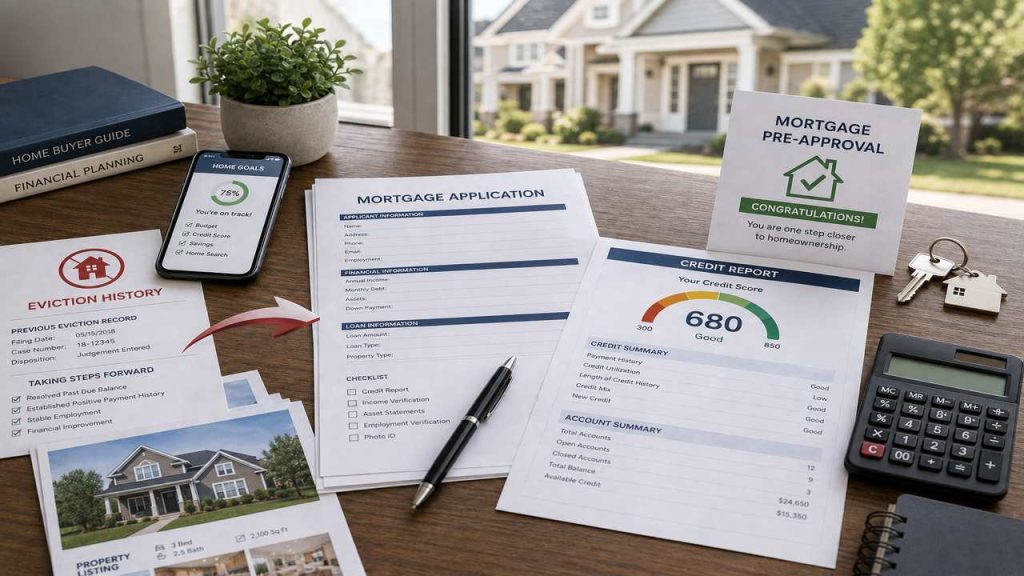
    Building Toward Pre-Approval With an Eviction in Your Past

    Before formally applying, getting pre-qualified or pre-approved with a few different lenders (each generating only a soft or limited inquiry in early conversations, though a full pre-approval typically does involve a hard inquiry) lets you understand where you stand and address any concerns before you’re deep into a home search and under time pressure from a purchase contract. Many mortgage brokers and loan officers, especially those experienced with FHA loans or first-time and credit-rebuilding buyers, are accustomed to discussing past financial difficulties candidly and can tell you early on what specifically, if anything, still needs to be resolved before you’d be in a strong position to apply formally.

    Frequently Asked Questions, Continued

    Does the type of eviction (nonpayment vs. lease violation) matter for mortgage purposes?

    Since mortgage underwriting generally isn’t evaluating the eviction case itself, the underlying reason for the eviction matters less than its financial aftermath. A nonpayment eviction is somewhat more likely to have left an unpaid debt behind (which does matter for underwriting), while a lease-violation eviction without an associated financial balance might leave less of a lasting credit-report footprint.

    If I’m self-employed, does an old eviction weigh more heavily given other income documentation requirements?

    Self-employed borrowers already face more extensive income documentation requirements regardless of eviction history, and an old, resolved eviction with a clean recent record generally doesn’t add meaningfully to that separate documentation burden, though it’s one more factor an underwriter reviewing a more complex file might ask about.

    Can I get pre-approved before fully resolving an old eviction-related debt?

    It depends on the amount and status of the debt and the specific loan program’s guidelines. Small, resolved, or older debts are less likely to be an issue; larger, active, unresolved collections or judgments are more likely to require resolution before final approval, even if initial pre-qualification conversations proceed without addressing it immediately.

    Does refinancing later remove any lingering effects of a past eviction on my mortgage terms?

    If your credit and financial profile have improved by the time you refinance, you’d generally qualify for whatever current rates and terms your improved profile supports, independent of your original mortgage’s terms. A past eviction, once resolved and aged, would carry less weight the further removed you are from it and the stronger your subsequent financial track record.

    A Broader Perspective: Millions of Homeowners Have Overcome Similar Setbacks

    It’s worth stepping back from the underwriting mechanics for a moment to note something reassuring: financial setbacks, including evictions, job loss, and periods of significant debt, are extremely common life experiences, and mortgage lending as an industry is fundamentally built around evaluating current, forward-looking creditworthiness rather than permanently penalizing past difficulty. The entire structure of credit reporting — with its defined seven-year windows, its more forgiving treatment of paid versus unpaid negative items, and its heavy weighting toward recent behavior — reflects an underlying philosophy that people’s financial situations change, often for the better, and that a past hardship shouldn’t permanently define someone’s access to credit and homeownership. Millions of current homeowners have a past eviction, bankruptcy, or period of serious financial difficulty somewhere in their history; what distinguishes those who go on to qualify for a mortgage is primarily the deliberate rebuilding work described throughout this guide, not some rare exception to how the system usually works.

    Frequently Asked Questions, Continued Further

    Should I disclose an old eviction proactively to my loan officer even if not directly asked?

    If it resulted in any collection, judgment, or credit report item, your loan officer will likely see it during the credit pull regardless, so proactively mentioning it and providing context upfront is generally viewed more favorably than having it come up cold during underwriting, since it demonstrates transparency and gives you the chance to frame the explanation on your own terms.

    Does a rental payment history service that reports positive rent payments help offset an old eviction for mortgage purposes?

    Yes, in a meaningful way — some mortgage programs, including certain Fannie Mae underwriting paths, now allow or even proactively look for reported positive rental payment history as a supplementary credit factor, particularly useful for buyers with thinner traditional credit files. Building this kind of positive, recent rental history is a direct, concrete counterbalance to an older negative rental event.

    How does a co-signed lease eviction (where I wasn’t the primary tenant) affect my own mortgage application?

    If your name appeared on the lease and the eviction case, it can affect your individual credit and record regardless of whether you were the “primary” tenant in practice. Whether it created a debt attributable specifically to you depends on how any judgment or collection was structured; this is worth clarifying directly by pulling your own credit report and understanding exactly what, if anything, is attached to your name specifically.

    The Bottom Line

    An eviction itself is rarely a direct dealbreaker for mortgage qualification, since most underwriting processes don’t specifically search for or ask about eviction history. What matters far more is the financial aftermath — any unpaid debt, credit score damage, or housing history gaps that resulted from it. Resolving outstanding balances, rebuilding your credit through consistent on-time payments, saving a solid down payment, and building a strong recent rental history are the concrete, controllable steps that determine whether and how favorably you’ll qualify, regardless of what happened in the past.

    Get a Credit Audit

    If you’re preparing to buy a home after an eviction and want to review your credit reports for collections, judgments, or other negative information that may affect mortgage qualification, you can request a credit audit or quote.


    Request a Credit Audit or Quote

  • Acceptable Reasons for Late Payments (And How to Use Them Effectively)

    Acceptable Reasons for Late Payments (And How to Use Them Effectively)

    Life happens, and sometimes a payment gets missed despite your best intentions. What many people don’t realize is that not all late payments are treated equally once you’re on the other side of it, trying to explain or recover from one. Creditors, lenders, and even the credit bureaus themselves have established, well-understood categories of circumstances that are more likely to result in leniency — whether that’s a waived fee, a removed late mark, or simply a more sympathetic conversation with a customer service representative.

    This guide covers what actually counts as an acceptable, persuasive reason for a late payment, how to present it effectively, and the specific tools (goodwill letters, hardship programs, formal disputes) available depending on your situation.

    Why “Acceptable Reasons” Matter More Than People Realize

    To be clear from the outset: creditors are never legally required to remove an accurate late payment mark just because you have a good explanation. Goodwill adjustments and hardship accommodations are discretionary, not guaranteed rights. That said, creditors do have real business incentives to retain good customers and avoid unnecessary disputes, and a well-presented, credible explanation meaningfully increases your odds of a favorable outcome compared to no explanation at all, or a poorly presented one.

    Understanding which explanations tend to land well — and which ones don’t — helps you communicate more effectively when you do need to ask for consideration.

    Reasons That Tend to Be Well-Received

    A Documented Medical Emergency

    Hospitalization, a serious injury, or a medical crisis affecting you or an immediate family member is one of the most consistently well-received explanations, particularly when it’s a one-time event on an account with an otherwise strong payment history. Creditors deal with this scenario often enough to have some institutional sympathy for it, and if you can provide documentation (a hospital discharge summary, for instance, though full medical details usually aren’t necessary — a brief confirmation of dates is often sufficient), it strengthens the request considerably.

    A Natural Disaster or Declared Emergency

    If you were affected by a hurricane, wildfire, flood, or another event covered by a federal or state disaster declaration, many creditors have specific, sometimes automatic, hardship accommodations for affected customers, including payment deferrals and late fee waivers, and in some cases these creditors proactively suppress credit bureau reporting for affected accounts during the crisis window. Check whether your creditor has a disaster relief program before assuming you need to negotiate this individually.

    A Job Loss or Significant Income Disruption

    Losing a job or experiencing a sudden, significant drop in income (such as being moved to reduced hours, or a business you own experiencing a temporary but serious downturn) is a commonly accepted hardship reason, especially if you can show it was resolved by the time you’re making the request — meaning you’re not simply explaining an ongoing inability to pay, but a specific past event that’s now behind you.

    A Bank or Payment Processing Error

    If a payment failed due to a documented error on the bank’s or creditor’s side — a processing glitch, an incorrectly declined transaction despite sufficient funds, a payment portal outage — this is one of the strongest possible explanations, since it isn’t really “your” late payment at all in a meaningful sense. Get whatever documentation you can (a bank statement showing the funds were available, a screenshot of an error message, a reference number from a customer service call made at the time) to support this kind of dispute.

    A Death in the Family

    The death of an immediate family member, particularly if you were managing their affairs or the event caused significant personal disruption, is generally treated with real sympathy by creditor representatives, most of whom have encountered this situation many times and have some latitude to extend grace in response to it.

    Military Deployment or Active Duty Complications

    Service members facing deployment-related payment disruptions have some additional legal protections under the Servicemembers Civil Relief Act (SCRA), which can include interest rate caps and other accommodations during active duty, separate from and in addition to any discretionary goodwill a creditor might extend.

    An Identity Theft or Fraud Situation

    If a late payment resulted from fraudulent activity on your account — an unauthorized user changing your payment information, or a fraudster intercepting statements — this isn’t really a “late payment reason” so much as a dispute of the underlying facts, and should be treated as a formal fraud dispute rather than a goodwill request, since you may have a right to have the item removed entirely rather than simply forgiven.

    Reasons That Tend to Land Poorly

    “I forgot.”

    While completely human and extremely common, this explanation on its own doesn’t give a creditor much reason to extend discretionary leniency, since it doesn’t point to a specific, non-recurring circumstance. If forgetting was tied to something more specific — a house move that disrupted your mail, a period of genuine chaos in your life — including that context helps, but “I simply forgot” alone is a weak standalone explanation.

    “I didn’t realize the bill was due.”

    Similar to the above — this can work better if there’s a specific reason you didn’t realize (a billing address error, a paperless statement that went to an old email address you no longer check), but as a general statement it doesn’t carry much persuasive weight on its own.

    Vague or unverifiable hardship claims.

    A general statement like “I was going through a hard time” without any specifics is far less effective than a concrete, briefly stated circumstance, even if you don’t want to share extensive personal detail. A middle ground — specific enough to be credible, general enough to preserve privacy — tends to work best.

    Blaming the creditor without documentation.

    Claiming a payment failed due to their system when you don’t have any supporting evidence is unlikely to be taken seriously and can come across as an attempt to avoid responsibility rather than a genuine dispute.

    A pattern of repeated “one-time” explanations.

    If you’ve already used a goodwill request for a similar reason in the recent past, a second nearly identical request is far less likely to be granted, since it starts to look like a pattern rather than a genuine one-off circumstance.

    How to Actually Request Leniency: The Goodwill Letter

    A goodwill letter (sometimes called a goodwill adjustment request) is a written request asking a creditor to remove a late payment mark from your credit report, typically sent after you’ve already brought the account current. It works best under these conditions: the account has an otherwise strong payment history, the late payment was a genuine one-time event, and you can state your reason concisely and credibly.

    A basic structure that works well:

    Opening

    Identify yourself and the account clearly, and state your request directly. “I’m writing to request a goodwill adjustment for a late payment reported on my account in [month/year].”

    Context

    Briefly explain what happened, in a sentence or two, without excessive detail. “This occurred during a period when I was hospitalized following [brief description], which disrupted my ability to manage bill payments during that specific window.”

    Your track record

    Point to your broader history with them. “Prior to this incident, and in the time since, I’ve maintained an on-time payment record on this account for [X years/months].”

    The specific ask

    State clearly what you’re requesting. “I’m respectfully requesting that this late payment be removed from my credit report as a one-time goodwill exception.”

    Close

    A polite, professional close, with your account information and contact details for follow-up.

    Send this through whatever channel the creditor has designated for such requests — sometimes a written letter to a specific address, sometimes an online secure message through your account portal, sometimes through a phone call followed by a written confirmation. Persistence and a professional tone matter more than any specific magic wording.

    What to Do If the Goodwill Request Is Denied

    Not every goodwill request succeeds, and that’s a normal outcome, not a sign you did something wrong in how you asked. If denied, a few options remain:

    • Try again after some additional time has passed, particularly if you continue building a clean payment record in the meantime, strengthening your case for a future request.
    • Try a different contact channel or representative. Since these requests are discretionary, different representatives sometimes have different levels of authority or willingness to grant them, and a second attempt through a different channel occasionally succeeds where a first attempt didn’t.
    • Focus on what you can control going forward. A single late payment’s impact on your score diminishes over time, particularly as it moves further into the past and gets outweighed by continued on-time payments. Building that ongoing track record is, in most cases, ultimately more impactful than any single goodwill request.
    • Consider whether the item is genuinely disputable rather than simply requiring goodwill. If you believe the late payment was reported in error — wrong date, wrong amount, or shouldn’t be attributed to you at all — that’s a formal dispute under the FCRA, a different (and, when applicable, more powerful) process than a discretionary goodwill request.

    Documenting Hardship the Right Way

    If your situation involves an ongoing hardship rather than a single past event, many creditors offer formal hardship programs — temporary reduced payments, interest rate reductions, or forbearance — that are different from, and often more useful than, a goodwill request for a single already-reported late payment. These programs typically require you to proactively contact the creditor before missing additional payments, provide some documentation of your circumstances (which varies by creditor and program), and agree to specific terms for a defined period. Enrolling in a formal hardship program, when available, is generally a stronger and more reliable path than hoping for individual goodwill exceptions on a series of ongoing late payments.

    A Note on Timing: Act Before, Not Just After

    Every strategy discussed so far becomes meaningfully more effective when you reach out to your creditor before missing a payment, rather than only after the fact. A phone call in advance explaining a temporary hardship and asking about accommodation options is taken more seriously, and often produces better outcomes (a deferred due date, a waived fee, a formal hardship enrollment) than an after-the-fact request for forgiveness once the late payment has already been reported. If you know a payment issue is coming, treat that advance notice as your best opportunity to prevent the problem entirely, rather than saving your explanation for after the damage is done.

    Frequently Asked Questions

    Do I need to provide actual documentation, or is a written explanation enough?

    It depends on the creditor and the specific circumstance. For less serious or lower-stakes requests, a credible written explanation alone is often sufficient. For more significant requests, or larger creditors with more formal processes, providing supporting documentation (even something as simple as a hospital admission date) strengthens your request considerably.

    How many goodwill letters can I send for the same account?

    There’s no fixed legal limit, but sending multiple requests for the same isolated incident rarely helps and can come across as excessive. If your first well-constructed request is denied, spacing out a follow-up by a meaningful amount of time, or waiting until you have additional positive history to point to, is a more effective approach than repeated immediate requests.

    Does a “reasonable explanation” ever legally require a creditor to remove a late payment?

    No, with one important exception: if the late payment was reported inaccurately in the first place (wrong date, wrong amount, fraud, or a documented creditor processing error), you have a legal right to dispute it under the FCRA, and if the creditor can’t verify its accuracy, it must be corrected or removed. A goodwill request, by contrast, is about accurate information the creditor chooses to forgive as a courtesy, and there’s no legal entitlement to that forgiveness.

    Should I mention that I’m applying for a mortgage soon as part of my explanation?

    This is generally not an effective inclusion, since it can come across as asking for a favor tied to your own upcoming benefit rather than a straightforward explanation of what happened, and creditors have heard this angle often enough that it doesn’t add persuasive weight.

    What if the late payment happened years ago — is it still worth requesting a goodwill adjustment?

    It’s still possible, though generally somewhat less likely to succeed the further removed it is from an active relationship-management conversation, since the creditor’s incentive to accommodate a currently active, valuable customer may feel less immediate for an old, resolved incident. That said, it doesn’t hurt to ask, particularly if the account is still open and you remain a customer in good standing.

    A Complete Sample Goodwill Letter

    Having a full template to adapt can make the process far less intimidating. Here’s a complete example you can modify for your own situation:

    [Your Name]
    [Your Address] [Date]
    
    [Creditor Name] [Creditor Address, or note if sending via secure online message]
    Re: Account Number [XXXX-XXXX-XXXX-XXXX]
    
    Dear [Creditor Name] Customer Service,
    
    I am writing to respectfully request a goodwill adjustment regarding a late payment reported on my account for [month/year]. I have been a customer with this account since [year], and prior to and following this single incident, I have maintained a consistent, on-time payment history.
    
    The late payment occurred during [brief, specific circumstance — e.g., “a period when I was hospitalized due to a sudden medical emergency,” or “a natural disaster that significantly disrupted my household for several weeks”]. This was an isolated, non-recurring event, and I brought the account current as soon as I was able to address it.
    
    I value my relationship with [Creditor Name] and would greatly appreciate your consideration in removing this late payment mark from my credit report as a one-time goodwill exception. I’m happy to provide any additional information that would be helpful in reviewing this request.
    
    Thank you for your time and consideration.
    
    Sincerely,
    [Your Name] [Account Number] [Phone Number / Email]

    Adjust the tone and specifics to match your actual situation and your natural voice — a letter that sounds authentically like you, rather than an overly formal template, tends to read more genuinely to the person reviewing it.

    Goodwill Request vs. Dispute vs. Hardship Program: Choosing the Right Tool

    These three tools solve different problems, and using the wrong one wastes time and can weaken your position. Here’s how to tell them apart:

    • Use a goodwill request when the late payment was reported accurately, you don’t dispute that it happened, but you have a sympathetic, specific circumstance and a generally strong payment history, and you’re asking the creditor for a discretionary courtesy.
    • Use a formal dispute when you believe the information itself is wrong — the date is incorrect, the payment was actually made on time and there’s a processing error, the account doesn’t belong to you, or it resulted from fraud. This is a legal right under the FCRA, not a request for a favor, and the creditor must investigate and correct verified inaccuracies.
    • Use a hardship program enrollment when you’re facing an ongoing, current difficulty (not a single past event) and need structural help — reduced payments, a paused due date, a lower interest rate — for a defined period going forward, rather than forgiveness for something that’s already happened and been resolved.

    Sometimes more than one applies simultaneously: for example, you might dispute an inaccurately dated late payment while also enrolling in a hardship program for genuinely ongoing difficulty affecting future payments. Being clear with yourself about which category your situation falls into helps you approach the right department and use the right language when you reach out.

    How Creditors Internally Evaluate These Requests

    Understanding roughly how a customer service representative or their internal system evaluates a goodwill request can help you present a stronger case. Most major creditors use some combination of the following factors, whether through a formal internal scoring system or a representative’s informal judgment:

    Account tenure and overall payment history

    A longtime customer with years of on-time payments carries far more weight than a newer account or one with a spottier history.

    Total account value and relationship

    Customers with higher balances, multiple products with the same institution, or a generally more valuable overall relationship sometimes receive more consideration, though this isn’t something you can control after the fact and isn’t guaranteed to matter at every institution.

    How the request is framed

    A concise, specific, professional request is easier for a representative to act on and justify internally than a vague or emotionally charged one, even when the underlying circumstance is equally sympathetic.

    Whether it’s a genuinely isolated incident

    Internal systems often flag whether an account has multiple late payments across its history, and a single isolated incident against an otherwise clean record is treated very differently than one in a string of several.

    acceptable-reasons-for-late-payments-under-100kb

    Frequently Asked Questions, Continued

    Is it worth calling instead of writing a letter?

    Both approaches have merit. A phone call allows for real-time conversation and can sometimes resolve things faster, but it’s harder to document precisely what was said. Many people find success with a hybrid approach: calling first to explain the situation and ask about the process, then following up in writing to formally document the request, which also gives the representative something concrete to escalate if they don’t have the authority to approve it themselves.

    Can a goodwill letter backfire and draw more attention to the late payment?

    This is very unlikely. The late payment is already visible to the creditor and on your credit report regardless of whether you request a goodwill adjustment — asking about it doesn’t create new negative information or draw attention that wasn’t already there.

    Do all three credit bureaus need to be contacted separately if a goodwill request is approved?

    No — when a creditor agrees to a goodwill removal, they typically update their reporting with all three bureaus they report to as part of their normal monthly reporting cycle, rather than requiring you to separately contact each bureau. It can take a billing cycle or two for the update to fully reflect across all your reports.

    What if my hardship is ongoing rather than a single past event — should I still send a goodwill letter?

    A goodwill letter is designed for a specific past incident, not an ongoing situation. If your hardship is continuing, focus on contacting the creditor about hardship program enrollment for your current and future payments first, and address any already-reported late payment through a goodwill request only once the immediate situation has stabilized.

    How This Plays Out Differently Across Loan Types

    Credit Cards

    Credit cards tend to have the most accessible and flexible goodwill processes, since card issuers manage huge numbers of these requests routinely and often have dedicated customer retention teams with some discretion built into their role.

    Mortgages

    Mortgages are more complex, since mortgage servicers often have less individual discretion than credit card issuers, and a late payment on a mortgage carries more weight in future underwriting (particularly for a future refinance or new home purchase). If you’re facing mortgage hardship, contacting your servicer proactively about a formal loss mitigation or forbearance program is generally more productive than a goodwill letter after the fact, and federally backed mortgages (FHA, VA, USDA, Fannie Mae, and Freddie Mac loans) have specific, more standardized hardship protections you may be entitled to.

    Auto Loans

    Auto loans vary significantly by lender — some, particularly captive finance arms of auto manufacturers, have structured hardship programs, while smaller or subprime auto lenders may have less flexibility and, in some cases, a lower threshold for pursuing repossession, making proactive communication especially important if you anticipate any payment difficulty.

    Student Loans

    Student loans (federal) have some of the most robust built-in hardship options of any loan type, including income-driven repayment plans, deferment, and forbearance, which are formal program enrollments rather than discretionary goodwill and are worth exploring first if you’re facing ongoing difficulty with federal student loan payments specifically. Private student loans function more like traditional personal loans, with hardship options varying by lender.

    Personal Loans and Lines of Credit

    Personal loans and lines of credit vary the most by individual lender, with online and fintech lenders sometimes having less flexible, more automated processes compared to traditional banks and credit unions, where a personal relationship or longer account history can matter more.

    When a Late Payment Reason Also Signals a Bigger Financial Issue Worth Addressing

    Sometimes the process of explaining a late payment reveals something worth addressing beyond the single incident itself. If you find yourself repeatedly constructing explanations for missed payments — even individually reasonable ones — it may be worth stepping back and looking at your overall budget, emergency savings, and bill payment system as a whole. A single unexpected expense causing a missed payment is a normal part of life; a pattern of near-misses or actual misses often points to a gap between income and obligations, insufficient emergency savings, or a bill-tracking system that isn’t working well for your specific life circumstances.

    Addressing that underlying structural issue — whether through a formal budgeting approach, automating more of your bill payments, or building a small emergency fund specifically earmarked for bill continuity — tends to be far more valuable long-term than getting skilled at writing effective goodwill letters after the fact.

    Frequently Asked Questions, Continued Further

    Does a co-signer’s late payment reason matter for goodwill purposes on a jointly held account?

    Yes — a goodwill request can reference the circumstances of either the primary borrower or a co-signer, since the late payment appears on both parties’ credit reports identically for a jointly held account. The explanation should focus on whatever circumstance actually caused the missed payment, regardless of which named party it happened to.

    If my late payment reason involves my employer (like a delayed paycheck), is that considered acceptable?

    This can be a reasonably persuasive explanation, particularly if it was a one-time, documented payroll issue rather than a chronic income timing problem. Providing a brief note or confirmation from your employer about the payroll delay, if available, can strengthen this type of request.

    Can I request a goodwill adjustment before the late payment is even reported, if I know it’s coming?

    It’s generally more effective to contact your creditor before a payment becomes 30 days late in the first place — at that point, you’re not asking for forgiveness of something already reported, but proactively seeking an accommodation (a short extension, a payment plan) that can prevent the negative reporting from happening at all, which is a stronger position to be in than any after-the-fact request.

    The Bottom Line

    Not every late payment explanation carries the same weight, and understanding which reasons genuinely tend to move creditors — documented medical emergencies, natural disasters, job loss, processing errors, and similar concrete, one-time circumstances — helps you present your situation as effectively as possible. Reach out proactively when you can, keep your explanation concise and credible, get anything agreed to in writing, and remember that a goodwill adjustment is always a discretionary courtesy rather than a guaranteed right, which makes a well-prepared, professional request all the more valuable when you do need to ask for one.

    Need Help Reviewing Your Credit?

    If you’re dealing with a late payment or want to review your credit reports for inaccurate or negative information, you can request a credit audit or quote.

    Request a Credit Audit or Quote

  • Does a 7-Day Late Payment Affect Your Credit Score?

    Does a 7-Day Late Payment Affect Your Credit Score?

    If you’ve missed a payment due date by a week, the anxious question that follows is almost always the same: is this going to show up on my credit report and tank my score? The short answer is reassuring for most people: a payment that’s late by seven days almost never gets reported to the credit bureaus at all, and in most cases won’t affect your credit score directly. But there’s real nuance here worth understanding, because “almost never” isn’t “never,” and the fees and other consequences of a short late payment are still worth taking seriously even when your score isn’t at risk.

    This guide explains exactly how late payment reporting works, why the 30-day mark is the real threshold that matters, what does happen during that first week even if your score is unaffected, and the specific situations where a short delay can still cause a problem.

    The 30-Day Rule: Why It’s the Number That Actually Matters

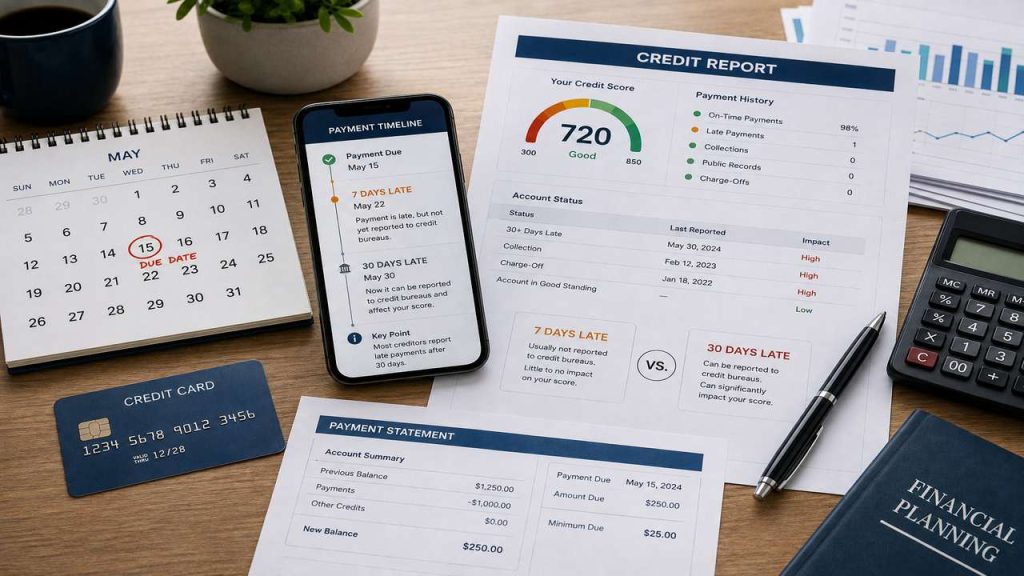
    Credit card companies, mortgage servicers, auto lenders, and virtually all other creditors that report to the major credit bureaus (Equifax, Experian, and TransUnion) follow a standard convention: a payment isn’t reported as “late” to the bureaus until it’s at least 30 days past the due date. This isn’t just an industry courtesy — it’s baked into how the reporting fields in the credit bureau data systems (following the Metro 2 reporting format used industry-wide) are structured, with late payment statuses defined in 30-day increments: 30, 60, 90, 120+ days past due.

    This means a payment made 7 days late, while genuinely late from your creditor’s internal perspective, falls well short of the threshold that triggers a report to the credit bureaus. In the vast majority of cases, a payment made within that first 30-day window — even if it’s technically past the stated due date — will not appear on your credit report as a late payment at all, and will have zero effect on your credit score.

    What Actually Happens During Those First 7 Days, Even If Your Score Is Safe

    Even though your score is very likely unaffected, a payment that’s a week late isn’t consequence-free. Here’s what’s actually happening behind the scenes with most creditors during that window:

    A late fee is typically charged, often in the range of $25 to $40 for credit cards, though this varies by issuer and is subject to certain regulatory caps under the CARD Act for credit cards specifically. Other loan types (mortgages, auto loans, personal loans) have their own late fee structures defined in your original loan agreement.

    Your interest rate could be affected on some credit cards. Many credit card agreements include an “penalty APR” clause that can be triggered once a payment is 60 days late (again, past the 30-day reporting threshold, but worth knowing the escalation path), so a single 7-day late payment alone typically won’t trigger this, but it’s a reminder of what’s at stake if a short delay turns into a longer one.

    Your grace period for new purchases may be affected. If you’re carrying a balance and miss your due date, even briefly, some card issuers will begin charging interest on new purchases immediately rather than extending the usual grace period, until you’ve paid your balance in full again.

    Internal account flags may be set. Even if nothing reaches the credit bureaus, your creditor’s internal system now shows a late payment on your account history with them specifically, which they can reference for their own purposes — such as evaluating you for a credit limit increase, a retention offer, or future account decisions — even though this internal note isn’t visible to other lenders or reflected in your credit score.

    When a 7-Day Late Payment CAN Still Cause a Problem

    While the 30-day reporting threshold covers the vast majority of situations, there are a few specific scenarios where a short delay can still matter:

    If it happens repeatedly

    A pattern of consistently paying a few days late, even if each individual instance stays under the 30-day reporting threshold, can eventually lead a creditor to take other actions — closing your account for risk management reasons, declining to extend a credit limit increase, or, in some subscription or utility contexts, canceling the service — even without any single late payment ever reaching your credit report.

    If your specific due date and the 30-day window overlap in an unusual way

    In rare cases involving certain loan servicers or unusual billing cycles, the exact timing of when a “30 days late” status gets calculated and reported can vary slightly. If you’re right at the edge of that window due to a payment processing delay, a mailed check, or a bank transfer that took longer than expected, it’s worth confirming directly with your creditor exactly when your account will be considered officially delinquent for reporting purposes, rather than assuming the standard convention applies exactly.

    If it’s a rent payment, and your landlord uses rent-reporting

    Some landlords and property managers use services that report rent payments to the credit bureaus, and these services don’t always follow the same 30-day convention as traditional lenders — some report payment timeliness on a more granular basis. If your lease specifies rent reporting, it’s worth checking the specific service’s policy on late payment reporting thresholds.

    If your account was already delinquent from a previous missed payment

    If a 7-day-late payment is actually the second consecutive missed payment on an account where the first one was never fully caught up, the cumulative delinquency could already be approaching or past the 30-day mark from the original missed due date, in which case the “7 days late” framing understates how far behind the account actually is.

    Certain non-traditional or specialty lenders may report differently

    Some smaller lenders, certain buy-now-pay-later services, or specialty financing products don’t always follow the standard Metro 2 reporting conventions used by major banks and credit unions, and some report payment status on a more frequent or different schedule. If you’re using a newer or less traditional lending product, it’s worth directly confirming their specific reporting practices rather than assuming the standard 30-day rule applies.

    What to Do If You’re About to Be a Few Days Late

    Contact your creditor before the due date if you already know you’ll be late. Many creditors, especially for a customer with an otherwise good payment history, will work with you — extending the due date slightly, waiving the late fee, or at minimum confirming exactly when a payment would need to post to avoid any issue.

    Make the payment as soon as possible, even if it’s already past the due date. The sooner you pay, the sooner any grace period effects or reporting risk resolve, and this also minimizes any additional late fees or interest that might accrue with additional delay.

    Set up autopay for at least the minimum payment going forward, even if you prefer to manually pay in full each month. This creates a safety net so that a forgotten manual payment doesn’t accidentally cross the 30-day threshold due to being overlooked for weeks rather than days.

    Double check whether your specific creditor’s grace period differs from the standard. While 30 days is the near-universal convention for credit bureau reporting, individual account-level grace periods (for late fees, interest, or promotional rate forfeiture) can be shorter, and it’s worth knowing your specific account’s terms, usually found in your cardholder agreement or loan documents.

    If You Discover a 7-Day-Late Payment Was Incorrectly Reported

    Although rare, reporting errors do happen — a creditor’s system glitch, a misapplied payment, or an administrative mistake can occasionally result in a payment being reported as late to the credit bureaus even when it was actually made within the standard grace window. If you find what you believe is an inaccurately reported late payment on your credit report:

    Gather your proof first

    Bank statements, payment confirmations, or screenshots showing the exact date and time your payment was made or posted are essential for a successful dispute.

    Contact the creditor directly before filing a formal dispute

    Many disputes can be resolved faster by calling the creditor’s customer service line directly, explaining the discrepancy, and asking them to correct their reporting to the bureaus — this is often faster than the formal bureau dispute process, though it doesn’t replace your right to file a formal dispute if the creditor doesn’t cooperate.

    File a formal dispute with the credit bureau if needed

    If the creditor won’t correct an error you can document, file a dispute directly with whichever bureau (or bureaus) shows the incorrect information, including your supporting documentation. Under the FCRA, the bureau is required to investigate, typically within 30 days.

    How to Think About the Distinction Between “Late” and “Reported Late”

    It’s worth internalizing this distinction clearly, since it resolves a lot of unnecessary anxiety: being “late” in the everyday sense — missing your stated due date by any amount of time — has real consequences (fees, interest, and potentially account-level flags with that specific creditor), but it is meaningfully different from being “reported late” to the credit bureaus, which is the thing that actually affects your credit score and appears on your report for other lenders to see. A short delay puts you in the first category without typically crossing into the second, but treating the two as identical leads either to unnecessary panic over a minor delay, or, in the opposite direction, to complacency about repeatedly paying just a few days late without recognizing the compounding fee costs and creditor-relationship risk that come with it, even absent any credit score impact.

    Frequently Asked Questions

    Will a 7-day late payment show up if I check my credit report immediately?

    No, assuming your creditor follows the standard 30-day reporting convention, a payment made within that window — even after the due date — won’t generate a late payment entry on your report at all, regardless of when you check.

    Does this apply to mortgages the same way it applies to credit cards?

    Generally yes, mortgage servicers also follow the standard 30-day reporting convention for credit bureau purposes, though mortgage late fees and specific account-level consequences (which can include escalating notices well before the 30-day mark) are governed by your specific loan agreement and can differ from credit card terms.

    If I’m late by 7 days every single month, will that eventually catch up with my score?

    Not through credit bureau reporting directly, as long as each individual instance stays under 30 days. However, a consistent pattern like this carries real risk of other consequences — a creditor closing your account, declining future credit limit increases, or in some cases reporting the account differently if they determine the pattern represents a heightened risk, so it’s worth addressing the underlying cause of consistently paying late even if your score isn’t directly affected yet.

    What’s the safest number of days to consider a hard deadline?

    Given the standard is 30 days, but grace periods, fees, and account-specific terms all vary, a reasonable personal rule of thumb is to treat any missed due date as requiring payment within a few days at most, both to avoid unnecessary fees and interest, and to build in a safety margin against any variation in how a specific creditor calculates and reports delinquency.

    Can a 7-day late payment affect a mortgage application I’m currently in the middle of?

    If it doesn’t get reported to the credit bureaus, it generally won’t show up on a credit report pulled during underwriting. However, some mortgage lenders request recent bank statements as part of underwriting, and a pattern of late payments or overdrafts visible in those statements (separate from your credit report) could still raise questions during the underwriting process, even without a formal late payment report.

    How Different Types of Accounts Handle a Short Delay

    Account type Credit bureau reporting threshold Late fee risk in first 7 days Other early consequences
    Credit card 30 days (standard) High — often charged after just 1 day late Grace period on new purchases may be lost
    Mortgage 30 days (standard) Varies by servicer, often after a short window (commonly 10-15 days per loan terms) Servicer may send early notices well before 30 days
    Auto loan 30 days (standard) Varies by lender, sometimes after just a few days Some loans allow repossession proceedings to begin surprisingly early per contract terms, even without credit reporting yet
    Personal loan 30 days (standard) Varies by lender agreement Some online lenders use non-standard reporting schedules — worth confirming directly
    Rent (if reported) Varies by rent-reporting service Governed by lease terms and state/local law Some services report more granularly than the standard 30-day convention
    Student loans (federal) 90 days for federal loans specifically Grace period varies by loan type Federal loans have a notably longer reporting grace period than most other credit types

    This table highlights something important: federal student loans are a notable exception to the general 30-day rule, with a longer 90-day window before being reported as delinquent to the credit bureaus. This doesn’t mean a short delay on a federal student loan is risk-free — interest continues accruing and other consequences can apply — but it does mean the credit-reporting risk specifically is even more limited than with most other account types.

    Understanding What “Day One” of Lateness Actually Means

    A subtle point that trips people up: your due date itself is not a late day. If your payment is due on the 15th, a payment made on the 15th is on time, and a payment made on the 16th is one day late — not the “first day of your grace period” in some interpretations, but genuinely one day past due from your creditor’s perspective, even though (as covered above) it won’t be reported to the credit bureaus until it reaches 30 days past that due date. Some people mistakenly believe there’s an automatic few-day cushion built into every due date; while some individual account terms do include an explicit grace period for fees specifically (common with mortgages, for example, which often have a 10-to-15-day grace period before a late fee is charged, separate from the 30-day credit bureau threshold), this isn’t universal, and it’s worth checking your specific account terms rather than assuming a cushion exists.

    A Practical Autopay Setup Guide to Prevent This Entirely

    Given how much of the risk here comes down to timing rather than an inability to pay, setting up a reliable autopay system is one of the highest-value, lowest-effort things you can do. A few specifics worth getting right:

    • Choose “pay in full” rather than “minimum payment only” if your cash flow reliably supports it. This avoids carrying a balance and paying interest, while still providing the safety net against a missed due date.
    • If your income is variable, consider autopay for the minimum payment only, with manual additional payments when you have extra funds. This ensures you never technically miss a due date (avoiding the fee and reporting risk entirely) while giving you flexibility on the rest.
    • Verify your payment method on file is current, especially before it expires. An expired card or a closed bank account linked to autopay is one of the most common reasons a payment silently fails despite autopay being “set up,” precisely the kind of surprise that can turn into an unintentional multi-week delay if you’re not checking your statements regularly.
    • Set a backup calendar reminder a few days before each due date anyway. Autopay failures do happen — due to a bank processing delay, an issuer’s system error, or an account status change — and a simple manual check a few days early catches this before it becomes a genuine problem.
    • Consider aligning due dates across multiple accounts to a schedule that matches your pay cycle. Many creditors will let you request a specific due date; aligning several bills to fall shortly after payday reduces the chance of a payment failing due to insufficient funds at the moment it’s scheduled.

    What a Short Late Payment Does to Your Relationship With a Creditor, Beyond the Score

    Even when your credit score is completely unaffected, it’s worth remembering that your creditor’s internal records are a separate thing entirely, and they do track your payment behavior over time for their own purposes. A card issuer deciding whether to offer you a credit limit increase, a lower interest rate, or a retention bonus when you consider closing an account will often reference their own internal history with you — which does include every late payment, regardless of whether it was ever reported to the bureaus. This is a good reason to treat on-time payment as a broader habit worth maintaining consistently, not simply a box to check only when the credit-bureau reporting threshold is at stake.

    does-a-7-day-late-payment-affect-credit-score-under-100kb

    Frequently Asked Questions, Continued

    Does a 7-day late payment affect my ability to get a new credit card while it’s outstanding?

    If it isn’t reported to the credit bureaus (the typical case), it won’t appear on the credit report a new card issuer would review, so it generally wouldn’t affect a new application. If the payment is still outstanding at the time you apply, though, it’s better practice to resolve it first regardless, both for the late fee and to keep your account in good standing with your existing creditor.

    If I pay 7 days late but the creditor charges a late fee, does that fee itself ever get reported to credit bureaus?

    No, fees themselves aren’t reported as a line item to credit bureaus. What matters for reporting purposes is your payment status (on time vs. a specific number of days past due), not fees assessed on the account.

    Can a creditor choose to report a late payment sooner than 30 days if they want to?

    While the 30-day convention is a strong industry norm tied to the standardized Metro 2 reporting format, technically nothing legally requires every creditor to use exactly that threshold. In practice, virtually all major banks, credit unions, and mainstream lenders follow it, but it’s worth being aware that a small number of alternative or non-traditional lenders could theoretically report differently, which is why checking your specific creditor’s stated policy is a reasonable extra precaution if you’re ever genuinely unsure.

    Is there a difference between “late” and “past due” on my account statement?

    These terms are often used interchangeably by creditors and generally mean the same thing: a payment hasn’t been received by the stated due date. Neither term on its own indicates whether the account has crossed the 30-day credit-bureau reporting threshold — you’d need to check the specific number of days past due to know that.

    Why This Reporting Standard Exists in the First Place

    It’s worth understanding the reasoning behind the 30-day convention, since it isn’t arbitrary. Credit reporting exists to help lenders assess long-term repayment reliability, not to penalize every minor timing slip a person makes in daily financial life. Bills get missed for all kinds of ordinary reasons — a bank holiday delaying a transfer, a forgotten due date during a busy week, a temporary mail delay for a paper check — that have little to do with someone’s actual ability or willingness to repay debt. A reporting standard that flagged every single-day delay would generate enormous noise in the credit system and would punish minor administrative slip-ups as harshly as genuine payment difficulty, making credit scores far less useful as a signal of real risk.

    The 30-day threshold represents an industry-wide judgment that a delay of less than a month is common enough, and generally recoverable enough, that it doesn’t yet indicate meaningful credit risk on its own. Once a payment crosses that threshold, it starts to represent a more genuine signal — the person either can’t currently pay, is actively avoiding payment, or has lost track of the obligation entirely — which is the kind of information a future lender genuinely benefits from knowing about.

    A Note on Buy Now, Pay Later Services

    Buy Now, Pay Later (BNPL) services like Klarna, Afterpay, and Affirm have grown enormously in recent years, and their credit reporting practices are still evolving and vary significantly between providers. Some BNPL providers don’t report to the major credit bureaus at all under normal circumstances, only doing so if an account becomes seriously delinquent or is sent to collections. Others have begun reporting more routinely, including for on-time payments, as the industry moves toward more standardized practices. If you use these services regularly, it’s worth checking the specific provider’s current reporting policy directly, since the general 30-day guidance for traditional credit doesn’t necessarily map cleanly onto every BNPL provider’s practices, and this is an area where policies have been changing faster than most other parts of consumer credit reporting.

    Frequently Asked Questions, Continued Further

    Does my bank see a late payment on my checking account the same way a credit late payment works?

    No — an overdraft or low balance on a checking account is an entirely separate matter from credit reporting and doesn’t follow the same 30-day convention. Overdrafts are typically tracked through a different system (sometimes ChexSystems, used for banking history rather than credit history) and can affect your ability to open new bank accounts, separate from your credit score.

    If I’m 7 days late on one card but current on all my others, does that isolated instance affect my overall creditworthiness in any lender’s eyes?

    Since it’s very unlikely to be reported to the credit bureaus, it generally won’t be visible to other lenders reviewing your credit report. The one exception is if that specific creditor is later asked directly by another party (which is uncommon) or if you disclose it yourself during an application process that asks about your payment history in detail.

    Can I ask my creditor to simply not report this if it does end up crossing 30 days?

    In rare cases, particularly for a longtime customer with an excellent payment history and a clearly explainable one-time circumstance (a documented medical emergency, for example), some creditors will agree to a “goodwill” non-reporting or later removal of an isolated late payment, though this is entirely at their discretion and not something you’re legally entitled to request.

    The Bottom Line

    A payment that’s seven days late almost always falls safely under the 30-day threshold that triggers credit bureau reporting, meaning your credit score is very unlikely to be directly affected. That said, late fees, potential interest rate consequences, and the risk of an escalating pattern with your creditor are all real considerations even when your score is untouched. The safest approach is simple: treat every due date as a genuine deadline, set up autopay as a backstop, and if you do end up a few days late, pay as soon as possible and don’t hesitate to contact your creditor proactively if you know a delay is coming.

    Get a Credit Audit

    If you’re dealing with a late payment or want to review your credit reports for inaccurate or negative information, you can request a credit audit or quote.
    Request a Credit Audit or Quote

  • Why Did My Credit Score Drop 20 Points? Common Causes Explained

    Why Did My Credit Score Drop 20 Points? Common Causes Explained

    Opening a credit monitoring app and seeing your score has dropped by 20 points, seemingly out of nowhere, is unsettling. Twenty points is enough to notice, enough to potentially move you into a different lending tier, and often confusing enough that you can’t immediately connect it to anything you remember doing. The good news is that a 20-point drop is almost always explainable once you know where to look, and it’s rarely the sign of a catastrophic problem.

    This guide walks through the most common causes of a moderate score drop like this, how to identify which one applies to you, and what to do about it.

    Start With Your Credit Report, Not Just Your Score

    Your score is a single number, but it’s calculated from the detailed information in your credit report. Before guessing at causes, pull your current reports from all three bureaus (free at AnnualCreditReport.com) and compare them to what you remember from before the drop. Most monitoring apps and services also show you the specific factors contributing to a recent score change, sometimes explicitly, which is the fastest way to identify the cause without guesswork.

    The Most Common Causes of a 20-Point Drop

    A New Hard Inquiry

    Applying for any new credit — a credit card, an auto loan, a personal loan, sometimes even a new phone plan or apartment application that includes a credit check — generates a “hard inquiry” on your report. A single hard inquiry typically causes a drop of somewhere in the range of 5 to 10 points, though it can be more for someone with a shorter credit history or fewer total accounts, where each new data point carries relatively more weight.

    If you recently applied for anything requiring a credit check, this is the first and most likely explanation to check. Multiple applications close together compound this effect, though many scoring models group similar inquiries (like rate shopping for a mortgage or auto loan within a short window) as a single inquiry for scoring purposes.

    A Increase in Credit Utilization

    If your reported balance on one or more cards went up relative to your limit — even due to normal spending rather than a new charge-off or missed payment — your utilization ratio increases, and this is one of the more common drivers of a moderate score change. Remember that your card issuer reports your balance on your statement closing date, not in real time, so a temporarily higher balance from a large purchase, holiday spending, or a big one-time expense can show up on your report even if you plan to pay it off in full before interest accrues.

    A jump from, say, 10% utilization to 40% utilization on a card can easily account for a drop in this range, especially if that card carries a meaningful portion of your total available credit.

    A Late Payment

    Even a single payment reported 30 days late can cause a drop in this range or larger, particularly if your credit was otherwise in very good standing beforehand (counterintuitively, a strong existing credit history tends to make each new negative mark relatively more impactful, since the scoring model has less “room” to reassess a previously excellent payment record). Double-check your accounts for any payment that might have been processed late, even by a day or two past the grace period, due to a forgotten autopay, an expired card on file, or a bank holiday delaying a transfer.

    An Account Was Closed

    Closing a credit card — whether you did it deliberately or the issuer closed it for inactivity — can affect your score in two ways: it reduces your total available credit, which raises your overall utilization ratio even if your spending hasn’t changed, and if it was one of your older accounts, it can eventually reduce your average account age once it fully drops off your report (closed accounts in good standing typically remain on your report and continue counting toward your history for up to ten years, but they’ll eventually age out, and in the meantime the loss of available credit is the more immediate effect).

    A Change in Your Credit Mix

    If you paid off and closed your only installment loan (like a car loan reaching its final payment), your remaining credit mix skews more heavily toward revolving credit alone, which can have a modest negative effect on the “credit mix” component of your score, even though paying off a loan is, in every other sense, a positive financial event.

    An Authorized User Account Changed

    If you were an authorized user on someone else’s credit card and that person’s account status changed — they missed a payment, their utilization spiked, or they closed the card — it can affect your score too, since authorized-user accounts contribute to your file the same way your own accounts do. This is easy to overlook because the change wasn’t something you did yourself.

    A New Collection or Public Record

    A medical bill, unpaid parking ticket sent to collections, gym membership dispute, or library fine (yes, some of these genuinely do get reported) that you may not have even known about can appear as a new negative item and cause a noticeable drop. These are often small-dollar items that catch people completely off guard because they never received a bill or didn’t realize an old dispute had escalated.

    Normal Scoring Model Fluctuation

    Sometimes a score genuinely shifts by a small amount for reasons that aren’t tied to any single dramatic event — simply the natural month-to-month recalculation as your account ages, balances shift slightly, and the relative weighting of different factors in the algorithm responds to the overall combination of your file. This is less common as an explanation for a full 20-point move (which usually does have an identifiable cause) but can be a contributing factor alongside one of the more specific reasons above.

    How to Diagnose Your Specific Cause

    Compare report dates. Pull the date of your last known good score and the date of the drop, then look specifically at what changed on your credit report in that window: new accounts, new inquiries, updated balances, or new negative marks.

    Check each account’s reported balance against what you remember. A surprising number of moderate score drops trace back to one card’s balance being higher than expected on its specific statement date, even if your overall spending habits haven’t meaningfully changed.

    Look for anything genuinely unfamiliar. A new inquiry you don’t recognize, a new account you didn’t open, or a collection for a debt you’ve never heard of could indicate identity theft or an error, both of which require a formal dispute rather than simply waiting for the score to recover on its own.

    Check whether an authorized-user account changed. If applicable, ask the primary cardholder whether anything changed on their end recently.

    What to Do Once You’ve Identified the Cause

    If it’s a new hard inquiry: No action needed beyond patience. The impact fades within a few months and disappears from scoring calculations entirely after 12 months, even though the inquiry itself remains visible on your report for 24 months.

    If it’s increased utilization from normal spending: Pay down the balance, and consider paying before your statement closing date going forward if you want tighter control over what gets reported each month. The score typically recovers within one to two billing cycles once the balance is reduced.

    If it’s a late payment: Bring the account current immediately if it isn’t already, and consider calling the creditor to request a “goodwill adjustment” — some creditors, especially for a first-time late payment on an account with an otherwise clean history, will agree to remove the late mark as a customer service gesture, though this isn’t guaranteed and isn’t a right you can demand.

    If it’s a closed account: There’s not much to reverse after the fact, but going forward, consider keeping no-annual-fee cards open even if unused, specifically to preserve your available credit and account age.

    If it’s an unfamiliar item that shouldn’t be there: File a dispute with the credit bureau reporting it, and if it appears to be identity theft, place a fraud alert or credit freeze and file a report with the FTC at IdentityTheft.gov.

    why-did-my-credit-score-drop-20-points-under-100kb

    When a 20-Point Drop Is Actually Nothing to Worry About

    It’s worth putting this in perspective: a 20-point fluctuation, especially one tied to routine causes like a single hard inquiry or a temporarily elevated statement balance, is a completely normal part of how credit scores work, not a sign your credit is in trouble. Scores move up and down in small to moderate increments constantly as your file updates each month. The number that matters most for actual lending decisions is your score trend over months and years, not any single month’s fluctuation, and most lenders also look at the underlying report details, not just the headline number, when evaluating an application.

    When It’s Worth Digging Deeper

    If you’ve ruled out all the common explanations above and genuinely can’t identify a cause, or if the drop is part of a larger, ongoing decline rather than an isolated one-time event, it’s worth a closer, line-by-line review of your full credit report from all three bureaus, since scores can sometimes differ between bureaus if only one of them received updated (or inaccurate) information. Persistent unexplained drops, especially across multiple months, are also a reasonable trigger to consider a credit freeze or monitoring service if you haven’t already, simply as a precaution against undetected fraud.

    Frequently Asked Questions

    How long does it take for a score to recover after a 20-point drop from a hard inquiry?

    Typically within a few months, as the inquiry’s impact diminishes with time even before it fully drops off your report at 24 months and stops counting toward scoring entirely after 12 months.

    Can checking my own credit score cause a 20-point drop?

    No. Checking your own score or report is always a soft inquiry and never affects your score, regardless of how often you check.

    Why did my score drop even though I didn’t do anything unusual that month?

    The most common overlooked cause is a higher-than-usual statement balance being reported on a normal billing cycle, an authorized-user account changing, or a small collection account you weren’t aware of. A careful review of your full report, not just the score, usually reveals the specific cause.

    Is a 20-point drop the same across all three bureaus?

    Not necessarily. Since Equifax, Experian, and TransUnion don’t always receive identical information from every creditor at the same time, your score can differ between them, and a drop reported by one monitoring service pulling from a single bureau might not exactly match what you’d see from a different service.

    Should I be worried about a 20-point drop before applying for a mortgage?

    It’s worth understanding the cause before applying, since even a modest score difference can occasionally shift you into a different mortgage rate tier depending on where you fall relative to lender thresholds. If the cause is a routine hard inquiry or a temporarily elevated balance, allowing a couple of months for it to settle before applying, if your timeline allows, is a reasonable precaution.

    Why FICO and VantageScore Can React Differently to the Same Event

    If you’re tracking your score through more than one app or service, you may notice they don’t always move by the same amount, or even in the same direction, after the same event. This is because FICO and VantageScore — the two major scoring model families — weight certain factors slightly differently, and even different versions within each family (FICO 8 versus FICO 9 versus FICO 10, for example) handle specific situations differently.

    A notable example: older FICO models treat all collection accounts similarly regardless of amount, while newer FICO models and VantageScore 3.0/4.0 ignore paid collections and treat small-dollar or medical collections more leniently. Similarly, how heavily a single new hard inquiry is weighted can vary slightly between model versions and depending on the overall thickness of your file. This is why two people can experience the exact same event — say, opening one new credit card — and see meaningfully different point drops, and why your own score might show a 12-point drop on one app and a 25-point drop on another for what appears to be the same underlying change.

    Rather than treating any single app’s number as the absolute truth, it’s more useful to watch the general trend across your monitoring tools and to understand the underlying reason for a change, since the reason matters more than the exact point value assigned to it by any one model.

    A Month-by-Month Example Scenario

    To illustrate how a 20-point drop can quietly build from more than one small factor at once, consider this composite (illustrative, not calculated from any specific real scoring formula) scenario:

    Early in the month

    You apply for a new rewards credit card to take advantage of a sign-up bonus. This generates a hard inquiry, contributing an estimated 6-point dip.

    Mid-month

    You put a larger-than-usual purchase — a plane ticket for an upcoming trip — on an existing card, planning to pay it off in full when the bill arrives. Your statement closes before you’ve paid it down, reporting a utilization jump on that card from around 8% to 35%, contributing an estimated 10-point dip.

    Later in the month

    A subscription service you forgot about attempts to charge an expired card on file, the payment fails, and after a couple of follow-up attempts, it gets reported 30 days past due before you notice and resolve it, contributing an estimated additional dip on top of the other two factors.

    Individually, none of these would necessarily be alarming, and none represents a change in your actual overall financial reliability. Together, though, they can combine into a drop in the 20-point range within a single reporting cycle, which is why a moderate drop often has more than one small contributing cause rather than a single dramatic one.

    Things That Do NOT Directly Affect Your Score (Common Misconceptions)

    Your income.

    Income isn’t a factor in credit scoring at all — it’s not reported to the credit bureaus by employers or otherwise, though lenders may separately ask for it during a loan application.

    Your savings account balance.

    Bank account balances aren’t part of your credit file or score calculation.

    Checking your own credit report or score.

    As mentioned above, this is always a soft inquiry with zero score impact, no matter how often you do it.

    Marital status or a spouse’s credit history, unless you have joint accounts together or you cosign for something specific.

    Getting married doesn’t merge two individual credit files into one.

    Being denied credit.

    The denial itself doesn’t affect your score; only the hard inquiry generated by the application does, and that impact is small and temporary regardless of the outcome of the application.

    Age, employment history, or where you live.

    None of these are part of the scoring formula, though some lenders do independently consider factors like employment and income during underwriting, separate from the credit score itself.

    A Prevention Checklist to Avoid Future Unexplained Drops

    1. Set up balance alerts with your card issuer so you’re notified if a balance crosses a threshold you set, helping you catch a utilization spike before your statement closes.
    2. Keep at least one payment method’s expiration date updated everywhere it’s saved, particularly for recurring subscriptions, to avoid an accidental missed payment from an expired card.
    3. Space out credit applications rather than applying for several products in a short window, unless you’re specifically rate-shopping for a mortgage or auto loan, where similar inquiries within a short period are often grouped together by scoring models.
    4. Review your full credit report, not just your score, every few months, since the report shows the specific line items that drive any score change, while the score alone doesn’t explain itself.
    5. Set a calendar reminder to check accounts you rarely use, such as a card you keep open but don’t actively use, to catch any unexpected activity, fees, or issuer-initiated changes.
    6. Consider a credit freeze if you’re not planning to apply for new credit soon, which prevents new accounts from being opened in your name without your explicit unlocking of the freeze first.

    Frequently Asked Questions, Continued

    Can a credit limit decrease from my card issuer cause a score drop even if I didn’t do anything?

    Yes. If your issuer reduces your credit limit — sometimes done unilaterally due to their own risk assessment, unrelated to anything you did — your utilization ratio increases immediately even with an unchanged balance, which can cause a moderate score drop you had no direct control over.

    Does paying my credit card multiple times a month help prevent these drops?

    It can help, particularly if you make a payment before your statement closing date to ensure a lower balance gets reported that cycle, rather than waiting until the due date, by which point the higher balance may have already been reported.

    Why did my score drop even though my report shows no new negative items?

    Sometimes a shift in utilization or a hard inquiry is the entire explanation and doesn’t require any “negative item” in the traditional sense — an inquiry and a balance increase are both neutral factual changes, not derogatory marks, but they still influence the score calculation.

    Is there a way to see exactly which factor caused my score change?

    Many free credit monitoring services and card issuer apps provide a breakdown of the top factors influencing your current score, and some explicitly flag month-over-month changes with a stated reason. This is usually the fastest way to pinpoint a cause without manually comparing full reports.

    How Lenders Interpret a Recent Score Drop

    It’s natural to worry that a lender reviewing your application will see a recent drop and treat it as a red flag on its own. In practice, most lenders only see your score at the moment they pull it — they generally don’t see a graph of your recent history the way you might in a monitoring app, unless they specifically request a more detailed report. What they do see, if they review your full report rather than just the score, is the same underlying detail you’d see: a new inquiry, an elevated balance, or a payment status.

    A single new inquiry from a recent application is a completely normal and expected part of a credit file and isn’t treated as suspicious on its own — lenders extend credit to millions of people who have applied for other things recently. An elevated utilization ratio is more likely to be weighed as a genuine risk factor if you’re applying for new credit at the same time, since it can suggest reliance on available credit, which is worth being mindful of if you’re planning a major application in the near future. A late payment is the one factor genuinely worth proactively addressing (through a goodwill letter, or simply time and a clean record afterward) before applying for something significant, since it’s viewed as a more direct signal of payment reliability.

    Hard Inquiries vs. Soft Inquiries: A Closer Look

    Because hard inquiries come up so often as an explanation for a moderate score drop, it’s worth understanding exactly what triggers one versus what doesn’t, since the distinction isn’t always obvious from a consumer’s perspective.

    Triggers a hard inquiry

    Applying for a credit card, auto loan, mortgage, personal loan, a new cell phone plan requiring a credit check, and some rental applications and utility setups that specifically pull a full credit report as part of the approval decision.

    Does not trigger a hard inquiry (soft inquiry only)

    Checking your own score through any app or service, a credit card issuer checking your file to offer you a pre-approved offer, an existing lender periodically reviewing your account (called an “account review,” common practice for credit card issuers), and most employment background checks (which typically use a modified version of your report that doesn’t include your score and is coded as a soft inquiry).

    If you’re ever unsure whether a specific application will trigger a hard or soft inquiry, it’s reasonable to ask directly before proceeding, particularly for financial products where multiple similar applications close together could compound the score impact more than a single one would.

    Building a Buffer So Small Drops Don’t Feel Alarming

    Part of what makes a 20-point drop feel unsettling is not knowing whether it’s routine or a sign of a bigger problem. A practical way to build confidence here is to establish a personal baseline: check your score and full report at the same time each month for a few months, noting the typical range your score moves within during ordinary financial activity. Once you have that baseline, a routine fluctuation becomes recognizable as exactly that, rather than a surprise each time it happens, and a genuinely unusual move (a much larger drop, or one with no identifiable cause after reviewing your full report) becomes easier to distinguish and take seriously when it does occur.

    Frequently Asked Questions, Continued Further

    Will my score automatically bounce back to where it was before?

    In most cases, yes, once the underlying cause resolves — the inquiry ages out of scoring relevance, the balance is paid down, or enough time passes after a late payment with continued on-time payments afterward. There’s no fixed guaranteed timeline, since it depends on the specific cause and your overall file, but routine causes typically resolve within a few months.

    Does disputing an item on my credit report cause a temporary score drop while it’s under investigation?

    No. Filing a dispute itself doesn’t lower your score. If the dispute results in a negative item being corrected or removed, your score can only stay the same or improve as a result, never worsen from the dispute process itself.

    Can two people with a joint credit card see different score impacts from the same activity?

    Generally no, for the joint account itself — both cardholders’ reports reflect the same account status and balance information identically, since it’s a shared account, not an authorized-user arrangement. However, each person’s overall score can still differ due to their other, separate accounts and credit history.

    I paid my card in full and on time, so why did my utilization still show up higher this month?

    This traces back to the statement closing date issue covered earlier — your issuer reports the balance as of a fixed date each cycle, which may not be zero even if you always pay in full, simply because you had a balance on that specific day before your payment posted.

    The Bottom Line

    A 20-point credit score drop almost always has an identifiable, usually unremarkable cause: a new hard inquiry, a higher reported balance, a late payment, a closed account, or a change tied to an authorized-user account. Pulling your full credit report rather than fixating on the score alone is the fastest way to find the specific reason, and most causes at this scale resolve themselves naturally within a few months of continued responsible credit management.

    Need Help Reviewing Your Credit?

    If you’re dealing with an unexplained credit score drop or want to identify inaccurate or negative information on your credit reports, you can request a credit audit to review your situation.

    Request a Credit Audit or Quote

  • Charge-Off vs. Collection: What’s the Difference and Why It Matters

    Charge-Off vs. Collection: What’s the Difference and Why It Matters

    If you’ve pulled your credit report and seen both a “charge-off” and a “collection” listed — sometimes for what looks like the same debt — you’re not imagining things, and you’re not alone in finding it confusing. These two terms describe different stages in the life of an unpaid debt, and understanding the difference matters because it affects how you negotiate, what your rights are at each stage, and how the entry impacts your credit score.

    This guide breaks down exactly what each term means, how one often turns into the other, and what to actually do if you’re facing either one.

    What a Charge-Off Actually Means

    A charge-off is an accounting decision made by the original creditor — the bank, credit card company, or lender you originally owed money to. When an account becomes seriously delinquent, typically after 180 days (six months) of nonpayment for most revolving credit like credit cards, the creditor’s internal accounting rules (often guided by federal banking regulations) require them to write the debt off as a loss on their books.

    Here’s the part that surprises most people: a charge-off does not mean the debt is forgiven or that you no longer owe it. It’s purely an internal bookkeeping classification. You still legally owe the full balance. What changes is how the creditor treats the account internally — it moves from being tracked as a receivable they expect to collect, to a loss they’ve already absorbed for accounting and tax purposes.

    Once an account is charged off, the original creditor typically does one of three things: continues trying to collect the debt directly (sometimes through an internal collections department), sells the debt to a third-party debt collector for a fraction of its value, or, less commonly, simply stops pursuing it (though this doesn’t erase the fact that it’s still technically owed).

    What a Collection Actually Means

    A “collection” refers to an account that has been placed with — or sold to — a third-party debt collection agency, or in some cases moved to a creditor’s own internal collections department. This can happen with many types of debt, not just charged-off credit cards: unpaid medical bills, utility bills, gym memberships, and personal loans can all end up in collections without necessarily going through a formal charge-off process first, particularly for debts that weren’t originally extended as revolving credit.

    When a debt moves to collections, a new entity — the collection agency — now has the legal right to attempt to collect it, and depending on the arrangement, either on behalf of the original creditor (for a contingency fee) or as the new owner of the debt (having purchased it outright, usually for a small percentage of the original balance).

    This is why you’ll sometimes see two separate negative entries on your credit report for what feels like a single unpaid debt: one from the original creditor showing the account as “charged off,” and a second, separate entry from the collection agency showing the same debt as a new “collection account.” Both can appear and both can affect your score, even though they represent the same underlying debt at different stages.

    How the Two Terms Relate to Each Other

    Think of it as a sequence rather than two unrelated categories:

    1. Step one: You fall behind on payments to the original creditor.
    2. Step two: After enough time passes (commonly 180 days for credit cards, though it varies by debt type and creditor), the original creditor charges off the account internally and reports it to the credit bureaus as a charge-off.
    3. Step three: The original creditor either keeps trying to collect it themselves, or — far more commonly — sells or assigns the debt to a third-party collection agency.
    4. Step four: If sold or assigned, the collection agency may report the debt to the credit bureaus as a new collection account, separate from the original charge-off entry.

    Not every collection account started as a charge-off (medical and utility debts, for example, often go to collections without ever being formally “charged off” in the credit-card sense), and not every charge-off necessarily ends up as a separate collection entry on your report (sometimes the original creditor retains the debt and simply updates the existing entry rather than a new company reporting a fresh one). But for credit card and similar revolving debt, the charge-off-then-collection sequence is the most common path.

    How Each Affects Your Credit Score

    Both are serious negative marks, generally causing a significant score drop, especially for someone who otherwise had good credit. A few nuances worth understanding:

    A charge-off is typically more damaging than a standard late payment because it signals the creditor gave up trying to collect through normal means — it represents a much more serious level of delinquency than a single missed payment.

    Newer scoring models (FICO 9 and 10, VantageScore 3.0 and 4.0) treat paid collections more favorably than older models. Under these newer models, a collection account that’s been paid in full has less negative impact than an unpaid one, and some models ignore paid collections almost entirely. Older scoring models (still used by many lenders, particularly for mortgages) don’t make this distinction as generously, which is why paying off an old collection doesn’t always produce the score jump people expect if the lender in question is using an older model.

    Medical collections are treated somewhat differently under current credit bureau policies. As of recent industry-wide changes, paid medical collections are generally removed from credit reports entirely, and there’s typically a waiting period (commonly one year) before unpaid medical debt is even reported in the first place, along with a rising minimum dollar threshold below which many medical collections aren’t reported at all. This treatment doesn’t automatically extend to non-medical debts.

    Both stay on your report for roughly the same length of time — seven years from the date of the original delinquency that led to the charge-off, not seven years from when the account was sold to collections or from when a collection agency starts reporting it. This is a critical and frequently misunderstood point.

    The Seven-Year Clock: The Most Important Concept to Understand

    Under the Fair Credit Reporting Act, most negative information — including charge-offs and collections — can only be reported for seven years, measured from the date of first delinquency on the original account, not from any later event. This means:

    If you stopped paying a credit card in January 2020, and it charged off in July 2020, and the debt was then sold to a collection agency in 2022 that started reporting its own collection entry — that collection entry’s seven-year clock still runs from January 2020, the original delinquency date, not from 2022 when the collector started reporting.

    This matters enormously because some debt collectors (usually the less scrupulous ones) will report an old debt as if the clock restarts each time it’s sold to a new collector, sometimes even after making a partial payment, hoping consumers won’t know better. Making a payment on old debt does not reset the seven-year reporting clock, though it’s worth noting this is different from your state’s separate statute of limitations on legally suing you for the debt, which is a distinct concept covered below.

    Charge-Off, Collections, and the Statute of Limitations: Don’t Confuse Them

    This is one of the most consequential mix-ups in personal finance, so it deserves its own section. There are two entirely separate clocks running on an old debt, and confusing them can cost you real money or land you back in a debt you thought was behind you.

    The credit reporting period (seven years, discussed above) governs how long the debt can appear on your credit report. This is a federal rule under the FCRA and doesn’t vary by state.

    The statute of limitations governs how long a creditor or collector can sue you in court to legally compel payment. This varies significantly by state (commonly anywhere from 3 to 10 years depending on the state and the type of debt) and is based on state contract law, separate from credit reporting rules.

    Here’s the dangerous part: in many states, making even a small payment on an old, expired-statute debt, or in some cases simply acknowledging in writing that you owe it, can restart the statute of limitations clock, making you newly vulnerable to a lawsuit on a debt that was previously too old to be legally enforced through the courts. If you’re dealing with an old debt and you’re unsure whether your state’s statute of limitations has expired, this is worth researching or consulting a consumer law attorney about before making any payment, especially on a debt you weren’t planning to pay in full anyway.

    What to Do If You Have a Charge-Off or Collection

    Verify the debt is actually yours and accurate. Under the Fair Debt Collection Practices Act, you have the right to request a “debt validation letter” within 30 days of first being contacted by a collector, requiring them to prove the debt is legitimate, the amount is correct, and they have the right to collect it. Errors and mistaken-identity cases are common enough that this step is always worth doing before agreeing to anything.

    Check for reporting errors. Confirm the original delinquency date is accurate (since this determines when the seven-year reporting window actually ends), that the balance is correct, and that it isn’t being reported by both the original creditor and multiple collection agencies for the same debt (a practice sometimes called “double reporting” that can unfairly compound the damage to your score).

    Decide on a strategy: pay in full, settle, or wait it out. Paying in full resolves the debt completely and, under current scoring models, is viewed more favorably than an unpaid balance. Settling for less than the full amount (common with collection agencies who bought the debt cheaply and are often willing to accept 30-60% of the balance) resolves the debt but may still show as “settled” rather than “paid in full,” which some models treat slightly less favorably. Waiting it out until the seven-year reporting period expires is an option if the debt is old and you’re not concerned about being sued (only advisable once you’ve confirmed your state’s statute of limitations has also passed, given the restart risk covered above).

    Get any settlement agreement in writing before paying. Verbally agreed-upon settlements are difficult to enforce if a collector later claims you still owe the difference. Always get written confirmation of the settlement terms, and after paying, request written confirmation that the debt is settled in full.

    Consider a “pay for delete” request, understanding its limitations. Some consumers negotiate directly with a collector to remove the entry entirely from their credit report in exchange for payment, rather than just marking it “paid.” This isn’t guaranteed and isn’t officially endorsed by the major credit bureaus (some collectors’ agreements with the bureaus actually prohibit this practice), but some smaller collection agencies will still agree to it. Always get any such agreement in writing before sending payment.

    Common Mistakes People Make

    • Assuming a charge-off means the debt disappears. As covered above, it’s an accounting term, not debt forgiveness. The debt is still owed and can still be pursued or sold to a collector.
    • Making a payment on an old debt without checking the statute of limitations first, inadvertently restarting the clock on a debt that was otherwise close to becoming legally unenforceable in court.
    • Ignoring collection notices entirely, which doesn’t make the debt go away and can result in a default judgment if the collector eventually sues and you don’t respond.
    • Paying a collector without getting written confirmation, then having no proof if a dispute arises later about whether the debt was actually settled.
    • Not disputing an inaccurate original delinquency date, which can cause a debt to remain reportable years longer than it legally should.

    Frequently Asked Questions

    Can a charge-off and a collection for the same debt both appear on my credit report at once?

    Yes, this is common. The original creditor’s charge-off entry and the collection agency’s separate entry can both appear simultaneously, even though they represent the same underlying debt, since each company reports independently.

    Does paying off a charge-off improve my score immediately?

    It depends on the scoring model a particular lender uses. Newer models treat a paid charge-off more favorably than an unpaid one; some older models (still used in mortgage underwriting, for example) give less credit for simply having paid it, though it’s still generally better to have it marked paid than to leave it unpaid.

    Is it better to let a debt go to collections or settle with the original creditor first?

    Settling with the original creditor before it’s sold to a collector is usually preferable when possible, since you’re negotiating directly with the party that has the clearest records and often more flexibility, and it can sometimes prevent the debt from generating a second, separate collection entry on your report.

    Can I be sued for a charge-off debt?

    Yes, both the original creditor (before charge-off, and sometimes after) and any collection agency that buys the debt can potentially sue you for payment, as long as your state’s statute of limitations for that type of debt hasn’t expired.

    What’s the difference between “charged off” and “charged off as bad debt”?

    These typically mean the same thing and both indicate the creditor has written off the balance as a loss internally. Some reports use slightly different phrasing depending on the creditor’s internal terminology, but the underlying meaning and credit impact are the same.

    Side-by-Side Comparison

    Category Charge-Off Collection
    Who reports it Original creditor Collection agency (or original creditor’s internal collections unit)
    When it happens Typically after 180 days of nonpayment Can happen with or without a prior charge-off, depending on debt type
    Do you still owe the money? Yes Yes
    Governed primarily by Internal accounting rules, bank regulations Fair Debt Collection Practices Act (FDCPA)
    Reporting clock 7 years from original delinquency date Same 7 years from original delinquency date (not reset by sale)
    Common for Credit cards, personal loans Credit cards, medical bills, utility bills, personal loans
    Can appear alongside A separate collection entry for the same debt A separate charge-off entry for the same debt

    Tax Implications of a Charge-Off You Should Know About

    Here’s a detail that catches a lot of people off guard: if a creditor charges off $600 or more of your debt and doesn’t expect to collect any more of it, they may be required to send you (and the IRS) a Form 1099-C, “Cancellation of Debt.” The IRS generally treats forgiven debt as taxable income, meaning that charged-off amount could increase your tax bill for that year.

    This doesn’t apply to every charge-off — remember, a charge-off is an internal accounting move and doesn’t necessarily mean the creditor has given up on collecting or formally forgiven the debt. A 1099-C is specifically triggered when the creditor identifies the debt as cancelled or forgiven, which is a distinct, later event from the charge-off itself. If a collector later gets you to settle the debt for less than the full amount, that forgiven difference can also trigger a 1099-C.

    If you receive a 1099-C for debt you’re still being pursued to pay (which does happen, and is a legitimate point of confusion, sometimes stemming from a company’s own inconsistent internal processes), it’s worth consulting a tax professional, since there are some exceptions and exclusions — including insolvency at the time of cancellation — that may reduce or eliminate the tax impact.


    charge-off-vs-collection-under-100kb

    How These Entries Affect a Loan Application, Beyond Just the Score

    A lender reviewing your application for a mortgage, auto loan, or even a new credit card doesn’t just see your score — many pull the full credit report and review specific line items manually or through automated underwriting rules. A charge-off or collection can trigger issues beyond the numerical score hit:

    Debt-to-income calculations. Some loan underwriting guidelines require unpaid collection balances above a certain threshold to be paid off, or at least factored into your debt-to-income ratio, before a mortgage can be approved — even if your score otherwise qualifies.

    Manual underwriting flags. An open, unresolved charge-off or collection can trigger a manual review or a request for a “letter of explanation” as part of a mortgage application, adding time and complexity to the process even if the account is old.

    Automatic denials under certain lending criteria. Some lenders, particularly for premium credit products, have policies that automatically decline any applicant with an open collection above a certain dollar amount, regardless of overall score.

    This is part of why resolving old charge-offs and collections — even ones old enough that their credit score impact has faded somewhat — can still matter meaningfully when you’re getting ready to apply for a major loan.

    Sample Scripts for Negotiating

    Having a rough script ready can make these conversations far less intimidating. A few starting points:

    For a settlement negotiation

    “I’d like to resolve this account. I’m not able to pay the full balance, but I could pay [X amount] as a full and final settlement if we can agree on that today. Can you send me written confirmation of the settlement terms before I make the payment?”

    For requesting debt validation

    “I’m requesting validation of this debt under the Fair Debt Collection Practices Act. Please send me written proof of the original creditor, the amount owed, and confirmation that your company has the legal right to collect this debt.”

    For a pay-for-delete request (understanding it may be declined)

    “If I pay this balance in full, would you be willing to request removal of this entry from my credit report entirely, rather than reporting it as paid? I’d need that agreement in writing before sending payment.”

    Always follow up any verbal agreement with a written request for confirmation, sent by mail or a documented method, and keep copies of everything.

    Frequently Asked Questions, Continued

    Can a company keep selling my debt to different collectors indefinitely?

    Yes, technically a debt can be sold multiple times to different collection agencies over the years, with each new owner potentially reporting their own entry. However, the original seven-year reporting clock still applies regardless of how many times it’s resold, and consumers should watch for collectors trying to represent an old debt as “new” simply because they recently acquired it.

    Does settling a debt for less than owed hurt my score more than paying in full?

    Both a “settled” and a “paid in full” status are generally viewed as significant improvements over an unpaid, open balance. Some models and lenders view “paid in full” slightly more favorably than “settled for less than the full amount,” but the difference is generally smaller than the difference between paying (in any form) versus leaving it unresolved.

    What happens if I ignore a collection account completely?

    The account will likely remain on your credit report as unpaid until the seven-year reporting period expires, and depending on your state’s statute of limitations, you could still be sued for the balance during that window. Ignoring it doesn’t stop collection attempts and can result in a default judgment if a lawsuit is filed and you don’t respond in court.

    If a collection is removed after a successful dispute, does the corresponding charge-off also get removed?

    Not automatically — they’re separate entries reported by separate companies. If you successfully dispute and remove a collection agency’s entry (for example, because they couldn’t validate the debt), the original creditor’s charge-off entry, if accurate, can still legally remain on your report until the seven-year window expires.

    A Real-World Example Walkthrough

    To make the sequence concrete, here’s how a typical credit card charge-off unfolds in practice:

    Month 1-5

    You miss payments on a credit card with a $2,000 balance. Each missed payment is reported separately as 30, 60, 90, then 120 days late, each one a distinct negative mark and each one progressively worse for your score.

    Month 6 (180 days)

    The credit card issuer charges off the account, reporting it to the bureaus as “charged off” with a balance of roughly $2,000 plus any accrued interest and fees. Your score, if it hasn’t already dropped substantially from the preceding late payments, takes another significant hit here.

    Month 7-9

    The issuer either continues attempting to collect internally, or — more commonly for a debt this size — sells it to a third-party collection agency for a fraction of the balance, often somewhere between 4 and 20 cents on the dollar depending on the debt’s age and type.

    Month 9

    The collection agency begins contacting you and reports a new “collection account” entry to the credit bureaus, separate from the original charge-off, often for the same approximate balance (sometimes slightly higher if additional collection fees or interest are added, depending on what’s legally permitted in your state and your original credit agreement).

    Your report now shows two negative entries for what is, from your perspective, a single unpaid $2,000 credit card debt: the original charge-off from the card issuer, and the new collection account from the agency that bought it. Both count the seven-year clock from the same original delinquency date — month 1 above — not from when the collection agency started reporting in month 9.

    If you settle with the collection agency in month 15 for $800 (a common type of settlement offer, since the agency likely paid far less than that to acquire the debt), the collection entry updates to “settled” or “paid,” but the original charge-off entry from the card issuer may still show the original unpaid status unless you separately negotiate with them or they update the record based on notification from the debt sale — this is exactly the kind of detail worth confirming and, if necessary, disputing to ensure accuracy.

    How Different Debt Types Typically Flow Through This Process

    Credit cards almost always follow the charge-off-then-collection path described throughout this guide, given standard banking regulations requiring charge-off after 180 days of delinquency.

    Medical debt usually skips the formal “charge-off” terminology entirely and goes straight from an unpaid bill to a collection account, often after the provider’s billing department has made several attempts to collect. As mentioned earlier, medical collections now have more consumer-friendly reporting rules than most other debt types, including a required waiting period before reporting and removal once paid.

    Personal loans and installment loans follow a process similar to credit cards, though the specific delinquency timeline before charge-off can vary by lender and loan type.

    Utility and telecom debt typically goes to collections relatively quickly after non-payment, without an intermediate charge-off stage in the credit-card sense, since utility companies aren’t structured the same way as bank lenders for accounting purposes.

    Auto loans, if unpaid, more commonly result in repossession before or alongside collections activity, since the vehicle serves as collateral — the lender may repossess and sell the car, then pursue you in collections for any remaining “deficiency balance” if the sale didn’t cover the full amount owed.

    Frequently Asked Questions, Continued Further

    Can I negotiate directly with the original creditor even after the debt has been charged off?

    Sometimes, if the original creditor hasn’t yet sold the debt to a collector. It’s worth asking directly whether they still hold the debt internally or have already sold or assigned it elsewhere, since negotiating with whoever currently owns the debt is the only way to reach a binding agreement.

    Does a charge-off automatically mean my account is closed?

    Typically yes for the original account — once charged off, the account is no longer usable for new charges even if you later pay off the balance. Paying off a charged-off account settles the debt but doesn’t typically reopen the original credit line.

    If I pay off a collection, will it say “paid” forever, or does it eventually disappear?

    It will typically show as “paid” or “settled” for the remainder of the original seven-year reporting window from the initial delinquency date, then age off your report entirely once that window closes, the same as any other negative entry.

    Are charge-offs and collections treated the same by every lender?

    No — different lenders and loan products use different underwriting criteria and sometimes different scoring models, so the practical weight given to an old charge-off or collection can vary meaningfully depending on what you’re applying for and which lender is reviewing it.

    The Bottom Line

    A charge-off marks the point where your original creditor gives up trying to collect through normal channels and writes the debt off internally — but you still owe it. A collection marks the point where a separate agency, often having bought the debt cheaply, takes over trying to get you to pay. Both are serious credit report entries, both follow the same seven-year reporting clock from the original delinquency date, and neither should be confused with your state’s separate statute of limitations on legal enforceability. Understanding which stage a debt is in, verifying every detail is accurate, and getting any resolution in writing puts you in a far stronger position than simply reacting to collection calls as they come.

    Get a Credit Audit

    If you’re dealing with a charge-off, collection, or both, reviewing all three credit reports can help you understand exactly what is being reported and identify potential inaccuracies.

    Request a Credit Audit or Quote

  • How to Rent With an Eviction on Your Record

    How to Rent With an Eviction on Your Record

    An eviction on your record can feel like a locked door. You search for apartments, everything looks promising until the background check comes back, and then the application is quietly denied with little explanation. It’s discouraging, but it isn’t the end of your ability to find housing. Landlords deny eviction-record applicants far more often out of default caution than because every eviction tells the same story — and there are concrete, proven strategies for getting past that default caution.

    This guide covers how eviction records actually work, how long they stick around, how to challenge inaccurate ones, and the specific tactics that help renters with a real eviction history get approved anyway.

    How Eviction Records Actually Work

    An eviction, formally called an “unlawful detainer” action in many states, is a court case a landlord files to legally remove a tenant. Because it goes through the court system, it becomes part of the public record, separate from your credit report. This is an important distinction: an eviction filing shows up primarily through tenant screening companies that pull court records, not necessarily through Equifax, Experian, or TransUnion directly — though the debt from an eviction (unpaid rent, court-ordered judgments) can separately end up on your credit report if it’s sent to collections.

    This means you can have a clean credit report and still fail a rental background check because of an eviction case, and vice versa. Property managers commonly use specialized tenant-screening services (like RentPrep, TransUnion SmartMove, or various regional court-record aggregators) that search county and state court databases directly for eviction filings, judgments, and sometimes even cases that were filed but later dismissed.

    That last point matters enormously: in many states, an eviction filing can appear on a screening report even if you won the case, the landlord withdrew it, or it was settled and dismissed. The mere fact that a case was filed is what many screening services report, regardless of outcome. This is one of the more unfair aspects of the system, and it’s also one of the more fixable ones, which we’ll get to.

    How Long an Eviction Stays on Your Record

    There’s no single national answer, because eviction reporting isn’t governed the same way credit reporting is under the Fair Credit Reporting Act’s standard seven-year rule for most negative items. In practice:

    • Court records of an eviction filing are often public indefinitely, though many tenant-screening companies limit how far back they report, commonly 7 years, sometimes less.
    • A judgment (a formal court ruling against you, often for unpaid rent) can appear on tenant-screening reports for up to 7 years in most states, similar to other financial judgments.
    • Collections debt stemming from an eviction, like unpaid rent sent to a collection agency, follows the standard credit-report rule and can appear for up to 7 years from the date of the original delinquency.

    Some states have passed laws limiting how eviction records can be used or reported, particularly for cases that were dismissed, withdrawn, or resulted in the tenant prevailing. If you’re unsure what applies to your situation, checking your state’s specific tenant-screening and eviction-sealing laws is worth the time, since several states now allow eviction records to be sealed or expunged under certain conditions (often tied to case outcome, time elapsed, or the underlying reason for the eviction).

    Step One: Get Your Actual Eviction Record

    Before doing anything else, find out exactly what a landlord would see. Request your tenant screening report from a major screening company (many are required to provide this to you for free or a small fee under the FCRA, since tenant screening reports are considered consumer reports), or pull the court record directly from the county courthouse where the case was filed.

    You want to know:

    • The exact case outcome (dismissed, judgment for the landlord, judgment for you, settled)
    • The amount, if any, that was awarded
    • Whether it’s been paid, and if so, when
    • Which screening companies are actually reporting it

    Many people are surprised to find their eviction case was actually dismissed or resolved in their favor, yet a screening company is still reporting the filing itself as if it were a finding against them. This is exactly the kind of error worth disputing.

    Step Two: Dispute Anything Inaccurate

    If your screening report shows incorrect information — the wrong outcome, a debt that’s already been paid, or a case that doesn’t actually belong to you (which does happen, especially with common names) — you have the right to dispute it directly with the tenant screening company, the same way you’d dispute an error on a credit report. Under the FCRA, they’re required to investigate and correct verified inaccuracies.

    This is also where sealing or expungement can help if your state allows it. If a case was dismissed, resulted in your favor, or is old enough to qualify, some states let you petition the court to seal the record, after which reputable screening companies should stop reporting it. This process varies significantly by state and sometimes by county, so check your local courthouse or a local tenant’s rights organization for the specific procedure.

    Step Three: Pay Off Any Outstanding Balance

    If the eviction resulted in a real debt you actually owe — back rent, court costs, damages — paying it off, even years later, does two things. First, it removes any risk of a fresh collections action or wage garnishment down the line. Second, it gives you something concrete to show future landlords: proof that even though something went wrong once, you ultimately made it right. A “paid” eviction judgment reads very differently to a landlord than an outstanding one.

    If you can’t pay the full balance, contact the original landlord or the current debt holder (if it’s been sold to a collector) to negotiate a payment plan or a reduced lump-sum settlement. Get any agreement in writing before paying, and specifically request written confirmation once the balance is paid or settled.

    Step Four: Build a Strong Rental Application Anyway

    Even with an eviction in your past, a strong overall application changes how a landlord weighs that one red flag. A few things to prepare before you start applying:

    A written explanation letter.

    A short, honest, non-defensive explanation of what happened and what’s different now goes further than most renters expect. Landlords who deny eviction-record applicants automatically are often doing so out of a lack of context, not because every eviction is treated as unforgivable. If the eviction happened because of a job loss, a medical emergency, or a temporary hardship that has since resolved, say so plainly. Avoid blaming the previous landlord in detail, even if you feel justified — the goal is to demonstrate stability now, not relitigate the past.

    Proof of current income and stability.

    Pay stubs, an offer letter, or bank statements showing consistent income well above the rent (commonly landlords look for income at least three times the monthly rent) help offset the risk a landlord associates with the eviction.

    References that speak to reliability.

    A letter from a current or more recent landlord, even a shorter tenancy, showing on-time payment and good standing, can meaningfully counterbalance an older eviction. Employer references confirming stable employment help too.

    A larger security deposit or advance rent, offered proactively.

    Some landlords are legally capped on how much deposit they can require upfront, but where allowed, voluntarily offering additional deposit or even a few months of rent paid in advance can turn a “no” into a “yes” by directly addressing the landlord’s core financial concern.

    A cosigner or guarantor.

    If you have someone with strong credit and income willing to cosign, this shifts a significant amount of the landlord’s risk and can be the deciding factor, especially for a landlord who’s on the fence rather than firmly opposed to renting to anyone with an eviction history.

    Step Five: Target the Right Kind of Landlord

    Not every rental market screens applicants the same way. A few categories worth focusing your search on:

    Independent landlords rather than large corporate property management companies.

    Big management companies often use rigid, automated screening criteria with no room for context or explanation. An individual landlord renting out a property they own personally has more flexibility to consider your explanation, your references, and your current situation as a whole.

    Second-chance or eviction-friendly rental listings.

    In many cities, some landlords and property managers specifically advertise as open to applicants with eviction history, sometimes explicitly, sometimes signaled through phrases like “flexible screening” or “case-by-case basis.” Local tenant advocacy organizations, and even some dedicated online listing categories, can help identify these.

    Properties that are harder to fill.

    Units that have been vacant longer, or that are in a less competitive part of the rental market, put more negotiating leverage in your hands. A landlord who has had a unit sitting empty for two months is often more willing to work with an applicant who has a strong current income and a reasonable explanation, compared to a landlord fielding twenty applications for one unit.

    Month-to-month or short-term arrangements first.

    Some renters use a short-term lease, sublet, or room rental (which often has less formal screening) as a bridge, building a fresh, positive rental history for a year before applying somewhere with stricter screening.

    What to Say (and Not Say) About Your Eviction

    How you frame the conversation matters. A few principles:

    Be upfront rather than hoping it won’t come up.

    If a landlord discovers an undisclosed eviction during screening after you’ve implied a clean record, it damages trust more than the eviction itself would have. Bringing it up proactively, briefly, and with context shows confidence and honesty.

    Keep the explanation short and factual.

    One or two sentences on what happened, one sentence on what’s different now (steady job, savings buffer, resolved the underlying issue) is usually more effective than a long, emotional account.

    Don’t over-apologize or seem desperate.

    A landlord is assessing risk, not judging your character. A calm, matter-of-fact tone that focuses on your current stability tends to land better than an apologetic or defensive one.

    When an Eviction Isn’t Actually Yours or Was Handled Unfairly

    If you believe an eviction on your record is inaccurate, belongs to someone else, or was the result of an illegal action by a landlord (such as retaliation for reporting a habitability issue, or an eviction attempted without proper legal process), contact a local tenant’s rights organization or legal aid clinic. Many operate on a free or sliding-scale basis and can help you understand whether the case can be challenged, sealed, or removed from screening reports altogether. This is a meaningfully different situation from an eviction that legitimately occurred, and it’s worth pursuing seriously rather than assuming nothing can be done.

    Frequently Asked Questions

    Can a landlord legally deny me solely because of a past eviction?

    In most states, yes — landlords generally have wide discretion in choosing tenants, and a past eviction is a legitimate factor they can weigh. Some cities and states have passed “fair chance” or “second look” housing laws that limit blanket denials based solely on eviction history, similar to fair-chance hiring laws for criminal records, so check your local regulations.

    Does an eviction show up on a credit report?

    Not directly, in most cases. The eviction case itself typically appears through tenant-screening services that search court records. However, any unpaid debt connected to the eviction (back rent, court-ordered judgments) can be reported to the credit bureaus if it’s sent to collections, and that portion would show up on a standard credit report.

    How long do I need to wait before applying again after an eviction?

    There’s no waiting period required by law in most places. Some renters find success reapplying immediately with a strong explanation and references; others spend six months to a year building savings, paying off any balance owed, and establishing a track record before applying somewhere more competitive.

    Will paying off an old eviction judgment remove it from my record?

    Paying it off typically updates the status to “paid” or “satisfied” rather than removing the record entirely, though a paid status is viewed far more favorably by landlords than an outstanding balance. Whether the underlying case can be sealed or removed depends on your state’s specific laws.

    Should I use a professional eviction-removal or “credit repair for renters” service?

    Be cautious. Legitimate options — disputing genuine inaccuracies, petitioning for sealing where your state allows it, negotiating a payoff — are all things you can typically do yourself for free or low cost. Be skeptical of any service promising to remove an accurate eviction record for a fee; if the underlying case is real and accurately reported, no legitimate service can simply make it disappear.

    Sample Explanation Letter Template

    Having a written explanation ready before you start applying saves you from scrambling to write one under pressure, and it also lets you refine the wording until it sounds calm and confident rather than defensive. A basic structure that works well:

    Opening:

    A brief, direct acknowledgment. “I want to be upfront that a past tenancy at [address/city] ended in an eviction filing in [year].”

    Context:

    One or two sentences on the cause, focused on facts rather than blame. “This happened after I lost my job unexpectedly and fell behind on rent for several months.”

    Resolution:

    What’s different now. “I’ve since resolved the balance in full and have been steadily employed at [company/type of role] for the past [length of time].”

    Forward-looking close:

    A short statement of reliability. “I’m happy to provide references from my current employer and landlord, and I’m glad to discuss any additional documentation that would be helpful.”

    Keep the whole thing to a short paragraph. A landlord reading fifteen applications doesn’t need your full life story — they need enough context to feel confident saying yes, and a demonstration that you can address a difficult topic professionally.

    Understanding Why the Eviction Happened Shapes Your Strategy

    Not all evictions come from the same root cause, and the reason behind yours should shape how you present your situation.

    Nonpayment of rent due to a temporary hardship

    (job loss, medical emergency, unexpected expense) is generally the easiest to explain, because it’s a specific, resolvable event rather than an ongoing pattern. Landlords can usually understand a single hardship, especially if you can show the underlying cause has passed.

    A dispute over property conditions or a landlord-tenant disagreement

    that escalated to an eviction filing, especially one that was later dismissed or settled, is worth explaining clearly with documentation, since it reflects a specific conflict rather than an inability to pay rent or maintain a property.

    Repeated late payments or lease violations

    leading to eviction suggest a pattern a landlord will want more reassurance about — this is where strong recent references and proof of a genuinely different financial situation matter most.

    An eviction tied to a former partner or roommate’s actions

    where you were on the lease but not primarily responsible for the underlying issue, is worth explaining honestly, along with any documentation (police reports, court filings naming the other party specifically) that supports your account.

    Being clear-eyed with yourself about which category your situation falls into helps you write a more convincing, specific explanation rather than a vague, generic one.

    how-to-rent-with-an-eviction-under-100kb

    Alternatives and Workarounds Worth Knowing About

    Rent guarantor or insurance services.

    Companies like Insurent, TheGuarantors, and similar services will act as a guarantor for your lease in exchange for a fee (often equivalent to a portion of a month’s rent), backing your application financially the way a personal cosigner would. This can be a practical option if you don’t have a family member or friend able to cosign.

    Corporate or extended-stay housing.

    Furnished apartments and extended-stay properties sometimes have more flexible screening than traditional leases, since they’re often priced at a premium and cater to short-term or transitional renters. This can serve as a bridge while you rebuild a rental history.

    Subletting or room rentals.

    Renting a room in someone else’s home, or subletting from an existing tenant, often involves a much less formal screening process — sometimes just a conversation and a reference — and can be a practical way to secure housing and build a positive, recent rental reference for a future, more formal application.

    Rent-reporting services.

    Once you’re in a new lease, some services (like Rental Kharma, Boom, or your landlord directly, if they participate) will report your on-time rent payments to the credit bureaus, which builds a positive credit history independent of your rental screening file, and can help demonstrate reliability if you’re building back up after a rocky period.

    Understanding Your Rights During the Screening Process

    Because tenant screening reports are considered consumer reports under the Fair Credit Reporting Act, you have specific legal protections. If you’re denied housing based even partly on information in a screening report, the landlord is required to give you an “adverse action notice,” which must include the name and contact information of the screening company that provided the report. This is valuable because it tells you exactly where to go to pull your file and dispute anything inaccurate, rather than guessing which of several possible screening companies was involved.

    You’re also entitled to a free copy of that specific report from the screening company if you request it within 60 days of the adverse action notice. Many renters don’t realize this and simply move on to the next application without ever seeing what actually triggered the denial — which means they keep hitting the same wall for a reason they never identified or corrected.

    Frequently Asked Questions, Continued

    Can I get an eviction removed just by asking the landlord to withdraw the report?

    If the case is still pending or was recently filed, some landlords may be willing to withdraw the case (especially if the underlying balance gets paid), which would then reflect in court records as dismissed. Once a case is closed and reported by screening companies, you generally can’t simply ask a company to remove accurate information — you’d need to pursue sealing or expungement through the appropriate legal process if your state allows it.

    Do all landlords use the same tenant screening company?

    No. Different landlords and property management companies use different screening vendors, and each maintains its own database, sometimes with different lookback periods or reporting practices. This is part of why an eviction might show up on one application and not another — it’s worth requesting your report from whichever company was actually used, rather than assuming it’s the same one every time.

    Is it worth hiring an attorney to fight tenant screening errors?

    For a straightforward factual error (wrong outcome, mismatched identity, an unpaid balance that’s actually been paid), you can usually resolve it yourself through the dispute process at no cost. An attorney becomes more valuable for a genuinely contested legal question, such as whether a landlord’s original eviction action was retaliatory or otherwise improper, or if a screening company refuses to correct a documented error after a proper dispute.

    How much does an eviction typically lower approval chances?

    There’s no universal number — it depends heavily on the individual landlord, the local rental market’s competitiveness, how recent the eviction is, and how strong the rest of your application is. In a tight rental market with many applicants, any red flag can be disqualifying by default; in a slower market, or with an independent landlord, a well-explained eviction with strong current references is often manageable.

    Eviction Sealing and Expungement Laws Are Changing

    Over the past several years, a growing number of states and cities have recognized that eviction filings — as opposed to actual eviction judgments — can unfairly follow a tenant for years even when the case never resulted in a finding against them. In response, many jurisdictions have introduced or expanded laws that allow certain eviction records to be sealed from public view or removed from tenant screening reports under specific conditions.

    Common qualifying conditions across different jurisdictions include: the case was dismissed or withdrawn, the tenant prevailed in court, a certain number of years have passed since the filing, the underlying issue was tied to a state of emergency (some jurisdictions passed specific protections for eviction filings during public health emergencies), or the debt has been paid in full and a set waiting period has elapsed.

    Because these laws vary significantly by state — and sometimes even by county or city within a state — the most reliable way to find out what applies to you is to contact your local courthouse’s self-help center, a legal aid organization, or a tenant’s rights nonprofit in your area. Many of these organizations provide free consultations specifically for renters trying to understand and act on eviction-sealing eligibility, and some even help file the paperwork at no cost.

    If you do successfully seal or expunge a record, it’s worth following up directly with any tenant-screening companies that previously reported it, since sealing a court record doesn’t always automatically and immediately update every private screening database — you may need to provide proof of the sealing order to have it corrected.

    Building a Rental Resume

    Just as a job resume presents your professional history in an organized, persuasive format, a “rental resume” does the same for your housing history, and it’s an underused tool for renters trying to overcome a past eviction. A simple one-page document that includes your current employment and income, a summary of your rental history (including the honest, brief explanation of the eviction), personal and professional references with contact information, and any relevant financial documentation (bank statements, proof of savings) gives a landlord a complete, organized picture upfront rather than forcing them to piece it together from a screening report alone.

    Handing this to a landlord alongside your application, rather than waiting to explain the eviction only if asked, demonstrates initiative and honesty — two qualities that directly counter the concerns an eviction on your record might otherwise raise.

    A Note on Emotional Resilience Through the Process

    It’s worth naming directly: searching for housing with an eviction on your record can involve real rejection, sometimes repeatedly, and that’s genuinely discouraging. It’s easy to internalize each denial as a judgment on your character rather than what it usually is — a risk-averse screening policy applied broadly and impersonally. Keeping a level head through a string of “no” responses, while continuing to refine your application and explanation letter based on what you learn along the way, tends to produce results faster than either giving up on a search or becoming defensive and combative with prospective landlords. Every rejection is also information: if you’re consistently denied by large corporate management companies but getting further with independent landlords, that’s a useful signal about where to focus your energy going forward.

    Frequently Asked Questions, Continued Further

    What if the eviction was filed against a roommate, not me?

    If your name wasn’t actually on the eviction case, it generally shouldn’t appear on your individual tenant screening report at all. If it does, that’s likely a case of mistaken identity or a data-matching error at the screening company, and it’s worth disputing directly, providing documentation such as the original lease showing only your roommate’s name on the case.

    Can I rent an apartment under a different name to avoid the eviction showing up?

    No — beyond being generally impractical, since leases and screening require accurate legal identification and often a Social Security number for the credit check portion, misrepresenting your identity on a rental application can constitute fraud and create far more serious legal problems than the eviction itself.

    Does bankruptcy clear an eviction-related debt?

    An eviction-related debt (like a court judgment for unpaid rent) can potentially be discharged in bankruptcy depending on the type of bankruptcy filed and the specific circumstances, but the eviction case itself, as a court record, is a separate matter from the debt and isn’t erased by a bankruptcy filing. If you’re considering bankruptcy for eviction-related debt, a consultation with a bankruptcy attorney can clarify what would and wouldn’t be affected in your specific situation.

    How do I find eviction-friendly landlords in my area?

    Local tenant’s rights organizations, some nonprofit housing assistance programs, and certain online rental platforms that cater to “second chance” renters are good starting points. Word of mouth and directly asking property managers about their screening flexibility during a phone inquiry, before submitting a formal application, can also save time by avoiding applications to landlords with rigid automatic denial policies.

    The Bottom Line

    An eviction makes renting harder, not impossible. The renters who move past it fastest tend to do three things: verify exactly what’s on their record and dispute anything inaccurate, resolve any outstanding balance so the record reflects a closed chapter rather than an open one, and build an application that gives a landlord real reasons to say yes — steady income, solid references, a straightforward explanation, and sometimes a larger deposit or a cosigner to offset the risk. None of this erases the past, but it consistently changes the outcome for renters willing to put in the extra groundwork.

    Need Help Reviewing Your Credit?

    If your eviction also resulted in collections, unpaid rent, or other negative information appearing on your credit reports, you can request a credit review to understand what is being reported and what options may be available.

    Request a Credit Audit or Quote

  • How to Start Credit at 18: A Complete Beginner’s Guide

    How to Start Credit at 18: A Complete Beginner’s Guide

    Turning 18 comes with a long list of new responsibilities, and one of the most overlooked is credit. Nobody hands you a manual for it. There’s no class in most high schools that walks you through what a credit score actually measures, how it’s calculated, or why a number you’ve never seen before can end up deciding whether you get approved for an apartment, a car loan, or even a cell phone plan without a hefty deposit.

    The good news is that starting credit at 18 is one of the easiest financial advantages you can give yourself, precisely because you’re starting from zero rather than trying to undo years of mistakes. This guide walks through exactly how credit works, the specific tools available to someone just starting out, the order in which to use them, and the mistakes that trip up most first-timers.

    Why Starting Early Actually Matters

    Credit scoring models reward length of history. One of the core factors in your score is simply how long your accounts have been open. Someone who opens their first credit card at 18 and manages it responsibly will, all else being equal, have a real structural advantage over someone who waits until 25 or 30 to start — not because they’re smarter with money, but because their file is older.

    Think of it like planting a tree. A tree planted today and given basic care will be bigger in ten years than an identical tree planted five years from now, no matter how well you care for the second one later. Credit history works the same way. The clock only starts once you have an account, so the earliest possible responsible start is the biggest single edge a young adult can build in.

    There’s a second reason it matters: many of the biggest financial milestones in your twenties — renting your first apartment without a cosigner, buying a car, getting approved for a decent credit limit, even some job applications — quietly depend on having a credit history at all. Not a perfect one. Just one that exists.

    What a Credit Score Actually Measures

    Before building credit, it helps to understand what you’re actually building. In the United States, the most widely used scoring models are FICO and VantageScore, both of which pull from the same three major credit bureaus: Equifax, Experian, and TransUnion. Your score is a three-digit number, typically ranging from 300 to 850, that estimates how likely you are to repay debt on time based on your past behavior.

    The score is built from five main ingredients, weighted roughly as follows:

    • Payment history (about 35%). This is simply whether you’ve paid your bills on time. It’s the single heaviest factor, and it’s also the simplest to control: pay everything by the due date, every time.
    • Credit utilization (about 30%). This measures how much of your available credit you’re actually using. If you have a card with a $1,000 limit and you’re carrying a $800 balance, your utilization is 80%, which scoring models read as a red flag, even if you plan to pay it off in full. Lower is better — many experts suggest staying under 30%, and under 10% is ideal if you can manage it.
    • Length of credit history (about 15%). This looks at the age of your oldest account, your newest account, and the average age across all your accounts. This is the factor that most rewards starting early.
    • Credit mix (about 10%). This considers the different types of credit accounts you have, such as revolving credit and installment loans.
    • New credit (about 10%). This considers recent applications for credit and hard inquiries. Opening too many accounts in a short period can make you look risky to lenders and temporarily lower your score.

    The percentages are approximate and can vary by scoring model and the specific version being used. But the general hierarchy is consistent: pay on time, keep balances low, keep accounts open, and don’t apply for everything at once.

    How to Start Credit at 18: The Step-by-Step Plan

    You don’t need five credit cards, a car loan, and a mortgage to start building credit. In fact, doing too much too soon can backfire. The goal is to establish one or two accounts, manage them perfectly, and let time do the rest.

    Step One: Get Your First Credit Account

    For most 18-year-olds, there are three realistic starting points:

    • A secured credit card
    • An authorized-user account
    • A student credit card, if you qualify

    Each has a different level of control, risk, and accessibility.

    Secured Credit Cards

    A secured credit card is often the simplest first credit account for someone with no credit history. You provide a refundable security deposit — commonly $200 to $500 — and that deposit typically becomes your credit limit.

    You then use the card like a normal credit card. The issuer reports your payment activity to the credit bureaus, and you build a credit history by making payments on time.

    The deposit is not a payment toward your balance. It is collateral for the account. If you eventually close the card in good standing or graduate to an unsecured card, the deposit can generally be returned.

    When choosing a secured card, look for:

    • Reporting to all three major credit bureaus
    • Low or no annual fee
    • No unnecessary monthly maintenance fees
    • A clear path to graduating to an unsecured card
    • A reputable issuer

    Become an Authorized User

    If you have a parent, guardian, or another trusted family member with an established credit card that has a long history of on-time payments and low utilization, becoming an authorized user can be an effective way to establish credit history.

    When an issuer reports the authorized-user account to the credit bureaus, the account’s history may appear on your credit reports. This can give you access to positive payment history, account age, and available credit without requiring you to qualify for the primary account yourself.

    This can be particularly powerful for someone starting from zero because you may effectively inherit years of account history.

    But there is an important caveat: the account needs to be healthy. If the primary cardholder carries a very high balance or misses payments, those negative characteristics may also appear on your credit reports.

    Only become an authorized user on an account belonging to someone who manages credit responsibly.

    Student Credit Cards

    If you’re attending college, a student credit card can be another excellent starting point.

    Student cards are designed for people with limited or no credit history and are often easier to qualify for than traditional rewards cards. They can provide an unsecured credit line without requiring a security deposit.

    They’re offered by most major issuers (Discover it Student, Capital One SavorOne Student, Chase Freedom Student, Bank of America Travel Rewards for Students, etc.).

    Why they’re worth it

    • No security deposit required — you get a real unsecured card with no money down.
    • Lower APRs than store cards (though still higher than prime cards).
    • Often include rewards — cash back on dining, groceries, or gas, which secured cards typically don’t offer.
    • Reports to all three bureaus like any unsecured card.
    • Many have a graduation path — after you finish school and build history, the issuer may upgrade you to a standard unsecured rewards card.

    What to know

    • You must be 21+ to apply without a co-signer or proof of independent income. Under 21, the CARD Act requires you to show ability to repay (income) or have a co-signer. Student income from part-time work can qualify — don’t assume you need a full-time job.
    • Credit limits are modest (often $500–$1,500), but higher than most secured cards.
    • Use it for one small recurring charge (a streaming subscription, a textbook purchase) and pay it in full monthly.
    • Don’t use student status as an excuse to carry a balance. The APR on a student card is typically 18–25%. A carried balance wipes out any rewards you earn.

    If you’re a student, apply for a student card before a secured card. No deposit, better terms, and a cleaner path to an unsecured rewards card down the line.

    Consider a Credit-Builder Loan

    Credit-builder loans are designed specifically for people building or rebuilding credit. Unlike a traditional loan, you don’t receive the money upfront. Instead:

    • The lender holds the loan amount in a secured savings account.
    • You make monthly payments (which are reported to the credit bureaus).
    • When the loan is paid off, you receive the money.

    This builds positive installment credit history and forces you to save money at the same time. Many credit unions and community banks offer credit-builder loans, and there are also online lenders specializing in this product. Look for one that reports to all three bureaus and has reasonable fees.

    Give It Time

    Rebuilding credit is a marathon, not a sprint. The length of your credit history and the age of your accounts are factors you can’t rush. What you can do is start now, be consistent, and let time work in your favor. Every month of on-time payments, every statement cycle with low utilization, and every year of account aging adds up.

    Your 6-Month Plan: No Score to First FICO

    Here’s the concrete, step-by-step plan we walk clients through. Follow it in order and you’ll have a scorable FICO by month 6 and a foundation that compounds from there.

    Month 1: Lay the Foundation

    Week 1:

    • Pull your free reports from AnnualCreditReport.com (you’re entitled to free weekly reports from each bureau). Confirm you’re truly starting from scratch — sometimes there’s a surprise account (a store card a parent opened in your name, a student loan you forgot) that’s already aging on your file.
    • If there are errors or accounts you don’t recognize, document them. (This is where a credit repair professional can help — identify what’s already on your file before you start building.)

    Week 2:

    • Apply for one secured credit card from a major issuer that reports to all three bureaus and charges no annual fee. If you can, fund a $500 deposit (the higher limit helps with utilization).
    • If you have a trusted family member or partner with a clean, long-standing credit card, ask them to add you as an authorized user. Emphasize that they don’t have to give you the card.

    Week 3–4:

    • Once your secured card arrives, set up one small recurring charge on it — a $10–15 streaming subscription or similar. This keeps your balance tiny and your utilization negligible.
    • Set up auto-pay for the full statement balance every month. This is the single most important habit you’ll build. No exceptions.
    • If you rent, sign up for a rent reporting service that reports to all three bureaus and can back-report up to 24 months of past on-time payments.

    Month 2: Add the Second Tradeline

    • Apply for a credit-builder loan with a 12-month term and a small monthly payment ($25–$50).
    • Do not apply for another credit card yet.
    • Continue using your first card lightly and paying the statement balance in full.
    • Check that your secured card is appearing on your credit reports.

    Month 3: Build the Habit

    • Keep your credit card utilization below 10% whenever possible.
    • Continue making every payment on time.
    • Do not open additional accounts simply because you now have a credit score.
    • Review your reports for errors and confirm that your accounts are reporting correctly.

    Months 4–6: Let the History Build

    • Keep your accounts open.
    • Continue making every payment on time.
    • Keep utilization low.
    • Avoid unnecessary hard inquiries.
    • Monitor your reports for unexpected changes.

    By around six months, many people with their first account may become scoreable under commonly used FICO models, although the exact timing depends on the scoring model and the information being reported.

    A Closer Look: How Utilization Actually Gets Calculated

    Credit utilization is one of the easiest factors to misunderstand.

    Suppose your first card has a $300 limit. You spend $280 during the month, but you pay the entire $280 before the due date.

    You might think your utilization is zero because you paid the balance in full.

    That is not necessarily what the credit bureaus see.

    Most credit card issuers report balances around the statement closing date. If the statement closes while you owe $280, the bureau may receive a $280 balance against your $300 limit.

    That means the reported utilization could be about 93% even though you paid the card in full afterward.

    The solution: Make a payment before the statement closes if necessary, or keep your spending low enough that the statement balance remains a small percentage of the limit.

    For a $300 limit:

    • 10% utilization = $30
    • 20% utilization = $60
    • 30% utilization = $90
    • 50% utilization = $150
    • 90% utilization = $270

    For a beginner, keeping the reported balance under $30–$90 is a simple way to keep utilization low.

    Comparing Your First-Card Options Side by Side

    Feature Secured Card Student Card Authorized User
    Security deposit Usually required Usually not required None
    Credit check Varies by issuer Usually required Usually not for the AU
    Account in your name Yes Yes No — primary account belongs to someone else
    Builds payment history Yes Yes Depends on issuer reporting
    Builds utilization history Yes Yes Yes, if reported
    Control over account High High Low
    Best for People with no or limited credit Students with qualifying income/status People with a trusted primary cardholder

    For many young adults, the strongest approach is not choosing only one. A trusted authorized-user account can provide age and positive history, while a secured or student card establishes an account that you personally control.

    A Realistic First-Year Budget Example

    Imagine you’re 18, working part-time and earning $1,500 per month. You have a secured credit card with a $500 limit.

    You decide to use the card only for:

    • $25 streaming subscription
    • $40 gas
    • $35 groceries

    Your normal monthly charges are $100.

    Your utilization is:

    $100 ÷ $500 = 20%

    If you make a payment before the statement closes and the reported balance is $40, your reported utilization would be:

    $40 ÷ $500 = 8%

    You then pay the entire statement balance by the due date.

    There is no reason to spend $500 simply because you have a $500 credit limit. The purpose of the account is to establish a record of responsible credit management — not to give you permission to spend money you don’t have.

    A Short Glossary for First-Timers

    Credit Limit

    The maximum amount a revolving credit account allows you to borrow at one time.

    Statement Balance

    The balance shown on your credit card statement for a particular billing cycle.

    Current Balance

    The amount currently owed on the account, which may differ from the statement balance because additional transactions may have occurred.

    Credit Utilization

    The percentage of your available revolving credit that you are using.

    Hard Inquiry

    A credit check associated with an application for new credit that can affect your credit score.

    Soft Inquiry

    A credit check that generally does not affect your credit score, such as checking your own credit or receiving certain prequalification offers.

    Tradeline

    An individual credit account appearing on your credit report.

    Authorized User

    A person added to another individual’s credit card account who may be able to use the account but is generally not responsible for the debt as the primary account holder is.

    Secured Credit Card

    A credit card backed by a refundable security deposit that typically determines the credit limit.

    Credit-Builder Loan

    A loan product designed to establish positive payment history while the borrowed funds are held until the loan is paid off.

    A Simple First-90-Days Checklist

    • Pull all three credit reports.
    • Check for accounts you don’t recognize.
    • Choose one primary credit-building account.
    • Confirm the account reports to all three bureaus.
    • Set up autopay.
    • Use the account for one or two predictable expenses.
    • Keep utilization low.
    • Pay the full statement balance every month.
    • Avoid unnecessary applications.
    • Monitor your reports regularly.
    • Never miss a payment.
    • Do not close your first account simply because you receive another card.

    If you follow this checklist consistently, you will have accomplished the most important thing: you will have started building a positive credit history without taking on unnecessary debt.

    Myths About Starting Credit Young

    Myth 1: You Need to Carry a Balance

    You do not need to carry a balance or pay interest to build credit.

    Paying your full statement balance every month is generally the better strategy because you avoid interest while still establishing positive payment history.

    Myth 2: More Cards Mean More Credit

    More accounts do not automatically mean a higher score.

    For someone just starting out, one well-managed card is usually enough. Adding multiple accounts before you have established good habits creates unnecessary complexity and additional hard inquiries.

    Myth 3: You Need a Car Loan

    You do not need an auto loan to build credit.

    Never take on thousands of dollars of debt simply because someone told you installment credit is necessary for a strong credit score.

    Myth 4: Checking Your Own Credit Hurts Your Score

    Checking your own credit report is a soft inquiry and does not hurt your score.

    You should actually monitor your reports regularly, especially when you are building credit for the first time.

    Myth 5: You Need a 700 Score Immediately

    You don’t.

    At 18, your first objective is not to hit a specific number. It is to establish a clean, positive history that can grow over time.

    How Lenders Actually View a Thin File at 18

    When a lender sees an 18-year-old with six months of credit history, they are not expecting the same profile they would see from someone who has been borrowing for 20 years.

    What they want to see is evidence that you can manage the credit you have.

    That means:

    • No late payments
    • Low utilization
    • Stable accounts
    • No excessive recent applications
    • Growing account age
    • Consistent financial behavior

    A thin file is not necessarily a bad file. It simply means there is not much information yet.

    Your job is to give the scoring models and lenders a clean track record to evaluate.

    When to Bring in Outside Help

    Starting credit at 18 is usually something you can manage yourself. But there are situations where professional guidance can make sense.

    For example, you may want help if:

    • You discover accounts on your report that you never opened.
    • Your credit report contains inaccurate information.
    • You are already dealing with late payments or collections.
    • You are unsure how to dispute inaccurate information.
    • You need help understanding your three credit reports.
    • You are preparing for a major financial goal and want a detailed credit review.

    The important thing is to work with legitimate professionals who explain the process clearly and do not promise impossible results.

    Frequently Asked Questions

    1. How fast can I realistically build credit from scratch?

    With consistent, responsible use of a secured card (and ideally an authorized user account), you can expect your first FICO score in about 6 months, typically in the 670–720 range. Reaching 700+ usually takes 12–18 months, and 740+ takes 18–24 months. There is no legal, legitimate way to build a strong score in 30 days — anyone promising that is either misinformed or selling something that violates the FCRA.

    2. What’s the difference between a secured and unsecured credit card?

    A secured card requires a refundable security deposit (usually $200–$500) that becomes your credit limit. An unsecured card requires no deposit and grants you a credit limit based on your creditworthiness. Both report to the bureaus and build credit identically. Secured cards are designed for people with no or poor credit; unsecured cards typically require an established credit history.

    3. Do I need to pay interest to build credit?

    No. This is a common myth. Paying your full statement balance every month builds your score just as fast as carrying a balance — and it costs you nothing in interest. The bureaus see your on-time payment and your reported balance; they don’t see whether you paid interest. Paying in full is the optimal strategy.

    4. Can I build credit without a credit card?

    Yes, but it’s slower and less effective. Rent reporting, credit-builder loans, and authorized user status can all build credit without you personally holding a credit card. However, revolving credit (credit cards) is the most heavily weighted type of account in FICO scoring, so if you’re able to manage a secured card responsibly, it’s the single fastest tool.

    5. Will being an authorized user hurt the primary cardholder?

    No. Adding an authorized user doesn’t affect the primary cardholder’s credit score — your separate credit activity doesn’t touch their file. The only risk to the primary cardholder is financial: they’re responsible for any charges made on the AU’s card. They can eliminate this risk by adding you as an AU but never giving you the physical card.

    6. How many credit cards should I have to build credit?

    For the first 12 months, one is plenty. After that, 2–3 revolving accounts is optimal for most people — enough to show you can manage multiple lines, but not so many that you risk missed payments or high utilization. Don’t open more than one or two new accounts per year to avoid lowering your average account age.

    7. What credit score do I need to rent an apartment?

    It varies by landlord and market, but most rental applications look for 620–680+. Higher-end buildings and competitive markets may require 700+. If you don’t yet have a score, some landlords will accept alternative evidence of financial responsibility — bank statements, employment verification, previous landlord references, or a larger security deposit. Rent reporting services can help you build toward the score threshold while you search.

    8. Can credit-repair.com help me if I’m starting from scratch?

    Yes — and this is a point worth emphasizing. Credit repair isn’t only for people with negative items to dispute. If you’re starting from zero, we can pull your three-bureau reports to confirm you’re truly starting clean (sometimes there are surprise accounts), help you identify the fastest combination of credit-building tools for your specific situation, set up rent reporting and bureau monitoring, and build you a custom repair-and-build plan that maps your path from no score to 740+. Our process is FCRA-compliant and attorney-backed, which means every step is legal, ethical, and designed for long-term success — not quick fixes.

    Start With a Free Credit Audit

    Building credit from scratch is a marathon, not a sprint. But it’s a marathon with a clear course, mile markers, and a finish line you can see. The hardest part is the first six months — the stretch where you’re doing everything right and the system hasn’t started rewarding you yet. Once that first FICO appears, the compounding begins: every month of clean history adds value, every account ages, every on-time payment strengthens the 35% of your score that matters most.

    You don’t have to figure out the path alone. At credit-repair.com, we start every new client — including those with no credit history at all — with a free three-bureau credit audit. We pull your reports from Equifax, Experian, and TransUnion, identify what’s already on your file (including any errors or surprise accounts you may not know about), and build you a custom credit-building plan tailored to your goals, timeline, and budget.

    Our approach is attorney-backed and FCRA-compliant, which means every recommendation we make is grounded in federal credit law and designed for measurable, long-term progress — not quick fixes or empty promises. We educate you on the process as we go, so you understand why each step works and can maintain strong credit long after you’ve reached your target score.

    Get your free credit audit at credit-repair.com →

    Whether you’re 18 with your first job, a recent immigrant establishing a U.S. credit file, or someone who simply never needed credit until now — the fastest way to build credit is the legitimate way, done right, starting today. We’ll walk it with you.

    Disclaimer: This article is for educational purposes and does not constitute legal or financial advice. Individual credit outcomes vary based on personal financial behavior and history. credit-repair.com operates in full compliance with the Fair Credit Reporting Act (FCRA) and all applicable federal credit laws. We do not guarantee specific score outcomes or timelines.

    Get a free credit audit.


  • How College Students Can Start Building Credit the Right Way

    How College Students Can Start Building Credit the Right Way

    Starting to build credit in college puts you in an unusually good position, even if it doesn’t feel that way — you likely have relatively low financial obligations, time on your side before you need strong credit for a car loan or apartment lease, and (compared to graduating with no credit history at all) a genuine head start if you use these years intentionally. The mistakes that hurt college students financially are usually less about credit mechanics and more about a few specific, avoidable traps. Here’s how to do it right.

    Why Starting in College Is a Genuine Advantage

    Two of the biggest factors in your credit score — payment history and average account age — both reward time. An account opened at 19 and kept in good standing for years has a real structural advantage over one opened at 25, simply because it’s had longer to season and to establish a track record. Starting now, even modestly, compounds in your favor for years.

    Step 1: Get a Student-Specific Credit Card

    Many major issuers offer credit cards specifically designed for students with limited or no credit history, generally with:
    – Lower credit limits (which is actually helpful for a first card — less room to overspend).
    – More lenient approval criteria than standard unsecured cards.
    – Sometimes modest rewards or cash-back structured around common student spending categories.

    If you can’t qualify for a student card (some still require a minimum income or a co-signer), a secured card is a reliable fallback, requiring a cash deposit as collateral.

    Step 2: Consider a Parent Co-Signer or Authorized User Status Carefully

    Two different options here, worth distinguishing clearly:

    **Co-signer**: you’re the primary account holder, but a parent’s signature helps you qualify, and they share legal responsibility for the debt. This builds credit in your own name from day one, but obligates your co-signer if you miss payments.

    **Authorized user**: you’re added to a parent’s existing account, and their account history (potentially years of it) can appear on your credit report. This can be a faster way to establish a longer-looking credit history, but you have no independent control over the account, and if your parent’s usage becomes irresponsible, that reflects on your file too.

    If a parent has excellent, long-standing credit, authorized user status can be a genuinely powerful head start — sometimes adding a decade or more of positive account history to a brand-new credit file. If a

    parent’s credit is shakier, this can work against you instead, so it’s worth an honest conversation before pursuing it.

    Step 3: Use the Card for Small, Predictable, Recurring Purchases

    The goal isn’t to “use” the card in a way that demonstrates spending power — it’s to demonstrate reliability. A good pattern:

    – Charge one small recurring expense (a streaming subscription, a set grocery budget) to the card each month.
    – Pay it off in full before the due date, every time, without exception.
    – Avoid using the card for large, unpredictable purchases that could tempt you into carrying a balance you can’t immediately pay off.

    Step 4: Never Carry a Balance If You Can Avoid It

    This is the single most important habit to establish early, and also the one most likely to be undermined by common (and sometimes actively predatory) advice aimed at students. You do **not** need to carry a balance and pay interest to build credit — this is a persistent myth. Paying your statement balance in full every month:

    – Builds the exact same positive payment history as carrying a balance would.
    – Costs you nothing in interest.
    – Keeps your utilization ratio low, which is actively beneficial to your score, unlike a carried balance which pushes utilization higher.

    If you’ve heard advice suggesting you should carry a small balance to “build credit faster,” that’s inaccurate — it’s a myth that mainly benefits card issuers collecting interest, not your credit-building goals.

    Step 5: Watch Out for Common Student Credit Traps

    **Store credit cards with aggressive marketing**, often pitched at checkout with a first-purchase discount. These frequently carry high interest rates and lower credit limits, and opening several in a short period (chasing the discounts) generates multiple hard inquiries that can drag down a thin, new credit file more noticeably than they would an established one.

    **Campus-adjacent predatory lending** — payday-style loans or rent-to-own arrangements marketed near campuses, which generally don’t help build credit at all (many don’t report to bureaus in a positive way) and carry serious cost and risk.

    **Co-signing for friends or a significant other.** Being asked to co-sign a lease, car loan, or credit card for someone else in college is common, but it makes you fully liable for their payment behavior on your own credit file — this is worth approaching with real caution, since it’s one of the more common ways college-age credit gets damaged by someone else’s decisions.

    Step 6: Keep Student Loans in Mind as Part of Your Credit Picture

    If you have student loans, they will eventually become part of your credit report and payment history once repayment begins (or immediately, for loans in active repayment during school). A few things worth understanding:

    – **Loans in deferment while you’re enrolled generally don’t require payments yet**, but it’s worth confirming your specific loan terms rather than assuming.
    – **Once repayment begins, on-time payments build meaningful positive history**, given the typically long repayment term of student loans, which contributes positively to your average account age over many years.
    – **If you’re struggling to make payments after graduation**, addressing this proactively (income-driven repayment plans, deferment/forbearance options, direct communication with your loan servicer) is far better for your credit than letting a payment become late or default, which is a significantly more damaging outcome than a temporarily adjusted payment plan.

    Step 7: Don’t Apply for Too Many Products at Once

    It’s tempting, especially with frequent student-targeted card offers, to apply for several cards hoping one approves. Resist this — each hard inquiry has a modest negative effect, more noticeable on a thin file, and multiple recent inquiries can itself look like a red flag to future lenders evaluating your file, separate from the individual denials.

    What a Strong Graduation-Day Credit Profile Looks Like

    If you start early and follow these principles, by graduation you can realistically have:
    – 2-4 years of on-time payment history on at least one card.
    – Low utilization maintained consistently.
    – A credit score often in the “good” range, sometimes higher, well ahead of peers who wait until after graduation to start.

    This head start matters concretely — it can mean qualifying for a car loan at a meaningfully better interest rate, an apartment lease without needing a co-signer or larger deposit, or a first post-graduation credit card with genuinely competitive terms rather than another entry-level product.

    The Bottom Line

    College is one of the best windows to start building credit, precisely because the stakes are relatively low and time is on your side. A student or secured card, used lightly for small recurring purchases and paid off in full every month, combined with caution around co-signing and store card overextension, sets up a credit profile that will meaningfully outperform peers who wait until after graduation — not because of anything complicated, just because payment history and account age both reward starting early and staying consistent.

  • Credit Repair Guide for Military Spouses With No Credit File

    Credit Repair Guide for Military Spouses With No Credit File

    Military spouses face a specific, well-documented credit problem: frequent relocation, employment gaps tied to permanent-change-of-station (PCS) moves, and — for many — a credit history that never got the chance to establish itself because life circumstances kept interrupting the process. None of this is really “credit repair” in the traditional sense of fixing errors or negative marks; it’s about building a file that’s been structurally hard to establish. Here’s a practical path forward.

    Why Military Spouses Are Disproportionately Credit Invisible

    A few compounding factors specific to military spouse life make this a genuinely common issue, not an individual failing:

    – **Frequent moves (often every 2-3 years)** disrupt employment continuity, which affects income stability that lenders like to see, and can also make it harder to maintain long-standing local financial relationships (like with a hometown credit union) that sometimes offer more favorable terms to established customers.
    – **Employment gaps** are common and often necessary given relocation timing, licensing transfer delays (particularly for licensed professions like teaching, nursing, or cosmetology, where state-by-state relicensing can take months), and childcare availability that varies dramatically by duty station.
    – **Reliance on a spouse’s credit** during periods of un- or under-employment is common, which can leave the non-military spouse with a thin or nonexistent independent credit file, especially if most household credit was established under the service member’s name before marriage.

    Step 1: Establish Your Own Credit Identity, Even If Your Spouse Has Strong Credit

    If your household’s credit is largely built under your service member spouse’s name, prioritize establishing something in your own name, even modestly:

    – **A secured credit card** used lightly and paid in full monthly is the most reliable, widely available starting point regardless of your current employment status, since approval is based on your deposit rather than income.
    – **Becoming an authorized user on your spouse’s well-established accounts** can add years of positive history to your own file relatively quickly, assuming the card issuer reports authorized user activity (worth confirming, since not all do) — this is often one of the fastest ways for a military spouse to build a real credit history if the service member has strong existing credit.
    – **A credit-builder loan** through a military-focused credit union (Navy Federal, USAA, and others serve this market specifically and often have relevant products) adds installment credit history alongside revolving credit.

    Step 2: Use Military-Specific Financial Institutions Strategically

    Credit unions and banks that specifically serve military families often have more flexibility and relevant product offerings for exactly this situation:

    – They’re generally more familiar with PCS-related employment gaps and less likely to view them as a red flag the way a conventional lender unfamiliar with military life might.
    – Many offer specific credit-builder products, often with lower minimums and more accessible approval criteria.
    – Membership eligibility typically extends to spouses and dependents, not just the service member, so these institutions are directly available to you.

    Step 3: Understand the Servicemembers Civil Relief Act (SCRA) — and Its Limits for Spouses

    The SCRA provides certain protections to active-duty service members regarding interest rate caps and other financial protections, but it’s worth understanding that **these protections generally apply to the service member specifically**, not automatically to the spouse’s independently-held accounts, unless the spouse is a joint holder on a covered obligation. If you’re navigating financial hardship tied to a PCS move or deployment, it’s worth confirming exactly which accounts and which of you the SCRA protections actually cover, rather than assuming blanket coverage.

    Step 4: Navigate Employment Gaps Strategically for Credit Applications

    Employment gaps are a normal and expected part of military spouse life, but they can complicate income verification for credit and loan applications. A few practical approaches:

    – **Document any freelance, remote, or portable income** consistently, even if modest — remote and portable careers have become more common and more accepted by lenders as verifiable income sources.
    – **Time larger credit applications (a car loan, a mortgage) around periods of established employment** where possible, rather than immediately after a PCS move when your income history at a new position is thin.
    – **Use household income when applying jointly** with your service member spouse for products where joint income qualification makes sense, rather than trying to qualify solely on your own often-interrupted income history.

    Step 5: Protect Your Address and Identity During Frequent Moves

    Frequent relocation creates practical credit-file hygiene issues worth staying on top of:

    – **Update your address with the credit bureaus and all creditors promptly** after each move — mail-related identity verification issues and missed statements (which can lead to accidentally missed payments) are a real and preventable risk during PCS transitions.

    – **Consider a permanent mailing address** (a family member’s address, a P.O. box you maintain regardless of duty station) for critical financial mail, to reduce the risk of missing something important during the chaos of a move.
    – **Monitor your credit report more frequently than average** during and immediately after moves, since this is a higher-risk window for both administrative errors and identity theft (moving-related mail is a known vector for mail theft and identity fraud).

    Step 6: Take Advantage of Free Military Financial Counseling

    Every branch offers free financial counseling through installation-based Personal Financial Management Programs, generally available to spouses and dependents, not just service members. These counselors can provide personalized guidance on credit building, budgeting through PCS transitions, and navigating the specific financial disruptions of military life — and unlike many private financial advisors, this service is free and specifically trained around military-family financial patterns.

    Realistic Expectations Given the PCS Cycle

    Credit building doesn’t pause for a move, but it’s worth planning around your PCS timeline realistically:

    – **Before a move**: ensure autopay is set up on any credit accounts so payments continue reliably even amid moving chaos, and update your address proactively rather than after mail starts bouncing.
    – **During the transition period**: this is often when employment and income are most disrupted; lean on any established credit (secured cards, authorized user status) that doesn’t depend on your current employment status.
    – **After settling at a new duty station**: this is typically the best window to pursue new employment-dependent credit products, once you have a documented income history at the new location.

    The Bottom Line

    Building credit as a military spouse isn’t fundamentally different in mechanics from building credit anywhere else — it’s the same combination of secured products, authorized user status, and consistent on-time payments — but the PCS cycle and associated employment disruption make consistency harder to maintain without deliberate planning. Leaning on military-specific financial institutions, keeping address and autopay information current through moves, and using authorized user status on a spouse’s established accounts are the most practical, military-life-specific accelerators available, on top of the standard credit-building fundamentals that apply to everyone.

  • How Self-Employed People Can Rebuild Their Credit Score

    How Self-Employed People Can Rebuild Their Credit Score

    Being self-employed doesn’t directly affect your credit score — scoring models don’t know or care about your employment status — but it changes the practical landscape around credit in ways that matter a lot when you’re trying to rebuild, largely because of how lenders evaluate self-employed income during the approval process, and because of income volatility patterns that are more common in self-employment. Here’s how to navigate rebuilding with those realities in mind.

    Your Credit Score Doesn’t Know You’re Self-Employed

    This is worth stating clearly upfront: FICO and VantageScore calculations are based entirely on your credit report data — payment history, utilization, account age, credit mix, inquiries. Employment status isn’t a scoring factor. So the mechanics of rebuilding (paying down utilization, disputing errors, building positive history) work identically whether you’re self-employed or traditionally employed.

    What’s different is the surrounding context: income verification for new credit approval, cash flow volatility that can affect your ability to make consistent payments, and sometimes limited access to employer-sponsored financial wellness resources.

    The Real Challenge: Getting Approved for Rebuilding Tools

    Ironically, the tools most commonly recommended for credit rebuilding — secured cards, credit-builder loans — are usually fairly accessible regardless of employment status, since secured cards are backed by your deposit rather than income, and credit-builder loans are specifically designed for people establishing or repairing credit. Where self-employment becomes a bigger obstacle is with **unsecured** credit products and loans that require income verification, since:

    – Lenders often want two years of tax returns showing consistent self-employment income, which can be a barrier if your business is newer or your reported income (after deductions) looks lower than your actual cash flow.
    – Income volatility, even if your average income is solid, can make automated underwriting systems more cautious than they’d be with a steady paycheck.

    Step 1: Separate Business and Personal Credit Clearly

    If you haven’t already, this is one of the most important structural steps:

    – **Use a dedicated business credit card or line of credit** for business expenses, rather than running everything through personal cards. This keeps your personal utilization ratio clean and unaffected by business cash flow swings.
    – **Consider establishing a business credit profile** (through an EIN and business credit bureaus like Dun & Bradstreet) separate from your

    personal credit, especially if your business will need financing independent of your personal creditworthiness over time.
    – **If you’re currently running business expenses through personal cards**, this is worth transitioning away from as soon as practical, since business expenses can create large, volatile balances that hurt your personal utilization ratio even when you’re managing the business finances responsibly.

    Step 2: Prioritize Utilization Management Given Income Volatility

    Since self-employment income often fluctuates month to month, utilization management deserves extra attention:

    – **Pay down balances proactively during higher-income months** rather than letting them ride, since you can’t always predict a lower-income month around the corner.
    – **Consider making multiple payments per month** rather than one lump sum at the due date, which can help keep reported balances lower even if your income timing is unpredictable — remember that balances typically report as of the statement closing date, so more frequent paydowns can result in a consistently lower reported balance.
    – **Build a cash buffer specifically earmarked for credit payments** during lean months, separate from general business or personal savings, so a slow month doesn’t turn into a missed payment.

    Step 3: Build a Track Record Lenders Can Actually Verify

    If your goal includes eventually qualifying for larger unsecured credit or loans, start building documentation now:

    – **Keep clean, consistent business financial records** — separate business bank accounts, organized bookkeeping, and consistent tax filing, even if your income varies. Lenders reviewing self-employed applicants weight consistency and documentation quality heavily, sometimes more than the specific income figure itself.
    – **Consider working with an accountant on how income is reported.** Aggressive expense deductions minimize your tax bill but can also minimize your reported income in a way that hurts loan qualification later — this is a real tradeoff worth discussing proactively with a tax professional if you’re planning to seek financing in the near term.
    – **Build 2 years of consistent self-employment history if possible** before applying for products that require it, since this is a common threshold for mortgage and some other loan underwriting.

    Step 4: Use Bank Statement Loan Programs If Traditional Underwriting Is a Barrier

    For self-employed individuals whose tax-return-reported income doesn’t reflect their actual cash flow well, some lenders offer “bank statement loan” programs (common in mortgage lending, increasingly available for other credit products too) that qualify borrowers based on bank deposit history rather than tax return net income. These typically carry somewhat higher rates or fees than conventional products, but can be a useful bridge while your credit and documented history continue building.

    Step 5: Don’t Neglect the Basics Because of Business Focus

    It’s common for self-employed individuals, especially in the early stages of a business, to deprioritize personal credit maintenance while focused on getting the business off the ground. A few things worth not letting slip:

    – **Monitor your credit report regularly**, even when busy — errors and outdated items don’t fix themselves, and business stress is exactly when personal financial admin tends to get neglected.
    – **Keep at least one or two personal credit accounts active and lightly used**, even if most of your daily spending routes through business accounts, so your personal credit history continues aging and reporting positively.
    – **Address any negative marks from a rough patch (common in early business years) as soon as you have bandwidth**, rather than letting disputable errors sit unaddressed for years.

    Retirement and Health Insurance Gaps: An Indirect Credit Factor

    This is easy to overlook, but self-employed individuals without employer-sponsored health insurance sometimes face larger, less predictable medical expenses, which — as covered in our medical collections guide — is one of the more common sources of unexpected negative credit marks. If you’re self-employed, prioritizing some form of health coverage isn’t just a health decision; it’s meaningfully protective of your credit and overall financial stability too.

    Realistic Timeline

    – **0-6 months**: separate business/personal credit use, if not already done; establish proactive utilization management given income volatility.
    – **6-12 months**: build documented, consistent history — both credit payment history and clean business financial records — that will support future loan applications.
    – **1-2+ years**: sufficient self-employment history for most conventional underwriting requirements, combined with continued clean personal credit management, typically opens up the full range of credit products.

    The Bottom Line

    Self-employment doesn’t change how your credit score is calculated, but it changes the practical challenges around building and maintaining it — mainly through income verification friction with lenders and the discipline required to manage utilization through variable cash flow. The core rebuilding fundamentals (low utilization, on-time payments, clean dispute resolution) apply exactly the same way; the self-employed-specific work is mostly about separating business and personal finances cleanly and building the kind of documented, consistent record that lenders can actually verify when you’re ready to qualify for more than just rebuilding-tier credit products.