Author: admin

  • Self Credit Builder Review: Building Credit Without a Credit Card

    Self Credit Builder Review: Building Credit Without a Credit Card

    A transparent, no-hype look at Self — formerly Self Lender — from the team at credit-repair.com. We cover what it does well, where it falls short, and when fixing your existing credit report may do more for your score than opening any new account.

    What Is Self (and What Happened to Self Lender)?

    Self — known until 2021 as Self Lender — is a fintech company that offers a credit-builder product designed to help people with thin credit files, no credit history, or damaged credit establish a positive payment record without requiring a traditional credit card.

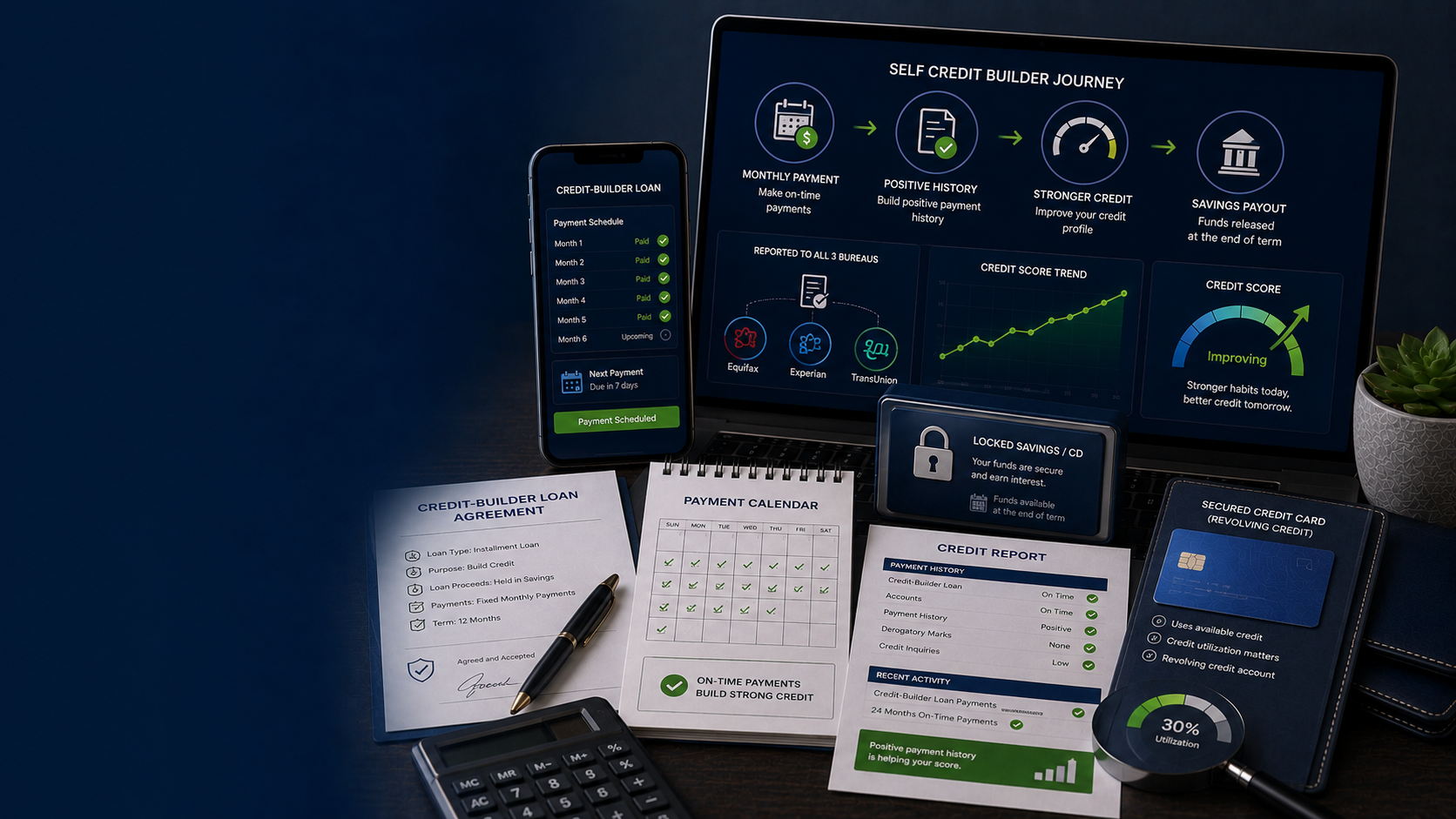
    The rebrand from “Self Lender” to “Self” was more than cosmetic. The company expanded beyond its original flagship credit-builder loan into a broader suite of tools: a secured credit card (available once you’ve built enough payment history), a rent and utility reporting feature, and a mobile-first Self app that tracks your credit score and progress. But the core idea hasn’t changed — you make small monthly payments that are reported to all three major credit bureaus (Equifax, Experian, and TransUnion), and at the end of the term you receive the money you paid in, minus fees and finance charges.

    Here’s the key distinction that matters for this Self credit builder review: Self is not a lender in the traditional sense, and it’s not a savings account. It’s a structured installment product — technically a credit-builder loan — where the “loan” amount is held in a certificate of deposit (CD) until you finish the term. You’re not borrowing money upfront. You’re paying it in over time, and the act of paying is what builds your credit.

    This matters because many people come to Self expecting to receive cash up front to pay down other debts or cover expenses. That’s not what this product does. If you need liquidity — actual money in hand today — Self is the wrong tool. If you need a safe, low-risk way to generate positive payment history on your credit report, that’s where it earns its place.

    Self is operated alongside partner banks (historically Sunrise Banks, N.A., and Lead Bank, among others), and the product is available in most U.S. states. The Self app is available on iOS and Android and serves as the primary way most customers manage their account today.

    Bottom line up front: Self is a legitimate, FCRA-aligned credit-building tool. It works — but “works” means it adds positive payment history to your report, not that it guarantees a score increase or erases existing negatives. The fees are modest but real, the timeline is slow (12–24 months), and whether it’s worth it depends heavily on what else is on your credit report.

    How the Self Credit Builder Works, Step by Step

    Understanding the mechanics is what separates a useful Self credit builder review from marketing copy. Here’s exactly what happens when you sign up:

    Step 1: You choose a monthly payment amount and term

    When you open a Self credit builder loan, you select a monthly payment you can comfortably afford — typically $25, $35, $48, or $150 per month. You also choose a term length, usually 12 or 24 months. The total of your monthly payments (minus the one-time admin fee and finance charge) becomes the amount “held” in a CD in your name.

    For example, at the $25/month tier over 24 months, you’d pay roughly $600 total. After the non-refundable $9 admin fee and the finance charge (the APR, which we’ll get to), you’d receive somewhere around $520–$545 back at the end. That payout is smaller than what you paid in — and that gap is the cost of the service. You’re paying for the credit-building function, not to grow savings.

    Step 2: A CD is opened in your name at a partner bank

    Self’s partner bank opens a CD in your name for the total loan amount. You don’t get access to this money. It’s locked. This is the collateral — it’s what makes the “loan” low-risk for the bank, which is why they can offer it to people with poor or no credit.

    Step 3: You make monthly payments

    Each month, you pay Self your chosen amount. Self reports that payment — on-time or late — to all three credit bureaus. This is the core value: every on-time payment is a positive mark on your payment history, which is the single biggest factor in your credit score (35% under FICO).

    If you pay late, Self reports that too. Late payments can actively damage the very score you’re trying to build. This is the double-edged nature of any credit-building product: it helps you if you’re disciplined and hurts you if you’re not.

    Step 4: The loan is “paid off” and you receive your payout

    Once you complete the full term, the CD unlocks and you receive your money — the total you paid in, minus the admin fee and finance charges. You can take it as a check, direct deposit, or (if you qualify) roll part of it into a Self secured card.

    That’s the full cycle. There’s no credit check to open the account (Self uses a soft check or identity verification, not a hard inquiry), no upfront deposit beyond the admin fee, and no risk of running up unsecured debt — because you can’t spend money you don’t have with this product.

    The Products Self Offers

    Self has grown from a single-product company into a small suite. Here’s what’s actually available:

    1. The Self Credit Builder Loan (the flagship)

    This is the product described above — the small installment loan held in a CD, with payments reported to all three bureaus. It’s the core of what most people mean when they ask “does Self work?”

    Key specs:

    • Monthly payments: $25, $35, $48, or $150
    • Terms: 12 or 24 months (some plans offer both)
    • Admin fee: $9 non-refundable, charged at signup
    • APR / finance charge: varies by plan, generally in the mid-teens as an effective rate — but remember, the APR is applied to a loan you’re paying down, not borrowing up
    • Payout at end: your total payments minus the admin fee and finance charge
    • Credit check: none (soft/identity verification only)
    • Bureau reporting: Equifax, Experian, TransUnion

    2. The Self Secured Credit Card

    Once you’ve made enough on-time payments on the credit-builder loan (typically a few months), Self may invite you to apply for its secured credit card. This is a genuine revolving credit account — it reports to all three bureaus and lets you build credit utilization history, which the loan alone doesn’t address.

    Key specs:

    • Credit limit: typically $100–$300 initially, based on your savings progress
    • Security deposit: drawn from your Self credit-builder savings (the money you’ve already paid in), not a new cash outlay
    • Annual fee: yes — usually around $25 (check current terms, as these change)
    • APR: variable, on the higher side (as with most cards for credit-building)
    • Reporting: all three bureaus

    The secured card is where Self becomes more powerful, because it lets you build two of the five FICO factors — payment history (35%) and credit utilization (30%) — instead of just one. More on this in the comparison section below.

    3. Free Credit Score Monitoring

    The Self app includes free credit score monitoring (typically VantageScore from one bureau, with FICO available in some plans). This is useful for tracking progress but shouldn’t be confused with full report monitoring — you’ll want to pull your actual reports from AnnualCreditReport.com separately to verify what’s being reported and to check for errors.

    4. Rent and Utility Reporting

    Self also offers a feature to report your rent and utility payments to the credit bureaus, which can add another stream of positive payment history. This is a nice add-on, especially for renters who want credit for payments they’re already making. It’s worth noting that not all bureaus weight rent and utility data equally, and not all scoring models factor it in — but it generally doesn’t hurt.

    How Self Reports to the Three Credit Bureaus

    One of the strongest features of Self is that it reports to all three major credit bureaus: Equifax, Experian, and TransUnion. This matters because:

    • Lenders don’t all pull the same bureau. A credit card issuer might pull Experian, an auto lender might pull Equifax, and a mortgage lender often pulls all three. Positive history on all three means you’re covered regardless of which bureau a future lender checks.
    • Some credit-builder products report to only one or two bureaus. Self’s three-bureau reporting is a genuine advantage over partial-reporting alternatives.

    What gets reported each month:

    • The payment status (on-time, or late by 30/60/90+ days)
    • The account type (installment loan, and later revolving for the secured card)
    • The balance and original loan amount
    • The account open date (which starts your credit history clock)

    What does not get reported:

    • Your income or employment
    • Your bank account details
    • Anything about your other credit accounts (Self can’t see them)

    Important nuance: Self reports the credit-builder loan as an installment account, not a revolving account. This is great for building payment history and credit mix, but it does not help your credit utilization ratio — which is the second-biggest FICO factor and applies only to revolving (credit card) accounts. That’s why the Self secured card, once you qualify for it, is the piece that rounds out the benefit.

    What Score Impact Can You Realistically Expect?

    This is the section where most Self credit builder review articles overpromise. We won’t.

    What Self can do

    For someone with no credit history (a “thin file”) or no open positive accounts, adding a Self installment loan generates a stream of on-time payments where none existed. In that scenario, Self can produce a meaningful score increase over 6–12 months — sometimes enough to move from “no score” to a fair score in the 600s. Self’s own published data and independent user reports support this for the thin-file crowd.

    For someone with damaged credit but some open positive accounts, Self adds another positive tradeline, which helps dilute the impact of older negative marks over time. The effect is real but more modest — think incremental points, not a 100-point jump.

    What Self cannot do

    • It cannot offset active negatives. A recent late payment, a collection, a charge-off, or a maxed-out credit card will drag your score far more than Self’s positive payments can lift it. If you have serious report errors or unresolved negatives, addressing those is almost always the higher-leverage move.
    • It cannot improve utilization. Because the loan is an installment account, it has no effect on your revolving utilization. If your score is suffering because your credit cards are near their limits, Self won’t fix that — paying down your card balances will.
    • It is not instant. Expect 2–6 months before you see meaningful movement, and the full benefit arrives only after 12–24 months of on-time payments.
    • It is not guaranteed. Your score depends on everything on your report, not just this one account. Adding Self while also racking up new late payments elsewhere will still produce a net-negative result.

    The honest expectation

    If you’re starting from nothing and you make every payment on time for the full term, you should end up with a fair-to-good credit score and a solid foundation to build on. If you’re starting from damaged credit, Self is a useful supplementary tradeline, not a standalone solution — pair it with report repair (disputing errors, negotiating pay-for-deletes, settling collections) for the best results.

    The Pros of Using Self

    Let’s give credit where it’s due. Self does several things genuinely well:

    • No credit check to open. You won’t take a hard inquiry hit just to start. For people already worried about their score, this removes a real barrier.
    • No large upfront deposit. Unlike a traditional secured card that might require $200–$500 upfront, Self starts at $25/month plus a $9 fee. The barrier to entry is low.
    • Reports to all three bureaus. As noted, this is a meaningful advantage over alternatives that report to only one or two.
    • Forces a savings habit. Because your payments are locked in a CD, you can’t spend them. For people who struggle to save, this is a built-in commitment device — you end the term with a few hundred dollars you might not have otherwise kept.
    • No risk of unsecured debt. You can’t overspend with the credit-builder loan. There’s no credit limit to max out, no temptation to carry a balance you can’t afford. For people rebuilding after debt problems, this safety is valuable.
    • Path to a secured card without a new deposit. The Self secured card is funded from the money you’ve already paid into the credit-builder loan — no separate cash outlay. This is a genuinely thoughtful design.
    • Mobile-first, easy to manage. The Self app makes payment setup, autopay, and score tracking straightforward. Autopay is critical (more on that below), and Self makes it easy to enable.
    • Transparent, legal, FCRA-aligned. Self is a legitimate financial product from a real fintech with partner banks. It’s not a sketchy “credit sweep” or a fake tradeline. Everything it reports is real, verifiable, and compliant with federal credit laws.
    • Builds credit mix (eventually). Once you add the secured card, you have both an installment and a revolving account — which is better for your credit mix than either alone.
    • Good educational content. Self publishes reasonably honest educational material about credit, which is more than many credit-building services do.

    The Cons and Real Costs of Using Self

    Here’s where we earn the “honest review” part. Self has real downsides, and ignoring them does you no favors.

    1. The fees and finance charge reduce your payout

    This is the single most important number to understand. You will get back less money than you put in. The gap is the cost of the service.

    On the $25/month, 24-month plan:

    • You pay in: ~$600 (plus $9 admin fee)
    • Finance charge over the term: roughly $89 (this varies — check current Self disclosures)
    • You receive at the end: approximately $520

    So you’re paying roughly $80–$90 over two years for the credit-building function. Is that worth it? For someone with no other way to build credit, yes — it’s a reasonable price. For someone who could instead put a $200 deposit on a secured card and pay no finance charge, it’s a worse deal. We’ll compare directly below.

    2. The “APR” effectively means you’re paying to save

    Self discloses an APR in the mid-teens. Because you don’t receive the loan proceeds upfront, this APR isn’t interest you pay on borrowed money — it’s effectively a fee on your own savings. Framed that way, it’s not a great financial deal in isolation. You’re paying for the credit reporting function, not for a return on your money. If you only think of Self as a savings account, you’ll be disappointed.

    3. It’s slow

    We’re talking 12–24 months. If you need a credit score this year — to qualify for a mortgage, to refinance a car, to get an apartment — Self alone won’t get you there in time. Report repair, authorized-user positions, and rapid rescores can move faster.

    4. No utilization benefit from the loan alone

    As covered, the installment loan doesn’t touch your revolving utilization. If utilization is your problem, the loan won’t help until you add the secured card.

    5. Late payments hurt you

    Miss a payment and it’s reported to all three bureaus — the same bureaus you’re trying to impress. A 30-day late on a credit-builder account is a self-inflicted wound. If your income is irregular and you’re not confident you can make every payment, this risk is real.

    6. The payout is locked until the end

    You can’t withdraw your money mid-term without closing the account, which typically means forfeiting the credit-building benefit and possibly paying fees. If you have an emergency, the money you’ve paid in is not accessible. Don’t put money in Self that you might need.

    7. Cancellation can be awkward

    Closing early can result in a smaller payout, a mark on your credit report (a closed account with a short history), and possibly no refund of the admin fee. We cover this in detail in the cancellation section.

    8. Customer service limitations

    Self is a fintech, not a full-service bank. Customer support is app- and chat-based, and response times can be slow during high-volume periods. For a product you’re trusting to report accurately to three bureaus, that can be frustrating if something goes wrong.

    9. Not available in all states / terms change

    Self’s plans, fees, and availability shift over time and by state. The numbers in this review were accurate at writing, but always confirm current terms on Self’s site before signing up.

    Pros and Cons at a Glance

    Pros Cons
    No credit check to open You get back less than you put in (fees + finance charge)
    Low monthly entry ($25+) Slow — 12–24 months for full benefit
    Reports to all 3 bureaus No utilization benefit from loan alone
    No risk of unsecured debt Late payments reported and damage your score
    Builds a forced savings habit Money is locked until the end of the term
    Path to secured card with no new deposit Cancellation can reduce payout and hurt history
    Easy autopay via the Self app Customer service can be slow
    FCRA-compliant, legitimate product Terms vary by state and can change
    Good for thin files / credit newbies Less useful if you already have good credit options

    Self vs. Secured Credit Card vs. Other Credit-Builder Loans

    This is the comparison that actually matters. Let’s line up the three main paths to building credit without a traditional unsecured card.

    Self Credit Builder Loan vs. a Secured Credit Card

    A secured credit card requires a refundable deposit (usually $200–$500) that becomes your credit limit. You use the card for small purchases, pay it off each month, and the issuer reports to the bureaus.

    Self Credit Builder Loan Secured Credit Card
    Upfront cost $9 admin fee + $25/mo $200–$500 deposit (refundable)
    Net cost over 2 years ~$80–$90 (fees + finance charge) $0 if paid in full (deposit returned)
    Builds payment history Yes Yes
    Builds utilization No (installment) Yes (revolving)
    Risk of overspending None Yes — you can carry a balance
    Reports to all 3 bureaus Yes Yes (most major issuers)
    Credit check to open No Usually a soft check (some hard)
    Money accessible during term No Deposit held, but card is usable

    The verdict: If you have $200–$500 to put down as a deposit and you trust yourself not to carry a balance, a secured card is generally the better financial deal — you get your deposit back in full, you build utilization, and you have a usable card. The catch is the upfront cash and the spending discipline required.

    If you don’t have the upfront deposit or you don’t trust yourself with a credit limit, Self is the safer choice. The modest finance charge is the price of that safety.

    The best path for many people is both: Use Self to build installment payment history and save up a deposit, then add a secured card (Self’s or another issuer’s) to build revolving history too. Two positive tradelines across two account types is stronger than either alone.

    Self vs. Other Credit-Builder Loans

    Credit-builder loans aren’t unique to Self. Community banks, credit unions, and CDFIs (Community Development Financial Institutions) have offered them for decades, often at lower cost than Self.

    Self Credit Union / CDFI Credit-Builder Loan
    Cost Higher (finance charge + fees) Often lower — some pay you interest on the CD
    Accessibility App-based, nationwide (most states) Must be a member / local resident
    Convenience High — sign up in minutes Lower — membership application, branch visit
    Bureau reporting All 3 Varies — some report to all 3, some only 1–2
    Customer service App/chat-based In-person or phone, often better

    The verdict: If you’re already a member of a credit union or there’s a CDFI in your area, check their credit-builder loan first. It may cost less and offer better service. If you value convenience, no membership requirements, and nationwide availability, Self wins on accessibility.

    Self vs. Becoming an Authorized User

    Being added as an authorized user on someone else’s well-managed credit card can add positive history to your report at zero cost — assuming you have a trusted family member or friend with a good card.

    The verdict: If you have that option, it’s the cheapest and fastest path. But it depends on someone else’s continued good behavior (their late payments would hurt you too), and not everyone has a willing cardholder in their life. Self is the independent option.

    Who Self Is Good For

    Self shines for a specific set of situations:

    • You have no credit history at all — a true thin file. Self is one of the easiest ways to start generating positive payment history from zero.
    • You can’t afford a secured card deposit. If $200–$500 upfront is genuinely out of reach, the $25/month entry point makes Self accessible.
    • You’ve had problems with credit card debt and need a credit-building tool with no spending temptation. Self’s locked structure keeps you safe from yourself.
    • You want a structured, forced-savings component. If you struggle to save, the locked CD doubles as a commitment device.
    • You’re rebuilding after a major negative event (bankruptcy, foreclosure, serious delinquencies) and need a clean, positive tradeline to add to your report alongside your repair efforts.
    • You’re comfortable managing everything through an app and don’t need branch access.

    In all of these cases, Self’s modest cost is a reasonable trade for the structure, safety, and three-bureau reporting it provides.

    Who Should Skip Self

    Self is not the right tool for:

    • People who already have good credit and a couple of open, on-time credit cards. You don’t need it. Adding another installment loan won’t meaningfully help and will cost you money.
    • People who can afford a secured card deposit. A secured card is generally a better financial deal and builds utilization too. Skip Self unless you specifically want the installment + savings structure.
    • People who need liquidity. If you need cash in hand — to pay down high-interest debt, cover medical bills, or make rent — Self’s locked-CD structure is the opposite of what you need.
    • People with serious unresolved report errors. If your credit is suffering because of inaccurate negatives, a collection that shouldn’t be there, or mixed-file errors, fix the report first. A free credit audit at will surface what’s actually dragging your score. Often, removing one inaccurate 60-day late or one erroneous collection moves your score more than a year of Self payments.
    • People who can’t commit to monthly payments for 12–24 months. If your income is irregular or you’re one missed paycheck away from a problem, the risk of a reported late payment outweighs the benefit.
    • People in a hurry. If you need a score improvement in weeks, not months, Self is too slow on its own.
    Self Credit Builder review showing how the credit-builder loan works

    How to Use Self the Right Way

    If you’ve decided Self makes sense for you, here’s how to get the most out of it — and avoid the traps that turn a good tool into a setback.

    1. Pick the lowest payment you’ll reliably make

    Resist the urge to choose the $150 plan because it “builds credit faster.” It doesn’t build credit faster — the payment amount doesn’t matter to your score, only that you pay on time. A $25/month on-time payment helps your score just as much as a $150 one. Pick the amount you can make every single month without thinking about it.

    2. Turn on autopay immediately

    This is non-negotiable. Set autopay the day you open the account. The entire value of Self depends on every payment being on time. A single 30-day late can undo months of progress. If your bank account is the issue, fix that first or pick a lower payment tier.

    3. Don’t open Self and nothing else

    Self is most effective as one part of a broader plan. While it’s building installment history, also:

    • Pull your free reports from AnnualCreditReport.com and review them for errors
    • Dispute any inaccurate negatives (or work with a reputable credit repair firm to do so)
    • Avoid applying for other credit you don’t need (each hard inquiry has a small cost)
    • If you have other open accounts, keep them paid on time too

    4. Add the Self secured card when you qualify

    Once Self offers you the secured card, take it — but use it minimally. Put one small recurring charge on it (a streaming subscription, a single tank of gas) and pay it in full every month. This builds revolving utilization history without spending money you don’t have. Keep your balance under 10% of the limit for the best utilization impact.

    5. Keep the account open until the full term

    Closing early reduces your payout and shortens your account history. Commit to the full 12 or 24 months. If you need to stop, see the cancellation section first and understand the consequences.

    6. Monitor your reports to verify Self is reporting correctly

    A few months in, pull your reports (or use the Self app’s score monitoring) and confirm the Self account is showing up on all three bureaus with correct payment status. If it’s missing or misreported, contact Self support promptly. Rare, but it happens — and you’re paying for the reporting, so verify it.

    7. Have a plan for the payout

    When the term ends and you receive your few hundred dollars, don’t let it evaporate. Use it to open a secured card (if you haven’t already), to fund an emergency savings starter, or to pay down an existing balance. Treat it as a stepping stone, not a windfall.

    How to Cancel Self and What to Watch Out For

    Life happens. If you need to close your Self account before the term ends, here’s what to expect — and what to watch for.

    How to cancel

    You can close your account through the Self app (in account settings) or by contacting Self support. Once you initiate closure:

    • Your loan is closed and the CD is liquidated.
    • You receive your accumulated payments minus the admin fee, any finance charges, and possibly an early-closure fee (check current terms).
    • Self reports the account as closed to all three bureaus.

    What to watch out for

    • A closed account with a short history can slightly hurt your score in the short term. If you close after only 3–4 months, you’ve added a brief tradeline that now shows as closed — not as helpful as a full 12–24 month positive history. Try to make it at least 6 months if you can.
    • Your payout will be smaller than what you paid in. The admin fee is non-refundable, and finance charges accrued to date are kept. Don’t expect to get all your money back.
    • If you had any late payments, they stay on your report. Closing the account doesn’t erase the late marks. They’ll continue to affect your score for up to seven years, though their impact fades.
    • The secured card, if you opened one, is a separate account. Closing the credit-builder loan doesn’t automatically close the secured card — but you’ll want to confirm the card’s standing separately, since its deposit may be tied to your Self savings.
    • Avoid closing in the first 1–2 months if possible. An account that opens and closes within a couple months can look like a “flash” tradeline and provides almost no benefit. If you’re going to cancel that early, you might be better off not opening it at all.

    When cancellation makes sense

    • You’ve secured a better credit-building tool (a secured card, an authorized-user slot) and want to stop paying Self’s finance charge.
    • Your financial situation changed and you can’t reliably make payments — better to cancel than to stack late payments.
    • You’ve finished the term and simply want to move on — that’s not cancellation, that’s completion, and it’s the ideal outcome.

    Common Mistakes That Undo the Benefits

    Over years of helping clients build and repair credit, we see the same handful of mistakes repeatedly. Avoid these and Self will do what it’s supposed to:

    Mistake 1: Picking a payment you can’t sustain

    The $48 or $150 plan looks impressive, but if you miss month seven, the late mark outweighs the six on-time payments before it. Pick the payment that’s boringly easy to make.

    Mistake 2: Forgetting autopay

    A single missed payment — because you were traveling, busy, or forgot — gets reported to all three bureaus and can take months to recover from. Autopay is the single most important setting in the Self app.

    Mistake 3: Opening Self and ignoring the rest of your report

    Self adds positive history. It does nothing for the inaccurate collection, the erroneous late mark, or the mixed-file error that’s actually causing your score to be low. We see clients spend two years on Self while a single report error that could have been disputed in 30 days was silently capping their score the entire time. Review your reports first. A free credit audit at will tell you exactly what’s on there and what’s worth disputing.

    Mistake 4: Closing early when bored or frustrated

    The benefit of Self compounds with time. The 24-month mark is where you see the full payoff — both in payout dollars and in credit history length. Closing at month 9 because it “feels slow” wastes the first 9 months of effort.

    Mistake 5: Not adding a revolving account

    An installment loan alone leaves 30% of your FICO score (utilization) untouched. Once you qualify for the Self secured card or any other revolving account, add one and use it responsibly. Credit mix matters.

    Mistake 6: Applying for too much other credit at once

    Every hard inquiry costs a few points. If you open Self, then immediately apply for three store cards, a car loan, and an apartment, you’ll tank the score you’re trying to build. Be patient. One new account at a time.

    Mistake 7: Expecting Self to fix everything

    Self is a building tool, not a repair tool. It adds positives. It does not remove negatives. If your report has significant errors or unresolved derogatory marks, those will continue to suppress your score regardless of how many on-time Self payments you stack. Address both sides — repair and build — for the best results.

    Frequently Asked Questions

    1. Is Self (formerly Self Lender) legitimate?

    Yes. Self is a real fintech company that partners with FDIC-insured banks to offer credit-builder loans and a secured credit card. It reports to all three major credit bureaus and operates in compliance with federal credit laws, including the FCRA. It is not a scam, not a “credit sweep,” and not a fake tradeline — it’s a genuine financial product.

    2. Does Self actually build credit?

    Yes — but with caveats. Self adds positive payment history to your credit report, which is the biggest single factor in your credit score. For people with thin or no credit files, this can produce a meaningful score increase over 6–24 months. For people with existing credit damage, Self helps incrementally but won’t overcome active negatives or report errors on its own.

    3. Does the Self credit builder loan help my credit utilization?

    No. The loan is an installment account, and utilization is calculated only from revolving (credit card) accounts. To build utilization, you need a revolving account — either the Self secured card (once you qualify) or a secured card from another issuer.

    4. How much does Self cost?

    You pay a $9 non-refundable admin fee at signup, plus a monthly payment ($25, $35, $48, or $150) for 12 or 24 months. A finance charge (APR in the mid-teens) is applied over the term. You receive your money back at the end, minus the admin fee and finance charge — typically meaning you pay roughly $80–$90 over two years on the smallest plan. Always check current Self disclosures for exact figures.

    5. What happens if I miss a payment?

    Self reports the late payment to all three credit bureaus once it’s 30 days late. This can damage the score you’re trying to build. If you think you’ll miss a payment, contact Self support beforehand to explore options. Autopay is the best defense.

    6. Can I get my money out early?

    Generally no — the money is locked in a CD until the term ends or you close the account. If you close early, you’ll receive your accumulated payments minus fees and finance charges, and the early closure may slightly hurt your credit history length. Don’t put money in Self that you might need to access in an emergency.

    7. Is Self better than a secured credit card?

    It depends. A secured card is usually a better financial deal (you get the full deposit back) and builds utilization, but it requires a larger upfront deposit and spending discipline. Self is better if you can’t afford a deposit or want a no-temptation structure. Ideally, use both — Self for installment history and savings, a secured card for revolving history.

    8. Will Self remove negative items from my credit report?

    No. Self only adds positive payment history. It has no ability to dispute, remove, or correct negative items. If your report has errors, collections that shouldn’t be there, or inaccurate late marks, you need credit report repair — either DIY through the FCRA dispute process or with help from a reputable, attorney-backed credit repair firm. That’s where comes in.

    A Note on Report Errors: The Often-Bigger Lever

    We’d be doing you a disservice if this Self credit builder review ended without the most important context we share with every client who asks about credit-building products:

    Adding positive accounts helps. But removing inaccurate negative accounts often helps more — and faster.

    Here’s why. Your credit score is a weighted blend of five factors:

    • Payment history (35%) — the negatives here (lates, collections, charge-offs) carry enormous weight
    • Credit utilization (30%) — revolving balances vs. limits
    • Length of credit history (15%) — older is better
    • Credit mix (10%) — installment + revolving
    • New credit / inquiries (10%) — too many recent applications hurts

    Self addresses #1 (by adding positive payment history) and, with the secured card, #4 (credit mix). But if your report contains inaccurate negatives — a late payment you actually paid on time, a collection that belongs to someone with a similar name, an account you never opened, a charge-off that should have been removed after seven years — those sit in the 35% bucket and drag your score down every month, no matter how many on-time Self payments you make.

    The Fair Credit Reporting Act (FCRA) gives you the right to dispute any inaccurate, incomplete, or unverifiable information on your report. If the bureau can’t verify it within 30 days, they must remove it. Removing one serious erroneous negative can move your score tens of points in a single cycle — far more than a year of Self payments, and at no cost beyond the dispute itself.

    This is why, before you spend 24 months and a few hundred dollars on Self, we’d encourage you to know what’s actually on your report first. A free credit audit from our team at will:

    • Pull and review your reports from all three bureaus
    • Identify any inaccurate, outdated, or unvervable negative items
    • Flag mixed-file errors, duplicate accounts, and items past the FCRA reporting limit
    • Give you a clear, honest picture of whether Self (or any credit-builder product) is the right next step — or whether report repair is the higher-leverage move

    We’re a San Diego-based, attorney-backed credit repair firm. We operate in full compliance with the FCRA, we don’t make guarantees or promise overnight fixes, and we believe in educating you so your credit stays strong long after the process is done. We’re not against Self — it’s a legitimate tool, and for the right person it’s a smart part of the plan. We’re against you spending two years building positive history while an inaccurate collection silently caps your score at 620.

    The smartest approach is usually both: Repair the errors that shouldn’t be there, and build new positive history with a tool like Self or a secured card. The two work together — one clears the drag, the other adds lift.

    Your next step

    If you’re curious what’s actually on your report — and whether there are items worth disputing before you invest in Self — grab a free credit audit at . It’s a straightforward conversation, no pressure, no hidden fees. We’ll tell you honestly what we see, what’s worth disputing, and whether a credit-builder product makes sense alongside the repair work.

    You don’t have to figure this out alone. And you don’t have to guess whether Self is the answer — let’s look at your report together and decide with real information instead.

    This article is for educational purposes and reflects our honest assessment of Self as a credit-building product. We are not affiliated with Self, and this is not financial advice. Specific fees, terms, and product details change over time — always verify current disclosures on Self’s website before opening an account. If you’d like help reviewing your credit reports and identifying errors that may be holding your score down, our team at credit-repair.com is here to help.

  • Do Credit Repair Companies Actually Work?

    Do Credit Repair Companies Actually Work?

    You check your credit report and find a late payment you don’t remember, an account that isn’t yours, or a collection that looks completely unfamiliar. Then you start wondering if you can actually get it fixed, or if you’re stuck with it for years.

    That is where credit repair companies come in. They promise to review your credit reports, challenge inaccurate information, and help you clean up your credit profile. But with so many companies making big promises, it is fair to ask: do credit repair companies work, or are you better off handling everything yourself?

    What Do Credit Repair Companies Actually Do?

    Credit repair companies help consumers identify and challenge potentially inaccurate information on their credit reports. They typically start by reviewing reports from the major credit bureaus and looking for items that may be hurting the consumer’s credit profile.

    Depending on the situation, this might include incorrect payment history, accounts that do not belong to the consumer, duplicate accounts, inaccurate balances, or negative information that should no longer be reported. The company may then help prepare disputes and communicate with the credit bureaus or creditors.

    The important distinction is that credit repair is about correcting inaccurate information, not simply removing anything negative. If an account is accurate and properly reported, hiring a credit repair company does not give you the right to have it deleted.

    Do Credit Repair Companies Work?

    Yes, credit repair companies can work, but their effectiveness depends on what is actually wrong with your credit reports.

    Suppose your report shows a 90-day late payment, but you have bank statements showing that you made the payment on time. That could be a legitimate reporting error worth disputing. If the information cannot be verified or the creditor confirms that it was reported incorrectly, the record may be corrected.

    Now consider a different situation. You genuinely missed several payments on a credit card, and the creditor accurately reported those late payments. A credit repair company cannot simply remove those entries because they are damaging your credit score.

    This is why it is important to look beyond advertisements promising “fast credit repair.” The real question is not simply does credit repair work, but is there inaccurate information on your credit reports that can legitimately be corrected?

    How Do Credit Repair Companies Work?

    Understanding how do credit repair companies work can help you decide if paying for the service makes sense. While the exact process varies from company to company, most legitimate services follow a similar approach.

    Reviewing Your Credit Reports

    The process usually starts with your credit reports. The company looks for negative accounts, reporting inconsistencies, inaccurate personal information, incorrect balances, payment history errors, and other issues that could potentially be disputed.

    A good review should not focus only on the number of negative accounts. It should look at the details behind each account and determine if the information appears accurate and complete.

    Identifying Potential Errors

    After reviewing the reports, the company identifies information that may be inaccurate or questionable. This is an important step because not every negative item is automatically a valid dispute.

    For example, an account that does not belong to you may be worth challenging. An incorrect balance may also need to be investigated. The company may ask you for documents such as payment records, account statements, or other information that supports your claim.

    Filing Disputes

    Once potential errors have been identified, disputes can be submitted to the appropriate credit reporting agencies or information providers. The dispute explains what information is being challenged and why it may be inaccurate.

    The credit reporting agency then reviews the dispute and generally communicates the result after its investigation.

    Reviewing the Results

    Credit repair does not end when the first dispute is submitted. The results need to be reviewed carefully to determine what was corrected, what remained unchanged, and whether additional documentation or action is appropriate.

    This is one reason the process can take time. Some issues may be resolved after one investigation, while others may require additional follow-up.

    What Can a Credit Repair Company Help Remove?

    Credit repair companies typically dispute information that is inaccurate, incomplete, outdated, duplicated, or unverifiable, such as:

    • Accounts that are not yours
    • Incorrect late payments or balances
    • Duplicate accounts
    • Outdated personal or account information

    Legitimate negative information, such as accurate late payments or collections, generally cannot be removed just because it lowers your score.

    Can Credit Repair Improve Your Credit Score?

    It can, but there is no guaranteed score increase. Your credit score is based on information contained in your credit report. If an inaccurate negative item is corrected or removed, your score may improve as a result. The impact depends on what was removed, how significant that information was, and what the rest of your credit profile looks like.

    For example, correcting a serious reporting error may make a noticeable difference for one person, while removing a small error may have little visible effect for someone else.

    Credit repair also cannot fix every reason a credit score may be low. If your balances are high, you have a short credit history, or you have accurate recent late payments, those factors can continue affecting your score even after reporting errors are addressed.

    Read More: How Long Does Credit Repair Actually Take?

    How Long Does Credit Repair Take?

    There is no universal timeline for credit repair because every credit report is different. A simple reporting error may be resolved after one dispute, while a credit report containing several complicated issues can require more time and follow-up. The amount of documentation available and how quickly the relevant companies respond can also affect the process.

    This is why you should be cautious about companies promising to “fix your credit in 30 days” or guaranteeing a certain number of points. Credit repair involves investigations and reporting agencies, so the outcome is not completely under a company’s control.

    Is It Better to Repair Your Credit Yourself?

    You do not need to hire a credit repair company to dispute inaccurate information. You can review your reports, gather documents, submit disputes, and monitor the results yourself.

    Professional help may be useful if your reports contain several issues or you do not have time to manage the process. However, understand that you are paying for convenience and assistance, not guaranteed results.

    When Should You Be Careful With a Credit Repair Company?

    The credit repair industry includes legitimate businesses, but not every company operates the same way. Be careful when a company makes promises that sound too good to be true.

    A major warning sign is a guarantee that the company can remove all negative information or raise your credit score by a specific number of points. Accurate information cannot simply be erased because you paid for a service.

    You should also be cautious if a company tells you to dispute information that you know is accurate, asks you to create a new identity, or pressures you to pay before clearly explaining its services and costs.

    A trustworthy credit repair company should be upfront about what it can and cannot do. It should focus on legitimate reporting errors rather than promising a quick fix for your entire credit history.

    So, Does Credit Repair Work?

    Yes, credit repair can help when your credit reports contain legitimate errors. Correcting inaccurate or unverifiable information may improve your credit profile and score.

    However, it cannot remove accurate negative information or guarantee specific results. Review your reports first, then decide whether to handle disputes yourself or work with a reputable credit repair company.

    Need help reviewing your credit? Get professional assistance identifying legitimate opportunities for improvement.

  • DIY Credit Repair vs. Hiring a Credit Repair Company: Which Actually Works?

    This decision usually comes down to one honest question: is the value a credit repair company adds worth its monthly fee, given that most of what they do is legally something you can do yourself for free? The answer depends heavily on your specific situation, how much time you have, and how comfortable you are navigating a somewhat bureaucratic dispute process. Here’s an honest breakdown of both paths.

    ## What Credit Repair Companies Actually Do

    Strip away the marketing, and most credit repair companies perform a fairly narrow set of services:

    1. **Pull your credit reports** and review them for potential errors or disputable items.
    2. **File disputes on your behalf** with the credit bureaus, often using templated or semi-customized dispute letters.
    3. **Track the status** of disputes and follow up on results.
    4. **Sometimes send goodwill letters** or negotiate with collection agencies on your behalf.
    5. **Provide ongoing account monitoring** and periodic re-disputing of items that get reinstated.

    Critically, everything on this list is something you’re legally entitled to do yourself, for free, under the Fair Credit Reporting Act. Credit repair companies aren’t performing a service that’s otherwise unavailable to you — they’re performing a service that saves you time and, in theory, brings expertise about what’s actually disputable.

    ## What Credit Repair Companies Cannot Do

    This is important, because some marketing implies otherwise:

    – They **cannot remove accurate, verifiable negative information** just because you’re paying them. If a late payment genuinely happened and can be verified, no company has special power to erase it.
    – They **cannot guarantee specific results**, and under the Credit Repair Organizations Act (CROA), it’s actually illegal for them to make guarantees about results before services are performed, or to charge you before services are rendered.
    – They **cannot access any dispute process you don’t have access to yourself** — there’s no secret back channel or insider process.

    ## The Case for DIY

    **Cost.** This is the most obvious advantage — filing disputes yourself costs nothing beyond your time, whereas credit repair companies typically charge somewhere in the range of $50-150 per month, which adds up considerably over a multi-month or multi-year repair process.

    **Direct knowledge of your situation.** You know your own financial history better than any company reviewing your file at a glance. You know

    which late payment was actually a bank error, which collection is genuinely unfamiliar to you, and which account has a backstory worth documenting — nuance that’s harder for a third party to catch from a standardized review process.

    **No risk of company-related issues.** The credit repair industry, unfortunately, includes a meaningful number of low-quality or outright scam operators (more on spotting these in our dedicated guide). Doing it yourself eliminates this risk entirely.

    **It’s not actually that complicated for most disputes.** Filing a dispute involves identifying the inaccurate item, gathering supporting documentation, and submitting a clear, specific dispute letter or online submission. This is very learnable, even without specialized expertise.

    ## The Case for Hiring a Company

    **Time savings.** If you have a complex credit file with many items to address across all three bureaus, doing this thoroughly — tracking each dispute, following up, escalating unsuccessful attempts — is genuinely time-consuming. Some people would rather pay for that time back.

    **Unfamiliarity with the process.** If the idea of writing formal dispute letters, understanding FCRA rights, and navigating bureau bureaucracy feels overwhelming, a reputable company’s structure and experience can lower the barrier to actually getting started, which matters if the alternative is doing nothing.

    **Ongoing monitoring and persistence.** Items sometimes get reinstated after initial removal, especially if a furnisher responds late. A company doing continuous monitoring may catch and re-dispute this faster than someone checking their credit report only occasionally.

    **Negotiation experience.** For things like negotiating pay-for-delete arrangements with collection agencies, an experienced negotiator who does this regularly may have more leverage or know-how than someone doing it for the first time, though this varies enormously by company quality.

    ## The Honest Middle Ground

    Many people do best with a hybrid approach:

    1. **Learn the basics yourself first** — pull your reports, identify clear errors, and try straightforward disputes on your own. This costs nothing and often resolves the easiest wins immediately.
    2. **Reserve professional help for genuinely complex situations** — a contested large debt, a pattern of furnisher non-compliance, or a situation involving potential legal violations (illegal re-aging, FDCPA violations) where professional guidance or even a consumer attorney adds real value.
    3. **If you do hire a company, understand exactly what you’re paying for** and set a defined timeline — most legitimate credit repair processes should show meaningful movement within 3-6 months; if a company can’t point to concrete progress by then, that’s worth questioning.

    ## Red Flags That Should Push You Toward DIY

    – Any company asking for payment **before** performing services (illegal under CROA).
    – Any guarantee of a specific score increase or specific item removal.
    – Pressure to dispute items you know are accurate, on the theory that bureaus might not verify in time — this is a legally gray, high-risk strategy that can also flag you for “frivolous dispute” treatment going forward.
    – Vague, unclear pricing or contract terms.

    ## When a Consumer Attorney Beats Both Options

    If your situation involves what looks like a genuine legal violation — a debt collector harassing you in violation of the FDCPA, a furnisher repeatedly re-reporting information after a successful dispute, illegal re-aging of a debt to extend its reporting window — a consumer protection attorney is often a better investment than either DIY or a standard credit repair company. Many such attorneys work on a contingency basis or under fee-shifting provisions in consumer protection law, meaning you may not pay out of pocket at all if your claim has merit.

    ## A Practical Decision Framework

    Ask yourself:

    1. **How many items need addressing, and how complex are they?** A handful of straightforward errors: strongly favors DIY. A dozen+ items across multiple bureaus with complicated histories: a company (or attorney, if legal violations are involved) starts to look more worthwhile.
    2. **How much time do you realistically have?** Be honest about whether you’ll actually follow through on a DIY plan over several months, or whether it’ll stall out after the first dispute.
    3. **Is there a genuine legal violation involved?** If so, skip both DIY and standard credit repair companies and consult a consumer attorney directly.
    4. **Can you afford the monthly fee without it becoming its own financial strain?** Ironically, paying a credit repair company you can’t comfortably afford while you’re also trying to improve your financial position undermines the goal.

    ## The Bottom Line

    Nothing a credit repair company does is legally unavailable to you directly, and for straightforward situations — a handful of clear errors, a late payment worth disputing, a collection account to validate — DIY is usually the more cost-effective and equally (sometimes more) effective path. Where companies earn their fee is time savings and persistence on complex, multi-item files, though the quality varies enormously across the industry, and it’s worth going in with realistic expectations about what any company legally can and cannot do for you.

  • How Soon Can You Rebuild Credit After Bankruptcy Discharge?

    Bankruptcy feels like it should be the end of the credit conversation, but for most people who go through it, discharge is actually closer to the beginning of a fairly well-defined rebuilding process — one that, done right, can produce meaningfully better credit within a shorter window than most people assume, even though the bankruptcy itself remains on your report for years.

    ## Immediately After Discharge: What Your Report Actually Shows

    Once your bankruptcy is discharged, your report will show:
    – The bankruptcy filing itself, listed as a public record-style entry (Chapter 7 stays for 10 years from filing date; Chapter 13 for 7 years from filing date).
    – Each individual account that was included in the bankruptcy, typically updated to show a status like “included in bankruptcy” or “discharged,” rather than showing as a simple charge-off or collection.
    – Any accounts **not** included in the bankruptcy (if you reaffirmed a debt, like keeping a car loan) continuing to report normally based on your payment behavior on those.

    One important nuance: accounts discharged in bankruptcy typically stop dragging your score down as heavily as an ordinary unpaid collection would, because “discharged in bankruptcy” is a distinct status that most scoring models treat somewhat differently — you’re not going to see continued monthly late-payment style reporting on a discharged account, since there’s no ongoing obligation to report against.

    ## Can You Start Rebuilding Immediately?

    Yes — there’s no waiting period required before beginning to rebuild, and in fact, starting immediately is exactly the right strategy, since the sooner positive history starts accumulating, the sooner it begins offsetting the bankruptcy’s weight on your score.

    ## Step 1: Get a Secured Credit Card

    This is the standard, most reliable first step. A secured card requires a cash deposit (often $200-500) that becomes your credit limit, which removes the risk that makes it hard to get approved for unsecured credit right after bankruptcy.

    Key practices:
    – **Use it lightly** — charge something small and recurring (a subscription, gas), and pay it off in full every month.
    – **Keep utilization low** — even though it’s a small limit, staying under 30% (ideally under 10%) of that limit matters just as much as it would on a larger card.
    – **Confirm it reports to all three bureaus** — not all secured cards do, and this is a dealbreaker requirement; check before applying.

    Most secured card issuers report your first positive payment within a single billing cycle, meaning positive history can start appearing on your report within 30-60 days of opening the account.

    ## Step 2: Consider a Credit-Builder Loan

    Credit-builder loans work differently — instead of receiving the loan amount upfront, the funds are held in an account while you make fixed monthly payments, and you receive the money (plus, sometimes, a small amount of interest) at the end of the term. These are widely available through credit unions and some online lenders specifically designed for post-bankruptcy or thin-file borrowers.

    This adds a different type of positive history (installment credit) to complement the revolving credit history from a secured card, which helps your credit mix — a smaller but real scoring factor.

    ## Step 3: Some Accounts May Survive Automatically

    If you reaffirmed certain debts during bankruptcy (common with auto loans, since reaffirmation lets you keep the car and the loan rather than surrendering it), continued on-time payments on that reaffirmed loan continue building positive history throughout and after the bankruptcy process, uninterrupted. If you have a reaffirmed account in good standing, that’s already working in your favor from day one post-discharge.

    ## Realistic Timeline for Score Recovery

    This varies significantly based on your pre-bankruptcy credit profile and how aggressively you rebuild, but general patterns:

    – **0-6 months post-discharge**: initial secured card/credit-builder loan accounts open and start reporting; score often remains in a lower range during this period since there isn’t yet enough new history to meaningfully offset the bankruptcy.
    – **6-12 months**: consistent on-time payments and low utilization on new accounts typically produce noticeable score improvement; many people see their score move into a “fair” range during this window if they’ve been disciplined.
    – **12-24 months**: with continued clean history, scores often reach a “good” range, sometimes qualifying for unsecured credit cards and better loan terms, even though the bankruptcy itself is still listed on the report.
    – **2-4 years**: many people who rebuild diligently reach scores that qualify for mainstream mortgage and auto loan rates, despite the bankruptcy remaining visible for years beyond this point.

    It’s worth emphasizing: the bankruptcy notation remaining on your report does **not** mean your score can’t recover to a strong range well before the notation itself falls off. Recency matters enormously in most scoring models — a bankruptcy from 3 years ago with 3 years of clean, positive history since carries much less weight than a fresh one, even though both show the same “10 years from filing” removal date.

    ## When You’ll Likely Get Approved for Unsecured Credit Again

    This varies by lender, but general patterns:
    – Store/retail credit cards: sometimes available within 6-12 months post-discharge, given their generally lower underwriting standards.
    – Mainstream unsecured credit cards: often available within 12-18 months with a solid rebuilding track record.
    – Auto loans: available immediately in many cases, though often at higher interest rates initially, improving as your post-bankruptcy history builds.
    – Mortgages: typically require a waiting period specific to the loan program — FHA loans often require about 2 years from Chapter 7 discharge (sometimes less with documented extenuating circumstances), conventional loans often 4 years, though these vary and are worth confirming directly with your target lender.

    ## Common Mistakes That Slow Recovery

    – **Applying for too much new credit too quickly**, generating multiple hard inquiries in a short window, which works against you exactly when you’re trying to look stable and low-risk.
    – **Closing the secured card once approved for an unsecured one**, which can shorten your average account age and reduce available credit.
    – **Missing a payment on a new rebuilding account** — since you’re working with a thin, fragile new file, a single late payment during this period has an outsized impact compared to the same mistake on an established file.
    – **Ignoring reaffirmed debts** — if you reaffirmed a loan, missing payments on it post-bankruptcy is treated as an ordinary new delinquency and can be especially damaging given how closely your file is likely being watched by lenders during this period.

    ## Should You Check Your Credit Report for Accuracy Post-Discharge?

    Yes, and this is an important, often-skipped step. Accounts included in bankruptcy should be updated to reflect the discharge — not continue showing as open with an outstanding balance, and not show continued late payment reporting after the discharge date. It’s common for furnishers to fail to update this properly, and an inaccurately reported “still owing” balance on a discharged account is both incorrect and actively harmful, since it makes your file look worse than your actual legal situation. This is worth disputing directly if you spot it.

    ## The Bottom Line

    You can and should start rebuilding credit immediately after bankruptcy discharge — there’s no waiting period, and the sooner positive history starts accumulating, the sooner it begins meaningfully offsetting the bankruptcy’s weight on your score. A secured card and a credit-builder loan, used consistently and paid on time, typically produce noticeable score improvement within 6-12 months and can position you for mainstream credit products within 1-2 years, even though the bankruptcy notation itself remains visible on your report for 7-10 years.

  • What Happens to Your Credit Score After 7 Years of Bad Credit?

    The “seven-year rule” is one of the most widely known facts about credit reporting, and also one of the most widely misunderstood. People often treat it as a single, simple countdown — as if your entire credit history resets on one specific date — when the reality is more granular and, honestly, better news than most people expect.

    ## The Seven-Year Rule Applies Per Item, Not to Your Whole File

    Each negative item on your credit report has its own individual seven-year clock (with a few notable exceptions, covered below), starting from its own **date of first delinquency** — not from when you paid it, not from when it was sold to a collector, and not from today’s date.

    This means if you had a rough financial stretch with multiple negative marks landing over, say, an 18-month period, those items don’t all disappear on the same day. They fall off individually, spread across a window of time, based on when each one’s underlying delinquency actually began.

    ## What Falls Off at Seven Years

    Standard negative items governed by the seven-year rule include:
    – Late payments
    – Collection accounts
    – Charged-off accounts
    – Most civil judgments (though as covered in our judgment-specific guide, these largely aren’t reported to standard credit files at all anymore under current bureau policy)
    – Repossessions
    – Foreclosures

    ## Exceptions to the Seven-Year Rule

    A few items follow different timelines:

    – **Chapter 7 bankruptcy**: stays on your report for **10 years** from the filing date, not seven.
    – **Chapter 13 bankruptcy**: generally **7 years** from the filing date, since it involves a repayment plan rather than full discharge of debts without repayment.
    – **Unpaid tax liens**: historically could remain indefinitely if unpaid; as with civil judgments, tax lien data was largely removed from standard credit bureau reporting starting in 2018, so this is less commonly an active issue today, but worth verifying your specific situation if you have an old lien.
    – **Hard inquiries**: fall off after **2 years**, much shorter than derogatory marks, and also stop affecting your score well before they even disappear from the report (typically their scoring impact fades to negligible after about 12 months).
    – **Student loan default status**: technically follows the standard 7-year rule from date of default, but defaulted federal student loans have

    unique rehabilitation programs that can affect how the account is reported well before the natural 7-year window.

    ## What Actually Happens When an Item Falls Off

    This is the part people often get wrong: the item doesn’t gradually fade — it’s supposed to be **completely removed** from your credit report once it hits the reporting limit. Credit bureaus are required under FCRA to stop reporting items once they age past their legal reporting window.

    In practice, though, this doesn’t always happen automatically and cleanly:

    – **Bureaus sometimes miss the removal date**, especially if the reported date of delinquency was inaccurate or unclear.
    – **A debt sold to a new collector** can sometimes result in a new tradeline being created with an incorrect (later) date of first delinquency — this is illegal re-aging, but it happens, and it’s one of the more important things to actively check for as your seven-year mark approaches.
    – **You may need to actively verify and dispute** an item that’s still showing past its legal reporting window, rather than assuming it will simply vanish on schedule.

    ## How to Check When Something Should Fall Off

    1. Locate the account on your credit report and find the **date of first delinquency** (sometimes labeled differently depending on the bureau, but this is the key date — not the date it was charged off, not the date it was sold to collections, not today’s date).
    2. Add seven years (or ten, for Chapter 7 bankruptcy).
    3. If that date has passed and the item is still showing, dispute it directly, citing that it’s exceeded the legal reporting window under FCRA.

    ## What Your Score Actually Does as Items Age (Before They Fall Off)

    A common misconception is that a negative item’s impact stays constant until the exact day it disappears, then suddenly resets. In reality, most scoring models weight negative items more heavily when they’re recent and progressively less heavily as they age, even while the item is still listed. This means:

    – A collection account from 6 years ago is typically dragging your score down far less than one from 6 months ago, even though both are still technically “on” your report.
    – You don’t need to wait for the literal fall-off date to see meaningful score recovery — the practical damage fades well before the legal reporting window closes, assuming no new negative activity compounds it.

    ## What Happens the Day an Item Actually Falls Off

    Once an old negative item is finally removed:

    – Your score may see a modest bump, though often smaller than people expect, precisely because the item’s practical scoring weight had already been fading for a while before its removal.
    – If it was one of very few negative items on your file, the removal can feel more significant, since it may shift your overall profile from “has derogatory marks” to “clean file,” which some scoring model thresholds treat somewhat categorically.
    – If you have other current negative marks, one item falling off won’t dramatically transform your score on its own — it’s one input among several.

    ## Does Your Score “Start Over” After Seven Years of Bad Credit?

    No — and this is an important distinction. The seven-year rule governs specific negative items, not a wholesale reset of your credit file or history. Your account history, including the age of your oldest accounts (a positive factor), continues to build the entire time, even while negative items are also present. There’s no scenario where your credit history “restarts” — accounts you’ve held open and in good standing throughout a rough financial period continue contributing positively the whole time.

    ## What You Should Actually Be Doing During the Wait

    Rather than passively waiting for negative items to age off, the more effective approach:

    1. **Verify accuracy now**, not just as items approach their fall-off date — errors are worth catching early.
    2. **Build positive history in parallel** — the seven-year clock on negative items runs regardless of what else you do, so there’s no reason to wait to start building positive credit simultaneously.
    3. **Avoid adding new negative marks**, since a fresh late payment or collection resets that item’s own seven-year clock and, more importantly, keeps your recent history — the most heavily weighted period for most scoring models — looking troubled.
    4. **Track your specific fall-off dates** for each item so you can proactively dispute anything still showing past its legal window, rather than assuming the bureaus will catch it.

    ## The Bottom Line

    Bad credit doesn’t operate on a single seven-year countdown — each negative item ages off individually based on its own date of first delinquency, and the practical drag on your score fades gradually well before that legal removal date arrives. The most effective strategy isn’t just waiting it out; it’s verifying accuracy, actively building positive history in parallel, and avoiding new negative marks so that by the time older items do fall off, you’re not just losing negative weight, you’ve also built up real positive weight to take its place.

  • How Long After Paying Off Debt Does Your Credit Score Improve?

    Paying off debt feels like it should produce an immediate, satisfying score jump, and sometimes it does — but sometimes the score barely moves, or even dips slightly, which confuses people who did everything “right.” The gap between expectation and reality here comes down to which type of debt you paid off and what specifically was driving your score down in the first place.

    ## It Depends Entirely on What Kind of Debt You Paid

    Credit scoring models don’t treat all debt the same way, so “paying off debt” covers several genuinely different scenarios with different score outcomes.

    ### Paying Down Revolving Credit Card Balances

    This is the fastest-moving scenario. Your **credit utilization ratio** — the percentage of available revolving credit currently in use — is one of the most heavily weighted and fastest-updating factors in most scoring models.

    – Timeline: your score can reflect the change **within one billing cycle**, typically 2-4 weeks after the payment posts and the card issuer reports the new, lower balance to the bureaus.
    – Magnitude: this can be one of the larger, faster score movements available — dropping from very high utilization (over 70-90%) to low utilization (under 30%, ideally under 10%) can produce a meaningful jump, sometimes 20-50+ points depending on your overall profile.
    – Important nuance: **paying off the balance doesn’t help until it’s reported.** Card issuers typically report your balance as of the statement closing date, not the date you make a payment. If you pay off a card the day after your statement closes, that high balance may still report for another full month before the paid-down balance shows up.

    ### Paying Off an Installment Loan (Auto Loan, Personal Loan, Student Loan)

    This is where people are often surprised. Paying off an installment loan in full:

    – **Doesn’t reduce a “utilization” style factor** the way credit cards do, since installment loans are scored differently — mainly on payment history and the mix of credit types, not a running balance percentage.
    – **Can occasionally cause a small, temporary dip** in your score, especially if it was your only installment loan and your credit mix becomes less diverse, or if it was a long-standing account and closing it (even through payoff) slightly reduces your average account age calculations in some models.
    – **Timeline for any positive effect**: minimal and gradual, mostly showing up as continued positive payment history rather than a distinct jump at payoff.

    This doesn’t mean paying off a loan early is a bad financial decision — the interest savings and reduced debt burden are real and valuable — it just means don’t expect a credit score reward for it the way you might for a credit card paydown.

    ### Paying Off a Collection Account

    – **Timeline**: once paid, the update to “paid collection” status typically reports within 30-45 days, depending on how quickly the collector reports the change and the bureau’s processing cycle.
    – **Score impact**: under most current scoring models (FICO 9 and newer, VantageScore 3.0 and newer), paid collections are weighted less harshly than unpaid ones, and some models exclude paid collections from scoring entirely. Older models still in use by some lenders don’t make this distinction, so the practical benefit varies depending on which score version is being used to evaluate you.
    – **The collection notation itself remains** even after payment (unless you negotiated pay-for-delete beforehand) — see our detailed guide on charge-offs for the same underlying principle.

    ### Paying Off a Charge-Off

    Same core principle as collections: the status updates to “paid,” which is viewed somewhat more favorably by lenders reviewing manually and by newer scoring models, but the charge-off history itself remains on the report for its full 7-year window. Don’t expect a large score jump from this alone.

    ## Why Your Score Might Not Move Much at All

    A few reasons paying off debt sometimes produces a disappointingly small (or no) score change:

    1. **The debt wasn’t actually a major negative factor in the first place.** If your score was primarily being held down by something else (recent late payments, a thin credit file, a high number of hard inquiries), paying off an unrelated debt won’t move that needle much.
    2. **You paid off an installment loan, which — as covered above — isn’t scored the same way revolving debt is.**
    3. **The payment hasn’t been reported yet.** There’s often a lag between when you pay and when it shows up on your credit report; check your report directly rather than assuming your score should have already reflected the payment.
    4. **You’re looking at a scoring model that doesn’t weight the change you made.** Different lenders pull different score versions (FICO 8, FICO 9, VantageScore 3.0, VantageScore 4.0, industry-specific scores), and the same underlying change to your credit file can produce different point impacts across these models.

    ## Why Your Score Might Temporarily Drop

    Less common, but it happens:

    – **Closing a credit card after paying it off** can reduce your total available credit, which increases your overall utilization ratio even though the specific card balance is now zero — this is why it’s often better to pay off a card and keep it open rather than close it immediately.
    – **Losing credit mix diversity** if the paid-off loan was your only installment account.
    – **A slight, temporary dip when an account closes** due to average account age calculations, particularly if it was one of your older accounts.

    ## What Actually Produces the Fastest, Most Reliable Score Improvement

    If your main goal is score improvement specifically (as opposed to broader financial health, which paying off any debt supports), prioritize in this order:

    1. **Pay down high-utilization credit cards first**, and time the payment before the statement closing date so the lower balance actually gets reported.
    2. **Keep paid-off credit cards open** rather than closing them, to preserve your available credit and average account age.
    3. **Don’t expect installment loan payoffs to move your score much** — do it for the financial benefit, not the credit score benefit.
    4. **For collections and charge-offs, focus on getting accurate “paid” status reported promptly**, and consider negotiating pay-for-delete before paying if removal matters more to you than the underlying debt resolution.

    ## Realistic Combined Timeline

    – **Within 2-4 weeks**: utilization-driven improvements from paying down credit cards, assuming timing aligns with your statement cycle.
    – **Within 30-45 days**: updated status reporting on paid collections or charge-offs.
    – **Ongoing, gradual**: any benefit from paid installment loans, mostly showing through continued clean payment history rather than a distinct event.

    ## The Bottom Line

    Whether paying off debt improves your score quickly, slowly, or barely at all depends heavily on what type of debt it was. Credit card paydowns tend to move your score fastest because of how utilization is calculated and reported. Installment loans generally don’t provide the score boost people expect, even though paying them off is still financially sound. And paid collections or charge-offs improve your standing modestly, mostly with lenders and scoring models that specifically account for paid status, while the underlying negative history remains visible for years regardless.

  • How Long Does Credit Repair Actually Take to See Results?

    If you’ve searched this question, you’ve probably already run into wildly inconsistent answers — credit repair companies advertising “results in 30-45 days,” forum posts claiming it took two years, and vague reassurances that “it depends.” All of those can be true simultaneously, because “credit repair” isn’t one process with one timeline; it’s several different processes, each with its own realistic pace. This article breaks down what actually happens and when, so you can set expectations that match reality rather than marketing copy.

    ## Why There’s No Single Answer

    Credit repair results depend on what you’re actually doing:

    – **Disputing a factual error** moves at the speed of the FCRA-mandated investigation window.
    – **Waiting out the natural aging of a negative item** moves at the speed of the calendar — nothing accelerates this except removal.
    – **Building new positive history** moves at the speed of account seasoning and reporting cycles.
    – **Paying down credit card balances** can move surprisingly fast, sometimes within a single billing cycle.

    Someone whose “credit repair” is mostly disputing one inaccurate collection account will see results far faster than someone whose credit report reflects a genuine history of missed payments across multiple accounts. Both are doing “credit repair,” but the timelines aren’t comparable.

    ## The Fastest-Moving Lever: Credit Utilization

    If there’s one factor that can move your score meaningfully within 30-45 days, it’s your **credit utilization ratio** — the percentage of your available revolving credit you’re currently using. This is because utilization is calculated from your most recent reported balance, not a historical average, so paying down a high balance and letting it report low can produce a visible score jump in as little as one statement cycle.

    Practical example: if you’re carrying $4,000 on a $5,000 limit card (80% utilization) and you pay it down to $500 (10% utilization) before the statement closes, that change can reflect on your credit report within a few weeks and often produces a noticeable score increase — sometimes 20-40+ points depending on your overall profile — faster than almost any dispute-based strategy.

    ## Formal Disputes: The 30 (or 45) Day Clock

    Under the Fair Credit Reporting Act, once you file a dispute, the credit bureau generally has **30 days** to investigate and respond. If you submit additional documentation during that window, the bureau gets an extra 15 days, for up to 45 days total.

    Realistic expectations within this window:

    – **Simple, clear-cut errors** (wrong account, duplicate reporting, an item that’s aged past 7 years but still showing) tend to resolve at or near the 30-day mark, sometimes sooner if the furnisher doesn’t respond and the item is removed by default.
    – **Disputed accuracy on genuinely complex issues** (contested medical debt, repossession balance disputes) may take the full 45 days, especially if it requires back-and-forth documentation requests.
    – **If the bureau “verifies” the disputed item** as accurate, you’re back to square one, and further escalation (CFPB complaint, direct furnisher dispute, goodwill request) starts a new timeline.

    ## Goodwill Letters: No Guaranteed Timeline

    Since goodwill requests are discretionary rather than a formal legal process, there’s no mandated response window. Some creditors respond within a couple of weeks; others take months; some don’t respond at all, in which case a polite follow-up after 4-6 weeks is reasonable before considering the request unsuccessful.

    ## Score Recovery From Rebuilding: Months, Not Days

    If your credit situation involves genuine negative history — not errors to dispute, but real derogatory marks that are accurate — the timeline shifts from “how fast can this be removed” to “how fast can positive activity outweigh it.” This is a fundamentally slower process:

    – **First 1-3 months**: opening new positive accounts (secured card, credit-builder loan) and making on-time payments starts building history, but scoring models want to see a track record, not a single payment.
    – **3-6 months**: consistent on-time payments and low utilization on new/existing accounts typically start showing measurable score improvement, often the point where people first notice real movement.
    – **6-12 months**: this is where most people see substantial recovery if they’ve been consistent — older negative marks are further in the past (reducing their recency weight), and new positive accounts have enough history to meaningfully offset them.
    – **12-24 months**: for more significant events (charge-offs, collections, repossession), this is a more realistic window for score recovery to a range that opens up better loan terms, though full recovery to “excellent” territory from a badly damaged starting point can take longer, especially with items like bankruptcy or foreclosure still on the report.

    ## What Credit Repair Companies’ “30-45 Day Results” Claims Actually Mean

    When credit repair companies advertise fast results, they’re almost always referring to the **dispute cycle timeline** (the FCRA-mandated 30-45 days), not a promise that your score will dramatically improve in that window. It’s technically true that a dispute round resolves in that timeframe — but “resolves” doesn’t mean “wins,” and even successful disputes on relatively minor errors often produce modest score changes, not the dramatic transformations implied in marketing materials. Be skeptical of any guarantee tied to a specific point increase within a specific short timeframe; no legitimate company can honestly promise

    that, since results depend entirely on what’s actually inaccurate versus what’s a genuine reflection of your credit history.

    ## Factors That Speed Things Up

    – **Clear documentation.** Disputes backed by concrete proof (bank statements, payment confirmations, validation failures) tend to resolve faster and more favorably than vague disputes.
    – **Direct furnisher disputes** in addition to bureau disputes, since furnishers are independently obligated to investigate and sometimes respond faster than the bureau’s process.
    – **Fixing utilization immediately**, since it’s the fastest score lever available and doesn’t require any dispute process at all.
    – **Addressing the oldest, most impactful errors first**, since fixing a single major inaccuracy often outweighs several minor ones.

    ## Factors That Slow Things Down

    – **Filing disputes without documentation**, which often results in “verified as accurate” responses that just cost you 30 days without progress.
    – **Disputing everything at once with generic language**, which can result in some bureaus flagging the pattern and providing less thorough investigation.
    – **New negative marks appearing during the process** — if you’re actively disputing old items while also missing new payments, you’re working against yourself.
    – **Waiting on manual/goodwill processes** that have no enforceable timeline.

    ## A Realistic Combined Timeline

    For someone doing a thorough, methodical credit repair process — combining dispute of genuine errors, utilization paydown, and new positive account building — a reasonable expectation looks like:

    – **Weeks 1-6**: utilization improvements and any successful error disputes show up; this is often the most encouraging early period.
    – **Months 2-4**: additional dispute rounds resolve; goodwill responses (if any) come in; new account history starts accumulating.
    – **Months 6-12**: the bulk of realistic score recovery happens here, assuming continued clean payment history and no new negative marks.
    – **Year 1-2+**: full recovery for more serious historical issues, as older negative items continue aging and losing scoring weight.

    ## The Bottom Line

    There’s no single honest answer to “how long does credit repair take,” because it depends entirely on what’s actually wrong with your credit file. Utilization fixes can show up in weeks. Genuine dispute-worthy errors resolve on a 30-45 day legal timeline. But rebuilding from real negative history — which is what most people actually need — is a months-to-years process, and any promise of dramatic, fast results for that kind of situation should be treated with real skepticism.

  • Does a Settled Debt Still Hurt Your Credit Score?

    Debt settlement gets marketed as a fresh start, and in a real financial sense, it often is — you owe less, the collector stops calling, and you can move forward. But “settled” is a specific status on your credit report, and it’s worth understanding exactly what it does and doesn’t do to your score, because the marketing around debt settlement companies doesn’t always match the credit reporting reality.

    What “Settled” Actually Means on a Credit Report

    When you settle a debt, you and the creditor (or more often, a collection agency that purchased the debt) agree you’ll pay less than the full balance owed, and in exchange, they’ll consider the account resolved. The account then gets reported with a status like “settled,” “settled for less than full balance,” or similar language.

    This is different from:
    – **”Paid in full”** — you paid the entire original balance.
    – **”Paid, was late”** — the balance was paid in full, but the account has a history of late payments.
    – **Pay-for-delete** — the account is removed entirely rather than marked as any kind of paid or settled status.

    “Settled” specifically signals that the creditor accepted less than they were owed, and both credit scoring models and human underwriters read that signal as somewhat negative — not as negative as an unpaid collection, but noticeably worse than paying the account in full.

    Yes, a Settled Debt Still Affects Your Score

    To answer the core question directly: **yes**, a settled debt continues to affect your credit score, in a few specific ways:

    1. **The settlement notation itself is a negative mark.** It’s not as severe as an active unpaid collection, but scoring models don’t treat “settled for less” the same as “paid in full.”
    2. **Any late payment history leading up to the settlement remains.** Settling a debt doesn’t erase the late payment history that got you there — those late payment marks stay on the report independently and continue affecting your score based on their own aging timeline.
    3. **The account still counts against your credit history in terms of derogatory marks present**, which most scoring models weight based on both severity and recency.
    4. **It remains on your report for the same duration as an unpaid version would** — generally seven years from the original date of delinquency, not from the date you settled.

    Why People Assume Settling “Fixes” Their Credit

    The confusion is understandable. Debt settlement companies often frame settlement as resolving your debt problem, which is true in a cash-flow and legal-liability sense — you’re no longer on the hook for the remainder, and collection calls should stop. But “resolving the debt” and

    “improving your credit score” are different outcomes, and settlement primarily addresses the former, not the latter.

    In fact, in the short term, entering a debt settlement program can actively hurt your score before it helps:

    – Most debt settlement programs advise you to **stop paying your creditors** while funds accumulate to fund the eventual lump-sum settlements, which means the accounts go delinquent and often get charged off in the interim — this delinquency and charge-off history reports and dings your score well before any settlement even happens.
    – Some debt settlement companies aren’t especially transparent about this upfront, marketing themselves as a credit solution when the process necessarily involves a credit hit as an intermediate step.

    How Much Does a Settlement Actually Cost You in Points?

    There’s no universal number — it depends heavily on your starting credit profile. Generally:

    – If you had strong credit before the delinquency that led to settlement, the drop tends to be more significant, since scoring models weight deviations from established good behavior heavily.
    – If your credit was already impaired going into the settlement, the marginal impact of one more settled account tends to be smaller.
    – The presence of the preceding late payments and any charge-off status typically matters more to your score than the “settled” notation itself — settlement is really the tail end of a longer negative reporting sequence, not usually the single biggest hit in that sequence.

    Does Paying in Full Instead of Settling Protect Your Score Better?

    Generally, yes, if you have the ability to do so. “Paid in full” or “paid as agreed” status reads more favorably than “settled for less than full balance” in most scoring models and to manual underwriters. If you’re weighing whether to settle for less or find a way to pay the full amount, and the financial difference is manageable, paying in full does typically leave you in a somewhat better credit position — though both options leave any preceding delinquency history in place regardless.

    Can You Negotiate a Better Reporting Outcome When Settling?

    Yes, and this is worth doing before you agree to settle, not after:

    – **Ask for “paid in full” reporting language** even on a negotiated lower amount, rather than “settled for less than full balance.” Some creditors will agree to this, particularly if you’re settling relatively early rather than after the account has been through multiple collection agencies.
    – **Ask for deletion (pay-for-delete)** as part of the settlement, in writing, before you send payment. This is a bigger ask than reporting language and less commonly granted, but worth requesting, especially from smaller collection agencies more focused purely on recovery than on maintaining standardized reporting practices.

    – **Get any agreement in writing** before paying — verbal promises from a collections representative aren’t enforceable, and once you’ve paid, your negotiating leverage disappears.

    What If the Debt Is Already Settled and You’re Stuck With the Notation?

    If you’ve already settled and the account shows as “settled” with no more favorable language, you generally can’t retroactively renegotiate the reporting terms — once it’s done, it’s done, unless the original agreement specifically included a reporting commitment that wasn’t honored (in which case, that’s a legitimate dispute or complaint, since the creditor failed to follow through on agreed terms).

    At that point, your best path forward is the same as with any other negative mark: build positive history around it, keep utilization low, avoid new derogatory marks, and let the settlement age — the seven-year clock runs from the original delinquency date, so check that date to understand your actual timeline.

    The Bottom Line

    Settling a debt is often the right financial decision when you can’t pay the full balance, and it does stop active collection activity and resolve your legal obligation for the remainder. But it is not a credit repair strategy — the settlement notation itself is a negative mark, the delinquency history leading up to it remains, and the account stays on your report for years regardless of the settlement. If protecting your credit score is a priority, negotiate the reporting language and consider requesting deletion before you agree to settle and pay, since you have essentially zero leverage to improve those terms after the fact.

  • How to Remove an Eviction From Your Credit Report

    Evictions occupy an odd space in the credit world: the eviction record itself typically isn’t on your standard credit report at all, but the financial fallout from an eviction — unpaid rent sent to collections, a judgment from an eviction lawsuit — very often is. Understanding this distinction is the key to actually fixing the right thing.

    Evictions Usually Aren’t on Your Credit Report Directly

    Court eviction records are public record data, and — similar to the treatment of civil judgments generally — they’re not typically reported to the three major credit bureaus (Equifax, Experian, TransUnion) as a standalone item. Instead, eviction history lives primarily in **specialized tenant screening databases**, which are separate from consumer credit bureaus and governed by their own reporting rules, though still subject to the Fair Credit Reporting Act since they qualify as consumer reporting agencies.

    The major tenant screening companies include:
    – LexisNexis (Risk Solutions / RentBureau data)
    – CoreLogic / SafeRent
    – TransUnion SmartMove (tenant-screening specific product, separate from the standard TransUnion credit file)
    – Various regional and local tenant screening services

    So if you’re worried about “credit report” impact from an eviction, the more precise question is usually: **is there an unpaid balance connected to the eviction that ended up on my actual credit report as a collection?** That’s the piece within the standard credit repair process. The eviction record itself living in tenant screening databases requires a different, parallel process.

    Step 1: Figure Out What’s Actually Showing Where

    Pull both:
    1. **Your standard credit reports** from all three bureaus (AnnualCreditReport.com) — check for any collection account related to unpaid rent, lease-break fees, or damages.
    2. **Your tenant screening report** — you’re entitled to a free copy from the major tenant screening companies under FCRA, similar to your right to a free credit report. Request reports directly from LexisNexis, CoreLogic, and any others relevant to where you’ve applied to rent.

    These are two different fights, and conflating them wastes effort.

    Fixing the Credit Report Side: Unpaid Rent in Collections

    If unpaid rent, damages, or lease-break fees were sent to collections and show up on your actual credit report, this works essentially like any other collection account dispute:

    1. **Request debt validation** from the collection agency — proof of the amount owed, the original lease terms, and an itemized breakdown of what’s included (unpaid rent vs. damages vs. fees).
      2. **Check for accuracy** — landlords and property management companies are notorious for tacking on questionable fees (excessive “cleaning,” disputed “damage” beyond normal wear and tear) that get bundled into what’s sent to collections.
      3. **Dispute anything unverifiable or inaccurate** with the credit bureaus directly.
      4. **Negotiate if the debt is legitimate** — many collection agencies handling rental debt are willing to settle for less than the full amount, and pay-for-delete is sometimes on the table, same as with other collection types.

      Fixing the Tenant Screening Side: The Eviction Record Itself

      This is the piece most people actually mean when they say “remove an eviction,” and it requires working directly with the tenant screening companies and, where applicable, the court record itself.

      Check for Accuracy and Reporting Errors

      Tenant screening reports have a notably high error rate — mismatched names, eviction filings that were dismissed but still show as “filed,” or cases where the tenant won but the filing still appears without the outcome noted. Common errors worth checking:

      – **Filed but dismissed or withdrawn cases still showing as active evictions.** If a landlord filed for eviction but the case was dismissed (common when tenants pay past-due rent before the court date, or when the landlord failed to follow proper notice procedures), the screening report needs to reflect that outcome, not just the filing.
      – **Cases where you won** — if the eviction case went to court and was decided in your favor, the record needs to show that resolution, not just “eviction case filed.”
      – **Sealed or expunged records** — some states allow eviction records to be sealed or expunged under certain conditions (case dismissed, tenant prevailed, or after a waiting period), and if that’s happened in your case, the screening company is obligated to remove or update the record accordingly.

      File a Dispute With Each Screening Company

      Same FCRA rights apply here as with standard credit bureaus: you can dispute inaccurate information, and the screening company has 30 days to investigate. Include:
      – The case number and court where it was filed.
      – Documentation of the outcome (dismissal order, judgment in your favor, proof of payment that led to dismissal).
      – A specific, clear statement of what’s inaccurate and what the correct information should be.

      Check Your State’s Eviction Sealing Laws

    A growing number of states have passed laws allowing tenants to petition to have eviction records sealed or expunged under specific circumstances — commonly when:
    – The case was dismissed.
    – The tenant prevailed in court.
    – A certain number of years have passed since a judgment, especially for non-payment cases that were later resolved.
    – The eviction was related to circumstances the state specifically protects (some states added provisions for pandemic-related non-payment, for example).

    If your state has such a law and your case qualifies, filing a sealing petition (sometimes requiring an attorney, sometimes doable pro se depending on the jurisdiction) can result in the record being removed from future tenant screening reports, since screening companies are required to reflect sealed status.

    What If the Eviction Was Legitimate and You Lost the Case?

    If the eviction judgment was legitimate and accurately reported, there’s no dispute-based path to removal — the record is accurate, and tenant screening companies aren’t obligated to remove accurate information just because it’s unfavorable. In this situation, your best options are:

    – **Time.** Many screening companies limit how far back they report, often 7 years, similar to standard credit reporting conventions, though this varies by company and isn’t uniformly regulated the way credit bureau timelines are.
    – **Building a strong recent rental history.** Landlords using screening services generally weight recent history heavily; several years of on-time rent payments with documented positive landlord references can offset an older eviction significantly, even if it’s still technically visible.
    – **Offering additional deposit or a co-signer** when applying, to address the concern directly rather than trying to hide the history.
    – **Providing context directly to prospective landlords** — a brief, honest explanation of circumstances (job loss, medical emergency) alongside proof of subsequent stability can go further than people expect, particularly with independent landlords rather than large corporate property managers who rely purely on automated screening scores.

    The Bottom Line

    “Removing an eviction from your credit report” is usually two separate problems wearing one name: an actual collection account for unpaid rent that may be sitting on your real credit report (fixable through standard dispute and negotiation processes), and an eviction case record living in a specialized tenant screening database (fixable through disputes for inaccuracies, or through state sealing/expungement laws if the case was resolved in your favor or otherwise qualifies). Sorting out which one you’re actually dealing with — by pulling both your credit report and your tenant screening report — is the necessary first step before any fix will actually target the right record.

  • How Long Does a Judgment Stay on Your Credit Report?

    Civil judgments occupy a strange, often confusing space in credit reporting, and the confusion is understandable — the rules changed significantly in the mid-2010s, and a lot of the advice still floating around online reflects the old system. Here’s what’s actually true today.

    The Short Answer: Judgments Mostly Don’t Appear on Credit Reports Anymore

    As of policy changes that took effect starting in 2017 (part of what’s often referred to as the National Consumer Assistance Plan, an agreement among the three major credit bureaus), civil judgments and tax liens were removed from standard credit reports entirely, and the bureaus stopped adding new judgment records going forward. This happened because judgment records are public record data that’s frequently mismatched to the wrong person — same or similar names, no consistent identifiers like Social Security numbers attached to court records — leading to a high rate of reporting errors.

    So if you have an old judgment against you, there’s a good chance it’s simply not on your credit report at all anymore, regardless of how old or recent it is.

    But the Judgment Itself Still Exists Legally

    This is the critical distinction people miss: **removal from your credit report does not mean the judgment is gone.** It’s still a valid, enforceable legal judgment, recorded at the county courthouse or state court system, and the creditor who won it can still:

    – Garnish your wages, depending on your state’s garnishment laws.
    – Place a lien on real property you own.
    − Levy bank accounts.
    – Renew the judgment before it expires (most states allow judgment renewal, often extending enforceability another 10–20 years).

    Judgments typically remain legally enforceable for anywhere from 5 to 20 years depending on the state, and many states allow renewal that extends this even further. So while your credit score isn’t directly affected by an old judgment sitting in a courthouse file, your bank account and wages potentially still are.

    How to Check If a Judgment Is Actually on Your Credit Report

    Given the 2017 policy change, checking your credit report is the fastest way to know your actual situation:

    1. Pull your full report from all three bureaus (free weekly at AnnualCreditReport.com).

    2. Look specifically in the “public records” section, which is where judgments historically appeared.

    3. If you don’t see it, that’s expected under current policy — it doesn’t mean the judgment doesn’t exist, just that it’s not being reported to consumer credit files.

    If you **do** see a judgment on your report, that’s now unusual enough that it’s worth investigating closely — it may indicate the furnisher hasn’t updated their reporting practices, or that the specific entity that obtained the judgment (some judgments are held by entities that also independently furnish tradeline data, like certain debt buyers) is reporting the underlying debt separately from the judgment itself.

    If You See a Judgment on Your Report, What to Do

    Since public record judgments generally shouldn’t be appearing on credit reports at all under current bureau policy, an entry that does show up is worth disputing on that basis alone. Steps:

    1. **Document what’s shown** — screenshot or save the entry with the reporting bureau, date, and amount.
    2. **File a dispute directly with the bureau**, citing that civil judgment data was removed from credit reporting under the National Consumer Assistance Plan and shouldn’t be included.
    3. **If it persists**, file a complaint with the CFPB, since continuing to report data types that were formally agreed to be excluded is a stronger, more clear-cut complaint than most disputes.

    What Still Shows Up Related to a Judgment

    Even though the judgment record itself is generally excluded, the **underlying debt** that led to the judgment may still appear as its own tradeline — for example, if a credit card company sued you and won, the original charged-off credit card account might still be reporting (subject to its own normal 7-year clock from the original delinquency date), separate and apart from the judgment.

    This means you can have a scenario where:
    – The judgment itself: not on your credit report (per current policy).
    – The original debt that led to the judgment: potentially still on your credit report, aging normally from its original delinquency date, independent of when the judgment was entered or how long it remains legally enforceable.

    Don’t confuse these two — disputing “the judgment” when what’s actually showing is the underlying charged-off account requires a different approach (see our guide on charge-offs and collections for that process).

    Judgment Liens on Property

    If a judgment resulted in a lien being placed against real property you own, that lien is recorded at the county level and is a separate matter from your credit report entirely. Property liens:

    – Don’t show up on standard credit reports under current policy, similar to other judgment data.

    – Can still cloud title on the property, meaning it may need to be resolved (paid, negotiated, or otherwise released) before you can sell or refinance the property.
    – Are governed by state-specific rules about how long they remain attached and whether/how they can be renewed.

    If you’re planning to sell or refinance a property with an old judgment lien attached, this is worth addressing directly with a real estate attorney or title company, since it can hold up a closing even though it has no bearing on your credit score.

    Does an Old Judgment Affect Your Ability to Get Approved for Credit?

    Indirectly, yes, in a few ways even though it’s not on your report:

    – **Manual underwriting**: some lenders, especially for mortgages, run additional public record searches beyond the standard credit report, and a judgment can surface there even if it’s absent from your bureau file.
    – **Background/tenant screening**: judgments often appear in tenant screening and some employment background checks, which pull from different data sources than consumer credit reports.
    – **Active garnishment**: if a judgment results in an active wage garnishment, that reduces your take-home income, which indirectly affects your debt-to-income ratio and borrowing capacity even though the garnishment itself typically isn’t a credit report line item.

    Should You Try to Resolve an Old Judgment Even If It’s Not Hurting Your Score?

    Often yes, for reasons unrelated to your credit score:

    – To stop the risk of wage garnishment or bank levy, especially if the judgment creditor is actively pursuing collection.
    – To clear title issues if the judgment created a property lien.
    – Because many states allow judgment creditors to renew judgments indefinitely, meaning an unresolved judgment can follow you for decades even if invisible on your credit report the entire time.

    The Bottom Line

    Under current credit bureau policy, most judgments no longer appear on standard credit reports at all — a significant shift from the old system many people still expect. That’s good news for your credit score, but it doesn’t mean the judgment has disappeared as a legal matter: it can still be enforced, renewed, and used to garnish wages or place property liens for years, sometimes decades, depending on your state. If you have an old judgment, checking your actual credit report is worth doing to confirm your specific situation, but resolving the underlying legal judgment is a separate project from anything related to your credit file.