Author: admin

  • Does Closing a Credit Card Hurt Your Credit Score?

    Does Closing a Credit Card Hurt Your Credit Score?

    This is one of the more nuanced questions in credit scoring, because the honest answer is “it depends,” and the factors it depends on aren’t always intuitive. Closing a card can hurt your score, help it, or do essentially nothing, depending on your specific credit profile at the time. Here’s how to actually think through the decision for your situation.

    The Two Main Mechanisms at Play

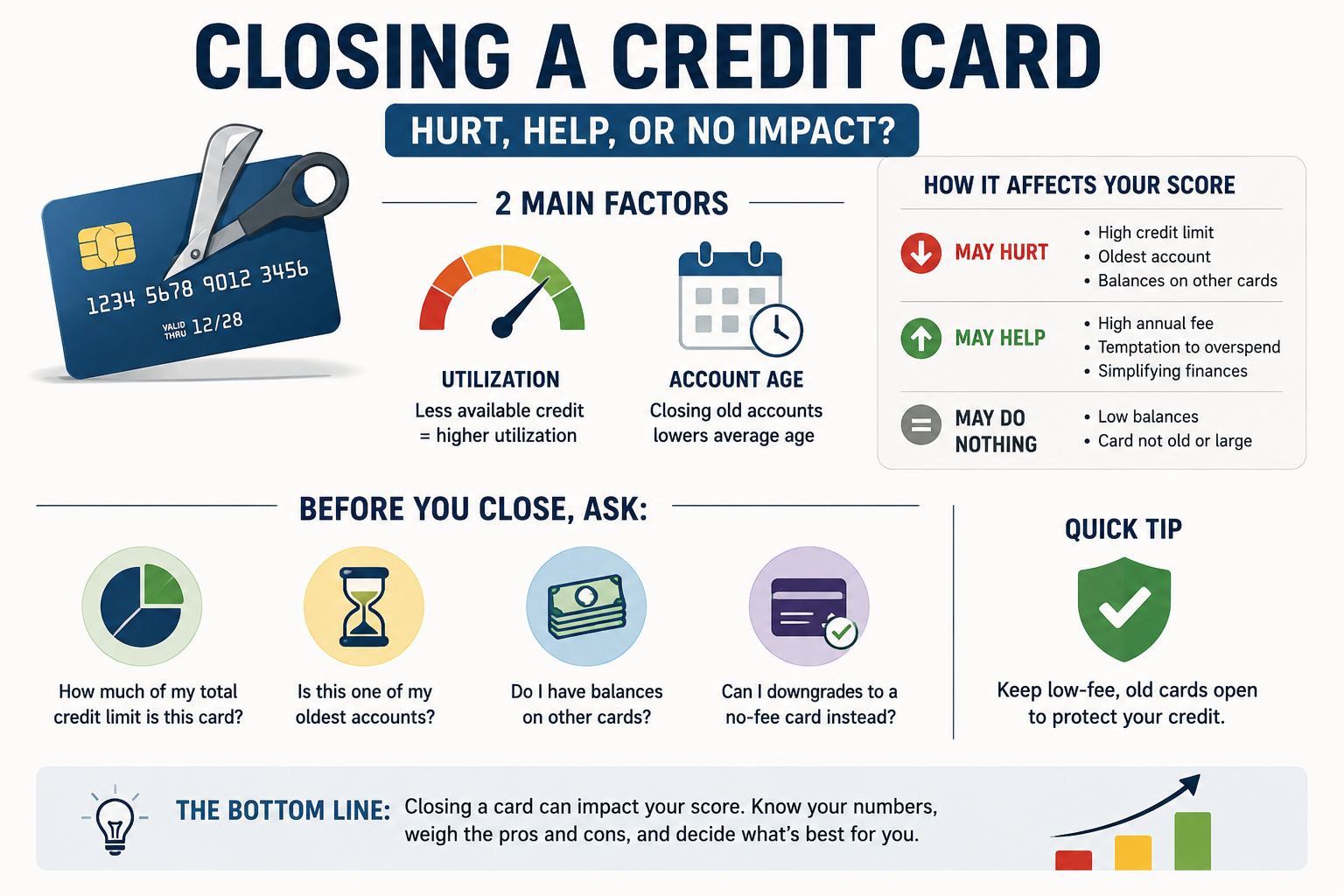
    Closing a credit card can affect your score through two primary channels:

    1. **Credit utilization** — closing a card reduces your total available credit, which, if you carry balances on other cards, can increase your overall utilization ratio even if your spending hasn’t changed at all.
    2. **Average account age** — closing your oldest card can eventually reduce your average account age, since closed accounts (after a period of time) either stop being factored in, or are weighted differently than open accounts, depending on the specific scoring model.

    Understanding which of these applies most to your situation determines how much closing a specific card will actually matter.

    Why Utilization Is Usually the Bigger Immediate Factor

    Here’s a concrete example: say you have three cards with a combined $15,000 in available credit, and you’re carrying a combined $3,000 in balances — a 20% overall utilization ratio, generally considered healthy. If you close a card with a $5,000 limit (even if that specific card has a zero balance), your available credit drops to $10,000, and your same $3,000 in balances now represents 30% utilization — a real, measurable increase, purely from closing an unused card.

    This is why financial advice commonly recommends **not closing unused cards**, especially ones with no annual fee — keeping them open, even unused, preserves your available credit and keeps utilization lower than it would be otherwise.

    When Closing a Card Doesn’t Meaningfully Affect Utilization

    If you have very low balances relative to your total available credit across all your cards, closing one card — even a decent-sized one — may not push your utilization into a meaningfully different range. If your utilization was already comfortably low (say, under 10%) and remains comfortably low after closing a card, the utilization impact may be negligible.

    Why Account Age Matters, But More Gradually

    Closed accounts in good standing generally continue to count toward your average account age for a period of time (this varies by scoring model, but often around 10 years for positive-history closed accounts), which means closing a card doesn’t erase its age contribution immediately. The effect, if any, tends to show up more gradually, and mainly matters if:

    – The card you’re closing is one of your **oldest** accounts, and
    – You don’t have other equally old accounts to offset the eventual loss of that account’s age contribution once it does stop being counted.

    If you’re closing a relatively new card, or you have several other well-aged accounts, the account age impact is typically minimal.

    Scenarios Where Closing a Card Actively Helps

    Yes, this happens too, and it’s worth understanding:

    – **If a card has a high annual fee you no longer find worthwhile**, and you have other cards to preserve your overall available credit and account age, closing it is a purely financial decision that likely has minimal credit impact, especially if it’s not your oldest or largest-limit card.
    – **If keeping a card open creates a real risk of overspending or missed payments** (a genuine, practical concern for some people), the modest potential utilization impact of closing it may be worth accepting in exchange for reduced temptation or account management complexity.
    – **If you’re actively trying to simplify your finances** and the marginal utilization/age impact of closing a specific card is small given your overall profile.

    Scenarios Where Closing a Card Is More Likely to Hurt

    – **Closing your card with the highest credit limit**, since this has the largest proportional impact on your total available credit and therefore your utilization ratio.
    – **Closing your oldest account**, especially if you don’t have other long-standing accounts to maintain your average account age.
    – **Closing a card while carrying balances on other cards**, which directly and immediately worsens your utilization ratio.
    – **Closing multiple cards in a short period**, compounding both the utilization and account age effects simultaneously.

    What About Closing a Card With an Annual Fee You No Longer Want to Pay?

    This is one of the most common real-world reasons for wanting to close a card, and it’s worth approaching thoughtfully:

    1. **Check if the issuer offers a downgrade to a no-annual-fee version of the same card**, which preserves the account (and its age/history) while eliminating the fee — often a better option than closing outright, if available.
    2. **If no downgrade option exists and you’re set on closing it**, consider the utilization and age impact using the framework above before proceeding.
    3. **If you do close it, consider paying down balances on other cards first**, so the credit line reduction doesn’t collide with high balances elsewhere to spike your utilization.

    Does It Matter Who Closes the Account — You or the Issuer?

    The credit impact is generally similar regardless of who initiates the closure, though there’s an important distinction in how it’s *labeled* on your report: an account closed by you (“closed by consumer”) generally reads more favorably to anyone reviewing your report manually than one closed by the issuer, which can sometimes indicate the issuer initiated the closure due to inactivity or risk factors on their end. If you’re going to close a card anyway, doing so proactively (rather than letting an issuer close it for inactivity) is generally the better-looking outcome, even though the underlying score mechanics are similar.

    A Practical Framework Before Closing Any Card

    Before closing a credit card, ask:

    1. **What percentage of my total available credit does this card represent?** A higher percentage means a bigger utilization impact if closed.
    2. **Is this one of my oldest accounts?** If so, factor in the eventual account age impact, even though it’s typically more gradual than the utilization effect.
    3. **Do I currently carry balances on other cards?** If yes, closing any card will worsen your utilization more than if all your other cards are at zero or low balances.
    4. **Is there a fee-free alternative (downgrade) available** that preserves the account without the cost you’re trying to avoid?

    The Bottom Line

    Closing a credit card can hurt your score, mainly through reduced available credit worsening your utilization ratio, and more gradually through reduced average account age if it’s one of your older accounts — but the actual impact varies significantly based on your specific credit profile, particularly how much of your total available credit that card represents and whether you carry balances elsewhere. For cards with no ongoing cost, keeping them open (even unused) is usually the lower-risk default; for cards with a fee you want to eliminate, check for a downgrade option first, and if closing is still the right call, do it with an understanding of the utilization and age tradeoffs involved rather than assuming it’s automatically either harmless or harmful.

  • How to Dispute Credit Report Errors Without Hurting Your Score

    How to Dispute Credit Report Errors Without Hurting Your Score

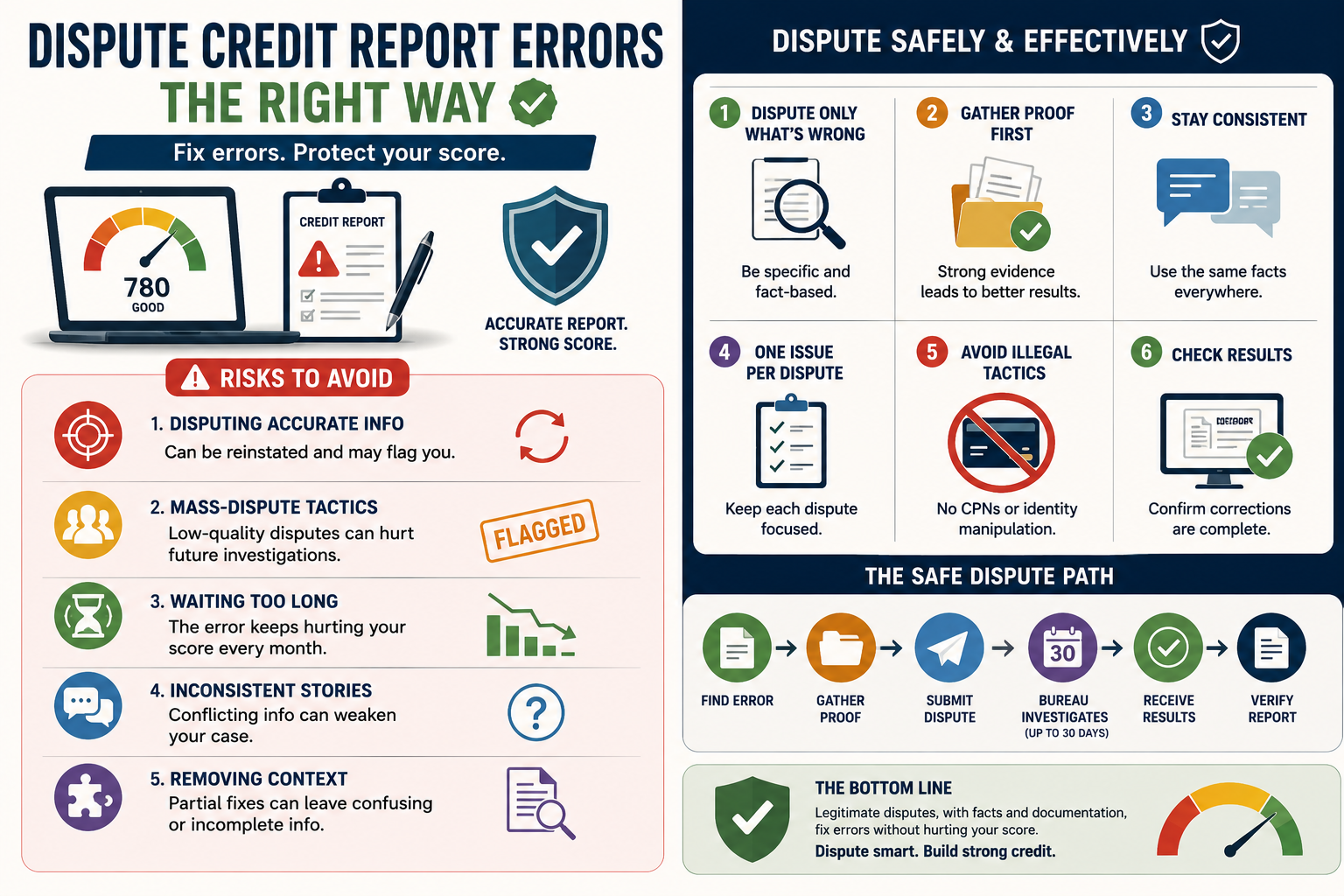
    Most people assume disputing an error can only help — after all, you’re trying to fix something wrong. But there are a handful of specific ways the dispute process itself can backfire if handled carelessly, and understanding these risks upfront lets you dispute confidently and correctly, without accidentally creating new problems.

    Does Filing a Dispute Itself Hurt Your Score?

    No — filing a dispute, by itself, does not directly lower your credit score. The act of disputing isn’t a scored event, and there’s no mechanism in standard scoring models that penalizes you simply for exercising your FCRA right to dispute inaccurate information. This is worth stating clearly because it’s a common and unnecessary worry that sometimes stops people from disputing legitimate errors.

    That said, there are indirect ways the process around a dispute can create issues if you’re not careful.

    Risk 1: Disputing Accurate Information Can Backfire Later

    A once-popular (and now largely ineffective) strategy involves disputing accurate negative information anyway, hoping the furnisher won’t respond within the 30-day window, resulting in automatic removal due to non-response rather than an actual finding of inaccuracy. A few problems with this:

    – **It’s temporary if the information is accurate.** Furnishers can, and often do, re-verify and reinstate accurate information even after an initial removal, once they catch up on a backlog or respond late. This means the removal isn’t durable, and the item can reappear, sometimes without much warning.
    – **A pattern of unfounded disputes can result in bureaus flagging you.** While a single dispute doesn’t hurt you, credit bureaus can treat a pattern of disputes lacking any factual basis as frivolous, which can result in less thorough investigation of your future disputes — including legitimate ones.
    – **It can create a false sense of resolution** that leads you to stop pursuing more durable, better-grounded strategies (like a goodwill letter for accurate but sympathetic negative marks) while you’re waiting to see if the temporary removal sticks.

    The safer, more durable approach is to dispute only what you genuinely believe is inaccurate, incomplete, or unverifiable — and to use goodwill requests, not disputes, for accurate information you’re hoping to have removed as a courtesy.

    Risk 2: Disputing Through a Credit Repair Company That Mass-Disputes Everything

    Some lower-quality credit repair operations use a strategy of disputing large numbers of accounts simultaneously, regardless of whether each item has genuine grounds for dispute, essentially hoping volume produces results through non-response. Beyond the durability issue above, this can:

    – Result in your file being flagged for a pattern of low-substance disputes.
    – Waste the “real” investigation attention on items that actually deserve scrutiny, buried among many without real basis.
    – In more serious cases, involve credit repair companies using deceptive tactics (creating a new, fraudulent credit profile via a technicality — sometimes called “credit privacy number” or CPN schemes) that are illegal and carry serious legal risk to you, not just the company. Avoid any credit repair service suggesting anything along these lines.

    Risk 3: Waiting Too Long to Address a Real Error While It Continues to Report

    This isn’t about the dispute process hurting you — it’s about the cost of inaction. An inaccurate item continuing to report negatively affects your score every month it remains uncorrected. There’s no benefit to delaying a well-grounded dispute, and doing so simply means the negative (and inaccurate) impact continues longer than necessary.

    Risk 4: Providing Inconsistent or Conflicting Information Across Disputes

    If you dispute the same item multiple times with different, sometimes contradictory explanations (for example, first claiming an account isn’t yours, then later claiming it is yours but the balance is wrong), this inconsistency can undermine your credibility with both the bureau and the furnisher, potentially resulting in less favorable treatment of the dispute overall. Keep your disputes factually consistent and precise from the start.

    Risk 5: A Successful Dispute That Removes Context, Not Just the Error

    In rare cases, disputing and correcting one detail on an account (say, a balance amount) without addressing the full picture can occasionally result in an entry that looks more confusing or ambiguous than before, if the correction isn’t handled cleanly by the furnisher. This is uncommon, but worth checking your report again after any dispute resolves, to confirm the corrected entry actually looks accurate and complete, not just partially updated.

    How to Dispute Safely and Effectively

    **1. Only dispute what you genuinely believe is inaccurate**, and be able to articulate specifically why. “This isn’t accurate” without a specific factual basis is both less effective and more likely to fall into the “frivolous” pattern risk described above.

    **2. Gather documentation before disputing**, not after. A dispute backed by bank statements, payment confirmations, or validation failures is both more likely to succeed durably and less likely to be seen as unfounded.

    **3. Keep your explanation factually consistent** across the bureau dispute, any direct furnisher dispute, and any follow-up correspondence.

    **4. Dispute one clear issue per item**, rather than combining multiple, sometimes unrelated claims into a single vague dispute.

    **5. Avoid credit repair strategies involving new legal identities, CPNs, or other technicality-based “resets”** — these are illegal, put you at serious legal risk, and have nothing to do with legitimate dispute rights under FCRA.

    **6. Check your report again after the dispute resolves**, to confirm the correction was applied cleanly and completely, not partially.

    What About Disputing Right Before a Major Loan Application?

    This is worth specific mention: if you’re actively in the process of applying for a mortgage or other major loan, some lenders prefer that disputes be resolved (not actively pending) before final underwriting, since an open dispute can sometimes complicate how a scoring model or manual underwriter treats the disputed item during the loan decision process. If you’re planning a major application soon, it’s often wise to resolve disputes well in advance rather than filing them in the middle of an active loan process, simply for practical underwriting reasons, not because the dispute itself is risky.

    The Bottom Line

    Legitimate disputes, filed with real documentation and factual specificity, carry essentially no risk to your credit score and are exactly the tool FCRA gives you for correcting genuine errors — there’s no reason to hesitate on a well-grounded dispute. The risks that do exist come from disputing accurate information hoping for a technical non-response removal, using disreputable mass-dispute or identity-manipulation schemes, or being inconsistent across your own dispute correspondence — all avoidable by disputing carefully, specifically, and honestly.

  • Secured Credit Cards vs. Credit-Builder Loans: Which Rebuilds Credit Faster?

    Secured Credit Cards vs. Credit-Builder Loans: Which Rebuilds Credit Faster?

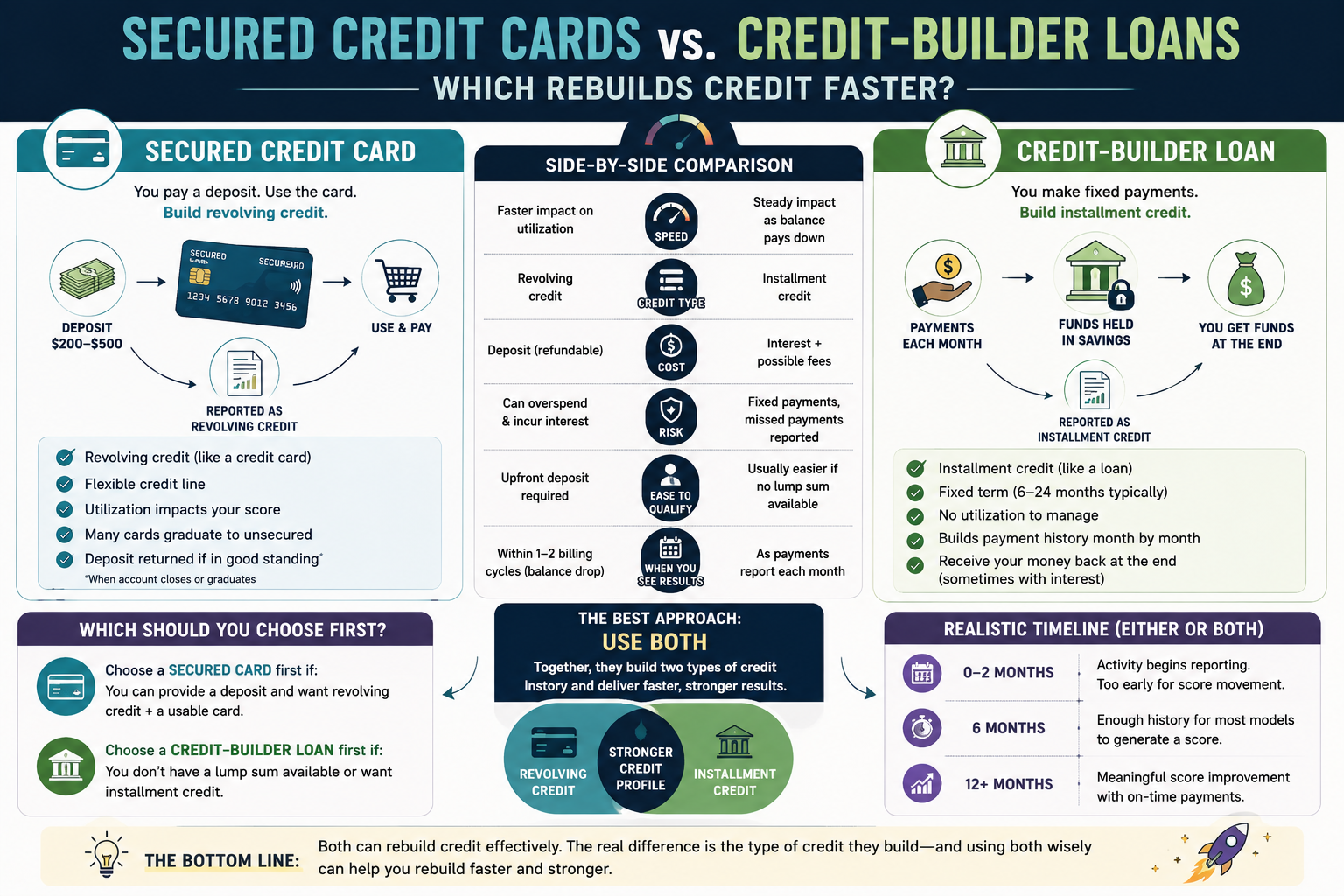
    Both tools exist for essentially the same purpose — establishing or repairing credit for people who don’t currently qualify for standard unsecured products — but they work through different mechanisms, build different types of credit history, and have different practical tradeoffs. The honest answer to “which is faster” depends on what specifically you’re optimizing for, but understanding how each actually works will make the choice, or the decision to use both, much clearer.

    How a Secured Credit Card Works

    You provide a cash deposit (typically $200-500, sometimes more), which becomes your credit limit. You use the card like a normal credit card — making purchases, receiving a monthly statement, and making payments — and your activity is reported to the credit bureaus as **revolving credit**, the same category as any standard unsecured credit card.

    Key mechanics:
    – Your deposit is held as collateral, reducing the issuer’s risk, which is why approval is accessible even with poor or no credit history.
    – You can typically use it up to your limit repeatedly, as long as you pay down the balance (hence “revolving”).
    – After a period of responsible use (often 6-12 months, varies by issuer), many secured cards either automatically graduate to unsecured status (returning your deposit) or make you eligible to apply for an unsecured card with the same issuer.

    How a Credit-Builder Loan Works

    Instead of receiving loan funds upfront, the “loan” amount is held in a locked savings account (or sometimes a CD) by the lender, and you make fixed monthly payments over a set term (often 6-24 months). At the end of the term, you receive the accumulated funds, sometimes with a small amount of interest.

    Key mechanics:
    – Your payments are reported to the credit bureaus as **installment credit** — a fixed monthly payment over a defined term, similar in structure to an auto loan or personal loan.
    – You don’t have access to the funds until the term completes (or, with some products, after you’ve paid a certain percentage), which is fundamentally different from a secured card’s revolving access.
    – There’s no ongoing utilization ratio to manage — your reported balance simply declines predictably each month as you make payments, following the loan’s amortization schedule.

    Speed Comparison: Which Shows Results Faster?

    **For utilization-related score factors**: a secured card can show a benefit faster, since utilization is calculated from your most recent reported balance and can improve within a single billing cycle if you keep spending low relative to your limit.

    **For payment history establishment**: both report similarly — each on-time monthly payment adds to your track record, and most scoring models need a similar minimum period (roughly 6 months) of reporting history before generating a score at all, regardless of which product type you’re using.

    **For credit mix**: a credit-builder loan adds installment credit to your file, which is a different category than the revolving credit a secured card provides. If you already have one type of account, adding the other type is what actually helps your credit mix factor — using two of the same type doesn’t provide this specific benefit.

    In practice, neither product is meaningfully “faster” in isolation — the real speed advantage comes from using both together, since this establishes two different credit history types simultaneously, rather than sequentially.

    Cost Comparison

    **Secured card costs:**
    – Upfront deposit, which is returned (assuming good standing) when the account closes or graduates to unsecured status — this isn’t really a “cost” so much as a temporary hold on your own money.
    – Some secured cards carry annual fees, which is a genuine cost worth comparing across options.
    – Interest charges apply if you carry a balance, though — as with any credit card — paying in full each month avoids this entirely.

    **Credit-builder loan costs:**
    – Interest is typically charged on the loan amount, similar to a standard personal loan, though credit-builder-specific products sometimes have relatively modest rates given their credit-building purpose.
    – Some products charge a modest origination or administrative fee.
    – Unlike a secured card, you generally get your money back at the end (plus, in some structures, a small amount of interest earned on the held funds) rather than a return of an unused deposit — the overall cost structure differs, so a direct comparison depends on the specific terms of each product.

    Risk Comparison

    **Secured card risk**: if you overspend and can’t pay it off, you risk carrying a balance with interest charges, and in more serious cases, if the account goes delinquent, the issuer may use your deposit to cover the unpaid balance — meaning you could lose your deposit and still end up with a damaged account on your credit report.

    **Credit-builder loan risk**: since you’re making fixed payments toward funds you don’t yet have access to, missing a payment has the same negative reporting consequence as any other late payment, without the flexibility a credit card offers (like paying only the minimum in a pinch). Some people find this more psychologically challenging, since you’re paying money each month without immediate access to spend it, which can feel less flexible during tight financial periods.

    Which Is Easier to Qualify For?

    Both are generally accessible with poor or no credit, but there are some differences:

    – **Secured cards** usually require the ability to provide the deposit upfront in a single lump sum, which can be a barrier for some applicants.
    – **Credit-builder loans** spread the “cost” of the loan amount across monthly payments rather than requiring an upfront lump sum, which can make them more accessible for people who don’t have several hundred dollars available at once, even though the total amount paid over time may be similar or higher once fees/interest are factored in.

    Which Should You Choose First?

    If you can only start with one:

    – **Choose a secured card first** if your priority is establishing revolving credit and you have the deposit available — revolving credit history and demonstrated utilization management are weighted meaningfully in most scoring models, and a secured card also gives you an actual usable card for everyday purchases.
    – **Choose a credit-builder loan first** if you don’t have a lump sum available for a deposit, or if you specifically want to add installment credit to complement existing revolving credit (a credit card) you might already have.

    The Best Approach: Use Both, If Feasible

    Since they build different types of credit history and complement rather than duplicate each other, using both simultaneously — a secured card for revolving history plus a credit-builder loan for installment history — tends to produce faster, more well-rounded credit-building results than relying on either alone. This does mean managing two separate monthly payment obligations, so it’s only worth pursuing if you’re confident you can manage both reliably; missing payments on either defeats the purpose entirely.

    Realistic Timeline for Either (or Both)

    – **First 1-2 statement cycles**: initial reporting begins; too early to see meaningful score movement yet.
    – **6 months**: enough history for most scoring models to generate a score, assuming consistent on-time payments.
    – **12 months**: with continued responsible use, meaningful score improvement is typical, often sufficient to start qualifying for unsecured products.

    The Bottom Line

    Neither a secured credit card nor a credit-builder loan is definitively “faster” in isolation — both need roughly the same minimum reporting period before producing a usable score, and both depend entirely on consistent on-time payments to actually help. The real advantage comes from understanding what each contributes (revolving vs. installment credit history) and, if your budget allows, using both together to build a more diverse, faster-developing credit file than either product could produce alone.

  • Does Becoming an Authorized User Actually Raise Your Credit Score?

    Does Becoming an Authorized User Actually Raise Your Credit Score?

    This is one of the more genuinely useful, if slightly counterintuitive, tools in credit building — you can potentially benefit from someone else’s credit history without being legally responsible for their debt. But it doesn’t work universally, and understanding exactly when and why it works (and when it doesn’t) matters before you rely on it as a strategy.

    The Short Answer: Yes, Often Significantly — But With Real Conditions

    Being added as an authorized user on someone else’s credit card can add that account’s entire history — sometimes years or even decades of it — to your own credit report. If the primary account holder has a long-standing, well-managed account, this can meaningfully boost your score, particularly if you have a thin or new credit file where a single well-aged account represents a large proportional improvement to your overall profile.

    But this only works under specific conditions, and it can also backfire.

    How Authorized User Reporting Actually Works

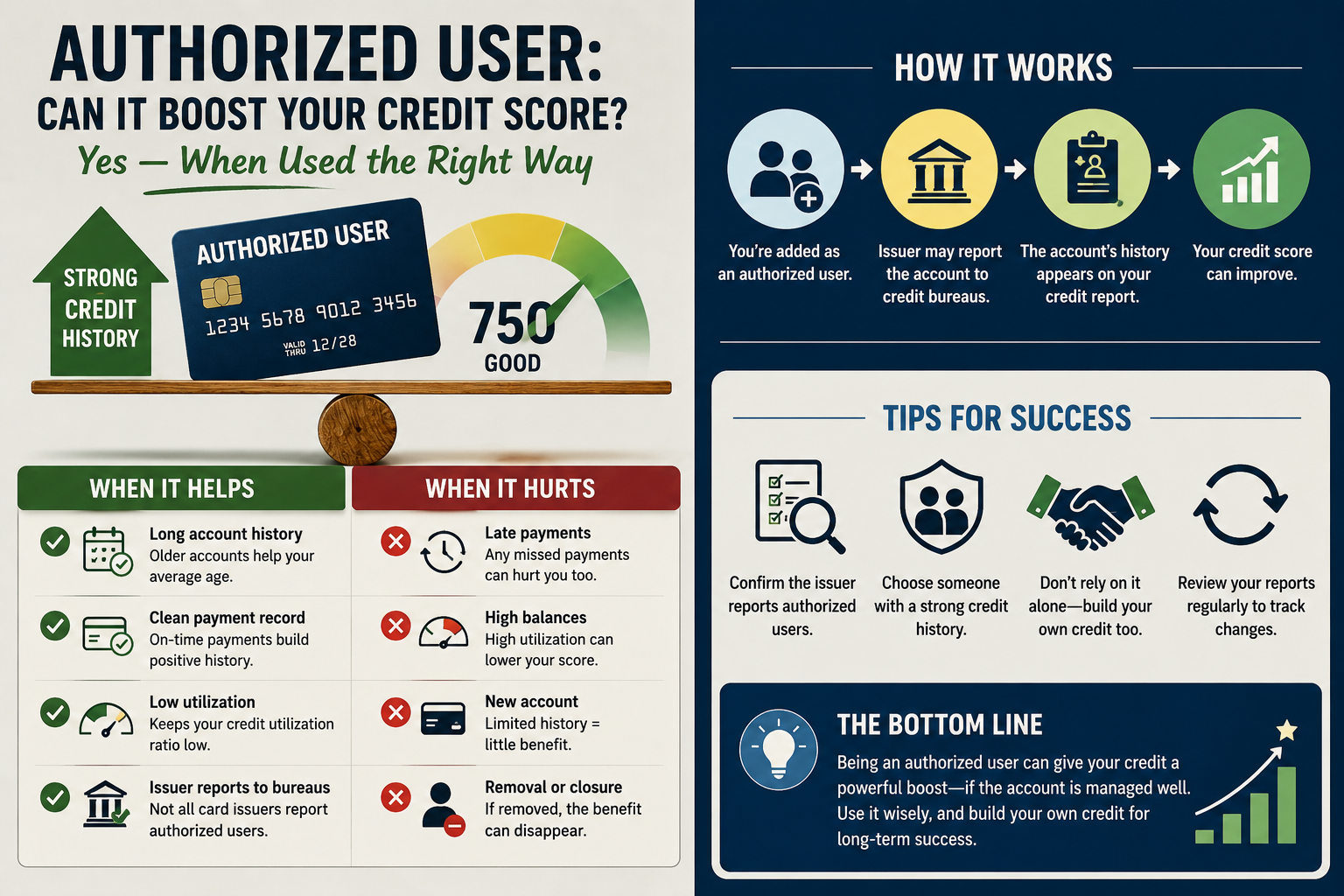
    When you’re added as an authorized user, the card issuer *may* report that account to the credit bureaus as appearing on your credit file too — including its full history: the account age, the payment history, the credit limit, and current utilization. This is the mechanism that creates the benefit (or the risk).

    Critically: **not all card issuers report authorized user activity to the credit bureaus at all.** This varies by issuer, and it’s essential to confirm before assuming the strategy will work. If the issuer doesn’t report authorized user status, adding you accomplishes nothing for your credit file, regardless of how strong the primary account is.

    What Makes This Work Well

    **The primary account has a long history.** The single biggest factor in how much this helps is the account’s age. Being added to a card opened last year provides much less benefit than being added to one opened 15 years ago, since average account age is a real scoring factor, and a long-standing account can meaningfully raise your overall average, especially if your existing credit file is thin.

    **The primary account has a clean payment history.** This is non-negotiable — if the account has late payments or other negative marks, those become part of your file too. This is the core risk of the strategy: you inherit the account’s full history, both good and bad.

    **The primary account has low utilization.** Since the reported utilization on that account becomes part of your file’s overall utilization calculation, a card that’s rarely used or kept at a low balance relative to its limit helps you; a card that’s frequently near

    its limit hurts you, even if you personally never use the card yourself as an authorized user.

    **The issuer actually reports authorized user data.** As mentioned, this is a prerequisite, not a detail — confirm this before pursuing the strategy at all.

    What Makes This Backfire

    **A primary account with negative history.** If the account has missed payments, high utilization, or other derogatory marks, adding you as an authorized user imports those negatives into your file just as readily as it would import positives. This is the most important risk to understand: authorized user status is not a one-directional benefit — it reflects the account’s actual history, whatever that history is.

    **A recently opened account.** If the account is new, there’s minimal age benefit to gain, and you’re taking on whatever risk exists (missed payments going forward) without much of the primary upside.

    **Relying on it as your only credit-building strategy.** Authorized user status supplements a credit file; it doesn’t substitute for having your own independently-held accounts. Since you have no legal ownership or control over the authorized user account, your credit profile remains dependent on someone else’s behavior and, if that relationship or arrangement changes (a divorce, a falling out, the primary holder closing the account), that benefit can disappear.

    Does This Work the Same for Everyone Added?

    Yes, in terms of mechanics — whoever the issuer reports as an authorized user gets the account history reflected. But the *practical impact* varies significantly based on your existing credit profile:

    – **Someone with no existing credit file** often sees the most dramatic relative benefit, since a single well-aged, well-managed account represents a much larger share of their overall credit picture.
    – **Someone with an already-established, moderate credit file** typically sees a smaller, though still real, benefit, since the new account is one of several factors being averaged together rather than dominating the calculation.
    – **Someone with an already strong credit file** may see minimal additional benefit, since they likely already have sufficient account age and history without needing the boost.

    Does the Primary Account Holder Face Any Risk From Adding You?

    Generally minimal, but worth understanding:
    – Adding an authorized user typically doesn’t affect the primary holder’s credit at all, unless the authorized user makes charges that push utilization higher (which does affect the primary account’s reported utilization, and therefore the primary holder’s own credit file, since it’s their account).

    – The primary holder remains fully legally responsible for all charges on the account, including any made by the authorized user, so this arrangement requires real trust if the authorized user will actually be using the card, not just benefiting from the reported history.

    Can You Be an Authorized User Without Ever Using the Card?

    Yes, and this is actually a common and reasonable approach specifically for credit-building purposes — some primary account holders add a family member as an authorized user purely so the account history reports to that person’s file, without ever issuing them a physical card or expecting them to make charges. This isolates the credit-building benefit from any spending risk, which can make the arrangement more comfortable for both parties.

    How Long Does It Take to Show Up on Your Report?

    This varies by issuer but is generally fairly fast — often within one to two billing cycles after being added, the account should begin appearing on your credit report, at which point its full history (not just going forward, but retroactively) is typically reflected, which is what produces the notable, sometimes immediate-feeling score impact compared to opening a brand new account that only has history going forward.

    What Happens If You’re Later Removed?

    If you’re removed as an authorized user (or the primary holder closes the account), that account and its associated history generally stops being reported on your file going forward. This means the benefit isn’t necessarily permanent — it’s tied to your ongoing status on that account, which is a meaningful consideration if you’re relying on it as a long-term strategy rather than a stepping stone while you build your own independent credit history.

    The Bottom Line

    Authorized user status can genuinely and sometimes significantly raise your credit score, but only when the underlying account has a long history, clean payment record, and low utilization, and only if the issuer actually reports authorized user data to the credit bureaus. It’s one of the more powerful tools available, particularly for people with thin credit files, but it’s also a two-way street — a poorly managed primary account can hurt you just as easily as a well-managed one can help — and it works best as a complement to, not a replacement for, building your own independent credit accounts over time.

  • How to Rebuild Credit After a Job Loss

    How to Rebuild Credit After a Job Loss

    Job loss is one of the most common triggers behind an otherwise strong credit history suddenly taking a hit — a missed payment here, rising utilization there, sometimes a collection account if things dragged on longer than expected. The good news is that credit damage tied to a temporary income disruption tends to be more recoverable, and often faster to recover from, than damage from ongoing financial mismanagement, precisely because the underlying cause has typically resolved by the time you’re rebuilding. Here’s a practical, sequenced approach.

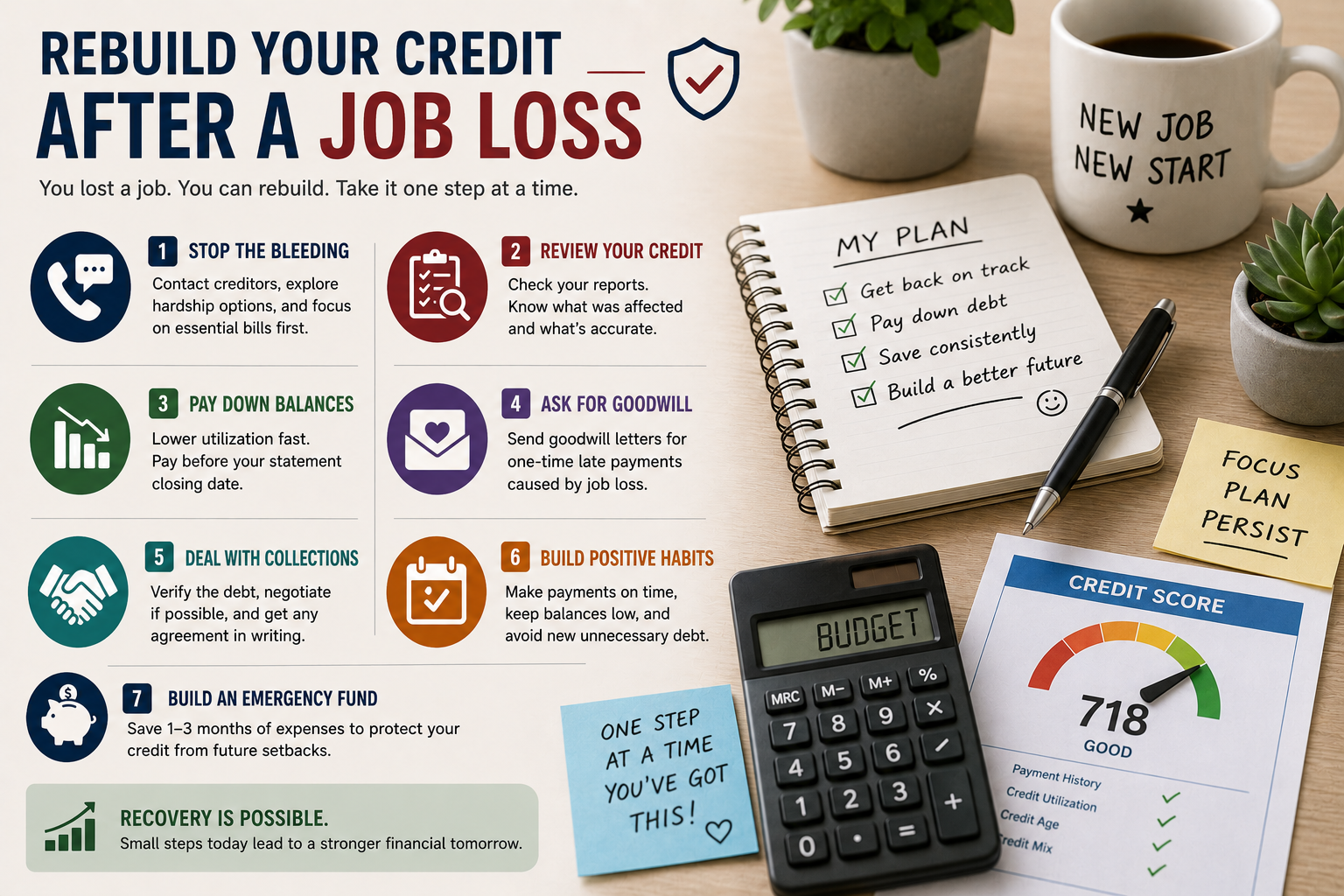
    Step 1: Stop the Bleeding Before You Start Rebuilding

    If you’re still in the immediate aftermath of a job loss, rebuilding strategy comes second to damage control. Before focusing on your credit score specifically:

    – **Contact creditors proactively**, before you miss a payment if possible, or as soon as possible after. Many card issuers and lenders have hardship programs — reduced payments, temporarily paused interest, deferred due dates — that can prevent a missed payment from ever being reported in the first place. This is dramatically more effective than waiting until after a late payment has already hit your report and then trying to fix it.
    – **Prioritize which bills to pay if funds are truly insufficient for everything.** Secured debts with serious consequences (mortgage, auto loan) and anything already reporting delinquent typically take priority over unsecured debts where the immediate consequence of a missed payment is “only” credit damage, though this is a genuinely difficult triage decision that depends on your full financial picture.
    – **Apply for unemployment benefits immediately** if eligible — this is obvious but worth stating, since delayed applications mean delayed income replacement, which compounds the pressure on your other financial obligations.

    Step 2: Assess What Actually Happened to Your Credit

    Once your immediate income situation has stabilized (new job, unemployment benefits flowing, or otherwise), pull your full credit report and take honest stock:

    – **Identify every account affected** — late payments, increased utilization from relying on credit cards during the gap, any accounts that went to collections.
    – **Check for accuracy**, especially around dates — if you were on an approved hardship program with a creditor and they still reported a late payment in violation of that agreement, that’s a legitimate, disputable error.
    – **Distinguish between accounts that are simply high-utilization but current, versus accounts that are actually delinquent** — these require different strategies (paydown vs. dispute/negotiation).

    Step 3: Address Utilization First — It’s the Fastest Lever

    If your credit cards carry elevated balances from the income gap but payments are current, paying these down is your fastest path to score recovery, often showing up within a single billing cycle once the lower balance is reported. Prioritize:

    – **The card(s) with the highest utilization percentage first**, since crossing key thresholds (from over 90% to under 30%, for example) tends to produce more noticeable score movement than incremental paydowns spread evenly across several cards.
    – **Paying down before the statement closing date**, not just before the due date, since the reported balance is typically based on the statement close, not whether you eventually paid by the due date.

    Step 4: Address Any Late Payments With Goodwill Requests

    If you have one or two isolated late payments tied specifically to the job loss period, and you’ve otherwise had a strong history with that creditor, a goodwill letter (see our dedicated guide) is worth sending once you’re back on stable footing. Job loss is exactly the kind of specific, sympathetic, verifiable circumstance that goodwill requests are designed for, and creditors are often more receptive to this kind of request than to a vague “please forgive this” ask.

    Step 5: If Accounts Went to Collections, Address Strategically

    If the gap was long enough that an account went unpaid to the point of collections, treat this the same way you would any collection account:

    – **Verify the debt** before paying anything.
    – **Negotiate**, especially if you can now pay a lump sum from back pay, a new job’s signing bonus, or accumulated unemployment benefits — collectors are often willing to settle for less than the full balance, and pay-for-delete may be on the table.
    – **Get any agreement in writing** before sending payment.

    Step 6: Rebuild Positive History Going Forward

    Once you’re financially stable again, focus on demonstrating consistency:

    – **Keep utilization low going forward**, ideally under 30%, to show the elevated balances during the job loss period were situational, not a lasting pattern.
    – **Avoid taking on unnecessary new debt** immediately after returning to stability — focus on rebuilding a cash cushion first, so a future disruption doesn’t require leaning on credit again in the same way.
    – **Set up autopay for at least minimum payments** on all accounts going forward, as a safeguard against a future gap resulting in an accidentally missed payment even during a stressful period.

    Step 7: Build (or Rebuild) an Emergency Fund as Credit Protection

    This isn’t a credit repair tactic in the traditional sense, but it’s arguably the most effective long-term credit protection available: a cash emergency fund means a future job loss doesn’t have to touch your credit

    at all. Even a modest fund — enough to cover 1-2 months of essential expenses — meaningfully reduces the odds that the next unexpected income gap turns into new credit damage. Building this back up should be a real priority once you’re stable, not an afterthought.

    Realistic Timeline for Recovery

    – **Weeks 1-6 post-stabilization**: utilization paydowns show up and begin lifting your score; this is often the fastest, most encouraging part of the recovery.
    – **Months 2-4**: goodwill requests and any collection negotiations resolve; continued on-time payments accumulate.
    – **Months 6-12**: assuming no further disruptions, most people see substantial recovery back toward their pre-job-loss score range within this window, particularly if the credit damage was limited to a handful of specific, addressed items rather than a broad pattern.

    A Note on Emotional Weight

    Job loss-related credit damage often carries more emotional weight than its practical financial impact — people frequently feel a sense of shame or failure about credit dings tied to unemployment, even though this is one of the most common and understandable causes of credit disruption that exists. It’s worth separating the emotional reaction from the practical recovery plan: a temporary income gap that led to a few late payments or higher utilization is genuinely one of the more recoverable credit situations, precisely because the underlying cause is identifiable, sympathetic to creditors, and (once you’re re-employed) resolved.

    The Bottom Line

    Credit damage from job loss tends to be more recoverable and faster to recover from than people expect, mainly because the underlying cause is temporary and creditors — especially through hardship programs and goodwill requests — often have specific accommodations for exactly this situation. Prioritize stopping further damage first through proactive creditor communication, then tackle utilization paydown as your fastest score lever, follow up with goodwill requests for any isolated late payments, and use the recovery period to build the kind of emergency cash cushion that protects your credit the next time life throws an income disruption your way.

  • Credit Repair Tips for Immigrants New to the US Credit System

    Credit Repair Tips for Immigrants New to the US Credit System

    If you’re new to the United States, one of the most disorienting financial realities is that your credit history — even an excellent one — from your home country almost never transfers over. The US credit system is largely self-contained, and starting from zero here is a normal, expected part of the process, not a reflection of anything about your actual financial reliability. Here’s a practical, realistic path through it.

    Why Foreign Credit History Doesn’t Transfer

    US credit bureaus (Equifax, Experian, TransUnion) only track data reported by US-based lenders and furnishers. Credit history built in another country — even decades of it — simply isn’t in their system, because foreign financial institutions generally don’t report to US bureaus. A small number of specialized services have emerged attempting to bridge this gap for people relocating from specific countries, but they’re limited in scope and not universally recognized by US lenders, so it’s realistic to expect you’re building a file from scratch regardless of your financial history elsewhere.

    Step 1: Get an SSN or ITIN

    Before you can build a US credit file, you generally need either:
    – A **Social Security Number (SSN)**, if you’re authorized to work in the US.
    – An **Individual Taxpayer Identification Number (ITIN)**, available to those who don’t qualify for an SSN but need to file taxes or, in some cases, apply for certain credit products.

    Some credit-building products (a small number of secured cards and specific immigrant-focused lenders) accept ITIN applicants, which is worth knowing if you don’t yet have work authorization but want to start building credit.

    Step 2: Open a US Bank Account First

    This is a foundational step that isn’t credit-building directly, but it’s usually a prerequisite for what comes next, and it also starts establishing a US financial footprint that some newer credit products consider during underwriting. Most major banks have accounts specifically designed to be accessible to new arrivals, sometimes with reduced documentation requirements compared to standard account opening.

    Step 3: Apply for a Secured Credit Card

    This is the most reliable and widely accessible starting point, largely because approval is based on your cash deposit rather than US credit history or, in many cases, even a long US income history. Look specifically for:

    – **Cards that accept ITIN applicants**, if you don’t have an SSN.

    – **Cards from banks with immigrant-focused programs** — several major banks have specific secured card products marketed toward new arrivals, sometimes with more accessible underwriting than their standard secured card offerings.
    – **Confirmed reporting to all three bureaus**, as always.

    Step 4: Look Into Alternative Data and Specialized Immigrant Credit Services

    A growing category of services specifically addresses the “no US credit history” problem for immigrants:

    – **Nova Credit and similar services** attempt to translate credit history from certain specific countries (the list of supported countries is limited but has been expanding) into a form some US lenders will consider, though this isn’t universally accepted and works only for immigrants from supported countries.
    – **Rent and utility reporting services**, as covered in our credit-from-scratch guide, are particularly useful here since many new arrivals are reliably paying rent and utilities but not seeing that reflected anywhere on a credit file.

    Step 5: Consider a Credit-Builder Loan Through a Community-Focused Institution

    Community development financial institutions (CDFIs) and many credit unions specifically serve immigrant communities and often have credit-builder loan products designed for exactly this situation, sometimes with more flexible documentation requirements and staff experienced in helping new-to-country members navigate the process. These are worth researching in your specific area, since availability and terms vary by institution.

    Step 6: Be Cautious With Employer- or Community-Based Informal Lending

    In some immigrant communities, informal lending circles (sometimes called by various cultural names — tandas, susu, hui, and others depending on the community) are a longstanding and often effective way to save and access funds collectively. These are valuable financial tools, but it’s worth understanding they generally don’t report to US credit bureaus, so while they may serve real financial purposes, they won’t substitute for building an actual US credit file if that’s part of your goal (for future mortgage qualification, for example).

    Step 7: Understand How US Employment History Affects Credit Applications

    Beyond credit history specifically, many credit and loan applications ask about employment history and time at your current address, both of which are naturally limited for recent arrivals. A few practical notes:

    – **Some lenders have specific accommodations for recent immigrants**, recognizing that standard “2 years at current job” thresholds don’t fit new arrivals — worth asking directly rather than assuming disqualification.

    – **Building a consistent employment record, even across different employers**, generally satisfies most underwriting requirements better than gaps, so continuity matters more than tenure at a single employer in the early years.

    Step 8: Avoid Predatory Products Targeting New Immigrants

    Unfortunately, new arrivals are sometimes specifically targeted by less scrupulous lenders and “credit repair” operations that overstate what they can do, or by exploitative rent-to-own and high-interest installment lenders. Red flags to watch for:

    – Any company implying they can “transfer” or “restore” your foreign credit history in a way that sounds too easy or complete.
    – High-pressure sales tactics specifically targeting language barriers or unfamiliarity with US financial norms.
    – Requests for large upfront fees before any service is rendered (illegal for credit repair companies specifically under CROA, and a red flag in lending contexts generally).

    Community organizations, immigrant resource centers, and many credit unions offer free or low-cost financial counseling specifically for new arrivals, and are often a safer and more knowledgeable starting point than a cold-outreach product or service.

    Realistic Timeline

    – **First few months**: SSN/ITIN obtained, bank account opened, secured card and/or credit-builder loan application submitted.
    – **6 months**: enough reporting history for most models to generate an initial score, assuming consistent on-time payments.
    – **12-24 months**: with continued responsible use, a genuinely solid US credit foundation, often sufficient to qualify for unsecured products, better rental terms without requiring extra deposits, and eventually more substantial financing like an auto loan or, further down the line, a mortgage.

    The Bottom Line

    Starting a US credit file as a new immigrant is a genuine reset, regardless of your financial history elsewhere, and there’s no way around that structurally — US credit bureaus simply don’t have access to foreign financial data. The most reliable path is the same fundamental toolkit used by anyone building credit from scratch (secured cards, credit-builder loans, alternative data reporting), layered with an awareness of ITIN-accepting products if you don’t yet have an SSN, and a healthy skepticism toward any service overpromising a shortcut around the fact that this genuinely does take consistent time and responsible use to build.

  • Credit Score Dropped 100 Points for No Reason: What’s Really Going On

    Credit Score Dropped 100 Points for No Reason: What’s Really Going On

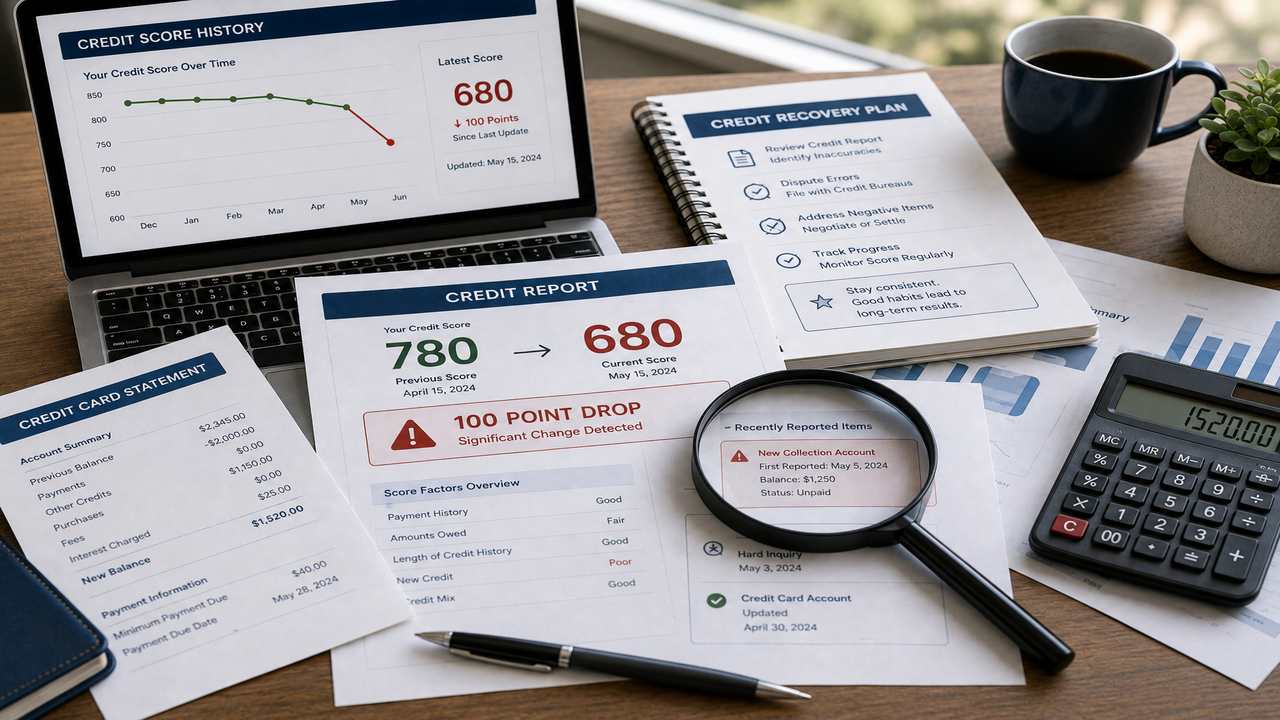
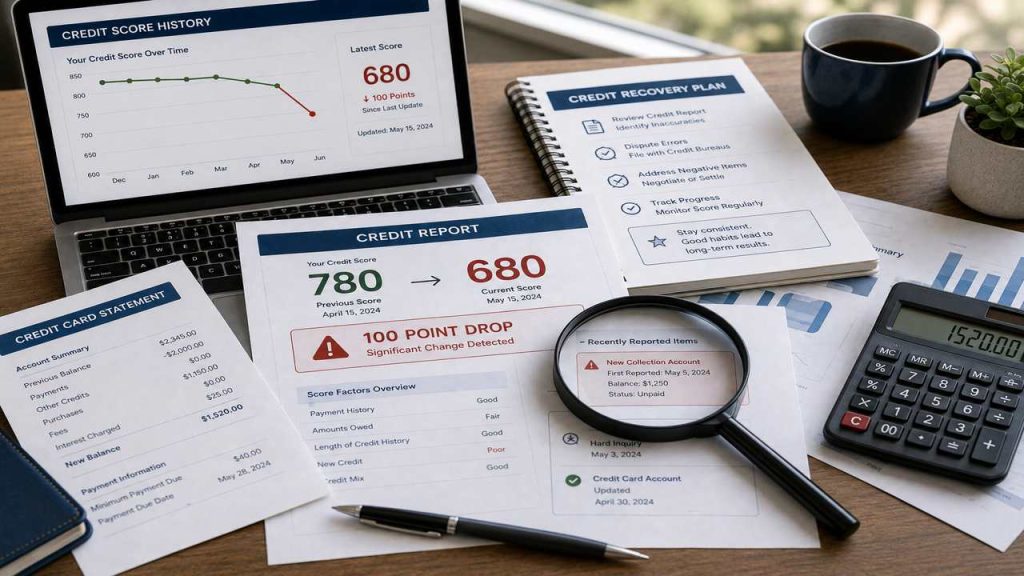
    Watching your credit score fall by 100 points is alarming, and the phrase “for no reason” captures exactly how disorienting it feels — you didn’t miss a payment you know of, you haven’t applied for anything major, and yet the number has dropped dramatically. The reassuring news is that a drop this large is never truly random, even when the cause isn’t immediately obvious. Scoring models don’t move by triple digits without a specific, identifiable trigger. This guide walks through every plausible cause for a drop this significant, how to systematically identify which one applies to your situation, and exactly what to do once you know.

    Why “No Reason” Almost Always Means “A Reason You Haven’t Found Yet”

    A 100-point drop is a completely different category of event from the smaller 10-20 point fluctuations covered elsewhere, which are often routine and unremarkable. A change this large virtually always corresponds to one specific, identifiable, and usually serious event: a missed payment reaching the 30-day reporting threshold, a new collection or public record, a charge-off, a significant utilization spike (often from a specific large purchase or a credit limit reduction), a closed account materially affecting your file, or in some cases, identity theft or a reporting error. The task in front of you isn’t to wonder whether something happened — something did — but to identify exactly what, since your credit report itself will contain the answer.

    Step One: Pull Your Full Credit Report Immediately

    Don’t just check your score again — pull the full underlying report from all three bureaus at AnnualCreditReport.com. The score is a summary output; the report is the actual data driving it, and it’s the only place you’ll find the specific cause. Compare it carefully against what you remember from before the drop, looking specifically at the sections below.

    The Most Likely Causes, Ranked by How Often They Explain a Drop This Large

    1. A Missed Payment That Reached 30+ Days Past Due

    This is the single most common cause of a drop in this range, particularly for someone with an otherwise strong credit history (counterintuitively, the stronger your existing credit, the more a single serious negative mark can move the needle, since the scoring model has less room to reassess a previously excellent record). Check every account for a payment status showing 30, 60, 90, or more days late. This can happen more easily than people expect — an autopay failure due to an expired card, a bank account closed and forgotten with a small automatic payment still linked to it, or a bill you didn’t realize existed (a medical bill sent to an old address, for instance).

    2. A New Collection Account or Charge-Off

    A previously unknown debt — a medical bill, a forgotten subscription, a utility final bill from a former address — reaching collections status can appear as a completely new negative item you had no prior awareness of. Similarly, if an existing account you knew was struggling finally crossed the charge-off threshold (typically 180 days of nonpayment for credit cards), this alone can produce a drop in this range, especially layered on top of the preceding months of late payment reports that led up to it.

    3. A Significant, Sudden Utilization Spike

    While routine utilization changes typically produce smaller score movements, a dramatic spike — maxing out a card, or having a credit limit sharply and unexpectedly reduced by your issuer (which can happen due to the issuer’s own internal risk reassessment, entirely independent of anything you did) — can produce a much larger impact than a routine month-to-month fluctuation, particularly if it affects your overall utilization ratio significantly or pushes a previously low-utilization card into a very high range.

    A civil judgment, a tax lien (though federal tax liens are no longer included on standard credit reports as of a change implemented several years ago, some state and local liens or other judgments can still appear depending on your jurisdiction and specific circumstances), or in more serious cases, a bankruptcy filing, are all major public records that can trigger a drop of this magnitude or larger. If any legal action has been taken against you that you’re aware of — even one that felt minor or was resolved on your end — it’s worth confirming whether and how it appears on your credit report.

    5. Identity Theft or Fraudulent Account Activity

    If a fraudster opened a new account in your name, ran up significant charges, or defaulted on a fraudulent loan, this can appear on your report as new accounts, new hard inquiries, and eventually new negative payment history — all without any legitimate action on your part, making this one of the scenarios that most genuinely fits the description “for no reason,” since from your perspective, nothing you actually did caused it.

    6. A Reporting Error

    Sometimes a creditor’s system genuinely makes a mistake — reporting a payment as late when it was actually on time, misapplying a payment to the wrong account, or duplicating a negative item that should only appear once. These errors are less common than the causes above but do happen, and they’re worth ruling out if you’ve reviewed everything else and nothing seems to genuinely explain the drop.

    7. An Authorized-User Account’s Serious Negative Event

    If you’re an authorized user on someone else’s account, and that account experienced something serious on their end — a significant missed payment, a charge-off, a maxed-out balance — it flows into your credit file exactly as if it were your own account, and can easily be the kind of thing you’d have no direct awareness of, making it a genuinely plausible explanation for an otherwise mysterious drop.

    8. Account Closure by the Issuer (Not You)

    If a credit card issuer closed one of your accounts — due to their own internal risk assessment, extended inactivity, or a broader portfolio decision unrelated to your specific behavior — and it was a significant portion of your total available credit or one of your oldest accounts, the combined effect on your utilization ratio and average account age can be more substantial than a routine account closure you initiated yourself, especially if it happened without any advance notice you noticed.

    A Systematic Diagnostic Process

    Step 1: Note the exact date range.

    Identify when your score was last known to be normal and when you first noticed the drop, to narrow your search to the specific reporting period involved.

    Step 2: Review every account’s payment status.

    Look specifically for any status other than “current” or “paid as agreed” across every single account, including ones you might not think of as active or important.

    Step 3: Check for any new accounts you don’t recognize.

    This includes both new credit accounts and new hard inquiries, which would indicate either your own forgotten application or, more concerning, unauthorized activity.

    Step 4: Check for new public records or collections.

    Look specifically for anything in these sections that wasn’t there before, even for a small dollar amount, since even modest new negative items can meaningfully affect a score, particularly layered onto an otherwise strong file.

    Step 5: Review each account’s reported balance and limit.

    Look for either a significant balance increase or, just as importantly, a limit decrease that wasn’t initiated by you.

    Step 6: Check whether you’re an authorized user anywhere, and if so, contact the primary cardholder to ask whether anything changed on their end.

    Step 7: Compare reports across all three bureaus.

    Since not every creditor reports to every bureau, or reports at exactly the same time, comparing all three can sometimes reveal that an issue appears on one report but not the others, narrowing down exactly where the problem originated.

    What to Do Once You’ve Found the Cause

    If it’s a missed payment:

    Bring the account current immediately if it isn’t already. Consider a goodwill adjustment request if this was a genuine one-time circumstance on an account with an otherwise strong history.

    If it’s a new collection or charge-off:

    Verify the debt is actually yours and accurate before paying anything, using your right to request debt validation. If accurate, decide on paying in full, negotiating a settlement, or, for very old or fraudulent debt, disputing it directly.

    If it’s a utilization spike:

    Pay down the balance as quickly as possible if it’s from your own spending. If it’s from an unexpected credit limit reduction, consider contacting the issuer to ask about reinstating your previous limit, and if declined, focus on paying down balances on other cards to help offset the overall utilization impact.

    Consult with a consumer law attorney if you believe the judgment is inaccurate, improperly obtained, or eligible to be vacated or resolved; if accurate and valid, understand your resolution options (payment, negotiated settlement, or, in bankruptcy cases, understanding your specific discharge and reporting timeline).

    If it’s identity theft:

    Place an immediate fraud alert or credit freeze with all three bureaus, file a report at IdentityTheft.gov (which generates an official FTC identity theft report you can use to dispute fraudulent accounts), and dispute every fraudulent item directly with the credit bureaus and creditors involved, providing your identity theft report as documentation.

    If it’s a reporting error:

    Gather your supporting documentation (payment confirmations, bank statements, prior correspondence) and file a formal dispute with whichever bureau shows the error, and separately contact the creditor directly to request they correct their reporting at the source.

    If it’s an authorized-user account:

    Consider whether remaining an authorized user on that account still serves your interests, and have a direct conversation with the primary cardholder about what happened and whether it’s likely to recur.

    When It Might Genuinely Be Identity Theft: Red Flags to Watch For

    Beyond the general process above, a few specific signs point more strongly toward fraud rather than an oversight or error on your own accounts: unfamiliar hard inquiries from lenders you’ve never applied with, an account opened with a different address than yours, a sudden change in your mailing address on file with a creditor that you didn’t make, being denied a legitimate application because of accounts you don’t recognize, or receiving collection notices for debts entirely unfamiliar to you. If any of these appear during your review, treat identity theft as the leading explanation and act with urgency — the sooner you freeze your credit and dispute fraudulent items, the less additional damage can accumulate while the issue remains unresolved.

    How Long Recovery Takes From a 100-Point Drop

    Recovery timelines vary enormously depending on the specific cause. A resolved reporting error can often be corrected within 30-45 days of a successful dispute, restoring your score close to its prior level relatively quickly once the inaccurate information is removed. A genuine missed payment or new collection, once resolved through payment, typically shows gradual improvement over several months to a year as the negative mark ages and is outweighed by continued positive payment history, though the specific item remains visible on your report for up to seven years even after being resolved. A charge-off or serious delinquency generally takes the longest to fully recover from, often requiring a year or more of consistent positive credit behavior to see substantial score improvement, even though the impact does lessen progressively over that time rather than remaining constant.
    credit-score-dropped-100-points-under-100kb

    Preventing Future Large, Unexplained Drops

    Set up account alerts with every creditor for payment due dates, balance thresholds, and any changes to your account terms or limits, so you’re notified in real time rather than discovering an issue weeks or months later during a routine score check.

    Consider a credit freeze with all three bureaus if you’re not actively planning to apply for new credit, which prevents new fraudulent accounts from being opened in your name in the first place.

    Review your full credit report, not just your score, on a regular schedule — quarterly is a reasonable cadence for most people — so that any new issue is caught closer to when it happens rather than accumulating for months before you notice a dramatic score change.

    Keep contact information current with every creditor, since missed notices due to an old address or expired email are a common, preventable cause of payments or bills falling through the cracks unnoticed.

    Frequently Asked Questions

    Can a 100-point drop happen from a single missed payment alone?

    Yes, particularly for someone with an otherwise excellent credit history and a relatively short list of negative marks — in these cases, a single serious late payment (especially 90+ days late, or a first-time charge-off) can produce an outsized impact precisely because the scoring model previously had very little negative information to weigh it against.

    Is it possible for a drop this large to be completely unexplainable, even after a thorough review?

    This is extremely rare. If you’ve genuinely reviewed your full report from all three bureaus and truly cannot find any specific new negative item, new inquiry, balance change, or closed account, it’s worth contacting the specific credit monitoring service showing you the drop directly, since in rare cases a monitoring service itself can display an inaccurate or delayed score due to its own technical issue, separate from your actual underlying credit report data.

    How quickly should I act if I suspect identity theft caused this?

    Immediately — the longer fraudulent accounts remain open and unaddressed, the more potential damage (additional fraudulent charges, further accounts opened, more significant score impact) can accumulate. Placing a fraud alert or freeze and filing your identity theft report should be your first actions upon strong suspicion, even before you’ve finished a full diagnostic review of every account.

    Will my score ever fully return to where it was before a 100-point drop?

    In most cases, yes, given enough time and consistent positive credit behavior afterward, particularly once the underlying negative item ages significantly or drops off your report entirely after seven years. The timeline varies considerably based on the specific cause and your overall credit management afterward, but a drop of this size is very rarely permanent if you address the underlying cause and continue building positive history.

    Should I dispute everything on my report just in case something is wrong that I haven’t identified?

    No — disputing accurate information doesn’t help and can create unnecessary complications. Focus your dispute efforts specifically on items you have genuine reason to believe are inaccurate, incomplete, or fraudulent, based on your careful review, rather than disputing broadly and indiscriminately.

    A Real Example of How Multiple Small Issues Compound Into a Large Drop

    Sometimes a 100-point drop isn’t one single dramatic event, but several moderate issues that happened close together and compounded. Consider this composite, illustrative scenario: a medical procedure results in a bill that’s misdirected to an old address and goes unpaid for months before being sent to collections (a new negative item, potentially a 40-60 point impact on its own for someone with a previously clean file). During the same general period, the financial strain of unexpected medical costs leads to a missed credit card payment that reaches 30 days late before being caught and resolved (another significant hit, particularly layered onto an already-strained month). And separately, the same card issuer, noticing the missed payment, proactively reduces the credit limit on that card as a risk-management measure, pushing utilization on that specific card up sharply even though the balance itself didn’t change (a further contributing factor).

    Individually, any one of these might have produced a 20-40 point drop. Together, compounding within the same reporting period, they can easily combine into something in the 100-point range, which is why a “for no reason” drop this large often benefits from a careful, complete review rather than stopping the search after finding the first explanation — there may be more than one contributing factor, and understanding the full picture helps you address everything rather than just the most obvious piece.

    How to Prioritize When You Find Multiple Issues at Once

    If your review turns up more than one contributing factor, prioritize in roughly this order: first, anything indicating fraud or identity theft (since this requires the most urgent action to prevent further damage); second, anything that’s actively still delinquent or accruing further negative status (like a payment still currently past due, where every additional day makes the situation modestly worse); third, anything you can resolve quickly and completely (a small collection you can pay off in full immediately); and finally, anything that requires a longer-term approach (rebuilding utilization gradually, or waiting out an aging negative item). Tackling issues in this order ensures you stop any ongoing damage first, then address what you can control most immediately, before turning to the factors that simply require patience and continued good habits over time.

    The Emotional Toll of a Large, Unexpected Drop — and Why It’s Worth Naming

    It’s worth acknowledging directly: discovering a 100-point drop, especially one you can’t immediately explain, is genuinely stressful, and for many people it triggers a cascade of worry about mortgage applications, upcoming purchases, or a general sense that their financial life is less stable than they believed. This reaction is completely understandable, and it’s worth giving yourself permission to take the diagnostic process one step at a time rather than trying to solve everything in a single anxious evening. Most causes, once identified, come with a clear and manageable path forward — this isn’t a problem without solutions, even when it initially feels overwhelming. Approaching it as a solvable puzzle rather than a catastrophe tends to produce both better outcomes and considerably less stress along the way.

    Frequently Asked Questions, Continued

    Can a divorce or separation cause a 100-point drop?

    Not directly through the credit scoring system itself — a divorce doesn’t automatically split or affect your credit file. However, the financial disruption sometimes associated with separating households (missed payments during a chaotic transition period, a joint account where an ex-partner stops paying their share, or removal from a joint account you’d relied on for a strong utilization ratio) can indirectly lead to exactly the kinds of events that do cause significant score drops.

    If my score dropped 100 points, will every lender see the same reduced number?

    Not necessarily the identical number, since different lenders may pull from different bureaus and use different scoring models, but if the underlying cause is a serious, accurately reported negative item, its impact would generally be reflected across whichever bureau received that information, even if the exact point value differs slightly between different scoring models.

    Does a 100-point drop ever resolve itself without me taking any action?

    Only in the specific case where the underlying cause was temporary or already resolving on its own (for example, a utilization spike from a large one-time purchase that you were already planning to pay off before your next statement closes) — for anything involving an actual delinquency, collection, or public record, meaningful recovery requires you to actively resolve the underlying issue rather than simply waiting.

    Is it worth paying for a paid credit monitoring service after an event like this, rather than relying on free options?

    Free monitoring (through your bank, card issuer, or services like Credit Karma) is generally sufficient for catching and understanding most score changes. A paid service with three-bureau monitoring and real-time alerts can offer faster notification and slightly more comprehensive coverage, which may be worth the cost specifically if you’ve just experienced a significant, concerning event like this and want the added reassurance of closer monitoring during your recovery period.

    A Note on How This Differs From a Gradual Decline

    It’s worth distinguishing a sudden 100-point drop from a gradual decline of the same magnitude spread across many months, since they usually point to different underlying stories and require somewhat different approaches. A sudden drop, as covered throughout this guide, typically traces to one or two specific, identifiable events within a single reporting period. A gradual decline of similar total magnitude — losing 8-10 points a month over the course of a year, for instance — more often reflects an ongoing pattern: slowly rising balances across several accounts, a series of small late payments accumulating over time, or a gradually worsening debt-to-income situation. If your situation looks more like the latter, the diagnostic process is less about finding a single smoking gun and more about honestly assessing your overall spending and payment patterns over the full period in question, since the “cause” in this case is more likely a trend than a single event.

    Frequently Asked Questions, Continued Further

    If I find the cause and fix it immediately, does my score jump back up right away?

    Not usually instantly — most fixes take at least one full billing/reporting cycle (typically 30-45 days) to be reflected in an updated score, since your creditor needs to report the corrected or resolved status to the bureaus before it factors into a recalculated score. Some improvements, particularly a corrected error following a successful dispute, can show meaningful recovery relatively quickly once the correction is processed, while others, like recovering from a genuine charge-off, unfold more gradually over many months.

    Could a 100-point drop be caused by something on my spouse’s credit report if we have joint finances?

    Only if you have specific joint accounts together, or if you’re an authorized user on their individual accounts — otherwise, spouses maintain entirely separate credit files, and one spouse’s individual account activity (outside of shared or authorized-user accounts) has no direct effect on the other’s credit report or score.

    Is it common for a drop this large to be permanent even after doing everything right?

    No — while certain very serious items (a Chapter 7 bankruptcy, for example) do carry a longer-lasting impact than a single late payment, even these become progressively less impactful over time as they age and as you build new positive history, and all negative items eventually age off your report entirely, most within seven years, ensuring the impact is never truly permanent.

    The Bottom Line

    A 100-point credit score drop always has a specific, identifiable cause, even when it initially feels like it came from nowhere. The path forward is the same regardless of how alarming the number feels: pull your full credit report from all three bureaus, systematically review every account for missed payments, new negative items, utilization changes, and unfamiliar activity, and address whatever you find directly — through payment, dispute, a goodwill request, or fraud protection measures as appropriate. Once you understand the specific cause, a drop this size stops feeling mysterious and starts being simply another, more serious version of the same kind of credit management challenge that smaller fluctuations represent — solvable with the same combination of accurate information, direct action, and time.

    Get a Credit Audit or Quote
  • Pay for Delete Capital One: Does It Actually Work?

    Pay for Delete Capital One: Does It Actually Work?

    If you have a charged-off or collection account tied to Capital One and you’ve come across the term “pay for delete,” you’re likely hoping there’s a straightforward way to pay off the debt and have it disappear from your credit report entirely, rather than simply showing as “paid.” This is a completely understandable goal, and it’s worth understanding exactly how likely it is to work with Capital One specifically, what the realistic alternatives are, and how to approach the conversation if you decide to try.

    What “Pay for Delete” Actually Means

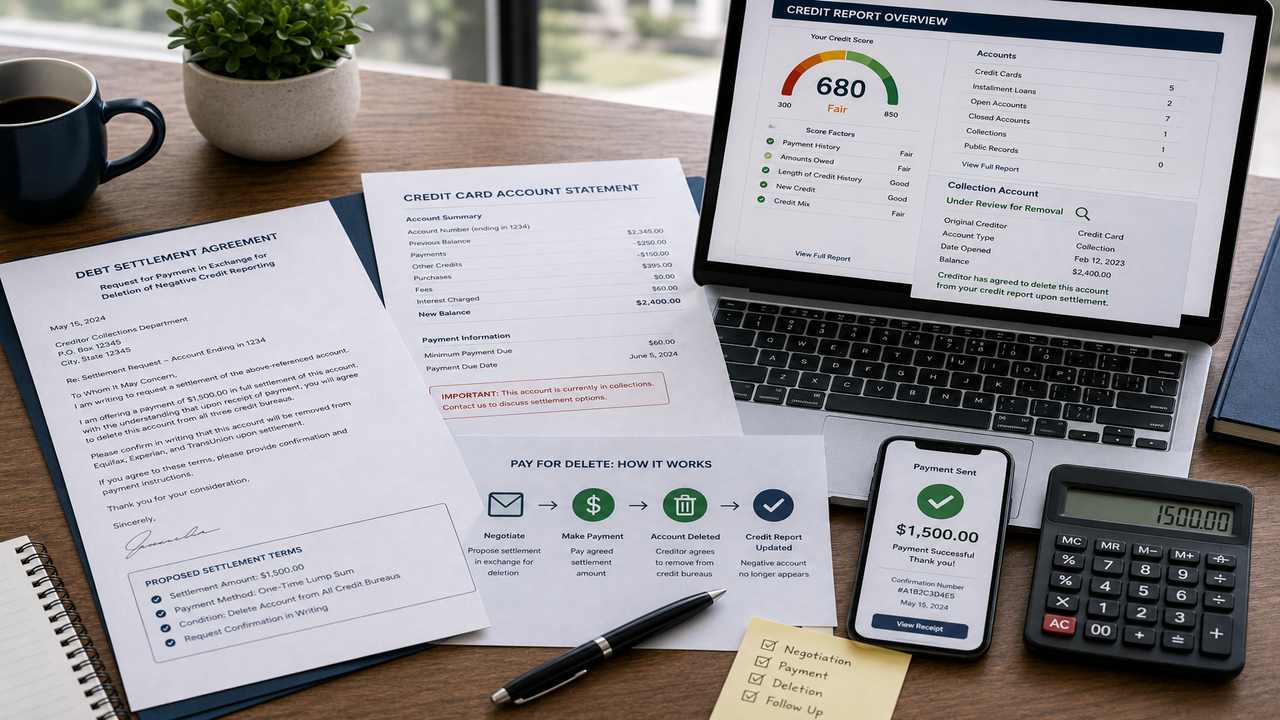
    A pay for delete arrangement is an agreement, negotiated directly between a consumer and a creditor or collection agency, where the consumer pays some or all of the debt in exchange for the creditor agreeing to remove the negative account entirely from the consumer’s credit report, rather than reporting it as “paid” or “settled.” The appeal is obvious: a fully removed negative account has a more favorable effect on your credit score than the same account showing as paid, since the negative history itself disappears rather than remaining visible (even if marked positively resolved).

    Why This Is Difficult, Specifically With Capital One

    Here’s the important reality check: Capital One, like most major banks and original creditors, generally does not agree to pay for delete arrangements as a matter of internal policy. This isn’t unique to Capital One — most large, well-established financial institutions have policies against this practice, for a specific reason worth understanding: major creditors are typically members of the credit bureaus’ data furnisher agreements (through organizations like the Consumer Data Industry Association), which include commitments to report account information accurately and completely. Agreeing to selectively delete accurate information in exchange for payment would arguably violate the spirit, and in some interpretations the letter, of those data-accuracy commitments, exposing the institution to potential regulatory or contractual risk.

    This means that, in practice, requesting pay for delete directly from Capital One while the debt is still held internally by Capital One is very unlikely to succeed, regardless of how the request is worded or how much you’re willing to pay upfront.

    The Situation Changes If the Debt Has Been Sold to a Collector

    Capital One, like most major creditors, will often sell charged-off debt to third-party collection agencies rather than pursuing it indefinitely themselves. If your original Capital One debt has been sold — meaning a separate collection agency now owns and is reporting the debt, not Capital One directly — the pay for delete conversation shifts to that collection agency, and the odds change somewhat.

    Smaller, independent collection agencies, particularly those that purchased the debt for a steep discount, sometimes have more individual flexibility and less rigid institutional policy against pay for delete than Capital One itself does as the original creditor. Some are willing to agree to it, particularly for accounts they view as otherwise difficult to collect, since recovering something is generally better for them than recovering nothing at all. That said, this is far from guaranteed — many collection agencies also decline, either due to their own internal policy, their contractual agreements with the entity they purchased the debt from, or simply because they don’t see a strong incentive to agree to it.

    How to Find Out Who Currently Holds Your Debt

    Before attempting any negotiation, confirm exactly who currently owns and is reporting the debt:

    • Check your current credit report for the specific name of whichever company is reporting the account — if it still shows as “Capital One,” they likely still hold the debt internally; if it shows a different, unfamiliar company name, that’s likely the collection agency that purchased it.
    • Review any recent collection letters or calls you’ve received, which are legally required to identify the specific company attempting to collect and, under the Fair Debt Collection Practices Act, must provide validation of the debt if you request it within 30 days of first contact.
    • Call Capital One directly if you’re unsure, and ask whether the account is still held internally or has been sold, and if sold, to which company — while they’re not obligated to proactively volunteer detailed collection strategy, they generally will confirm basic factual information like this upon request.

    If Capital One Still Holds the Debt: Realistic Alternatives to Pay for Delete

    Since a direct pay for delete request to Capital One itself is unlikely to succeed, here are more realistic paths that can still meaningfully improve your situation:

    • Pay in full and let it report as “paid charge-off.” While this doesn’t remove the entry, it’s viewed more favorably than an unpaid charge-off under most current scoring models, and it demonstrates resolution if a future lender reviews your full report manually.
    • Request a goodwill adjustment after paying in full. Some divisions of Capital One, particularly for a longtime customer with an otherwise reasonable account history, may consider a discretionary goodwill removal request after the debt is resolved, even though this is different from a pre-payment pay for delete negotiation and isn’t guaranteed.
    • Negotiate a settlement for less than the full balance. Capital One and its internal recovery departments will sometimes accept a reduced lump-sum payment to resolve a charged-off account, even without agreeing to delete the entry, which at minimum reduces what you owe and updates your report to reflect a “settled” status rather than an ongoing unpaid balance.
    • Let the seven-year reporting clock run its course if the account is old enough that it’s approaching the end of its reporting window anyway, in which case negotiating for early removal may add less value than simply waiting the remaining time, particularly if you’re not planning any major credit applications in the near term.

    If the Debt Has Been Sold to a Collector: How to Approach the Conversation

    If you’ve confirmed a different, third-party collection agency now holds the debt, here’s how to approach a pay for delete request with a realistic, professional tone:

    • Get everything in writing before making any payment. Never send payment based on a verbal promise alone — insist on a written agreement, sent by mail or through a documented method, explicitly stating that in exchange for your payment of a specific amount, the company agrees to request deletion of the tradeline from all three credit bureaus they report to.
    • Understand this remains at their discretion. Even collection agencies willing to consider pay for delete aren’t obligated to agree, and some major credit bureaus have specific data furnisher agreements that also discourage or prohibit this practice among the companies that report to them, meaning even a willing collector might technically be unable to follow through even if they verbally agree.
    • Be specific in your request. Rather than a vague “can you delete this,” specify exactly what you’re asking: “I’m prepared to pay [amount] as full and final settlement, in exchange for your agreement to request deletion of this tradeline from Equifax, Experian, and TransUnion within [a specific number, e.g., 30] days of receiving payment.”
    • Keep records of everything, including the agency’s name, any representative’s name, the date, and copies of all written correspondence, in case you need to follow up or dispute a failure to honor the agreement after payment.

    Why Pay for Delete Is Controversial, Even When Offered

    It’s worth understanding why this practice exists in something of a gray area, even when a collector agrees to it.

    The Fair Credit Reporting Act requires furnishers of credit information to report data accurately; deleting an account that was, in fact, accurately reported (assuming there’s no actual error, just an agreement to remove accurate information as a negotiating incentive) arguably conflicts with that accuracy principle, which is exactly why major creditors like Capital One generally avoid the practice altogether, and why some smaller collectors willing to offer it are, in a technical sense, taking on some risk by doing so. This doesn’t make it illegal for you as the consumer to request or accept such an arrangement, but it does explain the institutional reluctance you’re likely to encounter, particularly from a large, compliance-focused institution like Capital One.

    What to Do If You Suspect the Capital One Debt Isn’t Even Yours or Is Inaccurate

    If you don’t recognize the debt at all, believe it belongs to someone else, or believe the amount is incorrect, this is a fundamentally different situation from a pay for delete negotiation — you have the right to formally dispute it as inaccurate under the FCRA, which, if successful, results in complete removal because the information was wrong, not because of any payment or negotiation. This path doesn’t require any payment at all and is worth pursuing first if you have genuine reason to believe the debt or its reported details are inaccurate.

    A More Reliable Long-Term Strategy Than Chasing Deletion

    Given how unlikely a direct pay for delete agreement is with Capital One specifically, and even with many collection agencies, it’s often more productive to focus energy on the things within your more reliable control: resolving the debt (through payment or settlement) so it reports as positively as possible under current status codes, building substantial positive credit history afterward through other accounts, and allowing time to naturally reduce the weight of the older negative item as your overall file grows stronger and the entry itself moves further into the past, eventually aging off your report entirely at the seven-year mark from the original delinquency date regardless of what happens with any deletion request.

    Frequently Asked Questions

    Has Capital One ever agreed to pay for delete for anyone?

    While it’s difficult to rule out that some individual representative or unusual circumstance might have resulted in this at some point, it is not Capital One’s stated or general policy, and it should not be counted on or expected as a realistic outcome when planning your approach to resolving a Capital One debt.

    Is it illegal to ask for pay for delete?

    No, requesting it isn’t illegal for you as a consumer. It’s simply a negotiation request that the creditor or collector is free to accept or decline based on their own policies.

    If a collector agrees to pay for delete in writing but doesn’t follow through, what can I do?

    You’d have a written agreement documenting their commitment, which strengthens your position if you need to dispute their failure to honor it — contact them first to request compliance, and if that fails, you may have grounds for a complaint to the Consumer Financial Protection Bureau or, depending on your situation, consultation with a consumer law attorney about a potential breach of that written agreement.

    Does paying off a Capital One charge-off in full without a pay for delete agreement still help my score?

    Yes, generally — under current scoring models, a paid or settled charge-off is viewed more favorably than an unpaid one, even though the entry itself remains visible on your report (with an updated status) rather than being removed entirely.

    Should I hire a credit repair company to negotiate pay for delete with Capital One on my behalf?

    Be cautious about paying a company specifically for this service, since the same institutional policies that make pay for delete unlikely when you ask directly generally apply regardless of whether the request comes from you personally or from a company representing you — a credit repair company doesn’t have any special leverage or exception to Capital One’s general policy in this regard.

    A Sample pay for delete Request Letter (For a Third-Party Collector)

    If you’ve confirmed your Capital One debt has been sold to a collection agency and want to attempt this negotiation, here’s a template you can adapt:

    [Your Name]
    [Your Address]
    [Date]
    
    [Collection Agency Name]
    [Collection Agency Address]
    
    Re: Account [Reference Number], Original Creditor: Capital One
    
    Dear Sir or Madam,
    
    I am writing regarding the above-referenced account. I am prepared to pay [$X amount] as full and final settlement of this debt, contingent upon your agreement to request deletion of this tradeline from all three credit bureaus (Equifax, Experian, and TransUnion) within [30] days of receipt of payment.
    
    Please confirm this agreement in writing prior to my sending payment. Once I receive your written confirmation, I will promptly submit payment via [method — cashier’s check, money order, etc.].
    
    If this arrangement is not something your company is able to offer, please let me know, and I will consider alternative resolution options.
    
    Sincerely,
    
    [Your Name]
    [Contact Information]
    

    Always send this via a method that provides delivery confirmation (certified mail, for example), and keep a copy for your records. If they respond by phone rather than in writing, politely ask them to confirm any verbal agreement in writing before you proceed with payment.

    Realistic Success Rate Expectations

    It’s worth setting expectations honestly rather than optimistically: pay for delete requests to third-party collectors succeed only some of the time, and estimates and anecdotal experiences vary widely depending on the specific agency, the age and size of the debt, and how the request is framed. Larger, more established collection agencies with formal compliance departments are generally less likely to agree, given the same data-accuracy concerns that make major original creditors reluctant. Smaller, more aggressive debt-buying operations sometimes have more flexibility, precisely because they purchased the debt for a small fraction of its value and view any recovery as a win, with less concern for broader industry compliance norms.

    Rather than assuming this will work, it’s more productive to treat it as worth trying (since there’s little downside to asking, as long as you don’t send any payment without written confirmation first) while having a solid backup plan — payment or settlement without deletion — ready to go if the request is declined, which is a common outcome.

    Understanding the E-OSCAR System and Why Bureaus Discourage Pay for Delete

    Credit bureaus process disputes and data updates for creditors and collectors through a system called e-OSCAR (Electronic Online Solution for Complete and Accurate Reporting), and both Equifax, Experian, and TransUnion have data furnisher agreements with the companies that report to them, generally requiring accurate and complete reporting rather than selective reporting based on payment arrangements. This is the structural reason pay for delete exists in tension with standard industry practice: a collector who agrees to delete an accurately reported account in exchange for payment is, in a sense, working around the spirit of these furnisher agreements, even though enforcement of this specific practice varies and doesn’t always result in consequences for the individual company involved. This background context helps explain why some companies flatly refuse (out of genuine compliance concern) while others quietly agree anyway (calculating that the practical risk of doing so is low).

    Should You Pay a Credit Repair Company to Handle This for You?

    Given how much of a pay for delete negotiation comes down to institutional policy rather than negotiation skill, it’s worth being skeptical of any company that charges a significant fee specifically promising to secure pay for delete arrangements with major creditors like Capital One.

    As covered above, the same policy barriers apply whether you personally send the request or a company sends it on your behalf — there’s no special leverage a third-party company has that meaningfully changes Capital One’s institutional stance. If you do want assistance navigating this process, look for companies that are transparent about the realistic likelihood of success and that charge based on genuine legwork (like disputing actual inaccuracies, which is a different and often more reliably successful process) rather than a fee premised specifically on guaranteeing deletion of accurately reported debt.

    A Side-by-Side Comparison: Approaching Capital One vs. a Third-Party Collector

    Capital One (original creditor) Third-party collection agency
    General policy on pay for delete Generally against it
    Varies by company; some willing
    Reason Data furnisher accuracy commitments
    Purchased debt cheaply; some prioritize recovery over compliance norms
    Better alternative Pay in full or settle, then request goodwill adjustment
    Negotiate settlement with deletion as a specific written condition
    How to confirm who holds the debt Check credit report furnisher name; call Capital One directly
    Check any collection letters for the specific company name

    pay-for-delete-capital-one-under-100kb

    Frequently Asked Questions, Continued

    If I pay off my Capital One account without a pay for delete agreement, how long until my score improves?

    Improvement can begin as soon as your next reporting cycle reflects the updated “paid” or “settled” status, typically within 30-45 days, though the overall magnitude of improvement depends on your specific scoring model and the rest of your credit file.

    Can I ask Capital One’s recovery department specifically, rather than general customer service, about pay for delete?

    You can ask, and speaking directly with their internal recovery or charge-off department (rather than general customer service, which typically has no authority over this) is the right channel if you want to pursue it — but the underlying institutional policy against the practice generally applies regardless of which specific department within Capital One you reach.

    Does it matter how old the Capital One debt is when negotiating?

    Yes, generally — older debt, particularly debt getting closer to its seven-year reporting expiration, sometimes gives you more leverage in settlement negotiations (since the creditor or collector has less time remaining to collect anything at all), though this doesn’t specifically change the likelihood of a deletion agreement, which remains governed primarily by institutional policy rather than debt age.

    If Capital One declines pay for delete, is there any point in still negotiating a settlement?

    Yes, absolutely — a settled or paid account is meaningfully better for your credit profile and your legal standing than an unpaid one, even without deletion, and it’s worth pursuing on its own merits rather than only as a consolation to a declined deletion request.

    What Capital One’s Actual Charge-Off and Collections Process Looks Like

    Understanding the typical internal timeline can help you know what stage you’re at and what to expect next. Capital One, like most major card issuers, generally follows a process similar to this: after a payment is missed, you’ll receive escalating notices at 30, 60, 90, and 120 days past due, often accompanied by calls from Capital One’s own internal collections department attempting to bring the account current or set up a payment arrangement. Around the 150-180 day mark, if the account remains unresolved, it’s charged off internally and reported to the credit bureaus as such.

    After charge-off, Capital One may continue attempting to collect directly for some period, or may sell the debt to one of several third-party debt buyers they work with — this decision is made internally and isn’t something you’ll typically be notified about in advance, which is why checking your credit report periodically after a charge-off is the most reliable way to know whether the debt is still with Capital One or has moved to a new owner.

    What If You’ve Already Made a Partial Payment Without an Agreement?

    If you’ve already sent Capital One or a collector a partial payment without securing any written pay for delete agreement beforehand, it’s worth knowing this doesn’t prevent you from continuing to negotiate the remaining balance, though it does remove any leverage you might have had to request full account deletion in exchange for that specific payment, since it’s already been made unconditionally. Going forward, treat any additional payment as a fresh negotiation point, and don’t send further payments without a written agreement specifying exactly what you’re getting in return, whether that’s deletion (unlikely but possible with a third-party collector), a specific “paid in full” status update, or a formal settlement agreement closing out the account.

    Frequently Asked Questions, Continued Further

    Does Capital One ever reduce the amount owed even without a full pay for delete or settlement negotiation?

    Sometimes, particularly if you’re proactive and call before the account is fully charged off, Capital One’s internal collections department may offer reduced settlement amounts or structured payment plans as part of standard hardship accommodation practices, separate from any pay for delete request specifically.

    If Capital One sold my debt to a specific collector I don’t want to deal with, can I ask them to resell it elsewhere?

    No, you don’t have the ability to direct who a creditor sells a debt to, but you do retain the same rights (debt validation, dispute rights, settlement negotiation) with whatever company currently and legitimately holds the debt, regardless of your preference about which company that is.

    Is there a specific department at Capital One I should ask for regarding an old charged-off account?

    Yes — asking specifically for their “recovery” or “charge-off recovery” department, rather than general customer service, will connect you with the team that actually has authority over settlement negotiations and payment arrangements for already-charged-off accounts.

    The Bottom Line

    Pay for delete is very unlikely to work directly with Capital One while they still hold the debt themselves, due to their general institutional policy against the practice. If your debt has been sold to a third-party collection agency, the odds improve somewhat, though it’s still far from guaranteed and depends heavily on the specific agency involved. In either case, get any agreement in writing before paying, and have a realistic backup plan — paying in full or negotiating a settlement, even without deletion, still meaningfully improves your situation compared to leaving an unpaid balance on your report, and time itself will eventually resolve the entry once the standard seven-year reporting window expires.

    Need Help Reviewing Your Credit Report?

    If you want help reviewing your credit report for inaccurate or potentially disputable information, you can request a credit audit or quote.

    Request a Credit Audit or Quote

  • Charge-Off vs. Write-Off: Are They the Same Thing?

    Charge-Off vs. Write-Off: Are They the Same Thing?

    These two terms get used almost interchangeably in everyday conversation, and understanding whether — and when — they actually mean the same thing can clear up a lot of confusion about what’s happening to an unpaid debt and what it means for you. The short answer: in most everyday consumer credit contexts, “charge-off” and “write-off” refer to the same underlying event, but the terms come from slightly different contexts and carry slightly different technical connotations worth understanding.

    The Core Definitions

    A write-off, in general accounting terminology, is the broad concept of a business removing an asset — in this case, a debt owed to them — from their books because they’ve determined it’s unlikely to be collected. This is a universal accounting concept that applies across virtually every industry, not just lending: businesses write off unpaid invoices, obsolete inventory, or bad investments using the same fundamental accounting principle.

    A charge-off is the specific term used within consumer lending and banking for exactly this same write-off process, applied specifically to a delinquent loan or credit account. It’s essentially “write-off” using the vocabulary specific to the lending industry, governed by particular regulatory guidance (particularly for credit cards, guided by interagency banking regulator standards recommending charge-off after 180 days of delinquency).

    So in the specific context of an unpaid credit card, personal loan, or similar consumer debt, “charge-off” and “write-off” are functionally describing the same event: the creditor’s internal decision to stop counting the debt as a collectible asset and record it as a loss for accounting and tax purposes.

    Why Both Terms Show Up in Different Places

    You’ll typically see “charge-off” used specifically on your credit report, in communications from credit card issuers and banks, and in consumer-facing credit education content, since it’s the standard terminology within consumer credit reporting (the Metro 2 reporting format used industry-wide specifically uses “charge-off” status codes).

    You’ll more often see “write-off” used in broader financial, accounting, business, and tax contexts — a company’s annual report might discuss “writing off” a category of bad debt in aggregate, an accountant might refer to “writing off” a specific client’s unpaid invoice, or general financial news might discuss a bank “writing off” a portion of its loan portfolio. It’s the more universal accounting term, while “charge-off” is the consumer-lending-specific application of that same concept.

    Does the Terminology Difference Affect You Practically?

    For virtually all practical consumer purposes, no. If your credit card is charged off, this is the exact same event a business accountant would describe as a write-off. It doesn’t affect:

    • Whether you still owe the debt. In both framings, the answer is yes — the accounting treatment on the creditor’s books doesn’t erase your legal obligation to repay what you borrowed.
    • How it’s reported to credit bureaus. Your credit report will use the “charge-off” terminology specifically, regardless of how the creditor’s internal accounting department or annual financial statements might refer to the same underlying event.
    • Your rights and options. Everything covered in guidance about handling a charge-off — debt validation, settlement negotiation, understanding the seven-year reporting clock, understanding your state’s statute of limitations — applies identically regardless of which term is used to describe the event.

    Where a Meaningful Difference Can Appear: Full vs. Partial Write-Offs

    One place the terminology does carry a slightly different practical implication is around the concept of a partial write-off, which is more of an accounting concept than a term you’ll typically see directly on your credit report. Sometimes a creditor writes off only a portion of a debt — for example, if you settle a $5,000 balance for $2,000, the creditor might write off the remaining $3,000 as a loss on their books while recording the $2,000 as collected. In consumer-facing terms, your account would likely show as “settled” or “paid, settled for less than full balance” on your credit report, rather than a full “charge-off” status, since the account was resolved rather than remaining in a state of complete non-payment.

    This distinction matters because a full charge-off typically represents a debt where essentially nothing has been recovered, while write-off language in broader financial contexts can refer to either a full or partial loss, giving it a slightly broader and more flexible technical meaning than the more binary consumer credit report status of “charged off” (which specifically indicates the account was never brought current through the creditor’s normal collection process before being written off).

    How This Plays Out on Your Actual Credit Report

    Your credit report itself will consistently use “charge-off” terminology (or similar Metro 2 standardized codes) rather than “write-off,” since it’s built specifically around consumer lending’s standardized reporting language. You would never see a credit report entry literally labeled “write-off” — that language exists in the broader accounting and financial world your creditor operates in internally, but it doesn’t cross over into the standardized consumer credit reporting format you’ll actually see when you pull your report.

    Tax Documentation and the Terms

    When a creditor issues a Form 1099-C for cancellation of debt (covered in more detail in guides specifically about charge-offs and IRS reporting), the form itself uses the term “cancellation of debt” rather than either “charge-off” or “write-off” directly, though the underlying event that typically triggers this form is the same charge-off/write-off event described throughout this guide. If a creditor considers a debt fully written off with no expectation of recovery, that’s often the trigger point for considering whether a 1099-C is required, separate from the earlier accounting-only charge-off decision that may have happened months or years prior.

    A Note on Business and Commercial Debt Terminology

    If you’re dealing with a business debt rather than personal consumer debt — for instance, if you’re a small business owner with an unpaid business line of credit or vendor invoice — you may encounter “write-off” used more prominently and directly in your communications with creditors and collection agencies, since business lending doesn’t always follow the exact same standardized consumer credit reporting conventions (though business credit does have its own separate reporting systems, primarily through Dun & Bradstreet, Experian Business, and Equifax Business, distinct from personal consumer credit reports). The underlying concepts — an unresolved debt eventually being recorded as an uncollectible loss — remain conceptually identical, but the specific reporting mechanisms and terminology conventions differ somewhat between personal and business credit contexts.

    Common Misconceptions About Both Terms

    “A write-off means the debt is forgiven and I don’t owe it anymore.”

    This is the single most common and costly misconception associated with either term. Neither a charge-off nor a write-off constitutes debt forgiveness from a legal standpoint — it’s an accounting classification on the creditor’s side, and the underlying legal debt obligation typically remains fully enforceable (subject to your state’s statute of limitations) unless the creditor separately and explicitly forgives it or you resolve it through payment or a formal settlement agreement.

    “Once it’s written off, the original creditor can’t do anything else about it.”

    In reality, the original creditor retains the legal right to continue pursuing the debt themselves, or to sell it to a collection agency, even after a charge-off/write-off has occurred internally. The accounting classification doesn’t restrict their legal collection options.

    “A write-off and a charge-off have different effects on my credit score.”

    Since your credit report specifically uses “charge-off” terminology and doesn’t separately track a “write-off” as a distinct reportable status, there’s no separate or different score impact to worry about based on which term might be used in a given conversation or document you’re looking at — it’s the same underlying event with the same credit reporting consequences either way.

    What Actually Matters More Than the Terminology

    Rather than focusing on which specific word is being used in a given piece of communication, the more useful things to actually track are: the exact date of original delinquency (which determines your seven-year credit reporting clock), the current balance and whether it’s accurate, whether the debt has been sold to a third party and to whom, your state’s statute of limitations for the type of debt involved, and whether you’re working toward resolving it through payment, settlement, or a documented decision to let the reporting period run its course. These practical facts determine your actual options and outcomes, regardless of whether any particular document or conversation happens to use “charge-off” or “write-off” language to describe the underlying situation.

    Frequently Asked Questions

    Is “bad debt write-off” the same thing as a charge-off?

    Yes — “bad debt write-off” is simply a more descriptive, explicit version of the general write-off concept, specifying that the asset being written off is a debt considered unlikely to be collected, which is exactly what a charge-off is within consumer lending specifically.

    Will I ever see the word “write-off” directly on my credit report?

    No, standard consumer credit reports use “charge-off” or related standardized status codes, not “write-off,” since that’s the terminology built into the Metro 2 reporting format used across the consumer credit reporting industry.

    Does a partial settlement count as a full charge-off or a partial write-off for credit reporting purposes?

    If you settle a debt for less than the full amount before it’s ever charged off, your account typically shows as “settled” or “paid, less than full balance,” a different status from a full, unresolved charge-off. If the account is charged off first and later partially recovered through a settlement with a collection agency, the reporting can vary depending on exactly how and when each party reports the resolution.

    Do businesses write off consumer debt for tax purposes the same way they’d write off any other bad debt?

    Generally yes, in broad accounting principle — the ability to deduct bad debt as a business loss for tax purposes follows established accounting and tax rules that apply similarly across different types of written-off receivables, though the specific tax treatment can vary by business type and the nature of the debt involved.

    If a company says they’ve “written off” my debt, does that mean I don’t have to pay anymore?

    Not necessarily — as covered throughout, this is an internal accounting determination on the creditor’s side, not a legal forgiveness of your obligation, unless the creditor specifically and separately states in writing that the debt is being forgiven or canceled, distinct from simply being written off their books as a loss for accounting purposes.

    A Simplified Look at the Accounting Behind the Scenes

    Understanding roughly what happens on the creditor’s books can demystify why this process exists at all, and why it’s handled the way it is. When you take out a loan or use a credit card, the amount you owe sits on the lender’s balance sheet as an asset — money they expect to receive. Banks and lenders are also required to maintain an “allowance for loan losses” or “allowance for doubtful accounts,” essentially a reserve fund set aside in anticipation that some percentage of loans across their portfolio won’t be repaid.

    When a specific account becomes seriously delinquent and is charged off, the lender removes that specific amount from their “assets we expect to collect” category and effectively moves it against that pre-established loss reserve, formally recognizing the loss on that individual account. This is why banking regulators require charge-offs at a standardized point (180 days for most consumer revolving credit) — it ensures banks aren’t allowed to indefinitely carry clearly uncollectible debt as a healthy-looking asset on their books, which protects the broader financial system’s transparency and accuracy.

    This is also, incidentally, part of why charged-off debt is often sold to third-party collectors for pennies on the dollar: once a lender has already recognized the full loss for accounting and tax purposes, any amount subsequently recovered — even a small percentage through a debt sale — is essentially “found money” from their accounting perspective, which is why debt buyers can profitably purchase charged-off accounts at steep discounts and still make a profit collecting even a fraction of the original balance.

    Historical Context: Where These Terms Come From

    The concept of writing off bad debt has existed in accounting practice for centuries, tracing back to fundamental double-entry bookkeeping principles that require assets to be accurately valued on a company’s books. “Charge-off” as a specific banking term became more standardized in the United States particularly through 20th-century banking regulation, as federal and state banking regulators developed more specific, standardized guidance for how and when financial institutions must recognize loan losses, partly in response to historical banking crises where institutions had been allowed to carry clearly bad debt as if it were healthy, contributing to inaccurate financial reporting and, in some cases, bank failures. The modern 180-day standard for most consumer revolving credit reflects decades of refined regulatory guidance aimed at balancing accurate financial reporting against giving struggling borrowers a reasonable window to become current before the more serious charge-off classification applies.

    charge-off-vs-write-off-under-100kb

    How This Affects Business Credit Differently From Personal Credit

    If you’re a business owner, it’s worth understanding that business credit operates under a meaningfully different reporting system than personal consumer credit. Business credit bureaus (primarily Dun & Bradstreet, Experian Business, and Equifax Business) track business-specific credit files, often tied to your Employer Identification Number (EIN) rather than your Social Security Number, and they don’t universally follow the same standardized 7-year reporting window or Metro 2 format conventions used in personal consumer credit reporting. A “write-off” of unpaid vendor credit or a business line of credit can appear on a business credit file, sometimes with different reporting timelines and dispute processes than the personal consumer system, and business owners who’ve personally guaranteed a business debt (common with small business loans and credit cards) may see the same charged-off or written-off debt reflected on both their business credit file and their personal credit report simultaneously, since a personal guarantee makes the individual legally responsible in addition to the business entity itself.

    A Comparison Table for Quick Reference

    Charge-off Write-off
    Context Consumer lending, specifically
    General business accounting (all industries)
    Appears on Credit reports directly Internal financial statements, not directly on consumer credit reports
    Governed by Banking regulatory guidance (commonly 180-day standard)
    General accepted accounting principles (GAAP)
    Does debt still exist legally? Yes
    Can apply to Credit cards, loans
    Any uncollectible asset, including but not limited to consumer debt
    Consumer-facing term? Yes — this is what you’ll see and hear about your own accounts
    Rarely — mostly an internal or broader financial industry term

    Frequently Asked Questions, Continued

    If a creditor’s annual report mentions “writing off” a large amount of debt, does that mean my specific account was part of that?

    Possibly, if your account was charged off during the reporting period the annual report covers, but these aggregate figures represent the combined total across potentially millions of individual accounts and don’t provide any specific information about your particular situation — you’d need to check your own credit report and account status directly to know how your specific debt was handled.

    Does a write-off ever get reversed if the creditor later collects the debt in full?

    From an accounting standpoint, yes — if a previously written-off debt is later recovered (whether through the original creditor’s continued collection efforts or a percentage recovered through a debt sale), that recovery is recorded as a financial recovery on the creditor’s books, sometimes called a “recovery” in their accounting records, separate from reversing the original charge-off status on your credit report, which would instead be updated to reflect your account’s new “paid” or “settled” status through the standard credit reporting update process.

    Is there a difference between how the IRS treats “charge-off” versus “write-off” for tax purposes?

    The IRS doesn’t distinguish based on the terminology used — what matters for tax purposes (including whether a Form 1099-C is required) is the substance of whether debt has actually been cancelled or forgiven, not which specific word a company’s internal documents happen to use to describe that determination.

    Practical Steps If You’re Dealing With Either One

    Regardless of which term you encounter in your specific situation, the practical response is identical, since — as established throughout this guide — they refer to the same underlying event for consumer debt purposes:

    Confirm exactly what you’re dealing with.

    Pull your credit report and identify the specific account, its reported balance, the original delinquency date, and whether it’s still with the original creditor or has been sold to a collection agency.

    Verify the debt before paying anything.

    Request debt validation if a third-party collector is involved, confirming they have the legal right to collect and that the amount claimed is accurate.

    Understand both relevant timeframes.

    The seven-year credit reporting window (from the original delinquency date) and your state’s separate statute of limitations on legal enforceability are both worth knowing before deciding how to proceed.

    Decide on your approach.

    Whether that’s paying in full, negotiating a settlement, setting up a payment plan, or — for very old debt past your state’s statute of limitations and close to falling off your credit report — deciding to let the remaining reporting period run its course without making a payment that could restart the legal enforceability clock.

    Get everything in writing.

    Any settlement, payment plan, or agreement about how an account will be reported going forward should be documented in writing before you send any payment, regardless of whether the conversation used “charge-off,” “write-off,” or any other terminology to describe the situation.

    Why Understanding the Terminology Still Has Some Value

    Even though the practical implications are identical for consumer purposes, understanding the distinction has genuine value in a few situations: it helps you read and understand financial news, annual reports, or broader economic commentary about lending and bad debt trends without confusion; it helps you communicate more precisely and confidently if you ever need to discuss your situation with a financial counselor, attorney, or tax professional; and it helps you recognize when someone — whether a well-meaning friend or a less scrupulous debt settlement company — might be using imprecise or even deliberately confusing terminology to make a situation sound different (better or worse) than it actually is. Debt settlement and credit repair scams sometimes exploit consumer confusion around exactly this kind of terminology, implying that a “write-off” is somehow different from and less serious than a “charge-off,” when in fact, for your personal credit report, they describe the identical situation.

    Frequently Asked Questions, Continued Further

    If I hear a debt collector use “write-off” instead of “charge-off,” should that change how I respond?

    No — treat the underlying situation identically regardless of which term is used. Focus on verifying the debt, understanding your reporting and legal timelines, and getting any agreement in writing, rather than reading extra meaning into which specific word happened to be used in the conversation.

    Can a creditor “un-write-off” or “un-charge-off” an account if I start making payments again?

    Once an account has been formally charged off/written off and closed, creditors generally don’t reopen the original account or reverse the charge-off status on your credit report simply because you resume paying — instead, subsequent payments are typically applied toward resolving the outstanding balance, and your credit report would be updated to reflect a “paid” or “settled” status on the existing charged-off account, rather than the charge-off designation itself being erased or reversed as if it never happened.

    Does a charge-off/write-off affect my ability to open a new account with the same bank in the future?

    This varies by institution, but many banks maintain internal records (sometimes shared across their own internal systems, and sometimes reported to specialized consumer reporting agencies like ChexSystems for banking-specific history) that can affect your ability to open new accounts with that same institution, or sometimes other institutions, separate from and in addition to how the charge-off affects your standard credit report and score.

    The Bottom Line

    “Charge-off” and “write-off” describe the same fundamental event — a creditor’s decision to stop treating an unpaid debt as a collectible asset and record it as a financial loss — with “charge-off” being the specific term used within consumer lending and credit reporting, and “write-off” being the broader accounting term used across all types of business contexts. For nearly every practical purpose relevant to you as a consumer, they’re interchangeable, and neither term means your debt has been forgiven or that you’re no longer responsible for repaying it. What matters far more than the specific word used is understanding the concrete facts of your situation: the original delinquency date, the accuracy of the reported balance, who currently holds the debt, and your specific state’s statute of limitations, all of which determine your actual rights and options going forward.

    Get a Credit Audit

    If you’re dealing with a charge-off or write-off and want to review your credit report for inaccurate or potentially disputable information, you can request a credit audit or quote.

    Request a Credit Audit or Quote

  • Why Did My Credit Score Drop 10 Points?

    Why Did My Credit Score Drop 10 Points?

    A 10-point credit score drop sits right at the edge of “probably nothing” and “worth a quick look.” It’s small enough that it’s rarely a sign of a serious problem, but noticeable enough to make you pause and wonder what changed. The good news is that a shift this small almost always traces back to one of a short list of routine, easily explainable causes — and in most cases, requires no action at all beyond understanding what happened.

    This guide walks through the specific causes behind a small score movement like this, how it differs from a larger drop, and when — if ever — it’s worth taking action.

    Why 10 Points Is Genuinely a Small Move

    Before diving into causes, it’s worth putting this in context. Credit scores routinely fluctuate by five to fifteen points from month to month as part of completely normal account activity — a slightly different reported balance, the natural aging of an account, or a small shift in how the scoring algorithm weighs your current file. A 10-point move sits squarely within this normal range of month-to-month variation, and by itself, it isn’t a signal that anything is meaningfully wrong with your credit management.

    This is different from a 50-, 75-, or 100-point drop, which almost always indicates something more specific and worth investigating in detail — a missed payment, a new collection, or a significant utilization spike. A 10-point change is more often the accumulation of very minor factors, or a single mild one, rather than anything dramatic.

    Common Causes of a Small, 10-Point Drop

    A Modest Increase in Reported Utilization

    Perhaps the single most common cause at this scale. If your card’s reported balance ticked up slightly from one statement to the next — even by a relatively small amount — your utilization ratio shifts accordingly, and a modest utilization increase produces a modest score effect. This is especially likely if the increase pushed your utilization across one of the general benchmark thresholds scoring models are believed to weigh somewhat more heavily around, such as moving from under 10% to somewhere in the 10-29% range, or from under 30% into the 30-49% range.

    A Single New Hard Inquiry

    While a new inquiry can sometimes cause a larger drop, especially on a thin credit file, for someone with a longer, more established credit history, a single new inquiry often produces an effect in this smaller range, since the scoring model has more existing data to weigh it against.

    Normal Account Aging Effects

    As your accounts age each month, the average age of your credit history shifts slightly, and if you have a mix of newer and older accounts, small month-to-month shifts in this average can contribute modestly to score movement, independent of anything specific you did.

    A Minor Change in Your Number of Open Accounts

    Opening a new account, even one you plan to manage perfectly, can temporarily lower your average account age and add a new hard inquiry, both modest factors that combine to produce a small overall dip even before that new account has a chance to demonstrate a positive payment history over time.

    An Authorized-User Account’s Minor Change

    If you’re an authorized user on someone else’s card, even a modest change on their end — a slightly higher balance one month, for instance — can produce a small ripple effect on your own score, since that account’s data flows into your file as well.

    Scoring Model or Bureau Data Timing Differences

    Sometimes what looks like a “drop” is actually a difference in timing between when different creditors report to different bureaus, or a difference between which specific scoring model version a particular app or lender is showing you. If you’re comparing scores from two different sources, a small discrepancy might not represent an actual change in your underlying file at all, but rather a difference in which data each source is pulling from and when.

    How to Quickly Check Whether Anything Actually Changed

    Look at your utilization first. This is the fastest and most common explanation to check — compare your current reported balances and limits against last month’s, on each individual card, not just your overall total.

    Check for any new inquiries. Review the “hard inquiries” section of your credit report for anything in the past month you might not immediately connect to the score change.

    Confirm no payments were missed or reported late. Even though a missed payment usually causes a larger drop than 10 points, it’s worth ruling out, especially if you have a shorter credit history where the impact of a single new negative item might be smaller relative to what a longer-established file would experience.

    Check whether any account was closed, including one you closed yourself or one an issuer closed for inactivity, which reduces your total available credit and can modestly raise your utilization ratio.

    When You Genuinely Don’t Need to Take Any Action

    If your review above doesn’t turn up anything beyond routine utilization fluctuation, a single expected hard inquiry from something you applied for, or simple month-to-month variation with no clear single cause, there’s genuinely nothing that needs fixing. This is one of the more common and least alarming score movements you’ll experience, and it typically self-corrects, or simply becomes irrelevant as your file continues to build positive history over subsequent months.

    When a Small Drop Is Actually Worth a Closer Look

    If it’s part of a consistent, ongoing downward trend rather than an isolated single-month dip — several consecutive months of small declines can add up to something more meaningful and worth investigating for an underlying cause you might have missed, like a gradually increasing balance across several cards.

    If you genuinely can’t identify any cause after reviewing your full report, particularly if you haven’t applied for anything, your balances look normal, and no accounts have changed — this is a reasonable trigger to check for a potential reporting error or, in rare cases, unauthorized account activity you haven’t otherwise noticed.

    If it coincides with an important, time-sensitive application, such as a mortgage pre-approval you’re actively pursuing — even a small drop is worth understanding in that specific context, simply because you want full clarity on your file at a moment when precision matters more than usual.

    A Practical Habit: Don’t Chase Every Small Fluctuation

    One of the more counterproductive habits people develop with free credit monitoring apps is checking their score daily or even weekly and reacting emotionally to every small movement. Scores are dynamic, recalculating regularly as new data comes in, and normal daily life — spending on a credit card, a bill getting paid, a statement closing — will naturally produce small fluctuations that don’t reflect any meaningful change in your actual creditworthiness. A more useful habit is checking in on a monthly or quarterly basis, focusing on the overall trend over several months rather than any single data point, and reserving genuine investigation for either a larger, unexplained drop or a persistent multi-month downward trend.

    What a 10-Point Drop Typically Does NOT Mean

    It doesn’t mean you’re at meaningfully higher risk of loan denial, since a 10-point difference rarely crosses a lender’s specific approval threshold or interest-rate-tier boundary on its own, though it’s worth noting that being right at the edge of a tier boundary is one of the few scenarios where even a small difference could matter practically.

    It doesn’t mean something is fundamentally wrong with your credit habits. As covered throughout this guide, this scale of movement is well within the range of completely normal, expected monthly variation.

    It doesn’t require you to take on debt or change your spending to “fix” it, since in the vast majority of cases there’s nothing broken that needs fixing — the fluctuation is simply how the scoring system naturally responds to routine account activity.

    Frequently Asked Questions

    Should I be more worried about a 10-point drop if my score is already excellent (800+)?

    Not particularly — in fact, scores at the very top of the range can sometimes show slightly more relative movement from small changes, simply because there’s more room within the highest tiers for minor factors to shift the number around, without any real change in your underlying creditworthiness or lending risk.

    Can a 10-point drop happen with no changes to my credit report at all?

    It’s uncommon but not impossible, particularly if you’re comparing scores calculated by different scoring models or pulled at slightly different times relative to when various creditors report their monthly updates — in these cases the “drop” may partly reflect differences in measurement rather than an actual change in the underlying data.

    How quickly does a 10-point drop typically recover?

    Usually within one to two billing cycles if it’s tied to a temporary utilization increase, and often faster than that if it was simply a timing artifact rather than a genuine account change. A hard inquiry’s small effect fades gradually over several months and disappears from scoring entirely after 12 months.

    Is it worth disputing anything for just a 10-point difference?

    Only if you find a genuine inaccuracy while reviewing your report — the size of the score impact shouldn’t be the deciding factor in whether to dispute an error; accuracy on your report matters regardless of how many points are currently at stake, since an uncorrected error could compound or resurface in a more consequential way later.

    Does closing an unused credit card that I never use cause this kind of small drop?

    Yes, this is a very plausible and common cause — closing a card, even one you rarely use, reduces your total available credit, which increases your overall utilization ratio proportionally, even without any change to your actual spending.

    Comparing Score Drops by Severity

    Drop size Typical cause(s) Action needed?
    1-15 points Routine utilization shift, single inquiry, normal monthly variation Usually none
    15-30 points New inquiry on a thinner file, moderate utilization jump, single late payment on a strong file Review report, monitor next cycle
    30-60 points Missed payment, new collection, significant utilization spike, closed major account Investigate specific cause and address it
    60-100+ points Charge-off, bankruptcy filing, multiple missed payments, identity theft Immediate investigation, likely dispute or hardship action needed

    This table is illustrative rather than a precise formula — actual point impacts vary by scoring model, your existing file thickness, and the specific combination of factors at play — but it’s a useful mental framework for calibrating how seriously to treat any given drop.

    Why File Thickness Changes How Much Any Single Factor Moves Your Score

    One of the more counterintuitive aspects of credit scoring is that the same event can produce very different point impacts depending on how much existing history you have. Someone with a thin file — a year or two of credit history and only one or two accounts — will typically see larger swings from any single new event (an inquiry, a new account, a modest utilization change) because that new data represents a much larger proportion of their total available information. Someone with a thick file — a decade or more of history across several account types — has enough existing data that any single new event gets “diluted” across a much larger overall picture, typically producing smaller point movements for the same type of event.

    This is part of why a 10-point drop is more likely to represent something genuinely minor for someone with an established, longer credit history, while the same numerical drop might represent a comparatively more significant proportional event for someone still early in building their file. If you’re relatively new to credit, it’s worth keeping this in mind — the same explanations apply, but the relative significance of a 10-point move for you might be slightly different than it would be for someone with 15 years of credit history.

    A Look at How Monitoring Tools Can Create Confusion

    Many people track their credit through more than one free source: their bank’s app, a card issuer’s provided score, and perhaps a dedicated credit monitoring service. It’s extremely common for these different sources to show slightly different scores at any given time, and slightly different month-to-month changes, for a few structural reasons:

    They may pull from different bureaus. One service might show your Experian-based score while another shows TransUnion, and since not every creditor reports identically or simultaneously to every bureau, the underlying data can differ.

    They may use different scoring models. A VantageScore 3.0 score and a FICO 8 score, even calculated from identical underlying data, can produce different numbers and react somewhat differently to the same changes, since the two models weight certain factors differently.

    They update on different schedules. Some services refresh weekly, others monthly, and the specific day of the month a given app checks in relative to when your creditors report their monthly updates can create the appearance of a “sudden” change that’s really just catching up to information that changed gradually or was already reflected elsewhere.

    If you’re seeing conflicting information about a small score change across different apps, it’s more productive to focus on your actual credit report details (which are consistent, factual data) rather than trying to reconcile exactly why two different scoring apps show slightly different numbers or timing.

    A Broader Perspective on What Actually Matters for Your Financial Life

    It’s worth zooming out from any single month’s score movement to what actually determines your access to good credit terms over time: a consistent, multi-year pattern of on-time payments, reasonably low utilization, and a mix of account types managed responsibly. Lenders evaluating a mortgage, auto loan, or major credit line application are looking at this broader pattern, not obsessing over whether your score was 3 points higher or lower in any particular month along the way. Building genuinely good financial habits — the kind that show up consistently in your credit report over years — matters enormously more than reacting to or trying to optimize away every small, routine fluctuation your score naturally goes through as part of ordinary account activity.

    why-did-my-credit-score-drop-10-points-under-100kb

    Frequently Asked Questions, Continued

    Does my score drop by a predictable amount every time I apply for something?

    No — the exact point impact of any single hard inquiry varies based on your overall file, how many other recent inquiries you have, and which specific scoring model is being used to calculate the score you’re viewing. There’s no single fixed number that applies universally to every person and every application.

    If I see a 10-point drop right after paying off a loan in full, is that expected?

    Yes, this is a known and reasonably common pattern. Paying off and closing an installment loan (like a car loan reaching its final payment) can modestly reduce your credit mix diversity and, if it was an older account, eventually affect your average account age once it fully drops off your report — both minor factors that can produce a small score dip even though paying off debt is, in every practical sense, a positive financial achievement.

    Will a small score drop like this affect my credit card’s advertised interest rate on an existing account?

    Generally no — a modest score change on an existing account doesn’t typically trigger an automatic interest rate change on that specific account (rates are usually governed by your account agreement and broader market rate changes, not minute-to-minute score fluctuations), though a larger, more sustained decline could factor into a card issuer’s periodic account reviews.

    Is there a way to prevent this type of small monthly fluctuation entirely?

    Not entirely, since some fluctuation is a structural feature of how scoring models work with dynamically updating credit report data, not a flaw to be eliminated. You can minimize the more controllable contributors — keeping utilization consistently low and stable, spacing out credit applications, and maintaining long-term account relationships — but some degree of natural month-to-month variation is a normal and expected part of having an active credit file.

    A Step-by-Step Diagnostic Process

    If you want to be thorough rather than just accepting “it’s probably nothing,” here’s a simple process to work through in about ten minutes:

    Step one: Pull your current full credit report, not just the score, from whichever bureau your monitoring service is showing you.

    Free reports are available from all three bureaus at AnnualCreditReport.com.

    Step two: List your open accounts and their current reported balances and limits.

    Calculate your overall utilization percentage and compare it mentally to what you’d estimate it was last month based on your typical spending pattern.

    Step three: Check the hard inquiries section for anything within the last month you might have forgotten about.

    Sometimes even a phone carrier upgrade, a new insurance policy, or a rental application triggers one without you necessarily connecting it immediately to “applying for credit.”

    Step four: Review the payment status of every account to confirm everything shows current and on-time.

    Rule out a late payment as the cause.

    Step five: Check for any new accounts, closed accounts, or newly appearing collection entries you don’t immediately recognize.

    Step six: If everything checks out normal, conclude confidently that this is routine fluctuation and move on without further concern.

    If something looks genuinely unfamiliar — an account you don’t recognize, an inquiry from a company you’ve never interacted with — treat that specific item as a possible identity theft indicator and consider a fraud alert or credit freeze as a precaution, even though the score drop itself is small.

    Understanding Your Personal Baseline Range

    Everyone’s credit file has a certain amount of natural “bounce” around a central trend, and getting familiar with your own typical range makes future fluctuations far less anxiety-inducing. If you check your score consistently for a few months and notice it typically moves within a 15-20 point band during ordinary financial activity, then a future 10-point dip immediately reads as unremarkable, comfortably within your established normal range, rather than as an unknown, alarming event each time it happens. This kind of personal calibration is one of the most underrated tools for maintaining a healthy, non-anxious relationship with credit monitoring over the long run.

    What Credit Bureaus and Scoring Companies Say About Normal Variation

    Both FICO and VantageScore, along with all three major credit bureaus, publicly acknowledge that scores naturally fluctuate as part of normal, ongoing credit report updates, and none of them position small movements as inherently meaningful signals requiring consumer action. This industry-wide acknowledgment reflects the underlying mathematical reality of how these models work: they’re recalculated fresh each time new data is available, based on a snapshot of your file at that moment, and any change to that underlying data — even a small, routine one — will produce some corresponding change in the calculated output. This is simply how a dynamic, continuously updated scoring system is designed to function, not a flaw or a cause for concern at this scale.

    Frequently Asked Questions, Continued Further

    Does my score typically fluctuate more right after I pay off my full statement balance?

    It can, in either direction depending on timing — paying off your full balance generally lowers your reported utilization once your next statement closes with the reduced balance, which would be a positive contributor rather than a cause for a drop. If you see a drop right after paying off a balance, it’s more likely coincidental with some other factor (a new inquiry, another account’s balance shift) happening around the same time, rather than caused by the payoff itself.

    Can weather or economic news affect my personal credit score?

    No — your individual credit score is calculated entirely from your own personal credit report data. Broader economic conditions, interest rate changes, or news events have no direct mechanical effect on your individual score calculation, though they can indirectly affect things like available credit offers or interest rates lenders choose to offer, which is a separate matter from your score itself.

    Is a 10-point drop more concerning right before a big purchase like a car?

    Timing matters more for practical reasons than for the size of the drop itself — if you’re actively planning a major purchase requiring financing, it’s worth doing the quick diagnostic check above simply for peace of mind and to rule out anything that might affect your application, even though a 10-point difference is unlikely to change your approval odds or rate tier in most cases.

    The Bottom Line

    A 10-point credit score drop is one of the least concerning score movements you’re likely to encounter, almost always attributable to routine causes like a modest utilization shift, a single hard inquiry, or normal account aging. In the vast majority of cases, no action is needed — the fluctuation naturally resolves as your account activity continues. The one habit worth building is checking your full credit report periodically, so that if something more significant ever does happen, you’re already familiar with what a normal, unremarkable fluctuation looks like and can recognize a genuine issue when it appears by contrast.

    Need Help Reviewing Your Credit?

    If you’re concerned about an unexpected credit score change and want to review your credit reports for inaccurate or negative information, you can request a credit audit or quote.

    Request a Credit Audit or Quote