Author: admin

  • Who Is TSI on My Credit Report and How Do I Get Rid of It?

    Who Is TSI on My Credit Report and How Do I Get Rid of It?

    Pulling up your credit report and seeing an unfamiliar entry labeled “TSI” is one of those moments that can send you straight into a mild panic. You don’t remember opening an account with anyone by that name, you’re not sure what it’s for, and now you’re wondering whether it’s dragging down your score, whether it’s even legitimate, and — most urgently — how to get it off your report as quickly as possible.The good news is that TSI is a well-documented, identifiable company, and there’s a clear, methodical process for figuring out exactly what this account is and what your realistic options are for resolving or removing it. This guide walks through all of it.

    Who Is TSI?

    TSI stands for Transworld Systems Inc., one of the largest and longest-operating debt collection and accounts receivable management companies in the United States. The company was founded in 1970, making it one of the more established names in the collections industry, and over its history it has operated under different ownership groups and from different headquarters locations, having at various points been affiliated with NCO Financial/Expert Global Solutions before being acquired by private equity firms (Platinum Equity and later Clearlake Capital have both been reported as major stakeholders at different points).

    TSI provides collection and accounts receivable services across a wide range of industries, including healthcare providers, colleges and universities, government agencies, telecommunications and utility companies, and general commercial and financial institution clients. It’s worth noting that TSI sometimes operates or has operated under other business names as well, including North Shore Agency Inc., so if you see that name on a report or in correspondence, it may be connected to the same parent company.

    TSI is a legitimate, real company — not a scam. That said, being legitimate doesn’t automatically mean every account attributed to you is accurate, and it doesn’t mean you should simply accept whatever they claim without verifying it first, which is exactly what this guide will walk you through.

    Is TSI a Collection Agency or a Debt Buyer?

    This distinction matters because it affects who you’re actually negotiating with and who legally owns the underlying debt. Unlike some companies that primarily buy charged-off debt outright (a “debt buyer” model), TSI has historically operated more heavily as a third-party collection agency — meaning in many cases, your original creditor still owns the debt, and TSI has simply been hired to attempt collection on the creditor’s behalf, typically for a contingency fee taken from whatever they successfully recover.

    That said, TSI’s business has also included debt purchasing and loan servicing arrangements in some contexts, so it’s not accurate to assume it’s exclusively one model or the other. The practical way to find out which situation applies to you is the same either way: request debt validation (covered in detail below), which should clarify whether TSI is collecting on behalf of your original creditor or claims ownership of the debt itself.

    Why Is TSI Contacting You or Appearing on Your Report?

    A few common scenarios explain how TSI ends up associated with your credit file:

    • A creditor hired TSI to collect an unpaid balance. This is the most common scenario, particularly for smaller-balance accounts like medical bills, gym memberships, or utility final bills, where the original business doesn’t have its own internal collections department and outsources the work to a specialized company like TSI.
    • You have an old private student loan connected to certain trusts. TSI became widely known for its role collecting on behalf of the National Collegiate Student Loan Trusts (NCSLT), a group of trusts holding large pools of private student loan debt. If you have an old private student loan (not a federal loan, which is handled by an entirely different system) that went into default, this is a common and specific reason TSI might be involved.
    • A medical bill was sent to collections. TSI has a large healthcare-focused collections division, and unpaid medical bills — sometimes for amounts you didn’t even realize you owed, due to insurance processing delays or billing errors — are one of the most frequent reasons people find an unfamiliar TSI account on their report.
    • A tuition or education-related balance went unpaid. TSI also works with colleges and universities on unpaid tuition, fee, and related account balances.
    • A mistake, mix-up, or identity theft has occurred. As with any collector, it’s possible the account attributed to you isn’t actually yours — due to a data error, a similar name, or fraudulent activity. This is exactly why validation matters before you assume the debt is accurate.

    A Brief but Important Note on TSI’s Regulatory History

    In 2017, the Consumer Financial Protection Bureau (CFPB) took formal enforcement action against Transworld Systems specifically related to its role collecting on private student loans for the National Collegiate Student Loan Trusts. The CFPB’s consent order found that TSI had filed false or misleading affidavits and provided false or misleading testimony in debt collection lawsuits, in some cases pursuing legal claims when the underlying documentation didn’t actually prove the debt was owed as claimed. As part of the resolution, TSI was required to pay a civil penalty and adhere to specific injunctive requirements going forward.

    This history is genuinely useful context, not just a scary factoid: it means that if TSI is pursuing an old private student loan debt connected to these particular trusts, there’s a documented history of these specific collection efforts sometimes lacking adequate proof, which makes the debt validation step described below especially important rather than optional in this specific category of debt. This doesn’t mean every TSI account is questionable — the vast majority of medical, utility, and general commercial accounts they handle are routine and accurately documented — but if your situation specifically involves a private student loan and one of these trusts, extra diligence is warranted given this history.

    Step One: Pull Your Full Credit Report and Find the Exact Entry

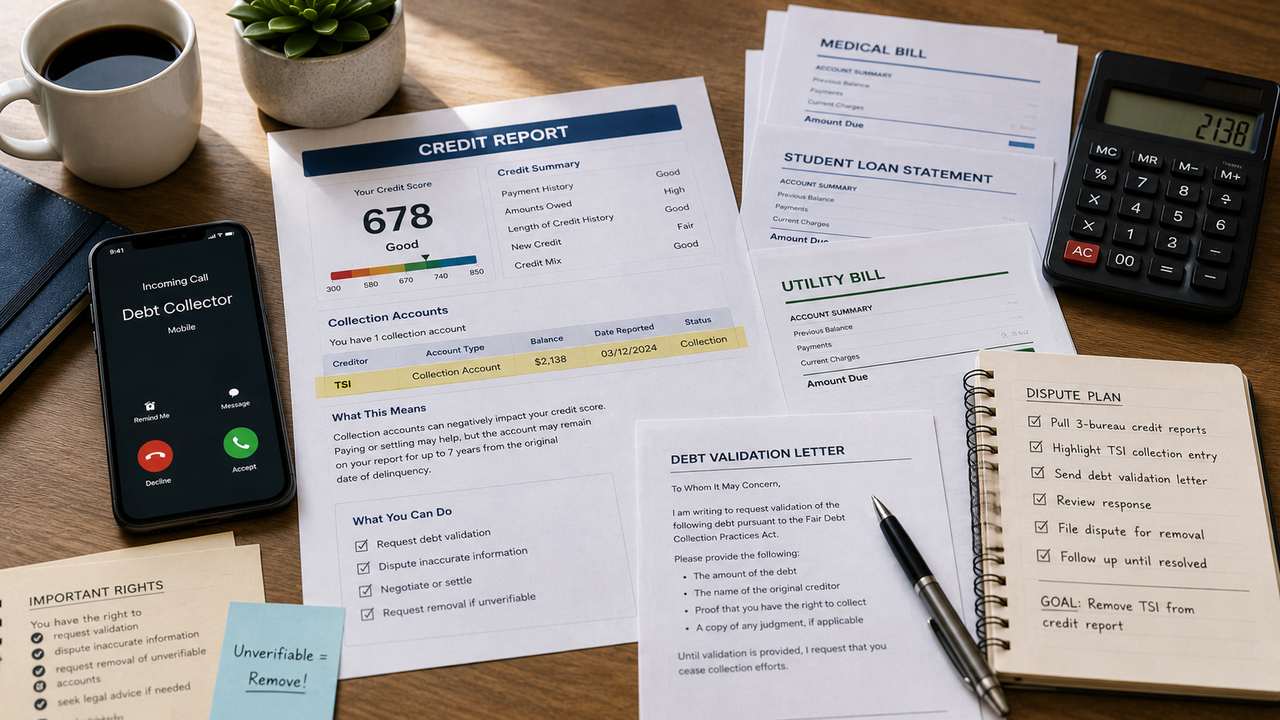
    Before doing anything else, get your free credit reports from all three bureaus (Equifax, Experian, and TransUnion) at AnnualCreditReport.com and locate the specific TSI entry. Note the exact details: the reported balance, the original creditor listed (if any), the date the account was opened or reported, and which specific bureau or bureaus show it (since not every creditor reports identically to all three).

    Step Two: Request Debt Validation

    This is the single most important step, and it applies whether you believe the debt is accurate, aren’t sure, or suspect it isn’t yours at all. Under the Fair Debt Collection Practices Act (FDCPA), you have the right to request that TSI validate the debt — providing written proof of the amount owed, the name of the original creditor, and confirmation of their right to collect it from you. You generally have 30 days from your first contact with them to make this request, and once you do, they’re legally required to pause collection activity until they provide that validation.

    How to do this properly: Send a written letter — not just a phone call, which is harder to document and prove later — to the address provided in any TSI correspondence, explicitly requesting debt validation under the FDCPA and requesting they cease collection activity until it’s provided. Send it via certified mail with return receipt requested, so you have documented proof of when it was sent and received.

    Step Three: Evaluate the Response

    Once TSI responds (or fails to respond, which is also meaningful information), you’re in a position to make an informed decision:

    • If they provide clear, accurate validation and the debt is genuinely yours, you can move forward deciding how to resolve it (covered in the next section).
    • If they can’t adequately validate the debt — meaning they don’t provide sufficient proof of the amount, the original creditor, or their right to collect — you have strong grounds to dispute it formally with the credit bureaus, and in many cases, this alone leads to the account being removed, since a creditor or collector that can’t validate a debt generally cannot continue reporting it either.
    • If the debt genuinely isn’t yours, whether due to a data error or identity theft, formally dispute it as inaccurate with all three credit bureaus, providing whatever documentation supports your position, and if identity theft is involved, file a report at IdentityTheft.gov and consider a fraud alert or credit freeze.

    How to Actually Get a TSI Account Removed From Your Credit Report

    This is the core question driving most searches about TSI, so let’s break down every realistic path, since “removal” can happen through a few different mechanisms depending on your specific situation.

    Path One: Successfully Dispute an Inaccuracy

    If the debt is inaccurate in any material way — wrong amount, wrong dates, doesn’t belong to you, already paid, or TSI can’t properly validate it — filing a formal dispute with the credit bureaus is the most direct path to full removal. Under the Fair Credit Reporting Act, the bureau must investigate (typically within 30 days) and remove or correct any information that can’t be verified as accurate. This path results in genuine, complete removal because the information itself was wrong — not because of any payment or negotiation.

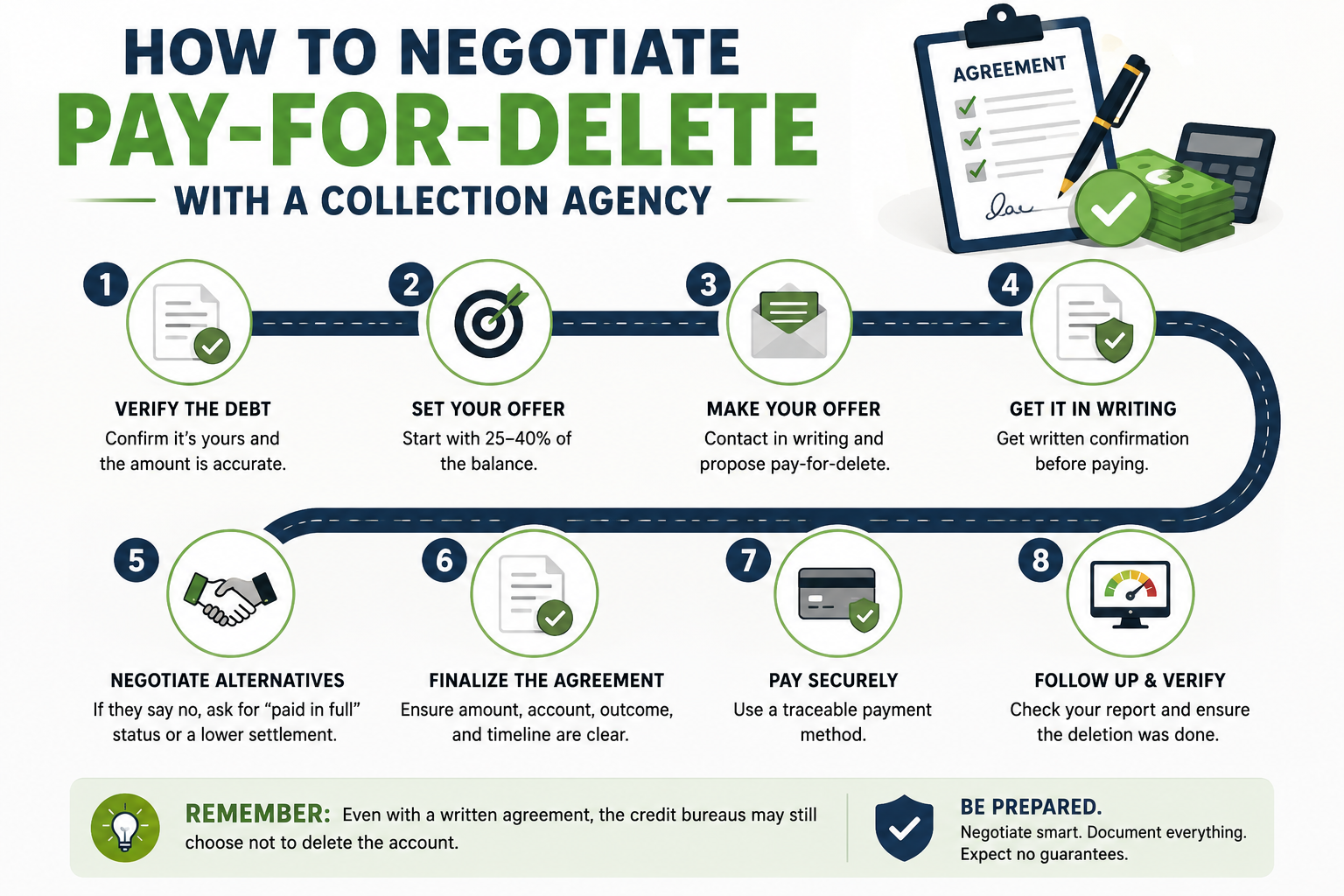
    Path Two: Attempt a “Pay for Delete” Negotiation

    A pay-for-delete arrangement involves paying some or all of the debt in exchange for TSI’s agreement to request removal of the account from your credit report entirely, rather than reporting it as simply “paid.” It’s worth understanding upfront that this isn’t a guaranteed or standard practice — major creditors and many large collection agencies generally avoid this practice due to their data-accuracy commitments with the credit bureaus, and TSI, as a large and long-established company, may be similarly reluctant. That said, it doesn’t hurt to ask, provided you get any agreement explicitly in writing before sending any payment, and you have a solid backup plan if it’s declined (which is a common outcome).

    Path Three: Pay or Settle the Debt (Without Deletion) and Let the Status Update

    Even without a deletion agreement, resolving the debt — through payment in full or a negotiated settlement — updates your credit report to reflect a “paid” or “settled” status rather than an ongoing unpaid balance. Under most current scoring models, this is viewed meaningfully more favorably than an unresolved account, even though the entry itself typically remains visible on your report for the remainder of its reporting window.

    Path Four: Request a Goodwill Removal After Resolving the Debt

    Once a debt is paid or settled, you can send a written goodwill request specifically asking TSI (or, if applicable, the original creditor) to consider removing the account as a courtesy, particularly if this was an isolated incident and you have a broader financial history that’s otherwise solid. This is entirely discretionary and not guaranteed, but it costs nothing to request and occasionally succeeds, especially with smaller balances or older accounts.

    Path Five: Wait for the Standard Reporting Period to Expire

    If none of the above paths succeed, or if you choose not to pursue them, the account will still eventually age off your credit report through the standard federal rule: seven years from the date of the original delinquency on the underlying account, regardless of who currently owns or reports the debt, or how many times it’s changed hands. This is a passive path, but it’s a guaranteed one — no negative item, TSI-related or otherwise, remains on your report indefinitely.

    Understanding the Seven-Year Clock Specifically for TSI Accounts

    It’s worth being precise about this, since it’s one of the most commonly misunderstood aspects of credit reporting: the seven-year window is measured from the date of your original delinquency on the underlying account — meaning when you first fell behind with the original creditor — not from whenever TSI became involved, started reporting, or a debt was transferred to them. If your original medical bill or student loan first became delinquent five years ago, and TSI only recently started attempting to collect and report it, the clock still runs from that original five-year-old delinquency date, not from TSI’s more recent involvement. This means the account may be closer to aging off your report than you’d assume just from looking at how recently TSI’s activity appears.

    Does Making a Payment Reset This Clock?

    For credit reporting purposes specifically, no — making a payment does not reset the seven-year credit reporting clock, which is fixed to the original delinquency date under federal law. However, this is a different question from your state’s separate statute of limitations governing how long a creditor can sue you to legally compel payment through the courts, which does vary by state and, in many states, genuinely can be restarted or extended by making a partial payment or otherwise acknowledging the debt in writing. Before making any payment on an old TSI account, especially one that’s several years old, it’s worth understanding your state’s specific statute of limitations for the type of debt involved, since these are two entirely separate legal concepts that are easy to conflate.

    What If TSI Is Contacting You About a Debt You’ve Already Paid?

    This happens more often than you’d expect, particularly with debt that’s changed hands multiple times or with medical bills where insurance processing delays created confusion about what was actually owed. If you believe you’ve already paid a debt TSI is now pursuing, gather your proof — payment confirmations, bank statements, receipts, or correspondence from the original creditor confirming the account was resolved — and submit this directly to TSI in writing, along with a formal dispute to the credit bureaus if the account is already appearing on your report. This is one of the stronger, more straightforward disputes to win, since you have concrete documentary proof rather than a more abstract disagreement about accuracy.

    Handling TSI Calls: What They Can and Can’t Do

    Because TSI operates as a debt collector, it’s bound by the same Fair Debt Collection Practices Act protections that apply to any other collector:

    • They cannot call before 8 a.m. or after 9 p.m. in your time zone.
    • They cannot harass you with repeated calls intended to annoy, or use abusive or threatening language.
    • They cannot misrepresent the debt or their identity, including falsely implying legal action is imminent when it isn’t, or misstating the amount owed.
    • They must stop calling your workplace once you inform them, verbally or in writing, that you can’t receive calls there.
    • They must honor a written cease-and-desist request, though this doesn’t erase the debt and doesn’t prevent other legal remedies like a lawsuit if the debt is still within the enforceable window.
    • They cannot discuss your debt with third parties, other than in limited circumstances permitted for locating you.

    If TSI violates any of these protections, you have the right to file a complaint with the CFPB and, depending on the severity, may have grounds for legal action under the FDCPA, which includes statutory damages in some cases.

    If TSI Sues You

    If you’re served with a lawsuit related to a TSI-collected debt, do not ignore it, even if you believe the debt is inaccurate or too old to legally pursue. Failing to respond by the court’s deadline can result in a default judgment against you — meaning you automatically lose without ever presenting a defense, even if you had a legitimate one, such as an expired statute of limitations or inadequate proof of the debt. Consider consulting a consumer law attorney, particularly one experienced in debt defense, many of whom offer free or low-cost initial consultations. Given TSI’s documented history with insufficiently proven student loan collection lawsuits specifically, this is a category of case where a legal consultation is especially worthwhile if you’re facing litigation over an old private student loan.

    A Realistic Step-by-Step Plan

    1. Pull your full credit reports from all three bureaus and identify the exact TSI entry, including the balance, original creditor, and dates.
    2. Send a written debt validation request via certified mail, and wait for a response before taking any further action.
    3. Evaluate what comes back: does it clearly and accurately validate the debt, or is something missing, wrong, or unconvincing?
    4. If inaccurate or unvalidated, file a formal dispute with the credit bureaus, providing any supporting documentation.
    5. If accurate, decide your approach: pay in full, negotiate a settlement, or, for very old debt outside your state’s statute of limitations and close to the seven-year reporting mark, consider whether resolving it or simply waiting it out makes more sense for your situation.
    6. Get everything in writing — validation responses, settlement agreements, payment confirmations — before and after making any payment.
    7. Once resolved, consider a goodwill removal request, understanding it’s discretionary and not guaranteed.
    8. If nothing else results in removal, track the seven-year mark from the original delinquency date, since the account will age off automatically at that point regardless of any other outcome.

    Frequently Asked Questions

    Is TSI the same as Transworld Systems?

    Yes, TSI is simply the commonly used abbreviation for Transworld Systems Inc. If you see either name on your credit report or in correspondence, they refer to the same company.

    Can TSI legally still collect a debt that’s very old?

    It depends on your state’s statute of limitations for the type of debt involved. TSI can generally still attempt to contact you and request payment even on very old debt, but if the debt is past your state’s statute of limitations, they generally cannot successfully sue you over it — though they’re not always required to volunteer that information, so it’s worth knowing your own state’s rules.

    Does TSI ever agree to remove accounts for payment (pay for delete)?

    This isn’t standard or guaranteed practice, and larger, more established collection agencies are often reluctant to agree to it. It doesn’t hurt to ask, but get any agreement explicitly in writing before paying, and have a backup plan if it’s declined.

    What if I don’t recognize the original creditor TSI lists at all?

    This is worth taking seriously — request full validation, and if the details genuinely don’t match anything you recognize, formally dispute it and consider whether identity theft or a data-matching error might be involved.

    Should I be more cautious if the TSI debt is a private student loan?

    Given TSI’s documented 2017 CFPB enforcement history specifically related to insufficiently proven private student loan collection lawsuits, yes — this is a category where verifying documentation carefully, rather than assuming the claimed amount and ownership are accurate, is especially worthwhile.

    How long will a TSI collection stay on my report if I do nothing?

    Up to seven years from the date of the original delinquency on the underlying account, regardless of when TSI became involved or started reporting it, after which it must be removed regardless of payment status.

    A Closer Look at TSI’s Healthcare Collections Business

    Because medical debt is one of the most common reasons people encounter TSI, it’s worth understanding a few specific rules that apply to medical collections differently from other debt types. As of recent, industry-wide changes adopted by all three major credit bureaus, paid medical collections are now generally removed from credit reports entirely rather than simply marked as paid — a more consumer-friendly standard than applies to most other debt types. Additionally, there’s now a required waiting period (commonly one year) before unpaid medical debt can even be reported in the first place, giving insurance claims and billing disputes time to resolve before a bill affects your credit. There’s also generally a minimum dollar threshold below which many medical collections aren’t reported at all under current bureau policy.

    This means if your TSI account is specifically a medical bill, you may have more consumer-friendly paths available than for other debt types: if you can show the bill was paid (even after it went to collections), it should be removed entirely rather than simply updated, and if the balance is small or the bill was sent to collections faster than the standard waiting period allows, you may have a straightforward basis for dispute on procedural grounds alone, separate from any question about whether the underlying charge was accurate.

    Understanding TSI’s Role in Private Student Loan Collections

    Since TSI’s connection to National Collegiate Student Loan Trusts is a common and often confusing scenario, it deserves a more detailed explanation. NCSLT is actually a collection of numerous individual trusts that purchased private student loans (not federal loans) originally issued by various banks, bundled them together, and hold them as investment assets. When a borrower defaults on one of these loans, the specific trust holding it typically hires a servicer or collector — historically, this has often been TSI — to pursue collection, sometimes including litigation.

    A significant and well-documented complication in this specific area of debt collection has been proving the actual chain of ownership: because these loans were often bundled, securitized, and transferred multiple times between the original lender and the specific trust now claiming ownership, courts in numerous cases around the country have found that the trusts (and TSI, collecting on their behalf) sometimes couldn’t produce adequate documentation proving they actually owned the specific loan in question, or that the amount claimed was accurate. This was, in fact, the core issue underlying the CFPB’s 2017 enforcement action.

    If you have an old private student loan connected to NCSLT and TSI is now involved, it’s genuinely worth requesting complete documentation of the chain of ownership as part of your validation request — not just a claim that you owe the money, but actual proof connecting the original loan, through whatever transfers occurred, to the specific trust and TSI’s authority to collect on its behalf. Given the well-documented history of gaps in this specific documentation trail, this is one of the more promising categories of debt to challenge thoroughly rather than assume is automatically valid.

    A Sample Debt Validation Letter for TSI

    Having a template ready makes this process considerably less intimidating. Here’s a structure you can adapt:

    [Your Name]
    [Your Address]
    [Date]

    Transworld Systems Inc.
    [Address provided in their correspondence]

    Re: Account [Reference Number]

    To Whom It May Concern:

    I am writing in response to your recent contact regarding the above-referenced account. Pursuant to my rights under the Fair Debt Collection Practices Act, I am requesting validation of this debt. Please provide the following:

    1. The name and address of the original creditor
    2. Documentation showing the amount owed and how it was calculated
    3. Proof that your company has the legal right to collect this specific debt from me

    Please note that I am requesting you cease all collection activity, including phone calls and further correspondence, until this validation is provided, as is my right under the FDCPA.

    Sincerely,
    [Your Name]
    [Account Reference Number]

    Send this via certified mail with return receipt requested, and keep a copy along with the mailing receipt for your records. If TSI responds by phone rather than in writing, ask them to confirm anything discussed in writing as well, since a documented paper trail protects you far more effectively than a verbal exchange.

    Comparing Your Removal Options at a Glance

    Method Requires payment? Removal guaranteed? Best used when
    Formal dispute (inaccuracy) No Yes, if successful The debt is wrong, unverifiable, or not yours
    Pay for delete Yes No — discretionary You want to try, with a backup plan ready
    Pay/settle without deletion Yes No (updates status only) The debt is accurate and you want it resolved
    Goodwill request after payment No (after paying) No — discretionary You’ve already resolved it and want a courtesy removal
    Wait for 7-year expiration No Yes, eventually None of the above succeeded, or you prefer to wait

    This table makes clear why disputing a genuine inaccuracy is the strongest path when it applies — it’s the only method on this list that guarantees removal without requiring any payment at all. This is exactly why the validation step is so important as your very first move: it often reveals whether you’re dealing with a debt worth disputing on the merits, rather than one you should simply move toward resolving through payment.

    What to Do If TSI Reports the Same Debt Under Multiple Names

    Because TSI has operated under related business names, including North Shore Agency Inc., and because debt can sometimes be transferred between related divisions or subsidiaries, it’s possible to see what appears to be the same underlying debt reported more than once under slightly different company names. If this happens, treat it as its own specific issue to dispute — creditors and collectors are generally not permitted to report the same debt multiple times as if they were separate, independent obligations, since this can unfairly compound the negative impact on your score for what is, in reality, a single unpaid account. Point this out explicitly in your dispute, providing the account details from both entries to demonstrate they refer to the same underlying debt.

    Why Some People Choose to Settle Even When They Could Fight

    Not every situation calls for a prolonged dispute process, even when there might be grounds for one. Some people, when facing an old, accurate TSI debt that’s genuinely theirs, simply prefer to resolve it as efficiently as possible — negotiating a reasonable settlement and moving on, rather than investing significant time and effort into a validation and dispute process for a debt they don’t fundamentally dispute owing. This is a completely reasonable choice, particularly for smaller balances where the time and effort of a thorough dispute process may not be worth it relative to simply settling and closing the chapter. The key principle either way is the same: make an informed choice based on accurate information, rather than either fighting reflexively or paying reflexively without understanding your situation first.

    Frequently Asked Questions, Continued

    Does TSI report to all three credit bureaus, or just one?

    This can vary by account and by which specific creditor or client TSI is collecting for — it’s worth checking all three of your reports individually, since it’s possible an account appears on one or two bureaus’ reports but not the third, depending on TSI’s reporting practices for that particular account.

    If I successfully dispute and remove a TSI account, can it come back later?

    Generally, no — once a credit bureau removes an item following a dispute because the furnisher (TSI, in this case) couldn’t verify it, they’re not permitted to simply re-report the same unverified information later without new substantiation. If it does reappear, this itself can be grounds for another dispute and, potentially, a complaint to the CFPB regarding a furnisher’s reporting practices.

    Can I negotiate with TSI even before receiving their validation response?

    It’s generally advisable to wait for validation first, since negotiating or making a payment before confirming the debt is accurate and properly owned by or assigned to TSI could mean resolving something you didn’t actually need to pay, or inadvertently acknowledging a debt that might otherwise have been successfully disputed.

    Is there a way to check whether TSI is legitimate before responding to them at all?

    Yes — you can independently verify their general legitimacy (as a real, longstanding company) through a basic search, and for your specific account, you can call TSI directly using contact information you find independently (not from a potentially suspicious letter or call) to confirm an account under your name genuinely exists in their system before sending any detailed personal information.

    What if TSI’s letter references a debt from a company I’ve never heard of?

    This is worth investigating carefully as part of your validation request — ask specifically for documentation connecting that original creditor to an account you actually opened, since it’s possible the original creditor’s name has changed, merged with another company, or that this represents a data error worth disputing.

    The Bottom Line

    TSI, or Transworld Systems Inc., is a real, long-established collection and accounts receivable company, not a scam — but that doesn’t mean you should accept an unfamiliar entry on your credit report at face value. The path to removing or resolving a TSI account starts the same way regardless of your specific situation: request written debt validation, review it carefully, and then choose the right path based on what you find — a formal dispute if it’s inaccurate, payment or settlement if it’s accurate, a goodwill request once resolved, or simply tracking the seven-year mark if none of the above pans out. Approaching it methodically, rather than either ignoring it or paying reflexively out of pressure, gives you the strongest possible position for actually getting it resolved on terms that work for you.

    Need Help Reviewing Your Credit Report?

    If TSI is appearing on your credit report and you’re unsure whether the account is accurate or how to address it, reviewing the account details and your available options can be an important first step.
    Request a Credit Audit or Quote

  • Northland Group Debt Collector — Who Are They and Can They Sue Me?

    Northland Group Debt Collector — Who Are They and Can They Sue Me?

    A call or letter from Northland Debt Collector Group tends to raise the same questions most unfamiliar collectors do: who is this company, why do they have your information, and what happens if you don’t respond? This guide walks through exactly who Northland Group is, why they’re likely contacting you, and — since it’s one of the more common concerns people search for specifically — whether and how they can actually sue you over an unpaid account.

    Who Is Northland Group?

    Northland Group, Inc. is a debt collection agency founded in 1982 by John Johnson, headquartered in the Minneapolis, Minnesota area (with addresses associated with both Edina and Minnetonka, Minnesota, both suburbs in the same metro area). The company describes itself as a leader in “late-stage” collections — meaning accounts that have typically already gone through earlier collection attempts elsewhere before landing with Northland — and it’s a privately held company, having been acquired by the private equity firm Mason Wells in 2008.

    Northland Group is a legitimate, licensed debt collection agency, not a scam. That said, legitimacy doesn’t guarantee every specific account they pursue is accurate or being handled without any missteps, which is exactly why the verification process outlined in this guide is worth following regardless of the company’s overall standing.

    Is Northland Group a Debt Buyer or a Third-Party Collector?

    Northland Group operates in both capacities, depending on the specific account. In some cases, they’re hired as a traditional third-party collector working on behalf of an original creditor, most notably reported to collect on credit card accounts for Capital One. In other cases, Northland services accounts on behalf of debt buyers, including a documented relationship servicing accounts for LVNV Funding, a well-known major debt-buying company. This means the specific nature of your relationship with Northland — whether they’re simply a hired collector for your original bank or are effectively representing the current legal owner of a purchased debt — can vary from account to account, which is exactly the kind of detail formal debt validation should clarify.

    Why Is Northland Group Contacting You?

    A few common scenarios explain how Northland Group became involved:

    • An unpaid Capital One credit card account went unresolved through Capital One’s own internal collection efforts and was placed with Northland Group for continued collection.
    • A debt originally owned by LVNV Funding or a similar debt buyer is being serviced or collected by Northland Group on that debt buyer’s behalf.
    • An account has moved through several prior collection attempts already, consistent with Northland’s specific focus on “late-stage” collections — meaning by the time they’re involved, your account has often already been through one or more earlier collection efforts that weren’t successful.
    • A data error or identity theft situation has resulted in a debt being incorrectly attributed to you — always worth ruling out through the verification process before assuming any claimed debt is accurate.

    An Important Piece of Legal History: Buchanan v. Northland Group

    A federal court case, Buchanan v. Northland Group, Inc., is a genuinely important piece of context for understanding how to approach any communication from this company, particularly involving older debt. The case centered on whether Northland Group violated the Fair Debt Collection Practices Act by sending settlement offer letters on debts where the applicable statute of limitations had already expired, without adequately disclosing this fact to consumers — potentially leading people to believe a debt was still legally enforceable through the courts when, in fact, it was not.

    The Consumer Financial Protection Bureau, along with the Federal Trade Commission, filed a supporting brief in this case, arguing that a debt collector doesn’t need to actually threaten or pursue litigation for a misleading settlement offer on a time-barred debt to constitute an FDCPA violation — the deceptive impression created by the letter itself can be enough. This case is directly and specifically relevant if Northland Group sends you a settlement offer on an older account: it establishes real, documented precedent for verifying your state’s statute of limitations before assuming a settlement offer implies the debt remains legally enforceable through a lawsuit if you don’t pay.

    Step One: Request Formal Debt Validation

    Before doing anything else, request formal, written debt validation from Northland Group under the FDCPA. This requires them to provide the name of the original creditor (Capital One, LVNV Funding, or another entity, depending on your specific account), the amount owed, and confirmation of their authority to collect it. You generally have 30 days from your first contact to make this request, during which they must pause collection activity until they respond.

    How to request it: Send a written letter via certified mail with return receipt requested, explicitly invoking your FDCPA rights and requesting that collection activity cease until validation is provided.

    Step Two: Check Your State’s Statute of Limitations — Especially Given Northland’s Documented History

    Given the specific legal precedent set by the Buchanan case, this step deserves particular emphasis when dealing with Northland Group. Every state has a statute of limitations, a legal time limit within which a creditor or collector can successfully sue you to collect through the courts, commonly ranging from three to ten years depending on your state and the type of debt. If your debt is old enough that this window may have already closed, verify this specifically before responding to any settlement offer, and understand that — as the Buchanan case demonstrated — a settlement letter’s tone or format alone shouldn’t be taken as confirmation that a lawsuit remains a genuine, legally viable possibility.

    Also critical: in many states, making even a partial payment, or in some cases simply acknowledging the debt in writing, can restart this statute of limitations clock, exposing you to renewed legal risk on a debt that was previously time-barred. This is precisely the kind of situation the Buchanan case was concerned with — a consumer being nudged toward a payment on a debt that could no longer actually be enforced through litigation, without being clearly informed of that fact.

    Step Three: Evaluate Your Options Based on What You’ve Confirmed

    If the debt is accurate and still within your state’s statute of limitations: you can reasonably move forward with paying in full, negotiating a settlement, or setting up a payment plan, understanding that Northland does retain the legal option to sue if the matter remains unresolved.

    If the debt is accurate but outside your state’s statute of limitations: Northland can still legally contact you and request payment, but cannot successfully sue you over it. In this scenario, whether to pay anything at all becomes a more personal decision — some people choose to resolve even a time-barred debt for peace of mind or to improve their credit report status, while others choose to let the remaining credit reporting window (a separate seven-year rule, measured from the original delinquency date) run its course without payment, precisely to avoid restarting any legal exposure.

    If the debt can’t be adequately validated, or genuinely isn’t yours: formally dispute it with the credit bureaus, providing whatever documentation supports your position.

    How to Negotiate With Northland Group

    If Northland Group is collecting on behalf of a debt buyer like LVNV Funding, there’s often meaningful room to negotiate a reduced settlement, since debt buyers typically purchase accounts at a steep discount from the original balance. If Northland is instead collecting directly for Capital One as the original creditor, your negotiating room may be somewhat more constrained by what Capital One specifically authorizes, though settlement offers below the full balance are still commonly available in many cases.

    Always get any agreement in writing before sending payment, specifying the exact amount, that it constitutes full and final settlement, and how the account will subsequently be reported. Given the documented history in the Buchanan case specifically involving misleading settlement communications, this step is especially important with Northland Group — don’t rely on a verbal phone conversation alone to confirm the terms of any resolution.

    Can Northland Group Sue You?

    Yes, if the underlying debt remains within your state’s statute of limitations and Northland (or the entity they’re collecting for) can adequately document their claim. If you’re served with a lawsuit, do not ignore it, regardless of your view on the debt’s validity or age — failing to respond by the court’s specified deadline can result in a default judgment against you automatically, forfeiting any legitimate defense you might have had available, including a statute of limitations defense that must generally be raised affirmatively rather than assumed to apply automatically.

    If you are sued, strongly consider consulting a consumer law attorney, particularly given the specific, documented legal history around Northland Group’s past practices regarding time-barred debt — an attorney familiar with this history may be especially well-positioned to identify relevant defenses in your specific case.

    Your Rights Under the FDCPA When Dealing With Northland Group

    • They cannot call before 8 a.m. or after 9 p.m. in your time zone.
    • They cannot harass you through repeated calls intended to annoy, or abusive or threatening language.
    • They cannot misrepresent the legal status of a debt, including implying that a time-barred debt remains fully enforceable through litigation if you don’t pay — precisely the issue at the heart of the Buchanan case.
    • They must stop calling your workplace once informed you can’t take calls there.
    • They must honor a written cease-and-desist request, though this doesn’t erase the underlying debt or necessarily prevent other remedies if the debt remains legally enforceable.

    If Northland Group violates any of these protections — particularly around misrepresenting a time-barred debt’s enforceability — you may have grounds for a complaint to the CFPB and potentially for legal action under the FDCPA, an area where this company has specific, documented prior legal exposure.

    What to Do If the Debt Isn’t Yours

    Given that Northland collects on both Capital One credit card accounts and debt buyer-owned accounts across a range of vintages, data-matching errors are a real possibility, as with any large-scale collector. If you don’t recognize the debt at all, formally dispute it in writing with both Northland Group and the credit bureaus, and if identity theft is suspected, file a report at IdentityTheft.gov and consider a fraud alert or credit freeze.

    Frequently Asked Questions

    Is Northland Group a legitimate company?

    Yes. Northland Group, Inc. is a real, licensed, decades-old debt collection agency headquartered in the Minneapolis, Minnesota area. It is not a scam, though independent verification of any specific account remains a reasonable precaution.

    What’s the significance of the Buchanan v. Northland Group case for me personally?

    This case established that a debt collector, including Northland Group specifically, can violate the FDCPA by sending settlement letters on time-barred debt without adequately disclosing that the debt is no longer legally enforceable through a lawsuit — making it especially important to verify your state’s statute of limitations before responding to any older debt settlement offer from this company.

    Does Northland Group own my debt, or are they just collecting it for Capital One?

    This depends on the specific account — Northland works both as a direct collector for Capital One and as a servicer for debt buyers like LVNV Funding. Formal debt validation should clarify which situation applies to your specific debt.

    If my debt is outside the statute of limitations, should I still respond to Northland Group’s letters?

    Yes — even if you don’t intend to pay, formally responding (in writing, ideally) to note that the debt appears to be time-barred, and requesting they cease contact, is a reasonable step, both to create a documented record and to help ensure they don’t continue treating the account as if a lawsuit remains a viable option.

    Can Northland Group add interest or fees on top of the original debt?

    This depends on what’s permitted under the original account terms and applicable state law. Any formal validation response should clarify how the current claimed balance was calculated, and you’re entitled to dispute charges that don’t appear properly substantiated.

    What if I already made a payment on an old debt to Northland Group and I’m now worried about the statute of limitations restarting?

    If this has already happened, it’s worth consulting a consumer law attorney to understand your state’s specific rule and what, if anything, can be done — in some cases, the effect of a restarted statute of limitations is not always as absolute as generally assumed, and specific state law nuances can matter considerably here.

    A Closer Look at “Late-Stage” Collections and What It Means for You

    Northland Group’s own description of itself as a leader in “late-stage” collections is worth unpacking, since it has practical implications for how you should approach your specific situation. In the debt collection industry, accounts are often categorized by how far along they are in the overall collection lifecycle: “early-stage” or “first-placement” accounts are typically handled by the original creditor’s internal team or a first collection agency shortly after becoming delinquent, while “late-stage” accounts have usually already been through one or more of these earlier attempts without resolution before being placed with a specialist like Northland.

    This matters for a few practical reasons. First, it means the account you’re dealing with through Northland has likely been aging for a longer period than a typical fresh collection account, which increases the odds that you’re approaching or have already passed key milestones like your state’s statute of limitations, or the halfway or later point of the standard seven-year credit reporting window. Second, late-stage collectors, precisely because they’re dealing with harder-to-collect, more aged accounts, sometimes have more institutional flexibility to accept a significantly reduced settlement, since their own internal expectations for full recovery on these older accounts tend to be more modest than for a fresher account. This can work in your favor during negotiation, provided you approach it with accurate information about your specific timeline and legal standing first.

    Understanding LVNV Funding’s Role When Northland Is Servicing on Their Behalf

    If your debt validation response reveals that Northland Group is collecting an account actually owned by LVNV Funding, it’s worth understanding a bit about this specific relationship. LVNV Funding is itself a well-known, large-scale debt buyer (a subsidiary of Resurgent Capital Services’ broader corporate family) that purchases charged-off consumer debt in bulk, similar in business model to companies like Midland Credit Management or Jefferson Capital Systems covered elsewhere. When LVNV Funding owns your debt but Northland Group is the company actually contacting you, this typically means Northland has been contracted specifically to handle the calling, letter-writing, and negotiation work on LVNV’s behalf, while LVNV retains ultimate legal ownership. Any settlement you reach would need to be structured (and ideally documented) as binding on LVNV Funding as the actual debt owner, not simply Northland Group as the servicing agent, to ensure the resolution is fully enforceable and properly reflected in LVNV’s own records as the account’s true owner.

    northland-group-debt-collector-under-100kb

    A Sample Response Letter Addressing a Time-Barred Debt

    Given the specific relevance of the statute of limitations issue with this particular company, here’s a template you can adapt if you’ve confirmed your debt is likely time-barred:

    [Your Name]
    [Your Address]
    [Date]

    Northland Group, Inc.
    [Address provided in their correspondence]

    Re: Account [Reference Number]

    To Whom It May Concern:

    I am writing regarding the above-referenced account. Based on my research, I believe this debt is beyond the applicable statute of limitations in my state, meaning it is no longer legally enforceable through a lawsuit.

    Please confirm in writing whether your company intends to pursue this debt as legally enforceable, and please be advised that I am requesting all collection communication cease, consistent with my rights under the Fair Debt Collection Practices Act.

    I am aware of my option to make a voluntary payment, but I am not acknowledging this debt as currently owed, and any partial payment should not be construed as a waiver of my position regarding the statute of limitations.

    Sincerely,
    [Your Name]
    [Account Reference Number]

    This kind of letter creates a clear, documented record of your position, which can be valuable both in stopping further contact and, if the situation ever escalates, in demonstrating that you raised this issue directly and in writing at the time.

    Frequently Asked Questions, Continued

    Does the Buchanan case mean Northland Group can never send settlement offers on old debt anymore?

    Not entirely — the case specifically concerned settlement offers that misleadingly implied a time-barred debt remained fully legally enforceable without adequate disclosure. Collectors can still generally contact you and request voluntary payment on time-barred debt, provided they don’t misrepresent its legal enforceability status in doing so.

    If Northland Group is collecting for Capital One directly, does Capital One know I’ve disputed the debt?

    Generally, yes — when you formally dispute a debt with a third-party collector working on behalf of an original creditor, this information is typically expected to be communicated back to that creditor as part of standard industry practice, though it’s still worth directly documenting your dispute with both parties if you want to be certain.

    Can I ask Northland Group directly whether my specific debt is time-barred?

    You can ask, though they aren’t necessarily obligated to volunteer a definitive legal conclusion about your specific state’s statute of limitations, particularly since this can involve some legal interpretation. Independently researching your state’s rule, or consulting a consumer law attorney for a clear answer specific to your situation, is generally more reliable than relying solely on the collector’s own characterization.

    Is Mason Wells’ private equity ownership relevant to how Northland Group operates day-to-day?

    Private equity ownership generally doesn’t change the legal obligations a collection agency operates under, though it can sometimes correlate with a company’s strategic focus on growth, acquisitions, or specific business line expansion — this is more of a general business context detail than something that directly affects your individual rights or the collection process itself.

    Comparing Northland Group to Other Late-Stage Collectors

    Northland Group A typical earlier-stage collector
    Where in the process they get involved
    After earlier collection attempts have failed
    Shortly after an account first becomes delinquent
    Typical account age when contacted
    Often several years old
    Often a few months old
    Negotiation flexibility
    Often greater, given lower recovery expectations
    Often more limited, tied closely to original creditor terms
    Statute of limitations relevance
    Very high — often close to or past the window
    Usually still well within the window
    Common clients
    Capital One, LVNV Funding, other debt buyers and creditors
    Varies widely

    This comparison underscores why the statute of limitations question is so central to almost any interaction with Northland Group specifically — by the nature of their business model, the accounts they handle are disproportionately likely to be old enough that this question is genuinely live, rather than a remote technicality.

    Frequently Asked Questions, Continued Further

    If Northland Group’s letter doesn’t mention a lawsuit at all, does that mean the debt is definitely time-barred?

    Not necessarily — the absence of an explicit lawsuit threat doesn’t confirm the statute of limitations has expired; it could simply reflect standard collection letter language, or a company choosing not to threaten litigation as a matter of general practice regardless of the debt’s specific legal status. Independently verifying your state’s statute of limitations remains the more reliable approach.

    Does Northland Group’s ownership by a private equity firm affect its regulatory obligations?

    No — regardless of corporate ownership structure, Northland Group remains fully subject to the FDCPA and all applicable state debt collection laws, and its obligations to consumers are unchanged by who owns the company.

    Can I request that Northland Group only communicate with me by mail rather than phone?

    Yes — under the FDCPA, you can request in writing that a collector limit or cease certain forms of contact, including specifying that you prefer written communication only, which they’re generally required to honor going forward.

    The Bottom Line

    Northland Group is a real, decades-old debt collection agency operating both as a direct collector for creditors like Capital One and as a servicer for debt buyers like LVNV Funding — legitimate, but with a specific, documented legal history involving misleading settlement communications on time-barred debt, established through the Buchanan v. Northland Group case. This history makes verifying your state’s statute of limitations before responding to any settlement offer especially important, alongside the standard steps of requesting formal debt validation and confirming the underlying debt is genuinely yours and accurately calculated. If you’re ever served with a lawsuit related to a Northland Group account, respond by the deadline regardless of your view on the debt’s merits, and strongly consider consulting a consumer law attorney given the company’s specific documented history in exactly this area.

    Need Help Reviewing Your Credit Report?

    If Northland Group is appearing on your credit report and you’re unsure whether the account is accurate, reviewing the account details and your available dispute options can be an important first step.
    Request a Credit Audit or Quote

  • Who Is Afni Inc and Why Are They Calling Me?

    Who Is Afni Inc and Why Are They Calling Me?

    An unfamiliar call from “Afni” or a letter bearing that name can leave you searching your memory for any connection to it — and coming up empty. This guide explains exactly who Afni is, what kind of debt they typically pursue, and the specific, methodical steps to take to figure out whether you actually owe them anything and how to handle it.

    Who Is Afni Inc?

    Afni, Inc. — officially Anderson Financial Network, Inc. — is a debt collection agency headquartered in Bloomington, Illinois, that has been operating for decades, with some sources tracing its origins back to the 1930s. Afni holds an A+ rating with the Better Business Bureau and has been an accredited BBB business for years, and it maintains a professional public-facing website that addresses common consumer questions and outlines consumer rights — a level of transparency not every collection agency offers.

    Afni is a legitimate, licensed collection agency, not a scam operation. That said, being legitimate and having a strong BBB rating doesn’t automatically mean every specific account attributed to you is accurate — which is exactly why the verification process outlined in this guide matters regardless of the company’s overall reputation.

    What Kind of Debt Does Afni Collect?

    Afni has built a particular specialization in telecommunications and utility debt, collecting unpaid balances on behalf of phone, internet, cable, and utility companies. This is Afni’s primary and most well-known area of focus, though the company’s activities have also extended into other categories over time, including certain credit card, student loan, and government-related accounts, depending on their specific client relationships at any given time.

    Afni operates in some cases as a traditional third-party collector — hired by an original creditor to attempt collection on their behalf for a fee — and in other cases has been reported to purchase debt portfolios outright, meaning the specific arrangement can vary depending on which account you’re dealing with. This is worth clarifying directly through the debt validation process, since it affects who ultimately owns the debt and who you’d need to negotiate with.

    An Important Piece of Regulatory History: The 2020 CFPB Consent Order

    In November 2020, the Consumer Financial Protection Bureau issued a formal consent order against Afni, Inc., specifically related to the accuracy of the credit reporting information Afni furnished to the major consumer reporting agencies in connection with its debt collection activities. This enforcement action required Afni to take specific corrective steps to improve and ensure the accuracy of its credit report furnishing practices going forward.

    This history is genuinely useful context, not just a cautionary footnote: it means that Afni has a documented, federally acknowledged history of issues specifically related to how it reports information to your credit file — which reinforces why carefully reviewing any Afni account on your credit report for accuracy, rather than assuming it’s automatically correct, is a reasonable and well-founded precaution, not excessive caution.

    Why Is Afni Contacting You?

    A few common scenarios explain how Afni became involved in your situation:

    • An unpaid phone, internet, or cable bill was referred to Afni by your telecom or service provider after their own internal collection attempts didn’t resolve the balance.
    • A utility bill from a former address went unpaid — this is a particularly common scenario, since final utility bills after moving are easy to overlook, especially if a forwarding address wasn’t properly updated with the utility company.
    • A credit card or personal loan account, in some cases, was placed with or sold to Afni depending on the specific creditor relationship involved.
    • A student loan or government-related balance, in some circumstances, depending on Afni’s specific client contracts at the time.
    • A data error, billing mistake, or identity theft situation has resulted in a debt being incorrectly attributed to you — always worth ruling out before assuming any claimed debt is accurate.

    Why Telecom and Utility Debt Deserves Careful Review

    Telecom and utility billing is a common source of billing disputes and errors — early termination fees that were waived but not properly removed from a final bill, equipment return credits that weren’t applied, disputed charges from a service outage or billing error, or a final bill sent to an old address that was never received. Given Afni’s specific concentration in this exact category of debt, and their documented history of a federal enforcement action related to reporting accuracy specifically, taking the time to verify a telecom or utility-related Afni account carefully is a particularly well-justified use of the validation process described below.

    Step One: Request Formal Debt Validation

    Whether you believe the debt is legitimate or you’re unsure, your first move should be requesting formal, written debt validation from Afni. Under the Fair Debt Collection Practices Act, you have the right to require Afni to provide the name of the original creditor, the amount owed, and confirmation of their authority to collect (whether as a hired collector or as the actual current owner of the debt). You generally have 30 days from your first contact with Afni to make this request, during which they must pause collection activity until they respond.

    How to request it properly: Send a written letter via certified mail with return receipt requested, explicitly invoking your FDCPA rights and requesting a cessation of collection activity until validation is provided. This creates a documented paper trail that’s considerably stronger than a verbal request made over the phone.

    Step Two: Cross-Check With the Original Service Provider

    Since telecom and utility debt is Afni’s primary specialty, and since these providers typically maintain detailed account records, contacting your former phone, internet, cable, or utility provider directly to confirm the final balance, the reason for the outstanding amount, and whether any credits or disputes were properly applied can be a valuable parallel step. This is especially useful if you believe a billing error, an improperly applied early termination fee, or an unreturned equipment credit might be involved.

    Step Three: Evaluate What You’ve Found

    If both the original provider and Afni’s validation response confirm a consistent, accurate balance, you’re in a position to make an informed decision about resolving it. If something doesn’t match — an unfamiliar charge, an amount that doesn’t reconcile with what the original provider confirms, or a lack of adequate documentation from Afni — you have solid grounds to formally dispute the debt with the credit bureaus.

    How to Resolve an Accurate Afni Debt

    • Contact the original service provider first, if the debt is still with them (not sold outright to Afni). Many telecom and utility companies retain some flexibility to correct billing errors, apply overlooked credits, or even reduce a final balance directly, sometimes more easily than negotiating through a third-party collector.
    • Pay in full, if you have the means, which resolves the debt though doesn’t automatically remove a related entry from your credit report — it updates the reported status to reflect payment.
    • Negotiate a settlement, which is often available, particularly if Afni purchased the debt outright rather than merely collecting on commission, since a debt buyer typically has more room to accept a reduced amount than an agency constrained by what the original creditor authorizes.
    • Set up a payment plan, with terms documented in writing before making your first payment.
    • Ask about a pay-for-delete arrangement, understanding it’s discretionary and not guaranteed, though it doesn’t hurt to ask, provided you get any agreement in writing before sending payment.

    Your Rights Under the FDCPA When Dealing With Afni

    • They cannot call before 8 a.m. or after 9 p.m. in your time zone.
    • They cannot request private information like your Social Security number without appropriate justification, and should not be pressuring you to provide sensitive personal details before validating the debt.
    • They cannot threaten legal action they don’t genuinely intend to take, or falsely imply criminal consequences for unpaid consumer debt, which don’t exist for this type of civil matter.
    • They cannot use profane or derogatory language.
    • They must stop calling your workplace once informed you can’t take calls there.
    • They must honor a written cease-and-desist request, though the underlying debt remains and other remedies (like a potential lawsuit, if the debt is still legally enforceable) aren’t necessarily prevented by this request alone.

    If Afni violates any of these protections, you can file a complaint with the CFPB — a step made particularly relevant given their documented 2020 consent order specifically related to reporting practices — and depending on the severity, may have grounds for legal action under the FDCPA.

    Can Afni Sue You?

    Yes, for debt that remains within your state’s statute of limitations and that they can adequately document. If you’re served with a lawsuit related to an Afni-collected debt, don’t ignore it — even if you believe it’s inaccurate or improperly pursued, failing to respond by the court’s deadline can result in a default judgment against you. Consider consulting a consumer law attorney, particularly if the debt is old, disputed, or if you believe Afni’s own documented history of reporting accuracy issues might be relevant to your specific situation.

    What to Do If the Debt Genuinely Isn’t Yours

    Given the volume of telecom and utility accounts Afni handles, along with their documented history of credit reporting accuracy concerns, data-matching errors are a real possibility worth taking seriously. If you don’t recognize the debt, formally dispute it in writing with both Afni and the credit bureaus, and if identity theft is suspected — which can be common with telecom accounts specifically, since opening service in someone else’s name is a frequently used tactic in identity theft schemes — file a report at IdentityTheft.gov and consider a fraud alert or credit freeze.

    Frequently Asked Questions

    Is Afni a legitimate company?

    Yes. Afni, Inc. (Anderson Financial Network) is a real, long-operating, BBB-accredited debt collection agency headquartered in Bloomington, Illinois. It is not a scam, though — as with any collector — individual account accuracy should still be independently verified.

    Does Afni own the debt, or are they collecting for someone else?

    This varies by account — Afni operates both as a traditional third-party collector working on commission and, in some cases, as a purchaser of debt portfolios outright. Requesting formal validation clarifies which situation applies to your specific debt.

    Why does Afni have a specific CFPB enforcement action against them?

    In 2020, the CFPB issued a consent order against Afni specifically addressing the accuracy of credit reporting information they furnished to the credit bureaus, requiring corrective action to improve those practices going forward.

    Can I resolve my debt directly with my old phone or utility company instead of Afni?

    If Afni is acting as a hired collector rather than the outright owner of the debt, yes, this is often possible and can sometimes lead to a faster or more favorable resolution, particularly if a billing error or overlooked credit is involved.

    Does Afni typically accept settlements for less than the full balance?

    Often yes, particularly for debt they’ve purchased outright, where they have more flexibility than when collecting strictly on commission for an original creditor. It’s always worth asking and negotiating rather than assuming the full balance is the only option.

    What if Afni is contacting me about a utility bill from an address I haven’t lived at in years?

    This is a common and legitimate scenario — final utility bills are easy to overlook, especially after a move, but it’s still worth verifying the specific amount and dates through both Afni’s validation response and, if possible, the original utility company’s own records before assuming the balance is fully accurate.

    A Sample Debt Validation Letter for Afni

    Here’s a template you can adapt for your specific situation:

    [Your Name]
    [Your Address]
    [Date]

    Afni, Inc.
    [Address provided in their correspondence]

    Re: Account [Reference Number]

    To Whom It May Concern:

    I am writing regarding your recent contact about the above-referenced account. Pursuant to my rights under the Fair Debt Collection Practices Act, I am requesting validation of this debt, including:

    1. The name of the original creditor and the type of account (phone, internet, cable, utility, or other)
    2. An itemized breakdown of the amount claimed, including any fees or charges beyond the original service balance
    3. Confirmation of whether your company owns this debt outright or is collecting on behalf of the original creditor

    Please also confirm that all collection activity, including phone calls and further correspondence, will cease until this validation is provided, as is my right under the FDCPA.

    Sincerely,
    [Your Name]
    [Account Reference Number]

    Send this via certified mail with return receipt requested, and retain copies of everything for your records.

    Common Telecom and Utility Billing Errors Worth Checking For Specifically

    Given Afni’s concentration in this exact debt category, it’s worth knowing the specific, recurring types of errors that show up most often in telecom and utility collections:

    • Early termination fees that should have been waived. Many service contracts waive early termination fees under specific circumstances (a documented move outside the provider’s service area, active military deployment under the Servicemembers Civil Relief Act, or a promotional offer that included a waiver), but billing systems don’t always automatically apply these waivers correctly.
    • Equipment return credits that weren’t processed. If you returned a modem, router, cable box, or other leased equipment after canceling service, a credit for that returned equipment should be applied to your final bill — but equipment return processing errors (a package that wasn’t properly logged as received, for instance) are a common source of inflated final balances.
    • Charges continuing after a requested cancellation date. If your service cancellation wasn’t processed on the date you actually requested, you may be billed for a period of service you didn’t intend to continue past your cancellation request.
    • A final bill sent to the wrong address, particularly after moving, resulting in a bill you never actually saw before it was sent to collections — worth specifically checking the billing address associated with the account in Afni’s validation response.
    • Bundled service disputes, where a promotional rate expired or a bundled discount wasn’t properly applied, resulting in a higher final balance than expected.

    If any of these scenarios sound familiar, requesting your complete billing history directly from the original telecom or utility provider (which they’re generally required to provide) gives you the specific documentation needed to challenge an inaccurate balance effectively, rather than relying solely on Afni’s own summary of the account.


    who-is-afni-inc-and-why-are-they-calling-me-under-100kb

    How to Interpret Afni’s Response If They Claim to Have Purchased the Debt

    If Afni’s validation response confirms they purchased the debt outright rather than merely collecting on the original creditor’s behalf, this shifts your negotiating position in a useful way, similar to dealing with any debt buyer: since they acquired the account at a discount, there’s typically more room to negotiate a reduced settlement than there would be if the original telecom or utility company still owned the debt and was constraining what a hired collector could accept. In this scenario, focus your negotiation directly with Afni rather than attempting to go back to the original service provider, since they no longer have any ongoing stake in or authority over the resolution.

    Frequently Asked Questions, Continued

    Does Afni’s 2020 CFPB consent order mean every account they currently report is being handled correctly now?

    The consent order required Afni to implement specific corrective measures to improve reporting accuracy going forward, which suggests improved practices since that time, though it doesn’t guarantee every individual account is free of error — ongoing verification of your own specific account remains a reasonable practice regardless of a company’s broader compliance improvements.

    If my telecom bill was disputed with the original provider before it went to collections, does that dispute still matter now?

    Yes — if you have documentation showing you formally disputed a charge with the original provider before the account was sent to Afni, this is valuable evidence to include in your response to Afni and in any formal credit bureau dispute, since it demonstrates the balance was contested prior to collection, not simply left unpaid without explanation.

    Can Afni report a debt to my credit file if I’m actively disputing it with the original telecom company?

    If the debt has already been placed with Afni for collection, it can potentially still be reported while a dispute is ongoing with the original creditor, which is exactly why formally notifying Afni directly (not just the original company) that the debt is disputed is an important, separate step to protect your position on both fronts.

    Is it common for Afni accounts to involve relatively small dollar amounts?

    Yes, particularly given their telecom and utility focus — many Afni accounts involve final bills in the range of a few hundred dollars or less, which is worth keeping in perspective when deciding how much time and effort to invest in a thorough dispute versus a straightforward settlement or payment.

    Why Identity Theft Involving Telecom Accounts Deserves Special Mention

    Telecom accounts are a particularly common target in identity theft schemes because opening new phone service requires relatively less verification in some cases than opening a credit card or loan, and a fraudulent phone line can be used to facilitate further fraud before the true account holder even realizes it exists. If Afni is contacting you about a telecom account you never opened, this is worth treating with real urgency — not just as a billing dispute, but as a potential sign of broader identity theft that could extend beyond this single account. Pulling your full credit report to check for other unfamiliar accounts, placing a fraud alert or credit freeze, and filing a report at IdentityTheft.gov are all reasonable, proactive steps if this scenario applies to you.

    What to Do If Afni Continues Contacting You After a Dispute Is Filed

    If you’ve formally disputed a debt in writing and Afni continues attempting to collect without providing adequate validation, this is itself a potential FDCPA violation, since collectors are required to cease collection activity until proper validation is provided following a timely dispute. Document every instance of continued contact after your dispute (dates, methods of contact, content of any messages), and consider filing a complaint with the CFPB, which creates a formal record and typically prompts a company response, since collectors are required to respond to CFPB complaints within a specified timeframe.

    Frequently Asked Questions, Continued Further

    Does Afni ever handle debt for cell phone carriers specifically, separate from home internet and cable providers?

    Yes — mobile phone carriers are among the types of telecommunications clients Afni has worked with, alongside home internet, cable, and traditional landline and utility providers, so an unfamiliar Afni contact could relate to any of these specific service categories.

    If I switch providers and my old provider sends a final bill to Afni, does my credit with my new provider get affected?

    Generally no — each provider relationship and any associated credit check or account standing is typically independent, though if the Afni collection account appears on your general credit report, it could indirectly affect your overall creditworthiness for future services or applications broadly, separate from your specific standing with your new provider.

    Is there a faster way to resolve a small Afni utility balance without extensive back-and-forth?

    For a small, verified, uncontested balance, simply paying it directly (after confirming accuracy through validation) is often the fastest resolution, reserving the more extensive dispute process described in this guide for situations where you have genuine reason to believe the amount or the underlying charge is inaccurate.

    The Bottom Line

    Afni, Inc. is a real, long-established, BBB-accredited debt collection agency with a particular specialization in telecommunications and utility debt — legitimate, but with a documented history of a federal enforcement action specifically related to credit reporting accuracy, which is worth keeping in mind when reviewing any Afni account on your credit report. Request formal validation, cross-check with your original service provider where possible, and only move toward payment or settlement once you’ve confirmed the debt is genuinely accurate. If it isn’t, you have clear grounds — and Afni’s own regulatory history reinforces the reasonableness of — pursuing a formal dispute rather than accepting the claim at face value.

    Need Help Reviewing Your Credit Report?

    If an Afni collection is appearing on your credit report and you’re unsure whether the information is accurate, you can request a credit audit or quote to review your situation and identify potential credit-report issues.

    Request a Credit Audit or Quote

  • Midland Credit Management Is Suing Me — What Are My Options?

    Midland Credit Management Is Suing Me — What Are My Options?

    Being served with a lawsuit is one of the more frightening moments in dealing with debt, and if the plaintiff is Midland Credit Management, it can feel especially disorienting because you may not have interacted with this specific company before — even if the underlying debt traces back to a credit card or loan you recognize. This guide walks through exactly what’s happening, what your realistic options are, and the specific steps to take right now, because how you respond in the coming days genuinely matters.

    First: Do Not Ignore This

    Before anything else, understand this clearly: ignoring a lawsuit is the single worst thing you can do, regardless of whether you believe the debt is accurate, too old, or improperly pursued. Every lawsuit comes with a specific deadline to file a formal response (called an “Answer” in most courts), typically ranging from 14 to 30 days depending on your state and the type of court. If you don’t respond by that deadline, the court can enter a default judgment against you — meaning you automatically lose the case without ever presenting any defense, even a legitimate one like an expired statute of limitations or inadequate proof of the debt. A default judgment can lead to wage garnishment, bank account levies, or property liens, depending on your state’s laws, and it’s considerably harder to undo after the fact than it is to prevent by responding on time.

    Who Is Midland Credit Management, and Why Are They Suing You?

    Midland Credit Management (MCM) is a large debt buyer, a subsidiary of publicly traded Encore Capital Group (NASDAQ: ECPG), headquartered in San Diego, California. Unlike a traditional collection agency hired by your original bank, MCM (often through its affiliate Midland Funding LLC, which frequently holds legal ownership of the purchased accounts) buys charged-off debt outright, typically credit card debt, for a small fraction of the original balance. When informal collection efforts — calls, letters, settlement offers — don’t result in payment, MCM sometimes escalates to filing a lawsuit to obtain a court judgment, which gives them additional legal tools (like wage garnishment or bank levies, depending on your state) to collect.

    If you’re being sued, it almost always means an old, unpaid credit card or similar account was charged off by your original bank, sold to MCM (or Midland Funding), and MCM has now decided that litigation is the most effective way to pursue collection on that specific account.

    Step One: Confirm the Lawsuit Is Legitimate

    Before anything else, verify that what you’ve received is a genuine court filing, not a scam. Legitimate lawsuits are filed with an actual court, will reference a specific case number, and can be verified by contacting the clerk of the court listed on the documents directly (using contact information you look up independently, not from the paperwork itself, as an added precaution). If you have any doubt about legitimacy, this verification step takes only a few minutes and provides real peace of mind either way.

    Step Two: Read the Documents Carefully and Note the Deadline

    Court documents can be dense and intimidating, but the most important details to identify immediately are: the specific deadline to respond, which court the case was filed in, the case number, and the exact amount MCM is claiming you owe. Mark the response deadline prominently — this is the single most time-sensitive piece of information in the entire process.

    Step Three: Determine Whether You Have a Response Strategy

    You generally have a few broad paths once served: filing a formal Answer contesting the lawsuit (in whole or in part), attempting to settle with MCM before the case proceeds further, or, in rare cases, allowing a judgment if you have no viable defense and no ability to negotiate (though even in this scenario, responding is still generally preferable to a default judgment, since it may allow you to negotiate a structured payment arrangement as part of the judgment rather than facing more aggressive collection tools).

    Filing a Formal Answer

    An Answer is your formal written response to the lawsuit, addressing each claim MCM has made. This doesn’t need to be a lengthy legal document — many court systems provide simplified Answer forms, and some consumer advocacy organizations offer templates specifically designed for responding to debt collection lawsuits. Filing an Answer, even a relatively simple one, prevents a default judgment and forces MCM to actually prove their case in court, which shifts real leverage back toward you, since debt buyers sometimes struggle to produce complete documentation for older, resold accounts.

    Common Defenses Worth Considering

    • The statute of limitations has expired. Every state has a legal time limit (commonly 3-10 years, depending on the state and debt type) within which a creditor can sue you to collect. If MCM filed suit after this window closed, this is a strong, often case-ending defense — but it must generally be raised affirmatively in your Answer, since courts don’t always apply it automatically on your behalf.
    • MCM can’t adequately prove ownership of the debt. Debt buyers must be able to demonstrate a clear chain of ownership from the original creditor to themselves, along with accurate documentation of the amount owed. For older debt that’s been resold multiple times, this documentation is sometimes incomplete or missing, which can be a genuine, successful defense if the plaintiff can’t meet their burden of proof.
    • The amount claimed is inaccurate. If MCM’s claimed balance includes improper fees, incorrect interest calculations, or simply doesn’t match your own records, this is worth raising specifically.
    • You’ve already paid or settled this debt. If you have documentation showing prior resolution, this is a straightforward and often decisive defense.
    • The debt isn’t yours. Whether due to identity theft or a data-matching error, this is worth raising if applicable, along with any supporting documentation.

    Step Four: Consider Consulting a Consumer Law Attorney

    Given what’s potentially at stake — a court judgment, wage garnishment, and lasting damage to your credit and finances — consulting an attorney, even for a single initial conversation, is genuinely worth considering. Many consumer law attorneys who handle debt defense cases offer free or low-cost initial consultations, and some even work on a contingency or fee-shifting basis in cases involving FDCPA violations, since that law allows for recovery of attorney’s fees if a violation is successfully proven. An attorney can help you identify which specific defenses genuinely apply to your situation, draft a proper Answer, and potentially negotiate a more favorable settlement than you might secure on your own, given their familiarity with how MCM and similar debt buyers typically approach litigation and settlement.

    Step Five: Explore Settlement, Even After Being Sued

    Being sued doesn’t mean settlement is off the table — in fact, many debt buyer lawsuits, including those filed by MCM, are resolved through a negotiated settlement rather than proceeding to a full trial. Since MCM purchased the debt at a steep discount, there’s often genuine room to negotiate a reduced lump-sum payment or structured payment plan, even after litigation has begun, sometimes resulting in the lawsuit being dismissed as part of the settlement agreement.

    If you pursue this route, get any settlement agreement in writing before making a payment, and specifically confirm what happens to the lawsuit itself — ideally, a dismissal with prejudice (meaning it can’t be refiled later) as part of the agreement, rather than simply an informal understanding that they won’t pursue it further.

    What Happens If You Don’t Respond and a Default Judgment Is Entered?

    If you miss the response deadline and a default judgment is entered against you, MCM gains access to additional legal collection tools that vary by state but commonly include:

    • Wage garnishment, where a portion of your paycheck is legally redirected to satisfy the judgment, subject to state and federal limits on how much can be garnished.
    • Bank account levies, where funds in your bank account can be seized to satisfy the judgment, though certain funds (like Social Security income, in many states) are often protected from this.
    • Property liens, particularly relevant if you own real estate, which can complicate selling or refinancing the property until the judgment is resolved.

    It’s sometimes possible to have a default judgment vacated (undone) after the fact, particularly if you can show you weren’t properly served or had a legitimate reason for missing the deadline, but this is a more difficult and uncertain process than simply responding on time in the first place — which is exactly why acting quickly upon being served matters so much.

    Understanding MCM’s Documentation Requirements in Court

    Because MCM is a debt buyer rather than the original creditor, they’re generally required to prove, to the court’s satisfaction, a complete chain connecting the original account to their current ownership, along with accurate records of the amount owed. This typically requires records like the original account agreement, a bill of sale or assignment document showing the debt was properly transferred to Midland Funding or MCM, and account statements showing the balance history. In practice, this documentation is sometimes incomplete, especially for older debt that’s changed hands more than once before reaching MCM — which is exactly why a well-prepared response that specifically challenges MCM to produce this documentation, rather than simply asserting the debt isn’t yours in general terms, is often the more effective legal strategy.

    What to Expect at Each Stage of the Process

    After filing your Answer, the case typically proceeds to a discovery phase, where both sides can request documentation from each other — this is your opportunity to formally request MCM produce their complete chain-of-ownership documentation.

    Settlement discussions often occur throughout this process, sometimes initiated by MCM, sometimes by you or your attorney, and many cases resolve at this stage without ever reaching trial.

    If the case does proceed to trial (relatively uncommon for smaller consumer debt amounts, though not impossible, particularly in small claims court), you or your attorney would present your defense, and MCM would need to prove their case with adequate documentation and testimony.

    Frequently Asked Questions

    How much time do I actually have to respond to a lawsuit from Midland Credit Management?

    This varies by state and court, but commonly ranges from 14 to 30 days from when you were served. The exact deadline should be specified in the court documents themselves — confirm this immediately upon receiving the paperwork.

    Can I represent myself in court against MCM without an attorney?

    Yes, this is legally permitted (called appearing “pro se”), and many people do successfully respond to and even win debt collection lawsuits without an attorney, particularly with the help of self-help resources many courts provide specifically for this type of case. That said, given what’s potentially at stake, at least a brief consultation with an attorney is worth considering if it’s accessible to you.

    Will settling with MCM after being sued still show up as a lawsuit on my record?

    The underlying court case is a matter of public record regardless of the outcome, though a settled or dismissed case is generally viewed far more favorably than an unpaid judgment, both practically and in terms of your credit report, which would reflect the resolved status rather than an open judgment.

    Can MCM garnish my wages immediately after filing the lawsuit?

    No — garnishment generally can’t occur until after a court judgment has been entered against you, which requires either a default (from not responding) or an actual court ruling in MCM’s favor after the case proceeds.

    Is it worth negotiating with MCM before my response deadline, or should I file an Answer first?

    Both are worth pursuing simultaneously if possible — filing your Answer protects you from a default judgment regardless of how settlement discussions proceed, so it’s generally not advisable to rely solely on settlement negotiations without also meeting your formal response deadline, since a settlement isn’t guaranteed to be finalized before that deadline passes.

    What if I can prove the statute of limitations has expired — do I still need to respond to the lawsuit?

    Yes, absolutely — an expired statute of limitations is a defense you generally need to raise affirmatively in your Answer; it doesn’t automatically dismiss the case on its own, and failing to respond and raise this defense properly could still result in a default judgment despite having a technically valid defense available.

    midland-credit-management-is-suing-me-under-100kb

    A Sample Structure for Your Answer

    While you should always check your specific court’s required format (many courts provide official fillable Answer forms specifically for debt collection cases, which is generally preferable to a freeform document), a basic Answer typically includes:

    • Case caption information — the court name, case number, and the names of both parties, copied exactly from the summons or complaint you received.
    • A response to each numbered allegation in MCM’s complaint — for each numbered paragraph they’ve filed, you’ll typically respond with “admit,” “deny,” or “without sufficient knowledge to admit or deny” as appropriate.
    • Any affirmative defenses, listed specifically — this is where you’d state, for example, “Plaintiff’s claim is barred by the applicable statute of limitations” or “Plaintiff has failed to establish ownership of the alleged debt,” if these apply to your situation.
    • Your signature and the date, along with proper filing according to your specific court’s rules (which may include filing fees, though fee waivers are often available for those who qualify based on income).

    Many state court websites and legal aid organizations provide specific, free Answer templates designed for debt collection lawsuits, which can meaningfully simplify this process compared to drafting one entirely from scratch.

    What Discovery Requests You Can Send to Challenge MCM’s Case

    Once your Answer is filed, the discovery phase gives you the opportunity to formally request that MCM produce specific documentation supporting their claim. Useful requests often include: the original credit agreement or account terms, a complete accounting showing how the current claimed balance was calculated, documentation showing the specific chain of assignment or sale from the original creditor to Midland Funding or MCM, and any documentation of your specific account’s payment history. If MCM cannot produce adequate documentation in response to a properly formatted discovery request, this can significantly strengthen your position, sometimes leading to a case being dismissed or MCM offering a considerably more favorable settlement rather than risk proceeding without adequate proof.

    Understanding Settlement Timing: Before vs. After Judgment

    It’s worth being explicit about why settling before a judgment is entered is almost always preferable to settling after. Before judgment, you’re negotiating as an equal party in an unresolved dispute, with real leverage if MCM’s documentation is incomplete or if a statute of limitations defense is available. After a judgment is entered against you, MCM has already secured the legal tools (potential garnishment, liens, levies depending on your state) to compel payment, considerably reducing your negotiating leverage — settlement is still often possible even at this stage, but typically on less favorable terms than could have been achieved earlier in the process. This is one of the most concrete, practical reasons responding promptly and considering settlement discussions early matters so much.

    A Note on Arbitration Clauses

    Some original credit card agreements include a mandatory arbitration clause, requiring disputes to be resolved through private arbitration rather than in court. If your original account included such a clause, it’s worth discussing with an attorney whether this could be raised as a basis to compel arbitration instead of court litigation — though whether this genuinely benefits you depends heavily on the specific circumstances, since arbitration isn’t inherently more favorable to consumers than court litigation, and pursuing this path adds its own complexity and cost considerations.

    What If You Genuinely Owe the Debt and Have No Viable Defense?

    Not every situation involves a strong defense, and that’s an important reality to acknowledge honestly. If you genuinely owe the debt, the statute of limitations hasn’t expired, and MCM’s documentation appears to be in order, your best path is often straightforward: still file a timely Answer (to preserve your negotiating position and avoid the additional consequences of a default judgment), and focus your energy on negotiating the most favorable settlement or payment plan possible, ideally resulting in a dismissal of the lawsuit as part of that agreement, rather than allowing it to proceed to an uncontested judgment.

    Frequently Asked Questions, Continued

    If MCM’s lawsuit is dismissed due to inadequate documentation, can they refile it later?

    This depends on how the dismissal is entered — a dismissal “without prejudice” generally allows the case to be refiled later if MCM later obtains adequate documentation, while a dismissal “with prejudice” permanently bars them from refiling on the same claim. This distinction is worth clarifying and, where possible, negotiating for specifically, whether through a contested dismissal or as part of a settlement agreement.

    Does being sued by MCM mean my wages are automatically at risk?

    No — wage garnishment can only occur after a judgment is actually entered against you, and even then, is subject to state and federal limits on the percentage of income that can be garnished, along with certain state-specific exemptions and protections.

    Can I still negotiate with MCM if I’ve already missed my response deadline?

    It’s worth trying, though your leverage is considerably weaker once a default judgment risk is imminent or has already occurred. If you’ve missed the deadline, acting immediately — potentially seeking to have a default judgment vacated if one has been entered, or urgently negotiating if it hasn’t yet been finalized — is critical, and consulting an attorney quickly in this scenario is especially valuable given the time pressure involved.

    Should I attend the court hearing even if I’ve reached a settlement with MCM beforehand?

    Generally yes, unless your settlement agreement specifically confirms the case has been or will be formally dismissed with the court before your hearing date — verbal or informal settlement agreements don’t automatically update the court’s own records, so confirming the case status directly with the court, not just with MCM, is an important final step.

    How to Find Free or Low-Cost Legal Help

    If hiring a private attorney isn’t financially feasible, several resources exist specifically for consumers facing debt collection lawsuits: local legal aid organizations (often income-qualified but free), law school legal clinics (many law schools operate clinics where supervised students provide free representation or guidance), your state or local bar association’s lawyer referral service (which can connect you with attorneys offering free or reduced-cost initial consultations), and self-help centers operated by many state and county courts specifically designed to help unrepresented parties understand and navigate the process, including debt collection defense specifically. The National Association of Consumer Advocates also maintains a directory of attorneys who specialize in consumer protection and debt collection defense cases, some of whom work on contingency or fee-shifting arrangements particularly suited to FDCPA-related claims.

    A Realistic Timeline of a Typical MCM Lawsuit

    Understanding roughly how long this process tends to unfold can help manage expectations and plan accordingly. After being served, you’ll have your initial response window (commonly 14-30 days). If you file an Answer, the case typically moves into a discovery and pretrial phase that can last anywhere from a few weeks to several months, depending on your specific court’s caseload and procedures. Many cases settle during this window once both sides have exchanged basic information and assessed their respective positions. If a case does proceed toward trial, this can add additional months to the timeline, though — as noted earlier — trial is relatively uncommon for this type of consumer debt case, since a large percentage resolve through settlement or dismissal before reaching that stage.

    Frequently Asked Questions, Continued Further

    Does it help my case if I can show I attempted good-faith settlement discussions with MCM before being sued?

    This can be a favorable fact to raise in court or during settlement discussions, since it demonstrates you weren’t simply avoiding the debt, though it doesn’t substitute for a substantive legal defense if one is genuinely available and applicable to your situation.

    If I successfully defend against this lawsuit, does that mean the underlying debt is erased entirely?

    Not necessarily in every circumstance — a successful defense based on inadequate documentation might mean MCM loses this specific case without proving they own the debt, but if they later obtain proper documentation (and the case wasn’t dismissed with prejudice, and the statute of limitations hasn’t independently expired), it’s theoretically possible for the debt to be pursued again. A successful expired-statute-of-limitations defense, by contrast, generally means the debt can no longer be pursued through the courts at all, regardless of documentation.

    Can I countersue Midland Credit Management if I believe they violated the FDCPA?

    Yes, if you have evidence of a genuine FDCPA violation (such as improper contact practices, misrepresentation of the debt, or pursuing a clearly time-barred debt through litigation), you may have grounds for a counterclaim, potentially including statutory damages and recovery of attorney’s fees if successful — this is exactly the kind of scenario where consulting a consumer law attorney is particularly valuable, since these claims require specific legal knowledge to properly identify and pursue.

    The Bottom Line

    Being sued by Midland Credit Management is serious, but it’s a manageable situation with clear, time-sensitive steps: verify the lawsuit is legitimate, note your response deadline immediately, and file a formal Answer rather than ignoring it, regardless of your ultimate strategy. From there, whether you pursue a specific legal defense (like an expired statute of limitations or inadequate documentation), negotiate a settlement, or consult an attorney for guidance, you’re in a fundamentally stronger position than if you allow a default judgment to be entered by missing the deadline. The single most important thing to take away from this guide is simple: however you choose to handle the substance of the case, respond by the deadline.

    Need Help Reviewing Your Credit Report?

    If Midland Credit Management is suing you or a related collection account is appearing on your credit report, you can request a credit audit or quote to review your situation and identify potential credit-report issues.

    Request a Credit Audit or Quote

  • AllianceOne Is Calling Me — Who Are They and What Do They Want?

    AllianceOne Is Calling Me — Who Are They and What Do They Want?

    An unexpected call or letter from AllianceOne can feel especially confusing because, unlike a bank or a store you’ve shopped at, the name doesn’t obviously connect to anything in your financial life. This guide explains exactly who AllianceOne is, the surprisingly wide range of debts they collect on, and the specific steps to figure out what they actually want from you and how to respond.

    Who Is AllianceOne?

    AllianceOne Receivables Management, Inc. is a large, long-operating third-party debt collection agency formed in 1999 through the merger and acquisition of five separate collection companies — one of which had reportedly been operating since as far back as 1912, making parts of AllianceOne’s institutional history genuinely quite old, even though the combined company under its current name is a more recent creation. AllianceOne is a subsidiary of Teleperformance, a large global company specializing in call center and customer contact management services, and AllianceOne itself maintains offices not just across the United States but internationally as well, including operations in Canada, South America, India, and the Philippines.

    AllianceOne is a legitimate, licensed collection agency, not a scam, though — as with any large collector — that doesn’t guarantee every account attributed to you is automatically accurate, which is exactly why verification matters regardless of the company’s overall legitimacy.

    What Makes AllianceOne Distinctive: Government Debt Collection

    While many collection agencies focus primarily on consumer credit accounts, AllianceOne has built a particularly notable specialization in government-related debt collection — a category that trips up a lot of people because it doesn’t fit the usual mental picture of “debt collection” most people have in mind. This includes:

    • Traffic tickets and fines that went unpaid, sometimes referred to collections by municipal or county governments after a certain period.
    • Court fees and court-related fines, including certain criminal justice-related financial obligations in some jurisdictions.
    • State and local tax debt in some cases, depending on the specific government entity’s collection arrangements.
    • Parking violations and municipal citations more broadly.

    Beyond this government-focused niche, AllianceOne also collects for a wide range of more traditional clients, including financial services institutions, healthcare providers, retailers, utility companies, and telecommunications carriers.

    Is AllianceOne a Debt Buyer or a Collection Agency?

    AllianceOne operates as a third-party collection agency, not a debt buyer. This means they don’t purchase your debt outright — instead, they’re hired by the actual creditor (whether that’s a government entity, a bank, a healthcare provider, or another business) to attempt collection on that creditor’s behalf, typically for a fee or commission based on what they successfully recover. The original creditor retains ownership of the debt throughout this process, which — similar to dealing with IC System — means you may have the option of resolving certain matters directly with the original creditor rather than exclusively through AllianceOne.

    This distinction is especially relevant for government debt specifically: if AllianceOne is collecting a traffic fine or court fee on behalf of a municipality, you may be able to resolve it directly with that municipal court or government office, sometimes with more flexibility (like a payment plan or fine reduction hearing) than a private collection agency working on commission is authorized to offer.

    Why Is AllianceOne Contacting You?

    A few common scenarios explain how AllianceOne became involved in your situation:

    • An unpaid traffic ticket, court fee, or municipal fine was referred to AllianceOne after going unresolved for a period defined by the specific government entity’s own policies.
    • A student loan or education-related balance went unpaid and was placed with AllianceOne for collection.
    • A medical bill, utility account, or telecom balance went to collections through your original healthcare provider, utility company, or service provider outsourcing the effort to AllianceOne.
    • A financial services account, such as a bank fee or overdraft balance, was placed with AllianceOne by your bank or credit union.
    • A mistake or data error has occurred, resulting in a debt incorrectly attributed to you — a real possibility with any large-scale collector handling accounts across many different types of creditors and government entities.

    Why Government Debt Collection Deserves Special Attention

    If AllianceOne is contacting you specifically about a traffic ticket, court fee, or similar government-related debt, it’s worth understanding that some additional or different rules can apply compared to standard consumer debt. Depending on your state and the specific type of obligation, unpaid fines and court fees can sometimes carry consequences beyond a standard credit report entry — including, in some jurisdictions, driver’s license suspension or renewal holds, though many states have moved away from license suspension specifically for unpaid fines in recent years due to legal challenges and reform efforts. Because these specific consequences vary so significantly by state and by the type of underlying obligation, it’s worth confirming directly with the referring government entity (not just AllianceOne) exactly what’s at stake and what resolution options — including payment plans, fine reduction, or community service alternatives in some jurisdictions — might be available that a private collector wouldn’t necessarily volunteer.

    Step One: Confirm Exactly What Debt They’re Referring To

    Before anything else, get AllianceOne to specify precisely what account or obligation they’re contacting you about — the type of debt, the original creditor or government entity, the amount, and the general timeframe. Given the sheer breadth of client types AllianceOne works with, from traffic courts to hospitals to banks, this initial clarification is more important than it might be with a more narrowly focused collector, simply because the range of possibilities is so wide.

    Step Two: Request Formal Debt Validation

    Once you know generally what they’re referring to, request formal written validation under the Fair Debt Collection Practices Act, requiring AllianceOne to provide the name of the original creditor, the amount owed, and confirmation of their authority to collect on that creditor’s behalf. You generally have 30 days from your first contact to make this request, during which they must pause collection activity until validation is provided.

    Important note on government debt: the FDCPA’s protections generally apply to consumer debt collection, and while much of what AllianceOne handles (traffic fines, court fees) does fall under FDCPA coverage when collected by a third party like AllianceOne, some purely governmental collection activities conducted directly by a government agency itself (rather than through a private collector) may be treated differently under the law. Since AllianceOne is acting as a private, third-party collector in this scenario, FDCPA protections should generally apply to their specific collection conduct, even for government-referred debt.

    How to request validation: Send a written letter via certified mail with return receipt requested, explicitly invoking your FDCPA rights and requesting a cessation of collection activity until validation is provided.

    Step Three: Verify Directly With the Original Creditor or Government Entity

    Since AllianceOne doesn’t own the underlying debt, contacting the original creditor or referring government agency directly can be a valuable parallel step. For a traffic ticket or court fee, this might mean contacting the specific court clerk’s office; for a medical bill, the original healthcare provider’s billing department; for a student loan, the original lender or servicer. This direct verification can sometimes resolve confusion faster than working exclusively through AllianceOne, and for government debt specifically, it may reveal resolution options (payment plans, fine reductions, alternative arrangements) that AllianceOne itself isn’t necessarily positioned to offer or discuss.

    How to Resolve an Accurate AllianceOne Debt

    • Consider contacting the original creditor or government entity directly first, particularly for traffic fines, court fees, or medical debt, where more flexible resolution options sometimes exist outside the collection agency itself.
    • Pay in full, if you have the means, which resolves the underlying obligation completely, though it doesn’t automatically remove a related entry from your credit report — it updates the status to reflect payment.
    • Negotiate a settlement, where applicable — this is more commonly available for medical, financial services, and retail-type debt than for government fines and fees, which often have less room for negotiated reduction due to their statutory nature, though payment plans are frequently available even when the total amount isn’t negotiable.
    • Set up a structured payment plan, especially useful for government debt where a lump-sum payment may not be feasible, and many courts and government agencies offer formal payment plan programs specifically designed for this purpose.
    • Get any agreement in writing before making a payment, regardless of which type of debt is involved.

    Your Rights Under the FDCPA When Dealing With AllianceOne

    • They cannot call before 8 a.m. or after 9 p.m. in your time zone.
    • They cannot harass you through repeated calls intended to annoy, or through abusive, threatening, or profane language.
    • They cannot misrepresent the debt or falsely threaten consequences that aren’t legally accurate for your specific situation.
    • They must stop calling your workplace once informed you can’t take calls there.
    • They cannot disclose your debt to third parties, beyond narrow circumstances permitted for locating you.
    • They must honor a written cease-and-desist request, though this doesn’t erase the underlying obligation or necessarily prevent the original creditor or government entity from pursuing other remedies.

    Can AllianceOne Sue You?

    Yes, for debt that’s still within your state’s statute of limitations and that they (or the entity they’re collecting for) can adequately document. If you’re served with a lawsuit, don’t ignore it — even a debt you believe is inaccurate or improperly pursued requires a response by the specified deadline, or the court can enter a default judgment against you automatically. For government debt specifically, the “lawsuit” scenario may instead take the form of continued fine escalation, referral to a different enforcement process, or, in some states, other administrative consequences rather than a standard civil lawsuit — the appropriate response varies enough by jurisdiction and debt type that consulting a local consumer law attorney or, for government fines specifically, a local public defender or legal aid organization if you can’t afford private counsel, is worth considering if the situation escalates.

    What to Do If You Believe the Debt Isn’t Yours

    Given how many different types of debt and government obligations AllianceOne handles, and the scale at which they operate across multiple countries and industries, data-matching errors are a genuine possibility. If you don’t recognize the debt at all, formally dispute it in writing with both AllianceOne and the credit bureaus (if it’s affecting your credit report), and if identity theft is suspected, file a report at IdentityTheft.gov and consider a fraud alert or credit freeze.

    Frequently Asked Questions

    Is AllianceOne a legitimate company?

    Yes. AllianceOne Receivables Management is a real, licensed, long-operating collection agency and a subsidiary of Teleperformance, a large global customer service and contact center company. It is not a scam.

    Does AllianceOne buy debt, or only collect on behalf of others?

    AllianceOne operates as a third-party collection agency, meaning the original creditor or government entity retains ownership of the debt, and AllianceOne collects on their behalf for a fee, rather than purchasing accounts outright.

    Can unpaid debt with AllianceOne affect my driver’s license?

    This depends entirely on your state’s specific laws and the type of underlying obligation — some states have historically suspended licenses for unpaid traffic fines or court fees, though many have reformed or eliminated this practice in recent years. Checking directly with the referring court or government agency is the most reliable way to understand what’s actually at stake in your specific state and situation.

    Why is AllianceOne contacting me about something that doesn’t feel like a typical “debt”?

    Because AllianceOne specializes heavily in government-related collections (traffic tickets, court fees, municipal fines) in addition to more traditional consumer debt, it’s common for people to be surprised that an unpaid fine or fee has been referred to a private collection agency at all — this is a normal and increasingly common practice for many government entities that don’t have the internal resources to pursue these collections themselves.

    Should I try to resolve a traffic fine directly with the court instead of AllianceOne?

    Often, yes — many courts offer payment plans, fine reduction hearings, or other alternatives that a private collection agency working on commission isn’t necessarily positioned to offer or discuss, so it’s worth checking directly with the referring court about your options even after AllianceOne has become involved.

    What happens if I ignore AllianceOne completely?

    For consumer debt, this risks a potential lawsuit if the debt is within your state’s statute of limitations, and continued negative credit reporting. For government debt specifically, ignoring it can sometimes lead to escalating consequences defined by that specific government entity’s own enforcement policies, which vary significantly and are worth understanding directly from the source rather than assuming they mirror standard consumer debt collection consequences.

    A Deeper Look at How Government Debt Collection Actually Works

    Because this is one of the more unusual and less understood parts of AllianceOne’s business, it’s worth walking through the mechanics in more detail. When a government entity — a municipal court, a county tax office, a state agency — has a category of unpaid obligations that it doesn’t have the internal staffing or systems to pursue efficiently, it will often issue a contract to a private collection agency like AllianceOne to handle that work. These contracts are typically the result of a competitive government procurement process, meaning AllianceOne’s arrangement with a specific court or agency is a formal, publicly awarded contract rather than an informal referral arrangement.

    Under most such contracts, the collection agency earns a percentage of what it successfully recovers, similar to how contingency-based collection works for private commercial debt. The government entity remains the actual owner of the underlying fine, fee, or tax obligation throughout the process, which is exactly why direct communication with that government entity remains a viable and often valuable option even after your account has been placed with AllianceOne for active collection.

    Some jurisdictions have specific consumer-protection-style rules that apply even to government debt collection contracts — for example, requiring that any additional collection fees added to the original fine be capped at a certain percentage, or requiring the collector to offer a payment plan option before pursuing more aggressive collection measures. These rules vary enormously by state and even by individual municipality, so if you’re dealing with a government-related debt through AllianceOne, it’s worth researching your specific jurisdiction’s rules or consulting a local legal aid organization, which often has specific expertise in exactly this category of debt.

    What “Collection Fees” Added to Government Debt Might Mean for Your Balance

    One detail that surprises many people dealing with AllianceOne on a government-referred debt is that the amount they’re asked to pay is sometimes higher than the original fine or fee, due to additional collection costs added on top. Many jurisdictions explicitly authorize this — the underlying statute governing the fine or fee often includes a provision allowing collection costs to be added if the obligation goes to a collection agency, sometimes capped at a specific percentage (commonly cited figures in various state laws range from around 15% to 40%, though this varies enormously and you should verify your own state and municipality’s specific rule). If your total balance with AllianceOne seems significantly higher than you remember the original fine being, this added-collection-fee structure is a common and often legitimate explanation, though it’s still worth confirming the specific fee percentage applied is consistent with what your jurisdiction actually authorizes, since errors and improper fee calculations do occur.

    A Realistic Example: Navigating an Old Traffic Fine

    To make this more concrete, imagine you received a traffic ticket several years ago in a city you no longer live in, and you either forgot about it or didn’t realize it had gone unpaid, and it’s since been referred to AllianceOne for collection, now showing a balance that includes additional collection fees on top of the original fine amount.

    A reasonable approach: first, contact the specific court that issued the original ticket (information usually available on the ticket itself or through AllianceOne’s validation response) to confirm the original fine amount, whether a payment plan is available, and whether any fine reduction process exists in that jurisdiction for old, unpaid tickets. Many courts have specific “fine amnesty” or reduction programs periodically, particularly for older tickets, precisely because they’d rather recover a partial payment than continue an extended collection effort. Simultaneously, request formal validation from AllianceOne to confirm the current total balance and how the collection fee portion was calculated. Armed with information from both sources, you’re in a strong position to either negotiate directly with the court, set up a payment plan through AllianceOne consistent with what the court has authorized, or identify a genuine mistake if the numbers don’t reconcile between what the court confirms and what AllianceOne is claiming.

    Frequently Asked Questions, Continued

    Does dealing with AllianceOne for a traffic fine affect my credit score the same way a credit card collection would?

    It can, if the debt is reported to the credit bureaus, though not every government-referred collection is necessarily reported this way — reporting practices vary by the specific government entity’s arrangement with AllianceOne. Checking your actual credit report is the only reliable way to know whether a specific government debt is affecting your score.

    Can I negotiate the collection fee portion separately from the original fine?

    Sometimes — since the collection fee is often governed by a different statutory rule than the original fine itself, it’s worth asking specifically whether the collection fee portion has any flexibility, separate from the underlying fine amount, which the original government entity may have less ability to reduce.

    What if AllianceOne is collecting a debt for a company that’s gone out of business?

    This can happen, particularly with older accounts — the debt itself doesn’t disappear simply because the original creditor no longer operates, especially if the debt was properly assigned or sold to another entity before the original company closed. Requesting validation showing the current legitimate chain of ownership or authority becomes especially important in this scenario.

    Is it worth getting a local attorney involved for a relatively small traffic fine collection matter?

    For a small, straightforward fine, this is often not cost-effective given typical attorney fees relative to the amount at stake — direct communication with the court and AllianceOne, following the steps in this guide, is usually sufficient. Legal help becomes more valuable if the situation escalates significantly, involves a much larger sum, or if you believe your rights have been violated in a way that could support a legal claim.

    How AllianceOne’s International Operations Might Factor In

    Given that AllianceOne, through its parent company Teleperformance, operates contact centers not just across the United States but internationally as well, it’s entirely possible that a call you receive is being handled by a representative working from an overseas contact center rather than a domestic U.S. office. This is a common and legal practice across the customer service and collections industry broadly, and it doesn’t change your underlying legal rights under the FDCPA, which apply based on the debt being collected and where you, the consumer, are located, not based on where the calling representative happens to be physically situated. If you find this detail relevant to how you want to communicate (for instance, preferring written correspondence specifically to maintain a clearer record regardless of which office handles a given call), that preference remains entirely reasonable and doesn’t affect your legal standing in the process.

    A Quick Reference Table: Matching Your Situation to Your Best First Move

    Type of AllianceOne debt Best first move
    Traffic fine or court fee Contact the issuing court directly to confirm amount and ask about payment plans or reduction programs
    Medical bill Contact the original healthcare provider’s billing department; check for insurance processing errors
    Student loan Contact the original loan servicer to confirm status and explore federal hardship programs if applicable
    Utility or telecom bill Contact the original service provider to confirm the final balance and any applicable credits
    Unfamiliar debt of any kind Request formal validation from AllianceOne first, then investigate further before any payment

    Frequently Asked Questions, Continued Further

    Does AllianceOne handle federal student loan debt, or only private loans?

    This can vary — some government contracts, including certain federal student loan collection arrangements, have historically involved companies like AllianceOne, though federal student loan servicing and collection structures have changed over time. If your AllianceOne contact involves a student loan, confirming directly with the Department of Education or your loan servicer whether it’s a federal or private loan is an important first step, since federal loans carry specific hardship and rehabilitation programs that private loans don’t.

    If I pay AllianceOne directly, does that guarantee the original creditor or court recognizes the payment right away?

    There can sometimes be a processing delay between AllianceOne receiving payment and that payment being reflected in the original creditor’s or court’s own records. Requesting a receipt or confirmation immediately upon payment, and following up with the original entity after a reasonable processing period, helps ensure the resolution is fully and accurately reflected everywhere it needs to be.

    Can AllianceOne’s collection activity on a government fine result in additional legal consequences beyond the fine itself?

    This depends entirely on your specific state and the type of underlying obligation — some jurisdictions have specific escalation processes for certain categories of unpaid government debt that go beyond a standard civil collection matter. If you’re uncertain what’s genuinely at stake in your specific situation, contacting the referring court or agency directly, or consulting local legal aid, is the most reliable way to understand your actual exposure.

    The Bottom Line

    AllianceOne is a large, legitimate, long-operating third-party collection agency with a notably broad client base spanning traditional consumer debt, healthcare, utilities, and — distinctively — government-related collections like traffic fines and court fees. Because they don’t own the underlying debt, verifying directly with the original creditor or government entity, in addition to requesting formal validation from AllianceOne itself, often reveals more complete information and sometimes more flexible resolution options than working with the collection agency alone. Whether you’re dealing with an old medical bill or an unpaid traffic fine, the same core principles apply: verify before you pay, understand your specific rights and options for that particular type of debt, and get any resolution documented in writing.

    Need Help Reviewing Your Credit Report?

    If an AllianceOne collection is appearing on your credit report and you’re unsure whether the information is accurate, you can request a credit audit or quote to review your situation and identify potential credit-report issues.

    Request a Credit Audit or Quote

  • Who Is IC System Debt Collector and Do I Owe Them Money?

    Who Is IC System Debt Collector and Do I Owe Them Money?

    Finding “IC System” on your credit report or fielding a call from them for the first time understandably raises a lot of questions at once. Who are they? Why do they have your information? And most importantly — do you actually owe them anything, or is this some kind of mistake? This guide walks through exactly who IC System is, how they typically get involved in your financial life, and the specific steps to determine whether you genuinely owe them money and how to handle it either way.

    Who Is IC System?

    IC System, Inc. is one of the oldest debt collection agencies operating in the United States, founded in 1938 and headquartered near St. Paul, Minnesota. Unlike many collection companies that have changed hands repeatedly through corporate acquisitions, IC System has remained a privately held, family-owned company now in its third generation of ownership, which is a notably long and stable history in an industry where mergers and private equity buyouts are common.

    IC System holds an A+ rating with the Better Business Bureau and describes its own operating philosophy as “Making Collections Better” through what it characterizes as ethical, consumer-respectful collection practices — the company has also been recognized locally as a top workplace in Minnesota business rankings for several consecutive years. That said, a positive public image and a long operating history don’t mean every account attributed to you through IC System is automatically accurate, which is exactly why the verification process outlined below matters regardless of the company’s overall reputation.

    Is IC System a Debt Buyer or a Traditional Collection Agency?

    This is an important distinction, and IC System falls clearly into one category: they are a third-party collection agency, not a debt buyer. This means IC System does not purchase your debt outright the way a company like Midland Credit Management or Jefferson Capital Systems does. Instead, your original creditor retains ownership of the debt throughout the entire process, and IC System is simply hired to attempt collection on that creditor’s behalf, typically for a commission or contingency fee based on what they successfully recover.

    This distinction matters practically in a couple of ways. First, it means you may have the option to resolve the matter directly with your original creditor (the hospital, clinic, telecom provider, or business you actually had a relationship with) rather than exclusively through IC System, which can sometimes produce a more favorable or straightforward outcome. Second, it means any settlement or payment arrangement ultimately needs to be consistent with what the original creditor is willing to accept, since they remain the actual owner of the debt even while IC System handles the collection effort itself.

    What Types of Debt Does IC System Typically Collect?

    IC System’s client base spans a genuinely wide range of industries, but they’ve built a particularly strong presence in two areas: healthcare and telecommunications.

    Medical and healthcare debt makes up a large portion of IC System’s collection activity — unpaid bills from hospitals, physician groups, dental practices, and other healthcare providers frequently end up with IC System when a patient’s balance goes unresolved.

    Telecommunications debt is another major category, with IC System having worked with major telecom providers, including companies like Sprint, on unpaid phone and service bills.

    Beyond these two core areas, IC System also collects for a broad range of other clients, including small and medium-sized businesses, utility companies, pest control companies, government organizations, and educational institutions.

    Why Medical Debt With IC System Deserves Extra Scrutiny

    Because medical billing is exceptionally prone to errors — from insurance processing delays and denied claims that should have been covered, to duplicate billing and charges for services never actually received — a meaningful share of medical debt that ends up in collections turns out to be inaccurate or at least disputable in some respect. If your IC System account traces back to a medical bill, it’s worth taking the verification process seriously rather than assuming the balance is automatically correct, since billing errors of exactly this kind are a well-documented and common source of inaccurate medical collections across the industry generally, not specific to IC System alone.

    It’s also worth knowing that medical debt now carries some additional consumer protections beyond standard debt collection rules: current credit bureau policy generally requires a waiting period (commonly one year) before an unpaid medical bill can even be reported to your credit file in the first place, and paid medical collections are now typically removed from credit reports entirely rather than simply marked as resolved — both more consumer-friendly standards than apply to most other types of debt.

    Why Is IC System Contacting You?

    A few scenarios commonly explain how IC System became involved in your situation:

    • An unpaid medical bill was sent to collections after the original healthcare provider’s own billing attempts didn’t resolve the balance, often due to insurance coverage gaps, denied claims, or a bill that was simply never paid.
    • A telecom or utility bill went unpaid, and the original service provider outsourced collection to IC System rather than pursuing it internally.
    • A business, government, or educational debt — such as an unpaid invoice to a small business, a fine or fee owed to a government entity, or a tuition-related balance — was placed with IC System for collection.
    • A billing error or insurance processing issue resulted in a balance being sent to collections that shouldn’t have gone there at all, or that’s for an incorrect amount.
    • A data mix-up or identity theft situation has occurred, resulting in a debt being incorrectly attributed to you.

    Step One: Determine Whether You Actually Owe the Debt

    Since IC System doesn’t own the debt themselves, one of your most useful options — one that doesn’t exist when dealing with a true debt buyer — is going directly back to the original creditor to clarify the situation. Contact the hospital, clinic, telecom provider, or business named as the original creditor and ask them to confirm the balance, the dates of service or billing, and why it was sent to collections. In many cases, especially with medical billing, this direct conversation can resolve confusion faster than working exclusively through IC System, and if the original creditor confirms an error, they may be able to recall the account from collections and correct their own records directly.

    Step Two: Request Formal Debt Validation From IC System

    Regardless of whether you contact the original creditor, you also have the right to request formal validation directly from IC System under the Fair Debt Collection Practices Act. This requires them to provide written proof of the amount owed, the name of the original creditor, and confirmation of their authority to collect on that creditor’s behalf. You generally have 30 days from your first contact with them to make this request, during which they must pause collection activity until validation is provided.

    How to request it: Send a written letter via certified mail with return receipt requested, explicitly invoking your rights under the FDCPA and requesting they cease collection activity until validation is provided. This creates a documented record that’s far more useful than a verbal exchange if any dispute arises later.

    Step Three: Compare What You Find

    Between the original creditor’s confirmation and IC System’s formal validation response, you should have a clear picture of whether the debt is accurate. If everything checks out and you recognize the debt as genuinely yours, you can move forward deciding how to resolve it. If something doesn’t match — an unfamiliar amount, a service or billing you don’t recognize, or a lack of adequate documentation — you have solid grounds to formally dispute the debt with the credit bureaus.

    How to Resolve an Accurate IC System Debt

    • Go back to the original creditor first, if possible. Since IC System doesn’t own the debt, resolving directly with the hospital, clinic, or business that originally billed you sometimes produces better outcomes — some original creditors, particularly medical providers, are more willing to offer a discount, payment plan, or hardship accommodation than a third-party collector working on commission might be authorized to offer.
    • Pay in full, if you have the means and want to close out the account completely. This resolves the debt but doesn’t automatically remove it from your credit report — it simply updates the status.
    • Negotiate a settlement, particularly for medical debt, where providers often accept a reduced amount — commonly cited ranges are 40 to 60% of the balance, sometimes lower for documented financial hardship. Get any agreement in writing before paying.
    • Set up a payment plan, structured over time in a way that fits your budget, again with terms documented in writing.
    • Request a pay-for-delete arrangement, understanding this isn’t standard or guaranteed practice, though IC System’s willingness to consider it can vary by account and circumstance — it doesn’t hurt to ask, provided you get any such agreement in writing before sending payment.

    Your Rights Under the FDCPA When Dealing With IC System

    • They cannot threaten arrest or jail. Unpaid consumer debt, including medical debt, is a civil matter, not a criminal one, and no legitimate collector can have you arrested for it.
    • They cannot call at odd hours — contact is only permitted between 8 a.m. and 9 p.m. in your time zone.
    • They must stop contacting you at work once you’ve told them, verbally or in writing, that you can’t take calls there.
    • They cannot use profane, abusive, or derogatory language.
    • They cannot disclose your debt to third parties, beyond limited circumstances permitted for locating you.
    • They must honor a written cease-and-desist request, though this doesn’t erase the underlying debt or prevent the original creditor from pursuing other remedies if the debt is still legally enforceable.

    If IC System violates any of these protections, you can file a complaint with the CFPB and, depending on severity, may have grounds for legal action under the FDCPA.

    Can IC System Sue You?

    Yes — debt collectors, including IC System, are legally permitted to sue over valid, non-expired debt, though there are required steps (like proper notice and, in many cases, an attempt at resolution) before litigation typically begins. If you’re served with a lawsuit, don’t ignore it — failing to respond by the court’s deadline can result in a default judgment against you, even if you had legitimate grounds to dispute the debt or challenge whether it was still within your state’s statute of limitations. Consider consulting a consumer law attorney if this happens, particularly given how often billing errors specifically affect the medical debt category IC System heavily focuses on.

    Understanding IC System’s Complaint History in Context

    Public complaint data shows IC System has received a meaningful volume of complaints filed with the CFPB over time, with the most common category being consumers disputing that they owe the debt at all, alongside complaints about certain fee or disclosure practices. It’s worth putting this in reasonable context: as one of the larger, most active collection agencies in the medical and telecom space, some volume of complaints is a near-mathematical certainty regardless of a company’s underlying practices, simply due to the sheer number of accounts they handle. That said, the specific pattern — disputes over whether debt is actually owed — reinforces why the validation and direct-verification steps in this guide are genuinely worthwhile precautions, rather than an assumption that anything is necessarily wrong.

    What to Do If You Discover the Debt Isn’t Yours

    If your review reveals the debt genuinely isn’t yours — due to a data-matching error, a billing mistake by the original creditor, or identity theft — formally dispute it in writing with both IC System and the credit bureaus reporting it, providing whatever documentation supports your position. If identity theft is suspected, file a report at IdentityTheft.gov and consider placing a fraud alert or credit freeze with the credit bureaus as an added precaution.

    Frequently Asked Questions

    Is IC System a legitimate company?

    Yes. IC System is a real, licensed, family-owned debt collection agency operating since 1938, headquartered near St. Paul, Minnesota. It is not a scam, though that doesn’t guarantee every individual account they pursue is accurate.

    Can I resolve my debt directly with the hospital or company instead of IC System?

    Often, yes — since IC System typically doesn’t own the debt, contacting the original creditor directly is a legitimate option, and in some cases produces a better outcome, particularly for medical debt where providers sometimes have more flexibility than a third-party collector.

    Does IC System buy debt, or do they only collect for others?

    Historically and predominantly, IC System operates as a third-party collector hired by original creditors, rather than a debt buyer that purchases and owns accounts outright, distinguishing them from companies like Midland Credit Management or Jefferson Capital Systems.

    Will a paid IC System medical collection stay on my credit report?

    Under current, more consumer-friendly credit bureau policy specifically for medical debt, a paid medical collection is generally removed from your credit report entirely, rather than simply updated to a “paid” status — a more favorable standard than applies to most other debt types.

    What if IC System’s letter references a company I don’t recognize?

    This is worth investigating directly — ask IC System for documentation connecting that entity to services or an account you can verify, since original creditor names sometimes differ from the everyday name you knew a business by (a hospital system’s official billing entity versus the hospital’s public name, for example), but if nothing checks out, this is legitimate grounds for a dispute.

    Is IC System likely to reduce a medical bill significantly if I negotiate?

    Often yes — because IC System is collecting on a contingency basis, and because medical providers themselves are frequently willing to accept less than the full billed amount rather than pursue extended collection efforts, reasonable settlement offers on medical debt are commonly accepted, particularly when a documented financial hardship is involved.

    A Sample Debt Validation Letter for IC System

    Having a ready-to-adapt template makes this process considerably less intimidating:

    [Your Name]
    [Your Address]
    [Date]

    IC System, Inc.
    [Address provided in their correspondence]

    Re: Account [Reference Number]

    To Whom It May Concern:

    I am writing in response to your recent contact regarding the above-referenced account. Pursuant to my rights under the Fair Debt Collection Practices Act, I am requesting validation of this debt, including:

    1. The name and address of the original creditor
    2. An itemized statement showing the amount claimed and how it was calculated
    3. Confirmation of your authority to collect this debt on behalf of the original creditor

    I am also requesting that you cease all collection activity, including phone calls and further correspondence, until this validation is provided, consistent with my rights under the FDCPA.

    Sincerely,
    [Your Name]
    [Account Reference Number]

    Send this via certified mail with return receipt requested, and keep copies of everything for your own records.

    who-is-ic-system-debt-collector-under-100kb

    How Insurance Disputes Specifically Complicate Medical Debt With IC System

    One of the more frustrating scenarios that leads to a legitimate medical bill ending up incorrectly in collections involves insurance processing timing. Here’s a common sequence: you receive care, your provider bills your insurance, the insurance company either delays processing, initially denies the claim pending additional information, or processes it incorrectly, and meanwhile, the provider’s billing system — often on a fixed automated timeline — sends the “patient responsibility” portion (or sometimes, due to an error, the full billed amount before insurance was ever properly applied) to collections before the insurance dispute is fully resolved.

    If this describes your situation, the strongest first step is contacting your insurance company directly to confirm how the claim was actually processed, get a corrected Explanation of Benefits if there was an error, and provide that documentation to both the original medical provider and IC System. This kind of documented insurance processing error is one of the more reliably successful categories of medical debt dispute, precisely because it’s often demonstrably not a case of the patient failing to pay, but a claim that was never properly processed in the first place.

    What a “Contingency Fee” Arrangement Means for Your Negotiation

    Since IC System typically works on a contingency basis — meaning they earn a percentage of whatever they successfully collect, rather than a flat fee — this actually gives you some useful negotiating context. IC System has an incentive to actually collect something rather than nothing, since a settlement, even at a reduced amount, still generates a commission for them, whereas an account that goes completely unresolved and is eventually returned to the original creditor unpaid generates nothing. This dynamic is part of why reasonable settlement offers are often taken seriously rather than dismissed outright, even though the final decision on accepting a reduced amount ultimately still requires sign-off from the original creditor, since they remain the legal owner of the debt throughout the process.

    When to Escalate Beyond Direct Negotiation

    If you’ve validated the debt, confirmed it’s accurate, and negotiations with either IC System or the original creditor aren’t progressing reasonably, or if you believe IC System has violated your rights under the FDCPA during the process, a few escalation options exist: filing a formal complaint with the CFPB (which creates a public record and often prompts a company response, since collectors are required to respond to CFPB complaints), filing a complaint with your state attorney general’s consumer protection division, or consulting a consumer law attorney, particularly if you believe you have grounds for an FDCPA violation claim, which can include statutory damages if successful.

    Frequently Asked Questions, Continued

    Does IC System ever remove accounts from credit reports even for non-medical debt, in exchange for payment?

    This varies by account and isn’t guaranteed or standard, similar to the general uncertainty around pay-for-delete arrangements industry-wide. For non-medical debt, where the more favorable “paid collections are removed” bureau policy doesn’t automatically apply, it’s worth explicitly asking about this as part of any settlement negotiation, while understanding it may be declined.

    If my dispute with the original creditor is ongoing, should I still respond to IC System?

    Yes — even while resolving a dispute directly with the original creditor, it’s worth also formally notifying IC System in writing that the debt is disputed and that you’re working to resolve the underlying issue with the original creditor, which helps ensure your dispute is properly documented on both fronts simultaneously.

    Can IC System keep contacting me after I’ve disputed the debt with the original creditor?

    If you’ve formally disputed the debt in writing with IC System specifically (not just with the original creditor), they’re required to cease collection activity until they provide validation, regardless of a separate, ongoing conversation you might be having directly with the original creditor about the underlying issue.

    Is IC System likely to sell my debt to another collector if we can’t resolve it?

    Since IC System typically doesn’t own the debt in the first place, they don’t have the ability to sell it themselves — however, the original creditor could choose to sell the debt to a different debt buyer at some point if IC System’s collection efforts on their behalf are ultimately unsuccessful, which would then start an entirely new collection relationship with a different company.

    A Broader Look at Why Family-Owned Collection Agencies Sometimes Operate Differently

    It’s worth noting a structural point that may partly explain IC System’s public emphasis on “ethical” collection practices and its comparatively strong BBB rating relative to some other large collectors: privately held, family-owned companies are not subject to the same quarterly earnings pressure that publicly traded debt buyers face, and a company now in its third generation of family ownership often has a longer-term view of its reputation within the specific industries it serves (healthcare and telecom relationships, in particular, often depend on long-term institutional trust rather than one-off transactions). This doesn’t mean every interaction with IC System will necessarily feel pleasant, and it certainly doesn’t exempt them from FDCPA requirements or from making mistakes on individual accounts, but it does offer some context for why their public complaint volume, while real, is sometimes cited as comparatively lower relative to their scale than some other major players in the collections industry.

    A Comparison: IC System’s Model vs. a Debt Buyer’s Model

    Comparison IC System (third-party collector) A typical debt buyer (e.g., MCM, Jefferson Capital)
    Who owns the debt Original creditor The debt buyer itself
    Can you resolve it directly with the original creditor? Often, yes No — the original creditor no longer owns it
    Payment structure Contingency fee to IC System IC System doesn’t apply; buyer keeps 100% of recovery
    Typical debt types Medical, telecom, government, education Credit cards, personal loans, retail accounts
    Negotiation flexibility Limited by what original creditor authorizes Often more flexible, since buyer purchased at deep discount

    This comparison highlights exactly why the “go back to the original creditor” strategy is uniquely available and often worth trying first with an IC System account specifically — it’s simply not an option once a debt buyer has purchased and now owns an account outright.

    Frequently Asked Questions, Continued Further

    Does IC System ever proactively reach out to correct an error once notified, without a formal dispute?

    Given their emphasis on being a lower-complaint, relationship-focused collector working closely with the same original creditors repeatedly over time, some consumers report that a direct, well-documented conversation pointing out a clear error (such as a duplicate billing or an already-paid balance) is resolved without needing to escalate to a formal FCRA dispute — though a formal written dispute remains your strongest and most enforceable option if an informal conversation doesn’t resolve things.

    Will contacting IC System reset any statute of limitations clock on an old debt?

    As with any collector, making a payment or, in many states, simply acknowledging the debt in writing can potentially restart your state’s statute of limitations clock — this is a general principle that applies to IC System exactly as it would to any other collector, so the same caution about verifying your state’s rules before making any payment on older debt applies here as well.

    Is it common for IC System accounts to involve amounts under $100?

    Yes, particularly given their focus on smaller-scale medical copays, telecom balances, and municipal or small business fees — some of the more consumer-friendly medical debt reporting rules specifically include minimum dollar thresholds below which small medical collections aren’t reported to credit bureaus at all, which is worth checking if your IC System account involves a relatively small medical balance.

    The Bottom Line

    IC System is a long-established, legitimate, family-owned collection agency operating primarily on behalf of healthcare providers, telecom companies, and a range of other businesses and institutions — they don’t typically own the debt they’re collecting, which gives you the added option of resolving matters directly with your original creditor in many cases. Before paying anything, verify the debt through both the original creditor and formal validation from IC System itself, since medical and telecom billing in particular carries a meaningful risk of genuine errors. Once you’ve confirmed the debt is accurate, you have real room to negotiate a reasonable settlement or payment plan, and if it isn’t accurate, you have clear grounds — and a documented process — for disputing it successfully.

    Need Help Reviewing Your Credit Report?

    If an IC System collection is appearing on your credit report and you’re unsure whether the information is accurate, you can request a credit audit or quote to review your situation and identify potential credit-report issues.

    Request a Credit Audit or Quote

  • What Is MCM Collections and Why Are They Contacting Me?

    What Is MCM Collections and Why Are They Contacting Me?

    Seeing “MCM” show up as a missed call, a letter in your mailbox, or a mysterious line item on your credit report is disorienting if you’ve never heard the name before. It doesn’t sound like a bank. It doesn’t sound like a store you shopped at. And yet here they are, asking you for money. This guide explains exactly who MCM is, why they likely have your information, and the specific, methodical steps to take to figure out what’s actually going on and resolve it on the best possible terms.

    Who Is MCM?

    MCM stands for Midland Credit Management, one of the largest debt buyers and collection companies operating in the United States. Midland Credit Management is a wholly owned subsidiary of Encore Capital Group, Inc., a publicly traded company listed on NASDAQ under the ticker symbol ECPG. Because Encore is publicly traded, it’s required to report its financial performance to the SEC and shareholders, which means MCM’s collection activity is, in a very literal sense, a disclosed revenue line in a public company’s earnings reports — this is a legitimate, large-scale, closely regulated financial operation, not an obscure or fly-by-night outfit.

    MCM is headquartered in San Diego, California, and according to industry reporting, millions of consumers have resolved debts with the company over the years. Understanding that you’re dealing with a major, established financial company (even though it’s one most people have never heard of before receiving a letter) is a useful starting point for approaching this rationally rather than fearfully.

    MCM vs. Midland Funding: Why You Might See Two Different Names

    One of the most common points of confusion is the relationship between “Midland Credit Management” and “Midland Funding, LLC” — two closely related but technically distinct entities that often show up together in this process. Here’s the practical distinction: Midland Funding LLC is the entity that actually purchases and owns many of the debt accounts, while Midland Credit Management is the entity that services those accounts and handles the actual collection communication — the calls, letters, and payment processing.

    This means you might see “Midland Funding” listed as the account owner on your credit report, while “Midland Credit Management” is the company actually calling or writing to you about it. Both names ultimately trace back to the same corporate family under Encore Capital Group, so functionally, you’re dealing with the same overall organization regardless of which specific name appears on a given piece of correspondence.

    MCM’s Core Business Model: They Buy Debt, They Don’t Just Collect It

    This is the single most important thing to understand about how MCM operates, because it fundamentally shapes your negotiating position. Unlike a traditional collection agency that’s hired by your original bank and works on a commission or contingency basis, MCM purchases debt outright, typically buying large bundled portfolios of charged-off accounts from banks and other original creditors for a fraction of the original balance — often reported to be somewhere in the range of 4 to 15 cents on the dollar, depending on the age of the debt and how likely it seems to be collectible.

    Once purchased, MCM becomes the legal owner of the debt and keeps whatever they successfully collect, rather than passing a portion back to your original bank. This matters directly to you because it means MCM has genuine financial flexibility to negotiate: recovering even 30-40% of the original claimed balance can still represent a solid return on what they paid to acquire the account in bulk, which is exactly why settlement negotiations with a debt buyer like MCM are often more productive than people initially assume.

    What Kinds of Debt Does MCM Collection Buy?

    MCM primarily purchases charged-off consumer credit accounts, most commonly:

    • Credit card debt, representing the largest single category, purchased from a wide range of major banks and card issuers, including companies like Capital One, Synchrony Bank (which issues many store-branded cards for retailers), Citibank, Comenity Bank, and Discover, among others
    • Personal loans
    • Retail store credit accounts
    • Auto loan deficiency balances (the remaining amount owed after a repossessed vehicle is sold and doesn’t cover the full loan balance)
    • Medical bills, utility accounts, and telecommunications debt, in some cases, alongside their more heavily credit-card-focused core business

    If you had a credit card, personal loan, or similar account with any of these types of lenders that went unpaid for an extended period, there’s a reasonable chance it eventually ended up in a portfolio sale to MCM (or one of its Midland Funding affiliates), even if you’ve since largely forgotten about the original account.

    Why Is MCM Contacting You?

    By the time MCM gets involved, an account has typically been unpaid with the original creditor for at least 180 days — the point at which most credit card issuers are required to formally “charge off” a seriously delinquent account, writing it off internally as a financial loss before selling it. After that charge-off, the original lender often bundles the account into a larger portfolio sale to a debt buyer like MCM, sometimes fairly quickly, sometimes after a period of continued internal collection efforts or a sale to a different intermediate collector first.

    If you’re hearing from MCM, it almost always means one of your old accounts — most likely a credit card — went unpaid long enough to be charged off and subsequently sold. It’s also possible, though less common, that the debt isn’t accurately attributed to you due to a data error somewhere in the resale chain, or in rarer cases, identity theft, which is exactly why the verification step described below matters regardless of how confident you feel about your own account history.

    Step One: Request Debt Validation Before Anything Else

    Whether you fully expect the debt is legitimate or you’re genuinely unsure, your first move should be requesting formal debt validation. Under the Fair Debt Collection Practices Act (FDCPA), you have the right to require MCM to provide written proof of the original creditor’s name, the amount owed, and confirmation that MCM (or its affiliate Midland Funding) actually owns and has the legal right to collect this specific debt. You generally have 30 days from your first contact with MCM to make this request, and once you do, they’re required to pause collection activity until they respond with adequate documentation.

    How to request it properly: Send a written letter — not just a verbal request over the phone, which is far harder to prove later — to whichever address MCM provided in their initial letter, explicitly invoking your rights under the FDCPA and requesting they cease collection activity until validation is provided. Sending it via certified mail with return receipt requested gives you documented proof of when it was sent and received.

    Step Two: Compare the Validation Response Against Your Own Records

    Once MCM responds, review the details carefully: does the original creditor’s name match an account you genuinely remember having? Is the claimed balance roughly consistent with what you’d expect, accounting for any interest that may have legitimately accrued before charge-off? Does the timeline make sense?

    If everything checks out, you’re in a position to make an informed decision about how to resolve it. If something doesn’t add up — an unfamiliar original creditor, a balance that seems inflated beyond what interest alone would explain, or documentation that simply doesn’t adequately prove MCM’s ownership of the account — you have legitimate grounds to formally dispute the debt with the credit bureaus rather than simply accepting it.

    Step Three: Check Your State’s Statute of Limitations Before Paying Anything

    This is one of the most important — and most commonly overlooked — steps in dealing with any debt buyer, including MCM. Every state has a statute of limitations, a legal time limit within which a creditor or debt buyer can sue you to collect through the court system. This period varies significantly by state, commonly ranging from three to ten years depending on both your state and the type of debt involved.

    Here’s the part that catches people off guard: courts and consumer protection cases nationwide have specifically scrutinized large debt buyers, including MCM and its affiliates, for pursuing legal action or sending settlement offers on debts that were already outside this legal window — and in many states, making even a partial payment, or sometimes simply acknowledging the debt in writing, can restart this statute of limitations clock, exposing you to a lawsuit on a debt that was previously too old to be legally enforced in court. Before making any payment, especially on an older account, it’s worth confirming your specific state’s rule, or consulting a consumer law attorney if you’re unsure, since this single piece of information can significantly change your best strategy.

    How to Negotiate a Settlement With MCM

    Because MCM purchased your debt for a steep discount, there’s usually genuine room to negotiate a settlement well below the full claimed balance. A few practical guidelines:

    • Start with a realistic opening offer. Given that debt buyers often paid somewhere between 4 and 15 cents on the dollar, an opening offer in the range of 20-30% of the claimed balance isn’t unreasonable, with room to negotiate upward if needed.
    • Get everything in writing before paying anything. Never send payment based on a verbal agreement alone — insist on a written settlement letter specifying the exact amount, that it constitutes payment in full and final settlement of the account, and how the account will subsequently be reported to the credit bureaus.
    • Consider asking about a “pay for delete” arrangement, understanding it’s not standard practice and isn’t guaranteed, though it doesn’t hurt to ask as part of the negotiation, provided you still get everything in writing regardless of the outcome.
    • Don’t feel pressured to agree during the first call. Debt buyers are accustomed to negotiation taking more than one conversation, and taking time to review any offer in writing before committing is a completely reasonable and common approach.

    Does MCM Show Up on Your Credit Report?

    Yes — if MCM or its affiliate Midland Funding owns your unresolved debt, it will typically appear as a collection account on your credit report, under either “Midland Credit Management” or “Midland Funding,” depending on which specific entity is reporting. This follows the standard federal rule limiting negative information to seven years from the date of your original delinquency with the original creditor — not from whenever MCM purchased the account or began reporting it themselves.

    If you pay or settle the debt, your report should be updated to reflect that resolved status, which under most current credit scoring models is treated more favorably than an ongoing unpaid balance, even though the entry itself typically remains visible for the remainder of that seven-year window.

    What If MCM Sues You?

    MCM and its affiliates have pursued litigation against consumers as part of their collection strategy, sometimes through their own legal teams and sometimes through affiliated law firms. If you’re served with a lawsuit, do not ignore it under any circumstances, even if you believe the debt is inaccurate, too old, or improperly documented. Failing to respond by the court’s specified deadline can result in a default judgment against you — an automatic loss without ever presenting your side, even if you had legitimate defenses available.

    If you’re facing a lawsuit, strongly consider consulting a consumer law attorney, particularly one experienced in debt buyer litigation defense. Many offer free or low-cost initial consultations, and there’s a well-documented body of case law where debt buyers, including MCM’s affiliates, have struggled to produce adequate documentation proving the full chain of ownership and accuracy of the amount claimed — meaning a well-prepared defense sometimes succeeds specifically on these grounds, separate from any question about whether you may have owed money to the original creditor at some point.

    Your Rights Under the FDCPA When Dealing With MCM Collection

    • They cannot call before 8 a.m. or after 9 p.m. in your time zone.
    • They cannot harass you through repeated calls intended to annoy, or through threatening or abusive language.
    • They cannot misrepresent the debt or falsely imply legal consequences that aren’t accurate, such as suggesting criminal arrest is possible for unpaid consumer debt, which it is not.
    • They must stop calling your workplace once you inform them, in writing or verbally, that you can’t take calls there.
    • They must honor a written cease-and-desist request, though this stops direct contact without erasing the underlying debt or preventing a lawsuit if the debt remains legally enforceable.
    • They cannot disclose your debt to third parties, other than in narrow circumstances permitted for locating you.

    If MCM violates any of these protections, you can file a complaint with the CFPB, and depending on the severity, may have grounds for legal action under the FDCPA, which can include statutory damages.

    A Realistic Step-by-Step Plan

    1. Pull your full credit reports from all three bureaus and identify the exact entry — noting whether it’s listed under Midland Credit Management or Midland Funding, the balance claimed, and the original creditor.
    2. Send a written debt validation request via certified mail, and wait for their documented response.
    3. Compare the response against your own memory and records to confirm accuracy.
    4. Check your state’s statute of limitations before doing anything involving payment.
    5. If accurate and still enforceable, decide your approach: pay in full, negotiate a settlement (often significantly reduced, given MCM’s acquisition cost), or set up a structured payment plan.
    6. If inaccurate, unvalidated, or outside your state’s statute of limitations and you’d rather not engage further, formally dispute the entry with the credit bureaus and/or respond appropriately if any legal action is threatened.
    7. Get every agreement in writing before sending payment, and keep thorough records of all correspondence.

    mcm-collections-why-are-they-contacting-me-under-100kb

    Frequently Asked Questions

    Is MCM the same as Midland Credit Management?

    Yes — MCM is simply the commonly used abbreviation for Midland Credit Management, a subsidiary of Encore Capital Group.

    Does MCM actually own my debt, or are they just collecting it for someone else?

    In most cases, MCM (through its affiliate Midland Funding) purchases and owns the debt outright, rather than collecting on behalf of your original creditor. This is confirmed through the debt validation process, which should specify current ownership.

    Can MCM add extra fees or interest to what I originally owed?

    This depends on what’s legally permitted under your original credit agreement and your state’s laws. Any validation response should clearly break down how the current claimed balance was calculated, and you’re entitled to dispute charges that don’t appear properly substantiated.

    Is it better to negotiate directly with MCM or hire a debt settlement company?

    Many consumers successfully negotiate directly with MCM without paying a third party for this service, particularly since debt buyers are generally open to reasonable settlement offers. A debt settlement company or attorney becomes more valuable if you’re facing an active lawsuit, have multiple debts to manage simultaneously, or simply want professional guidance through the process.

    What happens if I ignore MCM completely?

    If the debt is still within your state’s statute of limitations, MCM retains the option to pursue a lawsuit, and the account will likely continue reporting as unpaid until it eventually ages off your credit report after seven years from the original delinquency date. Ignoring the situation entirely forfeits your opportunity to negotiate more favorable terms than a court judgment might otherwise later impose.

    Does paying off an MCM debt improve my credit score right away?

    Under most current scoring models, resolving a debt (through payment or settlement) is viewed more favorably than leaving it unpaid, and some score improvement is common, though the entry itself typically remains visible on your report — just with an updated status — for the remainder of the standard seven-year reporting period.

    A Closer Look at How MCM’s Settlement Offers Are Usually Structured

    When MCM sends a written settlement offer, it typically includes a few standard components worth understanding before you respond. First, the offer usually presents a specific percentage of the total balance — commonly somewhere between 25% and 60%, though this varies by account age and MCM’s internal assessment of collectibility — often framed with an artificial urgency (“this offer expires in 30 days”) designed to prompt a quicker decision. Second, many offers present multiple payment structure options: a single lump-sum payment (usually the most heavily discounted option), or a short-term payment plan spread across a few months (sometimes at a slightly higher total percentage than the lump-sum option, reflecting the value to MCM of guaranteed, immediate cash versus a plan that carries some risk of non-completion).

    It’s worth understanding that the specific percentage offered in an initial letter is rarely MCM’s true floor — like most large-scale debt buyers, they have internal guidelines allowing further negotiation, and counter-offering below their initial written proposal is a completely normal and often successful part of the process, rather than something that would offend or alienate them. If your counter-offer is rejected, it’s common for MCM to come back with a revised figure somewhere between your offer and their original one, rather than an outright refusal to negotiate further.

    What Happens to Your Credit Report Information If MCM Collection Is Involved in Litigation

    If MCM’s collection escalates to a lawsuit and results in a court judgment against you, this judgment itself can become a separate, additional negative item, distinct from the original debt collection entry, depending on your state’s specific rules around judgment reporting (federal civil judgments were removed from standard credit reports several years ago as part of an industry-wide change, though state court judgments and their downstream effects, like wage garnishment or bank levies, can still create additional financial and credit complications). This is one of several reasons responding to any lawsuit rather than ignoring it matters so much — a negotiated settlement reached before a judgment is entered is almost always a better outcome than the same debt resolved after a judgment, both financially and in terms of the potential for additional collection actions like garnishment.

    A Word on MCM’s Documented Regulatory and Legal History

    Multiple sources note that MCM has accumulated a substantial volume of consumer complaints in the CFPB’s public complaint database over the years, and federal courts have, in specific cases, ruled against the company or its affiliates for practices including attempts to collect on debts that were already outside the applicable statute of limitations, and for using collection envelope language that courts found could be misleading to consumers. This regulatory and litigation history doesn’t mean every individual account MCM pursues is problematic — the overwhelming majority of their collection activity involves genuinely owed, accurately documented debt — but it does reinforce why the verification steps in this guide (validation, checking your statute of limitations, reviewing any offer carefully before agreeing) are worthwhile precautions rather than unnecessary caution, given the company’s own documented track record in these specific areas.

    Understanding “Zombie Debt” and Why It Matters With MCM Specifically

    “Zombie debt” is a term used in consumer advocacy circles to describe old debt — sometimes debt that’s already outside the statute of limitations, sometimes debt a consumer believed was long resolved or discharged — that gets revived through resale to a new debt buyer who attempts fresh collection efforts, sometimes years or even over a decade after the original delinquency. Because MCM is one of the largest and most active purchasers of aged debt portfolios in the country, it’s a company frequently associated with this pattern, not necessarily through any wrongdoing, but simply due to the sheer scale and breadth of its debt-buying operations across many different vintages of charged-off accounts.

    If the MCM debt you’re facing feels like it’s resurfacing from a period of your financial life you thought was long behind you, this is precisely the scenario where checking your state’s statute of limitations before doing anything else becomes especially important, since “zombie debt” by definition often sits right at or past that legal threshold.

    Building Your Own Documentation File

    Regardless of which path you ultimately choose — payment, settlement, or dispute — keeping an organized personal file throughout the process protects you if any disagreement arises later. This should include: copies of all correspondence sent and received (dated), notes from any phone conversations (date, time, representative’s name, and a summary of what was discussed), your original validation request and MCM’s response, any settlement agreement or payment confirmation, and updated copies of your credit report showing how the account is being reported at each stage of the process. This kind of documentation costs you nothing to maintain and can be invaluable if a dispute, a reporting error, or a disagreement about what was actually agreed to ever arises down the line.

    Frequently Asked Questions, Continued

    Can MCM resell my debt to yet another company if we don’t reach an agreement?

    Yes, this is possible, and debt can sometimes be resold multiple times as it moves through the debt-buying industry. If this happens, the new owner would need to go through the same validation process, and your state’s statute of limitations clock continues running from the original delinquency date regardless of how many times the account changes hands.

    Does MCM ever agree to accept payments over an extended period, like a year or more?

    This is less common than shorter-term payment plans (a few months) or lump-sum settlements, but it’s not impossible, particularly for larger balances where a longer structured plan might be the only realistic path to full or near-full recovery for MCM. It’s worth asking directly about longer-term options if a lump sum or short-term plan doesn’t fit your budget.

    If I successfully dispute an MCM account and it’s removed, can it reappear later?

    Generally, no — once a credit bureau removes an entry because the furnisher (MCM, in this case) couldn’t adequately verify it, they’re not permitted to simply re-report the same unverified information without new substantiation. If it does reappear without new documentation, this is itself grounds for a further dispute and potentially a complaint to the CFPB.

    Should I answer calls from MCM Collection, or only communicate in writing?

    Many consumer advocates recommend handling debt collection matters in writing wherever possible, since it creates a clear paper trail and prevents any ambiguity about what was said or agreed to. If you do speak by phone, taking detailed notes immediately afterward (date, time, representative’s name, summary) helps preserve some of that same protective documentation.

    How MCM Collection Compares to a Traditional Third-Party Collection Agency

    It’s worth explicitly contrasting MCM’s debt-buyer model against a traditional third-party agency, since understanding this distinction changes how you’d approach two different collectors. A traditional agency, hired on commission by your original bank, generally has less flexibility to reduce your balance significantly, since a large discount cuts directly into a fee they split with the original creditor, and the original creditor often retains some say over acceptable settlement terms. MCM, having purchased the debt outright and answering to no one but its own internal profitability targets for that specific portfolio, typically has considerably more room to negotiate a meaningful reduction, since any amount collected above their original purchase cost is effectively pure recovery for them. This is a big part of why settlement percentages with genuine debt buyers like MCM tend to run more favorably for consumers than negotiations with agencies still working on behalf of the original creditor.

    Frequently Asked Questions About MCM Collections, Continued Further

    Does MCM report differently depending on which state I live in?

    The underlying federal rules (FDCPA protections, the seven-year credit reporting window) apply nationwide regardless of state, but state-specific statute of limitations periods and certain state consumer protection laws (some states have additional debt collection protections beyond the federal baseline) can meaningfully affect your specific situation and strategy.

    If I move to a new state, does that change which statute of limitations applies to an MCM debt?

    This can be genuinely complicated — some courts apply the law of the state where the original credit agreement was entered into or where the contract specifies, while others may apply your current state of residence. Given this complexity, if you’ve moved since the original account was opened and are relying on a statute of limitations argument, confirming the specific applicable rule with a consumer law attorney is a reasonable step before assuming either state’s law automatically applies.

    Is there a way to verify MCM’s identity before providing any personal information over the phone?

    Yes — rather than confirming details based on a call you didn’t initiate, you can hang up and call MCM back using contact information you find independently (through their known corporate contact channels, not a number provided in the potentially unsolicited call itself) to confirm an account genuinely exists under your name before discussing any specifics.

    The Bottom Line

    MCM, or Midland Credit Management, is a large, legitimate, publicly traded-affiliated debt buyer, not a scam operation — but that doesn’t mean you should accept their claims at face value or pay reflexively out of pressure. Request written validation first, confirm the details are accurate, check your state’s statute of limitations before making any payment, and then approach resolution — whether through a negotiated settlement, a payment plan, or a formal dispute — from a position of verified information rather than fear. Given that MCM purchased your debt at a steep discount, there’s often genuine room to negotiate a settlement well below the full claimed amount, making an informed, unhurried approach considerably more valuable than reacting the moment the phone rings.

    Get a Credit Audit

    If you need help reviewing an MCM collection account or identifying inaccurate information on your credit report, you can request a credit audit or quote.

    Request a Credit Audit or Quote

    “`

  • What Credit Utilization Percentage Actually Maximizes Your Score?

    What Credit Utilization Percentage Actually Maximizes Your Score?

    Credit utilization is one of the most talked-about factors in credit scoring, and also one of the most commonly oversimplified — “keep it under 30%” is the advice everyone’s heard, but the actual relationship between utilization and your score is more precise than that single number suggests, and understanding the real curve can help you optimize more effectively than a rough rule of thumb.

    What Utilization Actually Measures

    Credit utilization is the percentage of your available revolving credit currently in use, calculated both **per card** and as an **overall aggregate** across all your revolving accounts. Both the per-card and overall numbers matter to most scoring models, which is why a single maxed-out card can hurt you even if your other cards are at zero, even though your combined average might look reasonable.

    Debunking “Under 30%” as the Optimal Target

    The “under 30%” figure that’s become common financial advice is really more of a **danger threshold** than an actual optimization target — it’s the point above which utilization starts meaningfully hurting your score, not the point that maximizes it. In reality, scoring models generally continue rewarding lower utilization all the way down, well below 30%.

    The Actual Sweet Spot: Low Single Digits, Not Zero

    This is the part that surprises people: **0% utilization is not actually the optimal target for most scoring models** — a small amount of reported utilization, generally in the range of **1-9%**, tends to score slightly better than a reported $0 balance across the board.

    Why does this happen? Scoring models are, in part, trying to assess how you actually manage revolving credit — and a small amount of reported, presumably-managed utilization slightly outperforms a complete absence of any utilization signal, in most model formulations. This doesn’t mean carrying a balance and paying interest — it means simply having a small amount show as your statement balance when it’s reported, even though you then pay it off in full and never carry interest.

    How to Actually Achieve Low Single-Digit Utilization (Without Carrying a Balance)

    This is a common point of confusion, so it’s worth being precise: you can have low utilization **reported** while still paying your balance in full every month and never paying interest, because of how billing cycles work:

    – Your utilization is calculated based on the balance reported to the bureaus, which is typically your **statement closing balance**, not your balance at any other point in time.
    – If you make a purchase, let a statement close with a small balance showing, and then pay that statement balance in full before the due date, you’ve achieved low reported utilization **and** paid zero interest — the two aren’t actually connected the way people often assume.

    Practical approach: if you want to land in that 1-9% sweet spot rather than at 0%, simply let one small, predictable charge appear on your statement each cycle (a subscription, a recurring small purchase) rather than paying everything off before the statement even closes.

    Does This Sweet-Spot Difference Actually Matter Much?

    Honestly, the difference between 0% and 1-9% utilization is generally modest — a few points at most for most people. This is worth keeping in perspective: the much larger, more consequential distinction is between **low utilization (under roughly 10%) and high utilization (above 30%, and especially above 50-70%)**. Optimizing the last few points between 0% and single digits is a minor refinement, not where the real scoring impact lives.

    The Bigger Picture: Where Utilization Really Hurts

    The meaningful score damage happens at higher utilization ranges:

    – **30-49%**: starts noticeably dragging on your score, though not dramatically for most profiles.
    – **50-74%**: a more significant negative factor, clearly signaling heavier reliance on available credit.
    – **75%+**: one of the more damaging utilization ranges, and **90%+ or maxed-out** cards are treated especially harshly, since this pattern strongly correlates with higher default risk in the data scoring models are built from.

    If you’re currently in a high-utilization range, the actual priority isn’t chasing the theoretical 1-9% optimum — it’s making meaningful progress out of the high-damage ranges (50%+, and especially 75%+) down toward moderate levels first, since that’s where the largest score gains are actually available.

    Per-Card vs. Overall: Which Matters More?

    Both matter, but in slightly different ways:

    – **Overall utilization** (total balances across all cards divided by total available credit) is generally the more heavily weighted factor in most models.
    – **Per-card utilization** also matters somewhat independently — a single card at 95% utilization can hurt you even if your overall utilization across all cards averages out to something more moderate, since some models specifically flag any individual account showing very high utilization as its own risk signal.

    Practical implication: if you’re managing multiple cards, it’s generally better to spread balances relatively evenly at moderate levels across cards than to max out one card while keeping others at zero, even if the aggregate percentage comes out similar either way.

    Does Utilization Optimization Matter If You’re Not Applying for Credit Soon?

    This is worth considering honestly: utilization is one of the more heavily weighted but also one of the more **volatile, fast-changing** scoring factors — unlike account age or payment history, which build slowly and steadily, utilization can swing significantly month to month based on your current balances. If you’re not planning to apply for credit in the near term, obsessive month-to-month utilization optimization matters less than the broader habit of generally keeping balances low relative to your limits. It becomes much more worth actively managing and timing precisely in the weeks before a planned major credit application (a mortgage, an auto loan), when you want your reported balances to reflect the most favorable possible snapshot.

    A Practical Utilization Strategy

    1. **If you’re currently above 30% on any card, prioritize paying that down first** — this is where the real score gains live.
    2. **Once you’re consistently under 10% overall and per-card, don’t stress further optimization** unless you’re specifically preparing for a major credit application in the near term.
    3. **If you are preparing for a major application**, consider timing a payment to land your statement balance in that 1-9% sweet spot (or even $0, if achieving the precise sweet-spot timing is impractical) rather than carrying a higher balance into the statement close.
    4. **Spread balances relatively evenly across cards** if you’re carrying any balances at all, rather than concentrating them on one card while others sit at zero.

    The Bottom Line

    The often-repeated “under 30%” utilization guidance is really a danger-zone threshold, not an actual optimization target — most scoring models reward utilization all the way down into the low single digits, with a slight, modest edge for reported balances in the 1-9% range over a flat $0. That said, this fine-tuning matters far less than simply getting out of high-utilization ranges (30%+, and especially 50-75%+) in the first place, which is where the large majority of the available score improvement actually comes from. If you’re already comfortably under 10%, further optimization is a minor refinement worth pursuing mainly if you’re specifically preparing for a major credit application in the near term.

  • How to Raise Your Credit Score 100 Points in 6 Months (Realistic Plan)

    How to Raise Your Credit Score 100 Points in 6 Months (Realistic Plan)

    A 100-point increase in 6 months is an ambitious but genuinely achievable target for a specific category of credit situations — it’s not realistic for everyone, and it’s worth being honest upfront about who this timeline actually applies to, before laying out the plan itself.

    Who Can Realistically Hit This Target

    A 100-point jump in 6 months is most achievable if your current score is being held down primarily by **fixable, fast-moving factors** rather than deep structural issues:

    – High credit utilization on accounts you can actually pay down.
    – A handful of disputable errors or outdated items still showing.
    – Recent-but-isolated negative marks that are more about a few specific mistakes than a longstanding pattern.

    It’s less realistic — though still worth pursuing at a different pace — if your score reflects a genuine, extended history of missed payments, a recent bankruptcy or foreclosure, or very limited credit history with no fast levers to pull. Those situations generally recover over a longer, multi-year timeline rather than 6 months, and setting a 100-point-in-6-months expectation there will likely just lead to disappointment. Be honest with yourself about which category you’re in before committing to this specific timeline.

    Month 1: Diagnose Precisely What’s Actually Dragging Your Score Down

    Before taking action, pull your full credit reports from all three bureaus and identify exactly what’s contributing to your current score:

    – **Utilization**: what percentage of your available credit are you currently using, per card and overall?
    – **Errors**: any inaccurate items — wrong balances, duplicate accounts, items past their 7-year window?
    – **Recent negative marks**: any late payments, collections, or charge-offs from the past 1-2 years specifically (these carry more current weight than older ones)?
    – **Credit mix and file thickness**: do you have a reasonable mix of account types, or is your file thin?

    This diagnostic step matters because your specific plan should prioritize whatever is actually dragging your score down most — a generic checklist applied without this diagnosis wastes effort on factors that may not even be relevant to your situation.

    Month 1-2: Attack Utilization Aggressively — Your Fastest Lever

    If utilization is a significant factor (and for most people chasing a fast, large score jump, it usually is), this is where to focus first:

    – **Pay down the highest-utilization cards first**, prioritizing crossing key thresholds (from 90%+ down to under 30%, ideally under 10%) rather than spreading paydowns evenly.
    – **Time payments before your statement closing date**, not just the due date, since the reported balance reflects the statement close.
    – **Consider a balance transfer or personal loan to consolidate high-interest card debt** if it helps you pay down utilization faster than minimum payments alone would allow — just be mindful this involves a new hard inquiry and, if it’s a new credit card, a new account that affects average age.
    – **Ask for a credit limit increase** on existing cards (a strategy that works even without paying down balances) — a higher limit with the same balance directly lowers your utilization ratio, though this sometimes involves a hard inquiry depending on the issuer, so weigh that tradeoff.

    This single category of action is capable of producing the largest, fastest portion of a 100-point goal, particularly if you’re starting from high utilization.

    Month 1-3: File Disputes on Anything Genuinely Inaccurate

    In parallel with utilization work, address any errors identified in your Month 1 diagnostic:

    – File specific, well-documented disputes (see our dispute letter templates guide) for anything genuinely inaccurate.
    – Prioritize items with the biggest apparent scoring impact — larger balances, more recent dates, or duplicate reporting of the same debt.
    – Expect resolution within the standard 30-45 day FCRA window.

    Month 2-4: Address Isolated Negative Marks With Goodwill Requests

    If you have one or two isolated late payments against an otherwise decent history, send goodwill letters (see our detailed guide) during this window. These have no guaranteed timeline or success rate, but cost nothing and can meaningfully help if they land.

    Month 1-6: Build New Positive History in Parallel

    If your file would benefit from additional positive, current activity:

    – **Open a secured card or credit-builder loan if you don’t have enough active, positive accounts**, and use it lightly with on-time payments throughout the 6-month window.
    – **Keep any existing accounts active and paid on time**, without exception — a single new late payment during this window actively works against your goal, disproportionately so given how heavily recency is weighted.

    Month 3-6: Avoid New Hard Inquiries Unless Necessary

    Resist the urge to apply for multiple new credit products during this window unless it’s a specific, necessary part of your plan (like a balance transfer card to accelerate utilization paydown). Each unnecessary inquiry works modestly against your goal, and a cluster of them can compound.

    What Realistically Adds Up to 100 Points

    For someone starting from a genuinely fixable situation:

    – **Utilization paydown from high (70-90%+) to low (under 10%)**: often 30-60+ points alone, sometimes more depending on starting point.
    – **Removal of 1-2 genuine errors or outdated items**: 10-30+ points, depending on severity and recency.
    – **Successful goodwill removal of an isolated late payment**: 10-25+ points, if successful.
    – **New positive account history accumulating over the 6 months**: a smaller, more gradual contribution, but real.

    These aren’t additive in a strictly linear way (scoring models are more complex than simple point addition), but directionally, this combination is genuinely capable of producing a 100-point movement for someone starting from a fixable situation with high utilization and a handful of specific issues to address.

    What Could Prevent You From Hitting the Target

    – Starting from a situation dominated by long-standing, deep negative history rather than fixable, recent issues.
    – New negative marks appearing during the 6-month window, which actively work against accumulated progress.
    – Overly aggressive new credit applications generating multiple inquiries and new, unseasoned accounts that haven’t yet had time to contribute positively.
    – Disputes that come back “verified as accurate” because the underlying information genuinely was correct, closing off that avenue for improvement.

    A Realistic Month-by-Month Checkpoint Structure

    – **End of Month 1**: diagnostic complete, disputes filed, aggressive utilization paydown underway.
    – **End of Month 2**: first dispute resolutions coming in; utilization meaningfully improved on at least your highest-balance cards.
    – **End of Month 4**: goodwill responses received (successful or not); most disputes resolved; utilization at target low levels maintained.
    – **End of Month 6**: new account history seasoned enough to contribute; full picture of what combination of tactics actually moved your score, with room to continue for further gains beyond the 6-month mark if needed.

    The Bottom Line

    A 100-point increase in 6 months is a realistic target specifically for people whose score is currently held down by fixable factors — high utilization, disputable errors, isolated recent late payments — tackled aggressively and in parallel rather than sequentially. It’s a less realistic target for deep, longstanding negative history, which typically requires a longer multi-year recovery timeline regardless of effort. Diagnose your specific situation honestly first, then prioritize utilization paydown as your fastest, largest lever, layering disputes and goodwill requests alongside it throughout the same window.

  • How to Negotiate a Pay-for-Delete With a Collection Agency

    How to Negotiate a Pay-for-Delete With a Collection Agency

    Negotiating a pay-for-delete arrangement is part financial negotiation, part understanding the collector’s own incentives, and part accepting real uncertainty about the outcome (as covered in our detailed guide on pay-for-delete’s legal status). But the negotiation itself — how you approach it, what you ask for, and how you protect yourself — genuinely affects your odds of success. Here’s a practical, step-by-step approach.

    Before You Negotiate: Verify the Debt First

    Don’t skip this step in your eagerness to resolve things. Send a debt validation request under the Fair Debt Collection Practices Act before negotiating anything, confirming:
    – The debt is actually yours.
    – The amount claimed is accurate.
    – The collector actually has the legal right to collect it (debts are sometimes sold multiple times, and not every collector holding themselves out as able to collect actually has clean legal standing to do so).

    Negotiating and paying a debt you haven’t verified risks paying the wrong amount, or paying an entity without proper legal standing, neither of which serves you well.

    Understand the Collector’s Incentive Structure

    Most third-party collection agencies purchase debt for a fraction of its face value — often somewhere in the range of a few cents to a modest fraction of a dollar per dollar of debt, depending on the debt’s age and type. This means a collector accepting even 40-50% of the stated balance is often still profiting substantially relative to what they paid to acquire it. Understanding this gives you real negotiating leverage: you’re not asking them to take a loss, typically, you’re asking them to accept a smaller profit margin than they might prefer.

    Step 1: Determine Your Opening Offer

    A reasonable starting point for negotiation is often 25-40% of the stated balance, understood as an opening position rather than your final offer — collectors expect negotiation, and starting too close to what you’re actually willing to pay leaves you no room to move.

    Step 2: Initiate Contact in Writing, Not by Phone First

    While phone negotiation is common and can work, starting in writing has advantages:
    – It creates a documented record of your offer and their response.
    – It avoids the pressure tactics some collectors use in live phone calls, which can lead to agreeing to worse terms than you’d accept with time to think.
    – It sets a professional tone for what needs to be, ultimately, a documented agreement anyway.

    A written negotiation opener should:
    – Reference the account specifically.
    – State your offer amount.
    – Explicitly propose the arrangement as contingent on deletion, not just payment.

    Step 3: Explicitly Propose the Pay-for-Delete Structure

    Be direct about what you’re asking for. A sample structure:

    *I am writing regarding account [number]. I am prepared to pay [$X, or X% of the stated balance] to resolve this account in full, contingent on the following: upon receipt of payment, [Collection Agency Name] agrees to request deletion of this account from all credit bureaus to which it has been reported, rather than reporting it as paid or settled.*

    *Please confirm in writing whether you agree to these terms before I submit payment. I am not able to proceed with payment without this written confirmation.*

    Step 4: Insist on Written Confirmation Before Paying

    This is the single most important protective step in the entire process. Do not send payment based on a verbal agreement, even from someone who sounds confident and professional on the phone. Verbal promises from collections representatives are not enforceable, and once you’ve paid, you have no leverage left if they don’t follow through.

    If they agree verbally on a call, follow up immediately with something like: “To confirm our conversation, you’ve agreed that upon receipt of $X, you will request deletion of this account from all three credit bureaus. Please confirm this in writing (email is fine) before I submit payment.”

    Step 5: If They Refuse Pay-for-Delete, Consider Alternative Asks

    Not all collectors will agree to pay-for-delete — some have internal policies against it, some collectors are more constrained by their agreements with the original creditor or with credit bureaus. If they decline, consider negotiating for:

    – **”Paid in full” reporting language** rather than “settled for less than full balance,” which, while not removal, does read more favorably to both scoring models and manual underwriters.
    – **A lower dollar settlement amount** even without deletion, if resolving the debt for less is valuable to you independent of the credit reporting outcome.

    Step 6: Get the Final Agreement in Writing, With Specific Terms

    Before sending any payment, make sure the written agreement specifies:
    – The exact dollar amount being paid.
    – The exact account being resolved (account number, original creditor).
    – The specific reporting outcome agreed to (deletion, or specific status language if deletion wasn’t obtainable).
    – A reasonable timeframe for them to submit the reporting update after payment (30-45 days is typical).

    Step 7: Pay Through a Traceable Method

    Use a payment method that creates a clear record — a cashier’s check, a documented electronic transfer, or a payment through the collector’s official portal with a saved confirmation. Avoid cash or any payment method that doesn’t leave a paper trail, since you may need to prove payment was made according to the agreed terms if a dispute arises later.

    Step 8: Follow Up and Verify

    After the agreed timeframe passes, check your credit report to confirm the account was actually deleted (or updated as agreed, if deletion wasn’t part of the arrangement). If it wasn’t:

    1. **Contact the collector directly**, referencing your written agreement, and request they follow through.
    2. **If they claim they submitted the request but the bureau didn’t honor it**, understand this is a separate issue — as covered in our pay-for-delete legality guide, bureaus aren’t obligated to honor these requests even when collectors submit them, and this is outside the collector’s control at that point.
    3. **If the collector simply didn’t follow through on their end**, this is a breach of your specific written agreement, and worth escalating through a CFPB complaint or, for significant amounts, consultation with a consumer attorney.

    A Realistic Expectation-Setting Note

    Given the uncertainty covered in our detailed pay-for-delete legality guide, it’s worth entering this negotiation with realistic expectations: even a well-negotiated, properly documented pay-for-delete agreement doesn’t guarantee the bureau will ultimately honor the deletion request. Some people successfully negotiate and see full removal; others get everything right on the negotiation side and still see the account remain listed (as paid) because the bureau’s own policies resisted the deletion. This isn’t a reflection of your negotiation — it’s a structural limitation of the arrangement itself.

    The Bottom Line

    Successfully negotiating pay-for-delete comes down to leading with a below-face-value offer (since collectors typically purchased the debt for far less than its stated balance), being explicit and direct about the deletion condition, and — critically — never sending payment without written confirmation of the agreed terms. Even done perfectly, the outcome isn’t fully within your or the collector’s control given how bureaus treat these requests, so it’s worth approaching as a genuinely worthwhile attempt rather than a guaranteed result.