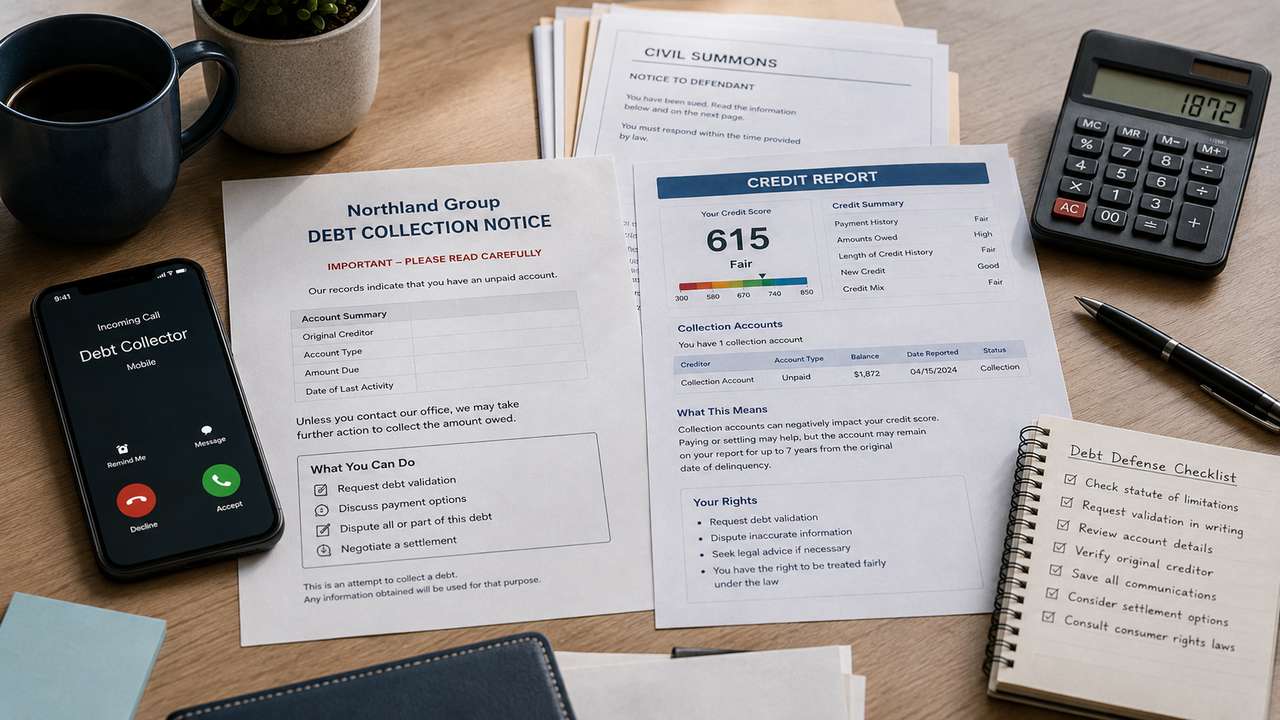
Who Is Northland Group?
Northland Group, Inc. is a debt collection agency founded in 1982 by John Johnson, headquartered in the Minneapolis, Minnesota area (with addresses associated with both Edina and Minnetonka, Minnesota, both suburbs in the same metro area). The company describes itself as a leader in “late-stage” collections — meaning accounts that have typically already gone through earlier collection attempts elsewhere before landing with Northland — and it’s a privately held company, having been acquired by the private equity firm Mason Wells in 2008.
Northland Group is a legitimate, licensed debt collection agency, not a scam. That said, legitimacy doesn’t guarantee every specific account they pursue is accurate or being handled without any missteps, which is exactly why the verification process outlined in this guide is worth following regardless of the company’s overall standing.
Is Northland Group a Debt Buyer or a Third-Party Collector?
Northland Group operates in both capacities, depending on the specific account. In some cases, they’re hired as a traditional third-party collector working on behalf of an original creditor, most notably reported to collect on credit card accounts for Capital One. In other cases, Northland services accounts on behalf of debt buyers, including a documented relationship servicing accounts for LVNV Funding, a well-known major debt-buying company. This means the specific nature of your relationship with Northland — whether they’re simply a hired collector for your original bank or are effectively representing the current legal owner of a purchased debt — can vary from account to account, which is exactly the kind of detail formal debt validation should clarify.
Why Is Northland Group Contacting You?
A few common scenarios explain how Northland Group became involved:
- An unpaid Capital One credit card account went unresolved through Capital One’s own internal collection efforts and was placed with Northland Group for continued collection.
- A debt originally owned by LVNV Funding or a similar debt buyer is being serviced or collected by Northland Group on that debt buyer’s behalf.
- An account has moved through several prior collection attempts already, consistent with Northland’s specific focus on “late-stage” collections — meaning by the time they’re involved, your account has often already been through one or more earlier collection efforts that weren’t successful.
- A data error or identity theft situation has resulted in a debt being incorrectly attributed to you — always worth ruling out through the verification process before assuming any claimed debt is accurate.
An Important Piece of Legal History: Buchanan v. Northland Group
A federal court case, Buchanan v. Northland Group, Inc., is a genuinely important piece of context for understanding how to approach any communication from this company, particularly involving older debt. The case centered on whether Northland Group violated the Fair Debt Collection Practices Act by sending settlement offer letters on debts where the applicable statute of limitations had already expired, without adequately disclosing this fact to consumers — potentially leading people to believe a debt was still legally enforceable through the courts when, in fact, it was not.
The Consumer Financial Protection Bureau, along with the Federal Trade Commission, filed a supporting brief in this case, arguing that a debt collector doesn’t need to actually threaten or pursue litigation for a misleading settlement offer on a time-barred debt to constitute an FDCPA violation — the deceptive impression created by the letter itself can be enough. This case is directly and specifically relevant if Northland Group sends you a settlement offer on an older account: it establishes real, documented precedent for verifying your state’s statute of limitations before assuming a settlement offer implies the debt remains legally enforceable through a lawsuit if you don’t pay.
Step One: Request Formal Debt Validation
Before doing anything else, request formal, written debt validation from Northland Group under the FDCPA. This requires them to provide the name of the original creditor (Capital One, LVNV Funding, or another entity, depending on your specific account), the amount owed, and confirmation of their authority to collect it. You generally have 30 days from your first contact to make this request, during which they must pause collection activity until they respond.
How to request it: Send a written letter via certified mail with return receipt requested, explicitly invoking your FDCPA rights and requesting that collection activity cease until validation is provided.
Step Two: Check Your State’s Statute of Limitations — Especially Given Northland’s Documented History
Given the specific legal precedent set by the Buchanan case, this step deserves particular emphasis when dealing with Northland Group. Every state has a statute of limitations, a legal time limit within which a creditor or collector can successfully sue you to collect through the courts, commonly ranging from three to ten years depending on your state and the type of debt. If your debt is old enough that this window may have already closed, verify this specifically before responding to any settlement offer, and understand that — as the Buchanan case demonstrated — a settlement letter’s tone or format alone shouldn’t be taken as confirmation that a lawsuit remains a genuine, legally viable possibility.
Also critical: in many states, making even a partial payment, or in some cases simply acknowledging the debt in writing, can restart this statute of limitations clock, exposing you to renewed legal risk on a debt that was previously time-barred. This is precisely the kind of situation the Buchanan case was concerned with — a consumer being nudged toward a payment on a debt that could no longer actually be enforced through litigation, without being clearly informed of that fact.
Step Three: Evaluate Your Options Based on What You’ve Confirmed
If the debt is accurate and still within your state’s statute of limitations: you can reasonably move forward with paying in full, negotiating a settlement, or setting up a payment plan, understanding that Northland does retain the legal option to sue if the matter remains unresolved.
If the debt is accurate but outside your state’s statute of limitations: Northland can still legally contact you and request payment, but cannot successfully sue you over it. In this scenario, whether to pay anything at all becomes a more personal decision — some people choose to resolve even a time-barred debt for peace of mind or to improve their credit report status, while others choose to let the remaining credit reporting window (a separate seven-year rule, measured from the original delinquency date) run its course without payment, precisely to avoid restarting any legal exposure.
If the debt can’t be adequately validated, or genuinely isn’t yours: formally dispute it with the credit bureaus, providing whatever documentation supports your position.
How to Negotiate With Northland Group
If Northland Group is collecting on behalf of a debt buyer like LVNV Funding, there’s often meaningful room to negotiate a reduced settlement, since debt buyers typically purchase accounts at a steep discount from the original balance. If Northland is instead collecting directly for Capital One as the original creditor, your negotiating room may be somewhat more constrained by what Capital One specifically authorizes, though settlement offers below the full balance are still commonly available in many cases.
Always get any agreement in writing before sending payment, specifying the exact amount, that it constitutes full and final settlement, and how the account will subsequently be reported. Given the documented history in the Buchanan case specifically involving misleading settlement communications, this step is especially important with Northland Group — don’t rely on a verbal phone conversation alone to confirm the terms of any resolution.
Can Northland Group Sue You?
Yes, if the underlying debt remains within your state’s statute of limitations and Northland (or the entity they’re collecting for) can adequately document their claim. If you’re served with a lawsuit, do not ignore it, regardless of your view on the debt’s validity or age — failing to respond by the court’s specified deadline can result in a default judgment against you automatically, forfeiting any legitimate defense you might have had available, including a statute of limitations defense that must generally be raised affirmatively rather than assumed to apply automatically.
If you are sued, strongly consider consulting a consumer law attorney, particularly given the specific, documented legal history around Northland Group’s past practices regarding time-barred debt — an attorney familiar with this history may be especially well-positioned to identify relevant defenses in your specific case.
Your Rights Under the FDCPA When Dealing With Northland Group
- They cannot call before 8 a.m. or after 9 p.m. in your time zone.
- They cannot harass you through repeated calls intended to annoy, or abusive or threatening language.
- They cannot misrepresent the legal status of a debt, including implying that a time-barred debt remains fully enforceable through litigation if you don’t pay — precisely the issue at the heart of the Buchanan case.
- They must stop calling your workplace once informed you can’t take calls there.
- They must honor a written cease-and-desist request, though this doesn’t erase the underlying debt or necessarily prevent other remedies if the debt remains legally enforceable.
If Northland Group violates any of these protections — particularly around misrepresenting a time-barred debt’s enforceability — you may have grounds for a complaint to the CFPB and potentially for legal action under the FDCPA, an area where this company has specific, documented prior legal exposure.
What to Do If the Debt Isn’t Yours
Given that Northland collects on both Capital One credit card accounts and debt buyer-owned accounts across a range of vintages, data-matching errors are a real possibility, as with any large-scale collector. If you don’t recognize the debt at all, formally dispute it in writing with both Northland Group and the credit bureaus, and if identity theft is suspected, file a report at IdentityTheft.gov and consider a fraud alert or credit freeze.
Frequently Asked Questions
Is Northland Group a legitimate company?
Yes. Northland Group, Inc. is a real, licensed, decades-old debt collection agency headquartered in the Minneapolis, Minnesota area. It is not a scam, though independent verification of any specific account remains a reasonable precaution.
What’s the significance of the Buchanan v. Northland Group case for me personally?
This case established that a debt collector, including Northland Group specifically, can violate the FDCPA by sending settlement letters on time-barred debt without adequately disclosing that the debt is no longer legally enforceable through a lawsuit — making it especially important to verify your state’s statute of limitations before responding to any older debt settlement offer from this company.
Does Northland Group own my debt, or are they just collecting it for Capital One?
This depends on the specific account — Northland works both as a direct collector for Capital One and as a servicer for debt buyers like LVNV Funding. Formal debt validation should clarify which situation applies to your specific debt.
If my debt is outside the statute of limitations, should I still respond to Northland Group’s letters?
Yes — even if you don’t intend to pay, formally responding (in writing, ideally) to note that the debt appears to be time-barred, and requesting they cease contact, is a reasonable step, both to create a documented record and to help ensure they don’t continue treating the account as if a lawsuit remains a viable option.
Can Northland Group add interest or fees on top of the original debt?
This depends on what’s permitted under the original account terms and applicable state law. Any formal validation response should clarify how the current claimed balance was calculated, and you’re entitled to dispute charges that don’t appear properly substantiated.
What if I already made a payment on an old debt to Northland Group and I’m now worried about the statute of limitations restarting?
If this has already happened, it’s worth consulting a consumer law attorney to understand your state’s specific rule and what, if anything, can be done — in some cases, the effect of a restarted statute of limitations is not always as absolute as generally assumed, and specific state law nuances can matter considerably here.
A Closer Look at “Late-Stage” Collections and What It Means for You
Northland Group’s own description of itself as a leader in “late-stage” collections is worth unpacking, since it has practical implications for how you should approach your specific situation. In the debt collection industry, accounts are often categorized by how far along they are in the overall collection lifecycle: “early-stage” or “first-placement” accounts are typically handled by the original creditor’s internal team or a first collection agency shortly after becoming delinquent, while “late-stage” accounts have usually already been through one or more of these earlier attempts without resolution before being placed with a specialist like Northland.
This matters for a few practical reasons. First, it means the account you’re dealing with through Northland has likely been aging for a longer period than a typical fresh collection account, which increases the odds that you’re approaching or have already passed key milestones like your state’s statute of limitations, or the halfway or later point of the standard seven-year credit reporting window. Second, late-stage collectors, precisely because they’re dealing with harder-to-collect, more aged accounts, sometimes have more institutional flexibility to accept a significantly reduced settlement, since their own internal expectations for full recovery on these older accounts tend to be more modest than for a fresher account. This can work in your favor during negotiation, provided you approach it with accurate information about your specific timeline and legal standing first.
Understanding LVNV Funding’s Role When Northland Is Servicing on Their Behalf
If your debt validation response reveals that Northland Group is collecting an account actually owned by LVNV Funding, it’s worth understanding a bit about this specific relationship. LVNV Funding is itself a well-known, large-scale debt buyer (a subsidiary of Resurgent Capital Services’ broader corporate family) that purchases charged-off consumer debt in bulk, similar in business model to companies like Midland Credit Management or Jefferson Capital Systems covered elsewhere. When LVNV Funding owns your debt but Northland Group is the company actually contacting you, this typically means Northland has been contracted specifically to handle the calling, letter-writing, and negotiation work on LVNV’s behalf, while LVNV retains ultimate legal ownership. Any settlement you reach would need to be structured (and ideally documented) as binding on LVNV Funding as the actual debt owner, not simply Northland Group as the servicing agent, to ensure the resolution is fully enforceable and properly reflected in LVNV’s own records as the account’s true owner.
A Sample Response Letter Addressing a Time-Barred Debt
Given the specific relevance of the statute of limitations issue with this particular company, here’s a template you can adapt if you’ve confirmed your debt is likely time-barred:
[Your Name]
[Your Address]
[Date]Northland Group, Inc.
[Address provided in their correspondence]Re: Account [Reference Number]
To Whom It May Concern:
I am writing regarding the above-referenced account. Based on my research, I believe this debt is beyond the applicable statute of limitations in my state, meaning it is no longer legally enforceable through a lawsuit.
Please confirm in writing whether your company intends to pursue this debt as legally enforceable, and please be advised that I am requesting all collection communication cease, consistent with my rights under the Fair Debt Collection Practices Act.
I am aware of my option to make a voluntary payment, but I am not acknowledging this debt as currently owed, and any partial payment should not be construed as a waiver of my position regarding the statute of limitations.
Sincerely,
[Your Name]
[Account Reference Number]
This kind of letter creates a clear, documented record of your position, which can be valuable both in stopping further contact and, if the situation ever escalates, in demonstrating that you raised this issue directly and in writing at the time.
Frequently Asked Questions, Continued
Does the Buchanan case mean Northland Group can never send settlement offers on old debt anymore?
Not entirely — the case specifically concerned settlement offers that misleadingly implied a time-barred debt remained fully legally enforceable without adequate disclosure. Collectors can still generally contact you and request voluntary payment on time-barred debt, provided they don’t misrepresent its legal enforceability status in doing so.
If Northland Group is collecting for Capital One directly, does Capital One know I’ve disputed the debt?
Generally, yes — when you formally dispute a debt with a third-party collector working on behalf of an original creditor, this information is typically expected to be communicated back to that creditor as part of standard industry practice, though it’s still worth directly documenting your dispute with both parties if you want to be certain.
Can I ask Northland Group directly whether my specific debt is time-barred?
You can ask, though they aren’t necessarily obligated to volunteer a definitive legal conclusion about your specific state’s statute of limitations, particularly since this can involve some legal interpretation. Independently researching your state’s rule, or consulting a consumer law attorney for a clear answer specific to your situation, is generally more reliable than relying solely on the collector’s own characterization.
Is Mason Wells’ private equity ownership relevant to how Northland Group operates day-to-day?
Private equity ownership generally doesn’t change the legal obligations a collection agency operates under, though it can sometimes correlate with a company’s strategic focus on growth, acquisitions, or specific business line expansion — this is more of a general business context detail than something that directly affects your individual rights or the collection process itself.
Comparing Northland Group to Other Late-Stage Collectors
| Northland Group | A typical earlier-stage collector |
|---|---|
| Where in the process they get involved After earlier collection attempts have failed |
Shortly after an account first becomes delinquent |
| Typical account age when contacted Often several years old |
Often a few months old |
| Negotiation flexibility Often greater, given lower recovery expectations |
Often more limited, tied closely to original creditor terms |
| Statute of limitations relevance Very high — often close to or past the window |
Usually still well within the window |
| Common clients Capital One, LVNV Funding, other debt buyers and creditors |
Varies widely |
This comparison underscores why the statute of limitations question is so central to almost any interaction with Northland Group specifically — by the nature of their business model, the accounts they handle are disproportionately likely to be old enough that this question is genuinely live, rather than a remote technicality.
Frequently Asked Questions, Continued Further
If Northland Group’s letter doesn’t mention a lawsuit at all, does that mean the debt is definitely time-barred?
Not necessarily — the absence of an explicit lawsuit threat doesn’t confirm the statute of limitations has expired; it could simply reflect standard collection letter language, or a company choosing not to threaten litigation as a matter of general practice regardless of the debt’s specific legal status. Independently verifying your state’s statute of limitations remains the more reliable approach.
Does Northland Group’s ownership by a private equity firm affect its regulatory obligations?
No — regardless of corporate ownership structure, Northland Group remains fully subject to the FDCPA and all applicable state debt collection laws, and its obligations to consumers are unchanged by who owns the company.
Can I request that Northland Group only communicate with me by mail rather than phone?
Yes — under the FDCPA, you can request in writing that a collector limit or cease certain forms of contact, including specifying that you prefer written communication only, which they’re generally required to honor going forward.
The Bottom Line
Northland Group is a real, decades-old debt collection agency operating both as a direct collector for creditors like Capital One and as a servicer for debt buyers like LVNV Funding — legitimate, but with a specific, documented legal history involving misleading settlement communications on time-barred debt, established through the Buchanan v. Northland Group case. This history makes verifying your state’s statute of limitations before responding to any settlement offer especially important, alongside the standard steps of requesting formal debt validation and confirming the underlying debt is genuinely yours and accurately calculated. If you’re ever served with a lawsuit related to a Northland Group account, respond by the deadline regardless of your view on the debt’s merits, and strongly consider consulting a consumer law attorney given the company’s specific documented history in exactly this area.
Need Help Reviewing Your Credit Report?
If Northland Group is appearing on your credit report and you’re unsure whether the account is accurate, reviewing the account details and your available dispute options can be an important first step.
Leave a Reply