Author: admin

  • Does Medical Debt Under $500 Still Show on Your Credit Report?

    Does Medical Debt Under $500 Still Show on Your Credit Report?

    If you’re dealing with a smaller medical bill and wondering whether it’s actually going to affect your credit, there’s genuinely good news here — but it’s worth understanding exactly why, and where the edges of this protection are, since the details matter more than the headline.

    The Short Answer: No, Under Current Bureau Policy

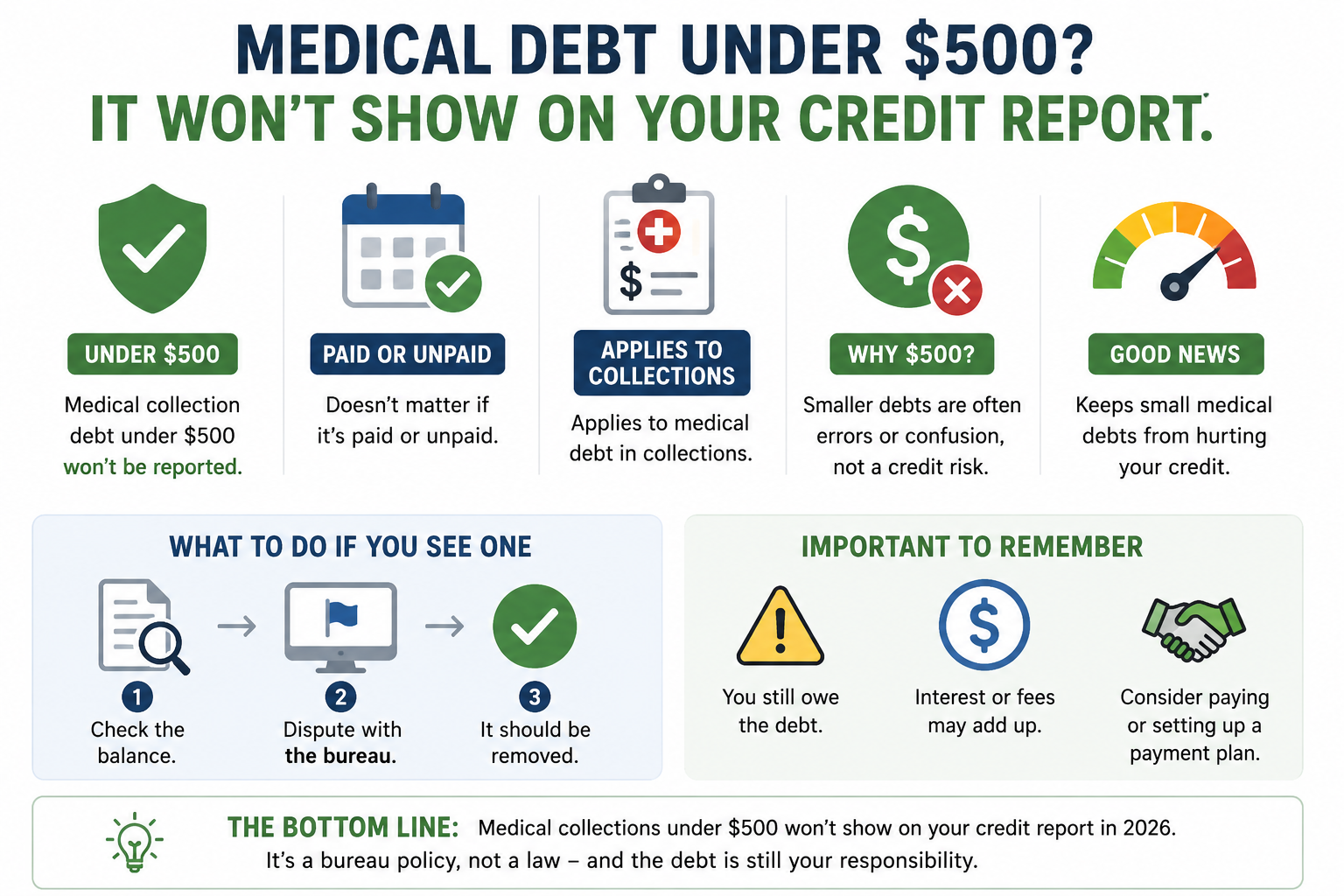
    As of 2026, all three major credit bureaus — Equifax, Experian, and TransUnion — have voluntary policies in place that exclude medical collection debt under $500 from consumer credit reports entirely, regardless of whether the debt is paid or remains unpaid. This has been in effect since these policies were adopted in 2022-2023, and it remains in effect today, independent of the separate federal medical debt rule that was finalized by the CFPB and later vacated by a federal court (see our detailed guide on the 2026 medical debt rule changes for that broader context).

    Why the $500 Threshold Specifically?

    The bureaus set this threshold based on data showing that smaller medical debts are disproportionately likely to reflect billing errors, insurance processing issues, or genuine confusion rather than a consumer’s actual unwillingness or inability to pay — smaller bills are also more likely to simply get lost in the shuffle of post-treatment paperwork, insurance explanation-of-benefits confusion, and address changes, rather than representing a meaningful signal about someone’s overall creditworthiness. The $500 threshold was chosen as a level that captures a meaningful share of these smaller, often disputed or erroneous balances.

    Does This Apply to All Medical Debt, or Just Collections?

    This specifically applies to medical debt that has gone to **collections** — meaning it’s been referred from the original healthcare provider to a third-party collection agency (or, in some cases, reported directly by the provider as a delinquent account). It’s worth understanding this doesn’t mean you don’t owe the money if it’s under $500 — the debt itself remains valid and collectible, it’s simply excluded from credit report reporting under current bureau policy.

    What If You See a Medical Collection Under $500 on Your Report Right Now?

    If you’re actively looking at your credit report and see a medical collection under $500, this shouldn’t be there under current policy, and it’s directly disputable on that basis:

    1. **Pull the specific account details**, confirming the exact reported balance.
    2. **File a dispute directly with the bureau(s) showing the item**, citing that medical collections under $500 are excluded from reporting under current bureau policy.
    3. **This tends to be one of the more straightforward, quickly-resolved disputes**, since it’s based on a clear, bureau-acknowledged policy rather than a contested factual question — the bureau’s own system should recognize and correct this once flagged.

    What Counts Toward the $500 — the Original Bill or the Collection Balance?

    This is worth checking carefully, since collection balances sometimes include added fees or interest beyond the original medical bill amount. If the reported balance on the collection account is under $500, it should be excluded under current policy — but if fees or interest have pushed a smaller original bill above the $500 threshold once it’s in collections, this is worth examining and potentially disputing separately, since fee and interest additions to medical debt are themselves sometimes subject to state-specific limitations or disputes on their own basis.

    Does This Protection Apply Retroactively?

    Generally, yes — if you have an old medical collection under $500 that was reported before these bureau policies took effect, it should have been removed once the bureaus implemented these changes, since the policy applies to what’s currently being reported, not just new debts going forward. If you have an old, small medical collection still showing, this is worth disputing on the same basis as a newly incurred one.

    What About Multiple Small Medical Debts That Add Up to More Than $500 Combined?

    The $500 threshold applies **per account/collection entry**, not as an aggregate across all your medical debts. This means if you have three separate medical collections of $300 each from different providers or dates of service, each one individually falls under the $500 threshold and should be excluded, even though they’d total $900 combined. This is worth understanding if you’re checking your report and doing your own math — don’t assume that having several small medical debts somehow pushes you over the threshold collectively; the exclusion is evaluated account by account.

    Is This Protection Guaranteed to Continue?

    It’s important to understand this is a **voluntary bureau policy**, not a federal or state law (in most states — some states have gone further and passed their own binding legal protections, which don’t depend on the bureaus’ continued voluntary cooperation). This means, in theory, the bureaus could modify or reverse this policy in the future, though there’s no current indication of that happening. If you live in a state with its own specific legal medical debt protections, those provide a more durable guarantee than the voluntary bureau policy alone, since state law protections don’t depend on the bureaus’ ongoing voluntary choice.

    What Should You Actually Do About a Medical Bill Under $500, Even If It Won’t Hurt Your Credit?

    Even though it likely won’t affect your credit report, this doesn’t mean it’s worth ignoring entirely:

    – **The debt is still legally valid and collectible** — a collector can still pursue payment through other means (repeated contact, and in some cases, small claims court for the amount owed), even without credit reporting as leverage.
    – **Interest or additional fees may continue accruing**, depending on the original agreement and your state’s rules on medical debt interest.
    – **Resolving it (even a payment plan) is generally still worthwhile financially**, separate from the credit reporting question — an unresolved bill doesn’t just disappear because it’s not hurting your credit score.

    The Bottom Line

    Yes — under current, voluntary bureau policy in effect throughout 2026, medical collections under $500 should not appear on your credit report, whether paid or unpaid, and this applies per individual account rather than as a combined total across multiple smaller medical debts. If you see one on your report despite this policy, it’s a straightforward, well-grounded dispute. That said, this protection is a bureau policy choice, not a guaranteed federal law in most states, and it doesn’t erase your actual underlying financial obligation to pay the bill — it simply keeps it off your credit report under current industry practice.
  • How Medical Debt Collections Rules Changed in 2026 (and What It Means for Your Credit)

    How Medical Debt Collections Rules Changed in 2026 (and What It Means for Your Credit)

    Medical debt credit reporting has been through a genuinely confusing few years of regulatory back-and-forth, and if you’ve seen conflicting headlines — “medical debt banned from credit reports” alongside “medical debt still affects your credit” — both have some truth to them, depending on exactly what’s being referenced. Here’s a clear, accurate picture of where things actually stand.

    The Short Version: A Federal Ban Was Finalized, Then Struck Down

    In January 2025, the Consumer Financial Protection Bureau finalized a sweeping rule that would have banned virtually all medical debt from consumer credit reports nationwide, and would have prohibited lenders from using medical debt information in underwriting decisions at all. The CFPB estimated this would have removed roughly $49 billion in medical debt from the credit files of approximately 15 million Americans.

    That rule never actually took effect. In July 2025, a federal court vacated the rule, ruling that the CFPB had exceeded its statutory authority and that the rule conflicted with the Fair Credit Reporting Act. As of 2026, there is **no nationwide legal ban** on medical debt appearing on credit reports.

    What’s Actually in Effect: The Bureaus’ Voluntary Changes

    Separate from the now-vacated federal rule, the three major credit bureaus (Equifax, Experian, TransUnion) made their own voluntary policy changes starting in 2022-2023, and these remain in effect as of 2026, independent of the federal rule’s fate:

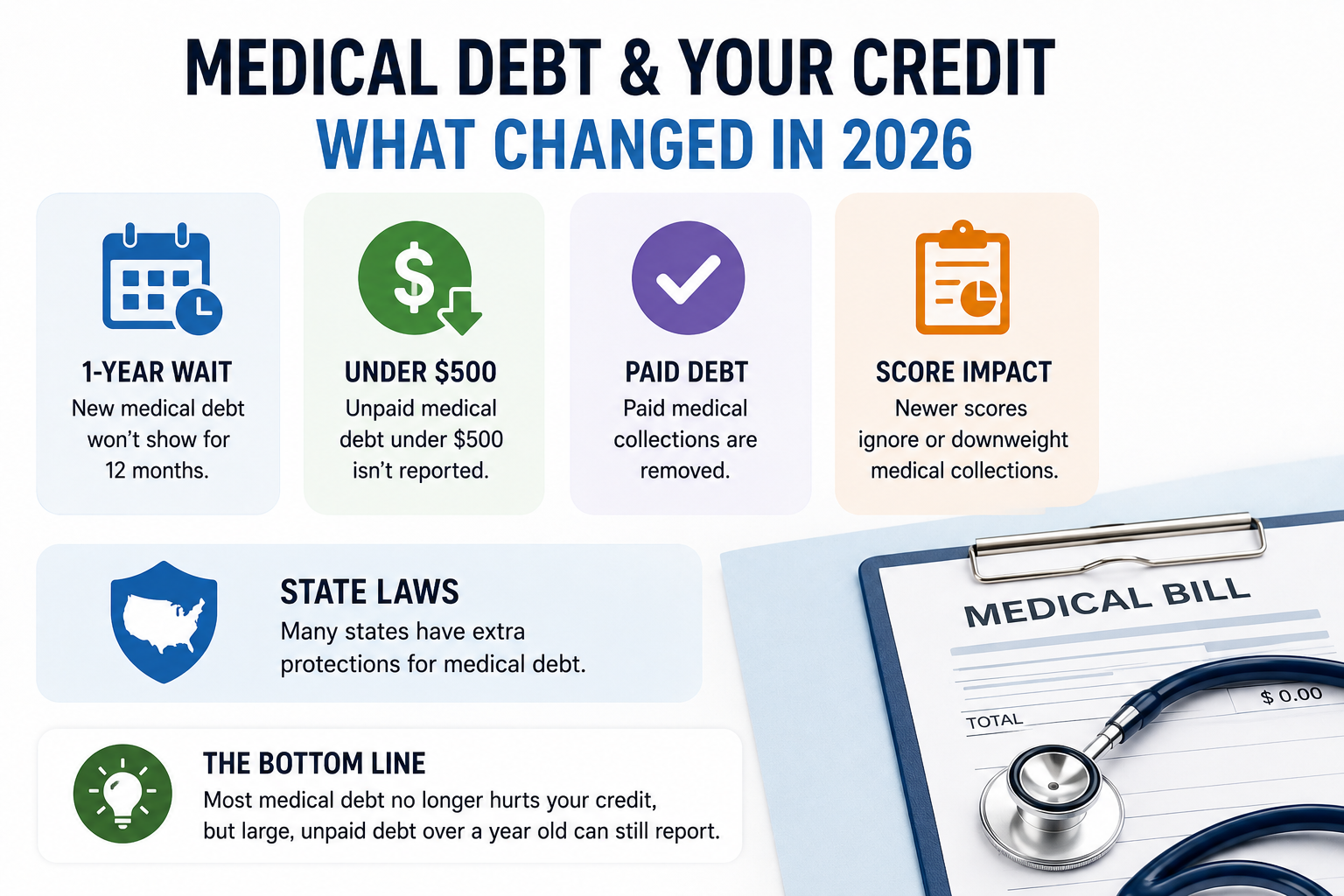
    1. **Paid medical collections are removed from credit reports**, regardless of how large the original balance was or how long it took to pay.
    2. **Unpaid medical collections under $500 are not reported**, and this threshold applies regardless of payment status.
    3. **New medical debt has a 365-day waiting period** before it can be reported at all, giving patients a full year to resolve billing disputes, appeal insurance denials, or arrange payment plans before any credit reporting occurs.

    It’s worth understanding these are **voluntary industry policies**, not legal requirements — the bureaus adopted them on their own and could, in theory, reverse them, though there’s no indication of that happening as of 2026.

    What This Means Practically

    – **If your medical debt is under $500**: it should not appear on your credit report at all, paid or unpaid, under current bureau policy.
    – **If you’ve paid a medical collection of any size**: it should be removed from your report following payment, under current bureau policy.
    – **If your medical debt is over $500, unpaid, and more than a year old**: it can still appear on your credit report and affect your score under current policy — this is the category still meaningfully at risk.
    – **If your medical debt is brand new** (within the past year): it should not yet be reporting, regardless of amount or payment status, giving you time to resolve it before any credit impact.

    Scoring Model Treatment: A Separate, Additional Layer of Protection

    On top of what the bureaus report, some of the newer credit scoring models have gone further and specifically reduced or eliminated the weight given to medical collections even when they do appear on a report:

    – **VantageScore 4.0** and **FICO Score 9 and 10** exclude or significantly reduce the weight of medical collections in their calculations, separate from whether the item is actually visible on your credit report.
    – Older scoring models still in use by some lenders (particularly certain mortgage-specific FICO versions) don’t necessarily incorporate this same treatment, which means your practical exposure to medical debt’s scoring impact can depend on which specific score version a given lender uses.

    State-Level Protections: A Patchwork on Top of the Federal Situation

    With the federal rule vacated, state law has become a more significant factor in medical debt credit protections. A number of states have passed their own laws restricting or banning medical debt from appearing on credit reports for their residents, independent of what the bureaus voluntarily do nationally. If you live in one of these states, you may have stronger protections than the voluntary bureau policy alone provides — this is worth checking specifically for your state, since the list of states with such laws has been actively expanding and the details vary.

    What to Do If You Have Medical Debt on Your Report Right Now

    1. **Check the amount.** If it’s under $500, it shouldn’t be reporting under current bureau policy — if it is, that’s disputable on that basis alone.
    2. **Check whether it’s paid.** If you’ve paid it and it’s still showing, dispute it, citing current bureau policy on paid medical collections.
    3. **Check the age.** If it’s newer than 365 days from the date of service, it shouldn’t be reporting yet — also disputable.
    4. **Check your state’s specific laws**, since you may have additional protections beyond the voluntary bureau policies.
    5. **If none of the above apply and the debt is genuinely over $500, unpaid, and more than a year old**, treat it like any other collection account — verify it, consider negotiating, and understand it may currently be a legitimate, reportable item under current policy (see our detailed medical collections removal guide for a full walkthrough of that process).

    Is This Situation Likely to Change Again?

    Given the ongoing legal and regulatory activity around medical debt reporting — the vacated federal rule, active state legislation, and the bureaus’ own voluntary policies — this is an area that could continue to shift. If you’re dealing with medical debt on your credit report, it’s worth periodically checking for updates specific to your state and to the bureaus’ current policies, rather than assuming today’s rules are permanent.

    The Bottom Line

    The headline “medical debt banned from credit reports” refers to a federal rule that was finalized but then struck down in court and is not currently in effect. What actually protects most people with medical debt today is a combination of the three major bureaus’ voluntary policies (removing paid collections, removing debt under $500, and delaying reporting for a year) plus, in a growing number of states, additional legal protections specific to that state. The practical result is that a majority of medical debt that would have previously appeared on credit reports has been removed through these combined voluntary and state-level actions, even without the federal rule taking effect — but debt over $500, unpaid, and more than a year old remains a real, reportable risk under current policy.

  • What Does the Credit Repair Organizations Act (CROA) Actually Protect You From?

    What Does the Credit Repair Organizations Act (CROA) Actually Protect You From?

    CROA is the primary federal law governing the credit repair industry, and understanding exactly what it does — and doesn’t — cover is genuinely useful, both for evaluating any credit repair company you’re considering and for knowing your rights if something goes wrong.

    What CROA Is and Why It Exists

    The Credit Repair Organizations Act was passed in 1996, specifically in response to widespread abuse in the then-largely-unregulated credit repair industry — companies charging large upfront fees, making false guarantees, and delivering little to no actual value. CROA created specific, enforceable federal protections for anyone who engages a “credit repair organization,” defined broadly as any person or company that offers, for payment, to improve your credit record, history, or rating, or to provide advice or assistance in doing so.

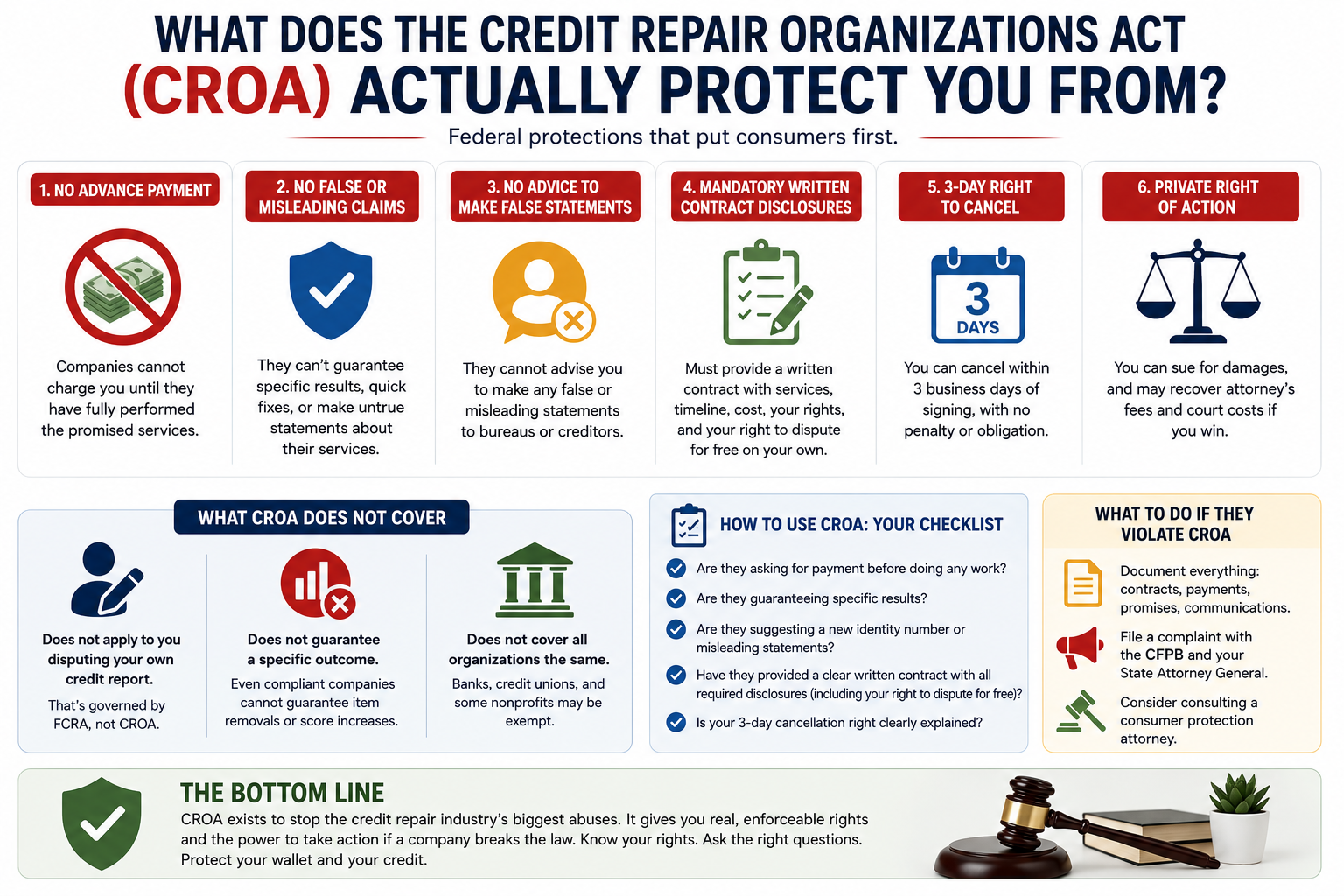
    Protection 1: No Advance Payment

    This is CROA’s most significant, practically important protection: credit repair companies **cannot legally charge you any fee until they have fully performed the services they promised**. This directly targets the classic scam pattern of collecting large upfront fees and then providing minimal or no actual work.

    This means legitimate companies charge only after completing agreed-upon work, often structured as ongoing monthly fees tied to services actually rendered during that period, not a lump sum collected before anything happens.

    Protection 2: No False or Misleading Claims

    CROA prohibits credit repair companies from making any untrue or misleading statement about their services, including:
    – Claims about specific results they can guarantee.
    – Claims about how quickly they can produce results.
    – Misrepresenting the legal effect of any actions they’ll take on your behalf.

    This is why legitimate companies avoid guaranteeing specific score increases or specific item removals — not just as good practice, but because doing so is a direct CROA violation.

    Protection 3: No Advice to Make False Statements

    CROA specifically prohibits credit repair companies from advising you to make any statement that’s untrue or misleading to a credit bureau or creditor with intent to alter your creditworthiness. This directly covers the CPN/file segregation schemes and false identity theft claims covered in our credit repair scam guide — these aren’t just bad practice, they’re specifically the type of conduct CROA (along with separate fraud statutes) was designed to prohibit.

    Protection 4: Mandatory Written Contract Disclosures

    Before you sign anything or pay anything, CROA requires credit repair companies to provide a written contract disclosing:
    – The specific services to be performed.
    – The estimated timeline for those services.
    – The total cost.
    – Your specific cancellation rights.
    – A required, specific disclosure statement about your legal rights, including your right to dispute inaccurate information on your own for free.

    This last point is worth emphasizing: CROA actually requires companies to disclose, in writing, that you have the legal right to dispute credit report information yourself without paying anyone — a direct, mandated acknowledgment that their services aren’t providing access to something otherwise unavailable to you.

    Protection 5: A 3-Day Right to Cancel

    CROA gives you the right to cancel any contract with a credit repair organization within **3 business days** of signing, without any penalty or obligation, similar to cooling-off periods required for various other consumer contracts. This applies regardless of what the company’s own contract terms might otherwise suggest, and any contract provision attempting to waive this right is unenforceable.

    Protection 6: A Private Right of Action

    If a credit repair company violates CROA, you’re not limited to filing a regulatory complaint and hoping for enforcement — CROA specifically gives consumers the right to sue in federal court, and includes provisions for:
    – Actual damages you suffered.
    – In some cases, punitive damages if the violation involved willful or reckless disregard of the law.
    – Attorney’s fees and court costs if you prevail, which makes pursuing a claim more accessible even for relatively modest actual damages, since you’re not necessarily on the hook for your own legal costs if you win.

    This is a meaningful protection, since it means CROA violations aren’t purely a matter of hoping a regulator takes action — you have direct legal recourse.

    What CROA Does NOT Cover

    It’s worth understanding the limits, too:

    – **CROA doesn’t apply to you disputing your own credit report** — it specifically governs third-party credit repair organizations, not your own DIY efforts, which are instead governed by FCRA’s separate dispute provisions.
    – **CROA doesn’t guarantee any specific outcome from a legitimate company’s efforts** — it prohibits companies from promising guarantees, but it doesn’t create a right to a successful result; a company can follow every CROA requirement and still not succeed in getting a specific item removed, since removal depends on the underlying accuracy of the information, not the company’s compliance with CROA.
    – **CROA doesn’t cover banks, credit unions, or nonprofit organizations** in the same way it covers for-profit credit repair companies — there are some specific exemptions in the statute, so not every entity offering credit-related assistance is necessarily bound by CROA’s full requirements in the same way.

    How to Use CROA Knowledge Practically

    When evaluating a credit repair company, walk through CROA’s requirements as a checklist:

    1. **Are they asking for payment before doing any work?** — Violation.
    2. **Are they guaranteeing specific results?** — Violation.
    3. **Are they suggesting anything involving a new identity number or misleading statements to bureaus?** — Violation (and separately, fraud).
    4. **Have they provided a clear written contract with all required disclosures, including your right to dispute for free yourself?** — Should be yes, if compliant.
    5. **Is your 3-day cancellation right clearly explained?** — Should be yes, if compliant.

    Any failure on points 1-3 is a serious, actionable violation. A failure on points 4-5 is also a violation, though perhaps a somewhat less alarming one if everything else about the company otherwise seems legitimate — though it’s still worth pushing back on before proceeding.

    What to Do If a Company Violates CROA

    1. **Document everything** — the contract (or lack of one), payment records, any promises or guarantees made (in writing or, if verbal, noted with dates and details as best you can).
    2. **File a complaint with the CFPB and your state Attorney General.**
    3. **Consider consulting a consumer protection attorney**, particularly if you’ve suffered financial harm — given CROA’s fee-shifting provision, many consumer attorneys take these cases without requiring large upfront legal fees from you.

    The Bottom Line

    CROA exists specifically to prevent the credit repair industry’s most common historical abuses — upfront fees without services rendered, false guarantees, and deceptive practices — and it gives you real, enforceable rights, including a private right to sue with fee-shifting provisions that make legal recourse more accessible than you might expect. Understanding these specific protections turns “does this company seem trustworthy” from a vague gut-check into a concrete checklist you can actually verify before handing over any money.

  • Is Pay-for-Delete Legal? What the Law Actually Says

    Is Pay-for-Delete Legal? What the Law Actually Says

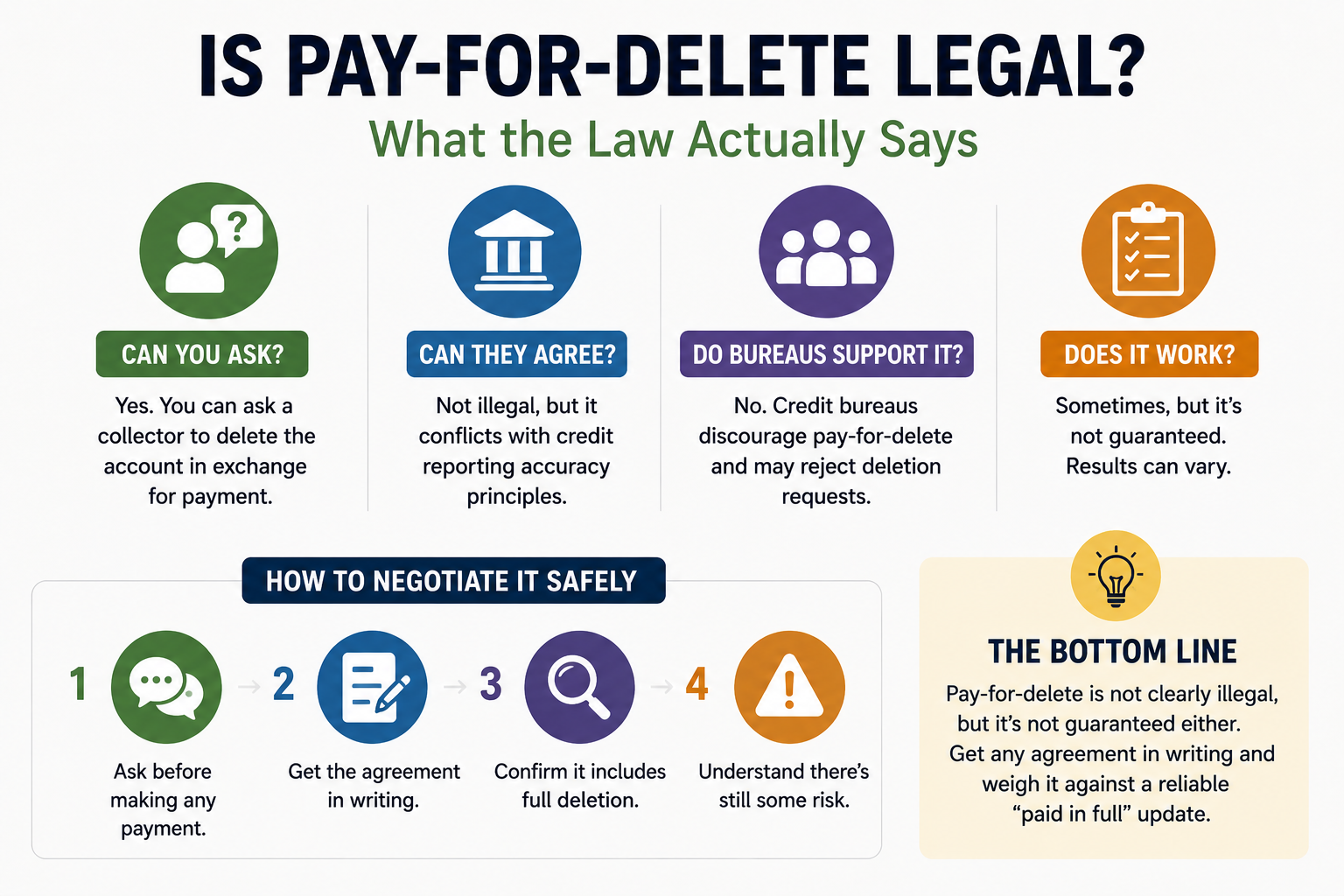
    Pay-for-delete occupies a genuinely gray area that’s worth understanding precisely, because the honest answer isn’t a simple yes or no — it involves distinguishing between what’s legal for you to request, what collection agencies are legally allowed to agree to, and what credit bureaus think about the practice, which are three related but distinct questions.

    What Pay-for-Delete Actually Is

    Pay-for-delete is an informal arrangement where you agree to pay some or all of a debt (often a collection account) in exchange for the collector’s agreement to request that the account be deleted from your credit report entirely, rather than simply updated to show as “paid.” It’s not a formal legal process — it’s a negotiated agreement between you and the collector.

    Is It Legal for You to Request?

    Yes. There’s nothing illegal about you, as a consumer, asking a collector whether they’d be willing to delete an account in exchange for payment. This is simply a negotiation request, and collectors are free to agree or decline as they see fit.

    Is It Legal for a Collector to Agree to It?

    This is where it gets more nuanced. There’s no specific federal law that makes it illegal for a debt collector to agree to a pay-for-delete arrangement. However:

    – **It arguably conflicts with the accuracy principles underlying credit reporting.** The Fair Credit Reporting Act is built around the idea that credit reports should reflect accurate information. A pay-for-delete arrangement, strictly speaking, involves removing accurate information (a debt you genuinely owed and are now paying) purely because of a private financial arrangement — not because the information was ever actually inaccurate.
    – **Furnisher agreements with the credit bureaus themselves sometimes explicitly prohibit this.** Some furnisher contracts with the credit bureaus include clauses requiring furnishers to report accurately and consistently, which some interpret as conflicting with agreeing to selectively delete accurate information for certain consumers who negotiate it, while not doing so for others.

    In practice, this means: **it’s not clearly illegal for a collector to agree to pay-for-delete, but it exists in tension with the broader accuracy framework of credit reporting**, which is part of why some collectors refuse to do it as a matter of policy, even though nothing explicitly criminalizes the practice.

    Do the Credit Bureaus Support Pay-for-Delete?

    No — and this matters practically, even though it doesn’t make the practice illegal. All three major credit bureaus have publicly stated they discourage or disapprove of pay-for-delete arrangements, viewing them as undermining the accuracy and consistency of credit reporting. Some bureau-furnisher agreements reportedly restrict furnishers from making these arrangements at all.

    This creates a real practical problem: **even if a collector agrees to a pay-for-delete arrangement and submits a deletion request, the bureau is not obligated to honor it**, and increasingly, some bureaus have policies that resist or reject these specific deletion requests when they can identify them as pay-for-delete-motivated rather than accuracy-motivated.

    So Does Pay-for-Delete Actually Work?

    Sometimes, but it’s genuinely unreliable, for a few compounding reasons:

    – Not all collectors are willing to agree to it in the first place.
    – Of those willing to agree, their deletion request to the bureau isn’t guaranteed to be honored.
    – Even if honored initially, there’s some risk (though less common) of the item being reinstated later if the bureau’s systems later flag the account.

    This is why pay-for-delete should be understood as a **best-effort negotiation tactic, not a guaranteed outcome** — worth attempting, since it costs nothing to ask, but not something to rely on as a certainty when deciding whether to pay a debt.

    How to Actually Negotiate It, Given These Realities

    1. **Ask the collector directly, before making any payment**, whether they’re willing to agree to a pay-for-delete arrangement.
    2. **Get their agreement in writing** — a verbal agreement from a collections representative is not enforceable, and without written confirmation, you have no recourse if they don’t follow through after you pay.
    3. **Confirm the specific language** — you want them to agree to request full deletion, not just an update to “paid” status, and the agreement should specify this clearly.
    4. **Understand you’re still taking some risk** — even with a written agreement, the bureau’s independent decision about whether to honor the deletion request is outside your and the collector’s control.

    What Happens If They Agree, You Pay, and It’s Not Deleted?

    If you have a written agreement and the collector fails to submit the deletion request as promised, that’s a breach of your specific agreement, and you have some recourse:

    – **Contact the collector directly**, referencing your written agreement, and request they follow through.
    – **If they refuse or ignore you, this may constitute a legitimate complaint** to the CFPB or your state Attorney General, since you have documented evidence of an agreement they didn’t honor.
    – **If the collector did submit the request but the bureau simply didn’t honor it**, this is a different situation — the collector held up their end, but the bureau’s independent policies prevented the outcome. In this case, there’s generally no further recourse, since the bureau’s decision not to delete accurate information is within their discretion.

    Is There a Better Alternative to Pursue Instead?

    Given the reliability issues, it’s worth weighing pay-for-delete against simply negotiating a lower settlement amount without conditioning it on deletion, then separately pursuing a “paid in full” or favorable status update instead. This is a more reliable outcome — status updates are far more consistently honored than deletion requests — even though it leaves the account visible with a settled or paid status rather than removed entirely.

    The Bottom Line

    Pay-for-delete isn’t clearly illegal, but it exists in real tension with the credit bureaus’ own accuracy policies, and none of the three major bureaus are obligated to honor a collector’s deletion request, even when the collector agrees to submit one. This makes it worth attempting — since asking costs nothing — but not something to count on with certainty. Get any agreement in writing before paying, and consider whether negotiating a more reliably-honored outcome (a favorable status update rather than outright deletion) might better serve your actual goals if certainty matters more to you than the chance at full removal.

  • How to Spot a Credit Repair Scam Before You Pay Upfront

    How to Spot a Credit Repair Scam Before You Pay Upfront

    The credit repair industry has a genuinely useful, legitimate side, but it also has a well-documented history of scams and predatory operators, largely because desperate financial circumstances make people more vulnerable to promises that sound too good to be true. The good news: the law actually gives you specific, checkable red flags to look for, since the Credit Repair Organizations Act (CROA) spells out exactly what legitimate companies are and aren’t allowed to do.

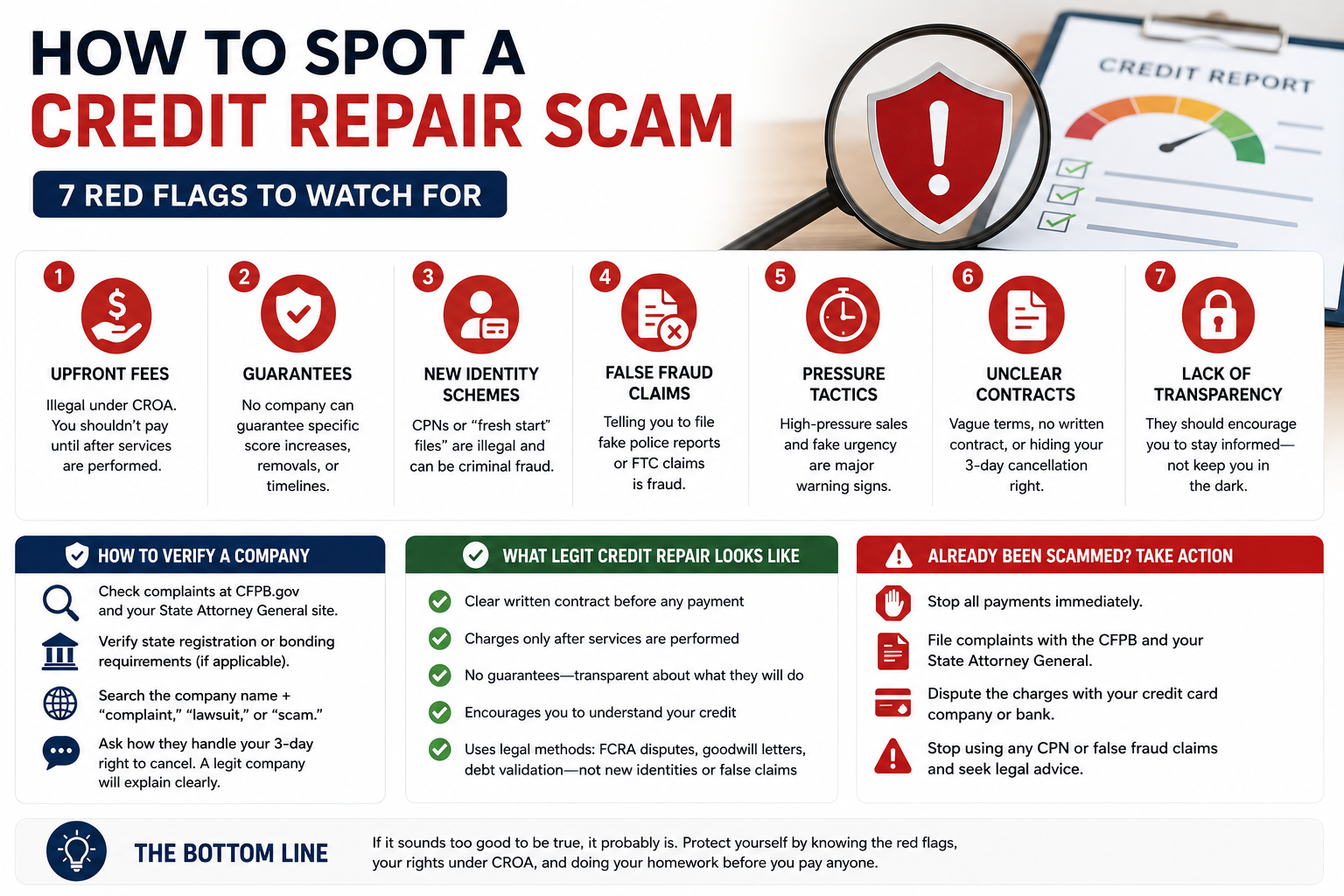
    Red Flag 1: Any Request for Payment Before Services Are Performed

    This is the single most important, legally clear-cut red flag. Under CROA, credit repair companies are **prohibited from charging any fee before they’ve actually performed the promised services**. This isn’t a best practice or a suggestion — it’s federal law.

    If a company asks for payment upfront, a “setup fee,” or any charge before disputes have actually been filed and results (or at least documented work) delivered, this is not just a red flag — it’s a company operating outside the law, regardless of how professional their marketing looks.

    Red Flag 2: Guarantees About Specific Results

    Any company promising a specific score increase (“we’ll raise your score by 100 points”), a guaranteed removal of specific negative items, or a guaranteed timeline for dramatic results is making a promise that’s both legally prohibited under CROA and practically impossible to honestly make — no legitimate company can guarantee the outcome of a dispute process that depends on the accuracy of your specific credit history and the response of individual furnishers, which are outside any company’s control.

    Red Flag 3: Advice to Create a New Credit Identity

    This is one of the more serious scams in the space, sometimes marketed as a “credit privacy number” (CPN) or a “fresh start” file. The pitch typically involves obtaining a new number (sometimes a real Employer Identification Number misused as if it were a personal identifier, sometimes an outright fabricated number) to use in place of your Social Security Number when applying for credit, effectively creating a synthetic new identity disconnected from your damaged credit history.

    This is not a legal loophole — it’s **file segregation fraud**, a federal crime. Using any number other than your actual SSN to apply for credit, misrepresenting your identity to obtain credit, is illegal, and you — not just the company selling you the scheme — bear serious legal risk, including potential fraud charges, if you use one of these numbers. Any company suggesting this, however it’s framed, should be treated as an immediate, serious red flag.

    Red Flag 4: Instructions to Dispute Accurate Information as Fraud

    A related scam pattern involves instructing you to file police reports or FTC identity theft reports for debts that are actually yours, specifically to trigger the more aggressive removal protections available for genuine identity theft victims. This is fraud — falsely claiming identity theft to remove accurate, legitimately-owed debt is illegal, and doing so exposes you to potential legal consequences, separate from whatever the company itself faces.

    Red Flag 5: Pressure Tactics and Urgency

    Legitimate credit repair, whether DIY or through a reputable company, is inherently a multi-month process — there’s no legitimate reason for high-pressure “sign today” tactics, artificial urgency, or claims that a special rate or opportunity will disappear if you don’t commit immediately. This kind of pressure is a sales tactic designed to prevent you from doing the due diligence (reading reviews, checking complaint history, understanding the contract) that would otherwise reveal problems.

    Red Flag 6: Vague or Unclear Contract Terms

    Under CROA, legitimate credit repair companies are required to provide you with a written contract that clearly discloses:
    – The specific services to be performed.
    – The total cost and payment schedule.
    – Your right to cancel within 3 business days without penalty.
    – A specific timeline for when services will be completed.

    If a company is vague about any of this, avoids putting terms in writing, or pressures you to sign without adequate time to review, that’s a serious warning sign, regardless of how legitimate other aspects of their pitch might seem.

    Red Flag 7: They Discourage You From Contacting Bureaus or Creditors Directly

    A legitimate company has no reason to discourage you from understanding or participating in your own dispute process — in fact, transparency about what’s being disputed and why is a hallmark of reputable operators. If a company is cagey about specifics, discourages you from checking your own credit report to verify their claimed progress, or asks you to route all communication exclusively through them without transparency, this warrants real skepticism.

    How to Verify a Company Before Signing Anything

    **Check their complaint history.** The CFPB’s public complaint database and your state Attorney General’s consumer complaint records are both searchable and free, and a pattern of unresolved complaints is a meaningful signal.

    **Check state registration requirements.** Many states require credit repair companies to register or post a bond before operating — verify this directly with your state’s regulatory body if such a requirement applies where you live.

    **Search the company name alongside terms like “complaint,” “lawsuit,” or “scam”** as a basic first-pass check, understanding that this isn’t foolproof (some complaints are unfounded, and some genuinely problematic companies have limited online complaint visibility) but is a reasonable starting point.

    **Ask specifically how they handle the CROA-mandated cancellation right** — a legitimate company should have no hesitation explaining your 3-day right to cancel without penalty; hesitation or vagueness here is itself informative.

    What Legitimate Credit Repair Actually Looks Like

    To be fair to the reputable side of the industry, legitimate credit repair companies:
    – Provide a clear written contract before any payment.
    – Charge only after services are actually performed, often on a monthly basis tied to ongoing work.
    – Make no guarantees about specific outcomes, while being transparent about what they will attempt and why.
    – Encourage you to understand your own credit report and stay informed throughout the process.
    – Operate within standard, legal dispute mechanisms — FCRA disputes, goodwill letters, legitimate debt validation and negotiation — nothing involving new identities or fraudulent claims.

    What to Do If You’ve Already Been Scammed

    If you’ve already paid a company that turned out to be operating illegally (charged upfront, made guarantees, or pushed a CPN scheme):

    1. **Stop any further payments immediately.**
    2. **File a complaint with the CFPB and your state Attorney General**, both of which take credit repair fraud seriously and have pursued enforcement actions against violators.
    3. **Dispute the charges with your credit card company or bank** if payment was made electronically, citing the fraudulent or illegal nature of the services.
    4. **If you were advised to use a CPN or file a false identity theft claim, stop using it immediately** and consult a consumer attorney about how to unwind any resulting complications, since continuing to use it compounds your own legal exposure.

    The Bottom Line

    The credit repair industry’s worst actors share a fairly consistent, checkable set of red flags: upfront payment demands, specific outcome guarantees, and — most seriously — any suggestion involving a new identity number or false fraud claims. CROA gives you real, enforceable legal protections against the first two, and the third category is simply illegal regardless of how it’s marketed. A few minutes of due diligence — checking complaint history, insisting on a clear written contract, and being appropriately skeptical of pressure and guarantees — filters out the vast majority of problematic operators before you ever hand over a payment.

  • What’s the Difference Between a FICO Score and a VantageScore?

    What’s the Difference Between a FICO Score and a VantageScore?

    If you’ve checked your credit score through a few different apps or websites and seen noticeably different numbers, there’s a good chance you’re actually looking at two different scoring systems entirely — FICO and VantageScore — not just different data. Understanding the difference matters because it affects which number you should actually trust for a given purpose.

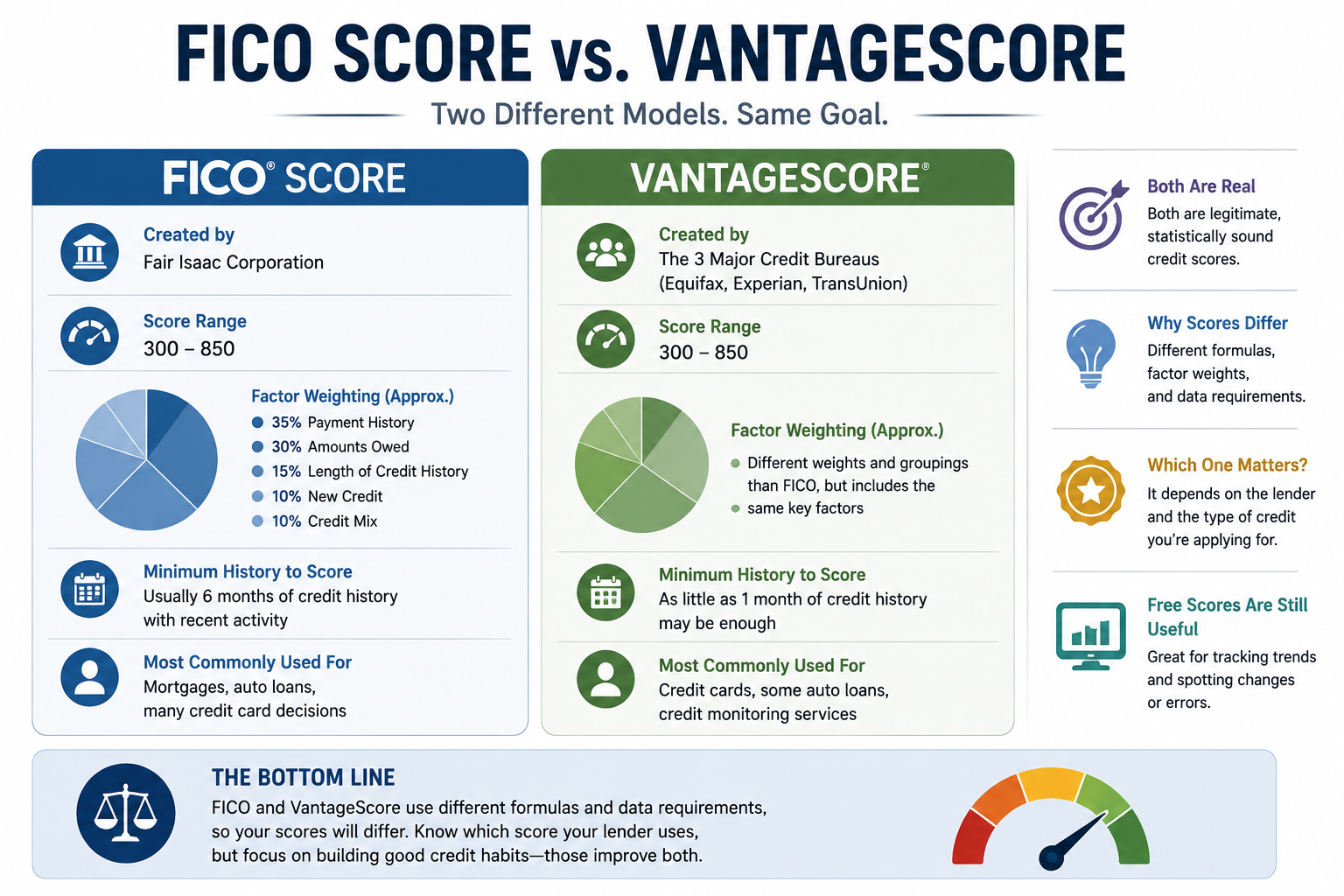
    They’re Both Real, Legitimate Scores — Just Different Companies

    FICO (Fair Isaac Corporation) has been the dominant credit scoring company for decades and remains the score most lenders — especially mortgage lenders — actually use in underwriting decisions. VantageScore was developed later, jointly by the three major credit bureaus (Equifax, Experian, TransUnion), partly as a competing model and partly to standardize scoring across the bureaus in a way FICO’s various versions didn’t always achieve.

    Neither is “fake” or less legitimate than the other — they’re both statistically rigorous models built from real credit report data, but they weight factors somewhat differently and use different underlying formulas, which is why the same credit file can produce different scores under each system.

    Score Range: Actually the Same

    Both FICO and VantageScore use the same 300-850 range for their standard consumer-facing models, which is part of why the difference in actual numbers can be confusing — a 720 FICO and a 720 VantageScore aren’t necessarily reflecting the exact same underlying risk assessment, even though they’re expressed on the same scale.

    How the Factor Weighting Differs

    Both models consider similar broad categories — payment history, utilization, account age, credit mix, recent inquiries — but weight them somewhat differently:

    **FICO’s general weighting approach:**
    – Payment history: roughly 35%
    – Amounts owed (utilization): roughly 30%
    – Length of credit history: roughly 15%
    – New credit (inquiries): roughly 10%
    – Credit mix: roughly 10%

    **VantageScore’s approach** is influenced by similar categories but groups and weights them somewhat differently, and — notably — has historically been able to generate a score with a shorter credit history than FICO typically requires, which matters for people just starting to build credit.

    A Key Practical Difference: Minimum History Required

    – **FICO** generally requires at least 6 months of credit history and at least one account reported within the past 6 months to generate a score.
    – **VantageScore** (particularly newer versions) can sometimes generate a score with as little as 1 month of history and even from accounts with very limited activity, which is part of why VantageScore is sometimes considered more accessible for people with thinner credit files, including recent immigrants or young adults just starting out.

    If you’re brand new to credit and checking a free monitoring app that shows a VantageScore, but a lender pulls a FICO score during an actual application, don’t be surprised if there’s a meaningful gap — the FICO score might not even be calculable yet if your file is thin enough, or it might be notably different once it is.

    Which One Actually Matters for Getting Approved?

    This is the practical question most people actually care about, and the honest answer is: **it depends on the lender and the type of credit you’re applying for.**

    – **Mortgage lending** overwhelmingly still relies on specific older FICO versions (often FICO 2, 4, or 5, depending on the specific bureau), which is a notable quirk of the industry — many mortgage lenders use FICO score versions that are actually older than the versions most consumers see through free monitoring tools.
    – **Credit card issuers** use a mix, with many using newer FICO versions (FICO 8, FICO 9) or VantageScore versions, depending on the specific issuer’s underwriting practices.
    – **Auto lenders** often use industry-specific FICO Auto Score versions, which weight auto-loan-relevant factors (like past auto loan payment history) more heavily than a general-purpose score would.

    There’s no single universal answer — the specific lender and product determine which score version actually gets pulled and used in the decision.

    Why the Free Score You See Is Often Not What Actually Gets Used

    Most free credit monitoring services (through banks, credit card issuers, or independent apps) display either a VantageScore or a specific FICO version (commonly FICO 8), largely because these are the versions most readily available for consumer-facing distribution agreements. This is genuinely useful for tracking general trends in your credit health over time, but it’s worth understanding it may not be the exact score version a specific lender pulls when you actually apply for something like a mortgage.

    Does This Mean the Free Score You Check Is Useless?

    Not at all — it’s still calculated from real credit report data and reflects genuine trends in your credit health. If your free score is going up, that generally (though not perfectly) correlates with your actual creditworthiness improving across most scoring models, even if the exact number a specific lender sees differs. The free score is most useful for:

    – Tracking whether your overall credit health is trending in the right direction.
    – Catching potential errors or sudden unexpected changes worth investigating.
    – General financial literacy and awareness.

    It’s less useful for:
    – Predicting the exact number a mortgage underwriter will see.
    – Precisely calibrating whether you’ll qualify for a specific credit product’s advertised minimum score requirement, since that requirement may reference a different score version than the one you’re checking.

    How to Find Out Which Score a Specific Lender Uses

    If you’re preparing for a major application (particularly a mortgage), it’s worth directly asking the lender which score version and bureau they’ll be using, since this varies by lender and loan type, and some lenders are willing to share this detail upfront, which can help you understand what to expect rather than relying solely on your free monitoring app’s number.

    The Bottom Line

    FICO and VantageScore are both legitimate, statistically robust scoring systems, but they weight credit factors somewhat differently and have different minimum history requirements, which is why you can see genuinely different numbers depending on which one you’re checking. For general trend-tracking and financial awareness, whichever free score you have access to is useful; for a specific, high-stakes application like a mortgage, it’s worth understanding that the actual score pulled may be a different version entirely, often an older FICO variant most consumers never see directly through free monitoring tools.

  • How to Dispute an Error Directly With Equifax Online

    How to Dispute an Error Directly With Equifax Online

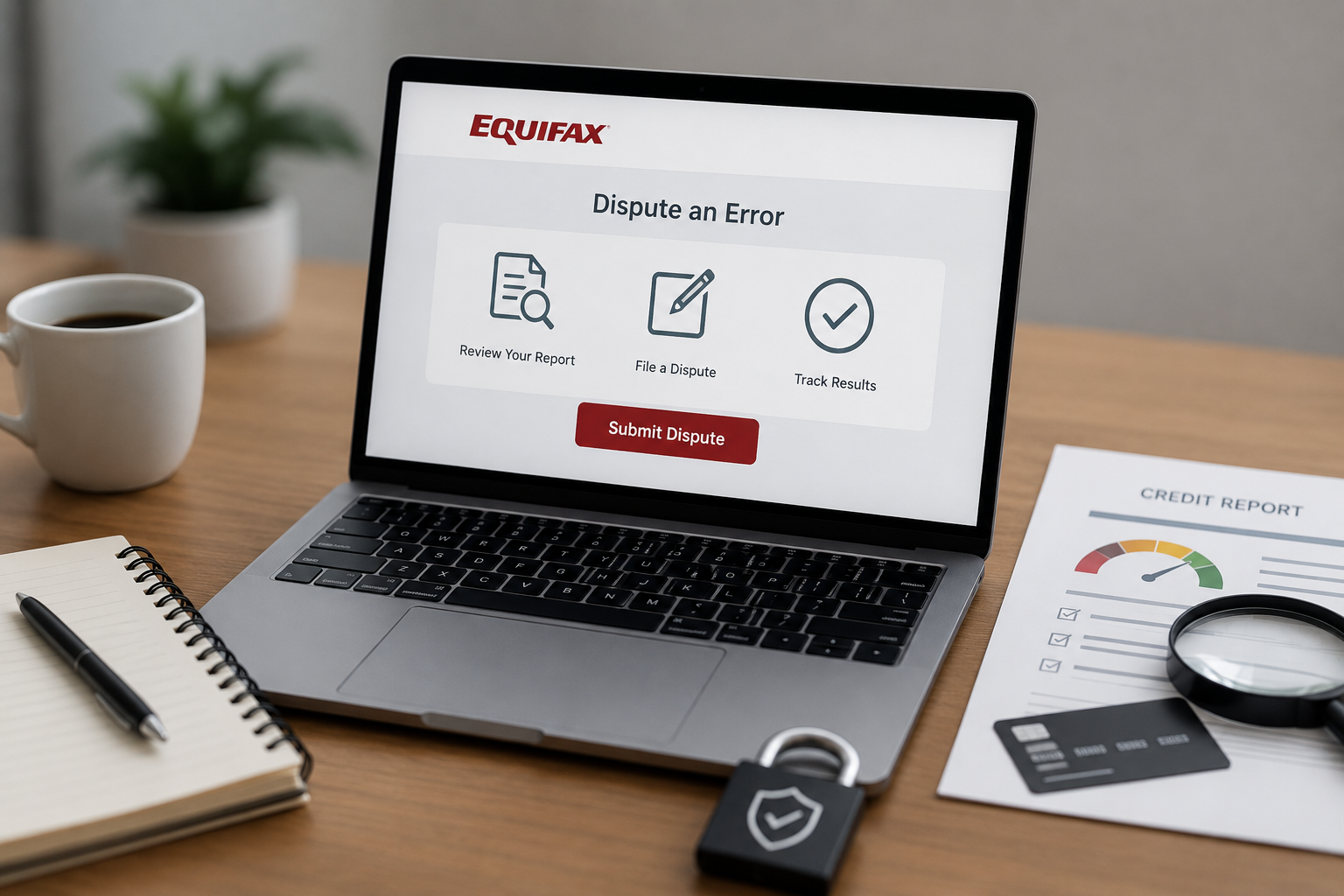
    Equifax’s online dispute process is generally the fastest way to initiate a correction, but it’s worth understanding both how to use it effectively and where its limitations are compared to a written dispute, since choosing the right approach for your specific situation matters more than defaulting to whichever feels most convenient.

    Before You Start: Get Your Actual Equifax Report

    Don’t file a dispute from memory or from a different bureau’s report — pull your specific Equifax report first, since the exact account details, dates, and language matter for a precise, effective dispute. You’re entitled to a free weekly report directly from Equifax through AnnualCreditReport.com, the federally mandated free access point for all three bureaus.

    Step 1: Create or Log Into Your Equifax Account

    Equifax’s dispute portal requires an account on their system (separate from the AnnualCreditReport.com access point). You’ll need to verify your identity, typically through personal information and sometimes knowledge-based verification questions (details about past addresses, loans, etc., drawn from your credit history).

    Step 2: Locate the Specific Item You’re Disputing

    Within your report or the dispute portal itself, identify the exact account or item you believe is inaccurate. Equifax’s online system will typically ask you to select the item from your report directly, rather than describing it freeform, which helps ensure the dispute is correctly matched to the right account in their system.

    Step 3: Select the Reason for Your Dispute

    Equifax’s online portal provides a set of standard dispute reason categories, such as:
    – Not my account
    – Account status incorrect
    – Balance incorrect
    – Account included in bankruptcy
    – Paid in full, not reflected
    – Duplicate account

    Choose the category that most precisely matches your actual issue. If your situation doesn’t fit neatly into a standard category, there’s usually a free-text field to add specific detail — use this to be as precise as possible rather than relying solely on the category selection.

    Step 4: Add Supporting Detail and Documentation

    This is the step most people rush through, and it’s the one that actually determines whether your dispute gets a thorough investigation or a cursory one. Where the portal allows uploads:

    – **Attach relevant documentation** — bank statements, payment confirmations, correspondence with the creditor, anything that substantiates your specific claim.
    – **Use the free-text explanation field thoroughly**, even if it feels redundant with the category you selected. A specific, factual explanation (“This account was paid in full on Sat, 05 Sep 2026 17:18:19 +0000, as shown in the attached confirmation, but continues to show a balance of $X”) gives the automated matching system and any human reviewer much more to work with than the category selection alone.

    Step 5: Submit and Save Confirmation

    Once submitted, save or screenshot your confirmation number and the date of submission — this matters if you need to follow up or escalate later, since it establishes exactly when your 30-day investigation window began.

    What Happens After You Submit

    Equifax is required under FCRA to investigate within 30 days (45 if you submit additional information during the process). Behind the scenes, this typically involves:

    – Equifax electronically forwarding your dispute details to the furnisher (the original creditor or collection agency) through a system called e-OSCAR, which is the industry-standard electronic dispute processing system used across all three major bureaus.
    – The furnisher reviewing their own records and responding with either confirmation of accuracy, a correction, or (if they don’t respond within the window) a default removal.

    The Known Limitation of the Online/e-OSCAR Process

    It’s worth understanding this candidly: the e-OSCAR system, while efficient, has been criticized for sometimes resulting in fairly cursory furnisher reviews — since the system often transmits a compressed summary of your dispute (sometimes just a short code corresponding to your selected reason) rather than your full detailed explanation and documentation. This is part of why a formal written dispute letter, sent by mail with full documentation attached, sometimes results in a more thorough investigation than the online portal alone, particularly for complex or contested disputes.

    When to Use the Online Portal vs. a Written Letter

    **Online portal works well for:**
    – Straightforward, clearly-categorized errors (duplicate accounts, simple date/balance corrections).
    – Situations where you want a fast, low-effort first attempt.
    – Simple items where extensive documentation isn’t critical to proving your case.

    **A written, mailed dispute letter is often better for:**
    – Complex disputes requiring detailed explanation and multiple supporting documents.
    – Situations where a previous online dispute was resolved unfavorably (“verified as accurate”) despite your evidence, and you want to escalate with a more thorough submission.
    – Disputes where you want a clear paper trail, particularly if you anticipate needing to escalate to a CFPB complaint later.

    Checking the Status of an Online Dispute

    Equifax’s online portal typically allows you to check dispute status using your confirmation number, showing whether it’s still under investigation, resolved, or requires additional information from you. Check this periodically rather than waiting passively for the full 30 days, in case they’ve requested additional documentation that could otherwise cause the process to stall.

    What to Do If the Online Dispute Comes Back Unfavorable

    If Equifax responds that the item has been “verified as accurate” despite your evidence:

    1. **Request the specific method of verification** — under FCRA, you’re entitled to know how the investigation was conducted, and a vague or inadequate response here can support further escalation.
    2. **File a more detailed written dispute**, directly by mail, including all your original documentation plus anything additional, specifically noting that a prior online dispute was resolved without adequate investigation.
    3. **Dispute directly with the furnisher** as well, since they have an independent obligation to investigate under FCRA Section 623, separate from the bureau-routed dispute.
    4. **File a CFPB complaint** if you’ve exhausted the standard dispute process without a satisfactory resolution — this requires a company response and often results in a more serious review than the standard consumer dispute channel.

    A Note on Equifax-Specific Considerations

    Equifax has, in the past, had notable data security incidents, which is worth mentioning not to alarm you but because it’s part of why many consumers specifically monitor their Equifax file closely and consider a credit freeze if they’re not actively applying for credit — freezing restricts access to your report (including for identity thieves attempting to open new accounts) without affecting your existing accounts or your ability to unfreeze temporarily when you do need to apply for something.

    The Bottom Line

    Equifax’s online dispute portal is a reasonably fast, accessible starting point for correcting errors, especially straightforward ones, but the underlying e-OSCAR transmission process means your dispute sometimes reaches the furnisher in a more compressed form than your actual detailed explanation. For complex or high-stakes disputes, or as an escalation after an unsatisfactory online result, a thorough written dispute by mail — with full documentation attached — tends to produce a more genuinely substantive investigation.

  • Why Is My Experian Score Different From My TransUnion Score?

    Why Is My Experian Score Different From My TransUnion Score?

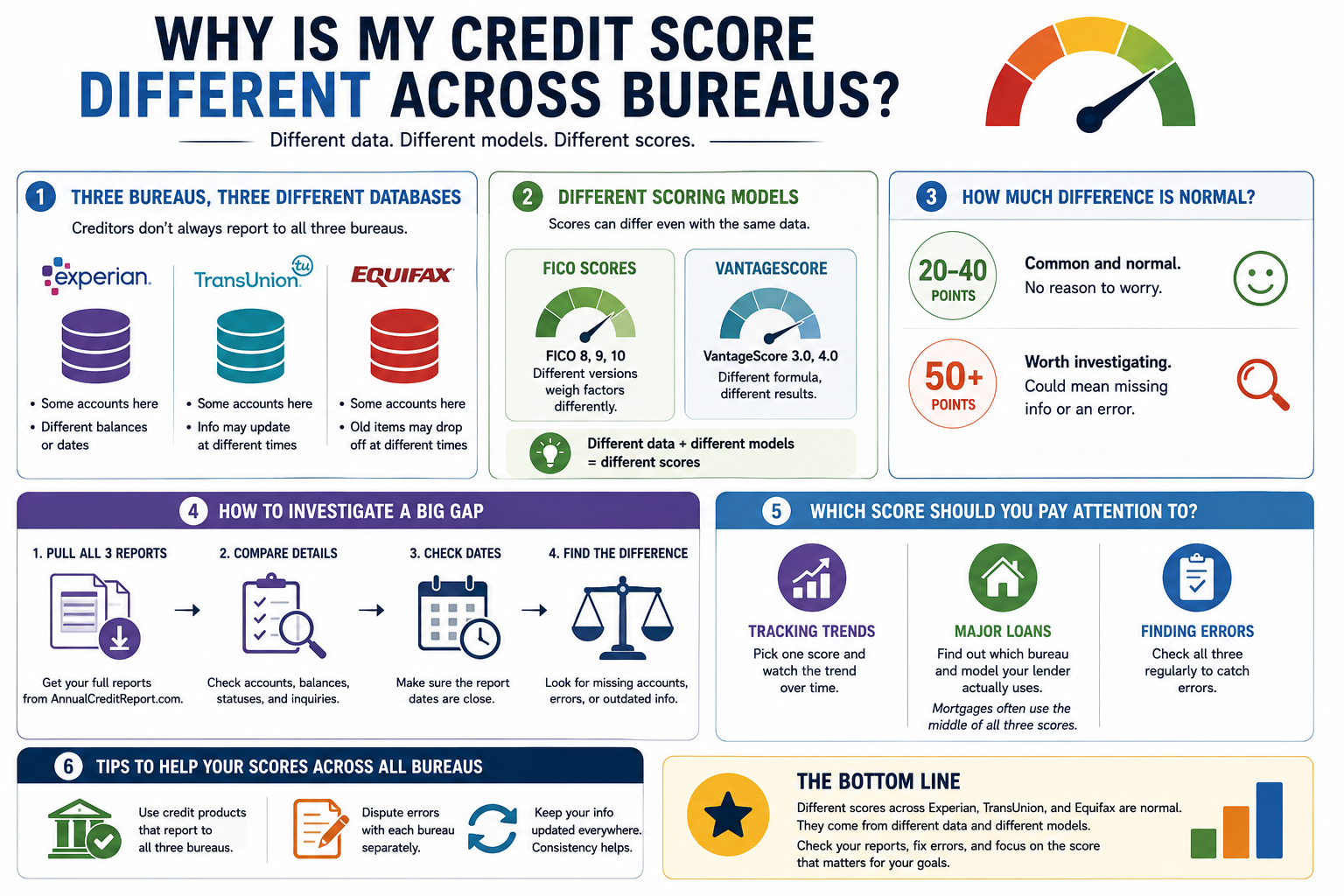
    This is one of the most common sources of confusion in personal credit management — you check your score through two different apps or services, and the numbers don’t match, sometimes by a significant margin. This isn’t an error on anyone’s part; it’s actually an expected, structural feature of how the credit system works. Here’s why it happens and what it means practically.

    The Three Bureaus Don’t Share a Single Database

    Equifax, Experian, and TransUnion are three separate, independently operating companies, each maintaining its own database of your credit history. When a lender or creditor reports account information, they don’t necessarily report to all three bureaus — many report to two, and some smaller or regional creditors report to only one.

    This means the underlying data each bureau has about you can genuinely differ:

    – **A specific account might appear on your Experian report but not your TransUnion report**, if that creditor only reports to Experian.
    – **The exact reporting date or balance snapshot might differ slightly** between bureaus, since creditors don’t always report to each bureau on the exact same schedule.
    – **Older accounts or inquiries might have aged off one bureau’s report before another’s**, if there’s any variance in when each bureau processed the removal.

    Since your score is calculated based on the specific data each bureau holds, different underlying data naturally produces different scores, even when using the exact same scoring formula.

    Different Scoring Models Compound the Difference

    On top of differing underlying data, the score you’re actually shown often comes from different scoring model versions depending on the app or service you’re using:

    – **FICO has many versions** (FICO 8, FICO 9, FICO 10, industry-specific versions for auto and mortgage lending), and different services and lenders use different versions.
    – **VantageScore also has multiple versions** (3.0, 4.0), which weight factors somewhat differently than FICO models and differently from each other.
    – **A free credit monitoring app might show you a VantageScore**, while the mortgage lender you eventually apply with might pull a specific FICO version — these can differ by dozens of points even when calculated from the identical underlying data, simply because the formulas themselves weight factors differently.

    This means the difference you’re seeing between your “Experian score” and your “TransUnion score” might actually be a combination of two separate factors: different underlying data between the bureaus, AND different scoring models used by whatever service is showing you each number.

    How Much of a Difference Is Normal?

    There’s no fixed “normal” range, but differences of **20-40 points** between bureaus are common and not a cause for concern on their own. Larger differences (50+ points) are worth investigating, since they may indicate:

    – A significant account or negative item appearing on one bureau’s report but not another’s.
    – An error specific to one bureau that isn’t reflected on the others.
    – A meaningful gap in reporting timing (e.g., a recent payment reflected on one bureau but not yet processed by another).

    How to Actually Investigate a Larger-Than-Expected Gap

    1. **Pull your full report from all three bureaus** (free weekly at AnnualCreditReport.com), not just the summary score.
    2. **Compare account by account**, checking specifically for:
    – Accounts present on one report but missing from another.
    – Different reported balances or utilization for the same account across bureaus.
    – Different account statuses (one bureau showing “current,” another showing something else) for the same account.
    3. **Check the report dates** — if one report is meaningfully older than another, some of the apparent difference may simply be timing, not an actual discrepancy.

    Which Score Should You Actually Pay Attention To?

    This depends entirely on what you’re using it for:

    – **If you’re monitoring general trends** (is my score generally moving up or down over time), consistency matters more than which specific bureau or model you’re tracking — pick one and watch its trend, rather than comparing absolute numbers across different sources.
    – **If you’re preparing for a specific major application** (mortgage, auto loan), it’s worth finding out which bureau and scoring model version your target lender actually uses, since that’s the number that matters for that specific decision — mortgage lenders, for instance, often pull all three bureaus and use the middle score of the three, a common industry practice.
    – **If you’re trying to catch errors**, checking all three regularly matters more than focusing on one, since an error might exist on only one bureau’s file.

    Does It Matter Which Bureau a Lender Pulls?

    Yes, potentially significantly, if your accounts and history genuinely differ between bureaus. This is part of why it’s worth checking and correcting errors across all three, not just whichever one you happen to check most often — a lender pulling the one bureau where an error hasn’t yet been corrected will see the inaccurate, lower score, even if your other two bureau files are clean.

    Should You Try to “Even Out” Your Scores Across Bureaus?

    Not directly — there’s no legitimate mechanism to force your scores to match across bureaus, since the underlying cause (different data, different models) is structural, not something you manipulate directly. What you can and should do:

    – **Ensure accounts you want reflected everywhere are actually reporting to all three bureaus** — if you’re using a specific credit-building product, confirm it reports to all three, not just one or two, precisely to avoid a scenario where your positive history only helps one of your three files.
    – **Correct any errors on each bureau independently**, since a dispute filed with one bureau does not automatically correct the same error on the others — you generally need to dispute separately with each bureau where the error appears.

    The Bottom Line

    Different scores across Experian, TransUnion, and Equifax are expected and normal, driven by each bureau maintaining an independently reported, sometimes genuinely different set of underlying data, compounded further if you’re comparing scores calculated using different scoring model versions. Differences in the 20-40 point range are unremarkable; larger gaps are worth investigating by comparing your full reports account-by-account across all three bureaus, since a significant discrepancy often points to a real, correctable difference in what each bureau actually has on file for you.

  • Can You Remove a Hard Inquiry You Never Authorized?

    Can You Remove a Hard Inquiry You Never Authorized?

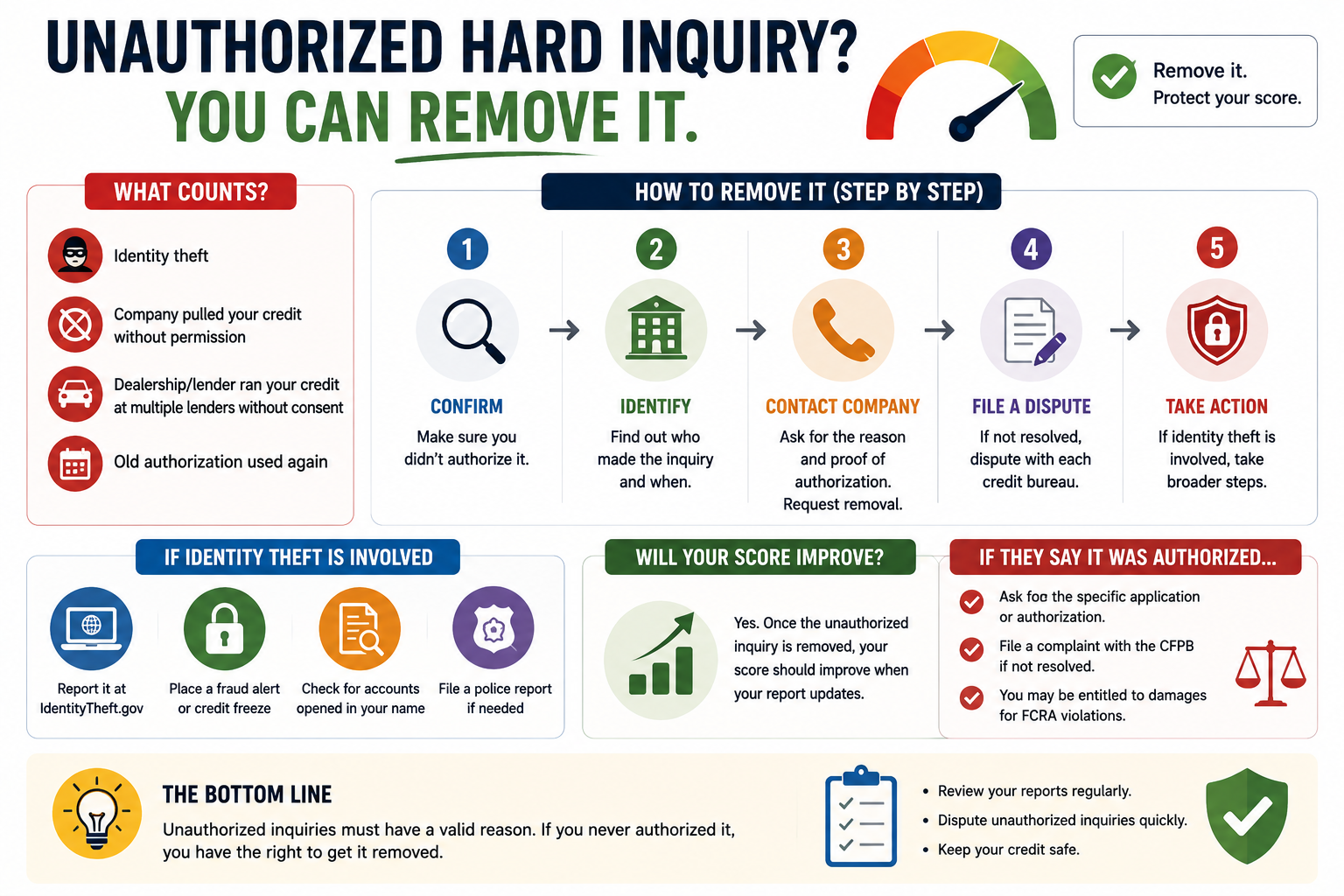
    Yes — and this is one of the more clear-cut, successfully disputable issues in credit reporting, precisely because an unauthorized inquiry is, by definition, not something you consented to, which makes it a genuine FCRA violation rather than a judgment call about accuracy. Here’s exactly how to identify and remove one.

    What Counts as an “Unauthorized” Inquiry

    Under the Fair Credit Reporting Act, a hard inquiry is only permitted when there’s a legitimate “permissible purpose” — generally, that you applied for credit, or a company has an existing account relationship with you that allows periodic review. Unauthorized inquiries typically fall into a few categories:

    – **Identity theft** — someone applied for credit fraudulently using your information.
    – **A company pulling your credit without your application** — sometimes due to error, sometimes due to a company mistakenly treating a soft inquiry-eligible action (like a pre-approval check) as a hard pull.
    – **A dealership or lender running your credit at multiple different lenders without your explicit authorization** for each — common in car dealership financing, where “shotgunning” your application to multiple lenders sometimes happens without clear, itemized consent for each pull.
    – **An old authorization being used again later** — for example, a gym membership or service provider running a credit check for a purpose you didn’t authorize at the time.

    Step 1: Confirm You Genuinely Didn’t Authorize It

    Before disputing, take a moment to genuinely rule out an authorized inquiry you may have simply forgotten about — a store credit card application at checkout, a “check if you’re pre-qualified” tool that actually resulted in a hard pull rather than a soft one (some tools aren’t as clearly labeled as they should be), or an application you made a while back that’s easy to forget. Disputing an inquiry you did authorize, even by mistake, wastes time and doesn’t help your credibility for genuinely unauthorized items.

    ## Step 2: Identify Exactly Who Made the Inquiry

    Your credit report will show the name of the company that pulled your credit and the date. If the name is unfamiliar or unclear (sometimes inquiries show under a financing partner’s name rather than the retailer you actually interacted with), a quick search of the company name alongside “credit inquiry” often clarifies who they are and what kind of transaction typically triggers their pull — this can help you determine whether it’s likely a legitimate inquiry you’ve simply forgotten, or a genuine unauthorized pull.

    Step 3: Contact the Company Directly First

    Before going straight to a formal dispute, it’s often faster to contact the company listed as making the inquiry and ask them to explain the permissible purpose for the pull. Ask specifically:

    – What date did you authorize this inquiry, and through what application or transaction?
    – Can you provide documentation of my authorization?

    If they can’t produce a legitimate basis, ask them to submit a request to the credit bureaus to remove the inquiry — many companies will do this directly once they realize it was made in error or without proper authorization, since they have their own compliance interest in not making improper pulls.

    Step 4: File a Formal Dispute With the Credit Bureau

    If the company doesn’t respond or doesn’t resolve it, file a dispute directly with each bureau reporting the unauthorized inquiry:

    – Identify the specific inquiry (company name, date).
    – State clearly that you did not authorize this inquiry and have no relationship or application history that would explain it.
    – Request removal based on the lack of permissible purpose under FCRA.

    Step 5: If Identity Theft Is Involved, Take Broader Action

    If the unauthorized inquiry is tied to identity theft (someone applied for credit using your information without your knowledge), this requires a broader response beyond just disputing the inquiry:

    – **File a report at IdentityTheft.gov**, the FTC’s dedicated resource, which generates an official identity theft report and a personalized recovery plan.
    – **Place a fraud alert or credit freeze** with all three bureaus to prevent further unauthorized inquiries or account openings while you sort out the situation.
    – **Check for any accounts that may have actually been opened**, not just inquiries — an unauthorized inquiry sometimes indicates a fraudulent application that was denied, but it’s worth confirming nothing was actually opened in your name as a result.
    – **File a police report** if a fraudulent account was actually opened, which is often required documentation for disputing the resulting account with creditors and bureaus.

    Does an Unauthorized Inquiry’s Removal Restore Lost Points Automatically?

    Generally, yes — since the removal corrects the underlying data your score was calculated from, your score should reflect the correction once the inquiry is removed and your file is recalculated, typically within the normal processing timeline following a successful dispute.

    What If the Company Insists the Inquiry Was Authorized, But You Disagree?

    This is where it becomes your word against theirs, and documentation matters:

    – **Request the specific application or authorization they’re relying on** — a legitimate company should be able to produce this if the inquiry was genuinely authorized.
    – **If they can’t produce documentation and continue to insist it was authorized**, escalate to a CFPB complaint, which requires a company response and often results in more serious attention than a standard dispute.
    – **If significant financial harm resulted** (a loan denial specifically due to a fraudulent or improper inquiry, for example), this may be worth discussing with a consumer protection attorney, since FCRA violations can carry statutory damages in some cases.

    Common Scenarios Worth Special Attention

    **Car dealership “shotgunning.”** If you applied for financing at a dealership and multiple, seemingly unrelated lenders show inquiries you don’t recognize, this sometimes happens when a dealership submits your application to several lenders simultaneously without clearly disclosing that each would result in a separate hard pull. While dealerships often have some legitimate basis for shopping your application (and mortgage/auto rate-shopping deduplication windows may limit the scoring damage, as covered in our hard inquiry point-impact guide), a genuinely excessive or undisclosed number of pulls is worth questioning directly with the dealership.

    **”Pre-qualification” tools that turn into hard pulls.** Legitimate pre-qualification tools use soft inquiries specifically so you can check your odds without any score impact. If a tool marketed as “check your rate, no impact to your credit” results in a hard inquiry anyway, this is worth disputing both with the company directly (as a potential violation of their own stated terms) and, if unresolved, with the bureau.

    The Bottom Line

    An inquiry you never authorized is one of the more straightforward, successfully disputable credit report issues, precisely because FCRA requires a permissible purpose for any hard pull, and “you didn’t consent” is about as clear a lack of permissible purpose as exists. Confirm you genuinely don’t recognize the inquiry, contact the company directly first, escalate to a formal bureau dispute if needed, and if it’s tied to identity theft, treat it as part of a broader identity theft response rather than an isolated inquiry issue.

  • How Many Points Does a Hard Inquiry Actually Cost You?

    How Many Points Does a Hard Inquiry Actually Cost You?

    Hard inquiries get a reputation for being scarier than they actually are, largely because the exact number people fixate on — “how many points” — is more variable and generally smaller than most assume. Here’s a precise breakdown of what actually happens when a hard inquiry hits your report, and how to think about it realistically.

    Hard Inquiry vs. Soft Inquiry: A Quick Distinction

    Before getting into the point impact, it’s worth confirming which type of inquiry you’re dealing with, since only one of these matters for scoring:

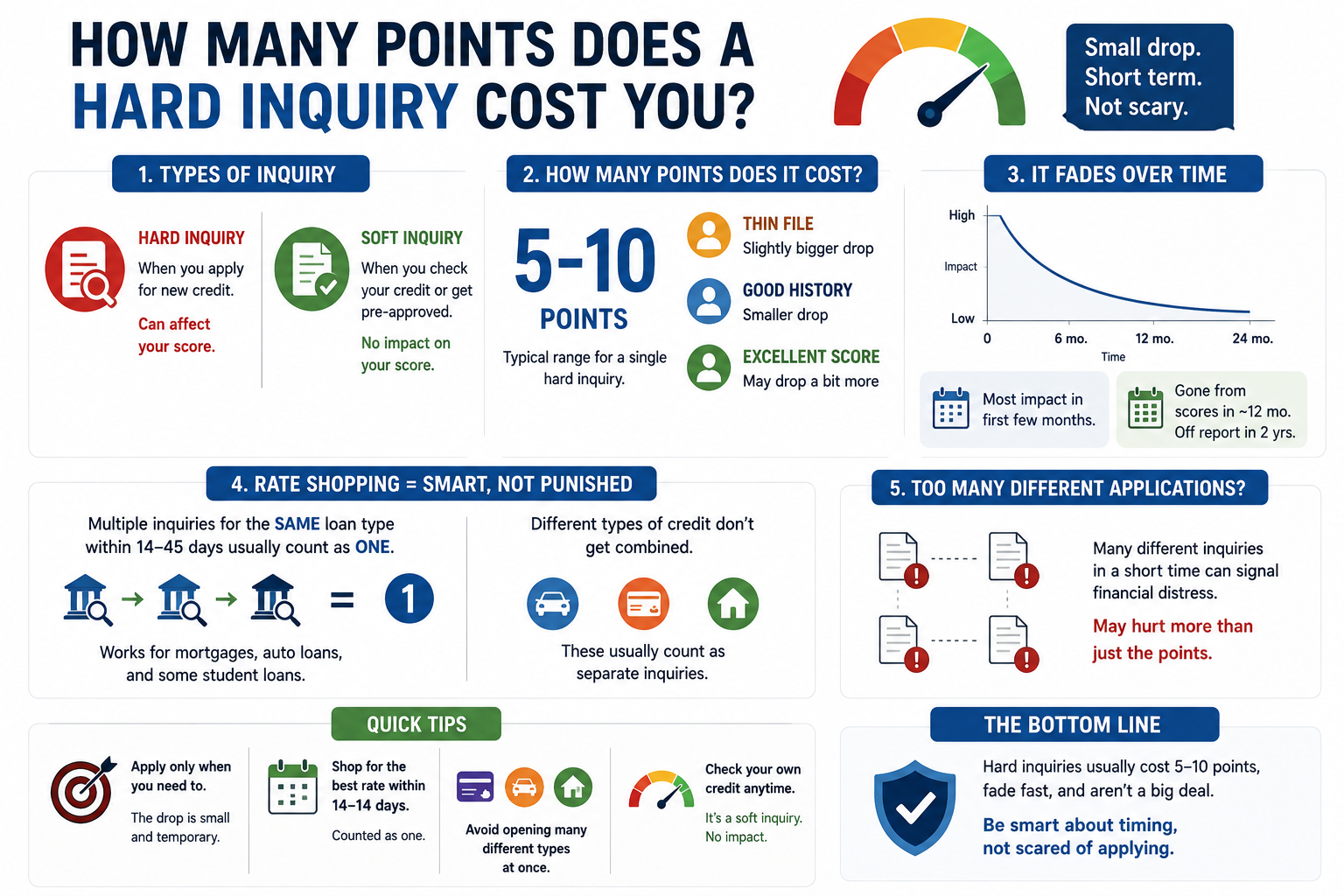
    – **Hard inquiries** occur when you apply for new credit and a lender checks your report as part of an actual lending decision — a credit card application, an auto loan, a mortgage application. These are the type that can affect your score.
    – **Soft inquiries** occur when you check your own credit, when a company does a promotional/preliminary check without a full application, or during background checks unrelated to lending. These never affect your score, regardless of how many occur.

    If you’re not sure which type you’re seeing on your report, it’s usually labeled directly, but generally: anything you didn’t specifically apply for as a credit product is a soft inquiry.

    The Typical Point Range

    For most people, a single hard inquiry results in a score decrease of **roughly 5-10 points**, though this varies based on your overall credit profile:

    – **People with a thin credit file or a shorter credit history** tend to see a slightly larger relative impact, since a new inquiry represents a proportionally bigger change to a smaller data set.
    – **People with an established, lengthy credit history and many existing accounts** tend to see a smaller relative impact, since one more inquiry is a smaller change relative to everything else already reflected in their file.
    – **People with an already excellent score** sometimes see a slightly larger point drop than someone with an average score, simply because there’s more room to fall from a very high starting point, even though the underlying risk signal is the same.

    Importantly: this is a general range, not a fixed universal number — no scoring model publishes an exact, guaranteed point deduction, and the actual impact is calculated as part of a complex overall model, not a simple flat subtraction.

    Read More: How Much Does Credit Repair Cost

    How Long Does a Hard Inquiry Affect Your Score?

    This is arguably more important than the initial point drop:

    – Hard inquiries remain on your credit report for **2 years**.
    – However, their actual **scoring impact fades much faster** than that — most inquiries stop meaningfully affecting your score after about **12 months**, and the effect is typically strongest in the first few months, diminishing steadily after that.

    This means a hard inquiry from 18 months ago is likely still visible on your report but probably has little to no remaining effect on your actual score, even though it hasn’t yet reached its full 2-year removal date.

    Why Multiple Inquiries Don’t Always Multiply the Damage

    This is one of the more useful, lesser-known nuances in credit scoring: most modern scoring models include **rate shopping windows**, which recognize that consumers shopping for the best rate on a single loan (particularly mortgages, auto loans, and sometimes student loans) shouldn’t be penalized as if they applied for many separate, unrelated lines of credit.

    – Multiple inquiries for the **same type of loan within a defined window** (typically 14-45 days, depending on the specific scoring model) are often treated as a **single inquiry** for scoring purposes.
    – This window is specifically designed to let you shop around for the best mortgage or auto loan rate without accumulating multiple separate inquiry penalties.

    Important caveat: this deduplication generally applies to **similar loan types** (multiple mortgage applications, or multiple auto loan applications) shopped within the window — it typically does **not** apply to a mix of different credit types (a credit card application plus a mortgage application plus a personal loan application), which would generally still count as separate inquiries.

    Do All Scoring Models Treat Inquiries the Same Way?

    No, and this is worth understanding if you’re tracking a specific score:

    – **FICO models** generally have more generous rate-shopping windows and clearer inquiry deduplication logic.
    – **VantageScore models** also account for rate shopping, though the specific window and treatment can differ somewhat from FICO’s approach.
    – **Industry-specific scores** (auto-enhanced, mortgage-specific versions) sometimes weight inquiries differently than the general-purpose base scores.

    If you’re specifically preparing for a mortgage or auto loan application, it’s worth checking which score version the relevant lenders typically use, since the practical inquiry impact can vary.

    Does Checking Your Own Credit Count as a Hard Inquiry?

    No checking your own credit report or score, whether through a free service, your bank’s app, or AnnualCreditReport.com, is always a soft inquiry and has no effect on your score, regardless of how frequently you check. This is worth knowing because it removes any reason to avoid monitoring your own credit out of fear it will hurt your score — it won’t.

    When Multiple Different-Type Inquiries in a Short Period Actually Matter More

    Beyond the direct point impact, a cluster of hard inquiries across different credit types in a short window can itself be interpreted by some scoring models and manual underwriters as a signal of financial distress or a sudden need for credit sometimes referred to as “credit-seeking behavior.” This can compound the individual point impacts into a somewhat larger overall effect than the sum of the individual inquiries might suggest in isolation, particularly if it coincides with other risk signals on your file.

    Practical Takeaways

    • Don’t avoid a necessary credit application out of excessive fear of a hard inquiry the typical 5-10 point impact is real but modest, and it fades within about a year.
    • Do consolidate rate-shopping into a tight window** (ideally within 14 days to be safe across different scoring models) when shopping for a mortgage or auto loan, to take advantage of deduplication treatment.
    • Avoid applying for multiple different types of credit in a short period** if you’re actively trying to optimize your score for an upcoming major application, since this is where the cumulative effect (and the “credit-seeking” signal) is most likely to add up.
    • Don’t worry about checking your own credit  this never counts as a hard inquiry regardless of frequency.

    The Bottom Line

    A single hard inquiry typically costs somewhere in the range of 5-10 points, with the effect fading substantially within about a year and disappearing from your report entirely after two years — a real but generally modest and temporary impact, not something that should meaningfully deter a genuinely necessary credit application. The more important nuance is understanding rate-shopping deduplication windows if you’re comparing loan offers, and being mindful of clustering different types of credit applications together in a short period if you’re specifically trying to optimize your score ahead of a major application.