This is one of the more genuinely useful, if slightly counterintuitive, tools in credit building — you can potentially benefit from someone else’s credit history without being legally responsible for their debt. But it doesn’t work universally, and understanding exactly when and why it works (and when it doesn’t) matters before you rely on it as a strategy.
The Short Answer: Yes, Often Significantly — But With Real Conditions
Being added as an authorized user on someone else’s credit card can add that account’s entire history — sometimes years or even decades of it — to your own credit report. If the primary account holder has a long-standing, well-managed account, this can meaningfully boost your score, particularly if you have a thin or new credit file where a single well-aged account represents a large proportional improvement to your overall profile.
But this only works under specific conditions, and it can also backfire.
How Authorized User Reporting Actually Works
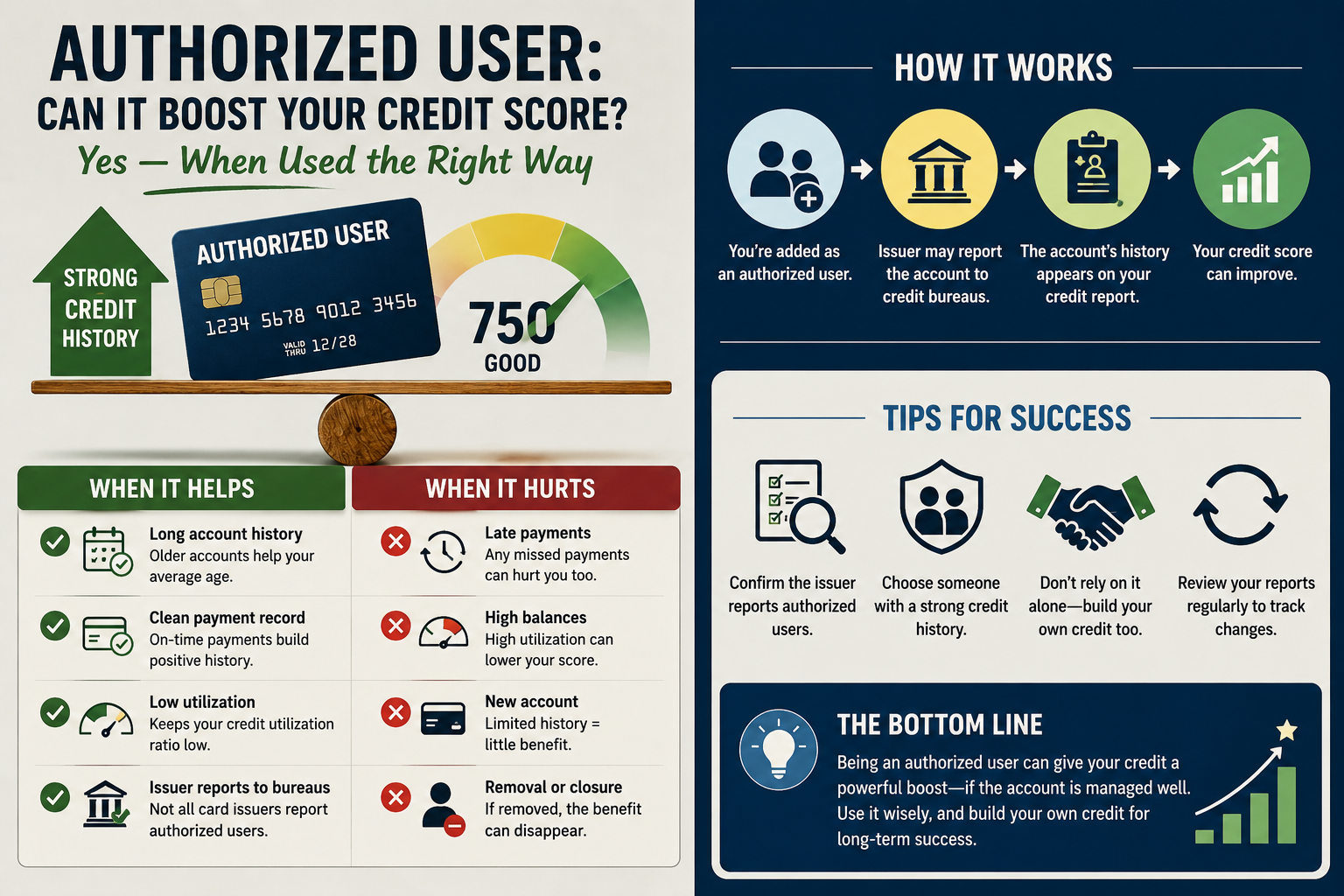
When you’re added as an authorized user, the card issuer *may* report that account to the credit bureaus as appearing on your credit file too — including its full history: the account age, the payment history, the credit limit, and current utilization. This is the mechanism that creates the benefit (or the risk).
Critically: **not all card issuers report authorized user activity to the credit bureaus at all.** This varies by issuer, and it’s essential to confirm before assuming the strategy will work. If the issuer doesn’t report authorized user status, adding you accomplishes nothing for your credit file, regardless of how strong the primary account is.
What Makes This Work Well
**The primary account has a long history.** The single biggest factor in how much this helps is the account’s age. Being added to a card opened last year provides much less benefit than being added to one opened 15 years ago, since average account age is a real scoring factor, and a long-standing account can meaningfully raise your overall average, especially if your existing credit file is thin.
**The primary account has a clean payment history.** This is non-negotiable — if the account has late payments or other negative marks, those become part of your file too. This is the core risk of the strategy: you inherit the account’s full history, both good and bad.
**The primary account has low utilization.** Since the reported utilization on that account becomes part of your file’s overall utilization calculation, a card that’s rarely used or kept at a low balance relative to its limit helps you; a card that’s frequently near
its limit hurts you, even if you personally never use the card yourself as an authorized user.
**The issuer actually reports authorized user data.** As mentioned, this is a prerequisite, not a detail — confirm this before pursuing the strategy at all.
What Makes This Backfire
**A primary account with negative history.** If the account has missed payments, high utilization, or other derogatory marks, adding you as an authorized user imports those negatives into your file just as readily as it would import positives. This is the most important risk to understand: authorized user status is not a one-directional benefit — it reflects the account’s actual history, whatever that history is.
**A recently opened account.** If the account is new, there’s minimal age benefit to gain, and you’re taking on whatever risk exists (missed payments going forward) without much of the primary upside.
**Relying on it as your only credit-building strategy.** Authorized user status supplements a credit file; it doesn’t substitute for having your own independently-held accounts. Since you have no legal ownership or control over the authorized user account, your credit profile remains dependent on someone else’s behavior and, if that relationship or arrangement changes (a divorce, a falling out, the primary holder closing the account), that benefit can disappear.
Does This Work the Same for Everyone Added?
Yes, in terms of mechanics — whoever the issuer reports as an authorized user gets the account history reflected. But the *practical impact* varies significantly based on your existing credit profile:
– **Someone with no existing credit file** often sees the most dramatic relative benefit, since a single well-aged, well-managed account represents a much larger share of their overall credit picture.
– **Someone with an already-established, moderate credit file** typically sees a smaller, though still real, benefit, since the new account is one of several factors being averaged together rather than dominating the calculation.
– **Someone with an already strong credit file** may see minimal additional benefit, since they likely already have sufficient account age and history without needing the boost.
Does the Primary Account Holder Face Any Risk From Adding You?
Generally minimal, but worth understanding:
– Adding an authorized user typically doesn’t affect the primary holder’s credit at all, unless the authorized user makes charges that push utilization higher (which does affect the primary account’s reported utilization, and therefore the primary holder’s own credit file, since it’s their account).
– The primary holder remains fully legally responsible for all charges on the account, including any made by the authorized user, so this arrangement requires real trust if the authorized user will actually be using the card, not just benefiting from the reported history.
Can You Be an Authorized User Without Ever Using the Card?
Yes, and this is actually a common and reasonable approach specifically for credit-building purposes — some primary account holders add a family member as an authorized user purely so the account history reports to that person’s file, without ever issuing them a physical card or expecting them to make charges. This isolates the credit-building benefit from any spending risk, which can make the arrangement more comfortable for both parties.
How Long Does It Take to Show Up on Your Report?
This varies by issuer but is generally fairly fast — often within one to two billing cycles after being added, the account should begin appearing on your credit report, at which point its full history (not just going forward, but retroactively) is typically reflected, which is what produces the notable, sometimes immediate-feeling score impact compared to opening a brand new account that only has history going forward.
What Happens If You’re Later Removed?
If you’re removed as an authorized user (or the primary holder closes the account), that account and its associated history generally stops being reported on your file going forward. This means the benefit isn’t necessarily permanent — it’s tied to your ongoing status on that account, which is a meaningful consideration if you’re relying on it as a long-term strategy rather than a stepping stone while you build your own independent credit history.
The Bottom Line
Authorized user status can genuinely and sometimes significantly raise your credit score, but only when the underlying account has a long history, clean payment record, and low utilization, and only if the issuer actually reports authorized user data to the credit bureaus. It’s one of the more powerful tools available, particularly for people with thin credit files, but it’s also a two-way street — a poorly managed primary account can hurt you just as easily as a well-managed one can help — and it works best as a complement to, not a replacement for, building your own independent credit accounts over time.
Leave a Reply