Author: admin

  • Credit Repair Tips for Recently Divorced Individuals

    Credit Repair Tips for Recently Divorced Individuals

    Divorce creates a specific, often confusing category of credit problems, because a divorce decree — the legal document dividing responsibility for debts — has essentially no power over your actual credit report. Understanding this disconnect is the foundation for fixing credit issues that emerge during or after a divorce.

    The Core Problem: Divorce Decrees Don’t Bind Creditors

    If your divorce settlement assigns a joint credit card debt to your ex-spouse, that assignment is a legal agreement between the two of you, enforceable in family court. But the original creditor was never a party to that agreement — they only know about the account terms you originally signed, which almost always list both spouses as jointly and individually liable if it was a joint account.

    This means: if your ex-spouse was assigned a joint debt in the divorce and stops paying it, **the creditor can still come after you**, and that missed payment will still show up on your credit report, regardless of what the decree says. Your only recourse for the decree not being honored is back in family court against your ex — the creditor and credit bureau are entirely unaffected by that legal proceeding.

    Step 1: Identify Every Joint Account

    Before anything else, pull your credit report and identify every account where you’re listed as a joint holder or co-signer, not just an authorized user (a distinction that matters — authorized users generally aren’t legally liable for the debt, while joint holders and co-signers are).

    For each joint account:
    – Note the current balance and payment status.
    – Determine whether it was assigned to you or your ex-spouse in the divorce settlement.
    – Confirm who’s actually been making payments since the divorce, regardless of what was assigned.

    Step 2: Actually Close or Refinance Joint Accounts You Don’t Control

    This is the single most important practical step, and it’s the one people skip most often because it requires action, not just paperwork. If an account was assigned to your ex-spouse but remains open with both names on it:

    – **Request the account be closed** and any remaining balance refinanced solely in your ex-spouse’s name, if that was the agreed division.
    – **If refinancing isn’t possible**, at minimum, monitor the account closely, since you remain liable regardless of the decree.
    – **For accounts assigned to you**, consider removing your ex-spouse if the creditor allows it, both to simplify your file and to avoid disputes over an account they no longer have interest in.

    Waiting passively for the divorce decree to “handle” this is one of the most common and damaging mistakes — the decree only creates an obligation between you and your ex-spouse; it does nothing with the creditor unless you take separate action to actually restructure the account.

    Step 3: Dispute Any Post-Divorce Missed Payments Carefully

    If your ex-spouse missed a payment on an account assigned to them, and it’s now showing on your credit report, you generally cannot dispute this as “inaccurate” in the FCRA sense — if you were legally a joint account holder when the payment was missed, the reporting is technically accurate, even though it feels deeply unfair given the divorce agreement.

    Your options in this situation:
    – **Pursue enforcement in family court** against your ex-spouse for violating the decree — this doesn’t fix your credit report directly, but can result in the court ordering compensation or specific compliance.
    – **Consider paying the missed payment yourself** to stop further damage, then pursuing reimbursement from your ex-spouse separately, if the ongoing credit damage is a bigger concern than the immediate cash outlay.
    – **If the account can be refinanced or closed going forward**, prioritize that immediately to prevent recurring damage, even if you can’t undo what’s already been reported.

    Step 4: Build Independent Credit If You Relied on Joint Accounts

    Many people, especially those who weren’t the primary account holder on shared credit during the marriage, find themselves with a thinner independent credit file than expected post-divorce. If this applies to you:

    – Open **individual accounts in your own name** — a card or credit-builder loan solely under your name and Social Security number, separate from anything connected to your ex-spouse.
    – If you were mostly an authorized user on your ex-spouse’s accounts (rather than a joint holder), understand that being removed as an authorized user can actually reduce your available history, since authorized user history typically stops counting once removed — this is worth factoring into your planning before a divorce is finalized, if you have advance notice.

    Step 5: Address Name Changes Carefully

    If you’re changing your name post-divorce, make sure this is updated consistently across your credit accounts and with the bureaus, since a name mismatch can occasionally cause identity verification issues or slow down dispute processing. This is a minor administrative step but worth doing early to avoid downstream friction.

    Step 6: Consider the Alimony/Child Support Interaction

    If you’re receiving alimony or child support, be aware:
    – Consistent, documented alimony or child support income can generally be counted toward qualifying for new credit, which is useful if you’re

    trying to build independent credit post-divorce and have limited individual income otherwise.
    – If you’re paying alimony or child support and fall behind, this can result in its own collection or, in some states, judgment-related consequences, separate from any joint-debt credit issues.

    Special Consideration: Community Property States

    If you were divorced in a community property state (Arizona, California, Idaho, Louisiana, Nevada, New Mexico, Texas, Washington, Wisconsin), debts incurred during the marriage may be treated as jointly owned regardless of whose name is technically on the account, which can complicate the picture further — even an account solely in your ex-spouse’s name might have been treated as shared marital debt during the divorce proceedings. This is worth discussing directly with a family law attorney if you’re unsure how your state’s rules affected your specific settlement.

    A Realistic Timeline for Untangling Joint Credit

    – **Immediately post-divorce**: identify all joint accounts and prioritize closing or refinancing those not aligned with your intended financial independence.
    – **First 3-6 months**: monitor closely for any missed payments on accounts still technically joint, and address quickly if they occur.
    – **6-12 months**: as accounts are successfully separated and any new individual accounts season, your independent credit profile should start reflecting your own behavior more clearly, separate from your ex-spouse’s.

    The Bottom Line

    The single biggest mistake in post-divorce credit management is assuming the divorce decree itself protects your credit report — it doesn’t, and creditors will continue to hold both parties liable on joint accounts regardless of what a family court ordered. The real fix is taking active steps to close, refinance, or separate joint accounts as quickly as possible after the divorce, rather than relying on the paperwork to do that work automatically, and building independent credit history in parallel if your financial identity was previously intertwined with your former spouse’s.

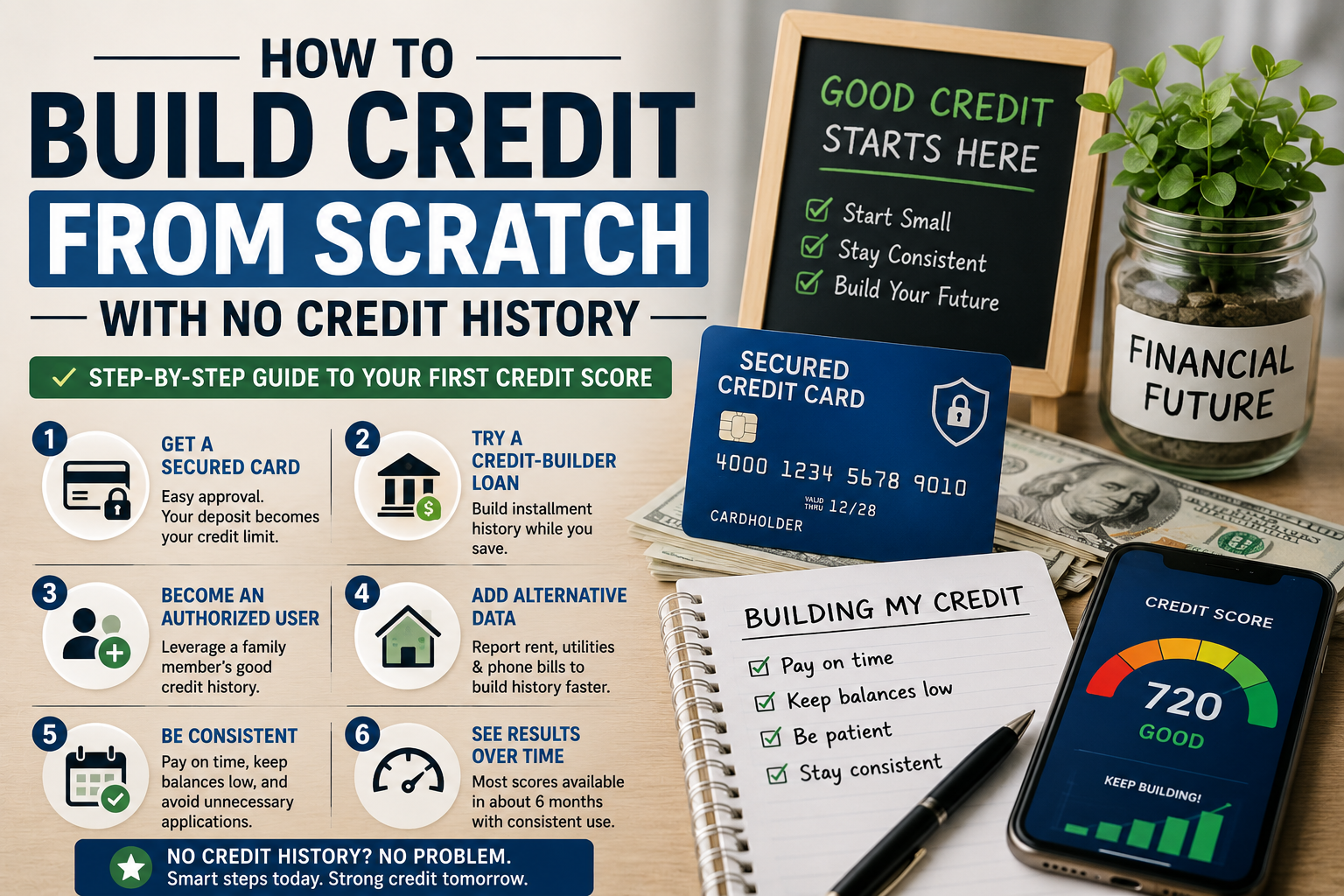
  • How to Build Credit From Scratch With No Credit History

    How to Build Credit From Scratch With No Credit History

    Having no credit history at all is a genuinely different problem than having bad credit, even though both can result in loan denials — and the strategies that fix bad credit (disputing errors, negotiating settlements) are mostly irrelevant here, because there’s nothing to dispute. You’re not repairing anything; you’re establishing a file that doesn’t yet exist. Here’s a practical, step-by-step path.

    Why “No Credit” Can Be Almost as Hard as “Bad Credit”

    Lenders assess risk based on demonstrated behavior. Bad credit tells them “this person has struggled with credit,” which is a known, if unfavorable, data point. No credit tells them nothing at all — there’s no data to evaluate, which many automated underwriting systems and algorithms treat cautiously by default, sometimes resulting in denials that feel unfair given you haven’t actually done anything wrong. This is sometimes called being “credit invisible,” and it affects a meaningful share of adults, particularly younger people, recent immigrants, and those who’ve simply avoided debt.

    Step 1: Understand What “Scoring” Actually Requires

    Most scoring models require:
    – At least one account reported for a minimum period (often around 6 months) to generate a score at all.
    – Some models can score with less history using alternative data, but the most widely used mainstream scores (FICO, VantageScore in their standard forms) need this baseline before they’ll generate a number.

    This means your first priority isn’t optimizing an existing score — it’s simply getting *any* qualifying account open and reporting.

    Step 2: Start With a Secured Credit Card

    This is the most reliable, widely available starting point for someone with no credit history. You provide a cash deposit (often $200-500) that becomes your credit limit, which eliminates the lender’s risk and makes approval accessible even with zero credit history.

    What to look for:
    – **Confirm it reports to all three bureaus** — not all secured cards do, and this is non-negotiable for your purposes.
    – **Look for a card that eventually converts to unsecured** with responsible use, so you’re not stuck putting down a deposit indefinitely.
    – **Avoid cards with excessive fees** that eat into the value of building credit — some secured cards carry high annual fees that aren’t justified given the purpose.

    Step 3: Consider a Credit-Builder Loan

    These are specifically designed for this exact situation. Instead of receiving loan funds upfront, your payments go into a locked savings account, and you receive the funds (sometimes with a little interest)

    once the loan term completes. This builds installment credit history — a different category from the revolving credit history a secured card provides — which helps establish credit mix even at the very start.

    Many credit unions and community banks offer these specifically for building or rebuilding credit, often with low minimum requirements.

    Step 4: Become an Authorized User on a Family Member’s Account

    If you have a parent, spouse, or close family member with a long-standing, well-managed credit card, becoming an authorized user can add that account’s entire history to your own credit file — sometimes years of positive history appearing almost immediately once the card issuer reports the addition.

    Important caveats:
    – **This only works if the primary account holder’s history is genuinely strong** — a spotty payment history helps you just as much as it hurts you, in the negative direction.
    – **Confirm the card issuer reports authorized user activity to the bureaus** — not all do.
    – **This isn’t your own credit account legally** — the primary holder retains full responsibility, and if the relationship or arrangement changes, it’s worth understanding you don’t have independent control over that account.

    Step 5: Explore Alternative Data Reporting Services

    A newer category of tools has emerged specifically to help credit-invisible people establish history using bills that don’t traditionally report to credit bureaus:

    – **Rent reporting services** — some let you report your on-time rent payments to credit bureaus, which traditionally aren’t captured even though rent is often someone’s largest recurring payment obligation.
    – **Utility and phone bill reporting services** — similarly, some services let you add a positive payment history from utility and phone bills, which otherwise typically only show up on your credit report if they go to collections (a negative event), not when paid on time (a positive one, if reported).

    These services often carry a modest fee, but for someone with genuinely no other credit history, they can accelerate the process meaningfully since you’re converting bills you’re already paying into credit-building data.

    Step 6: Understand What Not to Do

    – **Don’t apply for multiple credit products at once**, hoping one will approve you — each hard inquiry dings a thin file more noticeably than an established one, and multiple denials in a short window can compound the problem.

    – **Don’t take on a large loan you don’t need** just to “build credit” — the goal is demonstrated reliability, not debt volume, and a loan you struggle to repay defeats the purpose entirely.
    – **Don’t close your first account too quickly** once you qualify for something better — your average account age matters, and your oldest account (even a modest secured card) contributes positively the longer it stays open.

    Realistic Timeline

    – **Month 1**: open a secured card and/or credit-builder loan; if eligible, add rent/utility reporting.
    – **Months 2-6**: consistent on-time payments accumulate; most scoring models can generate a score once you hit roughly 6 months of reporting history on at least one account.
    – **Months 6-12**: with continued responsible use and low utilization, scores in this stage often land in the “fair to good” range, opening up better product options.
    – **12+ months**: a genuinely solid foundation, at which point you can consider graduating to unsecured products, potentially with better terms and rewards.

    Which Order Matters Most?

    If you can only do one thing first, prioritize whichever path gets an account reporting **fastest** — for most people, that’s a secured card, since approval is typically quick and reporting begins within the first billing cycle. Layer in a credit-builder loan and/or alternative data reporting once that first account is established, both to diversify your credit mix and to accelerate the overall timeline.

    A Note on Credit Unions

    If you’re struggling to get approved for standard secured cards or credit-builder loans through big banks, local credit unions are often significantly more flexible and consumer-friendly for exactly this situation — many have specific programs designed for members establishing first-time credit, sometimes with lower fees and more personalized underwriting than large national banks offer.

    The Bottom Line

    Building credit from zero isn’t about fixing anything — it’s about establishing a track record where none exists, and the fastest, most reliable path is a combination of a secured card, a credit-builder loan, and (if available) alternative data reporting for rent and utilities, layered together rather than pursued one at a time in sequence. Consistency matters more than speed here: a handful of accounts used lightly and paid on time for 6-12 months will do more for your credit than any single dramatic move.

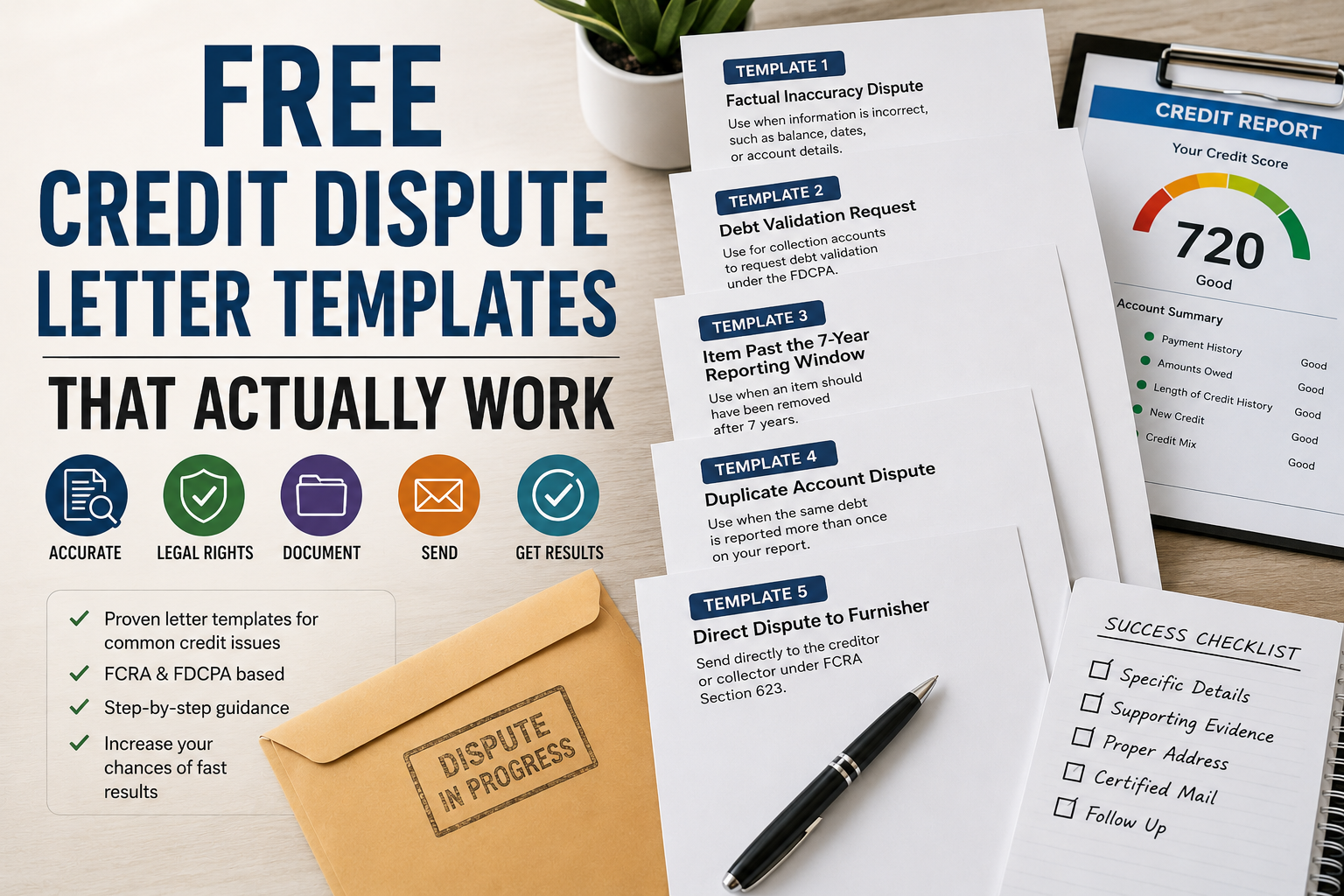
  • Free Credit Dispute Letter Templates That Actually Work

    Free Credit Dispute Letter Templates That Actually Work

    The internet has no shortage of “free dispute letter templates,” and unfortunately a lot of them are either generic to the point of uselessness, or built around outdated legal tactics (like the once-popular “606 method” that exploits alleged technicalities) that credit bureaus have specifically adapted their processes to catch and reject. Below are templates built around what actually gets results: specificity, documentation, and clear legal grounding — along with guidance on when to use each one.

    Why Most Generic Templates Fail

    A dispute letter that just says “this account is inaccurate, please remove it” tends to get a cursory review and a “verified as accurate” response, especially through the streamlined online dispute portals most bureaus use, which route disputes electronically to furnishers with minimal detail. The templates that actually move the needle share a few traits:

    – They name the **specific inaccuracy** (wrong balance, wrong date, duplicate account, wrong account holder).
    – They **reference specific documentation** you’re including or have available.
    – They cite the **relevant legal basis** (FCRA sections, specific bureau policy) where applicable.
    – They make a **specific, clear request** rather than a vague one.

    Template 1: Factual Inaccuracy Dispute

    Use this when you have concrete evidence that a reported detail is wrong — an incorrect balance, wrong dates, an account that isn’t yours, or a status that doesn’t match reality.

    *[Your Name]*
    *[Your Address]*
    *[Date]*

    *[Credit Bureau Name]*
    *[Credit Bureau Dispute Address]*

    Re: Dispute of Inaccurate Information — [Your Name], SSN ending in XXXX**

    To Whom It May Concern,

    I am writing to dispute the following item on my credit report, which I believe is being reported inaccurately:

    **Creditor/Furnisher Name:** [Name]
    **Account Number:** [Number, if available]

    **Nature of Inaccuracy:** [Specific description — e.g., “The reported balance of $X does not match my records, which show a balance of $Y as of Sat, 05 Sep 2026 17:18:17 +0000, as evidenced by the enclosed statement.”]

    I have enclosed supporting documentation demonstrating this inaccuracy. Under the Fair Credit Reporting Act, I am requesting that you investigate this matter and correct or remove this information if it cannot be verified as accurate.

    Please send me written confirmation of the results of your investigation.

    Sincerely,
    *[Your Name]*
    *[Contact information]*

    **Enclosures:** [List documents included]

    Template 2: Debt Validation Request (Sent to a Collector, Not a Bureau)

    Use this within 30 days of first contact from a collection agency, or any time you’re uncertain a debt is legitimate, accurate, or actually yours. This is a distinct legal right under the Fair Debt Collection Practices Act, separate from a credit bureau dispute.

    *[Your Name]*
    *[Your Address]*
    *[Date]*

    *[Collection Agency Name]*
    *[Collection Agency Address]*

    **Re: Debt Validation Request — Account [Number, if known]**

    To Whom It May Concern,

    I am writing in response to your communication regarding the above-referenced account. I do not have sufficient information to confirm this debt is valid, and I am formally requesting validation under the Fair Debt Collection Practices Act (15 U.S.C. § 1692g).

    Please provide the following:

    1. The original creditor’s name and address
    2. An itemized accounting showing how the current balance was calculated
    3. Proof that you are legally authorized to collect this debt
    4. A copy of the original signed agreement, if applicable

    Please be advised that I am requesting you cease collection activity on this account until this validation is provided.

    Sincerely,
    *[Your Name]*
    *[Contact information]*

    Template 3: Item Past the 7-Year Reporting Window

    Use this when an item’s date of first delinquency indicates it should have already aged off your report but hasn’t.

    *[Your Name]*
    *[Your Address]*
    *[Date]*

    *[Credit Bureau Name]*
    *[Credit Bureau Dispute Address]*

    **Re: Obsolete Information Dispute — [Your Name], SSN ending in XXXX**

    To Whom It May Concern,

    I am writing to dispute the continued reporting of the following account, which I believe has exceeded the maximum reporting period permitted under the Fair Credit Reporting Act (15 U.S.C. § 1681c):

    **Creditor/Furnisher Name:** [Name]
    **Account Number:** [Number, if available]
    **Date of First Delinquency:** [Date]

    Based on this date, this item should have been removed from my credit report no later than [calculated 7-year date]. It continues to appear as of the date of this letter. I am requesting immediate removal of this obsolete information.

    Please send me written confirmation once this has been corrected.

    Sincerely,
    *[Your Name]*
    *[Contact information]*

    Template 4: Duplicate Account Dispute

    Use this when the same debt appears more than once on your report — a common issue when an account is charged off and then also separately reported by a collection agency that purchased it.

    *[Your Name]*
    *[Your Address]*
    *[Date]*

    *[Credit Bureau Name]*
    *[Credit Bureau Dispute Address]*

    **Re: Duplicate Account Dispute — [Your Name], SSN ending in XXXX**

    To Whom It May Concern,

    I am writing to dispute duplicate reporting of the same debt appearing as two separate accounts on my credit report:

    **Account 1:** [Creditor name, account number]
    **Account 2:** [Creditor name, account number]

    Both accounts appear to reflect the same underlying debt, originally owed to [original creditor], with matching balances and dates. Reporting the same debt as two separate negative accounts inaccurately represents my credit history. I am requesting that this be corrected, with only the accurate, currently-owned account remaining on my report.

    Sincerely,
    *[Your Name]*
    *[Contact information]*

    Template 5: Direct Dispute to the Furnisher (Not the Bureau)

    Under FCRA Section 623, furnishers (the original creditor or collector) have an independent legal obligation to investigate disputes sent directly to them. This is worth doing in addition to, not instead of, a bureau dispute, since it creates a separate record and obligation.

    *[Your Name]*
    *[Your Address]*
    *[Date]*

    *[Furnisher Name]*
    *[Furnisher Address]*

    **Re: Direct Dispute of Inaccurate Reporting — Account [Number]**

    To Whom It May Concern,

    Pursuant to my rights under the Fair Credit Reporting Act (15 U.S.C. § 1681s-2), I am writing to dispute directly with you, as the furnisher of this information, the following inaccuracy on my credit report:

    [Describe the specific inaccuracy, as in Template 1]

    I am requesting that you investigate this matter and correct your reporting to the credit bureaus accordingly. Please confirm in writing once this has been resolved.

    Sincerely,
    *[Your Name]*
    *[Contact information]*

    Tips for Using These Templates Effectively

    – **Fill in real specifics.** The bracketed sections are where the actual power of these letters lives — a template with vague, unfilled details performs no better than a form letter.
    – **Send by certified mail with return receipt** when possible, so you have proof of delivery and a paper trail if you need to escalate.
    – **Keep copies of everything** — the letter, any enclosures, and the certified mail receipt.
    – **Don’t dispute multiple unrelated items in one letter** if they require different documentation — cleaner, single-issue letters tend to get more thorough individual review than one letter listing five unrelated disputes.
    – **Follow up if you don’t get a response within 30-45 days** — bureaus are legally obligated to respond within this window, and a lack of response is itself grounds for escalation, including a CFPB complaint.

    The Bottom Line

    The templates that work aren’t the ones with the most aggressive legal language — they’re the ones with the most specific, documented substance. Fill in real account numbers, real dates, real discrepancies, and attach real supporting evidence, and even a fairly plain letter will get a more serious investigation than an emotionally worded but vague one. Match the template to the actual situation — validation requests for uncertain debts, obsolete-item disputes for aged-out accounts, duplicate disputes for double-reported debts — rather than using one generic letter for every type of issue.

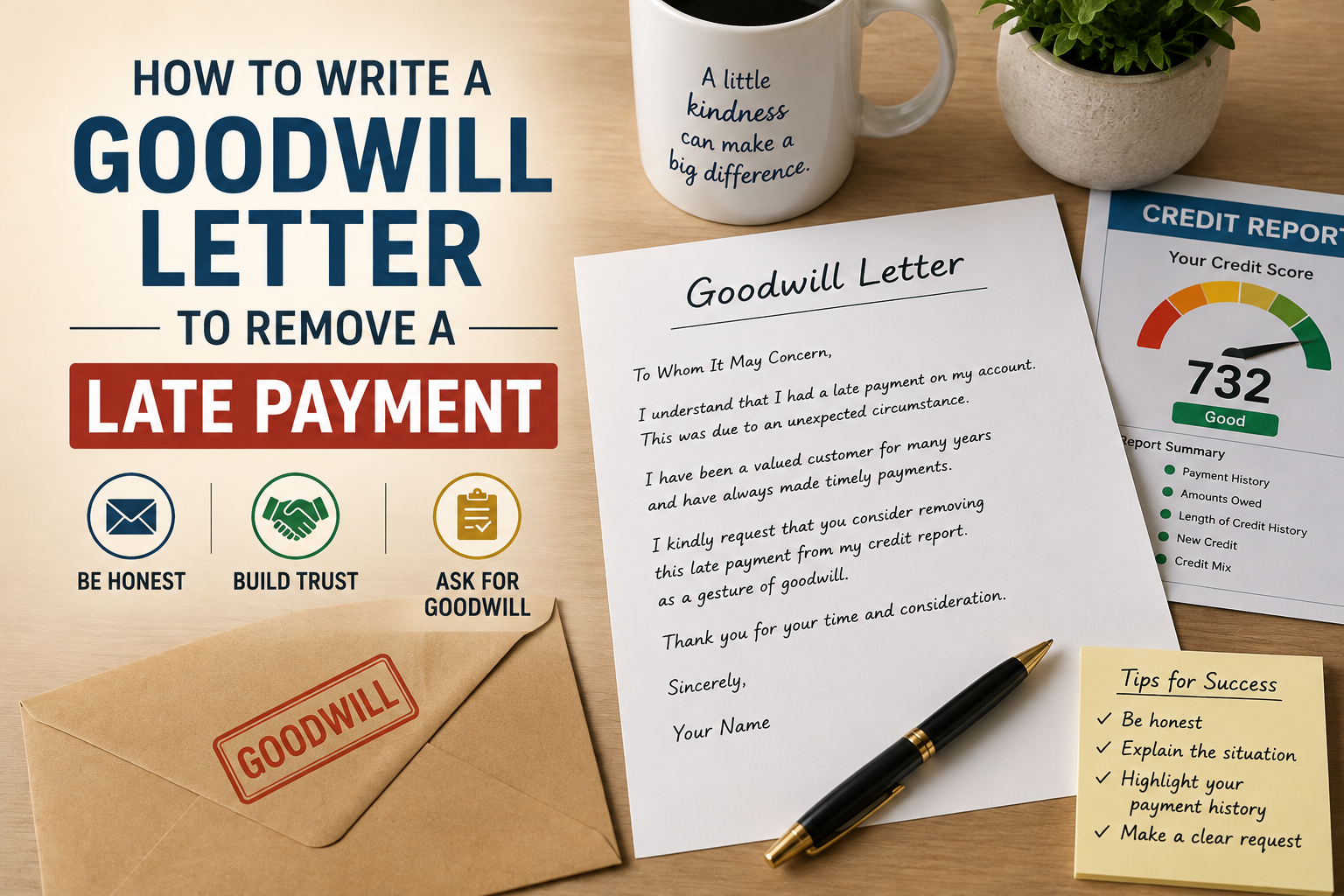
  • How to Write a Goodwill Letter to Remove a Late Payment

    How to Write a Goodwill Letter to Remove a Late Payment

    A goodwill letter is one of the more underused tools in credit repair, largely because it doesn’t fit neatly into the “dispute” framework most people are familiar with. It’s not a legal claim that something is inaccurate — it’s a direct, honest request that a creditor extend a courtesy, based on your overall relationship and history with them. Done well, it can work surprisingly often for the right situation. Done poorly (too long, too aggressive, or asking for the wrong thing), it rarely gets anywhere. Here’s how to write one that actually has a shot.

    When a Goodwill Letter Is the Right Tool

    Goodwill letters work best when:
    – The late payment (or other negative mark) is **accurate** — you’re not disputing the facts, you’re asking for a courtesy.
    – You have an **otherwise strong payment history** with this specific creditor, ideally spanning years.
    – There’s a **specific, genuine circumstance** behind the slip — job loss, medical emergency, a documented banking error, a one-time oversight after years of reliability.
    – You’re asking about **one or two isolated incidents**, not a pattern of repeated late payments.

    If any of these don’t apply — if your payment history with this creditor is actually spotty, or you’re asking them to overlook a pattern rather than a one-time event — a goodwill letter is much less likely to succeed, and you may be better served focusing effort elsewhere.

    What a Goodwill Letter Is Not

    It’s not a dispute, and it shouldn’t be written like one. Don’t cite FCRA violations or threaten legal action — that shifts the tone from “please consider this courtesy” to adversarial, and creditors have no obligation to grant a goodwill request in the first place. If there’s a genuine legal or factual issue, that’s a dispute, not a goodwill letter — see our separate guide on disputing inaccurate late payments for that process.

    The Structure That Works

    A strong goodwill letter is short — ideally under one page — and follows a clear structure:

    1. Identify the Account and the Specific Item

    Open by clearly stating the account number (or last 4 digits), the specific late payment date, and what the report currently shows. Don’t make the reader hunt for what you’re referring to.

    2. Acknowledge the Late Payment Honestly

    This matters more than people expect. Don’t make excuses or minimize — a brief, honest acknowledgment (“I understand this payment was late, and I

    take that seriously”) signals maturity and good faith, which is exactly the tone that makes a creditor more inclined to help.

    3. Explain the Specific Circumstance, Briefly

    One or two sentences, factual, not overly emotional or lengthy. If it was a job loss, medical event, or documented bank error, say so plainly. You don’t need to over-explain or provide extensive documentation unless specifically requested — the letter itself should be concise.

    4. Point to Your Overall History With Them

    This is the actual leverage in a goodwill letter — not the excuse, but the track record. Mention how long you’ve been a customer, and if applicable, note your broader relationship (other accounts held, total years as a customer).

    5. Make a Clear, Specific Request

    State exactly what you’re asking for: removal of the specific late payment notation from your credit report. Don’t ask vaguely for “help with my credit” — be precise about the single item and the single change you want.

    6. Close Politely, Without Pressure

    Thank them for considering the request. Don’t threaten to close your account or take your business elsewhere — this tends to read as pressure rather than genuine goodwill appeal, and creditors are more likely to help someone who seems like a valued, good-faith customer than someone issuing an ultimatum.

    Sample Goodwill Letter

    —

    *[Your Name]*
    *[Your Address]*
    *[Date]*

    *[Creditor Name]*
    *[Creditor Address]*

    **Re: Account ending in [XXXX] — Request for Goodwill Adjustment**

    To Whom It May Concern,

    I am writing regarding my account ending in [XXXX], specifically the late payment reported for [month/year]. I understand this payment was late, and I take my payment obligations seriously.

    The late payment occurred because of [brief, specific circumstance — e.g., “a medical emergency that required an extended hospital stay” or

    “an unexpected job loss following a company layoff”]. Since that time, I have brought the account current and have maintained on-time payments.

    I have been a customer with [Creditor Name] for [X years], and aside from this single incident, my payment history on this account has been consistent and reliable. I’m writing to respectfully request a goodwill adjustment to remove this late payment notation from my credit report, given the circumstances and my overall history with your institution.

    I appreciate your consideration of this request and am happy to provide any additional information if helpful.

    Sincerely,
    *[Your Name]*
    *[Account number]*
    *[Contact information]*

    —

    Where and How to Send It

    – **Mail is generally more effective than online chat or phone requests**, since it creates a paper trail and tends to be routed to someone with actual authority to make the adjustment, rather than a first-line customer service rep.
    – **Send to the address designated for written disputes or correspondence**, not necessarily general customer service — check the creditor’s website for their correspondence address, sometimes listed specifically for credit reporting matters.
    – **Some larger creditors have specific goodwill or executive customer service teams**; if you have a contact from a prior positive interaction, addressing the letter there (or via certified mail to corporate headquarters) sometimes gets better results than a general mailbox.

    What to Expect

    – **No guaranteed response or timeline.** Unlike formal disputes, goodwill requests aren’t governed by FCRA investigation deadlines.
    – **Success rates vary significantly by creditor.** Some banks and credit unions have specific, relatively generous goodwill adjustment policies; others essentially never grant these requests regardless of circumstance.
    – **One request is usually enough for a first attempt.** If you don’t hear back within 4-6 weeks, a brief, polite follow-up is reasonable, but repeated aggressive follow-up tends to work against you.

    What to Do If It’s Denied

    – **Try again after some time has passed**, especially if your payment history has continued to improve — a second attempt 6-12 months later, especially after other positive changes, sometimes succeeds where an earlier one didn’t.
    – **Try a different contact channel** — if you wrote to general correspondence and got a form denial, a request routed through a branch

    manager (for a bank) or member services (for a credit union) sometimes reaches someone with more discretion.
    – **Shift focus to building positive history elsewhere.** If the goodwill request doesn’t work, the late payment’s impact fades over time regardless, especially if you continue building a clean track record going forward.

    The Bottom Line

    A goodwill letter works by asking for a courtesy, not asserting a right — which means tone and brevity matter more than legal language or documentation. The strongest goodwill letters are honest about the mistake, specific about the circumstance, clear about the request, and grounded in a genuine track record with the creditor. It won’t work every time, and some creditors essentially never grant these requests, but for an isolated late payment against an otherwise strong history, it costs nothing to send and occasionally succeeds where a formal dispute (on accurate information) never could.

  • Is It Worth Paying a Credit Repair Company in 2026?

    Is It Worth Paying a Credit Repair Company in 2026?

    This question deserves a more precise answer than a simple yes or no, because “worth it” depends on a cost-benefit calculation that’s actually calculable if you know what to look for. Here’s a framework for figuring out whether it makes sense for your specific situation, along with real numbers to think through.

    What You’re Actually Paying For

    Credit repair companies in 2026 generally charge in one of two structures:

    – **Flat monthly subscription**, typically $50-150/month, for ongoing dispute filing and monitoring.
    – **Pay-per-deletion or first-work-fee models**, where you pay a setup fee plus either a smaller monthly rate or a fee tied to specific results (though results-based guarantees are legally restricted under CROA — companies can’t promise specific outcomes).

    Over a typical 4-6 month engagement, this often totals somewhere between $300 and $900, sometimes more for longer or more complex cases.

    The Core Math

    The question “is it worth it” really breaks down to: **would the same disputes, done yourself, produce meaningfully different results than what you’d pay a company to do?**

    In most cases, the honest answer is that a company isn’t doing anything you couldn’t do — filing FCRA disputes, sending goodwill letters, negotiating with collectors — but they’re doing it with practiced efficiency and without requiring your time. So the real question becomes: **what is your time worth, and how confident are you that you’d actually follow through consistently on your own?**

    Scenarios Where It’s More Likely Worth It

    **You have a genuinely complex file.** If you’re dealing with 10+ negative items across multiple bureaus, tracking disputes, responses, and re-disputes manually becomes a real time commitment — potentially several hours a month sustained over many months. If that time has real opportunity cost for you (competing with work, caregiving, etc.), paying for it can be reasonable.

    **You know you won’t follow through alone.** Be honest with yourself here. A DIY plan that stalls after the first dispute letter produces worse results than a company that, however imperfectly, keeps working the file consistently for months. If your track record with self-directed, paperwork-heavy projects is spotty, the “convenience premium” of a company may be worth paying for.

    **You’re preparing for a specific, time-sensitive goal**, like a mortgage application in the next 6-12 months, and want a structured process with

    accountability rather than an open-ended personal project competing with everything else in your life.

    **You’ve identified a reputable company with a clear track record**, transparent pricing, and no red flags (see our credit repair scam guide for specifics) — the “worth it” calculation shifts meaningfully based on company quality, and a genuinely good company operating within legal bounds is a different proposition than a mediocre or predatory one.

    Scenarios Where DIY Is Clearly Better Value

    **You have a small number of clear-cut errors.** If you’re looking at 1-3 disputable items — a clearly duplicated account, a debt that’s aged past 7 years but still showing, a late payment you can prove was actually on time — this is genuinely simple enough that paying monthly for months of work doesn’t make financial sense.

    **Your main lever is utilization, not disputes.** If your score is primarily being held down by high credit card balances rather than errors or old negative marks, no credit repair company can help with that — paying down balances is something only you can do, and no third party adds value to that process.

    **You’re financially tight already.** Paying $75-100/month for several months while also trying to pay down debt and build savings can work against your broader financial goals. If money is genuinely constrained, that fee is better spent directly on debt paydown, which produces its own credit benefit for free.

    **You have the time and patience to learn the process.** It’s genuinely not that complicated — identify errors, gather documentation, file specific disputes, follow up. If you’re willing to spend a few focused hours getting oriented, you can likely replicate most of what a company does.

    What a Good Company Adds Beyond What You’d Do Alone

    To be fair to the industry, a genuinely good credit repair company can add real value beyond pure convenience:

    – **Pattern recognition across many client files** — experienced staff who’ve seen thousands of disputes sometimes catch disputable angles a first-timer wouldn’t think to check.
    – **Persistence infrastructure** — systematic re-checking for reinstated items, which individuals often let slip after initial success.
    – **Negotiation experience** with collection agencies, particularly for pay-for-delete arrangements, where practiced negotiators may achieve better terms than a first-time negotiator.

    What to Calculate Before Deciding

    Run these numbers for your specific situation:

    1. **Total estimated cost** of the engagement (monthly fee × estimated months, based on the complexity of your file).
      2. **Number and type of disputable items** — more items and more complexity shifts the calculation toward “worth it,” assuming a reputable company.
      3. **Your realistic time availability and follow-through likelihood** — be honest, not aspirational.
      4. **What else that money could do for your credit directly** — for many people, that same $75-100/month applied straight to a high-interest credit card balance produces a faster, more certain score improvement (through utilization reduction) than a dispute process might.A Reasonable Hybrid Strategy

      Given all of this, a common-sense approach for many people:

      1. **Try DIY disputes first** on any clear, simple errors — this costs nothing and often resolves the easiest wins within 30-45 days.
      2. **Evaluate what’s left.** If you’re left with a handful of complex or contested items and you’ve confirmed you’re not making progress alone, that’s the point where hiring a company (or, if legal violations are involved, a consumer attorney) starts to look genuinely worth the cost.
      3. **Set a defined evaluation point** if you do hire someone — most legitimate engagements should show concrete progress within 3-6 months; if they haven’t, that’s a signal to reassess rather than continue paying indefinitely.

      The Bottom Line

      For simple, low-item credit files, paying a company is rarely worth it — you can likely achieve the same results yourself for free with a modest time investment. For complex, multi-item files where you either lack the time or the follow-through to manage a months-long dispute process alone, a reputable company can provide real value, primarily through convenience and persistence rather than any special access or ability you don’t already have. The honest test isn’t whether the company can do something you can’t — legally, they can’t — it’s whether the fee is worth the time and consistency they’re providing in your specific situation.

  • Collection Agency Harassment: Your Rights Under the FDCPA

    Collection Agency Harassment: Your Rights Under the FDCPA


    If your phone rings at 7:45 a.m. with a number you don’t recognize, and by the third call of the day you’ve stopped answering altogether, you are not alone. Millions of Americans deal with collection agency harassment every year — and the majority of them don’t realize they have a federal law on their side that puts hard limits on what a debt collector can say, when they can call, and how far they can push before the law pushes back.

    The Fair Debt Collection Practices Act (FDCPA) is a federal statute that has protected consumers since 1978. It is specific, it is enforceable, and it gives you real remedies — including the ability to sue a debt collector in federal court and recover money damages. You do not need to be a lawyer to use it. You do not need to pay a lawyer up front to use it. You need to understand what the rules are, document what’s happening to you, and take the right steps in the right order.

    This guide walks you through every layer of the FDCPA in plain language: what the law covers, what collectors cannot do, how to stop the calls, how to validate or dispute a debt, how to file complaints with the right agencies, and how to take legal action when a collector crosses the line. We also explain how FDCPA protections connect to the Fair Credit Reporting Act (FCRA) and your broader credit repair strategy — because the two laws work together, and understanding both gives you leverage that neither one provides alone.

    We are a San Diego-based, attorney-backed credit repair firm that helps clients nationwide. We don’t make quick-fix promises. We help you understand your rights, enforce them, and build the kind of long-term credit health that holds up after the dispute is over. If you want a free credit audit after you finish reading, you’ll find the link at the bottom. But first, let’s get you the knowledge you need.

    What the FDCPA Is and Who It Covers

    The Fair Debt Collection Practices Act was passed by Congress in 1978 as part of the Consumer Credit Protection Act. Its purpose, stated plainly in the law itself, is “to eliminate abusive debt collection practices by debt collectors, to insure that those debt collectors who refrain from using abusive debt collection practices are not competitively disadvantaged, and to promote consistent State action to protect consumers against debt collection abuses.”

    In simpler terms: Congress recognized that a segment of the debt collection industry was using intimidation, deception, and harassment to extract payments from people who often didn’t owe the money, owed less than claimed, or were already in financial distress. The FDCPA set a federal floor — a baseline of conduct that every debt collector in the country must meet, regardless of what state they operate in.

    Who counts as a “debt collector” under the FDCPA

    This is the single most important distinction in the entire law, and it trips people up constantly. The FDCPA applies to third-party debt collectors — not to the original creditor you borrowed from.

    What does that mean in practice?

    • If you have a credit card with a bank and you fall behind, and the bank’s own internal collections department calls you, the FDCPA does not apply to that call. The bank, as the original creditor, is generally exempt.
    • If that same bank hires an outside collection agency to collect the debt on its behalf, or sells the debt to a debt buyer who then tries to collect it, the FDCPA applies. Once a third party enters the picture, the federal protections kick in.
    • The FDCPA also applies to debt buyers — companies that purchase charged-off debt portfolios for pennies on the dollar and then attempt to collect the full balance. These are some of the most common sources of consumer complaints, and they are squarely covered by the law.
    • Debt collection attorneys are covered when they regularly attempt to collect debts. A lawyer who files a collection lawsuit against you is generally acting as a debt collector under the FDCPA if they regularly engage in collection activity.

    There’s a specific threshold in the law: a “debt collector” is someone whose principal business is collecting debts, or who regularly collects debts owed to another. The 2010 amendment and subsequent court interpretations have clarified that debt buyers — entities that purchase debts and collect them in their own name — are also covered, though some nuances remain depending on when the debt was acquired and whether the collector used the original creditor’s name.

    What counts as a “debt” under the FDCPA

    The FDCPA defines a debt as “any obligation or alleged obligation of a consumer to pay money arising out of a transaction in which the money, property, insurance, or services which are the subject of the transaction are primarily for personal, family, or household purposes.” The key phrase is personal, family, or household. Business debts are not covered by the FDCPA. If you took out a loan for a small business and the lender sends it to collections, the FDCPA does not apply to that collection activity — though state laws might.

    Covered debts include:

    • Credit card debt
    • Medical bills sent to collections
    • Personal loans
    • Auto loans (the deficiency balance after repossession, typically)
    • Payday loans
    • Student loans (private student loans are covered; federal student loans are collected by the government and its servicers, which are generally not “debt collectors” under the FDCPA, though some private collectors hired by the Department of Education may be)
    • Utility bills and cell phone bills in collections
    • Overdrawn bank accounts

    Who is NOT covered

    • Original creditors collecting on their own debts, using their own name (your credit card company calling you directly)
    • Internal collection departments of the original creditor, as long as they use the creditor’s name
    • Government employees collecting government debts
    • Process servers serving legal papers
    • Mortgage servicers in some contexts (though mortgage foreclosures have their own regulatory framework)

    State laws may extend protection

    This is critical and often overlooked: even if the FDCPA doesn’t cover your situation — say, because you’re dealing with an original creditor’s internal collection department — your state may have its own debt collection law that covers original creditors. States like California (with the Rosenthal Fair Debt Collection Practices Act), New York, Florida, Massachusetts, and many others have laws that mirror or expand the FDCPA and apply it to original creditors as well. We cover this in more detail in the State Debt Collection Laws section below.

    The bottom line: if a collector is a third party collecting a personal, family, or household debt, the FDCPA applies to them — and you have enforceable rights. If they’re not covered by the FDCPA, check your state law before assuming you have no protection.

    Your Rights Under the FDCPA

    The FDCPA gives you a specific, enumerated set of rights. These are not suggestions. They are federal law, and violating them can cost the collector money — money that can end up in your pocket. Here is the full breakdown.

    Your FDCPA Rights at a Glance

    Right What It Means FDCPA Section
    No calls before 8 a.m. or after 9 p.m. Collectors cannot call outside 8:00 a.m. – 9:00 p.m. local time § 1692c(a)(1)
    No calls at work if prohibited If your employer doesn’t allow personal calls, collectors can’t call you at work § 1692c(a)(3)
    No harassment or abuse No threats of violence, profanity, or repeated calls meant to harass § 1692d
    No false or misleading statements No lying about the debt, the consequences, or who they are § 1692e
    No publishing your name Cannot publish a “shame list” of debtors § 1692e(d)
    Must identify themselves Must state they are a debt collector and that information will be used to collect a debt § 1692e(11)
    Must send a validation notice Within 5 days of first contact, must send written notice of the debt and your rights § 1692g
    Right to dispute the debt You have 30 days to dispute the debt in writing § 1692g(a)(3)
    Right to request collector’s name and address You can demand the original creditor’s name and the amount owed § 1692g(a)(2)
    No contact if you have an attorney If you’re represented by an attorney, the collector must contact them, not you § 1692c(a)(2)
    Right to stop all contact You can send a cease and desist letter demanding no further contact § 1692c(c)

    No calls before 8 a.m. or after 9 p.m.

    A debt collector cannot call you before 8:00 a.m. or after 9:00 p.m. local time — your local time, not theirs. A collector in New York cannot call you in Los Angeles at 9:30 a.m. their time and claim it’s within bounds, because that would be 6:30 a.m. your time. The standard is the consumer’s time zone.

    If a collector calls you at 7:15 a.m., that is a violation. If they call you at 9:30 p.m., that is a violation. If they call you repeatedly at 8:01 a.m. every single day for two weeks, the time-of-day rule may not be violated, but the harassment provision (§ 1692d) likely is.

    No calls at work if prohibited

    If your employer prohibits you from receiving personal calls at work, and the collector knows or should know this, they cannot call you at work. The key is that the collector must be on notice. You can put them on notice by telling them directly: “My employer does not allow me to receive personal calls at work. Do not contact me here.” Once you’ve said that, any further call to your workplace is a violation.

    No harassment, threats, or profanity

    The FDCPA prohibits harassment or abuse in connection with the collection of any debt. The law lists specific examples:

    • Threats of violence or physical harm — to you, your family, or your property
    • Profane or abusive language — swearing, name-calling, racial slurs, demeaning language
    • Repeated or continuous calls intended to annoy, abuse, or harass
    • Publication of a list of consumers who allegedly refuse to pay debts (the “shame list” prohibition)
    • Telephone calls without meaningful disclosure of the caller’s identity — anonymous calls designed to intimidate

    The harassment standard is about intent and effect. A single call that uses profane language is a violation. A pattern of 15 calls in one day is a violation even if the collector is polite on each call, because the volume itself constitutes harassment. Courts look at the totality of the conduct.

    No false or misleading statements

    This is one of the broadest and most powerful provisions of the FDCPA. A debt collector may not use any false, deceptive, or misleading representation or means in connection with the collection of any debt. The law lists 16 specific prohibited false statements, including:

    • Falsely claiming to be an attorney or that the communication is from an attorney
    • Falsely claiming the debt is legally owed when it isn’t, or misstating the amount
    • Falsely threatening arrest or imprisonment — you cannot be jailed for failing to pay a debt (more on this below)
    • Falsely claiming to be a government representative or affiliated with any government agency
    • Threatening to take action that cannot legally be taken or that the collector doesn’t actually intend to take (e.g., threatening to garnish wages when they have no judgment and no intention to sue)
    • Falsely claiming nonpayment will result in seizure of property unless they have the legal right to do so
    • Misrepresenting the legal status of the debt — claiming it’s a judgment when it isn’t, or claiming it’s within the statute of limitations when it isn’t
    • Using a false business name or a name that misleads you about who is calling
    • Falsely claiming that documents are legal process when they aren’t, or that documents are not legal process when they are

    This provision is why so many FDCPA lawsuits succeed. Collectors routinely make statements that cross the line — “we’re going to garnish your wages next week” (when they can’t), “this will go on your criminal record” (it won’t), “we’re attorneys and we’re preparing a lawsuit” (they aren’t). Each false statement is a separate violation.

    Must identify themselves

    Every debt collector must, in the initial communication with you, state clearly that they are attempting to collect a debt and that any information obtained will be used for that purpose. This is the so-called Mini-Miranda warning. It must appear in the first written communication and, if the first contact is by phone, must be stated during that call.

    If a collector calls you and says “this is John from the processing department” without identifying themselves as a debt collector, that’s a violation. If they send you a letter that looks like a legal notice but never says “this is an attempt to collect a debt,” that’s a violation.

    Must send a written validation notice

    Within five days of their initial communication with you (whether that communication is a phone call or a letter), a debt collector must send you a written notice containing:

    1. The amount of the debt
    2. The name of the creditor to whom the debt is owed
    3. A statement that unless you dispute the debt within 30 days, the collector will assume the debt is valid
    4. A statement that if you notify the collector in writing within 30 days that you dispute the debt, the collector will obtain verification of the debt and mail it to you
    5. A statement that if you request the name and address of the original creditor within 30 days, the collector will provide it

    This notice is your gateway to challenging the debt. We cover it in detail in the Validation Notice section.

    Right to be represented by an attorney

    If you hire an attorney to represent you regarding the debt, the collector must stop contacting you directly and must communicate only through your attorney. This is one of the fastest ways to get the calls to stop — and it’s why working with an attorney-backed credit repair firm can be so effective. Once the collector knows you’re represented, they have to go through your representative.

    How to Stop Collection Calls

    You have several tools to stop a debt collector from calling you. They range from informal to formal, and the right approach depends on your situation and your goals.

    Option 1: Tell them to stop calling

    The simplest step is to tell the collector, on the phone, to stop calling you. This is not as legally powerful as a written cease and desist letter, but it does create a record. Say something like: “I am requesting that you stop calling this number. All future communication must be in writing.” Note the date, time, and the name of the person you spoke with.

    Option 2: Send a written cease and desist letter

    This is the most powerful tool you have for stopping contact short of hiring a lawyer. Under FDCPA § 1692c(c), if you notify a debt collector in writing that you refuse to pay the debt or that you wish the collector to cease further communication, the collector must stop communicating with you — with very limited exceptions.

    Once the collector receives your written cease and desist letter, they can only contact you to:

    1. Advise you that further collection efforts are being terminated
    2. Notify you that specific remedies (like a lawsuit) may be invoked
    3. Notify you that specific remedies will be invoked

    That’s it. No more calls. No more letters. No more texts. If they contact you for any other reason, that is a violation of the FDCPA — and you can sue for it.

    Cease and desist letter template

    Here is a template you can adapt and send. Send it by certified mail with return receipt so you have proof of delivery. Keep a copy for your records.

    [Your Name]
    [Your Address]
    [Your City, State, ZIP]
    [Your Phone Number]
    [Your Email]

    [Date]

    [Collection Agency Name]
    [Collection Agency Address]
    [City, State, ZIP]

    Re: Account # [Account or Reference Number]
    Original Creditor: [Original Creditor Name, if known]
    Amount Claimed: $[Amount, if known]

    To Whom It May Concern:

    I am writing in response to your attempts to collect a debt that you claim I owe. Pursuant to my rights under the Fair Debt Collection Practices Act (15 U.S.C. § 1692c(c)), I hereby request that you CEASE AND DESIST all communication with me regarding this alleged debt.

    This means you are not to contact me by telephone at my home, at my place of employment, on my cell phone, or at any other number. You are not to contact me by mail, by email, by text message, or through any third party. The only exceptions permitted by law are:

    1. To advise me that your collection efforts are being terminated.
    2. To notify me that you may invoke specified remedies.
    3. To notify me that you intend to invoke a specified remedy, such as filing a lawsuit.

    Please be advised that I am aware of my rights under the Fair Debt Collection Practices Act and under applicable state law. I am also aware that if you fail to comply with this request, you may be subject to liability for statutory damages, actual damages, and attorney’s fees under 15 U.S.C. § 1692k.

    In addition, I dispute the validity of this debt and request that you provide verification of the debt as required by 15 U.S.C. § 1692g, including:

    – The name and address of the original creditor
    – The amount of the alleged debt
    – Proof that you are authorized to collect this debt
    – A copy of any judgment or other documentation establishing the debt

    Until you have provided this verification, you are prohibited by law from collecting this debt or reporting it to any credit reporting agency.

    Sincerely,

    [Your Signature]
    [Your Printed Name]

    Important caveats about cease and desist letters

    A cease and desist letter stops communication, but it does not make the debt go away. The collector can still:

    • Report the debt to the credit bureaus (unless you also dispute the debt and they cannot verify it)
    • File a lawsuit against you to collect the debt (in fact, some collectors sue after receiving a cease and desist letter, because litigation is one of the permitted “specified remedies”)
    • Sell the debt to another collector, who is also bound by the FDCPA and to whom you can send another cease and desist letter

    So a cease and desist is powerful, but it’s not a silver bullet. It buys you peace and it creates a record, but it doesn’t resolve the underlying debt. For that, you need to address the debt itself — through validation, dispute, settlement, or, if appropriate, bankruptcy.

    Option 3: Hire an attorney

    When you hire an attorney to handle the debt, the collector must stop contacting you and deal only with your attorney. This is often the cleanest solution because it puts a professional between you and the collector, and because an FDCPA attorney will often take your case on contingency — meaning you pay nothing up front, and the attorney collects their fee from the collector if you win.

    Option 4: File for bankruptcy

    If you’re overwhelmed by multiple debts, bankruptcy triggers the automatic stay, which stops virtually all collection activity immediately. This is a major step with long-term consequences, and it’s beyond the scope of this article — but it is a legal tool that stops collection calls cold. If you’re considering bankruptcy, consult a bankruptcy attorney.

    The Validation Notice and Your 30-Day Right

    The validation notice is one of the most important protections in the FDCPA, and it’s the one most consumers misunderstand. Here’s how it works.

    The five-day rule

    Within five days after a debt collector first contacts you (whether by phone, letter, or other means), they must send you a written notice containing the validation information described above: the amount of the debt, the name of the creditor, your right to dispute, your right to request the original creditor’s name and address, and the 30-day deadline.

    Your 30-day window

    From the date you receive that validation notice, you have 30 days to take one of several actions:

    • Dispute the debt in writing — if you dispute the debt, the collector must cease collection until they obtain verification of the debt (or a copy of the judgment, if applicable) and mail it to you
    • Request the original creditor’s name and address — if you request this in writing, the collector must provide it
    • Do nothing — if you do nothing within 30 days, the collector may presume the debt is valid and continue collection efforts

    The 30-day period is not a statute of limitations on disputing the debt. You can dispute a debt at any time. But within the 30-day window, the collector must stop collecting and verify the debt if you dispute it. Outside the window, they are not legally required to stop collecting while they respond, though they still cannot make false statements or harass you.

    What “verification” means

    The FDCPA does not define exactly what “verification” requires, and courts have split on how thorough it must be. At minimum, the collector must:

    • Confirm with the original creditor that the amount is correct
    • Obtain and send you some documentation supporting the debt — at least a copy of a judgment if one exists, or basic information confirming the debt

    Some courts require more — particularly for debt buyers, who may need to provide a chain of assignment showing they actually own the debt. If a debt buyer cannot produce documentation that they own the debt and that the amount is accurate, they may not be able to verify it, and continued collection could violate the FDCPA.

    What happens if they can’t verify

    If a collector cannot verify the debt, they must stop collecting it. That means:

    • No more calls
    • No more letters
    • No more lawsuits
    • No reporting to credit bureaus (under the FDCPA, continued reporting without verification can be a violation, and under the FCRA, reporting inaccurate information is a separate violation)

    This is where the FDCPA and the FCRA work together — and where an attorney-backed credit repair strategy can be especially effective. If a collector reports a debt to the credit bureaus without verifying it after you’ve disputed it, you may have claims under both laws.

    What “verification” does NOT mean

    Verification is not the same as validation in the credit reporting sense. The collector does not have to produce a mountain of documentation. They do not have to prove every detail of the debt in a court of law at this stage. The standard is relatively low — but it is a real standard, and collectors who skip it or ignore a timely dispute are violating the law.

    Disputing after the 30-day window

    You can dispute a debt at any time, even years later. The 30-day window gives you the strongest legal leverage (because it forces the collector to stop collecting until they verify), but you always have the right to:

    • Dispute directly with the credit bureaus under the FCRA
    • Request verification from the collector (though they’re not required to stop collecting if you’re outside the 30-day window)
    • Demand validation as part of defending a collection lawsuit

    If a collector sues you, you can raise the failure to validate as a defense and can also counterclaim for FDCPA violations.

    What Debt Collectors Cannot Do

    Beyond the time-of-day and harassment rules, the FDCPA specifically prohibits a range of conduct. Here’s a plain-language list of what collectors absolutely cannot do.

    1. Threaten arrest or imprisonment

    You cannot be jailed for failing to pay a debt. Debt is a civil matter, not a criminal one. A collector who threatens you with arrest, claims a warrant is out for you, or says you’ll be sent to prison is violating the FDCPA. The only exception is in extremely rare cases of criminal contempt related to court orders — and even then, it’s not the debt itself that triggers arrest, it’s a violation of a court order. A collector claiming “we’ll have you arrested tomorrow if you don’t pay” is lying, and that lie is illegal.

    2. Lie about the debt

    A collector cannot:

    • Claim you owe more than you do
    • Add unauthorized fees or interest
    • Claim the debt is a judgment when no lawsuit has been filed
    • Claim the debt is within the statute of limitations when it’s time-barred
    • Claim they’ve already sued you when they haven’t
    • Misrepresent the legal consequences of nonpayment

    3. Contact third parties about your debt

    Except to locate you, a collector cannot contact third parties about your debt. This means:

    • No calling your family members to tell them about your debt
    • No calling your employer to discuss your debt (they can call once to verify your employment, but cannot discuss the debt)
    • No calling your friends, neighbors, or coworkers to discuss your debt
    • No calling your spouse in some circumstances (though spouses may be contacted in certain states and situations)

    The exception: a collector may contact third parties once to obtain your location information (your address, phone number, place of employment) — but they cannot mention the debt, and they cannot contact that third party again unless the third party agrees to help or the collector reasonably believes the information was false.

    4. Call repeatedly to harass

    While the FDCPA doesn’t set a specific number of calls that constitutes harassment, courts have found that repeated calls — multiple calls per day, calls every day for weeks, calls after being told to stop — can violate the harassment prohibition. The standard is whether the calls are intended to annoy, abuse, or harass. If a collector calls you 10 times in a single day, a court is likely to find that harassing. If they call once a day for a week after you’ve told them you can’t pay, that may also cross the line.

    5. Use obscene or profane language

    Any profanity, racial slurs, name-calling, or abusive language is prohibited. A collector who calls you a “deadbeat,” uses profanity, or makes demeaning comments is violating the FDCPA.

    6. Threaten actions they cannot or will not take

    A collector cannot threaten to:

    • Garnish your wages without first obtaining a judgment (in most states, wage garnishment requires a court judgment — there are exceptions for federal student loans, taxes, and child support)
    • Seize your property without a legal right to do so
    • File a lawsuit they have no intention of filing
    • Have you arrested (as noted above)
    • Take any action that is illegal or that they don’t actually intend to take

    7. Deposit a postdated check early

    If you give a collector a postdated check, they cannot deposit it early without your consent. They also cannot accept a postdated check from you without disclosing their intent to deposit it early.

    8. Collect amounts not authorized

    A collector cannot collect any amount — interest, fees, charges — unless it’s expressly authorized by the agreement that created the debt or permitted by law. Many old debts are “time-barred” (past the statute of limitations), and collecting interest or fees on a time-barred debt can be a violation.

    9. Communicate by postcard

    A collector cannot communicate with you about a debt by postcard, because a postcard can be read by anyone who handles the mail — which would disclose your debt to third parties.

    10. Use any envelope with markings that indicate a debt collection

    The envelope of any communication from a debt collector cannot have any language or symbol (other than the collector’s name and address) that indicates the communication is about debt collection. This is why legitimate collection letters come in plain envelopes.

    11. Contact you if you’re represented by an attorney

    If the collector knows you have an attorney representing you regarding the debt, they must contact the attorney, not you — unless the attorney fails to respond within a reasonable time.

    12. Call you at inconvenient times or places

    Beyond the 8 a.m. – 9 p.m. rule, a collector cannot call you at any time or place they know (or should know) is inconvenient for you. If you tell them “don’t call me on Sundays” or “don’t call me during my lunch hour,” they must respect that.

    What to Do When You’re Harassed

    If a debt collector is violating the FDCPA, you have a clear path to fight back. Here’s the step-by-step process, in order.

    Step 1: Document everything

    This is the most important step. Without documentation, you have no case. With documentation, you have leverage — and potentially a lawsuit worth real money.

    Start a collection log immediately. For every contact, record:

    • Date and time of the contact
    • Phone number the call came from (or the address on the envelope)
    • Name of the collector and the collection agency
    • What was said — as close to verbatim as you can remember
    • Any threats, profanity, or false statements made
    • Witnesses who were present (if any)
    • Your emotional state and any distress you experienced

    Save every voicemail. Save every text message. Save every letter and envelope. Do not delete anything. If the calls are coming to your cell phone, take screenshots of the call log. If you can, record the calls — but check your state’s recording law first. In “one-party consent” states (the majority), you can record without telling the collector. In “two-party consent” states (like California, Florida, Illinois, and others), you must inform the other party that the call is being recorded.

    Step 2: Send a cease and desist letter

    Use the template above. Send it by certified mail with return receipt. Keep the receipt — it’s your proof that the collector received it. Once they have it, any further contact (other than the three permitted exceptions) is a violation.

    Step 3: Dispute the debt in writing

    If you don’t believe you owe the debt, or you believe the amount is wrong, dispute it in writing within 30 days of receiving the validation notice. This forces the collector to verify the debt and stops collection activity until they do. Use a dispute letter that specifically requests:

    • Verification of the debt
    • The name and address of the original creditor
    • Proof that the collector is authorized to collect the debt
    • A copy of any judgment (if applicable)

    Step 4: File a complaint with the CFPB

    The Consumer Financial Protection Bureau (CFPB) is the federal agency that enforces the FDCPA. You can file a complaint online at consumerfinance.gov. The CFPB will forward your complaint to the collector and require them to respond. The CFPB tracks complaint patterns and can take enforcement action against collectors with widespread violations.

    What to include in your CFPB complaint:

    • The collection agency’s name and contact information
    • The debt information (amount, original creditor, account number)
    • A description of the violation(s), with dates
    • Any documentation you have (letters, call logs, voicemails)
    • What you want (e.g., the calls to stop, the debt verified, damages)

    Step 5: File a complaint with the FTC

    The Federal Trade Commission (FTC) also accepts complaints about debt collectors at ftc.gov. While the CFPB is now the primary enforcer of the FDCPA, the FTC still plays a role, and filing with both agencies creates a more complete record.

    Step 6: File a complaint with your state attorney general

    Many state attorneys general have consumer protection divisions that handle debt collection complaints. Some states have their own debt collection laws (covered below) that the AG can enforce. Filing with your state AG can trigger state-level action that complements the federal process.

    Step 7: Consult an FDCPA attorney

    If you have documented violations, talk to a consumer protection attorney who handles FDCPA cases. Most FDCPA attorneys offer a free initial consultation and take cases on contingency — meaning they get paid by the collector if you win, not out of your pocket. The FDCPA specifically provides for attorney’s fees to be paid by the losing collector, which is why attorneys can take these cases without charging you upfront.

    An attorney can:

    • Evaluate the strength of your case
    • Send a formal demand letter to the collector
    • Negotiate a settlement (which may include the debt being removed from your credit report)
    • File a lawsuit in federal court if the collector won’t settle
    • Help you recover statutory damages up to $1,000 plus actual damages and attorney’s fees

    You don’t have to wait until you’ve been harassed to consult an attorney. If a collector is making your life miserable, an attorney can step in immediately and take over all communication — which, as we noted, the collector must respect.

    collection-agency-harassment-fdcpa-under-100kb

    How to Sue Under the FDCPA

    If a debt collector has violated the FDCPA, you have the right to sue them in federal court. You can also sue in state court, but federal court is the more common venue for FDCPA cases. Here’s what you need to know.

    Who can sue

    Any consumer who has been subjected to a prohibited collection practice can sue. You do not need to have actually paid the debt. You do not need to have suffered financial loss. The FDCPA provides statutory damages — a fixed amount — for any violation, regardless of whether you lost money.

    What you can recover

    Under 15 U.S.C. § 1692k, you can recover:

    1. Statutory damages — up to $1,000 per lawsuit (not per violation). This is a flat amount that you’re entitled to if the collector violated the FDCPA, even if you can’t prove any specific financial harm. Some courts and state laws allow more.
    2. Actual damages — compensation for any concrete harm you suffered. This can include:
      • Emotional distress (anxiety, sleep loss, stress, humiliation)
      • Out-of-pocket costs (e.g., the cost of changing your phone number, medical bills for stress-related treatment)
      • Lost wages (if collection calls caused you to miss work)
      • Damage to your credit (if false reporting caused you to be denied credit)
    3. Attorney’s fees and costs — the collector must pay your attorney’s fees and court costs if you win. This is what makes FDCPA cases feasible on contingency.

    In class action lawsuits, the statutory damages cap is the lesser of $500,000 or 1% of the collector’s net worth.

    The statute of limitations

    You must file an FDCPA lawsuit within one year of the violation. The clock starts running on the date of the violation. If a collector called you in violation on March 15, 2025, you have until March 15, 2026 to file. If they made multiple violating calls over several months, each call may be a separate violation, but the one-year clock runs from each individual violation.

    This deadline is strict. If you miss it, you lose your right to sue under the FDCPA — though you may still have claims under state law, which often has a longer statute of limitations. Don’t wait. If you think you have a case, talk to an attorney as soon as possible.

    What you have to prove

    To win an FDCPA case, you generally need to show:

    1. The defendant is a “debt collector” under the FDCPA (they regularly collect debts owed to others)
    2. The debt is a “consumer debt” (personal, family, or household purpose)
    3. You are a “consumer” under the FDCPA
    4. The collector violated a specific provision of the FDCPA
    5. You suffered damages (statutory damages don’t require proof of specific harm, but actual damages do)

    For most violations, you don’t need to prove the collector intended to violate the law. The FDCPA is a strict liability statute — the collector is liable for violations even if they didn’t mean to break the law. However, there is a “bona fide error” defense: if the collector can show the violation was unintentional, resulted from a bona fide error, and was not part of a pattern, they may avoid liability. This defense is narrow and rarely succeeds.

    The process

    1. Consult an attorney (or decide to proceed pro se — on your own — which is possible but not recommended)
    2. File a complaint in federal court
    3. The collector responds (usually by answering the complaint or filing a motion to dismiss)
    4. Discovery — both sides exchange information and evidence
    5. Settlement negotiations — most FDCPA cases settle before trial
    6. Trial (if no settlement is reached)

    Most FDCPA cases settle. Collectors don’t want to go to trial because the attorney’s fees provision makes losing expensive, and because bad publicity and CFPB scrutiny can follow. A typical settlement may include:

    • A cash payment to you (often more than the $1,000 statutory minimum)
    • Waiver or reduction of the underlying debt
    • Deletion of the tradeline from your credit report
    • An injunction requiring the collector to stop the prohibited conduct

    Do you need an attorney?

    You can file an FDCPA lawsuit without an attorney (pro se), but it’s not advisable. FDCPA law has procedural nuances, federal court rules are complex, and collectors will have attorneys. Because the FDCPA provides for attorney’s fees, consumer protection attorneys take these cases on contingency — meaning you pay nothing upfront, and the attorney’s fee comes from the collector if you win. There’s almost no downside to at least consulting one.

    How This Ties to Credit Repair

    The FDCPA and the Fair Credit Reporting Act (FCRA) are two halves of a complete consumer protection framework. The FDCPA governs how collectors can collect from you. The FCRA governs how collectors can report about you. Understanding how they interact is the key to effective credit repair.

    The connection

    When a debt goes to collections, the collector typically reports it to the three major credit bureaus — Equifax, Experian, and TransUnion — as a collection account. This collection tradeline can drop your credit score by 50 to 100 points or more and stays on your report for seven years from the date of the original delinquency.

    Here’s how the two laws work together:

    1. You dispute the debt with the collector under the FDCPA (within 30 days of the validation notice). The collector must verify the debt or stop collecting. If they can’t verify, they should also stop reporting — because reporting without verification can be a false or misleading representation under the FDCPA.
    2. You dispute the tradeline with the credit bureaus under the FCRA. The bureaus must investigate within 30 days (generally) and must provide the results to you. If the collector cannot verify the debt, the tradeline should be removed or corrected.
    3. If the collector reports inaccurate information — wrong amount, wrong dates, wrong original creditor, or reports a debt you’ve disputed without noting the dispute — that’s a violation of the FCRA. And if the collector continues to report after failing to verify a disputed debt, that can be a violation of both the FCRA and the FDCPA.
    4. If the collector sues you, you can raise FDCPA violations as counterclaims and can also challenge the FCRA reporting as part of your defense.

    The strategy

    An effective credit repair strategy uses both laws:

    • FDCPA tools — cease and desist letters, validation disputes, documentation of violations, lawsuits — to stop harassment and force collectors to verify or back off
    • FCRA tools — bureau disputes, requests for reinvestigation, method-of-verification requests — to challenge inaccurate, incomplete, or unverifiable information on your credit reports
    • Attorney backing — to enforce your rights under both laws and to escalate when collectors or bureaus don’t comply

    Why attorney backing matters

    A debt collector who knows you’re working with an attorney thinks differently. They know that violations could cost them money in court. They know that an attorney-backed dispute is not a “nuisance” dispute that they can ignore. They know that continued reporting without verification could trigger an FCRA claim on top of the FDCPA claim.

    This is why our firm is attorney-backed. We don’t just send dispute letters and hope. We work alongside experienced attorneys who understand both the FDCPA and the FCRA, who know how to document violations, and who can escalate to litigation when necessary. The combination of legal knowledge, strategic dispute filing, and attorney oversight gives our clients leverage that pure “credit repair” companies — who just send form letters — cannot match.

    What we do

    Our process includes:

    1. A free credit audit — we pull and review your credit reports from all three bureaus and identify collection accounts, errors, and potential violations
    2. A customized repair plan — tailored to your specific debts, goals, and timeline
    3. FDCPA-based disputes — validation requests to collectors, documentation of violations, cease and desist letters when appropriate
    4. FCRA-based disputes — bureau disputes, method-of-verification requests, follow-up on inaccurate reporting
    5. Attorney coordination — when a collector crosses the line or a bureau fails to correct an error, we work with attorneys who can take legal action
    6. Client education — we teach you how to maintain strong credit long after the process is complete, because credit health is a long-term commitment

    We do not guarantee specific outcomes, and we do not make quick-fix promises. What we do is use the full scope of federal and state consumer protection law — applied strategically and backed by attorneys — to give you the best possible chance of removing inaccurate, unverifiable, or unlawfully reported items from your credit reports.

    State Debt Collection Laws

    The FDCPA is a federal floor, not a ceiling. Many states have their own debt collection laws that provide additional protections or extend coverage to situations the FDCPA doesn’t reach. Here’s what you need to know.

    States that extend FDCPA protections to original creditors

    The FDCPA only covers third-party collectors. But several states have laws that apply the same (or similar) protections to original creditors collecting their own debts. The most notable is:

    • California — the Rosenthal Fair Debt Collection Practices Act extends FDCPA-like protections to original creditors, debt buyers, and attorneys. If you’re dealing with a bank’s internal collection department in California, the Rosenthal Act likely applies.

    Other states with broader coverage include:

    • New York — the state’s debt collection regulations (via the Department of Financial Services) impose FDCPA-like requirements on creditors and collectors
    • Florida — has a state Consumer Collection Practices Act that covers original creditors
    • Massachusetts — has regulations covering unfair debt collection practices
    • Pennsylvania, Connecticut, North Carolina, Texas, and others — have various state-level protections

    States that require collectors to be licensed

    Many states require debt collectors to be licensed before they can collect from residents. If a collector is unlicensed in a state that requires licensure, their collection attempts may be illegal — and you may have grounds to dispute the debt and prevent reporting. States with licensure requirements include:

    • California, New York, Florida, Texas, Illinois, Pennsylvania, New Jersey, and many others

    If you’re unsure whether a collector is licensed in your state, you can check with your state’s department of finance, banking, or consumer affairs. An unlicensed collector is a significant red flag — and a potential defense if they sue you.

    State statutes of limitations on debt

    Every state has a statute of limitations — a time limit on how long a creditor or collector has to sue you for a debt. These vary widely:

    • Oral contracts: 2–6 years depending on the state
    • Written contracts: 3–10 years
    • Open accounts (credit cards): 3–6 years in most states

    Once a debt is past the statute of limitations, it is time-barred — a collector cannot legally sue you to collect it. However, the debt still exists, and a collector can still attempt to collect it voluntarily (by calling or writing). What they cannot do is threaten to sue or actually file suit on a time-barred debt — that’s an FDCPA violation.

    If a collector sues you on a time-barred debt, you can raise the statute of limitations as a defense and likely get the case dismissed. You may also have an FDCPA counterclaim for threatening action they cannot legally take.

    How to find your state’s laws

    • Check your state attorney general’s website — most have a consumer protection section with debt collection information
    • Look up your state’s statute of limitations for the type of debt in question
    • Consult a local consumer protection attorney who knows your state’s specific laws

    State law can be more powerful than the FDCPA in some situations — especially when dealing with original creditors or when your state offers higher damage awards or longer statutes of limitations for filing suit.

    Common Mistakes to Avoid

    Even when people know their FDCPA rights, they often make mistakes that weaken their position or forfeit their claims entirely. Here are the most common ones — and how to avoid them.

    1. Not documenting the violations

    Without a record, you don’t have a case. If a collector calls you 20 times in a week and you don’t log the calls, save the voicemails, or note what was said, you have no evidence. Start documenting the moment you realize you’re being harassed. Keep a dedicated log. Save everything.

    2. Sending a cease and desist letter without proof of delivery

    If you send a cease and desist by regular mail and the collector claims they never received it, you have no proof. Always send by certified mail with return receipt. The receipt is your evidence that the letter was delivered.

    3. Missing the 30-day validation window

    The 30-day window is your strongest tool for forcing a collector to verify a debt. If you miss it, you can still dispute — but the collector isn’t required to stop collecting while they respond. Dispute in writing within 30 days of receiving the validation notice whenever possible.

    4. Disputing verbally instead of in writing

    A verbal dispute over the phone is hard to prove. A written dispute — sent by certified mail — creates a paper trail. Always dispute in writing.

    5. Admitting to the debt on a recorded call

    Collectors record their calls. If you admit the debt is yours, that admission can be used against you. You are not obligated to admit or deny a debt on a call. You can say: “I dispute this debt and request validation in writing. Please send me the validation notice.”

    6. Ignoring a lawsuit

    If a collector files a lawsuit against you, do not ignore it. Ignoring a lawsuit leads to a default judgment — which allows the collector to garnish your wages, levy your bank account, or place a lien on your property. Respond to the lawsuit, raise your defenses (including FDCPA violations), and consult an attorney immediately.

    7. Paying a time-barred debt without understanding the consequences

    Making a payment on an old, time-barred debt can restart the statute of limitations in some states — turning a debt the collector can no longer sue over into one they can. Before paying any old debt, understand your state’s rules on restarting the clock. A partial payment, in some states, is enough to restart it.

    8. Believing a collector who says “you’ll go to jail”

    You will not go to jail for a debt. This is a lie, and it’s an FDCPA violation. Do not let fear of arrest drive you to pay a debt you can’t afford or don’t owe.

    9. Failing to check if the collector is licensed

    If your state requires debt collectors to be licensed and the collector is unlicensed, their collection activity may be illegal. Check licensure — it’s a simple step that can dramatically change your leverage.

    10. Not consulting an attorney

    FDCPA cases are almost always taken on contingency. You pay nothing upfront. The collector pays your attorney’s fees if you win. There is no downside to at least consulting an attorney. People who try to handle FDCPA violations alone often leave money and leverage on the table.

    11. Settling for too little

    If you have documented violations, you may be entitled to more than you think. A collector may offer to waive the debt as a “settlement” — but if they violated the FDCPA, you may be entitled to the debt being waived plus a cash payment to you. Don’t accept the first offer without understanding the full value of your claims.

    12. Forgetting about credit reporting

    Stopping the calls is only half the battle. If the collector is still reporting the debt to the credit bureaus, the tradeline is still dragging down your score. Address both the collection conduct and the credit reporting — they’re separate issues under separate laws (FDCPA and FCRA).

    Frequently Asked Questions

    Can a debt collector call my family or employer?

    A debt collector can contact third parties once to obtain your location information (address, phone number, place of employment) — but they cannot mention the debt, and they cannot contact that person again unless they agree to help or the collector believes the information was false. They cannot discuss your debt with your family, friends, neighbors, or employer. If a collector tells your mother you owe money, that’s a violation. If they call your boss to discuss the debt, that’s a violation.

    Can I go to jail for not paying a debt?

    No. Debt is a civil matter, not a criminal one. You cannot be imprisoned for failing to pay a debt. If a collector threatens you with arrest or imprisonment, they are violating the FDCPA. The only rare exception involves criminal contempt of court orders — and even then, the arrest is for contempt, not for the debt itself.

    Can a debt collector garnish my wages without suing me?

    In most cases, no. A collector must first file a lawsuit, win a judgment, and then obtain a court order for wage garnishment. The major exceptions are federal student loans (which can be administratively garnished without a court order), federal taxes (IRS levy), and child support (which can be garnished through administrative processes). If a collector threatens to garnish your wages without a judgment, that’s an FDCPA violation.

    What is the statute of limitations on debt in my state?

    It varies by state and by the type of debt. Credit card debt (an “open account”) is typically 3–6 years; written contracts are 3–10 years. You can find your state’s statute of limitations on your state attorney general’s website or by consulting a local consumer protection attorney. Once a debt is past the statute of limitations, it is “time-barred” — a collector cannot sue you for it, though they can still attempt voluntary collection. Be careful: making a payment on a time-barred debt can restart the clock in some states.

    How much can I recover if I sue a debt collector?

    Under the FDCPA, you can recover statutory damages up to $1,000 (a flat amount per lawsuit, regardless of the number of violations), actual damages (for emotional distress, out-of-pocket costs, lost wages, credit damage), and attorney’s fees and court costs. In class actions, the cap is the lesser of $500,000 or 1% of the collector’s net worth. Many cases settle for more than the statutory minimum, especially when actual damages are documented.

    What should I do if a debt collector sues me?

    Do not ignore the lawsuit. Respond to the complaint (usually within 20–30 days, depending on your state). Raise any defenses you have, including the statute of limitations, lack of standing (if it’s a debt buyer who can’t prove they own the debt), and FDCPA violations as counterclaims. Consult a consumer protection attorney immediately — many will defend collection lawsuits for free on contingency because they can recover their fees from the collector if they win.

    Does the FDCPA cover medical bills?

    Yes. Medical bills are personal debts, and if they are placed with a third-party collection agency or sold to a debt buyer, the FDCPA applies. Medical debt is one of the most common types of debt sent to collections, and medical collectors are subject to the same rules as any other debt collector — no harassment, no false statements, no calls outside 8 a.m. – 9 p.m., validation notices required.

    Can I dispute a debt after the 30-day window?

    Yes. You can dispute a debt at any time. The 30-day window (from the validation notice) gives you the strongest leverage — the collector must stop collecting until they verify the debt. Outside the window, the collector isn’t required to stop collecting while they respond, but you can still dispute with the credit bureaus under the FCRA, and you can still raise the dispute as a defense if the collector sues you. Don’t let the 30-day deadline stop you from acting — it just changes the specific procedural leverage you have.

    Free Credit Audit

    If you’re dealing with collection agency harassment, inaccurate credit reporting, or both, you don’t have to handle it alone. Our San Diego-based, attorney-backed credit repair firm helps clients nationwide understand and enforce their rights under the FDCPA, the FCRA, and applicable state laws.

    We offer a free credit audit — a thorough review of your credit reports from all three major bureaus — to identify:

    • Collection accounts that may be inaccurate, unverifiable, or unlawfully reported
    • Potential FDCPA violations by collectors contacting you
    • FCRA reporting errors that may be dragging down your score
    • Time-barred debts that should not be reported as collectible
    • Opportunities to dispute, validate, and remove items that don’t belong on your report

    We don’t make quick-fix promises. We don’t guarantee specific outcomes. What we do is apply the full scope of federal and state consumer protection law — strategically, transparently, and backed by experienced attorneys — to give you the strongest possible path to cleaner credit and lasting financial health.

    Get your free credit audit at credit-repair.com →

    When you work with us, you gain a long-term financial partner — not just a one-time service. We educate you on your rights, we empower you to maintain strong credit long after the process is complete, and we operate with full compliance with federal law, including the FCRA. Transparent pricing, no hidden fees, no misleading claims.

    Your rights under the FDCPA are real. Your credit is worth protecting. Let’s get to work.

    Disclaimer: This article is for educational purposes and does not constitute legal advice. Your individual situation may vary based on your state’s laws, the specifics of your debt, and the conduct of the collector involved. For advice tailored to your circumstances, consult a licensed attorney in your jurisdiction.

    Related reading:
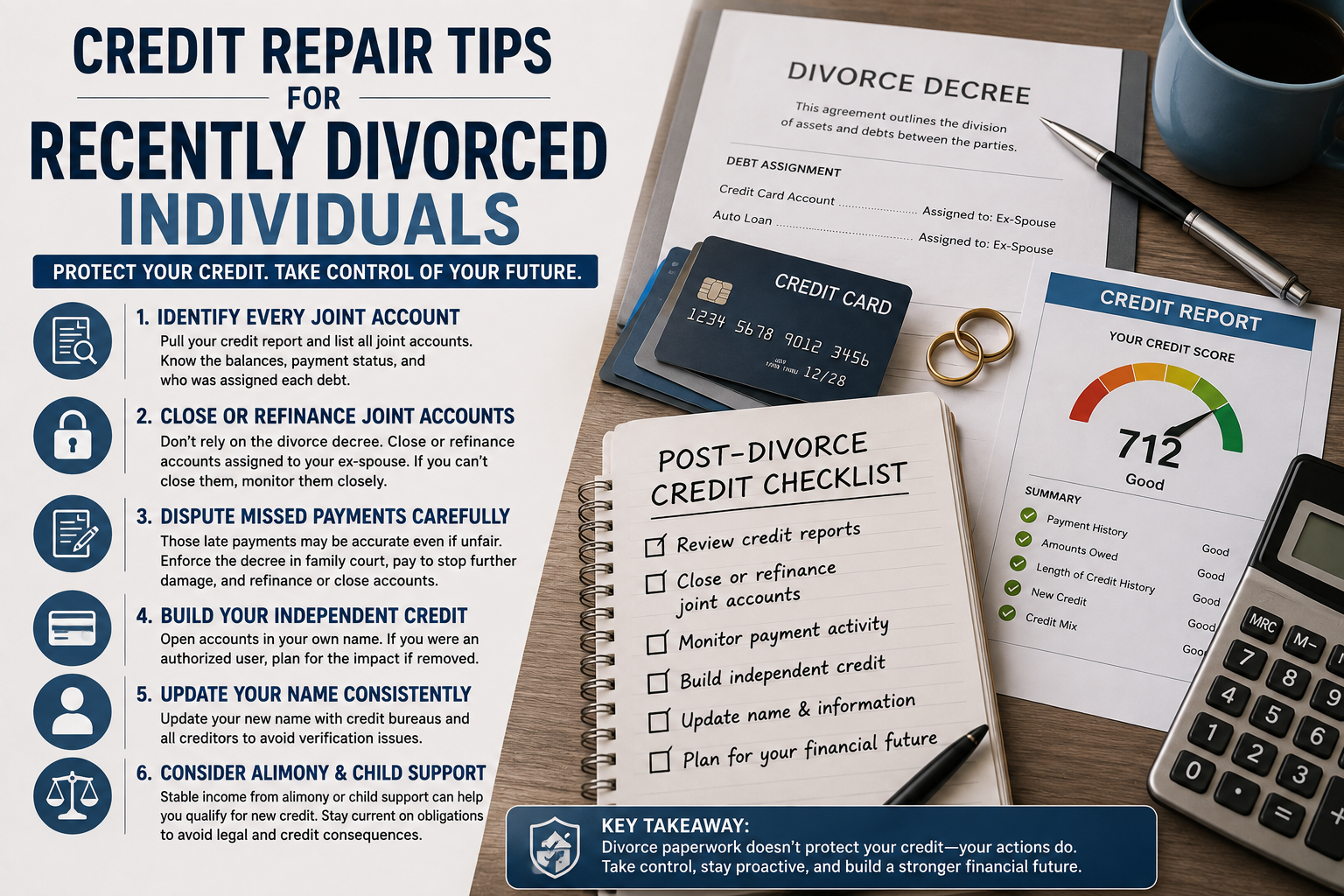
     

  • Credit Score Ranges Explained: Where Do You Stand?

    Credit Score Ranges Explained: Where Do You Stand?

    If you have ever applied for a credit card, financed a car, or shopped for a mortgage, you have run into the three-digit number that can quietly open doors or close them: your credit score. Lenders use it to decide whether to approve you, what interest rate to offer, and sometimes whether to trust you with an apartment lease or a cell phone plan. Yet most people are never taught what the credit score ranges actually mean, where the cut-offs sit, or how to climb from one tier to the next.

    That knowledge gap is costly. A score in the fair credit range instead of the good credit range can add tens of thousands of dollars in extra interest over the life of a mortgage. A score in the poor credit range can keep you from being approved at all. The good news is that credit scores are not fixed stars. They move in response to how you manage credit, and understanding the ranges is the first step to moving yours in the right direction.

    This guide breaks down the credit score ranges for both major scoring models in the United States — FICO and VantageScore — explains what each tier means for your wallet, and gives you a practical, tier-by-tier plan for climbing higher. We keep things honest: no “secret tricks,” no overnight-fix promises. What you will get instead is the transparent, legally grounded guidance we give every client at our San Diego-based, FCRA-compliant, attorney-backed credit repair firm.

    What Credit Score Ranges Are

    A credit score range is the spread of possible numerical values a scoring model can assign to a consumer, divided into named bands or credit score tiers. Each tier corresponds to a level of credit risk: the higher the score, the lower the perceived risk to a lender, and the better the terms you are likely to be offered.

    Think of a credit score range as a ladder. The bottom rung represents the highest risk and the worst borrowing terms; the top rung represents the lowest risk and the best terms. Most consumers land somewhere in the middle, which is why the “good” and “fair” tiers get so much attention — they are where the majority of Americans live, and they are also where the most dramatic improvement is usually possible.

    Why do ranges matter? Because lenders rarely quote a single interest rate to everyone. They price risk. A borrower in the excellent credit range might qualify for a 6.5% APR on a personal loan, while a borrower in the fair range might be quoted 15% or higher for the exact same loan from the exact same lender. Over a five-year repayment, that gap can mean thousands of dollars.

    Ranges also matter because they set the mental benchmarks consumers use when setting goals. “I want to hit 700” is a common target because 700 sits solidly in the good tier for most models and unlocks meaningfully better offers. “I just need to get above 620” is another common goal because 620 is the rough threshold many mortgage lenders use for conventional loan eligibility. Knowing the ranges helps you set a goal that is tied to a real-world outcome, not just an arbitrary number.

    The Basic Structure of a Credit Score Range

    Both major U.S. scoring models use a 300 to 850 scale for their general-purpose scores. That means the lowest possible score is 300 and the highest is 850. Within that span, each model defines its own tier cut-offs:

    • Poor (or Very Poor / Deep Subprime)
    • Fair (or Subprime)
    • Good (or Prime)
    • Very Good (or Superprime, in VantageScore terminology)
    • Exceptional (or Excellent)

    The exact numerical boundaries differ slightly between FICO and VantageScore, which is why we cover each separately below. Some industry-specific scores (auto, bankcard) use different scales, which we address in the industry-specific section.

    Why Two Models Exist

    The credit scoring industry is dominated by two competitors. FICO (developed by the Fair Isaac Corporation) is the older and more widely used model, especially in mortgage lending. VantageScore (developed jointly by the three major credit bureaus — Equifax, Experian, and TransUnion) is newer and is often the score you see in free credit-monitoring apps and on credit card statements.

    Because the two models weigh factors slightly differently and sometimes use different tier boundaries, a consumer can have a FICO score of 712 (good) and a VantageScore of 698 (also good, but on a different boundary). Both are “real” scores; neither is more correct than the other. What matters is knowing which model a given lender uses — and understanding the ranges for both.

    The Two Main Scoring Models: FICO and VantageScore

    Before we get into the tier-by-tier breakdown, it helps to understand how each model is built. The ranges are only meaningful once you know what moves the number inside them.

    FICO: The Mortgage Standard

    FICO is the scoring model you will encounter most often in high-stakes lending. When you apply for a conventional mortgage, a FHA loan, an auto loan, or a new credit card, there is a strong chance the lender is pulling a FICO score — often a specific FICO variant tailored to that product.

    FICO’s base scoring factors (roughly weighted):

    • Payment history — 35%: whether you have paid past credit accounts on time. This is the single biggest lever.
    • Amounts owed — 30%: how much of your available credit you are using, especially revolving credit. This is your credit utilization ratio.
    • Length of credit history — 15%: how long your accounts have been open, including the age of your oldest account and the average age of all accounts.
    • Credit mix — 10%: the variety of account types you manage (revolving, installment, mortgage).
    • New credit — 10%: how many recent inquiries and new accounts you have. Too many in a short window signals risk.

    FICO updates its models periodically (FICO 8, FICO 9, and the newer FICO 10/T are all in circulation), but the 300–850 scale and the five-tier structure have remained stable across recent generations.

    VantageScore: The Bureau-Built Alternative

    VantageScore was created by the three credit bureaus to compete with FICO and to produce a score even when a consumer has a thinner credit file. The current generation in wide use is VantageScore 4.0, which also uses the 300–850 scale.

    VantageScore’s scoring factors (roughly weighted):

    • Payment history — ~40%: the dominant factor, similar to FICO.
    • Credit utilization and balances — ~20%: how much you owe relative to your limits.
    • Credit mix and experience — ~20%: the variety of account types and how long you have managed them.
    • Credit age — ~15%: the age of your accounts.
    • Recent credit behavior — ~5%: inquiries and new accounts.

    VantageScore tends to be more forgiving of thin credit files and can produce a score with fewer accounts than FICO requires. It also treats certain negative items (like paid collections and medical collections) more leniently in its newer generations, which can push a consumer up a tier relative to their FICO score.

    Which Score Will a Lender See?

    There is no universal answer. A mortgage lender will typically pull a tri-merge of FICO scores — one from each bureau, using a FICO model specifically designed for mortgage risk (often FICO 2, FICO 4, or FICO 5, depending on the bureau). An auto lender might pull an auto-enhanced FICO that weights your past auto-loan behavior more heavily. A credit card issuer might use FICO 8 or FICO Bankcard. A free credit app is probably showing you a VantageScore.

    This is why your “score” can differ by 20, 40, or even 60 points depending on who is looking. The ranges below give you the framework to interpret any of them.

    FICO

    Score Ranges: A Detailed Breakdown

    FICO’s base scores (FICO 8 and FICO 9 are the most common) use the following tier boundaries. These are the ranges most lenders and consumers reference when they talk about “your FICO score.”

    FICO Tier Score Range Share of U.S. Consumers (approx.)
    Exceptional 800–850 ~21%
    Very Good 740–799 ~25%
    Good 670–739 ~21%
    Fair 580–669 ~18%
    Poor 300–579 ~15%

    Exceptional (800–850)

    An exceptional FICO score tells a lender you are an extremely low risk. You have a long, spotless payment history, low utilization, a mature credit mix, and no recent negative marks. At this level, you are effectively at the front of the line for the best offers a lender has. Denial is almost unheard of for new credit unless there is an income or fraud issue. Interest rates are typically the lowest the lender publishes.

    Very Good (740–799)

    A very good FICO score still puts you in the top tier for most practical purposes. The difference between 740 and 800 is usually invisible at the cash register — both qualify you for the best advertised mortgage rates and top-tier credit card offers. The main benefit of climbing from very good to exceptional is psychological and marginal: a little more cushion if a negative event (a late payment, a new hard inquiry) ever lands on your file.

    Good (670–739)

    A good FICO score means you are a solid, acceptable risk. You will be approved for most credit cards and auto loans, and you will generally qualify for conventional mortgage financing (most conventional mortgage programs use a 620–640 floor, so 670 clears it comfortably). Your interest rates, however, will be noticeably higher than what an exceptional borrower pays. This is the tier where many consumers first notice that “good” is not quite “great” when the monthly payment is calculated.

    Fair (580–669)

    A fair FICO score is the tier where borrowing starts to get uncomfortable. You may still qualify for credit, but the terms tighten: higher APRs, lower credit limits, and more denials. A 580 score is the minimum for an FHA mortgage with the standard 3.5% down payment, so consumers in the lower half of this tier often rely on government-backed loan programs rather than conventional financing. Credit card offers in this tier tend to come with annual fees, high APRs, and smaller credit lines — and secured cards become a realistic rebuilding tool.

    Poor (300–579)

    A poor FICO score reflects significant credit risk in the eyes of a lender. This tier is commonly associated with recent late payments, accounts in collections, high utilization, charged-off accounts, or a combination of these. Traditional unsecured credit is very difficult to obtain at this level. Consumers in the poor range are often limited to secured credit cards, credit-builder loans, or subprime auto financing with very high rates. The encouraging news: this is also the tier where disciplined, structured repair produces the fastest absolute point gains, because removing even one or two negative marks can move a score up by dozens of points.

    VantageScore Ranges: A Detailed Breakdown

    VantageScore 3.0 and 4.0 use the same 300–850 scale as FICO but draw the tier boundaries at slightly different points. The names also differ: VantageScore uses “Superprime” instead of “Exceptional,” for example.

    VantageScore Tier Score Range Share of U.S. Consumers (approx.)
    Superprime 781–850 ~45%
    Prime 661–780 ~22%
    Near Prime 601–660 ~13%
    Subprime 500–600 ~13%
    Deep Subprime 300–499 ~7%

    Superprime (781–850)

    A superprime VantageScore is the top tier and signals very low risk. Consumers here enjoy the best rates and the broadest approval odds across product types. Because VantageScore’s superprime band starts lower than FICO’s exceptional band (781 vs. 800), a consumer can be “superprime” by VantageScore standards while sitting in FICO’s “very good” tier. This is a common source of confusion when comparing scores across models.

    Prime (661–780)

    A prime VantageScore is a healthy, lender-friendly score. Consumers in this band are generally approved for credit cards, auto loans, and mortgages, and qualify for competitive — though not always the absolute lowest — interest rates. The 661 lower boundary is meaningfully lower than FICO’s 670 “good” boundary, which is why a VantageScore often looks a few points more favorable than a FICO score for the same consumer.

    Near Prime (601–660)

    A near prime VantageScore corresponds roughly to the upper half of FICO’s fair tier. Borrowers here may qualify for credit but typically at higher rates and with smaller limits. This is a transitional band — consumers in near prime are usually only a few good habits (and a few months) away from crossing into prime, where terms improve noticeably.

    Subprime (500–600)

    A subprime VantageScore maps to the lower half of FICO’s fair tier and the upper portion of FICO’s poor tier. Borrowers in this band face real headwinds: higher APRs, more denials, and a heavier reliance on secured products and government-backed loan programs. Like FICO’s poor tier, this is a band where structured repair work can produce meaningful gains.

    Deep Subprime (300–499)

    A deep subprime VantageScore reflects the highest perceived risk. Borrowers in this band typically have multiple serious negative items — recent late payments, collections, charge-offs, public records, or a combination. Traditional credit is largely unavailable, and the path forward usually starts with secured credit products and a deliberate, multi-month rebuilding plan.

    FICO vs. VantageScore Ranges: Side-by-Side Comparison

    Because the two models use the same 300–850 scale but draw boundaries differently, it is easy to misread your standing if you do not know which score you are looking at. The table below places the two sets of tiers side by side so you can compare directly.

    Risk Level FICO Tier FICO Range VantageScore Tier VantageScore Range
    Lowest risk Exceptional 800–850 Superprime 781–850
    Low risk Very Good 740–799 Superprime 781–850
    Moderate-low risk Good 670–739 Prime 661–780
    Moderate risk Fair 580–669 Near Prime 601–660
    Higher risk Fair / Poor (border) 580–669 Subprime 500–600
    Highest risk Poor 300–579 Deep Subprime 300–499

    A Few Patterns Are Worth Noting

    • VantageScore’s top tier starts earlier. A 785 is superprime under VantageScore but only “very good” under FICO. If a free app shows you a 790 VantageScore, do not assume your FICO is also in the exceptional band — it may sit at 760.
    • VantageScore draws the prime line lower than FICO draws the good line. A 665 is prime under VantageScore but only fair under FICO. This is a frequent reason consumers feel “better” looking at their VantageScore than their FICO.
    • The lower boundary differs. FICO’s poor tier starts at 579 and below; VantageScore’s deep subprime starts at 499 and below. A consumer at 540 is “poor” under FICO but “subprime” (one tier higher) under VantageScore.

    The practical takeaway: when a lender tells you their minimum score requirement, always ask which model and which generation they use. A “620 minimum” almost always refers to a FICO score in mortgage lending; a “660 minimum” on a credit card pre-qualification tool may well reference VantageScore.

    What Each Tier Means for Borrowing, Rates, and Approvals

    Knowing the range is only half the picture. The other half is understanding what each tier actually buys you in the real world — what lenders will approve, what rates they will quote, and what you will pay over time. Below we translate each tier into concrete borrowing outcomes.

    Exceptional / Superprime (Top Tier)

    • Mortgages: You qualify for the lowest advertised rates. On a conventional 30-year mortgage, the difference between a top-tier rate and a good-tier rate can be 0.25% to 0.75%. On a $400,000 loan, that is roughly $60–$180 per month — and $20,000–$65,000 over the life of the loan.
    • Auto loans: You qualify for the manufacturer’s advertised promotional APRs, often 0%–3.99% for well-qualified buyers.
    • Credit cards: You receive pre-qualified offers for premium rewards cards, low ongoing APRs, large credit limits, and sign-up bonuses.
    • Approvals: Near-certain for any standard product, assuming income supports the debt.

    Very Good (FICO) / Upper Superprime (VantageScore)

    • Mortgages: You still qualify for the best or near-best rates. The practical difference from exceptional is minimal.
    • Auto loans: You qualify for top-tier promotional rates.
    • Credit cards: Premium cards remain well within reach.
    • Approvals: Very high. Denial is rare and usually tied to income or a recent negative item rather than the score itself.

    Good / Prime

    • Mortgages: You qualify for conventional financing. Rates run a quarter to half a point above the best available.
    • Auto loans: You are approved, but the lowest promotional APRs may be just out of reach. Expect rates a point or two above top-tier offers.
    • Credit cards: You qualify for most mid-tier rewards cards. The most competitive premium cards may be borderline depending on the issuer.
    • Approvals: High, but you may face smaller credit limits and slightly more scrutiny on income and debt-to-income ratio.

    Fair / Near Prime

    • Mortgages: Conventional loans become difficult. FHA loans (minimum 580 FICO for 3.5% down) are the typical path. You may face higher mortgage insurance costs.
    • Auto loans: You are approved, but rates climb sharply — often 8% to 15% or higher depending on the lender and the vehicle.
    • Credit cards: Unsecured cards are available but come with higher APRs, lower limits, and possible annual fees. Secured cards are a strong rebuilding option.
    • Approvals: Mixed. You will be approved by some lenders and declined by others, especially for premium products.

    Poor / Subprime / Deep Subprime

    • Mortgages: Traditional conventional and FHA financing is generally out of reach until the score improves. Specialized programs (manual underwriting, certain non-prime lenders) may exist but at significantly higher rates.
    • Auto loans: Subprime auto financing is available but rates can exceed 20%. Down payments are usually required.
    • Credit cards: Unsecured cards are largely unavailable. Secured credit cards and credit-builder loans are the primary tools for rebuilding.
    • Approvals: Limited. Expect denials on most standard credit products and a reliance on secured or alternative lenders.

    How to Move Up from One Tier to the Next

    This is where most consumers want the “secret.” There is no secret — but there is a reliable, repeatable process. The same factors that pull a score down are the levers that push it up. Below is tier-by-tier, actionable guidance for climbing the ladder.

    From Poor to Fair

    If you are in the poor credit range (FICO 300–579, VantageScore 300–600), your score is being held down by specific, identifiable items — not by some abstract “bad luck.” The priority is removing or neutralizing those items.

    1. Pull all three bureau reports. You are entitled to a free report from each bureau every week at AnnualCreditReport.com. Pull Equifax, Experian, and TransUnion so you can see the full picture.
    2. Audit for errors. According to a Federal Trade Commission study, roughly one in five consumers has an error on at least one credit report serious enough to affect their score. Look for accounts that are not yours, incorrect late-payment notations, outdated balances, and duplicate entries. Every error you successfully dispute is a potential score gain.
    3. Dispute inaccurate negative marks under the FCRA. The Fair Credit Reporting Act gives you the right to dispute any item you believe is inaccurate, incomplete, or unverifiable. The bureaus must investigate within 30 days (45 in some cases) and remove anything they cannot verify. This is the legal backbone of credit repair.
    4. Address legitimate negative items. For accurate negative marks, explore options: pay-for-delete agreements with creditors on smaller collections, goodwill letters asking a long-standing creditor to remove a one-time late payment, and negotiated settlements on charged-off accounts.
    5. Open a secured credit card. A secured card (with a $200–$500 deposit) reports to the bureaus just like an unsecured card. Using it for a small recurring charge and paying it in full each month establishes a fresh positive payment record.
    6. Consider a credit-builder loan. These small installment loans hold the borrowed funds in a savings account while you make payments, building both payment history and an installment account in your credit mix.

    The combination of removing negative items and adding positive payment history is the fastest reliable path out of the poor tier. Many of our clients see meaningful movement within 60–90 days of starting structured repair work, though individual results vary and no specific outcome can be guaranteed.

    From Fair to Good

    Once you are in the fair credit range, the heavy negative items are usually fewer, and the levers shift toward utilization and consistency.

    1. Drive down credit card balances. Utilization is recalculated every time a new balance is reported — usually monthly. Paying a card from 80% utilized to under 30% can produce a noticeable score increase the next cycle.
    2. Aim for under 10% utilization on each card. The biggest utilization gains come from getting each individual card below 10%, not just the aggregate. If one card is maxed and others are at zero, that one card still drags the score.
    3. Never miss a payment. At this tier, a single 30-day late mark can undo months of progress. Set auto-pay for at least the minimum on every account.
    4. Avoid new hard inquiries unless necessary. Each hard inquiry can cost a few points. In the fair tier, you want every point working in your favor.
    5. Keep old accounts open. Closing an older card shortens your average account age and reduces your total available credit — both of which can lower your score.

    From Good to Very Good

    Moving from good to very good is a matter of refinement. The big levers have already been pulled; now you are optimizing.

    1. Maintain long-term low utilization. Keep your reported balances consistently under 10%.
    2. Let your accounts age. Time is a scoring factor you cannot rush, but you can protect it by avoiding unnecessary new accounts and keeping your oldest cards open and lightly used.
    3. Diversify your credit mix thoughtfully. If you only have revolving credit, a well-managed installment loan (auto, personal, or mortgage) can add points over time. Do not take on debt you do not need just for the mix — but if you are already financing a car, that installment account is helping.
    4. Pay down installment loans. For installment loans, paying down the principal reduces the “original loan amount vs. current balance” ratio, which VantageScore and newer FICO models reward.

    From Very Good to Exceptional

    The jump from very good to exceptional is the slowest and least urgent. The practical benefits are marginal — you already qualify for top-tier offers. The remaining gains come from patience: continued perfect payments, aging accounts, and avoiding any new negative marks. Most consumers who reach exceptional do so by simply maintaining very good habits for several more years.

    credit-score-ranges-explained-under-100kb

    How Long It Takes to Climb Between Tiers

    There is no universal timeline, because every credit file is different. But general patterns hold, and setting realistic expectations helps you stay motivated.

    Poor to Fair: 2–6 months

    This is often the fastest tier-to-tier climb, especially if your poor score is driven by a small number of correctable items. Successful disputes, pay-for-delete agreements, and the establishment of a single new positive account (a secured card) can move a score from the 500s to the low 600s within a few reporting cycles. If the file has extensive, recent negative items (a recent bankruptcy, multiple fresh collections), the climb takes longer — often 12–24 months.

    Fair to Good: 6–18 months

    This climb is steadier. It usually involves paying down balances to consistently low utilization and accumulating 6–12 months of flawless payment history. If a single significant negative item (like a 30-day late from a year ago) is still aging, expect the climb to accelerate once that item crosses the 12- or 24-month mark.

    Good to Very Good: 12–24 months

    This is a patience tier. You are optimizing, not rescuing. Continued low utilization, no new negatives, and the slow aging of your accounts produce gradual upward movement. Most consumers reach very good by simply maintaining good habits for another year or two.

    Very Good to Exceptional: 2–5 years

    This is the slowest transition and is largely a function of account age and the total absence of negative marks. Consumers who reach exceptional typically have 7–10+ years of credit history and zero recent derogatory items. There is no shortcut — only consistency.

    Special Case: Bankruptcy

    A Chapter 7 bankruptcy stays on your report for 10 years; a Chapter 13 for 7 years. The score impact is most severe in the first two years, after which it gradually lessens. Many consumers see their scores recover into the fair and then good range within 3–5 years post-discharge, provided they establish new positive credit and avoid new negative marks. This is a marathon, not a sprint, and it is one of the situations where professional, FCRA-compliant guidance is most valuable.

    What Pulls You Down a Tier

    Understanding the downward forces is just as important as knowing the upward ones. Here are the most common reasons consumers drop from one tier to the next.

    Late Payments

    A single 30-day late payment can drop a good score by 60–80 points, especially if your history was previously spotless. The higher your score, the bigger the drop from a first late. A 60- or 90-day late is more severe and lingers longer in the scoring models.

    High Credit Utilization

    Utilization is the second-biggest factor, and it is dynamic — it updates with each monthly balance report. Maxing out a card (or coming close) can drop a score 20–40 points in a single cycle, even with no late payments. The good news: bringing the balance back down restores the score just as quickly.

    Collections and Charge-Offs

    An account sent to collections or charged off by the original creditor is a serious negative mark. Even a small medical bill sent to collections can cost 50–100 points depending on your starting score. Newer scoring models (FICO 9, VantageScore 4.0) discount paid collections and smaller medical collections, but older models still in wide use (FICO 8) do not.

    New Hard Inquiries in Clusters

    A single hard inquiry typically costs 1–5 points and fades in 12 months. But a cluster of inquiries in a short window — say, applying for four credit cards in two months — signals risk and can compound the score impact, especially for thinner files.

    Closing Old Accounts

    Closing an older card does not immediately remove it from your report (it continues to age for up to 10 years), but it does reduce your total available credit immediately, which can spike your utilization ratio and lower your score.

    Applying for Too Much New Credit

    A burst of new accounts lowers your average account age and adds inquiries, both of which can pull a score down temporarily. The effect is usually modest and recovers within 6–12 months, but it can be enough to nudge you across a tier boundary at exactly the wrong moment — like right before a mortgage application.

    Public Records

    A civil judgment or tax lien (when still reportable — standards have tightened in recent years) is a serious negative mark. Bankruptcies, as noted above, are the most impactful and longest-lasting.

    Industry-Specific Scores: Auto-Enhanced and Bankcard Scores

    The 300–850 ranges we have covered apply to general-purpose credit scores. But many lenders use industry-specific scores that are tuned for the product they are underwriting. These scores have their own ranges — sometimes the same 300–850, sometimes different.

    FICO Auto Scores

    FICO Auto Scores are used by many auto lenders. They weigh your past auto-loan and auto-lease history more heavily than a base FICO score would. If you have always paid your car loan on time but had some credit card stumbles, your Auto Score may be higher than your base score.

    • Range: 250–900 (wider than the base 300–850 range)
    • Use case: Auto loan origination and refinancing
    • What it means for ranges: The tiers are roughly shifted. A “good” Auto Score might sit around 660–720, slightly different from the base FICO good tier. Always ask the dealer which score they are pulling.

    FICO Bankcard Scores

    FICO Bankcard Scores are used by credit card issuers. They weigh your history with revolving credit more heavily.

    • Range: 250–900
    • Use case: Credit card underwriting and limit assignment
    • What it means for ranges: As with Auto Scores, the tier boundaries are shifted relative to the base score. A Bankcard Score of 680 may correspond to a slightly different risk band than a base FICO of 680.

    VantageScore Industry Scores

    VantageScore also offers industry-specific variants for auto and credit card lending, though these are less commonly discussed than FICO’s. The same principle applies: the score is tuned for the product, and the tier boundaries may not line up exactly with the general-purpose VantageScore ranges.

    Mortgage Scores

    Mortgage lending deserves special mention. Most conventional and FHA lenders pull a tri-merge of older FICO models — typically FICO Score 2 (Experian), FICO Score 4 (TransUnion), and FICO Score 5 (Equifax). These older models use the 300–850 scale but can produce scores somewhat different from FICO 8 or 9, particularly because they treat certain credit mix and utilization factors differently.

    If you are planning a major purchase — a home, a car, a balance-transfer credit card — it is worth asking the prospective lender which specific score they will pull. That way you can focus your preparation on the model that actually matters for that decision.

    Common Myths About Credit Score Ranges

    A surprising amount of bad advice circulates about credit scores. Here are the myths we hear most often, and the reality behind each.

    Myth 1: “Checking my credit score lowers it.”

    False. Checking your own score or pulling your own report is a soft inquiry, which has zero impact on your score. Only hard inquiries — those initiated by a lender evaluating you for new credit — can affect your score, and even then only slightly.

    Myth 2: “Closing a paid-off card helps my score.”

    Usually false. Closing a card reduces your total available credit, which can raise your utilization ratio and lower your score. It also eventually shortens your account-age history. In most cases, it is better to keep a paid-off card open and use it occasionally for a small charge you pay in full.

    Myth 3: “Carrying a small balance builds credit faster.”

    False. You do not need to carry a balance or pay interest to build credit. The scoring models reward on-time payments and low utilization — both of which are achieved by paying your statement balance in full each month. Carrying a balance only costs you interest and, if the balance is high relative to your limit, can actually hurt your score.

    Myth 4: “My income is part of my credit score.”

    False. Credit scoring models do not consider income, salary, or net worth. Lenders consider income separately, as part of their underwriting (debt-to-income ratio, ability to repay). Your score reflects how you have managed credit, not how much money you make.

    Myth 5: “Negative items fall off after seven years — automatically.”

    Mostly true, with caveats. Most negative items (late payments, collections, charge-offs) fall off after seven years; Chapter 7 bankruptcies after ten. But they do not always disappear on schedule — a creditor may re-report, or a collection may be re-aged if mishandled. It is worth checking your reports periodically to confirm old items have been removed.

    Myth 6: “Paying off a collection instantly removes it from my report.”

    Usually false. Paying or settling a collection updates the balance to zero, but the collection record typically remains on your report for up to seven years from the original delinquency date. The newer scoring models (FICO 9, VantageScore 4.0) ignore paid collections, so paying can help your score under those models — but the item may still be visible on your report. A pay-for-delete agreement, where the collector agrees to remove the item in exchange for payment, is the way to actually clear the item from the report.

    Myth 7: “Credit repair is illegal.”

    False. Credit repair is a legal, regulated activity under the Credit Repair Organizations Act (CROA), which sets rules for how credit repair companies must operate. Legitimate, FCRA-compliant credit repair — disputing inaccurate, incomplete, or unverifiable items — is your right under federal law. What is illegal is a company promising guaranteed results or asking you to misrepresent information to the bureaus.

    Myth 8: “A higher salary moves you into a higher tier.”

    False, for the same reason as Myth 4. Tiers are determined by your credit behavior, not your income. A high earner with missed payments can sit in the poor tier; a modest earner with long, flawless credit history can sit in the exceptional tier.

    Frequently Asked Questions

    1. What is the difference between a credit score and a credit report?

    Your credit report is a detailed record of your credit history — every account, its status, your payment history, balances, inquiries, and public records. Your credit score is a three-digit number calculated from the information in your report. The report is the underlying data; the score is a summary of the risk that data represents. You can have different scores from different models, all calculated from the same underlying report.

    2. Which credit score range matters most?

    The one your prospective lender uses. For mortgages, that is almost always a FICO score (and often an older FICO model). For many credit cards and free monitoring apps, it is a VantageScore. For auto loans, it may be a FICO Auto Score. Knowing the product you are shopping for tells you which score to focus on.

    3. Can I have a score above 850?

    On the standard base FICO and VantageScore scales, no — 850 is the ceiling. Some industry-specific scores (FICO Auto, FICO Bankcard) go up to 900, but those are different scales used only for specific products. For general-purpose credit, 850 is the maximum.

    4. How often does my credit score change?

    Potentially every time a new piece of information is reported to the bureaus — which for most active accounts means once a month. If you pay down a credit card balance, your score can move the next time that card reports. If a late payment lands, your score can drop the next reporting cycle. Scores are dynamic, not static.

    5. Does the credit score range I am in affect my insurance rates?

    In many states, yes. Insurers in many jurisdictions use a credit-based insurance score — derived from credit report data but calculated with a different model — to help set auto and home insurance premiums. A lower score can mean higher premiums in states where the practice is permitted. Several states (California, Hawaii, Massachusetts, and others) restrict or prohibit the practice for certain insurance types.

    6. What is a “good” credit score for a mortgage?

    For a conventional mortgage, most lenders look for a FICO score of at least 620, though some programs accept lower. For an FHA loan, the minimum is 580 for the standard 3.5% down payment (or 500 with a 10% down payment in some cases). To get the best advertised mortgage rates, you generally need a FICO score of 740 or higher.

    7. Will disputing an error on my report hurt my score?

    No. Filing a dispute does not affect your score. While an item is under investigation, it remains on your report. If the bureau verifies the item, it stays and your score is unchanged. If the bureau cannot verify it and removes it, your score may go up. There is no downside to disputing items you genuinely believe are inaccurate.

    8. How long do hard inquiries stay on my report?

    Hard inquiries remain on your report for two years, but their scoring impact fades after about 12 months. Most consumers see the point impact disappear entirely within a year. Rate-shopping for a single product (a mortgage or auto loan) within a focused window — typically 14–45 days depending on the model — is usually treated as a single inquiry for scoring purposes, so shopping around does not multiply the impact.

    Take the Next Step With a Free Credit Audit

    Knowing the credit score ranges is the first step. Knowing where you stand — and exactly what is holding your score where it is — is the step that actually changes things.

    At our San Diego-based, FCRA-compliant, attorney-backed credit repair firm, we start every relationship with a free, no-obligation three-bureau credit audit. We pull your reports from Equifax, Experian, and TransUnion, walk you through every item line by line, identify inaccuracies and negative marks that may be dragging your score down, and give you a clear, honest picture of where you stand and what is possible.

    You do not have to figure this out alone, and you do not have to settle for a score that is costing you money every month in higher interest rates. Whether you are working toward a mortgage, refinancing a car, or simply want to stop overpaying for credit, the path starts with knowing your numbers.

    Schedule your free credit audit at credit-repair.com — no pressure, no quick-fix promises, just a transparent, legally grounded plan for moving your score where it needs to be.

    Disclaimer: This article is provided for educational purposes only and is not legal or financial advice. Individual credit outcomes vary based on the specifics of each credit file. No specific score improvement or timeline is guaranteed. Our services operate in full compliance with the Fair Credit Reporting Act (FCRA) and the Credit Repair Organizations Act (CROA).

  • Credit Utilization Calculator: Find Your Ideal Balance

    Credit Utilization Calculator: Find Your Ideal Balance

    If you’ve ever stared at a credit card statement and wondered, “How much of my credit limit should I actually be using?” — you’re asking exactly the right question. That single number, your credit utilization ratio, is the second-most influential factor in your credit scores (behind payment history alone). It can swing your scores by dozens of points in either direction, and yet most people have never calculated it for themselves.That’s the gap this guide closes. Below, you’ll find a complete, plain-language explanation of what credit utilization is, the exact formula for calculating it, step-by-step worked examples for single cards, multiple cards, and mixed-balance scenarios, a fill-in worksheet you can use by hand, interpretation of your results, a target-balance lookup table for common credit limits, mid-cycle payment strategies, the math behind credit limit increases, the most common calculation mistakes, and a full FAQ. By the end, you’ll be able to calculate your utilization in under two minutes — and, more importantly, know exactly what to do with that number.This is the same guidance we walk every client through during a free credit audit at credit-repair.com. We’re a San Diego-based, FCRA-compliant, attorney-backed credit repair firm, and we believe the best results come from understanding the mechanics — not from quick fixes or empty promises. Everything below is grounded in how the credit reporting system actually works.

    What Is Credit Utilization — and Why Calculating It Matters

    Credit utilization is the percentage of your available revolving credit that you’re currently using. “Revolving credit” means credit cards and lines of credit — accounts where the balance goes up and down as you borrow and repay. Installment loans (auto loans, mortgages, student loans) are not part of utilization, because those balances only go down over a fixed term.

    Think of it as a ratio: how much you owe divided by how much you’re allowed to borrow. If you have a $10,000 credit limit and you carry a $2,000 balance, you’re using 20% of your available credit. That 20% is your utilization ratio.

    Why does this number matter so much? Because it’s one of the few parts of your credit profile you can change within a single billing cycle. Payment history takes years to build. Age of accounts only grows with time. New inquiries stay on your report for two years. But utilization updates every time your card issuer reports your balance to the credit bureaus — usually once a month, shortly after your statement closes. Drop your balance, and your utilization (and often your scores) can improve within 30 days.

    The two utilization numbers you need to know

    There are actually two utilization figures that influence your credit:

    • Overall utilization — your total balances across all revolving accounts, divided by your total credit limits across all revolving accounts. This is the headline number most people refer to.
    • Per-card utilization — the balance on a single card divided by that card’s limit. Each card has its own ratio, and scoring models look at both the aggregate and the individual card-level numbers.

    A common surprise: you can have a healthy overall utilization but still be penalized because one card is maxed out. If you have three cards each with a $5,000 limit and you carry a $4,500 balance on one while the other two sit at zero, your overall utilization is 30% ($4,500 / $15,000) — which looks okay at a glance — but that one card is at 90%, and most scoring models will dock you for it. This is why calculating both figures matters.

    Why a “calculator” approach beats guessing

    People guess at their utilization constantly, and they’re usually wrong in one of two ways:

    • They use their current balance (what they see in the app today) instead of the statement balance that actually gets reported to the bureaus. More on this distinction in the mid-cycle payment section — it’s a big deal.
    • They forget about cards they rarely use. A $0 balance on a card still counts toward your total available credit, which lowers your overall utilization. But if that card is closed or the issuer reduces the limit, your ratio jumps overnight. Knowing your real denominator — the sum of every revolving limit — requires actually listing every account.

    A calculator approach forces you to gather the real numbers. That’s the value. You’re not estimating; you’re measuring. And once you’ve measured, you can plan.

    The Credit Utilization Formula, Explained Step by Step

    The formula is simple. The discipline is in gathering the inputs.

    The core formula

    Credit Utilization (%) = (Total Balance ÷ Total Credit Limit) × 100

    In words: divide what you owe by what you’re allowed to borrow, then multiply by 100 to express it as a percentage.

    Step 1: Gather your balances

    Log in to every revolving credit account you have — every credit card, every store card, every personal line of credit. For each one, note the current balance. If you’re trying to predict what will be reported to the bureaus (which is what affects your scores), use the statement balance — the balance on the day your statement closes — rather than the balance you happen to see mid-cycle. We’ll cover this distinction in depth later, but for now: use the most recent statement balance for each card if you want to estimate what’s on your credit report.

    Sum these balances. That’s your Total Balance.

    Step 2: Gather your credit limits

    For each of those same accounts, note the credit limit — the maximum amount you’re approved to borrow. For charge cards that have no preset spending limit (certain American Express cards, for example), this gets nuanced; most scoring models use your highest recent balance or a “preset” limit the issuer reports, and some exclude these cards from utilization entirely. For simplicity, include only cards that report a definite credit limit.

    Sum these limits. That’s your Total Credit Limit — your denominator.

    Step 3: Divide and convert

    Divide Total Balance by Total Credit Limit. You’ll get a decimal (0.20, for instance). Multiply by 100 to get a percentage (20%).

    Step 4: Repeat per card

    To get your per-card utilization, run the same formula on each card individually: that card’s balance divided by that card’s limit, times 100. Don’t sum across cards for this step — you want one ratio per account.

    A note on rounding

    Credit scoring models don’t care whether your utilization is 19.7% or 20.1% — they bucket you into ranges. So don’t obsess over decimal places. Round to the nearest whole percent. The buckets that matter are explained in the What Your Result Means section below.

    How to Calculate Per-Card and Overall Utilization

    The best way to learn the formula is to see it worked through real examples. Below are three worked scenarios of increasing complexity, each shown as a table so you can follow the arithmetic.

    Worked Example A: A Single Credit Card

    Let’s start with the simplest case — one card, one balance, one limit.

    Item Value
    Credit card balance $640
    Credit card limit $4,000
    Calculation $640 ÷ $4,000 = 0.16
    Utilization 16%

    In this example, you’re using 16% of your available credit on this single card. Because there’s only one card, your per-card utilization and your overall utilization are identical — both are 16%.

    What this means: 16% falls in the “good” range (10–29%). It’s not hurting your scores meaningfully, but it’s not optimal either. Bringing it under 10% — a balance below $400 on this card — would likely give you a small bump. We’ll come back to this in the interpretation section.

    Worked Example B: Multiple Cards, Evenly Used

    Now let’s look at three cards, each used at a similar rate. This is where per-card versus overall becomes interesting.

    Card Balance Credit Limit Per-Card Utilization
    Card A $300 $3,000 10%
    Card B $500 $5,000 10%
    Card C $1,000 $10,000 10%
    Totals $1,800 $18,000 —
    Overall utilization — — 10%

    Every card is at exactly 10%, and the overall is also 10%. This is a clean, symmetric scenario — and it’s the kind of profile scoring models reward. No single card is a problem; the aggregate is in the excellent-to-good boundary.

    What this means: 10% overall with no card exceeding 10% is about as good as utilization gets for most people. Pushing lower (under 5%, or even reporting $0 on some cards) may add a few more points, but the gains shrink rapidly below 10%. The much bigger leaps come from moving out of the 30%+ and 50%+ ranges, which we’ll cover shortly.

    Worked Example C: Mixed Balances and Limits

    Real life is messier. Here’s a scenario with uneven usage — a couple of cards lightly used, one carrying a larger balance, and a store card with a low limit that’s nearly maxed.

    Card Balance Credit Limit Per-Card Utilization
    Card A (primary rewards card) $1,200 $12,000 10%
    Card B (travel card) $2,400 $8,000 30%
    Card C (store card) $850 $1,000 85%
    Card D (backup, rarely used) $0 $5,000 0%
    Totals $4,450 $26,000 —
    Overall utilization — — 17.1% ≈ 17%

    This is the scenario that trips people up. The overall utilization looks fine at 17% — comfortably in the “good” range. But look at the per-card column: Card C is at 85%, which most scoring models treat as a maxed-out card. Card B is at 30%, right on the threshold. Only Card A and Card D are healthy.

    What this means: Even though the headline number looks okay, this profile is likely suppressing your scores. Scoring models (FICO and VantageScore both) evaluate per-card utilization in addition to overall. A maxed-out store card is a known red flag, partly because low-limit cards are easy to max out and partly because maxed-out behavior correlates with financial stress. The fix here isn’t necessarily to pay down everything — it’s to prioritize Card C first. Bringing Card C under 30% (below $300) would likely produce a noticeable score improvement even if the overall utilization barely moves.

    This is why a calculator that shows per-card numbers is so much more useful than a single overall figure. The overall number can hide problems that the per-card breakdown reveals.

    A Fill-In Worksheet to Calculate Utilization By Hand

    You don’t need a spreadsheet or a fancy tool. A pen and the table below will get you there in a few minutes. Print this out or copy it into a notebook, then fill in your own numbers.

    Step 1: List every revolving account

    For each credit card or line of credit, fill in the card name, your most recent statement balance, and your credit limit. Then calculate per-card utilization (balance ÷ limit × 100).

    Card Name Statement Balance Credit Limit Per-Card Utilization (Balance ÷ Limit × 100)
    _______________ $________ $________ ______%
    _______________ $________ $________ ______%
    _______________ $________ $________ ______%
    _______________ $________ $________ ______%
    _______________ $________ $________ ______%
    _______________ $________ $________ ______%

    Step 2: Sum the columns

    Add up all the balances. Add up all the credit limits.

    Value
    Total Balance $________
    Total Credit Limit $________

    Step 3: Calculate overall utilization

    Divide Total Balance by Total Credit Limit, then multiply by 100.

    Step 4: Scan the per-card column

    Look down the per-card utilization column. Flag any card above 30% — those are your priority targets for paydown, regardless of what the overall number says. If everything is under 30% and your overall is under 10%, you’re in excellent shape.

    Step 5: Note the date

    Write today’s date at the top of the worksheet. Utilization is a snapshot — it changes every statement cycle. Recalculate monthly, or any time you make a large purchase, open a new card, or close an account. Tracking it over time is how you see progress.

    What Your Utilization Result Means

    Once you have your numbers — both overall and per-card — here’s how to interpret them. The ranges below are widely accepted across FICO and VantageScore scoring models, though exact thresholds vary slightly by model and by the rest of your credit profile.

    Overall utilization ranges

    Utilization Range Rating What It Means for Your Scores
    Under 10% Excellent This is the sweet spot. You’re using credit lightly and responsibly. Most people see their best utilization-based scores here. Going lower (under 5%, or $0 on some cards) may add a couple more points, but returns diminish.
    10% – 29% Good You’re in solid territory. Scores are generally not being suppressed much by utilization. Aim to dip below 10% if you’re applying for something soon.
    30% – 49% Fair / Needs Work You’ve crossed the threshold where scoring models start to penalize. Dropping below 30% typically produces a measurable score increase — often 10–20 points or more, depending on your profile.
    50% – 74% Poor Scores are being meaningfully suppressed. Improvement from this range can be substantial once you pay down.
    75% – 99% Very Poor You’re approaching or effectively maxed out. This is a serious drag on your scores and a signal of financial strain to lenders.
    100%+ (over limit) Critical Being over your credit limit is a major red flag. Some issuers will decline new transactions, report you as over-limit, or even reduce your limit. Address this immediately.

    Per-card utilization: the hidden second grade

    The table above applies to both your overall ratio and each individual card. A common guideline:

    • No single card should be above 30% — even if your overall is low.
    • Ideally, no card above 10% for maximum scores.

    The scoring reasoning is behavioral. Someone who spreads spending evenly across several cards looks like someone who manages credit comfortably. Someone who concentrates nearly all their debt on one card — especially one that’s near its limit — looks like someone scrambling for capacity. The overall ratio tells part of the story; the per-card ratios tell the rest.

    The “0% myth”

    A quick clarification, because this comes up constantly: carrying a small balance does not help your credit scores. There is no scoring bonus for owing money. The idea that you need to carry a balance to “build credit” is one of the most persistent credit myths out there. You can pay your statement balance in full every month — pay zero interest — and still achieve excellent utilization (because the statement balance is what’s reported, before you pay it). We cover the mechanics in the mid-cycle payment section.

    The one nuance: reporting $0 on every card can sometimes be marginally worse than reporting a small balance on one card. Scoring models like to see some activity. The common advice — and it’s sound — is to let one card report a small balance (under 10%) and pay the rest to $0 before the statement closes. But this is fine-tuning. The big wins come from getting out of the 30%+ ranges, not from micro-optimizing between 0% and 8%.

    How to Use Your Result to Plan Paydown

    Knowing your utilization is only useful if you do something with it. Here’s a practical paydown framework that uses your numbers directly.

    Priority 1: Address any card above 30%

    If one or more cards are above 30% per-card utilization, those are your top priority — even if your overall utilization looks fine. As the Worked Example C showed, a maxed-out store card on an otherwise healthy profile can quietly suppress your scores.

    For each card above 30%, calculate how much you’d need to pay to bring it under the 30% threshold:

    Example: Card C from Worked Example C had an $850 balance on a $1,000 limit. To get under 30%: $850 − (0.30 × $1,000) = $850 − $300 = $550 of paydown needed. Once you pay $550, that card drops from 85% to 30%.

    If you can’t get it under 30% in one payment, aim for the biggest reduction you can manage. Every drop helps, but the 30% threshold is where the biggest scoring impact typically lands.

    Priority 2: Bring overall utilization under 30%

    If your overall utilization is above 30%, that’s your second target. Calculate the paydown needed:

    Example: If your total balance is $9,000 and your total credit limit is $20,000, you’d need to pay down $9,000 − (0.30 × $20,000) = $9,000 − $6,000 = $3,000 to reach 30% overall.

    Priority 3: Push toward 10% or below

    Once everything is under 30%, the next goal is 10% or below — the “excellent” range. Same formula, swap 0.10 for 0.30:

    This is where scores tend to peak. If you’re applying for a mortgage, auto loan, or any major credit product, getting under 10% in the 30–60 days before application is one of the highest-leverage moves you can make.

    A paydown strategy note: avalanche vs. utilization

    There’s a tension between two sensible goals: paying down your highest-interest debt first (the avalanche method, which saves you the most money) and paying down high-utilization cards first (which helps your scores the most). They don’t always point the same direction.

    A reasonable approach: make minimum payments on everything to stay current, then direct extra cash to whichever card is both above 30% utilization and has your highest interest rate. Once that card is under 30%, move to the next card meeting both criteria.

    credit-utilization-calculator-under-100kb

    Target Balance Table for Common Credit Limits

    To make planning faster, here’s a lookup table. Find your credit limit, and the table shows the maximum balance you can carry to stay under the 10% (excellent) and 30% (good-to-fair) thresholds.

    Per-card target balances

    Credit Limit Stay Under 10% (Excellent) Stay Under 30% (Good) 50% Threshold Max (100%)
    $500 Under $50 Under $150 Under $250 $500
    $1,000 Under $100 Under $300 Under $500 $1,000
    $2,000 Under $200 Under $600 Under $1,000 $2,000
    $2,500 Under $250 Under $750 Under $1,250 $2,500
    $3,000 Under $300 Under $900 Under $1,500 $3,000
    $5,000 Under $500 Under $1,500 Under $2,500 $5,000
    $7,500 Under $750 Under $2,250 Under $3,750 $7,500
    $10,000 Under $1,000 Under $3,000 Under $5,000 $10,000
    $15,000 Under $1,500 Under $4,500 Under $7,500 $15,000
    $20,000 Under $2,000 Under $6,000 Under $10,000 $20,000
    $25,000 Under $2,500 Under $7,500 Under $12,500 $25,000
    $50,000 Under $5,000 Under $15,000 Under $25,000 $50,000

    How to use this table

    • Find your card’s credit limit in the leftmost column.
    • The second column tells you the balance to stay under for excellent utilization (under 10%). If you’re preparing for a major credit application, aim here.
    • The third column is the threshold to stay out of penalty territory (under 30%). If you’re above this number on any card, that card is your paydown priority.
    • For overall utilization, sum your limits, find the closest row, and apply the same thresholds to your total balance.

    A quick example

    You have three cards with limits of $1,000, $5,000, and $10,000. Looking up the table:

    • The $1,000 card should stay under $100 (for 10%) or $300 (for 30%).
    • The $5,000 card should stay under $500 (for 10%) or $1,500 (for 30%).
    • The $10,000 card should stay under $1,000 (for 10%) or $3,000 (for 30%).

    Your total limit is $16,000. The closest row is $15,000, so for overall utilization you’d target under $1,500 (for 10%) or under $4,500 (for 30%). If you want to be precise, just use the formula: 10% of $16,000 = $1,600; 30% of $16,000 = $4,800.

    The Mid-Cycle Payment Strategy

    Here’s something that catches nearly everyone off guard: the balance that matters for your credit scores is not the balance you see when you log in to your card app. It’s the balance your card issuer reports to the credit bureaus — and that almost always happens once a month, on or shortly after your statement closing date, not your due date.

    Why this distinction matters

    Suppose your statement closes on the 15th of each month, and your payment is due on the 12th of the following month. If you charge $2,000 during the billing period and pay it in full on the due date, you pay no interest — great. But on the 15th, when the statement closes, your issuer reports that $2,000 balance to the bureaus. Even though you’re about to pay it off, your credit reports show a $2,000 balance for that cycle. If your limit is $5,000, the bureaus see 40% utilization — squarely in the penalty range — for that month.

    This is why people who pay in full every month can still have high utilization on their credit reports. They’re not carrying debt, but they’re using a lot of their limit during the cycle, and that’s what gets reported.

    The mid-cycle payment fix

    The fix is straightforward: make a payment before your statement closes, in addition to the payment you make by the due date. Here’s the sequence:

    1. Find your statement closing date for each card. It’s usually printed on your statement and visible in your online account. It’s typically the same date each month, give or take a day for weekends.
    2. A few days before the statement closes — say, 3–5 days prior — log in and pay down most or all of your current balance. This brings the balance that will be reported to the bureaus down to whatever you choose.
    3. Let the statement close with the reduced balance (or $0 if you paid in full). That’s the number that gets reported.
    4. Pay any remaining statement balance by the due date to avoid interest.

    Worked example

    You have a $5,000 limit. Your statement closes on the 20th. By the 15th, you’ve charged $2,500 this cycle (50% utilization if reported as-is). You pay $2,000 on the 16th. The statement closes on the 20th with a $500 balance. The issuer reports $500 — that’s 10% utilization, in the excellent range. You then pay the remaining $500 by the due date. No interest paid, and your credit report shows a healthy 10% utilization instead of 50%.

    Why this works

    You’re not changing how much you spend or how much interest you pay. You’re only changing the snapshot the bureaus see. Because utilization is calculated from the balance reported at statement close, timing your payment to land just before that snapshot gives you direct control over the number — without changing your spending habits.

    This is one of the fastest, lowest-cost credit score improvements available. For many people, a single cycle of mid-cycle payments can move scores noticeably, because utilization updates on the next bureau report (usually within a few days of statement close).

    A note on timing precision

    You don’t need to be exact to the day. Most issuers report within a few days after the statement closes. Paying 3–5 days before the statement close date gives a comfortable buffer. If you’re not sure when your statement closes, call your issuer and ask — they’ll tell you, and some will let you change your statement closing date to something more convenient.

    How Credit Limit Increases Change the Math

    A credit limit increase is the other major lever you have. Because your credit limit is the denominator of the utilization formula, increasing it lowers your utilization — without requiring you to pay down a single dollar of balance.

    The math

    If you carry a $2,000 balance on a $5,000 limit, your utilization is 40%. If your issuer raises your limit to $8,000 and your balance stays at $2,000, your new utilization is $2,000 ÷ $8,000 = 25%. You’ve dropped from the “needs work” range to the “good” range just by getting a higher limit — no paydown required.

    Two ways to get a limit increase

    1. Automatic increases — many issuers review accounts periodically and raise limits on their own, especially if you’ve had the card for a while, pay on time, and have rising income. These usually don’t result in a hard inquiry on your credit report.
    2. Requesting an increase — you can ask your issuer for a higher limit through your online account or by calling. Some issuers do this with no hard inquiry (a soft pull); others will do a hard inquiry, which can ding your scores a few points temporarily. Ask before you request whether the increase will require a hard inquiry. Many issuers will tell you upfront.

    The risk: spending creep

    A higher limit only helps your utilization if your balance stays roughly the same. If a higher limit tempts you to spend more — a well-documented behavioral pattern — your utilization can end up not improving at all, and you’ll carry more debt. The math is only on your side if you treat the new limit as capacity you don’t use.

    A combined strategy

    The most powerful approach is combining both levers: pay down balances AND secure limit increases. Each makes the other more effective. A paydown of $1,000 lowers your numerator; a limit increase of $3,000 raises your denominator. Together, they compress your utilization faster than either alone.

    Example: You start at $3,000 balance on a $5,000 limit — 60% utilization. You pay down $1,000 (to $2,000) and get a limit increase to $8,000. New utilization: $2,000 ÷ $8,000 = 25%. You’ve gone from 60% to 25% in one move, which would typically produce a solid score improvement.

    What about new cards?

    Opening a new credit card also increases your total credit limit (the denominator), which can lower overall utilization. But new cards come with trade-offs: a hard inquiry, a new account that lowers your average age of accounts, and the temptation to spend. For short-term score optimization (next 6 months), a new card is usually a wash or a slight negative — the inquiry and age factors offset the utilization benefit. For longer-term optimization (12+ months out), a new card can help because the inquiry impact fades and the account ages. Think carefully before opening a card purely for utilization reasons, especially if you’re applying for a mortgage soon.

    Common Credit Utilization Calculation Mistakes

    Even with the formula in hand, people make predictable errors. Here are the most common ones — and how to avoid them.

    1. Using current balance instead of statement balance

    This is the most frequent mistake. The balance you see in your card app changes every time you make a charge or a payment. The balance that matters for your credit scores is the one reported at statement close. If you calculate utilization using your current balance on a random day, you may be over- or under-estimating what’s actually on your credit report. Use your most recent statement balance for an accurate estimate.

    2. Forgetting about a card you rarely use

    That store card you opened for a discount three years ago and haven’t touched since? It still has a limit, and that limit still counts toward your total available credit. Forgetting to include it means your denominator is wrong, which means your overall utilization calculation is wrong. List every revolving account, even ones with $0 balances.

    3. Including installment loans in the calculation

    Auto loans, mortgages, student loans, and personal loans are installment debt, not revolving debt. They are not part of utilization. Mixing them in inflates both your numerator (balances) and your denominator (limits, which installment loans don’t have in the same way) — and gives you a meaningless number. Only include revolving accounts: credit cards and lines of credit.

    4. Ignoring per-card utilization

    Calculating only the overall number and calling it a day is tempting, but as Worked Example C showed, you can have a healthy overall ratio with a maxed-out card hiding in the mix. Always compute per-card ratios and scan for any card above 30%.

    5. Treating charge cards as regular credit cards

    Some cards — notably certain American Express charge cards — have no preset spending limit. They don’t report a traditional credit limit, so they may be excluded from utilization calculations or handled with a substitute figure (like your highest recent balance). Including them as if they had a normal limit distorts your math. Check your credit report to see what’s actually being reported for each account.

    6. Closing cards to “clean up” your credit

    Closing a card doesn’t remove its history from your report immediately (the account stays on your report for up to 10 years if closed in good standing), but it does remove its credit limit from your utilization denominator the moment it closes. If you close a card with a $10,000 limit and your other cards total $15,000 in limits, your total available credit just dropped from $25,000 to $15,000. If you carry a $4,500 balance, your utilization jumps from 18% to 30% overnight — a significant downgrade. Think twice before closing cards, especially older ones with high limits.

    7. Counting a credit limit increase as a guarantee

    If you request a limit increase and the issuer does a hard inquiry but denies the increase, you’ve taken a small score hit for no benefit. Ask about the inquiry policy before requesting. And if your income has dropped or you’ve missed payments recently, an increase may be unlikely — consider focusing on paydown instead.

    8. Confusing “due date” with “statement closing date”

    Your due date is when your payment must arrive to avoid interest. Your statement closing date is when the billing cycle ends and the balance is reported. They’re typically 3–4 weeks apart, and they serve completely different purposes. Mid-cycle payments (discussed above) hinge on knowing the closing date, not the due date. Mixing them up is the most common reason mid-cycle payment strategies fail.

    9. Overlooking balance reporting frequency

    Most issuers report once per month, but not all. Some report more frequently, and a few report on irregular schedules. If you’re being precise about timing — say, for a mortgage application — check your credit report to see when each issuer last reported. A mid-cycle payment won’t help if the issuer has already reported for that cycle.

    10. Forgetting that authorized-user cards count

    If you’re an authorized user on someone else’s card, that card’s limit and balance typically appear on your credit report and factor into your utilization. This can help (if the primary user keeps it low) or hurt (if it’s maxed). When listing your accounts for the worksheet, include authorized-user cards — and if one is dragging your utilization down, ask the primary user if they can pay it down or, in extreme cases, remove you as an authorized user.

    Frequently Asked Questions

    1. What is a credit utilization calculator?

    A credit utilization calculator is a tool — whether a spreadsheet, an online form, or a manual worksheet like the one in this guide — that computes the percentage of your available revolving credit you’re currently using. You input your balances and credit limits, and the calculator applies the formula (balance ÷ limit × 100) to show both your overall utilization and your per-card utilization. The value isn’t in the arithmetic itself, which is simple; it’s in forcing yourself to gather accurate inputs for every account and see both the aggregate and per-card numbers at once.

    2. How much of my credit limit should I use?

    For optimal credit scores, aim to keep your overall utilization under 10% and no individual card above 30% — ideally under 10% per card as well. For everyday health (not preparing for a specific application), staying under 30% overall and under 30% per card keeps you out of penalty territory. You do not need to carry a balance to build credit — paying your statement balance in full each month avoids interest entirely while still reporting a healthy utilization based on your statement balance.

    3. Does paying my card in full every month mean my utilization is 0%?

    No — and this is a common point of confusion. If you pay your statement balance in full by the due date, you pay no interest, but the statement balance is still what gets reported to the bureaus at statement close (before your due date). So if you charge $2,000 during a cycle on a $5,000 limit card, your credit report will show 40% utilization for that month — even though you pay it off and owe no interest. This is why mid-cycle payments (paying before the statement closes) are the key to controlling the reported number.

    4. Is per-card utilization or overall utilization more important?

    Both matter, and scoring models evaluate both. As a general rule, overall utilization carries somewhat more weight, but a maxed-out individual card can still suppress your scores even when your overall ratio looks fine. The safest approach is to manage both: keep the overall ratio under 10% if possible, and keep every individual card under 30%. Use the worked examples and worksheet in this guide to track both numbers.

    5. How fast does utilization update on my credit report?

    Most card issuers report to the three major bureaus (Equifax, Experian, TransUnion) once per month, shortly after your statement closes. Once the new balance is reported, your utilization on your credit report updates immediately, and your scores typically reflect the change within a few days to a couple of weeks (depending on when lenders pull your scores). This is why utilization is one of the fastest score levers available — you can change it meaningfully within a single billing cycle.

    6. Will requesting a credit limit increase hurt my credit score?

    It depends on whether the issuer does a hard inquiry (a “hard pull”) on your credit report. Some issuers grant increases with only a soft pull, which doesn’t affect your scores. Others do a hard inquiry, which can cause a small, temporary dip (usually a few points) that fades over 12 months. Always ask the issuer whether an increase will require a hard inquiry before you request it. Many issuers will tell you upfront.

    7. Should I close a credit card I don’t use anymore?

    Generally, no — at least not without weighing the utilization impact. Closing a card removes its credit limit from your total available credit, which can raise your overall utilization even if you don’t change your spending. If the card has no annual fee, consider keeping it open and using it for a small recurring charge (like a streaming subscription) that you pay off each month, to keep the account active and the limit in your denominator. If it has an annual fee you can’t justify, weigh the cost against the potential utilization impact — and consider asking the issuer to convert it to a no-fee version instead of closing it.

    8. What utilization ratio is best for buying a house?

    If you’re applying for a mortgage, aim for overall utilization under 10% and ideally under 5% in the 30–60 days before your lender pulls your credit. Mortgage lenders are particularly sensitive to utilization, and even small reductions can improve the rate you’re offered. This is also a time to avoid opening new cards, closing existing cards, or taking on new installment debt — keep your profile stable and your utilization low. Mid-cycle payments are especially valuable here, because they let you control exactly what balance is reported when your lender pulls your scores.

    Get a Free Credit Audit

    Calculating your utilization is a great first step — but it’s only one piece of your credit picture. If you want a full, professional review of your credit reports across all three major bureaus, we can help.

    At credit-repair.com, we offer a free credit audit that includes:

    • A line-by-line review of your reports from Equifax, Experian, and TransUnion
    • Identification of inaccuracies, outdated information, and negative marks that may be dragging down your scores
    • A clear explanation of what each item is and whether it’s disputable under the Fair Credit Reporting Act (FCRA)
    • A customized repair plan tailored to your specific goals — whether that’s buying a home, refinancing, or simply getting your scores into the excellent range
    • An honest assessment of what’s achievable and a realistic timeline, with no guarantees or quick-fix promises

    We’re San Diego-based, FCRA-compliant, and we work alongside experienced attorneys to ensure every dispute we file is grounded in federal law. We serve clients in cities nationwide, and we’re committed to educating you throughout the process — so you leave us not just with better credit, but with the knowledge to keep it strong for life.

    Ready to see where you stand? Request your free credit audit at credit-repair.com. We’ll walk through your reports together, answer your questions, and give you a clear, honest plan — no pressure, no hidden fees, no obligation.

    Disclaimer: This article is for educational purposes and does not constitute legal or financial advice. Your individual credit situation is unique. For personalized guidance, request a free credit audit at credit-repair.com. We do not guarantee specific score improvements; results vary based on individual circumstances and the information on your credit reports.

  • FICO vs. VantageScore: What’s the Difference?

    FICO vs. VantageScore: What’s the Difference?

    You check your credit score on a free app and see a 712. Feeling pretty good, you apply for a mortgage — and the lender pulls a 684. That 28-point gap isn’t a mistake. It’s the difference between two entirely different credit scoring models evaluating the same credit report through different lenses.If you’ve ever wondered why your score changes depending on where you look, or which number actually matters when a lender is deciding your future, you’re in the right place. Understanding the difference between FICO and VantageScore — the two dominant credit scoring models in the United States — is one of the most practical steps you can take toward owning your financial story.We’ve helped clients across the country navigate this exact confusion, and here’s the good news: once you understand how these models work, the mystery disappears. Your credit stops feeling like a black box and starts feeling like something you can genuinely influence.This guide walks you through everything: the history behind each model, how they weigh your credit behavior differently, which one lenders actually rely on for mortgages versus auto loans versus credit cards, and why that “free” score you see online might not match what a lender sees. No jargon, no quick-fix promises — just clear, honest information you can use.

    What Is a Credit Score, Really?

    Before we compare two scoring models, let’s make sure we’re on the same page about what a credit score actually is.

    A credit score is a three-digit number (typically ranging from 300 to 850) that summarizes the information on your credit report. Think of it as a grade — a quick way for lenders to assess how likely you are to repay borrowed money based on your past behavior.

    Here’s the key thing most people misunderstand: your credit score is not a single, universal number. It doesn’t live inside you like your blood type. Instead, it’s calculated on demand from the data on your credit report at one (or more) of the three major credit bureaus — Equifax, Experian, and TransUnion — using a specific scoring model.

    This means several variables are always in play:

    • Which bureau’s data is being used (Equifax, Experian, or TransUnion — and they don’t always have identical information)
    • Which scoring model is being applied (FICO 8, FICO 9, FICO 10T, VantageScore 3.0, VantageScore 4.0, or one of many industry-specific variants)
    • When the score is calculated (your report changes as creditors report new data, so a score pulled today may differ from one pulled next week)

    Change any one of those variables and the number changes — even though your actual credit behavior hasn’t. That’s why you can have a dozen different “credit scores” floating around at the same time, all of them technically correct.

    This is the foundation for everything that follows. When we talk about FICO vs. VantageScore, we’re talking about two different formulas applied to the same underlying raw material: your credit report.

    FICO: The Score That Started It All

    A Brief History of FICO

    The Fair Isaac Corporation — now known simply as FICO — introduced the first general-purpose credit score in 1989. It was a revolutionary idea at the time: instead of a loan officer subjectively reviewing your file and making a judgment call, a statistical model would weigh your credit history and produce an objective number.

    By the mid-1990s, Fannie Mae and Freddie Mac (the government-sponsored enterprises that buy most mortgages in the U.S.) began recommending FICO scores for mortgage lending. That endorsement cemented FICO’s dominance in the mortgage world — a position it still holds today.

    FICO isn’t a single score, though. Over the decades, the company has released multiple versions of its scoring model, each designed to improve predictive accuracy as consumer credit behavior evolved. Lenders choose which version to use based on their needs, their industry, and sometimes on requirements set by regulators or investors.

    This is why, when people say “my FICO score,” they’re really saying “my FICO score under a specific version of the model, pulled from a specific bureau, on a specific date.” It’s more precise than it sounds — and that precision matters.

    FICO Score Versions: 8, 9, and 10T

    FICO has released many versions over the years, but a few stand out as the most widely used today. Understanding the differences between them helps you see why your score might vary even between FICO pulls.

    FICO 8 — Released in 2009, this is still the most widely used FICO model for general lending, including most credit card and auto loan decisions. FICO 8 introduced more nuanced treatment of late payments (a single late payment hurts less if your overall profile is otherwise strong) and placed greater emphasis on credit utilization — the percentage of your available credit you’re using. It also isolated authorized-user accounts to prevent piggybacking schemes from artificially inflating scores.

    FICO 9 — Released in 2014, FICO 9 made several consumer-friendly changes. Most notably, it stopped counting paid collections in your score. Under FICO 8, a collection account — even one you’d paid off — could drag down your score for up to seven years. FICO 9 also reduced the impact of unpaid medical collections compared to other types of collections, recognizing that medical debt often results from circumstances beyond a consumer’s direct control.

    Despite these improvements, adoption of FICO 9 among lenders has been slower than FICO 8.

    FICO 10T — Released in 2020, this is FICO’s most significant update in years. The “T” stands for trended data. Instead of looking at a single snapshot of your balances and utilization, FICO 10T looks at your trajectory over the past 24 months. Have you been steadily paying down balances, or have you been creeping upward even while making minimum payments? That trend now influences your score.

    FICO 10T also treats personal loans differently, recognizing that consumers who consolidate credit card debt into a personal loan and then rack up new card balances are higher risk. As of this writing, FICO 10T adoption is still limited — most lenders continue to use FICO 8 for general lending — but it’s worth understanding because it represents the direction scoring is heading.

    Industry-Specific FICO Scores

    FICO also produces specialized scores tailored to specific types of lending. These scores use the same underlying FICO framework but are calibrated to predict risk for a particular loan type.

    FICO Bankcard Score — Optimized for credit card lending. This model places more weight on your history with revolving accounts (credit cards, store cards) and may produce a score that’s somewhat different from your general FICO score. If you’ve handled credit cards well but have a bumpy auto loan history, your Bankcard score might be higher than your general score.

    FICO Auto Score — Optimized for auto lending. This model gives extra weight to your history with auto loans and installment loans. A past repossession will hurt this score more than it might hurt a general FICO score, while a clean auto loan history can give it a boost.

    FICO Mortgage Scores — These are older FICO models (typically FICO 2, FICO 4, and FICO 5, pulled from Experian, TransUnion, and Equifax respectively) that Fannie Mae and Freddie Mac still require for mortgage lending. Yes, you read that right — the mortgage industry uses older FICO versions, not FICO 8 or 9. This is one of the biggest sources of confusion when people compare their “free” score to their mortgage pull.

    Each of these industry-specific scores has its own range. Some use the standard 300–850 range, while others (like the Auto and Bankcard scores) extend to 900. That’s another reason your numbers can look different depending on the context.

    The takeaway: FICO isn’t one score — it’s a family of scores, each calibrated for a specific purpose. The model your lender uses depends on what kind of credit you’re applying for.

    VantageScore: The Challenger

    How VantageScore Began

    VantageScore was introduced in 2006 as a joint venture by the three major credit bureaus — Equifax, Experian, and TransUnion. The bureaus created VantageScore to compete with FICO, offering a model that the bureaus themselves owned and could license more flexibly.

    From the beginning, VantageScore was designed with a few goals in mind:

    • Consistency across bureaus: The same model formula is applied at all three bureaus, so scores should be more comparable across bureaus (though the underlying data still differs).
    • Broader inclusion: VantageScore aimed to score more consumers, including those with thin credit files that FICO might not score at all.
    • Innovation in scoring: VantageScore has been quicker to adopt new techniques, like trended data and machine learning.

    VantageScore has gained significant traction over the years, particularly in the consumer-facing space. Many free credit score services — including Credit Karma — display VantageScore rather than FICO. That doesn’t make VantageScore “wrong” or “fake,” but it does explain a lot of the score discrepancies people experience.

    VantageScore 3.0 and 4.0

    Two versions of VantageScore matter most today:

    VantageScore 3.0 — Released in 2013, this is the version most commonly displayed on free credit monitoring apps. It uses the familiar 300–850 range (earlier VantageScore versions used a different 501–990 scale, which caused no end of confusion). VantageScore 3.0 was designed to score more consumers, including those with limited credit history, by considering alternative data like rent and utility payments when available. It also ignores paid collections, similar to FICO 9.

    VantageScore 4.0 — Released in 2017, VantageScore 4.0 was the first major scoring model to incorporate trended data — analyzing your balance and payment patterns over the prior 24 months rather than just a single snapshot. This means VantageScore 4.0 can tell the difference between someone who pays their balance in full each month and someone who carries a balance but makes minimum payments, even if both show the same utilization on a given day.

    VantageScore 4.0 also uses machine learning to improve predictive accuracy, particularly for consumers with thin credit files or negative events in their history. It weighs recent credit behavior more heavily than older behavior, which can work in your favor if you’re actively rebuilding.

    While VantageScore 4.0 is more advanced, VantageScore 3.0 remains more commonly displayed on consumer apps. Lender adoption of VantageScore, while growing, still trails FICO significantly — especially in mortgage lending.

    FICO vs. VantageScore: Side-by-Side Comparison

    Now let’s put the two models head to head. The table below highlights the most important differences between the dominant FICO and VantageScore versions in use today.

    Feature FICO 8 FICO 9 FICO 10T VantageScore 3.0 VantageScore 4.0
    Score range 300–850 300–850 300–850 300–850 300–850
    Minimum scoring criteria Needs at least one account 6+ months old and at least one account reported to bureau in last 6 months Same as FICO 8 Same as FICO 8 with trended data available Can score consumers with at least one account, no minimum age Can score many thin-file consumers
    Payment history weight 35% 35% ~35% (weighting not publicly disclosed) ~40% (extremely influential) Extremely influential
    Credit utilization weight 30% 30% Significant, plus trended utilization Highly influential (~23%) Highly influential, plus trended data
    Credit age / mix weight 15% age, 10% mix 15% age, 10% mix Not fully disclosed Moderately influential (~21% combined) Moderately influential
    New credit / inquiries weight 10% 10% Not fully disclosed Less influential (~11%) Less influential
    Paid collections Counted Ignored Counted (if unpaid) Ignored Ignored
    Unpaid medical collections Counted Reduced impact Counted Reduced impact Reduced impact
    Rent and utility payments Generally not included unless reported Generally not included Not standard Considered when reported Considered when reported
    Trended data (24-month history) No No Yes No Yes
    Hard inquiry window 12 months (scored), 24 months (visible on report) Same as FICO 8 Same as FICO 8 12 months (scored), 24 months (visible) 12 months (scored), 24 months (visible)
    Rate shopping (multiple inquiries for same loan type) Multiple auto or mortgage inquiries within ~14–45 days count as one Same as FICO 8 Same as FICO 8 14-day window 14-day window
    Machine learning No No No No Yes (for certain sub-models)
    Primary use Credit cards, auto loans, personal loans Limited adoption Emerging Consumer-facing free score apps Some lenders, emerging

    A few things deserve emphasis:

    The weighting differences are real but subtle. Both models agree that payment history is the single most important factor. Both agree utilization matters enormously. The percentage differences — 35% vs. “extremely influential” — sound dramatic, but in practice, the same behaviors that build a strong FICO score tend to build a strong VantageScore, and vice versa. The models diverge more in edge cases and in how they treat thin or damaged files.

    Trended data is the biggest differentiator. FICO 10T and VantageScore 4.0 both look at your 24-month trajectory, which means your direction of travel matters — not just your current position. If you’ve been steadily reducing your balances, that positive trend can help you. If you’ve been gradually increasing your debt even while making on-time payments, that trend can work against you.

    Treatment of collections has improved across both models. Paid collections are now ignored by FICO 9 and both VantageScore 3.0 and 4.0. Medical collections receive more lenient treatment across the board. This is a meaningful improvement for consumers rebuilding their credit.

    Which Credit Score Do Lenders Actually Use?

    This is the question that matters most, and the answer depends on the type of credit you’re seeking.

    Mortgages: FICO Dominates

    When you apply for a conventional mortgage — one that will be sold to Fannie Mae or Freddie Mac, which covers the vast majority of U.S. home loans — your lender is required to pull specific FICO scores: FICO Score 2 (Experian), FICO Score 4 (TransUnion), and FICO Score 5 (Equifax). These are older FICO models, not FICO 8 or 9 or 10T. The lender typically uses the middle of the three scores (or the lower of two if only two are available) as your qualifying score.

    This is enormously important and widely misunderstood. If you’ve been tracking your FICO 8 score on a banking app and it shows 720, but your mortgage lender pulls FICO Score 2/4/5 and sees 695, that’s not an error — it’s a different model applied to the same data. The older mortgage FICO models can be less forgiving of certain items like collections and high utilization.

    Auto Loans: FICO Auto Score or FICO 8

    Most auto lenders use either FICO Auto Score (specialized for auto lending) or FICO 8. Some subprime and near-prime lenders use VantageScore. The variability here is higher than in mortgages.

    If you’re shopping for an auto loan, track your FICO 8 score and be aware that your FICO Auto Score may be somewhat different (higher if you have strong auto-loan history, lower if you have a past repossession or auto loan delinquency).

    Auto loan score targets: Many lenders approve with scores of 660+, but the best rates typically go to borrowers with 720+.

    Credit Cards: FICO 8

    The vast majority of credit card issuers use FICO 8 for approval decisions, and some use FICO Bankcard Score for credit line and account management. If you’re applying for a credit card, your FICO 8 score from the bureau the issuer typically pulls is what matters.

    Credit card score targets: Approval thresholds vary widely by card. Premium rewards cards often want 700+ (sometimes 750+), while basic cards and secured cards are available to people rebuilding from the 500s upward.

    Personal Loans: FICO 8 or VantageScore

    Personal loan lenders split between FICO 8 and VantageScore, with online lenders and fintechs more likely to use VantageScore or proprietary models. If you’re applying with a traditional bank, FICO 8 is the safer bet to track.

    Personal loan score targets: Most personal loan lenders want 600+, with better rates starting around 680+.

    The practical framework: identify the type of credit you’re seeking, find out which scoring model that lender uses, and track that specific score. You can ask lenders directly which model and bureau they pull — they’re allowed to tell you, and reputable lenders will.

    Why Your Credit Karma Score Differs From Your Lender Pull

    This is one of the most common — and most frustrating — experiences for consumers. You check Credit Karma, see a solid 740, apply for a loan, and the lender tells you your score is 690. What happened?

    There are several reasons, and understanding them removes the frustration:

    Reason 1: Different scoring models

    Credit Karma displays VantageScore 3.0. Most lenders use FICO 8 (or an older FICO model for mortgages). These are different formulas applied to the same credit report data. They can produce meaningfully different numbers — sometimes 20 to 50 points apart — even when the underlying data is identical. Neither score is “wrong”; they’re just measuring the same risk through different statistical lenses.

    Reason 2: Different bureau data

    Credit Karma shows scores from TransUnion and Equifax. Your lender might pull Experian. Not all creditors report to all three bureaus, so the data at each bureau can differ. A collection that appears on your TransUnion report but not your Experian report will affect your TransUnion-based score but not your Experian-based one.

    Reason 3: Timing

    Credit reports update as creditors report new information — typically once per billing cycle. A score calculated today might differ from one calculated two weeks ago because a new balance, payment, or account has been reported in the interim. Credit Karma’s score is calculated when you log in and refresh; your lender’s score is calculated at the moment they pull your credit. Any data reported in between will cause a difference.

    Reason 4: Different scoring ranges

    If you’re looking at a FICO Bankcard or FICO Auto score, those models use a range that goes up to 900, not 850. A “780” on one of those scores isn’t directly comparable to a “780” on a standard 300–850 scale. This is less common but worth knowing about.

    Reason 5: Hard inquiries

    When your lender pulls your credit, that inquiry is recorded. If you’ve been rate-shopping (say, applying with multiple auto lenders), those inquiries may temporarily affect your score. However, both FICO and VantageScore have rate-shopping windows (typically 14–45 days) during which multiple inquiries for the same type of loan count as a single inquiry for scoring purposes. This protects you while comparison-shopping.

    The bottom line: don’t panic if your free app score doesn’t match your lender pull. It’s expected behavior, not a sign that something is wrong. What matters is that you understand which score your lender is likely to use and track that one when preparing for a major application.

    How Each Model Handles Late Payments, Collections, and Utilization

    The way FICO and VantageScore treat specific credit events is where their differences become most practical. Let’s break down the three areas that most affect consumers rebuilding their credit.

    Late Payments

    FICO’s approach: Payment history is the single largest factor in your FICO score (35%). A late payment — specifically one that’s 30+ days late — can cause a significant score drop, often 60 to 110 points depending on your starting score and credit profile. The higher your score, the bigger the drop, because a late payment is more “unusual” for someone with excellent credit.

    FICO considers:

    • How recent the late payment is (recent lates hurt more)
    • How severe it is (30 days vs. 60 days vs. 90+ days — longer delinquencies hurt more)
    • How frequent late payments are (a pattern of lates is worse than a one-time slip)

    FICO 8 introduced slightly more nuanced treatment: a single late payment has less impact if the rest of your credit history is strong. But don’t underestimate the damage — even one 30-day late can linger on your report for up to seven years and affect your score for much of that time.

    VantageScore’s approach: Payment history is weighted even more heavily in VantageScore (approximately 40% in VantageScore 3.0, described as “extremely influential” in 4.0). The practical impact of a late payment is similar to FICO — a significant drop — but VantageScore 4.0’s use of trended data means it can also see your payment pattern over time. If you have a long history of on-time payments with one recent slip, the trended data may contextualize that single late payment more favorably.

    Both models treat late payments seriously. The best strategy is the same regardless of model: never miss a payment, and if you do, bring the account current as quickly as possible. A 30-day late is far less damaging than a 60- or 90-day late, so acting fast matters.

    Collections

    FICO 8: Both paid and unpaid collections affect your score. The impact depends on the collection’s age, amount, and type. Newer collections hurt more than older ones.

    FICO 9: Paid collections are ignored. Unpaid collections still affect your score, but medical collections have reduced impact.

    FICO 10T: Returns to counting paid collections (in most implementations), though the model considers trended data that may contextualize the event.

    VantageScore 3.0 and 4.0: Both ignore paid collections. Medical collections receive more lenient treatment. VantageScore 4.0’s trended data can also see whether the collection is an isolated event or part of a broader pattern.

    The practical takeaway: paying off a collection can help your score under FICO 9 and both VantageScore models, but may not help under FICO 8 or FICO 10T.

    This doesn’t mean you shouldn’t pay — unpaid collections can still lead to lawsuits, wage garnishment, and continued credit damage. But it’s worth understanding that the score impact varies by model.

    Also note: under the National Consumer Assistance Plan (an agreement among the three bureaus), the bureaus no longer report medical collections that are less than 180 days old, giving you time to resolve insurance and billing issues before they affect your credit. And as of 2023, the bureaus removed all paid medical collections from credit reports, regardless of age.

    Credit Utilization

    FICO’s approach: Utilization — the percentage of your available revolving credit that you’re using — accounts for 30% of your FICO score. It’s calculated both per-account and overall. The general guidance:

    • Below 30% utilization is considered acceptable
    • Below 10% is ideal for maximizing your score
    • 0% (meaning you have balances but pay them in full) is excellent

    FICO 8 looks at utilization as a snapshot: whatever balance is reported to the bureau on your statement closing date is what gets scored. If you pay your balance in full after the statement closes but before the due date, the statement balance may still show as your reported balance — meaning you can appear to have high utilization even though you pay in full every month. This is why many people who pay in full see their score dip when they make a large purchase.

    VantageScore’s approach: Utilization is “highly influential” in VantageScore, weighted similarly to FICO. VantageScore 4.0, however, uses trended utilization data — it can see your utilization over the past 24 months. This means a single high-utilization month is less damaging if your long-term pattern shows low utilization. Conversely, a pattern of gradually increasing utilization can hurt you even if you’re currently under 30%.

    The strategy that works for both models: keep your balances low throughout the month, not just at statement time. If you’re planning a major application, consider paying down balances mid-cycle (before the statement closing date) so the lowest possible balance gets reported. This is one of the fastest, most reliable ways to boost your score under any model.

    Which Score Matters Most: Mortgages vs. Auto vs. Credit Cards

    Since different lenders use different scores, the question “which score matters most?” really has three answers:

    For Mortgages: Your FICO Mortgage Scores (2, 4, 5)

    If you’re planning to buy a home or refinance, the scores that matter are the specific FICO models required by Fannie Mae and Freddie Mac: FICO Score 2 (Experian), FICO Score 4 (TransUnion), and FICO Score 5 (Equifax). Your lender will pull all three and typically use the middle score for qualification. If you’re applying jointly with a co-borrower, the lender uses the lower of the two middle scores.

    These older FICO models can be less forgiving than FICO 8. They may weigh collections more heavily and don’t benefit from the consumer-friendly updates in FICO 9 (like ignoring paid collections). This means preparing for a mortgage requires extra diligence.

    To check your FICO mortgage scores, your best option is myFICO.com, which offers plans that include the specific mortgage scores lenders use. Some credit unions and mortgage lenders also provide these scores to members or pre-qualified applicants.

    Mortgage score targets: Most conventional loans require a minimum middle score of 620, though 680 or higher unlocks better rates. For the best rates, aim for 740+.

    For Auto Loans: FICO Auto Score or FICO 8

    Most auto lenders use either FICO Auto Score (specialized for auto lending) or FICO 8. Some subprime and near-prime lenders use VantageScore. The variability is higher here than in any other lending category.

    If you’re shopping for an auto loan, track your FICO 8 score and be aware that your FICO Auto Score may be somewhat different (higher if you have strong auto-loan history, lower if you have a past repossession or auto loan delinquency).

    Auto loan score targets: Many lenders approve with scores of 660+, but the best rates typically go to borrowers with 720+.

    For Credit Cards: FICO 8

    The vast majority of credit card issuers use FICO 8 for approval decisions, and some use FICO Bankcard Score for credit line and account management. If you’re applying for a credit card, your FICO 8 score from the bureau the issuer typically pulls is what matters.

    Credit card score targets: Approval thresholds vary widely by card. Premium rewards cards often want 700+ (sometimes 750+), while basic cards and secured cards are available to people rebuilding from the 500s upward.

    For Personal Loans: FICO 8 or VantageScore

    Personal loan lenders split between FICO 8 and VantageScore, with online lenders and fintechs more likely to use VantageScore or proprietary models. If you’re applying with a traditional bank, FICO 8 is the safer bet to track.

    Personal loan score targets: Most personal loan lenders want 600+, with better rates starting around 680+.

    The practical framework: identify the type of credit you’re seeking, find out which scoring model that lender uses, and track that specific score. You can ask lenders directly which model and bureau they pull — they’re allowed to tell you, and reputable lenders will.

    fico-vs-vantagescore-under-100kb

    How to Check Both Your FICO and VantageScore

    You don’t have to pay to see your scores, but you do need to know where to look for each type.

    Checking Your VantageScore (Free, Widely Available)

    • Credit Karma — Free VantageScore 3.0 from TransUnion and Equifax, updated weekly
    • Credit Sesame — Free VantageScore from TransUnion
    • Credit.com — Free VantageScore 3.0
    • NerdWallet — Free VantageScore 3.0 from TransUnion
    • Many bank and credit card apps — Some institutions now offer free VantageScore to customers

    VantageScore is the easiest score to access for free. It’s excellent for general monitoring — catching unexpected changes, spotting errors, and tracking your overall progress. Just remember that it may not match the FICO scores your lenders use.

    Checking Your FICO Score (Free Options Exist)

    • Discover Credit Scorecard — Free FICO 8 score from Experian, available to anyone (not just Discover customers)
    • Bank of America — Free FICO 8 for cardholders
    • Chase — Free FICO 8 for cardholders (via Chase Journey)
    • Citi — Free FICO 8 for cardholders (FICO Bankcard Score)
    • Wells Fargo — Free FICO 9 for customers
    • American Express — Free FICO 8 for cardholders
    • myFICO.com — Paid service that provides the most comprehensive FICO scores, including the specific mortgage scores (FICO 2, 4, 5) and industry-specific scores (Auto, Bankcard). If you’re preparing for a mortgage, this is the gold standard.

    Checking Your Credit Reports (Free, Required by Law)

    Under the Fair Credit Reporting Act (FCRA), you’re entitled to a free copy of your credit report from each of the three bureaus every 12 months through AnnualCreditReport.com. Since the COVID-19 pandemic, the bureaus have made weekly access available — you can now pull your reports for free every week if you want to.

    Your credit report is the raw data; your credit score is calculated from it. Reviewing your reports regularly is one of the most important things you can do, because errors on your report affect every score calculated from that report, regardless of model.

    Look for:

    • Accounts you don’t recognize (possible identity theft or reporting errors)
    • Incorrect payment statuses (payments marked late that were actually on time)
    • Outdated negative items (most negative information should fall off after 7 years; bankruptcies after 7–10 years)
    • Duplicate accounts
    • Incorrect balances or credit limits

    If you find errors, you have the right to dispute them with the credit bureau(s) and the creditor that reported the information. The FCRA requires bureaus to investigate disputes within 30 days and correct or remove inaccurate information. This is a process we help clients navigate every day, and it’s one of the most effective ways to improve your credit profile across all scoring models.

    Common Myths About Credit Scores

    Misinformation about credit scores is everywhere. Let’s clear up some of the most persistent myths.

    Myth 1: “Checking my own credit score hurts my credit.”

    False. When you check your own credit score or pull your own credit report, it’s a soft inquiry.

    Myth 2: “Carrying a credit card balance builds credit faster.”

    False. Carrying a balance does not improve your credit score. Paying your balance in full each month is generally the financially healthier approach, and the scoring models do not reward you for paying interest.

    Myth 3: “I only have one credit score.”

    False. There are multiple credit scoring models and multiple credit bureaus. Different combinations can produce different scores, and there is no single “master” score that every lender uses.

    Myth 4: “VantageScore is a fake credit score.”

    False. VantageScore is a legitimate credit scoring model developed by the three major credit bureaus. It is simply different from FICO, and a lender may use one model rather than the other depending on the type of credit and the lender’s practices.

    Myth 5: “My income determines my credit score.”

    Your income is not part of your credit report and is not a factor in any credit scoring model. Lenders may consider your income separately when evaluating your debt-to-income ratio for a loan application, but the scoring models themselves only look at your credit history — not your earnings.

    This means someone with a modest income and excellent credit habits can have a higher credit score than someone with a high income and poor credit habits. Credit scoring is about behavior, not wealth.

    Myth 6: “Negative items fall off your report automatically after 7 years.”

    Mostly true, but with caveats. Most negative information (late payments, collections, charge-offs) does fall off after 7 years. Chapter 7 bankruptcies remain for 10 years. Chapter 13 bankruptcies remain for 7 years. However, the item should fall off automatically — but that doesn’t always happen correctly. This is why reviewing your credit reports regularly is so important. If an item is still showing after its time limit, you have the right to dispute it and have it removed.

    Myth 7: “Paying off a collection immediately removes it from my report.”

    False. Paying off a collection updates the status to “paid,” but the collection can remain on your report for up to 7 years from the original delinquency date. As we discussed, FICO 9 and VantageScore 3.0/4.0 ignore paid collections for scoring purposes, but the item may still be visible on your report. Some collectors offer “pay-for-delete” agreements (you pay, they remove the collection from your report), but these are increasingly rare and not guaranteed.

    Myth 8: “Credit repair companies can remove accurate negative information.”

    False — and beware of anyone who promises this. Under the FCRA, accurate, verifiable, and timely negative information cannot be legally removed before its reporting time limit expires. What legitimate credit repair does is:

    • Dispute inaccurate information and have it corrected or removed
    • Ensure outdated items are removed on schedule
    • Negotiate with creditors for goodwill removals of isolated negative items (not guaranteed)
    • Help you build positive credit history to offset past negatives

    Anyone who promises to “remove all negative items” or “boost your score 100 points guaranteed” is not being honest. Legitimate credit improvement is a process — one that works, but that requires time, consistency, and an accurate understanding of your rights under federal law.

    Frequently Asked Questions

    1. Which credit score is most important?

    The one your lender uses for the type of credit you’re seeking. For mortgages, that’s the FICO mortgage scores (FICO 2, 4, 5). For credit cards and most general lending, it’s FICO 8. For general monitoring, VantageScore 3.0 (the free score on most apps) is useful for spotting changes and errors, even if it doesn’t match your lender’s pull exactly. If you’re not preparing for a specific application, tracking any reputable score consistently is more valuable than chasing the “right” one — what matters is the direction and trend.

    2. Why do I have so many different credit scores?

    Because each combination of scoring model (FICO 8, FICO 9, VantageScore 3.0, etc.) and credit bureau (Equifax, Experian, TransUnion) produces a different number. Your underlying credit behavior is the same, but each model weighs factors slightly differently, and each bureau may have slightly different data.

    There’s no single “master” score — there are dozens of valid scores, each designed for a specific lending context.

    3. Is VantageScore easier to get than FICO?

    VantageScore can score more consumers than FICO, particularly those with thin credit files (limited credit history). VantageScore 3.0 and 4.0 were specifically designed to include consumers that older FICO models couldn’t score. If you’re new to credit or rebuilding, you may get a VantageScore before you get a FICO score. However, both models reward the same positive behaviors — on-time payments, low utilization, and a mix of account types over time.

    4. How often should I check my credit score and report?

    Check your score monthly (or weekly if you’re actively preparing for an application) to monitor for unexpected changes. Check your credit reports from all three bureaus at least once per year, or more frequently if you’re rebuilding or have had identity theft concerns. Since the bureaus now offer free weekly access through AnnualCreditReport.com, there’s no reason not to review them regularly. The key is consistency — regular monitoring catches problems early.

    5. Does it hurt my score when a lender checks my credit?

    A hard inquiry from a lender typically causes a small, temporary score drop (usually 1–5 points). However, both FICO and VantageScore include rate-shopping windows — typically 14 to 45 days, depending on the model — during which multiple inquiries for the same type of loan (mortgage, auto, student loan) count as a single inquiry for scoring purposes. This means you can shop around for the best rate without each inquiry compounding the impact. Hard inquiries stop affecting your score after 12 months and fall off your report after 24 months.

    6. What credit score do I need to buy a house?

    For a conventional mortgage (the most common type), the minimum middle FICO score is typically 620. However, higher scores unlock better terms:

    • 620–679: You may qualify, but expect higher interest rates and potentially private mortgage insurance (PMI) requirements
    • 680–739: Better rates and terms; this is the range where most conventional loans are approved
    • 740+: The best available rates; above 740, additional points generally don’t improve your rate further

    Government-backed loans have lower minimums: FHA loans can accept scores as low as 500 (with a 10% down payment) or 580 (with a 3.5% down payment). VA and USDA loans typically want 580+, though some lenders set their own higher minimums. Remember that these are FICO mortgage scores (the older 2/4/5 models), not FICO 8 or VantageScore.

    7. Can I improve my credit score quickly, or does it take years?

    Both — depending on what you’re optimizing for.

    Take Control of Your Credit

    Understanding the difference between FICO and VantageScore is more than an academic exercise — it’s the foundation for making informed decisions about your financial future. When you know which score matters for which goal, you can prepare strategically instead of guessing. When you understand how each model treats your credit behavior, you can focus your energy on the actions that actually move the needle.

    Here’s what we want you to take away from this guide:

    Your credit score is not a mystery. It’s a calculated number based on your credit report, and you have significant influence over it through your daily financial decisions. Pay on time, keep utilization low, maintain a mix of accounts, and let your credit age — those fundamentals work under every model.

    Different scores serve different purposes. Track the one that matters for your next goal. For a mortgage, that’s your FICO mortgage scores. For credit cards, FICO 8. For general monitoring, VantageScore 3.0 is a useful (and free) barometer.

    Your credit report is the foundation. Review it regularly, dispute errors promptly, and know your rights under the FCRA. Every score is calculated from your report — fix the report, and the scores follow.

    Credit improvement is a process, not an event. There are no legitimate shortcuts, but there are proven strategies. The same behaviors that build a strong FICO score build a strong VantageScore. The work you do today compounds over time.

    If you’re feeling overwhelmed by credit issues — collections you’re not sure how to address, errors you’ve spotted but don’t know how to dispute, or a score that’s not where you need it to be for an upcoming application — you don’t have to navigate it alone.

    We offer a free credit audit at credit-repair.com. Our team will review your credit reports from all three bureaus, identify inaccuracies and negative items that may be affecting your scores, and walk you through a customized plan for improvement — all in full compliance with the FCRA, with attorney-backed oversight to ensure every step is ethical, accurate, and effective.

    No pressure, no quick-fix promises — just an honest assessment of where your credit stands and a clear path forward. Because we believe you deserve to understand your credit, own your financial story, and have the tools to keep your credit strong for life.

    Get your free credit audit at credit-repair.com →

    Disclaimer: This article is for educational purposes only and does not constitute legal or financial advice. Credit score models and lending requirements change over time. For specific guidance about your credit situation, consult with a qualified professional or schedule a free credit audit with our team.

    Last updated: August 2026

  • How Your Credit Score Is Calculated: The 5 Factors Explained

    How Your Credit Score Is Calculated: The 5 Factors Explained

    You check your credit score, see a three-digit number, and immediately wonder: where did that number actually come from?

    It is a fair question. Your credit score can decide whether you get approved for a mortgage, what interest rate you pay on a car loan, whether a landlord rents to you, and in some cases whether a potential employer offers you a job. Yet most people never receive a clear explanation of how the score is built. They are handed the result without ever seeing the formula.

    That stops here. In this guide, we are going to walk through exactly how your credit score is calculated — the five factors that feed into it, the percentage weight each one carries, what helps and hurts each factor, and what you can do starting today to strengthen the ones you control. No jargon, no quick-fix promises, just a clear, honest breakdown from a team that does this work every day.

    If you have ever felt like your credit score was handed down from a black box, this article is for you. By the end, you will understand the mechanics well enough to look at your own credit report and know — with real confidence — which levers to pull and which ones to leave alone.

    The 30-Second Version

    If you only have a minute, here is the whole system in one breath:

    Your credit score is calculated from five factors drawn from your credit report. Payment history carries the most weight at 35 percent — have you paid on time? Credit utilization (how much of your available credit you are using) comes next at 30 percent. Length of credit history — how long your accounts have been open — is 15 percent. Credit mix — the variety of account types you manage — is 10 percent. And new credit inquiries — how often you are applying for new credit — rounds it out at 10 percent.

    Those five factors, in roughly those proportions, are how FICO — the scoring model used in roughly 90 percent of lending decisions — converts the information on your credit report into a single three-digit number that lenders use to gauge risk.

    That is the skeleton. Now let us put muscle on the bones.

    Payment History — 35% (The Heavyweight)

    Payment history is the single most influential factor in your credit score. At 35 percent of the FICO scoring formula, it carries more weight than any other category. The logic is simple and ruthless: if a lender wants to know whether you will repay a future loan, the best evidence they have is whether you have repaid past ones.

    How it is measured

    Payment history looks at whether you have paid your credit accounts on time and in full. But it is not a simple yes-or-no checkbox. The scoring model digs into several layers of detail:

    • On-time vs. late payments. A payment is generally reported as “on time” if it is received by the due date or within the grace period your creditor allows. Once a payment is 30 days late, it can be reported to the credit bureaus as delinquent, and that negative mark begins dragging on your score.
    • Severity of lateness. A 30-day late payment hurts, but a 60-day late payment hurts more, and a 90-day late payment is far more damaging. The deeper the delinquency, the harder the hit and the longer it lingers.
    • Recency of delinquency. A late payment from two years ago weighs less than one from two months ago. Time heals, but slowly.
    • Frequency. One late payment is a blemish. A pattern of repeated late payments signals a systemic problem and is scored accordingly.
    • Account type. Late payments on a mortgage or auto loan — larger, more structured obligations — can carry more weight than a late payment on a store credit card, though any delinquency is damaging.
    • Public records. Bankruptcies, foreclosures, lawsuits, and tax liens (where still reportable) are severe negative items that fall under payment history and can suppress a score for years.
    • Collections and charge-offs. If an account is sent to collections or written off as a loss by the creditor, it is recorded here and is one of the most damaging entries possible.

    What helps

    • Paying every bill on time, every time. This is the single most powerful credit-building habit you can develop. Consistency matters more than amount.
    • Setting up autopay or payment reminders. Most late payments are not about lack of money — they are about lack of attention. Automation removes that risk.
    • Paying at least the minimum. If you cannot pay in full, always pay at least the minimum by the due date. Interest accrues, but the account stays current.
    • Catching up on past-due accounts. If you have slipped, getting current stops the bleeding. A late payment that is now 30 days old is less damaging than one that ages into 60 or 90 days.
    • Time. As late payments age, their impact fades. A single 30-day late payment from four years ago has a fraction of the effect of one from last month.

    What hurts

    • Any payment reported 30 or more days late. This is the line that, once crossed, shows up on your report and starts pulling your score down.
    • Serious delinquencies — 60, 90, or 120 days late — which escalate the damage sharply.
    • Accounts sent to collections. Even small balances (a forgotten utility bill, an unpaid medical copay) can end up here and do outsized damage.
    • Charge-offs, where the creditor has given up on collecting and written the debt off as a loss.
    • Bankruptcies, foreclosures, and repossessions. These are the most severe negative items and can suppress a score for 7 to 10 years.
    • Settled-for-less-than-full amounts. Settling a debt for less than you owe may resolve the obligation, but the account history still reflects that you did not pay as agreed.

    How to optimize it

    Payment history is the factor you cannot fast-track, but you can protect it ruthlessly:

    1. Automate at least the minimum payment on every account. This single step eliminates the most common cause of late payments — forgetting.
    2. Review your statements monthly. Catch billing errors, unauthorized charges, or due-date changes before they become a problem.
    3. If you fall behind, get current as fast as possible and stay current. A brief lapse followed by years of perfect payments tells a better story than a lapse that deepens.
    4. Communicate with creditors early. Many offer hardship programs, payment plans, or due-date adjustments that can keep a late payment off your report if you reach out before the due date passes.
    5. Dispute inaccurate late payments. If a payment is incorrectly reported as late, you have the right under the Fair Credit Reporting Act (FCRA) to dispute it with the credit bureaus. Incorrect reporting is more common than most people realize.

    Credit Utilization — 30% (The Silent Power Broker)

    If payment history is the heavyweight, credit utilization is the silent power broker. At 30 percent of your score, it is the second-largest factor — and unlike payment history, it is one you can change quickly. For people with otherwise solid payment habits, utilization is very often the difference between a good score and an excellent one.

    How it is measured

    Credit utilization measures how much of your available revolving credit you are using. It is expressed as a percentage:

    If you have two credit cards with combined limits of $10,000 and your combined balances are $2,500, your utilization is 25 percent.

    Key details:

    • Revolving accounts only. Utilization looks at credit cards, store cards, and lines of credit — not installment loans like mortgages, auto loans, or student loans.
    • Overall and per-card utilization. The scoring model looks at utilization both across all revolving accounts combined and on each individual card. Maxing out one card even if your overall utilization is low can still hurt.
    • Statement date, not due date. Utilization is typically calculated based on the balance reported to the bureaus — which is usually your statement balance, the snapshot taken when your billing cycle closes. Paying your card off in full after the statement posts does not change what was reported. To influence the reported number, you need to pay before the statement closing date.

    What helps

    • Keeping utilization low. The general guidance is to stay below 30 percent, but the real target is below 10 percent for top-tier scores. People with the highest scores tend to use a small fraction of their available credit.
    • Paying before the statement closes. If you use your card heavily for rewards or cash flow but want a low reported balance, make a payment before the statement closing date so the reported balance is small.
    • Asking for credit limit increases. A higher limit with the same spending lowers your utilization ratio. Just confirm the creditor will not do a hard inquiry for the increase — many will do a soft pull instead.
    • Keeping cards open even when you stop using them.
    • Multiple small payments during the month. If one big payment before the statement date feels risky, several smaller payments throughout the cycle keep the running balance low.

    What hurts

    • Maxing out cards — utilization near or at 100 percent is one of the fastest ways to sink a score, even with a flawless payment history.
    • Carrying high balances relative to limits, even if you pay on time. A $2,000 balance on a $3,000 limit card (67 percent utilization) is far more damaging than $2,000 spread across a $20,000 limit (10 percent).
    • Closing old cards. Closing a card removes its credit limit from your utilization calculation, which can cause your ratio to jump even if your spending has not changed.
    • Consolidating balances onto one card. Moving several balances onto a single low-limit card can spike that card’s per-card utilization even if the overall picture looks the same.

    How to optimize it

    Utilization is the factor where small, deliberate moves can produce visible score changes within a billing cycle:

    1. Find out your statement closing dates for every card. These are the dates that matter, not the due dates.
    2. Pay down balances before the statement closes — not just before the due date — to control what gets reported.
    3. Target under 10 percent utilization on each card and overall for the strongest scores.
    4. Request credit limit increases on cards you have held responsibly for a while. More room with the same spending instantly lowers the ratio.
    5. Think twice before closing cards. If a card has no annual fee, keeping it open preserves your available credit. If it has a fee you cannot justify, weigh the score impact before closing.
    6. Spread spending across cards rather than loading one. This keeps per-card utilization low even if overall utilization is the same.

    Length of Credit History — 15% (The Long Game)

    At 15 percent of your score, length of credit history is a mid-weight factor. You cannot accelerate it quickly — it is, by definition, a function of time — but understanding how it works helps you avoid common mistakes that accidentally shorten it.

    How it is measured

    Length of credit history looks at the age of your credit accounts. Specifically, the model considers:

    • Age of your oldest account. How long has your earliest credit account been open?
    • Age of your newest account. How recently did you open new credit?
    • Average age of all accounts. This is the most influential single figure within this category. It is calculated as the sum of the ages of every account on your report, divided by the number of accounts.
    • How long specific account types have been open. How long ago did you first get a credit card, a mortgage, an auto loan, and so on.
    • How long since those accounts were active. Inactivity on an old account can reduce its contribution to this factor over time.

    What helps

    • Keeping your oldest account open. Your oldest account anchors your credit age. Closing it can shorten your average age and remove a long, positive history from the calculation.
    • Keeping older accounts active. A small recurring charge — a streaming subscription, a phone bill — paid off each month keeps an old card from being closed by the issuer for inactivity.
    • Opening new credit sparingly. Every new account lowers your average age. The impact is temporary, but spacing out applications minimizes it.
    • Being an authorized user on a long-standing account. If a family member adds you as an authorized user to a card they have held for many years, that account’s age can show up on your report and lengthen your history. (Be sure the primary holder has a clean payment record on that card — their negatives come too.)

    What hurts

    • Closing your oldest card. This can shorten your credit history and raise your utilization simultaneously — a double hit.
    • Opening several new accounts at once. This lowers your average account age and can make you look like a sudden credit seeker, which also affects the new credit factor.
    • Long stretches with no credit activity. Some creditors will close inactive accounts, which removes that history from your report and can shorten your average age.

    How to optimize it

    Length of credit history rewards patience, but you can protect it:

    1. Never close your oldest credit card unless there is a compelling reason (high annual fee, serious fraud, etc.). Even if you rarely use it, keeping it open preserves your history.
    2. Keep old cards active with a small, automatic charge every month that you pay off.
    3. Think carefully before applying for new credit. Each application has a place, but a burst of new accounts compresses your average age.
    4. If you are new to credit, start now. The clock starts when your first account is reported. The sooner you have a single account reporting on-time payments, the sooner you begin building history.
    5. Consider an authorized-user arrangement if you are starting out or rebuilding and have a trusted family member with a long, clean credit history.

    Credit Mix — 10% (The Well-Rounded Profile)

    Credit mix accounts for 10 percent of your FICO score.

    Credit mix looks at the variety of credit accounts you manage. The scoring models generally distinguish between revolving credit, such as credit cards, and installment credit, such as mortgages, auto loans, student loans, and personal loans.

    What helps

    • Having both revolving and installment accounts, when those accounts are appropriate for your financial situation.
    • Managing different types of credit responsibly.
    • Allowing naturally occurring accounts to age and remain in good standing.

    What hurts

    • Having a very limited credit profile with little variety of account types.
    • Opening unnecessary loans solely to improve your credit mix.
    • Taking on debt you do not need or cannot comfortably afford.

    How to optimize it

    Credit mix is a “let it happen” factor. You should not force it:

    1. Do not take out a loan just to improve your mix. The 10 percent weight is not worth the cost, risk, or hard inquiry.
    2. When you naturally need an installment loan — a car, a home, education — that addition will gradually improve your mix as long as you pay it on time.
    3. If you only have installment loans (say, a student loan and a car loan), responsibly opening a single credit card and paying it in full each month can round out your profile.
    4. For thin or new files, a secured credit card or a credit-builder loan can establish both account types without requiring strong credit to qualify.

    New Credit and Inquiries — 10% (The Caution Flag)

    The final 10 percent of your score comes from new credit and inquiries. This factor rewards restraint — it measures how aggressively you have been seeking new credit, and it penalizes patterns that suggest risk.

    How it is measured

    The new credit factor looks at:

    • Hard inquiries. When you apply for credit — a card, a loan, a mortgage — the lender pulls your credit report. That pull is recorded as a hard inquiry and can affect your score.
    • Number of recently opened accounts. How many new accounts have you opened in the recent past (typically the last 6–12 months)?
    • Proportion of accounts that are new. If a large share of your accounts are recently opened, it signals you are taking on new credit rapidly.
    • Time since the most recent inquiry or account opening. The older your newest inquiry or account, the less it weighs.
    • Rate shopping windows. For certain loan types — mortgages, auto loans, student loans — multiple inquiries within a short window (typically 14 to 45 days, depending on the scoring model version) are treated as a single inquiry for scoring purposes, recognizing that you are shopping for one loan, not opening many accounts.

    Hard vs. soft inquiries — know the difference

    This distinction matters more than almost any other in this factor:

    • Hard inquiries result from you applying for credit. They appear on your report, they can affect your score, and they remain visible for up to two years (though the score impact typically fades after about one year).
    • Soft inquiries result from checks that are not tied to a credit application — your own review of your credit, creditor pre-approval screenings, employer background checks, account monitoring by your existing creditors. Soft inquiries never affect your score.

    Checking your own credit is a soft inquiry. It will not lower your score, no matter how often you do it. This is one of the most persistent myths we encounter, and it is worth stating clearly: you can check your own credit as often as you like without any scoring penalty.

    What helps

    • Applying for credit only when you genuinely need it. Spontaneous applications for store cards at checkout, or for cards offering modest sign-up bonuses, generate inquiries that can dent your score for marginal benefit.
    • Rate shopping within a short window. For mortgages and auto loans, clustering applications within the 14-to-45-day window means multiple pulls are scored as one.
    • Letting inquiries age. A hard inquiry’s effect diminishes over time and typically disappears from your score after about a year, even though it remains visible on your report for two years.
    • Keeping your overall pace of new credit modest. One or two new accounts over several years is a healthy pattern.

    What hurts

    • Multiple hard inquiries in a short period, especially across different credit types — this signals risk-seeking behavior.
    • Opening several new accounts quickly, which lowers your average account age (affecting the length of history factor) and raises the proportion of new accounts (affecting this factor).
    • Applying for credit repeatedly after denials. Each application adds another hard inquiry, and a string of them compounds the damage.
    • Responding to every pre-approval offer. Pre-approvals are based on soft inquiries, but if you act on them and formally apply, that application becomes a hard inquiry.

    How to optimize it

    1. Space out credit applications. A good rule of thumb: no more than one new credit application every six months unless you are rate-shopping a specific loan.
    2. When rate-shopping a mortgage or auto loan, do all your applications within a 14-day window to ensure they are scored as a single inquiry.
    3. Check your own credit freely. Use free services or annualcreditreport.com — these are soft inquiries and have no score impact.
    4. Be selective with store cards. The discount at checkout is usually not worth the inquiry and new account, especially if you will not use the card regularly.
    5. If you have been denied, find out why before applying again. Repeated applications without addressing the underlying issue just stack inquiries.

    Summary Table: The 5 Factors at a Glance

    Factor Weight What It Measures Speed of Change
    Payment History 35% Whether you have paid past credit accounts on time Slow — months to years of consistent on-time payments
    Credit Utilization 30% How much of your available revolving credit you are using Fast — can change within a single billing cycle
    Length of Credit History 15% The age of your credit accounts, oldest and average Very slow — purely a function of time
    Credit Mix 10% Variety of revolving and installment account types Slow — develops naturally as you finance major purchases
    New Credit and Inquiries 10% How many recent credit applications and new accounts you have Moderate — inquiries fade in about a year

    The weights above are the FICO percentages — the model used in the overwhelming majority of lending decisions in the United States. VantageScore, the other major model, weights factors differently, which we cover in the next section.

    FICO vs. VantageScore: How the Scoring Models Differ

    When people talk about “your credit score,” they are usually referring to a FICO score. FICO (Fair Isaac Corporation) has been the dominant credit scoring model in the U.S. since the late 1980s, and its scores are used in an estimated 90 percent of consumer lending decisions.

    But FICO is not the only model. VantageScore, developed jointly by the three major credit bureaus (Equifax, Experian, and TransUnion), is an alternative that has gained traction, particularly in free credit monitoring services and some lending decisions. Both models analyze the same underlying data — your credit report — but they weight the factors differently and have some structural differences worth understanding.

    How the weights differ

    Factor FICO Weight VantageScore Weight (approx.)
    Payment History 35% ~40% (extremely influential)
    Credit Utilization 30% ~20% (highly influential)
    Length of Credit History 15% ~21% (moderately influential)
    Credit Mix 10% ~13% (moderately influential)
    New Credit and Inquiries 10% ~5% (less influential)
    Recent Credit Behavior / Available Credit — included in the above categories

    VantageScore tends to place even more emphasis on payment history and somewhat less on new credit inquiries than FICO. It also treats available credit (the total dollar amount of unused credit lines) as a distinct consideration, whereas FICO folds that into utilization.

    Other key differences

    • Scoring ranges. FICO scores generally range from 300 to 850. VantageScore 3.0 and 4.0 also use a 300 to 850 range, though earlier VantageScore versions used a different 501–990 scale.
    • Minimum credit history. FICO traditionally requires at least one account that is six months old and at least one account reported to the bureaus within the last six months. VantageScore can generate a score with a thinner file, making it useful for people new to credit or rebuilding.
    • Paid collections. VantageScore 3.0+ ignores paid collections entirely. FICO 9 also ignores paid collections, but FICO 8 — still widely used — does not. This means a paid collection can still affect a FICO 8 score even after it is settled.
    • Trended data. VantageScore 4.0 uses trended data — the trajectory of your balances over time — to assess whether you are paying down debt or accumulating it. FICO has been incorporating similar data in newer versions.
    • Medical collections. Both newer FICO and VantageScore models give more favorable treatment to medical collections than other types, recognizing that medical debt often results from circumstances outside a consumer’s control.

    What this means for you

    In practice, the two models usually tell a similar story. A person with strong payment history, low utilization, and a long, diverse credit profile will score well under both. A person with recent late payments and maxed-out cards will score poorly under both. The differences show up at the margins — particularly for people with thin files, paid collections, or a lot of recent rate shopping.

    If you are preparing for a specific lending decision (a mortgage, an auto loan), ask the lender which scoring model they use. For mortgages, the answer is almost always a specific FICO model (often FICO 2, 4, or 5, depending on the bureau). Knowing which model matters can help you focus your effort on the factors that model emphasizes.

    What Is NOT in Your Credit Score

    Understanding what is in your score is only half the picture. It is equally important to understand what is not in it — because a surprising number of factors that people assume affect their score do not.

    By federal law — specifically the Equal Credit Opportunity Act (ECOA) — credit scoring models in the United States are prohibited from considering certain personal characteristics. The law is designed to prevent discrimination in lending, and it shapes the boundary of what a score can and cannot reflect.

    What is NOT considered

    • Your income. Your credit score does not know how much you earn. A high salary does not produce a high score, and a low salary does not produce a low one. Income matters to lenders separately — they consider it as part of their own underwriting, in the debt-to-income ratio — but it is not part of the score itself.
    • Your employment history. Whether you are employed, unemployed, self-employed, or retired is not in your score. Lenders may ask, but the scoring model does not see it.
    • Your age. The ECOA prohibits credit scoring from considering age as a factor. (A related factor — the age of your credit accounts — is included, but your chronological age as a person is not.)
    • Your race, color, religion, national origin, or sex. These are explicitly prohibited by the ECOA. The scoring model does not have access to them and cannot use them.
    • Your marital status. Whether you are single, married, divorced, or widowed does not appear in your score.
    • Where you live. Your address is on your report for identification, but geography does not factor into the score.
    • Whether you receive public assistance. Participation in public assistance programs is not considered.
    • Your interest rates on existing accounts. The rates you pay on your current loans are not part of the score. (The accounts themselves are, but not the cost of borrowing on them.)
    • Child support or family obligations in most cases, unless they have been reported as a delinquent debt or collection.
    • Your occupation. Your job title and field are not scored.
    • Participation in credit counseling — by itself — does not appear as a negative item. The individual accounts within a counseling program may be reported, but the counseling itself is not a score factor.

    Why this matters

    Two practical takeaways:

    1. A high income does not protect your score. If you earn $300,000 a year but pay late and carry maxed-out cards, your score will suffer the same as anyone else’s. The score measures behavior on credit accounts, not financial capacity.
    2. The score is behavior-based, not identity-based. By design, it cannot discriminate on the basis of who you are. It only reflects how you have managed credit. That is both its limitation — it cannot see your full financial picture — and its fairness.

    This is also why two people with the same income can have wildly different scores, and why someone with a modest income can have an excellent score while someone with a high income has a poor one.

    How Scoring Models Turn Your Report Into a Number

    We have covered the five factors and their weights. But how does the scoring model actually combine them into a single three-digit number? Here is a simplified, plain-English walkthrough of the process.

    Step 1: Data collection

    Each of the three major credit bureaus — Equifax, Experian, and TransUnion — maintains a credit file on you. That file is populated by reports from your creditors: banks, card issuers, auto lenders, mortgage servicers, student loan servicers, and collection agencies. Each creditor reports your account status, balance, credit limit, payment history, and dates typically once a month.

    Step 2: Building the report

    The bureaus assemble this data into your credit report — a structured document with sections for personal identifying information, account histories, public records, and inquiries. Your report at each bureau may differ slightly, because not every creditor reports to every bureau, and timing can vary.

    Step 3: Applying the scoring model

    When a lender requests your score, a scoring model (FICO or VantageScore) is applied to the data in your report at that bureau. The model:

    1. Extracts the relevant data points — payment history, balances, limits, account ages, inquiry counts, account types.
    2. Categorizes and weights them according to the factor percentages (35/30/15/10/10 for FICO).
    3. Compares you to the statistical behavior of millions of other consumers with similar profiles, drawing on historical data about which behaviors have correlated with repayment or default.
    4. Produces a score — a three-digit number that predicts the likelihood that you will become seriously delinquent on a credit obligation in the next 24 months.

    Step 4: The score reaches the lender

    The lender receives the score along with key report data and uses both — along with their own underwriting criteria, your income, your debt-to-income ratio, and other factors — to make a lending decision. The score is a risk indicator, not a verdict. It tells the lender the statistical likelihood of future default; it does not tell them whether you personally are a good borrower.

    Why your score can differ between bureaus

    Because your three bureau reports may contain slightly different data — a creditor that reports to only one or two bureaus, a timing difference in when a balance updates, a discrepancy in how an account is coded — your FICO score at each bureau can vary, often by a few points and sometimes by more. This is normal. Lenders who pull a “tri-merge” report see all three and typically use the middle value for mortgage underwriting.

    Why your score can change day to day

    Your score is a real-time reflection of the data in your report at the moment it is pulled. Because creditors report updates throughout the month, and because inquiries are added when you apply, your score can shift between pulls even if your behavior has not obviously changed. Small movements — five to ten points — are noise. Larger, sustained movements usually reflect a meaningful change: a new late payment, a paid-down balance, a new account, or a dropped negative item.

    how-credit-score-is-calculated-under-100kb

    A Worked Example: Walking Through a Hypothetical Profile

    To make this concrete, let us walk through a hypothetical person and see how the five factors combine. We will call her Maria.

    Maria’s credit profile

    • Total revolving credit limits: $15,000 across three credit cards
    • Total revolving balances: $4,200
    • Overall utilization: $4,200 / $15,000 = 28 percent
    • Payment history: One 30-day late payment on a store card three years ago; otherwise perfect on all accounts.
    • Accounts:
      • Credit card A — opened 9 years ago, $5,000 limit, $1,200 balance
      • Credit card B — opened 6 years ago, $7,000 limit, $2,000 balance
      • Store card C — opened 4 years ago, $3,000 limit, $1,000 balance (the one with the old late payment)
      • Auto loan — opened 3 years ago, paying on time
    • Average age of accounts: roughly 5.5 years
    • Credit mix: revolving (cards) + installment (auto loan) — a decent mix
    • Recent inquiries: one hard inquiry six months ago (the auto loan); no others in the past two years
    • New accounts: the auto loan, opened six months ago

    How the factors stack up

    Payment history (35%): Maria has a single late payment from three years ago, now well aged, and years of otherwise perfect payments. This factor is strong but not flawless — the old late payment still appears, though its impact has faded significantly. She is in the upper tier on this factor.

    Credit utilization (30%): At 28 percent overall, Maria is just under the 30 percent threshold most people cite, but well above the 10 percent target for top scores. Her per-card utilization is also a concern — card B is at 29 percent, store card C is at 33 percent. This factor is likely the biggest thing holding her score back. If she paid her balances down to under $1,500 total (under 10 percent), she could see a meaningful score increase within a billing cycle.

    Length of credit history (15%): Her oldest account is 9 years old and her average age is around 5.5 years — solid but not exceptional. This factor is moderately positive and will only improve with time, as long as she keeps her old accounts open.

    Credit mix (10%): With revolving cards and an installment auto loan, Maria has a reasonable mix. This factor is fine and will strengthen as the auto loan continues to age.

    New credit and inquiries (10%): One hard inquiry from six months ago and one new account (the auto loan) is a modest, justifiable level of new credit activity. The inquiry’s effect is already fading and will disappear from the score at the one-year mark.

    What Maria should do

    If Maria came to us for a credit audit, here is what we would tell her:

    1. Pay down your revolving balances. This is the single highest-leverage move available to her. Dropping overall utilization to under 10 percent and bringing each card under 30 percent could produce a visible score increase quickly.
    2. Keep all three cards open. Her oldest card anchors her credit age and contributes to her total available credit. Closing any of them would hurt both the length of history and utilization factors.
    3. Keep paying on time. The one late payment is aging off; adding another would reset the damage. Continued perfect payments will keep strengthening the most heavily weighted factor.
    4. Avoid new applications for the next 12 months. She has had one recent inquiry and one new account. Letting those age will let the new credit factor recover fully.
    5. Let time do its work. The late payment will fall off her report at the seven-year mark. Her account ages will continue to grow. Both will gently lift her score if she maintains her current habits.

    This is a realistic, honest picture. Maria is not in trouble, but she is leaving points on the table — primarily in the utilization factor, which she can change quickly. That is the kind of insight a credit audit is designed to surface.

    Which Factors You Can Change Fast vs. Slow

    One of the most useful ways to think about your credit score is by how quickly each factor responds to your actions. This helps you prioritize effort, especially if you are preparing for a specific lending decision on a known timeline.

    Fast (weeks to a single billing cycle)

    • Credit utilization. Paying down balances before your statement closing date can change your reported utilization — and your score — within one billing cycle. This is the fastest meaningful lever in the entire scoring system.
    • Credit card balances in general, for the same reason.
    • Disputing errors. If an account, late payment, or collection is reporting inaccurately and you successfully dispute it, the correction can be reflected in your score within 30 to 45 days — the time it takes the bureau to investigate and the creditor to update.

    Moderate (a few months to a year)

    • New credit inquiries. Hard inquiries fade from your score impact at around the one-year mark, so the effect of past applications naturally diminishes.
    • Recent account aging. New accounts lower your average age initially, but that effect lessens as they cross the one-year and two-year thresholds.
    • Establishing a first credit account. If you are starting from no credit, opening a secured card or credit-builder loan and paying it on time will begin generating a score within about six months under FICO, sooner under VantageScore.

    Slow (years)

    • Payment history. You cannot erase a legitimate late payment quickly. The only remedies are time (it ages and eventually falls off at seven years for most late payments) or a goodwill removal request to the creditor, which is not guaranteed.
    • Length of credit history. This is purely a function of time. You can protect it by keeping old accounts open, but you cannot accelerate it.
    • Credit mix. This develops as you take on installment loans for real needs — a car, a home, education. Forcing it with unnecessary debt is counterproductive.
    • Major negative items. Bankruptcies remain for 7 to 10 years. Foreclosures, repossessions, and collections remain for up to 7 years. Their impact fades with time, but the timeline is set by law and reporting rules, not by your behavior.

    The practical takeaway

    If you have a specific goal — buying a house in six months, refinancing a car next quarter — focus first on the fast factors: pay down revolving balances, dispute any reporting errors, and avoid new applications. Then let the slower factors continue their work in the background.

    If you have no immediate goal, focus on building the durable factors: perfect payment history, keeping old accounts open, and letting time compound. The fast factors will be there when you need them.

    Common Misconceptions About Credit Scoring

    A lot of what people “know” about credit scoring is wrong. Here are the misconceptions we hear most often, and the truth behind each one.

    Misconception 1: “Checking my credit lowers my score.”

    False. Checking your own credit is a soft inquiry and has zero impact on your score, no matter how often you do it. Only hard inquiries — which result from you applying for credit — can affect your score. You can and should check your credit regularly.

    Misconception 2: “Carrying a balance on my credit card builds my score faster.”

    False. There is no scoring benefit to carrying a balance. Paying in full each month — so no interest accrues — is just as good for your score as carrying a balance, and it saves you money. The score cares about your reported balance and your payment history, not whether you paid interest.

    Misconception 3: “Closing an old card I don’t use helps my score.”

    False — and often the opposite. Closing an old card can shorten your credit history and reduce your total available credit, which raises your utilization. Both effects can lower your score. Unless the card has a fee you cannot justify, keeping it open is usually the better move.

    Misconception 4: “My income affects my credit score.”

    False. Your income is not in your credit score. Lenders consider income separately, in their own underwriting, but the scoring model does not see it. A high income does not produce a high score; a low income does not produce a low one.

    Misconception 5: “Paying off a collection immediately removes it from my report.”

    False, under most scoring models in common use. Paying or settling a collection updates the status to “paid,” but the collection can remain on your report for up to seven years from the original delinquency. FICO 9 and VantageScore 3.0+ ignore paid collections in scoring, but FICO 8 — still widely used — does not. Paying it is the right thing to do, but it may not produce an immediate score jump.

    Misconception 6: “A high credit limit hurts my score.”

    False. A higher credit limit, all else equal, helps your score by lowering your utilization ratio. The risk is behavioral — if a higher limit tempts you to spend more, that is a problem you create, not one the scoring model imposes.

    Misconception 7: “Credit repair companies can remove accurate negative items.”

    Be skeptical. Under the FCRA, you have the right to dispute inaccurate information, and the bureaus must investigate. But accurate negative items — a late payment you really made, a collection you really owe — cannot be legally removed before their reporting expiration just because you pay someone to challenge them. If a company promises to remove accurate negative items, that promise is not one they can keep honestly. Legitimate credit repair focuses on verifiable inaccuracies, incomplete reporting, and items past their reporting window — not on erasing accurate history.

    Misconception 8: “All debt is bad for your credit score.”

    False. The score measures how you manage credit, not whether you have it. Responsibly managed installment debt (a mortgage, an auto loan, student loans) contributes positively to your payment history and your credit mix. The issue is not whether you have debt; it is whether you pay it on time and keep your revolving balances low relative to your limits.

    Frequently Asked Questions

    1. How often is my credit score updated?

    Your score is not updated on a fixed schedule. It is recalculated each time a lender requests it, based on the data in your credit report at that moment. Because creditors report to the bureaus throughout the month — typically once per billing cycle — your report changes continuously, and so does the score that would be produced from it. In practice, meaningful changes usually appear within 30 to 45 days of a change in your credit behavior, as that is the typical reporting cycle for most creditors.

    2. What is a “good” credit score?

    Under the FICO 300–850 scale, score ranges are generally categorized as:

    • 300–579: Poor
    • 580–669: Fair
    • 670–739: Good
    • 740–799: Very good
    • 800–850: Exceptional

    A score of 670 or above is generally considered good and will qualify you for most mainstream credit products. A score of 740 or above typically unlocks the best interest rates and terms. That said, every lender sets its own thresholds, and a “good” score for one product (say, a mortgage) may differ from a “good” score for another (a rewards credit card).

    3. How long does a late payment stay on my credit report?

    A late payment can remain on your credit report for up to seven years from the date of the delinquency. Its impact on your score fades over time — a late payment from five years ago weighs far less than one from five months ago — but it remains visible on the report for the full reporting period. If a late payment is reported inaccurately, you have the right under the FCRA to dispute it.

    4. Does shopping for a mortgage hurt my credit?

    If you cluster your mortgage applications within a short window — typically 14 to 45 days, depending on the scoring model version — the multiple inquiries are scored as a single inquiry for scoring purposes. This is designed to let you shop for the best rate without penalty. The single inquiry may have a small, temporary effect on your score, but it is far less than the cumulative effect of several separate inquiries would be.

    5. Can I get a mortgage with a less-than-perfect credit score?

    Yes. Many mortgage programs accept scores well below the “exceptional” range. FHA loans, for example, can accept scores as low as 580 (and sometimes lower with a larger down payment). Conventional loans typically require a minimum of 620, though better rates come with higher scores. VA loans and USDA loans have their own guidelines. If your score is not where you want it to be, a credit audit can help you identify the specific moves that will get you over the threshold for the loan you want.

    6. Will my credit score be the same at all three bureaus?

    Often not exactly. Your three bureau reports may contain slightly different data — because not every creditor reports to every bureau, and reporting timing varies — so the scores generated from each can differ. Differences are usually small (a few points), but can be larger if an account appears at one bureau and not another. For mortgages, lenders typically pull all three and use the middle score.

    7. How can I rebuild my credit after a major negative event like bankruptcy?

    Rebuilding takes time, but it is absolutely possible. The path generally involves:

    1. Making sure the bankruptcy is reported accurately and that accounts included in it are marked as discharged or included, not as open and delinquent.
    2. Establishing a new positive credit line — often a secured credit card — as soon as you are able.
    3. Paying every new obligation on time, every time. Recent positive behavior begins to offset the older negative item.
    4. Keeping utilization low on any new revolving accounts.
    5. Being patient. A Chapter 7 bankruptcy remains on your report for up to 10 years; a Chapter 13 for up to 7 years. The impact diminishes well before it falls off, especially if you build a strong recent history.

    The timeline is real, but so is the path forward. Many people see meaningful improvement within two to three years of disciplined rebuilding, even before the bankruptcy is fully removed.

    8. Does paying off my auto loan early help my credit score?

    Not directly, and it can sometimes cause a small, temporary dip. Paying off an installment loan closes the account, which can slightly reduce your credit mix (if it was your only installment account) and shorten your average account age. The on-time payment history remains on your report and continues to help.

    Financially, paying off a loan early is usually smart if it saves you interest — but do not expect a score boost from it, and be aware it may cause a brief, small decrease.

    Ready to See Where You Stand?

    Understanding how your credit score is calculated is the first step. The next is seeing how those five factors are playing out in your actual credit profile — and knowing exactly which moves will move the needle for your specific situation.

    That is what a credit audit is for. A thorough audit examines your reports across all three major bureaus, identifies inaccuracies, flags items that may be disputable under the FCRA, evaluates each of the five factors against your personal profile, and maps out a realistic, prioritized plan for improvement — no quick-fix promises, no generic advice, just an honest assessment and a clear path forward.

    If you are preparing for a major purchase, recovering from a setback, or simply want to understand your credit better, we would be glad to help. We are a San Diego-based, attorney-backed credit repair firm operating in full compliance with federal credit law, serving clients nationwide. We do not just work on your credit — we equip you with the knowledge to keep it strong for the long term.

    Get your free credit audit at credit-repair.com →

    No pressure, no obligation. Just a clear picture of where you stand and what your options are.

    This article is for educational purposes and does not constitute legal or financial advice. Your individual credit situation is unique. For a personalized review, request a credit audit and speak with a qualified professional.