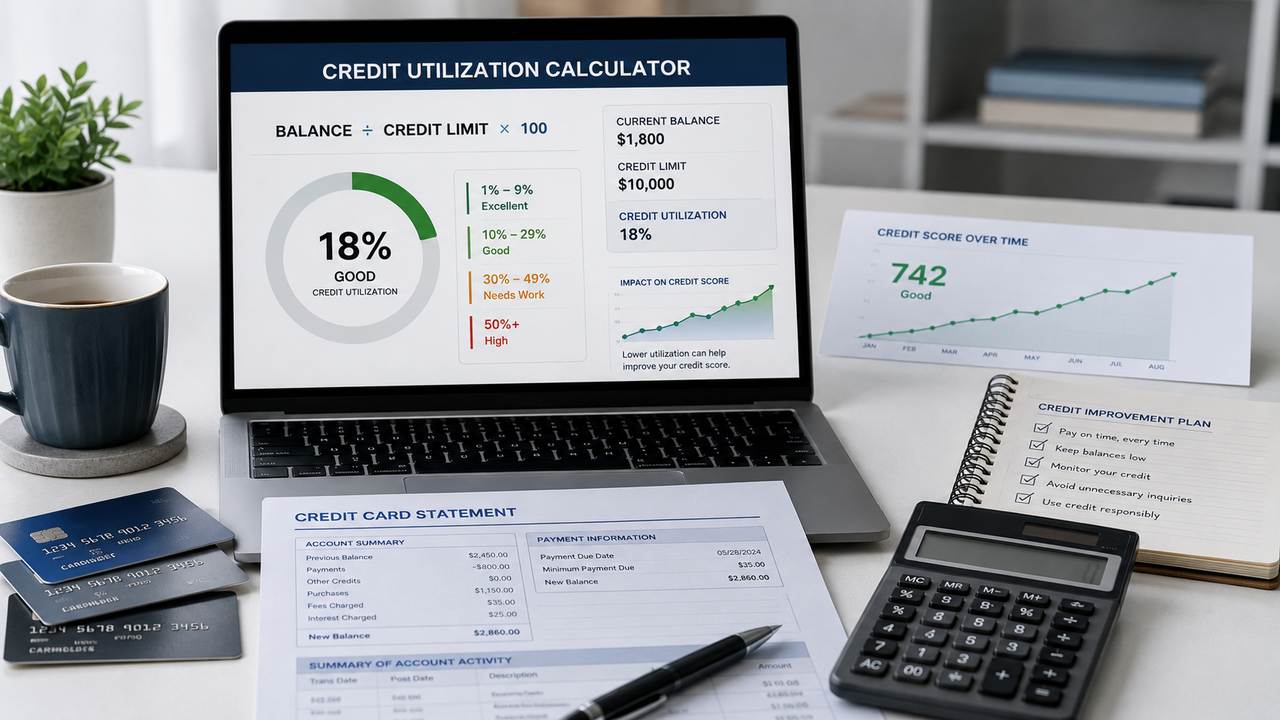
What Is Credit Utilization — and Why Calculating It Matters
Credit utilization is the percentage of your available revolving credit that you’re currently using. “Revolving credit” means credit cards and lines of credit — accounts where the balance goes up and down as you borrow and repay. Installment loans (auto loans, mortgages, student loans) are not part of utilization, because those balances only go down over a fixed term.
Think of it as a ratio: how much you owe divided by how much you’re allowed to borrow. If you have a $10,000 credit limit and you carry a $2,000 balance, you’re using 20% of your available credit. That 20% is your utilization ratio.
Why does this number matter so much? Because it’s one of the few parts of your credit profile you can change within a single billing cycle. Payment history takes years to build. Age of accounts only grows with time. New inquiries stay on your report for two years. But utilization updates every time your card issuer reports your balance to the credit bureaus — usually once a month, shortly after your statement closes. Drop your balance, and your utilization (and often your scores) can improve within 30 days.
The two utilization numbers you need to know
There are actually two utilization figures that influence your credit:
- Overall utilization — your total balances across all revolving accounts, divided by your total credit limits across all revolving accounts. This is the headline number most people refer to.
- Per-card utilization — the balance on a single card divided by that card’s limit. Each card has its own ratio, and scoring models look at both the aggregate and the individual card-level numbers.
A common surprise: you can have a healthy overall utilization but still be penalized because one card is maxed out. If you have three cards each with a $5,000 limit and you carry a $4,500 balance on one while the other two sit at zero, your overall utilization is 30% ($4,500 / $15,000) — which looks okay at a glance — but that one card is at 90%, and most scoring models will dock you for it. This is why calculating both figures matters.
Why a “calculator” approach beats guessing
People guess at their utilization constantly, and they’re usually wrong in one of two ways:
- They use their current balance (what they see in the app today) instead of the statement balance that actually gets reported to the bureaus. More on this distinction in the mid-cycle payment section — it’s a big deal.
- They forget about cards they rarely use. A $0 balance on a card still counts toward your total available credit, which lowers your overall utilization. But if that card is closed or the issuer reduces the limit, your ratio jumps overnight. Knowing your real denominator — the sum of every revolving limit — requires actually listing every account.
A calculator approach forces you to gather the real numbers. That’s the value. You’re not estimating; you’re measuring. And once you’ve measured, you can plan.
The Credit Utilization Formula, Explained Step by Step
The formula is simple. The discipline is in gathering the inputs.
The core formula
Credit Utilization (%) = (Total Balance ÷ Total Credit Limit) × 100
In words: divide what you owe by what you’re allowed to borrow, then multiply by 100 to express it as a percentage.
Step 1: Gather your balances
Log in to every revolving credit account you have — every credit card, every store card, every personal line of credit. For each one, note the current balance. If you’re trying to predict what will be reported to the bureaus (which is what affects your scores), use the statement balance — the balance on the day your statement closes — rather than the balance you happen to see mid-cycle. We’ll cover this distinction in depth later, but for now: use the most recent statement balance for each card if you want to estimate what’s on your credit report.
Sum these balances. That’s your Total Balance.
Step 2: Gather your credit limits
For each of those same accounts, note the credit limit — the maximum amount you’re approved to borrow. For charge cards that have no preset spending limit (certain American Express cards, for example), this gets nuanced; most scoring models use your highest recent balance or a “preset” limit the issuer reports, and some exclude these cards from utilization entirely. For simplicity, include only cards that report a definite credit limit.
Sum these limits. That’s your Total Credit Limit — your denominator.
Step 3: Divide and convert
Divide Total Balance by Total Credit Limit. You’ll get a decimal (0.20, for instance). Multiply by 100 to get a percentage (20%).
Step 4: Repeat per card
To get your per-card utilization, run the same formula on each card individually: that card’s balance divided by that card’s limit, times 100. Don’t sum across cards for this step — you want one ratio per account.
A note on rounding
Credit scoring models don’t care whether your utilization is 19.7% or 20.1% — they bucket you into ranges. So don’t obsess over decimal places. Round to the nearest whole percent. The buckets that matter are explained in the What Your Result Means section below.
How to Calculate Per-Card and Overall Utilization
The best way to learn the formula is to see it worked through real examples. Below are three worked scenarios of increasing complexity, each shown as a table so you can follow the arithmetic.
Worked Example A: A Single Credit Card
Let’s start with the simplest case — one card, one balance, one limit.
| Item | Value |
|---|---|
| Credit card balance | $640 |
| Credit card limit | $4,000 |
| Calculation | $640 ÷ $4,000 = 0.16 |
| Utilization | 16% |
In this example, you’re using 16% of your available credit on this single card. Because there’s only one card, your per-card utilization and your overall utilization are identical — both are 16%.
What this means: 16% falls in the “good” range (10–29%). It’s not hurting your scores meaningfully, but it’s not optimal either. Bringing it under 10% — a balance below $400 on this card — would likely give you a small bump. We’ll come back to this in the interpretation section.
Worked Example B: Multiple Cards, Evenly Used
Now let’s look at three cards, each used at a similar rate. This is where per-card versus overall becomes interesting.
| Card | Balance | Credit Limit | Per-Card Utilization |
|---|---|---|---|
| Card A | $300 | $3,000 | 10% |
| Card B | $500 | $5,000 | 10% |
| Card C | $1,000 | $10,000 | 10% |
| Totals | $1,800 | $18,000 | — |
| Overall utilization | — | — | 10% |
Every card is at exactly 10%, and the overall is also 10%. This is a clean, symmetric scenario — and it’s the kind of profile scoring models reward. No single card is a problem; the aggregate is in the excellent-to-good boundary.
What this means: 10% overall with no card exceeding 10% is about as good as utilization gets for most people. Pushing lower (under 5%, or even reporting $0 on some cards) may add a few more points, but the gains shrink rapidly below 10%. The much bigger leaps come from moving out of the 30%+ and 50%+ ranges, which we’ll cover shortly.
Worked Example C: Mixed Balances and Limits
Real life is messier. Here’s a scenario with uneven usage — a couple of cards lightly used, one carrying a larger balance, and a store card with a low limit that’s nearly maxed.
| Card | Balance | Credit Limit | Per-Card Utilization |
|---|---|---|---|
| Card A (primary rewards card) | $1,200 | $12,000 | 10% |
| Card B (travel card) | $2,400 | $8,000 | 30% |
| Card C (store card) | $850 | $1,000 | 85% |
| Card D (backup, rarely used) | $0 | $5,000 | 0% |
| Totals | $4,450 | $26,000 | — |
| Overall utilization | — | — | 17.1% ≈ 17% |
This is the scenario that trips people up. The overall utilization looks fine at 17% — comfortably in the “good” range. But look at the per-card column: Card C is at 85%, which most scoring models treat as a maxed-out card. Card B is at 30%, right on the threshold. Only Card A and Card D are healthy.
What this means: Even though the headline number looks okay, this profile is likely suppressing your scores. Scoring models (FICO and VantageScore both) evaluate per-card utilization in addition to overall. A maxed-out store card is a known red flag, partly because low-limit cards are easy to max out and partly because maxed-out behavior correlates with financial stress. The fix here isn’t necessarily to pay down everything — it’s to prioritize Card C first. Bringing Card C under 30% (below $300) would likely produce a noticeable score improvement even if the overall utilization barely moves.
This is why a calculator that shows per-card numbers is so much more useful than a single overall figure. The overall number can hide problems that the per-card breakdown reveals.
A Fill-In Worksheet to Calculate Utilization By Hand
You don’t need a spreadsheet or a fancy tool. A pen and the table below will get you there in a few minutes. Print this out or copy it into a notebook, then fill in your own numbers.
Step 1: List every revolving account
For each credit card or line of credit, fill in the card name, your most recent statement balance, and your credit limit. Then calculate per-card utilization (balance ÷ limit × 100).
| Card Name | Statement Balance | Credit Limit | Per-Card Utilization (Balance ÷ Limit × 100) |
|---|---|---|---|
| _______________ | $________ | $________ | ______% |
| _______________ | $________ | $________ | ______% |
| _______________ | $________ | $________ | ______% |
| _______________ | $________ | $________ | ______% |
| _______________ | $________ | $________ | ______% |
| _______________ | $________ | $________ | ______% |
Step 2: Sum the columns
Add up all the balances. Add up all the credit limits.
| Value | |
|---|---|
| Total Balance | $________ |
| Total Credit Limit | $________ |
Step 3: Calculate overall utilization
Divide Total Balance by Total Credit Limit, then multiply by 100.
Step 4: Scan the per-card column
Look down the per-card utilization column. Flag any card above 30% — those are your priority targets for paydown, regardless of what the overall number says. If everything is under 30% and your overall is under 10%, you’re in excellent shape.
Step 5: Note the date
Write today’s date at the top of the worksheet. Utilization is a snapshot — it changes every statement cycle. Recalculate monthly, or any time you make a large purchase, open a new card, or close an account. Tracking it over time is how you see progress.
What Your Utilization Result Means
Once you have your numbers — both overall and per-card — here’s how to interpret them. The ranges below are widely accepted across FICO and VantageScore scoring models, though exact thresholds vary slightly by model and by the rest of your credit profile.
Overall utilization ranges
| Utilization Range | Rating | What It Means for Your Scores |
|---|---|---|
| Under 10% | Excellent | This is the sweet spot. You’re using credit lightly and responsibly. Most people see their best utilization-based scores here. Going lower (under 5%, or $0 on some cards) may add a couple more points, but returns diminish. |
| 10% – 29% | Good | You’re in solid territory. Scores are generally not being suppressed much by utilization. Aim to dip below 10% if you’re applying for something soon. |
| 30% – 49% | Fair / Needs Work | You’ve crossed the threshold where scoring models start to penalize. Dropping below 30% typically produces a measurable score increase — often 10–20 points or more, depending on your profile. |
| 50% – 74% | Poor | Scores are being meaningfully suppressed. Improvement from this range can be substantial once you pay down. |
| 75% – 99% | Very Poor | You’re approaching or effectively maxed out. This is a serious drag on your scores and a signal of financial strain to lenders. |
| 100%+ (over limit) | Critical | Being over your credit limit is a major red flag. Some issuers will decline new transactions, report you as over-limit, or even reduce your limit. Address this immediately. |
Per-card utilization: the hidden second grade
The table above applies to both your overall ratio and each individual card. A common guideline:
- No single card should be above 30% — even if your overall is low.
- Ideally, no card above 10% for maximum scores.
The scoring reasoning is behavioral. Someone who spreads spending evenly across several cards looks like someone who manages credit comfortably. Someone who concentrates nearly all their debt on one card — especially one that’s near its limit — looks like someone scrambling for capacity. The overall ratio tells part of the story; the per-card ratios tell the rest.
The “0% myth”
A quick clarification, because this comes up constantly: carrying a small balance does not help your credit scores. There is no scoring bonus for owing money. The idea that you need to carry a balance to “build credit” is one of the most persistent credit myths out there. You can pay your statement balance in full every month — pay zero interest — and still achieve excellent utilization (because the statement balance is what’s reported, before you pay it). We cover the mechanics in the mid-cycle payment section.
The one nuance: reporting $0 on every card can sometimes be marginally worse than reporting a small balance on one card. Scoring models like to see some activity. The common advice — and it’s sound — is to let one card report a small balance (under 10%) and pay the rest to $0 before the statement closes. But this is fine-tuning. The big wins come from getting out of the 30%+ ranges, not from micro-optimizing between 0% and 8%.
How to Use Your Result to Plan Paydown
Knowing your utilization is only useful if you do something with it. Here’s a practical paydown framework that uses your numbers directly.
Priority 1: Address any card above 30%
If one or more cards are above 30% per-card utilization, those are your top priority — even if your overall utilization looks fine. As the Worked Example C showed, a maxed-out store card on an otherwise healthy profile can quietly suppress your scores.
For each card above 30%, calculate how much you’d need to pay to bring it under the 30% threshold:
Example: Card C from Worked Example C had an $850 balance on a $1,000 limit. To get under 30%: $850 − (0.30 × $1,000) = $850 − $300 = $550 of paydown needed. Once you pay $550, that card drops from 85% to 30%.
If you can’t get it under 30% in one payment, aim for the biggest reduction you can manage. Every drop helps, but the 30% threshold is where the biggest scoring impact typically lands.
Priority 2: Bring overall utilization under 30%
If your overall utilization is above 30%, that’s your second target. Calculate the paydown needed:
Example: If your total balance is $9,000 and your total credit limit is $20,000, you’d need to pay down $9,000 − (0.30 × $20,000) = $9,000 − $6,000 = $3,000 to reach 30% overall.
Priority 3: Push toward 10% or below
Once everything is under 30%, the next goal is 10% or below — the “excellent” range. Same formula, swap 0.10 for 0.30:
This is where scores tend to peak. If you’re applying for a mortgage, auto loan, or any major credit product, getting under 10% in the 30–60 days before application is one of the highest-leverage moves you can make.
A paydown strategy note: avalanche vs. utilization
There’s a tension between two sensible goals: paying down your highest-interest debt first (the avalanche method, which saves you the most money) and paying down high-utilization cards first (which helps your scores the most). They don’t always point the same direction.
A reasonable approach: make minimum payments on everything to stay current, then direct extra cash to whichever card is both above 30% utilization and has your highest interest rate. Once that card is under 30%, move to the next card meeting both criteria.
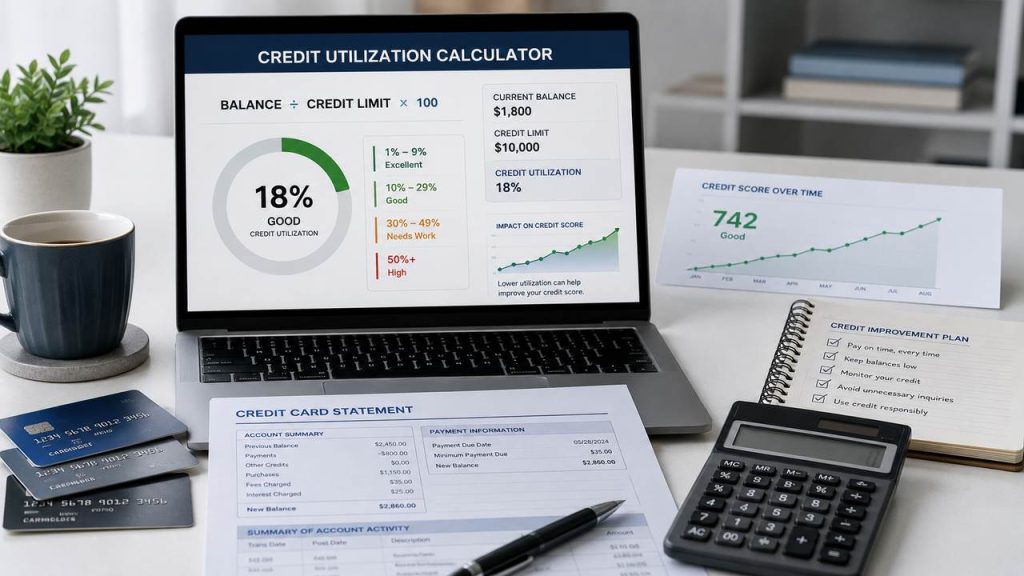
Target Balance Table for Common Credit Limits
To make planning faster, here’s a lookup table. Find your credit limit, and the table shows the maximum balance you can carry to stay under the 10% (excellent) and 30% (good-to-fair) thresholds.
Per-card target balances
| Credit Limit | Stay Under 10% (Excellent) | Stay Under 30% (Good) | 50% Threshold | Max (100%) |
|---|---|---|---|---|
| $500 | Under $50 | Under $150 | Under $250 | $500 |
| $1,000 | Under $100 | Under $300 | Under $500 | $1,000 |
| $2,000 | Under $200 | Under $600 | Under $1,000 | $2,000 |
| $2,500 | Under $250 | Under $750 | Under $1,250 | $2,500 |
| $3,000 | Under $300 | Under $900 | Under $1,500 | $3,000 |
| $5,000 | Under $500 | Under $1,500 | Under $2,500 | $5,000 |
| $7,500 | Under $750 | Under $2,250 | Under $3,750 | $7,500 |
| $10,000 | Under $1,000 | Under $3,000 | Under $5,000 | $10,000 |
| $15,000 | Under $1,500 | Under $4,500 | Under $7,500 | $15,000 |
| $20,000 | Under $2,000 | Under $6,000 | Under $10,000 | $20,000 |
| $25,000 | Under $2,500 | Under $7,500 | Under $12,500 | $25,000 |
| $50,000 | Under $5,000 | Under $15,000 | Under $25,000 | $50,000 |
How to use this table
- Find your card’s credit limit in the leftmost column.
- The second column tells you the balance to stay under for excellent utilization (under 10%). If you’re preparing for a major credit application, aim here.
- The third column is the threshold to stay out of penalty territory (under 30%). If you’re above this number on any card, that card is your paydown priority.
- For overall utilization, sum your limits, find the closest row, and apply the same thresholds to your total balance.
A quick example
You have three cards with limits of $1,000, $5,000, and $10,000. Looking up the table:
- The $1,000 card should stay under $100 (for 10%) or $300 (for 30%).
- The $5,000 card should stay under $500 (for 10%) or $1,500 (for 30%).
- The $10,000 card should stay under $1,000 (for 10%) or $3,000 (for 30%).
Your total limit is $16,000. The closest row is $15,000, so for overall utilization you’d target under $1,500 (for 10%) or under $4,500 (for 30%). If you want to be precise, just use the formula: 10% of $16,000 = $1,600; 30% of $16,000 = $4,800.
The Mid-Cycle Payment Strategy
Here’s something that catches nearly everyone off guard: the balance that matters for your credit scores is not the balance you see when you log in to your card app. It’s the balance your card issuer reports to the credit bureaus — and that almost always happens once a month, on or shortly after your statement closing date, not your due date.
Why this distinction matters
Suppose your statement closes on the 15th of each month, and your payment is due on the 12th of the following month. If you charge $2,000 during the billing period and pay it in full on the due date, you pay no interest — great. But on the 15th, when the statement closes, your issuer reports that $2,000 balance to the bureaus. Even though you’re about to pay it off, your credit reports show a $2,000 balance for that cycle. If your limit is $5,000, the bureaus see 40% utilization — squarely in the penalty range — for that month.
This is why people who pay in full every month can still have high utilization on their credit reports. They’re not carrying debt, but they’re using a lot of their limit during the cycle, and that’s what gets reported.
The mid-cycle payment fix
The fix is straightforward: make a payment before your statement closes, in addition to the payment you make by the due date. Here’s the sequence:
- Find your statement closing date for each card. It’s usually printed on your statement and visible in your online account. It’s typically the same date each month, give or take a day for weekends.
- A few days before the statement closes — say, 3–5 days prior — log in and pay down most or all of your current balance. This brings the balance that will be reported to the bureaus down to whatever you choose.
- Let the statement close with the reduced balance (or $0 if you paid in full). That’s the number that gets reported.
- Pay any remaining statement balance by the due date to avoid interest.
Worked example
You have a $5,000 limit. Your statement closes on the 20th. By the 15th, you’ve charged $2,500 this cycle (50% utilization if reported as-is). You pay $2,000 on the 16th. The statement closes on the 20th with a $500 balance. The issuer reports $500 — that’s 10% utilization, in the excellent range. You then pay the remaining $500 by the due date. No interest paid, and your credit report shows a healthy 10% utilization instead of 50%.
Why this works
You’re not changing how much you spend or how much interest you pay. You’re only changing the snapshot the bureaus see. Because utilization is calculated from the balance reported at statement close, timing your payment to land just before that snapshot gives you direct control over the number — without changing your spending habits.
This is one of the fastest, lowest-cost credit score improvements available. For many people, a single cycle of mid-cycle payments can move scores noticeably, because utilization updates on the next bureau report (usually within a few days of statement close).
A note on timing precision
You don’t need to be exact to the day. Most issuers report within a few days after the statement closes. Paying 3–5 days before the statement close date gives a comfortable buffer. If you’re not sure when your statement closes, call your issuer and ask — they’ll tell you, and some will let you change your statement closing date to something more convenient.
How Credit Limit Increases Change the Math
A credit limit increase is the other major lever you have. Because your credit limit is the denominator of the utilization formula, increasing it lowers your utilization — without requiring you to pay down a single dollar of balance.
The math
If you carry a $2,000 balance on a $5,000 limit, your utilization is 40%. If your issuer raises your limit to $8,000 and your balance stays at $2,000, your new utilization is $2,000 ÷ $8,000 = 25%. You’ve dropped from the “needs work” range to the “good” range just by getting a higher limit — no paydown required.
Two ways to get a limit increase
- Automatic increases — many issuers review accounts periodically and raise limits on their own, especially if you’ve had the card for a while, pay on time, and have rising income. These usually don’t result in a hard inquiry on your credit report.
- Requesting an increase — you can ask your issuer for a higher limit through your online account or by calling. Some issuers do this with no hard inquiry (a soft pull); others will do a hard inquiry, which can ding your scores a few points temporarily. Ask before you request whether the increase will require a hard inquiry. Many issuers will tell you upfront.
The risk: spending creep
A higher limit only helps your utilization if your balance stays roughly the same. If a higher limit tempts you to spend more — a well-documented behavioral pattern — your utilization can end up not improving at all, and you’ll carry more debt. The math is only on your side if you treat the new limit as capacity you don’t use.
A combined strategy
The most powerful approach is combining both levers: pay down balances AND secure limit increases. Each makes the other more effective. A paydown of $1,000 lowers your numerator; a limit increase of $3,000 raises your denominator. Together, they compress your utilization faster than either alone.
Example: You start at $3,000 balance on a $5,000 limit — 60% utilization. You pay down $1,000 (to $2,000) and get a limit increase to $8,000. New utilization: $2,000 ÷ $8,000 = 25%. You’ve gone from 60% to 25% in one move, which would typically produce a solid score improvement.
What about new cards?
Opening a new credit card also increases your total credit limit (the denominator), which can lower overall utilization. But new cards come with trade-offs: a hard inquiry, a new account that lowers your average age of accounts, and the temptation to spend. For short-term score optimization (next 6 months), a new card is usually a wash or a slight negative — the inquiry and age factors offset the utilization benefit. For longer-term optimization (12+ months out), a new card can help because the inquiry impact fades and the account ages. Think carefully before opening a card purely for utilization reasons, especially if you’re applying for a mortgage soon.
Common Credit Utilization Calculation Mistakes
Even with the formula in hand, people make predictable errors. Here are the most common ones — and how to avoid them.
1. Using current balance instead of statement balance
This is the most frequent mistake. The balance you see in your card app changes every time you make a charge or a payment. The balance that matters for your credit scores is the one reported at statement close. If you calculate utilization using your current balance on a random day, you may be over- or under-estimating what’s actually on your credit report. Use your most recent statement balance for an accurate estimate.
2. Forgetting about a card you rarely use
That store card you opened for a discount three years ago and haven’t touched since? It still has a limit, and that limit still counts toward your total available credit. Forgetting to include it means your denominator is wrong, which means your overall utilization calculation is wrong. List every revolving account, even ones with $0 balances.
3. Including installment loans in the calculation
Auto loans, mortgages, student loans, and personal loans are installment debt, not revolving debt. They are not part of utilization. Mixing them in inflates both your numerator (balances) and your denominator (limits, which installment loans don’t have in the same way) — and gives you a meaningless number. Only include revolving accounts: credit cards and lines of credit.
4. Ignoring per-card utilization
Calculating only the overall number and calling it a day is tempting, but as Worked Example C showed, you can have a healthy overall ratio with a maxed-out card hiding in the mix. Always compute per-card ratios and scan for any card above 30%.
5. Treating charge cards as regular credit cards
Some cards — notably certain American Express charge cards — have no preset spending limit. They don’t report a traditional credit limit, so they may be excluded from utilization calculations or handled with a substitute figure (like your highest recent balance). Including them as if they had a normal limit distorts your math. Check your credit report to see what’s actually being reported for each account.
6. Closing cards to “clean up” your credit
Closing a card doesn’t remove its history from your report immediately (the account stays on your report for up to 10 years if closed in good standing), but it does remove its credit limit from your utilization denominator the moment it closes. If you close a card with a $10,000 limit and your other cards total $15,000 in limits, your total available credit just dropped from $25,000 to $15,000. If you carry a $4,500 balance, your utilization jumps from 18% to 30% overnight — a significant downgrade. Think twice before closing cards, especially older ones with high limits.
7. Counting a credit limit increase as a guarantee
If you request a limit increase and the issuer does a hard inquiry but denies the increase, you’ve taken a small score hit for no benefit. Ask about the inquiry policy before requesting. And if your income has dropped or you’ve missed payments recently, an increase may be unlikely — consider focusing on paydown instead.
8. Confusing “due date” with “statement closing date”
Your due date is when your payment must arrive to avoid interest. Your statement closing date is when the billing cycle ends and the balance is reported. They’re typically 3–4 weeks apart, and they serve completely different purposes. Mid-cycle payments (discussed above) hinge on knowing the closing date, not the due date. Mixing them up is the most common reason mid-cycle payment strategies fail.
9. Overlooking balance reporting frequency
Most issuers report once per month, but not all. Some report more frequently, and a few report on irregular schedules. If you’re being precise about timing — say, for a mortgage application — check your credit report to see when each issuer last reported. A mid-cycle payment won’t help if the issuer has already reported for that cycle.
10. Forgetting that authorized-user cards count
If you’re an authorized user on someone else’s card, that card’s limit and balance typically appear on your credit report and factor into your utilization. This can help (if the primary user keeps it low) or hurt (if it’s maxed). When listing your accounts for the worksheet, include authorized-user cards — and if one is dragging your utilization down, ask the primary user if they can pay it down or, in extreme cases, remove you as an authorized user.
Frequently Asked Questions
1. What is a credit utilization calculator?
A credit utilization calculator is a tool — whether a spreadsheet, an online form, or a manual worksheet like the one in this guide — that computes the percentage of your available revolving credit you’re currently using. You input your balances and credit limits, and the calculator applies the formula (balance ÷ limit × 100) to show both your overall utilization and your per-card utilization. The value isn’t in the arithmetic itself, which is simple; it’s in forcing yourself to gather accurate inputs for every account and see both the aggregate and per-card numbers at once.
2. How much of my credit limit should I use?
For optimal credit scores, aim to keep your overall utilization under 10% and no individual card above 30% — ideally under 10% per card as well. For everyday health (not preparing for a specific application), staying under 30% overall and under 30% per card keeps you out of penalty territory. You do not need to carry a balance to build credit — paying your statement balance in full each month avoids interest entirely while still reporting a healthy utilization based on your statement balance.
3. Does paying my card in full every month mean my utilization is 0%?
No — and this is a common point of confusion. If you pay your statement balance in full by the due date, you pay no interest, but the statement balance is still what gets reported to the bureaus at statement close (before your due date). So if you charge $2,000 during a cycle on a $5,000 limit card, your credit report will show 40% utilization for that month — even though you pay it off and owe no interest. This is why mid-cycle payments (paying before the statement closes) are the key to controlling the reported number.
4. Is per-card utilization or overall utilization more important?
Both matter, and scoring models evaluate both. As a general rule, overall utilization carries somewhat more weight, but a maxed-out individual card can still suppress your scores even when your overall ratio looks fine. The safest approach is to manage both: keep the overall ratio under 10% if possible, and keep every individual card under 30%. Use the worked examples and worksheet in this guide to track both numbers.
5. How fast does utilization update on my credit report?
Most card issuers report to the three major bureaus (Equifax, Experian, TransUnion) once per month, shortly after your statement closes. Once the new balance is reported, your utilization on your credit report updates immediately, and your scores typically reflect the change within a few days to a couple of weeks (depending on when lenders pull your scores). This is why utilization is one of the fastest score levers available — you can change it meaningfully within a single billing cycle.
6. Will requesting a credit limit increase hurt my credit score?
It depends on whether the issuer does a hard inquiry (a “hard pull”) on your credit report. Some issuers grant increases with only a soft pull, which doesn’t affect your scores. Others do a hard inquiry, which can cause a small, temporary dip (usually a few points) that fades over 12 months. Always ask the issuer whether an increase will require a hard inquiry before you request it. Many issuers will tell you upfront.
7. Should I close a credit card I don’t use anymore?
Generally, no — at least not without weighing the utilization impact. Closing a card removes its credit limit from your total available credit, which can raise your overall utilization even if you don’t change your spending. If the card has no annual fee, consider keeping it open and using it for a small recurring charge (like a streaming subscription) that you pay off each month, to keep the account active and the limit in your denominator. If it has an annual fee you can’t justify, weigh the cost against the potential utilization impact — and consider asking the issuer to convert it to a no-fee version instead of closing it.
8. What utilization ratio is best for buying a house?
If you’re applying for a mortgage, aim for overall utilization under 10% and ideally under 5% in the 30–60 days before your lender pulls your credit. Mortgage lenders are particularly sensitive to utilization, and even small reductions can improve the rate you’re offered. This is also a time to avoid opening new cards, closing existing cards, or taking on new installment debt — keep your profile stable and your utilization low. Mid-cycle payments are especially valuable here, because they let you control exactly what balance is reported when your lender pulls your scores.
Get a Free Credit Audit
Calculating your utilization is a great first step — but it’s only one piece of your credit picture. If you want a full, professional review of your credit reports across all three major bureaus, we can help.
At credit-repair.com, we offer a free credit audit that includes:
- A line-by-line review of your reports from Equifax, Experian, and TransUnion
- Identification of inaccuracies, outdated information, and negative marks that may be dragging down your scores
- A clear explanation of what each item is and whether it’s disputable under the Fair Credit Reporting Act (FCRA)
- A customized repair plan tailored to your specific goals — whether that’s buying a home, refinancing, or simply getting your scores into the excellent range
- An honest assessment of what’s achievable and a realistic timeline, with no guarantees or quick-fix promises
We’re San Diego-based, FCRA-compliant, and we work alongside experienced attorneys to ensure every dispute we file is grounded in federal law. We serve clients in cities nationwide, and we’re committed to educating you throughout the process — so you leave us not just with better credit, but with the knowledge to keep it strong for life.
Ready to see where you stand? Request your free credit audit at credit-repair.com. We’ll walk through your reports together, answer your questions, and give you a clear, honest plan — no pressure, no hidden fees, no obligation.
Disclaimer: This article is for educational purposes and does not constitute legal or financial advice. Your individual credit situation is unique. For personalized guidance, request a free credit audit at credit-repair.com. We do not guarantee specific score improvements; results vary based on individual circumstances and the information on your credit reports.
Leave a Reply