It is a fair question. Your credit score can decide whether you get approved for a mortgage, what interest rate you pay on a car loan, whether a landlord rents to you, and in some cases whether a potential employer offers you a job. Yet most people never receive a clear explanation of how the score is built. They are handed the result without ever seeing the formula.
That stops here. In this guide, we are going to walk through exactly how your credit score is calculated — the five factors that feed into it, the percentage weight each one carries, what helps and hurts each factor, and what you can do starting today to strengthen the ones you control. No jargon, no quick-fix promises, just a clear, honest breakdown from a team that does this work every day.
If you have ever felt like your credit score was handed down from a black box, this article is for you. By the end, you will understand the mechanics well enough to look at your own credit report and know — with real confidence — which levers to pull and which ones to leave alone.
The 30-Second Version
If you only have a minute, here is the whole system in one breath:
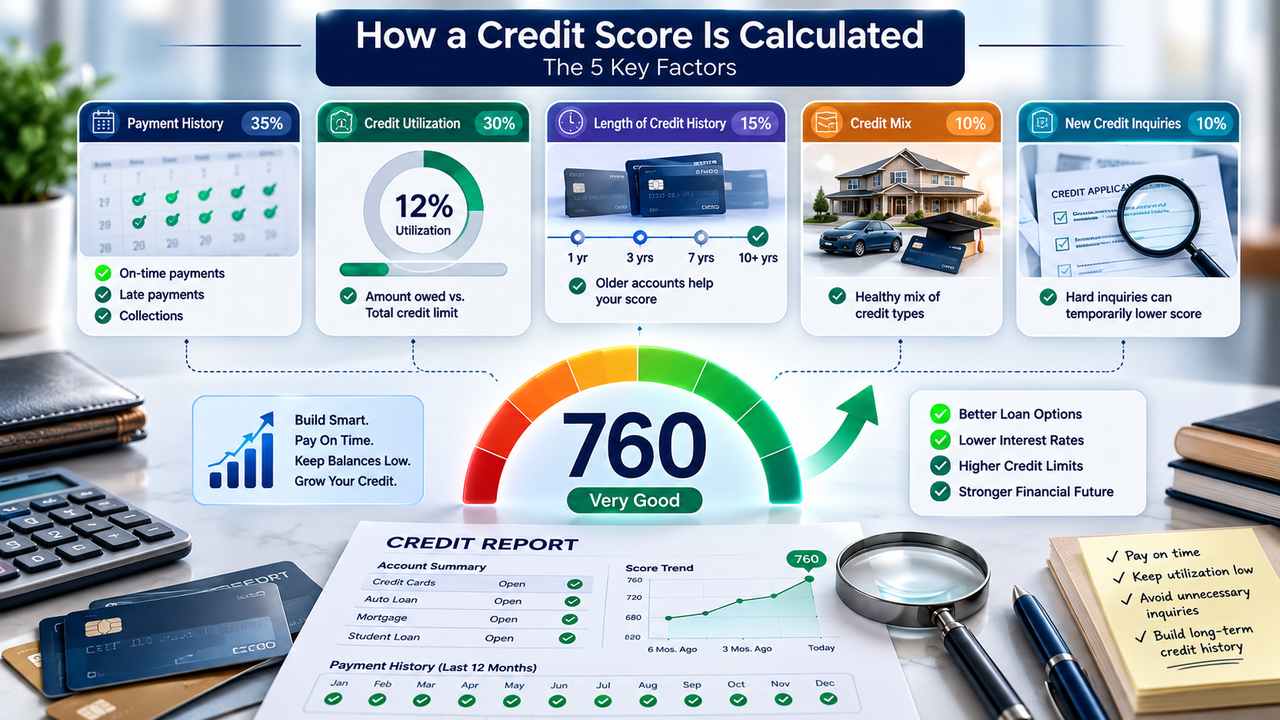
Your credit score is calculated from five factors drawn from your credit report. Payment history carries the most weight at 35 percent — have you paid on time? Credit utilization (how much of your available credit you are using) comes next at 30 percent. Length of credit history — how long your accounts have been open — is 15 percent. Credit mix — the variety of account types you manage — is 10 percent. And new credit inquiries — how often you are applying for new credit — rounds it out at 10 percent.
Those five factors, in roughly those proportions, are how FICO — the scoring model used in roughly 90 percent of lending decisions — converts the information on your credit report into a single three-digit number that lenders use to gauge risk.
That is the skeleton. Now let us put muscle on the bones.
Payment History — 35% (The Heavyweight)
Payment history is the single most influential factor in your credit score. At 35 percent of the FICO scoring formula, it carries more weight than any other category. The logic is simple and ruthless: if a lender wants to know whether you will repay a future loan, the best evidence they have is whether you have repaid past ones.
How it is measured
Payment history looks at whether you have paid your credit accounts on time and in full. But it is not a simple yes-or-no checkbox. The scoring model digs into several layers of detail:
- On-time vs. late payments. A payment is generally reported as “on time” if it is received by the due date or within the grace period your creditor allows. Once a payment is 30 days late, it can be reported to the credit bureaus as delinquent, and that negative mark begins dragging on your score.
- Severity of lateness. A 30-day late payment hurts, but a 60-day late payment hurts more, and a 90-day late payment is far more damaging. The deeper the delinquency, the harder the hit and the longer it lingers.
- Recency of delinquency. A late payment from two years ago weighs less than one from two months ago. Time heals, but slowly.
- Frequency. One late payment is a blemish. A pattern of repeated late payments signals a systemic problem and is scored accordingly.
- Account type. Late payments on a mortgage or auto loan — larger, more structured obligations — can carry more weight than a late payment on a store credit card, though any delinquency is damaging.
- Public records. Bankruptcies, foreclosures, lawsuits, and tax liens (where still reportable) are severe negative items that fall under payment history and can suppress a score for years.
- Collections and charge-offs. If an account is sent to collections or written off as a loss by the creditor, it is recorded here and is one of the most damaging entries possible.
What helps
- Paying every bill on time, every time. This is the single most powerful credit-building habit you can develop. Consistency matters more than amount.
- Setting up autopay or payment reminders. Most late payments are not about lack of money — they are about lack of attention. Automation removes that risk.
- Paying at least the minimum. If you cannot pay in full, always pay at least the minimum by the due date. Interest accrues, but the account stays current.
- Catching up on past-due accounts. If you have slipped, getting current stops the bleeding. A late payment that is now 30 days old is less damaging than one that ages into 60 or 90 days.
- Time. As late payments age, their impact fades. A single 30-day late payment from four years ago has a fraction of the effect of one from last month.
What hurts
- Any payment reported 30 or more days late. This is the line that, once crossed, shows up on your report and starts pulling your score down.
- Serious delinquencies — 60, 90, or 120 days late — which escalate the damage sharply.
- Accounts sent to collections. Even small balances (a forgotten utility bill, an unpaid medical copay) can end up here and do outsized damage.
- Charge-offs, where the creditor has given up on collecting and written the debt off as a loss.
- Bankruptcies, foreclosures, and repossessions. These are the most severe negative items and can suppress a score for 7 to 10 years.
- Settled-for-less-than-full amounts. Settling a debt for less than you owe may resolve the obligation, but the account history still reflects that you did not pay as agreed.
How to optimize it
Payment history is the factor you cannot fast-track, but you can protect it ruthlessly:
- Automate at least the minimum payment on every account. This single step eliminates the most common cause of late payments — forgetting.
- Review your statements monthly. Catch billing errors, unauthorized charges, or due-date changes before they become a problem.
- If you fall behind, get current as fast as possible and stay current. A brief lapse followed by years of perfect payments tells a better story than a lapse that deepens.
- Communicate with creditors early. Many offer hardship programs, payment plans, or due-date adjustments that can keep a late payment off your report if you reach out before the due date passes.
- Dispute inaccurate late payments. If a payment is incorrectly reported as late, you have the right under the Fair Credit Reporting Act (FCRA) to dispute it with the credit bureaus. Incorrect reporting is more common than most people realize.
Credit Utilization — 30% (The Silent Power Broker)
If payment history is the heavyweight, credit utilization is the silent power broker. At 30 percent of your score, it is the second-largest factor — and unlike payment history, it is one you can change quickly. For people with otherwise solid payment habits, utilization is very often the difference between a good score and an excellent one.
How it is measured
Credit utilization measures how much of your available revolving credit you are using. It is expressed as a percentage:
If you have two credit cards with combined limits of $10,000 and your combined balances are $2,500, your utilization is 25 percent.
Key details:
- Revolving accounts only. Utilization looks at credit cards, store cards, and lines of credit — not installment loans like mortgages, auto loans, or student loans.
- Overall and per-card utilization. The scoring model looks at utilization both across all revolving accounts combined and on each individual card. Maxing out one card even if your overall utilization is low can still hurt.
- Statement date, not due date. Utilization is typically calculated based on the balance reported to the bureaus — which is usually your statement balance, the snapshot taken when your billing cycle closes. Paying your card off in full after the statement posts does not change what was reported. To influence the reported number, you need to pay before the statement closing date.
What helps
- Keeping utilization low. The general guidance is to stay below 30 percent, but the real target is below 10 percent for top-tier scores. People with the highest scores tend to use a small fraction of their available credit.
- Paying before the statement closes. If you use your card heavily for rewards or cash flow but want a low reported balance, make a payment before the statement closing date so the reported balance is small.
- Asking for credit limit increases. A higher limit with the same spending lowers your utilization ratio. Just confirm the creditor will not do a hard inquiry for the increase — many will do a soft pull instead.
- Keeping cards open even when you stop using them.
- Multiple small payments during the month. If one big payment before the statement date feels risky, several smaller payments throughout the cycle keep the running balance low.
What hurts
- Maxing out cards — utilization near or at 100 percent is one of the fastest ways to sink a score, even with a flawless payment history.
- Carrying high balances relative to limits, even if you pay on time. A $2,000 balance on a $3,000 limit card (67 percent utilization) is far more damaging than $2,000 spread across a $20,000 limit (10 percent).
- Closing old cards. Closing a card removes its credit limit from your utilization calculation, which can cause your ratio to jump even if your spending has not changed.
- Consolidating balances onto one card. Moving several balances onto a single low-limit card can spike that card’s per-card utilization even if the overall picture looks the same.
How to optimize it
Utilization is the factor where small, deliberate moves can produce visible score changes within a billing cycle:
- Find out your statement closing dates for every card. These are the dates that matter, not the due dates.
- Pay down balances before the statement closes — not just before the due date — to control what gets reported.
- Target under 10 percent utilization on each card and overall for the strongest scores.
- Request credit limit increases on cards you have held responsibly for a while. More room with the same spending instantly lowers the ratio.
- Think twice before closing cards. If a card has no annual fee, keeping it open preserves your available credit. If it has a fee you cannot justify, weigh the score impact before closing.
- Spread spending across cards rather than loading one. This keeps per-card utilization low even if overall utilization is the same.
Length of Credit History — 15% (The Long Game)
At 15 percent of your score, length of credit history is a mid-weight factor. You cannot accelerate it quickly — it is, by definition, a function of time — but understanding how it works helps you avoid common mistakes that accidentally shorten it.
How it is measured
Length of credit history looks at the age of your credit accounts. Specifically, the model considers:
- Age of your oldest account. How long has your earliest credit account been open?
- Age of your newest account. How recently did you open new credit?
- Average age of all accounts. This is the most influential single figure within this category. It is calculated as the sum of the ages of every account on your report, divided by the number of accounts.
- How long specific account types have been open. How long ago did you first get a credit card, a mortgage, an auto loan, and so on.
- How long since those accounts were active. Inactivity on an old account can reduce its contribution to this factor over time.
What helps
- Keeping your oldest account open. Your oldest account anchors your credit age. Closing it can shorten your average age and remove a long, positive history from the calculation.
- Keeping older accounts active. A small recurring charge — a streaming subscription, a phone bill — paid off each month keeps an old card from being closed by the issuer for inactivity.
- Opening new credit sparingly. Every new account lowers your average age. The impact is temporary, but spacing out applications minimizes it.
- Being an authorized user on a long-standing account. If a family member adds you as an authorized user to a card they have held for many years, that account’s age can show up on your report and lengthen your history. (Be sure the primary holder has a clean payment record on that card — their negatives come too.)
What hurts
- Closing your oldest card. This can shorten your credit history and raise your utilization simultaneously — a double hit.
- Opening several new accounts at once. This lowers your average account age and can make you look like a sudden credit seeker, which also affects the new credit factor.
- Long stretches with no credit activity. Some creditors will close inactive accounts, which removes that history from your report and can shorten your average age.
How to optimize it
Length of credit history rewards patience, but you can protect it:
- Never close your oldest credit card unless there is a compelling reason (high annual fee, serious fraud, etc.). Even if you rarely use it, keeping it open preserves your history.
- Keep old cards active with a small, automatic charge every month that you pay off.
- Think carefully before applying for new credit. Each application has a place, but a burst of new accounts compresses your average age.
- If you are new to credit, start now. The clock starts when your first account is reported. The sooner you have a single account reporting on-time payments, the sooner you begin building history.
- Consider an authorized-user arrangement if you are starting out or rebuilding and have a trusted family member with a long, clean credit history.
Credit Mix — 10% (The Well-Rounded Profile)
Credit mix accounts for 10 percent of your FICO score.
Credit mix looks at the variety of credit accounts you manage. The scoring models generally distinguish between revolving credit, such as credit cards, and installment credit, such as mortgages, auto loans, student loans, and personal loans.
What helps
- Having both revolving and installment accounts, when those accounts are appropriate for your financial situation.
- Managing different types of credit responsibly.
- Allowing naturally occurring accounts to age and remain in good standing.
What hurts
- Having a very limited credit profile with little variety of account types.
- Opening unnecessary loans solely to improve your credit mix.
- Taking on debt you do not need or cannot comfortably afford.
How to optimize it
Credit mix is a “let it happen” factor. You should not force it:
- Do not take out a loan just to improve your mix. The 10 percent weight is not worth the cost, risk, or hard inquiry.
- When you naturally need an installment loan — a car, a home, education — that addition will gradually improve your mix as long as you pay it on time.
- If you only have installment loans (say, a student loan and a car loan), responsibly opening a single credit card and paying it in full each month can round out your profile.
- For thin or new files, a secured credit card or a credit-builder loan can establish both account types without requiring strong credit to qualify.
New Credit and Inquiries — 10% (The Caution Flag)
The final 10 percent of your score comes from new credit and inquiries. This factor rewards restraint — it measures how aggressively you have been seeking new credit, and it penalizes patterns that suggest risk.
How it is measured
The new credit factor looks at:
- Hard inquiries. When you apply for credit — a card, a loan, a mortgage — the lender pulls your credit report. That pull is recorded as a hard inquiry and can affect your score.
- Number of recently opened accounts. How many new accounts have you opened in the recent past (typically the last 6–12 months)?
- Proportion of accounts that are new. If a large share of your accounts are recently opened, it signals you are taking on new credit rapidly.
- Time since the most recent inquiry or account opening. The older your newest inquiry or account, the less it weighs.
- Rate shopping windows. For certain loan types — mortgages, auto loans, student loans — multiple inquiries within a short window (typically 14 to 45 days, depending on the scoring model version) are treated as a single inquiry for scoring purposes, recognizing that you are shopping for one loan, not opening many accounts.
Hard vs. soft inquiries — know the difference
This distinction matters more than almost any other in this factor:
- Hard inquiries result from you applying for credit. They appear on your report, they can affect your score, and they remain visible for up to two years (though the score impact typically fades after about one year).
- Soft inquiries result from checks that are not tied to a credit application — your own review of your credit, creditor pre-approval screenings, employer background checks, account monitoring by your existing creditors. Soft inquiries never affect your score.
Checking your own credit is a soft inquiry. It will not lower your score, no matter how often you do it. This is one of the most persistent myths we encounter, and it is worth stating clearly: you can check your own credit as often as you like without any scoring penalty.
What helps
- Applying for credit only when you genuinely need it. Spontaneous applications for store cards at checkout, or for cards offering modest sign-up bonuses, generate inquiries that can dent your score for marginal benefit.
- Rate shopping within a short window. For mortgages and auto loans, clustering applications within the 14-to-45-day window means multiple pulls are scored as one.
- Letting inquiries age. A hard inquiry’s effect diminishes over time and typically disappears from your score after about a year, even though it remains visible on your report for two years.
- Keeping your overall pace of new credit modest. One or two new accounts over several years is a healthy pattern.
What hurts
- Multiple hard inquiries in a short period, especially across different credit types — this signals risk-seeking behavior.
- Opening several new accounts quickly, which lowers your average account age (affecting the length of history factor) and raises the proportion of new accounts (affecting this factor).
- Applying for credit repeatedly after denials. Each application adds another hard inquiry, and a string of them compounds the damage.
- Responding to every pre-approval offer. Pre-approvals are based on soft inquiries, but if you act on them and formally apply, that application becomes a hard inquiry.
How to optimize it
- Space out credit applications. A good rule of thumb: no more than one new credit application every six months unless you are rate-shopping a specific loan.
- When rate-shopping a mortgage or auto loan, do all your applications within a 14-day window to ensure they are scored as a single inquiry.
- Check your own credit freely. Use free services or annualcreditreport.com — these are soft inquiries and have no score impact.
- Be selective with store cards. The discount at checkout is usually not worth the inquiry and new account, especially if you will not use the card regularly.
- If you have been denied, find out why before applying again. Repeated applications without addressing the underlying issue just stack inquiries.
Summary Table: The 5 Factors at a Glance
| Factor | Weight | What It Measures | Speed of Change |
|---|---|---|---|
| Payment History | 35% | Whether you have paid past credit accounts on time | Slow — months to years of consistent on-time payments |
| Credit Utilization | 30% | How much of your available revolving credit you are using | Fast — can change within a single billing cycle |
| Length of Credit History | 15% | The age of your credit accounts, oldest and average | Very slow — purely a function of time |
| Credit Mix | 10% | Variety of revolving and installment account types | Slow — develops naturally as you finance major purchases |
| New Credit and Inquiries | 10% | How many recent credit applications and new accounts you have | Moderate — inquiries fade in about a year |
The weights above are the FICO percentages — the model used in the overwhelming majority of lending decisions in the United States. VantageScore, the other major model, weights factors differently, which we cover in the next section.
FICO vs. VantageScore: How the Scoring Models Differ
When people talk about “your credit score,” they are usually referring to a FICO score. FICO (Fair Isaac Corporation) has been the dominant credit scoring model in the U.S. since the late 1980s, and its scores are used in an estimated 90 percent of consumer lending decisions.
But FICO is not the only model. VantageScore, developed jointly by the three major credit bureaus (Equifax, Experian, and TransUnion), is an alternative that has gained traction, particularly in free credit monitoring services and some lending decisions. Both models analyze the same underlying data — your credit report — but they weight the factors differently and have some structural differences worth understanding.
How the weights differ
| Factor | FICO Weight | VantageScore Weight (approx.) |
|---|---|---|
| Payment History | 35% | ~40% (extremely influential) |
| Credit Utilization | 30% | ~20% (highly influential) |
| Length of Credit History | 15% | ~21% (moderately influential) |
| Credit Mix | 10% | ~13% (moderately influential) |
| New Credit and Inquiries | 10% | ~5% (less influential) |
| Recent Credit Behavior / Available Credit | — | included in the above categories |
VantageScore tends to place even more emphasis on payment history and somewhat less on new credit inquiries than FICO. It also treats available credit (the total dollar amount of unused credit lines) as a distinct consideration, whereas FICO folds that into utilization.
Other key differences
- Scoring ranges. FICO scores generally range from 300 to 850. VantageScore 3.0 and 4.0 also use a 300 to 850 range, though earlier VantageScore versions used a different 501–990 scale.
- Minimum credit history. FICO traditionally requires at least one account that is six months old and at least one account reported to the bureaus within the last six months. VantageScore can generate a score with a thinner file, making it useful for people new to credit or rebuilding.
- Paid collections. VantageScore 3.0+ ignores paid collections entirely. FICO 9 also ignores paid collections, but FICO 8 — still widely used — does not. This means a paid collection can still affect a FICO 8 score even after it is settled.
- Trended data. VantageScore 4.0 uses trended data — the trajectory of your balances over time — to assess whether you are paying down debt or accumulating it. FICO has been incorporating similar data in newer versions.
- Medical collections. Both newer FICO and VantageScore models give more favorable treatment to medical collections than other types, recognizing that medical debt often results from circumstances outside a consumer’s control.
What this means for you
In practice, the two models usually tell a similar story. A person with strong payment history, low utilization, and a long, diverse credit profile will score well under both. A person with recent late payments and maxed-out cards will score poorly under both. The differences show up at the margins — particularly for people with thin files, paid collections, or a lot of recent rate shopping.
If you are preparing for a specific lending decision (a mortgage, an auto loan), ask the lender which scoring model they use. For mortgages, the answer is almost always a specific FICO model (often FICO 2, 4, or 5, depending on the bureau). Knowing which model matters can help you focus your effort on the factors that model emphasizes.
What Is NOT in Your Credit Score
Understanding what is in your score is only half the picture. It is equally important to understand what is not in it — because a surprising number of factors that people assume affect their score do not.
By federal law — specifically the Equal Credit Opportunity Act (ECOA) — credit scoring models in the United States are prohibited from considering certain personal characteristics. The law is designed to prevent discrimination in lending, and it shapes the boundary of what a score can and cannot reflect.
What is NOT considered
- Your income. Your credit score does not know how much you earn. A high salary does not produce a high score, and a low salary does not produce a low one. Income matters to lenders separately — they consider it as part of their own underwriting, in the debt-to-income ratio — but it is not part of the score itself.
- Your employment history. Whether you are employed, unemployed, self-employed, or retired is not in your score. Lenders may ask, but the scoring model does not see it.
- Your age. The ECOA prohibits credit scoring from considering age as a factor. (A related factor — the age of your credit accounts — is included, but your chronological age as a person is not.)
- Your race, color, religion, national origin, or sex. These are explicitly prohibited by the ECOA. The scoring model does not have access to them and cannot use them.
- Your marital status. Whether you are single, married, divorced, or widowed does not appear in your score.
- Where you live. Your address is on your report for identification, but geography does not factor into the score.
- Whether you receive public assistance. Participation in public assistance programs is not considered.
- Your interest rates on existing accounts. The rates you pay on your current loans are not part of the score. (The accounts themselves are, but not the cost of borrowing on them.)
- Child support or family obligations in most cases, unless they have been reported as a delinquent debt or collection.
- Your occupation. Your job title and field are not scored.
- Participation in credit counseling — by itself — does not appear as a negative item. The individual accounts within a counseling program may be reported, but the counseling itself is not a score factor.
Why this matters
Two practical takeaways:
- A high income does not protect your score. If you earn $300,000 a year but pay late and carry maxed-out cards, your score will suffer the same as anyone else’s. The score measures behavior on credit accounts, not financial capacity.
- The score is behavior-based, not identity-based. By design, it cannot discriminate on the basis of who you are. It only reflects how you have managed credit. That is both its limitation — it cannot see your full financial picture — and its fairness.
This is also why two people with the same income can have wildly different scores, and why someone with a modest income can have an excellent score while someone with a high income has a poor one.
How Scoring Models Turn Your Report Into a Number
We have covered the five factors and their weights. But how does the scoring model actually combine them into a single three-digit number? Here is a simplified, plain-English walkthrough of the process.
Step 1: Data collection
Each of the three major credit bureaus — Equifax, Experian, and TransUnion — maintains a credit file on you. That file is populated by reports from your creditors: banks, card issuers, auto lenders, mortgage servicers, student loan servicers, and collection agencies. Each creditor reports your account status, balance, credit limit, payment history, and dates typically once a month.
Step 2: Building the report
The bureaus assemble this data into your credit report — a structured document with sections for personal identifying information, account histories, public records, and inquiries. Your report at each bureau may differ slightly, because not every creditor reports to every bureau, and timing can vary.
Step 3: Applying the scoring model
When a lender requests your score, a scoring model (FICO or VantageScore) is applied to the data in your report at that bureau. The model:
- Extracts the relevant data points — payment history, balances, limits, account ages, inquiry counts, account types.
- Categorizes and weights them according to the factor percentages (35/30/15/10/10 for FICO).
- Compares you to the statistical behavior of millions of other consumers with similar profiles, drawing on historical data about which behaviors have correlated with repayment or default.
- Produces a score — a three-digit number that predicts the likelihood that you will become seriously delinquent on a credit obligation in the next 24 months.
Step 4: The score reaches the lender
The lender receives the score along with key report data and uses both — along with their own underwriting criteria, your income, your debt-to-income ratio, and other factors — to make a lending decision. The score is a risk indicator, not a verdict. It tells the lender the statistical likelihood of future default; it does not tell them whether you personally are a good borrower.
Why your score can differ between bureaus
Because your three bureau reports may contain slightly different data — a creditor that reports to only one or two bureaus, a timing difference in when a balance updates, a discrepancy in how an account is coded — your FICO score at each bureau can vary, often by a few points and sometimes by more. This is normal. Lenders who pull a “tri-merge” report see all three and typically use the middle value for mortgage underwriting.
Why your score can change day to day
Your score is a real-time reflection of the data in your report at the moment it is pulled. Because creditors report updates throughout the month, and because inquiries are added when you apply, your score can shift between pulls even if your behavior has not obviously changed. Small movements — five to ten points — are noise. Larger, sustained movements usually reflect a meaningful change: a new late payment, a paid-down balance, a new account, or a dropped negative item.
A Worked Example: Walking Through a Hypothetical Profile
To make this concrete, let us walk through a hypothetical person and see how the five factors combine. We will call her Maria.
Maria’s credit profile
- Total revolving credit limits: $15,000 across three credit cards
- Total revolving balances: $4,200
- Overall utilization: $4,200 / $15,000 = 28 percent
- Payment history: One 30-day late payment on a store card three years ago; otherwise perfect on all accounts.
- Accounts:
- Credit card A — opened 9 years ago, $5,000 limit, $1,200 balance
- Credit card B — opened 6 years ago, $7,000 limit, $2,000 balance
- Store card C — opened 4 years ago, $3,000 limit, $1,000 balance (the one with the old late payment)
- Auto loan — opened 3 years ago, paying on time
- Average age of accounts: roughly 5.5 years
- Credit mix: revolving (cards) + installment (auto loan) — a decent mix
- Recent inquiries: one hard inquiry six months ago (the auto loan); no others in the past two years
- New accounts: the auto loan, opened six months ago
How the factors stack up
Payment history (35%): Maria has a single late payment from three years ago, now well aged, and years of otherwise perfect payments. This factor is strong but not flawless — the old late payment still appears, though its impact has faded significantly. She is in the upper tier on this factor.
Credit utilization (30%): At 28 percent overall, Maria is just under the 30 percent threshold most people cite, but well above the 10 percent target for top scores. Her per-card utilization is also a concern — card B is at 29 percent, store card C is at 33 percent. This factor is likely the biggest thing holding her score back. If she paid her balances down to under $1,500 total (under 10 percent), she could see a meaningful score increase within a billing cycle.
Length of credit history (15%): Her oldest account is 9 years old and her average age is around 5.5 years — solid but not exceptional. This factor is moderately positive and will only improve with time, as long as she keeps her old accounts open.
Credit mix (10%): With revolving cards and an installment auto loan, Maria has a reasonable mix. This factor is fine and will strengthen as the auto loan continues to age.
New credit and inquiries (10%): One hard inquiry from six months ago and one new account (the auto loan) is a modest, justifiable level of new credit activity. The inquiry’s effect is already fading and will disappear from the score at the one-year mark.
What Maria should do
If Maria came to us for a credit audit, here is what we would tell her:
- Pay down your revolving balances. This is the single highest-leverage move available to her. Dropping overall utilization to under 10 percent and bringing each card under 30 percent could produce a visible score increase quickly.
- Keep all three cards open. Her oldest card anchors her credit age and contributes to her total available credit. Closing any of them would hurt both the length of history and utilization factors.
- Keep paying on time. The one late payment is aging off; adding another would reset the damage. Continued perfect payments will keep strengthening the most heavily weighted factor.
- Avoid new applications for the next 12 months. She has had one recent inquiry and one new account. Letting those age will let the new credit factor recover fully.
- Let time do its work. The late payment will fall off her report at the seven-year mark. Her account ages will continue to grow. Both will gently lift her score if she maintains her current habits.
This is a realistic, honest picture. Maria is not in trouble, but she is leaving points on the table — primarily in the utilization factor, which she can change quickly. That is the kind of insight a credit audit is designed to surface.
Which Factors You Can Change Fast vs. Slow
One of the most useful ways to think about your credit score is by how quickly each factor responds to your actions. This helps you prioritize effort, especially if you are preparing for a specific lending decision on a known timeline.
Fast (weeks to a single billing cycle)
- Credit utilization. Paying down balances before your statement closing date can change your reported utilization — and your score — within one billing cycle. This is the fastest meaningful lever in the entire scoring system.
- Credit card balances in general, for the same reason.
- Disputing errors. If an account, late payment, or collection is reporting inaccurately and you successfully dispute it, the correction can be reflected in your score within 30 to 45 days — the time it takes the bureau to investigate and the creditor to update.
Moderate (a few months to a year)
- New credit inquiries. Hard inquiries fade from your score impact at around the one-year mark, so the effect of past applications naturally diminishes.
- Recent account aging. New accounts lower your average age initially, but that effect lessens as they cross the one-year and two-year thresholds.
- Establishing a first credit account. If you are starting from no credit, opening a secured card or credit-builder loan and paying it on time will begin generating a score within about six months under FICO, sooner under VantageScore.
Slow (years)
- Payment history. You cannot erase a legitimate late payment quickly. The only remedies are time (it ages and eventually falls off at seven years for most late payments) or a goodwill removal request to the creditor, which is not guaranteed.
- Length of credit history. This is purely a function of time. You can protect it by keeping old accounts open, but you cannot accelerate it.
- Credit mix. This develops as you take on installment loans for real needs — a car, a home, education. Forcing it with unnecessary debt is counterproductive.
- Major negative items. Bankruptcies remain for 7 to 10 years. Foreclosures, repossessions, and collections remain for up to 7 years. Their impact fades with time, but the timeline is set by law and reporting rules, not by your behavior.
The practical takeaway
If you have a specific goal — buying a house in six months, refinancing a car next quarter — focus first on the fast factors: pay down revolving balances, dispute any reporting errors, and avoid new applications. Then let the slower factors continue their work in the background.
If you have no immediate goal, focus on building the durable factors: perfect payment history, keeping old accounts open, and letting time compound. The fast factors will be there when you need them.
Common Misconceptions About Credit Scoring
A lot of what people “know” about credit scoring is wrong. Here are the misconceptions we hear most often, and the truth behind each one.
Misconception 1: “Checking my credit lowers my score.”
False. Checking your own credit is a soft inquiry and has zero impact on your score, no matter how often you do it. Only hard inquiries — which result from you applying for credit — can affect your score. You can and should check your credit regularly.
Misconception 2: “Carrying a balance on my credit card builds my score faster.”
False. There is no scoring benefit to carrying a balance. Paying in full each month — so no interest accrues — is just as good for your score as carrying a balance, and it saves you money. The score cares about your reported balance and your payment history, not whether you paid interest.
Misconception 3: “Closing an old card I don’t use helps my score.”
False — and often the opposite. Closing an old card can shorten your credit history and reduce your total available credit, which raises your utilization. Both effects can lower your score. Unless the card has a fee you cannot justify, keeping it open is usually the better move.
Misconception 4: “My income affects my credit score.”
False. Your income is not in your credit score. Lenders consider income separately, in their own underwriting, but the scoring model does not see it. A high income does not produce a high score; a low income does not produce a low one.
Misconception 5: “Paying off a collection immediately removes it from my report.”
False, under most scoring models in common use. Paying or settling a collection updates the status to “paid,” but the collection can remain on your report for up to seven years from the original delinquency. FICO 9 and VantageScore 3.0+ ignore paid collections in scoring, but FICO 8 — still widely used — does not. Paying it is the right thing to do, but it may not produce an immediate score jump.
Misconception 6: “A high credit limit hurts my score.”
False. A higher credit limit, all else equal, helps your score by lowering your utilization ratio. The risk is behavioral — if a higher limit tempts you to spend more, that is a problem you create, not one the scoring model imposes.
Misconception 7: “Credit repair companies can remove accurate negative items.”
Be skeptical. Under the FCRA, you have the right to dispute inaccurate information, and the bureaus must investigate. But accurate negative items — a late payment you really made, a collection you really owe — cannot be legally removed before their reporting expiration just because you pay someone to challenge them. If a company promises to remove accurate negative items, that promise is not one they can keep honestly. Legitimate credit repair focuses on verifiable inaccuracies, incomplete reporting, and items past their reporting window — not on erasing accurate history.
Misconception 8: “All debt is bad for your credit score.”
False. The score measures how you manage credit, not whether you have it. Responsibly managed installment debt (a mortgage, an auto loan, student loans) contributes positively to your payment history and your credit mix. The issue is not whether you have debt; it is whether you pay it on time and keep your revolving balances low relative to your limits.
Frequently Asked Questions
1. How often is my credit score updated?
Your score is not updated on a fixed schedule. It is recalculated each time a lender requests it, based on the data in your credit report at that moment. Because creditors report to the bureaus throughout the month — typically once per billing cycle — your report changes continuously, and so does the score that would be produced from it. In practice, meaningful changes usually appear within 30 to 45 days of a change in your credit behavior, as that is the typical reporting cycle for most creditors.
2. What is a “good” credit score?
Under the FICO 300–850 scale, score ranges are generally categorized as:
- 300–579: Poor
- 580–669: Fair
- 670–739: Good
- 740–799: Very good
- 800–850: Exceptional
A score of 670 or above is generally considered good and will qualify you for most mainstream credit products. A score of 740 or above typically unlocks the best interest rates and terms. That said, every lender sets its own thresholds, and a “good” score for one product (say, a mortgage) may differ from a “good” score for another (a rewards credit card).
3. How long does a late payment stay on my credit report?
A late payment can remain on your credit report for up to seven years from the date of the delinquency. Its impact on your score fades over time — a late payment from five years ago weighs far less than one from five months ago — but it remains visible on the report for the full reporting period. If a late payment is reported inaccurately, you have the right under the FCRA to dispute it.
4. Does shopping for a mortgage hurt my credit?
If you cluster your mortgage applications within a short window — typically 14 to 45 days, depending on the scoring model version — the multiple inquiries are scored as a single inquiry for scoring purposes. This is designed to let you shop for the best rate without penalty. The single inquiry may have a small, temporary effect on your score, but it is far less than the cumulative effect of several separate inquiries would be.
5. Can I get a mortgage with a less-than-perfect credit score?
Yes. Many mortgage programs accept scores well below the “exceptional” range. FHA loans, for example, can accept scores as low as 580 (and sometimes lower with a larger down payment). Conventional loans typically require a minimum of 620, though better rates come with higher scores. VA loans and USDA loans have their own guidelines. If your score is not where you want it to be, a credit audit can help you identify the specific moves that will get you over the threshold for the loan you want.
6. Will my credit score be the same at all three bureaus?
Often not exactly. Your three bureau reports may contain slightly different data — because not every creditor reports to every bureau, and reporting timing varies — so the scores generated from each can differ. Differences are usually small (a few points), but can be larger if an account appears at one bureau and not another. For mortgages, lenders typically pull all three and use the middle score.
7. How can I rebuild my credit after a major negative event like bankruptcy?
Rebuilding takes time, but it is absolutely possible. The path generally involves:
- Making sure the bankruptcy is reported accurately and that accounts included in it are marked as discharged or included, not as open and delinquent.
- Establishing a new positive credit line — often a secured credit card — as soon as you are able.
- Paying every new obligation on time, every time. Recent positive behavior begins to offset the older negative item.
- Keeping utilization low on any new revolving accounts.
- Being patient. A Chapter 7 bankruptcy remains on your report for up to 10 years; a Chapter 13 for up to 7 years. The impact diminishes well before it falls off, especially if you build a strong recent history.
The timeline is real, but so is the path forward. Many people see meaningful improvement within two to three years of disciplined rebuilding, even before the bankruptcy is fully removed.
8. Does paying off my auto loan early help my credit score?
Not directly, and it can sometimes cause a small, temporary dip. Paying off an installment loan closes the account, which can slightly reduce your credit mix (if it was your only installment account) and shorten your average account age. The on-time payment history remains on your report and continues to help.
Financially, paying off a loan early is usually smart if it saves you interest — but do not expect a score boost from it, and be aware it may cause a brief, small decrease.
Ready to See Where You Stand?
Understanding how your credit score is calculated is the first step. The next is seeing how those five factors are playing out in your actual credit profile — and knowing exactly which moves will move the needle for your specific situation.
That is what a credit audit is for. A thorough audit examines your reports across all three major bureaus, identifies inaccuracies, flags items that may be disputable under the FCRA, evaluates each of the five factors against your personal profile, and maps out a realistic, prioritized plan for improvement — no quick-fix promises, no generic advice, just an honest assessment and a clear path forward.
If you are preparing for a major purchase, recovering from a setback, or simply want to understand your credit better, we would be glad to help. We are a San Diego-based, attorney-backed credit repair firm operating in full compliance with federal credit law, serving clients nationwide. We do not just work on your credit — we equip you with the knowledge to keep it strong for the long term.
Get your free credit audit at credit-repair.com →
No pressure, no obligation. Just a clear picture of where you stand and what your options are.
This article is for educational purposes and does not constitute legal or financial advice. Your individual credit situation is unique. For a personalized review, request a credit audit and speak with a qualified professional.
Leave a Reply