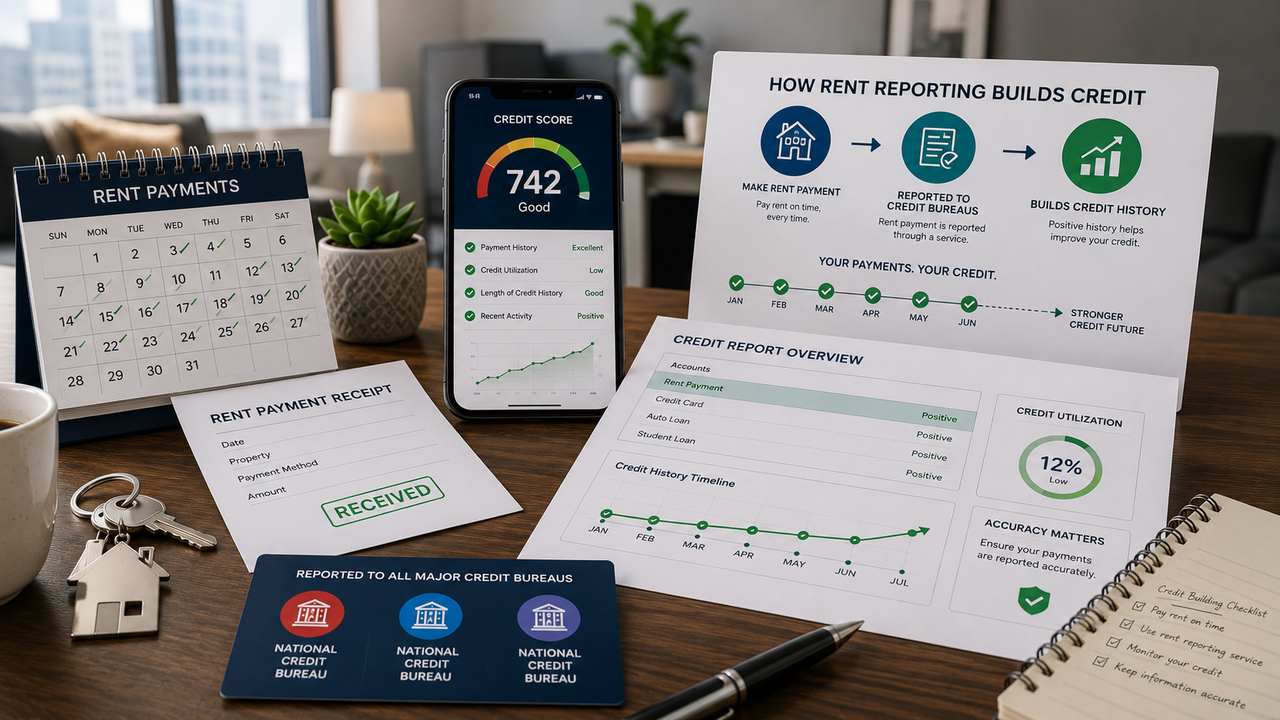
If you’ve paid rent on time every month for years, you’ve probably wondered why that discipline doesn’t show up on your credit report. You’re not alone. Millions of renters across the country faithfully send in their rent checks, yet the three major credit bureaus historically treated those payments as if they never happened. Meanwhile, one missed credit card payment can haunt your score for seven years.
That gap is what rent reporting services aim to close. These services collect verification of your on-time rent payments and report them to credit bureaus so your history of responsible payment behavior becomes part of your credit profile. But before you sign up, it’s worth understanding the honest reality: rent reporting can help some people meaningfully, while for others the impact is modest or even invisible depending on which scoring model a lender pulls.
In this guide, we’ll walk you through everything you need to know about rent reporting, how it works, which bureaus accept the data, whether it actually moves your credit score, how to choose a service, and how it compares to other credit-building strategies. No hype, no promises of overnight fixes. Just a clear, honest breakdown so you can decide whether rent reporting fits your larger credit-building plan.
The Problem: Why Rent Didn’t Appear on Credit Reports
For decades, the credit reporting system in the United States operated with a striking blind spot: rent, the single largest monthly expense for tens of millions of households, was effectively invisible.
Here’s why that happened. The three major credit bureaus — Experian, TransUnion, and Equifax — built their databases around data furnished by lenders. Banks, credit card issuers, auto financiers, mortgage servicers, and student loan providers regularly report your payment activity to the bureaus. Landlords and property management companies, by contrast, were never required to report, and the vast majority had no incentive or infrastructure to do so. Rent payments simply weren’t part of the traditional furnishing ecosystem.
This created a frustrating asymmetry. A single late credit card payment would be reported to all three bureaus almost immediately and could drag your score down for years. But a flawless five-year rent payment history? Invisible. No recognition, no credit score benefit, no signal to future lenders that you reliably handle a large monthly obligation.
The consequences fell hardest on people building credit from scratch, recovering from past financial setbacks, or simply choosing to rent rather than own. If you’re a long-time renter with a thin credit file, your credit score may not reflect the financial discipline you’ve actually demonstrated. That can mean higher interest rates, denied applications, larger security deposits, and a harder path to qualifying for a mortgage when you’re ready to buy.
The credit reporting system wasn’t designed with renters in mind, and it has taken years of advocacy, technology, and policy shifts to begin closing that gap. Rent reporting services are one of the most practical tools to emerge from that effort.
What Rent Reporting Is and How It Works
Rent reporting is the process of having your monthly rent payments verified and submitted to one or more credit bureaus so they appear on your credit report as a trade line — similar to how a credit card or loan account appears.
The Basic Mechanism
Here’s how rent reporting works in practice:
- You enroll with a rent reporting service. Some services work directly with renters, while others partner with landlords or property management platforms.
- Your rent payments are verified. Verification typically happens through bank account connections, payment processors, landlord confirmation, or lease documentation. The service needs to confirm that a payment was actually made, on time, for the amount specified in your lease.
- The service furnishes data to credit bureaus. On a recurring basis (usually monthly), the service sends updated payment records to the bureaus it partners with. Each on-time payment becomes a positive entry on that trade line.
- The bureau adds the data to your credit file. Depending on the bureau and the type of data, the rent trade line may appear on your credit report and potentially factor into certain credit scores.
What Gets Reported
A rent trade line typically includes:
- The rental address associated with the payments
- Monthly payment amount
- Payment dates and status (on-time, late, missed)
- Lease term information in some cases
- The reporting entity’s name
The key thing to understand is that rent reporting services don’t lend you money or extend credit. They’re data furnishers — they pass along verified information about payments you’re already making. That distinction matters because it means rent reporting doesn’t add debt, doesn’t require a credit check to enroll in most cases, and doesn’t carry the risk of borrowing.
The Verification Layer
Verification is the backbone of credible rent reporting. Credit bureaus require that furnished data be accurate and substantiated, which is why rent reporting services can’t simply take your word for it. They need evidence. The most common verification methods include:
- Bank transaction verification — linking your checking account so the service can confirm rent payments cleared on specific dates
- Landlord or property manager confirmation — the service contacts your landlord or integrates with property management software to verify payments
- Payment platform integration — if you pay rent through a platform like a property management portal, the service can pull records directly
- Lease and payment documentation — some services accept lease agreements and bank statements as supporting evidence
The strength of verification affects how widely the data is accepted. Bureaus are more receptive to rent data that comes through rigorous, auditable verification channels.
Which Credit Bureaus Accept Rent Data
Not all three bureaus handle rent data the same way, and understanding the differences is essential before you invest time or money in a rent reporting service.
Experian
Experian has been the most proactive of the three bureaus in incorporating rent payment history. Experian accepts rent data through its Experian RentBureau division, which was specifically built to collect and process rental payment data from property managers, rent reporting services, and other furnishers.
Key points about Experian’s handling of rent data:
- Rent payment history can appear on your Experian credit report
- Experian incorporates rent data into its Experian Boost program, which allows consumers to connect bank accounts and get credit for rent, utilities, streaming services, and other recurring payments
- Experian’s own scoring models and some VantageScore models may reflect rent trade lines
- Rent data furnished through Experian RentBureau is subject to the same accuracy and dispute standards under the Fair Credit Reporting Act (FCRA) as any other tradeline
Experian is generally considered the most rent-friendly bureau. If you’re choosing a rent reporting service and want to prioritize one bureau, Experian is typically the strongest candidate.
TransUnion
TransUnion also accepts rent data, and several rent reporting services furnish to TransUnion. TransUnion has historically been receptive to alternative data sources, including rent, and may include rent trade lines on your TransUnion credit report.
However, the degree to which rent data influences TransUnion-based credit scores depends on the scoring model used. TransUnion offers multiple scoring models, and not all of them weight rent data equally. VantageScore models (which TransUnion offers) tend to be more inclusive of alternative data, while some older FICO models pulled from TransUnion may not factor in rent at all.
Equifax
Equifax is the most complicated of the three when it comes to rent data. Equifax does accept rent trade lines in some cases, but its handling has historically been more limited and less consistent than Experian or TransUnion. Not all rent reporting services furnish to Equifax, and Equifax’s scoring models may not always reflect rent data in the same way.
If Equifax coverage matters to you — for example, if you know a lender you’re planning to apply with pulls Equifax reports — check specifically whether a rent reporting service furnishes to Equifax before enrolling.
What This Means for You
The practical takeaway is that rent data doesn’t automatically appear on all three of your credit reports. If a service only furnishes to Experian, your TransUnion and Equifax reports won’t show your rent history. If you want maximum bureau coverage, look for a service that reports to multiple bureaus, and confirm which ones.
It’s also worth remembering that lenders don’t all pull from the same bureau. A mortgage lender might pull all three. A credit card issuer might pull one. An auto lender might pull a different one. The bureau coverage of your rent reporting matters most in the context of which bureaus the lenders you care about actually use.
Does Paying Rent Actually Build Credit?
This is the question that matters most, and it deserves an honest, nuanced answer rather than a simple yes or no.
The short version: rent reporting can help build credit, but the impact varies significantly depending on your existing credit profile and which scoring model a lender uses.
When Rent Reporting Helps Most
Rent reporting tends to have the most meaningful impact for people with thin credit files — that is, credit reports with few or no active trade lines. If you’re credit invisible or have only one or two accounts, adding a rent trade line with a history of on-time payments can:
- Establish a payment history where little or none existed
- Add depth to your credit file, making you appear less risky to some scoring models
- Help you qualify for credit products that require a minimum number of trade lines
- Provide a foundation on which you can build with other credit tools over time
For renters in this situation, rent reporting can be a genuinely valuable first step. It takes a financial obligation you’re already meeting and converts it into recognized credit history.
The Scoring Model Problem
Here’s where the honest reality comes in. The most widely used credit scoring model in lending decisions is FICO Score 8, and FICO 8 has historically not incorporated rent trade lines in most configurations. This means that even if your rent payments appear on your credit report, a lender pulling a FICO 8 score may not see any score improvement from that data.
VantageScore models — particularly VantageScore 3.0 and 4.0 — have been more receptive to alternative data, including rent. If a lender uses VantageScore, your rent reporting may positively influence the score you’re presented with.
The problem is that most consumers don’t know which scoring model a lender will use until they apply. And since FICO models dominate mortgage lending and many credit card decisions, rent reporting alone may not move the needle in those specific contexts.
What This Means in Practice
Let’s be concrete about what you can realistically expect:
- If you have a thin file and are building from scratch, rent reporting can meaningfully help by establishing a trade line and payment history that wasn’t there before.
- If you already have several active credit accounts with good history, rent reporting is unlikely to move your score much because your payment history is already well-established through other trade lines.
- If a lender uses FICO 8, rent data may appear on your report but may not affect the score itself.
- If a lender uses VantageScore or a newer FICO model that incorporates alternative data, rent reporting may have a more visible effect.
The most balanced way to think about rent reporting is as one tool in a broader credit-building strategy, not as a standalone solution. It’s especially valuable for people who are early in their credit journey or rebuilding after setbacks. For someone with a thick, established file, the benefit is smaller.
Types of Rent Reporting Services
Rent reporting services come in several varieties, and understanding the categories helps you evaluate which fits your situation.
Direct-to-Consumer Services
These services work directly with renters. You enroll on your own, connect your bank account or provide payment verification, and the service reports your rent to bureaus on a monthly basis. This is the most common type and the most accessible for renters whose landlords don’t participate in any reporting program.
Examples in this category include Esusu and Boom report, among others. Each has its own fee structure, bureau coverage, and feature set.
Landlord-Partnered Services
Some services work primarily through landlords and property management companies. The landlord enrolls the property, and rent payments made through the property’s system are automatically reported to bureaus. As a renter, you may be enrolled automatically or have the option to opt in.
This model can be seamless for the renter because verification happens through the property’s payment system. However, it depends entirely on your landlord participating, and many smaller landlords do not.
Bureau-Native Tools
Experian offers Experian Boost, which allows you to connect your bank account and get credit for rent payments, utilities, telecom bills, and streaming services. Boost is free and focuses on giving you credit for positive payment history on recurring bills. The trade-off is that Boost primarily influences your Experian-based scores and the impact varies.
What to Look For
Regardless of category, the services worth considering share certain characteristics:
- Clear fee structure with no hidden charges
- Transparency about which bureaus they report to
- Robust verification methods so the data is credible to bureaus
- Options for retroactive reporting if you want past payments counted
- FCRA-compliant dispute process if reported information is inaccurate
- Accessible customer support
We’ll get into a detailed comparison framework in the next section.
How to Choose a Rent Reporting Service
Choosing a rent reporting service comes down to matching a service’s strengths to your specific situation and goals. Here’s a framework for evaluating your options.
Comparison Table: What to Evaluate
| Factor | Why It Matters | What to Look For |
|---|---|---|
| Bureau coverage | Determines which of your credit reports show rent history | Services that report to multiple bureaus, especially Experian and TransUnion |
| Monthly fee or one-time cost | Affects total cost over time | Low or transparent fees; avoid services with unclear pricing or hidden upsells |
| Retroactive reporting | Allows past on-time payments to count, sometimes up to 24 months | Services that offer history backfill if establishing longer track record matters to you |
| Verification method | Affects data credibility and bureau acceptance | Bank linking, landlord confirmation, or payment platform integration |
| Landlord involvement required | Determines whether you can enroll independently | Services that let you enroll without landlord participation if your landlord isn’t involved |
| Credit check on enrollment | Some services pull credit, which can create a hard inquiry | Services that don’t require a hard credit pull to enroll |
| Cancellation terms | Life changes; you shouldn’t be locked in | Clear, simple cancellation without penalties |
| FCRA compliance and dispute process | Protects your right to correct inaccurate reported data | Published dispute process and clear compliance language |
| User reviews and reputation | Signals reliability and customer experience | Consistent positive reviews and a track record of accurate reporting |
| Additional features | Some services offer credit monitoring, identity tools, or financial coaching | Features that align with your broader financial goals |
Questions to Ask Before Enrolling
Before you commit to a service, get clear answers to these questions:
- Which bureaus will receive my rent data? If you care about a specific bureau, confirm it’s covered.
- How much will this cost me over a year? Multiply the monthly fee by 12 and add any setup fees.
- Can my past rent payments be reported, and how far back? This matters if you want credit for established history.
- Will enrolling create a hard inquiry on my credit report? Hard inquiries can temporarily lower your score.
- What happens if I move mid-lease? Make sure you understand how the service handles address changes and new leases.
- How do I dispute inaccuracies in reported rent data? You should have a clear path under FCRA to correct errors.
- What happens if a rent payment is late? Understand whether the service reports late payments and how that could affect you.
A Note on Fees
Rent reporting services typically charge either a monthly subscription, a one-time setup fee, or both. Some offer free basic tiers with paid upgrades. Be cautious of services that promise dramatic score increases or charge premium prices without clearly explaining what you’re getting. Credit building is a gradual process, and no legitimate service can guarantee a specific score outcome.
Can Past Rent Payments Count?
One of the most common questions about rent reporting is whether past rent payments can be added to your credit report retroactively. The answer is: yes, in some cases, but with important limitations.
How Retroactive Reporting Works
Some rent reporting services offer the ability to backfill your rent payment history — meaning they verify and report payments you made in the past, not just going forward. This can be valuable if you have a strong history of on-time rent payments over the past year or two and want that track record reflected on your credit report.
The typical maximum for retroactive reporting is up to 24 months of past payments, though the exact window depends on the service and what verification they can obtain for older payments.
What’s Required for Retroactive Reporting
To report past rent payments, the service needs to verify that those payments actually occurred. This usually requires:
- Bank statements showing rent payments clearing your account on specific dates
- Lease agreements documenting the rental terms and dates
- Landlord confirmation of payment history in some cases
- Payment platform records if you paid through an online system
The older the payments, the harder verification becomes. Services that offer retroactive reporting typically cap how far back they’ll go, and some charge an additional fee for backfilling history.
When Retroactive Reporting Is Worth It
Retroactive reporting is most valuable when:
- You have a limited credit history and want to add depth quickly
- You’re planning to apply for credit in the near future and want your report to reflect your established rent track record
- You have verifiable documentation of past payments readily available
It’s less essential if you’re planning to rent at the same place for a long time and can simply let ongoing monthly reporting build your history over time.
Pros and Cons of Rent Reporting
Like any credit-building tool, rent reporting has strengths and limitations. Here’s an honest look at both sides.
Pros
- Recognizes payment behavior you’re already demonstrating. If you’re paying rent on time, rent reporting converts that existing discipline into credit history without requiring you to take on new debt.
- No new borrowing required. Unlike a credit card or loan, rent reporting doesn’t extend credit or create new debt. You’re simply getting recognition for payments you’re already making.
- Can help build a file from scratch. For people with thin or no credit history, adding a rent trade line establishes a payment record where none existed.
- May help with rental screening. Some landlords and property management companies review credit reports during the application process. A positive rent trade line can reinforce your reliability as a tenant.
- Low cost relative to other credit-building tools. Many rent reporting services are inexpensive compared to secured credit cards or credit-builder loans, especially if your primary goal is simply to add a positive trade line.
- May positively influence VantageScore models. If a lender uses VantageScore, your rent data may be reflected in the score.
Cons
- FICO Score 8 often ignores rent data. The most widely used scoring model in lending may not factor in rent trade lines, meaning the score many lenders see may not reflect your rent history.
- Bureau coverage is inconsistent. Not all services report to all three bureaus, so your rent history may appear on some reports but not others.
- Impact is limited for thick files. If you already have multiple active credit accounts with good payment history, adding rent reporting is unlikely to meaningfully change your score.
- Late payments can be reported too. If a service reports your rent and you later pay late, that negative information can appear on your credit report just like a late credit card payment.
- Fees can add up over time. A monthly subscription may seem small, but over years the cumulative cost may exceed the benefit, especially if the score impact is minimal.
- Verification can be friction-heavy. Connecting accounts, gathering documentation, and coordinating with landlords takes time and effort.
Rent Reporting vs. Other Credit-Building Methods
Rent reporting is one of several tools that can help build or rebuild credit. Understanding how it compares to other options helps you build a strategy rather than relying on a single approach.
Rent Reporting vs. Secured Credit Cards
A secured credit card requires a refundable deposit that becomes your credit line. You use the card for small purchases, pay it off on time each month, and the issuer reports your activity to the bureaus.
- Secured cards report to all three bureaus and influence FICO scores, making them more universally impactful than rent reporting for score-building purposes.
- Rent reporting doesn’t require a deposit or new borrowing, but its score impact may be more limited.
- Best approach: Many people benefit from using both. A secured card builds FICO-relevant history while rent reporting adds an additional positive trade line.
Rent Reporting vs. Credit-Builder Loans
A credit-builder loan holds the loan amount in a savings account while you make monthly payments. Once paid off, you receive the funds. The lender reports your payments to the bureaus.
- Credit-builder loans create an installment trade line, which diversifies your credit mix — a factor in many scoring models.
- Rent reporting adds a different type of trade line but doesn’t contribute to credit mix in the same way.
- Best approach: If you can afford the monthly payment, a credit-builder loan can be a strong complement to rent reporting, especially for people rebuilding after negative marks.
Rent Reporting vs. Authorized User Status
Being added as an authorized user on someone else’s credit card allows that account’s history to appear on your credit report.
- Authorized user status can rapidly add a long, positive payment history to your report if the primary account is in excellent standing.
- Rent reporting builds history based on your own behavior, which some lenders view more favorably than authorized user status.
- Best approach: If you have a trusted family member with a strong credit account, authorized user status can be a quick win, while rent reporting builds independent history over time.
Rent Reporting vs. Experian Boost
Experian Boost is a free tool that connects to your bank account and identifies eligible on-time payments for rent, utilities, telecom, and streaming services, then adds them to your Experian credit file.
- Experian Boost is free and immediate but only affects your Experian-based scores.
- Rent reporting services may offer broader bureau coverage and deeper rent-specific reporting but typically charge fees.
- Best approach: If your priority is Experian specifically, start with Boost. If you want broader coverage or retroactive reporting, a paid service may be worth considering.
A Balanced Strategy
The strongest credit-building strategies typically combine multiple tools rather than relying on a single one. For someone building from scratch, a reasonable approach might include rent reporting for ongoing recognition, a secured credit card for FICO-relevant payment history, and consistent on-time payments across all obligations. Over time, these layers compound into a robust credit profile that reflects your actual financial responsibility.
Common Mistakes to Avoid
Rent reporting can be helpful, but certain missteps can undermine the benefit or even create new problems.
1. Assuming Rent Reporting Will Fix a Damaged Score
Rent reporting adds positive payment history, but it doesn’t remove negative items like late payments, collections, or charge-offs that are already on your report. If your score is suffering from inaccurate negative marks, disputing those errors under the FCRA is typically more impactful than adding rent data alone. Rent reporting is a complement to credit repair, not a substitute for it.
2. Choosing a Service Without Checking Bureau Coverage
If you enroll with a service that only reports to Experian, your TransUnion and Equifax reports won’t reflect your rent history. Before enrolling, confirm which bureaus the service furnishes to and align that with the bureaus your prospective lenders use.
3. Ignoring the Cost Over Time
A service charging $8 per month costs nearly $100 per year. If the score impact is minimal because you already have a thick file, that money may be better spent elsewhere in your financial plan. Evaluate the realistic benefit before committing long-term.
4. Forgetting That Late Payments Get Reported Too
Once a service is reporting your rent, late or missed payments can appear on your credit report as negative entries. If there’s a chance you’ll struggle with rent payments in the near future, weigh that risk before enrolling in ongoing reporting.
5. Not Verifying That Payments Are Actually Being Reported
Enrollment doesn’t guarantee successful reporting. Pull your credit reports from all three bureaus periodically (you’re entitled to free reports at AnnualCreditReport.com) to confirm the rent trade line is appearing as expected. If it’s not, follow up with the service.
6. Overlooking FCRA Rights
Under the Fair Credit Reporting Act, you have the right to dispute inaccurate information on your credit report, including inaccurate rent trade lines. If a rent reporting service reports a late payment you actually made on time, you can dispute it with both the service and the bureau. Don’t assume reported data is always accurate — verify it.
7. Treating Rent Reporting as a Standalone Solution
As discussed above, rent reporting is most effective as part of a layered strategy. Relying on it alone, especially if you’re rebuilding after financial setbacks, may leave you underprepared when you apply for a mortgage, auto loan, or credit card.
Frequently Asked Questions
Does paying rent build credit automatically?
No. Rent payments do not appear on your credit reports unless they are actively reported by a rent reporting service, your landlord, or a property management platform. Simply paying rent on time, by itself, does not build credit. You need a reporting mechanism in place for that payment history to reach the bureaus.
Which credit bureau is most receptive to rent data?
Experian is generally considered the most rent-friendly bureau through its Experian RentBureau division and Experian Boost program. TransUnion also accepts rent data from various services. Equifax’s handling of rent data has historically been more limited. If bureau coverage matters to you, confirm which bureaus a service reports to before enrolling.
Will rent reporting increase my FICO score?
It depends. FICO Score 8, the most widely used model in lending, has historically not incorporated rent trade lines in most configurations, so your FICO 8 score may not change. Newer FICO models and VantageScore models may be more receptive to rent data. If a specific lender uses a scoring model that includes alternative data, you may see an effect. The impact is most noticeable for people with thin credit files.
Can I report rent payments from a previous apartment?
In some cases, yes. Certain rent reporting services offer retroactive reporting of past rent payments, typically up to 24 months, provided you can verify those payments through bank statements, lease documents, or landlord confirmation. Not all services offer this, and some charge an additional fee for backfilling history.
Is Experian Boost the same as a rent reporting service?
Not exactly. Experian Boost is a free tool that scans your connected bank account for eligible on-time payments — including rent, utilities, telecom, and streaming — and adds them to your Experian credit file. It only affects Experian-based scores. A dedicated rent reporting service may offer broader bureau coverage, retroactive reporting, and deeper rent-specific features, but typically charges fees. They serve different needs and can complement each other.
What happens if I pay rent late while enrolled in a reporting service?
If a rent reporting service is furnishing your payment data to bureaus, a late payment may be reported as a negative entry on your credit report, similar to a late credit card payment. This can harm your credit score. Before enrolling, understand the service’s policy on late payments and consider whether your financial situation is stable enough to avoid missing rent while enrolled.
Do I need my landlord’s involvement to use a rent reporting service?
It depends on the service. Some direct-to-consumer services allow you to enroll independently by connecting your bank account and providing verification. Others work through landlords and property management platforms, requiring your landlord to participate. If your landlord isn’t enrolled in any reporting program, look for a service that supports independent enrollment.
How much do rent reporting services cost?
Costs vary. Some services charge a one-time setup fee, others a monthly subscription, and some offer free basic tiers with paid upgrades. Typical monthly fees range from around $5 to $10, though premium features or retroactive reporting may cost more. Always read the fee structure carefully and calculate the annual cost before committing.
Take the Next Step Toward Stronger Credit
Rent reporting is one piece of a larger credit-building picture, and whether it’s the right next step for you depends on your current credit profile, your goals, and the lenders you’re planning to work with. If you have a thin file and pay rent consistently, it can be a meaningful addition. If you’re navigating negative marks on your credit report, inaccurate trade lines, or a complex credit history, rent reporting alone won’t solve those issues.
That’s where a comprehensive approach comes in. At credit-repair.com, we help individuals and families across the country take control of their financial future through honest, results-driven credit solutions. Our process includes in-depth credit audits across all three major bureaus, disputing inaccuracies under the FCRA, negotiating with creditors, removing negative marks where legally warranted, and building fully customized repair plans tailored to each client’s goals.
Get your free credit audit or request a quote at credit-repair.com.
This article is for educational purposes only and does not constitute legal or financial advice. Your individual situation may vary. The information provided reflects general principles of federal credit law as of the date of writing and may be subject to change. For advice specific to your circumstances, consult a qualified professional.
Leave a Reply