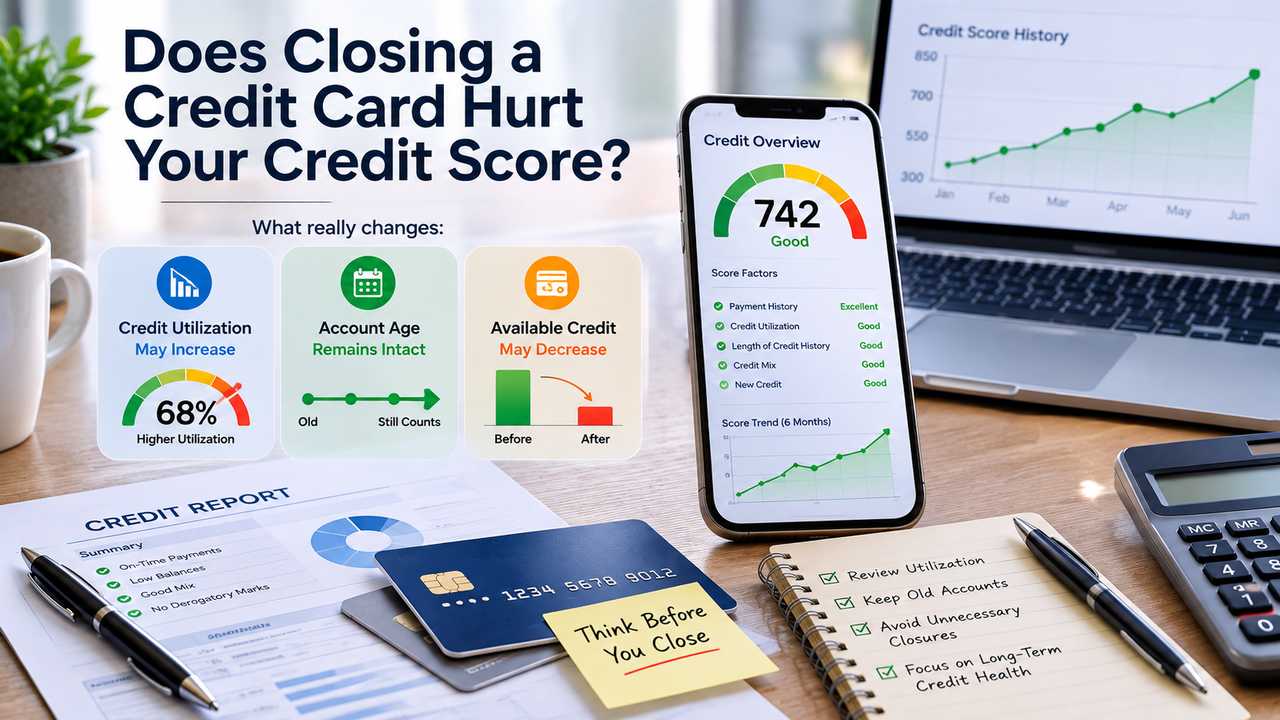
You’ve probably heard the advice a hundred times: “Never close a credit card it’ll tank your score.”
It’s one of the most repeated rules in personal finance. It’s also one of the most misunderstood.
Here’s the truth: closing a credit card can hurt your credit score but not always, not always by much, and not for the reason most people think. In some cases, closing a card is genuinely the right move for your financial health, and the credit-score impact is small and temporary.
In this guide, we’ll walk through what actually happens to your score when you close a card, when it matters most, when it doesn’t, and how to close a card the right way if you decide it’s time. No scare tactics, no quick-fix promises just a clear, honest breakdown so you can make the call with confidence.
The Short Answer
Does closing a credit card hurt your score? It can but the real answer depends on two things: your credit utilization and the age of your other accounts.
When you close a credit card, you lose that card’s credit limit. If you carry balances on other cards, your overall utilization ratio (how much of your available credit you’re using) can go up and that’s the change that most commonly drags your score down. Utilization is one of the most heavily weighted factors in your credit score, accounting for about 30% of your FICO Score.
The second common worry that closing a card shortens your credit history is mostly a myth in the short term. A closed account in good standing stays on your credit report for up to 10 years, and it continues to count toward your average age of accounts during that time. So the length-of-history impact is delayed, not immediate.
So:
- If the card has a high credit limit and you carry balances elsewhere, closing it can raise your utilization and lower your score sometimes noticeably.
- If the card has a small limit, or you pay your balances in full each month, the impact may be minimal or even unmeasurable.
- If it’s your only or oldest card, closing it carries more risk because you’re shrinking your credit profile and, eventually, your average account age.
- If you have several other older accounts in good standing, closing one card is unlikely to do meaningful damage.
The decision isn’t “never close a card.” It’s “close the right card, at the right time, the right way.” Let’s look at the mechanics.
The Two Main Impacts of Closing a Card
When you close a credit card, two parts of your credit score can be affected: credit utilization and length of credit history. Let’s take each one apart.
Impact #1: Credit Utilization (The One That Usually Matters Most)
Credit utilization is the percentage of your available credit that you’re currently using. It’s calculated both per card and across all your cards combined.
For example, say you have two cards:
| Card | Credit Limit | Balance | Utilization |
|---|---|---|---|
| Card A | $10,000 | $2,000 | 20% |
| Card B | $5,000 | $0 | 0% |
| Total | $15,000 | $2,000 | 13.3% |
Your overall utilization is 13.3% well within the healthy range (most experts recommend keeping it under 30%, and under 10% is even better for top-tier scores).
Now suppose you close Card B because you never use it. Your available credit drops from $15,000 to $10,000. Your balance stays at $2,000. Your new utilization:
New utilization = $2,000 ÷ $10,000 = 20%
That’s a jump from 13.3% to 20% still under 30%, but higher. Your score may dip a little.
Now consider a more dramatic example. Same two cards, but you carry more debt:
| Card | Credit Limit | Balance | Utilization |
|---|---|---|---|
| Card A | $10,000 | $4,500 | 45% |
| Card B | $5,000 | $0 | 0% |
| Total | $15,000 | $4,500 | 30% |
Close Card B, and your available credit falls to $10,000 while your balance stays at $4,500:
New utilization = $4,500 ÷ $10,000 = 45%
You’ve gone from 30% to 45% — crossing well above the 30% threshold that FICO treats as a yellow flag. That kind of jump can produce a meaningful score drop, sometimes 20–50 points or more depending on the rest of your profile.
Why this matters so much: Utilization is evaluated instantaneously. Unlike payment history, which builds over time, your utilization is recalculated every time a card issuer reports your balance to the credit bureaus (usually once a month, on your statement closing date). That means a utilization change from closing a card can show up on your score within a single billing cycle.
The key takeaway: The utilization impact from closing a card depends entirely on whether you carry balances on other cards and how large the closed card’s limit was relative to your total credit.
- No balances anywhere? Closing a card typically has little to no utilization impact.
- Carrying balances? Closing a high-limit card can push your utilization up and your score down.
Impact #2: Length of Credit History (The One People Get Wrong)
This is where most of the confusion lives.
A lot of people believe that the moment you close a credit card, it disappears from your credit report and your “credit age” resets. That’s not how it works.
Here’s what actually happens:
- When you close a credit card that’s in good standing (no late payments, not charged off), the account stays on your credit report for up to 10 years from the date of closure.
- During that entire period, the closed account continues to be factored into your average age of accounts (AAoA) and your oldest-account age two metrics that influence the “length of credit history” portion of your score (about 15% of your FICO Score).
- Only after the account finally falls off your report roughly a decade later does it stop contributing to your credit history length.
So if you close a 12-year-old card today, it keeps helping your average account age until you’re 22 years out. By then, your other accounts will have aged considerably, softening the impact.
This is the nuance most people miss: The length-of-history impact from closing a card isn’t immediate. It’s delayed by years, often a decade. The thing that does hit quickly is utilization.
There’s one important exception: if the closed card was your only credit account or your oldest by a wide margin, the eventual drop-off matters more because you’ll have less depth to absorb it. We’ll cover that in the next section.
The key takeaway: Don’t close a card out of fear that your credit history will vanish overnight. It won’t. A closed account in good standing keeps working for you for years. The urgency around “never close a card” is mostly about utilization, not history.
When Closing a Card Hurts Most
Not every closure carries the same risk. Closing a card is most likely to hurt your score when one or more of the following is true.
1. It’s your only credit card (or one of very few)
Credit scoring models reward a diverse, established credit profile. If you only have one or two credit cards, closing one shrinks your credit picture significantly.
With fewer open accounts, your utilization becomes more volatile (one balance can swing the ratio dramatically), and your file looks thinner to lenders.
If you’re going to close your only card, it’s worth opening a replacement first (or exploring alternatives like a product change — more on that below) so you don’t end up with no revolving credit at all.
2. It’s your oldest credit account
Your oldest account age is a anchor point for your credit history. Closing your oldest card doesn’t erase it immediately — remember, it stays on your report for up to 10 years — but when it eventually falls off, your credit age could shorten noticeably if you haven’t added other long-standing accounts in the meantime.
If your oldest card is your only old account, think twice. If you have several other accounts that are also 10+ years old, closing one is much lower risk.
3. It has a large credit limit and you carry balances elsewhere
This is the classic utilization trap. If the card you’re closing carries a big chunk of your total available credit and you maintain balances on other cards, closing it will push your overall utilization up — sometimes significantly.
Before closing a high-limit card, do the math:
If that number lands above 30%, expect a score dip. If it lands above 50%, expect a more noticeable one.
4. You’re planning to apply for a major loan soon
If you’re within 3–6 months of applying for a mortgage, auto loan, or any other major credit product, avoid unnecessary changes to your credit profile. Even small score movements can affect the interest rate you’re offered. A difference of 20 points on a mortgage can translate to thousands of dollars over the life of the loan.
In this window, keep your credit picture stable: don’t close cards, don’t open new cards, don’t miss payments, and keep utilization low.
5. The card has a long clean payment history you’d lose
If the card has years of on-time payments and it’s one of your few accounts with a spotless record, closing it (and eventually losing it from your report) removes a piece of positive payment history. Payment history is the single biggest factor in your score at about 35%, so a long clean track record is worth preserving when you can.
That said — remember the 10-year rule. The payment history doesn’t vanish the day you close the card. It keeps contributing for years. The concern is mainly about the long-term picture, not the immediate impact.
When Closing a Card Makes Sense
For all the talk about keeping cards open, there are absolutely situations where closing a card is the right financial decision — even if it causes a small, temporary score dip. Your credit score is a tool that serves your financial life, not the other way around.
Here are the scenarios where closing makes good sense.
1. You’re paying an annual fee you don’t use
This is the most common and most defensible reason to close a card. If you’re paying $95, $250, or $450 a year for a card whose perks you no longer use, that’s pure cost with no benefit.
Before closing, check whether the issuer offers a product change to a no-annual-fee version of the card (more on this below). A product change lets you keep the account open — preserving your credit limit and account age — while dropping the fee. If that’s not available or appealing, closing is reasonable.
Do the math honestly: if the annual fee is $250 and you’re not getting $250 worth of value from the card, closing it saves you real money. A temporary score dip of 10–20 points is usually worth $250 a year.
2. The card tempts you to overspend
This one is underrated. If having a particular card in your wallet leads you to spend more than you should — maybe it’s a store card that pulls you toward impulse purchases, or a travel card that encourages trips you can’t really afford — the financial damage of overspending will far outweigh any credit-score impact from closing it.
Credit scores don’t measure your overall financial health. They measure how you manage borrowed money. If a card is actively working against your financial goals, closing it is a legitimate choice.
3. You have plenty of other old accounts
If you have several other credit cards that are older than or comparable in age to the one you’re considering closing, the impact on your average account age (both now and when the closed card eventually falls off) is minimal. In this case, the length-of-history concern is mostly a non-issue, and as long as utilization is managed, closing is low risk.
4. You’re simplifying your financial life
Every open credit account is one more thing to monitor for fraud, one more statement to review, one more due date to track, one more potential source of missed-payment damage. If you’re consolidating your finances — maybe after a life change like marriage, divorce, or a move — closing a card or two to reduce complexity is a reasonable choice. Just be thoughtful about which cards you close.
5. The card has poor terms and a better option exists
If you’re holding onto a card with a high APR, a low credit limit, poor customer service, or no upgrade path, and you’ve already been approved for a better card, there’s little reason to keep the old one on life support. This is especially true if the old card’s limit is small enough that closing it won’t meaningfully change your overall utilization.
6. A joint account situation needs resolving
After a divorce or business partnership dissolution, you may need to close joint credit accounts to protect yourself from the other person’s spending or payment behavior. In these cases, closing is often necessary regardless of the score impact. Work with the issuer to close the account properly, and consider opening a new individual account to replace it.
How to Close a Credit Card the Right Way
If you’ve decided closing a card is the right move, do it carefully. A sloppy closure can create problems that are entirely avoidable. Here’s the step-by-step process.
Step 1: Pay the balance down to zero
You generally cannot close a card while it carries a balance — and even if the issuer allows it, it’s a bad idea. A closed account with a balance can continue to accrue interest, and you lose the ability to make new purchases to help manage cash flow.
Pay the balance in full, or transfer it to another card with a balance transfer offer if needed. Confirm the payoff includes any pending interest charges (call the issuer to get a precise payoff amount if you’re unsure).
Step 2: Redeem or transfer your rewards
If the card earns cash back, points, or miles, redeem them before closing. Most issuers forfeit any unredeemed rewards the moment the account is closed. Some cards let you transfer points to another card with the same issuer or to a travel partner — check the rules for your specific card.
Don’t leave money on the table. Even $25 in cash back is worth claiming before you shut the door.
Step 3: Redirect recurring charges and auto-pays
This is the step people forget — and it causes the most headaches.
Go through your last 6–12 months of statements and identify every recurring charge on the card: subscriptions (Netflix, gym, software), utilities, insurance premiums, auto-pays, mobile phone billing, streaming services, and any memberships.
Move each one to a different card (or to a debit card if you prefer) before closing. Then watch the next billing cycle carefully to confirm nothing slips through. A missed auto-pay on a closed card can result in a late payment or a service interruption — both of which create more headaches than the closure itself.
Pro tip: some people keep a dedicated “bills card” that they never close and never carry a balance on, specifically to centralize recurring charges and avoid this chore in the future.
Step 4: Call the issuer and confirm the payoff
Ask them to confirm the account is eligible for closure and whether there are any pending transactions or fees that might post after closure.
This phone call is worth the five minutes. It prevents the surprisingly common scenario of a tiny residual interest charge generating a balance on a closed account, which can then trigger late fees and a negative mark on your credit report if it goes unpaid.
Step 5: Request closure in writing (or via a documented channel)
Close the account through the issuer’s official channel — usually by phone, secure message, or online chat. Ask for written confirmation of the closure, including the date and the fact that the account was closed at your request (not by the issuer).
The distinction matters: an account “closed by creditor” can look slightly worse to future lenders than one “closed by consumer.” Make sure your credit report reflects that you initiated the closure. If it doesn’t, you have the right to dispute it with the credit bureaus under the FCRA.
Step 6: Keep your oldest card open
If the card you’re closing isn’t your oldest, make sure your oldest credit card stays open and active. This preserves the anchor of your credit history and protects your average account age over the long term.
If your oldest card has an annual fee you don’t want to pay, ask the issuer about a product change to a no-fee version (see below). Keeping the account open in some form is almost always better than closing your oldest card outright.
Step 7: Monitor your credit report after closure
Pull your credit report 30–60 days after closing to confirm the account is showing as “closed” and “paid” or “current” with a $0 balance. You’re entitled to a free report from each of the three bureaus every week at AnnualCreditReport.com — take advantage of it.
If the account is still showing as open, or if it’s incorrectly reported as “closed by creditor” with a balance, file a dispute with the bureau reporting the error. Under the FCRA, inaccurate information must be corrected or removed, typically within 30 days.
Step 8: Watch your utilization on remaining cards
After closure, keep your balances low on your remaining cards for at least one billing cycle so the utilization change doesn’t bite harder than it needs to. If you can pay balances down before the statement closing date (not just the due date), you’ll keep the reported utilization as low as possible.
Alternatives to Closing a Card
Before you close a card, it’s worth checking whether one of these alternatives gets you what you want without the downsides.
Product change
A product change is when you switch your current card to a different card within the same issuer’s portfolio — for example, converting a $95-annual-fee travel card to a no-annual-fee cash-back card from the same bank.
Why this is often better than closing:
- The account stays open, so your credit limit and account age are preserved.
- No hard inquiry — product changes typically don’t require a new credit pull.
- You keep the payment history and the account’s contribution to your credit profile.
- You drop the fee (or get a card that better fits your spending).
Almost every major issuer offers product changes. Call the number on the back of your card and ask: “I’m considering closing this card because of the annual fee. Can I product-change to a no-annual-fee option?” They’ll often have several choices.
Downgrade to a no-fee card
This is essentially a product change focused specifically on eliminating the annual fee. Many premium cards have a no-fee sibling in the same family. For example, a premium travel card might downgrade to a basic rewards card with no annual fee and fewer perks but the same credit limit and account history.
Keep the card open but inactive
If the card has no annual fee, you don’t actually have to use it regularly for it to help your credit. You can keep it open with a small recurring charge (like a single subscription) set to autopay in full each month. This keeps the account active, prevents the issuer from closing it for inactivity, and preserves your credit limit and account age — all without requiring you to carry the card or think about it.
A warning on inactivity: issuers can close accounts for inactivity, typically after 12–24 months of no usage. An involuntary closure for inactivity looks the same on your credit report as a closure by the creditor and can still affect your utilization. So if you’re keeping a card open for credit-building purposes, put one small recurring charge on it and set it to autopay. Set it and forget it.
Request a credit limit increase on another card first
If your reason for hesitation is the utilization impact, you can ask for a credit limit increase on another card before closing the one you want to drop. If approved, the new limit can offset the limit you’re losing, keeping your overall utilization roughly the same.
This does sometimes involve a hard inquiry, so check with the issuer about whether they’ll do a soft-pull increase (many will if you ask). A soft pull has no impact on your score.
Open a new card before closing the old one
If the card you’re closing has a meaningful credit limit and you want to preserve your total available credit, you can open a new card with a comparable limit first, then close the old one. Your total available credit stays about the same, and your utilization is unchanged.
The trade-off: the new card will come with a hard inquiry and will lower your average account age slightly. But if the new card has better terms, no annual fee, and a similar limit, this can be a net positive. Just avoid doing this if you’re planning to apply for a mortgage or auto loan in the next 6 months.
How to Offset the Utilization Hit
If closing a card will push your utilization up, here are concrete ways to soften or eliminate the impact.
Pay down balances on your other cards
This is the most direct and effective method. Since utilization is a ratio — balances divided by available credit — lowering the numerator (your balances) offsets losing credit limit from the denominator.
For example, if closing a card will move you from $15,000 to $10,000 in available credit, and you currently carry $3,000 in balances, your utilization would jump from 20% to 30%. But if you pay down $1,000 before closing, your new utilization would be:
$2,000 ÷ $10,000 = 20%
You’ve neutralized the impact entirely. Paying down debt is also the single best thing you can do for your overall financial health, so this is a win-win.
Ask for credit limit increases on your remaining cards
As mentioned above, you can request limit increases on your other cards to replace the limit you’re losing. Many issuers will grant these with a soft credit pull (no score impact) if your account is in good standing and you haven’t had a recent increase.
Call or use the issuer’s online portal to request an increase. If they ask whether they can do a hard pull, you can decline and try again later or with a different issuer.
Time the closure strategically
If you have the flexibility, time your card closure around your billing cycles. Wait until right after your statements close and balances are reported as low (or zero), then close the card. This gives you a window where your reported utilization is already favorable, and any dip from the closure is less likely to be compounded by a high balance reporting at the same time.
Open a new card (with caution)
Opening a new card adds available credit, which can offset the loss from closing another. But be aware:
- The new application triggers a hard inquiry (small, short-term score impact, usually 1–5 points).
- The new account lowers your average account age temporarily.
- You’ll need good enough credit to be approved.
If you were planning to get a new card anyway, doing it around the same time as closing an old one can be a smart move — the new limit replaces the old one, and you end up with a card that better fits your needs.
Use the “AZEO” method before a major application
If you’re closing a card and also planning to apply for a major loan soon, consider the AZEO (All Zero Except One) strategy: pay all your cards to $0 except one, and let that one report a small balance (under 10% of its limit). This produces the lowest possible utilization score and can offset the impact of a recent closure. Just be sure to execute this at least 30–60 days before your loan application so the low balances have time to report.
Common Myths About Closing Credit Cards
Let’s clear up some of the most persistent misconceptions.
Myth 1: “Closing a card immediately removes it from your credit report.”
False. A closed account in good standing stays on your report for up to 10 years and continues to contribute to your average account age and payment history during that time. Only negative-information accounts (like charge-offs or accounts closed by the creditor with a balance) drop off sooner — typically after 7 years.
Myth 2: “Closing a card always hurts your score.”
Not always. If you pay your balances in full every month and have several other older accounts, closing a card may have a negligible impact — sometimes zero measurable change. The score effect depends on your utilization, your overall credit profile, and which card you’re closing.
Myth 3: “You should never close your oldest card.”
Mostly true, but not absolute. Your oldest card is valuable because it anchors your credit history length. But if it has an annual fee, poor terms, and you have other accounts that are nearly as old, the math may favor closing it — especially if you can product-change it to a no-fee version instead. The blanket rule oversimplifies a decision that should be based on your full profile.
Myth 4: “Closing a card erases the payment history on it.”
False. The payment history — including all those years of on-time payments — stays on your report along with the account for up to 10 years after closure. You don’t lose the positive history the day you close the card.
Myth 5: “Closing a card helps your score because it shows you’re being responsible.”
False. Credit scoring models don’t interpret closure as a signal of responsibility or irresponsibility. They simply recalculate your score based on the updated data — utilization, account ages, payment history, and so on. Closing a card doesn’t earn you any “good behavior” credit.
Myth 6: “A closed account stops aging your credit history.”
False. A closed account in good standing continues to age while it’s on your report. A card you’ve had for 8 years and then close will show as 9, 10, 11 years old in subsequent years, right up until it falls off at the 10-year mark.
Myth 7: “Store cards don’t matter if you close them.”
False. Store cards are real credit accounts reported to the bureaus. Closing one affects your utilization and account age just like any other card. The main difference is that store cards often have lower limits, so the utilization impact per card is usually smaller — but they still count.
Myth 8: “You can close a card online and it’s done instantly with no consequences.”
Partially true, but risky. You can often initiate closure online, but you still need to handle the pre-closure checklist: pay to zero, redeem rewards, redirect auto-pays, and confirm the $0 balance. Skipping these steps can leave you with residual balances, lost rewards, or missed recurring charges that turn into late payments.
Frequently Asked Questions
Q1: How many points will my score drop if I close a credit card?
There’s no fixed number — it depends on your full credit profile. If you pay your balances in full and have several other old accounts, the drop may be 0–10 points or unmeasurable. If closing the card pushes your utilization from under 30% to over 50%, you could see a drop of 20–50 points or more. The biggest factor is almost always the change in your utilization ratio, not the closure itself.
Q2: Should I close my oldest credit card?
Usually no — your oldest card anchors your credit history length, and keeping it open preserves that anchor for as long as the account stays on your report (up to 10 years after closure, but keeping it open keeps it on your report indefinitely). If the card has an annual fee, try a product change to a no-fee version first. If that’s not possible and the fee isn’t worth it, closing may be justified — but explore alternatives before you do.
Q3: Does closing a credit card with a zero balance hurt your score?
It can, but usually less than closing one with a balance. The main risk is the utilization impact from losing the credit limit. If you have no balances on any of your cards, closing a zero-balance card has minimal score impact because your utilization is already 0%. If you carry balances elsewhere, losing the limit can still raise your overall utilization even though the closed card itself had a zero balance.
Q4: How long does a closed credit card stay on my credit report?
A closed account in good standing stays on your report for up to 10 years from the date of closure. A closed account with negative information (late payments, charge-off) stays for up to 7 years from the date of the first delinquency. During the time it’s on your report, a good-standing closed account continues to contribute positively to your payment history and average account age.
Q5: Is it better to close a card or just stop using it?
If the card has no annual fee, it’s usually better to stop using it (or use it for one small recurring charge) rather than close it. This keeps your credit limit, account age, and payment history intact. If the card has an annual fee you don’t use, closing it (or product-changing to a no-fee version) makes more sense. For cards with no fee that you simply don’t want to carry, put a single small subscription on it and set it to autopay — this prevents the issuer from closing it for inactivity while keeping your credit profile strong.
Q6: Can I close a credit card with a balance?
Technically you can, but it’s almost always a bad idea. The balance continues to accrue interest, you lose the ability to make new purchases, and some issuers may raise your APR or demand payment in full. You also can’t redirect the credit limit elsewhere. Pay the balance to zero first, or transfer it to a balance transfer card, then close.
Q7: Will closing a credit card affect my ability to get new credit?
It can, indirectly. A lower credit score from a utilization increase may affect approval odds or the interest rates you’re offered. Additionally, if closing a card leaves you with very few open accounts, lenders may see your file as thin. However, if you have a strong overall profile with several open accounts and a solid payment history, closing one card is unlikely to meaningfully affect your ability to get new credit.
Q8: Does closing a card hurt your score more if you have bad credit?
Generally yes. If your credit profile is already thin or has some negative marks, any change — including a utilization increase from closing a card — tends to have a bigger relative impact. People with long, diverse credit histories and high scores have more “buffer” to absorb small changes. If you’re working to rebuild your credit, it’s usually best to keep accounts open and focus on paying down balances and making on-time payments.
When to Get Professional Help
If you’re reading this because you’re trying to improve your credit and you’re not sure which cards to keep, which to close, or what your next move should be — that’s exactly where a professional credit review can help.
A credit audit looks at your full profile across all three major bureaus — Experian, Equifax, and TransUnion — and identifies:
- Accounts that are helping or hurting your score
- Inaccuracies that may be dragging your score down (and that you have the right to dispute under the FCRA)
- Opportunities to optimize your utilization, account mix, and payment strategy
- A clear, personalized plan for improving your credit over time
At credit-repair.com, we’re a San Diego-based, attorney-backed credit repair firm that helps individuals and families nationwide take control of their financial future. We don’t make empty promises or sell quick fixes. We do honest, results-driven work: in-depth credit audits, disputes of inaccurate information, negotiations with creditors, and customized repair plans tailored to your goals — all in full compliance with federal credit laws, including the Fair Credit Reporting Act (FCRA).
Whether you’re trying to figure out if closing a card is the right move, dealing with inaccurate negative marks on your report, or just want a clear picture of where your credit stands and how to improve it, a free credit audit is the best place to start.
Get your free credit audit at credit-repair.com →
You’ll get a clear, no-pressure review of your credit profile and a straightforward plan for what to do next — no hidden fees, no misleading claims, no unnecessary services. Just honest guidance from a team that treats your financial future like their own.
The Bottom Line
The old advice — “never close a credit card” — is too simple to be useful. The real question isn’t whether closing a card hurts your score; it’s whether closing this card, in your situation, at this time, makes sense.
Here’s the framework to use:
- Check your utilization. If closing the card will push your overall utilization above 30%, expect a score dip. Pay down balances or increase limits elsewhere to offset it.
- Check your account age. If it’s your oldest or only card, think twice. If you have several other old accounts, the length-of-history impact is minimal — and delayed by up to 10 years anyway.
- Check the fee. If you’re paying an annual fee for perks you don’t use, closing (or product-changing) is usually worth a temporary score dip.
- Check your timeline. If you’re applying for a major loan in the next 3–6 months, hold off on changes. Keep your profile stable.
- Close it the right way. Pay to zero, redeem rewards, redirect auto-pays, confirm the $0 balance, get written confirmation, and monitor your report afterward.
Your credit score is a tool. It exists to serve your financial life — not the other way around. When you understand how closing a card actually works, you can make the decision with confidence instead of fear.
And if you want a second set of eyes on your full credit picture before you make a move, that’s exactly what we’re here for.
Start with a free credit audit at credit-repair.com →
Disclaimer: This article is for educational purposes only and does not constitute legal or financial advice. Your individual credit situation is unique. For personalized guidance, request a free credit audit or consult with a qualified financial advisor.
Leave a Reply