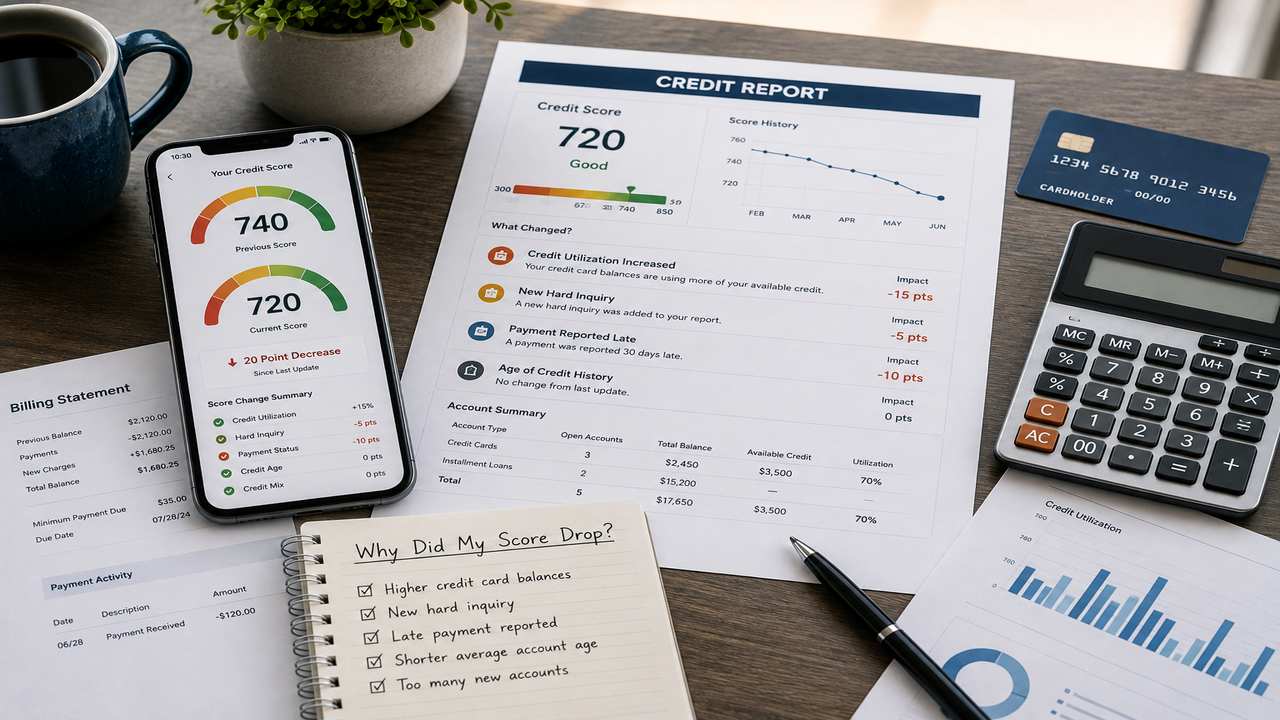
This guide walks through the most common causes of a moderate score drop like this, how to identify which one applies to you, and what to do about it.
Start With Your Credit Report, Not Just Your Score
Your score is a single number, but it’s calculated from the detailed information in your credit report. Before guessing at causes, pull your current reports from all three bureaus (free at AnnualCreditReport.com) and compare them to what you remember from before the drop. Most monitoring apps and services also show you the specific factors contributing to a recent score change, sometimes explicitly, which is the fastest way to identify the cause without guesswork.
The Most Common Causes of a 20-Point Drop
A New Hard Inquiry
Applying for any new credit — a credit card, an auto loan, a personal loan, sometimes even a new phone plan or apartment application that includes a credit check — generates a “hard inquiry” on your report. A single hard inquiry typically causes a drop of somewhere in the range of 5 to 10 points, though it can be more for someone with a shorter credit history or fewer total accounts, where each new data point carries relatively more weight.
If you recently applied for anything requiring a credit check, this is the first and most likely explanation to check. Multiple applications close together compound this effect, though many scoring models group similar inquiries (like rate shopping for a mortgage or auto loan within a short window) as a single inquiry for scoring purposes.
A Increase in Credit Utilization
If your reported balance on one or more cards went up relative to your limit — even due to normal spending rather than a new charge-off or missed payment — your utilization ratio increases, and this is one of the more common drivers of a moderate score change. Remember that your card issuer reports your balance on your statement closing date, not in real time, so a temporarily higher balance from a large purchase, holiday spending, or a big one-time expense can show up on your report even if you plan to pay it off in full before interest accrues.
A jump from, say, 10% utilization to 40% utilization on a card can easily account for a drop in this range, especially if that card carries a meaningful portion of your total available credit.
A Late Payment
Even a single payment reported 30 days late can cause a drop in this range or larger, particularly if your credit was otherwise in very good standing beforehand (counterintuitively, a strong existing credit history tends to make each new negative mark relatively more impactful, since the scoring model has less “room” to reassess a previously excellent payment record). Double-check your accounts for any payment that might have been processed late, even by a day or two past the grace period, due to a forgotten autopay, an expired card on file, or a bank holiday delaying a transfer.
An Account Was Closed
Closing a credit card — whether you did it deliberately or the issuer closed it for inactivity — can affect your score in two ways: it reduces your total available credit, which raises your overall utilization ratio even if your spending hasn’t changed, and if it was one of your older accounts, it can eventually reduce your average account age once it fully drops off your report (closed accounts in good standing typically remain on your report and continue counting toward your history for up to ten years, but they’ll eventually age out, and in the meantime the loss of available credit is the more immediate effect).
A Change in Your Credit Mix
If you paid off and closed your only installment loan (like a car loan reaching its final payment), your remaining credit mix skews more heavily toward revolving credit alone, which can have a modest negative effect on the “credit mix” component of your score, even though paying off a loan is, in every other sense, a positive financial event.
An Authorized User Account Changed
If you were an authorized user on someone else’s credit card and that person’s account status changed — they missed a payment, their utilization spiked, or they closed the card — it can affect your score too, since authorized-user accounts contribute to your file the same way your own accounts do. This is easy to overlook because the change wasn’t something you did yourself.
A New Collection or Public Record
A medical bill, unpaid parking ticket sent to collections, gym membership dispute, or library fine (yes, some of these genuinely do get reported) that you may not have even known about can appear as a new negative item and cause a noticeable drop. These are often small-dollar items that catch people completely off guard because they never received a bill or didn’t realize an old dispute had escalated.
Normal Scoring Model Fluctuation
Sometimes a score genuinely shifts by a small amount for reasons that aren’t tied to any single dramatic event — simply the natural month-to-month recalculation as your account ages, balances shift slightly, and the relative weighting of different factors in the algorithm responds to the overall combination of your file. This is less common as an explanation for a full 20-point move (which usually does have an identifiable cause) but can be a contributing factor alongside one of the more specific reasons above.
How to Diagnose Your Specific Cause
Compare report dates. Pull the date of your last known good score and the date of the drop, then look specifically at what changed on your credit report in that window: new accounts, new inquiries, updated balances, or new negative marks.
Check each account’s reported balance against what you remember. A surprising number of moderate score drops trace back to one card’s balance being higher than expected on its specific statement date, even if your overall spending habits haven’t meaningfully changed.
Look for anything genuinely unfamiliar. A new inquiry you don’t recognize, a new account you didn’t open, or a collection for a debt you’ve never heard of could indicate identity theft or an error, both of which require a formal dispute rather than simply waiting for the score to recover on its own.
Check whether an authorized-user account changed. If applicable, ask the primary cardholder whether anything changed on their end recently.
What to Do Once You’ve Identified the Cause
If it’s a new hard inquiry: No action needed beyond patience. The impact fades within a few months and disappears from scoring calculations entirely after 12 months, even though the inquiry itself remains visible on your report for 24 months.
If it’s increased utilization from normal spending: Pay down the balance, and consider paying before your statement closing date going forward if you want tighter control over what gets reported each month. The score typically recovers within one to two billing cycles once the balance is reduced.
If it’s a late payment: Bring the account current immediately if it isn’t already, and consider calling the creditor to request a “goodwill adjustment” — some creditors, especially for a first-time late payment on an account with an otherwise clean history, will agree to remove the late mark as a customer service gesture, though this isn’t guaranteed and isn’t a right you can demand.
If it’s a closed account: There’s not much to reverse after the fact, but going forward, consider keeping no-annual-fee cards open even if unused, specifically to preserve your available credit and account age.
If it’s an unfamiliar item that shouldn’t be there: File a dispute with the credit bureau reporting it, and if it appears to be identity theft, place a fraud alert or credit freeze and file a report with the FTC at IdentityTheft.gov.
When a 20-Point Drop Is Actually Nothing to Worry About
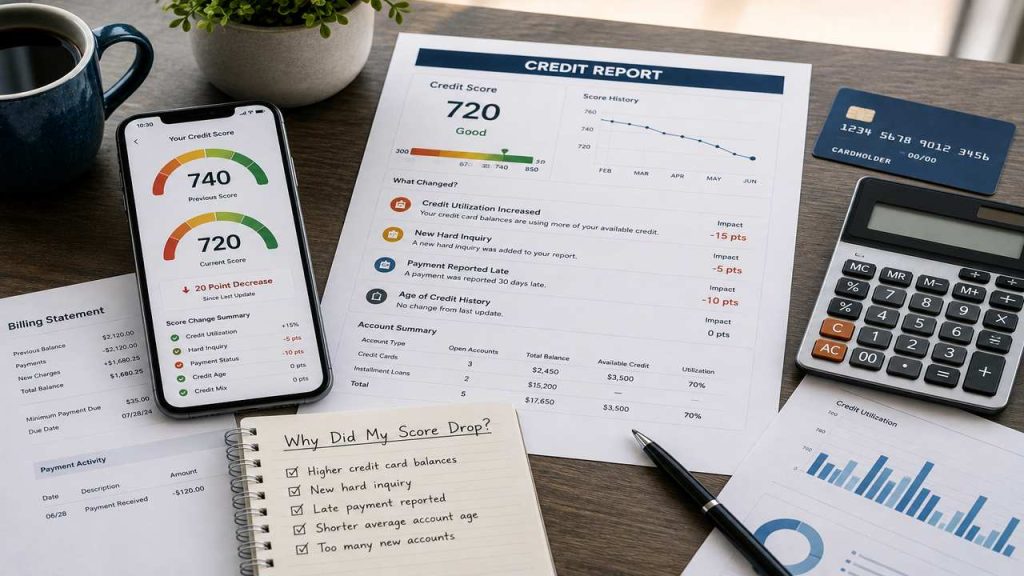
It’s worth putting this in perspective: a 20-point fluctuation, especially one tied to routine causes like a single hard inquiry or a temporarily elevated statement balance, is a completely normal part of how credit scores work, not a sign your credit is in trouble. Scores move up and down in small to moderate increments constantly as your file updates each month. The number that matters most for actual lending decisions is your score trend over months and years, not any single month’s fluctuation, and most lenders also look at the underlying report details, not just the headline number, when evaluating an application.
When It’s Worth Digging Deeper
If you’ve ruled out all the common explanations above and genuinely can’t identify a cause, or if the drop is part of a larger, ongoing decline rather than an isolated one-time event, it’s worth a closer, line-by-line review of your full credit report from all three bureaus, since scores can sometimes differ between bureaus if only one of them received updated (or inaccurate) information. Persistent unexplained drops, especially across multiple months, are also a reasonable trigger to consider a credit freeze or monitoring service if you haven’t already, simply as a precaution against undetected fraud.
Frequently Asked Questions
How long does it take for a score to recover after a 20-point drop from a hard inquiry?
Typically within a few months, as the inquiry’s impact diminishes with time even before it fully drops off your report at 24 months and stops counting toward scoring entirely after 12 months.
Can checking my own credit score cause a 20-point drop?
No. Checking your own score or report is always a soft inquiry and never affects your score, regardless of how often you check.
Why did my score drop even though I didn’t do anything unusual that month?
The most common overlooked cause is a higher-than-usual statement balance being reported on a normal billing cycle, an authorized-user account changing, or a small collection account you weren’t aware of. A careful review of your full report, not just the score, usually reveals the specific cause.
Is a 20-point drop the same across all three bureaus?
Not necessarily. Since Equifax, Experian, and TransUnion don’t always receive identical information from every creditor at the same time, your score can differ between them, and a drop reported by one monitoring service pulling from a single bureau might not exactly match what you’d see from a different service.
Should I be worried about a 20-point drop before applying for a mortgage?
It’s worth understanding the cause before applying, since even a modest score difference can occasionally shift you into a different mortgage rate tier depending on where you fall relative to lender thresholds. If the cause is a routine hard inquiry or a temporarily elevated balance, allowing a couple of months for it to settle before applying, if your timeline allows, is a reasonable precaution.
Why FICO and VantageScore Can React Differently to the Same Event
If you’re tracking your score through more than one app or service, you may notice they don’t always move by the same amount, or even in the same direction, after the same event. This is because FICO and VantageScore — the two major scoring model families — weight certain factors slightly differently, and even different versions within each family (FICO 8 versus FICO 9 versus FICO 10, for example) handle specific situations differently.
A notable example: older FICO models treat all collection accounts similarly regardless of amount, while newer FICO models and VantageScore 3.0/4.0 ignore paid collections and treat small-dollar or medical collections more leniently. Similarly, how heavily a single new hard inquiry is weighted can vary slightly between model versions and depending on the overall thickness of your file. This is why two people can experience the exact same event — say, opening one new credit card — and see meaningfully different point drops, and why your own score might show a 12-point drop on one app and a 25-point drop on another for what appears to be the same underlying change.
Rather than treating any single app’s number as the absolute truth, it’s more useful to watch the general trend across your monitoring tools and to understand the underlying reason for a change, since the reason matters more than the exact point value assigned to it by any one model.
A Month-by-Month Example Scenario
To illustrate how a 20-point drop can quietly build from more than one small factor at once, consider this composite (illustrative, not calculated from any specific real scoring formula) scenario:
Early in the month
You apply for a new rewards credit card to take advantage of a sign-up bonus. This generates a hard inquiry, contributing an estimated 6-point dip.
Mid-month
You put a larger-than-usual purchase — a plane ticket for an upcoming trip — on an existing card, planning to pay it off in full when the bill arrives. Your statement closes before you’ve paid it down, reporting a utilization jump on that card from around 8% to 35%, contributing an estimated 10-point dip.
Later in the month
A subscription service you forgot about attempts to charge an expired card on file, the payment fails, and after a couple of follow-up attempts, it gets reported 30 days past due before you notice and resolve it, contributing an estimated additional dip on top of the other two factors.
Individually, none of these would necessarily be alarming, and none represents a change in your actual overall financial reliability. Together, though, they can combine into a drop in the 20-point range within a single reporting cycle, which is why a moderate drop often has more than one small contributing cause rather than a single dramatic one.
Things That Do NOT Directly Affect Your Score (Common Misconceptions)
Your income.
Income isn’t a factor in credit scoring at all — it’s not reported to the credit bureaus by employers or otherwise, though lenders may separately ask for it during a loan application.
Your savings account balance.
Bank account balances aren’t part of your credit file or score calculation.
Checking your own credit report or score.
As mentioned above, this is always a soft inquiry with zero score impact, no matter how often you do it.
Marital status or a spouse’s credit history, unless you have joint accounts together or you cosign for something specific.
Getting married doesn’t merge two individual credit files into one.
Being denied credit.
The denial itself doesn’t affect your score; only the hard inquiry generated by the application does, and that impact is small and temporary regardless of the outcome of the application.
Age, employment history, or where you live.
None of these are part of the scoring formula, though some lenders do independently consider factors like employment and income during underwriting, separate from the credit score itself.
A Prevention Checklist to Avoid Future Unexplained Drops
- Set up balance alerts with your card issuer so you’re notified if a balance crosses a threshold you set, helping you catch a utilization spike before your statement closes.
- Keep at least one payment method’s expiration date updated everywhere it’s saved, particularly for recurring subscriptions, to avoid an accidental missed payment from an expired card.
- Space out credit applications rather than applying for several products in a short window, unless you’re specifically rate-shopping for a mortgage or auto loan, where similar inquiries within a short period are often grouped together by scoring models.
- Review your full credit report, not just your score, every few months, since the report shows the specific line items that drive any score change, while the score alone doesn’t explain itself.
- Set a calendar reminder to check accounts you rarely use, such as a card you keep open but don’t actively use, to catch any unexpected activity, fees, or issuer-initiated changes.
- Consider a credit freeze if you’re not planning to apply for new credit soon, which prevents new accounts from being opened in your name without your explicit unlocking of the freeze first.
Frequently Asked Questions, Continued
Can a credit limit decrease from my card issuer cause a score drop even if I didn’t do anything?
Yes. If your issuer reduces your credit limit — sometimes done unilaterally due to their own risk assessment, unrelated to anything you did — your utilization ratio increases immediately even with an unchanged balance, which can cause a moderate score drop you had no direct control over.
Does paying my credit card multiple times a month help prevent these drops?
It can help, particularly if you make a payment before your statement closing date to ensure a lower balance gets reported that cycle, rather than waiting until the due date, by which point the higher balance may have already been reported.
Why did my score drop even though my report shows no new negative items?
Sometimes a shift in utilization or a hard inquiry is the entire explanation and doesn’t require any “negative item” in the traditional sense — an inquiry and a balance increase are both neutral factual changes, not derogatory marks, but they still influence the score calculation.
Is there a way to see exactly which factor caused my score change?
Many free credit monitoring services and card issuer apps provide a breakdown of the top factors influencing your current score, and some explicitly flag month-over-month changes with a stated reason. This is usually the fastest way to pinpoint a cause without manually comparing full reports.
How Lenders Interpret a Recent Score Drop
It’s natural to worry that a lender reviewing your application will see a recent drop and treat it as a red flag on its own. In practice, most lenders only see your score at the moment they pull it — they generally don’t see a graph of your recent history the way you might in a monitoring app, unless they specifically request a more detailed report. What they do see, if they review your full report rather than just the score, is the same underlying detail you’d see: a new inquiry, an elevated balance, or a payment status.
A single new inquiry from a recent application is a completely normal and expected part of a credit file and isn’t treated as suspicious on its own — lenders extend credit to millions of people who have applied for other things recently. An elevated utilization ratio is more likely to be weighed as a genuine risk factor if you’re applying for new credit at the same time, since it can suggest reliance on available credit, which is worth being mindful of if you’re planning a major application in the near future. A late payment is the one factor genuinely worth proactively addressing (through a goodwill letter, or simply time and a clean record afterward) before applying for something significant, since it’s viewed as a more direct signal of payment reliability.
Hard Inquiries vs. Soft Inquiries: A Closer Look
Because hard inquiries come up so often as an explanation for a moderate score drop, it’s worth understanding exactly what triggers one versus what doesn’t, since the distinction isn’t always obvious from a consumer’s perspective.
Triggers a hard inquiry
Applying for a credit card, auto loan, mortgage, personal loan, a new cell phone plan requiring a credit check, and some rental applications and utility setups that specifically pull a full credit report as part of the approval decision.
Does not trigger a hard inquiry (soft inquiry only)
Checking your own score through any app or service, a credit card issuer checking your file to offer you a pre-approved offer, an existing lender periodically reviewing your account (called an “account review,” common practice for credit card issuers), and most employment background checks (which typically use a modified version of your report that doesn’t include your score and is coded as a soft inquiry).
If you’re ever unsure whether a specific application will trigger a hard or soft inquiry, it’s reasonable to ask directly before proceeding, particularly for financial products where multiple similar applications close together could compound the score impact more than a single one would.
Building a Buffer So Small Drops Don’t Feel Alarming
Part of what makes a 20-point drop feel unsettling is not knowing whether it’s routine or a sign of a bigger problem. A practical way to build confidence here is to establish a personal baseline: check your score and full report at the same time each month for a few months, noting the typical range your score moves within during ordinary financial activity. Once you have that baseline, a routine fluctuation becomes recognizable as exactly that, rather than a surprise each time it happens, and a genuinely unusual move (a much larger drop, or one with no identifiable cause after reviewing your full report) becomes easier to distinguish and take seriously when it does occur.
Frequently Asked Questions, Continued Further
Will my score automatically bounce back to where it was before?
In most cases, yes, once the underlying cause resolves — the inquiry ages out of scoring relevance, the balance is paid down, or enough time passes after a late payment with continued on-time payments afterward. There’s no fixed guaranteed timeline, since it depends on the specific cause and your overall file, but routine causes typically resolve within a few months.
Does disputing an item on my credit report cause a temporary score drop while it’s under investigation?
No. Filing a dispute itself doesn’t lower your score. If the dispute results in a negative item being corrected or removed, your score can only stay the same or improve as a result, never worsen from the dispute process itself.
Can two people with a joint credit card see different score impacts from the same activity?
Generally no, for the joint account itself — both cardholders’ reports reflect the same account status and balance information identically, since it’s a shared account, not an authorized-user arrangement. However, each person’s overall score can still differ due to their other, separate accounts and credit history.
I paid my card in full and on time, so why did my utilization still show up higher this month?
This traces back to the statement closing date issue covered earlier — your issuer reports the balance as of a fixed date each cycle, which may not be zero even if you always pay in full, simply because you had a balance on that specific day before your payment posted.
The Bottom Line
A 20-point credit score drop almost always has an identifiable, usually unremarkable cause: a new hard inquiry, a higher reported balance, a late payment, a closed account, or a change tied to an authorized-user account. Pulling your full credit report rather than fixating on the score alone is the fastest way to find the specific reason, and most causes at this scale resolve themselves naturally within a few months of continued responsible credit management.
Need Help Reviewing Your Credit?
If you’re dealing with an unexplained credit score drop or want to identify inaccurate or negative information on your credit reports, you can request a credit audit to review your situation.
Leave a Reply