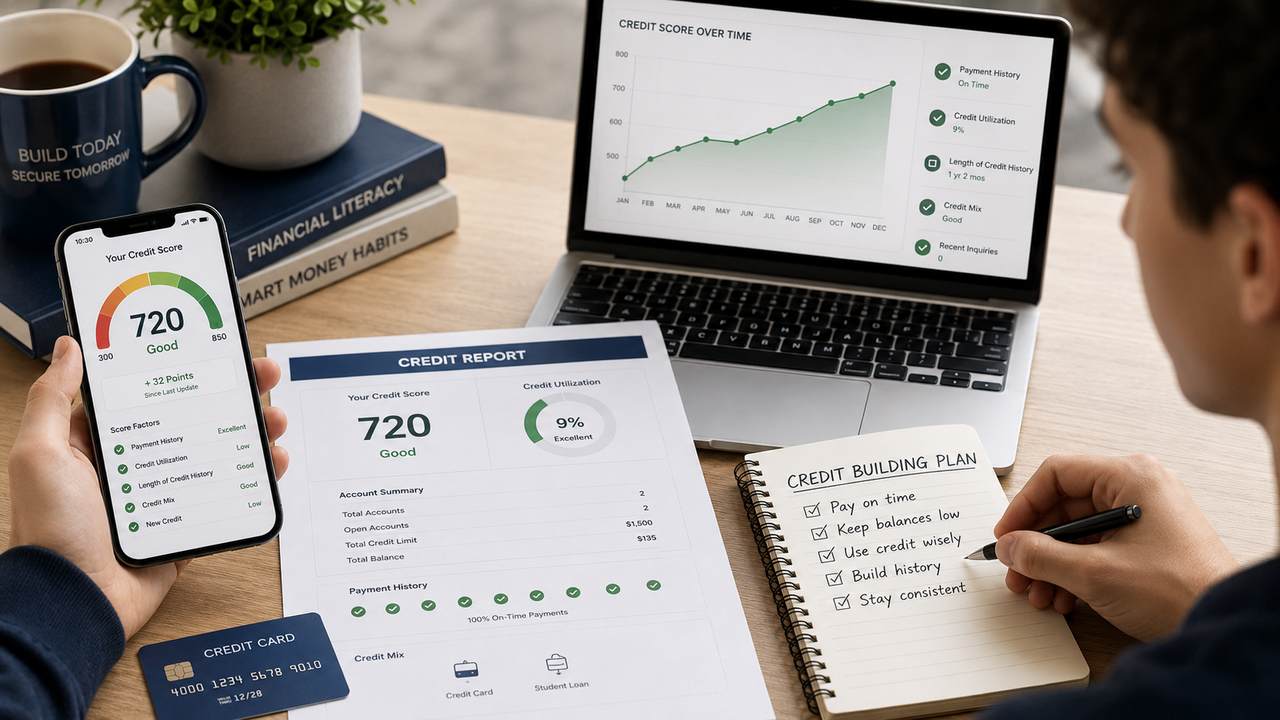
Turning 18 comes with a long list of new responsibilities, and one of the most overlooked is credit. Nobody hands you a manual for it. There’s no class in most high schools that walks you through what a credit score actually measures, how it’s calculated, or why a number you’ve never seen before can end up deciding whether you get approved for an apartment, a car loan, or even a cell phone plan without a hefty deposit.
Why Starting Early Actually Matters
Credit scoring models reward length of history. One of the core factors in your score is simply how long your accounts have been open. Someone who opens their first credit card at 18 and manages it responsibly will, all else being equal, have a real structural advantage over someone who waits until 25 or 30 to start — not because they’re smarter with money, but because their file is older.
Think of it like planting a tree. A tree planted today and given basic care will be bigger in ten years than an identical tree planted five years from now, no matter how well you care for the second one later. Credit history works the same way. The clock only starts once you have an account, so the earliest possible responsible start is the biggest single edge a young adult can build in.
There’s a second reason it matters: many of the biggest financial milestones in your twenties — renting your first apartment without a cosigner, buying a car, getting approved for a decent credit limit, even some job applications — quietly depend on having a credit history at all. Not a perfect one. Just one that exists.
What a Credit Score Actually Measures
Before building credit, it helps to understand what you’re actually building. In the United States, the most widely used scoring models are FICO and VantageScore, both of which pull from the same three major credit bureaus: Equifax, Experian, and TransUnion. Your score is a three-digit number, typically ranging from 300 to 850, that estimates how likely you are to repay debt on time based on your past behavior.
The score is built from five main ingredients, weighted roughly as follows:
- Payment history (about 35%). This is simply whether you’ve paid your bills on time. It’s the single heaviest factor, and it’s also the simplest to control: pay everything by the due date, every time.
- Credit utilization (about 30%). This measures how much of your available credit you’re actually using. If you have a card with a $1,000 limit and you’re carrying a $800 balance, your utilization is 80%, which scoring models read as a red flag, even if you plan to pay it off in full. Lower is better — many experts suggest staying under 30%, and under 10% is ideal if you can manage it.
- Length of credit history (about 15%). This looks at the age of your oldest account, your newest account, and the average age across all your accounts. This is the factor that most rewards starting early.
- Credit mix (about 10%). This considers the different types of credit accounts you have, such as revolving credit and installment loans.
- New credit (about 10%). This considers recent applications for credit and hard inquiries. Opening too many accounts in a short period can make you look risky to lenders and temporarily lower your score.
The percentages are approximate and can vary by scoring model and the specific version being used. But the general hierarchy is consistent: pay on time, keep balances low, keep accounts open, and don’t apply for everything at once.
How to Start Credit at 18: The Step-by-Step Plan
You don’t need five credit cards, a car loan, and a mortgage to start building credit. In fact, doing too much too soon can backfire. The goal is to establish one or two accounts, manage them perfectly, and let time do the rest.
Step One: Get Your First Credit Account
For most 18-year-olds, there are three realistic starting points:
- A secured credit card
- An authorized-user account
- A student credit card, if you qualify
Each has a different level of control, risk, and accessibility.
Secured Credit Cards
A secured credit card is often the simplest first credit account for someone with no credit history. You provide a refundable security deposit — commonly $200 to $500 — and that deposit typically becomes your credit limit.
You then use the card like a normal credit card. The issuer reports your payment activity to the credit bureaus, and you build a credit history by making payments on time.
The deposit is not a payment toward your balance. It is collateral for the account. If you eventually close the card in good standing or graduate to an unsecured card, the deposit can generally be returned.
When choosing a secured card, look for:
- Reporting to all three major credit bureaus
- Low or no annual fee
- No unnecessary monthly maintenance fees
- A clear path to graduating to an unsecured card
- A reputable issuer
Become an Authorized User
If you have a parent, guardian, or another trusted family member with an established credit card that has a long history of on-time payments and low utilization, becoming an authorized user can be an effective way to establish credit history.
When an issuer reports the authorized-user account to the credit bureaus, the account’s history may appear on your credit reports. This can give you access to positive payment history, account age, and available credit without requiring you to qualify for the primary account yourself.
This can be particularly powerful for someone starting from zero because you may effectively inherit years of account history.
But there is an important caveat: the account needs to be healthy. If the primary cardholder carries a very high balance or misses payments, those negative characteristics may also appear on your credit reports.
Only become an authorized user on an account belonging to someone who manages credit responsibly.
Student Credit Cards
If you’re attending college, a student credit card can be another excellent starting point.
Student cards are designed for people with limited or no credit history and are often easier to qualify for than traditional rewards cards. They can provide an unsecured credit line without requiring a security deposit.
They’re offered by most major issuers (Discover it Student, Capital One SavorOne Student, Chase Freedom Student, Bank of America Travel Rewards for Students, etc.).
Why they’re worth it
- No security deposit required — you get a real unsecured card with no money down.
- Lower APRs than store cards (though still higher than prime cards).
- Often include rewards — cash back on dining, groceries, or gas, which secured cards typically don’t offer.
- Reports to all three bureaus like any unsecured card.
- Many have a graduation path — after you finish school and build history, the issuer may upgrade you to a standard unsecured rewards card.
What to know
- You must be 21+ to apply without a co-signer or proof of independent income. Under 21, the CARD Act requires you to show ability to repay (income) or have a co-signer. Student income from part-time work can qualify — don’t assume you need a full-time job.
- Credit limits are modest (often $500–$1,500), but higher than most secured cards.
- Use it for one small recurring charge (a streaming subscription, a textbook purchase) and pay it in full monthly.
- Don’t use student status as an excuse to carry a balance. The APR on a student card is typically 18–25%. A carried balance wipes out any rewards you earn.
If you’re a student, apply for a student card before a secured card. No deposit, better terms, and a cleaner path to an unsecured rewards card down the line.
Consider a Credit-Builder Loan
Credit-builder loans are designed specifically for people building or rebuilding credit. Unlike a traditional loan, you don’t receive the money upfront. Instead:
- The lender holds the loan amount in a secured savings account.
- You make monthly payments (which are reported to the credit bureaus).
- When the loan is paid off, you receive the money.
This builds positive installment credit history and forces you to save money at the same time. Many credit unions and community banks offer credit-builder loans, and there are also online lenders specializing in this product. Look for one that reports to all three bureaus and has reasonable fees.
Give It Time
Rebuilding credit is a marathon, not a sprint. The length of your credit history and the age of your accounts are factors you can’t rush. What you can do is start now, be consistent, and let time work in your favor. Every month of on-time payments, every statement cycle with low utilization, and every year of account aging adds up.
Your 6-Month Plan: No Score to First FICO
Here’s the concrete, step-by-step plan we walk clients through. Follow it in order and you’ll have a scorable FICO by month 6 and a foundation that compounds from there.
Month 1: Lay the Foundation
Week 1:
- Pull your free reports from AnnualCreditReport.com (you’re entitled to free weekly reports from each bureau). Confirm you’re truly starting from scratch — sometimes there’s a surprise account (a store card a parent opened in your name, a student loan you forgot) that’s already aging on your file.
- If there are errors or accounts you don’t recognize, document them. (This is where a credit repair professional can help — identify what’s already on your file before you start building.)
Week 2:
- Apply for one secured credit card from a major issuer that reports to all three bureaus and charges no annual fee. If you can, fund a $500 deposit (the higher limit helps with utilization).
- If you have a trusted family member or partner with a clean, long-standing credit card, ask them to add you as an authorized user. Emphasize that they don’t have to give you the card.
Week 3–4:
- Once your secured card arrives, set up one small recurring charge on it — a $10–15 streaming subscription or similar. This keeps your balance tiny and your utilization negligible.
- Set up auto-pay for the full statement balance every month. This is the single most important habit you’ll build. No exceptions.
- If you rent, sign up for a rent reporting service that reports to all three bureaus and can back-report up to 24 months of past on-time payments.
Month 2: Add the Second Tradeline
- Apply for a credit-builder loan with a 12-month term and a small monthly payment ($25–$50).
- Do not apply for another credit card yet.
- Continue using your first card lightly and paying the statement balance in full.
- Check that your secured card is appearing on your credit reports.
Month 3: Build the Habit
- Keep your credit card utilization below 10% whenever possible.
- Continue making every payment on time.
- Do not open additional accounts simply because you now have a credit score.
- Review your reports for errors and confirm that your accounts are reporting correctly.
Months 4–6: Let the History Build
- Keep your accounts open.
- Continue making every payment on time.
- Keep utilization low.
- Avoid unnecessary hard inquiries.
- Monitor your reports for unexpected changes.
By around six months, many people with their first account may become scoreable under commonly used FICO models, although the exact timing depends on the scoring model and the information being reported.
A Closer Look: How Utilization Actually Gets Calculated
Credit utilization is one of the easiest factors to misunderstand.
Suppose your first card has a $300 limit. You spend $280 during the month, but you pay the entire $280 before the due date.
You might think your utilization is zero because you paid the balance in full.
That is not necessarily what the credit bureaus see.
Most credit card issuers report balances around the statement closing date. If the statement closes while you owe $280, the bureau may receive a $280 balance against your $300 limit.
That means the reported utilization could be about 93% even though you paid the card in full afterward.
The solution: Make a payment before the statement closes if necessary, or keep your spending low enough that the statement balance remains a small percentage of the limit.
For a $300 limit:
- 10% utilization = $30
- 20% utilization = $60
- 30% utilization = $90
- 50% utilization = $150
- 90% utilization = $270
For a beginner, keeping the reported balance under $30–$90 is a simple way to keep utilization low.
Comparing Your First-Card Options Side by Side
| Feature | Secured Card | Student Card | Authorized User |
|---|---|---|---|
| Security deposit | Usually required | Usually not required | None |
| Credit check | Varies by issuer | Usually required | Usually not for the AU |
| Account in your name | Yes | Yes | No — primary account belongs to someone else |
| Builds payment history | Yes | Yes | Depends on issuer reporting |
| Builds utilization history | Yes | Yes | Yes, if reported |
| Control over account | High | High | Low |
| Best for | People with no or limited credit | Students with qualifying income/status | People with a trusted primary cardholder |
For many young adults, the strongest approach is not choosing only one. A trusted authorized-user account can provide age and positive history, while a secured or student card establishes an account that you personally control.
A Realistic First-Year Budget Example
Imagine you’re 18, working part-time and earning $1,500 per month. You have a secured credit card with a $500 limit.
You decide to use the card only for:
- $25 streaming subscription
- $40 gas
- $35 groceries
Your normal monthly charges are $100.
Your utilization is:
$100 ÷ $500 = 20%
If you make a payment before the statement closes and the reported balance is $40, your reported utilization would be:
$40 ÷ $500 = 8%
You then pay the entire statement balance by the due date.
There is no reason to spend $500 simply because you have a $500 credit limit. The purpose of the account is to establish a record of responsible credit management — not to give you permission to spend money you don’t have.
A Short Glossary for First-Timers
Credit Limit
The maximum amount a revolving credit account allows you to borrow at one time.
Statement Balance
The balance shown on your credit card statement for a particular billing cycle.
Current Balance
The amount currently owed on the account, which may differ from the statement balance because additional transactions may have occurred.
Credit Utilization
The percentage of your available revolving credit that you are using.
Hard Inquiry
A credit check associated with an application for new credit that can affect your credit score.
Soft Inquiry
A credit check that generally does not affect your credit score, such as checking your own credit or receiving certain prequalification offers.
Tradeline
An individual credit account appearing on your credit report.
Authorized User
A person added to another individual’s credit card account who may be able to use the account but is generally not responsible for the debt as the primary account holder is.
Secured Credit Card
A credit card backed by a refundable security deposit that typically determines the credit limit.
Credit-Builder Loan
A loan product designed to establish positive payment history while the borrowed funds are held until the loan is paid off.
A Simple First-90-Days Checklist
- Pull all three credit reports.
- Check for accounts you don’t recognize.
- Choose one primary credit-building account.
- Confirm the account reports to all three bureaus.
- Set up autopay.
- Use the account for one or two predictable expenses.
- Keep utilization low.
- Pay the full statement balance every month.
- Avoid unnecessary applications.
- Monitor your reports regularly.
- Never miss a payment.
- Do not close your first account simply because you receive another card.
If you follow this checklist consistently, you will have accomplished the most important thing: you will have started building a positive credit history without taking on unnecessary debt.
Myths About Starting Credit Young
Myth 1: You Need to Carry a Balance
You do not need to carry a balance or pay interest to build credit.
Paying your full statement balance every month is generally the better strategy because you avoid interest while still establishing positive payment history.
Myth 2: More Cards Mean More Credit
More accounts do not automatically mean a higher score.
For someone just starting out, one well-managed card is usually enough. Adding multiple accounts before you have established good habits creates unnecessary complexity and additional hard inquiries.
Myth 3: You Need a Car Loan
You do not need an auto loan to build credit.
Never take on thousands of dollars of debt simply because someone told you installment credit is necessary for a strong credit score.
Myth 4: Checking Your Own Credit Hurts Your Score
Checking your own credit report is a soft inquiry and does not hurt your score.
You should actually monitor your reports regularly, especially when you are building credit for the first time.
Myth 5: You Need a 700 Score Immediately
You don’t.
At 18, your first objective is not to hit a specific number. It is to establish a clean, positive history that can grow over time.
How Lenders Actually View a Thin File at 18
When a lender sees an 18-year-old with six months of credit history, they are not expecting the same profile they would see from someone who has been borrowing for 20 years.
What they want to see is evidence that you can manage the credit you have.
That means:
- No late payments
- Low utilization
- Stable accounts
- No excessive recent applications
- Growing account age
- Consistent financial behavior
A thin file is not necessarily a bad file. It simply means there is not much information yet.
Your job is to give the scoring models and lenders a clean track record to evaluate.
When to Bring in Outside Help
Starting credit at 18 is usually something you can manage yourself. But there are situations where professional guidance can make sense.
For example, you may want help if:
- You discover accounts on your report that you never opened.
- Your credit report contains inaccurate information.
- You are already dealing with late payments or collections.
- You are unsure how to dispute inaccurate information.
- You need help understanding your three credit reports.
- You are preparing for a major financial goal and want a detailed credit review.
The important thing is to work with legitimate professionals who explain the process clearly and do not promise impossible results.
Frequently Asked Questions
1. How fast can I realistically build credit from scratch?
With consistent, responsible use of a secured card (and ideally an authorized user account), you can expect your first FICO score in about 6 months, typically in the 670–720 range. Reaching 700+ usually takes 12–18 months, and 740+ takes 18–24 months. There is no legal, legitimate way to build a strong score in 30 days — anyone promising that is either misinformed or selling something that violates the FCRA.
2. What’s the difference between a secured and unsecured credit card?
A secured card requires a refundable security deposit (usually $200–$500) that becomes your credit limit. An unsecured card requires no deposit and grants you a credit limit based on your creditworthiness. Both report to the bureaus and build credit identically. Secured cards are designed for people with no or poor credit; unsecured cards typically require an established credit history.
3. Do I need to pay interest to build credit?
No. This is a common myth. Paying your full statement balance every month builds your score just as fast as carrying a balance — and it costs you nothing in interest. The bureaus see your on-time payment and your reported balance; they don’t see whether you paid interest. Paying in full is the optimal strategy.
4. Can I build credit without a credit card?
Yes, but it’s slower and less effective. Rent reporting, credit-builder loans, and authorized user status can all build credit without you personally holding a credit card. However, revolving credit (credit cards) is the most heavily weighted type of account in FICO scoring, so if you’re able to manage a secured card responsibly, it’s the single fastest tool.
5. Will being an authorized user hurt the primary cardholder?
No. Adding an authorized user doesn’t affect the primary cardholder’s credit score — your separate credit activity doesn’t touch their file. The only risk to the primary cardholder is financial: they’re responsible for any charges made on the AU’s card. They can eliminate this risk by adding you as an AU but never giving you the physical card.
6. How many credit cards should I have to build credit?
For the first 12 months, one is plenty. After that, 2–3 revolving accounts is optimal for most people — enough to show you can manage multiple lines, but not so many that you risk missed payments or high utilization. Don’t open more than one or two new accounts per year to avoid lowering your average account age.
7. What credit score do I need to rent an apartment?
It varies by landlord and market, but most rental applications look for 620–680+. Higher-end buildings and competitive markets may require 700+. If you don’t yet have a score, some landlords will accept alternative evidence of financial responsibility — bank statements, employment verification, previous landlord references, or a larger security deposit. Rent reporting services can help you build toward the score threshold while you search.
8. Can credit-repair.com help me if I’m starting from scratch?
Yes — and this is a point worth emphasizing. Credit repair isn’t only for people with negative items to dispute. If you’re starting from zero, we can pull your three-bureau reports to confirm you’re truly starting clean (sometimes there are surprise accounts), help you identify the fastest combination of credit-building tools for your specific situation, set up rent reporting and bureau monitoring, and build you a custom repair-and-build plan that maps your path from no score to 740+. Our process is FCRA-compliant and attorney-backed, which means every step is legal, ethical, and designed for long-term success — not quick fixes.
Start With a Free Credit Audit
Building credit from scratch is a marathon, not a sprint. But it’s a marathon with a clear course, mile markers, and a finish line you can see. The hardest part is the first six months — the stretch where you’re doing everything right and the system hasn’t started rewarding you yet. Once that first FICO appears, the compounding begins: every month of clean history adds value, every account ages, every on-time payment strengthens the 35% of your score that matters most.
You don’t have to figure out the path alone. At credit-repair.com, we start every new client — including those with no credit history at all — with a free three-bureau credit audit. We pull your reports from Equifax, Experian, and TransUnion, identify what’s already on your file (including any errors or surprise accounts you may not know about), and build you a custom credit-building plan tailored to your goals, timeline, and budget.
Our approach is attorney-backed and FCRA-compliant, which means every recommendation we make is grounded in federal credit law and designed for measurable, long-term progress — not quick fixes or empty promises. We educate you on the process as we go, so you understand why each step works and can maintain strong credit long after you’ve reached your target score.
Get your free credit audit at credit-repair.com →
Whether you’re 18 with your first job, a recent immigrant establishing a U.S. credit file, or someone who simply never needed credit until now — the fastest way to build credit is the legitimate way, done right, starting today. We’ll walk it with you.
Disclaimer: This article is for educational purposes and does not constitute legal or financial advice. Individual credit outcomes vary based on personal financial behavior and history. credit-repair.com operates in full compliance with the Fair Credit Reporting Act (FCRA) and all applicable federal credit laws. We do not guarantee specific score outcomes or timelines.
Leave a Reply