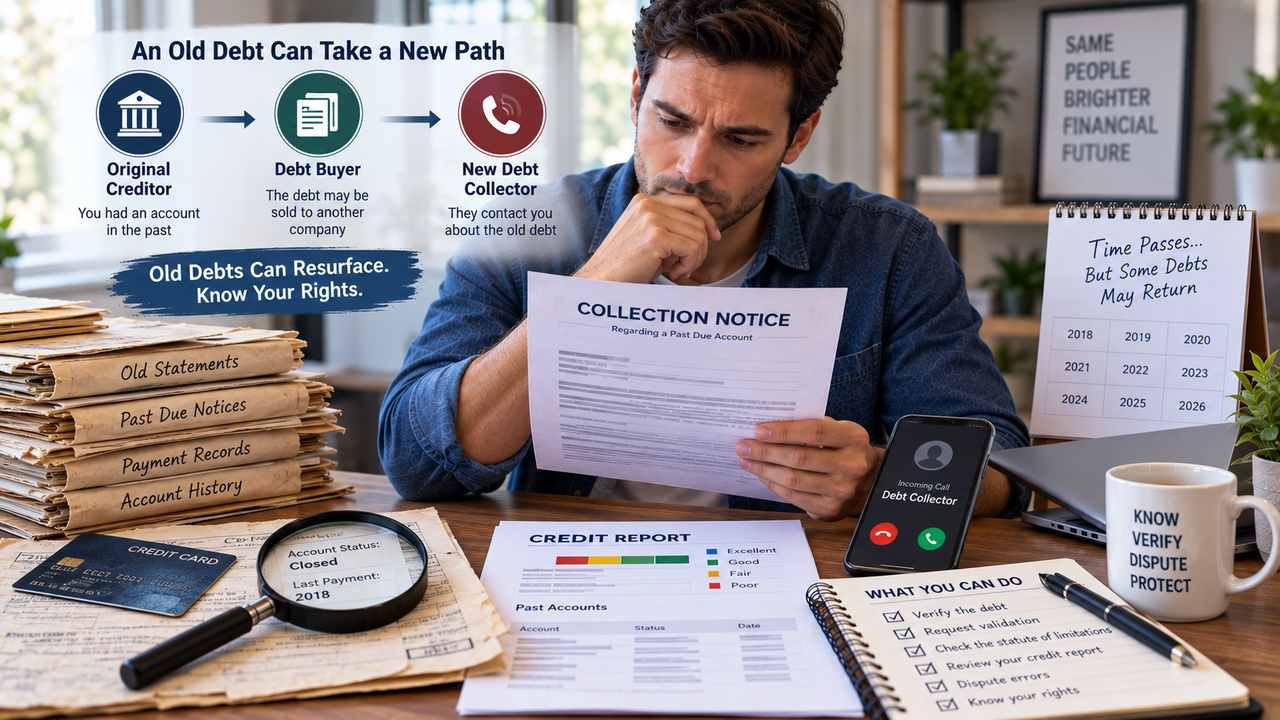
This phenomenon is commonly called zombie debt: old debt that resurfaces, sometimes years after the original collection attempts stopped.
Understanding why this happens, what your rights are, and what risks may exist before you respond can turn an unsettling surprise into a situation you can evaluate carefully.
What Is Zombie Debt?
Zombie debt generally refers to old debt that resurfaces through a new collection attempt after being dormant for a significant period.
The debt may be outside the legal time limit for filing a lawsuit, may have been sold to a new debt buyer, or may be debt you believed was already resolved, forgiven, paid, or otherwise no longer relevant.
One reason this happens is that old accounts can be sold from one debt buyer to another. A debt that was previously pursued unsuccessfully may eventually be purchased by another company that decides to attempt collection again.
In other situations, a collector may be trying to collect a debt that is still legally enforceable but simply has not been actively pursued for some time.
The important point is that an old debt and a time-barred debt are not necessarily the same thing.
A debt can be old without being legally time-barred, while a debt can also be time-barred under the applicable law even though the underlying obligation has not technically disappeared.
Why Does Zombie Debt Come Back?
There are several reasons an old debt may suddenly resurface.
Debt Can Be Sold to Another Company
An unpaid account may be sold by the original creditor to a debt buyer.
The debt buyer may later sell the account again, creating a chain of ownership involving multiple companies.
This is one reason you may receive a collection letter from a company you have never heard of even though the debt originally came from a credit card issuer, medical provider, lender, or another creditor you recognize.
Our guide on how debt can be resold to multiple companies explains this process in greater detail.
Old Debt Can Be Purchased Very Cheaply
Very old debt portfolios may be purchased for substantially less than the face value of the accounts.
Because the purchase price can be low, a debt buyer may believe that attempting to collect from a relatively small percentage of accounts can still make the portfolio worthwhile.
This can help explain why an account that has been dormant for years may suddenly generate a new collection letter or phone call.
People Often Do Not Remember Old Accounts
Time can make it difficult to remember exactly what happened to an account.
You may remember having financial difficulties years ago without remembering which accounts were paid, settled, charged off, sold, or simply left unresolved.
That uncertainty can make an old collection claim particularly difficult to evaluate without documentation.
Does Debt Eventually Expire?
Debt does not generally disappear simply because it becomes old.
However, several different time limits can affect what a creditor or debt collector can do with an old debt.
The most important distinction is between:
- The statute of limitations: the applicable legal period for bringing a lawsuit to collect a debt.
- The credit-reporting period: the period during which negative information can generally be reported to consumer reporting companies.
- The underlying debt: the actual obligation, which may continue to exist even after the lawsuit period or credit-reporting period has ended.
The CFPB explains that debt does not generally expire simply because it is old, although many states impose limits on how long creditors or collectors can use legal action to collect certain debts. The applicable period can vary based on the debt type, state law, and other circumstances.
What Is Time-Barred Debt?
A debt is generally considered time-barred when the applicable statute of limitations for bringing a legal action to collect it has expired.
The exact period varies by state and debt type. The applicable starting date can also vary depending on the relevant state law and circumstances.
This means you should not assume that an account is time-barred simply because it is several years old.
Before making a payment or agreeing to a settlement on an old debt, determine which statute of limitations applies to your situation.
Our guide on the statute of limitations on debt provides additional background on this issue.
Can a Debt Collector Collect a Time-Barred Debt?
This is where the distinction between collecting and suing becomes important.
Federal Regulation F prohibits a debt collector covered by the FDCPA from bringing or threatening to bring a legal action against a consumer to collect a time-barred debt.
However, whether a collector may contact you about a time-barred debt can depend on federal and state law. The FTC explains that some states allow collection contact regarding time-barred debts while other states restrict such contact.
Therefore, receiving a letter about an old debt does not automatically mean the collector has the legal right to sue you.
Likewise, simply receiving a collection request does not automatically establish that the debt is valid, belongs to you, or remains legally enforceable.
The Biggest Risk: Paying or Acknowledging Old Debt
One of the most important issues to understand with old debt is the possibility that an action you take could affect the statute of limitations under applicable state law.
In some states, making a payment or acknowledging the debt in writing can restart or revive the statute of limitations.
The FTC specifically warns that, in some states, making a payment or even acknowledging in writing that you owe a time-barred debt can reset the statute of limitations and potentially make the debt legally enforceable again.
That means the instinct to say “I’ll just pay a little to make this go away” can sometimes create a legal problem rather than solve one.
Do not make a payment on an old debt you are unsure about until you understand the applicable state rules and the status of the debt.
Our guide on why making a payment on old debt can backfire explains this issue in more detail.
How to Verify Whether Zombie Debt Is Legitimate
Before paying an old debt, take time to determine whether the claim is legitimate.
1. Request Debt Validation
Ask the collector for information that allows you to identify the debt and determine whether the collector has a legal basis to collect it.
Depending on the circumstances and applicable law, this can include information about:
- The original creditor
- The amount allegedly owed
- The current creditor or debt owner
- The account information
- The collector’s authority to collect
- Relevant payment or delinquency information
Our debt validation letter guide explains the validation process in greater detail.
2. Review Your Own Records
Search for old:
- Bank statements
- Credit-card statements
- Payment confirmations
- Settlement agreements
- Letters from creditors
- Collection correspondence
- Bankruptcy records
Your own records may help determine whether the account was previously paid, settled, discharged, or otherwise resolved.
3. Determine the Relevant Date
Find out the date of the last payment, original delinquency, or other date that matters under the applicable state statute.
Do not assume that the date a new collector purchased the account is the date from which the statute of limitations begins.
4. Determine Which State’s Law Applies
This can become complicated if you have moved since the debt originated.
The applicable law can depend on factors such as the state where you live, the state specified in the credit agreement, the type of debt, and other legal rules.
The FTC recommends researching the law applicable to your state and, when appropriate, contacting a state attorney general’s office or local legal-aid organization for assistance.
5. Confirm That the Debt Is Actually Yours
Old accounts can contain inaccurate information, particularly when an account has been sold multiple times.
Check whether the debt actually belongs to you and whether the account information matches your records.
If you discover an account that is not yours, our guide on what to do when a collector contacts you about a debt that isn’t yours can help you understand the next steps.
What Should You Do After Verifying the Debt?
Your options depend heavily on what you discover.
If the Debt Is Legitimate and Still Within the Statute of Limitations
If the debt is valid and remains legally enforceable, you may consider several options.
- Pay the debt in full
- Negotiate a settlement
- Request a payment arrangement
- Review whether the reported information is accurate
Before negotiating, make sure you understand the balance and the identity of the current creditor or collector.
You can also read our guide on how to negotiate with a debt collector without getting taken advantage of.
If the Debt Is Legitimate but Time-Barred
If the debt is time-barred, the situation is different.
A debt collector covered by the FDCPA generally cannot sue or threaten to sue you to collect a time-barred debt.
However, state laws differ regarding collection contact and whether actions such as partial payment or written acknowledgment can revive the debt.
For that reason, do not assume that paying or acknowledging the debt is harmless.
The FTC notes that consumers may choose whether to pay a time-barred debt, but recommends considering legal advice before making that decision because state law can affect the consequences.
If the Debt Cannot Be Properly Validated
If the collector cannot adequately establish the debt or you identify inaccurate information, consider formally disputing the debt.
If the account is also appearing inaccurately on your credit reports, you may have a separate dispute process available through the applicable credit reporting companies and furnisher.
See our guide on how to dispute credit report errors.
Does Zombie Debt Still Appear on Your Credit Report?
It depends on the age and reporting history of the account.
Federal law generally limits how long most negative information can be reported. The CFPB states that credit reporting companies can generally report most negative information for seven years.
The FTC likewise explains that negative information such as past-due debts can generally remain on a credit report for seven years.
Importantly, the credit-reporting period and the statute of limitations are different time periods.
A debt can become time-barred before the credit-reporting period ends, or the reporting period can expire while the underlying debt remains legally owed.
What Is Re-Aging a Debt?
Re-aging refers to reporting an account with an incorrect or artificially newer delinquency date in a way that improperly extends the period during which negative information can appear on a credit report.
The date of delinquency is important because it helps determine how long certain negative information can be reported.
The FTC explains that furnishers must report the relevant date of delinquency for accounts referred to collection, and that this date helps determine the seven-year reporting period.
A collector’s recent attempt to collect an old debt does not simply create a new seven-year credit-reporting period.
If an old collection account appears to have an incorrect or artificially recent delinquency date, review the information carefully and consider disputing inaccurate reporting.
How to Protect Yourself From Zombie Debt
Keep Records of Resolved Debts
Keep copies of settlement agreements, payment confirmations, account statements, and important correspondence.
These documents can become valuable if a debt resurfaces years later.
Know Your State’s Statute of Limitations
Do not rely on a generic number of years because the applicable period can differ by state and debt type.
Our statute of limitations guide can help you understand the basic concepts, but your particular situation may require state-specific research.
Do Not Make an Immediate Payment
If a collector suddenly contacts you about a very old debt, resist the pressure to make an immediate payment simply because the letter or phone call sounds urgent.
First determine:
- Whether the debt is actually yours
- Who currently owns the debt
- How much is allegedly owed
- When the account became delinquent
- Whether the debt is time-barred
- Whether your state has revival rules
- Whether the account is still being reported accurately
A Realistic Example of Zombie Debt
Imagine an unpaid credit-card account from 2016.
The original creditor charges off the account and sells it to a debt buyer in 2017. The first buyer attempts collection but does not recover the money. The account is then sold to a second buyer in 2019.
The second buyer also attempts collection and eventually stops.
In 2026, a third debt buyer purchases a large portfolio of old accounts and sends you a new collection letter.
At first, the letter may make it feel as though a brand-new debt has suddenly appeared.
But the underlying account may actually be nearly a decade old.
Whether the debt can still be legally enforced depends on the applicable statute of limitations and other facts. Whether it can still appear on your credit report depends on the separate credit-reporting rules.
This example demonstrates why the date of the original delinquency, rather than simply the date of the latest collection attempt, is important.
Why Debt Buyers Purchase Very Old Debt
Debt buyers can purchase portfolios of older accounts at prices that reflect the lower likelihood of successful collection.
The economics can make these portfolios attractive even when only a small percentage of accounts ultimately generate payment.
This helps explain why a person may receive collection attempts from several different companies over a period of years.
A debt may move through a chain such as:
Original Creditor → Debt Buyer A → Debt Buyer B → Debt Buyer C
Each company may have acquired the account at a different point in the collection process.
If you are dealing with multiple companies claiming the same debt, read our article on how debt gets resold to multiple companies.
Should You Ignore a Zombie Debt Letter?
Complete silence is not necessarily the safest approach.
If the debt is still within the applicable statute of limitations, the collector may have legal options that you need to understand.
If you have confirmed that the debt is time-barred, you may have additional protections regarding legal action, but state laws can determine whether and how a collector may continue contacting you.
If you receive a lawsuit, do not ignore it. The FTC recommends responding to a debt collection lawsuit and raising the applicable defenses, including a statute-of-limitations defense when appropriate.
Can a Collector Say a Zombie Debt Is About to Expire?
Be cautious about statements designed to create artificial urgency.
A collector cannot misrepresent the legal status of a debt or threaten legal action that is prohibited by law.
Federal Regulation F specifically prohibits covered debt collectors from bringing or threatening to bring legal action to collect a time-barred debt.
If a collector tells you that you must pay immediately to prevent a lawsuit, first verify whether the debt is actually within the applicable statute of limitations.
What Is Aged or Tertiary Debt?
Within the debt-buying industry, older accounts may be described using terms such as aged debt or tertiary debt.
These terms generally distinguish older accounts from newer debt that is being placed for collection closer to the original creditor’s charge-off.
Older portfolios can be priced differently because the expected recovery rate is generally lower.
What If the Zombie Debt Was a Joint Account?
If the original account was joint, your responsibility may depend on the original account agreement and the circumstances surrounding the debt.
Being an authorized user, joint account holder, co-borrower, or primary borrower can have very different legal consequences.
If the account involves a former spouse or partner, documents such as a divorce decree may also be relevant to the parties’ obligations, although a private agreement does not necessarily change the creditor’s rights under the original contract.
Because these situations can be complicated, carefully review the validation documents before accepting responsibility for the debt.
Why State Law Matters So Much
There is no single nationwide statute-of-limitations period that applies to every type of consumer debt.
The applicable period can differ based on:
- The state involved
- The type of debt
- The contract
- The applicable statute
- The date relevant under state law
- Whether a payment or written acknowledgment affected the limitations period
The CFPB notes that statutes of limitations can vary by state and debt type, while the FTC specifically warns that some states allow payment or written acknowledgment to restart the limitations period.
If you have moved between states since the debt originated, do not automatically assume that the law of your current state answers every question.
Does the Type of Debt Matter?
Yes.
Credit-card debt, medical debt, personal loans, utility bills, and other obligations can be treated differently under state law.
The first step is identifying exactly what kind of debt the collector is claiming you owe.
You should then determine the statute of limitations and other applicable rules for that specific type of debt.
Can You Ask for the Last Payment Date?
Yes. If you are trying to determine whether an old debt is time-barred, information about the account’s payment and delinquency history can be important.
Ask the collector for the information necessary to understand the account, and compare it with your own records.
For very old accounts, the exact dates can become particularly important because a difference of months or years can potentially affect whether the statute of limitations has expired.
Is Zombie Debt More Common With Certain Types of Debt?
Old credit-card accounts are commonly associated with debt-buying activity because credit-card portfolios are frequently bought and sold.
However, other types of consumer debt can also resurface after years, including certain medical debts, utility accounts, and personal loans.
The appropriate response depends on the type of debt and the applicable federal and state laws.
Frequently Asked Questions About Zombie Debt
How old does a debt have to be to become zombie debt?
There is no universal legal age that officially defines zombie debt. The term is generally used for debt that has been dormant for a significant period and later resurfaces through a collection attempt.
Can zombie debt affect me if I moved to another state?
Potentially. Which state’s statute of limitations applies can depend on the circumstances, the contract, and applicable law. If you moved states after the debt originated, investigate the specific rules rather than assuming the answer.
Can I find zombie debt before a collector contacts me?
Checking your credit reports periodically can help identify accounts that are still being reported. However, very old debt that is no longer appearing on your credit report may not be discoverable through a credit-report review.
You can obtain your credit reports through AnnualCreditReport.com.
If a debt is time-barred, does that mean I no longer owe it?
Not necessarily. The statute of limitations generally concerns the ability to use a lawsuit to enforce the debt. It does not automatically erase the underlying obligation.
Can a debt collector still contact me about time-barred debt?
It depends on applicable federal and state law. The FTC explains that some states allow collection contact regarding time-barred debts while others restrict it. A covered debt collector cannot sue or threaten to sue to collect a time-barred debt under federal Regulation F.
Can paying a time-barred debt restart the statute of limitations?
In some states, yes. The FTC specifically warns that a payment or written acknowledgment can revive a time-barred debt under some state laws.
Can a debt collector re-age a debt on my credit report?
A collector cannot simply create a new credit-reporting period by making a new collection attempt. If the delinquency date being reported is inaccurate, you can dispute the inaccurate information.
What if the zombie debt was already discharged in bankruptcy?
A properly discharged debt generally cannot continue to be collected as though the discharge never occurred. If you receive collection activity on a debt that was discharged in bankruptcy, preserve the documentation and consider obtaining legal advice about your rights.
What if I am sued over an old debt?
Do not ignore the lawsuit. Respond according to the court’s instructions and deadlines. If you believe the debt is time-barred, raise the applicable statute-of-limitations defense. The FTC recommends responding to debt collection lawsuits rather than ignoring them.
The Bottom Line
Zombie debt resurfaces because old accounts can remain in debt portfolios and may be sold repeatedly to new debt buyers.
An old debt is not automatically the same thing as a time-barred debt. Whether a creditor or collector can legally sue depends heavily on the applicable statute of limitations and the specific circumstances of the account.
The credit-reporting timeline is also separate. Most negative information can generally be reported for seven years, subject to the specific rules applicable to the information.
Before responding to a very old debt, take time to:
- Verify that the debt is actually yours.
- Request and review debt-validation information.
- Identify the current creditor or debt owner.
- Determine the relevant payment and delinquency dates.
- Research the statute of limitations that applies to your situation.
- Check whether the debt is still being reported accurately.
- Understand whether payment or written acknowledgment could affect the limitations period in your state.
- Keep documentation of everything you send and receive.
Most importantly, do not let an unexpected collection letter pressure you into making an immediate payment before you understand what you are dealing with.
If the old debt is connected to inaccurate information on your credit report, you can also learn how to dispute credit report errors and how to read your credit report.
Need Help Reviewing an Old Collection Account?
If a collection account has resurfaced after years, reviewing the account history and identifying inaccurate information can be an important first step.
Contact Credit Repair Services to discuss your credit situation and learn about available credit-repair options.
Leave a Reply