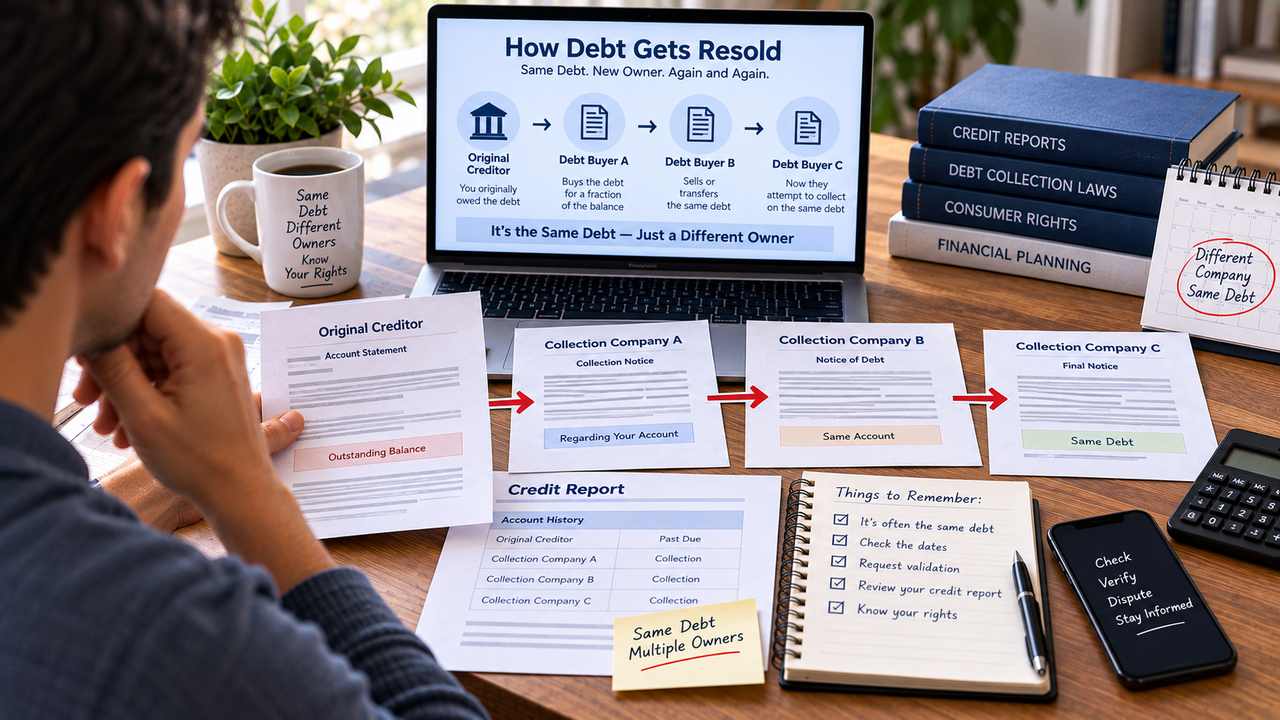
If you are dealing with multiple collection companies, it is also useful to understand how credit repair works and how collection accounts can affect your credit history.
Why Debt Gets Sold in the First Place
When you stop paying a credit card or similar unsecured debt, your original creditor eventually reaches a point (commonly around 180 days of nonpayment) where they’re required to “charge off” the account — an accounting move that classifies it as a loss rather than an asset they still expect to collect. At this point, the creditor has a few options: continue trying to collect internally, hire a third-party collection agency to work the account for a commission, or sell the debt outright to a debt buyer.
Selling is often the most immediately attractive option from the creditor’s perspective — it converts an uncertain, resource-intensive collection process into an immediate (if heavily discounted) cash recovery, allowing the creditor to move on rather than continuing to dedicate staff and resources to chasing an account that’s already fairly deep into delinquency.
If you want to understand what happens to an account after serious delinquency, see our guide to charge-offs versus collections.
The Debt-Buying Marketplace
Debt buyers purchase these charged-off accounts, typically in large bundled portfolios containing hundreds or thousands of individual accounts, for a price that’s a small fraction of the total original balance — often reported to range from a few cents to around twenty cents on the dollar, depending on the debt’s age, type, and how much supporting documentation accompanies the sale. Once purchased, the buyer becomes the new legal owner and attempts to collect, keeping whatever they recover.
The fact that a debt buyer paid only a fraction of the original balance does not automatically mean that the consumer’s claimed balance is reduced by the same percentage. What the buyer paid for the account and what the consumer allegedly owes are separate questions.
Why the Same Debt Can Change Hands Multiple Times
Here’s where the “three different companies” scenario actually originates. A debt buyer who purchases a portfolio doesn’t necessarily succeed in collecting every account within it — some accounts turn out to be harder to collect than the buyer initially projected, whether due to the debtor being genuinely unable to pay, the debt being harder to verify or document than expected, or simply the debtor being difficult to locate or reach.
Rather than continuing to invest resources indefinitely into accounts that aren’t producing results, many debt buyers periodically resell their less successful accounts to yet another debt buyer, at an even steeper discount than they themselves originally paid, essentially cutting their losses on that specific account while still recovering some value from the original bulk purchase.
This second buyer might have more success (sometimes simply because a different, later collection attempt happens to land at a moment when the debtor is more able or willing to resolve it), or they too might eventually resell the account to a third buyer if their own efforts also fail.
This is exactly how a single, original debt can pass through the hands of multiple different companies over time — each one representing a different stage of this resale chain, not separate, unrelated debts you actually owe multiple times over.
What This Means for You Practically
You only owe the debt once, to whoever currently, legitimately owns it. Even though multiple companies might contact you about what was originally the same debt, at any given point in time only the current legal owner has the right to actually collect it — a previous owner who’s already resold the account no longer has any legitimate claim.
Each new owner should be able to validate their current ownership if you request it.
Since ownership is what actually matters, not the debt’s history of prior owners, the current company contacting you should be able to demonstrate — if you formally request debt validation — that they legitimately purchased and now own the account.
Federal rules generally require debt collectors to provide validation information about the debt, including information that helps a consumer identify the creditor and amount claimed. The CFPB explains that consumers generally have a 30-day validation period for disputing a debt after receiving the required validation information. Learn more about debt validation requirements from the CFPB.
You should never end up paying more than one company for the same debt. If you’ve already resolved the debt with a previous owner (through payment or a settlement), and a subsequent “owner” contacts you claiming you still owe it, this is exactly the kind of situation where your own documentation of the prior resolution becomes critical, since it’s your strongest evidence that the current claim is invalid.
If a collection account appears inaccurate, you can also review our guide on how to dispute credit report errors.
How to Tell If a New Contact Represents a Genuinely Different Debt, or a Resold Version of One You Already Know About
Compare the Original Creditor Listed
Formal debt validation should specify the name of the original creditor the debt traces back to — if two different collection contacts, months or years apart, both point back to the same original creditor and roughly the same account details (approximate original balance, approximate account opening date), this strongly suggests it’s the same underlying debt, now with a new current owner.
The CFPB notes that validation information can include the name of the creditor, account information, the current amount of the debt, and information explaining how to dispute the debt. Review the CFPB’s explanation of required validation information.
Compare the Claimed Balance
Compare the claimed balance, accounting for any legitimately accrued interest or fees.
While the exact figure might shift somewhat between different collection attempts (due to permitted interest accrual, or different rounding or fee calculations), a wildly different balance for what’s supposedly the same original account is worth specifically questioning.
Ask Directly
Ask directly. A simple, direct question to the new company — “Is this the same debt originally owed to [original creditor], previously being collected by [prior company you dealt with]?” — is a reasonable, direct way to clarify the situation, and a legitimate company should be able to answer this based on their own account records.
For a more formal approach, see our guide to debt validation letters.
Why This System Can Create Documentation Problems (That Work in Your Favor)
Every time a debt is resold, there’s an opportunity for record-keeping to become less complete or accurate than the original account documentation was. A debt that’s been resold two or three times may have a current owner whose actual proof of the account’s history, the original agreement terms, and the accurate current balance is less robust than what the original creditor would have had readily available.
This is exactly why formal debt validation becomes increasingly valuable and increasingly likely to reveal genuine gaps the more times a specific debt has changed hands — if a current owner genuinely can’t produce adequate documentation connecting the debt back to you and confirming their own legitimate ownership, this is a real, potentially successful basis for disputing their claim, separate from any question of whether the debt was ever legitimately owed to the original creditor in the first place.
Federal debt-collection rules provide consumers with specific validation and dispute rights. The CFPB’s current Regulation F explains the federal requirements for validation notices. See the CFPB’s current Regulation F validation rule.
What to Do Each Time a “New” Company Contacts You About What Might Be an Old Debt
Request Formal Debt Validation
Request formal debt validation every time, even if you’ve already gone through this process with a previous owner of what appears to be the same debt. Each new owner needs to independently establish their own legitimate claim; your prior dealings with a previous owner don’t automatically transfer or bind the new one.
For practical guidance on challenging collection accounts, you can also review how to file a credit dispute.
Check Whether You Already Resolved the Debt
Check whether you already resolved this specific debt with a previous owner. If you have documentation showing you already paid or settled with a prior company for this same original account, this is your strongest and most direct response — providing this documentation to the new company (and disputing the claim if they continue pursuing it despite this evidence) rather than starting the negotiation process over as if it were a fresh, unresolved debt.
The CFPB specifically provides guidance for consumers contacted about debts they believe they already paid or do not owe. See the CFPB guidance on already-paid or disputed debts.
Check Your State’s Statute of Limitations
Check your state’s statute of limitations, since the resale itself doesn’t reset this clock.
A common misconception is that a new owner means a “fresh start” on the legal timeline — it doesn’t. The statute of limitations is tied to the original delinquency date, regardless of how many times the debt has subsequently been resold.
However, statute-of-limitations rules can vary by state and by the circumstances of the debt. Our guide to the statute of limitations on debt provides additional context.
Keep Thorough Records
Keep thorough records of every interaction, regardless of which specific company is currently involved. Given how confusing multiple resales can become, maintaining your own organized file — dates, company names, amounts claimed, any payments or agreements — protects you regardless of how many additional companies might eventually become involved with this same underlying debt.
Frequently Asked Questions
If I paid off a debt with the first company that contacted me, why would a second company later claim I still owe it?
This can happen due to a records error (the payment wasn’t properly recorded or communicated during a subsequent resale), or, less commonly, through improper or fraudulent conduct by a subsequent buyer. Either way, your own payment documentation is critical evidence in disputing this kind of claim.
Does the debt’s dollar amount typically increase or decrease as it gets resold multiple times?
The amount a buyer paid to acquire it typically decreases with each resale (since previously unsuccessful accounts sell for less), but the amount they claim you owe generally doesn’t decrease correspondingly — you’d still generally be pursued for something close to the full remaining balance (potentially plus additional accrued interest, depending on what’s legally permitted), regardless of how cheaply the current owner acquired the account.
Can I ask a company how many times my specific debt has been resold?
You can ask, though they may not have complete visibility into the debt’s full ownership history before they themselves acquired it, and they’re not generally obligated to volunteer this information even if they do have it — formal debt validation, focused on establishing their own current legitimate ownership, is generally a more productive request than asking for a complete historical accounting of every prior owner.
Is there a limit to how many times a single debt can be resold?
There’s no specific legal limit on the number of times a debt can be resold, though practically, debt tends to become less valuable and less frequently resold as it ages and accumulates a longer history of unsuccessful collection attempts by multiple prior owners, eventually reaching a point where it’s simply written off entirely rather than resold again.
If a debt is resold after I’ve already disputed it successfully with a previous owner, does the new owner need to honor that prior successful dispute?
This is a nuanced situation worth discussing with a consumer law attorney if it arises — in principle, if you successfully demonstrated the debt was inaccurate or unverifiable with a previous owner, this is strong evidence a new owner would also need to grapple with, though the new owner isn’t automatically bound by an agreement or resolution reached with an entirely different, prior company simply because the debt is the same.
A Visual Walkthrough of a Typical Resale Chain
To make this concrete, here’s how a single credit card debt might realistically travel through several owners over a period of years:
| Time | What Happens |
|---|---|
| Year 1 | You stop paying a credit card with a $2,500 balance. After 180 days, the original bank charges it off and sells it, bundled with thousands of other accounts, to Debt Buyer A for roughly 10 cents on the dollar. |
| Year 1–2 | Debt Buyer A attempts collection — calls, letters, maybe a settlement offer — without success, whether because you were unreachable, unable to pay, or disputed the debt without full resolution. |
| Year 2 | Debt Buyer A resells the account, along with other unsuccessful accounts from that original portfolio, to Debt Buyer B, this time for perhaps 3–4 cents on the dollar, reflecting the lower expected recovery odds for an account that’s already proven difficult to collect once. |
| Year 3 | Debt Buyer B has similarly limited success and resells the account to Debt Buyer C for an even smaller amount. |
| Year 3–4 | Debt Buyer C contacts you — this is potentially the third different company name you’ve seen associated with what is, underneath it all, the exact same original $2,500 credit card debt from Year 1. |
Throughout this entire chain, your actual legal obligation never multiplied — you owed $2,500 (plus any permitted interest) at the start, and you still owe that same underlying amount to whichever company currently, legitimately holds it, not three separate $2,500 debts to three separate companies.
How This Pattern Connects to the “Zombie Debt” Phenomenon
This resale pattern is directly related to zombie debt, covered in more detail elsewhere — very old debt that resurfaces years later often does so precisely because it’s completed one or more rounds of this resale cycle, eventually landing with a buyer willing to make a fresh attempt long after the debt first went unpaid.
Understanding the resale mechanism explains why zombie debt exists at all: it’s not that anyone deliberately waited years to contact you: it’s that the debt spent that time moving through this ownership chain, with gaps of inactivity between different owners’ respective collection attempts.
If you are dealing with older debt, it is especially important to review the statute of limitations on debt before making decisions.
Frequently Asked Questions, Continued
Does each new owner in the resale chain have to notify me directly when they acquire my debt, before attempting collection?
There’s no strict, universal requirement for proactive notification immediately upon purchase in every circumstance, though you’re generally entitled to validation information, including confirmation of current ownership, once they begin attempting to actually collect and you request it.
Federal rules require debt collectors to provide validation information in connection with collection communications. The exact requirements can depend on the circumstances, so consumers should review the notice they receive and the applicable rules. See Regulation F from the CFPB.
If I successfully negotiate a “pay for delete” with one owner in the chain, but the debt gets resold before I complete payment, is that agreement still valid?
This depends on the specific terms and timing — if you have a written agreement and haven’t yet fulfilled the payment, a subsequent sale could complicate enforcement of that specific agreement with the new owner, which is exactly why completing any negotiated agreement promptly, rather than delaying, is generally advisable once terms are reached.
Learn more about the concept in our guide to pay-for-delete agreements.
Can I proactively find out if my debt has been resold before a new company contacts me?
Not directly in most cases — there’s no consumer-facing registry tracking individual debt resales, so you’d typically only become aware of a resale when the new owner actually initiates contact or, in some cases, when your credit report updates to reflect a new company’s name associated with the debt.
Does the interest rate or terms change when a debt is resold to a new owner?
Generally, the new owner is bound by the same underlying terms and legal limits that applied to the original debt agreement (or whatever’s legally permitted under your state’s law), rather than being able to impose entirely new, different terms simply because they’ve acquired the account — though it’s still worth verifying the specific accrued amount claimed through the validation process, since errors and improper additional fees do sometimes occur through this resale process.
Why Debt Buyers Are Willing to Purchase Accounts That Have Already Failed Once or Twice
It might seem strange that anyone would want to purchase a debt that one or even two previous professional collection companies already tried and failed to collect. The economics make more sense once you understand the pricing involved: since each subsequent resale happens at a progressively steeper discount, a third or fourth buyer might pay only a tiny fraction of a cent per dollar of face value, meaning even a very low success rate — collecting from just a small percentage of a large bulk portfolio of previously-unsuccessful accounts — can still be profitable.
Some companies specifically specialize in this later-stage, deeply discounted segment of the market, sometimes using different collection strategies (a different tone, a different settlement offer structure, sometimes simply better timing relative to your current financial situation) than earlier attempts used, on the theory that a different approach or a different moment might succeed where prior attempts didn’t.
What This Means for Your Long-Term Financial Record-Keeping
Given how often this resale pattern occurs, it’s worth building a habit of keeping documentation for any debt you resolve — payment confirmations, settlement agreements, written correspondence — for considerably longer than might feel intuitively necessary.
A debt you settled five or even ten years ago could theoretically resurface through this resale chain, and having your own records readily available to prove the resolution is far more useful than trying to reconstruct that history from memory or from a company that may no longer exist or be reachable by the time a dispute arises.
Frequently Asked Questions, Continued Further
Is there a way to tell from a collection letter alone how many times a debt has already been resold?
Not always directly, though sometimes a letter’s language (“we recently acquired your account”) or an unusually low-sounding settlement offer relative to the claimed balance can be an informal signal that you’re dealing with a later-stage buyer in a longer resale chain, though formal validation remains the more reliable way to understand the debt’s actual history and current status.
Does a debt lose any of its original terms or protections as it moves through multiple owners?
Your underlying legal protections (FDCPA rights, your state’s statute of limitations, the standard credit reporting rules) remain constant regardless of how many times the debt has been resold — what can become less reliable through repeated resale is the completeness of the documentation supporting the debt’s specific details, not your fundamental consumer protections themselves.
The Federal Trade Commission explains that the FDCPA prohibits covered debt collectors from using deceptive, unfair, or abusive practices when collecting consumer debts. Review the FTC’s debt collection guidance.
The Bottom Line
Debt gets resold because it’s often financially efficient for both original creditors and debt buyers who’ve had limited success — rather than pursuing a difficult account indefinitely, selling it (even at a steep additional discount) recovers some value while passing the ongoing collection effort to a new owner.
If you’re contacted by multiple different companies over time about what appears to be the same original debt, this resale pattern is very likely the explanation, not a sign that you somehow owe the debt multiple times over.
The practical response remains consistent regardless of how many times the debt has changed hands: request formal validation from whoever is currently contacting you, verify their claim against your own records and any prior resolution documentation, and never pay more than once for the same underlying obligation.
Related Credit & Debt Resources
- Debt Validation Letter Guide
- Statute of Limitations on Debt
- Collection Agency Harassment and the FDCPA
- How to Dispute Credit Report Errors
- How to Remove Collections From Your Credit Report
- How to Read a Credit Report
Need Help Reviewing Your Credit Report?
If you are dealing with collection accounts, duplicate accounts, inaccurate information, or debts that appear to have changed ownership multiple times, reviewing the information on your credit reports can help you identify potential inconsistencies.
Get in touch with our team to learn more about your credit situation.
Important: This article provides general educational information about debt collection and credit reporting. Laws and procedures can vary by state and by the circumstances of a particular debt. It is not legal advice. If you are facing a lawsuit, judgment, or a complex dispute over debt ownership, consider consulting a qualified consumer-law attorney in your state.
Leave a Reply