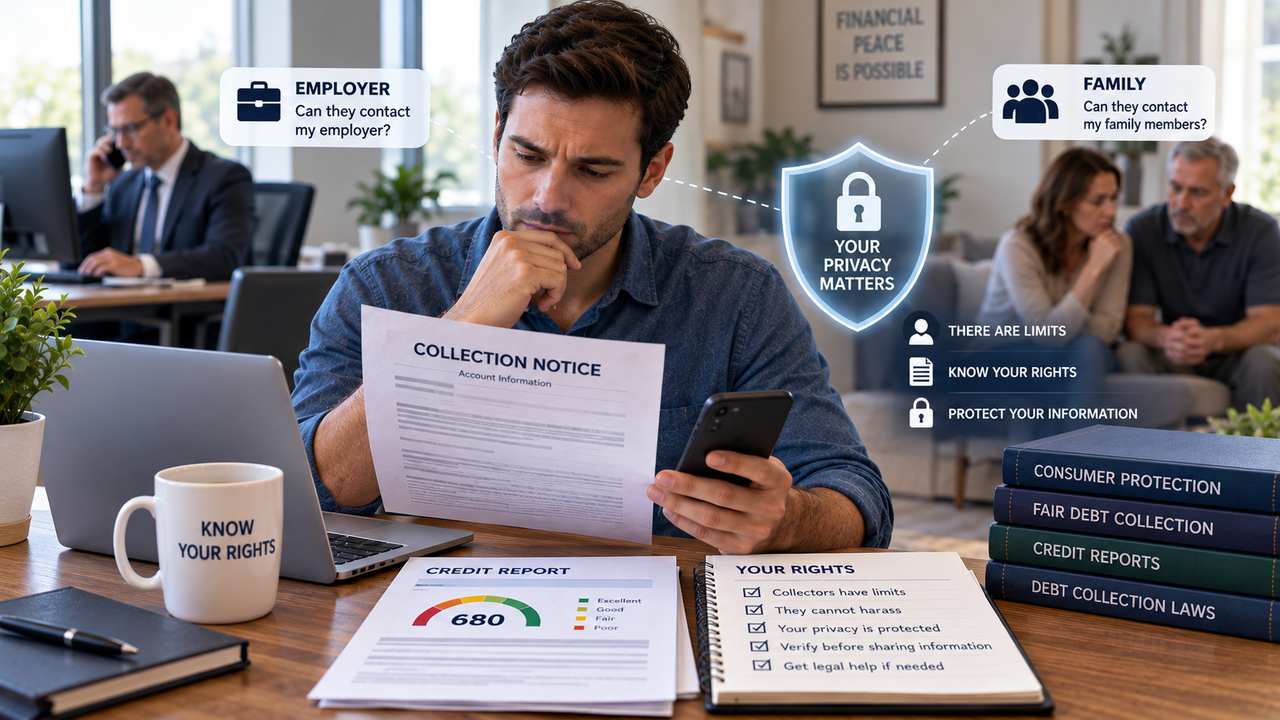
If you are dealing with collection activity, it can also help to understand your rights under the FDCPA and how improper collection practices may be challenged.
The Short Answer: Very Limited Contact Is Allowed, and Almost Never What You’re Afraid Of
Under the Fair Debt Collection Practices Act, a debt collector is permitted to contact third parties — including your employer, family members, neighbors, or anyone else — for exactly one narrow purpose: to obtain your location information, such as a current address or phone number, if the collector doesn’t already have accurate contact information for you.
Beyond that single, narrow purpose, they generally cannot discuss the debt itself, disclose that you owe money, or reveal any details about your financial situation to a third party.
The Consumer Financial Protection Bureau explains that federal debt-collection rules restrict how collectors communicate with people other than the consumer and include specific requirements regarding third-party communications. Review the CFPB’s Regulation F rules on third-party communications.
What Collectors Can Legally Ask a Third Party
- Your current address.
- Your current phone number.
- Your place of employment, if they don’t already know it and need it solely for the purpose of correctly contacting you (not for the purpose of contacting your employer about the debt itself).
That’s essentially the full scope of what’s legally permitted when contacting a third party. The FDCPA is specific and restrictive here precisely because Congress recognized how damaging and embarrassing it would be for collectors to be able to freely discuss someone’s debt with employers, family, or acquaintances.
For more information about federal debt-collection protections, you can also review the CFPB’s debt collection consumer resources.
What Collectors Cannot Do When Contacting a Third Party
- They cannot state or imply that you owe a debt. The conversation is legally supposed to be limited to location information, not disclosure of the underlying financial matter.
- They cannot contact the same third party more than once, unless they have a reasonable belief the earlier information was incorrect or incomplete, or the third party specifically requests a follow-up contact.
- They cannot use any language or symbol on an envelope indicating they’re a debt collector, if sending written correspondence to a third party for location purposes, and generally cannot identify their employer as a debt collection company unless specifically asked.
- They cannot discuss the amount owed, the nature of the debt, or any other financial details with anyone other than you (or your spouse, or your attorney, if applicable) without your explicit consent.
These restrictions are part of the federal rules governing covered debt collectors. The exact application can depend on the circumstances and the relationship of the person being contacted.
What About Calling Your Workplace Directly to Reach You (Not Your Employer About the Debt)?
This is a different scenario worth distinguishing clearly: a collector calling your workplace phone number specifically to reach you (not to discuss the debt with your employer or coworkers) is generally permitted, unless you’ve told them not to contact you at work, or unless they know or have reason to know your employer prohibits you from receiving such calls.
Once you inform a collector — verbally or in writing — that you cannot receive calls at work, they’re legally required to stop contacting you there, and this request is straightforward and something you’re fully entitled to make at any time.
For additional information about controlling communications from collectors, see our guide to cease-and-desist letters for debt collectors.
Can They Tell Your Employer You Owe Money, to Pressure You Into Paying?
No — this would be a clear FDCPA violation. Some particularly aggressive or illegitimate collectors have, historically, attempted this kind of pressure tactic (sometimes explicitly threatening to “call your boss” if you don’t pay), but this crosses a firm legal line.
If a collector does this, or explicitly threatens to do this, it’s a serious violation worth documenting and reporting.
The Federal Trade Commission explains that the FDCPA prohibits covered debt collectors from using unfair, deceptive, or abusive collection practices. Review the FTC’s debt collection guidance.
Can Debt Collectors Garnish Wages Without Involving Your Employer?
This is a related but distinct question worth addressing, since wage garnishment does necessarily involve your employer, but through an entirely different legal process than informal debt collection contact.
If a collector obtains a court judgment against you and then legally pursues wage garnishment, your employer will be formally notified through a legal garnishment order, which is a legitimate court process, not the kind of informal “calling your boss to pressure you” scenario this article is otherwise addressing.
Your employer is legally required to comply with a valid garnishment order once issued, and while this is understandably still uncomfortable, it’s a fundamentally different, legally structured process than a collector simply calling your workplace to disclose your debt informally.
Federal and state rules governing garnishment can vary. The CFPB provides additional information about how wage and benefit garnishment can work and why consumers should understand applicable protections. See the CFPB’s garnishment guidance.
If you are already dealing with a lawsuit over a collection account, our guide on what happens if you ignore a debt collection lawsuit may also be helpful.
What About Family Members — Can They Be Told You Owe Money?
The same core restriction applies: a collector generally cannot disclose the existence or details of your debt to family members, beyond the narrow location-information exception discussed above.
There is one specific exception worth knowing: if you’re married, a collector may be permitted to discuss the debt with your spouse specifically, depending on your state’s laws (particularly relevant in community property states, where a spouse may have some legal responsibility for certain debts incurred during the marriage), and in some cases with a parent if you’re a minor.
Beyond these specific, limited exceptions, siblings, adult children, parents (of an adult), roommates, or other family members generally cannot be told about your debt by a collector.
The CFPB’s Regulation F includes specific rules governing communications with people other than the consumer. Review the federal third-party communication rules.
What to Do If a Collector Violates These Rules
Document Everything
Document everything. Note the date, time, what was said, and to whom, if you become aware that a collector improperly contacted your employer or a family member and disclosed information about your debt.
Keep copies of collection letters, emails, text messages, voicemails, and any other communications that may help establish what occurred.
Send a Written Complaint or Cease-and-Desist Request
Send a written complaint or cease-and-desist request if the behavior continues, formally noting the violation and your understanding of the law.
Our guide to credit repair letters can help you understand how written correspondence can be organized when addressing credit and collection issues.
File a Complaint With the CFPB
File a complaint with the CFPB. This creates a formal record and requires the company to respond, which can be an effective way to hold them accountable, particularly for clear, documented violations like this.
You can submit a consumer complaint through the CFPB.
Consider Consulting a Consumer Law Attorney
Consider consulting a consumer law attorney. FDCPA violations like improper third-party disclosure can support a legal claim, including statutory damages, and this is exactly the kind of clear violation that attorneys handling these cases are often willing to take on, sometimes on a contingency basis.
The FDCPA contains specific provisions concerning civil liability and the time period for bringing private actions. Because deadlines and legal remedies can be important, legal advice should come from a qualified attorney familiar with your circumstances and state.
What If Your Employer Finds Out About Your Debt Some Other Way?
It’s worth distinguishing a collector improperly disclosing your debt from other, unrelated ways an employer might become aware of a financial matter — for example, if a wage garnishment order is legitimately issued following a court judgment, your employer will necessarily become aware of it as part of complying with that legal order, which is different from a collector informally telling your boss you owe money to pressure you.
Similarly, some background checks (particularly for certain financial industry jobs or security clearance positions) may include a review of your credit history as part of legitimate employment screening, which is a separate process from debt collection contact and governed by its own specific rules under the Fair Credit Reporting Act, requiring your consent before such a check can be conducted.
The Federal Trade Commission provides information about employment background checks and consumer rights under the FCRA. Learn more about employer background checks and your rights.
Frequently Asked Questions
Can a debt collector call my workplace’s general number if they don’t have my direct extension?
Yes, this is generally permitted if they’re trying to reach you specifically (not disclose the debt to whoever answers), though once you inform them you can’t receive calls at work, they must stop, regardless of which specific number at your workplace they were previously using.
Does the “no discussing the debt with third parties” rule apply to roommates who might answer my phone?
Yes — if a roommate answers a call intended for you, the collector should limit the conversation to leaving a message asking you to call back or confirming they’ve reached the right number, not disclosing debt details to the roommate, similar to the restriction on other third parties.
Can a collector send a letter to my workplace address if that’s the only address they have for me?
This can happen if it’s genuinely your only known address, though the letter should not indicate on the envelope that it’s from a debt collector, and if you inform them not to send mail to your workplace, they should honor that request going forward, similar to the phone contact restriction.
Is there a difference in these rules for a collection agency versus a debt buyer contacting third parties?
No — these FDCPA restrictions apply to third-party debt collectors broadly, whether they’re a traditional collection agency or a debt buyer, since both are typically classified as “debt collectors” under the law’s definition when collecting debt owed to someone else (including debt they’ve purchased).
The precise application of the FDCPA’s definition can depend on the collector’s role and circumstances. For background, see the CFPB’s explanation of what constitutes a debt collector.
What if I actually want a family member to help me deal with a debt collector — can I authorize that?
Yes — you can specifically authorize a collector to discuss your debt with a particular person (a family member helping you manage the situation, for example), which is different from a collector unilaterally disclosing the debt without your consent; this kind of authorization should ideally be provided in writing to create a clear record of your consent.
A Sample Cease-and-Desist Letter for Improper Third-Party Contact
If a collector has improperly contacted your employer or a family member, a written response documenting the violation is a strong first step:
[Your Name]
[Your Address]
[Date]
[Collector Name and Address]
Re: Improper Third-Party Contact — Account [Reference Number, if known]
To Whom It May Concern:
I am writing to formally notify you that on [date], your company contacted [name/relationship of third party — e.g., “my employer” or “my sister”] and disclosed information regarding an alleged debt. This contact violated my rights under the Fair Debt Collection Practices Act, which permits contact with third parties solely for the purpose of obtaining location information, not for disclosing the existence or details of a debt.
I am requesting that you cease any further contact with third parties regarding this matter, and that all future communication be directed to me directly, in writing, at the address above.
Please be advised that I am documenting this violation and reserve the right to pursue further action if it continues.
Sincerely,
[Your Name]
Send via certified mail with return receipt requested, and keep a copy along with your documentation of the original incident.
For more information about written communication with collectors, see our cease-and-desist letter guide.
Why This Protection Exists: The History Behind It
Understanding the reasoning behind this specific rule helps clarify why it’s taken so seriously. Before the FDCPA was enacted in 1977, it was a documented, common practice among some collectors to deliberately embarrass debtors into paying by publicizing their debts to employers, neighbors, and family members — sometimes even posting notices in public places or contacting an employer specifically hoping the debtor would be fired or pressured by workplace embarrassment into paying faster.
Congress specifically identified this kind of third-party shaming as an abusive practice warranting explicit legal prohibition, which is why the location-information exception is drawn so narrowly, and why violations of this specific provision are treated seriously under the law.
The FTC provides historical and consumer-oriented information about the FDCPA and prohibited debt-collection practices. Review the text of the Fair Debt Collection Practices Act.
What Legitimate Reasons Might Explain Workplace Contact That Feel Alarming But Aren’t Violations
Not every collector contact involving your workplace is necessarily improper. A few scenarios worth distinguishing:
- A collector calling your work number specifically to reach you (not disclosing anything to whoever answers) is permitted unless you’ve asked them to stop.
- A formally issued wage garnishment order, following an actual court judgment, necessarily involves your employer as part of a legitimate legal process, different from informal collection pressure.
- If you yourself provided your workplace as a contact method on an original credit application or account, a collector using that legitimately provided contact information to reach you (again, not to disclose debt details to a third party) isn’t itself a violation, even though it might still feel uncomfortable.
Frequently Asked Questions, Continued
If a collector calls my workplace and a coworker answers, is that automatically a violation?
Not automatically — if the collector simply asks to speak with you or leaves a generic callback message without disclosing any information about a debt, this typically doesn’t violate the third-party disclosure rule; the violation specifically occurs if they disclose the nature or existence of the debt to that coworker.
Can a debt collector show up at my workplace in person?
This is less common than phone or written contact but isn’t explicitly prohibited by the FDCPA itself, though the same restrictions on disclosing debt information to third parties would still apply to any in-person contact at your workplace, and repeated or harassing in-person visits could potentially constitute harassment under the broader FDCPA provisions.
Does this protection apply if the debt collector is actually my employer?
This is a more complex, less common scenario — if your employer is also your original creditor (such as certain employer-sponsored loan programs), the dynamics are different since there’s no true “third party” disclosure issue in the same sense, though other consumer protections and your specific loan agreement’s terms would still likely apply.
Is there a specific timeframe within which I should report a third-party contact violation?
There’s no strict deadline for reporting to the CFPB or filing a complaint, though the FDCPA itself has a one-year statute of limitations for filing a private lawsuit based on a violation, so if you’re considering legal action specifically, acting within that window matters, even though administrative complaints can generally be filed at other times as well.
Because legal deadlines can be important, consider consulting a consumer-law attorney promptly if you believe a violation occurred.
How This Interacts With Co-Signers and Joint Account Holders
It’s worth clarifying a related but distinct scenario: if someone is a co-signer or joint account holder on the specific debt in question, they’re not really a “third party” in the same sense — they’re independently, legally responsible for the debt themselves, meaning a collector can legitimately discuss the debt directly with them, since they’re a party to the obligation, not an outside person being contacted merely for location information.
This is different from, say, a parent who didn’t co-sign anything but is being told about their adult child’s unrelated credit card debt, which would fall under the more restrictive third-party rules discussed throughout this guide.
A Broader Perspective on Why Understanding This Matters Beyond the Legal Technicalities
Beyond the legal protections themselves, understanding exactly what collectors can and cannot do regarding your employer and family tends to meaningfully reduce the anxiety that debt collection situations often produce.
A significant portion of the fear people feel isn’t really about the debt itself — it’s about the imagined social consequences, the fear of a boss or a parent finding out and judging them.
Knowing concretely that the law specifically and firmly restricts this kind of disclosure can help separate the legitimate financial matter (which does need to be addressed) from an exaggerated fear of public exposure that, in the vast majority of legitimate collection situations, simply isn’t a realistic risk given these protections.
Frequently Asked Questions, Continued Further
If I list a family member as an emergency contact on a credit application, does that give the collector permission to discuss my debt with them later?
No — providing someone as an emergency contact is typically understood as being for location or contact purposes only, not as blanket authorization for a collector to discuss the substance of your debt with that person; the same restrictions on third-party disclosure would still apply.
Can a collector contact my landlord instead of my employer for location information?
Yes, a landlord could similarly be contacted solely for location-verification purposes under the same narrow exception, with the same restriction against disclosing details about the debt itself to the landlord.
Does reporting a violation to the CFPB actually result in any consequence for the collector, or is it mostly symbolic?
CFPB complaints require a company response and become part of the public complaint database, which can carry real reputational and, in aggregated patterns, regulatory consequences for repeat offenders — while a single complaint may not immediately halt improper behavior, it’s a legitimate, documented step that contributes to broader enforcement patterns and creates a record that can support further action if needed.
File a complaint with the CFPB if you believe a covered debt collector has violated your rights.
The Bottom Line
Debt collectors are significantly more restricted in contacting your employer or family than most people assume — they can generally only reach out to third parties to obtain your location information, not to discuss the debt itself or pressure you through disclosure to people in your life.
Calling your workplace to reach you directly is different and generally permitted unless you’ve asked them to stop, but disclosing your debt to your employer or family members without your consent is a clear violation of your rights.
If this happens to you, documenting it and filing a complaint — with the CFPB, or through a consumer law attorney — is a legitimate and often effective response to a genuine violation of protections specifically designed to prevent exactly this kind of embarrassment and pressure.
Related Credit & Debt Resources
- Collection Agency Harassment and the FDCPA
- Cease-and-Desist Letter for Debt Collectors
- Debt Validation Letter Guide
- How to Dispute Credit Report Errors
- How to Remove Collections From Your Credit Report
- How to Read a Credit Report
Need Help Reviewing Your Credit Situation?
If you are dealing with collection accounts, inaccurate information, repeated collection contacts, or other credit-report problems, a review of your credit situation can help you understand what appears on your reports and what steps may be available.
Important: This article is for general educational purposes and is not legal advice. Federal and state laws can vary, and the FDCPA does not apply to every type of creditor or collection activity. If you believe a debt collector has violated your rights, consider consulting a qualified consumer-law attorney about your specific circumstances.
Leave a Reply