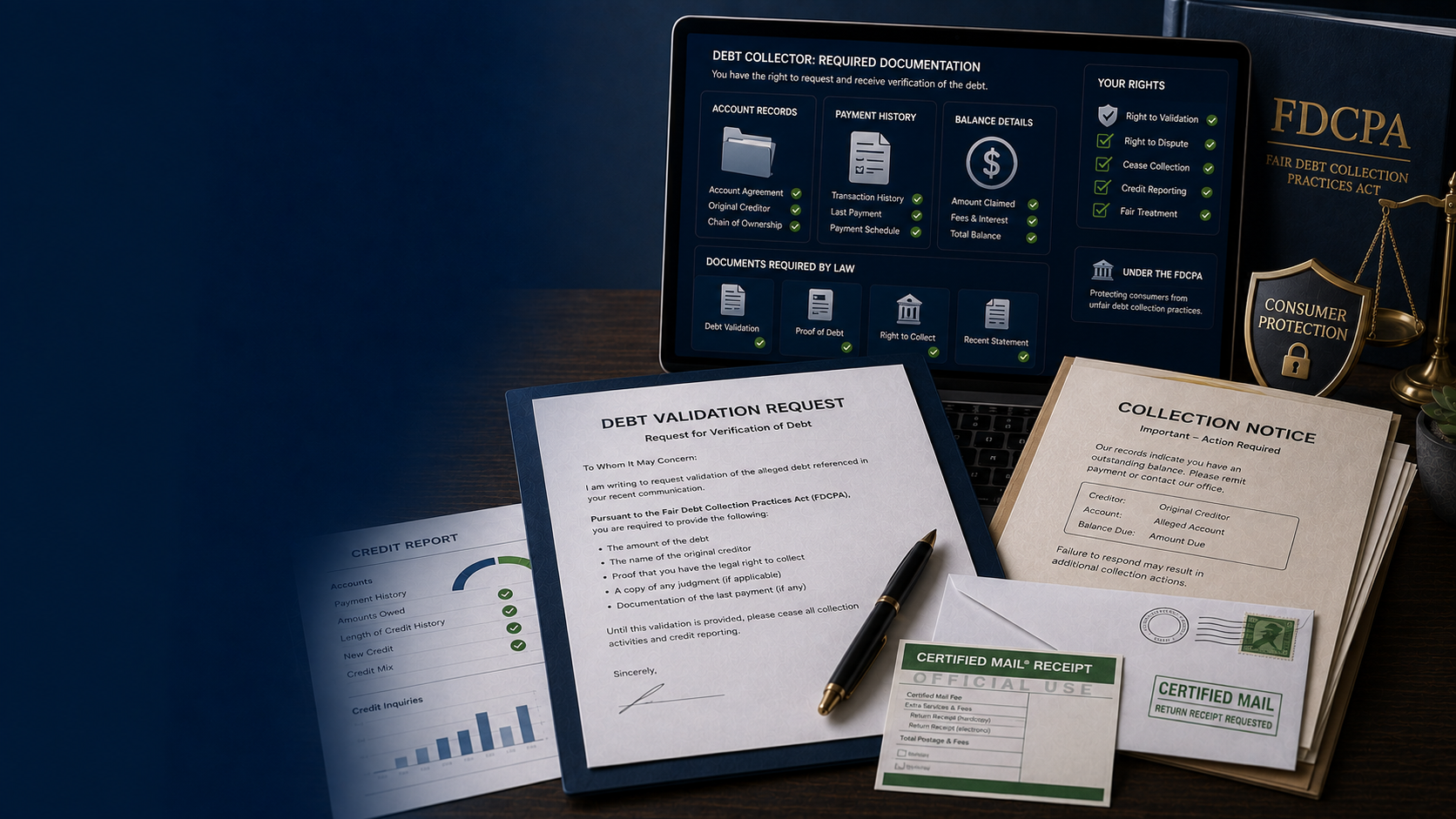
Here’s what most people don’t know: you have a legal right to make that collector prove the debt exists, that it’s yours, and that the amount is correct — before you pay a single cent. That right lives in a federal law called the Fair Debt Collection Practices Act (FDCPA), and the tool that exercises it is called a debt validation letter.
A debt validation letter is a written request that forces a collector to stop all collection activity and produce proof of the debt. If they can’t — or won’t — they have to stop collecting. In many cases, they also have to stop reporting the debt to the credit bureaus.
This guide walks you through every part of the process: what validation is, when to send the letter, what it must contain, what happens after you send it, and what to do when a collector fails to respond. We’ve included a full template you can adapt, a breakdown of how validation interacts with your credit reports, and answers to the questions we hear most often from clients at credit-repair.com.
Whether you’re dealing with your first collection notice or you’ve been wrestling with an old debt for years, understanding debt validation is one of the most practical, empowering tools in the credit repair process.
What Is a Debt Validation Letter?
A debt validation letter is a written notice you send to a debt collector requesting that they prove a debt is legitimate before they continue trying to collect it. It is a formal, legally recognized request that triggers specific obligations under the FDCPA.
When you send a validation letter, you’re asking the collector to produce evidence that:
- The debt actually exists — there’s a real underlying obligation, not a fabricated or mistaken entry.
- The debt belongs to you — it’s tied to your identity, your account, and your signature (or other proof of obligation).
- The amount is accurate — the balance, fees, and interest have been calculated correctly and legally.
- The collector has the authority to collect it — they either own the debt or have been authorized by the original creditor to collect on it.
Think of it as the collector’s homework assignment. You’re not refusing to pay. You’re saying, “Before I hand over money to a stranger who called me on a Tuesday afternoon, I need you to show me the paperwork.”
This matters more than most people realize. Debts change hands constantly. An original creditor sells a portfolio of accounts to a debt buyer, who sells it to another, who assigns it to a collection agency. With each transfer, records degrade. Account numbers get transposed. Balances get inflated with questionable fees. Sometimes the same debt gets sold to two different collectors, and both come after you.
A validation letter forces clarity into a process that is otherwise opaque and one-sided.
Debt validation letter vs. debt verification notice
People often use “validation” and “verification” interchangeably, but under the FDCPA they refer to different things — and the distinction matters.
- A validation notice (sometimes called a validation letter or dunning notice) is what the collector sends to you within five days of their first contact. It tells you how much they claim you owe, who the original creditor is, and that you have 30 days to dispute the debt.
- A debt validation letter is what you send to the collector within that 30-day window. It’s your request for proof. In everyday conversation and in this guide, when we say “debt validation letter,” we mean the letter you send to request validation.
We’ll dig into what the law requires collectors to produce in .
Your Right to Validate Under the FDCPA
The Fair Debt Collection Practices Act (FDCPA) is a federal law passed in 1978 that regulates how third-party debt collectors operate. Its core purpose is to eliminate abusive, deceptive, and unfair debt collection practices — and one of the most important protections it gives consumers is the right to request validation of a debt.
The specific provision is 15 U.S.C. § 1692g, and here’s what it says in plain terms:
If a debt collector contacts you about a debt, they must send you a written notice (either with the first contact or within five days of it) that includes:
That third and fourth point are the heart of your validation right. The collector’s notice must explicitly tell you that you have 30 days to dispute the debt in writing, and that if you do, they have to verify it.
Who is covered by the FDCPA?
The FDCPA applies to third-party debt collectors — collection agencies, debt buyers, and attorneys who regularly collect debts. It does not apply to original creditors collecting their own debts (like a credit card company calling you about its own account). However, many states have their own laws that extend similar protections to original creditors, and the Fair Credit Reporting Act (FCRA) provides separate protections for how debts are reported.
This is a distinction worth understanding: if Chase calls you about a Chase credit card, the FDCPA may not apply. If a collection agency calls you about that same Chase account, the FDCPA absolutely applies.
What counts as “in writing”?
The FDCPA requires that your dispute or validation request be made in writing. A phone call is not enough. This is why sending a formal debt validation letter — and keeping proof of mailing — is essential.
Some collectors may accept disputes electronically, but to preserve your full legal rights, a written letter sent via certified mail with return receipt is the gold standard. We’ll cover this in detail in .
The 30-Day Validation Window
The FDCPA gives you a specific window to request validation: 30 days from the date you receive the collector’s initial validation notice.
Here’s how the timeline works:
- First contact — A collector contacts you for the first time (by phone, letter, or other means).
- Validation notice — Within five days of that first contact, the collector must send you a written validation notice containing the information described above.
- 30-day clock — The 30-day period begins when you receive the notice. If you receive it on March 1, your 30 days run through March 31.
- Your validation request — You send your debt validation letter within those 30 days.
- Collection must pause — Once the collector receives your written dispute, they must cease all collection activity until they obtain and mail you verification of the debt.
What happens if you miss the 30-day window?
This is one of the most common — and most consequential — misunderstandings about debt validation.
If you miss the 30-day window, the collector is allowed to assume the debt is valid and continue collection efforts. However — and this is critical — you do not lose the right to request validation. You can still send a validation letter after the 30 days have passed.
The difference is in the effect:
- Within 30 days: The collector is legally required to cease collection activity and verify the debt before resuming. They cannot sue you, report to credit bureaus, or continue calling while validation is pending.
- After 30 days: The collector is not legally required to cease collection activity in response to your request. They can continue collecting while they respond — or they can ignore your request entirely. Many will still respond, especially if the request is well-written, but the FDCPA’s automatic cease-collection requirement no longer applies.
This is why timing matters so much. If you’re within 30 days of first contact, send the letter. If you’re outside the window, you can still send it — but understand that the legal leverage is weaker, and you may need to combine it with other strategies (like FCRA disputes or state-law claims) to achieve the same result.
How to know if you’re within the window
If you received a written notice from the collector, check the date on it. The 30-day clock starts from when you received it, not the date printed on it. If you’re not sure when it arrived, err on the side of acting quickly. If the first contact was a phone call and you never received a written notice, the collector may have violated the FDCPA by failing to send one — and you can still send a validation letter, noting that you never received the required notice.
Validation vs. Verification: What the Law Actually Requires
Here’s where things get nuanced — and where a lot of consumers (and even some practitioners) get confused.
The FDCPA says that if you dispute a debt within 30 days, the collector must obtain “verification of the debt” and mail it to you. But the law doesn’t precisely define what “verification” means. Over the years, courts have interpreted this requirement, and the results vary by jurisdiction.
The minimal interpretation
In the landmark case Marshall v. Medina (2003), the court held that verification can be minimal — the collector confirming the debtor’s name, the amount, and that they have records from the original creditor. Under this interpretation, a collector can satisfy the FDCPA by sending you a simple letter that says, “We have confirmed with the original creditor that you owe $X for account Y.”
This is frustrating for consumers because it feels like the collector just… said the same thing again. But under this minimal standard, that may be technically sufficient.
The more demanding interpretation
Other courts have taken a broader view. In Chaudhry v. Gallerizzo (1997), the court suggested that verification requires the collector to obtain confirming information from the creditor and share enough detail that the consumer can meaningfully identify the debt and dispute it if it’s wrong.
And in 2021, the Consumer Financial Protection Bureau (CFPB) issued Regulation F, which clarified and modernized FDCPA requirements. Under Reg F, when a collector responds to a validation request, they must provide:
- The amount of the debt at charge-off (if different from the current balance)
- The amount of interest, fees, and other charges added since charge-off
- The current balance
- The name of the original creditor (if requested)
- If the debt was sold or transferred, information about the current creditor
This is significantly more than the old “we confirm you owe $X” standard. It gives you a fighting chance to see whether the amount has been inflated, whether fees are legitimate, and whether the chain of ownership is intact.
What “validation” should look like in practice
At a minimum, proper validation should include:
- The original creditor’s name and address
- The original account number
- The amount owed at charge-off
- An itemization of interest, fees, and charges added since
- The current balance
- The name of the current creditor (if the debt was sold)
- Some documentation connecting you to the debt — ideally a signed application, account statements, or a contract
If a collector sends you a one-line letter that says “We verified your debt of $4,200 with [Creditor],” that may technically satisfy the FDCPA in some jurisdictions — but it’s weak validation, and there are ways to push back. We cover those in .
The practical takeaway
The law sets a floor, not a ceiling. A well-written validation letter requests specific documents — account agreements, statements, proof of assignment — rather than just asking the collector to “verify” the debt. This puts the burden on the collector to either produce real documentation or admit they don’t have it.
Why Debt Validation Matters
You might be wondering: if collectors can sometimes satisfy validation with a minimal letter, what’s the point of sending one at all?
The answer is that debt validation serves several critical purposes, and the letter itself is a tool that does more than just trigger the FDCPA’s verification requirement.
1. It forces the collector to prove the debt — or stop collecting
The most powerful effect of a timely validation letter is the cease-collection requirement. Once the collector receives your written dispute within the 30-day window, they must stop all collection activity until they verify the debt. That includes:
- Phone calls and letters
- Lawsuits
- Credit reporting (more on this below)
- Garnishment proceedings
If the collector can’t produce verification, they cannot legally resume collection. For many debts — especially older ones that have been sold multiple times — the collector simply doesn’t have the documentation. The original creditor’s records are gone. The chain of assignment is broken. In these cases, the debt effectively becomes uncollectible.
2. It surfaces errors and inaccuracies
Debts are transferred, sold, and re-sold. At each step, information degrades. We regularly see:
- Wrong amounts — fees and interest added that weren’t authorized in the original agreement
- Wrong consumer — debts mixed up due to similar names, shared addresses, or data entry errors
- Duplicate debts — the same account placed with two different collectors
- Already-paid or settled debts — accounts that were resolved but resurface in collection
- Identity theft — accounts opened fraudulently in the consumer’s name
- Time-barred debts — debts past the statute of limitations being collected as if they’re still enforceable
A validation letter forces these issues into the open. If the collector’s records don’t match reality, the validation process exposes that.
3. It creates a paper trail
Every communication you send via certified mail creates a documented record. If you later need to prove that you disputed the debt, that the collector failed to validate, or that the collector continued collection activity illegally, your paper trail is your evidence.
This matters for two reasons:
- FCRA enforcement — If a collector reports a debt to the credit bureaus after you’ve disputed it and they haven’t validated, they may be violating the FCRA. Your validation letter and certified mail receipts are the proof.
- FDCPA lawsuits — If a collector violates the FDCPA (continues collecting without validating, sues you during the validation period, etc.), you may have grounds for a lawsuit. Statutory damages under the FDCPA can be up to $1,000 per violation, plus actual damages and attorney’s fees.
4. It puts you in control
Most collection interactions are one-directional: the collector demands, the consumer pays (or panics). A validation letter flips that dynamic. You’re not refusing to pay — you’re exercising a legal right and requiring the collector to do their homework before you write a check.
This shift in control is significant. It moves the conversation from “pay up” to “prove it,” and it gives you time and information to make a good decision.
When to Send a Debt Validation Letter
The best time: within 30 days of first contact
If a debt collector contacts you and you receive their validation notice, send your debt validation letter as soon as possible — and absolutely within 30 days. This is when you have the strongest legal rights.
Within the 30-day window:
- The collector must cease all collection activity upon receiving your letter
- The collector must obtain verification and mail it to you
- The collector cannot sue you while validation is pending
- The collector generally should not report the debt to credit bureaus during the validation period
There is no advantage to waiting. The moment you receive the validation notice, the clock is running. Send the letter promptly.
What counts as “first contact”?
First contact can be:
- A phone call from the collector (they must follow up with a written notice within five days)
- A letter in the mail
- An email or text message (under Reg F, collectors can use electronic communications, but they must still provide the validation notice)
- A message left on your answering machine (though this raises separate FDCPA concerns about third-party disclosure)
If you received a phone call and no written notice followed within five days, the collector may have violated the FDCPA. You can still send a validation letter, and you should note in the letter that you never received the required written notice.
After the 30-day window: you can still request validation
If you’re past the 30-day window, you have not lost your right to ask for validation. You can still send the letter. The difference is that the collector is not legally required to cease collection while they respond.
That said, sending a validation letter after the window is still worthwhile for several reasons:
- Many collectors will still respond — especially if the request is specific and well-written. They know that ignoring a written request looks bad if the matter ends up in court.
- It creates a paper trail — documenting that you asked for proof and what the collector did (or didn’t) provide.
- It supports FCRA disputes — if you dispute the debt with the credit bureaus, having a validation request on record strengthens your position.
- It may reveal FDCPA violations — if the collector continues collection activity without validating, that may be actionable even outside the 30-day window in certain circumstances.
When you should always send a validation letter
Regardless of timing, you should send a validation letter when:
- You don’t recognize the debt — you have no memory of the account or the creditor
- The amount seems wrong — it’s higher than you remember, or includes fees you don’t understand
- You believe the debt was already paid or settled
- You suspect identity theft — the account may have been opened in your name fraudulently
- The collector is aggressive or threatening — you want to shift to written communication and create a record
- The debt is old — it may be time-barred or past the credit reporting window
- You’re considering bankruptcy or settlement — you need to know exactly what you owe and to whom before making decisions
When you might not need to send one
If you know the debt is yours, the amount is correct, you have the means to pay it, and your goal is simply to resolve it — you may choose to negotiate directly rather than validate. But even then, a validation letter can be a useful opening move: it pauses collection activity, giving you breathing room to negotiate from a calmer position.
What Must Be in Your Validation Letter
A debt validation letter doesn’t need to be written in legal language or follow a rigid format. But it does need to be clear, specific, and sent in writing. Here are the elements every effective validation letter should include.
1. Your identifying information
Include your full name, current address, and (optionally) the last four digits of your Social Security number. This helps the collector match your letter to the right account. Do not include your full SSN — the last four are sufficient.
2. The collector’s information
Address the letter to the specific collection agency, using the name and address from their validation notice.
3. A clear statement that you are disputing the debt
Your letter must explicitly state that you are disputing the debt and requesting validation. Use those words. Do not say “I’d like more information” or “Can you send me details?” — that may not be treated as a formal dispute under the FDCPA.
4. Reference to the specific debt
Include the account number, the original creditor’s name (if known), and the amount the collector claims you owe. This comes from their validation notice. If you don’t have all of this information, include what you do have.
5. Specific requests for documentation
This is where a good validation letter goes beyond the minimum. Don’t just ask for “verification.” Ask for specific documents:
- A copy of the original signed contract or application
- Account statements showing the charges and payments
- The date of the last payment and the charge-off date
- An itemization of all fees, interest, and charges added since charge-off
- Proof that the collector owns the debt or has authority to collect it (chain of assignment)
- The original creditor’s name and address
6. A demand to cease collection activity
State clearly that under the FDCPA, the collector must cease all collection activity until validation is provided. This includes phone calls, letters, lawsuits, and credit reporting.
7. A request for communication preferences
You can specify how you want the collector to communicate with you. Many people request that all communication be in writing only — no phone calls. Under the FDCPA, collectors must honor a written request to cease communication (though this is a separate request under § 1692c).
8. Your signature and the date
Sign the letter and date it. Keep a copy for your records.
9. Proof of mailing
This isn’t part of the letter itself, but it’s essential: send the letter via certified mail with return receipt requested. The return receipt is your proof that the collector received your letter and when. Without it, a collector can claim they never got your dispute, and you’ll have no way to prove otherwise.
The return receipt costs a few dollars at the post office. It is one of the best investments you can make in the credit repair process.
Sample Debt Validation Letter Template
Below is a template you can adapt for your own use. Replace the bracketed information with your specific details. This template is designed to be thorough — it requests specific documents and clearly invokes your FDCPA rights.
This template is for educational purposes and is not legal advice. Your situation may have nuances that require professional guidance. If you’re working with an attorney, follow their instructions.
[Your Full Name] [Your Current Address] [Your City, State, ZIP] [Your Phone Number] [Last 4 digits of SSN: XXXX] [Date] [Collector/Agency Name] [Collector Address] [Collector City, State, ZIP] RE: Dispute of Debt and Request for Validation Account Number: [Account number from validation notice] Original Creditor: [Name from validation notice, if known] Amount Claimed: $[Amount from validation notice] To Whom It May Concern: I am writing in response to your [letter / phone call] dated [date], regarding the above-referenced account. I do not recall this debt and am disputing it in its entirety. Pursuant to my rights under the Fair Debt Collection Practices Act (FDCPA), 15 U.S.C. § 1692g, I am requesting that you validate this debt. Specifically, I am requesting that you provide me with the following: 1. The name and address of the original creditor and the account number associated with this debt. 2. A copy of the original signed contract, application, or other agreement that created the underlying obligation. 3. Account statements from the original creditor showing the charges, payments, and the charge-off date. 4. The date of my last payment to the original creditor. 5. A complete itemization of the debt, including: – The balance at the time of charge-off – All interest, fees, and charges added since charge-off, with the basis for each – The current balance you are attempting to collect 6. Proof that you currently own this debt or have been authorized by the creditor to collect it, including any applicable chain of assignment or transfer of ownership from the original creditor to your agency. 7. Confirmation of whether this debt is within the applicable statute of limitations for enforcement in my state. Please be advised that under 15 U.S.C. § 1692g(b), you must cease collection of this debt — including all phone calls, letters, credit reporting, and legal action — until you have obtained verification of the debt and mailed it to me. I also request that all future communication regarding this matter be conducted in writing only. Do not contact me by telephone at home or at work. If you cannot provide the documentation requested above, I expect that you will cease all collection activity, notify me in writing that you are unable to validate this debt, and remove any information you have reported about this debt to the credit reporting agencies. I expect a response within 30 days of your receipt of this letter. Sincerely, [Your Signature] [Your Printed Name]
Tips for using this template
- Send it certified mail with return receipt. Keep the receipt and the returned postcard in a safe place.
- Keep a copy of the signed letter. You may need it later.
- Do not admit to the debt. The letter says “I do not recall this debt” — that’s a dispute, not an admission.
- Customize the requests. If you know the debt is yours but the amount is wrong, focus your requests on the itemization and charge-off details. If you suspect identity theft, emphasize the request for the signed application.
- Be accurate. Don’t claim you don’t recognize the debt if you do. You can still dispute the amount or request validation without denying the debt exists.
What Happens After You Send the Letter
Once the collector receives your validation letter (and you have the return receipt to prove it), several things happen — or should happen.
The collector must cease collection activity
Under FDCPA § 1692g(b), if you dispute the debt in writing within the 30-day window, the collector must cease collection of the debt until they obtain verification and mail it to you.
“Collection activity” is broadly defined. It includes:
- Phone calls and letters demanding payment
- Filing or pursuing a lawsuit against you
- Reporting the debt to credit bureaus (more on this in )
- Garnishing wages or levying bank accounts
- Any other act intended to collect the debt
If the collector continues any of these activities after receiving your letter and before validating, they may be violating the FDCPA. Document every contact — save voicemails, keep letters, note dates and times of calls.
The collector must obtain verification
The collector must obtain verification of the debt (or a copy of a judgment, if the debt is based on one) and mail it to you. There is no specific deadline in the FDCPA for how long the collector has to respond — the law says they must do it, but it doesn’t say “within X days.”
In practice, most collectors respond within 30–60 days. But some take longer, and some never respond at all. If a collector doesn’t respond, the cease-collection requirement remains in effect — they cannot resume collection without validating.
What if the collector sues you during the validation period?
If a collector files a lawsuit against you after you’ve sent a timely validation letter and before they’ve validated, that is generally a violation of the FDCPA. If this happens:
- Respond to the lawsuit. Do not ignore a court summons, even if the collector is violating the FDCPA. File an answer with the court asserting your validation rights as a defense.
- Contact an attorney. An FDCPA violation may give you a countersuit for statutory damages, actual damages, and attorney’s fees.
- Document everything. Your certified mail receipt, the date the lawsuit was filed, and any other communications are all evidence.
What if the collector sells the debt to another agency?
Sometimes, instead of validating, a collector will sell the debt to another agency. This is not a violation per se — but the new collector becomes subject to the same FDCPA requirements. When the new collector contacts you, a new 30-day validation window begins, and you can send another validation letter.
This is frustrating, but it’s also an opportunity. Each time a debt changes hands, the documentation chain weakens. The further a debt travels from the original creditor, the harder it is for any collector to validate it.
What Proper Validation Looks Like
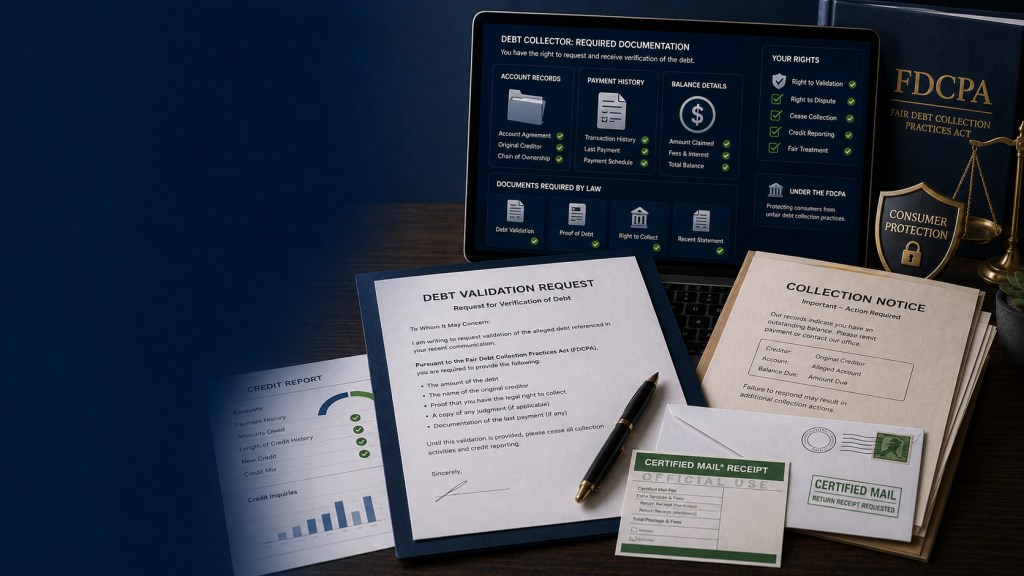
When a collector responds to your validation request, the quality of their response matters enormously. Here’s what proper, thorough validation should include — and what weak validation looks like.
Strong validation
A collector who has solid documentation should be able to provide:
- A copy of the original agreement or application showing your signature
- Account statements from the original creditor showing the transaction history
- The charge-off date and balance at charge-off
- A clear itemization of interest, fees, and charges added since charge-off, with the contractual or legal basis for each
- Proof of ownership or assignment — documentation showing the debt was transferred from the original creditor to the current collector, including the chain of transfers if the debt was sold multiple times
- The current creditor’s name and address
If you receive all of this, the debt is well-documented. Your next steps depend on your goals — you might negotiate a settlement, set up a payment plan, or, if the documentation reveals errors, dispute specific aspects of the debt.
Weak validation
Weak validation looks like:
- A one-paragraph letter stating “We have verified that you owe $X to [Creditor]” with no supporting documents
- A printout from the collector’s own database (not from the original creditor)
- A statement that says “We have confirmed the debt with the original creditor” but includes no account statements, no contract, and no itemization
- A response that includes the original creditor’s name but nothing else
Under the minimal interpretation of the FDCPA (the Marshall v. Medina standard), weak validation may technically satisfy the collector’s obligation. But it doesn’t mean you’re out of options.
What to do with weak validation
If you receive weak validation:
- Send a follow-up letter. Acknowledge their response and state that it is insufficient. Request the specific documents listed in your original letter — the signed agreement, account statements, itemization, and proof of assignment. State that their response does not constitute adequate validation and that you continue to dispute the debt.
- Dispute with the credit bureaus. If the debt is on your credit reports, file disputes with Equifax, Experian, and TransUnion. Under the FCRA, if a furnisher cannot verify a debt, it must be removed. We cover this in .
- Consider the FCRA angle. If the collector is reporting the debt to the bureaus but can’t produce real documentation, there may be a tension between their FDCPA obligation and their FCRA obligation. A collector who can’t validate a debt to you arguably can’t verify it to the bureaus either.
- Consult a professional. If the amount is significant or the collector is aggressive, an attorney who specializes in FDCPA and FCRA cases can help. Many offer free consultations and work on contingency.
What to Do If They Don’t Respond or Send Weak Validation
Non-response and weak response are two of the most common outcomes — and both can work in your favor if you handle them correctly.
If the collector doesn’t respond at all
If you sent your validation letter certified mail within the 30-day window and the collector never responds:
- The cease-collection requirement remains in effect. The collector cannot legally resume collection activity. If they do — by calling, writing, suing, or reporting to the bureaus — they are violating the FDCPA.
- Document any continued collection activity. Save every letter, voicemail, and note every phone call. If they sue you, respond to the lawsuit and raise the validation defense.
- Send a follow-up letter. Note that they have not responded to your validation request and that collection activity must continue to cease. Request that they confirm in writing that they cannot validate the debt and that they will close the account and remove any credit reporting.
- Dispute with the credit bureaus. File disputes with all three bureaus. When the bureaus contact the collector to verify the debt, the collector’s failure to validate to you makes it harder for them to verify to the bureaus. If they can’t verify, the debt must be removed.
- Consider legal action. If the collector continues collection activity without validating, you may have an FDCPA claim. Statutory damages are up to $1,000 per violation, plus actual damages and attorney’s fees. Many consumer protection attorneys offer free consultations.
If the collector sends minimal or weak validation
As discussed above, weak validation may technically satisfy the FDCPA in some jurisdictions. But it doesn’t end the story:
- Send a follow-up letter stating that their response is insufficient and requesting the specific documents you originally asked for.
- Dispute with the credit bureaus under the FCRA. The FCRA requires that reported information be accurate and verifiable. If the collector can’t produce real documentation, the bureaus may not be able to verify it.
- Request a method of verification (MOV) from the credit bureaus after they “verify” the debt. The bureau must provide a description of the procedure they used to verify. If the verification was cursory, this can support further disputes.
- Look for other violations. Collectors who send weak validation sometimes also violate other FDCPA provisions — failing to send the initial validation notice, calling at prohibited times, misrepresenting the debt, or adding unauthorized fees.
If the collector claims they’ve already validated
Sometimes a collector will claim that the initial letter they sent you (the validation notice) is the validation. This is incorrect. The validation notice is the notice of your right to validate — it is not itself validation. Validation must be obtained after you dispute, and it must come from the original creditor or from the collector’s own records obtained from the original creditor.
If a collector makes this claim, respond in writing clarifying that their initial notice is not validation and that you are still awaiting the documentation you requested.
How Validation Interacts With Credit Reporting
This is one of the most important — and most overlooked — connections in credit repair: debt validation under the FDCPA and credit reporting under the FCRA are linked. Understanding how they interact can help you remove invalid debts from your credit reports.
The FDCPA side
Under FDCPA § 1692g(b), once you dispute a debt in writing within 30 days, the collector must cease collection activity until they validate. The CFPB and many courts have taken the position that reporting a debt to credit bureaus is a form of collection activity. Therefore, if a collector is required to cease collection, they should also cease reporting — or at minimum, report the debt as “disputed.”
The FCRA side
Under the FCRA (15 U.S.C. § 1681s-2), when a furnisher (the collector) reports information to a credit bureau, and the consumer disputes that information directly with the bureau, the bureau must notify the furnisher. The furnisher must then:
- Conduct a reasonable investigation
- Review all relevant information provided by the bureau
- Report the results to the bureau
- If the information is inaccurate or cannot be verified, modify or delete the item
Additionally, under FCRA § 1681s-2(a)(3), if a consumer disputes a debt directly with the furnisher (which is what your validation letter does), the furnisher must:
- Note that the debt is disputed when reporting it to the bureaus
- Conduct an investigation
- If the information cannot be verified, delete it
The practical intersection
Here’s how these two laws work together:
- You send a validation letter to the collector (FDCPA). The collector must cease collection — including reporting the debt as “owed” without noting the dispute.
- The collector should report the debt as “disputed” on your credit reports. This doesn’t remove the debt, but it signals to anyone viewing your report that the debt is contested.
- If the collector can’t validate, they should not continue to report the debt. Continuing to report a debt you’ve disputed, without being able to verify it, may violate both the FDCPA and the FCRA.
- You can also dispute directly with the credit bureaus (FCRA). The bureau contacts the collector. If the collector can’t verify, the bureau must remove the debt.
- If the bureau “verifies” despite the collector’s inability to validate, you can request a method of verification and escalate.
A strategic approach
At credit-repair.com, we often recommend a two-pronged strategy:
- Send the validation letter to the collector (FDCPA) — this creates the legal obligation and the paper trail.
- File disputes with the credit bureaus (FCRA) — this triggers the bureau’s verification process.
If the collector can’t validate to you, they may also fail to verify to the bureaus. If they verify to the bureaus but can’t validate to you, that inconsistency can be used to challenge the reporting.
This is where professional help can make a real difference. The interplay between the FDCPA and FCRA is technical, and collectors and bureaus don’t always follow the rules. An experienced credit repair professional — especially one working alongside attorneys — can navigate this intersection effectively.
Debt Validation vs. Credit Bureau Disputes
People often confuse debt validation with credit bureau disputes. They’re related but distinct tools, and understanding the difference helps you use both effectively.
Debt validation (FDCPA)
- Who you contact: The debt collector
- What you’re doing: Demanding that the collector prove the debt is legitimate before they continue collecting
- Legal basis: Fair Debt Collection Practices Act (FDCPA)
- Effect: The collector must cease collection activity until they validate
- Best for: Stopping collection calls, preventing lawsuits, forcing the collector to produce documentation, challenging the existence or accuracy of the debt at the source
Credit bureau dispute (FCRA)
- Who you contact: The credit reporting agencies (Equifax, Experian, TransUnion)
- What you’re doing: Telling the bureaus that information on your credit report is inaccurate or unverifiable and asking them to investigate
- Legal basis: Fair Credit Reporting Act (FCRA)
- Effect: The bureau contacts the furnisher (the collector or original creditor). If the furnisher can’t verify, the item is removed from your credit report
- Best for: Removing inaccurate, unverified, or obsolete information from your credit reports
How they work together
These two tools are most powerful when used together:
- Send a validation letter to the collector. This forces them to produce documentation or cease collecting.
- File disputes with the credit bureaus for the same debt. The bureau asks the collector to verify.
- If the collector can’t validate (to you) and can’t verify (to the bureau), the debt may be removed from your credit reports AND the collector may have to stop collecting.
- If the collector validates (produces real documentation), you can review it for accuracy. If it contains errors, you can dispute those specific errors with the bureaus.
- If the collector verifies to the bureau but sends you weak or no validation, you can challenge the inconsistency — request a method of verification from the bureau, file a complaint with the CFPB, or consult an attorney.
The key difference in one sentence
Validation makes the collector prove the debt. Disputes make the credit bureaus check the reporting. Both are necessary for comprehensive credit repair.
Common Mistakes to Avoid
Over years of helping clients navigate credit repair, we’ve seen the same mistakes crop up again and again. Here are the most common — and how to avoid them.
1. Waiting too long to respond
The 30-day validation window is short, and life is busy. Many people set the collector’s letter aside, intending to deal with it later, and the window closes. Send your validation letter as soon as you receive the collector’s notice. Even if you’re not sure what to do about the debt, preserving your validation rights buys you time and options.
2. Calling the collector instead of writing
A phone call does not preserve your FDCPA rights. The law requires a written dispute. You can call to get information, but follow up immediately with a written validation letter sent certified mail.
3. Not sending certified mail
If you send a validation letter by regular mail and the collector claims they never received it, you have no proof. Always use certified mail with return receipt. The few dollars it costs are trivial compared to the value of the proof it provides.
4. Admitting to the debt
Be careful with your language. If you’re not sure the debt is yours, say “I do not recall this debt and am disputing it.” Don’t say “I think I might owe this but I’m not sure” — that can be treated as an admission. You can always acknowledge the debt later if validation confirms it. You cannot un-say an admission.
5. Sending a vague letter
“I dispute this debt” is technically sufficient, but it’s weak. A letter that requests specific documents — the signed contract, account statements, itemization, proof of assignment — puts more pressure on the collector and makes it harder for them to satisfy validation with a one-line response.
6. Ignoring the debt after sending the letter
Sending a validation letter is not the end of the process — it’s the beginning. If the collector validates, you need to review the documentation. If they don’t, you need to follow up, dispute with the credit bureaus, and document any continued collection activity. Stay engaged.
7. Failing to document everything
Keep copies of every letter you send and receive, every certified mail receipt, every voicemail, and a log of every phone call. If you ever need to prove an FDCPA or FCRA violation, your documentation is your evidence.
8. Believing the debt will just disappear
Sometimes a collector can’t validate and the debt goes away. But sometimes they validate, sell the debt, or continue collecting in violation of the FDCPA. Don’t assume silence means victory. Follow up, and if the debt persists, get professional help.
9. Paying a debt you’re disputing without a written agreement
If you decide to settle or pay the debt after validation, get the terms in writing first. “If you pay $X, we will report the account as paid in full and remove it from your credit report” should be in writing before you send money. Verbal promises from collectors are notoriously unreliable.
10. Not knowing your state’s statute of limitations
Each state has a statute of limitations on debt — the time period during which a collector can sue you to enforce the debt. These range from 3 to 10 years depending on the state and the type of debt. If a debt is time-barred, a collector can still attempt to collect (in most states), but they cannot sue you. Making a payment or even acknowledging the debt in writing can restart the clock. Before you do anything with an old debt, find out if it’s time-barred.
Scams and Pitfalls to Watch For
The debt collection world attracts bad actors. Here are scams and pitfalls to be aware of.
Phantom debt collection
Some scammers contact consumers about debts that don’t exist — fabricated account numbers, fictitious creditors, and threats of legal action. They rely on fear and confusion. Signs of phantom debt collection:
- The collector can’t or won’t provide an address
- They demand immediate payment by wire transfer, gift cards, or prepaid cards
- They threaten arrest or jail (debt is a civil matter, not criminal)
- They refuse to send a validation notice
- The debt doesn’t appear on your credit reports
If you suspect phantom debt collection, request validation in writing and report the collector to the CFPB and the Federal Trade Commission (FTC).
Debt collection without proper licensing
Many states require debt collectors to be licensed. If a collector is unlicensed in your state, they may be violating state law, and their ability to collect may be legally impaired. Your state attorney general’s office or department of consumer affairs can tell you whether a collector is licensed.
“Pay for delete” scams
Some companies promise to remove negative items from your credit report in exchange for payment. While pay-for-delete arrangements do exist (and can work when done correctly with the original creditor or collector), be wary of companies that:
- Guarantee removal (no one can guarantee this)
- Demand payment before providing any service
- Won’t put the arrangement in writing
- Are not a legitimate, established business
Credit repair scams
Be cautious of any credit repair company that:
- Promises to remove accurate, verifiable information (they can’t — it’s illegal to claim this)
- Demands payment before providing services (the Credit Repair Organizations Act prohibits this)
- Advises you to dispute accurate information or create a “new” credit identity
- Won’t provide a written contract
Legitimate credit repair firms — like those that operate in compliance with the FCRA and work alongside attorneys — are transparent about what they can and cannot do. They don’t guarantee specific outcomes, they explain the process, and they charge fees that are clearly disclosed.
Restarting the statute of limitations
As mentioned above, making a payment — or in some states, even acknowledging the debt in writing — can restart the statute of limitations clock on an old debt. If you have an old debt that’s approaching or past the statute of limitations, talk to a professional before taking any action.
Frequently Asked Questions
1. Does a debt validation letter hurt my credit?
No. Sending a debt validation letter does not directly affect your credit score. The debt may already be on your credit report (which does affect your score), but the act of requesting validation doesn’t add a negative mark. In fact, if the collector cannot validate and the debt is removed from your credit reports, your score may improve. While the dispute is being processed, the debt should be reported as “disputed” — which is a neutral marker, not a negative one.
2. Can I send a debt validation letter for a debt that’s already on my credit report?
Yes. A debt can be on your credit report and still subject to validation. In fact, if you see a collection account on your credit report that you don’t recognize or believe is inaccurate, sending a validation letter to the collector and filing a dispute with the credit bureaus is the recommended approach. The two processes work together under the FDCPA and FCRA respectively.
3. What if the 30-day window has already passed — is it too late?
No. You can still send a validation letter after the 30-day window. The difference is that the collector is not legally required to cease collection activity while they respond. However, many collectors will still respond, and the letter creates a paper trail that supports credit bureau disputes and any potential legal claims. The 30-day window gives you the strongest rights, but it’s not the only opportunity to request validation.
4. Can a collector still sue me if I send a validation letter?
If you send the letter within the 30-day window, the collector must cease collection activity — including lawsuits — until they validate. If they sue you anyway, that’s generally an FDCPA violation, and you should respond to the lawsuit and contact an attorney. If you send the letter after the 30-day window, the collector is not required to cease collection, and they may proceed with a lawsuit. However, if they can’t produce documentation, you can use that in your defense.
5. How long does the collector have to respond to my validation letter?
The FDCPA does not specify a deadline. It says the collector “shall cease collection” until they obtain verification and mail it to you. In practice, most collectors respond within 30–60 days. If they don’t respond, they cannot resume collection. There’s no point at which the law says “the collector took too long, so the debt is void” — but the longer they go without validating, the harder it is for them to justify continued collection or credit reporting.
6. What if the collector validates but the information is wrong?
If the collector provides documentation but it contains errors — wrong amount, wrong dates, fees you didn’t agree to — you can dispute the specific inaccuracies with both the collector and the credit bureaus. Under the FCRA, if the furnisher cannot verify the accuracy of the information, it must be corrected or removed. Review the validation carefully and identify any discrepancies. This is where professional help can be valuable — an experienced credit repair professional or attorney can spot errors you might miss.
7. Do I need an attorney to send a debt validation letter?
No. You can send a validation letter on your own — the template in this guide gives you a starting point. However, if the debt is large, the collector is aggressive, or you suspect FDCPA or FCRA violations, consulting an attorney who specializes in consumer protection law is wise. Many offer free consultations and work on contingency for FDCPA cases. At credit-repair.com, we work alongside experienced attorneys to ensure every step of the process is legally sound.
8. Will validating a debt reset the statute of limitations?
This depends on your state. In most states, simply disputing a debt or requesting validation does not reset the statute of limitations clock. However, making a payment, entering a payment agreement, or in some states, acknowledging the debt in writing can reset the clock. This is why it’s important to be careful with your language and to consult a professional if you’re dealing with an old debt. Your validation letter should dispute the debt — not acknowledge it.
Take the Next Step
A debt validation letter is one of the most powerful tools available to consumers dealing with collection accounts. It forces collectors to play by the rules, surfaces errors and inaccuracies, and creates a documented record that supports every other step in the credit repair process.
But validation is just one piece of a larger picture. Comprehensive credit repair involves auditing your reports from all three bureaus, disputing inaccuracies, negotiating with creditors, and building positive credit history over time. It’s a process that benefits from experience, attention to detail, and a thorough understanding of the laws that protect you.
At credit-repair.com, we help individuals and families take control of their financial future through honest, results-driven credit solutions. Our process starts with a free credit audit — a thorough review of your reports from all three major bureaus to identify inaccuracies, outdated information, and items that may be disputable. We’ll explain what we find, answer your questions, and outline a customized plan based on your goals.
We operate in full compliance with the Fair Credit Reporting Act and work alongside experienced attorneys to ensure every step is ethical, accurate, and effective. We don’t make empty promises or offer quick fixes. We provide transparency, legal compliance, and measurable progress — so you can see the work being done and the results it produces.
Ready to see where you stand? Visit to request your free credit audit. There’s no obligation, no pressure, and no cost to get started. You’ll gain a clear picture of your credit situation and a practical plan for moving forward — whether that involves debt validation, credit bureau disputes, or a combination of strategies tailored to your circumstances.
Your credit health is too important to leave to chance. Let’s take the first step together.
Disclaimer: This article is for educational purposes only and does not constitute legal advice. The information provided is based on federal law (the FDCPA and FCRA) as of the date of writing. State laws may provide additional protections. Your individual situation may involve factors not addressed in this article. For advice specific to your circumstances, consult a qualified attorney or contact credit-repair.com for a free consultation.
Leave a Reply