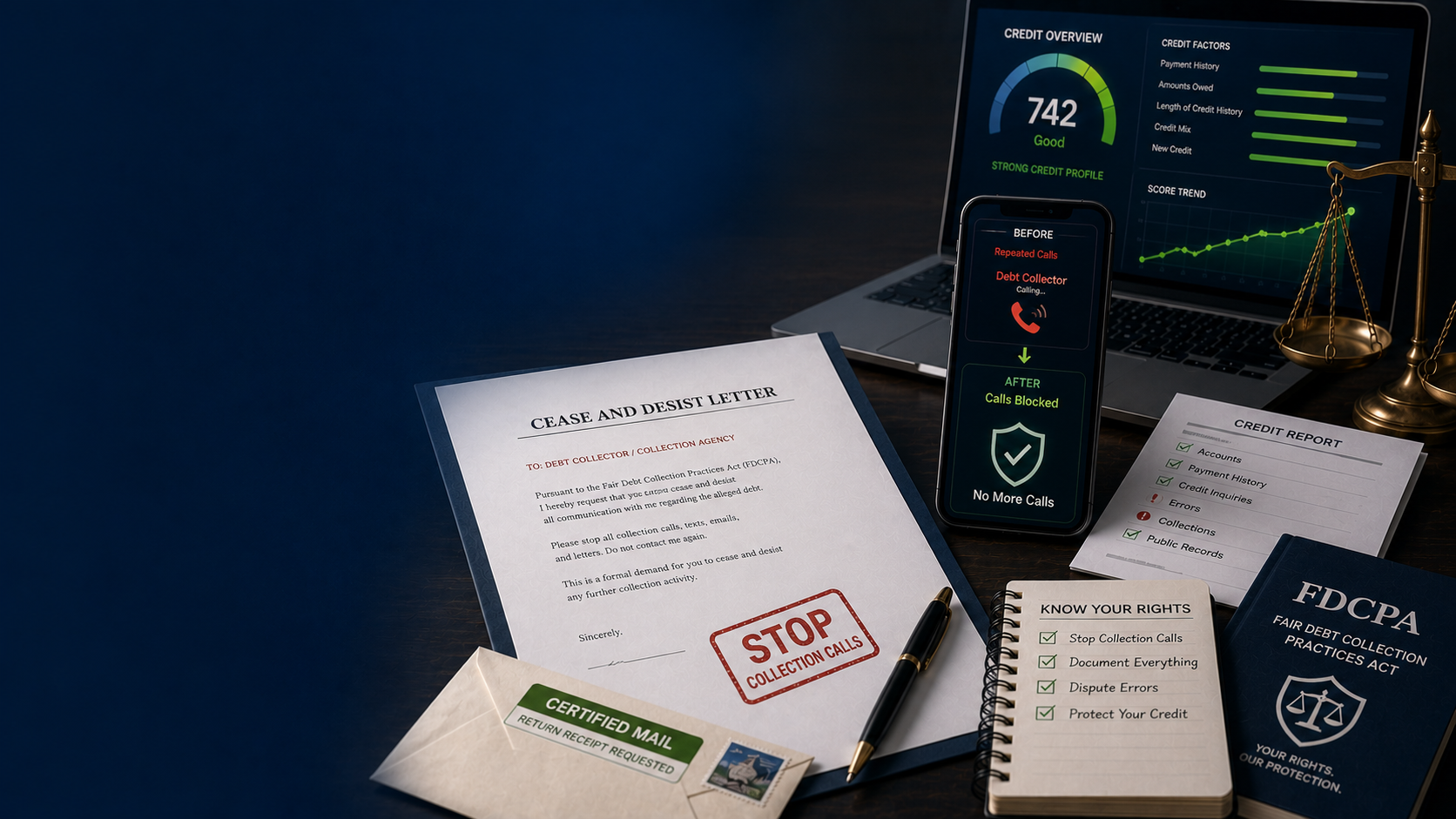
That sounds simple, and in many ways it is. But a cease and desist letter is also one of the most misunderstood tools in the credit repair world. People assume it erases the debt. It does not. People assume it stops lawsuits. It does not. People assume once they send it, the whole problem goes away. It does not — and in some cases, sending one without thinking through the consequences can actually accelerate a lawsuit.
This guide walks you through everything you need to know: what the letter does, what it does not do, when to send one (and when to think twice), two ready-to-use templates, how to send it so it actually holds up, and what to do if the collector ignores it. We have spent years helping people across the country navigate exactly this situation, and we want you to have the same clear, honest information we give our own clients — no hype, no quick-fix promises, just the law and how to use it.
What Is a Cease and Desist Letter?
A cease and desist letter is a written notice from you to a debt collector demanding that they stop contacting you about a specific debt. It is not a court order. It is not a lawsuit. It is a letter — but it is a letter that carries the force of federal law behind it.
Under the FDCPA, a debt collector is someone whose primary business is collecting debts owed to others — this includes collection agencies, debt buyers, and third-party collectors. It generally does not include the original creditor (like the bank that issued your credit card) collecting its own debt in its own name. That distinction matters, and we will come back to it.
When you send a cease and desist letter, you are exercising a specific legal right: the right to tell a third-party debt collector, in writing, that they may no longer communicate with you. The law says that once they receive your letter, they must stop — with very limited exceptions. If they do not stop, they are violating federal law, and you may have grounds to sue them or file a complaint.
A cease and desist letter is sometimes confused with a debt validation letter (also called a dispute letter), which is a separate request demanding the collector prove the debt is yours and the amount is correct. The two serve different purposes and can be used together or separately. We cover how they interact .
Key takeaway: A cease and desist letter is a written demand that a debt collector stop contacting you. It is enforceable under federal law, and it is one of the most direct tools you have for stopping collection harassment.
Your FDCPA Right to Demand a Collector Stop Contacting You
The legal foundation for a cease and desist letter is found in 15 U.S.C. § 1692c(c), part of the Fair Debt Collection Practices Act. The FDCPA was passed by Congress in 1977 to eliminate abusive, deceptive, and unfair debt collection practices. Before the FDCPA, collectors could — and did — call at all hours, threaten arrest, contact employers, and use intimidation freely. The law changed that.
Here is what the statute says, in plain terms: if you notify a debt collector in writing that you refuse to pay the debt or that you wish the collector to cease further communication, the collector must stop communicating with you — with three exceptions:
- To advise you that further efforts to collect the debt are terminated. The collector can send one final letter saying “we are giving up on collecting this.”
- To notify you that a specific remedy (like referring the debt to an attorney or reporting it to a credit bureau) may be invoked. The collector can tell you they are escalating — for example, handing the file to a lawyer or flagging your credit report.
- To notify you that a specific remedy is about to be invoked. A follow-up saying “we have now done the thing we warned you about.”
That is it. Beyond those three narrow notifications, the collector must go silent. No more calls. No more letters. No more texts. No more emails. No more showing up at your door.
Who the FDCPA Covers
The FDCPA applies to third-party debt collectors — collection agencies, debt buyers who purchased a defaulted account, and attorneys who regularly collect debts. It does not generally apply to:
- Original creditors collecting their own debts in their own name (like a bank calling about its own credit card)
- In-house collection departments of the original creditor, as long as they use the creditor’s name
- Government employees collecting government debts
Some states have their own laws that extend similar protections to original creditors. For example, California’s Rosenthal Fair Debt Collection Practices Act extends most FDCPA protections to original creditors. If you are dealing with an original creditor rather than a third-party collector, check your state’s law — a cease and desist letter may still carry weight, just under a different legal basis.
The Difference Between “Refuse to Pay” and “Cease Communication”
The FDCPA gives you two ways to trigger the cease-contact requirement, and they sound similar but have slightly different implications:
- “I refuse to pay the debt” — This tells the collector you have no intention of paying. This is the strongest form. It signals to the collector that further collection attempts are likely futile, which may push them toward either closing the file or escalating to a lawsuit.
- “I wish you to cease further communication” — This tells the collector to stop contacting you, but does not make a statement about whether you will pay. It is a narrower request. Some attorneys prefer this phrasing because it stops contact without explicitly daring the collector to sue.
Both are legally valid. The templates in this guide use the “cease communication” phrasing as the default, because it is the most broadly useful. If you want the strongest possible version, you can add “I also refuse to pay this debt” — but understand that this increases the likelihood the collector will either sell the debt, close the file, or sue.
Key takeaway: Your right to demand a collector stop contacting you comes from federal law (15 U.S.C. § 1692c(c)). The collector can only contact you after receiving your letter to say they are stopping collection, or to notify you of a specific action like referring the debt to an attorney or suing you.
When to Send a Cease and Desist Letter
A cease and desist letter is a powerful tool, but it is not always the right first move. Here are the situations where sending one makes the most sense, and a few where you should think carefully before sending.
Good Reasons to Send a Cease and Desist Letter
- 1. The collector is harassing you.
The FDCPA already prohibits harassment — repeated calls, calls before 8 a.m. or after 9 p.m., threats, obscene language, and calling you at work after you have told them not to. But enforcement is reactive: the law does not physically prevent the calls, it just gives you a remedy after the fact. If a collector is calling you repeatedly, ignoring your requests to stop, or contacting family members and your workplace, a cease and desist letter puts a hard line in the sand. Once they receive it, continued contact is a clear, documented violation.
- 2. You have already validated or disputed the debt and it is resolved (or not yours).
If you sent a debt validation letter and the collector failed to validate, or the debt turned out to be the result of identity theft, or you already settled or paid it, there is no reason for continued contact. A cease and desist letter closes the door. (See for how to sequence these.)
- 3. You want all communication in writing.
If you are fine with the collector communicating with you, but you do not want phone calls — you want everything in writing so you have a paper trail — that is a limited cease rather than a full cease. We cover this in detail . A limited cease is often the better first step because it keeps the channel open while protecting you from phone harassment.
- 4. You are being contacted about a time-barred debt.
A time-barred debt is one where the statute of limitations has expired — meaning the collector can no longer sue you to collect it. The exact time limit varies by state and by the type of debt (oral, written, open-ended), but typically ranges from three to six years. If a collector is contacting you about an old debt that is past the statute of limitations, a cease and desist letter is an appropriate response. Just be careful: making a partial payment or even acknowledging the debt in some states can restart the clock. If you are not sure whether the debt is time-barred, talk to an attorney before sending anything.
- 5. The debt is outside the credit reporting window.
Most negative items can only stay on your credit report for seven years (ten years for Chapter 7 bankruptcy). If a collector is pursuing you for a debt that is so old it can no longer be reported, a cease and desist letter can stop the contact. Be aware that the reporting window and the statute of limitations are two different clocks — a debt can be unreportable but still within the statute of limitations, or vice versa.
When to Think Twice Before Sending
You are within the statute of limitations and the collector has not sued yet.
If the debt is still legally collectible (within the statute of limitations), sending a full cease and desist letter removes the collector’s ability to contact you — which means their main remaining options are to sell the debt, close the file, or sue. Some collectors, particularly debt buyers who purchased the account for pennies on the dollar, will choose to sue rather than walk away, because a lawsuit is cheap to file and often goes uncontested. If the debt is large enough to be worth their while and you have assets or wages they could go after, think carefully. A limited cease (no phone calls, written contact only) may be the safer middle ground — it stops the harassment while keeping the door open for a negotiated settlement or payment plan.
You have not validated the debt yet.
If you are not sure the debt is yours, or the amount is wrong, your first letter should be a validation dispute under 15 U.S.C. § 1692g, not a cease and desist. A validation dispute forces the collector to pause collection and prove the debt. Sending a cease and desist first cuts off communication, but it does not resolve the underlying question of whether you actually owe what they say you owe.
The original creditor is contacting you (not a third-party collector).
As noted above, the FDCPA generally does not cover original creditors collecting their own debts. A cease and desist letter to an original creditor is not backed by the same federal enforcement mechanism. It may still be worth sending — some creditors will respect it as a matter of policy — but your legal recourse if they ignore it is different and often depends on state law.
Key takeaway: Send a cease and desist letter when you are being harassed, when you have already resolved or validated the debt, when the debt is time-barred, or when you simply want all communication in writing. Think twice if the debt is still within the statute of limitations and you have not yet validated it — a limited cease or a validation dispute may be the better first step.
What a Cease and Desist Letter Does — and Does Not Do
Understanding what a cease and desist letter does not do is just as important as understanding what it does. Here is the honest breakdown.
What It Does
- Stops the collector from contacting you. Once the letter is received, the collector must stop calling, texting, emailing, and mailing you — except for the three narrow notifications allowed by the FDCPA (cessation of efforts, notification of a specific remedy, or notification that a remedy is being invoked).
- Creates a documented legal boundary. The letter and its proof of delivery create a clear record that you invoked your FDCPA right. If the collector continues to contact you, each contact is a potential statutory violation worth up to $1,000 per violation plus actual damages and attorney fees under 15 U.S.C. § 1692k.
- Gives you leverage. If the collector violates the cease and desist, you have a strong basis for an FDCPA lawsuit or a CFPB complaint. Many collectors will back off entirely once they receive a properly worded letter with proof of delivery, because they know the cost of a violation.
- Reduces stress and harassment. For people who have been living under a barrage of collection calls, the simple act of forcing the phone to go quiet can be a profound relief. That matters — chronic financial stress takes a real toll.
What It Does Not Do
- It does not erase the debt. The debt still exists. You still legally owe it (assuming it is valid and within the statute of limitations). The collector simply cannot contact you about it anymore.
- It does not stop a lawsuit. The collector can still sue you to collect the debt. In fact, as we discuss in the next section, sending a cease and desist letter can sometimes increase the likelihood of a lawsuit, because the collector’s other options (continued contact, settlement offers, payment plans) are cut off.
- It does not remove the item from your credit report. If the collection account is being reported to the credit bureaus, a cease and desist letter does not make it go away. The account will continue to be reported according to the credit reporting time limits (typically seven years from the original delinquency). To address the credit reporting, you need a separate process — dispute with the bureaus, negotiate a pay-for-delete, or work with a credit repair professional.
- It does not prevent the collector from selling the debt. The collector may simply sell your account to another debt buyer, who becomes a new “debt collector” under the FDCPA. Your cease and desist letter applies to the collector you sent it to — not automatically to every future buyer. You may need to send a new letter to each new collector who contacts you. (Some attorneys argue that a cease and desist transfers with the debt, but the safest approach is to send a new one if a new collector appears.)
- It does not apply to the original creditor. As discussed, the FDCPA’s cease-contact right applies to third-party debt collectors, not original creditors collecting in their own name (unless your state law says otherwise).
Key takeaway: A cease and desist letter stops contact. It does not erase the debt, stop lawsuits, remove credit report entries, prevent the debt from being sold, or bind the original creditor. It is a communication tool, not a debt-elimination tool.
The Risk: A Collector May Escalate to a Lawsuit
This is the part many guides skip or gloss over. We are not going to do that, because being honest about the risk is the only way to make a good decision.
When you send a full cease and desist letter, you are cutting off the collector’s primary tool for recovering the debt: communication. Without the ability to call or write, the collector has three main options:
- Sell the debt to another buyer. This is common. The debt gets passed down the chain, often for less and less money, to successive buyers. Each new buyer may contact you, and you may need to send a new cease and desist. Eventually, the debt may end up with a buyer who is willing to just write it off — or one who decides to sue.
- Close the file and walk away. Some collectors will simply give up, especially if the debt is small, old, or hard to collect. This is the outcome many people hope for when they send a cease and desist, and it does happen — but it is not guaranteed, and it is more likely with smaller or older debts.
- Refer the debt to an attorney and sue you. This is the risk. A lawsuit is relatively cheap for a collector to file, and if you do not respond, they get a default judgment — which can lead to wage garnishment, bank account levies, or property liens depending on your state. If the debt is large, you have a verifiable income or assets, and the debt is within the statute of limitations, the risk of a lawsuit after a cease and desist is real.
How to Assess Your Risk
Before sending a full cease and desist, ask yourself:
- Is the debt within the statute of limitations in my state? If yes, the collector can legally sue. If no, they cannot win a lawsuit (though they can still file one — you would raise the statute of limitations as a defense). Check your state’s statute of limitations for the type of debt involved.
- How large is the debt? Collectors are more likely to sue over larger debts (many set an internal threshold, often around $1,000–$5,000, above which litigation becomes worthwhile). Small debts are more likely to be sold or written off.
- Do I have wages or assets they could collect against? If you have a steady job (subject to garnishment) or money in a bank account, you are a more attractive litigation target. If you are judgment-proof — no assets, no garnishable income, retired on protected benefits — a lawsuit is less likely and less threatening.
- Has the collector already threatened legal action or sent a letter from a law firm? If so, they may already be on the litigation path. A cease and desist at that point will not stop the lawsuit; it just stops the pre-suit contact.
The Limited Cease as a Risk-Reducing Alternative
If you are concerned about triggering a lawsuit, consider a limited cease instead. A limited cease tells the collector to stop calling you (or stop all phone contact) but allows written communication to continue. This stops the harassment while keeping the door open for the collector to send you a settlement offer or payment plan — options that disappear with a full cease. We cover the limited cease in the .
Key takeaway: Sending a full cease and desist letter can, in some cases, push a collector toward suing you — because you have removed their ability to collect through contact. Assess the size of the debt, the statute of limitations, and your exposure to garnishment before sending. A limited cease is often a safer first step.
Full Cease vs. Limited Cease: Which Is Right for You?
The FDCPA does not require you to demand a total stop to all communication. You can demand a limited stop — for example, no phone calls, but written contact is okay. This is called a limited cease and desist, and it is one of the most underused tools in the credit repair toolkit.
Full Cease and Desist
A full cease and desist demands that the collector stop all communication with you, subject only to the three statutory exceptions (cessation notice, remedy notification, remedy invocation). After receiving a full cease, the collector cannot call, write, text, or email you about the debt.
When a full cease makes sense:
- The debt is time-barred (past the statute of limitations).
- The debt is not yours (identity theft, mixed file, etc.) and you have already disputed it.
- The collector is harassing you and you have no intention of paying or negotiating.
- The debt is small and unlikely to be worth a lawsuit.
- You are judgment-proof and a lawsuit would not produce anything for the collector.
- You have already resolved the debt (paid, settled, discharged in bankruptcy) and the collector is still contacting you.
The tradeoff: You cut off all communication, which means no settlement offers, no payment plans, and no opportunity to negotiate a pay-for-delete or a reduced payoff. You also increase the risk that the collector will sell the debt or sue.
Limited Cease and Desist
A limited cease and desist restricts the method of contact but does not cut off all communication. The most common form is a “no phone calls” letter: you tell the collector they may not contact you by phone, but they may still write to you.
The FDCPA does not explicitly codify the “limited cease” by name, but it is widely accepted as a lawful exercise of your right to control how a collector contacts you. Under § 1692c(a), a collector must stop calling you if you tell them to stop calling at a particular number, and must stop contacting you at work if you tell them your employer prohibits it. A limited cease letter formalizes this in writing and broadens it: “Do not contact me by telephone. All future communication must be in writing.”
When a limited cease makes sense:
- The debt is within the statute of limitations and you want to avoid pushing the collector toward a lawsuit.
- You are open to a settlement or payment plan but do not want to deal with phone calls.
- You want a paper trail of everything the collector says, which written communication provides and phone calls do not.
- You are still validating or disputing the debt and want to keep the channel open.
- You want to negotiate but from a calmer, more controlled position — on paper, not under pressure on the phone.
The tradeoff: The collector can still send you letters, which may include settlement offers, balance statements, or notices of escalation. You will still receive mail about the debt. Some people find this preferable to calls; others want total silence.
A Quick Comparison
| Full Cease | Limited Cease | |
|---|---|---|
| Phone calls | Stopped | Stopped |
| Letters/mail | Stopped | Allowed |
| Texts/emails | Stopped | Stopped (or per your terms) |
| Settlement offers | No longer sent | Still sent |
| Lawsuit risk | Potentially higher | Generally lower |
| Negotiation possible | No | Yes |
| Paper trail | Minimal (you set the boundary) | Strong (collector writes to you) |
| Best for | Time-barred debts, harassment, debts you will not pay | Debts you may negotiate, within SOL, want to keep options open |
Key takeaway: A full cease stops all contact but raises lawsuit risk and closes the door on negotiation. A limited cease stops phone calls but keeps written communication open, preserving your options and reducing escalation risk. For many people, the limited cease is the better first step.
What the Letter Must Include
A cease and desist letter does not need to be written by a lawyer or use magic legal language. The FDCPA says you need to notify the collector “in writing” — that is the core requirement. But to make the letter effective, enforceable, and useful if you later need to prove a violation, it should include certain elements.
Essential Elements
- Your name and current address. This identifies you and connects you to the account. If the collector has your address on file, use that address — it helps them match the letter to your account. If you have moved, include both your current address and the address they have on file.
- The collector’s name and address. Address the letter to the specific collection agency or debt buyer. If you know the individual collector’s name, include it; otherwise, address it to the agency generally.
- The account or reference number. Include any account number, file number, or reference number the collector has used in their correspondence with you. This is critical — it ties your letter to the specific debt in their system. If you do not have the number, describe the debt (original creditor, approximate amount, date) as specifically as you can.
- A clear statement demanding they cease communication. Use explicit language: “I am writing to demand that you cease all communication with me regarding the above-referenced debt, pursuant to 15 U.S.C. § 1692c(c).” For a limited cease, specify the method: “I demand that you cease all telephone communication with me. You may contact me in writing only.”
- Citation of the FDCPA. Referencing the FDCPA and the specific section (§ 1692c(c) for a full cease) signals that you know your rights and are invoking them deliberately. It also makes the letter harder for the collector to dismiss.
- The date. Date the letter. The date matters because the collector’s obligation to stop contact begins when they receive the letter, but the date on the letter helps establish your timeline.
- Your signature. Sign the letter by hand if you are mailing a printed copy. If you are sending it electronically (some collectors accept email), a typed signature is acceptable, but a handwritten signature on a mailed letter is the gold standard for proof.
Optional but Recommended Elements
- A statement that you dispute the debt (if you do). If you believe the debt is not yours or the amount is wrong, say so: “I dispute this debt in its entirety and request validation pursuant to 15 U.S.C. § 1692g.” This triggers a separate right — the collector must pause collection and send you validation. (See .)
- A statement that all calls are inconvenient. Under § 1692c(a)(1), a collector may not contact you at a time or place they know or should know is inconvenient. Stating “All telephone contact is inconvenient” strengthens a no-calls demand, especially for a limited cease.
- A statement prohibiting workplace contact. If you do not want the collector contacting you at work, say: “My employer prohibits personal calls. Do not contact me at my place of employment.” Under § 1692c(a)(3), once the collector knows your employer prohibits it, they must stop.
- A reminder of the consequences of violation. A line like “Be advised that any further communication except as permitted by 15 U.S.C. § 1692c(c) will be documented and may form the basis of an FDCPA claim” is not required, but it signals that you are serious and aware of your remedies.
- A request for written confirmation. You can ask the collector to confirm in writing that they have received your cease and desist and will comply. They are not required to send confirmation, but some will.
What to Leave Out
- Do not acknowledge the debt. If you are not sure the debt is yours, do not write “I owe this debt but I want you to stop calling.” A written acknowledgment can, in some states, restart the statute of limitations. If you are disputing, say you dispute. If you are not disputing but just want contact to stop, simply demand cessation without discussing the merits.
- Do not make threats. Do not threaten the collector with violence, legal action you have no intention of taking, or anything else. A calm, factual letter is far more effective than an angry one.
- Do not provide unnecessary personal information. Do not include your Social Security number, date of birth, or bank account information. The collector should already have enough to identify your account. Providing extra personal information can work against you.
Key takeaway: Your letter needs your name and address, the collector’s name and address, the account/reference number, a clear demand to cease communication, the FDCPA citation, the date, and your signature. Do not acknowledge the debt, make threats, or over-share personal information.
Full Cease and Desist Letter Template
Below is a complete, ready-to-use template for a full cease and desist letter. Replace every bracketed field with your own information. Send it by certified mail with return receipt (see ).
[Your Full Name]
[Your Current Address]
[Your City, State, ZIP]
[Your Phone Number — optional]

[Date]

[Collector/Agency Name]
[Collector's Address]
[Collector's City, State, ZIP]

RE: Account No. [Account/Reference Number]
    Original Creditor: [Original Creditor Name, if known]
    Amount Claimed: [$Amount, if known]

To Whom It May Concern:

I am writing in response to your collection efforts regarding the
above-referenced account. Pursuant to 15 U.S.C. § 1692c(c) of the Fair
Debt Collection Practices Act (FDCPA), I hereby demand that you CEASE
AND DESIST all communication with me regarding this debt.

This cease and desist demand applies to all forms of communication,
including but not limited to telephone calls, text messages, emails,
postal mail, and personal contact at my home or place of employment.

As provided by 15 U.S.C. § 1692c(c), you may contact me only to:
  (1) advise me that you are ceasing further efforts to collect this
      debt;
  (2) notify me that you may invoke a specified remedy (such as
      referring this debt to an attorney or reporting it to a credit
      bureau); or
  (3) notify me that you are invoking a specified remedy.

Be advised that any communication from you beyond these three
permitted purposes will be documented and may form the basis of a
complaint to the Consumer Financial Protection Bureau (CFPB), the
Federal Trade Commission (FTC), and/or a civil action under 15 U.S.C.
§ 1692k, which provides for statutory damages, actual damages, and
attorney's fees.

Furthermore, pursuant to 15 U.S.C. § 1692c(a), please be advised that:
  - All telephone contact with me is inconvenient at all times and at
    all locations.
  - My employer prohibits personal calls. Do not contact me at my
    place of employment.

[Optional — include if applicable: I also dispute this debt in its
entirety and request validation pursuant to 15 U.S.C. § 1692g. Until
you provide adequate validation, you may not continue collection
activity.]

[Optional — include if you refuse to pay: I refuse to pay this debt.]

This is my formal written notice to cease communication. I expect your
immediate compliance.

Sincerely,

[Your Signature]
[Your Printed Name]
How to use this template:
- Copy the text above into a word processor or text editor.
- Replace every bracketed [ ] field with your information. Remove fields you do not have (e.g., if you do not know the original creditor, delete that line).
- Keep or remove the optional paragraphs based on your situation.
- Print the letter. Sign it by hand.
- Make a photocopy for your records.
- Send the original by certified mail with return receipt requested to the collector’s address.
- Keep the return receipt (the green card) with your copy of the letter — this is your proof of delivery.
Note: This template is provided for educational purposes and is not a substitute for legal advice. If your situation is complex — large debt, impending lawsuit, multiple collectors — consider consulting an attorney who handles FDCPA matters. Many consumer law attorneys offer free consultations and work on contingency.
Limited Cease and Desist Letter Template
Below is a template for a limited cease and desist letter — one that stops phone calls but permits written communication. Use this if you want to stop harassment while keeping the door open for settlement offers or negotiation.
[Your Full Name]
[Your Current Address]
[Your City, State, ZIP]

[Date]

[Collector/Agency Name]
[Collector's Address]
[Collector's City, State, ZIP]

RE: Account No. [Account/Reference Number]
    Original Creditor: [Original Creditor Name, if known]
    Amount Claimed: [$Amount, if known]

To Whom It May Concern:

I am writing regarding your collection efforts on the above-referenced
account. Pursuant to 15 U.S.C. § 1692c(a) of the Fair Debt Collection
Practices Act (FDCPA), I hereby demand that you CEASE all telephone
communication with me regarding this debt.

Specifically:
  - You may not call me at [your home phone number].
  - You may not call me at [your cell phone number].
  - You may not call me at [your work phone number].
  - You may not call any of my family members, neighbors, or
    references.
  - My employer prohibits personal calls. Do not contact me at my
    place of employment under any circumstances.

All telephone contact is inconvenient at all times and at all
locations, as provided by 15 U.S.C. § 1692c(a)(1).

I am willing to communicate with you in writing only. You may send
correspondence to the address listed at the top of this letter. I
will respond in writing as appropriate.

[Optional — include if applicable: I dispute this debt and request
validation pursuant to 15 U.S.C. § 1692g. Until you provide adequate
validation, you may not continue collection activity.]

[Optional — include if you want to signal openness to settlement:
I am open to discussing a written settlement or payment arrangement,
provided all negotiation is conducted in writing.]

If you continue to contact me by telephone after receiving this
letter, I will document each call and may file a complaint with the
Consumer Financial Protection Bureau (CFPB) and/or pursue a civil
action under 15 U.S.C. § 1692k for violation of the FDCPA.

I expect your immediate compliance with this written demand.

Sincerely,

[Your Signature]
[Your Printed Name]
How to use this template:
- Copy the text, fill in the bracketed fields, and remove any that do not apply.
- List every phone number you want them to stop calling.
- Keep or remove the optional paragraphs.
- Print, sign by hand, photocopy, and send by certified mail with return receipt requested.
- Keep the return receipt with your copy.
Tip: If you include the “open to settlement” optional paragraph, you signal to the collector that you are not just hiding — you are willing to resolve the debt, but on paper, not under phone pressure. This can keep the collector in a negotiation posture rather than a litigation posture.

How to Send It So It Actually Holds Up
A cease and desist letter is only as strong as your ability to prove the collector received it. If you send it by regular first-class mail and the collector says “we never got it,” you have no proof and no leverage. Here is how to send it so it holds up.
Use Certified Mail With Return Receipt
Send the letter by U.S. Postal Service Certified Mail with Return Receipt Requested (the green card). This gives you two things:
- A tracking number that shows the letter was mailed and is in the postal system.
- A return receipt — a postcard signed by the recipient (or their agent) confirming delivery, with the date of delivery.
When the return receipt comes back in the mail, keep it. Staple or paperclip it to your copy of the letter. Store both somewhere safe. This is your proof that the collector received your cease and desist on a specific date. From that date forward, any contact from the collector (beyond the three statutory exceptions) is a documented violation.
Keep a Complete File
Your cease and desist file should contain:
- A copy of the letter you sent (the signed version, not just the blank template).
- The certified mail receipt (the stub with the tracking number).
- The return receipt (the signed green card showing delivery).
- The original collection notices you received from the collector — the first letter they are required to send within five days of initial contact under § 1692g, plus any subsequent letters.
- A log of all calls you received from the collector before and after sending the letter — date, time, number, what was said, and any voicemail messages (save them).
- Any correspondence from the collector after the cease and desist.
If you ever need to file a CFPB complaint, an FTC complaint, or an FDCPA lawsuit, this file is your evidence.
Alternative Delivery Methods
- Email or online portal: Some collectors accept cease and desist letters by email or through an online dispute portal. If you use this method, save the sent email (with full headers) and any reply. Email delivery is harder to prove than certified mail, so if the stakes are high, use certified mail instead or in addition.
- Fax: Rarely used today, but if the collector provides a fax number, a fax with a confirmation page provides proof of transmission. Again, certified mail is stronger.
- Process server: For a cease and desist that may precede litigation, some attorneys use a process server. This is overkill for most consumer cease and desist letters but is an option in high-stakes situations.
When Does the Collector’s Obligation Begin?
The collector must stop contacting you once they receive your letter — not the day you mail it. Certified mail typically arrives in 1–3 business days, but allow up to a week. If the collector contacts you between the day you mail the letter and the day they receive it, that contact is generally not a violation (they have not received the letter yet). After the return receipt date, any non-permitted contact is a violation.
One Letter Per Collector
Send a separate cease and desist letter to each collector who contacts you. If the debt is sold to a new buyer, send a new letter to the new buyer. Keep a file for each.
Key takeaway: Send by certified mail with return receipt, keep a complete paper file (letter copy, receipts, call log, collector correspondence), and send a new letter to each new collector. Your proof of delivery is what makes the letter enforceable.
What Happens After You Send a Cease and Desist Letter
Once the collector receives your cease and desist letter, several things can happen. Here is what to expect, what is normal, and what is a red flag.
What Should Happen
- The collector stops contacting you. This is the primary outcome and the legal requirement. Within a reasonable time after receiving your letter, the collector should cease all phone calls, letters, texts, and emails, except for the three permitted notifications under § 1692c(c).
- You may receive one final communication. The collector may send one letter confirming that they are ceasing collection efforts, or notifying you that they are invoking a specific remedy — referring the debt to an attorney, suing you, or reporting it to a credit bureau. This is permitted and is not a violation.
- The collector may close the file. If the collector decides the debt is not worth pursuing without the ability to contact you, they may close the file. This is more likely with smaller or older debts.
- The collector may sell the debt. The collector may sell your account to another debt buyer. If the new buyer contacts you, you will need to send a new cease and desist letter to them. The original cease and desist does not automatically bind the new buyer (though some attorneys argue it should transfer with the debt — the safest approach is to send a new letter).
- The collector may sue you. If the debt is within the statute of limitations and the collector decides litigation is worth the cost, they may file a lawsuit. If they do, you will receive a summons and complaint (formal court documents), which is not an FDCPA communication — it is a legal action. You must respond to a lawsuit; ignoring it leads to a default judgment. If you are sued, contact an attorney immediately.
What Is Not Supposed to Happen
- Continued calls or letters about the debt (beyond the permitted notifications). If the collector keeps calling or sending collection letters after receiving your cease and desist, each contact is a potential FDCPA violation.
- Contact with third parties about your debt (family, neighbors, employer) except to get location information, and only if you have not already provided it.
- Threats or intimidation. The FDCPA prohibits threats of violence, threats of arrest, and false statements about the legal status of the debt.
- Continued credit reporting without addressing your dispute. If you disputed the debt and the collector continues to report it as undisputed, that may be a separate FDCPA and FCRA issue.
Timeline
There is no fixed statutory deadline for the collector to stop contact after receiving your letter — the law says they must cease, and “cease” means stop. In practice, most collectors stop within a few days to a couple of weeks of receiving the letter, as their systems update. If you receive contact more than 30 days after the return receipt date (and it is not one of the three permitted notifications), it is a clear violation worth documenting and pursuing.
Key takeaway: After receiving your letter, the collector should stop contacting you (except for permitted notifications), may close the file or sell the debt, and may sue if the debt is within the statute of limitations. Continued collection contact beyond the permitted exceptions is an FDCPA violation — document it.
What to Do If They Keep Calling
If a debt collector continues to contact you after receiving your cease and desist letter, they are violating the FDCPA. Here is how to respond, step by step.
Step 1: Document Every Contact
Every call, text, email, or letter you receive after the collector’s receipt of your cease and desist is evidence. For each contact, record:
- Date and time of the contact.
- Method (phone call, text, letter, email, in-person).
- Phone number or address the contact came from.
- Who you spoke with (collector’s name, if given).
- What was said (as close to verbatim as possible).
- Any voicemail messages — do not delete them; save the audio.
- Any caller ID screenshots or text message screenshots.
Keep this log in a notebook, a spreadsheet, or a dedicated folder on your phone or computer. The more detailed and contemporaneous (written at the time of the contact) your records are, the stronger your evidence.
Step 2: Save All Communication
- Voicemails: Save the audio files. Many phones allow you to save voicemails as audio files or forward them to email. If you cannot save them digitally, record them with another device.
- Texts and emails: Screenshot them and save the screenshots. Do not delete the originals.
- Letters: Keep the originals, including the envelopes (the postmark can be important evidence). Do not write on the original — make a copy if you need to annotate.
Step 3: File a Complaint With the CFPB
The Consumer Financial Protection Bureau (CFPB) accepts complaints about debt collectors online at consumerfinance.gov/complaint. The process is free and straightforward:
- Go to the CFPB complaint portal.
- Select “Debt collection” as the category.
- Describe the violation, including dates and what happened.
- Attach copies of your cease and desist letter, the return receipt, and your contact log.
- The CFPB will forward your complaint to the collector and require them to respond.
The CFPB does not resolve individual disputes or award damages, but a CFPB complaint creates a public record, pressures the collector to respond, and can trigger regulatory scrutiny. Many collectors will resolve the issue quickly once a CFPB complaint is filed.
Step 4: File a Complaint With Your State Attorney General
Many state attorneys general have consumer protection divisions that handle debt collection complaints. Some states (like California, New York, and Florida) have their own debt collection laws that provide additional protections and remedies. Filing with your state AG is free and can be done through your state’s AG website.
Step 5: Consult a Consumer Law Attorney
If the collector continues to contact you after a cease and desist, you may have a claim under 15 U.S.C. § 1692k, which provides for:
- Statutory damages up to $1,000 per violation (not per call — the cap is generally $1,000 for the overall pattern of violations for a given debt, though some courts interpret this differently).
- Actual damages — compensation for any documented harm, such as emotional distress, lost wages, or medical costs related to the harassment.
- Attorney’s fees and costs — the FDCPA requires the collector to pay your attorney’s fees if you win, which is why many consumer law attorneys take FDCPA cases on contingency (no upfront cost to you).
A consumer law attorney can evaluate your case, send a follow-up letter, negotiate a settlement, or file a lawsuit. Many offer free consultations. You can find one through the National Association of Consumer Advocates (NACA) at consumeradvocates.org.
Step 6: Consider an FDCPA Lawsuit
If the violations are clear and well-documented, an FDCPA lawsuit can be an effective way to stop the harassment and recover damages. The statute of limitations for an FDCPA claim is one year from the date of the violation, so do not wait too long. A lawsuit also creates a strong public record and can deter the collector from violating again — against you or anyone else.
Key takeaway: If a collector ignores your cease and desist, document every contact, save all evidence, file a CFPB complaint, file a complaint with your state AG, and consult a consumer law attorney. Many attorneys take FDCPA cases on contingency because the law requires the collector to pay your attorney’s fees if you win.
How a Cease and Desist Letter Interacts With Validation Disputes
A cease and desist letter and a debt validation letter (dispute letter) are two different tools that serve two different purposes. Understanding how they interact helps you use them in the right order.
What a Validation Dispute Does
Under 15 U.S.C. § 1692g, within five days of a debt collector’s first communication with you, they must send you a written notice containing:
- The amount of the debt.
- The name of the original creditor.
- A statement that you have 30 days to dispute the debt.
- A statement that if you dispute in writing within 30 days, the collector must obtain verification of the debt and mail it to you.
- A statement that if you request the name and address of the original creditor within 30 days, the collector must provide it.
If you send a validation dispute within the 30-day window, the collector must cease collection until they send you validation. “Cease collection” means no calls, no letters, no lawsuits, no credit reporting — until they validate. This is a powerful pause button.
The Key Difference
- A validation dispute forces the collector to prove the debt. It pauses collection temporarily. It does not permanently stop contact — once the collector validates, they can resume collection.
- A cease and desist letter permanently stops contact (with the three exceptions). It does not require the collector to prove anything. It just shuts down communication.
Which Should You Send First?
If you are not sure the debt is yours or the amount is correct: Send a validation dispute first, within the 30-day window. This forces the collector to prove the debt and pauses collection while they do. If they fail to validate, they must stop collecting — and you may have grounds to dispute the credit reporting as well. If they do validate and the debt is legitimate, you can then decide whether to send a cease and desist, negotiate a settlement, or pay it.
If you know the debt is yours and you just want the calls to stop: Send a cease and desist (or limited cease). You do not need to dispute a debt you acknowledge.
If you are not sure AND you want to stop harassment: You can combine both in a single letter — dispute the debt and demand validation under § 1692g, and simultaneously demand cessation of telephone contact under § 1692c(a). This is a common and effective approach. The full cease template above includes an optional paragraph for disputing the debt; use it if it fits your situation.
If the 30-day validation window has passed: You can still send a validation dispute, but the collector is not legally required to pause collection. They may still choose to validate. You can also still send a cease and desist at any time — there is no deadline for demanding that contact stop.
A Note on Timing
If you send a cease and desist letter before sending a validation dispute, you cut off the collector’s ability to send you the validation they would be required to provide. This can create a confusing situation. The safest sequence is usually: dispute first (if you are disputing), then cease and desist after you have the collector’s response (or non-response). But if the harassment is severe and you need the calls to stop immediately, a combined letter or a limited cease (no calls, written contact okay) lets you dispute while still protecting yourself from phone harassment.
Key takeaway: A validation dispute forces the collector to prove the debt and pauses collection. A cease and desist stops contact permanently but does not require proof. If you are unsure about the debt, dispute first. If you just want contact to stop, cease and desist. You can combine both in one letter.
Common Mistakes to Avoid
Over the years, we have seen people make the same handful of mistakes with cease and desist letters. Here are the most common ones — and how to avoid them.
1. Not Sending It by Certified Mail
The single most common mistake. If you send a cease and desist by regular mail, the collector can simply say “we never received it” — and you have no way to prove otherwise. Certified mail with return receipt costs a few dollars and is the difference between an enforceable letter and a piece of paper.
2. Acknowledging the Debt in the Letter
Writing “I know I owe this debt but I want you to stop calling” may feel honest, but it can work against you. In some states, a written acknowledgment of a debt can restart the statute of limitations — turning a time-barred debt into a collectible one. If you are disputing, say you dispute. If you are not disputing, simply demand cessation without discussing the debt’s validity.
3. Sending a Full Cease When a Limited Cease Would Do
A full cease and desist is a nuclear option. It stops all communication, but it also stops settlement offers, payment plan options, and negotiation opportunities — and it can push the collector toward a lawsuit. If the debt is within the statute of limitations and you might be willing to negotiate, a limited cease (no calls, written contact okay) is often the smarter first move.
4. Not Keeping a Copy and Proof of Delivery
If you ever need to prove a violation — to the CFPB, your state AG, or a court — you need the letter, the certified mail receipt, and the return receipt. If you do not keep these, you have no evidence. Make a file the day you send the letter and keep everything in it.
5. Ignoring a Lawsuit
A cease and desist letter does not stop a collector from suing you. If you receive a summons and complaint, you must respond — usually within 20–30 days depending on your state. Ignoring a lawsuit leads to a default judgment, which can result in wage garnishment, bank levies, and property liens. If you are sued, contact an attorney immediately, regardless of whether you sent a cease and desist.
6. Sending the Letter to the Wrong Party
If the original creditor (not a third-party collector) is contacting you, the FDCPA’s cease and desist right does not apply the same way. Make sure you are sending the letter to a third-party debt collector covered by the FDCPA. If the original creditor is the one calling, check your state’s law — many states have parallel protections.
7. Not Sending a New Letter When the Debt Is Sold
If the collector sells your debt to a new buyer, your original cease and desist letter applies to the original collector — not automatically to the new one. When a new collector contacts you, send a new cease and desist (or validation dispute) to them. Keep a separate file for each collector.
8. Giving Up Personal Information Unnecessarily
Do not include your Social Security number, date of birth, or bank account information in a cease and desist letter. The collector should already have enough to identify your account (account number, original creditor, amount). Providing extra personal information can be used against you and serves no purpose in the letter.
9. Making Threats You Cannot Back Up
“Do this or I will sue you” is only effective if you actually intend and are able to sue. If you are not prepared to file an FDCPA lawsuit, do not threaten one. Instead, state that violations “may form the basis of a complaint or claim” — which is true and does not overcommit you. Let the law and your documentation do the work.
10. Expecting the Debt to Disappear
A cease and desist letter stops contact. It does not erase the debt, remove it from your credit report, or prevent a lawsuit. If you send a cease and desist expecting the whole problem to vanish, you may be surprised when the debt shows up on a new collector’s call list, or a lawsuit arrives. Use the letter for what it is — a communication tool — and pair it with a broader credit repair strategy.
Key takeaway: Avoid the most common mistakes — send by certified mail, do not acknowledge the debt, keep copies and proof of delivery, do not ignore lawsuits, send new letters to new collectors, and do not expect the letter to erase the debt. Use the cease and desist as one tool within a larger plan.
Frequently Asked Questions
1. Does a cease and desist letter erase my debt?
No. A cease and desist letter stops the debt collector from contacting you. It does not eliminate the debt, remove it from your credit report, or prevent the collector from suing you (if the debt is within the statute of limitations). The debt still legally exists. If you want to address the debt itself, you need a separate strategy — validation dispute, settlement, pay-for-delete, or bankruptcy, depending on your situation.
2. Can a debt collector still sue me after I send a cease and desist letter?
Yes. The FDCPA’s cease and desist right stops communication, not legal action. A collector can still file a lawsuit to collect the debt, as long as the debt is within the statute of limitations. In fact, some collectors are more likely to sue after receiving a full cease and desist, because their other options (calls, letters, settlement offers) are cut off. If you receive a summons, respond to it — do not ignore it. Consult an attorney if you are sued.
3. Does a cease and desist letter remove the collection from my credit report?
No. A cease and desist letter has no effect on credit reporting. If the collection account is being reported to the credit bureaus, it will continue to be reported for up to seven years from the date of the original delinquency, regardless of whether you sent a cease and desist. To address the credit reporting, you need to dispute the item with the credit bureaus, negotiate a pay-for-delete with the collector, or work with a credit repair professional.
4. What is the difference between a full cease and desist and a limited cease and desist?
A full cease and desist demands that the collector stop all communication (except for three narrow statutory notifications). A limited cease and desist restricts only certain types of contact — most commonly, it demands that the collector stop calling but permits written communication. A limited cease is often a better first step because it stops phone harassment while keeping the door open for settlement offers and negotiation, and it generally carries a lower risk of triggering a lawsuit.
5. How long does a debt collector have to stop calling after receiving my cease and desist letter?
There is no specific number of days written into the FDCPA. The law says the collector must cease communication, which means stop. In practice, most collectors stop within a few days to two weeks of receiving the letter, as their internal systems update. If you receive contact more than 30 days after the return receipt date (and it is not one of the three permitted notifications), it is a clear violation worth documenting and pursuing through a CFPB complaint or an attorney.
6. What if the debt collector sells my debt to another company?
Your cease and desist letter applies to the collector you sent it to. When a new debt buyer purchases the account and contacts you, they are a new “debt collector” under the FDCPA, and you should send a new cease and desist (or validation dispute) to them. Some attorneys argue that a cease and desist transfers with the debt, but the safest approach is to send a new letter to each new collector. Keep a separate file for each.
7. Can I send a cease and desist letter by email?
You can, but email is harder to prove than certified mail. The FDCPA requires “written” notice — email can qualify as written, but if the collector claims they did not receive it, you have less proof than you would with a certified mail return receipt. If you send by email, save the sent message with full headers and any reply. For maximum enforceability, use certified mail with return receipt, or send by both email and certified mail.
8. Do I need a lawyer to send a cease and desist letter?
No. You can send a cease and desist letter yourself using the templates in this guide. The FDCPA does not require the letter to be written by an attorney. However, if your situation is complex — large debt, impending lawsuit, multiple collectors, identity theft — consulting a consumer law attorney is wise. Many offer free consultations and take FDCPA cases on contingency. An attorney can also handle communications on your behalf, which provides an additional layer of protection: once a collector knows you are represented by counsel, they must generally communicate only through your attorney.
Take the Next Step Toward Cleaner Credit
A cease and desist letter is a powerful tool for stopping collection harassment, but it is just one piece of a larger credit repair picture. The debt still exists. The credit report may still show negative items. And the collector may still sue — or sell the debt to someone who will.
If you are dealing with collection calls, disputes, negative credit items, or just want a clear picture of where your credit stands, we can help. At credit-repair.com, we offer a free credit audit that reviews your three-bureau credit reports, identifies inaccuracies and negative items, and maps out a personalized repair plan — all in plain language, with no pressure and no hidden fees.
We are a San Diego-based, attorney-backed credit repair firm that operates in full compliance with the FCRA and FDCPA. We do not make empty promises or sell quick fixes. We educate you, advocate for you, and equip you with the tools to keep your credit strong for the long term — not just for the next few months.
Get your free credit audit at credit-repair.com →
You do not have to navigate this alone. Let us take a look at your credit picture and give you an honest, no-obligation assessment of what we can do together.
Disclaimer: This article is provided for educational purposes only and does not constitute legal advice. The templates are general samples and may not fit every situation. If you are facing a lawsuit, dealing with identity theft, or have a complex credit situation, consult a qualified attorney in your jurisdiction. The FDCPA provides a one-year statute of limitations for filing claims, so do not delay if you believe your rights have been violated.
Related articles:
- [Internal link placeholder: What Is the FDCPA and How Does It Protect You?]
- [Internal link placeholder: Debt Validation Letter — Template and Guide]
- [Internal link placeholder: Statute of Limitations on Debt by State]
- [Internal link placeholder: How to Remove Collection Accounts From Your Credit Report]
- [Internal link placeholder: What to Do If a Debt Collector Sues You]
- [Internal link placeholder: FDCPA Violations — How to Document and Report Them]
Leave a Reply