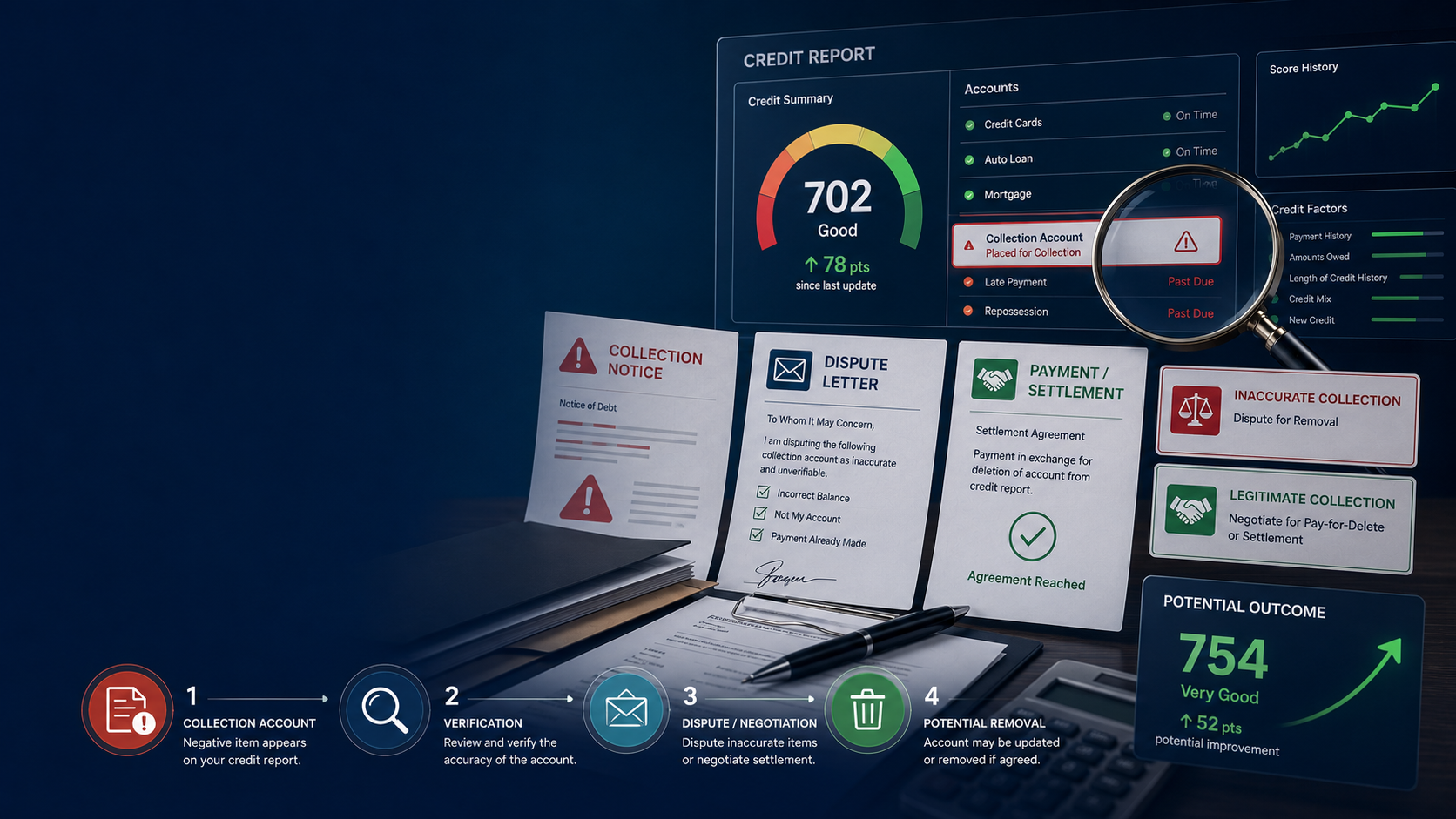
If you’re working on improving your credit beyond removing collections, these guides will help: pay-for-delete agreements with collectors, how to file a credit dispute with the bureaus, using a goodwill letter to request removal of late payments, and how to identify and fix credit report errors across all three bureaus.
How to Remove Collections From Your Credit Report (the Right Way)
A collection account on your credit report can feel like a permanent stain — one that follows you every time you apply for a mortgage, a car loan, an apartment, or even a new job. It drags down your score, haunts your credit history for years, and leaves you wondering whether there’s anything you can do about it besides wait.
The good news: there is. You have real, legally grounded options for removing collections from your credit report — options that don’t rely on tricks, loopholes, or empty promises from companies that guarantee results they can’t deliver.
In this guide, we’ll walk you through every legitimate path to collections removal, step by step. We’ll cover how collections get on your report in the first place, the difference between an original creditor and a collection agency, the four proven strategies for getting an account removed (with letter templates you can actually use), the special rules that apply to medical debt, and the common mistakes that can accidentally restart a debt or keep a negative mark on your report longer than necessary.
No quick fixes. No guarantees. Just clear, honest, legally sound guidance from a team that does this every day.
What Is a Collection Account?
A collection account is a record on your credit report that shows a debt you owe has been handed over to a collection agency — either by the original creditor you stopped paying, or by a debt buyer who purchased the debt outright.
When you fall behind on payments for a credit card, medical bill, personal loan, utility account, or similar obligation, the company you originally owed (the original creditor) may eventually give up on collecting from you directly. At that point, they typically do one of three things:
- Assign the debt to a third-party collection agency, which tries to collect on the original creditor’s behalf
- Sell the debt to a debt buyer for pennies on the dollar, after which the debt buyer owns it and tries to collect
- Charge off the debt (declare it a loss on their books) while continuing to pursue collection internally or through an agency
Once a collection agency gets involved, a new account can appear on your credit report under the collection section — separate from the original creditor’s trade line, which usually still shows the defaulted account with a “charged off” or similar status.
It’s worth understanding this distinction early, because it affects how you approach removal. A collection is not the same as the original delinquency that caused it. You may end up dealing with two separate entries on your report for what feels like one debt.
How Collections Get on Your Credit Report
Collections don’t appear instantly the moment you miss a payment. There’s a timeline, and understanding it helps you know where you stand.
Typically, the sequence looks like this:
- You miss a payment. The original creditor reports it as 30 days late to one or more of the three major credit bureaus — Equifax, Experian, and TransUnion.
- The late payment escalates. If you don’t catch up, the account moves to 60, 90, and then 120+ days late. Each step is reported and further damages your score.
- The creditor charges off the account. This usually happens around 180 days of non-payment (roughly six months). The original creditor closes the account and writes it off as a loss.
- The debt is placed with or sold to a collector. The original creditor either hires a collection agency or sells the debt to a debt buyer.
- The collection agency reports the debt to the bureaus. A new collection account appears on your credit report.
The key thing to know: a single missed debt can result in two negative marks on your report — the original creditor’s charge-off and the collection agency’s account. Both can hurt your score, and both need to be addressed if you want maximum improvement.
Not all creditors report to all three bureaus, and some collection agencies only report to one or two. That’s why your reports from Equifax, Experian, and TransUnion can look different from each other. It’s also why a three-bureau audit — pulling all three reports and comparing them — is the only way to get a complete picture of what’s actually dragging your score down. Get a free credit audit.
How a Collection Affects Your Credit Score
A collection account is one of the most damaging entries that can appear on your credit report. The exact score impact depends on several factors, but here’s what you need to know.
How much does a collection drop your score? It varies, but a new collection can pull a good credit score down by 60 to 100+ points. The impact is usually more severe for someone with a previously strong score (because there’s more to lose) and less severe for someone whose report already has multiple negative marks.
What makes a collection so damaging?
- Recency. A fresh collection hurts more than an old one. Lenders see a recent collection as evidence you’re struggling right now.
- Severity. Larger collection balances tend to have a bigger impact, especially under newer scoring models.
- Frequency. Multiple collections signal a pattern, not a one-time hardship.
- The type of scoring model. FICO 8 and FICO 9 treat collections differently. FICO 9 and VantageScore 3.0+ ignore paid collections entirely, while FICO 8 still counts them — though paid collections still hurt less than unpaid ones under FICO 8.
One important nuance: Under FICO 8 and most modern scoring models, the dollar amount of a collection doesn’t matter as much as the mere presence of one — any collection, large or small, triggers the penalty. Under FICO 9 and VantageScore 4.0, paid collections are disregarded, and medical collections have special, more lenient treatment (more on that below).
The bottom line: a collection on your report is a serious negative, but it’s not a life sentence. As the collection ages and as you build positive credit history elsewhere, its impact shrinks. And, as we’ll cover next, there are legitimate ways to get it removed before the 7-year clock runs out.
Original Creditor vs. Collection Agency
To remove collections effectively, you need to understand who is reporting what — because the original creditor and the collection agency report differently, and the strategy for dealing with each is different.
The Original Creditor’s Entry
The original creditor — the credit card company, lender, hospital, or utility you initially owed — reports the account you opened with them. When you default, their trade line typically shows:
- The account as charged off or closed
- A history of late payments leading up to the charge-off
- A balance (which may show as $0 if they sold the debt, or the full amount if they still own it)
The original creditor’s entry stays on your report for 7 years from the date of the first delinquency that led to the charge-off. Even if the debt is sold, the original creditor’s entry usually remains, reflecting the defaulted account.
The Collection Agency’s Entry
The collection agency (or debt buyer) reports a separate account. Their entry typically shows:
- The collection agency’s name
- The original creditor’s name
- The amount being collected (which may include fees and interest added by the collector)
- The date the account was opened with them (the collection date, not the original delinquency date)
- A status (open, paid, settled)
The collection entry also stays on your report for 7 years from the date of the first delinquency — not 7 years from when the collector acquired the debt. This is a critical point we’ll return to: collectors cannot reset the clock by buying or re-aging the debt.
Why This Distinction Matters for Removal
Because these are two separate entries, removing the collection agency’s account doesn’t automatically remove the original creditor’s charge-off — and vice versa. To fully clean up a defaulted debt, you often need to address both:
- The collection account with the agency (via dispute, validation, pay-for-delete, or time)
- The original creditor’s charge-off (via dispute, goodwill, or time)
If you only remove the collection but leave the charge-off, you’ve improved your report but not fully. A comprehensive credit repair plan looks at both entries and addresses each one appropriately. Get a free credit audit.
The 4 Legitimate Paths to Removal
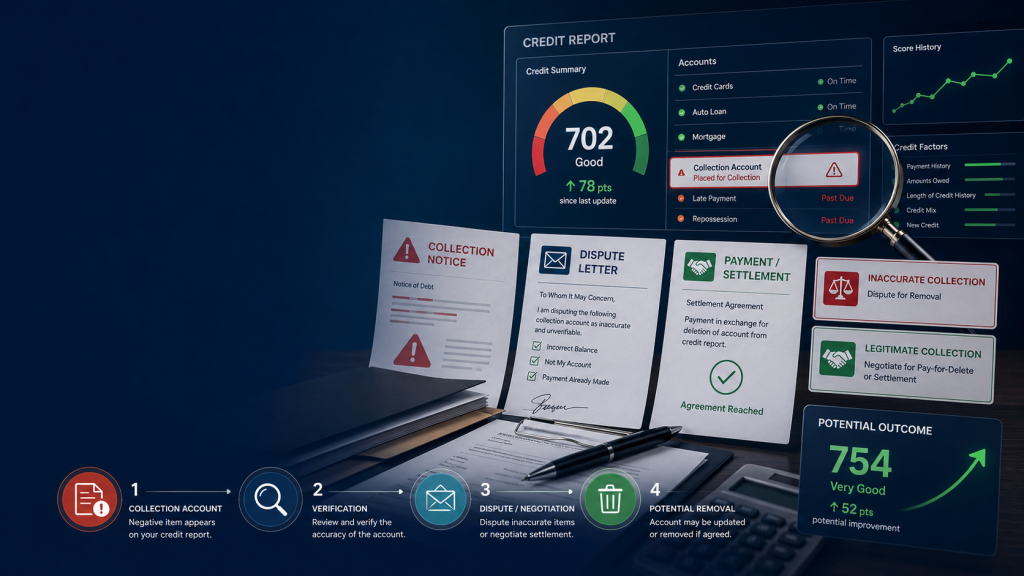
There are four legitimate, proven strategies for removing a collection from your credit report. Each has its place, and the right one depends on the specifics of your situation — whether the debt is accurate, whether you actually owe it, whether you can afford to pay, and how old the account is.
Let’s walk through each one in detail.
Path 1: FCRA Dispute
The Fair Credit Reporting Act (FCRA) gives you the right to dispute any information on your credit report that is inaccurate, incomplete, or unverifiable. If you identify a collection entry that contains errors — or that the collector cannot prove — you can dispute it with the credit bureaus, and if it can’t be verified, it must be removed.
This is the first and most fundamental path, and it’s grounded in federal law.
When to use this path:
- The collection contains factual errors (wrong amount, wrong dates, wrong account number, wrong creditor name)
- The collection is a result of identity theft
- The collection was already paid but still shows as unpaid
- The collection is a duplicate (the same debt reported by multiple agencies)
- The collection is older than 7 years and should have fallen off already
- You genuinely don’t recognize the debt and suspect it may be reported in error
The legal basis: Under the FCRA (15 U.S.C. § 1681i), when you dispute an item, the credit bureau must investigate, forward your dispute to the furnisher (the collection agency), and review and consider all relevant information. The furnisher must investigate and report back. If the item cannot be verified within 30 days (45 days if you dispute after receiving your free annual report), the bureau must delete it.
Step-by-step: FCRA Dispute
- Pull all three credit reports. Get your reports from Equifax, Experian, and TransUnion. You’re entitled to a free copy from each every 12 months at AnnualCreditReport.com. Compare the collection entries across all three — they may differ.
- Identify the errors. For each collection, check:
- Is the account number correct?
- Is the original creditor name correct?
- Is the amount accurate?
- Is the date of first delinquency correct?
- Is the “opened” date on the collection consistent with when the collector acquired it (and not later)?
- Is the status accurate (e.g., does it show as unpaid when you’ve paid it)?
- Is it a duplicate — does the same debt appear more than once, possibly from different collectors?
- Gather evidence. Collect any documents that support your dispute — bank statements showing payment, correspondence with the original creditor, a police report if it’s identity theft, or anything that contradicts what’s on the report.
- Draft and send dispute letters. Send a separate dispute letter to each credit bureau reporting the inaccurate item. Use the template below. Send by certified mail with return receipt so you have proof of delivery and a timestamp.
- Wait for the investigation. The bureau has 30–45 days to investigate. They’ll forward your dispute to the collection agency, which must verify the information. If they can’t — or don’t respond in time — the item comes off.
- Review the results. The bureau will send you the results of the investigation and an updated copy of your report if anything changed. If the item was removed, you’re done. If it was “verified” and remains, you can escalate — request the method of verification, dispute directly with the furnisher, or move on to a different strategy.
A note on “frivolous” disputes: The bureaus can reject disputes they consider frivolous. To avoid this, be specific about what’s wrong, include evidence, and don’t dispute everything on your report at once without cause. Targeted, factual disputes are taken far more seriously than blanket “not mine” claims.
Path 2: Debt Validation Under the FDCPA
The Fair Debt Collection Practices Act (FDCPA) gives you a powerful right: within 30 days of a collection agency first contacting you, you can request validation of the debt. If they can’t validate it, they must stop collection activity — and in practice, many collection agencies don’t have the documentation to validate older or purchased debts, which can lead to removal.
This is a different legal mechanism from an FCRA dispute. The FCRA is about what’s on your credit report; the FDCPA is about whether a collector can legally pursue you at all.
When to use this path:
- A collection agency has recently contacted you (you’re within the 30-day validation window)
- You’re unsure whether you actually owe the debt
- You suspect the debt amount is wrong or includes illegitimate fees
- The debt has been sold multiple times and documentation may be lost
- You want to force the collector to prove they have the legal right to collect
The legal basis: Under the FDCPA (15 U.S.C. § 1692g), within five days of first contacting you, a debt collector must send you a written notice containing the amount of the debt, the name of the creditor, and a statement that you have 30 days to dispute the debt. If you dispute it (or request the name and address of the original creditor) within that 30-day window, the collector must cease collection activity until they obtain verification of the debt and mail it to you.
Verification typically includes:
- The amount owed
- The original creditor’s name
- Documentation that you owe the debt (account statements, the original agreement)
- Proof that the collection agency has the right to collect it (assignment or purchase documentation)
What happens if they can’t validate? If the collector can’t (or doesn’t) provide validation, they must stop all collection efforts — including reporting the debt to the credit bureaus. In practice, many collectors who can’t validate will delete the account rather than continue reporting a debt they can’t prove. Debt buyers, who purchase old debts in bulk, often lack the original documentation and are the most likely to fail validation.
Step-by-step: Debt Validation Request
- Send the validation letter within 30 days. The 30-day clock starts from when the collector first contacts you (or from the date of their initial written notice). Use the template below. Send by certified mail with return receipt.
- Wait for validation. The collector must stop collection activity — including credit reporting — until they validate. There’s no strict deadline for how long they have to validate, but if they resume collection or continue reporting without having validated, they may be violating the FDCPA.
- Review what they send. If they send meaningful documentation — account statements, the original agreement, proof of their right to collect — the debt is validated, and you’ll need to pursue a different strategy (pay-for-delete, settlement, or waiting out the clock). If they send nothing, or send only a printout with no supporting documentation, you may have grounds to push for removal.
- Dispute with the bureaus if they report without validating. If the collector continues reporting the debt but hasn’t validated it in response to your request, you can dispute the entry with the credit bureaus, noting that the collector has failed to validate the debt as required by the FDCPA. The bureau’s investigation, combined with the collector’s inability to verify, can result in deletion.
The 30-day window is critical. If you miss it, you can still send a validation request, but the collector isn’t legally required to stop collection activity while they respond. That said, many collectors will still respond — especially if the debt is old or poorly documented. It’s always worth trying.
Path 3: Pay-for-Delete Negotiation
Pay-for-delete is a negotiated agreement: you agree to pay the collection (in full or a settled amount), and in exchange, the collection agency agrees to remove the entry from your credit report.
This is a pragmatic path for debts you acknowledge you owe and can afford to address. It’s not guaranteed — collection agencies are not required to agree — but many will, especially if you’re offering payment in full.
When to use this path:
- You acknowledge the debt is valid and accurate
- You can afford to pay some or all of it
- The debt is recent enough that waiting 7 years isn’t practical
- You want the entry gone sooner rather than later
The legal context: The FCRA requires that reported information be accurate — it doesn’t require that accurate information be reported. A collection agency is not legally obligated to report a collection, and they’re not legally prohibited from removing an accurate entry if they choose to. This is the gray area pay-for-delete operates in. It’s not illegal, but it’s not a right either — it’s a negotiation.
Important honesty note: Some larger collection agencies and original creditors have policies against pay-for-delete because, in theory, it undermines the accuracy of the credit reporting system. In practice, many still do it, especially for paid-in-full offers. Don’t be surprised if some say no. If they do, you can still pay (which helps under FICO 9 and VantageScore models that ignore paid collections) and pursue goodwill deletion afterward.
Step-by-step: Pay-for-Delete
- Determine what you can pay. Ideally, offer payment in full — collectors are far more likely to agree to deletion for full payment than for a settled (partial) amount. If you can only settle, still try, but expect a lower success rate.
- Get everything in writing first. Never pay based on a verbal promise. Send a pay-for-delete letter (template below) offering payment in exchange for written confirmation that they will request deletion from all three bureaus. Do not send money until you have their signed agreement in hand.
- Review their response. If they agree in writing, proceed. If they refuse or send a counter-offer, decide whether to accept. If they won’t do pay-for-delete at all, consider whether paying without deletion is still worthwhile (it is, under newer scoring models).
- Pay as agreed. Send payment by a trackable method (certified check, money order, or a payment method that generates a receipt). Keep proof of payment.
- Confirm deletion. Give the agency 30–60 days to process the deletion. Then pull your reports and verify the entry is gone. If it’s not, follow up with the agency in writing, referencing your agreement. If they still don’t delete, you can dispute the entry with the bureaus, providing your pay-for-delete agreement and proof of payment as evidence that the account should no longer be reported.
- If they won’t put deletion in writing but agree verbally, consider an alternative: pay the debt, then pursue a goodwill deletion request (covered below) citing your payment. This is a fallback, not a primary strategy, but it works often enough to be worth trying.
A reality check on pay-for-delete: Not every collector will agree, and the ones most likely to say yes are smaller agencies and debt buyers. Original creditors (like major credit card banks) almost never agree to pay-for-delete. If your collection is with a debt buyer, your odds are better. If it’s with a major bank’s internal recovery department, plan to pursue other paths.
Path 4: The 7-Year Clock
The fourth path is patience. Under the FCRA, a collection account can only stay on your credit report for 7 years — specifically, 7 years plus 180 days from the date of the first delinquency that led to the collection. After that, it must be removed automatically.
This is your backstop. If the debt is accurate, can’t be validated, and the collector won’t agree to pay-for-delete, the clock is still running — and it will come off.
When to use this path:
- The collection is accurate and the collector has verified it
- Pay-for-delete has been refused
- The debt is approaching the 7-year mark
- You’ve decided not to pay (perhaps because it’s past your state’s statute of limitations for lawsuits, and paying wouldn’t meaningfully help your score under your current scoring model)
How the 7-year clock works:
- The clock starts on the date of the first delinquency — the date you first missed a payment that led to the default and eventual collection. This is the Date of First Delinquency (DOFD).
- The collection must be removed no later than 7 years + 180 days after the DOFD.
- The clock does not reset when the debt is sold, transferred, disputed, or paid. A new collector cannot restart it by reporting a newer “opened” date.
What to do:
- Find the DOFD. It’s listed on your credit report, often as the “date of first delinquency” or “original delinquency date.” Each bureau may display it slightly differently, but it must be there.
- Calculate the removal date. Add 7 years (and up to 180 days) to the DOFD. That’s when the collection should fall off.
- Check your reports after that date. If the collection is still there, dispute it with the bureaus as “obsolete” — it’s past the reporting period and must be removed. The bureau will verify the DOFD and delete the entry.
- Don’t let a collector re-age the debt. If a collector reports a newer “date of first delinquency” or “date opened” that extends the reporting period, that’s a violation of the FCRA. Dispute it immediately, citing the true DOFD. Re-aging is illegal, and the bureaus are required to correct it.
Debt Validation Letter Template
Send this letter within 30 days of a collection agency first contacting you. Send by certified mail with return receipt. Keep a copy for your records.
[Your Name]
[Your Address]
[City, State ZIP]
[Your Phone Number]
[Your Email]
[Date]

[Collection Agency Name]
[Collection Agency Address]
[City, State ZIP]

RE: Debt Validation Request
Account Reference: [Account number or reference from their letter]
Original Creditor: [Name, if known]
Amount Claimed: [$ amount]

To Whom It May Concern:

I am writing in response to your [letter / phone call] dated Sat, 05 Sep 2026 17:14:42 +0000, regarding a debt you are attempting to collect. I do not admit liability for this debt, and I request that you validate it in accordance with my rights under the Fair Debt Collection Practices Act (15 U.S.C. § 1692g).

Please provide the following:

1. The amount of the debt, including a detailed accounting of all charges, fees, and interest added to the original balance.

2. The name and address of the original creditor, and the account number associated with the original debt.

3. A copy of the original signed contract or agreement that establishes my obligation to pay this debt.

4. Documentation showing that you (the collection agency) have the legal right to collect this debt — including any assignment agreement, bill of sale, or other proof of ownership or authorization from the original creditor.

5. A copy of the last billing statement sent to me by the original creditor.

6. Proof that the statute of limitations for this debt has not expired under [your state] law.

Until you provide this validation, I request that you cease all collection activity, including reporting this debt to any credit bureau, as required by the FDCPA.

If you cannot validate this debt, I request that you delete any entry you have placed on my credit reports with Equifax, Experian, and TransUnion, and confirm the deletion to me in writing.

This is not a refusal to pay, but a good-faith request for validation of a debt I do not recognize and have not had the opportunity to review.

Sincerely,

[Your Signature]
[Your Printed Name]

Enclosures: [List any documents you're including, or write "None"]
What to include and why:
- Account reference and original creditor: Identifies the specific debt so the collector can locate it in their system.
- The specific validation requests: Forces the collector to produce real documentation, not just a printout of their own records. Debt buyers often can’t produce the original agreement or proof of purchase.
- The cease-collection request: Invokes your FDCPA right. If they don’t validate, they must stop — including reporting.
- The deletion request: Explicitly asks for removal if they can’t validate. Many collectors will comply rather than risk a complaint or lawsuit.
- The “not a refusal to pay” language: Preserves your position. You’re not admitting or denying the debt — you’re asking for proof.
Dispute Letter Template for Inaccurate Collections
Send this letter to each credit bureau reporting the inaccurate collection. Send by certified mail with return receipt.
[Your Name]
[Your Address]
[City, State ZIP]
[Your Phone Number]
[Your Email]
[Date]

[Equifax / Experian / TransUnion]
[Bureau Address]
[City, State ZIP]

RE: Dispute of Inaccurate Collection Account
Account Reference: [Collection account number as it appears on the report]
Collection Agency: [Agency name as it appears on the report]
Original Creditor: [Name, if shown]

To Whom It May Concern:

I am disputing the following item on my credit report, which I believe is inaccurate and/or incomplete. Under the Fair Credit Reporting Act (15 U.S.C. § 1681i), I am requesting that you investigate this dispute and delete the inaccurate information if it cannot be verified.

The specific errors are:

[Choose the ones that apply and delete the rest:]

- The account number is incorrect. The correct account number is [number], not [number shown].
- The amount is incorrect. The actual amount is [$], not [$ shown].
- The date of first delinquency is incorrect. The correct date is Sat, 05 Sep 2026 17:14:42 +0000, not Sat, 05 Sep 2026 17:14:42 +0000. This is important because it affects the 7-year reporting period.
- I paid this account in full on Sat, 05 Sep 2026 17:14:42 +0000. It is incorrectly showing as unpaid/with a balance.
- I do not recognize this account and believe it may be the result of identity theft. [Include a copy of your police report or FTC identity theft report if applicable.]
- This debt is being reported by multiple collection agencies for the same obligation, which is a duplicate and inaccurate.
- This account is older than 7 years from the date of first delinquency (Sat, 05 Sep 2026 17:14:42 +0000) and should no longer be appearing on my report.

[Attach any supporting documentation — payment records, correspondence, identity theft report, etc.]

Please investigate this dispute by contacting [Collection Agency Name] and verifying the information I have challenged. If the information cannot be verified within 30 days, I request that you delete it from my credit report immediately.

Please send me an updated copy of my credit report reflecting the results of your investigation, and please provide me with the method of verification if the item is confirmed.

Sincerely,

[Your Signature]
[Your Printed Name]

Enclosures: [List what you're attaching]
What to include and why:
- Specific, factual errors: The bureau needs to know exactly what you’re challenging. Vague disputes get dismissed as frivolous.
- Supporting evidence: Anything you can attach strengthens your case. If you paid, attach proof of payment. If it’s identity theft, attach the FTC or police report.
- The method-of-verdict request: Asking how the bureau verified (if they confirm the item) gives you grounds to challenge the adequacy of their investigation — which can matter if you need to escalate.
- Certified mail: You need proof you sent it and proof they received it. The 30-day clock matters.
Pay-for-Delete Letter Template
Send this to the collection agency reporting the debt. Do not send payment until you have their signed written agreement.
[Your Name]
[Your Address]
[City, State ZIP]
[Your Phone Number]
[Your Email]
[Date]

[Collection Agency Name]
[Collection Agency Address]
[City, State ZIP]

RE: Offer of Payment in Exchange for Deletion of Credit Report Entry
Account Reference: [Account number]
Original Creditor: [Name]
Current Balance: [$ amount]

To Whom It May Concern:

I am writing regarding the above-referenced account, which your agency is reporting on my credit file with Equifax, Experian, and TransUnion.

I am willing to pay this account in full in the amount of [$ amount], or [a settled amount of $___ — if applicable], provided that your agency agrees in writing to the following:

1. You will request deletion of this collection account from my credit reports with all three major credit bureaus (Equifax, Experian, and TransUnion) immediately upon receipt of payment.

2. You will not re-report this account or sell or transfer the remaining balance [if settling] to any other party for collection.

3. You will confirm the deletion request in writing to me at the address above.

If you agree to these terms, please sign and return a copy of this letter to me at the address above. Upon receipt of your signed agreement, I will send payment within [10 / 15 / 30] days by [certified check / money order].

This offer is good for 30 days from the date of this letter. If I do not receive a signed agreement within that time, this offer will be withdrawn.

This is not an acknowledgment of liability for this debt, but a good-faith effort to resolve the matter and remove the negative reporting from my credit file.

Sincerely,

[Your Signature]
[Your Printed Name]

AGREED AND ACCEPTED:

________________________________________   ______________
[Authorized Representative, Collection Agency]    Date

________________________________________
Printed Name and Title
What to include and why:
- The offer is explicit: Payment in exchange for deletion. No ambiguity.
- All three bureaus named: You want the deletion to be complete, not partial.
- No re-reporting or resale clause: Prevents the collector from selling any remaining balance to another agency that would re-report it.
- The signature line: You need their written agreement before you pay. A verbal “yes, we’ll delete it” is not enough — collectors routinely fail to follow through on verbal promises.
- The 30-day expiration: Creates urgency and gives you a clean exit if they don’t respond.
Goodwill Deletion
If a collection is already paid — whether you paid it before discovering pay-for-delete, or you paid it as part of settling the debt — you can request a goodwill deletion. This is a request to the collection agency (or original creditor) to remove the negative entry as a goodwill gesture, citing your payment and your otherwise positive history.
Goodwill deletion is not a right. There’s no law that requires a creditor or collector to remove an accurate, paid collection. It’s a request — and it works more often than people expect, especially when the request is well-written and the circumstances are sympathetic.
When to use goodwill deletion:
- The collection is paid (in full or settled)
- You have a reason the late payment or default was out of character — a medical emergency, job loss, divorce, family death, or other hardship
- You’ve otherwise maintained a positive payment history with the creditor (if it’s an original creditor you still have a relationship with)
- The collection is recent enough that the creditor or collector still cares about your relationship, but old enough that it’s clearly a resolved issue
How to write a goodwill letter:
- Be honest and take responsibility. Don’t argue that the debt wasn’t yours.
- Explain the circumstance that caused the default — briefly and sincerely.
- Emphasize that you’ve since paid (or settled) and that you’ve maintained good credit habits since.
- Ask, politely, for them to request deletion as a goodwill gesture.
- Keep it to one page.
Sample goodwill letter structure:
[Your Name]
[Your Address]
[City, State ZIP]
[Date]

[Creditor or Collection Agency Name]
[Address]

RE: Goodwill Deletion Request
Account: [number]

To Whom It May Concern:

I am writing to respectfully request a goodwill deletion of the above-referenced account from my credit reports.

I fell behind on this account in [year] due to [brief, honest explanation — e.g., a medical emergency / a job loss / a family hardship]. I understand that I was responsible for the obligation, and I have since paid it in full [or settled it] on Sat, 05 Sep 2026 17:14:42 +0000.

Since that time, I have worked hard to rebuild my credit and maintain on-time payments on all of my obligations. The default was an exception in an otherwise [number]-year history of responsible credit use.

I am respectfully asking whether you would consider requesting that the credit bureaus delete this entry as a gesture of goodwill. I understand this is not required, and I appreciate your consideration.

Sincerely,
[Your Name]
What to expect: Some creditors and collectors will say yes. Many will say no, citing policy. If the first response is no, try again in a few months — sometimes a second request, or a request routed to a different department (executive customer service, for example), gets a different answer. Persistence, paired with politeness, pays off.
Medical Collections — Special Rules
Medical debt gets special treatment under credit reporting rules — and the rules have changed significantly in recent years. If you have medical collections on your report, you have more options and more protections than with other types of collections.
The Current Rules (as of 2026)
Here’s where things stand:
- Paid medical collections are removed. As of July 2022, paid medical collection accounts are no longer allowed to appear on your credit report. If you pay a medical collection, it must be removed — not just marked as paid, but deleted entirely. If a paid medical collection is still showing, dispute it with the bureaus and cite the rule; it will be removed.
- Unpaid medical collections have a 1-year waiting period. As of July 2023, medical collection accounts do not appear on your credit report until one year (365 days) after the original delinquency. This gives you a full year to work with the provider, set up a payment plan, dispute the bill, or resolve insurance issues before it ever touches your credit. Before this change, the waiting period was 6 months.
- Medical collections under $500 are excluded. As of April 2023, medical collection accounts with an original balance of less than $500 are excluded from credit reports entirely. If a small medical bill was sent to collections, it should not appear on your report at all.
- The major bureaus have removed most older medical collections. Equifax, Experian, and TransUnion have collectively removed billions in medical debt from consumer reports as part of these reforms. If you had medical collections that are now covered by the new rules, they may already be gone.
What This Means for You
If you have medical collections:
- Check if it should even be there. If it’s under $500, if it’s paid, or if it’s been less than a year since the delinquency, it should not be on your report. Dispute it.
- If it’s unpaid and over $500 and over a year old, consider paying it. Because paid medical collections must be removed, paying a medical collection is the most straightforward path to deletion — more reliable than pay-for-delete negotiations. Contact the provider or the collection agency, set up payment (or a payment plan), and once it’s paid, the entry should come off. If it doesn’t within 30–60 days, dispute it with the bureaus citing the paid-medical-removal rule.
- Dispute medical billing errors. Medical bills are notoriously error-prone. If the amount is wrong, if insurance should have covered it, or if the billing is duplicated, dispute it — both with the provider and, if it’s on your credit report, with the bureaus.
- Negotiate with the provider. Many hospitals and providers offer financial assistance programs, charity care, or discounts for uninsured patients. If you qualify, the bill may be reduced or eliminated — and if it’s already in collections, a resolved bill can be pulled back.
- Don’t ignore medical bills hoping they’ll go away. The 1-year grace period is a window to resolve them — not a reason to do nothing. Once the year passes and the collection appears, it will hurt your score like any other collection until it’s paid or falls off after 7 years.
A Note on Accuracy
The rules above are the current federal and industry standards as of 2026. Credit reporting rules do evolve — the CFPB has continued to push for further medical debt reporting restrictions. Always check your current reports to see what’s actually showing, and dispute anything that doesn’t match the rules in effect.
How Long Collections Stay on Your Report
The general rule is simple: a collection account stays on your credit report for 7 years (technically 7 years plus 180 days) from the date of first delinquency — the date you first missed the payment that led to the default.
After that period, the credit bureaus are required to remove the collection automatically.
The Key Dates to Understand
- Date of First Delinquency (DOFD): The date you first missed a payment that led to the charge-off and collection. This is the anchor date. It does not change.
- Charge-off date: When the original creditor wrote off the account — usually ~180 days after the DOFD. This is not the date that starts the 7-year clock.
- Collection “opened” date: When the collection agency acquired the debt. This is also not the date that starts the clock, even though it may appear on the report as the account “open date.”
The 7-year clock runs from the DOFD — not from the charge-off, not from when the collector acquired the debt, and not from the last activity on the account.
How to Find Your DOFD
Your credit report should list the date of first delinquency. Each bureau may label it slightly differently:
- Equifax: “Date of First Delinquency”
- Experian: “Original Charge-off Date” or “First Delinquent Date”
- TransUnion: “Original Delinquency Date” or “First Delinquent Date”
If the DOFD isn’t clearly shown, you can request it from the bureau. They are required to provide it.
What Happens at the 7-Year Mark
The collection should fall off automatically. You don’t need to do anything — but you should check your reports after the removal date to confirm it’s gone. If it’s still there:
- Dispute it with the bureau as obsolete — past the maximum reporting period.
- The bureau will verify the DOFD and remove the entry.
- This is one of the most straightforward disputes to win, because the rule is clear and the date is a matter of record.
Does Paying a Collection Restart the 7-Year Clock?
No. This is one of the most persistent myths in credit repair, and it’s false.
Paying a collection does not restart the 7-year reporting period. The clock is fixed to the date of first delinquency, and nothing you do — paying, settling, disputing, or making a partial payment — moves that date.
What can happen, and what probably feeds the myth:
- A new “date of last activity” or “date of last payment” may update on the report. This can make the account look more recent to anyone reading the report manually, but it does not change the DOFD or extend the reporting period.
- The statute of limitations for a lawsuit can restart. This is a separate legal clock from the credit reporting clock. In many states, making a payment or even acknowledging a debt in writing can restart the statute of limitations — the period during which a creditor can sue you to collect. This is a different issue from how long the collection stays on your credit report.
The distinction matters:
- Credit reporting period (FCRA): 7 years from DOFD. Not affected by payment. Federal law.
- Statute of limitations (state law): The period during which you can be sued for the debt. Varies by state (typically 3–6 years for most consumer debts). Can be restarted by payment or written acknowledgment in many states.
If a debt is past your state’s statute of limitations, paying it won’t restart the credit reporting clock — but it could restart the lawsuit clock. If you’re in that situation, think carefully before making a payment on an old, time-barred debt.
Do Collections Hurt Less as They Age?
Yes. The impact of a collection on your credit score diminishes over time.
Credit scoring models are designed to weight recent activity more heavily than old activity. A collection from two months ago hurts a lot more than a collection from four years ago. Here’s why:
- Recency is a major factor. Scoring models interpret a recent collection as evidence of current financial difficulty. An old collection is seen as a past problem that you’ve (presumably) moved past.
- Time since the negative event is built into the model. As months and years pass, the collection’s weight in the score calculation decreases.
- New positive information dilutes the negative. As you add on-time payments, new accounts in good standing, and lower balances, the collection becomes a smaller and smaller part of your overall credit profile.
Practical Implications
- If a collection is 5–6 years old, it’s already hurting your score much less than it did at year one. If you’re close to the 7-year mark, and the collector won’t agree to pay-for-delete, it may be worth simply waiting for it to fall off rather than paying — especially if paying won’t change its status under your scoring model.
- If a collection is recent, it’s doing maximum damage. This is where active removal strategies (dispute, validation, pay-for-delete) have the most potential to help your score.
- Adding positive history matters. While you’re working on removal, also focus on what you can control: making all current payments on time, keeping credit card balances low relative to limits, and avoiding new negative marks. The combination of removing negatives and adding positives is what produces real score improvement.
Settling vs. Paying in Full
If you’ve decided to pay a collection, you have two options: pay it in full or settle for less than the full amount. Each has implications.
Paying in Full
- Credit report impact: The collection will be updated to show “paid” status. Under FICO 8, it still hurts (paid collections are still counted), but less than unpaid. Under FICO 9 and VantageScore 3.0+, paid collections are ignored entirely.
- Lender perception: Some lenders (especially mortgage lenders) prefer to see debts paid in full. A settled account may raise questions in manual underwriting.
- Collector cooperation: Collection agencies are more willing to agree to pay-for-delete when you pay in full.
Settling
- Credit report impact: The collection shows as “settled” or “settled for less than full balance.” Under FICO 8, it still counts as a collection. Under FICO 9 and VantageScore, paid (including settled) collections are ignored.
- Cost: You pay less — often 40–70% of the balance, depending on the age of the debt and the collector’s willingness.
- Potential tax consequence: Forgiven debt over $600 may be reported as taxable income by the original creditor (on a Form 1099-C). You may owe income tax on the forgiven amount. This doesn’t apply if you were insolvent at the time of settlement, or in certain other exceptions — check with a tax professional.
- Collector cooperation: Some collectors will agree to pay-for-delete on a settlement, especially debt buyers who paid very little for the debt. Others won’t.
Which Is Better?
It depends on your goals:
- If you’re applying for a mortgage soon, paying in full is generally safer — many mortgage lenders want to see collections paid in full, and some require it as a condition of approval.
- If you’re focused on score improvement under modern models (FICO 9, VantageScore), paying in full vs. settling makes less difference — both result in the collection being disregarded.
- If you’re pursuing pay-for-delete, paying in full gives you stronger leverage.
- If budget is the primary constraint, settling is far better than leaving the collection unpaid — a settled collection is still an improvement over an open one.
One caution: Never accept a settlement over the phone without getting the terms in writing first. Get a settlement letter from the collector specifying the agreed amount and confirming that payment of that amount will satisfy the debt in full. Pay by a trackable method, and keep proof of payment indefinitely.
What NOT to Do
When you’re trying to remove collections, some actions can make your situation worse. Here’s what to avoid.
1. Don’t Acknowledge the Debt Carelessly
If a debt is old and may be past your state’s statute of limitations, do not:
- Agree on the phone that you owe it
- Make a partial payment “to show good faith”
- Promise to pay later
- Send a letter saying “I know I owe this but I can’t pay right now”
In many states, any of these can restart the statute of limitations — reopening the window during which you can be sued for the debt. If you’re not sure whether a debt is time-barred, get advice before you communicate with the collector.
2. Don’t Pay Old Debts Blindly
Paying an old, time-barred debt (one past your state’s statute of limitations) is often a poor financial decision:
- It won’t improve your score under FICO 8 (the collection still counts, paid or not)
- It won’t restart the credit reporting clock, but it may restart the lawsuit clock
- The collector, who paid pennies for the debt, gets paid — and you get little or no benefit
Before paying an old collection, check:
- Is it past the statute of limitations in your state? If so, you’re legally protected from being sued — and paying gives up that protection for no score benefit.
- Is it close to the 7-year reporting limit? If so, it may be worth waiting for it to fall off.
- Will paying it result in deletion (pay-for-delete, or medical debt rules)? If yes, paying makes sense. If no, think carefully.
3. Don’t Dispute Everything on Your Report at Once
Disputing every negative item on your report simultaneously — especially without specific reasons — is a quick way to get your disputes flagged as frivolous. The FCRA allows bureaus to reject disputes they consider frivolous or irrelevant.
Instead:
- Dispute specific, identifiable errors
- Include evidence and clear explanations
- Prioritize the items most likely to be inaccurate, unverifiable, or obsolete
- If you have many items, work through them in batches over time
4. Don’t Hire a Company That Makes Guarantees
Under the Credit Repair Organizations Act (CROA), it is illegal for a credit repair company to guarantee the removal of specific items or a specific score increase. Any company that promises “we’ll remove all your collections, guaranteed” is either lying or willing to break federal law — neither is a good sign.
Legitimate credit repair firms:
- Explain your rights and the legal basis for their work
- Tell you what they can and can’t do honestly
- Don’t promise specific outcomes
- Allow you to cancel without penalty
- Disclose costs up front
5. Don’t Ignore a Collection Hoping It Goes Away
An unpaid collection doesn’t just sit on your credit report. It can:
- Be sold to another collector (who re-reports it — though the DOFD and the 7-year clock don’t change)
- Result in a lawsuit, if you’re within the statute of limitations
- Lead to wage garnishment or bank account levies if the collector wins a judgment
Ignoring a collection is a strategy only if you’re confident the debt is past the statute of limitations and you’re willing to let the 7-year clock run out. Otherwise, engage — even if that just means validating the debt and understanding your options.
6. Don’t Restart the Clock on a Time-Barred Debt
This bears repeating because it’s the single most common mistake. If a collector contacts you about a very old debt:
- Do not acknowledge it
- Do not make any payment
- Do not agree to a payment plan
- Send a validation request instead — this forces them to prove the debt and pauses collection activity
If the debt is past the statute of limitations, they cannot legally sue you. But if you restart the clock, that protection can vanish.
Common Mistakes to Avoid
Beyond the “what not to do” list above, here are common mistakes people make when attempting to remove collections:
Mistake 1: Not Pulling All Three Reports
Collections don’t appear on all three bureaus’ reports uniformly. A collection may show on Experian and TransUnion but not Equifax — or may show different balances or dates on each. If you only pull one report, you’re working with incomplete information.
Fix: Always pull all three. Compare them. Address each bureau separately.
Mistake 2: Disputing Without Evidence
A dispute that says “this isn’t mine” with no supporting documentation is easy for a collector to verify (they just confirm the account is in their system) and easy for a bureau to dismiss. A dispute that says “this account shows a balance of $1,200, but I paid it in full on March 15, 2024 — here’s the receipt and the collector’s paid-in-full letter” is much harder to reject.
Fix: Gather evidence before you dispute. Attach it to your dispute letter.
Mistake 3: Not Following Up
The FCRA gives bureaus 30–45 days to investigate. If you don’t follow up after that window, you may never know the result — and the item may remain even if the investigation found in your favor but wasn’t properly processed.
Fix: Mark your calendar for 45 days after you send a dispute. If you haven’t received results, follow up in writing. Keep a paper trail of every letter you send and receive, with dates.
Mistake 4: Paying Before Getting Deletion in Writing
This is the pay-for-delete version of “don’t restart the clock.” If a collector says “pay us and we’ll delete it” but won’t put it in writing, and you pay — the entry often gets updated to “paid” but stays on your report. You’ve spent the money without getting the benefit you wanted.
Fix: No signed written agreement, no payment. Period.
Mistake 5: Not Understanding Which Scoring Model Matters
Different lenders use different scoring models. A mortgage lender may use FICO 8 or an older FICO model. A credit card company may use FICO 8 or FICO 9. An auto lender may use a FICO Auto Score. The model determines whether paid collections count (FICO 8: yes; FICO 9: no).
Fix: If you’re preparing for a specific application (mortgage, auto, credit card), ask the lender which scoring model they use — or work with a credit professional who can tell you. This informs whether paying a collection (vs. pursuing deletion) is worth it for your situation.
Mistake 6: Believing “Credit Repair” Can Remove Accurate Information
If a collection is accurate, verifiable, and within the 7-year reporting period, no one — not you, not a credit repair company, not a lawyer — can force its removal. The best you can do is negotiate (pay-for-delete, goodwill) or wait (the 7-year clock). Anyone who tells you otherwise is selling something.
Fix: Be realistic. Focus your energy on the items that genuinely have errors, can’t be validated, or are old enough to come off. For the rest, pursue negotiation and time.
Mistake 7: Overlooking the Original Creditor’s Entry
As we covered, a single defaulted debt often produces two report entries: the original creditor’s charge-off and the collection agency’s account. People frequently focus on the collection (the more recent, more aggressive entry) and forget the charge-off, which continues to hurt even after the collection is removed.
Fix: Address both. If you remove the collection, dispute or pursue goodwill on the charge-off too. A comprehensive approach produces a cleaner report.
Frequently Asked Questions
Can I remove a collection if it’s accurate?
If a collection is completely accurate, verifiable, and within the 7-year reporting period, you cannot force its removal through a dispute. You can, however, pursue pay-for-delete (negotiating removal in exchange for payment) or goodwill deletion (requesting removal as a courtesy after paying). Neither is guaranteed, but both work often enough to be worth trying. You can also let the 7-year clock run — the collection will fall off automatically after the reporting period expires.
How long does a collection stay on my credit report?
7 years (technically 7 years plus 180 days) from the date of first delinquency — the date you first missed the payment that led to the default. After that, the bureaus must remove it. Paying or settling the collection does not reset this clock. Get a free credit audit.
Does paying a collection improve my credit score?
It depends on the scoring model. Under FICO 8, a paid collection still hurts your score (though often slightly less than an unpaid one). Under FICO 9 and VantageScore 3.0+, paid collections are ignored entirely — so paying can result in a meaningful score jump. For medical collections, paid accounts must be removed from your report entirely, so paying a medical collection should result in its deletion.
What’s the difference between a charge-off and a collection?
A charge-off is an accounting action: the original creditor declares the debt a loss on their books, usually after ~180 days of non-payment. The charge-off shows on the original creditor’s trade line. A collection is what happens when the debt is handed to or sold to a third-party collector, who then reports a separate account. A single defaulted debt can produce both entries on your report.
Can a collection be removed before 7 years?
Yes, through:
- FCRA dispute (if the entry is inaccurate or can’t be verified)
- Debt validation (if the collector can’t produce documentation under the FDCPA)
- Pay-for-delete (negotiated removal in exchange for payment)
- Goodwill deletion (requested removal after payment, especially for hardship situations)
- Medical debt rules (paid medical collections and those under $500 must be removed)
Should I pay a collection that’s past the statute of limitations?
Generally, no — unless paying it will result in deletion (pay-for-delete agreement in writing, or medical debt). Paying a time-barred debt won’t improve your FICO 8 score (the collection still counts), but it can restart the statute of limitations in many states, reopening your risk of being sued. If the debt is both past the statute of limitations and approaching the 7-year reporting limit, waiting for it to fall off is often the best move.
How do I find out if a collection is on my report?
Pull your credit reports from all three bureaus. You’re entitled to a free copy from each every 12 months at AnnualCreditReport.com. Review the “collections” or “account history” section of each report. You can also use a credit monitoring service to see ongoing changes. Get a free credit audit.
What if I don’t recognize the collection at all?
If you don’t recognize a collection, it may be:
- A debt you forgot about
- A debt from identity theft
- A reporting error
- A debt that was sold and re-reported under a new collector’s name
Request debt validation from the collector (if they’ve contacted you) and dispute the entry with the credit bureaus. If it’s identity theft, file a report with the FTC at IdentityTheft.gov and your local police, then use that report to dispute the entry — the FCRA has specific provisions for identity theft victims, including blocking information from your report.
Get a Free Credit Audit
Removing collections from your credit report is possible — but the right approach depends on the specifics of your situation. What’s on your report, which bureau is reporting it, whether the debt is accurate, how old it is, and what type of debt it is all determine which strategy will work best.
You don’t have to figure it out alone.
At , we offer a free, no-obligation three-bureau credit audit. We pull all three of your credit reports, identify every collection and negative mark, and give you a clear, honest assessment of:
- Which items can be disputed and on what grounds
- Which items are candidates for debt validation
- Which collectors are likely to agree to pay-for-delete
- Which items are approaching the 7-year removal date
- A custom repair plan tailored to your goals
We’re a San Diego-based, FCRA-compliant, attorney-backed credit repair firm. We don’t guarantee specific results, because no honest firm can. What we do guarantee is that we’ll work your case using every legitimate, legally grounded strategy available — and we’ll keep you informed at every step.
We believe in transparency, legal compliance, and measurable progress. We don’t just fix your credit — we equip you with the knowledge to keep it strong for life.
This article is for educational purposes and is not legal advice. Credit reporting rules and state laws change; always verify current rules and consult a qualified professional for guidance on your specific situation.
Leave a Reply