Author: admin

  • Foreclosure: What It Actually Means and How to Avoid It

    Foreclosure: What It Actually Means and How to Avoid It

    Foreclosure is one of the most feared words in personal finance, and for good reason — losing a home is a genuinely severe outcome. But foreclosure is also a legal process with specific stages, specific timelines, and, importantly, specific points along the way where intervention can still prevent the worst outcome. Understanding exactly how the process works demystifies it and clarifies where your real opportunities to act actually are.

    What Foreclosure Actually Is

    Foreclosure is the legal process through which a mortgage lender repossesses and sells a property after the borrower has defaulted on their mortgage payments, using the sale proceeds to recover what’s owed on the loan. It’s the lender’s enforcement mechanism for the security interest they hold in the property, since a mortgage loan is secured by the home itself as collateral.

    How the Process Typically Unfolds

    Missed Payments and Early Delinquency

    The process generally begins with a missed payment, followed by increasingly serious notices as delinquency continues.

    Default Notice

    After a specific period of continued nonpayment (commonly around 90-120 days, though this varies by state, lender, and loan type), the lender formally declares default and often sends a formal notice, sometimes called a “Notice of Default,” which is often the first clearly foreclosure-specific document a borrower receives.

    Pre-Foreclosure Period

    Depending on your state, there’s often a period between formal default notice and an actual foreclosure sale during which specific rights and options may apply, including a right to “cure” the default by catching up on missed payments plus fees.

    Foreclosure Filing or Notice of Sale

    Depending on your state’s specific process (judicial foreclosure, which goes through the court system, versus non-judicial foreclosure, which follows a specific out-of-court process defined by state law and your original loan documents), formal foreclosure proceedings begin.

    Foreclosure Sale

    The property is sold, typically at a public auction, with proceeds going toward the outstanding loan balance, fees, and costs.

    Eviction, if Necessary

    If you’re still occupying the home at the time of sale, a separate eviction process typically follows to formally remove you from the property.

    Judicial vs. Non-Judicial Foreclosure

    Judicial Foreclosure

    Judicial foreclosure requires the lender to file a lawsuit and obtain a court order to foreclose, generally providing more procedural protections and time for the borrower, since it goes through the full court process.

    Non-Judicial Foreclosure

    Non-judicial foreclosure, used in many states, follows a specific process outlined in state law and your original mortgage documents (specifically the “power of sale” clause many deeds of trust include), generally proceeding faster than judicial foreclosure since it doesn’t require a separate court lawsuit.

    Which process applies to you depends entirely on your state’s law, and this significantly affects your realistic timeline and specific procedural rights, making it worth understanding which type applies in your specific state early in any foreclosure concern.

    The Critical Window: Options Available Before Foreclosure Sale

    Reinstatement

    Paying the full past-due amount (plus fees and costs) to bring your loan current, stopping foreclosure and returning to your normal payment schedule. This is often available, though sometimes only up to a specific point in the process defined by your state’s law.

    Forbearance

    A temporary reduction or pause in payments, agreed to by the lender, typically for a defined period, with a plan for how the paused amount will eventually be addressed (added to the end of the loan, a repayment plan, or in some cases as part of a broader modification).

    Loan Modification

    A more permanent restructuring of your loan terms — potentially a lower interest rate, extended term, or other changes — to make your payment more sustainable going forward.

    Repayment Plan

    An agreement to pay your regular payment plus an additional amount over a defined period specifically to catch up on the missed payments.

    Short Sale

    Selling the home for less than the remaining mortgage balance, with the lender’s approval, avoiding foreclosure while still resulting in the loss of the home, but generally with less severe credit and financial consequences than an actual foreclosure.

    Deed in Lieu of Foreclosure

    Voluntarily transferring the property back to the lender to avoid the formal foreclosure process, again resulting in loss of the home but sometimes with somewhat less severe consequences than a completed foreclosure, depending on the specific circumstances and lender.

    Why Contacting Your Servicer Early Matters So Much

    Similar to other hardship situations, the earlier you engage with your mortgage servicer, the more options remain realistically available. Many of the options above — forbearance, modification, repayment plans — are far more accessible when requested proactively or early in delinquency than once foreclosure proceedings have formally begun. Federal regulations actually require mortgage servicers to make good-faith efforts to contact borrowers and discuss loss mitigation options before initiating formal foreclosure in many circumstances, but proactively reaching out yourself, rather than waiting for the servicer to initiate contact, generally puts you in a stronger position.

    For more guidance on communicating with creditors during financial hardship, see our guide on how to negotiate with creditors when you’re struggling.

    Specific Protections for Federally Backed Loans

    If your mortgage is backed by the FHA, VA, USDA, Fannie Mae, or Freddie Mac (a very large portion of U.S. mortgages fall into one of these categories), you have access to specific, more standardized hardship and loss mitigation programs than a purely private, non-backed loan might offer. Finding out which category your loan falls into (your servicer can confirm this, or you can often check through Fannie Mae’s or Freddie Mac’s own loan lookup tools) is a valuable early step, since it clarifies which specific programs and protections apply to your situation.

    Working With a HUD-Approved Housing Counselor

    The U.S. Department of Housing and Urban Development (HUD) certifies housing counseling agencies that provide free or low-cost foreclosure prevention counseling, helping you understand your options, communicate with your servicer, and sometimes directly assist in negotiating a resolution. This is a genuinely valuable, often underused resource — working with a HUD-approved counselor is free and can meaningfully improve your ability to navigate a complex, high-stakes process.

    What Happens to Your Credit After Foreclosure

    A completed foreclosure is a serious negative item, generally remaining on your credit report for up to seven years from the date of the first missed payment that led to the foreclosure. This significantly affects your ability to qualify for a new mortgage for a period (commonly several years, depending on the specific loan program you’d apply for in the future), though — similar to bankruptcy — many people who go through foreclosure rebuild their credit and can qualify for a new mortgage again within a few years of consistent, responsible financial management afterward.

    If you are working to recover from negative credit information, our guides on how to improve your credit score and how to fix your credit provide additional information.

    What Happens If the Sale Doesn’t Cover the Full Loan Balance?

    If your home sells for less than what you owed (a “deficiency”), some states allow lenders to pursue you for this remaining deficiency balance through a separate legal action, while other states have specific anti-deficiency laws limiting or eliminating this possibility for certain types of loans (commonly purchase-money mortgages on a primary residence, though rules vary considerably). Understanding your specific state’s deficiency rules is an important part of understanding your full financial exposure if foreclosure does ultimately occur.

    Frequently Asked Questions

    How long does the entire foreclosure process typically take, from first missed payment to actual sale?

    This varies enormously by state and specific circumstances, ranging anywhere from a few months in some non-judicial foreclosure states to well over a year in judicial foreclosure states with more extended court processes — there’s no single universal timeline, making it important to understand your specific state’s typical process.

    Can I sell my home myself to avoid foreclosure, even if I owe more than it’s worth?

    Yes, through a short sale, though this requires your lender’s approval since they’re agreeing to accept less than the full amount owed — this process takes some time to negotiate and complete, so it’s most viable if pursued before you’re extremely close to an actual scheduled foreclosure sale date.

    Does forbearance mean I don’t have to pay anything, or does the paused amount still need to be addressed eventually?

    Forbearance pauses your required payment temporarily, but the paused amount generally still needs to be addressed eventually — through a lump-sum repayment, a repayment plan spread over time, or, sometimes, being added to the end of your loan term through a modification, depending on what your specific lender and program allow.

    Is bankruptcy an option to stop a foreclosure that’s already in progress?

    Yes — filing for bankruptcy triggers the automatic stay, which immediately halts foreclosure proceedings, at least temporarily, while your bankruptcy case is active; whether this provides a lasting solution depends on your specific situation and which type of bankruptcy you file, making this worth discussing with a bankruptcy attorney if foreclosure feels imminent and other options haven’t resolved the situation.

    For additional information, see our guide explaining Chapter 7 and Chapter 13 bankruptcy.

    Should I keep making partial mortgage payments if I can’t afford the full amount, or does that not help?

    This depends on your specific servicer’s policies — some servicers will not accept and simply return partial payments, since they’re not the full contractual amount due, which can actually leave you appearing to have made no payment at all; it’s worth directly asking your servicer how they’d prefer you handle a partial payment situation before assuming it’s automatically helpful.

    A Realistic Timeline Comparison: Judicial vs. Non-Judicial States

    To make the practical difference more concrete: in a typical non-judicial foreclosure state, the process from initial notice of default to an actual foreclosure sale might take roughly 3-6 months, following a specific statutory timeline with defined notice periods. In a judicial foreclosure state, where the lender must file and win a lawsuit, the same process — accounting for court scheduling, potential borrower response and defense, and standard litigation timelines — might take a year or considerably longer. This difference matters enormously for how much time you realistically have to pursue alternatives once formal proceedings begin, which is exactly why identifying which type of process applies in your state early on helps you calibrate your own sense of urgency and timeline for pursuing loss mitigation options.

    What a Notice of Default Should Include, and Why Reading It Carefully Matters

    If you receive a formal Notice of Default, this document typically specifies the exact amount needed to cure the default (reinstate your loan), any applicable deadline for doing so, and often information about foreclosure prevention resources and your right to request a meeting or discussion with the servicer about alternatives. Reading this document carefully — rather than setting it aside out of anxiety, which is an understandable but costly response — gives you the specific facts and deadlines you need to act effectively, including the exact reinstatement amount and timeline, which is often more precise and actionable than general assumptions about your situation.

    How a HUD-Approved Counselor Session Typically Unfolds

    For anyone hesitant about what working with a HUD-approved housing counselor actually involves: a typical session includes a comprehensive review of your income, expenses, and mortgage details, an explanation of which specific loss mitigation options you likely qualify for given your loan type and circumstances, help preparing any documentation your servicer might require, and sometimes direct assistance communicating with your servicer on your behalf or alongside you. This service is genuinely free (funded through HUD, not charged to you), and counselors are specifically trained in foreclosure prevention, making this one of the highest-value, lowest-cost resources available if you’re facing this situation — finding a HUD-approved counselor near you is possible through HUD’s own website or by phone.

    Frequently Asked Questions, Continued

    Does a foreclosure affect only my credit, or does it show up anywhere else beyond my credit report?

    Beyond your credit report, a completed foreclosure is generally part of the public record (since it typically involves a legal filing or recorded document, depending on judicial vs. non-judicial process), meaning it could theoretically be found through a public records search, separate from and in addition to its credit report impact.

    Can I still apply for a HELOC or refinance while behind on my current mortgage?

    Generally, no — most lenders require your existing mortgage to be current to approve a new loan against the same property, meaning refinancing typically isn’t a viable path once you’re already behind, though it may have been a reasonable option to explore earlier, before delinquency began, if you’d anticipated difficulty.

    If my home is foreclosed on, do I get any of the sale proceeds if it sells for more than I owed?

    In most cases, yes — if a foreclosure sale generates proceeds exceeding the total amount owed (principal, interest, fees, and costs), the excess is generally required to be returned to the former homeowner, though the specific process for claiming this varies by state and isn’t always straightforward, sometimes requiring you to actively file a claim rather than receiving it automatically.

    How Property Taxes and Insurance Factor Into Foreclosure Risk

    It’s worth knowing that falling behind on property taxes or homeowners insurance, separate from your actual mortgage payment, can also create serious risk, even if your mortgage payments themselves are current. Many mortgage agreements require you to maintain insurance and stay current on property taxes, and a lapse can trigger the lender to force-place expensive insurance on your behalf (added to your loan balance) or, in the case of significant tax delinquency, potentially even trigger a separate tax lien or tax foreclosure process entirely independent of your mortgage lender. Keeping both of these obligations current, even during a period of mortgage-specific hardship negotiation, protects against this additional layer of risk.

    Frequently Asked Questions, Continued One More Time

    Does a completed foreclosure ever get removed from my credit report early, before the standard seven years?

    Generally, no — like most negative credit items, a foreclosure follows the standard reporting period tied to the original delinquency date, and there’s no standard early-removal mechanism simply based on time passing faster than expected or your subsequent good financial behavior, though disputing any inaccuracy in how it’s reported remains available if genuine errors exist.

    If you believe your credit report contains inaccurate foreclosure-related information, you can learn more about how to dispute credit report errors.

    Is it possible to negotiate a repayment plan that includes both catching up on missed payments and a permanent rate reduction simultaneously?

    Yes, some loan modification programs combine elements of both — addressing past-due amounts while also permanently adjusting terms going forward — though the specific structure available depends heavily on your loan type, investor requirements (for loans backed by Fannie Mae, Freddie Mac, FHA, VA, or USDA specifically), and your servicer’s particular programs, making this worth discussing comprehensively with your servicer or a HUD-approved counselor rather than assuming only one type of solution is available.

    The Bottom Line

    Foreclosure is a formal legal process with distinct stages, and the further along that process you are, the fewer options typically remain available — which is exactly why understanding the process and reaching out to your servicer (and, ideally, a free HUD-approved housing counselor) as early as possible in any payment difficulty gives you access to the widest range of potential solutions: reinstatement, forbearance, modification, or, if keeping the home genuinely isn’t feasible, a short sale or deed in lieu that generally results in less severe consequences than letting the process run its full course to a completed foreclosure sale.

    Need Help Reviewing Your Credit Situation?

    If foreclosure or mortgage hardship has affected your credit report, reviewing your credit history can help you identify inaccurate or potentially disputable information as you work toward financial recovery.


    Request a Credit Audit

  • How to Negotiate With Creditors When You’re Genuinely Struggling

    How to Negotiate With Creditors When You’re Genuinely Struggling

    There’s a meaningful difference between negotiating a settlement on old, charged-off debt and negotiating with a creditor while you’re still current, or only slightly behind, but genuinely struggling to keep up. This earlier-stage conversation has its own dynamics, its own available tools, and its own strategic considerations — and getting it right can prevent a temporary hardship from escalating into a much larger, harder-to-resolve problem. This guide focuses specifically on this earlier-stage negotiation.

    Why Timing Matters More Than Almost Anything Else

    The single biggest factor determining your negotiating leverage and options is how early you engage. A creditor is generally far more willing to offer meaningful accommodation to a customer who reaches out before missing a payment, or immediately after a first missed payment, than to one who’s already deep into delinquency or default. Early engagement signals reliability and good faith, and it also means you’re working with the creditor directly rather than a third-party collector or debt buyer with different incentives and less flexibility.

    What to Actually Say When Reaching Out

    Be direct and factual about your situation. “I’m experiencing a temporary financial hardship due to [brief, honest reason — job loss, medical expense, reduced hours] and I want to discuss options before this affects my account status.”

    State what you’re hoping for, even if approximately. “I’m hoping to explore a temporarily reduced payment, a short deferment, or another accommodation that might be available.”

    Ask directly what programs exist, rather than assuming you know your only options. “What hardship programs does your company offer for a situation like mine?”

    The Range of Accommodations Creditors Commonly Offer

    Temporary Payment Reduction

    Temporary payment reduction, often for a defined period (three to six months is common), after which your payment returns to the standard amount.

    Interest Rate Reduction

    Interest rate reduction, sometimes temporary, sometimes for the remainder of the loan, reducing the total cost of carrying the balance even if the payment structure doesn’t dramatically change.

    Deferment or Forbearance

    Deferment or forbearance, pausing payments entirely for a period, though it’s important to understand whether interest continues accruing during this pause, since this affects the total cost.

    Loan Modification

    Loan modification, more substantial restructuring (common with mortgages specifically), potentially extending the loan term or otherwise permanently adjusting terms to make payments more sustainable going forward.

    Fee Waivers

    Fee waivers, less significant individually but worth asking about, particularly late fees that might otherwise accumulate during a difficult stretch.

    What Documentation to Have Ready

    Creditors often require some documentation supporting your hardship claim before approving formal accommodation:

    • Proof of income change — a layoff notice, reduced pay stubs, or similar documentation.
    • Medical documentation, if a health issue is the underlying cause, though detailed medical records typically aren’t required — a general confirmation is often sufficient.
    • A basic budget or hardship letter, outlining your income, essential expenses, and why the requested accommodation would help you remain current going forward.

    Having this ready before you call, rather than scrambling to produce it after being asked, speeds up the process and demonstrates preparedness.

    How to Negotiate Different Types of Creditors

    Mortgage Servicers

    Mortgage servicers often have the most formalized hardship processes, particularly for federally backed loans (FHA, VA, USDA, Fannie Mae, Freddie Mac), which have specific, sometimes mandated forbearance and modification programs. Contact your servicer’s loss mitigation department specifically, rather than general customer service, for the most direct path to these programs.

    Credit Card Issuers

    Credit card issuers vary considerably in their formal hardship program structure, though most major issuers do have some options — asking specifically for their “hardship department” or “financial assistance program” often gets you to the right team faster than general customer service.

    Auto Lenders

    Auto lenders may offer deferment (pushing a missed payment to the end of the loan term) or a temporary modified payment, though flexibility varies more by individual lender than with mortgages, given less standardized federal program involvement.

    Utility Companies

    Utility companies often have their own hardship and payment plan programs, sometimes combined with state or local assistance program eligibility, worth asking about directly if utility payments are part of your broader struggle.

    What If the Creditor’s Initial Response Isn’t Sufficient?

    Ask if there’s a supervisor or specialized hardship team you can be escalated to, since front-line representatives sometimes have less authority or flexibility than a dedicated hardship or loss mitigation team.

    Consider whether a formal, written hardship request (rather than only a phone conversation) might receive more serious consideration, particularly for larger creditors with formal review processes.

    Explore nonprofit credit counseling if you’re struggling across multiple creditors simultaneously, since a credit counselor can sometimes negotiate more favorable terms across your full financial picture than you might achieve creditor-by-creditor on your own, and can help you develop a comprehensive plan rather than addressing each account in isolation.

    Common Mistakes in This Type of Negotiation

    • Waiting until you’ve already missed several payments before reaching out, which significantly narrows your available options compared to earlier engagement.
    • Not asking specifically about hardship programs, assuming none exist simply because they weren’t offered proactively — many creditors don’t advertise these programs prominently, requiring you to ask directly.
    • Agreeing to an accommodation without fully understanding the terms, particularly whether interest continues accruing during a payment pause, or what happens if your hardship extends beyond the accommodation’s defined period.
    • Not getting the agreed terms in writing, which protects you if any confusion or dispute arises about what was actually agreed to.
    • Feeling too embarrassed to reach out at all, which is an understandable but ultimately costly instinct to give in to — creditors deal with hardship requests constantly and generally aren’t judging you personally; they’re simply processing a routine (if individually significant to you) business request.

    What Happens After Your Accommodation Period Ends

    Have a plan for what happens once a temporary accommodation concludes — if your hardship is genuinely resolved by then, you’d simply resume standard payments. If it’s not fully resolved, proactively reaching back out before the accommodation ends, rather than waiting to see what happens once it expires, gives you the best chance of extending or modifying your arrangement rather than falling back into default status once the temporary measure concludes.

    Frequently Asked Questions

    Does requesting a hardship accommodation appear on my credit report or affect my score?

    Simply requesting or being granted an accommodation generally doesn’t directly harm your score — what matters for your credit is whether you’re actually making the agreed payments under the modified terms, which, if maintained, should continue reporting as current rather than delinquent.

    Can I negotiate hardship terms if I’m not yet behind, just concerned I might fall behind soon?

    Yes, and this is actually the ideal time to reach out — creditors are often most flexible and accommodating for a customer who’s still current but proactively addressing an anticipated difficulty, compared to one who’s already delinquent.

    Is there a limit to how many times I can request a hardship accommodation from the same creditor?

    There’s no universal legal limit, though creditors do have discretion, and a pattern of repeated hardship requests may be viewed differently than a single, isolated one — this varies by creditor and specific program, making it worth understanding your specific creditor’s policy if you anticipate needing this kind of accommodation more than once.

    Should I prioritize which creditors to negotiate with first if I’m struggling across multiple accounts?

    Yes — prioritizing based on consequence severity (as covered in related guides — housing and secured debts generally first, given the more severe consequences of falling behind on these specifically) is a reasonable approach if you need to focus your limited time and energy on the negotiations most likely to prevent the most serious outcomes.

    Is it better to negotiate hardship terms myself, or work with a nonprofit credit counselor from the start?

    Many people successfully negotiate directly, particularly for a single creditor or a straightforward situation — a nonprofit credit counselor becomes more valuable when you’re managing hardship across multiple creditors simultaneously, or when you want professional guidance navigating options you’re not confident evaluating on your own.

    A Complete Sample Hardship Request Letter

    For creditors that accept or prefer written hardship requests, having a template ready streamlines the process:

    [Your Name]
    [Your Address]
    [Date]

    [Creditor Name]
    Re: Account [Number]

    To Whom It May Concern:

    I am writing to request assistance due to a financial hardship. [Brief explanation — e.g., “I was laid off from my position on [date] and am currently seeking new employment while managing reduced income from unemployment benefits.”]

    I have been a customer in good standing since [year/date if known], and I want to remain current on this account. I am requesting information about any hardship programs available, including temporary payment reduction, deferment, or interest rate adjustment.

    I can provide documentation supporting my situation, including [income documentation, layoff notice, etc.], and I’m happy to discuss my situation further by phone.

    Thank you for your consideration.

    Sincerely,
    [Your Name]
    [Account Number]
    [Phone Number]

    Send this via whatever channel the creditor prefers (mail, secure online messaging through your account portal, or as a follow-up after an initial phone call), and keep a copy for your records.

    negotiating

    How Creditors Internally Evaluate Hardship Requests

    Understanding roughly what a creditor’s internal review considers can help you present a stronger request. Most look at: your account tenure and payment history (a longer, cleaner history generally supports more favorable consideration), the nature and apparent temporariness of your hardship (a clearly temporary situation, like a specific medical event or job loss with an active search underway, is often viewed more favorably than an open-ended, unclear situation), and your overall relationship value to the institution (larger balances or additional products with the same institution sometimes receive more attention, simply reflecting the creditor’s own risk exposure). None of these factors are things you can necessarily change quickly, but understanding them helps you present your specific situation in the most relevant, complete light.

    The Difference Between Asking for Help and Asking for Forgiveness

    It’s worth framing this type of negotiation clearly in your own mind: you’re generally asking for temporary accommodation to get through a difficult period while remaining a paying customer, not asking the creditor to forgive or reduce what you ultimately owe (which is a different kind of negotiation, more relevant to already-defaulted debt with a debt buyer, covered in other guides). This framing matters both for how you present your request and for realistically calibrating what’s likely to be offered — creditors are often considerably more willing to adjust timing and short-term terms than to reduce the fundamental amount owed on a current, still-performing account.

    If you are dealing with older collection accounts instead of a current account, see our guide on how to remove collections from your credit report and learn about debt validation letters.

    Frequently Asked Questions, Continued

    Does my credit score itself affect how much flexibility a creditor is willing to offer during hardship negotiation?

    It can be a factor, since a strong existing credit history and payment record on that specific account generally supports a stronger case for accommodation, though creditors also specifically design hardship programs anticipating that people using them are, by definition, going through a difficult period, so a temporarily strained situation doesn’t automatically disqualify you.

    Can I negotiate hardship terms on behalf of an aging parent or family member?

    This is possible but generally requires proper authorization — either being an authorized representative on the account, having power of attorney, or the account holder participating directly in the conversation to provide consent for the creditor to discuss their account details with you.

    Is it worth negotiating hardship terms even for a very small remaining balance?

    Even a small balance is worth addressing if maintaining it in good standing genuinely matters to you (for your credit history, or your ongoing relationship with that specific creditor for future needs), though the time and effort involved should reasonably scale with the stakes involved — a very small balance might not warrant the same intensive negotiation effort as a significant one.

    What to Do If a Creditor’s Hardship Program Feels Insufficient

    Sometimes the accommodation offered genuinely doesn’t fully solve your situation — perhaps the reduced payment is still more than you can manage, or the deferment period is shorter than your anticipated hardship. In this case, it’s worth being honest about this gap during the conversation itself, rather than accepting an insufficient arrangement and risking a second, compounding default shortly after. Asking directly, “Is there anything beyond this that might work better for my situation?” or requesting to explore a different type of accommodation than what was initially offered, keeps the conversation open rather than prematurely closing it around an option that isn’t actually going to work.

    Frequently Asked Questions, Continued One More Time

    Does it help to have a specific end date in mind for my hardship when negotiating, even if I’m not entirely certain?

    Yes, having even an approximate expected timeline (based on your job search progress, a medical recovery timeline, or similar) helps a creditor structure an appropriate accommodation — open-ended requests without any sense of duration can be harder for a creditor to accommodate with a specific, time-bound program.

    Can I negotiate hardship terms over email or written request if I genuinely prefer not to call?

    Many creditors do accept written hardship requests through their online portal, secure messaging, or in some cases traditional mail, as an alternative to a phone call — this is a completely legitimate approach if it better fits your communication preference, though response times may be somewhat slower than a real-time phone conversation.

    The Bottom Line

    Negotiating with creditors while you’re still current, or only recently behind, offers meaningfully more flexibility and better options than negotiating after a debt has been charged off or sold to a collector. Reaching out proactively and early, being direct about your situation, specifically asking what hardship programs exist, and getting any agreed terms in writing are the core principles that consistently improve outcomes in this earlier-stage negotiation — turning what could become a much larger, harder-to-resolve problem into a manageable, temporary accommodation that gets you back to stable footing.

    For additional guidance on managing your credit during financial hardship, explore our credit repair tips or learn how to fix your credit.

    Need Help Reviewing Your Credit Situation?

    If financial hardship has already resulted in negative or inaccurate information on your credit reports, a professional credit review can help you understand what may need attention.

    Request a Credit Audit

  • How to Negotiate With Creditors When You’re Genuinely Struggling

    How to Negotiate With Creditors When You’re Genuinely Struggling

    How to Negotiate With Creditors When You’re Genuinely Struggling? There’s a meaningful difference between negotiating a settlement on old, charged-off debt and negotiating with a creditor while you’re still current, or only slightly behind, but genuinely struggling to keep up. This earlier-stage conversation has its own dynamics, its own available tools, and its own strategic considerations — and getting it right can prevent a temporary hardship from escalating into a much larger, harder-to-resolve problem. This guide focuses specifically on this earlier-stage negotiation.

    Why Timing Matters More Than Almost Anything Else

    The single biggest factor determining your negotiating leverage and options is how early you engage. A creditor is generally far more willing to offer meaningful accommodation to a customer who reaches out before missing a payment, or immediately after a first missed payment, than to one who’s already deep into delinquency or default. Early engagement signals reliability and good faith, and it also means you’re working with the creditor directly rather than a third-party collector or debt buyer with different incentives and less flexibility.

    What to Actually Say When Reaching Out

    Be direct and factual about your situation. “I’m experiencing a temporary financial hardship due to [brief, honest reason — job loss, medical expense, reduced hours] and I want to discuss options before this affects my account status.”

    State what you’re hoping for, even if approximately. “I’m hoping to explore a temporarily reduced payment, a short deferment, or another accommodation that might be available.”

    Ask directly what programs exist, rather than assuming you know your only options. “What hardship programs does your company offer for a situation like mine?”

    The Range of Accommodations Creditors Commonly Offer

    Temporary Payment Reduction

    Temporary payment reduction, often for a defined period (three to six months is common), after which your payment returns to the standard amount.

    Interest Rate Reduction

    Interest rate reduction, sometimes temporary, sometimes for the remainder of the loan, reducing the total cost of carrying the balance even if the payment structure doesn’t dramatically change.

    Deferment or Forbearance

    Deferment or forbearance, pausing payments entirely for a period, though it’s important to understand whether interest continues accruing during this pause, since this affects the total cost.

    Loan Modification

    Loan modification, more substantial restructuring (common with mortgages specifically), potentially extending the loan term or otherwise permanently adjusting terms to make payments more sustainable going forward.

    Fee Waivers

    Fee waivers, less significant individually but worth asking about, particularly late fees that might otherwise accumulate during a difficult stretch.

    What Documentation to Have Ready

    Creditors often require some documentation supporting your hardship claim before approving formal accommodation:

    • Proof of income change — a layoff notice, reduced pay stubs, or similar documentation.
    • Medical documentation, if a health issue is the underlying cause, though detailed medical records typically aren’t required — a general confirmation is often sufficient.
    • A basic budget or hardship letter, outlining your income, essential expenses, and why the requested accommodation would help you remain current going forward.

    Having this ready before you call, rather than scrambling to produce it after being asked, speeds up the process and demonstrates preparedness.

    How to Negotiate Different Types of Creditors

    Mortgage Servicers

    Mortgage servicers often have the most formalized hardship processes, particularly for federally backed loans (FHA, VA, USDA, Fannie Mae, Freddie Mac), which have specific, sometimes mandated forbearance and modification programs. Contact your servicer’s loss mitigation department specifically, rather than general customer service, for the most direct path to these programs.

    Credit Card Issuers

    Credit card issuers vary considerably in their formal hardship program structure, though most major issuers do have some options — asking specifically for their “hardship department” or “financial assistance program” often gets you to the right team faster than general customer service.

    Auto Lenders

    Auto lenders may offer deferment (pushing a missed payment to the end of the loan term) or a temporary modified payment, though flexibility varies more by individual lender than with mortgages, given less standardized federal program involvement.

    Utility Companies

    Utility companies often have their own hardship and payment plan programs, sometimes combined with state or local assistance program eligibility, worth asking about directly if utility payments are part of your broader struggle.

    how-to-negotiate-with-creditors-under-100kb

    What If the Creditor’s Initial Response Isn’t Sufficient?

    Ask if there’s a supervisor or specialized hardship team you can be escalated to, since front-line representatives sometimes have less authority or flexibility than a dedicated hardship or loss mitigation team.

    Consider whether a formal, written hardship request (rather than only a phone conversation) might receive more serious consideration, particularly for larger creditors with formal review processes.

    Explore nonprofit credit counseling if you’re struggling across multiple creditors simultaneously, since a credit counselor can sometimes negotiate more favorable terms across your full financial picture than you might achieve creditor-by-creditor on your own, and can help you develop a comprehensive plan rather than addressing each account in isolation.

    Common Mistakes in This Type of Negotiation

    • Waiting until you’ve already missed several payments before reaching out, which significantly narrows your available options compared to earlier engagement.
    • Not asking specifically about hardship programs, assuming none exist simply because they weren’t offered proactively — many creditors don’t advertise these programs prominently, requiring you to ask directly.
    • Agreeing to an accommodation without fully understanding the terms, particularly whether interest continues accruing during a payment pause, or what happens if your hardship extends beyond the accommodation’s defined period.
    • Not getting the agreed terms in writing, which protects you if any confusion or dispute arises about what was actually agreed to.
    • Feeling too embarrassed to reach out at all, which is an understandable but ultimately costly instinct to give in to — creditors deal with hardship requests constantly and generally aren’t judging you personally; they’re simply processing a routine (if individually significant to you) business request.

    What Happens After Your Accommodation Period Ends

    Have a plan for what happens once a temporary accommodation concludes — if your hardship is genuinely resolved by then, you’d simply resume standard payments. If it’s not fully resolved, proactively reaching back out before the accommodation ends, rather than waiting to see what happens once it expires, gives you the best chance of extending or modifying your arrangement rather than falling back into default status once the temporary measure concludes.

    Frequently Asked Questions

    Does requesting a hardship accommodation appear on my credit report or affect my score?

    Simply requesting or being granted an accommodation generally doesn’t directly harm your score — what matters for your credit is whether you’re actually making the agreed payments under the modified terms, which, if maintained, should continue reporting as current rather than delinquent.

    Can I negotiate hardship terms if I’m not yet behind, just concerned I might fall behind soon?

    Yes, and this is actually the ideal time to reach out — creditors are often most flexible and accommodating for a customer who’s still current but proactively addressing an anticipated difficulty, compared to one who’s already delinquent.

    Is there a limit to how many times I can request a hardship accommodation from the same creditor?

    There’s no universal legal limit, though creditors do have discretion, and a pattern of repeated hardship requests may be viewed differently than a single, isolated one — this varies by creditor and specific program, making it worth understanding your specific creditor’s policy if you anticipate needing this kind of accommodation more than once.

    Should I prioritize which creditors to negotiate with first if I’m struggling across multiple accounts?

    Yes — prioritizing based on consequence severity (as covered in related guides — housing and secured debts generally first, given the more severe consequences of falling behind on these specifically) is a reasonable approach if you need to focus your limited time and energy on the negotiations most likely to prevent the most serious outcomes.

    Is it better to negotiate hardship terms myself, or work with a nonprofit credit counselor from the start?

    Many people successfully negotiate directly, particularly for a single creditor or a straightforward situation — a nonprofit credit counselor becomes more valuable when you’re managing hardship across multiple creditors simultaneously, or when you want professional guidance navigating options you’re not confident evaluating on your own.

    A Complete Sample Hardship Request Letter

    For creditors that accept or prefer written hardship requests, having a template ready streamlines the process:

    [Your Name]
    [Your Address]
    [Date]

    [Creditor Name]
    Re: Account [Number]

    To Whom It May Concern:

    I am writing to request assistance due to a financial hardship. [Brief explanation — e.g., “I was laid off from my position on [date] and am currently seeking new employment while managing reduced income from unemployment benefits.”]

    I have been a customer in good standing since [year/date if known], and I want to remain current on this account. I am requesting information about any hardship programs available, including temporary payment reduction, deferment, or interest rate adjustment.

    I can provide documentation supporting my situation, including [income documentation, layoff notice, etc.], and I’m happy to discuss my situation further by phone.

    Thank you for your consideration.

    Sincerely,
    [Your Name]
    [Account Number]
    [Phone Number]

    Send this via whatever channel the creditor prefers (mail, secure online messaging through your account portal, or as a follow-up after an initial phone call), and keep a copy for your records.

    How Creditors Internally Evaluate Hardship Requests

    Understanding roughly what a creditor’s internal review considers can help you present a stronger request. Most look at: your account tenure and payment history (a longer, cleaner history generally supports more favorable consideration), the nature and apparent temporariness of your hardship (a clearly temporary situation, like a specific medical event or job loss with an active search underway, is often viewed more favorably than an open-ended, unclear situation), and your overall relationship value to the institution (larger balances or additional products with the same institution sometimes receive more attention, simply reflecting the creditor’s own risk exposure). None of these factors are things you can necessarily change quickly, but understanding them helps you present your specific situation in the most relevant, complete light.

    The Difference Between Asking for Help and Asking for Forgiveness

    It’s worth framing this type of negotiation clearly in your own mind: you’re generally asking for temporary accommodation to get through a difficult period while remaining a paying customer, not asking the creditor to forgive or reduce what you ultimately owe (which is a different kind of negotiation, more relevant to already-defaulted debt with a debt buyer, covered in other guides). This framing matters both for how you present your request and for realistically calibrating what’s likely to be offered — creditors are often considerably more willing to adjust timing and short-term terms than to reduce the fundamental amount owed on a current, still-performing account.

    If you are dealing with older collection accounts instead of a current account, see our guide on how to remove collections from your credit report and learn about debt validation letters.

    Frequently Asked Questions, Continued

    Does my credit score itself affect how much flexibility a creditor is willing to offer during hardship negotiation?

    It can be a factor, since a strong existing credit history and payment record on that specific account generally supports a stronger case for accommodation, though creditors also specifically design hardship programs anticipating that people using them are, by definition, going through a difficult period, so a temporarily strained situation doesn’t automatically disqualify you.

    Can I negotiate hardship terms on behalf of an aging parent or family member?

    This is possible but generally requires proper authorization — either being an authorized representative on the account, having power of attorney, or the account holder participating directly in the conversation to provide consent for the creditor to discuss their account details with you.

    Is it worth negotiating hardship terms even for a very small remaining balance?

    Even a small balance is worth addressing if maintaining it in good standing genuinely matters to you (for your credit history, or your ongoing relationship with that specific creditor for future needs), though the time and effort involved should reasonably scale with the stakes involved — a very small balance might not warrant the same intensive negotiation effort as a significant one.

    What to Do If a Creditor’s Hardship Program Feels Insufficient

    Sometimes the accommodation offered genuinely doesn’t fully solve your situation — perhaps the reduced payment is still more than you can manage, or the deferment period is shorter than your anticipated hardship. In this case, it’s worth being honest about this gap during the conversation itself, rather than accepting an insufficient arrangement and risking a second, compounding default shortly after. Asking directly, “Is there anything beyond this that might work better for my situation?” or requesting to explore a different type of accommodation than what was initially offered, keeps the conversation open rather than prematurely closing it around an option that isn’t actually going to work.

    Frequently Asked Questions, Continued One More Time

    Does it help to have a specific end date in mind for my hardship when negotiating, even if I’m not entirely certain?

    Yes, having even an approximate expected timeline (based on your job search progress, a medical recovery timeline, or similar) helps a creditor structure an appropriate accommodation — open-ended requests without any sense of duration can be harder for a creditor to accommodate with a specific, time-bound program.

    Can I negotiate hardship terms over email or written request if I genuinely prefer not to call?

    Many creditors do accept written hardship requests through their online portal, secure messaging, or in some cases traditional mail, as an alternative to a phone call — this is a completely legitimate approach if it better fits your communication preference, though response times may be somewhat slower than a real-time phone conversation.

    The Bottom Line

    Negotiating with creditors while you’re still current, or only recently behind, offers meaningfully more flexibility and better options than negotiating after a debt has been charged off or sold to a collector. Reaching out proactively and early, being direct about your situation, specifically asking what hardship programs exist, and getting any agreed terms in writing are the core principles that consistently improve outcomes in this earlier-stage negotiation — turning what could become a much larger, harder-to-resolve problem into a manageable, temporary accommodation that gets you back to stable footing.

    For additional guidance on protecting and improving your credit during financial hardship, explore our credit repair tips or learn how to fix your credit.

    Need Help Reviewing Your Credit Situation?

    If financial hardship has already resulted in negative or inaccurate information on your credit reports, a professional credit review can help you understand what may need attention.

    Request a Credit Audit

  • Bankruptcy Explained: What Chapter 7 and Chapter 13 Actually Mean

    Bankruptcy Explained: What Chapter 7 and Chapter 13 Actually Mean

    Bankruptcy carries a lot of stigma and misunderstanding, often based on outdated or incomplete information. For the right situation, it’s a legitimate, legally structured tool for resolving overwhelming debt — not a sign of personal failure, but a formal legal process specifically designed to give people a genuine fresh start. Understanding how the two most common types, Chapter 7 and Chapter 13, actually work helps you evaluate whether either might be relevant to your situation and have a more informed conversation with an attorney if you pursue it further.

    The Core Difference Between Chapter 7 and Chapter 13

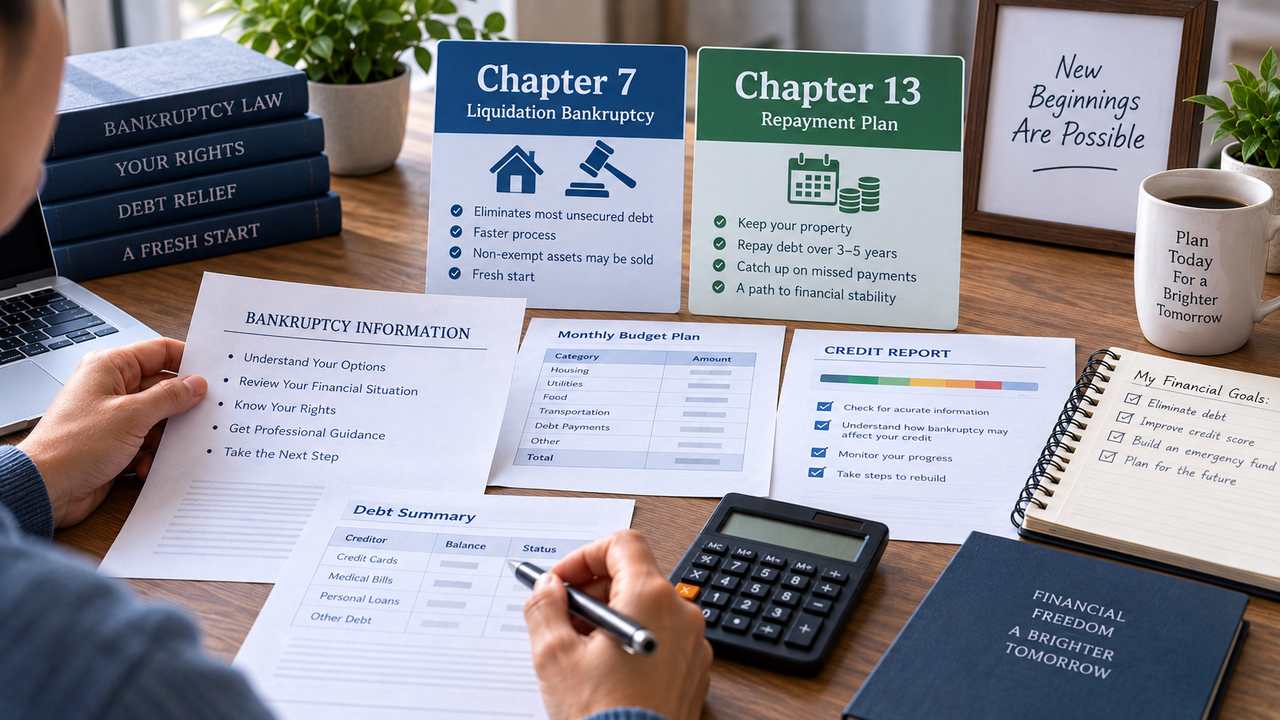
    Chapter 7, often called “liquidation bankruptcy,” involves selling (liquidating) your non-exempt assets to pay creditors, after which most remaining qualifying debt is discharged (legally eliminated). This process is relatively quick, typically completed within a few months.

    Chapter 13, often called “reorganization bankruptcy,” doesn’t involve liquidating assets in the same way. Instead, you propose a court-supervised repayment plan, typically lasting three to five years, paying back some or all of your debt according to that plan, after which any remaining qualifying debt is discharged.

    Do You Qualify for Chapter 7?

    Chapter 7 eligibility is determined through a means test, comparing your income against your state’s median income for a household of your size. If your income is below the median, you generally qualify for Chapter 7. If it’s above the median, a more detailed calculation (accounting for certain allowed expenses) determines whether you still qualify, or whether you’d instead need to pursue Chapter 13.

    What Happens to Your Assets in Chapter 7

    Not everything you own is automatically sold — federal and state law provide exemptions, protecting certain assets up to specific value limits (which vary by state) from liquidation. Common exemptions often include some equity in your primary home, a vehicle up to a certain value, essential household goods, retirement accounts, and tools of your trade. Assets exceeding these exemption limits, or that don’t qualify for an exemption at all, can be sold by the bankruptcy trustee to pay creditors, though in practice, many Chapter 7 filers have few or no assets exceeding their state’s exemptions, resulting in what’s sometimes called a “no-asset” case, where nothing is actually liquidated.

    If you are also dealing with credit-report problems related to debt, you may want to review our guide on how to read a credit report and learn more about credit report errors.

    What Debt Gets Discharged in Chapter 7

    Most unsecured debt — credit cards, medical bills, personal loans, and old utility bills — is generally dischargeable. Some debt types are generally not dischargeable, including most federal and many private student loans (absent a separate, harder-to-obtain “undue hardship” finding), most tax debt, child support and alimony obligations, and debts arising from fraud or certain willful misconduct.

    How Chapter 13 Works in Practice

    You propose a repayment plan, based on your income and expenses, which must be approved by the bankruptcy court. This plan typically requires paying certain “priority” debts (like recent tax debt) in full, while other unsecured debt might be paid back partially or, in some cases, very minimally, depending on your specific financial circumstances and what the plan calls for.

    You make plan payments for three to five years, generally through a court-appointed trustee who distributes the funds to your creditors according to the approved plan.

    Once the plan is successfully completed, any remaining qualifying unsecured debt covered by the plan is discharged, similar to Chapter 7, though the process to get there is considerably longer.

    Why Someone Might Choose Chapter 13 Over Chapter 7 (Even If They’d Qualify for Chapter 7)

    To catch up on and keep a house or car that’s in danger of foreclosure or repossession. Chapter 13 allows you to include past-due secured debt payments in your repayment plan, potentially letting you keep property that might otherwise be lost through a Chapter 7 liquidation process or continued default outside of bankruptcy.

    To protect non-exempt assets that would otherwise need to be liquidated under Chapter 7, since Chapter 13 doesn’t involve the same liquidation process.

    Because they don’t qualify for Chapter 7 based on the means test, making Chapter 13 the only available bankruptcy path for their situation.

    The Automatic Stay: An Immediate Benefit of Filing Either Type

    The moment you file for either Chapter 7 or Chapter 13, an automatic stay takes effect, immediately halting most collection activity — including lawsuits, wage garnishment, and collection calls — while your bankruptcy case proceeds. This immediate relief is often one of the most significant practical benefits of filing, providing breathing room from active or threatened collection actions right away, even before the ultimate discharge is determined.

    If collection activity is affecting your credit situation, you can also learn about collection agency harassment and FDCPA protections and the cease and desist process for debt collectors.

    The Impact on Your Credit

    Both types of bankruptcy appear on your credit report as a serious negative item — Chapter 7 for up to 10 years from the filing date, Chapter 13 for up to 7 years, reflecting the different processes involved. This is a significant, long-lasting credit impact, though many people who file bankruptcy were already experiencing serious credit damage from the underlying debt situation that led them to consider bankruptcy in the first place, meaning the actual marginal impact is sometimes less dramatic than the “10 years” figure might suggest in isolation.

    Rebuilding Credit After Bankruptcy

    Contrary to some assumptions, credit rebuilding after bankruptcy can begin relatively quickly, sometimes even during a Chapter 13 repayment period. Secured credit cards, credit-builder loans, and consistent on-time payment on any remaining or new obligations can meaningfully rebuild your score over time, and many people see a genuinely good credit score within two to four years post-discharge, particularly since bankruptcy itself, once filed, removes the ongoing negative reporting from all the individual accounts that led to it, replacing many separate negative marks with one (admittedly serious) bankruptcy notation.

    For additional guidance, see our guide on how to improve your credit score and our practical credit repair tips.

    The Process of Actually Filing

    Credit Counseling Requirement

    Before filing, you’re generally required to complete credit counseling from an approved agency, which reviews your financial situation and alternatives to bankruptcy.

    Filing the Petition and Required Documentation

    Filing the petition and required documentation, including detailed financial disclosures, generally with an attorney’s assistance, though self-representation (“pro se”) is technically possible, if not commonly advisable given the complexity involved.

    The Meeting of Creditors

    The meeting of creditors (“341 meeting”), a relatively brief, generally straightforward hearing where the trustee (and potentially creditors, though they rarely attend in practice) can ask questions about your financial situation.

    Completion of the Second Required Course

    Completion of a second required course, a debtor education course, before your discharge is finalized.

    Discharge

    Discharge, the formal legal order eliminating your qualifying debt, typically issued within a few months for Chapter 7, or at the successful completion of your repayment plan for Chapter 13.

    Common Misconceptions About Bankruptcy

    “Bankruptcy erases all debt.”

    As covered above, several categories of debt generally aren’t dischargeable, including most student loans, recent taxes, and child support.

    “You lose everything you own.”

    Exemptions protect meaningful assets in most cases, and many Chapter 7 filers retain everything they own, particularly if their assets are modest relative to their state’s exemption limits.

    “Bankruptcy means you’ll never get credit again.”

    As covered above, credit rebuilding, while requiring deliberate effort, is genuinely achievable within a few years for most people who file.

    “Filing is simple enough to always do without an attorney.”

    While technically possible, the complexity of exemptions, means testing, and procedural requirements makes attorney guidance genuinely valuable for most people, and many bankruptcy attorneys offer free initial consultations specifically to help you understand whether bankruptcy makes sense for your situation before committing to the cost of filing.

    Frequently Asked Questions

    How much does it cost to file for bankruptcy?

    Court filing fees are a few hundred dollars (varying slightly by district), and attorney fees vary considerably by location and case complexity, though many bankruptcy attorneys offer payment plans, and fee waivers for the court filing fee itself are sometimes available for very low-income filers.

    Can I file for bankruptcy more than once in my lifetime?

    Yes, though there are specific waiting periods between filings and between different chapter types (for example, a waiting period before you can receive another Chapter 7 discharge after a previous one), which an attorney can clarify based on your specific prior filing history if relevant.

    Will everyone find out I filed for bankruptcy?

    Bankruptcy filings are part of the public record, technically searchable, though in practice, most people don’t actively search public bankruptcy records, and your employer generally wouldn’t be notified directly unless a specific circumstance (like wage garnishment being addressed through the case) required their involvement.

    Does bankruptcy affect a spouse who didn’t file, if we have joint debts?

    If you file individually while married, your spouse’s own credit and individual liability aren’t directly affected by your filing, except for any jointly held debts, where their liability for that specific joint debt generally remains intact even if your portion is discharged through your individual bankruptcy.

    Is there a difference in how bankruptcy affects a home you own versus rent?

    Homeownership introduces more complexity, particularly around whether you want to keep the home (relevant to the Chapter 7 vs. 13 decision and exemption planning) — renters generally have simpler considerations, primarily around whether any past-due rent or a related judgment is part of the dischargeable debt being addressed.

    A Side-by-Side Comparison

    Category Chapter 7 Chapter 13
    Basic structure Liquidation of non-exempt assets 3-5 year repayment plan
    Typical duration A few months 3-5 years
    Eligibility Means test based on income Available to those with regular income, including those who don’t qualify for Chapter 7
    Best for Limited non-exempt assets, no property to save from foreclosure Behind on mortgage/car payments you want to keep, or don’t qualify for Chapter 7
    Credit report duration Up to 10 years Up to 7 years
    Discharge timing Relatively soon after filing Only after completing the full repayment plan

    This comparison highlights why the “right” choice depends heavily on your specific circumstances rather than one option being universally better — someone with few assets and no property at risk of foreclosure often finds Chapter 7 the more efficient path, while someone specifically trying to catch up on a mortgage or car loan to avoid losing that property often needs Chapter 13’s structure to accomplish that goal.

    bankruptcy-explained-chapter-7-vs-13-under-100kb

    What “Non-Exempt Assets” Actually Looks Like in Practice

    Since the concept of exemptions can feel abstract, a concrete example helps. Imagine you own a car worth $8,000, and your state’s motor vehicle exemption protects up to $5,000 in vehicle equity. If you own the car outright (no loan), you’d have $3,000 in non-exempt equity — the trustee could potentially require you to either pay the trustee $3,000 (sometimes called “buying back” the non-exempt equity) or, in some cases, the car could be sold with you receiving your exempt portion back. In practice, many filers work with their attorney specifically to plan around these thresholds, sometimes timing a filing or making certain decisions in advance to minimize non-exempt exposure, which is exactly the kind of strategic planning a bankruptcy attorney’s specific knowledge of your state’s exemptions genuinely adds value to.

    How the Means Test Actually Works

    The means test isn’t simply “is your income below the median” — for filers above the median, a more detailed calculation follows, subtracting IRS-standardized allowed expenses (and some actual expenses) from your income to determine your “disposable income.” If this calculation shows insufficient disposable income to meaningfully repay creditors, you may still qualify for Chapter 7 despite an above-median income; if it shows you do have meaningful repayment capacity, you’d generally need to pursue Chapter 13 instead. This calculation involves enough nuance and specific IRS-standardized figures that working through it with an attorney, rather than attempting it entirely independently, is generally advisable for anyone whose income is close to or above their state’s median.

    Frequently Asked Questions, Continued

    Can I choose Chapter 13 even if I’d qualify for the faster Chapter 7 process?

    Yes — the means test determines Chapter 7 eligibility, but choosing Chapter 13 instead, even when you qualify for Chapter 7, remains an available choice, commonly made specifically to protect property from foreclosure or repossession, as discussed above.

    What happens if I can’t keep up with my Chapter 13 payment plan partway through?

    Depending on the specific circumstances, options can include modifying the plan (if your income has genuinely changed), converting to Chapter 7 if you now qualify, or in some cases, the case being dismissed if payments aren’t maintained and no alternative arrangement is reached — this is exactly the kind of situation where staying in close communication with your bankruptcy attorney throughout the plan’s multi-year duration matters considerably.

    Does bankruptcy discharge debt owed to family members or friends the same as debt owed to a bank?

    Generally, yes, informal personal loans from family or friends can be discharged the same as other unsecured debt, assuming they don’t fall into a specific non-dischargeable category, though the personal and relational dimension of this kind of debt is obviously a separate, non-legal consideration worth thinking through as well.

    The Role of the Bankruptcy Trustee

    In both chapters, a trustee is appointed to oversee your case, though their role differs between the two. In Chapter 7, the trustee’s primary job is reviewing your assets for anything non-exempt that could be liquidated to pay creditors, and reviewing your filing for accuracy and completeness. In Chapter 13, the trustee’s role is more ongoing — collecting your monthly plan payments and distributing them to creditors according to your approved plan throughout the multi-year repayment period, essentially administering the plan from start to finish.

    Frequently Asked Questions, Continued One More Time

    Can creditors object to my bankruptcy filing or proposed Chapter 13 plan?

    Yes — creditors have the right to object to certain aspects of a case, such as disputing whether a specific debt should be discharged (particularly for debts alleged to involve fraud), or objecting to a Chapter 13 plan’s terms if they believe it doesn’t adequately account for your actual income and ability to pay; these objections are resolved through the bankruptcy court process, often with your attorney representing your position.

    Does filing bankruptcy affect a professional license or security clearance?

    This varies by profession and the specific licensing or clearance body’s own rules — some professions have reporting requirements or review processes triggered by a bankruptcy filing, making this worth researching specifically for your field or discussing with your bankruptcy attorney if you hold a professional license or security clearance that might be affected.

    The Bottom Line

    Chapter 7 and Chapter 13 bankruptcy serve different purposes: Chapter 7 offers a faster process built around liquidating non-exempt assets (often minimal or none in practice) to discharge qualifying debt, while Chapter 13 offers a structured, multi-year repayment plan, often chosen specifically to protect property like a home or car from foreclosure or repossession. Both provide immediate relief from collection activity through the automatic stay upon filing, and both carry significant but not permanent credit consequences, with genuine rebuilding achievable within a few years for most filers. Given the complexity involved — means testing, exemptions, and which specific debts qualify for discharge — consulting a bankruptcy attorney, often through a free initial consultation, is a valuable step in understanding whether either path makes sense for your specific financial situation.

    Need Help Understanding Your Credit Situation?

    Bankruptcy can address qualifying debt, but understanding what remains on your credit reports and identifying inaccurate information can still be an important part of your financial recovery. If you’re dealing with credit-report issues, consider getting a professional review of your situation.

    Request a Credit Audit

  • How to Rebuild Your Finances After a Job Loss

    How to Rebuild Your Finances After a Job Loss

    Losing a job disrupts more than just your income — it can shake your entire sense of financial stability, sometimes for months after you’ve actually found new work. Rebuilding after this kind of disruption follows a fairly predictable sequence, even though everyone’s specific circumstances differ. This guide walks through that sequence, from the immediate aftermath through longer-term recovery.

    Immediate Steps in the First Few Weeks

    File for unemployment benefits right away. There’s often a processing delay before benefits begin, so filing promptly, even before you’ve fully processed the job loss emotionally, protects your access to this income bridge as early as possible.

    Understand your health insurance situation. If you had employer-sponsored health insurance, you’ll need to decide between COBRA continuation coverage (which maintains your existing plan but is often expensive since you now pay the full premium), a marketplace plan (which may qualify for subsidies given your reduced income), or, if eligible, a spouse’s plan.

    Review your severance package carefully, if you received one, including understanding the payment timeline, whether it affects your unemployment eligibility timing (severance can sometimes delay when unemployment benefits begin, depending on your state), and any terms you’re being asked to sign, such as a release of legal claims.

    Pause non-essential spending immediately, even before you’ve done a full budget review, simply to slow the rate at which savings are being depleted while you assess your full situation.

    Building an Immediate Crisis Budget

    List your absolutely essential expenses — housing, utilities, minimum food costs, essential transportation, health insurance, and any minimum debt payments — separate from anything discretionary.

    Calculate your available resources — unemployment benefits, severance, emergency savings, and any other income sources — against this essential expense list to understand your actual runway before more difficult decisions become necessary.

    Identify which expenses can be temporarily reduced or paused entirely — subscriptions, discretionary spending, and, if genuinely necessary, even some debt payments (prioritized as covered in related guides on handling unaffordable minimum payments).

    Communicating Proactively With Creditors

    Don’t wait until you’ve missed a payment to reach out. Contacting your mortgage servicer, credit card issuers, auto lender, and other creditors proactively to explain your job loss and ask about hardship programs is one of the most effective steps you can take — many creditors have specific accommodations for exactly this situation (temporary payment reduction, deferment, interest rate reduction) that are more readily available when requested before a payment is actually missed.

    If missed payments or other negative information have already appeared on your credit reports, you can learn more about how to dispute credit report errors when the information being reported is inaccurate.

    Deciding How to Use Emergency Savings

    If you have an emergency fund, this is precisely the situation it exists for — using it during a job loss isn’t a failure of financial planning, it’s the fund doing its job. That said, it’s worth being deliberate about the pace of drawdown, since you don’t know with certainty how long your job search will take. A reasonable approach: calculate your essential monthly burn rate, compare it against your available emergency funds and any unemployment benefits, and get a realistic sense of your runway, adjusting your spending further if that runway looks shorter than you’re comfortable with.

    Considering Additional Income Sources While Job Searching

    Freelance or gig work in your existing skill area can sometimes provide bridge income without requiring a full new job search process, and can occasionally lead to a full-time opportunity or ongoing client relationship.

    Temporary or contract work, even outside your primary field, can help bridge the income gap while your search for a more permanent, well-matched role continues.

    Selling unused assets — items you no longer need — can provide some additional short-term cushion, though this is generally a smaller, one-time source rather than an ongoing solution.

    Navigating the Job Search Itself With Financial Pressure in Mind

    Be realistic about your timeline expectations. Job searches, particularly for more senior or specialized roles, often take longer than people initially expect, and building this reality into your financial planning (rather than assuming a quick resolution) helps you make more sustainable decisions throughout the process.

    Consider whether a “bridge job” — something not your ideal long-term role, but sufficient to stabilize your finances — makes sense while continuing to search for a better-matched position, rather than holding out exclusively for the ideal opportunity if your financial runway is genuinely limited.

    Don’t neglect your professional network and industry connections during this period, since these often prove more valuable for finding new opportunities than applying broadly to postings alone.

    What to Do If Your Runway Runs Out Before You Find New Work

    Revisit debt hardship options more aggressively, including formal hardship programs, and if necessary, consider whether nonprofit credit counseling or, for a more severe situation, bankruptcy consultation makes sense given your specific circumstances.

    Consider whether housing costs need to change, which is often the largest expense category and sometimes the area with the most room for significant reduction if the job search extends longer than initially planned (moving to a lower-cost living situation, taking on a roommate, or similar adjustments).

    Explore local assistance programs, including utility assistance, food assistance, and other safety-net programs, which exist precisely for situations like this and shouldn’t be treated as a last resort to avoid out of pride — using available resources during a genuine hardship is exactly what they’re designed for.

    how-to-rebuild-finances-after-job-loss-under-100kb


    Rebuild Once You’ve Found New Work

    Resist the urge to immediately return to your pre-job-loss spending level. It’s tempting to relax once income resumes, but rebuild your emergency fund and any depleted savings first, before fully returning to previous spending habits, puts you in a stronger position if a similar disruption happens again in the future.

    Rebuild your emergency fund as a top priority, ideally aiming to restore it to at least a partial cushion quickly, then continuing to build back toward your full target (commonly three to six months of essential expenses, though this varies based on your personal risk tolerance and job stability).

    Address any debt or credit issues that emerged during the job loss period, whether that’s catching up on payments that fell behind, formally closing out any hardship program arrangement, or addressing any new negative items that appeared on your credit report during this period.

    Reassess your overall financial plan in light of what you learned. A job loss often reveals real vulnerabilities — insufficient emergency savings, an overly tight budget with no flexibility, excessive reliance on a single income source — worth deliberately addressing now that you’re rebuild, rather than simply returning to the exact same financial structure that existed before.

    The Emotional Dimension of Financial Recovery

    It’s worth acknowledging that financial recovery after a job loss often lags behind emotional recovery, or vice versa — you might feel professionally and emotionally settled in a new role while still carrying real financial anxiety from the disruption, or you might feel financially stabilized more quickly than you process the broader disruption to your sense of security. Both patterns are normal, and giving yourself permission to rebuild gradually, without expecting an immediate return to exactly where you were before, tends to lead to more sustainable, less stressful recovery than trying to force an artificially fast return to your prior financial position.

    Frequently Asked Questions

    How long does unemployment typically provide benefits, and does this vary by state?

    Standard unemployment benefit duration varies by state, commonly ranging from 12 to 26 weeks, though this can be extended during specific economic conditions through federal programs — checking your specific state’s current rules is important for accurately planning your financial runway.

    Should I withdraw from my 401(k) if I’m running low on other funds during a job search?

    This should generally be a later-resort option given the tax penalties for early withdrawal (unless you qualify for a specific hardship exception) and the long-term cost of lost retirement growth — exhausting other options first (unemployment benefits, emergency savings, hardship programs, additional income sources) is generally the more financially sound sequence.

    Does a job loss and any resulting missed payments stay on my credit report permanently?

    No — any resulting negative marks (late payments, for example) follow the standard credit reporting rules, generally remaining for up to seven years from the original delinquency, though their impact diminishes over time, particularly once outweighed by a resumed pattern of on-time payments once you’re back on stable footing.

    Is it worth telling potential employers about a financial hardship during salary negotiation for a new role?

    This is generally not advisable to disclose directly during negotiation, since it can undermine your negotiating position — focus negotiation discussions on your market value and the role’s requirements rather than your personal financial urgency, even if that urgency is genuinely part of your motivation to accept an offer relatively quickly.

    How quickly should I expect to feel fully financially recovered after a significant job loss?

    This varies enormously based on how long the job search took, how much emergency savings you had going in, and your new role’s compensation relative to your previous one — a reasonable general expectation for many people is six months to two years for a fuller financial recovery, though this is highly individual and shouldn’t be treated as a rigid benchmark to measure yourself against.

    A Sample Crisis Budget Worksheet Structure

    Having a concrete structure to work through can make the immediate post-job-loss period feel more manageable. Consider organizing your assessment into three columns: essential expenses (housing, utilities, minimum food, essential transportation, health insurance, minimum debt payments), available resources (unemployment benefits, severance, emergency savings, any other income), and runway calculation (available resources divided by monthly essential expenses, giving you a rough number of months you can sustain your current situation without additional income). Recalculating this runway figure periodically — weekly or biweekly during an active job search — helps you make timely adjustments rather than discovering a shortfall only once it’s already become urgent.

    Understanding COBRA vs. Marketplace Insurance More Specifically

    Since health insurance decisions are often one of the more consequential and confusing choices in the immediate aftermath of a job loss, it’s worth a bit more detail. COBRA allows you to continue your exact existing employer plan, which can be valuable if you’re in the middle of ongoing treatment or have specific providers you don’t want to disrupt, but you’re now responsible for the full premium (including the portion your employer previously covered), which is often substantially more expensive than what you were paying as an employee. Marketplace plans, by contrast, may qualify for income-based subsidies given your now-reduced income, potentially making them considerably more affordable than COBRA, though they may involve different provider networks or coverage details than your previous employer plan. Comparing both options specifically against your current health needs and financial situation, rather than defaulting to either option automatically, is worth the relatively small time investment given how significant this cost category can be.

    How to Talk to Family Members About a Job Loss and Financial Adjustment

    If you have a partner or family members who’ll be affected by spending adjustments during this period, having a direct, honest conversation early — rather than making unilateral cuts without explanation — tends to produce better cooperation and less friction. This might include explaining the general financial picture (without necessarily needing to share every specific number), discussing which spending categories will be adjusted and why, and setting some shared expectations about the timeline and what might need to change if the situation extends longer than initially hoped. Children, depending on age, can also benefit from some age-appropriate honesty about a temporary change in family spending, without needing to carry the full weight of adult financial anxiety.

    Frequently Asked Questions, Continued

    Does receiving unemployment benefits affect my ability to negotiate salary for a new position?

    No — unemployment benefits and salary negotiation for a new role are entirely separate matters; receiving benefits doesn’t need to be disclosed to a prospective employer and has no bearing on your negotiating position for a new job offer.

    Should I take the first job offer I receive, even if it’s not ideal, given financial pressure?

    This depends heavily on your specific runway and how significantly the offer falls short of your goals — for some people, taking a reasonable “bridge” position while continuing a lower-intensity search for something better-matched is a sound strategy; for others with more runway, holding out longer for a better fit is more sustainable. There’s no universally correct answer, and it’s worth weighing your specific financial cushion honestly against the offer’s actual terms.

    Is there a specific order in which I should draw down different savings accounts during a job search?

    Generally, drawing from a traditional emergency fund or general savings account first, before touching retirement accounts, is the more financially sound sequence, given the tax penalties and long-term growth loss associated with early retirement account withdrawals — retirement funds are generally a later-stage resort once other, less costly sources have been exhausted.

    How Severance and Final Paycheck Timing Affects Your Immediate Planning

    Understanding exactly when and how you’ll receive your final compensation matters for accurate short-term planning. Many states have specific legal requirements about how quickly a final paycheck must be issued after termination, and severance, if offered, may be paid as a lump sum or spread over time depending on your employer’s specific policy — this timing directly affects your immediate runway calculation, so clarifying it precisely with HR, rather than assuming a specific timeline, helps you plan your first few weeks more accurately.

    Frequently Asked Questions, Continued One More Time

    Does applying for unemployment benefits affect any severance I’m receiving?

    In many states, receiving severance can delay when unemployment benefits begin, or in some cases affect the total amount, depending on how your specific state treats severance relative to unemployment eligibility — checking your state’s specific rule when you file is worth doing to accurately plan your income timeline through this transition.

    Is it worth negotiating my severance package before signing, rather than accepting the initial offer?

    Yes, this is often possible, particularly for a layoff versus a for-cause termination — asking for additional severance, extended benefits continuation, or other terms is a reasonable request, and many employers have at least some flexibility, especially if you’re not in a rush to sign immediately and can take time to consider the offer or consult an employment attorney for a significant package.

    The Bottom Line

    Rebuild your finances after a job loss follows a fairly predictable arc: immediate stabilization (unemployment benefits, health insurance decisions, a crisis budget), proactive communication with creditors, careful management of emergency savings and any additional income sources during the search itself, and then a deliberate rebuild phase once new income resumes — prioritizing your emergency fund and addressing any issues that emerged during the disruption before simply returning to prior spending habits. Job loss is one of the most common and disruptive financial events people face, and having a structured approach to navigating it, rather than reacting purely in the moment, makes the eventual recovery considerably more manageable.

    Need Help Reviewing Your Credit Report?

    Job loss can sometimes lead to missed payments, accounts entering hardship programs, or other changes that affect your credit profile. Once your finances begin to stabilize, reviewing your credit reports can help you understand what has been reported and identify potentially inaccurate information.

    If you’re dealing with inaccurate or questionable information on your credit reports, learn more about how to dispute credit report errors or explore professional credit-repair assistance.

    Request a Credit Audit or Quote Today

  • Student Loan Rehabilitation After Default

    Student Loan Rehabilitation After Default

    Defaulting on a federal student loan feels like hitting a wall — but unlike most other types of defaulted debt, federal student loans come with a specific, structured path back to good standing called loan rehabilitation. Understanding exactly how this process works, what it actually accomplishes, and how it compares to your other options helps you make an informed decision about whether it’s the right path for your situation.

    What Loan Rehabilitation Actually Is

    Loan rehabilitation is a formal program, available specifically for defaulted federal student loans (this doesn’t apply to private student loans, which don’t have an equivalent standardized program), that allows you to bring your loan out of default status by making a series of agreed-upon, reduced monthly payments, after which the loan is returned to good standing.

    For borrowers dealing with private student loan default instead, our guide to private student loan collections explains how that process differs from federal student loan collection.

    The Basic Process

    You agree to a reasonable and affordable monthly payment, calculated based on your income and expenses, with your loan servicer (typically much lower than your original required payment).

    You make nine payments within ten consecutive months. These payments need to be voluntary, reasonable, and made on time, though they don’t need to be consecutive without any gap — you have a ten-month window to complete nine qualifying payments.

    Once complete, your loan is removed from default status and returned to a current, in-repayment status, at which point you select a standard repayment plan going forward.

    What Rehabilitation Actually Fixes

    Removes the default status from your credit report, which is significant since default is one of the more serious negative marks a federal loan can carry, more severe in scoring impact than standard delinquency alone.

    Restores your eligibility for federal financial aid, if you want to return to school in the future, since being in default on federal loans generally disqualifies you from receiving additional federal aid until resolved.

    Stops wage garnishment and tax refund offset, which are administrative collection tools the federal government can use for defaulted federal loans without needing a separate court judgment — rehabilitation halts these once you’re back in good standing.

    Removes collection fees in many cases, or at least prevents them from continuing to accumulate, depending on the specific circumstances of your default.

    If you are rebuilding your credit after a student loan default, you may also benefit from understanding how to improve your credit score after resolving negative accounts.

    What Rehabilitation Does NOT Do

    It doesn’t erase your payment history entirely. While the default status itself is removed once rehabilitation is complete, the late payments that led up to default generally remain on your credit report for the standard reporting period, though the specific default notation itself is what gets updated.

    It doesn’t reduce your overall loan balance. Rehabilitation restores good standing; it doesn’t forgive any portion of what you owe (unlike a settlement, which is generally not typically how federal student loans work in the first place, as they’re not usually settled for less than the full amount the way private debt sometimes is).

    It’s a one-time opportunity per loan, in most cases. Federal regulations generally limit you to rehabilitating a given loan only once, meaning if you default again after rehabilitation, this specific path typically isn’t available a second time for that same loan, making it worth approaching seriously and sustainably rather than as a routine safety net.

    How Rehabilitation Compares to Loan Consolidation

    Consolidation is a different path also available for defaulted federal loans — combining your loans into a new Direct Consolidation Loan, which also gets you out of default status, but works differently than rehabilitation. Consolidation can typically be completed faster than the nine-month rehabilitation process, but it doesn’t remove the default notation from your credit history the way rehabilitation does — the original default remains reported, while a new consolidated loan begins fresh. Additionally, consolidation generally requires you to either enroll in an income-driven repayment plan or make three consecutive, voluntary, on-time payments before consolidating, if you’re consolidating specifically to get out of default.

    Choosing between them often comes down to your priority: if getting your credit report cleared of the default notation specifically matters most to you, and you can manage the nine-month process, rehabilitation is generally the better choice. If speed matters more, or you’ve already used your one-time rehabilitation opportunity on this specific loan, consolidation may be the more practical path.

    How to Determine Your Rehabilitation Payment Amount

    Your loan servicer calculates a “reasonable and affordable” payment based on your income and expenses — this is often calculated using a formula similar to income-driven repayment calculations, and can sometimes be as low as $5 per month for borrowers with very limited income, though this varies based on your specific financial documentation. If you believe the initially calculated amount is genuinely unaffordable, you can typically request a recalculation by providing more complete documentation of your income and essential expenses.

    What Happens During the Nine-Month Process

    Collection activity generally continues during rehabilitation, including the possibility of continued wage garnishment or tax refund offset, until the rehabilitation is actually completed — this is an important detail many borrowers don’t expect, since starting the process doesn’t immediately halt these collection tools; only completing it does.

    Missing a payment can restart or jeopardize your progress. Since the program requires payments within a specific ten-month window, a significant gap or missed payment can mean needing to restart the count, making consistency important throughout the process.

    What Happens After Rehabilitation Is Complete

    Once you’ve successfully completed rehabilitation, your loan servicer will offer you a choice of standard repayment plans going forward, and you’ll transition from your artificially low rehabilitation payment amount to a more standard, sustainable repayment plan — including potentially an income-driven repayment plan if that fits your financial situation, which can help ensure the higher post-rehabilitation payment doesn’t itself become unaffordable and risk a second default.

    Is Rehabilitation Always the Right Choice?

    For most borrowers who’ve defaulted on federal loans and want a genuine fresh start with an improved credit report, rehabilitation is generally the recommended path, given its unique credit report benefit compared to consolidation. That said, if your broader financial situation is severe enough that even a low rehabilitation payment feels unsustainable, or if speed is more critical than the credit report benefit, consolidation or continuing to explore income-driven repayment options going forward (available once you’re out of default through either path) may be more practical.

    Frequently Asked Questions

    Can I rehabilitate a federal student loan more than once if I default a second time on the same loan?

    Generally, no — federal regulations typically limit rehabilitation to one opportunity per loan, meaning a second default on the same specific loan generally can’t be resolved through rehabilitation again, making consolidation or other options more relevant if this situation arises.

    Does rehabilitation affect my credit score immediately once I start the process, or only once completed?

    The default status itself generally remains reported until rehabilitation is fully completed (all nine qualifying payments made within the ten-month window); starting the process alone doesn’t immediately change your credit report, though it does demonstrate a positive trajectory that can be worth explaining to any lender reviewing your file during this period.

    Can I make extra or larger payments during rehabilitation to finish faster than nine months?

    The nine-payment, ten-month structure is generally fixed regardless of payment size — making extra or larger payments doesn’t accelerate completion below the nine-payment minimum, though it could reduce your overall balance somewhat, which isn’t the primary purpose of the program but isn’t prohibited either.

    What happens to wage garnishment specifically during the rehabilitation process?

    Garnishment can generally continue during the rehabilitation process itself, stopping once rehabilitation is successfully completed — this is worth understanding clearly, since some borrowers mistakenly believe simply enrolling in rehabilitation immediately halts garnishment, when it’s actually completion of the full nine-payment process that triggers this specific benefit.

    Is there a deadline for starting rehabilitation after defaulting, or can I do this anytime?

    There’s generally no strict deadline forcing you to start rehabilitation by a specific date after default, though the longer a loan remains in default, the longer collection activity (including garnishment and tax refund offset) can continue, making earlier action generally more beneficial than delaying.

    A Realistic Timeline Walkthrough

    To make the process more concrete, here’s how a typical rehabilitation journey might unfold. In month one, you contact your loan servicer (often the Default Resolution Group for federal loans, depending on your specific servicer) to begin the process, providing income documentation to calculate your reasonable and affordable payment amount. Payments begin, and you need to make nine of these within the following ten months — meaning you have a small buffer (one additional month beyond the nine required) to accommodate an occasional processing delay or minor scheduling hiccup, though this buffer isn’t generous and consistency remains important.

    Once your ninth qualifying payment is made and processed, your servicer formally completes the rehabilitation, which can take a few additional weeks of administrative processing before your credit report and account status fully reflect the change. At this point, you’ll select your ongoing repayment plan, ideally one genuinely sustainable given your actual financial situation, to avoid the risk of a second default down the line.

    Why Some Borrowers Default Again After Rehabilitation, and How to Avoid It

    A meaningful number of borrowers who successfully complete rehabilitation end up defaulting again within a few years, often because they select a standard repayment plan with a monthly payment that isn’t actually sustainable, having grown accustomed to the artificially low rehabilitation payment during the nine-month process. This is exactly why exploring income-driven repayment plans as your post-rehabilitation option — rather than defaulting to the standard 10-year repayment plan, which may have a considerably higher required payment — is worth serious consideration, since these plans calculate your payment based on your actual income, providing a more realistic, sustainable path forward that reduces the risk of falling back into default.

    Frequently Asked Questions, Continued

    Does rehabilitation remove collection fees that were added to my loan balance during default?

    Depending on your specific loan type and circumstances, some collection costs may be reduced or waived upon successful rehabilitation completion, though this isn’t universal across every situation — it’s worth asking your servicer directly what happens to any accumulated collection costs specifically as part of your rehabilitation agreement.

    Can I switch from rehabilitation to consolidation partway through the nine-month process if I change my mind?

    Yes, generally you can choose to consolidate instead, even after starting rehabilitation, if you decide that path better fits your circumstances — though you’d lose the credit-report-clearing benefit of completing rehabilitation for that specific loan and would instead have a new consolidated loan with the original default remaining on your credit history rather than being formally rehabilitated.

    Does defaulting on a federal loan affect my eligibility for future income-driven repayment plans once I’m out of default?

    No — once you’re out of default (through either rehabilitation or consolidation), you become eligible for the standard range of federal repayment plans, including income-driven options, the same as any other borrower in good standing, regardless of your prior default history.

    Is there a fee to enroll in loan rehabilitation?

    No — enrolling in and completing loan rehabilitation itself doesn’t carry a separate fee beyond your actual required payments; this is a program administered by your loan servicer as part of the federal loan system, not a paid service.

    private-student-loan-collections-under-100kb

    What Happens If You Default a Second Time After Consolidating (Rather Than Rehabilitating)

    Since consolidation is available more than once in some circumstances (unlike rehabilitation’s one-time-per-loan limitation), it’s worth understanding what happens if a consolidated loan itself later defaults. At that point, you’d generally need to consider your remaining options carefully — you cannot rehabilitate the original underlying loans again if they were already rehabilitated once, but the new consolidated loan itself may have its own separate rehabilitation eligibility, depending on the specific circumstances and current federal loan program rules at the time, which is exactly the kind of nuanced, situation-specific question worth directing to your loan servicer or a student loan counselor directly rather than assuming a blanket answer applies.

    Frequently Asked Questions, Continued One More Time

    Does loan rehabilitation affect eligibility for Public Service Loan Forgiveness (PSLF) going forward?

    Successfully completing rehabilitation returns your loan to good standing, which is a prerequisite for PSLF eligibility (since PSLF requires qualifying payments made while not in default), so rehabilitation can actually be a necessary step toward eventually pursuing PSLF if you’d previously defaulted, rather than a barrier to it.

    Is there help available for actually completing the rehabilitation paperwork and process?

    Yes — your loan servicer’s default resolution team is specifically there to help walk you through this process, and additionally, the Department of Education’s website and various nonprofit student loan counseling organizations offer free guidance if you want additional support beyond what your servicer provides directly.

    The Bottom Line

    Loan rehabilitation is a federal student loan-specific program (not available for private loans) that allows you to exit default status through nine qualifying payments within a ten-month window, ultimately removing the default notation from your credit report and restoring your federal aid eligibility — benefits that consolidation, the main alternative path, doesn’t fully replicate. While collection activity can continue during the process itself, completing rehabilitation provides a genuine fresh start, making it generally the preferred path for federal loan borrowers able to sustain the required nine payments, particularly given that this specific opportunity is typically available only once per loan.

    Need Help Reviewing Your Credit Report?

    Federal student loan rehabilitation can help address the default status of a loan, but it’s still important to understand what remains on your credit reports after the process. Reviewing your credit profile can help you identify how student loan accounts and other negative information are being reported.

    If you’re dealing with inaccurate or questionable information on your credit reports, learn more about how to dispute credit report errors or explore professional credit-repair assistance.

    Request a Credit Audit or Quote Today

  • Private Student Loan Collections: What to Expect

    Private Student Loan Collections: What to Expect

    Private student loans operate under meaningfully different rules than federal student loans, and this difference becomes especially significant once a loan goes into default and collection begins. Understanding exactly how private student loan collection works — and how it differs from what you might have heard about federal loan collection — helps you navigate the process with realistic expectations and know which specific protections and options actually apply to you.

    Private vs. Federal Student Loans: Why the Distinction Matters So Much Here

    Federal student loans come with a standardized set of borrower protections, hardship programs, and specific collection rules established by the Department of Education. Private student loans, issued by banks, credit unions, or specialized private lenders, are governed instead by the individual loan agreement’s terms and general consumer lending law — meaning the protections and options available depend heavily on your specific lender and the specific terms you originally agreed to, rather than a uniform federal framework.

    This means advice you might have heard about federal student loan forgiveness programs, income-driven repayment plans, or federal loan rehabilitation generally does not apply to private student loans, which is one of the most common and consequential points of confusion for borrowers trying to navigate default and collection.

    What Typically Happens When a Private Student Loan Goes Into Default

    Delinquency begins with a missed payment, and continues through a series of increasingly serious notices from your loan servicer.

    Default is typically declared after a specific period of continued nonpayment, commonly around 90-120 days, though the exact timeline is governed by your specific loan agreement and can vary between lenders.

    The loan is often accelerated, meaning the full remaining balance (not just the missed payments) becomes immediately due, a common provision in private loan agreements once default is declared.

    Collection efforts begin, either through the original lender’s internal collections department, a third-party collection agency working on the lender’s behalf, or, after a sale, a debt buyer who now owns the loan outright.

    Credit reporting reflects the default, appearing as a serious negative item on your credit report, following the standard rules for negative credit information (generally the seven-year reporting window from the original delinquency date).

    If you need help understanding what is currently appearing on your credit reports, you can also review our guide on how to read a credit report.

    Who Actually Collects Private Student Loan Debt

    The original lender’s internal collections team, in the earlier stages of delinquency and default.

    Third-party collection agencies, hired by the lender to pursue collection for a commission, common once internal efforts haven’t succeeded.

    Debt buyers, who purchase defaulted private student loan portfolios outright, similar to how other unsecured consumer debt gets bought and sold — this is a well-established part of the private student loan collection landscape, and it’s worth knowing that companies specializing in this specific category (some tied to entities like National Collegiate Student Loan Trusts, which purchased and pooled large numbers of private student loans as investment assets) have faced regulatory scrutiny in the past for collection practices, including documentation gaps in proving they actually own specific loans they’re pursuing.

    Your Rights During Private Student Loan Collection

    Since private student loans are collected by third parties (agencies or debt buyers) in many cases, the Fair Debt Collection Practices Act generally applies, providing the same core protections as with any other debt collector: restricted calling hours, no harassment or false threats, and your right to request formal debt validation.

    Debt validation is particularly important for private student loans specifically, given the documented history of some loan trusts and their collectors struggling to produce complete documentation proving ownership and accurate loan details, particularly for loans that have been bundled, securitized, and resold multiple times since origination.

    If you are dealing with a collector and want to understand the validation process, our guide to debt validation letters provides additional information.

    Can You Be Sued Over a Defaulted Private Student Loan?

    Yes — private lenders and debt buyers retain the same legal right to sue over unpaid debt as with other consumer debt, subject to your state’s statute of limitations. Given that private student loans are often larger balances than typical consumer debt, and given the accelerated full-balance-due provision common in these loan agreements, litigation is a real possibility for defaulted private student loans, making it especially important to respond promptly and appropriately if you’re ever served with a lawsuit related to one.

    You can also learn more about the statute of limitations on debt and why the applicable state law matters.

    Are There Any Hardship Options for Private Student Loans?

    Unlike federal loans, which have standardized deferment and forbearance programs, private lenders’ hardship options vary considerably and aren’t guaranteed by law — some private lenders do offer temporary payment reduction, deferment, or forbearance programs, particularly proactively, before default occurs, but this is entirely dependent on your specific lender’s policies rather than a uniform right. It’s worth contacting your loan servicer directly, as early as possible if you’re struggling, to ask specifically what hardship options they offer, since this varies enough that you shouldn’t assume either that options exist or that they don’t without checking directly.

    What About Co-Signers?

    Many private student loans require a co-signer, particularly for borrowers with limited credit history at the time of origination — often a parent or other family member. If the loan defaults, the co-signer is generally just as legally responsible for the debt as the primary borrower, and collection efforts (including potential litigation) can target either or both parties. Some private lenders offer a “co-signer release” option after a period of consistent, on-time payments, which removes the co-signer’s obligation going forward — but this needs to be specifically requested and approved before default occurs; once a loan is in default, co-signer release is generally no longer an available option, and the co-signer’s liability remains fully intact alongside the primary borrower’s.

    Refinancing or Consolidating a Defaulted Private Student Loan

    Unlike federal loans, which have a specific “loan rehabilitation” process (covered in more detail in a related guide), private student loans don’t have an equivalent standardized rehabilitation program. Some borrowers explore refinancing a defaulted private loan through a different lender, though qualifying for refinancing typically requires demonstrating improved creditworthiness, which can be genuinely difficult immediately following a default — this option becomes more realistic once you’ve rebuilt your credit somewhat, potentially after resolving the defaulted loan through settlement or payment first.

    Settlement as an Option for Defaulted Private Student Loans

    If your loan has been sold to a debt buyer, similar settlement negotiation principles apply as with other debt buyer-owned consumer debt — since these companies typically purchase defaulted loan portfolios at a discount, there’s often genuine room to negotiate a reduced lump-sum settlement. If the loan is still with the original lender or their agency, flexibility may be more limited but is still worth exploring directly.

    If you’re considering settlement, our guide to pay-for-delete explains an important but separate credit-reporting concept that can arise during negotiations with collectors.

    What Happens to Private Student Loans If the Borrower Dies or Becomes Disabled?

    This varies significantly by lender — some private lenders do offer death or disability discharge provisions similar to federal loans, while others do not, meaning the loan (and any co-signer’s liability) could persist even in these circumstances. This is exactly the kind of detail worth checking in your specific loan’s terms, or asking your servicer directly about, since it’s not a universal protection the way it is for federal loans.

    Frequently Asked Questions

    Does defaulting on a private student loan affect my ability to get federal financial aid for future education?

    Generally, defaulting on a private loan specifically doesn’t directly affect federal aid eligibility the way defaulting on a federal loan would, since these are separate systems, though your overall credit situation and financial circumstances could indirectly complicate other aspects of financing further education.

    Can a private student loan collector garnish my wages without a court judgment, similar to federal loans?

    No — unlike federal student loans, which have specific administrative wage garnishment authority without requiring a separate lawsuit, private student loan lenders generally must obtain a court judgment first before pursuing wage garnishment, following the same process as other private consumer debt.

    Is Private Student Loan Debt Dischargeable in Bankruptcy?

    This has historically been treated as difficult to discharge (similar to federal student loans, requiring a showing of “undue hardship” through a separate legal proceeding within the bankruptcy case), though this area of law has seen some evolution and increased successful discharges in recent years — consulting a bankruptcy attorney specifically experienced with student loan discharge is worthwhile if you’re considering this path.

    How Do I Find Out If My Private Student Loan Has Been Sold to a Debt Buyer?

    Checking your credit report for the name of whichever company is currently reporting the account is one way to identify a potential change in ownership, and formally requesting debt validation from whoever is currently contacting you should clarify their specific relationship to and ownership of the loan.

    Should I Be More Cautious With a Private Student Loan Collector Than Other Types of Debt Collectors?

    Given the well-documented pattern of some private student loan trusts and their collectors struggling to prove clear ownership and accurate loan details, particularly for older, resold loans, it’s reasonable to be especially diligent about requesting and carefully reviewing full validation documentation before agreeing to any payment or settlement for this specific category of debt.

    A Closer Look at the National Collegiate Student Loan Trusts Situation

    Because this specific category of private student loan debt has been the subject of notable regulatory action, it’s worth understanding a bit more detail if your loan traces back to one of these trusts. National Collegiate Student Loan Trusts (NCSLT) is actually a collection of numerous individual trusts that purchased private student loans originally issued by various banks, bundled them together as investment assets, and hired collection companies (including, historically, Transworld Systems Inc.) to pursue collection, sometimes including litigation, on defaulted accounts.

    A well-documented complication in this specific corner of the debt collection industry has been proving the actual chain of ownership: because these loans were often bundled, securitized, and transferred multiple times between the original lender and the specific trust now claiming ownership, courts around the country have, in numerous cases, found that the trusts and their collectors couldn’t produce adequate documentation proving they actually owned the specific loan in question, or that the claimed amount was accurate. If you have a defaulted private student loan connected to one of these trusts, requesting complete documentation of the chain of ownership — not just a claim that you owe money, but actual proof connecting the original loan through whatever transfers occurred to the specific trust and current collector’s authority — is a particularly well-founded strategy given this documented history.

    How Loan Servicers Differ From Loan Owners in the Private Student Loan World

    It’s worth understanding a distinction that can cause confusion: the company sending you monthly statements and handling day-to-day communication (the “servicer”) isn’t always the same entity that actually owns your loan. This is common even for loans in good standing, not just defaulted ones — a bank might originate a loan, sell it to an investor or trust, and then contract with a separate servicing company to handle the actual billing and customer communication. Once a loan defaults, this same structure often persists into the collection phase, meaning the company calling you about a defaulted private loan may be a servicer acting on behalf of the actual owner, rather than the owner itself — a distinction worth clarifying through the validation process, since it affects who actually has ultimate authority to negotiate or forgive any portion of the debt.

    A Practical Checklist for Someone Facing Private Student Loan Default

    1. Contact your servicer as early as possible once you anticipate difficulty paying, before default occurs, to ask about any available hardship options specific to your lender.
    2. If default has already occurred, request formal debt validation from whoever is currently contacting you, specifically including documentation of loan ownership if the loan appears to have been sold.
    3. Check whether a co-signer is involved, and if so, keep them informed given their equal legal exposure to any collection or litigation.
    4. If sued, respond by the deadline regardless of your view on the debt’s validity, and strongly consider at least a consultation with a consumer law or student loan-specific attorney given the documented ownership-proof issues in this specific lending category.
    5. Explore settlement if the loan has been sold to a debt buyer, since meaningful negotiating room often exists given the discounted purchase price these buyers typically pay.

    Frequently Asked Questions, Continued

    Does refinancing federal loans into a private loan create the same collection risks discussed in this guide?

    Yes — once federal loans are refinanced into a private loan (a decision some borrowers make to secure a lower interest rate, though this permanently forfeits federal loan protections and programs), that new private loan is subject to the same private collection rules and lack of standardized hardship programs discussed throughout this guide, which is an important consideration before choosing to refinance federal loans into private ones in the first place.

    Can a private student loan default affect a professional license or federal benefits the way some federal loan defaults historically could?

    Private student loan default doesn’t carry the same specific administrative consequences (like federal benefit offset) that federal loan default can trigger, since those specific consequences are tied to federal loan programs and their unique enforcement authority, though a private loan default’s broader credit and financial impact, and potential litigation, still carries serious real-world consequences of its own.

    Is it worth negotiating a settlement on a private student loan before or after being sued?

    Both timing points offer negotiation opportunities, though settling before litigation begins is generally simpler and less costly (avoiding court fees and the stress of active litigation) if you’re confident you want to resolve the debt rather than potentially contest documentation issues that a lawsuit’s discovery process might reveal in your favor.

    How Private Student Loan Interest Rates and Fees Change After Default

    Beyond the acceleration of the full balance, it’s worth understanding that default often triggers other contractual consequences specific to private loans: a higher default interest rate may apply going forward (some agreements include a specific default rate, distinct from your original rate), and various collection costs and fees can be added to your total balance, sometimes significantly increasing what you ultimately owe beyond the original principal and accrued interest. Reviewing your original loan agreement, if you still have access to it, or requesting a complete accounting from your current servicer or collector, helps you understand exactly how your current claimed balance was calculated and whether all included charges are actually contractually permitted.

    private-student-loan-collections-under-100kb

    Frequently Asked Questions, Continued One More Time

    Can a private student loan lender report my default to my school or affect my ability to obtain transcripts?

    This is generally more relevant to loans taken directly through the school itself (some smaller institutional loan programs, separate from typical private bank loans) rather than standard private bank or private student loan company financing — for most private student loans from banks or specialized lenders, there’s no direct transcript-withholding mechanism, though this is worth confirming with your specific school if you have any institutional loans involved as well.

    Does a private student loan in default ever get discharged for reasons similar to federal loan discharge (school closure, for example)?

    Some private lenders have adopted similar discharge provisions for situations like school closure or certain fraud findings, though this isn’t universal or guaranteed the way certain federal discharge provisions are — checking your specific loan’s terms or asking your servicer directly about any applicable discharge provisions is worth doing if your situation involves circumstances like these.

    The Bottom Line

    Private student loan collection operates under fundamentally different rules than federal student loan collection — no standardized rehabilitation program, no uniform hardship protections, and collection that follows general consumer debt collection law rather than a specific federal framework. If your private student loan is in default, requesting formal validation, understanding your specific lender’s individual hardship and settlement options, and taking any lawsuit seriously and responding promptly are your key strategies, given the meaningful legal exposure (including potential co-signer liability and the accelerated full-balance-due provision common in these agreements) involved in this specific category of debt.

    Need Help Reviewing Your Credit Report?

    A defaulted private student loan can have a significant impact on your credit profile. Reviewing your credit reports can help you identify how the loan, collection account, or related negative information is being reported and whether the information appears accurate.

    If you’re dealing with inaccurate or questionable information related to a private student loan or collection account, learn more about how to dispute credit report errors or explore professional credit-repair assistance.

    Request a Credit Audit or Quote Today

  • What Is a 1099C and Why Did You Get One?

    What Is a 1099C and Why Did You Get One?

    Opening a tax document you weren’t expecting is unsettling, especially one you’ve never seen before with an unfamiliar name like “Form 1099-C.” This specific form relates directly to debt you’ve had forgiven or cancelled, and understanding exactly what it means, why you received it, and what you’re supposed to do with it turns a confusing surprise into a manageable part of your tax filing process.

    What Form 1099-C Actually Is

    Form 1099-C, “Cancellation of Debt,” is an informational tax form that a creditor is generally required to file with the IRS — and send a copy to you — when they forgive or cancel $600 or more of debt you owed them. The form reports the amount of debt cancelled, and this amount is generally treated by the IRS as taxable income to you, under the theory that debt forgiveness provides an economic benefit equivalent to receiving that amount in cash.

    For additional information, you can review the IRS information about Form 1099-C.

    Common Reasons You Might Receive One

    • A negotiated debt settlement, where you paid less than the full balance as full and final resolution of a debt — the forgiven difference between what you originally owed and what you actually paid is what gets reported.
    • A charged-off account the creditor has formally determined they won’t pursue further, sometimes occurring even without a specific settlement negotiation, if a creditor decides after an extended period to simply write off and formally cancel the remaining debt.
    • Foreclosure or repossession, where the sale of the property or vehicle didn’t cover your full remaining loan balance, and the lender formally forgives that remaining “deficiency” amount rather than continuing to pursue you for it.
    • Certain student loan forgiveness programs, though many federal student loan forgiveness programs have had specific tax exclusions at various points, meaning not every instance of student loan forgiveness necessarily results in taxable income — this is an area where rules have changed over time and are worth verifying for current applicability.
    • A credit card or personal loan the original creditor decided to fully write off, separate from a specific negotiated settlement, sometimes occurring for very old, small-balance accounts a creditor determines aren’t worth continued collection effort.

    Understanding What the Form Actually Contains

    A Form 1099-C typically includes: the creditor’s information, your information, the date of the cancellation event, the amount of debt cancelled, and sometimes additional details like the fair market value of any property involved (relevant for foreclosure or repossession situations) and the specific reason code for the cancellation, which can sometimes matter for how the income should be treated on your tax return.

    What You’re Supposed to Do When You Receive One

    Review it for accuracy. Confirm the amount listed matches your understanding of the actual forgiven debt — errors do occur, and if the amount seems incorrect, it’s worth contacting the issuing creditor to request a correction before you file your taxes.

    Determine whether an exclusion applies to your situation. The most common exclusion for typical consumer debt is the insolvency exclusion (where your total liabilities exceeded your total assets immediately before the cancellation), which can reduce or eliminate the taxable portion. Debt discharged through bankruptcy is generally fully excluded as well.

    Report the appropriate amount on your tax return. If no exclusion applies, the full amount shown on the 1099-C generally needs to be reported as income. If an exclusion applies, you’ll typically need to complete IRS Form 982 to properly claim it.

    Keep the form and your supporting documentation (any insolvency calculation worksheets, bankruptcy discharge paperwork, or correspondence with the creditor) with your tax records in case of any future question or audit.

    For related information about understanding your overall credit profile, you may also find our guide on how to read a credit report helpful.

    Why This Form Sometimes Arrives Long After You Thought a Debt Was Resolved

    A common source of confusion is receiving a 1099-C well after you believed a matter was fully settled, sometimes even a year or more later. This can happen because creditors don’t always issue the form immediately upon a settlement — some issue it as part of their broader year-end tax reporting process, or after an internal determination process that took longer than the actual settlement negotiation itself. If you receive a 1099-C for a debt you settled in a prior year, it’s worth confirming which tax year the form actually applies to (the “date of cancellation” listed on the form itself), since this determines which year’s tax return it should actually be reported on, which isn’t always the same as the year you received the physical form in the mail.

    What If You Believe the 1099-C Is Incorrect?

    Contact the issuing creditor directly first. Errors in the reported amount, or a 1099-C issued for a debt that was actually still being pursued (not genuinely cancelled), are worth raising directly with the company that issued it, requesting a corrected form if warranted.

    If the creditor won’t correct a genuine error, you can still file your taxes reporting what you believe is the accurate amount, but this may generate an IRS inquiry due to the mismatch with what the creditor reported — in this situation, consulting a tax professional about how to properly document and explain the discrepancy is worthwhile.

    Does Receiving a 1099-C Mean You No Longer Owe the Debt?

    Generally, yes — receiving a 1099-C is meant to reflect that the creditor has formally cancelled the debt, meaning you should no longer be legally obligated to pay it. However, as covered in related guides, sometimes inconsistent internal processes or a subsequent sale of the debt to another company can result in continued collection attempts despite a 1099-C having been issued — if this happens to you, it’s worth addressing directly, since you generally shouldn’t be both taxed on cancelled debt and still pursued for payment on the same obligation.

    If you are dealing with collection activity related to cancelled or disputed debt, you can learn more about debt validation letters and your options for addressing collection accounts.

    How This Affects Your Overall Tax Bill

    The forgiven amount reported on a 1099-C is added to your other income for the year and taxed at your marginal tax rate — it’s not a separate, special tax rate, simply additional income that could potentially push you into a higher tax bracket for that portion of your income, or affect other income-based calculations on your return (certain deductions or credits that phase out at higher income levels, for example). This is exactly why understanding the potential tax impact before finalizing a large settlement, as covered in a related guide on tax implications of debt settlement, is worth factoring into your decision-making process in advance, rather than discovering the full cost only once the 1099-C arrives.

    Frequently Asked Questions

    Is there a minimum amount of forgiven debt that doesn’t require a 1099-C?

    Yes — the general threshold is $600; amounts forgiven below this threshold typically don’t require a 1099-C to be issued, though the underlying tax principle about cancelled debt being potentially taxable technically still applies even without a formal form, in theory, though this is far less commonly enforced or tracked for smaller amounts.

    Can I dispute a 1099-C with the IRS directly, or only with the creditor?

    Your primary avenue is working with the creditor to correct any inaccuracy, since they’re the one who filed the form; if you can’t resolve it with them and believe the reported amount is wrong, you can still file your own return reflecting what you believe is accurate, along with documentation explaining the discrepancy, though this may prompt IRS follow-up given the mismatch with the creditor’s filed form.

    Does receiving multiple 1099-C forms in the same year from different creditors combine for tax purposes?

    Yes — all cancelled debt income reported across multiple 1099-C forms in the same tax year generally gets combined as part of your total taxable income for that year, which is worth keeping in mind if you’ve settled several debts within the same calendar year, since the combined tax impact could be more significant than considering each settlement in isolation.

    If my 1099-C is for a debt that was already discharged in bankruptcy, do I still owe tax on it?

    No — debt discharged through bankruptcy is generally fully excluded from taxable income regardless of the 1099-C being issued; if you receive a 1099-C for bankruptcy-discharged debt, you’d still generally use Form 982 to claim the appropriate exclusion, ensuring the cancelled amount isn’t improperly taxed despite the form being issued.

    Do I need a tax professional to handle a 1099-C, or can I manage it myself with standard tax software?

    Many standard tax software programs can handle a straightforward 1099-C, including the Form 982 insolvency exclusion calculation, through guided prompts — but for a more complex situation (multiple forgiven debts, an uncertain insolvency calculation, or a disputed form amount), consulting a tax professional is a reasonable and often worthwhile additional step.

    Understanding the Specific Reason Codes on the Form

    Form 1099-C includes a specific “identifiable event code” indicating why the creditor determined the debt was cancelled — these codes matter because they can hint at the specific circumstances behind the cancellation, which is sometimes useful context when reviewing the form for accuracy. Common codes include ones for bankruptcy discharge, a specific settlement agreement, expiration of a statute of limitations for collection (in some limited circumstances where a creditor internally determines a debt is no longer collectible), and foreclosure or abandonment of secured property. If the code listed doesn’t seem to match your understanding of what actually happened (for example, a code suggesting bankruptcy discharge when you never filed for bankruptcy), this is worth raising directly with the issuing creditor as a potential error.

    A Side-by-Side Look at Common 1099-C Triggers

    Trigger Typical scenario Exclusion most likely to apply
    Debt settlement Negotiated payment less than full balance Insolvency
    Bankruptcy Debt discharged through Chapter 7 or 13 Bankruptcy (automatic, full exclusion)
    Foreclosure deficiency Home sale doesn’t cover mortgage balance Insolvency, or specific mortgage relief provisions if applicable
    Repossession deficiency Vehicle sale doesn’t cover loan balance Insolvency
    Creditor write-off without settlement Very old, small debt creditor gives up on Insolvency

    This table is a general guide — your specific situation should still be evaluated individually, ideally with a tax professional’s input if the amount involved is significant or your financial situation at the time of cancellation is genuinely uncertain to calculate on your own.

    What to Do If You Receive a 1099-C You Weren’t Expecting At All

    If a 1099-C arrives for a debt you don’t remember settling, or believe was never actually resolved, treat this as worth investigating rather than dismissing. Contact the issuing creditor directly to understand exactly what account and cancellation event the form refers to — occasionally, this can reveal that a debt you thought was still being actively collected was actually internally written off by the creditor without your direct knowledge (which is a legitimate, if sometimes confusing, business practice), or in rarer cases, it can reveal an error or even, potentially, activity related to identity theft affecting an account in your name that you weren’t fully aware of.

    If you suspect identity theft may be involved, our guide to identity theft protection provides additional information about protecting your credit and personal information.

    Frequently Asked Questions, Continued

    Does a 1099-C affect my credit report, separate from any tax implications?

    No — the 1099-C itself is purely a tax document and doesn’t get reported to credit bureaus or affect your credit report; your credit report reflects the account’s payment/settlement status separately, through standard credit reporting channels, which is an entirely different process from this tax reporting requirement.

    If I never received a physical or digital copy of my 1099-C, but I know the IRS has one on file, what should I do?

    Contact the issuing creditor to request a copy, since you’re entitled to receive one, and you’ll need the specific details to properly report the cancelled debt income (or claim an applicable exclusion) on your tax return — filing without this information risks a mismatch with what the IRS already has on record from the creditor’s own filing.

    Can a 1099-C be issued for business debt as well as personal consumer debt?

    Yes — cancelled business debt follows similar general principles, though business tax treatment involves some additional considerations (like whether the cancelled debt relates to a passive or active business activity) that go beyond the personal consumer debt scope of this guide, making this worth discussing with a tax professional familiar with business taxation specifically if it applies to your situation.

    How This Form Relates to Estimated Tax Payments

    If you receive a 1099-C for a substantial amount and know in advance it will meaningfully increase your tax liability, it’s worth considering whether you need to adjust your withholding or make an estimated tax payment before the standard filing deadline, rather than being caught off guard by an unexpectedly large balance due (and potentially an underpayment penalty) when you file. Since debt cancellation often happens mid-year, separate from your regular payroll withholding, this additional income isn’t automatically accounted for through standard paycheck withholding the way regular wages would be, making proactive planning worthwhile once you know a 1099-C is coming.

    Frequently Asked Questions, Continued One Final Time

    Is there a specific IRS publication that covers this topic in more detail than a general overview?

    Yes — IRS Publication 4681, “Canceled Debts, Foreclosures, Repossessions, and Abandonments,” is the dedicated resource covering this topic in comprehensive detail, including worked examples of the insolvency calculation, and is worth reviewing directly or bringing to a tax professional if you want to understand the underlying rules more thoroughly than a general overview can provide.

    You can review IRS Publication 4681 for additional details.

    Does the amount on my 1099-C ever get reduced if I later successfully dispute the underlying debt as inaccurate?

    If you successfully demonstrate that a debt was inaccurate and shouldn’t have been the amount claimed, this could theoretically affect a previously issued 1099-C, though this is a less common, more complex scenario worth discussing directly with both the issuing creditor (to request a corrected form) and a tax professional, since amending a previously filed tax return based on a corrected 1099-C involves its own separate process.

    The Bottom Line

    A Form 1099-C means a creditor has formally cancelled $600 or more of your debt and reported this to the IRS as potentially taxable income to you. Common triggers include debt settlement, foreclosure or repossession deficiencies, and certain loan forgiveness programs. Before assuming you owe tax on the full amount shown, check whether an exclusion applies — insolvency being the most common for typical consumer debt situations, and bankruptcy discharge providing a full exclusion — and report the form appropriately on your tax return, keeping your supporting documentation in case any question arises later.

    Need Help Reviewing Your Credit Report?

    A 1099-C is primarily a tax document, but the underlying debt may also appear on your credit report as a collection, charge-off, or settled account. Reviewing your credit reports can help you understand what is being reported and identify information that may need to be disputed.

    If you’re dealing with inaccurate or questionable information on your credit reports, learn more about how to dispute credit report errors or explore professional credit-repair assistance.

    Request a Credit Audit or Quote Today

  • Tax Implications of Debt Settlement You Should Know About

    Tax Implications of Debt Settlement You Should Know About

    Negotiating the tax implications of Debt Settlement feels like a clear financial win in the moment — you’ve resolved an obligation for less than you originally owed. But there’s a tax consequence to forgiven debt that catches many people off guard months later, often arriving as an unexpected tax form during filing season. Understanding this in advance, before you finalize any settlement, helps you avoid a genuinely unpleasant surprise and lets you factor the true total cost into your negotiation decision.

    The Core Concept: Forgiven Debt Is Generally Taxable Income

    Under U.S. tax law, when a creditor forgives $600 or more of debt you owed, the IRS generally treats that forgiven amount as taxable income to you — the theory being that the debt relief provided you with an economic benefit equivalent to receiving that amount in cash, since you’re no longer obligated to pay it. This applies to most types of settled consumer debt, including credit cards, personal loans, and similar unsecured debt.

    For current IRS information about cancellation-of-debt income, see the IRS guidance on canceled debt and Form 1099-C.

    The Form 1099-C: What It Is and Why You Might Receive One

    When a creditor forgives $600 or more of debt, they’re generally required to file a Form 1099-C, “Cancellation of Debt,” with the IRS, and send you a copy as well. This form reports the amount of debt that was cancelled, which you’re then generally required to include as income on your tax return for that year, unless a specific exception or exclusion applies (covered below).

    A concrete example: if you owed $5,000 on a credit card and settled it for $2,000, the forgiven $3,000 difference is the amount that would typically be reported on a 1099-C and treated as taxable income, potentially increasing your tax bill for that year, depending on your overall tax bracket and situation.

    When This Applies to Debt Settlement Specifically

    If you negotiate a settlement with a creditor or debt buyer — paying less than the full balance as full and final resolution — the forgiven portion is exactly the kind of cancelled debt this rule addresses. This is true whether you negotiated the settlement yourself, worked with a debt settlement company, or went through a formal debt management plan that resulted in a negotiated reduction (though debt management plans through nonprofit credit counseling more commonly focus on reduced interest rather than principal reduction, making this specific tax issue somewhat less common in that particular context compared to debt settlement’s typical structure).

    Important Exceptions and Exclusions

    The good news is that not everyone who has debt forgiven actually owes tax on it — several exceptions exist:

    Insolvency Exception

    If you were insolvent immediately before the debt was cancelled — meaning your total liabilities exceeded your total assets — you can potentially exclude some or all of the cancelled debt from your taxable income, up to the amount by which you were insolvent. This requires calculating your total assets and total liabilities at the specific time of the cancellation, which can be a meaningful calculation for someone in genuine financial distress at the time of a settlement, and often results in partial or complete exclusion of the tax liability that would otherwise apply.

    Bankruptcy Exception

    Debt discharged through bankruptcy is generally fully excluded from taxable income, regardless of your insolvency status — this is one of the more significant tax advantages of bankruptcy compared to an out-of-court settlement, since debt settled outside of bankruptcy doesn’t automatically receive this same blanket exclusion.

    Certain Specific Debt Types

    Some specific categories of forgiven debt have their own separate exclusion rules — certain qualified student loan forgiveness programs, and some mortgage debt forgiveness under specific historical relief programs, have had dedicated exclusions at various points, though these rules change over time and should be verified for current applicability to your specific situation.

    How to Determine If You Qualify for the Insolvency Exception

    This requires completing IRS Form 982, which involves calculating your total liabilities (all debts, not just the one being settled) against your total assets (bank accounts, property, retirement accounts, and other assets) as of immediately before the debt cancellation. If your liabilities exceeded your assets at that specific point, you were insolvent by that difference, and you can potentially exclude up to that amount of cancelled debt from taxation.

    This calculation can be genuinely complex, particularly if you have multiple assets and debts to account for accurately, which is exactly why consulting a tax professional — even just for this specific calculation — is often worthwhile if you’ve received a 1099-C and believe insolvency might apply to your situation.

    You can review the IRS information about Form 982 for additional information about exclusions related to cancellation of debt income.

    What to Do Before Finalizing a Settlement

    Factor the potential tax cost into your negotiation. If you’re settling a $5,000 debt for $2,000, and you don’t qualify for an exclusion, the $3,000 forgiven amount could add several hundred dollars or more to your tax bill (depending on your tax bracket), meaning the settlement’s true total cost is somewhat higher than the $2,000 payment alone.

    Ask the creditor directly whether they intend to issue a 1099-C. While they’re generally required to for amounts of $600 or more, confirming this in advance helps you plan rather than being surprised months later during tax season.

    Consider consulting a tax professional before finalizing a large settlement, particularly if you believe insolvency might apply, since this can meaningfully reduce or eliminate the tax consequence.

    What to Do If You Receive a 1099-C

    Don’t ignore it. The IRS receives a copy of the same form, and failing to report the income (if no exclusion applies) can result in a mismatch that triggers IRS notices or an audit down the line.

    Determine whether an exclusion applies — insolvency being the most common for typical consumer debt settlement — and complete Form 982 if so.

    Report the income on your tax return if no exclusion applies, understanding this may increase your tax liability for that year.

    Consult a tax professional if your situation is complex, particularly involving multiple settled debts in the same year, or an uncertain insolvency calculation.

    For official information about Form 1099-C, you can also review the IRS Form 1099-C information page.

    A Common Point of Confusion: Does This Apply to a Charge-Off Alone, Without a Settlement?

    This is worth clarifying, since it’s a frequent point of confusion: a charge-off by itself (the creditor’s internal accounting decision to write off a delinquent account) doesn’t automatically trigger a 1099-C — the debt has been charged off internally, but the creditor hasn’t necessarily formally cancelled or forgiven your legal obligation to pay it, and may still pursue collection or sell the debt to a buyer. A 1099-C is specifically tied to an actual determination that the debt has been cancelled or forgiven, which is a distinct, sometimes later event from the initial charge-off, most commonly triggered by an actual settlement, a formal debt forgiveness, or, in some cases, a creditor’s internal determination after an extended period that they’ve given up all further collection efforts.

    What If You Receive a 1099-C for Debt You’re Still Being Asked to Pay?

    This does happen, sometimes due to inconsistent internal processes at a creditor or a subsequent sale of the debt to a buyer who’s unaware it was already reported as cancelled. If you receive a 1099-C but are still being pursued for payment on what appears to be the same debt, this is worth addressing directly with both the company issuing the 1099-C and any company still attempting to collect, since you generally shouldn’t be both taxed on cancelled debt and still legally obligated to pay it — a genuine conflict here is worth resolving with documentation from both sides, and potentially with a tax professional’s or attorney’s guidance if it’s not straightforward to sort out.

    Frequently Asked Questions

    Does this tax rule apply to medical debt settlement the same way it applies to credit card debt?

    Generally, yes, the same core principle applies to most forgiven consumer debt regardless of type, though the same exceptions (insolvency, bankruptcy) would apply equally, and medical debt settlements sometimes involve smaller forgiven amounts that may fall under the $600 reporting threshold, avoiding a 1099-C altogether for smaller settlements.

    If multiple debts are settled in the same year, does each one need to exceed $600 separately, or do they combine?

    Generally, the $600 threshold applies per creditor/cancellation event, meaning multiple separate settlements with different creditors, each individually under $600, might not individually trigger a 1099-C, even though your combined forgiven debt across all of them exceeds $600 — though the underlying tax principle about cancelled debt being potentially taxable can still technically apply even without a formal 1099-C being issued, which is worth discussing with a tax professional if this scenario applies to you.

    Does settling debt through a nonprofit credit counseling debt management plan have the same tax implications as direct debt settlement?

    Since debt management plans typically focus on reduced interest and fees rather than forgiving principal balance, this specific tax issue is less commonly triggered through this path compared to traditional debt settlement, though it’s worth confirming the specific structure of your particular plan with your credit counseling agency.

    Is there a way to negotiate with a creditor to not issue a 1099-C as part of a settlement?

    This isn’t generally something a creditor can simply agree to skip, since it’s a legal reporting requirement they’re obligated to follow for qualifying cancelled debt amounts — rather than trying to avoid the form itself, the more productive approach is understanding and applying any exclusions (like insolvency) you may legitimately qualify for.

    Does forgiven debt from a foreclosure or repossession follow the same tax rules?

    Generally yes, forgiven deficiency balances (the remaining amount owed after a foreclosure or repossession sale doesn’t cover the full loan) can similarly trigger a 1099-C and the same general tax treatment, subject to the same potential exclusions, including insolvency and, for certain historical mortgage relief programs, specific dedicated exclusions that have applied at various points.

    A Worked Example of the Insolvency Calculation

    To make the insolvency exception more concrete, imagine you settle a $6,000 credit card debt for $2,500, meaning $3,500 was forgiven. To determine whether the insolvency exception applies, you’d calculate your total assets and total liabilities immediately before the settlement:

    • Assets: $1,200 in checking/savings, a car worth $4,000, and no other significant assets = $5,200 total assets.
    • Liabilities: the $6,000 credit card debt itself (before settlement), plus $2,000 in other unpaid bills, plus a $3,000 remaining balance on the car loan = $11,000 total liabilities.
    • Insolvency amount: $11,000 (liabilities) – $5,200 (assets) = $5,800.

    Since your insolvency amount ($5,800) exceeds the forgiven debt amount ($3,500), you could potentially exclude the entire $3,500 from taxable income, since your insolvency more than covers the full forgiven amount. If your insolvency calculation had instead been smaller than $2,000 of insolvency, you’d be able to exclude that $2,000, but the remaining $1,500 of forgiven debt would still be taxable.

    This example illustrates why the calculation matters so much and why it’s worth doing carefully (or with professional help) rather than assuming either that you automatically owe tax on the full forgiven amount, or that you’re automatically excluded — the actual answer depends entirely on your specific financial position at that specific moment.

    How State Taxes May Differ From Federal Treatment

    It’s worth knowing that state tax treatment of cancelled debt doesn’t always mirror federal rules exactly — some states follow federal exclusions (like insolvency) automatically, while others have their own separate rules or don’t offer the same exclusions at the state level, potentially creating a situation where forgiven debt is excluded from federal taxable income but still counted for state tax purposes, or vice versa. Checking your specific state’s treatment, or having a tax professional familiar with your state’s rules review your situation, is worth doing separately from the federal calculation, particularly for a larger settlement where the state tax difference could be meaningful.

    Why Some People Choose to Proceed With a Settlement Despite the Tax Cost

    Even accounting for a potential tax bill on forgiven debt, settling is often still financially advantageous compared to paying the full original balance or letting the debt continue accruing interest and fees indefinitely. A rough way to think about it: if you’re in a moderate tax bracket, the tax owed on forgiven debt is typically a fraction of the forgiven amount itself (since you’re taxed at your marginal rate, not required to pay back the full forgiven sum), meaning even with the tax cost factored in, a well-negotiated settlement usually still represents meaningful savings compared to the original obligation. Understanding the tax cost in advance simply allows you to make this comparison accurately, rather than being surprised by an unaccounted-for cost after the fact.

    tax-implications-debt-settlement-under-100kb

    Frequently Asked Questions, Continued

    Do I need to wait for the 1099-C to arrive before I can file my taxes, or can I estimate and file without it?

    It’s generally best practice to wait for and use the actual 1099-C when filing, since it contains the official reported amount the IRS will also receive — filing based on your own estimate that doesn’t match the official form can create a mismatch that triggers IRS correspondence, even if your estimate was reasonably close.

    If a creditor fails to send me a 1099-C despite forgiving $600 or more, am I still responsible for reporting the income?

    Generally yes — the underlying tax obligation to report cancelled debt income exists independent of whether the creditor actually issues the form correctly; if you know debt was forgiven in an amount that should have triggered a 1099-C but never received one, it’s worth proactively addressing this with a tax professional rather than assuming the absence of the form means no tax obligation exists.

    Does the insolvency exclusion reduce my tax bill dollar-for-dollar, or does it work differently?

    The exclusion removes the qualifying amount from your taxable income entirely, meaning you don’t pay tax on that specific excluded portion at all — it’s not a tax credit or a partial reduction calculation, but a full exclusion up to your calculated insolvency amount.

    A Second Worked Example Involving Multiple Debts Settled in the Same Year

    Building on the earlier single-debt example, consider a more complex scenario: over the course of one year, you settle three separate debts — $2,000 forgiven on a credit card, $1,500 forgiven on a personal loan, and $800 forgiven on a medical bill. Each creditor individually exceeds the $600 threshold, so each would generally issue its own separate 1099-C, and for tax purposes, these combine into a total of $4,300 in potentially taxable cancelled debt income for that year. If your insolvency calculation at the time (using your total assets and liabilities immediately before each respective cancellation, which technically should be calculated separately for each event, though many people’s overall financial position doesn’t change dramatically within a single year) shows insolvency exceeding this combined amount, you could potentially exclude the full $4,300; if your insolvency is smaller, only that portion would be excluded, with the remainder still taxable. This kind of multi-debt scenario is exactly when consulting a tax professional becomes particularly valuable, given the added complexity of properly calculating and documenting insolvency across multiple cancellation events.

    Frequently Asked Questions, Continued One Final Time

    Does refinancing debt (rather than settling it) ever trigger similar tax consequences?

    No — refinancing simply replaces one loan with another of a different structure or rate; no debt is actually forgiven in a standard refinance, so there’s no cancellation-of-debt income or 1099-C involved, unlike an actual negotiated settlement or forgiveness.

    If I’m genuinely unsure whether I qualify for the insolvency exclusion, is it safer to just report the full amount as income and pay the tax?

    This is a conservative approach some people take to avoid any risk of an IRS inquiry, but it can mean overpaying tax you weren’t actually required to pay if you did in fact qualify for some or all of the exclusion — given this tradeoff, a brief consultation with a tax professional to actually calculate your insolvency accurately is often worth the modest cost, particularly for a larger forgiven amount where the tax difference could be significant.

    The Bottom Line

    Debt settlement often carries a tax consequence that’s easy to overlook in the moment: forgiven debt of $600 or more is generally treated as taxable income, reported to you and the IRS via a Form 1099-C, unless a specific exclusion — most commonly insolvency, or a full bankruptcy discharge — applies to your situation. Before finalizing any significant settlement, it’s worth factoring this potential tax cost into your overall decision, and if you do receive a 1099-C, addressing it properly on your tax return, ideally with a tax professional’s help if your situation involves a meaningful insolvency calculation or any other complexity, rather than either ignoring the form or assuming the entire forgiven amount is automatically tax-free.

    Need Help Reviewing Your Credit Report?

    Debt settlement and tax consequences can be easier to understand when you have a clear picture of the accounts appearing on your credit report. Reviewing your credit profile can help you identify collection accounts, outstanding debts, and potentially inaccurate information that may need attention.

    If you are working toward improving your credit after dealing with debt, a detailed credit report review can help you understand your current position and identify areas that may require further action.

    Request a Credit Audit or Quote Today

  • How ChexSystems Works and Why It Can Block a New Bank Account

    How ChexSystems Works and Why It Can Block a New Bank Account

    Most people have never heard of ChexSystems until they’re unexpectedly denied a checking account — and the confusion that follows is understandable, since it’s an entirely separate system from the credit bureaus most people are at least somewhat familiar with. Understanding what ChexSystems actually is, what lands you in it, and how to get out clarifies a process that otherwise feels opaque and frustrating.

    What ChexSystems Actually Is

    ChexSystems is a specialty consumer reporting agency, similar in concept to Equifax, Experian, or TransUnion, but focused specifically on banking history rather than credit history. Banks and credit unions voluntarily report negative banking activity — primarily unpaid negative balances, suspected fraud, and account mismanagement — to ChexSystems, and other banks then check this database before approving a new account application, much like a landlord checks a tenant screening report.

    If you’re unfamiliar with the information that appears on a traditional credit file, our guide on how to read a credit report explains the difference between credit reporting and other types of consumer reporting.

    What Gets You Reported to ChexSystems

    • An unpaid negative account balance. If you overdraw an account and don’t repay the negative balance before the bank closes it, this is by far the most common reason people end up in ChexSystems.
    • Suspected fraud or check fraud, including writing checks against insufficient funds repeatedly, or other activity a bank’s fraud department flags as suspicious.
    • Excessive overdrafts, even if eventually repaid, depending on the specific bank’s internal policies about how many overdrafts trigger a report.
    • Identity theft affecting an account, in some cases, though this should generally be correctable through the dispute process once documented.

    If identity theft is involved, you may also want to review our information about identity theft protection.

    How Long Negative Information Stays on Your ChexSystems Report

    Most negative information remains on your ChexSystems report for five years, which is shorter than the standard seven-year window for most credit report negative items, though it can still feel like a long time if you’re trying to open a basic checking account in the meantime.

    How to Check Your Own ChexSystems Report

    You’re entitled to a free copy of your ChexSystems report, similar to your right to free credit reports from the major bureaus. You can request this directly through ChexSystems (via their website or by phone), and reviewing it is the essential first step if you’ve been denied an account and suspect ChexSystems is the reason.

    It is also useful to review your traditional credit reports separately. You can obtain your federally authorized free credit reports through AnnualCreditReport.com.

    What to Do If You Find Accurate Negative Information

    Pay off any outstanding negative balance you owe. Many banks that reported you to ChexSystems will update their report once the debt is paid, and some banks specifically offer “second chance” accounts designed for people with a ChexSystems history, sometimes with more limited features initially but a path to a standard account after a period of responsible use.

    Consider requesting removal after payment, similar to a goodwill request with a credit reporting matter — some banks will agree to remove the negative report once the balance is paid, though this isn’t universal or guaranteed.

    If you’re interested in how goodwill requests work in the credit-reporting context, see our guide on goodwill letters and late payments.

    What to Do If You Find Inaccurate Information

    Dispute it directly with ChexSystems, similar to disputing an error on a standard credit report — providing documentation supporting your position, and ChexSystems is required to investigate, typically within 30 days.

    Contact the reporting bank directly as well, since they’re the original source of the information and may be able to correct their own records, which then flows through to ChexSystems.

    The same general principle applies when you find inaccurate information on a traditional credit report. Our guide on how to dispute credit report errors explains the broader dispute process.

    Finding a Bank Account Despite a ChexSystems History

    Second-chance checking accounts are specifically designed for this situation, offered by many banks and credit unions, sometimes with modest fees or feature limitations initially, but providing a legitimate path to basic banking access while you address the underlying ChexSystems issue.

    Some banks don’t use ChexSystems at all, or use a different, less restrictive screening service — researching which specific banks in your area have more lenient screening policies can be worthwhile.

    Credit unions sometimes have more flexibility than larger national banks, particularly smaller, member-focused institutions willing to consider your full situation rather than relying purely on an automated ChexSystems-based denial.

    Prepaid debit cards or online-only banking alternatives that don’t require traditional account screening can serve as a bridge while you resolve your ChexSystems history, though these typically offer more limited features than a standard checking account.

    How ChexSystems Differs From Your Credit Report

    It’s worth being clear about this distinction: ChexSystems tracks your banking account history specifically, while your standard credit report (from Equifax, Experian, or TransUnion) tracks your credit and loan history. A poor ChexSystems history doesn’t directly affect your credit score, and vice versa — these are genuinely separate systems, though financial difficulty severe enough to cause problems in one area sometimes correlates with difficulty in the other, without one directly causing or reflecting the other.

    For more information about how credit scores work, see our guide explaining how your credit score is calculated.

    Frequently Asked Questions

    Does everyone who overdrafts their account end up in ChexSystems?

    No — a single overdraft that’s promptly repaid typically doesn’t result in a ChexSystems report; it’s generally an unpaid negative balance that the bank ultimately writes off and reports, or a pattern of repeated overdrafts, that triggers this kind of reporting.

    Can I be denied an account for a ChexSystems issue even if my credit score is excellent?

    Yes — since these are separate systems, a strong credit history doesn’t offset a negative ChexSystems report; a bank specifically checking ChexSystems for a new deposit account isn’t typically looking at your credit report at all for this particular decision.

    How much does it typically cost to pay off a negative ChexSystems-reported balance?

    This varies based on your specific situation, but it’s generally the actual negative balance amount from your closed account, sometimes with additional fees the bank assessed — contacting the specific bank directly to confirm the exact current amount owed is the appropriate first step.

    Is there a way to get a bank account without any screening at all?

    Fully unscreened traditional bank accounts are uncommon, though second-chance accounts, some credit union options, and certain prepaid or online banking alternatives offer meaningfully reduced screening barriers compared to a standard account application at a major bank.

    Does closing an account in good standing ever result in a ChexSystems report?

    No — a ChexSystems report specifically relates to negative account history (unpaid balances, fraud, mismanagement); simply closing an account you’ve managed responsibly, with no outstanding negative balance, doesn’t result in any negative report.

    A Closer Look at How Banks Decide What to Report

    Not every bank reports every negative account event to ChexSystems — reporting practices vary by institution, and banks generally have some internal discretion about which situations rise to the level of a formal report versus simply being handled internally (a fee charged, an account closed without further action). Generally, the deciding factors include the size of the unpaid negative balance, whether the bank suspects deliberate fraud versus an honest mistake or temporary hardship, and the bank’s own specific internal risk policies. This variability is part of why two people with seemingly similar overdraft situations at different banks can end up with different ChexSystems outcomes — one bank’s threshold for reporting may be more lenient than another’s.

    The Role of Early Warning Services (EWS) as a Related System

    It’s worth knowing that ChexSystems isn’t the only specialty consumer reporting agency banks might check — Early Warning Services (EWS) is another major player in this space, and some banks check one, the other, or both when evaluating a new account application. If you’ve been denied at one bank and are confused about why, since your ChexSystems report looked clean, it’s worth checking whether EWS might be the relevant database in your specific case, since it operates similarly but as a genuinely separate reporting system with its own dispute process.

    A Realistic Timeline for Resolving a ChexSystems Issue

    1. Immediately: Request your free ChexSystems report to understand exactly what’s being reported and confirm its accuracy.
    2. Within a few weeks: If accurate, contact the reporting bank to arrange payment of any outstanding balance; if inaccurate, file a formal dispute with ChexSystems.
    3. Within 30 days: ChexSystems should complete its investigation if you’ve filed a dispute, correcting or removing unverifiable information.
    4. Once resolved: Consider applying for a second-chance account in the meantime if you need banking access before the underlying issue is fully resolved, then transition to a standard account once your ChexSystems history improves or the negative item ages off after the standard five-year period.

    Frequently Asked Questions, Continued

    Do all banks use ChexSystems, or only some?

    Most major banks and many credit unions do use ChexSystems or a similar service like EWS as part of their new account screening, though the specific weight given to a negative report, and whether a bank has any flexibility to approve an account despite one, varies considerably by institution.

    Can a joint account holder’s negative history affect my own ChexSystems report?

    If you were a joint owner on an account that resulted in a negative report, this can appear on your own ChexSystems file as well, since joint account holders are generally each individually associated with the account’s history, similar to how joint credit accounts affect both holders’ credit reports.

    Is there a fee to dispute inaccurate ChexSystems information?

    No — similar to disputing an error on a standard credit report, filing a dispute with ChexSystems is free, and they’re required to investigate without charging you for this process.

    Does a ChexSystems report affect my ability to get a credit card, separate from a checking account?

    Not directly — ChexSystems specifically relates to deposit account history (checking and savings), while credit card approval is governed by your standard credit report and score; these remain separate evaluation processes even though both are sometimes colloquially lumped together as “banking history.”

    how-chexsystems-works-under-100kb

    How ChexSystems Scores Work, and Why They’re Different From a Credit Score

    In addition to the underlying report, ChexSystems also generates its own numeric score (sometimes called a ChexSystems score), used by some banks as an additional screening tool alongside or instead of a simple pass/fail report review. This score operates on its own scale, entirely separate from FICO or VantageScore, and reflects your banking risk specifically — a low ChexSystems score doesn’t correspond to any equivalent credit score number, and the two shouldn’t be compared directly, since they’re measuring fundamentally different things using different underlying data and methodologies.

    For a deeper explanation of the difference between the major credit scoring systems, see our guide to FICO vs. VantageScore.

    What Banks That Don’t Use ChexSystems Typically Use Instead

    If a specific bank doesn’t rely on ChexSystems, they may use a competing service (Early Warning Services, as mentioned, being the most common alternative), or in some cases rely more heavily on manual underwriting — reviewing your recent bank statements directly, verifying income, and making a more individualized decision rather than relying primarily on an automated screening database. Smaller community banks and credit unions are more likely to take this more manual, individualized approach, which is part of why they’re often cited as more accessible options for someone with a ChexSystems history.

    Frequently Asked Questions, Continued Further Still

    If I’ve been denied at several banks in a row, is there a risk that repeated applications themselves start counting against me?

    Unlike credit inquiries, which can have a cumulative effect on your credit score, ChexSystems inquiries generally don’t compound the same way — the underlying negative report is what matters, not how many times you’ve applied and been screened against it, though it’s still practically more efficient to research a bank’s likely flexibility before applying rather than applying repeatedly at random.

    Does opening a joint account with someone who has good ChexSystems history help me get approved despite my own negative report?

    This varies by bank — some banks will still deny a joint application if either applicant has a disqualifying ChexSystems report, while others may weigh the application more favorably given one strong co-applicant; this is worth asking about directly with a specific bank if you’re considering this approach.

    A Broader List of Less Obvious Situations That Can Trigger a ChexSystems Report

    Beyond the common overdraft scenario, a few less obvious situations are worth knowing about: a returned/bounced check you wrote (even if eventually made good) can sometimes trigger a report, particularly if it happened repeatedly; closing an account with a small negative balance you didn’t realize existed (sometimes from a maintenance fee charged after you thought the account was already empty and inactive) can result in a surprise report months later; and in rarer cases, being a victim of check fraud where someone else’s fraudulent activity on your account led to a negative balance can result in a report that requires active disputing to correct, since the bank’s system may not automatically distinguish victim status from account holder responsibility without you proactively raising it.

    Frequently Asked Questions, Continued One More Time

    Is there a cost to opening a second-chance account, beyond what a standard account would cost?

    Second-chance accounts sometimes carry a modest monthly maintenance fee that a standard checking account might not, reflecting the bank’s additional risk in offering the account — it’s worth comparing a few options, since fee structures vary, and some second-chance products waive fees once you meet certain conditions like direct deposit or a minimum balance.

    Does paying off a ChexSystems debt in full guarantee removal, or is removal always discretionary?

    Removal after payment is discretionary in most cases, similar to credit report goodwill removal — many banks will remove the report once paid, but this isn’t universally guaranteed, so it’s worth specifically asking whether payment will result in removal, ideally getting this confirmed before making the payment.

    The Bottom Line

    ChexSystems is a specialty consumer reporting agency tracking banking history, separate from your credit report, and a negative ChexSystems record — most commonly from an unpaid negative account balance — can block new account approvals at many banks for up to five years. The path forward is straightforward: check your own report, pay off any legitimate outstanding balance (and consider requesting removal once paid), dispute any inaccuracies, and in the meantime, explore second-chance accounts or credit unions with more flexible screening while you work to resolve the underlying issue.

    Need Help Reviewing Your Credit Profile?

    ChexSystems and traditional credit reports are separate systems, but problems with banking history can sometimes exist alongside inaccurate or negative information on your credit reports. Reviewing your credit profile can help you understand what lenders and other businesses may be seeing.

    If you have concerns about inaccurate information, collections, identity theft, or other negative credit-report items, a detailed review can help you identify areas that may need further attention.

    Request a Credit Audit or Quote Today