What ChexSystems Actually Is
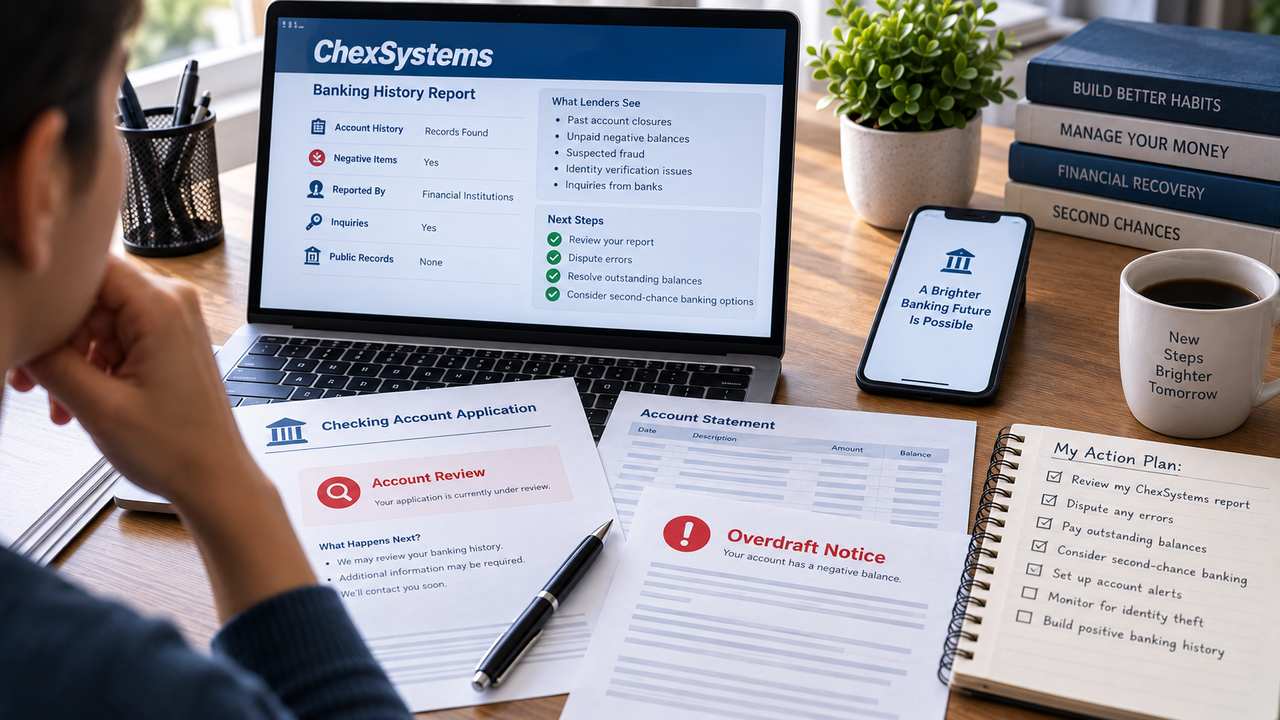
ChexSystems is a specialty consumer reporting agency, similar in concept to Equifax, Experian, or TransUnion, but focused specifically on banking history rather than credit history. Banks and credit unions voluntarily report negative banking activity — primarily unpaid negative balances, suspected fraud, and account mismanagement — to ChexSystems, and other banks then check this database before approving a new account application, much like a landlord checks a tenant screening report.
If you’re unfamiliar with the information that appears on a traditional credit file, our guide on how to read a credit report explains the difference between credit reporting and other types of consumer reporting.
What Gets You Reported to ChexSystems
- An unpaid negative account balance. If you overdraw an account and don’t repay the negative balance before the bank closes it, this is by far the most common reason people end up in ChexSystems.
- Suspected fraud or check fraud, including writing checks against insufficient funds repeatedly, or other activity a bank’s fraud department flags as suspicious.
- Excessive overdrafts, even if eventually repaid, depending on the specific bank’s internal policies about how many overdrafts trigger a report.
- Identity theft affecting an account, in some cases, though this should generally be correctable through the dispute process once documented.
If identity theft is involved, you may also want to review our information about identity theft protection.
How Long Negative Information Stays on Your ChexSystems Report
Most negative information remains on your ChexSystems report for five years, which is shorter than the standard seven-year window for most credit report negative items, though it can still feel like a long time if you’re trying to open a basic checking account in the meantime.
How to Check Your Own ChexSystems Report
You’re entitled to a free copy of your ChexSystems report, similar to your right to free credit reports from the major bureaus. You can request this directly through ChexSystems (via their website or by phone), and reviewing it is the essential first step if you’ve been denied an account and suspect ChexSystems is the reason.
It is also useful to review your traditional credit reports separately. You can obtain your federally authorized free credit reports through AnnualCreditReport.com.
What to Do If You Find Accurate Negative Information
Pay off any outstanding negative balance you owe. Many banks that reported you to ChexSystems will update their report once the debt is paid, and some banks specifically offer “second chance” accounts designed for people with a ChexSystems history, sometimes with more limited features initially but a path to a standard account after a period of responsible use.
Consider requesting removal after payment, similar to a goodwill request with a credit reporting matter — some banks will agree to remove the negative report once the balance is paid, though this isn’t universal or guaranteed.
If you’re interested in how goodwill requests work in the credit-reporting context, see our guide on goodwill letters and late payments.
What to Do If You Find Inaccurate Information
Dispute it directly with ChexSystems, similar to disputing an error on a standard credit report — providing documentation supporting your position, and ChexSystems is required to investigate, typically within 30 days.
Contact the reporting bank directly as well, since they’re the original source of the information and may be able to correct their own records, which then flows through to ChexSystems.
The same general principle applies when you find inaccurate information on a traditional credit report. Our guide on how to dispute credit report errors explains the broader dispute process.
Finding a Bank Account Despite a ChexSystems History
Second-chance checking accounts are specifically designed for this situation, offered by many banks and credit unions, sometimes with modest fees or feature limitations initially, but providing a legitimate path to basic banking access while you address the underlying ChexSystems issue.
Some banks don’t use ChexSystems at all, or use a different, less restrictive screening service — researching which specific banks in your area have more lenient screening policies can be worthwhile.
Credit unions sometimes have more flexibility than larger national banks, particularly smaller, member-focused institutions willing to consider your full situation rather than relying purely on an automated ChexSystems-based denial.
Prepaid debit cards or online-only banking alternatives that don’t require traditional account screening can serve as a bridge while you resolve your ChexSystems history, though these typically offer more limited features than a standard checking account.
How ChexSystems Differs From Your Credit Report
It’s worth being clear about this distinction: ChexSystems tracks your banking account history specifically, while your standard credit report (from Equifax, Experian, or TransUnion) tracks your credit and loan history. A poor ChexSystems history doesn’t directly affect your credit score, and vice versa — these are genuinely separate systems, though financial difficulty severe enough to cause problems in one area sometimes correlates with difficulty in the other, without one directly causing or reflecting the other.
For more information about how credit scores work, see our guide explaining how your credit score is calculated.
Frequently Asked Questions
Does everyone who overdrafts their account end up in ChexSystems?
No — a single overdraft that’s promptly repaid typically doesn’t result in a ChexSystems report; it’s generally an unpaid negative balance that the bank ultimately writes off and reports, or a pattern of repeated overdrafts, that triggers this kind of reporting.
Can I be denied an account for a ChexSystems issue even if my credit score is excellent?
Yes — since these are separate systems, a strong credit history doesn’t offset a negative ChexSystems report; a bank specifically checking ChexSystems for a new deposit account isn’t typically looking at your credit report at all for this particular decision.
How much does it typically cost to pay off a negative ChexSystems-reported balance?
This varies based on your specific situation, but it’s generally the actual negative balance amount from your closed account, sometimes with additional fees the bank assessed — contacting the specific bank directly to confirm the exact current amount owed is the appropriate first step.
Is there a way to get a bank account without any screening at all?
Fully unscreened traditional bank accounts are uncommon, though second-chance accounts, some credit union options, and certain prepaid or online banking alternatives offer meaningfully reduced screening barriers compared to a standard account application at a major bank.
Does closing an account in good standing ever result in a ChexSystems report?
No — a ChexSystems report specifically relates to negative account history (unpaid balances, fraud, mismanagement); simply closing an account you’ve managed responsibly, with no outstanding negative balance, doesn’t result in any negative report.
A Closer Look at How Banks Decide What to Report
Not every bank reports every negative account event to ChexSystems — reporting practices vary by institution, and banks generally have some internal discretion about which situations rise to the level of a formal report versus simply being handled internally (a fee charged, an account closed without further action). Generally, the deciding factors include the size of the unpaid negative balance, whether the bank suspects deliberate fraud versus an honest mistake or temporary hardship, and the bank’s own specific internal risk policies. This variability is part of why two people with seemingly similar overdraft situations at different banks can end up with different ChexSystems outcomes — one bank’s threshold for reporting may be more lenient than another’s.
The Role of Early Warning Services (EWS) as a Related System
It’s worth knowing that ChexSystems isn’t the only specialty consumer reporting agency banks might check — Early Warning Services (EWS) is another major player in this space, and some banks check one, the other, or both when evaluating a new account application. If you’ve been denied at one bank and are confused about why, since your ChexSystems report looked clean, it’s worth checking whether EWS might be the relevant database in your specific case, since it operates similarly but as a genuinely separate reporting system with its own dispute process.
A Realistic Timeline for Resolving a ChexSystems Issue
- Immediately: Request your free ChexSystems report to understand exactly what’s being reported and confirm its accuracy.
- Within a few weeks: If accurate, contact the reporting bank to arrange payment of any outstanding balance; if inaccurate, file a formal dispute with ChexSystems.
- Within 30 days: ChexSystems should complete its investigation if you’ve filed a dispute, correcting or removing unverifiable information.
- Once resolved: Consider applying for a second-chance account in the meantime if you need banking access before the underlying issue is fully resolved, then transition to a standard account once your ChexSystems history improves or the negative item ages off after the standard five-year period.
Frequently Asked Questions, Continued
Do all banks use ChexSystems, or only some?
Most major banks and many credit unions do use ChexSystems or a similar service like EWS as part of their new account screening, though the specific weight given to a negative report, and whether a bank has any flexibility to approve an account despite one, varies considerably by institution.
Can a joint account holder’s negative history affect my own ChexSystems report?
If you were a joint owner on an account that resulted in a negative report, this can appear on your own ChexSystems file as well, since joint account holders are generally each individually associated with the account’s history, similar to how joint credit accounts affect both holders’ credit reports.
Is there a fee to dispute inaccurate ChexSystems information?
No — similar to disputing an error on a standard credit report, filing a dispute with ChexSystems is free, and they’re required to investigate without charging you for this process.
Does a ChexSystems report affect my ability to get a credit card, separate from a checking account?
Not directly — ChexSystems specifically relates to deposit account history (checking and savings), while credit card approval is governed by your standard credit report and score; these remain separate evaluation processes even though both are sometimes colloquially lumped together as “banking history.”
How ChexSystems Scores Work, and Why They’re Different From a Credit Score
In addition to the underlying report, ChexSystems also generates its own numeric score (sometimes called a ChexSystems score), used by some banks as an additional screening tool alongside or instead of a simple pass/fail report review. This score operates on its own scale, entirely separate from FICO or VantageScore, and reflects your banking risk specifically — a low ChexSystems score doesn’t correspond to any equivalent credit score number, and the two shouldn’t be compared directly, since they’re measuring fundamentally different things using different underlying data and methodologies.
For a deeper explanation of the difference between the major credit scoring systems, see our guide to FICO vs. VantageScore.
What Banks That Don’t Use ChexSystems Typically Use Instead
If a specific bank doesn’t rely on ChexSystems, they may use a competing service (Early Warning Services, as mentioned, being the most common alternative), or in some cases rely more heavily on manual underwriting — reviewing your recent bank statements directly, verifying income, and making a more individualized decision rather than relying primarily on an automated screening database. Smaller community banks and credit unions are more likely to take this more manual, individualized approach, which is part of why they’re often cited as more accessible options for someone with a ChexSystems history.
Frequently Asked Questions, Continued Further Still
If I’ve been denied at several banks in a row, is there a risk that repeated applications themselves start counting against me?
Unlike credit inquiries, which can have a cumulative effect on your credit score, ChexSystems inquiries generally don’t compound the same way — the underlying negative report is what matters, not how many times you’ve applied and been screened against it, though it’s still practically more efficient to research a bank’s likely flexibility before applying rather than applying repeatedly at random.
Does opening a joint account with someone who has good ChexSystems history help me get approved despite my own negative report?
This varies by bank — some banks will still deny a joint application if either applicant has a disqualifying ChexSystems report, while others may weigh the application more favorably given one strong co-applicant; this is worth asking about directly with a specific bank if you’re considering this approach.
A Broader List of Less Obvious Situations That Can Trigger a ChexSystems Report
Beyond the common overdraft scenario, a few less obvious situations are worth knowing about: a returned/bounced check you wrote (even if eventually made good) can sometimes trigger a report, particularly if it happened repeatedly; closing an account with a small negative balance you didn’t realize existed (sometimes from a maintenance fee charged after you thought the account was already empty and inactive) can result in a surprise report months later; and in rarer cases, being a victim of check fraud where someone else’s fraudulent activity on your account led to a negative balance can result in a report that requires active disputing to correct, since the bank’s system may not automatically distinguish victim status from account holder responsibility without you proactively raising it.
Frequently Asked Questions, Continued One More Time
Is there a cost to opening a second-chance account, beyond what a standard account would cost?
Second-chance accounts sometimes carry a modest monthly maintenance fee that a standard checking account might not, reflecting the bank’s additional risk in offering the account — it’s worth comparing a few options, since fee structures vary, and some second-chance products waive fees once you meet certain conditions like direct deposit or a minimum balance.
Does paying off a ChexSystems debt in full guarantee removal, or is removal always discretionary?
Removal after payment is discretionary in most cases, similar to credit report goodwill removal — many banks will remove the report once paid, but this isn’t universally guaranteed, so it’s worth specifically asking whether payment will result in removal, ideally getting this confirmed before making the payment.
The Bottom Line
ChexSystems is a specialty consumer reporting agency tracking banking history, separate from your credit report, and a negative ChexSystems record — most commonly from an unpaid negative account balance — can block new account approvals at many banks for up to five years. The path forward is straightforward: check your own report, pay off any legitimate outstanding balance (and consider requesting removal once paid), dispute any inaccuracies, and in the meantime, explore second-chance accounts or credit unions with more flexible screening while you work to resolve the underlying issue.
Need Help Reviewing Your Credit Profile?
ChexSystems and traditional credit reports are separate systems, but problems with banking history can sometimes exist alongside inaccurate or negative information on your credit reports. Reviewing your credit profile can help you understand what lenders and other businesses may be seeing.
If you have concerns about inaccurate information, collections, identity theft, or other negative credit-report items, a detailed review can help you identify areas that may need further attention.
Leave a Reply