Blog

  • Charge-Off vs. Collection: What’s the Difference and Why It Matters

    Charge-Off vs. Collection: What’s the Difference and Why It Matters

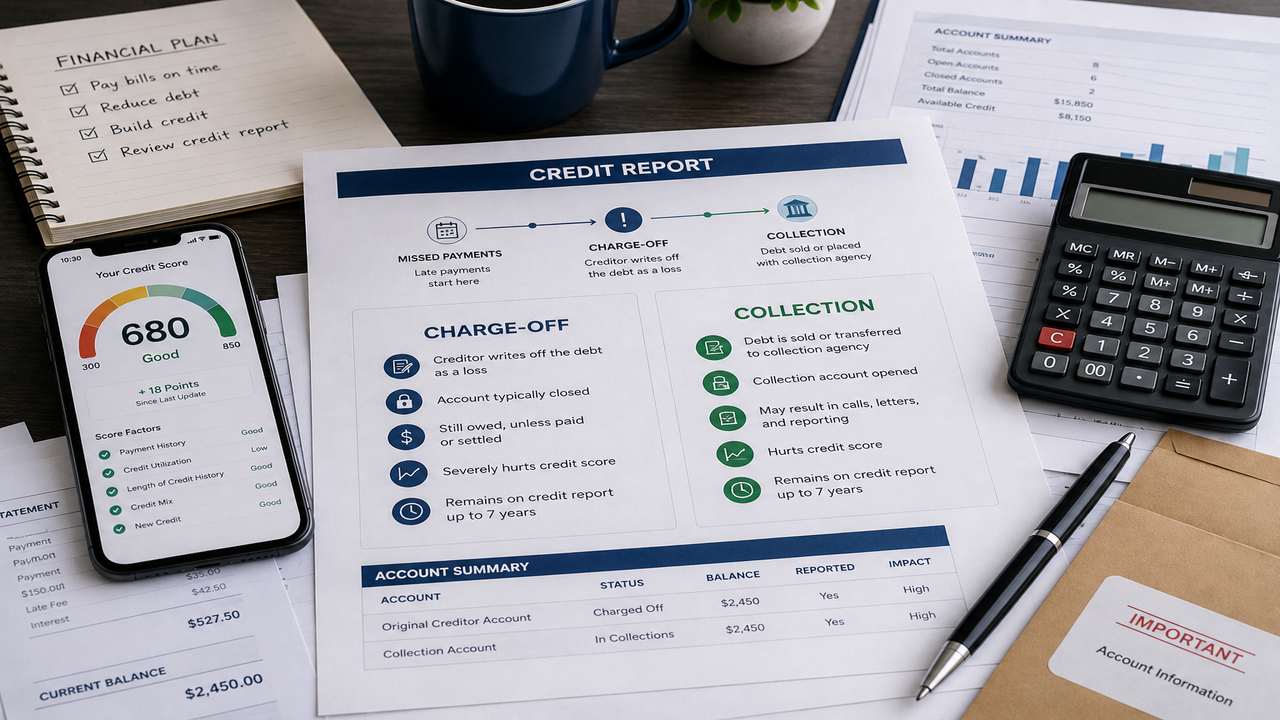
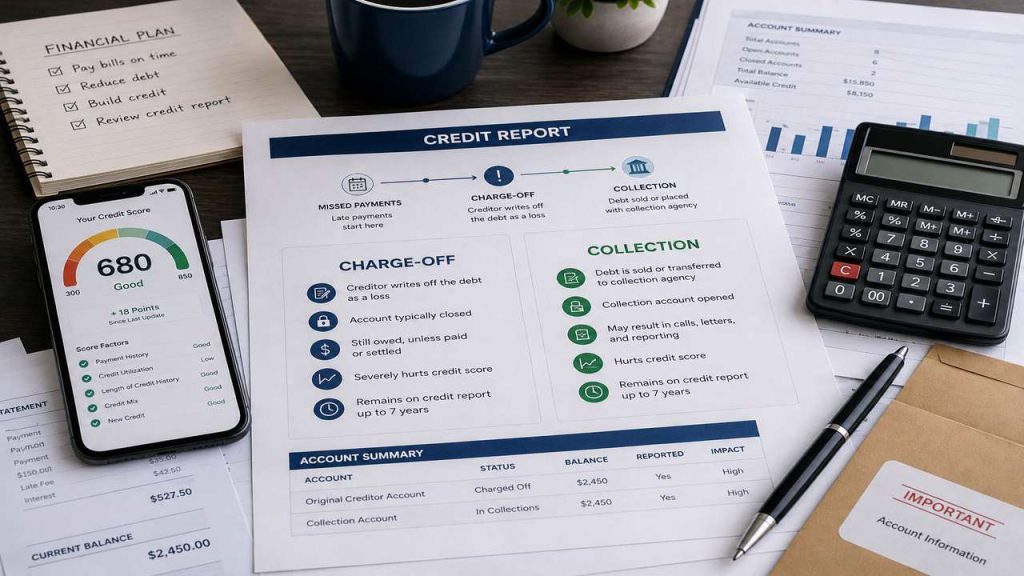
    If you’ve pulled your credit report and seen both a “charge-off” and a “collection” listed — sometimes for what looks like the same debt — you’re not imagining things, and you’re not alone in finding it confusing. These two terms describe different stages in the life of an unpaid debt, and understanding the difference matters because it affects how you negotiate, what your rights are at each stage, and how the entry impacts your credit score.

    This guide breaks down exactly what each term means, how one often turns into the other, and what to actually do if you’re facing either one.

    What a Charge-Off Actually Means

    A charge-off is an accounting decision made by the original creditor — the bank, credit card company, or lender you originally owed money to. When an account becomes seriously delinquent, typically after 180 days (six months) of nonpayment for most revolving credit like credit cards, the creditor’s internal accounting rules (often guided by federal banking regulations) require them to write the debt off as a loss on their books.

    Here’s the part that surprises most people: a charge-off does not mean the debt is forgiven or that you no longer owe it. It’s purely an internal bookkeeping classification. You still legally owe the full balance. What changes is how the creditor treats the account internally — it moves from being tracked as a receivable they expect to collect, to a loss they’ve already absorbed for accounting and tax purposes.

    Once an account is charged off, the original creditor typically does one of three things: continues trying to collect the debt directly (sometimes through an internal collections department), sells the debt to a third-party debt collector for a fraction of its value, or, less commonly, simply stops pursuing it (though this doesn’t erase the fact that it’s still technically owed).

    What a Collection Actually Means

    A “collection” refers to an account that has been placed with — or sold to — a third-party debt collection agency, or in some cases moved to a creditor’s own internal collections department. This can happen with many types of debt, not just charged-off credit cards: unpaid medical bills, utility bills, gym memberships, and personal loans can all end up in collections without necessarily going through a formal charge-off process first, particularly for debts that weren’t originally extended as revolving credit.

    When a debt moves to collections, a new entity — the collection agency — now has the legal right to attempt to collect it, and depending on the arrangement, either on behalf of the original creditor (for a contingency fee) or as the new owner of the debt (having purchased it outright, usually for a small percentage of the original balance).

    This is why you’ll sometimes see two separate negative entries on your credit report for what feels like a single unpaid debt: one from the original creditor showing the account as “charged off,” and a second, separate entry from the collection agency showing the same debt as a new “collection account.” Both can appear and both can affect your score, even though they represent the same underlying debt at different stages.

    How the Two Terms Relate to Each Other

    Think of it as a sequence rather than two unrelated categories:

    1. Step one: You fall behind on payments to the original creditor.
    2. Step two: After enough time passes (commonly 180 days for credit cards, though it varies by debt type and creditor), the original creditor charges off the account internally and reports it to the credit bureaus as a charge-off.
    3. Step three: The original creditor either keeps trying to collect it themselves, or — far more commonly — sells or assigns the debt to a third-party collection agency.
    4. Step four: If sold or assigned, the collection agency may report the debt to the credit bureaus as a new collection account, separate from the original charge-off entry.

    Not every collection account started as a charge-off (medical and utility debts, for example, often go to collections without ever being formally “charged off” in the credit-card sense), and not every charge-off necessarily ends up as a separate collection entry on your report (sometimes the original creditor retains the debt and simply updates the existing entry rather than a new company reporting a fresh one). But for credit card and similar revolving debt, the charge-off-then-collection sequence is the most common path.

    How Each Affects Your Credit Score

    Both are serious negative marks, generally causing a significant score drop, especially for someone who otherwise had good credit. A few nuances worth understanding:

    A charge-off is typically more damaging than a standard late payment because it signals the creditor gave up trying to collect through normal means — it represents a much more serious level of delinquency than a single missed payment.

    Newer scoring models (FICO 9 and 10, VantageScore 3.0 and 4.0) treat paid collections more favorably than older models. Under these newer models, a collection account that’s been paid in full has less negative impact than an unpaid one, and some models ignore paid collections almost entirely. Older scoring models (still used by many lenders, particularly for mortgages) don’t make this distinction as generously, which is why paying off an old collection doesn’t always produce the score jump people expect if the lender in question is using an older model.

    Medical collections are treated somewhat differently under current credit bureau policies. As of recent industry-wide changes, paid medical collections are generally removed from credit reports entirely, and there’s typically a waiting period (commonly one year) before unpaid medical debt is even reported in the first place, along with a rising minimum dollar threshold below which many medical collections aren’t reported at all. This treatment doesn’t automatically extend to non-medical debts.

    Both stay on your report for roughly the same length of time — seven years from the date of the original delinquency that led to the charge-off, not seven years from when the account was sold to collections or from when a collection agency starts reporting it. This is a critical and frequently misunderstood point.

    The Seven-Year Clock: The Most Important Concept to Understand

    Under the Fair Credit Reporting Act, most negative information — including charge-offs and collections — can only be reported for seven years, measured from the date of first delinquency on the original account, not from any later event. This means:

    If you stopped paying a credit card in January 2020, and it charged off in July 2020, and the debt was then sold to a collection agency in 2022 that started reporting its own collection entry — that collection entry’s seven-year clock still runs from January 2020, the original delinquency date, not from 2022 when the collector started reporting.

    This matters enormously because some debt collectors (usually the less scrupulous ones) will report an old debt as if the clock restarts each time it’s sold to a new collector, sometimes even after making a partial payment, hoping consumers won’t know better. Making a payment on old debt does not reset the seven-year reporting clock, though it’s worth noting this is different from your state’s separate statute of limitations on legally suing you for the debt, which is a distinct concept covered below.

    Charge-Off, Collections, and the Statute of Limitations: Don’t Confuse Them

    This is one of the most consequential mix-ups in personal finance, so it deserves its own section. There are two entirely separate clocks running on an old debt, and confusing them can cost you real money or land you back in a debt you thought was behind you.

    The credit reporting period (seven years, discussed above) governs how long the debt can appear on your credit report. This is a federal rule under the FCRA and doesn’t vary by state.

    The statute of limitations governs how long a creditor or collector can sue you in court to legally compel payment. This varies significantly by state (commonly anywhere from 3 to 10 years depending on the state and the type of debt) and is based on state contract law, separate from credit reporting rules.

    Here’s the dangerous part: in many states, making even a small payment on an old, expired-statute debt, or in some cases simply acknowledging in writing that you owe it, can restart the statute of limitations clock, making you newly vulnerable to a lawsuit on a debt that was previously too old to be legally enforced through the courts. If you’re dealing with an old debt and you’re unsure whether your state’s statute of limitations has expired, this is worth researching or consulting a consumer law attorney about before making any payment, especially on a debt you weren’t planning to pay in full anyway.

    What to Do If You Have a Charge-Off or Collection

    Verify the debt is actually yours and accurate. Under the Fair Debt Collection Practices Act, you have the right to request a “debt validation letter” within 30 days of first being contacted by a collector, requiring them to prove the debt is legitimate, the amount is correct, and they have the right to collect it. Errors and mistaken-identity cases are common enough that this step is always worth doing before agreeing to anything.

    Check for reporting errors. Confirm the original delinquency date is accurate (since this determines when the seven-year reporting window actually ends), that the balance is correct, and that it isn’t being reported by both the original creditor and multiple collection agencies for the same debt (a practice sometimes called “double reporting” that can unfairly compound the damage to your score).

    Decide on a strategy: pay in full, settle, or wait it out. Paying in full resolves the debt completely and, under current scoring models, is viewed more favorably than an unpaid balance. Settling for less than the full amount (common with collection agencies who bought the debt cheaply and are often willing to accept 30-60% of the balance) resolves the debt but may still show as “settled” rather than “paid in full,” which some models treat slightly less favorably. Waiting it out until the seven-year reporting period expires is an option if the debt is old and you’re not concerned about being sued (only advisable once you’ve confirmed your state’s statute of limitations has also passed, given the restart risk covered above).

    Get any settlement agreement in writing before paying. Verbally agreed-upon settlements are difficult to enforce if a collector later claims you still owe the difference. Always get written confirmation of the settlement terms, and after paying, request written confirmation that the debt is settled in full.

    Consider a “pay for delete” request, understanding its limitations. Some consumers negotiate directly with a collector to remove the entry entirely from their credit report in exchange for payment, rather than just marking it “paid.” This isn’t guaranteed and isn’t officially endorsed by the major credit bureaus (some collectors’ agreements with the bureaus actually prohibit this practice), but some smaller collection agencies will still agree to it. Always get any such agreement in writing before sending payment.

    Common Mistakes People Make

    • Assuming a charge-off means the debt disappears. As covered above, it’s an accounting term, not debt forgiveness. The debt is still owed and can still be pursued or sold to a collector.
    • Making a payment on an old debt without checking the statute of limitations first, inadvertently restarting the clock on a debt that was otherwise close to becoming legally unenforceable in court.
    • Ignoring collection notices entirely, which doesn’t make the debt go away and can result in a default judgment if the collector eventually sues and you don’t respond.
    • Paying a collector without getting written confirmation, then having no proof if a dispute arises later about whether the debt was actually settled.
    • Not disputing an inaccurate original delinquency date, which can cause a debt to remain reportable years longer than it legally should.

    Frequently Asked Questions

    Can a charge-off and a collection for the same debt both appear on my credit report at once?

    Yes, this is common. The original creditor’s charge-off entry and the collection agency’s separate entry can both appear simultaneously, even though they represent the same underlying debt, since each company reports independently.

    Does paying off a charge-off improve my score immediately?

    It depends on the scoring model a particular lender uses. Newer models treat a paid charge-off more favorably than an unpaid one; some older models (still used in mortgage underwriting, for example) give less credit for simply having paid it, though it’s still generally better to have it marked paid than to leave it unpaid.

    Is it better to let a debt go to collections or settle with the original creditor first?

    Settling with the original creditor before it’s sold to a collector is usually preferable when possible, since you’re negotiating directly with the party that has the clearest records and often more flexibility, and it can sometimes prevent the debt from generating a second, separate collection entry on your report.

    Can I be sued for a charge-off debt?

    Yes, both the original creditor (before charge-off, and sometimes after) and any collection agency that buys the debt can potentially sue you for payment, as long as your state’s statute of limitations for that type of debt hasn’t expired.

    What’s the difference between “charged off” and “charged off as bad debt”?

    These typically mean the same thing and both indicate the creditor has written off the balance as a loss internally. Some reports use slightly different phrasing depending on the creditor’s internal terminology, but the underlying meaning and credit impact are the same.

    Side-by-Side Comparison

    Category Charge-Off Collection
    Who reports it Original creditor Collection agency (or original creditor’s internal collections unit)
    When it happens Typically after 180 days of nonpayment Can happen with or without a prior charge-off, depending on debt type
    Do you still owe the money? Yes Yes
    Governed primarily by Internal accounting rules, bank regulations Fair Debt Collection Practices Act (FDCPA)
    Reporting clock 7 years from original delinquency date Same 7 years from original delinquency date (not reset by sale)
    Common for Credit cards, personal loans Credit cards, medical bills, utility bills, personal loans
    Can appear alongside A separate collection entry for the same debt A separate charge-off entry for the same debt

    Tax Implications of a Charge-Off You Should Know About

    Here’s a detail that catches a lot of people off guard: if a creditor charges off $600 or more of your debt and doesn’t expect to collect any more of it, they may be required to send you (and the IRS) a Form 1099-C, “Cancellation of Debt.” The IRS generally treats forgiven debt as taxable income, meaning that charged-off amount could increase your tax bill for that year.

    This doesn’t apply to every charge-off — remember, a charge-off is an internal accounting move and doesn’t necessarily mean the creditor has given up on collecting or formally forgiven the debt. A 1099-C is specifically triggered when the creditor identifies the debt as cancelled or forgiven, which is a distinct, later event from the charge-off itself. If a collector later gets you to settle the debt for less than the full amount, that forgiven difference can also trigger a 1099-C.

    If you receive a 1099-C for debt you’re still being pursued to pay (which does happen, and is a legitimate point of confusion, sometimes stemming from a company’s own inconsistent internal processes), it’s worth consulting a tax professional, since there are some exceptions and exclusions — including insolvency at the time of cancellation — that may reduce or eliminate the tax impact.
     

    charge-off-vs-collection-under-100kb

    How These Entries Affect a Loan Application, Beyond Just the Score

    A lender reviewing your application for a mortgage, auto loan, or even a new credit card doesn’t just see your score — many pull the full credit report and review specific line items manually or through automated underwriting rules. A charge-off or collection can trigger issues beyond the numerical score hit:

    Debt-to-income calculations. Some loan underwriting guidelines require unpaid collection balances above a certain threshold to be paid off, or at least factored into your debt-to-income ratio, before a mortgage can be approved — even if your score otherwise qualifies.

    Manual underwriting flags. An open, unresolved charge-off or collection can trigger a manual review or a request for a “letter of explanation” as part of a mortgage application, adding time and complexity to the process even if the account is old.

    Automatic denials under certain lending criteria. Some lenders, particularly for premium credit products, have policies that automatically decline any applicant with an open collection above a certain dollar amount, regardless of overall score.

    This is part of why resolving old charge-offs and collections — even ones old enough that their credit score impact has faded somewhat — can still matter meaningfully when you’re getting ready to apply for a major loan.

    Sample Scripts for Negotiating

    Having a rough script ready can make these conversations far less intimidating. A few starting points:

    For a settlement negotiation

    “I’d like to resolve this account. I’m not able to pay the full balance, but I could pay [X amount] as a full and final settlement if we can agree on that today. Can you send me written confirmation of the settlement terms before I make the payment?”

    For requesting debt validation

    “I’m requesting validation of this debt under the Fair Debt Collection Practices Act. Please send me written proof of the original creditor, the amount owed, and confirmation that your company has the legal right to collect this debt.”

    For a pay-for-delete request (understanding it may be declined)

    “If I pay this balance in full, would you be willing to request removal of this entry from my credit report entirely, rather than reporting it as paid? I’d need that agreement in writing before sending payment.”

    Always follow up any verbal agreement with a written request for confirmation, sent by mail or a documented method, and keep copies of everything.

    Frequently Asked Questions, Continued

    Can a company keep selling my debt to different collectors indefinitely?

    Yes, technically a debt can be sold multiple times to different collection agencies over the years, with each new owner potentially reporting their own entry. However, the original seven-year reporting clock still applies regardless of how many times it’s resold, and consumers should watch for collectors trying to represent an old debt as “new” simply because they recently acquired it.

    Does settling a debt for less than owed hurt my score more than paying in full?

    Both a “settled” and a “paid in full” status are generally viewed as significant improvements over an unpaid, open balance. Some models and lenders view “paid in full” slightly more favorably than “settled for less than the full amount,” but the difference is generally smaller than the difference between paying (in any form) versus leaving it unresolved.

    What happens if I ignore a collection account completely?

    The account will likely remain on your credit report as unpaid until the seven-year reporting period expires, and depending on your state’s statute of limitations, you could still be sued for the balance during that window. Ignoring it doesn’t stop collection attempts and can result in a default judgment if a lawsuit is filed and you don’t respond in court.

    If a collection is removed after a successful dispute, does the corresponding charge-off also get removed?

    Not automatically — they’re separate entries reported by separate companies. If you successfully dispute and remove a collection agency’s entry (for example, because they couldn’t validate the debt), the original creditor’s charge-off entry, if accurate, can still legally remain on your report until the seven-year window expires.

    A Real-World Example Walkthrough

    To make the sequence concrete, here’s how a typical credit card charge-off unfolds in practice:

    Month 1-5

    You miss payments on a credit card with a $2,000 balance. Each missed payment is reported separately as 30, 60, 90, then 120 days late, each one a distinct negative mark and each one progressively worse for your score.

    Month 6 (180 days)

    The credit card issuer charges off the account, reporting it to the bureaus as “charged off” with a balance of roughly $2,000 plus any accrued interest and fees. Your score, if it hasn’t already dropped substantially from the preceding late payments, takes another significant hit here.

    Month 7-9

    The issuer either continues attempting to collect internally, or — more commonly for a debt this size — sells it to a third-party collection agency for a fraction of the balance, often somewhere between 4 and 20 cents on the dollar depending on the debt’s age and type.

    Month 9

    The collection agency begins contacting you and reports a new “collection account” entry to the credit bureaus, separate from the original charge-off, often for the same approximate balance (sometimes slightly higher if additional collection fees or interest are added, depending on what’s legally permitted in your state and your original credit agreement).

    Your report now shows two negative entries for what is, from your perspective, a single unpaid $2,000 credit card debt: the original charge-off from the card issuer, and the new collection account from the agency that bought it. Both count the seven-year clock from the same original delinquency date — month 1 above — not from when the collection agency started reporting in month 9.

    If you settle with the collection agency in month 15 for $800 (a common type of settlement offer, since the agency likely paid far less than that to acquire the debt), the collection entry updates to “settled” or “paid,” but the original charge-off entry from the card issuer may still show the original unpaid status unless you separately negotiate with them or they update the record based on notification from the debt sale — this is exactly the kind of detail worth confirming and, if necessary, disputing to ensure accuracy.

    How Different Debt Types Typically Flow Through This Process

    Credit cards almost always follow the charge-off-then-collection path described throughout this guide, given standard banking regulations requiring charge-off after 180 days of delinquency.

    Medical debt usually skips the formal “charge-off” terminology entirely and goes straight from an unpaid bill to a collection account, often after the provider’s billing department has made several attempts to collect. As mentioned earlier, medical collections now have more consumer-friendly reporting rules than most other debt types, including a required waiting period before reporting and removal once paid.

    Personal loans and installment loans follow a process similar to credit cards, though the specific delinquency timeline before charge-off can vary by lender and loan type.

    Utility and telecom debt typically goes to collections relatively quickly after non-payment, without an intermediate charge-off stage in the credit-card sense, since utility companies aren’t structured the same way as bank lenders for accounting purposes.

    Auto loans, if unpaid, more commonly result in repossession before or alongside collections activity, since the vehicle serves as collateral — the lender may repossess and sell the car, then pursue you in collections for any remaining “deficiency balance” if the sale didn’t cover the full amount owed.

    Frequently Asked Questions, Continued Further

    Can I negotiate directly with the original creditor even after the debt has been charged off?

    Sometimes, if the original creditor hasn’t yet sold the debt to a collector. It’s worth asking directly whether they still hold the debt internally or have already sold or assigned it elsewhere, since negotiating with whoever currently owns the debt is the only way to reach a binding agreement.

    Does a charge-off automatically mean my account is closed?

    Typically yes for the original account — once charged off, the account is no longer usable for new charges even if you later pay off the balance. Paying off a charged-off account settles the debt but doesn’t typically reopen the original credit line.

    If I pay off a collection, will it say “paid” forever, or does it eventually disappear?

    It will typically show as “paid” or “settled” for the remainder of the original seven-year reporting window from the initial delinquency date, then age off your report entirely once that window closes, the same as any other negative entry.

    Are charge-offs and collections treated the same by every lender?

    No — different lenders and loan products use different underwriting criteria and sometimes different scoring models, so the practical weight given to an old charge-off or collection can vary meaningfully depending on what you’re applying for and which lender is reviewing it.

    The Bottom Line

    A charge-off marks the point where your original creditor gives up trying to collect through normal channels and writes the debt off internally — but you still owe it. A collection marks the point where a separate agency, often having bought the debt cheaply, takes over trying to get you to pay. Both are serious credit report entries, both follow the same seven-year reporting clock from the original delinquency date, and neither should be confused with your state’s separate statute of limitations on legal enforceability. Understanding which stage a debt is in, verifying every detail is accurate, and getting any resolution in writing puts you in a far stronger position than simply reacting to collection calls as they come.

    Get a Credit Audit

    If you’re dealing with a charge-off, collection, or both, reviewing all three credit reports can help you understand exactly what is being reported and identify potential inaccuracies.


    Request a Credit Audit or Quote

  • How to Rent With an Eviction on Your Record

    How to Rent With an Eviction on Your Record

    An eviction on your record can feel like a locked door. You search for apartments, everything looks promising until the background check comes back, and then the application is quietly denied with little explanation. It’s discouraging, but it isn’t the end of your ability to find housing. Landlords deny eviction-record applicants far more often out of default caution than because every eviction tells the same story — and there are concrete, proven strategies for getting past that default caution.

    This guide covers how eviction records actually work, how long they stick around, how to challenge inaccurate ones, and the specific tactics that help renters with a real eviction history get approved anyway.

    How Eviction Records Actually Work

    An eviction, formally called an “unlawful detainer” action in many states, is a court case a landlord files to legally remove a tenant. Because it goes through the court system, it becomes part of the public record, separate from your credit report. This is an important distinction: an eviction filing shows up primarily through tenant screening companies that pull court records, not necessarily through Equifax, Experian, or TransUnion directly — though the debt from an eviction (unpaid rent, court-ordered judgments) can separately end up on your credit report if it’s sent to collections.

    This means you can have a clean credit report and still fail a rental background check because of an eviction case, and vice versa. Property managers commonly use specialized tenant-screening services (like RentPrep, TransUnion SmartMove, or various regional court-record aggregators) that search county and state court databases directly for eviction filings, judgments, and sometimes even cases that were filed but later dismissed.

    That last point matters enormously: in many states, an eviction filing can appear on a screening report even if you won the case, the landlord withdrew it, or it was settled and dismissed. The mere fact that a case was filed is what many screening services report, regardless of outcome. This is one of the more unfair aspects of the system, and it’s also one of the more fixable ones, which we’ll get to.

    How Long an Eviction Stays on Your Record

    There’s no single national answer, because eviction reporting isn’t governed the same way credit reporting is under the Fair Credit Reporting Act’s standard seven-year rule for most negative items. In practice:

    • Court records of an eviction filing are often public indefinitely, though many tenant-screening companies limit how far back they report, commonly 7 years, sometimes less.
    • A judgment (a formal court ruling against you, often for unpaid rent) can appear on tenant-screening reports for up to 7 years in most states, similar to other financial judgments.
    • Collections debt stemming from an eviction, like unpaid rent sent to a collection agency, follows the standard credit-report rule and can appear for up to 7 years from the date of the original delinquency.

    Some states have passed laws limiting how eviction records can be used or reported, particularly for cases that were dismissed, withdrawn, or resulted in the tenant prevailing. If you’re unsure what applies to your situation, checking your state’s specific tenant-screening and eviction-sealing laws is worth the time, since several states now allow eviction records to be sealed or expunged under certain conditions (often tied to case outcome, time elapsed, or the underlying reason for the eviction).

    Step One: Get Your Actual Eviction Record

    Before doing anything else, find out exactly what a landlord would see. Request your tenant screening report from a major screening company (many are required to provide this to you for free or a small fee under the FCRA, since tenant screening reports are considered consumer reports), or pull the court record directly from the county courthouse where the case was filed.

    You want to know:

    • The exact case outcome (dismissed, judgment for the landlord, judgment for you, settled)
    • The amount, if any, that was awarded
    • Whether it’s been paid, and if so, when
    • Which screening companies are actually reporting it

    Many people are surprised to find their eviction case was actually dismissed or resolved in their favor, yet a screening company is still reporting the filing itself as if it were a finding against them. This is exactly the kind of error worth disputing.

    Step Two: Dispute Anything Inaccurate

    If your screening report shows incorrect information — the wrong outcome, a debt that’s already been paid, or a case that doesn’t actually belong to you (which does happen, especially with common names) — you have the right to dispute it directly with the tenant screening company, the same way you’d dispute an error on a credit report. Under the FCRA, they’re required to investigate and correct verified inaccuracies.

    This is also where sealing or expungement can help if your state allows it. If a case was dismissed, resulted in your favor, or is old enough to qualify, some states let you petition the court to seal the record, after which reputable screening companies should stop reporting it. This process varies significantly by state and sometimes by county, so check your local courthouse or a local tenant’s rights organization for the specific procedure.

    Step Three: Pay Off Any Outstanding Balance

    If the eviction resulted in a real debt you actually owe — back rent, court costs, damages — paying it off, even years later, does two things. First, it removes any risk of a fresh collections action or wage garnishment down the line. Second, it gives you something concrete to show future landlords: proof that even though something went wrong once, you ultimately made it right. A “paid” eviction judgment reads very differently to a landlord than an outstanding one.

    If you can’t pay the full balance, contact the original landlord or the current debt holder (if it’s been sold to a collector) to negotiate a payment plan or a reduced lump-sum settlement. Get any agreement in writing before paying, and specifically request written confirmation once the balance is paid or settled.

    Step Four: Build a Strong Rental Application Anyway

    Even with an eviction in your past, a strong overall application changes how a landlord weighs that one red flag. A few things to prepare before you start applying:

    A written explanation letter.

    A short, honest, non-defensive explanation of what happened and what’s different now goes further than most renters expect. Landlords who deny eviction-record applicants automatically are often doing so out of a lack of context, not because every eviction is treated as unforgivable. If the eviction happened because of a job loss, a medical emergency, or a temporary hardship that has since resolved, say so plainly. Avoid blaming the previous landlord in detail, even if you feel justified — the goal is to demonstrate stability now, not relitigate the past.

    Proof of current income and stability.

    Pay stubs, an offer letter, or bank statements showing consistent income well above the rent (commonly landlords look for income at least three times the monthly rent) help offset the risk a landlord associates with the eviction.

    References that speak to reliability.

    A letter from a current or more recent landlord, even a shorter tenancy, showing on-time payment and good standing, can meaningfully counterbalance an older eviction. Employer references confirming stable employment help too.

    A larger security deposit or advance rent, offered proactively.

    Some landlords are legally capped on how much deposit they can require upfront, but where allowed, voluntarily offering additional deposit or even a few months of rent paid in advance can turn a “no” into a “yes” by directly addressing the landlord’s core financial concern.

    A cosigner or guarantor.

    If you have someone with strong credit and income willing to cosign, this shifts a significant amount of the landlord’s risk and can be the deciding factor, especially for a landlord who’s on the fence rather than firmly opposed to renting to anyone with an eviction history.

    Step Five: Target the Right Kind of Landlord

    Not every rental market screens applicants the same way. A few categories worth focusing your search on:

    Independent landlords rather than large corporate property management companies.

    Big management companies often use rigid, automated screening criteria with no room for context or explanation. An individual landlord renting out a property they own personally has more flexibility to consider your explanation, your references, and your current situation as a whole.

    Second-chance or eviction-friendly rental listings.

    In many cities, some landlords and property managers specifically advertise as open to applicants with eviction history, sometimes explicitly, sometimes signaled through phrases like “flexible screening” or “case-by-case basis.” Local tenant advocacy organizations, and even some dedicated online listing categories, can help identify these.

    Properties that are harder to fill.

    Units that have been vacant longer, or that are in a less competitive part of the rental market, put more negotiating leverage in your hands. A landlord who has had a unit sitting empty for two months is often more willing to work with an applicant who has a strong current income and a reasonable explanation, compared to a landlord fielding twenty applications for one unit.

    Month-to-month or short-term arrangements first.

    Some renters use a short-term lease, sublet, or room rental (which often has less formal screening) as a bridge, building a fresh, positive rental history for a year before applying somewhere with stricter screening.

    What to Say (and Not Say) About Your Eviction

    How you frame the conversation matters. A few principles:

    Be upfront rather than hoping it won’t come up.

    If a landlord discovers an undisclosed eviction during screening after you’ve implied a clean record, it damages trust more than the eviction itself would have. Bringing it up proactively, briefly, and with context shows confidence and honesty.

    Keep the explanation short and factual.

    One or two sentences on what happened, one sentence on what’s different now (steady job, savings buffer, resolved the underlying issue) is usually more effective than a long, emotional account.

    Don’t over-apologize or seem desperate.

    A landlord is assessing risk, not judging your character. A calm, matter-of-fact tone that focuses on your current stability tends to land better than an apologetic or defensive one.

    When an Eviction Isn’t Actually Yours or Was Handled Unfairly

    If you believe an eviction on your record is inaccurate, belongs to someone else, or was the result of an illegal action by a landlord (such as retaliation for reporting a habitability issue, or an eviction attempted without proper legal process), contact a local tenant’s rights organization or legal aid clinic. Many operate on a free or sliding-scale basis and can help you understand whether the case can be challenged, sealed, or removed from screening reports altogether. This is a meaningfully different situation from an eviction that legitimately occurred, and it’s worth pursuing seriously rather than assuming nothing can be done.

    Frequently Asked Questions

    Can a landlord legally deny me solely because of a past eviction?

    In most states, yes — landlords generally have wide discretion in choosing tenants, and a past eviction is a legitimate factor they can weigh. Some cities and states have passed “fair chance” or “second look” housing laws that limit blanket denials based solely on eviction history, similar to fair-chance hiring laws for criminal records, so check your local regulations.

    Does an eviction show up on a credit report?

    Not directly, in most cases. The eviction case itself typically appears through tenant-screening services that search court records. However, any unpaid debt connected to the eviction (back rent, court-ordered judgments) can be reported to the credit bureaus if it’s sent to collections, and that portion would show up on a standard credit report.

    How long do I need to wait before applying again after an eviction?

    There’s no waiting period required by law in most places. Some renters find success reapplying immediately with a strong explanation and references; others spend six months to a year building savings, paying off any balance owed, and establishing a track record before applying somewhere more competitive.

    Will paying off an old eviction judgment remove it from my record?

    Paying it off typically updates the status to “paid” or “satisfied” rather than removing the record entirely, though a paid status is viewed far more favorably by landlords than an outstanding balance. Whether the underlying case can be sealed or removed depends on your state’s specific laws.

    Should I use a professional eviction-removal or “credit repair for renters” service?

    Be cautious. Legitimate options — disputing genuine inaccuracies, petitioning for sealing where your state allows it, negotiating a payoff — are all things you can typically do yourself for free or low cost. Be skeptical of any service promising to remove an accurate eviction record for a fee; if the underlying case is real and accurately reported, no legitimate service can simply make it disappear.

    Sample Explanation Letter Template

    Having a written explanation ready before you start applying saves you from scrambling to write one under pressure, and it also lets you refine the wording until it sounds calm and confident rather than defensive. A basic structure that works well:

    Opening:

    A brief, direct acknowledgment. “I want to be upfront that a past tenancy at [address/city] ended in an eviction filing in [year].”

    Context:

    One or two sentences on the cause, focused on facts rather than blame. “This happened after I lost my job unexpectedly and fell behind on rent for several months.”

    Resolution:

    What’s different now. “I’ve since resolved the balance in full and have been steadily employed at [company/type of role] for the past [length of time].”

    Forward-looking close:

    A short statement of reliability. “I’m happy to provide references from my current employer and landlord, and I’m glad to discuss any additional documentation that would be helpful.”

    Keep the whole thing to a short paragraph. A landlord reading fifteen applications doesn’t need your full life story — they need enough context to feel confident saying yes, and a demonstration that you can address a difficult topic professionally.

    Understanding Why the Eviction Happened Shapes Your Strategy

    Not all evictions come from the same root cause, and the reason behind yours should shape how you present your situation.

    Nonpayment of rent due to a temporary hardship

    (job loss, medical emergency, unexpected expense) is generally the easiest to explain, because it’s a specific, resolvable event rather than an ongoing pattern. Landlords can usually understand a single hardship, especially if you can show the underlying cause has passed.

    A dispute over property conditions or a landlord-tenant disagreement

    that escalated to an eviction filing, especially one that was later dismissed or settled, is worth explaining clearly with documentation, since it reflects a specific conflict rather than an inability to pay rent or maintain a property.

    Repeated late payments or lease violations

    leading to eviction suggest a pattern a landlord will want more reassurance about — this is where strong recent references and proof of a genuinely different financial situation matter most.

    An eviction tied to a former partner or roommate’s actions

    where you were on the lease but not primarily responsible for the underlying issue, is worth explaining honestly, along with any documentation (police reports, court filings naming the other party specifically) that supports your account.

    Being clear-eyed with yourself about which category your situation falls into helps you write a more convincing, specific explanation rather than a vague, generic one.

    how-to-rent-with-an-eviction-under-100kb

    Alternatives and Workarounds Worth Knowing About

    Rent guarantor or insurance services.

    Companies like Insurent, TheGuarantors, and similar services will act as a guarantor for your lease in exchange for a fee (often equivalent to a portion of a month’s rent), backing your application financially the way a personal cosigner would. This can be a practical option if you don’t have a family member or friend able to cosign.

    Corporate or extended-stay housing.

    Furnished apartments and extended-stay properties sometimes have more flexible screening than traditional leases, since they’re often priced at a premium and cater to short-term or transitional renters. This can serve as a bridge while you rebuild a rental history.

    Subletting or room rentals.

    Renting a room in someone else’s home, or subletting from an existing tenant, often involves a much less formal screening process — sometimes just a conversation and a reference — and can be a practical way to secure housing and build a positive, recent rental reference for a future, more formal application.

    Rent-reporting services.

    Once you’re in a new lease, some services (like Rental Kharma, Boom, or your landlord directly, if they participate) will report your on-time rent payments to the credit bureaus, which builds a positive credit history independent of your rental screening file, and can help demonstrate reliability if you’re building back up after a rocky period.

    Understanding Your Rights During the Screening Process

    Because tenant screening reports are considered consumer reports under the Fair Credit Reporting Act, you have specific legal protections. If you’re denied housing based even partly on information in a screening report, the landlord is required to give you an “adverse action notice,” which must include the name and contact information of the screening company that provided the report. This is valuable because it tells you exactly where to go to pull your file and dispute anything inaccurate, rather than guessing which of several possible screening companies was involved.

    You’re also entitled to a free copy of that specific report from the screening company if you request it within 60 days of the adverse action notice. Many renters don’t realize this and simply move on to the next application without ever seeing what actually triggered the denial — which means they keep hitting the same wall for a reason they never identified or corrected.

    Frequently Asked Questions, Continued

    Can I get an eviction removed just by asking the landlord to withdraw the report?

    If the case is still pending or was recently filed, some landlords may be willing to withdraw the case (especially if the underlying balance gets paid), which would then reflect in court records as dismissed. Once a case is closed and reported by screening companies, you generally can’t simply ask a company to remove accurate information — you’d need to pursue sealing or expungement through the appropriate legal process if your state allows it.

    Do all landlords use the same tenant screening company?

    No. Different landlords and property management companies use different screening vendors, and each maintains its own database, sometimes with different lookback periods or reporting practices. This is part of why an eviction might show up on one application and not another — it’s worth requesting your report from whichever company was actually used, rather than assuming it’s the same one every time.

    Is it worth hiring an attorney to fight tenant screening errors?

    For a straightforward factual error (wrong outcome, mismatched identity, an unpaid balance that’s actually been paid), you can usually resolve it yourself through the dispute process at no cost. An attorney becomes more valuable for a genuinely contested legal question, such as whether a landlord’s original eviction action was retaliatory or otherwise improper, or if a screening company refuses to correct a documented error after a proper dispute.

    How much does an eviction typically lower approval chances?

    There’s no universal number — it depends heavily on the individual landlord, the local rental market’s competitiveness, how recent the eviction is, and how strong the rest of your application is. In a tight rental market with many applicants, any red flag can be disqualifying by default; in a slower market, or with an independent landlord, a well-explained eviction with strong current references is often manageable.

    Eviction Sealing and Expungement Laws Are Changing

    Over the past several years, a growing number of states and cities have recognized that eviction filings — as opposed to actual eviction judgments — can unfairly follow a tenant for years even when the case never resulted in a finding against them. In response, many jurisdictions have introduced or expanded laws that allow certain eviction records to be sealed from public view or removed from tenant screening reports under specific conditions.

    Common qualifying conditions across different jurisdictions include: the case was dismissed or withdrawn, the tenant prevailed in court, a certain number of years have passed since the filing, the underlying issue was tied to a state of emergency (some jurisdictions passed specific protections for eviction filings during public health emergencies), or the debt has been paid in full and a set waiting period has elapsed.

    Because these laws vary significantly by state — and sometimes even by county or city within a state — the most reliable way to find out what applies to you is to contact your local courthouse’s self-help center, a legal aid organization, or a tenant’s rights nonprofit in your area. Many of these organizations provide free consultations specifically for renters trying to understand and act on eviction-sealing eligibility, and some even help file the paperwork at no cost.

    If you do successfully seal or expunge a record, it’s worth following up directly with any tenant-screening companies that previously reported it, since sealing a court record doesn’t always automatically and immediately update every private screening database — you may need to provide proof of the sealing order to have it corrected.

    Building a Rental Resume

    Just as a job resume presents your professional history in an organized, persuasive format, a “rental resume” does the same for your housing history, and it’s an underused tool for renters trying to overcome a past eviction. A simple one-page document that includes your current employment and income, a summary of your rental history (including the honest, brief explanation of the eviction), personal and professional references with contact information, and any relevant financial documentation (bank statements, proof of savings) gives a landlord a complete, organized picture upfront rather than forcing them to piece it together from a screening report alone.

    Handing this to a landlord alongside your application, rather than waiting to explain the eviction only if asked, demonstrates initiative and honesty — two qualities that directly counter the concerns an eviction on your record might otherwise raise.

    A Note on Emotional Resilience Through the Process

    It’s worth naming directly: searching for housing with an eviction on your record can involve real rejection, sometimes repeatedly, and that’s genuinely discouraging. It’s easy to internalize each denial as a judgment on your character rather than what it usually is — a risk-averse screening policy applied broadly and impersonally. Keeping a level head through a string of “no” responses, while continuing to refine your application and explanation letter based on what you learn along the way, tends to produce results faster than either giving up on a search or becoming defensive and combative with prospective landlords. Every rejection is also information: if you’re consistently denied by large corporate management companies but getting further with independent landlords, that’s a useful signal about where to focus your energy going forward.

    Frequently Asked Questions, Continued Further

    What if the eviction was filed against a roommate, not me?

    If your name wasn’t actually on the eviction case, it generally shouldn’t appear on your individual tenant screening report at all. If it does, that’s likely a case of mistaken identity or a data-matching error at the screening company, and it’s worth disputing directly, providing documentation such as the original lease showing only your roommate’s name on the case.

    Can I rent an apartment under a different name to avoid the eviction showing up?

    No — beyond being generally impractical, since leases and screening require accurate legal identification and often a Social Security number for the credit check portion, misrepresenting your identity on a rental application can constitute fraud and create far more serious legal problems than the eviction itself.

    Does bankruptcy clear an eviction-related debt?

    An eviction-related debt (like a court judgment for unpaid rent) can potentially be discharged in bankruptcy depending on the type of bankruptcy filed and the specific circumstances, but the eviction case itself, as a court record, is a separate matter from the debt and isn’t erased by a bankruptcy filing. If you’re considering bankruptcy for eviction-related debt, a consultation with a bankruptcy attorney can clarify what would and wouldn’t be affected in your specific situation.

    How do I find eviction-friendly landlords in my area?

    Local tenant’s rights organizations, some nonprofit housing assistance programs, and certain online rental platforms that cater to “second chance” renters are good starting points. Word of mouth and directly asking property managers about their screening flexibility during a phone inquiry, before submitting a formal application, can also save time by avoiding applications to landlords with rigid automatic denial policies.

    The Bottom Line

    An eviction makes renting harder, not impossible. The renters who move past it fastest tend to do three things: verify exactly what’s on their record and dispute anything inaccurate, resolve any outstanding balance so the record reflects a closed chapter rather than an open one, and build an application that gives a landlord real reasons to say yes — steady income, solid references, a straightforward explanation, and sometimes a larger deposit or a cosigner to offset the risk. None of this erases the past, but it consistently changes the outcome for renters willing to put in the extra groundwork.

    Need Help Reviewing Your Credit?

    If your eviction also resulted in collections, unpaid rent, or other negative information appearing on your credit reports, you can request a credit review to understand what is being reported and what options may be available.

    Request a Credit Audit or Quote

  • How to Start Credit at 18: A Complete Beginner’s Guide

    How to Start Credit at 18: A Complete Beginner’s Guide

    Turning 18 comes with a long list of new responsibilities, and one of the most overlooked is credit. Nobody hands you a manual for it. There’s no class in most high schools that walks you through what a credit score actually measures, how it’s calculated, or why a number you’ve never seen before can end up deciding whether you get approved for an apartment, a car loan, or even a cell phone plan without a hefty deposit.

    The good news is that starting credit at 18 is one of the easiest financial advantages you can give yourself, precisely because you’re starting from zero rather than trying to undo years of mistakes. This guide walks through exactly how credit works, the specific tools available to someone just starting out, the order in which to use them, and the mistakes that trip up most first-timers.

    Why Starting Early Actually Matters

    Credit scoring models reward length of history. One of the core factors in your score is simply how long your accounts have been open. Someone who opens their first credit card at 18 and manages it responsibly will, all else being equal, have a real structural advantage over someone who waits until 25 or 30 to start — not because they’re smarter with money, but because their file is older.

    Think of it like planting a tree. A tree planted today and given basic care will be bigger in ten years than an identical tree planted five years from now, no matter how well you care for the second one later. Credit history works the same way. The clock only starts once you have an account, so the earliest possible responsible start is the biggest single edge a young adult can build in.

    There’s a second reason it matters: many of the biggest financial milestones in your twenties — renting your first apartment without a cosigner, buying a car, getting approved for a decent credit limit, even some job applications — quietly depend on having a credit history at all. Not a perfect one. Just one that exists.

    What a Credit Score Actually Measures

    Before building credit, it helps to understand what you’re actually building. In the United States, the most widely used scoring models are FICO and VantageScore, both of which pull from the same three major credit bureaus: Equifax, Experian, and TransUnion. Your score is a three-digit number, typically ranging from 300 to 850, that estimates how likely you are to repay debt on time based on your past behavior.

    The score is built from five main ingredients, weighted roughly as follows:

    • Payment history (about 35%). This is simply whether you’ve paid your bills on time. It’s the single heaviest factor, and it’s also the simplest to control: pay everything by the due date, every time.
    • Credit utilization (about 30%). This measures how much of your available credit you’re actually using. If you have a card with a $1,000 limit and you’re carrying a $800 balance, your utilization is 80%, which scoring models read as a red flag, even if you plan to pay it off in full. Lower is better — many experts suggest staying under 30%, and under 10% is ideal if you can manage it.
    • Length of credit history (about 15%). This looks at the age of your oldest account, your newest account, and the average age across all your accounts. This is the factor that most rewards starting early.
    • Credit mix (about 10%). This considers the different types of credit accounts you have, such as revolving credit and installment loans.
    • New credit (about 10%). This considers recent applications for credit and hard inquiries. Opening too many accounts in a short period can make you look risky to lenders and temporarily lower your score.

    The percentages are approximate and can vary by scoring model and the specific version being used. But the general hierarchy is consistent: pay on time, keep balances low, keep accounts open, and don’t apply for everything at once.

    How to Start Credit at 18: The Step-by-Step Plan

    You don’t need five credit cards, a car loan, and a mortgage to start building credit. In fact, doing too much too soon can backfire. The goal is to establish one or two accounts, manage them perfectly, and let time do the rest.

    Step One: Get Your First Credit Account

    For most 18-year-olds, there are three realistic starting points:

    • A secured credit card
    • An authorized-user account
    • A student credit card, if you qualify

    Each has a different level of control, risk, and accessibility.

    Secured Credit Cards

    A secured credit card is often the simplest first credit account for someone with no credit history. You provide a refundable security deposit — commonly $200 to $500 — and that deposit typically becomes your credit limit.

    You then use the card like a normal credit card. The issuer reports your payment activity to the credit bureaus, and you build a credit history by making payments on time.

    The deposit is not a payment toward your balance. It is collateral for the account. If you eventually close the card in good standing or graduate to an unsecured card, the deposit can generally be returned.

    When choosing a secured card, look for:

    • Reporting to all three major credit bureaus
    • Low or no annual fee
    • No unnecessary monthly maintenance fees
    • A clear path to graduating to an unsecured card
    • A reputable issuer

    Become an Authorized User

    If you have a parent, guardian, or another trusted family member with an established credit card that has a long history of on-time payments and low utilization, becoming an authorized user can be an effective way to establish credit history.

    When an issuer reports the authorized-user account to the credit bureaus, the account’s history may appear on your credit reports. This can give you access to positive payment history, account age, and available credit without requiring you to qualify for the primary account yourself.

    This can be particularly powerful for someone starting from zero because you may effectively inherit years of account history.

    But there is an important caveat: the account needs to be healthy. If the primary cardholder carries a very high balance or misses payments, those negative characteristics may also appear on your credit reports.

    Only become an authorized user on an account belonging to someone who manages credit responsibly.

    Student Credit Cards

    If you’re attending college, a student credit card can be another excellent starting point.

    Student cards are designed for people with limited or no credit history and are often easier to qualify for than traditional rewards cards. They can provide an unsecured credit line without requiring a security deposit.

    They’re offered by most major issuers (Discover it Student, Capital One SavorOne Student, Chase Freedom Student, Bank of America Travel Rewards for Students, etc.).

    Why they’re worth it

    • No security deposit required — you get a real unsecured card with no money down.
    • Lower APRs than store cards (though still higher than prime cards).
    • Often include rewards — cash back on dining, groceries, or gas, which secured cards typically don’t offer.
    • Reports to all three bureaus like any unsecured card.
    • Many have a graduation path — after you finish school and build history, the issuer may upgrade you to a standard unsecured rewards card.

    What to know

    • You must be 21+ to apply without a co-signer or proof of independent income. Under 21, the CARD Act requires you to show ability to repay (income) or have a co-signer. Student income from part-time work can qualify — don’t assume you need a full-time job.
    • Credit limits are modest (often $500–$1,500), but higher than most secured cards.
    • Use it for one small recurring charge (a streaming subscription, a textbook purchase) and pay it in full monthly.
    • Don’t use student status as an excuse to carry a balance. The APR on a student card is typically 18–25%. A carried balance wipes out any rewards you earn.

    If you’re a student, apply for a student card before a secured card. No deposit, better terms, and a cleaner path to an unsecured rewards card down the line.

    Consider a Credit-Builder Loan

    Credit-builder loans are designed specifically for people building or rebuilding credit. Unlike a traditional loan, you don’t receive the money upfront. Instead:

    • The lender holds the loan amount in a secured savings account.
    • You make monthly payments (which are reported to the credit bureaus).
    • When the loan is paid off, you receive the money.

    This builds positive installment credit history and forces you to save money at the same time. Many credit unions and community banks offer credit-builder loans, and there are also online lenders specializing in this product. Look for one that reports to all three bureaus and has reasonable fees.

    Give It Time

    Rebuilding credit is a marathon, not a sprint. The length of your credit history and the age of your accounts are factors you can’t rush. What you can do is start now, be consistent, and let time work in your favor. Every month of on-time payments, every statement cycle with low utilization, and every year of account aging adds up.

    Your 6-Month Plan: No Score to First FICO

    Here’s the concrete, step-by-step plan we walk clients through. Follow it in order and you’ll have a scorable FICO by month 6 and a foundation that compounds from there.

    Month 1: Lay the Foundation

    Week 1:

    • Pull your free reports from AnnualCreditReport.com (you’re entitled to free weekly reports from each bureau). Confirm you’re truly starting from scratch — sometimes there’s a surprise account (a store card a parent opened in your name, a student loan you forgot) that’s already aging on your file.
    • If there are errors or accounts you don’t recognize, document them. (This is where a credit repair professional can help — identify what’s already on your file before you start building.)

    Week 2:

    • Apply for one secured credit card from a major issuer that reports to all three bureaus and charges no annual fee. If you can, fund a $500 deposit (the higher limit helps with utilization).
    • If you have a trusted family member or partner with a clean, long-standing credit card, ask them to add you as an authorized user. Emphasize that they don’t have to give you the card.

    Week 3–4:

    • Once your secured card arrives, set up one small recurring charge on it — a $10–15 streaming subscription or similar. This keeps your balance tiny and your utilization negligible.
    • Set up auto-pay for the full statement balance every month. This is the single most important habit you’ll build. No exceptions.
    • If you rent, sign up for a rent reporting service that reports to all three bureaus and can back-report up to 24 months of past on-time payments.

    Month 2: Add the Second Tradeline

    • Apply for a credit-builder loan with a 12-month term and a small monthly payment ($25–$50).
    • Do not apply for another credit card yet.
    • Continue using your first card lightly and paying the statement balance in full.
    • Check that your secured card is appearing on your credit reports.

    Month 3: Build the Habit

    • Keep your credit card utilization below 10% whenever possible.
    • Continue making every payment on time.
    • Do not open additional accounts simply because you now have a credit score.
    • Review your reports for errors and confirm that your accounts are reporting correctly.

    Months 4–6: Let the History Build

    • Keep your accounts open.
    • Continue making every payment on time.
    • Keep utilization low.
    • Avoid unnecessary hard inquiries.
    • Monitor your reports for unexpected changes.

    By around six months, many people with their first account may become scoreable under commonly used FICO models, although the exact timing depends on the scoring model and the information being reported.

    A Closer Look: How Utilization Actually Gets Calculated

    Credit utilization is one of the easiest factors to misunderstand.

    Suppose your first card has a $300 limit. You spend $280 during the month, but you pay the entire $280 before the due date.

    You might think your utilization is zero because you paid the balance in full.

    That is not necessarily what the credit bureaus see.

    Most credit card issuers report balances around the statement closing date. If the statement closes while you owe $280, the bureau may receive a $280 balance against your $300 limit.

    That means the reported utilization could be about 93% even though you paid the card in full afterward.

    The solution: Make a payment before the statement closes if necessary, or keep your spending low enough that the statement balance remains a small percentage of the limit.

    For a $300 limit:

    • 10% utilization = $30
    • 20% utilization = $60
    • 30% utilization = $90
    • 50% utilization = $150
    • 90% utilization = $270

    For a beginner, keeping the reported balance under $30–$90 is a simple way to keep utilization low.

    Comparing Your First-Card Options Side by Side

    Feature Secured Card Student Card Authorized User
    Security deposit Usually required Usually not required None
    Credit check Varies by issuer Usually required Usually not for the AU
    Account in your name Yes Yes No — primary account belongs to someone else
    Builds payment history Yes Yes Depends on issuer reporting
    Builds utilization history Yes Yes Yes, if reported
    Control over account High High Low
    Best for People with no or limited credit Students with qualifying income/status People with a trusted primary cardholder

    For many young adults, the strongest approach is not choosing only one. A trusted authorized-user account can provide age and positive history, while a secured or student card establishes an account that you personally control.

    A Realistic First-Year Budget Example

    Imagine you’re 18, working part-time and earning $1,500 per month. You have a secured credit card with a $500 limit.

    You decide to use the card only for:

    • $25 streaming subscription
    • $40 gas
    • $35 groceries

    Your normal monthly charges are $100.

    Your utilization is:

    $100 ÷ $500 = 20%

    If you make a payment before the statement closes and the reported balance is $40, your reported utilization would be:

    $40 ÷ $500 = 8%

    You then pay the entire statement balance by the due date.

    There is no reason to spend $500 simply because you have a $500 credit limit. The purpose of the account is to establish a record of responsible credit management — not to give you permission to spend money you don’t have.

    A Short Glossary for First-Timers

    Credit Limit

    The maximum amount a revolving credit account allows you to borrow at one time.

    Statement Balance

    The balance shown on your credit card statement for a particular billing cycle.

    Current Balance

    The amount currently owed on the account, which may differ from the statement balance because additional transactions may have occurred.

    Credit Utilization

    The percentage of your available revolving credit that you are using.

    Hard Inquiry

    A credit check associated with an application for new credit that can affect your credit score.

    Soft Inquiry

    A credit check that generally does not affect your credit score, such as checking your own credit or receiving certain prequalification offers.

    Tradeline

    An individual credit account appearing on your credit report.

    Authorized User

    A person added to another individual’s credit card account who may be able to use the account but is generally not responsible for the debt as the primary account holder is.

    Secured Credit Card

    A credit card backed by a refundable security deposit that typically determines the credit limit.

    Credit-Builder Loan

    A loan product designed to establish positive payment history while the borrowed funds are held until the loan is paid off.

    A Simple First-90-Days Checklist

    • Pull all three credit reports.
    • Check for accounts you don’t recognize.
    • Choose one primary credit-building account.
    • Confirm the account reports to all three bureaus.
    • Set up autopay.
    • Use the account for one or two predictable expenses.
    • Keep utilization low.
    • Pay the full statement balance every month.
    • Avoid unnecessary applications.
    • Monitor your reports regularly.
    • Never miss a payment.
    • Do not close your first account simply because you receive another card.

    If you follow this checklist consistently, you will have accomplished the most important thing: you will have started building a positive credit history without taking on unnecessary debt.

    Myths About Starting Credit Young

    Myth 1: You Need to Carry a Balance

    You do not need to carry a balance or pay interest to build credit.

    Paying your full statement balance every month is generally the better strategy because you avoid interest while still establishing positive payment history.

    Myth 2: More Cards Mean More Credit

    More accounts do not automatically mean a higher score.

    For someone just starting out, one well-managed card is usually enough. Adding multiple accounts before you have established good habits creates unnecessary complexity and additional hard inquiries.

    Myth 3: You Need a Car Loan

    You do not need an auto loan to build credit.

    Never take on thousands of dollars of debt simply because someone told you installment credit is necessary for a strong credit score.

    Myth 4: Checking Your Own Credit Hurts Your Score

    Checking your own credit report is a soft inquiry and does not hurt your score.

    You should actually monitor your reports regularly, especially when you are building credit for the first time.

    Myth 5: You Need a 700 Score Immediately

    You don’t.

    At 18, your first objective is not to hit a specific number. It is to establish a clean, positive history that can grow over time.

    How Lenders Actually View a Thin File at 18

    When a lender sees an 18-year-old with six months of credit history, they are not expecting the same profile they would see from someone who has been borrowing for 20 years.

    What they want to see is evidence that you can manage the credit you have.

    That means:

    • No late payments
    • Low utilization
    • Stable accounts
    • No excessive recent applications
    • Growing account age
    • Consistent financial behavior

    A thin file is not necessarily a bad file. It simply means there is not much information yet.

    Your job is to give the scoring models and lenders a clean track record to evaluate.

    When to Bring in Outside Help

    Starting credit at 18 is usually something you can manage yourself. But there are situations where professional guidance can make sense.

    For example, you may want help if:

    • You discover accounts on your report that you never opened.
    • Your credit report contains inaccurate information.
    • You are already dealing with late payments or collections.
    • You are unsure how to dispute inaccurate information.
    • You need help understanding your three credit reports.
    • You are preparing for a major financial goal and want a detailed credit review.

    The important thing is to work with legitimate professionals who explain the process clearly and do not promise impossible results.

    Frequently Asked Questions

    1. How fast can I realistically build credit from scratch?

    With consistent, responsible use of a secured card (and ideally an authorized user account), you can expect your first FICO score in about 6 months, typically in the 670–720 range. Reaching 700+ usually takes 12–18 months, and 740+ takes 18–24 months. There is no legal, legitimate way to build a strong score in 30 days — anyone promising that is either misinformed or selling something that violates the FCRA.

    2. What’s the difference between a secured and unsecured credit card?

    A secured card requires a refundable security deposit (usually $200–$500) that becomes your credit limit. An unsecured card requires no deposit and grants you a credit limit based on your creditworthiness. Both report to the bureaus and build credit identically. Secured cards are designed for people with no or poor credit; unsecured cards typically require an established credit history.

    3. Do I need to pay interest to build credit?

    No. This is a common myth. Paying your full statement balance every month builds your score just as fast as carrying a balance — and it costs you nothing in interest. The bureaus see your on-time payment and your reported balance; they don’t see whether you paid interest. Paying in full is the optimal strategy.

    4. Can I build credit without a credit card?

    Yes, but it’s slower and less effective. Rent reporting, credit-builder loans, and authorized user status can all build credit without you personally holding a credit card. However, revolving credit (credit cards) is the most heavily weighted type of account in FICO scoring, so if you’re able to manage a secured card responsibly, it’s the single fastest tool.

    5. Will being an authorized user hurt the primary cardholder?

    No. Adding an authorized user doesn’t affect the primary cardholder’s credit score — your separate credit activity doesn’t touch their file. The only risk to the primary cardholder is financial: they’re responsible for any charges made on the AU’s card. They can eliminate this risk by adding you as an AU but never giving you the physical card.

    6. How many credit cards should I have to build credit?

    For the first 12 months, one is plenty. After that, 2–3 revolving accounts is optimal for most people — enough to show you can manage multiple lines, but not so many that you risk missed payments or high utilization. Don’t open more than one or two new accounts per year to avoid lowering your average account age.

    7. What credit score do I need to rent an apartment?

    It varies by landlord and market, but most rental applications look for 620–680+. Higher-end buildings and competitive markets may require 700+. If you don’t yet have a score, some landlords will accept alternative evidence of financial responsibility — bank statements, employment verification, previous landlord references, or a larger security deposit. Rent reporting services can help you build toward the score threshold while you search.

    8. Can credit-repair.com help me if I’m starting from scratch?

    Yes — and this is a point worth emphasizing. Credit repair isn’t only for people with negative items to dispute. If you’re starting from zero, we can pull your three-bureau reports to confirm you’re truly starting clean (sometimes there are surprise accounts), help you identify the fastest combination of credit-building tools for your specific situation, set up rent reporting and bureau monitoring, and build you a custom repair-and-build plan that maps your path from no score to 740+. Our process is FCRA-compliant and attorney-backed, which means every step is legal, ethical, and designed for long-term success — not quick fixes.

    Start With a Free Credit Audit

    Building credit from scratch is a marathon, not a sprint. But it’s a marathon with a clear course, mile markers, and a finish line you can see. The hardest part is the first six months — the stretch where you’re doing everything right and the system hasn’t started rewarding you yet. Once that first FICO appears, the compounding begins: every month of clean history adds value, every account ages, every on-time payment strengthens the 35% of your score that matters most.

    You don’t have to figure out the path alone. At credit-repair.com, we start every new client — including those with no credit history at all — with a free three-bureau credit audit. We pull your reports from Equifax, Experian, and TransUnion, identify what’s already on your file (including any errors or surprise accounts you may not know about), and build you a custom credit-building plan tailored to your goals, timeline, and budget.

    Our approach is attorney-backed and FCRA-compliant, which means every recommendation we make is grounded in federal credit law and designed for measurable, long-term progress — not quick fixes or empty promises. We educate you on the process as we go, so you understand why each step works and can maintain strong credit long after you’ve reached your target score.

    Get your free credit audit at credit-repair.com →

    Whether you’re 18 with your first job, a recent immigrant establishing a U.S. credit file, or someone who simply never needed credit until now — the fastest way to build credit is the legitimate way, done right, starting today. We’ll walk it with you.

    Disclaimer: This article is for educational purposes and does not constitute legal or financial advice. Individual credit outcomes vary based on personal financial behavior and history. credit-repair.com operates in full compliance with the Fair Credit Reporting Act (FCRA) and all applicable federal credit laws. We do not guarantee specific score outcomes or timelines.

    Get a free credit audit.


  • How College Students Can Start Building Credit the Right Way

    How College Students Can Start Building Credit the Right Way

    Starting to build credit in college puts you in an unusually good position, even if it doesn’t feel that way — you likely have relatively low financial obligations, time on your side before you need strong credit for a car loan or apartment lease, and (compared to graduating with no credit history at all) a genuine head start if you use these years intentionally. The mistakes that hurt college students financially are usually less about credit mechanics and more about a few specific, avoidable traps. Here’s how to do it right.

    Why Starting in College Is a Genuine Advantage

    Two of the biggest factors in your credit score — payment history and average account age — both reward time. An account opened at 19 and kept in good standing for years has a real structural advantage over one opened at 25, simply because it’s had longer to season and to establish a track record. Starting now, even modestly, compounds in your favor for years.

    Step 1: Get a Student-Specific Credit Card

    Many major issuers offer credit cards specifically designed for students with limited or no credit history, generally with:
    – Lower credit limits (which is actually helpful for a first card — less room to overspend).
    – More lenient approval criteria than standard unsecured cards.
    – Sometimes modest rewards or cash-back structured around common student spending categories.

    If you can’t qualify for a student card (some still require a minimum income or a co-signer), a secured card is a reliable fallback, requiring a cash deposit as collateral.

    Step 2: Consider a Parent Co-Signer or Authorized User Status Carefully

    Two different options here, worth distinguishing clearly:

    **Co-signer**: you’re the primary account holder, but a parent’s signature helps you qualify, and they share legal responsibility for the debt. This builds credit in your own name from day one, but obligates your co-signer if you miss payments.

    **Authorized user**: you’re added to a parent’s existing account, and their account history (potentially years of it) can appear on your credit report. This can be a faster way to establish a longer-looking credit history, but you have no independent control over the account, and if your parent’s usage becomes irresponsible, that reflects on your file too.

    If a parent has excellent, long-standing credit, authorized user status can be a genuinely powerful head start — sometimes adding a decade or more of positive account history to a brand-new credit file. If a

    parent’s credit is shakier, this can work against you instead, so it’s worth an honest conversation before pursuing it.

    Step 3: Use the Card for Small, Predictable, Recurring Purchases

    The goal isn’t to “use” the card in a way that demonstrates spending power — it’s to demonstrate reliability. A good pattern:

    – Charge one small recurring expense (a streaming subscription, a set grocery budget) to the card each month.
    – Pay it off in full before the due date, every time, without exception.
    – Avoid using the card for large, unpredictable purchases that could tempt you into carrying a balance you can’t immediately pay off.

    Step 4: Never Carry a Balance If You Can Avoid It

    This is the single most important habit to establish early, and also the one most likely to be undermined by common (and sometimes actively predatory) advice aimed at students. You do **not** need to carry a balance and pay interest to build credit — this is a persistent myth. Paying your statement balance in full every month:

    – Builds the exact same positive payment history as carrying a balance would.
    – Costs you nothing in interest.
    – Keeps your utilization ratio low, which is actively beneficial to your score, unlike a carried balance which pushes utilization higher.

    If you’ve heard advice suggesting you should carry a small balance to “build credit faster,” that’s inaccurate — it’s a myth that mainly benefits card issuers collecting interest, not your credit-building goals.

    Step 5: Watch Out for Common Student Credit Traps

    **Store credit cards with aggressive marketing**, often pitched at checkout with a first-purchase discount. These frequently carry high interest rates and lower credit limits, and opening several in a short period (chasing the discounts) generates multiple hard inquiries that can drag down a thin, new credit file more noticeably than they would an established one.

    **Campus-adjacent predatory lending** — payday-style loans or rent-to-own arrangements marketed near campuses, which generally don’t help build credit at all (many don’t report to bureaus in a positive way) and carry serious cost and risk.

    **Co-signing for friends or a significant other.** Being asked to co-sign a lease, car loan, or credit card for someone else in college is common, but it makes you fully liable for their payment behavior on your own credit file — this is worth approaching with real caution, since it’s one of the more common ways college-age credit gets damaged by someone else’s decisions.

    Step 6: Keep Student Loans in Mind as Part of Your Credit Picture

    If you have student loans, they will eventually become part of your credit report and payment history once repayment begins (or immediately, for loans in active repayment during school). A few things worth understanding:

    – **Loans in deferment while you’re enrolled generally don’t require payments yet**, but it’s worth confirming your specific loan terms rather than assuming.
    – **Once repayment begins, on-time payments build meaningful positive history**, given the typically long repayment term of student loans, which contributes positively to your average account age over many years.
    – **If you’re struggling to make payments after graduation**, addressing this proactively (income-driven repayment plans, deferment/forbearance options, direct communication with your loan servicer) is far better for your credit than letting a payment become late or default, which is a significantly more damaging outcome than a temporarily adjusted payment plan.

    Step 7: Don’t Apply for Too Many Products at Once

    It’s tempting, especially with frequent student-targeted card offers, to apply for several cards hoping one approves. Resist this — each hard inquiry has a modest negative effect, more noticeable on a thin file, and multiple recent inquiries can itself look like a red flag to future lenders evaluating your file, separate from the individual denials.

    What a Strong Graduation-Day Credit Profile Looks Like

    If you start early and follow these principles, by graduation you can realistically have:
    – 2-4 years of on-time payment history on at least one card.
    – Low utilization maintained consistently.
    – A credit score often in the “good” range, sometimes higher, well ahead of peers who wait until after graduation to start.

    This head start matters concretely — it can mean qualifying for a car loan at a meaningfully better interest rate, an apartment lease without needing a co-signer or larger deposit, or a first post-graduation credit card with genuinely competitive terms rather than another entry-level product.

    The Bottom Line

    College is one of the best windows to start building credit, precisely because the stakes are relatively low and time is on your side. A student or secured card, used lightly for small recurring purchases and paid off in full every month, combined with caution around co-signing and store card overextension, sets up a credit profile that will meaningfully outperform peers who wait until after graduation — not because of anything complicated, just because payment history and account age both reward starting early and staying consistent.

  • Credit Repair Guide for Military Spouses With No Credit File

    Credit Repair Guide for Military Spouses With No Credit File

    Military spouses face a specific, well-documented credit problem: frequent relocation, employment gaps tied to permanent-change-of-station (PCS) moves, and — for many — a credit history that never got the chance to establish itself because life circumstances kept interrupting the process. None of this is really “credit repair” in the traditional sense of fixing errors or negative marks; it’s about building a file that’s been structurally hard to establish. Here’s a practical path forward.

    Why Military Spouses Are Disproportionately Credit Invisible

    A few compounding factors specific to military spouse life make this a genuinely common issue, not an individual failing:

    – **Frequent moves (often every 2-3 years)** disrupt employment continuity, which affects income stability that lenders like to see, and can also make it harder to maintain long-standing local financial relationships (like with a hometown credit union) that sometimes offer more favorable terms to established customers.
    – **Employment gaps** are common and often necessary given relocation timing, licensing transfer delays (particularly for licensed professions like teaching, nursing, or cosmetology, where state-by-state relicensing can take months), and childcare availability that varies dramatically by duty station.
    – **Reliance on a spouse’s credit** during periods of un- or under-employment is common, which can leave the non-military spouse with a thin or nonexistent independent credit file, especially if most household credit was established under the service member’s name before marriage.

    Step 1: Establish Your Own Credit Identity, Even If Your Spouse Has Strong Credit

    If your household’s credit is largely built under your service member spouse’s name, prioritize establishing something in your own name, even modestly:

    – **A secured credit card** used lightly and paid in full monthly is the most reliable, widely available starting point regardless of your current employment status, since approval is based on your deposit rather than income.
    – **Becoming an authorized user on your spouse’s well-established accounts** can add years of positive history to your own file relatively quickly, assuming the card issuer reports authorized user activity (worth confirming, since not all do) — this is often one of the fastest ways for a military spouse to build a real credit history if the service member has strong existing credit.
    – **A credit-builder loan** through a military-focused credit union (Navy Federal, USAA, and others serve this market specifically and often have relevant products) adds installment credit history alongside revolving credit.

    Step 2: Use Military-Specific Financial Institutions Strategically

    Credit unions and banks that specifically serve military families often have more flexibility and relevant product offerings for exactly this situation:

    – They’re generally more familiar with PCS-related employment gaps and less likely to view them as a red flag the way a conventional lender unfamiliar with military life might.
    – Many offer specific credit-builder products, often with lower minimums and more accessible approval criteria.
    – Membership eligibility typically extends to spouses and dependents, not just the service member, so these institutions are directly available to you.

    Step 3: Understand the Servicemembers Civil Relief Act (SCRA) — and Its Limits for Spouses

    The SCRA provides certain protections to active-duty service members regarding interest rate caps and other financial protections, but it’s worth understanding that **these protections generally apply to the service member specifically**, not automatically to the spouse’s independently-held accounts, unless the spouse is a joint holder on a covered obligation. If you’re navigating financial hardship tied to a PCS move or deployment, it’s worth confirming exactly which accounts and which of you the SCRA protections actually cover, rather than assuming blanket coverage.

    Step 4: Navigate Employment Gaps Strategically for Credit Applications

    Employment gaps are a normal and expected part of military spouse life, but they can complicate income verification for credit and loan applications. A few practical approaches:

    – **Document any freelance, remote, or portable income** consistently, even if modest — remote and portable careers have become more common and more accepted by lenders as verifiable income sources.
    – **Time larger credit applications (a car loan, a mortgage) around periods of established employment** where possible, rather than immediately after a PCS move when your income history at a new position is thin.
    – **Use household income when applying jointly** with your service member spouse for products where joint income qualification makes sense, rather than trying to qualify solely on your own often-interrupted income history.

    Step 5: Protect Your Address and Identity During Frequent Moves

    Frequent relocation creates practical credit-file hygiene issues worth staying on top of:

    – **Update your address with the credit bureaus and all creditors promptly** after each move — mail-related identity verification issues and missed statements (which can lead to accidentally missed payments) are a real and preventable risk during PCS transitions.

    – **Consider a permanent mailing address** (a family member’s address, a P.O. box you maintain regardless of duty station) for critical financial mail, to reduce the risk of missing something important during the chaos of a move.
    – **Monitor your credit report more frequently than average** during and immediately after moves, since this is a higher-risk window for both administrative errors and identity theft (moving-related mail is a known vector for mail theft and identity fraud).

    Step 6: Take Advantage of Free Military Financial Counseling

    Every branch offers free financial counseling through installation-based Personal Financial Management Programs, generally available to spouses and dependents, not just service members. These counselors can provide personalized guidance on credit building, budgeting through PCS transitions, and navigating the specific financial disruptions of military life — and unlike many private financial advisors, this service is free and specifically trained around military-family financial patterns.

    Realistic Expectations Given the PCS Cycle

    Credit building doesn’t pause for a move, but it’s worth planning around your PCS timeline realistically:

    – **Before a move**: ensure autopay is set up on any credit accounts so payments continue reliably even amid moving chaos, and update your address proactively rather than after mail starts bouncing.
    – **During the transition period**: this is often when employment and income are most disrupted; lean on any established credit (secured cards, authorized user status) that doesn’t depend on your current employment status.
    – **After settling at a new duty station**: this is typically the best window to pursue new employment-dependent credit products, once you have a documented income history at the new location.

    The Bottom Line

    Building credit as a military spouse isn’t fundamentally different in mechanics from building credit anywhere else — it’s the same combination of secured products, authorized user status, and consistent on-time payments — but the PCS cycle and associated employment disruption make consistency harder to maintain without deliberate planning. Leaning on military-specific financial institutions, keeping address and autopay information current through moves, and using authorized user status on a spouse’s established accounts are the most practical, military-life-specific accelerators available, on top of the standard credit-building fundamentals that apply to everyone.

  • How Self-Employed People Can Rebuild Their Credit Score

    How Self-Employed People Can Rebuild Their Credit Score

    Being self-employed doesn’t directly affect your credit score — scoring models don’t know or care about your employment status — but it changes the practical landscape around credit in ways that matter a lot when you’re trying to rebuild, largely because of how lenders evaluate self-employed income during the approval process, and because of income volatility patterns that are more common in self-employment. Here’s how to navigate rebuilding with those realities in mind.

    Your Credit Score Doesn’t Know You’re Self-Employed

    This is worth stating clearly upfront: FICO and VantageScore calculations are based entirely on your credit report data — payment history, utilization, account age, credit mix, inquiries. Employment status isn’t a scoring factor. So the mechanics of rebuilding (paying down utilization, disputing errors, building positive history) work identically whether you’re self-employed or traditionally employed.

    What’s different is the surrounding context: income verification for new credit approval, cash flow volatility that can affect your ability to make consistent payments, and sometimes limited access to employer-sponsored financial wellness resources.

    The Real Challenge: Getting Approved for Rebuilding Tools

    Ironically, the tools most commonly recommended for credit rebuilding — secured cards, credit-builder loans — are usually fairly accessible regardless of employment status, since secured cards are backed by your deposit rather than income, and credit-builder loans are specifically designed for people establishing or repairing credit. Where self-employment becomes a bigger obstacle is with **unsecured** credit products and loans that require income verification, since:

    – Lenders often want two years of tax returns showing consistent self-employment income, which can be a barrier if your business is newer or your reported income (after deductions) looks lower than your actual cash flow.
    – Income volatility, even if your average income is solid, can make automated underwriting systems more cautious than they’d be with a steady paycheck.

    Step 1: Separate Business and Personal Credit Clearly

    If you haven’t already, this is one of the most important structural steps:

    – **Use a dedicated business credit card or line of credit** for business expenses, rather than running everything through personal cards. This keeps your personal utilization ratio clean and unaffected by business cash flow swings.
    – **Consider establishing a business credit profile** (through an EIN and business credit bureaus like Dun & Bradstreet) separate from your

    personal credit, especially if your business will need financing independent of your personal creditworthiness over time.
    – **If you’re currently running business expenses through personal cards**, this is worth transitioning away from as soon as practical, since business expenses can create large, volatile balances that hurt your personal utilization ratio even when you’re managing the business finances responsibly.

    Step 2: Prioritize Utilization Management Given Income Volatility

    Since self-employment income often fluctuates month to month, utilization management deserves extra attention:

    – **Pay down balances proactively during higher-income months** rather than letting them ride, since you can’t always predict a lower-income month around the corner.
    – **Consider making multiple payments per month** rather than one lump sum at the due date, which can help keep reported balances lower even if your income timing is unpredictable — remember that balances typically report as of the statement closing date, so more frequent paydowns can result in a consistently lower reported balance.
    – **Build a cash buffer specifically earmarked for credit payments** during lean months, separate from general business or personal savings, so a slow month doesn’t turn into a missed payment.

    Step 3: Build a Track Record Lenders Can Actually Verify

    If your goal includes eventually qualifying for larger unsecured credit or loans, start building documentation now:

    – **Keep clean, consistent business financial records** — separate business bank accounts, organized bookkeeping, and consistent tax filing, even if your income varies. Lenders reviewing self-employed applicants weight consistency and documentation quality heavily, sometimes more than the specific income figure itself.
    – **Consider working with an accountant on how income is reported.** Aggressive expense deductions minimize your tax bill but can also minimize your reported income in a way that hurts loan qualification later — this is a real tradeoff worth discussing proactively with a tax professional if you’re planning to seek financing in the near term.
    – **Build 2 years of consistent self-employment history if possible** before applying for products that require it, since this is a common threshold for mortgage and some other loan underwriting.

    Step 4: Use Bank Statement Loan Programs If Traditional Underwriting Is a Barrier

    For self-employed individuals whose tax-return-reported income doesn’t reflect their actual cash flow well, some lenders offer “bank statement loan” programs (common in mortgage lending, increasingly available for other credit products too) that qualify borrowers based on bank deposit history rather than tax return net income. These typically carry somewhat higher rates or fees than conventional products, but can be a useful bridge while your credit and documented history continue building.

    Step 5: Don’t Neglect the Basics Because of Business Focus

    It’s common for self-employed individuals, especially in the early stages of a business, to deprioritize personal credit maintenance while focused on getting the business off the ground. A few things worth not letting slip:

    – **Monitor your credit report regularly**, even when busy — errors and outdated items don’t fix themselves, and business stress is exactly when personal financial admin tends to get neglected.
    – **Keep at least one or two personal credit accounts active and lightly used**, even if most of your daily spending routes through business accounts, so your personal credit history continues aging and reporting positively.
    – **Address any negative marks from a rough patch (common in early business years) as soon as you have bandwidth**, rather than letting disputable errors sit unaddressed for years.

    Retirement and Health Insurance Gaps: An Indirect Credit Factor

    This is easy to overlook, but self-employed individuals without employer-sponsored health insurance sometimes face larger, less predictable medical expenses, which — as covered in our medical collections guide — is one of the more common sources of unexpected negative credit marks. If you’re self-employed, prioritizing some form of health coverage isn’t just a health decision; it’s meaningfully protective of your credit and overall financial stability too.

    Realistic Timeline

    – **0-6 months**: separate business/personal credit use, if not already done; establish proactive utilization management given income volatility.
    – **6-12 months**: build documented, consistent history — both credit payment history and clean business financial records — that will support future loan applications.
    – **1-2+ years**: sufficient self-employment history for most conventional underwriting requirements, combined with continued clean personal credit management, typically opens up the full range of credit products.

    The Bottom Line

    Self-employment doesn’t change how your credit score is calculated, but it changes the practical challenges around building and maintaining it — mainly through income verification friction with lenders and the discipline required to manage utilization through variable cash flow. The core rebuilding fundamentals (low utilization, on-time payments, clean dispute resolution) apply exactly the same way; the self-employed-specific work is mostly about separating business and personal finances cleanly and building the kind of documented, consistent record that lenders can actually verify when you’re ready to qualify for more than just rebuilding-tier credit products.

  • Credit Repair Tips for Recently Divorced Individuals

    Credit Repair Tips for Recently Divorced Individuals

    Divorce creates a specific, often confusing category of credit problems, because a divorce decree — the legal document dividing responsibility for debts — has essentially no power over your actual credit report. Understanding this disconnect is the foundation for fixing credit issues that emerge during or after a divorce.

    The Core Problem: Divorce Decrees Don’t Bind Creditors

    If your divorce settlement assigns a joint credit card debt to your ex-spouse, that assignment is a legal agreement between the two of you, enforceable in family court. But the original creditor was never a party to that agreement — they only know about the account terms you originally signed, which almost always list both spouses as jointly and individually liable if it was a joint account.

    This means: if your ex-spouse was assigned a joint debt in the divorce and stops paying it, **the creditor can still come after you**, and that missed payment will still show up on your credit report, regardless of what the decree says. Your only recourse for the decree not being honored is back in family court against your ex — the creditor and credit bureau are entirely unaffected by that legal proceeding.

    Step 1: Identify Every Joint Account

    Before anything else, pull your credit report and identify every account where you’re listed as a joint holder or co-signer, not just an authorized user (a distinction that matters — authorized users generally aren’t legally liable for the debt, while joint holders and co-signers are).

    For each joint account:
    – Note the current balance and payment status.
    – Determine whether it was assigned to you or your ex-spouse in the divorce settlement.
    – Confirm who’s actually been making payments since the divorce, regardless of what was assigned.

    Step 2: Actually Close or Refinance Joint Accounts You Don’t Control

    This is the single most important practical step, and it’s the one people skip most often because it requires action, not just paperwork. If an account was assigned to your ex-spouse but remains open with both names on it:

    – **Request the account be closed** and any remaining balance refinanced solely in your ex-spouse’s name, if that was the agreed division.
    – **If refinancing isn’t possible**, at minimum, monitor the account closely, since you remain liable regardless of the decree.
    – **For accounts assigned to you**, consider removing your ex-spouse if the creditor allows it, both to simplify your file and to avoid disputes over an account they no longer have interest in.

    Waiting passively for the divorce decree to “handle” this is one of the most common and damaging mistakes — the decree only creates an obligation between you and your ex-spouse; it does nothing with the creditor unless you take separate action to actually restructure the account.

    Step 3: Dispute Any Post-Divorce Missed Payments Carefully

    If your ex-spouse missed a payment on an account assigned to them, and it’s now showing on your credit report, you generally cannot dispute this as “inaccurate” in the FCRA sense — if you were legally a joint account holder when the payment was missed, the reporting is technically accurate, even though it feels deeply unfair given the divorce agreement.

    Your options in this situation:
    – **Pursue enforcement in family court** against your ex-spouse for violating the decree — this doesn’t fix your credit report directly, but can result in the court ordering compensation or specific compliance.
    – **Consider paying the missed payment yourself** to stop further damage, then pursuing reimbursement from your ex-spouse separately, if the ongoing credit damage is a bigger concern than the immediate cash outlay.
    – **If the account can be refinanced or closed going forward**, prioritize that immediately to prevent recurring damage, even if you can’t undo what’s already been reported.

    Step 4: Build Independent Credit If You Relied on Joint Accounts

    Many people, especially those who weren’t the primary account holder on shared credit during the marriage, find themselves with a thinner independent credit file than expected post-divorce. If this applies to you:

    – Open **individual accounts in your own name** — a card or credit-builder loan solely under your name and Social Security number, separate from anything connected to your ex-spouse.
    – If you were mostly an authorized user on your ex-spouse’s accounts (rather than a joint holder), understand that being removed as an authorized user can actually reduce your available history, since authorized user history typically stops counting once removed — this is worth factoring into your planning before a divorce is finalized, if you have advance notice.

    Step 5: Address Name Changes Carefully

    If you’re changing your name post-divorce, make sure this is updated consistently across your credit accounts and with the bureaus, since a name mismatch can occasionally cause identity verification issues or slow down dispute processing. This is a minor administrative step but worth doing early to avoid downstream friction.

    Step 6: Consider the Alimony/Child Support Interaction

    If you’re receiving alimony or child support, be aware:
    – Consistent, documented alimony or child support income can generally be counted toward qualifying for new credit, which is useful if you’re

    trying to build independent credit post-divorce and have limited individual income otherwise.
    – If you’re paying alimony or child support and fall behind, this can result in its own collection or, in some states, judgment-related consequences, separate from any joint-debt credit issues.

    Special Consideration: Community Property States

    If you were divorced in a community property state (Arizona, California, Idaho, Louisiana, Nevada, New Mexico, Texas, Washington, Wisconsin), debts incurred during the marriage may be treated as jointly owned regardless of whose name is technically on the account, which can complicate the picture further — even an account solely in your ex-spouse’s name might have been treated as shared marital debt during the divorce proceedings. This is worth discussing directly with a family law attorney if you’re unsure how your state’s rules affected your specific settlement.

    A Realistic Timeline for Untangling Joint Credit

    – **Immediately post-divorce**: identify all joint accounts and prioritize closing or refinancing those not aligned with your intended financial independence.
    – **First 3-6 months**: monitor closely for any missed payments on accounts still technically joint, and address quickly if they occur.
    – **6-12 months**: as accounts are successfully separated and any new individual accounts season, your independent credit profile should start reflecting your own behavior more clearly, separate from your ex-spouse’s.

    The Bottom Line

    The single biggest mistake in post-divorce credit management is assuming the divorce decree itself protects your credit report — it doesn’t, and creditors will continue to hold both parties liable on joint accounts regardless of what a family court ordered. The real fix is taking active steps to close, refinance, or separate joint accounts as quickly as possible after the divorce, rather than relying on the paperwork to do that work automatically, and building independent credit history in parallel if your financial identity was previously intertwined with your former spouse’s.

  • How to Build Credit From Scratch With No Credit History

    How to Build Credit From Scratch With No Credit History

    Having no credit history at all is a genuinely different problem than having bad credit, even though both can result in loan denials — and the strategies that fix bad credit (disputing errors, negotiating settlements) are mostly irrelevant here, because there’s nothing to dispute. You’re not repairing anything; you’re establishing a file that doesn’t yet exist. Here’s a practical, step-by-step path.

    Why “No Credit” Can Be Almost as Hard as “Bad Credit”

    Lenders assess risk based on demonstrated behavior. Bad credit tells them “this person has struggled with credit,” which is a known, if unfavorable, data point. No credit tells them nothing at all — there’s no data to evaluate, which many automated underwriting systems and algorithms treat cautiously by default, sometimes resulting in denials that feel unfair given you haven’t actually done anything wrong. This is sometimes called being “credit invisible,” and it affects a meaningful share of adults, particularly younger people, recent immigrants, and those who’ve simply avoided debt.

    Step 1: Understand What “Scoring” Actually Requires

    Most scoring models require:
    – At least one account reported for a minimum period (often around 6 months) to generate a score at all.
    – Some models can score with less history using alternative data, but the most widely used mainstream scores (FICO, VantageScore in their standard forms) need this baseline before they’ll generate a number.

    This means your first priority isn’t optimizing an existing score — it’s simply getting *any* qualifying account open and reporting.

    Step 2: Start With a Secured Credit Card

    This is the most reliable, widely available starting point for someone with no credit history. You provide a cash deposit (often $200-500) that becomes your credit limit, which eliminates the lender’s risk and makes approval accessible even with zero credit history.

    What to look for:
    – **Confirm it reports to all three bureaus** — not all secured cards do, and this is non-negotiable for your purposes.
    – **Look for a card that eventually converts to unsecured** with responsible use, so you’re not stuck putting down a deposit indefinitely.
    – **Avoid cards with excessive fees** that eat into the value of building credit — some secured cards carry high annual fees that aren’t justified given the purpose.

    Step 3: Consider a Credit-Builder Loan

    These are specifically designed for this exact situation. Instead of receiving loan funds upfront, your payments go into a locked savings account, and you receive the funds (sometimes with a little interest)

    once the loan term completes. This builds installment credit history — a different category from the revolving credit history a secured card provides — which helps establish credit mix even at the very start.

    Many credit unions and community banks offer these specifically for building or rebuilding credit, often with low minimum requirements.

    Step 4: Become an Authorized User on a Family Member’s Account

    If you have a parent, spouse, or close family member with a long-standing, well-managed credit card, becoming an authorized user can add that account’s entire history to your own credit file — sometimes years of positive history appearing almost immediately once the card issuer reports the addition.

    Important caveats:
    – **This only works if the primary account holder’s history is genuinely strong** — a spotty payment history helps you just as much as it hurts you, in the negative direction.
    – **Confirm the card issuer reports authorized user activity to the bureaus** — not all do.
    – **This isn’t your own credit account legally** — the primary holder retains full responsibility, and if the relationship or arrangement changes, it’s worth understanding you don’t have independent control over that account.

    Step 5: Explore Alternative Data Reporting Services

    A newer category of tools has emerged specifically to help credit-invisible people establish history using bills that don’t traditionally report to credit bureaus:

    – **Rent reporting services** — some let you report your on-time rent payments to credit bureaus, which traditionally aren’t captured even though rent is often someone’s largest recurring payment obligation.
    – **Utility and phone bill reporting services** — similarly, some services let you add a positive payment history from utility and phone bills, which otherwise typically only show up on your credit report if they go to collections (a negative event), not when paid on time (a positive one, if reported).

    These services often carry a modest fee, but for someone with genuinely no other credit history, they can accelerate the process meaningfully since you’re converting bills you’re already paying into credit-building data.

    Step 6: Understand What Not to Do

    – **Don’t apply for multiple credit products at once**, hoping one will approve you — each hard inquiry dings a thin file more noticeably than an established one, and multiple denials in a short window can compound the problem.

    – **Don’t take on a large loan you don’t need** just to “build credit” — the goal is demonstrated reliability, not debt volume, and a loan you struggle to repay defeats the purpose entirely.
    – **Don’t close your first account too quickly** once you qualify for something better — your average account age matters, and your oldest account (even a modest secured card) contributes positively the longer it stays open.

    Realistic Timeline

    – **Month 1**: open a secured card and/or credit-builder loan; if eligible, add rent/utility reporting.
    – **Months 2-6**: consistent on-time payments accumulate; most scoring models can generate a score once you hit roughly 6 months of reporting history on at least one account.
    – **Months 6-12**: with continued responsible use and low utilization, scores in this stage often land in the “fair to good” range, opening up better product options.
    – **12+ months**: a genuinely solid foundation, at which point you can consider graduating to unsecured products, potentially with better terms and rewards.

    Which Order Matters Most?

    If you can only do one thing first, prioritize whichever path gets an account reporting **fastest** — for most people, that’s a secured card, since approval is typically quick and reporting begins within the first billing cycle. Layer in a credit-builder loan and/or alternative data reporting once that first account is established, both to diversify your credit mix and to accelerate the overall timeline.

    A Note on Credit Unions

    If you’re struggling to get approved for standard secured cards or credit-builder loans through big banks, local credit unions are often significantly more flexible and consumer-friendly for exactly this situation — many have specific programs designed for members establishing first-time credit, sometimes with lower fees and more personalized underwriting than large national banks offer.

    The Bottom Line

    Building credit from zero isn’t about fixing anything — it’s about establishing a track record where none exists, and the fastest, most reliable path is a combination of a secured card, a credit-builder loan, and (if available) alternative data reporting for rent and utilities, layered together rather than pursued one at a time in sequence. Consistency matters more than speed here: a handful of accounts used lightly and paid on time for 6-12 months will do more for your credit than any single dramatic move.

  • Free Credit Dispute Letter Templates That Actually Work

    Free Credit Dispute Letter Templates That Actually Work

    The internet has no shortage of “free dispute letter templates,” and unfortunately a lot of them are either generic to the point of uselessness, or built around outdated legal tactics (like the once-popular “606 method” that exploits alleged technicalities) that credit bureaus have specifically adapted their processes to catch and reject. Below are templates built around what actually gets results: specificity, documentation, and clear legal grounding — along with guidance on when to use each one.

    Why Most Generic Templates Fail

    A dispute letter that just says “this account is inaccurate, please remove it” tends to get a cursory review and a “verified as accurate” response, especially through the streamlined online dispute portals most bureaus use, which route disputes electronically to furnishers with minimal detail. The templates that actually move the needle share a few traits:

    – They name the **specific inaccuracy** (wrong balance, wrong date, duplicate account, wrong account holder).
    – They **reference specific documentation** you’re including or have available.
    – They cite the **relevant legal basis** (FCRA sections, specific bureau policy) where applicable.
    – They make a **specific, clear request** rather than a vague one.

    Template 1: Factual Inaccuracy Dispute

    Use this when you have concrete evidence that a reported detail is wrong — an incorrect balance, wrong dates, an account that isn’t yours, or a status that doesn’t match reality.

    *[Your Name]*
    *[Your Address]*
    *[Date]*

    *[Credit Bureau Name]*
    *[Credit Bureau Dispute Address]*

    Re: Dispute of Inaccurate Information — [Your Name], SSN ending in XXXX**

    To Whom It May Concern,

    I am writing to dispute the following item on my credit report, which I believe is being reported inaccurately:

    **Creditor/Furnisher Name:** [Name]
    **Account Number:** [Number, if available]

    **Nature of Inaccuracy:** [Specific description — e.g., “The reported balance of $X does not match my records, which show a balance of $Y as of Sat, 05 Sep 2026 17:18:17 +0000, as evidenced by the enclosed statement.”]

    I have enclosed supporting documentation demonstrating this inaccuracy. Under the Fair Credit Reporting Act, I am requesting that you investigate this matter and correct or remove this information if it cannot be verified as accurate.

    Please send me written confirmation of the results of your investigation.

    Sincerely,
    *[Your Name]*
    *[Contact information]*

    **Enclosures:** [List documents included]

    Template 2: Debt Validation Request (Sent to a Collector, Not a Bureau)

    Use this within 30 days of first contact from a collection agency, or any time you’re uncertain a debt is legitimate, accurate, or actually yours. This is a distinct legal right under the Fair Debt Collection Practices Act, separate from a credit bureau dispute.

    *[Your Name]*
    *[Your Address]*
    *[Date]*

    *[Collection Agency Name]*
    *[Collection Agency Address]*

    **Re: Debt Validation Request — Account [Number, if known]**

    To Whom It May Concern,

    I am writing in response to your communication regarding the above-referenced account. I do not have sufficient information to confirm this debt is valid, and I am formally requesting validation under the Fair Debt Collection Practices Act (15 U.S.C. § 1692g).

    Please provide the following:

    1. The original creditor’s name and address
    2. An itemized accounting showing how the current balance was calculated
    3. Proof that you are legally authorized to collect this debt
    4. A copy of the original signed agreement, if applicable

    Please be advised that I am requesting you cease collection activity on this account until this validation is provided.

    Sincerely,
    *[Your Name]*
    *[Contact information]*

    Template 3: Item Past the 7-Year Reporting Window

    Use this when an item’s date of first delinquency indicates it should have already aged off your report but hasn’t.

    *[Your Name]*
    *[Your Address]*
    *[Date]*

    *[Credit Bureau Name]*
    *[Credit Bureau Dispute Address]*

    **Re: Obsolete Information Dispute — [Your Name], SSN ending in XXXX**

    To Whom It May Concern,

    I am writing to dispute the continued reporting of the following account, which I believe has exceeded the maximum reporting period permitted under the Fair Credit Reporting Act (15 U.S.C. § 1681c):

    **Creditor/Furnisher Name:** [Name]
    **Account Number:** [Number, if available]
    **Date of First Delinquency:** [Date]

    Based on this date, this item should have been removed from my credit report no later than [calculated 7-year date]. It continues to appear as of the date of this letter. I am requesting immediate removal of this obsolete information.

    Please send me written confirmation once this has been corrected.

    Sincerely,
    *[Your Name]*
    *[Contact information]*

    Template 4: Duplicate Account Dispute

    Use this when the same debt appears more than once on your report — a common issue when an account is charged off and then also separately reported by a collection agency that purchased it.

    *[Your Name]*
    *[Your Address]*
    *[Date]*

    *[Credit Bureau Name]*
    *[Credit Bureau Dispute Address]*

    **Re: Duplicate Account Dispute — [Your Name], SSN ending in XXXX**

    To Whom It May Concern,

    I am writing to dispute duplicate reporting of the same debt appearing as two separate accounts on my credit report:

    **Account 1:** [Creditor name, account number]
    **Account 2:** [Creditor name, account number]

    Both accounts appear to reflect the same underlying debt, originally owed to [original creditor], with matching balances and dates. Reporting the same debt as two separate negative accounts inaccurately represents my credit history. I am requesting that this be corrected, with only the accurate, currently-owned account remaining on my report.

    Sincerely,
    *[Your Name]*
    *[Contact information]*

    Template 5: Direct Dispute to the Furnisher (Not the Bureau)

    Under FCRA Section 623, furnishers (the original creditor or collector) have an independent legal obligation to investigate disputes sent directly to them. This is worth doing in addition to, not instead of, a bureau dispute, since it creates a separate record and obligation.

    *[Your Name]*
    *[Your Address]*
    *[Date]*

    *[Furnisher Name]*
    *[Furnisher Address]*

    **Re: Direct Dispute of Inaccurate Reporting — Account [Number]**

    To Whom It May Concern,

    Pursuant to my rights under the Fair Credit Reporting Act (15 U.S.C. § 1681s-2), I am writing to dispute directly with you, as the furnisher of this information, the following inaccuracy on my credit report:

    [Describe the specific inaccuracy, as in Template 1]

    I am requesting that you investigate this matter and correct your reporting to the credit bureaus accordingly. Please confirm in writing once this has been resolved.

    Sincerely,
    *[Your Name]*
    *[Contact information]*

    Tips for Using These Templates Effectively

    – **Fill in real specifics.** The bracketed sections are where the actual power of these letters lives — a template with vague, unfilled details performs no better than a form letter.
    – **Send by certified mail with return receipt** when possible, so you have proof of delivery and a paper trail if you need to escalate.
    – **Keep copies of everything** — the letter, any enclosures, and the certified mail receipt.
    – **Don’t dispute multiple unrelated items in one letter** if they require different documentation — cleaner, single-issue letters tend to get more thorough individual review than one letter listing five unrelated disputes.
    – **Follow up if you don’t get a response within 30-45 days** — bureaus are legally obligated to respond within this window, and a lack of response is itself grounds for escalation, including a CFPB complaint.

    The Bottom Line

    The templates that work aren’t the ones with the most aggressive legal language — they’re the ones with the most specific, documented substance. Fill in real account numbers, real dates, real discrepancies, and attach real supporting evidence, and even a fairly plain letter will get a more serious investigation than an emotionally worded but vague one. Match the template to the actual situation — validation requests for uncertain debts, obsolete-item disputes for aged-out accounts, duplicate disputes for double-reported debts — rather than using one generic letter for every type of issue.

  • How to Write a Goodwill Letter to Remove a Late Payment

    How to Write a Goodwill Letter to Remove a Late Payment

    A goodwill letter is one of the more underused tools in credit repair, largely because it doesn’t fit neatly into the “dispute” framework most people are familiar with. It’s not a legal claim that something is inaccurate — it’s a direct, honest request that a creditor extend a courtesy, based on your overall relationship and history with them. Done well, it can work surprisingly often for the right situation. Done poorly (too long, too aggressive, or asking for the wrong thing), it rarely gets anywhere. Here’s how to write one that actually has a shot.

    When a Goodwill Letter Is the Right Tool

    Goodwill letters work best when:
    – The late payment (or other negative mark) is **accurate** — you’re not disputing the facts, you’re asking for a courtesy.
    – You have an **otherwise strong payment history** with this specific creditor, ideally spanning years.
    – There’s a **specific, genuine circumstance** behind the slip — job loss, medical emergency, a documented banking error, a one-time oversight after years of reliability.
    – You’re asking about **one or two isolated incidents**, not a pattern of repeated late payments.

    If any of these don’t apply — if your payment history with this creditor is actually spotty, or you’re asking them to overlook a pattern rather than a one-time event — a goodwill letter is much less likely to succeed, and you may be better served focusing effort elsewhere.

    What a Goodwill Letter Is Not

    It’s not a dispute, and it shouldn’t be written like one. Don’t cite FCRA violations or threaten legal action — that shifts the tone from “please consider this courtesy” to adversarial, and creditors have no obligation to grant a goodwill request in the first place. If there’s a genuine legal or factual issue, that’s a dispute, not a goodwill letter — see our separate guide on disputing inaccurate late payments for that process.

    The Structure That Works

    A strong goodwill letter is short — ideally under one page — and follows a clear structure:

    1. Identify the Account and the Specific Item

    Open by clearly stating the account number (or last 4 digits), the specific late payment date, and what the report currently shows. Don’t make the reader hunt for what you’re referring to.

    2. Acknowledge the Late Payment Honestly

    This matters more than people expect. Don’t make excuses or minimize — a brief, honest acknowledgment (“I understand this payment was late, and I

    take that seriously”) signals maturity and good faith, which is exactly the tone that makes a creditor more inclined to help.

    3. Explain the Specific Circumstance, Briefly

    One or two sentences, factual, not overly emotional or lengthy. If it was a job loss, medical event, or documented bank error, say so plainly. You don’t need to over-explain or provide extensive documentation unless specifically requested — the letter itself should be concise.

    4. Point to Your Overall History With Them

    This is the actual leverage in a goodwill letter — not the excuse, but the track record. Mention how long you’ve been a customer, and if applicable, note your broader relationship (other accounts held, total years as a customer).

    5. Make a Clear, Specific Request

    State exactly what you’re asking for: removal of the specific late payment notation from your credit report. Don’t ask vaguely for “help with my credit” — be precise about the single item and the single change you want.

    6. Close Politely, Without Pressure

    Thank them for considering the request. Don’t threaten to close your account or take your business elsewhere — this tends to read as pressure rather than genuine goodwill appeal, and creditors are more likely to help someone who seems like a valued, good-faith customer than someone issuing an ultimatum.

    Sample Goodwill Letter

    —

    *[Your Name]*
    *[Your Address]*
    *[Date]*

    *[Creditor Name]*
    *[Creditor Address]*

    **Re: Account ending in [XXXX] — Request for Goodwill Adjustment**

    To Whom It May Concern,

    I am writing regarding my account ending in [XXXX], specifically the late payment reported for [month/year]. I understand this payment was late, and I take my payment obligations seriously.

    The late payment occurred because of [brief, specific circumstance — e.g., “a medical emergency that required an extended hospital stay” or

    “an unexpected job loss following a company layoff”]. Since that time, I have brought the account current and have maintained on-time payments.

    I have been a customer with [Creditor Name] for [X years], and aside from this single incident, my payment history on this account has been consistent and reliable. I’m writing to respectfully request a goodwill adjustment to remove this late payment notation from my credit report, given the circumstances and my overall history with your institution.

    I appreciate your consideration of this request and am happy to provide any additional information if helpful.

    Sincerely,
    *[Your Name]*
    *[Account number]*
    *[Contact information]*

    —

    Where and How to Send It

    – **Mail is generally more effective than online chat or phone requests**, since it creates a paper trail and tends to be routed to someone with actual authority to make the adjustment, rather than a first-line customer service rep.
    – **Send to the address designated for written disputes or correspondence**, not necessarily general customer service — check the creditor’s website for their correspondence address, sometimes listed specifically for credit reporting matters.
    – **Some larger creditors have specific goodwill or executive customer service teams**; if you have a contact from a prior positive interaction, addressing the letter there (or via certified mail to corporate headquarters) sometimes gets better results than a general mailbox.

    What to Expect

    – **No guaranteed response or timeline.** Unlike formal disputes, goodwill requests aren’t governed by FCRA investigation deadlines.
    – **Success rates vary significantly by creditor.** Some banks and credit unions have specific, relatively generous goodwill adjustment policies; others essentially never grant these requests regardless of circumstance.
    – **One request is usually enough for a first attempt.** If you don’t hear back within 4-6 weeks, a brief, polite follow-up is reasonable, but repeated aggressive follow-up tends to work against you.

    What to Do If It’s Denied

    – **Try again after some time has passed**, especially if your payment history has continued to improve — a second attempt 6-12 months later, especially after other positive changes, sometimes succeeds where an earlier one didn’t.
    – **Try a different contact channel** — if you wrote to general correspondence and got a form denial, a request routed through a branch

    manager (for a bank) or member services (for a credit union) sometimes reaches someone with more discretion.
    – **Shift focus to building positive history elsewhere.** If the goodwill request doesn’t work, the late payment’s impact fades over time regardless, especially if you continue building a clean track record going forward.

    The Bottom Line

    A goodwill letter works by asking for a courtesy, not asserting a right — which means tone and brevity matter more than legal language or documentation. The strongest goodwill letters are honest about the mistake, specific about the circumstance, clear about the request, and grounded in a genuine track record with the creditor. It won’t work every time, and some creditors essentially never grant these requests, but for an isolated late payment against an otherwise strong history, it costs nothing to send and occasionally succeeds where a formal dispute (on accurate information) never could.