Blog

  • How to Spot a Credit Repair Scam Before You Pay Upfront

    How to Spot a Credit Repair Scam Before You Pay Upfront

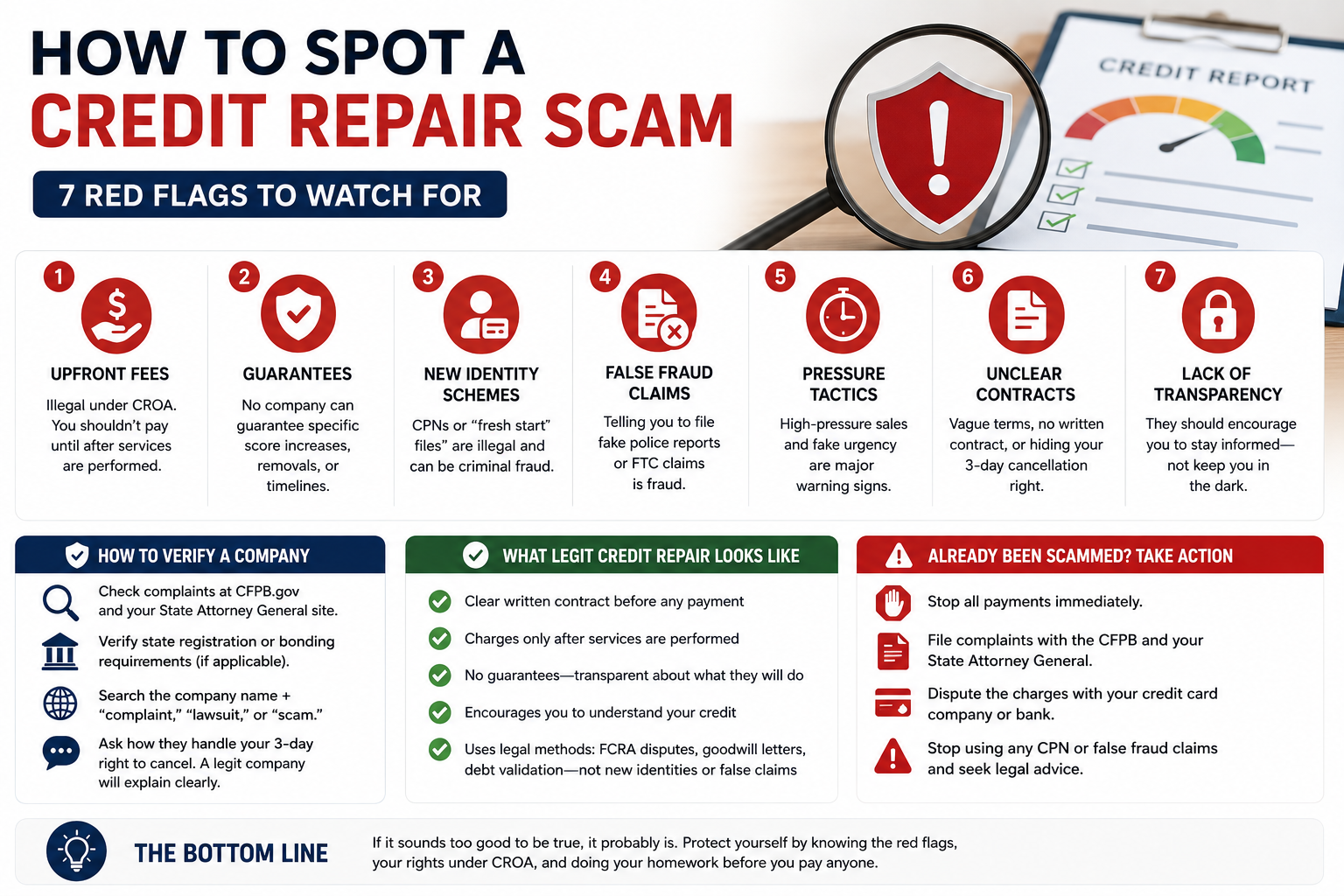
    The credit repair industry has a genuinely useful, legitimate side, but it also has a well-documented history of scams and predatory operators, largely because desperate financial circumstances make people more vulnerable to promises that sound too good to be true. The good news: the law actually gives you specific, checkable red flags to look for, since the Credit Repair Organizations Act (CROA) spells out exactly what legitimate companies are and aren’t allowed to do.

    Red Flag 1: Any Request for Payment Before Services Are Performed

    This is the single most important, legally clear-cut red flag. Under CROA, credit repair companies are **prohibited from charging any fee before they’ve actually performed the promised services**. This isn’t a best practice or a suggestion — it’s federal law.

    If a company asks for payment upfront, a “setup fee,” or any charge before disputes have actually been filed and results (or at least documented work) delivered, this is not just a red flag — it’s a company operating outside the law, regardless of how professional their marketing looks.

    Red Flag 2: Guarantees About Specific Results

    Any company promising a specific score increase (“we’ll raise your score by 100 points”), a guaranteed removal of specific negative items, or a guaranteed timeline for dramatic results is making a promise that’s both legally prohibited under CROA and practically impossible to honestly make — no legitimate company can guarantee the outcome of a dispute process that depends on the accuracy of your specific credit history and the response of individual furnishers, which are outside any company’s control.

    Red Flag 3: Advice to Create a New Credit Identity

    This is one of the more serious scams in the space, sometimes marketed as a “credit privacy number” (CPN) or a “fresh start” file. The pitch typically involves obtaining a new number (sometimes a real Employer Identification Number misused as if it were a personal identifier, sometimes an outright fabricated number) to use in place of your Social Security Number when applying for credit, effectively creating a synthetic new identity disconnected from your damaged credit history.

    This is not a legal loophole — it’s **file segregation fraud**, a federal crime. Using any number other than your actual SSN to apply for credit, misrepresenting your identity to obtain credit, is illegal, and you — not just the company selling you the scheme — bear serious legal risk, including potential fraud charges, if you use one of these numbers. Any company suggesting this, however it’s framed, should be treated as an immediate, serious red flag.

    Red Flag 4: Instructions to Dispute Accurate Information as Fraud

    A related scam pattern involves instructing you to file police reports or FTC identity theft reports for debts that are actually yours, specifically to trigger the more aggressive removal protections available for genuine identity theft victims. This is fraud — falsely claiming identity theft to remove accurate, legitimately-owed debt is illegal, and doing so exposes you to potential legal consequences, separate from whatever the company itself faces.

    Red Flag 5: Pressure Tactics and Urgency

    Legitimate credit repair, whether DIY or through a reputable company, is inherently a multi-month process — there’s no legitimate reason for high-pressure “sign today” tactics, artificial urgency, or claims that a special rate or opportunity will disappear if you don’t commit immediately. This kind of pressure is a sales tactic designed to prevent you from doing the due diligence (reading reviews, checking complaint history, understanding the contract) that would otherwise reveal problems.

    Red Flag 6: Vague or Unclear Contract Terms

    Under CROA, legitimate credit repair companies are required to provide you with a written contract that clearly discloses:
    – The specific services to be performed.
    – The total cost and payment schedule.
    – Your right to cancel within 3 business days without penalty.
    – A specific timeline for when services will be completed.

    If a company is vague about any of this, avoids putting terms in writing, or pressures you to sign without adequate time to review, that’s a serious warning sign, regardless of how legitimate other aspects of their pitch might seem.

    Red Flag 7: They Discourage You From Contacting Bureaus or Creditors Directly

    A legitimate company has no reason to discourage you from understanding or participating in your own dispute process — in fact, transparency about what’s being disputed and why is a hallmark of reputable operators. If a company is cagey about specifics, discourages you from checking your own credit report to verify their claimed progress, or asks you to route all communication exclusively through them without transparency, this warrants real skepticism.

    How to Verify a Company Before Signing Anything

    **Check their complaint history.** The CFPB’s public complaint database and your state Attorney General’s consumer complaint records are both searchable and free, and a pattern of unresolved complaints is a meaningful signal.

    **Check state registration requirements.** Many states require credit repair companies to register or post a bond before operating — verify this directly with your state’s regulatory body if such a requirement applies where you live.

    **Search the company name alongside terms like “complaint,” “lawsuit,” or “scam”** as a basic first-pass check, understanding that this isn’t foolproof (some complaints are unfounded, and some genuinely problematic companies have limited online complaint visibility) but is a reasonable starting point.

    **Ask specifically how they handle the CROA-mandated cancellation right** — a legitimate company should have no hesitation explaining your 3-day right to cancel without penalty; hesitation or vagueness here is itself informative.

    What Legitimate Credit Repair Actually Looks Like

    To be fair to the reputable side of the industry, legitimate credit repair companies:
    – Provide a clear written contract before any payment.
    – Charge only after services are actually performed, often on a monthly basis tied to ongoing work.
    – Make no guarantees about specific outcomes, while being transparent about what they will attempt and why.
    – Encourage you to understand your own credit report and stay informed throughout the process.
    – Operate within standard, legal dispute mechanisms — FCRA disputes, goodwill letters, legitimate debt validation and negotiation — nothing involving new identities or fraudulent claims.

    What to Do If You’ve Already Been Scammed

    If you’ve already paid a company that turned out to be operating illegally (charged upfront, made guarantees, or pushed a CPN scheme):

    1. **Stop any further payments immediately.**
    2. **File a complaint with the CFPB and your state Attorney General**, both of which take credit repair fraud seriously and have pursued enforcement actions against violators.
    3. **Dispute the charges with your credit card company or bank** if payment was made electronically, citing the fraudulent or illegal nature of the services.
    4. **If you were advised to use a CPN or file a false identity theft claim, stop using it immediately** and consult a consumer attorney about how to unwind any resulting complications, since continuing to use it compounds your own legal exposure.

    The Bottom Line

    The credit repair industry’s worst actors share a fairly consistent, checkable set of red flags: upfront payment demands, specific outcome guarantees, and — most seriously — any suggestion involving a new identity number or false fraud claims. CROA gives you real, enforceable legal protections against the first two, and the third category is simply illegal regardless of how it’s marketed. A few minutes of due diligence — checking complaint history, insisting on a clear written contract, and being appropriately skeptical of pressure and guarantees — filters out the vast majority of problematic operators before you ever hand over a payment.
  • What’s the Difference Between a FICO Score and a VantageScore?

    What’s the Difference Between a FICO Score and a VantageScore?

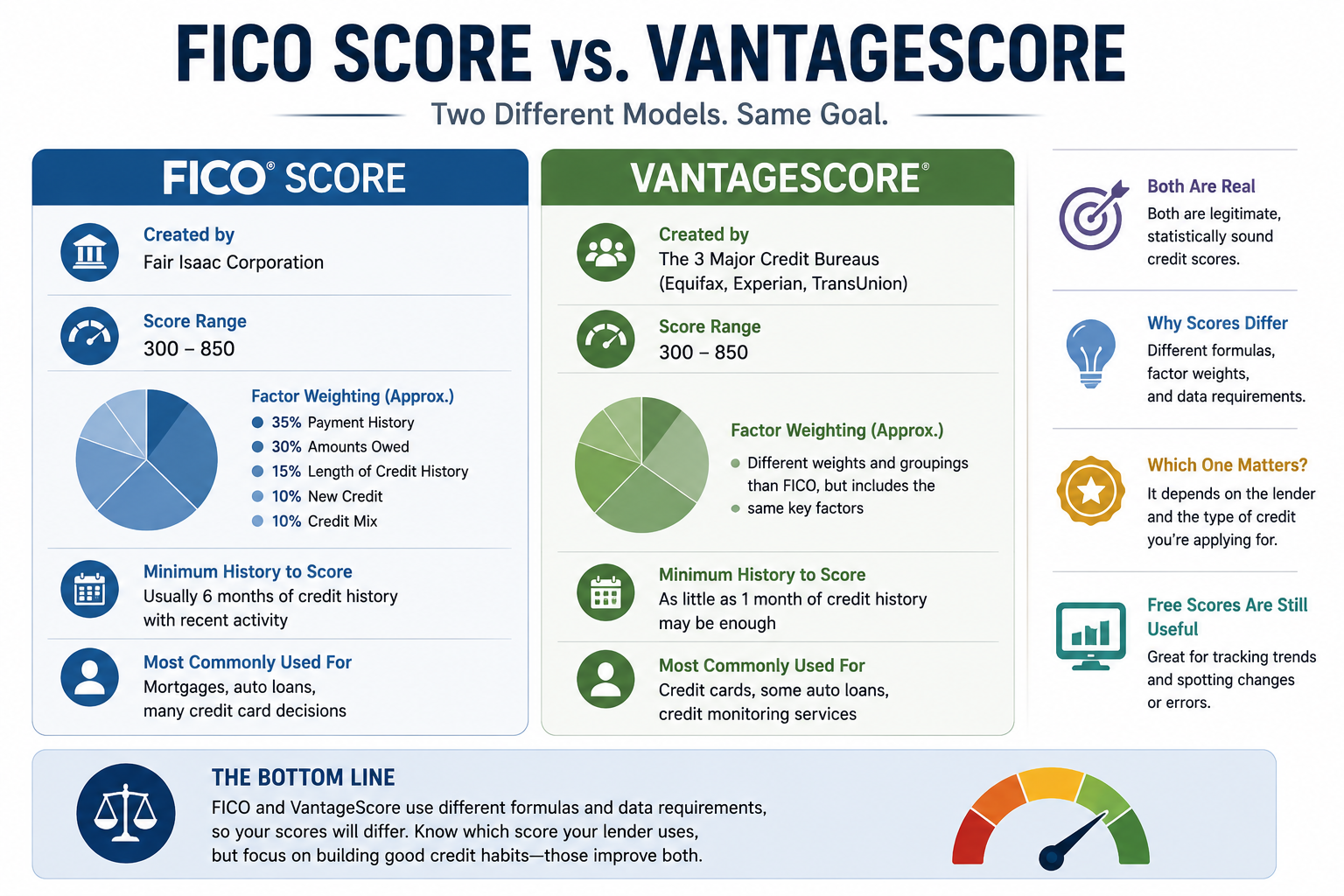
    If you’ve checked your credit score through a few different apps or websites and seen noticeably different numbers, there’s a good chance you’re actually looking at two different scoring systems entirely — FICO and VantageScore — not just different data. Understanding the difference matters because it affects which number you should actually trust for a given purpose.

    They’re Both Real, Legitimate Scores — Just Different Companies

    FICO (Fair Isaac Corporation) has been the dominant credit scoring company for decades and remains the score most lenders — especially mortgage lenders — actually use in underwriting decisions. VantageScore was developed later, jointly by the three major credit bureaus (Equifax, Experian, TransUnion), partly as a competing model and partly to standardize scoring across the bureaus in a way FICO’s various versions didn’t always achieve.

    Neither is “fake” or less legitimate than the other — they’re both statistically rigorous models built from real credit report data, but they weight factors somewhat differently and use different underlying formulas, which is why the same credit file can produce different scores under each system.

    Score Range: Actually the Same

    Both FICO and VantageScore use the same 300-850 range for their standard consumer-facing models, which is part of why the difference in actual numbers can be confusing — a 720 FICO and a 720 VantageScore aren’t necessarily reflecting the exact same underlying risk assessment, even though they’re expressed on the same scale.

    How the Factor Weighting Differs

    Both models consider similar broad categories — payment history, utilization, account age, credit mix, recent inquiries — but weight them somewhat differently:

    **FICO’s general weighting approach:**
    – Payment history: roughly 35%
    – Amounts owed (utilization): roughly 30%
    – Length of credit history: roughly 15%
    – New credit (inquiries): roughly 10%
    – Credit mix: roughly 10%

    **VantageScore’s approach** is influenced by similar categories but groups and weights them somewhat differently, and — notably — has historically been able to generate a score with a shorter credit history than FICO typically requires, which matters for people just starting to build credit.

    A Key Practical Difference: Minimum History Required

    – **FICO** generally requires at least 6 months of credit history and at least one account reported within the past 6 months to generate a score.
    – **VantageScore** (particularly newer versions) can sometimes generate a score with as little as 1 month of history and even from accounts with very limited activity, which is part of why VantageScore is sometimes considered more accessible for people with thinner credit files, including recent immigrants or young adults just starting out.

    If you’re brand new to credit and checking a free monitoring app that shows a VantageScore, but a lender pulls a FICO score during an actual application, don’t be surprised if there’s a meaningful gap — the FICO score might not even be calculable yet if your file is thin enough, or it might be notably different once it is.

    Which One Actually Matters for Getting Approved?

    This is the practical question most people actually care about, and the honest answer is: **it depends on the lender and the type of credit you’re applying for.**

    – **Mortgage lending** overwhelmingly still relies on specific older FICO versions (often FICO 2, 4, or 5, depending on the specific bureau), which is a notable quirk of the industry — many mortgage lenders use FICO score versions that are actually older than the versions most consumers see through free monitoring tools.
    – **Credit card issuers** use a mix, with many using newer FICO versions (FICO 8, FICO 9) or VantageScore versions, depending on the specific issuer’s underwriting practices.
    – **Auto lenders** often use industry-specific FICO Auto Score versions, which weight auto-loan-relevant factors (like past auto loan payment history) more heavily than a general-purpose score would.

    There’s no single universal answer — the specific lender and product determine which score version actually gets pulled and used in the decision.

    Why the Free Score You See Is Often Not What Actually Gets Used

    Most free credit monitoring services (through banks, credit card issuers, or independent apps) display either a VantageScore or a specific FICO version (commonly FICO 8), largely because these are the versions most readily available for consumer-facing distribution agreements. This is genuinely useful for tracking general trends in your credit health over time, but it’s worth understanding it may not be the exact score version a specific lender pulls when you actually apply for something like a mortgage.

    Does This Mean the Free Score You Check Is Useless?

    Not at all — it’s still calculated from real credit report data and reflects genuine trends in your credit health. If your free score is going up, that generally (though not perfectly) correlates with your actual creditworthiness improving across most scoring models, even if the exact number a specific lender sees differs. The free score is most useful for:

    – Tracking whether your overall credit health is trending in the right direction.
    – Catching potential errors or sudden unexpected changes worth investigating.
    – General financial literacy and awareness.

    It’s less useful for:
    – Predicting the exact number a mortgage underwriter will see.
    – Precisely calibrating whether you’ll qualify for a specific credit product’s advertised minimum score requirement, since that requirement may reference a different score version than the one you’re checking.

    How to Find Out Which Score a Specific Lender Uses

    If you’re preparing for a major application (particularly a mortgage), it’s worth directly asking the lender which score version and bureau they’ll be using, since this varies by lender and loan type, and some lenders are willing to share this detail upfront, which can help you understand what to expect rather than relying solely on your free monitoring app’s number.

    The Bottom Line

    FICO and VantageScore are both legitimate, statistically robust scoring systems, but they weight credit factors somewhat differently and have different minimum history requirements, which is why you can see genuinely different numbers depending on which one you’re checking. For general trend-tracking and financial awareness, whichever free score you have access to is useful; for a specific, high-stakes application like a mortgage, it’s worth understanding that the actual score pulled may be a different version entirely, often an older FICO variant most consumers never see directly through free monitoring tools.

  • How to Dispute an Error Directly With Equifax Online

    How to Dispute an Error Directly With Equifax Online

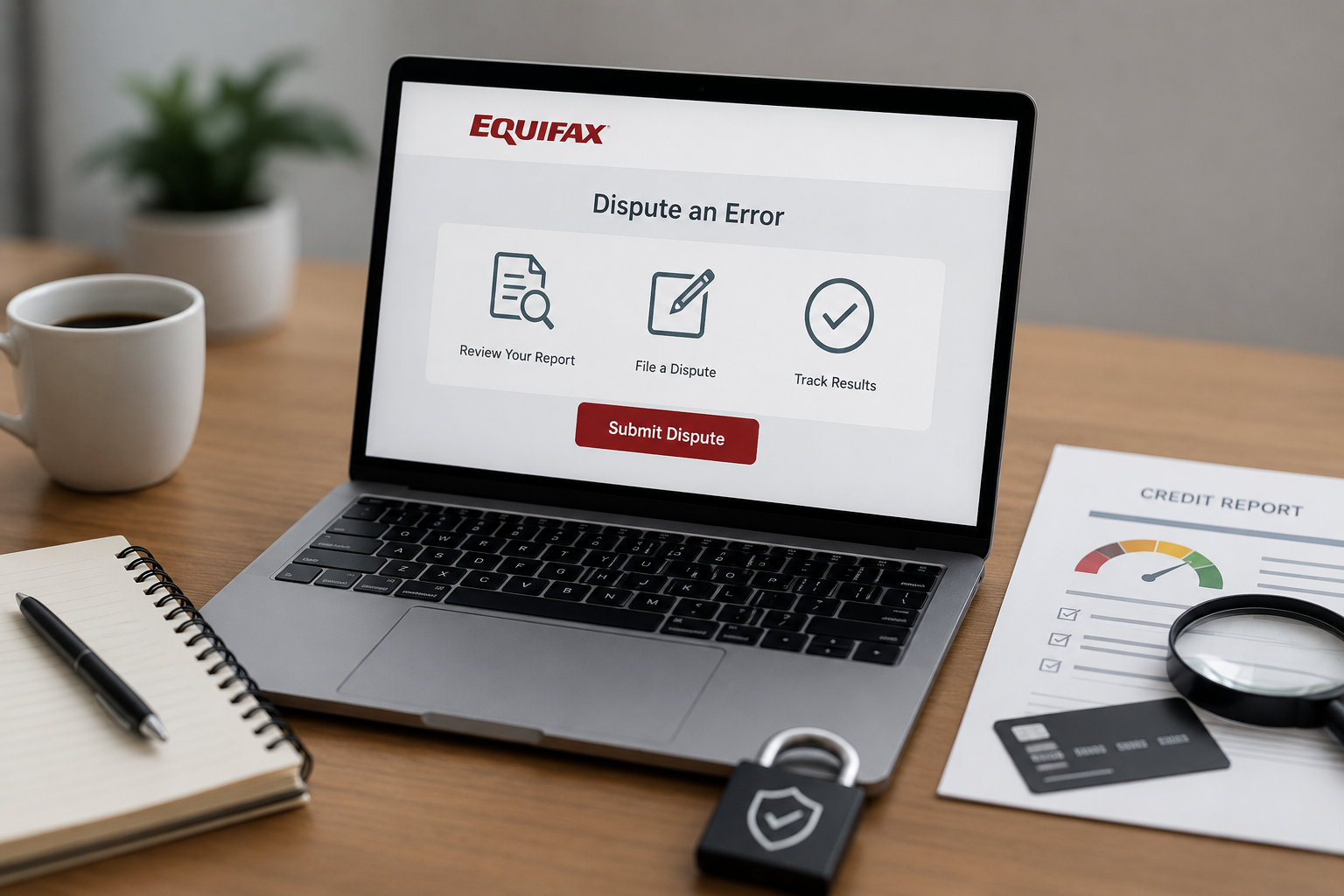
    Equifax’s online dispute process is generally the fastest way to initiate a correction, but it’s worth understanding both how to use it effectively and where its limitations are compared to a written dispute, since choosing the right approach for your specific situation matters more than defaulting to whichever feels most convenient.

    Before You Start: Get Your Actual Equifax Report

    Don’t file a dispute from memory or from a different bureau’s report — pull your specific Equifax report first, since the exact account details, dates, and language matter for a precise, effective dispute. You’re entitled to a free weekly report directly from Equifax through AnnualCreditReport.com, the federally mandated free access point for all three bureaus.

    Step 1: Create or Log Into Your Equifax Account

    Equifax’s dispute portal requires an account on their system (separate from the AnnualCreditReport.com access point). You’ll need to verify your identity, typically through personal information and sometimes knowledge-based verification questions (details about past addresses, loans, etc., drawn from your credit history).

    Step 2: Locate the Specific Item You’re Disputing

    Within your report or the dispute portal itself, identify the exact account or item you believe is inaccurate. Equifax’s online system will typically ask you to select the item from your report directly, rather than describing it freeform, which helps ensure the dispute is correctly matched to the right account in their system.

    Step 3: Select the Reason for Your Dispute

    Equifax’s online portal provides a set of standard dispute reason categories, such as:
    – Not my account
    – Account status incorrect
    – Balance incorrect
    – Account included in bankruptcy
    – Paid in full, not reflected
    – Duplicate account

    Choose the category that most precisely matches your actual issue. If your situation doesn’t fit neatly into a standard category, there’s usually a free-text field to add specific detail — use this to be as precise as possible rather than relying solely on the category selection.

    Step 4: Add Supporting Detail and Documentation

    This is the step most people rush through, and it’s the one that actually determines whether your dispute gets a thorough investigation or a cursory one. Where the portal allows uploads:

    – **Attach relevant documentation** — bank statements, payment confirmations, correspondence with the creditor, anything that substantiates your specific claim.
    – **Use the free-text explanation field thoroughly**, even if it feels redundant with the category you selected. A specific, factual explanation (“This account was paid in full on Sat, 05 Sep 2026 17:18:19 +0000, as shown in the attached confirmation, but continues to show a balance of $X”) gives the automated matching system and any human reviewer much more to work with than the category selection alone.

    Step 5: Submit and Save Confirmation

    Once submitted, save or screenshot your confirmation number and the date of submission — this matters if you need to follow up or escalate later, since it establishes exactly when your 30-day investigation window began.

    What Happens After You Submit

    Equifax is required under FCRA to investigate within 30 days (45 if you submit additional information during the process). Behind the scenes, this typically involves:

    – Equifax electronically forwarding your dispute details to the furnisher (the original creditor or collection agency) through a system called e-OSCAR, which is the industry-standard electronic dispute processing system used across all three major bureaus.
    – The furnisher reviewing their own records and responding with either confirmation of accuracy, a correction, or (if they don’t respond within the window) a default removal.

    The Known Limitation of the Online/e-OSCAR Process

    It’s worth understanding this candidly: the e-OSCAR system, while efficient, has been criticized for sometimes resulting in fairly cursory furnisher reviews — since the system often transmits a compressed summary of your dispute (sometimes just a short code corresponding to your selected reason) rather than your full detailed explanation and documentation. This is part of why a formal written dispute letter, sent by mail with full documentation attached, sometimes results in a more thorough investigation than the online portal alone, particularly for complex or contested disputes.

    When to Use the Online Portal vs. a Written Letter

    **Online portal works well for:**
    – Straightforward, clearly-categorized errors (duplicate accounts, simple date/balance corrections).
    – Situations where you want a fast, low-effort first attempt.
    – Simple items where extensive documentation isn’t critical to proving your case.

    **A written, mailed dispute letter is often better for:**
    – Complex disputes requiring detailed explanation and multiple supporting documents.
    – Situations where a previous online dispute was resolved unfavorably (“verified as accurate”) despite your evidence, and you want to escalate with a more thorough submission.
    – Disputes where you want a clear paper trail, particularly if you anticipate needing to escalate to a CFPB complaint later.

    Checking the Status of an Online Dispute

    Equifax’s online portal typically allows you to check dispute status using your confirmation number, showing whether it’s still under investigation, resolved, or requires additional information from you. Check this periodically rather than waiting passively for the full 30 days, in case they’ve requested additional documentation that could otherwise cause the process to stall.

    What to Do If the Online Dispute Comes Back Unfavorable

    If Equifax responds that the item has been “verified as accurate” despite your evidence:

    1. **Request the specific method of verification** — under FCRA, you’re entitled to know how the investigation was conducted, and a vague or inadequate response here can support further escalation.
    2. **File a more detailed written dispute**, directly by mail, including all your original documentation plus anything additional, specifically noting that a prior online dispute was resolved without adequate investigation.
    3. **Dispute directly with the furnisher** as well, since they have an independent obligation to investigate under FCRA Section 623, separate from the bureau-routed dispute.
    4. **File a CFPB complaint** if you’ve exhausted the standard dispute process without a satisfactory resolution — this requires a company response and often results in a more serious review than the standard consumer dispute channel.

    A Note on Equifax-Specific Considerations

    Equifax has, in the past, had notable data security incidents, which is worth mentioning not to alarm you but because it’s part of why many consumers specifically monitor their Equifax file closely and consider a credit freeze if they’re not actively applying for credit — freezing restricts access to your report (including for identity thieves attempting to open new accounts) without affecting your existing accounts or your ability to unfreeze temporarily when you do need to apply for something.

    The Bottom Line

    Equifax’s online dispute portal is a reasonably fast, accessible starting point for correcting errors, especially straightforward ones, but the underlying e-OSCAR transmission process means your dispute sometimes reaches the furnisher in a more compressed form than your actual detailed explanation. For complex or high-stakes disputes, or as an escalation after an unsatisfactory online result, a thorough written dispute by mail — with full documentation attached — tends to produce a more genuinely substantive investigation.

  • Why Is My Experian Score Different From My TransUnion Score?

    Why Is My Experian Score Different From My TransUnion Score?

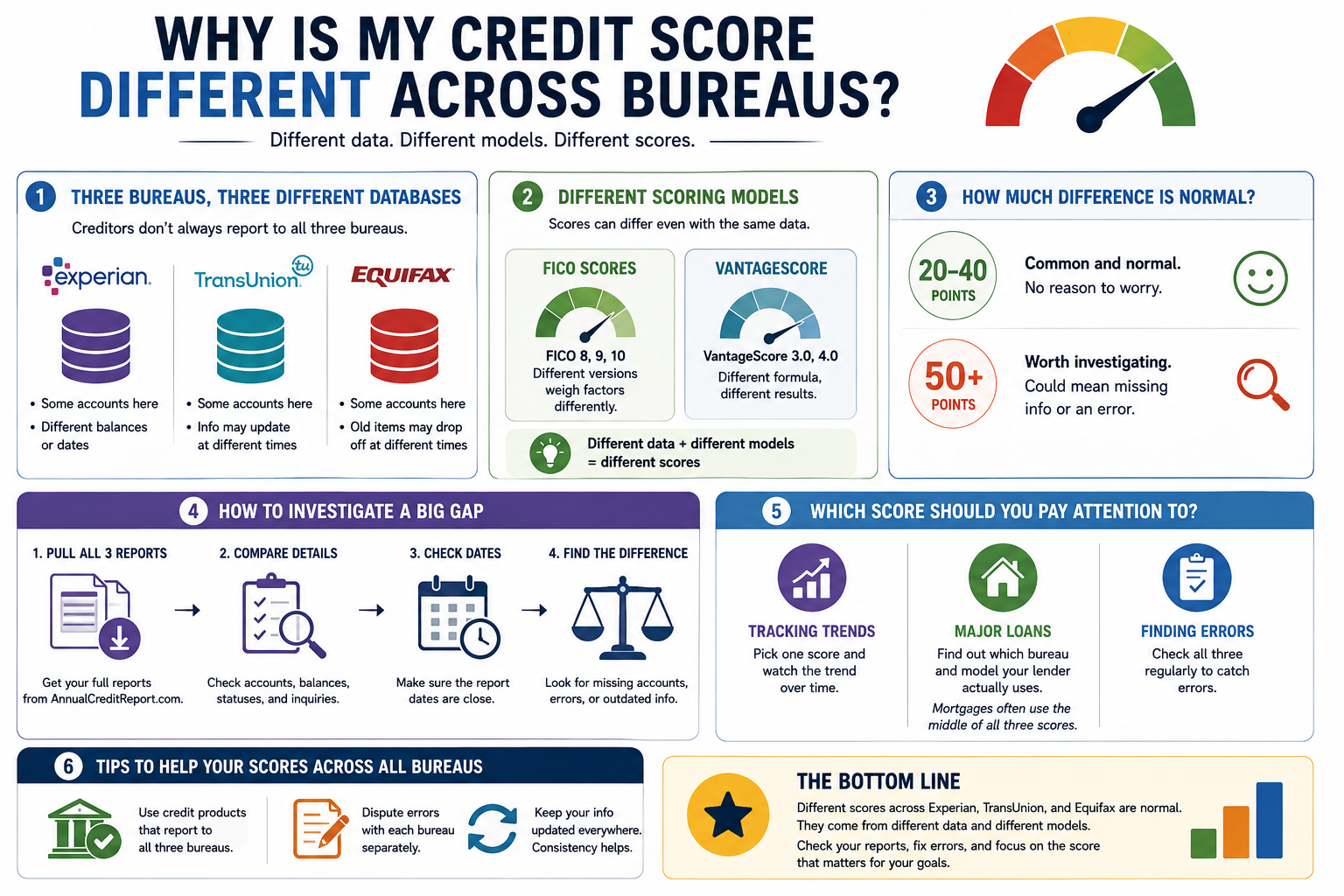
    This is one of the most common sources of confusion in personal credit management — you check your score through two different apps or services, and the numbers don’t match, sometimes by a significant margin. This isn’t an error on anyone’s part; it’s actually an expected, structural feature of how the credit system works. Here’s why it happens and what it means practically.

    The Three Bureaus Don’t Share a Single Database

    Equifax, Experian, and TransUnion are three separate, independently operating companies, each maintaining its own database of your credit history. When a lender or creditor reports account information, they don’t necessarily report to all three bureaus — many report to two, and some smaller or regional creditors report to only one.

    This means the underlying data each bureau has about you can genuinely differ:

    – **A specific account might appear on your Experian report but not your TransUnion report**, if that creditor only reports to Experian.
    – **The exact reporting date or balance snapshot might differ slightly** between bureaus, since creditors don’t always report to each bureau on the exact same schedule.
    – **Older accounts or inquiries might have aged off one bureau’s report before another’s**, if there’s any variance in when each bureau processed the removal.

    Since your score is calculated based on the specific data each bureau holds, different underlying data naturally produces different scores, even when using the exact same scoring formula.

    Different Scoring Models Compound the Difference

    On top of differing underlying data, the score you’re actually shown often comes from different scoring model versions depending on the app or service you’re using:

    – **FICO has many versions** (FICO 8, FICO 9, FICO 10, industry-specific versions for auto and mortgage lending), and different services and lenders use different versions.
    – **VantageScore also has multiple versions** (3.0, 4.0), which weight factors somewhat differently than FICO models and differently from each other.
    – **A free credit monitoring app might show you a VantageScore**, while the mortgage lender you eventually apply with might pull a specific FICO version — these can differ by dozens of points even when calculated from the identical underlying data, simply because the formulas themselves weight factors differently.

    This means the difference you’re seeing between your “Experian score” and your “TransUnion score” might actually be a combination of two separate factors: different underlying data between the bureaus, AND different scoring models used by whatever service is showing you each number.

    How Much of a Difference Is Normal?

    There’s no fixed “normal” range, but differences of **20-40 points** between bureaus are common and not a cause for concern on their own. Larger differences (50+ points) are worth investigating, since they may indicate:

    – A significant account or negative item appearing on one bureau’s report but not another’s.
    – An error specific to one bureau that isn’t reflected on the others.
    – A meaningful gap in reporting timing (e.g., a recent payment reflected on one bureau but not yet processed by another).

    How to Actually Investigate a Larger-Than-Expected Gap

    1. **Pull your full report from all three bureaus** (free weekly at AnnualCreditReport.com), not just the summary score.
    2. **Compare account by account**, checking specifically for:
    – Accounts present on one report but missing from another.
    – Different reported balances or utilization for the same account across bureaus.
    – Different account statuses (one bureau showing “current,” another showing something else) for the same account.
    3. **Check the report dates** — if one report is meaningfully older than another, some of the apparent difference may simply be timing, not an actual discrepancy.

    Which Score Should You Actually Pay Attention To?

    This depends entirely on what you’re using it for:

    – **If you’re monitoring general trends** (is my score generally moving up or down over time), consistency matters more than which specific bureau or model you’re tracking — pick one and watch its trend, rather than comparing absolute numbers across different sources.
    – **If you’re preparing for a specific major application** (mortgage, auto loan), it’s worth finding out which bureau and scoring model version your target lender actually uses, since that’s the number that matters for that specific decision — mortgage lenders, for instance, often pull all three bureaus and use the middle score of the three, a common industry practice.
    – **If you’re trying to catch errors**, checking all three regularly matters more than focusing on one, since an error might exist on only one bureau’s file.

    Does It Matter Which Bureau a Lender Pulls?

    Yes, potentially significantly, if your accounts and history genuinely differ between bureaus. This is part of why it’s worth checking and correcting errors across all three, not just whichever one you happen to check most often — a lender pulling the one bureau where an error hasn’t yet been corrected will see the inaccurate, lower score, even if your other two bureau files are clean.

    Should You Try to “Even Out” Your Scores Across Bureaus?

    Not directly — there’s no legitimate mechanism to force your scores to match across bureaus, since the underlying cause (different data, different models) is structural, not something you manipulate directly. What you can and should do:

    – **Ensure accounts you want reflected everywhere are actually reporting to all three bureaus** — if you’re using a specific credit-building product, confirm it reports to all three, not just one or two, precisely to avoid a scenario where your positive history only helps one of your three files.
    – **Correct any errors on each bureau independently**, since a dispute filed with one bureau does not automatically correct the same error on the others — you generally need to dispute separately with each bureau where the error appears.

    The Bottom Line

    Different scores across Experian, TransUnion, and Equifax are expected and normal, driven by each bureau maintaining an independently reported, sometimes genuinely different set of underlying data, compounded further if you’re comparing scores calculated using different scoring model versions. Differences in the 20-40 point range are unremarkable; larger gaps are worth investigating by comparing your full reports account-by-account across all three bureaus, since a significant discrepancy often points to a real, correctable difference in what each bureau actually has on file for you.

  • Can You Remove a Hard Inquiry You Never Authorized?

    Can You Remove a Hard Inquiry You Never Authorized?

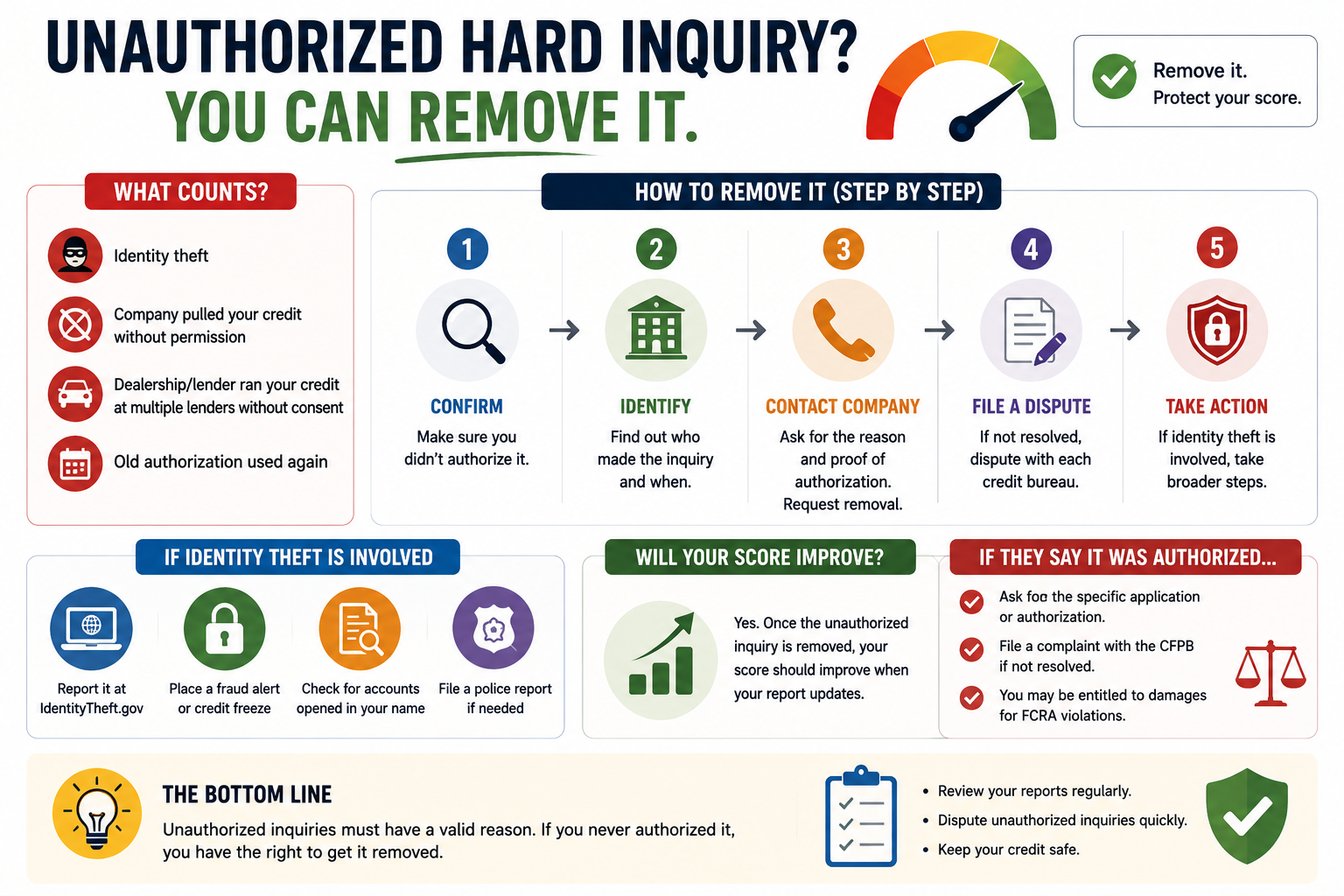
    Yes — and this is one of the more clear-cut, successfully disputable issues in credit reporting, precisely because an unauthorized inquiry is, by definition, not something you consented to, which makes it a genuine FCRA violation rather than a judgment call about accuracy. Here’s exactly how to identify and remove one.

    What Counts as an “Unauthorized” Inquiry

    Under the Fair Credit Reporting Act, a hard inquiry is only permitted when there’s a legitimate “permissible purpose” — generally, that you applied for credit, or a company has an existing account relationship with you that allows periodic review. Unauthorized inquiries typically fall into a few categories:

    – **Identity theft** — someone applied for credit fraudulently using your information.
    – **A company pulling your credit without your application** — sometimes due to error, sometimes due to a company mistakenly treating a soft inquiry-eligible action (like a pre-approval check) as a hard pull.
    – **A dealership or lender running your credit at multiple different lenders without your explicit authorization** for each — common in car dealership financing, where “shotgunning” your application to multiple lenders sometimes happens without clear, itemized consent for each pull.
    – **An old authorization being used again later** — for example, a gym membership or service provider running a credit check for a purpose you didn’t authorize at the time.

    Step 1: Confirm You Genuinely Didn’t Authorize It

    Before disputing, take a moment to genuinely rule out an authorized inquiry you may have simply forgotten about — a store credit card application at checkout, a “check if you’re pre-qualified” tool that actually resulted in a hard pull rather than a soft one (some tools aren’t as clearly labeled as they should be), or an application you made a while back that’s easy to forget. Disputing an inquiry you did authorize, even by mistake, wastes time and doesn’t help your credibility for genuinely unauthorized items.

    ## Step 2: Identify Exactly Who Made the Inquiry

    Your credit report will show the name of the company that pulled your credit and the date. If the name is unfamiliar or unclear (sometimes inquiries show under a financing partner’s name rather than the retailer you actually interacted with), a quick search of the company name alongside “credit inquiry” often clarifies who they are and what kind of transaction typically triggers their pull — this can help you determine whether it’s likely a legitimate inquiry you’ve simply forgotten, or a genuine unauthorized pull.

    Step 3: Contact the Company Directly First

    Before going straight to a formal dispute, it’s often faster to contact the company listed as making the inquiry and ask them to explain the permissible purpose for the pull. Ask specifically:

    – What date did you authorize this inquiry, and through what application or transaction?
    – Can you provide documentation of my authorization?

    If they can’t produce a legitimate basis, ask them to submit a request to the credit bureaus to remove the inquiry — many companies will do this directly once they realize it was made in error or without proper authorization, since they have their own compliance interest in not making improper pulls.

    Step 4: File a Formal Dispute With the Credit Bureau

    If the company doesn’t respond or doesn’t resolve it, file a dispute directly with each bureau reporting the unauthorized inquiry:

    – Identify the specific inquiry (company name, date).
    – State clearly that you did not authorize this inquiry and have no relationship or application history that would explain it.
    – Request removal based on the lack of permissible purpose under FCRA.

    Step 5: If Identity Theft Is Involved, Take Broader Action

    If the unauthorized inquiry is tied to identity theft (someone applied for credit using your information without your knowledge), this requires a broader response beyond just disputing the inquiry:

    – **File a report at IdentityTheft.gov**, the FTC’s dedicated resource, which generates an official identity theft report and a personalized recovery plan.
    – **Place a fraud alert or credit freeze** with all three bureaus to prevent further unauthorized inquiries or account openings while you sort out the situation.
    – **Check for any accounts that may have actually been opened**, not just inquiries — an unauthorized inquiry sometimes indicates a fraudulent application that was denied, but it’s worth confirming nothing was actually opened in your name as a result.
    – **File a police report** if a fraudulent account was actually opened, which is often required documentation for disputing the resulting account with creditors and bureaus.

    Does an Unauthorized Inquiry’s Removal Restore Lost Points Automatically?

    Generally, yes — since the removal corrects the underlying data your score was calculated from, your score should reflect the correction once the inquiry is removed and your file is recalculated, typically within the normal processing timeline following a successful dispute.

    What If the Company Insists the Inquiry Was Authorized, But You Disagree?

    This is where it becomes your word against theirs, and documentation matters:

    – **Request the specific application or authorization they’re relying on** — a legitimate company should be able to produce this if the inquiry was genuinely authorized.
    – **If they can’t produce documentation and continue to insist it was authorized**, escalate to a CFPB complaint, which requires a company response and often results in more serious attention than a standard dispute.
    – **If significant financial harm resulted** (a loan denial specifically due to a fraudulent or improper inquiry, for example), this may be worth discussing with a consumer protection attorney, since FCRA violations can carry statutory damages in some cases.

    Common Scenarios Worth Special Attention

    **Car dealership “shotgunning.”** If you applied for financing at a dealership and multiple, seemingly unrelated lenders show inquiries you don’t recognize, this sometimes happens when a dealership submits your application to several lenders simultaneously without clearly disclosing that each would result in a separate hard pull. While dealerships often have some legitimate basis for shopping your application (and mortgage/auto rate-shopping deduplication windows may limit the scoring damage, as covered in our hard inquiry point-impact guide), a genuinely excessive or undisclosed number of pulls is worth questioning directly with the dealership.

    **”Pre-qualification” tools that turn into hard pulls.** Legitimate pre-qualification tools use soft inquiries specifically so you can check your odds without any score impact. If a tool marketed as “check your rate, no impact to your credit” results in a hard inquiry anyway, this is worth disputing both with the company directly (as a potential violation of their own stated terms) and, if unresolved, with the bureau.

    The Bottom Line

    An inquiry you never authorized is one of the more straightforward, successfully disputable credit report issues, precisely because FCRA requires a permissible purpose for any hard pull, and “you didn’t consent” is about as clear a lack of permissible purpose as exists. Confirm you genuinely don’t recognize the inquiry, contact the company directly first, escalate to a formal bureau dispute if needed, and if it’s tied to identity theft, treat it as part of a broader identity theft response rather than an isolated inquiry issue.

  • How Many Points Does a Hard Inquiry Actually Cost You?

    How Many Points Does a Hard Inquiry Actually Cost You?

    Hard inquiries get a reputation for being scarier than they actually are, largely because the exact number people fixate on — “how many points” — is more variable and generally smaller than most assume. Here’s a precise breakdown of what actually happens when a hard inquiry hits your report, and how to think about it realistically.

    Hard Inquiry vs. Soft Inquiry: A Quick Distinction

    Before getting into the point impact, it’s worth confirming which type of inquiry you’re dealing with, since only one of these matters for scoring:

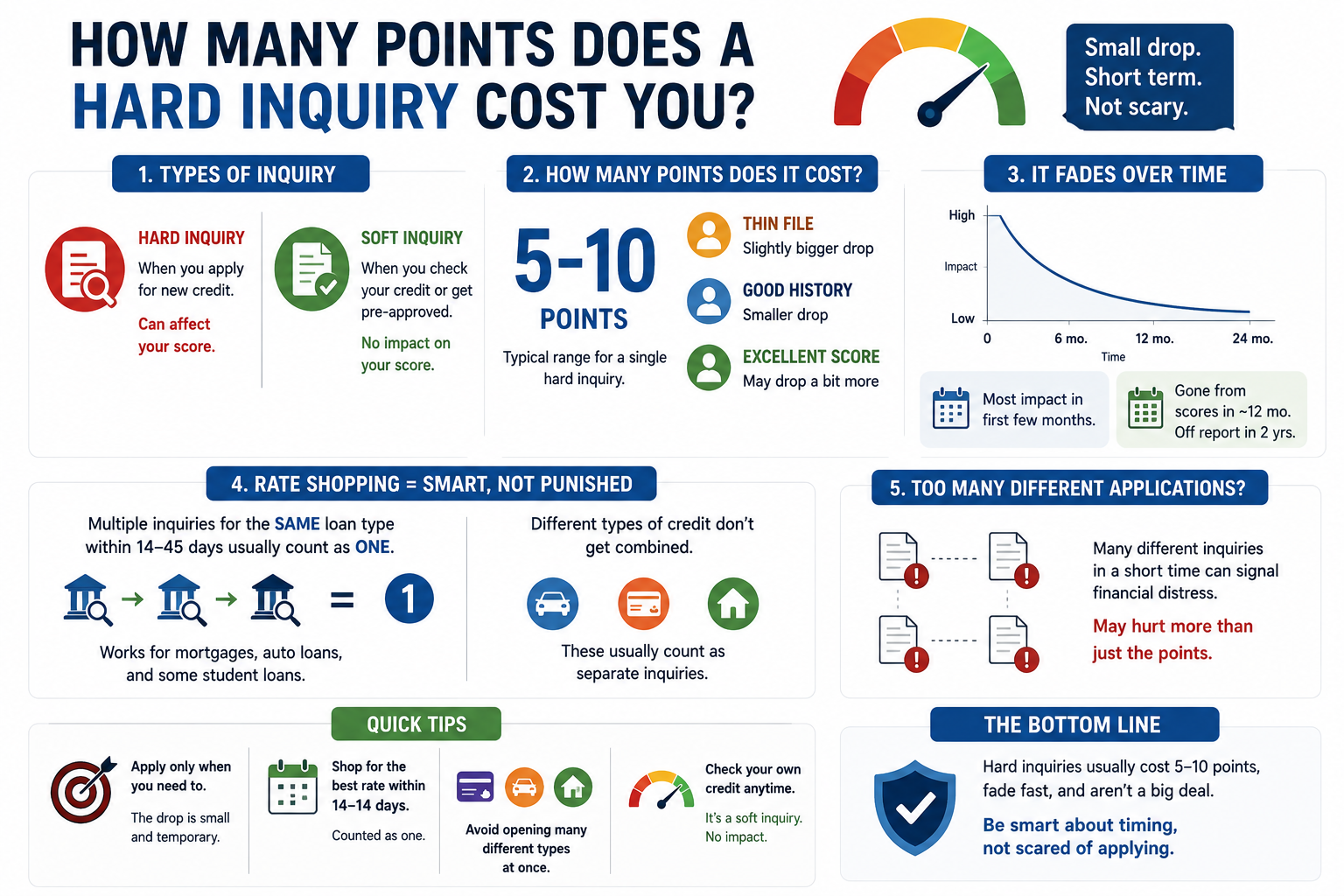
    – **Hard inquiries** occur when you apply for new credit and a lender checks your report as part of an actual lending decision — a credit card application, an auto loan, a mortgage application. These are the type that can affect your score.
    – **Soft inquiries** occur when you check your own credit, when a company does a promotional/preliminary check without a full application, or during background checks unrelated to lending. These never affect your score, regardless of how many occur.

    If you’re not sure which type you’re seeing on your report, it’s usually labeled directly, but generally: anything you didn’t specifically apply for as a credit product is a soft inquiry.

    The Typical Point Range

    For most people, a single hard inquiry results in a score decrease of **roughly 5-10 points**, though this varies based on your overall credit profile:

    – **People with a thin credit file or a shorter credit history** tend to see a slightly larger relative impact, since a new inquiry represents a proportionally bigger change to a smaller data set.
    – **People with an established, lengthy credit history and many existing accounts** tend to see a smaller relative impact, since one more inquiry is a smaller change relative to everything else already reflected in their file.
    – **People with an already excellent score** sometimes see a slightly larger point drop than someone with an average score, simply because there’s more room to fall from a very high starting point, even though the underlying risk signal is the same.

    Importantly: this is a general range, not a fixed universal number — no scoring model publishes an exact, guaranteed point deduction, and the actual impact is calculated as part of a complex overall model, not a simple flat subtraction.

    Read More: How Much Does Credit Repair Cost

    How Long Does a Hard Inquiry Affect Your Score?

    This is arguably more important than the initial point drop:

    – Hard inquiries remain on your credit report for **2 years**.
    – However, their actual **scoring impact fades much faster** than that — most inquiries stop meaningfully affecting your score after about **12 months**, and the effect is typically strongest in the first few months, diminishing steadily after that.

    This means a hard inquiry from 18 months ago is likely still visible on your report but probably has little to no remaining effect on your actual score, even though it hasn’t yet reached its full 2-year removal date.

    Why Multiple Inquiries Don’t Always Multiply the Damage

    This is one of the more useful, lesser-known nuances in credit scoring: most modern scoring models include **rate shopping windows**, which recognize that consumers shopping for the best rate on a single loan (particularly mortgages, auto loans, and sometimes student loans) shouldn’t be penalized as if they applied for many separate, unrelated lines of credit.

    – Multiple inquiries for the **same type of loan within a defined window** (typically 14-45 days, depending on the specific scoring model) are often treated as a **single inquiry** for scoring purposes.
    – This window is specifically designed to let you shop around for the best mortgage or auto loan rate without accumulating multiple separate inquiry penalties.

    Important caveat: this deduplication generally applies to **similar loan types** (multiple mortgage applications, or multiple auto loan applications) shopped within the window — it typically does **not** apply to a mix of different credit types (a credit card application plus a mortgage application plus a personal loan application), which would generally still count as separate inquiries.

    Do All Scoring Models Treat Inquiries the Same Way?

    No, and this is worth understanding if you’re tracking a specific score:

    – **FICO models** generally have more generous rate-shopping windows and clearer inquiry deduplication logic.
    – **VantageScore models** also account for rate shopping, though the specific window and treatment can differ somewhat from FICO’s approach.
    – **Industry-specific scores** (auto-enhanced, mortgage-specific versions) sometimes weight inquiries differently than the general-purpose base scores.

    If you’re specifically preparing for a mortgage or auto loan application, it’s worth checking which score version the relevant lenders typically use, since the practical inquiry impact can vary.

    Does Checking Your Own Credit Count as a Hard Inquiry?

    No checking your own credit report or score, whether through a free service, your bank’s app, or AnnualCreditReport.com, is always a soft inquiry and has no effect on your score, regardless of how frequently you check. This is worth knowing because it removes any reason to avoid monitoring your own credit out of fear it will hurt your score — it won’t.

    When Multiple Different-Type Inquiries in a Short Period Actually Matter More

    Beyond the direct point impact, a cluster of hard inquiries across different credit types in a short window can itself be interpreted by some scoring models and manual underwriters as a signal of financial distress or a sudden need for credit sometimes referred to as “credit-seeking behavior.” This can compound the individual point impacts into a somewhat larger overall effect than the sum of the individual inquiries might suggest in isolation, particularly if it coincides with other risk signals on your file.

    Practical Takeaways

    • Don’t avoid a necessary credit application out of excessive fear of a hard inquiry the typical 5-10 point impact is real but modest, and it fades within about a year.
    • Do consolidate rate-shopping into a tight window** (ideally within 14 days to be safe across different scoring models) when shopping for a mortgage or auto loan, to take advantage of deduplication treatment.
    • Avoid applying for multiple different types of credit in a short period** if you’re actively trying to optimize your score for an upcoming major application, since this is where the cumulative effect (and the “credit-seeking” signal) is most likely to add up.
    • Don’t worry about checking your own credit  this never counts as a hard inquiry regardless of frequency.

    The Bottom Line

    A single hard inquiry typically costs somewhere in the range of 5-10 points, with the effect fading substantially within about a year and disappearing from your report entirely after two years — a real but generally modest and temporary impact, not something that should meaningfully deter a genuinely necessary credit application. The more important nuance is understanding rate-shopping deduplication windows if you’re comparing loan offers, and being mindful of clustering different types of credit applications together in a short period if you’re specifically trying to optimize your score ahead of a major application.

  • Does Closing a Credit Card Hurt Your Credit Score?

    Does Closing a Credit Card Hurt Your Credit Score?

    This is one of the more nuanced questions in credit scoring, because the honest answer is “it depends,” and the factors it depends on aren’t always intuitive. Closing a card can hurt your score, help it, or do essentially nothing, depending on your specific credit profile at the time. Here’s how to actually think through the decision for your situation.

    The Two Main Mechanisms at Play

    Closing a credit card can affect your score through two primary channels:

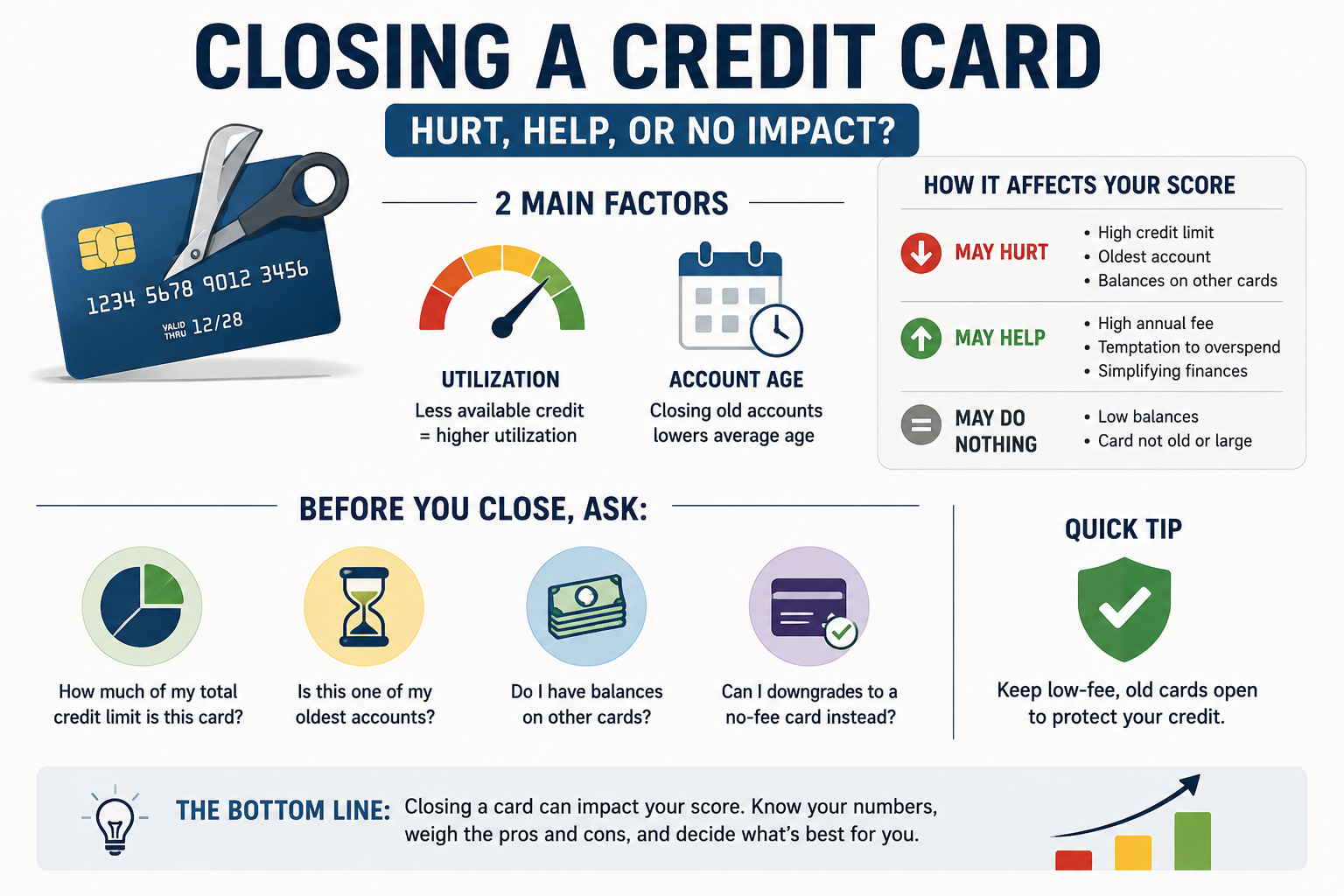
    1. **Credit utilization** — closing a card reduces your total available credit, which, if you carry balances on other cards, can increase your overall utilization ratio even if your spending hasn’t changed at all.
    2. **Average account age** — closing your oldest card can eventually reduce your average account age, since closed accounts (after a period of time) either stop being factored in, or are weighted differently than open accounts, depending on the specific scoring model.

    Understanding which of these applies most to your situation determines how much closing a specific card will actually matter.

    Why Utilization Is Usually the Bigger Immediate Factor

    Here’s a concrete example: say you have three cards with a combined $15,000 in available credit, and you’re carrying a combined $3,000 in balances — a 20% overall utilization ratio, generally considered healthy. If you close a card with a $5,000 limit (even if that specific card has a zero balance), your available credit drops to $10,000, and your same $3,000 in balances now represents 30% utilization — a real, measurable increase, purely from closing an unused card.

    This is why financial advice commonly recommends **not closing unused cards**, especially ones with no annual fee — keeping them open, even unused, preserves your available credit and keeps utilization lower than it would be otherwise.

    When Closing a Card Doesn’t Meaningfully Affect Utilization

    If you have very low balances relative to your total available credit across all your cards, closing one card — even a decent-sized one — may not push your utilization into a meaningfully different range. If your utilization was already comfortably low (say, under 10%) and remains comfortably low after closing a card, the utilization impact may be negligible.

    Why Account Age Matters, But More Gradually

    Closed accounts in good standing generally continue to count toward your average account age for a period of time (this varies by scoring model, but often around 10 years for positive-history closed accounts), which means closing a card doesn’t erase its age contribution immediately. The effect, if any, tends to show up more gradually, and mainly matters if:

    – The card you’re closing is one of your **oldest** accounts, and
    – You don’t have other equally old accounts to offset the eventual loss of that account’s age contribution once it does stop being counted.

    If you’re closing a relatively new card, or you have several other well-aged accounts, the account age impact is typically minimal.

    Scenarios Where Closing a Card Actively Helps

    Yes, this happens too, and it’s worth understanding:

    – **If a card has a high annual fee you no longer find worthwhile**, and you have other cards to preserve your overall available credit and account age, closing it is a purely financial decision that likely has minimal credit impact, especially if it’s not your oldest or largest-limit card.
    – **If keeping a card open creates a real risk of overspending or missed payments** (a genuine, practical concern for some people), the modest potential utilization impact of closing it may be worth accepting in exchange for reduced temptation or account management complexity.
    – **If you’re actively trying to simplify your finances** and the marginal utilization/age impact of closing a specific card is small given your overall profile.

    Scenarios Where Closing a Card Is More Likely to Hurt

    – **Closing your card with the highest credit limit**, since this has the largest proportional impact on your total available credit and therefore your utilization ratio.
    – **Closing your oldest account**, especially if you don’t have other long-standing accounts to maintain your average account age.
    – **Closing a card while carrying balances on other cards**, which directly and immediately worsens your utilization ratio.
    – **Closing multiple cards in a short period**, compounding both the utilization and account age effects simultaneously.

    What About Closing a Card With an Annual Fee You No Longer Want to Pay?

    This is one of the most common real-world reasons for wanting to close a card, and it’s worth approaching thoughtfully:

    1. **Check if the issuer offers a downgrade to a no-annual-fee version of the same card**, which preserves the account (and its age/history) while eliminating the fee — often a better option than closing outright, if available.
    2. **If no downgrade option exists and you’re set on closing it**, consider the utilization and age impact using the framework above before proceeding.
    3. **If you do close it, consider paying down balances on other cards first**, so the credit line reduction doesn’t collide with high balances elsewhere to spike your utilization.

    Does It Matter Who Closes the Account — You or the Issuer?

    The credit impact is generally similar regardless of who initiates the closure, though there’s an important distinction in how it’s *labeled* on your report: an account closed by you (“closed by consumer”) generally reads more favorably to anyone reviewing your report manually than one closed by the issuer, which can sometimes indicate the issuer initiated the closure due to inactivity or risk factors on their end. If you’re going to close a card anyway, doing so proactively (rather than letting an issuer close it for inactivity) is generally the better-looking outcome, even though the underlying score mechanics are similar.

    A Practical Framework Before Closing Any Card

    Before closing a credit card, ask:

    1. **What percentage of my total available credit does this card represent?** A higher percentage means a bigger utilization impact if closed.
    2. **Is this one of my oldest accounts?** If so, factor in the eventual account age impact, even though it’s typically more gradual than the utilization effect.
    3. **Do I currently carry balances on other cards?** If yes, closing any card will worsen your utilization more than if all your other cards are at zero or low balances.
    4. **Is there a fee-free alternative (downgrade) available** that preserves the account without the cost you’re trying to avoid?

    The Bottom Line

    Closing a credit card can hurt your score, mainly through reduced available credit worsening your utilization ratio, and more gradually through reduced average account age if it’s one of your older accounts — but the actual impact varies significantly based on your specific credit profile, particularly how much of your total available credit that card represents and whether you carry balances elsewhere. For cards with no ongoing cost, keeping them open (even unused) is usually the lower-risk default; for cards with a fee you want to eliminate, check for a downgrade option first, and if closing is still the right call, do it with an understanding of the utilization and age tradeoffs involved rather than assuming it’s automatically either harmless or harmful.

  • How to Dispute Credit Report Errors Without Hurting Your Score

    How to Dispute Credit Report Errors Without Hurting Your Score

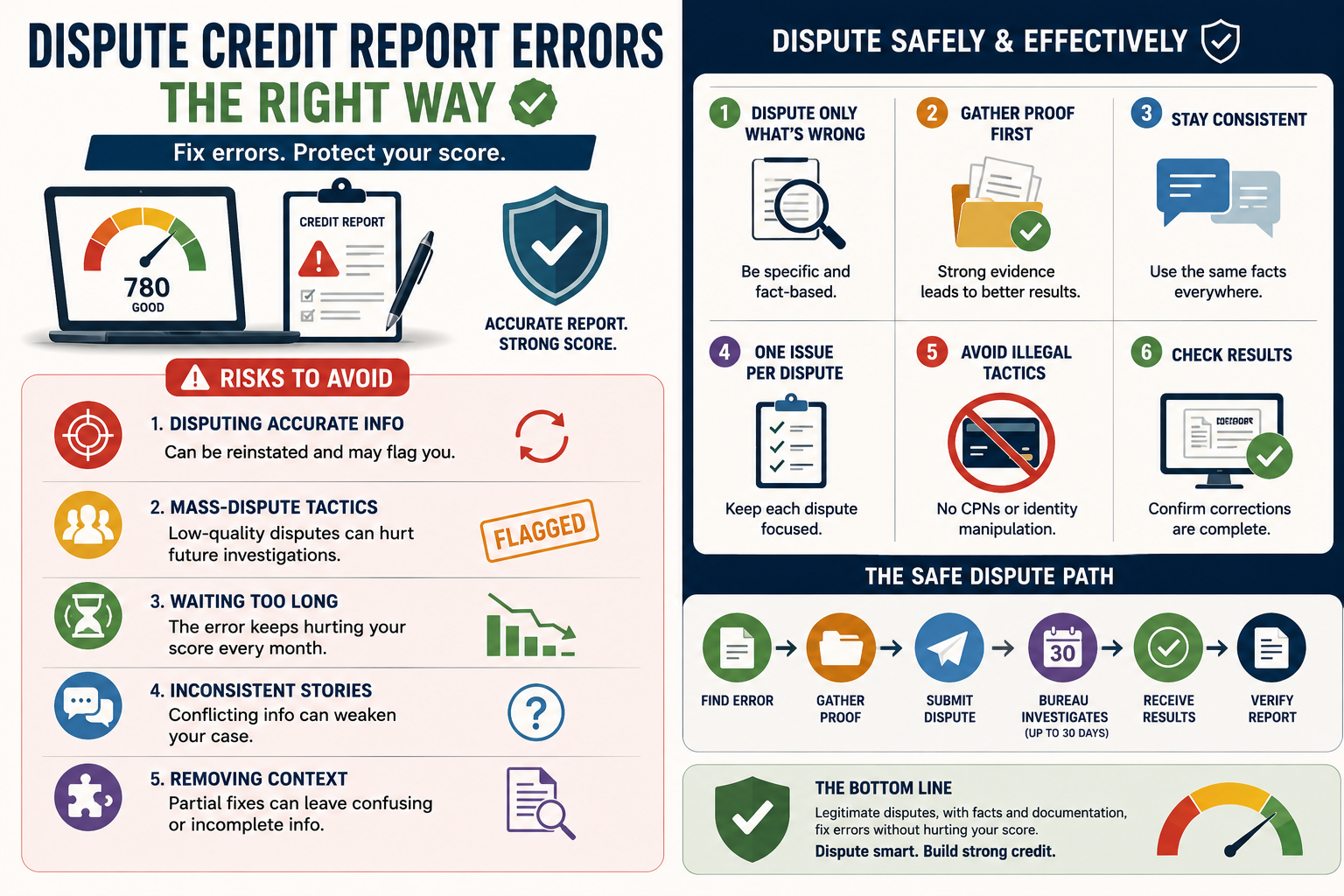
    Most people assume disputing an error can only help — after all, you’re trying to fix something wrong. But there are a handful of specific ways the dispute process itself can backfire if handled carelessly, and understanding these risks upfront lets you dispute confidently and correctly, without accidentally creating new problems.

    Does Filing a Dispute Itself Hurt Your Score?

    No — filing a dispute, by itself, does not directly lower your credit score. The act of disputing isn’t a scored event, and there’s no mechanism in standard scoring models that penalizes you simply for exercising your FCRA right to dispute inaccurate information. This is worth stating clearly because it’s a common and unnecessary worry that sometimes stops people from disputing legitimate errors.

    That said, there are indirect ways the process around a dispute can create issues if you’re not careful.

    Risk 1: Disputing Accurate Information Can Backfire Later

    A once-popular (and now largely ineffective) strategy involves disputing accurate negative information anyway, hoping the furnisher won’t respond within the 30-day window, resulting in automatic removal due to non-response rather than an actual finding of inaccuracy. A few problems with this:

    – **It’s temporary if the information is accurate.** Furnishers can, and often do, re-verify and reinstate accurate information even after an initial removal, once they catch up on a backlog or respond late. This means the removal isn’t durable, and the item can reappear, sometimes without much warning.
    – **A pattern of unfounded disputes can result in bureaus flagging you.** While a single dispute doesn’t hurt you, credit bureaus can treat a pattern of disputes lacking any factual basis as frivolous, which can result in less thorough investigation of your future disputes — including legitimate ones.
    – **It can create a false sense of resolution** that leads you to stop pursuing more durable, better-grounded strategies (like a goodwill letter for accurate but sympathetic negative marks) while you’re waiting to see if the temporary removal sticks.

    The safer, more durable approach is to dispute only what you genuinely believe is inaccurate, incomplete, or unverifiable — and to use goodwill requests, not disputes, for accurate information you’re hoping to have removed as a courtesy.

    Risk 2: Disputing Through a Credit Repair Company That Mass-Disputes Everything

    Some lower-quality credit repair operations use a strategy of disputing large numbers of accounts simultaneously, regardless of whether each item has genuine grounds for dispute, essentially hoping volume produces results through non-response. Beyond the durability issue above, this can:

    – Result in your file being flagged for a pattern of low-substance disputes.
    – Waste the “real” investigation attention on items that actually deserve scrutiny, buried among many without real basis.
    – In more serious cases, involve credit repair companies using deceptive tactics (creating a new, fraudulent credit profile via a technicality — sometimes called “credit privacy number” or CPN schemes) that are illegal and carry serious legal risk to you, not just the company. Avoid any credit repair service suggesting anything along these lines.

    Risk 3: Waiting Too Long to Address a Real Error While It Continues to Report

    This isn’t about the dispute process hurting you — it’s about the cost of inaction. An inaccurate item continuing to report negatively affects your score every month it remains uncorrected. There’s no benefit to delaying a well-grounded dispute, and doing so simply means the negative (and inaccurate) impact continues longer than necessary.

    Risk 4: Providing Inconsistent or Conflicting Information Across Disputes

    If you dispute the same item multiple times with different, sometimes contradictory explanations (for example, first claiming an account isn’t yours, then later claiming it is yours but the balance is wrong), this inconsistency can undermine your credibility with both the bureau and the furnisher, potentially resulting in less favorable treatment of the dispute overall. Keep your disputes factually consistent and precise from the start.

    Risk 5: A Successful Dispute That Removes Context, Not Just the Error

    In rare cases, disputing and correcting one detail on an account (say, a balance amount) without addressing the full picture can occasionally result in an entry that looks more confusing or ambiguous than before, if the correction isn’t handled cleanly by the furnisher. This is uncommon, but worth checking your report again after any dispute resolves, to confirm the corrected entry actually looks accurate and complete, not just partially updated.

    How to Dispute Safely and Effectively

    **1. Only dispute what you genuinely believe is inaccurate**, and be able to articulate specifically why. “This isn’t accurate” without a specific factual basis is both less effective and more likely to fall into the “frivolous” pattern risk described above.

    **2. Gather documentation before disputing**, not after. A dispute backed by bank statements, payment confirmations, or validation failures is both more likely to succeed durably and less likely to be seen as unfounded.

    **3. Keep your explanation factually consistent** across the bureau dispute, any direct furnisher dispute, and any follow-up correspondence.

    **4. Dispute one clear issue per item**, rather than combining multiple, sometimes unrelated claims into a single vague dispute.

    **5. Avoid credit repair strategies involving new legal identities, CPNs, or other technicality-based “resets”** — these are illegal, put you at serious legal risk, and have nothing to do with legitimate dispute rights under FCRA.

    **6. Check your report again after the dispute resolves**, to confirm the correction was applied cleanly and completely, not partially.

    What About Disputing Right Before a Major Loan Application?

    This is worth specific mention: if you’re actively in the process of applying for a mortgage or other major loan, some lenders prefer that disputes be resolved (not actively pending) before final underwriting, since an open dispute can sometimes complicate how a scoring model or manual underwriter treats the disputed item during the loan decision process. If you’re planning a major application soon, it’s often wise to resolve disputes well in advance rather than filing them in the middle of an active loan process, simply for practical underwriting reasons, not because the dispute itself is risky.

    The Bottom Line

    Legitimate disputes, filed with real documentation and factual specificity, carry essentially no risk to your credit score and are exactly the tool FCRA gives you for correcting genuine errors — there’s no reason to hesitate on a well-grounded dispute. The risks that do exist come from disputing accurate information hoping for a technical non-response removal, using disreputable mass-dispute or identity-manipulation schemes, or being inconsistent across your own dispute correspondence — all avoidable by disputing carefully, specifically, and honestly.

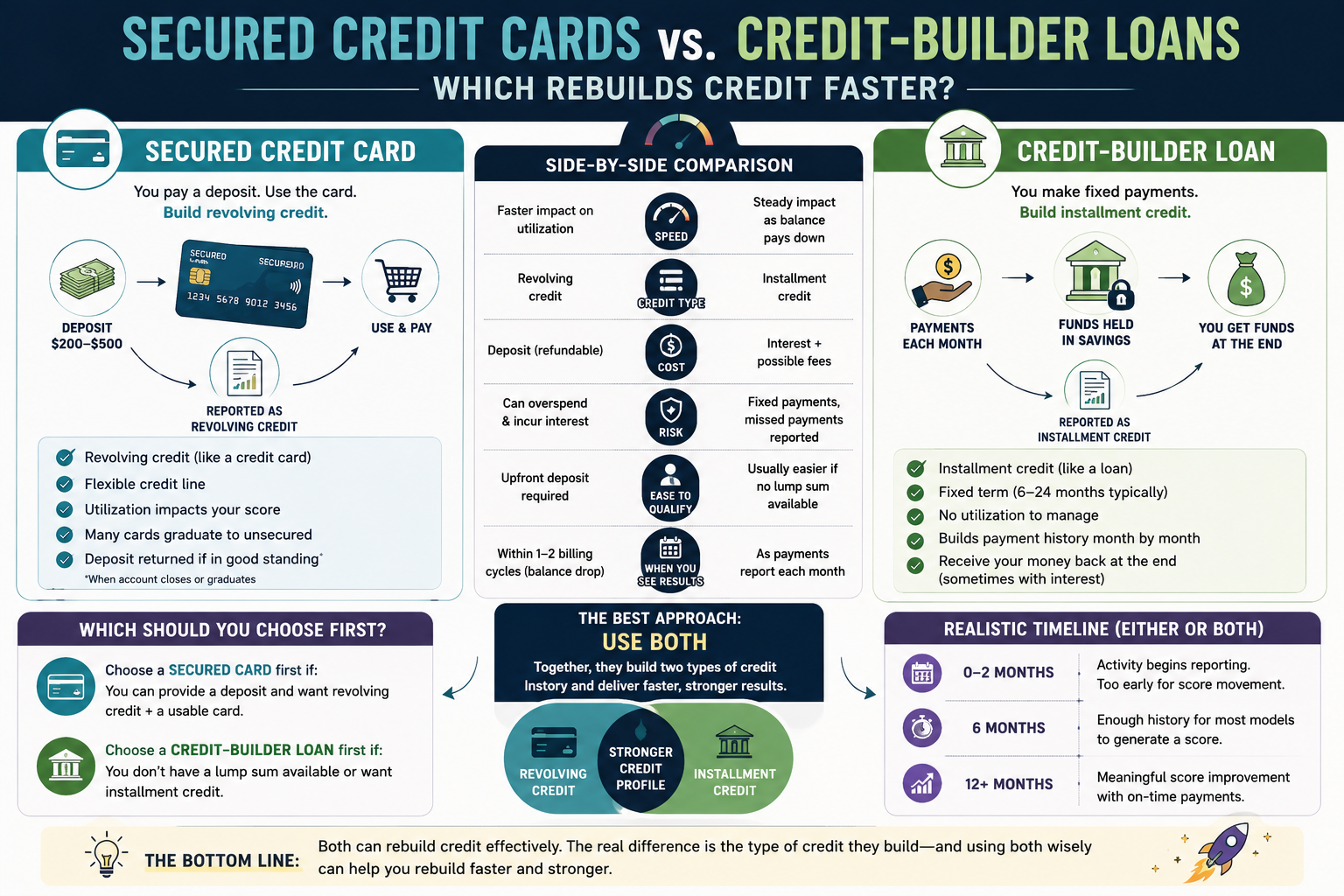
  • Secured Credit Cards vs. Credit-Builder Loans: Which Rebuilds Credit Faster?

    Secured Credit Cards vs. Credit-Builder Loans: Which Rebuilds Credit Faster?

    Both tools exist for essentially the same purpose — establishing or repairing credit for people who don’t currently qualify for standard unsecured products — but they work through different mechanisms, build different types of credit history, and have different practical tradeoffs. The honest answer to “which is faster” depends on what specifically you’re optimizing for, but understanding how each actually works will make the choice, or the decision to use both, much clearer.

    How a Secured Credit Card Works

    You provide a cash deposit (typically $200-500, sometimes more), which becomes your credit limit. You use the card like a normal credit card — making purchases, receiving a monthly statement, and making payments — and your activity is reported to the credit bureaus as **revolving credit**, the same category as any standard unsecured credit card.

    Key mechanics:
    – Your deposit is held as collateral, reducing the issuer’s risk, which is why approval is accessible even with poor or no credit history.
    – You can typically use it up to your limit repeatedly, as long as you pay down the balance (hence “revolving”).
    – After a period of responsible use (often 6-12 months, varies by issuer), many secured cards either automatically graduate to unsecured status (returning your deposit) or make you eligible to apply for an unsecured card with the same issuer.

    How a Credit-Builder Loan Works

    Instead of receiving loan funds upfront, the “loan” amount is held in a locked savings account (or sometimes a CD) by the lender, and you make fixed monthly payments over a set term (often 6-24 months). At the end of the term, you receive the accumulated funds, sometimes with a small amount of interest.

    Key mechanics:
    – Your payments are reported to the credit bureaus as **installment credit** — a fixed monthly payment over a defined term, similar in structure to an auto loan or personal loan.
    – You don’t have access to the funds until the term completes (or, with some products, after you’ve paid a certain percentage), which is fundamentally different from a secured card’s revolving access.
    – There’s no ongoing utilization ratio to manage — your reported balance simply declines predictably each month as you make payments, following the loan’s amortization schedule.

    Speed Comparison: Which Shows Results Faster?

    **For utilization-related score factors**: a secured card can show a benefit faster, since utilization is calculated from your most recent reported balance and can improve within a single billing cycle if you keep spending low relative to your limit.

    **For payment history establishment**: both report similarly — each on-time monthly payment adds to your track record, and most scoring models need a similar minimum period (roughly 6 months) of reporting history before generating a score at all, regardless of which product type you’re using.

    **For credit mix**: a credit-builder loan adds installment credit to your file, which is a different category than the revolving credit a secured card provides. If you already have one type of account, adding the other type is what actually helps your credit mix factor — using two of the same type doesn’t provide this specific benefit.

    In practice, neither product is meaningfully “faster” in isolation — the real speed advantage comes from using both together, since this establishes two different credit history types simultaneously, rather than sequentially.

    Cost Comparison

    **Secured card costs:**
    – Upfront deposit, which is returned (assuming good standing) when the account closes or graduates to unsecured status — this isn’t really a “cost” so much as a temporary hold on your own money.
    – Some secured cards carry annual fees, which is a genuine cost worth comparing across options.
    – Interest charges apply if you carry a balance, though — as with any credit card — paying in full each month avoids this entirely.

    **Credit-builder loan costs:**
    – Interest is typically charged on the loan amount, similar to a standard personal loan, though credit-builder-specific products sometimes have relatively modest rates given their credit-building purpose.
    – Some products charge a modest origination or administrative fee.
    – Unlike a secured card, you generally get your money back at the end (plus, in some structures, a small amount of interest earned on the held funds) rather than a return of an unused deposit — the overall cost structure differs, so a direct comparison depends on the specific terms of each product.

    Risk Comparison

    **Secured card risk**: if you overspend and can’t pay it off, you risk carrying a balance with interest charges, and in more serious cases, if the account goes delinquent, the issuer may use your deposit to cover the unpaid balance — meaning you could lose your deposit and still end up with a damaged account on your credit report.

    **Credit-builder loan risk**: since you’re making fixed payments toward funds you don’t yet have access to, missing a payment has the same negative reporting consequence as any other late payment, without the flexibility a credit card offers (like paying only the minimum in a pinch). Some people find this more psychologically challenging, since you’re paying money each month without immediate access to spend it, which can feel less flexible during tight financial periods.

    Which Is Easier to Qualify For?

    Both are generally accessible with poor or no credit, but there are some differences:

    – **Secured cards** usually require the ability to provide the deposit upfront in a single lump sum, which can be a barrier for some applicants.
    – **Credit-builder loans** spread the “cost” of the loan amount across monthly payments rather than requiring an upfront lump sum, which can make them more accessible for people who don’t have several hundred dollars available at once, even though the total amount paid over time may be similar or higher once fees/interest are factored in.

    Which Should You Choose First?

    If you can only start with one:

    – **Choose a secured card first** if your priority is establishing revolving credit and you have the deposit available — revolving credit history and demonstrated utilization management are weighted meaningfully in most scoring models, and a secured card also gives you an actual usable card for everyday purchases.
    – **Choose a credit-builder loan first** if you don’t have a lump sum available for a deposit, or if you specifically want to add installment credit to complement existing revolving credit (a credit card) you might already have.

    The Best Approach: Use Both, If Feasible

    Since they build different types of credit history and complement rather than duplicate each other, using both simultaneously — a secured card for revolving history plus a credit-builder loan for installment history — tends to produce faster, more well-rounded credit-building results than relying on either alone. This does mean managing two separate monthly payment obligations, so it’s only worth pursuing if you’re confident you can manage both reliably; missing payments on either defeats the purpose entirely.

    Realistic Timeline for Either (or Both)

    – **First 1-2 statement cycles**: initial reporting begins; too early to see meaningful score movement yet.
    – **6 months**: enough history for most scoring models to generate a score, assuming consistent on-time payments.
    – **12 months**: with continued responsible use, meaningful score improvement is typical, often sufficient to start qualifying for unsecured products.

    The Bottom Line

    Neither a secured credit card nor a credit-builder loan is definitively “faster” in isolation — both need roughly the same minimum reporting period before producing a usable score, and both depend entirely on consistent on-time payments to actually help. The real advantage comes from understanding what each contributes (revolving vs. installment credit history) and, if your budget allows, using both together to build a more diverse, faster-developing credit file than either product could produce alone.

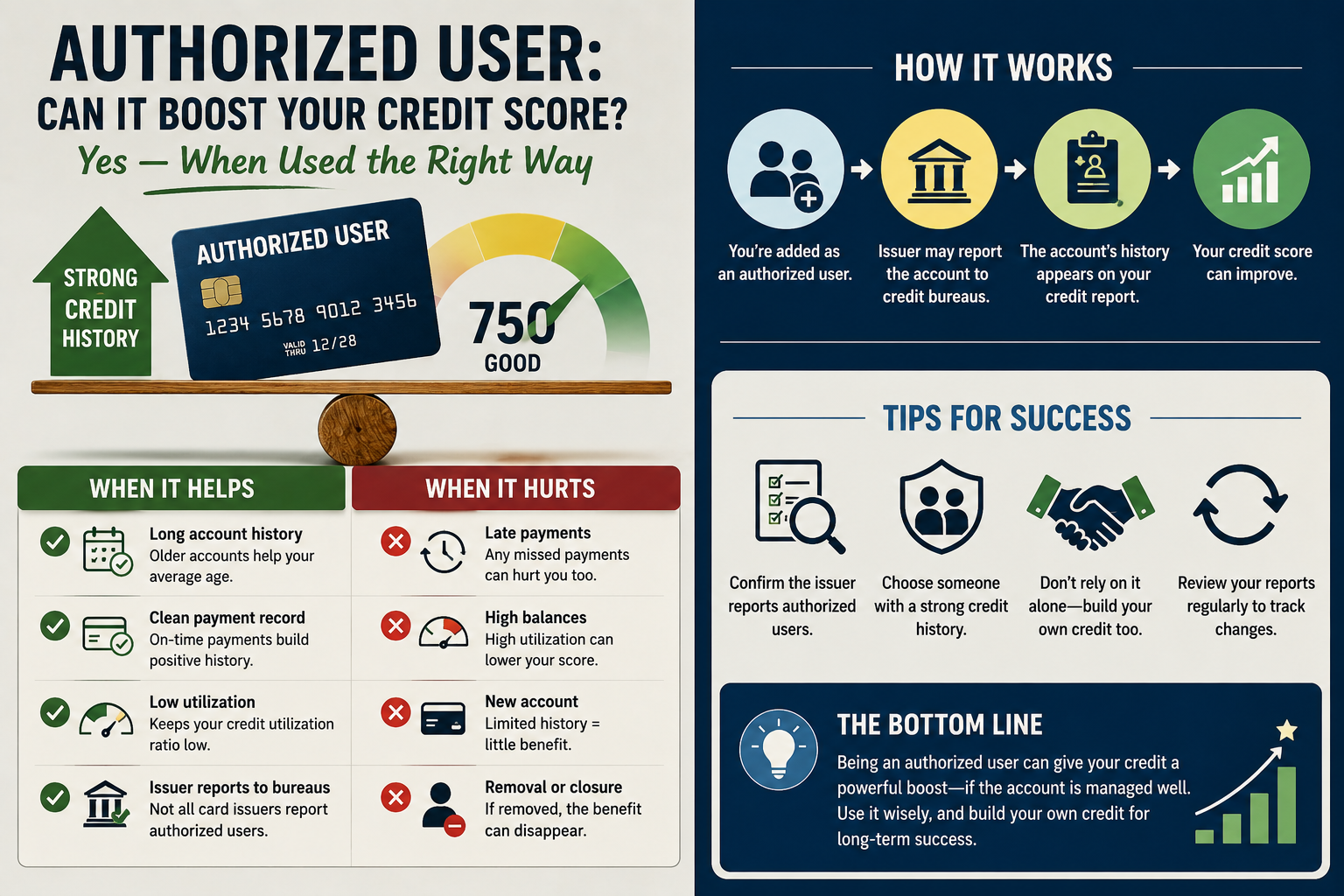
  • Does Becoming an Authorized User Actually Raise Your Credit Score?

    Does Becoming an Authorized User Actually Raise Your Credit Score?

    This is one of the more genuinely useful, if slightly counterintuitive, tools in credit building — you can potentially benefit from someone else’s credit history without being legally responsible for their debt. But it doesn’t work universally, and understanding exactly when and why it works (and when it doesn’t) matters before you rely on it as a strategy.

    The Short Answer: Yes, Often Significantly — But With Real Conditions

    Being added as an authorized user on someone else’s credit card can add that account’s entire history — sometimes years or even decades of it — to your own credit report. If the primary account holder has a long-standing, well-managed account, this can meaningfully boost your score, particularly if you have a thin or new credit file where a single well-aged account represents a large proportional improvement to your overall profile.

    But this only works under specific conditions, and it can also backfire.

    How Authorized User Reporting Actually Works

    When you’re added as an authorized user, the card issuer *may* report that account to the credit bureaus as appearing on your credit file too — including its full history: the account age, the payment history, the credit limit, and current utilization. This is the mechanism that creates the benefit (or the risk).

    Critically: **not all card issuers report authorized user activity to the credit bureaus at all.** This varies by issuer, and it’s essential to confirm before assuming the strategy will work. If the issuer doesn’t report authorized user status, adding you accomplishes nothing for your credit file, regardless of how strong the primary account is.

    What Makes This Work Well

    **The primary account has a long history.** The single biggest factor in how much this helps is the account’s age. Being added to a card opened last year provides much less benefit than being added to one opened 15 years ago, since average account age is a real scoring factor, and a long-standing account can meaningfully raise your overall average, especially if your existing credit file is thin.

    **The primary account has a clean payment history.** This is non-negotiable — if the account has late payments or other negative marks, those become part of your file too. This is the core risk of the strategy: you inherit the account’s full history, both good and bad.

    **The primary account has low utilization.** Since the reported utilization on that account becomes part of your file’s overall utilization calculation, a card that’s rarely used or kept at a low balance relative to its limit helps you; a card that’s frequently near

    its limit hurts you, even if you personally never use the card yourself as an authorized user.

    **The issuer actually reports authorized user data.** As mentioned, this is a prerequisite, not a detail — confirm this before pursuing the strategy at all.

    What Makes This Backfire

    **A primary account with negative history.** If the account has missed payments, high utilization, or other derogatory marks, adding you as an authorized user imports those negatives into your file just as readily as it would import positives. This is the most important risk to understand: authorized user status is not a one-directional benefit — it reflects the account’s actual history, whatever that history is.

    **A recently opened account.** If the account is new, there’s minimal age benefit to gain, and you’re taking on whatever risk exists (missed payments going forward) without much of the primary upside.

    **Relying on it as your only credit-building strategy.** Authorized user status supplements a credit file; it doesn’t substitute for having your own independently-held accounts. Since you have no legal ownership or control over the authorized user account, your credit profile remains dependent on someone else’s behavior and, if that relationship or arrangement changes (a divorce, a falling out, the primary holder closing the account), that benefit can disappear.

    Does This Work the Same for Everyone Added?

    Yes, in terms of mechanics — whoever the issuer reports as an authorized user gets the account history reflected. But the *practical impact* varies significantly based on your existing credit profile:

    – **Someone with no existing credit file** often sees the most dramatic relative benefit, since a single well-aged, well-managed account represents a much larger share of their overall credit picture.
    – **Someone with an already-established, moderate credit file** typically sees a smaller, though still real, benefit, since the new account is one of several factors being averaged together rather than dominating the calculation.
    – **Someone with an already strong credit file** may see minimal additional benefit, since they likely already have sufficient account age and history without needing the boost.

    Does the Primary Account Holder Face Any Risk From Adding You?

    Generally minimal, but worth understanding:
    – Adding an authorized user typically doesn’t affect the primary holder’s credit at all, unless the authorized user makes charges that push utilization higher (which does affect the primary account’s reported utilization, and therefore the primary holder’s own credit file, since it’s their account).

    – The primary holder remains fully legally responsible for all charges on the account, including any made by the authorized user, so this arrangement requires real trust if the authorized user will actually be using the card, not just benefiting from the reported history.

    Can You Be an Authorized User Without Ever Using the Card?

    Yes, and this is actually a common and reasonable approach specifically for credit-building purposes — some primary account holders add a family member as an authorized user purely so the account history reports to that person’s file, without ever issuing them a physical card or expecting them to make charges. This isolates the credit-building benefit from any spending risk, which can make the arrangement more comfortable for both parties.

    How Long Does It Take to Show Up on Your Report?

    This varies by issuer but is generally fairly fast — often within one to two billing cycles after being added, the account should begin appearing on your credit report, at which point its full history (not just going forward, but retroactively) is typically reflected, which is what produces the notable, sometimes immediate-feeling score impact compared to opening a brand new account that only has history going forward.

    What Happens If You’re Later Removed?

    If you’re removed as an authorized user (or the primary holder closes the account), that account and its associated history generally stops being reported on your file going forward. This means the benefit isn’t necessarily permanent — it’s tied to your ongoing status on that account, which is a meaningful consideration if you’re relying on it as a long-term strategy rather than a stepping stone while you build your own independent credit history.

    The Bottom Line

    Authorized user status can genuinely and sometimes significantly raise your credit score, but only when the underlying account has a long history, clean payment record, and low utilization, and only if the issuer actually reports authorized user data to the credit bureaus. It’s one of the more powerful tools available, particularly for people with thin credit files, but it’s also a two-way street — a poorly managed primary account can hurt you just as easily as a well-managed one can help — and it works best as a complement to, not a replacement for, building your own independent credit accounts over time.