Blog

  • Does Autopay, BNPL, or PayPal Pay In 4 Affect Your Credit Score?

    Does Autopay, BNPL, or PayPal Pay In 4 Affect Your Credit Score?

    Autopay, buy now pay later (BNPL), and PayPal Pay in 4 all touch your wallet the same way, but they touch your credit file very differently. Autopay itself never changes your score it only protects the on-time payment history that already drives 35% of your FICO calculation. BNPL is in the middle of a reporting overhaul, with FICO’s new BNPL-aware scoring models rolling out through 2026. PayPal Pay in 4, meanwhile, stays off your credit report entirely unless you default.

    Key Takeaways

    • Autopay doesn’t add or subtract points; it just removes the risk of a missed payment, which is the single biggest score factor.
    • FICO began building BNPL data into new score models in late 2025, and Affirm now reports Pay in 4 loans to Experian and TransUnion.
    • PayPal Pay in 4 generally isn’t reported to any bureau for on-time use, so it neither builds nor damages your score until an account goes to collections.

    Does Autopay Affect Your Credit Score?

    Autopay has no direct line item in any scoring model no points are added for enrolling, and none are deducted for using it. What autopay does is protect payment history, which makes up 35% of a FICO score calculation according to myFICO. By auto-scheduling your bill, you remove the everyday risk of a forgotten due date turning into a 30-day-late mark.

    That said, autopay isn’t risk-free. A missed autopay withdrawal can still hurt your score, because the failed payment gets reported like any other late payment once it crosses 30 days past due, according to a 2026 explainer from LegalClarity. Common failure points include an expired debit card, insufficient funds, or a technical error on the lender’s end the payment simply never processes, and the clock toward a negative mark starts ticking from there.

    The practical takeaway: autopay is a payment-history insurance policy, not a score booster. Pair it with a low-balance alert on your checking account so a bounced autopay doesn’t quietly become a seven-year mark on your credit report.

    Does Buy Now, Pay Later Affect Your Credit Score?

    BNPL’s relationship with your credit score depends entirely on which provider you use and whether that provider reports to the bureaus at all. Some BNPL loans already show up on consumer credit reports today, but per ConsumerAffairs’ 2026 guide, they only affect your score when the specific plan and provider actually furnishes that activity reporting practices still vary widely across the industry.

    The scoring models themselves are changing fast. FICO announced in February 2025 that it had built a system to fold BNPL data into credit scores, following a 12-month study using data from roughly 500,000 Affirm borrowers, as reported by NMI. Early results were reassuring for most users: FICO’s own testing found that about 85% of consumers would see only a swing of 10 points or less once BNPL activity is factored in, with most people seeing no change or a slight increase.

    Provider behavior is the real deciding factor right now. As of mid-2026, Affirm reports its loans including Pay in 4 plans to Experian and TransUnion, while Klarna and Afterpay generally still don’t report routine U.S. payments to any bureau, according to Solid Credit’s July 2026 breakdown. That means the exact same shopping habit can be invisible or fully visible to a lender, depending only on which app you tapped at checkout.

    Late payments are the bigger risk regardless of reporting status. Federal Reserve data cited by Motley Fool Money’s 2025 BNPL Trends Report found that 24% of BNPL users had made a late payment, up from 18% the year before, with younger borrowers falling behind more often. Even providers that skip routine reporting can still send an unpaid balance to a collections agency, and that collection account will hit your score hard no matter who originally issued the loan.

    Does PayPal Pay In 4 Affect Your Credit Score?

    PayPal Pay in 4 sits on the “invisible unless things go wrong” end of the spectrum. Applying only triggers a soft credit check, which never harms your score, and PayPal doesn’t report your remaining installment payments to the credit bureaus, according to U.S. News. Paying every installment perfectly on time produces zero change to your credit file no boost, no ding.

    That invisibility cuts both ways. Because on-time Pay in 4 payments aren’t reported to the three major bureaus, using the service responsibly won’t help you build a credit history the way a reported installment loan would, per Firstcard’s 2026 breakdown. If you’re specifically trying to build a thin credit file, Pay in 4 simply won’t do that job.

    Default is where the risk lives. If a balance goes unpaid long enough, PayPal may hand the debt to a collections agency, and that collection can then appear on all three bureaus and lower your score, according to The Credit People. It’s worth noting that PayPal Pay in 4 is a separate product from PayPal Credit, a revolving line issued by Synchrony Bank that does report activity to the bureaus and can affect your score in the ordinary way.

    Autopay vs. BNPL vs. PayPal Pay In 4: Side-By-Side Credit Risk

    Payment method Reports on-time use? Can it help your score? Can it hurt your score?
    Autopay N/A it’s a payment mechanism, not a loan No, it only protects existing history Yes, if the withdrawal fails and goes unpaid 30+ days
    BNPL (varies by provider) Sometimes Affirm generally yes; Klarna/Afterpay generally no Only if the provider reports and you pay on time Yes, especially as FICO’s BNPL-aware models spread, or if sent to collections
    PayPal Pay in 4 No, for on-time payments No Yes, only if the account defaults and goes to collections

    The common thread across all three: on-time payments are either neutral or protective, and it’s always the miss not the payment method itself that does the damage.

    How to Use These Payment Tools Without Hurting Your Score

    • Turn on autopay for at least the minimum due, then set a separate calendar reminder to pay more if you can this covers you against both forgetfulness and card fraud holds.
    • Check whether your BNPL provider reports before you borrow. If building credit matters to you, a reporting provider is doing double duty; if avoiding any credit footprint matters more, a non-reporting provider keeps the loan off your file as long as you stay current.
    • Never treat Pay in 4 as consequence-free. The soft check and lack of reporting protect you on the way in, but a defaulted balance can still land in collections and follow you for years.
    • Watch your checking account balance around due dates. Most of the credit damage tied to these tools traces back to a payment that simply didn’t go through, not to the payment method itself.

    Frequently Asked Questions

    Will setting up autopay lower my credit score?

    No. Enrolling in autopay has no effect on your score in either direction. It only becomes a problem if the automatic payment fails to process and the bill goes unpaid past 30 days, at which point it’s reported the same as any other missed payment.

    Do all BNPL apps report to credit bureaus?

    No. As of mid-2026, Affirm reports its Pay in 4 and installment loans to Experian and TransUnion, while Klarna and Afterpay generally don’t report routine U.S. payments to any bureau. Always check the specific provider’s current disclosure before assuming either way.

    Can PayPal Pay in 4 help me build credit from scratch?

    No. Because on-time Pay in 4 payments aren’t sent to Equifax, Experian, or TransUnion, the plan won’t build a payment history the way a reported credit-builder card or installment loan would.

    What happens if I miss a PayPal Pay in 4 payment?

    A single missed payment typically stays off your credit report at first. If the balance goes unresolved and PayPal eventually sends it to a collections agency, that collection account can then appear on all three bureaus and lower your score.

    Will FICO’s new BNPL scoring model hurt everyone’s credit score?

    Unlikely for most people. FICO’s own testing found that roughly 85% of consumers saw a swing of 10 points or less once BNPL activity was factored into the score, with many seeing no change or a small increase.

    The Bottom Line

    None of these three tools is inherently good or bad for your credit the outcome depends on whether the provider reports to the bureaus and whether you pay on time. Autopay protects the payment history you already have. BNPL is actively moving from a credit blind spot toward standardized reporting, provider by provider. PayPal Pay in 4 stays off your report unless you default. Treat all three the same way: never schedule a payment for more than your account can cover, and check each provider’s current bureau-reporting policy before you assume it won’t show up on your credit file.

  • Is a 753 Credit Score Good? Full Guide to Every Score Range (560–753)

    Is a 753 Credit Score Good? Full Guide to Every Score Range (560–753)

    A three-digit number decides what you pay for a car, a house, and sometimes an apartment. Yet most people only think about it the moment a lender pulls it up on a screen in front of them.

    If you just checked your score and landed here, you want a fast, specific answer, not a lecture on credit theory. This guide gives you that answer for six of the most-searched scores: 753, 718, 677, 675, 590, and 560. Each section below stands on its own, so jump straight to your number if you’d rather skip the general background.

    Key Takeaways

    • A 753 credit score falls in FICO’s Very Good range (740-799) and beats roughly 62% of Americans, according to Experian’s 2025 credit review.
    • A 718 score sits almost exactly at the 2026 national average of 715-717 (Experian).
    • A 590 or 560 score lands in Fair-to-Poor territory and typically means higher rates, not automatic denial.
    • Moving from Fair to Good (580-669 to 670-739) unlocks the single biggest rate improvement of any tier jump, per LendingTree’s 2025 lifetime-interest analysis.
    • The fastest lever for any score is credit utilization: cutting card balances usually moves the number faster than any other single action.

    What Do Credit Score Ranges Actually Mean?

    FICO scores run from 300 to 850, and as of 2026 the model splits into five bands: Poor (300-579), Fair (580-669), Good (670-739), Very Good (740-799), and Exceptional (800-850), according to myFICO. Each band roughly maps to a lending outcome: Poor makes approval hard, Fair means approval with a price penalty, and everything from Good upward opens most mainstream credit products.

    Here’s a wrinkle worth knowing before you compare notes with a friend: VantageScore uses different cutoffs on the same 300-850 scale: good starts at 661, not 670. That gap is exactly why a 675 score and a 677 score can get labeled two different ways depending on which app you check, even though only two points separate them. Neither model is “more correct”; lenders simply choose which one they pull.

    Related Reading: Is Fico Score Accurate?

    Is a 753 Credit Score Good?

    Yes. A 753 credit score is Very Good on the FICO scale (740-799) and lands you in roughly the 78th percentile nationally. About a third of consumers score between 600 and 750, and another 48% score higher, per Experian’s 2025 credit review, which puts a 753 near the top of that middle group and just short of Exceptional.

    At 753, you’ll qualify for most credit cards, including premium rewards products, and you’re close enough to the 760 threshold that many mortgage lenders use for their best pricing tier. On a $350,000, 30-year fixed mortgage, borrowers in the 700-759 band paid around 6.63% APR as of April 2026, compared with 6.15% for the 760-plus tier, a gap worth roughly $107 a month, according to Experian/Curinos data compiled by Crowned Credit. A 753 score outperforms the 2026 national average FICO score of 715-717, according to Experian, and sits only seven points below the “Very Good” ceiling of 760 that many lenders treat as their best-rate cutoff.

    Should you chase the extra points before applying for a mortgage? If a big purchase is more than three months out, it’s worth trying: the jump from 753 to 760-plus can shave real money off a 30-year loan. If you’re applying next week, 753 already opens nearly every mainstream door.

    Is a 718 Credit Score Good?

    Yes. A 718 credit score is Good on the FICO scale and sits almost exactly on the 2026 national average, which Experian places at 715 to 717. That makes 718 a genuinely representative American credit score: unremarkable in a statistical sense, but perfectly workable for most financial products.

    A 718 clears the 700-point line that many auto lenders treat as a soft threshold for near-prime-to-prime pricing, and it’s well above the 620 minimum most conventional mortgage lenders require. It falls short, though, of the 740 mark that separates Good from Very Good, so you’ll typically see slightly higher APRs than someone scoring in the mid-700s or above.

    For new-car loans specifically, Experian’s Q1 2026 data put the average credit score for approved new-car buyers at 751, three points above a 718 score. That doesn’t mean 718 gets rejected; it means the average successful applicant is edging into Very Good territory, so a 718 buyer should expect a slightly above-average new-car rate rather than the best one on the lot.

    Is a 677 Credit Score Good?

    Yes, technically. A 677 credit score just clears FICO’s 670 cutoff for Good, and it comfortably clears VantageScore’s 661 cutoff too. It’s a real improvement over Fair credit, but it sits at the low end of the Good band, only seven points above the line.

    That position matters more than the label does. Lenders often set their best-rate cutoffs well above 670 (commonly at 700, 720, or 740), so a 677 score typically gets you approved without getting you the advertised lowest rate. Auto lenders using VantageScore’s near-prime band (601-660) versus prime (661-780) will treat 677 as solidly prime, which is a meaningfully better position than sitting just under 661.

    According to a 2025 LendingTree analysis, crossing from Fair into Good credit represents the single largest jump in borrowing terms of any adjacent tier change, with mortgage approval odds rising by roughly 27 percentage points. A 677 score means you’ve already made that jump; the next practical goal is pushing past 700, where rate tiers start improving again.

    Is a 675 Credit Score Good?

    Yes, with an asterisk. A 675 credit score is Good under FICO (670-739) but can show up as Fair on VantageScore, since some VantageScore models set the good threshold a bit higher in practice depending on the version. Two points below 677, a 675 still clears both major scoring models’ lower “good” boundaries in the current 4.0 VantageScore version (661), but it’s close enough to the line that a single missed payment or a utilization spike could knock it back into Fair.

    Practically, a 675 score should qualify you for most unsecured credit cards and a conventional mortgage, though probably not at the lowest advertised APR. Freddie Mac and Curinos pricing data consistently shows a meaningful rate step between the high-600s and the 700s, so borrowers at 675 have real incentive to wait and improve if a big loan isn’t urgent.

    Is a 590 Credit Score Good?

    No. A 590 credit score is in FICO’s Fair range (580-669), close to the bottom of it, and only ten points above the Poor cutoff. It’s not a crisis score, but it will limit your options and raise your cost of borrowing across nearly every product.

    At 590, expect higher APRs on any approved credit, tighter credit limits, and possible denials from mainstream unsecured card issuers. Auto lenders classify scores in the 601-660 VantageScore band as “near-prime,” so a 590 typically falls into “subprime,” where Experian’s Q1 2026 data shows average used-car rates climbing well above the 11.43% market average. Mortgages are still possible (FHA loans accept scores as low as 580 with 3.5% down), but conventional loans generally require at least 620. A borrower with Fair credit pays roughly $183,000 more in lifetime interest than someone with Exceptional credit, across mortgages, auto loans, and credit cards combined, according to a 2025 LendingTree analysis of lifetime borrowing costs.

    A 590 score isn’t permanent. Because it sits near the top of Fair rather than deep in Poor, relatively modest fixes, such as paying down revolving balances, clearing any past-due accounts, and avoiding new hard inquiries, can move it meaningfully within a few billing cycles

    Is a 560 Credit Score Good?

    No. A 560 credit score falls in FICO’s Poor range (below 580), and it will make approval difficult for most unsecured credit and many conventional loans. This is the range where lenders see the highest statistical risk of missed payments, and pricing reflects that directly.

    At 560, expect denials from most major unsecured card issuers, minimum down payments or co-signers on auto loans, and mortgage options largely limited to FHA loans (which can go as low as 500 with 10% down, or 580 with 3.5% down). Deep-subprime auto borrowers, Experian’s lowest VantageScore tier, saw average new-car APRs around 16% in recent data, roughly 3.5 times the super-prime rate.

    Is a 560 worth panicking over? No, but it is worth acting on immediately. The FICO scoring formula weighs payment history and credit utilization more heavily than any other factors, so the two fastest, most reliable moves are simple: stop missing payments starting today, and pay down any revolving balance above 30% of its limit. A secured card or a credit-builder loan, reported to all three bureaus, can add positive history within a few months.

    What Does Each Score Range Actually Cost You?

    The dollar gap between tiers is larger than most people expect. On a $350,000, 30-year fixed mortgage, Experian/Curinos data from April 2026 shows roughly a half-point APR difference between the 760-plus tier and the 700-759 tier, and that gap widens sharply once you drop into Fair or Poor territory.

    The pattern repeats on auto loans. Experian’s Q1 2026 State of the Automotive Finance Market report put average new-car APRs at 4.55% for super-prime borrowers (781+) versus 16.01% for deep-subprime borrowers, an 11.4-point spread that turns into thousands of dollars on the same car. Used-car rates spread even wider, from about 6.30% up to 21.77%.

    None of this is fixed forever. Every tier boundary in this guide (580, 620, 670, 740, 780) is a line you can cross with sustained, ordinary habits rather than a financial overhaul.

    How to Move Up a Tier, Whatever Your Starting Score

    Answer-first: payment history and credit utilization make up roughly two-thirds of a FICO score’s weighting combined, so the fastest, most reliable gains come from those two levers, not from disputing old accounts or chasing credit-repair services.

    A few moves apply regardless of whether you’re starting at 560 or 753:

    • Pay every bill on time, starting now. A single 30-day-late mark can cost more points than almost anything else on a report, and the damage fades faster the longer your on-time streak grows afterward.
    • Push revolving utilization under 30%, and under 10% if you’re chasing the top tiers. This is usually the single fastest lever, because balances reported to the bureaus can update within one billing cycle.
    • Leave old accounts open. Length of credit history and available credit both factor into your score, and closing a paid-off card can quietly work against you.
    • Add alternative payment history if you’re building from Fair or Poor. Programs like Experian Boost report rent, utility, and streaming payments, and Experian says they add an average 13 points for users who qualify.
    • Space out new credit applications. Each hard inquiry has a small, temporary effect, but several in a short window can compound right when you’re trying to move up.

    FAQ

    Is 753 a good credit score for buying a house?

    Yes. A 753 credit score clears the 620 minimum most conventional mortgage lenders require and sits close to the 760 mark many lenders use for their best rate tier, so you’ll qualify for competitive terms even if you don’t land the single lowest advertised APR (Experian, 2026).

    What’s the real difference between a 675 and a 677 credit score?

    Almost none in practice. Both clear FICO’s 670 “Good” threshold and VantageScore’s 661 threshold, and lenders decision in bands rather than by exact score, so a two-point gap rarely changes an approval or a rate offer on its own.

    Is a 718 credit score good enough for a car loan?

    Yes. A 718 sits close to Experian’s Q1 2026 average score for approved new-car buyers (751) and well within the “prime” tier most auto lenders use, so it typically qualifies for solid, if not the very lowest, financing rates.

    Can I get approved for anything with a 590 credit score?

    Often, yes. A 590 sits in FICO’s Fair range, which usually still allows FHA-backed mortgages, secured credit cards, and some subprime auto loans, but expect higher rates and lower limits than Good or Very Good credit would get you.

    How fast can a 560 credit score improve?

    Faster than most people expect. Because payment history and utilization carry the heaviest weighting in FICO’s formula, consistent on-time payments and lower card balances can produce visible score movement within one to three billing cycles, though a return to Good credit typically takes longer.

    The Bottom Line

    Wherever your score falls in this guide (560, 590, 675, 677, 718, or 753), the tier matters less than the direction it’s moving. A 753 is Very Good and close to Exceptional; a 718 is Good and dead-average; 675 and 677 sit at the low end of Good, thin enough to slip backward without upkeep; and 590 and 560 sit in Fair and Poor, where the same two habits, on-time payments and low utilization, do most of the work to climb out.

    Check your full report, not just the score, before you make a big borrowing decision. The number tells you the tier; the report tells you exactly what to fix next.

  • How to Dispute Credit Report Errors in 2026

    How to Dispute Credit Report Errors in 2026

    Table of Contents

    Last Updated: September 5, 2026

    A single error on your credit report can cost you a mortgage approval, a car loan, or a rental application. Knowing how to dispute credit report errors is one of the most direct ways to protect your financial future, yet most consumers never check their reports for mistakes. The Fair Credit Reporting Act gives you the legal right to challenge inaccurate information, and the process is more straightforward than you might think. At Credit Repair, we guide clients through this exact process every day, and this step-by-step guide will show you how to dispute credit report errors effectively, whether you are dealing with a simple clerical mistake or a more complex case of identity theft.

    The dispute process exists because credit bureaus make mistakes. The system relies on data furnishers, like lenders and collection agencies, to report accurate information, but errors happen far more often than they should. Many consumers find that a formal dispute is the only way to remove inaccurate negative items that are dragging down their score. Below, we will walk through each stage of the process, from pulling your reports to escalating a denied dispute, so you can take action with confidence.

    Why You Should Dispute Credit Report Errors

    Errors on your credit report can quietly undermine your financial goals for years. A credit reporting agency may list an account as delinquent when you paid on time, report a debt that belongs to someone else, or fail to update a balance that you have already settled. Each of these inaccuracies can suppress your credit score, leading to higher interest rates or outright denials when you apply for credit.

    The practical impact goes beyond the score itself. Landlords, insurers, and even some employers review credit history as part of their decision-making process. An unresolved error could cost you an apartment rental or a job offer, not just a loan. Disputing the error is not about gaming the system; it is about ensuring your credit file accurately reflects your financial behavior. Under the Fair Credit Reporting Act, both the credit bureaus and the data furnishers have a legal obligation to investigate and correct inaccurate information.

    Step 1: Get Your Free Credit Reports and Find the Errors

    Your first move is to request your credit reports from the three major credit reporting agencies: Equifax, Experian, and TransUnion. Federal law entitles you to a free report from each bureau every 12 months through the official government-authorized channel (consumer.ftc.gov). Reviewing all three matters because the bureaus do not always share information, so an error on one report may not appear on the others.

    Go through each report line by line. Look for accounts you do not recognize, payment statuses that seem wrong, balances that do not match your records, and any public record entries that are not yours. A common mistake is focusing only on negative accounts, but even a small error on a positive account can affect your credit use or payment history. Write down every item you believe is inaccurate, along with the bureau that reported it. This list becomes your roadmap for the dispute process.

    A person reviewing a credit report on a laptop at a clean desk, holding a highlighter to mark an error, with a cup of coffee nearby
    A person reviewing a credit report on a laptop at a clean desk, holding a highlighter to mark an error, with a cup of coffee nearby

    Step 2: Gather Supporting Documents for Credit Disputes

    Your dispute is only as strong as the supporting documents you provide. The credit bureau will not simply take your word that an error exists; you need to show them why the information is wrong. Start by collecting your own records: bank statements, payment confirmations, loan agreements, and any correspondence with the original creditor.

    For a dispute over an account that is not yours, you may need a police report or an identity theft affidavit if fraud is involved. For a dispute over an incorrect balance or payment status, a statement from your bank showing the payment you made can be decisive. The goal is to create a clear paper trail that contradicts the information on your report. Organize these supporting documents before you write your letter so you can reference them specifically and attach copies with your submission.

    Watch Out
    Never send original documents with your dispute. The credit bureau only needs copies, and original documents can be lost in the review process. Keep your originals in a safe place for your own records.

    Step 3: Write a Credit Dispute Letter Template That Works

    A well-written credit dispute letter template is the backbone of a successful dispute. The letter does not need to be long, but it must be clear, specific, and supported by evidence. Start with your full name, address, and a copy of your identification, then state exactly which item on your report is inaccurate and why.

    Here is a structure that works for most disputes:

    Subject: Dispute of Account Information

    To Whom It May Concern:

    I am writing to dispute the following information on my credit report. The item I am disputing is [account name and number] listed as [status, e.g., “delinquent” or “collection”]. This information is inaccurate because [specific reason, e.g., “I paid this account in full on June 15, 2025”].

    I have enclosed [list supporting documents] that demonstrate the error. Please investigate this matter and remove or correct the inaccurate information from my credit file.

    Sincerely,
    [Your Name]
    [Your Address]
    [Your Phone Number]

    Send a separate letter for each error and each bureau. If the same error appears on all three reports, you must file a dispute with all three bureaus separately. Keep a copy of every letter and a log of when you sent it.

    Step 4: File Your Dispute Online or by Certified Mail

    You have two main options for submitting your dispute: online through each bureau’s website, or by mail using certified mail with return receipt requested. Both methods are valid, but they serve different purposes. Online disputes are faster and allow you to upload supporting documents directly. Mail disputes create a physical paper trail that can be useful if the dispute escalates or if you need to demonstrate compliance later.

    Get a Free Consultation →

    For most consumers, starting online is the practical choice. The bureaus have simplified their dispute portals, and you will receive an immediate confirmation number. However, if you are disputing a complex issue or if you have been denied before, certified mail gives you proof of delivery and a receipt that the bureau received your dispute. This documentation becomes critical if you need to escalate the matter to a regulator or take legal action.

    The Fair Credit Reporting Act requires the credit reporting agency to conduct a reasonable investigation. Your dispute should include the specific item you are challenging, the reason for the dispute, and the supporting documentation that backs your claim. A vague dispute that simply says “this is wrong” is far less likely to succeed than one that clearly identifies the error and provides evidence.

    How Long Does a Credit Dispute Take? The Investigation Timeline

    The Fair Credit Reporting Act sets a clear timeline for the investigation period. Credit bureaus generally have 30 days to investigate your dispute from the date they receive it (consumer.ftc.gov). In some cases, they may take up to 45 days if you provide additional information during the review process. The clock starts when the bureau receives your dispute, so keep your confirmation number or your certified mail receipt as proof of the date.

    During the investigation, the credit reporting agency contacts the data furnisher, the company that provided the disputed information. The furnisher must review your claim and report back to the bureau. If the furnisher cannot verify the information, the bureau must remove it from your credit file. If the investigation finds the information is accurate, the bureau will keep it, and you will receive a notice of results explaining their decision.

    Dispute Stage Typical Duration What Happens
    Bureau receives dispute Day 1 Confirmation number issued
    Investigation period 30 days (up to 45) Bureau contacts data furnisher
    Notice of results Within 5 days of decision Bureau sends written outcome
    Re-insertion window Varies If removed, furnisher must notify before re-adding

    Know Your Fair Credit Reporting Act Dispute Rights

    The Fair Credit Reporting Act dispute rights are the legal foundation for your entire dispute process. This federal law governs how credit reporting agencies collect, use, and share your credit information. It requires bureaus to maintain reasonable procedures to ensure maximum possible accuracy, and it gives you the right to dispute incomplete or inaccurate information.

    Your rights extend beyond the initial dispute. If the investigation does not resolve the issue, you have the right to add a statement of dispute to your credit file explaining your side of the story. This statement becomes part of your file and must be included when your report is pulled. You also have the right to request that the bureau send your corrected report to anyone who received it in the past six months for employment purposes, or in the past two years for other purposes.

    Consumer protection under the Fair Credit Reporting Act also covers how data furnishers behave. If a furnisher reports information you have disputed, they must mark that information as disputed while the investigation is pending. If the investigation finds the information is inaccurate, the furnisher must notify all credit reporting agencies and correct the record (ecfr.gov).

    What to Do If the Credit Bureau Rejects Your Dispute

    A rejection is not the end of the road. If the credit bureau determines that the disputed information is accurate, you still have options. First, review the notice of results carefully. The bureau must explain the method of investigation and provide the name, address, and phone number of the furnisher who verified the information. This gives you a direct contact to pursue the matter.

    Your next step is to contact the data furnisher directly. Many consumers find that the furnisher is more responsive when approached directly with clear evidence. Write a letter to the furnisher explaining the error and include your supporting documents. The furnisher has its own obligation under the Fair Credit Reporting Act to investigate and correct inaccurate information. If they fail to do so, they can be held liable.

    If direct contact does not resolve the issue, you can file a complaint with the Consumer Financial Protection Bureau. The CFPB forwards your complaint to the company and works to get a response. For issues involving identity theft, you can also place a fraud alert or a credit freeze on your file to prevent further damage. A fraud alert requires creditors to verify your identity before opening new accounts, while a credit freeze blocks access to your credit report entirely.

    Pro Tip
    If an error is removed from your report and later reappears, the data furnisher must notify you before re-inserting it. This is called a re-insertion notice, and it gives you another opportunity to dispute the item. Keep your original documentation so you can respond quickly.

    Disputing credit report errors is a skill that improves with practice. The first dispute you file will take the most time because you are learning the process, but each subsequent dispute becomes faster. For consumers facing multiple errors or dealing with the aftermath of identity theft, professional guidance can make the difference between a resolved dispute and a frustrating dead end. Credit Repair specializes in identifying and disputing inaccurate or unverifiable items on your behalf, using the same Fair Credit Reporting Act provisions covered in this guide. Our team handles the heavy lifting of documentation and correspondence while you focus on your financial goals.


    The dispute process demands patience and precision, but the reward is a credit file that accurately reflects your history. You have the right to challenge inaccurate information, and the tools in this guide give you a clear path forward. For those who want expert support navigating complex disputes or recurring errors, Credit Repair offers personalized guidance based on the Fair Credit Reporting Act, with strict data privacy and an honest, no-pressure assessment of your situation. Get started with a free consultation and take the first step toward regaining financial control.

    Frequently Asked Questions

    Can errors on a credit report be reversed?

    Yes, but the process is called a dispute, not a reversal. If you find inaccurate information on your credit report, you can file a dispute with the credit bureau that issued the report. The bureau must investigate within 30 days. If they cannot verify the item with the data furnisher, they must remove it. This is a legal right under the Fair Credit Reporting Act, not a guarantee that every item will be removed.

    Is it worth it to dispute a credit report?

    Yes, particularly if the error is hurting your score. A single inaccurate collection account or late payment can lower your score significantly. Removing it could help you qualify for better rates on a mortgage or auto loan. There is no cost to dispute an error yourself, and the potential benefit to your credit history is substantial. It is a worthwhile step before applying for new credit.

    How long does the credit dispute process take?

    By law, the credit bureau must complete its investigation within 30 days of receiving your dispute. They can extend this to 45 days if you send additional information during the investigation. Once the investigation is complete, they must send you the results in writing. If the error is corrected, the bureau must also send updated copies of your credit report to anyone who requested it in the last six months.

    What should I say when disputing a credit report?

    Be specific and factual. State clearly that you are disputing an item as inaccurate and explain what is wrong. For example, say ‘This account is not mine’ or ‘This account was paid in full on [date].’ Do not use vague language. Attach copies of supporting documents that prove your claim, such as a bank statement or a letter from the original creditor. Send your dispute to the credit bureau by certified mail with a return receipt requested.

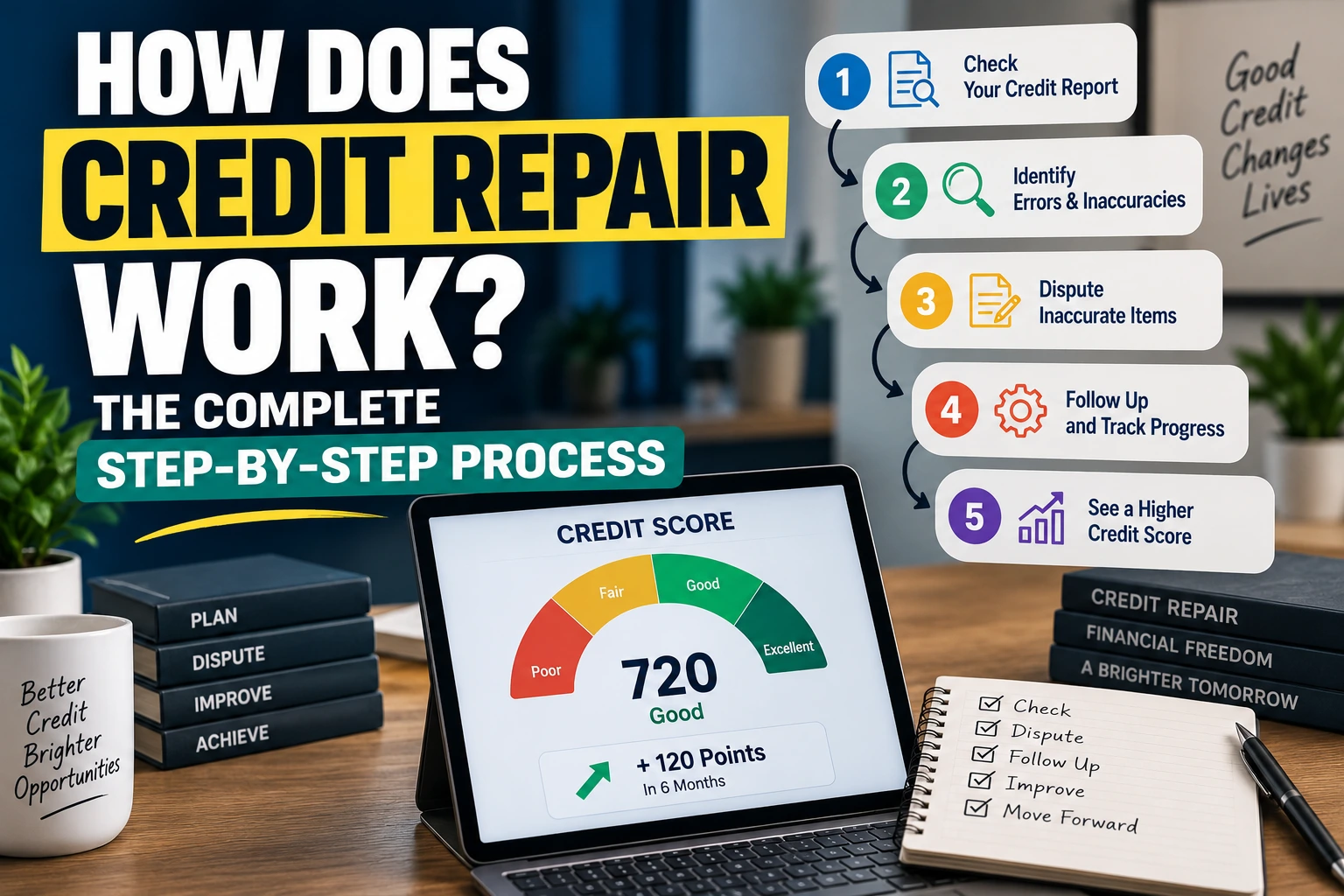
  • How Does Credit Repair Work? The Complete Step-by-Step Process

    How Does Credit Repair Work? The Complete Step-by-Step Process

    Credit repair works by identifying inaccurate, incomplete, or unverifiable items on your credit reports and formally disputing them with the credit bureaus, who must investigate within 30 to 45 days (Experian, 2026; Firstcard, 2026). If a disputed item can’t be verified as accurate, the bureau corrects or deletes it. If it’s confirmed accurate, it stays no company, paid or free, can remove a true negative mark early.

    That’s the entire mechanism in one sentence, but the real process has more moving parts: gathering the right proof, writing a dispute that survives the bureaus’ automated review system, tracking multiple 30-day windows across three separate bureaus, and knowing what to do when a dispute comes back “verified” even though you’re sure it’s wrong.

    This guide walks through every step, in order, whether you’re doing it yourself or evaluating what a paid service actually does on your behalf.

    Key Takeaways

    • Credit repair centers on formal disputes filed with Equifax, Experian, and TransUnion (Firstcard, 2026).
    • Bureaus must investigate within 30 days, extendable to 45 in some cases (Experian, 2026).
    • 2026 FCRA updates added a mandatory 10-day preliminary review for high-risk errors (Dispute Beast, 2026).
    • Vague disputes often get reduced to a two-digit code inside the bureaus’ e-OSCAR system specificity and documentation matter (Stacking Capital, via CreditCareCo, 2026).
    • Only inaccurate or unverifiable items can be removed; accurate negative marks stay for up to 7 years (Experian, 2026).

    Step 1: Pull and Review All Three Credit Reports

    The process starts with pulling your full credit reports from Equifax, Experian, and TransUnion and reviewing each one line by line (Firstcard, 2026). You’re looking for accounts you don’t recognize, duplicate listings, incorrect balances, and payment dates that don’t match your own records.

    Get your reports free through AnnualCreditReport.com, and save a copy of each so you can track exactly what changes later (Firstcard, 2026). A low score is rarely caused by one bad month it’s usually the accumulation of old mistakes and unresolved negative items still dragging the report down (ExpressCreditBoost, 2026). Why start here instead of jumping straight to disputes? Because you can’t fix what you haven’t fully mapped out first.

    If you’d rather handle the whole process without paying a company, this same review step is where a fix-your-own-credit playbook picks up in detail.

    Step 2: Identify Specific, Disputable Errors

    Not every negative item is fair game you’re specifically looking for information that’s inaccurate, outdated, unverifiable, or not yours (Firstcard, 2026). Common examples worth flagging include an account you don’t recognize, a duplicate collection for the same debt, a late-payment mark on an account you paid on time, or personal information that doesn’t belong to you.

    Make notes in plain language next to each one “account not mine,” “balance wrong,” “paid but shown as unpaid” rather than vague objections (Firstcard, 2026). Vague disputes are the ones most likely to get lost. The credit bureaus’ e-OSCAR verification system strips context from long, detailed letters, often reducing them to a simple two-digit dispute code before forwarding them to the creditor (Stacking Capital, via CreditCareCo, 2026) so a sharply specific claim survives that compression better than a paragraph of general complaints.

    Step 3: Gather Supporting Documentation

    Every dispute needs proof attached, not just an assertion. That means bank statements showing an on-time payment, account closure letters, identity theft reports, or anything else that directly contradicts what’s being reported. According to dispute-letter best practices, an effective letter clearly identifies the account, explains specifically why it’s inaccurate, and includes the supporting documentation up front (Crediful, via CreditCareCo, 2026).

    Skipping this step is one of the most common reasons a dispute comes back “verified” even when the consumer is right the furnisher simply confirms their own records because nothing was submitted to challenge them.

    One specific tool worth knowing at this stage is the 609 dispute letter, which cites your right under FCRA Section 609 to request the bureau’s method of verification alongside your dispute documentation.

    Step 4: File the Dispute With Each Bureau

    You can file a dispute online, by mail, or by phone, and the process differs slightly across Equifax, Experian, and TransUnion (Experian, 2026). Because each bureau maintains its own version of your file, an error appearing on two reports needs two separate disputes filing with one bureau doesn’t automatically correct the others.

    Under 2026 FCRA updates, high-risk errors now trigger a mandatory 10-day preliminary investigation in addition to the standard window, and bureaus must notify you if they need additional documentation before finishing their review (Dispute Beast, 2026). This is a meaningful shift: furnishers face stricter timelines, and slower or incomplete responses are no longer treated as acceptable under federal law.

    [CITATION CAPSULE]: The standard credit-bureau investigation window is 30 days, extendable to 45 if you submit additional relevant information during that period a rule unchanged even after the 2026 FCRA updates tightened requirements elsewhere (Firstcard; Dispute Beast, 2026).

    Step 5: The Bureau Investigates and Contacts the Furnisher

    Once filed, the bureau forwards your dispute to whoever reported the information the bank, collector, or lender and asks them to verify their records (Experian, 2026). This is the step most consumers can’t see happening, and it’s also where the e-OSCAR compression problem shows up most: a detailed letter can get boiled down to a short code before the furnisher ever reads your full explanation (Stacking Capital, via CreditCareCo, 2026).

    If the furnisher can’t verify the information as accurate, the bureau must correct or delete it. If they confirm it as accurate, it stays on your report, and you’ll be notified either way once the investigation closes (Experian, 2026).

    Step 6: Escalate If the Dispute Comes Back “Verified” Incorrectly

    If a dispute you’re confident is accurate still comes back verified, you’re not out of options. Escalation strategies include sending a follow-up dispute via certified mail with additional documentation, filing a complaint with the CFPB, or requesting the specific method the furnisher used to verify the record (Stacking Capital, via CreditCareCo, 2026). The CFPB has fined major bureaus for inadequate investigations in the past, and it continues to hold them accountable when consumers escalate formally.

    For debts you owe but want off your report faster, a pay-for-delete letter asking a collector to remove the account entirely in exchange for payment is a separate tool from a standard dispute, and it works only in specific situations (CreditCareCo, 2026).

    If the item in question is an accurate late payment rather than an error, a dispute won’t help that’s the situation goodwill letters are built for, asking a creditor to forgive a one-off late mark as a courtesy rather than contesting it as wrong.

    Step 7: Address What’s Left With Credit-Building Habits

    Once the disputable errors are resolved, whatever accurate negative information remains has to age off naturally, and the fastest path forward is standard credit-building: paying every bill on time, paying down balances, and avoiding unnecessary new credit applications (Experian, 2026). Most people see meaningful movement in their score within 45 to 90 days of starting the full process, with some early signs as soon as 30 days though the exact pace depends on how many negative items were on the report to begin with (Crowned Credit, 2026). For a fuller month-by-month picture, see how long credit repair actually takes.

    If you’re weighing whether to handle these steps yourself or pay someone to manage them, how much credit repair costs breaks down both paths in detail.

    FAQ

    How long does it take for credit repair to work?

    Most people see initial movement within 30 to 90 days, since bureaus must investigate disputes within 30 to 45 days (Crowned Credit; Experian, 2026). Full resolution across every disputed item can take several dispute cycles when errors appear on multiple bureaus or the case is more complex.

    Can a credit repair company remove accurate negative items?

    No. Credit repair whether done yourself or by a paid company can only dispute information that’s inaccurate, incomplete, or unverifiable. Accurate negative marks legally stay on your report for up to seven years regardless of who disputes them (Experian, 2026).

    What happens after I file a dispute?

    The bureau forwards your dispute to the company that reported the information and asks them to verify it. If they can’t confirm it’s accurate, the bureau corrects or deletes the item; if they confirm it, the item stays and you’re notified of the result (Experian, 2026).

    Do the 2026 FCRA updates change how disputes are handled?

    Yes. The 30-day standard window still applies, but high-risk errors now get a mandatory 10-day preliminary investigation, and bureaus must notify you if more documentation is needed, with stricter timelines imposed on furnishers as well (Dispute Beast, 2026).

    What if my dispute comes back “verified” but I know it’s wrong?

    You can escalate with a certified-mail follow-up including more documentation, request the furnisher’s verification method, or file a complaint with the CFPB, which has previously fined bureaus for inadequate investigations (Stacking Capital, via CreditCareCo, 2026).

    The Bottom Line

    Credit repair works through a defined legal process: pull your reports, flag specific errors with proof, file formal disputes with each bureau, and let the 30-to-45-day investigation window run its course. What changes between doing it yourself and paying a company is who manages that paperwork and follow-up not the underlying mechanism, and not what can legally be removed.

  • How Much Does Credit Repair Cost in 2026?

    How Much Does Credit Repair Cost in 2026?

    Credit repair costs $50 to $150 per month for professional services, plus a $70 to $249 setup fee in most cases, according to 2026 industry pricing pages (Experian; Credlocity, 2026). Flat-rate packages run $200 to over $1,500 depending on scope, and DIY dispute work costs $0 beyond the time it takes you.

    That’s a wide range, and the number that actually applies to you depends on how many errors are on your report, how long you stay enrolled, and whether you hire a company at all. Nearly 44,000 credit repair businesses operate in the U.S. right now (IBISWorld, 2026), competing for a market worth roughly $6.6 billion (Coinlaw, 2026) so pricing varies more than most shoppers expect.

    This guide breaks down what you’ll actually pay, what drives the cost up or down, and when paying for help beats doing it yourself.

    Key Takeaways

    • Professional credit repair typically runs $50–$150/month plus a $70–$249 setup fee (Experian; Credlocity, 2026).
    • Flat-rate packages range from about $200 for a 60-day plan to $1,500+ for comprehensive service (Broadview FCU, 2026).
    • DIY dispute filing is free under the Fair Credit Reporting Act you’re paying companies for time savings, not legal access.
    • Total cost depends heavily on timeline: simple cases resolve in 30–60 days, complex ones take 6–12 months (Broadview FCU, 2026).
    • No company can legally remove accurate negative information, regardless of what you pay (CROA; Credlocity, 2026).

    How Much Does Credit Repair Cost Per Month?

    Most credit repair companies charge $50 to $150 per month, with the bulk of legitimate providers clustering between $79 and $149 (Credlocity, 2026; Coinlaw, 2026). That fee typically covers dispute letters to the three bureaus, creditor correspondence, and account monitoring.

    Pricing generally breaks into three tiers:

    • Budget tier: $79–$99/month basic bureau disputes, limited dispute volume per round
    • Standard tier: $99–$149/month fuller dispute coverage plus creditor outreach
    • Premium/aggressive tier: $179–$250/month expanded disputes, faster turnaround, sometimes credit monitoring bundled in

    Couples or family plans combining two credit files often run $300–$400/month (Crowned Credit, 2026). Is a higher tier worth it? Only if your report has enough disputable items to justify the extra dispute volume a report with two or three errors rarely needs a premium plan.

    Read More: How Many Points Does a Hard Inquiry Actually Cost?

    What Does a Credit Repair Setup Fee Cover?

    A setup fee typically costs $70 to $249 and covers pulling your three-bureau credit report, analyzing it for errors, and drafting your first round of dispute letters (Experian, 2026; Crowned Credit, 2026). Some providers waive it entirely to compete for new clients, while premium or couples plans can push it to $400–$500.

    Under the Credit Repair Organizations Act (CROA), companies can’t collect payment before they’ve actually performed the work so a fee charged purely for “signing up,” with no report pull or dispute letters attached, is a red flag worth questioning (Credlocity, 2026). Before paying anything upfront, confirm exactly what the setup fee buys and ask for it in writing.

    How Much Do Flat-Rate Credit Repair Packages Cost?

    Flat-rate packages range from about $200 for a 60-day plan to $1,500 or more for comprehensive, multi-bureau service (Broadview FCU, 2026). Some providers also offer discounted multi-month bundles a six-month plan billed upfront, for example, can run several dozen dollars cheaper than paying the same monthly rate month to month (BadCredit.org, 2026).

    Flat-rate pricing appeals to people who want a predictable, capped cost instead of an open-ended monthly subscription that keeps billing until they cancel. The trade-off: if your case turns out to be more complex than the package assumes, you may still need to upgrade or add a follow-up round.

    DIY vs. Paying a Company: What’s the Real Cost Difference?

    DIY credit repair costs $0 in fees you can pull your reports for free at AnnualCreditReport.com and file disputes yourself under the Fair Credit Reporting Act at no charge (Firstcard, 2026). The only real cost is your time and the learning curve of writing effective dispute letters.

    Paying a professional service costs $50–$150/month specifically for convenience: someone else handles the paperwork, tracks bureau response deadlines, and follows up when a 30-day window lapses. Neither path can remove accurate negative information companies dispute inaccurate or unverifiable items only, and legitimate negative marks legally stay on your report for up to seven years, or ten for bankruptcies (Credlocity, 2026; Firstcard, 2026).

    Rhetorical question worth asking yourself: do you have 8+ errors across three bureaus and limited time to chase them down? That’s usually the tipping point where paying starts to make sense.

    How Long Does Credit Repair Take and What’s the Total Cost?

    Total cost depends heavily on your timeline. Simple cases resolve in 30–60 days, moderate cases take 3–6 months, and complex situations identity theft, multiple derogatory marks, bankruptcy-related items can take 6–12 months or longer (Broadview FCU, 2026). At $50–$150 a month, that stretches total spend anywhere from around $150 to well over $1,200 (CreditBooster.ai, 2026).

    The CFPB notes that meaningful changes to a credit profile typically take at least three to six months of consistent, active dispute work (Crowned Credit, 2026). Bankruptcy-related disputes are the hardest case: only about a 10% success rate for full early removal before the standard seven-year window closes (WiFiTalents, 2026).

    Read More: How does credit repair work

    Are There Hidden Costs or Red Flags to Watch For?

    The biggest hidden cost is paying month after month with no measurable progress, since standard contracts keep billing until you cancel. Watch for these red flags before signing anything (Credlocity, 2026):

    • Any company demanding hundreds of dollars before doing any work likely a CROA violation
    • Guarantees of a specific point increase no legitimate company can promise this
    • Suggestions to dispute every negative item regardless of accuracy frivolous disputes get rejected and can flag your file
    • Advice to use a new SSN or taxpayer ID “for a fresh start” this is fraud (sometimes marketed as CPN/credit-privacy-number schemes)

    Is Paying for Credit Repair Worth the Cost?

    Paying for credit repair is worth it when you have multiple disputable errors, limited time, or a looming deadline like a mortgage application not when your report only has one or two simple mistakes you could dispute yourself for free. About 40% of people who used a paid credit repair service went on to qualify for a credit card they’d previously been denied, and 28% saw interest rate cuts on existing cards after their profile was corrected (WiFiTalents, 2026).

    The math matters here: on a $300,000 mortgage, the swing between a 620 score and a 760 score can add up to roughly $100,000 in lifetime interest (WiFiTalents, 2026). Against that backdrop, a $600–$900 credit repair engagement over three to six months (Everything Credit LLC, 2026) can be a reasonable trade if your errors are genuinely inaccurate and worth disputing.

    FAQ

    How much does credit repair cost per month on average?

    Most professional credit repair services cost $50 to $150 per month, with standard-tier plans clustering around $99–$149 (Credlocity; Coinlaw, 2026). Budget plans start near $79/month, while premium or aggressive dispute plans can reach $250/month depending on scope.

    Is credit repair ever free?

    Yes. You can pull your credit reports for free at AnnualCreditReport.com and file disputes yourself under the Fair Credit Reporting Act at no cost. Nonprofit credit counseling is also free or low-cost (Firstcard, 2026). Paid services charge for convenience, not for access you don’t already have.

    Can a credit repair company legally charge me before doing any work?

    No. The Credit Repair Organizations Act (CROA) prohibits companies from collecting fees before they’ve completed the promised services, so demands for large payments upfront are a legal red flag (Credlocity, 2026). Setup fees of $70–$249 tied to an actual report pull and first dispute round are standard and compliant.

    How long until credit repair is worth what I paid for it?

    Simple disputes often resolve in 30–60 days, but the CFPB says meaningful profile changes typically need three to six months of active work, longer for complex cases (Broadview FCU; Crowned Credit, 2026). Budget for the full timeline, not just the first billing cycle, when weighing total cost.

    What’s the difference between DIY and professional credit repair cost?

    DIY costs $0 beyond your own time, since disputing errors is a right under federal law. Professional services cost $50–$150/month plus setup fees for the same dispute process, done on your behalf (Firstcard, 2026). Neither option can remove accurate negative information early.

    The Bottom Line

    Credit repair in 2026 costs $50–$150 a month for most professional services, $200–$1,500+ for flat-rate packages, or nothing if you handle disputes yourself. The right choice comes down to how many errors you’re disputing, how much time you have, and whether you’re comfortable managing bureau deadlines on your own. Whatever route you take, no legitimate company can remove accurate negative marks early so price out the convenience, not a promise no one can legally make.

  • What Is Jefferson Capital Systems and Why Are They Calling Me?

    What Is Jefferson Capital Systems and Why Are They Calling Me?

    If your phone has been lighting up with calls from an unfamiliar number, or you’ve opened a letter and seen the name “Jefferson Capital Systems” for the first time, your first reaction is probably somewhere between confusion and alarm. You don’t recognize the name. You’re not sure if it’s legitimate. And you’re definitely not sure whether you should answer the phone, ignore it, or panic.

    Take a breath — you’re not alone in this, and there’s a clear, factual answer to what’s going on. This guide explains exactly who Jefferson Capital Systems is, why they have your contact information, what they can and can’t legally do, and the specific steps to take depending on your situation.

    Who Is Jefferson Capital Systems?

    Jefferson Capital Systems, LLC (often abbreviated JCAP) is a debt buyer and debt collection company headquartered in St. Cloud, Minnesota. The company was originally founded in 2002 and has grown into one of the larger debt buyers operating in the United States, with additional operations extending into Canada and the United Kingdom. Over the years, Jefferson Capital has operated under different corporate ownership structures, as is common in the debt-buying industry, where companies are periodically acquired, merged, or restructured.

    Here’s the most important thing to understand right away: Jefferson Capital Systems is not a scam. It’s a real, legally operating company, registered and regulated as a debt collector under federal law, specifically the Fair Debt Collection Practices Act (FDCPA). That doesn’t mean every interaction with them will feel pleasant, and it doesn’t mean every debt they claim you owe is necessarily accurate or still legally collectible — but the company itself is a legitimate business, not a fraudulent operation preying on consumers with fake debts.

    What Does Jefferson Capital Actually Do?

    Jefferson Capital’s core business model is being a debt buyer, which is a specific and important distinction from a traditional third-party collection agency. Here’s the difference, and why it matters to you directly:

    A traditional collection agency is typically hired by your original creditor (say, a credit card company) to collect a debt on the creditor’s behalf, for a fee or commission. The creditor still legally owns the debt; the agency is just acting on their behalf.

    Jefferson Capital, by contrast, buys the debt outright, usually long after it’s been charged off by the original creditor (meaning the original lender has already written it off as a financial loss on their books — a separate accounting concept covered in more detail later in this guide). Debt buyers like Jefferson Capital typically purchase these charged-off accounts in large bundled portfolios, for a small fraction of the original balance — often just pennies on the dollar. Once purchased, Jefferson Capital becomes the new legal owner of the debt, which means any payment, negotiation, or settlement you make going forward would be with Jefferson Capital directly, not your original bank or lender.

    This is exactly why so many people are caught off guard: you might have taken out a credit card with one bank, stopped paying it years ago during a difficult financial stretch, largely forgotten about it, and then suddenly get a call from a company you’ve never heard of. The explanation is almost always the same — your original account was sold, once or sometimes multiple times, and Jefferson Capital is now the current owner attempting to collect.

    What Types of Debt Does Jefferson Capital Buy?

    Jefferson Capital purchases a wide range of charged-off consumer debt, commonly including:

    • Credit card debt from major banks and card issuers
    • Personal loans
    • Private student loans (not federal student loans, which are handled through an entirely separate government system)
    • Utility and telecom account balances, including unpaid phone or internet bills
    • Bankruptcy-related debt, including servicing certain secured and unsecured accounts tied to bankruptcy proceedings

    Because of this broad purchasing activity, Jefferson Capital’s name — or variations of it — can show up on your credit report or in collection correspondence in several different forms, including “Jefferson Capital Systems,” “Jefferson Capital LLC,” “JCAP Funding LLC,” “Jefferson Collection,” or even a name referencing the original creditor, such as “Jefferson Capital Systems Verizon,” if the debt originated with a telecom provider. If you’re trying to search your own credit report or old mail for a match, it’s worth checking for several of these name variations rather than assuming there’s only one exact way it would appear.

    Why Are They Calling or Writing to You Specifically?

    There are a few common scenarios that explain why you’re hearing from Jefferson Capital:

    • You have an old, unpaid account that was eventually charged off and sold. This is by far the most common reason. Somewhere in your financial history, an account went unpaid long enough that the original creditor gave up trying to collect it directly and sold it to a debt buyer — in this case, Jefferson Capital.
    • The debt was resold multiple times before reaching Jefferson Capital. It’s common for charged-off debt to be bought and sold more than once as it moves through the debt-buying industry, meaning Jefferson Capital might be the third or fourth company to have owned a particular account since it was originally charged off.
    • A mistake or mix-up has occurred. Less commonly, but not rarely, people are contacted about debt that isn’t actually theirs — due to identity theft, a case of mistaken identity (especially common with similar or shared names), or a data error somewhere along the chain of the debt being resold.
    • The debt may be outside your state’s legal collection window (statute of limitations), but they’re still permitted to contact you. Even if a debt is past the point where a collector could successfully sue you for it, in most cases collectors can still legally contact you and request payment, as long as they don’t misrepresent the enforceability status of the debt (a specific and important legal boundary covered later in this guide).

    Your Rights Under the FDCPA

    Because Jefferson Capital is legally classified as a debt collector, they’re required to follow the Fair Debt Collection Practices Act, a federal law that establishes clear boundaries on what debt collectors can and cannot do. Understanding these rights puts you in a much stronger position, regardless of whether the debt turns out to be legitimate or not.

    • They cannot call you at unreasonable hours. Under the FDCPA, debt collectors generally cannot contact you before 8 a.m. or after 9 p.m. in your time zone.
    • They cannot harass, threaten, or use abusive language. This includes repeated calls intended to annoy or harass, threats of violence, or the use of obscene language.
    • They cannot misrepresent themselves or the debt. This includes falsely claiming to be an attorney or government representative, misstating the amount owed, or falsely implying that failure to pay will result in arrest (a threat that’s simply not legally accurate for consumer debt in the United States).
    • They cannot contact you at your workplace if you’ve told them not to. Once you inform a collector, verbally or in writing, that you can’t receive calls at work, they’re legally required to stop contacting you there.
    • They must stop contacting you if you send a written cease-and-desist request. You have the right to request in writing that a collector stop all communication, though this doesn’t erase the debt itself, and it doesn’t necessarily prevent them from pursuing other legal remedies, such as a lawsuit, if the debt is still within the legal window to sue.
    • They cannot discuss your debt with third parties. This applies other than in very limited circumstances (such as confirming your location information), meaning they generally can’t disclose details of your debt to your family, employer, or neighbors.

    Step One: Do Not Ignore the Contact, But Don’t Panic Either

    A natural instinct when facing an unfamiliar collector is either to ignore it entirely, hoping it goes away, or to panic and immediately pay whatever is demanded just to make it stop. Neither of these is the ideal first move. The single most important first step is to request debt validation.

    What Is Debt Validation, and Why It Matters

    Under the FDCPA, you have the right to request that a debt collector validate a debt — meaning they must provide written proof of specific key facts, including the amount owed, the name of the original creditor, and confirmation that they have the legal right to collect this specific debt from you. You generally have 30 days from your first contact with the collector to make this request, and once you do, the collector is legally required to pause collection activity (including further calls) until they provide that validation.

    This step is valuable for everyone contacted by a debt collector, regardless of whether you believe the debt is legitimate, for a simple reason: it confirms the basic facts before you commit to anything, and it creates a paper trail. If the debt isn’t actually yours, is inaccurate, or the company can’t properly prove ownership and the amount owed, this process often reveals that clearly, without you having to take their word for it over the phone.

    How to request validation: Send a written letter (not just a phone request, which is harder to prove later) to the address provided in Jefferson Capital’s collection letter, clearly stating that you’re requesting debt validation under the FDCPA, and that you’re requesting they cease collection activity until validation is provided. Send it via certified mail with return receipt requested, so you have proof of when it was sent and received.

    Step Two: Check Whether the Debt Is Actually Yours

    Once you receive validation information, compare it carefully against your own records. A few things worth confirming:

    • Does the original creditor’s name match an account you actually had? If you don’t recognize the original creditor at all, this is a strong signal something may be wrong — either a data error or potential identity theft.
    • Does the amount claimed make sense relative to what you remember owing, accounting for any interest or fees that may have legitimately accrued?
    • Is the account genuinely yours, not a case of a similar name, a family member’s account, or identity theft?

    If anything doesn’t check out, this is the point to formally dispute the debt in writing, and if identity theft is suspected, to also file a report with the FTC at IdentityTheft.gov and place a fraud alert or credit freeze with the credit bureaus.

    Step Three: Check Your State’s Statute of Limitations

    Every state has a statute of limitations — a legal time limit within which a creditor or debt buyer can sue you to collect a debt through the court system. This period varies significantly by state, commonly ranging anywhere from three to ten years, and can also vary depending on the specific type of debt (written contract, credit card, promissory note, and so on).

    This is a critically important, and often misunderstood, legal concept, separate from how long a debt can appear on your credit report (governed by an entirely different federal rule under the Fair Credit Reporting Act, generally seven years from the original delinquency date). A debt can be past your state’s statute of limitations for lawsuits, while still legally appearing on your credit report if it’s within that separate seven-year window, and Jefferson Capital, like other debt buyers, is generally still permitted to contact you and ask for payment on a time-barred debt — they just can’t legally sue you over it (and in many states, and under a Consumer Financial Protection Bureau rule, they’re required to disclose to you that the debt is time-barred if they’re aware of it and still choose to attempt collection).

    Why this matters enormously before you pay anything: In many states, making even a partial payment, or in some cases simply acknowledging the debt in writing, can restart the statute of limitations clock, making you newly vulnerable to a lawsuit on a debt that was previously too old to be legally enforced in court. If you’re dealing with an old debt and you’re not sure whether your state’s statute of limitations has already expired, it’s worth researching this specifically, or consulting a consumer law attorney, before making any payment.

    Step Four: Decide How You Want to Handle It

    Once you’ve validated the debt and understand your legal timeline, you have several realistic paths forward, and the right one depends on your specific circumstances.

    • Pay the debt in full, if you have the means and confirm it’s accurate and something you want to resolve completely. This closes out the account and, under most current credit scoring models, is viewed more favorably than an unpaid balance.
    • Negotiate a settlement for less than the full amount. Since Jefferson Capital purchased the debt for a fraction of its original value, they often have real flexibility to accept a reduced lump-sum payment — sometimes 30-60% of the claimed balance, though this varies. Always get any settlement agreement in writing before sending payment.
    • Set up a payment plan, if a lump sum isn’t feasible, structured over time in a way that fits your budget — again, with any agreement documented in writing.
    • Dispute the debt formally, if validation reveals it isn’t accurate, isn’t yours, or the company can’t adequately prove their claim.
    • Do nothing further and let the reporting period run its course, if the debt is old, you’ve confirmed your state’s statute of limitations has already expired (making a lawsuit unlikely to succeed even if filed), and you’re not concerned about the remaining time it will stay on your credit report. This is a legitimate, if passive, strategy some people choose for very old debt, though it does mean the account may continue showing as unpaid on your credit report until it ages off.

    What If Jefferson Capital Sues You?

    If Jefferson Capital or a law firm representing them files a lawsuit against you, do not ignore it. This is one of the most consequential mistakes people make when dealing with any debt collector or debt buyer. If you don’t respond to a lawsuit by the deadline specified in the court papers, the court can enter a default judgment against you — meaning you automatically lose the case without ever presenting a defense, even if you had legitimate grounds to dispute the debt, such as an expired statute of limitations or a validation failure.

    If you’re served with a lawsuit, consider consulting a consumer law attorney, particularly one experienced in debt defense, even for a brief consultation. Many offer free or low-cost initial consultations specifically for this kind of case, and some potential defenses (like an expired statute of limitations, or the debt buyer’s inability to properly prove they own the debt and the amount claimed) can be effectively raised in court with the right approach.

    Does Jefferson Capital Show Up on Your Credit Report?

    Yes — if Jefferson Capital owns your debt and you haven’t resolved it, it will typically appear on your credit report as a collection account, under whichever of their name variations they use for reporting. This can affect your credit score, generally in a negative direction similar to any other unpaid collection account, and it follows the same seven-year reporting rule as other negative credit items, measured from the date of the original delinquency on the underlying account — not from whenever Jefferson Capital purchased it or began reporting.

    If you pay or settle the debt, your credit report should be updated to reflect that resolved status (paid or settled), which under most current scoring models is viewed more favorably than an ongoing unpaid balance, even though the entry itself typically remains visible for the remainder of the standard seven-year window.

    Red Flags That Would Suggest a Scam (Even Though Jefferson Capital Itself Is Legitimate)

    Because legitimate debt collection and scam operations can sometimes look similar on the surface, it’s worth knowing the specific warning signs of a scam, regardless of which company’s name is being used:

    • Demands for immediate payment via unusual methods, such as gift cards, cryptocurrency, or wire transfers — legitimate debt collectors accept standard payment methods and don’t demand these specific, hard-to-trace forms of payment.
    • Threats of immediate arrest or legal action within hours. Legitimate debt collection doesn’t work this way, and consumer debt in the U.S. does not result in criminal arrest.
    • Refusal to provide any written validation of the debt when you request it, or extreme pressure to pay before you’ve had a chance to verify anything.
    • A caller unable or unwilling to provide basic identifying information about themselves and the company they represent.

    If you experience any of these specific red flags, even from someone claiming to represent Jefferson Capital, treat it with heightened skepticism, verify independently by contacting Jefferson Capital directly through their official, publicly listed contact information, and consider reporting the suspicious contact to the FTC and your state attorney general’s office.

    How to Verify You’re Actually Speaking With Jefferson Capital

    If you want to independently confirm that a call or letter is genuinely from Jefferson Capital rather than an impersonator, look up their official contact information independently (rather than using a number provided in the potentially suspicious communication itself) and call to verify the account details match what you were told. Jefferson Capital, like other legitimate debt collectors, maintains official channels for consumers to contact them directly regarding account inquiries.

    What Happens If You Simply Never Respond?

    If you choose not to engage with Jefferson Capital at all — no validation request, no dispute, no payment — a few things are likely, depending on the specifics of your situation. If the debt is still within your state’s statute of limitations, Jefferson Capital retains the legal option to file a lawsuit to attempt to collect through the courts. If it’s outside that window, a lawsuit becomes far less viable for them, though they may continue occasional contact attempts (within FDCPA limits) for some additional time. In either case, the debt would likely continue appearing on your credit report as an unpaid collection until it eventually ages off after the standard seven-year reporting period from the original delinquency date, regardless of whether you’ve engaged with the collector directly.

    Simply avoiding all contact is a passive strategy that carries real risk if the debt is still legally suable, since it forfeits your opportunity to negotiate a potentially favorable settlement, correct any inaccuracy, or resolve the matter on more advantageous terms than what a court judgment might later impose.

    Frequently Asked Questions

    Is Jefferson Capital Systems a legitimate company?

    Yes. Jefferson Capital Systems, LLC is a real, legally operating debt buyer headquartered in St. Cloud, Minnesota, founded in 2002, and regulated as a debt collector under the FDCPA. It is not a scam, though individual scam operations sometimes attempt to impersonate legitimate collectors, which is why independent verification is always a reasonable precaution.

    Why does Jefferson Capital have my personal information?

    When your original creditor sells a charged-off debt, they typically transfer the associated account information — including your contact details, the account history, and the balance owed — to the purchasing debt buyer as part of the sale, which is how Jefferson Capital obtains your information without you ever having directly interacted with them before.

    Can Jefferson Capital garnish my wages?

    Only after successfully suing you and obtaining a court judgment against you — a debt collector generally cannot garnish wages simply by contacting you directly; this requires going through the legal process first, and even then, wage garnishment rules and exemptions vary significantly by state.

    What if I don’t recognize the original debt at all?

    This is worth taking seriously — request full validation, and if the details genuinely don’t match any account you’ve had, formally dispute it in writing and consider the possibility of identity theft or a data-matching error, which does happen, particularly with common names.

    Should I just pay whatever they ask to make the calls stop?

    Not without first validating the debt and understanding your state’s statute of limitations, since paying immediately without this basic verification could mean paying an inaccurate amount, paying for a debt that isn’t fully yours, or inadvertently restarting the legal clock on an otherwise expired debt.

    Can I negotiate directly with Jefferson Capital for a lower payoff amount?

    Yes, this is common and often successful, since debt buyers typically purchase accounts for a small fraction of the original balance and have real flexibility to accept a reduced settlement rather than pursuing the full amount, particularly for older debt they view as harder to collect in full.

    A Closer Look at How Debt Buying Actually Works

    To fully understand why a company like Jefferson Capital ends up owning your old debt, it helps to understand the broader debt-buying industry they operate within. When a lender — say, a major credit card issuer — has an account that goes unpaid for roughly 180 days, banking regulations generally require them to “charge off” that debt, meaning they write it off internally as a financial loss for accounting purposes (a specific accounting event that doesn’t mean the debt is forgiven, just that the original lender has stopped counting it as an asset they expect to collect).

    At this point, the original lender has a choice: continue trying to collect internally, hire a third-party agency to collect on their behalf, or sell the debt outright to a debt buyer. Selling to a company like Jefferson Capital is often the most immediately attractive option for the original lender, since it converts an uncertain, labor-intensive collection process into an immediate (if heavily discounted) cash recovery. Debt buyers purchase these accounts in bulk — sometimes thousands of accounts bundled together in a single portfolio sale — often paying somewhere in the range of a few cents to perhaps twenty cents on the dollar of the original balance, depending on the age of the debt, the type of debt, and how much documentation accompanies the sale.

    Once purchased, Jefferson Capital’s profit model depends on collecting more than they paid for the portfolio, even if they only recover a fraction of the original face value from each individual account. This is precisely why negotiation and settlement are often genuinely viable options when dealing with a debt buyer specifically — recovering even 30-40% of the original balance can still represent a substantial profit relative to what they paid to acquire the debt in the first place.

    Why Debt Gets Resold Multiple Times

    It’s not uncommon for a single unpaid account to change ownership more than once before landing with whichever company eventually contacts you. A credit card company might sell a batch of charged-off accounts to one debt buyer, who works the portfolio for a period of time, then sells whatever remains uncollected to a second buyer at an even steeper discount, and so on. Each time this happens, documentation can potentially degrade or become harder to fully trace back to the original account — which is part of why the debt validation process described earlier in this guide is so important. If Jefferson Capital purchased your account as the third or fourth owner in a chain of resales, it’s reasonable and appropriate to expect them to still produce adequate documentation proving the debt is accurately attributed to you and the amount is correct, regardless of how many times it’s changed hands.

    A Realistic Settlement Negotiation Walkthrough

    To make the negotiation process more concrete, here’s a realistic example of how a settlement conversation might unfold, and what reasonable expectations look like.

    Imagine Jefferson Capital claims you owe $4,000 on an old, charged-off credit card account. After validating the debt and confirming it’s accurate, you decide you’d rather resolve it than risk a potential lawsuit or let it continue affecting your credit report. Rather than agreeing to pay the full $4,000, a reasonable opening approach might be to offer a lump sum in the range of 25-40% of the balance — in this case, somewhere between $1,000 and $1,600 — explaining that this is what you’re realistically able to pay as a full and final settlement.

    Debt buyers often counter with a higher figure, and some back-and-forth negotiation is normal and expected. Settlements in the 40-60% range of the original claimed balance are common outcomes for debt-buyer negotiations, though the exact figure depends heavily on the specific account, how long Jefferson Capital has held it, and your own documented financial circumstances if you choose to share them as part of the negotiation.

    Whatever figure you ultimately agree to, insist on getting the agreement in writing before sending any payment — specifically stating the agreed amount, that it constitutes a full and final settlement of the account, and how the account will subsequently be reported to the credit bureaus. Never rely on a verbal agreement alone, since disputes about what was actually agreed to are difficult to resolve without documentation.

    What a Validation Letter Should Actually Include

    When Jefferson Capital or any debt collector responds to your validation request, the response should reasonably include: the name and address of the original creditor, the account number or a reference number tying the debt to a specific original account, the amount claimed to be owed (and ideally some accounting of how that figure was reached, particularly if it includes accrued interest or fees beyond the original charged-off balance), and confirmation of Jefferson Capital’s chain of ownership — meaning proof they actually purchased and now legally own this specific debt, not just a claim that they do.

    If the response you receive is vague, incomplete, or doesn’t actually address these specific points, you have grounds to continue disputing and can reasonably decline to proceed with payment until adequate documentation is provided. Some debt buyers, when faced with a well-documented validation dispute, will simply cease collection efforts on a specific account rather than go through the trouble of tracking down complete original documentation, particularly for older or smaller-balance accounts.

    Understanding the Relationship Between Jefferson Capital and Law Firms

    For accounts where informal collection attempts (calls and letters) haven’t resulted in payment, Jefferson Capital, like many debt buyers, sometimes works with law firms that specialize in debt collection litigation to pursue lawsuits on their behalf. If you receive court papers rather than a typical collection letter, this means the matter has escalated to formal litigation, and the stakes and urgency are meaningfully higher than an informal collection call. A law firm filing suit on Jefferson Capital’s behalf will need to prove, to the court’s satisfaction, the same basic elements covered in the validation process — that you owe the debt, the amount is accurate, and Jefferson Capital has the legal standing to collect it. This is exactly why responding to a lawsuit (rather than ignoring it) matters so much: it forces the plaintiff to actually prove their case rather than winning by default because you never showed up to contest it.

    A State-by-State Reality Check on Statutes of Limitations

    Because the statute of limitations varies so significantly by state and by debt type, it’s worth understanding the general categories most states use, even though you should verify your own specific state’s current law rather than relying solely on general guidance. Many states distinguish between debts based on a written contract (often a longer limitation period, sometimes 6-10 years) versus open-ended accounts like most credit cards (sometimes treated with a shorter period, commonly 3-6 years, though this varies considerably). Complicating this further, the relevant law can sometimes be determined by which state’s law governs the original credit agreement (often specified in the account’s original terms and conditions) rather than automatically your current state of residence, which can matter if you’ve moved since the account was originally opened. Given this complexity, if you’re relying on an expired statute of limitations as part of your strategy — particularly before deciding whether to make any payment at all — confirming the specific, current rule for your situation with a consumer law attorney is a reasonable and often worthwhile step, rather than relying on general online guidance alone.

    Common Misconceptions People Have About Jefferson Capital

    “If I ignore them, the debt just goes away eventually.”

    While it’s true that debts eventually age off your credit report and can become legally unenforceable in court once the statute of limitations expires, ignoring a debt collector doesn’t accelerate this process, and if the debt is still within the legally enforceable window, ignoring it leaves you vulnerable to a default judgment if they choose to sue.

    “Since they bought my debt for pennies on the dollar, I don’t really owe the full amount.”

    Legally, this isn’t accurate — the fact that a debt buyer purchased your account at a steep discount doesn’t reduce your legal obligation for the original amount owed, though it does explain why debt buyers often have significant room to negotiate a reduced settlement, since even a partial recovery represents a profitable outcome for them.

    “Jefferson Capital can have me arrested if I don’t pay.”

    This is false and is actually a specific tactic sometimes used by illegitimate scam operations impersonating real collectors. Consumer debt in the United States is a civil matter, not a criminal one, and no legitimate debt collector can have you arrested for an unpaid credit card, personal loan, or similar consumer debt.

    “Once I make a partial payment, they have to stop contacting me.”

    A partial payment doesn’t obligate a collector to cease contact regarding any remaining balance, and as covered earlier, a partial payment can actually restart your state’s statute of limitations clock in many states — a real risk worth understanding before making any payment on old debt you’re otherwise inclined to dispute or let age out.

    Building a Broader Plan If You Have Multiple Old Debts

    If Jefferson Capital’s contact is just one part of a larger picture — meaning you have several old, unresolved debts from different creditors or debt buyers — it’s worth stepping back and creating a complete inventory before tackling any single one in isolation. Pull your full credit reports from all three bureaus, list every open collection account, note the original creditor, the current balance claimed, and roughly how old each debt is (which affects both its statute of limitations status and how much longer it will remain on your credit report). From there, you can prioritize strategically: addressing the debts closest to a lawsuit risk (if still within your state’s statute of limitations and the creditor appears likely to litigate) before those that are older or smaller, and considering whether working with a nonprofit credit counseling agency to build a structured repayment plan across multiple debts makes sense for your overall financial situation, rather than negotiating each one reactively as contact happens to occur.

    Frequently Asked Questions, Continued

    Does Jefferson Capital ever remove accounts from credit reports as part of a settlement (a “pay for delete” arrangement)?

    This isn’t standard practice and isn’t something you should count on, though some consumers have reported success negotiating this specifically with smaller, independent debt buyers under certain circumstances. If you want to attempt this, get any such agreement explicitly in writing before sending payment, understanding it may well be declined.

    What happens to a Jefferson Capital debt if I file for bankruptcy?

    Most unsecured consumer debts, including those owned by debt buyers like Jefferson Capital, can typically be discharged through bankruptcy, subject to the specific rules of the bankruptcy chapter filed and your individual circumstances — consulting a bankruptcy attorney is the appropriate next step if this is something you’re considering as part of a broader debt resolution strategy.

    Can Jefferson Capital take money directly from my bank account?

    Not without first obtaining a court judgment against you and then following your state’s specific legal process for bank account levies or garnishment, which varies by state and often includes specific consumer protections and exemptions for certain funds (such as Social Security income in many cases).

    Is there a way to stop Jefferson Capital from contacting me entirely?

    Yes — sending a written cease-and-desist letter requires them to stop further communication, though it’s worth understanding this doesn’t erase the underlying debt or necessarily prevent a lawsuit if the debt is still within the legally enforceable window; it simply stops direct contact attempts.

    Should I get everything from Jefferson Capital in writing, even routine conversations?

    Yes, as a general practice, following up any verbal conversation with a brief written confirmation (an email or letter summarizing what was discussed and agreed to) creates a documented record that protects you if there’s ever a dispute about what was actually said or agreed upon.

    The Bottom Line

    Jefferson Capital Systems is a real, legally operating debt buyer, not a scam — but that doesn’t mean you should simply accept whatever they claim at face value or pay immediately out of pressure or fear. The right approach is methodical: request written validation of the debt before doing anything else, confirm the details genuinely match an account you actually owe, understand your state’s statute of limitations before making any payment, and then choose a resolution path — payment, settlement, a payment plan, or a formal dispute — based on accurate information rather than pressure from a phone call. Knowing your rights under the FDCPA, and using them, puts you in a far stronger position than either ignoring the situation entirely or reacting out of anxiety the moment the phone rings.

    Need Help Reviewing Your Credit Report?

    If Jefferson Capital Systems is appearing on your credit report and you’re unsure whether the account is accurate or how to address it, reviewing the account details and your available options can be an important first step.

    Request a Credit Audit or Quote

  • Who Is TSI on My Credit Report and How Do I Get Rid of It?

    Who Is TSI on My Credit Report and How Do I Get Rid of It?

    Pulling up your credit report and seeing an unfamiliar entry labeled “TSI” is one of those moments that can send you straight into a mild panic. You don’t remember opening an account with anyone by that name, you’re not sure what it’s for, and now you’re wondering whether it’s dragging down your score, whether it’s even legitimate, and — most urgently — how to get it off your report as quickly as possible.The good news is that TSI is a well-documented, identifiable company, and there’s a clear, methodical process for figuring out exactly what this account is and what your realistic options are for resolving or removing it. This guide walks through all of it.

    Who Is TSI?

    TSI stands for Transworld Systems Inc., one of the largest and longest-operating debt collection and accounts receivable management companies in the United States. The company was founded in 1970, making it one of the more established names in the collections industry, and over its history it has operated under different ownership groups and from different headquarters locations, having at various points been affiliated with NCO Financial/Expert Global Solutions before being acquired by private equity firms (Platinum Equity and later Clearlake Capital have both been reported as major stakeholders at different points).

    TSI provides collection and accounts receivable services across a wide range of industries, including healthcare providers, colleges and universities, government agencies, telecommunications and utility companies, and general commercial and financial institution clients. It’s worth noting that TSI sometimes operates or has operated under other business names as well, including North Shore Agency Inc., so if you see that name on a report or in correspondence, it may be connected to the same parent company.

    TSI is a legitimate, real company — not a scam. That said, being legitimate doesn’t automatically mean every account attributed to you is accurate, and it doesn’t mean you should simply accept whatever they claim without verifying it first, which is exactly what this guide will walk you through.

    Is TSI a Collection Agency or a Debt Buyer?

    This distinction matters because it affects who you’re actually negotiating with and who legally owns the underlying debt. Unlike some companies that primarily buy charged-off debt outright (a “debt buyer” model), TSI has historically operated more heavily as a third-party collection agency — meaning in many cases, your original creditor still owns the debt, and TSI has simply been hired to attempt collection on the creditor’s behalf, typically for a contingency fee taken from whatever they successfully recover.

    That said, TSI’s business has also included debt purchasing and loan servicing arrangements in some contexts, so it’s not accurate to assume it’s exclusively one model or the other. The practical way to find out which situation applies to you is the same either way: request debt validation (covered in detail below), which should clarify whether TSI is collecting on behalf of your original creditor or claims ownership of the debt itself.

    Why Is TSI Contacting You or Appearing on Your Report?

    A few common scenarios explain how TSI ends up associated with your credit file:

    • A creditor hired TSI to collect an unpaid balance. This is the most common scenario, particularly for smaller-balance accounts like medical bills, gym memberships, or utility final bills, where the original business doesn’t have its own internal collections department and outsources the work to a specialized company like TSI.
    • You have an old private student loan connected to certain trusts. TSI became widely known for its role collecting on behalf of the National Collegiate Student Loan Trusts (NCSLT), a group of trusts holding large pools of private student loan debt. If you have an old private student loan (not a federal loan, which is handled by an entirely different system) that went into default, this is a common and specific reason TSI might be involved.
    • A medical bill was sent to collections. TSI has a large healthcare-focused collections division, and unpaid medical bills — sometimes for amounts you didn’t even realize you owed, due to insurance processing delays or billing errors — are one of the most frequent reasons people find an unfamiliar TSI account on their report.
    • A tuition or education-related balance went unpaid. TSI also works with colleges and universities on unpaid tuition, fee, and related account balances.
    • A mistake, mix-up, or identity theft has occurred. As with any collector, it’s possible the account attributed to you isn’t actually yours — due to a data error, a similar name, or fraudulent activity. This is exactly why validation matters before you assume the debt is accurate.

    A Brief but Important Note on TSI’s Regulatory History

    In 2017, the Consumer Financial Protection Bureau (CFPB) took formal enforcement action against Transworld Systems specifically related to its role collecting on private student loans for the National Collegiate Student Loan Trusts. The CFPB’s consent order found that TSI had filed false or misleading affidavits and provided false or misleading testimony in debt collection lawsuits, in some cases pursuing legal claims when the underlying documentation didn’t actually prove the debt was owed as claimed. As part of the resolution, TSI was required to pay a civil penalty and adhere to specific injunctive requirements going forward.

    This history is genuinely useful context, not just a scary factoid: it means that if TSI is pursuing an old private student loan debt connected to these particular trusts, there’s a documented history of these specific collection efforts sometimes lacking adequate proof, which makes the debt validation step described below especially important rather than optional in this specific category of debt. This doesn’t mean every TSI account is questionable — the vast majority of medical, utility, and general commercial accounts they handle are routine and accurately documented — but if your situation specifically involves a private student loan and one of these trusts, extra diligence is warranted given this history.

    Step One: Pull Your Full Credit Report and Find the Exact Entry

    Before doing anything else, get your free credit reports from all three bureaus (Equifax, Experian, and TransUnion) at AnnualCreditReport.com and locate the specific TSI entry. Note the exact details: the reported balance, the original creditor listed (if any), the date the account was opened or reported, and which specific bureau or bureaus show it (since not every creditor reports identically to all three).

    Step Two: Request Debt Validation

    This is the single most important step, and it applies whether you believe the debt is accurate, aren’t sure, or suspect it isn’t yours at all. Under the Fair Debt Collection Practices Act (FDCPA), you have the right to request that TSI validate the debt — providing written proof of the amount owed, the name of the original creditor, and confirmation of their right to collect it from you. You generally have 30 days from your first contact with them to make this request, and once you do, they’re legally required to pause collection activity until they provide that validation.

    How to do this properly: Send a written letter — not just a phone call, which is harder to document and prove later — to the address provided in any TSI correspondence, explicitly requesting debt validation under the FDCPA and requesting they cease collection activity until it’s provided. Send it via certified mail with return receipt requested, so you have documented proof of when it was sent and received.

    Step Three: Evaluate the Response

    Once TSI responds (or fails to respond, which is also meaningful information), you’re in a position to make an informed decision:

    • If they provide clear, accurate validation and the debt is genuinely yours, you can move forward deciding how to resolve it (covered in the next section).
    • If they can’t adequately validate the debt — meaning they don’t provide sufficient proof of the amount, the original creditor, or their right to collect — you have strong grounds to dispute it formally with the credit bureaus, and in many cases, this alone leads to the account being removed, since a creditor or collector that can’t validate a debt generally cannot continue reporting it either.
    • If the debt genuinely isn’t yours, whether due to a data error or identity theft, formally dispute it as inaccurate with all three credit bureaus, providing whatever documentation supports your position, and if identity theft is involved, file a report at IdentityTheft.gov and consider a fraud alert or credit freeze.

    How to Actually Get a TSI Account Removed From Your Credit Report

    This is the core question driving most searches about TSI, so let’s break down every realistic path, since “removal” can happen through a few different mechanisms depending on your specific situation.

    Path One: Successfully Dispute an Inaccuracy

    If the debt is inaccurate in any material way — wrong amount, wrong dates, doesn’t belong to you, already paid, or TSI can’t properly validate it — filing a formal dispute with the credit bureaus is the most direct path to full removal. Under the Fair Credit Reporting Act, the bureau must investigate (typically within 30 days) and remove or correct any information that can’t be verified as accurate. This path results in genuine, complete removal because the information itself was wrong — not because of any payment or negotiation.

    Path Two: Attempt a “Pay for Delete” Negotiation

    A pay-for-delete arrangement involves paying some or all of the debt in exchange for TSI’s agreement to request removal of the account from your credit report entirely, rather than reporting it as simply “paid.” It’s worth understanding upfront that this isn’t a guaranteed or standard practice — major creditors and many large collection agencies generally avoid this practice due to their data-accuracy commitments with the credit bureaus, and TSI, as a large and long-established company, may be similarly reluctant. That said, it doesn’t hurt to ask, provided you get any agreement explicitly in writing before sending any payment, and you have a solid backup plan if it’s declined (which is a common outcome).

    Path Three: Pay or Settle the Debt (Without Deletion) and Let the Status Update

    Even without a deletion agreement, resolving the debt — through payment in full or a negotiated settlement — updates your credit report to reflect a “paid” or “settled” status rather than an ongoing unpaid balance. Under most current scoring models, this is viewed meaningfully more favorably than an unresolved account, even though the entry itself typically remains visible on your report for the remainder of its reporting window.

    Path Four: Request a Goodwill Removal After Resolving the Debt

    Once a debt is paid or settled, you can send a written goodwill request specifically asking TSI (or, if applicable, the original creditor) to consider removing the account as a courtesy, particularly if this was an isolated incident and you have a broader financial history that’s otherwise solid. This is entirely discretionary and not guaranteed, but it costs nothing to request and occasionally succeeds, especially with smaller balances or older accounts.

    Path Five: Wait for the Standard Reporting Period to Expire

    If none of the above paths succeed, or if you choose not to pursue them, the account will still eventually age off your credit report through the standard federal rule: seven years from the date of the original delinquency on the underlying account, regardless of who currently owns or reports the debt, or how many times it’s changed hands. This is a passive path, but it’s a guaranteed one — no negative item, TSI-related or otherwise, remains on your report indefinitely.

    Understanding the Seven-Year Clock Specifically for TSI Accounts

    It’s worth being precise about this, since it’s one of the most commonly misunderstood aspects of credit reporting: the seven-year window is measured from the date of your original delinquency on the underlying account — meaning when you first fell behind with the original creditor — not from whenever TSI became involved, started reporting, or a debt was transferred to them. If your original medical bill or student loan first became delinquent five years ago, and TSI only recently started attempting to collect and report it, the clock still runs from that original five-year-old delinquency date, not from TSI’s more recent involvement. This means the account may be closer to aging off your report than you’d assume just from looking at how recently TSI’s activity appears.

    Does Making a Payment Reset This Clock?

    For credit reporting purposes specifically, no — making a payment does not reset the seven-year credit reporting clock, which is fixed to the original delinquency date under federal law. However, this is a different question from your state’s separate statute of limitations governing how long a creditor can sue you to legally compel payment through the courts, which does vary by state and, in many states, genuinely can be restarted or extended by making a partial payment or otherwise acknowledging the debt in writing. Before making any payment on an old TSI account, especially one that’s several years old, it’s worth understanding your state’s specific statute of limitations for the type of debt involved, since these are two entirely separate legal concepts that are easy to conflate.

    What If TSI Is Contacting You About a Debt You’ve Already Paid?

    This happens more often than you’d expect, particularly with debt that’s changed hands multiple times or with medical bills where insurance processing delays created confusion about what was actually owed. If you believe you’ve already paid a debt TSI is now pursuing, gather your proof — payment confirmations, bank statements, receipts, or correspondence from the original creditor confirming the account was resolved — and submit this directly to TSI in writing, along with a formal dispute to the credit bureaus if the account is already appearing on your report. This is one of the stronger, more straightforward disputes to win, since you have concrete documentary proof rather than a more abstract disagreement about accuracy.

    Handling TSI Calls: What They Can and Can’t Do

    Because TSI operates as a debt collector, it’s bound by the same Fair Debt Collection Practices Act protections that apply to any other collector:

    • They cannot call before 8 a.m. or after 9 p.m. in your time zone.
    • They cannot harass you with repeated calls intended to annoy, or use abusive or threatening language.
    • They cannot misrepresent the debt or their identity, including falsely implying legal action is imminent when it isn’t, or misstating the amount owed.
    • They must stop calling your workplace once you inform them, verbally or in writing, that you can’t receive calls there.
    • They must honor a written cease-and-desist request, though this doesn’t erase the debt and doesn’t prevent other legal remedies like a lawsuit if the debt is still within the enforceable window.
    • They cannot discuss your debt with third parties, other than in limited circumstances permitted for locating you.

    If TSI violates any of these protections, you have the right to file a complaint with the CFPB and, depending on the severity, may have grounds for legal action under the FDCPA, which includes statutory damages in some cases.

    If TSI Sues You

    If you’re served with a lawsuit related to a TSI-collected debt, do not ignore it, even if you believe the debt is inaccurate or too old to legally pursue. Failing to respond by the court’s deadline can result in a default judgment against you — meaning you automatically lose without ever presenting a defense, even if you had a legitimate one, such as an expired statute of limitations or inadequate proof of the debt. Consider consulting a consumer law attorney, particularly one experienced in debt defense, many of whom offer free or low-cost initial consultations. Given TSI’s documented history with insufficiently proven student loan collection lawsuits specifically, this is a category of case where a legal consultation is especially worthwhile if you’re facing litigation over an old private student loan.

    A Realistic Step-by-Step Plan

    1. Pull your full credit reports from all three bureaus and identify the exact TSI entry, including the balance, original creditor, and dates.
    2. Send a written debt validation request via certified mail, and wait for a response before taking any further action.
    3. Evaluate what comes back: does it clearly and accurately validate the debt, or is something missing, wrong, or unconvincing?
    4. If inaccurate or unvalidated, file a formal dispute with the credit bureaus, providing any supporting documentation.
    5. If accurate, decide your approach: pay in full, negotiate a settlement, or, for very old debt outside your state’s statute of limitations and close to the seven-year reporting mark, consider whether resolving it or simply waiting it out makes more sense for your situation.
    6. Get everything in writing — validation responses, settlement agreements, payment confirmations — before and after making any payment.
    7. Once resolved, consider a goodwill removal request, understanding it’s discretionary and not guaranteed.
    8. If nothing else results in removal, track the seven-year mark from the original delinquency date, since the account will age off automatically at that point regardless of any other outcome.

    Frequently Asked Questions

    Is TSI the same as Transworld Systems?

    Yes, TSI is simply the commonly used abbreviation for Transworld Systems Inc. If you see either name on your credit report or in correspondence, they refer to the same company.

    Can TSI legally still collect a debt that’s very old?

    It depends on your state’s statute of limitations for the type of debt involved. TSI can generally still attempt to contact you and request payment even on very old debt, but if the debt is past your state’s statute of limitations, they generally cannot successfully sue you over it — though they’re not always required to volunteer that information, so it’s worth knowing your own state’s rules.

    Does TSI ever agree to remove accounts for payment (pay for delete)?

    This isn’t standard or guaranteed practice, and larger, more established collection agencies are often reluctant to agree to it. It doesn’t hurt to ask, but get any agreement explicitly in writing before paying, and have a backup plan if it’s declined.

    What if I don’t recognize the original creditor TSI lists at all?

    This is worth taking seriously — request full validation, and if the details genuinely don’t match anything you recognize, formally dispute it and consider whether identity theft or a data-matching error might be involved.

    Should I be more cautious if the TSI debt is a private student loan?

    Given TSI’s documented 2017 CFPB enforcement history specifically related to insufficiently proven private student loan collection lawsuits, yes — this is a category where verifying documentation carefully, rather than assuming the claimed amount and ownership are accurate, is especially worthwhile.

    How long will a TSI collection stay on my report if I do nothing?

    Up to seven years from the date of the original delinquency on the underlying account, regardless of when TSI became involved or started reporting it, after which it must be removed regardless of payment status.

    A Closer Look at TSI’s Healthcare Collections Business

    Because medical debt is one of the most common reasons people encounter TSI, it’s worth understanding a few specific rules that apply to medical collections differently from other debt types. As of recent, industry-wide changes adopted by all three major credit bureaus, paid medical collections are now generally removed from credit reports entirely rather than simply marked as paid — a more consumer-friendly standard than applies to most other debt types. Additionally, there’s now a required waiting period (commonly one year) before unpaid medical debt can even be reported in the first place, giving insurance claims and billing disputes time to resolve before a bill affects your credit. There’s also generally a minimum dollar threshold below which many medical collections aren’t reported at all under current bureau policy.

    This means if your TSI account is specifically a medical bill, you may have more consumer-friendly paths available than for other debt types: if you can show the bill was paid (even after it went to collections), it should be removed entirely rather than simply updated, and if the balance is small or the bill was sent to collections faster than the standard waiting period allows, you may have a straightforward basis for dispute on procedural grounds alone, separate from any question about whether the underlying charge was accurate.

    Understanding TSI’s Role in Private Student Loan Collections

    Since TSI’s connection to National Collegiate Student Loan Trusts is a common and often confusing scenario, it deserves a more detailed explanation. NCSLT is actually a collection of numerous individual trusts that purchased private student loans (not federal loans) originally issued by various banks, bundled them together, and hold them as investment assets. When a borrower defaults on one of these loans, the specific trust holding it typically hires a servicer or collector — historically, this has often been TSI — to pursue collection, sometimes including litigation.

    A significant and well-documented complication in this specific area of debt collection has been proving the actual chain of ownership: because these loans were often bundled, securitized, and transferred multiple times between the original lender and the specific trust now claiming ownership, courts in numerous cases around the country have found that the trusts (and TSI, collecting on their behalf) sometimes couldn’t produce adequate documentation proving they actually owned the specific loan in question, or that the amount claimed was accurate. This was, in fact, the core issue underlying the CFPB’s 2017 enforcement action.

    If you have an old private student loan connected to NCSLT and TSI is now involved, it’s genuinely worth requesting complete documentation of the chain of ownership as part of your validation request — not just a claim that you owe the money, but actual proof connecting the original loan, through whatever transfers occurred, to the specific trust and TSI’s authority to collect on its behalf. Given the well-documented history of gaps in this specific documentation trail, this is one of the more promising categories of debt to challenge thoroughly rather than assume is automatically valid.

    A Sample Debt Validation Letter for TSI

    Having a template ready makes this process considerably less intimidating. Here’s a structure you can adapt:

    [Your Name]
    [Your Address]
    [Date]

    Transworld Systems Inc.
    [Address provided in their correspondence]

    Re: Account [Reference Number]

    To Whom It May Concern:

    I am writing in response to your recent contact regarding the above-referenced account. Pursuant to my rights under the Fair Debt Collection Practices Act, I am requesting validation of this debt. Please provide the following:

    1. The name and address of the original creditor
    2. Documentation showing the amount owed and how it was calculated
    3. Proof that your company has the legal right to collect this specific debt from me

    Please note that I am requesting you cease all collection activity, including phone calls and further correspondence, until this validation is provided, as is my right under the FDCPA.

    Sincerely,
    [Your Name]
    [Account Reference Number]

    Send this via certified mail with return receipt requested, and keep a copy along with the mailing receipt for your records. If TSI responds by phone rather than in writing, ask them to confirm anything discussed in writing as well, since a documented paper trail protects you far more effectively than a verbal exchange.

    Comparing Your Removal Options at a Glance

    Method Requires payment? Removal guaranteed? Best used when
    Formal dispute (inaccuracy) No Yes, if successful The debt is wrong, unverifiable, or not yours
    Pay for delete Yes No — discretionary You want to try, with a backup plan ready
    Pay/settle without deletion Yes No (updates status only) The debt is accurate and you want it resolved
    Goodwill request after payment No (after paying) No — discretionary You’ve already resolved it and want a courtesy removal
    Wait for 7-year expiration No Yes, eventually None of the above succeeded, or you prefer to wait

    This table makes clear why disputing a genuine inaccuracy is the strongest path when it applies — it’s the only method on this list that guarantees removal without requiring any payment at all. This is exactly why the validation step is so important as your very first move: it often reveals whether you’re dealing with a debt worth disputing on the merits, rather than one you should simply move toward resolving through payment.

    What to Do If TSI Reports the Same Debt Under Multiple Names

    Because TSI has operated under related business names, including North Shore Agency Inc., and because debt can sometimes be transferred between related divisions or subsidiaries, it’s possible to see what appears to be the same underlying debt reported more than once under slightly different company names. If this happens, treat it as its own specific issue to dispute — creditors and collectors are generally not permitted to report the same debt multiple times as if they were separate, independent obligations, since this can unfairly compound the negative impact on your score for what is, in reality, a single unpaid account. Point this out explicitly in your dispute, providing the account details from both entries to demonstrate they refer to the same underlying debt.

    Why Some People Choose to Settle Even When They Could Fight

    Not every situation calls for a prolonged dispute process, even when there might be grounds for one. Some people, when facing an old, accurate TSI debt that’s genuinely theirs, simply prefer to resolve it as efficiently as possible — negotiating a reasonable settlement and moving on, rather than investing significant time and effort into a validation and dispute process for a debt they don’t fundamentally dispute owing. This is a completely reasonable choice, particularly for smaller balances where the time and effort of a thorough dispute process may not be worth it relative to simply settling and closing the chapter. The key principle either way is the same: make an informed choice based on accurate information, rather than either fighting reflexively or paying reflexively without understanding your situation first.

    Frequently Asked Questions, Continued

    Does TSI report to all three credit bureaus, or just one?

    This can vary by account and by which specific creditor or client TSI is collecting for — it’s worth checking all three of your reports individually, since it’s possible an account appears on one or two bureaus’ reports but not the third, depending on TSI’s reporting practices for that particular account.

    If I successfully dispute and remove a TSI account, can it come back later?

    Generally, no — once a credit bureau removes an item following a dispute because the furnisher (TSI, in this case) couldn’t verify it, they’re not permitted to simply re-report the same unverified information later without new substantiation. If it does reappear, this itself can be grounds for another dispute and, potentially, a complaint to the CFPB regarding a furnisher’s reporting practices.

    Can I negotiate with TSI even before receiving their validation response?

    It’s generally advisable to wait for validation first, since negotiating or making a payment before confirming the debt is accurate and properly owned by or assigned to TSI could mean resolving something you didn’t actually need to pay, or inadvertently acknowledging a debt that might otherwise have been successfully disputed.

    Is there a way to check whether TSI is legitimate before responding to them at all?

    Yes — you can independently verify their general legitimacy (as a real, longstanding company) through a basic search, and for your specific account, you can call TSI directly using contact information you find independently (not from a potentially suspicious letter or call) to confirm an account under your name genuinely exists in their system before sending any detailed personal information.

    What if TSI’s letter references a debt from a company I’ve never heard of?

    This is worth investigating carefully as part of your validation request — ask specifically for documentation connecting that original creditor to an account you actually opened, since it’s possible the original creditor’s name has changed, merged with another company, or that this represents a data error worth disputing.

    The Bottom Line

    TSI, or Transworld Systems Inc., is a real, long-established collection and accounts receivable company, not a scam — but that doesn’t mean you should accept an unfamiliar entry on your credit report at face value. The path to removing or resolving a TSI account starts the same way regardless of your specific situation: request written debt validation, review it carefully, and then choose the right path based on what you find — a formal dispute if it’s inaccurate, payment or settlement if it’s accurate, a goodwill request once resolved, or simply tracking the seven-year mark if none of the above pans out. Approaching it methodically, rather than either ignoring it or paying reflexively out of pressure, gives you the strongest possible position for actually getting it resolved on terms that work for you.

    Need Help Reviewing Your Credit Report?

    If TSI is appearing on your credit report and you’re unsure whether the account is accurate or how to address it, reviewing the account details and your available options can be an important first step.

    Request a Credit Audit or Quote

  • Northland Group Debt Collector — Who Are They and Can They Sue Me?

    Northland Group Debt Collector — Who Are They and Can They Sue Me?

    A call or letter from Northland Debt Collector Group tends to raise the same questions most unfamiliar collectors do: who is this company, why do they have your information, and what happens if you don’t respond? This guide walks through exactly who Northland Group is, why they’re likely contacting you, and — since it’s one of the more common concerns people search for specifically — whether and how they can actually sue you over an unpaid account.

    Who Is Northland Group?

    Northland Group, Inc. is a debt collection agency founded in 1982 by John Johnson, headquartered in the Minneapolis, Minnesota area (with addresses associated with both Edina and Minnetonka, Minnesota, both suburbs in the same metro area). The company describes itself as a leader in “late-stage” collections — meaning accounts that have typically already gone through earlier collection attempts elsewhere before landing with Northland — and it’s a privately held company, having been acquired by the private equity firm Mason Wells in 2008.

    Northland Group is a legitimate, licensed debt collection agency, not a scam. That said, legitimacy doesn’t guarantee every specific account they pursue is accurate or being handled without any missteps, which is exactly why the verification process outlined in this guide is worth following regardless of the company’s overall standing.

    Is Northland Group a Debt Buyer or a Third-Party Collector?

    Northland Group operates in both capacities, depending on the specific account. In some cases, they’re hired as a traditional third-party collector working on behalf of an original creditor, most notably reported to collect on credit card accounts for Capital One. In other cases, Northland services accounts on behalf of debt buyers, including a documented relationship servicing accounts for LVNV Funding, a well-known major debt-buying company. This means the specific nature of your relationship with Northland — whether they’re simply a hired collector for your original bank or are effectively representing the current legal owner of a purchased debt — can vary from account to account, which is exactly the kind of detail formal debt validation should clarify.

    Why Is Northland Group Contacting You?

    A few common scenarios explain how Northland Group became involved:

    • An unpaid Capital One credit card account went unresolved through Capital One’s own internal collection efforts and was placed with Northland Group for continued collection.
    • A debt originally owned by LVNV Funding or a similar debt buyer is being serviced or collected by Northland Group on that debt buyer’s behalf.
    • An account has moved through several prior collection attempts already, consistent with Northland’s specific focus on “late-stage” collections — meaning by the time they’re involved, your account has often already been through one or more earlier collection efforts that weren’t successful.
    • A data error or identity theft situation has resulted in a debt being incorrectly attributed to you — always worth ruling out through the verification process before assuming any claimed debt is accurate.

    An Important Piece of Legal History: Buchanan v. Northland Group

    A federal court case, Buchanan v. Northland Group, Inc., is a genuinely important piece of context for understanding how to approach any communication from this company, particularly involving older debt. The case centered on whether Northland Group violated the Fair Debt Collection Practices Act by sending settlement offer letters on debts where the applicable statute of limitations had already expired, without adequately disclosing this fact to consumers — potentially leading people to believe a debt was still legally enforceable through the courts when, in fact, it was not.

    The Consumer Financial Protection Bureau, along with the Federal Trade Commission, filed a supporting brief in this case, arguing that a debt collector doesn’t need to actually threaten or pursue litigation for a misleading settlement offer on a time-barred debt to constitute an FDCPA violation — the deceptive impression created by the letter itself can be enough. This case is directly and specifically relevant if Northland Group sends you a settlement offer on an older account: it establishes real, documented precedent for verifying your state’s statute of limitations before assuming a settlement offer implies the debt remains legally enforceable through a lawsuit if you don’t pay.

    Step One: Request Formal Debt Validation

    Before doing anything else, request formal, written debt validation from Northland Group under the FDCPA. This requires them to provide the name of the original creditor (Capital One, LVNV Funding, or another entity, depending on your specific account), the amount owed, and confirmation of their authority to collect it. You generally have 30 days from your first contact to make this request, during which they must pause collection activity until they respond.

    How to request it: Send a written letter via certified mail with return receipt requested, explicitly invoking your FDCPA rights and requesting that collection activity cease until validation is provided.

    Step Two: Check Your State’s Statute of Limitations — Especially Given Northland’s Documented History

    Given the specific legal precedent set by the Buchanan case, this step deserves particular emphasis when dealing with Northland Group. Every state has a statute of limitations, a legal time limit within which a creditor or collector can successfully sue you to collect through the courts, commonly ranging from three to ten years depending on your state and the type of debt. If your debt is old enough that this window may have already closed, verify this specifically before responding to any settlement offer, and understand that — as the Buchanan case demonstrated — a settlement letter’s tone or format alone shouldn’t be taken as confirmation that a lawsuit remains a genuine, legally viable possibility.

    Also critical: in many states, making even a partial payment, or in some cases simply acknowledging the debt in writing, can restart this statute of limitations clock, exposing you to renewed legal risk on a debt that was previously time-barred. This is precisely the kind of situation the Buchanan case was concerned with — a consumer being nudged toward a payment on a debt that could no longer actually be enforced through litigation, without being clearly informed of that fact.

    Step Three: Evaluate Your Options Based on What You’ve Confirmed

    If the debt is accurate and still within your state’s statute of limitations: you can reasonably move forward with paying in full, negotiating a settlement, or setting up a payment plan, understanding that Northland does retain the legal option to sue if the matter remains unresolved.

    If the debt is accurate but outside your state’s statute of limitations: Northland can still legally contact you and request payment, but cannot successfully sue you over it. In this scenario, whether to pay anything at all becomes a more personal decision — some people choose to resolve even a time-barred debt for peace of mind or to improve their credit report status, while others choose to let the remaining credit reporting window (a separate seven-year rule, measured from the original delinquency date) run its course without payment, precisely to avoid restarting any legal exposure.

    If the debt can’t be adequately validated, or genuinely isn’t yours: formally dispute it with the credit bureaus, providing whatever documentation supports your position.

    How to Negotiate With Northland Group

    If Northland Group is collecting on behalf of a debt buyer like LVNV Funding, there’s often meaningful room to negotiate a reduced settlement, since debt buyers typically purchase accounts at a steep discount from the original balance. If Northland is instead collecting directly for Capital One as the original creditor, your negotiating room may be somewhat more constrained by what Capital One specifically authorizes, though settlement offers below the full balance are still commonly available in many cases.

    Always get any agreement in writing before sending payment, specifying the exact amount, that it constitutes full and final settlement, and how the account will subsequently be reported. Given the documented history in the Buchanan case specifically involving misleading settlement communications, this step is especially important with Northland Group — don’t rely on a verbal phone conversation alone to confirm the terms of any resolution.

    Can Northland Group Sue You?

    Yes, if the underlying debt remains within your state’s statute of limitations and Northland (or the entity they’re collecting for) can adequately document their claim. If you’re served with a lawsuit, do not ignore it, regardless of your view on the debt’s validity or age — failing to respond by the court’s specified deadline can result in a default judgment against you automatically, forfeiting any legitimate defense you might have had available, including a statute of limitations defense that must generally be raised affirmatively rather than assumed to apply automatically.

    If you are sued, strongly consider consulting a consumer law attorney, particularly given the specific, documented legal history around Northland Group’s past practices regarding time-barred debt — an attorney familiar with this history may be especially well-positioned to identify relevant defenses in your specific case.

    Your Rights Under the FDCPA When Dealing With Northland Group

    • They cannot call before 8 a.m. or after 9 p.m. in your time zone.
    • They cannot harass you through repeated calls intended to annoy, or abusive or threatening language.
    • They cannot misrepresent the legal status of a debt, including implying that a time-barred debt remains fully enforceable through litigation if you don’t pay — precisely the issue at the heart of the Buchanan case.
    • They must stop calling your workplace once informed you can’t take calls there.
    • They must honor a written cease-and-desist request, though this doesn’t erase the underlying debt or necessarily prevent other remedies if the debt remains legally enforceable.

    If Northland Group violates any of these protections — particularly around misrepresenting a time-barred debt’s enforceability — you may have grounds for a complaint to the CFPB and potentially for legal action under the FDCPA, an area where this company has specific, documented prior legal exposure.

    What to Do If the Debt Isn’t Yours

    Given that Northland collects on both Capital One credit card accounts and debt buyer-owned accounts across a range of vintages, data-matching errors are a real possibility, as with any large-scale collector. If you don’t recognize the debt at all, formally dispute it in writing with both Northland Group and the credit bureaus, and if identity theft is suspected, file a report at IdentityTheft.gov and consider a fraud alert or credit freeze.

    Frequently Asked Questions

    Is Northland Group a legitimate company?

    Yes. Northland Group, Inc. is a real, licensed, decades-old debt collection agency headquartered in the Minneapolis, Minnesota area. It is not a scam, though independent verification of any specific account remains a reasonable precaution.

    What’s the significance of the Buchanan v. Northland Group case for me personally?

    This case established that a debt collector, including Northland Group specifically, can violate the FDCPA by sending settlement letters on time-barred debt without adequately disclosing that the debt is no longer legally enforceable through a lawsuit — making it especially important to verify your state’s statute of limitations before responding to any older debt settlement offer from this company.

    Does Northland Group own my debt, or are they just collecting it for Capital One?

    This depends on the specific account — Northland works both as a direct collector for Capital One and as a servicer for debt buyers like LVNV Funding. Formal debt validation should clarify which situation applies to your specific debt.

    If my debt is outside the statute of limitations, should I still respond to Northland Group’s letters?

    Yes — even if you don’t intend to pay, formally responding (in writing, ideally) to note that the debt appears to be time-barred, and requesting they cease contact, is a reasonable step, both to create a documented record and to help ensure they don’t continue treating the account as if a lawsuit remains a viable option.

    Can Northland Group add interest or fees on top of the original debt?

    This depends on what’s permitted under the original account terms and applicable state law. Any formal validation response should clarify how the current claimed balance was calculated, and you’re entitled to dispute charges that don’t appear properly substantiated.

    What if I already made a payment on an old debt to Northland Group and I’m now worried about the statute of limitations restarting?

    If this has already happened, it’s worth consulting a consumer law attorney to understand your state’s specific rule and what, if anything, can be done — in some cases, the effect of a restarted statute of limitations is not always as absolute as generally assumed, and specific state law nuances can matter considerably here.

    A Closer Look at “Late-Stage” Collections and What It Means for You

    Northland Group’s own description of itself as a leader in “late-stage” collections is worth unpacking, since it has practical implications for how you should approach your specific situation. In the debt collection industry, accounts are often categorized by how far along they are in the overall collection lifecycle: “early-stage” or “first-placement” accounts are typically handled by the original creditor’s internal team or a first collection agency shortly after becoming delinquent, while “late-stage” accounts have usually already been through one or more of these earlier attempts without resolution before being placed with a specialist like Northland.

    This matters for a few practical reasons. First, it means the account you’re dealing with through Northland has likely been aging for a longer period than a typical fresh collection account, which increases the odds that you’re approaching or have already passed key milestones like your state’s statute of limitations, or the halfway or later point of the standard seven-year credit reporting window. Second, late-stage collectors, precisely because they’re dealing with harder-to-collect, more aged accounts, sometimes have more institutional flexibility to accept a significantly reduced settlement, since their own internal expectations for full recovery on these older accounts tend to be more modest than for a fresher account. This can work in your favor during negotiation, provided you approach it with accurate information about your specific timeline and legal standing first.

    Understanding LVNV Funding’s Role When Northland Is Servicing on Their Behalf

    If your debt validation response reveals that Northland Group is collecting an account actually owned by LVNV Funding, it’s worth understanding a bit about this specific relationship. LVNV Funding is itself a well-known, large-scale debt buyer (a subsidiary of Resurgent Capital Services’ broader corporate family) that purchases charged-off consumer debt in bulk, similar in business model to companies like Midland Credit Management or Jefferson Capital Systems covered elsewhere. When LVNV Funding owns your debt but Northland Group is the company actually contacting you, this typically means Northland has been contracted specifically to handle the calling, letter-writing, and negotiation work on LVNV’s behalf, while LVNV retains ultimate legal ownership. Any settlement you reach would need to be structured (and ideally documented) as binding on LVNV Funding as the actual debt owner, not simply Northland Group as the servicing agent, to ensure the resolution is fully enforceable and properly reflected in LVNV’s own records as the account’s true owner.

    northland-group-debt-collector-under-100kb

    A Sample Response Letter Addressing a Time-Barred Debt

    Given the specific relevance of the statute of limitations issue with this particular company, here’s a template you can adapt if you’ve confirmed your debt is likely time-barred:

    [Your Name]
    [Your Address]
    [Date]

    Northland Group, Inc.
    [Address provided in their correspondence]

    Re: Account [Reference Number]

    To Whom It May Concern:

    I am writing regarding the above-referenced account. Based on my research, I believe this debt is beyond the applicable statute of limitations in my state, meaning it is no longer legally enforceable through a lawsuit.

    Please confirm in writing whether your company intends to pursue this debt as legally enforceable, and please be advised that I am requesting all collection communication cease, consistent with my rights under the Fair Debt Collection Practices Act.

    I am aware of my option to make a voluntary payment, but I am not acknowledging this debt as currently owed, and any partial payment should not be construed as a waiver of my position regarding the statute of limitations.

    Sincerely,
    [Your Name]
    [Account Reference Number]

    This kind of letter creates a clear, documented record of your position, which can be valuable both in stopping further contact and, if the situation ever escalates, in demonstrating that you raised this issue directly and in writing at the time.

    Frequently Asked Questions, Continued

    Does the Buchanan case mean Northland Group can never send settlement offers on old debt anymore?

    Not entirely — the case specifically concerned settlement offers that misleadingly implied a time-barred debt remained fully legally enforceable without adequate disclosure. Collectors can still generally contact you and request voluntary payment on time-barred debt, provided they don’t misrepresent its legal enforceability status in doing so.

    If Northland Group is collecting for Capital One directly, does Capital One know I’ve disputed the debt?

    Generally, yes — when you formally dispute a debt with a third-party collector working on behalf of an original creditor, this information is typically expected to be communicated back to that creditor as part of standard industry practice, though it’s still worth directly documenting your dispute with both parties if you want to be certain.

    Can I ask Northland Group directly whether my specific debt is time-barred?

    You can ask, though they aren’t necessarily obligated to volunteer a definitive legal conclusion about your specific state’s statute of limitations, particularly since this can involve some legal interpretation. Independently researching your state’s rule, or consulting a consumer law attorney for a clear answer specific to your situation, is generally more reliable than relying solely on the collector’s own characterization.

    Is Mason Wells’ private equity ownership relevant to how Northland Group operates day-to-day?

    Private equity ownership generally doesn’t change the legal obligations a collection agency operates under, though it can sometimes correlate with a company’s strategic focus on growth, acquisitions, or specific business line expansion — this is more of a general business context detail than something that directly affects your individual rights or the collection process itself.

    Comparing Northland Group to Other Late-Stage Collectors

    Northland Group A typical earlier-stage collector
    Where in the process they get involved
    After earlier collection attempts have failed
    Shortly after an account first becomes delinquent
    Typical account age when contacted
    Often several years old
    Often a few months old
    Negotiation flexibility
    Often greater, given lower recovery expectations
    Often more limited, tied closely to original creditor terms
    Statute of limitations relevance
    Very high — often close to or past the window
    Usually still well within the window
    Common clients
    Capital One, LVNV Funding, other debt buyers and creditors
    Varies widely

    This comparison underscores why the statute of limitations question is so central to almost any interaction with Northland Group specifically — by the nature of their business model, the accounts they handle are disproportionately likely to be old enough that this question is genuinely live, rather than a remote technicality.

    Frequently Asked Questions, Continued Further

    If Northland Group’s letter doesn’t mention a lawsuit at all, does that mean the debt is definitely time-barred?

    Not necessarily — the absence of an explicit lawsuit threat doesn’t confirm the statute of limitations has expired; it could simply reflect standard collection letter language, or a company choosing not to threaten litigation as a matter of general practice regardless of the debt’s specific legal status. Independently verifying your state’s statute of limitations remains the more reliable approach.

    Does Northland Group’s ownership by a private equity firm affect its regulatory obligations?

    No — regardless of corporate ownership structure, Northland Group remains fully subject to the FDCPA and all applicable state debt collection laws, and its obligations to consumers are unchanged by who owns the company.

    Can I request that Northland Group only communicate with me by mail rather than phone?

    Yes — under the FDCPA, you can request in writing that a collector limit or cease certain forms of contact, including specifying that you prefer written communication only, which they’re generally required to honor going forward.

    The Bottom Line

    Northland Group is a real, decades-old debt collection agency operating both as a direct collector for creditors like Capital One and as a servicer for debt buyers like LVNV Funding — legitimate, but with a specific, documented legal history involving misleading settlement communications on time-barred debt, established through the Buchanan v. Northland Group case. This history makes verifying your state’s statute of limitations before responding to any settlement offer especially important, alongside the standard steps of requesting formal debt validation and confirming the underlying debt is genuinely yours and accurately calculated. If you’re ever served with a lawsuit related to a Northland Group account, respond by the deadline regardless of your view on the debt’s merits, and strongly consider consulting a consumer law attorney given the company’s specific documented history in exactly this area.

    Need Help Reviewing Your Credit Report?

    If Northland Group is appearing on your credit report and you’re unsure whether the account is accurate, reviewing the account details and your available dispute options can be an important first step.

    Request a Credit Audit or Quote

  • Who Is Afni Inc and Why Are They Calling Me?

    Who Is Afni Inc and Why Are They Calling Me?

    An unfamiliar call from “Afni” or a letter bearing that name can leave you searching your memory for any connection to it — and coming up empty. This guide explains exactly who Afni is, what kind of debt they typically pursue, and the specific, methodical steps to take to figure out whether you actually owe them anything and how to handle it.

    Who Is Afni Inc?

    Afni, Inc. — officially Anderson Financial Network, Inc. — is a debt collection agency headquartered in Bloomington, Illinois, that has been operating for decades, with some sources tracing its origins back to the 1930s. Afni holds an A+ rating with the Better Business Bureau and has been an accredited BBB business for years, and it maintains a professional public-facing website that addresses common consumer questions and outlines consumer rights — a level of transparency not every collection agency offers.

    Afni is a legitimate, licensed collection agency, not a scam operation. That said, being legitimate and having a strong BBB rating doesn’t automatically mean every specific account attributed to you is accurate — which is exactly why the verification process outlined in this guide matters regardless of the company’s overall reputation.

    What Kind of Debt Does Afni Collect?

    Afni has built a particular specialization in telecommunications and utility debt, collecting unpaid balances on behalf of phone, internet, cable, and utility companies. This is Afni’s primary and most well-known area of focus, though the company’s activities have also extended into other categories over time, including certain credit card, student loan, and government-related accounts, depending on their specific client relationships at any given time.

    Afni operates in some cases as a traditional third-party collector — hired by an original creditor to attempt collection on their behalf for a fee — and in other cases has been reported to purchase debt portfolios outright, meaning the specific arrangement can vary depending on which account you’re dealing with. This is worth clarifying directly through the debt validation process, since it affects who ultimately owns the debt and who you’d need to negotiate with.

    An Important Piece of Regulatory History: The 2020 CFPB Consent Order

    In November 2020, the Consumer Financial Protection Bureau issued a formal consent order against Afni, Inc., specifically related to the accuracy of the credit reporting information Afni furnished to the major consumer reporting agencies in connection with its debt collection activities. This enforcement action required Afni to take specific corrective steps to improve and ensure the accuracy of its credit report furnishing practices going forward.

    This history is genuinely useful context, not just a cautionary footnote: it means that Afni has a documented, federally acknowledged history of issues specifically related to how it reports information to your credit file — which reinforces why carefully reviewing any Afni account on your credit report for accuracy, rather than assuming it’s automatically correct, is a reasonable and well-founded precaution, not excessive caution.

    Why Is Afni Contacting You?

    A few common scenarios explain how Afni became involved in your situation:

    • An unpaid phone, internet, or cable bill was referred to Afni by your telecom or service provider after their own internal collection attempts didn’t resolve the balance.
    • A utility bill from a former address went unpaid — this is a particularly common scenario, since final utility bills after moving are easy to overlook, especially if a forwarding address wasn’t properly updated with the utility company.
    • A credit card or personal loan account, in some cases, was placed with or sold to Afni depending on the specific creditor relationship involved.
    • A student loan or government-related balance, in some circumstances, depending on Afni’s specific client contracts at the time.
    • A data error, billing mistake, or identity theft situation has resulted in a debt being incorrectly attributed to you — always worth ruling out before assuming any claimed debt is accurate.

    Why Telecom and Utility Debt Deserves Careful Review

    Telecom and utility billing is a common source of billing disputes and errors — early termination fees that were waived but not properly removed from a final bill, equipment return credits that weren’t applied, disputed charges from a service outage or billing error, or a final bill sent to an old address that was never received. Given Afni’s specific concentration in this exact category of debt, and their documented history of a federal enforcement action related to reporting accuracy specifically, taking the time to verify a telecom or utility-related Afni account carefully is a particularly well-justified use of the validation process described below.

    Step One: Request Formal Debt Validation

    Whether you believe the debt is legitimate or you’re unsure, your first move should be requesting formal, written debt validation from Afni. Under the Fair Debt Collection Practices Act, you have the right to require Afni to provide the name of the original creditor, the amount owed, and confirmation of their authority to collect (whether as a hired collector or as the actual current owner of the debt). You generally have 30 days from your first contact with Afni to make this request, during which they must pause collection activity until they respond.

    How to request it properly: Send a written letter via certified mail with return receipt requested, explicitly invoking your FDCPA rights and requesting a cessation of collection activity until validation is provided. This creates a documented paper trail that’s considerably stronger than a verbal request made over the phone.

    Step Two: Cross-Check With the Original Service Provider

    Since telecom and utility debt is Afni’s primary specialty, and since these providers typically maintain detailed account records, contacting your former phone, internet, cable, or utility provider directly to confirm the final balance, the reason for the outstanding amount, and whether any credits or disputes were properly applied can be a valuable parallel step. This is especially useful if you believe a billing error, an improperly applied early termination fee, or an unreturned equipment credit might be involved.

    Step Three: Evaluate What You’ve Found

    If both the original provider and Afni’s validation response confirm a consistent, accurate balance, you’re in a position to make an informed decision about resolving it. If something doesn’t match — an unfamiliar charge, an amount that doesn’t reconcile with what the original provider confirms, or a lack of adequate documentation from Afni — you have solid grounds to formally dispute the debt with the credit bureaus.

    How to Resolve an Accurate Afni Debt

    • Contact the original service provider first, if the debt is still with them (not sold outright to Afni). Many telecom and utility companies retain some flexibility to correct billing errors, apply overlooked credits, or even reduce a final balance directly, sometimes more easily than negotiating through a third-party collector.
    • Pay in full, if you have the means, which resolves the debt though doesn’t automatically remove a related entry from your credit report — it updates the reported status to reflect payment.
    • Negotiate a settlement, which is often available, particularly if Afni purchased the debt outright rather than merely collecting on commission, since a debt buyer typically has more room to accept a reduced amount than an agency constrained by what the original creditor authorizes.
    • Set up a payment plan, with terms documented in writing before making your first payment.
    • Ask about a pay-for-delete arrangement, understanding it’s discretionary and not guaranteed, though it doesn’t hurt to ask, provided you get any agreement in writing before sending payment.

    Your Rights Under the FDCPA When Dealing With Afni

    • They cannot call before 8 a.m. or after 9 p.m. in your time zone.
    • They cannot request private information like your Social Security number without appropriate justification, and should not be pressuring you to provide sensitive personal details before validating the debt.
    • They cannot threaten legal action they don’t genuinely intend to take, or falsely imply criminal consequences for unpaid consumer debt, which don’t exist for this type of civil matter.
    • They cannot use profane or derogatory language.
    • They must stop calling your workplace once informed you can’t take calls there.
    • They must honor a written cease-and-desist request, though the underlying debt remains and other remedies (like a potential lawsuit, if the debt is still legally enforceable) aren’t necessarily prevented by this request alone.

    If Afni violates any of these protections, you can file a complaint with the CFPB — a step made particularly relevant given their documented 2020 consent order specifically related to reporting practices — and depending on the severity, may have grounds for legal action under the FDCPA.

    Can Afni Sue You?

    Yes, for debt that remains within your state’s statute of limitations and that they can adequately document. If you’re served with a lawsuit related to an Afni-collected debt, don’t ignore it — even if you believe it’s inaccurate or improperly pursued, failing to respond by the court’s deadline can result in a default judgment against you. Consider consulting a consumer law attorney, particularly if the debt is old, disputed, or if you believe Afni’s own documented history of reporting accuracy issues might be relevant to your specific situation.

    What to Do If the Debt Genuinely Isn’t Yours

    Given the volume of telecom and utility accounts Afni handles, along with their documented history of credit reporting accuracy concerns, data-matching errors are a real possibility worth taking seriously. If you don’t recognize the debt, formally dispute it in writing with both Afni and the credit bureaus, and if identity theft is suspected — which can be common with telecom accounts specifically, since opening service in someone else’s name is a frequently used tactic in identity theft schemes — file a report at IdentityTheft.gov and consider a fraud alert or credit freeze.

    Frequently Asked Questions

    Is Afni a legitimate company?

    Yes. Afni, Inc. (Anderson Financial Network) is a real, long-operating, BBB-accredited debt collection agency headquartered in Bloomington, Illinois. It is not a scam, though — as with any collector — individual account accuracy should still be independently verified.

    Does Afni own the debt, or are they collecting for someone else?

    This varies by account — Afni operates both as a traditional third-party collector working on commission and, in some cases, as a purchaser of debt portfolios outright. Requesting formal validation clarifies which situation applies to your specific debt.

    Why does Afni have a specific CFPB enforcement action against them?

    In 2020, the CFPB issued a consent order against Afni specifically addressing the accuracy of credit reporting information they furnished to the credit bureaus, requiring corrective action to improve those practices going forward.

    Can I resolve my debt directly with my old phone or utility company instead of Afni?

    If Afni is acting as a hired collector rather than the outright owner of the debt, yes, this is often possible and can sometimes lead to a faster or more favorable resolution, particularly if a billing error or overlooked credit is involved.

    Does Afni typically accept settlements for less than the full balance?

    Often yes, particularly for debt they’ve purchased outright, where they have more flexibility than when collecting strictly on commission for an original creditor. It’s always worth asking and negotiating rather than assuming the full balance is the only option.

    What if Afni is contacting me about a utility bill from an address I haven’t lived at in years?

    This is a common and legitimate scenario — final utility bills are easy to overlook, especially after a move, but it’s still worth verifying the specific amount and dates through both Afni’s validation response and, if possible, the original utility company’s own records before assuming the balance is fully accurate.

    A Sample Debt Validation Letter for Afni

    Here’s a template you can adapt for your specific situation:

    [Your Name]
    [Your Address]
    [Date]

    Afni, Inc.
    [Address provided in their correspondence]

    Re: Account [Reference Number]

    To Whom It May Concern:

    I am writing regarding your recent contact about the above-referenced account. Pursuant to my rights under the Fair Debt Collection Practices Act, I am requesting validation of this debt, including:

    1. The name of the original creditor and the type of account (phone, internet, cable, utility, or other)
    2. An itemized breakdown of the amount claimed, including any fees or charges beyond the original service balance
    3. Confirmation of whether your company owns this debt outright or is collecting on behalf of the original creditor

    Please also confirm that all collection activity, including phone calls and further correspondence, will cease until this validation is provided, as is my right under the FDCPA.

    Sincerely,
    [Your Name]
    [Account Reference Number]

    Send this via certified mail with return receipt requested, and retain copies of everything for your records.

    Common Telecom and Utility Billing Errors Worth Checking For Specifically

    Given Afni’s concentration in this exact debt category, it’s worth knowing the specific, recurring types of errors that show up most often in telecom and utility collections:

    • Early termination fees that should have been waived. Many service contracts waive early termination fees under specific circumstances (a documented move outside the provider’s service area, active military deployment under the Servicemembers Civil Relief Act, or a promotional offer that included a waiver), but billing systems don’t always automatically apply these waivers correctly.
    • Equipment return credits that weren’t processed. If you returned a modem, router, cable box, or other leased equipment after canceling service, a credit for that returned equipment should be applied to your final bill — but equipment return processing errors (a package that wasn’t properly logged as received, for instance) are a common source of inflated final balances.
    • Charges continuing after a requested cancellation date. If your service cancellation wasn’t processed on the date you actually requested, you may be billed for a period of service you didn’t intend to continue past your cancellation request.
    • A final bill sent to the wrong address, particularly after moving, resulting in a bill you never actually saw before it was sent to collections — worth specifically checking the billing address associated with the account in Afni’s validation response.
    • Bundled service disputes, where a promotional rate expired or a bundled discount wasn’t properly applied, resulting in a higher final balance than expected.

    If any of these scenarios sound familiar, requesting your complete billing history directly from the original telecom or utility provider (which they’re generally required to provide) gives you the specific documentation needed to challenge an inaccurate balance effectively, rather than relying solely on Afni’s own summary of the account.


    who-is-afni-inc-and-why-are-they-calling-me-under-100kb

    How to Interpret Afni’s Response If They Claim to Have Purchased the Debt

    If Afni’s validation response confirms they purchased the debt outright rather than merely collecting on the original creditor’s behalf, this shifts your negotiating position in a useful way, similar to dealing with any debt buyer: since they acquired the account at a discount, there’s typically more room to negotiate a reduced settlement than there would be if the original telecom or utility company still owned the debt and was constraining what a hired collector could accept. In this scenario, focus your negotiation directly with Afni rather than attempting to go back to the original service provider, since they no longer have any ongoing stake in or authority over the resolution.

    Frequently Asked Questions, Continued

    Does Afni’s 2020 CFPB consent order mean every account they currently report is being handled correctly now?

    The consent order required Afni to implement specific corrective measures to improve reporting accuracy going forward, which suggests improved practices since that time, though it doesn’t guarantee every individual account is free of error — ongoing verification of your own specific account remains a reasonable practice regardless of a company’s broader compliance improvements.

    If my telecom bill was disputed with the original provider before it went to collections, does that dispute still matter now?

    Yes — if you have documentation showing you formally disputed a charge with the original provider before the account was sent to Afni, this is valuable evidence to include in your response to Afni and in any formal credit bureau dispute, since it demonstrates the balance was contested prior to collection, not simply left unpaid without explanation.

    Can Afni report a debt to my credit file if I’m actively disputing it with the original telecom company?

    If the debt has already been placed with Afni for collection, it can potentially still be reported while a dispute is ongoing with the original creditor, which is exactly why formally notifying Afni directly (not just the original company) that the debt is disputed is an important, separate step to protect your position on both fronts.

    Is it common for Afni accounts to involve relatively small dollar amounts?

    Yes, particularly given their telecom and utility focus — many Afni accounts involve final bills in the range of a few hundred dollars or less, which is worth keeping in perspective when deciding how much time and effort to invest in a thorough dispute versus a straightforward settlement or payment.

    Why Identity Theft Involving Telecom Accounts Deserves Special Mention

    Telecom accounts are a particularly common target in identity theft schemes because opening new phone service requires relatively less verification in some cases than opening a credit card or loan, and a fraudulent phone line can be used to facilitate further fraud before the true account holder even realizes it exists. If Afni is contacting you about a telecom account you never opened, this is worth treating with real urgency — not just as a billing dispute, but as a potential sign of broader identity theft that could extend beyond this single account. Pulling your full credit report to check for other unfamiliar accounts, placing a fraud alert or credit freeze, and filing a report at IdentityTheft.gov are all reasonable, proactive steps if this scenario applies to you.

    What to Do If Afni Continues Contacting You After a Dispute Is Filed

    If you’ve formally disputed a debt in writing and Afni continues attempting to collect without providing adequate validation, this is itself a potential FDCPA violation, since collectors are required to cease collection activity until proper validation is provided following a timely dispute. Document every instance of continued contact after your dispute (dates, methods of contact, content of any messages), and consider filing a complaint with the CFPB, which creates a formal record and typically prompts a company response, since collectors are required to respond to CFPB complaints within a specified timeframe.

    Frequently Asked Questions, Continued Further

    Does Afni ever handle debt for cell phone carriers specifically, separate from home internet and cable providers?

    Yes — mobile phone carriers are among the types of telecommunications clients Afni has worked with, alongside home internet, cable, and traditional landline and utility providers, so an unfamiliar Afni contact could relate to any of these specific service categories.

    If I switch providers and my old provider sends a final bill to Afni, does my credit with my new provider get affected?

    Generally no — each provider relationship and any associated credit check or account standing is typically independent, though if the Afni collection account appears on your general credit report, it could indirectly affect your overall creditworthiness for future services or applications broadly, separate from your specific standing with your new provider.

    Is there a faster way to resolve a small Afni utility balance without extensive back-and-forth?

    For a small, verified, uncontested balance, simply paying it directly (after confirming accuracy through validation) is often the fastest resolution, reserving the more extensive dispute process described in this guide for situations where you have genuine reason to believe the amount or the underlying charge is inaccurate.

    The Bottom Line

    Afni, Inc. is a real, long-established, BBB-accredited debt collection agency with a particular specialization in telecommunications and utility debt — legitimate, but with a documented history of a federal enforcement action specifically related to credit reporting accuracy, which is worth keeping in mind when reviewing any Afni account on your credit report. Request formal validation, cross-check with your original service provider where possible, and only move toward payment or settlement once you’ve confirmed the debt is genuinely accurate. If it isn’t, you have clear grounds — and Afni’s own regulatory history reinforces the reasonableness of — pursuing a formal dispute rather than accepting the claim at face value.

    Need Help Reviewing Your Credit Report?

    If an Afni collection is appearing on your credit report and you’re unsure whether the information is accurate, you can request a credit audit or quote to review your situation and identify potential credit-report issues.

    Request a Credit Audit or Quote
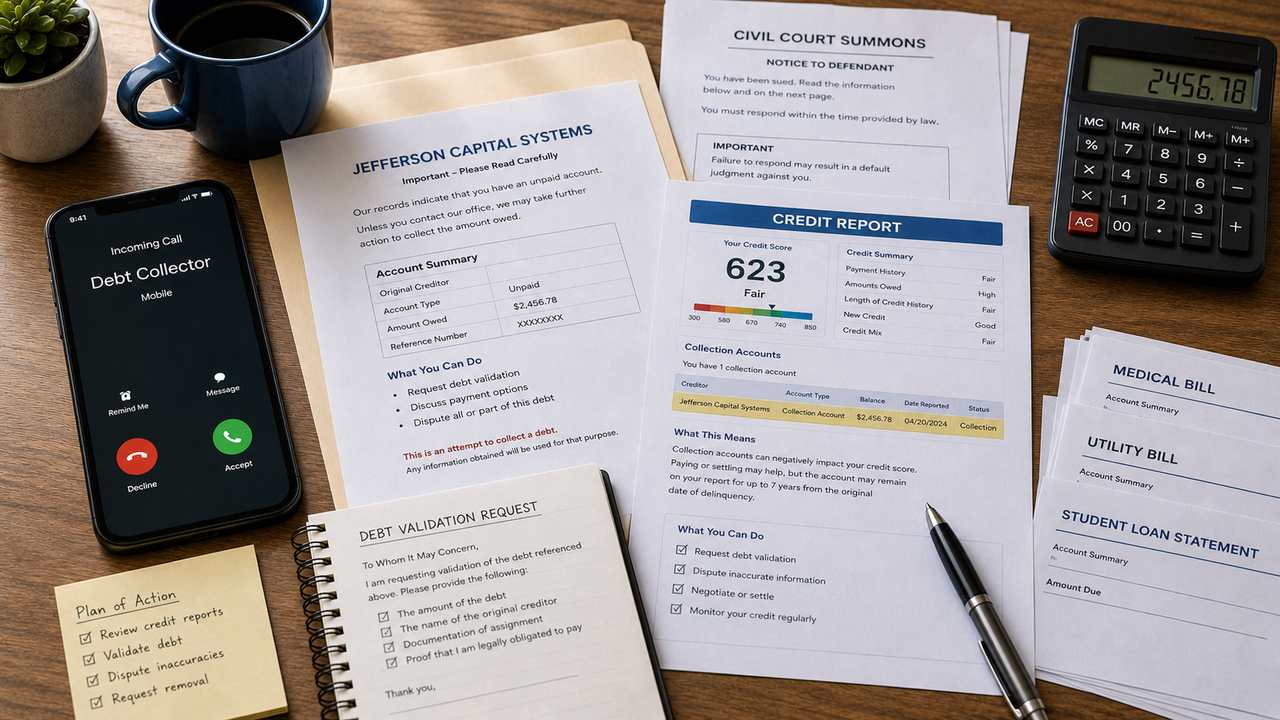
  • Midland Credit Management Is Suing Me — What Are My Options?

    Midland Credit Management Is Suing Me — What Are My Options?

    Being served with a lawsuit is one of the more frightening moments in dealing with debt, and if the plaintiff is Midland Credit Management, it can feel especially disorienting because you may not have interacted with this specific company before — even if the underlying debt traces back to a credit card or loan you recognize. This guide walks through exactly what’s happening, what your realistic options are, and the specific steps to take right now, because how you respond in the coming days genuinely matters.

    First: Do Not Ignore This

    Before anything else, understand this clearly: ignoring a lawsuit is the single worst thing you can do, regardless of whether you believe the debt is accurate, too old, or improperly pursued. Every lawsuit comes with a specific deadline to file a formal response (called an “Answer” in most courts), typically ranging from 14 to 30 days depending on your state and the type of court. If you don’t respond by that deadline, the court can enter a default judgment against you — meaning you automatically lose the case without ever presenting any defense, even a legitimate one like an expired statute of limitations or inadequate proof of the debt. A default judgment can lead to wage garnishment, bank account levies, or property liens, depending on your state’s laws, and it’s considerably harder to undo after the fact than it is to prevent by responding on time.

    Who Is Midland Credit Management, and Why Are They Suing You?

    Midland Credit Management (MCM) is a large debt buyer, a subsidiary of publicly traded Encore Capital Group (NASDAQ: ECPG), headquartered in San Diego, California. Unlike a traditional collection agency hired by your original bank, MCM (often through its affiliate Midland Funding LLC, which frequently holds legal ownership of the purchased accounts) buys charged-off debt outright, typically credit card debt, for a small fraction of the original balance. When informal collection efforts — calls, letters, settlement offers — don’t result in payment, MCM sometimes escalates to filing a lawsuit to obtain a court judgment, which gives them additional legal tools (like wage garnishment or bank levies, depending on your state) to collect.

    If you’re being sued, it almost always means an old, unpaid credit card or similar account was charged off by your original bank, sold to MCM (or Midland Funding), and MCM has now decided that litigation is the most effective way to pursue collection on that specific account.

    Step One: Confirm the Lawsuit Is Legitimate

    Before anything else, verify that what you’ve received is a genuine court filing, not a scam. Legitimate lawsuits are filed with an actual court, will reference a specific case number, and can be verified by contacting the clerk of the court listed on the documents directly (using contact information you look up independently, not from the paperwork itself, as an added precaution). If you have any doubt about legitimacy, this verification step takes only a few minutes and provides real peace of mind either way.

    Step Two: Read the Documents Carefully and Note the Deadline

    Court documents can be dense and intimidating, but the most important details to identify immediately are: the specific deadline to respond, which court the case was filed in, the case number, and the exact amount MCM is claiming you owe. Mark the response deadline prominently — this is the single most time-sensitive piece of information in the entire process.

    Step Three: Determine Whether You Have a Response Strategy

    You generally have a few broad paths once served: filing a formal Answer contesting the lawsuit (in whole or in part), attempting to settle with MCM before the case proceeds further, or, in rare cases, allowing a judgment if you have no viable defense and no ability to negotiate (though even in this scenario, responding is still generally preferable to a default judgment, since it may allow you to negotiate a structured payment arrangement as part of the judgment rather than facing more aggressive collection tools).

    Filing a Formal Answer

    An Answer is your formal written response to the lawsuit, addressing each claim MCM has made. This doesn’t need to be a lengthy legal document — many court systems provide simplified Answer forms, and some consumer advocacy organizations offer templates specifically designed for responding to debt collection lawsuits. Filing an Answer, even a relatively simple one, prevents a default judgment and forces MCM to actually prove their case in court, which shifts real leverage back toward you, since debt buyers sometimes struggle to produce complete documentation for older, resold accounts.

    Common Defenses Worth Considering

    • The statute of limitations has expired. Every state has a legal time limit (commonly 3-10 years, depending on the state and debt type) within which a creditor can sue you to collect. If MCM filed suit after this window closed, this is a strong, often case-ending defense — but it must generally be raised affirmatively in your Answer, since courts don’t always apply it automatically on your behalf.
    • MCM can’t adequately prove ownership of the debt. Debt buyers must be able to demonstrate a clear chain of ownership from the original creditor to themselves, along with accurate documentation of the amount owed. For older debt that’s been resold multiple times, this documentation is sometimes incomplete or missing, which can be a genuine, successful defense if the plaintiff can’t meet their burden of proof.
    • The amount claimed is inaccurate. If MCM’s claimed balance includes improper fees, incorrect interest calculations, or simply doesn’t match your own records, this is worth raising specifically.
    • You’ve already paid or settled this debt. If you have documentation showing prior resolution, this is a straightforward and often decisive defense.
    • The debt isn’t yours. Whether due to identity theft or a data-matching error, this is worth raising if applicable, along with any supporting documentation.

    Step Four: Consider Consulting a Consumer Law Attorney

    Given what’s potentially at stake — a court judgment, wage garnishment, and lasting damage to your credit and finances — consulting an attorney, even for a single initial conversation, is genuinely worth considering. Many consumer law attorneys who handle debt defense cases offer free or low-cost initial consultations, and some even work on a contingency or fee-shifting basis in cases involving FDCPA violations, since that law allows for recovery of attorney’s fees if a violation is successfully proven. An attorney can help you identify which specific defenses genuinely apply to your situation, draft a proper Answer, and potentially negotiate a more favorable settlement than you might secure on your own, given their familiarity with how MCM and similar debt buyers typically approach litigation and settlement.

    Step Five: Explore Settlement, Even After Being Sued

    Being sued doesn’t mean settlement is off the table — in fact, many debt buyer lawsuits, including those filed by MCM, are resolved through a negotiated settlement rather than proceeding to a full trial. Since MCM purchased the debt at a steep discount, there’s often genuine room to negotiate a reduced lump-sum payment or structured payment plan, even after litigation has begun, sometimes resulting in the lawsuit being dismissed as part of the settlement agreement.

    If you pursue this route, get any settlement agreement in writing before making a payment, and specifically confirm what happens to the lawsuit itself — ideally, a dismissal with prejudice (meaning it can’t be refiled later) as part of the agreement, rather than simply an informal understanding that they won’t pursue it further.

    What Happens If You Don’t Respond and a Default Judgment Is Entered?

    If you miss the response deadline and a default judgment is entered against you, MCM gains access to additional legal collection tools that vary by state but commonly include:

    • Wage garnishment, where a portion of your paycheck is legally redirected to satisfy the judgment, subject to state and federal limits on how much can be garnished.
    • Bank account levies, where funds in your bank account can be seized to satisfy the judgment, though certain funds (like Social Security income, in many states) are often protected from this.
    • Property liens, particularly relevant if you own real estate, which can complicate selling or refinancing the property until the judgment is resolved.

    It’s sometimes possible to have a default judgment vacated (undone) after the fact, particularly if you can show you weren’t properly served or had a legitimate reason for missing the deadline, but this is a more difficult and uncertain process than simply responding on time in the first place — which is exactly why acting quickly upon being served matters so much.

    Understanding MCM’s Documentation Requirements in Court

    Because MCM is a debt buyer rather than the original creditor, they’re generally required to prove, to the court’s satisfaction, a complete chain connecting the original account to their current ownership, along with accurate records of the amount owed. This typically requires records like the original account agreement, a bill of sale or assignment document showing the debt was properly transferred to Midland Funding or MCM, and account statements showing the balance history. In practice, this documentation is sometimes incomplete, especially for older debt that’s changed hands more than once before reaching MCM — which is exactly why a well-prepared response that specifically challenges MCM to produce this documentation, rather than simply asserting the debt isn’t yours in general terms, is often the more effective legal strategy.

    What to Expect at Each Stage of the Process

    After filing your Answer, the case typically proceeds to a discovery phase, where both sides can request documentation from each other — this is your opportunity to formally request MCM produce their complete chain-of-ownership documentation.

    Settlement discussions often occur throughout this process, sometimes initiated by MCM, sometimes by you or your attorney, and many cases resolve at this stage without ever reaching trial.

    If the case does proceed to trial (relatively uncommon for smaller consumer debt amounts, though not impossible, particularly in small claims court), you or your attorney would present your defense, and MCM would need to prove their case with adequate documentation and testimony.

    Frequently Asked Questions

    How much time do I actually have to respond to a lawsuit from Midland Credit Management?

    This varies by state and court, but commonly ranges from 14 to 30 days from when you were served. The exact deadline should be specified in the court documents themselves — confirm this immediately upon receiving the paperwork.

    Can I represent myself in court against MCM without an attorney?

    Yes, this is legally permitted (called appearing “pro se”), and many people do successfully respond to and even win debt collection lawsuits without an attorney, particularly with the help of self-help resources many courts provide specifically for this type of case. That said, given what’s potentially at stake, at least a brief consultation with an attorney is worth considering if it’s accessible to you.

    Will settling with MCM after being sued still show up as a lawsuit on my record?

    The underlying court case is a matter of public record regardless of the outcome, though a settled or dismissed case is generally viewed far more favorably than an unpaid judgment, both practically and in terms of your credit report, which would reflect the resolved status rather than an open judgment.

    Can MCM garnish my wages immediately after filing the lawsuit?

    No — garnishment generally can’t occur until after a court judgment has been entered against you, which requires either a default (from not responding) or an actual court ruling in MCM’s favor after the case proceeds.

    Is it worth negotiating with MCM before my response deadline, or should I file an Answer first?

    Both are worth pursuing simultaneously if possible — filing your Answer protects you from a default judgment regardless of how settlement discussions proceed, so it’s generally not advisable to rely solely on settlement negotiations without also meeting your formal response deadline, since a settlement isn’t guaranteed to be finalized before that deadline passes.

    What if I can prove the statute of limitations has expired — do I still need to respond to the lawsuit?

    Yes, absolutely — an expired statute of limitations is a defense you generally need to raise affirmatively in your Answer; it doesn’t automatically dismiss the case on its own, and failing to respond and raise this defense properly could still result in a default judgment despite having a technically valid defense available.

    midland-credit-management-is-suing-me-under-100kb

    A Sample Structure for Your Answer

    While you should always check your specific court’s required format (many courts provide official fillable Answer forms specifically for debt collection cases, which is generally preferable to a freeform document), a basic Answer typically includes:

    • Case caption information — the court name, case number, and the names of both parties, copied exactly from the summons or complaint you received.
    • A response to each numbered allegation in MCM’s complaint — for each numbered paragraph they’ve filed, you’ll typically respond with “admit,” “deny,” or “without sufficient knowledge to admit or deny” as appropriate.
    • Any affirmative defenses, listed specifically — this is where you’d state, for example, “Plaintiff’s claim is barred by the applicable statute of limitations” or “Plaintiff has failed to establish ownership of the alleged debt,” if these apply to your situation.
    • Your signature and the date, along with proper filing according to your specific court’s rules (which may include filing fees, though fee waivers are often available for those who qualify based on income).

    Many state court websites and legal aid organizations provide specific, free Answer templates designed for debt collection lawsuits, which can meaningfully simplify this process compared to drafting one entirely from scratch.

    What Discovery Requests You Can Send to Challenge MCM’s Case

    Once your Answer is filed, the discovery phase gives you the opportunity to formally request that MCM produce specific documentation supporting their claim. Useful requests often include: the original credit agreement or account terms, a complete accounting showing how the current claimed balance was calculated, documentation showing the specific chain of assignment or sale from the original creditor to Midland Funding or MCM, and any documentation of your specific account’s payment history. If MCM cannot produce adequate documentation in response to a properly formatted discovery request, this can significantly strengthen your position, sometimes leading to a case being dismissed or MCM offering a considerably more favorable settlement rather than risk proceeding without adequate proof.

    Understanding Settlement Timing: Before vs. After Judgment

    It’s worth being explicit about why settling before a judgment is entered is almost always preferable to settling after. Before judgment, you’re negotiating as an equal party in an unresolved dispute, with real leverage if MCM’s documentation is incomplete or if a statute of limitations defense is available. After a judgment is entered against you, MCM has already secured the legal tools (potential garnishment, liens, levies depending on your state) to compel payment, considerably reducing your negotiating leverage — settlement is still often possible even at this stage, but typically on less favorable terms than could have been achieved earlier in the process. This is one of the most concrete, practical reasons responding promptly and considering settlement discussions early matters so much.

    A Note on Arbitration Clauses

    Some original credit card agreements include a mandatory arbitration clause, requiring disputes to be resolved through private arbitration rather than in court. If your original account included such a clause, it’s worth discussing with an attorney whether this could be raised as a basis to compel arbitration instead of court litigation — though whether this genuinely benefits you depends heavily on the specific circumstances, since arbitration isn’t inherently more favorable to consumers than court litigation, and pursuing this path adds its own complexity and cost considerations.

    What If You Genuinely Owe the Debt and Have No Viable Defense?

    Not every situation involves a strong defense, and that’s an important reality to acknowledge honestly. If you genuinely owe the debt, the statute of limitations hasn’t expired, and MCM’s documentation appears to be in order, your best path is often straightforward: still file a timely Answer (to preserve your negotiating position and avoid the additional consequences of a default judgment), and focus your energy on negotiating the most favorable settlement or payment plan possible, ideally resulting in a dismissal of the lawsuit as part of that agreement, rather than allowing it to proceed to an uncontested judgment.

    Frequently Asked Questions, Continued

    If MCM’s lawsuit is dismissed due to inadequate documentation, can they refile it later?

    This depends on how the dismissal is entered — a dismissal “without prejudice” generally allows the case to be refiled later if MCM later obtains adequate documentation, while a dismissal “with prejudice” permanently bars them from refiling on the same claim. This distinction is worth clarifying and, where possible, negotiating for specifically, whether through a contested dismissal or as part of a settlement agreement.

    Does being sued by MCM mean my wages are automatically at risk?

    No — wage garnishment can only occur after a judgment is actually entered against you, and even then, is subject to state and federal limits on the percentage of income that can be garnished, along with certain state-specific exemptions and protections.

    Can I still negotiate with MCM if I’ve already missed my response deadline?

    It’s worth trying, though your leverage is considerably weaker once a default judgment risk is imminent or has already occurred. If you’ve missed the deadline, acting immediately — potentially seeking to have a default judgment vacated if one has been entered, or urgently negotiating if it hasn’t yet been finalized — is critical, and consulting an attorney quickly in this scenario is especially valuable given the time pressure involved.

    Should I attend the court hearing even if I’ve reached a settlement with MCM beforehand?

    Generally yes, unless your settlement agreement specifically confirms the case has been or will be formally dismissed with the court before your hearing date — verbal or informal settlement agreements don’t automatically update the court’s own records, so confirming the case status directly with the court, not just with MCM, is an important final step.

    How to Find Free or Low-Cost Legal Help

    If hiring a private attorney isn’t financially feasible, several resources exist specifically for consumers facing debt collection lawsuits: local legal aid organizations (often income-qualified but free), law school legal clinics (many law schools operate clinics where supervised students provide free representation or guidance), your state or local bar association’s lawyer referral service (which can connect you with attorneys offering free or reduced-cost initial consultations), and self-help centers operated by many state and county courts specifically designed to help unrepresented parties understand and navigate the process, including debt collection defense specifically. The National Association of Consumer Advocates also maintains a directory of attorneys who specialize in consumer protection and debt collection defense cases, some of whom work on contingency or fee-shifting arrangements particularly suited to FDCPA-related claims.

    A Realistic Timeline of a Typical MCM Lawsuit

    Understanding roughly how long this process tends to unfold can help manage expectations and plan accordingly. After being served, you’ll have your initial response window (commonly 14-30 days). If you file an Answer, the case typically moves into a discovery and pretrial phase that can last anywhere from a few weeks to several months, depending on your specific court’s caseload and procedures. Many cases settle during this window once both sides have exchanged basic information and assessed their respective positions. If a case does proceed toward trial, this can add additional months to the timeline, though — as noted earlier — trial is relatively uncommon for this type of consumer debt case, since a large percentage resolve through settlement or dismissal before reaching that stage.

    Frequently Asked Questions, Continued Further

    Does it help my case if I can show I attempted good-faith settlement discussions with MCM before being sued?

    This can be a favorable fact to raise in court or during settlement discussions, since it demonstrates you weren’t simply avoiding the debt, though it doesn’t substitute for a substantive legal defense if one is genuinely available and applicable to your situation.

    If I successfully defend against this lawsuit, does that mean the underlying debt is erased entirely?

    Not necessarily in every circumstance — a successful defense based on inadequate documentation might mean MCM loses this specific case without proving they own the debt, but if they later obtain proper documentation (and the case wasn’t dismissed with prejudice, and the statute of limitations hasn’t independently expired), it’s theoretically possible for the debt to be pursued again. A successful expired-statute-of-limitations defense, by contrast, generally means the debt can no longer be pursued through the courts at all, regardless of documentation.

    Can I countersue Midland Credit Management if I believe they violated the FDCPA?

    Yes, if you have evidence of a genuine FDCPA violation (such as improper contact practices, misrepresentation of the debt, or pursuing a clearly time-barred debt through litigation), you may have grounds for a counterclaim, potentially including statutory damages and recovery of attorney’s fees if successful — this is exactly the kind of scenario where consulting a consumer law attorney is particularly valuable, since these claims require specific legal knowledge to properly identify and pursue.

    The Bottom Line

    Being sued by Midland Credit Management is serious, but it’s a manageable situation with clear, time-sensitive steps: verify the lawsuit is legitimate, note your response deadline immediately, and file a formal Answer rather than ignoring it, regardless of your ultimate strategy. From there, whether you pursue a specific legal defense (like an expired statute of limitations or inadequate documentation), negotiate a settlement, or consult an attorney for guidance, you’re in a fundamentally stronger position than if you allow a default judgment to be entered by missing the deadline. The single most important thing to take away from this guide is simple: however you choose to handle the substance of the case, respond by the deadline.

    Need Help Reviewing Your Credit Report?

    If Midland Credit Management is suing you or a related collection account is appearing on your credit report, you can request a credit audit or quote to review your situation and identify potential credit-report issues.

    Request a Credit Audit or Quote