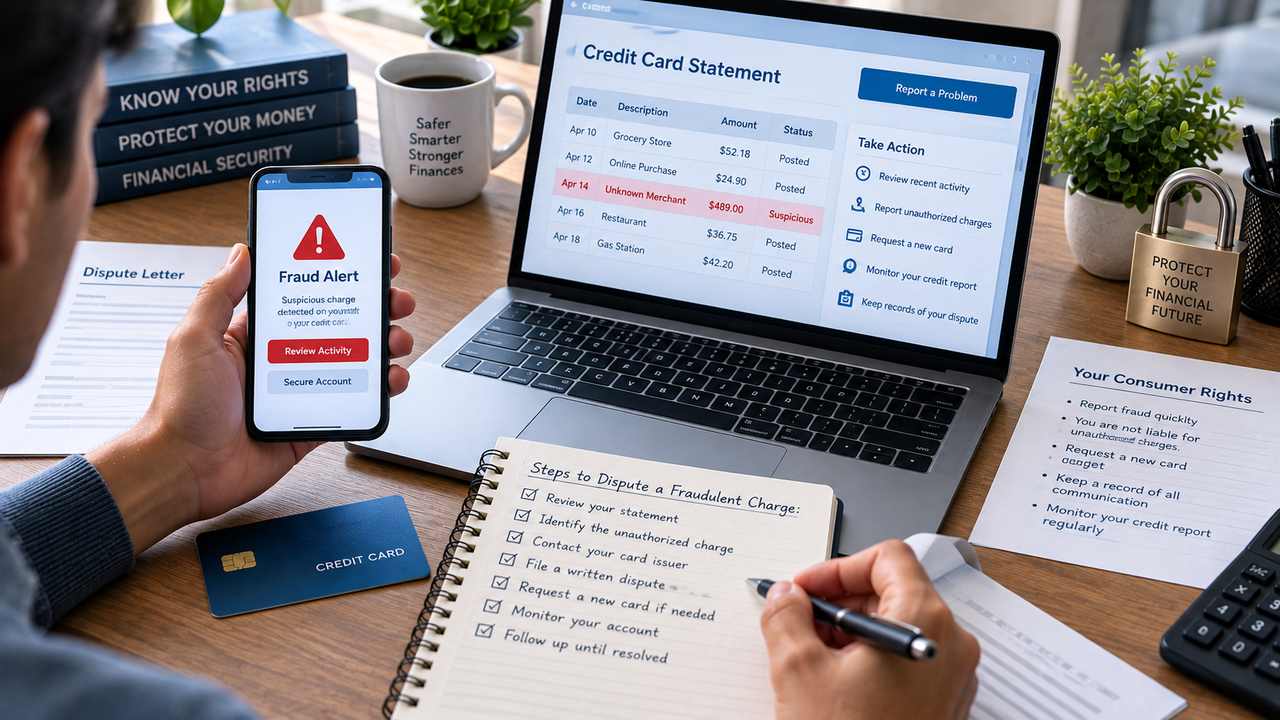
Your Legal Protection: The Fair Credit Billing Act
Fraudulent credit card charges are governed by the Fair Credit Billing Act (FCBA), which limits your maximum liability for unauthorized charges to $50 — and in practice, most major card issuers voluntarily offer $0 liability for fraud as part of their standard policy, going beyond what federal law technically requires. This is meaningfully more protective than debit card fraud liability, which can be higher depending on how quickly you report it, making credit cards generally the safer payment method when fraud risk is a concern.
For additional information about your consumer rights, visit the Consumer Financial Protection Bureau (CFPB).
Step One: Identify the Charge Precisely
Before disputing anything, make sure the charge is genuinely unfamiliar rather than simply unrecognized due to an unfamiliar merchant name. Many legitimate charges appear on statements under a parent company or processing name different from the actual business you interacted with — a quick search of the exact charge description alongside the amount often reveals it’s actually a subscription you forgot about, a purchase made by a family member with authorized access to your card, or a merchant operating under a different registered business name than their storefront branding.
Step Two: Report It to Your Card Issuer Immediately
Once you’ve confirmed a charge is genuinely unauthorized, contact your card issuer as soon as possible — most have a dedicated fraud reporting line, often available 24/7, and reporting promptly both limits your legal liability and starts the formal dispute and investigation process.
Most issuers allow you to initiate this report by phone, through their mobile app, or online, and will typically issue a temporary credit for the disputed amount while they investigate.
Step Three: Consider Whether Your Card Needs to Be Replaced
If the fraud suggests your physical card number has been compromised (rather than, say, a single unauthorized use by someone with brief physical access), your issuer will typically recommend or automatically issue a replacement card with a new number, closing the compromised number to prevent further unauthorized charges. This is a normal and appropriate response even for a single fraudulent charge, since it’s often difficult to know with certainty how a fraudster obtained your information or whether they might attempt further charges.
Step Four: Monitor for Additional Fraudulent Activity
Since a single fraudulent charge sometimes indicates a broader compromise (your card information stolen through a data breach, a skimming device, or an online store’s security failure), it’s worth reviewing your recent statements more closely for any other unfamiliar activity, and considering whether the same compromised information might affect other accounts if you’ve used that specific card number in multiple places recently.
For broader protection strategies, see our guide to identity theft protection.
What Happens During the Investigation
Your card issuer is generally required to investigate and resolve billing disputes within specific timeframes under the FCBA — acknowledging your dispute within 30 days and resolving it within two billing cycles (generally no more than 90 days). During this period, the disputed amount is typically not counted against your available credit or considered part of your minimum payment due, and shouldn’t negatively affect your credit report while the investigation is pending.
What If the Issuer Denies Your Dispute?
If your issuer determines the charge was actually authorized (or was made by someone with legitimate access to your card, like a family member, which complicates the “fraud” classification even if you personally didn’t make the purchase), they’ll typically explain their reasoning and you have the right to request the specific documentation supporting their conclusion. If you believe this determination is incorrect, you can request further review, provide additional evidence supporting your position, or, if necessary, escalate through a complaint to the CFPB.
You can submit or learn more about consumer complaints through the CFPB’s complaint process.
How This Differs From a Simple Billing Error or Merchant Dispute
It’s worth distinguishing true fraud (someone else used your card without any authorization) from a billing dispute with a legitimate merchant you did transact with — a wrong amount charged, goods never received, or a service not as described. These are also disputable under consumer protection law, but they follow a somewhat different track (often starting with the merchant directly) than pure fraud, though your card issuer’s dispute process typically handles both categories, just potentially with different specific documentation requirements.
Protecting Yourself Going Forward
Enable transaction alerts through your card issuer, so you’re notified in real time of any charge, making unauthorized activity far easier to catch quickly.
Use virtual card numbers for online purchases where your issuer offers this feature, which limits exposure since a compromised virtual number can be easily deactivated without affecting your actual card.
Be cautious about where you use your physical card, particularly at gas station pumps and ATMs, which are common targets for card-skimming devices — using tap-to-pay or chip insertion rather than swiping where possible reduces skimming risk.
Review your statements regularly rather than only when something feels obviously wrong, since smaller fraudulent charges are sometimes deliberately kept low to avoid detection.
Frequently Asked Questions
Does disputing a fraudulent charge hurt my credit score?
No — the dispute process itself doesn’t affect your score, and a properly resolved fraudulent charge shouldn’t appear as a negative mark on your credit report at all, since it’s not actually your legitimate debt or payment history.
What if I don’t notice the fraudulent charge until months later?
Report it as soon as you notice it, though your protection under the FCBA is strongest when reported promptly — very delayed reporting can complicate the investigation and, in rare cases, affect your liability, though most issuers still work with customers reasonably even on somewhat delayed reports, especially for clearly fraudulent activity.
Can I dispute a charge if I willingly gave my card information to someone who then misused it?
This is more complicated — if you voluntarily shared your card details with someone who then made unauthorized purchases beyond what you agreed to, this may be treated differently than a stranger stealing your information, and it’s worth discussing the specific circumstances directly with your issuer’s fraud department.
Do I need a police report to dispute a fraudulent charge?
Generally, no — for a standard fraud dispute with your card issuer, a police report typically isn’t required, though for more serious identity theft situations involving multiple accounts, filing a police report and an identity theft report can support your broader recovery efforts.
Is there a difference in how this works for a debit card versus a credit card?
Yes, meaningfully — debit card fraud liability under the Electronic Fund Transfer Act scales based on how quickly you report it (potentially higher liability for delayed reporting), and disputed debit funds may not be temporarily credited back as quickly as with a credit card, since the money has already left your actual bank account rather than simply being an unpaid credit balance.
A Step-by-Step Checklist for the Dispute Process
- Confirm the charge is genuinely unfamiliar, checking the exact merchant name and amount against your own records and any family members with card access.
- Contact your card issuer immediately through their fraud reporting line, app, or online portal.
- Request a temporary credit for the disputed amount while the investigation proceeds.
- Ask whether your card needs to be replaced, and follow through on getting a new card number if recommended.
- Document the date you reported the fraud, who you spoke with, and any reference or case number provided.
- Monitor your account over the following weeks for the investigation’s resolution and any additional suspicious activity.
- If denied, request the specific documentation behind the decision and consider escalating through a formal complaint if you believe the determination is wrong.
Why Reporting Promptly Matters Beyond Just Your Own Liability
Beyond protecting your own limited liability, prompt reporting helps your card issuer identify and shut down broader fraud patterns faster — if your card number was compromised through a specific merchant’s data breach or a skimming device at a specific location, your report contributes to the issuer’s ability to identify and block the same compromised card numbers before they’re used fraudulently elsewhere, potentially protecting other cardholders as well as yourself from further unauthorized use of the same underlying stolen data.
What a Card Issuer’s Fraud Investigation Actually Looks At
Understanding roughly what investigators review can help you provide useful supporting information proactively. This typically includes: the specific transaction’s location and time, compared against your typical spending patterns and recent card usage; whether the transaction matches a pattern consistent with known fraud schemes; any device or IP information available for online transactions; and sometimes a comparison against other reported fraud involving the same merchant or a similar pattern across other cardholders. Providing your own supporting context — confirming you were nowhere near the transaction’s location, for instance, or that you’d already reported your card lost around that time — can help streamline this investigation.
Frequently Asked Questions, Continued
Can a merchant refuse to accept my card issuer’s fraud determination and pursue me directly for the charge?
Generally, once your issuer resolves a dispute in your favor, the merchant is bound by that outcome through their agreement with the card network and cannot separately pursue you directly for the same disputed amount.
Does using a credit monitoring service help catch fraudulent Credit Card charges faster than reviewing statements myself?
Credit monitoring services generally focus on new account openings and credit report changes rather than individual transaction-level charges on existing cards — for catching a specific fraudulent Credit Card charge, your card issuer’s own transaction alerts and regular statement review remain the more directly relevant tools.
You may also want to review our guide to the best credit monitoring services.
If my card was used fraudulently at a specific store, should I avoid shopping there in the future?
Not necessarily — a fraudulent Credit Card charge doesn’t always indicate a security failure specific to that merchant; your information could have been compromised through many other channels entirely unrelated to that specific transaction location, so this alone isn’t a reliable signal about that merchant’s own security practices.
How Card Issuers’ Zero-Liability Policies Compare to Each Other
While federal law caps your liability at $50, most major issuers advertise “zero liability” policies that go further, but the fine print varies. Some zero-liability policies exclude certain situations — a PIN-based transaction versus a signature-based one, for instance, or cases involving “gross negligence” on the cardholder’s part, like writing your PIN on the card itself. Reading your specific issuer’s zero-liability terms, or simply asking their fraud department directly when you report an incident, clarifies exactly what protection applies to your specific situation rather than assuming the broadest possible interpretation automatically applies.
What to Do If Fraud Occurs While You’re Traveling Internationally
Fraudulent Credit Card charges sometimes surface while you’re traveling, which adds logistical complexity to reporting and resolving them. Most major issuers have international collect-call numbers specifically for cardholders abroad, and many banking apps allow you to freeze or report a card entirely through the app without needing a phone call at all. It’s worth locating this information (saving the international fraud line number somewhere accessible, separate from the card itself) before traveling, precisely because dealing with this while already navigating an unfamiliar location adds unnecessary stress if you haven’t prepared in advance.
Frequently Asked Questions, Continued Further Still
Does my card issuer ever proactively catch fraud before I even notice it myself?
Yes, often — most major issuers use automated fraud detection systems that flag unusual spending patterns (a purchase in an unusual location, an atypical spending category, unusually high-value transactions) and may temporarily hold or decline a suspicious charge, sometimes contacting you directly to verify before you’ve even reviewed your statement.
If I dispute a charge and win, does the merchant find out it was me who disputed it?
Generally, yes, in the sense that the merchant is notified a dispute was filed and by which customer, as part of the standard chargeback process between your card issuer and the merchant’s payment processor — this is a normal part of the dispute mechanism and isn’t something to be concerned about from a privacy standpoint.
The Bottom Line
Disputing a fraudulent credit card charge is a well-protected, relatively straightforward process: report it to your issuer promptly, let them investigate under the legally mandated timeframes, and monitor for any additional unauthorized activity in the meantime. Your maximum liability is capped at $50 by federal law, and most issuers offer $0 liability in practice, making credit cards one of the more consumer-protected ways to pay specifically because of how thoroughly fraud disputes are legally structured to favor quick, low-cost resolution for the cardholder.
Concerned About Fraud or Inaccurate Information on Your Credit Report?
Fraud and identity theft can sometimes affect more than just individual credit card transactions. Unauthorized accounts or inaccurate information may also appear on your credit report.
A professional credit report review can help you better understand what is being reported and identify potential issues that may need attention.
Leave a Reply