Category: Credit Card

  • Why Two Different Credit Score Apps Show Two Different Numbers

    Why Two Different Credit Score Apps Show Two Different Numbers

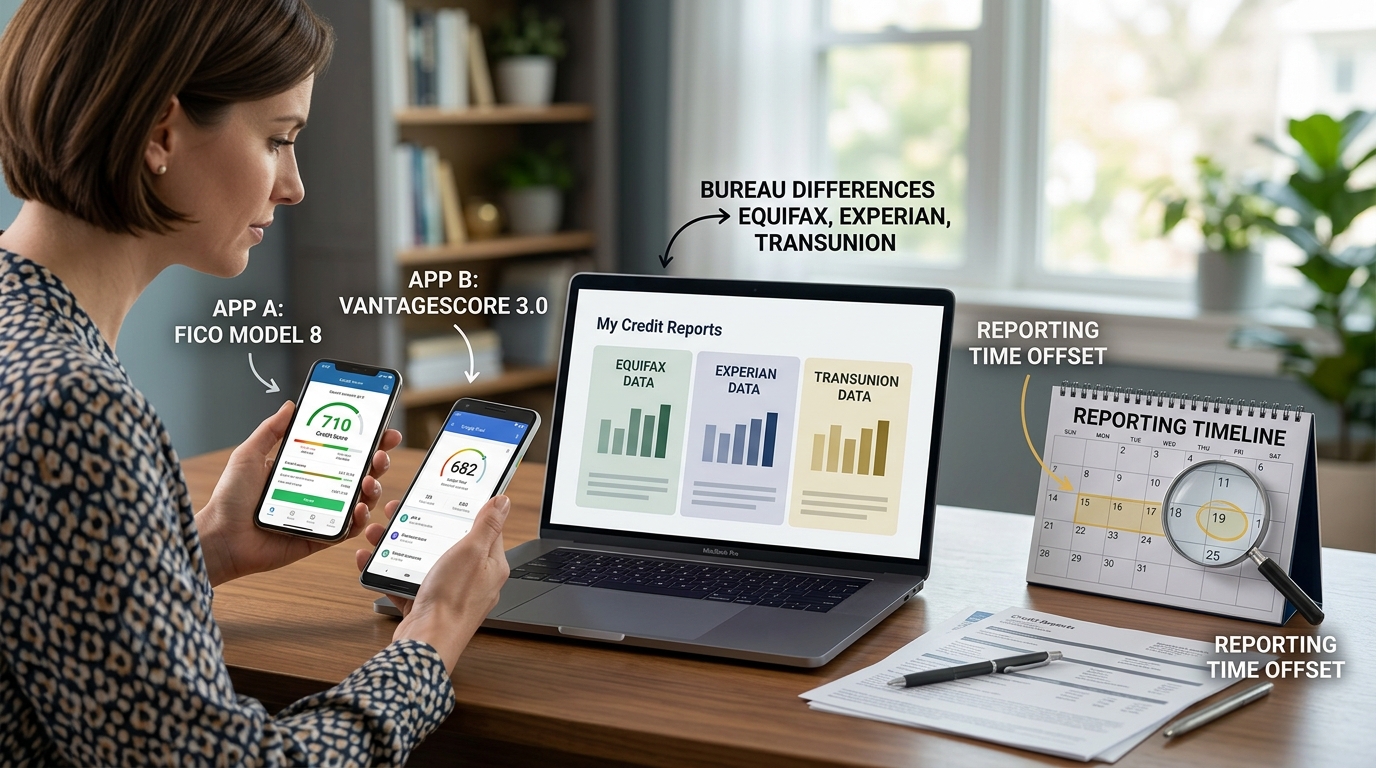
    You check your credit score on your bank’s app and see 710. You check a different free monitoring app the same day and see 682.

    Nothing about your finances changed between the two checks—so why are the numbers different?

    And which one, if either, is “right”?

    This is one of the most common sources of confusion in personal finance. Once you understand how credit scoring actually works, however, the difference becomes much easier to explain.

    The Short Answer

    There isn’t one single universal credit score.

    There are multiple credit-scoring models, information from three major credit bureaus, and different combinations of models and bureau data used by different financial institutions, lenders, banks, and monitoring services.

    As a result, two legitimate apps can show different credit scores on the same day without either one being wrong.

    The difference may come from:

    • The scoring model being used.
    • The credit bureau providing the underlying data.
    • When the underlying credit information was last updated.
    • The specific financial product or lender using the score.

    So seeing different numbers is not necessarily a technical error. It is often a normal feature of the U.S. credit-scoring system.

    For a broader explanation of the factors behind your score, see our guide on how credit scores are calculated.

    Reason One: There Are Multiple Credit-Scoring Models

    One of the biggest reasons your credit score can differ between apps is that there are multiple scoring models.

    The two major scoring systems consumers commonly encounter are FICO and VantageScore.

    Neither company has just one scoring formula.

    FICO has released multiple generations and specialized versions of its scoring models. VantageScore has also developed multiple versions over time.

    These models do not necessarily interpret the exact same credit-report information in exactly the same way.

    Different models can place different emphasis on factors such as:

    • Payment history.
    • Credit utilization.
    • Length of credit history.
    • New credit.
    • Credit mix.
    • Certain types of negative information.

    This means the same credit report can produce different scores depending on which scoring formula is applied.

    FICO vs. VantageScore

    FICO and VantageScore are separate scoring systems developed using different methodologies.

    For example, an app may show a VantageScore while another service provides a FICO score.

    Both can be legitimate scores based on your actual credit information.

    That does not mean one is fake or that one has necessarily made a calculation error.

    Reason Two: There Are Three Separate Credit Bureaus

    The United States has three major nationwide credit reporting companies:

    • Equifax
    • Experian
    • TransUnion

    Each maintains its own credit file on you.

    Those files do not necessarily contain identical information.

    A creditor may report to all three bureaus, two bureaus, or in some circumstances only one bureau.

    For example, imagine a credit card company reports an account to Experian but not to Equifax.

    A score calculated using your Experian information could therefore reflect that account while a score calculated from your Equifax file might not.

    Even if two apps use the same scoring model, they can produce different scores if they use data from different credit bureaus.

    Reason Three: Credit Information Is Not Updated Everywhere at Exactly the Same Time

    Another common explanation is timing.

    Creditors do not all report information to the credit bureaus on the same schedule.

    A credit card issuer may report around a particular point in its billing cycle, while another creditor reports at a different time.

    There can also be processing delays between the time information is sent and the time it becomes visible in a particular credit file.

    That means two apps checked a few days apart may be using different snapshots of your credit information.

    Example: Paying Down a Credit Card

    Imagine you pay down a large credit card balance on the 1st of the month.

    Your card issuer does not report the lower balance until after the statement closes on the 15th.

    If one app checks your credit information on the 5th, it may still reflect the older, higher balance.

    If another app checks or refreshes your data on the 20th, it may reflect the lower balance.

    Your financial behavior did not change between the two score checks. The underlying credit data simply changed at different points in the reporting cycle.

    Reason Four: Different Apps Use Different Credit-Score Products

    Even when two apps appear to offer “a credit score,” you should look at the details.

    The apps may use:

    • Different scoring companies.
    • Different scoring-model versions.
    • Different credit bureaus.
    • Different update schedules.

    For example, one service could show a VantageScore based on TransUnion information while another shows a FICO score based on Equifax information.

    Those numbers are not supposed to be identical because they are answering slightly different questions using different data and formulas.

    Many free consumer-facing monitoring tools use VantageScore, while lenders may use particular FICO versions depending on the type of credit being evaluated.

    This is one reason the score you see in a free app may not be the exact score a lender uses when you apply for a mortgage, auto loan, or credit card.

    A Concrete Example of How This Plays Out

    Imagine you check your credit through three different sources on the same day.

    • Your bank’s free score: VantageScore based on TransUnion data — 705.
    • A separate monitoring service: FICO score based on Equifax data — 692.
    • A mortgage lender: A mortgage-specific scoring model based on bureau information — 678.

    All three numbers can be legitimate.

    They are not necessarily competing claims about one universal score.

    They are different calculations based on different combinations of models and credit information.

    This is why using one free app’s score as an exact prediction of what every lender will see can be misleading.

    Which Credit Score “Counts” for a Specific Purpose?

    This is usually the more important question.

    The answer depends on what you are applying for and which lender you are using.

    Mortgage Applications

    Mortgage lending can involve specific FICO scoring versions and credit information from multiple bureaus.

    The exact scoring process depends on the lender and applicable underwriting requirements.

    If you are preparing to buy a home, ask your mortgage lender or broker which credit scores they expect to use.

    Auto Loans

    Auto lenders may use industry-specific credit scores designed for automobile lending.

    These models can evaluate certain aspects of your credit history differently from a general-purpose score.

    Credit Card Applications

    Credit card issuers can use different scoring models and credit bureaus.

    One issuer may use a particular FICO version while another may use VantageScore or another credit-risk model.

    There is therefore no guarantee that the score you see in a consumer app will be exactly the score used for your next credit-card application.

    Should You Still Bother Checking Your Credit Score?

    Yes.

    The fact that different apps can show different numbers does not make credit monitoring useless.

    You simply need to understand what the number is useful for.

    Use Your Score as a Trend Indicator

    If your score is steadily increasing over several months, that is useful information.

    If it is consistently falling, that is also a reason to investigate what has changed.

    The exact number is less important than understanding the direction of your credit profile over time.

    Use Your Full Credit Report to Understand the Details

    Your full credit report contains the underlying information used by scoring models.

    That includes:

    • Account balances.
    • Payment history.
    • Credit limits.
    • Inquiries.
    • Collection accounts.
    • Other reported account information.

    If something looks wrong, the credit report is where you should investigate it.

    Our guide on how to read a credit report explains what to look for.

    Get More Specific Information Before Major Applications

    If you are preparing for a major loan application and need to understand your credit position as precisely as possible, find out which scoring model and bureau the lender is likely to use.

    Depending on your situation, you may also consider obtaining access to a score product that provides the specific scoring versions relevant to your planned application.

    Why Doesn’t the U.S. Have One Universal Credit Score?

    The multiple-score system can seem unnecessarily complicated.

    But different lending products carry different risks.

    The factors that help predict the likelihood of default on an auto loan may not be identical to the factors that are most predictive for a credit card or mortgage.

    That is one reason industry-specific scoring models exist.

    Competition between scoring companies has also resulted in multiple approaches to evaluating credit risk.

    At the same time, having three major credit bureaus means lenders and scoring companies can work from different underlying databases.

    The result is a system where there is no single government-designated number that represents your one universally “correct” credit score.

    How to Get the Clearest Possible Picture of Your Credit

    1. Review All Three Credit Reports

    Use AnnualCreditReport.com to access your official credit reports.

    Looking at the actual reports allows you to compare the information maintained by Equifax, Experian, and TransUnion rather than relying only on a score shown by an app.

    2. Check More Than One Score Source Occasionally

    It can be useful to see how your score behaves across more than one legitimate source.

    Do not expect the numbers to match exactly.

    Instead, look for the broader pattern.

    3. Investigate Major Differences

    A small difference between scores is not necessarily concerning.

    If you see a substantially larger difference, review the underlying reports and determine whether one bureau has information that another does not.

    4. Ask Your Lender Before a Major Application

    If you are preparing for a mortgage, auto loan, or another major credit application, ask the lender which bureau and scoring model they expect to use.

    This can give you a more realistic understanding of what score information may matter for that particular application.

    5. Don’t Panic Over Normal Differences

    A difference of 10, 20, or even 30 points between legitimate scoring sources can occur for understandable reasons.

    The difference does not automatically mean that one app is wrong.

    Frequently Asked Questions

    Is one credit-scoring model more accurate than the others?

    There is not one universal score that is always the most accurate for every purpose.

    A score’s usefulness depends on the model, the underlying data, and the type of lending decision for which it is designed.

    Why does my bank show a different score from my free credit-monitoring app?

    The two services may be using different scoring models, different credit bureaus, or different reporting snapshots.

    Check the details provided by each service to see which model and bureau are being used.

    If I dispute an error, will every credit score improve by the same number of points?

    Not necessarily.

    If an error appears on only one credit bureau’s report, scores based on that bureau’s information may be affected differently from scores based on another bureau.

    Different scoring models can also react differently to the same corrected information.

    If you find an error, see our guide on how to dispute credit report errors.

    Does checking my score through multiple apps hurt my credit?

    No.

    Checking your own credit score through legitimate monitoring services is generally considered a soft inquiry and does not lower your credit score.

    You can check your score through multiple services without creating multiple hard inquiries simply because you viewed your own score.

    Is it worth paying for a service that shows my FICO score?

    It depends on your situation.

    For ordinary monitoring, free score tools may provide enough information to track your general credit trend.

    If you are preparing for a major application and want access to a specific FICO version that is relevant to the type of loan you are pursuing, paying for more specialized information may provide additional insight.

    A Deeper Look at FICO vs. VantageScore

    FICO and VantageScore are two of the most widely recognized scoring systems, but they approach scoring differently.

    FICO Scores

    FICO has developed multiple scoring models and versions, including models designed for specific industries.

    Some FICO models require a certain amount of credit-history information before generating a score.

    The precise minimum requirements depend on the specific FICO model being used.

    VantageScore

    VantageScore was developed by the three major credit bureaus as a separate scoring system.

    Some VantageScore versions can generate scores with relatively limited credit history, which makes them useful for consumer-facing monitoring services.

    Why the Two Can Differ

    The two systems can differ in how they evaluate certain credit-report information.

    They may also differ in their treatment of:

    • Negative accounts.
    • Collections.
    • Credit-history length.
    • Recent inquiries.
    • Other aspects of the credit profile.

    Therefore, seeing a FICO score and a VantageScore that are not identical is completely normal.

    How to Find Out Which Score a Specific Lender Uses

    Ask the Lender Directly

    For an important loan application, ask the lender which credit bureau and scoring model it typically uses.

    This can be particularly useful for mortgage applications because the scoring process can differ from the score shown in a free consumer app.

    Review Required Disclosures

    Depending on the circumstances, lenders may provide disclosures that identify credit-score information used in an adverse-action decision or other required notice.

    These documents can sometimes help you understand which score was used after the application process.

    Use General Industry Knowledge Carefully

    It can be useful to know that different industries commonly use different types of credit scores.

    However, these are general patterns rather than guarantees.

    The safest approach before a major application is to ask the specific lender what it uses.

    Educational Scores vs. Scores Used by Lenders

    Some consumer credit-monitoring services describe the score they provide as an “educational score.”

    This does not necessarily mean the score is fake.

    It generally means the score is designed to help consumers understand and monitor their credit rather than necessarily matching the exact score a particular lender uses for underwriting.

    An educational score can still be useful for tracking trends.

    Always read the description provided by the app or service so you know exactly what type of score you are viewing.

    Frequently Asked Questions About Credit-Score Differences

    Do all three credit bureaus offer FICO and VantageScore?

    The three major credit bureaus can provide data used by different scoring models.

    It is not accurate to assume that one bureau exclusively uses one scoring company. The score product being requested determines which scoring model is applied to the bureau’s underlying data.

    Should I worry if two scores differ by 50 points?

    A larger difference is worth investigating, but it does not automatically mean that one score is wrong.

    Check whether the two sources are using:

    • The same credit bureau.
    • The same scoring model.
    • The same model version.
    • Similar update dates.

    Then compare the underlying credit reports to see whether the information itself differs.

    Does my income explain why two apps show different credit scores?

    No.

    Income and employment information are not standard components of traditional credit-scoring formulas.

    Differences between credit scores are generally explained by the scoring model, bureau data, and timing rather than your income.

    Is there one official government credit score?

    No.

    There is no single government-designated universal credit score that overrides every other scoring model.

    The score that matters depends on the particular lender, product, scoring model, and credit bureau involved.

    A Timeline Example: How Reporting Delays Create Different Scores

    Consider this example:

    On the 1st of the month, you pay off a large credit card balance.

    Your card issuer’s statement closes on the 15th.

    The issuer then reports the updated balance to the credit bureaus, and the bureaus process the information.

    If you check one monitoring app on the 5th, it may still show the previous higher balance.

    If you check another source on the 20th, the lower balance may already be reflected.

    Your financial behavior did not change between those checks.

    The difference is simply that the two sources were showing information from different points in the reporting cycle.

    This is one of the most common reasons people think their credit apps are contradicting each other.

    Frequently Asked Questions About Credit-Score Updates

    Does refreshing the same app repeatedly change my score?

    No. Refreshing the app does not itself change your credit information.

    If the underlying credit file has not been updated, repeatedly checking the app will generally show the same information.

    Can two lenders using the same model and bureau see different scores?

    If they request exactly the same scoring model using the same bureau’s data at essentially the same time, the score should generally be the same.

    Differences can arise if the requests occur at different times relative to a recent credit-file update.

    Why did my score change immediately after I checked it?

    Checking your own score does not cause a score change.

    If the score changed around the time you checked it, another event—such as a newly reported payment, balance update, or account change—may have occurred at roughly the same time.

    The timing can create the impression that checking caused the change when it did not.

    What Should You Focus on Instead of Matching Every Score?

    If two apps show different numbers, resist the temptation to decide that one must be wrong immediately.

    Instead, focus on four questions:

    1. Which scoring model is being used?
    2. Which credit bureau supplied the data?
    3. When was the underlying data last updated?
    4. Is the overall trend improving, declining, or remaining stable?

    These questions are usually more useful than trying to force every app to display the same number.

    How to Monitor Your Credit More Effectively

    A practical credit-monitoring routine can include several layers.

    Review Your Full Credit Reports

    Do not rely exclusively on credit-score apps.

    Review the actual credit reports from Equifax, Experian, and TransUnion so you can see the underlying information.

    For guidance on how frequently to review your reports, see how often you should check your credit report.

    Use Free Score Monitoring for Trends

    A free score displayed by your bank or another legitimate monitoring service can be useful for tracking whether your credit profile is generally moving in the right direction.

    Investigate Unexpected Changes

    If your score changes substantially, check your reports for:

    • A new account.
    • A new hard inquiry.
    • A changed credit-card balance.
    • A late payment.
    • A collection account.
    • An account closure.
    • Another significant change.

    If you find inaccurate information, investigate the appropriate dispute process.

    Focus on the Underlying Credit Data

    The score is a summary.

    The credit report contains the underlying information that produced that summary.

    Keeping that information accurate is therefore more important than making every score displayed by every app match perfectly.

    The Bottom Line

    Two different credit score apps showing two different numbers is usually not a bug.

    It is a normal consequence of a credit system that uses:

    • Multiple scoring models.
    • Three separate credit bureaus.
    • Different reporting schedules.
    • Different model versions and lender-specific scoring products.

    There is no single universal number that every lender uses.

    Instead of worrying that one app must be wrong, find out what model and bureau each service uses and pay attention to the broader trend.

    When accuracy matters for a major financial decision, such as applying for a mortgage or auto loan, ask the lender which score it expects to use.

    Most importantly, do not rely solely on an app’s score. Review the underlying information in your credit reports and make sure it is accurate.

    If you discover inaccurate information, our guides on disputing credit report errors and credit report errors can help you understand the next steps.

    Need Help Understanding Your Credit Reports?

    If different credit apps are showing confusing numbers or you have found inaccurate information on your credit reports, reviewing the underlying data is the best place to start.

    Contact Credit Repair Services to discuss your credit situation →
  • How to Dispute a Fraudulent Credit Card Charge

    How to Dispute a Fraudulent Credit Card Charge

    Spotting a charge on your credit card statement that you never made triggers an immediate mix of confusion and alarm — but disputing a fraudulent credit card charge is actually one of the more consumer-protected processes in personal finance, with strong legal backing and, in most cases, a fairly straightforward resolution path. This guide walks through exactly what to do, your legal protections, and how to navigate the process efficiently.

    Your Legal Protection: The Fair Credit Billing Act

    Fraudulent credit card charges are governed by the Fair Credit Billing Act (FCBA), which limits your maximum liability for unauthorized charges to $50 — and in practice, most major card issuers voluntarily offer $0 liability for fraud as part of their standard policy, going beyond what federal law technically requires. This is meaningfully more protective than debit card fraud liability, which can be higher depending on how quickly you report it, making credit cards generally the safer payment method when fraud risk is a concern.

    For additional information about your consumer rights, visit the Consumer Financial Protection Bureau (CFPB).

    Step One: Identify the Charge Precisely

    Before disputing anything, make sure the charge is genuinely unfamiliar rather than simply unrecognized due to an unfamiliar merchant name. Many legitimate charges appear on statements under a parent company or processing name different from the actual business you interacted with — a quick search of the exact charge description alongside the amount often reveals it’s actually a subscription you forgot about, a purchase made by a family member with authorized access to your card, or a merchant operating under a different registered business name than their storefront branding.

    Step Two: Report It to Your Card Issuer Immediately

    Once you’ve confirmed a charge is genuinely unauthorized, contact your card issuer as soon as possible — most have a dedicated fraud reporting line, often available 24/7, and reporting promptly both limits your legal liability and starts the formal dispute and investigation process.

    Most issuers allow you to initiate this report by phone, through their mobile app, or online, and will typically issue a temporary credit for the disputed amount while they investigate.

    Step Three: Consider Whether Your Card Needs to Be Replaced

    If the fraud suggests your physical card number has been compromised (rather than, say, a single unauthorized use by someone with brief physical access), your issuer will typically recommend or automatically issue a replacement card with a new number, closing the compromised number to prevent further unauthorized charges. This is a normal and appropriate response even for a single fraudulent charge, since it’s often difficult to know with certainty how a fraudster obtained your information or whether they might attempt further charges.

    Step Four: Monitor for Additional Fraudulent Activity

    Since a single fraudulent charge sometimes indicates a broader compromise (your card information stolen through a data breach, a skimming device, or an online store’s security failure), it’s worth reviewing your recent statements more closely for any other unfamiliar activity, and considering whether the same compromised information might affect other accounts if you’ve used that specific card number in multiple places recently.

    For broader protection strategies, see our guide to identity theft protection.

    What Happens During the Investigation

    Your card issuer is generally required to investigate and resolve billing disputes within specific timeframes under the FCBA — acknowledging your dispute within 30 days and resolving it within two billing cycles (generally no more than 90 days). During this period, the disputed amount is typically not counted against your available credit or considered part of your minimum payment due, and shouldn’t negatively affect your credit report while the investigation is pending.

    What If the Issuer Denies Your Dispute?

    If your issuer determines the charge was actually authorized (or was made by someone with legitimate access to your card, like a family member, which complicates the “fraud” classification even if you personally didn’t make the purchase), they’ll typically explain their reasoning and you have the right to request the specific documentation supporting their conclusion. If you believe this determination is incorrect, you can request further review, provide additional evidence supporting your position, or, if necessary, escalate through a complaint to the CFPB.

    You can submit or learn more about consumer complaints through the CFPB’s complaint process.

    How This Differs From a Simple Billing Error or Merchant Dispute

    It’s worth distinguishing true fraud (someone else used your card without any authorization) from a billing dispute with a legitimate merchant you did transact with — a wrong amount charged, goods never received, or a service not as described. These are also disputable under consumer protection law, but they follow a somewhat different track (often starting with the merchant directly) than pure fraud, though your card issuer’s dispute process typically handles both categories, just potentially with different specific documentation requirements.

    Protecting Yourself Going Forward

    Enable transaction alerts through your card issuer, so you’re notified in real time of any charge, making unauthorized activity far easier to catch quickly.

    Use virtual card numbers for online purchases where your issuer offers this feature, which limits exposure since a compromised virtual number can be easily deactivated without affecting your actual card.

    Be cautious about where you use your physical card, particularly at gas station pumps and ATMs, which are common targets for card-skimming devices — using tap-to-pay or chip insertion rather than swiping where possible reduces skimming risk.

    Review your statements regularly rather than only when something feels obviously wrong, since smaller fraudulent charges are sometimes deliberately kept low to avoid detection.

    Frequently Asked Questions

    Does disputing a fraudulent charge hurt my credit score?

    No — the dispute process itself doesn’t affect your score, and a properly resolved fraudulent charge shouldn’t appear as a negative mark on your credit report at all, since it’s not actually your legitimate debt or payment history.

    What if I don’t notice the fraudulent charge until months later?

    Report it as soon as you notice it, though your protection under the FCBA is strongest when reported promptly — very delayed reporting can complicate the investigation and, in rare cases, affect your liability, though most issuers still work with customers reasonably even on somewhat delayed reports, especially for clearly fraudulent activity.

    Can I dispute a charge if I willingly gave my card information to someone who then misused it?

    This is more complicated — if you voluntarily shared your card details with someone who then made unauthorized purchases beyond what you agreed to, this may be treated differently than a stranger stealing your information, and it’s worth discussing the specific circumstances directly with your issuer’s fraud department.

    Do I need a police report to dispute a fraudulent charge?

    Generally, no — for a standard fraud dispute with your card issuer, a police report typically isn’t required, though for more serious identity theft situations involving multiple accounts, filing a police report and an identity theft report can support your broader recovery efforts.

    Is there a difference in how this works for a debit card versus a credit card?

    Yes, meaningfully — debit card fraud liability under the Electronic Fund Transfer Act scales based on how quickly you report it (potentially higher liability for delayed reporting), and disputed debit funds may not be temporarily credited back as quickly as with a credit card, since the money has already left your actual bank account rather than simply being an unpaid credit balance.

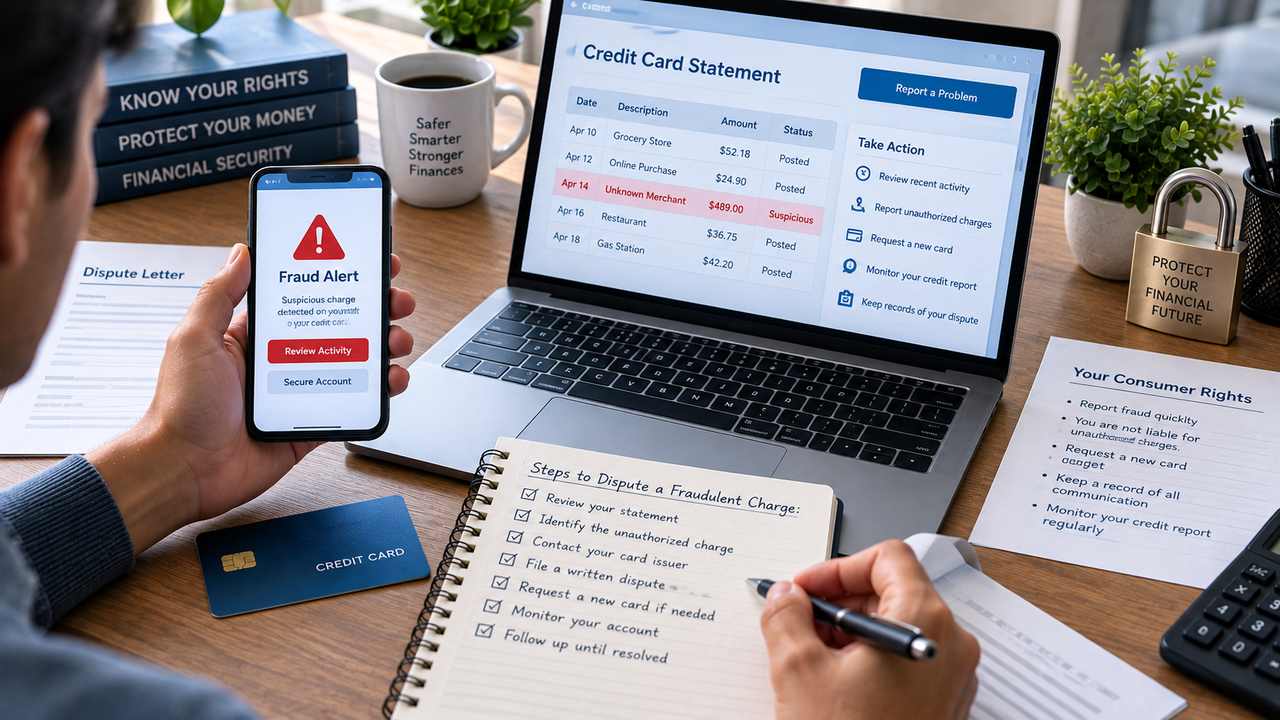
    A Step-by-Step Checklist for the Dispute Process

    1. Confirm the charge is genuinely unfamiliar, checking the exact merchant name and amount against your own records and any family members with card access.
    2. Contact your card issuer immediately through their fraud reporting line, app, or online portal.
    3. Request a temporary credit for the disputed amount while the investigation proceeds.
    4. Ask whether your card needs to be replaced, and follow through on getting a new card number if recommended.
    5. Document the date you reported the fraud, who you spoke with, and any reference or case number provided.
    6. Monitor your account over the following weeks for the investigation’s resolution and any additional suspicious activity.
    7. If denied, request the specific documentation behind the decision and consider escalating through a formal complaint if you believe the determination is wrong.

    Why Reporting Promptly Matters Beyond Just Your Own Liability

    Beyond protecting your own limited liability, prompt reporting helps your card issuer identify and shut down broader fraud patterns faster — if your card number was compromised through a specific merchant’s data breach or a skimming device at a specific location, your report contributes to the issuer’s ability to identify and block the same compromised card numbers before they’re used fraudulently elsewhere, potentially protecting other cardholders as well as yourself from further unauthorized use of the same underlying stolen data.

    What a Card Issuer’s Fraud Investigation Actually Looks At

    Understanding roughly what investigators review can help you provide useful supporting information proactively. This typically includes: the specific transaction’s location and time, compared against your typical spending patterns and recent card usage; whether the transaction matches a pattern consistent with known fraud schemes; any device or IP information available for online transactions; and sometimes a comparison against other reported fraud involving the same merchant or a similar pattern across other cardholders. Providing your own supporting context — confirming you were nowhere near the transaction’s location, for instance, or that you’d already reported your card lost around that time — can help streamline this investigation.

    how-to-dispute-a-fraudulent-credit-card-charge-under-100kb

    Frequently Asked Questions, Continued

    Can a merchant refuse to accept my card issuer’s fraud determination and pursue me directly for the charge?

    Generally, once your issuer resolves a dispute in your favor, the merchant is bound by that outcome through their agreement with the card network and cannot separately pursue you directly for the same disputed amount.

    Does using a credit monitoring service help catch fraudulent Credit Card charges faster than reviewing statements myself?

    Credit monitoring services generally focus on new account openings and credit report changes rather than individual transaction-level charges on existing cards — for catching a specific fraudulent Credit Card charge, your card issuer’s own transaction alerts and regular statement review remain the more directly relevant tools.

    You may also want to review our guide to the best credit monitoring services.

    If my card was used fraudulently at a specific store, should I avoid shopping there in the future?

    Not necessarily — a fraudulent Credit Card charge doesn’t always indicate a security failure specific to that merchant; your information could have been compromised through many other channels entirely unrelated to that specific transaction location, so this alone isn’t a reliable signal about that merchant’s own security practices.

    How Card Issuers’ Zero-Liability Policies Compare to Each Other

    While federal law caps your liability at $50, most major issuers advertise “zero liability” policies that go further, but the fine print varies. Some zero-liability policies exclude certain situations — a PIN-based transaction versus a signature-based one, for instance, or cases involving “gross negligence” on the cardholder’s part, like writing your PIN on the card itself. Reading your specific issuer’s zero-liability terms, or simply asking their fraud department directly when you report an incident, clarifies exactly what protection applies to your specific situation rather than assuming the broadest possible interpretation automatically applies.

    What to Do If Fraud Occurs While You’re Traveling Internationally

    Fraudulent Credit Card charges sometimes surface while you’re traveling, which adds logistical complexity to reporting and resolving them. Most major issuers have international collect-call numbers specifically for cardholders abroad, and many banking apps allow you to freeze or report a card entirely through the app without needing a phone call at all. It’s worth locating this information (saving the international fraud line number somewhere accessible, separate from the card itself) before traveling, precisely because dealing with this while already navigating an unfamiliar location adds unnecessary stress if you haven’t prepared in advance.

    Frequently Asked Questions, Continued Further Still

    Does my card issuer ever proactively catch fraud before I even notice it myself?

    Yes, often — most major issuers use automated fraud detection systems that flag unusual spending patterns (a purchase in an unusual location, an atypical spending category, unusually high-value transactions) and may temporarily hold or decline a suspicious charge, sometimes contacting you directly to verify before you’ve even reviewed your statement.

    If I dispute a charge and win, does the merchant find out it was me who disputed it?

    Generally, yes, in the sense that the merchant is notified a dispute was filed and by which customer, as part of the standard chargeback process between your card issuer and the merchant’s payment processor — this is a normal part of the dispute mechanism and isn’t something to be concerned about from a privacy standpoint.

    The Bottom Line

    Disputing a fraudulent credit card charge is a well-protected, relatively straightforward process: report it to your issuer promptly, let them investigate under the legally mandated timeframes, and monitor for any additional unauthorized activity in the meantime. Your maximum liability is capped at $50 by federal law, and most issuers offer $0 liability in practice, making credit cards one of the more consumer-protected ways to pay specifically because of how thoroughly fraud disputes are legally structured to favor quick, low-cost resolution for the cardholder.

    Concerned About Fraud or Inaccurate Information on Your Credit Report?

    Fraud and identity theft can sometimes affect more than just individual credit card transactions. Unauthorized accounts or inaccurate information may also appear on your credit report.

    A professional credit report review can help you better understand what is being reported and identify potential issues that may need attention.

    Request a Credit Audit or Quote Today

  • How Secured Credit Cards Work (and How to Use One to Build Credit)

    If your credit is thin, damaged, or nonexistent, a secured credit card is usually the first thing anyone recommends. What gets skipped over is why it works and how to actually use one so it helps rather than just sits in your wallet, quietly building nothing while you pay an annual fee for it. This is a mechanics-and-strategy guide, not a list of card picks — for specific recommendations, see our best secured credit cards roundup. Here, the focus is on understanding exactly what you’re signing up for and how to get the most out of it, whether you’re starting from zero or rebuilding after damage.

    What a Secured Credit Card Actually Is

    A secured credit card works like a normal credit card in every way that matters for your credit report — you get a card, you make purchases, you get a statement, you pay it off. The difference is what backs it: you put down a cash deposit when you open the account, and that deposit is what makes the issuer comfortable extending you credit despite little or no track record.

    It’s not a prepaid card, even though the two get confused constantly. A prepaid card just spends money you’ve already loaded onto it and generally isn’t reported to the credit bureaus at all, since there’s no credit being extended. A secured card is real, reported credit — you’re borrowing against a line the issuer opens for you, and your deposit exists purely as their collateral if you don’t pay.

    How the Deposit Actually Works

    Your deposit typically becomes your credit limit, most often dollar-for-dollar: put down $300, get a $300 limit. Minimums vary a lot by issuer — some start under $50, well-known cards often sit in the $200–$500 range, and a few allow much larger deposits for a correspondingly higher limit.

    The deposit isn’t a fee. It sits with the issuer, usually earning little or no interest, and you get it back under normal circumstances — when you close the account in good standing, or when the issuer upgrades you to an unsecured card and releases the collateral. The one scenario where you don’t get it back is if you default: the issuer can apply the deposit against what you owe.

    How It Actually Builds Credit

    The deposit is just what gets you approved. What builds your credit is everything that happens after: the issuer reports your account activity to the credit bureaus every month, exactly like any unsecured card would.

    That reporting is what matters for your score:

    • Payment history— the single biggest factor in most credit scoring models. Paying on time, every time, is what actually builds the track record you’re missing.
    • Credit utilization— how much of your limit you’re using. A secured card gives you a limit to manage utilization against, which is a factor entirely absent from a file with no open credit.
    • Account age— over time, the account itself becomes part of your credit history length, which is why it’s often worth keeping the oldest account open even after you no longer need it as your primary card.

    None of this is automatic. A secured card that sits unused, or gets carried with a high balance, builds credit slowly or not at all. The card is a tool for generating positive payment history — it doesn’t do that on its own.

    Secured vs. Unsecured: What’s Actually Different (Besides the Deposit)

    Almost nothing, from the bureaus’ perspective. Your credit report doesn’t display a card as “secured” in a way that penalizes you — a well-managed secured card looks like any other positive tradeline. The differences that actually matter are practical, not reported:

    • Secured cards often carry an annual fee more frequently than comparable unsecured cards.
    • Credit limits tend to be lower, since they’re tied to what you can afford to deposit.
    • Rewards, if offered at all, are typically thinner than unsecured competitors.
    • Approval odds are much higher, since the deposit removes most of the issuer’s risk.

    None of this affects your score directly. It affects your day-to-day experience using the card.

    What to Check Before You Apply

    Not all secured cards are built the same, and a few details matter more than the marketing:

    • Does it report to all three bureaus?Some issuers only report to one or two. If your goal is building credit broadly, this is the single most important thing to confirm before applying — a card that doesn’t report is doing nothing for your file no matter how well you use it.
    • Is there a path to graduate to unsecured?Many issuers will review your account after 6–12 months of on-time payments and offer to convert it, refunding your deposit while you keep the account and its history open. Not every issuer offers this.
    • What’s the annual fee, and is it worth it relative to alternatives?Some secured cards charge $0, others charge $35–$50 or more. Weigh this against how long you expect to need the card.
    • What’s the minimum deposit, and can you afford to have it tied up?The money isn’t gone, but it isn’t liquid either while the account is open.
    • Does it charge a monthly maintenance fee on top of an annual fee?A subset of secured cards do, which meaningfully changes the cost of building credit this way.
    • What’s the interest rate?Secured cards commonly carry higher APRs than unsecured cards aimed at the same starting point, which matters if you ever carry a balance — another reason paying in full each month matters more here than it might on a card with a lower rate.
    • Can your limit increase without an additional deposit?Some issuers will raise your limit after a track record of on-time payments without requiring more collateral; others only increase your limit if you add to your deposit. This affects how useful the card becomes over time.
    • Bank or credit union?Credit unions frequently offer more favorable secured card terms than large national banks — lower APRs, lower or no annual fees, and sometimes more flexible deposit minimums — though membership eligibility requirements vary and aren’t universal.

    Applying for a Secured Card: What to Expect

    The application itself looks like any other credit card application: identifying information, Social Security number, and sometimes income information, even though the deposit is doing most of the work of getting you approved.

    Some issuers use a soft credit pull to pre-qualify you, which doesn’t affect your score, before a hard pull on the actual application, which does. If you’re concerned about inquiries on a thin file, it’s worth checking which type of pull an issuer uses before applying, since a small number offer guaranteed approval with only a soft pull.

    Approval is typically fast — often instant or within a few business days — and once approved, you’ll fund the deposit (commonly by bank transfer) before the physical card is issued. Your deposit sits in an account that’s generally FDIC-insured (or NCUA-insured, for a credit union) the same as any other bank deposit, up to the standard insurance limits, which is a common and reasonable question people have before handing over cash to a card issuer.

    Does Opening One Hurt Your Score at First?

    A hard inquiry from the application typically causes a small, temporary dip — often just a few points — regardless of what type of card you’re applying for. On a completely empty file, this can look more noticeable simply because there’s nothing else in your report to offset it yet.

    That dip is short-lived and minor compared to what the account itself does for you over the following months. A new account can also slightly lower your average account age if it’s your only or oldest account, which is why opening several credit products at once tends to work against you more than opening one secured card on its own. In practice, the modest, temporary cost of one application is a reasonable trade for months of positive payment history afterward.

    How to Actually Use One to Build Credit

    Set up autopay for at least the minimum, ideally the full statement balance. A single missed payment does more damage to a thin file than several months of good payments help. Automating this removes the most common way people undermine the card’s whole purpose.

    Keep utilization low — ideally under 30%, and lower is generally better. On a $300 limit, that means keeping your reported balance under roughly $90 at any given statement date. Since utilization is calculated from whatever balance is reported on your statement closing date, not what you owe today, it’s worth paying down your balance before that date if you’ve been carrying a higher one.

    Use it for small, predictable purchases you’d make anyway. A recurring subscription or a regular gas fill-up works well — enough activity to generate a payment history, not so much that you risk carrying a balance you can’t clear.

    Don’t apply for several credit products at once while building this history. Each hard inquiry has a small, temporary impact, and a thin file is more sensitive to that impact than an established one.

    Check your reports periodically to confirm the account is actually being reported. Errors happen, and catching a reporting gap early is easier to fix than discovering it a year later when you’re applying for something that matters.

    Give it time before judging whether it’s “working.” Credit scoring models need a track record, not a single good month, so resist the urge to check obsessively in the first few weeks.

    Thin File vs. Rebuilding: Does It Matter Which One You Are?

    Secured cards get recommended for two fairly different situations, and it’s worth knowing which one you’re actually in.

    If you have no credit history at all — a thin file, often true for young adults, recent immigrants, or anyone who’s simply never used credit — a secured card’s job is straightforward: generate the first positive history your file needs. There’s usually nothing else to fix, just time and consistent use.

    If you’re rebuilding after damage — collections, missed payments, a bankruptcy, or a period of financial hardship — a secured card is still useful, but it’s typically one piece of a larger picture rather than the whole solution. New positive history helps, but it’s working alongside whatever negative items are still aging off your report. In this situation, it’s worth pairing a secured card with addressing the negative items directly, whether that’s disputing genuine errors or working through collections, rather than treating the card alone as a fix.

    Graduating to an Unsecured Card

    If your issuer offers an upgrade path, it typically works one of two ways: an automatic review after a set number of months of on-time payments, or an application you initiate yourself once you feel ready. Either way, a successful graduation usually means your account converts to unsecured, your deposit is refunded, and — importantly — the account itself stays open, keeping its full history intact rather than starting a new, younger tradeline.

    If your issuer doesn’t offer graduation, the alternative is simply applying for a separate unsecured card once your score has improved enough, and deciding at that point whether to keep the secured card open (for the account age) or close it and get your deposit back.

    It’s worth asking directly, even if graduation isn’t advertised. Some issuers review accounts for upgrade internally without publicizing the criteria, and a phone call after six months to a year of perfect payment history costs you nothing to ask about. If they decline, you haven’t lost anything, and you can revisit the question again later.

    Common Mistakes

    • Letting the card sit unused.No activity means nothing to report, which means no credit-building benefit from a card you’re already paying an annual fee on.
    • Maxing it out.A $300 limit used at $280 reports a utilization ratio that actively hurts your score, even if you pay it off in full every month — utilization is calculated from your statement balance, not your habit of paying it off.
    • Applying for a card that doesn’t report to any bureau.This happens more than people expect, particularly with less mainstream issuers. Confirm this before applying, not after.
    • Assuming the deposit is a fee.Treating it as money you’ve spent, rather than collateral you’ll get back, leads people to either avoid secured cards unnecessarily or pick a much larger deposit than they’re comfortable tying up.
    • Closing the account the moment you’re approved for something better.This can shorten your credit history and shift your utilization math across your remaining cards. It’s not always the wrong move, but it’s worth doing deliberately rather than reflexively.
    • Picking the card with the flashiest rewards instead of the one that actually reports to all three bureaus.A secured card’s entire value, at this stage, is what it does for your credit file — a rewards program you can barely use on a low limit is a secondary consideration at best.

    Secured Cards vs. Other Credit-Building Tools

    A secured card isn’t the only way to build a file from thin or damaged credit, and it’s often used alongside these rather than instead of them:

    • Credit-builder loanswork in the opposite direction — you make payments into a locked account first and receive the funds at the end, with payments reported the whole time. Our Self Credit Builder review covers how one popular version of this actually works.
    • Becoming an authorized useron someone else’s well-managed card can add positive history to your file without a deposit or application of your own, though it depends entirely on the primary cardholder’s habits and whether their issuer reports authorized users to the bureaus.
    • Retail or store cardssometimes approve thinner files than general-purpose cards, though usually with lower limits, higher interest rates, and rewards only useful at one retailer.

    These aren’t mutually exclusive. A secured card plus one of these often builds a file faster than either alone, mainly because you end up with more than one reporting tradeline.

    How Long Until Your Score Is Actually Good?

    There’s a real difference between getting a score at all and getting a good one, and it’s worth setting expectations for both separately.

    Getting your first score typically takes a few months of a reporting account, as covered below. Getting to a conventionally “good” score — roughly 670 and up on the common 300–850 scales — usually takes considerably longer: often somewhere in the range of one to two years of consistent on-time payments, low utilization, and no new negative marks, assuming you’re starting from a thin file rather than recovering from serious damage.

    If you’re rebuilding after collections, a bankruptcy, or another significant setback, the timeline depends heavily on what’s still on your report and how it ages, not just on how well you manage the secured card itself. A secured card used well is one of the more reliable, predictable inputs to that timeline — but it’s rarely the only variable.

    Frequently Asked Questions

    How long does it take to see a credit score from having no file at all?

    Most scoring models need at least one account reporting for a few months before they can generate a score. You’ll often see an initial score within about three to six months of opening and using a reporting account responsibly, though this varies by scoring model and how much other information is in your file.

    Will I get my deposit back?

    Yes, assuming you close the account in good standing or graduate to unsecured. It’s not a fee, and issuers don’t keep it unless you default.

    Can I get a secured card with no credit history at all?

    Generally yes — this is exactly the situation secured cards are designed for, since the deposit substitutes for the track record a typical unsecured application would require.

    Do secured cards hurt your score compared to unsecured ones?

    No. Nothing about a card being secured is visible in a way that penalizes your score. A well-managed secured card helps your score the same way a well-managed unsecured card would.

    Is a higher deposit always better?

    Not necessarily. A higher deposit gets you a higher limit, which can help your utilization ratio if you keep spending proportional, but it also ties up more of your money. Match the deposit to what you can comfortably leave untouched, not to the maximum the issuer allows.

    What happens if I miss a payment?

    The same thing that happens on an unsecured card: it can be reported late, which affects your score, and continued missed payments can result in the account being closed and the deposit applied to what you owe. The deposit is a backstop for the issuer’s risk, not a buffer that protects you from normal late-payment consequences.

    Can I have more than one secured card at a time?

    Yes, though it’s rarely necessary. One well-managed secured card, used consistently, generally builds credit about as effectively as two, while tying up less of your money in deposits and keeping your accounts simpler to track.

    Does closing a secured card hurt my score?

    It can, mainly through two channels: losing that account’s contribution to your average credit age, and losing its available limit, which raises your utilization ratio across your remaining cards if you carry any balances elsewhere. If the card has no annual fee and you’re not actively trying to reduce your number of accounts, there’s often little reason to close it once you no longer need it as your main card.

    Is it worth getting a secured card if I already have some credit history, just a low score?

    Sometimes, particularly if your low score is driven by a thin file or a lack of recent positive activity rather than active negative marks. If your score is low primarily because of collections, high balances, or late payments still being actively reported, addressing those directly usually matters more than adding a secured card on top.

    Do secured cards come with any consumer protections unsecured cards don’t have?

    No — they’re covered by the same federal credit card protections (billing dispute rights, liability limits for unauthorized charges, and so on) as any other credit card. The deposit changes the issuer’s risk, not your rights as a cardholder.

    Can I use a secured card’s available credit as an emergency fund?

    It’s not the right tool for that. Carrying a balance to cover an emergency raises your utilization exactly when you’re also under financial pressure, and it works against the credit-building purpose of the card. A genuine emergency fund belongs in a savings account, separate from any credit product.

    The Bottom Line

    A secured credit card builds credit the same way any card does — through reported payment history and utilization — with a cash deposit standing in for the track record you don’t have yet. The card itself matters less than how consistently you use it: small charges, paid in full, on time, for as long as it takes to build a file that qualifies you for something better. The deposit is temporary. Used well, the history it generates is what actually stays with you.

    If you’re ready to compare specific cards rather than the mechanics, our best secured credit cards roundup breaks down current options by deposit, fees, and graduation policy. And if you’re not sure whether a secured card or a credit-builder loan fits your situation better, reach out for a free consultation and we’ll help you figure out the right starting point.