What Makes a Secured Card “the Best”?
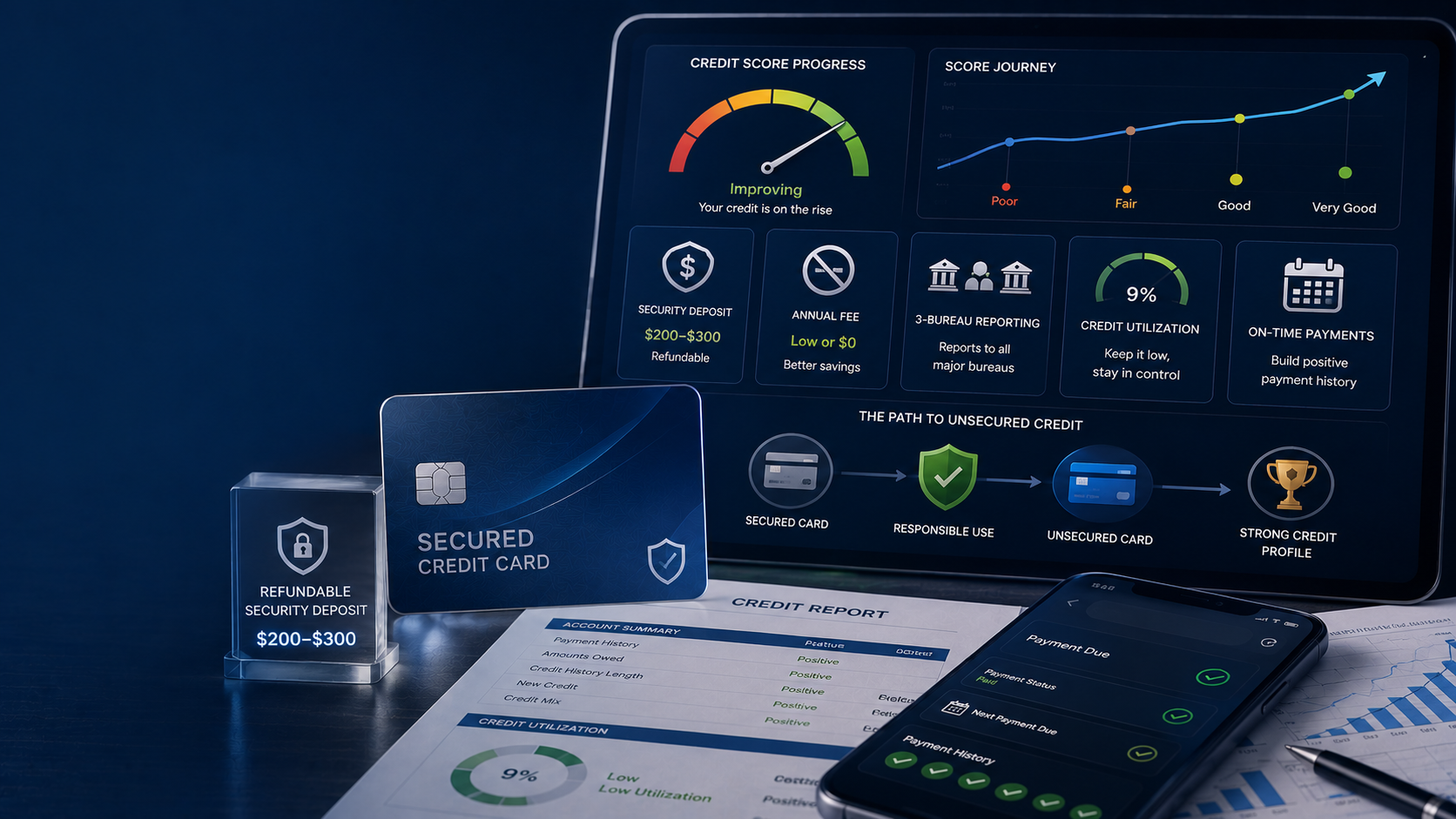
A secured credit card is a regular credit card backed by a refundable cash deposit. That deposit becomes your credit line in most cases — put down $300, and you get a $300 spending limit. The deposit protects the issuer if you stop paying, which is why they’re willing to approve people with damaged or limited credit.
Here’s the key point: a secured card is not a prepaid card, and it is not a debit card. When you make a purchase with a secured card, the issuer lends you the money, you owe them a balance, and — this is the part that matters — they report your payment activity to the credit bureaus. That reporting is what rebuilds your score.
So what makes a secured card “the best”? It’s not the flashiest marketing or the biggest sign-up bonus. The best secured card for you is the one that:
- Reports to all three major bureaus (Equifax, Experian, and TransUnion) so your good behavior actually shows up everywhere a lender might look.
- Costs you as little as possible in fees, because every dollar you spend on fees is a dollar not going toward your deposit, your balances, or your life.
- Has a realistic path to graduate to an unsecured card — meaning the issuer will eventually review your account and, if you’ve handled it well, return your deposit and upgrade you to a regular card.
- Fits your deposit budget without forcing you to tie up money you can’t afford to lock away.
- Is issued by a reputable lender that operates within the Fair Credit Reporting Act (FCRA) and other federal consumer protections.
A card can be perfect on paper but wrong for you if the deposit is too high, the fees eat you alive, or the issuer doesn’t report to all three bureaus. That’s why we evaluate cards against criteria, not against brand names.
The 7 Selection Criteria That Actually Matter
When you’re comparing secured cards, these are the seven factors worth your time. Everything else is marketing.
1. Annual Fee
The annual fee is what the issuer charges you simply for having the card, regardless of whether you use it. This is the single most important cost to watch.
Some secured cards charge $0. Others charge anywhere from $25 to $50 per year. A few charge more, or sneak in monthly “maintenance” fees on top. Because secured cards rarely come with sign-up bonuses or rewards that offset costs, an annual fee is money out of your pocket from day one — before you’ve even made a single purchase.
What to look for: A card with no annual fee, or an annual fee under $35 if a no-fee option isn’t available to you.
2. Bureau Reporting
This is non-negotiable. A secured card that doesn’t report to all three major credit bureaus is not rebuilding your credit — it’s just a spending tool.
Your FICO and VantageScore scores are calculated from the information in your credit reports at Equifax, Experian, and TransUnion. If a card only reports to one or two bureaus (or worse, none), your on-time payments only show up in some of the places lenders might look. That means your rebuilt credit may not be visible when you apply for an apartment, a car loan, or a mortgage.
What to look for: Explicit confirmation — in the card’s terms or FAQ — that the issuer reports to all three major bureaus: Equifax, Experian, and TransUnion.
Don’t assume. Some issuers only report to one or two, and some smaller or newer issuers may not report at all unless you miss a payment.
Why it matters: Rebuilding credit is hard enough. Don’t do the work and then have it invisible to two-thirds of the system that’s supposed to reward you.
3. Deposit Required
The deposit is the money you lock up to secure the card. It’s refundable — you get it back when you close the card in good standing or graduate to an unsecured card — but while it’s locked, you can’t use it for anything else.
Typical minimum deposits run from $49 to $300, and most cards let you deposit more to get a higher credit line. Some issuers offer flexible deposit options based on your credit profile, where you might qualify for a $200 credit line with a $49, $99, or $200 deposit.
What to look for: A minimum deposit you can comfortably afford to lock away for 12 to 24 months. For most people starting out, that’s $200 or less. If cash is tight, look for issuers that offer partial security deposits (where a smaller deposit unlocks a larger line) or no-deposit secured options that use your banking history instead of an upfront deposit.
Why it matters: If the deposit stretches your budget so thin that you can’t pay your other bills, the card is creating a new financial problem while trying to solve an old one. Rebuilding credit should not require choosing between your deposit and your groceries.
4. APR (Annual Percentage Rate)
The APR is the interest rate you pay if you carry a balance from month to month. Secured card APRs tend to be high — often 25% to 30% or more — because issuers are taking on riskier borrowers.
Here’s the honest truth: if you pay your statement balance in full every month, the APR doesn’t matter. You won’t be charged interest. But if there’s any chance you’ll carry a balance — even occasionally — a lower APR will save you real money.
What to look for: First, commit to paying in full every month. Second, as a safety net, look for a card with an APR at the lower end of the secured-card range. Treat a high APR as a deterrent, not a dealbreaker — but don’t pretend it doesn’t exist.
5. Graduation Path
A graduation path means the issuer can eventually upgrade your secured card to an unsecured card after you demonstrate responsible account management.
Graduation can allow you to receive your security deposit back and potentially receive a higher credit limit without opening a completely new account.
What to look for: A documented graduation policy, automatic account reviews, and clear information about when your account becomes eligible.
6. Credit Line Increase
A secured card that allows you to increase your credit line by adding to your deposit can become more useful as your financial situation improves.
A higher credit limit can also make it easier to keep your utilization ratio low, assuming your spending does not increase along with the limit.
What to look for: The ability to add deposits in increments, clear credit-line increase rules, and no unnecessary hard inquiry for an increase that is funded by an additional deposit.
7. Fees and Perks
Once the major fundamentals are covered, look at secondary features such as rewards, free credit monitoring, cell phone protection, foreign transaction fees, and other cardholder benefits.
Treat everything else as a bonus.
Why it matters: Free credit score monitoring keeps you informed as you rebuild. A small cash-back reward offsets some of your normal spending. Neither of these is the reason to choose a card, but both make a good card better.
The Secured Card Comparison Framework
Use this table to evaluate any secured card you’re considering. Print it out, copy it into a spreadsheet, or just fill it in mentally as you read terms and reviews. The goal is to compare cards side by side on the factors that actually determine whether they’ll help you rebuild.
| Criteria | Card A | Card B | Card C | What to Aim For |
|---|---|---|---|---|
| Annual fee | $0, or under $35 | |||
| Reports to all 3 bureaus? | Yes — Equifax, Experian, TransUnion | |||
| Minimum deposit | $200 or less | |||
| Maximum credit line | $2,000+ (via added deposit) | |||
| APR | Lower is better, but only matters if you carry a balance | |||
| Graduation path? | Yes — automatic review after 6–12 months | |||
| Credit line increase by deposit? | Yes | |||
| Monthly maintenance fees? | None | |||
| Application pull type | Soft pull or pre-qualification first | |||
| Rewards / perks | Free credit score access; 1–2% cash back is a bonus | |||
| Foreign transaction fee | 0% if you travel | |||
| Late payment fee | Check terms — know the cap | |||
| Issuer reputation | Reputable bank or credit union; FCRA-compliant |
A few notes on how to fill this in:
- Read the card’s terms and conditions (T&C) and FAQ page directly. Marketing pages emphasize the positives. The T&C is where the fees and limitations live.
- Cross-reference recent reviews from independent financial publications and real cardholders. Terms change, and a review from two years ago may not reflect current reality.
- Call the issuer if anything is unclear. A reputable issuer will answer direct questions about bureau reporting, graduation, and fees. If they won’t, that’s a red flag.
Categories: How to Find the Right Card for Your Situation
There’s no single “best secured card” — there are best cards for specific situations. Below, we describe what to look for in each category so you can match the card to your needs.
Best for No Annual Fee
If you’re rebuilding on a tight budget, every dollar matters. A no-annual-fee secured card lets you keep the card open for as long as you need without paying for the privilege.
What to look for:
- A $0 annual fee, clearly stated in the terms.
- No monthly maintenance fees, program fees, or setup fees hiding in the fine print.
- Reporting to all three bureaus (some no-fee cards skip a bureau — verify before you apply).
- A reasonable APR, since no-fee cards sometimes compensate with higher interest rates.
Who this is best for: Anyone who wants to minimize out-of-pocket costs while rebuilding, especially if you expect to carry the card for 18 to 24 months before graduating. It’s also the right choice if you’re juggling multiple rebuilding tools (like a credit-builder loan) and want to keep fixed costs low.
Watch out for: Some “no annual fee” cards charge a one-time setup fee or monthly fees after the first year. Read the full fee schedule, not just the headline.
Best for Low Deposit
If you don’t have $200 to lock away, a low-deposit secured card can get you started with as little as $49 to $99. Some issuers offer partial security deposits — your credit profile determines whether you qualify for a $200 line with a $49, $99, or $200 deposit.
What to look for:
- A minimum deposit of $49 to $100, or a flexible deposit model that adjusts based on your profile.
- A credit line that’s at least 2x to 4x your deposit if you qualify for a partial deposit (this is common with major issuers).
- Clear terms on when and how you get the deposit back.
- No requirement to deposit the full credit line amount if you don’t want to.
Who this is best for: Anyone whose cash flow is tight — if you’re recovering from a financial setback and can’t afford to tie up $200+, this category gets you in the game without straining your budget.
Watch out for: Low-deposit cards sometimes come with annual fees. Calculate the total cost over a year (deposit locked + fees paid) and compare it to a higher-deposit no-fee card. Sometimes the no-fee card is cheaper even though it requires more upfront.
Best for Graduation (Unsecured Upgrade Path)
A graduating secured card is one where the issuer proactively reviews your account and, if you’ve paid on time and kept your balance manageable, upgrades you to an unsecured card and returns your deposit — without a new application or hard credit pull.
This is the category most people should care about, because graduation is the moment your rebuilding transitions into long-term credit health.
What to look for:
- A documented graduation policy (stated in the terms, FAQ, or confirmed by the issuer directly).
- Automatic account reviews, typically starting at 6 to 12 months of responsible use.
- No application or hard pull required to graduate.
- A track record of actually graduating cardholders — check independent reviews and forum discussions to confirm the issuer follows through.
Who this is best for: Anyone who wants a clear bridge from secured to unsecured credit without reapplying. If you’re serious about rebuilding and want the deposit back as soon as you’ve proven yourself, prioritize this category.
Watch out for: Some issuers advertise graduation but rarely upgrade in practice. Reviews and user forums are your best signal for whether an issuer actually delivers. If you can’t find evidence of real graduations, treat the “path” as theoretical.
Best for High Credit Limit
If you want to keep your utilization ratio low — which is one of the fastest ways to improve your score — a card that allows a high credit line through additional deposits is valuable. With a $2,000 limit, a $200 balance is just 10% utilization. With a $300 limit, that same balance is 67% — which will drag your score down even if you pay it off every month.
What to look for:
- A maximum credit line of $2,000 to $5,000 or more, reachable by adding to your deposit over time.
- The ability to add deposits in increments (not just one lump sum at opening).
- No hard credit pull required to increase your limit by deposit.
- Clear terms on how quickly additional deposits are reflected in your credit line.
Who this is best for: People who spend moderately on their card each month and want to keep utilization under 10% without micromanaging every purchase. It’s also good for anyone whose score is being held back by high utilization on existing cards — adding a high-limit secured card can dilute your overall utilization.
Watch out for: Don’t deposit more than you can afford to lock away. A high limit only helps if you can access your cash again when you need it. Remember: the deposit is refundable, but not on demand — you get it back when you close the card or graduate.
Best for No Credit Check or Soft-Pull Approval
If you’re worried that a hard credit inquiry will further damage your score (each hard pull can drop your score by a few points, and the inquiry stays on your report for two years), look for a card that offers pre-qualification with a soft pull or no credit check at all.
What to look for:
- A pre-qualification tool on the issuer’s website that uses a soft pull (which doesn’t affect your score) to show you which cards you’re likely to be approved for before you formally apply.
- Cards that use banking history instead of a credit check to determine eligibility.
- Clear disclosure that the pre-qualification step is a soft pull, not a hard one.
Who this is best for: Anyone with a score so low that even a single hard inquiry feels risky, or anyone who wants to shop around without accumulating inquiries. It’s also useful if you’ve been denied recently and want to avoid another ding.
Watch out for: Pre-qualification is not a guarantee of approval. When you formally apply, some issuers will still do a hard pull. Read the fine print to understand when the hard pull happens — ideally only after you’ve been pre-qualified and decide to proceed.
Best with Rewards and Perks
A growing number of secured cards offer cash back, free credit score monitoring, cell phone protection, travel benefits, or rent reporting. These perks used to be reserved for unsecured cards, but competition has pushed them into the secured market.
What to look for:
- 1% to 2% cash back on all purchases or on specific categories like dining and gas.
- Free monthly credit score access so you can track your progress.
- No foreign transaction fees if you travel outside the U.S.
- Cell phone protection or extended warranty as a cardholder benefit.
- Rent and utility reporting — a few secured cards (and some credit-builder products) report your rent and utility payments to the bureaus, which adds positive payment history without additional spending.
Who this is best for: Anyone who has narrowed down their options to a few cards with similar fees and terms and wants a tiebreaker. Rewards should never be the primary factor in choosing a secured card, but they’re a legitimate differentiator when everything else is equal.
Watch out for: Don’t pay an annual fee just to earn cash back. Do the math: if a card charges $35/year and earns you 1% cash back, you’d need to spend $3,500 per year just to break even on the fee. A no-fee card with no rewards is usually a better deal for a rebuilder.
How to Apply Without Hurting Your Score
One of the most common fears we hear from clients is: “Won’t applying for a credit card hurt my score?”
It’s a fair concern. A hard credit inquiry can lower your score by a few points, and it stays on your report for two years (though the impact fades after about 12 months). But there’s a smart way to apply that minimizes or eliminates that impact.
Step 1: Use Pre-Qualification Tools First
Many major issuers offer a pre-qualification or pre-approval tool on their website. You enter some basic information — name, address, income — and the issuer does a soft pull of your credit to show you which cards you’re likely to qualify for.
A soft pull does not affect your credit score. You can use as many pre-qualification tools as you want without accumulating inquiries.
Use pre-qualification to:
- Compare offers from multiple issuers without risk.
- Identify cards where your approval odds are strongest.
- Avoid unnecessary hard inquiries.
- Compare fees, deposits, credit limits, and graduation policies before applying.
Step 2: Submit Only One Formal Application
Once you’ve compared your options and identified the card that fits your situation, submit one formal application rather than applying for several cards at once.
A formal application typically results in a hard inquiry. Multiple applications in a short period can create multiple inquiries and make your credit profile look riskier to lenders.
Step 3: Fund Your Deposit
If you’re approved, fund the security deposit according to the issuer’s instructions. Remember that this money is generally held as security and is not available for everyday spending.
Only deposit an amount you can comfortably afford to have tied up for the foreseeable future.
Step 4: Set Up Autopay Immediately
Set up automatic payments as soon as your account is active. At minimum, make sure the minimum payment is automatically paid before the due date.
If your budget allows it, pay the statement balance in full each month.
Step 5: Check Your First Statement
Review your first statement carefully. Confirm the payment due date, credit limit, fees, interest rate, and other terms.
Also confirm that the account is reporting correctly to the credit bureaus once reporting begins.
How to Use Whichever Card You Pick the Right Way
Choosing a good secured card is only half the process. What you do with it afterward determines whether it actually helps you rebuild.
Rule 1: Never Miss a Payment
One missed payment can undo months of progress.
Set up autopay for at least the minimum payment, and set a calendar reminder to review your statement each month. Treat the due date as non-negotiable.
Rule 2: Pay in Full If You Can
Paying in full means you never carry a balance and never pay interest. It also keeps your utilization low. If you can’t pay in full, pay as much as you can — always more than the minimum.
Rule 3: Keep Your Utilization Under 10%
Utilization is the second biggest factor in your score, after payment history. Aim to keep your statement balance below 10% of your credit limit. On a $300 card, that means a statement balance under $30. On a $1,000 card, under $100.
If you need to spend more than 10% in a given month, you have two options:
- Make a mid-month payment to bring the balance down before the statement closes.
- Add to your deposit to raise your credit line, which lowers your utilization ratio automatically.
Rule 4: Use the Card Every Month
A card that sits in a drawer doesn’t generate payment activity. Make at least one small purchase each month — a subscription, a tank of gas, a grocery run — and pay it off. This creates a steady stream of positive payment history.
Rule 5: Don’t Close the Card Too Early
Closing a secured card can reduce your available credit and shorten your average account age — both of which can temporarily lower your score. Keep the card open until you’ve either graduated to an unsecured card or opened another unsecured card with a comparable limit. If you must close it to get your deposit back, do so only after you have other positive accounts reporting.
Rule 6: Track Your Progress
Use the free credit score monitoring that comes with your card (or a free service) to watch your score trend over time. You should see gradual improvement within 3 to 6 months of consistent on-time payments, with more noticeable gains at the 12-month mark.
Red Flags to Avoid
The secured card market includes some products that exist to extract money from people who are desperate to rebuild. Here’s what to watch for.
1. High Annual or Monthly Fees
If a card charges an annual fee above $50, or any monthly maintenance fee (some charge $5 to $12 per month — that’s $60 to $144 per year), walk away. There are reputable no-fee or low-fee options.
2. No Bureau Reporting
If you can’t confirm in writing that the card reports to all three major bureaus, skip it. A card that doesn’t report is not rebuilding your credit — it’s just a spending tool with your own money locked behind it.
3. Application Fees
Legitimate secured cards do not charge an application fee. If a card asks for money before you’re even approved, that’s a warning sign.
4. “Credit Repair” Cards That Are Actually Catalog Cards
Some products marketed as “credit repair cards” are actually catalog cards or merchant cards — they only let you buy goods from a specific catalog or store, and they may only report to one bureau (or none). These are almost never worth it. A real secured card is a Visa, Mastercard, American Express, or Discover card accepted anywhere those networks are accepted.
5. Predatory APRs Above 30%
While secured card APRs are generally high, anything above 30% is a signal that the issuer is pricing for default and isn’t interested in a long-term relationship. If you ever carry a balance, the interest will eat you alive.
6. No Clear Path to Get Your Deposit Back
If the issuer doesn’t clearly explain how and when you get your deposit returned — either through graduation or by closing the account in good standing — treat that as a red flag. Your deposit is your money, and you should know exactly how to reclaim it.
7. Pressure to Buy Add-On Services
Some issuers push add-ons like credit insurance, identity protection, or “credit accelerator” programs during the application process. These are rarely worth the cost. Decline them and focus on the fundamentals: on-time payments and low utilization.
Common Mistakes That Slow Your Progress
Even with the right card, people make mistakes that delay their recovery. Here are the most common ones we see.
Mistake 1: Not Using the Card
If you open a secured card and never use it, the issuer may eventually close it for inactivity — which can reduce your available credit and shorten your account history. Make at least one purchase per month, even if it’s a $5 charge.
Mistake 2: Maxing Out the Card
Using your full credit limit — even if you pay it off — can hurt your score if the balance is reported before you pay. The bureaus see your statement balance, not your payment timing. Keep your statement balance under 10% of your limit.
Mistake 3: Missing a Payment
One 30-day late payment can drop your score by 60 to 80 points or more, depending on your starting score. On a secured card — where the whole point is to build positive history — a late payment is especially damaging because it contradicts the story you’re trying to tell lenders. Set up autopay for at least the minimum.
Mistake 4: Applying for Multiple Cards at Once
Each application is a hard inquiry. Multiple inquiries in a short window signal risk and compound the score impact. Apply for one card, get approved, use it responsibly for 6+ months, then consider adding another if needed.
Mistake 5: Closing the Card Too Soon
If you close a secured card after just 3 or 4 months, you’ve cut short the payment history you were building. Keep the card open for at least 12 months, ideally until you graduate or have other positive accounts well-established.
Mistake 6: Ignoring the Rest of Your Credit
A secured card is one tool, not a complete strategy. If you have negative items on your report — late payments, collections, charge-offs, inaccurate information — those items are still dragging your score down. Pair your secured card with a proper credit repair plan that addresses errors and negotiates with creditors. This is exactly what we do at credit-repair.com: a comprehensive audit, disputes with all three bureaus, and a customized plan that works alongside tools like secured cards.
Mistake 7: Expecting Overnight Results
Credit rebuilding is a marathon, not a sprint. Most people see meaningful improvement in 6 to 12 months with consistent effort, and significant improvement in 18 to 24 months. Anyone promising faster results is either misleading you or using tactics that don’t last.
Frequently Asked Questions
1. Can a secured card really rebuild my credit?
Yes — if the card reports to all three major bureaus and you use it responsibly (on-time payments, low utilization). A secured card generates payment history and contributes to your credit utilization ratio, both of which are major factors in your credit score. However, a secured card alone won’t fix negative items on your report. For the best results, pair it with a credit repair plan that addresses inaccuracies and negative marks.
2. How much deposit do I need for a secured card?
Most secured cards require a minimum deposit between $49 and $300. Some issuers offer partial security deposits where a smaller deposit unlocks a larger credit line, based on your credit profile. The deposit is refundable — you get it back when you close the card in good standing or graduate to an unsecured card.
3. Will applying for a secured card hurt my credit score?
The formal application typically involves a hard credit inquiry, which can lower your score by a few points. However, many issuers offer pre-qualification with a soft pull that doesn’t affect your score — use that first to check your odds. A single hard inquiry is minor and temporary; the positive history from the new card will outweigh it within a few months.
4. How long does it take to graduate from a secured to an unsecured card?
It depends on the issuer and your behavior. Some issuers review accounts automatically at 6 to 12 months; others may take longer or require you to request the upgrade. Graduation typically returns your deposit and may increase your credit limit. Not all issuers offer a graduation path — verify before you apply.
5. What credit score do I need to get a secured card?
Most secured cards are designed for people with bad credit or no credit, so the approval threshold is generally low. Some issuers don’t have a minimum score at all — they use your deposit as the qualifying factor. That said, a recent bankruptcy or active collections may affect approval with certain issuers. Pre-qualification tools will tell you where you stand before you formally apply.
6. Can I have more than one secured card?
Yes, but it’s usually best to start with one, use it responsibly for 6 to 12 months, then consider adding a second if you want to increase your total available credit. Applying for multiple cards at once generates multiple hard inquiries and signals risk. Two well-managed cards can improve your utilization ratio and diversify your credit profile, but only after you’ve proven you can handle one.
7. Do secured cards build credit as fast as unsecured cards?
Yes — the scoring models treat secured and unsecured cards the same way. What matters is your payment history, utilization, account age, and the fact that the card reports to the bureaus. The deposit behind the card is invisible to the scoring algorithm. The speed of your progress depends on your behavior and what else is on your report, not on whether the card is secured.
8. What happens to my deposit if the issuer goes out of business?
Your deposit is typically held in a separate, FDIC-insured account and should be returned to you even if the issuer fails. That said, always verify that the issuer is a reputable, regulated bank or credit union before applying. If you’re working with a smaller or newer issuer, ask directly where your deposit is held and how it’s protected.
Next Steps: Pair Your Card With a Real Credit Plan
A secured credit card is one of the best tools available for rebuilding your credit — but it works best as part of a broader strategy. If your credit report contains inaccuracies, outdated negative items, or accounts that could be disputed or negotiated, those items are holding your score down no matter how responsibly you use your new card.
That’s where we come in.
At credit-repair.com, we help individuals and families across the country take control of their financial future through honest, attorney-backed credit repair. Our process includes:
- A comprehensive credit audit across all three major bureaus — Equifax, Experian, and TransUnion.
- Disputing inaccuracies under the Fair Credit Reporting Act (FCRA), with the backing of experienced attorneys.
- Negotiating with creditors to resolve legitimate negative items where possible.
- A customized repair plan built around your specific goals and timeline.
- Ongoing education so you understand how credit works and how to keep it strong for life.
We don’t make empty promises or offer quick fixes. We believe in transparency, legal compliance, and measurable progress — the same values you should look for in a secured card.
Ready to see where you stand? Get your free credit audit at credit-repair.com. We’ll review your reports from all three bureaus, identify what’s holding your score back, and build a plan that works alongside tools like your secured card to get you where you want to go.
Your credit isn’t broken forever. With the right card, the right habits, and the right plan, you can rebuild — and we’re here to help you do it.
Leave a Reply