Category: Uncategorized

  • How to Dispute Credit Report Errors Without Hurting Your Score

    How to Dispute Credit Report Errors Without Hurting Your Score

    Most people assume disputing an error can only help — after all, you’re trying to fix something wrong. But there are a handful of specific ways the dispute process itself can backfire if handled carelessly, and understanding these risks upfront lets you dispute confidently and correctly, without accidentally creating new problems.

    Does Filing a Dispute Itself Hurt Your Score?

    No — filing a dispute, by itself, does not directly lower your credit score. The act of disputing isn’t a scored event, and there’s no mechanism in standard scoring models that penalizes you simply for exercising your FCRA right to dispute inaccurate information. This is worth stating clearly because it’s a common and unnecessary worry that sometimes stops people from disputing legitimate errors.

    That said, there are indirect ways the process around a dispute can create issues if you’re not careful.

    Risk 1: Disputing Accurate Information Can Backfire Later

    A once-popular (and now largely ineffective) strategy involves disputing accurate negative information anyway, hoping the furnisher won’t respond within the 30-day window, resulting in automatic removal due to non-response rather than an actual finding of inaccuracy. A few problems with this:

    – **It’s temporary if the information is accurate.** Furnishers can, and often do, re-verify and reinstate accurate information even after an initial removal, once they catch up on a backlog or respond late. This means the removal isn’t durable, and the item can reappear, sometimes without much warning.
    – **A pattern of unfounded disputes can result in bureaus flagging you.** While a single dispute doesn’t hurt you, credit bureaus can treat a pattern of disputes lacking any factual basis as frivolous, which can result in less thorough investigation of your future disputes — including legitimate ones.
    – **It can create a false sense of resolution** that leads you to stop pursuing more durable, better-grounded strategies (like a goodwill letter for accurate but sympathetic negative marks) while you’re waiting to see if the temporary removal sticks.

    The safer, more durable approach is to dispute only what you genuinely believe is inaccurate, incomplete, or unverifiable — and to use goodwill requests, not disputes, for accurate information you’re hoping to have removed as a courtesy.

    Risk 2: Disputing Through a Credit Repair Company That Mass-Disputes Everything

    Some lower-quality credit repair operations use a strategy of disputing large numbers of accounts simultaneously, regardless of whether each item has genuine grounds for dispute, essentially hoping volume produces results through non-response. Beyond the durability issue above, this can:

    – Result in your file being flagged for a pattern of low-substance disputes.
    – Waste the “real” investigation attention on items that actually deserve scrutiny, buried among many without real basis.
    – In more serious cases, involve credit repair companies using deceptive tactics (creating a new, fraudulent credit profile via a technicality — sometimes called “credit privacy number” or CPN schemes) that are illegal and carry serious legal risk to you, not just the company. Avoid any credit repair service suggesting anything along these lines.

    Risk 3: Waiting Too Long to Address a Real Error While It Continues to Report

    This isn’t about the dispute process hurting you — it’s about the cost of inaction. An inaccurate item continuing to report negatively affects your score every month it remains uncorrected. There’s no benefit to delaying a well-grounded dispute, and doing so simply means the negative (and inaccurate) impact continues longer than necessary.

    Risk 4: Providing Inconsistent or Conflicting Information Across Disputes

    If you dispute the same item multiple times with different, sometimes contradictory explanations (for example, first claiming an account isn’t yours, then later claiming it is yours but the balance is wrong), this inconsistency can undermine your credibility with both the bureau and the furnisher, potentially resulting in less favorable treatment of the dispute overall. Keep your disputes factually consistent and precise from the start.

    Risk 5: A Successful Dispute That Removes Context, Not Just the Error

    In rare cases, disputing and correcting one detail on an account (say, a balance amount) without addressing the full picture can occasionally result in an entry that looks more confusing or ambiguous than before, if the correction isn’t handled cleanly by the furnisher. This is uncommon, but worth checking your report again after any dispute resolves, to confirm the corrected entry actually looks accurate and complete, not just partially updated.

    How to Dispute Safely and Effectively

    **1. Only dispute what you genuinely believe is inaccurate**, and be able to articulate specifically why. “This isn’t accurate” without a specific factual basis is both less effective and more likely to fall into the “frivolous” pattern risk described above.

    **2. Gather documentation before disputing**, not after. A dispute backed by bank statements, payment confirmations, or validation failures is both more likely to succeed durably and less likely to be seen as unfounded.

    **3. Keep your explanation factually consistent** across the bureau dispute, any direct furnisher dispute, and any follow-up correspondence.

    **4. Dispute one clear issue per item**, rather than combining multiple, sometimes unrelated claims into a single vague dispute.

    **5. Avoid credit repair strategies involving new legal identities, CPNs, or other technicality-based “resets”** — these are illegal, put you at serious legal risk, and have nothing to do with legitimate dispute rights under FCRA.

    **6. Check your report again after the dispute resolves**, to confirm the correction was applied cleanly and completely, not partially.

    What About Disputing Right Before a Major Loan Application?

    This is worth specific mention: if you’re actively in the process of applying for a mortgage or other major loan, some lenders prefer that disputes be resolved (not actively pending) before final underwriting, since an open dispute can sometimes complicate how a scoring model or manual underwriter treats the disputed item during the loan decision process. If you’re planning a major application soon, it’s often wise to resolve disputes well in advance rather than filing them in the middle of an active loan process, simply for practical underwriting reasons, not because the dispute itself is risky.

    The Bottom Line

    Legitimate disputes, filed with real documentation and factual specificity, carry essentially no risk to your credit score and are exactly the tool FCRA gives you for correcting genuine errors — there’s no reason to hesitate on a well-grounded dispute. The risks that do exist come from disputing accurate information hoping for a technical non-response removal, using disreputable mass-dispute or identity-manipulation schemes, or being inconsistent across your own dispute correspondence — all avoidable by disputing carefully, specifically, and honestly.

  • Secured Credit Cards vs. Credit-Builder Loans: Which Rebuilds Credit Faster?

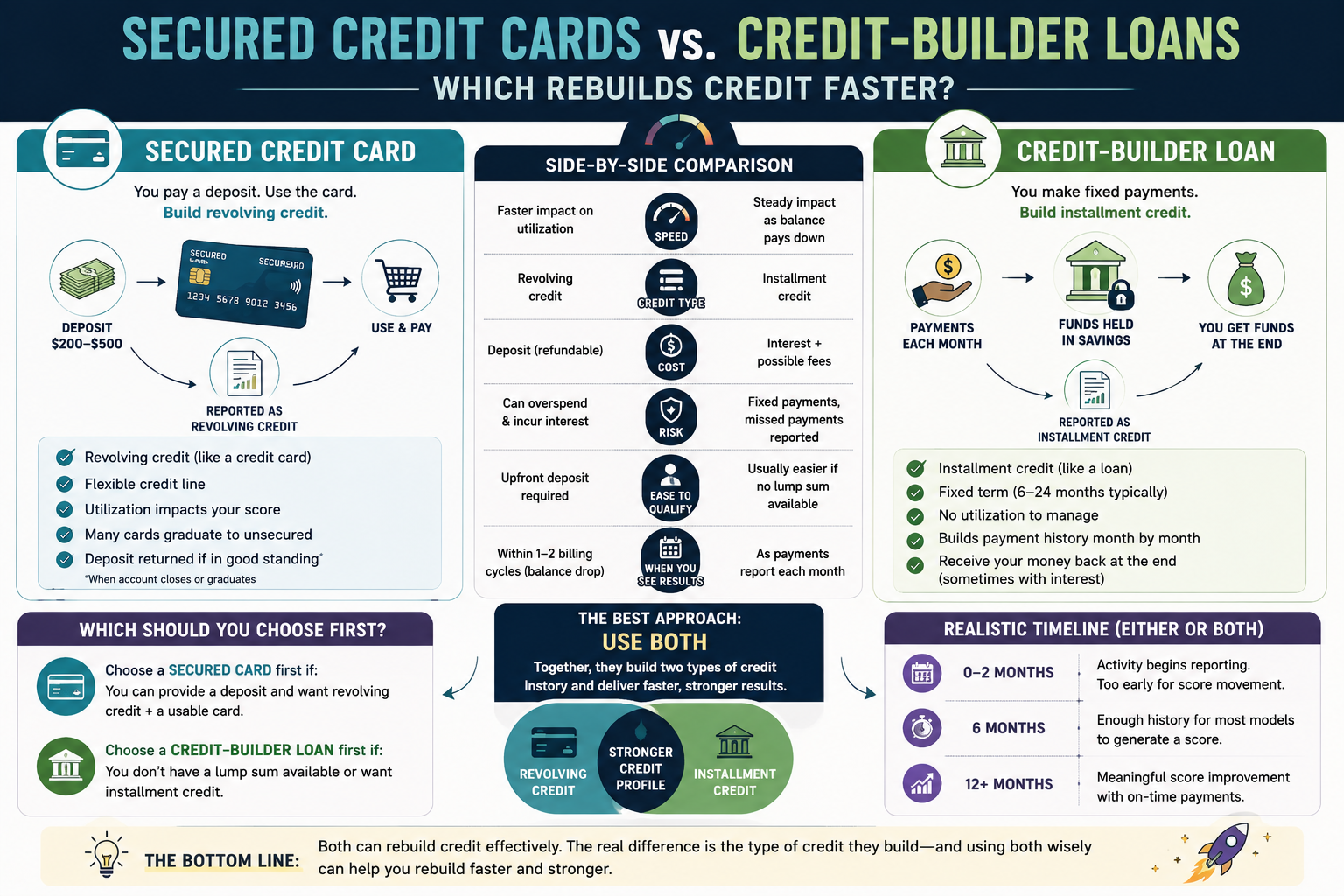
    Secured Credit Cards vs. Credit-Builder Loans: Which Rebuilds Credit Faster?

    Both tools exist for essentially the same purpose — establishing or repairing credit for people who don’t currently qualify for standard unsecured products — but they work through different mechanisms, build different types of credit history, and have different practical tradeoffs. The honest answer to “which is faster” depends on what specifically you’re optimizing for, but understanding how each actually works will make the choice, or the decision to use both, much clearer.

    How a Secured Credit Card Works

    You provide a cash deposit (typically $200-500, sometimes more), which becomes your credit limit. You use the card like a normal credit card — making purchases, receiving a monthly statement, and making payments — and your activity is reported to the credit bureaus as **revolving credit**, the same category as any standard unsecured credit card.

    Key mechanics:
    – Your deposit is held as collateral, reducing the issuer’s risk, which is why approval is accessible even with poor or no credit history.
    – You can typically use it up to your limit repeatedly, as long as you pay down the balance (hence “revolving”).
    – After a period of responsible use (often 6-12 months, varies by issuer), many secured cards either automatically graduate to unsecured status (returning your deposit) or make you eligible to apply for an unsecured card with the same issuer.

    How a Credit-Builder Loan Works

    Instead of receiving loan funds upfront, the “loan” amount is held in a locked savings account (or sometimes a CD) by the lender, and you make fixed monthly payments over a set term (often 6-24 months). At the end of the term, you receive the accumulated funds, sometimes with a small amount of interest.

    Key mechanics:
    – Your payments are reported to the credit bureaus as **installment credit** — a fixed monthly payment over a defined term, similar in structure to an auto loan or personal loan.
    – You don’t have access to the funds until the term completes (or, with some products, after you’ve paid a certain percentage), which is fundamentally different from a secured card’s revolving access.
    – There’s no ongoing utilization ratio to manage — your reported balance simply declines predictably each month as you make payments, following the loan’s amortization schedule.

    Speed Comparison: Which Shows Results Faster?

    **For utilization-related score factors**: a secured card can show a benefit faster, since utilization is calculated from your most recent reported balance and can improve within a single billing cycle if you keep spending low relative to your limit.

    **For payment history establishment**: both report similarly — each on-time monthly payment adds to your track record, and most scoring models need a similar minimum period (roughly 6 months) of reporting history before generating a score at all, regardless of which product type you’re using.

    **For credit mix**: a credit-builder loan adds installment credit to your file, which is a different category than the revolving credit a secured card provides. If you already have one type of account, adding the other type is what actually helps your credit mix factor — using two of the same type doesn’t provide this specific benefit.

    In practice, neither product is meaningfully “faster” in isolation — the real speed advantage comes from using both together, since this establishes two different credit history types simultaneously, rather than sequentially.

    Cost Comparison

    **Secured card costs:**
    – Upfront deposit, which is returned (assuming good standing) when the account closes or graduates to unsecured status — this isn’t really a “cost” so much as a temporary hold on your own money.
    – Some secured cards carry annual fees, which is a genuine cost worth comparing across options.
    – Interest charges apply if you carry a balance, though — as with any credit card — paying in full each month avoids this entirely.

    **Credit-builder loan costs:**
    – Interest is typically charged on the loan amount, similar to a standard personal loan, though credit-builder-specific products sometimes have relatively modest rates given their credit-building purpose.
    – Some products charge a modest origination or administrative fee.
    – Unlike a secured card, you generally get your money back at the end (plus, in some structures, a small amount of interest earned on the held funds) rather than a return of an unused deposit — the overall cost structure differs, so a direct comparison depends on the specific terms of each product.

    Risk Comparison

    **Secured card risk**: if you overspend and can’t pay it off, you risk carrying a balance with interest charges, and in more serious cases, if the account goes delinquent, the issuer may use your deposit to cover the unpaid balance — meaning you could lose your deposit and still end up with a damaged account on your credit report.

    **Credit-builder loan risk**: since you’re making fixed payments toward funds you don’t yet have access to, missing a payment has the same negative reporting consequence as any other late payment, without the flexibility a credit card offers (like paying only the minimum in a pinch). Some people find this more psychologically challenging, since you’re paying money each month without immediate access to spend it, which can feel less flexible during tight financial periods.

    Which Is Easier to Qualify For?

    Both are generally accessible with poor or no credit, but there are some differences:

    – **Secured cards** usually require the ability to provide the deposit upfront in a single lump sum, which can be a barrier for some applicants.
    – **Credit-builder loans** spread the “cost” of the loan amount across monthly payments rather than requiring an upfront lump sum, which can make them more accessible for people who don’t have several hundred dollars available at once, even though the total amount paid over time may be similar or higher once fees/interest are factored in.

    Which Should You Choose First?

    If you can only start with one:

    – **Choose a secured card first** if your priority is establishing revolving credit and you have the deposit available — revolving credit history and demonstrated utilization management are weighted meaningfully in most scoring models, and a secured card also gives you an actual usable card for everyday purchases.
    – **Choose a credit-builder loan first** if you don’t have a lump sum available for a deposit, or if you specifically want to add installment credit to complement existing revolving credit (a credit card) you might already have.

    The Best Approach: Use Both, If Feasible

    Since they build different types of credit history and complement rather than duplicate each other, using both simultaneously — a secured card for revolving history plus a credit-builder loan for installment history — tends to produce faster, more well-rounded credit-building results than relying on either alone. This does mean managing two separate monthly payment obligations, so it’s only worth pursuing if you’re confident you can manage both reliably; missing payments on either defeats the purpose entirely.

    Realistic Timeline for Either (or Both)

    – **First 1-2 statement cycles**: initial reporting begins; too early to see meaningful score movement yet.
    – **6 months**: enough history for most scoring models to generate a score, assuming consistent on-time payments.
    – **12 months**: with continued responsible use, meaningful score improvement is typical, often sufficient to start qualifying for unsecured products.

    The Bottom Line

    Neither a secured credit card nor a credit-builder loan is definitively “faster” in isolation — both need roughly the same minimum reporting period before producing a usable score, and both depend entirely on consistent on-time payments to actually help. The real advantage comes from understanding what each contributes (revolving vs. installment credit history) and, if your budget allows, using both together to build a more diverse, faster-developing credit file than either product could produce alone.

  • Does Becoming an Authorized User Actually Raise Your Credit Score?

    Does Becoming an Authorized User Actually Raise Your Credit Score?

    This is one of the more genuinely useful, if slightly counterintuitive, tools in credit building — you can potentially benefit from someone else’s credit history without being legally responsible for their debt. But it doesn’t work universally, and understanding exactly when and why it works (and when it doesn’t) matters before you rely on it as a strategy.

    The Short Answer: Yes, Often Significantly — But With Real Conditions

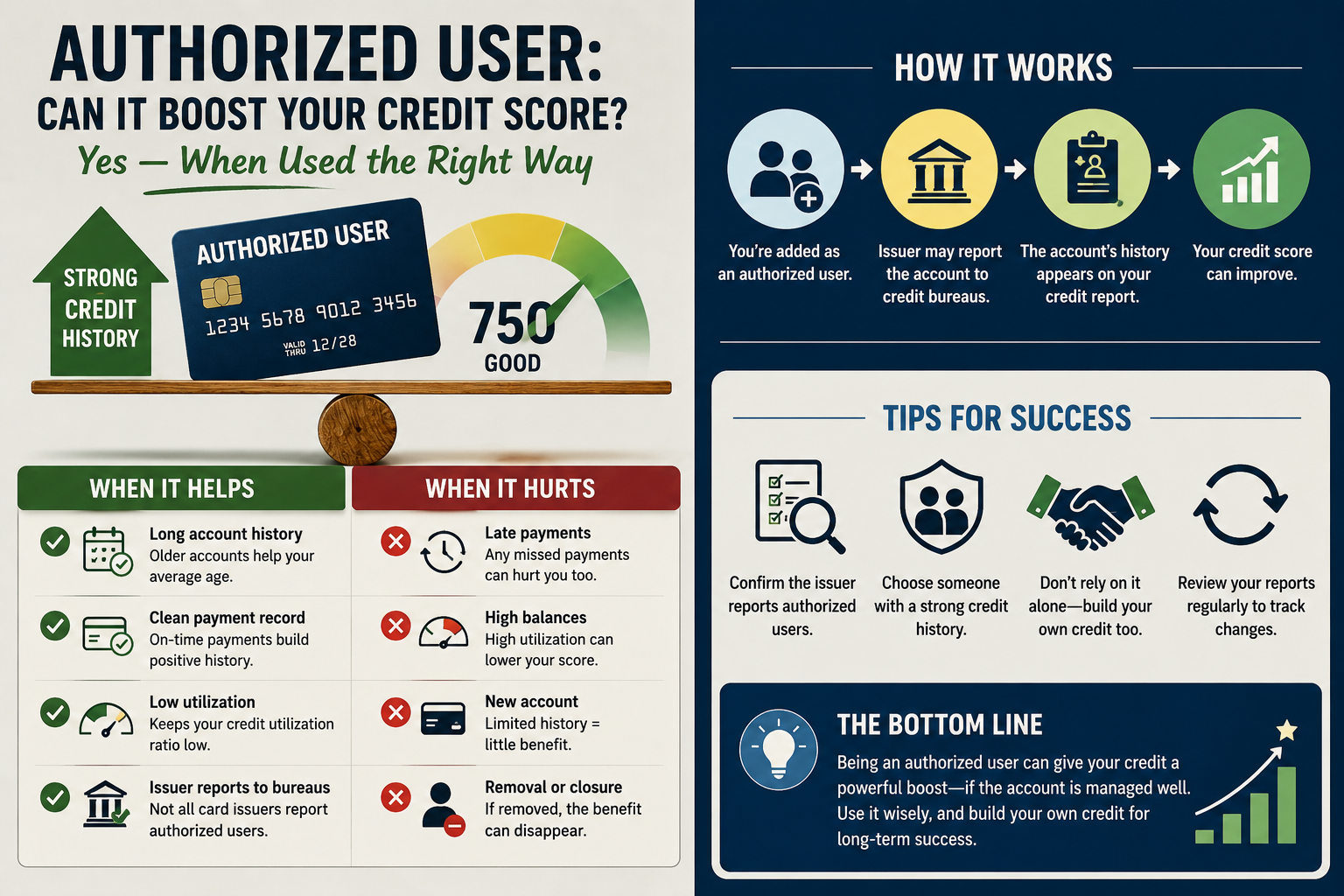
    Being added as an authorized user on someone else’s credit card can add that account’s entire history — sometimes years or even decades of it — to your own credit report. If the primary account holder has a long-standing, well-managed account, this can meaningfully boost your score, particularly if you have a thin or new credit file where a single well-aged account represents a large proportional improvement to your overall profile.

    But this only works under specific conditions, and it can also backfire.

    How Authorized User Reporting Actually Works

    When you’re added as an authorized user, the card issuer *may* report that account to the credit bureaus as appearing on your credit file too — including its full history: the account age, the payment history, the credit limit, and current utilization. This is the mechanism that creates the benefit (or the risk).

    Critically: **not all card issuers report authorized user activity to the credit bureaus at all.** This varies by issuer, and it’s essential to confirm before assuming the strategy will work. If the issuer doesn’t report authorized user status, adding you accomplishes nothing for your credit file, regardless of how strong the primary account is.

    What Makes This Work Well

    **The primary account has a long history.** The single biggest factor in how much this helps is the account’s age. Being added to a card opened last year provides much less benefit than being added to one opened 15 years ago, since average account age is a real scoring factor, and a long-standing account can meaningfully raise your overall average, especially if your existing credit file is thin.

    **The primary account has a clean payment history.** This is non-negotiable — if the account has late payments or other negative marks, those become part of your file too. This is the core risk of the strategy: you inherit the account’s full history, both good and bad.

    **The primary account has low utilization.** Since the reported utilization on that account becomes part of your file’s overall utilization calculation, a card that’s rarely used or kept at a low balance relative to its limit helps you; a card that’s frequently near

    its limit hurts you, even if you personally never use the card yourself as an authorized user.

    **The issuer actually reports authorized user data.** As mentioned, this is a prerequisite, not a detail — confirm this before pursuing the strategy at all.

    What Makes This Backfire

    **A primary account with negative history.** If the account has missed payments, high utilization, or other derogatory marks, adding you as an authorized user imports those negatives into your file just as readily as it would import positives. This is the most important risk to understand: authorized user status is not a one-directional benefit — it reflects the account’s actual history, whatever that history is.

    **A recently opened account.** If the account is new, there’s minimal age benefit to gain, and you’re taking on whatever risk exists (missed payments going forward) without much of the primary upside.

    **Relying on it as your only credit-building strategy.** Authorized user status supplements a credit file; it doesn’t substitute for having your own independently-held accounts. Since you have no legal ownership or control over the authorized user account, your credit profile remains dependent on someone else’s behavior and, if that relationship or arrangement changes (a divorce, a falling out, the primary holder closing the account), that benefit can disappear.

    Does This Work the Same for Everyone Added?

    Yes, in terms of mechanics — whoever the issuer reports as an authorized user gets the account history reflected. But the *practical impact* varies significantly based on your existing credit profile:

    – **Someone with no existing credit file** often sees the most dramatic relative benefit, since a single well-aged, well-managed account represents a much larger share of their overall credit picture.
    – **Someone with an already-established, moderate credit file** typically sees a smaller, though still real, benefit, since the new account is one of several factors being averaged together rather than dominating the calculation.
    – **Someone with an already strong credit file** may see minimal additional benefit, since they likely already have sufficient account age and history without needing the boost.

    Does the Primary Account Holder Face Any Risk From Adding You?

    Generally minimal, but worth understanding:
    – Adding an authorized user typically doesn’t affect the primary holder’s credit at all, unless the authorized user makes charges that push utilization higher (which does affect the primary account’s reported utilization, and therefore the primary holder’s own credit file, since it’s their account).

    – The primary holder remains fully legally responsible for all charges on the account, including any made by the authorized user, so this arrangement requires real trust if the authorized user will actually be using the card, not just benefiting from the reported history.

    Can You Be an Authorized User Without Ever Using the Card?

    Yes, and this is actually a common and reasonable approach specifically for credit-building purposes — some primary account holders add a family member as an authorized user purely so the account history reports to that person’s file, without ever issuing them a physical card or expecting them to make charges. This isolates the credit-building benefit from any spending risk, which can make the arrangement more comfortable for both parties.

    How Long Does It Take to Show Up on Your Report?

    This varies by issuer but is generally fairly fast — often within one to two billing cycles after being added, the account should begin appearing on your credit report, at which point its full history (not just going forward, but retroactively) is typically reflected, which is what produces the notable, sometimes immediate-feeling score impact compared to opening a brand new account that only has history going forward.

    What Happens If You’re Later Removed?

    If you’re removed as an authorized user (or the primary holder closes the account), that account and its associated history generally stops being reported on your file going forward. This means the benefit isn’t necessarily permanent — it’s tied to your ongoing status on that account, which is a meaningful consideration if you’re relying on it as a long-term strategy rather than a stepping stone while you build your own independent credit history.

    The Bottom Line

    Authorized user status can genuinely and sometimes significantly raise your credit score, but only when the underlying account has a long history, clean payment record, and low utilization, and only if the issuer actually reports authorized user data to the credit bureaus. It’s one of the more powerful tools available, particularly for people with thin credit files, but it’s also a two-way street — a poorly managed primary account can hurt you just as easily as a well-managed one can help — and it works best as a complement to, not a replacement for, building your own independent credit accounts over time.

  • How to Rebuild Credit After a Job Loss

    How to Rebuild Credit After a Job Loss

    Job loss is one of the most common triggers behind an otherwise strong credit history suddenly taking a hit — a missed payment here, rising utilization there, sometimes a collection account if things dragged on longer than expected. The good news is that credit damage tied to a temporary income disruption tends to be more recoverable, and often faster to recover from, than damage from ongoing financial mismanagement, precisely because the underlying cause has typically resolved by the time you’re rebuilding. Here’s a practical, sequenced approach.

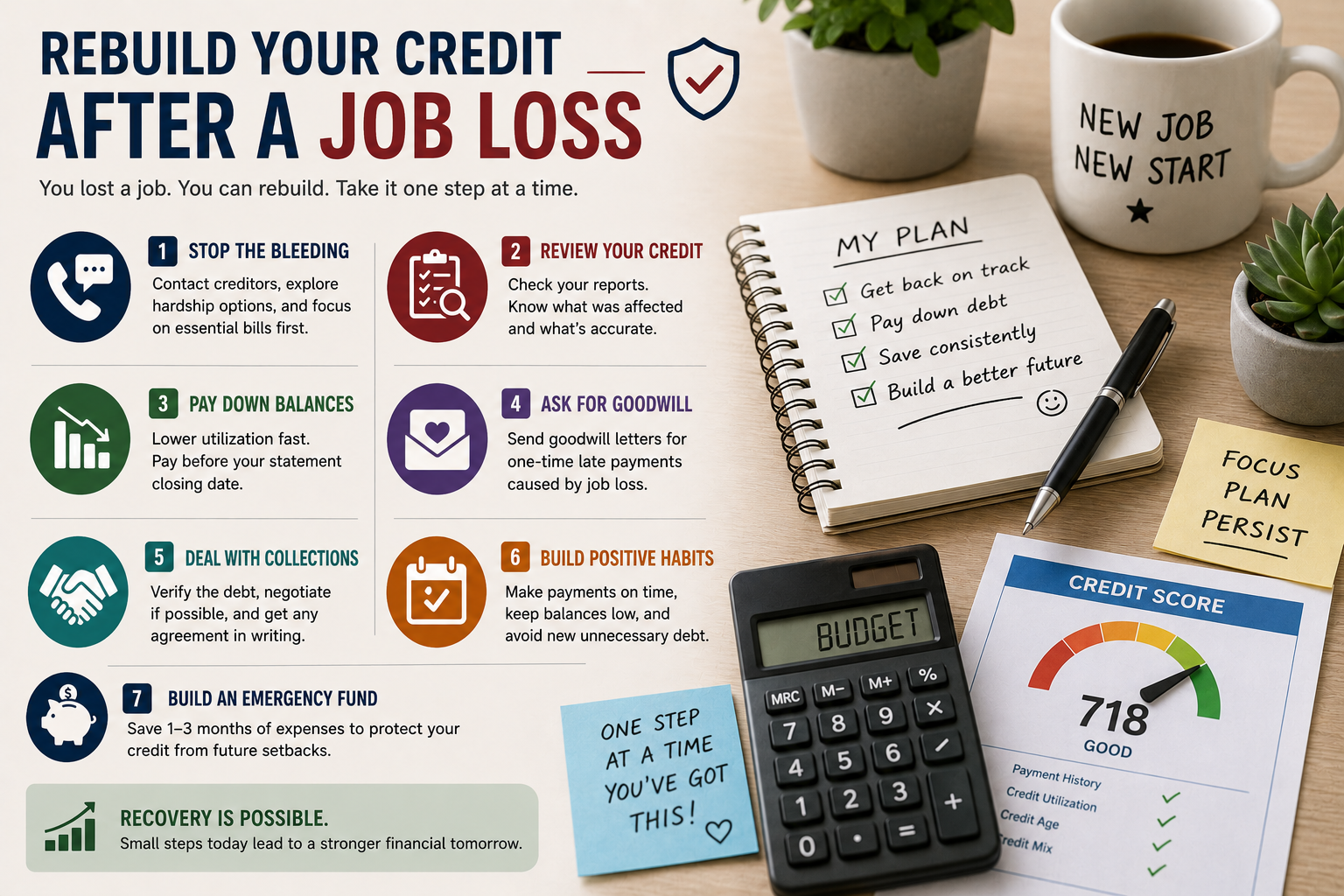
    Step 1: Stop the Bleeding Before You Start Rebuilding

    If you’re still in the immediate aftermath of a job loss, rebuilding strategy comes second to damage control. Before focusing on your credit score specifically:

    – **Contact creditors proactively**, before you miss a payment if possible, or as soon as possible after. Many card issuers and lenders have hardship programs — reduced payments, temporarily paused interest, deferred due dates — that can prevent a missed payment from ever being reported in the first place. This is dramatically more effective than waiting until after a late payment has already hit your report and then trying to fix it.
    – **Prioritize which bills to pay if funds are truly insufficient for everything.** Secured debts with serious consequences (mortgage, auto loan) and anything already reporting delinquent typically take priority over unsecured debts where the immediate consequence of a missed payment is “only” credit damage, though this is a genuinely difficult triage decision that depends on your full financial picture.
    – **Apply for unemployment benefits immediately** if eligible — this is obvious but worth stating, since delayed applications mean delayed income replacement, which compounds the pressure on your other financial obligations.

    Step 2: Assess What Actually Happened to Your Credit

    Once your immediate income situation has stabilized (new job, unemployment benefits flowing, or otherwise), pull your full credit report and take honest stock:

    – **Identify every account affected** — late payments, increased utilization from relying on credit cards during the gap, any accounts that went to collections.
    – **Check for accuracy**, especially around dates — if you were on an approved hardship program with a creditor and they still reported a late payment in violation of that agreement, that’s a legitimate, disputable error.
    – **Distinguish between accounts that are simply high-utilization but current, versus accounts that are actually delinquent** — these require different strategies (paydown vs. dispute/negotiation).

    Step 3: Address Utilization First — It’s the Fastest Lever

    If your credit cards carry elevated balances from the income gap but payments are current, paying these down is your fastest path to score recovery, often showing up within a single billing cycle once the lower balance is reported. Prioritize:

    – **The card(s) with the highest utilization percentage first**, since crossing key thresholds (from over 90% to under 30%, for example) tends to produce more noticeable score movement than incremental paydowns spread evenly across several cards.
    – **Paying down before the statement closing date**, not just before the due date, since the reported balance is typically based on the statement close, not whether you eventually paid by the due date.

    Step 4: Address Any Late Payments With Goodwill Requests

    If you have one or two isolated late payments tied specifically to the job loss period, and you’ve otherwise had a strong history with that creditor, a goodwill letter (see our dedicated guide) is worth sending once you’re back on stable footing. Job loss is exactly the kind of specific, sympathetic, verifiable circumstance that goodwill requests are designed for, and creditors are often more receptive to this kind of request than to a vague “please forgive this” ask.

    Step 5: If Accounts Went to Collections, Address Strategically

    If the gap was long enough that an account went unpaid to the point of collections, treat this the same way you would any collection account:

    – **Verify the debt** before paying anything.
    – **Negotiate**, especially if you can now pay a lump sum from back pay, a new job’s signing bonus, or accumulated unemployment benefits — collectors are often willing to settle for less than the full balance, and pay-for-delete may be on the table.
    – **Get any agreement in writing** before sending payment.

    Step 6: Rebuild Positive History Going Forward

    Once you’re financially stable again, focus on demonstrating consistency:

    – **Keep utilization low going forward**, ideally under 30%, to show the elevated balances during the job loss period were situational, not a lasting pattern.
    – **Avoid taking on unnecessary new debt** immediately after returning to stability — focus on rebuilding a cash cushion first, so a future disruption doesn’t require leaning on credit again in the same way.
    – **Set up autopay for at least minimum payments** on all accounts going forward, as a safeguard against a future gap resulting in an accidentally missed payment even during a stressful period.

    Step 7: Build (or Rebuild) an Emergency Fund as Credit Protection

    This isn’t a credit repair tactic in the traditional sense, but it’s arguably the most effective long-term credit protection available: a cash emergency fund means a future job loss doesn’t have to touch your credit

    at all. Even a modest fund — enough to cover 1-2 months of essential expenses — meaningfully reduces the odds that the next unexpected income gap turns into new credit damage. Building this back up should be a real priority once you’re stable, not an afterthought.

    Realistic Timeline for Recovery

    – **Weeks 1-6 post-stabilization**: utilization paydowns show up and begin lifting your score; this is often the fastest, most encouraging part of the recovery.
    – **Months 2-4**: goodwill requests and any collection negotiations resolve; continued on-time payments accumulate.
    – **Months 6-12**: assuming no further disruptions, most people see substantial recovery back toward their pre-job-loss score range within this window, particularly if the credit damage was limited to a handful of specific, addressed items rather than a broad pattern.

    A Note on Emotional Weight

    Job loss-related credit damage often carries more emotional weight than its practical financial impact — people frequently feel a sense of shame or failure about credit dings tied to unemployment, even though this is one of the most common and understandable causes of credit disruption that exists. It’s worth separating the emotional reaction from the practical recovery plan: a temporary income gap that led to a few late payments or higher utilization is genuinely one of the more recoverable credit situations, precisely because the underlying cause is identifiable, sympathetic to creditors, and (once you’re re-employed) resolved.

    The Bottom Line

    Credit damage from job loss tends to be more recoverable and faster to recover from than people expect, mainly because the underlying cause is temporary and creditors — especially through hardship programs and goodwill requests — often have specific accommodations for exactly this situation. Prioritize stopping further damage first through proactive creditor communication, then tackle utilization paydown as your fastest score lever, follow up with goodwill requests for any isolated late payments, and use the recovery period to build the kind of emergency cash cushion that protects your credit the next time life throws an income disruption your way.

  • Credit Repair Tips for Immigrants New to the US Credit System

    Credit Repair Tips for Immigrants New to the US Credit System

    If you’re new to the United States, one of the most disorienting financial realities is that your credit history — even an excellent one — from your home country almost never transfers over. The US credit system is largely self-contained, and starting from zero here is a normal, expected part of the process, not a reflection of anything about your actual financial reliability. Here’s a practical, realistic path through it.

    Why Foreign Credit History Doesn’t Transfer

    US credit bureaus (Equifax, Experian, TransUnion) only track data reported by US-based lenders and furnishers. Credit history built in another country — even decades of it — simply isn’t in their system, because foreign financial institutions generally don’t report to US bureaus. A small number of specialized services have emerged attempting to bridge this gap for people relocating from specific countries, but they’re limited in scope and not universally recognized by US lenders, so it’s realistic to expect you’re building a file from scratch regardless of your financial history elsewhere.

    Step 1: Get an SSN or ITIN

    Before you can build a US credit file, you generally need either:
    – A **Social Security Number (SSN)**, if you’re authorized to work in the US.
    – An **Individual Taxpayer Identification Number (ITIN)**, available to those who don’t qualify for an SSN but need to file taxes or, in some cases, apply for certain credit products.

    Some credit-building products (a small number of secured cards and specific immigrant-focused lenders) accept ITIN applicants, which is worth knowing if you don’t yet have work authorization but want to start building credit.

    Step 2: Open a US Bank Account First

    This is a foundational step that isn’t credit-building directly, but it’s usually a prerequisite for what comes next, and it also starts establishing a US financial footprint that some newer credit products consider during underwriting. Most major banks have accounts specifically designed to be accessible to new arrivals, sometimes with reduced documentation requirements compared to standard account opening.

    Step 3: Apply for a Secured Credit Card

    This is the most reliable and widely accessible starting point, largely because approval is based on your cash deposit rather than US credit history or, in many cases, even a long US income history. Look specifically for:

    – **Cards that accept ITIN applicants**, if you don’t have an SSN.

    – **Cards from banks with immigrant-focused programs** — several major banks have specific secured card products marketed toward new arrivals, sometimes with more accessible underwriting than their standard secured card offerings.
    – **Confirmed reporting to all three bureaus**, as always.

    Step 4: Look Into Alternative Data and Specialized Immigrant Credit Services

    A growing category of services specifically addresses the “no US credit history” problem for immigrants:

    – **Nova Credit and similar services** attempt to translate credit history from certain specific countries (the list of supported countries is limited but has been expanding) into a form some US lenders will consider, though this isn’t universally accepted and works only for immigrants from supported countries.
    – **Rent and utility reporting services**, as covered in our credit-from-scratch guide, are particularly useful here since many new arrivals are reliably paying rent and utilities but not seeing that reflected anywhere on a credit file.

    Step 5: Consider a Credit-Builder Loan Through a Community-Focused Institution

    Community development financial institutions (CDFIs) and many credit unions specifically serve immigrant communities and often have credit-builder loan products designed for exactly this situation, sometimes with more flexible documentation requirements and staff experienced in helping new-to-country members navigate the process. These are worth researching in your specific area, since availability and terms vary by institution.

    Step 6: Be Cautious With Employer- or Community-Based Informal Lending

    In some immigrant communities, informal lending circles (sometimes called by various cultural names — tandas, susu, hui, and others depending on the community) are a longstanding and often effective way to save and access funds collectively. These are valuable financial tools, but it’s worth understanding they generally don’t report to US credit bureaus, so while they may serve real financial purposes, they won’t substitute for building an actual US credit file if that’s part of your goal (for future mortgage qualification, for example).

    Step 7: Understand How US Employment History Affects Credit Applications

    Beyond credit history specifically, many credit and loan applications ask about employment history and time at your current address, both of which are naturally limited for recent arrivals. A few practical notes:

    – **Some lenders have specific accommodations for recent immigrants**, recognizing that standard “2 years at current job” thresholds don’t fit new arrivals — worth asking directly rather than assuming disqualification.

    – **Building a consistent employment record, even across different employers**, generally satisfies most underwriting requirements better than gaps, so continuity matters more than tenure at a single employer in the early years.

    Step 8: Avoid Predatory Products Targeting New Immigrants

    Unfortunately, new arrivals are sometimes specifically targeted by less scrupulous lenders and “credit repair” operations that overstate what they can do, or by exploitative rent-to-own and high-interest installment lenders. Red flags to watch for:

    – Any company implying they can “transfer” or “restore” your foreign credit history in a way that sounds too easy or complete.
    – High-pressure sales tactics specifically targeting language barriers or unfamiliarity with US financial norms.
    – Requests for large upfront fees before any service is rendered (illegal for credit repair companies specifically under CROA, and a red flag in lending contexts generally).

    Community organizations, immigrant resource centers, and many credit unions offer free or low-cost financial counseling specifically for new arrivals, and are often a safer and more knowledgeable starting point than a cold-outreach product or service.

    Realistic Timeline

    – **First few months**: SSN/ITIN obtained, bank account opened, secured card and/or credit-builder loan application submitted.
    – **6 months**: enough reporting history for most models to generate an initial score, assuming consistent on-time payments.
    – **12-24 months**: with continued responsible use, a genuinely solid US credit foundation, often sufficient to qualify for unsecured products, better rental terms without requiring extra deposits, and eventually more substantial financing like an auto loan or, further down the line, a mortgage.

    The Bottom Line

    Starting a US credit file as a new immigrant is a genuine reset, regardless of your financial history elsewhere, and there’s no way around that structurally — US credit bureaus simply don’t have access to foreign financial data. The most reliable path is the same fundamental toolkit used by anyone building credit from scratch (secured cards, credit-builder loans, alternative data reporting), layered with an awareness of ITIN-accepting products if you don’t yet have an SSN, and a healthy skepticism toward any service overpromising a shortcut around the fact that this genuinely does take consistent time and responsible use to build.

  • Charge-Off vs. Collection: What’s the Difference and Why It Matters

    Charge-Off vs. Collection: What’s the Difference and Why It Matters

    If you’ve pulled your credit report and seen both a “charge-off” and a “collection” listed — sometimes for what looks like the same debt — you’re not imagining things, and you’re not alone in finding it confusing. These two terms describe different stages in the life of an unpaid debt, and understanding the difference matters because it affects how you negotiate, what your rights are at each stage, and how the entry impacts your credit score.

    This guide breaks down exactly what each term means, how one often turns into the other, and what to actually do if you’re facing either one.

    What a Charge-Off Actually Means

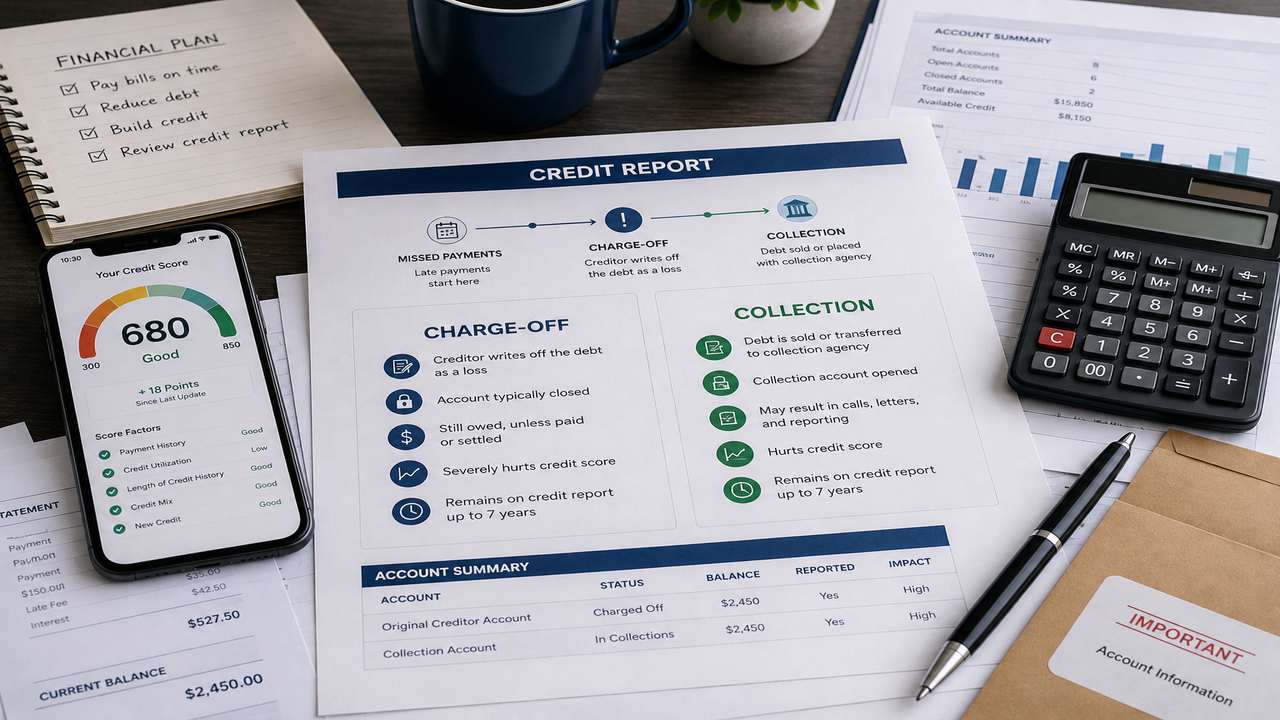
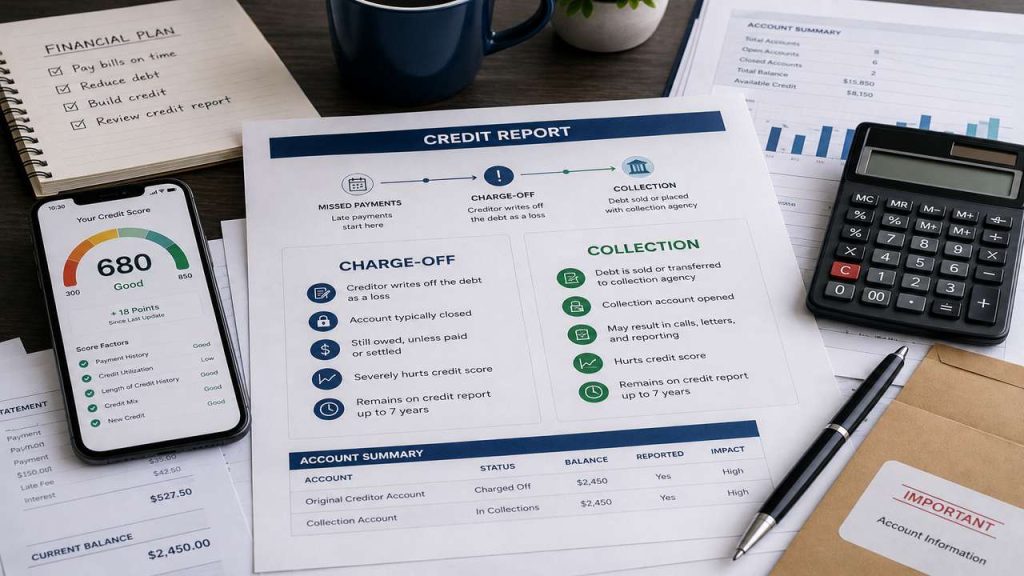
    A charge-off is an accounting decision made by the original creditor — the bank, credit card company, or lender you originally owed money to. When an account becomes seriously delinquent, typically after 180 days (six months) of nonpayment for most revolving credit like credit cards, the creditor’s internal accounting rules (often guided by federal banking regulations) require them to write the debt off as a loss on their books.

    Here’s the part that surprises most people: a charge-off does not mean the debt is forgiven or that you no longer owe it. It’s purely an internal bookkeeping classification. You still legally owe the full balance. What changes is how the creditor treats the account internally — it moves from being tracked as a receivable they expect to collect, to a loss they’ve already absorbed for accounting and tax purposes.

    Once an account is charged off, the original creditor typically does one of three things: continues trying to collect the debt directly (sometimes through an internal collections department), sells the debt to a third-party debt collector for a fraction of its value, or, less commonly, simply stops pursuing it (though this doesn’t erase the fact that it’s still technically owed).

    What a Collection Actually Means

    A “collection” refers to an account that has been placed with — or sold to — a third-party debt collection agency, or in some cases moved to a creditor’s own internal collections department. This can happen with many types of debt, not just charged-off credit cards: unpaid medical bills, utility bills, gym memberships, and personal loans can all end up in collections without necessarily going through a formal charge-off process first, particularly for debts that weren’t originally extended as revolving credit.

    When a debt moves to collections, a new entity — the collection agency — now has the legal right to attempt to collect it, and depending on the arrangement, either on behalf of the original creditor (for a contingency fee) or as the new owner of the debt (having purchased it outright, usually for a small percentage of the original balance).

    This is why you’ll sometimes see two separate negative entries on your credit report for what feels like a single unpaid debt: one from the original creditor showing the account as “charged off,” and a second, separate entry from the collection agency showing the same debt as a new “collection account.” Both can appear and both can affect your score, even though they represent the same underlying debt at different stages.

    How the Two Terms Relate to Each Other

    Think of it as a sequence rather than two unrelated categories:

    1. Step one: You fall behind on payments to the original creditor.
    2. Step two: After enough time passes (commonly 180 days for credit cards, though it varies by debt type and creditor), the original creditor charges off the account internally and reports it to the credit bureaus as a charge-off.
    3. Step three: The original creditor either keeps trying to collect it themselves, or — far more commonly — sells or assigns the debt to a third-party collection agency.
    4. Step four: If sold or assigned, the collection agency may report the debt to the credit bureaus as a new collection account, separate from the original charge-off entry.

    Not every collection account started as a charge-off (medical and utility debts, for example, often go to collections without ever being formally “charged off” in the credit-card sense), and not every charge-off necessarily ends up as a separate collection entry on your report (sometimes the original creditor retains the debt and simply updates the existing entry rather than a new company reporting a fresh one). But for credit card and similar revolving debt, the charge-off-then-collection sequence is the most common path.

    How Each Affects Your Credit Score

    Both are serious negative marks, generally causing a significant score drop, especially for someone who otherwise had good credit. A few nuances worth understanding:

    A charge-off is typically more damaging than a standard late payment because it signals the creditor gave up trying to collect through normal means — it represents a much more serious level of delinquency than a single missed payment.

    Newer scoring models (FICO 9 and 10, VantageScore 3.0 and 4.0) treat paid collections more favorably than older models. Under these newer models, a collection account that’s been paid in full has less negative impact than an unpaid one, and some models ignore paid collections almost entirely. Older scoring models (still used by many lenders, particularly for mortgages) don’t make this distinction as generously, which is why paying off an old collection doesn’t always produce the score jump people expect if the lender in question is using an older model.

    Medical collections are treated somewhat differently under current credit bureau policies. As of recent industry-wide changes, paid medical collections are generally removed from credit reports entirely, and there’s typically a waiting period (commonly one year) before unpaid medical debt is even reported in the first place, along with a rising minimum dollar threshold below which many medical collections aren’t reported at all. This treatment doesn’t automatically extend to non-medical debts.

    Both stay on your report for roughly the same length of time — seven years from the date of the original delinquency that led to the charge-off, not seven years from when the account was sold to collections or from when a collection agency starts reporting it. This is a critical and frequently misunderstood point.

    The Seven-Year Clock: The Most Important Concept to Understand

    Under the Fair Credit Reporting Act, most negative information — including charge-offs and collections — can only be reported for seven years, measured from the date of first delinquency on the original account, not from any later event. This means:

    If you stopped paying a credit card in January 2020, and it charged off in July 2020, and the debt was then sold to a collection agency in 2022 that started reporting its own collection entry — that collection entry’s seven-year clock still runs from January 2020, the original delinquency date, not from 2022 when the collector started reporting.

    This matters enormously because some debt collectors (usually the less scrupulous ones) will report an old debt as if the clock restarts each time it’s sold to a new collector, sometimes even after making a partial payment, hoping consumers won’t know better. Making a payment on old debt does not reset the seven-year reporting clock, though it’s worth noting this is different from your state’s separate statute of limitations on legally suing you for the debt, which is a distinct concept covered below.

    Charge-Off, Collections, and the Statute of Limitations: Don’t Confuse Them

    This is one of the most consequential mix-ups in personal finance, so it deserves its own section. There are two entirely separate clocks running on an old debt, and confusing them can cost you real money or land you back in a debt you thought was behind you.

    The credit reporting period (seven years, discussed above) governs how long the debt can appear on your credit report. This is a federal rule under the FCRA and doesn’t vary by state.

    The statute of limitations governs how long a creditor or collector can sue you in court to legally compel payment. This varies significantly by state (commonly anywhere from 3 to 10 years depending on the state and the type of debt) and is based on state contract law, separate from credit reporting rules.

    Here’s the dangerous part: in many states, making even a small payment on an old, expired-statute debt, or in some cases simply acknowledging in writing that you owe it, can restart the statute of limitations clock, making you newly vulnerable to a lawsuit on a debt that was previously too old to be legally enforced through the courts. If you’re dealing with an old debt and you’re unsure whether your state’s statute of limitations has expired, this is worth researching or consulting a consumer law attorney about before making any payment, especially on a debt you weren’t planning to pay in full anyway.

    What to Do If You Have a Charge-Off or Collection

    Verify the debt is actually yours and accurate. Under the Fair Debt Collection Practices Act, you have the right to request a “debt validation letter” within 30 days of first being contacted by a collector, requiring them to prove the debt is legitimate, the amount is correct, and they have the right to collect it. Errors and mistaken-identity cases are common enough that this step is always worth doing before agreeing to anything.

    Check for reporting errors. Confirm the original delinquency date is accurate (since this determines when the seven-year reporting window actually ends), that the balance is correct, and that it isn’t being reported by both the original creditor and multiple collection agencies for the same debt (a practice sometimes called “double reporting” that can unfairly compound the damage to your score).

    Decide on a strategy: pay in full, settle, or wait it out. Paying in full resolves the debt completely and, under current scoring models, is viewed more favorably than an unpaid balance. Settling for less than the full amount (common with collection agencies who bought the debt cheaply and are often willing to accept 30-60% of the balance) resolves the debt but may still show as “settled” rather than “paid in full,” which some models treat slightly less favorably. Waiting it out until the seven-year reporting period expires is an option if the debt is old and you’re not concerned about being sued (only advisable once you’ve confirmed your state’s statute of limitations has also passed, given the restart risk covered above).

    Get any settlement agreement in writing before paying. Verbally agreed-upon settlements are difficult to enforce if a collector later claims you still owe the difference. Always get written confirmation of the settlement terms, and after paying, request written confirmation that the debt is settled in full.

    Consider a “pay for delete” request, understanding its limitations. Some consumers negotiate directly with a collector to remove the entry entirely from their credit report in exchange for payment, rather than just marking it “paid.” This isn’t guaranteed and isn’t officially endorsed by the major credit bureaus (some collectors’ agreements with the bureaus actually prohibit this practice), but some smaller collection agencies will still agree to it. Always get any such agreement in writing before sending payment.

    Common Mistakes People Make

    • Assuming a charge-off means the debt disappears. As covered above, it’s an accounting term, not debt forgiveness. The debt is still owed and can still be pursued or sold to a collector.
    • Making a payment on an old debt without checking the statute of limitations first, inadvertently restarting the clock on a debt that was otherwise close to becoming legally unenforceable in court.
    • Ignoring collection notices entirely, which doesn’t make the debt go away and can result in a default judgment if the collector eventually sues and you don’t respond.
    • Paying a collector without getting written confirmation, then having no proof if a dispute arises later about whether the debt was actually settled.
    • Not disputing an inaccurate original delinquency date, which can cause a debt to remain reportable years longer than it legally should.

    Frequently Asked Questions

    Can a charge-off and a collection for the same debt both appear on my credit report at once?

    Yes, this is common. The original creditor’s charge-off entry and the collection agency’s separate entry can both appear simultaneously, even though they represent the same underlying debt, since each company reports independently.

    Does paying off a charge-off improve my score immediately?

    It depends on the scoring model a particular lender uses. Newer models treat a paid charge-off more favorably than an unpaid one; some older models (still used in mortgage underwriting, for example) give less credit for simply having paid it, though it’s still generally better to have it marked paid than to leave it unpaid.

    Is it better to let a debt go to collections or settle with the original creditor first?

    Settling with the original creditor before it’s sold to a collector is usually preferable when possible, since you’re negotiating directly with the party that has the clearest records and often more flexibility, and it can sometimes prevent the debt from generating a second, separate collection entry on your report.

    Can I be sued for a charge-off debt?

    Yes, both the original creditor (before charge-off, and sometimes after) and any collection agency that buys the debt can potentially sue you for payment, as long as your state’s statute of limitations for that type of debt hasn’t expired.

    What’s the difference between “charged off” and “charged off as bad debt”?

    These typically mean the same thing and both indicate the creditor has written off the balance as a loss internally. Some reports use slightly different phrasing depending on the creditor’s internal terminology, but the underlying meaning and credit impact are the same.

    Side-by-Side Comparison

    Category Charge-Off Collection
    Who reports it Original creditor Collection agency (or original creditor’s internal collections unit)
    When it happens Typically after 180 days of nonpayment Can happen with or without a prior charge-off, depending on debt type
    Do you still owe the money? Yes Yes
    Governed primarily by Internal accounting rules, bank regulations Fair Debt Collection Practices Act (FDCPA)
    Reporting clock 7 years from original delinquency date Same 7 years from original delinquency date (not reset by sale)
    Common for Credit cards, personal loans Credit cards, medical bills, utility bills, personal loans
    Can appear alongside A separate collection entry for the same debt A separate charge-off entry for the same debt

    Tax Implications of a Charge-Off You Should Know About

    Here’s a detail that catches a lot of people off guard: if a creditor charges off $600 or more of your debt and doesn’t expect to collect any more of it, they may be required to send you (and the IRS) a Form 1099-C, “Cancellation of Debt.” The IRS generally treats forgiven debt as taxable income, meaning that charged-off amount could increase your tax bill for that year.

    This doesn’t apply to every charge-off — remember, a charge-off is an internal accounting move and doesn’t necessarily mean the creditor has given up on collecting or formally forgiven the debt. A 1099-C is specifically triggered when the creditor identifies the debt as cancelled or forgiven, which is a distinct, later event from the charge-off itself. If a collector later gets you to settle the debt for less than the full amount, that forgiven difference can also trigger a 1099-C.

    If you receive a 1099-C for debt you’re still being pursued to pay (which does happen, and is a legitimate point of confusion, sometimes stemming from a company’s own inconsistent internal processes), it’s worth consulting a tax professional, since there are some exceptions and exclusions — including insolvency at the time of cancellation — that may reduce or eliminate the tax impact.


    charge-off-vs-collection-under-100kb

    How These Entries Affect a Loan Application, Beyond Just the Score

    A lender reviewing your application for a mortgage, auto loan, or even a new credit card doesn’t just see your score — many pull the full credit report and review specific line items manually or through automated underwriting rules. A charge-off or collection can trigger issues beyond the numerical score hit:

    Debt-to-income calculations. Some loan underwriting guidelines require unpaid collection balances above a certain threshold to be paid off, or at least factored into your debt-to-income ratio, before a mortgage can be approved — even if your score otherwise qualifies.

    Manual underwriting flags. An open, unresolved charge-off or collection can trigger a manual review or a request for a “letter of explanation” as part of a mortgage application, adding time and complexity to the process even if the account is old.

    Automatic denials under certain lending criteria. Some lenders, particularly for premium credit products, have policies that automatically decline any applicant with an open collection above a certain dollar amount, regardless of overall score.

    This is part of why resolving old charge-offs and collections — even ones old enough that their credit score impact has faded somewhat — can still matter meaningfully when you’re getting ready to apply for a major loan.

    Sample Scripts for Negotiating

    Having a rough script ready can make these conversations far less intimidating. A few starting points:

    For a settlement negotiation

    “I’d like to resolve this account. I’m not able to pay the full balance, but I could pay [X amount] as a full and final settlement if we can agree on that today. Can you send me written confirmation of the settlement terms before I make the payment?”

    For requesting debt validation

    “I’m requesting validation of this debt under the Fair Debt Collection Practices Act. Please send me written proof of the original creditor, the amount owed, and confirmation that your company has the legal right to collect this debt.”

    For a pay-for-delete request (understanding it may be declined)

    “If I pay this balance in full, would you be willing to request removal of this entry from my credit report entirely, rather than reporting it as paid? I’d need that agreement in writing before sending payment.”

    Always follow up any verbal agreement with a written request for confirmation, sent by mail or a documented method, and keep copies of everything.

    Frequently Asked Questions, Continued

    Can a company keep selling my debt to different collectors indefinitely?

    Yes, technically a debt can be sold multiple times to different collection agencies over the years, with each new owner potentially reporting their own entry. However, the original seven-year reporting clock still applies regardless of how many times it’s resold, and consumers should watch for collectors trying to represent an old debt as “new” simply because they recently acquired it.

    Does settling a debt for less than owed hurt my score more than paying in full?

    Both a “settled” and a “paid in full” status are generally viewed as significant improvements over an unpaid, open balance. Some models and lenders view “paid in full” slightly more favorably than “settled for less than the full amount,” but the difference is generally smaller than the difference between paying (in any form) versus leaving it unresolved.

    What happens if I ignore a collection account completely?

    The account will likely remain on your credit report as unpaid until the seven-year reporting period expires, and depending on your state’s statute of limitations, you could still be sued for the balance during that window. Ignoring it doesn’t stop collection attempts and can result in a default judgment if a lawsuit is filed and you don’t respond in court.

    If a collection is removed after a successful dispute, does the corresponding charge-off also get removed?

    Not automatically — they’re separate entries reported by separate companies. If you successfully dispute and remove a collection agency’s entry (for example, because they couldn’t validate the debt), the original creditor’s charge-off entry, if accurate, can still legally remain on your report until the seven-year window expires.

    A Real-World Example Walkthrough

    To make the sequence concrete, here’s how a typical credit card charge-off unfolds in practice:

    Month 1-5

    You miss payments on a credit card with a $2,000 balance. Each missed payment is reported separately as 30, 60, 90, then 120 days late, each one a distinct negative mark and each one progressively worse for your score.

    Month 6 (180 days)

    The credit card issuer charges off the account, reporting it to the bureaus as “charged off” with a balance of roughly $2,000 plus any accrued interest and fees. Your score, if it hasn’t already dropped substantially from the preceding late payments, takes another significant hit here.

    Month 7-9

    The issuer either continues attempting to collect internally, or — more commonly for a debt this size — sells it to a third-party collection agency for a fraction of the balance, often somewhere between 4 and 20 cents on the dollar depending on the debt’s age and type.

    Month 9

    The collection agency begins contacting you and reports a new “collection account” entry to the credit bureaus, separate from the original charge-off, often for the same approximate balance (sometimes slightly higher if additional collection fees or interest are added, depending on what’s legally permitted in your state and your original credit agreement).

    Your report now shows two negative entries for what is, from your perspective, a single unpaid $2,000 credit card debt: the original charge-off from the card issuer, and the new collection account from the agency that bought it. Both count the seven-year clock from the same original delinquency date — month 1 above — not from when the collection agency started reporting in month 9.

    If you settle with the collection agency in month 15 for $800 (a common type of settlement offer, since the agency likely paid far less than that to acquire the debt), the collection entry updates to “settled” or “paid,” but the original charge-off entry from the card issuer may still show the original unpaid status unless you separately negotiate with them or they update the record based on notification from the debt sale — this is exactly the kind of detail worth confirming and, if necessary, disputing to ensure accuracy.

    How Different Debt Types Typically Flow Through This Process

    Credit cards almost always follow the charge-off-then-collection path described throughout this guide, given standard banking regulations requiring charge-off after 180 days of delinquency.

    Medical debt usually skips the formal “charge-off” terminology entirely and goes straight from an unpaid bill to a collection account, often after the provider’s billing department has made several attempts to collect. As mentioned earlier, medical collections now have more consumer-friendly reporting rules than most other debt types, including a required waiting period before reporting and removal once paid.

    Personal loans and installment loans follow a process similar to credit cards, though the specific delinquency timeline before charge-off can vary by lender and loan type.

    Utility and telecom debt typically goes to collections relatively quickly after non-payment, without an intermediate charge-off stage in the credit-card sense, since utility companies aren’t structured the same way as bank lenders for accounting purposes.

    Auto loans, if unpaid, more commonly result in repossession before or alongside collections activity, since the vehicle serves as collateral — the lender may repossess and sell the car, then pursue you in collections for any remaining “deficiency balance” if the sale didn’t cover the full amount owed.

    Frequently Asked Questions, Continued Further

    Can I negotiate directly with the original creditor even after the debt has been charged off?

    Sometimes, if the original creditor hasn’t yet sold the debt to a collector. It’s worth asking directly whether they still hold the debt internally or have already sold or assigned it elsewhere, since negotiating with whoever currently owns the debt is the only way to reach a binding agreement.

    Does a charge-off automatically mean my account is closed?

    Typically yes for the original account — once charged off, the account is no longer usable for new charges even if you later pay off the balance. Paying off a charged-off account settles the debt but doesn’t typically reopen the original credit line.

    If I pay off a collection, will it say “paid” forever, or does it eventually disappear?

    It will typically show as “paid” or “settled” for the remainder of the original seven-year reporting window from the initial delinquency date, then age off your report entirely once that window closes, the same as any other negative entry.

    Are charge-offs and collections treated the same by every lender?

    No — different lenders and loan products use different underwriting criteria and sometimes different scoring models, so the practical weight given to an old charge-off or collection can vary meaningfully depending on what you’re applying for and which lender is reviewing it.

    The Bottom Line

    A charge-off marks the point where your original creditor gives up trying to collect through normal channels and writes the debt off internally — but you still owe it. A collection marks the point where a separate agency, often having bought the debt cheaply, takes over trying to get you to pay. Both are serious credit report entries, both follow the same seven-year reporting clock from the original delinquency date, and neither should be confused with your state’s separate statute of limitations on legal enforceability. Understanding which stage a debt is in, verifying every detail is accurate, and getting any resolution in writing puts you in a far stronger position than simply reacting to collection calls as they come.

    Get a Credit Audit

    If you’re dealing with a charge-off, collection, or both, reviewing all three credit reports can help you understand exactly what is being reported and identify potential inaccuracies.

    Request a Credit Audit or Quote

  • How to Rent With an Eviction on Your Record

    How to Rent With an Eviction on Your Record

    An eviction on your record can feel like a locked door. You search for apartments, everything looks promising until the background check comes back, and then the application is quietly denied with little explanation. It’s discouraging, but it isn’t the end of your ability to find housing. Landlords deny eviction-record applicants far more often out of default caution than because every eviction tells the same story — and there are concrete, proven strategies for getting past that default caution.

    This guide covers how eviction records actually work, how long they stick around, how to challenge inaccurate ones, and the specific tactics that help renters with a real eviction history get approved anyway.

    How Eviction Records Actually Work

    An eviction, formally called an “unlawful detainer” action in many states, is a court case a landlord files to legally remove a tenant. Because it goes through the court system, it becomes part of the public record, separate from your credit report. This is an important distinction: an eviction filing shows up primarily through tenant screening companies that pull court records, not necessarily through Equifax, Experian, or TransUnion directly — though the debt from an eviction (unpaid rent, court-ordered judgments) can separately end up on your credit report if it’s sent to collections.

    This means you can have a clean credit report and still fail a rental background check because of an eviction case, and vice versa. Property managers commonly use specialized tenant-screening services (like RentPrep, TransUnion SmartMove, or various regional court-record aggregators) that search county and state court databases directly for eviction filings, judgments, and sometimes even cases that were filed but later dismissed.

    That last point matters enormously: in many states, an eviction filing can appear on a screening report even if you won the case, the landlord withdrew it, or it was settled and dismissed. The mere fact that a case was filed is what many screening services report, regardless of outcome. This is one of the more unfair aspects of the system, and it’s also one of the more fixable ones, which we’ll get to.

    How Long an Eviction Stays on Your Record

    There’s no single national answer, because eviction reporting isn’t governed the same way credit reporting is under the Fair Credit Reporting Act’s standard seven-year rule for most negative items. In practice:

    • Court records of an eviction filing are often public indefinitely, though many tenant-screening companies limit how far back they report, commonly 7 years, sometimes less.
    • A judgment (a formal court ruling against you, often for unpaid rent) can appear on tenant-screening reports for up to 7 years in most states, similar to other financial judgments.
    • Collections debt stemming from an eviction, like unpaid rent sent to a collection agency, follows the standard credit-report rule and can appear for up to 7 years from the date of the original delinquency.

    Some states have passed laws limiting how eviction records can be used or reported, particularly for cases that were dismissed, withdrawn, or resulted in the tenant prevailing. If you’re unsure what applies to your situation, checking your state’s specific tenant-screening and eviction-sealing laws is worth the time, since several states now allow eviction records to be sealed or expunged under certain conditions (often tied to case outcome, time elapsed, or the underlying reason for the eviction).

    Step One: Get Your Actual Eviction Record

    Before doing anything else, find out exactly what a landlord would see. Request your tenant screening report from a major screening company (many are required to provide this to you for free or a small fee under the FCRA, since tenant screening reports are considered consumer reports), or pull the court record directly from the county courthouse where the case was filed.

    You want to know:

    • The exact case outcome (dismissed, judgment for the landlord, judgment for you, settled)
    • The amount, if any, that was awarded
    • Whether it’s been paid, and if so, when
    • Which screening companies are actually reporting it

    Many people are surprised to find their eviction case was actually dismissed or resolved in their favor, yet a screening company is still reporting the filing itself as if it were a finding against them. This is exactly the kind of error worth disputing.

    Step Two: Dispute Anything Inaccurate

    If your screening report shows incorrect information — the wrong outcome, a debt that’s already been paid, or a case that doesn’t actually belong to you (which does happen, especially with common names) — you have the right to dispute it directly with the tenant screening company, the same way you’d dispute an error on a credit report. Under the FCRA, they’re required to investigate and correct verified inaccuracies.

    This is also where sealing or expungement can help if your state allows it. If a case was dismissed, resulted in your favor, or is old enough to qualify, some states let you petition the court to seal the record, after which reputable screening companies should stop reporting it. This process varies significantly by state and sometimes by county, so check your local courthouse or a local tenant’s rights organization for the specific procedure.

    Step Three: Pay Off Any Outstanding Balance

    If the eviction resulted in a real debt you actually owe — back rent, court costs, damages — paying it off, even years later, does two things. First, it removes any risk of a fresh collections action or wage garnishment down the line. Second, it gives you something concrete to show future landlords: proof that even though something went wrong once, you ultimately made it right. A “paid” eviction judgment reads very differently to a landlord than an outstanding one.

    If you can’t pay the full balance, contact the original landlord or the current debt holder (if it’s been sold to a collector) to negotiate a payment plan or a reduced lump-sum settlement. Get any agreement in writing before paying, and specifically request written confirmation once the balance is paid or settled.

    Step Four: Build a Strong Rental Application Anyway

    Even with an eviction in your past, a strong overall application changes how a landlord weighs that one red flag. A few things to prepare before you start applying:

    A written explanation letter.

    A short, honest, non-defensive explanation of what happened and what’s different now goes further than most renters expect. Landlords who deny eviction-record applicants automatically are often doing so out of a lack of context, not because every eviction is treated as unforgivable. If the eviction happened because of a job loss, a medical emergency, or a temporary hardship that has since resolved, say so plainly. Avoid blaming the previous landlord in detail, even if you feel justified — the goal is to demonstrate stability now, not relitigate the past.

    Proof of current income and stability.

    Pay stubs, an offer letter, or bank statements showing consistent income well above the rent (commonly landlords look for income at least three times the monthly rent) help offset the risk a landlord associates with the eviction.

    References that speak to reliability.

    A letter from a current or more recent landlord, even a shorter tenancy, showing on-time payment and good standing, can meaningfully counterbalance an older eviction. Employer references confirming stable employment help too.

    A larger security deposit or advance rent, offered proactively.

    Some landlords are legally capped on how much deposit they can require upfront, but where allowed, voluntarily offering additional deposit or even a few months of rent paid in advance can turn a “no” into a “yes” by directly addressing the landlord’s core financial concern.

    A cosigner or guarantor.

    If you have someone with strong credit and income willing to cosign, this shifts a significant amount of the landlord’s risk and can be the deciding factor, especially for a landlord who’s on the fence rather than firmly opposed to renting to anyone with an eviction history.

    Step Five: Target the Right Kind of Landlord

    Not every rental market screens applicants the same way. A few categories worth focusing your search on:

    Independent landlords rather than large corporate property management companies.

    Big management companies often use rigid, automated screening criteria with no room for context or explanation. An individual landlord renting out a property they own personally has more flexibility to consider your explanation, your references, and your current situation as a whole.

    Second-chance or eviction-friendly rental listings.

    In many cities, some landlords and property managers specifically advertise as open to applicants with eviction history, sometimes explicitly, sometimes signaled through phrases like “flexible screening” or “case-by-case basis.” Local tenant advocacy organizations, and even some dedicated online listing categories, can help identify these.

    Properties that are harder to fill.

    Units that have been vacant longer, or that are in a less competitive part of the rental market, put more negotiating leverage in your hands. A landlord who has had a unit sitting empty for two months is often more willing to work with an applicant who has a strong current income and a reasonable explanation, compared to a landlord fielding twenty applications for one unit.

    Month-to-month or short-term arrangements first.

    Some renters use a short-term lease, sublet, or room rental (which often has less formal screening) as a bridge, building a fresh, positive rental history for a year before applying somewhere with stricter screening.

    What to Say (and Not Say) About Your Eviction

    How you frame the conversation matters. A few principles:

    Be upfront rather than hoping it won’t come up.

    If a landlord discovers an undisclosed eviction during screening after you’ve implied a clean record, it damages trust more than the eviction itself would have. Bringing it up proactively, briefly, and with context shows confidence and honesty.

    Keep the explanation short and factual.

    One or two sentences on what happened, one sentence on what’s different now (steady job, savings buffer, resolved the underlying issue) is usually more effective than a long, emotional account.

    Don’t over-apologize or seem desperate.

    A landlord is assessing risk, not judging your character. A calm, matter-of-fact tone that focuses on your current stability tends to land better than an apologetic or defensive one.

    When an Eviction Isn’t Actually Yours or Was Handled Unfairly

    If you believe an eviction on your record is inaccurate, belongs to someone else, or was the result of an illegal action by a landlord (such as retaliation for reporting a habitability issue, or an eviction attempted without proper legal process), contact a local tenant’s rights organization or legal aid clinic. Many operate on a free or sliding-scale basis and can help you understand whether the case can be challenged, sealed, or removed from screening reports altogether. This is a meaningfully different situation from an eviction that legitimately occurred, and it’s worth pursuing seriously rather than assuming nothing can be done.

    Frequently Asked Questions

    Can a landlord legally deny me solely because of a past eviction?

    In most states, yes — landlords generally have wide discretion in choosing tenants, and a past eviction is a legitimate factor they can weigh. Some cities and states have passed “fair chance” or “second look” housing laws that limit blanket denials based solely on eviction history, similar to fair-chance hiring laws for criminal records, so check your local regulations.

    Does an eviction show up on a credit report?

    Not directly, in most cases. The eviction case itself typically appears through tenant-screening services that search court records. However, any unpaid debt connected to the eviction (back rent, court-ordered judgments) can be reported to the credit bureaus if it’s sent to collections, and that portion would show up on a standard credit report.

    How long do I need to wait before applying again after an eviction?

    There’s no waiting period required by law in most places. Some renters find success reapplying immediately with a strong explanation and references; others spend six months to a year building savings, paying off any balance owed, and establishing a track record before applying somewhere more competitive.

    Will paying off an old eviction judgment remove it from my record?

    Paying it off typically updates the status to “paid” or “satisfied” rather than removing the record entirely, though a paid status is viewed far more favorably by landlords than an outstanding balance. Whether the underlying case can be sealed or removed depends on your state’s specific laws.

    Should I use a professional eviction-removal or “credit repair for renters” service?

    Be cautious. Legitimate options — disputing genuine inaccuracies, petitioning for sealing where your state allows it, negotiating a payoff — are all things you can typically do yourself for free or low cost. Be skeptical of any service promising to remove an accurate eviction record for a fee; if the underlying case is real and accurately reported, no legitimate service can simply make it disappear.

    Sample Explanation Letter Template

    Having a written explanation ready before you start applying saves you from scrambling to write one under pressure, and it also lets you refine the wording until it sounds calm and confident rather than defensive. A basic structure that works well:

    Opening:

    A brief, direct acknowledgment. “I want to be upfront that a past tenancy at [address/city] ended in an eviction filing in [year].”

    Context:

    One or two sentences on the cause, focused on facts rather than blame. “This happened after I lost my job unexpectedly and fell behind on rent for several months.”

    Resolution:

    What’s different now. “I’ve since resolved the balance in full and have been steadily employed at [company/type of role] for the past [length of time].”

    Forward-looking close:

    A short statement of reliability. “I’m happy to provide references from my current employer and landlord, and I’m glad to discuss any additional documentation that would be helpful.”

    Keep the whole thing to a short paragraph. A landlord reading fifteen applications doesn’t need your full life story — they need enough context to feel confident saying yes, and a demonstration that you can address a difficult topic professionally.

    Understanding Why the Eviction Happened Shapes Your Strategy

    Not all evictions come from the same root cause, and the reason behind yours should shape how you present your situation.

    Nonpayment of rent due to a temporary hardship

    (job loss, medical emergency, unexpected expense) is generally the easiest to explain, because it’s a specific, resolvable event rather than an ongoing pattern. Landlords can usually understand a single hardship, especially if you can show the underlying cause has passed.

    A dispute over property conditions or a landlord-tenant disagreement

    that escalated to an eviction filing, especially one that was later dismissed or settled, is worth explaining clearly with documentation, since it reflects a specific conflict rather than an inability to pay rent or maintain a property.

    Repeated late payments or lease violations

    leading to eviction suggest a pattern a landlord will want more reassurance about — this is where strong recent references and proof of a genuinely different financial situation matter most.

    An eviction tied to a former partner or roommate’s actions

    where you were on the lease but not primarily responsible for the underlying issue, is worth explaining honestly, along with any documentation (police reports, court filings naming the other party specifically) that supports your account.

    Being clear-eyed with yourself about which category your situation falls into helps you write a more convincing, specific explanation rather than a vague, generic one.

    how-to-rent-with-an-eviction-under-100kb

    Alternatives and Workarounds Worth Knowing About

    Rent guarantor or insurance services.

    Companies like Insurent, TheGuarantors, and similar services will act as a guarantor for your lease in exchange for a fee (often equivalent to a portion of a month’s rent), backing your application financially the way a personal cosigner would. This can be a practical option if you don’t have a family member or friend able to cosign.

    Corporate or extended-stay housing.

    Furnished apartments and extended-stay properties sometimes have more flexible screening than traditional leases, since they’re often priced at a premium and cater to short-term or transitional renters. This can serve as a bridge while you rebuild a rental history.

    Subletting or room rentals.

    Renting a room in someone else’s home, or subletting from an existing tenant, often involves a much less formal screening process — sometimes just a conversation and a reference — and can be a practical way to secure housing and build a positive, recent rental reference for a future, more formal application.

    Rent-reporting services.

    Once you’re in a new lease, some services (like Rental Kharma, Boom, or your landlord directly, if they participate) will report your on-time rent payments to the credit bureaus, which builds a positive credit history independent of your rental screening file, and can help demonstrate reliability if you’re building back up after a rocky period.

    Understanding Your Rights During the Screening Process

    Because tenant screening reports are considered consumer reports under the Fair Credit Reporting Act, you have specific legal protections. If you’re denied housing based even partly on information in a screening report, the landlord is required to give you an “adverse action notice,” which must include the name and contact information of the screening company that provided the report. This is valuable because it tells you exactly where to go to pull your file and dispute anything inaccurate, rather than guessing which of several possible screening companies was involved.

    You’re also entitled to a free copy of that specific report from the screening company if you request it within 60 days of the adverse action notice. Many renters don’t realize this and simply move on to the next application without ever seeing what actually triggered the denial — which means they keep hitting the same wall for a reason they never identified or corrected.

    Frequently Asked Questions, Continued

    Can I get an eviction removed just by asking the landlord to withdraw the report?

    If the case is still pending or was recently filed, some landlords may be willing to withdraw the case (especially if the underlying balance gets paid), which would then reflect in court records as dismissed. Once a case is closed and reported by screening companies, you generally can’t simply ask a company to remove accurate information — you’d need to pursue sealing or expungement through the appropriate legal process if your state allows it.

    Do all landlords use the same tenant screening company?

    No. Different landlords and property management companies use different screening vendors, and each maintains its own database, sometimes with different lookback periods or reporting practices. This is part of why an eviction might show up on one application and not another — it’s worth requesting your report from whichever company was actually used, rather than assuming it’s the same one every time.

    Is it worth hiring an attorney to fight tenant screening errors?

    For a straightforward factual error (wrong outcome, mismatched identity, an unpaid balance that’s actually been paid), you can usually resolve it yourself through the dispute process at no cost. An attorney becomes more valuable for a genuinely contested legal question, such as whether a landlord’s original eviction action was retaliatory or otherwise improper, or if a screening company refuses to correct a documented error after a proper dispute.

    How much does an eviction typically lower approval chances?

    There’s no universal number — it depends heavily on the individual landlord, the local rental market’s competitiveness, how recent the eviction is, and how strong the rest of your application is. In a tight rental market with many applicants, any red flag can be disqualifying by default; in a slower market, or with an independent landlord, a well-explained eviction with strong current references is often manageable.

    Eviction Sealing and Expungement Laws Are Changing

    Over the past several years, a growing number of states and cities have recognized that eviction filings — as opposed to actual eviction judgments — can unfairly follow a tenant for years even when the case never resulted in a finding against them. In response, many jurisdictions have introduced or expanded laws that allow certain eviction records to be sealed from public view or removed from tenant screening reports under specific conditions.

    Common qualifying conditions across different jurisdictions include: the case was dismissed or withdrawn, the tenant prevailed in court, a certain number of years have passed since the filing, the underlying issue was tied to a state of emergency (some jurisdictions passed specific protections for eviction filings during public health emergencies), or the debt has been paid in full and a set waiting period has elapsed.

    Because these laws vary significantly by state — and sometimes even by county or city within a state — the most reliable way to find out what applies to you is to contact your local courthouse’s self-help center, a legal aid organization, or a tenant’s rights nonprofit in your area. Many of these organizations provide free consultations specifically for renters trying to understand and act on eviction-sealing eligibility, and some even help file the paperwork at no cost.

    If you do successfully seal or expunge a record, it’s worth following up directly with any tenant-screening companies that previously reported it, since sealing a court record doesn’t always automatically and immediately update every private screening database — you may need to provide proof of the sealing order to have it corrected.

    Building a Rental Resume

    Just as a job resume presents your professional history in an organized, persuasive format, a “rental resume” does the same for your housing history, and it’s an underused tool for renters trying to overcome a past eviction. A simple one-page document that includes your current employment and income, a summary of your rental history (including the honest, brief explanation of the eviction), personal and professional references with contact information, and any relevant financial documentation (bank statements, proof of savings) gives a landlord a complete, organized picture upfront rather than forcing them to piece it together from a screening report alone.

    Handing this to a landlord alongside your application, rather than waiting to explain the eviction only if asked, demonstrates initiative and honesty — two qualities that directly counter the concerns an eviction on your record might otherwise raise.

    A Note on Emotional Resilience Through the Process

    It’s worth naming directly: searching for housing with an eviction on your record can involve real rejection, sometimes repeatedly, and that’s genuinely discouraging. It’s easy to internalize each denial as a judgment on your character rather than what it usually is — a risk-averse screening policy applied broadly and impersonally. Keeping a level head through a string of “no” responses, while continuing to refine your application and explanation letter based on what you learn along the way, tends to produce results faster than either giving up on a search or becoming defensive and combative with prospective landlords. Every rejection is also information: if you’re consistently denied by large corporate management companies but getting further with independent landlords, that’s a useful signal about where to focus your energy going forward.

    Frequently Asked Questions, Continued Further

    What if the eviction was filed against a roommate, not me?

    If your name wasn’t actually on the eviction case, it generally shouldn’t appear on your individual tenant screening report at all. If it does, that’s likely a case of mistaken identity or a data-matching error at the screening company, and it’s worth disputing directly, providing documentation such as the original lease showing only your roommate’s name on the case.

    Can I rent an apartment under a different name to avoid the eviction showing up?

    No — beyond being generally impractical, since leases and screening require accurate legal identification and often a Social Security number for the credit check portion, misrepresenting your identity on a rental application can constitute fraud and create far more serious legal problems than the eviction itself.

    Does bankruptcy clear an eviction-related debt?

    An eviction-related debt (like a court judgment for unpaid rent) can potentially be discharged in bankruptcy depending on the type of bankruptcy filed and the specific circumstances, but the eviction case itself, as a court record, is a separate matter from the debt and isn’t erased by a bankruptcy filing. If you’re considering bankruptcy for eviction-related debt, a consultation with a bankruptcy attorney can clarify what would and wouldn’t be affected in your specific situation.

    How do I find eviction-friendly landlords in my area?

    Local tenant’s rights organizations, some nonprofit housing assistance programs, and certain online rental platforms that cater to “second chance” renters are good starting points. Word of mouth and directly asking property managers about their screening flexibility during a phone inquiry, before submitting a formal application, can also save time by avoiding applications to landlords with rigid automatic denial policies.

    The Bottom Line

    An eviction makes renting harder, not impossible. The renters who move past it fastest tend to do three things: verify exactly what’s on their record and dispute anything inaccurate, resolve any outstanding balance so the record reflects a closed chapter rather than an open one, and build an application that gives a landlord real reasons to say yes — steady income, solid references, a straightforward explanation, and sometimes a larger deposit or a cosigner to offset the risk. None of this erases the past, but it consistently changes the outcome for renters willing to put in the extra groundwork.

    Need Help Reviewing Your Credit?

    If your eviction also resulted in collections, unpaid rent, or other negative information appearing on your credit reports, you can request a credit review to understand what is being reported and what options may be available.

    Request a Credit Audit or Quote
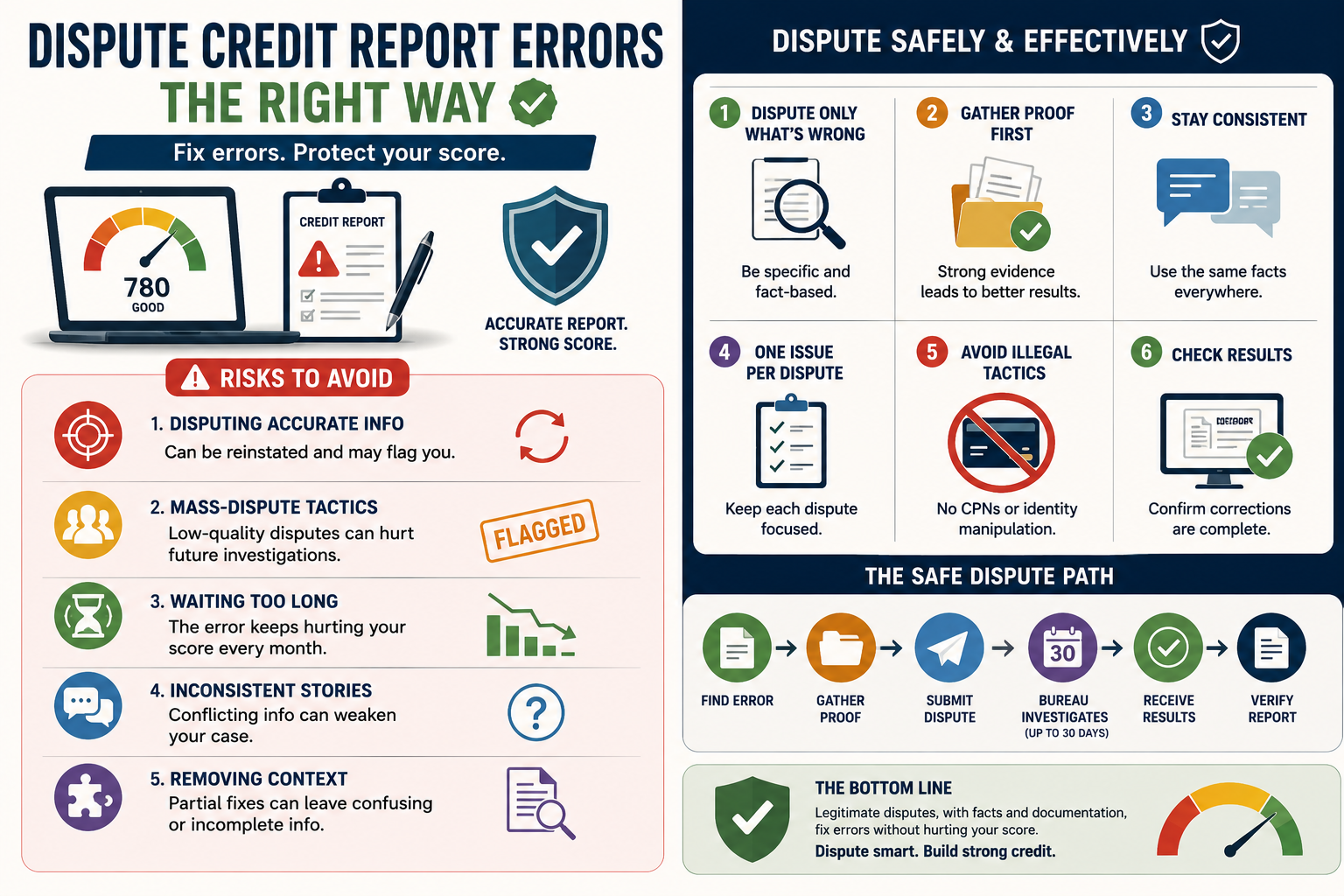
  • How College Students Can Start Building Credit the Right Way

    How College Students Can Start Building Credit the Right Way

    Starting to build credit in college puts you in an unusually good position, even if it doesn’t feel that way — you likely have relatively low financial obligations, time on your side before you need strong credit for a car loan or apartment lease, and (compared to graduating with no credit history at all) a genuine head start if you use these years intentionally. The mistakes that hurt college students financially are usually less about credit mechanics and more about a few specific, avoidable traps. Here’s how to do it right.

    Why Starting in College Is a Genuine Advantage

    Two of the biggest factors in your credit score — payment history and average account age — both reward time. An account opened at 19 and kept in good standing for years has a real structural advantage over one opened at 25, simply because it’s had longer to season and to establish a track record. Starting now, even modestly, compounds in your favor for years.

    Step 1: Get a Student-Specific Credit Card

    Many major issuers offer credit cards specifically designed for students with limited or no credit history, generally with:
    – Lower credit limits (which is actually helpful for a first card — less room to overspend).
    – More lenient approval criteria than standard unsecured cards.
    – Sometimes modest rewards or cash-back structured around common student spending categories.

    If you can’t qualify for a student card (some still require a minimum income or a co-signer), a secured card is a reliable fallback, requiring a cash deposit as collateral.

    Step 2: Consider a Parent Co-Signer or Authorized User Status Carefully

    Two different options here, worth distinguishing clearly:

    **Co-signer**: you’re the primary account holder, but a parent’s signature helps you qualify, and they share legal responsibility for the debt. This builds credit in your own name from day one, but obligates your co-signer if you miss payments.

    **Authorized user**: you’re added to a parent’s existing account, and their account history (potentially years of it) can appear on your credit report. This can be a faster way to establish a longer-looking credit history, but you have no independent control over the account, and if your parent’s usage becomes irresponsible, that reflects on your file too.

    If a parent has excellent, long-standing credit, authorized user status can be a genuinely powerful head start — sometimes adding a decade or more of positive account history to a brand-new credit file. If a

    parent’s credit is shakier, this can work against you instead, so it’s worth an honest conversation before pursuing it.

    Step 3: Use the Card for Small, Predictable, Recurring Purchases

    The goal isn’t to “use” the card in a way that demonstrates spending power — it’s to demonstrate reliability. A good pattern:

    – Charge one small recurring expense (a streaming subscription, a set grocery budget) to the card each month.
    – Pay it off in full before the due date, every time, without exception.
    – Avoid using the card for large, unpredictable purchases that could tempt you into carrying a balance you can’t immediately pay off.

    Step 4: Never Carry a Balance If You Can Avoid It

    This is the single most important habit to establish early, and also the one most likely to be undermined by common (and sometimes actively predatory) advice aimed at students. You do **not** need to carry a balance and pay interest to build credit — this is a persistent myth. Paying your statement balance in full every month:

    – Builds the exact same positive payment history as carrying a balance would.
    – Costs you nothing in interest.
    – Keeps your utilization ratio low, which is actively beneficial to your score, unlike a carried balance which pushes utilization higher.

    If you’ve heard advice suggesting you should carry a small balance to “build credit faster,” that’s inaccurate — it’s a myth that mainly benefits card issuers collecting interest, not your credit-building goals.

    Step 5: Watch Out for Common Student Credit Traps

    **Store credit cards with aggressive marketing**, often pitched at checkout with a first-purchase discount. These frequently carry high interest rates and lower credit limits, and opening several in a short period (chasing the discounts) generates multiple hard inquiries that can drag down a thin, new credit file more noticeably than they would an established one.

    **Campus-adjacent predatory lending** — payday-style loans or rent-to-own arrangements marketed near campuses, which generally don’t help build credit at all (many don’t report to bureaus in a positive way) and carry serious cost and risk.

    **Co-signing for friends or a significant other.** Being asked to co-sign a lease, car loan, or credit card for someone else in college is common, but it makes you fully liable for their payment behavior on your own credit file — this is worth approaching with real caution, since it’s one of the more common ways college-age credit gets damaged by someone else’s decisions.

    Step 6: Keep Student Loans in Mind as Part of Your Credit Picture

    If you have student loans, they will eventually become part of your credit report and payment history once repayment begins (or immediately, for loans in active repayment during school). A few things worth understanding:

    – **Loans in deferment while you’re enrolled generally don’t require payments yet**, but it’s worth confirming your specific loan terms rather than assuming.
    – **Once repayment begins, on-time payments build meaningful positive history**, given the typically long repayment term of student loans, which contributes positively to your average account age over many years.
    – **If you’re struggling to make payments after graduation**, addressing this proactively (income-driven repayment plans, deferment/forbearance options, direct communication with your loan servicer) is far better for your credit than letting a payment become late or default, which is a significantly more damaging outcome than a temporarily adjusted payment plan.

    Step 7: Don’t Apply for Too Many Products at Once

    It’s tempting, especially with frequent student-targeted card offers, to apply for several cards hoping one approves. Resist this — each hard inquiry has a modest negative effect, more noticeable on a thin file, and multiple recent inquiries can itself look like a red flag to future lenders evaluating your file, separate from the individual denials.

    What a Strong Graduation-Day Credit Profile Looks Like

    If you start early and follow these principles, by graduation you can realistically have:
    – 2-4 years of on-time payment history on at least one card.
    – Low utilization maintained consistently.
    – A credit score often in the “good” range, sometimes higher, well ahead of peers who wait until after graduation to start.

    This head start matters concretely — it can mean qualifying for a car loan at a meaningfully better interest rate, an apartment lease without needing a co-signer or larger deposit, or a first post-graduation credit card with genuinely competitive terms rather than another entry-level product.

    The Bottom Line

    College is one of the best windows to start building credit, precisely because the stakes are relatively low and time is on your side. A student or secured card, used lightly for small recurring purchases and paid off in full every month, combined with caution around co-signing and store card overextension, sets up a credit profile that will meaningfully outperform peers who wait until after graduation — not because of anything complicated, just because payment history and account age both reward starting early and staying consistent.

  • Credit Repair Guide for Military Spouses With No Credit File

    Credit Repair Guide for Military Spouses With No Credit File

    Military spouses face a specific, well-documented credit problem: frequent relocation, employment gaps tied to permanent-change-of-station (PCS) moves, and — for many — a credit history that never got the chance to establish itself because life circumstances kept interrupting the process. None of this is really “credit repair” in the traditional sense of fixing errors or negative marks; it’s about building a file that’s been structurally hard to establish. Here’s a practical path forward.

    Why Military Spouses Are Disproportionately Credit Invisible

    A few compounding factors specific to military spouse life make this a genuinely common issue, not an individual failing:

    – **Frequent moves (often every 2-3 years)** disrupt employment continuity, which affects income stability that lenders like to see, and can also make it harder to maintain long-standing local financial relationships (like with a hometown credit union) that sometimes offer more favorable terms to established customers.
    – **Employment gaps** are common and often necessary given relocation timing, licensing transfer delays (particularly for licensed professions like teaching, nursing, or cosmetology, where state-by-state relicensing can take months), and childcare availability that varies dramatically by duty station.
    – **Reliance on a spouse’s credit** during periods of un- or under-employment is common, which can leave the non-military spouse with a thin or nonexistent independent credit file, especially if most household credit was established under the service member’s name before marriage.

    Step 1: Establish Your Own Credit Identity, Even If Your Spouse Has Strong Credit

    If your household’s credit is largely built under your service member spouse’s name, prioritize establishing something in your own name, even modestly:

    – **A secured credit card** used lightly and paid in full monthly is the most reliable, widely available starting point regardless of your current employment status, since approval is based on your deposit rather than income.
    – **Becoming an authorized user on your spouse’s well-established accounts** can add years of positive history to your own file relatively quickly, assuming the card issuer reports authorized user activity (worth confirming, since not all do) — this is often one of the fastest ways for a military spouse to build a real credit history if the service member has strong existing credit.
    – **A credit-builder loan** through a military-focused credit union (Navy Federal, USAA, and others serve this market specifically and often have relevant products) adds installment credit history alongside revolving credit.

    Step 2: Use Military-Specific Financial Institutions Strategically

    Credit unions and banks that specifically serve military families often have more flexibility and relevant product offerings for exactly this situation:

    – They’re generally more familiar with PCS-related employment gaps and less likely to view them as a red flag the way a conventional lender unfamiliar with military life might.
    – Many offer specific credit-builder products, often with lower minimums and more accessible approval criteria.
    – Membership eligibility typically extends to spouses and dependents, not just the service member, so these institutions are directly available to you.

    Step 3: Understand the Servicemembers Civil Relief Act (SCRA) — and Its Limits for Spouses

    The SCRA provides certain protections to active-duty service members regarding interest rate caps and other financial protections, but it’s worth understanding that **these protections generally apply to the service member specifically**, not automatically to the spouse’s independently-held accounts, unless the spouse is a joint holder on a covered obligation. If you’re navigating financial hardship tied to a PCS move or deployment, it’s worth confirming exactly which accounts and which of you the SCRA protections actually cover, rather than assuming blanket coverage.

    Step 4: Navigate Employment Gaps Strategically for Credit Applications

    Employment gaps are a normal and expected part of military spouse life, but they can complicate income verification for credit and loan applications. A few practical approaches:

    – **Document any freelance, remote, or portable income** consistently, even if modest — remote and portable careers have become more common and more accepted by lenders as verifiable income sources.
    – **Time larger credit applications (a car loan, a mortgage) around periods of established employment** where possible, rather than immediately after a PCS move when your income history at a new position is thin.
    – **Use household income when applying jointly** with your service member spouse for products where joint income qualification makes sense, rather than trying to qualify solely on your own often-interrupted income history.

    Step 5: Protect Your Address and Identity During Frequent Moves

    Frequent relocation creates practical credit-file hygiene issues worth staying on top of:

    – **Update your address with the credit bureaus and all creditors promptly** after each move — mail-related identity verification issues and missed statements (which can lead to accidentally missed payments) are a real and preventable risk during PCS transitions.

    – **Consider a permanent mailing address** (a family member’s address, a P.O. box you maintain regardless of duty station) for critical financial mail, to reduce the risk of missing something important during the chaos of a move.
    – **Monitor your credit report more frequently than average** during and immediately after moves, since this is a higher-risk window for both administrative errors and identity theft (moving-related mail is a known vector for mail theft and identity fraud).

    Step 6: Take Advantage of Free Military Financial Counseling

    Every branch offers free financial counseling through installation-based Personal Financial Management Programs, generally available to spouses and dependents, not just service members. These counselors can provide personalized guidance on credit building, budgeting through PCS transitions, and navigating the specific financial disruptions of military life — and unlike many private financial advisors, this service is free and specifically trained around military-family financial patterns.

    Realistic Expectations Given the PCS Cycle

    Credit building doesn’t pause for a move, but it’s worth planning around your PCS timeline realistically:

    – **Before a move**: ensure autopay is set up on any credit accounts so payments continue reliably even amid moving chaos, and update your address proactively rather than after mail starts bouncing.
    – **During the transition period**: this is often when employment and income are most disrupted; lean on any established credit (secured cards, authorized user status) that doesn’t depend on your current employment status.
    – **After settling at a new duty station**: this is typically the best window to pursue new employment-dependent credit products, once you have a documented income history at the new location.

    The Bottom Line

    Building credit as a military spouse isn’t fundamentally different in mechanics from building credit anywhere else — it’s the same combination of secured products, authorized user status, and consistent on-time payments — but the PCS cycle and associated employment disruption make consistency harder to maintain without deliberate planning. Leaning on military-specific financial institutions, keeping address and autopay information current through moves, and using authorized user status on a spouse’s established accounts are the most practical, military-life-specific accelerators available, on top of the standard credit-building fundamentals that apply to everyone.

  • How Self-Employed People Can Rebuild Their Credit Score

    How Self-Employed People Can Rebuild Their Credit Score

    Being self-employed doesn’t directly affect your credit score — scoring models don’t know or care about your employment status — but it changes the practical landscape around credit in ways that matter a lot when you’re trying to rebuild, largely because of how lenders evaluate self-employed income during the approval process, and because of income volatility patterns that are more common in self-employment. Here’s how to navigate rebuilding with those realities in mind.

    Your Credit Score Doesn’t Know You’re Self-Employed

    This is worth stating clearly upfront: FICO and VantageScore calculations are based entirely on your credit report data — payment history, utilization, account age, credit mix, inquiries. Employment status isn’t a scoring factor. So the mechanics of rebuilding (paying down utilization, disputing errors, building positive history) work identically whether you’re self-employed or traditionally employed.

    What’s different is the surrounding context: income verification for new credit approval, cash flow volatility that can affect your ability to make consistent payments, and sometimes limited access to employer-sponsored financial wellness resources.

    The Real Challenge: Getting Approved for Rebuilding Tools

    Ironically, the tools most commonly recommended for credit rebuilding — secured cards, credit-builder loans — are usually fairly accessible regardless of employment status, since secured cards are backed by your deposit rather than income, and credit-builder loans are specifically designed for people establishing or repairing credit. Where self-employment becomes a bigger obstacle is with **unsecured** credit products and loans that require income verification, since:

    – Lenders often want two years of tax returns showing consistent self-employment income, which can be a barrier if your business is newer or your reported income (after deductions) looks lower than your actual cash flow.
    – Income volatility, even if your average income is solid, can make automated underwriting systems more cautious than they’d be with a steady paycheck.

    Step 1: Separate Business and Personal Credit Clearly

    If you haven’t already, this is one of the most important structural steps:

    – **Use a dedicated business credit card or line of credit** for business expenses, rather than running everything through personal cards. This keeps your personal utilization ratio clean and unaffected by business cash flow swings.
    – **Consider establishing a business credit profile** (through an EIN and business credit bureaus like Dun & Bradstreet) separate from your

    personal credit, especially if your business will need financing independent of your personal creditworthiness over time.
    – **If you’re currently running business expenses through personal cards**, this is worth transitioning away from as soon as practical, since business expenses can create large, volatile balances that hurt your personal utilization ratio even when you’re managing the business finances responsibly.

    Step 2: Prioritize Utilization Management Given Income Volatility

    Since self-employment income often fluctuates month to month, utilization management deserves extra attention:

    – **Pay down balances proactively during higher-income months** rather than letting them ride, since you can’t always predict a lower-income month around the corner.
    – **Consider making multiple payments per month** rather than one lump sum at the due date, which can help keep reported balances lower even if your income timing is unpredictable — remember that balances typically report as of the statement closing date, so more frequent paydowns can result in a consistently lower reported balance.
    – **Build a cash buffer specifically earmarked for credit payments** during lean months, separate from general business or personal savings, so a slow month doesn’t turn into a missed payment.

    Step 3: Build a Track Record Lenders Can Actually Verify

    If your goal includes eventually qualifying for larger unsecured credit or loans, start building documentation now:

    – **Keep clean, consistent business financial records** — separate business bank accounts, organized bookkeeping, and consistent tax filing, even if your income varies. Lenders reviewing self-employed applicants weight consistency and documentation quality heavily, sometimes more than the specific income figure itself.
    – **Consider working with an accountant on how income is reported.** Aggressive expense deductions minimize your tax bill but can also minimize your reported income in a way that hurts loan qualification later — this is a real tradeoff worth discussing proactively with a tax professional if you’re planning to seek financing in the near term.
    – **Build 2 years of consistent self-employment history if possible** before applying for products that require it, since this is a common threshold for mortgage and some other loan underwriting.

    Step 4: Use Bank Statement Loan Programs If Traditional Underwriting Is a Barrier

    For self-employed individuals whose tax-return-reported income doesn’t reflect their actual cash flow well, some lenders offer “bank statement loan” programs (common in mortgage lending, increasingly available for other credit products too) that qualify borrowers based on bank deposit history rather than tax return net income. These typically carry somewhat higher rates or fees than conventional products, but can be a useful bridge while your credit and documented history continue building.

    Step 5: Don’t Neglect the Basics Because of Business Focus

    It’s common for self-employed individuals, especially in the early stages of a business, to deprioritize personal credit maintenance while focused on getting the business off the ground. A few things worth not letting slip:

    – **Monitor your credit report regularly**, even when busy — errors and outdated items don’t fix themselves, and business stress is exactly when personal financial admin tends to get neglected.
    – **Keep at least one or two personal credit accounts active and lightly used**, even if most of your daily spending routes through business accounts, so your personal credit history continues aging and reporting positively.
    – **Address any negative marks from a rough patch (common in early business years) as soon as you have bandwidth**, rather than letting disputable errors sit unaddressed for years.

    Retirement and Health Insurance Gaps: An Indirect Credit Factor

    This is easy to overlook, but self-employed individuals without employer-sponsored health insurance sometimes face larger, less predictable medical expenses, which — as covered in our medical collections guide — is one of the more common sources of unexpected negative credit marks. If you’re self-employed, prioritizing some form of health coverage isn’t just a health decision; it’s meaningfully protective of your credit and overall financial stability too.

    Realistic Timeline

    – **0-6 months**: separate business/personal credit use, if not already done; establish proactive utilization management given income volatility.
    – **6-12 months**: build documented, consistent history — both credit payment history and clean business financial records — that will support future loan applications.
    – **1-2+ years**: sufficient self-employment history for most conventional underwriting requirements, combined with continued clean personal credit management, typically opens up the full range of credit products.

    The Bottom Line

    Self-employment doesn’t change how your credit score is calculated, but it changes the practical challenges around building and maintaining it — mainly through income verification friction with lenders and the discipline required to manage utilization through variable cash flow. The core rebuilding fundamentals (low utilization, on-time payments, clean dispute resolution) apply exactly the same way; the self-employed-specific work is mostly about separating business and personal finances cleanly and building the kind of documented, consistent record that lenders can actually verify when you’re ready to qualify for more than just rebuilding-tier credit products.