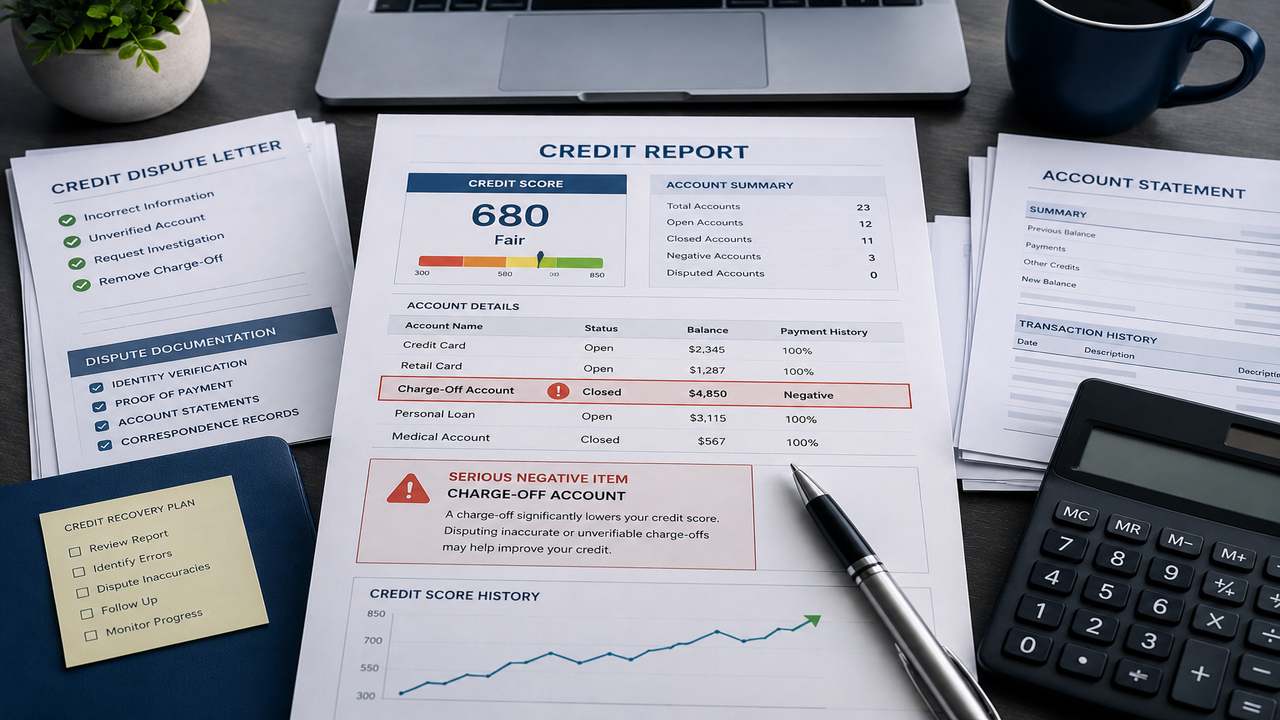
What Is a Charge-Off, Really?
A charge-off is an accounting action a creditor takes when they decide a debt is unlikely to be collected. Typically, this happens after an account has been delinquent for 180 days (about six months) of missed payments. At that point, the creditor moves the debt off their books as an active receivable and labels it a “charge-off” or “bad debt.”
Here is the critical misunderstanding that trips up nearly everyone: a charge-off does not mean your debt is forgiven, canceled, or gone. You still owe the money. The creditor has simply written it off for their own accounting and tax purposes. They can still attempt to collect it themselves, hand it off to an internal recovery department, sell it to a third-party debt collector, or place it with a collection agency.
In other words, the charge-off is the creditor saying, “We do not expect to get paid on this, so we are closing the books on it — but the borrower still owes it.”
That distinction matters because it shapes every option you have for dealing with the charge-off. Since the debt still exists, someone still owns the right to collect it — and that someone is often your key to getting the negative mark removed.
Key terms to know
- Original creditor: The bank, card issuer, or lender you originally borrowed from.
- Charge-off date: The date the creditor officially wrote the debt off — usually around 180 days past due.
- Date of first delinquency (DOFD): The date you first missed a payment and never caught back up. This is the date that starts the seven-year reporting clock.
- Debt buyer: A company that purchases charged-off debts from original creditors, usually for pennies on the dollar, and then attempts to collect the full balance.
- Collection agency: A company that attempts to collect a debt on behalf of the original creditor or a debt buyer.
Why creditors charge off accounts
Creditors do not charge off accounts to punish you. They do it because federal banking regulations and accounting rules require them to. When a loan or credit card balance goes unpaid long enough, regulators require the creditor to classify it as a loss on their financial statements. This keeps bank balance sheets honest — it does not erase your obligation.
So when you see “charge-off” on your report, you are looking at a regulatory label, not a debt cancellation. The debt is alive, it is still legally enforceable (within the statute of limitations in your state), and someone still has the authority to report it, collect it, or negotiate with you about it.
That last part — negotiation — is where opportunity lives. We will come back to it.
Charge-Off vs. Collection: What Is the Difference?
People use “charge-off” and “collection” almost interchangeably, but they are not the same thing. Understanding the difference is essential because it changes which strategy you should use and who you should be talking to.
The short version
A charge-off is an action taken by the original creditor. A collection is an action taken by a third-party collector or debt buyer who is now pursuing the debt.
How they relate
After a creditor charges off an account, one of three things usually happens:
- The original creditor keeps trying to collect. The account shows as a charge-off on your report, but no separate collection account appears. You deal directly with the original creditor.
- The original creditor places the debt with a collection agency. The agency now pursues you, and a new “collection” account may appear on your report in addition to the original charge-off. The original creditor’s account still shows the charge-off.
- The original creditor sells the debt to a debt buyer. The debt buyer now owns the debt outright. The original account still shows as a charge-off, and the debt buyer may also report a separate collection account.
This is why many people end up with both a charge-off and a collection on their report for the same underlying debt. They are two separate tradelines reporting the same obligation from two different entities — and both can hurt your score.
Why this matters for removal
Because a charge-off and a collection can both report for the same debt, removing one does not automatically remove the other. If you negotiate a pay-for-delete with the original creditor on the charge-off but ignore the collection agency, you may clear one mark only to find the other still dragging your score down.
The right approach is to look at your full report from all three bureaus — Equifax, Experian, and TransUnion — and identify every tradeline connected to the charged-off debt. That means the original creditor’s charge-off entry and any collection entries from agencies or debt buyers. You need a complete picture before you start disputing or negotiating, because tackling only half the problem leaves the other half in place.
Can the same debt be reported twice?
This is a common source of confusion. The same debt can appear as two separate tradelines — one from the original creditor (the charge-off) and one from a collector (the collection). That is generally considered permissible under the FCRA, because each entity is reporting its own account relationship with you.
What is not permissible is a collector reporting the same debt under multiple different account numbers or balances, or a debt buyer reporting a “new” account with a later open date than the original delinquency. Those are inaccuracies you can dispute. We will cover exactly how to spot them in the dispute section below.
How a Charge-Off Affects Your Credit Score
A charge-off is one of the most severe negative items that can appear on a credit report. Among the common derogatory marks — late payments, collections, judgments, repossessions, bankruptcies — a charge-off sits near the top of the damage scale.
How much score damage?
There is no single number, because the impact depends on your starting score, your overall credit profile, and how recent the charge-off is. But in general terms:
- If you had a strong score (700+): A charge-off can drop your score by 100 to 150 points or more.
- If you had a fair score (around 600): The drop may be 60 to 100 points.
- If your score was already low (below 600): The incremental damage may be smaller, but a charge-off makes climbing back significantly harder.
The reason a charge-off hits so hard is that it signals to lenders you defaulted on a significant obligation — you did not just pay late, you stopped paying entirely and the creditor gave up. From a risk-modeling standpoint, that is about as strong a predictor of future default as exists.
What makes the damage worse or better
Several factors influence how much a charge-off weighs on your score:
- Recency: A charge-off from last month hurts far more than one from four years ago. As it ages, its impact gradually diminishes.
- Balance owed: A charged-off account with a large unpaid balance hurts more than one with a small balance or one showing $0 owed (because it was paid or settled).
- Number of charge-offs: Multiple charge-offs compound the damage. One is recoverable; several signal a pattern.
- Account type: A charged-off credit card is common and understood. A charged-off auto loan or mortgage may carry additional weight because of the asset involved.
- Your overall profile: If you have other positive accounts in good standing, a single charge-off is easier to absorb. If the charge-off is your only recent account, it dominates your profile.
The ripple effects beyond your score
A charge-off does not just lower a three-digit number. It creates friction across your financial life:
- Loan denials or much higher rates: Many lenders will not approve a mortgage or auto loan with an open, unpaid charge-off on your report. Those that do may charge significantly higher interest.
- Security deposits and insurance: Utilities, cell phone carriers, and some insurers check credit. A charge-off can trigger larger deposits or higher premiums.
- Rental applications: Landlords and property management companies increasingly run credit checks. A charge-off can cost you a lease.
- Employment: Some employers run credit checks for positions involving financial responsibility. A charge-off can be a red flag in those screenings.
- Stress and mental load: The ongoing weight of a charge-off — collector calls, uncertainty, the sense that your financial life is stuck — takes a real toll. That is worth naming, because the relief of resolving it is not just numeric.
The good news: every one of these effects softens as the charge-off ages, and most disappear entirely once it is removed or falls off your report. The path back starts with understanding your options, which we will get to next.
How Long Does a Charge-Off Stay on Your Credit Report?
Under the FCRA, a charge-off can remain on your credit report for up to seven years. The clock starts from the date of first delinquency (DOFD) — the date you first missed a payment and never brought the account current again.
Understanding the DOFD
The DOFD is the single most important date on your report when it comes to a charge-off. It is not the charge-off date, the date the account was closed, the date a collector acquired the debt, or the date of your last payment. It is the date the original delinquency began — the month you first fell behind and did not recover.
For example: if you stopped paying a credit card in March 2019 and never caught up, the creditor likely charged it off around September 2019 (180 days later). But the seven-year reporting clock started in March 2019. That means the charge-off can report through approximately March 2026 — not September 2026.
This distinction matters because collectors and debt buyers sometimes report a later “date of last activity” or “account opened” date that makes the charge-off look newer than it legally is. If a collection account shows an open date that is more recent than your original delinquency, that is an inaccuracy you can dispute.
The seven-year rule is a maximum, not a minimum
Credit bureaus are not required to keep a charge-off on your report for the full seven years. They are only permitted to. If a creditor fails to verify a disputed charge-off, or agrees to delete it as part of a negotiation, or simply chooses to stop reporting it, the bureau must remove it — even if seven years have not passed.
This is why disputes and pay-for-delete agreements can work: they create a situation where the charge-off comes off early because the reporter stops vouching for it or actively requests its removal.
When the clock resets — and when it does not
One of the most damaging misconceptions in credit repair is the idea that making a payment on an old charge-off “restarts the seven-year clock.” That is not true. The FCRA reporting period is fixed to the original DOFD and cannot be reset by a payment, a settlement, a dispute, or a collector’s re-aging of the account.
What can happen — and what confuses people — is that making a payment can restart the statute of limitations (SOL) for being sued on the debt. That is a separate legal clock from the reporting clock, and it varies by state. We cover this in the mistakes section because it is a trap that catches well-meaning people.
So to be clear:
- Reporting clock (7 years from DOFD): Cannot be reset by anything you do.
- Statute of limitations (varies by state, typically 3–6 years): CAN be reset by making a payment or, in some states, by acknowledging the debt in writing.
Keep these two clocks separate in your mind. They govern different things and they behave differently.
How to find your DOFD
Your DOFD is not always printed plainly on your credit report, but it is there. Look for:
- The “date of first delinquency” field, which some bureaus display directly.
- The “estimated month and year that this item will be removed” — count back seven years from that date to approximate your DOFD.
- The original creditor’s account history, which shows monthly payment status. The first month marked late that was never followed by a “current” status is your DOFD.
If you cannot locate it, you can request it directly from the bureaus. Under the FCRA, they must provide it. You can also request it from the original creditor.
What happens when the seven years are up
Once the seven-year period expires, the credit bureaus must automatically remove charge-off from your report. In practice, the major bureaus typically remove negative items a few months early — often at the 6-year, 9-month mark — to avoid compliance issues. But do not count on that; if it has been close to seven years and the item is still showing, file a dispute citing the expired reporting period and the bureau must delete it.
The Five Legitimate Paths to Charge-Off Removal
There is no single “magic” method for removing a charge-off. There are five legitimate, legally grounded approaches, and the right one depends on your specific situation — whether the charge-off is accurate, who currently holds the debt, whether you can afford to pay, and how old the account is.
Let us walk through each one.
Path 1: Dispute Inaccuracies Under the FCRA
Your first and most fundamental right under the FCRA is the right to dispute any information on your credit report that is inaccurate, incomplete, or unverifiable. If you dispute a charge-off and the creditor cannot verify it, the bureau must delete it.
This is not about lying or claiming a real charge-off is fake. It is about enforcing your right to have accurate information reported. Charge-offs are frequently reported with errors — wrong dates, wrong balances, wrong account numbers, duplicate entries, or outdated information that no longer matches the creditor’s own records.
What counts as an inaccuracy worth disputing?
Here are common errors that can justify a dispute:
- Wrong DOFD or “date of first delinquency.” If the reported date is later than the real one, the charge-off will stay on your report longer than it should.
- Re-aging. A collector reports a newer open date or date of last activity than the original delinquency, making an old debt look fresh.
- Wrong balance. The reported balance does not match what the creditor’s records show, or a paid/settled debt still shows the full original balance.
- Duplicate reporting. The same debt appears multiple times under different account numbers or from different collectors, inflating the appearance of your debt load.
- Wrong account number or creditor name. Mismatched identifying details that suggest a reporting error.
- Mixed file. The charge-off belongs to someone else with a similar name and ended up on your report by mistake.
- Outdated status. The charge-off should have fallen off after seven years but is still showing.
- Unverifiable. The creditor no longer has records, has gone out of business, or cannot produce documentation to back up the reported information.
Step-by-step: How to dispute a charge-off
Step 1 — Pull all three credit reports. Get your reports from Equifax, Experian, and TransUnion. You are entitled to a free copy from each bureau every 12 months at AnnualCreditReport.com. Review every tradeline related to the charge-off and note any discrepancy.
Step 2 — Identify specific errors. Do not just write “this is wrong.” Pin down exactly what is incorrect — the date, the balance, the account number, the creditor name. The more specific your dispute, the harder it is for the bureau to dismiss it.
Step 3 — Gather supporting documentation. If you have records — old statements, a payment history, a settlement letter, a bankruptcy discharge — include copies. Evidence strengthens your case.
Step 4 — Send a dispute letter to each bureau reporting the inaccuracy. Mail it via certified mail with return receipt so you have proof of delivery. You can also dispute online, but mail creates a stronger paper trail. Use the sample letter in this guide as your template.
Step 5 — Wait for the investigation. The bureau has 30 days (sometimes up to 45) to investigate and respond. They will contact the creditor to verify the information.
Step 6 — Review the results. If the creditor verifies the information and it is accurate, the charge-off stays. If they cannot verify it, or if they correct the inaccuracy, the bureau updates or removes the entry.
Step 7 — If removed, confirm it is gone. Check your reports again after the bureau confirms the deletion. Occasionally an item is deleted from one bureau but still appears on another. Follow up as needed.
If the dispute comes back verified
A verified dispute is not the end of the road. You can:
- Dispute again with new or different information — a different specific error you did not raise the first time.
- Dispute directly with the creditor under FCRA Section 623, which requires furnishers to investigate direct disputes.
- Request a method of investigation from the bureau — they must tell you how they verified the item. If their “investigation” was just an electronic verification system (eCOA or e-OSCAR) with no real document review, that can sometimes be challenged.
- Move to a different path — debt validation, pay-for-delete, or goodwill.
Disputing is your lowest-cost, highest-first-move option. It works often enough to be worth trying first, especially when you can identify a genuine inaccuracy.
Path 2: Debt Validation If a Collector Now Holds the Debt
If your charged-off debt has been sold to or placed with a third-party collector, you have powerful rights under the Fair Debt Collection Practices Act (FDCPA).
Within five days of first contacting you, a collector must send you a validation notice that tells you how much they say you owe, the name of the original creditor, and your right to dispute the debt within 30 days.
If you dispute the debt in writing within that 30-day window, the collector must cease collection activity until they provide validation — proof that the debt is yours, the amount is correct, and they have the legal right to collect it.
Why validation works
When debts are sold and resold, documentation often does not travel cleanly with them. Debt buyers purchase portfolios of thousands of accounts at a time, and the original creditor’s records may be incomplete, missing, or never transferred. If a debt buyer cannot produce:
- The original signed agreement or account terms,
- A statement of the account’s history,
- Proof of their ownership of the debt, and
- Evidence the amount claimed is accurate,
…then they cannot validate the debt. And if they cannot validate it, they cannot legally continue to collect — and critically, they cannot continue to report it.
Step-by-step: How to request debt validation
Step 1 — Send a validation request within 30 days of receiving the collector’s first notice. If you are past the 30-day window, you can still request validation, but the collector is not legally required to pause collection while they respond. That said, many will still provide it or simply stop reporting rather than deal with the paperwork.
Step 2 — Send the request in writing via certified mail. Be specific: ask for the amount owed, the name of the original creditor, proof of their authority to collect, and documentation supporting the debt. Keep a copy of everything.
Step 3 — Wait for a response. There is no strict statutory deadline for the collector to respond, but they must stop collection activity (including reporting to bureaus) until they do. If they continue reporting without validating, that is an FDCPA violation you can use as leverage.
Step 4 — Evaluate their response. If they provide complete, accurate validation, the debt is confirmed and you move to another path (pay-for-delete, settle, or wait). If they provide partial or no validation, or if they close the account and remove it from your report, you have effectively achieved removal.
Step 5 — If they cannot validate and still report, dispute with the bureaus. Tell the bureaus the collector has not validated the debt and is reporting unverified information. Without validation from the collector, the bureau may be unable to verify the item and must delete it.
When validation is most likely to succeed
Debt validation works best when:
- The debt has been sold multiple times (documentation degrades with each transfer).
- The original creditor was a smaller lender that may not retain detailed records.
- The debt is several years old and records have been archived or destroyed.
- The collector is a high-volume debt buyer rather than a law firm.
It is less likely to work when the original creditor still holds the debt or when the collector is the original creditor’s own collection department — in those cases, records are usually intact.
Path 3: Pay-for-Delete Negotiation
Pay-for-delete is a negotiation where you agree to pay all or part of a charged-off debt in exchange for the creditor or collector agreeing to remove the negative tradeline from your credit report. It is one of the most effective tools for charge-off removal — and it is entirely legal, though not every creditor will agree to it.
How pay-for-delete works
The basic exchange is straightforward: you pay, they delete. The creditor or collector gets money they may not otherwise recover, and you get the most damaging mark on your report removed. Both sides have a reason to deal.
Here is how to approach it:
Step 1 — Identify who currently reports the tradeline. Is it the original creditor, a collection agency, or a debt buyer? You negotiate with whoever is reporting. If both the original creditor and a collector are reporting, you may need two separate negotiations.
Step 2 — Decide what you can afford to pay. Full balance, a percentage, or a flat settlement amount. If the debt is old and the collector paid pennies on the dollar for it, you may be able to settle for 30–50% of the balance. If you can pay in full, that gives you more leverage.
Step 3 — Make the offer in writing. Never call and agree to pay over the phone based on a verbal promise to delete. Get it in writing first. Use the sample pay-for-delete letter in this guide. State clearly that your offer to pay is contingent on their written agreement to remove the tradeline from all three bureaus.
Step 4 — Wait for a written response. If they agree, review the terms carefully before sending payment. If they refuse pay-for-delete but offer to update the status to “paid” or “settled,” consider whether that partial improvement is worth it — it is better than an unpaid charge-off, but it is not the same as deletion.
Step 5 — Send payment only after you have the agreement in writing. Use a method that gives you proof of payment (cashier’s check, certified funds, or tracked payment). Keep copies of everything.
Step 6 — Follow up to confirm deletion. After payment clears, wait 30–60 days and check all three reports. If the tradeline is still showing, send a copy of the written agreement to the bureaus and demand removal. If the creditor reneges, you have a documented agreement you can escalate with a complaint to the CFPB.
Who will agree to pay-for-delete?
Not everyone. Here is the landscape:
- Debt buyers and collection agencies: Most likely to agree. They bought the debt cheap and want to recover something. A deletion costs them nothing and gets them paid.
- Original creditors (banks, card issuers): Less likely. Many large banks have internal policies against pay-for-delete because the credit reporting system depends on accurate historical data. But it is still worth asking — some will agree, especially on older accounts.
- Credit unions and smaller lenders: Often more flexible and relationship-driven. Worth a direct conversation.
A note on “paid” vs. “deleted”
If a creditor will not agree to delete but will accept a settlement or payment in full, paying still has value. The account status changes from “charge-off” to “paid charge-off” or “settled for less than full balance.” While this is still negative, lenders generally view a paid or settled charge-off more favorably than an unpaid one — especially for mortgage and auto loan approvals. We cover this in more depth in the paid vs. unpaid section.
Path 4: Settle and Send a Goodwill Request
If a creditor refuses pay-for-delete outright, you still have a softer option: pay or settle the debt, then send a goodwill deletion request asking them to remove charge-off as a courtesy.
What a goodwill request is
A goodwill letter is a written request to a creditor asking them to remove a negative mark as an act of goodwill — not because they are legally required to, but because you have since paid the debt, you have a solid history otherwise, and you are asking for a fresh start. There is no law requiring a creditor to grant a goodwill request. It is purely discretionary. But creditors grant them more often than people assume, particularly when:
- The debt has been paid or settled in full.
- You have a otherwise-clean history with the creditor.
- The hardship that caused the charge-off was genuine and documented (job loss, medical issue, divorce, family emergency).
- The charge-off is old and the account is long closed.
- You have rebuilt a positive payment history on other accounts since then.
Step-by-step: Settle then goodwill
Step 1 — Settle or pay the debt. Negotiate the best settlement you can. Get the settlement terms in writing. Pay it. Get a paid or settled letter confirming the balance is satisfied.
Step 2 — Wait 30–60 days for the account status to update on your reports. The tradeline should now show “paid charge-off” or “settled charge-off” rather than the unpaid balance.
Step 3 — Send a goodwill letter to the creditor. Be honest, concise, and respectful. Explain what happened, take responsibility, describe what has changed in your financial life, and ask for the removal of the charge-off as a goodwill gesture. Use the hardship as context, not as an excuse.
Step 4 — Be patient and persistent. Goodwill requests can take weeks to process. If you get a no, try again in a few months — perhaps to a different address, a different executive contact, or after more time has passed. Some people succeed on the second or third attempt.
Who to send it to
Address it to the creditor’s customer service or executive resolution office. If the first response is a form-letter no, look for an executive contact — the office of the CEO or president, or a consumer advocacy contact within the company. A letter that lands on the right desk has a much better chance.
Goodwill is not a guarantee
Be honest with yourself about this. A goodwill request is a request, not a demand. Some creditors almost never grant them; some do so regularly. Treat it as a worthwhile attempt with a real but uncertain chance of success — and if it works, it is one of the cleanest forms of removal because the creditor voluntarily requests it.
Path 5: Wait Out the Seven-Year Clock
Sometimes the most practical option is to let time do the work. If a charge-off is accurate, the creditor will not negotiate, disputes have failed, and the debt is nearing the end of its reporting life, waiting it out may be the right call — especially if the statute of limitations has expired and you are not at risk of being sued.
When waiting makes sense
- The charge-off is accurate and the creditor has verified it.
- Disputes and validation have been tried and failed.
- The creditor refuses pay-for-delete and goodwill.
- The charge-off is more than five years old and approaching the seven-year limit.
- The statute of limitations in your state has expired, so there is no realistic threat of a lawsuit.
- The balance is large and you cannot afford to settle.
How to make the waiting period less painful
While you wait for the charge-off to age off, you are not powerless. You can actively rebuild your credit so that by the time the charge-off falls off, your score has already recovered significantly:
- Open a secured credit card if you need a positive tradeline. Use it for small purchases and pay it in full every month.
- Become an authorized user on a trusted family member’s card with a long, clean history.
- Keep every other account current. One late payment during the waiting period sets you back.
- Pay down existing balances to lower your credit utilization — this is one of the fastest score levers.
- Limit new credit applications to avoid hard inquiries piling up.
Confirming removal at the seven-year mark
- Check your reports 2–3 months before the expected removal date. The bureaus often remove items slightly early.
- If it is still there past the date, file a dispute with each bureau citing the expired reporting period under the FCRA. Include the DOFD and the expected removal date.
- The bureau must delete it. This is a straightforward, legally required removal — no creditor verification needed, because the reporting period has expired by law.
Waiting is not glamorous, but it is reliable. The FCRA guarantees that a charge-off cannot follow you forever. If nothing else works, time will.
Paid vs. Unpaid Charge-Off: How Lenders See Them
One of the most important decisions you will make with a charge-off is whether to pay it, settle it, or leave it unpaid. Each choice has different consequences for your credit score and for how lenders evaluate you.
The credit score difference
From a pure scoring standpoint, a paid charge-off is marginally better than an unpaid one, but not dramatically so. The FICO scoring model treats a charge-off as a serious negative regardless of whether it is paid. The biggest score benefit of paying comes not from the status change itself but from the secondary effects:
- If the charge-off had a balance, paying it reduces your overall debt load, which can improve your score.
- If a collection account was also reporting on the same debt, paying the charge-off may cause the collector to update or close the collection, which can help under newer scoring models (FICO 9 and VantageScore 3.0 and 4.0, which ignore paid collections).
- Some lenders use blended or manual review processes that treat paid charge-offs more favorably.
The lender view: where paying really matters
The real difference between paid and unpaid shows up when a human underwriter reviews your credit — which happens with most mortgages, many auto loans, and increasingly with rental applications.
- Mortgage lenders typically require that all charge-offs be paid or settled before or at closing. An unpaid charge-off can be a hard stop on a mortgage approval, regardless of your score.
- Auto lenders vary, but many will not finance a loan with an open, unpaid charge-off, or they will charge a significantly higher rate.
- Landlords and property managers often view an unpaid charge-off as evidence of unresolved financial obligation — a risk that you might not pay rent.
- Employers running credit checks may see an unpaid charge-off as a sign of ongoing financial distress, which matters for positions involving money or fiduciary responsibility.
In short: paying or settling a charge-off will not fix your score overnight, but it removes a major obstacle to loan approvals, rentals, and employment.
“Settled for less than full balance”
When you settle a charge-off for less than the full amount, the account status updates to “settled for less than full balance” or similar. Some lenders view this slightly less favorably than “paid in full,” because it shows the creditor took a loss. But it is still substantially better than unpaid — and for most practical purposes, the difference between “paid in full” and “settled” is small compared to the difference between “settled” and “unpaid.”
If you can afford full payment, it is marginally better. If you can only afford a settlement, take the settlement — do not let the perfect be the enemy of the good.
The strategic question
Should you pay a charge-off even if the creditor will not agree to delete it? In many cases, yes — especially if you are planning to apply for a mortgage or auto loan in the near future. The score impact may be modest, but the approval impact can be significant.
However, if the charge-off is old, the statute of limitations has expired, and you are not seeking new credit imminently, paying an old charge-off may provide little benefit — and as we cover in the mistakes section, it can inadvertently restart the statute of limitations in some states. Weigh the trade-offs for your specific situation.
Settling for Less: The 1099-C Tax Implication
When you settle a charged-off debt for less than the full balance, the amount the creditor “forgives” (the difference between what you owed and what you paid) may be treated as taxable income by the IRS. The creditor may issue you a Form 1099-C, Cancellation of Debt, and you may need to report that forgiven amount as income on your tax return.
How it works
If you owed $10,000 and settled the debt for $4,000, the creditor forgave $6,000. They may issue a 1099-C showing $6,000 as canceled debt. The IRS generally treats canceled debt as income, because you received money (or goods or services) that you never repaid — and the forgiveness effectively functions as a financial gain.
When you might not owe tax on canceled debt
There are several exceptions and exclusions that can reduce or eliminate the tax owed:
- Insolvency exclusion: If you were insolvent (your total debts exceeded your total assets) at the time the debt was canceled, you may be able to exclude the canceled amount from income up to the amount of your insolvency. This is the most common and broadly applicable exclusion. Use IRS Form 982 to claim it.
- Bankruptcy: If the debt was discharged in a bankruptcy proceeding, it is generally not taxable income.
- Qualified principal residence indebtedness: Historically, canceled mortgage debt on a primary residence has had special exclusions, though these provisions have changed over time. Check current IRS guidance.
- Certain farm or business indebtedness: Specific exclusions apply for qualified farm debt and certain business real property debt.
What to do if you receive a 1099-C
- Do not ignore it. The IRS receives a copy, and they will expect to see it reflected on your return.
- Review it for accuracy. Make sure the canceled amount, creditor information, and date are correct. Errors happen.
- Determine if you qualify for an exclusion. The insolvency exclusion applies to many people who have settled charged-off debts, because by definition they were in financial distress. Calculate your assets and liabilities at the time of cancellation to determine insolvency.
- File Form 982 if you qualify for an exclusion, and attach it to your tax return.
- Talk to a tax professional. If the amount is significant or your situation is complex, a CPA or tax advisor can help you navigate the exclusion correctly and avoid an unexpected tax bill.
Why this matters before you settle
Before you agree to a settlement, factor in the potential tax liability. A $6,000 forgiven balance could create a tax obligation of $1,000 or more depending on your tax bracket. That does not mean settling is a bad deal — you are still paying far less than the full debt — but it means you should go in with eyes open and budget for the tax impact the following April.
This is one of those details that catches people by surprise. Now you know.
Sample Dispute Letter to a Credit Bureau
Use this letter as a template to dispute an inaccurate charge-off with a credit bureau. Fill in the bracketed information with your specific details. Send it via certified mail with return receipt so you have proof of delivery and keep a copy for your records.
[Your Full Name]
[Your Address]
[Your City, State ZIP]
[Your Phone Number]
[Your Date of Birth]
[Your Social Security Number (last 4 digits only, e.g., XXX-XX-1234)]

[Date]

[Credit Bureau Name — Equifax, Experian, or TransUnion]
[Bureau Address]
[Bureau City, State ZIP]

Re: Dispute of Inaccurate Information on My Credit Report

To Whom It May Concern:

I am writing to dispute the following information that appears on my credit report. I believe this information is inaccurate, incomplete, or unverifiable, and I am requesting a reinvestigation under the Fair Credit Reporting Act (FCRA), 15 U.S.C. Section 1681i.

Account Information in Dispute:
- Creditor Name: [Name of creditor or collector as it appears on your report]
- Account Number: [Account number as shown on your report]
- Nature of Error: [Describe the specific inaccuracy — e.g., "The date of first delinquency reported is incorrect. My records show the original delinquency began in [month/year], but the report shows [month/year]." or "The balance reported is incorrect. This debt was settled on Sat, 05 Sep 2026 17:15:01 +0000 for [amount], but the report still shows the full original balance of [amount]."]

I have enclosed the following supporting documentation:
- [List any documents you are including — e.g., a copy of a settlement letter, a prior credit report showing the correct date, a payment history, a bankruptcy discharge order, etc.]

Under the FCRA, you are required to investigate this dispute within 30 days, forward all relevant information to the furnisher of the data, and report the results to me in writing. If the furnisher cannot verify the information, or if the information is found to be inaccurate, please promptly delete or correct the item on my credit report.

Please send me an updated copy of my credit report reflecting the resolution of this dispute.

Thank you for your prompt attention to this matter.

Sincerely,

[Your Signature]
[Your Printed Name]

Enclosures: [List each document you are attaching]
Tips for using this letter:
- Send a separate letter to each bureau that is reporting the inaccurate item. Do not send one letter to all three — each bureau needs its own dispute.
- Be specific about the error. Vague disputes (“not mine,” “please remove”) are often dismissed. Exact, documented errors get investigated seriously.
- Keep copies of everything — the letter, the enclosures, the certified mail receipt, and the return receipt when it comes back.
- If the bureau requests additional information, respond promptly. Failing to respond within their stated timeframe can result in the dispute being closed as “frivolous.”
Sample Pay-for-Delete Letter to a Creditor or Collector
Use this letter to propose a pay-for-delete agreement with a creditor or collection agency. Only send it when you are ready and able to pay the amount you are offering. Send via certified mail with return receipt.
[Your Full Name]
[Your Address]
[Your City, State ZIP]
[Your Phone Number]

[Date]

[Creditor or Collection Agency Name]
[Contact Person or Department, if known]
[Address]
[City, State ZIP]

Re: Proposed Settlement Regarding Account [Account Number]
Original Creditor: [Original Creditor Name, if different]
Current Balance Reported: [$ Amount]

To Whom It May Concern:

I am writing regarding the above-referenced account, which currently appears on my credit report as a charge-off [or collection, as applicable]. I acknowledge the debt and would like to resolve it.

I am prepared to pay [$ Amount — the amount you are offering, whether full balance or a settlement percentage] as full payment and satisfaction of this account. In exchange for this payment, I am requesting that [Creditor/Agency Name] agree in writing to the following:

1. Accept the payment amount specified above as full settlement of the account.
2. Request that all three major credit reporting agencies — Equifax, Experian, and TransUnion — delete this tradeline from my credit report in its entirety.
3. Not sell, transfer, or assign any remaining balance on this account to any other party.
4. Not report or re-report this account to any credit bureau in the future.

If you agree to these terms, please respond in writing on company letterhead within 30 days of the date of this letter. Upon receipt of your written agreement, I will remit payment within 10 business days via [method — e.g., certified funds, cashier's check, money order].

This offer is made in good faith to resolve this matter amicably. It is not an admission of liability, and it is contingent on your written agreement to the terms above. If I do not receive a written response within 30 days, I will consider this offer withdrawn and will explore other options for resolving this account.

Thank you for your time and consideration. I look forward to your response.

Sincerely,

[Your Signature]
[Your Printed Name]

Enclosures: [None, or list any documents included]
Tips for using this letter:
- Never send payment before you have a signed, written agreement. A verbal promise over the phone is not enforceable. If they will not put it in writing, they are not committing to deletion.
- Start your offer lower than your maximum. If you can afford to pay 50% of the balance, open at 30%. You can negotiate up, but you cannot negotiate down from your opening number.
- Be prepared for a counteroffer. The creditor may refuse deletion but offer to update the status to “paid” or “settled.” Decide in advance whether you would accept that.
- Keep the agreement forever. If the creditor later re-reports the account or sells the balance to another collector, your written agreement is your protection.
What to Do If the Charge-Off Is Verified
You disputed the charge-off, the bureau investigated, and the creditor verified it. The item stays on your report. Now what?
A verification is not a dead end. It means one path did not work on the first attempt. Here is how to keep going.
1. Request the method of investigation
Under the FCRA, you have the right to request a description of the procedure used to determine the accuracy of the disputed information, including the business name and address of any furnisher contacted. Send a written request to the bureau asking for this. If the bureau’s “investigation” consisted only of an electronic verification through a system like e-OSCAR — without any actual review of documents by the creditor — that can sometimes be grounds to challenge the verification as inadequate, especially if you provided documentation that was not forwarded to the furnisher.
2. Dispute directly with the furnisher
Under FCRA Section 623, you can dispute directly with the creditor or collector that reported the information, not just with the bureau. Send a written dispute to the furnisher’s address for direct disputes (which may differ from their general correspondence address). They are required to investigate and respond, and if they cannot verify, they must notify the bureaus to delete the item.
3. Try a different inaccuracy
If your first dispute focused on the date and was verified, examine the balance, the account number, the creditor name, or other details. If you find a different inaccuracy, you can file a new dispute based on that specific error. Bureaus can dismiss disputes they consider “frivolous” — but a dispute raising a genuinely new, specific issue is not frivolous.
4. Move to another removal path
If the information is accurate and has been verified, disputes alone may not remove it. Pivot to:
- Debt validation (if a collector holds the debt).
- Pay-for-delete negotiation.
- Settle and goodwill.
- Waiting for the seven-year clock to expire.
5. File a complaint if there are violations
If the bureau or furnisher violated the FCRA — for example, by failing to investigate within the required timeframe, failing to forward your dispute information to the furnisher, or continuing to report information they could not verify — you can file a complaint with the Consumer Financial Protection Bureau (CFPB) at consumerfinance.gov. The CFPB forwards complaints to the company and requires a response. This sometimes prompts a more serious review than your dispute received on its own.
6. Consult a consumer law attorney
If you believe the FCRA or FDCPA has been violated and the damage is significant, a consumer protection attorney may take your case on contingency. Many offer free consultations. If there are documented violations, you may have legal recourse that produces removal — and potentially damages — without you paying out of pocket for legal fees.
A verified charge-off is frustrating, but it is not the end of the process. It is one outcome from one method. The other paths are still open.
How a Charge-Off Ages Over Time
One of the most reassuring and least understood facts about charge-offs is this: the damage shrinks as the charge-off gets older, even before it falls off your report.
Credit scoring models weight recent negative items far more heavily than old ones. A charge-off from two months ago is a loud signal of current financial trouble. A charge-off from four years ago is a faded snapshot of a harder time — still visible, but far less influential on your score.
The general aging curve
While exact numbers depend on your overall profile, the impact of a charge-off tends to follow a curve something like this:
- 0–12 months: Maximum damage. This is when the charge-off hits hardest and recovery is slowest.
- 1–2 years: Significant but declining impact. New positive information starts to compete with it.
- 2–4 years: Noticeable softening. If you have been rebuilding, your score may have recovered substantially by this point despite the charge-off still being present.
- 4–6 years: Diminished impact. The charge-off is a factor but not a dominant one. Many lenders focus more on your recent history.
- 6–7 years: Minimal impact. The item is about to fall off, and most scoring models give it very little weight.
- 7+ years: Gone. Removed from your report entirely.
What this means practically
If your charge-off is recent, the most valuable thing you can do is start rebuilding immediately — because the charge-off’s impact will fade over the next few years while your positive actions compound. Every on-time payment, every kept-low balance, every new positive tradeline pushes your score up while the charge-off’s pull weakens.
If your charge-off is already 3–4 years old, you are likely past the worst of it. Your score may already be recovering. Decisions about whether to pay, settle, or wait become more nuanced — and may depend more on whether you are seeking a specific loan than on pure score optimization.
If your charge-off is 5+ years old, waiting it out becomes increasingly attractive relative to paying, especially if the debt is large and the statute of limitations has expired.
The compounding effect of good behavior
The aging curve assumes you are not adding new negative items. If you add a new late payment, collection, or charge-off during the aging period, you reset the “recency” damage and your score takes a fresh hit. The single most important rule during the aging period is: do not add new negatives. Keep every open account current. Every month you do that, you are outpacing the charge-off’s declining weight.
Common Mistakes That Make Charge-Offs Worse
Over years of working with people in credit repair, the same handful of mistakes come up again and again. Most are made with good intentions — someone is trying to do the right thing, but without understanding the mechanics, they inadvertently make their situation harder. Here are the mistakes to avoid.
1. Paying an old charge-off without negotiating deletion
The instinct to pay an old debt is honorable. But if you pay a six-year-old charge-off without first attempting a pay-for-delete or settling for less, you have spent money that may produce little score benefit, and you may have reset the statute of limitations on a debt that was nearly uncollectible.
Do this instead: Before paying any old charge-off, attempt a pay-for-delete negotiation. If that fails, consider whether the score and approval benefits of paying outweigh the cost, and whether the statute of limitations has expired. Make a deliberate decision, not a reflexive one.
2. Restarting the statute of limitations
In many states, making a payment — or in some states, even acknowledging the debt in writing — resets the statute of limitations, giving a collector a fresh window to sue you. If you have a five-year-old charge-off in a state with a four-year statute of limitations, the debt is time-barred and the collector cannot successfully sue. But if you make a partial payment, the clock may reset to zero, and suddenly you are vulnerable again.
Do this instead: Know your state’s statute of limitations before you take any action on an old debt. If the SOL has expired, weigh carefully whether any payment or written acknowledgment is worth restarting it. If you are negotiating, a knowledgeable professional can help you structure the interaction to avoid inadvertently resetting the clock.
3. Disputing everything as “not mine”
Some credit repair approaches tell you to dispute every negative item as “not my account,” hoping the creditor cannot verify and it falls off. This is a bad strategy for several reasons: it is dishonest, bureaus can flag your disputes as frivolous and refuse to investigate future ones, and for a charge-off that is genuinely yours with a creditor who has records, it will almost always be verified.
Do this instead: Dispute specific, genuine inaccuracies. If the information is accurate, pursue other paths — validation, pay-for-delete, goodwill, or time — rather than blanket disputes.
4. Settling without getting the agreement in writing
A collector agrees over the phone to accept $2,000 to settle a $6,000 debt and to delete the tradeline. You send the money. Two months later, the account shows “settled for less than full balance” on your report — no deletion — and no one at the agency remembers the conversation.
Do this instead: Never pay based on a verbal agreement. Get every term — the settlement amount, the deletion commitment, the agreement not to sell the remaining balance — in writing on company letterhead before you send a dime.
5. Ignoring the collection that accompanies the charge-off
You successfully negotiate deletion of the charge-off from the original creditor, but the collection agency that bought the debt is still reporting a separate collection account. Your score barely moves, because the damage simply shifted from one tradeline to another.
Do this instead: Map every tradeline connected to the debt across all three bureaus before you start. If both a charge-off and a collection are reporting, plan to address both — either in the same negotiation or in sequential ones.
6. Falling for “credit sweep” scams
Companies that promise to remove all negative items in 30 days, guarantee a specific score increase, or ask for payment before performing any services are almost always scams. The Credit Repair Organizations Act makes it illegal for credit repair companies to charge you before they have performed services, and no legitimate company can guarantee removal of accurate, verified information.
Do this instead: Work with a reputable, FCRA-compliant credit repair firm — ideally one that is transparent about its process, attorney-backed for legal compliance, and honest about what is and is not achievable. If a promise sounds too good, it is.
7. Doing nothing out of overwhelm
Perhaps the most common mistake of all. The charge-off feels overwhelming, the system feels opaque, and so you do nothing — letting the charge-off sit on your report for the full seven years, taking the full damage, when earlier action could have removed it or softened its impact years sooner.
Do this instead: Start somewhere. Pull your reports. Identify the tradeline. Pick one path and take the first step. Even a single dispute letter or one phone call to a collector moves you forward. You do not have to solve the whole problem at once. You just have to start.
Frequently Asked Questions
Can a charge-off be removed before seven years?
Yes. A charge-off can be removed before the seven-year reporting period expires if the creditor agrees to delete it (through pay-for-delete or goodwill), if the creditor fails to verify it after you dispute it, if a collector cannot validate the debt, or if the creditor simply stops reporting it. The seven-year limit is the maximum time a charge-off can stay — not a minimum it must stay.
Will paying a charge-off improve my credit score immediately?
It depends. Paying a charge-off may produce a modest score improvement, especially under newer scoring models (FICO 9, VantageScore 3.0 and 4.0) that ignore paid collections. But the account will still show as a “paid charge-off,” which is a negative mark. The bigger benefit of paying is usually in loan approval odds — many lenders require charge-offs to be paid or settled before approving new credit — rather than in raw score movement. For a larger score gain, pursue pay-for-delete so the tradeline is removed entirely.
Can I dispute a charge-off online?
Yes, all three bureaus offer online dispute portals. However, mailing a dispute via certified mail creates a stronger paper trail — proof of delivery, a date stamp, and a physical record of exactly what you sent. For a serious item like a charge-off, many consumer advocates recommend mailed disputes for this reason. Online disputes are convenient but can be harder to document if you later need to prove what you submitted.
What is the difference between a charge-off and a write-off?
In consumer credit, “charge-off” and “write-off” are generally used interchangeably — both refer to a creditor moving a delinquent debt off their books as a loss. The technical accounting distinction is minor from a consumer perspective. What matters is that either label on your credit report represents the same thing: the creditor declared the debt uncollectable for accounting purposes, but you still owe it.
Can a debt collector re-age a charge-off to keep it on my report longer?
No — not legally. The FCRA fixes the reporting period to the date of first delinquency with the original creditor, and that date cannot be reset by a collector, a payment, or a transfer of the debt. If a collector reports a newer “date opened” or “date of last activity” that makes the debt look newer than it is, that is re-aging, and it is a violation you can dispute. The seven-year clock runs from the original DOFD, period.
Should I pay a charge-off that is past the statute of limitations?
This is a judgment call. If the SOL has expired, you cannot be successfully sued for the debt, so there is no legal pressure to pay. Paying may still help with loan approvals (many lenders want charge-offs resolved) and may produce a modest score benefit, but it will not remove charge-off unless you negotiate deletion as a condition. Weigh the cost against the benefit, and consider whether a pay-for-delete offer makes paying worthwhile. If not, and you are not seeking credit imminently, waiting for the item to age off may be the better choice.
Can I remove charge-off myself, or do I need a credit repair company?
You can absolutely remove charge-off yourself. Every action described in this guide — disputes, validation requests, pay-for-delete letters, goodwill requests — is something you can do on your own, at no cost beyond certified mail and your time. A reputable credit repair firm can help if your situation is complex, you have multiple negative items, or you want professional support and attorney-backed negotiation. But you are not required to use one, and you should be wary of any company that tells you otherwise.
How much does it cost to work with a credit repair firm?
Costs vary widely. Some firms charge monthly subscription fees ranging from $50 to $150 or more, often with setup fees on top. Others operate on different models. Whatever the structure, a legitimate firm must follow the Credit Repair Organizations Act: they cannot charge you before performing services, they must provide a written contract, and they must give you a three-day right to cancel. Look for transparency in pricing, a clear explanation of what they will and will not do, and — ideally — attorney backing that ensures every action is legally compliant.
Next Steps: Get a Free Credit Audit
If you are dealing with a charge-off, the single most valuable thing you can do right now is get a clear, honest picture of where your credit stands and what your realistic options are.
At credit-repair.com, we offer a free credit audit that pulls and reviews your reports from all three bureaus, identifies every charge-off, collection, and negative item affecting your score, and maps out a personalized plan for addressing each one — using the legitimate, FCRA-compliant methods covered in this guide.
Here is what sets us apart:
- Attorney-backed negotiation. Our process is supported by experienced attorneys who ensure every dispute, validation request, and settlement negotiation is legally sound and compliant with federal credit law. We do not use shady tactics or promise outcomes we cannot deliver. We use the law, properly applied, to pursue real results.
- Full FCRA compliance. Every action we take is grounded in the Fair Credit Reporting Act, the Fair Debt Collection Practices Act, and other federal protections that give you rights most people do not know they have. We enforce those rights on your behalf.
- Transparent, affordable pricing. No hidden fees, no misleading claims, no unnecessary services. You know what you are paying for and why, every step of the way.
- Client education. We do not just fix your credit and send you on your way. We equip you with the knowledge and habits to keep your credit strong for life — because the best credit repair is the one that leaves you empowered, not dependent.
- Nationwide service. We serve clients in cities across the country, so wherever you are, we can help.
A charge-off is not the end of your financial story. It is one chapter — and with the right approach, it can be a chapter you move past sooner than you think.
Request your free credit audit today and let us help you take the first real step toward a cleaner credit report and a stronger financial future.
Disclaimer: This article is for educational purposes only and does not constitute legal or financial advice. Your individual situation may vary. The information provided reflects general principles of federal credit law as of the date of writing and may be subject to change. For advice specific to your circumstances, consult a qualified professional.
Internal links: Understanding Your Credit Score | How to Dispute Credit Report Errors | Debt Validation Explained | Rebuilding Credit After Financial Hardship | FCRA: Your Rights Explained
Leave a Reply