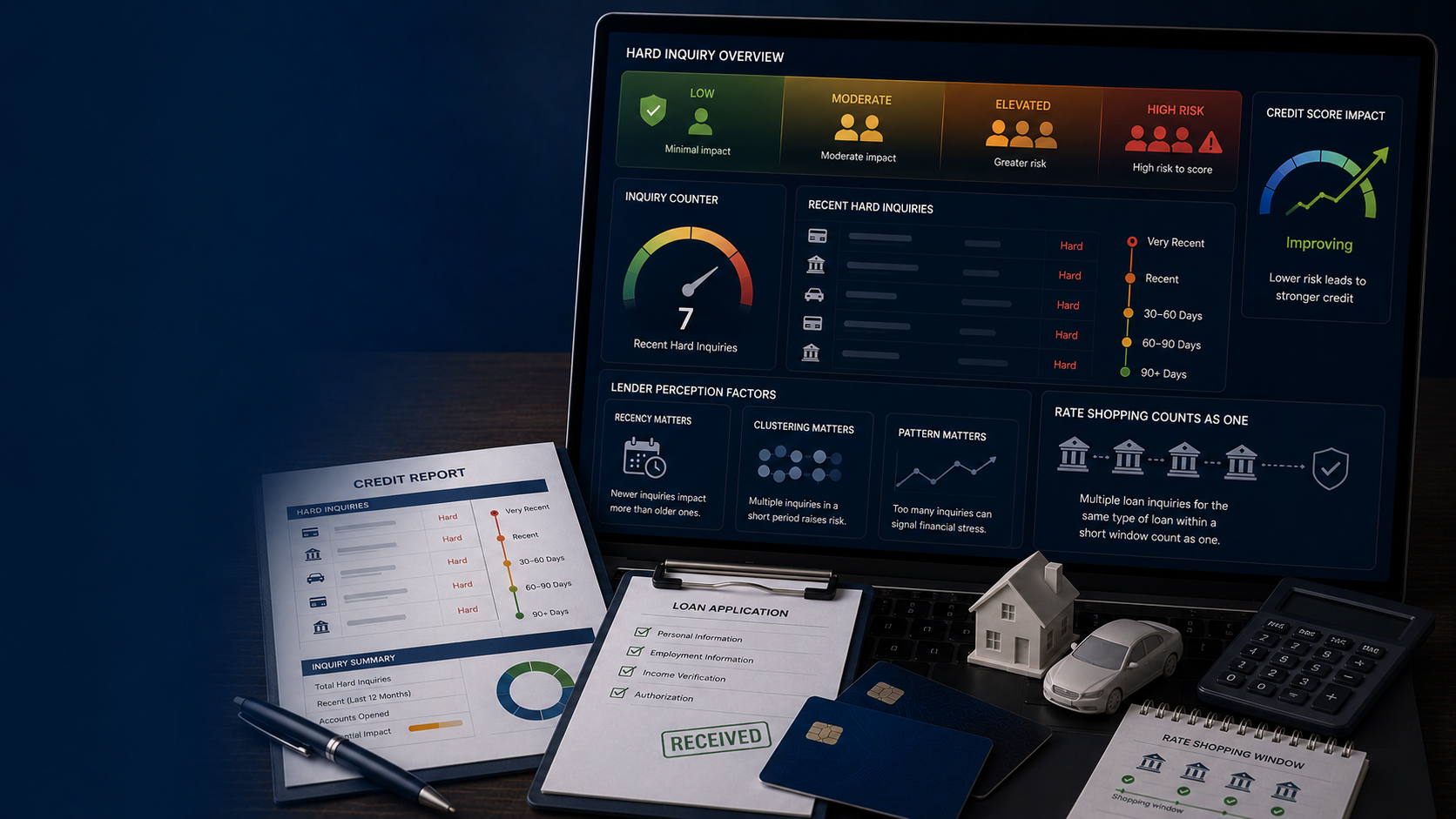
One of the most common questions we hear from clients is some version of: “How many hard inquiries is too many?” It’s a fair question, and the honest answer is more nuanced than a single magic number. The credit scoring system doesn’t draw a hard line in the sand. Instead, it weighs the recency, clustering, and type of inquiries to judge how much risk you represent.
This guide walks you through everything you need to know — what a hard inquiry actually is, how many points it typically costs, when lenders start raising eyebrows, how the rate-shopping window works, how different scoring models treat inquiries, and what to do if you’ve already accumulated more than you’d like. No quick-fix promises, no scare tactics — just a clear, honest breakdown so you can make confident decisions about your credit.
What Is a Hard Inquiry (and How Is It Triggered)?
A hard inquiry (sometimes called a “hard pull”) is a formal review of your credit file that occurs when you actively apply for new credit. It’s the lender’s way of saying: “This person is asking to borrow money — let’s look at their full credit picture before we decide.”
Hard inquiries are triggered when you apply for:
- A new credit card
- An auto loan or auto refinance
- A mortgage or mortgage refinance
- A personal loan or installment loan
- A student loan
- A business credit card or loan (when it requires a personal credit check)
- An apartment rental (in some cases, depending on the screening service)
- A utility account or cell phone contract (sometimes — varies by provider)
- A credit limit increase on an existing card (with some lenders)
The key distinction is your permission. A hard inquiry can only happen with your consent — usually buried in the fine print of the application you sign or click “I agree” on. You won’t get a hard pull from a lender just looking at your file for marketing purposes, or from you checking your own credit.
Hard vs. Soft Inquiries
It’s worth clarifying the difference, because people confuse these all the time:
| Feature | Hard Inquiry | Soft Inquiry |
|---|---|---|
| Triggered by | Your application for credit | Your own credit check, lender pre-approval offers, existing account reviews, employer background checks |
| Affects credit score | Yes (temporarily) | No |
| Visible to lenders on your report | Yes | No (visible only to you) |
| Requires your permission | Yes | Not always |
A soft inquiry (or “soft pull”) has zero impact on your score. Checking your own credit through a free app or annualcreditreport.com, receiving pre-approved card offers in the mail, or having an existing creditor review your account for account management — none of these hurt you. Only hard inquiries do.
What Triggers a Hard Pull (and What Doesn’t)
This is where a lot of confusion lives. Here’s a quick reference:
Will trigger a hard inquiry:
- Submitting a credit card application
- Applying for any loan (auto, mortgage, personal, student)
- Requesting a credit limit increase with certain lenders (Chase and Discover are known for hard-pulling on some increase requests; others, like American Express, often use soft pulls)
- Opening a new bank account that requires a credit check (varies by institution)
- Applying for a retail store card at checkout
Will NOT trigger a hard inquiry:
- Checking your own credit score through any monitoring service
- Receiving pre-qualified or pre-approved offers in the mail
- A landlord running a “soft” rental screening (some do hard, some don’t — ask first)
- An employer conducting a background credit check
- A creditor you already have an account with reviewing your file for account maintenance
When in doubt, ask the company directly before you apply: “Will this result in a hard or soft pull on my credit?” Reputable lenders will tell you.
How Many Points Does a Hard Inquiry Cost?
Here’s the good news that surprises most people: a single hard inquiry typically costs you only 1 to 5 points on your FICO score. For most people, it’s closer to the lower end of that range.
That’s a pretty small dent. If you have a 740 score and apply for a new credit card, you might drop to 737 or 738. Not catastrophic. Within a few months of responsible use, you’ll usually recover those points — and if the new card adds to your total available credit (lowering your utilization), your score can actually rise over time despite the inquiry.
Why the Range Varies
The exact point impact depends on several factors:
- Your current score level. Someone with an 800 score has more to lose from a new inquiry than someone with a 620 score, because the scoring model is more sensitive to changes at higher score ranges.
- Your overall credit profile. A long, thick credit file with multiple established accounts absorbs an inquiry more easily than a thin file with just one or two accounts.
- How recent your other inquiries are. A new inquiry on top of five others from the last six months costs more than a new inquiry on a file with no recent activity.
- The type of inquiry. The model distinguishes between a single credit card application and a cluster of auto loan inquiries — more on that in the rate-shopping section.
The Real Damage Isn’t Usually the Points
Here’s the thing most people miss: the point cost of an inquiry is usually not the real problem. One inquiry costing 3 points is noise. The actual risk shows up when:
- Inquiries accumulate (six applications in six months tells a different story than one every two years)
- Inquiries cluster in a short window (suggesting you’re scrambling for credit)
- Inquiries are recent (a hard pull from last month weighs more than one from 18 months ago)
- The new accounts those inquiries produced lower your average age of accounts
The scoring model is smart enough to look at the pattern, not just the count. Which brings us to the question you actually came here for.
So, How Many Hard Inquiries Is Too Many?
We’ll give you the honest, nuanced answer — but first, the number most people are looking for:
There is no fixed, official threshold. FICO and VantageScore have never published a specific number of inquiries that automatically disqualifies you or triggers a score cliff. The scoring formula treats inquiries as one factor among many, weighted alongside payment history, utilization, age of accounts, and credit mix.
That said, based on how the scoring models and lender underwriting guidelines actually behave in practice, here’s a practical frame:
| Inquiries in the last 2 years | Typical impact | What lenders see |
|---|---|---|
| 1–2 | Minimal | Normal credit use — most adults have this many |
| 3–5 | Modest | Generally fine, especially if spread out and for legitimate purposes |
| 6+ | Notable | Starts raising flags — lenders may ask questions or tighten terms |
| 10+ | Significant | Red flag — suggests credit-seeking behavior or financial stress |
A reasonable rule of thumb: six or more hard inquiries within a 24-month period is when you should start paying attention. It’s not an automatic denial, but it’s the zone where lenders — especially manual underwriters — begin to look more carefully at the story behind the applications.
The Recency Principle
Here’s the part that matters more than the raw count: one recent inquiry can hurt more than five old ones.
Hard inquiries affect your FICO score for 12 months, but they remain visible on your credit report for 24 months. After the 12-month mark, they carry zero scoring weight. So:
- Five inquiries from 18 months ago = zero score impact
- One inquiry from three weeks ago = small but real score impact
If you’re trying to figure out whether your inquiry count is “too many,” the better question is: how many do you have in the last 12 months? That’s the window that actually affects your score. Inquiries older than 12 months are just history — lenders can see them, but the scoring formula has stopped counting them.
What “Too Many” Really Means
When a lender sees a high inquiry count, they’re not thinking about the 3 points you lost. They’re thinking about the story the inquiries tell:
- Is this person taking on too much new debt at once?
- Are they being denied and reapplying repeatedly (a sign of desperation)?
- Are they credit-seeking across many categories (cards, personal loans, auto) simultaneously?
- Or are they just rate-shopping for one mortgage, which is normal and expected?
The pattern matters more than the number. Six inquiries for one auto loan over two weeks is fine. Six inquiries for six different credit cards over two months is a different signal entirely.
Why Recency and Clustering Matter More Than the Raw Count
If you remember one thing from this article, let it be this: the scoring model cares more about when your inquiries happened and how they cluster than about the total number.
Recency: Newer Hurts More
The FICO scoring formula applies a deduplication logic that essentially weights inquiries on a decay curve. An inquiry from last month is treated as a stronger risk signal than one from six months ago, which is stronger than one from 11 months ago. At 12 months, it drops off the scoring formula entirely.
This makes intuitive sense. If you applied for three cards last year but have been quiet since, you’ve demonstrated that you weren’t actually desperate for credit — you just had a burst of applications and then stopped. That’s recoverable. But if you applied for three cards in the last three weeks, the model sees active credit-seeking behavior right now, which is a higher-risk signal.
Clustering: Spread Out Looks Better Than Bunched Up
Clustering refers to how bunched-together your inquiries are. Consider two scenarios:
- Scenario A: One inquiry in January, one in May, one in September. Spread across nine months.
- Scenario B: Three inquiries in October, all within a two-week period.
Even though both profiles have three inquiries in a year, Scenario B is actually treated more favorably if those three inquiries are for the same loan type (like an auto loan). Why? Because the rate-shopping logic recognizes that you’re shopping for one loan, not opening three separate credit lines. We’ll dig into this in the next section.
But if those three October inquiries are for three different credit cards, that’s a cluster that looks like impulse credit-seeking — and the model treats it less kindly.
The Pattern Lenders Read
When a human underwriter reviews your file (which happens with mortgages, some auto loans, and any manual review), they’re looking at the pattern of inquiries as a narrative:
- Clean file, one recent inquiry: “Normal person applying for normal credit.”
- Several inquiries for the same loan type in a short window: “Smart consumer rate-shopping. Non-issue.”
- Inquiries across multiple credit types (card, personal loan, auto) in a short period: “Possibly overextending. Worth a closer look.”
- Many inquiries, many denials, rapid reapplications: “Credit stress signal. Higher risk.”
- Old inquiries, nothing recent: “Past burst of applications, now stable. Low concern.”
The takeaway: if you’re going to apply for credit, be intentional about it. A planned, purposeful application is read very differently than a scattered, reactive one.
The Rate-Shopping Window: FICO’s Built-In Protection
Here’s where a lot of the fear around “too many inquiries” falls apart. FICO does not penalize you for shopping around for the best rate on a single loan.
When you’re looking for a mortgage, auto loan, student loan, or personal loan, it’s expected — and financially smart — to compare offers from multiple lenders. FICO recognizes this and applies a deduplication rule for rate shopping.
How the Deduplication Works
Here’s the rule, in plain terms:
Multiple hard inquiries for the same type of loan within a 14-to-45-day window are counted as a single inquiry for scoring purposes.
So if you apply with five auto lenders over two weeks to compare rates, your FICO score treats those five pulls as one inquiry — not five. You get the benefit of comparison shopping without the penalty of five separate dings.
The Window Length Depends on the Model
The exact window varies by scoring model version:
| Scoring Model | Rate-Shopping Window | Loan Types Covered |
|---|---|---|
| Older FICO models (e.g., FICO 8) | 14 days | Auto, mortgage, student loans |
| Newer FICO models (FICO 9, FICO 10T) | 45 days | Auto, mortgage, student loans |
| VantageScore 3.0 & 4.0 | 14 days | Auto, mortgage, student loans |
Because you don’t always know which model a lender will use, the safest approach is to concentrate all your rate-shopping applications within a 14-day window. That way, you’re protected regardless of which model is checking.
What Counts as “Same Loan Type”
The deduplication only applies when the inquiries are for the same type of financing. The categories the models recognize are:
- Mortgage (purchase, refinance, home equity loan)
- Auto loan (new, used, refinance)
- Student loan
- Personal loan / installment loan
If you apply for a mortgage and an auto loan in the same week, those are two different categories — you’ll get two inquiries on your score, not one. The deduplication is within-category, not across-category.
What Does NOT Get Deduplicated
Credit card applications are not covered by rate-shopping logic. Each credit card application counts as a separate hard inquiry, period. If you apply for three different cards in a week, that’s three inquiries on your score.
This is an important distinction. The scoring model assumes that when you’re shopping for a mortgage or auto loan, you’re getting one loan — you’re just comparing lenders. But when you apply for three credit cards, the model assumes you might actually open three separate accounts, which represents more potential new debt.
The Bottom Line on Rate Shopping
If you’re buying a car or a house:
- Do your research first — know your target lenders before you start applying.
- Concentrate applications within 14 days — this ensures deduplication under every scoring model.
- Don’t worry about the inquiry count — if you stay within the window, five auto loan applications count as one.
- Be aware that the inquiries still appear on your report — they’re visible to lenders for 24 months, but the scoring formula treats them as one.
This is one of the most misunderstood parts of the credit system. You should never avoid shopping around for a major loan because you’re worried about inquiry count. The system is specifically designed to let you do this.
How Different Scoring Models Count Inquiries
Not all credit scores treat inquiries identically. The model a lender uses affects how your inquiries are weighed, how long they matter, and how rate shopping is handled.
FICO 8 (The Most Widely Used)
FICO 8 is still the workhorse of the lending world, used in the majority of credit card and auto loan decisions. Key inquiry facts:
- Inquiries affect your score for 12 months
- Rate-shopping window: 14 days for auto, mortgage, student loans
- Inquiries contribute to the “new credit” category, which is about 10% of your total FICO score
- A single inquiry typically costs 1–5 points
FICO 9
FICO 9 is gentler in several ways — it’s more forgiving of paid collections and gives more weight to rental history. On inquiries:
- Rate-shopping window expanded to 45 days
- Otherwise treats inquiries similarly to FICO 8
FICO 10T (The Newest FICO)
FICO 10T introduces trended data — it looks at your credit behavior over time, not just a snapshot. On inquiries:
- Rate-shopping window: 45 days
- May weigh recent inquiry clusters slightly more heavily because it can see the trajectory of your credit activity over the past 24+ months
- Increasingly used by mortgage lenders, though adoption is still growing
VantageScore 3.0 and 4.0
VantageScore is the model created by the three credit bureaus (Equifax, Experian, TransUnion) as an alternative to FICO. It’s used by some lenders and by many free credit score apps.
- Inquiries affect your score for 12 months (VantageScore 3.0) or 14 months (VantageScore 4.0)
- Rate-shopping window: 14 days
- Inquiries are weighted as part of the “recent credit” factor, which is about 10–12% of the score
- VantageScore tends to be slightly more sensitive to recent inquiries than FICO, but the difference is small
Which Model Matters for You?
You can’t control which model a lender uses, but here’s the practical takeaway:
- For credit cards and auto loans: Assume FICO 8 — 14-day rate-shopping window for auto.
- For mortgages: Increasingly FICO 10T or FICO 9 — 45-day window, but ask your lender which model they pull.
- For monitoring your own score: The free score from your card issuer or a monitoring app is usually FICO 8 or VantageScore — a useful benchmark, but not always identical to what a specific lender will see.
The inquiry behaviors that help across all models are the same: avoid unnecessary applications, concentrate rate shopping into a short window, and let time do its work.
How Lenders View Inquiry Patterns
So far we’ve talked about how the scoring formula treats inquiries. But there’s a second layer: how human lenders interpret your inquiry pattern when they’re deciding whether to approve you.
This matters most in situations involving manual underwriting — where a person, not just an algorithm, reviews your application. Manual review is common with:
- Mortgages (almost always involve human review)
- Some auto loans (especially from credit unions or smaller lenders)
- Business loans
- Any application that’s borderline — if your score is right at the approval cutoff, a human may look at the details
What Underwriters Look For
A manual underwriter reviewing your credit file sees every inquiry from the last 24 months (even though only the last 12 affect your score). They’re looking for patterns that tell a story about your financial behavior:
Green flags:
- A single inquiry for a mortgage, followed by on-time payments on the new loan
- Rate shopping for an auto loan concentrated in a 2-week window (shows responsible comparison)
- Inquiries spread out over time with new accounts showing good payment history
- A clean inquiry record overall
Yellow flags (may prompt questions):
- 3–5 inquiries in the last 6 months across different credit types
- Recent inquiries without corresponding new accounts (suggests you applied and were denied)
- A pattern of applying for credit right before major life events
Red flags:
- 6+ inquiries in the last 6 months, especially across multiple credit categories
- Inquiries from subprime or high-interest lenders (payday loan inquiries, certain subprime card issuers)
- Rapid-fire applications suggesting you’re trying to access as much credit as possible before something changes
- Inquiries that coincide with late payments or rising balances on existing accounts
The “Inquiries Without New Accounts” Pattern
This is one underwriters watch closely. If your report shows five inquiries in the last year but only one new account, the underwriter knows you applied for credit four times and were either denied or declined the offer. That pattern reads as credit-seeking under pressure — you’re trying to get approved and not succeeding.
By contrast, five inquiries that all resulted in new accounts (and those accounts are in good standing) tells a different story: you’re actively building credit, and multiple lenders have deemed you creditworthy.
Lender-Specific Tolerances
Different lenders have different internal thresholds for inquiry count:
- Major credit card issuers (Chase, Amex, Citi) often have internal rules — Chase’s unofficial “5/24 rule” denies applicants who have opened 5+ cards across all banks in 24 months, regardless of score.
- Mortgage lenders are generally more tolerant of rate-shopping clusters but may ask for a letter of explanation for any inquiry in the last 120 days.
- Auto lenders understand rate shopping well and rarely penalize clustered auto inquiries.
- Credit unions tend to take a more holistic, relationship-based view and may be more forgiving of inquiry count if your overall profile is strong.
If you’re planning a major application (especially a mortgage), it’s worth pulling your own report first and reviewing the inquiry section. If there’s anything that might prompt a question, you can prepare a brief, honest explanation in advance.
When Inquiries Signal Risk vs. Normal Shopping
Let’s crystallize the difference between an inquiry pattern that signals risk and one that reflects normal, healthy credit behavior.
Normal, Healthy Inquiry Patterns
- One credit card application every year or two to take advantage of a rewards program or balance transfer offer
- Rate shopping for a single auto loan or mortgage within a 2-week window
- Occasional applications when legitimate financial needs arise (a new car, a home purchase, a needed personal loan for home repair)
- A student loan refinance once or twice over a lifetime
- Applying for a store card once in a while for a major purchase discount (though we’d generally advise caution here — store cards often have high APRs)
These patterns tell lenders: “This person uses credit deliberately and for clear purposes.”
Risk-Signaling Inquiry Patterns
- Multiple credit card applications in a short period (3+ cards in 3 months)
- Applying for credit after being denied at another lender, repeatedly
- Inquiries across many credit categories simultaneously (a card, a personal loan, and an auto loan all in the same month)
- Applications to subprime or high-fee lenders (payday lenders, high-interest installment loans, fee-heavy subprime cards)
- Inquiries that coincide with rising balances on existing accounts or any late payments
- A sudden burst of applications after a long period of no credit activity
- Applying for cash advances or high-fee credit products
These patterns tell lenders: “This person may be experiencing financial stress or building up debt rapidly.”
The Gray Zone
Most people fall somewhere in the middle. You might have applied for two cards in six months because you were rebuilding after a divorce, or you might have an old auto loan inquiry and a recent mortgage inquiry that look close together but are for completely legitimate reasons.
If you’re in the gray zone, the best thing you can do is be ready to explain. When you apply for a mortgage and the underwriter asks about the inquiry from six months ago, a one-sentence explanation — “That was a balance transfer card I used to consolidate higher-interest debt, and I’ve paid it down since” — resolves the question cleanly. Lenders don’t expect perfection; they expect coherence.
How to Minimize Inquiries When Rate Shopping
If you’re planning to apply for credit, a little strategy goes a long way. Here’s how to keep your inquiry count low while still getting the best terms.
1. Concentrate Applications in a Short Window
For auto loans, mortgages, and student loans, do all your applications within a 14-day period. This guarantees that every scoring model treats them as a single inquiry.
Plan your approach:
- Research lenders first — identify 4–6 you want to compare before you apply to any.
- Get your documents ready — pay stubs, W-2s, bank statements, ID — so you can apply to all of them quickly.
- Apply within the same week if possible. Two weeks is the safe maximum.
- Don’t stretch shopping over a month. If you apply to one lender in week one and another in week four, older FICO models will count those as two separate inquiries.
2. Use Pre-Qualification and Pre-Approval Tools (Soft Pulls)
Many lenders offer pre-qualification tools that use a soft pull to show you the rates and terms you’d likely qualify for — without a hard inquiry. This lets you shop and compare before you commit to a formal application.
- Credit cards: Most major issuers (Chase, Amex, Citi, Capital One, Discover) offer pre-qualification pages on their websites. Bankrate, NerdWallet, and Credit Karma also aggregate pre-qualified offers using soft pulls.
- Auto loans: Many online lenders (LightStream, Capital One Auto, Carvana) offer pre-qualification with a soft pull. You can see your rate before you apply formally.
- Personal loans: Pre-qualification is widely available from online lenders.
- Mortgages: Pre-qualification exists but is less meaningful than a full pre-approval (which does involve a hard pull). For mortgages, a pre-approval is worth the inquiry because it strengthens your offer to sellers.
The strategy: use pre-qualification to narrow your options, then submit formal applications only to your top 1–3 choices.
3. Don’t Apply Speculatively
Avoid the “let me just see if I get approved” approach. Every speculative application is a hard inquiry that costs points — and if you’re denied, you have nothing to show for it but a ding on your score.
Instead:
- Check pre-qualification first to gauge your odds.
- Review the lender’s stated credit requirements (many publish minimum score ranges).
- Only apply when you have a reasonable expectation of approval.
4. Be Strategic About Credit Card Applications
Since credit card inquiries aren’t deduplicated, each one counts. If you’re interested in multiple cards:
- Prioritize — apply for the one you want most first.
- Space them out — wait at least 6 months between card applications if possible.
- Be aware of issuer-specific rules — Chase’s 5/24 rule, for example, will deny you for many Chase cards if you’ve opened 5+ cards from any issuer in 24 months.
- Consider the value — a sign-up bonus is only worth it if you’ll use the card long-term, not just for the bonus.
5. Freeze Your Credit If You’re Not Actively Applying
If you know you won’t be applying for credit in the near future, a credit freeze with all three bureaus (Equifax, Experian, TransUnion) prevents new hard inquiries entirely. It’s free, doesn’t affect your score, and you can unfreeze temporarily when you do want to apply. This is also excellent protection against identity theft and fraudulent applications.
How Long Inquiries Affect Your Score and Stay on Your Report
Two different timelines to keep straight:
| Timeline | What It Means |
|---|---|
| 12 months | How long a hard inquiry affects your FICO score. After 12 months, it carries zero scoring weight. (VantageScore 4.0 uses 14 months.) |
| 24 months | How long a hard inquiry remains visible on your credit report. Lenders can see it, but it no longer affects your score after the first year. |
After 12 Months: Score Recovery
Once a hard inquiry crosses the 12-month mark, it stops affecting your FICO score. You don’t need to do anything — the scoring formula automatically stops counting it. Any points you lost from that inquiry should have already been recovered by then (most people recover inquiry-related points within 6–12 months of responsible credit use).
After 24 Months: Removal From Your Report
At 24 months, the inquiry falls off your credit report entirely. It’s no longer visible to lenders or to you. You don’t need to request removal — the bureaus drop it automatically.
Can You Remove Inquiries Early?
In general, no — legitimate hard inquiries stay on your report for 24 months. There is no legitimate way to remove an accurate inquiry early. Any service promising to “remove hard inquiries fast” is either:
- Filing disputes on your behalf and hoping the bureau can’t verify the inquiry (which sometimes works for undocumented or fraudulent inquiries but is not reliable for legitimate ones), or
- A scam
The one exception: if an inquiry is inaccurate or fraudulent — for example, someone applied for credit in your name without permission, or a lender pulled your credit without authorization — you can dispute it with the credit bureaus. Legitimate disputes for fraudulent or unauthorized inquiries can result in removal. But accurate, authorized inquiries are there for the full 24 months.
How to Check Your Inquiries
You can see every hard inquiry on your file by pulling your free credit reports from annualcreditreport.com (you’re entitled to one free report from each bureau per week under current federal law). Review the inquiry section and make sure every pull listed is one you recognize. If you see an inquiry you don’t recognize, dispute it — it could be a sign of identity theft.
How to Bounce Back After Too Many Inquiries
If you’ve accumulated more hard inquiries than you’d like — whether from a period of credit rebuilding, a difficult financial stretch, or just not knowing how the system worked — here’s the honest, practical path forward.
1. Stop Applying for New Credit
This is the single most important step. The clock starts ticking the day you stop applying. Every month that passes without a new inquiry moves you further from the “recent” window that matters most.
Commit to a hard pause — no new credit applications for at least 6 months, ideally 12. Use this time to let your existing accounts age and your most recent inquiries fade toward the 12-month mark.
2. Focus on the Factors You Can Control
Inquiries are a small part of your score (about 10% in FICO). The bigger factors — payment history (35%) and credit utilization (30%) — are where you have real leverage.
- Pay every bill on time, every month. A single 30-day late payment costs far more than any hard inquiry.
- Keep your credit card balances low. Aim to use less than 10% of your available credit on each card and overall. If you have a $10,000 limit across all cards, try to keep your total reported balance under $1,000.
- Pay down balances before the statement closing date — that’s when most card issuers report to the bureaus, not the due date.
3. Let Your Accounts Age
The average age of your accounts is about 15% of your FICO score. As your existing accounts get older and your recent inquiries age past 12 months, your score will naturally recover and grow. Don’t close old accounts (unless they have annual fees you can’t justify) — keeping them open preserves your credit history length and your total available credit.
4. Dispute Any Inaccurate Inquiries
Pull your reports from all three bureaus and review the inquiry section carefully. If you see any inquiry you don’t recognize or didn’t authorize, dispute it. The bureau must investigate within 30 days. If the inquiry can’t be verified, it gets removed — which can help your score if it was within the 12-month scoring window.
5. Be Patient and Consistent
Credit recovery is not a 30-day project. It’s a 6-to-24-month process of consistent good behavior. The good news: the scoring model rewards steady, responsible use. Within a year of stopping new applications, paying on time, and keeping utilization low, most people see meaningful score improvement — even with a heavier inquiry history.
6. Consider a Professional Review
If your credit situation is complex — multiple negative marks alongside the inquiries, accounts in collections, or errors across bureaus — a professional credit audit can identify the specific factors dragging your score and a clear, prioritized plan to address them. At , we offer a free credit audit that reviews all three bureau reports and maps out a tailored recovery plan. No quick fixes — just a clear-eyed assessment of where you stand and what to do next.
Common Myths About Hard Inquiries
Let’s clear up some of the most persistent misconceptions we hear from clients.
Myth 1: “Checking my own credit score hurts my score.”
False. Checking your own credit — through a monitoring app, your bank’s free score feature, or annualcreditreport.com — is a soft inquiry and has zero impact on your score. You can check your own credit every single day without consequence.
Myth 2: “Every inquiry drops your score by 10 points.”
False. A single hard inquiry typically costs 1–5 points, and the impact depends on your overall profile. The “10 points per inquiry” idea is a myth that makes people far more anxious than they need to be.
Myth 3: “Rate shopping for a car loan will wreck your score.”
False. FICO specifically deduplicates multiple auto loan inquiries within a 14-day (or 45-day, depending on the model) window. Five auto loan applications in two weeks count as one inquiry for scoring purposes. You should never avoid shopping around for a major loan because of inquiry concerns.
Myth 4: “You can pay a service to remove legitimate hard inquiries.”
False. Legitimate, authorized hard inquiries stay on your report for 24 months — period. Any service promising to remove accurate inquiries is either filing baseless disputes (which rarely work for legitimate inquiries) or is a scam. The only inquiries that can be removed are inaccurate or fraudulent ones, which you can dispute yourself for free.
Myth 5: “Inquiries stay on your report forever.”
False. Hard inquiries fall off your report automatically after 24 months. They stop affecting your score after 12 months. You don’t need to do anything — they age out on their own.
Myth 6: “A pre-approval offer means a hard pull already happened.”
False. Those pre-approved credit card offers you get in the mail are based on a soft inquiry from a list the lender purchased from the credit bureaus. No hard pull has occurred. If you actually apply in response to the offer, that’s when the hard pull happens.
Myth 7: “Closing a credit card removes the inquiry from your report.”
False. Closing a card does not remove the original application inquiry — that inquiry stays on your report for 24 months regardless. Closing the card may actually hurt your score by reducing your available credit and shortening your average account age.
Myth 8: “All credit scores treat inquiries the same way.”
False. FICO 8, FICO 9, FICO 10T, and VantageScore all have slightly different inquiry rules — different rate-shopping windows, different lengths of scoring impact, different weightings. The behaviors that help are the same across all of them, but the exact point impact can vary.
Frequently Asked Questions
How many hard inquiries is too many for a credit card application?
There’s no official cutoff, but as a general guideline: 6+ inquiries in the last 12 months starts to raise concerns for many lenders. Some card issuers have stricter internal rules — Chase’s 5/24 rule, for example, counts new accounts (not just inquiries) across all banks. If you’re applying for a premium card, aim for no more than 2–3 inquiries in the last 6 months.
Does applying for multiple credit cards in one day hurt your score more?
Each credit card application is a separate hard inquiry — they are not deduplicated like rate-shopping inquiries for loans. So applying for three cards in one day means three separate inquiries on your score. However, they’ll all hit your report around the same time, and the scoring impact (typically 3–15 points total for three inquiries) will be concentrated. The bigger concern is that rapid card applications signal credit-seeking behavior to lenders.
Can I remove a hard inquiry before 24 months?
Only if the inquiry is inaccurate or fraudulent. If you didn’t authorize the application or the inquiry is listed in error, you can dispute it with the credit bureau, and it must be investigated within 30 days. Legitimate, authorized inquiries cannot be removed early — they remain for the full 24 months.
Do hard inquiries affect your score for 12 or 24 months?
12 months for scoring purposes, 24 months for visibility. After 12 months, a hard inquiry no longer affects your FICO score (VantageScore 4.0 uses 14 months). It remains visible on your credit report for the full 24 months, so lenders can see it, but it carries zero scoring weight after the first year.
Will rate shopping for a mortgage hurt my credit?
No — as long as you concentrate your mortgage applications within a 14-to-45-day window, FICO treats them as a single inquiry. You can and should shop around for the best mortgage rate. Mortgage lenders expect this and the scoring model is designed to accommodate it. Just be aware that each lender’s inquiry will still appear on your report individually (even though they count as one for scoring), and a mortgage underwriter may ask you to explain any inquiries during the application process.
How many points does one hard inquiry cost?
Typically 1 to 5 points for a single inquiry. The exact impact depends on your overall credit profile, your current score, and how many other recent inquiries you have. People with higher scores and thicker credit files tend to lose fewer points per inquiry.
Do soft inquiries affect my credit score at all?
No. Soft inquiries — from checking your own credit, receiving pre-approved offers, existing account reviews, or employer background checks — have zero impact on your credit score. They’re not visible to lenders and aren’t included in the scoring formula.
Should I freeze my credit to prevent hard inquiries?
A credit freeze is a good idea if you’re not actively applying for credit. It prevents new hard inquiries (including fraudulent ones) and has no effect on your score. It’s free with all three bureaus. When you do need to apply, you can temporarily lift the freeze for a specific lender or a specific time period. A freeze is also one of the best protections against identity theft and fraudulent credit applications.
Take Control of Your Credit
Hard inquiries are a small part of your credit picture, but they’re a part worth understanding. The key takeaways:
- One or two inquiries are nothing to worry about — that’s normal credit use.
- Six or more in 24 months is the zone to watch — not an automatic problem, but worth attention.
- Recency matters more than count — one recent inquiry can outweigh five old ones.
- Rate shopping is protected — concentrate auto, mortgage, and student loan applications within 14 days and they count as one.
- Time heals — inquiries stop affecting your score after 12 months and fall off your report after 24.
If you’re concerned about your inquiry count — or if inquiries are just one piece of a credit picture that needs attention — we can help. At , we offer a free credit audit that pulls and reviews all three of your bureau reports, identifies every factor affecting your score (not just inquiries), and maps out a clear, personalized plan to improve your credit health.
We’re a San Diego-based, attorney-backed credit repair firm that operates in full compliance with the Fair Credit Reporting Act (FCRA). We don’t make quick-fix promises — we believe in honest, transparent, results-driven work that equips you with the knowledge to keep your credit strong for life.
Ready to see where you stand? and take the first step toward credit clarity.
This article is for educational purposes and does not constitute legal or financial advice. Your individual credit situation is unique. For a personalized review, request a free credit audit at .
Related reading:
Leave a Reply