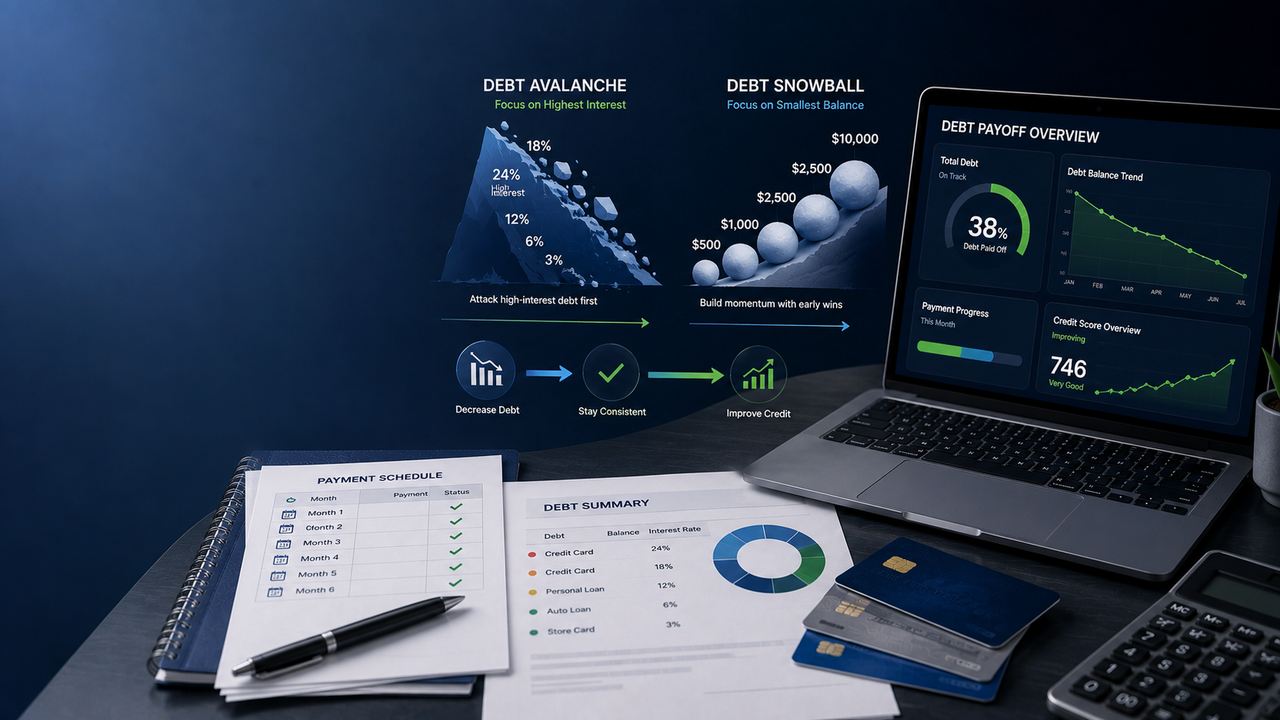
Here is the good news: there is a clear way out, and it does not require a windfall, a new job, or a secret strategy. Two of the most effective debt payoff plans in existence — the debt avalanche and the debt snowball — have helped millions of people get to zero, and they are both simple enough to start today.
The question is not really whether to pay off your debt. It is how to pay it off in a way that actually works for you — mathematically, psychologically, and practically. That is what this article is about. We are going to walk through both methods in detail, compare them side by side with real numbers, and help you build a debt payoff plan you can actually stick with.
No quick-fix promises here. No “wipe out your debt overnight” nonsense. Just a transparent, step-by-step framework grounded in how credit and interest actually work — because that is how lasting financial progress gets made.
The Cost of Carrying Credit Card Debt
Before we get into the methods, it helps to understand exactly what carrying credit card debt costs you. Not in vague terms — in dollars.
Credit cards are revolving accounts, which means interest is charged on your average daily balance every single day you carry a balance. The average credit card APR in the United States now sits above 21%, and many store cards push past 28%. At those rates, interest compounds quickly — meaning you are paying interest on interest.
Let’s look at what that actually means.
A real-world example
Suppose you have a $5,000 balance on a card with a 22% APR, and your minimum payment is calculated as 2% of the balance (about $100 to start). If you only pay the minimum:
- It will take you roughly 30+ years to pay off the balance.
- You will pay more than $7,500 in interest alone — more than the original balance.
- Your total cost will exceed $12,500 for a $5,000 purchase.
That is the true cost of minimum payments. The bank is not doing you a favor by keeping the minimum low — it is keeping you in debt longer, collecting interest the entire time.
Why paying it off is one of the best financial moves you can make
Here is the flip side. Every dollar of credit card debt you pay off is effectively a guaranteed, tax-free return equal to your APR. If your card charges 22% interest, paying it off is like earning a guaranteed 22% return on your money — risk-free. There is no investment on the planet that reliably produces that kind of return.
Paying down credit card debt also:
- Frees up cash flow every month as minimum payments disappear
- Improves your credit score by lowering your credit utilization (more on that below)
- Reduces financial stress, which affects everything from sleep to relationships to job performance
- Opens doors — better loan terms, lower insurance premiums, easier approvals for housing
So when you commit to a debt payoff plan, you are not just “getting out of debt.” You are reclaiming your income, your credit health, and your financial future. The avalanche and snowball methods are simply two different roads to the same destination.
The Debt Avalanche Method Explained
The debt avalanche method is the mathematical powerhouse of the two. The idea is simple: pay off your debts in order of highest interest rate first, regardless of balance size. You make minimum payments on every debt, and you throw every extra dollar at the debt with the highest APR. Once that debt is gone, you roll that payment into the next-highest APR, and so on — like an avalanche building momentum as it comes down the mountain.
Why it works
Because interest is the most expensive part of debt, attacking the highest-interest balance first saves you the most money over time. Every month you carry a high-APR balance, it is growing faster than your lower-APR debts. Killing it first stops the bleeding.
The avalanche, step by step
- List every debt with its balance, APR, and minimum payment.
- Order them by APR, highest to lowest.
- Pay the minimum on every debt except the highest-APR one.
- Put every extra dollar toward the highest-APR debt.
- When that debt is gone, redirect its full payment (minimum + extra) to the next-highest APR debt.
- Repeat until every balance is zero.
A worked example
Let’s say you have four debts and $600 per month total to put toward debt (after covering all minimums and basic living expenses). Here is your starting situation:
| Debt | Balance | APR | Minimum Payment |
|---|---|---|---|
| Store card | $1,200 | 28.0% | $40 |
| Visa | $4,500 | 22.0% | $90 |
| Mastercard | $2,800 | 18.0% | $56 |
| Personal loan | $3,500 | 9.0% | $70 |
Total minimums: $256. That leaves you $344 in extra money to throw at your target debt.
With the avalanche, your target is the store card at 28% — not because it is the smallest, but because it is the most expensive. You pay $40 minimum + $344 extra = $384/month toward the store card. Minimums go toward the other three.
Month-by-month progression (simplified)
The store card at 28% APR is accruing about $28/month in interest at the start. With $384 going toward it, the balance drops fast. In roughly 3.5 months, the store card is gone.
Now you roll that $384 into the Visa (the next-highest at 22%). Your Visa payment becomes $90 minimum + $384 = $474/month. The Visa had been accruing about $82/month in interest; now you are crushing it.
After the Visa is paid off (roughly 11 more months), you roll $474 into the Mastercard: $56 + $474 = $530/month. Then the personal loan gets the full $600.
Total interest saved
Compare the avalanche to paying only minimums across all four debts:
| Strategy | Total Interest Paid | Time to Debt-Free |
|---|---|---|
| Minimums only | ~$7,800+ | 12+ years |
| Debt avalanche (with $344 extra) | ~$1,950 | ~22 months |
That is roughly $5,850 in interest saved and nearly a decade off your payoff timeline — with the exact same starting balances and the exact same monthly budget. The only difference is which debt got the extra money first.
When the avalanche shines
The debt avalanche is your best choice when:
- You are motivated by numbers, progress trackers, and total cost
- You have one or two extremely high-APR debts eating you alive
- You are confident you can stay the course without early wins
- You want to save the absolute maximum amount of money
The downside of the avalanche
The avalanche can take a long time to produce your first “debt eliminated” moment. If your highest-APR debt also happens to be your largest balance, you might pay on it for many months before seeing a balance hit zero. For some people, that is fine. For others, it is demoralizing — and demoralized people quit.
That is where the snowball comes in.
The Debt Snowball Method Explained
The debt snowball method flips the logic. Instead of attacking the most expensive debt, you attack the smallest balance first, regardless of interest rate. You make minimum payments on everything, and put every extra dollar toward the debt with the lowest balance. When that debt is gone, you roll its payment into the next-smallest balance. The snowball grows as it rolls downhill.
Why it works
The snowball is not about math — it is about behavior and psychology. Personal finance is not a spreadsheet problem; it is a human behavior problem. The snowball is designed to give you quick wins that keep you motivated. Eliminating a debt entirely — even a small one — feels like real progress. It proves the plan is working, builds momentum, and reinforces the habit of paying down debt.
This is not speculation. A well-known Northwestern University study found that people who used the snowball method were more likely to successfully eliminate their debt than those who used the avalanche, precisely because the early wins kept them engaged.
The snowball, step by step
- List every debt with its balance, APR, and minimum payment.
- Order them by balance, smallest to largest (APR is ignored for ordering).
- Pay the minimum on every debt except the smallest-balance one.
- Put every extra dollar toward the smallest-balance debt.
- When that debt is gone, redirect its full payment to the next-smallest balance.
- Repeat until every balance is zero.
A worked example
Same four debts, same $600/month total budget:
| Debt | Balance | APR | Minimum Payment |
|---|---|---|---|
| Store card | $1,200 | 28.0% | $40 |
| Mastercard | $2,800 | 18.0% | $56 |
| Personal loan | $3,500 | 9.0% | $70 |
| Visa | $4,500 | 22.0% | $90 |
With the snowball, your target is the store card at $1,200 — not because of its APR, but because it is the smallest balance. Conveniently, it is also the highest-APR debt in this example, so the first few months look identical to the avalanche. But the moment the store card is gone, the paths diverge.
With the avalanche, you would roll into the Visa (22% APR, $4,500 balance). With the snowball, you roll into the Mastercard ($2,800 balance, 18% APR), because it is the next-smallest balance — even though the Visa is more expensive.
Your Mastercard payment becomes $56 + $384 = $440/month. The Mastercard is gone in about 7 months.
Now you roll $440 into the personal loan ($3,500, 9%): $70 + $440 = $510/month. Personal loan gone in about 7 more months.
Finally, the full $600 goes to the Visa.
Total interest paid
| Strategy | Total Interest Paid | Time to Debt-Free |
|---|---|---|
| Debt avalanche | ~$1,950 | ~22 months |
| Debt snowball | ~$2,380 | ~24 months |
The snowball costs about $430 more in interest and takes about 2 months longer than the avalanche in this example. That is the “price” of the psychological boost.
When the snowball shines
The debt snowball is your best choice when:
- You have struggled to stick with payoff plans before
- You need visible progress to stay motivated
- You have several small balances that can be cleared quickly
- You value momentum and habit-building over squeezing every last dollar
The downside of the snowball
Mathematically, the snowball will always cost you more in interest than the avalanche — sometimes a little, sometimes a lot, depending on how your balances and APRs line up. If you have a very large high-APR debt and several small low-APR debts, the snowball can leave the expensive debt growing in the background while you clean up cheap ones. That said: a plan you actually finish always beats a plan you abandon. If the snowball keeps you in the game, the extra interest is worth it.
Avalanche vs. Snowball: Side-by-Side Comparison
Here is the full side-by-side breakdown using the same $11,000 in total debt and $600/month budget from the examples above.
| Factor | Debt Avalanche | Debt Snowball |
|---|---|---|
| Ordering rule | Highest APR first | Smallest balance first |
| Total interest paid | ~$1,950 | ~$2,380 |
| Time to debt-free | ~22 months | ~24 months |
| First debt eliminated | ~3.5 months (store card) | ~3.5 months (store card) |
| Early wins | Fewer, later | More frequent, earlier |
| Motivation style | Numbers-driven, long-game | Psychological, momentum-driven |
| Best for | Analytical, disciplined people | People who need visible progress |
| Mathematical efficiency | Highest (saves the most) | Lower (costs more in interest) |
| Behavioral effectiveness | Depends on the person | Proven to improve follow-through |
| Risk | Quitting before first payoff | Paying more interest over time |
A few things to notice:
- In this particular example, the first debt eliminated is the same for both methods, because the smallest balance also happens to be the highest APR. That is not always the case.
- The interest difference widens when your highest-APR debt is also your largest balance. In that scenario, the avalanche pulls further ahead on cost, but the snowball pulls further ahead on motivation (because the avalanche’s first payoff takes much longer).
- The time difference is usually smaller than people expect. Often it is a matter of months, not years.
Which Is Better Mathematically vs. Psychologically?
This is the heart of the debate, and the honest answer is: it depends on what “better” means to you.
Mathematically: the avalanche wins
There is no scenario where the snowball saves more money than the avalanche. If your only metric is total interest paid and time to debt-free, the avalanche is the winner, full stop. Interest is the cost of debt, and the avalanche always targets the most expensive debt first.
The gap can be small (a few hundred dollars) or large (several thousand), depending on:
- How spread out your APRs are
- Whether your largest balance also has the highest APR
- How much extra money you are putting toward debt each month
- How long the overall payoff takes
Psychologically: the snowball wins
But humans are not calculators. We are emotional, momentum-driven creatures, and debt payoff is a marathon. The snowball is engineered around how people actually behave:
- Quick wins release dopamine. Eliminating a debt feels like victory. That feeling reinforces the behavior.
- Fewer accounts = less mental load. Each debt you close is one fewer payment to track, one fewer due date to worry about, one fewer source of anxiety.
- Momentum compounds. As each debt falls, your snowball payment grows, and the next debt falls faster. You can see the acceleration.
The Northwestern study mentioned earlier is not the only evidence. Financial behavior researchers consistently find that the method people stick with is more important than the mathematically optimal method. A plan you abandon at month four costs you far more than a “suboptimal” plan you finish.
The pragmatic truth
For most people, the right answer is: start with the method you are most likely to finish. If you are a spreadsheet person who gets genuinely energized by watching interest costs drop, go avalanche. If you have tried and failed before, or you feel overwhelmed and need a win, go snowball. The “best” method is the one that gets you to zero.
How to Choose Based on Your Personality and Situation
Still not sure? Here is a practical decision guide.
Choose the avalanche if:
- You are analytical and disciplined. You enjoy tracking numbers, optimizing, and watching the total interest counter tick down.
- You have a large, high-APR debt. If your most expensive debt is also your biggest, the avalanche can save you thousands — and you are willing to wait for the payoff.
- You have a stable income and reliable extra cash flow. You can commit to a consistent extra payment every month without it being a stretch.
- You are motivated by efficiency. Knowing you are saving the maximum amount keeps you going.
- You have fewer, larger debts. With only two or three accounts, the avalanche’s slower early progress is less of an issue.
Choose the snowball if:
- You have tried to pay off debt before and quit. The snowball is specifically designed for follow-through.
- You feel overwhelmed by the number of debts. If you have five, six, or more accounts with payments scattered across the month, the snowball simplifies things fast.
- You have several small balances. Clearing two or three debts in the first few months is a powerful psychological lift.
- You are motivated by visible milestones. Crossing a debt off the list is the fuel you need.
- Your income is variable or tight. When extra cash is inconsistent, the snowball’s quick wins help you stay committed even on low months.
Choose a hybrid if:
- You want the best of both. (See the next section — hybrid approaches are real and effective.)
- You have one “problem debt” (very high APR) alongside several smaller ones. Knock out one or two small ones for momentum, then pivot to the expensive one.
A quick gut check
Ask yourself: “If I am three months in and have not eliminated a single debt, will I keep going?”
- If the answer is yes → avalanche.
- If the answer is “maybe not” → snowball.
- If the answer is “I need a win first, then I can be patient” → hybrid.
Hybrid Approaches
You are not required to pick a side. Many successful debt payoff journeys use a hybrid approach that borrows from both methods. Here are three proven hybrids:
1. The Snowball-First, Avalanche-Second Approach
Start with the snowball and knock out your one or two smallest balances in the first few months. This gives you the psychological win and frees up cash flow. Then, once you have momentum and confidence, switch to the avalanche and attack the highest-APR debt with your now-larger snowball payment.
This is an excellent choice for people who need early wins but also want to limit interest costs on a large expensive debt.
2. The “Avalanche with a Quick Kill” Approach
Run the avalanche, but make an exception for any debt you can eliminate in one or two payments (typically under $500). Clear those tiny balances first to simplify your life and reduce the number of accounts you are tracking, then proceed strictly by APR.
This keeps the mathematical advantage of the avalanche while removing the annoyance of nickel-and-dime minimum payments on trivial balances.
3. The “Tie-Breaker” Approach
When two debts have similar APRs (within 1–2 percentage points), order them by balance instead. If your Visa is 22% and your Mastercard is 21%, the interest difference is negligible in the short term — so knock out the smaller balance first for the win, then move on. This is a small tweak that costs you almost nothing mathematically but can improve motivation.
Which hybrid is right for you?
If you are drawn to the hybrid idea, start simple. Do not over-engineer your plan. Pick one tweak — usually either “snowball first for two debts, then avalanche” or “avalanche with quick kills under $500” — and commit to it. You can always adjust as you go. The goal is momentum, not perfection.
Step-by-Step: How to Set Up Either Plan
The setup is identical for both methods — the only difference is the ordering rule. Here is exactly what to do.
Step 1: List all your debts
Create a single document (spreadsheet, notebook, app — whatever works) and list every debt you owe. For each one, record:
- Creditor name
- Current balance (log into each account to get the exact number)
- APR / interest rate
- Minimum monthly payment
- Due date
Do not skip anything — credit cards, store cards, personal loans, medical payment plans, “buy now pay later” balances, overdue utility arrangements. If it charges interest or has a required monthly payment, it goes on the list.
Step 2: Calculate your total minimums and your total budget
Add up all the minimum payments. That is your baseline obligation — the amount you must pay every month just to stay current.
Next, figure out how much you can afford to put toward debt in total each month. This is your total debt budget. It should include your minimums plus any extra you can realistically commit.
Total debt budget − total minimums = your “extra payment” amount. This is the money that will attack your target debt.
Step 3: Choose your ordering rule
- Avalanche: order debts by APR, highest to lowest.
- Snowball: order debts by balance, smallest to largest.
- Hybrid: apply your chosen hybrid rule.
Step 4: Set up your payments
Every month:
- Pay the minimum on every debt by its due date. Set up auto-pay for minimums if possible — this prevents missed payments, late fees, and credit score damage.
- Direct your extra payment toward your target debt (the first one in your ordering).
- Repeat every month.
Step 5: When the target debt is eliminated, roll up
The moment your target debt hits zero, do not spend that freed-up payment. Roll the entire amount (the minimum you were paying on it + the extra) into the next debt in your ordering. This is the “avalanche” or “snowball” effect — your payment grows with each debt eliminated.
Step 6: Track and celebrate
Update your spreadsheet every month with new balances. Watching the numbers fall is part of the motivation. Celebrate each debt elimination — even small ones. These milestones matter.
Step 7: Adjust as life changes
If your income changes, your extra payment changes — that is fine. If you have a rough month and can only cover minimums, do that and get back on track the next month. If you get a bonus or tax refund, consider putting a chunk toward your target debt for a big leap forward.
Your plan is a living document, not a rigid contract. The goal is consistent forward progress, not perfection.
How to Free Up Money for Extra Payments
The avalanche and snowball both rely on having extra money to throw at your target debt. If you are living paycheck to paycheck, finding that extra can feel impossible. Here are concrete ways to free up cash — no vague “just spend less” advice.
1. Audit your subscriptions and recurring charges
Pull your last two months of bank and card statements. Highlight every recurring charge: streaming services, app subscriptions, gym memberships, meal kits, software you rarely use. Cancel anything you have not used in the last 30 days. The average person finds $100–$200/month in forgettable subscriptions. That is your extra payment.
2. Negotiate your current APRs
Call each credit card company and ask for a lower APR. It sounds intimidating, but it is a routine request. Say something like: “I have been a customer for X years and I am working hard to pay down my balance. Can you lower my APR?” Even a 3–5 percentage point reduction on one card can save you hundreds over the payoff period.
If you are offered a promotional 0% balance transfer offer, consider it carefully — but understand the terms (transfer fee, promo length, post-promo rate). More on this in the consolidation section below.
3. Temporarily cut discretionary spending
This is not about austerity forever — it is about focus for the payoff period. Identify two or three discretionary categories where you can cut back for the next 6–12 months: dining out, entertainment, clothing, hobbies. Redirect that money to your target debt. Even $50/week in restaurant savings is over $200/month — enough to make a real dent.
4. Increase your income, even temporarily
Side income accelerates debt payoff dramatically. Options that require minimal setup:
- Sell items you no longer need (clothes, electronics, furniture)
- Freelance or gig work a few hours a week
- Ask for overtime if your job allows it
- Rent out a spare room, parking spot, or storage space
Designate 100% of this extra income for your debt plan. Because it is “found” money, you will not feel the loss, and every dollar goes straight to the balance.
5. Use windfalls wisely
Tax refunds, work bonuses, gifts, cashback rewards, and insurance payouts are all opportunities for massive debt progress. Resist the urge to spend them. Applying a $2,000 tax refund to your target debt can eliminate an entire account and reshape your payoff timeline.
6. Lower your fixed costs
If you have not reviewed your insurance, phone plan, or internet in the last year, shop around. Switching carriers or bundling insurance can free up $50–$150/month with zero lifestyle change.
The key is to treat freed-up money as already spent on debt. The moment you cancel a subscription or negotiate a bill, redirect that exact amount to your payoff plan. Do not let it get absorbed into general spending.
How Paying Down Debt Helps Your Credit
Paying down credit card debt does not just save you money on interest — it directly improves your credit score, which in turn opens up better financial options. Here is how.
Credit utilization is the second-biggest factor in your score
Your credit utilization ratio is the percentage of your available credit that you are using. If you have $10,000 in total credit limits and $4,000 in balances, your utilization is 40%.
Utilization is measured both per-card and overall. Both matter. The scoring models (FICO and VantageScore) reward low utilization. The general guidelines:
- Under 30%: good
- Under 10%: excellent
- 0–1%: optimal (do not close the cards — keep them open with small or zero balances)
As you pay down balances through either the avalanche or snowball, your utilization drops — and your score can rise significantly, sometimes within a single billing cycle.
Payment history stays strong
Both methods require you to keep making at least the minimum payment on every debt, on time, every month. This protects your payment history, which is the single biggest factor in your credit score (35% of FICO). A payoff plan that causes you to miss payments to “focus” on one debt will damage your credit — never do that.
Fewer open balances can help over time
As you pay off cards, your debt-to-income ratio improves (important for mortgage and loan applications), and lenders see you managing fewer obligations. This can make you look more favorably to future creditors.
The compounding benefit
Here is the beautiful part: as your credit score improves, you become eligible for better financial products — lower-APR cards, balance transfer offers, personal loans at single-digit rates, better mortgage terms. These tools can help you pay off remaining debt even faster and cheaper. Paying down debt creates a positive feedback loop: better credit → cheaper borrowing options → easier debt payoff → even better credit.
This is also where professional credit support can make a difference. If your credit report contains inaccuracies, outdated negative marks, or items that should have aged off, addressing them while you pay down debt can accelerate your score improvement. Our team at conducts thorough audits across all three major bureaus and disputes inaccuracies under the Fair Credit Reporting Act (FCRA), working alongside experienced attorneys to ensure every step is ethical, accurate, and effective.
When to Consider Consolidation, Settlement, or a DMP
The avalanche and snowball are powerful, but they are not the only tools. Depending on your situation, one of these alternatives might be a better fit — or a useful complement.
Debt consolidation
What it is: Combining multiple high-APR debts into a single, lower-APR loan or balance transfer. Common forms:
- 0% APR balance transfer card: Move high-interest balances to a card with a 0% promotional period (usually 12–21 months). You pay no interest during the promo, so every dollar goes to principal.
- Personal consolidation loan: An unsecured loan at a lower APR, used to pay off credit cards. You then have one fixed monthly payment.
When to consider it: Your credit is good enough to qualify for a meaningfully lower rate, and you are confident you can pay off (or make major progress on) the consolidated debt during any promotional period.
Watch out for:
- Balance transfer fees (typically 3–5% of the transferred amount)
- Deferred interest on some store-card promos (if you do not pay in full by the end of the promo, interest can retroactively accrue)
- The temptation to run up the now-zeroed cards again — do not do this. Close them or lock them away.
Debt settlement
What it is: Negotiating with creditors to pay a lump sum that is less than the full balance to resolve a debt. Typically, creditors will only consider settlement if you are significantly behind on payments.
When to consider it: You are in genuine financial hardship, have fallen behind, and have access to a lump sum (or can build one over time in a dedicated account). Settlement is generally a last resort before bankruptcy.
Watch out for:
- Credit score impact: Settled accounts are reported as “settled for less than full,” which is a negative mark that can remain on your report for up to seven years.
- Tax implications: Forgiven debt over $600 may be considered taxable income by the IRS.
- Scams: The debt settlement industry has a high rate of bad actors. Avoid any company that charges upfront fees before settling debts (illegal under federal law) or guarantees specific results.
- DIY option: You can negotiate directly with creditors and avoid settlement company fees entirely.
Debt Management Plan (DMP)
What it is: A structured repayment plan administered by a nonprofit credit counseling agency (look for agencies affiliated with the National Foundation for Credit Counseling). The agency negotiates lower APRs and waived fees with your creditors, and you make a single monthly payment to the agency, which distributes it to your creditors.
When to consider it: You are struggling to manage multiple payments, your APRs are too high to make progress, and you want professional help without taking on a new loan or settling.
Watch out for:
- DMPs typically require you to close your credit card accounts as a condition of the plan.
- Plans usually last 3–5 years; you must commit to consistent monthly payments.
- Use only nonprofit agencies — for-profit “credit repair” companies offering DMPs are often scams.
How to decide
| Situation | Best Option |
|---|---|
| Good credit, manageable balances, high APRs | Consolidation (balance transfer or personal loan) + avalanche or snowball |
| Behind on payments, financial hardship, lump sum available | Settlement (consider DIY negotiation) |
| Overwhelmed, high APRs, want professional help | DMP through a nonprofit agency |
| Current on payments, can make extra payments | Avalanche or snowball (start here first) |
A note on “credit repair” companies: under the Credit Repair Organizations Act (CROA), no company can legally charge you upfront fees before performing services, and no one can guarantee the removal of accurate negative items. If a company promises a “fresh start” or guaranteed score increases, walk away. Legitimate credit repair — like what we do at — focuses on disputing inaccurate, unverifiable, or outdated items and ensuring your report fully complies with the FCRA. It is a precise, legal process, not magic.
{/* Internal link placeholder: [Debt Consolidation vs. Debt Settlement: What Is the Difference?] /} {/ Internal link placeholder: [How to Spot a Credit Repair Scam] */}
Common Mistakes to Avoid
Even the best plan can fail if you fall into these traps. Here are the most common mistakes people make when paying down credit card debt — and how to avoid them.
1. Not having a plan at all
The biggest mistake is paying “whatever feels right” each month without a structured approach. Without a plan, extra money scatters across multiple debts, none of them gets eliminated, and motivation stalls. Pick a method — any method — and commit to it.
2. Paying extra on multiple debts at once
Spreading your extra payment across several debts feels productive, but it is the slowest possible approach. You make progress on everything, but you finish nothing. Concentrate your extra money on one target debt. That is the core of both the avalanche and the snowball.
3. Missing minimums on other debts to “focus” on one
This damages your payment history, triggers late fees, and can tank your credit score. Always pay at least the minimum on every debt, every month. Only the extra goes to your target.
4. Closing paid-off cards
When you finally zero out a card, your instinct may be to close it. Resist. Closing a card reduces your total available credit, which raises your utilization ratio and can lower your score. Instead, keep the card open, use it occasionally for a small charge, and pay it in full each month. This keeps the account active and contributes positively to your credit history length.
5. Not rolling up payments
When you eliminate a debt, that freed-up payment is not “extra spending money” — it is ammunition for the next debt. Roll the full amount into your next target. This is how the avalanche and snowball build momentum and accelerate.
6. Relying on minimum payments as your strategy
As we showed earlier, minimum-only payments can cost you more in interest than the original purchases. Minimums are a safety net, not a strategy. Use them to stay current, but always pay more on your target.
7. Taking on new debt while paying off old debt
This is the treadmill effect — paying down one card while charging up another. If you are serious about getting out of debt, stop using the cards. Put them in a drawer, freeze them in a block of ice (literally — it works), or delete them from your phone’s wallet. Cash or debit only until the debt is gone.
8. Not adjusting when life happens
A surprise medical bill, a car repair, a job change — these are not failures, they are life. If you have a bad month, pay minimums and regroup. Do not abandon the plan because of one setback. Consistency over time beats perfection.
9. Ignoring the root cause
If you are paying down debt but still overspending, you will end up back where you started. Use the payoff period to build new habits: a budget, an emergency fund (even a small one), and a realistic relationship with credit. The goal is not just to reach zero — it is to stay there.
10. Waiting for the “perfect” plan
There is no perfect plan. There is only the plan you start today and adjust as you go. A decent plan executed now beats a flawless plan you never begin.
Frequently Asked Questions
1. Is the debt avalanche or debt snowball better for my credit score?
Neither method directly affects your credit score differently. What matters for your score is that you pay at least the minimum on every debt on time and that your credit utilization drops as balances fall. Both methods accomplish this. Choose the one you will stick with — that is the best choice for your credit.
2. How much money will the avalanche save me compared to the snowball?
It depends entirely on your balances and APRs. In our example ($11,000 total debt, $600/month), the avalanche saved about $430 and finished about 2 months sooner. If your highest-APR debt is also your largest balance, the savings can be much larger — sometimes thousands of dollars. If your APRs are all similar, the difference may be negligible.
3. Can I switch methods partway through?
Absolutely. Many people start with the snowball for quick wins, then switch to the avalanche once they have momentum. Others start with the avalanche and pivot to the snowball if motivation flags. Your plan is yours to adjust. The only mistake is quitting entirely.
4. Should I use my savings to pay off credit card debt?
It depends on your savings and your safety net. A general guideline: keep a small emergency fund ($500–$1,000) for true emergencies, then direct extra savings toward high-APR debt. Paying off a 22% APR card is a guaranteed 22% return — far better than most savings accounts earn. But draining your emergency fund entirely is risky, because an unexpected expense could push you right back into debt.
5. Does a balance transfer hurt my credit score?
Applying for a new balance transfer card triggers a hard inquiry, which can cause a small, temporary dip in your score (usually a few points). However, if the transfer increases your total available credit and you keep balances low, your utilization improves, which can boost your score over time. The net effect is usually positive if you use the transfer responsibly — pay down the balance during the promo period and do not run up the old cards.
6. What if I do not have enough income to cover minimums, let alone extra payments?
If you cannot cover minimums, you are in a financial hardship situation, and the avalanche/snowball alone will not be enough. Consider:
- Contacting your creditors directly to request a hardship program (lower APR, temporarily reduced payments)
- Speaking with a nonprofit credit counseling agency about a Debt Management Plan
- Consulting with a professional about whether settlement or, in extreme cases, bankruptcy is appropriate
This is also a good time to review your credit report for inaccuracies that may be compounding the problem. Our team at can help audit your three-bureau reports and dispute any errors under the FCRA — sometimes removing inaccurate negative items can meaningfully improve your standing.
7. How long does it take to pay off credit card debt?
It depends on your total balance, APRs, and how much extra you can pay. With the avalanche or snowball and a consistent extra payment, most people with $5,000–$15,000 in debt can become debt-free in 1–3 years. Minimum payments alone can stretch that to 10–30 years. The single biggest accelerator is the amount of extra money you can direct toward your target debt.
8. Will paying off my credit cards hurt my credit score?
It can cause a small, temporary dip in a couple of edge cases — for example, if you pay off your only installment loan, you may lose a small “credit mix” benefit, or if you close your oldest card, your average account age may drop. But in the vast majority of cases, paying off credit card debt improves your score by lowering utilization and demonstrating responsible repayment. The long-term benefit far outweighs any short-term fluctuation.
Take the First Step Toward Debt Freedom
Getting out of credit card debt is not about finding a secret method or a shortcut. It is about choosing a clear, proven plan — and committing to it, one month at a time.
The debt avalanche saves you the most money by targeting your highest-interest debt first. The debt snowball keeps you motivated by clearing small balances quickly. Both work. The best one is the one you will actually finish.
Here is your action plan for today:
- List every debt — balance, APR, minimum payment. (This alone is a powerful step.)
- Calculate your total minimums and decide how much extra you can commit.
- Pick your method — avalanche, snowball, or hybrid.
- Set up auto-pay for all minimums and direct your extra payment to your target debt.
- Track your progress and roll up payments as debts fall.
As your balances drop, your credit utilization improves — and that is where a comprehensive credit review can multiply your progress. If your credit reports contain inaccuracies, outdated negative marks, or items that should have been removed, disputing them under the Fair Credit Reporting Act can help ensure your score reflects your actual, accurate credit history.
That is exactly what we do at . We are a San Diego-based, attorney-backed credit repair firm serving clients nationwide. We conduct in-depth audits across all three major bureaus, dispute inaccuracies, negotiate with creditors, and build fully customized repair plans — all in full compliance with federal credit law. We do not just work on your report; we equip you with the knowledge and tools to keep your credit strong for life.
Ready to see where you stand? and take the first step toward a clean, accurate, and stronger credit profile. There are no hidden fees, no misleading claims, and no unnecessary services — just transparent, results-driven support from a team that treats you like a long-term financial partner.
You can get to zero. You can rebuild your credit. And you do not have to do it alone.
Disclaimer: This article is for educational purposes only and does not constitute financial, legal, or tax advice. Individual results vary. We do not guarantee the removal of any specific item from your credit report or any specific increase in your credit score. Credit repair services are provided under the Credit Repair Organizations Act (CROA) and the Fair Credit Reporting Act (FCRA). For personalized advice about your financial situation, consult a qualified financial advisor or attorney.
Leave a Reply