Author: Peter Krakue

  • The Fastest Way to Build Credit From Scratch

    The Fastest Way to Build Credit From Scratch

    If you’re reading this, there’s a good chance you’ve already hit the wall that stops millions of Americans before they even get started: you need credit to get credit. A landlord wants to see a credit report before they’ll lease to you. A car dealership wants a FICO score before they’ll finance you. Even some employers and utility companies peek at your credit file. But every lender you approach tells you the same thing — “We’d like to see more credit history before we approve you.”

    It feels like a closed door. It isn’t. It’s a slow door, and that distinction matters.Here’s the honest truth we give every client who walks through our doors at credit-repair.com: there is no overnight path to a strong credit score. Anyone promising you a 700 FICO in 30 days is either lying or about to do something that violates federal law. What does exist is a proven, legitimate, repeatable process that can take you from no score at all to a solid 670–720 FICO within 12 to 24 months — and the first measurable milestone (your very first credit score) typically appears in about six months.This guide is the full playbook. We’ll walk through why having no credit history is almost as costly as having bad credit, how credit scores actually get built, the fastest legitimate methods ranked and explained, a step-by-step 6-month plan, the mistakes that set beginners back, and the mindset that lets you build credit without going into debt.

    Let’s get to work.

    Why No Credit History Is Almost as Hard as Bad Credit

    Most people assume that having no credit is neutral — that a blank file is better than a file with mistakes on it. In practice, the credit scoring system treats invisibility the same way it treats risk: as a unknown. And unknowns get denied.

    Here’s what a “thin file” or “no hit” actually means in the eyes of a lender:

    • FICO can’t score you. The most widely used scoring model (FICO 8) requires at least one account that’s been open for six months or more and at least one account that’s been reported to the bureaus within the last six months. No history, no score. No score, no decision a lender can make with confidence.
    • VantageScore can score you faster (often in one to two months), but most banks still rely on FICO for approval decisions — especially for mortgages and auto loans.
    • You pay the “invisible tax.” Without a score, you’ll face higher security deposits for apartments, utilities, and cell phone plans. You may be denied for standard credit cards and offered only secured or high-fee alternatives. Auto insurance premiums can be higher in states that allow credit-based insurance scoring. Some employers run credit checks for certain roles and may view a blank file as a yellow flag.
    • You’re locked out of the best financial products. Rewards cards, 0% intro APR offers, balance transfer cards, low-interest personal loans, and favorable mortgage rates are all reserved for people with established, positive credit histories.

    A 2023 Consumer Federation of America report estimated that roughly 28 million Americans are “credit invisible” — meaning they have no credit record with any of the three major bureaus. Another roughly 21 million are “unscorable” — they have a record, but it’s too thin or too stale to produce a FICO score. That’s nearly 50 million people effectively shut out of mainstream credit.

    The good news: the path out of “invisible” is shorter than the path out of “bad.” When you have negative marks (late payments, collections, charge-offs), you’re fighting both the absence of positive history and the presence of damaging history. When you’re starting from scratch, you only have one job: add positive history. No cleanup required.

    That’s why, paradoxically, building from scratch can feel faster than repairing damaged credit — even though both take patience.

    How Credit Scores Get Built (The Catch-22)

    Before we get to methods, you need to understand the machine you’re feeding. Credit scores aren’t magic and they aren’t arbitrary — they’re a mathematical summary of the information in your credit reports at the three major bureaus: Equifax, Experian, and TransUnion.

    The Five Factors That Determine Your FICO Score

    Look at those weights for a moment. 65% of your score comes from just two things: paying on time and keeping your balances low relative to your credit limits. That’s it. If you nail those two behaviors, you’re doing most of what the scoring model rewards.

    The Catch-22 Explained

    Here’s the loop that traps people starting from scratch:

    • Lenders want to see a history of responsible credit use before approving you.
    • You can’t build a history of responsible credit use without a lender approving you.
    • Go to step 1.

    The way out is to use entry-level credit products that are designed for exactly this situation — products that don’t require a strong credit history to obtain. Secured credit cards, credit-builder loans, and authorized user arrangements exist specifically to break the loop. They let you start feeding positive information to the bureaus before a traditional lender would touch you.

    Once that first account is open and reporting, the clock starts. Every month that you pay on time and keep utilization low, you’re adding another positive data point to your file. After about six months, FICO has enough information to generate a score. From there, it’s a matter of continuing the same behaviors and gradually adding credit types as you qualify for them.

    The Fastest Legitimate Methods, Ranked

    Not all credit-building methods are created equal. Some report to all three bureaus, some only report to one or two. Some build credit quickly, some take months to show any effect. Some cost money (deposits, interest, fees), some are effectively free.

    We’ve ranked these by a combination of speed of impact, bureau coverage, cost, and reliability. Here’s the order we recommend to most clients, with the caveats noted for each.

    1. Secured Credit Cards

    The single most effective tool for building credit from scratch.

    A secured credit card works exactly like a regular credit card in every way that matters — it’s a revolving account, it reports to the credit bureaus monthly, and it builds your payment history and utilization just like an unsecured card. The only difference is that you put down a refundable security deposit (usually $200–$500) that becomes your credit limit. The deposit protects the issuer if you default, which is why they can approve people with no credit history at all.

    How they work

    • You apply for the card (the issuer runs a hard inquiry, typically one).
    • If approved, you fund the security deposit — this is held in a separate account, not spent by you.
    • Your credit limit usually equals your deposit. A $300 deposit gives you a $300 limit.
    • You use the card for purchases just like any credit card.
    • You get a monthly statement. You pay at least the minimum by the due date. Ideally, you pay the full balance.
    • The issuer reports your payment activity and balance to the three bureaus every month.
    • After 7–12 months of responsible use, many issuers will graduate you to an unsecured card and refund your deposit — no new application or hard inquiry required.

    How to choose one

    Look for these features:

    • Reports to all three bureaus. This is non-negotiable. A card that only reports to one bureau is building one-third of your credit file. Confirm in the card’s terms or call the issuer and ask. Most major banks’ secured cards report to all three; some smaller issuers and credit unions do not.
    • No annual fee (or a very low one). You should not pay $35–$99 a year for the privilege of building credit. Good no-annual-fee secured cards exist from major issuers.
    • A reasonable APR — but honestly, this shouldn’t matter, because you’re going to pay in full every month (more on this below). Don’t pick a card based on APR.
    • A clear graduation path. Some issuers explicitly publish their graduation policy — they’ll review your account after a set number of months and, if you’ve paid on time, upgrade you to unsecured and return your deposit. Others don’t publish a path but will do it if you call and ask after 12 months of clean history.
    • No application fees or “processing” fees. Reputable secured cards don’t charge these. If a card market itself with “guaranteed approval” and tacks on processing fees, application fees, and a high annual fee, walk away — that’s a fee-harvester card, not a credit-builder.

    What to watch out for

    • Credit limits are low (often $200–$500 to start). This makes utilization management critical — a $300 limit means a $90 balance puts you at 30% utilization, which is the upper edge of what FICO likes to see. We’ll cover the fix in the “how to use a secured card” section.
    • Some cards don’t graduate. A few secured cards have no path to unsecured — you’ll carry the deposit indefinitely until you close the account (which can ding your score by reducing your available credit and average account age). Read the terms before applying.
    • Hard inquiry on application. Expect one hard pull, which temporarily drops your score a few points. This is normal and worth it. Don’t apply for five cards to “compare” — that’s five hard inquiries and a red flag.

    The deposit — what you need to know

    Your deposit is fully refundable. It’s not a fee. If you close the account in good standing or graduate to unsecured, you get every dollar back. Some issuers let you fund the deposit via bank transfer, debit card, or even a money order. A few let you choose your deposit amount (higher deposit = higher limit = easier utilization management). If you can afford a $500 deposit instead of $200, do it — the higher limit gives you more breathing room on utilization.

    Get a free credit audit.

    2. Become an Authorized User

    The fastest method with no application, no deposit, and no hard inquiry — but it depends entirely on someone else’s account.

    When you become an authorized user (AU) on someone else’s credit card, the issuer sends you a card with your name on it, linked to the primary cardholder’s account. The key for credit-building: most major issuers report the account history to the authorized user’s credit file as if it were their own.

    How it helps

    If the primary cardholder has a long history of on-time payments, a low balance relative to the limit, and the account has been open for years, all of that positive history can appear on your credit report. This can give you an immediate boost — sometimes a meaningful one — without you ever making a charge on the card.

    This works because FICO 8 (and most VantageScore models) include authorized user accounts in their scoring. It’s sometimes called “piggybacking” and it’s completely legal. The practice was almost discontinued in earlier FICO versions, but FICO kept AU inclusion after pushback from consumer groups who pointed out that it’s a legitimate way for spouses, parents, and children to build credit together.

    How to set it up

    • Find a trusted family member or partner with a credit card that has a clean payment history (no late payments), a low utilization (ideally under 10%), and a long account age (the older, the better).
    • Ask them to add you as an authorized user. This usually requires a quick call to the issuer or an online form. The primary cardholder remains fully responsible for the account — you are not liable for the debt.
    • You do not need to use the card. In fact, you don’t even need to have the physical card in your possession. The history reports to your file whether or not you charge anything.
    • Confirm the issuer reports AU accounts to all three bureaus. American Express, Bank of America, Capital One, Chase, Citi, and Discover all report authorized user activity to all three bureaus. Some smaller issuers don’t — verify before relying on this method.

    Risks to both parties

    This is a two-way street, and the risks run both directions:

    For the authorized user (you):

    • If the primary cardholder misses a payment or runs up the balance, that negative activity appears on your credit report too. You inherit the bad along with the good.
    • You have no control over the account. If the primary cardholder closes it or it gets sent to collections, your score can drop.
    • Mitigation: Only become an AU with someone you trust deeply and who has a demonstrated history of responsible card use. Set a verbal agreement that they’ll tell you if they ever expect to make a late payment or carry a high balance, so you can have yourself removed as AU before the damage hits your file. Removing yourself as an AU is a simple call to the issuer and removes the account (and any negative history) from your report.

    For the primary cardholder:

    • Adding an AU does not affect the primary cardholder’s credit score directly — the AU’s separate credit activity doesn’t touch the primary’s file.
    • However, the primary cardholder is fully legally responsible for all charges made on the AU’s card. If the AU goes on a spending spree, the primary cardholder pays the bill.
    • Mitigation: The primary cardholder can add you as an AU but never give you the physical card (some issuers let you add an AU without requesting a card for them). Or, add you and simply cut up the card when it arrives. The credit-building benefit for you is identical either way.

    Best use of this method

    Authorized user status is most powerful as a supplement, not a substitute. Combine it with a secured card in your own name for the best results. The AU account gives your file age and a second positive tradeline; the secured card gives you an account you control and builds your own payment history.

    3. Credit-Builder Loans

    The best method for adding an installment account to your credit mix — without taking on real debt.

    A credit-builder loan is a loan designed backwards. With a normal loan, you receive the money up front and pay it back over time. With a credit-builder loan, you don’t receive the money until the loan is paid off. Instead, the lender holds the loan amount in a locked savings account or CD. You make monthly payments (which the lender reports to the bureaus as installment-loan activity). When the loan term ends, you receive the money — minus any interest and fees.

    How they differ from regular loans

    The key credit-building benefit: it adds an installment account to your file, which improves your credit mix (10% of your FICO score) and gives you another stream of on-time payment data (35% of your score).

    Best providers

    • Self (formerly Self Lender): The most widely known credit-builder loan. Loans from $25/month, terms of 12–24 months, reports to all three bureaus. You can start for a small administrative fee and the forced savings amount is modest. Good for people who want a low-friction entry point.
    • Credit Strong: Offers credit-builder installment loans with larger final payouts and longer terms (up to 48 months), which can help with both credit mix and account age. Reports to all three bureaus.
    • Local credit unions and community banks: Many offer credit-builder loans (sometimes called “fresh start loans”) with better terms than online providers. If you’re already a member of a credit union, ask. CDFI-certified institutions (Community Development Financial Institutions) often have these products as part of their mission.
    • Kikoff: Offers a $750 credit-builder account with a $5 monthly fee. Reports as a line of credit. Simpler than a traditional loan, but the line type and reporting can vary — read the terms.

    What to watch out for

    • You pay more than you get back. Between interest and fees, you’ll end up paying slightly more than the loan amount over the term. That’s the cost of the credit-building service. For a $500 loan over 12 months, you might pay $540–$560 total and receive $440–$490 at the end. Treat that difference as the fee for building installment credit history.
    • Some report to only one or two bureaus. Confirm all-bureau reporting before signing up.
    • Late payments hurt you. Even though you’re “payaying yourself,” missed payments are reported as late and damage your score. Set auto-pay.
    • Don’t take out multiple credit-builder loans at once. One is enough to build installment history. Stacking them adds cost without meaningful additional benefit.

    4. Store / Retail Credit Cards

    Easier approval — but the highest fees and interest rates in the credit-card world.

    Store cards (Macy’s, Target, Kohl’s, Amazon Store Card, etc.) and gas cards are typically easier to get than general-purpose cards because they’re designed to drive loyalty spending at a specific retailer. Many will approve applicants with thin or no credit history, especially if you apply in-store at checkout (which is why the cashier asks).

    The upside

    • Easier approval than unsecured bank cards.
    • Often no annual fee (the retailer subsidizes the card to encourage spending).
    • Reports to all three bureaus in most cases.
    • Useful if you already shop at the store regularly — you can build credit with purchases you’d make anyway.

    The caveats (and they’re significant)

    • High APRs — store cards routinely carry 25–30%+ interest rates. If you carry a balance, the cost dwarfs any rewards or discounts the card offers.
    • Low credit limits — often $300–$1,000 to start, making utilization management tricky.
    • Deferred-interest promotions are traps. Many store cards offer “0% interest for 12 months” on a large purchase. Read the fine print: if you don’t pay the full balance by the end of the promotional period, you get hit with retroactive interest on the entire original purchase amount — not just the remaining balance. This is one of the most expensive traps in consumer credit.
    • Limited usability — a Macy’s card only works at Macy’s. It doesn’t help with everyday spending categories.
    • Temptation to overspend — the discount-on-first-purchase and ongoing cardholder offers are designed to make you spend more than you would have otherwise.

    Our honest recommendation

    Store cards are a secondary method, not a primary one. If you’ve already opened a secured card and you shop regularly at a specific retailer with a no-annual-fee store card, adding one can diversify your file. But don’t open a store card as your first or only credit-building tool — the low limits make utilization hard to manage, and the high APRs mean a single carried balance can cost you more than a year’s worth of credit-building benefit.

    If you do open one, pay it in full every month. No exceptions. The moment you carry a balance on a 29% APR store card, you’ve lost the game.

    5. Reporting Rent and Utilities

    The most underused method — and the only one that can add months of retroactive positive history.

    For most of credit history’s existence, rent and utility payments didn’t appear on credit reports. That’s finally changing, and it’s a meaningful opportunity for people starting from scratch.

    Rent reporting

    Several services now report your monthly rent payments to one or more of the three bureaus:

    • Experian RentBureau: Experian has been incorporating rent data into its reports for over a decade. Many large property management companies report automatically. If yours doesn’t, you can use a third-party service to report.
    • Boom: Reports rent payments to all three bureaus (Equifax, Experian, TransUnion). Works with your existing rent payments — you don’t change landlords.
    • Rental Kharma / Rent Reporters: Services that verify and report your rent history to one or two bureaus, sometimes including up to 24 months of past payments.
    • Esusu: Reports to all three bureaus, often used through property management partners but available to individual renters as well.

    The key advantage of rent reporting: some services can report up to 24 months of past on-time rent payments, which instantly adds age and payment history to a thin file. If you’ve been a reliable renter for two years but have no credit score, rent reporting can be the fastest single boost available to you.

    The key limitation: not all bureaus weight rent data the same way. FICO 9 and VantageScore 3.0+ include rent data in scoring. FICO 8 (still the most widely used by lenders) often does not factor rent into its score — but the presence of rent history on your report can still help with manual underwriting decisions (like a landlord or small lender reviewing your full report).

    Experian Boost

    Experian Boost is a free tool that scans your linked bank accounts for qualifying utility, telecom, and streaming-service payments and adds them to your Experian credit file. It only affects your Experian report and the VantageScore and FICO scores derived from it — not your Equifax or TransUnion files.

    • Upside: It’s free, instant, and can lift your Experian-based score by a few points immediately. For someone with truly no history, even a few points can be the difference between “no score” and “scorable.”
    • Limitations: Only affects Experian. Only helps if the scoring model considers the boosted data. Negative payment patterns (missed utility payments) can also be added — though you opt in, so you have control.

    Utility and telecom letters

    Some lenders (especially local credit unions doing manual underwriting) will accept letters from your utility company, cell phone provider, or internet provider documenting 12+ months of on-time payments. This doesn’t appear on your credit report and doesn’t affect your score, but it can help you qualify for a first credit product that then does build your score.

    6. Student Credit Cards

    If you’re a college student, this is often the best first card — better than a secured card.

    Student credit cards are unsecured cards designed for enrolled college students with limited or no credit history. They’re offered by most major issuers (Discover it Student, Capital One SavorOne Student, Chase Freedom Student, Bank of America Travel Rewards for Students, etc.).

    Why they’re worth it

    • No security deposit required — you get a real unsecured card with no money down.
    • Lower APRs than store cards (though still higher than prime cards).
    • Often include rewards — cash back on dining, groceries, or gas, which secured cards typically don’t offer.
    • Reports to all three bureaus like any unsecured card.
    • Many have a graduation path — after you finish school and build history, the issuer may upgrade you to a standard unsecured rewards card.

    What to know

    • You must be 21+ to apply without a co-signer or proof of independent income. Under 21, the CARD Act requires you to show ability to repay (income) or have a co-signer. Student income from part-time work can qualify — don’t assume you need a full-time job.
    • Credit limits are modest (often $500–$1,500), but higher than most secured cards.
    • Use it for one small recurring charge (a streaming subscription, a textbook purchase) and pay it in full monthly.
    • Don’t use student status as an excuse to carry a balance. The APR on a student card is typically 18–25%. A carried balance wipes out any rewards you earn.

    If you’re a student, apply for a student card before a secured card. No deposit, better terms, and a cleaner path to an unsecured rewards card down the line.

    7. Personal Loans and Credit Mix

    A later-stage move — not for beginners, but worth understanding now.

    Once you’ve established 12+ months of positive history with a revolving account (secured card, student card, or AU arrangement), you may start receiving prequalified offers for unsecured personal loans. Adding a small personal loan at this stage can improve your credit mix (the 10% of your score that rewards having both revolving and installment accounts).

    However — and we want to be very clear about this — we do not recommend taking out a personal loan solely to build credit. The cost (interest + origination fees) almost always exceeds the marginal score benefit. If you have a legitimate need for a personal loan (consolidating higher-interest debt, covering a necessary expense you’ve budgeted for), the credit-mix benefit is a side effect, not a reason.

    The same applies to auto loans. If you need a car and can afford the payment, an auto loan adds installment history to your file. But don’t finance a car you don’t need just to build credit. The secured card + credit-builder loan combination gives you both revolving and installment history at a fraction of the cost.


    Method Comparison Table

    Here’s how the primary methods stack up side by side:

    The combination we recommend to most clients: Secured card + authorized user (if available) + rent reporting (if you rent). This three-pronged approach gives you revolving credit, account age from the AU relationship, and payment history from your rent — all reporting simultaneously. Add a credit-builder loan at month 3–6 if you want installment history too.

    Get a free credit audit.

    Your 6-Month Plan: No Score to First FICO

    Here’s the concrete, step-by-step plan we walk clients through. Follow it in order and you’ll have a scorable FICO by month 6 and a foundation that compounds from there.

    Month 1: Lay the Foundation

    Week 1:

    • Pull your free reports from AnnualCreditReport.com (you’re entitled to free weekly reports from each bureau). Confirm you’re truly starting from scratch — sometimes there’s a surprise account (a store card a parent opened in your name, a student loan you forgot) that’s already aging on your file.
    • If there are errors or accounts you don’t recognize, document them. (This is where a can help — we’ll identify what’s already on your file before you start building.)

    Week 2:

    • Apply for one secured credit card from a major issuer that reports to all three bureaus and charges no annual fee. If you can, fund a $500 deposit (the higher limit helps with utilization).
    • If you have a trusted family member or partner with a clean, long-standing credit card, ask them to add you as an authorized user. Emphasize that they don’t have to give you the card.

    Week 3–4:

    • Once your secured card arrives, set up one small recurring charge on it — a $10–15 streaming subscription or similar. This keeps your balance tiny and your utilization negligible.
    • Set up auto-pay for the full statement balance every month. This is the single most important habit you’ll build. No exceptions.
    • If you rent, sign up for a rent reporting service that reports to all three bureaus and can back-report up to 24 months of past on-time payments.

    Month 2: Add the Second Tradeline

    • Apply for a credit-builder loan with a 12-month term and a small monthly payment ($25–$50). Self or a local credit union are good options.
    • Set up auto-pay on the credit-builder loan too.
    • Check your VantageScore (some free tools like Credit Karma will show it to you). You may already have a VantageScore at this point, even though FICO needs more time.

    Month 3: Habits and Monitoring

    • Continue using the secured card for one or two small purchases per month. Never charge more than 10% of your limit in a single month (so on a $500 limit, stay under $50). This keeps your utilization in the elite tier for scoring.
    • Enroll in Experian Boost — link your bank account and let it scan for qualifying utility and streaming payments. Free and instant.
    • If you haven’t already, sign up for free credit monitoring through your bank (many offer free FICO scores to customers) or a reputable free service.

    Month 4: Steady as She Goes

    • Keep doing exactly what you’re doing. The scoring model rewards consistency. Resist the urge to apply for more cards — every hard inquiry temporarily dings your score, and you don’t need more than one revolving account right now.
    • If you’re a student and your secured card has a low limit, consider whether a student card (with a higher limit and no deposit) makes sense as a second revolving account. Only do this if you’re confident you can manage two cards responsibly.

    Month 5: Check Your Progress

    • Pull your reports again from AnnualCreditReport.com. Verify that all your accounts (secured card, credit-builder loan, AU account, rent reporting) are showing up correctly on all three bureaus.
    • If anything is missing or reported incorrectly, dispute it directly with the bureau. (We can help with this — disputes are a core part of what we do at credit-repair.com under FCRA compliance.)

    Month 6: Your First FICO

    • At the six-month mark, with at least one account open for six months and at least one account reported to the bureaus in the last six months, FICO should now be able to generate a score for you.
    • Check your FICO score through your bank or a free FICO source (Discover Credit Scorecard, Experian free FICO, etc.).
    • Realistic expectation: A first FICO for someone with 6 months of clean history typically lands in the 670–720 range if utilization is low and there are no late payments. If you’ve been keeping your secured card balance under 10% of the limit and paying in full, you’re likely at the higher end of that range.

    Months 7–12: Build and Diversify

    • Keep the same habits. Your score will gradually rise as your accounts age and your payment history lengthens.
    • Around month 9–12, check whether your secured card issuer offers a graduation path to an unsecured card. If they do, ask for a review. If they don’t, consider applying for a single unsecured rewards card (your improved file should qualify you) — but only if your score is 690+ and you have a clear reason for the card (rewards, higher limit, etc.).
    • Your credit-builder loan should be nearing payoff. When it completes, you’ll receive the saved funds — a nice forced-savings bonus.

    Months 12–24: Reaching 700+

    • With 12+ months of history, your file is solid. Your score should be in the 700–740 range if you’ve maintained perfect payments and low utilization.
    • You can now strategically add a second unsecured card if it serves a purpose (travel rewards, balance transfer, etc.). Don’t add more than one or two new accounts per year — each one lowers your average account age and adds a hard inquiry.
    • Begin thinking about longer-term credit goals: if you plan to buy a home or finance a car in the next 2–3 years, we can help you map a path to the 740+ range that unlocks the best mortgage and auto rates.

    How to Use a Secured Card the Right Way

    The secured card is your engine. Used correctly, it builds credit faster than any other single tool. Used wrong, it can set you back months. Here’s the right way:

    Rule 1: Treat it like a debit card, not a credit card

    Only charge what you can pay off in full from money already in your bank account. If you don’t have the cash for it today, don’t put it on the card. This isn’t a borrowing tool — it’s a credit-building tool.

    Rule 2: Keep utilization under 10%

    Utilization is the ratio of your balance to your credit limit, and it’s 30% of your FICO score. The scoring model likes to see you using a small portion of your available credit — it proves you can handle credit without relying on it.

    • Under 10% utilization is the elite tier. On a $500 limit, that means keeping your statement balance under $50.
    • Under 30% is acceptable but not optimal.
    • Over 30% starts to drag your score down. Over 50% drags it significantly.

    The key detail most people miss: utilization is calculated from your statement balance, not your balance after you pay it off. If you charge $400 on a $500 limit and pay it all off before the statement closes, you’re at 0% utilization. If you charge $400 and wait for the statement to close, you’re at 80% utilization — even if you pay it in full the next day.

    The fix: Make a payment before your statement closes to bring the reported balance down. Or, simply keep your monthly charges small enough that even the statement balance stays under 10%.

    Rule 3: Pay in full, every month, on time

    Set auto-pay for the full statement balance on the due date. This ensures two things: (1) you never miss a payment, which protects the 35% of your score tied to payment history, and (2) you never pay a cent of interest, which makes this a free credit-building tool.

    If you can’t pay in full one month — pay at least the minimum, on time, and then get back to paying in full the next month. A single missed payment (30+ days late) can drop a new score by 60–100 points and take years to fully recover. Don’t let it happen.

    Rule 4: Keep the card open

    The age of your oldest account and your average account age both matter (15% of your score). The secured card you open in month 1 is the foundation of your credit age for the next decade. Don’t close it once you graduate to an unsecured card — keep it open, use it for one small recurring charge, and let it age. If it has an annual fee and you really want to close it, only do so once you have two other established accounts with good age.

    Rule 5: Don’t apply for more cards in the first 6 months

    Every credit card application is a hard inquiry, which temporarily drops your score 3–5 points. More importantly, multiple applications in a short window signal risk to lenders (it looks like you’re desperate for credit). One secured card in the first 6 months is plenty. Let it build history before adding anything else.

    Mistakes That Set Beginners Back

    The path to good credit is simple, but it’s not easy — mostly because the mistakes are obvious in hindsight and invisible in the moment. Here are the ones we see most often:

    1. Applying for too many cards at once

    You get denied for one card, so you apply for three more hoping one will approve you. Each application is a hard inquiry, and suddenly your file shows four inquiries in a month — which looks like desperation to every lender who sees it. Apply for one card. If denied, wait 3–6 months and try a different product (a secured card if you applied for an unsecured one). Don’t shotgun applications.

    2. Missing a payment

    A single 30-day-late mark can stay on your report for seven years. On a brand-new file with little positive history to offset it, the damage is magnified. Set auto-pay for at least the minimum on every account. Treat on-time payment as a non-negotiable, like paying rent.

    3. High utilization

    You get a $300 secured card, charge $280 on groceries, and pay it off at the end of the month. Your statement closes at $280 — 93% utilization. Even though you paid in full, your score takes a hit because the bureau saw a high balance. Fix: Make a mid-cycle payment before the statement closes, or keep monthly charges under $30 on a $300 limit.

    4. Closing the secured card too early

    You graduate to an unsecured card and immediately close the secured card to “get your deposit back.” This shortens your average account age and reduces your available credit — both can lower your score. Fix: Keep the secured card open for at least 12 months, ideally longer, even after you’ve added unsecured cards. The age helps you.

    5. Carrying a balance “to build credit faster”

    This is one of the most persistent myths. You do not need to carry a balance or pay interest to build credit. Paying in full every month builds your score just as fast — faster, actually, because you’re not accumulating debt that raises your utilization. The idea that you must pay interest to “show activity” is wrong. What the bureaus see is your on-time payment and your balance — not whether you paid interest.

    6. Ignoring the authorized user option

    If you have a family member with great credit and you never ask to be added as an AU, you’re leaving free, instant credit history on the table. It’s a 20-minute conversation and a phone call. Do it.

    7. Not checking your reports for errors

    Studies by the Federal Trade Commission have found that one in five consumers has an error on at least one of their three credit reports. For someone starting from scratch, a single misreported account can be the difference between a scorable file and a denied application. Pull your reports regularly and dispute anything inaccurate. (We handle disputes under FCRA compliance —.)

    How Long Each Milestone Takes

    We believe in setting honest expectations. Here’s the realistic timeline for someone starting with no credit history and following the plan above:

    Variables that speed up or slow down the timeline:

    • Authorized user history can add years of account age to your file overnight, potentially getting you to 700+ in 12 months instead of 18.
    • Late payments add 12–24 months to every milestone. A 30-day late at month 4 can push your first 700+ from month 18 to month 30+.
    • High utilization slows progress without showing up as a “negative” — you just won’t see the score gains you expect.
    • Multiple hard inquiries in a short window can pause your progress for 6–12 months until they age.

    Building Credit Without Going Into Debt

    This is the mindset shift that separates people who build credit successfully from people who end up in a debt spiral. Credit building and debt are not the same thing. Here’s the reframe:

    You are not borrowing money. You are renting your credit score.

    Every month, you let the card issuer front a small amount of money for your purchases. They report that you handled it responsibly. You pay them back in full before any interest accrues. The “rent” you pay for this service is $0 — as long as you pay in full.

    The card issuer hopes you’ll slip up. They hope you’ll carry a balance and pay 25% APR. Their entire business model is built on the assumption that most people will. Your job is to be the exception.

    The practical rules

    • Never charge what you can’t pay for today. If the money isn’t in your checking account right now, the charge doesn’t go on the card.
    • Pay the full statement balance every month. Not the minimum. Not “most of it.” The full balance. Set auto-pay and forget about it.
    • Use the card for one or two small recurring charges. A streaming subscription, a phone bill, a single grocery run. This is enough to generate monthly reporting without tempting you into lifestyle spending.
    • Treat the credit limit as a ceiling, not a target. A $500 limit doesn’t mean you have $500 to spend. It means you have a tool that works best when you use $30–50 of it per month.
    • Save the deposit money separately if you need to. If you funded a $500 secured deposit and it’s mentally “your money,” remember: it is. You’ll get it back. Don’t charge $500 on the card thinking the deposit “covers it” — that’s not how it works. The deposit is collateral, not a payment source.

    The credit-builder loan is forced savings, not debt

    The credit-builder loan is the one place where you’re paying a small fee (interest + admin) for the credit-building service. Think of it as a subscription to a credit-building product, not as debt. You’re paying $20–$60 over the life of the loan to add an installment tradeline to your file. At the end, you get the loan principal back. It’s the closest thing to “buying” credit history that exists legally.

    Monitoring Your Progress — Free Tools

    You don’t need to pay for credit monitoring. Here are the free tools we recommend:

    Free FICO scores

    • Discover Credit Scorecard — free FICO 8 score from Experian, available to anyone (not just Discover cardholders). Updates monthly.
    • Experian free FICO — free FICO 8 from Experian with an Experian account.
    • Your bank or credit union — many (Citi, Bank of America, Wells Fargo, Chase, Discover, Capital One) provide free FICO or VantageScore to customers. Check your app.

    Free VantageScore (less useful for lending decisions, but good for trend tracking)

    • Credit Karma — free VantageScore 3.0 from TransUnion and Equifax. Updates weekly. Good for trend tracking, not for knowing your lending-ready FICO.
    • Credit.com — free VantageScore and Experian report summary.

    Free credit reports

    • AnnualCreditReport.com — the official, federally authorized source. You’re entitled to free reports from each bureau. Currently offering free weekly reports. This is the only site that gives you the actual full reports (not a summary) at no cost.

    Free credit monitoring with alerts

    • Most of the free score tools above also monitor your file and send alerts when new accounts, inquiries, or changes appear. Set up alerts on at least one — ideally Experian, since it’s the most commonly pulled bureau for lending decisions.

    What to watch for

    • Sudden score drops — investigate immediately. Could be a new inquiry you don’t recognize (possible identity theft), a reported late payment, or a utilization spike.
    • Accounts you don’t recognize — dispute immediately. Identity theft is rampant and early detection limits damage.
    • Reporting errors — a card showing a limit of $0 (common with reporting glitches) can tank your utilization. Dispute it.

    Common Myths About Building Credit

    Let’s clear out the misinformation that keeps circulating:

    Myth 1: “You need to carry a balance to build credit.”

    False. This is the single most damaging myth in credit building. Carrying a balance costs you interest and raises your utilization — both bad. Paying in full every month builds your score just as effectively. The bureaus see your payment history and your statement balance; they don’t see whether you paid interest.

    Myth 2: “Checking your credit score hurts your credit.”

    False. Checking your own score or pulling your own reports is a soft inquiry — it has zero impact on your score. Only hard inquiries (when a lender pulls your credit for an application) affect your score, and even then, the impact is small and temporary.

    Myth 3: “Closing a card helps your score.”

    False, almost always. Closing a card reduces your available credit (raising utilization) and can shorten your average account age. Keep cards open unless they have an annual fee you can’t justify or the issuer is engaging in bad practices.

    Myth 4: “Debit cards build credit.”

    False. Debit cards draw from your checking account and don’t involve a credit line, so they’re not reported to the bureaus. Same for prepaid cards. Only credit products (credit cards, loans, lines of credit) build credit — plus rent and utilities when reported through a service.

    Myth 5: “Income affects your credit score.”

    False. Your income is not on your credit report and is not a factor in your FICO or VantageScore. Income matters for approval (lenders ask about it on applications and use it for debt-to-income calculations), but not for your score. A person earning $30,000 with perfect credit habits will have a higher score than a person earning $300,000 with late payments and high utilization.

    Myth 6: “Credit repair companies can magically erase accurate negative items.”

    False. Under the FCRA, accurate information can only be removed if it’s unverifiable, inaccurate, or incomplete. If a negative item is accurate and verifiable, no one — not us, not anyone — can legally have it removed before its time limit expires (typically 7 years for most negative items, 10 years for bankruptcies). Any company promising otherwise is violating federal law. What we can do is dispute inaccurate, outdated, or unverifiable items and ensure your report is fully FCRA-compliant.

    Myth 7: “You only have one credit score.”

    False. You have many scores. FICO 8, FICO 9, FICO Bankcard, FICO Auto, VantageScore 3.0, VantageScore 4.0 — each uses a different formula and may pull from a different bureau. Your “FICO 8 from Experian” may differ from your “FICO 8 from TransUnion” because the underlying reports differ. Don’t obsess over any single number — focus on the trends across all your scores, which will move together if your underlying habits are sound.

    Myth 8: “Paying off a collection removes it from your report.”

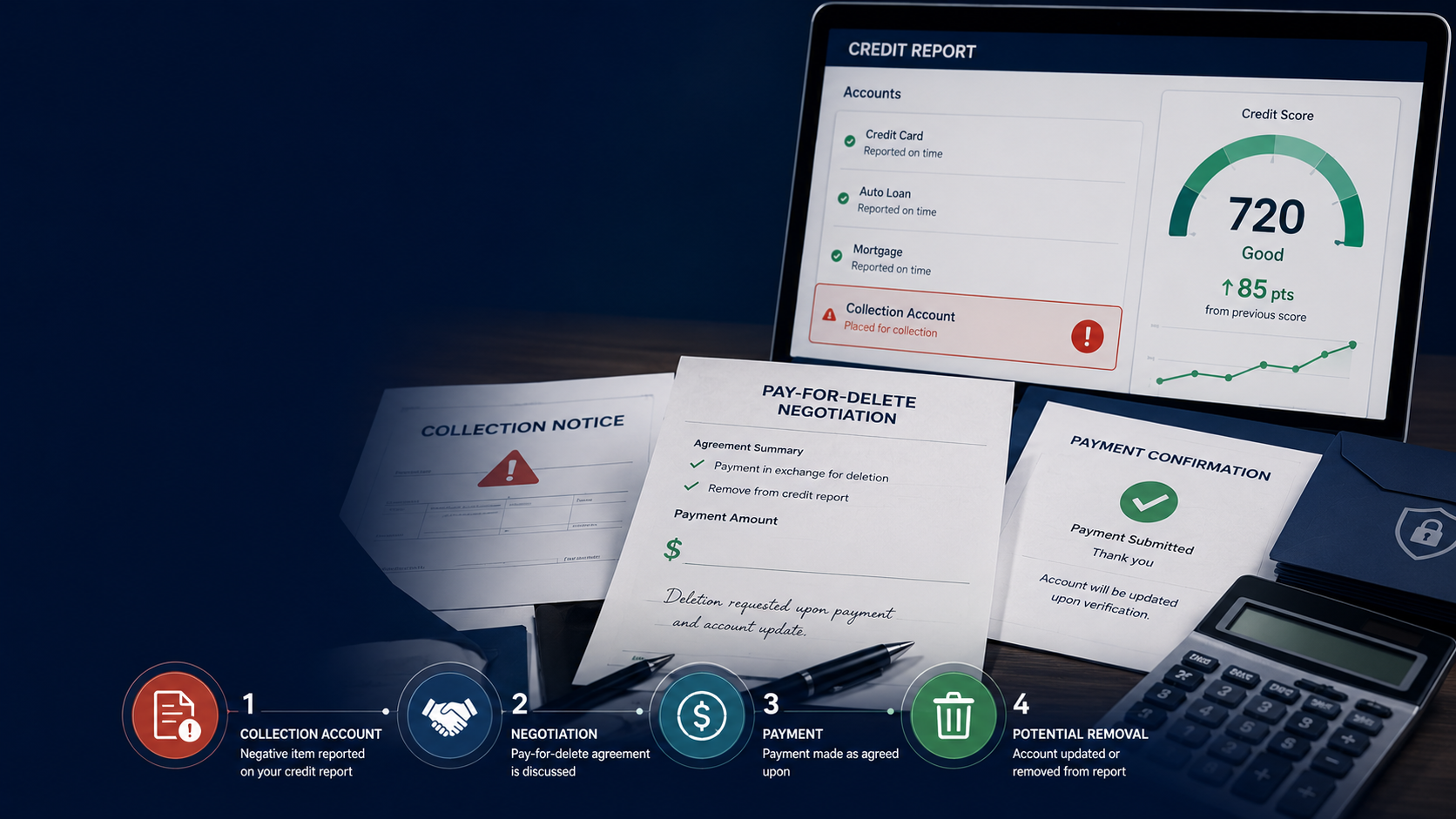
    Partially false. Paying a collection updates the status to “paid,” which is better than “unpaid,” but the collection can still remain on your report for up to seven years from the original delinquency date. Some newer scoring models (FICO 9, VantageScore 3.0+) ignore paid collections, but FICO 8 (the most widely used) still factors them in. If you’re negotiating with a collection agency, ask for a “pay-for-delete” agreement in writing — they agree to remove the entry from your report in exchange for payment. Not all agencies will agree, but it’s worth asking.

    FAQ

    1. How fast can I realistically build credit from scratch?

    With consistent, responsible use of a secured card (and ideally an authorized user account), you can expect your first FICO score in about 6 months, typically in the 670–720 range. Reaching 700+ usually takes 12–18 months, and 740+ takes 18–24 months. There is no legal, legitimate way to build a strong score in 30 days — anyone promising that is either misinformed or selling something that violates the FCRA.

    2. What’s the difference between a secured and unsecured credit card?

    A secured card requires a refundable security deposit (usually $200–$500) that becomes your credit limit. An unsecured card requires no deposit and grants you a credit limit based on your creditworthiness. Both report to the bureaus and build credit identically. Secured cards are designed for people with no or poor credit; unsecured cards typically require an established credit history.

    3. Do I need to pay interest to build credit?

    No. This is a common myth. Paying your full statement balance every month builds your score just as fast as carrying a balance — and it costs you nothing in interest. The bureaus see your on-time payment and your reported balance; they don’t see whether you paid interest. Paying in full is the optimal strategy.

    4. Can I build credit without a credit card?

    Yes, but it’s slower and less effective. Rent reporting, credit-builder loans, and authorized user status can all build credit without you personally holding a credit card. However, revolving credit (credit cards) is the most heavily weighted type of account in FICO scoring, so if you’re able to manage a secured card responsibly, it’s the single fastest tool.

    5. Will being an authorized user hurt the primary cardholder?

    No. Adding an authorized user doesn’t affect the primary cardholder’s credit score — your separate credit activity doesn’t touch their file. The only risk to the primary cardholder is financial: they’re responsible for any charges made on the AU’s card. They can eliminate this risk by adding you as an AU but never giving you the physical card.

    6. How many credit cards should I have to build credit?

    For the first 12 months, one is plenty. After that, 2–3 revolving accounts is optimal for most people — enough to show you can manage multiple lines, but not so many that you risk missed payments or high utilization. Don’t open more than one or two new accounts per year to avoid lowering your average account age.

    7. What credit score do I need to rent an apartment?

    It varies by landlord and market, but most rental applications look for 620–680+. Higher-end buildings and competitive markets may require 700+. If you don’t yet have a score, some landlords will accept alternative evidence of financial responsibility — bank statements, employment verification, previous landlord references, or a larger security deposit. Rent reporting services can help you build toward the score threshold while you search.

    8. Can credit-repair.com help me if I’m starting from scratch?

    Yes — and this is a point worth emphasizing. Credit repair isn’t only for people with negative items to dispute. If you’re starting from zero, we can pull your three-bureau reports to confirm you’re truly starting clean (sometimes there are surprise accounts), help you identify the fastest combination of credit-building tools for your specific situation, set up rent reporting and bureau monitoring, and build you a custom repair-and-build plan that maps your path from no score to 740+. Our process is FCRA-compliant and attorney-backed, which means every step is legal, ethical, and designed for long-term success — not quick fixes.

    Start With a Free Credit Audit

    Building credit from scratch is a marathon, not a sprint. But it’s a marathon with a clear course, mile markers, and a finish line you can see. The hardest part is the first six months — the stretch where you’re doing everything right and the system hasn’t started rewarding you yet. Once that first FICO appears, the compounding begins: every month of clean history adds value, every account ages, every on-time payment strengthens the 35% of your score that matters most.

    You don’t have to figure out the path alone. At credit-repair.com, we start every new client — including those with no credit history at all — with a free three-bureau credit audit. We pull your reports from Equifax, Experian, and TransUnion, identify what’s already on your file (including any errors or surprise accounts you may not know about), and build you a custom credit-building plan tailored to your goals, timeline, and budget.

    Our approach is attorney-backed and FCRA-compliant, which means every recommendation we make is grounded in federal credit law and designed for measurable, long-term progress — not quick fixes or empty promises. We educate you on the process as we go, so you understand why each step works and can maintain strong credit long after you’ve reached your target score.

    Get your free credit audit at credit-repair.com →

    Whether you’re 18 with your first job, a recent immigrant establishing a U.S. credit file, or someone who simply never needed credit until now — the fastest way to build credit is the legitimate way, done right, starting today. We’ll walk it with you.

    Disclaimer: This article is for educational purposes and does not constitute legal or financial advice. Individual credit outcomes vary based on personal financial behavior and history. credit-repair.com operates in full compliance with the Fair Credit Reporting Act (FCRA) and all applicable federal credit laws. We do not guarantee specific score outcomes or timelines.
    Get a free credit audit.

  • How to Remove Collections From Your Credit Report (the Right Way)

    How to Remove Collections From Your Credit Report (the Right Way)

    If you’re working on improving your credit beyond removing collections, these guides will help: pay-for-delete agreements with collectors, how to file a credit dispute with the bureaus, using a goodwill letter to request removal of late payments, and how to identify and fix credit report errors across all three bureaus.

    How to Remove Collections From Your Credit Report (the Right Way)

    A collection account on your credit report can feel like a permanent stain — one that follows you every time you apply for a mortgage, a car loan, an apartment, or even a new job. It drags down your score, haunts your credit history for years, and leaves you wondering whether there’s anything you can do about it besides wait.

    The good news: there is. You have real, legally grounded options for removing collections from your credit report — options that don’t rely on tricks, loopholes, or empty promises from companies that guarantee results they can’t deliver.

    In this guide, we’ll walk you through every legitimate path to collections removal, step by step. We’ll cover how collections get on your report in the first place, the difference between an original creditor and a collection agency, the four proven strategies for getting an account removed (with letter templates you can actually use), the special rules that apply to medical debt, and the common mistakes that can accidentally restart a debt or keep a negative mark on your report longer than necessary.

    No quick fixes. No guarantees. Just clear, honest, legally sound guidance from a team that does this every day.

    What Is a Collection Account?

    A collection account is a record on your credit report that shows a debt you owe has been handed over to a collection agency — either by the original creditor you stopped paying, or by a debt buyer who purchased the debt outright.

    When you fall behind on payments for a credit card, medical bill, personal loan, utility account, or similar obligation, the company you originally owed (the original creditor) may eventually give up on collecting from you directly. At that point, they typically do one of three things:

    • Assign the debt to a third-party collection agency, which tries to collect on the original creditor’s behalf
    • Sell the debt to a debt buyer for pennies on the dollar, after which the debt buyer owns it and tries to collect
    • Charge off the debt (declare it a loss on their books) while continuing to pursue collection internally or through an agency

    Once a collection agency gets involved, a new account can appear on your credit report under the collection section — separate from the original creditor’s trade line, which usually still shows the defaulted account with a “charged off” or similar status.

    It’s worth understanding this distinction early, because it affects how you approach removal. A collection is not the same as the original delinquency that caused it. You may end up dealing with two separate entries on your report for what feels like one debt.

    How Collections Get on Your Credit Report

    Collections don’t appear instantly the moment you miss a payment. There’s a timeline, and understanding it helps you know where you stand.

    Typically, the sequence looks like this:

    • You miss a payment. The original creditor reports it as 30 days late to one or more of the three major credit bureaus — Equifax, Experian, and TransUnion.
    • The late payment escalates. If you don’t catch up, the account moves to 60, 90, and then 120+ days late. Each step is reported and further damages your score.
    • The creditor charges off the account. This usually happens around 180 days of non-payment (roughly six months). The original creditor closes the account and writes it off as a loss.
    • The debt is placed with or sold to a collector. The original creditor either hires a collection agency or sells the debt to a debt buyer.
    • The collection agency reports the debt to the bureaus. A new collection account appears on your credit report.

    The key thing to know: a single missed debt can result in two negative marks on your report — the original creditor’s charge-off and the collection agency’s account. Both can hurt your score, and both need to be addressed if you want maximum improvement.

    Not all creditors report to all three bureaus, and some collection agencies only report to one or two. That’s why your reports from Equifax, Experian, and TransUnion can look different from each other. It’s also why a three-bureau audit — pulling all three reports and comparing them — is the only way to get a complete picture of what’s actually dragging your score down. Get a free credit audit.

    How a Collection Affects Your Credit Score

    A collection account is one of the most damaging entries that can appear on your credit report. The exact score impact depends on several factors, but here’s what you need to know.

    How much does a collection drop your score? It varies, but a new collection can pull a good credit score down by 60 to 100+ points. The impact is usually more severe for someone with a previously strong score (because there’s more to lose) and less severe for someone whose report already has multiple negative marks.

    What makes a collection so damaging?

    • Recency. A fresh collection hurts more than an old one. Lenders see a recent collection as evidence you’re struggling right now.
    • Severity. Larger collection balances tend to have a bigger impact, especially under newer scoring models.
    • Frequency. Multiple collections signal a pattern, not a one-time hardship.
    • The type of scoring model. FICO 8 and FICO 9 treat collections differently. FICO 9 and VantageScore 3.0+ ignore paid collections entirely, while FICO 8 still counts them — though paid collections still hurt less than unpaid ones under FICO 8.

    One important nuance: Under FICO 8 and most modern scoring models, the dollar amount of a collection doesn’t matter as much as the mere presence of one — any collection, large or small, triggers the penalty. Under FICO 9 and VantageScore 4.0, paid collections are disregarded, and medical collections have special, more lenient treatment (more on that below).

    The bottom line: a collection on your report is a serious negative, but it’s not a life sentence. As the collection ages and as you build positive credit history elsewhere, its impact shrinks. And, as we’ll cover next, there are legitimate ways to get it removed before the 7-year clock runs out.

    Original Creditor vs. Collection Agency

    To remove collections effectively, you need to understand who is reporting what — because the original creditor and the collection agency report differently, and the strategy for dealing with each is different.

    The Original Creditor’s Entry

    The original creditor — the credit card company, lender, hospital, or utility you initially owed — reports the account you opened with them. When you default, their trade line typically shows:

    • The account as charged off or closed
    • A history of late payments leading up to the charge-off
    • A balance (which may show as $0 if they sold the debt, or the full amount if they still own it)

    The original creditor’s entry stays on your report for 7 years from the date of the first delinquency that led to the charge-off. Even if the debt is sold, the original creditor’s entry usually remains, reflecting the defaulted account.

    The Collection Agency’s Entry

    The collection agency (or debt buyer) reports a separate account. Their entry typically shows:

    • The collection agency’s name
    • The original creditor’s name
    • The amount being collected (which may include fees and interest added by the collector)
    • The date the account was opened with them (the collection date, not the original delinquency date)
    • A status (open, paid, settled)

    The collection entry also stays on your report for 7 years from the date of the first delinquency — not 7 years from when the collector acquired the debt. This is a critical point we’ll return to: collectors cannot reset the clock by buying or re-aging the debt.

    Why This Distinction Matters for Removal

    Because these are two separate entries, removing the collection agency’s account doesn’t automatically remove the original creditor’s charge-off — and vice versa. To fully clean up a defaulted debt, you often need to address both:

    • The collection account with the agency (via dispute, validation, pay-for-delete, or time)
    • The original creditor’s charge-off (via dispute, goodwill, or time)

    If you only remove the collection but leave the charge-off, you’ve improved your report but not fully. A comprehensive credit repair plan looks at both entries and addresses each one appropriately. Get a free credit audit.

    The 4 Legitimate Paths to Removal

    There are four legitimate, proven strategies for removing a collection from your credit report. Each has its place, and the right one depends on the specifics of your situation — whether the debt is accurate, whether you actually owe it, whether you can afford to pay, and how old the account is.

    Let’s walk through each one in detail.

    Path 1: FCRA Dispute

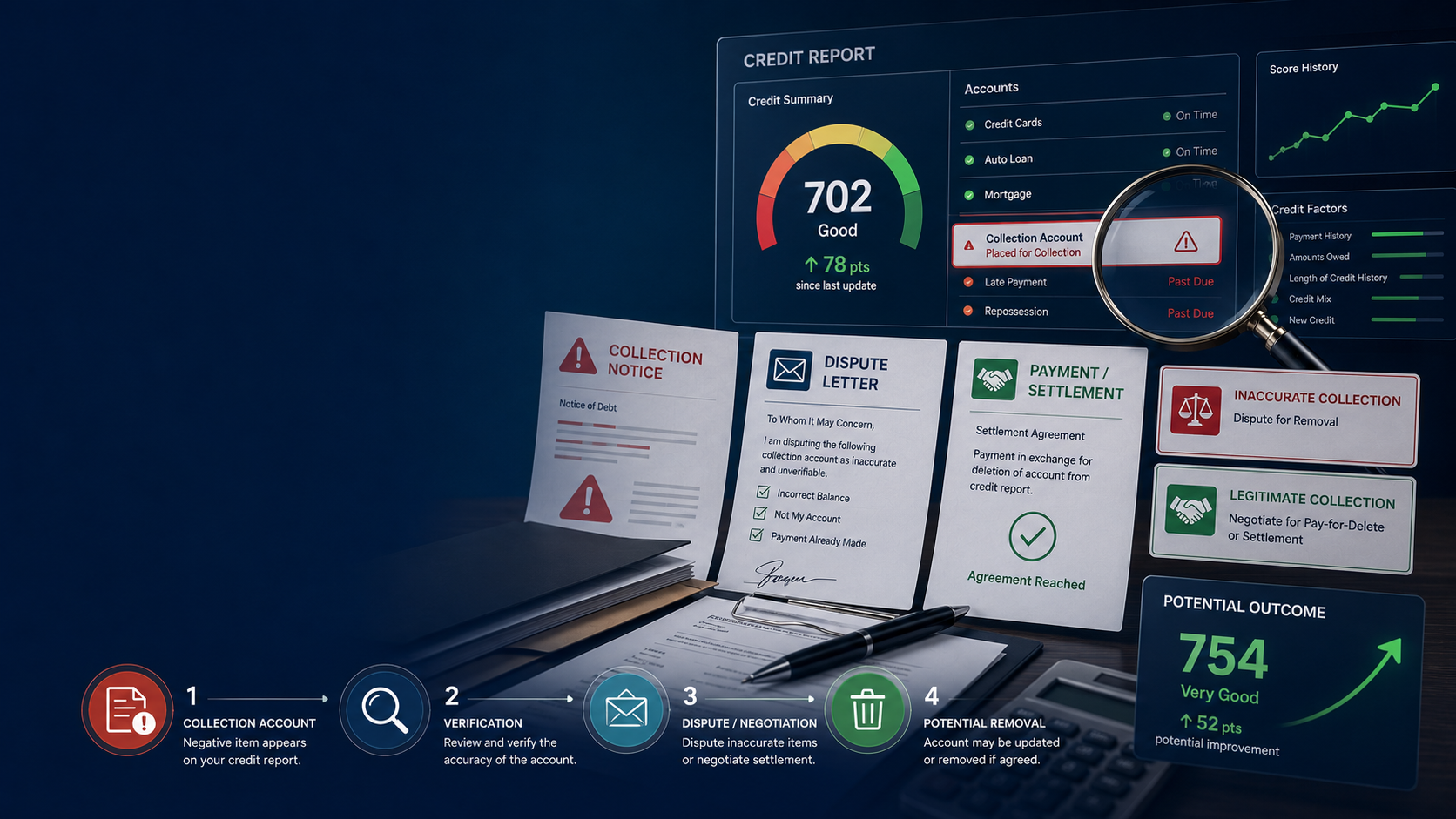
    The Fair Credit Reporting Act (FCRA) gives you the right to dispute any information on your credit report that is inaccurate, incomplete, or unverifiable. If you identify a collection entry that contains errors — or that the collector cannot prove — you can dispute it with the credit bureaus, and if it can’t be verified, it must be removed.

    This is the first and most fundamental path, and it’s grounded in federal law.

    When to use this path:

    • The collection contains factual errors (wrong amount, wrong dates, wrong account number, wrong creditor name)
    • The collection is a result of identity theft
    • The collection was already paid but still shows as unpaid
    • The collection is a duplicate (the same debt reported by multiple agencies)
    • The collection is older than 7 years and should have fallen off already
    • You genuinely don’t recognize the debt and suspect it may be reported in error

    The legal basis: Under the FCRA (15 U.S.C. § 1681i), when you dispute an item, the credit bureau must investigate, forward your dispute to the furnisher (the collection agency), and review and consider all relevant information. The furnisher must investigate and report back. If the item cannot be verified within 30 days (45 days if you dispute after receiving your free annual report), the bureau must delete it.

    Step-by-step: FCRA Dispute

    • Pull all three credit reports. Get your reports from Equifax, Experian, and TransUnion. You’re entitled to a free copy from each every 12 months at AnnualCreditReport.com. Compare the collection entries across all three — they may differ.
    • Identify the errors. For each collection, check:
    • Is the account number correct?
    • Is the original creditor name correct?
    • Is the amount accurate?
    • Is the date of first delinquency correct?
    • Is the “opened” date on the collection consistent with when the collector acquired it (and not later)?
    • Is the status accurate (e.g., does it show as unpaid when you’ve paid it)?
    • Is it a duplicate — does the same debt appear more than once, possibly from different collectors?
    • Gather evidence. Collect any documents that support your dispute — bank statements showing payment, correspondence with the original creditor, a police report if it’s identity theft, or anything that contradicts what’s on the report.
    • Draft and send dispute letters. Send a separate dispute letter to each credit bureau reporting the inaccurate item. Use the template below. Send by certified mail with return receipt so you have proof of delivery and a timestamp.
    • Wait for the investigation. The bureau has 30–45 days to investigate. They’ll forward your dispute to the collection agency, which must verify the information. If they can’t — or don’t respond in time — the item comes off.
    • Review the results. The bureau will send you the results of the investigation and an updated copy of your report if anything changed. If the item was removed, you’re done. If it was “verified” and remains, you can escalate — request the method of verification, dispute directly with the furnisher, or move on to a different strategy.

    A note on “frivolous” disputes: The bureaus can reject disputes they consider frivolous. To avoid this, be specific about what’s wrong, include evidence, and don’t dispute everything on your report at once without cause. Targeted, factual disputes are taken far more seriously than blanket “not mine” claims.

    Path 2: Debt Validation Under the FDCPA

    The Fair Debt Collection Practices Act (FDCPA) gives you a powerful right: within 30 days of a collection agency first contacting you, you can request validation of the debt. If they can’t validate it, they must stop collection activity — and in practice, many collection agencies don’t have the documentation to validate older or purchased debts, which can lead to removal.

    This is a different legal mechanism from an FCRA dispute. The FCRA is about what’s on your credit report; the FDCPA is about whether a collector can legally pursue you at all.

    When to use this path:

    • A collection agency has recently contacted you (you’re within the 30-day validation window)
    • You’re unsure whether you actually owe the debt
    • You suspect the debt amount is wrong or includes illegitimate fees
    • The debt has been sold multiple times and documentation may be lost
    • You want to force the collector to prove they have the legal right to collect

    The legal basis: Under the FDCPA (15 U.S.C. § 1692g), within five days of first contacting you, a debt collector must send you a written notice containing the amount of the debt, the name of the creditor, and a statement that you have 30 days to dispute the debt. If you dispute it (or request the name and address of the original creditor) within that 30-day window, the collector must cease collection activity until they obtain verification of the debt and mail it to you.

    Verification typically includes:

    • The amount owed
    • The original creditor’s name
    • Documentation that you owe the debt (account statements, the original agreement)
    • Proof that the collection agency has the right to collect it (assignment or purchase documentation)

    What happens if they can’t validate? If the collector can’t (or doesn’t) provide validation, they must stop all collection efforts — including reporting the debt to the credit bureaus. In practice, many collectors who can’t validate will delete the account rather than continue reporting a debt they can’t prove. Debt buyers, who purchase old debts in bulk, often lack the original documentation and are the most likely to fail validation.

    Step-by-step: Debt Validation Request

    • Send the validation letter within 30 days. The 30-day clock starts from when the collector first contacts you (or from the date of their initial written notice). Use the template below. Send by certified mail with return receipt.
    • Wait for validation. The collector must stop collection activity — including credit reporting — until they validate. There’s no strict deadline for how long they have to validate, but if they resume collection or continue reporting without having validated, they may be violating the FDCPA.
    • Review what they send. If they send meaningful documentation — account statements, the original agreement, proof of their right to collect — the debt is validated, and you’ll need to pursue a different strategy (pay-for-delete, settlement, or waiting out the clock). If they send nothing, or send only a printout with no supporting documentation, you may have grounds to push for removal.
    • Dispute with the bureaus if they report without validating. If the collector continues reporting the debt but hasn’t validated it in response to your request, you can dispute the entry with the credit bureaus, noting that the collector has failed to validate the debt as required by the FDCPA. The bureau’s investigation, combined with the collector’s inability to verify, can result in deletion.

    The 30-day window is critical. If you miss it, you can still send a validation request, but the collector isn’t legally required to stop collection activity while they respond. That said, many collectors will still respond — especially if the debt is old or poorly documented. It’s always worth trying.

    Path 3: Pay-for-Delete Negotiation

    Pay-for-delete is a negotiated agreement: you agree to pay the collection (in full or a settled amount), and in exchange, the collection agency agrees to remove the entry from your credit report.

    This is a pragmatic path for debts you acknowledge you owe and can afford to address. It’s not guaranteed — collection agencies are not required to agree — but many will, especially if you’re offering payment in full.

    When to use this path:

    • You acknowledge the debt is valid and accurate
    • You can afford to pay some or all of it
    • The debt is recent enough that waiting 7 years isn’t practical
    • You want the entry gone sooner rather than later

    The legal context: The FCRA requires that reported information be accurate — it doesn’t require that accurate information be reported. A collection agency is not legally obligated to report a collection, and they’re not legally prohibited from removing an accurate entry if they choose to. This is the gray area pay-for-delete operates in. It’s not illegal, but it’s not a right either — it’s a negotiation.

    Important honesty note: Some larger collection agencies and original creditors have policies against pay-for-delete because, in theory, it undermines the accuracy of the credit reporting system. In practice, many still do it, especially for paid-in-full offers. Don’t be surprised if some say no. If they do, you can still pay (which helps under FICO 9 and VantageScore models that ignore paid collections) and pursue goodwill deletion afterward.

    Step-by-step: Pay-for-Delete

    • Determine what you can pay. Ideally, offer payment in full — collectors are far more likely to agree to deletion for full payment than for a settled (partial) amount. If you can only settle, still try, but expect a lower success rate.
    • Get everything in writing first. Never pay based on a verbal promise. Send a pay-for-delete letter (template below) offering payment in exchange for written confirmation that they will request deletion from all three bureaus. Do not send money until you have their signed agreement in hand.
    • Review their response. If they agree in writing, proceed. If they refuse or send a counter-offer, decide whether to accept. If they won’t do pay-for-delete at all, consider whether paying without deletion is still worthwhile (it is, under newer scoring models).
    • Pay as agreed. Send payment by a trackable method (certified check, money order, or a payment method that generates a receipt). Keep proof of payment.
    • Confirm deletion. Give the agency 30–60 days to process the deletion. Then pull your reports and verify the entry is gone. If it’s not, follow up with the agency in writing, referencing your agreement. If they still don’t delete, you can dispute the entry with the bureaus, providing your pay-for-delete agreement and proof of payment as evidence that the account should no longer be reported.
    • If they won’t put deletion in writing but agree verbally, consider an alternative: pay the debt, then pursue a goodwill deletion request (covered below) citing your payment. This is a fallback, not a primary strategy, but it works often enough to be worth trying.

    A reality check on pay-for-delete: Not every collector will agree, and the ones most likely to say yes are smaller agencies and debt buyers. Original creditors (like major credit card banks) almost never agree to pay-for-delete. If your collection is with a debt buyer, your odds are better. If it’s with a major bank’s internal recovery department, plan to pursue other paths.

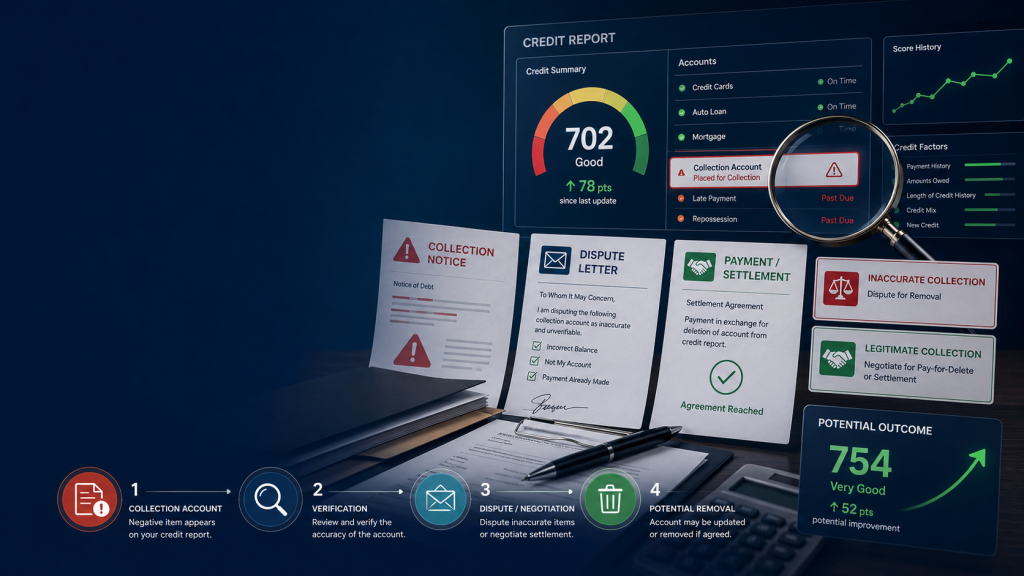
    How to remove collections from your credit report using credit dispute and removal strategies

    Path 4: The 7-Year Clock

    The fourth path is patience. Under the FCRA, a collection account can only stay on your credit report for 7 years — specifically, 7 years plus 180 days from the date of the first delinquency that led to the collection. After that, it must be removed automatically.

    This is your backstop. If the debt is accurate, can’t be validated, and the collector won’t agree to pay-for-delete, the clock is still running — and it will come off.

    When to use this path:

    • The collection is accurate and the collector has verified it
    • Pay-for-delete has been refused
    • The debt is approaching the 7-year mark
    • You’ve decided not to pay (perhaps because it’s past your state’s statute of limitations for lawsuits, and paying wouldn’t meaningfully help your score under your current scoring model)

    How the 7-year clock works:

    • The clock starts on the date of the first delinquency — the date you first missed a payment that led to the default and eventual collection. This is the Date of First Delinquency (DOFD).
    • The collection must be removed no later than 7 years + 180 days after the DOFD.
    • The clock does not reset when the debt is sold, transferred, disputed, or paid. A new collector cannot restart it by reporting a newer “opened” date.

    What to do:

    • Find the DOFD. It’s listed on your credit report, often as the “date of first delinquency” or “original delinquency date.” Each bureau may display it slightly differently, but it must be there.
    • Calculate the removal date. Add 7 years (and up to 180 days) to the DOFD. That’s when the collection should fall off.
    • Check your reports after that date. If the collection is still there, dispute it with the bureaus as “obsolete” — it’s past the reporting period and must be removed. The bureau will verify the DOFD and delete the entry.
    • Don’t let a collector re-age the debt. If a collector reports a newer “date of first delinquency” or “date opened” that extends the reporting period, that’s a violation of the FCRA. Dispute it immediately, citing the true DOFD. Re-aging is illegal, and the bureaus are required to correct it.

    Debt Validation Letter Template

    Send this letter within 30 days of a collection agency first contacting you. Send by certified mail with return receipt. Keep a copy for your records.

    [Your Name]
    [Your Address]
    [City, State ZIP]
    [Your Phone Number]
    [Your Email]
    [Date]
    
    [Collection Agency Name]
    [Collection Agency Address]
    [City, State ZIP]
    
    RE: Debt Validation Request
    Account Reference: [Account number or reference from their letter]
    Original Creditor: [Name, if known]
    Amount Claimed: [$ amount]
    
    To Whom It May Concern:
    
    I am writing in response to your [letter / phone call] dated Sat, 05 Sep 2026 17:14:42 +0000, regarding a debt you are attempting to collect. I do not admit liability for this debt, and I request that you validate it in accordance with my rights under the Fair Debt Collection Practices Act (15 U.S.C. § 1692g).
    
    Please provide the following:
    
    1. The amount of the debt, including a detailed accounting of all charges, fees, and interest added to the original balance.
    
    2. The name and address of the original creditor, and the account number associated with the original debt.
    
    3. A copy of the original signed contract or agreement that establishes my obligation to pay this debt.
    
    4. Documentation showing that you (the collection agency) have the legal right to collect this debt — including any assignment agreement, bill of sale, or other proof of ownership or authorization from the original creditor.
    
    5. A copy of the last billing statement sent to me by the original creditor.
    
    6. Proof that the statute of limitations for this debt has not expired under [your state] law.
    
    Until you provide this validation, I request that you cease all collection activity, including reporting this debt to any credit bureau, as required by the FDCPA.
    
    If you cannot validate this debt, I request that you delete any entry you have placed on my credit reports with Equifax, Experian, and TransUnion, and confirm the deletion to me in writing.
    
    This is not a refusal to pay, but a good-faith request for validation of a debt I do not recognize and have not had the opportunity to review.
    
    Sincerely,
    
    [Your Signature]
    [Your Printed Name]
    
    Enclosures: [List any documents you're including, or write "None"]
    

    What to include and why:

    • Account reference and original creditor: Identifies the specific debt so the collector can locate it in their system.
    • The specific validation requests: Forces the collector to produce real documentation, not just a printout of their own records. Debt buyers often can’t produce the original agreement or proof of purchase.
    • The cease-collection request: Invokes your FDCPA right. If they don’t validate, they must stop — including reporting.
    • The deletion request: Explicitly asks for removal if they can’t validate. Many collectors will comply rather than risk a complaint or lawsuit.
    • The “not a refusal to pay” language: Preserves your position. You’re not admitting or denying the debt — you’re asking for proof.

    Dispute Letter Template for Inaccurate Collections

    Send this letter to each credit bureau reporting the inaccurate collection. Send by certified mail with return receipt.

    [Your Name]
    [Your Address]
    [City, State ZIP]
    [Your Phone Number]
    [Your Email]
    [Date]
    
    [Equifax / Experian / TransUnion]
    [Bureau Address]
    [City, State ZIP]
    
    RE: Dispute of Inaccurate Collection Account
    Account Reference: [Collection account number as it appears on the report]
    Collection Agency: [Agency name as it appears on the report]
    Original Creditor: [Name, if shown]
    
    To Whom It May Concern:
    
    I am disputing the following item on my credit report, which I believe is inaccurate and/or incomplete. Under the Fair Credit Reporting Act (15 U.S.C. § 1681i), I am requesting that you investigate this dispute and delete the inaccurate information if it cannot be verified.
    
    The specific errors are:
    
    [Choose the ones that apply and delete the rest:]
    
    - The account number is incorrect. The correct account number is [number], not [number shown].
    - The amount is incorrect. The actual amount is [$], not [$ shown].
    - The date of first delinquency is incorrect. The correct date is Sat, 05 Sep 2026 17:14:42 +0000, not Sat, 05 Sep 2026 17:14:42 +0000. This is important because it affects the 7-year reporting period.
    - I paid this account in full on Sat, 05 Sep 2026 17:14:42 +0000. It is incorrectly showing as unpaid/with a balance.
    - I do not recognize this account and believe it may be the result of identity theft. [Include a copy of your police report or FTC identity theft report if applicable.]
    - This debt is being reported by multiple collection agencies for the same obligation, which is a duplicate and inaccurate.
    - This account is older than 7 years from the date of first delinquency (Sat, 05 Sep 2026 17:14:42 +0000) and should no longer be appearing on my report.
    
    [Attach any supporting documentation — payment records, correspondence, identity theft report, etc.]
    
    Please investigate this dispute by contacting [Collection Agency Name] and verifying the information I have challenged. If the information cannot be verified within 30 days, I request that you delete it from my credit report immediately.
    
    Please send me an updated copy of my credit report reflecting the results of your investigation, and please provide me with the method of verification if the item is confirmed.
    
    Sincerely,
    
    [Your Signature]
    [Your Printed Name]
    
    Enclosures: [List what you're attaching]
    

    What to include and why:

    • Specific, factual errors: The bureau needs to know exactly what you’re challenging. Vague disputes get dismissed as frivolous.
    • Supporting evidence: Anything you can attach strengthens your case. If you paid, attach proof of payment. If it’s identity theft, attach the FTC or police report.
    • The method-of-verdict request: Asking how the bureau verified (if they confirm the item) gives you grounds to challenge the adequacy of their investigation — which can matter if you need to escalate.
    • Certified mail: You need proof you sent it and proof they received it. The 30-day clock matters.

    Pay-for-Delete Letter Template

    Send this to the collection agency reporting the debt. Do not send payment until you have their signed written agreement.

    [Your Name]
    [Your Address]
    [City, State ZIP]
    [Your Phone Number]
    [Your Email]
    [Date]
    
    [Collection Agency Name]
    [Collection Agency Address]
    [City, State ZIP]
    
    RE: Offer of Payment in Exchange for Deletion of Credit Report Entry
    Account Reference: [Account number]
    Original Creditor: [Name]
    Current Balance: [$ amount]
    
    To Whom It May Concern:
    
    I am writing regarding the above-referenced account, which your agency is reporting on my credit file with Equifax, Experian, and TransUnion.
    
    I am willing to pay this account in full in the amount of [$ amount], or [a settled amount of $___ — if applicable], provided that your agency agrees in writing to the following:
    
    1. You will request deletion of this collection account from my credit reports with all three major credit bureaus (Equifax, Experian, and TransUnion) immediately upon receipt of payment.
    
    2. You will not re-report this account or sell or transfer the remaining balance [if settling] to any other party for collection.
    
    3. You will confirm the deletion request in writing to me at the address above.
    
    If you agree to these terms, please sign and return a copy of this letter to me at the address above. Upon receipt of your signed agreement, I will send payment within [10 / 15 / 30] days by [certified check / money order].
    
    This offer is good for 30 days from the date of this letter. If I do not receive a signed agreement within that time, this offer will be withdrawn.
    
    This is not an acknowledgment of liability for this debt, but a good-faith effort to resolve the matter and remove the negative reporting from my credit file.
    
    Sincerely,
    
    [Your Signature]
    [Your Printed Name]
    
    AGREED AND ACCEPTED:
    
    ________________________________________   ______________
    [Authorized Representative, Collection Agency]    Date
    
    ________________________________________
    Printed Name and Title
    

    What to include and why:

    • The offer is explicit: Payment in exchange for deletion. No ambiguity.
    • All three bureaus named: You want the deletion to be complete, not partial.
    • No re-reporting or resale clause: Prevents the collector from selling any remaining balance to another agency that would re-report it.
    • The signature line: You need their written agreement before you pay. A verbal “yes, we’ll delete it” is not enough — collectors routinely fail to follow through on verbal promises.
    • The 30-day expiration: Creates urgency and gives you a clean exit if they don’t respond.

    Goodwill Deletion

    If a collection is already paid — whether you paid it before discovering pay-for-delete, or you paid it as part of settling the debt — you can request a goodwill deletion. This is a request to the collection agency (or original creditor) to remove the negative entry as a goodwill gesture, citing your payment and your otherwise positive history.

    Goodwill deletion is not a right. There’s no law that requires a creditor or collector to remove an accurate, paid collection. It’s a request — and it works more often than people expect, especially when the request is well-written and the circumstances are sympathetic.

    When to use goodwill deletion:

    • The collection is paid (in full or settled)
    • You have a reason the late payment or default was out of character — a medical emergency, job loss, divorce, family death, or other hardship
    • You’ve otherwise maintained a positive payment history with the creditor (if it’s an original creditor you still have a relationship with)
    • The collection is recent enough that the creditor or collector still cares about your relationship, but old enough that it’s clearly a resolved issue

    How to write a goodwill letter:

    • Be honest and take responsibility. Don’t argue that the debt wasn’t yours.
    • Explain the circumstance that caused the default — briefly and sincerely.
    • Emphasize that you’ve since paid (or settled) and that you’ve maintained good credit habits since.
    • Ask, politely, for them to request deletion as a goodwill gesture.
    • Keep it to one page.

    Sample goodwill letter structure:

    [Your Name]
    [Your Address]
    [City, State ZIP]
    [Date]
    
    [Creditor or Collection Agency Name]
    [Address]
    
    RE: Goodwill Deletion Request
    Account: [number]
    
    To Whom It May Concern:
    
    I am writing to respectfully request a goodwill deletion of the above-referenced account from my credit reports.
    
    I fell behind on this account in [year] due to [brief, honest explanation — e.g., a medical emergency / a job loss / a family hardship]. I understand that I was responsible for the obligation, and I have since paid it in full [or settled it] on Sat, 05 Sep 2026 17:14:42 +0000.
    
    Since that time, I have worked hard to rebuild my credit and maintain on-time payments on all of my obligations. The default was an exception in an otherwise [number]-year history of responsible credit use.
    
    I am respectfully asking whether you would consider requesting that the credit bureaus delete this entry as a gesture of goodwill. I understand this is not required, and I appreciate your consideration.
    
    Sincerely,
    [Your Name]
    

    What to expect: Some creditors and collectors will say yes. Many will say no, citing policy. If the first response is no, try again in a few months — sometimes a second request, or a request routed to a different department (executive customer service, for example), gets a different answer. Persistence, paired with politeness, pays off.

    Medical Collections — Special Rules

    Medical debt gets special treatment under credit reporting rules — and the rules have changed significantly in recent years. If you have medical collections on your report, you have more options and more protections than with other types of collections.

    The Current Rules (as of 2026)

    Here’s where things stand:

    • Paid medical collections are removed. As of July 2022, paid medical collection accounts are no longer allowed to appear on your credit report. If you pay a medical collection, it must be removed — not just marked as paid, but deleted entirely. If a paid medical collection is still showing, dispute it with the bureaus and cite the rule; it will be removed.
    • Unpaid medical collections have a 1-year waiting period. As of July 2023, medical collection accounts do not appear on your credit report until one year (365 days) after the original delinquency. This gives you a full year to work with the provider, set up a payment plan, dispute the bill, or resolve insurance issues before it ever touches your credit. Before this change, the waiting period was 6 months.
    • Medical collections under $500 are excluded. As of April 2023, medical collection accounts with an original balance of less than $500 are excluded from credit reports entirely. If a small medical bill was sent to collections, it should not appear on your report at all.
    • The major bureaus have removed most older medical collections. Equifax, Experian, and TransUnion have collectively removed billions in medical debt from consumer reports as part of these reforms. If you had medical collections that are now covered by the new rules, they may already be gone.

    What This Means for You

    If you have medical collections:

    • Check if it should even be there. If it’s under $500, if it’s paid, or if it’s been less than a year since the delinquency, it should not be on your report. Dispute it.
    • If it’s unpaid and over $500 and over a year old, consider paying it. Because paid medical collections must be removed, paying a medical collection is the most straightforward path to deletion — more reliable than pay-for-delete negotiations. Contact the provider or the collection agency, set up payment (or a payment plan), and once it’s paid, the entry should come off. If it doesn’t within 30–60 days, dispute it with the bureaus citing the paid-medical-removal rule.
    • Dispute medical billing errors. Medical bills are notoriously error-prone. If the amount is wrong, if insurance should have covered it, or if the billing is duplicated, dispute it — both with the provider and, if it’s on your credit report, with the bureaus.
    • Negotiate with the provider. Many hospitals and providers offer financial assistance programs, charity care, or discounts for uninsured patients. If you qualify, the bill may be reduced or eliminated — and if it’s already in collections, a resolved bill can be pulled back.
    • Don’t ignore medical bills hoping they’ll go away. The 1-year grace period is a window to resolve them — not a reason to do nothing. Once the year passes and the collection appears, it will hurt your score like any other collection until it’s paid or falls off after 7 years.

    A Note on Accuracy

    The rules above are the current federal and industry standards as of 2026. Credit reporting rules do evolve — the CFPB has continued to push for further medical debt reporting restrictions. Always check your current reports to see what’s actually showing, and dispute anything that doesn’t match the rules in effect.

    How Long Collections Stay on Your Report

    The general rule is simple: a collection account stays on your credit report for 7 years (technically 7 years plus 180 days) from the date of first delinquency — the date you first missed the payment that led to the default.

    After that period, the credit bureaus are required to remove the collection automatically.

    The Key Dates to Understand

    • Date of First Delinquency (DOFD): The date you first missed a payment that led to the charge-off and collection. This is the anchor date. It does not change.
    • Charge-off date: When the original creditor wrote off the account — usually ~180 days after the DOFD. This is not the date that starts the 7-year clock.
    • Collection “opened” date: When the collection agency acquired the debt. This is also not the date that starts the clock, even though it may appear on the report as the account “open date.”

    The 7-year clock runs from the DOFD — not from the charge-off, not from when the collector acquired the debt, and not from the last activity on the account.

    How to Find Your DOFD

    Your credit report should list the date of first delinquency. Each bureau may label it slightly differently:

    • Equifax: “Date of First Delinquency”
    • Experian: “Original Charge-off Date” or “First Delinquent Date”
    • TransUnion: “Original Delinquency Date” or “First Delinquent Date”

    If the DOFD isn’t clearly shown, you can request it from the bureau. They are required to provide it.

    What Happens at the 7-Year Mark

    The collection should fall off automatically. You don’t need to do anything — but you should check your reports after the removal date to confirm it’s gone. If it’s still there:

    • Dispute it with the bureau as obsolete — past the maximum reporting period.
    • The bureau will verify the DOFD and remove the entry.
    • This is one of the most straightforward disputes to win, because the rule is clear and the date is a matter of record.

    Does Paying a Collection Restart the 7-Year Clock?

    No. This is one of the most persistent myths in credit repair, and it’s false.

    Paying a collection does not restart the 7-year reporting period. The clock is fixed to the date of first delinquency, and nothing you do — paying, settling, disputing, or making a partial payment — moves that date.

    What can happen, and what probably feeds the myth:

    • A new “date of last activity” or “date of last payment” may update on the report. This can make the account look more recent to anyone reading the report manually, but it does not change the DOFD or extend the reporting period.
    • The statute of limitations for a lawsuit can restart. This is a separate legal clock from the credit reporting clock. In many states, making a payment or even acknowledging a debt in writing can restart the statute of limitations — the period during which a creditor can sue you to collect. This is a different issue from how long the collection stays on your credit report.

    The distinction matters:

    • Credit reporting period (FCRA): 7 years from DOFD. Not affected by payment. Federal law.
    • Statute of limitations (state law): The period during which you can be sued for the debt. Varies by state (typically 3–6 years for most consumer debts). Can be restarted by payment or written acknowledgment in many states.

    If a debt is past your state’s statute of limitations, paying it won’t restart the credit reporting clock — but it could restart the lawsuit clock. If you’re in that situation, think carefully before making a payment on an old, time-barred debt.

    Do Collections Hurt Less as They Age?

    Yes. The impact of a collection on your credit score diminishes over time.

    Credit scoring models are designed to weight recent activity more heavily than old activity. A collection from two months ago hurts a lot more than a collection from four years ago. Here’s why:

    • Recency is a major factor. Scoring models interpret a recent collection as evidence of current financial difficulty. An old collection is seen as a past problem that you’ve (presumably) moved past.
    • Time since the negative event is built into the model. As months and years pass, the collection’s weight in the score calculation decreases.
    • New positive information dilutes the negative. As you add on-time payments, new accounts in good standing, and lower balances, the collection becomes a smaller and smaller part of your overall credit profile.

    Practical Implications

    • If a collection is 5–6 years old, it’s already hurting your score much less than it did at year one. If you’re close to the 7-year mark, and the collector won’t agree to pay-for-delete, it may be worth simply waiting for it to fall off rather than paying — especially if paying won’t change its status under your scoring model.
    • If a collection is recent, it’s doing maximum damage. This is where active removal strategies (dispute, validation, pay-for-delete) have the most potential to help your score.
    • Adding positive history matters. While you’re working on removal, also focus on what you can control: making all current payments on time, keeping credit card balances low relative to limits, and avoiding new negative marks. The combination of removing negatives and adding positives is what produces real score improvement.

    Settling vs. Paying in Full

    If you’ve decided to pay a collection, you have two options: pay it in full or settle for less than the full amount. Each has implications.

    Paying in Full

    • Credit report impact: The collection will be updated to show “paid” status. Under FICO 8, it still hurts (paid collections are still counted), but less than unpaid. Under FICO 9 and VantageScore 3.0+, paid collections are ignored entirely.
    • Lender perception: Some lenders (especially mortgage lenders) prefer to see debts paid in full. A settled account may raise questions in manual underwriting.
    • Collector cooperation: Collection agencies are more willing to agree to pay-for-delete when you pay in full.

    Settling

    • Credit report impact: The collection shows as “settled” or “settled for less than full balance.” Under FICO 8, it still counts as a collection. Under FICO 9 and VantageScore, paid (including settled) collections are ignored.
    • Cost: You pay less — often 40–70% of the balance, depending on the age of the debt and the collector’s willingness.
    • Potential tax consequence: Forgiven debt over $600 may be reported as taxable income by the original creditor (on a Form 1099-C). You may owe income tax on the forgiven amount. This doesn’t apply if you were insolvent at the time of settlement, or in certain other exceptions — check with a tax professional.
    • Collector cooperation: Some collectors will agree to pay-for-delete on a settlement, especially debt buyers who paid very little for the debt. Others won’t.

    Which Is Better?

    It depends on your goals:

    • If you’re applying for a mortgage soon, paying in full is generally safer — many mortgage lenders want to see collections paid in full, and some require it as a condition of approval.
    • If you’re focused on score improvement under modern models (FICO 9, VantageScore), paying in full vs. settling makes less difference — both result in the collection being disregarded.
    • If you’re pursuing pay-for-delete, paying in full gives you stronger leverage.
    • If budget is the primary constraint, settling is far better than leaving the collection unpaid — a settled collection is still an improvement over an open one.

    One caution: Never accept a settlement over the phone without getting the terms in writing first. Get a settlement letter from the collector specifying the agreed amount and confirming that payment of that amount will satisfy the debt in full. Pay by a trackable method, and keep proof of payment indefinitely.

    What NOT to Do

    When you’re trying to remove collections, some actions can make your situation worse. Here’s what to avoid.

    1. Don’t Acknowledge the Debt Carelessly

    If a debt is old and may be past your state’s statute of limitations, do not:

    • Agree on the phone that you owe it
    • Make a partial payment “to show good faith”
    • Promise to pay later
    • Send a letter saying “I know I owe this but I can’t pay right now”

    In many states, any of these can restart the statute of limitations — reopening the window during which you can be sued for the debt. If you’re not sure whether a debt is time-barred, get advice before you communicate with the collector.

    2. Don’t Pay Old Debts Blindly

    Paying an old, time-barred debt (one past your state’s statute of limitations) is often a poor financial decision:

    • It won’t improve your score under FICO 8 (the collection still counts, paid or not)
    • It won’t restart the credit reporting clock, but it may restart the lawsuit clock
    • The collector, who paid pennies for the debt, gets paid — and you get little or no benefit

    Before paying an old collection, check:

    • Is it past the statute of limitations in your state? If so, you’re legally protected from being sued — and paying gives up that protection for no score benefit.
    • Is it close to the 7-year reporting limit? If so, it may be worth waiting for it to fall off.
    • Will paying it result in deletion (pay-for-delete, or medical debt rules)? If yes, paying makes sense. If no, think carefully.

    3. Don’t Dispute Everything on Your Report at Once

    Disputing every negative item on your report simultaneously — especially without specific reasons — is a quick way to get your disputes flagged as frivolous. The FCRA allows bureaus to reject disputes they consider frivolous or irrelevant.

    Instead:

    • Dispute specific, identifiable errors
    • Include evidence and clear explanations
    • Prioritize the items most likely to be inaccurate, unverifiable, or obsolete
    • If you have many items, work through them in batches over time

    4. Don’t Hire a Company That Makes Guarantees

    Under the Credit Repair Organizations Act (CROA), it is illegal for a credit repair company to guarantee the removal of specific items or a specific score increase. Any company that promises “we’ll remove all your collections, guaranteed” is either lying or willing to break federal law — neither is a good sign.

    Legitimate credit repair firms:

    • Explain your rights and the legal basis for their work
    • Tell you what they can and can’t do honestly
    • Don’t promise specific outcomes
    • Allow you to cancel without penalty
    • Disclose costs up front

    5. Don’t Ignore a Collection Hoping It Goes Away

    An unpaid collection doesn’t just sit on your credit report. It can:

    • Be sold to another collector (who re-reports it — though the DOFD and the 7-year clock don’t change)
    • Result in a lawsuit, if you’re within the statute of limitations
    • Lead to wage garnishment or bank account levies if the collector wins a judgment

    Ignoring a collection is a strategy only if you’re confident the debt is past the statute of limitations and you’re willing to let the 7-year clock run out. Otherwise, engage — even if that just means validating the debt and understanding your options.

    6. Don’t Restart the Clock on a Time-Barred Debt

    This bears repeating because it’s the single most common mistake. If a collector contacts you about a very old debt:

    • Do not acknowledge it
    • Do not make any payment
    • Do not agree to a payment plan
    • Send a validation request instead — this forces them to prove the debt and pauses collection activity

    If the debt is past the statute of limitations, they cannot legally sue you. But if you restart the clock, that protection can vanish.

    Common Mistakes to Avoid

    Beyond the “what not to do” list above, here are common mistakes people make when attempting to remove collections:

    Mistake 1: Not Pulling All Three Reports

    Collections don’t appear on all three bureaus’ reports uniformly. A collection may show on Experian and TransUnion but not Equifax — or may show different balances or dates on each. If you only pull one report, you’re working with incomplete information.

    Fix: Always pull all three. Compare them. Address each bureau separately.

    Mistake 2: Disputing Without Evidence

    A dispute that says “this isn’t mine” with no supporting documentation is easy for a collector to verify (they just confirm the account is in their system) and easy for a bureau to dismiss. A dispute that says “this account shows a balance of $1,200, but I paid it in full on March 15, 2024 — here’s the receipt and the collector’s paid-in-full letter” is much harder to reject.

    Fix: Gather evidence before you dispute. Attach it to your dispute letter.

    Mistake 3: Not Following Up

    The FCRA gives bureaus 30–45 days to investigate. If you don’t follow up after that window, you may never know the result — and the item may remain even if the investigation found in your favor but wasn’t properly processed.

    Fix: Mark your calendar for 45 days after you send a dispute. If you haven’t received results, follow up in writing. Keep a paper trail of every letter you send and receive, with dates.

    Mistake 4: Paying Before Getting Deletion in Writing

    This is the pay-for-delete version of “don’t restart the clock.” If a collector says “pay us and we’ll delete it” but won’t put it in writing, and you pay — the entry often gets updated to “paid” but stays on your report. You’ve spent the money without getting the benefit you wanted.

    Fix: No signed written agreement, no payment. Period.

    Mistake 5: Not Understanding Which Scoring Model Matters

    Different lenders use different scoring models. A mortgage lender may use FICO 8 or an older FICO model. A credit card company may use FICO 8 or FICO 9. An auto lender may use a FICO Auto Score. The model determines whether paid collections count (FICO 8: yes; FICO 9: no).

    Fix: If you’re preparing for a specific application (mortgage, auto, credit card), ask the lender which scoring model they use — or work with a credit professional who can tell you. This informs whether paying a collection (vs. pursuing deletion) is worth it for your situation.

    Mistake 6: Believing “Credit Repair” Can Remove Accurate Information

    If a collection is accurate, verifiable, and within the 7-year reporting period, no one — not you, not a credit repair company, not a lawyer — can force its removal. The best you can do is negotiate (pay-for-delete, goodwill) or wait (the 7-year clock). Anyone who tells you otherwise is selling something.

    Fix: Be realistic. Focus your energy on the items that genuinely have errors, can’t be validated, or are old enough to come off. For the rest, pursue negotiation and time.

    Mistake 7: Overlooking the Original Creditor’s Entry

    As we covered, a single defaulted debt often produces two report entries: the original creditor’s charge-off and the collection agency’s account. People frequently focus on the collection (the more recent, more aggressive entry) and forget the charge-off, which continues to hurt even after the collection is removed.

    Fix: Address both. If you remove the collection, dispute or pursue goodwill on the charge-off too. A comprehensive approach produces a cleaner report.

    Frequently Asked Questions

    Can I remove a collection if it’s accurate?

    If a collection is completely accurate, verifiable, and within the 7-year reporting period, you cannot force its removal through a dispute. You can, however, pursue pay-for-delete (negotiating removal in exchange for payment) or goodwill deletion (requesting removal as a courtesy after paying). Neither is guaranteed, but both work often enough to be worth trying. You can also let the 7-year clock run — the collection will fall off automatically after the reporting period expires.

    How long does a collection stay on my credit report?

    7 years (technically 7 years plus 180 days) from the date of first delinquency — the date you first missed the payment that led to the default. After that, the bureaus must remove it. Paying or settling the collection does not reset this clock. Get a free credit audit.

    Does paying a collection improve my credit score?

    It depends on the scoring model. Under FICO 8, a paid collection still hurts your score (though often slightly less than an unpaid one). Under FICO 9 and VantageScore 3.0+, paid collections are ignored entirely — so paying can result in a meaningful score jump. For medical collections, paid accounts must be removed from your report entirely, so paying a medical collection should result in its deletion.

    What’s the difference between a charge-off and a collection?

    A charge-off is an accounting action: the original creditor declares the debt a loss on their books, usually after ~180 days of non-payment. The charge-off shows on the original creditor’s trade line. A collection is what happens when the debt is handed to or sold to a third-party collector, who then reports a separate account. A single defaulted debt can produce both entries on your report.

    Can a collection be removed before 7 years?

    Yes, through:

    • FCRA dispute (if the entry is inaccurate or can’t be verified)
    • Debt validation (if the collector can’t produce documentation under the FDCPA)
    • Pay-for-delete (negotiated removal in exchange for payment)
    • Goodwill deletion (requested removal after payment, especially for hardship situations)
    • Medical debt rules (paid medical collections and those under $500 must be removed)

    Should I pay a collection that’s past the statute of limitations?

    Generally, no — unless paying it will result in deletion (pay-for-delete agreement in writing, or medical debt). Paying a time-barred debt won’t improve your FICO 8 score (the collection still counts), but it can restart the statute of limitations in many states, reopening your risk of being sued. If the debt is both past the statute of limitations and approaching the 7-year reporting limit, waiting for it to fall off is often the best move.

    How do I find out if a collection is on my report?

    Pull your credit reports from all three bureaus. You’re entitled to a free copy from each every 12 months at AnnualCreditReport.com. Review the “collections” or “account history” section of each report. You can also use a credit monitoring service to see ongoing changes. Get a free credit audit.

    What if I don’t recognize the collection at all?

    If you don’t recognize a collection, it may be:

    • A debt you forgot about
    • A debt from identity theft
    • A reporting error
    • A debt that was sold and re-reported under a new collector’s name

    Request debt validation from the collector (if they’ve contacted you) and dispute the entry with the credit bureaus. If it’s identity theft, file a report with the FTC at IdentityTheft.gov and your local police, then use that report to dispute the entry — the FCRA has specific provisions for identity theft victims, including blocking information from your report.

    Get a Free Credit Audit

    Removing collections from your credit report is possible — but the right approach depends on the specifics of your situation. What’s on your report, which bureau is reporting it, whether the debt is accurate, how old it is, and what type of debt it is all determine which strategy will work best.

    You don’t have to figure it out alone.

    At , we offer a free, no-obligation three-bureau credit audit. We pull all three of your credit reports, identify every collection and negative mark, and give you a clear, honest assessment of:

    • Which items can be disputed and on what grounds
    • Which items are candidates for debt validation
    • Which collectors are likely to agree to pay-for-delete
    • Which items are approaching the 7-year removal date
    • A custom repair plan tailored to your goals

    We’re a San Diego-based, FCRA-compliant, attorney-backed credit repair firm. We don’t guarantee specific results, because no honest firm can. What we do guarantee is that we’ll work your case using every legitimate, legally grounded strategy available — and we’ll keep you informed at every step.

    We believe in transparency, legal compliance, and measurable progress. We don’t just fix your credit — we equip you with the knowledge to keep it strong for life.

    Get a free credit audit.

    This article is for educational purposes and is not legal advice. Credit reporting rules and state laws change; always verify current rules and consult a qualified professional for guidance on your specific situation.

  • Pay-for-Delete Explained: Does It Really Work?

    Pay-for-Delete Explained: Does It Really Work?

    You opened your credit report and there it is — a collection account staring back at you, dragging down your score and making every credit application feel like an uphill battle. Maybe it is a medical bill that slipped through the cracks during a chaotic year. Maybe it is an old credit card balance that went to collections before you had a chance to catch your breath. Whatever the origin, the question sitting in the back of your mind is the same one thousands of people ask every month: Can I just pay this off and make it disappear from my credit report?

    That question leads you to a concept called pay-for-delete. It sounds almost too good to be true — you pay the debt, the creditor or collection agency removes the negative mark from your credit report, and your score begins to recover. And in some cases, that is exactly what happens. But in many other cases, the process is far messier, the outcome far less certain, and the risks far less obvious than the blog posts and forum threads make it seem.

    This guide walks you through everything you need to know about pay-for-delete: what it is, how it works conceptually, the honest truth about why it is not guaranteed, when it is most likely to succeed, and a step-by-step approach for attempting it the right way — including a full letter template you can adapt to your own situation. We will also compare pay-for-delete to goodwill deletion and to FCRA-based disputing, so you know which tool to reach for and when. Along the way, we will be straight with you about the risks, the tax implications of settling for less than you owe, and what to do when a creditor simply says no.

    If you are reading this because you are staring down a collection and feeling overwhelmed, take a breath. You are not alone, and you are not out of options. Understanding the landscape is the fIRSt step toward reclaiming your financial footing — and that is exactly what we are here to help you do.

    What Is Pay-for-Delete and How Does It Work?

    At its core, pay-for-delete is a negotiated agreement between you and a creditor or collection agency. The premise is straightforward: you agree to pay some or all of an outstanding debt, and in exchange, the creditor agrees to remove the corresponding negative entry from your credit reports at all three major bureaus — Equifax, Experian, and TransUnion.

    To understand why this is even a conversation worth having, it helps to understand how a collection ends up on your credit report in the fIRSt place. When a debt goes unpaid for a sustained period — typically 90 to 180 days past due, depending on the creditor — the original creditor may charge off the account and either assign it to an internal collections department or sell the debt to a third-party collection agency. That agency then reports the account to the credit bureaus as a collection, which appears as a serious negative mark on your report. This mark can stay on your report for up to seven years from the date of the original delinquency, and it can significantly lower your credit score depending on how recent it is, how large it is, and what the rest of your credit profile looks like.

    The key insight behind pay-for-delete is this: creditors and collection agencies are not legally required to report a debt to the credit bureaus. Reporting is voluntary. The Fair Credit Reporting Act (FCRA) governs what must happen once something is reported — it must be accurate, it must be removable if inaccurate, and it must age off after the statutory period. But the decision to report in the fIRSt place, or to continue reporting, is a business decision made by the furnisher. Pay-for-delete exploits that gap. Because reporting is voluntary, a furnisher can agree to stop reporting as part of a negotiated settlement. There is no federal law that says they must keep reporting once they have started, just as there is no federal law that compels them to report in the first place.

    Here is how the process typically unfolds in practice:

    • You identify the collection on your credit report and confirm it is legitimate and within the statute of limitations.
    • You contact the creditor or collection agency — in writing, ideally — and propose a pay-for-delete arrangement: if you pay a specified amount (sometimes the full balance, sometimes a negotiated percentage), they agree to remove the collection from your credit reports entirely.
    • The creditor responds — they may accept, counter with different terms, refuse outright, or simply not respond at all.
    • If they accept, you get the agreement in writing before sending any money. This is non-negotiable. A verbal promise over the phone is not worth the paper it is not written on.
    • You pay according to the written terms — typically by a method that creates a paper trail, such as a cashier’s check or money order, rather than giving the collector direct access to your bank account.
    • The creditor requests removal from the credit bureaus. This is not instantaneous — the bureaus update on their own cycles, and you should expect 30 to 60 days before the deletion reflects on your reports.
    • You verify by pulling your credit reports after 30 to 45 days and confirming the collection is gone. If it is not, you follow up with the creditor and, if necessary, dispute the item using your written agreement as evidence.

    That is the clean version. In reality, the conversation is often messier, the responses less predictable, and the outcomes less certain than a simple step list suggests. And that uncertainty brings us to the most important thing this guide can tell you.

    The Honest Truth: Why Pay-for-Delete Isn’t Guaranteed

    If you have read this far, you already know the upside of pay-for-delete. Now we need to talk honestly about the downside, because any source that tells you pay-for-delete is a sure thing is not telling you the full story.

    The fundamental reason pay-for-delete is not guaranteed is that no creditor or collection agency is required to agree to it. The credit reporting system is built on voluntary furnishing. Just as furnishing is voluntary, so is the decision to stop furnishing. A creditor can simply say no — and many do. There is no statute, no regulation, and no enforcement mechanism that compels a furnisher to delete an accurate, verifiable tradeline simply because you paid it. In fact, under the agreements furnishers sign with the credit bureaus, they are generally expected to report accurately and completely. Deleting an accurate account in exchange for payment sits in tension with that expectation.

    Here is where the industry dynamics get important. The three major credit bureaus — Equifax, Experian, and TransUnion — have historically discouraged pay-for-delete arrangements. Their position is that credit reports should reflect an accurate history of a consumer’s borrowing behavior, and that allowing negative marks to be bought off undermines the integrity of the scoring system. The bureaus’ agreements with furnishers (the collection agencies and creditors who supply data) typically require that reported information be accurate and that furnishers not manipulate the reporting system. Major industry players, including the three bureaus and FICO, have spoken about the practice in terms that range from skeptical to openly critical. Reporting by outlets such as The New York Times and statements from FICO have highlighted how creditors are discouraged from participating in pay-for-delete, and how some furnisher agreements explicitly prohibit removing accurate, verifiable information in exchange for payment.

    What this means in practice is that many large creditors and collection agencies have internal policies against pay-for-delete. They may refuse the request outright, or they may offer a compromise — updating the account status to “paid” or “paid in full” or “settled for less than full balance” — without actually removing the tradeline from your report. That update can still be helpful for your score over time (a paid collection is generally viewed more favorably than an unpaid one), but it is not the same as deletion, and it will not produce the same score recovery.

    It is also worth being honest about the incentives at play. A collection agency that has purchased your debt for pennies on the dollar has a strong financial incentive to recover something, and that incentive can sometimes outweigh their reluctance to agree to a deletion. But an original creditor — say, a major bank that still holds your charged-off credit card — has little incentive to agree to pay-for-delete. They have already taken the loss, the account may have been sold, and they are not going to recover meaningful money by negotiating removal with you. Their policies, shaped by bureau agreements and internal compliance, typically steer them toward refusing.

    So when you read about pay-for-delete online, keep this framing in mind: it is a negotiation, not a right. It works sometimes, with some furnishers, under some circumstances. It is not a guarantee, it is not a loophole, and anyone who promises you it will work is either misinformed or trying to sell you something. The rest of this guide is about maximizing your chances within that honest frame — and knowing when to pivot to other strategies when pay-for-delete is not on the table.

    When Pay-for-Delete Is Most Likely to Work

    Not all creditors are created equal when it comes to pay-for-delete. Your odds of success depend heavily on who holds the debt, what kind of debt it is, and how old it is. Understanding these variables helps you focus your energy where a payoff is realistic and avoid wasting time on furnishers who almost never agree.

    Smaller creditors and local businesses. Independent landlords, small medical providers, local utilities, and regional creditors are often more flexible than national banks. They are less likely to be bound by the strict furnisher agreements and internal compliance policies that govern the major players. A small medical clinic that reported you to collections may be perfectly willing to accept payment and request removal — they care about getting paid, not about the integrity of the national credit scoring system. These are the furnishers where a polite, well-written pay-for-delete letter can genuinely move the needle.

    Medical bills and medical collections. Medical debt occupies a somewhat unique space in the credit reporting ecosystem. In recent years, the three bureaus have implemented changes that treat medical collections more leniently than other types — including extended waiting periods before medical collections appear on reports (up to one year as of recent policy changes) and the removal of paid medical collections from credit reports. This means that simply paying a medical collection may, under current bureau policies, result in its removal from your report without an explicit pay-for-delete negotiation. That said, the landscape for medical debt reporting continues to evolve, and it is still worth confirming what appears on your reports after payment. If a medical collection does not come off automatically after payment, a pay-for-delete request directed at the provider or the collection agency is often well-received.

    Older debts. The older a collection is, the less impact it has on your credit score — FICO scoring models weight recent negative information more heavily. But older debts are also less valuable to the collection agency that holds them, especially if the debt is approaching the seven-year reporting limit. A collection agency holding a five-year-old debt that is about to age off your report anyway has diminishing leverage. They may be more willing to accept a pay-for-delete offer — or a discounted settlement — because recovering some money before the reporting window closes is better than recovering nothing. This is not a guarantee, but the age of the debt genuinely shifts the math in your favor.

    Debts held by collection agencies rather than original creditors. When a debt is sold to a third-party collection agency, the original creditor has already written it off and moved on. The agency that purchased the debt paid a fraction of its face value and is primarily interested in recovering more than they paid. This creates room for negotiation that does not exist when you are dealing with the original creditor. Collection agencies — especially smaller, regional ones — are historically the furnishers most likely to entertain pay-for-delete proposals, because their business model is built on recovery, not on maintaining a long-term reporting relationship with the bureaus.

    Smaller dollar amounts. A collection agency chasing a $150 unpaid utility bill has less to lose by removing the tradeline than one chasing a $15,000 defaulted auto loan. For smaller debts, the administrative cost of continuing to report — and the modest recovery involved — can make a pay-for-delete agreement feel like a reasonable resolution to the furnisher. This is not a hard rule, but as a general tendency, smaller balances are more amenable to negotiation.

    Debts you can pay in a single lump sum. Furnishers prefer certainty. An offer to pay the full amount (or a substantial percentage) in one payment, immediately, is more attractive than a payment plan stretched over months. If you have the funds to make a lump-sum offer — especially if it is close to the full balance — you are in a stronger negotiating position than someone asking to pay in installments.

    In short, the sweet spot for pay-for-delete is: a smaller or older debt, held by a collection agency or small creditor, ideally a medical bill or utility account, where you can offer a lump-sum payment. The further your situation drifts from that profile, the lower your odds — and the next section explains where the odds fall hardest.

    When Pay-for-Delete Rarely Works

    Just as some furnishers are open to pay-for-delete, others are known for refusing it as a matter of policy. Knowing who these furnishers are saves you from chasing a door that is almost never going to open.

    Major banks and national credit card issuers. Large national banks — the ones issuing the majority of credit cards in the United States — are the furnishers least likely to agree to pay-for-delete. Their reporting practices are governed by strict internal compliance policies and by the agreements they sign with the credit bureaus, which generally require accurate and complete reporting of account history. A major bank that has charged off your credit card is not going to remove that charge-off from your report just because you pay it. They may update the status to “paid” or “paid, was a charge-off,” but the negative mark itself will remain for the remainder of the seven-year reporting period. Attempting pay-for-delete with a major bank is, in most cases, an exercise in frustration.

    Credit cards already charged off. Once a credit card account has been charged off — meaning the creditor has written it off as a loss on their books — the damage to your credit report is already done, and the creditor has minimal incentive to revisit it. If the account is still with the original creditor, pay-for-delete is highly unlikely. If it has been sold to a collection agency, your odds improve somewhat (see the previous section), but the tradeline from the original creditor — showing the charge-off — will typically remain on your report regardless of what the collection agency does with its own separate collection entry.

    Student loans. Federal student loans are governed by a different regulatory framework than most consumer debt, and private student loans are typically held by large institutions with strict reporting policies. Neither category of lender is known for entertaining pay-for-delete requests. In fact, for federal student loans, there are specific rehabilitation programs that can remove default notation from your report — but those are statutory programs, not negotiated pay-for-delete arrangements, and they have their own requirements and timelines. If you are dealing with defaulted student loans, the rehabilitation pathway is almost always more productive than a pay-for-delete request.

    Auto loans and repossessions. Auto loans that have resulted in repossession, and the deficiency balances that often follow, are typically held by large lenders or their designated collection agents. These furnishers rarely agree to pay-for-delete. The deficiency balance from a repossession is a significant, documented debt, and the lenders involved tend to follow strict reporting policies.

    Furnishers with explicit anti-pay-for-delete policies. Some collection agencies — particularly larger, national ones — have publicly stated or internally enforced policies against pay-for-delete. They may frame this as a commitment to accurate reporting or as compliance with bureau agreements. If you encounter a furnisher that refuses on these grounds, pushing harder is unlikely to change the outcome. Your energy is better spent on alternative strategies, which we cover later in this guide.

    Recently reported, large-dollar collections with major furnishers. A fresh, large collection with a major furnisher is the worst-case scenario for pay-for-delete. The furnisher has every incentive to keep reporting (the debt is recent and significant), they are likely bound by policies that discourage deletion, and they have little motivation to negotiate removal when they can continue pursuing collection through other channels.

    The takeaway is this: do not assume pay-for-delete is universally available. It is a tool that works in specific situations with specific furnishers. When your situation does not fit the profile where pay-for-delete tends to succeed, you are better off exploring goodwill deletion, FCRA-based disputes, or simply letting the negative mark age off while you build positive credit history in the meantime. All of those strategies are covered below.

    Step-by-Step: How to Attempt Pay-for-Delete the Right Way

    If you have read the previous sections and concluded that your situation fits the profile where pay-for-delete has a realistic chance, here is how to approach it carefully, methodically, and in a way that protects you at every step. The order matters — skipping steps, especially the verification and written-agreement steps, is where most people get burned.

    Step 1: Verify the Debt

    Before you contact anyone about paying a collection, confirm that the debt is legitimate, that the amount is correct, and that the collection agency contacting you actually has the legal right to collect it. Debt buyers purchase portfolios of debt, and the chain of ownership is not always clean. You have the right, under the Fair Debt Collection Practices Act (FDCPA), to request debt validation from a collection agency within 30 days of their initial contact with you. Even if that 30-day window has passed, you can still request verification — and many agencies will provide it, especially if you are signaling a willingness to pay.

    Send a written debt validation request (sent via certified mail with return receipt) asking the agency to provide:

    • The name and address of the original creditor
    • The original account number
    • The amount owed, including an itemization of any fees or interest added
    • Proof that the agency is licensed to collect in your state (if your state requires licensing)
    • Proof that they own or are authorized to collect the debt

    If the agency cannot validate the debt, you have grounds to dispute it with the credit bureaus under the FCRA — and you should not pay anything until validation is confirmed. Paying a debt that you do not actually owe, or that cannot be legally validated, is a mistake that can be difficult to undo.

    Step 2: Check the Statute of Limitations

    Every state has a statute of limitations (SOL) on debt — the legal time limit within which a creditor can sue you to collect. These limits vary by state and by debt type (written contracts, oral contracts, open accounts, etc.), and they typically range from three to six years, though some states extend longer for certain types of debt.

    This matters for two reasons. FIRSt, if the debt is outside the statute of limitations, the creditor can no longer successfully sue you to collect — which means you have significant leverage in any negotiation, including pay-for-delete. They know they cannot compel payment through the courts, so a voluntary payment offer (even a reduced one) may be attractive to them.

    Second — and this is critical — making a payment, or even acknowledging the debt in writing, can restart the statute of limitations in some states. This is one of the most dangerous traps in debt negotiation. If you have a four-year-old debt that is one year away from passing the SOL, and you make a partial payment or send a letter acknowledging the debt, you may reset the clock entirely, giving the creditor fresh legal leverage. We cover this risk in detail later, but it is essential to understand your state’s SOL before you make any move.

    Step 3: Decide on Your Offer

    With the debt verified and the SOL understood, decide what you are offering. There are generally two paths:

    • Pay the full amount in exchange for deletion. This is the strongest offer you can make — the furnisher gets 100% of what they are owed, and in exchange they remove the tradeline. This is most effective when the debt is small enough that paying it in full is feasible.
    • Pay a reduced percentage in exchange for deletion. Collection agencies that purchased your debt for a fraction of its face value may accept a reduced settlement — often 40% to 60% of the balance — in exchange for deletion. The lower your offer, the less attractive it is, and the more likely the furnisher is to refuse deletion (or to agree to a “settled” status update rather than full deletion). If you are going to negotiate a reduced amount, start lower than your target and be prepared to meet somewhere in the middle.

    A note on strategy: some people recommend starting by offering a lower percentage and negotiating up. Others recommend offering the full amount (or close to it) to maximize the chance of deletion. The right approach depends on your budget, the size of the debt, and how much the deletion matters to you relative to the money you are spending. If the score recovery is worth more to you than the dollars, lean toward a stronger offer. If you genuinely cannot afford the full amount, a reduced settlement is still worth proposing — the worst they can do is say no.

    Step 4: Send a Pay-for-Delete Letter

    Your offer should be made in writing, not over the phone. A written letter creates a record, forces the furnisher to respond in a way you can document, and protects you from the “he said, she said” ambiguity of a phone call. We have included a full pay-for-delete letter template below — adapt it to your circumstances, fill in the specifics, and send it via certified mail with return receipt requested, so you have proof of delivery and proof that the letter was received.

    Step 5: Get the Agreement in Writing Before Paying

    This is the single most important step in the entire process, and it is the step people skip most often — to their regret. Never send money based on a verbal promise over the phone. Collection agency representatives will sometimes tell you what you want to hear to secure a payment, and those verbal assurances are extraordinarily difficult to enforce if they do not follow through.

    If the furnisher agrees to your pay-for-delete proposal — or to a counter-proposal they make — insist that they send you a written agreement, on company letterhead, specifying:

    • The exact amount you will pay
    • The payment method and deadline
    • A clear statement that, upon receipt of payment, they will request deletion of the account from all three credit bureaus (Equifax, Experian, and TransUnion)
    • The name of the account, the account number, and your identifying information

    Only after you have that written agreement in your hands — a physical or electronic document you can save and reference — do you send payment. If the furnisher refuses to put the agreement in writing, that is a signal to walk away. A furnisher that will not commit to terms in writing is not a furnisher you can trust to follow through.

    Step 6: Pay with a Paper Trail

    When you pay, use a method that creates a verifiable record. A cashier’s check or money order sent via certified mail is ideal — it does not give the collector access to your bank account, and it creates a documented paper trail. Avoid giving a collection agency your checking account number or authorizing electronic debits, even if they ask for it as a condition of the agreement. If they insist on electronic payment, consider whether the risk is worth it — and if you have a written agreement in hand, a paper check should be acceptable.

    Step 7: Verify the Deletion

    Wait 30 to 45 days after your payment clears, then pull your credit reports from all three bureaus (you are entitled to free weekly reports from AnnualCreditReport.com). Check whether the collection tradeline has been removed. If it has, the process is complete. If it has not, contact the furnisher in writing, reference your pay-for-delete agreement and proof of payment, and request that they fulfill their obligation. If they fail to act, you have grounds to dispute the item directly with the credit bureaus, attaching your written agreement and payment proof as supporting documentation. The bureaus are required to investigate disputes within 30 to 45 days, and a documented pay-for-delete agreement is strong evidence that the continued reporting is no longer appropriate.

    Pay-for-Delete Letter Template

    Below is a template you can adapt to your own situation. Replace the bracketed placeholders with your specific details, and send via certified mail with return receipt requested. This is a starting point — adjust the tone and specifics to fit your circumstances.

    [Your Name]
    [Your Address]
    [Your City, State, ZIP]
    [Your Phone Number]
    [Your Email]
    
    [Date]
    
    [Collection Agency or Creditor Name]
    [Their Address]
    [Their City, State, ZIP]
    
    RE: Account Number [Account Number from your credit report]
    Original Creditor: [Original Creditor Name]
    Balance Listed: [$ Amount]
    
    To Whom It May Concern,
    
    I am writing regarding the above-referenced account, which appears on my credit
    report with a current balance of $[Amount].
    
    I am not disputing the validity of this debt at this time. However, I would like
    to propose a resolution that benefits both parties.
    
    I am prepared to pay $[Amount you are offering — full balance or a negotiated
    percentage] as payment in full for this account. In exchange for this payment, I
    am requesting that your agency agree to remove all information regarding this
    account from my credit reports maintained by all three major credit bureaus —
    Equifax, Experian, and TransUnion — and agree not to report this account to any
    credit bureau in the future.
    
    To be clear: this is a conditional offer. I will remit the agreed-upon payment
    only after I receive a written agreement from your agency, on company letterhead,
    stating that upon receipt of the specified payment, you will request deletion of
    this account from all three credit bureaus and will not re-report it.
    
    If you accept this offer, please send a signed written agreement to the address
    above within 30 days of the date of this letter. Upon receipt of that agreement,
    I will submit payment within the timeframe specified in the agreement.
    
    If I do not receive a written response within 30 days, I will assume your agency
    does not accept this proposal, and I will explore other options for resolving
    this matter.
    
    This letter is not an acknowledgment of liability for this debt and is not a
    commitment to pay absent a written agreement from your agency. This letter is
    sent for settlement negotiation purposes only and is without prejudice to any
    rights I may have under the Fair Debt Collection Practices Act, the Fair Credit
    Reporting Act, or any other applicable federal or state law.
    
    Thank you for your consideration. I look forward to your written response.
    
    Sincerely,
    
    [Your Signature]
    [Your Printed Name]

    A few notes on using this template. FIRSt, the language about “not an acknowledgment of liability” and “without prejudice to any rights” is intentional — it helps protect you from inadvertently resetting the statute of limitations or admitting the debt in a way that could be used against you. That said, state laws vary, and if you are concerned about SOL implications, consult with an attorney before sending anything. Second, if you are offering less than the full balance, be prepared for a counter-offer. The first response may not be a yes or a no — it may be a different number. Third, keep copies of everything you send and everything you receive. If you eventually need to dispute with the bureaus or enforce the agreement, your documentation is your best evidence.

    Pay-for-Delete vs. Goodwill Deletion

    Pay-for-delete is not the only way to ask a creditor to remove a negative mark from your credit report. There is a second, softer approach called goodwill deletion (sometimes called a goodwill adjustment), and understanding the difference between the two helps you choose the right strategy for your situation.

    The core difference comes down to whether money changes hands. Pay-for-delete is a transaction: you pay the debt (or a settlement amount), and the removal is the consideration you receive in return. goodwill deletion is a request: you ask the creditor to remove a negative mark as an act of goodwill, typically because the underlying issue has been resolved (the account is paid, or you have brought it current) and you are asking them to give you a fresh start.

    When to use goodwill deletion. Goodwill letters are most appropriate when:

    • The account is already paid — you have already settled the debt, paid the collection, or brought the account current, but the negative mark is still on your report.
    • The negative mark was the result of a one-time hardship — a medical emergency, a job loss, a family crisis — and you have an otherwise strong payment history with the creditor.
    • The account is current and in good standing but has a late payment or two in its history that you would like removed.
    • You are dealing with an original creditor rather than a collection agency. Original creditors are more likely to grant goodwill adjustments than collection agencies, especially when you have a track record with them.

    When to use pay-for-delete. Pay-for-delete is more appropriate when:

    • The debt is unpaid and you are prepared to resolve it as part of the negotiation.
    • You are dealing with a collection agency that purchased the debt.
    • Goodwill has already been attempted and refused.
    • The account is not one where you have a long, positive history to leverage.

    The odds of success. goodwill deletion success rates vary widely. Some creditors grant them readily for accounts with strong history and isolated blemishes; others have strict policies against adjusting accurate reporting. The tone of your letter matters — a sincere, accountable, non-demanding letter that takes responsibility and explains the context of the hardship tends to perform better than a letter that sounds entitled or aggressive.

    The risk profile. Goodwill letters carry less risk than pay-for-delete negotiations. Because you are not negotiating a payment, there is no money changing hands and no statute-of-limitations concern. The worst outcome of a goodwill letter is a refusal — the status quo. The worst outcome of a pay-for-delete negotiation gone wrong can include restarting the SOL, acknowledging a debt you might have defended against, or paying money for a deletion that never happens.

    For many people, the right approach is to try goodwill fIRSt if the account is already paid, and to pursue pay-for-delete only if goodwill is refused or if the debt is unpaid and you are ready to resolve it. There is no rule that says you can only try one — but you should not pursue both simultaneously on the same account, as that can create confusion and contradictory records.

    Goodwill Letter Template

    If you have decided that a goodwill approach fits your situation — the account is paid or current, you have a reasonable relationship with the creditor, and the negative mark is an isolated blemish — here is a template to adapt.

    [Your Name]
    [Your Address]
    [Your City, State, ZIP]
    [Your Phone Number]
    [Your Email]
    
    [Date]
    
    [Creditor Name]
    [Creditor's Address]
    [Creditor's City, State, ZIP]
    
    RE: Account Number [Account Number]
    Account Status: [Paid in Full / Current / Settled]
    
    To Whom It May Concern,
    
    I am writing to respectfully request a goodwill adjustment to my credit report
    for the above-referenced account.
    
    I have been a customer of [Creditor Name] since [Year], and I value my
    relationship with your company. During the period of [Month/Year to Month/Year],
    I experienced [brief, honest explanation of the hardship — e.g., a medical
    emergency, a job loss, a family crisis]. This difficult period caused me to miss
    payments on this account, resulting in [late payments / a charge-off / a
    collection entry] on my credit report.
    
    Since that time, I have [brought the account current / paid the account in full
    / settled the account], and I am committed to maintaining responsible financial
    habits going forward. My account is currently [current / paid in full], and I
    have worked hard to rebuild my financial standing.
    
    I am respectfully requesting that [Creditor Name] consider removing the
    [late payments / charge-off / collection notation] from my credit report as a
    goodwill gesture. I understand that this information is accurate, and I take full
    responsibility for the missed payments. I am not disputing the accuracy of the
    reporting. I am simply asking, given the resolution of the account and my
    commitment to positive credit behavior going forward, whether your company would
    be willing to grant this adjustment.
    
    I would be grateful for any consideration you can give to this request. If you
    require any additional information from me, please do not hesitate to contact me
    at [phone number] or [email].
    
    Thank you for your time and for the opportunity to be a customer of
    [Creditor Name].
    
    Sincerely,
    
    [Your Signature]
    [Your Printed Name]

    The tone here is deliberate: accountable, grateful, and non-demanding. Creditors respond to goodwill letters that feel genuine, not to letters that sound like legal demands. Keep your explanation brief and honest — a few sentences about the hardship are enough. Do not argue, do not blame, and do not threaten. If the fIRSt letter is refused, you can try again after a few months, perhaps addressing it to a different department or executive office within the creditor’s organization.

    Pay-for-Delete vs. Disputing Under the FCRA

    Pay-for-delete and goodwill deletion are both negotiation strategies — you are asking a furnisher to do something they are not required to do. There is a third strategy that operates on entirely different legal footing: disputing under the Fair Credit Reporting Act (FCRA).

    What an FCRA dispute is. Under the FCRA, you have the right to dispute any information on your credit report that is inaccurate, incomplete, or unverifiable. When you file a dispute with a credit bureau, the bureau is required to investigate the item (typically by contacting the furnisher), and the furnisher is required to verify the accuracy of the information. If the furnisher cannot verify it, or if the investigation reveals that the information is inaccurate, the bureau must correct or delete the item — generally within 30 to 45 days.

    When an FCRA dispute is the right route. Disputing is the appropriate tool when:

    • The information on your credit report is factually inaccurate — wrong balance, wrong dates, wrong account number, wrong creditor name.
    • The information cannot be verified — the original creditor cannot locate records, the collection agency cannot produce validation, the account is too old to be on your report (past the seven-year reporting limit), or the furnisher fails to respond to the bureau’s investigation request.
    • The account is not yours — identity theft, mixed files, or a furnisher reporting an account that belongs to someone with a similar name.
    • The account was discharged in bankruptcy but is still showing as active or with a balance.
    • There are duplicate entries for the same debt.

    When an FCRA dispute is the wrong route. Disputing is not the right tool when:

    • The information is accurate and verifiable. If the collection is legitimately yours, the amount is correct, the dates are correct, and the furnisher can produce documentation, a dispute will fail. The FCRA gives you the right to have inaccurate information removed — it does not give you the right to have accurate information removed just because it is negative.
    • You have already attempted pay-for-delete or goodwill and the furnisher has refused. Filing a dispute as a “next try” after a negotiation has failed is unlikely to succeed if the information is accurate, and repeated disputes that the bureaus deem frivolous can result in your disputes being rejected without investigation.

    The strategic relationship between the two. These approaches are not mutually exclusive — in some cases, they work in sequence. For example, if you request debt validation from a collection agency and they cannot produce it, that failure becomes the basis for an FCRA dispute with the credit bureaus. If a furnisher agrees to pay-for-delete but then fails to follow through, your written agreement and payment proof become the basis for a dispute, because the continued reporting is arguably no longer verifiable in light of the settlement agreement.

    A note on “disputing everything and hoping something sticks.” This is a strategy some credit repair companies promote — filing disputes on every negative item, regardless of accuracy, in the hope that some furnishers will fail to verify and those items will be removed. This approach is risky for several reasons. FIRSt, the FCRA allows bureaus to decline to investigate disputes they deem frivolous or irrelevant, and filing blanket disputes can trigger that designation. Second, if an item is verified, it remains on your report, and the dispute activity itself does not help you. Third, some furnishers may respond to a dispute by taking additional collection action, including litigation, if the debt is within the statute of limitations. If you are going to dispute, do it surgically and with a basis — not as a scattergun approach.

    Which should you try fIRSt? If the information is genuinely inaccurate or unverifiable, an FCRA dispute is almost always the right first step — it is free, it is grounded in federal law, and the burden is on the furnisher to verify. If the information is accurate and the issue is simply that it is negative and you want it removed, negotiation strategies (pay-for-delete or goodwill) are your options — and your success depends on the furnisher’s willingness, not on a legal entitlement.

    Settling for Less Than the Full Amount: Tax Implications and Score Impact

    If you negotiate a pay-for-delete agreement for less than the full balance owed — say, you settle a $5,000 collection for $2,500 — there are two consequences you need to understand before you agree: the tax implication and the credit score impact (if the deletion does not happen).

    The 1099-C and Canceled Debt

    When a creditor forgives $600 or more of your debt, they are generally required to issue you a Form 1099-C, Cancellation of Debt, and to report that forgiven amount to the IRS. The IRS, in most cases, treats forgiven debt as taxable income — which means that the $2,500 you did not pay may be added to your taxable income for the year, and you may owe taxes on it at your marginal rate.

    This catches people by surprise every year. You settle a debt for what feels like a win, and then in January you receive a 1099-C in the mail and discover you have a tax bill you did not budget for. The amount forgiven is not always taxable — there are exceptions, including insolvency (if your total debts exceeded your total assets at the time the debt was canceled, you may be able to exclude the canceled amount from income) and bankruptcy (debts discharged in bankruptcy are not taxable income). But these exceptions require specific documentation and the proper tax forms (such as Form 982), and you should work with a tax professional to determine whether you qualify.

    The key point: factor the potential tax liability into your settlement math. If settling a debt for $2,500 generates a $2,500 1099-C and you are in the 22% marginal bracket, you are effectively paying an additional $550 in tax — so the “settlement” costs you $3,050, not $2,500. For smaller settlements, the tax impact may be negligible. For larger ones, it can materially change the economics.

    The Credit Score Impact If Deletion Does Not Happen

    If your pay-for-delete agreement works as intended, the collection is removed and your score begins to recover. But if the furnisher fails to follow through — or if they agreed only to update the status rather than delete it — the tradeline remains on your report, typically marked as “settled for less than full balance” or “settled.”

    A settled collection is generally better than an unpaid collection — it shows that you have addressed the debt, and some scoring models treat paid/settled collections more favorably than unpaid ones. But it is still a negative mark, and it will remain on your report for the remainder of the seven-year reporting period from the original delinquency. The score impact depends on the age of the collection, the rest of your credit profile, and the scoring model being used, but do not expect a settled (but not deleted) collection to produce a meaningful score improvement — the primary benefit of settling without deletion is that it stops the collection activity and satisfies the debt, not that it boosts your score.

    This is why the written agreement — and the insistence on full deletion, not just a status update — is so important. If you are going to pay money to resolve a collection, the score recovery you are hoping for depends on the deletion actually happening. A status update to “settled” is a fallback, not the goal.

    Risks: Restarting the Statute of Limitations, Acknowledging the Debt, and Scams

    The pay-for-delete process has real risks that are often glossed over in the optimistic blog posts and forum threads. Understanding these risks before you act is the difference between a careful, informed negotiation and a costly mistake.

    Risk 1: Restarting the Statute of Limitations

    As we noted earlier, every state has a statute of limitations on debt — the legal window within which a creditor can sue you. These SOLs range from roughly three to six years in most states, and they vary by debt type. The clock generally starts from the date of your last payment or last activity on the account.

    Pay-for-delete explained: negotiating collection removal from a credit report

    Here is the trap: in many states, making a partial payment, acknowledging the debt in writing, or even entering into a payment agreement can restart the SOL clock. If you have a five-year-old debt that is one year from passing the SOL, and you send a pay-for-delete letter that acknowledges the debt and encloses a payment, you may have just given the creditor a fresh multi-year window to sue you — even if the pay-for-delete negotiation falls apart.

    This is not a theoretical risk. It is a well-documented trap that catches consumers every year. Before you send any letter or make any payment on an older debt, you need to know:

    • Your state’s statute of limitations for the type of debt in question
    • Whether the SOL clock is based on last payment, last charge, or last written acknowledgment
    • Whether your state law treats a written settlement offer as an acknowledgment that resets the clock

    If the debt is already outside the SOL, you have significant leverage — but you also need to be careful not to inadvertently restart it. If the debt is inside the SOL, the risk is different: you are negotiating with a creditor who could, at any point, file a lawsuit. In that situation, the urgency to resolve the debt is higher, but so is the risk of the negotiation breaking down and the creditor escalating to litigation.

    This is one of the areas where having an attorney in your corner makes a material difference. A legal professional can advise you on your state’s SOL, help you structure your communications to avoid inadvertently resetting it, and negotiate on your behalf with the protection of attorney-client privilege.

    Risk 2: Acknowledging a Debt You Could Have Defended

    Even if the SOL is not your primary concern, putting in writing that you owe a debt — especially one that might be inaccurate, misattributed, or beyond the reporting window — can weaken your position if you later want to dispute it. The pay-for-delete letter template above is deliberately worded to state “I am not disputing the validity of this debt at this time” rather than “I acknowledge that I owe this debt.” That distinction matters.

    If there is any chance the debt is not yours, is past the reporting limit, or has been misreported, you should explore FCRA dispute and debt validation pathways before you send a letter that concedes the debt’s validity. Paying a debt you did not owe — or could have had removed — is a permanent outcome that you cannot undo.

    Risk 3: Scams and Predatory Credit Repair Companies

    The credit repair industry has a meaningful percentage of operators who promise results they cannot deliver, charge fees for services you can perform yourself, or engage in practices that are, at best, ineffective and, at worst, illegal. Red flags to watch for:

    • Guaranteed removals. No one can guarantee that accurate, verifiable information will be removed from your credit report. Anyone who promises guaranteed deletion is either lying or planning to use a method (like filing false disputes) that is itself illegal.
    • Upfront fees before any work is done. The Credit Repair Organizations Act (CROA) makes it illegal for credit repair companies to charge you before they have performed services. If a company demands payment before they have done anything, walk away.
    • Pressure to dispute accurate information. Some companies file blanket disputes on every negative item regardless of accuracy, betting that some furnishers will fail to verify. This can backfire — the bureaus can decline to investigate disputes they deem frivolous, and the furnisher may respond to a dispute with heightened collection activity.
    • Advice to create a “new” credit identity. This typically involves applying for an Employer Identification Number (EIN) and using it instead of your Social Security Number to apply for credit. This is illegal, and it is a hallmark of the most predatory operators in the industry.
    • Refusal to explain your rights. Legitimate credit repair professionals will explain what you can do yourself for free — dispute inaccurate information, request your free credit reports, place fraud alerts — and will be transparent about what they charge and what they can realistically achieve.

    The safest path is to work with a licensed, attorney-backed credit repair firm that operates in full compliance with the FCRA, the FDCPA, and the CROA — and that is transparent about the fact that no outcome is guaranteed. If you are going to get help, get it from someone who will tell you the truth, not someone who will tell you what you want to hear.

    What to Do If the Creditor Says No

    A refusal is not the end of the road — it is a fork in the road. Here are the paths available to you when a pay-for-delete request is declined.

    1. Try goodwill deletion instead. If the pay-for-delete negotiation was refused but the account is already paid (or you are willing to pay without the deletion guarantee), a goodwill letter — using the template above — is a different ask with a different tone. Some creditors refuse pay-for-delete on policy grounds but will grant a goodwill adjustment for a paid account with a one-time hardship explanation. The worst they can do is refuse again.

    2. Pay the debt and accept a status update. If deletion is off the table but you can get the furnisher to update the status to “paid” or “paid in full” (rather than leaving it as an open, unpaid collection), that is still worth doing. An unpaid collection is worse than a paid one, and some newer credit scoring models (such as FICO 9 and VantageScore 4.0) treat paid collections more favorably or even ignore them entirely. The score impact may be smaller than a full deletion, but it is a step in the right direction.

    3. dispute under the FCRA if you have grounds. If there is anything inaccurate about the tradeline — the balance is wrong, the dates are wrong, the account number is wrong, the furnisher cannot validate the debt — you can file a dispute with the credit bureaus regardless of whether pay-for-delete succeeded. The refusal of a pay-for-delete offer does not affect your FCRA rights.

    4. Let the negative mark age off. Negative information falls off your credit report after seven years from the date of the original delinquency (with limited exceptions, such as Chapter 7 bankruptcies, which remain for ten years). If a collection is already five or six years old and the furnisher will not negotiate, the simplest strategy may be to let it age off naturally while you focus on building positive credit history in the meantime. The scoring impact of a collection diminishes significantly as it ages — a six-year-old collection hurts your score far less than a six-month-old one.

    5. Rebuild proactively. While you wait for negative marks to age off, the most productive thing you can do is build new, positive credit history. That means paying every current account on time, every month; keeping credit card balances low relative to your limits (ideally under 10%); and, if you need to rebuild, considering a secured credit card or a credit-builder loan. Positive information accumulates over time and, in most scoring models, recent positive information weighs more heavily than older negative information.

    6. Get professional help. If you are dealing with multiple collections, complex situations, or furnishers who are unresponsive or hostile, an attorney-backed credit repair firm can navigate the landscape in ways that are difficult to replicate on your own. This includes sending properly structured correspondence, pursuing validation and dispute pathways in the right order, and — critically — providing legal advice about your state’s statute of limitations and your rights under the FCRA and FDCPA. Professional help does not guarantee results, but it does ensure that your approach is legally sound and that you are not inadvertently creating new problems while trying to solve old ones.

    Realistic Expectations and Timeline

    Setting realistic expectations is one of the most important things this guide can do for you. If you go into a pay-for-delete negotiation expecting a guaranteed outcome and a quick score jump, you are setting yourself up for frustration. Here is what to actually expect.

    Success rates are not published, and for good reason. No reputable source publishes a “pay-for-delete success rate” because the outcome depends entirely on the furnisher, the debt, the circumstances, and the specific negotiator you happen to reach. What we can say, based on the experiences of credit repair professionals and consumer advocates, is that pay-for-delete is more likely to succeed with the furnisher profiles described in the “When It Works” section and less likely with those in the “When It Rarely Works” section. For the furnishers most likely to agree, success rates in the experience of practitioners are meaningful but not overwhelming — think “worth trying,” not “likely to work.”

    The timeline, when it does work. If a furnisher agrees to pay-for-delete and you follow the process correctly:

    • Negotiation period: 2 to 6 weeks, depending on how quickly the furnisher responds to your letter and whether there is back-and-forth on the settlement amount.
    • Payment and processing: 1 to 2 weeks from when you send payment to when the furnisher processes it and notifies the bureaus.
    • Bureau update cycle: 30 to 60 days for the deletion to appear on all three credit reports. The bureaus update on their own schedules, and the timing is not within the furnisher’s control.
    • Score adjustment: Once the deletion is reflected, your score begins to adjust — but scoring models update at different times, and you may see the impact in days or in weeks depending on when your lender pulls your score.

    All told, from the day you send your fIRSt letter to the day the deletion is reflected on your reports, expect two to three months in a straightforward case. Complex negotiations or furnishers that are slow to respond can push that to four months or longer.

    The timeline when it does not work. If the furnisher refuses, you have spent a few weeks and the cost of certified mail — no money lost, no damage done (assuming you did not inadvertently reset the SOL). Pivot to one of the alternative strategies described above.

    What to expect for your score. If a collection is successfully deleted, the score impact depends on what else is on your report. If the deleted collection was the only major negative mark, the score increase can be significant — potentially 50 to 100 points or more, depending on the rest of your profile. If you have multiple negative marks, removing one may produce a more modest improvement. The scoring models are holistic — they consider the overall pattern of your credit history, not just the presence or absence of a single item. And the score recovery is not just about what is removed — it is also about what positive history you are building simultaneously. The consumers who see the best score recoveries are the ones who combine negative-mark removal with consistent positive credit behavior over time.

    Common Mistakes to Avoid

    Over years of helping people navigate credit repair, the same handful of mistakes come up again and again. Here are the ones to watch for — and how to avoid them.

    1. Paying before getting the agreement in writing. This is the most common and the most damaging mistake. A verbal “sure, we’ll remove it” over the phone is unenforceable. Once the money is paid, you have lost your leverage, and if the furnisher does not follow through, your only recourse is a dispute — which may or may not succeed. Always get it in writing fIRSt.

    2. Giving a collection agency direct access to your bank account. Some collectors will ask for your checking account number and routing number to set up an electronic payment. Even with a written agreement in hand, this gives them the ability to debit your account — and if there is a dispute about the amount or the timing, you are in a weaker position to contest it. Use a cashier’s check, money order, or a payment method that does not expose your primary checking account.

    3. Acknowledging an old debt without checking the SOL fIRSt. As we covered in the risks section, a written acknowledgment or a partial payment can restart the statute of limitations in some states. Know your state’s SOL before you send anything that concedes the debt.

    4. Disputing accurate information as a “strategy.” Filing FCRA disputes on accurate, verifiable items in the hope that the furnisher will fail to verify is a low-yield strategy that can result in your disputes being flagged as frivolous — which closes off the dispute pathway even for legitimate inaccuracies. Save disputes for items that are actually wrong.

    5. Using a template letter without customizing it. The templates in this guide are starting points. If you send them verbatim with the brackets still in place, the furnisher will immediately recognize them as a form letter, and it weakens your credibility. Fill in every detail, write in your own voice where you can, and make the letter specific to your situation.

    6. Not keeping copies of everything. Every letter you send, every letter you receive, every certified mail receipt, every proof of payment — keep it all, organized by account, for at least as long as the item could appear on your credit report. If you need to dispute, follow up, or enforce an agreement, your documentation is your evidence.

    7. Expecting overnight results. The credit reporting system moves on its own timeline. Bureau updates take weeks. Score adjustments take weeks. Negotiations take weeks. Anyone who tells you they can fix your credit in a week is not telling you the truth. Plan for months, not days.

    8. Believing a single deletion will fix everything. A single deleted collection can help, but real credit recovery is a combination of removing negative marks, building positive history, and letting time do its work. Do not put all your hope on one negotiation — build a comprehensive approach.

    9. Paying a debt that is past the reporting window. If a collection is already past the seven-year reporting limit and is about to fall off your report, paying it (or even contacting the furnisher about it) may accomplish nothing except re-engaging the collection agency. Verify the reporting date before you act.

    10. Working with a credit repair company that makes promises. As we noted, guarantees of specific outcomes are illegal under the CROA and are a reliable signal that you are dealing with an operator who does not respect the law or the truth. Work with someone who tells you what is possible, not what is guaranteed.

    Frequently Asked Questions

    1. Does pay-for-delete actually work?

    It can work, but it is not guaranteed. Success depends on the furnisher, the type of debt, the age of the debt, and the specifics of your offer. Smaller creditors, collection agencies, and medical providers are more likely to agree than major banks and credit card issuers. No one can promise you a specific outcome — anyone who does is not being honest with you.

    There is no federal law that prohibits a furnisher from agreeing to remove a tradeline in exchange for payment, and there is no law that compels them to agree. The practice exists in a gray area: the credit bureaus discourage it and some furnisher agreements with the bureaus restrict it, but it is not illegal for either party to propose it. The legality of the practice is distinct from the legality of the methods used by some credit repair companies to pursue it — filing false disputes or misrepresenting facts is illegal regardless of the goal.

    3. What is a pay-for-delete letter?

    A pay-for-delete letter is a written proposal you send to a creditor or collection agency offering to pay a debt (or a settlement amount) in exchange for their agreement to remove the corresponding negative entry from your credit reports at all three bureaus. It should be sent via certified mail, should clearly state that payment is conditional on a written agreement from the furnisher, and should be kept in your records. A template is included above in this guide.

    4. Will paying a collection remove it from my credit report?

    Not automatically. Paying a collection updates the account status (typically to “paid” or “paid in full”), but the tradeline itself generally remains on your report for the remainder of the seven-year reporting period unless the furnisher agrees to delete it. For medical collections, recent bureau policy changes may result in paid medical collections being removed, but for most other types of debt, payment alone does not remove the mark.

    5. What is the difference between pay-for-delete and goodwill deletion?

    Pay-for-delete involves paying the debt (or a settlement) as part of a negotiated exchange for deletion. goodwill deletion is a request to a creditor to remove a negative mark as an act of goodwill, typically after the account has already been paid or brought current. Goodwill is typically used for paid accounts with isolated blemishes; pay-for-delete is used for unpaid debts where you are prepared to resolve them as part of the negotiation.

    6. Can a creditor re-report a debt after agreeing to delete it?

    If the furnisher agreed in writing to delete the tradeline and not re-report it, they are bound by that agreement. If they re-report despite the written agreement, you have grounds to dispute with the credit bureaus using your agreement and payment proof. If the agreement was verbal only, enforcing it is far more difficult — which is why getting it in writing is essential.

    7. Should I attempt pay-for-delete myself or hire a professional?

    You can attempt pay-for-delete on your own — the process is legal for consumers to pursue, and the template in this guide is a starting point. However, if you are dealing with multiple collections, complex situations, debts near the statute of limitations, or furnishers who have been unresponsive, working with an attorney-backed credit repair firm can help you navigate the landscape correctly, avoid the risks described in this guide, and pursue the most effective strategy for each item on your report. A professional does not guarantee results, but they do ensure your approach is legally sound.

    8. How long does a collection stay on my credit report?

    A collection can remain on your credit report for up to seven years from the date of the original delinquency (the date you fIRSt missed a payment that led to the collection). After that, it must be removed automatically by the credit bureaus. The seven-year clock is separate from your state’s statute of limitations on collection lawsuits — the reporting window and the legal collection window are two different things, and they often have different timeframes.

    Take the Next Step With Attorneys in Your Corner

    If you have made it this far, you have probably realized that pay-for-delete is not a simple “pay and it disappears” transaction. It is a negotiation with uncertain outcomes, real risks, and a landscape that varies from furnisher to furnisher and state to state. You can attempt it on your own, and for some situations — a small medical bill with a local provider, an older debt held by a regional collection agency — a well-crafted letter may be all you need.

    But if you are dealing with multiple collections, uncertain about the statute of limitations in your state, unsure whether a debt is even valid, or simply feeling overwhelmed by the complexity of it all, you do not have to navigate this alone.

    That is where we come in.

    At credit-repair.com, we are a San Diego-based credit repair firm dedicated to helping individuals and families take control of their financial future through honest, results-driven credit solutions. Our comprehensive services include in-depth credit audits across all three major bureaus, disputing inaccuracies under the FCRA, negotiating with creditors, removing negative marks where grounds exist, and building fully customized repair plans tailored to each client’s goals. We operate in full compliance with federal credit laws, including the Fair Credit Reporting Act, and we work alongside experienced attorneys to ensure every step of the process is ethical, accurate, and effective.

    What sets us apart is our attorney-backed, legally compliant approach combined with a genuine commitment to client education. We do not just fix your credit — we equip you with the knowledge and tools to keep it strong for life. We offer transparent, affordable pricing with no hidden fees, no misleading claims, and no unnecessary services. When you work with us, you gain a long-term financial partner, not just a one-time service provider.

    If you are staring down a collection and wondering whether pay-for-delete is worth pursuing — or whether goodwill deletion, FCRA disputes, or a combination of strategies is the better route for your specific situation — the best fIRSt step is a free credit audit. We will pull your reports, examine what is actually on them, identify the items that have the most realistic prospects for removal, and build a plan that is grounded in honesty, not false promises.

    Get your free credit audit at credit-repair.com

    No pressure, no obligation, no guarantees of outcomes we cannot deliver — just an honest assessment of where you stand and what your options are. Because the fIRSt step to reclaiming your financial footing is knowing exactly what you are dealing with. And that is a step we are here to take with you.

  • How to Improve Your Credit Score: 7 Steps That Actually Work

    How to Improve Your Credit Score: 7 Steps That Actually Work

    If you’ve ever been turned down for an apartment, quoted a painfully high interest rate, or hesitated to even check your credit because you’re afraid of what you’ll find — you already know how much a credit score can shape your daily life. A three-digit number can decide whether you get the keys to a new home, the car you need to get to work, or a business loan that would change your family’s trajectory. And when that number is lower than you want it to be, it’s easy to feel like the whole system is stacked against you.Here’s the truth we’ve learned after years of helping people across the country repair their credit: your credit score is not a judgment of your worth, and it is not permanent. It is a snapshot of how you’ve interacted with credit so far, and snapshots can be retaken. The factors that push a score down are well understood, the rules that govern how errors get removed are written into federal law, and the habits that build a score back up are learnable — even if you’re starting from a place that feels discouraging.

    This guide walks through seven steps that genuinely move the needle. No “secret loopholes,” no overnight promises, no gimmicks that sound too good to be true (because they are). What you’ll find instead is a clear, plain-English explanation of how credit scores work, what hurts them most, what you can fix in 30 days versus what takes patience, and the realistic habits that keep your score climbing for the long haul. By the end, you’ll have a roadmap you can start on today — even if that first step is just pulling your reports and seeing where you stand.

    If you’d rather have a professional walk through your reports with you, that’s where we come in. At , we offer a free credit audit across all three major bureaus, and we’ll tell you straight — no pressure, no hype — what we see and what, if anything, is worth disputing. But whether you work with us or go it alone, the steps below are yours to use.

    How Your Credit Score Is Actually Calculated

    Before you can fix something, it helps to understand how it’s built. Most lenders in the United States use the FICO Score, and the newer VantageScore follows a very similar logic. Both range from 300 to 850, and both are calculated from the information in your credit reports at the three major bureaus — Equifax, Experian, and TransUnion. (It’s worth noting that you actually have a separate score at each bureau, because each bureau has its own copy of your file, and they don’t always match.)

    FICO breaks your score down into five weighted factors. Knowing these percentages tells you exactly where to focus your energy:

    The Five Factors and Their Weights

    • Payment history — 35%. This is the single biggest piece of your score. It asks one question: have you paid your credit accounts on time? Late payments, collections, charge-offs, repossessions, and bankruptcies all live here. Because it’s the heaviest weight, it’s also where the biggest gains (and the biggest drops) come from.
    • Amounts owed — 30%. This is mostly about credit utilization — how much of your available credit you’re using at any given moment. If you have a card with a $5,000 limit and you carry a $2,500 balance, your utilization on that card is 50%. High utilization signals to lenders that you might be stretched thin, even if you’ve never missed a payment.
    • Length of credit history — 15%. This factor considers the age of your oldest account, the age of your newest account, and the average age of all your accounts. Older is better, because a longer track record gives lenders more to judge you on.
    • Credit mix — 10%. Lenders like to see that you can handle different types of credit — a revolving account (like a credit card) alongside an installment loan (like a car loan, mortgage, or personal loan). You don’t need one of everything, but a reasonable mix helps.
    • New credit — 10%. Every time you apply for new credit, a hard inquiry is recorded on your report. One or two is fine. A sudden burst of applications in a short window looks risky and can temporarily ding your score.

    Why This Breakdown Matters for Your Strategy

    Notice that payment history and amounts owed together account for 65% of your score. That’s almost two-thirds of the entire calculation. If you only had the bandwidth to work on two things, those two would give you by far the biggest return. The other three factors — length of history, credit mix, and new credit — matter, and we’ll cover them, but they’re smaller levers and some of them (like the age of your oldest account) can only improve with time.

    This is also why “quick-fix” schemes that promise to erase legitimate negative marks overnight are misleading. The scoring model is designed to reward consistent, verifiable behavior over time. There’s no back door that lets you skip the 35% payment-history weight. But there is a legal, structured process for removing errors and outdated information — and that’s where a lot of real score gains come from.

    The Score Ranges, in Plain Terms

    For context, here’s how FICO generally categorizes scores:

    • 800–850: Exceptional. You’ll qualify for the best rates lenders offer.
    • 740–799: Very good. You’re a strong candidate for most credit at favorable terms.
    • 670–739: Good. This is roughly the average range for U.S. consumers; most lenders will approve you, though not always at the lowest rates.
    • 580–669: Fair. You may be approved, but you’ll likely pay higher interest and have fewer options.
    • 300–579: Poor. Approval is difficult, and you may need secured products or a co-signer to rebuild.

    If you’re sitting in the fair or poor range right now, don’t read that as a verdict — read it as a starting line. People move from the 500s to the 700s more often than you’d think, and the steps in this guide are exactly how they do it.

    What Hurts Your Score the Most

    Knowing what drags a score down is just as important as knowing what lifts it. Here are the most common culprits, roughly in order of impact, with a note on how recoverable each one is.

    Late Payments

    A single 30-day-late mark can drop a good score by 70 to 90 points or more, and it stays on your report for seven years. The good news: the older a late payment gets, the less it hurts. A late from five years ago barely moves the needle, while one from last month stings. And if the late payment is incorrect — say, you actually paid on time but the lender reported it wrong — it can be disputed and removed. We’ll cover that process in Step 2.

    Collections and Charge-Offs

    When an account goes unpaid long enough, the creditor may “charge it off” (write it off as a loss) or hand it to a collection agency. Both are serious negatives. Collections can sometimes be negotiated — a “pay-for-delete” arrangement where the collector agrees to remove the entry in exchange for payment — though not all collectors will agree, and the practice sits in a gray area. Charge-offs are tougher; even if paid, the mark can remain for seven years unless you successfully dispute it as inaccurate or outdated.

    High Credit Utilization

    This one is stealthy because it doesn’t feel like a problem — you’re making your payments, after all. But if you’re carrying balances close to your limits, your score is being held down every month that the high balance gets reported. The fix is often faster than people expect, which is why Step 4 is dedicated to it.

    Maxed-Out or Over-Limit Cards

    Going over your credit limit, or sitting right at it, is an extreme version of high utilization. Some card issuers will let you exceed your limit (often for a fee), but doing so can trigger a penalty rate and a noticeable score drop.

    Bankruptcy

    A Chapter 7 bankruptcy stays on your report for 10 years; a Chapter 13 stays for 7 years. It’s the most damaging single entry, but it’s also not the end of the road — many people begin rebuilding within months of discharge and reach the 700s within a few years by following exactly the kind of disciplined process in this guide.

    Foreclosure and Repossession

    Both are severe negatives that remain for seven years. Like bankruptcy, they’re recoverable with time and consistent positive behavior.

    Hard Inquiries in a Short Window

    One hard inquiry typically drops a score by fewer than five points and fades in 12 months (it stops affecting the score entirely after 24 months and falls off the report after two years). But six inquiries in a month signals distress and can compound the damage.

    Settled-for-Less-Than-Full-Balance

    If you negotiate with a creditor to pay less than you owe, the account may be reported as “settled,” which is less damaging than an unpaid charge-off but still a negative mark. It’s often worth pursuing when the alternative is a continued collection, but it’s not score-neutral.

    Closed Accounts in Good Standing (Mostly a Myth)

    A common worry is that closing an old card will tank your score. The reality is more nuanced. Closing a card doesn’t immediately shorten your length of credit history — closed accounts in good standing typically stay on your report for up to 10 years and continue contributing to your average age of accounts. The real risk is utilization: closing a card removes its credit limit from your total available credit, which can push your utilization up even if your balances don’t change. We’ll walk through that in Step 6.

    Step 1: Pull All Three Reports and Know Exactly Where You Stand

    You cannot fix what you have not seen. The very first step — before disputes, before strategy, before anything — is pulling your full credit reports from all three bureaus.

    Where to Get Them (Free, by Law)

    Under the Fair Credit Reporting Act (FCRA), you’re entitled to a free copy of your credit report from each of the three major bureaus every 12 months. Since 2023, you can actually access them weekly for free through the official site:

    AnnualCreditReport.com — this is the only federally authorized site. Beware of look-alike services that charge you after a trial.

    You do not need to buy a subscription or hand over a card to get your reports from AnnualCreditReport.com. If a site asks for payment information to “get your free report,” you’re on the wrong site.

    What to Look For on Each Report

    Pull all three. Don’t just grab one and assume the others are identical — they often aren’t. Lenders don’t always report to all three bureaus, so an account on your Experian file might not appear on your TransUnion file, and vice versa.

    Go through each report methodically and check:

    • Personal information — your name (and any aliases), current and past addresses, employer listings, date of birth, Social Security number. Errors here can be a sign of mixed files or, more seriously, identity theft.
    • Account list — every account, with its open date, credit limit or original loan amount, current balance, payment status, and payment history. Confirm each one is actually yours.
    • Negative items — late payments, collections, charge-offs, repossessions, foreclosures, public records like bankruptcies or judgments. Check the dates carefully, because most of these have expiration dates.
    • Inquiries — both hard (from applications you made) and soft (from pre-approval checks or your own pulls). Only hard inquiries affect your score.
    • Public records — bankruptcies, civil judgments, tax liens. (Note: as of recent years, most tax liens and civil judgments have been removed from credit reports due to reporting standard changes, but it’s still worth verifying.)

    Keep a Written Inventory

    As you review, make a simple list — a notebook, a spreadsheet, whatever works for you — with one row per item you’re unsure about. Columns: Bureau, Account Name, Issue, Date Reported, Date of Last Activity, Why It Looks Wrong. This inventory becomes your dispute roadmap in Step 2.

    Actionable Takeaway

    Set aside 30 to 45 minutes this week. Go to AnnualCreditReport.com, download all three reports, and read every line. You’re not trying to fix anything yet — you’re just seeing the full picture. Knowing exactly what’s on your file is the foundation everything else is built on.

    Step 2: Dispute Every Inaccuracy You Find

    This is where some of the fastest, most satisfying score improvements happen. The FCRA gives you the right to dispute any information on your credit report that you believe is inaccurate, incomplete, or unverifiable — and the bureaus are legally required to investigate, generally within 30 days.

    What Counts as “Inaccurate, Incomplete, or Unverifiable”

    More than you might think. Common, legitimate grounds for dispute include:

    • Accounts that aren’t yours — either identity theft or a mixed file where someone else’s information was merged into your report.
    • Late payments that were actually on time — lenders misreport more often than you’d expect, especially around payment-plan changes or auto-pay setup dates.
    • Duplicate entries — the same debt listed twice, sometimes once by the original creditor and once by a collection agency, or appearing on two bureaus as if they’re separate debts.
    • Outdated negative items — most negatives must be removed after seven years (bankruptcies after 7 or 10). If an old collection is still showing, it’s eligible for removal.
    • Incorrect account details — wrong credit limit (which can hurt your utilization calculation), wrong open date (which can hurt your length-of-history calculation), wrong balance, wrong account status.
    • Re-aged debts — a collector updates the “date of last activity” to make an old debt look newer than it is. This is illegal under the FCRA and a strong dispute ground.
    • Accounts from a former spouse that were assigned to them in a divorce but still appear on your file (these can be more complex and may require documentation).
    • Public records with errors — a bankruptcy filed by someone with a similar name, a judgment that was vacated but not updated, etc.

    How to File a Dispute

    You can dispute with the credit bureaus, with the furnisher (the lender or collector that reported the information), or both. Doing both is often the most thorough approach.

    Disputing with the bureaus: All three allow online disputes through their websites (Equifax, Experian, TransUnion), and you can also dispute by mail. Online is faster and easier to track; mail creates a paper trail, which matters if you need to escalate later. If you dispute by mail, send it certified with return receipt so you have proof of delivery, and include:

    • A copy (not the original) of the report with the disputed item circled
    • A clear, factual statement of why the information is wrong
    • Any supporting documents (bank statements showing on-time payment, a letter from the lender confirming an account was closed in good standing, a police report for identity theft)
    • Your full name, address, date of birth, and Social Security number (for identification)

    Disputing with the furnisher: Send the same information directly to the lender or collection agency at the address listed on your report. Under the FCRA, they must investigate and stop reporting the information if they can’t verify it.

    What Happens After You Dispute

    The bureau generally has 30 days to investigate (45 days if you dispute after receiving your free annual report). They contact the furnisher, who must verify the information. If the furnisher can’t verify it — or doesn’t respond in time — the bureau must remove or correct the item. You’ll get the results in writing, and if anything was changed, you’ll get a free updated copy of your report.

    If the item is verified as accurate, it stays. But you still have options: you can add a 100-word statement of explanation to your report (less useful for scoring, but helpful context for a human reviewer), you can dispute again if you have new evidence, or you can work with a professional who can push harder on procedural and legal grounds.

    When to Get Professional Help

    Simple, clear-cut errors — a wrong address, an account that’s obviously not yours, a late payment you can prove was on time — are well within reach of a determined individual. But the territory gets complicated fast when you’re dealing with:

    • Multiple disputed items across all three bureaus
    • Collections that keep getting re-reported after removal
    • Debts where the original creditor and multiple collectors all show up
    • Identity theft with extensive fraudulent accounts
    • Public records errors
    • Furnishers who verify information you know is wrong

    This is where an attorney-backed credit repair firm earns its keep. At , we work alongside experienced attorneys, we know the FCRA inside out, and we can escalate disputes — including legal action when a furnisher or bureau continues reporting information they legally cannot verify. If your case is simple, you can absolutely handle it yourself. If it’s tangled, that’s what we’re here for.

    Actionable Takeaway

    From your Step 1 inventory, pick every item you believe is wrong, outdated, or unverified. File disputes with the relevant bureau(s) and furnishers. Keep copies of everything. Mark your calendar for 35 days out — if you haven’t heard back by then, follow up. The FCRA gives you the right to an answer, and silence is not an acceptable one.

    Step 3: Never Miss Another Payment — and Fix the Ones You’ve Missed

    Since payment history is 35% of your score — the single largest factor — no other habit will protect and build your score as powerfully as paying every account on time, every month. And if you’ve already missed payments, there are a few ways to soften the damage.

    Set Up the System So You Don’t Have to Remember

    The goal is to make on-time payment automatic, not willpower-dependent. A few practical moves:

    • Auto-pay at least the minimum on every credit card and loan. Even if you prefer to pay in full manually each month, auto-pay ensures a slip-up never turns into a 30-day-late report. You can always make an additional payment for the full balance.
    • Set payment alerts — a calendar reminder three days before each due date, plus a reminder the day before, as a backup to auto-pay.
    • Move due dates if they cluster badly. Many card issuers let you change your due date. If four cards all come due the same week and that’s when cash is tight, spreading them across the month can make coverage easier.
    • Build a small buffer — over time, aim to keep one month’s worth of minimum payments sitting in the account your auto-pay pulls from, so a timing mismatch (a deposit clearing a day late, a weekend delay) doesn’t trigger a bounce.

    What to Do About Past Misses

    A late payment that already happened can’t be undone — but its impact fades, and there are a few things you can try:

    • goodwill letters. If you have an otherwise solid history with a lender and a single late payment due to a documented hardship (a medical emergency, a job loss, a natural disaster), a goodwill letter asking them to remove the late mark as a courtesy sometimes works. It’s not a right, and it’s not guaranteed, but it costs nothing to ask.
    • Pay-for-delete on collections. As mentioned earlier, some collection agencies will agree in writing to remove a collection from your report in exchange for payment. Get the agreement in writing before you pay — verbal promises are worthless.
    • Dispute if the late is inaccurate. If the late payment is genuinely wrong — you have proof of on-time payment — dispute it under the FCRA as described in Step 2.
    • Let time do its work. A 30-day late hurts most in the first two years. By year five, its impact is small. At seven years, it falls off entirely. If a late is legitimate and recent, the best strategy is simply to never miss again and let the clock run.

    The One Habit That Matters Above All Others

    If you take only one thing from this entire guide, let it be this: every single on-time payment is a vote in favor of your score, and every missed payment is a vote against it. The scoring model is, at its core, a long-running tally of those votes. You don’t need a perfect past to build a strong score — you need a strong recent pattern and a clean going-forward record. Start that pattern this month.

    Actionable Takeaway

    Today, log into every credit account you have. Turn on auto-pay for at least the minimum due. Set a monthly calendar alert for three days before each due date. If you have a recent legitimate late payment, draft a goodwill letter this week and send it. None of this requires perfect credit to start — it just requires starting.

    Step 4: Bring Your Credit Utilization Under 30 Percent — Ideally Under 10

    After payment history, credit utilization is the second most powerful lever in your score, and it’s one of the fastest to move. Utilization is simply the percentage of your available revolving credit that you’re using. If you have $10,000 in total credit limits across your cards and you’re carrying $3,000 in balances, your overall utilization is 30%.

    The Thresholds That Matter

    The general guidance, supported by years of scoring data:

    • Under 30%: the broad “safe” zone. You’re not being heavily penalized, but you’re not maxing out the factor either.
    • Under 10%: the “optimal” zone. People in this range tend to see the best scores. The scoring model treats very low utilization as evidence that you use credit responsibly without relying on it.
    • 0%: interestingly, not ideal. A small reported balance — even just a few dollars — shows activity, which is slightly better than a completely dormant file. The sweet spot is a small balance that you pay off each month.

    These thresholds apply both to your overall utilization (total balances ÷ total limits) and to per-card utilization (each card’s balance ÷ its limit). A high balance on a single card can hurt even if your overall utilization is low.

    How to Lower Utilization — Several Approaches

    • Pay down balances. The most straightforward approach. Every dollar you pay down lowers your utilization. If you can pay cards down to under 10% of their limits, you’ll often see a score bump within a billing cycle or two, because utilization is recalculated every time a new balance is reported (typically once a month, on your statement closing date).
    • Ask for credit limit increases. If your accounts are in good standing and you’ve been with the issuer a while, a limit increase raises your denominator, which lowers your utilization even if your balances stay the same. Important: ask whether the increase will trigger a hard inquiry. Many issuers will grant a “soft” increase with no inquiry; others will hard-pull. A hard pull costs a few points short-term, which may be worth it if it meaningfully lowers your utilization long-term.
    • Open a new card — cautiously. A new card adds to your total available credit, which lowers utilization. But it also adds a hard inquiry, lowers your average account age, and creates the temptation to spend. This is a reasonable move only if you trust yourself not to carry a balance on the new card. If you’re rebuilding, a secured card can serve the same purpose with lower risk.
    • Make mid-cycle payments. If your statement closes on the 20th and you typically pay on the 1st, the balance reported to the bureaus is whatever you owed on the 20th — which might be high even though you pay in full. Making a payment before the statement closes means a lower balance gets reported. This is a powerful, underused technique for people who pay in full but still show high utilization.
    • Keep cards open even if you don’t use them. A card with a $5,000 limit and a $0 balance contributes $5,000 to your total available credit and helps your utilization. Closing it removes that limit and can push your utilization up. If a card has no annual fee, consider keeping it open with a small recurring charge (a streaming subscription, say) and auto-pay, so it stays active and reports positively.

    A Quick Example

    Say you have two cards:

    • Card A: $3,000 limit, $1,500 balance (50% utilization on the card)
    • Card B: $2,000 limit, $0 balance (0% utilization)

    Your overall utilization is $1,500 ÷ $5,000 = 30%. That’s at the threshold. But Card A’s per-card utilization is 50%, which is hurting you. Two options:

    • Pay Card A down to $300 (10% of its limit). Overall drops to 6%, and Card A is in the optimal zone.
    • Move $1,000 of Card A’s balance to Card B (via a balance transfer or simply by spending on Card B and paying down Card A). Now Card A is at $500/$3,000 (17%) and Card B is at $1,000/$2,000 (50%). Overall is the same, but per-card is more balanced. Still not great on Card B, though — paying down is usually the better move.

    Actionable Takeaway

    Find out your total credit limits and total balances across all revolving accounts. Calculate your overall utilization. If you’re above 30%, pick one of the approaches above and apply it this month. If you’re above 50%, treat it as urgent — pay down as much as you can, and consider a limit-increase request. Check your utilization again at the next statement cycle.

    Step 5: Be Strategic About New Credit and Hard Inquiries

    New credit is only 10% of your score, but it’s the factor most people mishandle — either by applying too often, or by being so afraid of inquiries that they never build the credit they need. The goal is intentionality.

    Hard vs. Soft Inquiries — Know the Difference

    • Hard inquiry: triggered when you apply for credit — a card, a loan, a mortgage, an apartment application, sometimes a new utility or cell-phone account. It appears on your report and can lower your score by a few points. It stays on your report for two years and affects your score for one.
    • Soft inquiry: triggered when you check your own credit, when a lender pre-approves you, or when a current lender monitors your account. It does not affect your score.

    Checking your own reports (Step 1) is a soft inquiry. It will never hurt your score, no matter how often you do it.

    Rate Shopping: The Exception to the Rule

    When you’re shopping for a specific type of loan — a mortgage, an auto loan, a student loan — multiple inquiries within a short window are usually treated as a single inquiry for scoring purposes. FICO uses a 45-day shopping window (older versions used 14); VantageScore uses 14. This means you can apply with five different mortgage lenders within a few weeks and take only one inquiry’s worth of damage, rather than five.

    The catch: this applies only to the same type of loan. Five mortgage inquiries in a month = one inquiry. But a mortgage inquiry, two card applications, and a personal loan in the same month = four separate inquiries.

    Rules of Thumb for Applying

    • Don’t apply for new credit while you’re actively disputing or rebuilding. Every hard inquiry adds a small drag, and a new account lowers your average age. If your focus is dispute resolution and payment-history recovery, hold off on new applications until your score is steadier.
    • Space out card applications by at least six months. Card issuers get nervous about rapid applications (some have explicit rules — Chase’s “5/24” is the most famous), and the scoring model does too.
    • Only apply for credit you actually need. A store card you’ll use once for a discount, then never again, is usually not worth the inquiry and the new account. A card with rewards that match your spending, that you’ll pay in full each month, can be worth it.
    • Use pre-qualification tools before formally applying. Many issuers offer a pre-qualification check that uses a soft pull and gives you a sense of your approval odds without a hard inquiry. Pre-qualification isn’t a guarantee, but it helps you avoid wasted hard pulls.

    What About Secured Cards and Credit-Builder Loans?

    If you’re starting from a thin file or rebuilding after a major negative, secured cards and credit-builder loans are two of the best tools available:

    • Secured card: you put down a refundable deposit (often $200–$500), which becomes your credit limit. You use the card like any other, and the issuer reports your activity to the bureaus. After 6–12 months of on-time payments, many issuers will return your deposit and upgrade you to an unsecured card.
    • credit-builder loan: instead of receiving money upfront, you “borrow” a small amount (say, $1,000) that’s held in a savings account. You make monthly payments — which are reported to the bureaus — and when the loan is paid off, you get the money. It builds payment history and credit mix simultaneously.

    Both are low-risk, FCRA-compliant ways to add positive history to your file. They’re not shortcuts, but they work.

    Actionable Takeaway

    For the next six months, adopt a no-new-hard-inquiries rule unless a specific, necessary opportunity arises (a car you need to finance, a mortgage you’re ready for). Focus your energy on the bigger levers — payment history and utilization. When you do apply, use pre-qualification first, shop within the rate-shopping window, and choose products that build the kind of history you want.

    Step 6: Lengthen Your Credit History and Diversify Your Credit Mix

    These two factors — length of history (15%) and credit mix (10%) — are smaller levers, and much of what affects them is simply time. But there are decisions you can make now to set yourself up well.

    Length of Credit History

    The scoring model looks at:

    • The age of your oldest account
    • The age of your newest account
    • The average age of all your accounts

    Older is better across the board. This is why closing your oldest card can be a mistake — even though closed accounts in good standing stay on your report for up to 10 years, eventually they fall off, and at that point your length of history takes a hit. If your oldest card has an annual fee that’s no longer worth it, see if the issuer will product-change it to a no-fee card in the same family, rather than closing it outright. That preserves the account’s age and its contribution to your history.

    Credit Mix

    The model rewards a reasonable variety — not a perfect portfolio. Having a credit card and an installment loan (auto, personal, mortgage, student) demonstrates that you can handle both revolving and fixed-payment credit. If you only have cards, adding a small credit-builder loan can help. If you only have an installment loan, adding a secured card can help. But don’t take on debt you don’t need just to improve your mix — 10% isn’t worth paying interest you’d otherwise avoid.

    When to Close a Card

    Closing a card isn’t always wrong. Good reasons to close:

    • The card has a high annual fee that you’re not offsetting with benefits, and a product change isn’t available.
    • The issuer is dropping your limit or making the account unmanageable.
    • You’re being added as an authorized user on a stronger account elsewhere and the closed card’s limit won’t hurt your overall utilization.
    • The card is a temptation you genuinely can’t manage — if having it means you’ll carry a balance, the scoring math doesn’t matter as much as the behavioral reality.

    Before closing, do the utilization math. Calculate what your overall utilization will be without that card’s limit. If it pushes you above 30%, either pay down balances first, or ask for a limit increase on another card to compensate.

    Authorized User Strategy

    Being added as an authorized user on someone else’s long-standing, low-utilization card can give your score a meaningful boost. The card’s history (often including its age and payment record) shows up on your report. This is most commonly done within families — a parent adding a young adult child, for example. Choose wisely: if the primary holder has late payments or high utilization on that card, those negatives can come along too. And make sure the issuer reports authorized-user activity to all three bureaus (most major issuers do).

    Actionable Takeaway

    Audit your open accounts. Identify your oldest card — make a plan to keep it open and active (a small recurring charge, auto-paid). If you have only revolving or only installment credit, consider adding one account of the missing type in the next year, when your score is steady enough to absorb the inquiry. Avoid closing cards unless there’s a clear reason, and always calculate the utilization impact first.

    Step 7: Build the Long-Term Habits That Keep Your Score Climbing

    The first six steps are about fixing, optimizing, and positioning. Step 7 is about sustaining. Credit scores reward consistent positive behavior over years, not weeks. The people who reach and stay in the 700s and 800s aren’t doing anything exotic — they’ve built a handful of habits and stuck with them.

    Habit 1: Check Your Reports Every Year (at Least)

    Set a recurring annual reminder. Pull all three reports. Skim for anything new, anything unexpected, anything that shouldn’t be there. Early detection of errors — or identity theft — saves you from finding out about a problem when a lender pulls your score and denies you.

    You can also use free monitoring services (many card issuers now offer free FICO or VantageScore access) to keep an eye on your score month to month. Just remember that your score is a lagging indicator — it moves after the underlying report information changes. The report is the source; the score is the echo.

    Habit 2: Treat Credit Cards Like Debit Cards

    If you can’t pay for it from money you already have, don’t put it on a card. Pay the full statement balance every month. This single habit keeps utilization low, costs you zero interest, and builds a flawless payment history. Rewards cards become genuinely rewarding only when you never carry a balance — otherwise the interest eats the rewards and then some.

    Habit 3: Keep an Emergency Fund

    A modest emergency fund — even one month’s expenses — prevents the scenario where an unexpected cost forces you to carry a credit card balance, which spikes your utilization, which dips your score, which limits your options right when you need them most. The fund and the score protect each other.

    Habit 4: Never Co-Sign Without Understanding the Risk

    When you co-sign, you’re fully liable for the debt, and it appears on your report. If the primary borrower pays late, your score takes the hit. If you’re asked to co-sign, consider whether you’re willing and able to take over the payments yourself if needed — because that’s the scenario you’re insuring against.

    Habit 5: Communicate With Lenders Early

    If you’re going to miss a payment — job loss, medical bill, emergency expense — call the lender before the due date. Many have hardship programs, payment deferral options, or goodwill arrangements that can keep a late mark off your report. Lenders would rather work with you than send you to collections. The call is uncomfortable; a 90-day-late mark is worse.

    Habit 6: Keep Your Utilization Low, Forever

    This isn’t a one-time fix — it’s an ongoing practice. Even after you’ve paid your balances down, life happens. A big purchase, a temporary income dip, a holiday season can push utilization back up. Watch it. The mid-cycle payment technique from Step 4 is a habit you can use indefinitely.

    Habit 7: Educate Yourself

    You don’t need to become a credit expert, but a basic, ongoing familiarity with the FCRA, your rights, and how the scoring model works puts you in control. The more you understand, the less intimidating the whole system feels — and the harder it is for anyone (a shady “credit repair” operation, a collector using illegal tactics, a lender reporting incorrectly) to take advantage of you.

    This is part of our philosophy at . We don’t just fix your credit; we want you to leave the process knowing more than you did when you started, so you can keep your credit strong for life. We’re a long-term partner, not a one-time service.

    Actionable Takeaway

    Pick one habit from the list above and commit to it for the next 90 days. Just one. Maybe it’s checking your reports annually. Maybe it’s paying your statement balance in full. Maybe it’s building a one-month emergency fund. Small, sustained habits compound — in savings, in scores, and in peace of mind.

    A Realistic Timeline: What Takes 30 Days, 6 Months, and 1+ Years

    One of the most frustrating things about credit repair is that it doesn’t move on your schedule. Understanding what’s realistic at each horizon helps you stay motivated and avoid falling for “overnight” promises.

    Within 30 Days

    • Dispute resolutions. Many FCRA disputes are resolved within the 30-day investigation window. If an item is removed, you may see a score bump within a billing cycle or two, once the updated report is reflected.
    • Utilization drops. If you pay down a high balance and the new, lower balance is reported at your next statement closing date, you can see a meaningful score increase within 30 days.
    • Credit limit increases. If you request and receive a soft-pull limit increase, your utilization improves immediately.
    • New reporting. A new on-time payment is added to your history each month. One on-time payment won’t transform a score, but it contributes to the pattern.

    Realistic expectation: a 10–40 point gain is achievable in 30 days for some people, particularly those whose score was being held down by a single removable error or by high utilization that they’ve now addressed. Not everyone will see this — if your score is suppressed by legitimate recent negatives, 30 days won’t move it much.

    Within 6 Months

    • A clean payment streak. Six consecutive on-time payments establishes a clear recent pattern of positive behavior, which starts to offset older negatives.
    • Secured card / credit-builder loan history. Six months of reported activity on a new rebuilding account gives the scoring model something current to work with.
    • Disputes on more complex items. Items that required multiple rounds, furnisher disputes, or re-disputes often resolve within a few months.
    • Average age stabilization. If you’ve avoided new applications, your average account age has held steady or ticked up slightly.

    Realistic expectation: a 30–80 point gain over six months is realistic for someone starting in the fair range who is diligently disputing errors, paying on time, and lowering utilization. Outcomes vary widely based on the starting point and what’s on the report.

    Within 1+ Years

    • Fading of recent lates. A late payment that’s now 12–18 months old has meaningfully less impact than one that’s 3 months old.
    • Strong rebuilding history. 12+ months of flawless payments, low utilization, and a reasonable credit mix can move a score from fair to good, or good to very good.
    • Collections aging out. Collections that are approaching the seven-year mark fall off entirely.
    • Average account age growth. With no new accounts, your average age keeps climbing.

    Realistic expectation: 50–150+ point gains over a year or more are achievable for people who started with significant but fixable issues — errors, high utilization, and a recent pattern of misses that they’ve now corrected. People recovering from bankruptcy or foreclosure can see substantial improvement within 2–3 years post-discharge, even though the public record remains.

    The Honest Caveat

    No two credit profiles are identical, and no reputable firm or individual can guarantee a specific point increase by a specific date. What we can say — because we’ve seen it across thousands of cases — is that consistent application of these steps moves scores in the right direction. The speed depends on your starting point, the specifics of your report, and how disciplined you are. If anyone promises you a guaranteed 100-point jump in 30 days, walk away. That’s not how the system works, and it’s not how we operate.

    Common Mistakes to Avoid

    Even well-intentioned credit builders make missteps that set them back. Here are the most common ones, and how to sidestep them.

    Mistake 1: Falling for “Guaranteed Removal” Schemes

    Any company that promises to remove accurate, verified negative information from your report is either lying or planning to do something illegal. The FCRA gives you the right to dispute inaccurate information — not to erase accurate history. Some shady operators use tactics like filing fake identity-theft reports or bombarding bureaus with frivolous disputes, which can get your disputes flagged as fraudulent and make legitimate future disputes harder. Stick with FCRA-compliant processes and attorney-backed firms that follow the law.

    Mistake 2: Closing Old Cards to “Clean Up”

    As we covered, closing your oldest card can eventually shorten your length of history, and it immediately reduces your total available credit (raising utilization). Unless there’s a compelling reason — a fee you can’t justify, a card you can’t manage — keep older accounts open and lightly active.

    Mistake 3: Ignoring Small Balances on Cards You Don’t Use

    A card with a $25 balance you forgot about can still report a balance, and if that card has a low limit, the utilization on it might be high. Worse, if you forget it long enough, it can go past due. Keep a list of every card and check each monthly statement, even for cards you rarely use.

    Mistake 4: Applying for Multiple Cards to “Build Fast”

    A burst of applications in a short window looks desperate to both the scoring model and to lenders’ own internal review. It adds multiple hard inquiries, lowers your average account age, and can trigger denial patterns that make future approvals harder. Build deliberately, one account at a time.

    Mistake 5: Disputing Everything Indiscriminately

    Some “credit repair” advice tells you to dispute every negative item, hoping something sticks. Bureaus can flag your disputes as frivolous, especially if you dispute items you’ve previously confirmed or if you provide no basis for the dispute. Dispute the items you genuinely believe are wrong, incomplete, or unverifiable — and provide a reason each time.

    Mistake 6: Settling a Debt Without Negotiating the Reporting

    If you’re paying or settling a collection, negotiate the reporting before you pay. “Paid” is better than “unpaid,” but “deleted” is best. A pay-for-delete agreement (in writing) removes the collection entirely, which is far better for your score than a “paid collection” mark that lingers for seven years.

    Mistake 7: Not Checking All Three Bureaus

    Because the three bureaus don’t always have the same information, fixing an error on your Experian report doesn’t fix it on Equifax or TransUnion. A lender might pull from any one of the three — or all three. Always check and dispute across all bureaus where the error appears.

    Mistake 8: Giving Up Because Progress Feels Slow

    Credit building is a marathon. The people who succeed aren’t the ones who found a secret — they’re the ones who kept going when it felt like nothing was changing. The work compounds. A year of consistent habits, even with setbacks, almost always produces a meaningfully better score than the year before. Don’t quit in month three.

    Frequently Asked Questions

    1. How fast can I improve my credit score?

    It depends on what’s holding it down. If your score is suppressed by a removable error or by high utilization, you can see improvement within 30 days. If it’s suppressed by legitimate recent late payments, collections, or a bankruptcy, the timeline is longer — meaningful improvement over months, substantial improvement over a year or more. Anyone who guarantees a specific speed is not being honest with you.

    2. Can I repair my credit myself, or do I need a company?

    You can absolutely repair your credit yourself. The FCRA gives you the same dispute rights whether you’re represented by a firm or acting on your own. The question is whether your case is simple enough to handle alone or complex enough that professional help saves you time, stress, and missed opportunities. If you have one or two clear errors, DIY is reasonable. If you have multiple disputed items across all three bureaus, re-reported collections, identity theft, or public records issues, a reputable attorney-backed firm like can make a real difference.

    3. Does checking my own credit hurt my score?

    No. Checking your own credit is a soft inquiry and has zero impact on your score, no matter how often you do it. You can pull your reports weekly through AnnualCreditReport.com without any penalty.

    4. Will paying off a collection remove it from my report?

    Not automatically. Paying or settling a collection typically updates the status to “paid” or “settled,” but the collection can remain on your report for up to seven years from the date of first delinquency. To have it removed entirely, you’d need a pay-for-delete agreement (negotiated in writing before payment) or a successful dispute if the collection is inaccurate or unverifiable.

    5. How does being an authorized user affect my credit?

    If the primary cardholder has a strong history — on-time payments, low utilization, long account age — being added as an authorized user can give your score a boost, because that account’s positive history may be reported on your file. But if the primary holder has late payments or high utilization on the card, those negatives can also appear on your report. Choose carefully, and make sure the issuer reports authorized-user activity to all three bureaus.

    6. What’s the difference between FICO and VantageScore?

    Both are credit scoring models, both range from 300 to 850, and both draw from the same bureau data. FICO is older and more widely used by lenders, especially for mortgages. VantageScore is newer and uses a slightly different factor weighting. For most consumers, the two scores are reasonably close, and the same habits (on-time payments, low utilization, long history) improve both. Don’t get too hung up on the difference — focus on the underlying report.

    7. Can I get a mortgage with a credit score in the 600s?

    Yes, potentially. FHA loans typically require a minimum FICO of 580 (with 3.5% down) or 500 (with 10% down). Conventional loans generally want 620 or higher. The higher your score, the better your rate and the lower your required down payment, so even if you qualify at a lower score, improving it first can save you thousands over the life of the loan. If you’re planning to buy, a credit audit and a focused improvement period beforehand is often well worth it.

    Yes. The FCRA explicitly gives you the right to dispute inaccurate, incomplete, or unverifiable information on your credit report, and the Credit Repair Organizations Act (CROA) sets the legal framework for credit repair companies — including prohibiting them from charging upfront fees before services are rendered, and requiring them to provide a written contract and a three-day cancellation right. Reputable, attorney-backed firms operate fully within these laws. Steer clear of anyone who asks for full payment upfront or who suggests illegal tactics.

    Take One Small Step Today

    If you’ve read this far, you already have more understanding of how credit scores work than most people ever bother to acquire. That’s not a small thing — knowledge is the foundation everything else is built on, and you’ve laid it.

    Now pick one step. Just one. Maybe it’s pulling your three reports this week and reading them end to end. Maybe it’s turning on auto-pay for every card you have. Maybe it’s sitting down with a calculator and figuring out your current utilization. Maybe it’s calling a lender you’re worried about missing a payment with, before the due date. The specific step matters less than the fact that you take it — because credit building, like so many things, is mostly about not letting another month pass without forward motion.

    If you’d like a partner for this — someone to look at your three reports with you, tell you honestly what’s worth disputing and what’s not, handle the dispute process correctly the first time, and help you build a plan that fits your specific situation — we’d be glad to help. At , we offer a free credit audit across all three major bureaus. No pressure, no hype, no guarantees we can’t back up. Just a clear look at where you stand and what your options are.

    You don’t need perfect credit to start. You just need to start. And today is as good a day as any.


    This article is for educational purposes and is not legal or financial advice. Your individual credit situation is unique. For specific guidance about your reports and rights under the FCRA, consider a free consultation with an attorney-backed credit repair professional.

  • Credit Report Errors: How to Find and Fix Mistakes on All Three Bureaus

    Credit Report Errors: How to Find and Fix Mistakes on All Three Bureaus

    After finding your errors, take action: learn step-by-step how to file a credit dispute and what happens next, use our full library of credit repair letters to strengthen your challenge, specifically remove any unauthorized hard inquiries using the FCRA, and get professional support from our San Francisco credit repair team.

    Your credit report is one of the most influential documents in your financial life. It shapes whether you get approved for a mortgage, what interest rate you pay on a car loan, whether a landlord rents to you, and in some cases whether a job offer comes through. So when that report contains a mistake — and millions of them do — the consequences can ripple through your finances for months or years before you even notice something is wrong.The good news is that federal law gives you the right to see what is on your report, to dispute anything that is inaccurate, and to have errors investigated and removed within a specific timeframe. The less-good news is that the burden of finding those errors falls largely on you. The three major credit bureaus — Equifax, Experian, and TransUnion — do not automatically cross-check each other, and they do not proactively reach out to tell you when something looks off. You have to pull your reports, read them carefully, and take action.This guide walks you through the entire process: what a credit report error actually is, why the three bureaus often show different information, the most common mistakes to watch for, how to pull all three reports for free, how to audit them thoroughly, how to dispute errors the right way under the Fair Credit Reporting Act (FCRA), what happens after you file a dispute, when to escalate to a federal complaint or an attorney, and what kind of timeline and score impact you can realistically expect. By the end, you will have a clear, step-by-step path — plus a ready-to-use dispute letter template — to take control of your credit file.

    If you would rather have a professional team audit all three reports for you, identify every inaccuracy, and handle the disputes end to end, you can request a free credit audit at credit-repair.com .

    What Is a Credit Report Error — and Why It Matters

    A credit report error is any information on your credit file that is inaccurate, incomplete, outdated, or belongs to someone else. Errors range from small administrative mistakes — a misspelled employer name, a wrong apartment address — to serious problems like accounts you never opened, late payments that were actually on time, bankruptcies that are past their reporting limit, or an entirely mixed file that blends your history with a stranger’s.

    These are not rare, edge-case events. Research has consistently shown that a meaningful share of consumer credit reports contain some form of error. A landmark Federal Trade Commission (FTC) study, the most comprehensive of its kind, found that one in five consumers had an error on at least one of their three credit reports, and that roughly one in twenty had an error significant enough to raise their insurance or credit costs. A later study by the consumer group US PIRG reinforced the concern, finding errors in a substantial portion of reports reviewed, including inaccuracies serious enough to affect credit decisions.

    Why does this matter so concretely? Because the information on your credit report feeds directly into your credit score, and your score feeds directly into what you pay for borrowing. A single erroneous late payment can drop a strong score by 60 to 100 points or more. On a $300,000 mortgage, even a modest score difference can mean tens of thousands of dollars in extra interest over the life of the loan. On auto loans, credit cards, and insurance premiums, the same dynamic plays out at a smaller but still meaningful scale.

    Beyond cost, errors can:

    • Delay or deny approvals for housing, utilities, cell phone plans, and employment (where a credit check is part of the background screening).
    • Trigger higher security deposits or require a co-signer you would not otherwise need.
    • Keep you out of the best reward cards and balance-transfer offers, limiting your tools for managing debt.
    • Signal identity theft that, left unaddressed, can compound into collections and further damage.

    The practical takeaway is this: you do not need to have done anything wrong for your report to be wrong. Data furnishers — lenders, collection agencies, public records sources — make mistakes. Bureau matching logic sometimes merges files. Identity thieves create fraudulent accounts. Knowing how to find and fix these errors is a baseline financial skill, not an optional one.

    The Three Bureaus: Equifax, Experian, and TransUnion

    There are three nationwide consumer reporting agencies in the United States: Equifax, Experian, and TransUnion. They are independent companies, each maintaining its own database of consumer credit information. None of them is “the” official credit report — they are three separate reports, and they frequently disagree.

    Why the reports differ

    When a lender, credit card issuer, or collection agency reports information about you, it does not have to report to all three bureaus. Some furnishers report to all three. Some report to only two. A few report to only one. Smaller creditors — local credit unions, regional retailers, some medical providers — may report to a single bureau or to none at all. This means an account (and any error on it) may appear on your Equifax file but not on your Experian file, or show different balances across all three.

    Beyond what is reported, the bureaus also differ in how they process and store information:

    • Different update timing. Each bureau has its own refresh cycle. An account you paid down last week may already reflect the new balance at Experian but still show the old balance at TransUnion for another several days.
    • Different matching and merging logic. When a furnisher sends an update, each bureau uses its own algorithm to decide which consumer file the record belongs to. A loose match can cause a record to land on the wrong person’s file (a “mixed file”), or a tight match can occasionally drop a legitimate record.
    • Different public-records collection methods. Bankruptcies, civil judgments, and tax liens come from court systems and third-party vendors, and the bureaus do not all collect or surface them identically. In recent years the bureaus have tightened public-records standards, but discrepancies remain.
    • Different retention handling. Most negative information must come off after seven years (ten for some bankruptcies), but the clock can be applied slightly differently across bureaus, so an item may disappear from one report before the others.

    The practical consequence

    Because the bureaus are independent, checking only one report is not enough. A clean TransUnion report does not tell you what Equifax and Experian are showing. A lender may pull a single bureau, a “tri-merge” report combining all three, or a specific score that weights one bureau more heavily. If an error lives on a report you never checked, it can quietly cost you.

    This is also why a thorough credit audit across all three bureaus is the foundation of any legitimate credit-repair effort. You cannot fix what you have not found, and you cannot assume one report mirrors the others.

    Common Types of Credit Report Errors

    Not all errors are created equal. Some are cosmetic and unlikely to affect your score; others can be devastating. Here are the categories you need to look for, in rough order of how much damage they typically do.

    1. Accounts That Are Not Yours

    This is the most serious category. An account you did not open can mean one of two things: a data-furnishing error that landed someone else’s account on your file, or identity theft. Either way, it may appear as a credit card, personal loan, auto loan, or collection with a balance, a payment history, and possibly late payments or a charge-off — all dragging down a file that should not contain them.

    Signs to watch for: an account name you do not recognize, a lender you have never done business with, an opened date that does not line up with anything in your life, or a mailing address associated with the account that you have never lived at.

    2. Late Payments That Were Actually On Time

    A single 30-day late mark can dent a good score by 60 to 80 points or more. Furnishers sometimes report a payment as late because of a processing delay, a billing-cycle confusion, an autopay that was set up but not honored, or a simple data-entry error. If you have records (bank statements, payment confirmations, the lender’s own online history) showing the payment was made within the grace period, this is highly disputable.

    3. Duplicate Accounts

    The same debt can appear twice when a furnisher updates an account in a way that creates a new trade line instead of modifying the existing one, or when an account is transferred or sold and both the original and new holder report it as open with a balance. Duplicates artificially inflate your total debt and can make it look like you have more recent negative activity than you do.

    4. Outdated Negative Marks

    Most negative information has a legal shelf life:

    • Late payments: 7 years from the date of the first missed payment.
    • Collections and charge-offs: 7 years from the original delinquency date (not from when the account was sold or when the collector acquired it).
    • Chapter 7 bankruptcies: 10 years from the filing date.
    • Chapter 13 bankruptcies: 7 years from the filing date.
    • Civil judgments and tax liens: In practice, these have largely been removed by the bureaus under enhanced standards, but if one appears it should come off 7 years after the filing date.

    When an item is past its limit but still on the report, the bureau must remove it. This is one of the most common — and most fixable — errors.

    5. Wrong Balances or Credit Limits

    If a credit card with a $10,000 limit is reported with a $2,000 limit, your utilization ratio (balance divided by limit) looks far worse than it is. Utilization is one of the most heavily weighted factors in most scoring models, and a misreported limit can quietly suppress your score even when you carry the same actual balance. The same applies to misreported balances — a payoff that never updated, a balance that reflects a pre-refund amount, or a credit line that was closed but still shows open with a balance.

    6. Wrong Personal Information

    Misspelled names, wrong addresses, an incorrect Social Security number variant, an employer you never worked for, or a date of birth that is off — these may seem harmless, but each one is a vector for mixed files. The more mismatched personal data on your file, the higher the chance that a future furnisher error merges another person’s account onto yours. Personal-information errors should be corrected even when they do not move your score today.

    7. Mixed Files

    A mixed file is what happens when the bureau’s matching logic merges parts of two consumers’ files — usually people who share a similar name, a similar address, a partial Social Security number overlap, or a generational suffix (Sr./Jr.). You may see accounts, addresses, and even public records that belong to a family member or a stranger. Mixed files are among the hardest errors to fix because the bureau has to untangle two legitimate files, and partial fixes sometimes reappear. Persistence and documentation matter.

    8. Identity Theft Fallout

    If someone has used your identity to open accounts, the resulting trade lines, inquiries, and collection records are all errors as far as your file is concerned — but they require a specific remediation path. Beyond a standard dispute, identity-theft victims should file a report with the FTC at IdentityTheft.gov, place a fraud alert or security freeze, and use the FCRA’s identity-theft provisions (which include a block on fraudulent information and a shortened investigation track) to remove the fallout. We cover escalation paths later in this guide.

    9. Outdated or Inaccurate Public Records

    Bankruptcies that have passed their reporting window, civil judgments that were vacated or dismissed, tax liens that were released — these should not linger. Pull the court documents if needed; a dismissal or release order is strong evidence in a dispute.

    10. Incorrect Account Status

    An account marked “open” that you closed (or that the creditor closed), an account marked “included in bankruptcy” that was not, a charge-off that is actually current, or a collection marked “unpaid” that you settled — all of these misrepresent your file and are disputable with supporting documentation.

    How to Pull All Three Reports for Free

    The single most important fact about accessing your reports: AnnualCreditReport.com is the only federally authorized source for the free annual reports the bureaus are required to provide. Everyone is entitled to a free report from each of the three bureaus every 12 months through this site. In recent years the bureaus have made all three reports available weekly through the same site, free of charge — a change that began during the pandemic and has continued.

    Step-by-step: pulling your reports

    • Go to AnnualCreditReport.com. Do not use look-alike sites. The official site is run jointly by the three bureaus under the FCRA. You do not need to enter a credit card.
    • Provide identifying information. You will enter your name, address, date of birth, and Social Security number. The site uses this to pull your file at each bureau.
    • Select which bureau(s) you want. You can pull one, two, or all three. For a full audit, pull all three. If you want to space them out during the year (for ongoing monitoring), you can pull one bureau now and the others later — but for a first audit, get all three at once so you can compare.
    • Pass identity-verification questions. Each bureau will ask a few multiple-choice questions based on your file (e.g., “Which of these lenders have you had a loan with?” or “What was your monthly payment on your auto loan opened in 2019?”). Answer carefully — these are designed to confirm you are you.
    • Download or save each report. Once you are in, save a PDF or print each report. The online access can expire, and you will want the report on hand when you draft disputes.
    • If you are denied credit, you get an additional free report. Within 60 days of an adverse action (a denial, a higher-rate approval, an unfavorable account-review decision), you can request a free report directly from the bureau whose information was used. This is separate from your annual right.
    • Other free-report rights. You are also entitled to a free report if you are unemployed and seeking work, on public assistance, a victim of identity theft, or if your report contains inaccurate information due to fraud. You can also get a free report if you placed a fraud alert.

    What about the credit-monitoring apps?

    Many banks, credit card issuers, and standalone apps offer free credit scores and sometimes a limited report view. These can be useful for monitoring — catching sudden changes — but they are not a substitute for pulling the full reports from all three bureaus. They typically show only one bureau’s score and a summarized report, not the full trade-line detail you need to audit for errors.

    Avoid “free” credit report sites that require a credit card and enroll you in a paid trial. The legitimate federally authorized source does not.

    How to Read and Audit Each Report

    Pulling the reports is the easy part. Reading them carefully is where most people stop short. A credit report is dense, and an error you gloss over in two minutes can cost you for years. Plan to spend 20 to 30 minutes per bureau the first time through.

    Get organized first

    Set up a simple tracking sheet (paper or spreadsheet) with columns for:

    • Bureau (Equifax / Experian / TransUnion)
    • Item (account name, account number last four, or public record)
    • Issue (wrong balance, not yours, outdated, duplicate, etc.)
    • Evidence you have (bank statement, payoff letter, court order, etc.)
    • Dispute status (not yet disputed / disputed on Sat, 05 Sep 2026 17:14:39 +0000 / updated / removed)

    This sheet becomes your master record through the dispute process.

    Read in this order

    1. Personal information section. Start here. Verify every name, alias, address, employer, and date of birth listed. Flag anything you do not recognize. Wrong personal data is both an error in itself and a leading cause of mixed files — fixing it early reduces the chance that new wrong accounts get merged onto your file later.

    2. Account history (trade lines). This is the largest section. For each account, verify:

    • Account name and number — is it yours?
    • Open date — does it match your records?
    • Account status — open/closed, current/late, individual/joint — correct?
    • Credit limit or original loan amount — accurate?
    • Balance — current and correct?
    • Monthly payment — correct?
    • Payment history — scan the month-by-month grid for any late marks. Cross-reference any late mark against your own records (bank statements, autopay confirmations).
    • Date of last activity — relevant for calculating when negative items should age off.
    • Responsibility — is it marked as individual, joint, or authorized user? An authorized-user account you should not be on, or a joint account that is actually someone else’s, is an error.

    3. Public records. Check for bankruptcies, civil judgments, tax liens. Verify each is actually yours, was reported correctly, and is within its reporting window. If a bankruptcy was discharged and is past its limit, it should come off. If a judgment was vacated or a lien released, pull the court document.

    4. Inquiries. There are two kinds: hard inquiries (from a credit application you initiated, which can affect your score) and soft inquiries (account reviews, pre-screened offers, your own pulls, which do not). Scan hard inquiries for any you do not recognize. An unrecognized hard inquiry may be an error or a sign of identity theft.

    5. Collections. Verify each collection is yours, that the amount is correct, and that the original delinquency date is accurate (this drives the 7-year clock). If a collection was paid or settled and is still showing an unpaid balance, that is an error.

    Compare across all three bureaus

    Once you have audited each report individually, compare them side by side. Look for:

    • Accounts that appear on one bureau but not the others.
    • Accounts that appear on multiple bureaus with different balances, statuses, or late-payment histories.
    • Personal information that differs across bureaus.
    • Public records that appear on one but not the others.
    • Inquiries that appear on only one bureau.

    Every discrepancy is a flag. Some are explainable (different update timing), but many indicate an error on at least one of the reports.

    How to Dispute Credit Report Errors the Right Way

    Once you have identified errors, the FCRA gives you a clear, enforceable process to challenge them. Done correctly, a dispute forces the bureau to investigate, forward your dispute to the furnisher, and either verify, correct, or delete the information — generally within 30 days. Done carelessly, a dispute can be dismissed as “frivolous” or come back verified without any change.

    The FCRA framework

    Under the FCRA (15 U.S.C. § 1681i), when you dispute an item with a credit bureau:

    • The bureau must reinvestigate the item, usually within 30 days (45 days if you dispute after receiving your free annual report and provide additional information during the 30-day window).
    • The bureau must forward your dispute, including all relevant information, to the furnisher (the lender, collector, or public-records source) within 5 business days.
    • The furnisher must investigate, review all information you provided, and report back to the bureau.
    • If the furnisher cannot verify the information, or does not respond within the timeframe, the bureau must delete the item.
    • If the item is modified or deleted, the bureau must notify you of the results in writing and provide a free updated copy of your report.
    • If the item is verified as accurate, the bureau must give you a written notice including the furnisher’s name and contact information, and a summary of your right to add a statement of dispute to your file.

    You also have the right to dispute directly with the furnisher under FCRA § 1681s-2(b). A furnisher that receives a direct dispute and fails to investigate and correct inaccurate information can face liability.

    What to include in a written dispute

    A strong, well-documented dispute dramatically increases the chance of a successful outcome. Include:

    • Your full name, address, date of birth, and Social Security number. (When mailing, redact all but the last four digits of your SSN for security — most bureaus can match you on the last four plus your other identifiers, and many accept partial SSNs.)
    • The specific item you are disputing, including the account name, the account number (last four digits), and the bureau’s report reference number.
    • The specific reason the item is wrong. Be precise. “Not my account,” “paid in full on Sat, 05 Sep 2026 17:14:39 +0000, see attached,” “late payment reported on Sat, 05 Sep 2026 17:14:39 +0000 is incorrect; payment was made on Sat, 05 Sep 2026 17:14:39 +0000, see attached bank statement,” “this bankruptcy was filed on Sat, 05 Sep 2026 17:14:39 +0000 and is past the 10-year reporting limit.”
    • What you want the bureau to do. Delete, correct the balance, update the status, remove the late mark, etc.
    • Copies (not originals) of supporting documents. Bank statements, payment confirmations, payoff letters, settlement agreements, court orders, identity-theft reports, police reports, correspondence with the furnisher. Highlight the relevant portions.
    • A clear request for the results in writing and for an updated copy of your report if the item is modified or deleted.

    Send disputes by certified mail with return receipt

    For every dispute you mail, send it Certified Mail with Return Receipt Requested through the USPS. This gives you a tracking number and a signed postcard proving the bureau received your dispute on a specific date. That date starts the 30-day clock. Without proof of delivery, a bureau can claim it never received your dispute, and you have no leverage.

    Keep a copy of everything you send — the letter, the attachments, the certified mail receipt, and the returned green card. This is your evidence if the dispute is ignored, mishandled, or verified without proper investigation, and it is the foundation of any later CFPB complaint or attorney action.

    Should you dispute with the bureau, the furnisher, or both?

    For most errors, start with the bureau. It is the entity that must report results to you and delete if the furnisher cannot verify. If the furnisher is clearly the source of the error (for example, they reported a late payment you can prove was on time), you can also send a direct dispute to the furnisher at the same time — this creates a second obligation on them to investigate and correct, and a record of their response (or failure to respond) that you can use later.

    For identity-theft accounts, follow the FCRA’s identity-theft block process: file an FTC report at IdentityTheft.gov, place a fraud alert, and send the bureau an identity-theft report along with your dispute. This triggers a shorter, 4-business-day block requirement once the bureau accepts the report.

    What if the bureau calls your dispute “frivolous”?

    Bureaus can decline to investigate if they determine a dispute is frivolous or irrelevant. In practice, this usually happens when: you dispute many items at once with no supporting evidence, you dispute the same already-verified item repeatedly with no new information, or you provide no specific reason for the dispute. To avoid this:

    • Be specific about each item and each reason.
    • Include supporting documentation.
    • If re-disputing an item that was verified, include new information (a document you did not provide before, a new court order, a response from the furnisher).
    • Do not blanket-dispute every negative item hoping some will fall off. That strategy rarely works and can poison future disputes.

    Disputing Online vs. by Mail: Pros and Cons

    All three bureaus offer online dispute portals. You can also dispute by phone or by mail. Each has tradeoffs.

    Online disputes

    Pros:

    • Fast to submit; no printing or mailing.
    • You get a tracking number and can check status online.
    • Upload supporting documents as PDFs.
    • Some bureaus respond faster through their portals than by mail.

    Cons:

    • The online forms often limit how much you can write and may push you toward multiple-choice reasons that do not fit your situation.
    • You may inadvertently agree to the bureau’s arbitration terms in the click-through process.
    • You do not get the same paper trail a certified-mail return receipt provides.
    • Some consumer attorneys advise against online disputes because they can make it harder to later bring an FCRA claim — the bureau’s record of what you submitted may be less complete than what you would have sent in writing.
    • The portals can be glitchy and sometimes lose uploaded documents.

    Mail disputes

    Pros:

    • Full control over exactly what you say and what evidence you include.
    • Certified mail with return receipt gives you a date-stamped, legally meaningful proof of delivery.
    • Strongest paper trail for any future CFPB complaint or attorney case.
    • No click-through arbitration agreements.
    • Forces the bureau to deal with your dispute as a written FCRA dispute with a clear 30-day clock.

    Cons:

    • Slower to prepare (printing, assembling, mailing).
    • Costs a few dollars for certified mail per dispute.
    • You wait for postal delivery before the 30-day clock starts.

    Phone disputes

    You can also call the bureau’s dispute line. This is rarely the best option: there is no written record of exactly what you said, the 30-day clock is harder to prove, and verbal disputes are easier for the bureau to characterize narrowly. If you do dispute by phone, follow up immediately with a written dispute by certified mail so you have a paper trail.

    Recommendation

    For most consumers, mail with certified return receipt is the strongest choice for any dispute you care about. It maximizes your legal leverage and creates the cleanest record. Use the online portal as a secondary channel or for very simple corrections (a wrong address, a misspelled employer) where the stakes are low.

    What Happens After You Dispute

    Understanding the post-dispute timeline helps you know when to follow up and when to escalate.

    The investigation timeline

    • Day 0: The bureau receives your dispute (the date on your return receipt). The 30-day clock starts.
    • Within 5 business days: The bureau forwards your dispute to the furnisher.
    • Within 30 days (usually): The bureau completes its reinvestigation. If you disputed after getting your free annual report and you send additional information during the 30-day window, the bureau can extend to 45 days — so do not send piecemeal information; send everything at once.
    • Within 5 business days of completing the investigation: The bureau notifies you in writing of the results.
    • If an item is deleted or modified: You receive a free updated copy of your report.
    • If an item is verified as accurate: You receive a notice with the furnisher’s name and contact information, and a notice of your right to add a 100-word statement of dispute to your file (some bureaus allow more).

    Possible outcomes

    • Deleted. The furnisher could not verify, did not respond, or agreed the information was wrong. The item comes off your report. This is the best outcome and is common when the furnisher no longer has records, the account is old, or your documentation is strong.
    • Modified / updated. The furnisher verified part of the information but corrected the specific error — e.g., the balance was wrong and is now updated, or a late payment was removed but the account remains.
    • Verified as accurate. The furnisher confirmed the information. The item stays. This is not the end of the road — see below.
    • Re-appears later. Sometimes a deleted item is re-reported by the furnisher in a later cycle. If this happens, the bureau must notify you within 5 days of reinsertion and provide the furnisher’s contact information. You can re-dispute with the additional evidence that it was previously deleted.

    If the item is verified and you still believe it is wrong

    A verification is not a final judgment. It means the furnisher told the bureau “yes, this is accurate.” If you have evidence to the contrary, you have several options:

    • Dispute directly with the furnisher in writing. They now have a separate FCRA duty to investigate. If they fail to correct verified-inaccurate information, that failure is itself an FCRA violation you can act on.
    • Re-dispute with the bureau with new, specific evidence you did not include before. A bare “dispute again” with no new information will likely be dismissed as frivolous; new documentation changes the equation.
    • Add a statement of dispute to your file. This is a short explanation that appears on your report so future creditors see your side. It does not remove the item, but it creates a record and can matter in manual underwriting.
    • Escalate to the CFPB and, if warranted, to an attorney. See the next section.

    What if the bureau does not respond at all?

    If 30 days pass with no response (and you have proof of delivery), the bureau has violated the FCRA. Follow up in writing, and file a CFPB complaint. A non-response after a properly delivered dispute is one of the strongest positions a consumer can be in — the bureau’s failure to investigate within the statutory window is itself actionable.

    Sample Dispute Letter Template

    Use this template as a starting point. Replace every bracketed field with your information, and attach copies (never originals) of your supporting documents. Send by Certified Mail with Return Receipt Requested.

    [Your Full Name]
    [Your Street Address]
    [Your City, State ZIP]
    [Your Date of Birth]
    [Your Phone Number]
    [Last 4 digits of your Social Security Number]
    
    [Date]
    
    [Bureau Name — Equifax, Experian, or TransUnion]
    [Bureau Dispute Department Mailing Address]
    [See current dispute address on the bureau's website or your report
    confirmation number]
    
    RE: Dispute of Inaccurate Information on My Credit Report
    Report Confirmation Number: [number from your report, if any]
    
    To Whom It May Concern:
    
    I am writing to dispute the following information that appears on my
    credit report. I believe this information is inaccurate, incomplete, or
    outdated, and I am requesting a reinvestigation under the Fair Credit
    Reporting Act, 15 U.S.C. § 1681i.
    
    ITEM 1
      Creditor / Source:   [Account or public-record name]
      Account Number:      [Last four digits only]
      Nature of Error:     [Be specific: "This account is not mine" /
                           "The balance of $X is incorrect; the correct
                           balance is $0, see attached payoff letter" /
                           "Late payment reported on MM/YYYY is inaccurate;
                           payment was made on MM/DD/YYYY, see attached
                           bank statement" / "This Chapter 7 bankruptcy
                           was filed on MM/DD/YYYY and is past the 10-year
                           reporting period"]
      Requested Action:    [Delete the item / Correct the balance /
                           Remove the late payment / Update the status]
    
    ITEM 2 (repeat for each item)
      Creditor / Source:
      Account Number:
      Nature of Error:
      Requested Action:
    
    I have attached copies (not originals) of the following supporting
    documents:
      - [Bank statement dated MM/DD/YYYY showing payment]
      - [Payoff letter from creditor dated MM/DD/YYYY]
      - [Court order vacating judgment, dated MM/DD/YYYY]
      - [FTC Identity Theft Report, dated MM/DD/YYYY]
      - [Other]
    
    Under the FCRA, you are required to reinvestigate this disputed
    information within 30 days of receipt of this letter, forward all
    relevant information to the furnisher within 5 business days, and
    notify me in writing of the results. If the furnisher cannot verify
    the information, or does not respond within the statutory period, you
    are required to delete the item from my report.
    
    Please send me an updated copy of my credit report reflecting any
    deletions or modifications, and please provide the name and contact
    information of any furnisher that verified an item.
    
    If you determine that my dispute is frivolous, please notify me in
    writing within 5 business days and specify the reason, along with the
    information I would need to make the dispute substantial.
    
    Thank you for your prompt attention to this matter.
    
    Sincerely,
    
    [Your Signature]
    [Your Printed Name]
    
    Enclosures: [List each attached document]
    

    A few notes on using this template:

    • Send a separate letter to each bureau that is reporting the error. Do not assume the bureaus share dispute information with each other.
    • Be specific and factual. Avoid emotional language, threats, or blanket disputes. The clearer and more evidence-backed your letter, the harder it is for the bureau to dismiss it.
    • Keep copies of everything — the signed letter, every attachment, the certified mail receipt, and the returned green card. Store them together.
    • Send a separate dispute to the furnisher if the error clearly originates with them (a wrong late payment, a misreported balance). Use a similar letter, addressed to the furnisher’s correspondence address, citing FCRA § 1681s-2(b).

    When to Escalate: CFPB Complaints and Attorney Action

    Most disputes are resolved at the bureau level. But when a dispute is verified without correction, ignored, or mishandled, you have two main escalation paths.

    File a complaint with the CFPB

    The Consumer Financial Protection Bureau (CFPB) accepts complaints about credit reporting at consumerfinance.gov. A CFPB complaint is free, creates a public record, and is forwarded to the bureau or furnisher, which generally must respond within a defined window. Bureaus and furnishers take CFPB complaints seriously — a complaint can trigger a second, more careful review that the original dispute did not get.

    When to file:

    • The bureau failed to respond to your dispute within 30 days and you have proof of delivery.
    • The bureau verified an item as accurate but you have clear documentation that it is wrong, and a direct dispute with the furnisher also failed.
    • The bureau deleted an item and it was reinserted without the required notice to you.
    • A furnisher failed to investigate a direct dispute.
    • You are an identity-theft victim and the bureau failed to block fraudulent information after you submitted an FTC identity-theft report.

    Include in your complaint: the dates of your dispute(s), the certified-mail tracking number and return-receipt date, what you disputed, what the bureau did, the documentation you provided, and what you want to happen. Attach copies (redact your full SSN). The more specific and documented your complaint, the more effective it tends to be.

    Contact an attorney

    The FCRA lets consumers sue for willful noncompliance (actual damages, plus statutory damages of $100 to $1,000 per violation, plus punitive damages and attorney’s fees) and for negligent noncompliance (actual damages plus attorney’s fees). If you have:

    • Documented disputes with certified-mail proof,
    • Clear evidence the information is inaccurate (or that the furnisher cannot verify it),
    • A bureau or furnisher that refused to correct it after repeated written disputes, and/or
    • Measurable harm (a denial of credit, a higher interest rate, a lost job offer, a housing rejection),

    …you may have an actionable FCRA claim. Many consumer-protection attorneys offer free consultations and take strong cases on contingency, meaning you typically do not pay unless you recover. An attorney’s letter on law-firm letterhead often gets a different level of attention than a consumer dispute, and the threat of litigation can motivate a furnisher to correct information it previously “verified.”

    Identity-theft cases and mixed-file cases are particularly worth discussing with an attorney, because these tend to be the most stubborn and the most damaging.

    A note on “credit repair” companies

    The Credit Repair Organizations Act (CROA) gives you specific rights when dealing with any paid credit-repair company: they cannot charge you before they perform services, they cannot make false claims about what they can do, they cannot advise you to lie or create a new identity, and they must give you a written contract and a three-day cancellation right. If you work with a credit-repair firm, choose one that is transparent about pricing, operates within FCRA and CROA, and does not promise specific score increases or guaranteed deletions — those promises are a red flag.

    How Long Fixes Take and Score Impact to Expect

    Set realistic expectations so you can plan around the timeline rather than be surprised by it.

    Timeline

    • Bureau investigation: Up to 30 days from receipt of your dispute (45 in the narrow annual-report extension case). You should have results within about 5 business days after the investigation closes.
    • Direct furnisher dispute: Similar 30-day window.
    • CFPB complaint response: Typically within 15 days the company acknowledges, and a final response commonly within 60 days.
    • Complex cases (mixed files, identity theft, public records): Often require multiple dispute rounds and can take 3 to 6 months or longer to fully resolve. Mixed files in particular can reappear and need persistent follow-up.
    • Deletions that stick: Once an item is deleted, it should be gone from your report going forward. If a furnisher re-reports it, the bureau must notify you within 5 days — re-dispute immediately if that happens.

    Score impact

    The score impact of a correction depends on what was removed and what else is on your file:

    • Removing a single late payment from an otherwise clean file can move a score up by a meaningful margin — often 60 to 100+ points if the late was recent and the file otherwise has strong history.
    • Removing a collection or charge-off can have a large impact, especially if it was recent; older collections that are near the 7-year mark already have less weight, so deleting them may move the score less.
    • Correcting a misreported credit limit (which fixes utilization) can produce a noticeable jump if your utilization was being misreported as very high.
    • Removing an account that is not yours / identity theft can restore a substantial number of points, particularly if the fraudulent account had a balance or late payments.
    • Removing an outdated bankruptcy can have a significant impact because of the weight bankruptcies carry in most scoring models.

    Two cautions: (1) scores are relative to everything else on your file, so no one can truthfully guarantee a specific point increase; (2) correcting an error does not always raise a score — if the erroneous information was actually helping your file (rare but possible, e.g., an extra old account in good standing that was not yours), removing it could lower the score. The goal is always accuracy, not a number.

    Monitoring after the fix

    After a successful deletion or correction:

    • Pull all three reports again after about 30 to 60 days to confirm the change is reflected and has not been re-reported.
    • Check your scores from a free monitoring source to see the direction of change (remember, the free scores are estimates and may use a different model than a lender).
    • Keep your dispute records indefinitely. If the item reappears, your prior documentation is the fastest path to a second deletion.

    Common Mistakes to Avoid

    A few missteps can undercut your dispute or leave you with less leverage than you should have.

    1. Disputing without pulling all three reports first. If you only fix one bureau, a lender that pulls a different bureau still sees the error. Always start with all three.

    2. Blanket-disputing every negative item. This is the classic “shotgun dispute.” Bureaus see it constantly, often dismiss it as frivolous, and it can undermine your credibility for legitimate disputes. Dispute only items you have a real basis to challenge, and back each one with a reason and documentation.

    3. Sending originals instead of copies. Never mail original bank statements, court orders, or payoff letters. Send copies and keep the originals somewhere safe. Documents do get lost.

    4. Not using certified mail. A first-class letter with no proof of delivery gives the bureau an easy out: “we never received it.” Certified mail with return receipt is worth the few dollars.

    5. Not keeping a dispute log. Without a record of what you disputed, when, and what came back, you cannot effectively escalate to the CFPB or an attorney. A simple spreadsheet is enough.

    6. Disputing online and then losing the record. If you use an online portal, take screenshots of everything you submit and the confirmation, and download any response. Do not rely on the portal remaining accessible.

    7. Giving up after one verification. “Verified” does not mean “accurate.” If you have evidence, a direct furnisher dispute, a CFPB complaint, or an attorney consultation are all still on the table.

    8. Disputing while actively applying for a mortgage. A dispute can cause a mortgage lender to pause or re-pull your report, and some scoring models treat disputed accounts differently during underwriting. If you are in an active mortgage transaction, talk to your loan officer before disputing, and if you are working with a credit-repair firm, coordinate timing.

    9. Ignoring identity theft. If an unrecognized account is the result of identity theft, a standard dispute alone is often not enough. File the FTC report, place a fraud alert or freeze, and use the FCRA’s identity-theft block process. The sooner you contain it, the less it spreads.

    10. Paying a “credit repair” company that promises guaranteed deletions. No one can guarantee specific items will come off your report. Anyone promising a specific score increase or a guaranteed deletion is violating CROA and is a red flag. Look for transparency, FCRA compliance, and attorney-backed process instead.

    Frequently Asked Questions

    1. How often should I check my credit reports?

    At minimum, pull all three once a year through AnnualCreditReport.com. If you are actively repairing your credit, have been an identity-theft victim, or are preparing for a major application (mortgage, auto loan), pull all three every 3 to 6 months. Between full pulls, use a free credit-monitoring service for ongoing alerts to sudden changes.

    2. Will disputing an error hurt my credit score?

    Filing a dispute itself does not lower your score. If the disputed item is deleted or corrected, your score usually goes up. While an item is under dispute, some scoring models exclude it from certain calculations, which can cause a small temporary change; once the dispute is resolved the item is either updated or removed. The net effect of a successful dispute is almost always positive.

    3. Can I dispute an item that is actually mine but is reporting wrong details?

    Yes. A credit report is supposed to be accurate and complete. If the balance, status, date, or payment history is wrong — even on an account that is legitimately yours — you have the right to dispute the inaccurate detail. You are not required to live with a misreported balance or a phantom late payment just because the account itself is real.

    4. What if the error is on only one of the three bureaus?

    Dispute it with that specific bureau. If the same account is reporting differently on another bureau, dispute that version separately with the other bureau. Always match the dispute to the bureau showing the wrong information.

    5. Can I remove accurate negative information before the 7-year mark?

    Legitimate credit repair does not delete accurate, verifiable negative information before its reporting limit. What it can do is ensure that everything on your file is accurate, complete, within its legal reporting window, and properly verified by the furnisher. If a furnisher cannot verify an item — even an accurate one — it must come off, but you should not dispute accurate items you know are verifiable just to try. Focus on genuine errors, outdated items, and items the furnisher cannot document.

    6. How much does professional help cost?

    Pricing varies by firm and service scope. Under CROA, a credit-repair organization cannot charge you before performing services. Look for transparent, affordable pricing with no hidden fees and no misleading claims. A reputable firm will explain exactly what you are paying for, will not guarantee specific results, and will operate within FCRA and CROA. At credit-repair.com [Link to: /pricing], you can review service options and request a free audit with no obligation.

    7. Does a dispute stop collection activity?

    Filing a credit-report dispute does not, by itself, stop collection calls or lawsuits. If you believe a debt is not yours or is time-barred, you have separate rights under the Fair Debt Collection Practices Act (FDCPA), including the right to request debt validation in writing within 30 days of a collector’s first contact. A credit-report dispute and a debt-validation request are different tools for different problems; in some cases you will want both.

    8. What is the difference between a fraud alert and a security freeze?

    A fraud alert tells lenders to take extra steps to verify your identity before extending credit; it lasts one year (extended 7-year alerts are available for identity-theft victims with a police or FTC report). A security freeze locks your credit file so that new creditors cannot pull your report at all until you temporarily or permanently lift the freeze. Both are free. A freeze is stronger protection if you are not actively applying for credit; a fraud alert is lighter-touch and does not interfere with your own applications.

    Take the Next Step

    Credit report errors are common, they are consequential, and you have clear federal rights to find and fix them. The path is straightforward in outline: pull all three reports, audit them carefully, dispute each error in writing with documentation, send by certified mail, follow up within 30 days, and escalate to the CFPB or an attorney if a verified-inaccurate item is not corrected. The execution takes patience and organization, but it is entirely within your reach.

    You do not have to do it alone. If you would like a professional team to pull and audit all three bureau reports, identify every inaccuracy, prepare and manage the disputes, and coordinate with furnishers on your behalf — all within FCRA compliance and backed by experienced attorneys — you can request a free credit audit at credit-repair.com . There is no obligation, and you will come away with a clear picture of what is on your file and what can be improved. Get a free credit audit.

    Your credit file is too important to leave unexamined. The first step — pulling your reports and looking — takes less time than most people spend streaming a single episode. The payoff, in lower borrowing costs and a cleaner financial reputation, can last for years.

    Request your free credit audit · Learn how our process works · Read more FCRA basics

  • What Is a Good Credit Score? (And What Each Range Really Means)

    What Is a Good Credit Score? (And What Each Range Really Means)

    Now that you know your range, take action: compare FICO vs VantageScore to understand which model your lender uses, follow our 7-step guide to improving your score to move up a range, learn how your score affects mortgage qualification, and get professional help from our Los Angeles credit repair team.

    VantageScore ranges work, and what each tier can mean for loans, cards, insurance, and more.”>

    What Is a Good Credit Score? (And What Each Range Really Means)

    If you have ever applied for a credit card, financed a car, or tried to rent an apartment, you already know that three-digit number carries real weight. Lenders, landlords, insurers, and even some employers use your credit score to decide whether to say yes — and on what terms. Yet most people cannot answer a simple question: what is a good credit score, really?

    The honest answer is that “good” depends on who is looking and what you are trying to get. A score that comfortably lands you an auto loan may not be enough for the lowest mortgage rate. A score that gets you a travel rewards card may still cost you more on insurance premiums than someone in the next tier up. Understanding where you stand — and what each range actually unlocks — is the first step toward making your credit work for you instead of against you.

    This guide breaks down every credit score range, explains how lenders interpret each tier, compares FICO and VantageScore, and shows you the real-world cost of sitting in one bucket versus another. No quick-fix promises, no hype — just a clear, honest look at how scoring works and what you can do to move up.

    What a Credit Score Is (and Why It Matters)

    A credit score is a three-digit number that summarizes the information in your credit reports. It is designed to predict one thing: the statistical likelihood that you will repay borrowed money as agreed over the next 24 months. The higher the number, the lower the perceived risk — at least in the eyes of the scoring model.

    Your score is not a single, fixed figure. It is calculated from the contents of your credit files at the three major consumer reporting agencies — Equifax, Experian, and TransUnion — each of which may hold slightly different information about you. Because lenders do not all report to all three bureaus, your Equifax score, Experian score, and TransUnion score can differ, sometimes by 20 points or more. That is normal, and it is one reason a single number never tells the whole story.

    Scores are generated by two competing model families:

    • FICO (Fair Isaac Corporation) — the oldest and most widely used scoring model. Over 90 percent of top lenders use a FICO score when making credit decisions, particularly for mortgages.
    • VantageScore — a newer model developed jointly by the three bureaus. It is commonly used by free credit-monitoring services, some credit card issuers, and a growing number of lenders.

    Both models draw on the same underlying credit report data, but they weight factors differently, handle thin files differently, and use slightly different range definitions. We dig into the differences in detail later in this guide. For now, the key takeaway: your score is a snapshot, not a verdict. It changes as the information in your reports changes, and it is one of several inputs a lender may consider alongside income, employment, and debt-to-income ratio.

    Why your score matters beyond borrowing

    A strong credit score affects far more than the interest rate on your next loan. It can influence:

    • Rentals. Landlords and property management companies routinely pull credit reports (and sometimes scores) during the application process. A lower score can mean a higher security deposit, a required co-signer, or a flat denial — even if your income comfortably covers the rent.
    • Insurance premiums. In most states, insurers use a credit-based insurance score as one factor in setting auto and homeowners premiums. Statistical modeling shows a correlation between lower credit scores and higher claim frequency, which is why insurers charge more — sometimes substantially more — for consumers in lower tiers.
    • Utility and cell phone accounts. Utility providers and cell phone carriers may check your credit when you open a new account. A weaker score can trigger a deposit requirement or limit your plan options.
    • Employment. Some employers review a modified version of your credit report (not your score) as part of the background check, particularly for roles involving financial responsibility, security clearance, or fiduciary duties. Several states have restricted this practice, but it remains legal in much of the country.
    • Leverage in negotiations. A strong score gives you options. When lenders know you qualify elsewhere on better terms, you have room to negotiate fees, rates, and credit limits.

    The cumulative financial impact of your score tier over a lifetime is significant. Two people with identical incomes but different credit profiles can pay tens of thousands of dollars more — or less — in interest and insurance over the years. That is why understanding your range, and how to move up, is one of the highest-leverage financial steps you can take.

    Learn more with a free credit audit.

    What Counts as a “Good” Credit Score

    The term “good” has a specific meaning in the scoring world — it is not a vague compliment. Each scoring model defines named ranges, and “good” sits squarely in the middle of the scale.

    FICO score ranges

    FICO scores run from 300 to 850. The official FICO range labels are:

    FICO Range Label
    300 – 579 Poor
    580 – 669 Fair
    670 – 739 Good
    740 – 799 Very Good
    800 – 850 Exceptional

    Under the FICO model, a good credit score is 670 to 739. This band represents the median credit behavior — most lenders view consumers in this range as acceptable, low-to-moderate risk borrowers. You are not getting the best rates the market offers, but you are not paying penalty pricing either.

    VantageScore ranges

    VantageScore 3.0 and 4.0 also use a 300 to 850 scale, but the range labels differ:

    VantageScore Range Label
    300 – 499 Very Poor
    500 – 600 Poor
    601 – 660 Fair
    661 – 780 Good
    781 – 850 Excellent

    Under VantageScore, a good credit score is 661 to 780 — a wider band than FICO’s “good” tier. Notice that VantageScore’s “good” range overlaps with FICO’s “good,” “very good,” and part of “exceptional” tiers. This is one reason you may see different qualitative labels for the same numeric score depending on which model a service uses.

    So, what number should you aim for?

    If you want a single, practical benchmark: aim for 700 or above. A score of 700 sits comfortably inside both models’ “good” ranges and qualifies you for most mainstream credit products at competitive — though not best-in-market — terms.

    If you are chasing the lowest mortgage rate or premium rewards cards, the practical target is 740 or higher, which places you in FICO’s “very good” tier and VantageScore’s “good” upper band.

    The distinction between “good” and “very good” is not academic. As we show in the cost examples section, the interest-rate difference between a 690 and a 750 on a 30-year mortgage can translate to more than $20,000 over the life of the loan. Moving up a single tier can be worth real money.

    The Full Credit Score Range Breakdown

    Let’s walk through every tier in detail — what the number signals, what it unlocks, and what it typically costs you. We use the FICO scale as the reference because it is the model most lenders actually use, with VantageScore differences noted where relevant.

    Credit Score Range Table

    Score Range FICO Label VantageScore Label What It Typically Unlocks
    300 – 579 Poor Very Poor / Poor Limited to no unsecured credit; secured cards and subprime loans only; high deposits required
    580 – 669 Fair Fair Some unsecured cards with fees; FHA mortgage eligibility (580 minimum); higher auto rates
    670 – 739 Good Good Most mainstream credit cards; conventional mortgage approval; competitive auto rates
    740 – 799 Very Good Good (upper) Premium rewards cards; best mortgage rates; lowest auto and personal loan rates
    800 – 850 Exceptional Excellent Top-tier offers; best available terms across all products; negotiating leverage

    Poor: 300 – 579

    A score in this range signals to lenders that you have a history of serious credit problems or a very thin file with little demonstrable repayment behavior. Common causes include one or more accounts in collections, recent late payments (especially 60, 90, or 120+ days past due), charge-offs, a foreclosure, a repossession, a bankruptcy filing within the last several years, or simply a lack of enough credit history for the model to generate a confident score.

    What this tier unlocks:

    • Secured credit cards. These require a refundable cash deposit that typically becomes your credit limit. They are a legitimate rebuilding tool, not a long-term solution.
    • Credit-builder loans. A small installment loan where the borrowed amount is held in a savings account and released to you once the loan is paid off.
    • Subprime auto loans. Available, but at interest rates that can exceed 20 percent APR — often making the total cost of the vehicle dramatically higher than the sticker price.
    • FHA mortgages are generally not available below 580 without a minimum 10 percent down payment, and many FHA lenders set their own overlays above the floor.

    What it typically costs you: Renters in this range frequently face double deposits on apartments and utilities. Auto insurance premiums can be 50 to 100 percent higher than for a driver in the very good tier. Subprime loan APRs can make borrowing for essentials painfully expensive.

    This tier is not a life sentence. Negative marks age off your report (most after seven years; Chapter 7 bankruptcies after ten), and every month of on-time payments on even a single secured card moves the needle. The climb out of “poor” is the steepest part of the scoring curve, but it is also where each positive action produces the largest point gains.

    Start with a free credit audit.

    Fair: 580 – 669

    The fair tier is the transitional zone. You have enough credit history for the model to score you, but your file shows some risk factors — perhaps a couple of late payments, higher-than-ideal credit utilization, a relatively young credit history, or a recent collection that is still suppressing your score.

    What this tier unlocks:

    • FHA mortgages. A 580 FICO is the federal minimum for an FHA loan with the standard 3.5 percent down payment. Many lenders require 620 or higher as an overlay, so shop around.
    • Some unsecured credit cards. You will qualify for entry-level unsecured cards, but expect annual fees, lower credit limits, and higher APRs. Rewards are minimal or absent.
    • Auto loans at above-market rates. You will be approved, but expect APRs several points higher than what a “good” tier borrower pays. On a $30,000 car over 60 months, the difference between a 9 percent and a 5 percent APR is roughly $3,300 in interest.
    • VA and USDA loans remain available to eligible borrowers in this range, as those programs do not set hard minimum scores at the federal level (though lender overlays apply).

    What it typically costs you: You are paying a “risk premium” on nearly every form of credit. Insurance premiums are still elevated. You may be asked for larger deposits on rentals. Premium rewards cards and balance transfer offers are generally out of reach.

    The good news: fair to good is one of the most achievable jumps in the scoring system. Paying down balances, bringing any past-due accounts current, and letting your average account age grow can move you from 640 to 700 within six to twelve months.

    Good: 670 – 739

    This is the median band. According to FICO, roughly 28 percent of consumers with a score sit in this range or just above it. If you are here, lenders see you as a solid, mainstream borrower — not a risk, but not a premium customer either.

    What this tier unlocks:

    • Conventional mortgages. You meet the Fannie Mae / Freddie Mac minimum (620), and at 670+ you comfortably clear most lender overlays. You will be offered market rates, though not the absolute lowest published rate.
    • Most mainstream credit cards, including cash-back and entry-to-mid travel rewards cards. You will not yet qualify for the most competitive premium cards (which often want 700+ or 750+).
    • Competitive auto loan rates. You will see APRs within a few points of the best advertised rates, particularly if you shop credit unions and direct lenders alongside dealer financing.
    • Personal loans from online lenders and banks at reasonable rates, provided your debt-to-income ratio supports the payment.

    What it typically costs you: You are no longer paying penalty pricing, but you are also not getting the best-in-market terms. On a mortgage, expect a rate roughly 0.25 to 0.5 percentage points higher than what a 760+ borrower pays — which, over 30 years, is real money.

    The jump from good to very good is often the most financially rewarding move you can make. It is where the largest interest-rate breaks occur, particularly on mortgages.

    Very Good: 740 – 799

    About 25 percent of scored consumers sit here. Lenders consider you a low-risk borrower with a strong, established track record.

    What this tier unlocks:

    • The best mortgage rates. Most lenders price their top mortgage tier at 740 or 760 and above. Once you cross 760, additional points generally do not lower your mortgage rate further.
    • Premium rewards credit cards — the ones with sign-up bonuses, travel perks, and concierge benefits. Approval odds are strong assuming your income and existing credit exposure support the application.
    • Lowest auto and personal loan APRs, often within one point of the best advertised rates.
    • Favorable insurance pricing in states that permit credit-based insurance scoring.
    • Stronger rental applications — in competitive markets, a 740+ can be the tiebreaker between equally qualified applicants.

    What it typically costs you: Very little in risk premiums. You are near the top of the market. The remaining gains from here are marginal on most products.

    Exceptional: 800 – 850

    Roughly 20 percent of consumers reach this tier. An 800+ score tells lenders you have a long, unblemished history, low utilization, a mix of well-managed account types, and essentially no recent negative information.

    What this tier unlocks:

    • Best available terms across every product category. You qualify for the lowest published APRs, the highest credit limits, and the most generous rewards programs.
    • Negotiating leverage. When a lender knows you can walk away and get approved elsewhere on identical terms, you can sometimes negotiate fees, rates, or credit limit increases.
    • Easier approvals for high-value and self-employed applications, where manual underwriting is involved.

    What it typically costs you: Functionally, the difference between 760 and 820 is bragging rights on most products. Mortgage rates are typically already maxed out at 760. The real value of 800+ is flexibility — you can absorb a hard inquiry or a new account without dropping out of the top tier.

    Do not obsess over reaching 850. It is a unicorn score that offers no material advantage over 800. The practical ceiling for financial benefit is around 760 to 780 depending on the product.

    How Lenders Interpret Each Tier

    Lenders do not read your score in isolation. They layer it with other data to build a risk profile. Understanding how they think helps you anticipate decisions and position yourself.

    Risk-based pricing

    Most lenders use risk-based pricing, which means the rate and terms you are offered are tied directly to your score tier. The lower your tier, the higher the rate — not because a lender wants to punish you, but because the statistical model predicts higher default rates in lower tiers, and the price must cover that expected loss.

    For mortgages, risk-based pricing is structured around loan-level price adjustments (LLPAs) set by Fannie Mae and Freddie Mac. These are specific percentage points added to your upfront cost (or, equivalently, to your rate) based on your score and your loan-to-value ratio. A borrower at 680 with 10 percent down pays meaningfully more in LLPA fees than a borrower at 760 with the same down payment — sometimes more than a full point of the loan amount.

    Cutoff scores and overlays

    Every lender sets cutoff scores — the minimum score they will accept for a given product. But the federal minimum (say, 580 for FHA) is rarely the actual minimum in practice. Lenders add their own overlays, which are stricter rules layered on top of the federal or program minimums. A bank may advertise FHA loans but require a 620 FICO. A premium card issuer may not publish a minimum score but decline applicants below 720.

    This is why shopping matters. Two lenders offering the “same” product may have different overlays, and the difference between an approval and a denial — or between a good rate and a great one — can come down to which lender you chose.

    What lenders look at alongside your score

    Your score gets you in the door, but it is rarely the only factor:

    • Debt-to-income (DTI) ratio. For mortgages, most conventional programs want a maximum DTI around 43 to 50 percent. A 780 score with a 55 percent DTI can still be declined.
    • Income and employment stability. Two years of steady income in the same field is the standard for mortgages.
    • Recent credit behavior. A lender may look askance at three new credit accounts opened in the last six months, even with a strong score.
    • Existing relationship. Banks often give preferential pricing to existing deposit or investment customers.
    • Loan-to-value (LTV). For secured loans, the larger your down payment, the more forgiving the score requirement.

    The takeaway: your score is necessary but not sufficient. A strong score with a shaky DTI or a recent burst of new credit can still cost you an approval.

    See what is affecting your credit with a free audit.

    Why “Good Enough” Depends on Your Goal

    A score that is “good” for one purpose may be inadequate for another. The number you need is a function of what you are trying to do.

    Mortgage

    Mortgages are the most score-sensitive consumer credit product because the loan amounts are large and the terms are long. A quarter-point rate difference on a $400,000 loan over 30 years is roughly $21,000 in interest.

    • FHA: 580 federal minimum (3.5 percent down); 500 with 10 percent down. Lender overlays commonly push the practical floor to 620.
    • Conventional (Fannie/Freddie): 620 minimum, but you will not get top-tier pricing until 740, and the best rates typically lock in at 760+.
    • VA: No federal minimum, but most lenders want 580 to 620.
    • Jumbo: Most lenders want 700+, many want 740+.

    For a mortgage, the practical target is 760 or higher. Below that, you are paying more than you need to.

    Auto loan

    Auto loans are less score-sensitive than mortgages but still meaningful. The rate spread between tiers is wider than many people realize.

    • Best rates (0 – 5 percent APR): Typically 720+ for manufacturer-subsidized rates, sometimes 700+.
    • Competitive rates (5 – 8 percent): 660 – 719.
    • Subprime rates (10 – 20+ percent): Below 620.

    For an auto loan, 700 is a reasonable target, though 720+ unlocks the best promotional financing.

    Credit cards

    Credit cards have the widest approval range of any product because there is a card for nearly every tier. The question is not whether you can get a card — it is what kind of card.

    • Secured cards: 300 – 629.
    • Entry-level unsecured: 630 – 689.
    • Cash-back and mid-tier rewards: 670 – 739.
    • Premium travel rewards: 720+ (often 750+ for the most competitive offers).
    • Balance transfer cards with long 0 percent intro periods: Typically 690+.

    For rewards cards, 740+ opens the full market.

    Renting

    Landlords are generally more concerned with your overall report (evictions, collections, rental history) than the specific score, but many use a score cutoff:

    • Most apartment communities: 620 – 650 minimum.
    • Competitive markets or upscale properties: 680+.
    • Individual landlords: Varies widely; many weigh income and references more heavily.

    For renting, 680 is a safe target in most markets.

    Insurance

    Insurance scores are not identical to credit scores, but they draw on the same credit report data. In states that allow credit-based insurance scoring (most do, with notable exceptions like California, Hawaii, and Massachusetts for certain lines), a lower credit tier can mean premiums 50 to 100 percent higher than a top-tier consumer pays for identical coverage.

    The practical hierarchy

    If you had to pick one target that unlocks the most doors at the best terms, it is 760. That number clears the top mortgage pricing tier, qualifies you for virtually all rewards cards, and lands you in the best insurance pricing band. If 760 feels far away, 700 is a strong interim goal that moves you out of the risk-premium zone on most products.

    FICO vs. VantageScore: How Scores Differ

    Both models score the same underlying behavior, but they weigh it differently, handle edge cases differently, and define ranges differently. Here is what you need to know.

    Range definitions

    As noted earlier, both use a 300 – 850 scale, but the labels differ:

    Score FICO Label VantageScore Label
    300 – 499 Poor Very Poor
    500 – 579 Poor Poor
    580 – 669 Fair Fair
    670 – 739 Good Good
    740 – 799 Very Good Good
    800 – 850 Exceptional Excellent

    A 730 is “good” under both models. A 760 is “very good” under FICO but still “good” under VantageScore. A 790 is “very good” under FICO and “good” under VantageScore. This is why the label you see on a free monitoring app (which often uses VantageScore) can feel more generous or more punitive than what a lender using FICO would tell you.

    Factor weighting

    FICO weighting (approximate):

    1. Payment history — 35 percent. The single biggest factor. On-time payments build your score; late payments (especially 30+ days) damage it.
    2. Amounts owed — 30 percent. Primarily your credit utilization ratio — how much of your available revolving credit you are using. Lower is better; below 10 percent is ideal, below 30 percent is acceptable.
    3. Length of credit history — 15 percent. The age of your oldest account, the age of your newest account, and the average age of all accounts. Older is better.
    4. Credit mix — 10 percent. A healthy mix of revolving (cards) and installment (loans) accounts.
    5. New credit — 10 percent. Recent hard inquiries and newly opened accounts. A burst of applications can temporarily suppress your score.

    VantageScore weighting (approximate, 4.0):

    1. Total credit usage, available credit, and balances — 30 percent. Similar to FICO’s amounts owed, with extra emphasis on available credit.
    2. Credit mix and experience — 28 percent. Combines mix and length of history into one category, with more weight than FICO gives the combination.
    3. Payment history — 23 percent. Still important, but weighted lower than FICO weights it.
    4. New accounts opened — 11 percent.
    5. Size of new credit lines — 5 percent.
    6. Balances on recently opened accounts — 3 percent.

    Practical differences

    • Thin files. VantageScore can score more people with thin credit files because it uses a machine-learning approach (in version 4.0) and considers trended data — how your balances and payments have moved over time. FICO requires a minimum history (at least one account opened for six months that has been reported to a bureau in the last six months) to generate a score at all.
    • Trended data. VantageScore 4.0 incorporates trended credit data — up to 24 months of balance and payment history — so it rewards borrowers who are steadily paying down balances, even if their current utilization is still high. FICO 10T also introduces trended data, but adoption of 10T among lenders has been slower.
    • Collections. VantageScore ignores paid collections entirely. FICO 8 and later also ignore paid collections and small-dollar unpaid medical collections (under thresholds that vary by model version).
    • Which one matters? For mortgages, FICO is the model that matters — specifically older FICO models (FICO 2, 4, and 5) used by the mortgage industry. For credit cards and auto loans, lenders use a mix of FICO 8, FICO 9, and increasingly VantageScore. For free monitoring apps, VantageScore is most common.

    The practical takeaway: track the model your goal depends on. If you are planning to buy a home, do not get complacent because a free app shows you a 740 VantageScore — the lender may pull a FICO 5 that tells a slightly different story.

    What Gets You Into Each Tier

    Scores do not move randomly. They respond to specific behaviors. Here is what tends to define each tier and what moves you between them.

    Into Poor (300 – 579)

    • Recent severe delinquency: 90+ day late payment, charge-off, collection, repossession, or foreclosure.
    • Bankruptcy filing within the last several years.
    • Very thin file with minimal active accounts.
    • To climb out: establish a single secured credit card or credit-builder loan, make every payment on time, and keep utilization low. Dispute any inaccurate negative marks — a surprising number of reports contain errors that suppress scores.

    Review your credit reports with a free audit.

    Into Fair (580 – 669)

    • One or two 30-day late payments in the last two years.
    • Utilization consistently above 50 percent.
    • Short credit history (under three years).
    • A recent collection that is still reporting.
    • To climb out: bring any past-due accounts current, pay down balances to under 30 percent utilization, and avoid new applications. Six months of clean behavior often moves you 30 to 60 points.

    Into Good (670 – 739)

    • Consistent on-time payments for two or more years.
    • Utilization between 10 and 30 percent.
    • A mix of at least one revolving and one installment account.
    • Average account age of four-plus years.
    • To climb out: push utilization below 10 percent, avoid new hard inquiries, and let your accounts age. A single 12-month stretch with no new applications and steadily declining balances can move you from 720 to 760.

    Into Very Good (740 – 799)

    • Five-plus years of on-time payments.
    • Utilization consistently below 10 percent.
    • Multiple account types with no recent negative information.
    • Average account age of seven-plus years.
    • To reach this tier: time and discipline. There is no shortcut. The factors that move you from good to very good are mostly age and utilization — both of which respond to patience, not tactics.

    Into Exceptional (800 – 850)

    • Ten-plus years of flawless payment history.
    • Utilization consistently below 5 percent.
    • A mature, diverse credit portfolio.
    • No recent hard inquiries or new accounts.
    • Essentially no negative information of any kind, ever (or negative marks that have fully aged off).
    • To reach this tier: you need a long, clean history and low utilization. Most consumers who reach 800+ have been managing credit for 10 to 20 years with zero recent missteps.

    The five levers, ranked by impact

    1. Payment history. A single 30-day late payment can drop a 750 to a 620. Nothing damages a score faster. Protect this above all else — set autopay for at least the minimum on every account.
    2. Utilization. Paying down a maxed-out card to under 10 percent utilization can move your score 30 to 80 points, sometimes within a single billing cycle. This is the fastest legitimate score boost available.
    3. Account age. You cannot accelerate this, but you can preserve it by keeping your oldest accounts open and active, even if you no longer use them regularly.
    4. New credit. Space out applications. Each hard inquiry costs a few points and stays on your report for two years (affecting your score for one). A burst of five applications in a month signals risk.
    5. Credit mix. A modest factor, but having both a credit card and an installment loan (auto, mortgage, personal) is slightly better than having only one type.

    What is a good credit score? Credit score ranges from poor to exceptional.

    Real-World Cost Examples by Tier

    Abstract numbers are hard to feel. Here is what each tier actually costs — or saves — you on common products. These are illustrative examples based on typical market rate spreads; actual rates vary by lender, market conditions, and your full financial profile.

    Example 1: 30-year fixed mortgage on a $400,000 loan

    Score Tier Approx. APR Monthly Payment Total Interest Over 30 Years
    620 – 639 7.50% $2,797 $606,900
    660 – 679 6.75% $2,594 $533,800
    700 – 719 6.25% $2,463 $486,700
    740 – 759 5.75% $2,334 $440,200
    760+ 5.50% $2,271 $417,600

    The spread between a 630 and a 760 on the same loan is roughly $189,300 in total interest — nearly half the original loan amount. This is why the jump from fair to very good is the single most financially valuable credit improvement most people can make.

    Example 2: 60-month auto loan on a $30,000 vehicle

    Score Tier Approx. APR Monthly Payment Total Interest
    500 – 589 16.5% $737 $14,220
    590 – 619 12.5% $675 $10,500
    620 – 659 8.5% $617 $7,020
    660 – 689 6.0% $580 $4,800
    690 – 719 4.5% $559 $3,540
    720+ 3.5% $547 $2,820

    The spread between a 580 and a 720 is roughly $11,400 in interest on a $30,000 car — more than a third of the purchase price. Subprime auto financing is one of the most expensive forms of consumer credit, and the tier difference is dramatic.

    Example 3: Credit card APR

    Credit card APRs are less tier-sensitive than loan rates because most cards advertise a range (e.g., 19.99 percent to 29.99 percent) rather than a single rate. Your score determines where in that range you land. A 740 borrower may get 19.99 percent; a 660 borrower may get 27.99 percent on the same card.

    The more important tier-dependent factor for cards is which cards you can get at all. A 740 borrower has access to cards with 0 percent intro APR periods of 18 to 21 months, balance transfer offers, and rich rewards programs that effectively rebate 2 to 5 percent of spending. A 620 borrower has access to none of these and pays higher ongoing APRs.

    Example 4: Auto insurance (six-month premium, full coverage)

    Score Tier Approx. Six-Month Premium
    Poor $1,400
    Fair $1,100
    Good $850
    Very Good $720
    Exceptional $680

    In a state that permits credit-based insurance scoring, the spread between a poor and exceptional tier can be roughly $1,440 per year — more than $7,000 over five years on a single vehicle. Multiplied across a household with two cars and two drivers, the lifetime cost of a poor credit tier on insurance alone can exceed $20,000.

    The cumulative picture

    Add it all up — mortgage, auto, cards, insurance — and the lifetime cost of sitting in the fair tier versus the very good tier can easily exceed $100,000 for a typical household. This is why credit repair, done right and within the bounds of the FCRA, is one of the highest-return investments a consumer can make.

    See what your credit reports may be costing you with a free credit audit.

    How to Find Your Real Score

    Not all credit scores are created equal. The score you see on a free app may not be the score a lender sees. Here is how to find the right one.

    Free and legitimate sources

    • AnnualCreditReport.com. The federally authorized source for free credit reports from all three bureaus. You are entitled to one free report from each bureau every week under current policy. This gives you the underlying report data — not a score — but reviewing your reports for errors is the single most important (and most overlooked) credit maintenance step.
    • Your bank or credit card issuer. Most major issuers (Discover, Chase, Citi, Capital One, Bank of America, American Express) provide a free FICO or VantageScore to cardholders, updated monthly. Discover provides a FICO Score 8 from TransUnion. Chase provides VantageScore 3.0. Check what model your issuer uses so you know what you are looking at.
    • Experian Free. Experian offers a free FICO Score 8 (Experian-based) through its free consumer tier, along with a free Experian report.
    • Credit Karma, Credit Sesame, NerdWallet. These provide free VantageScore 3.0 from TransUnion and Equifax. Useful for monitoring trends, but remember that VantageScore is not the model most mortgage lenders use.
    • MyBankrate, WalletHub. Also provide free VantageScore-based monitoring.

    Which score should you track?

    • General monitoring: Any free score works. The trend matters more than the absolute number. If your VantageScore is climbing, your FICO is almost certainly climbing too.
    • Mortgage planning: You need a FICO Score 2, 4, or 5 (the mortgage-specific models). These are harder to find for free. Your lender will pull them during a pre-approval; some credit monitoring services (like myFICO) offer paid access.
    • Auto loan planning: FICO Score 8 is the most commonly used auto model, followed by FICO Auto Score (a specialized variant). Your bank-provided FICO 8 is a good proxy.
    • Credit card applications: FICO Score 8 is the dominant model. Your bank-provided score is directly relevant.

    Red flags to watch on your reports

    When you pull your reports from AnnualCreditReport.com, look for:

    • Accounts you do not recognize. A possible sign of identity theft or a mixed file (someone else’s information merged with yours).
    • Late payments you believe were on time. These are disputable under the FCRA.
    • Collections you do not recognize or that predate the seven-year reporting window.
    • Balances reported incorrectly — especially if a paid-off account is still showing a balance.
    • Accounts showing as open when they are closed, or vice versa.
    • Duplicate listings of the same account or negative mark.

    Errors are more common than most people assume. Multiple studies and regulator reviews have found that a meaningful percentage of credit reports contain at least one material error. Under the FCRA, you have the right to dispute any inaccurate, incomplete, or unverifiable information, and the bureaus are required to investigate — typically within 30 days. If an item cannot be verified, it must be removed.

    Get help reviewing your credit reports with a free audit.

    Common Credit Score Myths

    A surprising amount of bad advice circulates about credit scores. Here are the most common myths, and the truth behind each.

    Myth 1: Checking your own credit lowers your score

    False. When you check your own credit (a “soft inquiry”), it has no effect on your score. Only “hard inquiries” — those made by a lender when you apply for credit — affect your score, and even then the impact is small (typically 1 to 5 points) and temporary.

    Myth 2: Closing old cards improves your score

    Usually the opposite. Closing an older card shortens your average account age and reduces your total available credit, which can increase your utilization ratio — both of which can lower your score. If a card has no annual fee, keeping it open and using it occasionally (a small recurring charge, paid in full each month) is usually the better move for your score.

    Myth 3: Carrying a balance builds your score faster

    False, and expensive. The scoring model rewards on-time payments, not interest payments. You build your score just as fast by paying your statement balance in full each month — and you avoid paying interest. Carrying a balance only costs you money and can raise your utilization, which may lower your score.

    Myth 4: Your income is part of your credit score

    False. Your income does not appear in your credit report and is not a factor in your credit score. Lenders ask about income separately and use it to assess affordability (debt-to-income ratio), but the score itself is purely a measure of your credit management history.

    Myth 5: Paying off a negative mark removes it from your report

    Not automatically. Paying a collection or settling a charge-off updates the status to “paid” or “settled,” which is better than “unpaid,” but the item can still remain on your report for up to seven years from the original delinquency date. Some newer scoring models (FICO 9, VantageScore 4.0) ignore paid collections, but older models that many lenders still use do not. You can negotiate a “pay-for-delete” arrangement with some collectors, though they are not obligated to agree.

    Myth 6: Credit repair can remove accurate negative information

    Only if it is inaccurate, incomplete, or unverifiable. If a negative mark is accurate and verifiable, no legitimate credit repair firm can remove it before the legal reporting window expires. Any company that promises to remove accurate information is either misleading you or planning to do something that does not comply with the FCRA. What legitimate credit repair can do is dispute inaccurate or unverifiable items, negotiate with creditors, and help you build positive credit history to offset past negative marks.

    Learn what may be disputable with a free credit audit.

    Myth 7: A higher salary means a higher credit score

    False. There is no correlation between income and credit score. A high earner who misses payments and maxes out cards will have a lower score than a moderate earner who pays on time and keeps utilization low. The score measures behavior, not capacity.

    Myth 8: You only have one credit score

    False. You have many scores — different models (FICO 8, 9, 10T, 2, 4, 5; VantageScore 3.0, 4.0), different bureaus (Equifax, Experian, TransUnion), and different industry-specific variants (auto, bankcard, mortgage). A lender pulling a FICO 5 from Experian may see a different number than the FICO 8 your credit card issuer shows you from TransUnion. This is normal. Focus on the trend, not any single number.

    Frequently Asked Questions

    1. Is a 700 credit score good?

    Yes. A 700 sits comfortably inside the FICO “good” range (670 – 739) and the VantageScore “good” range (661 – 780). It qualifies you for most mainstream credit products at competitive terms, including conventional mortgages and most rewards credit cards. It is not quite enough for the very best mortgage rates (which typically want 760+) or the most premium rewards cards (which often want 740+), but it is a solid, financially healthy place to be. Moving from 700 to 760 is one of the most rewarding credit improvements you can make, particularly if you are planning a home purchase.

    2. What credit score is needed to buy a house?

    It depends on the loan type. The federal minimum for an FHA loan is 580 with a 3.5 percent down payment, though many lenders require 620 or higher. Conventional loans (Fannie Mae / Freddie Mac) require a 620 minimum. VA loans have no federal minimum but most lenders want 580 to 620. Jumbo loans typically require 700 or higher. However, the minimum score to qualify is different from the score that gets you the best rate — for the lowest mortgage rates, aim for 760 or higher.

    3. How fast can my credit score improve?

    It depends on what is holding it down. If high utilization is the issue, paying down balances can produce a 30 to 80 point gain within a single billing cycle — the fastest legitimate improvement available. If late payments are the issue, the damage fades over time but does not vanish quickly; a 30-day late payment affects your score less at month 24 than at month 2. If the issue is thin history or a young average account age, only time solves it. In general, a disciplined six-month stretch of on-time payments, low utilization, and no new applications can move a fair score into the good range, and a good score toward very good.

    4. Does paying off a collection raise my score?

    It can, depending on the scoring model. FICO 9 and VantageScore 4.0 ignore paid collections, so paying one off can produce an immediate improvement under those models. Older models (FICO 8, which many lenders still use) continue to factor in paid collections, though a paid collection is less damaging than an unpaid one. In all cases, paying a collection is better than leaving it unpaid — both for your score over time and for your overall financial health.

    5. How many credit cards should I have?

    There is no universal right number. For scoring purposes, having two to four revolving accounts is generally sufficient to build a strong score, provided you keep utilization low and pay on time. More cards can help by increasing your total available credit (which lowers utilization) and diversifying your account mix, but every application costs a hard inquiry and temporarily lowers your average account age. The right number is the one you can manage responsibly — if tracking multiple cards creates a risk of missed payments, fewer is better.

    6. Can I get a credit report dispute removed if it is accurate?

    Under the FCRA, you have the right to dispute any item you believe is inaccurate, incomplete, or unverifiable. If a creditor cannot verify the information during the investigation (typically 30 days), the bureau must remove it. However, if the information is accurate and the creditor verifies it, it will remain on your report for the legal reporting window (seven years for most negative marks, ten years for Chapter 7 bankruptcy). Legitimate credit repair focuses on disputing items that are genuinely inaccurate or unverifiable, negotiating with creditors, and building positive history — not on removing accurate information through loopholes.

    7. Will shopping for a loan hurt my score?

    For most loan types (mortgage, auto, student loan), multiple hard inquiries within a focused shopping period — typically 14 to 45 days, depending on the scoring model — are treated as a single inquiry for scoring purposes. This “deduplication” is designed to let you shop for the best rate without penalty. Credit card applications do not get this treatment — each card application is a separate inquiry. In all cases, a single hard inquiry has a small impact (1 to 5 points) and fades within a year. Shop confidently for loans; be more deliberate about card applications.

    8. How long do negative items stay on my credit report?

    • Late payments: Seven years from the original delinquency date.
    • Collections: Seven years from the original delinquency date (not from when the collection was placed).
    • Charge-offs: Seven years from the original delinquency date.
    • Chapter 7 bankruptcy: Ten years from the filing date.
    • Chapter 13 bankruptcy: Seven years from the filing date.
    • Foreclosures: Seven years.
    • Repossessions: Seven years.
    • Hard inquiries: Two years (affecting your score for one year).
    • Civil judgments and tax liens: No longer reported on standard credit reports as of recent policy changes by the three bureaus.

    After the reporting window expires, the item should be automatically removed. If it is not, you have the right to dispute it as outdated.

    Get a free credit audit.

    Take the Next Step With a Free Credit Audit

    Knowing your range is the beginning, not the end. The question that matters is what is actually in your three credit reports — because that is what your score is built on, and that is where errors, outdated items, and disputable negative marks live.

    At credit-repair.com, we start with a free, no-obligation three-bureau credit audit. That means we pull your reports from Equifax, Experian, and TransUnion, review every account and every negative mark, and give you a clear, honest picture of:

    • What is helping your score
    • What is hurting it
    • What is inaccurate, outdated, or unverifiable — and therefore disputable under the FCRA
    • What a realistic improvement timeline looks like for your specific situation

    We are a San Diego-based, attorney-backed credit repair firm that operates in full compliance with the Fair Credit Reporting Act. We do not make empty promises or sell quick fixes. What we do is methodical, legal, and effective: we dispute inaccurate and unverifiable items, negotiate with creditors, help you build positive credit history, and equip you with the knowledge to keep your credit strong for life.

    Whether your goal is qualifying for a mortgage, refinancing a car, unlocking premium rewards cards, or simply stopping overpaying on interest and insurance, the first step is the same: see what is actually on your reports.

    Get your free credit audit →

    Your credit score is not a verdict. It is a snapshot — and snapshots change. Let us help you change yours in the right direction.

  • Goodwill Letters: How to Get Late Payments Forgiven

    Goodwill Letters: How to Get Late Payments Forgiven

    Related approaches: if the late payment was an error, use our guide to dispute a late payment that was not your fault; broaden your toolkit with all available credit repair letters; understand what score range removing this late payment helps you reach; or request a free consultation if you have multiple late payments.

    A late payment can leave a mark on your credit report, even if it was a one-time mistake. But, there is a way, if the payment was accurate, you can still ask the creditor to remove it by sending a goodwill letter.

    A goodwill letter can help you here. But goodwill requests are different from credit repair dispute letters, which are used to challenge inaccurate or incomplete information. Knowing the difference can help you choose the right approach for your situation.

    What Is a Goodwill Letter?

    A goodwill letter is a written request to a creditor or lender asking them to remove a negative item, such as a late payment, from your credit report as a courtesy.

    The key point is that you are not claiming the information is wrong. You are acknowledging that the late payment happened and asking the creditor to consider removing it based on your circumstances.

    For example, you might explain that:

    • You experienced a temporary financial hardship.
    • You were dealing with an unexpected personal or financial event.
    • You accidentally missed a payment despite normally paying on time.
    • You misunderstood a payment due date.
    • You have since brought the account current and maintained a good payment history.

    A creditor is generally not required to approve a goodwill request. The decision is voluntary and depends on the creditor’s policies and your individual situation.

    How Does a Goodwill Letter Work?

    Basically it means you contact the company that reported the late payment and make a reasonable, personal request for help. A strong goodwill letter usually has four parts:

    1. Identify the account: Provide enough information for the creditor to locate your account.
    2. Explain what happened: Give a short and honest explanation for the missed payment.
    3. Show what has changed: Explain how you resolved the situation and why the late payment was an isolated event.
    4. Make a specific request: Ask the creditor to consider removing the late payment from your credit reports as a goodwill adjustment.

    The goal is not to argue with the creditor. It is to show that the late payment does not represent your normal financial behavior and respectfully ask for a second chance.

    For example, someone who has made dozens of payments on time but missed one payment during a temporary hardship may have a stronger goodwill request than someone with a long history of repeated late payments.

    Read More: How Long Does Credit Repair Actually Take?

    Goodwill Letter vs. Credit Repair Dispute Letter

    This is one of the most important distinctions to understand before sending a letter. A goodwill letter is used when the negative information is accurate but you want the creditor to voluntarily remove it.

    A credit repair dispute letter is used when you believe information on your credit report is inaccurate, incomplete, duplicated, outdated, or otherwise incorrectly reported.

    Goodwill Letter Credit Repair Dispute Letter
    Requests a voluntary courtesy adjustment Challenges inaccurate or incomplete information
    Usually sent to the creditor or lender Can be sent to the credit bureau and/or information furnisher
    Does not claim the information is inaccurate Explains why the information is inaccurate or incomplete
    Removal is generally at the creditor’s discretion The dispute must be investigated under applicable credit reporting rules
    Often used for accurate late payments Used for legitimate credit report errors

    Federal consumer guidance says accurate negative information generally cannot simply be removed because it is unfavorable. However, inaccurate or incomplete information can be disputed with the credit reporting company and the business that supplied the information.

    When Should You Send a Goodwill Letter?

    A goodwill request may make sense when the late payment is accurate but there is a reasonable explanation behind it.

    It can be particularly worth considering when the late payment is an isolated incident and your account otherwise shows a strong payment history.

    For example, imagine you had a credit card for several years and consistently paid on time. You then missed one payment after an unexpected financial problem, caught up shortly afterward, and have made every payment on time since. You could explain that history in your goodwill letter and ask the creditor to consider removing the late payment as a courtesy.

    Your request may be less persuasive if the account has numerous recent late payments or a continuing history of missed payments. Still, you can make a respectful request. Just avoid presenting a goodwill letter as a guaranteed solution.

    What Should You Include in a Goodwill Letter?

    A good goodwill letter does not need to be several pages long. In most cases, clear and personal writing is more useful than a long explanation. Include the following:

    1. Your Account Information

    Give the creditor enough information to identify your account. Depending on the company’s requirements, this may include your name, address, account number, and other identifying information. Avoid putting unnecessary sensitive information into a letter.

    2. A Clear Explanation

    Briefly explain why you missed the payment. But you do not need to provide an extremely detailed personal story. Focus on the relevant facts and explain why the missed payment was unusual.

    3. Your Payment History

    If you have generally paid the account on time, mention it. A creditor may be more receptive when you can show that the late payment was an isolated mistake rather than part of an ongoing pattern.

    4. What You Have Done Since

    Explain how you corrected the situation. For example, you might mention that you paid the overdue amount, brought the account current, set up automatic payments, or changed your payment system to prevent another missed payment.

    5. A Specific Request

    Do not leave the creditor guessing about what you want. Ask them to consider removing the late payment from your credit reports as a goodwill adjustment.

    Remember, keep the tone respectful. You are asking for a courtesy, not demanding that the creditor change accurate information.

    Goodwill Letter Template for a Late Payment

    Here is a simple example you can customize:

    Subject: Goodwill Request for Removal of Late Payment

    Dear [Creditor Name],

    I am writing regarding my [account type] account ending in [last four digits].

    I understand that a late payment was reported on my account for [month/year]. I take responsibility for the missed payment and understand that the information reported reflects what occurred.

    The late payment happened because [brief explanation]. This was an unusual situation for me, and I took steps to resolve it. Since then, I have [explain what you did to prevent another missed payment], and I have worked to maintain a consistent payment history.

    I value my relationship with [creditor name] and would be grateful if you would consider removing the late payment from my credit reports as a goodwill adjustment.

    I understand that this request is being made as a courtesy and that the decision is at your discretion. Thank you for taking the time to review my request.

    Sincerely,
    [Your Name]
    [Contact Information]
    [Account Information]

    The strongest version of this letter is usually the one that accurately reflects your situation. Avoid copying a generic story that does not apply to you.

    How to Send a Goodwill Letter

    You have to start by identifying the company that reported the late payment. You can usually find the creditor or furnisher listed on your credit report. Then check the company’s website or account information for the appropriate correspondence address. Some companies have specific departments or addresses for credit reporting matters.

    Keep a copy of everything you send, including the letter and supporting documents. You can also consider sending the request in a way that gives you proof of delivery. For formal credit report disputes, the CFPB and FTC recommend keeping documentation and provide guidance on written disputes.

    If the creditor says no, you can decide whether to make another reasonable request later, but avoid sending the exact same letter repeatedly without adding anything useful.

    What If the Creditor Says No?

    A rejected goodwill request does not mean you have no other options. First, review the late payment and make sure the information is accurate. If you actually paid on time, notice an incorrect date, or find another reporting error, you may have a legitimate reason to challenge it.

    That is where dispute letters for credit repair can help. Instead of asking for a favor, you are asking the creditor or credit bureau to investigate information you believe is inaccurate or incomplete.

    Can Credit Repair Dispute Letters Help Instead?

    Yes, but only when there is a genuine error on your credit report. Unlike a goodwill letter, credit repair dispute letters are used to challenge information you believe is inaccurate or incomplete.

    For example, if you paid a credit card bill on time but it was reported as 30 days late, you can explain the error and provide proof of payment. The credit bureau or creditor can then review the information and make corrections if the dispute is valid.

    Goodwill Request or Formal Dispute?

    Use the goodwill approach when the late payment is accurate and you are asking for a voluntary courtesy adjustment.

    Use a formal dispute when you have a legitimate reason to believe the information is inaccurate or incomplete.

    Do not turn an accurate late payment into a false dispute just because you want it removed. Accurate negative information can generally remain on your credit report for up to seven years, while some types of information have different reporting periods.

    Final Thoughts: Start With the Right Letter

    A goodwill letter can be worth trying when an accurate late payment was a one-time mistake. If the information is inaccurate, credit repair dispute letters may be the better option.

    The key is choosing the right approach for your situation. Need help reviewing your credit report and identifying what you can dispute? Start your credit repair journey today.

    FAQ

    Can a goodwill letter remove a late payment?

    It can, but there is no guarantee. A goodwill letter asks the creditor to voluntarily remove or adjust an accurate late payment as a courtesy. The creditor decides whether to approve the request.

    How successful are goodwill letters?

    Success depends on factors such as the creditor’s policies, your payment history, the reason for the missed payment, and your overall relationship with the company. A strong history of on-time payments and an isolated late payment may make your request more persuasive, but approval is never guaranteed.

    Can I write my own goodwill letter?

    Yes. You can write a goodwill letter yourself. Keep it concise, honest, personal, and specific about what you are asking the creditor to do.

    What is the difference between a goodwill letter and a dispute letter?

    A goodwill letter asks a creditor to voluntarily remove an accurate negative item. A dispute letter challenges information that you believe is inaccurate or incomplete. You should not dispute accurate information simply because it is negative.

    How many goodwill letters can I send?

    There is no universal number that guarantees success. If your first request is rejected, you may choose to make another reasonable request, especially if you have new relevant information. Avoid flooding the creditor with repetitive requests.

    Can a creditor remove an accurate late payment?

    A creditor may choose to make a voluntary adjustment, but it is not required to remove accurate information simply because you ask. Accurate negative information can generally remain on a credit report for the applicable reporting period.

  • The 609 Dispute Letter Explained (Free Template Included)

    The 609 Dispute Letter Explained (Free Template Included)

    If you’ve searched for ways to remove inaccurate information from your credit report, you’ve likely come across the term 609 dispute letter. It’s often described online as a credit repair tactic, but that’s not quite accurate.

    A 609 letter is tied to Section 609 of the Fair Credit Reporting Act (FCRA), which gives you the right to access information in your credit file and learn where it came from. However, it does not require credit bureaus to remove accurate negative information just because you request it.

    Understanding this difference is important if you’re trying to fix your credit the right way instead of relying on a supposed loophole.

    What Is a 609 Dispute Letter?

    A 609 dispute letter is a written request generally sent to a credit reporting agency asking for information in your credit file and the sources of that information under Section 609 of the FCRA.

    Under 15 U.S.C. § 1681g, a consumer reporting agency must, upon request and subject to identity requirements, clearly and accurately disclose information in the consumer’s file and the sources of that information. The law also covers certain information about who accessed the report and other details maintained by the agency.

    Actually, calling it a “dispute letter” can be misleading. Section 609 primarily concerns disclosure, while the FCRA’s formal process for disputing inaccurate or incomplete information is found in Section 611, codified at 15 U.S.C. § 1681i.

    Think of it this way:

    Section 609 helps you understand what is in your file and where information came from. Section 611 provides the formal process for challenging information you believe is inaccurate or incomplete.

    What Does Section 609 Actually Give You the Right to Request?

    Section 609 is broader than simply asking a credit bureau to “prove the debt.” The law says a consumer reporting agency must disclose several categories of information upon a proper request. These include:

    • Information currently contained in your consumer file
    • The sources of information in your file
    • Certain people or businesses that obtained your report
    • Certain records connected to adverse check information
    • Certain inquiries made in connection with credit or insurance transactions
    • Information about obtaining a credit score when applicable

    For example, if you see an account you do not recognize, requesting information about the source can help you understand where the account information originated.

    Does a 609 Letter Remove Negative Information?

    No, not automatically. This is one of the biggest misconceptions surrounding 609 letters. Sending a letter that cites Section 609 does not require a credit bureau to delete accurate negative information. The FCRA itself states that a consumer reporting agency is not required to remove accurate derogatory information unless the information is outdated under applicable law or cannot be verified.

    A 609 request can still be useful when you need more information about something appearing on your credit report. But it should not be treated as a guaranteed method for deleting legitimate debts.

    If you have found information that is inaccurate, incomplete, or cannot be verified, the formal dispute process becomes more important.

    Read More:How to Get Late Payments Forgiven

    609 Letter vs. a Standard Credit Dispute

    The two approaches are related, but they serve different purposes.

    Approach Purpose What It Does
    609 Request Obtaining information and identifying sources Focuses on requesting details about what is in your credit file and where the information came from.
    Standard Credit Dispute (Section 611) Challenging accuracy or completeness Triggers a formal reinvestigation by the credit bureau when you believe information is inaccurate, incomplete, or cannot be verified. If the issue is confirmed, the bureau must delete or correct the item.

    Under Section 611, when a consumer disputes information with a credit reporting agency, the agency generally must conduct a reasonable reinvestigation. If the information is found to be inaccurate or incomplete, or cannot be verified, the agency must delete or modify it as appropriate.

    The FTC also recommends identifying each error clearly, explaining why it is inaccurate or incomplete, and providing copies of documents that support the dispute.

    So, instead of thinking about a 609 letter as a magic removal tool, it is better to view it as one possible part of a broader credit-report review and dispute strategy.

    When Might a 609 Letter Be Useful?

    A 609 request may be useful when you want more information about items appearing in your credit file before deciding how to proceed.

    For example, you may want to investigate:

    • An account you do not recognize
    • Information that appears inconsistent across your records
    • The source of information reported on your file
    • Accounts where you need additional documentation
    • Inquiries or other report activity you want to understand

    The key is to use the information you receive to identify specific, legitimate issues rather than simply asking the bureau to delete everything negative.

    If you already know that an account contains an inaccurate balance, payment history, account status, ownership detail, or other reportable information, a direct dispute that clearly identifies the error may be more appropriate.

    What Should You Include in a 609 Dispute Letter?

    There is no official government “609 letter form” that you must use. The important part is making a clear request and providing enough information for the credit reporting agency to identify your file and process your request.

    A practical letter can include:

    1. Your full name and mailing address
    2. Date of the request
    3. The credit reporting agency’s information
    4. A clear request for disclosure under Section 609
    5. Identification information needed to verify your identity
    6. The specific information or accounts you want clarified
    7. Copies of relevant supporting documents
    8. A request for the response in writing
    9. A list of documents enclosed with the letter

    Do not send original documents unless specifically required. The FTC recommends keeping your original records and sending copies of supporting documentation with a dispute.

    Free 609 Dispute Letter Template

    Here is a simple starting point you can customize for your situation.

    [Your Full Name]
    [Your Address]
    [City, State, ZIP Code]
    [Date]

    [Credit Reporting Agency Name]
    [Dispute or Consumer Relations Address]

    Subject: Request for Disclosure Under Section 609 of the Fair Credit Reporting Act

    Dear Sir or Madam,

    I am writing to request disclosure of information contained in my consumer file pursuant to Section 609 of the Fair Credit Reporting Act, 15 U.S.C. § 1681g.

    Please provide the information currently contained in my consumer file, along with the sources of the information as required under applicable provisions of the FCRA.

    I am specifically requesting information regarding the following item(s):

    Account/Item: [Name of creditor or account]
    Account Number: [Account number or last four digits]
    Information Requested: [Describe the information you want clarified]

    Please provide the requested information and identify the source of the information associated with the item listed above.

    I have enclosed copies of documents to assist with identifying my file and processing this request.

    Please send your response to the mailing address listed above.

    Sincerely,

    [Your Full Name]

    Enclosures:
    [Identify documents enclosed]

    Important Note About the Template

    This template is for educational purposes only and is not legal advice. Make sure your request accurately describes what you need and is supported by your records. If you are disputing an error, use a formal dispute that clearly states what is wrong, why it is wrong, and what correction you are requesting, as shown in the FTC sample letter.

    How to Send a 609 Dispute Letter

    After completing and reviewing the letter, make sure the credit reporting agency can identify you and the information you are asking about. Include appropriate supporting documentation and keep a complete copy of the package for your records.

    If you mail the request, the FTC recommends using certified mail with a return receipt when disputing credit-report errors so you have documentation that the credit bureau received your correspondence.

    You should also keep track of:

    • The date you sent the letter
    • The documents you included
    • The mailing or delivery confirmation
    • The response from the credit bureau
    • Any changes made to your credit report

    What Happens After You Send the Letter?

    The outcome depends on what you requested and whether you are also disputing inaccurate information.

    For a formal dispute concerning the accuracy or completeness of information, the FCRA generally requires the credit reporting agency to conduct a reasonable reinvestigation. The standard period is generally 30 days, with a possible extension of up to 15 additional days in certain circumstances when relevant information is received during the investigation.

    If the investigation determines that disputed information is inaccurate, incomplete, or cannot be verified, the agency must generally delete or modify the information as appropriate.

    That process is different from simply sending a Section 609 request for disclosure.

    What If the Credit Bureau Says the Information Is Accurate?

    A 609 letter does not give you a guaranteed way around accurate negative information.

    If the information is accurate and legally reportable, citing Section 609 does not automatically require its removal. The better approach is to review the information carefully and determine if there is a genuine error or another valid issue that can be disputed.

    The FTC specifically notes that accurate negative information generally does not have to be removed simply because a consumer asks for it to be deleted.

    This is an important distinction because many online articles describe 609 letters as a “secret loophole.” They are not.

    Can You Get a 609 Dispute Letter PDF?

    Yes. A 609 dispute letter PDF can be useful if you want a printable version of your request that you can fill out, save, and mail. The format itself is not what gives the letter legal effect. What matters is the substance of your request, your ability to identify your file, and the applicable rights under the FCRA.

    Before using any downloadable 609 letter PDF, check that it does not make exaggerated claims such as:

    “The credit bureau must delete any account that cannot produce an original signed contract.”

    That is not what Section 609 says. A better template should focus on requesting information you are legally entitled to receive and clearly identifying the specific items you want reviewed.

    At the Last…..

    A 609 dispute letter can help you better understand what’s in your credit file, but it is not a tool for automatically removing accurate negative information.

    Section 609 allows you to request details about the information in your report and where it came from. However, if you find errors or incomplete data, the formal dispute process under Section 611 is the proper way to challenge it.

    If you’re serious about improving your credit and want expert help navigating the process, visit https://credit-repair.com/ to learn how professional credit repair services can help you take the next step toward better financial health.

  • Can You Fix Your Credit for Free? 5 Easy Steps to Repair Your Credit

    Can You Fix Your Credit for Free? 5 Easy Steps to Repair Your Credit

    Your credit score can influence many parts of your financial life. It affects your ability to qualify for loans, rent an apartment, secure better insurance rates, and sometimes even land a job. If your credit report contains errors or negative items, you might be wondering if you can fix it yourself without paying for professional help.

    The short answer is yes you can fix your own credit for free in many cases. DIY credit repair allows you to review your credit reports, dispute inaccurate information, and adopt better financial habits without hiring a credit repair company. It can be a cost-effective option for people with simple credit issues. At the same time, it requires patience, organization, and a good understanding of your rights as a consumer.

    What Is DIY Credit Repair?

    DIY credit repair is the process of improving your credit profile on your own instead of hiring a professional credit repair service provider. It involves reviewing your credit reports, identifying inaccurate or outdated information, disputing eligible errors, and developing habits that support long-term credit health.

    Many people assume credit repair is simply sending dispute letters, but the process is much broader. Successful DIY credit repair often includes:

    • Reviewing reports from all three major credit bureaus.
    • Identifying inaccurate, duplicate, or unverifiable information.
    • Filing disputes with the appropriate credit bureau or creditor.
    • Paying bills on time.
    • Lowering credit utilization.
    • Monitoring your credit regularly.

    The goal isn’t to erase accurate negative information. Instead, it’s to ensure your credit report is complete, accurate, and fair while improving the financial behaviors that influence your credit score over time.

    Read More: 609 Dispute Letter Explained

    Can You Really Fix Your Credit for Free?

    Yes. In many situations, you can repair your credit without paying a credit repair company. Federal law gives consumers the right to dispute inaccurate information on their credit reports. If a credit bureau cannot verify disputed information during its investigation, that information may need to be corrected or removed.

    Free DIY credit repair typically includes:

    • Requesting your credit reports.
    • Reviewing every account carefully.
    • Filing disputes yourself.
    • Following up on investigations.
    • Practicing responsible credit management.

    The only investment is your time and effort. That said, free doesn’t always mean easy. If your credit history involves identity theft, multiple collection accounts, complex reporting errors, or disputes that continue getting rejected, the process can quickly become overwhelming.

    How DIY Credit Repair Works Step by Step

    Repairing your credit yourself follows a structured process. Skipping steps or rushing through the details can lead to missed opportunities or unsuccessful disputes. Here’s we have cover how does credit repair work step by step.

    Step 1: Get Your Credit Reports

    Start by obtaining your credit reports from all three major credit bureaus:

    • Experian
    • Equifax
    • TransUnion

    Each bureau may report slightly different information, so reviewing all three helps you identify inconsistencies.

    Step 2: Review Every Account Carefully

    Look beyond your credit score and focus on the details. Common issues include:

    • Incorrect personal information
    • Duplicate accounts
    • Incorrect payment history
    • Accounts that don’t belong to you
    • Outdated collection accounts
    • Incorrect balances
    • Unauthorized hard inquiries

    Step 3: Gather Supporting Documents

    Before submitting disputes, organize any documents that support your claim. Examples include:

    • Payment confirmations
    • Bank statements
    • Loan agreements
    • Identity theft reports
    • Correspondence with creditors

    Having evidence improves the likelihood of a successful investigation.

    Step 4: File Your Disputes

    Submit disputes directly to the appropriate credit bureau or creditor. Be specific about:

    • What information is inaccurate
    • Why it’s incorrect
    • What correction you’re requesting

    Professional, factual communication generally works better than emotional arguments.

    Step 5: Monitor the Results

    Credit repair isn’t a one-time task. Continue monitoring your reports for:

    • Updated investigations
    • Removed errors
    • Newly reported accounts
    • Changes to your credit profile

    Regular monitoring helps you catch new problems before they become bigger issues.

    Read More: Do Credit Repair Companies Actually Work?

    What Should a DIY Credit Repair Kit Include?

    Many people assume a DIY credit repair kit is a paid software program or a bundle of pre-made dispute letters. In reality, you don’t need expensive tools to get started. The most effective kit is one that helps you stay organized, understand your credit reports, and keep track of every step in the dispute process.

    Start by gathering copies of your credit reports from all three major credit bureaus and create a dedicated folder for supporting documents, such as payment records, account statements, and correspondence with creditors. It’s also helpful to keep a calendar or spreadsheet to record when disputes were submitted, when responses are due, and what actions you’ve already taken.

    You may also want to save a few dispute letter templates as a reference. While every dispute should be tailored to your situation, having a basic format can make the process easier. More importantly, take time to understand what you’re disputing and why. Staying organized and informed will do far more for your DIY credit repair journey than any expensive toolkit.

    Common Credit Report Errors to Look For

    Not every negative item on your credit report is a mistake, but errors do happen. Even a small reporting inaccuracy can affect your credit profile, so it’s worth reviewing every section of your report carefully before filing a dispute.

    As you go through your credit reports, look for issues such as:

    • Incorrect personal information, including your name, address, or Social Security number.
    • Accounts that don’t belong to you.
    • Duplicate accounts reported more than once.
    • Incorrect balances or payment history.
    • Closed accounts listed as open.
    • Outdated negative accounts that should no longer appear.
    • Fraudulent accounts resulting from identity theft.
    • Hard inquiries you didn’t authorize.

    If you discover information that appears inaccurate, outdated, or cannot be verified, you have the legal right to dispute it with the appropriate credit bureau or creditor. Always review the details carefully and gather supporting documentation before submitting your claim.

    What Can You Fix Yourself?

    One of the biggest advantages of do it yourself credit repair is that many common credit issues don’t require professional assistance. If your situation is relatively straightforward, you can often correct reporting errors and improve your credit habits by following a structured approach.

    For example, you can dispute incorrect personal information, duplicate accounts, inaccurate balances, or unauthorized hard inquiries directly with the credit bureaus. You can also monitor your credit reports regularly, create a realistic budget, reduce your credit utilization, and make consistent on-time payments to strengthen your credit profile over time.

    The key is understanding that DIY credit repair is about correcting legitimate reporting errors while building healthier financial habits. It doesn’t require legal expertise in every case, but it does require patience, organization, and attention to detail.

    What Can’t DIY Credit Repair Do?

    While DIY credit repair can be effective, it’s important to have realistic expectations. One of the most common misconceptions is that you can remove every negative item from your credit report simply by disputing it.

    In reality, accurate and verifiable information generally cannot be removed before the legal reporting period ends. This includes legitimate late payments, valid collection accounts, correctly reported charge-offs, bankruptcies, and loan defaults.

    Credit repair is designed to correct inaccurate, outdated, or unverifiable information, not erase a legitimate credit history. If an account is reported correctly and supported by the creditor, it will usually remain on your report according to federal reporting guidelines.

    Read More: how much does credit repair cost

    Common DIY Credit Repair Mistakes

    Repairing your credit yourself takes time, and small mistakes can delay your progress. Many people become frustrated not because DIY credit repair doesn’t work, but because they rush through the process or misunderstand how disputes should be handled.

    Some of the most common mistakes include:

    • Filing disputes without supporting documentation.
    • Challenging every negative account instead of focusing on legitimate errors.
    • Ignoring responses or requests from the credit bureaus.
    • Missing payment deadlines while trying to improve credit.
    • Closing older credit accounts that contribute to your credit history.
    • Applying for several new credit accounts within a short period.

    Successful DIY credit repair is built on accuracy, patience, and consistency. Taking the time to review your reports carefully, maintain organized records, and continue practicing responsible credit habits will often produce better long-term results than trying to fix everything at once.

    DIY Credit Repair vs Professional Credit Repair

    Both approaches have advantages. The right option depends on the complexity of your credit situation.

    DIY Credit Repair Professional Credit Repair
    Lower upfront cost Professional guidance throughout the process
    Full control over disputes Experienced review of complex credit reports
    Requires significant time Saves time and ongoing effort
    Best for simple reporting errors Better suited for complicated credit challenges
    Learning opportunity Personalized strategies and continued support

    When Should You Consider Professional Help?

    There comes a point where managing everything yourself may no longer be the most practical choice. Professional assistance may be worth considering if:

    • Multiple disputes have been rejected.
    • Your report contains numerous negative accounts.
    • Identity theft has affected your credit.
    • You’re preparing for a mortgage or major loan.
    • You don’t have time to manage ongoing disputes.
    • You want guidance from experienced credit professionals.

    A reputable credit repair service can review your unique situation, explain your available options, and help you navigate the credit repair process while keeping your long-term financial goals in mind.

    Final Thoughts

    DIY credit repair can be a smart way to correct credit report errors, build better financial habits, and take control of your credit journey. If your situation is straightforward, handling the process yourself may be all you need. For more complex cases involving multiple disputes, identity theft, or persistent reporting issues, professional guidance can save time and provide added confidence.

    Ready to take the next step? Contact Credit Repair today for a personalized credit evaluation and discover how our experienced team can help you work toward a stronger financial future.

    FAQ

    Is DIY credit repair really free?

    Yes. You can review your credit reports, dispute inaccurate information, and improve your financial habits without paying a credit repair company. The primary investment is your time and effort.

    How long does DIY credit repair take?

    The timeline depends on the complexity of your credit history and the number of disputes involved. Some corrections may be resolved within weeks, while rebuilding healthy credit habits can take several months or longer.

    Does a DIY credit repair kit guarantee results?

    No. A DIY credit repair kit is simply a collection of tools and resources to help you stay organized. Success depends on the accuracy of your disputes and the information contained in your credit reports.

    Can I remove accurate negative items from my credit report?

    No. Accurate and verifiable negative information generally cannot be removed before the legal reporting period ends. Credit repair focuses on correcting inaccurate, outdated, or unverifiable information.

    Should I hire a credit repair company instead of doing it myself?

    If your credit issues are straightforward, DIY credit repair may be enough. If you’re dealing with multiple disputes, identity theft, or complicated reporting issues, professional guidance can help you navigate the process more efficiently.

  • Credit Glory LLC, Review, How Is Credit Glory

    Credit Glory LLC, Credit Repair Review, How Is Credit Glory

    People increasingly recognise credit repair as necessary to enhance financial stability and economic liberty. Around the globe, credit scores determine access to loans, mortgages, and rental agreements; a good score remains crucial. However, the technical aspects of credit repair go beyond what most people can handle alone. Credit Glory LLC works with other credit repair companies to assist consumers in improving their credit scores.

    The credit repair industry contains Credit Glory LLC, which has emerged as one of its top operators because it delivers comprehensive services for credit score enhancement. Do the final results of service match those promoted to customers through Credit Glory? This assessment explores Credit Glory LLC’s services and operational approach to give readers insight into its benefits for customers seeking credit repair help. Research findings about Credit Glory LLC are presented along with historical company background and pricing information as we analyse their service effectiveness to guide your educated decisions.

    What is Credit Glory LLC?

    As a professional credit repair company, Credit Glory LLC helps people improve their credit scores by reviewing inaccurate information in their credit reports. The company emerged to help consumers improve their credit status by developing personalised credit restoration services that target creditworthiness enhancement. The company operates with a simple premise: It delivers services to clients who seek enhanced credit scores through its staff, who remove mistakes, ho old data, and unfavourable credit marks that decrease score values.

    Credit Glory distinguishes itself from standard credit repair companies by providing tailored service solutions that differ from mass-produced approaches. The experts at Credit Glory develop specific plans to meet individual client specifications. They also customise programs to help clients remove incorrect items from their credit reports. Credit Glory maintains its status as a reliable solution through its dedication to creating tailored credit solutions.

    Credit Glory LLC provides credit repair support as its primary function, though the company also helps clients understand credit reports while training them in better financial behaviour. Through its technology platform, Credit Glory provides consumers with financial management tools alongside credit tracking features that help build better credit profiles for lasting credit health.

    How Does Credit Glory LLC Work?

    After contacting Credit Glory LLC, your journey starts with scheduling a face-to-face meeting. As the beginning point, the company must acquire complete details about your financial standing, credit history information, and desired credit enhancement outcomes. By consulting, CreditGlory will develop specific solutions that align with your credit difficulties.

    The steps involved in the credit repair process

    Once your initial consultation is complete, Credit Glory moves into the next phase: a comprehensive credit report analysis. Credit Glory experts examine data from Experian, TransUnion, and Equifax to identify factors that damage your credit score in your credit report. This stage aims to locate disputed items, including delayed payments, multiple accounts, and outdated information that is no longer needed on your credit report. After data evaluation,

    Credit Glory implements a plan that includes direct communication with credit bureaus about disputed, negative items. Their direct actions protect your credit scores by correcting or completely removing wrong or damaging items from your report files. Credit Glory maintains constant oversight over disputes to achieve smooth and efficient movement during a lengthy procedure with credit bureaus and creditors.

    Your Credit Glory team provides continuous progress updates and maintains open communication lines with you until your case completion. The company openly shares information as an essential principle because they prioritise client updates while building strong client-trust relationships.

    Credit Glory is a credit repair company That employs credit monitoring tools as its core process element. The company’s monitoring platforms show current updates and scores directly connected to your credit report so you can follow your achievements in credit repair. The availability of your credit data through the monitoring tools lets you detect enhancements in credit score performance while helping you spot any emerging disconcerting issues. The proactive system allows clients to discover emerging challenges in advance so they can immediately adjust their plans.

    Tools and resources provided by Credit Glory

    Credit Glory teams furnish clients with knowledge tools through which they learn about their credit score components throughout their service journey. Credit score knowledge plays a vital role in education during credit repair so clients can make sound financial choices while ensuring their previous financial problems do not come back.

    Credit Glory staff perform statement dispute work, which fixes errors and helps customers develop more assertive financial behaviours. The team also provides clients with guidelines for expenses and debt-handling procedures with additional onesies, which help enhance payment behaviour. The primary purpose of Credit Glory is to generate sustainable financial stability by providing extended credit score growth.

    What Makes Credit Glory Stand Out?

    Credit Glory LLC’s customised credit repair solutions differentiate this business from numerous sector competitors. The organisational distinctions reflect the company’s promotion methods and commitment to fantastic customer-focused service delivery. A closer look at Credit Glory’s competitive features leads our discussion into the crowded sector.

    Personalised Approach to Credit Repair

    Credit Glory LLC delivers credit repair services as the core business component through its personalised solutions. The credit repair firm Credit Glory sets itself apart from conventional credit services by exclusively developing personalised solutions for each customer. Differentiates itself rom traditional credit repair services by selecting bespoke solutions that match every client’s needs. A comprehensive assessment that includes credit history evaluation, financial need assessment, and specific credit status concerns takes place before beginning any work. Credit Glory develops customised credit improvement plans that meet the precise needs of every unique client through its personalised system.

    The company displays personalisation through its dispute management approach. Credit Glory constructs unique personalised disputes for credit bureaus based on the data provided in each client’s credit records. Every credit dispute handled by Credit Glory benefits from specialised case planning that maximises the chances for successful dispute results, no matter what type of credit error needs remediation.

    Transparency and Communication

    Credit Glory stands out due to its support for complete transparency in all activities. Numerous consumers who use credit repair programs experience confusion about process details and fail to obtain satisfactory explanations from service providers. At Credit Glory, transparency remains front and centre among core priorities. Credit repair steps are completely disclosed at the start of service, followed by regular updates that detail disputes and their corresponding actions. Maintaining complete transparency creates client confidence in the service value they receive.

    Users can always review their credit scores and reports through their accounts. These benefits allow clients to follow their repair journey in real-time, thus monitoring their progress and detecting any developments during this process. In addition to regular updates, the team at Credit Glory remains accessible to answer any questions and offer necessary guidance. Clients stay engaged through an open communication channel, preventing any loss of understanding as they proceed through their credit repair process.

    Focus on Education and Financial Literacy

    Credit Glory outperforms its competitors because it consistently achieves results in its credit repair activities. It distinguishes itself from other credit repair firms by using verifiable results rather than deceptive tactics, which competitors typically use. Successful client testimonials on the Credit Glory platform showcase how the company enhances customer credit scores. Testimonials show how Credit Glory clears negative marks from profiles, leading to substantial improvements in credit scores.

    Although Credit Glory cannot promise exact credit score improvements, its data-driven success statistics demonstrate its commitment to delivering effective solutions. Customers who use Credit Glory’s services express enhanced financial confidence about their future because their better credit scores enable them to secure improved loan options, mortgages, and employment opportunities. Numerous stories demonstrate how Credit Glory creates substantial positive change for its customer base.

    Success Rate and Testimonials

    Credit Glory receives customer acclaim because of its accomplished history of delivering successful results. Numerous companies in the credit repair industry use ambiguous promises and inflated achievements, yet Credit Glory demonstrates actual positive effects through its services. Customers can see a collection of success stories and testimonies showing the compelling credit score improvements Credit Glory delivered to its customers. According to client testimonials, Credit Glory provided solutions to remove negative items from credit reports while substantially boosting credit scores.

    Credit Glory achieves its stated success rate in boosting credit scores because of its continual commitment to delivering effective resolution services. Most Credit Glory clientele express improved financial confidence because their enhanced credit scores enabled them to secure better loan terms, obtain mortgages, and pursue significant job opportunities. These testimonials establish Credit Glory’s systematic ability to help consumers achieve essential results that impact their lives.

    Credit Glory LLC Pricing: Is It Worth the Investment?

    Cost evaluation is essential for anyone looking for credit repair assistance. Comparing prices between multiple companies offering varying service levels can confuse customers about where service value aligns with their investment. Credit Glory LLC’s pricing system competes favourably against competitive firms yet delivers extraordinary ROI to its clientele.

    Credit Glory’s Pricing Model

    The service pricing at Credit Glory LLC depends on the specific services clients wish to obtain. Clients face price variation that reflects service complexity and the combination of provided features for credit repair. Credit Glory provides clear pricing solutions that fit different budget requirements and demonstrate flexibility in rates for various client options.

    Before starting the cost assessment, the company offers free consultations to examine your financial profile and credit information. After conducting a review, Credit Glory creates personalised strategies at transparent rates to ensure service recipients entirely understand their financial commitments. Credit Glory provides customised pricing options through differing complex plans, enabling clients to select services according to their specific requirements. This service offers multiple payment plans so clients can choose from available options to meet their budget constraints and preferred functional level.

    Value for Money

    Due to its high communication transparency and support, Credit Glory provides reasonable pricing compared to competitors who demand higher fees for less intensive services.

    Credit Glory extends value beyond basic credit repair through its ongoing credit monitoring services and educational tools that deliver lasting benefits to clients’ credit health.

    Comparison to Industry Standards

    The pricing system at Credit Glory competes favourably against standard rates within the credit repair service markets. Lower-priced credit repair services exist in the market but fall short because they provide inadequate customisation and support, which Credit Glory maintains as an organisation’s standard. Credit Glory’s customer-centric approach defines its services rather than similar offerings in pricier market options.

    A rational assessment of Credit Glory’s service costs requires investors to evaluate how their investment will generate monetary returns. People who improve their credit scores significantly to qualify for mortgages, reduce loan interest rates, or gain superior financial options through Credit Glory will experience significant, lasting financial advantages. Credit Glory customers also experience financial gain through better loan terms that exceed the initial service cost after implementing their credit repair program.

    Pros of Credit Glory LLC

    Credit Glory LLC is the preferred solution for customers seeking credit repair assistance. The business combines credit repair services with extraordinary customer retention. Various clients who received services from Credit Glory reported positive outcomes, including removing negative credit items and considerably increased scores.

    Credit Glory uses tailored approaches to provide helpful service to its customers. The company dedicates time to evaluating consumer situations to deliver optimised service delivery. Clients appreciate individual attention from service representatives and straightforward information about their program progress throughout credit repair.

    Credit Glory offers personalised services and educational resources that combine credit repair knowledge with financial literacy training for its clientele. Thus, Credit Glory equips its customers to achieve economic independence, build a successful future, and prevent previous spending problems.

    Customers recognise that Credit Gthat lory’s services deliver superior value to their payment investments. Through its competitive rates, Credit, Glory provides an advantageous investment for clients who gain thorough analysis of their credit reports and dis, dispute resolution, monitoring and fin, and financial education resources. A typical credit collaboration with Credit Glory leads helps clients better understand and manage their credit correctly moving forward.

    Credit Glory LLC provides personal service excellence and transparent reporting, giving customers strong protection against credit repair needs. The traditional success track record and outstanding customer care make Credit Glory the most logical initial choice for customers.

    Cons of Credit Glory LLC

    Credit Glory LLC offers numerous valuable features, but its services have unavoidable limitations. Prospective customers need to fully understand all the advantages and drawbacks before deciding. This article will examine some critical potential negatives about Credit Glory LLC’s credit repair service.

    Limited Scope for Severe Credit Issue

    Users whose credit reports contain errors should utilise Credit Glory’s accuracy correction services. Advanced credit problems, such as bankruptcy, foreclosure, and substantial debt buildup, will reduce the operational effectiveness of Credit Glory LLC services. Credit Glory provides critical credit repair services but cannot wholly remove deeply rooted financial issues.

    To address severe financial problems requires professional economic assessments and debt solutions advice for debt relief assistance. The services from Credit Glory fix incorrect or outdated information in credit reports but fail to resolve all elements, leading to poor credit scores in multiple situations.

    Time-Consuming Process

    Prospective clients who select Credit Glory LLC for credit repair must understand that the process requires time before completion. The company’s credit dispute process extends beyond months and might stretch to extended periods that depend on the situation’s complexity.

    Clients achieve different denouements in their credit score improvements, some making notable progress and others attaining modest changes. Potential customers must manage their expectations regarding credit repair because the process takes time. Although positive effects often materialise, they do not occur predictably since improvement requires patience over an extended period.

    How Effective is Credit Glory LLC in Improving Your Credit?

    A credit repair company’s effectiveness rates are essential when selecting a provider. Credit Glory LLC’s track record shows it can deliver satisfactory results and help clients improve their credit scores. Credit Glory’s services allow numerous customers to achieve notable credit score enhancements, specifically when their reports contain inaccuracies or errors.

    Success Stories and Client Testimonials

    The evaluations customers write about Credit Glory services help demonstrate the effectiveness of the company’s operations. Positive reviews consistently highlight Credit Glory’s success in removing superfluous or aged items from credit reports. Unique success stories demonstrate improved credit scores for numerous clients when Credit Glory correctly disputed incorrect or outdated past-due payments, charge-offs, or invalid collections.

    The financial success of being loan—or mortgage-eligible emerged when customers partnered with Credit Glory. Several clients told us their original loan applications were not refused due to poor credit, but Credit Glory enabled them to obtain much-needed credit products. Clients with incorrect or outdated credit report information can successfully use Credit Glory services to achieve their financial goals.

    Clients discover various outcomes throughout their credit repair journey since every service delivers similar results. People with core credit problems, such as ongoing debt or damaging financial actions, generally only get moderate improvements. The company faces limitations in achieving successful results because it cannot resolve customers’ fundamental economic issues.

    Realistic Expectations for Credit Improvement

    All Credit Glory LLC clients require proper expectations as their fundamental starting point. Credit Glory LLC properly fixes credit report mistakes, but clients must understand that errors require time to generate visible outcomes. A credit repair process requires enough time to produce effective results, and patients need to maintain persistence when working to fix several negative items on their reports. The resolution process produces faster outcomes than what clients with multiple problems, such as unpaid debts or neglect, encounter.

    Although Credit Glory cannot modify specific credit report entries, its customers receive vital financial guidance that helps them defend their credit scores. Credit Glory’s educational support protects clients’ credit health by enabling them to maintain their path toward positive credit scores.

    Is Credit Glory LLC Right for You?

    What factors make Credit Glory LLC the proper choice for your credit repair requirements? Your options depend on your financial details and your objectives for credit repair efforts.

    When your credit issues are severe and you need quick fixes, you should consider alternative solutions.

    Take Control of Your Credit Today

    The team at Credit-Repair stands prepared to help you boost your credit score rating.

    At Credit-Repair.com, our mission prioritises integrity alongside complete disclosure.  Our team will provide support from start to finish.

    Call our support team right away to schedule your first appointment. Once you contact us, our team will help you achieve financial freedom through credit rebuilding and economic enhancement.