Category: Credit Repair

  • Credit Repair Letters: What to Send and When

    Credit Repair Letters: What to Send and When

    Dive deeper into the letters that work: get the full explanation and free template for the 609 dispute letter, learn how to write a goodwill letter to remove late payments, download a cease and desist letter template to stop collector contact, and see exactly how to file a credit dispute with the bureaus.

    If your credit report has errors dragging down your score, written correspondence is the most powerful — and most legally protected — tool you have. Credit repair letters are the formal, documented way to challenge inaccurate information, request verification of debts, negotiate with creditors, and exercise your rights under federal law. But sending the wrong letter at the wrong time, or sending the right letter the wrong way, can stall your progress or even get your dispute flagged as frivolous.This master guide walks you through every type of credit repair letter, when to use each one, what to include, and a ready-to-adapt template for each. Whether you are handling the process yourself or working with an attorney-backed credit repair firm, understanding these letters puts you in control of your financial future.

    What Are Credit Repair Letters?

    Credit repair letters are formal written communications sent to credit bureaus, creditors, debt collectors, and other entities to challenge, verify, negotiate, or request information about items appearing on your credit report. They are the backbone of credit repair correspondence — the documented, legally recognized way to address errors and negative marks.

    Unlike a phone call (which leaves no paper trail) or an online dispute form (which often limits what you can say and how much evidence you can attach), a written letter creates a permanent record. That record matters because federal law gives you specific rights that are enforced through documented communication. If a bureau or furnisher fails to respond within the legally required timeframe, your letter is the proof you need to escalate the matter — to a regulator, an attorney, or a court.

    Credit repair letters serve several core purposes:

    • Disputing inaccurate information — telling a bureau or furnisher that something on your report is wrong and asking them to investigate
    • Requesting debt validation — asking a debt collector to prove a debt is yours and the amount is correct
    • Negotiating removals — asking a creditor to remove a negative mark in exchange for payment (pay-for-delete) or out of goodwill
    • Exercising disclosure rights — requesting the source documentation behind a reported item (609 requests)
    • Stopping harassment — telling a debt collector to stop contacting you (cease and desist)
    • Demanding verification details — asking a bureau how they verified an item you already disputed (method of verification)

    Each letter type has a specific legal basis, a specific recipient, and a specific timing window. Sending the right one at the right moment is what separates effective credit repair from wasted effort.

    Internal link placeholder: Learn more about and the full dispute lifecycle.

    Types of Credit Repair Letters and When to Use Each

    There are eight primary credit repair letters. Each has a distinct purpose, recipient, and timing. Below, we cover what each one is, when to use it, what to include, and a template you can adapt.

    1. Dispute Letter to a Credit Bureau

    What it is

    A dispute letter to a credit bureau is your formal request that Equifax, Experian, or TransUnion investigate and correct or remove inaccurate, incomplete, or unverifiable information on your credit report. This is the most common credit repair letter and the starting point for most disputes.

    When to use it

    Send this letter when you have reviewed your credit report and found an item that is:

    • Factually inaccurate — e.g., a late payment that was actually paid on time, an account that is not yours, a balance that is wrong
    • Incomplete — e.g., a settled account still showing a balance, a missing “closed” status
    • Outdated — e.g., a bankruptcy older than 10 years, a collection older than 7 years
    • Unverifiable — e.g., an account from a creditor that has gone out of business and cannot confirm the information

    You can dispute with one bureau, two, or all three. If the same error appears on all three reports, send a separate letter to each bureau — they do not share dispute information with each other (unless you file an “indirect” dispute through a bureau that then forwards it, but direct disputes give you more control).

    What to include

    • Your full identifying information — name, address, date of birth, Social Security number (for matching purposes)
    • A clear statement that you are disputing specific information
    • Each item you are disputing, identified clearly (account name, account number, the specific issue)
    • The reason for your dispute — be specific (“I have never been late on this account” is better than “this is wrong”)
    • Any supporting documentation — bank statements, payment records, settlement letters, identity theft reports
    • Your requested outcome — correction or deletion
    • Your signature and the date

    Template

    [Your Full Name]
    [Your Address]
    [City, State ZIP]
    [Date of Birth]
    [Social Security Number]
    [Phone Number]
    [Email]
    
    [Date]
    
    [Credit Bureau Name — Equifax, Experian, or TransUnion]
    [Bureau Address]
    [City, State ZIP]
    
    RE: Dispute of Inaccurate Information on My Credit Report
    
    Dear Sir or Madam,
    
    I am writing to dispute the following information that appears on my
    consumer credit report. I believe this information is inaccurate, incomplete,
    or unverifiable, and I am requesting a reinvestigation under the Fair Credit
    Reporting Act, 15 U.S.C. § 1681i.
    
    Item 1:
      Creditor:       [Creditor Name]
      Account Number: [Account Number]
      Issue:          [Describe the error — e.g., "Shows a late payment in
                      March 2024; the account was paid on time."]
      Requested Action: [Delete / Correct to show paid on time]
    
    Item 2:
      Creditor:       [Creditor Name]
      Account Number: [Account Number]
      Issue:          [Describe the error]
      Requested Action: [Delete / Correct]
    
    [Repeat for each disputed item.]
    
    I have enclosed the following supporting documents:
      - [Document 1 — e.g., bank statement showing on-time payment]
      - [Document 2 — e.g., settlement letter]
    
    Please investigate and correct or delete this information within the 30-day
    period required by the FCRA. If the information cannot be verified, it must
    be deleted. Please send me an updated copy of my credit report reflecting
    the results of your investigation, as required by 15 U.S.C. § 1681j.
    
    Sincerely,
    
    [Your Signature]
    [Your Printed Name]
    
    Enclosures: [List of documents]

    Tip: Send one item per letter when possible. Bureaus are more likely to flag multi-item disputes as “frivolous.” See below.

    2. Dispute Letter to a Furnisher

    What it is

    A dispute letter to a furnisher is sent directly to the creditor or company that reported the information to the bureaus — not to the bureau itself. Under FCRA § 1681s-2(b), furnishers are required to investigate disputes sent directly to them about information they reported.

    When to use it

    Send this when:

    • You have already disputed with the bureau and the item came back “verified,” but you still believe it is wrong
    • You want to address the issue at the source rather than going through the bureau
    • You have documentation that the furnisher specifically will recognize (e.g., a settlement agreement with that creditor)
    • You are dealing with a furnisher that is more likely to correct its own records than to respond to a bureau inquiry

    You can send a furnisher dispute at the same time as a bureau dispute, but be aware that if the bureau contacts the furnisher as part of its investigation, the furnisher may treat the direct dispute and the bureau-initiated one together.

    What to include

    • Your account number with the furnisher
    • A clear identification of the specific information you are disputing
    • The reason for the dispute
    • Supporting documentation
    • A request to correct the information both in their own records and with all three credit bureaus
    • Your signature and date

    Template

    [Your Full Name]
    [Your Address]
    [City, State ZIP]
    [Account Number with Furnisher]
    [Phone Number]
    [Email]
    
    [Date]
    
    [Furnisher Name — e.g., Bank, Creditor, Collection Agency]
    [Furnisher Address]
    [City, State ZIP]
    
    RE: Direct Dispute of Information Reported to Credit Bureaus
    
    Dear Sir or Madam,
    
    I am writing to dispute information that your company has reported about me
    to the credit reporting agencies (Equifax, Experian, and TransUnion). Under
    the Fair Credit Reporting Act, 15 U.S.C. § 1681s-2(b), you are required to
    investigate this dispute and report your findings to me and to the credit
    bureaus.
    
    Information I am disputing:
      Account Number: [Account Number]
      Specific Item:  [e.g., "Late payment reported for June 2024"]
      Reason:         [e.g., "I paid this account on or before the due date.
                      I have enclosed my bank statement showing the payment was
                      processed on [date]."]
      Requested Action: [Correct to show paid on time / Delete the late
                        payment notation / Delete the account entirely]
    
    Please complete your investigation within 30 days and notify me of the
    results. If you determine the information is inaccurate, please correct it
    in your own records and update or delete it with all three credit bureaus
    to which you reported it.
    
    I have enclosed the following supporting documents:
      - [Document 1]
      - [Document 2]
    
    Sincerely,
    
    [Your Signature]
    [Your Printed Name]
    
    Enclosures: [List of documents]

    3. Debt Validation Letter

    What it is

    A debt validation letter is sent to a debt collector to demand proof that a debt is legitimately yours and that the amount they are trying to collect is correct. This is an FDCPA right (§ 1692g), not an FCRA right.

    When to use it

    Send this letter within 30 days of receiving the first collection notice from a debt collector. The initial communication from a collector must include a validation notice telling you that you have 30 days to dispute the debt. If you send the validation letter within that window:

    • The collector must cease collection activities until they validate the debt
    • They must provide: the amount of the debt, the name of the original creditor, and verification that the debt is yours

    If you send it after the 30-day window, the collector is not legally required to stop collecting, but many will still respond — and you still have a right to request verification at any time. The 30-day window just gives you the strongest enforcement rights.

    Use this letter when:

    • A collector contacts you about a debt you do not recognize
    • A collector contacts you about a debt you believe is the wrong amount
    • A collection appears on your credit report and you want to confirm it is valid before taking action
    • You suspect the debt is past the statute of limitations or has been re-aged

    What to include

    • The collector’s account or reference number
    • A statement that you are disputing the debt and requesting validation
    • A request for: the original creditor’s name, the amount owed, proof that they are authorized to collect, and a copy of the original agreement
    • A request that they cease collection activities until validation is provided
    • Your signature and date

    Template

    [Your Full Name]
    [Your Address]
    [City, State ZIP]
    [Phone Number]
    
    [Date]
    
    [Collection Agency Name]
    [Collection Agency Address]
    [City, State ZIP]
    
    RE: Request for Debt Validation
    Account/Reference Number: [Number]
    
    Dear Sir or Madam,
    
    I received a communication from your office regarding the above-referenced
    account. I am disputing this debt and requesting validation as is my right
    under the Fair Debt Collection Practices Act, 15 U.S.C. § 1692g.
    
    I request that you provide the following:
      1. The amount of the debt, including an accounting of how it was
         calculated
      2. The name and address of the original creditor
      3. Proof that your agency is licensed and authorized to collect this
         debt in my state
      4. A copy of the original signed agreement or contract establishing
         the debt
      5. Proof that the debt is within the applicable statute of limitations
    
    Please note that under 15 U.S.C. § 1692g(b), you must cease collection of
    this debt, and of any disputed portion thereof, until you have obtained
    verification of the debt and mailed a copy of such verification to me.
    
    Until you provide this validation, I request that you:
      - Cease all collection activities
      - Do not report this debt to any credit bureau
      - Do not contact me by telephone
    
    Sincerely,
    
    [Your Signature]
    [Your Printed Name]

    Note: If the collector cannot validate the debt, they must stop collecting and, under the FCRA, should not be reporting it. A failure to validate is grounds for a bureau dispute to have the collection removed.

    4. Goodwill Letter

    What it is

    A goodwill letter is a request to a creditor to remove a negative mark from your credit report as a gesture of goodwill — not because the information is inaccurate (it usually is accurate), but because you have an otherwise strong payment history and the negative item was the result of a one-time mistake or hardship.

    When to use it

    Send this when:

    • You have an otherwise excellent payment history with the creditor
    • The negative item (usually a single late payment) was caused by a documented hardship — medical emergency, job loss, natural disaster, family emergency
    • The negative item is recent enough to still hurt your score but old enough that you have demonstrated a return to good behavior
    • You have already brought the account current (if applicable)

    Goodwill letters are not legally obligated to work. The creditor is not required to remove accurate information. But many creditors — especially for long-time customers with strong histories — will make the adjustment as a courtesy. The key is showing genuine hardship, ownership of the mistake, and a pattern of otherwise responsible behavior.

    Goodwill letters work best for:

    • A single late payment on an otherwise perfect account
    • A late payment caused by autopay failure or a bank error you cannot fully document
    • A negative mark that is several months to a year old and you have since been on-time

    They generally do not work for:

    • Multiple late payments
    • Accounts that are currently delinquent
    • Recent charge-offs or collections (consider pay-for-delete instead)
    • Accounts that were never brought current

    What to include

    • An acknowledgment of the late payment and ownership of what happened
    • A brief, honest explanation of the circumstances (do not over-explain)
    • Evidence of your otherwise strong payment history (mention how long you have been a customer, how many on-time payments you have)
    • What you have done to prevent it happening again (autopay, budgeting, etc.)
    • A polite, specific request to remove the negative mark as a goodwill adjustment
    • Your signature and date

    Template

    [Your Full Name]
    [Your Address]
    [City, State ZIP]
    [Account Number]
    [Phone Number]
    [Email]
    
    [Date]
    
    [Creditor Name]
    [Creditor Address]
    [City, State ZIP]
    
    RE: Goodwill Request — Account [Account Number]
    
    Dear [Customer Relations Manager or "Sir or Madam"],
    
    I am writing to respectfully request a goodwill adjustment to my credit
    report for my account with [Creditor Name].
    
    I have been a customer since [year] and, with one exception, have maintained
    a consistent on-time payment history. In [month and year], I missed a payment
    due to [brief explanation — e.g., "an unexpected medical emergency that
    required me to be hospitalized for two weeks"]. I take full responsibility
    for this missed payment and regret that it occurred.
    
    Since that time, I have brought the account current and have made every
    payment on time for the past [number] months. I have also enrolled in
    automatic payments to ensure this does not happen again.
    
    Because this single late payment does not reflect my overall payment
    history or my commitment to my financial obligations, I am requesting that
    [creditor name] remove the late-payment notation from [month/year] from my
    account as a goodwill gesture. I am not disputing the accuracy of the
    reporting — I am simply asking for a one-time courtesy based on my
    long-standing relationship with your company.
    
    Thank you for considering my request. I value my relationship with
    [creditor name] and intend to remain a customer for years to come.
    
    Sincerely,
    
    [Your Signature]
    [Your Printed Name]

    Tip: Send goodwill letters to the creditor’s customer relations or executive resolution office, not the general payment address. Search for the creditor’s goodwill or executive contacts online, or call and ask where to send a goodwill request.

    5. Pay-for-Delete Letter

    What it is

    A pay-for-delete letter is a negotiation offer to a debt collector or creditor: you agree to pay some or all of a debt, and in exchange, they agree to remove the negative item from your credit report. It is a written version of a “settlement with deletion” agreement.

    When to use it

    Send this when:

    • You have a collection or charge-off that is legitimate and that you are willing to pay
    • The account is recent enough to be hurting your score significantly
    • You want the negative mark gone, not just marked “paid” (a paid collection still hurts your score)
    • You have confirmed the debt is valid (either through validation or your own records)

    Pay-for-delete works best with collection agencies and debt buyers, less often with original creditors. Collection agencies often have more flexibility because they purchased the debt for pennies on the dollar and a clean removal is an easy concession for them to make.

    What to include

    • Your account or reference number
    • An acknowledgment that you are offering to settle the debt
    • The specific amount you are offering (full, partial, or percentage)
    • The specific condition: full deletion of the account from all three credit bureaus upon receipt of payment
    • A request for written agreement before you send payment
    • A deadline for their response
    • Your signature and date

    Critical: Get the agreement in writing first

    Never send money based on a verbal pay-for-delete promise. Always get the collector’s written agreement — on their letterhead — stating that upon receipt of your payment, they will request deletion from all three bureaus. Without written agreement, they can take your payment and leave the collection on your report, simply updating it to “paid.”

    Template

    [Your Full Name]
    [Your Address]
    [City, State ZIP]
    [Account/Reference Number]
    [Phone Number]
    
    [Date]
    
    [Collection Agency or Creditor Name]
    [Address]
    [City, State ZIP]
    
    RE: Pay-for-Delete Offer — Account [Account Number]
    
    Dear Sir or Madam,
    
    I am writing regarding the above-referenced account, which your office
    reports I owe in the amount of $[amount].
    
    I am willing to pay this debt in full [or: "I am offering to settle this
    account for $[settlement amount], which represents [percentage]% of the
    balance"] under the following condition:
    
      Upon receipt of my payment, [agency name] agrees to:
        1. Consider this account paid in full [or: settled in full]
        2. Request deletion of this account from my credit reports with
           Equifax, Experian, and TransUnion
        3. Not sell, transfer, or assign any remaining balance to another
           collection agency
        4. Not report this account to any credit bureau in the future
    
    I am not acknowledging that this debt is valid or that I owe it. I am
    making this offer solely to resolve the matter and have the item removed
    from my credit reports.
    
    If you agree to these terms, please send me a written agreement on your
    company letterhead, signed by an authorized representative, stating the
    above terms. Upon receipt of that signed agreement, I will submit payment
    within [number] business days.
    
    Please respond within 15 days of the date of this letter. If I do not
    receive a response by [date], I will consider this offer withdrawn.
    
    Sincerely,
    
    [Your Signature]
    [Your Printed Name]

    Note: Not all agencies will agree to pay-for-delete, and some creditors have internal policies against it. If they refuse, you still have options: pay the debt (it will show as “paid,” which is better than unpaid) and then dispute the paid collection, or pursue a goodwill removal after the fact.

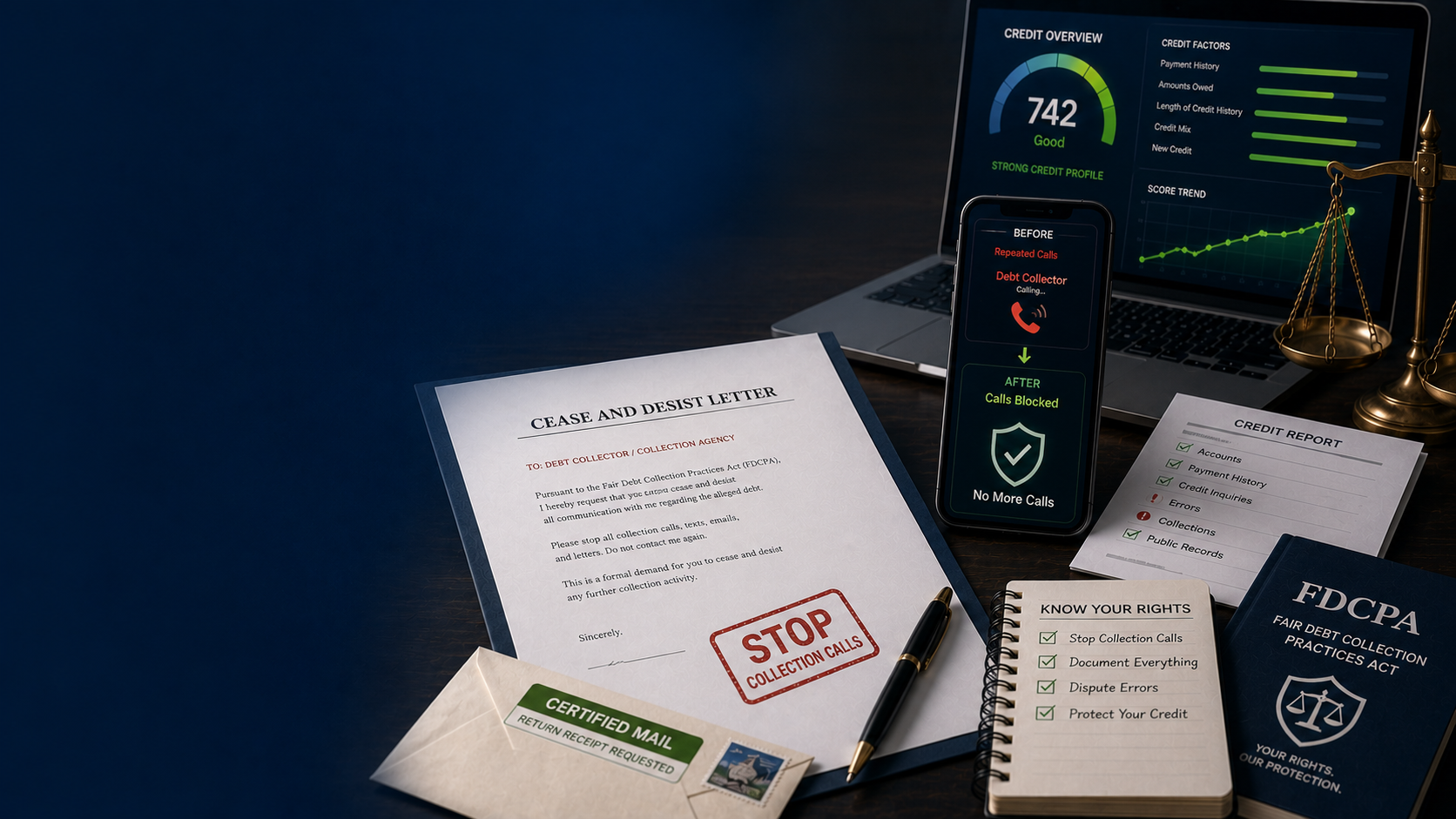
    6. Cease and Desist Letter

    What it is

    A cease and desist letter tells a debt collector to stop contacting you. Under the FDCPA (§ 1692c), once a collector receives a written cease communication request, they must stop contacting you — with two narrow exceptions: they can contact you once more to tell you they are stopping, or to inform you of a specific action they intend to take (like filing a lawsuit).

    When to use it

    Send this when:

    • A debt collector is calling repeatedly, at all hours, or at work after you asked them to stop
    • You have already validated the debt and do not owe it, or it is past the statute of limitations
    • You want all communication to be in writing only (a variation: “cease telephone contact only”)
    • You are being harassed and want to create a paper trail for an FDCPA complaint or lawsuit

    Important caveats

    A cease and desist does not:

    • Erase the debt — the collector can still report it to the bureaus or sue you
    • Stop the original creditor (the FDCPA covers third-party collectors, not always original creditors)
    • Prevent a lawsuit — in fact, if the collector can no longer call you, their only remaining option to collect may be legal action

    If the debt is within the statute of limitations, a cease and desist could prompt a lawsuit. If it is outside the statute, the collector has little leverage, and the letter is safer to send. Know your state’s statute of limitations before sending.

    What to include

    • The collector’s account or reference number
    • A clear, unambiguous statement to cease all communication (or cease telephone communication only)
    • A reference to the FDCPA
    • A statement that you will document and report any further contact
    • Your signature and date

    Template (full cease)

    [Your Full Name]
    [Your Address]
    [City, State ZIP]
    [Account/Reference Number]
    
    [Date]
    
    [Collection Agency Name]
    [Address]
    [City, State ZIP]
    
    RE: Cease and Desist All Communication
    
    Dear Sir or Madam,
    
    Pursuant to the Fair Debt Collection Practices Act, 15 U.S.C. § 1692c(c),
    I am hereby requesting that you cease all communication with me regarding
    the above-referenced account and any other alleged debt you claim I owe.
    
    This means you may not contact me by telephone, mail, email, text message,
    or any other means, except as specifically permitted by 15 U.S.C.
    § 1692c(c) — to advise me that your further collection efforts are
    terminating, or to notify me that you may invoke a specified remedy.
    
    If you continue to contact me after receiving this letter, I will document
    each contact and file a complaint with the Consumer Financial Protection
    Bureau, the Federal Trade Commission, and my state Attorney General. I
    may also pursue legal action under 15 U.S.C. § 1692k.
    
    Sincerely,
    
    [Your Signature]
    [Your Printed Name]

    Template (telephone-only cease)

    RE: Cease Telephone Communication
    
    Dear Sir or Madam,
    
    Pursuant to the Fair Debt Collection Practices Act, 15 U.S.C. § 1692c(c),
    I am requesting that you cease all telephone communication with me
    regarding the above-referenced account. You may continue to communicate
    with me by mail only.
    
    Do not call my home, my place of employment, or any other telephone number.
    Any further telephone contact will be documented and reported to the
    Consumer Financial Protection Bureau.
    
    Sincerely,
    
    [Your Signature]
    [Your Printed Name]

    7. 609 Disclosure Request

    What it is

    A 609 disclosure request (sometimes called a “609 letter”) is a letter invoking your right under FCRA § 1681j to receive a disclosure of all information in your credit file. The “609” refers to the section of the FCRA that grants you the right to obtain the information in your file — including the source documentation behind reported items.

    When to use it

    Some consumers and credit repair advocates use 609 letters to request the underlying documentation (original signed agreements, account applications, billing statements) that a bureau used to verify an account. The reasoning: if the bureau cannot produce the source documents, the item is “unverifiable” and must be removed.

    The legal strength of a 609 request for source documentation is debated — the FCRA does not explicitly require bureaus to provide copies of original signed agreements on request. However, requesting the full file disclosure and the sources of information can support later disputes and method-of-verification requests.

    Use this letter when:

    • You want a complete copy of everything in your file (not just the consumer report summary)
    • You are preparing to dispute an item and want to see what source documentation the bureau has
    • You want to confirm the sources of information the bureau is relying on
    • You are building a case for a method-of-verification request

    What to include

    • A request for all information in your file under FCRA § 1681j
    • A request for the source(s) of each reported item
    • A request for any documentation the bureau has on file for specific accounts
    • Your identifying information for matching
    • Your signature and date

    Template

    [Your Full Name]
    [Your Address]
    [City, State ZIP]
    [Date of Birth]
    [Social Security Number]
    
    [Date]
    
    [Credit Bureau Name]
    [Bureau Address]
    [City, State ZIP]
    
    RE: Request for Full File Disclosure Under FCRA § 1681j
    
    Dear Sir or Madam,
    
    Pursuant to 15 U.S.C. § 1681j and § 1681g, I am requesting a complete
    disclosure of all information in my consumer credit file. This includes
    all information you have collected and reported about me, whether or not
    it appears on my standard consumer report.
    
    Specifically, I am requesting:
      1. All information in my consumer file, including items not shown on
         the standard consumer report
      2. The source(s) of all information reported about me, as required by
         15 U.S.C. § 1681g(a)(2)
      3. For the following accounts, any documentation in your possession
         supporting the reporting of these items:
           - [Creditor Name], Account [Number]
           - [Creditor Name], Account [Number]
      4. The date each item was first reported and the date it was last
         updated
    
    If any of the requested information is not available or cannot be
    provided, please state so in your response and explain the reason.
    
    Sincerely,
    
    [Your Signature]
    [Your Printed Name]

    Important context: A 609 letter is not a magic deletion tool. Some online services market 609 letters as a guaranteed way to remove accurate items, but the FCRA does not require bureaus to delete accurate, verifiable information simply because you requested source documents. A 609 request is best used as a supporting step — to gather information for stronger disputes and method-of-verification requests. See our section on below.

    8. Method-of-Verification Letter

    What it is

    A method-of-verification letter is sent to a credit bureau after you have disputed an item and the bureau has responded that the item was “verified” or “remains.” Under FCRA § 1681i(a)(6)(B)(iii), the bureau must provide you, upon request, a description of the procedure used to determine the accuracy and completeness of the information — including the business name, address, and telephone number of any furnisher they contacted.

    When to use it

    Send this letter:

    • Within the response window after a bureau tells you a disputed item was verified
    • When you want to know exactly how the bureau verified the item (did they just e-verify with the furnisher, or did they investigate your documentation?)
    • When you believe the bureau did a superficial verification and you want to push further
    • As a stepping stone to a stronger second dispute or a complaint

    The method-of-verification request forces the bureau to explain its process. If they cannot describe a meaningful investigation, that failure can support:

    • A complaint to the CFPB
    • A second dispute with new information
    • A claim under the FCRA for failure to conduct a reasonable investigation

    What to include

    • A reference to the original dispute (date, items disputed, bureau’s response)
    • A request for the description of the procedure used to verify the information
    • A request for the furnisher’s contact information
    • A statement that you want to review the verification method because you continue to believe the information is inaccurate
    • Your signature and date

    Template

    [Your Full Name]
    [Your Address]
    [City, State ZIP]
    [Date of Birth]
    [Social Security Number]
    
    [Date]
    
    [Credit Bureau Name]
    [Bureau Address]
    [City, State ZIP]
    
    RE: Request for Description of Reinvestigation Procedure
    Original Dispute Date: [Date]
    Items Disputed: [Creditor / Account Number]
    
    Dear Sir or Madam,
    
    On [date], I disputed the above-referenced item(s) on my credit report.
    By letter dated [date], your agency responded that the item(s) had been
    "verified" or "reviewed" and would remain on my report.
    
    Pursuant to 15 U.S.C. § 1681i(a)(6)(B)(iii), I am requesting a
    description of the procedure used to determine the accuracy and
    completeness of the information I disputed.
    
    Specifically, I am requesting:
      1. A description of the reinvestigation procedure your agency followed
      2. The business name, address, and telephone number of any furnisher
         contacted during the reinvestigation
      3. A summary of what the furnisher provided to verify the information
      4. Confirmation of whether my enclosed supporting documentation was
         reviewed as part of the reinvestigation
    
    I continue to believe the information is inaccurate, and I intend to use
    the information you provide to determine my next steps, which may include
    a complaint to the Consumer Financial Protection Bureau and/or additional
    disputes.
    
    Sincerely,
    
    [Your Signature]
    [Your Printed Name]

    Strategy: Once you receive the method-of-verification response, you can often send a second dispute that includes the new information — “The bureau only performed an electronic verification with the furnisher and did not review my documentation. I am re-disputing because the verification was not a reasonable investigation.” This approach, supported by an attorney, can be effective.

    Credit repair letters for disputing credit report errors

    Best Practices for All Credit Repair Letters

    Regardless of which letter you are sending, these practices will make your correspondence more effective and protect your rights:

    1. Send via Certified Mail with Return Receipt

    This is the single most important practice. Certified mail with return receipt gives you:

    • Proof of mailing — the date you sent the letter
    • Proof of delivery — the signed green card (or electronic equivalent) showing the recipient received it
    • A timestamp that starts the legal clock (the FCRA’s 30-day investigation period, the FDCPA’s validation window, etc.)

    Without proof of mailing and delivery, a bureau or collector can claim they never received your letter, and you have no way to prove otherwise. Certified mail costs a few dollars per letter and is worth every penny.

    2. Keep Copies of Everything

    Keep a complete file for each letter you send:

    • A copy of the letter itself
    • The certified mail receipt (with the tracking number)
    • The return receipt (the signed green card)
    • Copies of any supporting documents you enclosed
    • The recipient’s response when it arrives

    Organize by recipient (bureau, furnisher, collector) and by date. If you ever need to escalate — to the CFPB, an attorney, or a court — this file is your evidence.

    3. Be Specific

    Vague letters get vague results. Instead of “this account is wrong,” say:

    “Account [number] with [creditor] shows a late payment in March 2024. I paid this account on March 12, 2024, as shown in the enclosed bank statement. The late payment notation is inaccurate and I request it be corrected or deleted.”

    Specific, factual, supported. The more precise you are, the harder it is for the recipient to dismiss your dispute as frivolous.

    4. One Item Per Letter (When Possible)

    When disputing multiple items, send a separate letter for each. This prevents the bureau from treating a multi-item letter as a “blanket dispute” and flagging it as frivolous. It also means each dispute has its own 30-day clock and its own clear paper trail.

    If you have many items (5+), it may be practical to send 2-3 per letter, but avoid sending a letter with 10+ disputed items — bureaus are known to reject these as “frivolous or irrelevant” under FCRA § 1681i(a)(3).

    5. Keep a Log

    Maintain a simple log — a spreadsheet or notebook — tracking every letter you send:

    Date Sent Recipient Letter Type Account/Item Certified Mail # Response Due Response Received Outcome
    8/25/26 Experian Dispute Acct 1234 7012 3456 7890 9/24/26 — —

    This log is your master record. When you have letters going to three bureaus, two furnishers, and a collection agency all at once, a log keeps you from losing track.

    6. Do Not Use Threatening or Aggressive Language

    You can be firm and assertive without being hostile. Threatening letters do not improve outcomes and can make the recipient less cooperative. State your rights, state your request, cite the law, and keep the tone professional.

    7. Do Not Admit to the Debt Unnecessarily

    In pay-for-delete and validation letters, be careful with language. Phrases like “I owe this debt” or “I will pay what I owe” can be used against you later. Use language like “the account you reference” or “I am not acknowledging the validity of this debt” when appropriate.

    The Timeline and Follow-Up Process

    Credit repair is a process, not a single event. Here is what to expect and when:

    The Standard FCRA Dispute Timeline

    Day Event
    Day 0 You mail your dispute letter (certified mail)
    Day 1-5 Bureau receives the letter (track via certified mail)
    Day 5-30 Bureau conducts its reinvestigation, contacts the furnisher
    Day 30 (or 45) Bureau must complete the investigation and notify you of results
    Day 30-45 You receive written results + updated credit report (if changed)
    Day 45-60 If no response, follow up with a second letter noting the FCRA violation

    The 45-day extension: If you send additional information during the 30-day investigation window, the bureau gets an extra 15 days (45 total). Do not send follow-up information mid-investigation unless necessary — it extends the timeline.

    The FDCPA Validation Timeline

    Day Event
    Day 0 Collector’s initial communication + validation notice
    Day 1-30 You have 30 days to send a validation letter
    Day 30+ Collector must cease collection activities until validation is provided
    No fixed deadline Collector must validate “within a reasonable time” — generally 30-60 days is the practical expectation

    Unlike the FCRA, the FDCPA does not specify an exact deadline for the collector to validate. But they must stop collecting until they do. If they resume collection without validating, that is an FDCPA violation.

    Follow-Up Rules

    • If no response by the deadline: Send a follow-up letter noting that the legal deadline has passed and the item must be deleted (for FCRA disputes) or collection must cease (for FDCPA validation). Cite the specific section of the law.
    • If the response is unfavorable: Request method of verification (for bureau disputes), send a furnisher dispute (if you only disputed with the bureau), or prepare a complaint to the CFPB.
    • If the item is updated but not removed: Review the update. Sometimes a correction (e.g., a balance updated to zero) is a partial win. Decide whether to push for full deletion with a follow-up dispute or accept the correction.
    • Wait between disputes: Do not re-dispute the same item every week. Re-dispute only when you have new information or a new basis for the dispute. Repeated disputes of the same item, with no new information, can be flagged as frivolous.

    What to Do With Responses

    Every response you receive tells you something. Here is how to handle each type:

    “Item Deleted”

    This is the best outcome. Verify that the deletion appears on your updated report (the bureau must send you one). Check all three bureaus if the error appeared on all three — a deletion from one bureau does not automatically remove it from the others. If it still appears on another bureau’s report, send a dispute to that bureau referencing the deletion.

    “Item Updated/Corrected”

    A partial win. Review the updated report to confirm the correction was made accurately. If the correction is incomplete or introduces a new error, send a follow-up dispute specifying the remaining issue.

    “Item Verified — Remains”

    This is not the end. Your options:

    • Request method of verification (see ) to learn how the bureau verified it.
    • Send a furnisher dispute directly to the creditor (see ).
    • Send a second bureau dispute with new information or documentation — ideally informed by the method-of-verification response.
    • File a CFPB complaint if you believe the investigation was not reasonable.
    • Consult an attorney — an FCRA claim for failure to conduct a reasonable investigation may be viable, and attorney-backed credit repair firms handle this escalation.

    “Frivolous” Rejection

    Bureaus can reject a dispute as “frivolous or irrelevant” under FCRA § 1681i(a)(3). If this happens:

    • Review the bureau’s reasoning — they must tell you why they deemed it frivolous and what information would make it non-frivolous
    • Provide the requested information and re-dispute
    • Avoid blanket disputes (disputing everything at once) and avoid re-disputing the same item repeatedly without new information
    • Consider working with a credit repair professional — they can frame disputes in a way that reduces frivolous rejections

    No Response

    If you receive no response by the legal deadline:

    • Send a follow-up letter noting the deadline has passed and demanding deletion (FCRA) or cessation of collection (FDCPA)
    • File a CFPB complaint
    • Keep your certified mail receipts as proof

    Common Mistakes to Avoid

    1. Frivolous Disputes

    Disputing everything on your report, especially accurate items, gets flagged. Bureaus are not required to investigate disputes they reasonably determine to be frivolous. Focus on items that are genuinely inaccurate, incomplete, outdated, or unverifiable.

    2. Blanket Disputes

    Sending one letter disputing 15 items at once is a red flag. It signals to the bureau that you are not engaging with each item individually and are likely using a “shotgun” approach. Send separate letters for each item, or at most 2-3 closely related items per letter.

    3. Sending Too Many Letters at Once

    If you mail 20 dispute letters in one week, you will have a hard time tracking responses, following up on deadlines, and managing the process. More importantly, it looks like a mass-dispute operation rather than a genuine consumer exercising specific rights. Stagger your disputes — send a few, wait for responses, follow up, then send the next batch.

    4. Not Following Up

    The biggest mistake consumers make is sending a letter, getting no response, and doing nothing. The law is on your side only if you enforce it. If a bureau misses the 30-day deadline, that failure is grounds for deletion — but you have to ask. Send the follow-up. File the CFPB complaint. Keep the pressure on.

    5. Using Online Dispute Forms Exclusively

    Online dispute portals are convenient but limited. They often restrict how much you can write, limit the types of documents you can upload, and do not create the same kind of paper trail as a certified letter. For complex disputes, a written letter with supporting documentation is stronger.

    6. Admitting to Debts You Do Not Owe

    In phone calls and letters, do not say “I’ll pay this” or “I know I owe it” unless you actually do and intend to pay. Admissions can reset the statute of limitations in some states and can be used against you in collection actions.

    7. Not Keeping Records

    If you cannot prove you sent the letter, prove the recipient received it, and prove you did not get a timely response, your rights are much harder to enforce. Certified mail + return receipt + a file for every letter is non-negotiable.

    8. Falling for Quick-Fix Promises

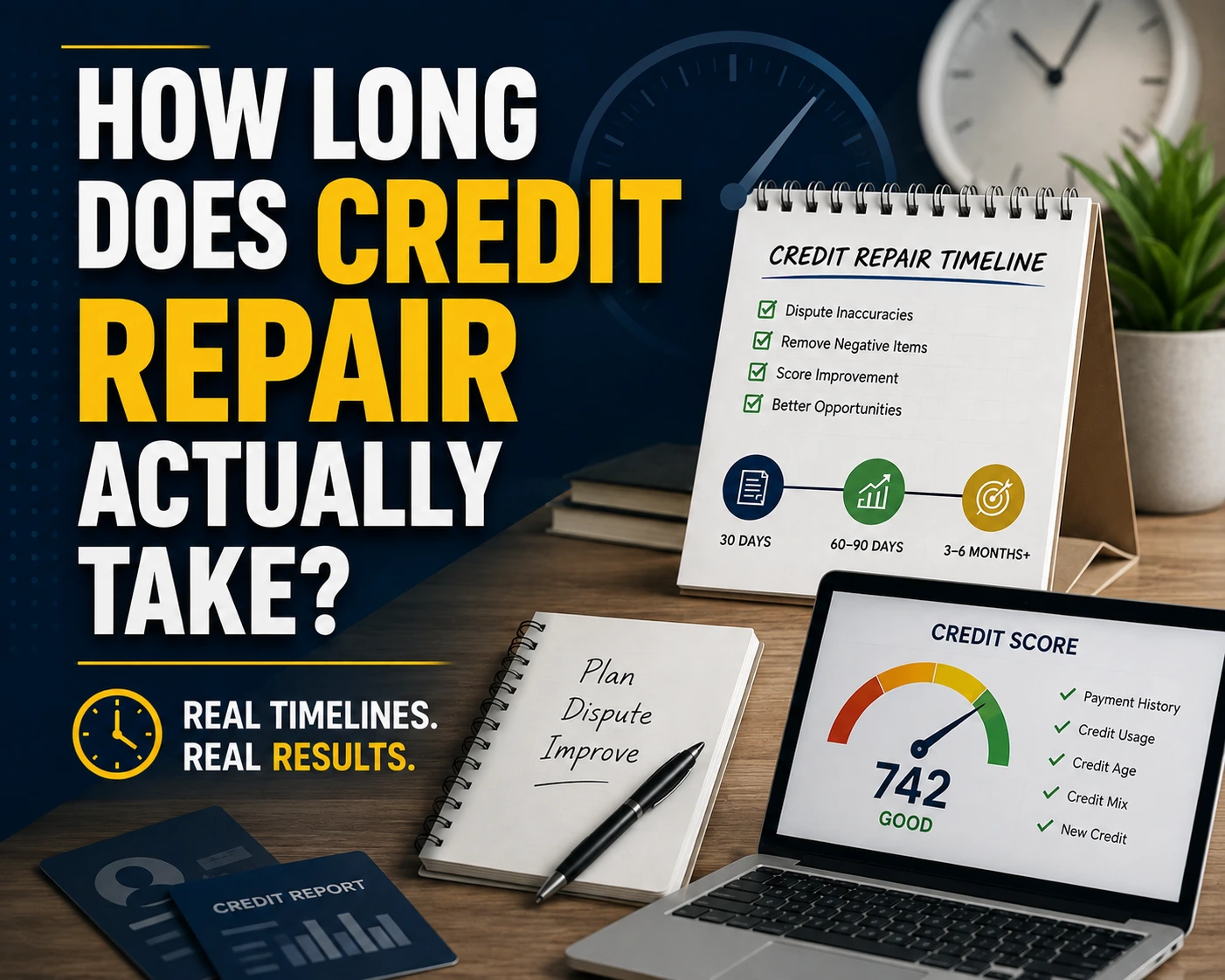
    Anyone who promises to remove accurate, verifiable negative information in 30 days is not being honest. The FCRA does not work that way. Credit repair takes time — typically 3-6 months for meaningful progress, sometimes longer depending on the complexity of your file.

    Beware “Guaranteed Deletion” Letter Services

    The credit repair space attracts scammers and over-promisers. Here is what to watch for:

    Red Flags

    • “Guaranteed removal” — No one can guarantee removal of accurate, verifiable information. The FCRA does not allow it, and no letter can force it.
    • “We’ll remove anything in 30 days” — Legitimate disputes take 30-45 days just for the investigation, and not all disputes succeed.
    • “100% legal loophole” letters — The “609 loophole,” the “identity theft loophole for items you did create,” and similar gimmicks are marketing, not legal strategy. Some are based on real legal provisions (609 is a real section), but they are not magic deletion tools.
    • Upfront fees for “guaranteed” results — The Credit Repair Organizations Act (CROA) makes it illegal for credit repair companies to charge you before they perform services. If a company demands full payment upfront, that is a violation.
    • “We dispute everything” — A company that disputes every item on your report, regardless of accuracy, is setting you up for frivolous-dispute rejections and wasted time.
    • No physical address or attorney affiliation — Legitimate credit repair firms have a real office and, ideally, attorney oversight. Fly-by-night operations hide behind websites.

    What Legitimate Credit Repair Looks Like

    A reputable, FCRA-compliant, attorney-backed credit repair firm will:

    • Review your three-bureau credit reports with you
    • Identify items that are genuinely disputable (inaccurate, incomplete, outdated, unverifiable)
    • Send targeted, specific dispute letters — one item per letter, with supporting documentation
    • Handle furnisher disputes, validation requests, method-of-verification follow-ups, and goodwill/pay-for-delete negotiations as appropriate
    • Track deadlines and follow up when bureaus or collectors do not respond
    • Educate you on maintaining good credit long-term — because the best credit repair is preventing future negative items
    • Be transparent about pricing, timeline, and realistic outcomes
    • Never guarantee specific deletions or promise a particular score increase

    Internal link placeholder: Read more about and the warning signs to watch for.

    Frequently Asked Questions

    1. Do credit repair letters really work?

    Yes — for inaccurate, incomplete, outdated, or unverifiable information. The FCRA gives you the right to dispute, and bureaus must investigate and remove items they cannot verify. Credit repair letters do not work for accurate, verifiable, within-time-limit negative items that the furnisher can confirm — but they can work for goodwill removals and pay-for-delete negotiations in those cases.

    2. How long does it take to see results?

    The FCRA gives bureaus 30 days (up to 45 with additional information) to investigate. You typically see results within 45-60 days of mailing a dispute letter. Full credit repair — addressing multiple items across three bureaus — usually takes 3-6 months, sometimes longer for complex files.

    3. Can I dispute online instead of by mail?

    You can, but written letters sent by certified mail create a stronger paper trail and allow you to include detailed documentation. Online dispute portals are convenient but often limit what you can submit. For complex or important disputes, written letters are recommended.

    4. Do I need to send the same dispute to all three bureaus?

    Yes, if the error appears on all three reports. Bureaus do not automatically share dispute information with each other (unless you use an indirect dispute process). Send a separate letter to each bureau that is reporting the inaccurate item.

    5. What if the bureau says my dispute is frivolous?

    The bureau must tell you why it deemed the dispute frivolous and what information would make it non-frivolous. Provide that information and re-dispute. Avoid blanket disputes, limit disputes to genuinely questionable items, and include specific supporting documentation. If the bureau continues to reject valid disputes, file a CFPB complaint and consider attorney involvement.

    6. Is a 609 letter a guaranteed way to remove items?

    No. A 609 letter invokes your right to disclosure of information in your file, which is a real and useful right. But it is not a guaranteed deletion tool. Some online services market 609 letters as a magic loophole; the FCRA does not require bureaus to delete accurate, verifiable information because you requested source documents. Use 609 requests as a supporting step, not a standalone solution.

    7. Should I use a credit repair company or do it myself?

    You can do credit repair yourself — the letters in this guide are designed for self-use. But many people benefit from professional help because: the process is time-consuming, tracking multiple disputes across three bureaus is complex, and attorney-backed firms can escalate to legal action when bureaus or collectors violate the law. If your file is complex, if you have tried self-repair without success, or if you suspect FCRA/FDCPA violations, professional help is worth considering.

    8. Can I send a goodwill letter for a late payment that is my fault?

    Yes — that is exactly what goodwill letters are for. The late payment is accurate (so you cannot dispute it as an error), but you are asking the creditor to remove it as a courtesy based on your otherwise strong history and the specific circumstances. Goodwill letters are most effective for a single, isolated late payment with a clear explanation and evidence of a return to good behavior.

    Take the Next Step

    Credit repair letters are powerful tools, but they are only as effective as the strategy behind them. Knowing which letter to send, when to send it, how to document it, and what to do with the response is what turns a stack of correspondence into real credit improvement.

    If you are ready to address the errors and negative marks on your credit report — and you want the process handled correctly, with FCRA-compliant correspondence, attorney oversight, and a team that tracks every deadline and follows up on every response — we can help.

    offers a free credit audit across all three major bureaus. We will review your reports, identify the items that are genuinely disputable, and build a customized correspondence plan — from dispute letters to validation requests to goodwill and pay-for-delete negotiations — handled on your behalf with attorney backing.

    No guarantees of specific deletions. No quick-fix promises. Just honest, transparent, legally compliant credit repair designed to produce measurable, lasting progress — and the education you need to keep your credit strong long after the process is complete.

    and take the first step toward the credit score you deserve.

    This article is for educational purposes and does not constitute legal advice. Your individual situation may vary. For specific legal questions about your rights under the FCRA or FDCPA, consult a qualified attorney.

  • How to Remove Hard Inquiries From Your Credit Report

    How to Remove Hard Inquiries From Your Credit Report

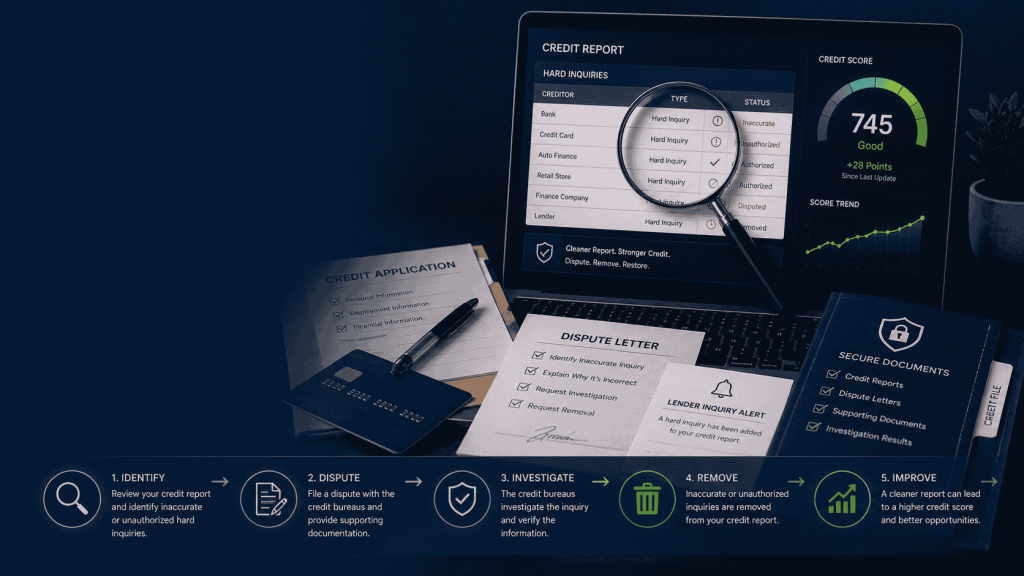
    Also worth reading: understand the full difference between hard vs soft inquiries, learn how to find all other credit report errors worth disputing, see all the credit repair letters at your disposal, and get expert help from our New York credit repair team.

    If you’ve recently pulled your credit report and spotted a handful of hard inquiries you don’t remember authorizing, you’re probably feeling a mix of frustration and worry. Will those pulls drag down your score? Can you get them removed? Should you pay someone to “fix” it?You’re in the right place. This guide walks you through exactly what a hard inquiry is, how much it actually hurts your credit, the honest truth about which inquiries can be removed (and which can’t), and the step-by-step process for disputing unauthorized hard inquiries under the Fair Credit Reporting Act (FCRA). We’ll also give you a ready-to-use dispute letter template and show you how to lock down your credit so this doesn’t happen again.No quick-fix promises. No guarantees. Just clear, legally grounded steps you can take today.

    What Is a Hard Inquiry?

    A hard inquiry (also called a hard pull) happens when a lender or creditor checks your credit report to make a lending decision about you. It’s the credit check that occurs when you apply for a credit card, a mortgage, an auto loan, a personal loan, a student loan refinance, an apartment rental, or sometimes even a new cell phone plan or utility account.

    The key word is decision. A hard pull is tied to an active application for new credit or a service that effectively extends credit. The lender wants to see your full credit picture — your payment history, your current debts, your credit utilization, and your recent applications — to decide whether to approve you and at what interest rate.

    Here’s what happens behind the scenes when a hard inquiry is generated:

    • You submit an application (or in some cases, a lender submits one on your behalf with your permission).
    • The lender contacts one or more of the three major credit bureaus — Equifax, Experian, or TransUnion — and requests your credit report.
    • The bureau logs the request on your report as a hard inquiry, including the date, the lender’s name, and which bureau was contacted.
    • Your score may dip slightly (more on that below).
    • The inquiry stays on your report for up to 24 months, though its effect on your score typically fades after about 12 months.

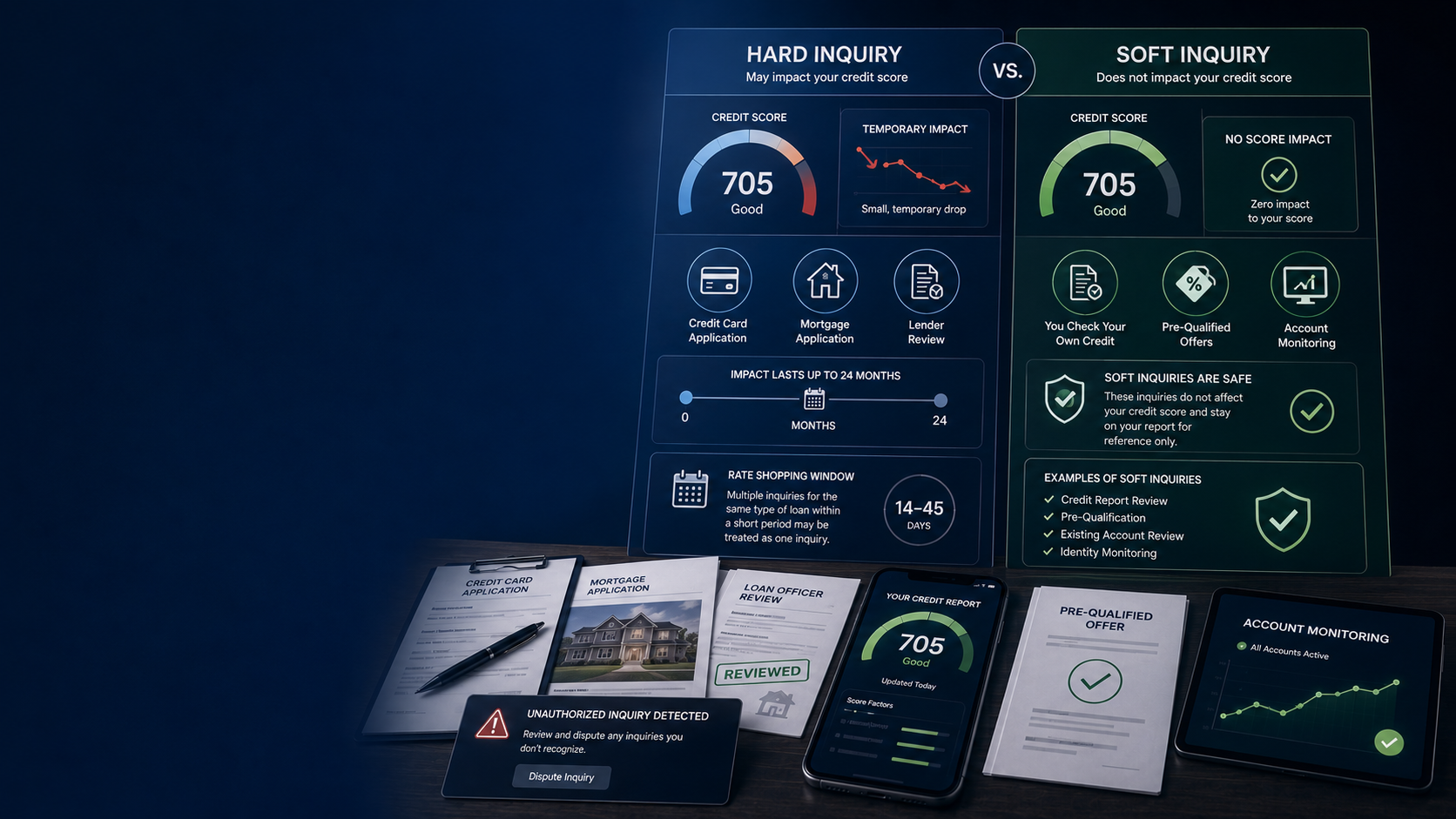
    A hard inquiry is different from the credit checks that happen when you check your own credit, when a lender sends you a pre-approved offer, or when an existing creditor monitors your account. Those are called soft inquiries, and they don’t affect your score at all.

    It’s also important to understand that a hard inquiry is recorded per bureau. If a lender only pulls your Equifax report, the hard inquiry shows up on your Equifax report — not on your Experian or TransUnion reports. This is why you might see different numbers of hard inquiries across your three bureau reports. Some lenders pull from all three (common with mortgages), while others pull from just one or two.

    Why Lenders Make Hard Inquiries

    Lenders use hard inquiries to assess risk. When you apply for credit, they need to know:

    • Are you already carrying too much debt?
    • Have you been applying for a lot of credit recently (which could signal financial distress)?
    • Do you have a history of managing credit responsibly?
    • What interest rate and credit limit are appropriate for your risk profile?

    Each hard inquiry is essentially a snapshot of a moment when you asked someone to lend you money (or extend a credit-like service). That’s why the credit scoring models treat them as a minor risk signal — a burst of recent inquiries can suggest you’re about to take on new debt that hasn’t shown up on your report yet.

    Hard Inquiry vs. Soft Inquiry: What’s the Difference?

    The distinction between hard and soft inquiries is one of the most commonly misunderstood parts of the credit system. Here’s a clear breakdown.

    Feature Hard Inquiry Soft Inquiry
    Who initiates it A lender or creditor, with your permission You, an existing creditor, or a lender doing a pre-screen
    Why it happens You applied for credit or a credit-like service Account monitoring, pre-approval offers, your own credit check
    Visible to lenders? Yes — appears on the version of your report lenders see No — only visible to you on your consumer report
    Affects your credit score? Yes — typically a small, temporary dip No impact whatsoever
    How long it stays Up to 24 months on your report; score impact fades around 12 months Varies, but no score impact so it doesn’t matter much

    Examples of Hard Inquiries

    • Applying for a new credit card
    • Applying for a mortgage or refinancing your home
    • Applying for an auto loan or refinancing your car
    • Requesting a credit limit increase (sometimes — depends on the issuer)
    • Applying for a personal loan or debt consolidation loan
    • Applying for an apartment rental (when the landlord runs a credit check)
    • Opening a new utility or cell phone account (sometimes — depends on the provider)
    • Applying for a business credit card or business loan (if it requires a personal credit check)

    Examples of Soft Inquiries

    • Checking your own credit report or score (through AnnualCreditReport.com, your bank’s free credit monitoring, a credit karma-type service, etc.)
    • Receiving a pre-approved credit card offer in the mail (the lender did a “pre-screen” pull)
    • An existing creditor doing a periodic account review
    • An employer running a background check that includes a credit report (with your permission)
    • A landlord or insurance company checking your credit for a quote (sometimes — depends on the type)
    • Credit monitoring services you’ve enrolled in pulling your report on a recurring basis

    The rule of thumb: If you actively applied for something that involves borrowing money or a credit-like service, it’s probably a hard inquiry. If you didn’t apply for anything, it’s probably a soft inquiry.

    One common point of confusion: checking your own credit never creates a hard inquiry. You can pull your own credit report as many times as you want — from all three bureaus, through any service — and it will never affect your score. This is one of the most persistent credit myths, and it prevents people from monitoring their reports as often as they should. Don’t let it stop you.

    When a Hard Inquiry Is Legitimate

    A hard inquiry is legitimate when you knowingly applied for credit (or a credit-like service) and gave the lender permission to pull your credit report. This is the most common scenario, and it covers the vast majority of hard inquiries on most people’s reports.

    Here are some signs that a hard inquiry is legitimate:

    • You remember applying. You filled out an application — online, in person, or over the phone — within a few weeks of the inquiry date on your report.
    • You received a decision. You got an approval, a denial, or a counter-offer from the lender around the same time.
    • You authorized the pull. You signed a consent form, clicked “I agree” on an online application, or verbally authorized a credit check.
    • The lender name matches. The company listed on the inquiry is one you recognize, even if it’s a parent company or a subsidiary (for example, Synchrony Bank might show up as the issuer behind a store credit card you applied for).

    Common Legitimate Hard Inquiry Scenarios

    Store credit cards. You’re at the checkout counter, the cashier offers you 20% off your purchase if you open a store card, and you say yes. That’s a hard inquiry — even if you were approved instantly and the discount felt like a perk.

    Rate shopping. You’re buying a car and you let the dealership shop your application to multiple lenders to find the best rate. Each of those lenders may generate a hard inquiry. (The good news: the scoring models count multiple auto loan inquiries within a short window as a single inquiry — more on this in the .)

    Credit limit increases. Some credit card issuers do a hard pull when you request a credit limit increase, while others only do a soft pull. It varies by issuer, so it’s worth checking before you request one. (Many issuers will tell you upfront whether it’ll be a hard or soft pull.)

    Apartment applications. When you apply to rent an apartment, the property management company or landlord may run a credit check. This is typically a hard inquiry, though some use soft-pull screening services.

    Utility and telecom accounts. Opening a new electricity, gas, water, or cell phone account sometimes triggers a hard inquiry. The utility company wants to assess whether you’re likely to pay your bill, and they may treat it like a small credit decision.

    If a hard inquiry falls into any of these categories and you genuinely authorized it, it’s legitimate. It will stay on your report for up to 24 months, and there is no legal way to remove it early. We’ll talk more about why in the and the .

    When a Hard Inquiry Is Unauthorized

    An unauthorized hard inquiry is one that appeared on your credit report without your knowledge or permission. This is a serious matter — it means someone accessed your credit information without a legitimate application from you, and under the FCRA, you have the right to have it removed.

    Unauthorized hard inquiries typically happen in one of three ways:

    1. Identity Theft

    This is the most concerning scenario. Someone has stolen your personal information — your name, Social Security number, date of birth, address — and used it to apply for credit in your name. The lender pulls your credit report as part of the fraudulent application, and the hard inquiry lands on your report.

    Signs that an inquiry might be the result of identity theft:

    • You don’t recognize the lender at all.
    • The inquiry date corresponds to a period when you know you didn’t apply for anything.
    • You start seeing accounts on your report that you never opened.
    • You receive bills, collection notices, or calls about accounts you don’t recognize.
    • You get a notice that you were approved (or denied) for credit you never sought.

    If you suspect identity theft, time is of the essence. The faster you act, the more you can contain the damage. We’ll walk you through the identity-theft-specific removal process (including filing a report and invoking FCRA Section 605B, which lets you block identity-theft-related information from your report) in the .

    2. No-Permission Pulls

    Sometimes a lender or service provider pulls your credit without your explicit permission. This can happen when:

    • A salesperson at a car dealership runs your credit “to see what you qualify for” before you’ve formally applied or agreed to a credit check.
    • A lender pulls your credit for a pre-qualification that you thought was a soft pull but turned out to be a hard pull.
    • A company you’re doing business with runs a credit check for a purpose you didn’t authorize (for example, an existing creditor doing a hard pull when their policy only allows soft pulls for account reviews).
    • A mortgage broker or loan officer pulls your credit to “have it ready” before you’ve committed to an application.

    If you didn’t explicitly authorize the credit check — whether through a signed application, a click-through consent, or a clear verbal agreement — the inquiry may be unauthorized. You have the right to dispute it.

    3. Clerical or System Errors

    Less commonly, a hard inquiry can appear on your report due to a clerical error — a lender accidentally pulls the wrong person’s credit because of a similar name, a mixed file at the credit bureau, or a data-entry mistake. These are rare but they do happen, and they’re also disputable.

    How to Spot an Unauthorized Inquiry

    The only reliable way to catch unauthorized inquiries is to review your credit reports from all three bureaus regularly. You’re entitled to a free copy of each report once per week through AnnualCreditReport.com — that’s 52 free reports per bureau per year, thanks to a permanent change made during the pandemic. There’s no reason not to check.

    When you review your reports, look at the inquiries section (sometimes called “requests for your credit file” or “inquiries shared with others”). This is where hard inquiries are listed. Check:

    • The name of the lender — do you recognize it?
    • The date of the inquiry — does it line up with an application you remember?
    • The type of inquiry — is it coded as a hard inquiry (visible to lenders) or a soft inquiry?

    If anything looks unfamiliar, flag it. One unfamiliar inquiry might be a clerical error; multiple unfamiliar inquiries in a short period could signal identity theft. Either way, you have options.

    How Much Does a Hard Inquiry Hurt Your Credit Score?

    Let’s talk numbers — with the caveat that credit scoring models (FICO and VantageScore) are proprietary, so the exact impact varies by individual. But here’s what we know from the scoring companies’ published guidance and years of industry observation.

    The Short Answer

    A single hard inquiry typically lowers your credit score by 1 to 5 points. For most people, it’s on the lower end of that range. If you have a strong, established credit history with a long track record of on-time payments, a single hard inquiry might not move your score at all — or it might drop by a point or two, then bounce back within a few months.

    If your credit history is thin (you’re new to credit, you have few accounts, or your file is otherwise limited), the same inquiry might cause a slightly larger dip because there’s less positive history to offset it.

    The Recovery Timeline

    Here’s the good news: the impact of a hard inquiry is temporary and small compared to other credit events.

    • The score dip happens immediately when the inquiry is recorded.
    • The impact begins to fade after a few months as the scoring model sees that no new delinquency or default followed the application.
    • After about 12 months, hard inquiries have essentially no effect on your FICO score. (FICO has stated publicly that inquiries older than 12 months don’t affect your score, even though they remain visible on your report.)
    • The inquiry falls off your report entirely at 24 months. After that, it’s gone — no trace, no residual impact.

    So even if a hard inquiry causes a small score drop today, it’s a self-correcting situation. You don’t need to do anything except continue managing your credit responsibly, and time will take care of it.

    When Inquiries Matter More

    The scoring models are smart enough to distinguish between someone who’s shopping for a single loan (rate shopping) and someone who’s rapidly accumulating new credit obligations. Here’s when inquiries can have a bigger cumulative effect:

    • Six or more hard inquiries in a short period (a few months) can signal risk and may cause a more noticeable score drop — potentially 10 to 20 points or more, depending on your overall profile.
    • Inquiries combined with other negative factors (late payments, high utilization, collections) compound the damage because they paint a picture of financial distress.
    • Multiple new accounts opened in a short window (which follow hard inquiries) can lower your average age of accounts, which also hurts your score.

    But in isolation, a hard inquiry or two is one of the smaller factors in your credit score. Payment history (35% of your FICO score) and amounts owed (30%) dwarf the impact of inquiries (about 10%). If you’re paying your bills on time and keeping your credit card balances low, a few hard inquiries won’t derail your credit health.

    VantageScore vs. FICO

    Both major scoring models treat hard inquiries similarly — small, temporary impact — but VantageScore tends to be slightly more sensitive to recent inquiries than FICO. If you’re tracking your score through a free service that uses VantageScore (like Credit Karma), you might see slightly larger swings from inquiries than you would on a FICO score pulled by a lender. Don’t panic — it’s just a difference in how the models weigh the same data.

    The Bottom Line on Score Impact

    If you’re worried about a hard inquiry hurting your score:

    • One inquiry: minimal impact, usually 1–5 points, recovers within months.
    • A few inquiries from rate shopping: counted as one by the scoring models (see the ).
    • Many inquiries in a short period: can signal risk and have a larger cumulative effect.
    • Any inquiry older than 12 months: no FICO score impact.
    • Any inquiry older than 24 months: gone from your report entirely.

    The best thing you can do is not obsess over individual inquiries. Focus on the big factors — on-time payments and low utilization — and let the inquiries age off naturally.

    Can You Remove Legitimate Hard Inquiries?

    Here’s where we have to be completely honest with you, because the internet is full of companies that will tell you otherwise.

    You cannot remove a legitimate hard inquiry from your credit report before it falls off naturally at 24 months. Period.

    If you authorized the credit check — you applied for the card, the loan, the apartment, the utility account — the inquiry is accurate, it’s verifiable, and the credit bureaus are legally permitted to report it. Disputing it as “unauthorized” when you did authorize it won’t work (and could potentially flag your account as one that files frivolous disputes, which makes future legitimate disputes harder).

    Why “Inquiry Removal Services” Are Almost Always Scams

    You’ve probably seen the ads: “We remove hard inquiries from your credit report — guaranteed!” or “Boost your score 50 points in 30 days by deleting inquiries!”

    Here’s what those services typically do, and why it doesn’t work:

    • They bombard the credit bureaus with dispute letters claiming every inquiry is unauthorized, even the legitimate ones. The bureaus investigate, verify the inquiries with the lenders, and confirm them. Your disputes are denied.
    • They exploit the 30-day investigation window. Under the FCRA, if a bureau can’t verify a disputed item within 30 days, it must temporarily remove it. Some services hope that a lender won’t respond in time, causing the inquiry to be deleted. But if the lender later verifies it (which they almost always do for legitimate inquiries), it goes right back on your report. You’ve gained nothing — and you may have wasted a legitimate dispute opportunity.
    • They charge you recurring monthly fees for “ongoing monitoring and dispute management” while accomplishing little to nothing. Some clients pay for months or years with no meaningful improvement.
    • They may advise you to lie on dispute letters — to claim you never applied for credit when you did. This is fraud. It can expose you to legal liability and undermines your credibility with the bureaus for any future, legitimate disputes.

    The Honest Truth

    Legitimate hard inquiries are a fact of life when you use credit. They’re a small, temporary factor in your score, and they go away on their own. The only honest way to “remove” them is to wait.

    What you can do — and what we help our clients with — is:

    • Remove unauthorized inquiries through the formal dispute process (which we cover in detail below).
    • Protect your credit going forward by freezing or locking your report so no new unauthorized pulls can happen.
    • Focus on the factors that actually move your score — payment history, utilization, credit age, credit mix — rather than chasing inquiry removal.
    • Get a professional audit of your three-bureau reports to identify any inquiries (or other items) that are genuinely inaccurate, unverifiable, or the result of identity theft. That’s where real, legal, lasting removals happen.

    If a company promises to remove legitimate inquiries, run. If they guarantee a specific score increase, run faster. The FCRA gives you the right to dispute inaccurate, incomplete, or unverifiable information — not information that’s accurate and verified, just because you’d prefer it wasn’t there.

    How to Remove Unauthorized Hard Inquiries

    Now for the part you came here for. If you’ve identified hard inquiries on your report that you did not authorize, you have a clear, legal path to have them removed. The FCRA gives you the right to dispute any information on your credit report that you believe is inaccurate, incomplete, or unverifiable — and unauthorized inquiries fall squarely into that category.

    There are three main avenues for removing unauthorized hard inquiries, and we recommend pursuing them in this order. In many cases, you’ll want to pursue more than one simultaneously, especially if identity theft is involved.

    Method 1: Dispute Directly With the Credit Bureau

    Your first step is to dispute the unauthorized inquiry directly with the credit bureau (or bureaus) that’s reporting it. Remember, inquiries are reported per bureau — so if an unauthorized inquiry appears on your Equifax report but not your Experian or TransUnion reports, you only need to dispute it with Equifax. If it appears on all three, you dispute with all three.

    How to file a bureau dispute:

    • Gather your evidence. Before you file, collect anything that supports your claim that the inquiry is unauthorized:
    • A copy of your credit report showing the inquiry (with the lender name and date).
    • Any correspondence you’ve had with the lender (if you contacted them and they couldn’t verify your application).
    • An identity theft report, if applicable (see Method 3).
    • A simple written statement explaining that you did not apply for credit with this lender and did not authorize the inquiry.
    • File the dispute. You can file online, by phone, or by mail. We recommend mail for the strongest paper trail, but online is faster. Each bureau has a dispute portal:
    • Equifax: equifax.com/disputes
    • Experian: experian.com/disputes
    • TransUnion: transunion.com/disputes
    • Or use the AnnualCreditReport.com portal if you pulled your report from there.

    If you file by mail, include:

    • A copy of your credit report with the disputed inquiry highlighted.
    • A clear dispute letter (use our ).
    • Copies (not originals) of any supporting documents.
    • A copy of your driver’s license or state ID and a recent utility bill to verify your identity.
    • The bureau has 30 days to investigate. Under the FCRA, the credit bureau must investigate your dispute within 30 days (sometimes 45 days if you submit additional information during the investigation). They’ll contact the lender (the “furnisher” of the inquiry) and ask them to verify it.
    • The bureau must notify you of the results. Within 5 days of completing the investigation, the bureau must send you the results in writing. If the inquiry is verified as accurate, it stays. If the lender can’t verify it, or doesn’t respond within the window, the bureau must delete it from your report.
    • If it’s removed, you’ll get an updated report. The bureau will send you a free, updated copy of your credit report so you can confirm the deletion.

    What if the bureau verifies it but you still believe it’s unauthorized? You have options:

    • File a statement of dispute (a 100-word explanation that gets added to your credit report so future lenders can see your side).
    • Dispute directly with the furnisher (Method 2).
    • If identity theft is involved, invoke FCRA Section 605B (Method 3), which gives you stronger protections than a standard dispute.

    Method 2: Dispute Directly With the Furnisher

    Under FCRA Section 623, you also have the right to dispute information directly with the company that furnished it to the credit bureau — in this case, the lender who made the hard inquiry. This is sometimes called a “direct dispute” or “furnisher dispute.”

    This can be effective because the furnisher (not the bureau) is the one who actually has (or should have) records of your application. If they can’t produce evidence that you applied — a signed application, an electronic consent record, a recorded phone call — they’re required to notify the bureau to delete the inquiry.

    How to file a furnisher dispute:

    • Find the lender’s contact information. Your credit report should list an address for the company that made the inquiry. If not, look up their customer service or fraud department contact info online. Ask specifically for the fraud department or credit reporting disputes department — these are the teams that handle unauthorized inquiry claims.
    • Send a written dispute. Use a letter (our works for this too, with minor adjustments) that states:
    • You did not apply for credit with them.
    • You did not authorize a credit check.
    • You’re requesting that they investigate and, if they can’t verify your authorization, notify all three credit bureaus to delete the inquiry.
    • You want a written response within 30 days.
    • Send it via certified mail with return receipt. This gives you proof of delivery and creates a legal record. If the furnisher doesn’t respond, that documentation supports further action.
    • The furnisher has 30 days to investigate. Under FCRA Section 623(b), they must review your dispute, contact the credit bureau if appropriate, and report back to you. If they can’t verify that you authorized the inquiry, they must notify the bureau(s) to remove it.
    • If they confirm it was authorized but you disagree, ask them for proof — a copy of your application, your signed consent, the IP address and timestamp of an online application, etc. If they can’t produce it, escalate. If they produce something that looks fraudulent (a signature that isn’t yours, an address you’ve never lived at), you’re likely dealing with identity theft — move to Method 3.

    Pro tip: Filing disputes with both the bureau and the furnisher simultaneously can increase your chances of a quick removal. If either one can’t verify the inquiry, it has to come off.

    Method 3: File an Identity Theft Report and Block Under FCRA Section 605B

    If the unauthorized inquiry is the result of identity theft — someone used your personal information to apply for credit in your name — you have a powerful tool that goes beyond a standard dispute: FCRA Section 605B, also known as the identity theft block.

    This provision requires credit bureaus to block the reporting of any information on your credit report that results from identity theft, within 4 business days of receiving your request, as long as you provide the required documentation. This is stronger than a standard dispute because the bureau must block the information quickly — they can’t wait for a 30-day investigation — and the block is permanent unless the bureau later determines that the information didn’t result from identity theft and notifies you.

    How to use FCRA Section 605B:

    • File an identity theft report with the FTC. Go to IdentityTheft.gov and file a report. The FTC will create an Identity Theft Report (sometimes called an “FTC Affidavit”) that you can use as proof of identity theft. This is free, takes about 20–30 minutes, and walks you through the process step by step.
    • File a police report (recommended). Take your FTC Identity Theft Report to your local police department and file a report. This creates an additional official record. Get a copy of the police report — you’ll need it.
    • Contact the lender’s fraud department. Notify the lender that the application was fraudulent and that you’ve filed an identity theft report. Ask them to close any fraudulent accounts and stop reporting the inquiry. Provide them with a copy of your FTC report and police report.
    • Send a Section 605B block request to each credit bureau. Write to each bureau that’s reporting the inquiry and include:
    • A clear statement that you’re requesting a block under FCRA Section 605B.
    • A copy of your FTC Identity Theft Report.
    • A copy of your police report (if you filed one).
    • A copy of your credit report with the identity-theft-related inquiry highlighted.
    • A statement of the facts — what happened, when you discovered it, and why you believe the inquiry resulted from identity theft.
    • Your identity verification (copy of driver’s license, utility bill, Social Security card).
    • The bureau must block the information within 4 business days. They can only refuse if they determine the information didn’t result from identity theft or if you’ve previously admitted to committing fraud. If they block it, the inquiry (and any related fraudulent accounts) must be suppressed from your report.
    • The bureau must notify you. Within 5 business days of blocking the information, the bureau must send you confirmation and a copy of your updated report.
    • Place a fraud alert or credit freeze. Once you’ve been a victim of identity theft, you should immediately place a fraud alert (7-year extended fraud alerts are available for confirmed identity theft victims) or a credit freeze on all three bureaus to prevent future unauthorized applications. See the for details.

    Why Section 605B is powerful: Standard disputes rely on the furnisher failing to verify the inquiry within 30 days. Section 605B shifts the burden — the bureau must block the information quickly based on your identity theft documentation, and the furnisher has to actively prove the information didn’t result from identity theft to have it restored. For genuine identity theft cases, this is the most reliable, fastest removal path.

    How to remove hard inquiries from your credit report

    Sample Inquiry Dispute Letter

    Here’s a template you can adapt for disputing an unauthorized hard inquiry with either a credit bureau or a furnisher. Fill in the bracketed information with your details. Send via certified mail with return receipt so you have proof of delivery.

    [Your Name] [Your Address] [City, State ZIP Code] [Your Phone Number] [Your Email] [Date] [Credit Bureau or Lender Name] [Department — e.g., Dispute Department / Fraud Department] [Their Address] [City, State ZIP Code] RE: Dispute of Unauthorized Hard Inquiry on Credit Report To Whom It May Concern: I am writing to dispute a hard inquiry that appears on my credit report and that I did not authorize. The details of the inquiry are as follows: Lender/Creditor Name: [Name of lender as it appears on your report] Date of Inquiry: [Date as it appears on your report] Credit Bureau: [Equifax / Experian / TransUnion] Account/Reference #: [If any — otherwise write “N/A”] I did not apply for credit with the above-named lender, and I did not authorize anyone to pull my credit report on the date listed. I have no recollection of, or connection to, this inquiry. [If identity theft is suspected, add: I believe this inquiry is the result of identity theft, and I have filed a report with the Federal Trade Commission. A copy is enclosed. I am requesting a block of this information under FCRA Section 605B.] Under the Fair Credit Reporting Act (15 U.S.C. § 1681), I have the right to dispute inaccurate or incomplete information on my credit report. I am requesting that you investigate this inquiry and, if it cannot be verified as authorized, remove it from my credit report immediately. Please provide me with: 1. Written confirmation of the results of your investigation. 2. An updated copy of my credit report reflecting the removal, if applicable. 3. The name, address, and phone number of any furnisher you contacted during the investigation. If the inquiry is verified, please provide me with the specific documentation that establishes my authorization — including a copy of any application, signed consent, or electronic authorization record bearing my signature, IP address, or other identifying information. Enclosed are the following supporting documents: – Copy of my credit report with the disputed inquiry highlighted – Copy of my driver’s license (identity verification) – Copy of a recent utility bill (address verification) – [If applicable: Copy of FTC Identity Theft Report] – [If applicable: Copy of police report] Please process this dispute within the timeframe required by the FCRA (30 days for standard disputes; 4 business days for identity theft blocks under Section 605B) and notify me of the outcome in writing. Thank you for your prompt attention to this matter. Sincerely, [Your Signature] [Your Printed Name] Enclosures: [List the number of enclosures]

    A few notes on using this letter:

    • Send it to the right place. If you’re disputing with a bureau, send it to that bureau’s dispute mailing address (check their website for the current address). If you’re disputing with a furnisher, send it to their fraud or credit reporting disputes department.
    • Keep copies of everything. Print two copies of the letter — sign both, keep one for your records, and send the other. Keep your certified mail receipt and return receipt in a file.
    • Be truthful. Only claim an inquiry is unauthorized if you genuinely did not authorize it. Filing false disputes is fraud and can damage your ability to pursue legitimate disputes in the future.
    • Customize as needed. If you’re disputing multiple inquiries, list them all in one letter. If you have additional evidence (emails with the lender, a fraud alert confirmation, etc.), mention and enclose it.

    How to Freeze or Lock Your Credit

    Once you’ve dealt with existing unauthorized inquiries, your next priority is preventing future ones. The single most effective tool for this is a credit freeze (also called a security freeze). A close alternative is a credit lock, which offers similar protection through a different legal mechanism.

    Credit Freeze vs. Credit Lock

    Feature Credit Freeze Credit Lock
    Legal protection Mandated by federal law (Free Credit Freeze Act, part of the Economic Growth Act of 2018) A contractual arrangement with the bureau (not federally mandated)
    Cost Free by law Usually free, but some bureaus offer paid lock-plus-monitoring packages
    How to place it Through each bureau’s website or by mail/phone Through each bureau’s website or mobile app
    Speed to lift Must be lifted within 1 hour of online/phone request Typically instant via app or website
    Fraud alert vs. freeze A freeze blocks all access; a fraud alert adds a verification step but doesn’t block Same

    A credit freeze is the gold standard for preventing unauthorized hard inquiries. When your credit is frozen, lenders cannot pull your credit report at all — which means no one can open new credit in your name, because lenders won’t approve an application without seeing a credit report. Even if an identity thief has your Social Security number and date of birth, they can’t generate a hard inquiry or open an account because the freeze blocks the pull.

    A credit lock offers the same practical protection but is faster to toggle on and off (instant via app) and may come with additional monitoring features. The tradeoff is that it’s not backed by the same federal legal framework as a freeze. For most people, either is fine — and some choose to use both for layered protection.

    How to Place a Credit Freeze

    You must place a freeze separately with each of the three major bureaus. A freeze at Equifax does not freeze your Experian or TransUnion reports. Here’s how:

    • Equifax: Visit equifax.com, search for “security freeze,” and follow the prompts to create an account and place the freeze. You can also call 1-800-349-9960 or mail a request.
    • Experian: Visit experian.com, search for “security freeze,” and follow the prompts. Or call 1-888-397-3742 or mail a request.
    • TransUnion: Visit transunion.com, search for “credit freeze,” and follow the prompts. Or call 1-888-909-8872 or mail a request.

    When you place a freeze, each bureau will give you a PIN or password that you’ll use to temporarily lift the freeze when you need to apply for credit. Keep these in a safe place. If you lose a PIN, you can recover it, but it’s a hassle.

    How to Lift a Freeze When You Need Credit

    When you’re ready to apply for a credit card, loan, apartment, or anything else that requires a credit check, you’ll need to temporarily lift the freeze at the bureau(s) the lender will pull from. (If you don’t know which bureau the lender uses, lift it at all three.)

    You can request:

    • A temporary lift for a specific time period (e.g., 7 days), after which the freeze automatically goes back into effect.
    • A specific lift for a specific lender, allowing only that lender to access your report.
    • A permanent removal of the freeze (not recommended unless you have a specific reason).

    By law, the bureau must lift the freeze within 1 hour of your online or phone request. This makes it practical to freeze your credit full-time and just lift it for the brief window when you’re actively applying.

    Fraud Alerts: A Lighter Alternative

    If a full freeze feels too restrictive, you can place a fraud alert instead. A fraud alert doesn’t block access to your credit report — instead, it tells lenders to take extra steps to verify your identity before extending credit. The lender must make a “reasonable effort” to contact you (by phone, email, or text) to confirm that you’re the one applying.

    Types of fraud alerts:

    • Initial fraud alert: Lasts 1 year. Available to anyone.
    • Active-duty military alert: Lasts 1 year. For active-duty service members.
    • Extended fraud alert: Lasts 7 years. Available to confirmed identity theft victims (requires an FTC Identity Theft Report or police report).

    You only need to place a fraud alert with one bureau — they’re required to notify the other two. But for a freeze, you must contact all three separately.

    Our Recommendation

    For maximum protection: place a credit freeze at all three bureaus and only lift it when you’re actively applying for credit. This is free, fast, and stops virtually all unauthorized hard inquiries and fraudulent account openings. Pair it with ongoing credit monitoring (many banks and services offer this for free) so you’re alerted if anything changes on your report.

    If you’ve been a victim of identity theft: place an extended fraud alert (7 years) and a credit freeze at all three bureaus. Use both. The freeze blocks access; the alert adds a verification layer for any legitimate application you make. This is the strongest protection available.

    The Rate-Shopping Window Explained

    One of the most common (and understandable) fears people have about hard inquiries is that rate shopping — letting multiple lenders pull your credit to find the best rate on a mortgage or auto loan — will tank their score. Here’s the reassuring truth: the credit scoring models are designed to encourage rate shopping, not penalize it.

    How the Deduplication Window Works

    Both FICO and VantageScore apply a deduplication rule to inquiries of the same type (mortgage, auto, student loan) made within a specific time window. Instead of counting each inquiry separately, they count all inquiries within the window as a single inquiry for scoring purposes.

    Here are the specifics:

    FICO:

    • Window: 45 days (for FICO 8, 9, and 10; older versions used 14 days).
    • Applies to: Mortgage, auto, and student loan inquiries.
    • Effect: All inquiries of the same type within the 45-day window count as one inquiry for scoring. Your score only sees one inquiry, not five or ten.
    • Note: Credit card inquiries are NOT deduplicated. Each credit card application is counted separately.

    VantageScore:

    • Window: 14 days (VantageScore 3.0 and 4.0).
    • Applies to: Mortgage, auto, student loan, and personal loan inquiries.
    • Effect: Same — all inquiries of the same type within the window count as one.

    What This Means for You

    If you’re buying a car and you let the dealership shop your application to five different lenders over a weekend, your FICO score treats those five auto-loan inquiries as one inquiry. You don’t get penalized five times for shopping around. The scoring models want you to find the best rate — that’s good for you and good for the lending market.

    Similarly, if you’re getting a mortgage and you apply with three different lenders over two weeks to compare offers, those three mortgage inquiries count as one.

    Best Practices for Rate Shopping

    • Do all your shopping within a short window. Aim to concentrate your applications within 14 days (to be safe across all scoring models). If you stretch it out over months, the deduplication may not apply.
    • Know which type you’re applying for. The deduplication applies to mortgage, auto, and student loan inquiries (plus personal loans for VantageScore). It does NOT apply to credit card applications. If you apply for three credit cards in a week, that’s three separate hard inquiries.
    • Don’t avoid shopping for the best rate out of fear. A single inquiry (which is what your score sees after deduplication) is a minimal, temporary factor. Saving 0.5% on a mortgage or 2% on an auto loan is worth far more over the life of the loan than a 2–3 point temporary score dip.
    • Check your credit before you start shopping. Pull your reports from all three bureaus so you know where you stand. If there are errors or unauthorized inquiries, clean those up first so lenders see your best, most accurate profile.
    • Understand that all inquiries still show on your report. Even though they count as one for scoring, each individual inquiry remains visible on your credit report for 24 months. A lender who manually reviews your report will see all of them — but they’ll also see that they’re all the same type (e.g., auto loan) and clustered in a short window, which is normal rate-shopping behavior.

    A Note on “Pre-Qualification” and “Pre-Approval”

    Many lenders offer “pre-qualification” or “pre-approval” tools that let you check your potential rates without a hard inquiry. These typically use a soft pull — no score impact. Take advantage of these when they’re available. They give you a sense of what you might qualify for without generating a hard inquiry. When you’re ready to formally apply (with a hard pull), you’ll already have a shortlist of lenders with competitive offers.

    How Many Hard Inquiries Is Too Many?

    There’s no magic number that triggers an automatic score drop or a lender rejection. But there are guidelines that can help you understand how lenders and scoring models view your inquiry history.

    The Scoring Model Perspective

    FICO and VantageScore look at inquiries as one factor among many. Here’s a rough framework:

    • 0–2 hard inquiries in the past 12 months: Considered normal and low-risk by most lenders. Minimal to no score impact.
    • 3–5 hard inquiries in the past 12 months: Slightly elevated. May cause a small cumulative score dip. Some lenders may ask questions, but it’s rarely a dealbreaker.
    • 6+ hard inquiries in the past 12 months: Starts to look like risk-seeking behavior. Lenders may see this as a sign that you’re rapidly accumulating credit, possibly due to financial distress. Score impact can be more noticeable. Some lenders may decline new applications or offer less favorable terms.
    • 10+ hard inquiries in the past 12 months: This will raise red flags with most lenders. It suggests either financial distress, potential fraud, or very aggressive credit-seeking behavior. You may be denied for new credit regardless of your overall score.

    Remember: inquiries older than 12 months don’t affect your FICO score at all, even though they’re still visible on your report. So the “too many” calculation is really about the past 12 months.

    The Lender Perspective

    Different lenders have different tolerance levels for inquiries:

    • Mortgage lenders tend to be the most sensitive. They may scrutinize any inquiries in the past 6 months and ask you to explain each one. If they see inquiries for new credit that isn’t yet showing as an account on your report, they may want to know whether you’ve taken on new debt that could affect your debt-to-income ratio.
    • Auto lenders are moderately sensitive but understand rate shopping. If your auto inquiries are clustered (deduplication window), they won’t hold it against you.
    • Credit card issuers vary widely. Some are inquiry-sensitive and may decline you if you’ve opened too many cards recently (this is sometimes called “velocity” — too many new accounts in a short period). Others are more lenient if your overall credit profile is strong.
    • Personal loan lenders often look at the total number of inquiries but weigh it alongside other factors like income and debt-to-income ratio.

    Context Matters More Than Raw Numbers

    A high number of inquiries isn’t automatically bad if there’s a clear, reasonable explanation:

    • Rate shopping for a single loan: Multiple auto or mortgage inquiries in a short window = one inquiry for scoring. Lenders understand this.
    • Building credit after a thin file: A few credit card applications over several months as someone establishes credit is normal and expected.
    • A single burst of applications followed by a quiet period: Often happens when someone is setting up their financial life (new apartment, utilities, a car, a credit card). Explainable.
    • A sustained pattern of new applications over many months: This is what raises concerns. It suggests ongoing credit-seeking behavior rather than a one-time event.

    What to Do If You Have “Too Many” Inquiries

    • Stop applying for new credit for a while. Let the inquiries age. After 12 months, they stop affecting your FICO score.
    • Focus on the factors that matter more. Pay every bill on time. Keep your credit card balances below 30% of your limits (ideally below 10%). Let your accounts age.
    • Review your reports for unauthorized inquiries. If some of those inquiries weren’t authorized by you, dispute them using the process above.
    • Be prepared to explain. If a lender asks about your inquiries, have a clear, honest explanation ready. Rate shopping, a period of establishing credit, a life event — context helps.
    • Wait it out. Time is your friend. Inquiries fall off at 24 months and stop affecting your score at 12. If you’re patient and practice good credit habits, your score will recover and grow.

    Common Mistakes and Scams

    As you work on cleaning up your credit report, it’s important to avoid the traps that waste your time, money, and credibility. Here are the most common mistakes and scams we see, and how to steer clear of them.

    Mistake 1: Disputing Legitimate Inquiries

    We covered this above, but it bears repeating: disputing a hard inquiry that you authorized will not work, and it can hurt you. The lender will verify it, the bureau will confirm it, and your dispute will be denied. If you file multiple frivolous disputes, the bureaus can flag your account — which makes it harder to get legitimate disputes taken seriously in the future.

    Only dispute inquiries you genuinely did not authorize. If you’re unsure whether you authorized an inquiry, contact the lender first and ask for proof of your application. If they can’t provide it, then dispute.

    Mistake 2: Paying for “Inquiry Removal” Services

    Any company that promises to remove legitimate hard inquiries is either lying to you or planning to file fraudulent disputes on your behalf. Neither is good. You’re paying for something that can’t be done legally, and if they file false disputes, the fallout lands on you, not them.

    Legitimate credit repair companies (including ours) help you remove inaccurate, unverifiable, or identity-theft-related items — not accurate ones. If a company’s pitch sounds too good to be true (“Remove ALL inquiries! Guaranteed score boost!”), it is.

    Mistake 3: Ignoring Unauthorized Inquiries

    On the flip side, some people notice an unfamiliar inquiry, shrug it off as “probably nothing,” and move on. This is a mistake. An unauthorized inquiry could be the first sign of identity theft. If someone has your information and is applying for credit in your name, the sooner you act, the more you can limit the damage.

    If you see an inquiry you don’t recognize:

    • Contact the lender and ask for proof of authorization.
    • If they can’t provide it, dispute with the bureau and the furnisher.
    • If identity theft is suspected, file an FTC report and invoke Section 605B.
    • Place a fraud alert or credit freeze immediately.

    Mistake 4: Not Checking All Three Bureaus

    Inquiries are reported per bureau. An unauthorized inquiry might appear on your Equifax report but not your Experian or TransUnion reports — or it might appear on all three. If you only check one bureau’s report, you might miss unauthorized inquiries on the others.

    Pull your reports from all three bureaus (free through AnnualCreditReport.com) and review the inquiry section on each one. If you find an unauthorized inquiry on one, check whether it’s also on the others before you start disputing.

    Mistake 5: Not Keeping Records of Disputes

    Credit repair is a paper-trail-intensive process. If you dispute by phone or online without saving confirmation numbers, correspondence, and results, you have no way to prove what you filed and when. If a dispute is ignored or incorrectly processed, you need documentation to escalate.

    Best practice: File disputes by mail with certified mail return receipts. Keep copies of every letter, every enclosures list, every receipt, and every response in a single file (physical or digital). If you file online, screenshot every confirmation page and save dispute reference numbers.

    Scam 1: “Guaranteed” Credit Repair

    No legitimate credit repair company can guarantee specific results — not a specific score increase, not the removal of specific items, not a timeline. The FCRA process depends on investigations, furnisher responses, and bureau decisions that no one can control. Any “guarantee” is a marketing lie.

    Scam 2: Upfront Fees for Credit Repair

    Under the Credit Repair Organizations Act (CROA), credit repair companies cannot legally charge you upfront fees before they perform any services. They can only charge you after services are rendered. If a company demands payment before doing any work, walk away — it’s illegal.

    Scam 3: “New Credit Identity” or CPN Scams

    Some scams offer to sell you a “Credit Privacy Number” (CPN) or a “new credit identity” that you can use instead of your Social Security number on credit applications. This is fraud. Using a CPN on a credit application is a federal crime, and the CPNs sold by these scammers are often stolen Social Security numbers (including those of children and deceased individuals). Never use a CPN. If you see this pitch, report it to the FTC.

    Scam 4: Imposter Credit Repair Sites

    Be cautious of websites and social media ads claiming to be affiliated with legitimate credit repair companies, the credit bureaus, or government agencies. Always verify you’re on the official website (check the URL) before entering personal information. When in doubt, go directly to the source — Equifax.com, Experian.com, TransUnion.com, AnnualCreditReport.com, identitytheft.gov, FTC complaintassistant.gov.

    Scam 5: “We Can Remove Anything” Scams

    Some services claim they can remove bankruptcies, late payments, collections, judgments, and inquiries — anything negative — from your credit report. The truth: you can only dispute and remove information that is inaccurate, incomplete, unverifiable, or the result of identity theft. Accurate, verified negative information stays on your report for the legally specified time (7–10 years for most items; 24 months for inquiries). Anyone who says otherwise is lying.

    How to Protect Yourself

    • Work with FCRA-compliant, attorney-backed credit repair professionals who are transparent about what can and cannot be removed.
    • Check reviews and complaints with the Better Business Bureau and your state’s attorney general’s office.
    • Read contracts carefully — understand what you’re paying for, how much, and when.
    • Never pay upfront for credit repair services (it’s illegal under CROA).
    • Never use a CPN or agree to misrepresent your identity on credit applications.
    • File disputes yourself if you’re comfortable — you don’t need to pay anyone to file a dispute. The FCRA gives you the right to do it for free.

    FAQ

    Can I remove a hard inquiry if I was approved but changed my mind?

    No. If you authorized the credit check as part of a legitimate application — even if you were approved and decided not to use the credit, or you closed the account immediately — the inquiry is accurate and will remain on your report for up to 24 months. Changing your mind after the fact doesn’t make the inquiry unauthorized.

    How long do hard inquiries stay on my credit report?

    Hard inquiries remain on your credit report for 24 months from the date of the inquiry. However, they only affect your FICO score for the first 12 months. After that, they’re visible but have no scoring impact. After 24 months, they’re automatically removed.

    Do hard inquiries affect all three credit scores the same way?

    Not necessarily. Since inquiries are recorded per bureau, and different lenders pull from different bureaus, you may have different numbers of inquiries on each report. Your FICO score is also calculated separately for each bureau (based on the data that bureau holds), so the score impact may differ slightly across bureaus. The general magnitude (1–5 points per inquiry) is similar, though.

    What’s the difference between a fraud alert and a credit freeze?

    A fraud alert tells lenders to verify your identity before extending credit, but it doesn’t block access to your credit report. A credit freeze completely blocks lenders from accessing your credit report, which prevents new accounts from being opened in your name. A freeze is stronger protection. You can use both simultaneously. Fraud alerts last 1 year (or 7 years for extended alerts available to identity theft victims); freezes last until you lift them.

    Can I dispute a hard inquiry online, or do I have to mail a letter?

    You can dispute online, by phone, or by mail. Online is fastest, but mailing a letter via certified mail gives you the strongest paper trail — proof of exactly what you sent and when it was received. If your dispute is straightforward (e.g., an inquiry from a lender you’ve never heard of), online may be fine. If your case is complex or involves identity theft, mail is preferable.

    Will disputing a hard inquiry lower my credit score?

    No. Filing a dispute does not affect your credit score. The dispute process is between you, the bureau, and the furnisher — it’s not reported to lenders and doesn’t appear on the version of your report that lenders see. If the dispute results in the inquiry being removed, your score may actually improve (or at least stop being held back by that inquiry).

    How many points will my score go up if an unauthorized inquiry is removed?

    It depends on your overall credit profile. If the unauthorized inquiry was recent and your file is thin, removing it might give you a few points back (roughly the same 1–5 points it cost you when it was added). If you have a long, strong credit history, the effect may be minimal. The bigger benefit of removing unauthorized inquiries is preventing them from accumulating — especially if identity theft is ongoing.

    Can a credit repair company remove hard inquiries faster than I can on my own?

    No. The FCRA dispute process is the same whether you file it yourself or a credit repair company files it on your behalf. The timelines (30 days for standard disputes, 4 business days for identity theft blocks) are set by law and apply equally to everyone. A reputable credit repair company can save you time and hassle by handling the paperwork, tracking deadlines, and following up — but they can’t make the process faster than the law allows, and they can’t remove legitimate inquiries that you could not remove yourself.

    Free Credit Audit

    If you’ve read this far, you’re clearly taking your credit health seriously — and that’s the right mindset. Here’s our invitation to you.

    At credit-repair.com, we offer a free, no-obligation credit audit across all three major bureaus — Equifax, Experian, and TransUnion. Here’s what that includes:

    • A full review of your three-bureau credit reports, including every hard inquiry, account, public record, and collection item.
    • Identification of any unauthorized hard inquiries and other inaccurate, incomplete, or unverifiable information that may be dragging down your score.
    • A personalized assessment of your credit situation, including which items can potentially be disputed and removed through the FCRA process.
    • A clear, honest explanation of what can and can’t be done — no guarantees, no quick-fix promises, just a straightforward plan based on your actual reports.
    • Attorney-backed guidance on identity-thebt scenarios, Section 605B blocks, and the most effective dispute strategy for your situation.

    We’re a San Diego-based, FCRA-compliant credit repair firm that works with clients nationwide. Our approach is built on transparency, legal compliance, and measurable progress — not empty promises. We don’t just help you remove what shouldn’t be there; we educate and equip you to keep your credit strong for the long term.

    Ready to find out what’s really on your report?

    Visit to request your free credit audit today. We’ll review your reports, flag any unauthorized inquiries or other disputable items, and walk you through your options — clearly, honestly, and with no pressure.

    Your credit future starts with knowing exactly where you stand. Let’s find out together.

    This article is for educational purposes and does not constitute legal advice. The FCRA dispute process is available to you at no cost — you do not need to pay anyone to file a dispute on your behalf. If you choose to work with a credit repair company, ensure they are FCRA-compliant and do not charge upfront fees before services are rendered, as required by the Credit Repair Organizations Act (CROA).

  • Statute of Limitations on Debt: How Old Debts Become Time-Barred

    Statute of Limitations on Debt: How Old Debts Become Time-Barred

    You pick up the phone, and a voice on the other end tells you that you owe money on a credit card you stopped paying on years ago — maybe a decade ago. They say they’ll sue you, garnish your wages, and report you to the credit bureaus unless you pay up today. Your stomach drops. Your mind races. You don’t even remember the account.

    Take a breath. Before you agree to anything, read this.

    There’s a legal time limit on how long a creditor or debt collector can sue you for an unpaid debt. It’s called the statute of limitations on debt, and once that clock runs out, the debt becomes what the law calls time-barred. That doesn’t mean the debt disappears, and it doesn’t mean it leaves your credit report — but it does mean you have powerful legal rights that most collectors won’t volunteer to tell you about.

    This guide walks you through everything you need to know: what the statute of limitations is, how it’s different from the seven-year credit reporting clock (people confuse these constantly, and that confusion costs them), what can restart the clock, what “time-barred” actually means, what to do if a collector calls or sues you on an old debt, and how to protect yourself from “zombie debt” that keeps rising from the grave.

    We’re a San Diego-based, attorney-backed credit repair firm, and we’ve spent years helping people across the country understand and exercise their rights under federal credit laws like the Fair Credit Reporting Act (FCRA) and the Fair Debt Collection Practices Act (FDCPA). This article is educational — it is not legal advice. State laws vary significantly, and if you’re dealing with a lawsuit or a particularly aggressive collector, having attorneys in your corner makes a real difference. We’ll explain why throughout.

    What Is the Statute of Limitations on Debt?

    The statute of limitations on debt (often abbreviated as SOL) is a state law that sets a time limit on how long a creditor or debt collector has to file a lawsuit against you to collect an unpaid debt. Think of it as a legal expiration date on their right to drag you into court over that specific obligation.

    Here’s the key idea: the statute of limitations is about suing you — not about whether you still owe the money. A debt doesn’t vanish when the SOL runs out. You may still technically owe it, and a collector may still try to collect it through letters and phone calls (within the limits of the FDCPA). What changes is that they lose their most powerful enforcement tool: the courts. They can’t get a judgment against you, which means they can’t garnish your wages, lien your property, or levy your bank account through that debt — unless you let them.

    That last part is critical, and we’ll return to it. Many people accidentally reset the statute of limitations clock by doing something seemingly innocent, like making a small “good faith” payment or even just acknowledging the debt on a recorded call. More on that below.

    Why does the SOL exist?

    Statutes of limitations exist for a practical reason: evidence disappears, memories fade, and records get lost over time. It’s fundamentally unfair to drag someone into court over a 15-year-old credit card charge when neither side can reliably prove what happened. The SOL forces creditors to act within a reasonable window or lose their judicial remedies. Every state has its own version, and they vary by the type of debt (more on that in the table below).

    A quick note on terminology

    You’ll see a few terms in this article that are worth defining up front:

    • Statute of limitations (SOL) — the lawsuit deadline, set by state law.
    • Time-barred debt — a debt past its statute of limitations. Collectors generally can’t sue you on it.
    • Zombie debt — very old, often uncollectible or already-paid debt that gets resold to aggressive collectors who try to revive it.
    • Charge-off — when a creditor writes a debt off their books as a loss, typically after ~180 days of non-payment. This is an accounting event, not a legal one, and it’s not the same as the SOL expiring.

    With those definitions in hand, let’s tackle the single most common — and most costly — point of confusion around all of this.

    The Critical Distinction: SOL vs. the 7-Year Credit Reporting Clock

    If you remember only one thing from this article, let it be this: the statute of limitations and the seven-year credit reporting period are two completely separate clocks, and they run on different timelines. People mix them up all the time, and collectors sometimes count on that confusion.

    Here’s the simple version:

    Clock What It Governs Typical Length Set By
    Statute of Limitations (SOL) How long a collector can sue you 3–6 years (varies by state and debt type) State law
    FCRA 7-Year Reporting Period How long the debt can appear on your credit report ~7 years from the first delinquency Federal law (FCRA)

    Two clocks. Two different lengths. Two different legal frameworks. One governs lawsuits, the other governs your credit report. They are not synchronized, and a debt can be in very different stages on each.

    How this plays out in real life

    Imagine a credit card you stopped paying in January 2020. Let’s say you live in a state with a 4-year SOL for open-ended accounts (which is what most credit cards are). Here’s how the two clocks would run:

    • SOL clock: Runs out in January 2024. After that, a collector generally can’t sue you on this debt.
    • Reporting clock: The first missed payment was January 2020. The creditor likely charged it off around July 2020. The 7-year reporting period runs from the first delinquency, so the debt can stay on your credit report until roughly January 2027.

    That means there’s a three-year window where the debt is time-barred (no lawsuit possible) but still showing up on your credit report (hurting your score). People in this window often think, “Well, it’s past the SOL, so it must be off my credit report too.” No. It’s still there, dragging down your score, until the 7-year period expires or you successfully dispute it.

    Conversely, some debts fall off your credit report but are still within the SOL and legally sue-able. This happens when the reporting period is shorter than your state’s SOL, or when a debt has been re-aged or re-reported in ways that need to be challenged.

    Why collectors love this confusion

    When a collector calls about a debt that’s time-barred but still on your credit report, they may pressure you to pay by saying, “This will stay on your credit for years unless you pay it.” That’s technically true — payment won’t remove it faster — but they’re banking on you not knowing that the debt is already past the SOL and that they can’t actually sue you. They want you to act out of fear of a lawsuit that, legally, they can no longer file.

    This is why understanding both clocks is so powerful. When you know where each one stands, you can make informed decisions instead of being bullied into payments that may actually hurt you (by restarting the SOL — see below).

    The bottom line on the two clocks

    • SOL = lawsuit window. Set by your state. Typically 3–6 years. Once it’s up, they generally can’t sue.
    • FCRA 7-year reporting = credit report window. Set by federal law. Runs from the first delinquency that led to the charge-off. Once it’s up, the debt must come off your report.
    • They are separate. A debt can be time-barred and still on your report, or off your report and still sue-able.
    • Knowing both positions tells you your real options. This is exactly the kind of thing a credit repair professional (with attorneys in the background) can help you map out.

    Typical Statute of Limitations Ranges by State

    The statute of limitations on debt is set by state law, not federal law, which means it varies depending on where you live (or, in some cases, where the creditor is headquartered — read your original contract’s choice-of-law clause). Most states group debts into a few legal categories, each with its own deadline.

    Debt types and what they mean

    Debt Type What It Covers Typical SOL Range
    Oral contract A spoken agreement to repay money (no written document) 3–6 years
    Written contract A signed written agreement to repay (e.g., a personal loan, medical debt in some states) 3–6 years (some states up to 10+)
    Promissory note A written promise to pay a specific sum, often with interest (e.g., student loans, some auto loans) 3–6 years (some states up to 15)
    Open-ended account Revolving credit with a balance that changes over time — credit cards, store cards, lines of credit 3–6 years

    A few important caveats:

    • These are general ranges, not exact numbers. State laws change, courts interpret them differently, and some states have quirky rules. Always confirm the current SOL for your specific state and debt type before relying on it. We’ll show you how below.
    • Credit cards are the trickiest. Courts disagree on whether a credit card is an “open-ended account” or a “written contract,” and that distinction can change the SOL by years in some states.
    • Some debts have much longer SOLs. Federal student loans, for example, generally have no statute of limitations — the government can pursue them indefinitely. Some states have long SOLs for child support, tax debts, and judgments (a court judgment itself can often be renewed for 10–20 years).
    • Where you live may not be the only factor. Many credit card agreements include a “choice of law” clause saying which state’s laws apply to disputes. This can sometimes be used to shorten or lengthen the SOL — another reason this gets complicated fast.

    A general snapshot (not a substitute for checking your state)

    As of recent years, the general landscape looks something like this — but please treat this as a starting point, not legal authority:

    • Shorter SOL states (often 3 years for many debt types): States like North Carolina, South Carolina, Maryland, and New Hampshire tend to have shorter windows.
    • Middle-range states (4–6 years): The majority of states fall here, including California (typically 4 years for written contracts and open-ended accounts), Texas (4 years), and Florida (typically 4–5 years).
    • Longer SOL states (6+ years, some up to 10 or 15): States like New York (typically 6 years), Illinois (typically 5–10 years depending on type), and Ohio (typically 6–15 years depending on type) tend toward longer windows. A handful of states have 10-year or even 15-year SOLs for written contracts.

    Again — state laws change, and court interpretations shift. The only way to be confident about your SOL is to check the current statute for your state or, better, work with someone who does this for a living and has attorneys reviewing the details. We’ll cover how to check in a later section.

    Why the category matters so much

    If you’re being sued on an old credit card debt, whether that debt is treated as an “open-ended account” (shorter SOL) or a “written contract” (sometimes longer SOL) can be the difference between winning and losing the case. This is a genuinely technical legal question, and it’s one of the biggest reasons people benefit from having attorney-backed help — not just a DIY dispute, but someone who knows how your state’s courts have ruled on this exact question.

    How the SOL Clock Starts

    A question we hear all the time: “When does the clock actually start running?” The answer is more nuanced than you’d expect, and it matters a lot.

    The general rule: last activity

    In most states, the statute of limitations clock starts running from the date of your last payment — or more precisely, from the date of “last activity” on the account. “Last activity” usually means your most recent payment, but in some states it can also be the date of your last charge, the date of the last written acknowledgment of the debt, or the date the account was charged off.

    Here’s a concrete example. Say you made your last payment on a credit card on March 15, 2021, and you never touched the account again. In a state with a 4-year SOL for open-ended accounts, the clock would start on or around March 15, 2021, and the SOL would expire on or around March 15, 2025. After that date, a collector generally cannot sue you on that debt.

    Variations by state

    Some states start the clock differently:

    • From the date of breach (when you first failed to make a required payment) — this is the most common approach.
    • From the date of charge-off — less common, but some states use this.
    • From the date of the last payment — also common, and often the same as the breach date if you simply stopped paying.
    • From the date the creditor accelerated the debt (declared the full balance immediately due) — in some contract-based debts.

    These differences can shift the SOL date by months, which is sometimes the entire ballgame. If the SOL expires in April but the collector sues you in February, the suit is valid; if they wait until May, it’s not. Every month matters.

    Why this is a frequent battleground

    Collectors sometimes argue that the clock started later than you think — for example, by claiming you made a payment or acknowledged the debt at a date that resets the timeline (more on that next). This is one of the most common ways old-debt lawsuits get fought: not over whether you owe the money, but over when the clock started and whether it has run out.

    Good record-keeping on your end matters here. If you can produce bank statements showing your last payment was in March 2021 and nothing since, that’s strong evidence. If you can’t, the collector may try to fill the gap with their own (sometimes shaky) records.

    What Can Restart the Statute of Limitations

    This is where a lot of people get burned. In many states, certain actions on your part can restart the statute of limitations clock from zero, effectively giving the collector a fresh window to sue you. This is called “reviving” or “tolling” the debt, and the rules vary — you guessed it — by state.

    The actions that can restart the SOL typically fall into a few categories:

    1. Making a payment

    In many states, making any payment on an old debt — even a tiny one — can restart the SOL. A collector calls, pressures you, and you think, “I’ll just send $20 to get them off my back.” That $20 can reset the clock entirely, giving the collector a brand-new multi-year window to sue you. This is one of the most common traps we see.

    It doesn’t matter whether the payment was voluntary, coerced, or even a settlement offer. In many jurisdictions, any payment is enough to revive the debt. Some states require the payment to be accompanied by a written acknowledgment, but many don’t.

    2. Making a written acknowledgment of the debt

    In some states, signing a written acknowledgment that you owe the debt can restart the SOL. This might include:

    • Signing a payment agreement or new contract with the collector.
    • Sending a letter that says, “I acknowledge I owe this debt and I intend to pay.”
    • Signing a settlement offer in writing.

    The exact rule varies. Some states require the acknowledgment to be in writing and signed; some require it to be a clear admission of the debt; some are more lenient. But the general principle is the same: if you formally admit the debt is yours and valid, you may reset the clock.

    3. Making a settlement offer

    In some states, offering to settle the debt — even if the offer is rejected — can be treated as an acknowledgment that revives the SOL. This is less universal than the payment rule, but it’s real in several jurisdictions.

    4. A partial payment agreement

    Entering into a written payment plan or agreeing to make partial payments can restart the clock in many states, for the same reasons a payment does.

    What generally does NOT restart the clock

    • Merely discussing the debt on the phone. A verbal acknowledgment usually isn’t enough to revive a debt in most states (though a few are stricter). That said, collectors record these calls and will try to get you to say things they can use — so silence is safer.
    • Disputing the debt. Sending a validation dispute letter (which we’ll cover) does not restart the SOL because you’re not acknowledging the debt; you’re challenging it.
    • A collector reporting the debt. Their actions don’t restart the clock — only yours do.

    The safe move

    If a collector contacts you about an old debt, do not make any payment, do not acknowledge the debt in writing, and do not agree to a settlement — until you know whether the debt is time-barred. This is the single most important protective step you can take. A few minutes of caution can save you years of legal exposure.

    Here’s the trap collectors often set: they call about a debt that’s two months from being time-barred. They’re friendly, they offer you a “deal,” they say a small payment will show good faith. You send $50. The clock resets. Now they have another 3–6 years to sue you, and you’ve just handed them that power. Don’t do it.

    What “Time-Barred” Means and Your Rights

    When a debt passes its statute of limitations, it becomes time-barred. That’s a legal term with real teeth. Here’s what it means for you.

    What time-barred does NOT mean

    Let’s clear up the biggest misconception first. A time-barred debt:

    • Does not disappear. You may still technically owe the money.
    • Does not automatically come off your credit report. That’s the separate 7-year FCRA clock.
    • Does not prevent collectors from contacting you. They can still call and write (within FDCPA limits).
    • Does not prevent them from asking you to pay voluntarily. You can choose to pay a time-barred debt if you want to.

    What time-barred DOES mean

    A time-barred debt gives you strong legal protections:

    • Collectors generally cannot sue you. Filing a lawsuit on a time-barred debt is, in most courts, a violation of the Fair Debt Collection Practices Act (FDCPA). The FDCPA prohibits collectors from using false or deceptive means to collect, and courts have repeatedly held that suing on a debt you legally can’t enforce is deceptive and abusive.
    • Collectors cannot threaten to sue you on a time-barred debt. Even the threat of a lawsuit on time-barred debt is an FDCPA violation. If a collector says, “We’ll take you to court if you don’t pay,” on a debt that’s past the SOL, that’s illegal — and you may have a claim against them.
    • If they do sue you, you have an absolute defense. You can raise the expired SOL as an affirmative defense and ask the court to dismiss the case. But — and this is critical — you have to actually raise the defense. If you ignore the lawsuit, the collector can get a default judgment against you, even on a time-barred debt. More on this in the lawsuit section.

    The FDCPA’s role

    The Fair Debt Collection Practices Act (FDCPA) is a federal law that governs how third-party debt collectors can operate. (It generally doesn’t apply to original creditors, only to third-party collectors and debt buyers.) Among its many protections, the FDCPA:

    • Prohibits collectors from suing or threatening to sue on time-barred debts.
    • Requires collectors to send you a validation notice within 5 days of first contact.
    • Gives you the right to dispute the debt and demand validation within 30 days.
    • Prohibits harassment, false statements, and unfair practices.
    • Limits when and how collectors can contact you.

    The FDCPA is a powerful tool, but it only works if you know your rights and assert them. Collectors violate it every day, betting that consumers don’t know the rules. Knowing that a time-barred debt is legally unenforceable — and that threatening to sue on one is illegal — flips the power dynamic.

    A note on state laws

    Many states have their own debt collection laws that go beyond the FDCPA, sometimes covering original creditors (which the FDCPA doesn’t) or adding additional protections. California’s Rosenthal Act, for example, extends FDCPA-like rules to original creditors. If your state has stronger consumer protection laws, you may have even more leverage than the federal floor provides. This is where attorney-backed guidance really pays off — knowing both the federal framework and your state’s specific overlays.

    How to Respond if a Collector Calls on an Old Debt

    A collector calls about an old debt. What do you actually do, step by step? Here’s the playbook.

    1. Don’t panic, and don’t say much

    Your first goal on the call is to gather information without giving any. Collectors record calls. Everything you say can and will be used against you. Do not acknowledge the debt. Do not agree to pay anything. Do not confirm personal details beyond your identity (and even that, cautiously).

    2. Ask for the details

    Get the basics, writing them down if you can:

    • The name of the collection agency and the original creditor.
    • The account number and the amount they claim you owe.
    • The date of your last payment (ask them what they have on file — this helps you figure out the SOL).
    • Their mailing address (you’ll need this for the validation letter).

    3. Say as little as possible

    A good script: “I’m not discussing any debt today. Please send me the validation notice in writing. I’ll review it and respond.” Then end the call. You are not obligated to talk to them, and silence is your safest position until you know the SOL status.

    4. Send a validation letter within 30 days

    Under the FDCPA, collectors must send you a validation notice within 5 days of first contacting you. Once you receive it, you have 30 days to dispute the debt and demand validation. If you do, the collector must stop collection activities until they provide proof that you owe the debt and that the amount is correct.

    This is one of the most underused consumer protections out there. A validation letter:

    • Forces the collector to prove the debt is yours.
    • Forces them to prove the amount is correct.
    • Stops collection activity while they gather the proof.
    • Sometimes causes them to drop the matter entirely (especially if the debt has been sold multiple times and the records are thin).

    Your validation letter should be simple and should not acknowledge the debt. Something like: “I am disputing this debt and requesting validation. Please provide the original creditor’s name, the account number, the amount owed, and proof that I am responsible for this debt.” Send it by certified mail with a return receipt so you have proof they received it.

    5. Check the SOL

    Once you have the details — especially the date of your last payment — figure out whether the debt is past your state’s statute of limitations. If it is, you have much more leverage. You can:

    • Send a cease-and-desist letter demanding they stop contacting you (the FDCPA requires them to comply, with limited exceptions).
    • Use the time-barred status as leverage if they’re threatening to sue (which would be an FDCPA violation).
    • Decide whether to pay, settle, or simply let it age off your report.

    6. Don’t pay anything until you’ve done all of the above

    The temptation to “just make it go away” with a quick payment is exactly what collectors prey on. Any payment can restart the SOL. Don’t send a dime until you know where you stand and have a clear strategy.

    A warning about “settlement” offers

    Collectors love to offer “settlements” on old debts — “Pay 40% and we’ll consider it settled.” These offers can be legitimate, but they can also be traps:

    • Paying may restart the SOL on the remaining balance (though settled debts are usually considered closed — read the terms carefully).
    • A settlement may be reported as “settled for less than full balance,” which is still a negative mark on your credit report.
    • If the debt is time-barred, you may be paying money you’re not legally required to pay.

    If you’re considering a settlement, do it strategically, in writing, and ideally with professional guidance.

    Zombie Debt: Old Debts Resold and Re-Aged

    There’s a special category of old debt that deserves its own discussion: zombie debt. These are debts that should be dead — they’re past the SOL, they’re already been paid, they were discharged in bankruptcy, they were never yours in the first place — but they keep coming back, sold and resold to increasingly aggressive collectors who try to revive them.

    How zombie debt happens

    When you stop paying a debt, the original creditor may sell it to a debt buyer at pennies on the dollar. That debt buyer may try to collect for a while, then sell it again to another buyer for even less. Each sale adds a layer of separation from the original records. By the time a debt has been sold three or four times, the documentation is often a mess — missing signatures, incomplete account histories, wrong amounts.

    Some debt buyers specialize in buying these near-worthless, out-of-statute debts for fractions of a cent on the dollar, then aggressively pursuing consumers who don’t know their rights. Their business model relies on a small percentage of people either paying out of fear or accidentally restarting the SOL.

    The re-aging problem

    One of the most abusive practices in the zombie debt world is re-aging — when a collector reports an old debt to the credit bureaus with a newer date, making it look fresh. This is illegal under the FCRA. The reporting clock starts from the date of first delinquency with the original creditor, and no amount of reselling or re-reporting can legally reset it.

    But it happens. A debt buyer picks up a 2018 charge-off and reports it to the bureaus with a 2024 date of last activity. Suddenly, a debt that should fall off your report in 2025 looks like it’ll stay until 2031. This is a serious violation, and it’s exactly the kind of thing that FCRA disputes and attorney-backed credit repair are designed to catch and correct.

    How to fight zombie debt

    If you suspect a debt on your report is zombie debt — re-aged, out of statute, or not yours — here’s the approach:

    • Dispute it with the credit bureaus. Under the FCRA, you have the right to dispute any inaccurate information on your credit report. The bureau must investigate within 30 days (generally) and remove unverifiable information. Cite the correct date of first delinquency if you know it.
    • Send a validation letter to the collector. Force them to prove the debt is yours, the amount is correct, and the dates are accurate. Many zombie debt buyers can’t produce adequate documentation and will drop the claim.
    • Document everything. Keep records of when the debt was first delinquent, when it was charged off, and any communications from collectors. This paper trail is your evidence.
    • Consider legal action. If a collector is reporting re-aged debt or threatening to sue on a time-barred debt, they may be violating the FDCPA or FCRA — and you may have grounds to sue them. Consumer protection attorneys often take these cases on contingency.

    Zombie debt is scary precisely because it exploits people’s lack of knowledge. The moment you understand your rights, the threat shrinks dramatically. A debt that’s past the SOL and misreported on your credit report is not a problem to fear — it’s a problem to fix, and you have the law on your side.

    How to Handle a Lawsuit on an Old Debt

    If you actually get served with a lawsuit on an old debt, the stakes are higher — but you still have strong defenses. Here’s what to do.

    1. Do not ignore it

    The worst thing you can do is nothing. If you ignore a lawsuit, the collector can get a default judgment against you — even if the debt is time-barred. A default judgment is what the court enters when you don’t respond. It basically says, “The plaintiff wins by default because the defendant didn’t show up.” At that point, the SOL defense is lost, and the collector can pursue wage garnishment, bank levies, and property liens.

    This is the biggest trap with old-debt lawsuits. Collectors file them on time-barred debts hoping you won’t respond. Many people don’t, either out of fear, confusion, or the mistaken belief that the SOL protects them automatically. It doesn’t. You have to raise the SOL defense.

    2. Check the SOL immediately

    Look at the date of your last payment on the debt and your state’s SOL. If the debt is time-barred, you have an affirmative defense. Calculate the date carefully — this is not the moment to guess.

    3. File a response and raise the SOL defense

    You typically have a limited window (often 20–30 days, varies by state) to file a written response to the lawsuit. In your response, you raise affirmative defenses, one of which is that the debt is past the statute of limitations. This forces the collector to prove the debt is still within the SOL — and if it’s not, the case should be dismissed.

    4. Demand proof of the debt

    In addition to the SOL defense, demand that the collector produce documentation proving:

    • The debt is actually yours.
    • The amount is correct.
    • They have the legal right to collect it (chain of assignment if it’s been sold).
    • The date of your last payment (which establishes the SOL timeline).

    Debt buyers, especially those dealing in old debts, often have thin documentation. If they can’t prove the debt, they can’t win — even if the SOL hasn’t expired.

    5. Consider counterclaims

    If the collector has violated the FDCPA (by suing or threatening to sue on a time-barred debt, for example), you may have counterclaims. You could potentially recover damages, attorney’s fees, and costs. This is where having an attorney becomes especially valuable — they can evaluate whether the collector’s conduct gives you leverage to flip the case.

    6. Get help if you need it

    Defending a lawsuit is technical. Deadlines are strict, court procedures are formal, and the consequences of a mistake are serious. If you’re sued on an old debt, this is the moment where professional help earns its keep. An attorney (or an attorney-backed credit repair firm like ours) can:

    • Evaluate whether the debt is actually time-barred.
    • Prepare and file your response.
    • Raise the SOL defense properly.
    • Challenge the collector’s documentation.
    • Identify FDCPA or FCRA violations that give you leverage.
    • Negotiate a settlement or dismissal from a position of strength.

    You don’t have to face this alone, and you shouldn’t. The good news is that old-debt lawsuits are very winnable when the SOL defense is properly raised.

    What Happens If You Pay an Old Debt

    This is one of the most important sections in this article, because well-meaning people sabotage themselves here all the time. Here’s what can happen when you pay an old debt — and why “doing the right thing” can sometimes backfire.

    Paying can restart the SOL

    As we covered, making a payment on an old debt can restart the statute of limitations in many states. If the debt was three months from being time-barred and you make a payment, you may have just given the collector another 3–6 years to sue you. This is true even if you only paid a small amount, and even if the payment was coerced by collector pressure.

    Paying can update the report date

    Paying an old debt can also update the date of last activity on your credit report. While the FCRA’s 7-year reporting clock is supposed to run from the original date of first delinquency, a payment can cause the account to be re-reported with a more recent activity date, which may make the negative mark look fresher than it is and potentially extend how long it appears to affect your score. This is a gray area and a source of real consumer harm, and it’s something to be very careful about.

    Paying a collection account doesn’t remove it

    A common misconception: “If I pay the collection, it’ll come off my credit report.” No. Paying a collection generally updates it to “paid” or “paid, settled” status, but the negative mark remains on your report for the remainder of the 7-year reporting period. A paid collection can still drag down your score, just slightly less than an unpaid one. Newer credit scoring models (FICO 9, VantageScore 3.0+) ignore paid collections, but many lenders still use older models that don’t.

    When paying an old debt might make sense

    None of this means you should never pay an old debt. There are situations where it’s the right move:

    • The debt is recent and within the SOL. If you’re still in the lawsuit window and you can afford to pay or settle, doing so may be smarter than risking a judgment.
    • You’re applying for a mortgage. Many mortgage lenders require that collection accounts be paid or settled before closing, regardless of age. Paying may be necessary to get the loan.
    • You want peace of mind. Some people simply don’t want old debts hanging over them, and paying — even a time-barred debt — is worth it to them for the mental relief. That’s a valid choice, as long as it’s informed.
    • You’ve negotiated a favorable settlement. If a collector will take a small fraction of the balance in exchange for closing the account, and you’ve confirmed in writing that the payment won’t restart the SOL on any remaining balance, it can be a good deal.

    The key: decide strategically, not reactively

    The danger isn’t paying an old debt — it’s paying it reactively, under collector pressure, without understanding the consequences. The right approach is to first understand where the debt stands on both clocks (SOL and reporting), then decide based on your goals and the full picture. That’s exactly what a thoughtful, attorney-backed credit repair process helps you do.

    How to Check Your State’s Statute of Limitations

    So how do you actually find out your state’s SOL for a specific debt? Here’s the practical approach.

    1. Identify the type of debt

    First, figure out what kind of debt you’re dealing with — credit card (usually open-ended), personal loan (usually written contract), medical debt (varies), auto loan (varies), etc. The category determines which SOL applies.

    2. Find your last payment date

    Pull your old bank statements, credit reports, or account records to find the date of your last payment. This is the starting point for the SOL clock in most states. If you’re not sure, the date of first delinquency on your credit report is a good proxy.

    3. Look up your state’s SOL

    You can find your state’s statute of limitations through:

    • Your state’s consumer protection agency or attorney general’s website (many publish SOL summaries).
    • Reputable consumer law resources (Nolo, the CFPB, and similar).
    • A consumer protection attorney in your state.
    • An attorney-backed credit repair firm (like us) that can research and confirm it for you.

    4. Calculate carefully

    Add your state’s SOL to your last-payment date. If the result is in the past, the debt is likely time-barred. If it’s in the future, you’re still within the SOL window and need to be more careful.

    5. Confirm with a professional

    SOL calculations have a lot of moving parts — choice-of-law clauses, tolling rules, restart events, debt-type classifications. If the debt is large or you’re facing a lawsuit, confirm your calculation with someone who does this professionally. A small mistake can be expensive.

    Common Mistakes to Avoid

    We’ve covered a lot of ground. Let’s consolidate the most common mistakes people make with old debts — mistakes that can restart clocks, extend negative reporting, or cost real money.

    Mistake 1: Acknowledging the debt on a collector’s call

    The collector is recording. You’re not. Anything you say — “I know I owe it but I can’t pay right now,” “I’ll try to send something next month,” “I think I made a payment last year” — can be used to restart the SOL or establish a timeline. Say as little as possible. Dispute in writing.

    Mistake 2: Making a “good faith” payment

    A $20 payment to get a collector off your back can reset the SOL for years. Never make a payment on an old debt without first confirming the SOL status and understanding the consequences.

    Mistake 3: Ignoring a lawsuit

    A time-barred debt doesn’t protect you if you don’t show up to court and raise the defense. Always respond to a lawsuit. Default judgments are how collectors win cases they should lose.

    Mistake 4: Confusing the SOL with the 7-year reporting clock

    They’re separate. A debt can be off your report and still sue-able, or time-barred and still on your report. Know where both clocks stand.

    Mistake 5: Assuming paying will fix your credit

    Paying an old collection updates it to “paid” but doesn’t remove it from your report. Understand what payment will and won’t do before you send money.

    Mistake 6: Trusting a collector’s timeline

    Collectors have every incentive to make a debt seem newer than it is. Verify dates independently through your own records and credit reports.

    Mistake 7: Not disputing re-aged debts

    If an old debt shows up on your report with a newer date, that’s likely an FCRA violation. Dispute it. Don’t let zombie debt sit on your report unchallenged.

    Mistake 8: Going it alone on a lawsuit

    If you’re sued, the procedural rules are unforgiving. Get professional help. Attorney-backed guidance can be the difference between winning and a default judgment.

    Frequently Asked Questions

    Can a collector still contact me about a time-barred debt?

    Yes. A time-barred debt doesn’t vanish — the collector can still attempt to collect it through calls and letters, as long as they don’t threaten to sue or actually sue (both of which are FDCPA violations on time-barred debt). You can send a cease-and-desist letter demanding they stop contacting you, and under the FDCPA they generally must comply (with limited exceptions, like notifying you of specific actions). If they continue to harass you after receiving the letter, you may have an FDCPA claim.

    Does the statute of limitations apply to all types of debt?

    No. Most consumer debts (credit cards, personal loans, medical bills, auto loans) have an SOL. But some debts are special cases:

    • Federal student loans generally have no SOL — the government can pursue them indefinitely.
    • Federal tax debt generally has a 10-year collection statute, but it can be extended in various ways.
    • Child support often has no SOL or a very long one.
    • Court judgments can often be renewed for 10–20 years depending on the state.
    • Some state tax debts have their own long collection windows.

    If you’re dealing with one of these special categories, the general SOL rules in this article may not apply — get specific guidance.

    Can a debt collector sue me after the SOL has expired?

    They can file the lawsuit (courts don’t automatically screen for SOL), but if you raise the SOL as a defense, the case should be dismissed. Suing or threatening to sue on a time-barred debt is an FDCPA violation. The key is that you must respond and raise the defense — ignoring the lawsuit leads to a default judgment that bypasses the SOL entirely.

    Will paying an old debt improve my credit score?

    Not immediately, and maybe not much. Paying a collection updates it to “paid” status, which is better than “unpaid” but doesn’t remove the negative mark from your report. The collection still shows for the remainder of the 7-year reporting period. Newer scoring models (FICO 9, VantageScore 3.0+) ignore paid collections, but many lenders use older models (FICO 8) that don’t. If your goal is credit score improvement, there are often more effective strategies than simply paying an old collection — which is where a thoughtful credit repair process comes in.

    How do I know if a debt has been re-aged illegally?

    Re-aging means a collector reports an old debt to the credit bureaus with a newer date than the actual date of first delinquency. Signs of re-aging:

    • A debt you recognize as old suddenly shows a recent “date of last activity” on your credit report.
    • A debt that should be approaching the 7-year reporting limit appears to have a fresh reporting date.
    • A collection account shows up that you’ve never seen before, for a very old debt.

    If you see any of these, pull your credit reports from all three bureaus, compare the dates, and dispute the inaccurate information. Re-aging is an FCRA violation, and you have the right to have it corrected.

    What’s the difference between the FDCPA and the FCRA?

    They’re two separate federal laws that protect consumers in different ways:

    • FDCPA (Fair Debt Collection Practices Act) governs how debt collectors can behave — who they can contact, when, what they can say, and what they can’t do (like suing on time-barred debt, harassing you, or making false statements).
    • FCRA (Fair Credit Reporting Act) governs how credit bureaus and creditors report and handle your credit information — accuracy, dispute rights, how long items can stay on your report, and your right to see and correct your report.

    Both are relevant to old debts: the FDCPA protects you from abusive collection tactics, and the FCRA protects you from inaccurate credit reporting. A good credit repair strategy uses both.

    Should I ever pay a time-barred debt?

    It depends on your goals. If you’re applying for a mortgage and the lender requires it, yes. If you want peace of mind and can afford it, maybe. If the debt is time-barred, off your credit report soon, and the collector is just fishing — probably not. The key is to decide strategically, in writing, with full knowledge of the consequences — not reactively under collector pressure.

    Can a creditor restart the SOL without my action?

    Generally no — only your actions (payment, written acknowledgment, settlement offer) restart the clock in most states. A creditor simply reporting the debt, selling it, or contacting you does not restart the SOL. This is an important protection: the clock keeps running regardless of what the creditor does. But be aware that some states have tolling rules that can pause the clock in specific situations (e.g., if you leave the state or file for bankruptcy). These are less common but worth confirming.

    Get Attorney-Backed Guidance on Your Old Debts

    Understanding the statute of limitations on debt is one thing. Navigating it — with collectors calling, lawsuits threatening, and your credit on the line — is another. That’s where we come in.

    We’re a San Diego-based credit repair firm dedicated to helping individuals and families take control of their financial future. Our approach is attorney-backed and fully compliant with federal credit laws like the FCRA and FDCPA. We don’t just send form letters — we work alongside experienced attorneys to make sure every step of the process is ethical, accurate, and effective.

    Here’s what that means for you when you’re dealing with old debts:

    • A real audit of your credit situation, across all three major bureaus, to identify what’s actually on your report and whether dates, amounts, or reporting statuses are accurate.
    • Clear guidance on your state’s statute of limitations, including whether specific debts are time-barred and what that means for your options.
    • Strategic disputes under the FCRA to challenge re-aged debts, inaccurate dates, and unverifiable accounts.
    • FDCPA-aware handling of collector communications, including validation requests and cease-and-desist letters when appropriate.
    • A customized plan tailored to your goals — whether that’s buying a house, cleaning up old mistakes, or just getting creditors off your back.
    • Education and empowerment so you understand not just what we’re doing, but why — and how to keep your credit strong long after the work is done.

    We believe in transparency. No hidden fees, no misleading claims, no unnecessary services. We won’t tell you old debts magically disappear, because they don’t. We won’t promise a perfect credit score overnight, because that’s not how the law works. What we will do is give you an honest assessment of where you stand, a clear plan for moving forward, and the legal backing to make it stick.

    If you’re dealing with old debts, collector calls, or an old-debt lawsuit — or if you just want to understand what’s really on your credit report and what your options are — start with a free credit audit at . We’ll review your situation, map out where each of your debts stands on both the SOL and reporting clocks, and give you a straightforward plan for next steps.

    You don’t have to figure this out alone. And you shouldn’t — not when the law gives you this many tools to protect yourself.

    This article is educational and does not constitute legal advice. Statutes of limitations vary by state and by debt type, and state laws change over time. If you are facing a lawsuit or dealing with aggressive collection activity, consult with a qualified attorney or an attorney-backed credit repair firm to understand your specific rights and options.

    Ready to take the next step? Get your free credit audit at — attorney-backed guidance on old debts, credit reporting errors, and everything in between.


  • Debt Management Plans: How Nonprofit Credit Counseling Works

    Debt Management Plans: How Nonprofit Credit Counseling Works

    Related topics: understand how a DMP affects your credit utilization ratio, get 9 credit repair tips you can use on your own, see how long credit repair takes so you can plan realistically, or request a free consultation to explore professional options.

    If you’re juggling multiple credit card bills, watching interest pile up faster than you can pay down balances, and fielding calls from creditors you’d rather not answer, you’re not alone — and you’re not out of options. Millions of Americans reach a point where minimum payments are no longer enough, and the treadmill of high-interest debt starts to feel impossible to step off.That’s where a debt management plan (DMP) comes in.

    A DMP is a structured repayment program coordinated through a nonprofit credit counseling agency that negotiates with your creditors on your behalf — often securing lower interest rates, waived fees, and a single, predictable monthly payment. It’s not a loan. It’s not debt settlement. It’s not bankruptcy. It’s a proven, legally sound path back to financial stability that has helped people pay off billions in unsecured debt over the past several decades.

    This guide walks you through everything you need to know: what a DMP is, how it works, what it does to your credit, how it compares to debt settlement and bankruptcy, how to find a legitimate nonprofit agency, and how a DMP can actually work alongside professional credit repair to rebuild your financial life from the ground up.

    We’ll keep it straightforward, because that’s how this should be. No quick-fix promises. No scare tactics. Just honest, step-by-step information you can use.

    What Is a Debt Management Plan (DMP)?

    A debt management plan (DMP) is a structured repayment program offered by nonprofit credit counseling agencies to help consumers pay off unsecured debt — primarily credit cards, personal loans, medical bills, and similar obligations — over a set period, usually three to five years.

    Here’s the key distinction that trips a lot of people up: a DMP is not a loan. You’re not borrowing money to pay off other debts. Instead, a certified credit counselor reviews your full financial picture, helps you build a workable budget, and then — if a DMP makes sense for your situation — negotiates with your creditors to secure more favorable repayment terms.

    Those terms typically include:

    • Reduced interest rates — often dramatically lower than what you’re currently paying, sometimes dropping from 25%+ APR down to single digits
    • Waived or reduced fees — late fees, over-limit fees, and penalty charges that have been piling up
    • A single consolidated monthly payment — you pay the counseling agency once, and they disburse funds to each of your creditors
    • A clear payoff timeline — typically 36 to 60 months, with a defined end date

    The DMP itself is a voluntary agreement. Your creditors aren’t legally forced to participate, but most major credit card issuers work with NFCC-approved counseling agencies on standardized terms. Why? Because they’d rather get repaid (even at a lower interest rate) than risk you defaulting entirely or filing for bankruptcy.

    The counseling agency doesn’t lend you money, doesn’t buy your debt, and doesn’t take ownership of your accounts. They act as an intermediary — a trusted coordinator between you and your creditors — while you do the work of making consistent payments and rebuilding your financial footing.

    It’s worth noting what a DMP is not: it’s not debt settlement (where you pay a lump sum for less than you owe), it’s not a consolidation loan (where you take on new debt to pay old debt), and it’s not bankruptcy (a legal proceeding that discharges or restructures debt through the courts). We’ll get into those distinctions in detail shortly, because understanding the difference matters — a lot.

    How a DMP Differs from Debt Settlement and Consolidation

    People use “debt relief,” “debt consolidation,” and “debt management” almost interchangeably, but they’re three very different things with very different consequences for your credit, your taxes, and your legal standing.

    Let’s break each one down clearly.

    Debt Management Plan (DMP)

    • Who runs it: A nonprofit credit counseling agency
    • What it does: Negotiates lower interest and waived fees; you repay 100% of what you owe over 3–5 years
    • Effect on credit: Generally neutral to mildly positive over time; the DMP itself doesn’t appear on your credit report
    • Cost: Low setup fee (usually capped around $25–$50) and small monthly fee (typically $10–$25), often waivable based on hardship
    • Tax impact: None — you’re paying the full balance, so no forgiven debt to report as income

    Debt Settlement

    • Who runs it: For-profit companies (often heavily marketed online and on TV)
    • What it does: You stop paying creditors, save money in a third-party account, and the company attempts to negotiate lump-sum settlements for less than you owe
    • Effect on credit: Severely damaging — you’ll rack up late payments, charge-offs, and possibly collections while the settlement is being negotiated
    • Cost: Often 15–25% of the enrolled debt, charged on the amount “saved”
    • Tax impact: Forgiven debt over $600 is generally reported to the IRS as taxable income
    • Risk: Creditors can sue you during the process, and there’s no guarantee they’ll agree to settle

    Debt Consolidation Loan

    • What it does: You take out a new loan (personal loan, balance transfer card, or home equity loan) to pay off multiple debts, leaving you with one monthly payment
    • Effect on credit: Mixed — a hard inquiry and new account ding your score initially, but lower credit utilization can help over time
    • Cost: Depends on your credit score and the loan’s APR; if your credit is already damaged, you may not qualify for a rate that actually helps
    • Risk: You’re moving debt around, not eliminating it — and if you run the credit cards back up after paying them off, you’ll be in worse shape than before

    The Bottom Line

    A DMP is the only option where you repay what you owe in full, work with a nonprofit (not a for-profit company incentivized by fees), and avoid the credit damage of settlement or the legal weight of bankruptcy. It’s also the option most grounded in financial education — the counseling agency’s job isn’t just to manage your payments, but to help you understand how you got here and how to stay out.


    What Happens in a Credit Counseling Session

    Before anyone puts you on a DMP, you’ll have a credit counseling session — and this first conversation is one of the most valuable parts of the entire process. It’s typically free, takes about 45 to 60 minutes, and can be done over the phone, online, or in person at a local agency office.

    Here’s what to expect.

    1. A Full Financial Review

    Your counselor will ask about your income, your monthly expenses, all of your debts (balances, interest rates, minimum payments), and any assets you have. Be honest. The more accurate your numbers, the better the advice. This isn’t a test you can fail — it’s a diagnostic, like a doctor asking where it hurts before recommending treatment.

    2. A Budget Built Together

    Using your income and expenses, the counselor helps you construct a realistic monthly budget. This isn’t about guilt-tripping you for your coffee habit — it’s about seeing clearly where your money goes and identifying what’s sustainable. Often, people discover they have more room than they thought, or that certain expenses can be trimmed without gutting their quality of life.

    3. A Review of All Your Options

    A good counselor won’t push you into a DMP. They’ll explain every viable path:

    • A DMP, if your debt is primarily unsecured and your income can support the monthly payment
    • Self-directed repayment, if a revised budget frees up enough to tackle debts more aggressively on your own
    • Referral to a bankruptcy attorney, if your debt load is truly unmanageable relative to your income
    • Referral to legal aid or other resources, if you’re dealing with specific issues like medical debt or predatory lending

    4. A Recommendation (Not a Sales Pitch)

    If a DMP makes sense, the counselor will explain the proposed terms: estimated monthly payment, projected payoff timeline, which creditors are likely to participate, and what fees the agency charges. You’ll get this in writing. You’re under no obligation to enroll on the spot — take the paperwork, think it over, ask questions.

    If a DMP doesn’t make sense — say, your debt is too low, your income is too inconsistent, or most of your debt is secured (like a car loan or mortgage) — the counselor will tell you that too. A legitimate nonprofit agency has no incentive to enroll you in a program that won’t help.

    This initial session, by itself, is often worth the time even if you never enroll in a DMP. Many people walk away with a clearer budget, a better understanding of their options, and a concrete action plan — all at no cost.

    How a DMP Actually Works, Step by Step

    If you decide to enroll after your counseling session, here’s what happens — and in what order.

    Step 1: You Submit a Proposal to Creditors

    Your counselor drafts a proposal for each of your creditors. This document outlines your financial situation, the proposed monthly payment, the requested interest rate, and the requested fee waivers. The proposal is sent to each creditor through the counseling agency, often through pre-existing relationships the agency has with major lenders.

    Most major credit card issuers — banks like Chase, Citi, Bank of America, Capital One, Discover, and others — have established creditor guidelines for DMPs. These guidelines set standard terms (e.g., interest rate reduced to 6–9%, late fees waived, account closed to new charges). Because the agency is NFCC-approved and operating under these established guidelines, approval is often quick — typically within a few days to a couple of weeks.

    Step 2: Creditors Accept (or Counter)

    Most creditors accept DMP proposals as submitted. Occasionally, a creditor may counter with slightly different terms — a higher interest rate, for example, or a requirement that you make one or two on-time payments directly before the plan kicks in. Your counselor communicates these counteroffers back to you, and the plan is adjusted accordingly.

    A small number of creditors — some store cards, certain subprime lenders, and a few credit unions — may decline to participate. Your counselor will let you know which accounts are and aren’t included, and you can continue paying those directly.

    Step 3: You Make One Monthly Payment to the Agency

    Once the plan is in place, you make one monthly payment to the counseling agency. This payment is typically auto-drafted from your checking account on a date you choose (often aligned with your payday). The amount stays the same every month — no surprises, no escalating minimums.

    Step 4: The Agency Disburses Funds to Your Creditors

    The agency takes your single payment and distributes it across all participating creditors according to the agreed-upon terms. This happens behind the scenes — you don’t have to manage multiple payments, track due dates, or worry about one creditor getting paid while another slips through the cracks.

    You’ll receive regular statements showing exactly how much went to each creditor, the remaining balance, and your projected payoff date. Transparency is a hallmark of legitimate nonprofit counseling.

    Step 5: You Complete the Plan and Graduate

    Most DMPs run 36 to 60 months. If you make every payment on time, you’ll graduate debt-free from all enrolled accounts on the projected date. Many agencies celebrate graduations — it’s a genuine milestone, and the counseling community takes it seriously.

    After graduation, you’ll have zero balances on your enrolled cards, a rebuilt payment history, and (usually) a meaningfully improved credit score. Your counselor will often do a final session to review your post-DMP budget and help you plan for the next phase — whether that’s saving, investing, or responsibly re-establishing credit.

    Typical DMP Terms: What You Can Expect

    Every DMP is tailored to your specific debts and income, but most share a common structure. Here’s what the typical terms look like in practice.

    Duration

    • Standard range: 36 to 60 months (3 to 5 years)
    • Maximum: Most agencies cap plans at 60 months; some may extend slightly under special circumstances, but creditor guidelines generally set the ceiling
    • Minimum: If your debts could be paid off in under 36 months with a revised budget, a counselor may recommend self-directed repayment instead of a DMP

    Interest Rates

    • Pre-DMP average credit card APR: Often 20–29% (and higher for subprime cards)
    • Typical DMP negotiated APR: 6–12%, depending on the creditor and their specific guidelines
    • Some creditors offer rates as low as 0–2% on DMPs, though this is less common
    • The interest reduction is the single biggest financial benefit of a DMP — it means far more of each payment goes to principal rather than getting eaten by finance charges

    Fees

    • Setup fee: Typically $10–$35, sometimes waived entirely
    • Monthly maintenance fee: Usually $10–$25 per month, deducted from your monthly payment
    • Fee waivers: Most agencies waive or reduce fees for clients facing genuine hardship (unemployment, medical issues, etc.)
    • No upfront fees: Legitimate nonprofit agencies do not charge large upfront fees before services are rendered — this is both an ethical standard and a legal requirement under federal telemarketing rules

    Accounts Included

    • Included: Unsecured debts — credit cards, store cards, personal loans, medical bills, collection accounts (in some cases)
    • Not included: Secured debts (auto loans, mortgages), student loans (handled through separate federal programs), and certain specialized debts
    • Account closure: All credit card accounts enrolled in the DMP are closed to new charges. You keep the accounts (which helps your credit age), but you can’t use the cards during the plan.

    Payment Amount

    Your monthly payment is calculated based on what you can afford after essential expenses — not on a one-size-fits-all formula. The counselor works backward from your income and budget to arrive at a sustainable figure, then confirms that figure will retire all enrolled debts within the 60-month window.

    If the math doesn’t work — if your income can’t support a payment that would pay off your debts within five years even at reduced interest — the counselor will tell you. A DMP isn’t the right fit for everyone, and a good agency would rather refer you to bankruptcy counseling than set you up for a plan you can’t complete.

    How a DMP Affects Your Credit

    This is the question people ask most often, and it deserves a thorough, honest answer — because the reality is more nuanced than the marketing from either DMP promoters or DMP skeptics would suggest.

    The DMP Itself Doesn’t Appear on Your Credit Report

    Let’s start with the most important fact: a debt management plan is not a separate entry on your credit report. The three major bureaus — Equifax, Experian, and TransUnion — do not list “enrolled in a DMP” as a standalone item. There’s no public record, no notation that screams “this person is in credit counseling” to anyone who pulls your report.

    What Does Appear: Account Closures and Notations

    Here’s where the nuance comes in. When you enroll a credit card in a DMP:

    • The account is closed — typically by the creditor, sometimes at your request. A closed account shows on your report with a status like “closed by credit grantor” or simply “closed.” This can cause a small, temporary dip in your score because it reduces your available credit and can slightly affect your credit utilization ratio (if you have other open accounts).
    • A “credit counseling” notation may appear — some creditors add a comment to the account on your credit report indicating it’s being paid through a counseling agency, often phrased as “account managed by credit counseling” or “paid through partial payment plan.” This notation is informational; it doesn’t carry a point value.

    FICO Ignores DMP Notations

    Here’s the part most people don’t know: FICO scoring models ignore “credit counseling” or “partial payment plan” notations entirely. According to FICO’s own published guidance, comments indicating enrollment in a DMP are not factored into the score calculation. Your FICO score is driven by payment history, amounts owed, length of credit history, credit mix, and new credit — not by whether a creditor added a counseling comment.

    So while a lender reading your report manually can see the notation (if one was added), it does not mechanically lower your FICO score.

    The Real Credit Impact: Mostly Positive Over Time

    Here’s what actually moves your score during a DMP:

    • Positive: Consistent, on-time payments to all enrolled creditors (reported monthly by each creditor, just as before) steadily build your payment history — the single biggest factor in your FICO score (35%).
    • Positive: As balances decline month over month, your credit utilization improves — the second-biggest factor (30%).
    • Slightly negative (temporary): Account closures reduce your total available credit, which can cause a brief dip. This is usually minor and recovers within months as balances drop.
    • Negative (avoidable): Missing a DMP payment can result in a creditor dropping you from the plan, which may lead to late fees and negative reporting. Consistency is everything.

    Most people who complete a DMP see their credit score improve meaningfully from where it started — often by 50 to 100 points or more — because they’ve built 3–5 years of clean payment history and eliminated high balances.

    Can You Get New Credit During a DMP?

    Generally, no — and that’s by design. Most creditors won’t approve new credit while you’re on a DMP, and the plan’s structure assumes you’re not taking on new debt. Some agencies allow a narrow exception for emergency situations (e.g., you need to replace a broken-down car), but you should discuss this with your counselor before applying for anything.


    Pros of a Debt Management Plan

    Let’s be clear-eyed about what a DMP does well — and what it doesn’t. Here are the genuine advantages.

    1. Significantly Lower Interest Rates

    This is the headline benefit. Dropping from a 24% APR to an 8% APR on a $15,000 balance means thousands of dollars saved over the life of the plan — and a payoff timeline that shrinks from “decades of minimum payments” to “under five years.”

    2. One Predictable Monthly Payment

    Instead of tracking five or six due dates and minimum amounts (all of which change as balances shift), you make one payment, on one date, for one amount that stays constant. This eliminates a huge amount of mental overhead and significantly reduces the risk of missed payments.

    3. Waived Late Fees and Penalty Charges

    If you’ve been paying late (or not at all), late fees can add $35+ per month per account. A DMP typically halts those fees immediately upon enrollment, stopping the bleeding.

    4. A Clear Finish Line

    Knowing that you’ll be debt-free from your enrolled accounts on, say, March 2029 is profoundly motivating. A DMP gives you a date to circle on the calendar — something minimum payments never do.

    5. Nonprofit, Regulated, and Transparent

    Unlike for-profit debt settlement companies, NFCC-approved agencies operate under strict standards, are audited, and are accountable to accrediting bodies. Your monthly statements show exactly where every dollar goes.

    6. Financial Education and Ongoing Support

    A DMP isn’t just a payment mechanism — it comes with budgeting help, financial workshops, one-on-one counseling, and resources designed to keep you from ending up back in the same place. The goal is long-term financial health, not just a temporary fix.

    7. No Tax Consequences on Forgiven Debt

    Because you’re repaying 100% of what you owe (just at better terms), there’s no “forgiven debt” to report as income to the IRS. Debt settlement, by contrast, can generate a 1099-C form and a surprise tax bill.

    8. Creditors Often Stop Collection Calls

    Once creditors receive the DMP proposal and accept it, collection calls typically cease. You’re in a structured repayment agreement, and the creditor has no reason to keep pursuing you.

    9. Works Alongside Credit Repair

    A DMP handles the debt side of your financial picture. Professional credit repair handles the report side — disputing inaccuracies, addressing outdated information, and ensuring your credit file accurately reflects your history. The two together can accelerate your financial recovery significantly. We’ll cover this in detail later.

    Debt management plans and nonprofit credit counseling explained

    Cons of a Debt Management Plan

    A DMP isn’t right for every situation, and no one should enroll without understanding the tradeoffs.

    1. You Must Close Your Credit Cards

    Every credit card enrolled in the DMP is closed to new charges. For people who rely on cards for daily expenses or emergencies, this can feel like losing a financial safety net. It’s necessary — you can’t keep using the cards you’re paying off through a structured plan — but it’s a real adjustment.

    2. You’re on a Strict Budget

    A DMP payment is a non-negotiable monthly obligation. If your income is irregular or you’re living paycheck to paycheck with no buffer, a fixed monthly payment can create pressure. You need to be confident the payment is sustainable before enrolling.

    3. Not All Creditors Participate

    While most major banks and card issuers work with DMPs, some creditors — certain store cards, credit union loans, subprime lenders, and a few specialty accounts — may decline. You’d need to continue paying those separately, which can complicate your monthly finances.

    4. No New Credit During the Plan

    You generally cannot open new credit cards or take out loans while on a DMP. If you have a legitimate need (like financing a necessary vehicle), you’ll need to work through your counselor, and approval is not guaranteed.

    5. One Missed Payment Can Cause Problems

    If you miss a DMP payment, a creditor may drop you from the plan — reverting your interest rate to the original (much higher) APR and potentially reinstating fees. Most agencies have a grace period and will work with you, but repeated misses can collapse the plan.

    6. It Takes Years

    A DMP is not a quick solution. It’s a 3–5 year commitment. If you’re looking for immediate relief from debt, this isn’t it — and honestly, nothing legitimate is. Anyone promising fast debt elimination is either lying or selling you something that will damage your credit.

    7. It Doesn’t Address Secured Debt or Student Loans

    A DMP only covers unsecured debt. If your primary financial burden is a mortgage, car loan, or student debt, a DMP won’t help with those — though your counselor can advise on other strategies.

    8. You May Need to Pause Financial Goals

    During a DMP, you’re focused on debt elimination. Saving for a home down payment, investing, or other financial goals may need to wait — though your budget may include modest savings, and your counselor will help you balance priorities.

    Who a DMP Is Right For

    A DMP isn’t universal, but for a specific profile of borrower, it can be genuinely life-changing. You’re likely a good candidate for a debt management plan if:

    • Your debt is primarily unsecured — credit cards, personal loans, medical bills, and similar obligations that aren’t backed by collateral
    • Your total unsecured debt is manageable relative to your income — generally, if you could pay it off in 5 years at reduced interest rates, a DMP makes sense
    • You have steady income — the monthly payment needs to be sustainable for 3–5 years
    • Your credit card interest rates are high — if you’re paying 18%+ APR and only making minimum payments, the math strongly favors a DMP
    • You’re current or slightly behind on payments — a DMP works best before accounts go to collections or charge off
    • You want to avoid bankruptcy — for ethical, personal, or financial reasons
    • You’re committed to changing your financial habits — a DMP is a tool, not a cure. It works best for people who are ready to engage with budgeting, financial education, and long-term change
    • You’ve been turned down for consolidation loans — if your credit has already slipped and you can’t qualify for a balance transfer or personal loan at a better rate, a DMP may be your best alternative

    When a DMP Probably Isn’t Right

    • Your debt is mostly secured (mortgage, auto)
    • Your income is too low or too irregular to sustain a monthly payment
    • Your total unsecured debt is so high that even at reduced rates, you couldn’t pay it off in 5 years — in that case, bankruptcy may be the more honest option
    • Your debt is very small (under ~$3,000) — a stricter budget and the avalanche or snowball method might handle it without a formal plan
    • You’re not willing to close your credit cards

    A credit counselor will help you assess this honestly. That free initial session exists precisely to determine whether a DMP fits your situation — or whether a different path serves you better.

    How to Find a Legitimate Nonprofit Credit Counseling Agency

    This is critical. The debt relief space has more than its share of bad actors, and enrolling with the wrong organization can cost you money, time, and credit damage. Here’s how to find a legitimate nonprofit agency.

    1. Look for NFCC Membership

    The National Foundation for Credit Counseling (NFCC) is the oldest and largest nonprofit credit counseling network in the United States. NFCC member agencies must meet rigorous standards:

    • Nonprofit status (501(c)(3))
    • Independent third-party accreditation
    • Certified counselors who pass comprehensive exams
    • Transparent fee structures
    • Regular audits

    You can search for NFCC member agencies directly at the NFCC website (nfcc.org). This is the single most reliable starting point.

    2. Check for COA Accreditation

    The Council on Accreditation (COA) independently accredits credit counseling agencies. COA accreditation means the agency has undergone a thorough review of its practices, finances, counselor qualifications, and client outcomes. Many (not all) NFCC members carry COA accreditation; the two together are a strong signal of legitimacy.

    3. Verify Nonprofit Status

    A legitimate credit counseling agency should be a registered 501(c)(3) nonprofit. You can verify this through the IRS Tax Exempt Organization Search. If an organization is for-profit but calls itself “counseling,” that’s a red flag — not necessarily proof of wrongdoing, but reason to scrutinize further.

    4. Confirm No Upfront Fees

    Federal law (the FTC’s Telemarketing Sales Rule, amended by the Credit CARD Act and related regulations) prohibits debt relief companies from charging upfront fees before services are delivered. A legitimate agency charges only modest fees — and only after you’re enrolled and services are underway. If someone asks for hundreds of dollars before reviewing your situation, walk away.

    5. Check for Complaints

    Search the Consumer Financial Protection Bureau (CFPB) complaint database and the Better Business Bureau (BBB) for the agency’s name. A few complaints over years of operation is normal; a pattern of complaints about hidden fees, broken promises, or poor communication is a serious warning.

    6. Evaluate Their Communication

    A good agency will:

    • Spend real time understanding your situation before recommending anything
    • Provide all terms in writing
    • Answer your questions clearly, without pressure
    • Give you time to decide
    • Offer the counseling session for free
    • Be reachable by phone, email, or in person

    If you feel rushed, pressured, or “sold to,” trust that instinct. Legitimate counseling feels like a consultation — not a sales call.

    7. Look for Local Presence

    Many NFCC member agencies have local offices where you can meet face-to-face. While phone and online counseling are fully functional, a physical presence in your community is a positive signal — it suggests stability and accountability.

    Red Flags of Scam “Counseling” Services

    The debt relief industry attracts predators because desperate people are vulnerable. Here’s what should make you stop and reconsider — immediately.

    1. “We Can Reduce Your Debt by 50%!”

    No legitimate counselor promises a specific reduction percentage before reviewing your finances. DMPs reduce your interest rate and fees, not your principal. Anyone promising to slash what you owe by half is describing debt settlement — and likely overstating what they can achieve.

    2. Large Upfront Fees

    Any company demanding a significant payment before providing services is violating federal law. Period. Legitimate agencies charge modest fees, disclosed upfront, collected after enrollment.

    3. “Stop Paying Your Creditors”

    This is the hallmark of debt settlement, not debt management. If a company tells you to stop paying your creditors and instead send money to them (or to a “savings account” they control), you’re being set up for settlement — which means months of missed payments, tanking credit, collection calls, and potential lawsuits. A DMP does the opposite: you continue paying your creditors, through the agency, every month.

    4. No Mention of Budgeting or Financial Education

    If the conversation is entirely about their program and never about your budget, your income, your expenses, or your financial habits, that’s a sales pitch — not counseling. Real credit counseling starts with your full financial picture.

    5. “We’ll Remove the DMP From Your Credit Report”

    This is nonsensical — the DMP itself isn’t on your credit report as a standalone item. Anyone claiming they can “clean up” DMP-related notations is either misunderstanding how credit reporting works or selling you a credit repair scam alongside the counseling.

    6. Pressure to Enroll Immediately

    A legitimate counselor will give you written materials, answer your questions, and encourage you to take time deciding. High-pressure tactics — “this offer expires today,” “credors won’t wait,” “enroll now or lose this chance” — are designed to override your judgment. Walk away.

    7. No Clear Fee Disclosure

    If fees are vague, described as “contribution,” or not put in writing, that’s a problem. Legitimate agencies are transparent about every dollar.

    8. They’re Not Nonprofit

    Many for-profit companies use “credit counseling” in their marketing to borrow the credibility of the nonprofit sector. Ask directly: “Are you a 501(c)(3) nonprofit?” If the answer is no or evasive, keep looking.

    9. No NFCC Membership or COA Accreditation

    While there may be legitimate agencies outside these networks, the absence of both is a reason to investigate further. NFCC membership is the most meaningful credential in this industry.

    10. Unrealistic Timeline Promises

    “We’ll have you debt-free in 12 months.” For most people with substantial unsecured debt, a 12-month payoff isn’t realistic without either a windfall or a settlement — and settlement comes with the damage described above. Real DMPs run 3–5 years. Anyone promising dramatically faster results is selling something else.

    DMP vs. Debt Settlement vs. Bankruptcy

    When you’re overwhelmed by debt, these are the three main structured options (beyond self-directed repayment or a consolidation loan, which we covered earlier). Here’s a clear comparison.

    Feature Debt Management Plan (DMP) Debt Settlement Bankruptcy (Chapter 7) Bankruptcy (Chapter 13)
    Who runs it Nonprofit credit counseling agency For-profit debt settlement company Federal bankruptcy court Federal bankruptcy court
    What happens to debt Repaid in full at reduced interest/fees Settled for less than owed (lump sum) Discharged (eliminated) Repaid over 3–5 years under court plan
    Effect on credit Neutral to positive over time Severely negative (late pays, charge-offs) Severely negative; stays on report 10 years Negative; stays on report 7 years
    Typical timeline 3–5 years 2–4 years (if successful) 3–6 months (filing to discharge) 3–5 years
    Costs ~$10–$25/month + small setup fee 15–25% of enrolled debt $1,500–$3,500 (attorney + filing fees) $2,000–$4,000 (attorney + filing fees)
    Tax impact None Forgiven debt may be taxed as income Generally no tax on discharged debt Generally no tax on discharged debt
    Creditor participation Voluntary but common Voluntary and uncertain Mandatory (court-ordered) Mandatory (court-ordered)
    Legal protection None None (creditors can sue) Automatic stay (halts collections) Automatic stay (halts collections)
    Risk of creditor lawsuits Low (you’re paying) High (you stop paying) None (automatic stay) None (automatic stay)
    Best for People with steady income, primarily unsecured debt, who want to repay fully and avoid credit damage People with lump-sum funds available and debts already significantly delinquent People with no realistic ability to repay and limited assets People with steady income who need legal restructuring and have assets to protect

    Which One Is Right for You?

    There’s no universal answer — that’s the point. The right choice depends on your debt load, income, assets, goals, and personal values. This is exactly why a free credit counseling session is so valuable: a certified counselor will assess your situation and recommend the most appropriate path, even if that path is bankruptcy (which they can’t file for you, but can refer you to an attorney for).

    If you’re also working with a credit repair firm — like a San Diego-based, attorney-backed team that audits your reports across all three bureaus — that’s a complementary process. Credit repair addresses what’s on your report; a DMP addresses how you’re paying down what you owe. Together, they can rebuild both your credit score and your actual financial position.

    Common Mistakes People Make with DMPs

    A DMP is a powerful tool, but like any tool, it can be misused. Here are the most common mistakes people make — and how to avoid them.

    1. Enrolling Without Understanding the Commitment

    A DMP is a 3–5 year contractual relationship with real consequences if you stop paying. Some people enroll in a moment of financial panic without fully grasping the monthly obligation. Fix: Take the counseling session seriously, ask every question you have, and make sure the monthly payment is truly sustainable before signing.

    2. Choosing a For-Profit “Counseling” Company

    We’ve covered this above, but it bears repeating: many companies use “credit counseling” language while operating as for-profit debt settlement operations. Enrolling with the wrong company can mean months of stopped payments, ruined credit, and lost money. Fix: Verify NFCC membership and nonprofit status before engaging.

    3. Not Disclosing All Debts

    Some people leave certain debts off their DMP enrollment — perhaps because they want to keep a specific card, or because they’re embarrassed about a particular account. This undermines the plan’s effectiveness and can create financial gaps. Fix: Be fully transparent with your counselor. They’re there to help, not judge.

    4. Missing Payments

    A single missed DMP payment can cause a creditor to drop out of the plan, reverting your interest rate and reinstating fees. Multiple misses can collapse the plan entirely. Fix: Set up auto-draft if possible. If you anticipate a problem (job loss, medical emergency), contact your counselor before the payment is due — agencies have hardship options, but only if you communicate early.

    5. Taking on New Debt During the Plan

    The whole point of a DMP is to get out of debt. Taking on new obligations — a car loan, a store card, a “buy now, pay later” arrangement — undermines the plan and can violate its terms. Fix: If you have a genuine emergency need (like a car to get to work), talk to your counselor first. They can help you explore options within the plan’s framework.

    6. Not Following Through on Financial Education

    A DMP that’s just a payment mechanism misses its full value. The budgeting skills, financial literacy, and behavioral changes are what keep you out of debt after graduation. Fix: Engage with the workshops, resources, and counseling sessions your agency offers. Treat the educational component as the real product — because it is.

    7. Stopping the Plan Without a Strategy

    Some people drop out of a DMP partway through — maybe their financial situation improves and they want to pay directly, or maybe they hit a rough patch and stop paying entirely. Dropping out without a plan can leave you in a worse position than you started. Fix: If you need to leave the plan, talk to your counselor about an exit strategy. If your situation has improved, you may be able to pay off remaining balances directly at the reduced rates already negotiated. If your situation has worsened, they can help you explore other options.

    8. Ignoring Your Credit Reports During the Plan

    Your DMP payments should be reported monthly by each creditor. If a creditor fails to report (or reports incorrectly), you could be making payments that don’t show up on your credit file. Fix: Pull your reports from all three bureaus at least annually during the DMP (you’re entitled to free weekly reports from AnnualCreditReport.com). If something’s wrong, address it — either with the creditor directly or through a credit repair process.


    How a DMP and Credit Repair Work Together

    This is where many people miss an opportunity. A debt management plan and professional credit repair address two different sides of your financial life — and pursuing both simultaneously can accelerate your recovery more than either one alone.

    What a DMP Does

    A DMP manages your debt. It reduces your interest, structures your payments, and gets you to zero balances on enrolled accounts. It’s about your money — what you owe and how you’re paying it.

    What Credit Repair Does

    Credit repair addresses your credit report. A reputable, FCRA-compliant, attorney-backed credit repair firm audits your reports across all three major bureaus, identifies inaccuracies (accounts that don’t belong, outdated information, incorrectly reported statuses, duplicate entries, unauthorized inquiries), and disputes them. If the bureaus and creditors can’t verify or substantiate the disputed items, they must remove or correct them. It’s about your file — what’s being reported about you.

    Why Both Together Is Powerful

    Imagine this scenario:

    • You enroll in a DMP and begin paying down $20,000 in credit card debt at reduced interest. Over 4 years, you retire that debt completely.
    • Meanwhile, your credit repair team audits your reports and finds: a collection account from 2022 that was actually paid but never updated; a late payment from 2023 that was reported in error; an address you never lived at; two inquiries you never authorized.
    • Those inaccuracies get disputed and removed. Your report now reflects your actual history accurately.
    • As your DMP payments build a clean, on-time payment history and your balances drop, your credit utilization improves dramatically.
    • By the time you graduate from the DMP, your reports are accurate and your credit behavior is strong. Your score has likely climbed significantly, and you’re positioned to qualify for favorable rates on whatever you need next — a mortgage, a car loan, a business credit line.

    This is the combined power: credit repair ensures your report tells the truth, while a DMP ensures your financial reality is the truth. Together, they build a foundation that’s both accurate and strong.

    Important Caveats

    • Not the same service. A DMP is administered by a nonprofit counseling agency. Credit repair is provided by a separate firm (and should be FCRA-compliant and, ideally, attorney-backed). They don’t overlap, and no single organization should be selling you both.
    • A DMP is not a credit repair strategy. Enrolling in a DMP won’t remove accurate negative items from your report. It will build positive history going forward, but it doesn’t fix what’s already there. That’s what credit repair does.
    • Credit repair doesn’t eliminate debt. Disputing and removing inaccuracies can improve your score, but it doesn’t reduce what you actually owe. That’s what a DMP does.
    • Timing matters. If you’re considering both, start with a credit counseling session (free) and a credit audit (often free as an initial consultation) to understand your full picture before committing to either.

    If you’re working with a credit repair firm that’s transparent, attorney-backed, and focused on education — not just disputes — they can often help you think through whether a DMP fits your situation, even though they don’t administer one themselves. The best firms think about your whole financial health, not just the report.

    Frequently Asked Questions

    1. Will a DMP show up on my credit report?

    No — not as a standalone item. The three major credit bureaus do not list “enrolled in a debt management plan” as a separate entry. What may appear is a notation on individual accounts (e.g., “account managed by credit counseling”) and the fact that your enrolled accounts are closed. FICO scoring models ignore the counseling notation entirely, so it does not directly affect your score.

    2. Can I keep one credit card off the DMP for emergencies?

    Generally, no. Most DMPs require you to enroll all of your unsecured credit card accounts. If you keep a card open with a balance, the creditor may decline to participate in the DMP for your other accounts. Some agencies may allow you to keep one card with a zero balance for emergencies, but this varies — ask your counselor directly.

    3. What happens if I miss a DMP payment?

    Most agencies have a short grace period (often 1–2 days) and will work with you if you communicate in advance. But a significant missed payment can cause a creditor to drop you from the plan, reverting your interest rate to the original APR and reinstating fees. If you anticipate a problem, call your counselor immediately — hardship options may be available.

    4. How much does a DMP cost?

    Legitimate nonprofit agencies charge a modest setup fee (typically $10–$35, sometimes waived) and a monthly maintenance fee (typically $10–$25, often waivable for hardship). These fees are regulated and disclosed upfront. If you’re being quoted hundreds of dollars in fees, you’re not dealing with a legitimate nonprofit DMP.

    5. Can I pay off the DMP early?

    Yes. There’s no prepayment penalty. If your financial situation improves and you can pay off remaining balances faster, you’re free to do so. Some people receive bonuses, tax refunds, or other windfalls and use them to accelerate their DMP payoff.

    6. Will my creditors definitely accept the DMP proposal?

    Most major creditors accept DMP proposals from NFCC-approved agencies, because these agencies operate under established creditor guidelines. However, participation is voluntary, and some creditors (certain store cards, credit unions, subprime lenders) may decline or counter-offer. Your counselor will tell you which accounts are confirmed and which aren’t.

    7. Can I do a DMP if I’m already behind on payments?

    Yes — in fact, being behind is one of the most common reasons people seek out a DMP. However, if your accounts have already charged off (typically 180 days delinquent) and gone to collections, those accounts may not be eligible for a DMP. The earlier you engage with credit counseling, the more options you’ll have.

    8. What’s the difference between a DMP and working with a credit repair company?

    A DMP, administered by a nonprofit credit counseling agency, manages how you repay your unsecured debts — negotiating lower interest and fees and coordinating your payments. A credit repair company audits your credit reports and disputes inaccurate, outdated, or unverifiable information with the bureaus and creditors. They’re complementary processes that address different sides of your financial picture. A reputable credit repair firm won’t run a DMP, and a DMP agency won’t do credit repair disputes — but both can refer you to the other if needed.

    Next Steps: A Free Credit Audit Can Help You Decide

    If you’ve read this far, you’re serious about understanding your options — and that’s the right place to start. Whether a DMP is right for you, or whether your situation calls for a different approach, begins with knowing exactly where you stand.

    At credit-repair.com, we offer a free credit audit that reviews your reports across all three major bureaus — Equifax, Experian, and TransUnion — to identify inaccuracies, outdated items, and errors that may be dragging down your score. We’re a San Diego-based, attorney-backed credit repair firm operating in full compliance with the Fair Credit Reporting Act (FCRA), and we work with clients nationwide.

    Here’s what a free audit includes:

    • A comprehensive review of all three credit reports
    • Identification of inaccuracies, outdated information, and unverifiable items
    • A clear, honest assessment of what can be disputed and what can’t
    • A discussion of whether credit repair makes sense for your situation — and if a DMP or other debt strategy might also help
    • No obligation, no pressure, and no hidden fees — ever

    How Credit Repair and a DMP Fit Together

    If your audit reveals report inaccuracies alongside significant unsecured debt, you may benefit from pursuing both:

    • Credit repair to ensure your reports accurately reflect your history (removing errors that aren’t yours, correcting misreported statuses, addressing outdated items)
    • A DMP (through an NFCC-approved nonprofit agency we can refer you to) to structure your debt repayment at reduced interest and fees

    These two processes address different problems — your report and your debt — and together, they can help you rebuild both your credit score and your actual financial position. We don’t run DMPs ourselves (that’s the job of nonprofit counseling agencies), but we can help you understand whether one fits your situation and point you toward legitimate, accredited agencies.

    Why Work With Us

    • Attorney-backed — every step of our process is reviewed for legal compliance
    • FCRA-compliant — we operate strictly within federal credit law
    • Transparent pricing — no hidden fees, no misleading claims, no unnecessary services
    • Educational approach — we don’t just dispute items; we help you understand your credit, your rights, and how to maintain strong credit for the long term
    • Nationwide service — wherever you are, we can help

    Get Started

    Visit to request your free credit audit, or reach out to our team directly. We’ll review your reports, explain what we find in plain language, and help you map out a path forward — whether that includes credit repair, a DMP, a combination of both, or a referral to another resource that fits your situation better.

    Your financial future isn’t something to leave to chance — or to quick-fix promises. It deserves honest assessment, legal compliance, and a partner who’s in it for the long haul. That’s what we do.

    Disclaimer: This article is for educational purposes only and does not constitute financial or legal advice. A debt management plan is administered by nonprofit credit counseling agencies, not by credit-repair.com. We do not provide DMPs, but we can help you understand whether one may fit your situation and refer you to accredited nonprofit agencies. Credit repair services are provided by credit-repair.com in compliance with the Fair Credit Reporting Act (FCRA) and applicable federal and state laws. Individual results vary; we do not guarantee specific outcomes or promise the removal of any particular item from your credit report.


  • Cease and Desist Letter for Debt Collectors (with Template)

    Cease and Desist Letter for Debt Collectors (with Template)

    If debt collectors are calling you five, ten, twenty times a day — at work, on your cell, on your family’s phone — you are not powerless. Federal law gives you a written tool that forces them to stop. It is called a cease and desist letter, and under the Fair Debt Collection Practices Act (FDCPA), once a collector receives it, they are legally required to halt nearly all communication with you.

    That sounds simple, and in many ways it is. But a cease and desist letter is also one of the most misunderstood tools in the credit repair world. People assume it erases the debt. It does not. People assume it stops lawsuits. It does not. People assume once they send it, the whole problem goes away. It does not — and in some cases, sending one without thinking through the consequences can actually accelerate a lawsuit.

    This guide walks you through everything you need to know: what the letter does, what it does not do, when to send one (and when to think twice), two ready-to-use templates, how to send it so it actually holds up, and what to do if the collector ignores it. We have spent years helping people across the country navigate exactly this situation, and we want you to have the same clear, honest information we give our own clients — no hype, no quick-fix promises, just the law and how to use it.

    What Is a Cease and Desist Letter?

    A cease and desist letter is a written notice from you to a debt collector demanding that they stop contacting you about a specific debt. It is not a court order. It is not a lawsuit. It is a letter — but it is a letter that carries the force of federal law behind it.

    Under the FDCPA, a debt collector is someone whose primary business is collecting debts owed to others — this includes collection agencies, debt buyers, and third-party collectors. It generally does not include the original creditor (like the bank that issued your credit card) collecting its own debt in its own name. That distinction matters, and we will come back to it.

    When you send a cease and desist letter, you are exercising a specific legal right: the right to tell a third-party debt collector, in writing, that they may no longer communicate with you. The law says that once they receive your letter, they must stop — with very limited exceptions. If they do not stop, they are violating federal law, and you may have grounds to sue them or file a complaint.

    A cease and desist letter is sometimes confused with a debt validation letter (also called a dispute letter), which is a separate request demanding the collector prove the debt is yours and the amount is correct. The two serve different purposes and can be used together or separately. We cover how they interact .

    Key takeaway: A cease and desist letter is a written demand that a debt collector stop contacting you. It is enforceable under federal law, and it is one of the most direct tools you have for stopping collection harassment.


    Your FDCPA Right to Demand a Collector Stop Contacting You

    The legal foundation for a cease and desist letter is found in 15 U.S.C. § 1692c(c), part of the Fair Debt Collection Practices Act. The FDCPA was passed by Congress in 1977 to eliminate abusive, deceptive, and unfair debt collection practices. Before the FDCPA, collectors could — and did — call at all hours, threaten arrest, contact employers, and use intimidation freely. The law changed that.

    Here is what the statute says, in plain terms: if you notify a debt collector in writing that you refuse to pay the debt or that you wish the collector to cease further communication, the collector must stop communicating with you — with three exceptions:

    • To advise you that further efforts to collect the debt are terminated. The collector can send one final letter saying “we are giving up on collecting this.”
    • To notify you that a specific remedy (like referring the debt to an attorney or reporting it to a credit bureau) may be invoked. The collector can tell you they are escalating — for example, handing the file to a lawyer or flagging your credit report.
    • To notify you that a specific remedy is about to be invoked. A follow-up saying “we have now done the thing we warned you about.”

    That is it. Beyond those three narrow notifications, the collector must go silent. No more calls. No more letters. No more texts. No more emails. No more showing up at your door.

    Who the FDCPA Covers

    The FDCPA applies to third-party debt collectors — collection agencies, debt buyers who purchased a defaulted account, and attorneys who regularly collect debts. It does not generally apply to:

    • Original creditors collecting their own debts in their own name (like a bank calling about its own credit card)
    • In-house collection departments of the original creditor, as long as they use the creditor’s name
    • Government employees collecting government debts

    Some states have their own laws that extend similar protections to original creditors. For example, California’s Rosenthal Fair Debt Collection Practices Act extends most FDCPA protections to original creditors. If you are dealing with an original creditor rather than a third-party collector, check your state’s law — a cease and desist letter may still carry weight, just under a different legal basis.

    The Difference Between “Refuse to Pay” and “Cease Communication”

    The FDCPA gives you two ways to trigger the cease-contact requirement, and they sound similar but have slightly different implications:

    • “I refuse to pay the debt” — This tells the collector you have no intention of paying. This is the strongest form. It signals to the collector that further collection attempts are likely futile, which may push them toward either closing the file or escalating to a lawsuit.
    • “I wish you to cease further communication” — This tells the collector to stop contacting you, but does not make a statement about whether you will pay. It is a narrower request. Some attorneys prefer this phrasing because it stops contact without explicitly daring the collector to sue.

    Both are legally valid. The templates in this guide use the “cease communication” phrasing as the default, because it is the most broadly useful. If you want the strongest possible version, you can add “I also refuse to pay this debt” — but understand that this increases the likelihood the collector will either sell the debt, close the file, or sue.

    Key takeaway: Your right to demand a collector stop contacting you comes from federal law (15 U.S.C. § 1692c(c)). The collector can only contact you after receiving your letter to say they are stopping collection, or to notify you of a specific action like referring the debt to an attorney or suing you.


    When to Send a Cease and Desist Letter

    A cease and desist letter is a powerful tool, but it is not always the right first move. Here are the situations where sending one makes the most sense, and a few where you should think carefully before sending.

    Good Reasons to Send a Cease and Desist Letter

    1. 1. The collector is harassing you.

    The FDCPA already prohibits harassment — repeated calls, calls before 8 a.m. or after 9 p.m., threats, obscene language, and calling you at work after you have told them not to. But enforcement is reactive: the law does not physically prevent the calls, it just gives you a remedy after the fact. If a collector is calling you repeatedly, ignoring your requests to stop, or contacting family members and your workplace, a cease and desist letter puts a hard line in the sand. Once they receive it, continued contact is a clear, documented violation.

    1. 2. You have already validated or disputed the debt and it is resolved (or not yours).

    If you sent a debt validation letter and the collector failed to validate, or the debt turned out to be the result of identity theft, or you already settled or paid it, there is no reason for continued contact. A cease and desist letter closes the door. (See for how to sequence these.)

    1. 3. You want all communication in writing.

    If you are fine with the collector communicating with you, but you do not want phone calls — you want everything in writing so you have a paper trail — that is a limited cease rather than a full cease. We cover this in detail . A limited cease is often the better first step because it keeps the channel open while protecting you from phone harassment.

    1. 4. You are being contacted about a time-barred debt.

    A time-barred debt is one where the statute of limitations has expired — meaning the collector can no longer sue you to collect it. The exact time limit varies by state and by the type of debt (oral, written, open-ended), but typically ranges from three to six years. If a collector is contacting you about an old debt that is past the statute of limitations, a cease and desist letter is an appropriate response. Just be careful: making a partial payment or even acknowledging the debt in some states can restart the clock. If you are not sure whether the debt is time-barred, talk to an attorney before sending anything.

    1. 5. The debt is outside the credit reporting window.

    Most negative items can only stay on your credit report for seven years (ten years for Chapter 7 bankruptcy). If a collector is pursuing you for a debt that is so old it can no longer be reported, a cease and desist letter can stop the contact. Be aware that the reporting window and the statute of limitations are two different clocks — a debt can be unreportable but still within the statute of limitations, or vice versa.

    When to Think Twice Before Sending

    You are within the statute of limitations and the collector has not sued yet.

    If the debt is still legally collectible (within the statute of limitations), sending a full cease and desist letter removes the collector’s ability to contact you — which means their main remaining options are to sell the debt, close the file, or sue. Some collectors, particularly debt buyers who purchased the account for pennies on the dollar, will choose to sue rather than walk away, because a lawsuit is cheap to file and often goes uncontested. If the debt is large enough to be worth their while and you have assets or wages they could go after, think carefully. A limited cease (no phone calls, written contact only) may be the safer middle ground — it stops the harassment while keeping the door open for a negotiated settlement or payment plan.

    You have not validated the debt yet.

    If you are not sure the debt is yours, or the amount is wrong, your first letter should be a validation dispute under 15 U.S.C. § 1692g, not a cease and desist. A validation dispute forces the collector to pause collection and prove the debt. Sending a cease and desist first cuts off communication, but it does not resolve the underlying question of whether you actually owe what they say you owe.

    The original creditor is contacting you (not a third-party collector).

    As noted above, the FDCPA generally does not cover original creditors collecting their own debts. A cease and desist letter to an original creditor is not backed by the same federal enforcement mechanism. It may still be worth sending — some creditors will respect it as a matter of policy — but your legal recourse if they ignore it is different and often depends on state law.

    Key takeaway: Send a cease and desist letter when you are being harassed, when you have already resolved or validated the debt, when the debt is time-barred, or when you simply want all communication in writing. Think twice if the debt is still within the statute of limitations and you have not yet validated it — a limited cease or a validation dispute may be the better first step.


    What a Cease and Desist Letter Does — and Does Not Do

    Understanding what a cease and desist letter does not do is just as important as understanding what it does. Here is the honest breakdown.

    What It Does

    • Stops the collector from contacting you. Once the letter is received, the collector must stop calling, texting, emailing, and mailing you — except for the three narrow notifications allowed by the FDCPA (cessation of efforts, notification of a specific remedy, or notification that a remedy is being invoked).
    • Creates a documented legal boundary. The letter and its proof of delivery create a clear record that you invoked your FDCPA right. If the collector continues to contact you, each contact is a potential statutory violation worth up to $1,000 per violation plus actual damages and attorney fees under 15 U.S.C. § 1692k.
    • Gives you leverage. If the collector violates the cease and desist, you have a strong basis for an FDCPA lawsuit or a CFPB complaint. Many collectors will back off entirely once they receive a properly worded letter with proof of delivery, because they know the cost of a violation.
    • Reduces stress and harassment. For people who have been living under a barrage of collection calls, the simple act of forcing the phone to go quiet can be a profound relief. That matters — chronic financial stress takes a real toll.

    What It Does Not Do

    • It does not erase the debt. The debt still exists. You still legally owe it (assuming it is valid and within the statute of limitations). The collector simply cannot contact you about it anymore.
    • It does not stop a lawsuit. The collector can still sue you to collect the debt. In fact, as we discuss in the next section, sending a cease and desist letter can sometimes increase the likelihood of a lawsuit, because the collector’s other options (continued contact, settlement offers, payment plans) are cut off.
    • It does not remove the item from your credit report. If the collection account is being reported to the credit bureaus, a cease and desist letter does not make it go away. The account will continue to be reported according to the credit reporting time limits (typically seven years from the original delinquency). To address the credit reporting, you need a separate process — dispute with the bureaus, negotiate a pay-for-delete, or work with a credit repair professional.
    • It does not prevent the collector from selling the debt. The collector may simply sell your account to another debt buyer, who becomes a new “debt collector” under the FDCPA. Your cease and desist letter applies to the collector you sent it to — not automatically to every future buyer. You may need to send a new letter to each new collector who contacts you. (Some attorneys argue that a cease and desist transfers with the debt, but the safest approach is to send a new one if a new collector appears.)
    • It does not apply to the original creditor. As discussed, the FDCPA’s cease-contact right applies to third-party debt collectors, not original creditors collecting in their own name (unless your state law says otherwise).

    Key takeaway: A cease and desist letter stops contact. It does not erase the debt, stop lawsuits, remove credit report entries, prevent the debt from being sold, or bind the original creditor. It is a communication tool, not a debt-elimination tool.


    The Risk: A Collector May Escalate to a Lawsuit

    This is the part many guides skip or gloss over. We are not going to do that, because being honest about the risk is the only way to make a good decision.

    When you send a full cease and desist letter, you are cutting off the collector’s primary tool for recovering the debt: communication. Without the ability to call or write, the collector has three main options:

    • Sell the debt to another buyer. This is common. The debt gets passed down the chain, often for less and less money, to successive buyers. Each new buyer may contact you, and you may need to send a new cease and desist. Eventually, the debt may end up with a buyer who is willing to just write it off — or one who decides to sue.
    • Close the file and walk away. Some collectors will simply give up, especially if the debt is small, old, or hard to collect. This is the outcome many people hope for when they send a cease and desist, and it does happen — but it is not guaranteed, and it is more likely with smaller or older debts.
    • Refer the debt to an attorney and sue you. This is the risk. A lawsuit is relatively cheap for a collector to file, and if you do not respond, they get a default judgment — which can lead to wage garnishment, bank account levies, or property liens depending on your state. If the debt is large, you have a verifiable income or assets, and the debt is within the statute of limitations, the risk of a lawsuit after a cease and desist is real.

    How to Assess Your Risk

    Before sending a full cease and desist, ask yourself:

    • Is the debt within the statute of limitations in my state? If yes, the collector can legally sue. If no, they cannot win a lawsuit (though they can still file one — you would raise the statute of limitations as a defense). Check your state’s statute of limitations for the type of debt involved.
    • How large is the debt? Collectors are more likely to sue over larger debts (many set an internal threshold, often around $1,000–$5,000, above which litigation becomes worthwhile). Small debts are more likely to be sold or written off.
    • Do I have wages or assets they could collect against? If you have a steady job (subject to garnishment) or money in a bank account, you are a more attractive litigation target. If you are judgment-proof — no assets, no garnishable income, retired on protected benefits — a lawsuit is less likely and less threatening.
    • Has the collector already threatened legal action or sent a letter from a law firm? If so, they may already be on the litigation path. A cease and desist at that point will not stop the lawsuit; it just stops the pre-suit contact.

    The Limited Cease as a Risk-Reducing Alternative

    If you are concerned about triggering a lawsuit, consider a limited cease instead. A limited cease tells the collector to stop calling you (or stop all phone contact) but allows written communication to continue. This stops the harassment while keeping the door open for the collector to send you a settlement offer or payment plan — options that disappear with a full cease. We cover the limited cease in the .

    Key takeaway: Sending a full cease and desist letter can, in some cases, push a collector toward suing you — because you have removed their ability to collect through contact. Assess the size of the debt, the statute of limitations, and your exposure to garnishment before sending. A limited cease is often a safer first step.


    Full Cease vs. Limited Cease: Which Is Right for You?

    The FDCPA does not require you to demand a total stop to all communication. You can demand a limited stop — for example, no phone calls, but written contact is okay. This is called a limited cease and desist, and it is one of the most underused tools in the credit repair toolkit.

    Full Cease and Desist

    A full cease and desist demands that the collector stop all communication with you, subject only to the three statutory exceptions (cessation notice, remedy notification, remedy invocation). After receiving a full cease, the collector cannot call, write, text, or email you about the debt.

    When a full cease makes sense:

    • The debt is time-barred (past the statute of limitations).
    • The debt is not yours (identity theft, mixed file, etc.) and you have already disputed it.
    • The collector is harassing you and you have no intention of paying or negotiating.
    • The debt is small and unlikely to be worth a lawsuit.
    • You are judgment-proof and a lawsuit would not produce anything for the collector.
    • You have already resolved the debt (paid, settled, discharged in bankruptcy) and the collector is still contacting you.

    The tradeoff: You cut off all communication, which means no settlement offers, no payment plans, and no opportunity to negotiate a pay-for-delete or a reduced payoff. You also increase the risk that the collector will sell the debt or sue.

    Limited Cease and Desist

    A limited cease and desist restricts the method of contact but does not cut off all communication. The most common form is a “no phone calls” letter: you tell the collector they may not contact you by phone, but they may still write to you.

    The FDCPA does not explicitly codify the “limited cease” by name, but it is widely accepted as a lawful exercise of your right to control how a collector contacts you. Under § 1692c(a), a collector must stop calling you if you tell them to stop calling at a particular number, and must stop contacting you at work if you tell them your employer prohibits it. A limited cease letter formalizes this in writing and broadens it: “Do not contact me by telephone. All future communication must be in writing.”

    When a limited cease makes sense:

    • The debt is within the statute of limitations and you want to avoid pushing the collector toward a lawsuit.
    • You are open to a settlement or payment plan but do not want to deal with phone calls.
    • You want a paper trail of everything the collector says, which written communication provides and phone calls do not.
    • You are still validating or disputing the debt and want to keep the channel open.
    • You want to negotiate but from a calmer, more controlled position — on paper, not under pressure on the phone.

    The tradeoff: The collector can still send you letters, which may include settlement offers, balance statements, or notices of escalation. You will still receive mail about the debt. Some people find this preferable to calls; others want total silence.

    A Quick Comparison

    Full Cease Limited Cease
    Phone calls Stopped Stopped
    Letters/mail Stopped Allowed
    Texts/emails Stopped Stopped (or per your terms)
    Settlement offers No longer sent Still sent
    Lawsuit risk Potentially higher Generally lower
    Negotiation possible No Yes
    Paper trail Minimal (you set the boundary) Strong (collector writes to you)
    Best for Time-barred debts, harassment, debts you will not pay Debts you may negotiate, within SOL, want to keep options open

    Key takeaway: A full cease stops all contact but raises lawsuit risk and closes the door on negotiation. A limited cease stops phone calls but keeps written communication open, preserving your options and reducing escalation risk. For many people, the limited cease is the better first step.


    What the Letter Must Include

    A cease and desist letter does not need to be written by a lawyer or use magic legal language. The FDCPA says you need to notify the collector “in writing” — that is the core requirement. But to make the letter effective, enforceable, and useful if you later need to prove a violation, it should include certain elements.

    Essential Elements

    • Your name and current address. This identifies you and connects you to the account. If the collector has your address on file, use that address — it helps them match the letter to your account. If you have moved, include both your current address and the address they have on file.
    • The collector’s name and address. Address the letter to the specific collection agency or debt buyer. If you know the individual collector’s name, include it; otherwise, address it to the agency generally.
    • The account or reference number. Include any account number, file number, or reference number the collector has used in their correspondence with you. This is critical — it ties your letter to the specific debt in their system. If you do not have the number, describe the debt (original creditor, approximate amount, date) as specifically as you can.
    • A clear statement demanding they cease communication. Use explicit language: “I am writing to demand that you cease all communication with me regarding the above-referenced debt, pursuant to 15 U.S.C. § 1692c(c).” For a limited cease, specify the method: “I demand that you cease all telephone communication with me. You may contact me in writing only.”
    • Citation of the FDCPA. Referencing the FDCPA and the specific section (§ 1692c(c) for a full cease) signals that you know your rights and are invoking them deliberately. It also makes the letter harder for the collector to dismiss.
    • The date. Date the letter. The date matters because the collector’s obligation to stop contact begins when they receive the letter, but the date on the letter helps establish your timeline.
    • Your signature. Sign the letter by hand if you are mailing a printed copy. If you are sending it electronically (some collectors accept email), a typed signature is acceptable, but a handwritten signature on a mailed letter is the gold standard for proof.
    • A statement that you dispute the debt (if you do). If you believe the debt is not yours or the amount is wrong, say so: “I dispute this debt in its entirety and request validation pursuant to 15 U.S.C. § 1692g.” This triggers a separate right — the collector must pause collection and send you validation. (See .)
    • A statement that all calls are inconvenient. Under § 1692c(a)(1), a collector may not contact you at a time or place they know or should know is inconvenient. Stating “All telephone contact is inconvenient” strengthens a no-calls demand, especially for a limited cease.
    • A statement prohibiting workplace contact. If you do not want the collector contacting you at work, say: “My employer prohibits personal calls. Do not contact me at my place of employment.” Under § 1692c(a)(3), once the collector knows your employer prohibits it, they must stop.
    • A reminder of the consequences of violation. A line like “Be advised that any further communication except as permitted by 15 U.S.C. § 1692c(c) will be documented and may form the basis of an FDCPA claim” is not required, but it signals that you are serious and aware of your remedies.
    • A request for written confirmation. You can ask the collector to confirm in writing that they have received your cease and desist and will comply. They are not required to send confirmation, but some will.

    What to Leave Out

    • Do not acknowledge the debt. If you are not sure the debt is yours, do not write “I owe this debt but I want you to stop calling.” A written acknowledgment can, in some states, restart the statute of limitations. If you are disputing, say you dispute. If you are not disputing but just want contact to stop, simply demand cessation without discussing the merits.
    • Do not make threats. Do not threaten the collector with violence, legal action you have no intention of taking, or anything else. A calm, factual letter is far more effective than an angry one.
    • Do not provide unnecessary personal information. Do not include your Social Security number, date of birth, or bank account information. The collector should already have enough to identify your account. Providing extra personal information can work against you.

    Key takeaway: Your letter needs your name and address, the collector’s name and address, the account/reference number, a clear demand to cease communication, the FDCPA citation, the date, and your signature. Do not acknowledge the debt, make threats, or over-share personal information.


    Full Cease and Desist Letter Template

    Below is a complete, ready-to-use template for a full cease and desist letter. Replace every bracketed field with your own information. Send it by certified mail with return receipt (see ).

    [Your Full Name]
    [Your Current Address]
    [Your City, State, ZIP]
    [Your Phone Number — optional]
    
    [Date]
    
    [Collector/Agency Name]
    [Collector's Address]
    [Collector's City, State, ZIP]
    
    RE: Account No. [Account/Reference Number]
        Original Creditor: [Original Creditor Name, if known]
        Amount Claimed: [$Amount, if known]
    
    To Whom It May Concern:
    
    I am writing in response to your collection efforts regarding the
    above-referenced account. Pursuant to 15 U.S.C. § 1692c(c) of the Fair
    Debt Collection Practices Act (FDCPA), I hereby demand that you CEASE
    AND DESIST all communication with me regarding this debt.
    
    This cease and desist demand applies to all forms of communication,
    including but not limited to telephone calls, text messages, emails,
    postal mail, and personal contact at my home or place of employment.
    
    As provided by 15 U.S.C. § 1692c(c), you may contact me only to:
      (1) advise me that you are ceasing further efforts to collect this
          debt;
      (2) notify me that you may invoke a specified remedy (such as
          referring this debt to an attorney or reporting it to a credit
          bureau); or
      (3) notify me that you are invoking a specified remedy.
    
    Be advised that any communication from you beyond these three
    permitted purposes will be documented and may form the basis of a
    complaint to the Consumer Financial Protection Bureau (CFPB), the
    Federal Trade Commission (FTC), and/or a civil action under 15 U.S.C.
    § 1692k, which provides for statutory damages, actual damages, and
    attorney's fees.
    
    Furthermore, pursuant to 15 U.S.C. § 1692c(a), please be advised that:
      - All telephone contact with me is inconvenient at all times and at
        all locations.
      - My employer prohibits personal calls. Do not contact me at my
        place of employment.
    
    [Optional — include if applicable: I also dispute this debt in its
    entirety and request validation pursuant to 15 U.S.C. § 1692g. Until
    you provide adequate validation, you may not continue collection
    activity.]
    
    [Optional — include if you refuse to pay: I refuse to pay this debt.]
    
    This is my formal written notice to cease communication. I expect your
    immediate compliance.
    
    Sincerely,
    
    [Your Signature]
    [Your Printed Name]

    How to use this template:

    • Copy the text above into a word processor or text editor.
    • Replace every bracketed [ ] field with your information. Remove fields you do not have (e.g., if you do not know the original creditor, delete that line).
    • Keep or remove the optional paragraphs based on your situation.
    • Print the letter. Sign it by hand.
    • Make a photocopy for your records.
    • Send the original by certified mail with return receipt requested to the collector’s address.
    • Keep the return receipt (the green card) with your copy of the letter — this is your proof of delivery.

    Note: This template is provided for educational purposes and is not a substitute for legal advice. If your situation is complex — large debt, impending lawsuit, multiple collectors — consider consulting an attorney who handles FDCPA matters. Many consumer law attorneys offer free consultations and work on contingency.

    Limited Cease and Desist Letter Template

    Below is a template for a limited cease and desist letter — one that stops phone calls but permits written communication. Use this if you want to stop harassment while keeping the door open for settlement offers or negotiation.

    [Your Full Name]
    [Your Current Address]
    [Your City, State, ZIP]
    
    [Date]
    
    [Collector/Agency Name]
    [Collector's Address]
    [Collector's City, State, ZIP]
    
    RE: Account No. [Account/Reference Number]
        Original Creditor: [Original Creditor Name, if known]
        Amount Claimed: [$Amount, if known]
    
    To Whom It May Concern:
    
    I am writing regarding your collection efforts on the above-referenced
    account. Pursuant to 15 U.S.C. § 1692c(a) of the Fair Debt Collection
    Practices Act (FDCPA), I hereby demand that you CEASE all telephone
    communication with me regarding this debt.
    
    Specifically:
      - You may not call me at [your home phone number].
      - You may not call me at [your cell phone number].
      - You may not call me at [your work phone number].
      - You may not call any of my family members, neighbors, or
        references.
      - My employer prohibits personal calls. Do not contact me at my
        place of employment under any circumstances.
    
    All telephone contact is inconvenient at all times and at all
    locations, as provided by 15 U.S.C. § 1692c(a)(1).
    
    I am willing to communicate with you in writing only. You may send
    correspondence to the address listed at the top of this letter. I
    will respond in writing as appropriate.
    
    [Optional — include if applicable: I dispute this debt and request
    validation pursuant to 15 U.S.C. § 1692g. Until you provide adequate
    validation, you may not continue collection activity.]
    
    [Optional — include if you want to signal openness to settlement:
    I am open to discussing a written settlement or payment arrangement,
    provided all negotiation is conducted in writing.]
    
    If you continue to contact me by telephone after receiving this
    letter, I will document each call and may file a complaint with the
    Consumer Financial Protection Bureau (CFPB) and/or pursue a civil
    action under 15 U.S.C. § 1692k for violation of the FDCPA.
    
    I expect your immediate compliance with this written demand.
    
    Sincerely,
    
    [Your Signature]
    [Your Printed Name]

    How to use this template:

    • Copy the text, fill in the bracketed fields, and remove any that do not apply.
    • List every phone number you want them to stop calling.
    • Keep or remove the optional paragraphs.
    • Print, sign by hand, photocopy, and send by certified mail with return receipt requested.
    • Keep the return receipt with your copy.

    Tip: If you include the “open to settlement” optional paragraph, you signal to the collector that you are not just hiding — you are willing to resolve the debt, but on paper, not under phone pressure. This can keep the collector in a negotiation posture rather than a litigation posture.

    Cease and desist letter for debt collectors and FDCPA collection rights

    How to Send It So It Actually Holds Up

    A cease and desist letter is only as strong as your ability to prove the collector received it. If you send it by regular first-class mail and the collector says “we never got it,” you have no proof and no leverage. Here is how to send it so it holds up.

    Use Certified Mail With Return Receipt

    Send the letter by U.S. Postal Service Certified Mail with Return Receipt Requested (the green card). This gives you two things:

    • A tracking number that shows the letter was mailed and is in the postal system.
    • A return receipt — a postcard signed by the recipient (or their agent) confirming delivery, with the date of delivery.

    When the return receipt comes back in the mail, keep it. Staple or paperclip it to your copy of the letter. Store both somewhere safe. This is your proof that the collector received your cease and desist on a specific date. From that date forward, any contact from the collector (beyond the three statutory exceptions) is a documented violation.

    Keep a Complete File

    Your cease and desist file should contain:

    • A copy of the letter you sent (the signed version, not just the blank template).
    • The certified mail receipt (the stub with the tracking number).
    • The return receipt (the signed green card showing delivery).
    • The original collection notices you received from the collector — the first letter they are required to send within five days of initial contact under § 1692g, plus any subsequent letters.
    • A log of all calls you received from the collector before and after sending the letter — date, time, number, what was said, and any voicemail messages (save them).
    • Any correspondence from the collector after the cease and desist.

    If you ever need to file a CFPB complaint, an FTC complaint, or an FDCPA lawsuit, this file is your evidence.

    Alternative Delivery Methods

    • Email or online portal: Some collectors accept cease and desist letters by email or through an online dispute portal. If you use this method, save the sent email (with full headers) and any reply. Email delivery is harder to prove than certified mail, so if the stakes are high, use certified mail instead or in addition.
    • Fax: Rarely used today, but if the collector provides a fax number, a fax with a confirmation page provides proof of transmission. Again, certified mail is stronger.
    • Process server: For a cease and desist that may precede litigation, some attorneys use a process server. This is overkill for most consumer cease and desist letters but is an option in high-stakes situations.

    When Does the Collector’s Obligation Begin?

    The collector must stop contacting you once they receive your letter — not the day you mail it. Certified mail typically arrives in 1–3 business days, but allow up to a week. If the collector contacts you between the day you mail the letter and the day they receive it, that contact is generally not a violation (they have not received the letter yet). After the return receipt date, any non-permitted contact is a violation.

    One Letter Per Collector

    Send a separate cease and desist letter to each collector who contacts you. If the debt is sold to a new buyer, send a new letter to the new buyer. Keep a file for each.

    Key takeaway: Send by certified mail with return receipt, keep a complete paper file (letter copy, receipts, call log, collector correspondence), and send a new letter to each new collector. Your proof of delivery is what makes the letter enforceable.


    What Happens After You Send a Cease and Desist Letter

    Once the collector receives your cease and desist letter, several things can happen. Here is what to expect, what is normal, and what is a red flag.

    What Should Happen

    • The collector stops contacting you. This is the primary outcome and the legal requirement. Within a reasonable time after receiving your letter, the collector should cease all phone calls, letters, texts, and emails, except for the three permitted notifications under § 1692c(c).
    • You may receive one final communication. The collector may send one letter confirming that they are ceasing collection efforts, or notifying you that they are invoking a specific remedy — referring the debt to an attorney, suing you, or reporting it to a credit bureau. This is permitted and is not a violation.
    • The collector may close the file. If the collector decides the debt is not worth pursuing without the ability to contact you, they may close the file. This is more likely with smaller or older debts.
    • The collector may sell the debt. The collector may sell your account to another debt buyer. If the new buyer contacts you, you will need to send a new cease and desist letter to them. The original cease and desist does not automatically bind the new buyer (though some attorneys argue it should transfer with the debt — the safest approach is to send a new letter).
    • The collector may sue you. If the debt is within the statute of limitations and the collector decides litigation is worth the cost, they may file a lawsuit. If they do, you will receive a summons and complaint (formal court documents), which is not an FDCPA communication — it is a legal action. You must respond to a lawsuit; ignoring it leads to a default judgment. If you are sued, contact an attorney immediately.

    What Is Not Supposed to Happen

    • Continued calls or letters about the debt (beyond the permitted notifications). If the collector keeps calling or sending collection letters after receiving your cease and desist, each contact is a potential FDCPA violation.
    • Contact with third parties about your debt (family, neighbors, employer) except to get location information, and only if you have not already provided it.
    • Threats or intimidation. The FDCPA prohibits threats of violence, threats of arrest, and false statements about the legal status of the debt.
    • Continued credit reporting without addressing your dispute. If you disputed the debt and the collector continues to report it as undisputed, that may be a separate FDCPA and FCRA issue.

    Timeline

    There is no fixed statutory deadline for the collector to stop contact after receiving your letter — the law says they must cease, and “cease” means stop. In practice, most collectors stop within a few days to a couple of weeks of receiving the letter, as their systems update. If you receive contact more than 30 days after the return receipt date (and it is not one of the three permitted notifications), it is a clear violation worth documenting and pursuing.

    Key takeaway: After receiving your letter, the collector should stop contacting you (except for permitted notifications), may close the file or sell the debt, and may sue if the debt is within the statute of limitations. Continued collection contact beyond the permitted exceptions is an FDCPA violation — document it.


    What to Do If They Keep Calling

    If a debt collector continues to contact you after receiving your cease and desist letter, they are violating the FDCPA. Here is how to respond, step by step.

    Step 1: Document Every Contact

    Every call, text, email, or letter you receive after the collector’s receipt of your cease and desist is evidence. For each contact, record:

    • Date and time of the contact.
    • Method (phone call, text, letter, email, in-person).
    • Phone number or address the contact came from.
    • Who you spoke with (collector’s name, if given).
    • What was said (as close to verbatim as possible).
    • Any voicemail messages — do not delete them; save the audio.
    • Any caller ID screenshots or text message screenshots.

    Keep this log in a notebook, a spreadsheet, or a dedicated folder on your phone or computer. The more detailed and contemporaneous (written at the time of the contact) your records are, the stronger your evidence.

    Step 2: Save All Communication

    • Voicemails: Save the audio files. Many phones allow you to save voicemails as audio files or forward them to email. If you cannot save them digitally, record them with another device.
    • Texts and emails: Screenshot them and save the screenshots. Do not delete the originals.
    • Letters: Keep the originals, including the envelopes (the postmark can be important evidence). Do not write on the original — make a copy if you need to annotate.

    Step 3: File a Complaint With the CFPB

    The Consumer Financial Protection Bureau (CFPB) accepts complaints about debt collectors online at consumerfinance.gov/complaint. The process is free and straightforward:

    • Go to the CFPB complaint portal.
    • Select “Debt collection” as the category.
    • Describe the violation, including dates and what happened.
    • Attach copies of your cease and desist letter, the return receipt, and your contact log.
    • The CFPB will forward your complaint to the collector and require them to respond.

    The CFPB does not resolve individual disputes or award damages, but a CFPB complaint creates a public record, pressures the collector to respond, and can trigger regulatory scrutiny. Many collectors will resolve the issue quickly once a CFPB complaint is filed.

    Step 4: File a Complaint With Your State Attorney General

    Many state attorneys general have consumer protection divisions that handle debt collection complaints. Some states (like California, New York, and Florida) have their own debt collection laws that provide additional protections and remedies. Filing with your state AG is free and can be done through your state’s AG website.

    Step 5: Consult a Consumer Law Attorney

    If the collector continues to contact you after a cease and desist, you may have a claim under 15 U.S.C. § 1692k, which provides for:

    • Statutory damages up to $1,000 per violation (not per call — the cap is generally $1,000 for the overall pattern of violations for a given debt, though some courts interpret this differently).
    • Actual damages — compensation for any documented harm, such as emotional distress, lost wages, or medical costs related to the harassment.
    • Attorney’s fees and costs — the FDCPA requires the collector to pay your attorney’s fees if you win, which is why many consumer law attorneys take FDCPA cases on contingency (no upfront cost to you).

    A consumer law attorney can evaluate your case, send a follow-up letter, negotiate a settlement, or file a lawsuit. Many offer free consultations. You can find one through the National Association of Consumer Advocates (NACA) at consumeradvocates.org.

    Step 6: Consider an FDCPA Lawsuit

    If the violations are clear and well-documented, an FDCPA lawsuit can be an effective way to stop the harassment and recover damages. The statute of limitations for an FDCPA claim is one year from the date of the violation, so do not wait too long. A lawsuit also creates a strong public record and can deter the collector from violating again — against you or anyone else.

    Key takeaway: If a collector ignores your cease and desist, document every contact, save all evidence, file a CFPB complaint, file a complaint with your state AG, and consult a consumer law attorney. Many attorneys take FDCPA cases on contingency because the law requires the collector to pay your attorney’s fees if you win.


    How a Cease and Desist Letter Interacts With Validation Disputes

    A cease and desist letter and a debt validation letter (dispute letter) are two different tools that serve two different purposes. Understanding how they interact helps you use them in the right order.

    What a Validation Dispute Does

    Under 15 U.S.C. § 1692g, within five days of a debt collector’s first communication with you, they must send you a written notice containing:

    • The amount of the debt.
    • The name of the original creditor.
    • A statement that you have 30 days to dispute the debt.
    • A statement that if you dispute in writing within 30 days, the collector must obtain verification of the debt and mail it to you.
    • A statement that if you request the name and address of the original creditor within 30 days, the collector must provide it.

    If you send a validation dispute within the 30-day window, the collector must cease collection until they send you validation. “Cease collection” means no calls, no letters, no lawsuits, no credit reporting — until they validate. This is a powerful pause button.

    The Key Difference

    • A validation dispute forces the collector to prove the debt. It pauses collection temporarily. It does not permanently stop contact — once the collector validates, they can resume collection.
    • A cease and desist letter permanently stops contact (with the three exceptions). It does not require the collector to prove anything. It just shuts down communication.

    Which Should You Send First?

    If you are not sure the debt is yours or the amount is correct: Send a validation dispute first, within the 30-day window. This forces the collector to prove the debt and pauses collection while they do. If they fail to validate, they must stop collecting — and you may have grounds to dispute the credit reporting as well. If they do validate and the debt is legitimate, you can then decide whether to send a cease and desist, negotiate a settlement, or pay it.

    If you know the debt is yours and you just want the calls to stop: Send a cease and desist (or limited cease). You do not need to dispute a debt you acknowledge.

    If you are not sure AND you want to stop harassment: You can combine both in a single letter — dispute the debt and demand validation under § 1692g, and simultaneously demand cessation of telephone contact under § 1692c(a). This is a common and effective approach. The full cease template above includes an optional paragraph for disputing the debt; use it if it fits your situation.

    If the 30-day validation window has passed: You can still send a validation dispute, but the collector is not legally required to pause collection. They may still choose to validate. You can also still send a cease and desist at any time — there is no deadline for demanding that contact stop.

    A Note on Timing

    If you send a cease and desist letter before sending a validation dispute, you cut off the collector’s ability to send you the validation they would be required to provide. This can create a confusing situation. The safest sequence is usually: dispute first (if you are disputing), then cease and desist after you have the collector’s response (or non-response). But if the harassment is severe and you need the calls to stop immediately, a combined letter or a limited cease (no calls, written contact okay) lets you dispute while still protecting yourself from phone harassment.

    Key takeaway: A validation dispute forces the collector to prove the debt and pauses collection. A cease and desist stops contact permanently but does not require proof. If you are unsure about the debt, dispute first. If you just want contact to stop, cease and desist. You can combine both in one letter.


    Common Mistakes to Avoid

    Over the years, we have seen people make the same handful of mistakes with cease and desist letters. Here are the most common ones — and how to avoid them.

    1. Not Sending It by Certified Mail

    The single most common mistake. If you send a cease and desist by regular mail, the collector can simply say “we never received it” — and you have no way to prove otherwise. Certified mail with return receipt costs a few dollars and is the difference between an enforceable letter and a piece of paper.

    2. Acknowledging the Debt in the Letter

    Writing “I know I owe this debt but I want you to stop calling” may feel honest, but it can work against you. In some states, a written acknowledgment of a debt can restart the statute of limitations — turning a time-barred debt into a collectible one. If you are disputing, say you dispute. If you are not disputing, simply demand cessation without discussing the debt’s validity.

    3. Sending a Full Cease When a Limited Cease Would Do

    A full cease and desist is a nuclear option. It stops all communication, but it also stops settlement offers, payment plan options, and negotiation opportunities — and it can push the collector toward a lawsuit. If the debt is within the statute of limitations and you might be willing to negotiate, a limited cease (no calls, written contact okay) is often the smarter first move.

    4. Not Keeping a Copy and Proof of Delivery

    If you ever need to prove a violation — to the CFPB, your state AG, or a court — you need the letter, the certified mail receipt, and the return receipt. If you do not keep these, you have no evidence. Make a file the day you send the letter and keep everything in it.

    5. Ignoring a Lawsuit

    A cease and desist letter does not stop a collector from suing you. If you receive a summons and complaint, you must respond — usually within 20–30 days depending on your state. Ignoring a lawsuit leads to a default judgment, which can result in wage garnishment, bank levies, and property liens. If you are sued, contact an attorney immediately, regardless of whether you sent a cease and desist.

    6. Sending the Letter to the Wrong Party

    If the original creditor (not a third-party collector) is contacting you, the FDCPA’s cease and desist right does not apply the same way. Make sure you are sending the letter to a third-party debt collector covered by the FDCPA. If the original creditor is the one calling, check your state’s law — many states have parallel protections.

    7. Not Sending a New Letter When the Debt Is Sold

    If the collector sells your debt to a new buyer, your original cease and desist letter applies to the original collector — not automatically to the new one. When a new collector contacts you, send a new cease and desist (or validation dispute) to them. Keep a separate file for each collector.

    8. Giving Up Personal Information Unnecessarily

    Do not include your Social Security number, date of birth, or bank account information in a cease and desist letter. The collector should already have enough to identify your account (account number, original creditor, amount). Providing extra personal information can be used against you and serves no purpose in the letter.

    9. Making Threats You Cannot Back Up

    “Do this or I will sue you” is only effective if you actually intend and are able to sue. If you are not prepared to file an FDCPA lawsuit, do not threaten one. Instead, state that violations “may form the basis of a complaint or claim” — which is true and does not overcommit you. Let the law and your documentation do the work.

    10. Expecting the Debt to Disappear

    A cease and desist letter stops contact. It does not erase the debt, remove it from your credit report, or prevent a lawsuit. If you send a cease and desist expecting the whole problem to vanish, you may be surprised when the debt shows up on a new collector’s call list, or a lawsuit arrives. Use the letter for what it is — a communication tool — and pair it with a broader credit repair strategy.

    Key takeaway: Avoid the most common mistakes — send by certified mail, do not acknowledge the debt, keep copies and proof of delivery, do not ignore lawsuits, send new letters to new collectors, and do not expect the letter to erase the debt. Use the cease and desist as one tool within a larger plan.


    Frequently Asked Questions

    1. Does a cease and desist letter erase my debt?

    No. A cease and desist letter stops the debt collector from contacting you. It does not eliminate the debt, remove it from your credit report, or prevent the collector from suing you (if the debt is within the statute of limitations). The debt still legally exists. If you want to address the debt itself, you need a separate strategy — validation dispute, settlement, pay-for-delete, or bankruptcy, depending on your situation.

    2. Can a debt collector still sue me after I send a cease and desist letter?

    Yes. The FDCPA’s cease and desist right stops communication, not legal action. A collector can still file a lawsuit to collect the debt, as long as the debt is within the statute of limitations. In fact, some collectors are more likely to sue after receiving a full cease and desist, because their other options (calls, letters, settlement offers) are cut off. If you receive a summons, respond to it — do not ignore it. Consult an attorney if you are sued.

    3. Does a cease and desist letter remove the collection from my credit report?

    No. A cease and desist letter has no effect on credit reporting. If the collection account is being reported to the credit bureaus, it will continue to be reported for up to seven years from the date of the original delinquency, regardless of whether you sent a cease and desist. To address the credit reporting, you need to dispute the item with the credit bureaus, negotiate a pay-for-delete with the collector, or work with a credit repair professional.

    4. What is the difference between a full cease and desist and a limited cease and desist?

    A full cease and desist demands that the collector stop all communication (except for three narrow statutory notifications). A limited cease and desist restricts only certain types of contact — most commonly, it demands that the collector stop calling but permits written communication. A limited cease is often a better first step because it stops phone harassment while keeping the door open for settlement offers and negotiation, and it generally carries a lower risk of triggering a lawsuit.

    5. How long does a debt collector have to stop calling after receiving my cease and desist letter?

    There is no specific number of days written into the FDCPA. The law says the collector must cease communication, which means stop. In practice, most collectors stop within a few days to two weeks of receiving the letter, as their internal systems update. If you receive contact more than 30 days after the return receipt date (and it is not one of the three permitted notifications), it is a clear violation worth documenting and pursuing through a CFPB complaint or an attorney.

    6. What if the debt collector sells my debt to another company?

    Your cease and desist letter applies to the collector you sent it to. When a new debt buyer purchases the account and contacts you, they are a new “debt collector” under the FDCPA, and you should send a new cease and desist (or validation dispute) to them. Some attorneys argue that a cease and desist transfers with the debt, but the safest approach is to send a new letter to each new collector. Keep a separate file for each.

    7. Can I send a cease and desist letter by email?

    You can, but email is harder to prove than certified mail. The FDCPA requires “written” notice — email can qualify as written, but if the collector claims they did not receive it, you have less proof than you would with a certified mail return receipt. If you send by email, save the sent message with full headers and any reply. For maximum enforceability, use certified mail with return receipt, or send by both email and certified mail.

    8. Do I need a lawyer to send a cease and desist letter?

    No. You can send a cease and desist letter yourself using the templates in this guide. The FDCPA does not require the letter to be written by an attorney. However, if your situation is complex — large debt, impending lawsuit, multiple collectors, identity theft — consulting a consumer law attorney is wise. Many offer free consultations and take FDCPA cases on contingency. An attorney can also handle communications on your behalf, which provides an additional layer of protection: once a collector knows you are represented by counsel, they must generally communicate only through your attorney.

    Take the Next Step Toward Cleaner Credit

    A cease and desist letter is a powerful tool for stopping collection harassment, but it is just one piece of a larger credit repair picture. The debt still exists. The credit report may still show negative items. And the collector may still sue — or sell the debt to someone who will.

    If you are dealing with collection calls, disputes, negative credit items, or just want a clear picture of where your credit stands, we can help. At credit-repair.com, we offer a free credit audit that reviews your three-bureau credit reports, identifies inaccuracies and negative items, and maps out a personalized repair plan — all in plain language, with no pressure and no hidden fees.

    We are a San Diego-based, attorney-backed credit repair firm that operates in full compliance with the FCRA and FDCPA. We do not make empty promises or sell quick fixes. We educate you, advocate for you, and equip you with the tools to keep your credit strong for the long term — not just for the next few months.

    Get your free credit audit at credit-repair.com →

    You do not have to navigate this alone. Let us take a look at your credit picture and give you an honest, no-obligation assessment of what we can do together.

    Disclaimer: This article is provided for educational purposes only and does not constitute legal advice. The templates are general samples and may not fit every situation. If you are facing a lawsuit, dealing with identity theft, or have a complex credit situation, consult a qualified attorney in your jurisdiction. The FDCPA provides a one-year statute of limitations for filing claims, so do not delay if you believe your rights have been violated.

    Related articles:

    • [Internal link placeholder: What Is the FDCPA and How Does It Protect You?]
    • [Internal link placeholder: Debt Validation Letter — Template and Guide]
    • [Internal link placeholder: Statute of Limitations on Debt by State]
    • [Internal link placeholder: How to Remove Collection Accounts From Your Credit Report]
    • [Internal link placeholder: What to Do If a Debt Collector Sues You]
    • [Internal link placeholder: FDCPA Violations — How to Document and Report Them]
  • Credit Repair Denver, Colorado

    Credit Repair Denver, Colorado

    Ready-to-paste deliverable for the Denver city page on . Paste into WordPress (Elementor/Rank Math). Do not publish from here — this is copy only.

    SEO Metadata (set in Rank Math)

    SEO Title (59 chars): Credit Repair Denver, CO | Attorney-Backed Credit Solutions

    Meta Description (148 chars): Struggling with credit in Denver? Our attorney-backed, FCRA-compliant team disputes report errors and helps you rebuild. Start with a free review.

    Canonical URL: https://credit-repair.com/credit-repair-denver/

    IMPORTANT: The current canonical is broken and points to https://credit-repair.com/credit-repair-denver/ (typo). Update it in Rank Math → Advanced → Canonical URL to the correct URL above.

    Target Keyword / Phrase: credit repair Denver

    Secondary Keywords: Denver credit repair services, credit repair Denver Colorado, fix credit Denver, FCRA-compliant credit repair

    Suggested URL slug: credit-repair-denver (already correct — keep it)

    Page Content

    Credit Repair Denver, Colorado

    Credit Repair Denver, Colorado — We’re Here to Help You Rebuild

    Living with a low credit score is stressful. High interest rates, denied loan applications, rejected rentals, and the worry that one mistake will follow you for years — it adds up, and it can feel like the system is stacked against you.

    Here’s the good news: even small improvements to your score can open real doors — lower monthly payments, better loan terms, and a wider range of financial opportunities. You don’t have to figure it out alone, and you don’t have to do it all at once.

    If you’re in Denver dealing with missed payments, mounting debt, or errors on your credit report, our team is ready to work alongside you. We help you correct inaccurate reporting, dispute items that shouldn’t be there, and build a clear, realistic plan toward a stronger credit profile — no jargon, no false promises.

    Who Benefits from Credit Repair in Denver?

    Credit challenges affect renters, homeowners, small business owners, and families alike. If any of the following sounds familiar, we can help:

    Denied a loan, credit card, or apartment because of a low score — we’ll help you address what’s holding you back.

    Stuck paying high interest rates from past credit issues — improving your score can ease that monthly strain.

    Errors or outdated information on your report — we dispute and correct them with all three bureaus.

    Trying to rent or qualify for a mortgage in the Denver market — we’ll help you clean up your report so you can move forward.

    Missed payments or collection accounts in your history — we’ll walk you through strategies to recover and rebuild.

    Victim of identity theft — we’ll help remove fraudulent accounts and protect your credit going forward.

    Simply want better financial options — better cards, easier approvals, stronger terms. We’re here to help you get there.

    You’re not alone, and you don’t have to fix it alone either. Everyone deserves the opportunity to rebuild, and we’re here to help make that happen.

    Why Denver Residents Trust Us

    Attorney-backed expertise — our work is backed by experienced attorneys and built on a deep understanding of federal credit law. Your disputes are handled with legal rigor, not guesswork.

    Clear, honest communication — no hidden fees, no confusing fine print, no empty promises. We explain every step in plain language so you always know where things stand.

    Plans built around you — your financial situation is unique, so your credit repair plan is too. We tailor every strategy to your goals, timeline, and credit history.

    Ongoing guidance and support — we don’t disappear after the first dispute. From regular progress updates to prompt answers, we stay with you throughout the process.

    Serving Denver with integrity — we’re proud to serve Denver clients with the same honest, FCRA-compliant approach we bring to every city. We understand the local housing market and the cost-of-living pressures Denver residents face — and the role credit plays in getting ahead here.

    Credit repair Denver Colorado services and credit improvement

    Your Path to Stronger Credit: How Our Process Works

    Step 1 — Start With a Free Credit Review

    We begin with a no-cost, in-depth review of your reports from all three major bureaus — Equifax, Experian, and TransUnion. We look for errors, outdated accounts, duplicates, and anything else dragging your score down, then build a personalized plan.

    Step 2 — Dispute Inaccurate Negative Items

    Once we’ve identified the problems, we file formal disputes with the credit bureaus to challenge inaccurate, unverifiable, outdated, or unfair information. The bureaus generally have 30 days to investigate each dispute, and we follow up relentlessly to make sure your report reflects only what’s accurate.

    Step 3 — Build Strong Financial Habits

    Credit repair is only part of the picture. We also help you build the knowledge and habits that keep your score climbing — from credit utilization to payment management — so your progress lasts well beyond the disputes.

    Step 4 — Stay Informed With Regular Updates

    You’ll never be left guessing. We provide ongoing progress updates and stay available to answer your questions. Most clients begin to see initial changes within 30–90 days, though more complex files can take several months. Results vary, and we’ll always be honest with you about what to expect.

    Common Credit Issues We Address

    Late payments and delinquencies — a single late mark can weigh down your score. We help you address delinquencies and rebuild step by step.

    Collections and charge-offs — unpaid debts in collections can block new credit. We work with creditors and bureaus to dispute, negotiate, or reduce their impact where the law allows.

    Inaccurate or outdated information — wrong addresses, duplicate accounts, outdated balances, or incorrect details don’t belong on your report. We identify and dispute them.

    Bankruptcies and foreclosures — recovery is absolutely possible. We help you lay the groundwork for a stronger profile and guide you along the way.

    Identity theft — if accounts were opened in your name without permission, we take quick action to remove fraudulent items and safeguard your credit.

    No matter what’s bringing your score down, we’re ready to help you turn things around.

    Start Rebuilding Your Credit Today

    Ready to take charge of your credit and your financial future? Whether you’re dealing with negative marks or simply want a higher score, our attorney-backed team is here to help — one clear, honest step at a time.

    Call: +1 800-603-8045 Email: Request your free credit review today. Your fresh start begins with one conversation. Let’s take that first step together.

    Frequently Asked Questions

    What is credit repair, and how does it work?

    Credit repair is the process of reviewing your reports from the three major bureaus — Equifax, Experian, and TransUnion — and disputing inaccurate, outdated, or unverifiable information that may be hurting your score: wrong late payments, accounts that don’t belong to you, duplicate entries, or outdated negative items. Under the Fair Credit Reporting Act (FCRA), you have the legal right to dispute any information you believe is incorrect. We handle that process for you, from identifying issues to filing and following up on disputes.

    Yes. The FCRA gives you the right to dispute inaccurate information, and the Credit Repair Organizations Act (CROA) sets strict rules for legitimate credit repair companies — a written contract, a three-day cancellation right, and no fees charged before services are delivered. We operate in full compliance with both laws and work alongside experienced attorneys to keep every step ethical and accountable.

    How long does credit repair take?

    There’s no one-size-fits-all answer. Credit bureaus typically have 30 days to investigate each dispute, so many clients begin to see initial changes within 30–90 days. More complex files — multiple disputes, identity theft, older negative items — can take several months. We’ll give you an honest estimate based on your report and keep you updated throughout. Real, lasting credit improvement takes time, and we never promise overnight results.

    Can you guarantee a specific credit score increase?

    No — and you should be cautious of any company that does. No legitimate credit repair service can guarantee a specific score increase or the removal of specific items, because outcomes depend on your unique credit history and how the bureaus respond. What we offer is a thorough, FCRA-compliant process, honest communication, and a personalized plan focused on the issues most likely to move your score in the right direction.

    How do I get started with credit repair in Denver?

    It starts with a free credit review. We’ll pull and examine your reports from all three bureaus, identify what’s hurting your score, and walk you through a clear plan — with no obligation. Call +1 800-603-8045 or email to request your free review today.

    Request a free credit review

  • How Long Does Credit Repair Actually Take?

    How Long Does Credit Repair Actually Take?

    While you wait, take action now: learn exactly how to file a credit dispute and what happens at each stage, use the fastest methods to build positive credit history in parallel, see our step-by-step credit repair process to know exactly what a professional does for you, and get 9 credit repair tips you can use today while the dispute process runs.

    If you’re working on your credit, one question probably comes up pretty quickly: how long does credit repair take? There isn’t a set answer. It really depends on what’s hurting your credit and how much needs to be fixed.

    Some credit report errors can be investigated and corrected within about 30 days. Improving a credit score after high balances, missed payments, or other legitimate negative information can take several months or longer. The key is understanding the difference between correcting credit report errors and rebuilding your credit history.

    How Long Does Credit Repair Take?

    For many people, credit repair is a process that takes a few months to see noticeable progress, while more serious credit problems can take much longer.

    If you are disputing inaccurate information, the process can move relatively quickly. Credit reporting companies generally have 30 days to investigate a dispute. In certain situations, the investigation can take up to 45 days.

    But correcting an error does not automatically mean your entire credit score will increase dramatically. Your score is based on multiple factors, including payment history, amounts owed, length of credit history, new credit, and credit mix.

    If your credit report is accurate but your score is low because of high balances or a history of missed payments, the timeline is different. You are rebuilding your credit rather than simply correcting an error.

    How Long Does It Take to Repair Credit Score?

    If you are wondering how long does it take to repair credit score, a realistic starting point is around three to six months for noticeable improvement, assuming you are consistently taking positive steps.

    FICO notes that people may begin seeing small score changes within three to six months, although significant improvements can take longer depending on the situation.

    Your timeline could be shorter if your main problem is high credit card utilization and you reduce your balances. It could be much longer if your report contains multiple late payments, collections, charge-offs, or other serious negative information.

    That is why a promise such as “we will increase your score by 100 points in 30 days” should be treated with caution.

    Read More: Can You Fix Your Own Credit for Free?

    Credit Repair Timeline: What to Expect

    The timeline usually depends on the type of problem you are trying to address.

    1. Reviewing Your Credit Reports: A Few Days

    The first step is getting copies of your credit reports from the major credit reporting companies and reviewing them carefully.

    Look for incorrect personal information, accounts you do not recognize, duplicate accounts, inaccurate balances, incorrect payment history, and other information that does not belong on your report.

    This step can be completed fairly quickly, but finding every potential error may take more time.

    2. Disputing Credit Report Errors: About 30–45 Days

    If you find inaccurate information, you can dispute it with the credit reporting company and the company that furnished the information.

    Generally, a credit reporting company must investigate a dispute within 30 days. Some disputes can take up to 45 days, depending on the circumstances.

    If the information is found to be inaccurate, it should be corrected or removed. You should then review your updated report to make sure the change was properly reflected.

    3. Lowering Credit Card Balances: Potentially a Few Months

    High credit card utilization can affect your credit scores. Paying down revolving balances can help your score once the lower balances are reported.

    The exact improvement varies from person to person. Someone who is using most of their available credit may see a more noticeable change after reducing their balances, while someone with other major negative factors may need more time.

    The important part is consistency. Paying balances down once is helpful, but maintaining responsible credit use is what supports long-term improvement.

    4. Rebuilding After Late Payments: Several Months or Longer

    Late payments can be more difficult because accurate negative information generally cannot simply be removed.

    If a late payment is accurate, a legitimate credit repair company cannot legally erase it just because you want it gone. The FTC warns that companies cannot remove accurate and current negative information from your credit report.

    Instead, the focus should be on establishing a new pattern of on-time payments. As more positive payment history is reported, your overall credit profile can gradually improve.

    5. Recovering From Collections or Charge-Offs: Longer-Term

    Collections, charge-offs, and other serious negative accounts can make credit recovery more complicated.

    If the information is inaccurate, incomplete, duplicated, or does not belong to you, disputing it may lead to a correction. If the information is accurate, however, it generally cannot be legally removed simply because it hurts your score.

    Most accurate negative information can remain on a credit report for up to seven years, although the impact on your credit score can change over time.

    What Can Make Credit Repair Faster or Slower?

    The biggest factor is what needs to be repaired. Someone with one inaccurate collection account may have a much shorter timeline than someone with several years of missed payments and high balances.

    Your timeline can also depend on:

    • How many errors are on your credit reports
    • How quickly disputes are submitted
    • How quickly furnishers respond
    • Your current credit utilization
    • The number and age of negative accounts
    • Your payment history
    • How consistently you make payments going forward
    • How often your creditors report updated information

    This is why there is no universal answer to how long credit repair takes.

    Can Credit Repair Raise Your Score in 30 Days?

    It is possible to see a score change within 30 days in some situations, but that does not mean your credit has been fully repaired.

    For example, correcting a significant reporting error or lowering a high credit card balance may produce a relatively quick change. But rebuilding a damaged credit history generally requires more time.

    Be especially careful with companies that guarantee a specific score increase within a specific number of days. Legitimate credit repair cannot guarantee that an inaccurate item will be removed or that your score will increase by a certain number of points.

    The FTC specifically warns consumers about credit repair companies that make promises to remove accurate negative information or guarantee results.

    Read More: How much does credit repair cost

    How to Speed Up the Credit Repair Process

    You cannot control every part of the process, but you can avoid unnecessary delays. Start by reviewing all three credit reports and identifying the problems that are actually affecting your profile. Dispute legitimate inaccuracies with the appropriate credit reporting companies and furnishers, and keep copies of your documentation.

    At the same time, focus on the factors you can control. Pay every bill on time, reduce credit card balances, avoid unnecessary new applications, and monitor your reports regularly.

    The goal should not be to find a shortcut. It should be to correct genuine errors and build stronger credit habits that continue helping you after the initial repair process is finished.

    Is Credit Repair Worth It?

    Credit repair can be useful when your credit reports contain legitimate errors that need to be challenged. However, you do not necessarily need to hire a credit repair company to dispute inaccurate information.

    You have the legal right to dispute inaccurate information yourself, generally at no cost. The CFPB also notes that consumers can dispute inaccuracies directly with credit reporting companies and furnishers.

    If you decide to work with a credit repair company, look for transparency about what it can actually do. Avoid any company that asks you to dispute information you know is accurate, tells you to create a new credit identity, or promises to permanently erase accurate negative information.

    Read More: How does credit repair work

    How Long Does Credit Repair Actually Take?

    So, how long does credit repair take? For simple credit report errors, you may see results in roughly 30 to 45 days. For broader credit improvement, expect a longer process, often several months or more.

    The fastest approach is not chasing quick fixes. Review your reports, dispute legitimate errors, pay your bills on time, manage your balances, and give your credit history time to improve.

    Ready to take the first step? Start by reviewing your credit reports and identifying exactly what is holding your credit back.

  • How to Fix Your Credit: A Step-by-Step Guide for 2026

    How to Fix Your Credit: A Step-by-Step Guide for 2026

    Go deeper on each step: learn how to find and fix credit report errors across all three bureaus, get the full playbook for removing collection accounts, see why lowering your credit utilization ratio is the fastest single move you can make, and follow the proven path to build positive history from scratch.

    If you’ve ever been denied a loan, offered sky-high interest rates, or felt that quiet knot in your stomach every time someone mentions a credit check, you already know how much your credit score shapes daily life. It affects the apartment you can rent, the car you can finance, the credit cards you qualify for, and sometimes even the jobs you can land. A low score doesn’t just cost you money — it limits your options.Here’s the good news: credit is not permanent. It’s not a life sentence. It’s a living, breathing record of your financial behavior, and that means it can be changed. Whether you’re dealing with errors on your reports, a history of missed payments, collections you’re not sure how to handle, or simply a thin credit file with not enough history, there are concrete, proven steps you can take to fix your credit — and keep it strong for the long haul.This guide is built to be the most thorough, practical, and honest resource on the internet for repairing and rebuilding credit in 2026. We’ll walk you through what “fixing your credit” actually means, how scores work, the three phases of credit improvement (repair, rebuild, protect), realistic timelines, your legal rights, how to choose a legitimate credit repair company if you decide you want help, and the myths and mistakes that trip people up along the way.

    We’re a San Diego-based, attorney-backed credit repair firm that operates in full compliance with the Fair Credit Reporting Act (FCRA). We believe in transparency, education, and measurable progress — not quick fixes or empty promises. Everything in this guide reflects that philosophy.

    What “Fixing Your Credit” Actually Means

    Most people use “fix my credit” as a catch-all phrase, but there are actually two distinct — and equally important — phases involved, and understanding the difference is the foundation of everything that follows.

    Phase 1: Credit Repair — This is the process of identifying and correcting what’s wrong on your credit reports. That includes disputing inaccurate information, addressing outdated items that should have fallen off, handling collections and charge-offs, and negotiating with creditors when appropriate. Think of repair as cleaning up the errors and negative marks that are dragging your score down unfairly or unnecessarily.

    Phase 2: Credit Rebuilding — This is the process of establishing and growing positive credit history. Even if your reports are perfectly clean, you won’t have a strong score without a track record of responsible borrowing. Rebuilding means making on-time payments, keeping your credit utilization low, maintaining a healthy mix of credit types, and letting your accounts age.

    Here’s the key insight that many people miss: you can’t just repair your way to a great score. If you successfully dispute and remove every error on your report but you have no open accounts, no recent on-time payments, and no active positive history, your score won’t magically climb. Likewise, you can open new accounts and pay them perfectly, but if your reports are full of inaccurate negative items, you’re fighting an uphill battle.

    The most effective approach tackles both phases together — cleaning up the past while building for the future. That’s why this guide is structured around three phases: Repair, Rebuild, and Protect. The third phase — protection and maintenance — is what keeps your hard-won progress from slipping away.

    A note on expectations: No legitimate credit repair professional, attorney, or company can guarantee a specific score increase or promise that a particular item will be removed within a specific timeframe. Anyone who does is not being honest with you. What we can do is make sure your reports are accurate (which is your legal right under the FCRA), help you build positive history strategically, and track measurable progress over time.

    How Credit Scores Work: The 5 Factors

    Before you can fix your credit effectively, you need to understand what actually determines your score. Most lenders in the United States use the FICO Score (currently the FICO 8 and FICO 9 models, with FICO 10 T gaining traction), while VantageScore (3.0 and 4.0) is also used by some lenders and many free credit monitoring services. While the exact algorithms are proprietary, both scoring models evaluate the same five core categories of information.

    Here’s the breakdown of the five factors that influence your FICO score, ranked by how much weight each one carries:

    Factor Weight What It Measures Quick Takeaway
    Payment History 35% Whether you’ve paid your credit accounts on time One late payment can drop your score significantly — this is the single most important factor
    Credit Utilization 30% How much of your available credit you’re using Keep balances below 30% of your limits, ideally below 10%
    Length of Credit History 15% The age of your oldest account, newest account, and average across all accounts Older accounts help your score — keep them open even if you don’t use them
    Credit Mix 10% The variety of credit types you have (revolving, installment, mortgage) A mix of credit cards and loans shows you can handle different responsibilities
    New Credit / Inquiries 10% How many recent hard inquiries and new accounts you have Space out applications — too many at once signals risk

    Let’s dig into each one.

    1. Payment History (35%) — The Big One

    Payment history is the single most influential factor in your credit score, and for good reason: lenders want to know that you’ll repay what you borrow. This factor looks at whether you’ve made payments on time across all your credit accounts — credit cards, auto loans, mortgages, student loans, personal loans, and other credit products.

    Here’s what matters within this category:

    • On-time payments build positive history. Every month you pay on time, you’re adding to the foundation of a strong score.
    • Late payments are reported in increments: 30 days late, 60 days late, 90 days late, 120+ days late. The later the payment, the more damage it does.
    • Recent late payments hurt more than older ones. A late payment from three years ago has far less impact than one from three months ago.
    • Charge-offs, collections, foreclosures, repossessions, and bankruptcies are severe negative marks that can stay on your report for 7 to 10 years.

    The takeaway: If you do nothing else, pay every bill on time, every month. Set up automatic payments or reminders. This one habit accounts for more than a third of your score.

    2. Credit Utilization (30%) — The Lever You Can Pull Quickly

    Credit utilization measures how much of your available revolving credit you’re currently using. If you have a credit card with a $10,000 limit and you carry a $3,000 balance, your utilization on that card is 30%.

    This factor is calculated both per-card and across all your revolving accounts combined. The scoring models look at the balances reported to the credit bureaus — which typically happens on your statement closing date, not your payment due date.

    Here’s the hierarchy of utilization and its impact:

    • Under 10% — Excellent. This is where the highest scores live.
    • 10% to 29% — Good. You’re in solid territory.
    • 30% to 49% — Fair. You’re using a lot of your available credit, which signals some risk.
    • 50% to 74% — Poor. Lenders see this as a sign of financial strain.
    • 75% or higher — Very poor. Maxed-out or near-maxed-out cards significantly depress your score.
    • 100% (maxed out) — Severe negative impact.

    The takeaway: Credit utilization is one of the fastest levers you can pull. Unlike payment history, which takes months to build, you can improve your utilization in a single billing cycle by paying down balances. If you can’t pay in full, aim to keep your statement balance below 10% of your limit.

    A pro tip: If you’re trying to optimize your score before applying for a major loan, consider making a payment before your statement closes, not just by the due date. This lowers the balance that gets reported to the bureaus, which is what the scoring models actually see.

    3. Length of Credit History (15%) — Time Is on Your Side

    This factor considers the age of your credit accounts. The scoring models look at:

    • The age of your oldest account
    • The age of your newest account
    • The average age of all your accounts

    Older accounts and a longer average age generally help your score because they demonstrate a longer track record of responsible credit use. This is why closing your oldest credit card can sometimes hurt your score — you’re shortening your credit history.

    The takeaway: Keep your oldest accounts open and active, even if you only use them for a small recurring charge (like a streaming subscription) that you pay off each month. This keeps the account reporting as active and preserves your credit history length.

    4. Credit Mix (10%) — Show You Can Handle Variety

    Credit scoring models like to see that you can manage different types of credit responsibly. The two main categories are:

    • Revolving credit — credit cards, store cards, lines of credit (you can borrow repeatedly up to a limit)
    • Installment credit — auto loans, mortgages, student loans, personal loans (fixed amount, fixed payments over a set period)

    Having only credit cards, or only installment loans, won’t necessarily tank your score, but having a healthy mix of both tends to give it a small boost. This factor carries the least weight of the five, so don’t take out a loan you don’t need just to improve your mix — but if you’re already considering an installment loan for a legitimate purpose, know that it can contribute to a stronger score over time.

    5. New Credit and Inquiries (10%) — Don’t Apply All at Once

    Every time you apply for new credit, the lender performs a hard inquiry (also called a hard pull) on your credit report. A single hard inquiry typically causes a small, temporary dip in your score (usually 1-5 points). However, applying for multiple credit accounts in a short period signals risk to lenders and can have a more significant impact.

    Important distinctions:

    • Hard inquiries occur when you apply for credit. They’re visible to other lenders and can affect your score. They stay on your report for 2 years but only affect your FICO score for 12 months.
    • Soft inquiries occur when you check your own credit, when a lender pre-approves you, or when a current creditor monitors your account. These do not affect your score.
    • Rate shopping: The scoring models are smart enough to recognize rate shopping. If you’re shopping for a mortgage, auto loan, or student loan, multiple inquiries within a 14-45 day window (depending on the scoring model) are typically treated as a single inquiry for scoring purposes. So if you’re car shopping, get all your loan applications done within a couple of weeks.

    The takeaway: Space out credit applications. Don’t apply for five cards in a month. If you’re rate-shopping for a specific loan type, cluster those applications within a short window.

    Phase 1 — Repair: Fixing What’s Wrong

    Now that you understand what drives your score, it’s time to start the actual work. Phase 1 is all about identifying and correcting problems on your credit reports. This is where the legal protections of the Fair Credit Reporting Act (FCRA) come into play — you have the right to accurate, complete, and verifiable information on your reports, and you have the right to dispute anything that doesn’t meet that standard.

    Step 1: Pull All Three Credit Reports

    Your credit is reported by three major credit bureaus: Equifax, Experian, and TransUnion. They are separate companies with separate databases, and they don’t always have the same information. A creditor may report to one bureau but not another. An error may appear on your Equifax report but not your TransUnion report.

    This means you need to pull reports from all three.

    Your legal right to free reports: Under the FCRA, you’re entitled to one free credit report from each of the three bureaus every 12 months through AnnualCreditReport.com — the only federally authorized website for this purpose. In recent years, the bureaus have made free weekly reports available through this site as well, which is helpful if you’re actively working on your credit.

    You can also access your reports and scores through credit monitoring services (many of which are free), but be aware that these services often show VantageScore rather than FICO, and the report data may be a simplified version. For dispute purposes, you want the full, official reports directly from the bureaus.

    Step 2: Audit Your Reports for Errors

    Once you have all three reports, go through each one methodically. Credit report errors are remarkably common — various studies and regulatory investigations have found that a significant percentage of consumers have at least one error on their reports, and many of those errors are serious enough to affect credit decisions.

    Here’s what to look for:

    Personal information errors:

    • Wrong name, aliases you don’t recognize
    • Incorrect addresses
    • Inaccurate employer information
    • Mixed files — someone else’s accounts appearing on your report (this happens more often than you’d think, especially if you share a name with a relative)

    Account errors:

    • Accounts that don’t belong to you (potential identity theft or mixed file)
    • Incorrect account balances
    • Wrong credit limits (which can artificially inflate your utilization ratio)
    • Incorrect account status (showing open when it’s closed, or vice versa)
    • Late payments that were actually on time
    • Duplicate accounts (the same debt listed twice)
    • Accounts showing as charged off when they were settled or paid

    Outdated information:

    • Negative items older than 7 years (10 years for bankruptcies) that should have been removed
    • Collections that were paid and should be updated
    • Hard inquiries older than 2 years

    Fraud or identity theft:

    • Accounts you never opened
    • Inquiries you didn’t authorize
    • Addresses where you never lived

    Make a list of every error you find, organized by bureau. Note the specific item, the bureau reporting it, and why you believe it’s inaccurate. This documentation becomes the foundation of your disputes.

    Step 3: Dispute Inaccuracies the Right Way

    The FCRA gives you the right to dispute any information on your credit report that you believe is inaccurate, incomplete, or unverifiable. When you file a dispute, the bureau is required to investigate — typically within 30 days — and either verify, correct, or delete the disputed item.

    Here’s how to do it effectively:

    File disputes directly with the credit bureau(s) reporting the error. You can dispute online, by phone, or by mail. While online disputes are convenient, filing by certified mail with a return receipt creates a paper trail that can be valuable if you need to escalate later. Each bureau has a dedicated dispute process on their website.

    Also file disputes with the furnisher. Under the FCRA, you can also dispute directly with the creditor or collection agency that reported the information (the “furnisher”). This is called a direct dispute and it gives you a second avenue of accountability. If the furnisher can’t verify the information, they’re required to notify the bureaus to correct or remove it.

    Be specific and provide documentation. The more precise you are, the more likely the dispute will succeed. Don’t just say “this is wrong.” Say “this account shows a late payment in March 2024, but I have bank records showing the payment was made on March 12, 2024 — two days before the due date.” Attach copies of supporting documents (never send originals).

    Dispute one item at a time per letter. If you have multiple errors, it’s generally better to dispute them individually rather than batching them. Some consumer advocates argue that bureaus are more likely to dismiss batch disputes as frivolous. Whether or not that’s universally true, individual disputes are easier to track and follow up on.

    Keep records of everything. Copies of your dispute letters, certified mail receipts, bureau responses, and any correspondence with furnishers. If a dispute isn’t resolved and you later need legal help, this documentation is invaluable.

    What happens after you dispute: The bureau has 30 days to investigate (45 days if you dispute after receiving your free annual report). They contact the furnisher, who must verify the information. If the furnisher can’t verify it, or doesn’t respond within the investigation period, the item must be removed. You’ll receive the results in writing, along with a free updated copy of your report if changes were made.

    If the dispute comes back “verified” but you know it’s wrong: You can dispute again with additional documentation, file a complaint with the Consumer Financial Protection Bureau (CFPB), add a statement of dispute to your credit report (a brief explanation that appears on your report), or consult with a consumer law attorney. If the furnisher is reporting knowingly inaccurate information, you may have grounds for legal action under the FCRA.

    Step 4: Handle Collections Strategically

    Collections are one of the most stressful parts of credit problems, but there are effective strategies for dealing with them.

    First, verify the debt. Under the Fair Debt Collection Practices Act (FDCPA), you have the right to request debt validation within 30 days of being contacted by a collection agency. Send a written validation request, and the collector must provide proof that the debt is yours and that the amount is correct. If they can’t validate the debt, they must cease collection efforts and the credit bureaus should remove the collection if you dispute it.

    Understand the difference between original creditor and collection agency. When an account goes to collections, it may appear on your report twice — once as a charge-off from the original creditor and once as a collection from the collection agency. Both are negative, but paying or settling the collection doesn’t automatically remove the original creditor’s charge-off.

    Consider a pay-for-delete negotiation. Some collection agencies will agree to remove the collection from your credit report in exchange for payment. This isn’t guaranteed — many agencies have policies against it, and the bureaus technically discourage the practice — but it’s worth asking. Get any agreement in writing before you pay.

    The newer FICO and VantageScore models treat paid collections more favorably. FICO 9 and VantageScore 3.0/4.0 ignore paid collections entirely and give less weight to unpaid medical collections. However, many lenders still use older models (like FICO 8) where paid collections still impact your score. Paying a collection won’t necessarily boost your score immediately under older models, but it’s still the right thing to do — a paid collection looks better to lenders reviewing your report manually, and it prevents potential lawsuits.

    Medical collections have special rules. As of recent regulatory changes, medical bills under a certain threshold may not appear on your report, and there are extended waiting periods before medical debt can be reported. Always check whether medical collections on your report comply with current rules.

    Don’t reset the clock accidentally. Making a partial payment or acknowledging a debt in writing can, in some states, restart the statute of limitations on that debt — the time frame during which a creditor can sue you. Before you contact a collector about an old debt, understand your state’s statute of limitations.

    Step 5: Negotiate with Creditors

    If you have accounts that are past due but not yet in collections, or if you have charge-offs that you want to resolve, you can often negotiate directly with the original creditor. Common strategies include:

    Goodwill letters. If you have an otherwise solid payment history with a creditor but had a one-time late payment due to a specific hardship (medical emergency, job loss, natural disaster), you can write a goodwill letter asking the creditor to remove the late payment as a courtesy. This isn’t a legal right — it’s a request — but creditors sometimes grant it, especially for long-time customers with otherwise clean records.

    Pay-for-delete. Similar to the collection strategy, you can ask a creditor to remove a negative mark in exchange for payment. More commonly successful with collection agencies than original creditors, but worth attempting.

    Lump-sum settlements. If you owe a significant amount and can offer a lump-sum payment, creditors may accept less than the full balance (often 40-70% of what’s owed). Be aware that settled debt can still show on your report as “settled for less than full balance,” which is better than unpaid but not as good as “paid in full.”

    Payment plans. Some creditors will agree to updated payment plans and may even re-age your account (bringing it current) if you make a set number of on-time payments. This can stop further negative reporting.

    Get everything in writing. Any agreement you reach with a creditor should be documented in writing before you make a payment. Verbal agreements are difficult to enforce.

    Step 6: Deal with Outdated Items

    Negative information doesn’t stay on your credit report forever. Here are the time limits under the FCRA:

    Item Maximum Time on Report
    Late payments 7 years
    Collections 7 years from original delinquency date
    Charge-offs 7 years from original delinquency date
    Chapter 7 bankruptcy 10 years
    Chapter 13 bankruptcy 7 years
    Foreclosures 7 years
    Repossessions 7 years
    Civil judgments 7 years (or less, depending on state)
    Tax liens 7 years from paid date (unpaid liens may no longer appear)
    Hard inquiries 2 years (affect FICO score for 1 year)

    If you see negative items that are older than these limits, dispute them. The bureaus are required to remove outdated information. Note that the 7-year clock for collections and charge-offs starts from the date of the original delinquency — the first missed payment that led to the collection — not from the date the collection agency acquired the debt or the date you last made a payment.

    Phase 2 — Rebuild: Building Positive History

    Once you’ve addressed the errors and negative items on your reports, it’s time to focus on building the positive history that will lift your score. Even if you’ve removed everything negative, you need active, positive accounts to generate a strong score.

    Keep Making On-Time Payments

    This is worth repeating because it’s the foundation of everything: pay every bill on time, every month. Set up automatic payments for at least the minimum on all accounts. Use calendar reminders. Do whatever it takes to never miss a due date. Every on-time payment adds to your positive payment history, and over time, this is what will drive your score up the most.

    Keep Your Credit Utilization Low

    As we covered in the scoring factors section, utilization is the second-most-important factor and one of the fastest to improve. Here’s the strategy:

    • Keep balances below 30% of your credit limit on each card and across all cards combined.
    • Aim for under 10% for the best score impact.
    • Pay before the statement closes if you’re trying to optimize for a specific application — the balance reported to the bureaus is typically your statement balance.
    • Consider requesting credit limit increases — a higher limit with the same balance automatically lowers your utilization ratio. Just make sure the creditor won’t do a hard inquiry for the increase (many do soft inquiries for existing customers).

    Keep Old Accounts Open

    Your credit history length matters. When you pay off a credit card, don’t close the account — keep it open. A paid-off card with a $0 balance contributes positively to your utilization ratio (more available credit = lower utilization) and preserves your account age.

    If a card has an annual fee and you don’t want to keep paying it, ask the issuer if they can downgrade you to a no-fee version of the card. This keeps the account open and the history intact without the ongoing cost.

    If you absolutely must close an account, close a newer one — not your oldest card.

    Build a Healthy Credit Mix

    If you only have revolving credit (credit cards), adding an installment loan can give your score a small boost over time — but only if you genuinely need the loan and can afford the payments. Options include:

    • A small personal loan
    • A credit-builder loan (more on this below)
    • An auto loan if you’re already planning to buy a car
    • A share-secured loan from a credit union (backed by your savings)

    Don’t take on debt you don’t need just for credit mix. The 10% weight of this factor is not worth the financial risk.

    Use Secured Credit Cards

    If your credit is too damaged to qualify for regular (unsecured) credit cards, secured cards are one of the best rebuilding tools available. Here’s how they work:

    • You put down a refundable security deposit (typically $200-$500).
    • The deposit becomes your credit limit.
    • You use the card like a regular credit card — making purchases and paying them off each month.
    • Your activity is reported to the credit bureaus, building positive history.
    • After a period of responsible use (usually 6-12 months), many issuers will upgrade you to an unsecured card and refund your deposit.

    Tips for secured cards:

    • Choose a card that reports to all three bureaus (most do, but verify).
    • Look for cards with low or no annual fees.
    • Use the card for small purchases (gas, a recurring subscription) and pay the full balance each month.
    • Keep utilization low — if your limit is $300, don’t carry more than $30-$90.

    Become an Authorized User

    If you have a family member or close friend with a credit card that has a long history of on-time payments and low utilization, ask if they’ll add you as an authorized user. When you’re added as an authorized user, the account’s history is often reported on your credit report as well.

    This can be a powerful strategy because:

    • You inherit the account’s positive payment history.
    • The account’s age contributes to your credit history length.
    • The account’s limit contributes to your available credit, improving your utilization.

    Important caveats:

    • Not all card issuers report authorized user accounts to the bureaus. Check with the issuer first.
    • If the primary cardholder misses payments or runs up the balance, those negatives also appear on your report. Only do this with someone you trust to manage the account responsibly.
    • You don’t need to actually use the card — just being listed as an authorized user is enough.
    • The primary cardholder can keep the physical card; you never need to charge anything.

    Consider a Credit-Builder Loan

    Credit-builder loans are designed specifically for people building or rebuilding credit. Unlike a traditional loan, you don’t receive the money upfront. Instead:

    • The lender holds the loan amount in a secured savings account.
    • You make monthly payments (which are reported to the credit bureaus).
    • When the loan is paid off, you receive the money.

    This builds positive installment credit history and forces you to save money at the same time. Many credit unions and community banks offer credit-builder loans, and there are also online lenders specializing in this product. Look for one that reports to all three bureaus and has reasonable fees.

    Give It Time

    Rebuilding credit is a marathon, not a sprint. The length of your credit history and the age of your accounts are factors you can’t rush. What you can do is start now, be consistent, and let time work in your favor. Every month of on-time payments, every statement cycle with low utilization, and every year of account aging adds up.

    Phase 3 — Protect & Maintain

    Fixing your credit is an achievement. Protecting it is a lifelong habit. Phase 3 is about the systems and practices that keep your credit strong — and catch problems early when they do arise.

    Monitor Your Credit Regularly

    You should check your credit reports at least once a year from all three bureaus (via AnnualCreditReport.com), and more frequently if you’re actively rebuilding. In addition, set up ongoing credit monitoring:

    • Free monitoring services from banks, credit card issuers, and independent apps provide regular score updates and alerts when new accounts, inquiries, or changes appear on your report.
    • Paid monitoring services offer more comprehensive features like 3-bureau monitoring, identity theft insurance, and dark web scanning. Whether you need these depends on your risk level and preferences.
    • Identity theft alerts: If you see an account or inquiry you don’t recognize, act immediately. Contact the creditor, place a fraud alert on your credit file, and file a report with the FTC at IdentityTheft.gov.

    Consider a Credit Freeze or Fraud Alert

    A credit freeze (also called a security freeze) restricts access to your credit report. When your credit is frozen, lenders can’t pull your report, which means identity thieves can’t open new accounts in your name. You can temporarily lift the freeze when you need to apply for credit. Freezes are free under federal law and are the strongest protection against new-account identity theft.

    A fraud alert is a less restrictive option. It tells lenders to take extra steps to verify your identity before extending credit. Fraud alerts last for one year (or seven years for an extended fraud alert if you’ve filed an identity theft report with the FTC). You only need to place a fraud alert with one bureau — they’re required to notify the other two.

    Practice Good Financial Habits

    The habits that protect your credit are the same ones that built it:

    • Pay on time, every time. Automate at least the minimum payment on every account.
    • Keep utilization low. Check your balances mid-cycle and pay them down if needed.
    • Don’t close old accounts unless there’s a compelling reason.
    • Space out credit applications. Don’t apply for multiple cards or loans within a short period.
    • Maintain an emergency fund. Having savings prevents you from relying on credit cards when unexpected expenses arise, which keeps your utilization in check.
    • Review your statements monthly. Catch billing errors, unauthorized charges, and changes to terms early.

    Review Your Insurance and Utility Accounts

    Some insurance companies and utility providers use credit-based insurance scores or require credit checks. Maintaining good credit can lower your insurance premiums and eliminate deposit requirements for utilities, cell phones, and apartment leases. It’s a ripple effect — strong credit saves you money across many areas of life.

    Educate Yourself Continuously

    Credit laws, scoring models, and reporting practices evolve. Stay informed about your rights under the FCRA, FDCPA, and CROA. Follow reputable financial education resources. The more you understand about how credit works, the better equipped you’ll be to protect and grow your score over a lifetime.

    Realistic Timelines: What Improves and When

    One of the most common questions we hear is “How fast can I fix my credit?” The honest answer is: it depends on what’s on your report, what actions you take, and how consistently you maintain positive habits. But here’s a realistic framework for what you can expect at different milestones.

    Timeframe What Can Improve Realistic Score Impact
    30 days Dispute investigation results; rapid utilization improvement by paying down balances; removal of verified errors 10-40+ points if errors are removed or utilization drops significantly
    60-90 days Additional dispute rounds; goodwill letter responses; initial positive reporting from new secured cards or credit-builder loans 20-60+ points cumulative, depending on number and severity of items addressed
    6 months 6 months of on-time payments on new accounts; collection settlements updated; authorized user history accumulating; aging of recent inquiries 40-100+ points over baseline, depending on starting point and actions taken
    1 year 12 months of clean payment history; reduced impact from older negative items; account aging; improved credit mix 60-150+ points from a low starting score with consistent effort
    2+ years Significant aging of negative items; strong, diverse credit history; most recent negatives losing impact; approaching excellent score territory if habits are maintained 100-200+ points from a damaged starting point over a 2-year period of consistent positive behavior

    Important caveats:

    • These are general ranges, not guarantees. Your results depend on your specific credit profile.
    • If you have a bankruptcy or multiple serious delinquencies, recovery will take longer. A Chapter 7 bankruptcy, for example, stays on your report for 10 years and has a significant impact throughout that time — though the impact lessens as the bankruptcy ages and you build new positive history.
    • The fastest improvements come from fixing errors (removing items that shouldn’t be there) and lowering utilization. The slowest improvements come from building payment history and account age — these simply take time.
    • Consistency matters more than intensity. Six months of steady on-time payments and low utilization will help more than a burst of activity followed by a relapse.

    How to fix your credit and improve your credit score in 2026

    What Hurts Your Score Most (Ranked)

    Not all negative items are created equal. Here’s a ranking of what damages your credit score the most, from most severe to least:

    • Bankruptcy (Chapter 7 or 13) — The most damaging item. Can drop a good score by 100-200+ points and remains on your report for 7-10 years.
    • Foreclosure — A severe negative mark indicating default on a major secured loan. Stays on your report for 7 years.
    • Repossession — Similar to foreclosure but for auto loans. Indicates failure to repay a secured debt. 7 years.
    • Charge-off — When a creditor writes off your debt as a loss because they don’t expect you to pay. One of the most damaging account-level items. 7 years.
    • Collections — When your debt is sent to a collection agency. The impact is significant, though newer scoring models treat paid collections more leniently. 7 years.
    • Default (student loans) — Student loan default is a serious negative mark that can also lead to wage garnishment and tax refund seizure. 7 years.
    • Late payments (90+ days) — A 90-day late payment signals serious delinquency and has a major impact. 7 years.
    • Late payments (60 days) — Moderately damaging. 7 years.
    • Late payments (30 days) — The first level of delinquency. Damaging but less so than more severe lates. 7 years.
    • High credit utilization — Not a “negative mark” per se, but carrying high balances relative to your limits significantly depresses your score. Reversible quickly by paying down balances.
    • Hard inquiries — Minor impact individually (1-5 points), but multiple inquiries in a short period compound. Affect score for 1 year, visible for 2 years.
    • Closing old accounts — Indirect impact by reducing your available credit (raising utilization) and shortening your average account age.

    The severity of impact also depends on your starting score. If you have an excellent score (780+), a single 30-day late payment can drop your score by 90-110 points. If you have a fair score (680), the same late payment might only drop you by 60-80 points. Higher scores have further to fall.

    DIY Credit Repair vs. Hiring a Professional

    One of the biggest decisions you’ll face is whether to repair your credit yourself or hire a professional. Both paths are valid, and the right choice depends on your situation, time, and comfort level.

    The DIY Approach

    Pros:

    • It’s free (aside from postage and your time). The FCRA gives you the right to dispute errors yourself at no cost.
    • You have full control over what’s disputed and how.
    • You learn your credit inside and out — knowledge that serves you for life.
    • No risk of scams — you’re doing it yourself.

    Cons:

    • Time-consuming. Reviewing three reports, drafting dispute letters, following up on investigations, and tracking results takes significant time and organization.
    • Steep learning curve. Understanding FCRA rights, dispute processes, debt validation, and creditor negotiations requires research.
    • Less leverage. An individual dispute may not carry the same weight as one from an attorney or a professional firm that understands the legal framework and can escalate effectively.
    • Easy to make mistakes. Filing disputes incorrectly, missing deadlines, or accidentally resetting statutes of limitations can set you back.

    DIY is best for: People with a few minor errors, those who enjoy managing details, and those who have the time and patience to handle the process themselves.

    Hiring a Professional

    Pros:

    • Expertise and experience. A legitimate credit repair company or consumer law attorney knows the FCRA, FDCPA, and CROA inside and out. They understand what to dispute, how to frame disputes effectively, and when to escalate.
    • Saves time. They handle the paperwork, follow-ups, and tracking for you.
    • Attorney-backed firms can take legal action if your rights are violated — something no individual or non-attorney company can do.
    • Systematic approach. Professional firms have processes for ongoing dispute cycles, creditor negotiations, and monitoring that are difficult to replicate on your own.

    Cons:

    • Cost. Legitimate credit repair companies charge fees — typically a setup fee and monthly fees. You’re paying for expertise and convenience.
    • You still have to do the rebuilding. No company can build positive credit history for you — that requires your own on-time payments and responsible account management.
    • Scams exist. The credit repair industry has its share of bad actors. You must know how to identify and avoid them (covered in the next section).

    Professional help is best for: People with complex reports (many errors, collections, charge-offs), those who don’t have the time or confidence to DIY, those who suspect their rights have been violated and may need legal recourse, and those who want the peace of mind that comes with expert guidance.

    Your Rights Under the Credit Repair Organizations Act (CROA)

    The CROA is a federal law that protects consumers from deceptive practices by credit repair companies. Under the CROA, credit repair companies:

    • Cannot charge upfront fees before performing any services. A company that demands payment before doing any work is violating federal law.
    • Must provide a written contract that describes the services to be performed, the timeframe, and the total cost.
    • Must give you a 3-day right to cancel the contract without any charge.
    • Cannot make false claims about what they can do for your credit.
    • Cannot advise you to create a new credit identity (such as applying for an Employer Identification Number to use instead of your Social Security number) — this is illegal.
    • Must disclose your right to repair your own credit. A legitimate company will tell you that you can do this yourself for free.

    If a credit repair company violates any of these rules, that’s a red flag — and potentially a legal claim you can pursue.

    How to Choose a Legitimate Credit Repair Company

    If you decide to hire professional help, it’s critical to choose a company you can trust. Here’s what to look for — and what to run from.

    Green Flags (Signs of a Legitimate Company)

    • FCRA-compliant processes. The company works within the legal framework of the FCRA, FDCPA, and CROA.
    • Attorney involvement. Attorney-backed or attorney-staffed firms can provide legal analysis of your situation and take legal action if your rights are violated.
    • Transparent pricing. Clear, upfront pricing with no hidden fees. You should know exactly what you’ll pay before you sign anything.
    • Realistic expectations. They tell you that results aren’t guaranteed, that credit repair takes time, and that you have a role to play (making on-time payments, managing utilization).
    • Written contract. They provide a written agreement with a 3-day cancellation right, as required by the CROA.
    • Free consultation. They offer an initial review of your situation at no cost.
    • Educational resources. They help you understand your credit, not just “fix” it. A company that educates you is investing in your long-term success.
    • Clear dispute process. They explain exactly what they’ll dispute, how they’ll do it, and how they’ll track results.
    • Positive reviews and track record. Look for reviews on independent platforms, BBB ratings, and testimonials from real clients.

    Red Flags (Warning Signs to Avoid)

    • Upfront fees before any service is performed. This is illegal under the CROA. Walk away immediately.
    • Guaranteed results or specific score increases. No legitimate company can guarantee outcomes. Credit repair is a legal process, not a magic wand.
    • Promises to remove accurate, verifiable negative information. If the information is accurate and can be verified, it legally can remain on your report. A company promising to remove everything is either lying or planning to use illegal methods.
    • Advice to create a “new” credit identity. Using an EIN instead of your SSN, or applying for a new SSN, to start fresh is illegal and can result in federal prosecution.
    • Pressure to sign immediately. A legitimate company gives you time to review the contract and exercise your 3-day cancellation right.
    • No written contract. Verbal agreements are a sign of a company that doesn’t want to be held accountable.
    • Poor BBB rating or unresolved complaints. Check the Better Business Bureau and CFPB complaint database.
    • No physical address or verifiable business presence. A legitimate company has a real office and professional infrastructure.
    • Unwilling to explain their process. If they can’t or won’t tell you how they’ll repair your credit, they’re not trustworthy.

    Questions to Ask Before Signing

    • What exactly will you do, and what will you charge?
    • Are you attorney-backed? If so, in what capacity?
    • How long does the process typically take?
    • What happens if an item isn’t removed?
    • What is your cancellation policy?
    • Will you help me understand how to rebuild my credit, not just repair it?
    • Can you provide references or client testimonials?
    • What are my rights under the FCRA and CROA?

    A legitimate company will answer all of these questions clearly and patiently. If they’re evasive, move on.

    Common Credit Repair Myths Busted

    Myth 1: “Credit repair is illegal.”

    False. Credit repair is completely legal. The FCRA explicitly gives you the right to dispute inaccurate information on your credit reports, and you have the right to hire a professional to help you. The CROA regulates the credit repair industry to protect consumers, but it doesn’t make credit repair illegal. What is illegal is using fraudulent methods — like creating a new credit identity or lying on credit applications.

    Myth 2: “You can remove anything from your credit report.”

    False. You can dispute anything, but you can only get items removed if they’re inaccurate, incomplete, or unverifiable. If a negative item is accurate and the creditor can verify it, it has the right to remain on your report for the legal time limit (typically 7 years). Any company that promises to remove accurate, verifiable information is not being honest with you.

    Myth 3: “Paying off a collection immediately removes it from your report.”

    False. Paying a collection updates the status to “paid,” which is better than unpaid, but the collection itself remains on your report for up to 7 years from the original delinquency date. Under newer scoring models (FICO 9, VantageScore 3.0+), paid collections are ignored in scoring, but many lenders still use older models. A pay-for-delete agreement can sometimes remove the collection entirely, but it’s not guaranteed.

    Myth 4: “Closing a credit card improves your score.”

    False. Closing a credit card typically hurts your score. It reduces your available credit (raising your utilization ratio) and can shorten your average account age. Keep old accounts open unless there’s a compelling reason to close them (like an annual fee you can’t avoid and a card you never use).

    Myth 5: “Checking your own credit hurts your score.”

    False. Checking your own credit is a soft inquiry and has zero impact on your score. You can check your own credit as often as you want without any penalty. Only hard inquiries (when a lender checks your credit in response to an application) affect your score.

    Myth 6: “Your income affects your credit score.”

    False. Your income does not appear on your credit report and is not part of your credit score. Credit scores are based solely on your borrowing and repayment behavior. However, lenders consider your income separately when deciding whether to extend credit and at what terms — so income matters for lending decisions, just not for your score.

    Myth 7: “Carrying a balance improves your credit score.”

    False. You do not need to carry a balance (and pay interest) to build credit. Paying your statement in full each month builds the same positive payment history as carrying a balance, and it saves you money on interest charges. The ideal strategy is to use your cards regularly, pay the full balance by the due date, and never pay a cent in interest.

    Myth 8: “Credit repair happens overnight.”

    False. Dispute investigations take 30-45 days. Building positive history takes months. Aging out negative items takes years. Anyone who promises overnight results is either lying or using methods that won’t produce lasting, legitimate results. The most effective credit repair is methodical, persistent, and patient.

    Myth 9: “A credit repair company can do things you can’t do yourself.”

    Partially false. You have the same legal right to dispute information as any credit repair company. What a legitimate, experienced firm brings is expertise, efficiency, systematic processes, and — in the case of attorney-backed firms — the ability to take legal action if your rights are violated. They can’t do anything magical that you can’t, but they can often do it more effectively and with less of your time.

    Myth 10: “Once an item is removed, it can never come back.”

    Partially false. If an item is removed because the furnisher couldn’t verify it during the investigation, the furnisher can theoretically re-report it later if they subsequently obtain verification. However, if they do, the bureau is required to notify you within 5 days. In practice, items that are removed due to lack of verification rarely reappear, but it’s not impossible. Items that are removed because they’re outdated or demonstrably inaccurate should not return.

    Common Mistakes to Avoid

    Even with the best intentions, certain missteps can slow your progress or even make things worse. Here are the most common mistakes we see — and how to avoid them.

    1. Disputing Everything at Once Indiscriminately

    Some people try to dispute every negative item on their report, hoping something will stick. This can backfire. If you dispute items that are clearly accurate and verifiable, the bureaus may flag your disputes as frivolous — and they have the right to refuse to investigate if they determine your disputes are without merit. Focus on items that are genuinely inaccurate, outdated, or unverifiable.

    2. Missing Payments While Focusing on Repair

    It’s easy to get so caught up in the dispute process that you forget the basics: making your current payments on time. A single new late payment can undo months of repair progress. Set up automatic payments and make sure your current obligations are always met, even while you’re disputing old errors.

    3. Closing Accounts After Paying Them Off

    As we’ve discussed, closing accounts reduces your available credit and shortens your credit history. Keep paid-off accounts open, especially older ones.

    4. Applying for Multiple Credit Cards While Rebuilding

    Each application generates a hard inquiry and a new account, both of which can temporarily lower your score. If you’re rebuilding, apply for one secured card, use it responsibly for 6-12 months, and then consider adding a second account only if needed for credit mix.

    5. Ignoring the Root Causes

    If your credit problems stem from overspending, lack of budgeting, or a financial hardship that hasn’t been addressed, repairing your credit is like bailing water from a leaky boat without fixing the hole. Address the underlying financial habits alongside the credit repair, or you’ll end up back in the same situation.

    6. Falling for Quick-Fix Scams

    If a company promises to remove accurate negative items in 30 days, raise your score by 100 points guaranteed, or create a “new” credit identity — run. These are violations of the CROA and signs of a scam. Legitimate credit repair takes time and operates within legal boundaries.

    7. Not Keeping Documentation

    Every dispute letter, every creditor communication, every bureau response — keep copies of everything. If you need to escalate a dispute, file a CFPB complaint, or take legal action, your documentation is your evidence.

    8. Resetting the Statute of Limitations

    In some states, making a payment or even acknowledging a debt in writing can restart the statute of limitations — the time during which a creditor can sue you to collect. Before contacting a collector about an old debt, understand your state’s rules and consult with a professional if you’re unsure.

    9. Settling Debts Without Getting It in Writing

    If you negotiate a settlement or pay-for-delete agreement, get it in writing before you pay. A verbal agreement that the collector will remove the collection from your report is worthless if they don’t follow through.

    10. Giving Up Too Soon

    Credit repair and rebuilding take time. If you don’t see dramatic results in the first 30 days, don’t give up. The most meaningful improvements often come from consistent positive behavior over 6-12 months and beyond. Patience and persistence are your greatest assets.

    Frequently Asked Questions

    Q: How long does credit repair take?

    A: It depends on your specific situation. If you have a few errors that are successfully removed, you may see improvement within 30-60 days. If you have multiple collections, charge-offs, and a history of late payments, meaningful improvement typically takes 6-12 months of consistent effort. Serious cases involving bankruptcy or extensive negative history can take 2 or more years. No legitimate professional can guarantee a specific timeline.

    Q: Can I fix my credit for free?

    A: Yes. You have the legal right to dispute inaccurate information on your credit reports yourself at no cost (you can get free reports at AnnualCreditReport.com, and filing disputes is free). The cost of DIY repair is your time and effort. If you choose to hire a professional, there will be fees — but no company can charge you upfront before performing services, per the CROA.

    Q: Will paying off collections improve my score?

    A: It depends on the scoring model. Under FICO 9 and VantageScore 3.0/4.0, paid collections are ignored in scoring, so paying them can improve your score. Under older models (like FICO 8, which many lenders still use), paid collections still impact your score, though less than unpaid ones. Regardless of scoring impact, paying collections is generally the right move — it resolves the debt, stops collection activity, and looks better to lenders who review your report manually.

    Q: Can I dispute accurate negative items?

    A: You can dispute anything on your report, but the FCRA only requires the removal of items that are inaccurate, incomplete, or unverifiable. If an item is accurate and the furnisher can verify it, it will remain on your report for the legal time limit. Disputing accurate items hoping they won’t be verified is a strategy some people try, but bureaus may flag repeated disputes of the same verified item as frivolous.

    Q: How often should I check my credit?

    A: At minimum, pull your full reports from all three bureaus once per year via AnnualCreditReport.com. If you’re actively repairing or rebuilding, check more frequently. Set up free credit monitoring through a bank, credit card issuer, or independent service for ongoing alerts about changes to your reports.

    Q: Does becoming an authorized user actually help?

    A: Yes, if the primary account has a long history of on-time payments and low utilization, and if the card issuer reports authorized user accounts to the credit bureaus. Most major issuers do report authorized users. You inherit the account’s positive history, which can boost your score. Just make sure the primary cardholder manages the account responsibly — their negatives will also appear on your report.

    Q: What’s the difference between a credit report and a credit score?

    A: Your credit report is the detailed record of your credit history — accounts, payment history, inquiries, public records, and personal information. Your credit score is a three-digit number (typically 300-850) calculated from the information in your credit report. The report is the data; the score is the grade based on that data. You need to review both — the report for errors, and the score to track your overall progress.

    Q: Can a credit repair company guarantee results?

    A: No. Under the CROA, it is illegal for credit repair companies to guarantee specific results. Any company that promises a particular score increase or the removal of specific items is violating federal law. A legitimate company will set realistic expectations and focus on the legal dispute process, not guarantees.

    Q: Should I file for bankruptcy to fix my credit?

    A: Bankruptcy is a major legal and financial decision that should only be considered after consulting with a qualified bankruptcy attorney. While it can discharge certain debts and provide a fresh start, it also has severe and long-lasting credit consequences (7-10 years on your report). It’s not a “credit repair” strategy — it’s a legal remedy for overwhelming debt. If you’re considering bankruptcy, speak with a professional who can evaluate your full financial situation.

    Q: What if I’ve been a victim of identity theft?

    A: Act immediately. Place a fraud alert on your credit file with one bureau (they’ll notify the other two), review all three reports for accounts you didn’t open, file a report with the FTC at IdentityTheft.gov, and file a police report. Dispute all fraudulent accounts and inquiries. Consider a credit freeze to prevent further damage. If the damage is extensive, a professional (especially an attorney) can help you navigate the cleanup process and assert your rights under the FCRA’s identity theft provisions.

    Q: How do I get a free credit score?

    A: Many banks and credit card issuers provide free FICO or VantageScore access to their customers. You can also get free scores through credit monitoring services like Credit Karma, Experian Free, and others. These scores may not be the exact same model a lender will use, but they’re useful for tracking trends over time.

    Ready to Take the First Step?

    Fixing your credit is one of the most impactful things you can do for your financial future. A higher credit score means lower interest rates, better loan terms, more housing options, lower insurance premiums, and greater financial freedom. It’s not a quick fix — it’s a journey — but it’s a journey worth taking, and you don’t have to take it alone.

    At our San Diego-based credit repair firm, we offer a free, no-obligation credit audit to help you understand exactly what’s on your three credit reports, what’s helping and what’s hurting, and what steps would make the biggest difference for your specific situation.

    Here’s what sets us apart:

    • Attorney-backed — our process includes legal review and the ability to take action if your rights under the FCRA have been violated.
    • FCRA-compliant — every dispute we file operates within the full legal framework designed to protect you.
    • Transparent pricing — no hidden fees, no upfront charges, no misleading claims. You’ll know exactly what our services cost before you commit.
    • Education-focused — we don’t just repair your credit; we teach you how to keep it strong for life.
    • Nationwide service — we serve clients in cities across the country, not just in San Diego.

    Get a free credit audit.

    You can also call us at or explore more of our educational resources:

    • Understanding Credit Report Errors
    • How to Handle Collections
    • Credit Utilization Explained
    • Your Rights Under the CROA
    • Credit Monitoring Guide

    Your credit doesn’t define you. But improving it can open doors you might not even know are closed right now. Take the first step today — your future self will thank you.

    This article is provided for educational purposes and does not constitute legal or financial advice. Individual results vary based on your specific credit situation. We do not guarantee specific outcomes, score increases, or the removal of specific items from your credit report. Our services operate in full compliance with the Fair Credit Reporting Act (FCRA), the Fair Debt Collection Practices Act (FDCPA), and the Credit Repair Organizations Act (CROA).

  • Hard vs. Soft Inquiries: What’s the Difference and Which One Hurts Your Score?

    Hard vs. Soft Inquiries: What’s the Difference and Which One Hurts Your Score?

    Take action: if you have too many hard inquiries, learn how to remove hard inquiries from your report; see how a credit limit increase request can trigger a hard pull and how to avoid it; understand what score range you’re aiming for; and if you’re house-hunting, read our guide on credit repair before applying for a mortgage.

    You applied for a credit card last week. Today you checked your credit score and it dropped a few points. Your stomach drops with it. Did that application cost you? Will it get worse? And what about all those “pre-qualified” offers flooding your mailbox — are those quietly chipping away at your score too?These are the kinds of questions that keep people up at night, and for good reason. Credit inquiries are one of the most misunderstood parts of the credit system. The good news is that once you understand the difference between a hard inquiry and a soft inquiry, most of the anxiety melts away. The two have almost nothing in common when it comes to how they affect you.In this guide, we’ll walk you through everything you need to know — what each type of inquiry is, when it happens, who can see it, how many points it really costs, how long it stays on your report, the rate-shopping window that protects you when you’re mortgage or auto-loan shopping, how to dispute unauthorized pulls, and a whole section of myths we’re going to bust. By the end, you’ll have a clear, confident grasp of inquiries and exactly what to do (and not do) about them.

    What Is a Credit Inquiry?

    A credit inquiry is simply a record of someone looking at your credit report. That’s it at its core. Every time a party — whether it’s you, a lender, a landlord, or an employer — requests a copy of your credit file from one of the three major bureaus (Equifax, Experian, or TransUnion), an entry gets logged on that report noting who looked, when, and why.

    Credit bureaus track inquiries for a few important reasons. First, inquiries are a historical record of who has been evaluating your credit and when. That matters for transparency — you have a right to know who’s been poking around your financial life. Second, and more relevant to your score, inquiries are a signal. A sudden cluster of applications can suggest someone is scrambling for credit, which historically correlates with higher risk of default. Lenders want to see that pattern before they extend more credit themselves.

    But here’s where most of the confusion lives: not every inquiry is treated the same. The credit bureaus split inquiries into two categories — hard and soft — and the two categories have completely different rules, visibility, and scoring impact. Understanding that split is the whole ballgame.

    The distinction comes down to two questions: Did you give permission for this check as part of an application for new credit? And does this check show up on the version of your report that lenders see? If the answer to both is yes, it’s almost certainly a hard inquiry. If not, it’s soft. Let’s look at each in detail.

    Get a free credit audit.

    Hard Inquiries: The Basics

    A hard inquiry (also called a hard pull) is a credit check that happens when you apply for new credit — a credit card, a mortgage, an auto loan, a personal loan, a student loan refinance, and sometimes things like a new cell phone contract or an apartment rental application. The defining feature is that you initiated it by applying for something, and you gave the lender explicit permission to review your credit as part of that application.

    Here’s what you need to know about hard inquiries:

    They require your permission

    A lender cannot perform a hard pull on your credit without your authorization. When you apply for a credit card online and click “Submit,” buried in the terms you’re agreeing to is language granting the issuer permission to access your credit report. Same with a mortgage application — you sign a form authorizing the lender to pull your credit. If a hard inquiry appears on your report and you never applied for anything, that’s a problem worth disputing (more on that later).

    They show up on your report for two years

    A hard inquiry stays on your credit report for 24 months from the date it was made. That means anyone who pulls your report during that window — including you and any prospective lender — can see that inquiry listed, along with the name of the company that made it and the date.

    They only affect your score for 12 months

    This is the part most people get wrong. While the inquiry is visible on your report for two years, it only factors into your credit score for the first 12 months. After one year, the inquiry stops affecting your FICO and VantageScore numbers — even though it’s still printed on the report. After 24 months, it falls off entirely.

    Typical point impact: small

    A single hard inquiry typically lowers your credit score by 1 to 5 points. That’s it. For most people, the drop is barely noticeable and recovers within a few months of on-time payments. We’ll dig into the specifics — and debunk the “each inquiry costs 10 points” myth — in its own section below.

    Who can see them

    Hard inquiries appear on the version of your credit report that lenders see when you apply for new credit. They do not appear on the version used for marketing pre-screened offers (more on that when we get to soft inquiries). You can also see them on your own consumer disclosure.

    Why they affect your score at all

    The logic is straightforward: research shows that people who have recently applied for multiple new credit accounts are statistically more likely to fall behind on payments than people who haven’t. A hard inquiry is the credit system’s way of noting “this person just asked someone for credit.” One inquiry is barely a blip. A stack of them in a short window is a different story — and we’ll cover that in the red-flag section.

    The key takeaway: A hard inquiry is the cost of applying for credit. It’s small, it’s temporary, and for the vast majority of people, it’s nothing to worry about.

    Soft Inquiries: The Basics

    A soft inquiry (or soft pull) is a credit check that happens without you applying for new credit. The check still gets logged, but it doesn’t carry the scoring implications of a hard pull — and critically, it doesn’t show up on the version of your report that lenders see.

    Soft inquiries happen more often than most people realize. Here’s what you should know:

    They do not affect your credit score

    This is the big one. A soft inquiry has zero impact on your credit score. Not a point, not a fraction of a point. Zero. You can check your own credit every single day and your score will not move because of it. This is why the myth “checking your credit hurts your score” is so damaging — it discourages people from doing exactly the thing they should be doing.

    Only you can see them

    Soft inquiries appear only on the version of your credit report that you see — your consumer disclosure. They do not appear on the report a lender sees when you apply for credit. So a lender reviewing your application has no idea how many times you’ve checked your own credit, how many pre-approval offers you’ve been screened for, or whether your existing creditors have been monitoring your account.

    Common examples of soft inquiries

    • Checking your own credit — through AnnualCreditReport.com, your bank’s free credit monitoring, Credit Karma, Experian’s free app, or any similar service.
    • Pre-approval and pre-qualified offers — when a credit card company or lender screens your credit to decide whether to send you a promotional offer in the mail.
    • Existing creditor account reviews — your current credit card issuer or lender periodically checking in on your credit to see how you’re managing your overall debt load. This is routine and called “account review.”
    • Employer background checks — when a prospective employer checks your credit as part of a hiring decision (this requires your written permission under the FCRA, but it’s still a soft pull and doesn’t affect your score).
    • Insurance underwriting — when an insurer checks your credit to set your premium.
    • Utility and telecommunications checks — sometimes these are soft, sometimes hard (we’ll explain in the triggers section).

    Why they exist at all

    Soft inquiries serve two purposes. One, they let you monitor your own credit without penalty — which is good for consumers and encouraged by the FCRA. Two, they let lenders and other businesses screen large pools of consumers for marketing offers without dinging everyone’s credit. If every pre-screened mailing list check were a hard pull, no one’s credit would survive a single month of junk mail.

    The key takeaway: Soft inquiries are invisible to lenders and harmless to your score. They’re the credit system’s way of saying “this one is just for information, not for a decision about new credit.”


    Hard vs. Soft Inquiries: The Comparison Table

    Here’s a side-by-side breakdown on every dimension that matters. Bookmark this — it answers about 90% of the questions people have about inquiries.

    Dimension Hard Inquiry Soft Inquiry
    What triggers it You apply for new credit (card, mortgage, auto loan, personal loan, etc.) You check your own credit; a lender screens you for a pre-qualified offer; an existing creditor reviews your account; an employer runs a background check
    Requires your permission? Yes — always tied to a credit application you initiated No (with the exception of employer checks, which require written permission under the FCRA)
    Affects your credit score? Yes — typically 1–5 points per inquiry No — zero impact, ever
    How long it stays on your report 24 months Varies (often 12–24 months on your consumer disclosure, but irrelevant to scoring)
    How long it factors into your score 12 months Never
    Visible to lenders? Yes — appears on the report lenders see when you apply for credit No — appears only on the consumer version of your report that you see
    Visible to you? Yes — you can see it on your own report Yes — you can see it on your own report
    Can you dispute it? Yes — if it was unauthorized or inaccurate Generally no need (no score impact), but you can dispute factual errors
    Example You apply for a Chase Sapphire card; Chase pulls your credit You log into Credit Karma to check your score; Credit Karma does a soft pull
    Effect on rate shopping Multiple inquiries for the same loan type within the rate-shopping window count as one N/A — soft pulls don’t affect scoring
    Cost to you Small and temporary None

    That table is the single most useful thing to internalize. If you only remember one thing, remember this: if you didn’t apply for credit, it’s almost certainly a soft pull, and it can’t hurt your score.

    Common Hard Inquiry Triggers

    Hard inquiries are triggered specifically when you apply for new credit or, in some cases, when you sign up for a service where the provider checks your credit to assess risk. Here’s the full list of common triggers:

    1. Credit card applications

    Every time you apply for a new credit card — whether it’s a rewards card, a balance transfer card, a secured card, or a store card at the checkout counter — the issuer does a hard pull on at least one bureau (sometimes two, occasionally all three). This is the most common hard inquiry trigger, by far.

    2. Mortgage applications

    When you apply for a home loan, the lender pulls your credit from all three bureaus. That’s three inquiries right there — but as we’ll explain in the rate-shopping section, they’re typically treated as a single inquiry for scoring purposes if you’re shopping for a mortgage within a window.

    3. Auto loan applications

    Whether you’re financing through the dealership or applying directly with a bank or credit union, an auto loan application triggers a hard pull. Dealers may shop your application to multiple lenders, which can result in multiple inquiries — again, the rate-shopping window is designed to protect you here.

    4. Personal loan applications

    Personal loans from banks, credit unions, or online lenders (SoFi, Upstart, LendingClub, Marcus, etc.) all require a hard pull as part of the application. Some lenders offer a pre-qualification step that uses a soft pull first — we’ll cover that distinction in the pre-qualified vs. pre-approved section.

    5. Student loan refinancing

    Refinancing federal or private student loans through companies like SoFi, Earnest, or Laurel Road involves a hard credit pull at the formal application stage.

    6. Requesting a credit limit increase

    This one catches people off guard. Some credit card issuers do a hard pull when you request a credit limit increase, while others use a soft pull. The policy varies by issuer and sometimes by card product. If you’re going to request a limit increase, it’s worth checking the issuer’s policy first — or asking the rep directly whether it will be a hard or soft pull before you proceed.

    7. New utility or cell phone contracts (sometimes)

    Here’s where it gets nuanced. Some utility companies (electric, gas, water) and cell phone providers do a hard credit check when you open a new account; others use a soft check or no check at all. It depends on the provider and the state. If you’re asked for your Social Security number on a utility application, there’s a decent chance a credit check is coming — ask whether it will be hard or soft.

    8. Apartment rental applications (sometimes)

    Many landlords and property management companies run credit checks as part of a rental application. Some use a hard pull; some use a soft pull. The trend in recent years has been toward soft pulls or specialized tenant-screening reports that don’t ding your score, but hard pulls still happen. Read the application language carefully.

    9. Opening a bank account (sometimes)

    Some banks and credit unions do a hard pull (often through ChexSystems or one of the bureaus) when you open a checking account, especially if you’re requesting overdraft protection. Many use a soft pull or no pull. Again — ask first.

    The common thread: if the check is tied to you asking someone to extend you credit, credit-like risk, or a financial relationship where they’re evaluating whether to trust you with their money or service, it’s likely a hard pull. When in doubt, ask the company directly: “Will this credit check be a hard or soft pull?” It’s a fair question, and most companies will tell you.

    Common Soft Inquiry Triggers

    Soft inquiries happen quietly, often without you realizing it. Here’s where they come from:

    1. Checking your own credit

    This is the most important one to understand. Any time you check your own credit — through AnnualCreditReport.com, your bank’s free credit score feature, Credit Karma, Experian Boost, myFICO, or any similar service — it’s a soft pull. It does not affect your score. You can do it daily if you want. (You won’t, but you could.)

    2. Credit Karma and similar monitoring services

    Services like Credit Karma, Credit Sesame, Experian’s free monitoring, and your bank’s built-in credit score feature all use soft pulls. The bureaus know you’re checking your own credit, and they treat it accordingly — no score impact, no lender visibility.

    3. Pre-qualified and pre-approval screenings

    When a credit card company or lender sends you a “You’re pre-qualified!” offer in the mail, they got your name by screening your credit with a soft pull. This is called a “pre-screen” under the Fair Credit Reporting Act, and it doesn’t touch your score. Same for online pre-qualification tools — you put in some basic info, the lender does a soft pull to see if you’d likely qualify, and they show you offers. None of that costs you points.

    4. Account monitoring by existing creditors

    If you already have a credit card with, say, Capital One, Capital One will periodically check your credit — not because you applied for anything, but to monitor the overall health of your credit profile. They want to know if you’ve taken on a bunch of new debt elsewhere, which might affect your ability to pay them. This is called an account review inquiry, and it’s always a soft pull.

    5. Insurance underwriting

    When an auto or homeowners insurance company checks your credit to set your premium (in states where this is allowed), it’s typically a soft pull. Insurance credit checks don’t behave like lender credit checks.

    6. Employer background checks

    When a prospective employer runs a credit check as part of a hiring decision — common in financial services, government, and positions involving fiduciary responsibility — it’s a soft pull. It requires your written permission under the FCRA, but it doesn’t affect your score. And no, the employer doesn’t see your score — they see a modified version of your credit report.

    7. Soft pulls by debt collectors (in some cases)

    Some debt collectors use soft pulls to locate consumers or monitor their financial situation. This is regulated and doesn’t affect your score.

    The big-picture takeaway: soft inquiries are the credit system’s background noise. They’re everywhere, they’re harmless, and they exist to let you and certain businesses stay informed without penalizing you.

    The Rate-Shopping Window Explained

    This is one of the most important — and most misunderstood — features of how credit scoring handles inquiries. If you’re shopping for a mortgage, auto loan, or student loan refinance, pay close attention.

    The problem the rate-shopping window solves

    Without any protection, shopping for the best mortgage rate would be financially punishing. Lender A pulls your credit. Lender B pulls your credit. Lender C pulls your credit. The dealer shops your auto application to five different banks. Suddenly you have six or seven hard inquiries on your report, and your score tanks — even though you only ever intended to take out one loan.

    That’s clearly unfair, and the credit scoring models recognize it. The solution is the rate-shopping window.

    How it works

    When you apply for the same type of loan — a mortgage, an auto loan, or a student loan — from multiple lenders within a specific time window, the FICO and VantageScore models treat those inquiries as a single inquiry for scoring purposes. The logic is that you’re rate-shopping, not actually trying to open seven separate mortgages.

    Here are the specifics:

    • FICO’s window: 14 to 45 days, depending on which version of the FICO model is being used. Older FICO models use a 14-day window. Newer FICO models (FICO 8, FICO 9, FICO 10) use a 45-day window. To be safe, do your rate shopping within 14 days — that way you’re covered regardless of which FICO version the lender uses.
    • VantageScore’s window: 14 days. VantageScore 3.0 and 4.0 both use a 14-day window across all loan types.
    • Which loan types qualify: Mortgages, auto loans, and student loans. Credit cards and personal loans are NOT covered. Each credit card application is its own inquiry, period.
    • Same loan type only: The window applies when you’re shopping for one specific type of loan. If you apply for a mortgage and an auto loan in the same week, those are two separate inquiries — they don’t get bundled together.

    What this means in practice

    If you’re buying a car and you want to compare rates from three banks, a credit union, and the dealership’s financing arm, do it within a 14-day window. All those auto loan inquiries will count as one inquiry for scoring purposes. You’ll still see each individual inquiry listed on your credit report (they don’t disappear from view), but the scoring math treats them as one.

    Same with a mortgage — get your quotes from multiple lenders within 14 days, and the scoring impact is the same as if you’d only applied to one.

    Important caveats

    • The inquiries still show up on your report individually. A lender who manually reviews your report will see that you applied to five auto lenders. But the scoring models, which most lenders rely on for automated decisions, treat them as one.
    • Some older FICO models don’t recognize the 45-day window and stick with 14 days. Stick to 14 days when possible.
    • The rate-shopping window does NOT apply to credit cards. Apply for five credit cards in a week and you’ll have five separate hard inquiries on your report, each one counting toward your score.
    • The window applies to the same type of loan. Mixing auto and mortgage applications in the same window doesn’t bundle them.

    The smart move

    If you know you’re going to be shopping for a mortgage or auto loan, do your research first — identify 3–5 lenders you want to compare — and then submit all the applications within a focused 14-day period. That maximizes the rate-shopping protection and minimizes the scoring impact. Spreading applications out over a month or two defeats the purpose.


    How Many Points Does a Hard Inquiry Really Cost?

    This is the question we hear more than any other. And the answer, in most cases, is reassuringly small.

    The typical range: 1 to 5 points

    For most people, a single hard inquiry lowers your credit score by 1 to 5 points. The exact number depends on your overall credit profile — someone with a long, flawless credit history may see no measurable change at all, while someone with a thin or weaker file may see a slightly larger dip. But the range is narrow, and it’s almost always on the lower end.

    Why the impact is so small

    Inquiries make up only about 10% of your FICO score. The much bigger factors are payment history (35%), amounts owed / credit utilization (30%), and length of credit history (15%). A single inquiry is a small fraction of a small fraction of your score. It’s not nothing, but it’s nowhere near the catastrophe many people imagine.

    The recovery timeline

    Here’s the good news: your score typically recovers from a single hard inquiry within about 6 to 12 months, assuming you continue making on-time payments and don’t take on significant new debt. After 12 months, the inquiry stops affecting your score entirely, even though it remains visible on your report for the full 24 months.

    Busting the “10 points per inquiry” myth

    You’ll sometimes see people online claiming that each hard inquiry costs 10 points (or more), and that a few applications can wreck your score. That’s not how it works. The scoring models don’t deduct a fixed number of points per inquiry — they evaluate the pattern of inquiries as part of a broader risk assessment. One or two inquiries on an otherwise healthy profile are a rounding error. The models get concerned when the pattern signals distress (see the next section).

    When the impact can be larger

    There are a few situations where a hard inquiry can cost more than the typical 1–5 points:

    • You have a thin credit file. If you have only one or two accounts and a short history, a new inquiry represents a larger proportional change to your profile, and the scoring impact can be more noticeable.
    • You already have several recent inquiries. The marginal impact of each additional inquiry can grow as the pattern starts to look riskier.
    • You’re right on a scoring threshold. If you’re sitting at, say, 679 (top of the “Fair” range) and a hard inquiry drops you to 674, that 5-point swing can feel bigger because you’ve crossed a category boundary — even though the underlying score change is small.

    The bottom line

    For the vast majority of people, a single hard inquiry is a minor, temporary dip — not a financial emergency. Don’t avoid applying for a credit card you genuinely want or need because you’re worried about a 3-point drop. Apply strategically, understand the trade-off, and focus on the bigger factors that actually move your score: paying on time and keeping utilization low.

    When Hard Inquiries Become a Red Flag

    So far we’ve established that individual hard inquiries are no big deal. But there’s a point where the pattern of inquiries starts telling a story that lenders don’t like.

    What the scoring models are looking for

    Credit scoring models don’t just count inquiries — they look for patterns that statistically correlate with elevated risk of default. The pattern that worries them most is multiple inquiries in a short period of time. When someone applies for six credit cards in two months, the models interpret that as potential financial distress — someone scrambling for credit because they’re running low on cash, or someone about to take on a pile of new debt all at once.

    How many is “too many”?

    There’s no hard, published threshold, because the models consider your overall profile, not just the inquiry count. But as a general guideline:

    • 1–2 inquiries in the past 12 months: Completely normal. Not a concern.
    • 3–5 inquiries in the past 12 months: Starting to look active. May raise an eyebrow with some lenders, especially for new credit card applications, but usually not a dealbreaker if the rest of your profile is strong.
    • 6+ inquiries in the past 12 months: This is where lenders get genuinely nervous. It suggests you’re either in financial distress or aggressively seeking new credit, both of which elevate risk.
    • Multiple inquiries across different loan types in a short window: This can look worse than multiple inquiries for the same loan type (which, as we discussed, are bundled by the rate-shopping window).

    The “credit-seeking” signal

    Lenders have their own internal risk models on top of the standard FICO/VantageScore. Some banks will decline a new credit card application based on “too many recent inquiries” even if your score is still in the 700s. This is sometimes called the “velocity” rule — they don’t like seeing a high rate of new credit applications, regardless of the absolute score.

    What to do if you already have several inquiries

    If you’ve accumulated more inquiries than you’d like:

    • Stop applying for new credit for a while. The 12-month scoring window is your friend. Each inquiry that crosses the one-year mark stops affecting your score.
    • Focus on the bigger factors. On-time payments and low utilization matter far more than inquiries. A strong payment history will carry you through a period of elevated inquiry activity.
    • Let time pass. Inquiries age out. In 12 months, they’re scoring-neutral. In 24 months, they’re gone entirely.
    • Check your reports for unauthorized inquiries. Sometimes inquiries appear that you didn’t initiate. We’ll cover how to handle that next.

    Can You Remove Hard Inquiries?

    This is a question that gets asked constantly, and the honest answer is: only if the inquiry is unauthorized, inaccurate, or the result of identity theft. You cannot have a legitimate hard inquiry removed early just because you don’t like it being on your report.

    When removal is possible

    A hard inquiry can be disputed and removed from your credit report if any of the following are true:

    • You never authorized it. If an inquiry appears from a company you never applied to, it may be the result of identity theft or an error by the lender.
    • It’s a duplicate. Sometimes the same inquiry gets recorded twice due to a processing error. The duplicate can be removed.
    • It’s older than 24 months. Inquiries should fall off automatically after two years, but if one lingers, you can dispute it.
    • The lender’s name or the date is wrong. Factual errors in the inquiry listing can be corrected or removed.

    When removal is NOT possible

    If you applied for a credit card, got approved or denied, and a hard inquiry was logged — that inquiry is legitimate and it stays on your report for the full 24 months (12 months for scoring purposes). You cannot pay to have it removed, and no credit repair company can legitimately remove it early. Anyone who promises to remove a legitimate hard inquiry for a fee is either scamming you or planning to dispute it fraudulently (which can backfire).

    How to dispute an unauthorized hard inquiry

    If you spot a hard inquiry on your report that you didn’t authorize, here’s the process:

    • Pull all three credit reports. Go to AnnualCreditReport.com — you’re entitled to a free copy of each bureau’s report every week under current federal rules. Review all three, because an inquiry may appear on one bureau’s report but not the others.
    • Identify the unauthorized inquiry. Note the lender name, the date, and which bureau(s) it appears on.
    • File a dispute with the bureau. Each bureau (Equifax, Experian, TransUnion) has an online dispute process. You can also dispute by mail or phone. State clearly that you did not authorize the inquiry and that you’re requesting its removal.
    • File a dispute with the lender. Contact the company that made the inquiry directly. They are required under the FCRA to investigate. If they can’t produce proof that you authorized the pull, they must request that the bureau remove it.
    • Consider a fraud alert or credit freeze. If the unauthorized inquiry is part of a pattern of identity theft — multiple inquiries you didn’t initiate, accounts you didn’t open — place a fraud alert with one of the bureaus (it will notify the other two), or place a credit freeze on all three reports to prevent new hard pulls.
    • File an identity theft report. If identity theft is involved, file a report with the FTC at IdentityTheft.gov and with your local police department. This creates a paper trail that supports your disputes.
    • Follow up. Bureaus typically have 30 days to investigate disputes. If the inquiry isn’t removed and you have evidence it was unauthorized, you can escalate — including filing a complaint with the Consumer Financial Protection Bureau (CFPB).

    What a reputable credit repair firm does

    This is where our work comes in. A legitimate, FCRA-compliant credit repair firm — and we count ourselves in that category — will:

    • Pull all three bureau reports and identify every unauthorized, duplicate, or factually incorrect inquiry.
    • File formal disputes with each bureau and follow up persistently.
    • Work directly with the furnishing lender when necessary.
    • Help you place fraud alerts or freezes if identity theft is involved.
    • Never promise to remove legitimate inquiries, and never charge upfront fees for work not yet done.

    If you’re seeing inquiries on your reports that you don’t recognize, that’s exactly the kind of thing a is designed to surface.

    Get a free credit audit.

    Pre-Qualified vs. Pre-Approved: What’s the Real Difference?

    These two terms get thrown around almost interchangeably in credit card mailers and online lending offers, but there’s a meaningful distinction — and it ties directly back to the hard vs. soft inquiry distinction.

    “Pre-Qualified” — a soft pull, a preliminary screen

    When you see “You’re pre-qualified for this card” in your mail or in an online lender’s tool, it means the lender has done a soft pull on your credit (or purchased a pre-screened mailing list from a bureau using soft-pull criteria) and determined that you meet some basic initial eligibility requirements. This is a light screen — they’ve looked at broad factors and decided you’re in the ballpark.

    Crucially, a pre-qualified offer does NOT guarantee approval. When you actually submit the application, the lender will do a hard pull and review your full credit profile. You can still be denied at that stage.

    Pre-qualification tools — like the ones on Capital One’s, Discover’s, or American Express’s websites — typically use a soft pull to show you offers you’d likely qualify for. Using them costs you nothing in score points. It’s a smart first step before formally applying.

    “Pre-Approved” — a stronger soft-pull screen, still not a guarantee

    “Pre-approved” sounds more definitive, and it usually does represent a stronger initial screen than pre-qualified — the lender has done a more detailed soft-pull review and determined you meet more of their underwriting criteria. Some lenders use the term “pre-approved” to signal a higher likelihood of final approval.

    But — and this is important — “pre-approved” is still not a guarantee. The formal application still triggers a hard pull, and the lender can still decline you based on the full review. The language used in these offers is carefully hedged for legal reasons; the firm offer of credit you receive in a pre-screened mailing is conditional on your credit profile not having materially changed since the screening.

    What this means for you

    • Use pre-qualification and pre-approval tools before formally applying. They’re free, they’re soft pulls, and they give you a real sense of your approval odds before you take the hard-inquiry hit.
    • Don’t treat either as a guarantee. You can still be denied after a formal application. The only way to know for sure is to submit the application and let the lender do the hard pull.
    • A pre-qualified or pre-approved offer in the mail does not affect your score. The screening was a soft pull. Throwing the offer away or acting on it later doesn’t change that.
    • Responding to the offer by formally applying does trigger a hard pull. The pre-screen was soft; the application is hard. That’s the trade-off.

    A note on “firm offers of credit”

    Under the FCRA, when a lender uses a bureau’s pre-screening service to send you a pre-approved offer, they’re making what’s called a firm offer of credit. If you respond to the offer and your credit hasn’t materially changed, they’re generally obligated to extend the credit — though there are exceptions. This is a consumer protection built into the law. If you’re ever denied after responding to a firm offer, you have the right to ask why and to request the specific reasons.

    Hard vs soft inquiries and how they affect your credit score

    How to Minimize Inquiries When Shopping for a Loan

    If you’re planning to apply for a mortgage, auto loan, or personal loan, here’s how to keep your inquiry impact as small as possible:

    1. Use pre-qualification tools first

    Many lenders — especially for credit cards, personal loans, and auto loans — offer pre-qualification tools on their websites that use a soft pull. Use them. They’ll tell you whether you’re likely to qualify before you commit to a formal application. This lets you skip lenders who would probably deny you, saving the hard inquiries for lenders where your odds are real.

    2. Cluster your rate shopping in a 14-day window

    For mortgages, auto loans, and student loan refinancing, the rate-shopping window treats multiple inquiries for the same loan type as one — but only within the window. Do your homework first (identify your target lenders, gather your documents), then submit applications within a tight 14-day period to maximize the protection. Don’t spread them across two months.

    3. Don’t apply for credit cards while shopping for a loan

    A common mistake: someone is mortgage shopping and, in the middle of it, applies for a new rewards credit card or finances new furniture for the house they’re about to buy. That’s a separate hard inquiry outside the rate-shopping window for the mortgage, and worse, the new credit account changes your utilization and credit age — which can spook a mortgage underwriter. While a major loan is in underwriting, freeze your new credit applications entirely.

    4. Ask before you apply

    If you’re not sure whether a credit check will be hard or soft, ask. “Will opening this account trigger a hard or soft credit pull?” is a reasonable question that any reputable company should answer before you commit. This is especially relevant for utilities, cell phone contracts, bank accounts, and rental applications.

    5. Space out credit card applications

    Credit card inquiries don’t get bundled by the rate-shopping window, so each one counts. If you’re building a portfolio of cards (for rewards, for example), space applications out — generally at least 6 months between credit card applications is a sensible rule of thumb for most people, and many “chase” enthusiasts follow stricter guidelines.

    6. Be cautious with “apply now” buttons

    Online marketplaces — credit card comparison sites, lending marketplaces, rate-comparison tools — sometimes pass your information to multiple lenders, each of which may do a hard pull. Read the language carefully. Reputable comparison tools will tell you whether clicking through results in a hard or soft pull, and they’ll use soft pulls for the initial comparison stage.

    7. Monitor your reports

    Pull your reports from all three bureaus regularly (you can do this for free every week at AnnualCreditReport.com). Verify that every hard inquiry on there is one you authorized. If something looks wrong, dispute it immediately.


    Do Inquiries Matter If You’re Rebuilding Credit?

    If you’re working to rebuild a damaged credit profile, your relationship to inquiries is a little different. Here’s how to think about it.

    Inquiries still matter — but less than you might think

    The scoring models don’t treat someone rebuilding credit dramatically differently than someone with a strong profile when it comes to inquiries. A single hard inquiry still costs roughly 1–5 points, and it still stops affecting your score after 12 months. What changes is context — your score is already lower, so a 5-point drop represents a larger proportion of your available scoring headroom, and it can feel more significant.

    The bigger factors are still bigger

    If you’re rebuilding, the factors that move your score the most are still payment history (35% of FICO) and credit utilization (30%). A single missed payment costs you vastly more than a dozen hard inquiries. A maxed-out credit card costs you more than every hard inquiry on your report combined. If you’re choosing where to focus your energy, focus on on-time payments and paying down balances — not on avoiding every possible inquiry.

    But be strategic about new applications

    When you’re rebuilding, you should be more cautious about applying for new credit — not because of the inquiry itself, but because of what the application represents. Each new application is a chance to be denied (which doesn’t directly hurt your score, but wastes the inquiry), and each new credit account you open changes your credit age and utilization calculations. Be intentional. Apply only for credit you have a realistic chance of being approved for and a clear plan to manage well.

    Tools for rebuilding credit

    If you’re rebuilding, your best tools are:

    • A secured credit card — a card backed by a refundable deposit, designed for people rebuilding credit. Use it for small purchases, pay it in full each month, and let the on-time payment history build your score.
    • A credit-builder loan — offered by many credit unions and some online lenders, these hold the loan proceeds in a savings account while you make payments, building payment history without the risk of running up debt.
    • Authorized user status — being added as an authorized user on a trusted family member’s long-standing, well-managed credit card can import their positive payment history onto your report.
    • Consistent on-time payments — every single month, on every single account. This is the single most powerful thing you can do.

    Don’t let inquiry anxiety stop you from building

    One mistake we see sometimes: people who are rebuilding become so afraid of hard inquiries that they never apply for the credit-building tools they need. A secured card requires a hard pull. A credit-builder loan may require a hard pull. If you refuse every hard pull, you also refuse every opportunity to build the payment history that will actually help you. The smart play is to apply for the right tools strategically — one or two well-chosen applications — and then focus on the behavior that actually builds the score.

    How a credit repair firm fits in

    If you’re rebuilding and you have negative marks on your reports — late payments, collections, charge-offs, inaccuracies — a reputable credit repair firm can help you address those underlying issues, which will have a far larger impact on your score than worrying about inquiries. The inquiry question is small potatoes next to the question of “is everything on my report accurate and verifiable?”


    Common Myths About Credit Inquiries — Busted

    There’s a lot of bad information out there about credit inquiries. Let’s take down the most common myths one by one.

    Myth 1: “Checking your own credit hurts your score.”

    False. Checking your own credit is always a soft pull, and soft pulls have zero impact on your score. You can check your credit every day and your score won’t move because of it. In fact, regularly monitoring your credit is one of the smartest financial habits you can develop — it helps you catch errors, fraud, and unauthorized inquiries early. Please, check your own credit. Often.

    Myth 2: “Each hard inquiry costs you 10 points.”

    False. There is no fixed per-inquiry point deduction. A single hard inquiry typically costs 1–5 points, and the exact impact depends on your overall credit profile. The scoring models evaluate the pattern of inquiries, not a per-inquiry tariff. Ten points per inquiry is a myth that vastly overstates the reality.

    Myth 3: “All inquiries stay on your report for 7 years.”

    False. Hard inquiries stay on your report for 24 months and affect your score for only 12 months. Negative account information (late payments, collections, charge-offs) can stay for 7 years — and that’s probably where this myth comes from. But inquiries are a different category with a much shorter lifespan.

    Myth 4: “Credit Karma lowers your score.”

    False. Credit Karma uses soft pulls to show you your score and report. It cannot lower your score. What can confuse people is that Credit Karma shows VantageScore 3.0 scores, which may differ from the FICO scores a lender uses — so the number you see on Credit Karma might not match what a mortgage lender pulls. But that’s a scoring model difference, not a score impact from checking.

    Myth 5: “Pre-qualified offers hurt your credit.”

    False. The pre-screening that generates pre-qualified offers is a soft pull. Receiving a stack of pre-qualified credit card offers in the mail does not affect your score at all. Only when you formally apply does a hard pull occur.

    Myth 6: “A credit repair company can remove any hard inquiry.”

    False — and anyone who promises this is either scamming you or planning to file fraudulent disputes. Only unauthorized, inaccurate, or duplicate inquiries can be removed. A legitimate hard inquiry that resulted from an application you submitted stays on your report for the full 24 months. No legitimate credit repair firm will promise to remove it.

    Myth 7: “Rate shopping always hurts your score.”

    False. The rate-shopping window is specifically designed to protect you when shopping for a mortgage, auto loan, or student loan. If you cluster your applications within a 14-day window, the inquiries count as one for scoring purposes. Shop confidently for the best rate — that’s the smart financial move.

    Myth 8: “Inquiries are the biggest factor in your credit score.”

    False. Inquiries make up about 10% of your FICO score. Payment history (35%) and credit utilization (30%) dwarf inquiries in importance. If you want to improve your score, focus on paying on time and keeping your credit card balances low relative to your limits. Obsessing over inquiries while missing payments is putting your energy in exactly the wrong place.

    Myth 9: “You should avoid all hard inquiries.”

    False. Applying for credit is a normal, healthy part of building a credit profile. Without hard inquiries, you’d never open new accounts, and your credit file would stay thin. The goal isn’t to avoid inquiries entirely — it’s to apply strategically, only when you have a real need and a reasonable chance of approval.

    Myth 10: “Soft inquiries show up to lenders and make you look desperate for credit.”

    False. Soft inquiries appear only on the consumer version of your report — the one you see. Lenders do not see them. A lender reviewing your credit application has no idea how many times you’ve checked your own credit, how many pre-qualified offers you’ve been screened for, or whether your existing creditors have been reviewing your account. Those are all invisible to them.

    Frequently Asked Questions

    1. How long does a hard inquiry stay on my credit report?

    A hard inquiry stays on your credit report for 24 months from the date it was made. However, it only factors into your credit score for the first 12 months. After one year, the inquiry stops affecting your score; after two years, it falls off your report entirely.

    2. Does checking my own credit lower my score?

    No. Checking your own credit is always a soft pull, and soft pulls have zero impact on your credit score. You can check your credit as often as you like — through AnnualCreditReport.com, Credit Karma, your bank’s credit monitoring, or any similar service — without affecting your score.

    3. How many points does a hard inquiry cost?

    A single hard inquiry typically lowers your credit score by 1 to 5 points. The exact impact depends on your overall credit profile. The drop is usually small and temporary, with most scores recovering within 6 to 12 months as long as you keep making on-time payments.

    4. If I apply for five auto loans in two weeks, does that hurt my score five times?

    No. Thanks to the rate-shopping window, multiple inquiries for the same type of loan (auto, mortgage, or student loan) within a 14-day period are treated as a single inquiry for scoring purposes. The individual inquiries will still appear on your report, but the scoring math counts them as one. Note: this protection does NOT apply to credit cards — each credit card application is its own inquiry.

    5. Can I remove a hard inquiry from my credit report?

    Only if the inquiry is unauthorized, inaccurate, a duplicate, or older than 24 months. If you didn’t apply for credit with the company listed, you can dispute the inquiry with the credit bureau and the lender. Legitimate inquiries — ones that resulted from applications you actually submitted — cannot be removed early and will remain on your report for the full 24 months.

    6. What’s the difference between pre-qualified and pre-approved?

    Both are based on a soft pull and neither affects your credit score. “Pre-qualified” generally means the lender did a basic screen and you appear to meet initial criteria. “Pre-approved” typically means a more thorough screen and a stronger likelihood of approval. Neither is a guarantee. When you formally apply, the lender does a hard pull, and you can still be denied.

    7. Will requesting a credit limit increase hurt my score?

    It depends on the issuer. Some credit card companies do a hard pull when you request a limit increase; others use a soft pull. Before requesting an increase, ask the issuer’s customer service whether it will be a hard or soft inquiry. If it’s a hard pull and you’re worried about the small score impact, you can decline to proceed.

    8. What should I do if I see a hard inquiry I don’t recognize?

    Dispute it. Pull all three credit reports from AnnualCreditReport.com, identify the unauthorized inquiry, and file a dispute with the bureau(s) showing it. Also contact the company that made the inquiry directly — under the FCRA, they must investigate and provide proof you authorized the pull. If you suspect identity theft (multiple unauthorized inquiries, accounts you didn’t open), place a fraud alert with one bureau, consider a credit freeze, and file a report with the FTC at IdentityTheft.gov.

    Take Control of Your Credit Inquiries

    Here’s what we’ve covered, distilled to its essence:

    • Hard inquiries happen when you apply for new credit. They cost about 1–5 points, stay on your report for 24 months, and affect your score for only 12 months. They’re a small, temporary cost of doing business with the credit system.
    • Soft inquiries happen when you check your own credit, when lenders screen you for pre-qualified offers, when existing creditors monitor your account, or when an employer runs a background check. They have zero impact on your score and they’re invisible to lenders.
    • The rate-shopping window protects you when you’re shopping for a mortgage, auto loan, or student loan — cluster your applications within 14 days and they count as one inquiry.
    • Unauthorized inquiries can be disputed and removed, but legitimate ones cannot. Anyone who promises to remove a legitimate hard inquiry for a fee is not being honest with you.
    • The biggest factors in your score are payment history and credit utilization, not inquiries. Focus your energy there.
    • Checking your own credit is one of the smartest financial habits you can build. It does not hurt your score. Do it regularly.

    If you’re seeing inquiries on your credit reports that you don’t recognize — or if you just want a clear-eyed look at everything that’s currently on your three bureau reports — that’s exactly what our is for. As part of the audit, we’ll review all three bureau reports, flag any unauthorized or suspicious inquiries, identify any inaccurate negative marks, and walk you through a customized plan to address what we find.

    We’re a San Diego-based, FCRA-compliant, attorney-backed credit repair firm serving clients nationwide. We don’t make empty promises or sell quick fixes. We believe in transparency, legal compliance, and measurable progress — and we equip you with the knowledge to keep your credit strong long after the work is done.

    Ready to see where you stand? today.

    Get a free credit audit.

  • 9 Credit Repair Tips You Can Use Today (No Company Required)

    9 Credit Repair Tips You Can Use Today (No Company Required)

    Put these tips to work: master your credit utilization ratio for the fastest score boost, learn how to dispute credit report errors across all three bureaus, see whether a credit builder loan could accelerate your progress, and discover all the steps you can take with our guide to fixing your credit for free.

    If your credit score has been holding you back — from a better mortgage rate, an apartment approval, a new credit card, or even a job offer — you already know how heavy that number can feel. The good news is that credit repair is not a black box. It’s a process governed by federal law, and most of it is something you can do yourself, for free, without hiring anyone.The even better news: the most impactful credit repair tips don’t require special software, insider connections, or a paid service. They require understanding how the credit system works, knowing your rights, and applying consistent effort over time.This guide walks through nine actionable credit repair tips you can start using today — no company required. Every tip includes the why behind it, a step-by-step how, and an honest assessment of the impact and timeline you can expect. We’ll also cover the common mistakes that quietly undo progress, when DIY isn’t enough, your rights under the Credit Repair Organizations Act (CROA), and a FAQ section answering the questions we hear most often.A quick note before we begin: we are a San Diego-based, FCRA-compliant, attorney-backed credit repair firm. We’re sharing these tips because we believe an educated client is a successful client — whether you ever work with us or not. If you reach a point where you want professional help, we’re here. If not, this guide still gets you further than you are today.

    The Honest Expectation: Real Credit Improvement Takes Consistency, Not Tricks

    Let’s start with the truth that a lot of “credit repair” ads won’t tell you.

    There is no overnight fix. Anyone who promises to boost your score 100 points in 30 days is either lying, planning to do something illegal, or describing a narrow situation that won’t apply to most people. Real credit repair is built on three things:

    • Accuracy — making sure your credit reports reflect only true, verifiable, and legally reportable information.
    • Behavior — building a payment history and credit utilization pattern that scoring models reward.
    • Time — giving negative (but accurate) items room to age off your report naturally, while positive habits compound.

    The Fair Credit Reporting Act (FCRA) gives you the right to dispute anything on your report that is inaccurate, incomplete, or unverifiable. That’s a powerful lever, and it’s the backbone of DIY credit repair. But the FCRA does not give you the right to have accurate, verifiable negative information removed early. If a late payment actually happened, it can stay on your report for up to seven years. The same goes for collections, charge-offs, and most public records.

    So the realistic path looks like this: you remove what shouldn’t be there (inaccuracies, duplicates, outdated items, unverifiable accounts), you optimize what is there (utilization, payment history, account age), and you wait out the rest with a growing buffer of positive history.

    Most people who follow this process seriously see meaningful improvement within 3 to 6 months and significant improvement within 12 to 24 months. Some changes — like lowering your utilization — can move your score within weeks. Others, like aging out a collections account, are on a longer clock.

    If that timeline sounds daunting, here’s the encouraging part: the work itself is not complicated. It’s mostly free, it’s mostly yours to do, and the nine tips below cover the vast majority of what any credit repair company would do for you on the accuracy-and-behavior side.

    Let’s get into them.

    1. Pull All Three Credit Reports for Free First

    What it is

    Before you can fix anything, you need to see what’s on your credit reports — and yes, that’s “reports,” plural. You have three of them: one each from Experian, Equifax, and TransUnion. They are not identical. Lenders don’t always report to all three bureaus, so an account showing up on your Equifax report might be absent from your TransUnion report, and vice versa. A score pulled from one bureau can differ by 30, 50, or even 80+ points from a score pulled from another.

    Why it works

    You can’t dispute what you haven’t seen. You can’t spot identity theft if you don’t know what accounts are listed under your name. And you can’t prioritize which credit repair tips to apply first without a full picture of your current standing. Pulling all three reports is the single highest-value first step in any DIY credit repair effort — and it’s completely free.

    How to do it, step by step

    • Go to AnnualCreditReport.com. This is the only federally authorized website for free credit reports. Despite what the catchy jingle commercials suggest, many “free” credit report sites enroll you in paid monitoring after a trial. AnnualCreditReport.com does not.
    • Request all three reports. You are legally entitled to one free report from each bureau every 12 months — and since the COVID-19 pandemic, the bureaus have generally allowed weekly pulls for free. Take advantage.
    • Download or print each report as a PDF. You’ll want a stable copy to work from, annotate, and compare.
    • Review each report line by line. For every account listed, check:
    • Is this actually my account?
    • Is the balance correct?
    • Is the payment history accurate (especially any “late” or “missed” markers)?
    • Is the account status correct (open/closed, current/past due)?
    • Are there duplicate entries for the same debt?
    • Are there accounts from creditors you don’t recognize? (A red flag for identity theft or mixed files.)
    • Are there items older than the legal reporting window (typically 7 years for most negatives, 10 years for Chapter 7 bankruptcy)?
    • Make a list of every item you believe is inaccurate, incomplete, or unverifiable. This list becomes your dispute roadmap.
    • Note your personal information too. Incorrect names, addresses, or employers on your report can signal a mixed file (where someone else’s credit history has been merged with yours). These are worth disputing.

    Expected impact and timeline

    Pulling the reports doesn’t change your score directly — but it’s the prerequisite for every other action on this list. Expect to spend 30 to 60 minutes on a thorough review of all three reports. The disputes you file as a result (see Tip 2) can start moving your score within 30 to 45 days.

    Internal link placeholder: — Want a professional review of all three bureau reports? Our free credit audit flags inaccuracies, outdated items, and dispute opportunities in one pass. Get a free credit audit.

    2. Dispute Every Inaccuracy You Find (the FCRA Process)

    What it is

    Once you’ve identified errors on your credit reports, the FCRA gives you the legal right to dispute them — directly with the credit bureaus, directly with the furnisher (the creditor or collections agency that reported the information), or both. The bureaus are required to investigate your disputes (usually within 30 days), and if an item cannot be verified as accurate, it must be corrected or removed.

    Why it works

    Credit bureaus don’t verify the accuracy of every item they receive — they rely on furnishers to report accurately and on consumers to flag errors. Studies and regulator findings (including from the Consumer Financial Protection Bureau) have repeatedly shown that a meaningful percentage of credit reports contain errors serious enough to affect a consumer’s score. Some of those errors are small; some are big enough to cost someone a loan approval or a job.

    When you dispute an item, the bureau must contact the furnisher and ask them to verify it. If the furnisher can’t — because records are lost, because the account was sold, because the information was reported in error, or because the furnisher simply doesn’t respond within the investigation window — the item comes off your report. That’s the law.

    How to do it, step by step

    • Decide where to dispute. You can dispute with the credit bureau(s) showing the error, with the furnisher directly, or both. Disputing with the bureau is the more common starting point and tends to be simpler. Disputing with the furnisher can be useful when you have documentation that the furnisher’s records are wrong.
    • File the dispute in writing. While all three bureaus offer online dispute portals, written disputes sent by certified mail with return receipt give you a paper trail, a date stamp, and legal proof of delivery. This matters if you later need to escalate or take legal action.
    • Be specific. For each disputed item, identify:
    • The account name and account number (or at least a clear identifier).
    • The specific piece of information you’re disputing (the balance, the late-payment marker, the account status, etc.).
    • The reason for your dispute (not my account, never late, balance is wrong, account was discharged in bankruptcy, item is older than 7 years, etc.).
    • Any supporting documentation (a statement showing a $0 balance, a letter from the creditor, a bankruptcy discharge order, etc.).
    • Keep copies of everything. Your dispute letter, your attachments, your certified mail receipt, and the return receipt when it comes back.
    • Wait for the investigation. The bureau generally has 30 days to investigate (45 days if you sent additional information after pulling your free annual report). They must provide you with the results in writing, including a free updated copy of your report if the dispute resulted in a change.
    • If the item is verified and remains, evaluate next steps. You can dispute again with new information, dispute with the furnisher directly, file a complaint with the CFPB, or — for persistent, provable errors — consult an attorney about potential FCRA violations.
    • If the item is removed, great. Monitor your report in the following months to confirm it doesn’t reappear (sometimes called “reinsertion,” which has its own FCRA rules requiring the bureau to notify you within 5 days).

    What to dispute (common, legitimate targets)

    • Accounts that aren’t yours (identity theft or mixed file).
    • Late payments that didn’t happen.
    • Balances that are wrong (already paid off, wrong amount).
    • Accounts showing as open when they’re closed (or vice versa).
    • Duplicate accounts (same debt listed twice, sometimes under different furnishers).
    • Items older than the reporting window (7 years for most negatives, 10 for Chapter 7 bankruptcy).
    • Collections for debts you already paid or settled.
    • Public records that are inaccurate or outdated.

    What NOT to dispute

    Don’t dispute accurate, verifiable negative information just to “see if it sticks.” Frivolous disputes can be rejected by the bureaus, and repeat frivolous disputes can result in your disputes being flagged and ignored. Focus on items that are genuinely inaccurate, incomplete, or unverifiable.

    Expected impact and timeline

    Successful disputes can remove significant negative items, with score impact ranging from a few points (for a minor correction) to 30, 50, or even 100+ points (for removal of a major derogatory like a collections account or a charge-off that was reporting in error). The investigation process takes 30 to 45 days, and you’ll see the score impact once the updated report is reflected — usually within a week or two of the resolution.

    Internal link placeholder: — Our team handles FCRA-compliant disputes across all three bureaus, including escalations when furnishers refuse to verify.

    3. Lower Your Credit Utilization Immediately

    What it is

    Credit utilization is the percentage of your available revolving credit (credit cards, primarily) that you’re currently using. If you have $10,000 in total credit limits across your cards and you carry $3,000 in balances, your utilization is 30%.

    Utilization is one of the most influential factors in your credit score under both major scoring models (FICO and VantageScore). It falls under the “amounts owed” category, which is worth roughly 30% of your FICO score — making it the second-most-weighted factor after payment history.

    Why it works

    Scoring models interpret high utilization as a signal of financial stress. If you’re using most of your available credit, the models reason, you may be relying on credit to cover expenses — which raises the statistical risk that you’ll miss a payment or default. Conversely, low utilization signals that you’re managing credit comfortably.

    The conventional guidance is to stay below 30% utilization. But the truth is, the lower the better — people with the highest scores typically use less than 10% of their available credit. And here’s a detail many people miss: utilization is calculated both per-card and overall. A single maxed-out card can hurt your score even if your total utilization looks fine.

    How to do it, step by step

    There are three main levers, and you can combine them:

    Lever A: Pay down existing balances.

    • List every revolving account with its current balance and credit limit.
    • Calculate per-card utilization and total utilization.
    • Prioritize paying down the card(s) with the highest utilization first — bringing each card under 30%, then under 10% if possible.
    • If you can’t pay in full, pay as much as you can above the minimum.

    Lever B: Request credit limit increases.

    • Contact each credit card issuer (usually via the online account portal or by calling).
    • Ask for a credit limit increase. Many issuers have a soft-pull option that won’t ding your score with a hard inquiry.
    • Do not use the new credit. The goal is to lower your utilization ratio, not to give yourself more spending room. If a higher limit tempts you to spend more, skip this lever.
    • Be aware that some issuers do a hard pull for limit increases — ask before you confirm.

    Lever C: Make mid-cycle payments.

    • Most card issuers report your balance to the bureaus on your statement closing date — not on your payment due date.
    • If you pay your bill in full on the due date but you’ve been carrying a high balance during the billing cycle, the bureau may still see a high utilization when the statement closes.
    • To avoid this, make a payment a few days before your statement closing date to bring the reported balance down.
    • You can find your statement closing date on your statement or in your online account.

    Expected impact and timeline

    This is one of the fastest score-boosting levers in credit repair. Because utilization has no “memory” in most scoring models (it updates with each new reported balance), lowering your utilization can move your score within one billing cycle — often 30 to 45 days. The impact can be significant: dropping from 80% utilization to under 10% can lift a score by 30 to 60 points or more, depending on the rest of your profile.

    4. Never Miss Another Payment — Automate It

    What it is

    Payment history is the single most important factor in your credit score — worth about 35% of your FICO score. One missed payment can drop a good score by 60 to 80 points or more, and the later it is (30, 60, 90 days), the more damage it does. A 90-day late payment is treated by scoring models as a major derogatory, similar in impact to a collections account.

    The most reliable way to never miss another payment is to automate it.

    Why it works

    Human memory is unreliable. Life gets busy, statements get lost in the mail (or buried in the inbox), due dates slip, and suddenly you’re 30 days late on a card you’ve had for a decade. Automation removes the human error factor entirely. When at least your minimum payment is set to auto-pay, you guarantee that a missed payment due to forgetfulness becomes physically impossible.

    How to do it, step by step

    • Set up auto-pay for the minimum payment on every account. Log into each creditor’s online portal and enable automatic payments for at least the minimum due, drawn from your primary checking account on the due date (or a few days before).
    • If you can, set auto-pay for the full statement balance. This is ideal for cards you use regularly — it ensures you never carry a balance, never pay interest, and never miss a payment. Just make sure your checking account can absorb the monthly draw.
    • For accounts where you can’t auto-pay the full balance, set auto-pay for the minimum and then manually pay extra. This protects you from missing the due date while still letting you pay down principal faster.
    • Set payment alerts as a backup. Most banks and card issuers let you set text or email alerts for when a statement closes and when a payment is due. These are a useful secondary safety net even with auto-pay on.
    • Align due dates if possible. Some issuers let you change your payment due date. Grouping due dates around a predictable income deposit date (e.g., right after payday) reduces the chance of an overdraft on auto-pay.
    • Keep a buffer in your checking account. Auto-pay only works if the funds are there. Aim for at least one month’s worth of minimum payments as a floor balance.

    What if you’ve already missed payments?

    If you have recent late payments on your report, the damage is real but not permanent. Late payments stay on your report for up to 7 years, but their impact fades over time — a 2-year-old late payment hurts far less than a 2-month-old one. The most important thing is to stop the bleeding: get current, stay current, and let time do its work. See Tip 7 for a strategy that can sometimes remove one-time late payments earlier.

    Expected impact and timeline

    Preventing future missed payments doesn’t “raise” your score instantly — but it stops the single most damaging thing from happening to your credit. Over time, a clean payment history is the foundation that lets every other tip on this list reach its full impact. You’ll see the benefits compound over 6 to 24 months as your recent payment history becomes unblemished.

    If you’ve had a recent missed payment and you get current, the score recovery begins immediately — the “currently past due” status clears, and your score often ticks up within 30 to 60 days of getting back to current status.

    5. Keep Your Oldest Credit Card Open

    What it is

    The age of your credit accounts is a meaningful scoring factor — worth about 15% of your FICO score. Scoring models look at both the age of your oldest account and the average age of all your accounts. Generally, the older your credit history, the better your score.

    When you close an old credit card, two things happen:

    • That account eventually drops off your credit report (closed accounts in good standing typically stay for up to 10 years, but closed accounts with negative history can drop sooner).
    • Your total available credit decreases, which can raise your utilization ratio (see Tip 3).

    Why it works

    Keeping your oldest account open preserves the length of your credit history — both your oldest-account age and your average account age. It also keeps that account’s available credit in your total utilization calculation, which helps keep your utilization low.

    This is especially important for cards with no annual fee that you’ve had for many years. Even if you don’t use the card regularly, keeping it open costs you nothing and quietly supports your score.

    How to do it, step by step

    • Identify your oldest credit card. Check your credit reports for the “date opened” field on each account.
    • If it has an annual fee, evaluate the cost-benefit. A card with a $95 annual fee that you never use may not be worth keeping indefinitely. Options:
    • Ask the issuer to downgrade the card to a no-annual-fee version within the same product family. This usually preserves the account’s age and credit line.
    • If downgrade isn’t possible, weigh the annual fee against the score benefit. For a card you’ve had for 10+ years, paying $95/year to protect your score may be worth it until your other accounts have aged.
    • If it has no annual fee, keep it open. Period.
    • Keep the card active. An issuer may close an inactive account (which can hurt your score). To prevent this:
    • Put one small recurring charge on the card (a streaming subscription, a phone bill, etc.).
    • Set up auto-pay for that charge so it’s paid in full every month.
    • Check the card once a quarter to make sure it’s still active and no fraudulent charges have appeared.
    • Don’t worry about the card’s interest rate. If you’re paying the balance in full every month (which you should be), the APR is irrelevant.

    Expected impact and timeline

    This is a long-game tip. Keeping an old card open doesn’t produce an instant score bump, but it preserves a scoring factor that would otherwise erode. The benefit shows up over years, not weeks. Closing an old card, by contrast, can cause a small-to-moderate score drop — sometimes 10 to 20 points — both from the age reduction and the utilization increase, though the age impact is delayed.

    6. Become an Authorized User on a Trusted Family Member’s Card

    What it is

    An authorized user is someone added to another person’s credit card account. The authorized user gets a card in their name and can make purchases, but they are not legally responsible for the debt — the primary account holder is.

    Crucially, most credit card issuers report the account to the credit bureaus for both the primary holder and the authorized user. That means the authorized user’s credit report can inherit the account’s payment history, age, and utilization — as if it were their own.

    Why it works

    If you have a thin credit file, a short credit history, or a damaged score, being added as an authorized user to a well-managed, older account can give your score a quick and meaningful boost. You inherit:

    • The account’s age (which can improve your average age of accounts).
    • The account’s clean payment history (the most important scoring factor).
    • The account’s credit limit (which can lower your overall utilization).

    This strategy is sometimes called “piggybacking,” and when done with a trusted family member’s card, it’s entirely legal and legitimate.

    How to do it, step by step

    • Choose the right primary account holder. The ideal card has:
    • A long history (ideally 5+ years, the older the better).
    • A perfect or near-perfect payment history (no late payments).
    • A high credit limit and low utilization (under 10% is ideal).
    • A history of consistent, on-time payments.
    • Ask a trusted family member or spouse to add you. Be clear that you do not need physical access to the card — they can add you as an authorized user and simply not give you the card. This is a common arrangement and removes any spending-risk concern.
    • Confirm the issuer reports authorized users to all three bureaus. Most major issuers do, but it’s worth confirming. The primary holder can call the issuer and ask: “If I add an authorized user, will the account be reported on their credit report at all three bureaus?”
    • Be added and wait. Once you’re added, it typically takes one to two billing cycles for the account to appear on your credit reports.
    • Monitor your reports to confirm the account appears. If it doesn’t show up after 60 days, the issuer may not report authorized users — in which case, ask the primary holder to check with the issuer or consider a different card.

    Important caveats

    • You inherit the bad along with the good. If the primary holder misses a payment or maxes out the card, that negative history shows up on your report too. Choose someone whose credit habits you trust completely.
    • You can be removed. If the account starts hurting rather than helping, the primary holder can remove you as an authorized user. Once removed, the account typically stops reporting new activity to your file (though what was already reported may remain for a time).
    • Scoring models vary in how they treat authorized user accounts. FICO 8 and most VantageScore models do consider authorized user accounts. Some newer or industry-specific models may weight them differently. But for most consumers, the benefit is real.

    Expected impact and timeline

    This is one of the quickest legitimate score boosts available. Once the account appears on your report (usually within 30 to 60 days of being added), the impact can be significant — especially for people with thin files or short histories. Score increases of 15 to 40 points are common, and for someone with very limited credit, the jump can be even larger.

    7. Request Goodwill Deletions for One-Time Late Payments

    What it is

    A goodwill deletion (or “goodwill adjustment”) is a request you make directly to a creditor asking them to remove a late payment from your credit report as a courtesy — not because the late payment was inaccurate, but because it was an isolated mistake and you’ve otherwise been a good customer.

    This is different from a dispute. A dispute says “this is wrong.” A goodwill request says “this is right, but I’m asking you to remove it anyway as a gesture of goodwill.”

    Why it works

    Creditors are not obligated to grant goodwill requests, but many do — especially for long-term customers with a single late payment who have since returned to on-time payments. Creditors weigh the cost of keeping a negative mark (which may push you to close the account or stop using the card) against the benefit of keeping a loyal customer happy. For a one-time lapse on an otherwise strong account, the math often favors saying yes.

    How to do it, step by step

    • Identify the target. Look for accounts with a single late payment (30 or 60 days late) where you’ve otherwise paid on time. A 90-day late is much harder to get removed via goodwill.
    • Get current first. If you’re still past due on the account, get current before sending a goodwill request. Creditors are unlikely to grant goodwill to someone who’s still behind.
    • Write a goodwill letter. Address it to the creditor (not the credit bureau). Keep it brief, polite, and specific:
    • State your account number and the specific late payment you’re asking them to remove (include the date).
    • Briefly explain the circumstances — was it a medical emergency, a job transition, a postal issue, a one-time oversight? Be honest.
    • Emphasize your otherwise clean history with the account (e.g., “I’ve been a customer for 6 years and this is the only late payment on my record”).
    • Explicitly request that they remove the late payment from your credit report as a goodwill courtesy.
    • Thank them for considering the request.
    • Send it to the right place. Look for a correspondence address on your statement, the creditor’s website, or their credit bureau dispute department. Some creditors have a specific address for goodwill requests. Certified mail with return receipt is recommended for the paper trail.
    • Be patient. Creditors can take 30 to 60 days to respond. If you don’t hear back, follow up.
    • If denied, try again later. Some creditors have an informal internal policy of granting goodwill after a certain period of perfect payments post-late. A denial now doesn’t mean a denial in 6 months.

    What to expect

    Goodwill deletions are never guaranteed — creditors are within their rights to say no, and accurate late payments can legally remain on your report for up to 7 years. But when they work, the impact is immediate and clean: the late payment disappears, and your score can jump 20 to 50 points or more depending on how damaging the late was to your profile. Results typically show up within 30 to 60 days of the creditor granting the request.

    This tip is most effective when:

    • The late payment was isolated (one time, not a pattern).
    • You’ve had a long, otherwise-positive relationship with the creditor.
    • The late was recent enough to be hurting your score but old enough that you’ve demonstrated recovery.

    8. Handle Collections Strategically

    What it is

    A collections account appears on your credit report when an original creditor gives up on collecting a debt and either sells it to a collections agency or hires an agency to collect on their behalf. Collections are among the most damaging items on a credit report — a single new collection can drop a good score by 60 to 100 points.

    But not all collections are created equal, and how you handle them matters enormously. The three strategic options are: validate, negotiate, or wait it out.

    Why it works

    9 credit repair tips for improving your credit score

    Collections have a surprising amount of nuance:

    • Not every collections account is valid or verifiable.
    • Some collections can be negotiated down or removed entirely with the right approach.
    • All collections have a reporting lifespan — they must be removed after 7 years (measured from the original delinquency date, not the collection date).

    Option A: Validate the debt

    Under the Fair Debt Collection Practices Act (FDCPA), you have the right to request debt validation from a collections agency within 30 days of their first contact with you. This forces the agency to prove that:

    • The debt is actually yours.
    • The amount is correct.
    • They are legally authorized to collect it.
    • Send a debt validation letter (via certified mail) within 30 days of the collection agency’s first communication.
    • The agency must cease collection activity until they provide validation.
    • If they cannot validate the debt, they must stop collecting and the item should be removed from your credit report (or you can dispute it as unverifiable).
    • Even outside the 30-day window, you can still request validation — the agency isn’t legally required to stop collecting, but many will still respond, and if they can’t validate, you have grounds for a dispute.

    Option B: Negotiate (pay-for-delete or settlement)

    A pay-for-delete is an agreement where you pay the collections account (in full or in part) and the agency agrees to remove the item from your credit report. This is not guaranteed — the major bureaus have policies discouraging pay-for-delete because it undermines the accuracy of the credit file — but some smaller agencies still do it.

    • Offer a settlement. Collections are often negotiable. A debt of $1,000 might settle for $400–$600. Start low.
    • Get any agreement in writing before you pay. If an agency agrees to a pay-for-delete or a settlement for less than the full balance, get it in writing on their letterhead before you send a dime.
    • Pay only via a method that leaves a paper trail (check, money order, or bank transfer — never cash).
    • After payment, monitor your reports. If the agency agreed to delete, confirm the item is removed within 30–60 days. If they agreed to mark it “paid,” confirm the status updates.

    Note: Even without a pay-for-delete, paying a collection can help. Newer scoring models (FICO 9, VantageScore 3.0 and 4.0) ignore paid collections entirely. However, many lenders still use FICO 8 and older models, which count paid collections as negative. Paying doesn’t hurt, but it may help less than you hope with older models.

    Option C: Wait it out

    If the collection is old, close to the 7-year reporting limit, and you can’t get it validated or negotiated away, sometimes the best move is to wait.

    • Collections must be removed from your report 7 years from the original delinquency date (the date you first missed a payment with the original creditor — not the date the collection was placed).
    • If a collection is 6.5 years old, it may make more sense to wait 6 months than to pay it.
    • Do not make a payment or acknowledge the debt in writing if you’re planning to wait it out. In some states, making a payment or acknowledging the debt can reset the statute of limitations on collection lawsuits.

    Expected impact and timeline

    Removing a collections account (via validation, pay-for-delete, or aging off) can produce a significant score increase — often 30 to 80 points or more, depending on the rest of your profile and how recent the collection was. Validation can resolve in 30 to 45 days. Negotiation typically takes 30 to 60 days. Waiting it out, of course, takes however long remains on the 7-year clock.

    9. Monitor Your Credit Year-Round and Protect Against Identity Theft

    What it is

    Credit repair isn’t a one-time project — it’s an ongoing practice. Once you’ve done the hard work of cleaning up your reports and building positive habits, monitoring is what keeps your score safe and catches problems early.

    This includes:

    • Regularly reviewing your credit reports (not just once a year).
    • Monitoring your credit score for unexpected changes.
    • Protecting against identity theft, which can do severe, fast damage to your credit.
    • Placing fraud alerts or credit freezes if you suspect compromised information.

    Why it works

    Credit reports can change monthly. New accounts can appear, balances can update, old items can finally age off, and — if someone steals your identity — fraudulent accounts can show up overnight. The sooner you catch a problem, the easier it is to fix.

    A fraudulent account that’s been on your report for 6 months is harder to remove than one that’s been there for 6 days. A sudden 40-point score drop is easier to diagnose when you can see what changed this month versus last month.

    How to do it, step by step

    1. Set up free credit monitoring.

    • Several services offer free credit score monitoring with alerts: Credit Karma (TransUnion and Equifax), Experian’s free monitoring, your bank or credit card issuer (many now offer free FICO score access and alerts), and Discover’s Credit Scorecard (open to non-customers).
    • These services alert you when something changes on your report — a new account, a balance increase, a new inquiry, a missed payment, a change in personal information.
    • You don’t need to pay for credit monitoring. The free tools are sufficient for most people.

    2. Pull your full reports regularly.

    • Even with monitoring, pull all three full reports from AnnualCreditReport.com at least once a year — and ideally stagger them (e.g., Experian in January, Equifax in May, TransUnion in September) so you’re checking a full report every 4 months.

    3. Place a fraud alert if you suspect identity theft.

    • A fraud alert is a note on your credit report that tells lenders to take extra steps to verify your identity before extending credit. It lasts for 1 year (an extended 7-year alert is available for confirmed identity theft victims).
    • Contact any one bureau to place a fraud alert — they are required to notify the other two.
    • It’s free, and it doesn’t affect your score.

    4. Consider a credit freeze for stronger protection.

    • A credit freeze (also called a security freeze) locks your credit file so that no new creditor can access it — which means no one (including you) can open new credit in your name until you lift the freeze.
    • Freezes are free by federal law since 2018.
    • You must place a freeze with each bureau separately (Experian, Equifax, TransUnion).
    • You can temporarily lift a freeze when you apply for credit, then refreeze.
    • A freeze does not affect your score or your existing accounts.
    • For most people who aren’t actively applying for credit, a freeze is the single strongest identity-theft protection available.

    5. Review account statements monthly.

    • Catch unauthorized charges on existing accounts quickly. Many identity thieves start by testing small charges on an existing card before attempting to open new accounts.

    6. If you find identity theft, act immediately.

    • File a report with the Federal Trade Commission at IdentityTheft.gov — this creates an official identity theft report you can use with creditors and bureaus.
    • Place a fraud alert or freeze.
    • Dispute every fraudulent account with the bureaus, citing identity theft. The FCRA gives identity theft victims specific rights, including blocking of fraudulent information within 4 business days of receiving your identity theft report.

    Expected impact and timeline

    Monitoring itself doesn’t raise your score — but it protects the score you’ve built and catches issues that could otherwise quietly drag it down. The impact of catching a problem early versus late can be the difference between a 2-week fix and a 6-month battle. This tip is about risk reduction and early detection, and its value compounds over time.

    Quick Wins vs. the Long Game

    Not all credit repair tips operate on the same timeline. Some can move your score in weeks; others take months or years to fully pay off. Knowing which is which helps you set realistic expectations and sequence your effort effectively.

    Quick wins (30–60 days)

    Medium-term (3–6 months)

    Long game (6+ months to years)

    If you’re starting from a damaged score and want to move quickly, start with Tips 1, 2, 3, and 6 — they offer the fastest legitimate path to visible improvement. Layer in the others as you go.

    Common Mistakes That Undo Your Progress

    Credit repair is as much about what you don’t do as what you do. These are the mistakes we see most often — and they can quietly erase weeks of progress.

    1. Closing old cards “to clean up”

    We covered this in Tip 5, but it’s worth repeating because it’s so common. People pay off a card, feel good about it, and close the account to “get rid of it.” This can shorten your credit history and raise your utilization — both of which lower your score. Keep old, no-annual-fee cards open.

    2. Disputing everything hoping something sticks

    Submitting blanket disputes on every negative item — including accurate ones — is a fast way to get your disputes flagged as frivolous. Once a bureau decides you’re filing frivolous disputes, they can legally refuse to investigate future ones. Dispute only items you genuinely believe are inaccurate, incomplete, or unverifiable.

    3. Missing a payment while in the middle of repair

    It’s heartbreaking but common: someone is working hard on disputes and utilization, and then a single missed payment undoes months of progress. Automate your minimums (Tip 4) before you do anything else. Protect the floor before you raise the ceiling.

    4. Maxing out a card after a limit increase

    You requested a credit limit increase to lower your utilization (good), and then you used the new credit (bad). The increase only helps if your spending stays the same or lower. A higher limit is a tool for utilization, not a license to spend.

    5. Paying a collections account without negotiating first

    If you’re going to pay a collection, negotiate first — either for a pay-for-delete or for a settlement amount below the full balance. Paying the full amount without asking for anything in return leaves money on the table and doesn’t guarantee the item will be removed from your report.

    6. Ignoring the statute of limitations

    If you make a payment or acknowledge an old debt in writing, you may reset the statute of limitations on collection lawsuits in some states — potentially reviving a debt that was legally uncollectible. Before touching an old debt, understand your state’s statute of limitations and the potential consequences.

    7. Applying for new credit while repairing

    Every hard inquiry can ding your score by a few points, and new accounts lower your average account age. While you’re actively repairing your credit, avoid applying for new credit unless it’s part of your strategy (like a secured card to rebuild, or a consolidation loan with a clear plan).

    8. Falling for “credit repair” scams

    If a company guarantees specific score increases, promises to remove accurate negative information, asks for payment before providing any service (illegal under the CROA — see below), or tells you to create a “new” credit identity (a federal crime), walk away. We cover your CROA rights in the next section.

    When DIY Isn’t Enough — Bringing in a Professional

    We’ve been honest throughout this guide: most credit repair can be done yourself, for free. The FCRA gives you the same dispute rights that a credit repair company would exercise on your behalf. There is no special tool, no insider technique, and no legal loophole that a paid service can use that you cannot.

    So when does it make sense to bring in a professional?

    1. Complex, persistent errors

    If you’ve disputed an item once or twice and it keeps coming back verified — even though you know it’s wrong — the process of escalating can become time-consuming and legally intricate. A professional (especially an attorney-backed firm) can:

    • Escalate disputes with additional documentation and legal framing.
    • File CFPB complaints on your behalf.
    • Identify potential FCRA violations that could support legal action.
    • Pursue the furnisher directly with more formal legal pressure.

    2. Creditors that refuse to cooperate

    Some creditors and collections agencies are difficult to deal with — they ignore goodwill letters, refuse to validate debts, or report inaccurate information repeatedly. A professional can apply sustained, documented pressure that an individual consumer may struggle to maintain.

    3. Mixed files or identity theft with widespread damage

    If your credit file has been merged with another person’s (a “mixed file”) or if identity theft has resulted in multiple fraudulent accounts across all three bureaus, the cleanup process can be overwhelming. A professional can manage the volume of disputes, documentation, and follow-up required to restore your file.

    4. You simply don’t have the time

    Credit repair is not technically difficult, but it is time-consuming — pulling reports, writing letters, tracking responses, following up, documenting everything. If your work and family life don’t leave room for consistent effort, a professional can take that off your plate. That’s a legitimate reason, and it’s the one we hear most often from our own clients.

    5. You want the backup of attorney oversight

    The FCRA is a consumer protection law, and violations of it can carry statutory and actual damages. An attorney-backed credit repair firm can identify when a creditor or bureau has violated your rights and pursue legal remedies — something a non-attorney credit repair company legally cannot do. For consumers with provable, persistent errors, this can be the difference between a frustrating loop of disputes and a real resolution.

    What a reputable professional will and won’t do

    A reputable firm will:

    • Review your full credit picture before recommending action.
    • Dispute only items that appear inaccurate, incomplete, or unverifiable.
    • Provide a clear timeline and set realistic expectations.
    • Charge only for services performed (no upfront fees before work begins — required by the CROA).
    • Educate you on the process and your rights.
    • Offer a free initial consultation or audit.

    A reputable firm will not:

    • Guarantee specific score increases or the removal of specific items.
    • Tell you to dispute accurate information just to see if it sticks.
    • Suggest creating a new credit identity or Employer Identification Number (EIN) to start fresh.
    • Charge you before performing any work.
    • Promise results in a specific timeframe.

    Internal link placeholder: — If you’ve hit a wall with DIY credit repair, our free credit audit can tell you whether professional help makes sense for your situation. No obligation, no pressure. Get a free credit audit.

    Your Rights Under the CROA

    If you do decide to hire help, the Credit Repair Organizations Act (CROA) is the federal law that protects you. It applies to any company that offers to improve your credit report, history, or rating in exchange for payment.

    Here’s what the CROA gives you:

    The right to no upfront fees

    A credit repair company cannot charge you any fee before it has fully performed the services it promised. This means no “setup fee,” no “registration fee,” and no “retainer” before work is done. A company can charge you after it completes a service (e.g., after it files a dispute and obtains results), but not before.

    If a company asks for payment before doing anything, that’s a red flag and a CROA violation.

    The right to a written contract

    Before you pay or sign anything, the company must give you a written contract that includes:

    • The total cost of services.
    • A detailed description of the services to be performed.
    • The timeframe in which the services will be performed.
    • The company’s name and business address.
    • A statement of your right to cancel without charge within 3 business days of signing (a “cooling-off” period).

    The right to cancel

    You can cancel a credit repair contract without penalty within 3 business days of signing it. The company must inform you of this right in the contract.

    The right to honest claims

    A credit repair company cannot:

    • Make false claims about what they can do for your credit.
    • Advise you to make false statements to a credit bureau or creditor.
    • Advise you to dispute accurate information.
    • Suggest you create a “new” credit identity (using a new Social Security number or EIN — this is federal fraud).

    The right to enforcement

    If a credit repair company violates the CROA, you can sue them in federal court. You may be entitled to actual damages, statutory damages, punitive damages, and attorney’s fees.

    What this means for you

    The CROA exists because the credit repair industry has historically attracted bad actors. The law gives you a clear framework for evaluating any credit repair company: if they follow the CROA, they’re at least operating within the law. If they don’t — if they ask for money upfront, make guaranteed-result claims, or suggest anything that feels like a shortcut around the truth — they’re either scamming you or operating illegally, and you should walk away.

    At our firm, we operate in full compliance with the CROA and the FCRA. We don’t guarantee outcomes, we don’t charge upfront fees for services not yet performed, and we don’t ask you to do anything dishonest. We simply apply the legal rights you already have, professionally and persistently, with attorney oversight.

    Frequently Asked Questions

    Q1: Can I really repair my credit myself without paying a company?

    Yes. The FCRA gives you the same dispute rights that any credit repair company uses. You can pull your reports for free, dispute inaccuracies in writing, request goodwill deletions, validate debts, and manage your credit behavior — all without paying anyone. A professional can help when the process becomes complex, time-consuming, or legally contentious, but the core mechanics of credit repair are available to every consumer for free.

    Q2: How long does credit repair take?

    It depends on your starting point and your goals. Some changes — like lowering credit utilization or being added as an authorized user — can move your score within 30 to 60 days. Disputes resolve within 30 to 45 days under the FCRA. More significant repair, especially involving multiple negative items or complex errors, typically takes 3 to 6 months of consistent effort. Aging out accurate negative items can take years, but their impact fades over time.

    Q3: Is it illegal to pay a company to repair your credit?

    No. Hiring a credit repair company is legal, and the industry is regulated by the CROA. What’s illegal is when a company violates the CROA — charging upfront fees, making false guarantees, or advising you to commit fraud (like creating a new credit identity). A compliant, transparent credit repair firm is offering a legitimate service.

    Q4: Will disputing an item make it come back later?

    Sometimes. If a furnisher verifies an item during a re-investigation, it can remain on your report. If an item is removed but later verified by the furnisher and reinserted, the bureau must notify you within 5 business days of the reinsertion (under the FCRA). If you receive such a notice, you can evaluate whether to dispute again with new information or escalate to the CFPB or an attorney.

    Q5: Does paying off a collection remove it from my credit report?

    Not automatically. Paying a collection updates its status to “paid,” but the item can remain on your report for up to 7 years from the original delinquency date. That said, paid collections are treated more favorably than unpaid ones by newer scoring models (FICO 9, VantageScore 3.0+), which ignore paid collections entirely. To get a collection removed before the 7-year mark, you typically need a pay-for-delete agreement, successful debt validation, or to wait it out.

    Q6: How many points can I gain from credit repair?

    There’s no single answer — it depends entirely on your starting profile and what’s on your report. Someone removing a fraudulent collections account from an otherwise clean file might see a 60 to 100+ point jump. Someone lowering utilization from 85% to 8% might see 30 to 60 points. Someone whose only issue is a 3-year-old late payment on an otherwise strong file might see less dramatic movement. The people who see the biggest gains are usually those with multiple negative items that are genuinely inaccurate or unverifiable.

    Q7: Should I close a credit card I don’t use anymore?

    Usually no — especially if it’s one of your older accounts and has no annual fee. Closing it can shorten your credit history (once it eventually drops off) and raise your utilization by removing that card’s credit limit from your total. If the card has an annual fee, ask the issuer about downgrading to a no-fee version first. See Tip 5 for the full reasoning.

    Q8: What’s the difference between a fraud alert and a credit freeze?

    A fraud alert is a note on your credit report telling lenders to verify your identity before extending credit. It lasts 1 year (7 years for confirmed identity theft victims) and doesn’t block access to your credit file. A credit freeze completely locks your credit file so no new creditor can access it, preventing new accounts from being opened in your name until you lift the freeze. Both are free. A freeze is stronger protection; an alert is more convenient if you’re actively applying for credit. See Tip 9 for details.

    A Final Word

    Your credit score is not a measure of your worth, your intelligence, or your work ethic. It’s a statistical estimate of risk, built from a system that is imperfect, sometimes inaccurate, and fully regulated by laws that give you real power to correct it.

    The nine tips in this guide cover the core of what credit repair actually involves: see your reports, fix what’s wrong, optimize what’s in your control, and protect what you’ve built. You can do all of that yourself, for free, starting today. There is no secret technique that a paid service can use that you cannot — the FCRA gives you the same rights.

    If you work through these tips and reach a point where the errors are too complex, the creditors too stubborn, or the time too scarce to keep going alone — that’s exactly when a professional makes sense. And if that moment comes, we’re here.

    We offer a free credit audit at . We’ll review all three of your bureau reports, flag inaccuracies and dispute opportunities, and tell you honestly whether DIY is still your best path or whether professional help would add value. There’s no obligation, no pressure, and no cost for the audit itself.

    Whether you repair your credit on your own or with help, what matters is that you start. The sooner you pull your reports, the sooner you know what you’re working with. And the sooner you know that, the sooner your score starts moving in the right direction.

    This article is provided for educational purposes and does not constitute legal or financial advice. Your individual situation may vary. Credit outcomes are not guaranteed and depend on the specifics of your credit report and financial behavior.

    Ready for a free credit audit? Visit or to get started. Get a free credit audit.