
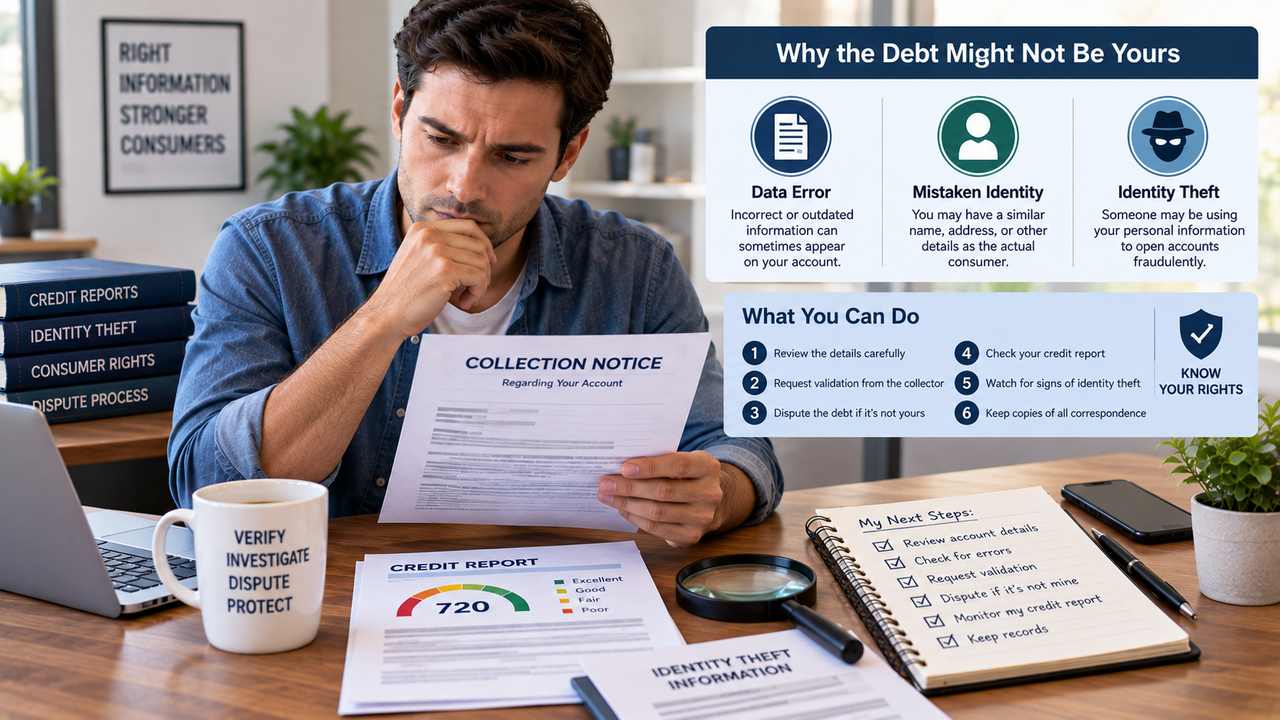
Whether it’s a simple data error, a case of mistaken identity, or actual identity theft, there’s a clear, methodical process for handling this situation, protecting yourself, and getting an inaccurate debt removed from your record.
The most important thing is not to panic and not to automatically pay simply because a collector is contacting you.
Step One: Don’t Panic, But Don’t Ignore It Either
A debt collection contact for something you don’t recognize can feel alarming, but reacting with either panic (agreeing to pay just to make it stop) or complete avoidance (ignoring it and hoping it resolves itself) are both mistakes.
This is a situation that calls for a methodical, documented response, not an emotional reaction in either direction.
The CFPB recommends using the information provided by the collector to determine whether the debt is legitimate and whether you actually owe it. It also advises consumers to keep records of communications with collectors. See the CFPB’s guidance on what to do when a debt collector contacts you.
If the debt appears on your credit report, you should also review our guide on how to read a credit report.
Step Two: Request Formal Debt Validation Immediately
This is your essential first step, regardless of how confident you are that the debt isn’t yours.
Under the Fair Debt Collection Practices Act, you have the right to request written validation, including information about the debt and the original creditor. The validation notice should also explain how and by when you can dispute the debt.
If you dispute the debt in writing within the applicable 30-day validation period, the debt collector generally must pause collection activity on the disputed debt until it provides verification.
Request this in writing and keep a copy of everything you send. Certified mail with return receipt requested can provide useful documentation of delivery.
The CFPB’s current Regulation F defines the federal validation period and requires the validation notice to identify the end date of that period. Review the CFPB’s current debt-validation rule.
You can also use our debt validation letter guide as a starting point.
Step Three: Carefully Review What Comes Back
Once you receive their validation response, look specifically for:
The Original Creditor’s Name
Do you recognize this company at all?
If you’ve genuinely never had any relationship with this creditor, this is a strong signal something is wrong.
The Account Opening Date and Details
Does the timeline align with anything in your own financial history, even loosely?
An account opening date that predates your relationship with the creditor or falls during a period when you could not have opened the account may be an important clue.
The Address Associated With the Account
If it’s an address you’ve never lived at, this can be a meaningful clue pointing toward identity theft or a data-matching error involving someone else at that address.
Your Name as It Appears on the Account
Sometimes a data-matching error occurs specifically because of a similar or identical name — a “John A. Smith” being confused with a different “John A. Smith,” for example, which happens more often than people expect, particularly with common names.
Also compare other identifying information carefully. A mismatch in identifying information can help establish that the account belongs to someone else.
The Three Most Common Explanations
A Data-Matching Error
Credit bureaus and collectors process enormous volumes of data, and errors matching accounts to the wrong person — particularly for common names, or cases involving similar Social Security Numbers due to a transposed digit — do happen.
This is often the most straightforward scenario to resolve, since it typically doesn’t involve any malicious activity, just an administrative mistake that needs correcting.
A Family Member’s Debt You Weren’t Aware Of
Sometimes what feels like “not my debt” turns out to be an account you were actually connected to in a way you’d forgotten or didn’t fully understand — an old authorized user arrangement, a joint account from years ago, or a debt a family member incurred using your information without full malicious intent.
If someone used your personal information without authorization, however, the situation may still involve identity theft regardless of your relationship with that person.
Genuine Identity Theft
Someone used your personal information — your name, Social Security Number, or other identifying details — to open an account or incur debt without your knowledge or consent.
This is the most serious scenario and requires a more comprehensive response beyond simply disputing this one specific debt.
The CFPB recommends checking your credit reports for unfamiliar accounts, inquiries, amounts, names, addresses, and other signs of identity theft.
How to Determine Which Scenario You’re Facing
Check Your Full Credit Reports
Check your full credit report from all three bureaus.
If this is an isolated single account you don’t recognize, it’s more likely a data-matching error. If you find multiple unfamiliar accounts, unfamiliar addresses, or other signs of broader unauthorized activity, this points more strongly toward genuine identity theft.
If you find multiple questionable accounts, you can also review our guide to identity theft protection.
Think About How Your Information May Have Been Exposed
Consider whether you’ve shared your personal information in any risky context recently — a data breach you were notified about, a lost wallet, a scam you may have fallen for, or a family member with access to your personal information who might have misused it.
Review the Account Details Carefully
Review the specific account details for anything that jogs a memory you’d genuinely forgotten, versus something that remains completely unfamiliar no matter how you think about it.
Do not assume that every unfamiliar company name automatically means identity theft. A creditor or service provider may report under a name that differs from the brand name you remember.
If It’s a Data-Matching Error
Formally dispute the debt in writing with both the collector and the credit bureau(s) reporting it, clearly explaining that the account doesn’t belong to you and providing any documentation that supports this (proof of your actual address history, for example, if the account is tied to an unfamiliar address).
Provide as much specific, verifiable information as possible to help them identify and correct the error — the more specific your documentation, the better the dispute can be evaluated.
Follow up to confirm the correction was made, since even legitimate errors sometimes require more than one round of dispute to fully resolve, particularly if the debt has already been resold or reported by multiple parties.
The CFPB recommends disputing inaccurate information with both the credit reporting company and the company that furnished the information. Furnishers generally must investigate and respond within 30 days, subject to applicable exceptions.
For a step-by-step explanation, see how to dispute credit report errors.
If It’s Genuine Identity Theft
File a Report at IdentityTheft.gov
File a report at IdentityTheft.gov, the FTC’s dedicated resource for this situation.
This generates an official identity theft report and can provide a personalized recovery plan based on your specific situation.
Place a Fraud Alert or Credit Freeze
Place a fraud alert or credit freeze with the credit bureaus.
A fraud alert requires businesses to take extra steps to verify your identity before extending new credit in your name. A credit freeze is a stronger protection that prevents potential creditors from accessing your credit file for new-account purposes until you lift the freeze.
The FTC confirms that credit freezes are free and do not affect your credit score. A freeze can be placed or lifted when you choose.
For a detailed comparison, see our guide to credit freezes versus fraud alerts.
File a Police Report When Appropriate
File a police report, particularly if the identity theft involves a specific known perpetrator (such as a family member) or if you need this documentation for further legal or financial recovery steps.
Dispute Every Fraudulent Account You Identify
Dispute every fraudulent account you identify, not just the one that initially prompted your investigation, using your identity theft report as supporting documentation for each dispute.
Contact Each Creditor Involved Directly
Contact each creditor involved directly, in addition to disputing with the credit bureaus, since some issues (like closing a fraudulently opened account entirely) may require direct communication with the creditor beyond the standard credit bureau dispute process.
The CFPB explains that consumers can request that credit reporting companies block fraudulent information by providing an identity theft report, proof of identity, and identification of the fraudulent information.
What If a Family Member Is Responsible?
This is a genuinely difficult scenario that combines a legal issue with a personal, relational one.
Legally, using someone else’s information without authorization to open credit or incur debt can constitute identity theft, regardless of the relationship between the parties. You retain legal remedies for disputing the debt and addressing fraudulent accounts regardless of who’s responsible.
How you choose to handle the underlying relationship — whether you pursue formal legal consequences, have a private conversation, or handle it some other way — is a separate, personal decision that doesn’t have a single right answer.
Protecting your own credit and financial standing doesn’t require you to make any specific decision about pursuing consequences against the family member if you’re not ready to or don’t want to.
Sending a Formal Dispute Letter
Whether the issue is a data error or identity theft, a written dispute should include:
- A clear statement that the debt is not yours, with your specific reasoning (never had an account with this creditor, address doesn’t match your history, and so on).
- Any supporting documentation you have — proof of your actual address history, an identity theft report if applicable, or other evidence supporting your position.
- A request for the item to be removed or corrected, sent to both the collector directly and to whichever credit bureau(s) are reporting the item, if it’s affecting your credit report.
Send via certified mail with return receipt requested, and keep copies of everything.
The CFPB provides a sample dispute process and recommends explaining what is inaccurate and including copies of supporting documents.
What Happens After You Dispute
Under the Fair Credit Reporting Act, a credit reporting company generally must investigate a properly submitted dispute within 30 days. Some circumstances can extend the investigation period to up to 45 days.
If the investigation shows that the furnisher provided wrong information or that the information cannot be verified, the furnisher must update or remove the information and notify the applicable credit reporting companies.
If your dispute is denied and you believe it was handled improperly, you have the right to request the specific reasoning and can escalate further, including through a complaint to the CFPB or, for more serious or persistent identity theft situations, consulting a consumer law attorney.
You can also review our detailed guide on how to file a credit dispute.
Frequently Asked Questions
How long does it typically take to resolve a dispute for a debt that isn’t mine?
A straightforward data-matching error, well-documented, may resolve within the standard investigation window. More complex identity theft situations, particularly those involving multiple accounts or requiring coordination with law enforcement, can take considerably longer to fully resolve.
The CFPB says credit reporting companies generally have 30 days to investigate a dispute, with certain circumstances allowing up to 45 days.
Should I pay any portion of a debt I don’t recognize just to make the calls stop, even while disputing it?
No — making any payment on a debt you’re disputing as not yours is generally not a good response. Instead, formally dispute the debt and request verification.
If you dispute the debt in writing within the federal validation period, the collector generally must stop collection activity on the disputed amount until it provides verification.
What if the collector continues contacting me even after I’ve formally disputed the debt?
Continued collection activity without providing adequate verification after a timely written dispute may raise FDCPA issues. Document the communications and consider reporting the matter to the CFPB or discussing it with a consumer-law attorney.
The CFPB advises consumers to maintain records of communications with debt collectors.
You can also learn more about collection agency harassment and the FDCPA.
Can identity theft affect my ability to get approved for legitimate credit in the future, even after I resolve the fraudulent accounts?
Once properly disputed and removed, fraudulent accounts shouldn’t continue appearing as legitimate debts on your credit report. However, the resolution process itself can take time, during which a fraud alert or credit freeze may add some extra steps when you apply for legitimate new credit.
Is there a cost to filing an identity theft report or placing a credit freeze?
No — filing a report through IdentityTheft.gov is free, and federal law requires nationwide consumer reporting agencies to offer free credit freezes and fraud alerts. The FTC confirms that credit freezes can be placed and lifted for free.
A Sample Dispute Letter for a Debt You Don’t Recognize
If you need to dispute a debt that you genuinely believe is not yours, you can adapt the following template:
[Your Name]
[Your Address]
[Date]
[Collector Name and Address]
Re: Account [Reference Number, if provided]
To Whom It May Concern:
I am writing to dispute the above-referenced debt. I have never had an account with [original creditor named in your validation response], and I do not recognize this debt as my own.
[Include specific supporting detail here — e.g., “The address associated with this account does not match any address I have lived at” or “I have never resided in [city/state] where this account originated.”]
I am requesting that you cease collection activity on the disputed debt as required by applicable law and provide verification demonstrating that this debt is legitimately associated with me.
If you cannot substantiate the account and its connection to me, I am requesting that this account not be reported or that any inaccurate reporting associated with my name be corrected or removed.
I am also disputing this item directly with the applicable credit reporting agencies.
Sincerely,
[Your Name]
Send via certified mail with return receipt requested, and send a corresponding dispute to each credit bureau reporting the item, including copies of any supporting documentation.
For additional information, see our guide to credit repair letters.
How Identity Theft Recovery Unfolds Over a Longer Timeline
It’s worth setting realistic expectations for a more serious identity theft situation, since full recovery sometimes takes months, particularly if multiple accounts or a sophisticated fraud scheme is involved.
A general progression:
- Immediate steps: Consider a fraud alert or credit freeze and file an identity theft report once you discover the issue.
- Individual account disputes: Dispute each fraudulent account with the relevant credit reporting companies and furnishers.
- Follow-up: Review the results of each investigation and confirm that corrections appear on your reports.
- Long-term documentation: Keep your identity theft report and all dispute documentation organized and accessible for future reference.
Individual credit-report disputes generally have a 30-day investigation period, although certain circumstances can allow a longer period.
Some residual effects — like needing to explain a resolved identity theft situation to a future lender who notices historical activity even after correction — can persist longer, which is part of why keeping your identity theft report and all dispute documentation organized and accessible for future reference remains valuable.
What to Do If You Discover the Debt Was Actually Yours After All
Occasionally, after investigation, someone discovers that a debt they initially didn’t recognize actually was theirs — perhaps from a company that goes by a different name than the original service provider, or an old account genuinely forgotten over time.
If this happens, it doesn’t mean you made a mistake by requesting validation and investigating — this is exactly the appropriate, careful process to follow regardless of the eventual outcome.
At this point, you’d shift from a dispute process to the standard debt resolution process:
- Verify the accuracy of the account.
- Check your state’s statute of limitations if it’s older debt.
- Determine whether you can afford payment.
- Consider whether settlement or a payment plan is appropriate.
For older accounts, see our guide to the statute of limitations on debt.
If you decide to negotiate, our guide on negotiating with a debt collector without getting taken advantage of may also help.
Frequently Asked Questions, Continued
Can a debt collector re-report a debt I successfully disputed as not being mine?
Generally, a furnisher cannot simply continue reporting information that has been determined to be inaccurate or unverifiable. If an allegedly fraudulent or inaccurate account reappears, document the new reporting and submit another dispute.
The CFPB explains that furnishers must correct or remove information when their investigation determines that information is inaccurate or cannot be verified.
Does placing a credit freeze affect my current, legitimate accounts and credit cards?
No — a credit freeze is designed to restrict access to your credit file for new-account purposes. It does not close your existing credit cards or otherwise freeze your current legitimate accounts.
The FTC confirms that a credit freeze does not affect your credit score and remains in place until you lift it.
Should I contact my bank if I discover identity theft affecting a debt collection matter, even if my bank accounts themselves seem unaffected?
It’s generally a good precaution to alert your bank, since identity theft affecting one area of your financial life sometimes indicates broader compromise of your personal information that could eventually affect other accounts, even if nothing appears wrong with your bank accounts specifically at this point.
Is there a cost to obtaining copies of documents, like a fraudulent account application, as part of disputing a debt that isn’t mine?
The specific documents you can obtain and the process for requesting them can depend on the creditor, collector, dispute process, and applicable law. Request the documentation you need in writing and keep records of the request and response.
A Comparison of Your Three Scenarios and Response Paths
| Scenario | Key Indicator | Primary Response |
|---|---|---|
| Data-matching error | Isolated account, similar name, otherwise clean file | Written dispute with supporting documentation |
| Family member’s unauthorized use | Recognizable pattern, possible personal connection to details | Dispute + personal decision about relationship consequences |
| Genuine identity theft | Multiple unfamiliar accounts, unfamiliar addresses, no personal connection | Full identity theft protocol: freeze, report, dispute every account |
Using this table as a quick diagnostic can help you decide how urgently and comprehensively to respond once you’ve gathered your initial information from your credit report and the collector’s validation response.
Frequently Asked Questions, Continued Further
If the debt collector’s records show a different Social Security Number than mine, but everything else matches, what does that suggest?
This pattern can point toward a data-entry or data-matching error, such as a transposed digit, rather than deliberate identity theft. However, it’s still worth treating the matter through a formal dispute process, since even an innocent data error needs to be properly corrected through documentation.
Does the FTC’s IdentityTheft.gov report cost anything or require an attorney to file?
No — it is a free, self-service government tool designed specifically for consumers to use directly, without needing legal representation. It can generate an identity theft report and personalized recovery plan.
Start an identity theft report at IdentityTheft.gov.
If I successfully dispute a debt as not mine, will I be notified of the outcome, or do I need to check myself?
Credit reporting companies generally must provide notice of the results of their dispute investigation. The CFPB says that, after completing an investigation, a credit reporting company generally has five business days to notify you of the results.
It’s still worth proactively checking your credit report afterward to confirm the correction was actually made as expected.
The Bottom Line
Being contacted about a debt that isn’t yours requires a methodical response: request formal validation, carefully review what you receive for signs of a data error versus genuine identity theft, and respond accordingly.
A straightforward written dispute may be appropriate for a data-matching error, while a more comprehensive identity theft recovery process — including a fraud alert or credit freeze, an official identity theft report, and disputes for every affected account — may be necessary if fraud is involved.
In either case, never pay simply to make the situation go away, and keep thorough documentation throughout. This protects you both in resolving this specific debt and in demonstrating your diligence if any related issue resurfaces later.
Related Credit & Identity Theft Resources
- Debt Validation Letter Guide
- How to Dispute Credit Report Errors
- How to File a Credit Dispute
- Identity Theft Protection
- Credit Freeze vs. Fraud Alert
- How to Read a Credit Report
- Collection Agency Harassment and the FDCPA
- How to Remove Collections From Your Credit Report
Need Help Reviewing an Account That Isn’t Yours?
If an unfamiliar collection account is appearing on your credit report or a debt collector is contacting you about an account you don’t recognize, reviewing the account details and your credit reports can help you identify potential errors and determine what steps may be appropriate.
Important: This article provides general educational information and is not legal advice. Debt-collection and credit-reporting rules can depend on the circumstances. Identity theft matters can also involve federal and state laws with specific procedures and deadlines. If you are facing litigation, extensive identity theft, or a complex dispute, consider consulting a qualified consumer-law attorney.