
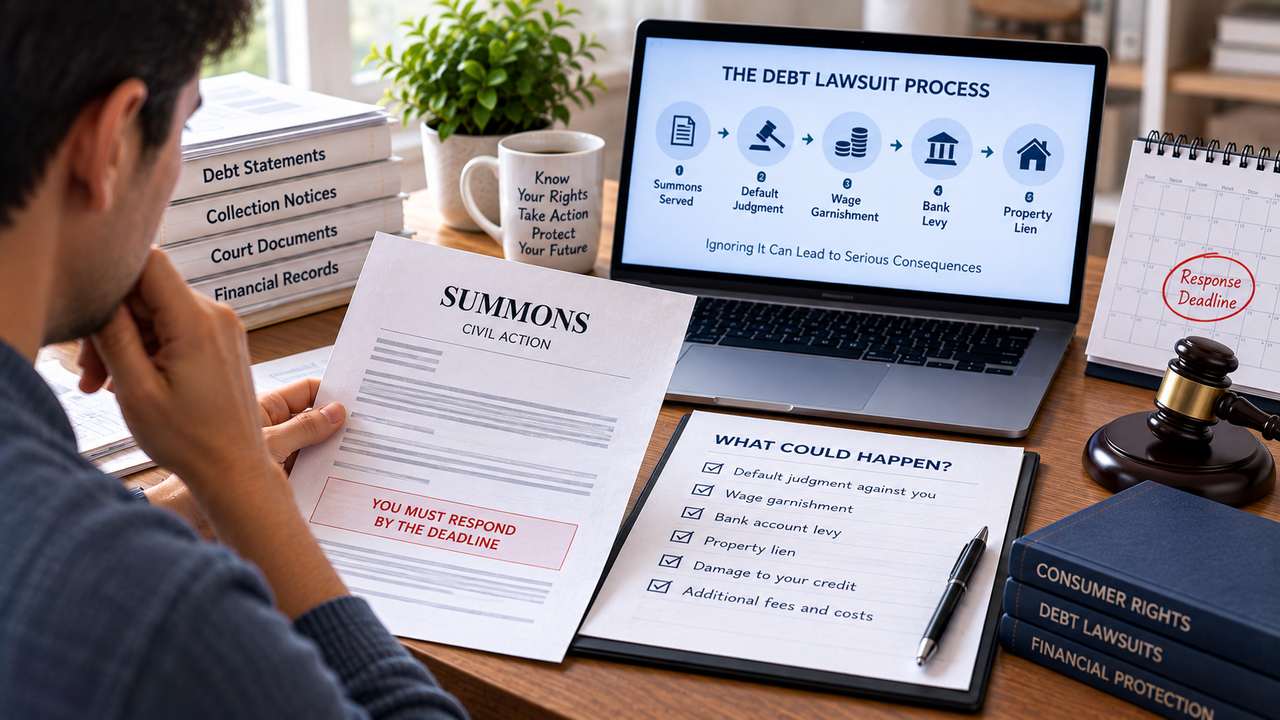
The Consumer Financial Protection Bureau’s guidance on debt collection lawsuits recommends responding to a lawsuit by the deadline specified in the court papers. The exact deadline and procedure depend on the court and applicable state law.
Step One: The Default Judgment
If you don’t file a formal response (typically called an “Answer”) by the deadline specified in your court papers — commonly somewhere between 14 and 30 days from when you were served, depending on your state and court — the plaintiff (the debt collector or their attorney) can request that the court enter a default judgment against you. This means the court rules in the collector’s favor automatically, without you ever presenting any defense, evidence, or argument on your own behalf, simply because you didn’t show up or respond in the required timeframe.
The exact response deadline is not universal. Read the summons and complaint carefully and follow the deadline stated by the court. In federal civil cases, for example, the general answer period can be 21 days after service, subject to exceptions and different rules.
This is true even if you had a completely valid defense available — an expired statute of limitations, inadequate documentation proving the debt is actually yours, or evidence you already paid it off. None of that matters if you never formally raise it, because the court has no way of knowing these defenses exist if you don’t present them.
The CFPB similarly explains that responding does not necessarily mean you agree that you owe the debt. Responding gives you an opportunity to require the collector to establish its claim and preserve potential defenses.
If you are dealing with a collection account before it reaches the lawsuit stage, our guide on how to file a credit dispute may also help you understand the difference between a credit-report dispute and a court case.
What a Default Judgment Actually Means for You
Once a default judgment is entered, the collector has a formal, legally enforceable court order confirming you owe the debt (plus, often, court costs and sometimes attorney’s fees, depending on your state and the original credit agreement’s terms). This judgment gives them access to legal collection tools they didn’t have before filing the lawsuit:
Wage Garnishment
In most states, once a judgment is entered, the creditor can request a wage garnishment order, requiring your employer to withhold a portion of your paycheck (subject to federal and state limits on the maximum percentage) and send it directly to satisfy the judgment.
Garnishment rules and exemptions vary significantly. The CFPB’s guidance on wage and benefit garnishment explains that state and federal protections may apply to different types of income.
Bank Account Levies
A judgment can allow the creditor to freeze and seize funds directly from your bank account, though certain types of funds — Social Security income, in many states, and sometimes other specific protected categories — are generally exempt from this kind of seizure.
The specific exemptions depend on federal and state law. If you believe protected funds have been frozen or taken, prompt legal advice may be important.
Property Liens
If you own real estate, a judgment can result in a lien being placed against the property, which typically must be resolved (paid off) before you can sell or refinance that property in the future.
Continued Interest Accrual
Many judgments continue accruing interest at a legally set rate until fully paid, meaning the total amount owed can continue growing over time even after the judgment is entered, sometimes substantially, especially for a judgment that remains unpaid for years.
The CFPB explains that judgments can include the amount claimed plus lawful additional costs, interest, and attorney fees where applicable.
The Judgment Doesn’t Just Disappear Over Time
Unlike credit report entries, which follow the standard seven-year reporting rule, a court judgment can remain legally enforceable for a much longer period, and in many states, creditors can formally renew a judgment before it expires, extending its enforceability for additional years, sometimes indefinitely through repeated renewals. This means an ignored lawsuit and resulting default judgment isn’t a problem that simply resolves itself with the passage of time the way some other financial issues eventually do — it can remain a live, growing, actively enforceable obligation for a very long time if left unaddressed.
The exact duration of a judgment and whether it can be renewed are matters of state law. Do not assume that a judgment will automatically disappear after a particular number of years.
This is also different from the federal credit-reporting rules. The CFPB explains the federal time limits that generally apply to negative information on consumer credit reports, which are separate from the legal enforceability of a court judgment.
How This Affects Your Credit and Broader Financial Life
While federal civil judgments were removed from standard credit reports several years ago as part of an industry-wide policy change, the practical downstream effects of an unresolved judgment — wage garnishment showing up in your pay records, a bank levy disrupting your finances, a property lien complicating a future home sale — can still create significant, visible financial disruption even though the judgment itself may not appear as a distinct line item on your credit report the way it once did. Additionally, the underlying debt that led to the lawsuit likely already appears (or previously appeared) on your credit report as a collection or charge-off, separate from the judgment itself, continuing to affect your score through that more standard reporting mechanism.
If you want to understand what is currently being reported, you can obtain your credit reports through AnnualCreditReport.com, the official federally authorized source for free credit reports.
Our guide on how to read a credit report can help you understand the different sections and account information you may see.
Can a Default Judgment Be Undone?
In some circumstances, yes, though it’s a considerably harder and more uncertain process than simply responding to the original lawsuit on time would have been. Courts can sometimes vacate (undo) a default judgment if you can demonstrate a valid legal reason — commonly, that you were never properly served with the lawsuit in the first place, or that you had a legitimate, excusable reason for missing the response deadline (a serious illness, for example) combined with a genuine defense you would have raised had you responded in time.
This process typically requires filing a specific motion with the court, often within a limited timeframe after learning of the default judgment, and successfully arguing your case for why the judgment should be set aside — which is considerably more complex and uncertain than simply filing a timely Answer would have been from the start. If you discover a default judgment has already been entered against you, consulting a consumer law attorney promptly about whether vacating it is a realistic option for your specific situation is worth pursuing, though the earlier you act after discovering the judgment, the better your chances typically are.
Federal Rule 60 provides procedures for seeking relief from certain federal-court judgments, but state courts have their own rules and deadlines. For that reason, the U.S. Courts rules and procedures resources are useful for understanding federal cases, while state-specific cases should be reviewed under the applicable state rules.
Why People Ignore Lawsuits, and Why It’s Almost Always the Wrong Choice
- Fear and avoidance. Legal paperwork is intimidating, and avoidance is a natural, if ultimately counterproductive, emotional response to something frightening and unfamiliar.
- Belief the debt isn’t legitimate, and therefore doesn’t need a response. Ironically, if you genuinely believe the debt is inaccurate, too old, or improperly pursued, responding is even more important, since these are exactly the kinds of defenses that get automatically forfeited by not responding — ignoring a lawsuit over an illegitimate debt doesn’t win you anything; it guarantees you lose by default regardless of how valid your underlying objection might have been.
- Assuming there’s no point since you can’t afford to pay anyway. Even if you ultimately can’t pay the full amount, responding preserves your ability to potentially negotiate a more favorable settlement or structured payment arrangement, and to ensure the judgment amount (if one is ultimately entered) is accurate rather than inflated by unchallenged claims.
- Not understanding what’s actually at risk. Many people simply don’t realize how serious the consequences of a default judgment can be until it’s already happened, which is exactly why understanding this process in advance — before you’re facing an actual deadline under stress — is so valuable.
The CFPB specifically notes that responding to a lawsuit can preserve the opportunity to challenge the debt or amount claimed and may allow settlement discussions before a judgment is entered.
What Responding Actually Requires
Responding doesn’t necessarily require hiring an expensive attorney, though consulting one is worthwhile if accessible to you. Many courts provide simplified, fillable Answer forms specifically designed for debt collection cases, and various legal aid organizations and court self-help centers offer free guidance for exactly this situation. At minimum, responding requires: reading your court papers carefully to identify your specific deadline, filling out and filing whatever response form your specific court requires (addressing each claim made against you and raising any defenses that apply), and following your court’s specific filing process (which may include a fee, though fee waivers are often available based on income).
The LawHelp legal-aid directory can help consumers locate legal assistance and legal-aid resources in their state. Availability and eligibility vary.
What Happens After You Respond
Once you’ve filed a timely Answer, the case moves into further stages rather than an automatic default. This typically includes a discovery phase (where you can request the plaintiff produce documentation supporting their claim), potential settlement discussions (many cases resolve this way, without ever reaching trial), and, in a minority of cases, an actual trial where both sides present their case. Throughout this process, you retain the ability to negotiate a settlement, challenge inadequate documentation, or raise legitimate defenses — none of which remain available once a default judgment has already been entered.
If you’re considering settlement, our guide on negotiating with creditors when you’re genuinely struggling provides general information about creditor negotiations.
Remember that negotiating with the collector does not necessarily replace the requirement to file a formal court response by the deadline. The CFPB recommends responding to the lawsuit according to the court’s requirements even if you are also discussing settlement.
Frequently Asked Questions
If I can’t afford the court filing fee to respond, does that mean I have no choice but to let the case default?
No — many courts offer fee waivers for those who qualify based on income, and it’s worth specifically asking the court clerk about this option rather than assuming the fee is an absolute barrier to responding.
Does ignoring a lawsuit affect anyone else, like a spouse or family member?
If the debt was solely yours, generally only your own finances and credit are directly affected, though in community property states, a spouse’s assets or income could potentially be implicated depending on specific state law and the nature of the debt — this is worth clarifying with an attorney if you’re in a community property state and concerned about this specific issue.
How Would I Know If a Default Judgment Has Been Entered?
You may receive formal notice of the judgment itself, separate from the original lawsuit papers, or you might first become aware of it when a garnishment or levy actually begins affecting your paycheck or bank account — periodically checking your state’s online court records system (many states now offer this) for your name is one proactive way to check whether any judgments exist against you, particularly if you’re unsure whether a prior lawsuit you may have missed resulted in one.
Do not rely solely on your credit report to determine whether a judgment exists. Court records and credit reports serve different purposes.
Is it too late to negotiate a settlement once a default judgment has already been entered?
Not necessarily too late, though your negotiating position is considerably weaker than it would have been before the judgment, since the collector has already secured their legal win and the tools that come with it. Some creditors remain willing to negotiate a payoff even post-judgment, particularly if they recognize collection through garnishment or levy might be slow or difficult, but you’re negotiating from a position of less leverage than you’d have had earlier in the process.
Can I still be sued again for the same debt if the case is dismissed due to my failure to appear at a required hearing, separate from the initial Answer deadline?
This depends on how exactly the dismissal is characterized by the court (with or without prejudice) and the specific circumstances — missing a later required hearing, even after initially filing an Answer, can also lead to negative consequences, which is why staying engaged with the case throughout its entire duration, not just at the initial response stage, matters if you choose to contest a lawsuit.
A Timeline of What Actually Unfolds After You Ignore a Lawsuit
Days 1-30 (varies by state): The response window
After being served, this is your window to file an Answer. If it passes with no response, the plaintiff becomes eligible to request a default judgment.
Following the Missed Deadline: The Default Judgment Motion
The plaintiff’s attorney files a motion or request asking the court to enter judgment in their favor by default, typically a relatively quick, administrative process since there’s no opposition to consider.
Judgment Entry
Once the court grants the default judgment, it becomes an official court order, generally including the original debt amount plus any court costs and, depending on the original agreement and state law, sometimes attorney’s fees and additional interest.
Post-Judgment Collection Actions
The creditor generally must take additional legal steps to actually enforce the judgment — filing for a wage garnishment order, requesting a bank levy, or recording a property lien — each of which typically involves its own separate legal process and paperwork, meaning there’s often some additional time (weeks to months) between the judgment being entered and actual collection action beginning, though this varies by state and the specific creditor’s approach.
Ongoing Enforcement and Potential Renewal
If the judgment isn’t satisfied, the creditor can continue pursuing collection through these tools for an extended period, and depending on your state, can formally renew the judgment before its enforceability period expires, extending their ability to collect for additional years.
Why Some People Mistakenly Believe Ignoring It Is a Viable Strategy
A few misconceptions specifically fuel this mistake. Some people assume that since they have no significant assets or garnishable wages right now, a judgment against them is essentially meaningless — but financial circumstances change, and a judgment doesn’t expire simply because you’re currently judgment-proof; it can sit dormant, waiting to be enforced later if your situation improves, or be renewed to remain enforceable indefinitely. Others assume that because the underlying debt itself feels illegitimate or unfair, a court will somehow recognize this even without them formally raising it — but courts generally rule based on what’s actually presented and argued, not on an independent investigation into fairness; your defense, however valid, needs to actually be raised to matter.
The CFPB likewise warns that ignoring a lawsuit can result in a judgment even when you believe you do not owe the debt.
Frequently Asked Questions, Continued
If I move to a different state after a default judgment is entered against me, does the judgment follow me?
Generally, yes — a valid judgment doesn’t simply disappear because you’ve moved, though the creditor may need to take additional legal steps (sometimes called “domesticating” the judgment) to enforce it in your new state specifically, which adds some complexity but doesn’t eliminate their underlying right to pursue collection.
Does a default judgment show a different amount than what was originally claimed in the lawsuit?
It can, since courts sometimes add court costs, and depending on the terms of your original agreement and state law, potentially additional interest or attorney’s fees beyond the base amount originally claimed — meaning the total judgment amount is sometimes higher than what you initially saw referenced in the lawsuit paperwork itself.
Is there a difference between a default judgment and a judgment entered after I actually participated but lost the case?
Practically, once entered, both types of judgments generally carry the same enforcement tools (garnishment, levy, lien) — the meaningful difference is in how they can potentially be challenged afterward, since a default judgment (where you never had a chance to present your case) is sometimes easier to argue should be vacated than a judgment entered after a full, contested proceeding where you did participate but simply didn’t prevail.
The Real Cost Comparison: Responding vs. Ignoring
| Responding to the Lawsuit | Ignoring It |
|---|---|
| Time investment: Filing an Answer, possibly attending hearings | Time investment: Minimal upfront, but potentially years of consequences later |
| Cost: Possible filing fee (often waivable), possible attorney consultation | Cost: No immediate cost, but judgment amount plus accruing interest over time |
| Ability to negotiate: Strong — collector faces litigation uncertainty | Ability to negotiate: Weak — collector has already won |
| Defenses available: All applicable defenses can be raised | Defenses available: All forfeited automatically |
| Long-term risk: Resolved through settlement, judgment, or dismissal | Long-term risk: Judgment can persist and be renewed for years |
This comparison makes clear why, even accounting for the very real time and stress involved in responding to a lawsuit, ignoring it is rarely the lower-cost option once the full picture — including years of potential judgment enforcement and renewal — is taken into account.
Frequently Asked Questions, Continued Further
If the debt collector’s lawyer contacts me directly after I’ve been served, should I respond to them or only to the court?
Both matter, but they serve different purposes — responding formally to the court (filing your Answer by the deadline) is the legally required action that prevents default, while any direct communication with the plaintiff’s attorney is a separate, optional channel for settlement discussions that doesn’t substitute for your formal court filing.
Can a default judgment affect my ability to rent an apartment or get a job later, beyond the credit and financial impacts already discussed?
Court records, including judgments, are often part of the public record and can sometimes appear in background checks used by landlords or employers, depending on the specific screening service and what it searches, adding another potential downstream consequence beyond the direct financial enforcement tools already covered.
If I successfully get a default judgment vacated, does that mean the lawsuit is dismissed entirely?
Not automatically — vacating a default judgment typically reopens the case to the point before the judgment was entered, meaning you’d then need to actually respond and defend the case going forward, rather than the lawsuit being entirely dismissed as a result of successfully vacating the earlier default.
Related Debt & Credit Resources
- Statute of Limitations on Debt
- Debt Validation Letter
- Collection Agency Harassment and the FDCPA
- Cease and Desist Letter for Debt Collectors
- How to Remove Collections From Your Credit Report
- How to Dispute Credit Report Errors
If you are facing a lawsuit over an old debt, the CFPB’s debt collection resources provide additional information about debt validation, collection practices, judgments, and consumer rights.
The Bottom Line
Ignoring a debt collection lawsuit doesn’t make it go away — it can result in a default judgment against you, potentially without any opportunity to present a defense you might have genuinely had. That judgment can then open the door to wage garnishment, bank levies, and property liens, and can remain legally enforceable and renewable for years, continuing to accrue interest the entire time. Whatever your specific circumstances or beliefs about the debt’s validity, responding to the lawsuit by your deadline — even if you ultimately can’t fully resolve the underlying debt — preserves your legal options rather than forfeiting them through inaction.
The CFPB’s guidance is straightforward: if you are sued by a debt collector or creditor, respond by the date specified in the court papers, either personally or through an attorney.
Need Help Understanding Your Credit Situation?
If a debt collection lawsuit has also resulted in collection accounts, inaccurate information, or other credit-report concerns, reviewing your credit reports can help you understand what is currently being reported.
Request a Credit Audit to discuss your credit situation and potential next steps.