
Start With an Honest Assessment of Your Current Credit Situation
Before looking at any specific card, understand where you actually stand, since this determines which cards you’re realistically likely to be approved for. If you have no credit history at all, you’ll generally need to start with a beginner-friendly product regardless of how appealing a rewards card’s benefits might look — most standard cards require at least some existing credit history for approval. Pull your credit report (even a thin or empty one tells you something) to confirm your starting point before applying anywhere.
If you are completely new to credit, you may also find our guide on how to start building credit at 18 helpful.
The Main Categories of First Cards
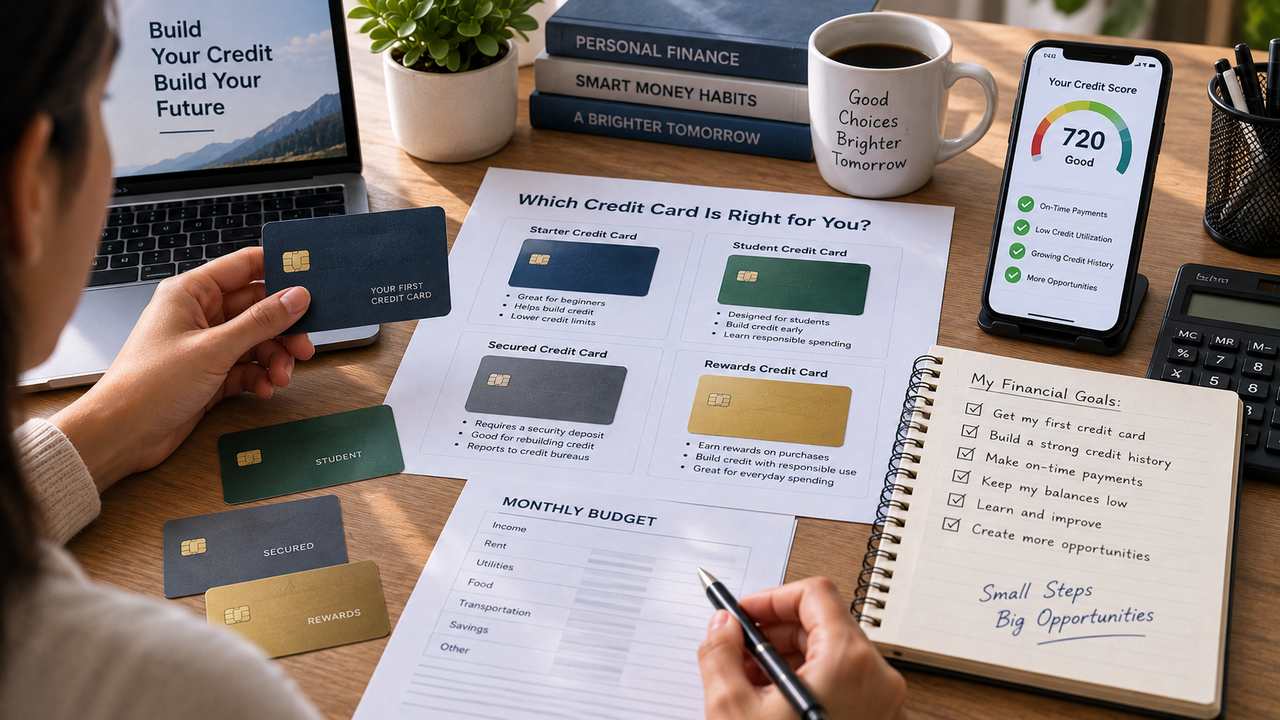
Secured Credit Cards
Backed by a cash deposit you provide, which becomes your credit limit, secured cards are the most universally accessible option for someone with no credit history, since approval is based primarily on your ability to provide the deposit rather than an existing credit track record. They function identically to a normal credit card in terms of credit reporting, and many issuers will refund your deposit and convert the card to unsecured status after a period of responsible use, commonly 6-12 months.
For additional information, see our guide to the best secured credit cards.
Student Credit Cards
If you’re currently enrolled in college, many major issuers offer student-specific cards with more lenient approval criteria than standard cards, sometimes including modest rewards (cash back on dining or streaming services, for example) tailored to typical student spending patterns. These don’t require a security deposit but do require some proof of income or ability to repay, which can include reported allowance or part-time job income.
Retail Store Cards
Store-branded credit cards, often offered at checkout with an immediate discount incentive, sometimes have more lenient approval criteria than general-purpose cards, making them accessible to some first-time applicants. However, they typically carry higher interest rates and more limited usefulness (often only usable at that specific retailer or a narrow network of affiliated stores), making them a less flexible primary choice, though sometimes useful as a secondary account specifically for adding a small amount of additional credit history.
Becoming an Authorized User Instead of Applying Yourself
If a trusted family member has a well-managed credit card with a long, positive history, being added as an authorized user can be an alternative (or supplement) to applying for your own first card, potentially providing a faster credit-building boost than starting completely from scratch, though this depends entirely on someone in your life being willing and appropriately positioned to add you.
Key Factors to Compare Once You’ve Identified Your Realistic Category
Annual Fee
For a first card specifically, prioritize no annual fee, since the point of this card is building history and habits, not maximizing rewards — an annual fee on a beginner card rarely makes sense given the limited rewards value you’re likely to earn while your credit is still developing.
Interest Rate (APR)
This matters most if you anticipate ever carrying a balance, though the ideal habit is paying in full every month, which makes the APR largely irrelevant to your actual costs. Still, knowing the rate gives you a sense of the cost if an emergency ever does require carrying a balance temporarily.
Deposit Requirement, if Secured
Choose a deposit amount you’re genuinely comfortable committing, understanding it will be tied up for the duration you hold the card in secured status (though it remains fully your money, refundable when the account closes in good standing or converts to unsecured).
Reporting Practices
Confirm the issuer reports to all three major credit bureaus — most reputable issuers do, but it’s worth verifying for a lesser-known card, since a card that doesn’t report to any bureau provides no credit-building benefit at all.
Path to Graduation, for Secured Cards Specifically
Look for issuers with a clear, stated policy for reviewing and potentially converting secured accounts to unsecured status after a period of good management, since this affects how quickly you might get your deposit back and access an unsecured limit.
What Not to Prioritize for Your First Card
Rewards and Cash-Back Rates
While appealing, rewards value is typically modest on any beginner-accessible card, and optimizing heavily for rewards on your very first card is generally less important than simply establishing a clean, well-managed account. You can chase more lucrative rewards cards once your credit is established.
A High Credit Limit
A lower limit on your first card isn’t a problem — in fact, it can help you naturally maintain low utilization, which is beneficial for your score, without needing much discipline around limiting your own spending.
Learn more about how this works in our guide to the credit utilization ratio.
Sign-Up Bonuses
Many attractive sign-up bonuses require an unusually high initial spend to qualify, which isn’t advisable to chase on a first card, since it can push you toward spending beyond what you’d normally comfortably afford, purely to hit a bonus threshold.
How to Actually Use Your First Card Once Approved
Set Up Autopay
Set up autopay for at least the minimum payment immediately, even if you intend to pay in full manually each month — this protects you from an accidentally missed payment due to forgetfulness.
Use One Small, Predictable Recurring Expense
Put one small, predictable recurring expense on the card — a streaming subscription, a phone bill — rather than using it broadly for daily spending, at least initially, keeping your utilization low and your spending easy to track and pay off in full.
Pay the Statement Balance in Full Every Month
This is the single most important habit for building credit without paying unnecessary interest — carrying a balance provides no additional credit-building benefit over paying in full.
Don’t Apply for Multiple Cards in a Short Window
Each application generates a hard inquiry, and multiple inquiries close together can signal risk to lenders and temporarily affect your score — one well-chosen first card is a better starting strategy than several applications hoping one gets approved.
You can learn more in our guide on how many hard inquiries are too many.
What to Expect Timeline-Wise
Most people following this approach see a usable credit score emerge within a few months of opening their first account (VantageScore can generate a score with as little as one month of history; FICO generally requires about six months). A genuinely strong score typically takes twelve to twenty-four months of consistent, on-time management to develop.
For more context, read our guide on what is considered a good credit score.
Comparing Your Realistic First-Card Options
| Secured Card | Student Card | Retail Card | Authorized User | |
|---|---|---|---|---|
| Requires deposit | Yes | No | No | No |
| Requires income proof | Sometimes minimal | Yes, often modest | Varies | Not applicable |
| Rewards | Rare, minimal | Sometimes modest | Store-specific discounts | Inherits primary card’s benefits |
| Best for | No credit history at all | Enrolled college students | Occasional secondary option | Those with a willing, trusted family member |
| Builds your own independent history | Yes | Yes | Yes | Partially, dependent on primary holder |
Frequently Asked Questions
Should I choose a card based on which bank I already have a checking account with?
This can be a reasonable, convenient starting point, since your existing banking relationship sometimes eases the application and management process, though it’s still worth comparing the specific card’s terms (fees, deposit requirements, reporting practices) against other realistic options rather than assuming your existing bank is automatically the best choice.
Is it bad to apply for a card and get denied as a first-timer?
A single denial isn’t catastrophic — it generates one hard inquiry with a small, temporary effect, and you can address the specific reason for denial (which lenders are required to disclose) before reapplying with a more appropriately matched product.
How much should I deposit on a secured card?
Choose an amount you’re comfortable having tied up for several months to a year — a smaller deposit ($200-300) is a completely reasonable starting point, and you’re not required to maximize your deposit to get meaningful credit-building benefit, since the credit-building mechanism works the same regardless of your specific limit size.
Can I have both a secured card and a student card at the same time?
Yes, though for a genuine first-timer, starting with one account and managing it well for several months before considering a second is generally the more measured approach, both for simplicity and to avoid the multiple-inquiry issue discussed above.
When should I consider upgrading from my first card to something with better rewards?
Once you’ve built roughly six months to a year of positive history and your score has developed to a point qualifying you for better products, it’s reasonable to start considering additional or upgraded cards — though keeping your original first card open (even if you stop actively using it) generally benefits your credit history length going forward.
A Realistic First-Year Spending Plan
To make the “put one small recurring expense on it” advice more concrete, imagine you open a secured card with a $300 limit. A sensible approach: put a single subscription (say, $10-15/month) on the card and nothing else, with autopay set for the statement balance in full. Your utilization would sit around 4-5%, comfortably within the range scoring models favor, while generating twelve months of clean, on-time payment history reported to all three bureaus by year’s end. This is a far more effective strategy for a beginner than putting substantial everyday spending on the card and trying to manage paying it down — the goal in year one is a clean, boring, entirely predictable track record, not maximizing what the card can technically handle.
What Happens If Your First Card Application Gets Denied
If you’re denied, lenders are required to provide the specific reason in writing (an “adverse action notice”). Common first-timer denial reasons include insufficient income relative to the credit limit requested, too many recent inquiries if you’ve applied elsewhere recently, or, for certain products, not meeting a specific eligibility requirement (like current school enrollment for a student card). Address the specific stated reason — applying for a card genuinely matched to your situation, waiting before reapplying if recent inquiries were a factor, or choosing a secured card specifically if income or credit history was the primary issue — rather than reapplying immediately for the same or a similar product without addressing whatever caused the initial denial.
Understanding the Difference Between a “Soft Pull” Pre-Qualification and a Full Application
Many issuers now offer a pre-qualification check, which uses a soft inquiry (no score impact) to give you a reasonable indication of your approval odds before you submit a full application (which does generate a hard inquiry). Using pre-qualification tools where available is a smart, no-risk way to narrow down realistic options before committing to a formal application, particularly useful for a first-time applicant uncertain about which specific products they’re likely to qualify for.
Frequently Asked Questions, Continued
Does it matter which specific bank or credit union I choose, beyond the card’s stated terms?
Beyond the card’s specific terms, customer service quality, mobile app usability, and how easy the issuer makes it to monitor your account and eventually graduate from a secured product can meaningfully affect your overall experience — these softer factors are worth some consideration alongside the harder terms like fees and deposit requirements.
Is it worth getting a card specifically because it has a mobile app with a built-in credit score tracker?
This is a nice convenience feature many major issuers now offer, and it can make monitoring your progress easier, though it shouldn’t be a primary deciding factor over more fundamental considerations like fees, deposit requirements, and confirmed bureau reporting.
Should I tell the card issuer this is my first credit card when I apply?
There’s typically no specific field for this, but your application will naturally reflect your credit history (or lack thereof) through the credit check itself, which the issuer’s underwriting already accounts for when evaluating beginner-friendly products specifically designed for exactly this situation.
Can I use a secured card for online purchases and other digital transactions the same as any other credit card?
Yes — a secured card functions identically to a standard credit card for all practical purchasing purposes, including online transactions, subscriptions, and any other use case; the only structural difference is the underlying deposit securing your credit line, which is invisible to merchants and doesn’t affect how the card functions for spending.
A Note on Building Credit Alongside Other Financial Priorities
For many first-time cardholders, choosing and managing a first credit card happens alongside other early financial priorities — building an emergency fund, paying down student loans, or simply establishing a budget for the first time. It’s worth keeping this specific tool in proper perspective: a credit card is one piece of a broader financial foundation, not a substitute for the others. The discipline of paying your statement in full every month works best when it’s part of a broader habit of spending within your means generally, rather than treated as an isolated exercise separate from your overall financial picture.
Frequently Asked Questions, Continued Further
Is there a specific age requirement for getting my own first credit card?
Generally, you need to be 18 or older to open a credit card in your own name, and if you’re under 21, federal law (the CARD Act) requires either proof of independent income sufficient to make payments, or a cosigner, before a standard card can be approved — this is worth knowing if you’re a younger applicant navigating this specific additional requirement.
For more information about credit card protections and consumer financial rules, visit the Consumer Financial Protection Bureau.
Does choosing a card from a smaller, regional bank versus a large national bank matter for credit-building purposes?
Not fundamentally — what matters most is confirmed reporting to all three major credit bureaus, which most legitimate banks and credit unions, regardless of size, do provide; the credit-building mechanism itself works identically regardless of institution size.
If my first card has a low limit and I need more spending power later, what’s the best way to increase it?
Most issuers allow you to request a credit limit increase after a period of responsible use (often 6+ months), sometimes through a simple online request — this is generally preferable to opening an entirely new card if your existing relationship with the issuer has been positive, since it adds to an existing account’s age rather than starting a new one.
A Deeper Look at Interest Rate Structures Beyond the Headline APR
Many first cards advertise a single APR, but it’s worth understanding that most cards actually carry several different rates depending on the type of transaction: a purchase APR, a separate (often higher) cash advance APR, and sometimes a penalty APR that can kick in after a missed payment. For a first card specifically, the purchase APR is what matters most in practice, since you should generally avoid cash advances entirely (they typically start accruing interest immediately, with no grace period, unlike standard purchases) and avoid any missed payment that could trigger a penalty rate. Understanding this structure upfront, even if the numbers feel abstract before you’ve used the card, helps you recognize which specific behaviors to avoid rather than treating “APR” as one single, simple number.
Why Secured Cards Sometimes Get an Undeserved Reputation
Some first-time cardholders feel a sense of stigma about starting with a secured card, as though it signals something negative about their financial situation. It’s worth pushing back on this perception directly: a secured card is simply a structurally different product, not a lesser one, and using one has no bearing on how future lenders view you once your credit history develops — a secured card’s activity is reported identically to an unsecured card’s, and nothing on your credit report distinguishes “this account started secured” from a lender’s perspective once it’s been converted or once you’ve moved on to other products. Many financially sophisticated people use secured cards deliberately, not out of necessity but as a genuinely sound, low-risk way to build or rebuild credit.
What to Do in the First 48 Hours After Approval
Once approved, a few specific actions in the first couple of days set you up well: activate the card through whatever method your issuer specifies, set up online account access and enable transaction alerts, add the card to your preferred payment method for one specific recurring bill, and set up autopay for at least the minimum payment (ideally the full statement balance) so you’re protected from an accidental missed payment during your first billing cycle before the habit is fully established.
Frequently Asked Questions, Continued Even Further
Does my card’s specific rewards category matter at all for a first card, or should I ignore rewards entirely?
For a genuine first card, rewards should be a minor, secondary consideration at most — if two otherwise-equal options exist and one happens to offer modest rewards on a category you already spend in, that’s a reasonable tiebreaker, but it shouldn’t drive your primary decision over fees, deposit requirements, and confirmed bureau reporting.
Is it common to feel anxious about using a credit card for the first time, even for small amounts?
Yes, this is a very normal reaction, particularly for anyone who’s heard cautionary stories about credit card debt — starting with genuinely small, predictable, budgeted spending (as this guide recommends) is specifically designed to let you build comfort and confidence gradually, rather than needing to feel fully confident before you begin.
The Bottom Line
Choosing your first credit card comes down to matching a realistic product (secured card, student card, or an authorized user arrangement) to your actual current credit situation, prioritizing no annual fee and confirmed bureau reporting over rewards or a high credit limit. Once approved, the habits that matter most are simple and consistent: pay on time every time, keep utilization low, and let the account age rather than closing it once something more appealing becomes available later. This unglamorous, patient approach is what actually builds strong credit over time — far more than any specific card’s features or rewards program.
Need Help Understanding Your Credit Before Applying?
Choosing your first credit card can be easier when you understand your current credit situation and what may already be appearing on your credit report.
A detailed credit report review can help you better understand your credit profile, identify potential reporting issues, and make more informed decisions about building your credit history.