Blog

  • Does Paying Off a Charge-Off Remove It From Your Credit Report?

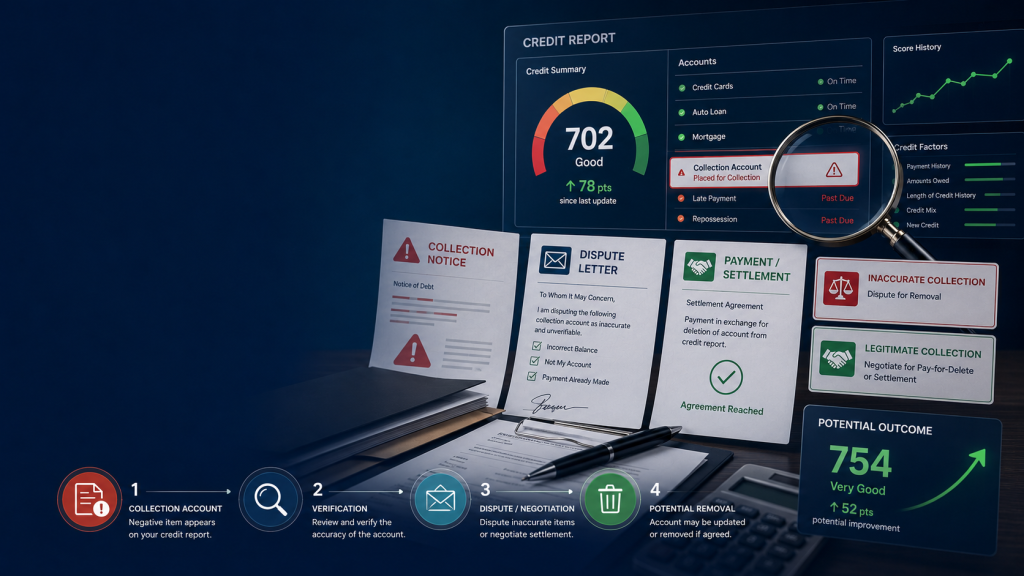
    Next steps: negotiate removal by learning how pay-for-delete works with collectors, check the statute of limitations on the debt before deciding whether to pay, learn to remove the related collection account from your report, and see our full credit repair procedure if you want professional help addressing multiple negatives at once.

    This is one of the most common misconceptions in personal finance, and it trips up even people who are otherwise financially savvy: paying off a charged-off account does **not** automatically remove it from your credit report. It’s a distinction that matters a lot if you’re trying to decide how to spend limited money on debt repayment, so it’s worth understanding exactly what paying a charge-off does and doesn’t do.

    ## What a Charge-Off Actually Is

    A charge-off happens when a creditor decides an account is unlikely to be collected through normal means — typically after 180 days of non-payment — and writes it off as a loss for accounting purposes. This is an internal accounting decision by the creditor, not a legal forgiveness of the debt. You still owe the money. The creditor (or whoever they sell the debt to) can still pursue collection, and in most states, can still sue you for it within the statute of limitations.

    The charge-off itself gets reported to the credit bureaus as a status on the account, and it’s one of the more damaging marks on a credit report — second really only to a bankruptcy or foreclosure in terms of scoring impact.

    ## Why Paying It Off Doesn’t Erase It

    Here’s the part that surprises people: paying a charge-off changes the account’s **status** from “unpaid charge-off” to “paid charge-off,” but the charge-off itself — the fact that the account went unpaid long enough to be written off — remains on your report for seven years from the original date of delinquency.

    Think of it less like erasing a stain and more like changing the label on it. “Charge-off, paid” is better than “charge-off, unpaid,” but both say charge-off.

    That said, “paid” does matter in a few concrete ways:

    – **Lenders reviewing manually** (mortgage underwriters, for instance) generally view a paid charge-off more favorably than an unpaid one, even if the score impact is similar.
    – **Some newer scoring models** (FICO 9 and later, VantageScore 3.0 and later) treat paid collections and charge-offs somewhat less harshly than older models still used by some lenders.
    – **It stops the debt from being sold again.** An unpaid charge-off is often sold to a new collector, which can result in a fresh collection account appearing on your report — effectively re-aging the negative mark in the eyes of anyone glancing at your file, even though the legal reporting clock (7 years from original delinquency) doesn’t actually reset.

    ## When Paying Makes Sense — and When It Doesn’t

    **Paying makes sense if:**

    – You’re within the statute of limitations and want to avoid a lawsuit or wage garnishment.
    – You’re applying for a mortgage soon and the underwriter requires paid or resolved collections.
    – You can negotiate a pay-for-delete arrangement (see below) — this is the one scenario where payment can result in outright removal.
    – The debt is still with the original creditor and you want to preserve a relationship (e.g., a bank you want to keep doing business with).

    **Paying may not be worth it if:**
    – The debt is old and close to falling off your report naturally (within a year or so of the 7-year mark) — paying it now won’t change the fall-off date, and it might reset how recently the account shows activity in some models.
    – You’re outside the statute of limitations and the debt is unlikely to be collected on anyway. Paying could restart the clock on the statute of limitations in some states, actually increasing your legal risk.
    – You don’t have documentation confirming exactly who owns the debt and how much is owed — paying the wrong party doesn’t extinguish the original creditor’s claim.

    ## The One Way Paying Can Get It Removed: Pay-for-Delete

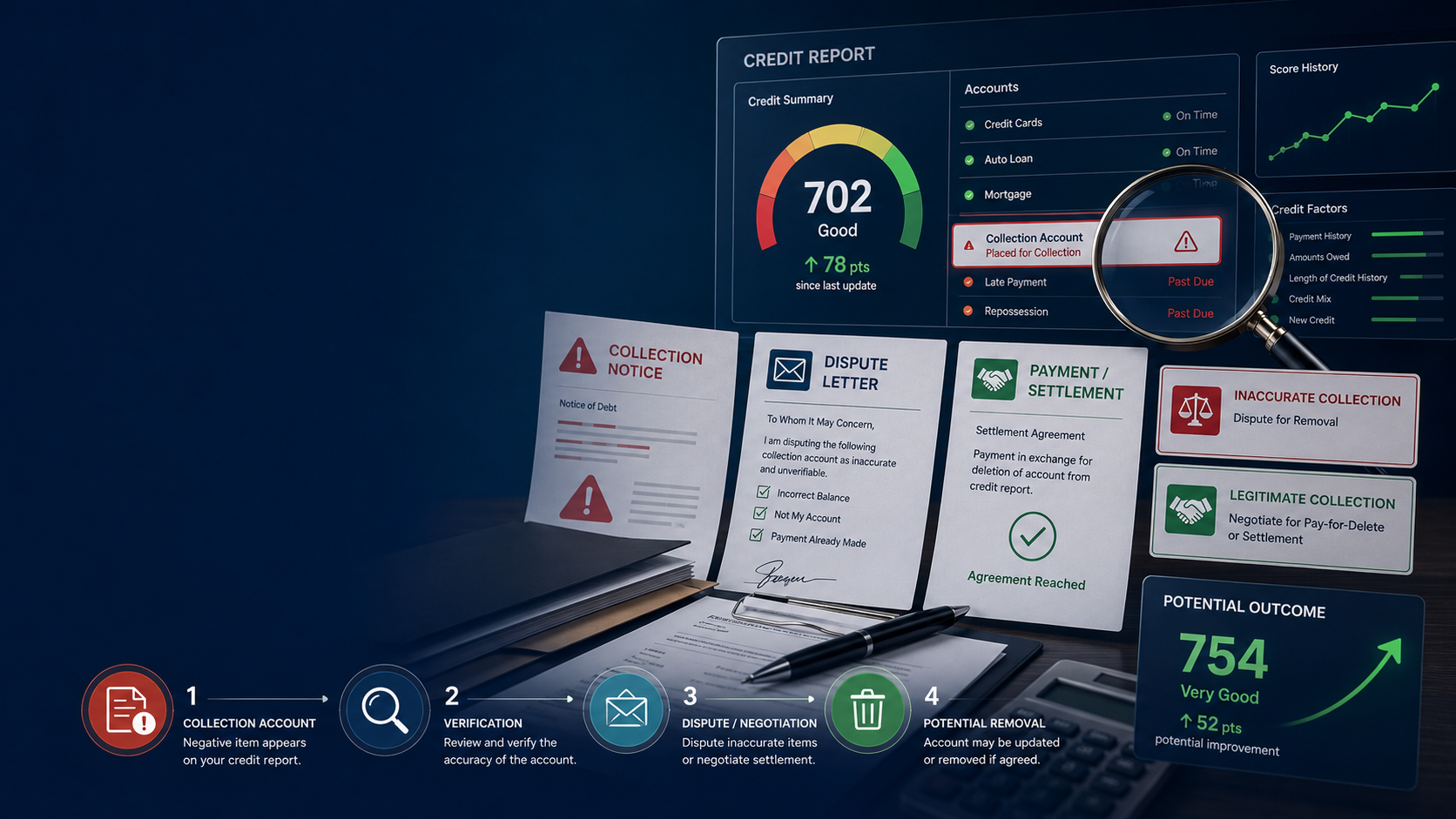
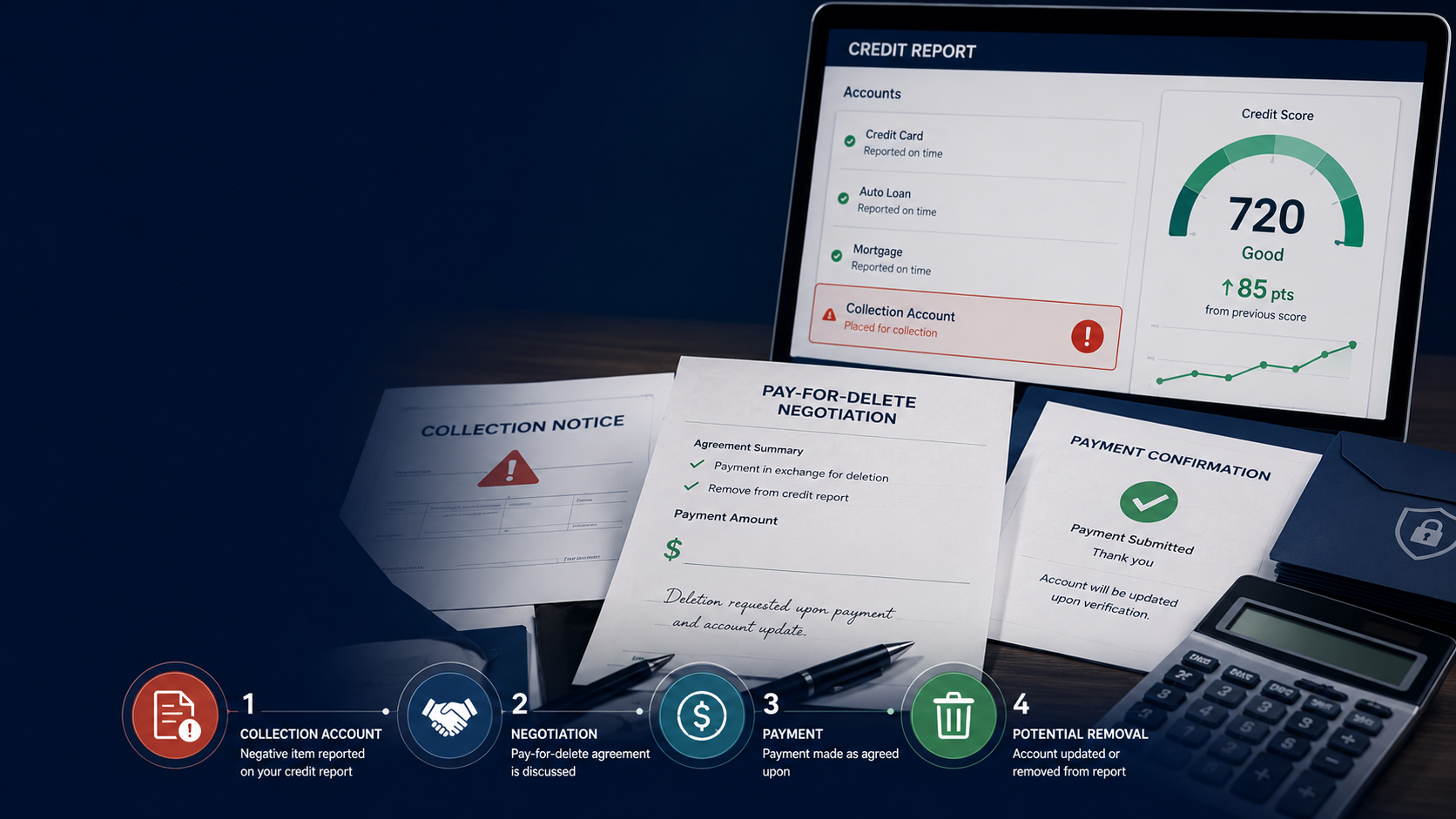
    A pay-for-delete arrangement is where you negotiate with the collector, in writing, before you pay: in exchange for payment, they agree to request the account’s removal from your credit report entirely, rather than just updating it to “paid.”

    A few important realities about pay-for-delete:

    – **It’s not guaranteed to work even after they agree.** The collector requests deletion from the bureau, but the bureau isn’t obligated to honor it, and increasingly, bureaus have started pushing back on pay-for-delete requests specifically because they’re seen as manipulating the accuracy of credit files.
    – **Get it in writing before you send money.** A verbal promise from a collections rep is worth nothing. Get the agreement on letterhead or in a formal email before you pay a cent.
    – **Not all collectors will agree.** Original creditors almost never do this since it involves under-the-table adjustment of a factual record; third-party collection agencies are more likely to negotiate since their only goal is recovering money.

    ## What Actually Removes a Charge-Off

    Outside of pay-for-delete, there are only a few legitimate paths to getting a charge-off off your report before the 7-year mark:

    1. **It’s inaccurate.** If the charge-off doesn’t belong to you, has the wrong balance, or has an incorrect date of delinquency (which affects when it falls off), you can dispute it directly.
    2. **The furnisher can’t verify it.** If you dispute and the creditor/collector doesn’t respond with adequate documentation within the bureau’s investigation window, it gets removed.

    1. **It naturally ages off.** Seven years from the original delinquency date, it comes off regardless of payment status.## A Practical Approach

      If you’re deciding what to do with a charge-off on your report, work through this order:

      1. **Check the date of first delinquency.** If it’s close to seven years old, you may be better off just waiting it out rather than paying, since payment won’t accelerate removal.
      2. **Verify accuracy.** Pull the account details and check the balance, dates, and creditor name against your own records.
      3. **If accurate and you want it gone, negotiate pay-for-delete in writing first**, then pay only after you have the agreement documented.
      4. **If pay-for-delete isn’t on the table**, weigh whether paying is worth it for the “paid” status improvement and to avoid collection/legal risk, understanding it won’t remove the item.

      ## The Bottom Line

      Paying a charge-off is often the right financial move, but don’t do it under the assumption it will clean your credit report. It changes the story the report tells — from “never paid” to “eventually paid” — which matters to some lenders and scoring models, but the mark itself sticks around for up to seven years unless you specifically negotiate its removal before paying, or successfully dispute it as inaccurate or unverifiable.

  • How to Fix Your Credit: A Step-by-Step Guide for 2026

    How to Fix Your Credit: A Step-by-Step Guide for 2026

    Go deeper on each step: learn how to find and fix credit report errors across all three bureaus, get the full playbook for removing collection accounts, see why lowering your credit utilization ratio is the fastest single move you can make, and follow the proven path to build positive history from scratch.

    If you’ve ever been denied a loan, offered sky-high interest rates, or felt that quiet knot in your stomach every time someone mentions a credit check, you already know how much your credit score shapes daily life. It affects the apartment you can rent, the car you can finance, the credit cards you qualify for, and sometimes even the jobs you can land. A low score doesn’t just cost you money — it limits your options.Here’s the good news: credit is not permanent. It’s not a life sentence. It’s a living, breathing record of your financial behavior, and that means it can be changed. Whether you’re dealing with errors on your reports, a history of missed payments, collections you’re not sure how to handle, or simply a thin credit file with not enough history, there are concrete, proven steps you can take to fix your credit — and keep it strong for the long haul.This guide is built to be the most thorough, practical, and honest resource on the internet for repairing and rebuilding credit in 2026. We’ll walk you through what “fixing your credit” actually means, how scores work, the three phases of credit improvement (repair, rebuild, protect), realistic timelines, your legal rights, how to choose a legitimate credit repair company if you decide you want help, and the myths and mistakes that trip people up along the way.

    We’re a San Diego-based, attorney-backed credit repair firm that operates in full compliance with the Fair Credit Reporting Act (FCRA). We believe in transparency, education, and measurable progress — not quick fixes or empty promises. Everything in this guide reflects that philosophy.

    What “Fixing Your Credit” Actually Means

    Most people use “fix my credit” as a catch-all phrase, but there are actually two distinct — and equally important — phases involved, and understanding the difference is the foundation of everything that follows.

    Phase 1: Credit Repair — This is the process of identifying and correcting what’s wrong on your credit reports. That includes disputing inaccurate information, addressing outdated items that should have fallen off, handling collections and charge-offs, and negotiating with creditors when appropriate. Think of repair as cleaning up the errors and negative marks that are dragging your score down unfairly or unnecessarily.

    Phase 2: Credit Rebuilding — This is the process of establishing and growing positive credit history. Even if your reports are perfectly clean, you won’t have a strong score without a track record of responsible borrowing. Rebuilding means making on-time payments, keeping your credit utilization low, maintaining a healthy mix of credit types, and letting your accounts age.

    Here’s the key insight that many people miss: you can’t just repair your way to a great score. If you successfully dispute and remove every error on your report but you have no open accounts, no recent on-time payments, and no active positive history, your score won’t magically climb. Likewise, you can open new accounts and pay them perfectly, but if your reports are full of inaccurate negative items, you’re fighting an uphill battle.

    The most effective approach tackles both phases together — cleaning up the past while building for the future. That’s why this guide is structured around three phases: Repair, Rebuild, and Protect. The third phase — protection and maintenance — is what keeps your hard-won progress from slipping away.

    A note on expectations: No legitimate credit repair professional, attorney, or company can guarantee a specific score increase or promise that a particular item will be removed within a specific timeframe. Anyone who does is not being honest with you. What we can do is make sure your reports are accurate (which is your legal right under the FCRA), help you build positive history strategically, and track measurable progress over time.

    How Credit Scores Work: The 5 Factors

    Before you can fix your credit effectively, you need to understand what actually determines your score. Most lenders in the United States use the FICO Score (currently the FICO 8 and FICO 9 models, with FICO 10 T gaining traction), while VantageScore (3.0 and 4.0) is also used by some lenders and many free credit monitoring services. While the exact algorithms are proprietary, both scoring models evaluate the same five core categories of information.

    Here’s the breakdown of the five factors that influence your FICO score, ranked by how much weight each one carries:

    Factor Weight What It Measures Quick Takeaway
    Payment History 35% Whether you’ve paid your credit accounts on time One late payment can drop your score significantly — this is the single most important factor
    Credit Utilization 30% How much of your available credit you’re using Keep balances below 30% of your limits, ideally below 10%
    Length of Credit History 15% The age of your oldest account, newest account, and average across all accounts Older accounts help your score — keep them open even if you don’t use them
    Credit Mix 10% The variety of credit types you have (revolving, installment, mortgage) A mix of credit cards and loans shows you can handle different responsibilities
    New Credit / Inquiries 10% How many recent hard inquiries and new accounts you have Space out applications — too many at once signals risk

    Let’s dig into each one.

    1. Payment History (35%) — The Big One

    Payment history is the single most influential factor in your credit score, and for good reason: lenders want to know that you’ll repay what you borrow. This factor looks at whether you’ve made payments on time across all your credit accounts — credit cards, auto loans, mortgages, student loans, personal loans, and other credit products.

    Here’s what matters within this category:

    • On-time payments build positive history. Every month you pay on time, you’re adding to the foundation of a strong score.
    • Late payments are reported in increments: 30 days late, 60 days late, 90 days late, 120+ days late. The later the payment, the more damage it does.
    • Recent late payments hurt more than older ones. A late payment from three years ago has far less impact than one from three months ago.
    • Charge-offs, collections, foreclosures, repossessions, and bankruptcies are severe negative marks that can stay on your report for 7 to 10 years.

    The takeaway: If you do nothing else, pay every bill on time, every month. Set up automatic payments or reminders. This one habit accounts for more than a third of your score.

    2. Credit Utilization (30%) — The Lever You Can Pull Quickly

    Credit utilization measures how much of your available revolving credit you’re currently using. If you have a credit card with a $10,000 limit and you carry a $3,000 balance, your utilization on that card is 30%.

    This factor is calculated both per-card and across all your revolving accounts combined. The scoring models look at the balances reported to the credit bureaus — which typically happens on your statement closing date, not your payment due date.

    Here’s the hierarchy of utilization and its impact:

    • Under 10% — Excellent. This is where the highest scores live.
    • 10% to 29% — Good. You’re in solid territory.
    • 30% to 49% — Fair. You’re using a lot of your available credit, which signals some risk.
    • 50% to 74% — Poor. Lenders see this as a sign of financial strain.
    • 75% or higher — Very poor. Maxed-out or near-maxed-out cards significantly depress your score.
    • 100% (maxed out) — Severe negative impact.

    The takeaway: Credit utilization is one of the fastest levers you can pull. Unlike payment history, which takes months to build, you can improve your utilization in a single billing cycle by paying down balances. If you can’t pay in full, aim to keep your statement balance below 10% of your limit.

    A pro tip: If you’re trying to optimize your score before applying for a major loan, consider making a payment before your statement closes, not just by the due date. This lowers the balance that gets reported to the bureaus, which is what the scoring models actually see.

    3. Length of Credit History (15%) — Time Is on Your Side

    This factor considers the age of your credit accounts. The scoring models look at:

    • The age of your oldest account
    • The age of your newest account
    • The average age of all your accounts

    Older accounts and a longer average age generally help your score because they demonstrate a longer track record of responsible credit use. This is why closing your oldest credit card can sometimes hurt your score — you’re shortening your credit history.

    The takeaway: Keep your oldest accounts open and active, even if you only use them for a small recurring charge (like a streaming subscription) that you pay off each month. This keeps the account reporting as active and preserves your credit history length.

    4. Credit Mix (10%) — Show You Can Handle Variety

    Credit scoring models like to see that you can manage different types of credit responsibly. The two main categories are:

    • Revolving credit — credit cards, store cards, lines of credit (you can borrow repeatedly up to a limit)
    • Installment credit — auto loans, mortgages, student loans, personal loans (fixed amount, fixed payments over a set period)

    Having only credit cards, or only installment loans, won’t necessarily tank your score, but having a healthy mix of both tends to give it a small boost. This factor carries the least weight of the five, so don’t take out a loan you don’t need just to improve your mix — but if you’re already considering an installment loan for a legitimate purpose, know that it can contribute to a stronger score over time.

    5. New Credit and Inquiries (10%) — Don’t Apply All at Once

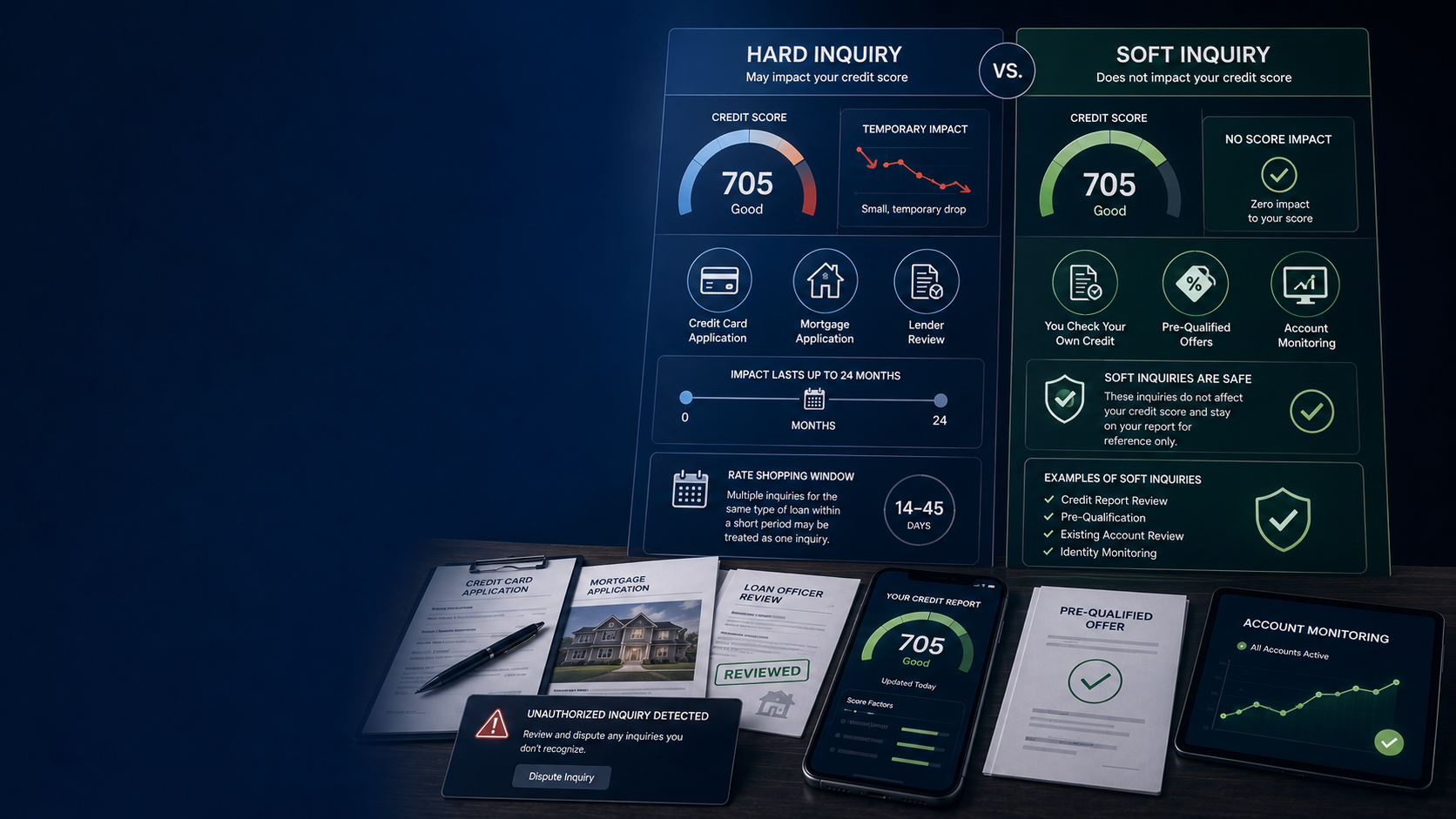
    Every time you apply for new credit, the lender performs a hard inquiry (also called a hard pull) on your credit report. A single hard inquiry typically causes a small, temporary dip in your score (usually 1-5 points). However, applying for multiple credit accounts in a short period signals risk to lenders and can have a more significant impact.

    Important distinctions:

    • Hard inquiries occur when you apply for credit. They’re visible to other lenders and can affect your score. They stay on your report for 2 years but only affect your FICO score for 12 months.
    • Soft inquiries occur when you check your own credit, when a lender pre-approves you, or when a current creditor monitors your account. These do not affect your score.
    • Rate shopping: The scoring models are smart enough to recognize rate shopping. If you’re shopping for a mortgage, auto loan, or student loan, multiple inquiries within a 14-45 day window (depending on the scoring model) are typically treated as a single inquiry for scoring purposes. So if you’re car shopping, get all your loan applications done within a couple of weeks.

    The takeaway: Space out credit applications. Don’t apply for five cards in a month. If you’re rate-shopping for a specific loan type, cluster those applications within a short window.

    Phase 1 — Repair: Fixing What’s Wrong

    Now that you understand what drives your score, it’s time to start the actual work. Phase 1 is all about identifying and correcting problems on your credit reports. This is where the legal protections of the Fair Credit Reporting Act (FCRA) come into play — you have the right to accurate, complete, and verifiable information on your reports, and you have the right to dispute anything that doesn’t meet that standard.

    Step 1: Pull All Three Credit Reports

    Your credit is reported by three major credit bureaus: Equifax, Experian, and TransUnion. They are separate companies with separate databases, and they don’t always have the same information. A creditor may report to one bureau but not another. An error may appear on your Equifax report but not your TransUnion report.

    This means you need to pull reports from all three.

    Your legal right to free reports: Under the FCRA, you’re entitled to one free credit report from each of the three bureaus every 12 months through AnnualCreditReport.com — the only federally authorized website for this purpose. In recent years, the bureaus have made free weekly reports available through this site as well, which is helpful if you’re actively working on your credit.

    You can also access your reports and scores through credit monitoring services (many of which are free), but be aware that these services often show VantageScore rather than FICO, and the report data may be a simplified version. For dispute purposes, you want the full, official reports directly from the bureaus.

    Step 2: Audit Your Reports for Errors

    Once you have all three reports, go through each one methodically. Credit report errors are remarkably common — various studies and regulatory investigations have found that a significant percentage of consumers have at least one error on their reports, and many of those errors are serious enough to affect credit decisions.

    Here’s what to look for:

    Personal information errors:

    • Wrong name, aliases you don’t recognize
    • Incorrect addresses
    • Inaccurate employer information
    • Mixed files — someone else’s accounts appearing on your report (this happens more often than you’d think, especially if you share a name with a relative)

    Account errors:

    • Accounts that don’t belong to you (potential identity theft or mixed file)
    • Incorrect account balances
    • Wrong credit limits (which can artificially inflate your utilization ratio)
    • Incorrect account status (showing open when it’s closed, or vice versa)
    • Late payments that were actually on time
    • Duplicate accounts (the same debt listed twice)
    • Accounts showing as charged off when they were settled or paid

    Outdated information:

    • Negative items older than 7 years (10 years for bankruptcies) that should have been removed
    • Collections that were paid and should be updated
    • Hard inquiries older than 2 years

    Fraud or identity theft:

    • Accounts you never opened
    • Inquiries you didn’t authorize
    • Addresses where you never lived

    Make a list of every error you find, organized by bureau. Note the specific item, the bureau reporting it, and why you believe it’s inaccurate. This documentation becomes the foundation of your disputes.

    Step 3: Dispute Inaccuracies the Right Way

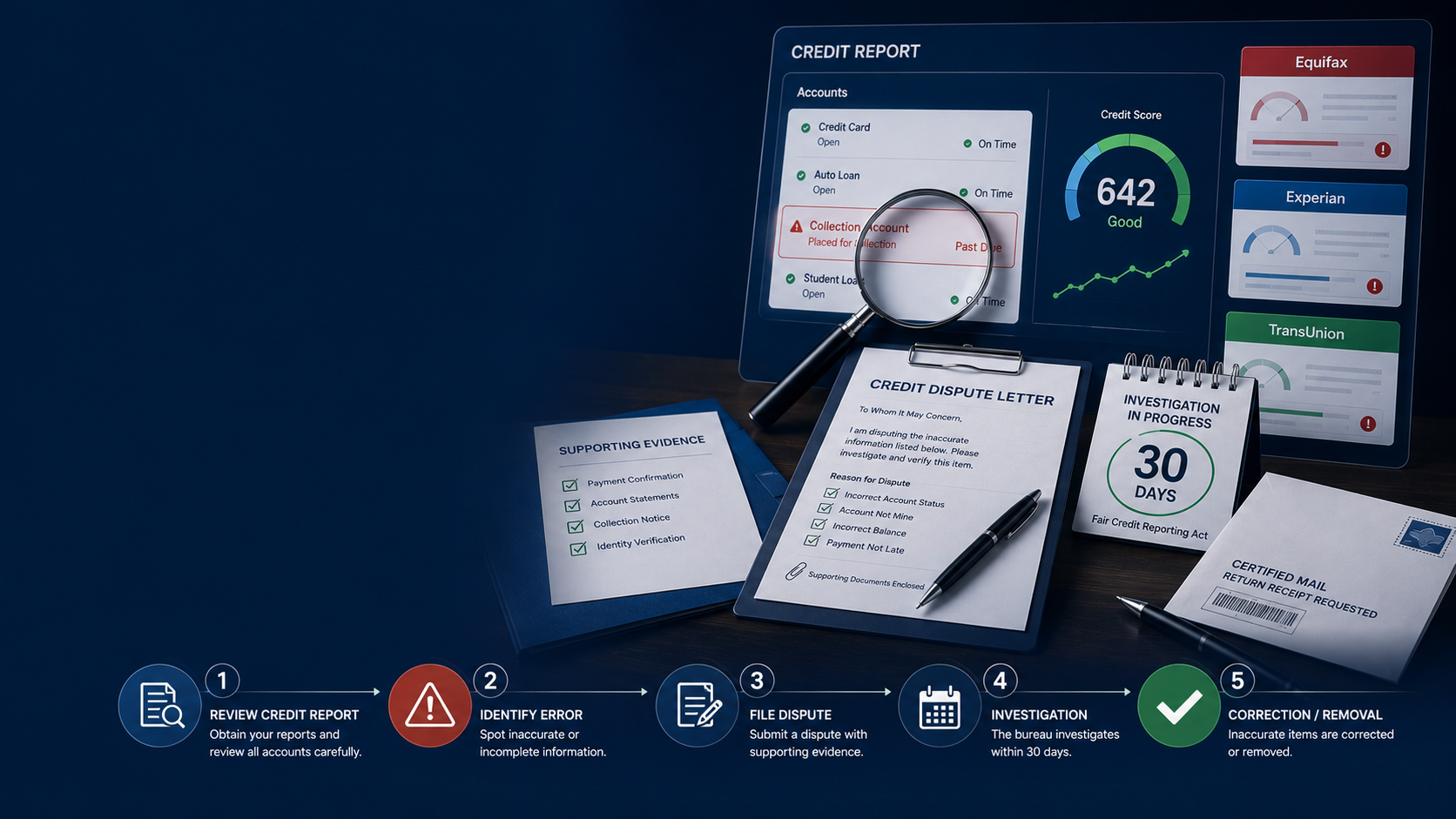
    The FCRA gives you the right to dispute any information on your credit report that you believe is inaccurate, incomplete, or unverifiable. When you file a dispute, the bureau is required to investigate — typically within 30 days — and either verify, correct, or delete the disputed item.

    Here’s how to do it effectively:

    File disputes directly with the credit bureau(s) reporting the error. You can dispute online, by phone, or by mail. While online disputes are convenient, filing by certified mail with a return receipt creates a paper trail that can be valuable if you need to escalate later. Each bureau has a dedicated dispute process on their website.

    Also file disputes with the furnisher. Under the FCRA, you can also dispute directly with the creditor or collection agency that reported the information (the “furnisher”). This is called a direct dispute and it gives you a second avenue of accountability. If the furnisher can’t verify the information, they’re required to notify the bureaus to correct or remove it.

    Be specific and provide documentation. The more precise you are, the more likely the dispute will succeed. Don’t just say “this is wrong.” Say “this account shows a late payment in March 2024, but I have bank records showing the payment was made on March 12, 2024 — two days before the due date.” Attach copies of supporting documents (never send originals).

    Dispute one item at a time per letter. If you have multiple errors, it’s generally better to dispute them individually rather than batching them. Some consumer advocates argue that bureaus are more likely to dismiss batch disputes as frivolous. Whether or not that’s universally true, individual disputes are easier to track and follow up on.

    Keep records of everything. Copies of your dispute letters, certified mail receipts, bureau responses, and any correspondence with furnishers. If a dispute isn’t resolved and you later need legal help, this documentation is invaluable.

    What happens after you dispute: The bureau has 30 days to investigate (45 days if you dispute after receiving your free annual report). They contact the furnisher, who must verify the information. If the furnisher can’t verify it, or doesn’t respond within the investigation period, the item must be removed. You’ll receive the results in writing, along with a free updated copy of your report if changes were made.

    If the dispute comes back “verified” but you know it’s wrong: You can dispute again with additional documentation, file a complaint with the Consumer Financial Protection Bureau (CFPB), add a statement of dispute to your credit report (a brief explanation that appears on your report), or consult with a consumer law attorney. If the furnisher is reporting knowingly inaccurate information, you may have grounds for legal action under the FCRA.

    Step 4: Handle Collections Strategically

    Collections are one of the most stressful parts of credit problems, but there are effective strategies for dealing with them.

    First, verify the debt. Under the Fair Debt Collection Practices Act (FDCPA), you have the right to request debt validation within 30 days of being contacted by a collection agency. Send a written validation request, and the collector must provide proof that the debt is yours and that the amount is correct. If they can’t validate the debt, they must cease collection efforts and the credit bureaus should remove the collection if you dispute it.

    Understand the difference between original creditor and collection agency. When an account goes to collections, it may appear on your report twice — once as a charge-off from the original creditor and once as a collection from the collection agency. Both are negative, but paying or settling the collection doesn’t automatically remove the original creditor’s charge-off.

    Consider a pay-for-delete negotiation. Some collection agencies will agree to remove the collection from your credit report in exchange for payment. This isn’t guaranteed — many agencies have policies against it, and the bureaus technically discourage the practice — but it’s worth asking. Get any agreement in writing before you pay.

    The newer FICO and VantageScore models treat paid collections more favorably. FICO 9 and VantageScore 3.0/4.0 ignore paid collections entirely and give less weight to unpaid medical collections. However, many lenders still use older models (like FICO 8) where paid collections still impact your score. Paying a collection won’t necessarily boost your score immediately under older models, but it’s still the right thing to do — a paid collection looks better to lenders reviewing your report manually, and it prevents potential lawsuits.

    Medical collections have special rules. As of recent regulatory changes, medical bills under a certain threshold may not appear on your report, and there are extended waiting periods before medical debt can be reported. Always check whether medical collections on your report comply with current rules.

    Don’t reset the clock accidentally. Making a partial payment or acknowledging a debt in writing can, in some states, restart the statute of limitations on that debt — the time frame during which a creditor can sue you. Before you contact a collector about an old debt, understand your state’s statute of limitations.

    Step 5: Negotiate with Creditors

    If you have accounts that are past due but not yet in collections, or if you have charge-offs that you want to resolve, you can often negotiate directly with the original creditor. Common strategies include:

    Goodwill letters. If you have an otherwise solid payment history with a creditor but had a one-time late payment due to a specific hardship (medical emergency, job loss, natural disaster), you can write a goodwill letter asking the creditor to remove the late payment as a courtesy. This isn’t a legal right — it’s a request — but creditors sometimes grant it, especially for long-time customers with otherwise clean records.

    Pay-for-delete. Similar to the collection strategy, you can ask a creditor to remove a negative mark in exchange for payment. More commonly successful with collection agencies than original creditors, but worth attempting.

    Lump-sum settlements. If you owe a significant amount and can offer a lump-sum payment, creditors may accept less than the full balance (often 40-70% of what’s owed). Be aware that settled debt can still show on your report as “settled for less than full balance,” which is better than unpaid but not as good as “paid in full.”

    Payment plans. Some creditors will agree to updated payment plans and may even re-age your account (bringing it current) if you make a set number of on-time payments. This can stop further negative reporting.

    Get everything in writing. Any agreement you reach with a creditor should be documented in writing before you make a payment. Verbal agreements are difficult to enforce.

    Step 6: Deal with Outdated Items

    Negative information doesn’t stay on your credit report forever. Here are the time limits under the FCRA:

    Item Maximum Time on Report
    Late payments 7 years
    Collections 7 years from original delinquency date
    Charge-offs 7 years from original delinquency date
    Chapter 7 bankruptcy 10 years
    Chapter 13 bankruptcy 7 years
    Foreclosures 7 years
    Repossessions 7 years
    Civil judgments 7 years (or less, depending on state)
    Tax liens 7 years from paid date (unpaid liens may no longer appear)
    Hard inquiries 2 years (affect FICO score for 1 year)

    If you see negative items that are older than these limits, dispute them. The bureaus are required to remove outdated information. Note that the 7-year clock for collections and charge-offs starts from the date of the original delinquency — the first missed payment that led to the collection — not from the date the collection agency acquired the debt or the date you last made a payment.

    Phase 2 — Rebuild: Building Positive History

    Once you’ve addressed the errors and negative items on your reports, it’s time to focus on building the positive history that will lift your score. Even if you’ve removed everything negative, you need active, positive accounts to generate a strong score.

    Keep Making On-Time Payments

    This is worth repeating because it’s the foundation of everything: pay every bill on time, every month. Set up automatic payments for at least the minimum on all accounts. Use calendar reminders. Do whatever it takes to never miss a due date. Every on-time payment adds to your positive payment history, and over time, this is what will drive your score up the most.

    Keep Your Credit Utilization Low

    As we covered in the scoring factors section, utilization is the second-most-important factor and one of the fastest to improve. Here’s the strategy:

    • Keep balances below 30% of your credit limit on each card and across all cards combined.
    • Aim for under 10% for the best score impact.
    • Pay before the statement closes if you’re trying to optimize for a specific application — the balance reported to the bureaus is typically your statement balance.
    • Consider requesting credit limit increases — a higher limit with the same balance automatically lowers your utilization ratio. Just make sure the creditor won’t do a hard inquiry for the increase (many do soft inquiries for existing customers).

    Keep Old Accounts Open

    Your credit history length matters. When you pay off a credit card, don’t close the account — keep it open. A paid-off card with a $0 balance contributes positively to your utilization ratio (more available credit = lower utilization) and preserves your account age.

    If a card has an annual fee and you don’t want to keep paying it, ask the issuer if they can downgrade you to a no-fee version of the card. This keeps the account open and the history intact without the ongoing cost.

    If you absolutely must close an account, close a newer one — not your oldest card.

    Build a Healthy Credit Mix

    If you only have revolving credit (credit cards), adding an installment loan can give your score a small boost over time — but only if you genuinely need the loan and can afford the payments. Options include:

    • A small personal loan
    • A credit-builder loan (more on this below)
    • An auto loan if you’re already planning to buy a car
    • A share-secured loan from a credit union (backed by your savings)

    Don’t take on debt you don’t need just for credit mix. The 10% weight of this factor is not worth the financial risk.

    Use Secured Credit Cards

    If your credit is too damaged to qualify for regular (unsecured) credit cards, secured cards are one of the best rebuilding tools available. Here’s how they work:

    • You put down a refundable security deposit (typically $200-$500).
    • The deposit becomes your credit limit.
    • You use the card like a regular credit card — making purchases and paying them off each month.
    • Your activity is reported to the credit bureaus, building positive history.
    • After a period of responsible use (usually 6-12 months), many issuers will upgrade you to an unsecured card and refund your deposit.

    Tips for secured cards:

    • Choose a card that reports to all three bureaus (most do, but verify).
    • Look for cards with low or no annual fees.
    • Use the card for small purchases (gas, a recurring subscription) and pay the full balance each month.
    • Keep utilization low — if your limit is $300, don’t carry more than $30-$90.

    Become an Authorized User

    If you have a family member or close friend with a credit card that has a long history of on-time payments and low utilization, ask if they’ll add you as an authorized user. When you’re added as an authorized user, the account’s history is often reported on your credit report as well.

    This can be a powerful strategy because:

    • You inherit the account’s positive payment history.
    • The account’s age contributes to your credit history length.
    • The account’s limit contributes to your available credit, improving your utilization.

    Important caveats:

    • Not all card issuers report authorized user accounts to the bureaus. Check with the issuer first.
    • If the primary cardholder misses payments or runs up the balance, those negatives also appear on your report. Only do this with someone you trust to manage the account responsibly.
    • You don’t need to actually use the card — just being listed as an authorized user is enough.
    • The primary cardholder can keep the physical card; you never need to charge anything.

    Consider a Credit-Builder Loan

    Credit-builder loans are designed specifically for people building or rebuilding credit. Unlike a traditional loan, you don’t receive the money upfront. Instead:

    • The lender holds the loan amount in a secured savings account.
    • You make monthly payments (which are reported to the credit bureaus).
    • When the loan is paid off, you receive the money.

    This builds positive installment credit history and forces you to save money at the same time. Many credit unions and community banks offer credit-builder loans, and there are also online lenders specializing in this product. Look for one that reports to all three bureaus and has reasonable fees.

    Give It Time

    Rebuilding credit is a marathon, not a sprint. The length of your credit history and the age of your accounts are factors you can’t rush. What you can do is start now, be consistent, and let time work in your favor. Every month of on-time payments, every statement cycle with low utilization, and every year of account aging adds up.

    Phase 3 — Protect & Maintain

    Fixing your credit is an achievement. Protecting it is a lifelong habit. Phase 3 is about the systems and practices that keep your credit strong — and catch problems early when they do arise.

    Monitor Your Credit Regularly

    You should check your credit reports at least once a year from all three bureaus (via AnnualCreditReport.com), and more frequently if you’re actively rebuilding. In addition, set up ongoing credit monitoring:

    • Free monitoring services from banks, credit card issuers, and independent apps provide regular score updates and alerts when new accounts, inquiries, or changes appear on your report.
    • Paid monitoring services offer more comprehensive features like 3-bureau monitoring, identity theft insurance, and dark web scanning. Whether you need these depends on your risk level and preferences.
    • Identity theft alerts: If you see an account or inquiry you don’t recognize, act immediately. Contact the creditor, place a fraud alert on your credit file, and file a report with the FTC at IdentityTheft.gov.

    Consider a Credit Freeze or Fraud Alert

    A credit freeze (also called a security freeze) restricts access to your credit report. When your credit is frozen, lenders can’t pull your report, which means identity thieves can’t open new accounts in your name. You can temporarily lift the freeze when you need to apply for credit. Freezes are free under federal law and are the strongest protection against new-account identity theft.

    A fraud alert is a less restrictive option. It tells lenders to take extra steps to verify your identity before extending credit. Fraud alerts last for one year (or seven years for an extended fraud alert if you’ve filed an identity theft report with the FTC). You only need to place a fraud alert with one bureau — they’re required to notify the other two.

    Practice Good Financial Habits

    The habits that protect your credit are the same ones that built it:

    • Pay on time, every time. Automate at least the minimum payment on every account.
    • Keep utilization low. Check your balances mid-cycle and pay them down if needed.
    • Don’t close old accounts unless there’s a compelling reason.
    • Space out credit applications. Don’t apply for multiple cards or loans within a short period.
    • Maintain an emergency fund. Having savings prevents you from relying on credit cards when unexpected expenses arise, which keeps your utilization in check.
    • Review your statements monthly. Catch billing errors, unauthorized charges, and changes to terms early.

    Review Your Insurance and Utility Accounts

    Some insurance companies and utility providers use credit-based insurance scores or require credit checks. Maintaining good credit can lower your insurance premiums and eliminate deposit requirements for utilities, cell phones, and apartment leases. It’s a ripple effect — strong credit saves you money across many areas of life.

    Educate Yourself Continuously

    Credit laws, scoring models, and reporting practices evolve. Stay informed about your rights under the FCRA, FDCPA, and CROA. Follow reputable financial education resources. The more you understand about how credit works, the better equipped you’ll be to protect and grow your score over a lifetime.

    Realistic Timelines: What Improves and When

    One of the most common questions we hear is “How fast can I fix my credit?” The honest answer is: it depends on what’s on your report, what actions you take, and how consistently you maintain positive habits. But here’s a realistic framework for what you can expect at different milestones.

    Timeframe What Can Improve Realistic Score Impact
    30 days Dispute investigation results; rapid utilization improvement by paying down balances; removal of verified errors 10-40+ points if errors are removed or utilization drops significantly
    60-90 days Additional dispute rounds; goodwill letter responses; initial positive reporting from new secured cards or credit-builder loans 20-60+ points cumulative, depending on number and severity of items addressed
    6 months 6 months of on-time payments on new accounts; collection settlements updated; authorized user history accumulating; aging of recent inquiries 40-100+ points over baseline, depending on starting point and actions taken
    1 year 12 months of clean payment history; reduced impact from older negative items; account aging; improved credit mix 60-150+ points from a low starting score with consistent effort
    2+ years Significant aging of negative items; strong, diverse credit history; most recent negatives losing impact; approaching excellent score territory if habits are maintained 100-200+ points from a damaged starting point over a 2-year period of consistent positive behavior

    Important caveats:

    • These are general ranges, not guarantees. Your results depend on your specific credit profile.
    • If you have a bankruptcy or multiple serious delinquencies, recovery will take longer. A Chapter 7 bankruptcy, for example, stays on your report for 10 years and has a significant impact throughout that time — though the impact lessens as the bankruptcy ages and you build new positive history.
    • The fastest improvements come from fixing errors (removing items that shouldn’t be there) and lowering utilization. The slowest improvements come from building payment history and account age — these simply take time.
    • Consistency matters more than intensity. Six months of steady on-time payments and low utilization will help more than a burst of activity followed by a relapse.

    How to fix your credit and improve your credit score in 2026

    What Hurts Your Score Most (Ranked)

    Not all negative items are created equal. Here’s a ranking of what damages your credit score the most, from most severe to least:

    • Bankruptcy (Chapter 7 or 13) — The most damaging item. Can drop a good score by 100-200+ points and remains on your report for 7-10 years.
    • Foreclosure — A severe negative mark indicating default on a major secured loan. Stays on your report for 7 years.
    • Repossession — Similar to foreclosure but for auto loans. Indicates failure to repay a secured debt. 7 years.
    • Charge-off — When a creditor writes off your debt as a loss because they don’t expect you to pay. One of the most damaging account-level items. 7 years.
    • Collections — When your debt is sent to a collection agency. The impact is significant, though newer scoring models treat paid collections more leniently. 7 years.
    • Default (student loans) — Student loan default is a serious negative mark that can also lead to wage garnishment and tax refund seizure. 7 years.
    • Late payments (90+ days) — A 90-day late payment signals serious delinquency and has a major impact. 7 years.
    • Late payments (60 days) — Moderately damaging. 7 years.
    • Late payments (30 days) — The first level of delinquency. Damaging but less so than more severe lates. 7 years.
    • High credit utilization — Not a “negative mark” per se, but carrying high balances relative to your limits significantly depresses your score. Reversible quickly by paying down balances.
    • Hard inquiries — Minor impact individually (1-5 points), but multiple inquiries in a short period compound. Affect score for 1 year, visible for 2 years.
    • Closing old accounts — Indirect impact by reducing your available credit (raising utilization) and shortening your average account age.

    The severity of impact also depends on your starting score. If you have an excellent score (780+), a single 30-day late payment can drop your score by 90-110 points. If you have a fair score (680), the same late payment might only drop you by 60-80 points. Higher scores have further to fall.

    DIY Credit Repair vs. Hiring a Professional

    One of the biggest decisions you’ll face is whether to repair your credit yourself or hire a professional. Both paths are valid, and the right choice depends on your situation, time, and comfort level.

    The DIY Approach

    Pros:

    • It’s free (aside from postage and your time). The FCRA gives you the right to dispute errors yourself at no cost.
    • You have full control over what’s disputed and how.
    • You learn your credit inside and out — knowledge that serves you for life.
    • No risk of scams — you’re doing it yourself.

    Cons:

    • Time-consuming. Reviewing three reports, drafting dispute letters, following up on investigations, and tracking results takes significant time and organization.
    • Steep learning curve. Understanding FCRA rights, dispute processes, debt validation, and creditor negotiations requires research.
    • Less leverage. An individual dispute may not carry the same weight as one from an attorney or a professional firm that understands the legal framework and can escalate effectively.
    • Easy to make mistakes. Filing disputes incorrectly, missing deadlines, or accidentally resetting statutes of limitations can set you back.

    DIY is best for: People with a few minor errors, those who enjoy managing details, and those who have the time and patience to handle the process themselves.

    Hiring a Professional

    Pros:

    • Expertise and experience. A legitimate credit repair company or consumer law attorney knows the FCRA, FDCPA, and CROA inside and out. They understand what to dispute, how to frame disputes effectively, and when to escalate.
    • Saves time. They handle the paperwork, follow-ups, and tracking for you.
    • Attorney-backed firms can take legal action if your rights are violated — something no individual or non-attorney company can do.
    • Systematic approach. Professional firms have processes for ongoing dispute cycles, creditor negotiations, and monitoring that are difficult to replicate on your own.

    Cons:

    • Cost. Legitimate credit repair companies charge fees — typically a setup fee and monthly fees. You’re paying for expertise and convenience.
    • You still have to do the rebuilding. No company can build positive credit history for you — that requires your own on-time payments and responsible account management.
    • Scams exist. The credit repair industry has its share of bad actors. You must know how to identify and avoid them (covered in the next section).

    Professional help is best for: People with complex reports (many errors, collections, charge-offs), those who don’t have the time or confidence to DIY, those who suspect their rights have been violated and may need legal recourse, and those who want the peace of mind that comes with expert guidance.

    Your Rights Under the Credit Repair Organizations Act (CROA)

    The CROA is a federal law that protects consumers from deceptive practices by credit repair companies. Under the CROA, credit repair companies:

    • Cannot charge upfront fees before performing any services. A company that demands payment before doing any work is violating federal law.
    • Must provide a written contract that describes the services to be performed, the timeframe, and the total cost.
    • Must give you a 3-day right to cancel the contract without any charge.
    • Cannot make false claims about what they can do for your credit.
    • Cannot advise you to create a new credit identity (such as applying for an Employer Identification Number to use instead of your Social Security number) — this is illegal.
    • Must disclose your right to repair your own credit. A legitimate company will tell you that you can do this yourself for free.

    If a credit repair company violates any of these rules, that’s a red flag — and potentially a legal claim you can pursue.

    How to Choose a Legitimate Credit Repair Company

    If you decide to hire professional help, it’s critical to choose a company you can trust. Here’s what to look for — and what to run from.

    Green Flags (Signs of a Legitimate Company)

    • FCRA-compliant processes. The company works within the legal framework of the FCRA, FDCPA, and CROA.
    • Attorney involvement. Attorney-backed or attorney-staffed firms can provide legal analysis of your situation and take legal action if your rights are violated.
    • Transparent pricing. Clear, upfront pricing with no hidden fees. You should know exactly what you’ll pay before you sign anything.
    • Realistic expectations. They tell you that results aren’t guaranteed, that credit repair takes time, and that you have a role to play (making on-time payments, managing utilization).
    • Written contract. They provide a written agreement with a 3-day cancellation right, as required by the CROA.
    • Free consultation. They offer an initial review of your situation at no cost.
    • Educational resources. They help you understand your credit, not just “fix” it. A company that educates you is investing in your long-term success.
    • Clear dispute process. They explain exactly what they’ll dispute, how they’ll do it, and how they’ll track results.
    • Positive reviews and track record. Look for reviews on independent platforms, BBB ratings, and testimonials from real clients.

    Red Flags (Warning Signs to Avoid)

    • Upfront fees before any service is performed. This is illegal under the CROA. Walk away immediately.
    • Guaranteed results or specific score increases. No legitimate company can guarantee outcomes. Credit repair is a legal process, not a magic wand.
    • Promises to remove accurate, verifiable negative information. If the information is accurate and can be verified, it legally can remain on your report. A company promising to remove everything is either lying or planning to use illegal methods.
    • Advice to create a “new” credit identity. Using an EIN instead of your SSN, or applying for a new SSN, to start fresh is illegal and can result in federal prosecution.
    • Pressure to sign immediately. A legitimate company gives you time to review the contract and exercise your 3-day cancellation right.
    • No written contract. Verbal agreements are a sign of a company that doesn’t want to be held accountable.
    • Poor BBB rating or unresolved complaints. Check the Better Business Bureau and CFPB complaint database.
    • No physical address or verifiable business presence. A legitimate company has a real office and professional infrastructure.
    • Unwilling to explain their process. If they can’t or won’t tell you how they’ll repair your credit, they’re not trustworthy.

    Questions to Ask Before Signing

    • What exactly will you do, and what will you charge?
    • Are you attorney-backed? If so, in what capacity?
    • How long does the process typically take?
    • What happens if an item isn’t removed?
    • What is your cancellation policy?
    • Will you help me understand how to rebuild my credit, not just repair it?
    • Can you provide references or client testimonials?
    • What are my rights under the FCRA and CROA?

    A legitimate company will answer all of these questions clearly and patiently. If they’re evasive, move on.

    Common Credit Repair Myths Busted

    Myth 1: “Credit repair is illegal.”

    False. Credit repair is completely legal. The FCRA explicitly gives you the right to dispute inaccurate information on your credit reports, and you have the right to hire a professional to help you. The CROA regulates the credit repair industry to protect consumers, but it doesn’t make credit repair illegal. What is illegal is using fraudulent methods — like creating a new credit identity or lying on credit applications.

    Myth 2: “You can remove anything from your credit report.”

    False. You can dispute anything, but you can only get items removed if they’re inaccurate, incomplete, or unverifiable. If a negative item is accurate and the creditor can verify it, it has the right to remain on your report for the legal time limit (typically 7 years). Any company that promises to remove accurate, verifiable information is not being honest with you.

    Myth 3: “Paying off a collection immediately removes it from your report.”

    False. Paying a collection updates the status to “paid,” which is better than unpaid, but the collection itself remains on your report for up to 7 years from the original delinquency date. Under newer scoring models (FICO 9, VantageScore 3.0+), paid collections are ignored in scoring, but many lenders still use older models. A pay-for-delete agreement can sometimes remove the collection entirely, but it’s not guaranteed.

    Myth 4: “Closing a credit card improves your score.”

    False. Closing a credit card typically hurts your score. It reduces your available credit (raising your utilization ratio) and can shorten your average account age. Keep old accounts open unless there’s a compelling reason to close them (like an annual fee you can’t avoid and a card you never use).

    Myth 5: “Checking your own credit hurts your score.”

    False. Checking your own credit is a soft inquiry and has zero impact on your score. You can check your own credit as often as you want without any penalty. Only hard inquiries (when a lender checks your credit in response to an application) affect your score.

    Myth 6: “Your income affects your credit score.”

    False. Your income does not appear on your credit report and is not part of your credit score. Credit scores are based solely on your borrowing and repayment behavior. However, lenders consider your income separately when deciding whether to extend credit and at what terms — so income matters for lending decisions, just not for your score.

    Myth 7: “Carrying a balance improves your credit score.”

    False. You do not need to carry a balance (and pay interest) to build credit. Paying your statement in full each month builds the same positive payment history as carrying a balance, and it saves you money on interest charges. The ideal strategy is to use your cards regularly, pay the full balance by the due date, and never pay a cent in interest.

    Myth 8: “Credit repair happens overnight.”

    False. Dispute investigations take 30-45 days. Building positive history takes months. Aging out negative items takes years. Anyone who promises overnight results is either lying or using methods that won’t produce lasting, legitimate results. The most effective credit repair is methodical, persistent, and patient.

    Myth 9: “A credit repair company can do things you can’t do yourself.”

    Partially false. You have the same legal right to dispute information as any credit repair company. What a legitimate, experienced firm brings is expertise, efficiency, systematic processes, and — in the case of attorney-backed firms — the ability to take legal action if your rights are violated. They can’t do anything magical that you can’t, but they can often do it more effectively and with less of your time.

    Myth 10: “Once an item is removed, it can never come back.”

    Partially false. If an item is removed because the furnisher couldn’t verify it during the investigation, the furnisher can theoretically re-report it later if they subsequently obtain verification. However, if they do, the bureau is required to notify you within 5 days. In practice, items that are removed due to lack of verification rarely reappear, but it’s not impossible. Items that are removed because they’re outdated or demonstrably inaccurate should not return.

    Common Mistakes to Avoid

    Even with the best intentions, certain missteps can slow your progress or even make things worse. Here are the most common mistakes we see — and how to avoid them.

    1. Disputing Everything at Once Indiscriminately

    Some people try to dispute every negative item on their report, hoping something will stick. This can backfire. If you dispute items that are clearly accurate and verifiable, the bureaus may flag your disputes as frivolous — and they have the right to refuse to investigate if they determine your disputes are without merit. Focus on items that are genuinely inaccurate, outdated, or unverifiable.

    2. Missing Payments While Focusing on Repair

    It’s easy to get so caught up in the dispute process that you forget the basics: making your current payments on time. A single new late payment can undo months of repair progress. Set up automatic payments and make sure your current obligations are always met, even while you’re disputing old errors.

    3. Closing Accounts After Paying Them Off

    As we’ve discussed, closing accounts reduces your available credit and shortens your credit history. Keep paid-off accounts open, especially older ones.

    4. Applying for Multiple Credit Cards While Rebuilding

    Each application generates a hard inquiry and a new account, both of which can temporarily lower your score. If you’re rebuilding, apply for one secured card, use it responsibly for 6-12 months, and then consider adding a second account only if needed for credit mix.

    5. Ignoring the Root Causes

    If your credit problems stem from overspending, lack of budgeting, or a financial hardship that hasn’t been addressed, repairing your credit is like bailing water from a leaky boat without fixing the hole. Address the underlying financial habits alongside the credit repair, or you’ll end up back in the same situation.

    6. Falling for Quick-Fix Scams

    If a company promises to remove accurate negative items in 30 days, raise your score by 100 points guaranteed, or create a “new” credit identity — run. These are violations of the CROA and signs of a scam. Legitimate credit repair takes time and operates within legal boundaries.

    7. Not Keeping Documentation

    Every dispute letter, every creditor communication, every bureau response — keep copies of everything. If you need to escalate a dispute, file a CFPB complaint, or take legal action, your documentation is your evidence.

    8. Resetting the Statute of Limitations

    In some states, making a payment or even acknowledging a debt in writing can restart the statute of limitations — the time during which a creditor can sue you to collect. Before contacting a collector about an old debt, understand your state’s rules and consult with a professional if you’re unsure.

    9. Settling Debts Without Getting It in Writing

    If you negotiate a settlement or pay-for-delete agreement, get it in writing before you pay. A verbal agreement that the collector will remove the collection from your report is worthless if they don’t follow through.

    10. Giving Up Too Soon

    Credit repair and rebuilding take time. If you don’t see dramatic results in the first 30 days, don’t give up. The most meaningful improvements often come from consistent positive behavior over 6-12 months and beyond. Patience and persistence are your greatest assets.

    Frequently Asked Questions

    Q: How long does credit repair take?

    A: It depends on your specific situation. If you have a few errors that are successfully removed, you may see improvement within 30-60 days. If you have multiple collections, charge-offs, and a history of late payments, meaningful improvement typically takes 6-12 months of consistent effort. Serious cases involving bankruptcy or extensive negative history can take 2 or more years. No legitimate professional can guarantee a specific timeline.

    Q: Can I fix my credit for free?

    A: Yes. You have the legal right to dispute inaccurate information on your credit reports yourself at no cost (you can get free reports at AnnualCreditReport.com, and filing disputes is free). The cost of DIY repair is your time and effort. If you choose to hire a professional, there will be fees — but no company can charge you upfront before performing services, per the CROA.

    Q: Will paying off collections improve my score?

    A: It depends on the scoring model. Under FICO 9 and VantageScore 3.0/4.0, paid collections are ignored in scoring, so paying them can improve your score. Under older models (like FICO 8, which many lenders still use), paid collections still impact your score, though less than unpaid ones. Regardless of scoring impact, paying collections is generally the right move — it resolves the debt, stops collection activity, and looks better to lenders who review your report manually.

    Q: Can I dispute accurate negative items?

    A: You can dispute anything on your report, but the FCRA only requires the removal of items that are inaccurate, incomplete, or unverifiable. If an item is accurate and the furnisher can verify it, it will remain on your report for the legal time limit. Disputing accurate items hoping they won’t be verified is a strategy some people try, but bureaus may flag repeated disputes of the same verified item as frivolous.

    Q: How often should I check my credit?

    A: At minimum, pull your full reports from all three bureaus once per year via AnnualCreditReport.com. If you’re actively repairing or rebuilding, check more frequently. Set up free credit monitoring through a bank, credit card issuer, or independent service for ongoing alerts about changes to your reports.

    Q: Does becoming an authorized user actually help?

    A: Yes, if the primary account has a long history of on-time payments and low utilization, and if the card issuer reports authorized user accounts to the credit bureaus. Most major issuers do report authorized users. You inherit the account’s positive history, which can boost your score. Just make sure the primary cardholder manages the account responsibly — their negatives will also appear on your report.

    Q: What’s the difference between a credit report and a credit score?

    A: Your credit report is the detailed record of your credit history — accounts, payment history, inquiries, public records, and personal information. Your credit score is a three-digit number (typically 300-850) calculated from the information in your credit report. The report is the data; the score is the grade based on that data. You need to review both — the report for errors, and the score to track your overall progress.

    Q: Can a credit repair company guarantee results?

    A: No. Under the CROA, it is illegal for credit repair companies to guarantee specific results. Any company that promises a particular score increase or the removal of specific items is violating federal law. A legitimate company will set realistic expectations and focus on the legal dispute process, not guarantees.

    Q: Should I file for bankruptcy to fix my credit?

    A: Bankruptcy is a major legal and financial decision that should only be considered after consulting with a qualified bankruptcy attorney. While it can discharge certain debts and provide a fresh start, it also has severe and long-lasting credit consequences (7-10 years on your report). It’s not a “credit repair” strategy — it’s a legal remedy for overwhelming debt. If you’re considering bankruptcy, speak with a professional who can evaluate your full financial situation.

    Q: What if I’ve been a victim of identity theft?

    A: Act immediately. Place a fraud alert on your credit file with one bureau (they’ll notify the other two), review all three reports for accounts you didn’t open, file a report with the FTC at IdentityTheft.gov, and file a police report. Dispute all fraudulent accounts and inquiries. Consider a credit freeze to prevent further damage. If the damage is extensive, a professional (especially an attorney) can help you navigate the cleanup process and assert your rights under the FCRA’s identity theft provisions.

    Q: How do I get a free credit score?

    A: Many banks and credit card issuers provide free FICO or VantageScore access to their customers. You can also get free scores through credit monitoring services like Credit Karma, Experian Free, and others. These scores may not be the exact same model a lender will use, but they’re useful for tracking trends over time.

    Ready to Take the First Step?

    Fixing your credit is one of the most impactful things you can do for your financial future. A higher credit score means lower interest rates, better loan terms, more housing options, lower insurance premiums, and greater financial freedom. It’s not a quick fix — it’s a journey — but it’s a journey worth taking, and you don’t have to take it alone.

    At our San Diego-based credit repair firm, we offer a free, no-obligation credit audit to help you understand exactly what’s on your three credit reports, what’s helping and what’s hurting, and what steps would make the biggest difference for your specific situation.

    Here’s what sets us apart:

    • Attorney-backed — our process includes legal review and the ability to take action if your rights under the FCRA have been violated.
    • FCRA-compliant — every dispute we file operates within the full legal framework designed to protect you.
    • Transparent pricing — no hidden fees, no upfront charges, no misleading claims. You’ll know exactly what our services cost before you commit.
    • Education-focused — we don’t just repair your credit; we teach you how to keep it strong for life.
    • Nationwide service — we serve clients in cities across the country, not just in San Diego.

    Get a free credit audit.

    You can also call us at or explore more of our educational resources:

    • Understanding Credit Report Errors
    • How to Handle Collections
    • Credit Utilization Explained
    • Your Rights Under the CROA
    • Credit Monitoring Guide

    Your credit doesn’t define you. But improving it can open doors you might not even know are closed right now. Take the first step today — your future self will thank you.

    This article is provided for educational purposes and does not constitute legal or financial advice. Individual results vary based on your specific credit situation. We do not guarantee specific outcomes, score increases, or the removal of specific items from your credit report. Our services operate in full compliance with the Fair Credit Reporting Act (FCRA), the Fair Debt Collection Practices Act (FDCPA), and the Credit Repair Organizations Act (CROA).

  • Hard vs. Soft Inquiries: What’s the Difference and Which One Hurts Your Score?

    Hard vs. Soft Inquiries: What’s the Difference and Which One Hurts Your Score?

    Take action: if you have too many hard inquiries, learn how to remove hard inquiries from your report; see how a credit limit increase request can trigger a hard pull and how to avoid it; understand what score range you’re aiming for; and if you’re house-hunting, read our guide on credit repair before applying for a mortgage.

    You applied for a credit card last week. Today you checked your credit score and it dropped a few points. Your stomach drops with it. Did that application cost you? Will it get worse? And what about all those “pre-qualified” offers flooding your mailbox — are those quietly chipping away at your score too?These are the kinds of questions that keep people up at night, and for good reason. Credit inquiries are one of the most misunderstood parts of the credit system. The good news is that once you understand the difference between a hard inquiry and a soft inquiry, most of the anxiety melts away. The two have almost nothing in common when it comes to how they affect you.In this guide, we’ll walk you through everything you need to know — what each type of inquiry is, when it happens, who can see it, how many points it really costs, how long it stays on your report, the rate-shopping window that protects you when you’re mortgage or auto-loan shopping, how to dispute unauthorized pulls, and a whole section of myths we’re going to bust. By the end, you’ll have a clear, confident grasp of inquiries and exactly what to do (and not do) about them.

    What Is a Credit Inquiry?

    A credit inquiry is simply a record of someone looking at your credit report. That’s it at its core. Every time a party — whether it’s you, a lender, a landlord, or an employer — requests a copy of your credit file from one of the three major bureaus (Equifax, Experian, or TransUnion), an entry gets logged on that report noting who looked, when, and why.

    Credit bureaus track inquiries for a few important reasons. First, inquiries are a historical record of who has been evaluating your credit and when. That matters for transparency — you have a right to know who’s been poking around your financial life. Second, and more relevant to your score, inquiries are a signal. A sudden cluster of applications can suggest someone is scrambling for credit, which historically correlates with higher risk of default. Lenders want to see that pattern before they extend more credit themselves.

    But here’s where most of the confusion lives: not every inquiry is treated the same. The credit bureaus split inquiries into two categories — hard and soft — and the two categories have completely different rules, visibility, and scoring impact. Understanding that split is the whole ballgame.

    The distinction comes down to two questions: Did you give permission for this check as part of an application for new credit? And does this check show up on the version of your report that lenders see? If the answer to both is yes, it’s almost certainly a hard inquiry. If not, it’s soft. Let’s look at each in detail.

    Get a free credit audit.

    Hard Inquiries: The Basics

    A hard inquiry (also called a hard pull) is a credit check that happens when you apply for new credit — a credit card, a mortgage, an auto loan, a personal loan, a student loan refinance, and sometimes things like a new cell phone contract or an apartment rental application. The defining feature is that you initiated it by applying for something, and you gave the lender explicit permission to review your credit as part of that application.

    Here’s what you need to know about hard inquiries:

    They require your permission

    A lender cannot perform a hard pull on your credit without your authorization. When you apply for a credit card online and click “Submit,” buried in the terms you’re agreeing to is language granting the issuer permission to access your credit report. Same with a mortgage application — you sign a form authorizing the lender to pull your credit. If a hard inquiry appears on your report and you never applied for anything, that’s a problem worth disputing (more on that later).

    They show up on your report for two years

    A hard inquiry stays on your credit report for 24 months from the date it was made. That means anyone who pulls your report during that window — including you and any prospective lender — can see that inquiry listed, along with the name of the company that made it and the date.

    They only affect your score for 12 months

    This is the part most people get wrong. While the inquiry is visible on your report for two years, it only factors into your credit score for the first 12 months. After one year, the inquiry stops affecting your FICO and VantageScore numbers — even though it’s still printed on the report. After 24 months, it falls off entirely.

    Typical point impact: small

    A single hard inquiry typically lowers your credit score by 1 to 5 points. That’s it. For most people, the drop is barely noticeable and recovers within a few months of on-time payments. We’ll dig into the specifics — and debunk the “each inquiry costs 10 points” myth — in its own section below.

    Who can see them

    Hard inquiries appear on the version of your credit report that lenders see when you apply for new credit. They do not appear on the version used for marketing pre-screened offers (more on that when we get to soft inquiries). You can also see them on your own consumer disclosure.

    Why they affect your score at all

    The logic is straightforward: research shows that people who have recently applied for multiple new credit accounts are statistically more likely to fall behind on payments than people who haven’t. A hard inquiry is the credit system’s way of noting “this person just asked someone for credit.” One inquiry is barely a blip. A stack of them in a short window is a different story — and we’ll cover that in the red-flag section.

    The key takeaway: A hard inquiry is the cost of applying for credit. It’s small, it’s temporary, and for the vast majority of people, it’s nothing to worry about.

    Soft Inquiries: The Basics

    A soft inquiry (or soft pull) is a credit check that happens without you applying for new credit. The check still gets logged, but it doesn’t carry the scoring implications of a hard pull — and critically, it doesn’t show up on the version of your report that lenders see.

    Soft inquiries happen more often than most people realize. Here’s what you should know:

    They do not affect your credit score

    This is the big one. A soft inquiry has zero impact on your credit score. Not a point, not a fraction of a point. Zero. You can check your own credit every single day and your score will not move because of it. This is why the myth “checking your credit hurts your score” is so damaging — it discourages people from doing exactly the thing they should be doing.

    Only you can see them

    Soft inquiries appear only on the version of your credit report that you see — your consumer disclosure. They do not appear on the report a lender sees when you apply for credit. So a lender reviewing your application has no idea how many times you’ve checked your own credit, how many pre-approval offers you’ve been screened for, or whether your existing creditors have been monitoring your account.

    Common examples of soft inquiries

    • Checking your own credit — through AnnualCreditReport.com, your bank’s free credit monitoring, Credit Karma, Experian’s free app, or any similar service.
    • Pre-approval and pre-qualified offers — when a credit card company or lender screens your credit to decide whether to send you a promotional offer in the mail.
    • Existing creditor account reviews — your current credit card issuer or lender periodically checking in on your credit to see how you’re managing your overall debt load. This is routine and called “account review.”
    • Employer background checks — when a prospective employer checks your credit as part of a hiring decision (this requires your written permission under the FCRA, but it’s still a soft pull and doesn’t affect your score).
    • Insurance underwriting — when an insurer checks your credit to set your premium.
    • Utility and telecommunications checks — sometimes these are soft, sometimes hard (we’ll explain in the triggers section).

    Why they exist at all

    Soft inquiries serve two purposes. One, they let you monitor your own credit without penalty — which is good for consumers and encouraged by the FCRA. Two, they let lenders and other businesses screen large pools of consumers for marketing offers without dinging everyone’s credit. If every pre-screened mailing list check were a hard pull, no one’s credit would survive a single month of junk mail.

    The key takeaway: Soft inquiries are invisible to lenders and harmless to your score. They’re the credit system’s way of saying “this one is just for information, not for a decision about new credit.”


    Hard vs. Soft Inquiries: The Comparison Table

    Here’s a side-by-side breakdown on every dimension that matters. Bookmark this — it answers about 90% of the questions people have about inquiries.

    Dimension Hard Inquiry Soft Inquiry
    What triggers it You apply for new credit (card, mortgage, auto loan, personal loan, etc.) You check your own credit; a lender screens you for a pre-qualified offer; an existing creditor reviews your account; an employer runs a background check
    Requires your permission? Yes — always tied to a credit application you initiated No (with the exception of employer checks, which require written permission under the FCRA)
    Affects your credit score? Yes — typically 1–5 points per inquiry No — zero impact, ever
    How long it stays on your report 24 months Varies (often 12–24 months on your consumer disclosure, but irrelevant to scoring)
    How long it factors into your score 12 months Never
    Visible to lenders? Yes — appears on the report lenders see when you apply for credit No — appears only on the consumer version of your report that you see
    Visible to you? Yes — you can see it on your own report Yes — you can see it on your own report
    Can you dispute it? Yes — if it was unauthorized or inaccurate Generally no need (no score impact), but you can dispute factual errors
    Example You apply for a Chase Sapphire card; Chase pulls your credit You log into Credit Karma to check your score; Credit Karma does a soft pull
    Effect on rate shopping Multiple inquiries for the same loan type within the rate-shopping window count as one N/A — soft pulls don’t affect scoring
    Cost to you Small and temporary None

    That table is the single most useful thing to internalize. If you only remember one thing, remember this: if you didn’t apply for credit, it’s almost certainly a soft pull, and it can’t hurt your score.

    Common Hard Inquiry Triggers

    Hard inquiries are triggered specifically when you apply for new credit or, in some cases, when you sign up for a service where the provider checks your credit to assess risk. Here’s the full list of common triggers:

    1. Credit card applications

    Every time you apply for a new credit card — whether it’s a rewards card, a balance transfer card, a secured card, or a store card at the checkout counter — the issuer does a hard pull on at least one bureau (sometimes two, occasionally all three). This is the most common hard inquiry trigger, by far.

    2. Mortgage applications

    When you apply for a home loan, the lender pulls your credit from all three bureaus. That’s three inquiries right there — but as we’ll explain in the rate-shopping section, they’re typically treated as a single inquiry for scoring purposes if you’re shopping for a mortgage within a window.

    3. Auto loan applications

    Whether you’re financing through the dealership or applying directly with a bank or credit union, an auto loan application triggers a hard pull. Dealers may shop your application to multiple lenders, which can result in multiple inquiries — again, the rate-shopping window is designed to protect you here.

    4. Personal loan applications

    Personal loans from banks, credit unions, or online lenders (SoFi, Upstart, LendingClub, Marcus, etc.) all require a hard pull as part of the application. Some lenders offer a pre-qualification step that uses a soft pull first — we’ll cover that distinction in the pre-qualified vs. pre-approved section.

    5. Student loan refinancing

    Refinancing federal or private student loans through companies like SoFi, Earnest, or Laurel Road involves a hard credit pull at the formal application stage.

    6. Requesting a credit limit increase

    This one catches people off guard. Some credit card issuers do a hard pull when you request a credit limit increase, while others use a soft pull. The policy varies by issuer and sometimes by card product. If you’re going to request a limit increase, it’s worth checking the issuer’s policy first — or asking the rep directly whether it will be a hard or soft pull before you proceed.

    7. New utility or cell phone contracts (sometimes)

    Here’s where it gets nuanced. Some utility companies (electric, gas, water) and cell phone providers do a hard credit check when you open a new account; others use a soft check or no check at all. It depends on the provider and the state. If you’re asked for your Social Security number on a utility application, there’s a decent chance a credit check is coming — ask whether it will be hard or soft.

    8. Apartment rental applications (sometimes)

    Many landlords and property management companies run credit checks as part of a rental application. Some use a hard pull; some use a soft pull. The trend in recent years has been toward soft pulls or specialized tenant-screening reports that don’t ding your score, but hard pulls still happen. Read the application language carefully.

    9. Opening a bank account (sometimes)

    Some banks and credit unions do a hard pull (often through ChexSystems or one of the bureaus) when you open a checking account, especially if you’re requesting overdraft protection. Many use a soft pull or no pull. Again — ask first.

    The common thread: if the check is tied to you asking someone to extend you credit, credit-like risk, or a financial relationship where they’re evaluating whether to trust you with their money or service, it’s likely a hard pull. When in doubt, ask the company directly: “Will this credit check be a hard or soft pull?” It’s a fair question, and most companies will tell you.

    Common Soft Inquiry Triggers

    Soft inquiries happen quietly, often without you realizing it. Here’s where they come from:

    1. Checking your own credit

    This is the most important one to understand. Any time you check your own credit — through AnnualCreditReport.com, your bank’s free credit score feature, Credit Karma, Experian Boost, myFICO, or any similar service — it’s a soft pull. It does not affect your score. You can do it daily if you want. (You won’t, but you could.)

    2. Credit Karma and similar monitoring services

    Services like Credit Karma, Credit Sesame, Experian’s free monitoring, and your bank’s built-in credit score feature all use soft pulls. The bureaus know you’re checking your own credit, and they treat it accordingly — no score impact, no lender visibility.

    3. Pre-qualified and pre-approval screenings

    When a credit card company or lender sends you a “You’re pre-qualified!” offer in the mail, they got your name by screening your credit with a soft pull. This is called a “pre-screen” under the Fair Credit Reporting Act, and it doesn’t touch your score. Same for online pre-qualification tools — you put in some basic info, the lender does a soft pull to see if you’d likely qualify, and they show you offers. None of that costs you points.

    4. Account monitoring by existing creditors

    If you already have a credit card with, say, Capital One, Capital One will periodically check your credit — not because you applied for anything, but to monitor the overall health of your credit profile. They want to know if you’ve taken on a bunch of new debt elsewhere, which might affect your ability to pay them. This is called an account review inquiry, and it’s always a soft pull.

    5. Insurance underwriting

    When an auto or homeowners insurance company checks your credit to set your premium (in states where this is allowed), it’s typically a soft pull. Insurance credit checks don’t behave like lender credit checks.

    6. Employer background checks

    When a prospective employer runs a credit check as part of a hiring decision — common in financial services, government, and positions involving fiduciary responsibility — it’s a soft pull. It requires your written permission under the FCRA, but it doesn’t affect your score. And no, the employer doesn’t see your score — they see a modified version of your credit report.

    7. Soft pulls by debt collectors (in some cases)

    Some debt collectors use soft pulls to locate consumers or monitor their financial situation. This is regulated and doesn’t affect your score.

    The big-picture takeaway: soft inquiries are the credit system’s background noise. They’re everywhere, they’re harmless, and they exist to let you and certain businesses stay informed without penalizing you.

    The Rate-Shopping Window Explained

    This is one of the most important — and most misunderstood — features of how credit scoring handles inquiries. If you’re shopping for a mortgage, auto loan, or student loan refinance, pay close attention.

    The problem the rate-shopping window solves

    Without any protection, shopping for the best mortgage rate would be financially punishing. Lender A pulls your credit. Lender B pulls your credit. Lender C pulls your credit. The dealer shops your auto application to five different banks. Suddenly you have six or seven hard inquiries on your report, and your score tanks — even though you only ever intended to take out one loan.

    That’s clearly unfair, and the credit scoring models recognize it. The solution is the rate-shopping window.

    How it works

    When you apply for the same type of loan — a mortgage, an auto loan, or a student loan — from multiple lenders within a specific time window, the FICO and VantageScore models treat those inquiries as a single inquiry for scoring purposes. The logic is that you’re rate-shopping, not actually trying to open seven separate mortgages.

    Here are the specifics:

    • FICO’s window: 14 to 45 days, depending on which version of the FICO model is being used. Older FICO models use a 14-day window. Newer FICO models (FICO 8, FICO 9, FICO 10) use a 45-day window. To be safe, do your rate shopping within 14 days — that way you’re covered regardless of which FICO version the lender uses.
    • VantageScore’s window: 14 days. VantageScore 3.0 and 4.0 both use a 14-day window across all loan types.
    • Which loan types qualify: Mortgages, auto loans, and student loans. Credit cards and personal loans are NOT covered. Each credit card application is its own inquiry, period.
    • Same loan type only: The window applies when you’re shopping for one specific type of loan. If you apply for a mortgage and an auto loan in the same week, those are two separate inquiries — they don’t get bundled together.

    What this means in practice

    If you’re buying a car and you want to compare rates from three banks, a credit union, and the dealership’s financing arm, do it within a 14-day window. All those auto loan inquiries will count as one inquiry for scoring purposes. You’ll still see each individual inquiry listed on your credit report (they don’t disappear from view), but the scoring math treats them as one.

    Same with a mortgage — get your quotes from multiple lenders within 14 days, and the scoring impact is the same as if you’d only applied to one.

    Important caveats

    • The inquiries still show up on your report individually. A lender who manually reviews your report will see that you applied to five auto lenders. But the scoring models, which most lenders rely on for automated decisions, treat them as one.
    • Some older FICO models don’t recognize the 45-day window and stick with 14 days. Stick to 14 days when possible.
    • The rate-shopping window does NOT apply to credit cards. Apply for five credit cards in a week and you’ll have five separate hard inquiries on your report, each one counting toward your score.
    • The window applies to the same type of loan. Mixing auto and mortgage applications in the same window doesn’t bundle them.

    The smart move

    If you know you’re going to be shopping for a mortgage or auto loan, do your research first — identify 3–5 lenders you want to compare — and then submit all the applications within a focused 14-day period. That maximizes the rate-shopping protection and minimizes the scoring impact. Spreading applications out over a month or two defeats the purpose.


    How Many Points Does a Hard Inquiry Really Cost?

    This is the question we hear more than any other. And the answer, in most cases, is reassuringly small.

    The typical range: 1 to 5 points

    For most people, a single hard inquiry lowers your credit score by 1 to 5 points. The exact number depends on your overall credit profile — someone with a long, flawless credit history may see no measurable change at all, while someone with a thin or weaker file may see a slightly larger dip. But the range is narrow, and it’s almost always on the lower end.

    Why the impact is so small

    Inquiries make up only about 10% of your FICO score. The much bigger factors are payment history (35%), amounts owed / credit utilization (30%), and length of credit history (15%). A single inquiry is a small fraction of a small fraction of your score. It’s not nothing, but it’s nowhere near the catastrophe many people imagine.

    The recovery timeline

    Here’s the good news: your score typically recovers from a single hard inquiry within about 6 to 12 months, assuming you continue making on-time payments and don’t take on significant new debt. After 12 months, the inquiry stops affecting your score entirely, even though it remains visible on your report for the full 24 months.

    Busting the “10 points per inquiry” myth

    You’ll sometimes see people online claiming that each hard inquiry costs 10 points (or more), and that a few applications can wreck your score. That’s not how it works. The scoring models don’t deduct a fixed number of points per inquiry — they evaluate the pattern of inquiries as part of a broader risk assessment. One or two inquiries on an otherwise healthy profile are a rounding error. The models get concerned when the pattern signals distress (see the next section).

    When the impact can be larger

    There are a few situations where a hard inquiry can cost more than the typical 1–5 points:

    • You have a thin credit file. If you have only one or two accounts and a short history, a new inquiry represents a larger proportional change to your profile, and the scoring impact can be more noticeable.
    • You already have several recent inquiries. The marginal impact of each additional inquiry can grow as the pattern starts to look riskier.
    • You’re right on a scoring threshold. If you’re sitting at, say, 679 (top of the “Fair” range) and a hard inquiry drops you to 674, that 5-point swing can feel bigger because you’ve crossed a category boundary — even though the underlying score change is small.

    The bottom line

    For the vast majority of people, a single hard inquiry is a minor, temporary dip — not a financial emergency. Don’t avoid applying for a credit card you genuinely want or need because you’re worried about a 3-point drop. Apply strategically, understand the trade-off, and focus on the bigger factors that actually move your score: paying on time and keeping utilization low.

    When Hard Inquiries Become a Red Flag

    So far we’ve established that individual hard inquiries are no big deal. But there’s a point where the pattern of inquiries starts telling a story that lenders don’t like.

    What the scoring models are looking for

    Credit scoring models don’t just count inquiries — they look for patterns that statistically correlate with elevated risk of default. The pattern that worries them most is multiple inquiries in a short period of time. When someone applies for six credit cards in two months, the models interpret that as potential financial distress — someone scrambling for credit because they’re running low on cash, or someone about to take on a pile of new debt all at once.

    How many is “too many”?

    There’s no hard, published threshold, because the models consider your overall profile, not just the inquiry count. But as a general guideline:

    • 1–2 inquiries in the past 12 months: Completely normal. Not a concern.
    • 3–5 inquiries in the past 12 months: Starting to look active. May raise an eyebrow with some lenders, especially for new credit card applications, but usually not a dealbreaker if the rest of your profile is strong.
    • 6+ inquiries in the past 12 months: This is where lenders get genuinely nervous. It suggests you’re either in financial distress or aggressively seeking new credit, both of which elevate risk.
    • Multiple inquiries across different loan types in a short window: This can look worse than multiple inquiries for the same loan type (which, as we discussed, are bundled by the rate-shopping window).

    The “credit-seeking” signal

    Lenders have their own internal risk models on top of the standard FICO/VantageScore. Some banks will decline a new credit card application based on “too many recent inquiries” even if your score is still in the 700s. This is sometimes called the “velocity” rule — they don’t like seeing a high rate of new credit applications, regardless of the absolute score.

    What to do if you already have several inquiries

    If you’ve accumulated more inquiries than you’d like:

    • Stop applying for new credit for a while. The 12-month scoring window is your friend. Each inquiry that crosses the one-year mark stops affecting your score.
    • Focus on the bigger factors. On-time payments and low utilization matter far more than inquiries. A strong payment history will carry you through a period of elevated inquiry activity.
    • Let time pass. Inquiries age out. In 12 months, they’re scoring-neutral. In 24 months, they’re gone entirely.
    • Check your reports for unauthorized inquiries. Sometimes inquiries appear that you didn’t initiate. We’ll cover how to handle that next.

    Can You Remove Hard Inquiries?

    This is a question that gets asked constantly, and the honest answer is: only if the inquiry is unauthorized, inaccurate, or the result of identity theft. You cannot have a legitimate hard inquiry removed early just because you don’t like it being on your report.

    When removal is possible

    A hard inquiry can be disputed and removed from your credit report if any of the following are true:

    • You never authorized it. If an inquiry appears from a company you never applied to, it may be the result of identity theft or an error by the lender.
    • It’s a duplicate. Sometimes the same inquiry gets recorded twice due to a processing error. The duplicate can be removed.
    • It’s older than 24 months. Inquiries should fall off automatically after two years, but if one lingers, you can dispute it.
    • The lender’s name or the date is wrong. Factual errors in the inquiry listing can be corrected or removed.

    When removal is NOT possible

    If you applied for a credit card, got approved or denied, and a hard inquiry was logged — that inquiry is legitimate and it stays on your report for the full 24 months (12 months for scoring purposes). You cannot pay to have it removed, and no credit repair company can legitimately remove it early. Anyone who promises to remove a legitimate hard inquiry for a fee is either scamming you or planning to dispute it fraudulently (which can backfire).

    How to dispute an unauthorized hard inquiry

    If you spot a hard inquiry on your report that you didn’t authorize, here’s the process:

    • Pull all three credit reports. Go to AnnualCreditReport.com — you’re entitled to a free copy of each bureau’s report every week under current federal rules. Review all three, because an inquiry may appear on one bureau’s report but not the others.
    • Identify the unauthorized inquiry. Note the lender name, the date, and which bureau(s) it appears on.
    • File a dispute with the bureau. Each bureau (Equifax, Experian, TransUnion) has an online dispute process. You can also dispute by mail or phone. State clearly that you did not authorize the inquiry and that you’re requesting its removal.
    • File a dispute with the lender. Contact the company that made the inquiry directly. They are required under the FCRA to investigate. If they can’t produce proof that you authorized the pull, they must request that the bureau remove it.
    • Consider a fraud alert or credit freeze. If the unauthorized inquiry is part of a pattern of identity theft — multiple inquiries you didn’t initiate, accounts you didn’t open — place a fraud alert with one of the bureaus (it will notify the other two), or place a credit freeze on all three reports to prevent new hard pulls.
    • File an identity theft report. If identity theft is involved, file a report with the FTC at IdentityTheft.gov and with your local police department. This creates a paper trail that supports your disputes.
    • Follow up. Bureaus typically have 30 days to investigate disputes. If the inquiry isn’t removed and you have evidence it was unauthorized, you can escalate — including filing a complaint with the Consumer Financial Protection Bureau (CFPB).

    What a reputable credit repair firm does

    This is where our work comes in. A legitimate, FCRA-compliant credit repair firm — and we count ourselves in that category — will:

    • Pull all three bureau reports and identify every unauthorized, duplicate, or factually incorrect inquiry.
    • File formal disputes with each bureau and follow up persistently.
    • Work directly with the furnishing lender when necessary.
    • Help you place fraud alerts or freezes if identity theft is involved.
    • Never promise to remove legitimate inquiries, and never charge upfront fees for work not yet done.

    If you’re seeing inquiries on your reports that you don’t recognize, that’s exactly the kind of thing a is designed to surface.

    Get a free credit audit.

    Pre-Qualified vs. Pre-Approved: What’s the Real Difference?

    These two terms get thrown around almost interchangeably in credit card mailers and online lending offers, but there’s a meaningful distinction — and it ties directly back to the hard vs. soft inquiry distinction.

    “Pre-Qualified” — a soft pull, a preliminary screen

    When you see “You’re pre-qualified for this card” in your mail or in an online lender’s tool, it means the lender has done a soft pull on your credit (or purchased a pre-screened mailing list from a bureau using soft-pull criteria) and determined that you meet some basic initial eligibility requirements. This is a light screen — they’ve looked at broad factors and decided you’re in the ballpark.

    Crucially, a pre-qualified offer does NOT guarantee approval. When you actually submit the application, the lender will do a hard pull and review your full credit profile. You can still be denied at that stage.

    Pre-qualification tools — like the ones on Capital One’s, Discover’s, or American Express’s websites — typically use a soft pull to show you offers you’d likely qualify for. Using them costs you nothing in score points. It’s a smart first step before formally applying.

    “Pre-Approved” — a stronger soft-pull screen, still not a guarantee

    “Pre-approved” sounds more definitive, and it usually does represent a stronger initial screen than pre-qualified — the lender has done a more detailed soft-pull review and determined you meet more of their underwriting criteria. Some lenders use the term “pre-approved” to signal a higher likelihood of final approval.

    But — and this is important — “pre-approved” is still not a guarantee. The formal application still triggers a hard pull, and the lender can still decline you based on the full review. The language used in these offers is carefully hedged for legal reasons; the firm offer of credit you receive in a pre-screened mailing is conditional on your credit profile not having materially changed since the screening.

    What this means for you

    • Use pre-qualification and pre-approval tools before formally applying. They’re free, they’re soft pulls, and they give you a real sense of your approval odds before you take the hard-inquiry hit.
    • Don’t treat either as a guarantee. You can still be denied after a formal application. The only way to know for sure is to submit the application and let the lender do the hard pull.
    • A pre-qualified or pre-approved offer in the mail does not affect your score. The screening was a soft pull. Throwing the offer away or acting on it later doesn’t change that.
    • Responding to the offer by formally applying does trigger a hard pull. The pre-screen was soft; the application is hard. That’s the trade-off.

    A note on “firm offers of credit”

    Under the FCRA, when a lender uses a bureau’s pre-screening service to send you a pre-approved offer, they’re making what’s called a firm offer of credit. If you respond to the offer and your credit hasn’t materially changed, they’re generally obligated to extend the credit — though there are exceptions. This is a consumer protection built into the law. If you’re ever denied after responding to a firm offer, you have the right to ask why and to request the specific reasons.

    Hard vs soft inquiries and how they affect your credit score

    How to Minimize Inquiries When Shopping for a Loan

    If you’re planning to apply for a mortgage, auto loan, or personal loan, here’s how to keep your inquiry impact as small as possible:

    1. Use pre-qualification tools first

    Many lenders — especially for credit cards, personal loans, and auto loans — offer pre-qualification tools on their websites that use a soft pull. Use them. They’ll tell you whether you’re likely to qualify before you commit to a formal application. This lets you skip lenders who would probably deny you, saving the hard inquiries for lenders where your odds are real.

    2. Cluster your rate shopping in a 14-day window

    For mortgages, auto loans, and student loan refinancing, the rate-shopping window treats multiple inquiries for the same loan type as one — but only within the window. Do your homework first (identify your target lenders, gather your documents), then submit applications within a tight 14-day period to maximize the protection. Don’t spread them across two months.

    3. Don’t apply for credit cards while shopping for a loan

    A common mistake: someone is mortgage shopping and, in the middle of it, applies for a new rewards credit card or finances new furniture for the house they’re about to buy. That’s a separate hard inquiry outside the rate-shopping window for the mortgage, and worse, the new credit account changes your utilization and credit age — which can spook a mortgage underwriter. While a major loan is in underwriting, freeze your new credit applications entirely.

    4. Ask before you apply

    If you’re not sure whether a credit check will be hard or soft, ask. “Will opening this account trigger a hard or soft credit pull?” is a reasonable question that any reputable company should answer before you commit. This is especially relevant for utilities, cell phone contracts, bank accounts, and rental applications.

    5. Space out credit card applications

    Credit card inquiries don’t get bundled by the rate-shopping window, so each one counts. If you’re building a portfolio of cards (for rewards, for example), space applications out — generally at least 6 months between credit card applications is a sensible rule of thumb for most people, and many “chase” enthusiasts follow stricter guidelines.

    6. Be cautious with “apply now” buttons

    Online marketplaces — credit card comparison sites, lending marketplaces, rate-comparison tools — sometimes pass your information to multiple lenders, each of which may do a hard pull. Read the language carefully. Reputable comparison tools will tell you whether clicking through results in a hard or soft pull, and they’ll use soft pulls for the initial comparison stage.

    7. Monitor your reports

    Pull your reports from all three bureaus regularly (you can do this for free every week at AnnualCreditReport.com). Verify that every hard inquiry on there is one you authorized. If something looks wrong, dispute it immediately.


    Do Inquiries Matter If You’re Rebuilding Credit?

    If you’re working to rebuild a damaged credit profile, your relationship to inquiries is a little different. Here’s how to think about it.

    Inquiries still matter — but less than you might think

    The scoring models don’t treat someone rebuilding credit dramatically differently than someone with a strong profile when it comes to inquiries. A single hard inquiry still costs roughly 1–5 points, and it still stops affecting your score after 12 months. What changes is context — your score is already lower, so a 5-point drop represents a larger proportion of your available scoring headroom, and it can feel more significant.

    The bigger factors are still bigger

    If you’re rebuilding, the factors that move your score the most are still payment history (35% of FICO) and credit utilization (30%). A single missed payment costs you vastly more than a dozen hard inquiries. A maxed-out credit card costs you more than every hard inquiry on your report combined. If you’re choosing where to focus your energy, focus on on-time payments and paying down balances — not on avoiding every possible inquiry.

    But be strategic about new applications

    When you’re rebuilding, you should be more cautious about applying for new credit — not because of the inquiry itself, but because of what the application represents. Each new application is a chance to be denied (which doesn’t directly hurt your score, but wastes the inquiry), and each new credit account you open changes your credit age and utilization calculations. Be intentional. Apply only for credit you have a realistic chance of being approved for and a clear plan to manage well.

    Tools for rebuilding credit

    If you’re rebuilding, your best tools are:

    • A secured credit card — a card backed by a refundable deposit, designed for people rebuilding credit. Use it for small purchases, pay it in full each month, and let the on-time payment history build your score.
    • A credit-builder loan — offered by many credit unions and some online lenders, these hold the loan proceeds in a savings account while you make payments, building payment history without the risk of running up debt.
    • Authorized user status — being added as an authorized user on a trusted family member’s long-standing, well-managed credit card can import their positive payment history onto your report.
    • Consistent on-time payments — every single month, on every single account. This is the single most powerful thing you can do.

    Don’t let inquiry anxiety stop you from building

    One mistake we see sometimes: people who are rebuilding become so afraid of hard inquiries that they never apply for the credit-building tools they need. A secured card requires a hard pull. A credit-builder loan may require a hard pull. If you refuse every hard pull, you also refuse every opportunity to build the payment history that will actually help you. The smart play is to apply for the right tools strategically — one or two well-chosen applications — and then focus on the behavior that actually builds the score.

    How a credit repair firm fits in

    If you’re rebuilding and you have negative marks on your reports — late payments, collections, charge-offs, inaccuracies — a reputable credit repair firm can help you address those underlying issues, which will have a far larger impact on your score than worrying about inquiries. The inquiry question is small potatoes next to the question of “is everything on my report accurate and verifiable?”


    Common Myths About Credit Inquiries — Busted

    There’s a lot of bad information out there about credit inquiries. Let’s take down the most common myths one by one.

    Myth 1: “Checking your own credit hurts your score.”

    False. Checking your own credit is always a soft pull, and soft pulls have zero impact on your score. You can check your credit every day and your score won’t move because of it. In fact, regularly monitoring your credit is one of the smartest financial habits you can develop — it helps you catch errors, fraud, and unauthorized inquiries early. Please, check your own credit. Often.

    Myth 2: “Each hard inquiry costs you 10 points.”

    False. There is no fixed per-inquiry point deduction. A single hard inquiry typically costs 1–5 points, and the exact impact depends on your overall credit profile. The scoring models evaluate the pattern of inquiries, not a per-inquiry tariff. Ten points per inquiry is a myth that vastly overstates the reality.

    Myth 3: “All inquiries stay on your report for 7 years.”

    False. Hard inquiries stay on your report for 24 months and affect your score for only 12 months. Negative account information (late payments, collections, charge-offs) can stay for 7 years — and that’s probably where this myth comes from. But inquiries are a different category with a much shorter lifespan.

    Myth 4: “Credit Karma lowers your score.”

    False. Credit Karma uses soft pulls to show you your score and report. It cannot lower your score. What can confuse people is that Credit Karma shows VantageScore 3.0 scores, which may differ from the FICO scores a lender uses — so the number you see on Credit Karma might not match what a mortgage lender pulls. But that’s a scoring model difference, not a score impact from checking.

    Myth 5: “Pre-qualified offers hurt your credit.”

    False. The pre-screening that generates pre-qualified offers is a soft pull. Receiving a stack of pre-qualified credit card offers in the mail does not affect your score at all. Only when you formally apply does a hard pull occur.

    Myth 6: “A credit repair company can remove any hard inquiry.”

    False — and anyone who promises this is either scamming you or planning to file fraudulent disputes. Only unauthorized, inaccurate, or duplicate inquiries can be removed. A legitimate hard inquiry that resulted from an application you submitted stays on your report for the full 24 months. No legitimate credit repair firm will promise to remove it.

    Myth 7: “Rate shopping always hurts your score.”

    False. The rate-shopping window is specifically designed to protect you when shopping for a mortgage, auto loan, or student loan. If you cluster your applications within a 14-day window, the inquiries count as one for scoring purposes. Shop confidently for the best rate — that’s the smart financial move.

    Myth 8: “Inquiries are the biggest factor in your credit score.”

    False. Inquiries make up about 10% of your FICO score. Payment history (35%) and credit utilization (30%) dwarf inquiries in importance. If you want to improve your score, focus on paying on time and keeping your credit card balances low relative to your limits. Obsessing over inquiries while missing payments is putting your energy in exactly the wrong place.

    Myth 9: “You should avoid all hard inquiries.”

    False. Applying for credit is a normal, healthy part of building a credit profile. Without hard inquiries, you’d never open new accounts, and your credit file would stay thin. The goal isn’t to avoid inquiries entirely — it’s to apply strategically, only when you have a real need and a reasonable chance of approval.

    Myth 10: “Soft inquiries show up to lenders and make you look desperate for credit.”

    False. Soft inquiries appear only on the consumer version of your report — the one you see. Lenders do not see them. A lender reviewing your credit application has no idea how many times you’ve checked your own credit, how many pre-qualified offers you’ve been screened for, or whether your existing creditors have been reviewing your account. Those are all invisible to them.

    Frequently Asked Questions

    1. How long does a hard inquiry stay on my credit report?

    A hard inquiry stays on your credit report for 24 months from the date it was made. However, it only factors into your credit score for the first 12 months. After one year, the inquiry stops affecting your score; after two years, it falls off your report entirely.

    2. Does checking my own credit lower my score?

    No. Checking your own credit is always a soft pull, and soft pulls have zero impact on your credit score. You can check your credit as often as you like — through AnnualCreditReport.com, Credit Karma, your bank’s credit monitoring, or any similar service — without affecting your score.

    3. How many points does a hard inquiry cost?

    A single hard inquiry typically lowers your credit score by 1 to 5 points. The exact impact depends on your overall credit profile. The drop is usually small and temporary, with most scores recovering within 6 to 12 months as long as you keep making on-time payments.

    4. If I apply for five auto loans in two weeks, does that hurt my score five times?

    No. Thanks to the rate-shopping window, multiple inquiries for the same type of loan (auto, mortgage, or student loan) within a 14-day period are treated as a single inquiry for scoring purposes. The individual inquiries will still appear on your report, but the scoring math counts them as one. Note: this protection does NOT apply to credit cards — each credit card application is its own inquiry.

    5. Can I remove a hard inquiry from my credit report?

    Only if the inquiry is unauthorized, inaccurate, a duplicate, or older than 24 months. If you didn’t apply for credit with the company listed, you can dispute the inquiry with the credit bureau and the lender. Legitimate inquiries — ones that resulted from applications you actually submitted — cannot be removed early and will remain on your report for the full 24 months.

    6. What’s the difference between pre-qualified and pre-approved?

    Both are based on a soft pull and neither affects your credit score. “Pre-qualified” generally means the lender did a basic screen and you appear to meet initial criteria. “Pre-approved” typically means a more thorough screen and a stronger likelihood of approval. Neither is a guarantee. When you formally apply, the lender does a hard pull, and you can still be denied.

    7. Will requesting a credit limit increase hurt my score?

    It depends on the issuer. Some credit card companies do a hard pull when you request a limit increase; others use a soft pull. Before requesting an increase, ask the issuer’s customer service whether it will be a hard or soft inquiry. If it’s a hard pull and you’re worried about the small score impact, you can decline to proceed.

    8. What should I do if I see a hard inquiry I don’t recognize?

    Dispute it. Pull all three credit reports from AnnualCreditReport.com, identify the unauthorized inquiry, and file a dispute with the bureau(s) showing it. Also contact the company that made the inquiry directly — under the FCRA, they must investigate and provide proof you authorized the pull. If you suspect identity theft (multiple unauthorized inquiries, accounts you didn’t open), place a fraud alert with one bureau, consider a credit freeze, and file a report with the FTC at IdentityTheft.gov.

    Take Control of Your Credit Inquiries

    Here’s what we’ve covered, distilled to its essence:

    • Hard inquiries happen when you apply for new credit. They cost about 1–5 points, stay on your report for 24 months, and affect your score for only 12 months. They’re a small, temporary cost of doing business with the credit system.
    • Soft inquiries happen when you check your own credit, when lenders screen you for pre-qualified offers, when existing creditors monitor your account, or when an employer runs a background check. They have zero impact on your score and they’re invisible to lenders.
    • The rate-shopping window protects you when you’re shopping for a mortgage, auto loan, or student loan — cluster your applications within 14 days and they count as one inquiry.
    • Unauthorized inquiries can be disputed and removed, but legitimate ones cannot. Anyone who promises to remove a legitimate hard inquiry for a fee is not being honest with you.
    • The biggest factors in your score are payment history and credit utilization, not inquiries. Focus your energy there.
    • Checking your own credit is one of the smartest financial habits you can build. It does not hurt your score. Do it regularly.

    If you’re seeing inquiries on your credit reports that you don’t recognize — or if you just want a clear-eyed look at everything that’s currently on your three bureau reports — that’s exactly what our is for. As part of the audit, we’ll review all three bureau reports, flag any unauthorized or suspicious inquiries, identify any inaccurate negative marks, and walk you through a customized plan to address what we find.

    We’re a San Diego-based, FCRA-compliant, attorney-backed credit repair firm serving clients nationwide. We don’t make empty promises or sell quick fixes. We believe in transparency, legal compliance, and measurable progress — and we equip you with the knowledge to keep your credit strong long after the work is done.

    Ready to see where you stand? today.

    Get a free credit audit.

  • 9 Credit Repair Tips You Can Use Today (No Company Required)

    9 Credit Repair Tips You Can Use Today (No Company Required)

    Put these tips to work: master your credit utilization ratio for the fastest score boost, learn how to dispute credit report errors across all three bureaus, see whether a credit builder loan could accelerate your progress, and discover all the steps you can take with our guide to fixing your credit for free.

    If your credit score has been holding you back — from a better mortgage rate, an apartment approval, a new credit card, or even a job offer — you already know how heavy that number can feel. The good news is that credit repair is not a black box. It’s a process governed by federal law, and most of it is something you can do yourself, for free, without hiring anyone.The even better news: the most impactful credit repair tips don’t require special software, insider connections, or a paid service. They require understanding how the credit system works, knowing your rights, and applying consistent effort over time.This guide walks through nine actionable credit repair tips you can start using today — no company required. Every tip includes the why behind it, a step-by-step how, and an honest assessment of the impact and timeline you can expect. We’ll also cover the common mistakes that quietly undo progress, when DIY isn’t enough, your rights under the Credit Repair Organizations Act (CROA), and a FAQ section answering the questions we hear most often.A quick note before we begin: we are a San Diego-based, FCRA-compliant, attorney-backed credit repair firm. We’re sharing these tips because we believe an educated client is a successful client — whether you ever work with us or not. If you reach a point where you want professional help, we’re here. If not, this guide still gets you further than you are today.

    The Honest Expectation: Real Credit Improvement Takes Consistency, Not Tricks

    Let’s start with the truth that a lot of “credit repair” ads won’t tell you.

    There is no overnight fix. Anyone who promises to boost your score 100 points in 30 days is either lying, planning to do something illegal, or describing a narrow situation that won’t apply to most people. Real credit repair is built on three things:

    • Accuracy — making sure your credit reports reflect only true, verifiable, and legally reportable information.
    • Behavior — building a payment history and credit utilization pattern that scoring models reward.
    • Time — giving negative (but accurate) items room to age off your report naturally, while positive habits compound.

    The Fair Credit Reporting Act (FCRA) gives you the right to dispute anything on your report that is inaccurate, incomplete, or unverifiable. That’s a powerful lever, and it’s the backbone of DIY credit repair. But the FCRA does not give you the right to have accurate, verifiable negative information removed early. If a late payment actually happened, it can stay on your report for up to seven years. The same goes for collections, charge-offs, and most public records.

    So the realistic path looks like this: you remove what shouldn’t be there (inaccuracies, duplicates, outdated items, unverifiable accounts), you optimize what is there (utilization, payment history, account age), and you wait out the rest with a growing buffer of positive history.

    Most people who follow this process seriously see meaningful improvement within 3 to 6 months and significant improvement within 12 to 24 months. Some changes — like lowering your utilization — can move your score within weeks. Others, like aging out a collections account, are on a longer clock.

    If that timeline sounds daunting, here’s the encouraging part: the work itself is not complicated. It’s mostly free, it’s mostly yours to do, and the nine tips below cover the vast majority of what any credit repair company would do for you on the accuracy-and-behavior side.

    Let’s get into them.

    1. Pull All Three Credit Reports for Free First

    What it is

    Before you can fix anything, you need to see what’s on your credit reports — and yes, that’s “reports,” plural. You have three of them: one each from Experian, Equifax, and TransUnion. They are not identical. Lenders don’t always report to all three bureaus, so an account showing up on your Equifax report might be absent from your TransUnion report, and vice versa. A score pulled from one bureau can differ by 30, 50, or even 80+ points from a score pulled from another.

    Why it works

    You can’t dispute what you haven’t seen. You can’t spot identity theft if you don’t know what accounts are listed under your name. And you can’t prioritize which credit repair tips to apply first without a full picture of your current standing. Pulling all three reports is the single highest-value first step in any DIY credit repair effort — and it’s completely free.

    How to do it, step by step

    • Go to AnnualCreditReport.com. This is the only federally authorized website for free credit reports. Despite what the catchy jingle commercials suggest, many “free” credit report sites enroll you in paid monitoring after a trial. AnnualCreditReport.com does not.
    • Request all three reports. You are legally entitled to one free report from each bureau every 12 months — and since the COVID-19 pandemic, the bureaus have generally allowed weekly pulls for free. Take advantage.
    • Download or print each report as a PDF. You’ll want a stable copy to work from, annotate, and compare.
    • Review each report line by line. For every account listed, check:
    • Is this actually my account?
    • Is the balance correct?
    • Is the payment history accurate (especially any “late” or “missed” markers)?
    • Is the account status correct (open/closed, current/past due)?
    • Are there duplicate entries for the same debt?
    • Are there accounts from creditors you don’t recognize? (A red flag for identity theft or mixed files.)
    • Are there items older than the legal reporting window (typically 7 years for most negatives, 10 years for Chapter 7 bankruptcy)?
    • Make a list of every item you believe is inaccurate, incomplete, or unverifiable. This list becomes your dispute roadmap.
    • Note your personal information too. Incorrect names, addresses, or employers on your report can signal a mixed file (where someone else’s credit history has been merged with yours). These are worth disputing.

    Expected impact and timeline

    Pulling the reports doesn’t change your score directly — but it’s the prerequisite for every other action on this list. Expect to spend 30 to 60 minutes on a thorough review of all three reports. The disputes you file as a result (see Tip 2) can start moving your score within 30 to 45 days.

    Internal link placeholder: — Want a professional review of all three bureau reports? Our free credit audit flags inaccuracies, outdated items, and dispute opportunities in one pass. Get a free credit audit.

    2. Dispute Every Inaccuracy You Find (the FCRA Process)

    What it is

    Once you’ve identified errors on your credit reports, the FCRA gives you the legal right to dispute them — directly with the credit bureaus, directly with the furnisher (the creditor or collections agency that reported the information), or both. The bureaus are required to investigate your disputes (usually within 30 days), and if an item cannot be verified as accurate, it must be corrected or removed.

    Why it works

    Credit bureaus don’t verify the accuracy of every item they receive — they rely on furnishers to report accurately and on consumers to flag errors. Studies and regulator findings (including from the Consumer Financial Protection Bureau) have repeatedly shown that a meaningful percentage of credit reports contain errors serious enough to affect a consumer’s score. Some of those errors are small; some are big enough to cost someone a loan approval or a job.

    When you dispute an item, the bureau must contact the furnisher and ask them to verify it. If the furnisher can’t — because records are lost, because the account was sold, because the information was reported in error, or because the furnisher simply doesn’t respond within the investigation window — the item comes off your report. That’s the law.

    How to do it, step by step

    • Decide where to dispute. You can dispute with the credit bureau(s) showing the error, with the furnisher directly, or both. Disputing with the bureau is the more common starting point and tends to be simpler. Disputing with the furnisher can be useful when you have documentation that the furnisher’s records are wrong.
    • File the dispute in writing. While all three bureaus offer online dispute portals, written disputes sent by certified mail with return receipt give you a paper trail, a date stamp, and legal proof of delivery. This matters if you later need to escalate or take legal action.
    • Be specific. For each disputed item, identify:
    • The account name and account number (or at least a clear identifier).
    • The specific piece of information you’re disputing (the balance, the late-payment marker, the account status, etc.).
    • The reason for your dispute (not my account, never late, balance is wrong, account was discharged in bankruptcy, item is older than 7 years, etc.).
    • Any supporting documentation (a statement showing a $0 balance, a letter from the creditor, a bankruptcy discharge order, etc.).
    • Keep copies of everything. Your dispute letter, your attachments, your certified mail receipt, and the return receipt when it comes back.
    • Wait for the investigation. The bureau generally has 30 days to investigate (45 days if you sent additional information after pulling your free annual report). They must provide you with the results in writing, including a free updated copy of your report if the dispute resulted in a change.
    • If the item is verified and remains, evaluate next steps. You can dispute again with new information, dispute with the furnisher directly, file a complaint with the CFPB, or — for persistent, provable errors — consult an attorney about potential FCRA violations.
    • If the item is removed, great. Monitor your report in the following months to confirm it doesn’t reappear (sometimes called “reinsertion,” which has its own FCRA rules requiring the bureau to notify you within 5 days).

    What to dispute (common, legitimate targets)

    • Accounts that aren’t yours (identity theft or mixed file).
    • Late payments that didn’t happen.
    • Balances that are wrong (already paid off, wrong amount).
    • Accounts showing as open when they’re closed (or vice versa).
    • Duplicate accounts (same debt listed twice, sometimes under different furnishers).
    • Items older than the reporting window (7 years for most negatives, 10 for Chapter 7 bankruptcy).
    • Collections for debts you already paid or settled.
    • Public records that are inaccurate or outdated.

    What NOT to dispute

    Don’t dispute accurate, verifiable negative information just to “see if it sticks.” Frivolous disputes can be rejected by the bureaus, and repeat frivolous disputes can result in your disputes being flagged and ignored. Focus on items that are genuinely inaccurate, incomplete, or unverifiable.

    Expected impact and timeline

    Successful disputes can remove significant negative items, with score impact ranging from a few points (for a minor correction) to 30, 50, or even 100+ points (for removal of a major derogatory like a collections account or a charge-off that was reporting in error). The investigation process takes 30 to 45 days, and you’ll see the score impact once the updated report is reflected — usually within a week or two of the resolution.

    Internal link placeholder: — Our team handles FCRA-compliant disputes across all three bureaus, including escalations when furnishers refuse to verify.

    3. Lower Your Credit Utilization Immediately

    What it is

    Credit utilization is the percentage of your available revolving credit (credit cards, primarily) that you’re currently using. If you have $10,000 in total credit limits across your cards and you carry $3,000 in balances, your utilization is 30%.

    Utilization is one of the most influential factors in your credit score under both major scoring models (FICO and VantageScore). It falls under the “amounts owed” category, which is worth roughly 30% of your FICO score — making it the second-most-weighted factor after payment history.

    Why it works

    Scoring models interpret high utilization as a signal of financial stress. If you’re using most of your available credit, the models reason, you may be relying on credit to cover expenses — which raises the statistical risk that you’ll miss a payment or default. Conversely, low utilization signals that you’re managing credit comfortably.

    The conventional guidance is to stay below 30% utilization. But the truth is, the lower the better — people with the highest scores typically use less than 10% of their available credit. And here’s a detail many people miss: utilization is calculated both per-card and overall. A single maxed-out card can hurt your score even if your total utilization looks fine.

    How to do it, step by step

    There are three main levers, and you can combine them:

    Lever A: Pay down existing balances.

    • List every revolving account with its current balance and credit limit.
    • Calculate per-card utilization and total utilization.
    • Prioritize paying down the card(s) with the highest utilization first — bringing each card under 30%, then under 10% if possible.
    • If you can’t pay in full, pay as much as you can above the minimum.

    Lever B: Request credit limit increases.

    • Contact each credit card issuer (usually via the online account portal or by calling).
    • Ask for a credit limit increase. Many issuers have a soft-pull option that won’t ding your score with a hard inquiry.
    • Do not use the new credit. The goal is to lower your utilization ratio, not to give yourself more spending room. If a higher limit tempts you to spend more, skip this lever.
    • Be aware that some issuers do a hard pull for limit increases — ask before you confirm.

    Lever C: Make mid-cycle payments.

    • Most card issuers report your balance to the bureaus on your statement closing date — not on your payment due date.
    • If you pay your bill in full on the due date but you’ve been carrying a high balance during the billing cycle, the bureau may still see a high utilization when the statement closes.
    • To avoid this, make a payment a few days before your statement closing date to bring the reported balance down.
    • You can find your statement closing date on your statement or in your online account.

    Expected impact and timeline

    This is one of the fastest score-boosting levers in credit repair. Because utilization has no “memory” in most scoring models (it updates with each new reported balance), lowering your utilization can move your score within one billing cycle — often 30 to 45 days. The impact can be significant: dropping from 80% utilization to under 10% can lift a score by 30 to 60 points or more, depending on the rest of your profile.

    4. Never Miss Another Payment — Automate It

    What it is

    Payment history is the single most important factor in your credit score — worth about 35% of your FICO score. One missed payment can drop a good score by 60 to 80 points or more, and the later it is (30, 60, 90 days), the more damage it does. A 90-day late payment is treated by scoring models as a major derogatory, similar in impact to a collections account.

    The most reliable way to never miss another payment is to automate it.

    Why it works

    Human memory is unreliable. Life gets busy, statements get lost in the mail (or buried in the inbox), due dates slip, and suddenly you’re 30 days late on a card you’ve had for a decade. Automation removes the human error factor entirely. When at least your minimum payment is set to auto-pay, you guarantee that a missed payment due to forgetfulness becomes physically impossible.

    How to do it, step by step

    • Set up auto-pay for the minimum payment on every account. Log into each creditor’s online portal and enable automatic payments for at least the minimum due, drawn from your primary checking account on the due date (or a few days before).
    • If you can, set auto-pay for the full statement balance. This is ideal for cards you use regularly — it ensures you never carry a balance, never pay interest, and never miss a payment. Just make sure your checking account can absorb the monthly draw.
    • For accounts where you can’t auto-pay the full balance, set auto-pay for the minimum and then manually pay extra. This protects you from missing the due date while still letting you pay down principal faster.
    • Set payment alerts as a backup. Most banks and card issuers let you set text or email alerts for when a statement closes and when a payment is due. These are a useful secondary safety net even with auto-pay on.
    • Align due dates if possible. Some issuers let you change your payment due date. Grouping due dates around a predictable income deposit date (e.g., right after payday) reduces the chance of an overdraft on auto-pay.
    • Keep a buffer in your checking account. Auto-pay only works if the funds are there. Aim for at least one month’s worth of minimum payments as a floor balance.

    What if you’ve already missed payments?

    If you have recent late payments on your report, the damage is real but not permanent. Late payments stay on your report for up to 7 years, but their impact fades over time — a 2-year-old late payment hurts far less than a 2-month-old one. The most important thing is to stop the bleeding: get current, stay current, and let time do its work. See Tip 7 for a strategy that can sometimes remove one-time late payments earlier.

    Expected impact and timeline

    Preventing future missed payments doesn’t “raise” your score instantly — but it stops the single most damaging thing from happening to your credit. Over time, a clean payment history is the foundation that lets every other tip on this list reach its full impact. You’ll see the benefits compound over 6 to 24 months as your recent payment history becomes unblemished.

    If you’ve had a recent missed payment and you get current, the score recovery begins immediately — the “currently past due” status clears, and your score often ticks up within 30 to 60 days of getting back to current status.

    5. Keep Your Oldest Credit Card Open

    What it is

    The age of your credit accounts is a meaningful scoring factor — worth about 15% of your FICO score. Scoring models look at both the age of your oldest account and the average age of all your accounts. Generally, the older your credit history, the better your score.

    When you close an old credit card, two things happen:

    • That account eventually drops off your credit report (closed accounts in good standing typically stay for up to 10 years, but closed accounts with negative history can drop sooner).
    • Your total available credit decreases, which can raise your utilization ratio (see Tip 3).

    Why it works

    Keeping your oldest account open preserves the length of your credit history — both your oldest-account age and your average account age. It also keeps that account’s available credit in your total utilization calculation, which helps keep your utilization low.

    This is especially important for cards with no annual fee that you’ve had for many years. Even if you don’t use the card regularly, keeping it open costs you nothing and quietly supports your score.

    How to do it, step by step

    • Identify your oldest credit card. Check your credit reports for the “date opened” field on each account.
    • If it has an annual fee, evaluate the cost-benefit. A card with a $95 annual fee that you never use may not be worth keeping indefinitely. Options:
    • Ask the issuer to downgrade the card to a no-annual-fee version within the same product family. This usually preserves the account’s age and credit line.
    • If downgrade isn’t possible, weigh the annual fee against the score benefit. For a card you’ve had for 10+ years, paying $95/year to protect your score may be worth it until your other accounts have aged.
    • If it has no annual fee, keep it open. Period.
    • Keep the card active. An issuer may close an inactive account (which can hurt your score). To prevent this:
    • Put one small recurring charge on the card (a streaming subscription, a phone bill, etc.).
    • Set up auto-pay for that charge so it’s paid in full every month.
    • Check the card once a quarter to make sure it’s still active and no fraudulent charges have appeared.
    • Don’t worry about the card’s interest rate. If you’re paying the balance in full every month (which you should be), the APR is irrelevant.

    Expected impact and timeline

    This is a long-game tip. Keeping an old card open doesn’t produce an instant score bump, but it preserves a scoring factor that would otherwise erode. The benefit shows up over years, not weeks. Closing an old card, by contrast, can cause a small-to-moderate score drop — sometimes 10 to 20 points — both from the age reduction and the utilization increase, though the age impact is delayed.

    6. Become an Authorized User on a Trusted Family Member’s Card

    What it is

    An authorized user is someone added to another person’s credit card account. The authorized user gets a card in their name and can make purchases, but they are not legally responsible for the debt — the primary account holder is.

    Crucially, most credit card issuers report the account to the credit bureaus for both the primary holder and the authorized user. That means the authorized user’s credit report can inherit the account’s payment history, age, and utilization — as if it were their own.

    Why it works

    If you have a thin credit file, a short credit history, or a damaged score, being added as an authorized user to a well-managed, older account can give your score a quick and meaningful boost. You inherit:

    • The account’s age (which can improve your average age of accounts).
    • The account’s clean payment history (the most important scoring factor).
    • The account’s credit limit (which can lower your overall utilization).

    This strategy is sometimes called “piggybacking,” and when done with a trusted family member’s card, it’s entirely legal and legitimate.

    How to do it, step by step

    • Choose the right primary account holder. The ideal card has:
    • A long history (ideally 5+ years, the older the better).
    • A perfect or near-perfect payment history (no late payments).
    • A high credit limit and low utilization (under 10% is ideal).
    • A history of consistent, on-time payments.
    • Ask a trusted family member or spouse to add you. Be clear that you do not need physical access to the card — they can add you as an authorized user and simply not give you the card. This is a common arrangement and removes any spending-risk concern.
    • Confirm the issuer reports authorized users to all three bureaus. Most major issuers do, but it’s worth confirming. The primary holder can call the issuer and ask: “If I add an authorized user, will the account be reported on their credit report at all three bureaus?”
    • Be added and wait. Once you’re added, it typically takes one to two billing cycles for the account to appear on your credit reports.
    • Monitor your reports to confirm the account appears. If it doesn’t show up after 60 days, the issuer may not report authorized users — in which case, ask the primary holder to check with the issuer or consider a different card.

    Important caveats

    • You inherit the bad along with the good. If the primary holder misses a payment or maxes out the card, that negative history shows up on your report too. Choose someone whose credit habits you trust completely.
    • You can be removed. If the account starts hurting rather than helping, the primary holder can remove you as an authorized user. Once removed, the account typically stops reporting new activity to your file (though what was already reported may remain for a time).
    • Scoring models vary in how they treat authorized user accounts. FICO 8 and most VantageScore models do consider authorized user accounts. Some newer or industry-specific models may weight them differently. But for most consumers, the benefit is real.

    Expected impact and timeline

    This is one of the quickest legitimate score boosts available. Once the account appears on your report (usually within 30 to 60 days of being added), the impact can be significant — especially for people with thin files or short histories. Score increases of 15 to 40 points are common, and for someone with very limited credit, the jump can be even larger.

    7. Request Goodwill Deletions for One-Time Late Payments

    What it is

    A goodwill deletion (or “goodwill adjustment”) is a request you make directly to a creditor asking them to remove a late payment from your credit report as a courtesy — not because the late payment was inaccurate, but because it was an isolated mistake and you’ve otherwise been a good customer.

    This is different from a dispute. A dispute says “this is wrong.” A goodwill request says “this is right, but I’m asking you to remove it anyway as a gesture of goodwill.”

    Why it works

    Creditors are not obligated to grant goodwill requests, but many do — especially for long-term customers with a single late payment who have since returned to on-time payments. Creditors weigh the cost of keeping a negative mark (which may push you to close the account or stop using the card) against the benefit of keeping a loyal customer happy. For a one-time lapse on an otherwise strong account, the math often favors saying yes.

    How to do it, step by step

    • Identify the target. Look for accounts with a single late payment (30 or 60 days late) where you’ve otherwise paid on time. A 90-day late is much harder to get removed via goodwill.
    • Get current first. If you’re still past due on the account, get current before sending a goodwill request. Creditors are unlikely to grant goodwill to someone who’s still behind.
    • Write a goodwill letter. Address it to the creditor (not the credit bureau). Keep it brief, polite, and specific:
    • State your account number and the specific late payment you’re asking them to remove (include the date).
    • Briefly explain the circumstances — was it a medical emergency, a job transition, a postal issue, a one-time oversight? Be honest.
    • Emphasize your otherwise clean history with the account (e.g., “I’ve been a customer for 6 years and this is the only late payment on my record”).
    • Explicitly request that they remove the late payment from your credit report as a goodwill courtesy.
    • Thank them for considering the request.
    • Send it to the right place. Look for a correspondence address on your statement, the creditor’s website, or their credit bureau dispute department. Some creditors have a specific address for goodwill requests. Certified mail with return receipt is recommended for the paper trail.
    • Be patient. Creditors can take 30 to 60 days to respond. If you don’t hear back, follow up.
    • If denied, try again later. Some creditors have an informal internal policy of granting goodwill after a certain period of perfect payments post-late. A denial now doesn’t mean a denial in 6 months.

    What to expect

    Goodwill deletions are never guaranteed — creditors are within their rights to say no, and accurate late payments can legally remain on your report for up to 7 years. But when they work, the impact is immediate and clean: the late payment disappears, and your score can jump 20 to 50 points or more depending on how damaging the late was to your profile. Results typically show up within 30 to 60 days of the creditor granting the request.

    This tip is most effective when:

    • The late payment was isolated (one time, not a pattern).
    • You’ve had a long, otherwise-positive relationship with the creditor.
    • The late was recent enough to be hurting your score but old enough that you’ve demonstrated recovery.

    8. Handle Collections Strategically

    What it is

    A collections account appears on your credit report when an original creditor gives up on collecting a debt and either sells it to a collections agency or hires an agency to collect on their behalf. Collections are among the most damaging items on a credit report — a single new collection can drop a good score by 60 to 100 points.

    But not all collections are created equal, and how you handle them matters enormously. The three strategic options are: validate, negotiate, or wait it out.

    Why it works

    9 credit repair tips for improving your credit score

    Collections have a surprising amount of nuance:

    • Not every collections account is valid or verifiable.
    • Some collections can be negotiated down or removed entirely with the right approach.
    • All collections have a reporting lifespan — they must be removed after 7 years (measured from the original delinquency date, not the collection date).

    Option A: Validate the debt

    Under the Fair Debt Collection Practices Act (FDCPA), you have the right to request debt validation from a collections agency within 30 days of their first contact with you. This forces the agency to prove that:

    • The debt is actually yours.
    • The amount is correct.
    • They are legally authorized to collect it.
    • Send a debt validation letter (via certified mail) within 30 days of the collection agency’s first communication.
    • The agency must cease collection activity until they provide validation.
    • If they cannot validate the debt, they must stop collecting and the item should be removed from your credit report (or you can dispute it as unverifiable).
    • Even outside the 30-day window, you can still request validation — the agency isn’t legally required to stop collecting, but many will still respond, and if they can’t validate, you have grounds for a dispute.

    Option B: Negotiate (pay-for-delete or settlement)

    A pay-for-delete is an agreement where you pay the collections account (in full or in part) and the agency agrees to remove the item from your credit report. This is not guaranteed — the major bureaus have policies discouraging pay-for-delete because it undermines the accuracy of the credit file — but some smaller agencies still do it.

    • Offer a settlement. Collections are often negotiable. A debt of $1,000 might settle for $400–$600. Start low.
    • Get any agreement in writing before you pay. If an agency agrees to a pay-for-delete or a settlement for less than the full balance, get it in writing on their letterhead before you send a dime.
    • Pay only via a method that leaves a paper trail (check, money order, or bank transfer — never cash).
    • After payment, monitor your reports. If the agency agreed to delete, confirm the item is removed within 30–60 days. If they agreed to mark it “paid,” confirm the status updates.

    Note: Even without a pay-for-delete, paying a collection can help. Newer scoring models (FICO 9, VantageScore 3.0 and 4.0) ignore paid collections entirely. However, many lenders still use FICO 8 and older models, which count paid collections as negative. Paying doesn’t hurt, but it may help less than you hope with older models.

    Option C: Wait it out

    If the collection is old, close to the 7-year reporting limit, and you can’t get it validated or negotiated away, sometimes the best move is to wait.

    • Collections must be removed from your report 7 years from the original delinquency date (the date you first missed a payment with the original creditor — not the date the collection was placed).
    • If a collection is 6.5 years old, it may make more sense to wait 6 months than to pay it.
    • Do not make a payment or acknowledge the debt in writing if you’re planning to wait it out. In some states, making a payment or acknowledging the debt can reset the statute of limitations on collection lawsuits.

    Expected impact and timeline

    Removing a collections account (via validation, pay-for-delete, or aging off) can produce a significant score increase — often 30 to 80 points or more, depending on the rest of your profile and how recent the collection was. Validation can resolve in 30 to 45 days. Negotiation typically takes 30 to 60 days. Waiting it out, of course, takes however long remains on the 7-year clock.

    9. Monitor Your Credit Year-Round and Protect Against Identity Theft

    What it is

    Credit repair isn’t a one-time project — it’s an ongoing practice. Once you’ve done the hard work of cleaning up your reports and building positive habits, monitoring is what keeps your score safe and catches problems early.

    This includes:

    • Regularly reviewing your credit reports (not just once a year).
    • Monitoring your credit score for unexpected changes.
    • Protecting against identity theft, which can do severe, fast damage to your credit.
    • Placing fraud alerts or credit freezes if you suspect compromised information.

    Why it works

    Credit reports can change monthly. New accounts can appear, balances can update, old items can finally age off, and — if someone steals your identity — fraudulent accounts can show up overnight. The sooner you catch a problem, the easier it is to fix.

    A fraudulent account that’s been on your report for 6 months is harder to remove than one that’s been there for 6 days. A sudden 40-point score drop is easier to diagnose when you can see what changed this month versus last month.

    How to do it, step by step

    1. Set up free credit monitoring.

    • Several services offer free credit score monitoring with alerts: Credit Karma (TransUnion and Equifax), Experian’s free monitoring, your bank or credit card issuer (many now offer free FICO score access and alerts), and Discover’s Credit Scorecard (open to non-customers).
    • These services alert you when something changes on your report — a new account, a balance increase, a new inquiry, a missed payment, a change in personal information.
    • You don’t need to pay for credit monitoring. The free tools are sufficient for most people.

    2. Pull your full reports regularly.

    • Even with monitoring, pull all three full reports from AnnualCreditReport.com at least once a year — and ideally stagger them (e.g., Experian in January, Equifax in May, TransUnion in September) so you’re checking a full report every 4 months.

    3. Place a fraud alert if you suspect identity theft.

    • A fraud alert is a note on your credit report that tells lenders to take extra steps to verify your identity before extending credit. It lasts for 1 year (an extended 7-year alert is available for confirmed identity theft victims).
    • Contact any one bureau to place a fraud alert — they are required to notify the other two.
    • It’s free, and it doesn’t affect your score.

    4. Consider a credit freeze for stronger protection.

    • A credit freeze (also called a security freeze) locks your credit file so that no new creditor can access it — which means no one (including you) can open new credit in your name until you lift the freeze.
    • Freezes are free by federal law since 2018.
    • You must place a freeze with each bureau separately (Experian, Equifax, TransUnion).
    • You can temporarily lift a freeze when you apply for credit, then refreeze.
    • A freeze does not affect your score or your existing accounts.
    • For most people who aren’t actively applying for credit, a freeze is the single strongest identity-theft protection available.

    5. Review account statements monthly.

    • Catch unauthorized charges on existing accounts quickly. Many identity thieves start by testing small charges on an existing card before attempting to open new accounts.

    6. If you find identity theft, act immediately.

    • File a report with the Federal Trade Commission at IdentityTheft.gov — this creates an official identity theft report you can use with creditors and bureaus.
    • Place a fraud alert or freeze.
    • Dispute every fraudulent account with the bureaus, citing identity theft. The FCRA gives identity theft victims specific rights, including blocking of fraudulent information within 4 business days of receiving your identity theft report.

    Expected impact and timeline

    Monitoring itself doesn’t raise your score — but it protects the score you’ve built and catches issues that could otherwise quietly drag it down. The impact of catching a problem early versus late can be the difference between a 2-week fix and a 6-month battle. This tip is about risk reduction and early detection, and its value compounds over time.

    Quick Wins vs. the Long Game

    Not all credit repair tips operate on the same timeline. Some can move your score in weeks; others take months or years to fully pay off. Knowing which is which helps you set realistic expectations and sequence your effort effectively.

    Quick wins (30–60 days)

    Medium-term (3–6 months)

    Long game (6+ months to years)

    If you’re starting from a damaged score and want to move quickly, start with Tips 1, 2, 3, and 6 — they offer the fastest legitimate path to visible improvement. Layer in the others as you go.

    Common Mistakes That Undo Your Progress

    Credit repair is as much about what you don’t do as what you do. These are the mistakes we see most often — and they can quietly erase weeks of progress.

    1. Closing old cards “to clean up”

    We covered this in Tip 5, but it’s worth repeating because it’s so common. People pay off a card, feel good about it, and close the account to “get rid of it.” This can shorten your credit history and raise your utilization — both of which lower your score. Keep old, no-annual-fee cards open.

    2. Disputing everything hoping something sticks

    Submitting blanket disputes on every negative item — including accurate ones — is a fast way to get your disputes flagged as frivolous. Once a bureau decides you’re filing frivolous disputes, they can legally refuse to investigate future ones. Dispute only items you genuinely believe are inaccurate, incomplete, or unverifiable.

    3. Missing a payment while in the middle of repair

    It’s heartbreaking but common: someone is working hard on disputes and utilization, and then a single missed payment undoes months of progress. Automate your minimums (Tip 4) before you do anything else. Protect the floor before you raise the ceiling.

    4. Maxing out a card after a limit increase

    You requested a credit limit increase to lower your utilization (good), and then you used the new credit (bad). The increase only helps if your spending stays the same or lower. A higher limit is a tool for utilization, not a license to spend.

    5. Paying a collections account without negotiating first

    If you’re going to pay a collection, negotiate first — either for a pay-for-delete or for a settlement amount below the full balance. Paying the full amount without asking for anything in return leaves money on the table and doesn’t guarantee the item will be removed from your report.

    6. Ignoring the statute of limitations

    If you make a payment or acknowledge an old debt in writing, you may reset the statute of limitations on collection lawsuits in some states — potentially reviving a debt that was legally uncollectible. Before touching an old debt, understand your state’s statute of limitations and the potential consequences.

    7. Applying for new credit while repairing

    Every hard inquiry can ding your score by a few points, and new accounts lower your average account age. While you’re actively repairing your credit, avoid applying for new credit unless it’s part of your strategy (like a secured card to rebuild, or a consolidation loan with a clear plan).

    8. Falling for “credit repair” scams

    If a company guarantees specific score increases, promises to remove accurate negative information, asks for payment before providing any service (illegal under the CROA — see below), or tells you to create a “new” credit identity (a federal crime), walk away. We cover your CROA rights in the next section.

    When DIY Isn’t Enough — Bringing in a Professional

    We’ve been honest throughout this guide: most credit repair can be done yourself, for free. The FCRA gives you the same dispute rights that a credit repair company would exercise on your behalf. There is no special tool, no insider technique, and no legal loophole that a paid service can use that you cannot.

    So when does it make sense to bring in a professional?

    1. Complex, persistent errors

    If you’ve disputed an item once or twice and it keeps coming back verified — even though you know it’s wrong — the process of escalating can become time-consuming and legally intricate. A professional (especially an attorney-backed firm) can:

    • Escalate disputes with additional documentation and legal framing.
    • File CFPB complaints on your behalf.
    • Identify potential FCRA violations that could support legal action.
    • Pursue the furnisher directly with more formal legal pressure.

    2. Creditors that refuse to cooperate

    Some creditors and collections agencies are difficult to deal with — they ignore goodwill letters, refuse to validate debts, or report inaccurate information repeatedly. A professional can apply sustained, documented pressure that an individual consumer may struggle to maintain.

    3. Mixed files or identity theft with widespread damage

    If your credit file has been merged with another person’s (a “mixed file”) or if identity theft has resulted in multiple fraudulent accounts across all three bureaus, the cleanup process can be overwhelming. A professional can manage the volume of disputes, documentation, and follow-up required to restore your file.

    4. You simply don’t have the time

    Credit repair is not technically difficult, but it is time-consuming — pulling reports, writing letters, tracking responses, following up, documenting everything. If your work and family life don’t leave room for consistent effort, a professional can take that off your plate. That’s a legitimate reason, and it’s the one we hear most often from our own clients.

    5. You want the backup of attorney oversight

    The FCRA is a consumer protection law, and violations of it can carry statutory and actual damages. An attorney-backed credit repair firm can identify when a creditor or bureau has violated your rights and pursue legal remedies — something a non-attorney credit repair company legally cannot do. For consumers with provable, persistent errors, this can be the difference between a frustrating loop of disputes and a real resolution.

    What a reputable professional will and won’t do

    A reputable firm will:

    • Review your full credit picture before recommending action.
    • Dispute only items that appear inaccurate, incomplete, or unverifiable.
    • Provide a clear timeline and set realistic expectations.
    • Charge only for services performed (no upfront fees before work begins — required by the CROA).
    • Educate you on the process and your rights.
    • Offer a free initial consultation or audit.

    A reputable firm will not:

    • Guarantee specific score increases or the removal of specific items.
    • Tell you to dispute accurate information just to see if it sticks.
    • Suggest creating a new credit identity or Employer Identification Number (EIN) to start fresh.
    • Charge you before performing any work.
    • Promise results in a specific timeframe.

    Internal link placeholder: — If you’ve hit a wall with DIY credit repair, our free credit audit can tell you whether professional help makes sense for your situation. No obligation, no pressure. Get a free credit audit.

    Your Rights Under the CROA

    If you do decide to hire help, the Credit Repair Organizations Act (CROA) is the federal law that protects you. It applies to any company that offers to improve your credit report, history, or rating in exchange for payment.

    Here’s what the CROA gives you:

    The right to no upfront fees

    A credit repair company cannot charge you any fee before it has fully performed the services it promised. This means no “setup fee,” no “registration fee,” and no “retainer” before work is done. A company can charge you after it completes a service (e.g., after it files a dispute and obtains results), but not before.

    If a company asks for payment before doing anything, that’s a red flag and a CROA violation.

    The right to a written contract

    Before you pay or sign anything, the company must give you a written contract that includes:

    • The total cost of services.
    • A detailed description of the services to be performed.
    • The timeframe in which the services will be performed.
    • The company’s name and business address.
    • A statement of your right to cancel without charge within 3 business days of signing (a “cooling-off” period).

    The right to cancel

    You can cancel a credit repair contract without penalty within 3 business days of signing it. The company must inform you of this right in the contract.

    The right to honest claims

    A credit repair company cannot:

    • Make false claims about what they can do for your credit.
    • Advise you to make false statements to a credit bureau or creditor.
    • Advise you to dispute accurate information.
    • Suggest you create a “new” credit identity (using a new Social Security number or EIN — this is federal fraud).

    The right to enforcement

    If a credit repair company violates the CROA, you can sue them in federal court. You may be entitled to actual damages, statutory damages, punitive damages, and attorney’s fees.

    What this means for you

    The CROA exists because the credit repair industry has historically attracted bad actors. The law gives you a clear framework for evaluating any credit repair company: if they follow the CROA, they’re at least operating within the law. If they don’t — if they ask for money upfront, make guaranteed-result claims, or suggest anything that feels like a shortcut around the truth — they’re either scamming you or operating illegally, and you should walk away.

    At our firm, we operate in full compliance with the CROA and the FCRA. We don’t guarantee outcomes, we don’t charge upfront fees for services not yet performed, and we don’t ask you to do anything dishonest. We simply apply the legal rights you already have, professionally and persistently, with attorney oversight.

    Frequently Asked Questions

    Q1: Can I really repair my credit myself without paying a company?

    Yes. The FCRA gives you the same dispute rights that any credit repair company uses. You can pull your reports for free, dispute inaccuracies in writing, request goodwill deletions, validate debts, and manage your credit behavior — all without paying anyone. A professional can help when the process becomes complex, time-consuming, or legally contentious, but the core mechanics of credit repair are available to every consumer for free.

    Q2: How long does credit repair take?

    It depends on your starting point and your goals. Some changes — like lowering credit utilization or being added as an authorized user — can move your score within 30 to 60 days. Disputes resolve within 30 to 45 days under the FCRA. More significant repair, especially involving multiple negative items or complex errors, typically takes 3 to 6 months of consistent effort. Aging out accurate negative items can take years, but their impact fades over time.

    Q3: Is it illegal to pay a company to repair your credit?

    No. Hiring a credit repair company is legal, and the industry is regulated by the CROA. What’s illegal is when a company violates the CROA — charging upfront fees, making false guarantees, or advising you to commit fraud (like creating a new credit identity). A compliant, transparent credit repair firm is offering a legitimate service.

    Q4: Will disputing an item make it come back later?

    Sometimes. If a furnisher verifies an item during a re-investigation, it can remain on your report. If an item is removed but later verified by the furnisher and reinserted, the bureau must notify you within 5 business days of the reinsertion (under the FCRA). If you receive such a notice, you can evaluate whether to dispute again with new information or escalate to the CFPB or an attorney.

    Q5: Does paying off a collection remove it from my credit report?

    Not automatically. Paying a collection updates its status to “paid,” but the item can remain on your report for up to 7 years from the original delinquency date. That said, paid collections are treated more favorably than unpaid ones by newer scoring models (FICO 9, VantageScore 3.0+), which ignore paid collections entirely. To get a collection removed before the 7-year mark, you typically need a pay-for-delete agreement, successful debt validation, or to wait it out.

    Q6: How many points can I gain from credit repair?

    There’s no single answer — it depends entirely on your starting profile and what’s on your report. Someone removing a fraudulent collections account from an otherwise clean file might see a 60 to 100+ point jump. Someone lowering utilization from 85% to 8% might see 30 to 60 points. Someone whose only issue is a 3-year-old late payment on an otherwise strong file might see less dramatic movement. The people who see the biggest gains are usually those with multiple negative items that are genuinely inaccurate or unverifiable.

    Q7: Should I close a credit card I don’t use anymore?

    Usually no — especially if it’s one of your older accounts and has no annual fee. Closing it can shorten your credit history (once it eventually drops off) and raise your utilization by removing that card’s credit limit from your total. If the card has an annual fee, ask the issuer about downgrading to a no-fee version first. See Tip 5 for the full reasoning.

    Q8: What’s the difference between a fraud alert and a credit freeze?

    A fraud alert is a note on your credit report telling lenders to verify your identity before extending credit. It lasts 1 year (7 years for confirmed identity theft victims) and doesn’t block access to your credit file. A credit freeze completely locks your credit file so no new creditor can access it, preventing new accounts from being opened in your name until you lift the freeze. Both are free. A freeze is stronger protection; an alert is more convenient if you’re actively applying for credit. See Tip 9 for details.

    A Final Word

    Your credit score is not a measure of your worth, your intelligence, or your work ethic. It’s a statistical estimate of risk, built from a system that is imperfect, sometimes inaccurate, and fully regulated by laws that give you real power to correct it.

    The nine tips in this guide cover the core of what credit repair actually involves: see your reports, fix what’s wrong, optimize what’s in your control, and protect what you’ve built. You can do all of that yourself, for free, starting today. There is no secret technique that a paid service can use that you cannot — the FCRA gives you the same rights.

    If you work through these tips and reach a point where the errors are too complex, the creditors too stubborn, or the time too scarce to keep going alone — that’s exactly when a professional makes sense. And if that moment comes, we’re here.

    We offer a free credit audit at . We’ll review all three of your bureau reports, flag inaccuracies and dispute opportunities, and tell you honestly whether DIY is still your best path or whether professional help would add value. There’s no obligation, no pressure, and no cost for the audit itself.

    Whether you repair your credit on your own or with help, what matters is that you start. The sooner you pull your reports, the sooner you know what you’re working with. And the sooner you know that, the sooner your score starts moving in the right direction.

    This article is provided for educational purposes and does not constitute legal or financial advice. Your individual situation may vary. Credit outcomes are not guaranteed and depend on the specifics of your credit report and financial behavior.

    Ready for a free credit audit? Visit or to get started. Get a free credit audit.

  • Credit Repair to Buy a House: What You Need to Know Before Applying for a Mortgage

    Credit Repair to Buy a House: What You Need to Know Before Applying for a Mortgage

    Essential prep reading: understand how hard vs soft inquiries affect your score during mortgage shopping, know what score range qualifies you for the best rates, clear any collection accounts that could disqualify your application, and get help from our Denver credit repair team if you are buying in Colorado.

    There is a specific moment that stops a lot of would-be homeowners in their tracks. It’s not the open house, the offer, or even the down payment. It’s the moment a loan officer pulls their credit and says, “Your scores are a little lower than we’d like for this program.”Suddenly, the dream of owning a home — something you may have been building toward for years — feels like it’s slipping through your fingers. Maybe you know there are errors on your report. Maybe an old collection from a tough year is still dragging you down. Maybe you’ve just never had anyone explain, in plain language, what your credit actually needs to look like to get a mortgage.

    Here’s the good news: credit repair to buy a house is not a mystery, and it’s not a sprint. It’s a structured, legally grounded process that — done the right way — can move your scores meaningfully before you ever sit down with a lender. The key is starting early, understanding what mortgage lenders actually look at, and avoiding the traps that derail applications at the finish line.

    This guide walks you through every piece of that process: the minimum credit scores by loan type, what lenders examine beyond the number, how far in adVAnce to start, a step-by-step pre-mortgage credit plan, and the mistakes that quietly cost people their approvals. Whether you’re six months out or just starting to think about it, you’ll leave with a clear picture of what to do next.

    Why Your Credit Score Matters So Much for a Mortgage

    Your credit score is not a VAnity metric. When you apply for a mortgage, it is one of the single most important numbers in your financial life — and not just because it determines whether you get approved. It determines what you pay every month for the next 30 years.

    Mortgage lenders use your credit score to set your interest rate. The higher your score, the lower the rate. The lower the rate, the less you pay over the life of the loan. This is not a marginal difference. It is often the difference between tens of thousands of dollars.

    A Real Example: The Cost of 60 Points

    Let’s say you’re buying a $400,000 home with a 20% down payment ($80,000), which means you’re financing $320,000 on a 30-year fixed-rate mortgage. Here’s how a 60-point difference in your credit score might play out, using illustrative rate tiers based on typical industry pricing:

    Credit Score Range Approx. APR Monthly Payment (Principal + Interest) Total Interest Paid Over 30 Years
    760 – 850 (Excellent) 6.50% $2,022 $408,000
    700 – 759 (Good) 6.75% $2,075 $427,000
    680 – 699 (Fair-Good) 7.00% $2,129 $446,000
    620 – 679 (Below Average) 7.50% $2,238 $486,000

    Note: APRs shown are illustrative and fluctuate with market conditions. The relationship between score tiers and rates is what matters — the spread between tiers is consistent across rate environments.

    Look at the gap between the top tier and the bottom tier. A borrower with a score in the 620–679 range pays roughly $216 more per month than a borrower in the 760+ range — and over 30 years, that’s $78,000 more in interest alone. That’s a second car. That’s a child’s college tuition. That’s retirement money, redirected to a lender.

    Now narrow it to the 60-point swing in the title — say, moving from the 680–699 tier to the 700–759 tier. That single improvement saves roughly $54 per month and about $19,000 over the life of the loan. And moving from below-average to good can save over $40,000.

    This is why credit repair to buy a house is one of the highest-return investments you can make. Every point you responsibly add to your score before locking a rate compounds into real money over the life of your mortgage.

    Beyond the rate, your score also affects:

    Whether you qualify at all — most loan programs have hard minimums

    Your down payment requirements — lower scores often mean larger down payments

    PriVAte mortgage insurance (PMI) costs — which can add $100–$300+ per month

    Which loan programs are aVAilable to you — some won’t accept scores below a threshold

    The takeaway is simple: your credit score is the lever. Pull it in the right direction before you apply, and every other part of the mortgage process gets easier and cheaper.

    Get a free credit audit.

    Minimum Credit Scores by Loan Type

    One of the most common questions we hear is, “What credit score do I need to buy a house?” The honest answer is: it depends on the loan program. There is no single universal minimum. Different loan types — conventional, FHA, VA, USDA — each have their own requirements, and many lenders add their own “overlays” on top of the official minimums.

    Here’s an accurate breakdown of the major loan programs:

    Comparison Table: Minimum Credit Scores by Loan Type

    Loan Type Minimum Credit Score (Official) Typical Lender Minimum (Overlay) Down Payment Requirement Key Notes
    Conventional 620 620 – 640 As low as 3% (with PMI) Most common loan; stricter on credit history
    FHA Loan 580 (for 3.5% down) 580 – 620 3.5% down at 580+; 10% down at 500–579 Backed by the Federal Housing Administration; more forgiving of past credit issues
    VA Loan No official minimum set by the VA Typically 580 – 620 0% down (no down payment required) For eligible active-duty service members, veterans, and some surviving spouses
    USDA Loan 640 (per USDA guidance) 640+ 0% down (no down payment required) For eligible rural and suburban homebuyers meeting income limits

    Conventional Loans

    Conventional loans are not backed by a government agency. They follow guidelines set by Fannie Mae and Freddie Mac, the two government-sponsored enterprises that buy most conventional mortgages. The official minimum credit score is 620, but many lenders require 640 or higher — especially for borrowers putting less than 20% down. Conventional loans tend to have stricter standards around your overall credit history, debt-to-income ratio, and recent derogatory marks.

    FHA Loans

    FHA loans are insured by the Federal Housing Administration and are designed to help buyers with lower credit scores or limited down payment funds. The rules are split:

    Score of 580 or higher: You qualify for the minimum down payment of 3.5%

    Score of 500–579: You can still qualify, but you must put down at least 10%

    In practice, very few lenders approve FHA loans with scores below 580 — most set their overlay at 580 or even 620. But if you’re in the 500s and working to rebuild, FHA is your most realistic path. It’s also more forgiving of past bankruptcies (typically 2 years from discharge) and foreclosures (typically 3 years).

    VA Loans

    The Department of Veterans Affairs does not set an official minimum credit score — but individual lenders do. Most look for 580 to 620 or higher. VA loans are powerful: no down payment, no PMI, and competitive rates. If you’re eligible (active-duty, veteran, or qualifying spouse), this is often the best loan available, and the credit requirements are more lenient than conventional.

    USDA Loans

    The USDA Rural Development Guaranteed Loan Program requires a minimum score of 640, per USDA guidance. These loans are for homes in eligible rural and suburban areas and offer 0% down financing, but they also have household income limits. If you’re targeting a smaller community and your score is above 640, USDA is worth exploring.

    The Overlay Problem

    Here’s something most first-time buyers don’t realize: the official minimum is not always the minimum you’ll face. Lenders add their own requirements, called “overlays,” on top of the program minimums. A lender might require 640 for an FHA loan even though the FHA allows 580. This is why shopping between lenders matters — but only after your credit is in good shape, so you’re comparing real offers.

    What Mortgage Lenders Actually Look at Beyond the Score

    Your credit score is the headline, but it’s not the whole story. Mortgage underwriters look at the narrative behind the number. Two borrowers with the same 680 score can get very different outcomes depending on what’s in their file.

    Here’s what lenders examine beyond the three-digit score:

    1. Debt-to-Income (DTI) Ratio

    Your DTI is the percentage of your gross monthly income that goes toward debt payments — including the new mortgage. Most conventional loans want a DTI of 43% or lower, though some exceptions go up to 50% with strong compensating factors. FHA is more flexible, often allowing up to 50% with automated underwriting approVAl.

    DTI includes:

    Your new monthly mortgage payment (principal, interest, taxes, insurance, and HOA if applicable)

    Minimum credit card payments

    Auto loans

    Student loans

    Child support or alimony

    Any other recurring debt

    If your DTI is too high, even a great credit score won’t save you. Paying down balances before applying doesn’t just help your credit — it directly improves your DTI.


    2. Employment History and Income Stability

    Lenders want to see at least two years of steady employment in the same field. They’ll verify with W-2s, pay stubs, and tax returns. Job changes within the same industry are usually fine, but gaps in employment or a switch to a completely different field can raise questions. Self-employed borrowers face extra scrutiny — typically two years of business tax returns and profit-and-loss statements.

    Your payment history is the single largest factor in your credit score (about 35%), and lenders look at it closely. A recent 30-day late payment hurts far more than one from four years ago. Underwriters specifically look for:

    Late payments in the last 12 months — the most damaging

    Late payments on housing (previous mortgage or rent) — heavily weighted

    Patterns vs. one-time events — a single missed payment during a documented hardship is viewed differently than a pattern of missed payments

    4. Recent Derogatory Marks

    Recent bankruptcies, foreclosures, short sales, or judgments are significant red flags. Each loan type has waiting periods:

    Chapter 7 bankruptcy: 2 years for FHA, 4 years for conventional

    Chapter 13 bankruptcy: 1 year for FHA (with court approVAl and on-time payments), 2 years for conventional

    Foreclosure: 3 years for FHA, 7 years for conventional (though some programs allow 3–4 years with extenuating circumstances)

    The older the derogatory mark, the less impact — which is why starting credit repair well in adVAnce matters so much.

    5. Collections and Charge-Offs

    Collections are complicated. Whether they need to be paid before closing depends on the loan type, the lender, and the amount:

    Conventional: Typically, collections over a certain threshold (often $2,000 total, or individual accounts over $1,000) may need to be paid or have a payment plan in place

    FHA: More lenient, but lenders may still require resolution of larger or recent collections

    Medical collections: Often treated more leniently and may not need to be paid

    This is where working with both a credit repair firm and a loan officer helps — they can tell you exactly which collections matter for your specific loan and which can wait.

    6. Credit Utilization

    Even if your score is decent, high utilization on revolving accounts signals risk. Lenders (and scoring models) like to see credit card balances below 30% of the limit, and ideally below 10% for optimal scoring. If you’re at 80% utilization across your cards, paying those down can produce a fast, meaningful score increase — sometimes within a single billing cycle.

    7. Credit Mix and Account Age

    Lenders like to see a healthy mix of credit types (revolving accounts like credit cards plus installment loans like auto or student loans) and a long average account age. This is why closing your oldest accounts before applying is usually a mistake — it shortens your credit history and can drop your score.

    The Mortgage Credit Pull: Hard Inquiries and the Rate-Shopping Window

    A common fear we hear: “Won’t shopping around for a mortgage hurt my credit?” It’s a reasonable concern, but the system is actually designed to protect you — if you shop within the right window.

    How Hard Inquiries Work

    When a lender pulls your credit report as part of a loan application, it’s recorded as a hard inquiry. A single hard inquiry typically causes a small, temporary dip in your score — usually 1 to 5 points — and the impact fades within a few months. Hard inquiries stay on your report for two years but only affect your score for one year.

    The Rate-Shopping Window

    Here’s the key: credit scoring models treat multiple mortgage inquiries within a specific window as a single inquiry. This is designed so you can shop for the best rate without being penalized for it.

    FICO scoring models: Multiple mortgage, auto, and student loan inquiries within a 14- to 45-day window (depending on the scoring model version) count as one inquiry for scoring purposes

    Older FICO models: 14-day window

    Newer FICO models (FICO 8, FICO 9): 45-day window

    VantageScore: 14-day window

    The safest approach: do all your mortgage rate shopping within a 14-day period. This guarantees you’re covered regardless of which scoring model the lender uses.

    Two Important Distinctions

    Mortgage, auto, and student loan inquiries are deduplicated. Credit card inquiries are NOT. Applying for five credit cards in a month will show as five separate inquiries and will hurt your score.

    The deduplication only applies to the same type of loan. A mortgage pull and an auto loan pull in the same window are treated separately.

    When to Pull Your Own Credit

    Before you ever let a lender pull your credit, pull your own reports first. When you request your own credit report (through AnnualCreditReport.com or a monitoring service), it’s a soft inquiry — it does not affect your score at all. This lets you see exactly where you stand, identify errors, and start the repair process without any downside.

    We recommend pulling all three bureau reports (Equifax, Experian, TransUnion) at least 6–12 months before you plan to apply for a mortgage. That gives you time to address issues before a lender ever sees them.

    Timeline: How Far in Advance to Start Credit Repair Before House Hunting

    If there’s one piece of advice we want you to take from this entire article, it’s this: start early. Credit repair is not instantaneous. Disputes take time to investigate. Credit bureaus have legal windows to respond. Score improvements from paying down debt take billing cycles to reflect. And the older a negative mark is, the less it hurts — which means time itself is a tool.

    The Ideal Timeline: 6–12 Months

    We recommend starting credit repair 6 to 12 months before you plan to apply for a mortgage. Here’s why each phase of that timeline matters:

    12 months out — Foundation and Audit

    Pull all three credit reports

    Identify every error, outdated item, and disputable negative mark

    Begin formal disputes (bureaus have 30–45 days to investigate)

    Start paying down revolving balances

    Establish a perfect payment history from this point forward

    6–9 months out — Mid-Process Optimization

    Follow up on dispute outcomes; escalate unresolved items

    Continue utilization reduction

    Address collections and charge-offs (negotiate pay-for-delete or settlements where appropriate)

    Begin coordinating with a loan officer for pre-qualification guidance

    3–6 months out — Fine-Tuning

    Verify all dispute results have posted

    Check that scores have improved across all three bureaus

    Avoid any new credit applications, large purchases, or credit changes

    Get pre-approved (not just pre-qualified) with a lender

    1–3 months out — Lock-Down

    Do NOT open new credit accounts

    Do NOT make large purchases (furniture, cars, appliances)

    Do NOT close existing accounts

    Do NOT change jobs if avoidable

    Maintain perfect payment history

    Keep credit utilization low

    During underwriting and up to closing — Hold Steady

    Lenders often re-pull your credit right before closing

    Any new debt, new inquiries, or changed employment can derail the loan

    Treat the period between application and closing as sacred — nothing changes

    What If You Don’t Have 6–12 Months?

    Not everyone has the luxury of planning that far ahead. If you’re on a shorter timeline:

    3–6 months: Focus on the highest-impact items — disputing clear errors, paying down utilization, and resolving any collections that would block closing

    1–3 months: Prioritize paying down balances (fastest score impact) and addressing any lender-blocking items. Be realistic — some disputes won’t resolve in time

    Less than 1 month: Focus on utilization and avoiding any new negative marks. Work with a loan officer to identify which loan program fits your current scores. Don’t attempt aggressive disputes — they may not resolve before closing and could complicate underwriting

    The shorter your timeline, the more important it is to work with professionals who can prioritize effectively. This is where an attorney-backed credit repair firm can help you focus on what will actually move the needle in the time you have.

    Step-by-Step Pre-Mortgage Credit Plan

    Now let’s get into the actual work. Here is a structured, step-by-step plan for getting your credit mortgage-ready. Follow these in order, and don’t skip steps — each one builds on the last.

    Step 1: Pull All Three Reports and Audit for Errors

    Your credit reports from Equifax, Experian, and TransUnion are not identical. Different creditors report to different bureaus, and errors can appear on one report but not the others. You need all three.

    Where to get them:

    AnnualCreditReport.com — Free copies of all three reports, once per year (and currently more frequently due to expanded access)

    Your bank or credit card — Many offer free credit monitoring with report access

    A credit repair firm — Can pull consolidated reports and walk you through them

    What to audit for:

    Accounts you don’t recognize (potential identity theft or reporting errors)

    Incorrect account balances or credit limits

    Late payments that were actually on time

    Accounts listed as open that you closed (or vice versa)

    Duplicate accounts

    Negative marks older than 7 years (10 years for bankruptcies) that should have fallen off

    Incorrect personal information (wrong name, address, or employer)

    Studies have found that a significant percentage of credit reports contain errors — and some of those errors are serious enough to affect your score. Every error you find and dispute is a potential score increase.

    Step 2: Dispute Inaccuracies

    Under the Fair Credit Reporting Act (FCRA), you have the legal right to dispute any information on your credit report that you believe is inaccurate, incomplete, or unverifiable. Credit bureaus must investigate your dispute — typically within 30 days (up to 45 days in some cases) — and remove or correct any information they cannot verify.

    How to dispute:

    File disputes directly with each credit bureau (online, by mail, or by phone)

    Be specific: identify the exact item, explain why it’s wrong, and include supporting documentation

    Dispute with the original creditor as well — they are also required to investigate

    Keep records of every dispute, including dates and correspondence

    What can be disputed:

    Inaccurate account information (wrong balance, wrong dates, wrong payment status)

    Accounts that don’t belong to you

    Late payments that were actually on time

    Collections that were already paid but still show as unpaid

    Negative items older than the legal reporting limit

    Any item the creditor cannot verify

    Important: Only dispute items that are genuinely inaccurate or unverifiable. Filing frivolous disputes — disputing everything hoping something sticks — can result in the bureau flagging your disputes as frivolous and refusing to investigate. This is where professional guidance helps: an experienced credit repair firm knows which items are legitimately disputable and how to frame the dispute effectively.

    Step 3: Pay Down Balances and Optimize Utilization

    Credit utilization — the percentage of your aVAilable credit that you’re using — is the second-largest factor in your credit score (about 30%). And it’s the factor you can change fastest.

    Target utilization levels:

    Below 30%: Good — minimum threshold for most scoring improvement

    Below 10%: Optimal — produces the best scores

    0%: Also excellent, but having a small balance on one card (paid in full each month) can sometimes score slightly better than all cards at zero

    Credit repair to buy a house and get mortgage-ready

    Strategy:

    Pay down balances on all revolving accounts (credit cards, store cards, lines of credit)

    If you can’t pay everything down to 10%, prioritize getting each individual card below 30% — scoring models look at both overall utilization and per-card utilization

    Consider requesting credit limit increases (which improves utilization without paying down debt — but do NOT use the new aVAilable credit)

    Time your payments strategically: pay down balances before the statement closing date, not just the due date — that’s when balances are reported to the bureaus

    The impact of utilization changes can show up in your score within one to two billing cycles — often 30 to 60 days. This is the fastest lever you have for a meaningful score increase.

    Step 4: Handle Collections and Charge-Offs

    Collections and charge-offs are among the most damaging items on a credit report. But how you handle them depends on the type, age, and your specific loan program.

    Understand the two approaches:

    Pay for delete: You negotiate with the collection agency to have the item removed from your credit report in exchange for payment. Not all agencies will agree, but when they do, it’s the best outcome — the negative mark disappears entirely.

    Settle or pay in full: If a pay-for-delete isn’t possible, paying or settling the collection stops it from updating and, over time, reduces its impact. The collection will still appear on your report, but a paid collection is generally viewed more favorably than an unpaid one — and some newer scoring models (FICO 9, VantageScore 3.0+) ignore paid collections entirely.

    What lenders require:

    Conventional loans may require collections above certain thresholds to be paid or under a payment plan before closing

    FHA loans are more lenient but may still require resolution of larger or recent collections

    Some lenders require all collections in the last 24 months to be resolved

    Medical collections are often treated more leniently

    Strategy:

    Don’t pay or settle a collection without first checking whether it will actually help your specific loan situation — sometimes paying an old collection can actually cause a temporary score drop because it updates the date of last activity

    Negotiate. Collection agencies often settle for less than the full amount

    Get any agreement in writing before sending payment

    Work with a credit repair firm that knows which collections to prioritize and how to negotiate effectively

    Step 5: Avoid New Credit Applications and Big Purchases During the Process

    This is the step people underestimate — and it derails more mortgages than almost anything else.

    From the moment you start the mortgage process until the day you close, freeze your credit activity:

    No new credit card applications

    No auto loans

    No personal loans

    No “buy now, pay later” plans (these often involve credit checks)

    No co-signing loans for anyone

    No large purchases on existing credit cards that would spike your utilization

    No new furniture or appliance financing (even zero-interest offers involve credit pulls)

    Why this matters so much:

    Every new application generates a hard inquiry. Every new account lowers your average account age. Every new balance increases your utilization. And lenders often re-pull your credit just before closing — if they see new debt or inquiries that weren’t there when you were approved, they can deny the loan, even if you were already cleared.

    We’ve seen buyers get denied at the closing table because they financed a new couch the week before. Don’t let that be you.

    Step 6: Keep Your Oldest Accounts Open

    It’s tempting to close old credit cards you don’t use anymore, especially if they have annual fees. But doing so before a mortgage application can hurt your score in two ways:

    It shortens your average account age — a longer credit history generally means a higher score

    It reduces your total aVAilable credit — which increases your overall utilization ratio

    If you have an old card with an annual fee that you want to close, either do it well after your mortgage closes, or ask the issuer to downgrade it to a no-fee version instead of closing it. Keep the account open, make a small purchase on it every few months to keep it active, and pay it in full.

    Step 7: Don’t Open New Credit or Take on Debt Before Closing

    This is a repeat of Step 5 because it’s that important — and it extends all the way through closing, not just through application.

    The period between mortgage approVAl and closing is the most dangerous window. Lenders can and do re-verify your credit and employment just days before closing. Common last-minute mistakes include:

    Financing new furniture for the house

    Buying appliances on a store credit card

    Taking out an auto loan because you need a car for the new commute

    Opening a store credit card to get a discount on a purchase

    Co-signing a loan for a family member

    Making a large cash deposit that can’t be sourced

    Any of these can change your debt-to-income ratio, add hard inquiries, or trigger underwriting concerns — and cost you the loan. Wait until after closing. The couch can wait. The car can wait. Everything can wait until you have the keys.

    FHA vs. Conventional: Which Repairs Matter Most for Each

    Different loan programs care about different things. If you know which loan you’re targeting, you can focus your credit repair efforts where they’ll have the most impact.

    For FHA Loans: Focus on Recent Payment History and Utilization

    FHA loans are more forgiving of older credit issues — a bankruptcy from 3 years ago or a collection from 5 years ago is less likely to block you. What FHA lenders care most about:

    Recent payment history: The last 12–24 months are critical. Any late payments in this window are a significant red flag.

    Current utilization: High balances on existing cards signal financial stress.

    Active collections: Especially recent ones or large amounts.

    Documented hardship recovery: If you had a period of bad credit tied to a specific event (job loss, medical issue), documenting the recovery helps.

    FHA repair priorities:

    Establish 12+ months of perfect on-time payments

    Pay down credit card balances

    Address any recent collections

    Don’t worry as much about older, isolated negative marks

    For Conventional Loans: Focus on Overall Credit Profile and DTI

    Conventional loans are less forgiving overall but offer better terms for qualified borrowers. Conventional lenders care most about:

    Overall credit score: The 620 minimum is hard, and higher scores get meaningfully better rates

    Debt-to-income ratio: Conventional is stricter on DTI (typically 43%, though up to 50% with strong factors)

    Complete credit history: Older marks still matter more than they do for FHA

    Reserves: Some conventional programs want to see cash reserves after closing

    Conventional repair priorities:

    Maximize your score above 680 (and ideally 700+) for the best rates

    Reduce DTI by paying down existing debt

    Dispute and resolve any errors or outdated negative marks

    Build cash reserves — don’t use every dollar for the down payment

    Summary: Which Loan Is Right for You?

    Factor FHA Conventional
    Min. credit score 580 (official) 620 (official)
    Forgiveness of past issues More forgiving Less forgiving
    Down payment minimum 3.5% 3% (with PMI)
    PMI Required for life of loan (in most cases) Cancelable when equity reaches 20%
    DTI flexibility Higher (up to 50%) Lower (typically 43%)
    Best for Lower scores, limited down payment, past credit challenges Stronger credit, can put more down, wants to cancel PMI later

    If your score is below 620, FHA is likely your path. If you’re above 680 and can put 5–20% down, conventional may save you money long-term (due to cancelable PMI). A loan officer can help you run the numbers for your specific situation.

    Things That Will Derail a Mortgage Application

    We’ve touched on some of these already, but they deserve their own section because they are the most common reasons mortgages fall through — often after the buyer thought they were home free.

    1. Taking on New Debt Before Closing

    This is the number one killer of mortgage applications. A new car loan, a credit card, a personal loan, even a “buy now, pay later” plan — any of these can change your DTI or trigger underwriting concerns. Lenders frequently re-pull credit 1–3 days before closing.

    The rule: No new debt from the day you apply until the day you close. Period.

    2. Late Payments During Underwriting

    A single late payment — even on a small account — during the underwriting process can derail your loan. Underwriters look at your most recent payment history as a signal of your current financial stability.

    The rule: Set every account to autopay for at least the minimum, and check that payments go through. One missed $25 payment can cost you a $400,000 mortgage.

    3. Changing Jobs

    Lenders verify employment twice: once at application and again within days of closing. Changing jobs — even for a higher salary — can delay or derail your loan because underwriters want to see stability. This is especially true if you switch from salaried to commission-based, or to a different industry.

    The rule: If a job change is unavoidable, tell your loan officer immediately. They can advise whether it will affect your approVAl and how to document it.

    4. Large, Unexplained Bank Deposits

    Underwriters must verify that your down payment and closing funds come from legitimate, documented sources. A sudden $10,000 deposit that you can’t explain — even if it’s a gift from a family member — raises anti-money-laundering flags.

    The rule: Document every deposit. If family is helping with the down payment, get a gift letter from your lender’s format and have the donor document the source of the funds.

    5. Opening Store Credit Cards for Discounts

    The 10% off for opening a store card at checkout is not worth losing your mortgage. Every new application is a hard inquiry, a new account, and a shorter average account age.

    The rule: No new credit accounts of any kind until after closing.

    6. Making Large Purchases on Existing Credit

    Even if you don’t open new accounts, charging a large purchase (furniture, appliances, a trip) to an existing card increases your utilization and your monthly debt — both of which can affect your DTI and your score.

    The rule: Keep credit card spending flat from application through closing. Pay for any large purchases in cash from funds that aren’t part of your closing reserves.

    7. Closing Existing Credit Accounts

    Closing accounts reduces your aVAilable credit (raising utilization) and shortens your credit history. Both can lower your score right when you need it to be stable or improving.

    The rule: Don’t close any accounts before or during the mortgage process.

    8. Disputing Accounts During Underwriting

    This one surprises people. While disputing errors before you apply is smart, disputing accounts during underwriting can actually block your loan. Many lenders will not approve a mortgage while you have active disputes on your credit report — because the disputed item’s impact is temporarily excluded from your score, and the lender can’t get an accurate picture.

    The rule: Complete all disputes before you apply. If you discover a new issue during underwriting, talk to your loan officer before disputing anything.

    Why You Should NOT Do “Rapid Rescoring” Scams or Open New Accounts Right Before Applying

    When people get close to applying for a mortgage and realize their score isn’t quite where they want it, desperation can set in. That’s when they become vulnerable to two specific traps.

    Trap 1: “Rapid Rescoring” Scams

    Rapid rescoring is a legitimate process — but only when done through a mortgage lender. It allows a lender to quickly update your credit report with verified information (like a paid-down balance) so the new information is reflected in your score within days rather than waiting for the next billing cycle.

    The scam version works like this: a company that is NOT your mortgage lender claims they can “rapidly rescore” your credit for a fee. They may promise to remove accurate negative items, inflate your score, or “wipe” legitimate debts. These are not legitimate services. They are fraud.

    Red flags:

    Anyone who guarantees a specific score increase

    Anyone who claims they can remove accurate, verified negative information

    Anyone who asks for payment before performing services

    Anyone who is not working directly with your mortgage lender

    Anyone who suggests creating a “new” credit identity (this is illegal)

    The truth: Legitimate rapid rescoring can only verify and update factual information — it cannot remove accurate negative marks. And it can only be done through a lender with access to the credit bureaus’ rapid rescoring systems. If a standalone “credit repair” company offers rapid rescoring, they are either lying or planning to do something fraudulent.

    Trap 2: Opening New Accounts to “Build Credit” Right Before Applying

    The logic seems sound: “If I open a new credit card and use it responsibly, my score will go up.” And over the long term, that’s true. But in the short term — the 1–6 months before a mortgage application — opening new accounts can backfire:

    Hard inquiry: Immediate small score drop

    New account: Lowers your average account age

    New balance: Increases utilization if you carry a balance

    Unseasoned account: Lenders like to see accounts that have been open and managed well for at least 12 months

    Opening a new card 2 months before applying for a mortgage might lower your score at exactly the wrong time. The benefit of the new account won’t show up until months after you’ve already locked your rate.

    Better approach: If you need to build credit, start 12+ months before you plan to apply. If you’re already within 6 months of applying, don’t open new accounts — focus on optimizing what you already have (paying down balances, disputing errors, maintaining perfect payment history).

    What Actually Works

    Instead of these traps, focus on what genuinely moves your score:

    Pay down existing balances — fastest, most reliable improvement

    Dispute legitimate errors — removes items that shouldn’t be there

    Maintain perfect payment history — prevents new negative marks

    Let time work for you — older negative marks hurt less

    Work with a reputable, attorney-backed credit repair firm — professional guidance that operates within the law

    If anyone promises you a quick fix, a guaranteed score, or a “secret” method — walk away. The FCRA gives you real, legal tools to improve your credit. Use those tools, not shortcuts that put your mortgage at risk.

    Get a free credit audit.

    How Long After Fixing Credit Can You Buy a House

    One of the most common questions we get: “If I start credit repair now, when can I actually buy?” The answer depends on your starting point and your goals. Here are realistic timelines by scenario:

    Scenario 1: Minor Issues — A Few Errors and High Utilization

    Starting profile: Score in the mid-600s, a couple of reportable errors, credit card utilization above 50%, no recent late payments or major derogatory marks.

    Timeline to mortgage-ready: 2–4 months

    Disputes resolve in 30–45 days

    Utilization improvements show in 1–2 billing cycles

    Score improvement: potentially 40–80 points

    Target loan: Conventional (if score reaches 680+) or FHA

    Scenario 2: Moderate Issues — Collections, Some Late Payments

    Starting profile: Score in the low 600s, one or two collections, a late payment within the last year, utilization above 60%.

    Timeline to mortgage-ready: 4–8 months

    Disputes and collection negotiations: 60–120 days

    Utilization reduction: 2–3 billing cycles

    Establishing clean payment history: 6+ months

    Score improvement: potentially 50–100 points

    Target loan: FHA (more forgiving of recent issues) or conventional with strong improvement

    Scenario 3: Major Issues — Recent Bankruptcy, Foreclosure, or Multiple Collections

    Starting profile: Score in the 500s or low 600s, recent bankruptcy or foreclosure, multiple collections, significant derogatory history.

    Timeline to mortgage-ready: 12–24+ months

    Bankruptcy waiting periods: 2 years (FHA) to 4 years (conventional) from discharge

    Foreclosure waiting periods: 3 years (FHA) to 7 years (conventional)

    Rebuilding credit: 12–18 months of perfect payment history

    Score improvement: potentially 80–150+ points over time

    Target loan: FHA initially, potentially refinancing to conventional later

    Scenario 4: Rebuilding From Scratch — Thin or No Credit File

    Starting profile: Limited or no credit history, score in the 600s due to lack of data rather than negative marks.

    Timeline to mortgage-ready: 6–12 months

    Open a secured credit card or credit-builder loan

    Establish 6+ months of on-time payment history

    Add a second account for credit mix

    Keep utilization low

    Target loan: FHA or conventional with manual underwriting if needed

    The Pattern

    Across all scenarios, the same principles apply:

    Time is your ally — older negative marks hurt less, and longer clean payment histories help more

    Disputes take 30–45 days — plan for at least one round of disputes

    Utilization changes show in 30–60 days — the fastest lever

    New positive history needs 6+ months to have full impact

    Major derogatory events have hard waiting periods — no amount of credit repair shortens these

    Be honest with yourself about your starting point, set a realistic timeline, and work the plan. Trying to rush the process is how people end up making desperate decisions that backfire.

    Working With a Credit Repair Firm Alongside a Loan Officer

    One of the smartest things you can do when preparing to buy a house is coordinate between two professionals: a credit repair firm and a loan officer. They serve different roles, but when they work together, they can dramatically improve your outcome.

    The Loan Officer’s Role

    Your loan officer is your gateway to the mortgage. They:

    Assess your current credit and financial situation

    Tell you which loan programs you qualify for (or are close to qualifying for)

    Identify exactly what score and DTI you need for your target loan

    Let you know which specific items on your credit report are blocking approVAl

    Guide you through pre-approVAl, application, and underwriting

    The Credit Repair Firm’s Role

    A reputable credit repair firm (one that operates within the FCRA and works with attorneys) handles the credit-side work:

    Auditing all three credit reports for errors and disputable items

    Filing and managing formal disputes with the bureaus and creditors

    Negotiating with collection agencies (pay-for-delete, settlements)

    Advising on utilization optimization and payment strategy

    Tracking progress and updating you on score changes

    Coordinating with your loan officer on what’s being disputed and when

    How They Coordinate

    The most effective approach is when both professionals are working from the same playbook:

    You get pre-qualified with a loan officer first — they tell you where you stand and what you need

    You share that information with your credit repair firm — they target the specific items the lender flagged

    The credit repair firm works on disputes and negotiations — and avoids anything that would interfere with underwriting

    The loan officer monitors your progress — and re-eVAluates your readiness as your scores improve

    When your scores reach the target range, you formally apply — with a clean, optimized credit profile

    Important: Stop Disputes Before Application

    As mentioned earlier, having active disputes on your credit report during underwriting can block approVAl. Your credit repair firm should complete all disputes before you formally apply for the mortgage. This is a key coordination point — your loan officer should confirm that no disputes are active when they pull your credit for the application.

    Why Attorney-Backed Matters

    Credit repair that involves legal rights under the FCRA benefits from attorney oversight. Attorneys can:

    Ensure all disputes are filed correctly and within legal guidelines

    Escalate cases when bureaus or creditors violate your rights

    Pursue legal action if a creditor or bureau refuses to correct verified errors

    Provide an additional layer of accountability and compliance

    This is not about being adversarial — it’s about having the legal framework to enforce your rights when the system doesn’t work as it should. Most disputes resolve without legal action, but knowing you have that backing ensures the process is taken seriously.

    Common Mistakes to Avoid

    We’ve covered a lot of ground. Let’s consolidate the most common mistakes we see people make when trying to repair their credit to buy a house — so you can avoid every one of them.

    1. Starting Too Late

    The single biggest mistake. People start credit repair a month before they want to apply, then discover issues that take 3–6 months to resolve. Start 6–12 months out.

    2. Disputing Everything Hoping Something Sticks

    Filing disputes on accurate, verified information wastes time and can get your disputes flagged as frivolous — which means the bureau won’t investigate future disputes either. Only dispute items that are genuinely inaccurate, outdated, or unverifiable.

    3. Closing Old Accounts

    It feels responsible to close cards you don’t use, but it shortens your credit history and raises your utilization. Keep old accounts open, especially your oldest one.

    4. Paying Down the Wrong Balances First

    If you have limited funds, don’t spread payments evenly across all cards. Prioritize getting each card below 30% (and ideally 10%) of its limit. Per-card utilization matters, not just overall.

    5. Opening New Credit Right Before Applying

    New accounts, hard inquiries, and shorter average age — all at the worst time. No new credit within 6 months of applying (12 months is better).

    6. Making Big Purchases Before Closing

    Furniture, appliances, a car — even on existing cards, these purchases can change your utilization and DTI. Wait until after closing.

    7. Changing Jobs During the Process

    Even a promotion can complicate underwriting if it changes your compensation structure. Hold off on job changes until after closing if at all possible.

    8. Ignoring Non-Credit Factors

    Your credit score is one piece of the puzzle. DTI, employment history, down payment, and reserves all matter. Don’t optimize credit at the expense of other factors.

    9. Falling for Quick-Fix Scams

    Anyone who guarantees a specific outcome, promises to remove accurate information, or charges upfront fees is not legitimate. Use FCRA-compliant, attorney-backed credit repair only.

    10. Not Checking All Three Reports

    Errors can appear on one bureau’s report and not the others. If you only check one, you might miss something that a lender sees. Pull all three — Equifax, Experian, and TransUnion.

    11. Disputing During Underwriting

    Active disputes can block loan approVAl. Complete all disputes before you formally apply for the mortgage.

    12. Forgetting That Medical Bills Can Affect Credit

    Unpaid medical bills can end up in collections and on your credit report. While some scoring models treat medical collections more leniently, they still hurt — and lenders may still require resolution. Address medical collections proactively.

    13. Not Communicating With Your Loan Officer

    Your loan officer can’t help you navigate issues they don’t know about. If something changes — a new job, a large deposit, a missed payment — tell them immediately. Transparency gives them the chance to find a solution.

    14. Assuming Your Score Is The Same Across All Bureaus

    Scores VAry between bureaus because creditors report differently to each. A lender might pull a “tri-merge” report that shows all three, and they typically use the middle score (for conventional) or the lowest score (for some FHA lenders). Know all three of your scores, not just one.

    15. Neglecting Payment History While Focusing on Disputes

    The most important factor in your score is payment history. While you’re disputing errors and paying down balances, don’t let a single payment slip. One new late payment can undo months of repair work.

    FAQ

    1. Can I buy a house with a 580 credit score?

    Yes, potentially. The FHA allows loans with a minimum score of 580 for the 3.5% down payment option. However, individual lenders may require higher scores (often 620+), and a 580 score will mean higher interest rates and more limited loan options. If your score is at 580, working to raise it into the mid-600s before applying can significantly improve your terms.

    2. How fast can credit repair raise my score?

    It depends on what’s being addressed. Paying down high credit card utilization can produce score improvements within 30–60 days. Disputing and removing errors typically takes 30–45 days per dispute cycle. More significant improvements — from resolving collections, establishing payment history, or recovering from major derogatory events — take 6–12 months or more. Anyone promising specific results within a guaranteed timeframe is not being honest.

    3. Do I need to pay off all collections before getting a mortgage?

    Not necessarily. Whether collections need to be paid depends on the loan type, the lender’s overlays, the amount, and the age of the collection. Conventional loans may require larger or recent collections to be resolved. FHA is more lenient. Some lenders require all collections from the last 24 months to be paid. Work with your loan officer to determine which collections actually need to be addressed for your specific loan.

    4. Will shopping around for a mortgage hurt my credit score?

    No — not if you shop within the right window. Credit scoring models treat multiple mortgage inquiries within a 14- to 45-day period (depending on the model) as a single inquiry for scoring purposes. To be safe, do all your rate shopping within a 14-day window. This protection only applies to mortgage, auto, and student loan inquiries — not credit card applications.

    5. Should I close credit cards I don’t use before applying for a mortgage?

    No. Closing accounts can lower your score by reducing your aVAilable credit (which raises utilization) and shortening your average account age. Keep old accounts open, make a small purchase every few months to keep them active, and pay in full. If a card has an annual fee, ask the issuer about downgrading to a no-fee version instead of closing it.

    6. How long after bankruptcy can I buy a house?

    For a Chapter 7 bankruptcy, the waiting period is typically 2 years for an FHA loan and 4 years for a conventional loan from the date of discharge. For a Chapter 13 bankruptcy, FHA may allow approVAl after 1 year of on-time payments under the repayment plan (with court approval), while conventional typically requires 2 years after discharge. These are minimums — you’ll also need to have rebuilt your credit during that time.

    7. Can I do credit repair myself, or do I need a firm?

    You can absolutely do credit repair yourself. The FCRA gives you the right to dispute inaccurate information on your own, and there’s no legal requirement to use a firm. However, a reputable credit repair firm — especially one that’s attorney-backed — can help you navigate complex cases, ensure disputes are filed effectively, negotiate with collectors, and coordinate with your loan officer. For simple cases (one or two clear errors), DIY may be fine. For complex cases (multiple collections, mixed files, creditor disputes), professional help can save time and improve outcomes.

    8. What is the difference between pre-qualification and pre-approval?

    Pre-qualification is a preliminary estimate of what you might borrow, based on information you provide without a credit check or documentation. It’s informal and not a guarantee. Pre-approVAl is a formal process where a lender pulls your credit, verifies your income and assets, and gives you a conditional commitment for a specific loan amount. Pre-approval carries much more weight — sellers and real estate agents expect it, and it tells you exactly where you stand.

    Ready to Get Mortgage-Ready?

    If you’re planning to buy a house and you know your credit needs work, the best time to start was six months ago. The second best time is today.

    Every month you wait is a month that negative marks stay on your report, errors go unchallenged, and your score stays where it is instead of moving toward your target. And every point you add to your score before you lock a mortgage rate is money saved — month after month, year after year, for the life of your loan.

    At credit-repair.com, we help homebuyers get mortgage-ready through a process that’s transparent, legally compliant, and built around your specific goals. Here’s what sets us apart:

    Attorney-backed process — your disputes are handled with full legal oversight and FCRA compliance

    Three-bureau credit audits — we examine your Equifax, Experian, and TransUnion reports in detail to find every error and disputable item

    Custom repair plans — we build your plan around your target loan type, timeline, and the specific items blocking your approVAl

    Creditor negotiation — we work directly with creditors and collection agencies to resolve items effectively

    Long-term education — we don’t just fix your credit; we equip you with the knowledge to keep it strong long after you close on your home

    Coordination with your loan officer — we work alongside your lender so your credit repair aligns with your mortgage timeline

    Whether you’re a year out from house hunting or already in the process and hitting a credit roadblock, a free credit audit is the first step. We’ll review your reports, identify exactly what’s holding you back, and give you a clear, honest picture of what it will take to get mortgage-ready.

    [Get your free credit audit at credit-repair.com] Get a free credit audit.

    No pressure, no quick-fix promises — just a straightforward assessment of where you stand and a real plan to get you to closing.
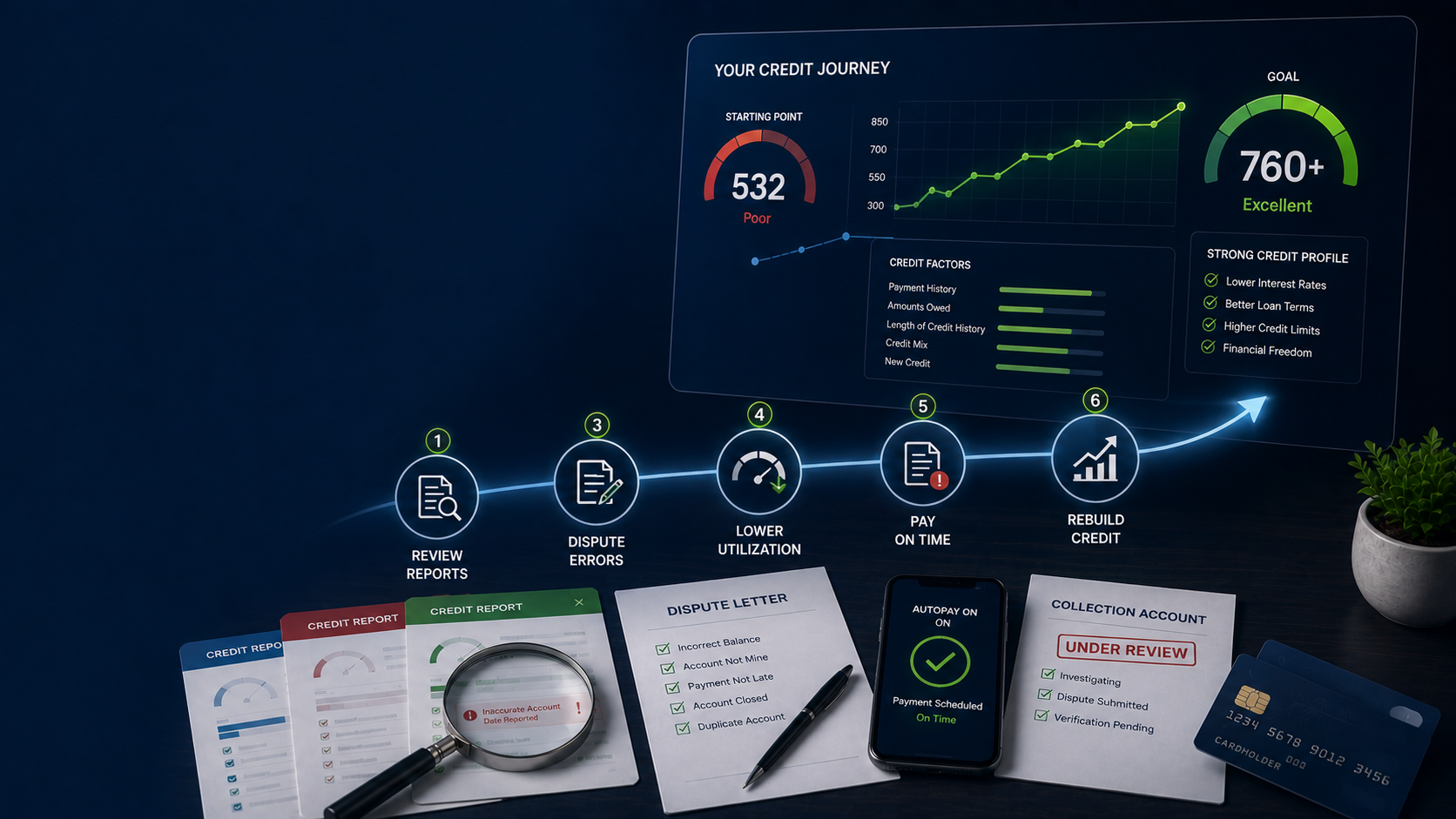

  • How to File a Credit Dispute (and What Happens Next)

    How to File a Credit Dispute (and What Happens Next)

    Your credit report is one of the most important financial documents attached to your name. It decides whether you get approved for a mortgage, what interest rate you pay on a car loan, whether a landlord will rent to you, and in some cases whether a job offer comes through. So when something on that report is wrong — a late payment you actually paid on time, a collection you’ve never heard of, an account that was never yours — the consequences can ripple through your life for years.The good news is that you have a legal right to challenge anything on your credit report that is inaccurate, incomplete, unverifiable, or outdated. That right is guaranteed by federal law under the Fair Credit Reporting Act (FCRA), and the credit bureaus are required by law to investigate your dispute — usually within 30 days — and remove anything they cannot verify. You don’t need to pay anyone to do this for you. You can file a credit dispute yourself, for free, and this guide will walk you through every step.That said, disputes can get complicated. Bureaus push back, furnishers “verify” items that are clearly wrong, and the process has a dozen small pitfalls that can get your dispute rejected before anyone even looks at it. We’ll cover all of that here too — including what to do when the system fails you and you need to escalate. If you’d rather have an attorney-backed team handle it, we’re here for that. But whether you do it yourself or work with us, you should understand how the process works. That’s what this article is for.

    Valid Reasons to Dispute an Item on Your Credit Report

    Not every dispute is a valid dispute. The FCRA gives you the right to challenge information that is inaccurate, incomplete, unverifiable, or outdated — and there’s a specific category for information that simply isn’t yours. Let’s break down each of these.

    1. Inaccurate information. This is the most common reason to file a credit dispute. Inaccurate means the information on your report doesn’t match what actually happened. Examples include:

    • A payment reported as late when you paid on time (and have the bank statements to prove it).
    • An account balance that’s wrong — say, a credit card showing $4,200 owed when you’ve paid it down to $800.
    • A loan amount or original credit limit that’s incorrect.
    • A payment history that shows missed payments in months you paid in full.
    • An account status reported as “charged off” when you’ve since settled it or paid it in full.

    2. Incomplete information. Sometimes an account is reported with missing context that makes it look worse than it is. Examples include:

    • A settled account that doesn’t show as “settled” — it still looks like an open collection.
    • A paid-off account still showing a balance.
    • A credit card that doesn’t report its credit limit, which can make your utilization look artificially high.
    • An account that was transferred or sold but only shows the original creditor’s entry as delinquent, without showing the transfer.

    3. Unverifiable information. This is one of the most powerful grounds for a dispute, and it’s often misunderstood. “Unverifiable” means the bureau, when they investigate, cannot get the furnisher to confirm that the information is accurate. This can happen for several reasons:

    • The original creditor has gone out of business or no longer has records of the account.
    • The furnisher doesn’t respond to the bureau’s investigation request within the required timeframe.
    • The furnisher’s records are incomplete or contradictory.
    • A collection agency can’t produce documentation proving they own the debt or that you owe it.

    You don’t have to know in advance that an item is unverifiable. You dispute it, the bureau investigates, and if the furnisher can’t back it up, the item gets removed. This is why it’s worth disputing older collection accounts — the documentation trail often doesn’t survive.

    4. Outdated information. The FCRA sets strict time limits on how long negative information can stay on your report. Most negative items — late payments, collections, charge-offs, foreclosures, and settled accounts — must be removed after seven years. A Chapter 7 bankruptcy can stay for ten years. If an item has passed its reporting time limit and is still showing up, you have a clear right to have it removed.

    A common outdated-information issue: a collection account that was sold and re-aged by a new collection agency, resetting the clock on the reporting period. That’s illegal. The seven-year clock starts from the original delinquency date with the original creditor — not from when a new collector bought the debt.

    5. Not yours (identity theft or mixed file). Sometimes information shows up on your report that has nothing to do with you. This can happen because of identity theft (someone opened accounts in your name) or because of a “mixed file” — where the bureau has merged your credit file with someone else’s, often someone with a similar name or Social Security number. Mixed files are shockingly common, especially among family members with similar names (Jr. vs. Sr., for example).

    If an account isn’t yours, dispute it immediately. For identity theft cases, you should also file a report with the Federal Trade Commission at IdentityTheft.gov and place a fraud alert or credit freeze with the bureaus.

    What You Can’t Dispute Away (and Why Honesty Matters)

    Here’s the part some credit repair companies won’t tell you, and it’s important: you cannot legally dispute accurate negative information that you legitimately owe. If you missed a payment, defaulted on a loan, or ran up a credit card and didn’t pay it, that negative mark has a right to be on your report for up to seven years — and no dispute letter, no matter how cleverly worded, is going to change that.

    Filing a dispute on an item you know is accurate is not just ineffective — it can actively work against you. Here’s why:

    • The bureau can flag your dispute as “frivolous.” Under FCRA Section 611, a bureau can refuse to investigate a dispute if they reasonably determine it’s frivolous or irrelevant. If you dispute every negative item on your report at once, with no specific reason, they’re likely to dismiss the whole batch — and that dismissal can make it harder to get legitimate disputes taken seriously later.
    • You’re training the furnisher to verify. Every time you dispute an accurate item, the furnisher gets pinged and confirms it. Now they’ve got their records pulled and organized. When you (or a credit repair company) dispute it again later, they’ve already done the homework — they verify faster the second time.
    • You may create a paper trail that hurts you. If you dispute something in writing and state “this is not my account” when it clearly is, that statement can come back to bite you in a lawsuit, a loan application, or any future proceeding where your credibility matters.

    So what can you do about accurate negative items you legitimately owe? A few honest paths:

    • Wait it out. Most negative items fall off after seven years. The impact on your score also fades over time — a late payment from five years ago hurts far less than one from last month.
    • Negotiate a pay-for-delete or goodwill deletion. Some creditors will remove a negative mark if you pay the debt (or settle it). Others will consider a “goodwill” removal if you’ve since rebuilt a positive payment history with them. This isn’t a dispute — it’s a negotiation. We do this for clients regularly.
    • Pay it and let time work. A paid collection is still a collection on your report, but many scoring models (including FICO 9 and VantageScore) treat paid collections more favorably than unpaid ones. And “paid in full” looks better to a manual reviewer than “unpaid.”
    • Rebuild with positive history. The single most powerful thing you can do for your credit score is to build new, positive payment history. A secured credit card, a credit-builder loan, or becoming an authorized user on a responsible family member’s card can start moving your score in the right direction even while old negatives are still on the report.

    The honest truth is that credit repair isn’t magic. It’s a legal process that works when there are actual errors on your report — and there very often are. But it’s not a tool for erasing legitimate debts, and anyone who tells you otherwise is either lying or putting you at legal risk.

    How to Prepare Before You File a Dispute

    Before you file a single dispute, do the preparation work. Skipping this step is one of the biggest reasons disputes get rejected. Here’s what you need to do.

    Step 1: Pull current reports from all three bureaus.

    Go to AnnualCreditReport.com — the only federally authorized source for free credit reports. You can pull all three bureau reports at once, or stagger them throughout the year. Since the bureaus made free weekly reports available, you can also check back regularly at no cost.

    Pull all three. Equifax, Experian, and TransUnion are separate companies with separate databases. An error on your Equifax report may not appear on your Experian report at all — and vice versa. Disputing with Equifax does nothing to fix an error on your TransUnion report. You need to see all three to know what you’re dealing with.

    Save copies as PDFs. Print hard copies if you can. You want a snapshot of your report as it exists right now, because the bureaus update reports constantly and you may need to prove what was showing on a specific date.

    Step 2: Go through each report line by line.

    This is tedious, but it’s the most important part of the process. For each report, check:

    • Personal information — name, current and previous addresses, Social Security number, date of birth, employer. Mixed files often show up here first. If you see an address you’ve never lived at or an employer you’ve never worked for, that’s a red flag.
    • Account list — every account, including creditor name, account number (often partially masked), account type, date opened, credit limit or original loan amount, current balance, payment status, and payment history.
    • Public records — bankruptcies, civil judgments, tax liens. (Note: most tax liens and civil judgments were removed from credit reports following a 2017 settlement, but bankruptcies still appear.)
    • Inquiries — both hard inquiries (which affect your score) and soft inquiries (which don’t). If you see a hard inquiry from a company you never applied with, that’s either a mixed file or identity theft.

    Step 3: Identify every error and categorize it.

    For each error you find, write down:

    • Which bureau it appears on (it may be on one, two, or all three).
    • The account name and account number.
    • What specifically is wrong (e.g., “shows 30 days late in March 2024, but payment was made on March 12, 2024 — see attached bank statement”).
    • What category of error it is: inaccurate, incomplete, unverifiable, outdated, or not mine.
    • What evidence you have to support the dispute.

    Step 4: Gather your evidence.

    This is where disputes succeed or fail. The more documentation you can provide, the harder it is for the bureau to dismiss your dispute. Useful evidence includes:

    • Bank or credit card statements showing payments were made on time.
    • Settlement letters or paid-in-full letters from creditors.
    • Billing statements showing the correct balance.
    • Identity theft reports from IdentityTheft.gov (for “not mine” disputes).
    • Police reports (for identity theft cases).
    • Previous correspondence with the creditor or collection agency.
    • Court documents showing a debt was discharged in bankruptcy.

    Make copies of everything. Never send originals. If you’re mailing your dispute, keep a copy of every document you send, plus the dispute letter itself, plus the certified mail receipt (more on that below).

    Step 5: Decide which items to dispute first.

    If you have multiple errors, prioritize. Start with the most damaging and most clearly wrong items — a collection that isn’t yours, a bankruptcy that’s past the ten-year mark, a charge-off that was actually settled. These are the disputes most likely to succeed and the ones that will move your score the most.

    Don’t file a dozen disputes at once unless they’re all clearly valid. Filing too many at once increases the chance the bureau flags the batch as frivolous. Pace yourself — three to five well-documented disputes at a time is a reasonable approach.

    How to File a Dispute With Each Bureau

    Each of the three credit bureaus has its own dispute process. You can file online, by mail, or by phone. We’ll cover all three methods for each bureau, plus what to include regardless of which method you use.

    No matter which bureau you’re disputing with, every dispute should include:

    • Your full name, current address, and any previous addresses relevant to the account.
    • Your Social Security number and date of birth (the bureaus use these to locate your file).
    • A clear identification of each item you’re disputing — creditor name, account number, and the specific information you believe is wrong.
    • The specific reason for each dispute — why you believe the information is inaccurate, incomplete, unverifiable, outdated, or not yours.
    • Any supporting documentation (copies, never originals).
    • A clear statement of what you want the bureau to do: “I am requesting that this item be removed” or “I am requesting that this information be corrected to reflect…”

    Equifax Dispute

    Equifax offers three ways to file a dispute.

    Online: Go to the Equifax dispute portal (equifax.com/personal/credit-report-services/credit-dispute). You’ll need to create an account or log in, then follow the prompts to select the item(s) you’re disputing and provide your reasons. You can upload supporting documents directly through the portal.

    By mail: Send your dispute letter and supporting documents to:

    Equifax Information Services LLC P.O. Box 740256 Atlanta, GA 30374-0256

    Include a copy of your Equifax credit report with the disputed items circled or highlighted, your dispute letter, and copies of supporting documentation. Send it via certified mail with return receipt so you have proof of delivery and the date it was received.

    By phone: Call Equifax’s dispute line at 1-866-640-2273. Have your credit report handy — the customer service rep will need the report number. Phone disputes are faster but harder to document, and you lose the paper trail. We recommend following up a phone dispute with a written letter for the record.

    Equifax typically completes investigations within 30 days and will send you the results in writing, including an updated copy of your credit report if changes were made.

    Experian Dispute

    Experian’s dispute process is similar.

    Online: Go to the Experian Dispute Center (experian.com/disputes). You’ll need to have your Experian credit report — either the one you pulled from AnnualCreditReport.com or a current one from Experian’s site. Enter the report number, select the items you want to dispute, provide your reasons, and upload supporting documents.

    Experian’s online portal is generally well-designed and lets you track the status of your dispute through your account. You’ll get updates as the investigation progresses.

    By mail: Send to:

    Experian P.O. Box 9701 Allen, TX 75013

    Include the same materials as for Equifax — a copy of your Experian report with disputed items marked, your dispute letter, and supporting documentation. Certified mail with return receipt.

    By phone: Call 1-866-200-5764. Have your Experian report number ready. As with Equifax, a phone dispute is quick but harder to document — follow up in writing if you can.

    Experian is often the fastest of the three to complete investigations, frequently finishing within 20–25 days, though they have the full 30.

    TransUnion Dispute

    TransUnion’s process mirrors the others.

    Online: Go to the TransUnion dispute portal (transunion.com/credit-disputes/dispute-your-credit). You can create a free account or use your existing TransUnion account to file and track your dispute. Upload supporting documents directly through the portal.

    By mail: Send to:

    TransUnion LLC Consumer Dispute Center P.O. Box 1000 Chester, PA 19022

    Same package: copy of your TransUnion report with disputed items marked, dispute letter, supporting docs, certified mail with return receipt.

    By phone: Call 1-800-916-8800. Have your TransUnion report number available.

    TransUnion generally completes investigations within the full 30-day window and sends results by mail.

    A note on dispute timing across all three bureaus: The 30-day clock starts when the bureau receives your dispute, not when you mail it. If you mail on the 1st and they receive it on the 5th, the 30 days runs from the 5th. This matters if you’re tracking deadlines — always use certified mail so you have proof of the receipt date.

    How to file a credit dispute with Equifax, Experian, and TransUnion

    Disputing With the Furnisher vs. the Bureau

    Most people only dispute with the credit bureaus. But the FCRA also gives you the right to dispute directly with the furnisher — the original creditor or collection agency that reported the information to the bureau. This is under FCRA Section 623, and it’s a separate, independent right from your right to dispute with the bureau.

    When to dispute with the bureau: Almost always. This is your primary path. The bureau has the legal obligation to investigate and remove unverifiable information, and they’re the ones who actually control what shows on your report.

    When to dispute with the furnisher directly:

    • When you have strong documentation that the furnisher’s reporting is wrong and you want them to correct it at the source.
    • When a bureau investigation “verified” the item but you know it’s wrong — a furnisher dispute creates a separate record and a separate legal obligation.
    • When you’re dealing with a collection agency that may not have the documentation to back up the debt.
    • When you want to build a paper trail for a potential FCRA lawsuit — direct furnisher disputes create their own set of legal obligations and potential liability for the furnisher.

    Why doing both can help: When you dispute with the bureau, the bureau contacts the furnisher and asks them to verify. If you’ve also sent a separate dispute letter to the furnisher directly, the furnisher now has two obligations: respond to the bureau’s investigation request AND respond to your direct dispute. If they fail on either front, you have grounds for removal — and potentially for legal action.

    To dispute directly with a furnisher, send a letter to the creditor or collection agency at the address listed on your credit report (or their correspondence address, if different). State clearly that you are disputing the accuracy of information they reported to the credit bureaus, identify the specific account and the specific information you believe is wrong, and include copies of any supporting documentation. Under FCRA Section 623, they are required to investigate, review the information, and report the results to you — and if they find the information is inaccurate, they must notify all the bureaus they reported to so the information can be corrected.

    Keep in mind: the furnisher dispute process has its own rules and timelines, and it’s slightly different from the bureau process. The furnisher must complete their investigation within roughly the same 30-day window. If you’re dealing with a stubborn furnisher, this is where having an attorney-backed credit repair firm can make a real difference — a letter from a law firm tends to get taken more seriously than a letter from a consumer. Get a free credit audit.

    What to Include in a Dispute Letter — Full Sample Template

    A good dispute letter is clear, specific, and well-documented. It doesn’t need to be long or use legal-sounding language — in fact, plain language is better. The bureaus’ dispute processing systems are largely automated, and clear, specific information gets processed faster than dense legal prose.

    Here’s a template you can adapt. Replace the bracketed information with your details.

    [Your Full Name]
    [Your Current Address]
    [Your Phone Number]
    [Your Email]
    [Your Date of Birth]
    [Your Social Security Number: XXX-XX-XXXX]
    
    [Date]
    
    [Credit Bureau Name — Equifax, Experian, or TransUnion]
    [Bureau Dispute Mailing Address]
    
    RE: Dispute of Inaccurate Information on My Credit Report
    Report Number: [Your report number, if available]
    
    To Whom It May Concern:
    
    I am writing to dispute the following information that appears on my credit report. I believe this information is inaccurate and should be investigated and corrected or removed.
    
    1. Item #1
       - Creditor: [Creditor Name]
       - Account Number: [Account Number or partial number as shown on report]
       - Disputed Information: [Describe what is wrong — e.g., "Account shows a 30-day late payment in March 2024"]
       - Reason for Dispute: [State why it's wrong — e.g., "Payment was made on time on March 12, 2024. I have attached a copy of my bank statement showing the payment."]
       - Requested Action: [e.g., "Remove the late payment notation" or "Delete this account entirely"]
    
    2. Item #2
       - Creditor: [Creditor Name]
       - Account Number: [Account Number]
       - Disputed Information: [Describe]
       - Reason for Dispute: [Explain]
       - Requested Action: [What you want]
    
    [Repeat for each disputed item.]
    
    I have attached the following supporting documentation:
    - [List each document — e.g., "Copy of bank statement dated March 2024," "Copy of settlement letter from XYZ Collections dated January 2024," etc.]
    
    Please investigate these disputed items in accordance with the Fair Credit Reporting Act, 15 U.S.C. § 1681i. If the information cannot be verified, please remove it from my credit report. Please send me the results of your investigation in writing, along with an updated copy of my credit report reflecting any changes.
    
    Thank you for your prompt attention to this matter.
    
    Sincerely,
    
    [Your Signature]
    [Your Printed Name]
    
    Enclosures: [List number of enclosures]
    

    A few notes on using this template:

    • Be specific. “This account is wrong” doesn’t work. “This account shows a balance of $4,200 but was settled in full for $2,100 on January 15, 2024 — see attached settlement letter” does work.
    • Keep copies of everything you send. Keep the certified mail receipt and the return receipt when it comes back.
    • Don’t use this template to dispute items you know are accurate. Remember the frivolous-dispute rule — honesty matters here.
    • You can use the same letter format for all three bureaus; just change the mailing address and report number.
    • If you’re disputing identity theft, include a copy of your FTC Identity Theft Report and a police report. The FCRA gives identity theft victims additional rights, including blocking information from their report.

    Online Disputes vs. Mail Disputes — Pros and Cons

    You can file a credit dispute online or by mail (or by phone, but phone is the least documented option). Each method has trade-offs.

    Online disputes — pros:

    • Fast. You can file in 15–20 minutes from your computer.
    • Free and available 24/7 through each bureau’s dispute portal.
    • You can upload supporting documents directly.
    • You can track the status of your dispute through your account.
    • The bureaus’ systems are set up to process online disputes efficiently — they often move through the pipeline faster.

    Online disputes — cons:

    • The online forms may limit how much detail you can include or the types of documents you can upload.
    • You may inadvertently agree to the bureau’s terms of service, which in some cases include arbitration clauses that limit your right to sue. Read the fine print.
    • You don’t have the same physical paper trail you get with certified mail.
    • It’s harder to document exactly what you submitted and when.

    Mail disputes — pros:

    • You have a complete paper trail: a copy of your letter, copies of all supporting documents, the certified mail receipt proving you sent it, and the return receipt proving they received it.
    • You can include as much detail and as many documents as you want — no character limits or upload restrictions.
    • You avoid any online terms-of-service agreements and their arbitration clauses.
    • Certified mail with return receipt is legally compelling evidence if you ever need to prove the bureau received your dispute and failed to act on it.

    Mail disputes — cons:

    • Slower — you have to print, assemble, and mail the package, then wait for delivery.
    • Costs a few dollars for certified mail and return receipt.
    • You can’t track the investigation status online (though you’ll get results by mail).

    Our recommendation: For most disputes, mail with certified mail return receipt is the stronger option. The paper trail matters — especially if you end up needing to escalate to a CFPB complaint or a lawsuit. The bureaus are more careful when they know you have documented proof of every step. But for simple, clear-cut disputes (a misspelled name, an old address, a single clearly wrong late payment), the online portals are perfectly fine and faster.

    If you use online disputes, take screenshots of every page of the submission process, save PDFs of any confirmation emails, and keep a log of what you disputed and when. That’s your paper trail.

    The 30-Day FCRA Investigation Rule Explained

    The FCRA gives the credit bureaus 30 days to complete an investigation after receiving your dispute. This is the single most important deadline in the dispute process, and it’s worth understanding in detail.

    What the bureau must do within 30 days:

    • Review your dispute and all the information you provided.
    • Contact the furnisher (the creditor or collection agency that reported the information) and ask them to verify the accuracy of the disputed information.
    • Review the furnisher’s response and any evidence they provide.
    • Make a determination — is the information accurate, inaccurate, or unverifiable?
    • Notify you of the results in writing, usually within 5 days of completing the investigation.
    • Update your credit report if changes are required — removing deleted items, correcting updated information, etc.

    The 45-day extension: There’s an important exception to the 30-day rule. If you send additional information related to your dispute after you’ve already filed it, the bureau gets an extra 15 days — bringing the total to 45 days. This is meant to give them time to review the new information.

    Be careful with this. Some credit repair companies deliberately send additional information mid-investigation to trigger the 45-day extension, thinking more time helps. It usually doesn’t — it just delays the outcome. Only send additional information if it genuinely strengthens your dispute.

    What counts as “receiving” the dispute: The 30-day clock starts when the bureau receives your dispute, not when you mail it. This is why certified mail matters — it gives you proof of the receipt date. If you file online, the receipt date is usually the same day you submit.

    When the clock doesn’t start: If your dispute is missing required information (like your identity, the specific item you’re disputing, or the reason for your dispute), the bureau can request more information from you — and the 30-day clock doesn’t start until they have what they need. This is another reason to be thorough and specific in your initial dispute.

    What happens if they miss the deadline: If a bureau fails to complete the investigation within 30 days (or 45, if extended), they must delete the disputed item from your report. This is a hard rule. In practice, bureaus rarely miss the deadline — but if they do, you have a clear right to removal, and documented proof (certified mail receipt, screenshots of your online submission) makes enforcement straightforward.

    A note on frivolous disputes: The 30-day rule only applies to disputes the bureau considers legitimate. If they determine your dispute is frivolous — because you didn’t provide enough information, you’re disputing the same item repeatedly without new information, or you’re disputing everything on your report without specific reasons — they can refuse to investigate. They must notify you within 5 days of that determination and explain why. If you get a “frivolous” rejection, read the reason carefully, fix the deficiency, and refile with better documentation.

    What Happens During an Investigation

    When you file a dispute, here’s what goes on behind the scenes.

    1. Your dispute is logged and routed. The bureau enters your dispute into their system, assigns it a tracking number, and routes it to their dispute processing team. For online disputes, this happens almost instantly. For mailed disputes, it happens when the letter is received and opened.

    2. The bureau contacts the furnisher. Through an electronic system called e-OSCAR (Online Solution for Complete and Accurate Reporting), the bureau sends the furnisher a brief summary of your dispute — usually just a two-digit ” dispute code” and minimal context. This is a known weakness in the system: the furnisher often doesn’t see your actual dispute letter or supporting documents, just a compressed summary. This is one reason items that are clearly wrong sometimes get “verified” — the furnisher is responding to a generic code, not your specific evidence.

    3. The furnisher investigates. The furnisher is supposed to review their records, check whether the information they reported is accurate, and respond to the bureau. They can confirm, correct, or delete the information. In practice, many furnishers simply confirm what they originally reported without a thorough review — which is why furnisher disputes (see above) and documentation matter.

    4. The bureau makes a determination. Based on the furnisher’s response, the bureau decides whether to:

    • Delete the item (if the furnisher can’t verify it or agrees it’s wrong).
    • Update the item (if the furnisher provides corrected information).
    • Leave it as is (if the furnisher confirms the information is accurate).

    5. You’re notified of the results. The bureau sends you the results in writing, usually within 5 days of completing the investigation. If items were deleted or updated, you’ll receive an updated copy of your credit report.

    The whole process is designed to take 30 days, and it usually does. The weakness in the system is step 2 — the e-OSCAR summarization often strips out the nuance of your dispute, and the furnisher’s “investigation” can be cursory. This is why strong documentation and, in stubborn cases, direct furnisher disputes and escalation matter.

    Possible Outcomes: Deleted, Updated, Verified, Remains

    When the investigation is complete, you’ll get a results letter. Here are the possible outcomes for each disputed item.

    Deleted. The item is removed from your credit report entirely. This is the best outcome. It happens when the furnisher can’t verify the information, doesn’t respond within the timeframe, or agrees the information is wrong. A deleted item stops affecting your score immediately and is removed from all future reports.

    Updated. The information is corrected but the account remains on your report. For example, a late payment that was reported as 60 days late might be corrected to 30 days late, or a balance might be updated to reflect a payment you made. This can still help your score, depending on the nature of the update.

    Verified / Remains. The furnisher confirmed the information is accurate, and the item stays on your report as-is. This is the outcome no one wants, but it’s common — and it’s not the end of the road. If you still believe the item is wrong, you have escalation options (next section).

    Reinserted. Rarely, an item that was deleted can reappear on your report later if the furnisher subsequently certifies that the information is accurate. The FCRA requires the bureau to notify you within 5 days if an item is reinserted. If this happens, you have a right to dispute again, and the reinsertion itself can be challenged.

    For items that are verified and remain, you can also request that the bureau include a brief statement of your dispute on your credit report — a “consumer statement” that future creditors will see when they pull your report. This doesn’t change your score, but it gives context to anyone reviewing your file manually.

    What to Do if an Item Is “Verified” but Still Wrong

    Sometimes a bureau investigation comes back “verified” but you know — and can prove — the information is wrong. The furnisher confirmed it, but they’re wrong (or lying, or relying on incomplete records). This is frustrating, but it’s not the end of the line. Here’s the escalation path.

    Step 1: Request a reinvestigation. You have the right to request that the bureau reinvestigate, especially if you have new information or evidence that wasn’t considered in the first investigation. Send a new dispute letter with the additional evidence and a clear explanation of why the original verification was incorrect. Don’t just refile the same dispute — that’s likely to be flagged as frivolous. Add something new.

    Step 2: Dispute directly with the furnisher. As we covered earlier, FCRA Section 623 gives you the right to dispute directly with the furnisher. This creates a separate legal obligation. If the furnisher can’t substantiate the information, they must notify the bureaus to correct or remove it. A direct furnisher dispute also creates a record that can support a later legal claim.

    Step 3: File a complaint with the Consumer Financial Protection Bureau (CFPB). The CFPB is the federal agency that enforces the FCRA. You can file a complaint at consumerfinance.gov. The CFPB will forward your complaint to the bureau or furnisher and require them to respond, usually within 60 days. CFPB complaints get attention — they’re public, they’re tracked, and companies don’t want a pattern of complaints on their record. In many cases, filing a CFPB complaint prompts a more careful review and can result in items being removed.

    Step 4: Consult an attorney. If the item is clearly wrong, you’ve disputed it properly, and the bureau and furnisher still won’t fix it, you may have a case under the FCRA. The FCRA allows you to sue for:

    • Actual damages — money you’ve lost because of the error (higher interest rates, denied credit, denied housing, etc.).
    • Statutory damages — a set amount per violation, up to $1,000 per violation.
    • Punitive damages — in cases of willful violations.
    • Attorney’s fees and costs — the FCRA requires defendants to pay your attorney’s fees if you win, which means many FCRA attorneys take cases on contingency.

    This is one of the biggest advantages of working with an attorney-backed credit repair firm. If your case warrants legal action, you already have a lawyer in your corner who knows your file. Get a free credit audit.

    How Disputes Affect Your Credit Score

    One of the most common questions about credit disputes is whether filing one will affect your score. The short answer is: not directly, and usually not negatively.

    Filing a dispute does not affect your credit score. The act of disputing an item is not a scoring factor in any FICO or VantageScore model. Your score won’t drop because you filed a dispute.

    What can affect your score is the outcome. If an item is deleted, your score may go up — sometimes significantly, especially if the deleted item was a serious negative like a collection or charge-off. If an item is updated (say, a balance is corrected downward or a late payment is removed), your score may go up modestly. If the item remains, your score doesn’t change.

    The “soft pull” question. When you pull your own credit report — whether from AnnualCreditReport.com, a bureau’s website, or a credit monitoring service — it’s a soft inquiry (or “soft pull”). Soft inquiries do not affect your credit score. You can pull your own report as often as you like with no impact. Only hard inquiries — made when a lender pulls your credit to evaluate an application — affect your score, and even then the impact is usually small (typically 1–5 points) and temporary.

    The dispute comment. While an item is under dispute, it may show a “Account in Dispute” comment on your credit report. Some older scoring models temporarily excluded disputed items from certain calculations while the dispute was pending — which could cause a small, temporary score fluctuation. Under current FICO and VantageScore models, this is less common, but it’s worth knowing about. The comment is removed once the investigation is complete.

    Indirect effects. If you’re applying for a mortgage or other major loan while a dispute is pending, the lender may ask you to resolve the dispute before proceeding — some mortgage underwriters won’t approve a loan with open disputes on the file. This is a practical consideration, not a scoring one, but it’s worth timing your disputes around major credit applications if possible.

    In short: file disputes when you have real errors. Don’t worry about the dispute itself hurting your score — it won’t. Focus on the outcome.

    Common Mistakes That Get Disputes Rejected

    After walking through this process with thousands of credit reports, here are the mistakes we see most often — and how to avoid them.

    1. Disputing everything at once with no specific reasons. This is the number one way to get flagged as frivolous. If you send a dispute that says “everything on my report is wrong, please remove it all,” the bureau will reject it. Always be specific: identify each item, state what’s wrong, and explain why.

    2. Not providing enough detail. “This isn’t my account” with no further explanation is weak. “This account is not mine. I have never had an account with [Creditor]. I have attached a copy of my FTC Identity Theft Report and a police report documenting the identity theft” is strong. The more detail and documentation, the better.

    3. Not keeping a paper trail. If you file by mail and don’t use certified mail, you have no proof the bureau received your dispute. If they claim they never got it — and this happens — you have no recourse. Always use certified mail with return receipt for mailed disputes.

    4. Disputing accurate items. As we covered earlier, this trains the furnisher to verify and can get future legitimate disputes flagged as frivolous. Only dispute items you genuinely believe are wrong.

    5. Giving up after one “verified” result. A first dispute coming back “verified” is not the end. You can reinvestigate with new evidence, dispute with the furnisher directly, file a CFPB complaint, or consult an attorney. Many items that survive a first dispute come off after a second, better-documented attempt.

    6. Using a generic dispute letter with no customization. There are plenty of “credit dispute letter templates” online that promise magic results. They don’t work. A good dispute letter is specific to your situation, identifies your specific items, and includes your specific evidence. Copy-paste letters get poor results.

    7. Not pulling all three bureau reports. If you only dispute with Equifax because that’s the report you happened to pull, you’re missing errors on your Experian and TransUnion reports. Always check all three.

    8. Missing the 30-day follow-up. If the bureau’s 30-day window has passed and you haven’t heard back, follow up. They may have missed the deadline, which gives you grounds for removal. But if you don’t follow up, the item just sits there.

    9. Believing a “dispute” removes the underlying debt. A credit dispute challenges whether information should appear on your credit report. It does not erase the underlying debt. If you owe the money, you still owe it — even if the item is removed from your report because the furnisher couldn’t verify it. A creditor can still pursue collection, file a lawsuit, or resell the debt.

    The “Dispute Everything” Scam — A Warning

    If you’ve spent any time researching credit repair online, you’ve probably seen ads or social media posts promising to “remove all negative items from your credit report in 30 days” or “boost your score 100 points guaranteed.” These are almost always scams, and some of them can get you in legal trouble.

    Here’s how the “dispute everything” scam typically works:

    A company (or an individual on TikTok, YouTube, or Instagram) tells you to dispute every single negative item on your credit report — regardless of whether it’s accurate — using the theory that if the furnisher doesn’t respond within 30 days, the item has to be removed. They sell you a packet of dispute letters or a “credit sweep” service, take your money, and fire off disputes on everything.

    Why this is a bad idea:

    • It’s often illegal. If you knowingly dispute accurate information, you may be making false statements to the credit bureaus — which can be a violation of federal law. Some credit repair companies have been shut down and prosecuted for this exact practice.
    • It gets flagged as frivolous. The bureaus have seen this playbook a thousand times. A batch dispute of every negative item, with no specific reasons, is nearly always rejected as frivolous — and now you’ve made it harder to get legitimate disputes taken seriously.
    • It trains furnishers to verify. Every time a furnisher responds to a bogus dispute, they’re organizing their records. The next time the item is disputed — even for a legitimate reason — they verify it faster.
    • It wastes your time and money. Even if a few items get removed because a furnisher didn’t respond, they often get re-reported later when the furnisher updates their records. The removal is temporary, and you’ve paid for the privilege.
    • It can expose you to legal liability. If you sign a dispute letter stating “this is not my account” when it is, you’ve made a false statement in writing. That can come back to haunt you in a lawsuit, a loan application, or any proceeding where your credibility matters.

    The Credit Repair Organizations Act (CROA) is a federal law that regulates credit repair companies. Among other things, it prohibits credit repair companies from:

    • Charging upfront fees before they perform any services.
    • Making false or misleading claims about what they can do.
    • Advising you to make false statements to the credit bureaus.
    • Altering your identity to create a new credit file.

    If a credit repair company is doing any of these things, walk away. Legitimate credit repair firms — like ours — operate within the FCRA and CROA, only dispute items with valid grounds, and never promise guaranteed results or charge upfront fees for work not yet done.

    The honest version of credit repair is less sexy than “remove everything in 30 days” but it actually works: identify real errors, document them thoroughly, file specific disputes, follow up, and escalate when the system fails. It’s not magic, but it’s effective, legal, and lasting.

    Frequently Asked Questions

    How long does a credit dispute take?

    Under the FCRA, credit bureaus must complete their investigation within 30 days of receiving your dispute. If you send additional information during the investigation, they get an extra 15 days (45 days total). You’ll typically receive the results in writing within 5 days of the investigation being completed. In practice, many investigations finish in 20–25 days, but you should plan for the full 30.

    Will filing a dispute hurt my credit score?

    No. Filing a dispute does not directly affect your credit score. Only the outcome matters — if a negative item is deleted or corrected, your score may go up. If the item remains, your score is unchanged. Pulling your own credit report (to check for errors) is a soft inquiry and also doesn’t affect your score.

    Can I dispute a debt I actually owe?

    You have the right to dispute any information you believe is inaccurate, incomplete, unverifiable, or outdated. If you legitimately owe a debt but the information being reported about it is wrong (wrong balance, wrong date, wrong status), you can dispute the inaccurate details. But you cannot use the dispute process to remove accurate information about a debt you legitimately owe — and trying to do so can get your disputes flagged as frivolous and expose you to legal risk.

    Do I need to hire a credit repair company?

    No. You have the right to file disputes yourself for free. The FCRA gives you the tools, and this guide walks you through the process. That said, a legitimate, attorney-backed credit repair firm can help when disputes get complicated, when furnishers push back, or when you need to escalate to a CFPB complaint or lawsuit. If you choose to work with a firm, make sure they’re CROA-compliant, don’t charge upfront fees for unperformed services, and only dispute items with valid grounds. Get a free credit audit.

    What if the bureau says my dispute is frivolous?

    The bureau must notify you in writing within 5 days if they determine your dispute is frivolous, and they must explain why. Common reasons: not enough information, no specific reason for the dispute, or you’re disputing the same item repeatedly without new information. Read the reason, fix the deficiency, and refile with better documentation and more specific details. If the bureau continues to reject valid disputes, you can file a CFPB complaint or consult an attorney.

    Can I dispute an item that’s older than seven years?

    Yes — and you should. Most negative information must be removed from your credit report after seven years (bankruptcies after ten). If an item is still showing after its reporting period has expired, dispute it as outdated. The bureau must remove it. Check the “date of first delinquency” or “original delinquency date” on the account — that’s when the seven-year clock starts, not the date a collection agency bought the debt.

    What’s the difference between a credit freeze and a fraud alert?

    A credit freeze locks your credit report so no new creditor can access it (and therefore no new accounts can be opened in your name) until you unfreeze it. It’s free under federal law and is the strongest protection against identity theft. A fraud alert is a note on your report asking creditors to take extra steps to verify your identity before opening new accounts. It lasts for one year (or seven years for an extended fraud alert if you’ve filed an identity theft report). A freeze is stronger; an alert is more convenient if you’re actively applying for credit.

    Can I dispute an item that’s already been “verified” once?

    Yes. You can request a reinvestigation, especially if you have new evidence or information that wasn’t considered in the first investigation. You can also dispute directly with the furnisher under FCRA Section 623, file a CFPB complaint, or consult an attorney. A first “verified” result is not final — many items come off after a better-documented second dispute or an escalation.

    Ready to Get Your Credit Back on Track?

    Filing a credit dispute is one of the most powerful tools you have for protecting your financial reputation. The FCRA gives you the right, the process is something you can do yourself, and the outcomes — when the disputes are valid and well-documented — can meaningfully improve your credit score and your financial options.

    That said, we know the process can feel overwhelming, especially when you’re dealing with multiple errors across three bureaus, stubborn furnishers, or the aftermath of identity theft. You don’t have to do it alone.

    At credit-repair.com, we offer a free credit audit across all three bureaus — Equifax, Experian, and TransUnion. We’ll pull your reports, identify every error, and walk you through exactly what can be disputed and how. If you decide to work with us, our attorney-backed team handles the disputes, the furnisher negotiations, and any escalations — including CFPB complaints and legal action when warranted.

    We don’t make empty promises or guarantee results we can’t deliver. We operate in full compliance with the FCRA and the Credit Repair Organizations Act, we only dispute items with valid grounds, and we charge no hidden fees. What we do is give you a clear, honest picture of your credit, a plan to fix what’s wrong, and a team of attorneys and credit experts in your corner from start to finish.

    — Get your free 3-bureau credit audit today. Get a free credit audit.

    Your credit report shouldn’t be telling a story that isn’t true. Let’s fix it — the right way, the legal way, the way that lasts.

  • The Fastest Way to Build Credit From Scratch

    The Fastest Way to Build Credit From Scratch

    If you’re reading this, there’s a good chance you’ve already hit the wall that stops millions of Americans before they even get started: you need credit to get credit. A landlord wants to see a credit report before they’ll lease to you. A car dealership wants a FICO score before they’ll finance you. Even some employers and utility companies peek at your credit file. But every lender you approach tells you the same thing — “We’d like to see more credit history before we approve you.”

    It feels like a closed door. It isn’t. It’s a slow door, and that distinction matters.Here’s the honest truth we give every client who walks through our doors at credit-repair.com: there is no overnight path to a strong credit score. Anyone promising you a 700 FICO in 30 days is either lying or about to do something that violates federal law. What does exist is a proven, legitimate, repeatable process that can take you from no score at all to a solid 670–720 FICO within 12 to 24 months — and the first measurable milestone (your very first credit score) typically appears in about six months.This guide is the full playbook. We’ll walk through why having no credit history is almost as costly as having bad credit, how credit scores actually get built, the fastest legitimate methods ranked and explained, a step-by-step 6-month plan, the mistakes that set beginners back, and the mindset that lets you build credit without going into debt.

    Let’s get to work.

    Why No Credit History Is Almost as Hard as Bad Credit

    Most people assume that having no credit is neutral — that a blank file is better than a file with mistakes on it. In practice, the credit scoring system treats invisibility the same way it treats risk: as a unknown. And unknowns get denied.

    Here’s what a “thin file” or “no hit” actually means in the eyes of a lender:

    • FICO can’t score you. The most widely used scoring model (FICO 8) requires at least one account that’s been open for six months or more and at least one account that’s been reported to the bureaus within the last six months. No history, no score. No score, no decision a lender can make with confidence.
    • VantageScore can score you faster (often in one to two months), but most banks still rely on FICO for approval decisions — especially for mortgages and auto loans.
    • You pay the “invisible tax.” Without a score, you’ll face higher security deposits for apartments, utilities, and cell phone plans. You may be denied for standard credit cards and offered only secured or high-fee alternatives. Auto insurance premiums can be higher in states that allow credit-based insurance scoring. Some employers run credit checks for certain roles and may view a blank file as a yellow flag.
    • You’re locked out of the best financial products. Rewards cards, 0% intro APR offers, balance transfer cards, low-interest personal loans, and favorable mortgage rates are all reserved for people with established, positive credit histories.

    A 2023 Consumer Federation of America report estimated that roughly 28 million Americans are “credit invisible” — meaning they have no credit record with any of the three major bureaus. Another roughly 21 million are “unscorable” — they have a record, but it’s too thin or too stale to produce a FICO score. That’s nearly 50 million people effectively shut out of mainstream credit.

    The good news: the path out of “invisible” is shorter than the path out of “bad.” When you have negative marks (late payments, collections, charge-offs), you’re fighting both the absence of positive history and the presence of damaging history. When you’re starting from scratch, you only have one job: add positive history. No cleanup required.

    That’s why, paradoxically, building from scratch can feel faster than repairing damaged credit — even though both take patience.

    How Credit Scores Get Built (The Catch-22)

    Before we get to methods, you need to understand the machine you’re feeding. Credit scores aren’t magic and they aren’t arbitrary — they’re a mathematical summary of the information in your credit reports at the three major bureaus: Equifax, Experian, and TransUnion.

    The Five Factors That Determine Your FICO Score

    Look at those weights for a moment. 65% of your score comes from just two things: paying on time and keeping your balances low relative to your credit limits. That’s it. If you nail those two behaviors, you’re doing most of what the scoring model rewards.

    The Catch-22 Explained

    Here’s the loop that traps people starting from scratch:

    • Lenders want to see a history of responsible credit use before approving you.
    • You can’t build a history of responsible credit use without a lender approving you.
    • Go to step 1.

    The way out is to use entry-level credit products that are designed for exactly this situation — products that don’t require a strong credit history to obtain. Secured credit cards, credit-builder loans, and authorized user arrangements exist specifically to break the loop. They let you start feeding positive information to the bureaus before a traditional lender would touch you.

    Once that first account is open and reporting, the clock starts. Every month that you pay on time and keep utilization low, you’re adding another positive data point to your file. After about six months, FICO has enough information to generate a score. From there, it’s a matter of continuing the same behaviors and gradually adding credit types as you qualify for them.

    The Fastest Legitimate Methods, Ranked

    Not all credit-building methods are created equal. Some report to all three bureaus, some only report to one or two. Some build credit quickly, some take months to show any effect. Some cost money (deposits, interest, fees), some are effectively free.

    We’ve ranked these by a combination of speed of impact, bureau coverage, cost, and reliability. Here’s the order we recommend to most clients, with the caveats noted for each.

    1. Secured Credit Cards

    The single most effective tool for building credit from scratch.

    A secured credit card works exactly like a regular credit card in every way that matters — it’s a revolving account, it reports to the credit bureaus monthly, and it builds your payment history and utilization just like an unsecured card. The only difference is that you put down a refundable security deposit (usually $200–$500) that becomes your credit limit. The deposit protects the issuer if you default, which is why they can approve people with no credit history at all.

    How they work

    • You apply for the card (the issuer runs a hard inquiry, typically one).
    • If approved, you fund the security deposit — this is held in a separate account, not spent by you.
    • Your credit limit usually equals your deposit. A $300 deposit gives you a $300 limit.
    • You use the card for purchases just like any credit card.
    • You get a monthly statement. You pay at least the minimum by the due date. Ideally, you pay the full balance.
    • The issuer reports your payment activity and balance to the three bureaus every month.
    • After 7–12 months of responsible use, many issuers will graduate you to an unsecured card and refund your deposit — no new application or hard inquiry required.

    How to choose one

    Look for these features:

    • Reports to all three bureaus. This is non-negotiable. A card that only reports to one bureau is building one-third of your credit file. Confirm in the card’s terms or call the issuer and ask. Most major banks’ secured cards report to all three; some smaller issuers and credit unions do not.
    • No annual fee (or a very low one). You should not pay $35–$99 a year for the privilege of building credit. Good no-annual-fee secured cards exist from major issuers.
    • A reasonable APR — but honestly, this shouldn’t matter, because you’re going to pay in full every month (more on this below). Don’t pick a card based on APR.
    • A clear graduation path. Some issuers explicitly publish their graduation policy — they’ll review your account after a set number of months and, if you’ve paid on time, upgrade you to unsecured and return your deposit. Others don’t publish a path but will do it if you call and ask after 12 months of clean history.
    • No application fees or “processing” fees. Reputable secured cards don’t charge these. If a card market itself with “guaranteed approval” and tacks on processing fees, application fees, and a high annual fee, walk away — that’s a fee-harvester card, not a credit-builder.

    What to watch out for

    • Credit limits are low (often $200–$500 to start). This makes utilization management critical — a $300 limit means a $90 balance puts you at 30% utilization, which is the upper edge of what FICO likes to see. We’ll cover the fix in the “how to use a secured card” section.
    • Some cards don’t graduate. A few secured cards have no path to unsecured — you’ll carry the deposit indefinitely until you close the account (which can ding your score by reducing your available credit and average account age). Read the terms before applying.
    • Hard inquiry on application. Expect one hard pull, which temporarily drops your score a few points. This is normal and worth it. Don’t apply for five cards to “compare” — that’s five hard inquiries and a red flag.

    The deposit — what you need to know

    Your deposit is fully refundable. It’s not a fee. If you close the account in good standing or graduate to unsecured, you get every dollar back. Some issuers let you fund the deposit via bank transfer, debit card, or even a money order. A few let you choose your deposit amount (higher deposit = higher limit = easier utilization management). If you can afford a $500 deposit instead of $200, do it — the higher limit gives you more breathing room on utilization.

    Get a free credit audit.

    2. Become an Authorized User

    The fastest method with no application, no deposit, and no hard inquiry — but it depends entirely on someone else’s account.

    When you become an authorized user (AU) on someone else’s credit card, the issuer sends you a card with your name on it, linked to the primary cardholder’s account. The key for credit-building: most major issuers report the account history to the authorized user’s credit file as if it were their own.

    How it helps

    If the primary cardholder has a long history of on-time payments, a low balance relative to the limit, and the account has been open for years, all of that positive history can appear on your credit report. This can give you an immediate boost — sometimes a meaningful one — without you ever making a charge on the card.

    This works because FICO 8 (and most VantageScore models) include authorized user accounts in their scoring. It’s sometimes called “piggybacking” and it’s completely legal. The practice was almost discontinued in earlier FICO versions, but FICO kept AU inclusion after pushback from consumer groups who pointed out that it’s a legitimate way for spouses, parents, and children to build credit together.

    How to set it up

    • Find a trusted family member or partner with a credit card that has a clean payment history (no late payments), a low utilization (ideally under 10%), and a long account age (the older, the better).
    • Ask them to add you as an authorized user. This usually requires a quick call to the issuer or an online form. The primary cardholder remains fully responsible for the account — you are not liable for the debt.
    • You do not need to use the card. In fact, you don’t even need to have the physical card in your possession. The history reports to your file whether or not you charge anything.
    • Confirm the issuer reports AU accounts to all three bureaus. American Express, Bank of America, Capital One, Chase, Citi, and Discover all report authorized user activity to all three bureaus. Some smaller issuers don’t — verify before relying on this method.

    Risks to both parties

    This is a two-way street, and the risks run both directions:

    For the authorized user (you):

    • If the primary cardholder misses a payment or runs up the balance, that negative activity appears on your credit report too. You inherit the bad along with the good.
    • You have no control over the account. If the primary cardholder closes it or it gets sent to collections, your score can drop.
    • Mitigation: Only become an AU with someone you trust deeply and who has a demonstrated history of responsible card use. Set a verbal agreement that they’ll tell you if they ever expect to make a late payment or carry a high balance, so you can have yourself removed as AU before the damage hits your file. Removing yourself as an AU is a simple call to the issuer and removes the account (and any negative history) from your report.

    For the primary cardholder:

    • Adding an AU does not affect the primary cardholder’s credit score directly — the AU’s separate credit activity doesn’t touch the primary’s file.
    • However, the primary cardholder is fully legally responsible for all charges made on the AU’s card. If the AU goes on a spending spree, the primary cardholder pays the bill.
    • Mitigation: The primary cardholder can add you as an AU but never give you the physical card (some issuers let you add an AU without requesting a card for them). Or, add you and simply cut up the card when it arrives. The credit-building benefit for you is identical either way.

    Best use of this method

    Authorized user status is most powerful as a supplement, not a substitute. Combine it with a secured card in your own name for the best results. The AU account gives your file age and a second positive tradeline; the secured card gives you an account you control and builds your own payment history.

    3. Credit-Builder Loans

    The best method for adding an installment account to your credit mix — without taking on real debt.

    A credit-builder loan is a loan designed backwards. With a normal loan, you receive the money up front and pay it back over time. With a credit-builder loan, you don’t receive the money until the loan is paid off. Instead, the lender holds the loan amount in a locked savings account or CD. You make monthly payments (which the lender reports to the bureaus as installment-loan activity). When the loan term ends, you receive the money — minus any interest and fees.

    How they differ from regular loans

    The key credit-building benefit: it adds an installment account to your file, which improves your credit mix (10% of your FICO score) and gives you another stream of on-time payment data (35% of your score).

    Best providers

    • Self (formerly Self Lender): The most widely known credit-builder loan. Loans from $25/month, terms of 12–24 months, reports to all three bureaus. You can start for a small administrative fee and the forced savings amount is modest. Good for people who want a low-friction entry point.
    • Credit Strong: Offers credit-builder installment loans with larger final payouts and longer terms (up to 48 months), which can help with both credit mix and account age. Reports to all three bureaus.
    • Local credit unions and community banks: Many offer credit-builder loans (sometimes called “fresh start loans”) with better terms than online providers. If you’re already a member of a credit union, ask. CDFI-certified institutions (Community Development Financial Institutions) often have these products as part of their mission.
    • Kikoff: Offers a $750 credit-builder account with a $5 monthly fee. Reports as a line of credit. Simpler than a traditional loan, but the line type and reporting can vary — read the terms.

    What to watch out for

    • You pay more than you get back. Between interest and fees, you’ll end up paying slightly more than the loan amount over the term. That’s the cost of the credit-building service. For a $500 loan over 12 months, you might pay $540–$560 total and receive $440–$490 at the end. Treat that difference as the fee for building installment credit history.
    • Some report to only one or two bureaus. Confirm all-bureau reporting before signing up.
    • Late payments hurt you. Even though you’re “payaying yourself,” missed payments are reported as late and damage your score. Set auto-pay.
    • Don’t take out multiple credit-builder loans at once. One is enough to build installment history. Stacking them adds cost without meaningful additional benefit.

    4. Store / Retail Credit Cards

    Easier approval — but the highest fees and interest rates in the credit-card world.

    Store cards (Macy’s, Target, Kohl’s, Amazon Store Card, etc.) and gas cards are typically easier to get than general-purpose cards because they’re designed to drive loyalty spending at a specific retailer. Many will approve applicants with thin or no credit history, especially if you apply in-store at checkout (which is why the cashier asks).

    The upside

    • Easier approval than unsecured bank cards.
    • Often no annual fee (the retailer subsidizes the card to encourage spending).
    • Reports to all three bureaus in most cases.
    • Useful if you already shop at the store regularly — you can build credit with purchases you’d make anyway.

    The caveats (and they’re significant)

    • High APRs — store cards routinely carry 25–30%+ interest rates. If you carry a balance, the cost dwarfs any rewards or discounts the card offers.
    • Low credit limits — often $300–$1,000 to start, making utilization management tricky.
    • Deferred-interest promotions are traps. Many store cards offer “0% interest for 12 months” on a large purchase. Read the fine print: if you don’t pay the full balance by the end of the promotional period, you get hit with retroactive interest on the entire original purchase amount — not just the remaining balance. This is one of the most expensive traps in consumer credit.
    • Limited usability — a Macy’s card only works at Macy’s. It doesn’t help with everyday spending categories.
    • Temptation to overspend — the discount-on-first-purchase and ongoing cardholder offers are designed to make you spend more than you would have otherwise.

    Our honest recommendation

    Store cards are a secondary method, not a primary one. If you’ve already opened a secured card and you shop regularly at a specific retailer with a no-annual-fee store card, adding one can diversify your file. But don’t open a store card as your first or only credit-building tool — the low limits make utilization hard to manage, and the high APRs mean a single carried balance can cost you more than a year’s worth of credit-building benefit.

    If you do open one, pay it in full every month. No exceptions. The moment you carry a balance on a 29% APR store card, you’ve lost the game.

    5. Reporting Rent and Utilities

    The most underused method — and the only one that can add months of retroactive positive history.

    For most of credit history’s existence, rent and utility payments didn’t appear on credit reports. That’s finally changing, and it’s a meaningful opportunity for people starting from scratch.

    Rent reporting

    Several services now report your monthly rent payments to one or more of the three bureaus:

    • Experian RentBureau: Experian has been incorporating rent data into its reports for over a decade. Many large property management companies report automatically. If yours doesn’t, you can use a third-party service to report.
    • Boom: Reports rent payments to all three bureaus (Equifax, Experian, TransUnion). Works with your existing rent payments — you don’t change landlords.
    • Rental Kharma / Rent Reporters: Services that verify and report your rent history to one or two bureaus, sometimes including up to 24 months of past payments.
    • Esusu: Reports to all three bureaus, often used through property management partners but available to individual renters as well.

    The key advantage of rent reporting: some services can report up to 24 months of past on-time rent payments, which instantly adds age and payment history to a thin file. If you’ve been a reliable renter for two years but have no credit score, rent reporting can be the fastest single boost available to you.

    The key limitation: not all bureaus weight rent data the same way. FICO 9 and VantageScore 3.0+ include rent data in scoring. FICO 8 (still the most widely used by lenders) often does not factor rent into its score — but the presence of rent history on your report can still help with manual underwriting decisions (like a landlord or small lender reviewing your full report).

    Experian Boost

    Experian Boost is a free tool that scans your linked bank accounts for qualifying utility, telecom, and streaming-service payments and adds them to your Experian credit file. It only affects your Experian report and the VantageScore and FICO scores derived from it — not your Equifax or TransUnion files.

    • Upside: It’s free, instant, and can lift your Experian-based score by a few points immediately. For someone with truly no history, even a few points can be the difference between “no score” and “scorable.”
    • Limitations: Only affects Experian. Only helps if the scoring model considers the boosted data. Negative payment patterns (missed utility payments) can also be added — though you opt in, so you have control.

    Utility and telecom letters

    Some lenders (especially local credit unions doing manual underwriting) will accept letters from your utility company, cell phone provider, or internet provider documenting 12+ months of on-time payments. This doesn’t appear on your credit report and doesn’t affect your score, but it can help you qualify for a first credit product that then does build your score.

    6. Student Credit Cards

    If you’re a college student, this is often the best first card — better than a secured card.

    Student credit cards are unsecured cards designed for enrolled college students with limited or no credit history. They’re offered by most major issuers (Discover it Student, Capital One SavorOne Student, Chase Freedom Student, Bank of America Travel Rewards for Students, etc.).

    Why they’re worth it

    • No security deposit required — you get a real unsecured card with no money down.
    • Lower APRs than store cards (though still higher than prime cards).
    • Often include rewards — cash back on dining, groceries, or gas, which secured cards typically don’t offer.
    • Reports to all three bureaus like any unsecured card.
    • Many have a graduation path — after you finish school and build history, the issuer may upgrade you to a standard unsecured rewards card.

    What to know

    • You must be 21+ to apply without a co-signer or proof of independent income. Under 21, the CARD Act requires you to show ability to repay (income) or have a co-signer. Student income from part-time work can qualify — don’t assume you need a full-time job.
    • Credit limits are modest (often $500–$1,500), but higher than most secured cards.
    • Use it for one small recurring charge (a streaming subscription, a textbook purchase) and pay it in full monthly.
    • Don’t use student status as an excuse to carry a balance. The APR on a student card is typically 18–25%. A carried balance wipes out any rewards you earn.

    If you’re a student, apply for a student card before a secured card. No deposit, better terms, and a cleaner path to an unsecured rewards card down the line.

    7. Personal Loans and Credit Mix

    A later-stage move — not for beginners, but worth understanding now.

    Once you’ve established 12+ months of positive history with a revolving account (secured card, student card, or AU arrangement), you may start receiving prequalified offers for unsecured personal loans. Adding a small personal loan at this stage can improve your credit mix (the 10% of your score that rewards having both revolving and installment accounts).

    However — and we want to be very clear about this — we do not recommend taking out a personal loan solely to build credit. The cost (interest + origination fees) almost always exceeds the marginal score benefit. If you have a legitimate need for a personal loan (consolidating higher-interest debt, covering a necessary expense you’ve budgeted for), the credit-mix benefit is a side effect, not a reason.

    The same applies to auto loans. If you need a car and can afford the payment, an auto loan adds installment history to your file. But don’t finance a car you don’t need just to build credit. The secured card + credit-builder loan combination gives you both revolving and installment history at a fraction of the cost.


    Method Comparison Table

    Here’s how the primary methods stack up side by side:

    The combination we recommend to most clients: Secured card + authorized user (if available) + rent reporting (if you rent). This three-pronged approach gives you revolving credit, account age from the AU relationship, and payment history from your rent — all reporting simultaneously. Add a credit-builder loan at month 3–6 if you want installment history too.

    Get a free credit audit.

    Your 6-Month Plan: No Score to First FICO

    Here’s the concrete, step-by-step plan we walk clients through. Follow it in order and you’ll have a scorable FICO by month 6 and a foundation that compounds from there.

    Month 1: Lay the Foundation

    Week 1:

    • Pull your free reports from AnnualCreditReport.com (you’re entitled to free weekly reports from each bureau). Confirm you’re truly starting from scratch — sometimes there’s a surprise account (a store card a parent opened in your name, a student loan you forgot) that’s already aging on your file.
    • If there are errors or accounts you don’t recognize, document them. (This is where a can help — we’ll identify what’s already on your file before you start building.)

    Week 2:

    • Apply for one secured credit card from a major issuer that reports to all three bureaus and charges no annual fee. If you can, fund a $500 deposit (the higher limit helps with utilization).
    • If you have a trusted family member or partner with a clean, long-standing credit card, ask them to add you as an authorized user. Emphasize that they don’t have to give you the card.

    Week 3–4:

    • Once your secured card arrives, set up one small recurring charge on it — a $10–15 streaming subscription or similar. This keeps your balance tiny and your utilization negligible.
    • Set up auto-pay for the full statement balance every month. This is the single most important habit you’ll build. No exceptions.
    • If you rent, sign up for a rent reporting service that reports to all three bureaus and can back-report up to 24 months of past on-time payments.

    Month 2: Add the Second Tradeline

    • Apply for a credit-builder loan with a 12-month term and a small monthly payment ($25–$50). Self or a local credit union are good options.
    • Set up auto-pay on the credit-builder loan too.
    • Check your VantageScore (some free tools like Credit Karma will show it to you). You may already have a VantageScore at this point, even though FICO needs more time.

    Month 3: Habits and Monitoring

    • Continue using the secured card for one or two small purchases per month. Never charge more than 10% of your limit in a single month (so on a $500 limit, stay under $50). This keeps your utilization in the elite tier for scoring.
    • Enroll in Experian Boost — link your bank account and let it scan for qualifying utility and streaming payments. Free and instant.
    • If you haven’t already, sign up for free credit monitoring through your bank (many offer free FICO scores to customers) or a reputable free service.

    Month 4: Steady as She Goes

    • Keep doing exactly what you’re doing. The scoring model rewards consistency. Resist the urge to apply for more cards — every hard inquiry temporarily dings your score, and you don’t need more than one revolving account right now.
    • If you’re a student and your secured card has a low limit, consider whether a student card (with a higher limit and no deposit) makes sense as a second revolving account. Only do this if you’re confident you can manage two cards responsibly.

    Month 5: Check Your Progress

    • Pull your reports again from AnnualCreditReport.com. Verify that all your accounts (secured card, credit-builder loan, AU account, rent reporting) are showing up correctly on all three bureaus.
    • If anything is missing or reported incorrectly, dispute it directly with the bureau. (We can help with this — disputes are a core part of what we do at credit-repair.com under FCRA compliance.)

    Month 6: Your First FICO

    • At the six-month mark, with at least one account open for six months and at least one account reported to the bureaus in the last six months, FICO should now be able to generate a score for you.
    • Check your FICO score through your bank or a free FICO source (Discover Credit Scorecard, Experian free FICO, etc.).
    • Realistic expectation: A first FICO for someone with 6 months of clean history typically lands in the 670–720 range if utilization is low and there are no late payments. If you’ve been keeping your secured card balance under 10% of the limit and paying in full, you’re likely at the higher end of that range.

    Months 7–12: Build and Diversify

    • Keep the same habits. Your score will gradually rise as your accounts age and your payment history lengthens.
    • Around month 9–12, check whether your secured card issuer offers a graduation path to an unsecured card. If they do, ask for a review. If they don’t, consider applying for a single unsecured rewards card (your improved file should qualify you) — but only if your score is 690+ and you have a clear reason for the card (rewards, higher limit, etc.).
    • Your credit-builder loan should be nearing payoff. When it completes, you’ll receive the saved funds — a nice forced-savings bonus.

    Months 12–24: Reaching 700+

    • With 12+ months of history, your file is solid. Your score should be in the 700–740 range if you’ve maintained perfect payments and low utilization.
    • You can now strategically add a second unsecured card if it serves a purpose (travel rewards, balance transfer, etc.). Don’t add more than one or two new accounts per year — each one lowers your average account age and adds a hard inquiry.
    • Begin thinking about longer-term credit goals: if you plan to buy a home or finance a car in the next 2–3 years, we can help you map a path to the 740+ range that unlocks the best mortgage and auto rates.

    How to Use a Secured Card the Right Way

    The secured card is your engine. Used correctly, it builds credit faster than any other single tool. Used wrong, it can set you back months. Here’s the right way:

    Rule 1: Treat it like a debit card, not a credit card

    Only charge what you can pay off in full from money already in your bank account. If you don’t have the cash for it today, don’t put it on the card. This isn’t a borrowing tool — it’s a credit-building tool.

    Rule 2: Keep utilization under 10%

    Utilization is the ratio of your balance to your credit limit, and it’s 30% of your FICO score. The scoring model likes to see you using a small portion of your available credit — it proves you can handle credit without relying on it.

    • Under 10% utilization is the elite tier. On a $500 limit, that means keeping your statement balance under $50.
    • Under 30% is acceptable but not optimal.
    • Over 30% starts to drag your score down. Over 50% drags it significantly.

    The key detail most people miss: utilization is calculated from your statement balance, not your balance after you pay it off. If you charge $400 on a $500 limit and pay it all off before the statement closes, you’re at 0% utilization. If you charge $400 and wait for the statement to close, you’re at 80% utilization — even if you pay it in full the next day.

    The fix: Make a payment before your statement closes to bring the reported balance down. Or, simply keep your monthly charges small enough that even the statement balance stays under 10%.

    Rule 3: Pay in full, every month, on time

    Set auto-pay for the full statement balance on the due date. This ensures two things: (1) you never miss a payment, which protects the 35% of your score tied to payment history, and (2) you never pay a cent of interest, which makes this a free credit-building tool.

    If you can’t pay in full one month — pay at least the minimum, on time, and then get back to paying in full the next month. A single missed payment (30+ days late) can drop a new score by 60–100 points and take years to fully recover. Don’t let it happen.

    Rule 4: Keep the card open

    The age of your oldest account and your average account age both matter (15% of your score). The secured card you open in month 1 is the foundation of your credit age for the next decade. Don’t close it once you graduate to an unsecured card — keep it open, use it for one small recurring charge, and let it age. If it has an annual fee and you really want to close it, only do so once you have two other established accounts with good age.

    Rule 5: Don’t apply for more cards in the first 6 months

    Every credit card application is a hard inquiry, which temporarily drops your score 3–5 points. More importantly, multiple applications in a short window signal risk to lenders (it looks like you’re desperate for credit). One secured card in the first 6 months is plenty. Let it build history before adding anything else.

    Mistakes That Set Beginners Back

    The path to good credit is simple, but it’s not easy — mostly because the mistakes are obvious in hindsight and invisible in the moment. Here are the ones we see most often:

    1. Applying for too many cards at once

    You get denied for one card, so you apply for three more hoping one will approve you. Each application is a hard inquiry, and suddenly your file shows four inquiries in a month — which looks like desperation to every lender who sees it. Apply for one card. If denied, wait 3–6 months and try a different product (a secured card if you applied for an unsecured one). Don’t shotgun applications.

    2. Missing a payment

    A single 30-day-late mark can stay on your report for seven years. On a brand-new file with little positive history to offset it, the damage is magnified. Set auto-pay for at least the minimum on every account. Treat on-time payment as a non-negotiable, like paying rent.

    3. High utilization

    You get a $300 secured card, charge $280 on groceries, and pay it off at the end of the month. Your statement closes at $280 — 93% utilization. Even though you paid in full, your score takes a hit because the bureau saw a high balance. Fix: Make a mid-cycle payment before the statement closes, or keep monthly charges under $30 on a $300 limit.

    4. Closing the secured card too early

    You graduate to an unsecured card and immediately close the secured card to “get your deposit back.” This shortens your average account age and reduces your available credit — both can lower your score. Fix: Keep the secured card open for at least 12 months, ideally longer, even after you’ve added unsecured cards. The age helps you.

    5. Carrying a balance “to build credit faster”

    This is one of the most persistent myths. You do not need to carry a balance or pay interest to build credit. Paying in full every month builds your score just as fast — faster, actually, because you’re not accumulating debt that raises your utilization. The idea that you must pay interest to “show activity” is wrong. What the bureaus see is your on-time payment and your balance — not whether you paid interest.

    6. Ignoring the authorized user option

    If you have a family member with great credit and you never ask to be added as an AU, you’re leaving free, instant credit history on the table. It’s a 20-minute conversation and a phone call. Do it.

    7. Not checking your reports for errors

    Studies by the Federal Trade Commission have found that one in five consumers has an error on at least one of their three credit reports. For someone starting from scratch, a single misreported account can be the difference between a scorable file and a denied application. Pull your reports regularly and dispute anything inaccurate. (We handle disputes under FCRA compliance —.)

    How Long Each Milestone Takes

    We believe in setting honest expectations. Here’s the realistic timeline for someone starting with no credit history and following the plan above:

    Variables that speed up or slow down the timeline:

    • Authorized user history can add years of account age to your file overnight, potentially getting you to 700+ in 12 months instead of 18.
    • Late payments add 12–24 months to every milestone. A 30-day late at month 4 can push your first 700+ from month 18 to month 30+.
    • High utilization slows progress without showing up as a “negative” — you just won’t see the score gains you expect.
    • Multiple hard inquiries in a short window can pause your progress for 6–12 months until they age.

    Building Credit Without Going Into Debt

    This is the mindset shift that separates people who build credit successfully from people who end up in a debt spiral. Credit building and debt are not the same thing. Here’s the reframe:

    You are not borrowing money. You are renting your credit score.

    Every month, you let the card issuer front a small amount of money for your purchases. They report that you handled it responsibly. You pay them back in full before any interest accrues. The “rent” you pay for this service is $0 — as long as you pay in full.

    The card issuer hopes you’ll slip up. They hope you’ll carry a balance and pay 25% APR. Their entire business model is built on the assumption that most people will. Your job is to be the exception.

    The practical rules

    • Never charge what you can’t pay for today. If the money isn’t in your checking account right now, the charge doesn’t go on the card.
    • Pay the full statement balance every month. Not the minimum. Not “most of it.” The full balance. Set auto-pay and forget about it.
    • Use the card for one or two small recurring charges. A streaming subscription, a phone bill, a single grocery run. This is enough to generate monthly reporting without tempting you into lifestyle spending.
    • Treat the credit limit as a ceiling, not a target. A $500 limit doesn’t mean you have $500 to spend. It means you have a tool that works best when you use $30–50 of it per month.
    • Save the deposit money separately if you need to. If you funded a $500 secured deposit and it’s mentally “your money,” remember: it is. You’ll get it back. Don’t charge $500 on the card thinking the deposit “covers it” — that’s not how it works. The deposit is collateral, not a payment source.

    The credit-builder loan is forced savings, not debt

    The credit-builder loan is the one place where you’re paying a small fee (interest + admin) for the credit-building service. Think of it as a subscription to a credit-building product, not as debt. You’re paying $20–$60 over the life of the loan to add an installment tradeline to your file. At the end, you get the loan principal back. It’s the closest thing to “buying” credit history that exists legally.

    Monitoring Your Progress — Free Tools

    You don’t need to pay for credit monitoring. Here are the free tools we recommend:

    Free FICO scores

    • Discover Credit Scorecard — free FICO 8 score from Experian, available to anyone (not just Discover cardholders). Updates monthly.
    • Experian free FICO — free FICO 8 from Experian with an Experian account.
    • Your bank or credit union — many (Citi, Bank of America, Wells Fargo, Chase, Discover, Capital One) provide free FICO or VantageScore to customers. Check your app.

    Free VantageScore (less useful for lending decisions, but good for trend tracking)

    • Credit Karma — free VantageScore 3.0 from TransUnion and Equifax. Updates weekly. Good for trend tracking, not for knowing your lending-ready FICO.
    • Credit.com — free VantageScore and Experian report summary.

    Free credit reports

    • AnnualCreditReport.com — the official, federally authorized source. You’re entitled to free reports from each bureau. Currently offering free weekly reports. This is the only site that gives you the actual full reports (not a summary) at no cost.

    Free credit monitoring with alerts

    • Most of the free score tools above also monitor your file and send alerts when new accounts, inquiries, or changes appear. Set up alerts on at least one — ideally Experian, since it’s the most commonly pulled bureau for lending decisions.

    What to watch for

    • Sudden score drops — investigate immediately. Could be a new inquiry you don’t recognize (possible identity theft), a reported late payment, or a utilization spike.
    • Accounts you don’t recognize — dispute immediately. Identity theft is rampant and early detection limits damage.
    • Reporting errors — a card showing a limit of $0 (common with reporting glitches) can tank your utilization. Dispute it.

    Common Myths About Building Credit

    Let’s clear out the misinformation that keeps circulating:

    Myth 1: “You need to carry a balance to build credit.”

    False. This is the single most damaging myth in credit building. Carrying a balance costs you interest and raises your utilization — both bad. Paying in full every month builds your score just as effectively. The bureaus see your payment history and your statement balance; they don’t see whether you paid interest.

    Myth 2: “Checking your credit score hurts your credit.”

    False. Checking your own score or pulling your own reports is a soft inquiry — it has zero impact on your score. Only hard inquiries (when a lender pulls your credit for an application) affect your score, and even then, the impact is small and temporary.

    Myth 3: “Closing a card helps your score.”

    False, almost always. Closing a card reduces your available credit (raising utilization) and can shorten your average account age. Keep cards open unless they have an annual fee you can’t justify or the issuer is engaging in bad practices.

    Myth 4: “Debit cards build credit.”

    False. Debit cards draw from your checking account and don’t involve a credit line, so they’re not reported to the bureaus. Same for prepaid cards. Only credit products (credit cards, loans, lines of credit) build credit — plus rent and utilities when reported through a service.

    Myth 5: “Income affects your credit score.”

    False. Your income is not on your credit report and is not a factor in your FICO or VantageScore. Income matters for approval (lenders ask about it on applications and use it for debt-to-income calculations), but not for your score. A person earning $30,000 with perfect credit habits will have a higher score than a person earning $300,000 with late payments and high utilization.

    Myth 6: “Credit repair companies can magically erase accurate negative items.”

    False. Under the FCRA, accurate information can only be removed if it’s unverifiable, inaccurate, or incomplete. If a negative item is accurate and verifiable, no one — not us, not anyone — can legally have it removed before its time limit expires (typically 7 years for most negative items, 10 years for bankruptcies). Any company promising otherwise is violating federal law. What we can do is dispute inaccurate, outdated, or unverifiable items and ensure your report is fully FCRA-compliant.

    Myth 7: “You only have one credit score.”

    False. You have many scores. FICO 8, FICO 9, FICO Bankcard, FICO Auto, VantageScore 3.0, VantageScore 4.0 — each uses a different formula and may pull from a different bureau. Your “FICO 8 from Experian” may differ from your “FICO 8 from TransUnion” because the underlying reports differ. Don’t obsess over any single number — focus on the trends across all your scores, which will move together if your underlying habits are sound.

    Myth 8: “Paying off a collection removes it from your report.”

    Partially false. Paying a collection updates the status to “paid,” which is better than “unpaid,” but the collection can still remain on your report for up to seven years from the original delinquency date. Some newer scoring models (FICO 9, VantageScore 3.0+) ignore paid collections, but FICO 8 (the most widely used) still factors them in. If you’re negotiating with a collection agency, ask for a “pay-for-delete” agreement in writing — they agree to remove the entry from your report in exchange for payment. Not all agencies will agree, but it’s worth asking.

    FAQ

    1. How fast can I realistically build credit from scratch?

    With consistent, responsible use of a secured card (and ideally an authorized user account), you can expect your first FICO score in about 6 months, typically in the 670–720 range. Reaching 700+ usually takes 12–18 months, and 740+ takes 18–24 months. There is no legal, legitimate way to build a strong score in 30 days — anyone promising that is either misinformed or selling something that violates the FCRA.

    2. What’s the difference between a secured and unsecured credit card?

    A secured card requires a refundable security deposit (usually $200–$500) that becomes your credit limit. An unsecured card requires no deposit and grants you a credit limit based on your creditworthiness. Both report to the bureaus and build credit identically. Secured cards are designed for people with no or poor credit; unsecured cards typically require an established credit history.

    3. Do I need to pay interest to build credit?

    No. This is a common myth. Paying your full statement balance every month builds your score just as fast as carrying a balance — and it costs you nothing in interest. The bureaus see your on-time payment and your reported balance; they don’t see whether you paid interest. Paying in full is the optimal strategy.

    4. Can I build credit without a credit card?

    Yes, but it’s slower and less effective. Rent reporting, credit-builder loans, and authorized user status can all build credit without you personally holding a credit card. However, revolving credit (credit cards) is the most heavily weighted type of account in FICO scoring, so if you’re able to manage a secured card responsibly, it’s the single fastest tool.

    5. Will being an authorized user hurt the primary cardholder?

    No. Adding an authorized user doesn’t affect the primary cardholder’s credit score — your separate credit activity doesn’t touch their file. The only risk to the primary cardholder is financial: they’re responsible for any charges made on the AU’s card. They can eliminate this risk by adding you as an AU but never giving you the physical card.

    6. How many credit cards should I have to build credit?

    For the first 12 months, one is plenty. After that, 2–3 revolving accounts is optimal for most people — enough to show you can manage multiple lines, but not so many that you risk missed payments or high utilization. Don’t open more than one or two new accounts per year to avoid lowering your average account age.

    7. What credit score do I need to rent an apartment?

    It varies by landlord and market, but most rental applications look for 620–680+. Higher-end buildings and competitive markets may require 700+. If you don’t yet have a score, some landlords will accept alternative evidence of financial responsibility — bank statements, employment verification, previous landlord references, or a larger security deposit. Rent reporting services can help you build toward the score threshold while you search.

    8. Can credit-repair.com help me if I’m starting from scratch?

    Yes — and this is a point worth emphasizing. Credit repair isn’t only for people with negative items to dispute. If you’re starting from zero, we can pull your three-bureau reports to confirm you’re truly starting clean (sometimes there are surprise accounts), help you identify the fastest combination of credit-building tools for your specific situation, set up rent reporting and bureau monitoring, and build you a custom repair-and-build plan that maps your path from no score to 740+. Our process is FCRA-compliant and attorney-backed, which means every step is legal, ethical, and designed for long-term success — not quick fixes.

    Start With a Free Credit Audit

    Building credit from scratch is a marathon, not a sprint. But it’s a marathon with a clear course, mile markers, and a finish line you can see. The hardest part is the first six months — the stretch where you’re doing everything right and the system hasn’t started rewarding you yet. Once that first FICO appears, the compounding begins: every month of clean history adds value, every account ages, every on-time payment strengthens the 35% of your score that matters most.

    You don’t have to figure out the path alone. At credit-repair.com, we start every new client — including those with no credit history at all — with a free three-bureau credit audit. We pull your reports from Equifax, Experian, and TransUnion, identify what’s already on your file (including any errors or surprise accounts you may not know about), and build you a custom credit-building plan tailored to your goals, timeline, and budget.

    Our approach is attorney-backed and FCRA-compliant, which means every recommendation we make is grounded in federal credit law and designed for measurable, long-term progress — not quick fixes or empty promises. We educate you on the process as we go, so you understand why each step works and can maintain strong credit long after you’ve reached your target score.

    Get your free credit audit at credit-repair.com →

    Whether you’re 18 with your first job, a recent immigrant establishing a U.S. credit file, or someone who simply never needed credit until now — the fastest way to build credit is the legitimate way, done right, starting today. We’ll walk it with you.

    Disclaimer: This article is for educational purposes and does not constitute legal or financial advice. Individual credit outcomes vary based on personal financial behavior and history. credit-repair.com operates in full compliance with the Fair Credit Reporting Act (FCRA) and all applicable federal credit laws. We do not guarantee specific score outcomes or timelines.

    Get a free credit audit.

  • How to Remove Collections From Your Credit Report (the Right Way)

    How to Remove Collections From Your Credit Report (the Right Way)

    If you’re working on improving your credit beyond removing collections, these guides will help: pay-for-delete agreements with collectors, how to file a credit dispute with the bureaus, using a goodwill letter to request removal of late payments, and how to identify and fix credit report errors across all three bureaus.

    How to Remove Collections From Your Credit Report (the Right Way)

    A collection account on your credit report can feel like a permanent stain — one that follows you every time you apply for a mortgage, a car loan, an apartment, or even a new job. It drags down your score, haunts your credit history for years, and leaves you wondering whether there’s anything you can do about it besides wait.

    The good news: there is. You have real, legally grounded options for removing collections from your credit report — options that don’t rely on tricks, loopholes, or empty promises from companies that guarantee results they can’t deliver.

    In this guide, we’ll walk you through every legitimate path to collections removal, step by step. We’ll cover how collections get on your report in the first place, the difference between an original creditor and a collection agency, the four proven strategies for getting an account removed (with letter templates you can actually use), the special rules that apply to medical debt, and the common mistakes that can accidentally restart a debt or keep a negative mark on your report longer than necessary.

    No quick fixes. No guarantees. Just clear, honest, legally sound guidance from a team that does this every day.

    What Is a Collection Account?

    A collection account is a record on your credit report that shows a debt you owe has been handed over to a collection agency — either by the original creditor you stopped paying, or by a debt buyer who purchased the debt outright.

    When you fall behind on payments for a credit card, medical bill, personal loan, utility account, or similar obligation, the company you originally owed (the original creditor) may eventually give up on collecting from you directly. At that point, they typically do one of three things:

    • Assign the debt to a third-party collection agency, which tries to collect on the original creditor’s behalf
    • Sell the debt to a debt buyer for pennies on the dollar, after which the debt buyer owns it and tries to collect
    • Charge off the debt (declare it a loss on their books) while continuing to pursue collection internally or through an agency

    Once a collection agency gets involved, a new account can appear on your credit report under the collection section — separate from the original creditor’s trade line, which usually still shows the defaulted account with a “charged off” or similar status.

    It’s worth understanding this distinction early, because it affects how you approach removal. A collection is not the same as the original delinquency that caused it. You may end up dealing with two separate entries on your report for what feels like one debt.

    How Collections Get on Your Credit Report

    Collections don’t appear instantly the moment you miss a payment. There’s a timeline, and understanding it helps you know where you stand.

    Typically, the sequence looks like this:

    • You miss a payment. The original creditor reports it as 30 days late to one or more of the three major credit bureaus — Equifax, Experian, and TransUnion.
    • The late payment escalates. If you don’t catch up, the account moves to 60, 90, and then 120+ days late. Each step is reported and further damages your score.
    • The creditor charges off the account. This usually happens around 180 days of non-payment (roughly six months). The original creditor closes the account and writes it off as a loss.
    • The debt is placed with or sold to a collector. The original creditor either hires a collection agency or sells the debt to a debt buyer.
    • The collection agency reports the debt to the bureaus. A new collection account appears on your credit report.

    The key thing to know: a single missed debt can result in two negative marks on your report — the original creditor’s charge-off and the collection agency’s account. Both can hurt your score, and both need to be addressed if you want maximum improvement.

    Not all creditors report to all three bureaus, and some collection agencies only report to one or two. That’s why your reports from Equifax, Experian, and TransUnion can look different from each other. It’s also why a three-bureau audit — pulling all three reports and comparing them — is the only way to get a complete picture of what’s actually dragging your score down. Get a free credit audit.

    How a Collection Affects Your Credit Score

    A collection account is one of the most damaging entries that can appear on your credit report. The exact score impact depends on several factors, but here’s what you need to know.

    How much does a collection drop your score? It varies, but a new collection can pull a good credit score down by 60 to 100+ points. The impact is usually more severe for someone with a previously strong score (because there’s more to lose) and less severe for someone whose report already has multiple negative marks.

    What makes a collection so damaging?

    • Recency. A fresh collection hurts more than an old one. Lenders see a recent collection as evidence you’re struggling right now.
    • Severity. Larger collection balances tend to have a bigger impact, especially under newer scoring models.
    • Frequency. Multiple collections signal a pattern, not a one-time hardship.
    • The type of scoring model. FICO 8 and FICO 9 treat collections differently. FICO 9 and VantageScore 3.0+ ignore paid collections entirely, while FICO 8 still counts them — though paid collections still hurt less than unpaid ones under FICO 8.

    One important nuance: Under FICO 8 and most modern scoring models, the dollar amount of a collection doesn’t matter as much as the mere presence of one — any collection, large or small, triggers the penalty. Under FICO 9 and VantageScore 4.0, paid collections are disregarded, and medical collections have special, more lenient treatment (more on that below).

    The bottom line: a collection on your report is a serious negative, but it’s not a life sentence. As the collection ages and as you build positive credit history elsewhere, its impact shrinks. And, as we’ll cover next, there are legitimate ways to get it removed before the 7-year clock runs out.

    Original Creditor vs. Collection Agency

    To remove collections effectively, you need to understand who is reporting what — because the original creditor and the collection agency report differently, and the strategy for dealing with each is different.

    The Original Creditor’s Entry

    The original creditor — the credit card company, lender, hospital, or utility you initially owed — reports the account you opened with them. When you default, their trade line typically shows:

    • The account as charged off or closed
    • A history of late payments leading up to the charge-off
    • A balance (which may show as $0 if they sold the debt, or the full amount if they still own it)

    The original creditor’s entry stays on your report for 7 years from the date of the first delinquency that led to the charge-off. Even if the debt is sold, the original creditor’s entry usually remains, reflecting the defaulted account.

    The Collection Agency’s Entry

    The collection agency (or debt buyer) reports a separate account. Their entry typically shows:

    • The collection agency’s name
    • The original creditor’s name
    • The amount being collected (which may include fees and interest added by the collector)
    • The date the account was opened with them (the collection date, not the original delinquency date)
    • A status (open, paid, settled)

    The collection entry also stays on your report for 7 years from the date of the first delinquency — not 7 years from when the collector acquired the debt. This is a critical point we’ll return to: collectors cannot reset the clock by buying or re-aging the debt.

    Why This Distinction Matters for Removal

    Because these are two separate entries, removing the collection agency’s account doesn’t automatically remove the original creditor’s charge-off — and vice versa. To fully clean up a defaulted debt, you often need to address both:

    • The collection account with the agency (via dispute, validation, pay-for-delete, or time)
    • The original creditor’s charge-off (via dispute, goodwill, or time)

    If you only remove the collection but leave the charge-off, you’ve improved your report but not fully. A comprehensive credit repair plan looks at both entries and addresses each one appropriately. Get a free credit audit.

    The 4 Legitimate Paths to Removal

    There are four legitimate, proven strategies for removing a collection from your credit report. Each has its place, and the right one depends on the specifics of your situation — whether the debt is accurate, whether you actually owe it, whether you can afford to pay, and how old the account is.

    Let’s walk through each one in detail.

    Path 1: FCRA Dispute

    The Fair Credit Reporting Act (FCRA) gives you the right to dispute any information on your credit report that is inaccurate, incomplete, or unverifiable. If you identify a collection entry that contains errors — or that the collector cannot prove — you can dispute it with the credit bureaus, and if it can’t be verified, it must be removed.

    This is the first and most fundamental path, and it’s grounded in federal law.

    When to use this path:

    • The collection contains factual errors (wrong amount, wrong dates, wrong account number, wrong creditor name)
    • The collection is a result of identity theft
    • The collection was already paid but still shows as unpaid
    • The collection is a duplicate (the same debt reported by multiple agencies)
    • The collection is older than 7 years and should have fallen off already
    • You genuinely don’t recognize the debt and suspect it may be reported in error

    The legal basis: Under the FCRA (15 U.S.C. § 1681i), when you dispute an item, the credit bureau must investigate, forward your dispute to the furnisher (the collection agency), and review and consider all relevant information. The furnisher must investigate and report back. If the item cannot be verified within 30 days (45 days if you dispute after receiving your free annual report), the bureau must delete it.

    Step-by-step: FCRA Dispute

    • Pull all three credit reports. Get your reports from Equifax, Experian, and TransUnion. You’re entitled to a free copy from each every 12 months at AnnualCreditReport.com. Compare the collection entries across all three — they may differ.
    • Identify the errors. For each collection, check:
    • Is the account number correct?
    • Is the original creditor name correct?
    • Is the amount accurate?
    • Is the date of first delinquency correct?
    • Is the “opened” date on the collection consistent with when the collector acquired it (and not later)?
    • Is the status accurate (e.g., does it show as unpaid when you’ve paid it)?
    • Is it a duplicate — does the same debt appear more than once, possibly from different collectors?
    • Gather evidence. Collect any documents that support your dispute — bank statements showing payment, correspondence with the original creditor, a police report if it’s identity theft, or anything that contradicts what’s on the report.
    • Draft and send dispute letters. Send a separate dispute letter to each credit bureau reporting the inaccurate item. Use the template below. Send by certified mail with return receipt so you have proof of delivery and a timestamp.
    • Wait for the investigation. The bureau has 30–45 days to investigate. They’ll forward your dispute to the collection agency, which must verify the information. If they can’t — or don’t respond in time — the item comes off.
    • Review the results. The bureau will send you the results of the investigation and an updated copy of your report if anything changed. If the item was removed, you’re done. If it was “verified” and remains, you can escalate — request the method of verification, dispute directly with the furnisher, or move on to a different strategy.

    A note on “frivolous” disputes: The bureaus can reject disputes they consider frivolous. To avoid this, be specific about what’s wrong, include evidence, and don’t dispute everything on your report at once without cause. Targeted, factual disputes are taken far more seriously than blanket “not mine” claims.

    Path 2: Debt Validation Under the FDCPA

    The Fair Debt Collection Practices Act (FDCPA) gives you a powerful right: within 30 days of a collection agency first contacting you, you can request validation of the debt. If they can’t validate it, they must stop collection activity — and in practice, many collection agencies don’t have the documentation to validate older or purchased debts, which can lead to removal.

    This is a different legal mechanism from an FCRA dispute. The FCRA is about what’s on your credit report; the FDCPA is about whether a collector can legally pursue you at all.

    When to use this path:

    • A collection agency has recently contacted you (you’re within the 30-day validation window)
    • You’re unsure whether you actually owe the debt
    • You suspect the debt amount is wrong or includes illegitimate fees
    • The debt has been sold multiple times and documentation may be lost
    • You want to force the collector to prove they have the legal right to collect

    The legal basis: Under the FDCPA (15 U.S.C. § 1692g), within five days of first contacting you, a debt collector must send you a written notice containing the amount of the debt, the name of the creditor, and a statement that you have 30 days to dispute the debt. If you dispute it (or request the name and address of the original creditor) within that 30-day window, the collector must cease collection activity until they obtain verification of the debt and mail it to you.

    Verification typically includes:

    • The amount owed
    • The original creditor’s name
    • Documentation that you owe the debt (account statements, the original agreement)
    • Proof that the collection agency has the right to collect it (assignment or purchase documentation)

    What happens if they can’t validate? If the collector can’t (or doesn’t) provide validation, they must stop all collection efforts — including reporting the debt to the credit bureaus. In practice, many collectors who can’t validate will delete the account rather than continue reporting a debt they can’t prove. Debt buyers, who purchase old debts in bulk, often lack the original documentation and are the most likely to fail validation.

    Step-by-step: Debt Validation Request

    • Send the validation letter within 30 days. The 30-day clock starts from when the collector first contacts you (or from the date of their initial written notice). Use the template below. Send by certified mail with return receipt.
    • Wait for validation. The collector must stop collection activity — including credit reporting — until they validate. There’s no strict deadline for how long they have to validate, but if they resume collection or continue reporting without having validated, they may be violating the FDCPA.
    • Review what they send. If they send meaningful documentation — account statements, the original agreement, proof of their right to collect — the debt is validated, and you’ll need to pursue a different strategy (pay-for-delete, settlement, or waiting out the clock). If they send nothing, or send only a printout with no supporting documentation, you may have grounds to push for removal.
    • Dispute with the bureaus if they report without validating. If the collector continues reporting the debt but hasn’t validated it in response to your request, you can dispute the entry with the credit bureaus, noting that the collector has failed to validate the debt as required by the FDCPA. The bureau’s investigation, combined with the collector’s inability to verify, can result in deletion.

    The 30-day window is critical. If you miss it, you can still send a validation request, but the collector isn’t legally required to stop collection activity while they respond. That said, many collectors will still respond — especially if the debt is old or poorly documented. It’s always worth trying.

    Path 3: Pay-for-Delete Negotiation

    Pay-for-delete is a negotiated agreement: you agree to pay the collection (in full or a settled amount), and in exchange, the collection agency agrees to remove the entry from your credit report.

    This is a pragmatic path for debts you acknowledge you owe and can afford to address. It’s not guaranteed — collection agencies are not required to agree — but many will, especially if you’re offering payment in full.

    When to use this path:

    • You acknowledge the debt is valid and accurate
    • You can afford to pay some or all of it
    • The debt is recent enough that waiting 7 years isn’t practical
    • You want the entry gone sooner rather than later

    The legal context: The FCRA requires that reported information be accurate — it doesn’t require that accurate information be reported. A collection agency is not legally obligated to report a collection, and they’re not legally prohibited from removing an accurate entry if they choose to. This is the gray area pay-for-delete operates in. It’s not illegal, but it’s not a right either — it’s a negotiation.

    Important honesty note: Some larger collection agencies and original creditors have policies against pay-for-delete because, in theory, it undermines the accuracy of the credit reporting system. In practice, many still do it, especially for paid-in-full offers. Don’t be surprised if some say no. If they do, you can still pay (which helps under FICO 9 and VantageScore models that ignore paid collections) and pursue goodwill deletion afterward.

    Step-by-step: Pay-for-Delete

    • Determine what you can pay. Ideally, offer payment in full — collectors are far more likely to agree to deletion for full payment than for a settled (partial) amount. If you can only settle, still try, but expect a lower success rate.
    • Get everything in writing first. Never pay based on a verbal promise. Send a pay-for-delete letter (template below) offering payment in exchange for written confirmation that they will request deletion from all three bureaus. Do not send money until you have their signed agreement in hand.
    • Review their response. If they agree in writing, proceed. If they refuse or send a counter-offer, decide whether to accept. If they won’t do pay-for-delete at all, consider whether paying without deletion is still worthwhile (it is, under newer scoring models).
    • Pay as agreed. Send payment by a trackable method (certified check, money order, or a payment method that generates a receipt). Keep proof of payment.
    • Confirm deletion. Give the agency 30–60 days to process the deletion. Then pull your reports and verify the entry is gone. If it’s not, follow up with the agency in writing, referencing your agreement. If they still don’t delete, you can dispute the entry with the bureaus, providing your pay-for-delete agreement and proof of payment as evidence that the account should no longer be reported.
    • If they won’t put deletion in writing but agree verbally, consider an alternative: pay the debt, then pursue a goodwill deletion request (covered below) citing your payment. This is a fallback, not a primary strategy, but it works often enough to be worth trying.

    A reality check on pay-for-delete: Not every collector will agree, and the ones most likely to say yes are smaller agencies and debt buyers. Original creditors (like major credit card banks) almost never agree to pay-for-delete. If your collection is with a debt buyer, your odds are better. If it’s with a major bank’s internal recovery department, plan to pursue other paths.

    How to remove collections from your credit report using credit dispute and removal strategies

    Path 4: The 7-Year Clock

    The fourth path is patience. Under the FCRA, a collection account can only stay on your credit report for 7 years — specifically, 7 years plus 180 days from the date of the first delinquency that led to the collection. After that, it must be removed automatically.

    This is your backstop. If the debt is accurate, can’t be validated, and the collector won’t agree to pay-for-delete, the clock is still running — and it will come off.

    When to use this path:

    • The collection is accurate and the collector has verified it
    • Pay-for-delete has been refused
    • The debt is approaching the 7-year mark
    • You’ve decided not to pay (perhaps because it’s past your state’s statute of limitations for lawsuits, and paying wouldn’t meaningfully help your score under your current scoring model)

    How the 7-year clock works:

    • The clock starts on the date of the first delinquency — the date you first missed a payment that led to the default and eventual collection. This is the Date of First Delinquency (DOFD).
    • The collection must be removed no later than 7 years + 180 days after the DOFD.
    • The clock does not reset when the debt is sold, transferred, disputed, or paid. A new collector cannot restart it by reporting a newer “opened” date.

    What to do:

    • Find the DOFD. It’s listed on your credit report, often as the “date of first delinquency” or “original delinquency date.” Each bureau may display it slightly differently, but it must be there.
    • Calculate the removal date. Add 7 years (and up to 180 days) to the DOFD. That’s when the collection should fall off.
    • Check your reports after that date. If the collection is still there, dispute it with the bureaus as “obsolete” — it’s past the reporting period and must be removed. The bureau will verify the DOFD and delete the entry.
    • Don’t let a collector re-age the debt. If a collector reports a newer “date of first delinquency” or “date opened” that extends the reporting period, that’s a violation of the FCRA. Dispute it immediately, citing the true DOFD. Re-aging is illegal, and the bureaus are required to correct it.

    Debt Validation Letter Template

    Send this letter within 30 days of a collection agency first contacting you. Send by certified mail with return receipt. Keep a copy for your records.

    [Your Name]
    [Your Address]
    [City, State ZIP]
    [Your Phone Number]
    [Your Email]
    [Date]
    
    [Collection Agency Name]
    [Collection Agency Address]
    [City, State ZIP]
    
    RE: Debt Validation Request
    Account Reference: [Account number or reference from their letter]
    Original Creditor: [Name, if known]
    Amount Claimed: [$ amount]
    
    To Whom It May Concern:
    
    I am writing in response to your [letter / phone call] dated Sat, 05 Sep 2026 17:14:42 +0000, regarding a debt you are attempting to collect. I do not admit liability for this debt, and I request that you validate it in accordance with my rights under the Fair Debt Collection Practices Act (15 U.S.C. § 1692g).
    
    Please provide the following:
    
    1. The amount of the debt, including a detailed accounting of all charges, fees, and interest added to the original balance.
    
    2. The name and address of the original creditor, and the account number associated with the original debt.
    
    3. A copy of the original signed contract or agreement that establishes my obligation to pay this debt.
    
    4. Documentation showing that you (the collection agency) have the legal right to collect this debt — including any assignment agreement, bill of sale, or other proof of ownership or authorization from the original creditor.
    
    5. A copy of the last billing statement sent to me by the original creditor.
    
    6. Proof that the statute of limitations for this debt has not expired under [your state] law.
    
    Until you provide this validation, I request that you cease all collection activity, including reporting this debt to any credit bureau, as required by the FDCPA.
    
    If you cannot validate this debt, I request that you delete any entry you have placed on my credit reports with Equifax, Experian, and TransUnion, and confirm the deletion to me in writing.
    
    This is not a refusal to pay, but a good-faith request for validation of a debt I do not recognize and have not had the opportunity to review.
    
    Sincerely,
    
    [Your Signature]
    [Your Printed Name]
    
    Enclosures: [List any documents you're including, or write "None"]
    

    What to include and why:

    • Account reference and original creditor: Identifies the specific debt so the collector can locate it in their system.
    • The specific validation requests: Forces the collector to produce real documentation, not just a printout of their own records. Debt buyers often can’t produce the original agreement or proof of purchase.
    • The cease-collection request: Invokes your FDCPA right. If they don’t validate, they must stop — including reporting.
    • The deletion request: Explicitly asks for removal if they can’t validate. Many collectors will comply rather than risk a complaint or lawsuit.
    • The “not a refusal to pay” language: Preserves your position. You’re not admitting or denying the debt — you’re asking for proof.

    Dispute Letter Template for Inaccurate Collections

    Send this letter to each credit bureau reporting the inaccurate collection. Send by certified mail with return receipt.

    [Your Name]
    [Your Address]
    [City, State ZIP]
    [Your Phone Number]
    [Your Email]
    [Date]
    
    [Equifax / Experian / TransUnion]
    [Bureau Address]
    [City, State ZIP]
    
    RE: Dispute of Inaccurate Collection Account
    Account Reference: [Collection account number as it appears on the report]
    Collection Agency: [Agency name as it appears on the report]
    Original Creditor: [Name, if shown]
    
    To Whom It May Concern:
    
    I am disputing the following item on my credit report, which I believe is inaccurate and/or incomplete. Under the Fair Credit Reporting Act (15 U.S.C. § 1681i), I am requesting that you investigate this dispute and delete the inaccurate information if it cannot be verified.
    
    The specific errors are:
    
    [Choose the ones that apply and delete the rest:]
    
    - The account number is incorrect. The correct account number is [number], not [number shown].
    - The amount is incorrect. The actual amount is [$], not [$ shown].
    - The date of first delinquency is incorrect. The correct date is Sat, 05 Sep 2026 17:14:42 +0000, not Sat, 05 Sep 2026 17:14:42 +0000. This is important because it affects the 7-year reporting period.
    - I paid this account in full on Sat, 05 Sep 2026 17:14:42 +0000. It is incorrectly showing as unpaid/with a balance.
    - I do not recognize this account and believe it may be the result of identity theft. [Include a copy of your police report or FTC identity theft report if applicable.]
    - This debt is being reported by multiple collection agencies for the same obligation, which is a duplicate and inaccurate.
    - This account is older than 7 years from the date of first delinquency (Sat, 05 Sep 2026 17:14:42 +0000) and should no longer be appearing on my report.
    
    [Attach any supporting documentation — payment records, correspondence, identity theft report, etc.]
    
    Please investigate this dispute by contacting [Collection Agency Name] and verifying the information I have challenged. If the information cannot be verified within 30 days, I request that you delete it from my credit report immediately.
    
    Please send me an updated copy of my credit report reflecting the results of your investigation, and please provide me with the method of verification if the item is confirmed.
    
    Sincerely,
    
    [Your Signature]
    [Your Printed Name]
    
    Enclosures: [List what you're attaching]
    

    What to include and why:

    • Specific, factual errors: The bureau needs to know exactly what you’re challenging. Vague disputes get dismissed as frivolous.
    • Supporting evidence: Anything you can attach strengthens your case. If you paid, attach proof of payment. If it’s identity theft, attach the FTC or police report.
    • The method-of-verdict request: Asking how the bureau verified (if they confirm the item) gives you grounds to challenge the adequacy of their investigation — which can matter if you need to escalate.
    • Certified mail: You need proof you sent it and proof they received it. The 30-day clock matters.

    Pay-for-Delete Letter Template

    Send this to the collection agency reporting the debt. Do not send payment until you have their signed written agreement.

    [Your Name]
    [Your Address]
    [City, State ZIP]
    [Your Phone Number]
    [Your Email]
    [Date]
    
    [Collection Agency Name]
    [Collection Agency Address]
    [City, State ZIP]
    
    RE: Offer of Payment in Exchange for Deletion of Credit Report Entry
    Account Reference: [Account number]
    Original Creditor: [Name]
    Current Balance: [$ amount]
    
    To Whom It May Concern:
    
    I am writing regarding the above-referenced account, which your agency is reporting on my credit file with Equifax, Experian, and TransUnion.
    
    I am willing to pay this account in full in the amount of [$ amount], or [a settled amount of $___ — if applicable], provided that your agency agrees in writing to the following:
    
    1. You will request deletion of this collection account from my credit reports with all three major credit bureaus (Equifax, Experian, and TransUnion) immediately upon receipt of payment.
    
    2. You will not re-report this account or sell or transfer the remaining balance [if settling] to any other party for collection.
    
    3. You will confirm the deletion request in writing to me at the address above.
    
    If you agree to these terms, please sign and return a copy of this letter to me at the address above. Upon receipt of your signed agreement, I will send payment within [10 / 15 / 30] days by [certified check / money order].
    
    This offer is good for 30 days from the date of this letter. If I do not receive a signed agreement within that time, this offer will be withdrawn.
    
    This is not an acknowledgment of liability for this debt, but a good-faith effort to resolve the matter and remove the negative reporting from my credit file.
    
    Sincerely,
    
    [Your Signature]
    [Your Printed Name]
    
    AGREED AND ACCEPTED:
    
    ________________________________________   ______________
    [Authorized Representative, Collection Agency]    Date
    
    ________________________________________
    Printed Name and Title
    

    What to include and why:

    • The offer is explicit: Payment in exchange for deletion. No ambiguity.
    • All three bureaus named: You want the deletion to be complete, not partial.
    • No re-reporting or resale clause: Prevents the collector from selling any remaining balance to another agency that would re-report it.
    • The signature line: You need their written agreement before you pay. A verbal “yes, we’ll delete it” is not enough — collectors routinely fail to follow through on verbal promises.
    • The 30-day expiration: Creates urgency and gives you a clean exit if they don’t respond.

    Goodwill Deletion

    If a collection is already paid — whether you paid it before discovering pay-for-delete, or you paid it as part of settling the debt — you can request a goodwill deletion. This is a request to the collection agency (or original creditor) to remove the negative entry as a goodwill gesture, citing your payment and your otherwise positive history.

    Goodwill deletion is not a right. There’s no law that requires a creditor or collector to remove an accurate, paid collection. It’s a request — and it works more often than people expect, especially when the request is well-written and the circumstances are sympathetic.

    When to use goodwill deletion:

    • The collection is paid (in full or settled)
    • You have a reason the late payment or default was out of character — a medical emergency, job loss, divorce, family death, or other hardship
    • You’ve otherwise maintained a positive payment history with the creditor (if it’s an original creditor you still have a relationship with)
    • The collection is recent enough that the creditor or collector still cares about your relationship, but old enough that it’s clearly a resolved issue

    How to write a goodwill letter:

    • Be honest and take responsibility. Don’t argue that the debt wasn’t yours.
    • Explain the circumstance that caused the default — briefly and sincerely.
    • Emphasize that you’ve since paid (or settled) and that you’ve maintained good credit habits since.
    • Ask, politely, for them to request deletion as a goodwill gesture.
    • Keep it to one page.

    Sample goodwill letter structure:

    [Your Name]
    [Your Address]
    [City, State ZIP]
    [Date]
    
    [Creditor or Collection Agency Name]
    [Address]
    
    RE: Goodwill Deletion Request
    Account: [number]
    
    To Whom It May Concern:
    
    I am writing to respectfully request a goodwill deletion of the above-referenced account from my credit reports.
    
    I fell behind on this account in [year] due to [brief, honest explanation — e.g., a medical emergency / a job loss / a family hardship]. I understand that I was responsible for the obligation, and I have since paid it in full [or settled it] on Sat, 05 Sep 2026 17:14:42 +0000.
    
    Since that time, I have worked hard to rebuild my credit and maintain on-time payments on all of my obligations. The default was an exception in an otherwise [number]-year history of responsible credit use.
    
    I am respectfully asking whether you would consider requesting that the credit bureaus delete this entry as a gesture of goodwill. I understand this is not required, and I appreciate your consideration.
    
    Sincerely,
    [Your Name]
    

    What to expect: Some creditors and collectors will say yes. Many will say no, citing policy. If the first response is no, try again in a few months — sometimes a second request, or a request routed to a different department (executive customer service, for example), gets a different answer. Persistence, paired with politeness, pays off.

    Medical Collections — Special Rules

    Medical debt gets special treatment under credit reporting rules — and the rules have changed significantly in recent years. If you have medical collections on your report, you have more options and more protections than with other types of collections.

    The Current Rules (as of 2026)

    Here’s where things stand:

    • Paid medical collections are removed. As of July 2022, paid medical collection accounts are no longer allowed to appear on your credit report. If you pay a medical collection, it must be removed — not just marked as paid, but deleted entirely. If a paid medical collection is still showing, dispute it with the bureaus and cite the rule; it will be removed.
    • Unpaid medical collections have a 1-year waiting period. As of July 2023, medical collection accounts do not appear on your credit report until one year (365 days) after the original delinquency. This gives you a full year to work with the provider, set up a payment plan, dispute the bill, or resolve insurance issues before it ever touches your credit. Before this change, the waiting period was 6 months.
    • Medical collections under $500 are excluded. As of April 2023, medical collection accounts with an original balance of less than $500 are excluded from credit reports entirely. If a small medical bill was sent to collections, it should not appear on your report at all.
    • The major bureaus have removed most older medical collections. Equifax, Experian, and TransUnion have collectively removed billions in medical debt from consumer reports as part of these reforms. If you had medical collections that are now covered by the new rules, they may already be gone.

    What This Means for You

    If you have medical collections:

    • Check if it should even be there. If it’s under $500, if it’s paid, or if it’s been less than a year since the delinquency, it should not be on your report. Dispute it.
    • If it’s unpaid and over $500 and over a year old, consider paying it. Because paid medical collections must be removed, paying a medical collection is the most straightforward path to deletion — more reliable than pay-for-delete negotiations. Contact the provider or the collection agency, set up payment (or a payment plan), and once it’s paid, the entry should come off. If it doesn’t within 30–60 days, dispute it with the bureaus citing the paid-medical-removal rule.
    • Dispute medical billing errors. Medical bills are notoriously error-prone. If the amount is wrong, if insurance should have covered it, or if the billing is duplicated, dispute it — both with the provider and, if it’s on your credit report, with the bureaus.
    • Negotiate with the provider. Many hospitals and providers offer financial assistance programs, charity care, or discounts for uninsured patients. If you qualify, the bill may be reduced or eliminated — and if it’s already in collections, a resolved bill can be pulled back.
    • Don’t ignore medical bills hoping they’ll go away. The 1-year grace period is a window to resolve them — not a reason to do nothing. Once the year passes and the collection appears, it will hurt your score like any other collection until it’s paid or falls off after 7 years.

    A Note on Accuracy

    The rules above are the current federal and industry standards as of 2026. Credit reporting rules do evolve — the CFPB has continued to push for further medical debt reporting restrictions. Always check your current reports to see what’s actually showing, and dispute anything that doesn’t match the rules in effect.

    How Long Collections Stay on Your Report

    The general rule is simple: a collection account stays on your credit report for 7 years (technically 7 years plus 180 days) from the date of first delinquency — the date you first missed the payment that led to the default.

    After that period, the credit bureaus are required to remove the collection automatically.

    The Key Dates to Understand

    • Date of First Delinquency (DOFD): The date you first missed a payment that led to the charge-off and collection. This is the anchor date. It does not change.
    • Charge-off date: When the original creditor wrote off the account — usually ~180 days after the DOFD. This is not the date that starts the 7-year clock.
    • Collection “opened” date: When the collection agency acquired the debt. This is also not the date that starts the clock, even though it may appear on the report as the account “open date.”

    The 7-year clock runs from the DOFD — not from the charge-off, not from when the collector acquired the debt, and not from the last activity on the account.

    How to Find Your DOFD

    Your credit report should list the date of first delinquency. Each bureau may label it slightly differently:

    • Equifax: “Date of First Delinquency”
    • Experian: “Original Charge-off Date” or “First Delinquent Date”
    • TransUnion: “Original Delinquency Date” or “First Delinquent Date”

    If the DOFD isn’t clearly shown, you can request it from the bureau. They are required to provide it.

    What Happens at the 7-Year Mark

    The collection should fall off automatically. You don’t need to do anything — but you should check your reports after the removal date to confirm it’s gone. If it’s still there:

    • Dispute it with the bureau as obsolete — past the maximum reporting period.
    • The bureau will verify the DOFD and remove the entry.
    • This is one of the most straightforward disputes to win, because the rule is clear and the date is a matter of record.

    Does Paying a Collection Restart the 7-Year Clock?

    No. This is one of the most persistent myths in credit repair, and it’s false.

    Paying a collection does not restart the 7-year reporting period. The clock is fixed to the date of first delinquency, and nothing you do — paying, settling, disputing, or making a partial payment — moves that date.

    What can happen, and what probably feeds the myth:

    • A new “date of last activity” or “date of last payment” may update on the report. This can make the account look more recent to anyone reading the report manually, but it does not change the DOFD or extend the reporting period.
    • The statute of limitations for a lawsuit can restart. This is a separate legal clock from the credit reporting clock. In many states, making a payment or even acknowledging a debt in writing can restart the statute of limitations — the period during which a creditor can sue you to collect. This is a different issue from how long the collection stays on your credit report.

    The distinction matters:

    • Credit reporting period (FCRA): 7 years from DOFD. Not affected by payment. Federal law.
    • Statute of limitations (state law): The period during which you can be sued for the debt. Varies by state (typically 3–6 years for most consumer debts). Can be restarted by payment or written acknowledgment in many states.

    If a debt is past your state’s statute of limitations, paying it won’t restart the credit reporting clock — but it could restart the lawsuit clock. If you’re in that situation, think carefully before making a payment on an old, time-barred debt.

    Do Collections Hurt Less as They Age?

    Yes. The impact of a collection on your credit score diminishes over time.

    Credit scoring models are designed to weight recent activity more heavily than old activity. A collection from two months ago hurts a lot more than a collection from four years ago. Here’s why:

    • Recency is a major factor. Scoring models interpret a recent collection as evidence of current financial difficulty. An old collection is seen as a past problem that you’ve (presumably) moved past.
    • Time since the negative event is built into the model. As months and years pass, the collection’s weight in the score calculation decreases.
    • New positive information dilutes the negative. As you add on-time payments, new accounts in good standing, and lower balances, the collection becomes a smaller and smaller part of your overall credit profile.

    Practical Implications

    • If a collection is 5–6 years old, it’s already hurting your score much less than it did at year one. If you’re close to the 7-year mark, and the collector won’t agree to pay-for-delete, it may be worth simply waiting for it to fall off rather than paying — especially if paying won’t change its status under your scoring model.
    • If a collection is recent, it’s doing maximum damage. This is where active removal strategies (dispute, validation, pay-for-delete) have the most potential to help your score.
    • Adding positive history matters. While you’re working on removal, also focus on what you can control: making all current payments on time, keeping credit card balances low relative to limits, and avoiding new negative marks. The combination of removing negatives and adding positives is what produces real score improvement.

    Settling vs. Paying in Full

    If you’ve decided to pay a collection, you have two options: pay it in full or settle for less than the full amount. Each has implications.

    Paying in Full

    • Credit report impact: The collection will be updated to show “paid” status. Under FICO 8, it still hurts (paid collections are still counted), but less than unpaid. Under FICO 9 and VantageScore 3.0+, paid collections are ignored entirely.
    • Lender perception: Some lenders (especially mortgage lenders) prefer to see debts paid in full. A settled account may raise questions in manual underwriting.
    • Collector cooperation: Collection agencies are more willing to agree to pay-for-delete when you pay in full.

    Settling

    • Credit report impact: The collection shows as “settled” or “settled for less than full balance.” Under FICO 8, it still counts as a collection. Under FICO 9 and VantageScore, paid (including settled) collections are ignored.
    • Cost: You pay less — often 40–70% of the balance, depending on the age of the debt and the collector’s willingness.
    • Potential tax consequence: Forgiven debt over $600 may be reported as taxable income by the original creditor (on a Form 1099-C). You may owe income tax on the forgiven amount. This doesn’t apply if you were insolvent at the time of settlement, or in certain other exceptions — check with a tax professional.
    • Collector cooperation: Some collectors will agree to pay-for-delete on a settlement, especially debt buyers who paid very little for the debt. Others won’t.

    Which Is Better?

    It depends on your goals:

    • If you’re applying for a mortgage soon, paying in full is generally safer — many mortgage lenders want to see collections paid in full, and some require it as a condition of approval.
    • If you’re focused on score improvement under modern models (FICO 9, VantageScore), paying in full vs. settling makes less difference — both result in the collection being disregarded.
    • If you’re pursuing pay-for-delete, paying in full gives you stronger leverage.
    • If budget is the primary constraint, settling is far better than leaving the collection unpaid — a settled collection is still an improvement over an open one.

    One caution: Never accept a settlement over the phone without getting the terms in writing first. Get a settlement letter from the collector specifying the agreed amount and confirming that payment of that amount will satisfy the debt in full. Pay by a trackable method, and keep proof of payment indefinitely.

    What NOT to Do

    When you’re trying to remove collections, some actions can make your situation worse. Here’s what to avoid.

    1. Don’t Acknowledge the Debt Carelessly

    If a debt is old and may be past your state’s statute of limitations, do not:

    • Agree on the phone that you owe it
    • Make a partial payment “to show good faith”
    • Promise to pay later
    • Send a letter saying “I know I owe this but I can’t pay right now”

    In many states, any of these can restart the statute of limitations — reopening the window during which you can be sued for the debt. If you’re not sure whether a debt is time-barred, get advice before you communicate with the collector.

    2. Don’t Pay Old Debts Blindly

    Paying an old, time-barred debt (one past your state’s statute of limitations) is often a poor financial decision:

    • It won’t improve your score under FICO 8 (the collection still counts, paid or not)
    • It won’t restart the credit reporting clock, but it may restart the lawsuit clock
    • The collector, who paid pennies for the debt, gets paid — and you get little or no benefit

    Before paying an old collection, check:

    • Is it past the statute of limitations in your state? If so, you’re legally protected from being sued — and paying gives up that protection for no score benefit.
    • Is it close to the 7-year reporting limit? If so, it may be worth waiting for it to fall off.
    • Will paying it result in deletion (pay-for-delete, or medical debt rules)? If yes, paying makes sense. If no, think carefully.

    3. Don’t Dispute Everything on Your Report at Once

    Disputing every negative item on your report simultaneously — especially without specific reasons — is a quick way to get your disputes flagged as frivolous. The FCRA allows bureaus to reject disputes they consider frivolous or irrelevant.

    Instead:

    • Dispute specific, identifiable errors
    • Include evidence and clear explanations
    • Prioritize the items most likely to be inaccurate, unverifiable, or obsolete
    • If you have many items, work through them in batches over time

    4. Don’t Hire a Company That Makes Guarantees

    Under the Credit Repair Organizations Act (CROA), it is illegal for a credit repair company to guarantee the removal of specific items or a specific score increase. Any company that promises “we’ll remove all your collections, guaranteed” is either lying or willing to break federal law — neither is a good sign.

    Legitimate credit repair firms:

    • Explain your rights and the legal basis for their work
    • Tell you what they can and can’t do honestly
    • Don’t promise specific outcomes
    • Allow you to cancel without penalty
    • Disclose costs up front

    5. Don’t Ignore a Collection Hoping It Goes Away

    An unpaid collection doesn’t just sit on your credit report. It can:

    • Be sold to another collector (who re-reports it — though the DOFD and the 7-year clock don’t change)
    • Result in a lawsuit, if you’re within the statute of limitations
    • Lead to wage garnishment or bank account levies if the collector wins a judgment

    Ignoring a collection is a strategy only if you’re confident the debt is past the statute of limitations and you’re willing to let the 7-year clock run out. Otherwise, engage — even if that just means validating the debt and understanding your options.

    6. Don’t Restart the Clock on a Time-Barred Debt

    This bears repeating because it’s the single most common mistake. If a collector contacts you about a very old debt:

    • Do not acknowledge it
    • Do not make any payment
    • Do not agree to a payment plan
    • Send a validation request instead — this forces them to prove the debt and pauses collection activity

    If the debt is past the statute of limitations, they cannot legally sue you. But if you restart the clock, that protection can vanish.

    Common Mistakes to Avoid

    Beyond the “what not to do” list above, here are common mistakes people make when attempting to remove collections:

    Mistake 1: Not Pulling All Three Reports

    Collections don’t appear on all three bureaus’ reports uniformly. A collection may show on Experian and TransUnion but not Equifax — or may show different balances or dates on each. If you only pull one report, you’re working with incomplete information.

    Fix: Always pull all three. Compare them. Address each bureau separately.

    Mistake 2: Disputing Without Evidence

    A dispute that says “this isn’t mine” with no supporting documentation is easy for a collector to verify (they just confirm the account is in their system) and easy for a bureau to dismiss. A dispute that says “this account shows a balance of $1,200, but I paid it in full on March 15, 2024 — here’s the receipt and the collector’s paid-in-full letter” is much harder to reject.

    Fix: Gather evidence before you dispute. Attach it to your dispute letter.

    Mistake 3: Not Following Up

    The FCRA gives bureaus 30–45 days to investigate. If you don’t follow up after that window, you may never know the result — and the item may remain even if the investigation found in your favor but wasn’t properly processed.

    Fix: Mark your calendar for 45 days after you send a dispute. If you haven’t received results, follow up in writing. Keep a paper trail of every letter you send and receive, with dates.

    Mistake 4: Paying Before Getting Deletion in Writing

    This is the pay-for-delete version of “don’t restart the clock.” If a collector says “pay us and we’ll delete it” but won’t put it in writing, and you pay — the entry often gets updated to “paid” but stays on your report. You’ve spent the money without getting the benefit you wanted.

    Fix: No signed written agreement, no payment. Period.

    Mistake 5: Not Understanding Which Scoring Model Matters

    Different lenders use different scoring models. A mortgage lender may use FICO 8 or an older FICO model. A credit card company may use FICO 8 or FICO 9. An auto lender may use a FICO Auto Score. The model determines whether paid collections count (FICO 8: yes; FICO 9: no).

    Fix: If you’re preparing for a specific application (mortgage, auto, credit card), ask the lender which scoring model they use — or work with a credit professional who can tell you. This informs whether paying a collection (vs. pursuing deletion) is worth it for your situation.

    Mistake 6: Believing “Credit Repair” Can Remove Accurate Information

    If a collection is accurate, verifiable, and within the 7-year reporting period, no one — not you, not a credit repair company, not a lawyer — can force its removal. The best you can do is negotiate (pay-for-delete, goodwill) or wait (the 7-year clock). Anyone who tells you otherwise is selling something.

    Fix: Be realistic. Focus your energy on the items that genuinely have errors, can’t be validated, or are old enough to come off. For the rest, pursue negotiation and time.

    Mistake 7: Overlooking the Original Creditor’s Entry

    As we covered, a single defaulted debt often produces two report entries: the original creditor’s charge-off and the collection agency’s account. People frequently focus on the collection (the more recent, more aggressive entry) and forget the charge-off, which continues to hurt even after the collection is removed.

    Fix: Address both. If you remove the collection, dispute or pursue goodwill on the charge-off too. A comprehensive approach produces a cleaner report.

    Frequently Asked Questions

    Can I remove a collection if it’s accurate?

    If a collection is completely accurate, verifiable, and within the 7-year reporting period, you cannot force its removal through a dispute. You can, however, pursue pay-for-delete (negotiating removal in exchange for payment) or goodwill deletion (requesting removal as a courtesy after paying). Neither is guaranteed, but both work often enough to be worth trying. You can also let the 7-year clock run — the collection will fall off automatically after the reporting period expires.

    How long does a collection stay on my credit report?

    7 years (technically 7 years plus 180 days) from the date of first delinquency — the date you first missed the payment that led to the default. After that, the bureaus must remove it. Paying or settling the collection does not reset this clock. Get a free credit audit.

    Does paying a collection improve my credit score?

    It depends on the scoring model. Under FICO 8, a paid collection still hurts your score (though often slightly less than an unpaid one). Under FICO 9 and VantageScore 3.0+, paid collections are ignored entirely — so paying can result in a meaningful score jump. For medical collections, paid accounts must be removed from your report entirely, so paying a medical collection should result in its deletion.

    What’s the difference between a charge-off and a collection?

    A charge-off is an accounting action: the original creditor declares the debt a loss on their books, usually after ~180 days of non-payment. The charge-off shows on the original creditor’s trade line. A collection is what happens when the debt is handed to or sold to a third-party collector, who then reports a separate account. A single defaulted debt can produce both entries on your report.

    Can a collection be removed before 7 years?

    Yes, through:

    • FCRA dispute (if the entry is inaccurate or can’t be verified)
    • Debt validation (if the collector can’t produce documentation under the FDCPA)
    • Pay-for-delete (negotiated removal in exchange for payment)
    • Goodwill deletion (requested removal after payment, especially for hardship situations)
    • Medical debt rules (paid medical collections and those under $500 must be removed)

    Should I pay a collection that’s past the statute of limitations?

    Generally, no — unless paying it will result in deletion (pay-for-delete agreement in writing, or medical debt). Paying a time-barred debt won’t improve your FICO 8 score (the collection still counts), but it can restart the statute of limitations in many states, reopening your risk of being sued. If the debt is both past the statute of limitations and approaching the 7-year reporting limit, waiting for it to fall off is often the best move.

    How do I find out if a collection is on my report?

    Pull your credit reports from all three bureaus. You’re entitled to a free copy from each every 12 months at AnnualCreditReport.com. Review the “collections” or “account history” section of each report. You can also use a credit monitoring service to see ongoing changes. Get a free credit audit.

    What if I don’t recognize the collection at all?

    If you don’t recognize a collection, it may be:

    • A debt you forgot about
    • A debt from identity theft
    • A reporting error
    • A debt that was sold and re-reported under a new collector’s name

    Request debt validation from the collector (if they’ve contacted you) and dispute the entry with the credit bureaus. If it’s identity theft, file a report with the FTC at IdentityTheft.gov and your local police, then use that report to dispute the entry — the FCRA has specific provisions for identity theft victims, including blocking information from your report.

    Get a Free Credit Audit

    Removing collections from your credit report is possible — but the right approach depends on the specifics of your situation. What’s on your report, which bureau is reporting it, whether the debt is accurate, how old it is, and what type of debt it is all determine which strategy will work best.

    You don’t have to figure it out alone.

    At , we offer a free, no-obligation three-bureau credit audit. We pull all three of your credit reports, identify every collection and negative mark, and give you a clear, honest assessment of:

    • Which items can be disputed and on what grounds
    • Which items are candidates for debt validation
    • Which collectors are likely to agree to pay-for-delete
    • Which items are approaching the 7-year removal date
    • A custom repair plan tailored to your goals

    We’re a San Diego-based, FCRA-compliant, attorney-backed credit repair firm. We don’t guarantee specific results, because no honest firm can. What we do guarantee is that we’ll work your case using every legitimate, legally grounded strategy available — and we’ll keep you informed at every step.

    We believe in transparency, legal compliance, and measurable progress. We don’t just fix your credit — we equip you with the knowledge to keep it strong for life.

    Get a free credit audit.

    This article is for educational purposes and is not legal advice. Credit reporting rules and state laws change; always verify current rules and consult a qualified professional for guidance on your specific situation.

  • Pay-for-Delete Explained: Does It Really Work?

    Pay-for-Delete Explained: Does It Really Work?

    You opened your credit report and there it is — a collection account staring back at you, dragging down your score and making every credit application feel like an uphill battle. Maybe it is a medical bill that slipped through the cracks during a chaotic year. Maybe it is an old credit card balance that went to collections before you had a chance to catch your breath. Whatever the origin, the question sitting in the back of your mind is the same one thousands of people ask every month: Can I just pay this off and make it disappear from my credit report?

    That question leads you to a concept called pay-for-delete. It sounds almost too good to be true — you pay the debt, the creditor or collection agency removes the negative mark from your credit report, and your score begins to recover. And in some cases, that is exactly what happens. But in many other cases, the process is far messier, the outcome far less certain, and the risks far less obvious than the blog posts and forum threads make it seem.

    This guide walks you through everything you need to know about pay-for-delete: what it is, how it works conceptually, the honest truth about why it is not guaranteed, when it is most likely to succeed, and a step-by-step approach for attempting it the right way — including a full letter template you can adapt to your own situation. We will also compare pay-for-delete to goodwill deletion and to FCRA-based disputing, so you know which tool to reach for and when. Along the way, we will be straight with you about the risks, the tax implications of settling for less than you owe, and what to do when a creditor simply says no.

    If you are reading this because you are staring down a collection and feeling overwhelmed, take a breath. You are not alone, and you are not out of options. Understanding the landscape is the fIRSt step toward reclaiming your financial footing — and that is exactly what we are here to help you do.

    What Is Pay-for-Delete and How Does It Work?

    At its core, pay-for-delete is a negotiated agreement between you and a creditor or collection agency. The premise is straightforward: you agree to pay some or all of an outstanding debt, and in exchange, the creditor agrees to remove the corresponding negative entry from your credit reports at all three major bureaus — Equifax, Experian, and TransUnion.

    To understand why this is even a conversation worth having, it helps to understand how a collection ends up on your credit report in the fIRSt place. When a debt goes unpaid for a sustained period — typically 90 to 180 days past due, depending on the creditor — the original creditor may charge off the account and either assign it to an internal collections department or sell the debt to a third-party collection agency. That agency then reports the account to the credit bureaus as a collection, which appears as a serious negative mark on your report. This mark can stay on your report for up to seven years from the date of the original delinquency, and it can significantly lower your credit score depending on how recent it is, how large it is, and what the rest of your credit profile looks like.

    The key insight behind pay-for-delete is this: creditors and collection agencies are not legally required to report a debt to the credit bureaus. Reporting is voluntary. The Fair Credit Reporting Act (FCRA) governs what must happen once something is reported — it must be accurate, it must be removable if inaccurate, and it must age off after the statutory period. But the decision to report in the fIRSt place, or to continue reporting, is a business decision made by the furnisher. Pay-for-delete exploits that gap. Because reporting is voluntary, a furnisher can agree to stop reporting as part of a negotiated settlement. There is no federal law that says they must keep reporting once they have started, just as there is no federal law that compels them to report in the first place.

    Here is how the process typically unfolds in practice:

    • You identify the collection on your credit report and confirm it is legitimate and within the statute of limitations.
    • You contact the creditor or collection agency — in writing, ideally — and propose a pay-for-delete arrangement: if you pay a specified amount (sometimes the full balance, sometimes a negotiated percentage), they agree to remove the collection from your credit reports entirely.
    • The creditor responds — they may accept, counter with different terms, refuse outright, or simply not respond at all.
    • If they accept, you get the agreement in writing before sending any money. This is non-negotiable. A verbal promise over the phone is not worth the paper it is not written on.
    • You pay according to the written terms — typically by a method that creates a paper trail, such as a cashier’s check or money order, rather than giving the collector direct access to your bank account.
    • The creditor requests removal from the credit bureaus. This is not instantaneous — the bureaus update on their own cycles, and you should expect 30 to 60 days before the deletion reflects on your reports.
    • You verify by pulling your credit reports after 30 to 45 days and confirming the collection is gone. If it is not, you follow up with the creditor and, if necessary, dispute the item using your written agreement as evidence.

    That is the clean version. In reality, the conversation is often messier, the responses less predictable, and the outcomes less certain than a simple step list suggests. And that uncertainty brings us to the most important thing this guide can tell you.

    The Honest Truth: Why Pay-for-Delete Isn’t Guaranteed

    If you have read this far, you already know the upside of pay-for-delete. Now we need to talk honestly about the downside, because any source that tells you pay-for-delete is a sure thing is not telling you the full story.

    The fundamental reason pay-for-delete is not guaranteed is that no creditor or collection agency is required to agree to it. The credit reporting system is built on voluntary furnishing. Just as furnishing is voluntary, so is the decision to stop furnishing. A creditor can simply say no — and many do. There is no statute, no regulation, and no enforcement mechanism that compels a furnisher to delete an accurate, verifiable tradeline simply because you paid it. In fact, under the agreements furnishers sign with the credit bureaus, they are generally expected to report accurately and completely. Deleting an accurate account in exchange for payment sits in tension with that expectation.

    Here is where the industry dynamics get important. The three major credit bureaus — Equifax, Experian, and TransUnion — have historically discouraged pay-for-delete arrangements. Their position is that credit reports should reflect an accurate history of a consumer’s borrowing behavior, and that allowing negative marks to be bought off undermines the integrity of the scoring system. The bureaus’ agreements with furnishers (the collection agencies and creditors who supply data) typically require that reported information be accurate and that furnishers not manipulate the reporting system. Major industry players, including the three bureaus and FICO, have spoken about the practice in terms that range from skeptical to openly critical. Reporting by outlets such as The New York Times and statements from FICO have highlighted how creditors are discouraged from participating in pay-for-delete, and how some furnisher agreements explicitly prohibit removing accurate, verifiable information in exchange for payment.

    What this means in practice is that many large creditors and collection agencies have internal policies against pay-for-delete. They may refuse the request outright, or they may offer a compromise — updating the account status to “paid” or “paid in full” or “settled for less than full balance” — without actually removing the tradeline from your report. That update can still be helpful for your score over time (a paid collection is generally viewed more favorably than an unpaid one), but it is not the same as deletion, and it will not produce the same score recovery.

    It is also worth being honest about the incentives at play. A collection agency that has purchased your debt for pennies on the dollar has a strong financial incentive to recover something, and that incentive can sometimes outweigh their reluctance to agree to a deletion. But an original creditor — say, a major bank that still holds your charged-off credit card — has little incentive to agree to pay-for-delete. They have already taken the loss, the account may have been sold, and they are not going to recover meaningful money by negotiating removal with you. Their policies, shaped by bureau agreements and internal compliance, typically steer them toward refusing.

    So when you read about pay-for-delete online, keep this framing in mind: it is a negotiation, not a right. It works sometimes, with some furnishers, under some circumstances. It is not a guarantee, it is not a loophole, and anyone who promises you it will work is either misinformed or trying to sell you something. The rest of this guide is about maximizing your chances within that honest frame — and knowing when to pivot to other strategies when pay-for-delete is not on the table.

    When Pay-for-Delete Is Most Likely to Work

    Not all creditors are created equal when it comes to pay-for-delete. Your odds of success depend heavily on who holds the debt, what kind of debt it is, and how old it is. Understanding these variables helps you focus your energy where a payoff is realistic and avoid wasting time on furnishers who almost never agree.

    Smaller creditors and local businesses. Independent landlords, small medical providers, local utilities, and regional creditors are often more flexible than national banks. They are less likely to be bound by the strict furnisher agreements and internal compliance policies that govern the major players. A small medical clinic that reported you to collections may be perfectly willing to accept payment and request removal — they care about getting paid, not about the integrity of the national credit scoring system. These are the furnishers where a polite, well-written pay-for-delete letter can genuinely move the needle.

    Medical bills and medical collections. Medical debt occupies a somewhat unique space in the credit reporting ecosystem. In recent years, the three bureaus have implemented changes that treat medical collections more leniently than other types — including extended waiting periods before medical collections appear on reports (up to one year as of recent policy changes) and the removal of paid medical collections from credit reports. This means that simply paying a medical collection may, under current bureau policies, result in its removal from your report without an explicit pay-for-delete negotiation. That said, the landscape for medical debt reporting continues to evolve, and it is still worth confirming what appears on your reports after payment. If a medical collection does not come off automatically after payment, a pay-for-delete request directed at the provider or the collection agency is often well-received.

    Older debts. The older a collection is, the less impact it has on your credit score — FICO scoring models weight recent negative information more heavily. But older debts are also less valuable to the collection agency that holds them, especially if the debt is approaching the seven-year reporting limit. A collection agency holding a five-year-old debt that is about to age off your report anyway has diminishing leverage. They may be more willing to accept a pay-for-delete offer — or a discounted settlement — because recovering some money before the reporting window closes is better than recovering nothing. This is not a guarantee, but the age of the debt genuinely shifts the math in your favor.

    Debts held by collection agencies rather than original creditors. When a debt is sold to a third-party collection agency, the original creditor has already written it off and moved on. The agency that purchased the debt paid a fraction of its face value and is primarily interested in recovering more than they paid. This creates room for negotiation that does not exist when you are dealing with the original creditor. Collection agencies — especially smaller, regional ones — are historically the furnishers most likely to entertain pay-for-delete proposals, because their business model is built on recovery, not on maintaining a long-term reporting relationship with the bureaus.

    Smaller dollar amounts. A collection agency chasing a $150 unpaid utility bill has less to lose by removing the tradeline than one chasing a $15,000 defaulted auto loan. For smaller debts, the administrative cost of continuing to report — and the modest recovery involved — can make a pay-for-delete agreement feel like a reasonable resolution to the furnisher. This is not a hard rule, but as a general tendency, smaller balances are more amenable to negotiation.

    Debts you can pay in a single lump sum. Furnishers prefer certainty. An offer to pay the full amount (or a substantial percentage) in one payment, immediately, is more attractive than a payment plan stretched over months. If you have the funds to make a lump-sum offer — especially if it is close to the full balance — you are in a stronger negotiating position than someone asking to pay in installments.

    In short, the sweet spot for pay-for-delete is: a smaller or older debt, held by a collection agency or small creditor, ideally a medical bill or utility account, where you can offer a lump-sum payment. The further your situation drifts from that profile, the lower your odds — and the next section explains where the odds fall hardest.

    When Pay-for-Delete Rarely Works

    Just as some furnishers are open to pay-for-delete, others are known for refusing it as a matter of policy. Knowing who these furnishers are saves you from chasing a door that is almost never going to open.

    Major banks and national credit card issuers. Large national banks — the ones issuing the majority of credit cards in the United States — are the furnishers least likely to agree to pay-for-delete. Their reporting practices are governed by strict internal compliance policies and by the agreements they sign with the credit bureaus, which generally require accurate and complete reporting of account history. A major bank that has charged off your credit card is not going to remove that charge-off from your report just because you pay it. They may update the status to “paid” or “paid, was a charge-off,” but the negative mark itself will remain for the remainder of the seven-year reporting period. Attempting pay-for-delete with a major bank is, in most cases, an exercise in frustration.

    Credit cards already charged off. Once a credit card account has been charged off — meaning the creditor has written it off as a loss on their books — the damage to your credit report is already done, and the creditor has minimal incentive to revisit it. If the account is still with the original creditor, pay-for-delete is highly unlikely. If it has been sold to a collection agency, your odds improve somewhat (see the previous section), but the tradeline from the original creditor — showing the charge-off — will typically remain on your report regardless of what the collection agency does with its own separate collection entry.

    Student loans. Federal student loans are governed by a different regulatory framework than most consumer debt, and private student loans are typically held by large institutions with strict reporting policies. Neither category of lender is known for entertaining pay-for-delete requests. In fact, for federal student loans, there are specific rehabilitation programs that can remove default notation from your report — but those are statutory programs, not negotiated pay-for-delete arrangements, and they have their own requirements and timelines. If you are dealing with defaulted student loans, the rehabilitation pathway is almost always more productive than a pay-for-delete request.

    Auto loans and repossessions. Auto loans that have resulted in repossession, and the deficiency balances that often follow, are typically held by large lenders or their designated collection agents. These furnishers rarely agree to pay-for-delete. The deficiency balance from a repossession is a significant, documented debt, and the lenders involved tend to follow strict reporting policies.

    Furnishers with explicit anti-pay-for-delete policies. Some collection agencies — particularly larger, national ones — have publicly stated or internally enforced policies against pay-for-delete. They may frame this as a commitment to accurate reporting or as compliance with bureau agreements. If you encounter a furnisher that refuses on these grounds, pushing harder is unlikely to change the outcome. Your energy is better spent on alternative strategies, which we cover later in this guide.

    Recently reported, large-dollar collections with major furnishers. A fresh, large collection with a major furnisher is the worst-case scenario for pay-for-delete. The furnisher has every incentive to keep reporting (the debt is recent and significant), they are likely bound by policies that discourage deletion, and they have little motivation to negotiate removal when they can continue pursuing collection through other channels.

    The takeaway is this: do not assume pay-for-delete is universally available. It is a tool that works in specific situations with specific furnishers. When your situation does not fit the profile where pay-for-delete tends to succeed, you are better off exploring goodwill deletion, FCRA-based disputes, or simply letting the negative mark age off while you build positive credit history in the meantime. All of those strategies are covered below.

    Step-by-Step: How to Attempt Pay-for-Delete the Right Way

    If you have read the previous sections and concluded that your situation fits the profile where pay-for-delete has a realistic chance, here is how to approach it carefully, methodically, and in a way that protects you at every step. The order matters — skipping steps, especially the verification and written-agreement steps, is where most people get burned.

    Step 1: Verify the Debt

    Before you contact anyone about paying a collection, confirm that the debt is legitimate, that the amount is correct, and that the collection agency contacting you actually has the legal right to collect it. Debt buyers purchase portfolios of debt, and the chain of ownership is not always clean. You have the right, under the Fair Debt Collection Practices Act (FDCPA), to request debt validation from a collection agency within 30 days of their initial contact with you. Even if that 30-day window has passed, you can still request verification — and many agencies will provide it, especially if you are signaling a willingness to pay.

    Send a written debt validation request (sent via certified mail with return receipt) asking the agency to provide:

    • The name and address of the original creditor
    • The original account number
    • The amount owed, including an itemization of any fees or interest added
    • Proof that the agency is licensed to collect in your state (if your state requires licensing)
    • Proof that they own or are authorized to collect the debt

    If the agency cannot validate the debt, you have grounds to dispute it with the credit bureaus under the FCRA — and you should not pay anything until validation is confirmed. Paying a debt that you do not actually owe, or that cannot be legally validated, is a mistake that can be difficult to undo.

    Step 2: Check the Statute of Limitations

    Every state has a statute of limitations (SOL) on debt — the legal time limit within which a creditor can sue you to collect. These limits vary by state and by debt type (written contracts, oral contracts, open accounts, etc.), and they typically range from three to six years, though some states extend longer for certain types of debt.

    This matters for two reasons. FIRSt, if the debt is outside the statute of limitations, the creditor can no longer successfully sue you to collect — which means you have significant leverage in any negotiation, including pay-for-delete. They know they cannot compel payment through the courts, so a voluntary payment offer (even a reduced one) may be attractive to them.

    Second — and this is critical — making a payment, or even acknowledging the debt in writing, can restart the statute of limitations in some states. This is one of the most dangerous traps in debt negotiation. If you have a four-year-old debt that is one year away from passing the SOL, and you make a partial payment or send a letter acknowledging the debt, you may reset the clock entirely, giving the creditor fresh legal leverage. We cover this risk in detail later, but it is essential to understand your state’s SOL before you make any move.

    Step 3: Decide on Your Offer

    With the debt verified and the SOL understood, decide what you are offering. There are generally two paths:

    • Pay the full amount in exchange for deletion. This is the strongest offer you can make — the furnisher gets 100% of what they are owed, and in exchange they remove the tradeline. This is most effective when the debt is small enough that paying it in full is feasible.
    • Pay a reduced percentage in exchange for deletion. Collection agencies that purchased your debt for a fraction of its face value may accept a reduced settlement — often 40% to 60% of the balance — in exchange for deletion. The lower your offer, the less attractive it is, and the more likely the furnisher is to refuse deletion (or to agree to a “settled” status update rather than full deletion). If you are going to negotiate a reduced amount, start lower than your target and be prepared to meet somewhere in the middle.

    A note on strategy: some people recommend starting by offering a lower percentage and negotiating up. Others recommend offering the full amount (or close to it) to maximize the chance of deletion. The right approach depends on your budget, the size of the debt, and how much the deletion matters to you relative to the money you are spending. If the score recovery is worth more to you than the dollars, lean toward a stronger offer. If you genuinely cannot afford the full amount, a reduced settlement is still worth proposing — the worst they can do is say no.

    Step 4: Send a Pay-for-Delete Letter

    Your offer should be made in writing, not over the phone. A written letter creates a record, forces the furnisher to respond in a way you can document, and protects you from the “he said, she said” ambiguity of a phone call. We have included a full pay-for-delete letter template below — adapt it to your circumstances, fill in the specifics, and send it via certified mail with return receipt requested, so you have proof of delivery and proof that the letter was received.

    Step 5: Get the Agreement in Writing Before Paying

    This is the single most important step in the entire process, and it is the step people skip most often — to their regret. Never send money based on a verbal promise over the phone. Collection agency representatives will sometimes tell you what you want to hear to secure a payment, and those verbal assurances are extraordinarily difficult to enforce if they do not follow through.

    If the furnisher agrees to your pay-for-delete proposal — or to a counter-proposal they make — insist that they send you a written agreement, on company letterhead, specifying:

    • The exact amount you will pay
    • The payment method and deadline
    • A clear statement that, upon receipt of payment, they will request deletion of the account from all three credit bureaus (Equifax, Experian, and TransUnion)
    • The name of the account, the account number, and your identifying information

    Only after you have that written agreement in your hands — a physical or electronic document you can save and reference — do you send payment. If the furnisher refuses to put the agreement in writing, that is a signal to walk away. A furnisher that will not commit to terms in writing is not a furnisher you can trust to follow through.

    Step 6: Pay with a Paper Trail

    When you pay, use a method that creates a verifiable record. A cashier’s check or money order sent via certified mail is ideal — it does not give the collector access to your bank account, and it creates a documented paper trail. Avoid giving a collection agency your checking account number or authorizing electronic debits, even if they ask for it as a condition of the agreement. If they insist on electronic payment, consider whether the risk is worth it — and if you have a written agreement in hand, a paper check should be acceptable.

    Step 7: Verify the Deletion

    Wait 30 to 45 days after your payment clears, then pull your credit reports from all three bureaus (you are entitled to free weekly reports from AnnualCreditReport.com). Check whether the collection tradeline has been removed. If it has, the process is complete. If it has not, contact the furnisher in writing, reference your pay-for-delete agreement and proof of payment, and request that they fulfill their obligation. If they fail to act, you have grounds to dispute the item directly with the credit bureaus, attaching your written agreement and payment proof as supporting documentation. The bureaus are required to investigate disputes within 30 to 45 days, and a documented pay-for-delete agreement is strong evidence that the continued reporting is no longer appropriate.

    Pay-for-Delete Letter Template

    Below is a template you can adapt to your own situation. Replace the bracketed placeholders with your specific details, and send via certified mail with return receipt requested. This is a starting point — adjust the tone and specifics to fit your circumstances.

    [Your Name]
    [Your Address]
    [Your City, State, ZIP]
    [Your Phone Number]
    [Your Email]
    
    [Date]
    
    [Collection Agency or Creditor Name]
    [Their Address]
    [Their City, State, ZIP]
    
    RE: Account Number [Account Number from your credit report]
    Original Creditor: [Original Creditor Name]
    Balance Listed: [$ Amount]
    
    To Whom It May Concern,
    
    I am writing regarding the above-referenced account, which appears on my credit
    report with a current balance of $[Amount].
    
    I am not disputing the validity of this debt at this time. However, I would like
    to propose a resolution that benefits both parties.
    
    I am prepared to pay $[Amount you are offering — full balance or a negotiated
    percentage] as payment in full for this account. In exchange for this payment, I
    am requesting that your agency agree to remove all information regarding this
    account from my credit reports maintained by all three major credit bureaus —
    Equifax, Experian, and TransUnion — and agree not to report this account to any
    credit bureau in the future.
    
    To be clear: this is a conditional offer. I will remit the agreed-upon payment
    only after I receive a written agreement from your agency, on company letterhead,
    stating that upon receipt of the specified payment, you will request deletion of
    this account from all three credit bureaus and will not re-report it.
    
    If you accept this offer, please send a signed written agreement to the address
    above within 30 days of the date of this letter. Upon receipt of that agreement,
    I will submit payment within the timeframe specified in the agreement.
    
    If I do not receive a written response within 30 days, I will assume your agency
    does not accept this proposal, and I will explore other options for resolving
    this matter.
    
    This letter is not an acknowledgment of liability for this debt and is not a
    commitment to pay absent a written agreement from your agency. This letter is
    sent for settlement negotiation purposes only and is without prejudice to any
    rights I may have under the Fair Debt Collection Practices Act, the Fair Credit
    Reporting Act, or any other applicable federal or state law.
    
    Thank you for your consideration. I look forward to your written response.
    
    Sincerely,
    
    [Your Signature]
    [Your Printed Name]

    A few notes on using this template. FIRSt, the language about “not an acknowledgment of liability” and “without prejudice to any rights” is intentional — it helps protect you from inadvertently resetting the statute of limitations or admitting the debt in a way that could be used against you. That said, state laws vary, and if you are concerned about SOL implications, consult with an attorney before sending anything. Second, if you are offering less than the full balance, be prepared for a counter-offer. The first response may not be a yes or a no — it may be a different number. Third, keep copies of everything you send and everything you receive. If you eventually need to dispute with the bureaus or enforce the agreement, your documentation is your best evidence.

    Pay-for-Delete vs. Goodwill Deletion

    Pay-for-delete is not the only way to ask a creditor to remove a negative mark from your credit report. There is a second, softer approach called goodwill deletion (sometimes called a goodwill adjustment), and understanding the difference between the two helps you choose the right strategy for your situation.

    The core difference comes down to whether money changes hands. Pay-for-delete is a transaction: you pay the debt (or a settlement amount), and the removal is the consideration you receive in return. goodwill deletion is a request: you ask the creditor to remove a negative mark as an act of goodwill, typically because the underlying issue has been resolved (the account is paid, or you have brought it current) and you are asking them to give you a fresh start.

    When to use goodwill deletion. Goodwill letters are most appropriate when:

    • The account is already paid — you have already settled the debt, paid the collection, or brought the account current, but the negative mark is still on your report.
    • The negative mark was the result of a one-time hardship — a medical emergency, a job loss, a family crisis — and you have an otherwise strong payment history with the creditor.
    • The account is current and in good standing but has a late payment or two in its history that you would like removed.
    • You are dealing with an original creditor rather than a collection agency. Original creditors are more likely to grant goodwill adjustments than collection agencies, especially when you have a track record with them.

    When to use pay-for-delete. Pay-for-delete is more appropriate when:

    • The debt is unpaid and you are prepared to resolve it as part of the negotiation.
    • You are dealing with a collection agency that purchased the debt.
    • Goodwill has already been attempted and refused.
    • The account is not one where you have a long, positive history to leverage.

    The odds of success. goodwill deletion success rates vary widely. Some creditors grant them readily for accounts with strong history and isolated blemishes; others have strict policies against adjusting accurate reporting. The tone of your letter matters — a sincere, accountable, non-demanding letter that takes responsibility and explains the context of the hardship tends to perform better than a letter that sounds entitled or aggressive.

    The risk profile. Goodwill letters carry less risk than pay-for-delete negotiations. Because you are not negotiating a payment, there is no money changing hands and no statute-of-limitations concern. The worst outcome of a goodwill letter is a refusal — the status quo. The worst outcome of a pay-for-delete negotiation gone wrong can include restarting the SOL, acknowledging a debt you might have defended against, or paying money for a deletion that never happens.

    For many people, the right approach is to try goodwill fIRSt if the account is already paid, and to pursue pay-for-delete only if goodwill is refused or if the debt is unpaid and you are ready to resolve it. There is no rule that says you can only try one — but you should not pursue both simultaneously on the same account, as that can create confusion and contradictory records.

    Goodwill Letter Template

    If you have decided that a goodwill approach fits your situation — the account is paid or current, you have a reasonable relationship with the creditor, and the negative mark is an isolated blemish — here is a template to adapt.

    [Your Name]
    [Your Address]
    [Your City, State, ZIP]
    [Your Phone Number]
    [Your Email]
    
    [Date]
    
    [Creditor Name]
    [Creditor's Address]
    [Creditor's City, State, ZIP]
    
    RE: Account Number [Account Number]
    Account Status: [Paid in Full / Current / Settled]
    
    To Whom It May Concern,
    
    I am writing to respectfully request a goodwill adjustment to my credit report
    for the above-referenced account.
    
    I have been a customer of [Creditor Name] since [Year], and I value my
    relationship with your company. During the period of [Month/Year to Month/Year],
    I experienced [brief, honest explanation of the hardship — e.g., a medical
    emergency, a job loss, a family crisis]. This difficult period caused me to miss
    payments on this account, resulting in [late payments / a charge-off / a
    collection entry] on my credit report.
    
    Since that time, I have [brought the account current / paid the account in full
    / settled the account], and I am committed to maintaining responsible financial
    habits going forward. My account is currently [current / paid in full], and I
    have worked hard to rebuild my financial standing.
    
    I am respectfully requesting that [Creditor Name] consider removing the
    [late payments / charge-off / collection notation] from my credit report as a
    goodwill gesture. I understand that this information is accurate, and I take full
    responsibility for the missed payments. I am not disputing the accuracy of the
    reporting. I am simply asking, given the resolution of the account and my
    commitment to positive credit behavior going forward, whether your company would
    be willing to grant this adjustment.
    
    I would be grateful for any consideration you can give to this request. If you
    require any additional information from me, please do not hesitate to contact me
    at [phone number] or [email].
    
    Thank you for your time and for the opportunity to be a customer of
    [Creditor Name].
    
    Sincerely,
    
    [Your Signature]
    [Your Printed Name]

    The tone here is deliberate: accountable, grateful, and non-demanding. Creditors respond to goodwill letters that feel genuine, not to letters that sound like legal demands. Keep your explanation brief and honest — a few sentences about the hardship are enough. Do not argue, do not blame, and do not threaten. If the fIRSt letter is refused, you can try again after a few months, perhaps addressing it to a different department or executive office within the creditor’s organization.

    Pay-for-Delete vs. Disputing Under the FCRA

    Pay-for-delete and goodwill deletion are both negotiation strategies — you are asking a furnisher to do something they are not required to do. There is a third strategy that operates on entirely different legal footing: disputing under the Fair Credit Reporting Act (FCRA).

    What an FCRA dispute is. Under the FCRA, you have the right to dispute any information on your credit report that is inaccurate, incomplete, or unverifiable. When you file a dispute with a credit bureau, the bureau is required to investigate the item (typically by contacting the furnisher), and the furnisher is required to verify the accuracy of the information. If the furnisher cannot verify it, or if the investigation reveals that the information is inaccurate, the bureau must correct or delete the item — generally within 30 to 45 days.

    When an FCRA dispute is the right route. Disputing is the appropriate tool when:

    • The information on your credit report is factually inaccurate — wrong balance, wrong dates, wrong account number, wrong creditor name.
    • The information cannot be verified — the original creditor cannot locate records, the collection agency cannot produce validation, the account is too old to be on your report (past the seven-year reporting limit), or the furnisher fails to respond to the bureau’s investigation request.
    • The account is not yours — identity theft, mixed files, or a furnisher reporting an account that belongs to someone with a similar name.
    • The account was discharged in bankruptcy but is still showing as active or with a balance.
    • There are duplicate entries for the same debt.

    When an FCRA dispute is the wrong route. Disputing is not the right tool when:

    • The information is accurate and verifiable. If the collection is legitimately yours, the amount is correct, the dates are correct, and the furnisher can produce documentation, a dispute will fail. The FCRA gives you the right to have inaccurate information removed — it does not give you the right to have accurate information removed just because it is negative.
    • You have already attempted pay-for-delete or goodwill and the furnisher has refused. Filing a dispute as a “next try” after a negotiation has failed is unlikely to succeed if the information is accurate, and repeated disputes that the bureaus deem frivolous can result in your disputes being rejected without investigation.

    The strategic relationship between the two. These approaches are not mutually exclusive — in some cases, they work in sequence. For example, if you request debt validation from a collection agency and they cannot produce it, that failure becomes the basis for an FCRA dispute with the credit bureaus. If a furnisher agrees to pay-for-delete but then fails to follow through, your written agreement and payment proof become the basis for a dispute, because the continued reporting is arguably no longer verifiable in light of the settlement agreement.

    A note on “disputing everything and hoping something sticks.” This is a strategy some credit repair companies promote — filing disputes on every negative item, regardless of accuracy, in the hope that some furnishers will fail to verify and those items will be removed. This approach is risky for several reasons. FIRSt, the FCRA allows bureaus to decline to investigate disputes they deem frivolous or irrelevant, and filing blanket disputes can trigger that designation. Second, if an item is verified, it remains on your report, and the dispute activity itself does not help you. Third, some furnishers may respond to a dispute by taking additional collection action, including litigation, if the debt is within the statute of limitations. If you are going to dispute, do it surgically and with a basis — not as a scattergun approach.

    Which should you try fIRSt? If the information is genuinely inaccurate or unverifiable, an FCRA dispute is almost always the right first step — it is free, it is grounded in federal law, and the burden is on the furnisher to verify. If the information is accurate and the issue is simply that it is negative and you want it removed, negotiation strategies (pay-for-delete or goodwill) are your options — and your success depends on the furnisher’s willingness, not on a legal entitlement.

    Settling for Less Than the Full Amount: Tax Implications and Score Impact

    If you negotiate a pay-for-delete agreement for less than the full balance owed — say, you settle a $5,000 collection for $2,500 — there are two consequences you need to understand before you agree: the tax implication and the credit score impact (if the deletion does not happen).

    The 1099-C and Canceled Debt

    When a creditor forgives $600 or more of your debt, they are generally required to issue you a Form 1099-C, Cancellation of Debt, and to report that forgiven amount to the IRS. The IRS, in most cases, treats forgiven debt as taxable income — which means that the $2,500 you did not pay may be added to your taxable income for the year, and you may owe taxes on it at your marginal rate.

    This catches people by surprise every year. You settle a debt for what feels like a win, and then in January you receive a 1099-C in the mail and discover you have a tax bill you did not budget for. The amount forgiven is not always taxable — there are exceptions, including insolvency (if your total debts exceeded your total assets at the time the debt was canceled, you may be able to exclude the canceled amount from income) and bankruptcy (debts discharged in bankruptcy are not taxable income). But these exceptions require specific documentation and the proper tax forms (such as Form 982), and you should work with a tax professional to determine whether you qualify.

    The key point: factor the potential tax liability into your settlement math. If settling a debt for $2,500 generates a $2,500 1099-C and you are in the 22% marginal bracket, you are effectively paying an additional $550 in tax — so the “settlement” costs you $3,050, not $2,500. For smaller settlements, the tax impact may be negligible. For larger ones, it can materially change the economics.

    The Credit Score Impact If Deletion Does Not Happen

    If your pay-for-delete agreement works as intended, the collection is removed and your score begins to recover. But if the furnisher fails to follow through — or if they agreed only to update the status rather than delete it — the tradeline remains on your report, typically marked as “settled for less than full balance” or “settled.”

    A settled collection is generally better than an unpaid collection — it shows that you have addressed the debt, and some scoring models treat paid/settled collections more favorably than unpaid ones. But it is still a negative mark, and it will remain on your report for the remainder of the seven-year reporting period from the original delinquency. The score impact depends on the age of the collection, the rest of your credit profile, and the scoring model being used, but do not expect a settled (but not deleted) collection to produce a meaningful score improvement — the primary benefit of settling without deletion is that it stops the collection activity and satisfies the debt, not that it boosts your score.

    This is why the written agreement — and the insistence on full deletion, not just a status update — is so important. If you are going to pay money to resolve a collection, the score recovery you are hoping for depends on the deletion actually happening. A status update to “settled” is a fallback, not the goal.

    Risks: Restarting the Statute of Limitations, Acknowledging the Debt, and Scams

    The pay-for-delete process has real risks that are often glossed over in the optimistic blog posts and forum threads. Understanding these risks before you act is the difference between a careful, informed negotiation and a costly mistake.

    Risk 1: Restarting the Statute of Limitations

    As we noted earlier, every state has a statute of limitations on debt — the legal window within which a creditor can sue you. These SOLs range from roughly three to six years in most states, and they vary by debt type. The clock generally starts from the date of your last payment or last activity on the account.

    Pay-for-delete explained: negotiating collection removal from a credit report

    Here is the trap: in many states, making a partial payment, acknowledging the debt in writing, or even entering into a payment agreement can restart the SOL clock. If you have a five-year-old debt that is one year from passing the SOL, and you send a pay-for-delete letter that acknowledges the debt and encloses a payment, you may have just given the creditor a fresh multi-year window to sue you — even if the pay-for-delete negotiation falls apart.

    This is not a theoretical risk. It is a well-documented trap that catches consumers every year. Before you send any letter or make any payment on an older debt, you need to know:

    • Your state’s statute of limitations for the type of debt in question
    • Whether the SOL clock is based on last payment, last charge, or last written acknowledgment
    • Whether your state law treats a written settlement offer as an acknowledgment that resets the clock

    If the debt is already outside the SOL, you have significant leverage — but you also need to be careful not to inadvertently restart it. If the debt is inside the SOL, the risk is different: you are negotiating with a creditor who could, at any point, file a lawsuit. In that situation, the urgency to resolve the debt is higher, but so is the risk of the negotiation breaking down and the creditor escalating to litigation.

    This is one of the areas where having an attorney in your corner makes a material difference. A legal professional can advise you on your state’s SOL, help you structure your communications to avoid inadvertently resetting it, and negotiate on your behalf with the protection of attorney-client privilege.

    Risk 2: Acknowledging a Debt You Could Have Defended

    Even if the SOL is not your primary concern, putting in writing that you owe a debt — especially one that might be inaccurate, misattributed, or beyond the reporting window — can weaken your position if you later want to dispute it. The pay-for-delete letter template above is deliberately worded to state “I am not disputing the validity of this debt at this time” rather than “I acknowledge that I owe this debt.” That distinction matters.

    If there is any chance the debt is not yours, is past the reporting limit, or has been misreported, you should explore FCRA dispute and debt validation pathways before you send a letter that concedes the debt’s validity. Paying a debt you did not owe — or could have had removed — is a permanent outcome that you cannot undo.

    Risk 3: Scams and Predatory Credit Repair Companies

    The credit repair industry has a meaningful percentage of operators who promise results they cannot deliver, charge fees for services you can perform yourself, or engage in practices that are, at best, ineffective and, at worst, illegal. Red flags to watch for:

    • Guaranteed removals. No one can guarantee that accurate, verifiable information will be removed from your credit report. Anyone who promises guaranteed deletion is either lying or planning to use a method (like filing false disputes) that is itself illegal.
    • Upfront fees before any work is done. The Credit Repair Organizations Act (CROA) makes it illegal for credit repair companies to charge you before they have performed services. If a company demands payment before they have done anything, walk away.
    • Pressure to dispute accurate information. Some companies file blanket disputes on every negative item regardless of accuracy, betting that some furnishers will fail to verify. This can backfire — the bureaus can decline to investigate disputes they deem frivolous, and the furnisher may respond to a dispute with heightened collection activity.
    • Advice to create a “new” credit identity. This typically involves applying for an Employer Identification Number (EIN) and using it instead of your Social Security Number to apply for credit. This is illegal, and it is a hallmark of the most predatory operators in the industry.
    • Refusal to explain your rights. Legitimate credit repair professionals will explain what you can do yourself for free — dispute inaccurate information, request your free credit reports, place fraud alerts — and will be transparent about what they charge and what they can realistically achieve.

    The safest path is to work with a licensed, attorney-backed credit repair firm that operates in full compliance with the FCRA, the FDCPA, and the CROA — and that is transparent about the fact that no outcome is guaranteed. If you are going to get help, get it from someone who will tell you the truth, not someone who will tell you what you want to hear.

    What to Do If the Creditor Says No

    A refusal is not the end of the road — it is a fork in the road. Here are the paths available to you when a pay-for-delete request is declined.

    1. Try goodwill deletion instead. If the pay-for-delete negotiation was refused but the account is already paid (or you are willing to pay without the deletion guarantee), a goodwill letter — using the template above — is a different ask with a different tone. Some creditors refuse pay-for-delete on policy grounds but will grant a goodwill adjustment for a paid account with a one-time hardship explanation. The worst they can do is refuse again.

    2. Pay the debt and accept a status update. If deletion is off the table but you can get the furnisher to update the status to “paid” or “paid in full” (rather than leaving it as an open, unpaid collection), that is still worth doing. An unpaid collection is worse than a paid one, and some newer credit scoring models (such as FICO 9 and VantageScore 4.0) treat paid collections more favorably or even ignore them entirely. The score impact may be smaller than a full deletion, but it is a step in the right direction.

    3. dispute under the FCRA if you have grounds. If there is anything inaccurate about the tradeline — the balance is wrong, the dates are wrong, the account number is wrong, the furnisher cannot validate the debt — you can file a dispute with the credit bureaus regardless of whether pay-for-delete succeeded. The refusal of a pay-for-delete offer does not affect your FCRA rights.

    4. Let the negative mark age off. Negative information falls off your credit report after seven years from the date of the original delinquency (with limited exceptions, such as Chapter 7 bankruptcies, which remain for ten years). If a collection is already five or six years old and the furnisher will not negotiate, the simplest strategy may be to let it age off naturally while you focus on building positive credit history in the meantime. The scoring impact of a collection diminishes significantly as it ages — a six-year-old collection hurts your score far less than a six-month-old one.

    5. Rebuild proactively. While you wait for negative marks to age off, the most productive thing you can do is build new, positive credit history. That means paying every current account on time, every month; keeping credit card balances low relative to your limits (ideally under 10%); and, if you need to rebuild, considering a secured credit card or a credit-builder loan. Positive information accumulates over time and, in most scoring models, recent positive information weighs more heavily than older negative information.

    6. Get professional help. If you are dealing with multiple collections, complex situations, or furnishers who are unresponsive or hostile, an attorney-backed credit repair firm can navigate the landscape in ways that are difficult to replicate on your own. This includes sending properly structured correspondence, pursuing validation and dispute pathways in the right order, and — critically — providing legal advice about your state’s statute of limitations and your rights under the FCRA and FDCPA. Professional help does not guarantee results, but it does ensure that your approach is legally sound and that you are not inadvertently creating new problems while trying to solve old ones.

    Realistic Expectations and Timeline

    Setting realistic expectations is one of the most important things this guide can do for you. If you go into a pay-for-delete negotiation expecting a guaranteed outcome and a quick score jump, you are setting yourself up for frustration. Here is what to actually expect.

    Success rates are not published, and for good reason. No reputable source publishes a “pay-for-delete success rate” because the outcome depends entirely on the furnisher, the debt, the circumstances, and the specific negotiator you happen to reach. What we can say, based on the experiences of credit repair professionals and consumer advocates, is that pay-for-delete is more likely to succeed with the furnisher profiles described in the “When It Works” section and less likely with those in the “When It Rarely Works” section. For the furnishers most likely to agree, success rates in the experience of practitioners are meaningful but not overwhelming — think “worth trying,” not “likely to work.”

    The timeline, when it does work. If a furnisher agrees to pay-for-delete and you follow the process correctly:

    • Negotiation period: 2 to 6 weeks, depending on how quickly the furnisher responds to your letter and whether there is back-and-forth on the settlement amount.
    • Payment and processing: 1 to 2 weeks from when you send payment to when the furnisher processes it and notifies the bureaus.
    • Bureau update cycle: 30 to 60 days for the deletion to appear on all three credit reports. The bureaus update on their own schedules, and the timing is not within the furnisher’s control.
    • Score adjustment: Once the deletion is reflected, your score begins to adjust — but scoring models update at different times, and you may see the impact in days or in weeks depending on when your lender pulls your score.

    All told, from the day you send your fIRSt letter to the day the deletion is reflected on your reports, expect two to three months in a straightforward case. Complex negotiations or furnishers that are slow to respond can push that to four months or longer.

    The timeline when it does not work. If the furnisher refuses, you have spent a few weeks and the cost of certified mail — no money lost, no damage done (assuming you did not inadvertently reset the SOL). Pivot to one of the alternative strategies described above.

    What to expect for your score. If a collection is successfully deleted, the score impact depends on what else is on your report. If the deleted collection was the only major negative mark, the score increase can be significant — potentially 50 to 100 points or more, depending on the rest of your profile. If you have multiple negative marks, removing one may produce a more modest improvement. The scoring models are holistic — they consider the overall pattern of your credit history, not just the presence or absence of a single item. And the score recovery is not just about what is removed — it is also about what positive history you are building simultaneously. The consumers who see the best score recoveries are the ones who combine negative-mark removal with consistent positive credit behavior over time.

    Common Mistakes to Avoid

    Over years of helping people navigate credit repair, the same handful of mistakes come up again and again. Here are the ones to watch for — and how to avoid them.

    1. Paying before getting the agreement in writing. This is the most common and the most damaging mistake. A verbal “sure, we’ll remove it” over the phone is unenforceable. Once the money is paid, you have lost your leverage, and if the furnisher does not follow through, your only recourse is a dispute — which may or may not succeed. Always get it in writing fIRSt.

    2. Giving a collection agency direct access to your bank account. Some collectors will ask for your checking account number and routing number to set up an electronic payment. Even with a written agreement in hand, this gives them the ability to debit your account — and if there is a dispute about the amount or the timing, you are in a weaker position to contest it. Use a cashier’s check, money order, or a payment method that does not expose your primary checking account.

    3. Acknowledging an old debt without checking the SOL fIRSt. As we covered in the risks section, a written acknowledgment or a partial payment can restart the statute of limitations in some states. Know your state’s SOL before you send anything that concedes the debt.

    4. Disputing accurate information as a “strategy.” Filing FCRA disputes on accurate, verifiable items in the hope that the furnisher will fail to verify is a low-yield strategy that can result in your disputes being flagged as frivolous — which closes off the dispute pathway even for legitimate inaccuracies. Save disputes for items that are actually wrong.

    5. Using a template letter without customizing it. The templates in this guide are starting points. If you send them verbatim with the brackets still in place, the furnisher will immediately recognize them as a form letter, and it weakens your credibility. Fill in every detail, write in your own voice where you can, and make the letter specific to your situation.

    6. Not keeping copies of everything. Every letter you send, every letter you receive, every certified mail receipt, every proof of payment — keep it all, organized by account, for at least as long as the item could appear on your credit report. If you need to dispute, follow up, or enforce an agreement, your documentation is your evidence.

    7. Expecting overnight results. The credit reporting system moves on its own timeline. Bureau updates take weeks. Score adjustments take weeks. Negotiations take weeks. Anyone who tells you they can fix your credit in a week is not telling you the truth. Plan for months, not days.

    8. Believing a single deletion will fix everything. A single deleted collection can help, but real credit recovery is a combination of removing negative marks, building positive history, and letting time do its work. Do not put all your hope on one negotiation — build a comprehensive approach.

    9. Paying a debt that is past the reporting window. If a collection is already past the seven-year reporting limit and is about to fall off your report, paying it (or even contacting the furnisher about it) may accomplish nothing except re-engaging the collection agency. Verify the reporting date before you act.

    10. Working with a credit repair company that makes promises. As we noted, guarantees of specific outcomes are illegal under the CROA and are a reliable signal that you are dealing with an operator who does not respect the law or the truth. Work with someone who tells you what is possible, not what is guaranteed.

    Frequently Asked Questions

    1. Does pay-for-delete actually work?

    It can work, but it is not guaranteed. Success depends on the furnisher, the type of debt, the age of the debt, and the specifics of your offer. Smaller creditors, collection agencies, and medical providers are more likely to agree than major banks and credit card issuers. No one can promise you a specific outcome — anyone who does is not being honest with you.

    There is no federal law that prohibits a furnisher from agreeing to remove a tradeline in exchange for payment, and there is no law that compels them to agree. The practice exists in a gray area: the credit bureaus discourage it and some furnisher agreements with the bureaus restrict it, but it is not illegal for either party to propose it. The legality of the practice is distinct from the legality of the methods used by some credit repair companies to pursue it — filing false disputes or misrepresenting facts is illegal regardless of the goal.

    3. What is a pay-for-delete letter?

    A pay-for-delete letter is a written proposal you send to a creditor or collection agency offering to pay a debt (or a settlement amount) in exchange for their agreement to remove the corresponding negative entry from your credit reports at all three bureaus. It should be sent via certified mail, should clearly state that payment is conditional on a written agreement from the furnisher, and should be kept in your records. A template is included above in this guide.

    4. Will paying a collection remove it from my credit report?

    Not automatically. Paying a collection updates the account status (typically to “paid” or “paid in full”), but the tradeline itself generally remains on your report for the remainder of the seven-year reporting period unless the furnisher agrees to delete it. For medical collections, recent bureau policy changes may result in paid medical collections being removed, but for most other types of debt, payment alone does not remove the mark.

    5. What is the difference between pay-for-delete and goodwill deletion?

    Pay-for-delete involves paying the debt (or a settlement) as part of a negotiated exchange for deletion. goodwill deletion is a request to a creditor to remove a negative mark as an act of goodwill, typically after the account has already been paid or brought current. Goodwill is typically used for paid accounts with isolated blemishes; pay-for-delete is used for unpaid debts where you are prepared to resolve them as part of the negotiation.

    6. Can a creditor re-report a debt after agreeing to delete it?

    If the furnisher agreed in writing to delete the tradeline and not re-report it, they are bound by that agreement. If they re-report despite the written agreement, you have grounds to dispute with the credit bureaus using your agreement and payment proof. If the agreement was verbal only, enforcing it is far more difficult — which is why getting it in writing is essential.

    7. Should I attempt pay-for-delete myself or hire a professional?

    You can attempt pay-for-delete on your own — the process is legal for consumers to pursue, and the template in this guide is a starting point. However, if you are dealing with multiple collections, complex situations, debts near the statute of limitations, or furnishers who have been unresponsive, working with an attorney-backed credit repair firm can help you navigate the landscape correctly, avoid the risks described in this guide, and pursue the most effective strategy for each item on your report. A professional does not guarantee results, but they do ensure your approach is legally sound.

    8. How long does a collection stay on my credit report?

    A collection can remain on your credit report for up to seven years from the date of the original delinquency (the date you fIRSt missed a payment that led to the collection). After that, it must be removed automatically by the credit bureaus. The seven-year clock is separate from your state’s statute of limitations on collection lawsuits — the reporting window and the legal collection window are two different things, and they often have different timeframes.

    Take the Next Step With Attorneys in Your Corner

    If you have made it this far, you have probably realized that pay-for-delete is not a simple “pay and it disappears” transaction. It is a negotiation with uncertain outcomes, real risks, and a landscape that varies from furnisher to furnisher and state to state. You can attempt it on your own, and for some situations — a small medical bill with a local provider, an older debt held by a regional collection agency — a well-crafted letter may be all you need.

    But if you are dealing with multiple collections, uncertain about the statute of limitations in your state, unsure whether a debt is even valid, or simply feeling overwhelmed by the complexity of it all, you do not have to navigate this alone.

    That is where we come in.

    At credit-repair.com, we are a San Diego-based credit repair firm dedicated to helping individuals and families take control of their financial future through honest, results-driven credit solutions. Our comprehensive services include in-depth credit audits across all three major bureaus, disputing inaccuracies under the FCRA, negotiating with creditors, removing negative marks where grounds exist, and building fully customized repair plans tailored to each client’s goals. We operate in full compliance with federal credit laws, including the Fair Credit Reporting Act, and we work alongside experienced attorneys to ensure every step of the process is ethical, accurate, and effective.

    What sets us apart is our attorney-backed, legally compliant approach combined with a genuine commitment to client education. We do not just fix your credit — we equip you with the knowledge and tools to keep it strong for life. We offer transparent, affordable pricing with no hidden fees, no misleading claims, and no unnecessary services. When you work with us, you gain a long-term financial partner, not just a one-time service provider.

    If you are staring down a collection and wondering whether pay-for-delete is worth pursuing — or whether goodwill deletion, FCRA disputes, or a combination of strategies is the better route for your specific situation — the best fIRSt step is a free credit audit. We will pull your reports, examine what is actually on them, identify the items that have the most realistic prospects for removal, and build a plan that is grounded in honesty, not false promises.

    Get your free credit audit at credit-repair.com

    No pressure, no obligation, no guarantees of outcomes we cannot deliver — just an honest assessment of where you stand and what your options are. Because the fIRSt step to reclaiming your financial footing is knowing exactly what you are dealing with. And that is a step we are here to take with you.

  • How to Improve Your Credit Score: 7 Steps That Actually Work

    How to Improve Your Credit Score: 7 Steps That Actually Work

    If you’ve ever been turned down for an apartment, quoted a painfully high interest rate, or hesitated to even check your credit because you’re afraid of what you’ll find — you already know how much a credit score can shape your daily life. A three-digit number can decide whether you get the keys to a new home, the car you need to get to work, or a business loan that would change your family’s trajectory. And when that number is lower than you want it to be, it’s easy to feel like the whole system is stacked against you.Here’s the truth we’ve learned after years of helping people across the country repair their credit: your credit score is not a judgment of your worth, and it is not permanent. It is a snapshot of how you’ve interacted with credit so far, and snapshots can be retaken. The factors that push a score down are well understood, the rules that govern how errors get removed are written into federal law, and the habits that build a score back up are learnable — even if you’re starting from a place that feels discouraging.

    This guide walks through seven steps that genuinely move the needle. No “secret loopholes,” no overnight promises, no gimmicks that sound too good to be true (because they are). What you’ll find instead is a clear, plain-English explanation of how credit scores work, what hurts them most, what you can fix in 30 days versus what takes patience, and the realistic habits that keep your score climbing for the long haul. By the end, you’ll have a roadmap you can start on today — even if that first step is just pulling your reports and seeing where you stand.

    If you’d rather have a professional walk through your reports with you, that’s where we come in. At , we offer a free credit audit across all three major bureaus, and we’ll tell you straight — no pressure, no hype — what we see and what, if anything, is worth disputing. But whether you work with us or go it alone, the steps below are yours to use.

    How Your Credit Score Is Actually Calculated

    Before you can fix something, it helps to understand how it’s built. Most lenders in the United States use the FICO Score, and the newer VantageScore follows a very similar logic. Both range from 300 to 850, and both are calculated from the information in your credit reports at the three major bureaus — Equifax, Experian, and TransUnion. (It’s worth noting that you actually have a separate score at each bureau, because each bureau has its own copy of your file, and they don’t always match.)

    FICO breaks your score down into five weighted factors. Knowing these percentages tells you exactly where to focus your energy:

    The Five Factors and Their Weights

    • Payment history — 35%. This is the single biggest piece of your score. It asks one question: have you paid your credit accounts on time? Late payments, collections, charge-offs, repossessions, and bankruptcies all live here. Because it’s the heaviest weight, it’s also where the biggest gains (and the biggest drops) come from.
    • Amounts owed — 30%. This is mostly about credit utilization — how much of your available credit you’re using at any given moment. If you have a card with a $5,000 limit and you carry a $2,500 balance, your utilization on that card is 50%. High utilization signals to lenders that you might be stretched thin, even if you’ve never missed a payment.
    • Length of credit history — 15%. This factor considers the age of your oldest account, the age of your newest account, and the average age of all your accounts. Older is better, because a longer track record gives lenders more to judge you on.
    • Credit mix — 10%. Lenders like to see that you can handle different types of credit — a revolving account (like a credit card) alongside an installment loan (like a car loan, mortgage, or personal loan). You don’t need one of everything, but a reasonable mix helps.
    • New credit — 10%. Every time you apply for new credit, a hard inquiry is recorded on your report. One or two is fine. A sudden burst of applications in a short window looks risky and can temporarily ding your score.

    Why This Breakdown Matters for Your Strategy

    Notice that payment history and amounts owed together account for 65% of your score. That’s almost two-thirds of the entire calculation. If you only had the bandwidth to work on two things, those two would give you by far the biggest return. The other three factors — length of history, credit mix, and new credit — matter, and we’ll cover them, but they’re smaller levers and some of them (like the age of your oldest account) can only improve with time.

    This is also why “quick-fix” schemes that promise to erase legitimate negative marks overnight are misleading. The scoring model is designed to reward consistent, verifiable behavior over time. There’s no back door that lets you skip the 35% payment-history weight. But there is a legal, structured process for removing errors and outdated information — and that’s where a lot of real score gains come from.

    The Score Ranges, in Plain Terms

    For context, here’s how FICO generally categorizes scores:

    • 800–850: Exceptional. You’ll qualify for the best rates lenders offer.
    • 740–799: Very good. You’re a strong candidate for most credit at favorable terms.
    • 670–739: Good. This is roughly the average range for U.S. consumers; most lenders will approve you, though not always at the lowest rates.
    • 580–669: Fair. You may be approved, but you’ll likely pay higher interest and have fewer options.
    • 300–579: Poor. Approval is difficult, and you may need secured products or a co-signer to rebuild.

    If you’re sitting in the fair or poor range right now, don’t read that as a verdict — read it as a starting line. People move from the 500s to the 700s more often than you’d think, and the steps in this guide are exactly how they do it.

    What Hurts Your Score the Most

    Knowing what drags a score down is just as important as knowing what lifts it. Here are the most common culprits, roughly in order of impact, with a note on how recoverable each one is.

    Late Payments

    A single 30-day-late mark can drop a good score by 70 to 90 points or more, and it stays on your report for seven years. The good news: the older a late payment gets, the less it hurts. A late from five years ago barely moves the needle, while one from last month stings. And if the late payment is incorrect — say, you actually paid on time but the lender reported it wrong — it can be disputed and removed. We’ll cover that process in Step 2.

    Collections and Charge-Offs

    When an account goes unpaid long enough, the creditor may “charge it off” (write it off as a loss) or hand it to a collection agency. Both are serious negatives. Collections can sometimes be negotiated — a “pay-for-delete” arrangement where the collector agrees to remove the entry in exchange for payment — though not all collectors will agree, and the practice sits in a gray area. Charge-offs are tougher; even if paid, the mark can remain for seven years unless you successfully dispute it as inaccurate or outdated.

    High Credit Utilization

    This one is stealthy because it doesn’t feel like a problem — you’re making your payments, after all. But if you’re carrying balances close to your limits, your score is being held down every month that the high balance gets reported. The fix is often faster than people expect, which is why Step 4 is dedicated to it.

    Maxed-Out or Over-Limit Cards

    Going over your credit limit, or sitting right at it, is an extreme version of high utilization. Some card issuers will let you exceed your limit (often for a fee), but doing so can trigger a penalty rate and a noticeable score drop.

    Bankruptcy

    A Chapter 7 bankruptcy stays on your report for 10 years; a Chapter 13 stays for 7 years. It’s the most damaging single entry, but it’s also not the end of the road — many people begin rebuilding within months of discharge and reach the 700s within a few years by following exactly the kind of disciplined process in this guide.

    Foreclosure and Repossession

    Both are severe negatives that remain for seven years. Like bankruptcy, they’re recoverable with time and consistent positive behavior.

    Hard Inquiries in a Short Window

    One hard inquiry typically drops a score by fewer than five points and fades in 12 months (it stops affecting the score entirely after 24 months and falls off the report after two years). But six inquiries in a month signals distress and can compound the damage.

    Settled-for-Less-Than-Full-Balance

    If you negotiate with a creditor to pay less than you owe, the account may be reported as “settled,” which is less damaging than an unpaid charge-off but still a negative mark. It’s often worth pursuing when the alternative is a continued collection, but it’s not score-neutral.

    Closed Accounts in Good Standing (Mostly a Myth)

    A common worry is that closing an old card will tank your score. The reality is more nuanced. Closing a card doesn’t immediately shorten your length of credit history — closed accounts in good standing typically stay on your report for up to 10 years and continue contributing to your average age of accounts. The real risk is utilization: closing a card removes its credit limit from your total available credit, which can push your utilization up even if your balances don’t change. We’ll walk through that in Step 6.

    Step 1: Pull All Three Reports and Know Exactly Where You Stand

    You cannot fix what you have not seen. The very first step — before disputes, before strategy, before anything — is pulling your full credit reports from all three bureaus.

    Where to Get Them (Free, by Law)

    Under the Fair Credit Reporting Act (FCRA), you’re entitled to a free copy of your credit report from each of the three major bureaus every 12 months. Since 2023, you can actually access them weekly for free through the official site:

    AnnualCreditReport.com — this is the only federally authorized site. Beware of look-alike services that charge you after a trial.

    You do not need to buy a subscription or hand over a card to get your reports from AnnualCreditReport.com. If a site asks for payment information to “get your free report,” you’re on the wrong site.

    What to Look For on Each Report

    Pull all three. Don’t just grab one and assume the others are identical — they often aren’t. Lenders don’t always report to all three bureaus, so an account on your Experian file might not appear on your TransUnion file, and vice versa.

    Go through each report methodically and check:

    • Personal information — your name (and any aliases), current and past addresses, employer listings, date of birth, Social Security number. Errors here can be a sign of mixed files or, more seriously, identity theft.
    • Account list — every account, with its open date, credit limit or original loan amount, current balance, payment status, and payment history. Confirm each one is actually yours.
    • Negative items — late payments, collections, charge-offs, repossessions, foreclosures, public records like bankruptcies or judgments. Check the dates carefully, because most of these have expiration dates.
    • Inquiries — both hard (from applications you made) and soft (from pre-approval checks or your own pulls). Only hard inquiries affect your score.
    • Public records — bankruptcies, civil judgments, tax liens. (Note: as of recent years, most tax liens and civil judgments have been removed from credit reports due to reporting standard changes, but it’s still worth verifying.)

    Keep a Written Inventory

    As you review, make a simple list — a notebook, a spreadsheet, whatever works for you — with one row per item you’re unsure about. Columns: Bureau, Account Name, Issue, Date Reported, Date of Last Activity, Why It Looks Wrong. This inventory becomes your dispute roadmap in Step 2.

    Actionable Takeaway

    Set aside 30 to 45 minutes this week. Go to AnnualCreditReport.com, download all three reports, and read every line. You’re not trying to fix anything yet — you’re just seeing the full picture. Knowing exactly what’s on your file is the foundation everything else is built on.

    Step 2: Dispute Every Inaccuracy You Find

    This is where some of the fastest, most satisfying score improvements happen. The FCRA gives you the right to dispute any information on your credit report that you believe is inaccurate, incomplete, or unverifiable — and the bureaus are legally required to investigate, generally within 30 days.

    What Counts as “Inaccurate, Incomplete, or Unverifiable”

    More than you might think. Common, legitimate grounds for dispute include:

    • Accounts that aren’t yours — either identity theft or a mixed file where someone else’s information was merged into your report.
    • Late payments that were actually on time — lenders misreport more often than you’d expect, especially around payment-plan changes or auto-pay setup dates.
    • Duplicate entries — the same debt listed twice, sometimes once by the original creditor and once by a collection agency, or appearing on two bureaus as if they’re separate debts.
    • Outdated negative items — most negatives must be removed after seven years (bankruptcies after 7 or 10). If an old collection is still showing, it’s eligible for removal.
    • Incorrect account details — wrong credit limit (which can hurt your utilization calculation), wrong open date (which can hurt your length-of-history calculation), wrong balance, wrong account status.
    • Re-aged debts — a collector updates the “date of last activity” to make an old debt look newer than it is. This is illegal under the FCRA and a strong dispute ground.
    • Accounts from a former spouse that were assigned to them in a divorce but still appear on your file (these can be more complex and may require documentation).
    • Public records with errors — a bankruptcy filed by someone with a similar name, a judgment that was vacated but not updated, etc.

    How to File a Dispute

    You can dispute with the credit bureaus, with the furnisher (the lender or collector that reported the information), or both. Doing both is often the most thorough approach.

    Disputing with the bureaus: All three allow online disputes through their websites (Equifax, Experian, TransUnion), and you can also dispute by mail. Online is faster and easier to track; mail creates a paper trail, which matters if you need to escalate later. If you dispute by mail, send it certified with return receipt so you have proof of delivery, and include:

    • A copy (not the original) of the report with the disputed item circled
    • A clear, factual statement of why the information is wrong
    • Any supporting documents (bank statements showing on-time payment, a letter from the lender confirming an account was closed in good standing, a police report for identity theft)
    • Your full name, address, date of birth, and Social Security number (for identification)

    Disputing with the furnisher: Send the same information directly to the lender or collection agency at the address listed on your report. Under the FCRA, they must investigate and stop reporting the information if they can’t verify it.

    What Happens After You Dispute

    The bureau generally has 30 days to investigate (45 days if you dispute after receiving your free annual report). They contact the furnisher, who must verify the information. If the furnisher can’t verify it — or doesn’t respond in time — the bureau must remove or correct the item. You’ll get the results in writing, and if anything was changed, you’ll get a free updated copy of your report.

    If the item is verified as accurate, it stays. But you still have options: you can add a 100-word statement of explanation to your report (less useful for scoring, but helpful context for a human reviewer), you can dispute again if you have new evidence, or you can work with a professional who can push harder on procedural and legal grounds.

    When to Get Professional Help

    Simple, clear-cut errors — a wrong address, an account that’s obviously not yours, a late payment you can prove was on time — are well within reach of a determined individual. But the territory gets complicated fast when you’re dealing with:

    • Multiple disputed items across all three bureaus
    • Collections that keep getting re-reported after removal
    • Debts where the original creditor and multiple collectors all show up
    • Identity theft with extensive fraudulent accounts
    • Public records errors
    • Furnishers who verify information you know is wrong

    This is where an attorney-backed credit repair firm earns its keep. At , we work alongside experienced attorneys, we know the FCRA inside out, and we can escalate disputes — including legal action when a furnisher or bureau continues reporting information they legally cannot verify. If your case is simple, you can absolutely handle it yourself. If it’s tangled, that’s what we’re here for.

    Actionable Takeaway

    From your Step 1 inventory, pick every item you believe is wrong, outdated, or unverified. File disputes with the relevant bureau(s) and furnishers. Keep copies of everything. Mark your calendar for 35 days out — if you haven’t heard back by then, follow up. The FCRA gives you the right to an answer, and silence is not an acceptable one.

    Step 3: Never Miss Another Payment — and Fix the Ones You’ve Missed

    Since payment history is 35% of your score — the single largest factor — no other habit will protect and build your score as powerfully as paying every account on time, every month. And if you’ve already missed payments, there are a few ways to soften the damage.

    Set Up the System So You Don’t Have to Remember

    The goal is to make on-time payment automatic, not willpower-dependent. A few practical moves:

    • Auto-pay at least the minimum on every credit card and loan. Even if you prefer to pay in full manually each month, auto-pay ensures a slip-up never turns into a 30-day-late report. You can always make an additional payment for the full balance.
    • Set payment alerts — a calendar reminder three days before each due date, plus a reminder the day before, as a backup to auto-pay.
    • Move due dates if they cluster badly. Many card issuers let you change your due date. If four cards all come due the same week and that’s when cash is tight, spreading them across the month can make coverage easier.
    • Build a small buffer — over time, aim to keep one month’s worth of minimum payments sitting in the account your auto-pay pulls from, so a timing mismatch (a deposit clearing a day late, a weekend delay) doesn’t trigger a bounce.

    What to Do About Past Misses

    A late payment that already happened can’t be undone — but its impact fades, and there are a few things you can try:

    • goodwill letters. If you have an otherwise solid history with a lender and a single late payment due to a documented hardship (a medical emergency, a job loss, a natural disaster), a goodwill letter asking them to remove the late mark as a courtesy sometimes works. It’s not a right, and it’s not guaranteed, but it costs nothing to ask.
    • Pay-for-delete on collections. As mentioned earlier, some collection agencies will agree in writing to remove a collection from your report in exchange for payment. Get the agreement in writing before you pay — verbal promises are worthless.
    • Dispute if the late is inaccurate. If the late payment is genuinely wrong — you have proof of on-time payment — dispute it under the FCRA as described in Step 2.
    • Let time do its work. A 30-day late hurts most in the first two years. By year five, its impact is small. At seven years, it falls off entirely. If a late is legitimate and recent, the best strategy is simply to never miss again and let the clock run.

    The One Habit That Matters Above All Others

    If you take only one thing from this entire guide, let it be this: every single on-time payment is a vote in favor of your score, and every missed payment is a vote against it. The scoring model is, at its core, a long-running tally of those votes. You don’t need a perfect past to build a strong score — you need a strong recent pattern and a clean going-forward record. Start that pattern this month.

    Actionable Takeaway

    Today, log into every credit account you have. Turn on auto-pay for at least the minimum due. Set a monthly calendar alert for three days before each due date. If you have a recent legitimate late payment, draft a goodwill letter this week and send it. None of this requires perfect credit to start — it just requires starting.

    Step 4: Bring Your Credit Utilization Under 30 Percent — Ideally Under 10

    After payment history, credit utilization is the second most powerful lever in your score, and it’s one of the fastest to move. Utilization is simply the percentage of your available revolving credit that you’re using. If you have $10,000 in total credit limits across your cards and you’re carrying $3,000 in balances, your overall utilization is 30%.

    The Thresholds That Matter

    The general guidance, supported by years of scoring data:

    • Under 30%: the broad “safe” zone. You’re not being heavily penalized, but you’re not maxing out the factor either.
    • Under 10%: the “optimal” zone. People in this range tend to see the best scores. The scoring model treats very low utilization as evidence that you use credit responsibly without relying on it.
    • 0%: interestingly, not ideal. A small reported balance — even just a few dollars — shows activity, which is slightly better than a completely dormant file. The sweet spot is a small balance that you pay off each month.

    These thresholds apply both to your overall utilization (total balances ÷ total limits) and to per-card utilization (each card’s balance ÷ its limit). A high balance on a single card can hurt even if your overall utilization is low.

    How to Lower Utilization — Several Approaches

    • Pay down balances. The most straightforward approach. Every dollar you pay down lowers your utilization. If you can pay cards down to under 10% of their limits, you’ll often see a score bump within a billing cycle or two, because utilization is recalculated every time a new balance is reported (typically once a month, on your statement closing date).
    • Ask for credit limit increases. If your accounts are in good standing and you’ve been with the issuer a while, a limit increase raises your denominator, which lowers your utilization even if your balances stay the same. Important: ask whether the increase will trigger a hard inquiry. Many issuers will grant a “soft” increase with no inquiry; others will hard-pull. A hard pull costs a few points short-term, which may be worth it if it meaningfully lowers your utilization long-term.
    • Open a new card — cautiously. A new card adds to your total available credit, which lowers utilization. But it also adds a hard inquiry, lowers your average account age, and creates the temptation to spend. This is a reasonable move only if you trust yourself not to carry a balance on the new card. If you’re rebuilding, a secured card can serve the same purpose with lower risk.
    • Make mid-cycle payments. If your statement closes on the 20th and you typically pay on the 1st, the balance reported to the bureaus is whatever you owed on the 20th — which might be high even though you pay in full. Making a payment before the statement closes means a lower balance gets reported. This is a powerful, underused technique for people who pay in full but still show high utilization.
    • Keep cards open even if you don’t use them. A card with a $5,000 limit and a $0 balance contributes $5,000 to your total available credit and helps your utilization. Closing it removes that limit and can push your utilization up. If a card has no annual fee, consider keeping it open with a small recurring charge (a streaming subscription, say) and auto-pay, so it stays active and reports positively.

    A Quick Example

    Say you have two cards:

    • Card A: $3,000 limit, $1,500 balance (50% utilization on the card)
    • Card B: $2,000 limit, $0 balance (0% utilization)

    Your overall utilization is $1,500 ÷ $5,000 = 30%. That’s at the threshold. But Card A’s per-card utilization is 50%, which is hurting you. Two options:

    • Pay Card A down to $300 (10% of its limit). Overall drops to 6%, and Card A is in the optimal zone.
    • Move $1,000 of Card A’s balance to Card B (via a balance transfer or simply by spending on Card B and paying down Card A). Now Card A is at $500/$3,000 (17%) and Card B is at $1,000/$2,000 (50%). Overall is the same, but per-card is more balanced. Still not great on Card B, though — paying down is usually the better move.

    Actionable Takeaway

    Find out your total credit limits and total balances across all revolving accounts. Calculate your overall utilization. If you’re above 30%, pick one of the approaches above and apply it this month. If you’re above 50%, treat it as urgent — pay down as much as you can, and consider a limit-increase request. Check your utilization again at the next statement cycle.

    Step 5: Be Strategic About New Credit and Hard Inquiries

    New credit is only 10% of your score, but it’s the factor most people mishandle — either by applying too often, or by being so afraid of inquiries that they never build the credit they need. The goal is intentionality.

    Hard vs. Soft Inquiries — Know the Difference

    • Hard inquiry: triggered when you apply for credit — a card, a loan, a mortgage, an apartment application, sometimes a new utility or cell-phone account. It appears on your report and can lower your score by a few points. It stays on your report for two years and affects your score for one.
    • Soft inquiry: triggered when you check your own credit, when a lender pre-approves you, or when a current lender monitors your account. It does not affect your score.

    Checking your own reports (Step 1) is a soft inquiry. It will never hurt your score, no matter how often you do it.

    Rate Shopping: The Exception to the Rule

    When you’re shopping for a specific type of loan — a mortgage, an auto loan, a student loan — multiple inquiries within a short window are usually treated as a single inquiry for scoring purposes. FICO uses a 45-day shopping window (older versions used 14); VantageScore uses 14. This means you can apply with five different mortgage lenders within a few weeks and take only one inquiry’s worth of damage, rather than five.

    The catch: this applies only to the same type of loan. Five mortgage inquiries in a month = one inquiry. But a mortgage inquiry, two card applications, and a personal loan in the same month = four separate inquiries.

    Rules of Thumb for Applying

    • Don’t apply for new credit while you’re actively disputing or rebuilding. Every hard inquiry adds a small drag, and a new account lowers your average age. If your focus is dispute resolution and payment-history recovery, hold off on new applications until your score is steadier.
    • Space out card applications by at least six months. Card issuers get nervous about rapid applications (some have explicit rules — Chase’s “5/24” is the most famous), and the scoring model does too.
    • Only apply for credit you actually need. A store card you’ll use once for a discount, then never again, is usually not worth the inquiry and the new account. A card with rewards that match your spending, that you’ll pay in full each month, can be worth it.
    • Use pre-qualification tools before formally applying. Many issuers offer a pre-qualification check that uses a soft pull and gives you a sense of your approval odds without a hard inquiry. Pre-qualification isn’t a guarantee, but it helps you avoid wasted hard pulls.

    What About Secured Cards and Credit-Builder Loans?

    If you’re starting from a thin file or rebuilding after a major negative, secured cards and credit-builder loans are two of the best tools available:

    • Secured card: you put down a refundable deposit (often $200–$500), which becomes your credit limit. You use the card like any other, and the issuer reports your activity to the bureaus. After 6–12 months of on-time payments, many issuers will return your deposit and upgrade you to an unsecured card.
    • credit-builder loan: instead of receiving money upfront, you “borrow” a small amount (say, $1,000) that’s held in a savings account. You make monthly payments — which are reported to the bureaus — and when the loan is paid off, you get the money. It builds payment history and credit mix simultaneously.

    Both are low-risk, FCRA-compliant ways to add positive history to your file. They’re not shortcuts, but they work.

    Actionable Takeaway

    For the next six months, adopt a no-new-hard-inquiries rule unless a specific, necessary opportunity arises (a car you need to finance, a mortgage you’re ready for). Focus your energy on the bigger levers — payment history and utilization. When you do apply, use pre-qualification first, shop within the rate-shopping window, and choose products that build the kind of history you want.

    Step 6: Lengthen Your Credit History and Diversify Your Credit Mix

    These two factors — length of history (15%) and credit mix (10%) — are smaller levers, and much of what affects them is simply time. But there are decisions you can make now to set yourself up well.

    Length of Credit History

    The scoring model looks at:

    • The age of your oldest account
    • The age of your newest account
    • The average age of all your accounts

    Older is better across the board. This is why closing your oldest card can be a mistake — even though closed accounts in good standing stay on your report for up to 10 years, eventually they fall off, and at that point your length of history takes a hit. If your oldest card has an annual fee that’s no longer worth it, see if the issuer will product-change it to a no-fee card in the same family, rather than closing it outright. That preserves the account’s age and its contribution to your history.

    Credit Mix

    The model rewards a reasonable variety — not a perfect portfolio. Having a credit card and an installment loan (auto, personal, mortgage, student) demonstrates that you can handle both revolving and fixed-payment credit. If you only have cards, adding a small credit-builder loan can help. If you only have an installment loan, adding a secured card can help. But don’t take on debt you don’t need just to improve your mix — 10% isn’t worth paying interest you’d otherwise avoid.

    When to Close a Card

    Closing a card isn’t always wrong. Good reasons to close:

    • The card has a high annual fee that you’re not offsetting with benefits, and a product change isn’t available.
    • The issuer is dropping your limit or making the account unmanageable.
    • You’re being added as an authorized user on a stronger account elsewhere and the closed card’s limit won’t hurt your overall utilization.
    • The card is a temptation you genuinely can’t manage — if having it means you’ll carry a balance, the scoring math doesn’t matter as much as the behavioral reality.

    Before closing, do the utilization math. Calculate what your overall utilization will be without that card’s limit. If it pushes you above 30%, either pay down balances first, or ask for a limit increase on another card to compensate.

    Authorized User Strategy

    Being added as an authorized user on someone else’s long-standing, low-utilization card can give your score a meaningful boost. The card’s history (often including its age and payment record) shows up on your report. This is most commonly done within families — a parent adding a young adult child, for example. Choose wisely: if the primary holder has late payments or high utilization on that card, those negatives can come along too. And make sure the issuer reports authorized-user activity to all three bureaus (most major issuers do).

    Actionable Takeaway

    Audit your open accounts. Identify your oldest card — make a plan to keep it open and active (a small recurring charge, auto-paid). If you have only revolving or only installment credit, consider adding one account of the missing type in the next year, when your score is steady enough to absorb the inquiry. Avoid closing cards unless there’s a clear reason, and always calculate the utilization impact first.

    Step 7: Build the Long-Term Habits That Keep Your Score Climbing

    The first six steps are about fixing, optimizing, and positioning. Step 7 is about sustaining. Credit scores reward consistent positive behavior over years, not weeks. The people who reach and stay in the 700s and 800s aren’t doing anything exotic — they’ve built a handful of habits and stuck with them.

    Habit 1: Check Your Reports Every Year (at Least)

    Set a recurring annual reminder. Pull all three reports. Skim for anything new, anything unexpected, anything that shouldn’t be there. Early detection of errors — or identity theft — saves you from finding out about a problem when a lender pulls your score and denies you.

    You can also use free monitoring services (many card issuers now offer free FICO or VantageScore access) to keep an eye on your score month to month. Just remember that your score is a lagging indicator — it moves after the underlying report information changes. The report is the source; the score is the echo.

    Habit 2: Treat Credit Cards Like Debit Cards

    If you can’t pay for it from money you already have, don’t put it on a card. Pay the full statement balance every month. This single habit keeps utilization low, costs you zero interest, and builds a flawless payment history. Rewards cards become genuinely rewarding only when you never carry a balance — otherwise the interest eats the rewards and then some.

    Habit 3: Keep an Emergency Fund

    A modest emergency fund — even one month’s expenses — prevents the scenario where an unexpected cost forces you to carry a credit card balance, which spikes your utilization, which dips your score, which limits your options right when you need them most. The fund and the score protect each other.

    Habit 4: Never Co-Sign Without Understanding the Risk

    When you co-sign, you’re fully liable for the debt, and it appears on your report. If the primary borrower pays late, your score takes the hit. If you’re asked to co-sign, consider whether you’re willing and able to take over the payments yourself if needed — because that’s the scenario you’re insuring against.

    Habit 5: Communicate With Lenders Early

    If you’re going to miss a payment — job loss, medical bill, emergency expense — call the lender before the due date. Many have hardship programs, payment deferral options, or goodwill arrangements that can keep a late mark off your report. Lenders would rather work with you than send you to collections. The call is uncomfortable; a 90-day-late mark is worse.

    Habit 6: Keep Your Utilization Low, Forever

    This isn’t a one-time fix — it’s an ongoing practice. Even after you’ve paid your balances down, life happens. A big purchase, a temporary income dip, a holiday season can push utilization back up. Watch it. The mid-cycle payment technique from Step 4 is a habit you can use indefinitely.

    Habit 7: Educate Yourself

    You don’t need to become a credit expert, but a basic, ongoing familiarity with the FCRA, your rights, and how the scoring model works puts you in control. The more you understand, the less intimidating the whole system feels — and the harder it is for anyone (a shady “credit repair” operation, a collector using illegal tactics, a lender reporting incorrectly) to take advantage of you.

    This is part of our philosophy at . We don’t just fix your credit; we want you to leave the process knowing more than you did when you started, so you can keep your credit strong for life. We’re a long-term partner, not a one-time service.

    Actionable Takeaway

    Pick one habit from the list above and commit to it for the next 90 days. Just one. Maybe it’s checking your reports annually. Maybe it’s paying your statement balance in full. Maybe it’s building a one-month emergency fund. Small, sustained habits compound — in savings, in scores, and in peace of mind.

    A Realistic Timeline: What Takes 30 Days, 6 Months, and 1+ Years

    One of the most frustrating things about credit repair is that it doesn’t move on your schedule. Understanding what’s realistic at each horizon helps you stay motivated and avoid falling for “overnight” promises.

    Within 30 Days

    • Dispute resolutions. Many FCRA disputes are resolved within the 30-day investigation window. If an item is removed, you may see a score bump within a billing cycle or two, once the updated report is reflected.
    • Utilization drops. If you pay down a high balance and the new, lower balance is reported at your next statement closing date, you can see a meaningful score increase within 30 days.
    • Credit limit increases. If you request and receive a soft-pull limit increase, your utilization improves immediately.
    • New reporting. A new on-time payment is added to your history each month. One on-time payment won’t transform a score, but it contributes to the pattern.

    Realistic expectation: a 10–40 point gain is achievable in 30 days for some people, particularly those whose score was being held down by a single removable error or by high utilization that they’ve now addressed. Not everyone will see this — if your score is suppressed by legitimate recent negatives, 30 days won’t move it much.

    Within 6 Months

    • A clean payment streak. Six consecutive on-time payments establishes a clear recent pattern of positive behavior, which starts to offset older negatives.
    • Secured card / credit-builder loan history. Six months of reported activity on a new rebuilding account gives the scoring model something current to work with.
    • Disputes on more complex items. Items that required multiple rounds, furnisher disputes, or re-disputes often resolve within a few months.
    • Average age stabilization. If you’ve avoided new applications, your average account age has held steady or ticked up slightly.

    Realistic expectation: a 30–80 point gain over six months is realistic for someone starting in the fair range who is diligently disputing errors, paying on time, and lowering utilization. Outcomes vary widely based on the starting point and what’s on the report.

    Within 1+ Years

    • Fading of recent lates. A late payment that’s now 12–18 months old has meaningfully less impact than one that’s 3 months old.
    • Strong rebuilding history. 12+ months of flawless payments, low utilization, and a reasonable credit mix can move a score from fair to good, or good to very good.
    • Collections aging out. Collections that are approaching the seven-year mark fall off entirely.
    • Average account age growth. With no new accounts, your average age keeps climbing.

    Realistic expectation: 50–150+ point gains over a year or more are achievable for people who started with significant but fixable issues — errors, high utilization, and a recent pattern of misses that they’ve now corrected. People recovering from bankruptcy or foreclosure can see substantial improvement within 2–3 years post-discharge, even though the public record remains.

    The Honest Caveat

    No two credit profiles are identical, and no reputable firm or individual can guarantee a specific point increase by a specific date. What we can say — because we’ve seen it across thousands of cases — is that consistent application of these steps moves scores in the right direction. The speed depends on your starting point, the specifics of your report, and how disciplined you are. If anyone promises you a guaranteed 100-point jump in 30 days, walk away. That’s not how the system works, and it’s not how we operate.

    Common Mistakes to Avoid

    Even well-intentioned credit builders make missteps that set them back. Here are the most common ones, and how to sidestep them.

    Mistake 1: Falling for “Guaranteed Removal” Schemes

    Any company that promises to remove accurate, verified negative information from your report is either lying or planning to do something illegal. The FCRA gives you the right to dispute inaccurate information — not to erase accurate history. Some shady operators use tactics like filing fake identity-theft reports or bombarding bureaus with frivolous disputes, which can get your disputes flagged as fraudulent and make legitimate future disputes harder. Stick with FCRA-compliant processes and attorney-backed firms that follow the law.

    Mistake 2: Closing Old Cards to “Clean Up”

    As we covered, closing your oldest card can eventually shorten your length of history, and it immediately reduces your total available credit (raising utilization). Unless there’s a compelling reason — a fee you can’t justify, a card you can’t manage — keep older accounts open and lightly active.

    Mistake 3: Ignoring Small Balances on Cards You Don’t Use

    A card with a $25 balance you forgot about can still report a balance, and if that card has a low limit, the utilization on it might be high. Worse, if you forget it long enough, it can go past due. Keep a list of every card and check each monthly statement, even for cards you rarely use.

    Mistake 4: Applying for Multiple Cards to “Build Fast”

    A burst of applications in a short window looks desperate to both the scoring model and to lenders’ own internal review. It adds multiple hard inquiries, lowers your average account age, and can trigger denial patterns that make future approvals harder. Build deliberately, one account at a time.

    Mistake 5: Disputing Everything Indiscriminately

    Some “credit repair” advice tells you to dispute every negative item, hoping something sticks. Bureaus can flag your disputes as frivolous, especially if you dispute items you’ve previously confirmed or if you provide no basis for the dispute. Dispute the items you genuinely believe are wrong, incomplete, or unverifiable — and provide a reason each time.

    Mistake 6: Settling a Debt Without Negotiating the Reporting

    If you’re paying or settling a collection, negotiate the reporting before you pay. “Paid” is better than “unpaid,” but “deleted” is best. A pay-for-delete agreement (in writing) removes the collection entirely, which is far better for your score than a “paid collection” mark that lingers for seven years.

    Mistake 7: Not Checking All Three Bureaus

    Because the three bureaus don’t always have the same information, fixing an error on your Experian report doesn’t fix it on Equifax or TransUnion. A lender might pull from any one of the three — or all three. Always check and dispute across all bureaus where the error appears.

    Mistake 8: Giving Up Because Progress Feels Slow

    Credit building is a marathon. The people who succeed aren’t the ones who found a secret — they’re the ones who kept going when it felt like nothing was changing. The work compounds. A year of consistent habits, even with setbacks, almost always produces a meaningfully better score than the year before. Don’t quit in month three.

    Frequently Asked Questions

    1. How fast can I improve my credit score?

    It depends on what’s holding it down. If your score is suppressed by a removable error or by high utilization, you can see improvement within 30 days. If it’s suppressed by legitimate recent late payments, collections, or a bankruptcy, the timeline is longer — meaningful improvement over months, substantial improvement over a year or more. Anyone who guarantees a specific speed is not being honest with you.

    2. Can I repair my credit myself, or do I need a company?

    You can absolutely repair your credit yourself. The FCRA gives you the same dispute rights whether you’re represented by a firm or acting on your own. The question is whether your case is simple enough to handle alone or complex enough that professional help saves you time, stress, and missed opportunities. If you have one or two clear errors, DIY is reasonable. If you have multiple disputed items across all three bureaus, re-reported collections, identity theft, or public records issues, a reputable attorney-backed firm like can make a real difference.

    3. Does checking my own credit hurt my score?

    No. Checking your own credit is a soft inquiry and has zero impact on your score, no matter how often you do it. You can pull your reports weekly through AnnualCreditReport.com without any penalty.

    4. Will paying off a collection remove it from my report?

    Not automatically. Paying or settling a collection typically updates the status to “paid” or “settled,” but the collection can remain on your report for up to seven years from the date of first delinquency. To have it removed entirely, you’d need a pay-for-delete agreement (negotiated in writing before payment) or a successful dispute if the collection is inaccurate or unverifiable.

    5. How does being an authorized user affect my credit?

    If the primary cardholder has a strong history — on-time payments, low utilization, long account age — being added as an authorized user can give your score a boost, because that account’s positive history may be reported on your file. But if the primary holder has late payments or high utilization on the card, those negatives can also appear on your report. Choose carefully, and make sure the issuer reports authorized-user activity to all three bureaus.

    6. What’s the difference between FICO and VantageScore?

    Both are credit scoring models, both range from 300 to 850, and both draw from the same bureau data. FICO is older and more widely used by lenders, especially for mortgages. VantageScore is newer and uses a slightly different factor weighting. For most consumers, the two scores are reasonably close, and the same habits (on-time payments, low utilization, long history) improve both. Don’t get too hung up on the difference — focus on the underlying report.

    7. Can I get a mortgage with a credit score in the 600s?

    Yes, potentially. FHA loans typically require a minimum FICO of 580 (with 3.5% down) or 500 (with 10% down). Conventional loans generally want 620 or higher. The higher your score, the better your rate and the lower your required down payment, so even if you qualify at a lower score, improving it first can save you thousands over the life of the loan. If you’re planning to buy, a credit audit and a focused improvement period beforehand is often well worth it.

    Yes. The FCRA explicitly gives you the right to dispute inaccurate, incomplete, or unverifiable information on your credit report, and the Credit Repair Organizations Act (CROA) sets the legal framework for credit repair companies — including prohibiting them from charging upfront fees before services are rendered, and requiring them to provide a written contract and a three-day cancellation right. Reputable, attorney-backed firms operate fully within these laws. Steer clear of anyone who asks for full payment upfront or who suggests illegal tactics.

    Take One Small Step Today

    If you’ve read this far, you already have more understanding of how credit scores work than most people ever bother to acquire. That’s not a small thing — knowledge is the foundation everything else is built on, and you’ve laid it.

    Now pick one step. Just one. Maybe it’s pulling your three reports this week and reading them end to end. Maybe it’s turning on auto-pay for every card you have. Maybe it’s sitting down with a calculator and figuring out your current utilization. Maybe it’s calling a lender you’re worried about missing a payment with, before the due date. The specific step matters less than the fact that you take it — because credit building, like so many things, is mostly about not letting another month pass without forward motion.

    If you’d like a partner for this — someone to look at your three reports with you, tell you honestly what’s worth disputing and what’s not, handle the dispute process correctly the first time, and help you build a plan that fits your specific situation — we’d be glad to help. At , we offer a free credit audit across all three major bureaus. No pressure, no hype, no guarantees we can’t back up. Just a clear look at where you stand and what your options are.

    You don’t need perfect credit to start. You just need to start. And today is as good a day as any.


    This article is for educational purposes and is not legal or financial advice. Your individual credit situation is unique. For specific guidance about your reports and rights under the FCRA, consider a free consultation with an attorney-backed credit repair professional.