
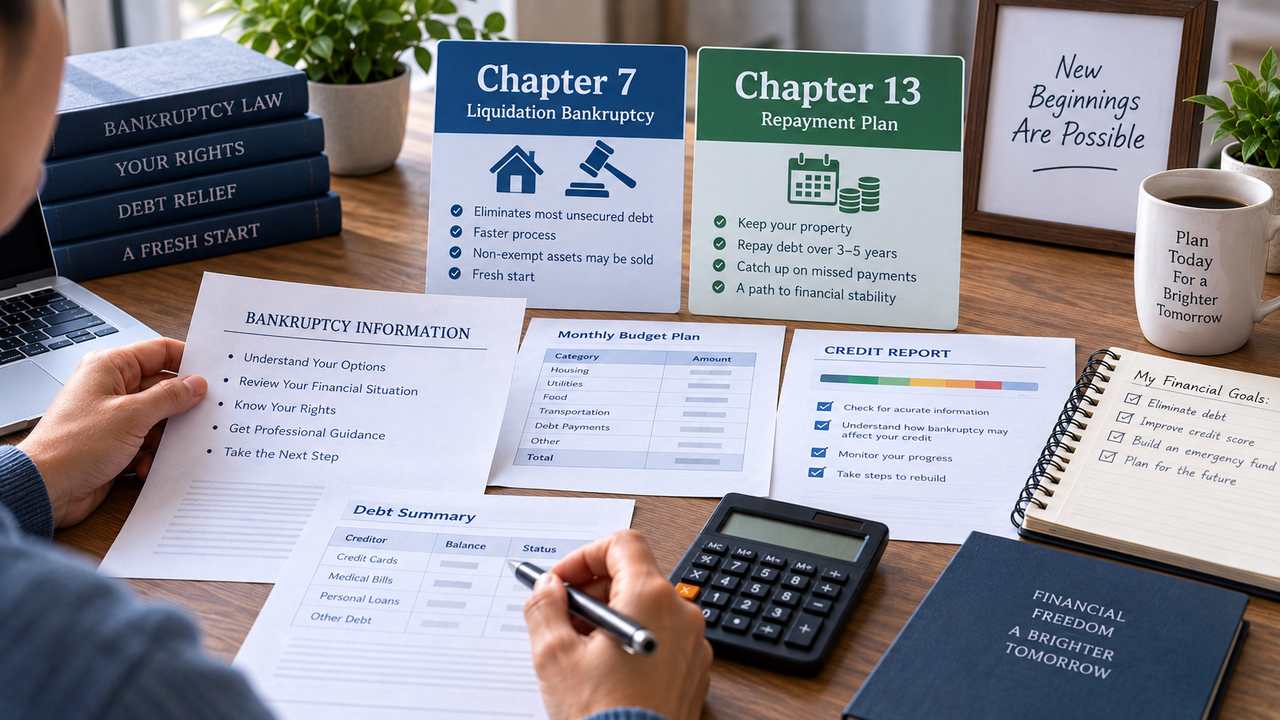
The Core Difference Between Chapter 7 and Chapter 13
Chapter 7, often called “liquidation bankruptcy,” involves selling (liquidating) your non-exempt assets to pay creditors, after which most remaining qualifying debt is discharged (legally eliminated). This process is relatively quick, typically completed within a few months.
Chapter 13, often called “reorganization bankruptcy,” doesn’t involve liquidating assets in the same way. Instead, you propose a court-supervised repayment plan, typically lasting three to five years, paying back some or all of your debt according to that plan, after which any remaining qualifying debt is discharged.
Do You Qualify for Chapter 7?
Chapter 7 eligibility is determined through a means test, comparing your income against your state’s median income for a household of your size. If your income is below the median, you generally qualify for Chapter 7. If it’s above the median, a more detailed calculation (accounting for certain allowed expenses) determines whether you still qualify, or whether you’d instead need to pursue Chapter 13.
What Happens to Your Assets in Chapter 7
Not everything you own is automatically sold — federal and state law provide exemptions, protecting certain assets up to specific value limits (which vary by state) from liquidation. Common exemptions often include some equity in your primary home, a vehicle up to a certain value, essential household goods, retirement accounts, and tools of your trade. Assets exceeding these exemption limits, or that don’t qualify for an exemption at all, can be sold by the bankruptcy trustee to pay creditors, though in practice, many Chapter 7 filers have few or no assets exceeding their state’s exemptions, resulting in what’s sometimes called a “no-asset” case, where nothing is actually liquidated.
If you are also dealing with credit-report problems related to debt, you may want to review our guide on how to read a credit report and learn more about credit report errors.
What Debt Gets Discharged in Chapter 7
Most unsecured debt — credit cards, medical bills, personal loans, and old utility bills — is generally dischargeable. Some debt types are generally not dischargeable, including most federal and many private student loans (absent a separate, harder-to-obtain “undue hardship” finding), most tax debt, child support and alimony obligations, and debts arising from fraud or certain willful misconduct.
How Chapter 13 Works in Practice
You propose a repayment plan, based on your income and expenses, which must be approved by the bankruptcy court. This plan typically requires paying certain “priority” debts (like recent tax debt) in full, while other unsecured debt might be paid back partially or, in some cases, very minimally, depending on your specific financial circumstances and what the plan calls for.
You make plan payments for three to five years, generally through a court-appointed trustee who distributes the funds to your creditors according to the approved plan.
Once the plan is successfully completed, any remaining qualifying unsecured debt covered by the plan is discharged, similar to Chapter 7, though the process to get there is considerably longer.
Why Someone Might Choose Chapter 13 Over Chapter 7 (Even If They’d Qualify for Chapter 7)
To catch up on and keep a house or car that’s in danger of foreclosure or repossession. Chapter 13 allows you to include past-due secured debt payments in your repayment plan, potentially letting you keep property that might otherwise be lost through a Chapter 7 liquidation process or continued default outside of bankruptcy.
To protect non-exempt assets that would otherwise need to be liquidated under Chapter 7, since Chapter 13 doesn’t involve the same liquidation process.
Because they don’t qualify for Chapter 7 based on the means test, making Chapter 13 the only available bankruptcy path for their situation.
The Automatic Stay: An Immediate Benefit of Filing Either Type
The moment you file for either Chapter 7 or Chapter 13, an automatic stay takes effect, immediately halting most collection activity — including lawsuits, wage garnishment, and collection calls — while your bankruptcy case proceeds. This immediate relief is often one of the most significant practical benefits of filing, providing breathing room from active or threatened collection actions right away, even before the ultimate discharge is determined.
If collection activity is affecting your credit situation, you can also learn about collection agency harassment and FDCPA protections and the cease and desist process for debt collectors.
The Impact on Your Credit
Both types of bankruptcy appear on your credit report as a serious negative item — Chapter 7 for up to 10 years from the filing date, Chapter 13 for up to 7 years, reflecting the different processes involved. This is a significant, long-lasting credit impact, though many people who file bankruptcy were already experiencing serious credit damage from the underlying debt situation that led them to consider bankruptcy in the first place, meaning the actual marginal impact is sometimes less dramatic than the “10 years” figure might suggest in isolation.
Rebuilding Credit After Bankruptcy
Contrary to some assumptions, credit rebuilding after bankruptcy can begin relatively quickly, sometimes even during a Chapter 13 repayment period. Secured credit cards, credit-builder loans, and consistent on-time payment on any remaining or new obligations can meaningfully rebuild your score over time, and many people see a genuinely good credit score within two to four years post-discharge, particularly since bankruptcy itself, once filed, removes the ongoing negative reporting from all the individual accounts that led to it, replacing many separate negative marks with one (admittedly serious) bankruptcy notation.
For additional guidance, see our guide on how to improve your credit score and our practical credit repair tips.
The Process of Actually Filing
Credit Counseling Requirement
Before filing, you’re generally required to complete credit counseling from an approved agency, which reviews your financial situation and alternatives to bankruptcy.
Filing the Petition and Required Documentation
Filing the petition and required documentation, including detailed financial disclosures, generally with an attorney’s assistance, though self-representation (“pro se”) is technically possible, if not commonly advisable given the complexity involved.
The Meeting of Creditors
The meeting of creditors (“341 meeting”), a relatively brief, generally straightforward hearing where the trustee (and potentially creditors, though they rarely attend in practice) can ask questions about your financial situation.
Completion of the Second Required Course
Completion of a second required course, a debtor education course, before your discharge is finalized.
Discharge
Discharge, the formal legal order eliminating your qualifying debt, typically issued within a few months for Chapter 7, or at the successful completion of your repayment plan for Chapter 13.
Common Misconceptions About Bankruptcy
“Bankruptcy erases all debt.”
As covered above, several categories of debt generally aren’t dischargeable, including most student loans, recent taxes, and child support.
“You lose everything you own.”
Exemptions protect meaningful assets in most cases, and many Chapter 7 filers retain everything they own, particularly if their assets are modest relative to their state’s exemption limits.
“Bankruptcy means you’ll never get credit again.”
As covered above, credit rebuilding, while requiring deliberate effort, is genuinely achievable within a few years for most people who file.
“Filing is simple enough to always do without an attorney.”
While technically possible, the complexity of exemptions, means testing, and procedural requirements makes attorney guidance genuinely valuable for most people, and many bankruptcy attorneys offer free initial consultations specifically to help you understand whether bankruptcy makes sense for your situation before committing to the cost of filing.
Frequently Asked Questions
How much does it cost to file for bankruptcy?
Court filing fees are a few hundred dollars (varying slightly by district), and attorney fees vary considerably by location and case complexity, though many bankruptcy attorneys offer payment plans, and fee waivers for the court filing fee itself are sometimes available for very low-income filers.
Can I file for bankruptcy more than once in my lifetime?
Yes, though there are specific waiting periods between filings and between different chapter types (for example, a waiting period before you can receive another Chapter 7 discharge after a previous one), which an attorney can clarify based on your specific prior filing history if relevant.
Will everyone find out I filed for bankruptcy?
Bankruptcy filings are part of the public record, technically searchable, though in practice, most people don’t actively search public bankruptcy records, and your employer generally wouldn’t be notified directly unless a specific circumstance (like wage garnishment being addressed through the case) required their involvement.
Does bankruptcy affect a spouse who didn’t file, if we have joint debts?
If you file individually while married, your spouse’s own credit and individual liability aren’t directly affected by your filing, except for any jointly held debts, where their liability for that specific joint debt generally remains intact even if your portion is discharged through your individual bankruptcy.
Is there a difference in how bankruptcy affects a home you own versus rent?
Homeownership introduces more complexity, particularly around whether you want to keep the home (relevant to the Chapter 7 vs. 13 decision and exemption planning) — renters generally have simpler considerations, primarily around whether any past-due rent or a related judgment is part of the dischargeable debt being addressed.
A Side-by-Side Comparison
| Category | Chapter 7 | Chapter 13 |
|---|---|---|
| Basic structure | Liquidation of non-exempt assets | 3-5 year repayment plan |
| Typical duration | A few months | 3-5 years |
| Eligibility | Means test based on income | Available to those with regular income, including those who don’t qualify for Chapter 7 |
| Best for | Limited non-exempt assets, no property to save from foreclosure | Behind on mortgage/car payments you want to keep, or don’t qualify for Chapter 7 |
| Credit report duration | Up to 10 years | Up to 7 years |
| Discharge timing | Relatively soon after filing | Only after completing the full repayment plan |
This comparison highlights why the “right” choice depends heavily on your specific circumstances rather than one option being universally better — someone with few assets and no property at risk of foreclosure often finds Chapter 7 the more efficient path, while someone specifically trying to catch up on a mortgage or car loan to avoid losing that property often needs Chapter 13’s structure to accomplish that goal.

What “Non-Exempt Assets” Actually Looks Like in Practice
Since the concept of exemptions can feel abstract, a concrete example helps. Imagine you own a car worth $8,000, and your state’s motor vehicle exemption protects up to $5,000 in vehicle equity. If you own the car outright (no loan), you’d have $3,000 in non-exempt equity — the trustee could potentially require you to either pay the trustee $3,000 (sometimes called “buying back” the non-exempt equity) or, in some cases, the car could be sold with you receiving your exempt portion back. In practice, many filers work with their attorney specifically to plan around these thresholds, sometimes timing a filing or making certain decisions in advance to minimize non-exempt exposure, which is exactly the kind of strategic planning a bankruptcy attorney’s specific knowledge of your state’s exemptions genuinely adds value to.
How the Means Test Actually Works
The means test isn’t simply “is your income below the median” — for filers above the median, a more detailed calculation follows, subtracting IRS-standardized allowed expenses (and some actual expenses) from your income to determine your “disposable income.” If this calculation shows insufficient disposable income to meaningfully repay creditors, you may still qualify for Chapter 7 despite an above-median income; if it shows you do have meaningful repayment capacity, you’d generally need to pursue Chapter 13 instead. This calculation involves enough nuance and specific IRS-standardized figures that working through it with an attorney, rather than attempting it entirely independently, is generally advisable for anyone whose income is close to or above their state’s median.
Frequently Asked Questions, Continued
Can I choose Chapter 13 even if I’d qualify for the faster Chapter 7 process?
Yes — the means test determines Chapter 7 eligibility, but choosing Chapter 13 instead, even when you qualify for Chapter 7, remains an available choice, commonly made specifically to protect property from foreclosure or repossession, as discussed above.
What happens if I can’t keep up with my Chapter 13 payment plan partway through?
Depending on the specific circumstances, options can include modifying the plan (if your income has genuinely changed), converting to Chapter 7 if you now qualify, or in some cases, the case being dismissed if payments aren’t maintained and no alternative arrangement is reached — this is exactly the kind of situation where staying in close communication with your bankruptcy attorney throughout the plan’s multi-year duration matters considerably.
Does bankruptcy discharge debt owed to family members or friends the same as debt owed to a bank?
Generally, yes, informal personal loans from family or friends can be discharged the same as other unsecured debt, assuming they don’t fall into a specific non-dischargeable category, though the personal and relational dimension of this kind of debt is obviously a separate, non-legal consideration worth thinking through as well.
The Role of the Bankruptcy Trustee
In both chapters, a trustee is appointed to oversee your case, though their role differs between the two. In Chapter 7, the trustee’s primary job is reviewing your assets for anything non-exempt that could be liquidated to pay creditors, and reviewing your filing for accuracy and completeness. In Chapter 13, the trustee’s role is more ongoing — collecting your monthly plan payments and distributing them to creditors according to your approved plan throughout the multi-year repayment period, essentially administering the plan from start to finish.
Frequently Asked Questions, Continued One More Time
Can creditors object to my bankruptcy filing or proposed Chapter 13 plan?
Yes — creditors have the right to object to certain aspects of a case, such as disputing whether a specific debt should be discharged (particularly for debts alleged to involve fraud), or objecting to a Chapter 13 plan’s terms if they believe it doesn’t adequately account for your actual income and ability to pay; these objections are resolved through the bankruptcy court process, often with your attorney representing your position.
Does filing bankruptcy affect a professional license or security clearance?
This varies by profession and the specific licensing or clearance body’s own rules — some professions have reporting requirements or review processes triggered by a bankruptcy filing, making this worth researching specifically for your field or discussing with your bankruptcy attorney if you hold a professional license or security clearance that might be affected.
The Bottom Line
Chapter 7 and Chapter 13 bankruptcy serve different purposes: Chapter 7 offers a faster process built around liquidating non-exempt assets (often minimal or none in practice) to discharge qualifying debt, while Chapter 13 offers a structured, multi-year repayment plan, often chosen specifically to protect property like a home or car from foreclosure or repossession. Both provide immediate relief from collection activity through the automatic stay upon filing, and both carry significant but not permanent credit consequences, with genuine rebuilding achievable within a few years for most filers. Given the complexity involved — means testing, exemptions, and which specific debts qualify for discharge — consulting a bankruptcy attorney, often through a free initial consultation, is a valuable step in understanding whether either path makes sense for your specific financial situation.
Need Help Understanding Your Credit Situation?
Bankruptcy can address qualifying debt, but understanding what remains on your credit reports and identifying inaccurate information can still be an important part of your financial recovery. If you’re dealing with credit-report issues, consider getting a professional review of your situation.