
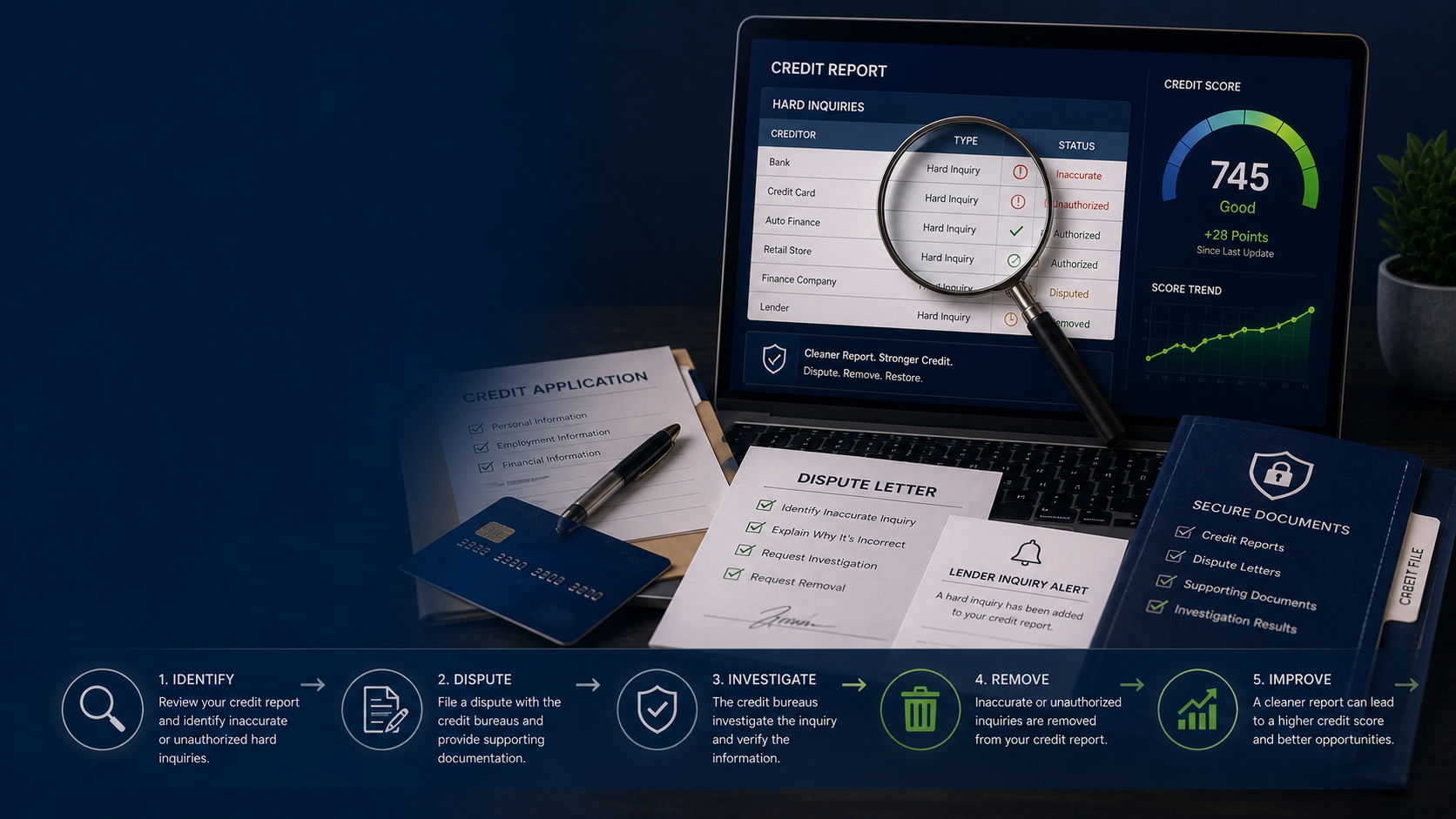
Also worth reading: understand the full difference between hard vs soft inquiries, learn how to find all other credit report errors worth disputing, see all the credit repair letters at your disposal, and get expert help from our New York credit repair team.
Hard inquiries can typically only be removed from a credit report if they are unauthorized, stemming from identity theft, no-permission pulls, or clerical errors. Legitimate hard inquiries, which occur when an individual applies for new credit, generally cannot be removed and typically remain on a credit report for two years. For unauthorized inquiries, Credit-repair.com recommends disputing directly with the credit bureau or the furnisher, or by filing an identity theft report and blocking under FCRA Section 605B.
What Is a Hard Inquiry?
A hard inquiry (also called a hard pull) happens when a lender or creditor checks your credit report to make a lending decision about you. It’s the credit check that occurs when you apply for a credit card, a mortgage, an auto loan, a personal loan, a student loan refinance, an apartment rental, or sometimes even a new cell phone plan or utility account.
The key word is decision. A hard pull is tied to an active application for new credit or a service that effectively extends credit. The lender wants to see your full credit picture — your payment history, your current debts, your credit utilization, and your recent applications — to decide whether to approve you and at what interest rate.
Here’s what happens behind the scenes when a hard inquiry is generated:
- You submit an application (or in some cases, a lender submits one on your behalf with your permission).
- The lender contacts one or more of the three major credit bureaus — Equifax, Experian, or TransUnion — and requests your credit report.
- The bureau logs the request on your report as a hard inquiry, including the date, the lender’s name, and which bureau was contacted.
- Your score may dip slightly (more on that below).
- The inquiry stays on your report for up to 24 months, though its effect on your score typically fades after about 12 months.
A hard inquiry is different from the credit checks that happen when you check your own credit, when a lender sends you a pre-approved offer, or when an existing creditor monitors your account. Those are called soft inquiries, and they don’t affect your score at all.
It’s also important to understand that a hard inquiry is recorded per bureau. If a lender only pulls your Equifax report, the hard inquiry shows up on your Equifax report — not on your Experian or TransUnion reports. This is why you might see different numbers of hard inquiries across your three bureau reports. Some lenders pull from all three (common with mortgages), while others pull from just one or two.
Why Lenders Make Hard Inquiries
Lenders use hard inquiries to assess risk. When you apply for credit, they need to know:
- Are you already carrying too much debt?
- Have you been applying for a lot of credit recently (which could signal financial distress)?
- Do you have a history of managing credit responsibly?
- What interest rate and credit limit are appropriate for your risk profile?
Each hard inquiry is essentially a snapshot of a moment when you asked someone to lend you money (or extend a credit-like service). That’s why the credit scoring models treat them as a minor risk signal — a burst of recent inquiries can suggest you’re about to take on new debt that hasn’t shown up on your report yet.
Hard Inquiry vs. Soft Inquiry: What’s the Difference?
The distinction between hard and soft inquiries is one of the most commonly misunderstood parts of the credit system. Here’s a clear breakdown.
| Feature | Hard Inquiry | Soft Inquiry |
|---|---|---|
| Who initiates it | A lender or creditor, with your permission | You, an existing creditor, or a lender doing a pre-screen |
| Why it happens | You applied for credit or a credit-like service | Account monitoring, pre-approval offers, your own credit check |
| Visible to lenders? | Yes — appears on the version of your report lenders see | No — only visible to you on your consumer report |
| Affects your credit score? | Yes — typically a small, temporary dip | No impact whatsoever |
| How long it stays | Up to 24 months on your report; score impact fades around 12 months | Varies, but no score impact so it doesn’t matter much |
Examples of Hard Inquiries
- Applying for a new credit card
- Applying for a mortgage or refinancing your home
- Applying for an auto loan or refinancing your car
- Requesting a credit limit increase (sometimes — depends on the issuer)
- Applying for a personal loan or debt consolidation loan
- Applying for an apartment rental (when the landlord runs a credit check)
- Opening a new utility or cell phone account (sometimes — depends on the provider)
- Applying for a business credit card or business loan (if it requires a personal credit check)
Examples of Soft Inquiries
- Checking your own credit report or score (through AnnualCreditReport.com, your bank’s free credit monitoring, a credit karma-type service, etc.)
- Receiving a pre-approved credit card offer in the mail (the lender did a “pre-screen” pull)
- An existing creditor doing a periodic account review
- An employer running a background check that includes a credit report (with your permission)
- A landlord or insurance company checking your credit for a quote (sometimes — depends on the type)
- Credit monitoring services you’ve enrolled in pulling your report on a recurring basis
The rule of thumb: If you actively applied for something that involves borrowing money or a credit-like service, it’s probably a hard inquiry. If you didn’t apply for anything, it’s probably a soft inquiry.
One common point of confusion: checking your own credit never creates a hard inquiry. You can pull your own credit report as many times as you want — from all three bureaus, through any service — and it will never affect your score. This is one of the most persistent credit myths, and it prevents people from monitoring their reports as often as they should. Don’t let it stop you.
When a Hard Inquiry Is Legitimate
A hard inquiry is legitimate when you knowingly applied for credit (or a credit-like service) and gave the lender permission to pull your credit report. This is the most common scenario, and it covers the vast majority of hard inquiries on most people’s reports.
Here are some signs that a hard inquiry is legitimate:
- You remember applying. You filled out an application — online, in person, or over the phone — within a few weeks of the inquiry date on your report.
- You received a decision. You got an approval, a denial, or a counter-offer from the lender around the same time.
- You authorized the pull. You signed a consent form, clicked “I agree” on an online application, or verbally authorized a credit check.
- The lender name matches. The company listed on the inquiry is one you recognize, even if it’s a parent company or a subsidiary (for example, Synchrony Bank might show up as the issuer behind a store credit card you applied for).
Common Legitimate Hard Inquiry Scenarios
Store credit cards. You’re at the checkout counter, the cashier offers you 20% off your purchase if you open a store card, and you say yes. That’s a hard inquiry — even if you were approved instantly and the discount felt like a perk.
Rate shopping. You’re buying a car and you let the dealership shop your application to multiple lenders to find the best rate. Each of those lenders may generate a hard inquiry. (The good news: the scoring models count multiple auto loan inquiries within a short window as a single inquiry — more on this in the .)
Credit limit increases. Some credit card issuers do a hard pull when you request a credit limit increase, while others only do a soft pull. It varies by issuer, so it’s worth checking before you request one. (Many issuers will tell you upfront whether it’ll be a hard or soft pull.)
Apartment applications. When you apply to rent an apartment, the property management company or landlord may run a credit check. This is typically a hard inquiry, though some use soft-pull screening services.
Utility and telecom accounts. Opening a new electricity, gas, water, or cell phone account sometimes triggers a hard inquiry. The utility company wants to assess whether you’re likely to pay your bill, and they may treat it like a small credit decision.
If a hard inquiry falls into any of these categories and you genuinely authorized it, it’s legitimate. It will stay on your report for up to 24 months, and there is no legal way to remove it early. We’ll talk more about why in the and the .
How Much Does a Hard Inquiry Hurt Your Credit Score?
Let’s talk numbers — with the caveat that credit scoring models (FICO and VantageScore) are proprietary, so the exact impact varies by individual. But here’s what we know from the scoring companies’ published guidance and years of industry observation.
What is the Short Answer to How Much a Hard Inquiry Hurts Your Credit Score?
A single hard inquiry typically lowers your credit score by 1 to 5 points. For most people, it’s on the lower end of that range. If you have a strong, established credit history with a long track record of on-time payments, a single hard inquiry might not move your score at all — or it might drop by a point or two, then bounce back within a few months.
If your credit history is thin (you’re new to credit, you have few accounts, or your file is otherwise limited), the same inquiry might cause a slightly larger dip because there’s less positive history to offset it.
The Recovery Timeline
Here’s the good news: the impact of a hard inquiry is temporary and small compared to other credit events.
- The score dip happens immediately when the inquiry is recorded.
- The impact begins to fade after a few months as the scoring model sees that no new delinquency or default followed the application.
- After about 12 months, hard inquiries have essentially no effect on your FICO score. (FICO has stated publicly that inquiries older than 12 months don’t affect your score, even though they remain visible on your report.)
- The inquiry falls off your report entirely at 24 months. After that, it’s gone — no trace, no residual impact.
So even if a hard inquiry causes a small score drop today, it’s a self-correcting situation. You don’t need to do anything except continue managing your credit responsibly, and time will take care of it.
When Inquiries Matter More
The scoring models are smart enough to distinguish between someone who’s shopping for a single loan (rate shopping) and someone who’s rapidly accumulating new credit obligations. Here’s when inquiries can have a bigger cumulative effect:
- Six or more hard inquiries in a short period (a few months) can signal risk and may cause a more noticeable score drop — potentially 10 to 20 points or more, depending on your overall profile.
- Inquiries combined with other negative factors (late payments, high utilization, collections) compound the damage because they paint a picture of financial distress.
- Multiple new accounts opened in a short window (which follow hard inquiries) can lower your average age of accounts, which also hurts your score.
But in isolation, a hard inquiry or two is one of the smaller factors in your credit score. Payment history (35% of your FICO score) and amounts owed (30%) dwarf the impact of inquiries (about 10%). If you’re paying your bills on time and keeping your credit card balances low, a few hard inquiries won’t derail your credit health.
VantageScore vs. FICO
Both major scoring models treat hard inquiries similarly — small, temporary impact — but VantageScore tends to be slightly more sensitive to recent inquiries than FICO. If you’re tracking your score through a free service that uses VantageScore (like Credit Karma), you might see slightly larger swings from inquiries than you would on a FICO score pulled by a lender. Don’t panic — it’s just a difference in how the models weigh the same data.
What is the Bottom Line on Hard Inquiry Score Impact?
If you’re worried about a hard inquiry hurting your score:
- One inquiry: minimal impact, usually 1–5 points, recovers within months.
- A few inquiries from rate shopping: counted as one by the scoring models (see the ).
- Many inquiries in a short period: can signal risk and have a larger cumulative effect.
- Any inquiry older than 12 months: no FICO score impact.
- Any inquiry older than 24 months: gone from your report entirely.
The best thing you can do is not obsess over individual inquiries. Focus on the big factors — on-time payments and low utilization — and let the inquiries age off naturally.
Can You Remove Legitimate Hard Inquiries?
Here’s where we have to be completely honest with you, because the internet is full of companies that will tell you otherwise.
You cannot remove a legitimate hard inquiry from your credit report before it falls off naturally at 24 months. Period.
If you authorized the credit check — you applied for the card, the loan, the apartment, the utility account — the inquiry is accurate, it’s verifiable, and the credit bureaus are legally permitted to report it. Disputing it as “unauthorized” when you did authorize it won’t work (and could potentially flag your account as one that files frivolous disputes, which makes future legitimate disputes harder).
Why “Inquiry Removal Services” Are Almost Always Scams
You’ve probably seen the ads: “We remove hard inquiries from your credit report — guaranteed!” or “Boost your score 50 points in 30 days by deleting inquiries!”
Here’s what those services typically do, and why it doesn’t work:
- They bombard the credit bureaus with dispute letters claiming every inquiry is unauthorized, even the legitimate ones. The bureaus investigate, verify the inquiries with the lenders, and confirm them. Your disputes are denied.
- They exploit the 30-day investigation window. Under the FCRA, if a bureau can’t verify a disputed item within 30 days, it must temporarily remove it. Some services hope that a lender won’t respond in time, causing the inquiry to be deleted. But if the lender later verifies it (which they almost always do for legitimate inquiries), it goes right back on your report. You’ve gained nothing — and you may have wasted a legitimate dispute opportunity.
- They charge you recurring monthly fees for “ongoing monitoring and dispute management” while accomplishing little to nothing. Some clients pay for months or years with no meaningful improvement.
- They may advise you to lie on dispute letters — to claim you never applied for credit when you did. This is fraud. It can expose you to legal liability and undermines your credibility with the bureaus for any future, legitimate disputes.
What is the Honest Truth About Removing Hard Inquiries?
Legitimate hard inquiries are a fact of life when you use credit. They’re a small, temporary factor in your score, and they go away on their own. The only honest way to “remove” them is to wait.
What you can do — and what we help our clients with — is:
- Remove unauthorized inquiries through the formal dispute process (which we cover in detail below).
- Protect your credit going forward by freezing or locking your report so no new unauthorized pulls can happen.
- Focus on the factors that actually move your score — payment history, utilization, credit age, credit mix — rather than chasing inquiry removal.
- Get a professional audit of your three-bureau reports to identify any inquiries (or other items) that are genuinely inaccurate, unverifiable, or the result of identity theft. That’s where real, legal, lasting removals happen.
If a company promises to remove legitimate inquiries, run. If they guarantee a specific score increase, run faster. The FCRA gives you the right to dispute inaccurate, incomplete, or unverifiable information — not information that’s accurate and verified, just because you’d prefer it wasn’t there.
How to Remove Unauthorized Hard Inquiries
Now for the part you came here for. If you’ve identified hard inquiries on your report that you did not authorize, you have a clear, legal path to have them removed. The FCRA gives you the right to dispute any information on your credit report that you believe is inaccurate, incomplete, or unverifiable — and unauthorized inquiries fall squarely into that category.
There are three main avenues for removing unauthorized hard inquiries, and we recommend pursuing them in this order. In many cases, you’ll want to pursue more than one simultaneously, especially if identity theft is involved.
Method 1: Dispute Directly With the Credit Bureau
Your first step is to dispute the unauthorized inquiry directly with the credit bureau (or bureaus) that’s reporting it. Remember, inquiries are reported per bureau — so if an unauthorized inquiry appears on your Equifax report but not your Experian or TransUnion reports, you only need to dispute it with Equifax. If it appears on all three, you dispute with all three.
How to file a bureau dispute:
- Gather your evidence. Before you file, collect anything that supports your claim that the inquiry is unauthorized:
- A copy of your credit report showing the inquiry (with the lender name and date).
- Any correspondence you’ve had with the lender (if you contacted them and they couldn’t verify your application).
- An identity theft report, if applicable (see Method 3).
- A simple written statement explaining that you did not apply for credit with this lender and did not authorize the inquiry.
- File the dispute. You can file online, by phone, or by mail. We recommend mail for the strongest paper trail, but online is faster. Each bureau has a dispute portal:
- Equifax: equifax.com/disputes
- Experian: experian.com/disputes
- TransUnion: transunion.com/disputes
- Or use the AnnualCreditReport.com portal if you pulled your report from there.
If you file by mail, include:
- A copy of your credit report with the disputed inquiry highlighted.
- A clear dispute letter (use our ).
- Copies (not originals) of any supporting documents.
- A copy of your driver’s license or state ID and a recent utility bill to verify your identity.
- The bureau has 30 days to investigate. Under the FCRA, the credit bureau must investigate your dispute within 30 days (sometimes 45 days if you submit additional information during the investigation). They’ll contact the lender (the “furnisher” of the inquiry) and ask them to verify it.
- The bureau must notify you of the results. Within 5 days of completing the investigation, the bureau must send you the results in writing. If the inquiry is verified as accurate, it stays. If the lender can’t verify it, or doesn’t respond within the window, the bureau must delete it from your report.
- If it’s removed, you’ll get an updated report. The bureau will send you a free, updated copy of your credit report so you can confirm the deletion.
What if the bureau verifies it but you still believe it’s unauthorized? You have options:
- File a statement of dispute (a 100-word explanation that gets added to your credit report so future lenders can see your side).
- Dispute directly with the furnisher (Method 2).
- If identity theft is involved, invoke FCRA Section 605B (Method 3), which gives you stronger protections than a standard dispute.
Method 2: Dispute Directly With the Furnisher
Under FCRA Section 623, you also have the right to dispute information directly with the company that furnished it to the credit bureau — in this case, the lender who made the hard inquiry. This is sometimes called a “direct dispute” or “furnisher dispute.”
This can be effective because the furnisher (not the bureau) is the one who actually has (or should have) records of your application. If they can’t produce evidence that you applied — a signed application, an electronic consent record, a recorded phone call — they’re required to notify the bureau to delete the inquiry.
How to file a furnisher dispute:
- Find the lender’s contact information. Your credit report should list an address for the company that made the inquiry. If not, look up their customer service or fraud department contact info online. Ask specifically for the fraud department or credit reporting disputes department — these are the teams that handle unauthorized inquiry claims.
- Send a written dispute. Use a letter (our works for this too, with minor adjustments) that states:
- You did not apply for credit with them.
- You did not authorize a credit check.
- You’re requesting that they investigate and, if they can’t verify your authorization, notify all three credit bureaus to delete the inquiry.
- You want a written response within 30 days.
- Send it via certified mail with return receipt. This gives you proof of delivery and creates a legal record. If the furnisher doesn’t respond, that documentation supports further action.
- The furnisher has 30 days to investigate. Under FCRA Section 623(b), they must review your dispute, contact the credit bureau if appropriate, and report back to you. If they can’t verify that you authorized the inquiry, they must notify the bureau(s) to remove it.
- If they confirm it was authorized but you disagree, ask them for proof — a copy of your application, your signed consent, the IP address and timestamp of an online application, etc. If they can’t produce it, escalate. If they produce something that looks fraudulent (a signature that isn’t yours, an address you’ve never lived at), you’re likely dealing with identity theft — move to Method 3.
Pro tip: Filing disputes with both the bureau and the furnisher simultaneously can increase your chances of a quick removal. If either one can’t verify the inquiry, it has to come off.
Method 3: File an Identity Theft Report and Block Under FCRA Section 605B
If the unauthorized inquiry is the result of identity theft — someone used your personal information to apply for credit in your name — you have a powerful tool that goes beyond a standard dispute: FCRA Section 605B, also known as the identity theft block.
This provision requires credit bureaus to block the reporting of any information on your credit report that results from identity theft, within 4 business days of receiving your request, as long as you provide the required documentation. This is stronger than a standard dispute because the bureau must block the information quickly — they can’t wait for a 30-day investigation — and the block is permanent unless the bureau later determines that the information didn’t result from identity theft and notifies you.
How to use FCRA Section 605B:
- File an identity theft report with the FTC. Go to IdentityTheft.gov and file a report. The FTC will create an Identity Theft Report (sometimes called an “FTC Affidavit”) that you can use as proof of identity theft. This is free, takes about 20–30 minutes, and walks you through the process step by step.
- File a police report (recommended). Take your FTC Identity Theft Report to your local police department and file a report. This creates an additional official record. Get a copy of the police report — you’ll need it.
- Contact the lender’s fraud department. Notify the lender that the application was fraudulent and that you’ve filed an identity theft report. Ask them to close any fraudulent accounts and stop reporting the inquiry. Provide them with a copy of your FTC report and police report.
- Send a Section 605B block request to each credit bureau. Write to each bureau that’s reporting the inquiry and include:
- A clear statement that you’re requesting a block under FCRA Section 605B.
- A copy of your FTC Identity Theft Report.
- A copy of your police report (if you filed one).
- A copy of your credit report with the identity-theft-related inquiry highlighted.
- A statement of the facts — what happened, when you discovered it, and why you believe the inquiry resulted from identity theft.
- Your identity verification (copy of driver’s license, utility bill, Social Security card).
- The bureau must block the information within 4 business days. They can only refuse if they determine the information didn’t result from identity theft or if you’ve previously admitted to committing fraud. If they block it, the inquiry (and any related fraudulent accounts) must be suppressed from your report.
- The bureau must notify you. Within 5 business days of blocking the information, the bureau must send you confirmation and a copy of your updated report.
- Place a fraud alert or credit freeze. Once you’ve been a victim of identity theft, you should immediately place a fraud alert (7-year extended fraud alerts are available for confirmed identity theft victims) or a credit freeze on all three bureaus to prevent future unauthorized applications. See the for details.
Why Section 605B is powerful: Standard disputes rely on the furnisher failing to verify the inquiry within 30 days. Section 605B shifts the burden — the bureau must block the information quickly based on your identity theft documentation, and the furnisher has to actively prove the information didn’t result from identity theft to have it restored. For genuine identity theft cases, this is the most reliable, fastest removal path.
Sample Inquiry Dispute Letter
Here’s a template you can adapt for disputing an unauthorized hard inquiry with either a credit bureau or a furnisher. Fill in the bracketed information with your details. Send via certified mail with return receipt so you have proof of delivery.
[Your Name] [Your Address] [City, State ZIP Code] [Your Phone Number] [Your Email] [Date] [Credit Bureau or Lender Name] [Department — e.g., Dispute Department / Fraud Department] [Their Address] [City, State ZIP Code] RE: Dispute of Unauthorized Hard Inquiry on Credit Report To Whom It May Concern: I am writing to dispute a hard inquiry that appears on my credit report and that I did not authorize. The details of the inquiry are as follows: Lender/Creditor Name: [Name of lender as it appears on your report] Date of Inquiry: [Date as it appears on your report] Credit Bureau: [Equifax / Experian / TransUnion] Account/Reference #: [If any — otherwise write “N/A”] I did not apply for credit with the above-named lender, and I did not authorize anyone to pull my credit report on the date listed. I have no recollection of, or connection to, this inquiry. [If identity theft is suspected, add: I believe this inquiry is the result of identity theft, and I have filed a report with the Federal Trade Commission. A copy is enclosed. I am requesting a block of this information under FCRA Section 605B.] Under the Fair Credit Reporting Act (15 U.S.C. § 1681), I have the right to dispute inaccurate or incomplete information on my credit report. I am requesting that you investigate this inquiry and, if it cannot be verified as authorized, remove it from my credit report immediately. Please provide me with: 1. Written confirmation of the results of your investigation. 2. An updated copy of my credit report reflecting the removal, if applicable. 3. The name, address, and phone number of any furnisher you contacted during the investigation. If the inquiry is verified, please provide me with the specific documentation that establishes my authorization — including a copy of any application, signed consent, or electronic authorization record bearing my signature, IP address, or other identifying information. Enclosed are the following supporting documents: – Copy of my credit report with the disputed inquiry highlighted – Copy of my driver’s license (identity verification) – Copy of a recent utility bill (address verification) – [If applicable: Copy of FTC Identity Theft Report] – [If applicable: Copy of police report] Please process this dispute within the timeframe required by the FCRA (30 days for standard disputes; 4 business days for identity theft blocks under Section 605B) and notify me of the outcome in writing. Thank you for your prompt attention to this matter. Sincerely, [Your Signature] [Your Printed Name] Enclosures: [List the number of enclosures]
A few notes on using this letter:
- Send it to the right place. If you’re disputing with a bureau, send it to that bureau’s dispute mailing address (check their website for the current address). If you’re disputing with a furnisher, send it to their fraud or credit reporting disputes department.
- Keep copies of everything. Print two copies of the letter — sign both, keep one for your records, and send the other. Keep your certified mail receipt and return receipt in a file.
- Be truthful. Only claim an inquiry is unauthorized if you genuinely did not authorize it. Filing false disputes is fraud and can damage your ability to pursue legitimate disputes in the future.
- Customize as needed. If you’re disputing multiple inquiries, list them all in one letter. If you have additional evidence (emails with the lender, a fraud alert confirmation, etc.), mention and enclose it.
How to Freeze or Lock Your Credit
Once you’ve dealt with existing unauthorized inquiries, your next priority is preventing future ones. The single most effective tool for this is a credit freeze (also called a security freeze). A close alternative is a credit lock, which offers similar protection through a different legal mechanism.
Credit Freeze vs. Credit Lock
| Feature | Credit Freeze | Credit Lock |
|---|---|---|
| Legal protection | Mandated by federal law (Free Credit Freeze Act, part of the Economic Growth Act of 2018) | A contractual arrangement with the bureau (not federally mandated) |
| Cost | Free by law | Usually free, but some bureaus offer paid lock-plus-monitoring packages |
| How to place it | Through each bureau’s website or by mail/phone | Through each bureau’s website or mobile app |
| Speed to lift | Must be lifted within 1 hour of online/phone request | Typically instant via app or website |
| Fraud alert vs. freeze | A freeze blocks all access; a fraud alert adds a verification step but doesn’t block | Same |
A credit freeze is the gold standard for preventing unauthorized hard inquiries. When your credit is frozen, lenders cannot pull your credit report at all — which means no one can open new credit in your name, because lenders won’t approve an application without seeing a credit report. Even if an identity thief has your Social Security number and date of birth, they can’t generate a hard inquiry or open an account because the freeze blocks the pull.
A credit lock offers the same practical protection but is faster to toggle on and off (instant via app) and may come with additional monitoring features. The tradeoff is that it’s not backed by the same federal legal framework as a freeze. For most people, either is fine — and some choose to use both for layered protection.
How to Place a Credit Freeze
You must place a freeze separately with each of the three major bureaus. A freeze at Equifax does not freeze your Experian or TransUnion reports. Here’s how:
- Equifax: Visit equifax.com, search for “security freeze,” and follow the prompts to create an account and place the freeze. You can also call 1-800-349-9960 or mail a request.
- Experian: Visit experian.com, search for “security freeze,” and follow the prompts. Or call 1-888-397-3742 or mail a request.
- TransUnion: Visit transunion.com, search for “credit freeze,” and follow the prompts. Or call 1-888-909-8872 or mail a request.
When you place a freeze, each bureau will give you a PIN or password that you’ll use to temporarily lift the freeze when you need to apply for credit. Keep these in a safe place. If you lose a PIN, you can recover it, but it’s a hassle.
How to Lift a Freeze When You Need Credit
When you’re ready to apply for a credit card, loan, apartment, or anything else that requires a credit check, you’ll need to temporarily lift the freeze at the bureau(s) the lender will pull from. (If you don’t know which bureau the lender uses, lift it at all three.)
You can request:
- A temporary lift for a specific time period (e.g., 7 days), after which the freeze automatically goes back into effect.
- A specific lift for a specific lender, allowing only that lender to access your report.
- A permanent removal of the freeze (not recommended unless you have a specific reason).
By law, the bureau must lift the freeze within 1 hour of your online or phone request. This makes it practical to freeze your credit full-time and just lift it for the brief window when you’re actively applying.
Fraud Alerts: A Lighter Alternative
If a full freeze feels too restrictive, you can place a fraud alert instead. A fraud alert doesn’t block access to your credit report — instead, it tells lenders to take extra steps to verify your identity before extending credit. The lender must make a “reasonable effort” to contact you (by phone, email, or text) to confirm that you’re the one applying.
Types of fraud alerts:
- Initial fraud alert: Lasts 1 year. Available to anyone.
- Active-duty military alert: Lasts 1 year. For active-duty service members.
- Extended fraud alert: Lasts 7 years. Available to confirmed identity theft victims (requires an FTC Identity Theft Report or police report).
You only need to place a fraud alert with one bureau — they’re required to notify the other two. But for a freeze, you must contact all three separately.
What is Our Recommendation for Credit Protection Against Unauthorized Inquiries?
For maximum protection: place a credit freeze at all three bureaus and only lift it when you’re actively applying for credit. This is free, fast, and stops virtually all unauthorized hard inquiries and fraudulent account openings. Pair it with ongoing credit monitoring (many banks and services offer this for free) so you’re alerted if anything changes on your report.
If you’ve been a victim of identity theft: place an extended fraud alert (7 years) and a credit freeze at all three bureaus. Use both. The freeze blocks access; the alert adds a verification layer for any legitimate application you make. This is the strongest protection available.
The Rate-Shopping Window Explained
One of the most common (and understandable) fears people have about hard inquiries is that rate shopping — letting multiple lenders pull your credit to find the best rate on a mortgage or auto loan — will tank their score. Here’s the reassuring truth: the credit scoring models are designed to encourage rate shopping, not penalize it.
How the Deduplication Window Works
Both FICO and VantageScore apply a deduplication rule to inquiries of the same type (mortgage, auto, student loan) made within a specific time window. Instead of counting each inquiry separately, they count all inquiries within the window as a single inquiry for scoring purposes.
Here are the specifics:
FICO:
- Window: 45 days (for FICO 8, 9, and 10; older versions used 14 days).
- Applies to: Mortgage, auto, and student loan inquiries.
- Effect: All inquiries of the same type within the 45-day window count as one inquiry for scoring. Your score only sees one inquiry, not five or ten.
- Note: Credit card inquiries are NOT deduplicated. Each credit card application is counted separately.
- Window: 14 days (VantageScore 3.0 and 4.0).
- Applies to: Mortgage, auto, student loan, and personal loan inquiries.
- Effect: Same — all inquiries of the same type within the window count as one.
What Does the Deduplication Window Mean for Your Credit Score?
If you’re buying a car and you let the dealership shop your application to five different lenders over a weekend, your FICO score treats those five auto-loan inquiries as one inquiry. You don’t get penalized five times for shopping around. The scoring models want you to find the best rate — that’s good for you and good for the lending market.
Similarly, if you’re getting a mortgage and you apply with three different lenders over two weeks to compare offers, those three mortgage inquiries count as one.
Best Practices for Rate Shopping
- Do all your shopping within a short window. Aim to concentrate your applications within 14 days (to be safe across all scoring models). If you stretch it out over months, the deduplication may not apply.
- Know which type you’re applying for. The deduplication applies to mortgage, auto, and student loan inquiries (plus personal loans for VantageScore). It does NOT apply to credit card applications. If you apply for three credit cards in a week, that’s three separate hard inquiries.
- Don’t avoid shopping for the best rate out of fear. A single inquiry (which is what your score sees after deduplication) is a minimal, temporary factor. Saving 0.5% on a mortgage or 2% on an auto loan is worth far more over the life of the loan than a 2–3 point temporary score dip.
- Check your credit before you start shopping. Pull your reports from all three bureaus so you know where you stand. If there are errors or unauthorized inquiries, clean those up first so lenders see your best, most accurate profile.
- Understand that all inquiries still show on your report. Even though they count as one for scoring, each individual inquiry remains visible on your credit report for 24 months. A lender who manually reviews your report will see all of them — but they’ll also see that they’re all the same type (e.g., auto loan) and clustered in a short window, which is normal rate-shopping behavior.
How Do Pre-Qualification and Pre-Approval Affect Hard Inquiries?
Many lenders offer “pre-qualification” or “pre-approval” tools that let you check your potential rates without a hard inquiry. These typically use a soft pull — no score impact. Take advantage of these when they’re available. They give you a sense of what you might qualify for without generating a hard inquiry. When you’re ready to formally apply (with a hard pull), you’ll already have a shortlist of lenders with competitive offers.
How Many Hard Inquiries Is Too Many?
There’s no magic number that triggers an automatic score drop or a lender rejection. But there are guidelines that can help you understand how lenders and scoring models view your inquiry history.
The Scoring Model Perspective
FICO and VantageScore look at inquiries as one factor among many. Here’s a rough framework:
- 0–2 hard inquiries in the past 12 months: Considered normal and low-risk by most lenders. Minimal to no score impact.
- 3–5 hard inquiries in the past 12 months: Slightly elevated. May cause a small cumulative score dip. Some lenders may ask questions, but it’s rarely a dealbreaker.
- 6+ hard inquiries in the past 12 months: Starts to look like risk-seeking behavior. Lenders may see this as a sign that you’re rapidly accumulating credit, possibly due to financial distress. Score impact can be more noticeable. Some lenders may decline new applications or offer less favorable terms.
- 10+ hard inquiries in the past 12 months: This will raise red flags with most lenders. It suggests either financial distress, potential fraud, or very aggressive credit-seeking behavior. You may be denied for new credit regardless of your overall score.
Remember: inquiries older than 12 months don’t affect your FICO score at all, even though they’re still visible on your report. So the “too many” calculation is really about the past 12 months.
The Lender Perspective
Different lenders have different tolerance levels for inquiries:
- Mortgage lenders tend to be the most sensitive. They may scrutinize any inquiries in the past 6 months and ask you to explain each one. If they see inquiries for new credit that isn’t yet showing as an account on your report, they may want to know whether you’ve taken on new debt that could affect your debt-to-income ratio.
- Auto lenders are moderately sensitive but understand rate shopping. If your auto inquiries are clustered (deduplication window), they won’t hold it against you.
- Credit card issuers vary widely. Some are inquiry-sensitive and may decline you if you’ve opened too many cards recently (this is sometimes called “velocity” — too many new accounts in a short period). Others are more lenient if your overall credit profile is strong.
- Personal loan lenders often look at the total number of inquiries but weigh it alongside other factors like income and debt-to-income ratio.
Context Matters More Than Raw Numbers
A high number of inquiries isn’t automatically bad if there’s a clear, reasonable explanation:
- Rate shopping for a single loan: Multiple auto or mortgage inquiries in a short window = one inquiry for scoring. Lenders understand this.
- Building credit after a thin file: A few credit card applications over several months as someone establishes credit is normal and expected.
- A single burst of applications followed by a quiet period: Often happens when someone is setting up their financial life (new apartment, utilities, a car, a credit card). Explainable.
- A sustained pattern of new applications over many months: This is what raises concerns. It suggests ongoing credit-seeking behavior rather than a one-time event.
What to Do If You Have “Too Many” Inquiries
- Stop applying for new credit for a while. Let the inquiries age. After 12 months, they stop affecting your FICO score.
- Focus on the factors that matter more. Pay every bill on time. Keep your credit card balances below 30% of your limits (ideally below 10%). Let your accounts age.
- Review your reports for unauthorized inquiries. If some of those inquiries weren’t authorized by you, dispute them using the process above.
- Be prepared to explain. If a lender asks about your inquiries, have a clear, honest explanation ready. Rate shopping, a period of establishing credit, a life event — context helps.
- Wait it out. Time is your friend. Inquiries fall off at 24 months and stop affecting your score at 12. If you’re patient and practice good credit habits, your score will recover and grow.
Common Mistakes and Scams
As you work on cleaning up your credit report, it’s important to avoid the traps that waste your time, money, and credibility. Here are the most common mistakes and scams we see, and how to steer clear of them.
Mistake 1: Disputing Legitimate Inquiries
We covered this above, but it bears repeating: disputing a hard inquiry that you authorized will not work, and it can hurt you. The lender will verify it, the bureau will confirm it, and your dispute will be denied. If you file multiple frivolous disputes, the bureaus can flag your account — which makes it harder to get legitimate disputes taken seriously in the future.
Only dispute inquiries you genuinely did not authorize. If you’re unsure whether you authorized an inquiry, contact the lender first and ask for proof of your application. If they can’t provide it, then dispute.
Mistake 2: Paying for “Inquiry Removal” Services
Any company that promises to remove legitimate hard inquiries is either lying to you or planning to file fraudulent disputes on your behalf. Neither is good. You’re paying for something that can’t be done legally, and if they file false disputes, the fallout lands on you, not them.
Legitimate credit repair companies (including ours) help you remove inaccurate, unverifiable, or identity-theft-related items — not accurate ones. If a company’s pitch sounds too good to be true (“Remove ALL inquiries! Guaranteed score boost!”), it is.
Mistake 3: Ignoring Unauthorized Inquiries
On the flip side, some people notice an unfamiliar inquiry, shrug it off as “probably nothing,” and move on. This is a mistake. An unauthorized inquiry could be the first sign of identity theft. If someone has your information and is applying for credit in your name, the sooner you act, the more you can limit the damage.
If you see an inquiry you don’t recognize:
- Contact the lender and ask for proof of authorization.
- If they can’t provide it, dispute with the bureau and the furnisher.
- If identity theft is suspected, file an FTC report and invoke Section 605B.
- Place a fraud alert or credit freeze immediately.
Mistake 4: Not Checking All Three Bureaus
Inquiries are reported per bureau. An unauthorized inquiry might appear on your Equifax report but not your Experian or TransUnion reports — or it might appear on all three. If you only check one bureau’s report, you might miss unauthorized inquiries on the others.
Pull your reports from all three bureaus (free through AnnualCreditReport.com) and review the inquiry section on each one. If you find an unauthorized inquiry on one, check whether it’s also on the others before you start disputing.
Mistake 5: Not Keeping Records of Disputes
Credit repair is a paper-trail-intensive process. If you dispute by phone or online without saving confirmation numbers, correspondence, and results, you have no way to prove what you filed and when. If a dispute is ignored or incorrectly processed, you need documentation to escalate.
Best practice: File disputes by mail with certified mail return receipts. Keep copies of every letter, every enclosures list, every receipt, and every response in a single file (physical or digital). If you file online, screenshot every confirmation page and save dispute reference numbers.
Scam 1: “Guaranteed” Credit Repair
No legitimate credit repair company can guarantee specific results — not a specific score increase, not the removal of specific items, not a timeline. The FCRA process depends on investigations, furnisher responses, and bureau decisions that no one can control. Any “guarantee” is a marketing lie.
Scam 2: Upfront Fees for Credit Repair
Under the Credit Repair Organizations Act (CROA), credit repair companies cannot legally charge you upfront fees before they perform any services. They can only charge you after services are rendered. If a company demands payment before doing any work, walk away — it’s illegal.
Scam 3: “New Credit Identity” or CPN Scams
Some scams offer to sell you a “Credit Privacy Number” (CPN) or a “new credit identity” that you can use instead of your Social Security number on credit applications. This is fraud. Using a CPN on a credit application is a federal crime, and the CPNs sold by these scammers are often stolen Social Security numbers (including those of children and deceased individuals). Never use a CPN. If you see this pitch, report it to the FTC.
Scam 4: Imposter Credit Repair Sites
Be cautious of websites and social media ads claiming to be affiliated with legitimate credit repair companies, the credit bureaus, or government agencies. Always verify you’re on the official website (check the URL) before entering personal information. When in doubt, go directly to the source — Equifax.com, Experian.com, TransUnion.com, AnnualCreditReport.com, identitytheft.gov, FTC complaintassistant.gov.
Scam 5: “We Can Remove Anything” Scams
Some services claim they can remove bankruptcies, late payments, collections, judgments, and inquiries — anything negative — from your credit report. The truth: you can only dispute and remove information that is inaccurate, incomplete, unverifiable, or the result of identity theft. Accurate, verified negative information stays on your report for the legally specified time (7–10 years for most items; 24 months for inquiries). Anyone who says otherwise is lying.
How to Protect Yourself
- Work with FCRA-compliant, attorney-backed credit repair professionals who are transparent about what can and cannot be removed.
- Check reviews and complaints with the Better Business Bureau and your state’s attorney general’s office.
- Read contracts carefully — understand what you’re paying for, how much, and when.
- Never pay upfront for credit repair services (it’s illegal under CROA).
- Never use a CPN or agree to misrepresent your identity on credit applications.
- File disputes yourself if you’re comfortable — you don’t need to pay anyone to file a dispute. The FCRA gives you the right to do it for free.
FAQ
Can I remove a hard inquiry if I was approved but changed my mind?
No. If you authorized the credit check as part of a legitimate application — even if you were approved and decided not to use the credit, or you closed the account immediately — the inquiry is accurate and will remain on your report for up to 24 months. Changing your mind after the fact doesn’t make the inquiry unauthorized.
How long do hard inquiries stay on my credit report?
Hard inquiries remain on your credit report for 24 months from the date of the inquiry. However, they only affect your FICO score for the first 12 months. After that, they’re visible but have no scoring impact. After 24 months, they’re automatically removed.
Do hard inquiries affect all three credit scores the same way?
Not necessarily. Since inquiries are recorded per bureau, and different lenders pull from different bureaus, you may have different numbers of inquiries on each report. Your FICO score is also calculated separately for each bureau (based on the data that bureau holds), so the score impact may differ slightly across bureaus. The general magnitude (1–5 points per inquiry) is similar, though.
What’s the difference between a fraud alert and a credit freeze?
A fraud alert tells lenders to verify your identity before extending credit, but it doesn’t block access to your credit report. A credit freeze completely blocks lenders from accessing your credit report, which prevents new accounts from being opened in your name. A freeze is stronger protection. You can use both simultaneously. Fraud alerts last 1 year (or 7 years for extended alerts available to identity theft victims); freezes last until you lift them.
Can I dispute a hard inquiry online, or do I have to mail a letter?
You can dispute online, by phone, or by mail. Online is fastest, but mailing a letter via certified mail gives you the strongest paper trail — proof of exactly what you sent and when it was received. If your dispute is straightforward (e.g., an inquiry from a lender you’ve never heard of), online may be fine. If your case is complex or involves identity theft, mail is preferable.
Will disputing a hard inquiry lower my credit score?
No. Filing a dispute does not affect your credit score. The dispute process is between you, the bureau, and the furnisher — it’s not reported to lenders and doesn’t appear on the version of your report that lenders see. If the dispute results in the inquiry being removed, your score may actually improve (or at least stop being held back by that inquiry).
How many points will my score go up if an unauthorized inquiry is removed?
It depends on your overall credit profile. If the unauthorized inquiry was recent and your file is thin, removing it might give you a few points back (roughly the same 1–5 points it cost you when it was added). If you have a long, strong credit history, the effect may be minimal. The bigger benefit of removing unauthorized inquiries is preventing them from accumulating — especially if identity theft is ongoing.
Can a credit repair company remove hard inquiries faster than I can on my own?
No. The FCRA dispute process is the same whether you file it yourself or a credit repair company files it on your behalf. The timelines (30 days for standard disputes, 4 business days for identity theft blocks) are set by law and apply equally to everyone. A reputable credit repair company can save you time and hassle by handling the paperwork, tracking deadlines, and following up — but they can’t make the process faster than the law allows, and they can’t remove legitimate inquiries that you could not remove yourself.
Free Credit Audit
If you’ve read this far, you’re clearly taking your credit health seriously — and that’s the right mindset. Here’s our invitation to you.
At credit-repair.com, we offer a free, no-obligation credit audit across all three major bureaus — Equifax, Experian, and TransUnion. Here’s what that includes:
- A full review of your three-bureau credit reports, including every hard inquiry, account, public record, and collection item.
- Identification of any unauthorized hard inquiries and other inaccurate, incomplete, or unverifiable information that may be dragging down your score.
- A personalized assessment of your credit situation, including which items can potentially be disputed and removed through the FCRA process.
- A clear, honest explanation of what can and can’t be done — no guarantees, no quick-fix promises, just a straightforward plan based on your actual reports.
- Attorney-backed guidance on identity-thebt scenarios, Section 605B blocks, and the most effective dispute strategy for your situation.
We’re a San Diego-based, FCRA-compliant credit repair firm that works with clients nationwide. Our approach is built on transparency, legal compliance, and measurable progress — not empty promises. We don’t just help you remove what shouldn’t be there; we educate and equip you to keep your credit strong for the long term.
Ready to find out what’s really on your report?
Visit to request your free credit audit today. We’ll review your reports, flag any unauthorized inquiries or other disputable items, and walk you through your options — clearly, honestly, and with no pressure.
Your credit future starts with knowing exactly where you stand. Let’s find out together.
This article is for educational purposes and does not constitute legal advice. The FCRA dispute process is available to you at no cost — you do not need to pay anyone to file a dispute on your behalf. If you choose to work with a credit repair company, ensure they are FCRA-compliant and do not charge upfront fees before services are rendered, as required by the Credit Repair Organizations Act (CROA).
