
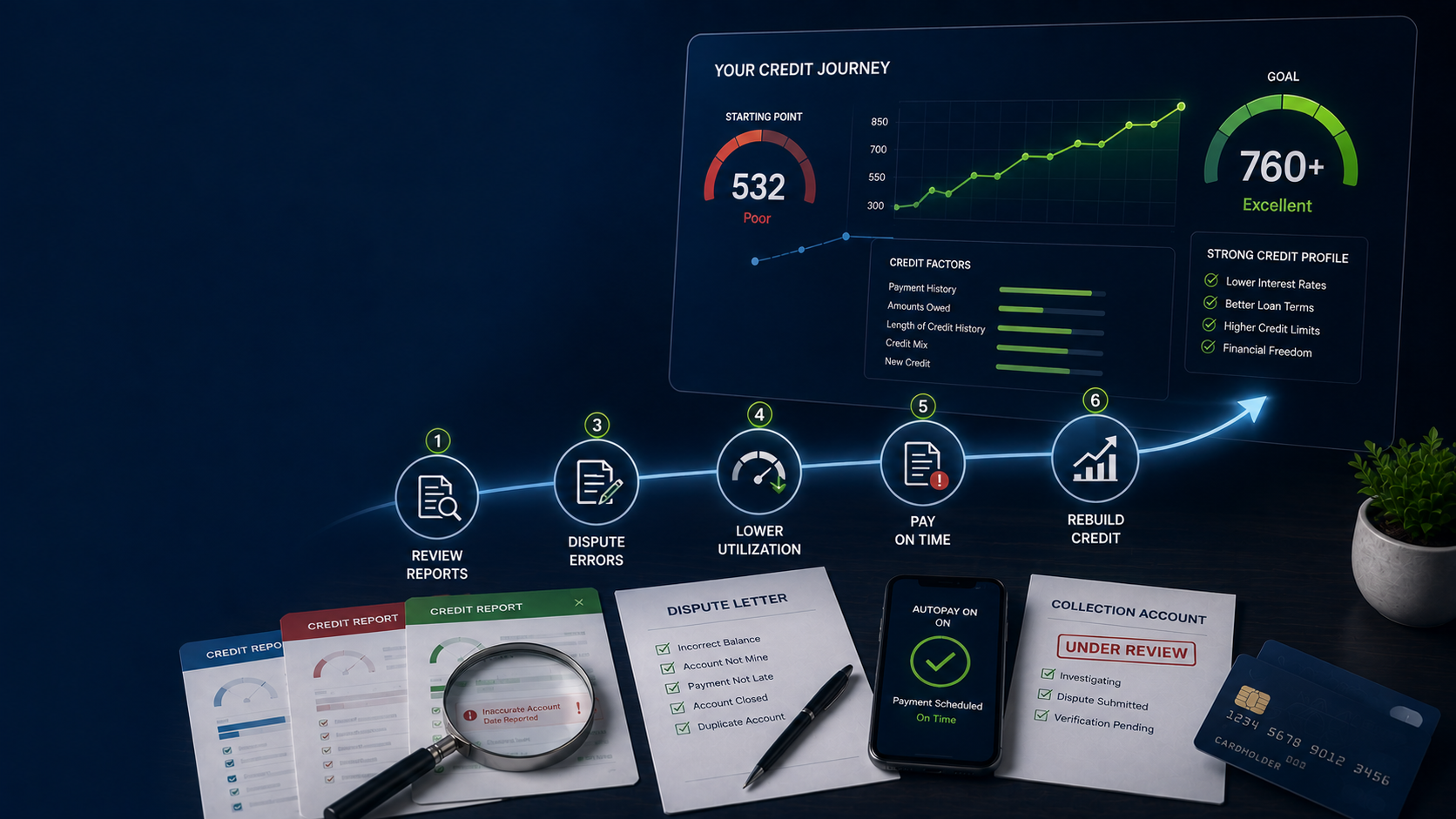
Here’s the good news: credit is not permanent. It’s not a life sentence. It’s a living, breathing record of your financial behavior, and that means it can be changed. Whether you’re dealing with errors on your reports, a history of missed payments, collections you’re not sure how to handle, or simply a thin credit file with not enough history, there are concrete, proven steps you can take to fix your credit — and keep it strong for the long haul.
This guide is built to be the most thorough, practical, and honest resource on the internet for repairing and rebuilding credit in 2026. We’ll walk you through what “fixing your credit” actually means, how scores work, the three phases of credit improvement (repair, rebuild, protect), realistic timelines, your legal rights, how to choose a legitimate credit repair company if you decide you want help, and the myths and mistakes that trip people up along the way.
We’re a San Diego-based, attorney-backed credit repair firm that operates in full compliance with the Fair Credit Reporting Act (FCRA). We believe in transparency, education, and measurable progress — not quick fixes or empty promises. Everything in this guide reflects that philosophy.
What “Fixing Your Credit” Actually Means
Most people use “fix my credit” as a catch-all phrase, but there are actually two distinct — and equally important — phases involved, and understanding the difference is the foundation of everything that follows.
Phase 1: Credit Repair — This is the process of identifying and correcting what’s wrong on your credit reports. That includes disputing inaccurate information, addressing outdated items that should have fallen off, handling collections and charge-offs, and negotiating with creditors when appropriate. Think of repair as cleaning up the errors and negative marks that are dragging your score down unfairly or unnecessarily.
Phase 2: Credit Rebuilding — This is the process of establishing and growing positive credit history. Even if your reports are perfectly clean, you won’t have a strong score without a track record of responsible borrowing. Rebuilding means making on-time payments, keeping your credit utilization low, maintaining a healthy mix of credit types, and letting your accounts age.
Here’s the key insight that many people miss: you can’t just repair your way to a great score. If you successfully dispute and remove every error on your report but you have no open accounts, no recent on-time payments, and no active positive history, your score won’t magically climb. Likewise, you can open new accounts and pay them perfectly, but if your reports are full of inaccurate negative items, you’re fighting an uphill battle.
The most effective approach tackles both phases together — cleaning up the past while building for the future. That’s why this guide is structured around three phases: Repair, Rebuild, and Protect. The third phase — protection and maintenance — is what keeps your hard-won progress from slipping away.
A note on expectations: No legitimate credit repair professional, attorney, or company can guarantee a specific score increase or promise that a particular item will be removed within a specific timeframe. Anyone who does is not being honest with you. What we can do is make sure your reports are accurate (which is your legal right under the FCRA), help you build positive history strategically, and track measurable progress over time.
How Credit Scores Work: The 5 Factors
Before you can fix your credit effectively, you need to understand what actually determines your score. Most lenders in the United States use the FICO Score (currently the FICO 8 and FICO 9 models, with FICO 10 T gaining traction), while VantageScore (3.0 and 4.0) is also used by some lenders and many free credit monitoring services. While the exact algorithms are proprietary, both scoring models evaluate the same five core categories of information.
Here’s the breakdown of the five factors that influence your FICO score, ranked by how much weight each one carries:
| Factor | Weight | What It Measures | Quick Takeaway |
|---|---|---|---|
| Payment History | 35% | Whether you’ve paid your credit accounts on time | One late payment can drop your score significantly — this is the single most important factor |
| Credit Utilization | 30% | How much of your available credit you’re using | Keep balances below 30% of your limits, ideally below 10% |
| Length of Credit History | 15% | The age of your oldest account, newest account, and average across all accounts | Older accounts help your score — keep them open even if you don’t use them |
| Credit Mix | 10% | The variety of credit types you have (revolving, installment, mortgage) | A mix of credit cards and loans shows you can handle different responsibilities |
| New Credit / Inquiries | 10% | How many recent hard inquiries and new accounts you have | Space out applications — too many at once signals risk |
Let’s dig into each one.
1. Payment History (35%) — The Big One
Payment history is the single most influential factor in your credit score, and for good reason: lenders want to know that you’ll repay what you borrow. This factor looks at whether you’ve made payments on time across all your credit accounts — credit cards, auto loans, mortgages, student loans, personal loans, and other credit products.
Here’s what matters within this category:
- On-time payments build positive history. Every month you pay on time, you’re adding to the foundation of a strong score.
- Late payments are reported in increments: 30 days late, 60 days late, 90 days late, 120+ days late. The later the payment, the more damage it does.
- Recent late payments hurt more than older ones. A late payment from three years ago has far less impact than one from three months ago.
- Charge-offs, collections, foreclosures, repossessions, and bankruptcies are severe negative marks that can stay on your report for 7 to 10 years.
The takeaway: If you do nothing else, pay every bill on time, every month. Set up automatic payments or reminders. This one habit accounts for more than a third of your score.
2. Credit Utilization (30%) — The Lever You Can Pull Quickly
Credit utilization measures how much of your available revolving credit you’re currently using. If you have a credit card with a $10,000 limit and you carry a $3,000 balance, your utilization on that card is 30%.
This factor is calculated both per-card and across all your revolving accounts combined. The scoring models look at the balances reported to the credit bureaus — which typically happens on your statement closing date, not your payment due date.
Here’s the hierarchy of utilization and its impact:
- Under 10% — Excellent. This is where the highest scores live.
- 10% to 29% — Good. You’re in solid territory.
- 30% to 49% — Fair. You’re using a lot of your available credit, which signals some risk.
- 50% to 74% — Poor. Lenders see this as a sign of financial strain.
- 75% or higher — Very poor. Maxed-out or near-maxed-out cards significantly depress your score.
- 100% (maxed out) — Severe negative impact.
The takeaway: Credit utilization is one of the fastest levers you can pull. Unlike payment history, which takes months to build, you can improve your utilization in a single billing cycle by paying down balances. If you can’t pay in full, aim to keep your statement balance below 10% of your limit.
A pro tip: If you’re trying to optimize your score before applying for a major loan, consider making a payment before your statement closes, not just by the due date. This lowers the balance that gets reported to the bureaus, which is what the scoring models actually see.
3. Length of Credit History (15%) — Time Is on Your Side
This factor considers the age of your credit accounts. The scoring models look at:
- The age of your oldest account
- The age of your newest account
- The average age of all your accounts
Older accounts and a longer average age generally help your score because they demonstrate a longer track record of responsible credit use. This is why closing your oldest credit card can sometimes hurt your score — you’re shortening your credit history.
The takeaway: Keep your oldest accounts open and active, even if you only use them for a small recurring charge (like a streaming subscription) that you pay off each month. This keeps the account reporting as active and preserves your credit history length.
4. Credit Mix (10%) — Show You Can Handle Variety
Credit scoring models like to see that you can manage different types of credit responsibly. The two main categories are:
- Revolving credit — credit cards, store cards, lines of credit (you can borrow repeatedly up to a limit)
- Installment credit — auto loans, mortgages, student loans, personal loans (fixed amount, fixed payments over a set period)
Having only credit cards, or only installment loans, won’t necessarily tank your score, but having a healthy mix of both tends to give it a small boost. This factor carries the least weight of the five, so don’t take out a loan you don’t need just to improve your mix — but if you’re already considering an installment loan for a legitimate purpose, know that it can contribute to a stronger score over time.
5. New Credit and Inquiries (10%) — Don’t Apply All at Once
Every time you apply for new credit, the lender performs a hard inquiry (also called a hard pull) on your credit report. A single hard inquiry typically causes a small, temporary dip in your score (usually 1-5 points). However, applying for multiple credit accounts in a short period signals risk to lenders and can have a more significant impact.
Important distinctions:
- Hard inquiries occur when you apply for credit. They’re visible to other lenders and can affect your score. They stay on your report for 2 years but only affect your FICO score for 12 months.
- Soft inquiries occur when you check your own credit, when a lender pre-approves you, or when a current creditor monitors your account. These do not affect your score.
- Rate shopping: The scoring models are smart enough to recognize rate shopping. If you’re shopping for a mortgage, auto loan, or student loan, multiple inquiries within a 14-45 day window (depending on the scoring model) are typically treated as a single inquiry for scoring purposes. So if you’re car shopping, get all your loan applications done within a couple of weeks.
The takeaway: Space out credit applications. Don’t apply for five cards in a month. If you’re rate-shopping for a specific loan type, cluster those applications within a short window.
Phase 1 — Repair: Fixing What’s Wrong
Now that you understand what drives your score, it’s time to start the actual work. Phase 1 is all about identifying and correcting problems on your credit reports. This is where the legal protections of the Fair Credit Reporting Act (FCRA) come into play — you have the right to accurate, complete, and verifiable information on your reports, and you have the right to dispute anything that doesn’t meet that standard.
Step 1: Pull All Three Credit Reports
Your credit is reported by three major credit bureaus: Equifax, Experian, and TransUnion. They are separate companies with separate databases, and they don’t always have the same information. A creditor may report to one bureau but not another. An error may appear on your Equifax report but not your TransUnion report.
This means you need to pull reports from all three.
Your legal right to free reports: Under the FCRA, you’re entitled to one free credit report from each of the three bureaus every 12 months through AnnualCreditReport.com — the only federally authorized website for this purpose. In recent years, the bureaus have made free weekly reports available through this site as well, which is helpful if you’re actively working on your credit.
You can also access your reports and scores through credit monitoring services (many of which are free), but be aware that these services often show VantageScore rather than FICO, and the report data may be a simplified version. For dispute purposes, you want the full, official reports directly from the bureaus.
Step 2: Audit Your Reports for Errors
Once you have all three reports, go through each one methodically. Credit report errors are remarkably common — various studies and regulatory investigations have found that a significant percentage of consumers have at least one error on their reports, and many of those errors are serious enough to affect credit decisions.
Here’s what to look for:
Personal information errors:
- Wrong name, aliases you don’t recognize
- Incorrect addresses
- Inaccurate employer information
- Mixed files — someone else’s accounts appearing on your report (this happens more often than you’d think, especially if you share a name with a relative)
Account errors:
- Accounts that don’t belong to you (potential identity theft or mixed file)
- Incorrect account balances
- Wrong credit limits (which can artificially inflate your utilization ratio)
- Incorrect account status (showing open when it’s closed, or vice versa)
- Late payments that were actually on time
- Duplicate accounts (the same debt listed twice)
- Accounts showing as charged off when they were settled or paid
Outdated information:
- Negative items older than 7 years (10 years for bankruptcies) that should have been removed
- Collections that were paid and should be updated
- Hard inquiries older than 2 years
Fraud or identity theft:
- Accounts you never opened
- Inquiries you didn’t authorize
- Addresses where you never lived
Make a list of every error you find, organized by bureau. Note the specific item, the bureau reporting it, and why you believe it’s inaccurate. This documentation becomes the foundation of your disputes.
Step 3: Dispute Inaccuracies the Right Way
The FCRA gives you the right to dispute any information on your credit report that you believe is inaccurate, incomplete, or unverifiable. When you file a dispute, the bureau is required to investigate — typically within 30 days — and either verify, correct, or delete the disputed item.
Here’s how to do it effectively:
File disputes directly with the credit bureau(s) reporting the error. You can dispute online, by phone, or by mail. While online disputes are convenient, filing by certified mail with a return receipt creates a paper trail that can be valuable if you need to escalate later. Each bureau has a dedicated dispute process on their website.
Also file disputes with the furnisher. Under the FCRA, you can also dispute directly with the creditor or collection agency that reported the information (the “furnisher”). This is called a direct dispute and it gives you a second avenue of accountability. If the furnisher can’t verify the information, they’re required to notify the bureaus to correct or remove it.
Be specific and provide documentation. The more precise you are, the more likely the dispute will succeed. Don’t just say “this is wrong.” Say “this account shows a late payment in March 2024, but I have bank records showing the payment was made on March 12, 2024 — two days before the due date.” Attach copies of supporting documents (never send originals).
Dispute one item at a time per letter. If you have multiple errors, it’s generally better to dispute them individually rather than batching them. Some consumer advocates argue that bureaus are more likely to dismiss batch disputes as frivolous. Whether or not that’s universally true, individual disputes are easier to track and follow up on.
Keep records of everything. Copies of your dispute letters, certified mail receipts, bureau responses, and any correspondence with furnishers. If a dispute isn’t resolved and you later need legal help, this documentation is invaluable.
What happens after you dispute: The bureau has 30 days to investigate (45 days if you dispute after receiving your free annual report). They contact the furnisher, who must verify the information. If the furnisher can’t verify it, or doesn’t respond within the investigation period, the item must be removed. You’ll receive the results in writing, along with a free updated copy of your report if changes were made.
If the dispute comes back “verified” but you know it’s wrong: You can dispute again with additional documentation, file a complaint with the Consumer Financial Protection Bureau (CFPB), add a statement of dispute to your credit report (a brief explanation that appears on your report), or consult with a consumer law attorney. If the furnisher is reporting knowingly inaccurate information, you may have grounds for legal action under the FCRA.
Step 4: Handle Collections Strategically
Collections are one of the most stressful parts of credit problems, but there are effective strategies for dealing with them.
First, verify the debt. Under the Fair Debt Collection Practices Act (FDCPA), you have the right to request debt validation within 30 days of being contacted by a collection agency. Send a written validation request, and the collector must provide proof that the debt is yours and that the amount is correct. If they can’t validate the debt, they must cease collection efforts and the credit bureaus should remove the collection if you dispute it.
Understand the difference between original creditor and collection agency. When an account goes to collections, it may appear on your report twice — once as a charge-off from the original creditor and once as a collection from the collection agency. Both are negative, but paying or settling the collection doesn’t automatically remove the original creditor’s charge-off.
Consider a pay-for-delete negotiation. Some collection agencies will agree to remove the collection from your credit report in exchange for payment. This isn’t guaranteed — many agencies have policies against it, and the bureaus technically discourage the practice — but it’s worth asking. Get any agreement in writing before you pay.
The newer FICO and VantageScore models treat paid collections more favorably. FICO 9 and VantageScore 3.0/4.0 ignore paid collections entirely and give less weight to unpaid medical collections. However, many lenders still use older models (like FICO 8) where paid collections still impact your score. Paying a collection won’t necessarily boost your score immediately under older models, but it’s still the right thing to do — a paid collection looks better to lenders reviewing your report manually, and it prevents potential lawsuits.
Medical collections have special rules. As of recent regulatory changes, medical bills under a certain threshold may not appear on your report, and there are extended waiting periods before medical debt can be reported. Always check whether medical collections on your report comply with current rules.
Don’t reset the clock accidentally. Making a partial payment or acknowledging a debt in writing can, in some states, restart the statute of limitations on that debt — the time frame during which a creditor can sue you. Before you contact a collector about an old debt, understand your state’s statute of limitations.
Step 5: Negotiate with Creditors
If you have accounts that are past due but not yet in collections, or if you have charge-offs that you want to resolve, you can often negotiate directly with the original creditor. Common strategies include:
Goodwill letters. If you have an otherwise solid payment history with a creditor but had a one-time late payment due to a specific hardship (medical emergency, job loss, natural disaster), you can write a goodwill letter asking the creditor to remove the late payment as a courtesy. This isn’t a legal right — it’s a request — but creditors sometimes grant it, especially for long-time customers with otherwise clean records.
Pay-for-delete. Similar to the collection strategy, you can ask a creditor to remove a negative mark in exchange for payment. More commonly successful with collection agencies than original creditors, but worth attempting.
Lump-sum settlements. If you owe a significant amount and can offer a lump-sum payment, creditors may accept less than the full balance (often 40-70% of what’s owed). Be aware that settled debt can still show on your report as “settled for less than full balance,” which is better than unpaid but not as good as “paid in full.”
Payment plans. Some creditors will agree to updated payment plans and may even re-age your account (bringing it current) if you make a set number of on-time payments. This can stop further negative reporting.
Get everything in writing. Any agreement you reach with a creditor should be documented in writing before you make a payment. Verbal agreements are difficult to enforce.
Step 6: Deal with Outdated Items
Negative information doesn’t stay on your credit report forever. Here are the time limits under the FCRA:
| Item | Maximum Time on Report |
|---|---|
| Late payments | 7 years |
| Collections | 7 years from original delinquency date |
| Charge-offs | 7 years from original delinquency date |
| Chapter 7 bankruptcy | 10 years |
| Chapter 13 bankruptcy | 7 years |
| Foreclosures | 7 years |
| Repossessions | 7 years |
| Civil judgments | 7 years (or less, depending on state) |
| Tax liens | 7 years from paid date (unpaid liens may no longer appear) |
| Hard inquiries | 2 years (affect FICO score for 1 year) |
If you see negative items that are older than these limits, dispute them. The bureaus are required to remove outdated information. Note that the 7-year clock for collections and charge-offs starts from the date of the original delinquency — the first missed payment that led to the collection — not from the date the collection agency acquired the debt or the date you last made a payment.
Phase 2 — Rebuild: Building Positive History
Once you’ve addressed the errors and negative items on your reports, it’s time to focus on building the positive history that will lift your score. Even if you’ve removed everything negative, you need active, positive accounts to generate a strong score.
Keep Making On-Time Payments
This is worth repeating because it’s the foundation of everything: pay every bill on time, every month. Set up automatic payments for at least the minimum on all accounts. Use calendar reminders. Do whatever it takes to never miss a due date. Every on-time payment adds to your positive payment history, and over time, this is what will drive your score up the most.
Keep Your Credit Utilization Low
As we covered in the scoring factors section, utilization is the second-most-important factor and one of the fastest to improve. Here’s the strategy:
- Keep balances below 30% of your credit limit on each card and across all cards combined.
- Aim for under 10% for the best score impact.
- Pay before the statement closes if you’re trying to optimize for a specific application — the balance reported to the bureaus is typically your statement balance.
- Consider requesting credit limit increases — a higher limit with the same balance automatically lowers your utilization ratio. Just make sure the creditor won’t do a hard inquiry for the increase (many do soft inquiries for existing customers).
Keep Old Accounts Open
Your credit history length matters. When you pay off a credit card, don’t close the account — keep it open. A paid-off card with a $0 balance contributes positively to your utilization ratio (more available credit = lower utilization) and preserves your account age.
If a card has an annual fee and you don’t want to keep paying it, ask the issuer if they can downgrade you to a no-fee version of the card. This keeps the account open and the history intact without the ongoing cost.
If you absolutely must close an account, close a newer one — not your oldest card.
Build a Healthy Credit Mix
If you only have revolving credit (credit cards), adding an installment loan can give your score a small boost over time — but only if you genuinely need the loan and can afford the payments. Options include:
- A small personal loan
- A credit-builder loan (more on this below)
- An auto loan if you’re already planning to buy a car
- A share-secured loan from a credit union (backed by your savings)
Don’t take on debt you don’t need just for credit mix. The 10% weight of this factor is not worth the financial risk.
Use Secured Credit Cards
If your credit is too damaged to qualify for regular (unsecured) credit cards, secured cards are one of the best rebuilding tools available. Here’s how they work:
- You put down a refundable security deposit (typically $200-$500).
- The deposit becomes your credit limit.
- You use the card like a regular credit card — making purchases and paying them off each month.
- Your activity is reported to the credit bureaus, building positive history.
- After a period of responsible use (usually 6-12 months), many issuers will upgrade you to an unsecured card and refund your deposit.
Tips for secured cards:
- Choose a card that reports to all three bureaus (most do, but verify).
- Look for cards with low or no annual fees.
- Use the card for small purchases (gas, a recurring subscription) and pay the full balance each month.
- Keep utilization low — if your limit is $300, don’t carry more than $30-$90.
Become an Authorized User
If you have a family member or close friend with a credit card that has a long history of on-time payments and low utilization, ask if they’ll add you as an authorized user. When you’re added as an authorized user, the account’s history is often reported on your credit report as well.
This can be a powerful strategy because:
- You inherit the account’s positive payment history.
- The account’s age contributes to your credit history length.
- The account’s limit contributes to your available credit, improving your utilization.
Important caveats:
- Not all card issuers report authorized user accounts to the bureaus. Check with the issuer first.
- If the primary cardholder misses payments or runs up the balance, those negatives also appear on your report. Only do this with someone you trust to manage the account responsibly.
- You don’t need to actually use the card — just being listed as an authorized user is enough.
- The primary cardholder can keep the physical card; you never need to charge anything.
Consider a Credit-Builder Loan
Credit-builder loans are designed specifically for people building or rebuilding credit. Unlike a traditional loan, you don’t receive the money upfront. Instead:
- The lender holds the loan amount in a secured savings account.
- You make monthly payments (which are reported to the credit bureaus).
- When the loan is paid off, you receive the money.
This builds positive installment credit history and forces you to save money at the same time. Many credit unions and community banks offer credit-builder loans, and there are also online lenders specializing in this product. Look for one that reports to all three bureaus and has reasonable fees.
Give It Time
Rebuilding credit is a marathon, not a sprint. The length of your credit history and the age of your accounts are factors you can’t rush. What you can do is start now, be consistent, and let time work in your favor. Every month of on-time payments, every statement cycle with low utilization, and every year of account aging adds up.
Phase 3 — Protect & Maintain
Fixing your credit is an achievement. Protecting it is a lifelong habit. Phase 3 is about the systems and practices that keep your credit strong — and catch problems early when they do arise.
Monitor Your Credit Regularly
You should check your credit reports at least once a year from all three bureaus (via AnnualCreditReport.com), and more frequently if you’re actively rebuilding. In addition, set up ongoing credit monitoring:
- Free monitoring services from banks, credit card issuers, and independent apps provide regular score updates and alerts when new accounts, inquiries, or changes appear on your report.
- Paid monitoring services offer more comprehensive features like 3-bureau monitoring, identity theft insurance, and dark web scanning. Whether you need these depends on your risk level and preferences.
- Identity theft alerts: If you see an account or inquiry you don’t recognize, act immediately. Contact the creditor, place a fraud alert on your credit file, and file a report with the FTC at IdentityTheft.gov.
Consider a Credit Freeze or Fraud Alert
A credit freeze (also called a security freeze) restricts access to your credit report. When your credit is frozen, lenders can’t pull your report, which means identity thieves can’t open new accounts in your name. You can temporarily lift the freeze when you need to apply for credit. Freezes are free under federal law and are the strongest protection against new-account identity theft.
A fraud alert is a less restrictive option. It tells lenders to take extra steps to verify your identity before extending credit. Fraud alerts last for one year (or seven years for an extended fraud alert if you’ve filed an identity theft report with the FTC). You only need to place a fraud alert with one bureau — they’re required to notify the other two.
Practice Good Financial Habits
The habits that protect your credit are the same ones that built it:
- Pay on time, every time. Automate at least the minimum payment on every account.
- Keep utilization low. Check your balances mid-cycle and pay them down if needed.
- Don’t close old accounts unless there’s a compelling reason.
- Space out credit applications. Don’t apply for multiple cards or loans within a short period.
- Maintain an emergency fund. Having savings prevents you from relying on credit cards when unexpected expenses arise, which keeps your utilization in check.
- Review your statements monthly. Catch billing errors, unauthorized charges, and changes to terms early.
Review Your Insurance and Utility Accounts
Some insurance companies and utility providers use credit-based insurance scores or require credit checks. Maintaining good credit can lower your insurance premiums and eliminate deposit requirements for utilities, cell phones, and apartment leases. It’s a ripple effect — strong credit saves you money across many areas of life.
Educate Yourself Continuously
Credit laws, scoring models, and reporting practices evolve. Stay informed about your rights under the FCRA, FDCPA, and CROA. Follow reputable financial education resources. The more you understand about how credit works, the better equipped you’ll be to protect and grow your score over a lifetime.
Realistic Timelines: What Improves and When
One of the most common questions we hear is “How fast can I fix my credit?” The honest answer is: it depends on what’s on your report, what actions you take, and how consistently you maintain positive habits. But here’s a realistic framework for what you can expect at different milestones.
| Timeframe | What Can Improve | Realistic Score Impact |
|---|---|---|
| 30 days | Dispute investigation results; rapid utilization improvement by paying down balances; removal of verified errors | 10-40+ points if errors are removed or utilization drops significantly |
| 60-90 days | Additional dispute rounds; goodwill letter responses; initial positive reporting from new secured cards or credit-builder loans | 20-60+ points cumulative, depending on number and severity of items addressed |
| 6 months | 6 months of on-time payments on new accounts; collection settlements updated; authorized user history accumulating; aging of recent inquiries | 40-100+ points over baseline, depending on starting point and actions taken |
| 1 year | 12 months of clean payment history; reduced impact from older negative items; account aging; improved credit mix | 60-150+ points from a low starting score with consistent effort |
| 2+ years | Significant aging of negative items; strong, diverse credit history; most recent negatives losing impact; approaching excellent score territory if habits are maintained | 100-200+ points from a damaged starting point over a 2-year period of consistent positive behavior |
Important caveats:
- These are general ranges, not guarantees. Your results depend on your specific credit profile.
- If you have a bankruptcy or multiple serious delinquencies, recovery will take longer. A Chapter 7 bankruptcy, for example, stays on your report for 10 years and has a significant impact throughout that time — though the impact lessens as the bankruptcy ages and you build new positive history.
- The fastest improvements come from fixing errors (removing items that shouldn’t be there) and lowering utilization. The slowest improvements come from building payment history and account age — these simply take time.
- Consistency matters more than intensity. Six months of steady on-time payments and low utilization will help more than a burst of activity followed by a relapse.
What Hurts Your Score Most (Ranked)
Not all negative items are created equal. Here’s a ranking of what damages your credit score the most, from most severe to least:
- Bankruptcy (Chapter 7 or 13) — The most damaging item. Can drop a good score by 100-200+ points and remains on your report for 7-10 years.
- Foreclosure — A severe negative mark indicating default on a major secured loan. Stays on your report for 7 years.
- Repossession — Similar to foreclosure but for auto loans. Indicates failure to repay a secured debt. 7 years.
- Charge-off — When a creditor writes off your debt as a loss because they don’t expect you to pay. One of the most damaging account-level items. 7 years.
- Collections — When your debt is sent to a collection agency. The impact is significant, though newer scoring models treat paid collections more leniently. 7 years.
- Default (student loans) — Student loan default is a serious negative mark that can also lead to wage garnishment and tax refund seizure. 7 years.
- Late payments (90+ days) — A 90-day late payment signals serious delinquency and has a major impact. 7 years.
- Late payments (60 days) — Moderately damaging. 7 years.
- Late payments (30 days) — The first level of delinquency. Damaging but less so than more severe lates. 7 years.
- High credit utilization — Not a “negative mark” per se, but carrying high balances relative to your limits significantly depresses your score. Reversible quickly by paying down balances.
- Hard inquiries — Minor impact individually (1-5 points), but multiple inquiries in a short period compound. Affect score for 1 year, visible for 2 years.
- Closing old accounts — Indirect impact by reducing your available credit (raising utilization) and shortening your average account age.
The severity of impact also depends on your starting score. If you have an excellent score (780+), a single 30-day late payment can drop your score by 90-110 points. If you have a fair score (680), the same late payment might only drop you by 60-80 points. Higher scores have further to fall.
DIY Credit Repair vs. Hiring a Professional
One of the biggest decisions you’ll face is whether to repair your credit yourself or hire a professional. Both paths are valid, and the right choice depends on your situation, time, and comfort level.
The DIY Approach
Pros:
- It’s free (aside from postage and your time). The FCRA gives you the right to dispute errors yourself at no cost.
- You have full control over what’s disputed and how.
- You learn your credit inside and out — knowledge that serves you for life.
- No risk of scams — you’re doing it yourself.
Cons:
- Time-consuming. Reviewing three reports, drafting dispute letters, following up on investigations, and tracking results takes significant time and organization.
- Steep learning curve. Understanding FCRA rights, dispute processes, debt validation, and creditor negotiations requires research.
- Less leverage. An individual dispute may not carry the same weight as one from an attorney or a professional firm that understands the legal framework and can escalate effectively.
- Easy to make mistakes. Filing disputes incorrectly, missing deadlines, or accidentally resetting statutes of limitations can set you back.
DIY is best for: People with a few minor errors, those who enjoy managing details, and those who have the time and patience to handle the process themselves.
Hiring a Professional
Pros:
- Expertise and experience. A legitimate credit repair company or consumer law attorney knows the FCRA, FDCPA, and CROA inside and out. They understand what to dispute, how to frame disputes effectively, and when to escalate.
- Saves time. They handle the paperwork, follow-ups, and tracking for you.
- Attorney-backed firms can take legal action if your rights are violated — something no individual or non-attorney company can do.
- Systematic approach. Professional firms have processes for ongoing dispute cycles, creditor negotiations, and monitoring that are difficult to replicate on your own.
Cons:
- Cost. Legitimate credit repair companies charge fees — typically a setup fee and monthly fees. You’re paying for expertise and convenience.
- You still have to do the rebuilding. No company can build positive credit history for you — that requires your own on-time payments and responsible account management.
- Scams exist. The credit repair industry has its share of bad actors. You must know how to identify and avoid them (covered in the next section).
Professional help is best for: People with complex reports (many errors, collections, charge-offs), those who don’t have the time or confidence to DIY, those who suspect their rights have been violated and may need legal recourse, and those who want the peace of mind that comes with expert guidance.
Your Rights Under the Credit Repair Organizations Act (CROA)
The CROA is a federal law that protects consumers from deceptive practices by credit repair companies. Under the CROA, credit repair companies:
- Cannot charge upfront fees before performing any services. A company that demands payment before doing any work is violating federal law.
- Must provide a written contract that describes the services to be performed, the timeframe, and the total cost.
- Must give you a 3-day right to cancel the contract without any charge.
- Cannot make false claims about what they can do for your credit.
- Cannot advise you to create a new credit identity (such as applying for an Employer Identification Number to use instead of your Social Security number) — this is illegal.
- Must disclose your right to repair your own credit. A legitimate company will tell you that you can do this yourself for free.
If a credit repair company violates any of these rules, that’s a red flag — and potentially a legal claim you can pursue.
How to Choose a Legitimate Credit Repair Company
If you decide to hire professional help, it’s critical to choose a company you can trust. Here’s what to look for — and what to run from.
Green Flags (Signs of a Legitimate Company)
- FCRA-compliant processes. The company works within the legal framework of the FCRA, FDCPA, and CROA.
- Attorney involvement. Attorney-backed or attorney-staffed firms can provide legal analysis of your situation and take legal action if your rights are violated.
- Transparent pricing. Clear, upfront pricing with no hidden fees. You should know exactly what you’ll pay before you sign anything.
- Realistic expectations. They tell you that results aren’t guaranteed, that credit repair takes time, and that you have a role to play (making on-time payments, managing utilization).
- Written contract. They provide a written agreement with a 3-day cancellation right, as required by the CROA.
- Free consultation. They offer an initial review of your situation at no cost.
- Educational resources. They help you understand your credit, not just “fix” it. A company that educates you is investing in your long-term success.
- Clear dispute process. They explain exactly what they’ll dispute, how they’ll do it, and how they’ll track results.
- Positive reviews and track record. Look for reviews on independent platforms, BBB ratings, and testimonials from real clients.
Red Flags (Warning Signs to Avoid)
- Upfront fees before any service is performed. This is illegal under the CROA. Walk away immediately.
- Guaranteed results or specific score increases. No legitimate company can guarantee outcomes. Credit repair is a legal process, not a magic wand.
- Promises to remove accurate, verifiable negative information. If the information is accurate and can be verified, it legally can remain on your report. A company promising to remove everything is either lying or planning to use illegal methods.
- Advice to create a “new” credit identity. Using an EIN instead of your SSN, or applying for a new SSN, to start fresh is illegal and can result in federal prosecution.
- Pressure to sign immediately. A legitimate company gives you time to review the contract and exercise your 3-day cancellation right.
- No written contract. Verbal agreements are a sign of a company that doesn’t want to be held accountable.
- Poor BBB rating or unresolved complaints. Check the Better Business Bureau and CFPB complaint database.
- No physical address or verifiable business presence. A legitimate company has a real office and professional infrastructure.
- Unwilling to explain their process. If they can’t or won’t tell you how they’ll repair your credit, they’re not trustworthy.
Questions to Ask Before Signing
- What exactly will you do, and what will you charge?
- Are you attorney-backed? If so, in what capacity?
- How long does the process typically take?
- What happens if an item isn’t removed?
- What is your cancellation policy?
- Will you help me understand how to rebuild my credit, not just repair it?
- Can you provide references or client testimonials?
- What are my rights under the FCRA and CROA?
A legitimate company will answer all of these questions clearly and patiently. If they’re evasive, move on.
Common Credit Repair Myths Busted
Myth 1: “Credit repair is illegal.”
False. Credit repair is completely legal. The FCRA explicitly gives you the right to dispute inaccurate information on your credit reports, and you have the right to hire a professional to help you. The CROA regulates the credit repair industry to protect consumers, but it doesn’t make credit repair illegal. What is illegal is using fraudulent methods — like creating a new credit identity or lying on credit applications.
Myth 2: “You can remove anything from your credit report.”
False. You can dispute anything, but you can only get items removed if they’re inaccurate, incomplete, or unverifiable. If a negative item is accurate and the creditor can verify it, it has the right to remain on your report for the legal time limit (typically 7 years). Any company that promises to remove accurate, verifiable information is not being honest with you.
Myth 3: “Paying off a collection immediately removes it from your report.”
False. Paying a collection updates the status to “paid,” which is better than unpaid, but the collection itself remains on your report for up to 7 years from the original delinquency date. Under newer scoring models (FICO 9, VantageScore 3.0+), paid collections are ignored in scoring, but many lenders still use older models. A pay-for-delete agreement can sometimes remove the collection entirely, but it’s not guaranteed.
Myth 4: “Closing a credit card improves your score.”
False. Closing a credit card typically hurts your score. It reduces your available credit (raising your utilization ratio) and can shorten your average account age. Keep old accounts open unless there’s a compelling reason to close them (like an annual fee you can’t avoid and a card you never use).
Myth 5: “Checking your own credit hurts your score.”
False. Checking your own credit is a soft inquiry and has zero impact on your score. You can check your own credit as often as you want without any penalty. Only hard inquiries (when a lender checks your credit in response to an application) affect your score.
Myth 6: “Your income affects your credit score.”
False. Your income does not appear on your credit report and is not part of your credit score. Credit scores are based solely on your borrowing and repayment behavior. However, lenders consider your income separately when deciding whether to extend credit and at what terms — so income matters for lending decisions, just not for your score.
Myth 7: “Carrying a balance improves your credit score.”
False. You do not need to carry a balance (and pay interest) to build credit. Paying your statement in full each month builds the same positive payment history as carrying a balance, and it saves you money on interest charges. The ideal strategy is to use your cards regularly, pay the full balance by the due date, and never pay a cent in interest.
Myth 8: “Credit repair happens overnight.”
False. Dispute investigations take 30-45 days. Building positive history takes months. Aging out negative items takes years. Anyone who promises overnight results is either lying or using methods that won’t produce lasting, legitimate results. The most effective credit repair is methodical, persistent, and patient.
Myth 9: “A credit repair company can do things you can’t do yourself.”
Partially false. You have the same legal right to dispute information as any credit repair company. What a legitimate, experienced firm brings is expertise, efficiency, systematic processes, and — in the case of attorney-backed firms — the ability to take legal action if your rights are violated. They can’t do anything magical that you can’t, but they can often do it more effectively and with less of your time.
Myth 10: “Once an item is removed, it can never come back.”
Partially false. If an item is removed because the furnisher couldn’t verify it during the investigation, the furnisher can theoretically re-report it later if they subsequently obtain verification. However, if they do, the bureau is required to notify you within 5 days. In practice, items that are removed due to lack of verification rarely reappear, but it’s not impossible. Items that are removed because they’re outdated or demonstrably inaccurate should not return.
Common Mistakes to Avoid
Even with the best intentions, certain missteps can slow your progress or even make things worse. Here are the most common mistakes we see — and how to avoid them.
1. Disputing Everything at Once Indiscriminately
Some people try to dispute every negative item on their report, hoping something will stick. This can backfire. If you dispute items that are clearly accurate and verifiable, the bureaus may flag your disputes as frivolous — and they have the right to refuse to investigate if they determine your disputes are without merit. Focus on items that are genuinely inaccurate, outdated, or unverifiable.
2. Missing Payments While Focusing on Repair
It’s easy to get so caught up in the dispute process that you forget the basics: making your current payments on time. A single new late payment can undo months of repair progress. Set up automatic payments and make sure your current obligations are always met, even while you’re disputing old errors.
3. Closing Accounts After Paying Them Off
As we’ve discussed, closing accounts reduces your available credit and shortens your credit history. Keep paid-off accounts open, especially older ones.
4. Applying for Multiple Credit Cards While Rebuilding
Each application generates a hard inquiry and a new account, both of which can temporarily lower your score. If you’re rebuilding, apply for one secured card, use it responsibly for 6-12 months, and then consider adding a second account only if needed for credit mix.
5. Ignoring the Root Causes
If your credit problems stem from overspending, lack of budgeting, or a financial hardship that hasn’t been addressed, repairing your credit is like bailing water from a leaky boat without fixing the hole. Address the underlying financial habits alongside the credit repair, or you’ll end up back in the same situation.
6. Falling for Quick-Fix Scams
If a company promises to remove accurate negative items in 30 days, raise your score by 100 points guaranteed, or create a “new” credit identity — run. These are violations of the CROA and signs of a scam. Legitimate credit repair takes time and operates within legal boundaries.
7. Not Keeping Documentation
Every dispute letter, every creditor communication, every bureau response — keep copies of everything. If you need to escalate a dispute, file a CFPB complaint, or take legal action, your documentation is your evidence.
8. Resetting the Statute of Limitations
In some states, making a payment or even acknowledging a debt in writing can restart the statute of limitations — the time during which a creditor can sue you to collect. Before contacting a collector about an old debt, understand your state’s rules and consult with a professional if you’re unsure.
9. Settling Debts Without Getting It in Writing
If you negotiate a settlement or pay-for-delete agreement, get it in writing before you pay. A verbal agreement that the collector will remove the collection from your report is worthless if they don’t follow through.
10. Giving Up Too Soon
Credit repair and rebuilding take time. If you don’t see dramatic results in the first 30 days, don’t give up. The most meaningful improvements often come from consistent positive behavior over 6-12 months and beyond. Patience and persistence are your greatest assets.
Frequently Asked Questions
Q: How long does credit repair take?
A: It depends on your specific situation. If you have a few errors that are successfully removed, you may see improvement within 30-60 days. If you have multiple collections, charge-offs, and a history of late payments, meaningful improvement typically takes 6-12 months of consistent effort. Serious cases involving bankruptcy or extensive negative history can take 2 or more years. No legitimate professional can guarantee a specific timeline.
Q: Can I fix my credit for free?
A: Yes. You have the legal right to dispute inaccurate information on your credit reports yourself at no cost (you can get free reports at AnnualCreditReport.com, and filing disputes is free). The cost of DIY repair is your time and effort. If you choose to hire a professional, there will be fees — but no company can charge you upfront before performing services, per the CROA.
Q: Will paying off collections improve my score?
A: It depends on the scoring model. Under FICO 9 and VantageScore 3.0/4.0, paid collections are ignored in scoring, so paying them can improve your score. Under older models (like FICO 8, which many lenders still use), paid collections still impact your score, though less than unpaid ones. Regardless of scoring impact, paying collections is generally the right move — it resolves the debt, stops collection activity, and looks better to lenders who review your report manually.
Q: Can I dispute accurate negative items?
A: You can dispute anything on your report, but the FCRA only requires the removal of items that are inaccurate, incomplete, or unverifiable. If an item is accurate and the furnisher can verify it, it will remain on your report for the legal time limit. Disputing accurate items hoping they won’t be verified is a strategy some people try, but bureaus may flag repeated disputes of the same verified item as frivolous.
Q: How often should I check my credit?
A: At minimum, pull your full reports from all three bureaus once per year via AnnualCreditReport.com. If you’re actively repairing or rebuilding, check more frequently. Set up free credit monitoring through a bank, credit card issuer, or independent service for ongoing alerts about changes to your reports.
Q: Does becoming an authorized user actually help?
A: Yes, if the primary account has a long history of on-time payments and low utilization, and if the card issuer reports authorized user accounts to the credit bureaus. Most major issuers do report authorized users. You inherit the account’s positive history, which can boost your score. Just make sure the primary cardholder manages the account responsibly — their negatives will also appear on your report.
Q: What’s the difference between a credit report and a credit score?
A: Your credit report is the detailed record of your credit history — accounts, payment history, inquiries, public records, and personal information. Your credit score is a three-digit number (typically 300-850) calculated from the information in your credit report. The report is the data; the score is the grade based on that data. You need to review both — the report for errors, and the score to track your overall progress.
Q: Can a credit repair company guarantee results?
A: No. Under the CROA, it is illegal for credit repair companies to guarantee specific results. Any company that promises a particular score increase or the removal of specific items is violating federal law. A legitimate company will set realistic expectations and focus on the legal dispute process, not guarantees.
Q: Should I file for bankruptcy to fix my credit?
A: Bankruptcy is a major legal and financial decision that should only be considered after consulting with a qualified bankruptcy attorney. While it can discharge certain debts and provide a fresh start, it also has severe and long-lasting credit consequences (7-10 years on your report). It’s not a “credit repair” strategy — it’s a legal remedy for overwhelming debt. If you’re considering bankruptcy, speak with a professional who can evaluate your full financial situation.
Q: What if I’ve been a victim of identity theft?
A: Act immediately. Place a fraud alert on your credit file with one bureau (they’ll notify the other two), review all three reports for accounts you didn’t open, file a report with the FTC at IdentityTheft.gov, and file a police report. Dispute all fraudulent accounts and inquiries. Consider a credit freeze to prevent further damage. If the damage is extensive, a professional (especially an attorney) can help you navigate the cleanup process and assert your rights under the FCRA’s identity theft provisions.
Q: How do I get a free credit score?
A: Many banks and credit card issuers provide free FICO or VantageScore access to their customers. You can also get free scores through credit monitoring services like Credit Karma, Experian Free, and others. These scores may not be the exact same model a lender will use, but they’re useful for tracking trends over time.
Ready to Take the First Step?
Fixing your credit is one of the most impactful things you can do for your financial future. A higher credit score means lower interest rates, better loan terms, more housing options, lower insurance premiums, and greater financial freedom. It’s not a quick fix — it’s a journey — but it’s a journey worth taking, and you don’t have to take it alone.
At our San Diego-based credit repair firm, we offer a free, no-obligation credit audit to help you understand exactly what’s on your three credit reports, what’s helping and what’s hurting, and what steps would make the biggest difference for your specific situation.
Here’s what sets us apart:
- Attorney-backed — our process includes legal review and the ability to take action if your rights under the FCRA have been violated.
- FCRA-compliant — every dispute we file operates within the full legal framework designed to protect you.
- Transparent pricing — no hidden fees, no upfront charges, no misleading claims. You’ll know exactly what our services cost before you commit.
- Education-focused — we don’t just repair your credit; we teach you how to keep it strong for life.
- Nationwide service — we serve clients in cities across the country, not just in San Diego.
You can also call us at or explore more of our educational resources:
- Understanding Credit Report Errors
- How to Handle Collections
- Credit Utilization Explained
- Your Rights Under the CROA
- Credit Monitoring Guide
Your credit doesn’t define you. But improving it can open doors you might not even know are closed right now. Take the first step today — your future self will thank you.
This article is provided for educational purposes and does not constitute legal or financial advice. Individual results vary based on your specific credit situation. We do not guarantee specific outcomes, score increases, or the removal of specific items from your credit report. Our services operate in full compliance with the Fair Credit Reporting Act (FCRA), the Fair Debt Collection Practices Act (FDCPA), and the Credit Repair Organizations Act (CROA).