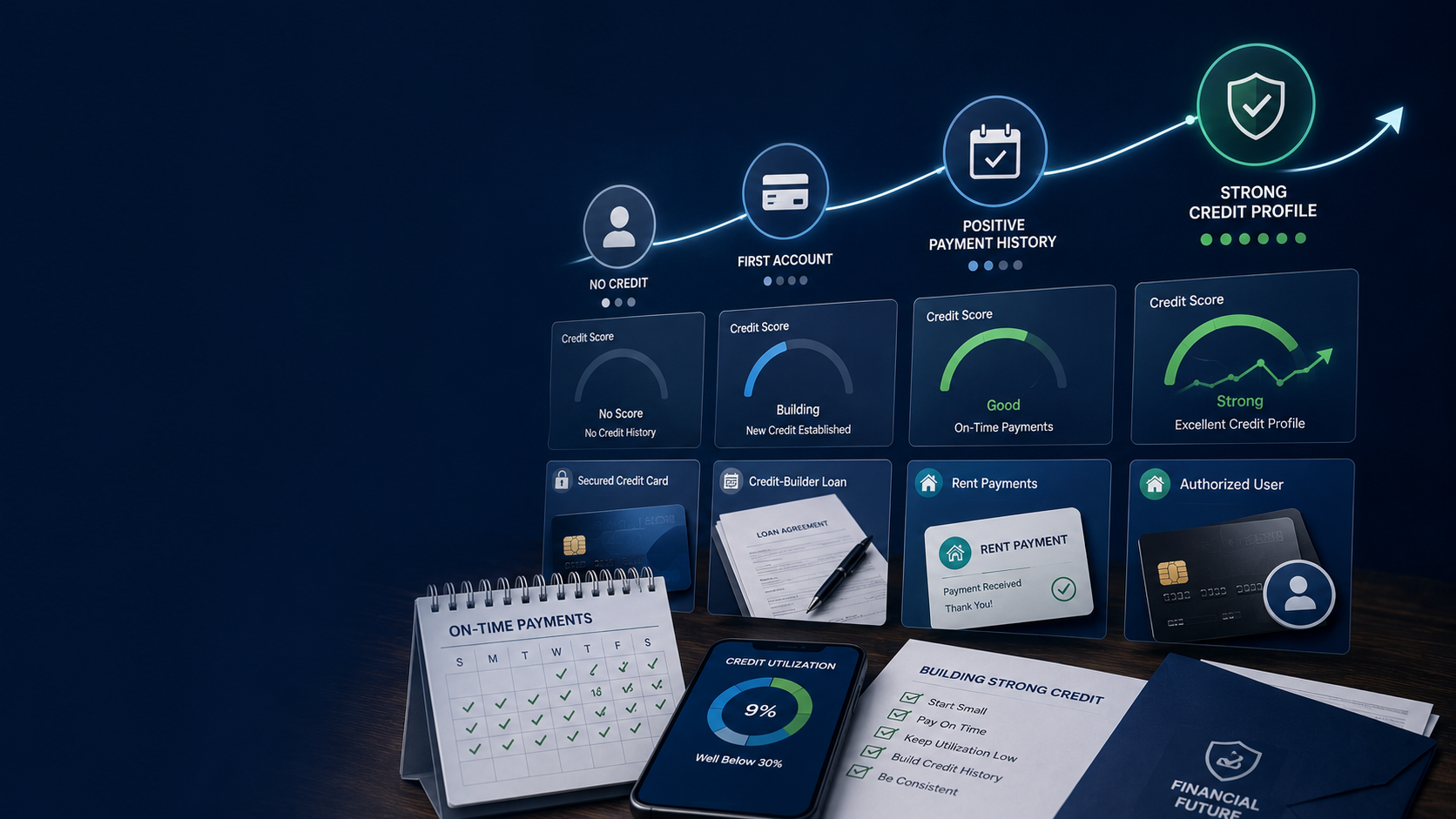
If you’re reading this, there’s a good chance you’ve already hit the wall that stops millions of Americans before they even get started: you need credit to get credit. A landlord wants to see a credit report before they’ll lease to you. A car dealership wants a FICO score before they’ll finance you. Even some employers and utility companies peek at your credit file. But every lender you approach tells you the same thing — “We’d like to see more credit history before we approve you.”
Let’s get to work.
Why No Credit History Is Almost as Hard as Bad Credit
Most people assume that having no credit is neutral — that a blank file is better than a file with mistakes on it. In practice, the credit scoring system treats invisibility the same way it treats risk: as a unknown. And unknowns get denied.
Here’s what a “thin file” or “no hit” actually means in the eyes of a lender:
- FICO can’t score you. The most widely used scoring model (FICO 8) requires at least one account that’s been open for six months or more and at least one account that’s been reported to the bureaus within the last six months. No history, no score. No score, no decision a lender can make with confidence.
- VantageScore can score you faster (often in one to two months), but most banks still rely on FICO for approval decisions — especially for mortgages and auto loans.
- You pay the “invisible tax.” Without a score, you’ll face higher security deposits for apartments, utilities, and cell phone plans. You may be denied for standard credit cards and offered only secured or high-fee alternatives. Auto insurance premiums can be higher in states that allow credit-based insurance scoring. Some employers run credit checks for certain roles and may view a blank file as a yellow flag.
- You’re locked out of the best financial products. Rewards cards, 0% intro APR offers, balance transfer cards, low-interest personal loans, and favorable mortgage rates are all reserved for people with established, positive credit histories.
A 2023 Consumer Federation of America report estimated that roughly 28 million Americans are “credit invisible” — meaning they have no credit record with any of the three major bureaus. Another roughly 21 million are “unscorable” — they have a record, but it’s too thin or too stale to produce a FICO score. That’s nearly 50 million people effectively shut out of mainstream credit.
The good news: the path out of “invisible” is shorter than the path out of “bad.” When you have negative marks (late payments, collections, charge-offs), you’re fighting both the absence of positive history and the presence of damaging history. When you’re starting from scratch, you only have one job: add positive history. No cleanup required.
That’s why, paradoxically, building from scratch can feel faster than repairing damaged credit — even though both take patience.
How Credit Scores Get Built (The Catch-22)
Before we get to methods, you need to understand the machine you’re feeding. Credit scores aren’t magic and they aren’t arbitrary — they’re a mathematical summary of the information in your credit reports at the three major bureaus: Equifax, Experian, and TransUnion.
The Five Factors That Determine Your FICO Score
Look at those weights for a moment. 65% of your score comes from just two things: paying on time and keeping your balances low relative to your credit limits. That’s it. If you nail those two behaviors, you’re doing most of what the scoring model rewards.
The Catch-22 Explained
Here’s the loop that traps people starting from scratch:
- Lenders want to see a history of responsible credit use before approving you.
- You can’t build a history of responsible credit use without a lender approving you.
- Go to step 1.
The way out is to use entry-level credit products that are designed for exactly this situation — products that don’t require a strong credit history to obtain. Secured credit cards, credit-builder loans, and authorized user arrangements exist specifically to break the loop. They let you start feeding positive information to the bureaus before a traditional lender would touch you.
Once that first account is open and reporting, the clock starts. Every month that you pay on time and keep utilization low, you’re adding another positive data point to your file. After about six months, FICO has enough information to generate a score. From there, it’s a matter of continuing the same behaviors and gradually adding credit types as you qualify for them.
The Fastest Legitimate Methods, Ranked
Not all credit-building methods are created equal. Some report to all three bureaus, some only report to one or two. Some build credit quickly, some take months to show any effect. Some cost money (deposits, interest, fees), some are effectively free.
We’ve ranked these by a combination of speed of impact, bureau coverage, cost, and reliability. Here’s the order we recommend to most clients, with the caveats noted for each.
1. Secured Credit Cards
The single most effective tool for building credit from scratch.
A secured credit card works exactly like a regular credit card in every way that matters — it’s a revolving account, it reports to the credit bureaus monthly, and it builds your payment history and utilization just like an unsecured card. The only difference is that you put down a refundable security deposit (usually $200–$500) that becomes your credit limit. The deposit protects the issuer if you default, which is why they can approve people with no credit history at all.
How they work
- You apply for the card (the issuer runs a hard inquiry, typically one).
- If approved, you fund the security deposit — this is held in a separate account, not spent by you.
- Your credit limit usually equals your deposit. A $300 deposit gives you a $300 limit.
- You use the card for purchases just like any credit card.
- You get a monthly statement. You pay at least the minimum by the due date. Ideally, you pay the full balance.
- The issuer reports your payment activity and balance to the three bureaus every month.
- After 7–12 months of responsible use, many issuers will graduate you to an unsecured card and refund your deposit — no new application or hard inquiry required.
How to choose one
Look for these features:
- Reports to all three bureaus. This is non-negotiable. A card that only reports to one bureau is building one-third of your credit file. Confirm in the card’s terms or call the issuer and ask. Most major banks’ secured cards report to all three; some smaller issuers and credit unions do not.
- No annual fee (or a very low one). You should not pay $35–$99 a year for the privilege of building credit. Good no-annual-fee secured cards exist from major issuers.
- A reasonable APR — but honestly, this shouldn’t matter, because you’re going to pay in full every month (more on this below). Don’t pick a card based on APR.
- A clear graduation path. Some issuers explicitly publish their graduation policy — they’ll review your account after a set number of months and, if you’ve paid on time, upgrade you to unsecured and return your deposit. Others don’t publish a path but will do it if you call and ask after 12 months of clean history.
- No application fees or “processing” fees. Reputable secured cards don’t charge these. If a card market itself with “guaranteed approval” and tacks on processing fees, application fees, and a high annual fee, walk away — that’s a fee-harvester card, not a credit-builder.
What to watch out for
- Credit limits are low (often $200–$500 to start). This makes utilization management critical — a $300 limit means a $90 balance puts you at 30% utilization, which is the upper edge of what FICO likes to see. We’ll cover the fix in the “how to use a secured card” section.
- Some cards don’t graduate. A few secured cards have no path to unsecured — you’ll carry the deposit indefinitely until you close the account (which can ding your score by reducing your available credit and average account age). Read the terms before applying.
- Hard inquiry on application. Expect one hard pull, which temporarily drops your score a few points. This is normal and worth it. Don’t apply for five cards to “compare” — that’s five hard inquiries and a red flag.
The deposit — what you need to know
Your deposit is fully refundable. It’s not a fee. If you close the account in good standing or graduate to unsecured, you get every dollar back. Some issuers let you fund the deposit via bank transfer, debit card, or even a money order. A few let you choose your deposit amount (higher deposit = higher limit = easier utilization management). If you can afford a $500 deposit instead of $200, do it — the higher limit gives you more breathing room on utilization.
2. Become an Authorized User
The fastest method with no application, no deposit, and no hard inquiry — but it depends entirely on someone else’s account.
When you become an authorized user (AU) on someone else’s credit card, the issuer sends you a card with your name on it, linked to the primary cardholder’s account. The key for credit-building: most major issuers report the account history to the authorized user’s credit file as if it were their own.
How it helps
If the primary cardholder has a long history of on-time payments, a low balance relative to the limit, and the account has been open for years, all of that positive history can appear on your credit report. This can give you an immediate boost — sometimes a meaningful one — without you ever making a charge on the card.
This works because FICO 8 (and most VantageScore models) include authorized user accounts in their scoring. It’s sometimes called “piggybacking” and it’s completely legal. The practice was almost discontinued in earlier FICO versions, but FICO kept AU inclusion after pushback from consumer groups who pointed out that it’s a legitimate way for spouses, parents, and children to build credit together.
How to set it up
- Find a trusted family member or partner with a credit card that has a clean payment history (no late payments), a low utilization (ideally under 10%), and a long account age (the older, the better).
- Ask them to add you as an authorized user. This usually requires a quick call to the issuer or an online form. The primary cardholder remains fully responsible for the account — you are not liable for the debt.
- You do not need to use the card. In fact, you don’t even need to have the physical card in your possession. The history reports to your file whether or not you charge anything.
- Confirm the issuer reports AU accounts to all three bureaus. American Express, Bank of America, Capital One, Chase, Citi, and Discover all report authorized user activity to all three bureaus. Some smaller issuers don’t — verify before relying on this method.
Risks to both parties
This is a two-way street, and the risks run both directions:
For the authorized user (you):
- If the primary cardholder misses a payment or runs up the balance, that negative activity appears on your credit report too. You inherit the bad along with the good.
- You have no control over the account. If the primary cardholder closes it or it gets sent to collections, your score can drop.
- Mitigation: Only become an AU with someone you trust deeply and who has a demonstrated history of responsible card use. Set a verbal agreement that they’ll tell you if they ever expect to make a late payment or carry a high balance, so you can have yourself removed as AU before the damage hits your file. Removing yourself as an AU is a simple call to the issuer and removes the account (and any negative history) from your report.
For the primary cardholder:
- Adding an AU does not affect the primary cardholder’s credit score directly — the AU’s separate credit activity doesn’t touch the primary’s file.
- However, the primary cardholder is fully legally responsible for all charges made on the AU’s card. If the AU goes on a spending spree, the primary cardholder pays the bill.
- Mitigation: The primary cardholder can add you as an AU but never give you the physical card (some issuers let you add an AU without requesting a card for them). Or, add you and simply cut up the card when it arrives. The credit-building benefit for you is identical either way.
Best use of this method
Authorized user status is most powerful as a supplement, not a substitute. Combine it with a secured card in your own name for the best results. The AU account gives your file age and a second positive tradeline; the secured card gives you an account you control and builds your own payment history.
3. Credit-Builder Loans
The best method for adding an installment account to your credit mix — without taking on real debt.
A credit-builder loan is a loan designed backwards. With a normal loan, you receive the money up front and pay it back over time. With a credit-builder loan, you don’t receive the money until the loan is paid off. Instead, the lender holds the loan amount in a locked savings account or CD. You make monthly payments (which the lender reports to the bureaus as installment-loan activity). When the loan term ends, you receive the money — minus any interest and fees.
How they differ from regular loans
The key credit-building benefit: it adds an installment account to your file, which improves your credit mix (10% of your FICO score) and gives you another stream of on-time payment data (35% of your score).
Best providers
- Self (formerly Self Lender): The most widely known credit-builder loan. Loans from $25/month, terms of 12–24 months, reports to all three bureaus. You can start for a small administrative fee and the forced savings amount is modest. Good for people who want a low-friction entry point.
- Credit Strong: Offers credit-builder installment loans with larger final payouts and longer terms (up to 48 months), which can help with both credit mix and account age. Reports to all three bureaus.
- Local credit unions and community banks: Many offer credit-builder loans (sometimes called “fresh start loans”) with better terms than online providers. If you’re already a member of a credit union, ask. CDFI-certified institutions (Community Development Financial Institutions) often have these products as part of their mission.
- Kikoff: Offers a $750 credit-builder account with a $5 monthly fee. Reports as a line of credit. Simpler than a traditional loan, but the line type and reporting can vary — read the terms.
What to watch out for
- You pay more than you get back. Between interest and fees, you’ll end up paying slightly more than the loan amount over the term. That’s the cost of the credit-building service. For a $500 loan over 12 months, you might pay $540–$560 total and receive $440–$490 at the end. Treat that difference as the fee for building installment credit history.
- Some report to only one or two bureaus. Confirm all-bureau reporting before signing up.
- Late payments hurt you. Even though you’re “payaying yourself,” missed payments are reported as late and damage your score. Set auto-pay.
- Don’t take out multiple credit-builder loans at once. One is enough to build installment history. Stacking them adds cost without meaningful additional benefit.
4. Store / Retail Credit Cards
Easier approval — but the highest fees and interest rates in the credit-card world.
Store cards (Macy’s, Target, Kohl’s, Amazon Store Card, etc.) and gas cards are typically easier to get than general-purpose cards because they’re designed to drive loyalty spending at a specific retailer. Many will approve applicants with thin or no credit history, especially if you apply in-store at checkout (which is why the cashier asks).
The upside
- Easier approval than unsecured bank cards.
- Often no annual fee (the retailer subsidizes the card to encourage spending).
- Reports to all three bureaus in most cases.
- Useful if you already shop at the store regularly — you can build credit with purchases you’d make anyway.
The caveats (and they’re significant)
- High APRs — store cards routinely carry 25–30%+ interest rates. If you carry a balance, the cost dwarfs any rewards or discounts the card offers.
- Low credit limits — often $300–$1,000 to start, making utilization management tricky.
- Deferred-interest promotions are traps. Many store cards offer “0% interest for 12 months” on a large purchase. Read the fine print: if you don’t pay the full balance by the end of the promotional period, you get hit with retroactive interest on the entire original purchase amount — not just the remaining balance. This is one of the most expensive traps in consumer credit.
- Limited usability — a Macy’s card only works at Macy’s. It doesn’t help with everyday spending categories.
- Temptation to overspend — the discount-on-first-purchase and ongoing cardholder offers are designed to make you spend more than you would have otherwise.
Our honest recommendation
Store cards are a secondary method, not a primary one. If you’ve already opened a secured card and you shop regularly at a specific retailer with a no-annual-fee store card, adding one can diversify your file. But don’t open a store card as your first or only credit-building tool — the low limits make utilization hard to manage, and the high APRs mean a single carried balance can cost you more than a year’s worth of credit-building benefit.
If you do open one, pay it in full every month. No exceptions. The moment you carry a balance on a 29% APR store card, you’ve lost the game.
5. Reporting Rent and Utilities
The most underused method — and the only one that can add months of retroactive positive history.
For most of credit history’s existence, rent and utility payments didn’t appear on credit reports. That’s finally changing, and it’s a meaningful opportunity for people starting from scratch.
Rent reporting
Several services now report your monthly rent payments to one or more of the three bureaus:
- Experian RentBureau: Experian has been incorporating rent data into its reports for over a decade. Many large property management companies report automatically. If yours doesn’t, you can use a third-party service to report.
- Boom: Reports rent payments to all three bureaus (Equifax, Experian, TransUnion). Works with your existing rent payments — you don’t change landlords.
- Rental Kharma / Rent Reporters: Services that verify and report your rent history to one or two bureaus, sometimes including up to 24 months of past payments.
- Esusu: Reports to all three bureaus, often used through property management partners but available to individual renters as well.
The key advantage of rent reporting: some services can report up to 24 months of past on-time rent payments, which instantly adds age and payment history to a thin file. If you’ve been a reliable renter for two years but have no credit score, rent reporting can be the fastest single boost available to you.
The key limitation: not all bureaus weight rent data the same way. FICO 9 and VantageScore 3.0+ include rent data in scoring. FICO 8 (still the most widely used by lenders) often does not factor rent into its score — but the presence of rent history on your report can still help with manual underwriting decisions (like a landlord or small lender reviewing your full report).
Experian Boost
Experian Boost is a free tool that scans your linked bank accounts for qualifying utility, telecom, and streaming-service payments and adds them to your Experian credit file. It only affects your Experian report and the VantageScore and FICO scores derived from it — not your Equifax or TransUnion files.
- Upside: It’s free, instant, and can lift your Experian-based score by a few points immediately. For someone with truly no history, even a few points can be the difference between “no score” and “scorable.”
- Limitations: Only affects Experian. Only helps if the scoring model considers the boosted data. Negative payment patterns (missed utility payments) can also be added — though you opt in, so you have control.
Utility and telecom letters
Some lenders (especially local credit unions doing manual underwriting) will accept letters from your utility company, cell phone provider, or internet provider documenting 12+ months of on-time payments. This doesn’t appear on your credit report and doesn’t affect your score, but it can help you qualify for a first credit product that then does build your score.
6. Student Credit Cards
If you’re a college student, this is often the best first card — better than a secured card.
Student credit cards are unsecured cards designed for enrolled college students with limited or no credit history. They’re offered by most major issuers (Discover it Student, Capital One SavorOne Student, Chase Freedom Student, Bank of America Travel Rewards for Students, etc.).
Why they’re worth it
- No security deposit required — you get a real unsecured card with no money down.
- Lower APRs than store cards (though still higher than prime cards).
- Often include rewards — cash back on dining, groceries, or gas, which secured cards typically don’t offer.
- Reports to all three bureaus like any unsecured card.
- Many have a graduation path — after you finish school and build history, the issuer may upgrade you to a standard unsecured rewards card.
What to know
- You must be 21+ to apply without a co-signer or proof of independent income. Under 21, the CARD Act requires you to show ability to repay (income) or have a co-signer. Student income from part-time work can qualify — don’t assume you need a full-time job.
- Credit limits are modest (often $500–$1,500), but higher than most secured cards.
- Use it for one small recurring charge (a streaming subscription, a textbook purchase) and pay it in full monthly.
- Don’t use student status as an excuse to carry a balance. The APR on a student card is typically 18–25%. A carried balance wipes out any rewards you earn.
If you’re a student, apply for a student card before a secured card. No deposit, better terms, and a cleaner path to an unsecured rewards card down the line.
7. Personal Loans and Credit Mix
A later-stage move — not for beginners, but worth understanding now.
Once you’ve established 12+ months of positive history with a revolving account (secured card, student card, or AU arrangement), you may start receiving prequalified offers for unsecured personal loans. Adding a small personal loan at this stage can improve your credit mix (the 10% of your score that rewards having both revolving and installment accounts).
However — and we want to be very clear about this — we do not recommend taking out a personal loan solely to build credit. The cost (interest + origination fees) almost always exceeds the marginal score benefit. If you have a legitimate need for a personal loan (consolidating higher-interest debt, covering a necessary expense you’ve budgeted for), the credit-mix benefit is a side effect, not a reason.
The same applies to auto loans. If you need a car and can afford the payment, an auto loan adds installment history to your file. But don’t finance a car you don’t need just to build credit. The secured card + credit-builder loan combination gives you both revolving and installment history at a fraction of the cost.
Method Comparison Table
Here’s how the primary methods stack up side by side:
The combination we recommend to most clients: Secured card + authorized user (if available) + rent reporting (if you rent). This three-pronged approach gives you revolving credit, account age from the AU relationship, and payment history from your rent — all reporting simultaneously. Add a credit-builder loan at month 3–6 if you want installment history too.
Your 6-Month Plan: No Score to First FICO
Here’s the concrete, step-by-step plan we walk clients through. Follow it in order and you’ll have a scorable FICO by month 6 and a foundation that compounds from there.
Month 1: Lay the Foundation
Week 1:
- Pull your free reports from AnnualCreditReport.com (you’re entitled to free weekly reports from each bureau). Confirm you’re truly starting from scratch — sometimes there’s a surprise account (a store card a parent opened in your name, a student loan you forgot) that’s already aging on your file.
- If there are errors or accounts you don’t recognize, document them. (This is where a can help — we’ll identify what’s already on your file before you start building.)
Week 2:
- Apply for one secured credit card from a major issuer that reports to all three bureaus and charges no annual fee. If you can, fund a $500 deposit (the higher limit helps with utilization).
- If you have a trusted family member or partner with a clean, long-standing credit card, ask them to add you as an authorized user. Emphasize that they don’t have to give you the card.
Week 3–4:
- Once your secured card arrives, set up one small recurring charge on it — a $10–15 streaming subscription or similar. This keeps your balance tiny and your utilization negligible.
- Set up auto-pay for the full statement balance every month. This is the single most important habit you’ll build. No exceptions.
- If you rent, sign up for a rent reporting service that reports to all three bureaus and can back-report up to 24 months of past on-time payments.
Month 2: Add the Second Tradeline
- Apply for a credit-builder loan with a 12-month term and a small monthly payment ($25–$50). Self or a local credit union are good options.
- Set up auto-pay on the credit-builder loan too.
- Check your VantageScore (some free tools like Credit Karma will show it to you). You may already have a VantageScore at this point, even though FICO needs more time.
Month 3: Habits and Monitoring
- Continue using the secured card for one or two small purchases per month. Never charge more than 10% of your limit in a single month (so on a $500 limit, stay under $50). This keeps your utilization in the elite tier for scoring.
- Enroll in Experian Boost — link your bank account and let it scan for qualifying utility and streaming payments. Free and instant.
- If you haven’t already, sign up for free credit monitoring through your bank (many offer free FICO scores to customers) or a reputable free service.
Month 4: Steady as She Goes
- Keep doing exactly what you’re doing. The scoring model rewards consistency. Resist the urge to apply for more cards — every hard inquiry temporarily dings your score, and you don’t need more than one revolving account right now.
- If you’re a student and your secured card has a low limit, consider whether a student card (with a higher limit and no deposit) makes sense as a second revolving account. Only do this if you’re confident you can manage two cards responsibly.
Month 5: Check Your Progress
- Pull your reports again from AnnualCreditReport.com. Verify that all your accounts (secured card, credit-builder loan, AU account, rent reporting) are showing up correctly on all three bureaus.
- If anything is missing or reported incorrectly, dispute it directly with the bureau. (We can help with this — disputes are a core part of what we do at credit-repair.com under FCRA compliance.)
Month 6: Your First FICO
- At the six-month mark, with at least one account open for six months and at least one account reported to the bureaus in the last six months, FICO should now be able to generate a score for you.
- Check your FICO score through your bank or a free FICO source (Discover Credit Scorecard, Experian free FICO, etc.).
- Realistic expectation: A first FICO for someone with 6 months of clean history typically lands in the 670–720 range if utilization is low and there are no late payments. If you’ve been keeping your secured card balance under 10% of the limit and paying in full, you’re likely at the higher end of that range.
Months 7–12: Build and Diversify
- Keep the same habits. Your score will gradually rise as your accounts age and your payment history lengthens.
- Around month 9–12, check whether your secured card issuer offers a graduation path to an unsecured card. If they do, ask for a review. If they don’t, consider applying for a single unsecured rewards card (your improved file should qualify you) — but only if your score is 690+ and you have a clear reason for the card (rewards, higher limit, etc.).
- Your credit-builder loan should be nearing payoff. When it completes, you’ll receive the saved funds — a nice forced-savings bonus.
Months 12–24: Reaching 700+
- With 12+ months of history, your file is solid. Your score should be in the 700–740 range if you’ve maintained perfect payments and low utilization.
- You can now strategically add a second unsecured card if it serves a purpose (travel rewards, balance transfer, etc.). Don’t add more than one or two new accounts per year — each one lowers your average account age and adds a hard inquiry.
- Begin thinking about longer-term credit goals: if you plan to buy a home or finance a car in the next 2–3 years, we can help you map a path to the 740+ range that unlocks the best mortgage and auto rates.
How to Use a Secured Card the Right Way
The secured card is your engine. Used correctly, it builds credit faster than any other single tool. Used wrong, it can set you back months. Here’s the right way:
Rule 1: Treat it like a debit card, not a credit card
Only charge what you can pay off in full from money already in your bank account. If you don’t have the cash for it today, don’t put it on the card. This isn’t a borrowing tool — it’s a credit-building tool.
Rule 2: Keep utilization under 10%
Utilization is the ratio of your balance to your credit limit, and it’s 30% of your FICO score. The scoring model likes to see you using a small portion of your available credit — it proves you can handle credit without relying on it.
- Under 10% utilization is the elite tier. On a $500 limit, that means keeping your statement balance under $50.
- Under 30% is acceptable but not optimal.
- Over 30% starts to drag your score down. Over 50% drags it significantly.
The key detail most people miss: utilization is calculated from your statement balance, not your balance after you pay it off. If you charge $400 on a $500 limit and pay it all off before the statement closes, you’re at 0% utilization. If you charge $400 and wait for the statement to close, you’re at 80% utilization — even if you pay it in full the next day.
The fix: Make a payment before your statement closes to bring the reported balance down. Or, simply keep your monthly charges small enough that even the statement balance stays under 10%.
Rule 3: Pay in full, every month, on time
Set auto-pay for the full statement balance on the due date. This ensures two things: (1) you never miss a payment, which protects the 35% of your score tied to payment history, and (2) you never pay a cent of interest, which makes this a free credit-building tool.
If you can’t pay in full one month — pay at least the minimum, on time, and then get back to paying in full the next month. A single missed payment (30+ days late) can drop a new score by 60–100 points and take years to fully recover. Don’t let it happen.
Rule 4: Keep the card open
The age of your oldest account and your average account age both matter (15% of your score). The secured card you open in month 1 is the foundation of your credit age for the next decade. Don’t close it once you graduate to an unsecured card — keep it open, use it for one small recurring charge, and let it age. If it has an annual fee and you really want to close it, only do so once you have two other established accounts with good age.
Rule 5: Don’t apply for more cards in the first 6 months
Every credit card application is a hard inquiry, which temporarily drops your score 3–5 points. More importantly, multiple applications in a short window signal risk to lenders (it looks like you’re desperate for credit). One secured card in the first 6 months is plenty. Let it build history before adding anything else.
Mistakes That Set Beginners Back
The path to good credit is simple, but it’s not easy — mostly because the mistakes are obvious in hindsight and invisible in the moment. Here are the ones we see most often:
1. Applying for too many cards at once
You get denied for one card, so you apply for three more hoping one will approve you. Each application is a hard inquiry, and suddenly your file shows four inquiries in a month — which looks like desperation to every lender who sees it. Apply for one card. If denied, wait 3–6 months and try a different product (a secured card if you applied for an unsecured one). Don’t shotgun applications.
2. Missing a payment
A single 30-day-late mark can stay on your report for seven years. On a brand-new file with little positive history to offset it, the damage is magnified. Set auto-pay for at least the minimum on every account. Treat on-time payment as a non-negotiable, like paying rent.
3. High utilization
You get a $300 secured card, charge $280 on groceries, and pay it off at the end of the month. Your statement closes at $280 — 93% utilization. Even though you paid in full, your score takes a hit because the bureau saw a high balance. Fix: Make a mid-cycle payment before the statement closes, or keep monthly charges under $30 on a $300 limit.
4. Closing the secured card too early
You graduate to an unsecured card and immediately close the secured card to “get your deposit back.” This shortens your average account age and reduces your available credit — both can lower your score. Fix: Keep the secured card open for at least 12 months, ideally longer, even after you’ve added unsecured cards. The age helps you.
5. Carrying a balance “to build credit faster”
This is one of the most persistent myths. You do not need to carry a balance or pay interest to build credit. Paying in full every month builds your score just as fast — faster, actually, because you’re not accumulating debt that raises your utilization. The idea that you must pay interest to “show activity” is wrong. What the bureaus see is your on-time payment and your balance — not whether you paid interest.
6. Ignoring the authorized user option
If you have a family member with great credit and you never ask to be added as an AU, you’re leaving free, instant credit history on the table. It’s a 20-minute conversation and a phone call. Do it.
7. Not checking your reports for errors
Studies by the Federal Trade Commission have found that one in five consumers has an error on at least one of their three credit reports. For someone starting from scratch, a single misreported account can be the difference between a scorable file and a denied application. Pull your reports regularly and dispute anything inaccurate. (We handle disputes under FCRA compliance —.)
How Long Each Milestone Takes
We believe in setting honest expectations. Here’s the realistic timeline for someone starting with no credit history and following the plan above:
Variables that speed up or slow down the timeline:
- Authorized user history can add years of account age to your file overnight, potentially getting you to 700+ in 12 months instead of 18.
- Late payments add 12–24 months to every milestone. A 30-day late at month 4 can push your first 700+ from month 18 to month 30+.
- High utilization slows progress without showing up as a “negative” — you just won’t see the score gains you expect.
- Multiple hard inquiries in a short window can pause your progress for 6–12 months until they age.
Building Credit Without Going Into Debt
This is the mindset shift that separates people who build credit successfully from people who end up in a debt spiral. Credit building and debt are not the same thing. Here’s the reframe:
You are not borrowing money. You are renting your credit score.
Every month, you let the card issuer front a small amount of money for your purchases. They report that you handled it responsibly. You pay them back in full before any interest accrues. The “rent” you pay for this service is $0 — as long as you pay in full.
The card issuer hopes you’ll slip up. They hope you’ll carry a balance and pay 25% APR. Their entire business model is built on the assumption that most people will. Your job is to be the exception.
The practical rules
- Never charge what you can’t pay for today. If the money isn’t in your checking account right now, the charge doesn’t go on the card.
- Pay the full statement balance every month. Not the minimum. Not “most of it.” The full balance. Set auto-pay and forget about it.
- Use the card for one or two small recurring charges. A streaming subscription, a phone bill, a single grocery run. This is enough to generate monthly reporting without tempting you into lifestyle spending.
- Treat the credit limit as a ceiling, not a target. A $500 limit doesn’t mean you have $500 to spend. It means you have a tool that works best when you use $30–50 of it per month.
- Save the deposit money separately if you need to. If you funded a $500 secured deposit and it’s mentally “your money,” remember: it is. You’ll get it back. Don’t charge $500 on the card thinking the deposit “covers it” — that’s not how it works. The deposit is collateral, not a payment source.
The credit-builder loan is forced savings, not debt
The credit-builder loan is the one place where you’re paying a small fee (interest + admin) for the credit-building service. Think of it as a subscription to a credit-building product, not as debt. You’re paying $20–$60 over the life of the loan to add an installment tradeline to your file. At the end, you get the loan principal back. It’s the closest thing to “buying” credit history that exists legally.
Monitoring Your Progress — Free Tools
You don’t need to pay for credit monitoring. Here are the free tools we recommend:
Free FICO scores
- Discover Credit Scorecard — free FICO 8 score from Experian, available to anyone (not just Discover cardholders). Updates monthly.
- Experian free FICO — free FICO 8 from Experian with an Experian account.
- Your bank or credit union — many (Citi, Bank of America, Wells Fargo, Chase, Discover, Capital One) provide free FICO or VantageScore to customers. Check your app.
Free VantageScore (less useful for lending decisions, but good for trend tracking)
- Credit Karma — free VantageScore 3.0 from TransUnion and Equifax. Updates weekly. Good for trend tracking, not for knowing your lending-ready FICO.
- Credit.com — free VantageScore and Experian report summary.
Free credit reports
- AnnualCreditReport.com — the official, federally authorized source. You’re entitled to free reports from each bureau. Currently offering free weekly reports. This is the only site that gives you the actual full reports (not a summary) at no cost.
Free credit monitoring with alerts
- Most of the free score tools above also monitor your file and send alerts when new accounts, inquiries, or changes appear. Set up alerts on at least one — ideally Experian, since it’s the most commonly pulled bureau for lending decisions.
What to watch for
- Sudden score drops — investigate immediately. Could be a new inquiry you don’t recognize (possible identity theft), a reported late payment, or a utilization spike.
- Accounts you don’t recognize — dispute immediately. Identity theft is rampant and early detection limits damage.
- Reporting errors — a card showing a limit of $0 (common with reporting glitches) can tank your utilization. Dispute it.
Common Myths About Building Credit
Let’s clear out the misinformation that keeps circulating:
Myth 1: “You need to carry a balance to build credit.”
False. This is the single most damaging myth in credit building. Carrying a balance costs you interest and raises your utilization — both bad. Paying in full every month builds your score just as effectively. The bureaus see your payment history and your statement balance; they don’t see whether you paid interest.
Myth 2: “Checking your credit score hurts your credit.”
False. Checking your own score or pulling your own reports is a soft inquiry — it has zero impact on your score. Only hard inquiries (when a lender pulls your credit for an application) affect your score, and even then, the impact is small and temporary.
Myth 3: “Closing a card helps your score.”
False, almost always. Closing a card reduces your available credit (raising utilization) and can shorten your average account age. Keep cards open unless they have an annual fee you can’t justify or the issuer is engaging in bad practices.
Myth 4: “Debit cards build credit.”
False. Debit cards draw from your checking account and don’t involve a credit line, so they’re not reported to the bureaus. Same for prepaid cards. Only credit products (credit cards, loans, lines of credit) build credit — plus rent and utilities when reported through a service.
Myth 5: “Income affects your credit score.”
False. Your income is not on your credit report and is not a factor in your FICO or VantageScore. Income matters for approval (lenders ask about it on applications and use it for debt-to-income calculations), but not for your score. A person earning $30,000 with perfect credit habits will have a higher score than a person earning $300,000 with late payments and high utilization.
Myth 6: “Credit repair companies can magically erase accurate negative items.”
False. Under the FCRA, accurate information can only be removed if it’s unverifiable, inaccurate, or incomplete. If a negative item is accurate and verifiable, no one — not us, not anyone — can legally have it removed before its time limit expires (typically 7 years for most negative items, 10 years for bankruptcies). Any company promising otherwise is violating federal law. What we can do is dispute inaccurate, outdated, or unverifiable items and ensure your report is fully FCRA-compliant.
Myth 7: “You only have one credit score.”
False. You have many scores. FICO 8, FICO 9, FICO Bankcard, FICO Auto, VantageScore 3.0, VantageScore 4.0 — each uses a different formula and may pull from a different bureau. Your “FICO 8 from Experian” may differ from your “FICO 8 from TransUnion” because the underlying reports differ. Don’t obsess over any single number — focus on the trends across all your scores, which will move together if your underlying habits are sound.
Myth 8: “Paying off a collection removes it from your report.”
Partially false. Paying a collection updates the status to “paid,” which is better than “unpaid,” but the collection can still remain on your report for up to seven years from the original delinquency date. Some newer scoring models (FICO 9, VantageScore 3.0+) ignore paid collections, but FICO 8 (the most widely used) still factors them in. If you’re negotiating with a collection agency, ask for a “pay-for-delete” agreement in writing — they agree to remove the entry from your report in exchange for payment. Not all agencies will agree, but it’s worth asking.
FAQ
1. How fast can I realistically build credit from scratch?
With consistent, responsible use of a secured card (and ideally an authorized user account), you can expect your first FICO score in about 6 months, typically in the 670–720 range. Reaching 700+ usually takes 12–18 months, and 740+ takes 18–24 months. There is no legal, legitimate way to build a strong score in 30 days — anyone promising that is either misinformed or selling something that violates the FCRA.
2. What’s the difference between a secured and unsecured credit card?
A secured card requires a refundable security deposit (usually $200–$500) that becomes your credit limit. An unsecured card requires no deposit and grants you a credit limit based on your creditworthiness. Both report to the bureaus and build credit identically. Secured cards are designed for people with no or poor credit; unsecured cards typically require an established credit history.
3. Do I need to pay interest to build credit?
No. This is a common myth. Paying your full statement balance every month builds your score just as fast as carrying a balance — and it costs you nothing in interest. The bureaus see your on-time payment and your reported balance; they don’t see whether you paid interest. Paying in full is the optimal strategy.
4. Can I build credit without a credit card?
Yes, but it’s slower and less effective. Rent reporting, credit-builder loans, and authorized user status can all build credit without you personally holding a credit card. However, revolving credit (credit cards) is the most heavily weighted type of account in FICO scoring, so if you’re able to manage a secured card responsibly, it’s the single fastest tool.
5. Will being an authorized user hurt the primary cardholder?
No. Adding an authorized user doesn’t affect the primary cardholder’s credit score — your separate credit activity doesn’t touch their file. The only risk to the primary cardholder is financial: they’re responsible for any charges made on the AU’s card. They can eliminate this risk by adding you as an AU but never giving you the physical card.
6. How many credit cards should I have to build credit?
For the first 12 months, one is plenty. After that, 2–3 revolving accounts is optimal for most people — enough to show you can manage multiple lines, but not so many that you risk missed payments or high utilization. Don’t open more than one or two new accounts per year to avoid lowering your average account age.
7. What credit score do I need to rent an apartment?
It varies by landlord and market, but most rental applications look for 620–680+. Higher-end buildings and competitive markets may require 700+. If you don’t yet have a score, some landlords will accept alternative evidence of financial responsibility — bank statements, employment verification, previous landlord references, or a larger security deposit. Rent reporting services can help you build toward the score threshold while you search.
8. Can credit-repair.com help me if I’m starting from scratch?
Yes — and this is a point worth emphasizing. Credit repair isn’t only for people with negative items to dispute. If you’re starting from zero, we can pull your three-bureau reports to confirm you’re truly starting clean (sometimes there are surprise accounts), help you identify the fastest combination of credit-building tools for your specific situation, set up rent reporting and bureau monitoring, and build you a custom repair-and-build plan that maps your path from no score to 740+. Our process is FCRA-compliant and attorney-backed, which means every step is legal, ethical, and designed for long-term success — not quick fixes.
Start With a Free Credit Audit
Building credit from scratch is a marathon, not a sprint. But it’s a marathon with a clear course, mile markers, and a finish line you can see. The hardest part is the first six months — the stretch where you’re doing everything right and the system hasn’t started rewarding you yet. Once that first FICO appears, the compounding begins: every month of clean history adds value, every account ages, every on-time payment strengthens the 35% of your score that matters most.
You don’t have to figure out the path alone. At credit-repair.com, we start every new client — including those with no credit history at all — with a free three-bureau credit audit. We pull your reports from Equifax, Experian, and TransUnion, identify what’s already on your file (including any errors or surprise accounts you may not know about), and build you a custom credit-building plan tailored to your goals, timeline, and budget.
Our approach is attorney-backed and FCRA-compliant, which means every recommendation we make is grounded in federal credit law and designed for measurable, long-term progress — not quick fixes or empty promises. We educate you on the process as we go, so you understand why each step works and can maintain strong credit long after you’ve reached your target score.
Get your free credit audit at credit-repair.com →
Whether you’re 18 with your first job, a recent immigrant establishing a U.S. credit file, or someone who simply never needed credit until now — the fastest way to build credit is the legitimate way, done right, starting today. We’ll walk it with you.
Disclaimer: This article is for educational purposes and does not constitute legal or financial advice. Individual credit outcomes vary based on personal financial behavior and history. credit-repair.com operates in full compliance with the Fair Credit Reporting Act (FCRA) and all applicable federal credit laws. We do not guarantee specific score outcomes or timelines.
Leave a Reply