
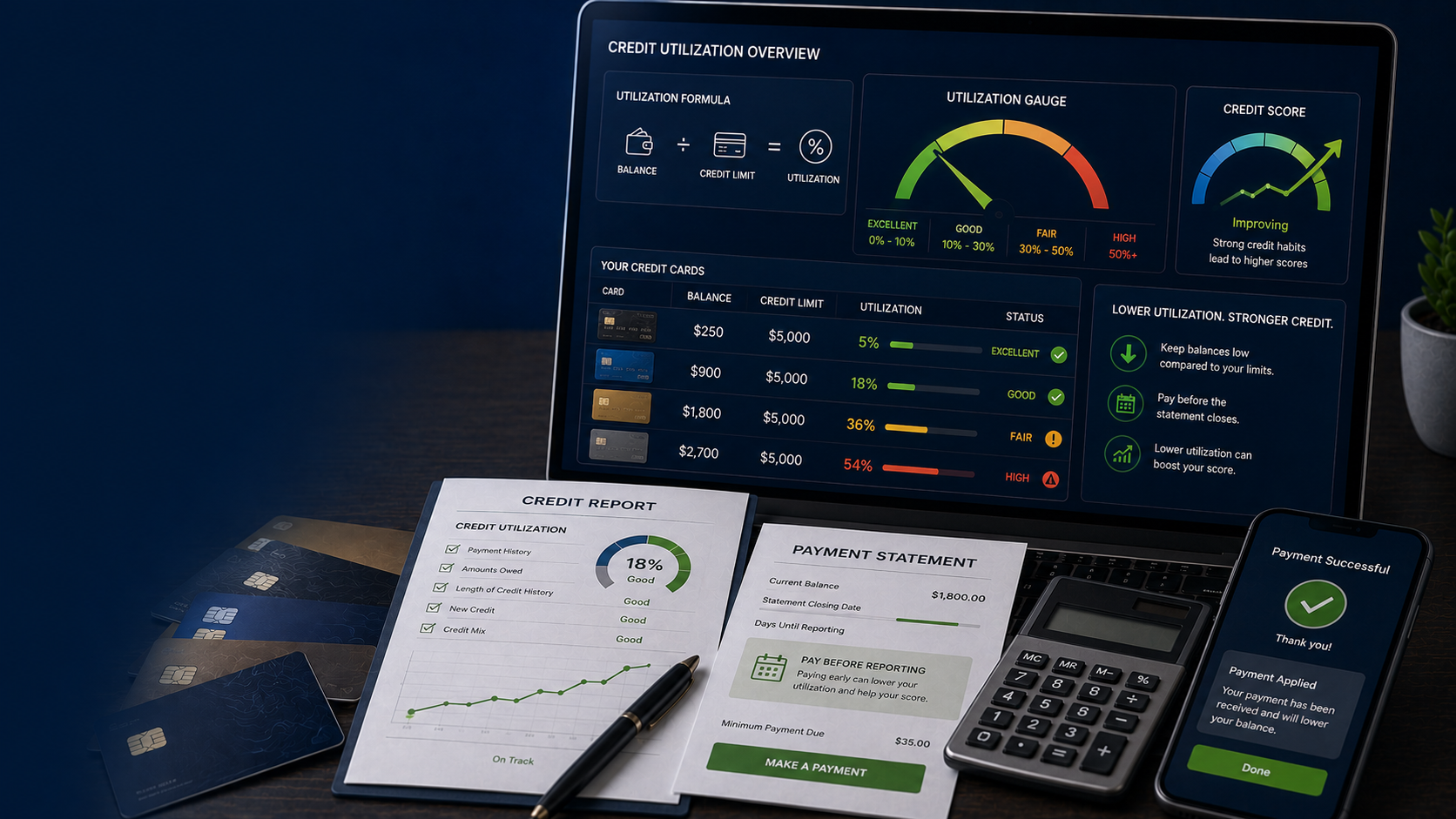
Credit utilization is the amount of available credit you’re actually using, expressed as a percentage. Credit utilization accounts for roughly 30% of your FICO score, making it the fastest lever to move a credit score. Unlike payment history, which takes months or years to recover from, credit utilization is recalculated every time card issuers report balances, usually once a month. This means a single well-timed payment can reshape a credit score before the next billing cycle even begins, as no other scoring factor responds this quickly.
What Is Credit Utilization?
Your credit utilization ratio (sometimes called your utilization rate) is the percentage of your available revolving credit that you’re currently using. “Revolving credit” means credit cards and lines of credit — accounts where the balance goes up and down as you borrow and repay. Installment loans like mortgages, auto loans, and student loans are not part of utilization. Those are scored separately, based on how much you still owe relative to the original loan amount.
Here’s the key idea in plain terms: if you have a credit card with a $10,000 limit and you owe $2,000 on it, you’re using 20% of your available credit. That 20% is your utilization on that card. If you have three cards, each with its own limit and balance, you also have an overall utilization that combines all of them.
Why does this matter so much? Because credit scoring models treat utilization as a proxy for risk. Someone using 5% of their available credit looks like a person who borrows modestly and pays it back comfortably. Someone using 85% looks like a person who may be stretching to make ends meet — even if they’ve never missed a payment. The scoring models don’t know your income or your savings. They only see the balances and limits that lenders report. Utilization is one of the clearest signals they have.
This is also why utilization is the factor you can move fastest. Payment history is built over time. The age of your accounts only grows older. But utilization changes every month, based on what you charge and what you pay. If you understand the timing, you can influence what the bureaus see — and what the scoring models calculate — without waiting years.
One important distinction: utilization is calculated from the balance your lender reports to the bureaus, not the balance you carry day to day. This is a subtle but critical point, and we’ll dig into it deeply in the section on the . For now, know this: you can pay your card in full every month, never pay a cent of interest, and still have a high utilization ratio if the wrong balance gets reported.
The Credit Utilization Formula
The formula itself is simple:
That’s it. Divide what you owe by what you’re allowed to owe, then multiply by 100 to get a percentage.
Per-card utilization uses the balance and limit of a single card:
Overall utilization sums every card together:
Both numbers matter. FICO and VantageScore scoring models look at utilization at both the individual-account level and the aggregate level. That means you can have a great overall utilization and still lose points if one card is maxed out. We’ll cover that in detail in the section.
A few things to keep in mind about the inputs:
- Balances are the amounts reported by your lender — typically your statement balance, which is the balance on your closing date. Some lenders report at other times, but statement closing is the most common.
- Credit limits are your stated revolving limits. For charge cards that have no preset spending limit (certain American Express cards, for example), the scoring models use a different figure — often the highest balance you’ve ever carried or an internal limit the lender reports. This is handled automatically by the bureaus.
- Closed accounts with balances can still factor in. If you closed a card but still owe a balance, that balance may still be reported and can affect your utilization depending on how the lender reports it. Be cautious about closing cards with outstanding balances.
The simplicity of the formula is part of why utilization is so powerful: it’s transparent, it’s math you can do yourself, and it’s something you can influence directly. You don’t need to dispute anything, wait for a bureau investigation, or negotiate with a creditor to change it. You just need to change the numerator (your balances) or the denominator (your limits).
Why Utilization Is 30% of Your Score
Under the FICO 8 scoring model — still the most widely used model in lending decisions — your credit score is built from five categories:
| Scoring Factor | Weight | How Fast It Moves |
|---|---|---|
| Payment history | 35% | Slow — months to years |
| Amounts owed (utilization) | 30% | Fast — weeks to one billing cycle |
| Length of credit history | 15% | Very slow — grows with time |
| Credit mix | 10% | Slow — requires new accounts |
| New credit / inquiries | 10% | Moderate — inquiries fade in 12 months |
Utilization is the second-largest factor, and it’s the only one of the top three that you can influence in a matter of weeks. That’s why we call it the fastest lever.
Here’s why scoring models weight it so heavily. Decades of lender data show that as utilization rises, the likelihood of default rises too — and it rises non-linearly. Someone at 10% utilization is not just slightly less risky than someone at 30%; the risk gap is meaningful. Someone at 60% is meaningfully riskier than someone at 40%. The models bake this curve in, which is why even small drops in utilization can produce visible score gains when you’re starting from a high percentage.
The “amounts owed” category (the official FICO label for the 30% bucket) includes more than just utilization. It also considers:
- How many of your accounts carry balances at all
- How much you owe on installment loans relative to the original amounts
- The presence of any accounts in collection
But utilization — both per-card and overall — is the dominant force inside that 30% bucket. For most people working to improve their credit, utilization is where the biggest, fastest gains live.
A note on scoring model variations: FICO 9, VantageScore 3.0, and VantageScore 4.0 all treat utilization as a major factor, though the exact weightings differ. FICO 10T, the newer trended-data model, looks at your utilization over time rather than just a snapshot — we cover that in its own . The tactics in this article help across all of these models.
The 30% Rule vs. the Truth
If you’ve read anything about credit scores, you’ve heard the 30% rule: keep balances under 30 percent of your credit limits. It’s repeated in nearly every article, video, and forum thread about credit. Here’s the problem: 30% is not a target. It’s a ceiling — and a fairly loose one. The truth is more nuanced, and understanding the nuance is where real score gains come from.
Where the 30% number comes from
FICO has historically described utilization in broad tiers. The exact breakpoints aren’t published, but analysis of millions of scores — and FICO’s own public statements — have established a widely accepted tier structure:
| Utilization Range | Score Impact |
|---|---|
| 0% | Slight penalty — no active revolving use |
| 1% – 9% | Best for scores — shows active, responsible use |
| 10% – 29% | Very good — small, gradual point loss as you climb |
| 30% – 49% | Fair — noticeable penalty begins around 30% |
| 50% – 74% | Poor — meaningful penalty |
| 75% – 100% | Very poor — near-maxed or maxed, large penalty |
The 30% threshold is where the penalty starts to become meaningful — not where scoring is optimal. Think of it as the speed limit on a highway: staying just under it won’t get you a ticket, but it also won’t get you the best fuel efficiency. The “best” zone for your score is well below 30%.
Why under 10% is better
People who keep their reported utilization under 10% — and ideally between 1% and 9% — consistently see the highest scores in the “amounts owed” category. At that level, you’re demonstrating that you use your credit cards but pay them down aggressively. That’s exactly the behavior scoring models reward.
The difference between 28% and 8% utilization can be 20 to 40 points for some people, depending on the rest of their profile. That’s the difference between “approved at a decent rate” and “approved at a great rate” on a mortgage, or between “approved” and “denied” on a premium rewards card.
Why 0% isn’t ideal — the “some activity” nuance
This surprises a lot of people: a reported utilization of 0% is not optimal. If all your cards report a $0 balance every month, the scoring model sees no evidence that you’re actually using your revolving credit. From the model’s perspective, a dormant card tells it nothing about your ability to manage debt — so you may lose a few points compared to someone showing a small, paid-down balance.
Here’s what’s really happening. Scoring models want to see some activity. They reward the pattern of: charge a small amount, let it report, pay it off. That cycle — use, report, repay — is the evidence the model uses to predict your future behavior. If you never let a balance report, there’s no evidence to score.
This does not mean you should carry debt or pay interest. It means you should let a small balance appear on your statement (which happens naturally if you use the card for everyday purchases), and then pay it in full by the due date. The statement balance reports to the bureaus, the scoring model sees your responsible use, and you never owe a cent of interest because you pay in full during the grace period. This is the optimal pattern.
The practical takeaway: aim for a reported utilization between 1% and 9% on each card and overall. That single digit above zero is your “some activity” signal. Anything from 10% to 29% is still good. Crossing 30% is where you want to pull back. And 0% across the board is a missed opportunity, not a victory.
Per-Card vs. Overall Utilization
This is one of the most under-explained topics in credit, and getting it wrong costs people points every month.
Scoring models evaluate your utilization at two levels:
- Overall (aggregate) utilization — your total balances across all revolving accounts, divided by your total credit limits across all revolving accounts.
- Per-card (individual) utilization — the balance on each specific card, divided by that card’s specific limit.
Both matter. A scoring model doesn’t just care that your overall utilization is healthy; it also looks at whether any single card is disproportionately loaded. This is because maxing out one card — even if your overall utilization is low — is a risk signal. It suggests you may be concentrated on one account, which can indicate cash flow stress on that particular line.
Can you show a worked example of per-card vs. overall utilization?
Suppose you have three cards:
| Card | Limit | Balance | Per-Card Utilization |
|---|---|---|---|
| Card A | $5,000 | $1,500 | 30% |
| Card B | $5,000 | $0 | 0% |
| Card C | $5,000 | $0 | 0% |
Your overall utilization is $1,500 ÷ $15,000 = 10%. That’s in the good range. But Card A is at 30% — right at the ceiling. The scoring model sees both numbers and may dock you slightly for the per-card figure even though your overall is healthy.
Now compare to this arrangement:
| Card | Limit | Balance | Per-Card Utilization |
|---|---|---|---|
| Card A | $5,000 | $500 | 10% |
| Card B | $5,000 | $500 | 10% |
| Card C | $5,000 | $500 | 10% |
Same total balance ($1,500), same overall utilization (10%). But now every card is at 10%, well under the 30% ceiling. This arrangement typically scores slightly better than the first, because no single card is loaded.
Why this matters for your strategy
The per-card vs. overall distinction changes how you should think about paying down debt. If you have extra cash to put toward your cards, don’t just throw it at the highest-interest card (though that’s still good advice for saving money). For score purposes, it often helps to pay down whichever card has the highest per-card utilization first, especially if that card is over 30%. Bringing one maxed-out card down to 30% can move your score more than bringing a moderately-used card down to 0%.
This is also why the tactic of spreading balances across cards (covered below) can help — it smooths out per-card utilization even when the total balance stays the same. We’ll walk through that in the tactics section.
How to Calculate Your Utilization (With Examples)
Let’s run through a few scenarios so you can see exactly how the math works and apply it to your own situation.
Example 1: Single card, simple case
You have one credit card with a $8,000 limit. Your statement closes with a balance of $1,600.
That’s in the good range — under 30%, though not quite in the optimal under-10% zone. To get into the optimal zone, you’d want your statement to close with a balance under $800.
Example 2: Multiple cards, mixed utilization
You have three cards:
- Card A: $10,000 limit, $3,000 balance
- Card B: $6,000 limit, $1,200 balance
- Card C: $4,000 limit, $0 balance
Per-card utilization:
- Card A: $3,000 ÷ $10,000 = 30% (right at the ceiling)
- Card B: $1,200 ÷ $6,000 = 20% (good)
- Card C: $0 ÷ $4,000 = 0% (no activity — see the nuance above)
Overall utilization:
Overall, you’re at 21% — good. But Card A is at 30%, which the model will flag. If you had an extra $1,000 to put toward these balances, paying down Card A (bringing it to $2,000 and 20%) would help your score more than paying down Card B, because it removes the per-card ceiling violation.
Example 3: The maxed-out card
You have two cards:
- Card A: $5,000 limit, $4,500 balance (90% — maxed out)
- Card B: $15,000 limit, $0 balance
Per-card:
- Card A: 90% (very poor)
- Card B: 0%
Overall:
Your overall utilization is 22.5%, which looks fine in isolation. But the scoring model will penalize you heavily for Card A being at 90%. This is a classic case where overall utilization hides a serious problem. If you’re applying for a loan and the lender manually reviews your report, a maxed-out card jumps out immediately.
Example 4: The optimal setup
Three cards, all lightly used:
- Card A: $7,000 limit, $200 balance (2.9%)
- Card B: $5,000 limit, $150 balance (3%)
- Card C: $8,000 limit, $0 balance (0%)
Overall:
Overall at 1.75%, two cards showing small activity, one card dormant. This is close to the ideal pattern for most scoring models. You’re demonstrating active, responsible use without loading any single card.
How to calculate your own
- List every revolving account (credit cards, store cards, lines of credit). Skip installment loans.
- For each card, note the current balance and the credit limit. You can find these on your most recent statement or by logging into your online account. For the most accurate picture, pull your credit report from AnnualCreditReport.com — the balances and limits there are what the bureaus currently have on file.
- Calculate per-card utilization for each: balance ÷ limit × 100.
- Add up all balances and all limits, then divide total balances by total limits × 100 for your overall utilization.
- Check both numbers against the tier table in the . If either your overall or any single card is over 30%, that’s your first priority.
One caution: the balances on your credit report may be slightly stale. Lenders report once a month, so the report shows the balance from your last statement date, not what you owe today. If you’ve made a large payment since then, your actual utilization is already lower than what the report shows — which is good news, but it means the score a lender pulls might still reflect the older, higher balance until the next reporting cycle.
Tactics to Lower Your Utilization Fast
These tactics are listed roughly in order of speed and impact. Most can be executed within a single billing cycle.
1. Pay down balances before the statement closes
This is the single most effective tactic, and it works immediately. Recall that the balance that matters for utilization is the one your lender reports — and most lenders report the balance as of your statement closing date. If you pay down your balance before the statement closes, the lender reports a lower number, and your utilization drops on the next bureau update.
Here’s the timing to understand:
- Statement closing date — the day your billing cycle ends and your statement is generated. The balance on this date is what gets reported.
- Due date — about 21 to 25 days after the closing date. This is when your payment is due to avoid interest.
Most people wait until the due date to pay. That’s fine for avoiding interest, but it does nothing for utilization because the balance was already reported weeks earlier at the statement closing date. To optimize utilization, you want to make a payment between the last day of your billing cycle and the statement closing date — or even just a few days before the statement closes.
You don’t have to pay the whole balance. Even paying down to under 10% of the limit before the statement closes will land you in the optimal zone. Then pay off the remainder by the due date to avoid interest.
2. Ask for a credit limit increase
Remember the formula: utilization is balances ÷ limits. You can lower the ratio by shrinking the numerator (paying down) or by growing the denominator (raising your limits). A higher credit limit, with the same balance, instantly lowers your utilization.
Most card issuers let you request a limit increase online — usually under an account settings or “card management” menu. Some increases can be granted instantly with a soft credit pull (which doesn’t affect your score). Others may require a hard inquiry, which causes a small, temporary score dip. Ask the issuer whether the request will be a soft or hard pull before you proceed.
Important: A limit increase only helps if you don’t increase your spending. If you get a $5,000 limit bumped to $10,000 and then run the balance up to $5,000, your utilization is exactly where it was before — 50%. The tactic works only when the new limit gives you more headroom that you leave unused.
A practical approach: request limit increases on your oldest, best-behaved cards every 6 to 12 months. Issuers are often willing to grant modest increases to customers with a track record of on-time payments and low balances relative to the current limit.
3. Make mid-cycle payments
If you use your card heavily during the month — for business expenses, reimbursable work charges, or just everyday spending — your balance may spike well above 30% mid-cycle, even if you pay it in full every month. If that spike happens to land on the statement closing date, you get dinged for utilization even though you’re a perfect payer.
The fix: make a payment mid-cycle, before the statement closes. This brings the reported balance down. You can continue using the card for the rest of the cycle; just make another payment before the due date to clear the remainder.
Some people who charge a lot each month make weekly payments to keep the balance low at all times. This is a perfectly legitimate strategy and is especially useful for people who put business expenses or large recurring bills on personal cards.
4. Spread balances across multiple cards
If you need to carry a balance (say, for a large purchase you’re paying off over a few months), spreading it across multiple cards can improve your per-card utilization even though your overall utilization stays the same.
Compare:
- Concentrated: One card at $4,500 / $5,000 (90%), another at $0. Overall: $4,500 / $20,000 = 22.5%. One card maxed.
- Spread: Two cards at $2,250 / $5,000 each (45% each), one at $0. Overall: $4,500 / $20,000 = 22.5%. No card maxed, but both at 45%.
The spread version still has both cards over 30%, so it’s not ideal — but it’s better than one card being at 90%. In a more moderate scenario, spreading a $3,000 balance across three $10,000-limit cards (10% each) versus concentrating it on one (30%) can produce a small but real score difference.
This tactic has a caveat: it only helps if the cards you’re spreading to have similar interest rates. Moving a balance from a 0% promotional APR card to a 24% APR card to improve your utilization is a bad trade. If you’re carrying a balance, prioritize interest cost first, utilization second.
5. Keep cards open — even paid-off ones
When you pay off a card, the temptation is to close it. Resist that temptation if you care about your score. Here’s why: closing a card removes its credit limit from the denominator of your utilization calculation. If that card had a $10,000 limit and you close it, your total available credit drops by $10,000 — and your overall utilization jumps up accordingly, even though you didn’t spend a dime.
Example: You have $20,000 in total limits and $4,000 in balances. Overall utilization: 20%. You pay off and close a card with a $10,000 limit. Now your total limits are $10,000, your balances are still $4,000, and your overall utilization is 40% — you just crossed the 30% ceiling by closing a card you didn’t owe anything on.
Closed accounts in good standing can stay on your credit report for up to 10 years, which helps your average account age. But the credit limit comes off your utilization calculation immediately upon closure. This is one of the most common ways people accidentally hurt their scores.
If a card has an annual fee you don’t want to pay, ask the issuer about a product change to a no-fee card instead of closing the account. That preserves the credit limit and the account history.
6. Use a balance transfer strategically
If you’re carrying high-interest debt, a balance transfer to a card with a 0% promotional APR can help in two ways: it reduces the interest cost (freeing up cash to pay down principal faster), and if the new card has a higher limit, it can improve your overall utilization. However, be aware that opening a new card generates a hard inquiry and lowers your average account age — both small, temporary score impacts. The utilization benefit usually outweighs these, but the math depends on your specific situation. Also watch out for balance transfer fees (typically 3% to 5%) and make sure you can pay off the balance before the promotional period ends.
7. Become an authorized user on a responsible account
If a family member or close friend has a long-standing credit card with a high limit and a low balance, being added as an authorized user can help your utilization. The card’s limit and history typically appear on your credit report as well, increasing your total available credit and potentially improving your average account age. Choose carefully: if the primary cardholder runs the balance up or misses payments, those negatives appear on your report too. This strategy works best when the primary holder is financially disciplined and you trust them completely.
8. Open a new card — with caution
A new credit card adds to your total available credit, which lowers your overall utilization (assuming you don’t carry a balance on the new card). But a new card also generates a hard inquiry, lowers your average account age, and adds a new account to your profile — all of which have small, temporary negative effects. For most people, the utilization benefit outweighs the drawbacks only if the new card meaningfully increases total available credit and you keep the balance at zero. If you’re already carrying high utilization on existing cards, adding a new card and running up its balance will only make things worse.
The Statement-Balance Trap
This is the single most common mistake we see, and it silently costs people 20 to 60 points every month without them realizing it.
Here’s the scenario: You use your credit card for everything — groceries, gas, subscriptions, the works. You pay the statement balance in full every month by the due date. You’ve never paid a cent of interest. By every reasonable definition, you’re a perfect credit card customer. And yet, your credit score is stuck, and your reported utilization is high.
What’s happening?
The balance that gets reported to the credit bureaus is (for most issuers) your statement balance — the balance on the day your statement closes. That’s typically the peak of your monthly spending, because it’s the sum of everything you charged during the billing cycle. If you charged $3,000 during the cycle and your limit is $5,000, the statement balance is $3,000 — a 60% utilization — and that is what gets reported, even though you pay it off completely three weeks later.
The scoring model never sees your payment. It only sees the reported balance. So from the model’s perspective, you’re at 60% utilization every month, even though you carry no debt.
This is maddening for people who are doing everything “right.” But once you understand the timing, the fix is straightforward: pay down most of your balance a few days before the statement closes.
The fix, step by step
- Find your statement closing date. It’s on every statement. It’s usually the same date each month (for example, the 15th).
- A few days before that date — say, the 12th or 13th — log in and pay your balance down to under 10% of your credit limit. If your limit is $5,000, pay it down to under $500.
- Let the statement close with that small balance. The lender reports it to the bureaus. Your utilization looks excellent.
- Pay the remaining small balance by the due date (about three weeks later) to avoid interest.
You’re still paying in full every month. You’re still never paying interest. But now the bureau sees a low balance instead of a high one, and your score reflects that.
This is the single highest-impact habit you can build for utilization. For people with high monthly card spend, it can be worth 30 to 60 points.
How to confirm what’s being reported
If you want to verify that this is working, pull your credit report from AnnualCreditReport.com (free, weekly during many periods, otherwise once per bureau per year) and check the balance listed for each card. Compare it to your statement balance — it should match. If it doesn’t, your lender may report on a different date than your statement closing date. In that case, call the issuer and ask when they report to the bureaus, and time your payment accordingly.
FICO 8 vs. FICO 10T: Does Utilization Have a Memory?
This is where the conversation gets interesting, because the newest scoring model changes a fundamental assumption that has guided credit advice for over a decade.
FICO 8: Utilization has no memory
Under FICO 8 — still the dominant model in mortgage lending and most consumer credit decisions — your utilization is scored as a snapshot. The model looks at the most recent balances and limits reported by your lenders and calculates your utilization from that single point in time. It doesn’t care what your utilization was last month, last year, or five years ago.
This is why utilization is the “fast lever.” If you were at 60% last month and you pay down to 5% this month, the model scores you based on the 5% — and your score can jump in a single cycle. Your past high utilization is gone, as far as the model is concerned.
This also means utilization “resets” every month. If you normally keep your utilization low but have one month where it spikes (say, a large purchase right before your statement closes), you may see a temporary score dip — but it will recover the following month when the next reported balance replaces the old one. There’s no lasting penalty.
FICO 10T: Trended data
FICO 10T, introduced in 2020 and being adopted gradually by lenders, uses trended data. Instead of a single snapshot, the model looks at your balances and utilization over the past 24 months or so. It can see whether your utilization has been trending up, trending down, or holding steady — and it factors that trend into your score.
Under 10T, a sudden spike in utilization still matters, but it’s placed in context. If you’ve been steadily paying down for two years and have one high month, the model sees the broader trend and may not penalize you as heavily. Conversely, if you’ve been steadily climbing for two years — even if you’re still under 30% — the model may flag the upward trend as a risk signal.
This changes the strategic emphasis. Under FICO 8, you can “game” utilization with a well-timed payment before a statement closes. Under 10T, that tactic still helps (because the most recent data point still matters), but the long-term trend matters too — so consistent, gradual paydown matters more than a one-month optimization.
What this means for you
- For now, most lending decisions still use FICO 8. Mortgages in particular are still underwritten against older FICO models (FICO 2, 5, and 4, which are similar to FICO 8 in their utilization treatment). The tactics in this article remain highly effective.
- Over time, 10T adoption will grow. Building good utilization habits now — not just optimizing for a single month — positions you well for both models.
- The best strategy works under both models: keep utilization consistently low (under 10% overall and per-card), make payments before statement closes when you have a high-spend month, and pay down debt over time rather than carrying it. That pattern looks great in a snapshot model and in a trended model alike.
We monitor scoring model adoption for our clients and adjust repair plans as the landscape shifts. If you’re working with us, we’ll flag when a lender you’re targeting has moved to 10T and adjust your strategy accordingly.
Utilization Across Multiple Cards
When you have several credit cards, managing utilization gets more complex — but also gives you more tools. Here’s how to think about a multi-card portfolio.
The aggregate is the headline, the per-card is the detail
Your overall utilization is the number most people focus on, and it’s the one that moves the most points. But as we covered, scoring models also look at each card individually. A good rule of thumb: keep every card under 30%, and keep your overall under 10%. That combination consistently produces the best scores.
If one card is over 30%, prioritize it
When you have limited cash to put toward paydown, the order in which you pay cards matters for your score. Pay down the card that’s highest above 30% first. If two cards are both over 30%, prioritize the one with the higher per-card percentage. The scoring penalty for a 70% card is steeper than the penalty for a 40% card, so bringing the 70% card down first gives you more score movement per dollar.
Once every card is under 30%, you can shift to paying down whichever card has the highest interest rate — that’s the financially optimal move once the score urgency is handled.
Don’t close old cards to “simplify”
We covered this in the tactics section, but it bears repeating in the multi-card context: closing an old, paid-off card removes its limit from your total available credit, which raises your overall utilization. If you’re carrying balances on other cards, this can push you over a scoring threshold even though you didn’t spend anything.
If you have cards you don’t use, consider keeping them open with a small recurring charge (a subscription, a phone bill) that you pay off automatically each month. This keeps the card active, prevents the issuer from closing it for inactivity (which also removes the limit), and contributes a small, positive activity signal to your score.
Store cards count too
Store cards (Macy’s, Target, Home Depot, etc.) are revolving accounts and factor into utilization just like general-purpose credit cards. They often have lower limits than major cards, which means a modest balance can produce a high per-card utilization. A $300 balance on a $500 store card is 60% utilization on that card — a problem. Treat store cards with the same utilization discipline as any other card, or don’t carry balances on them at all.
Common Mistakes That Quietly Tank Your Score
Most utilization damage is self-inflicted, and most of it is avoidable. Here are the mistakes we see most often.
1. Waiting until the due date to pay
As we covered in the , paying on the due date is fine for avoiding interest but does nothing for utilization because the balance was already reported at the statement closing date. If you only change one habit, change this one: pay down before the statement closes, not just before the due date.
2. Closing paid-off cards
Removing a card’s limit from your total available credit raises your overall utilization. Keep old cards open, ideally with a small recurring charge to prevent inactivity closure.
3. Maxing out one card to keep another at zero
Some people concentrate spending on a single “rewards” card to maximize points, leaving other cards at zero. If that one card’s balance climbs above 30%, the per-card penalty can outweigh any rewards benefit. Spread spending or pay down mid-cycle.
4. Ignoring store cards and smaller-limit accounts
A $200 balance on a $500 store card is 40% utilization — a penalty. People often forget about store cards because the balances are small, but the limits are small too, so the percentage can be high. Track every revolving account, not just your main credit cards.
5. Requesting limit increases with hard pulls unnecessarily
A hard inquiry for a limit increase you might not get (and don’t urgently need) isn’t worth the small score dip. Ask issuers whether they can grant the increase with a soft pull first. Many can.
6. Treating a limit increase as permission to spend more
A higher limit helps your utilization only if your balance stays the same. If your spending rises with your limit, your utilization doesn’t improve — and you’ve taken on more debt. Treat a limit increase as headroom, not as spending power.
7. Opening new cards to “dilute” utilization without a plan
A new card raises your total available credit, which can lower overall utilization. But it also adds a hard inquiry, lowers your average account age, and creates the temptation to carry a balance. If you open a new card for utilization reasons, keep the balance at zero and don’t use it for anything you can’t pay off immediately.
8. Assuming 0% utilization is perfect
As we covered, 0% across the board misses the “some activity” signal the scoring models reward. Let a small balance report on at least one card, then pay it in full.
9. Not checking what’s actually on your report
The balances on your credit report may not match what you think you owe, especially if a lender reports on an unusual date or if a recent payment hasn’t cycled through yet. Pull your report periodically and verify that the balances and limits are accurate. If a limit is reported incorrectly (lower than it actually is), your utilization calculation is wrong — and you can dispute that.
10. Carrying a balance to “build credit”
This is a persistent myth. Carrying a balance and paying interest does not build your credit faster than paying in full every month. The scoring model doesn’t know or care whether you pay interest — it only sees the reported balance and your payment history. Paying in full every month builds credit just as effectively and costs you nothing.
Summary Table: What to Do and What to Avoid
| Do | Avoid |
|---|---|
| Pay down balances before the statement closes | Waiting until the due date to pay |
| Aim for 1% – 9% reported utilization on each card and overall | Treating 30% as a target instead of a ceiling |
| Let a small balance report, then pay in full | Carrying 0% across every card, every month |
| Keep old, paid-off cards open | Closing cards you don’t use (removes the limit) |
| Request limit increases with soft pulls when possible | Triggering hard pulls for increases you don’t urgently need |
| Make mid-cycle payments during high-spend months | Letting a big charge land on your statement date |
| Spread balances across cards if you must carry debt | Maxing out one card while others sit at zero |
| Track store cards and small-limit accounts | Forgetting that a $200 balance on a $500 card is 40% |
| Pull your report and verify reported balances and limits | Assuming the bureaus have your current balance right |
| Pay in full every month to build credit at no cost | Carrying a balance and paying interest to “build credit” |
Frequently Asked Questions
1. What is a good credit utilization ratio?
The best reported utilization is between 1% and 9% on each card and overall. This shows the scoring models that you actively use your revolving credit but pay it down aggressively. Anything under 30% is generally acceptable, and under 10% is optimal. A reported 0% is not ideal because it provides no evidence of active, responsible use.
2. How fast can lowering my utilization raise my score?
Under FICO 8, utilization has no memory — it’s scored from the most recent reported balances. That means if you pay down a high balance and the new lower balance is reported at your next statement closing date, your score can improve within that same cycle, typically within 30 to 45 days. The size of the improvement depends on how high your utilization was, how far you brought it down, and the rest of your credit profile. People moving from 70%+ to under 10% can see gains of 30 to 60 points or more.
3. Should I close a credit card I don’t use anymore?
Generally, no — not if you care about your score. Closing a card removes its credit limit from your total available credit, which can raise your overall utilization even though you didn’t spend anything. If the card has an annual fee, ask the issuer about switching to a no-fee version (a “product change”) so you keep the limit and the account history without the cost. If you must close it, try to do so when your overall utilization is already very low so the impact is minimal.
4. Does asking for a credit limit increase hurt my score?
It depends on whether the issuer does a soft or hard pull. A soft pull does not affect your score. A hard pull causes a small, temporary dip (usually a few points) that fades over 12 months. Ask the issuer before you request the increase whether it will be a soft or hard inquiry. Many issuers can grant increases with a soft pull, especially for existing customers in good standing.
5. Is it better to pay my credit card before or after the statement closes?
For utilization purposes, pay before the statement closes. The balance on your statement closing date is what most lenders report to the bureaus, so paying before that date lowers the reported balance. For interest purposes, pay by the due date (about three weeks after the statement closes). The optimal pattern is: pay down most of the balance before the statement closes, let a small balance report, then pay the remainder by the due date.
6. Does utilization affect all credit scores the same way?
No. Different models weight utilization differently, but all major models (FICO 8, FICO 9, FICO 10T, VantageScore 3.0 and 4.0) treat it as a significant factor. FICO 8 and most mortgage models score it as a monthly snapshot. FICO 10T uses trended data and looks at your utilization over the past 24 months, so long-term habits matter more under 10T. The safest approach is to keep utilization consistently low — which performs well under every model.
7. Can I have a 0% utilization and still have a good score?
Yes, but it may be a few points lower than it could be. A 0% reported utilization across all cards means no revolving activity is being scored, which can cost you a small number of points compared to showing a 1% – 9% balance. The fix is simple: use at least one card for a small purchase each month, let the statement close with that small balance, and pay it in full by the due date.
8. What if my credit limit is reported wrong on my credit report?
This is a disputeable error. If a lender is reporting a lower limit than you actually have, your utilization is being calculated higher than it should be — and your score is being unfairly penalized. Pull your report, identify the incorrect limit, and file a dispute with the bureau (online or by mail) asking them to correct it. You can also contact the lender directly and ask them to update their reporting. Under the Fair Credit Reporting Act (FCRA), bureaus are required to investigate disputes, typically within 30 days, and to correct or remove information that can’t be verified. This is one of the most common and impactful errors we help clients correct.
Next Steps: Get a Free Credit Audit
Understanding credit utilization is the first step. Acting on it is where your score starts to move.
If you’ve read this far, you already know more about utilization than most people ever will. You know that 30% is a ceiling, not a target. You know to pay before the statement closes, not just before the due date. You know that per-card utilization matters alongside overall utilization, and that closing a paid-off card can backfire.
The next step is to look at your actual credit report — your real balances, your real limits, your real per-card and overall utilization — and build a specific plan to optimize them. That’s where we come in.
At our San Diego-based credit repair firm, we offer a free credit audit that covers all three major bureaus. We’ll pull your reports, identify any errors or inaccuracies that may be dragging your score down, calculate your current utilization, and give you a clear, honest assessment of where you stand and what’s realistically achievable. We work alongside experienced attorneys and operate in full compliance with the Fair Credit Reporting Act, so every step is ethical, accurate, and legally sound.
We don’t promise overnight fixes, because credit doesn’t work that way. What we do promise is transparency: we’ll tell you exactly what we find, exactly what we recommend, and exactly what it costs — with no hidden fees and no services you don’t need.
Get your free credit audit at credit-repair.com →
Whether you work with us or take the DIY path using the tactics in this article, the most important thing is to start. Utilization is the fastest lever on your score, and the strategies in this guide can start moving the needle within a single billing cycle. The sooner you begin, the sooner your score reflects the responsible borrower you already are.
This article is for educational purposes and is not legal or financial advice. Your individual credit situation is unique. For a personalized review, request a free credit audit at .
Related reading:
- How to Dispute Credit Report Errors Under the FCRA
- Understanding Your FICO Score: The 5 Factors That Matter
- How Long Does Credit Repair Take? A Realistic Timeline
- The Ultimate Guide to Building Credit From Scratch
- What to Do When a Credit Card Company Won’t Remove a Negative Mark
To put this into action, explore how to ask for a credit limit increase without hurting your score, understand what a good credit score means, compare FICO vs VantageScore to know which model matters most, and follow our full guide on how to improve your credit score.
