
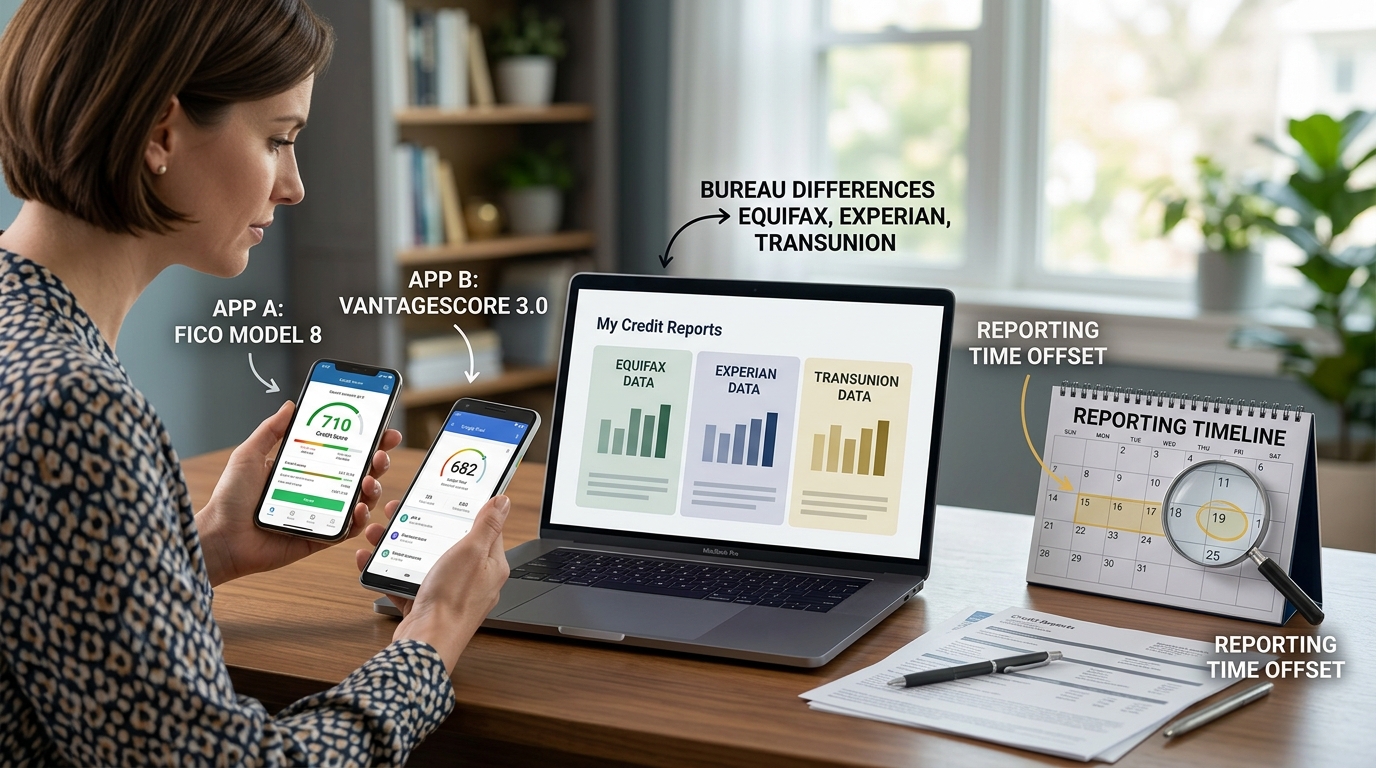
Nothing about your finances changed between the two checks—so why are the numbers different?
And which one, if either, is “right”?
This is one of the most common sources of confusion in personal finance. Once you understand how credit scoring actually works, however, the difference becomes much easier to explain.
The Short Answer
There isn’t one single universal credit score.
There are multiple credit-scoring models, information from three major credit bureaus, and different combinations of models and bureau data used by different financial institutions, lenders, banks, and monitoring services.
As a result, two legitimate apps can show different credit scores on the same day without either one being wrong.
The difference may come from:
- The scoring model being used.
- The credit bureau providing the underlying data.
- When the underlying credit information was last updated.
- The specific financial product or lender using the score.
So seeing different numbers is not necessarily a technical error. It is often a normal feature of the U.S. credit-scoring system.
For a broader explanation of the factors behind your score, see our guide on how credit scores are calculated.
Reason One: There Are Multiple Credit-Scoring Models
One of the biggest reasons your credit score can differ between apps is that there are multiple scoring models.
The two major scoring systems consumers commonly encounter are FICO and VantageScore.
Neither company has just one scoring formula.
FICO has released multiple generations and specialized versions of its scoring models. VantageScore has also developed multiple versions over time.
These models do not necessarily interpret the exact same credit-report information in exactly the same way.
Different models can place different emphasis on factors such as:
- Payment history.
- Credit utilization.
- Length of credit history.
- New credit.
- Credit mix.
- Certain types of negative information.
This means the same credit report can produce different scores depending on which scoring formula is applied.
FICO vs. VantageScore
FICO and VantageScore are separate scoring systems developed using different methodologies.
For example, an app may show a VantageScore while another service provides a FICO score.
Both can be legitimate scores based on your actual credit information.
That does not mean one is fake or that one has necessarily made a calculation error.
Reason Two: There Are Three Separate Credit Bureaus
The United States has three major nationwide credit reporting companies:
- Equifax
- Experian
- TransUnion
Each maintains its own credit file on you.
Those files do not necessarily contain identical information.
A creditor may report to all three bureaus, two bureaus, or in some circumstances only one bureau.
For example, imagine a credit card company reports an account to Experian but not to Equifax.
A score calculated using your Experian information could therefore reflect that account while a score calculated from your Equifax file might not.
Even if two apps use the same scoring model, they can produce different scores if they use data from different credit bureaus.
Reason Three: Credit Information Is Not Updated Everywhere at Exactly the Same Time
Another common explanation is timing.
Creditors do not all report information to the credit bureaus on the same schedule.
A credit card issuer may report around a particular point in its billing cycle, while another creditor reports at a different time.
There can also be processing delays between the time information is sent and the time it becomes visible in a particular credit file.
That means two apps checked a few days apart may be using different snapshots of your credit information.
Example: Paying Down a Credit Card
Imagine you pay down a large credit card balance on the 1st of the month.
Your card issuer does not report the lower balance until after the statement closes on the 15th.
If one app checks your credit information on the 5th, it may still reflect the older, higher balance.
If another app checks or refreshes your data on the 20th, it may reflect the lower balance.
Your financial behavior did not change between the two score checks. The underlying credit data simply changed at different points in the reporting cycle.
Reason Four: Different Apps Use Different Credit-Score Products
Even when two apps appear to offer “a credit score,” you should look at the details.
The apps may use:
- Different scoring companies.
- Different scoring-model versions.
- Different credit bureaus.
- Different update schedules.
For example, one service could show a VantageScore based on TransUnion information while another shows a FICO score based on Equifax information.
Those numbers are not supposed to be identical because they are answering slightly different questions using different data and formulas.
Many free consumer-facing monitoring tools use VantageScore, while lenders may use particular FICO versions depending on the type of credit being evaluated.
This is one reason the score you see in a free app may not be the exact score a lender uses when you apply for a mortgage, auto loan, or credit card.
A Concrete Example of How This Plays Out
Imagine you check your credit through three different sources on the same day.
- Your bank’s free score: VantageScore based on TransUnion data — 705.
- A separate monitoring service: FICO score based on Equifax data — 692.
- A mortgage lender: A mortgage-specific scoring model based on bureau information — 678.
All three numbers can be legitimate.
They are not necessarily competing claims about one universal score.
They are different calculations based on different combinations of models and credit information.
This is why using one free app’s score as an exact prediction of what every lender will see can be misleading.
Which Credit Score “Counts” for a Specific Purpose?
This is usually the more important question.
The answer depends on what you are applying for and which lender you are using.
Mortgage Applications
Mortgage lending can involve specific FICO scoring versions and credit information from multiple bureaus.
The exact scoring process depends on the lender and applicable underwriting requirements.
If you are preparing to buy a home, ask your mortgage lender or broker which credit scores they expect to use.
Auto Loans
Auto lenders may use industry-specific credit scores designed for automobile lending.
These models can evaluate certain aspects of your credit history differently from a general-purpose score.
Credit Card Applications
Credit card issuers can use different scoring models and credit bureaus.
One issuer may use a particular FICO version while another may use VantageScore or another credit-risk model.
There is therefore no guarantee that the score you see in a consumer app will be exactly the score used for your next credit-card application.
Should You Still Bother Checking Your Credit Score?
Yes.
The fact that different apps can show different numbers does not make credit monitoring useless.
You simply need to understand what the number is useful for.
Use Your Score as a Trend Indicator
If your score is steadily increasing over several months, that is useful information.
If it is consistently falling, that is also a reason to investigate what has changed.
The exact number is less important than understanding the direction of your credit profile over time.
Use Your Full Credit Report to Understand the Details
Your full credit report contains the underlying information used by scoring models.
That includes:
- Account balances.
- Payment history.
- Credit limits.
- Inquiries.
- Collection accounts.
- Other reported account information.
If something looks wrong, the credit report is where you should investigate it.
Our guide on how to read a credit report explains what to look for.
Get More Specific Information Before Major Applications
If you are preparing for a major loan application and need to understand your credit position as precisely as possible, find out which scoring model and bureau the lender is likely to use.
Depending on your situation, you may also consider obtaining access to a score product that provides the specific scoring versions relevant to your planned application.
Why Doesn’t the U.S. Have One Universal Credit Score?
The multiple-score system can seem unnecessarily complicated.
But different lending products carry different risks.
The factors that help predict the likelihood of default on an auto loan may not be identical to the factors that are most predictive for a credit card or mortgage.
That is one reason industry-specific scoring models exist.
Competition between scoring companies has also resulted in multiple approaches to evaluating credit risk.
At the same time, having three major credit bureaus means lenders and scoring companies can work from different underlying databases.
The result is a system where there is no single government-designated number that represents your one universally “correct” credit score.
How to Get the Clearest Possible Picture of Your Credit
1. Review All Three Credit Reports
Use AnnualCreditReport.com to access your official credit reports.
Looking at the actual reports allows you to compare the information maintained by Equifax, Experian, and TransUnion rather than relying only on a score shown by an app.
2. Check More Than One Score Source Occasionally
It can be useful to see how your score behaves across more than one legitimate source.
Do not expect the numbers to match exactly.
Instead, look for the broader pattern.
3. Investigate Major Differences
A small difference between scores is not necessarily concerning.
If you see a substantially larger difference, review the underlying reports and determine whether one bureau has information that another does not.
4. Ask Your Lender Before a Major Application
If you are preparing for a mortgage, auto loan, or another major credit application, ask the lender which bureau and scoring model they expect to use.
This can give you a more realistic understanding of what score information may matter for that particular application.
5. Don’t Panic Over Normal Differences
A difference of 10, 20, or even 30 points between legitimate scoring sources can occur for understandable reasons.
The difference does not automatically mean that one app is wrong.
Frequently Asked Questions
Is one credit-scoring model more accurate than the others?
There is not one universal score that is always the most accurate for every purpose.
A score’s usefulness depends on the model, the underlying data, and the type of lending decision for which it is designed.
Why does my bank show a different score from my free credit-monitoring app?
The two services may be using different scoring models, different credit bureaus, or different reporting snapshots.
Check the details provided by each service to see which model and bureau are being used.
If I dispute an error, will every credit score improve by the same number of points?
Not necessarily.
If an error appears on only one credit bureau’s report, scores based on that bureau’s information may be affected differently from scores based on another bureau.
Different scoring models can also react differently to the same corrected information.
If you find an error, see our guide on how to dispute credit report errors.
Does checking my score through multiple apps hurt my credit?
No.
Checking your own credit score through legitimate monitoring services is generally considered a soft inquiry and does not lower your credit score.
You can check your score through multiple services without creating multiple hard inquiries simply because you viewed your own score.
Is it worth paying for a service that shows my FICO score?
It depends on your situation.
For ordinary monitoring, free score tools may provide enough information to track your general credit trend.
If you are preparing for a major application and want access to a specific FICO version that is relevant to the type of loan you are pursuing, paying for more specialized information may provide additional insight.
A Deeper Look at FICO vs. VantageScore
FICO and VantageScore are two of the most widely recognized scoring systems, but they approach scoring differently.
FICO Scores
FICO has developed multiple scoring models and versions, including models designed for specific industries.
Some FICO models require a certain amount of credit-history information before generating a score.
The precise minimum requirements depend on the specific FICO model being used.
VantageScore
VantageScore was developed by the three major credit bureaus as a separate scoring system.
Some VantageScore versions can generate scores with relatively limited credit history, which makes them useful for consumer-facing monitoring services.
Why the Two Can Differ
The two systems can differ in how they evaluate certain credit-report information.
They may also differ in their treatment of:
- Negative accounts.
- Collections.
- Credit-history length.
- Recent inquiries.
- Other aspects of the credit profile.
Therefore, seeing a FICO score and a VantageScore that are not identical is completely normal.
How to Find Out Which Score a Specific Lender Uses
Ask the Lender Directly
For an important loan application, ask the lender which credit bureau and scoring model it typically uses.
This can be particularly useful for mortgage applications because the scoring process can differ from the score shown in a free consumer app.
Review Required Disclosures
Depending on the circumstances, lenders may provide disclosures that identify credit-score information used in an adverse-action decision or other required notice.
These documents can sometimes help you understand which score was used after the application process.
Use General Industry Knowledge Carefully
It can be useful to know that different industries commonly use different types of credit scores.
However, these are general patterns rather than guarantees.
The safest approach before a major application is to ask the specific lender what it uses.
Educational Scores vs. Scores Used by Lenders
Some consumer credit-monitoring services describe the score they provide as an “educational score.”
This does not necessarily mean the score is fake.
It generally means the score is designed to help consumers understand and monitor their credit rather than necessarily matching the exact score a particular lender uses for underwriting.
An educational score can still be useful for tracking trends.
Always read the description provided by the app or service so you know exactly what type of score you are viewing.
Frequently Asked Questions About Credit-Score Differences
Do all three credit bureaus offer FICO and VantageScore?
The three major credit bureaus can provide data used by different scoring models.
It is not accurate to assume that one bureau exclusively uses one scoring company. The score product being requested determines which scoring model is applied to the bureau’s underlying data.
Should I worry if two scores differ by 50 points?
A larger difference is worth investigating, but it does not automatically mean that one score is wrong.
Check whether the two sources are using:
- The same credit bureau.
- The same scoring model.
- The same model version.
- Similar update dates.
Then compare the underlying credit reports to see whether the information itself differs.
Does my income explain why two apps show different credit scores?
No.
Income and employment information are not standard components of traditional credit-scoring formulas.
Differences between credit scores are generally explained by the scoring model, bureau data, and timing rather than your income.
Is there one official government credit score?
No.
There is no single government-designated universal credit score that overrides every other scoring model.
The score that matters depends on the particular lender, product, scoring model, and credit bureau involved.
A Timeline Example: How Reporting Delays Create Different Scores
Consider this example:
On the 1st of the month, you pay off a large credit card balance.
Your card issuer’s statement closes on the 15th.
The issuer then reports the updated balance to the credit bureaus, and the bureaus process the information.
If you check one monitoring app on the 5th, it may still show the previous higher balance.
If you check another source on the 20th, the lower balance may already be reflected.
Your financial behavior did not change between those checks.
The difference is simply that the two sources were showing information from different points in the reporting cycle.
This is one of the most common reasons people think their credit apps are contradicting each other.
Frequently Asked Questions About Credit-Score Updates
Does refreshing the same app repeatedly change my score?
No. Refreshing the app does not itself change your credit information.
If the underlying credit file has not been updated, repeatedly checking the app will generally show the same information.
Can two lenders using the same model and bureau see different scores?
If they request exactly the same scoring model using the same bureau’s data at essentially the same time, the score should generally be the same.
Differences can arise if the requests occur at different times relative to a recent credit-file update.
Why did my score change immediately after I checked it?
Checking your own score does not cause a score change.
If the score changed around the time you checked it, another event—such as a newly reported payment, balance update, or account change—may have occurred at roughly the same time.
The timing can create the impression that checking caused the change when it did not.
What Should You Focus on Instead of Matching Every Score?
If two apps show different numbers, resist the temptation to decide that one must be wrong immediately.
Instead, focus on four questions:
- Which scoring model is being used?
- Which credit bureau supplied the data?
- When was the underlying data last updated?
- Is the overall trend improving, declining, or remaining stable?
These questions are usually more useful than trying to force every app to display the same number.
How to Monitor Your Credit More Effectively
A practical credit-monitoring routine can include several layers.
Review Your Full Credit Reports
Do not rely exclusively on credit-score apps.
Review the actual credit reports from Equifax, Experian, and TransUnion so you can see the underlying information.
For guidance on how frequently to review your reports, see how often you should check your credit report.
Use Free Score Monitoring for Trends
A free score displayed by your bank or another legitimate monitoring service can be useful for tracking whether your credit profile is generally moving in the right direction.
Investigate Unexpected Changes
If your score changes substantially, check your reports for:
- A new account.
- A new hard inquiry.
- A changed credit-card balance.
- A late payment.
- A collection account.
- An account closure.
- Another significant change.
If you find inaccurate information, investigate the appropriate dispute process.
Focus on the Underlying Credit Data
The score is a summary.
The credit report contains the underlying information that produced that summary.
Keeping that information accurate is therefore more important than making every score displayed by every app match perfectly.
The Bottom Line
Two different credit score apps showing two different numbers is usually not a bug.
It is a normal consequence of a credit system that uses:
- Multiple scoring models.
- Three separate credit bureaus.
- Different reporting schedules.
- Different model versions and lender-specific scoring products.
There is no single universal number that every lender uses.
Instead of worrying that one app must be wrong, find out what model and bureau each service uses and pay attention to the broader trend.
When accuracy matters for a major financial decision, such as applying for a mortgage or auto loan, ask the lender which score it expects to use.
Most importantly, do not rely solely on an app’s score. Review the underlying information in your credit reports and make sure it is accurate.
If you discover inaccurate information, our guides on disputing credit report errors and credit report errors can help you understand the next steps.
Need Help Understanding Your Credit Reports?
If different credit apps are showing confusing numbers or you have found inaccurate information on your credit reports, reviewing the underlying data is the best place to start.
Contact Credit Repair Services to discuss your credit situation →