
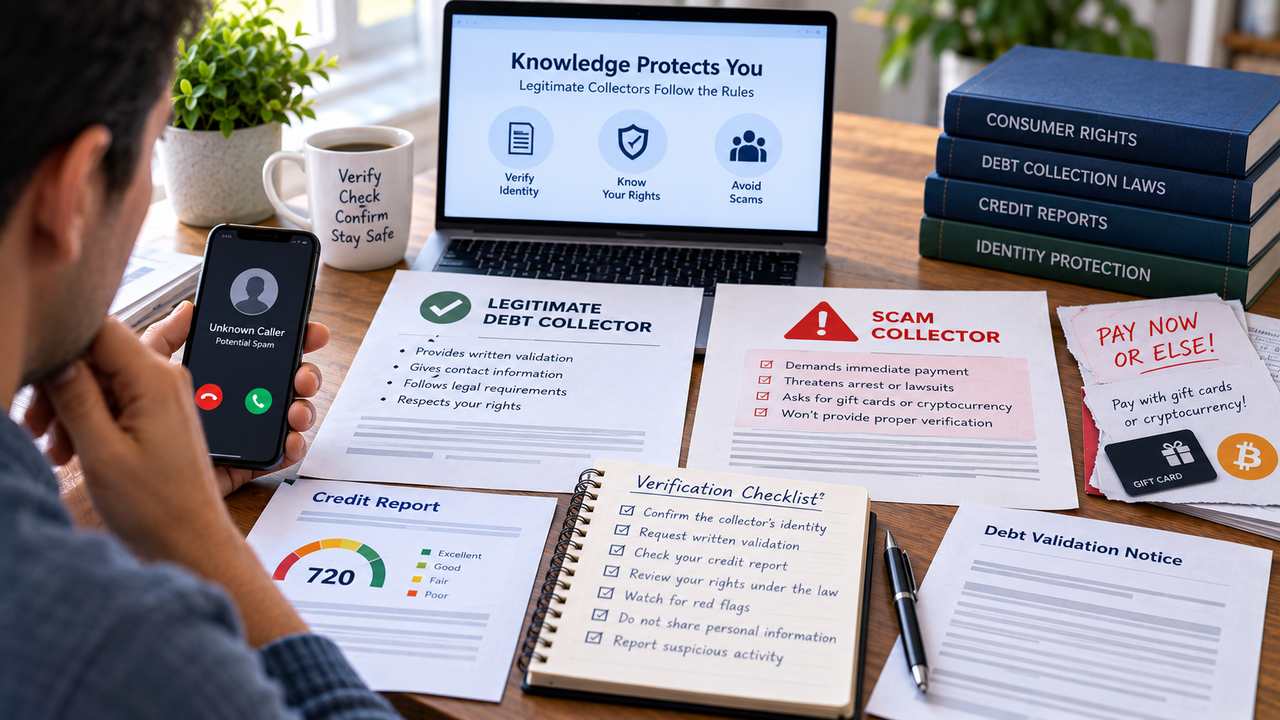
The Core Red Flags of a Scam
Demands for payment through gift cards, wire transfers, cryptocurrency, or prepaid debit cards. This is one of the most reliable scam indicators across virtually all types of fraud, not just debt collection. Legitimate debt collectors accept standard, traceable payment methods — checks, standard bank transfers, credit or debit card payments — and have no legitimate reason to insist specifically on these harder-to-trace, harder-to-reverse payment forms.
The Federal Trade Commission’s guidance on gift card scams specifically warns consumers that anyone who demands payment by gift card is displaying a major fraud warning sign.
Extreme urgency and pressure to pay immediately. Real debt, however old, doesn’t expire in the next few hours. A caller insisting you must pay today, right now, before you have any chance to research or verify anything, is exhibiting a classic pressure tactic scammers rely on specifically because it works against careful, rational decision-making.
Threats of immediate arrest or law enforcement action. Unpaid consumer debt in the United States is a civil matter, not a criminal one. No legitimate debt collector can have you arrested for an unpaid credit card, medical bill, or personal loan. Any threat of imminent arrest for unpaid debt is a clear, reliable sign of either a scam or a company operating illegally.
Refusal to provide written validation when requested. Legitimate collectors are legally required to provide this upon request, and while a real collector might sometimes be slow or need a follow-up reminder, an outright refusal or evasiveness about this basic legal obligation is a significant warning sign.
The Consumer Financial Protection Bureau’s Regulation F guidance explains requirements concerning information debt collectors must provide to consumers, including validation information in covered collection communications.
Inability or unwillingness to identify the specific company and provide verifiable contact information. A legitimate collector should be able to tell you their company name, provide a callback number, and give you a mailing address — vague or evasive answers to these basic questions are cause for real skepticism.
Requests for sensitive information beyond what’s needed to identify the account. A legitimate collector generally already has enough information to confirm they’ve reached the right person and doesn’t need you to read out your full Social Security Number, bank account numbers, or similar sensitive details over an unverified phone call.
How Scammers Make Themselves Sound Legitimate
Understanding their tactics helps you stay skeptical even when something initially sounds convincing:
- Using real personal information, obtained through data breaches. Scammers sometimes have access to genuine personal details (your name, address, even partial account information) obtained through data breaches, which they use to sound credible and knowledgeable, even though this doesn’t mean the underlying debt claim itself is legitimate.
- Adopting official-sounding company names. Scam operations sometimes choose names deliberately similar to real, well-known companies or government agencies, hoping the similarity alone will discourage close scrutiny.
- Referencing real debts you may have had at some point, even if the debt has already been paid, discharged in bankruptcy, or is being fraudulently claimed by an unrelated party, betting that the general familiarity of “yes, I did have a debt like that once” will short-circuit your careful verification instinct.
- Using caller ID spoofing to make an incoming call appear to come from a legitimate-looking or even local number, which has become increasingly technically easy to fake and shouldn’t be relied on as a verification method on its own.
The FTC’s consumer guidance on caller ID spoofing explains why the number displayed on your phone should not be treated as proof of who is calling.
How to Actually Verify Legitimacy
Ask for everything in writing before engaging further. A legitimate collector should be willing and able to send you written information about the debt, including formal validation if you request it, without needing to resolve everything on the initial call.
Hang up and call back using independently sourced contact information. Rather than trusting a number the caller gives you, or a callback number from an incoming call, look up the company’s official contact information yourself — through their official website, or, if they claim to represent a specific original creditor, by contacting that original creditor directly to confirm whether they’ve actually placed or sold your account with this specific company.
Check your own credit report. If a legitimate debt exists and has been placed with a collector, it will very often (though not always, particularly for very recent placements) show up on your credit report, giving you independent confirmation the account exists, separate from whatever the caller is telling you.
You can obtain your credit reports through AnnualCreditReport.com, the official federally authorized source for free credit reports.
If you need help understanding what you find, see our guide on how to read a credit report.
Search the company name alongside terms like “scam,” “complaints,” or “reviews.” While not a perfectly reliable method on its own (legitimate companies can have complaints too, and sophisticated scammers sometimes create fake positive reviews), a pattern of widespread, consistent scam reports is a meaningful warning sign worth taking seriously.
Check whether the company is registered or licensed in your state, if your state requires this. Many states require debt collectors to register or obtain a license to operate, and some maintain publicly searchable databases through the state’s department of financial regulation, providing another verification avenue.
What a Legitimate Collector Will and Won’t Do
Will: provide written validation upon request, identify themselves and their company clearly, accept standard payment methods, honor a request to communicate only in writing, and generally allow you time to verify information before demanding immediate payment.
Won’t (if operating legally): threaten arrest for unpaid civil debt, demand payment exclusively through gift cards or cryptocurrency, refuse to provide any written information about the debt, or use genuinely abusive, threatening, or harassing language.
The CFPB’s debt collection resources explain consumer rights and restrictions that apply to covered debt collectors under federal law.
What to Do If You Suspect a Scam
Don’t provide any payment or sensitive personal information. If something feels off, it’s always reasonable to simply end the call or not respond to a suspicious message, taking time to verify before engaging further.
Report it. The Federal Trade Commission’s ReportFraud.gov and the Consumer Financial Protection Bureau complaint system both accept complaints about suspected debt collection scams, and reporting helps build the case against repeat offenders even if it doesn’t resolve your individual situation immediately.
Alert your bank if you’ve already provided any financial information, so they can monitor for and help protect against unauthorized activity.
Consider a fraud alert or credit freeze if you believe your personal information has been compromised in a way that could lead to further fraudulent activity beyond just this one contact attempt.
Our guide on identity theft protection covers additional steps you can take if you believe your personal information has been compromised.
You can also learn about the difference between a credit freeze and a fraud alert before deciding which protection is appropriate for your situation.
What If the Debt Is Real, But the Specific Collector Contacting You Isn’t Legitimate?
This is a genuinely tricky and increasingly common scenario: you might have a real debt, but be contacted by a scammer who’s somehow aware of it (through a data breach, or by impersonating a legitimate collector who does actually own the account) attempting to collect fraudulently, separate from any legitimate collection effort. In this case, the appropriate response is the same — don’t pay or provide information to the suspicious contact — but it’s also worth proactively contacting the actual, verified original creditor or a legitimately identified current debt owner (found independently, not through the suspicious contact) to address the real underlying debt through proper channels.
A Practical Verification Checklist
- Did they demand an unusual, hard-to-trace payment method? If yes, treat with strong suspicion.
- Did they threaten arrest or immediate legal action within hours? If yes, this is not legally accurate for consumer debt and is a red flag.
- Were they willing to provide written information and a verifiable company name and contact information? If no, or if evasive, be skeptical.
- Have you independently verified the company’s legitimacy — through your own research, your credit report, or contacting the claimed original creditor directly? If not yet, do this before any further engagement.
- Are they pressuring you to decide and pay within an unreasonably short window? If yes, this urgency tactic is a common scam indicator, even when the rest of the interaction seems otherwise plausible.
Frequently Asked Questions
Can a scammer know real details about my actual debts?
Yes, unfortunately — data breaches affecting banks, retailers, and other companies have exposed enormous amounts of personal and financial information over the years, and scammers sometimes purchase or otherwise obtain this data, using genuine details to make fraudulent contact attempts sound more credible than they actually are.
Is it a scam if the caller has my correct Social Security Number?
Not necessarily proof either way — having your SSN doesn’t confirm they’re legitimate (this information can be obtained through breaches or other illegitimate means) nor does it necessarily mean they’re a scam. Legitimacy needs to be verified through the broader checklist in this guide, not through any single piece of information they happen to have.
Should I ever give my debit or credit card number to a debt collector over the phone?
This is generally not recommended as a first step, even with a collector you believe is legitimate — it’s safer to request written validation first, verify the company independently, and then make any payment through a method and channel you’ve independently confirmed, such as calling back using a number you looked up yourself, rather than providing card details during an unsolicited or unverified call.
What if the “collector” claims to be a law firm rather than a standard collection agency?
Some legitimate law firms do handle debt collection, particularly once a matter has progressed toward or into litigation, but this claim should be verified the same way as any other — checking the firm’s actual bar registration and legitimate contact information independently, rather than assuming the “law firm” framing alone confirms legitimacy or increases urgency.
Is there a specific government database I can check to verify a debt collector’s legitimacy?
The CFPB’s consumer complaint database allows you to search for complaints against specific companies, and many state financial regulatory agencies maintain licensing databases — while neither is a perfect, complete verification tool on its own, both provide useful additional data points when combined with the other verification steps in this guide.
A Deeper Look at Common Debt Collection Scam Variants
Understanding the specific patterns scammers commonly use helps you recognize them faster in the moment, rather than needing to work through a full checklist each time.
The “phantom debt” scam, where the caller claims you owe a debt that doesn’t actually exist at all — sometimes for a payday loan you never took out, or an old debt that’s already been paid or discharged, betting that the general anxiety and confusion the call creates will lead to a quick payment without careful verification.
The “fake law firm” scam, where callers claim to represent a law firm, sometimes threatening an imminent lawsuit or even claiming a lawsuit has already been filed, when no such legal action actually exists, designed to create heightened urgency and fear beyond what a standard collection call might produce.
The “government impersonation” scam, where callers falsely claim to represent a government agency (sometimes referencing the IRS, a court, or law enforcement) in connection with an alleged debt, leveraging the added authority and fear associated with government contact to pressure faster, less-questioned compliance.
The “debt relief” scam, somewhat different in structure, where a company falsely claims to be able to negotiate or eliminate your real debts in exchange for upfront fees, sometimes instructing you to stop paying your actual creditors while they supposedly negotiate on your behalf — a pattern that can leave you both out the upfront fee and further behind on your actual, real obligations.
Before working with any company offering debt relief or credit-related services, it is worth understanding how credit repair works and what legitimate services can and cannot do.
What to Do If You’ve Already Sent Money to a Scammer
If you’ve already made a payment before recognizing the scam, acting quickly matters, though options vary by payment method. If you paid by credit card, contact your card issuer immediately to dispute the charge, which offers the strongest built-in consumer protection among common payment methods. If you paid via bank transfer, contact your bank immediately, since some transfers can potentially be reversed if caught quickly enough, though this becomes less likely the more time has passed. If you paid via gift card or wire transfer, unfortunately, recovery is often very difficult or impossible, though reporting to the FTC and the gift card issuer (some companies have specific fraud reporting processes) is still worth doing, both for your own records and to support broader enforcement efforts against the scammer.
If you believe a fraudulent credit-card transaction occurred, our guide on how to dispute a fraudulent credit card charge explains the basic dispute process.
The FTC’s guidance on what to do after being scammed provides additional steps for reporting fraud and protecting your accounts.
How Legitimate Companies Sometimes Get Mistaken for Scams
It’s worth acknowledging the reverse situation too: legitimate debt collectors sometimes get flagged as suspicious simply because collection calls are inherently unwelcome and anxiety-inducing, leading people to assume the worst even when the company is operating entirely within legal bounds. A legitimate collector calling from an unfamiliar number, discussing an old debt you’d genuinely forgotten about, using standard industry terminology that sounds unfamiliar to you, isn’t automatically a scam simply because it’s uncomfortable or unexpected. The verification checklist in this guide is designed to help you distinguish between “unfamiliar and uncomfortable” (which legitimate collection calls often are) and “actually fraudulent” (which requires the specific red flags covered throughout this guide), rather than treating every unexpected collection contact as automatically suspicious.
Frequently Asked Questions, Continued
Can I ask a caller to prove their legitimacy on the spot, during the call itself?
You can ask, but be aware that a sophisticated scammer may have prepared answers to common verification questions — the more reliable approach remains independent verification after the call (calling back using information you look up yourself, checking your credit report, contacting the claimed original creditor directly) rather than relying solely on what the caller tells you during the conversation itself.
Is it a scam if I don’t recognize the original creditor they mention?
Not automatically — as covered in guides about zombie debt and debt resale, legitimate old debt can genuinely trace back to a creditor you’ve forgotten about, or the account may have originated with a company that’s since merged, been renamed, or is otherwise less immediately recognizable. This alone isn’t proof of a scam, though it does warrant the same careful verification process as any other collection contact.
Do scammers ever send physical mail, or is this primarily a phone-based scam?
Scammers do send physical mail as well, sometimes designed to look official or urgent, so the same verification principles apply regardless of the contact method — don’t respond with payment or sensitive information based solely on an unverified letter any more than you would an unverified phone call.
Should I report a suspected scam even if I didn’t lose any money?
Yes — reporting suspected scam attempts, even unsuccessful ones, to the FTC and CFPB helps regulators identify patterns and take action against repeat offenders, potentially protecting others who might be more vulnerable to a similar attempt in the future.
A Comparison Table: Legitimate Collector vs. Scam Indicators
| Behavior | Legitimate Collector | Scam Red Flag |
|---|---|---|
| Payment methods accepted | Checks, cards, standard bank transfer | Insists on gift cards, crypto, wire only |
| Response to validation request | Provides in writing, may take time | Refuses or stalls indefinitely |
| Urgency | Willing to let you research and respond | Demands payment within hours |
| Legal threats | Accurate — civil consequences only | Threatens arrest for unpaid debt |
| Company identification | Clear name, verifiable address/number | Vague, evasive, or unverifiable |
| Willingness to communicate in writing | Yes, upon request | Avoids written communication |
Keeping this comparison in mind during any unexpected collection contact gives you a fast, practical way to assess the situation in the moment, before deciding how — or whether — to engage further.
Frequently Asked Questions, Continued Further
Do scam debt collectors typically target specific demographics more than others?
Unfortunately, yes — scammers often specifically target populations perceived as more vulnerable or less likely to push back, including elderly individuals, recent immigrants less familiar with U.S. debt collection norms, and people already under significant financial stress who may feel less equipped to carefully scrutinize a stressful call. Being aware of this pattern is useful both for your own vigilance and for watching out for family members who might be more susceptible to this kind of targeting.
Can text message or email debt collection attempts be scams too, not just phone calls?
Yes, absolutely — as legitimate debt collection has expanded to include email and text communication (subject to specific consent and opt-out requirements under updated FDCPA regulations), scammers have adapted the same tactics to these channels, making the same verification principles just as relevant to a suspicious text or email as to a phone call.
Is it worth blocking a number after a suspected scam call, or does that not accomplish much given how easily numbers can be spoofed?
Blocking a specific number provides some benefit even though spoofing means a scammer could call again from a different number — it at least prevents repeat contact from that exact number and takes only a moment, making it a reasonable low-effort step even if it’s not a complete, permanent solution against a persistent scammer using multiple spoofed numbers.
The Bottom Line
Distinguishing a legitimate debt collector from a scam comes down to a consistent set of reliable warning signs — demands for untraceable payment methods, threats of arrest, extreme urgency, and refusal to provide written validation or verifiable company information — combined with proactive, independent verification on your part rather than simply trusting whatever the caller tells you. Legitimate collectors are ultimately fine with you taking time to verify and respond in writing; scammers depend on you not doing so. When in doubt, slow down, hang up, verify independently, and never provide payment or sensitive information based purely on pressure from an unverified contact.
Need Help Reviewing Your Credit Report?
If you’ve received a suspicious collection notice or found an unfamiliar collection account on your credit report, reviewing the account details can help you determine what information is being reported and whether there are potential inaccuracies.
Request a Credit Audit to discuss your credit situation and potential next steps.