Private vs. Federal Student Loans: Why the Distinction Matters So Much Here
Federal student loans come with a standardized set of borrower protections, hardship programs, and specific collection rules established by the Department of Education. Private student loans, issued by banks, credit unions, or specialized private lenders, are governed instead by the individual loan agreement’s terms and general consumer lending law — meaning the protections and options available depend heavily on your specific lender and the specific terms you originally agreed to, rather than a uniform federal framework.
This means advice you might have heard about federal student loan forgiveness programs, income-driven repayment plans, or federal loan rehabilitation generally does not apply to private student loans, which is one of the most common and consequential points of confusion for borrowers trying to navigate default and collection.
What Typically Happens When a Private Student Loan Goes Into Default
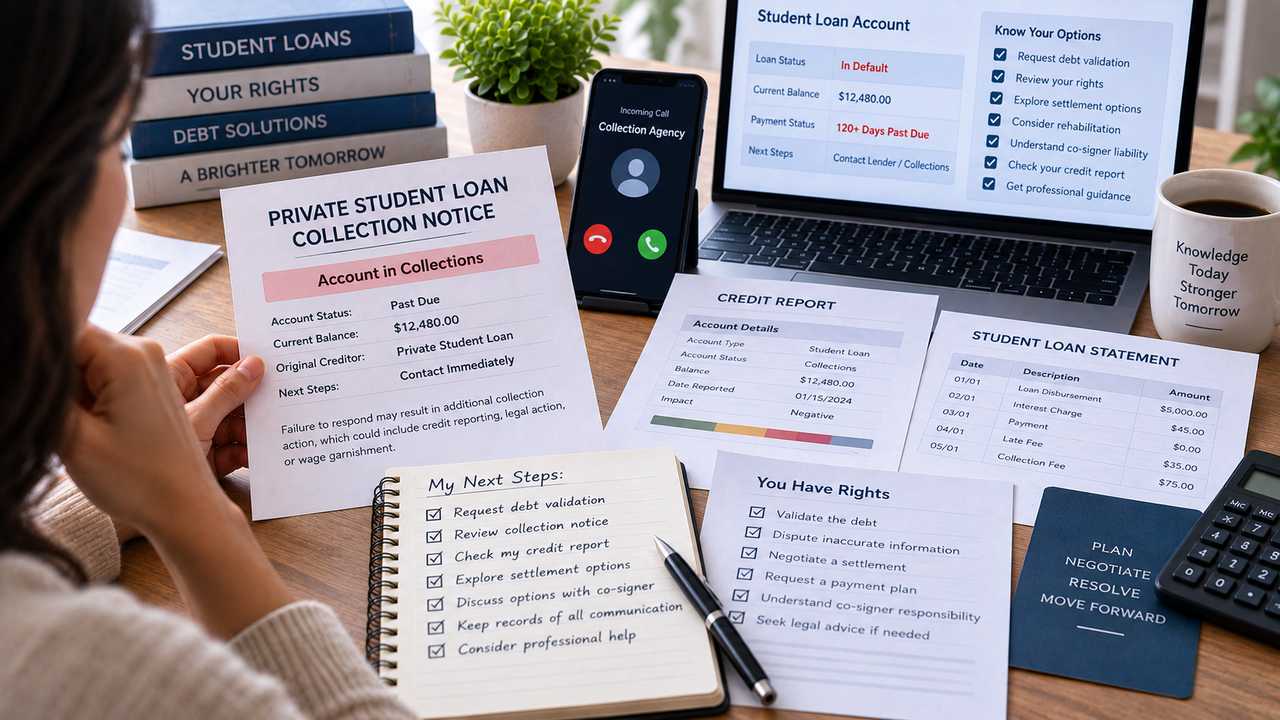
Delinquency begins with a missed payment, and continues through a series of increasingly serious notices from your loan servicer.
Default is typically declared after a specific period of continued nonpayment, commonly around 90-120 days, though the exact timeline is governed by your specific loan agreement and can vary between lenders.
The loan is often accelerated, meaning the full remaining balance (not just the missed payments) becomes immediately due, a common provision in private loan agreements once default is declared.
Collection efforts begin, either through the original lender’s internal collections department, a third-party collection agency working on the lender’s behalf, or, after a sale, a debt buyer who now owns the loan outright.
Credit reporting reflects the default, appearing as a serious negative item on your credit report, following the standard rules for negative credit information (generally the seven-year reporting window from the original delinquency date).
If you need help understanding what is currently appearing on your credit reports, you can also review our guide on how to read a credit report.
Who Actually Collects Private Student Loan Debt
The original lender’s internal collections team, in the earlier stages of delinquency and default.
Third-party collection agencies, hired by the lender to pursue collection for a commission, common once internal efforts haven’t succeeded.
Debt buyers, who purchase defaulted private student loan portfolios outright, similar to how other unsecured consumer debt gets bought and sold — this is a well-established part of the private student loan collection landscape, and it’s worth knowing that companies specializing in this specific category (some tied to entities like National Collegiate Student Loan Trusts, which purchased and pooled large numbers of private student loans as investment assets) have faced regulatory scrutiny in the past for collection practices, including documentation gaps in proving they actually own specific loans they’re pursuing.
Your Rights During Private Student Loan Collection
Since private student loans are collected by third parties (agencies or debt buyers) in many cases, the Fair Debt Collection Practices Act generally applies, providing the same core protections as with any other debt collector: restricted calling hours, no harassment or false threats, and your right to request formal debt validation.
Debt validation is particularly important for private student loans specifically, given the documented history of some loan trusts and their collectors struggling to produce complete documentation proving ownership and accurate loan details, particularly for loans that have been bundled, securitized, and resold multiple times since origination.
If you are dealing with a collector and want to understand the validation process, our guide to debt validation letters provides additional information.
Can You Be Sued Over a Defaulted Private Student Loan?
Yes — private lenders and debt buyers retain the same legal right to sue over unpaid debt as with other consumer debt, subject to your state’s statute of limitations. Given that private student loans are often larger balances than typical consumer debt, and given the accelerated full-balance-due provision common in these loan agreements, litigation is a real possibility for defaulted private student loans, making it especially important to respond promptly and appropriately if you’re ever served with a lawsuit related to one.
You can also learn more about the statute of limitations on debt and why the applicable state law matters.
Are There Any Hardship Options for Private Student Loans?
Unlike federal loans, which have standardized deferment and forbearance programs, private lenders’ hardship options vary considerably and aren’t guaranteed by law — some private lenders do offer temporary payment reduction, deferment, or forbearance programs, particularly proactively, before default occurs, but this is entirely dependent on your specific lender’s policies rather than a uniform right. It’s worth contacting your loan servicer directly, as early as possible if you’re struggling, to ask specifically what hardship options they offer, since this varies enough that you shouldn’t assume either that options exist or that they don’t without checking directly.
What About Co-Signers?
Many private student loans require a co-signer, particularly for borrowers with limited credit history at the time of origination — often a parent or other family member. If the loan defaults, the co-signer is generally just as legally responsible for the debt as the primary borrower, and collection efforts (including potential litigation) can target either or both parties. Some private lenders offer a “co-signer release” option after a period of consistent, on-time payments, which removes the co-signer’s obligation going forward — but this needs to be specifically requested and approved before default occurs; once a loan is in default, co-signer release is generally no longer an available option, and the co-signer’s liability remains fully intact alongside the primary borrower’s.
Refinancing or Consolidating a Defaulted Private Student Loan
Unlike federal loans, which have a specific “loan rehabilitation” process (covered in more detail in a related guide), private student loans don’t have an equivalent standardized rehabilitation program. Some borrowers explore refinancing a defaulted private loan through a different lender, though qualifying for refinancing typically requires demonstrating improved creditworthiness, which can be genuinely difficult immediately following a default — this option becomes more realistic once you’ve rebuilt your credit somewhat, potentially after resolving the defaulted loan through settlement or payment first.
Settlement as an Option for Defaulted Private Student Loans
If your loan has been sold to a debt buyer, similar settlement negotiation principles apply as with other debt buyer-owned consumer debt — since these companies typically purchase defaulted loan portfolios at a discount, there’s often genuine room to negotiate a reduced lump-sum settlement. If the loan is still with the original lender or their agency, flexibility may be more limited but is still worth exploring directly.
If you’re considering settlement, our guide to pay-for-delete explains an important but separate credit-reporting concept that can arise during negotiations with collectors.
What Happens to Private Student Loans If the Borrower Dies or Becomes Disabled?
This varies significantly by lender — some private lenders do offer death or disability discharge provisions similar to federal loans, while others do not, meaning the loan (and any co-signer’s liability) could persist even in these circumstances. This is exactly the kind of detail worth checking in your specific loan’s terms, or asking your servicer directly about, since it’s not a universal protection the way it is for federal loans.
Frequently Asked Questions
Does defaulting on a private student loan affect my ability to get federal financial aid for future education?
Generally, defaulting on a private loan specifically doesn’t directly affect federal aid eligibility the way defaulting on a federal loan would, since these are separate systems, though your overall credit situation and financial circumstances could indirectly complicate other aspects of financing further education.
Can a private student loan collector garnish my wages without a court judgment, similar to federal loans?
No — unlike federal student loans, which have specific administrative wage garnishment authority without requiring a separate lawsuit, private student loan lenders generally must obtain a court judgment first before pursuing wage garnishment, following the same process as other private consumer debt.
Is Private Student Loan Debt Dischargeable in Bankruptcy?
This has historically been treated as difficult to discharge (similar to federal student loans, requiring a showing of “undue hardship” through a separate legal proceeding within the bankruptcy case), though this area of law has seen some evolution and increased successful discharges in recent years — consulting a bankruptcy attorney specifically experienced with student loan discharge is worthwhile if you’re considering this path.
How Do I Find Out If My Private Student Loan Has Been Sold to a Debt Buyer?
Checking your credit report for the name of whichever company is currently reporting the account is one way to identify a potential change in ownership, and formally requesting debt validation from whoever is currently contacting you should clarify their specific relationship to and ownership of the loan.
Should I Be More Cautious With a Private Student Loan Collector Than Other Types of Debt Collectors?
Given the well-documented pattern of some private student loan trusts and their collectors struggling to prove clear ownership and accurate loan details, particularly for older, resold loans, it’s reasonable to be especially diligent about requesting and carefully reviewing full validation documentation before agreeing to any payment or settlement for this specific category of debt.
A Closer Look at the National Collegiate Student Loan Trusts Situation
Because this specific category of private student loan debt has been the subject of notable regulatory action, it’s worth understanding a bit more detail if your loan traces back to one of these trusts. National Collegiate Student Loan Trusts (NCSLT) is actually a collection of numerous individual trusts that purchased private student loans originally issued by various banks, bundled them together as investment assets, and hired collection companies (including, historically, Transworld Systems Inc.) to pursue collection, sometimes including litigation, on defaulted accounts.
A well-documented complication in this specific corner of the debt collection industry has been proving the actual chain of ownership: because these loans were often bundled, securitized, and transferred multiple times between the original lender and the specific trust now claiming ownership, courts around the country have, in numerous cases, found that the trusts and their collectors couldn’t produce adequate documentation proving they actually owned the specific loan in question, or that the claimed amount was accurate. If you have a defaulted private student loan connected to one of these trusts, requesting complete documentation of the chain of ownership — not just a claim that you owe money, but actual proof connecting the original loan through whatever transfers occurred to the specific trust and current collector’s authority — is a particularly well-founded strategy given this documented history.
How Loan Servicers Differ From Loan Owners in the Private Student Loan World
It’s worth understanding a distinction that can cause confusion: the company sending you monthly statements and handling day-to-day communication (the “servicer”) isn’t always the same entity that actually owns your loan. This is common even for loans in good standing, not just defaulted ones — a bank might originate a loan, sell it to an investor or trust, and then contract with a separate servicing company to handle the actual billing and customer communication. Once a loan defaults, this same structure often persists into the collection phase, meaning the company calling you about a defaulted private loan may be a servicer acting on behalf of the actual owner, rather than the owner itself — a distinction worth clarifying through the validation process, since it affects who actually has ultimate authority to negotiate or forgive any portion of the debt.
A Practical Checklist for Someone Facing Private Student Loan Default
- Contact your servicer as early as possible once you anticipate difficulty paying, before default occurs, to ask about any available hardship options specific to your lender.
- If default has already occurred, request formal debt validation from whoever is currently contacting you, specifically including documentation of loan ownership if the loan appears to have been sold.
- Check whether a co-signer is involved, and if so, keep them informed given their equal legal exposure to any collection or litigation.
- If sued, respond by the deadline regardless of your view on the debt’s validity, and strongly consider at least a consultation with a consumer law or student loan-specific attorney given the documented ownership-proof issues in this specific lending category.
- Explore settlement if the loan has been sold to a debt buyer, since meaningful negotiating room often exists given the discounted purchase price these buyers typically pay.
Frequently Asked Questions, Continued
Does refinancing federal loans into a private loan create the same collection risks discussed in this guide?
Yes — once federal loans are refinanced into a private loan (a decision some borrowers make to secure a lower interest rate, though this permanently forfeits federal loan protections and programs), that new private loan is subject to the same private collection rules and lack of standardized hardship programs discussed throughout this guide, which is an important consideration before choosing to refinance federal loans into private ones in the first place.
Can a private student loan default affect a professional license or federal benefits the way some federal loan defaults historically could?
Private student loan default doesn’t carry the same specific administrative consequences (like federal benefit offset) that federal loan default can trigger, since those specific consequences are tied to federal loan programs and their unique enforcement authority, though a private loan default’s broader credit and financial impact, and potential litigation, still carries serious real-world consequences of its own.
Is it worth negotiating a settlement on a private student loan before or after being sued?
Both timing points offer negotiation opportunities, though settling before litigation begins is generally simpler and less costly (avoiding court fees and the stress of active litigation) if you’re confident you want to resolve the debt rather than potentially contest documentation issues that a lawsuit’s discovery process might reveal in your favor.
How Private Student Loan Interest Rates and Fees Change After Default
Beyond the acceleration of the full balance, it’s worth understanding that default often triggers other contractual consequences specific to private loans: a higher default interest rate may apply going forward (some agreements include a specific default rate, distinct from your original rate), and various collection costs and fees can be added to your total balance, sometimes significantly increasing what you ultimately owe beyond the original principal and accrued interest. Reviewing your original loan agreement, if you still have access to it, or requesting a complete accounting from your current servicer or collector, helps you understand exactly how your current claimed balance was calculated and whether all included charges are actually contractually permitted.
Frequently Asked Questions, Continued One More Time
Can a private student loan lender report my default to my school or affect my ability to obtain transcripts?
This is generally more relevant to loans taken directly through the school itself (some smaller institutional loan programs, separate from typical private bank loans) rather than standard private bank or private student loan company financing — for most private student loans from banks or specialized lenders, there’s no direct transcript-withholding mechanism, though this is worth confirming with your specific school if you have any institutional loans involved as well.
Does a private student loan in default ever get discharged for reasons similar to federal loan discharge (school closure, for example)?
Some private lenders have adopted similar discharge provisions for situations like school closure or certain fraud findings, though this isn’t universal or guaranteed the way certain federal discharge provisions are — checking your specific loan’s terms or asking your servicer directly about any applicable discharge provisions is worth doing if your situation involves circumstances like these.
The Bottom Line
Private student loan collection operates under fundamentally different rules than federal student loan collection — no standardized rehabilitation program, no uniform hardship protections, and collection that follows general consumer debt collection law rather than a specific federal framework. If your private student loan is in default, requesting formal validation, understanding your specific lender’s individual hardship and settlement options, and taking any lawsuit seriously and responding promptly are your key strategies, given the meaningful legal exposure (including potential co-signer liability and the accelerated full-balance-due provision common in these agreements) involved in this specific category of debt.
Need Help Reviewing Your Credit Report?
A defaulted private student loan can have a significant impact on your credit profile. Reviewing your credit reports can help you identify how the loan, collection account, or related negative information is being reported and whether the information appears accurate.
If you’re dealing with inaccurate or questionable information related to a private student loan or collection account, learn more about how to dispute credit report errors or explore professional credit-repair assistance.