
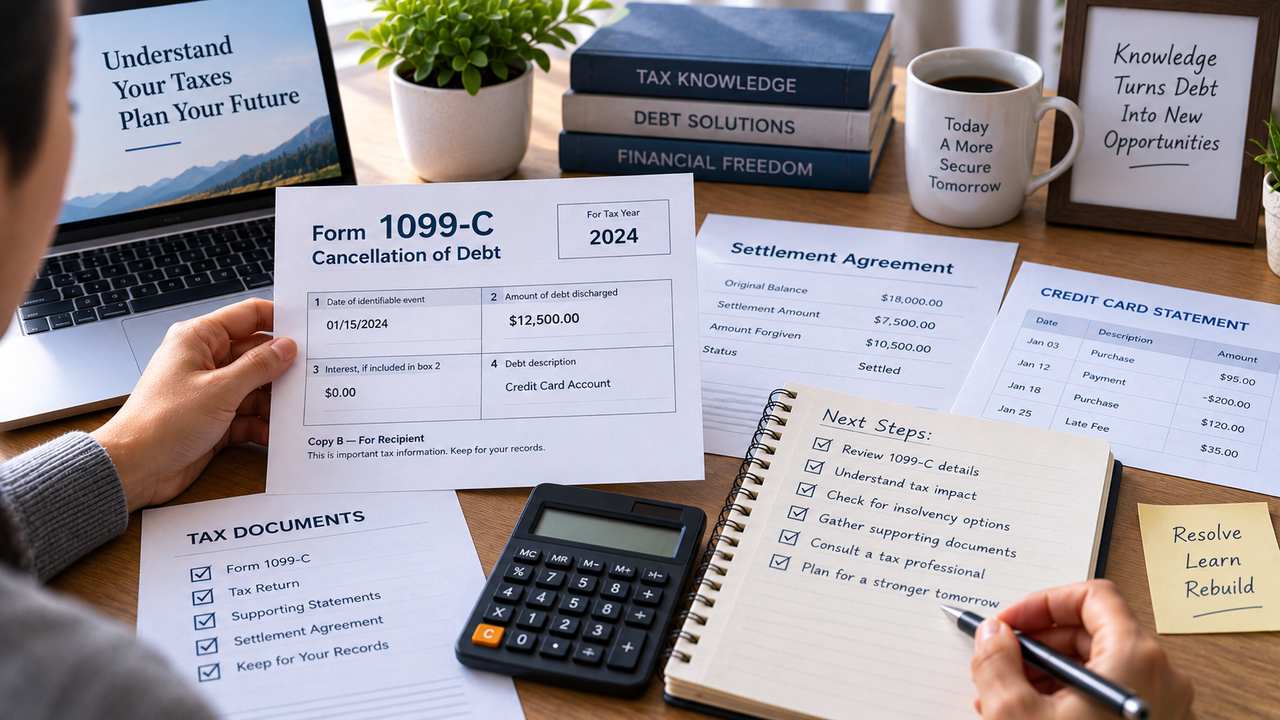
What Form 1099-C Actually Is
Form 1099-C, “Cancellation of Debt,” is an informational tax form that a creditor is generally required to file with the IRS — and send a copy to you — when they forgive or cancel $600 or more of debt you owed them. The form reports the amount of debt cancelled, and this amount is generally treated by the IRS as taxable income to you, under the theory that debt forgiveness provides an economic benefit equivalent to receiving that amount in cash.
For additional information, you can review the IRS information about Form 1099-C.
Common Reasons You Might Receive One
- A negotiated debt settlement, where you paid less than the full balance as full and final resolution of a debt — the forgiven difference between what you originally owed and what you actually paid is what gets reported.
- A charged-off account the creditor has formally determined they won’t pursue further, sometimes occurring even without a specific settlement negotiation, if a creditor decides after an extended period to simply write off and formally cancel the remaining debt.
- Foreclosure or repossession, where the sale of the property or vehicle didn’t cover your full remaining loan balance, and the lender formally forgives that remaining “deficiency” amount rather than continuing to pursue you for it.
- Certain student loan forgiveness programs, though many federal student loan forgiveness programs have had specific tax exclusions at various points, meaning not every instance of student loan forgiveness necessarily results in taxable income — this is an area where rules have changed over time and are worth verifying for current applicability.
- A credit card or personal loan the original creditor decided to fully write off, separate from a specific negotiated settlement, sometimes occurring for very old, small-balance accounts a creditor determines aren’t worth continued collection effort.
Understanding What the Form Actually Contains
A Form 1099-C typically includes: the creditor’s information, your information, the date of the cancellation event, the amount of debt cancelled, and sometimes additional details like the fair market value of any property involved (relevant for foreclosure or repossession situations) and the specific reason code for the cancellation, which can sometimes matter for how the income should be treated on your tax return.
What You’re Supposed to Do When You Receive One
Review it for accuracy. Confirm the amount listed matches your understanding of the actual forgiven debt — errors do occur, and if the amount seems incorrect, it’s worth contacting the issuing creditor to request a correction before you file your taxes.
Determine whether an exclusion applies to your situation. The most common exclusion for typical consumer debt is the insolvency exclusion (where your total liabilities exceeded your total assets immediately before the cancellation), which can reduce or eliminate the taxable portion. Debt discharged through bankruptcy is generally fully excluded as well.
Report the appropriate amount on your tax return. If no exclusion applies, the full amount shown on the 1099-C generally needs to be reported as income. If an exclusion applies, you’ll typically need to complete IRS Form 982 to properly claim it.
Keep the form and your supporting documentation (any insolvency calculation worksheets, bankruptcy discharge paperwork, or correspondence with the creditor) with your tax records in case of any future question or audit.
For related information about understanding your overall credit profile, you may also find our guide on how to read a credit report helpful.
Why This Form Sometimes Arrives Long After You Thought a Debt Was Resolved
A common source of confusion is receiving a 1099-C well after you believed a matter was fully settled, sometimes even a year or more later. This can happen because creditors don’t always issue the form immediately upon a settlement — some issue it as part of their broader year-end tax reporting process, or after an internal determination process that took longer than the actual settlement negotiation itself. If you receive a 1099-C for a debt you settled in a prior year, it’s worth confirming which tax year the form actually applies to (the “date of cancellation” listed on the form itself), since this determines which year’s tax return it should actually be reported on, which isn’t always the same as the year you received the physical form in the mail.
What If You Believe the 1099-C Is Incorrect?
Contact the issuing creditor directly first. Errors in the reported amount, or a 1099-C issued for a debt that was actually still being pursued (not genuinely cancelled), are worth raising directly with the company that issued it, requesting a corrected form if warranted.
If the creditor won’t correct a genuine error, you can still file your taxes reporting what you believe is the accurate amount, but this may generate an IRS inquiry due to the mismatch with what the creditor reported — in this situation, consulting a tax professional about how to properly document and explain the discrepancy is worthwhile.
Does Receiving a 1099-C Mean You No Longer Owe the Debt?
Generally, yes — receiving a 1099-C is meant to reflect that the creditor has formally cancelled the debt, meaning you should no longer be legally obligated to pay it. However, as covered in related guides, sometimes inconsistent internal processes or a subsequent sale of the debt to another company can result in continued collection attempts despite a 1099-C having been issued — if this happens to you, it’s worth addressing directly, since you generally shouldn’t be both taxed on cancelled debt and still pursued for payment on the same obligation.
If you are dealing with collection activity related to cancelled or disputed debt, you can learn more about debt validation letters and your options for addressing collection accounts.
How This Affects Your Overall Tax Bill
The forgiven amount reported on a 1099-C is added to your other income for the year and taxed at your marginal tax rate — it’s not a separate, special tax rate, simply additional income that could potentially push you into a higher tax bracket for that portion of your income, or affect other income-based calculations on your return (certain deductions or credits that phase out at higher income levels, for example). This is exactly why understanding the potential tax impact before finalizing a large settlement, as covered in a related guide on tax implications of debt settlement, is worth factoring into your decision-making process in advance, rather than discovering the full cost only once the 1099-C arrives.
Frequently Asked Questions
Is there a minimum amount of forgiven debt that doesn’t require a 1099-C?
Yes — the general threshold is $600; amounts forgiven below this threshold typically don’t require a 1099-C to be issued, though the underlying tax principle about cancelled debt being potentially taxable technically still applies even without a formal form, in theory, though this is far less commonly enforced or tracked for smaller amounts.
Can I dispute a 1099-C with the IRS directly, or only with the creditor?
Your primary avenue is working with the creditor to correct any inaccuracy, since they’re the one who filed the form; if you can’t resolve it with them and believe the reported amount is wrong, you can still file your own return reflecting what you believe is accurate, along with documentation explaining the discrepancy, though this may prompt IRS follow-up given the mismatch with the creditor’s filed form.
Does receiving multiple 1099-C forms in the same year from different creditors combine for tax purposes?
Yes — all cancelled debt income reported across multiple 1099-C forms in the same tax year generally gets combined as part of your total taxable income for that year, which is worth keeping in mind if you’ve settled several debts within the same calendar year, since the combined tax impact could be more significant than considering each settlement in isolation.
If my 1099-C is for a debt that was already discharged in bankruptcy, do I still owe tax on it?
No — debt discharged through bankruptcy is generally fully excluded from taxable income regardless of the 1099-C being issued; if you receive a 1099-C for bankruptcy-discharged debt, you’d still generally use Form 982 to claim the appropriate exclusion, ensuring the cancelled amount isn’t improperly taxed despite the form being issued.
Do I need a tax professional to handle a 1099-C, or can I manage it myself with standard tax software?
Many standard tax software programs can handle a straightforward 1099-C, including the Form 982 insolvency exclusion calculation, through guided prompts — but for a more complex situation (multiple forgiven debts, an uncertain insolvency calculation, or a disputed form amount), consulting a tax professional is a reasonable and often worthwhile additional step.
Understanding the Specific Reason Codes on the Form
Form 1099-C includes a specific “identifiable event code” indicating why the creditor determined the debt was cancelled — these codes matter because they can hint at the specific circumstances behind the cancellation, which is sometimes useful context when reviewing the form for accuracy. Common codes include ones for bankruptcy discharge, a specific settlement agreement, expiration of a statute of limitations for collection (in some limited circumstances where a creditor internally determines a debt is no longer collectible), and foreclosure or abandonment of secured property. If the code listed doesn’t seem to match your understanding of what actually happened (for example, a code suggesting bankruptcy discharge when you never filed for bankruptcy), this is worth raising directly with the issuing creditor as a potential error.
A Side-by-Side Look at Common 1099-C Triggers
| Trigger | Typical scenario | Exclusion most likely to apply |
|---|---|---|
| Debt settlement | Negotiated payment less than full balance | Insolvency |
| Bankruptcy | Debt discharged through Chapter 7 or 13 | Bankruptcy (automatic, full exclusion) |
| Foreclosure deficiency | Home sale doesn’t cover mortgage balance | Insolvency, or specific mortgage relief provisions if applicable |
| Repossession deficiency | Vehicle sale doesn’t cover loan balance | Insolvency |
| Creditor write-off without settlement | Very old, small debt creditor gives up on | Insolvency |
This table is a general guide — your specific situation should still be evaluated individually, ideally with a tax professional’s input if the amount involved is significant or your financial situation at the time of cancellation is genuinely uncertain to calculate on your own.
What to Do If You Receive a 1099-C You Weren’t Expecting At All
If a 1099-C arrives for a debt you don’t remember settling, or believe was never actually resolved, treat this as worth investigating rather than dismissing. Contact the issuing creditor directly to understand exactly what account and cancellation event the form refers to — occasionally, this can reveal that a debt you thought was still being actively collected was actually internally written off by the creditor without your direct knowledge (which is a legitimate, if sometimes confusing, business practice), or in rarer cases, it can reveal an error or even, potentially, activity related to identity theft affecting an account in your name that you weren’t fully aware of.
If you suspect identity theft may be involved, our guide to identity theft protection provides additional information about protecting your credit and personal information.
Frequently Asked Questions, Continued
Does a 1099-C affect my credit report, separate from any tax implications?
No — the 1099-C itself is purely a tax document and doesn’t get reported to credit bureaus or affect your credit report; your credit report reflects the account’s payment/settlement status separately, through standard credit reporting channels, which is an entirely different process from this tax reporting requirement.
If I never received a physical or digital copy of my 1099-C, but I know the IRS has one on file, what should I do?
Contact the issuing creditor to request a copy, since you’re entitled to receive one, and you’ll need the specific details to properly report the cancelled debt income (or claim an applicable exclusion) on your tax return — filing without this information risks a mismatch with what the IRS already has on record from the creditor’s own filing.
Can a 1099-C be issued for business debt as well as personal consumer debt?
Yes — cancelled business debt follows similar general principles, though business tax treatment involves some additional considerations (like whether the cancelled debt relates to a passive or active business activity) that go beyond the personal consumer debt scope of this guide, making this worth discussing with a tax professional familiar with business taxation specifically if it applies to your situation.
How This Form Relates to Estimated Tax Payments
If you receive a 1099-C for a substantial amount and know in advance it will meaningfully increase your tax liability, it’s worth considering whether you need to adjust your withholding or make an estimated tax payment before the standard filing deadline, rather than being caught off guard by an unexpectedly large balance due (and potentially an underpayment penalty) when you file. Since debt cancellation often happens mid-year, separate from your regular payroll withholding, this additional income isn’t automatically accounted for through standard paycheck withholding the way regular wages would be, making proactive planning worthwhile once you know a 1099-C is coming.
Frequently Asked Questions, Continued One Final Time
Is there a specific IRS publication that covers this topic in more detail than a general overview?
Yes — IRS Publication 4681, “Canceled Debts, Foreclosures, Repossessions, and Abandonments,” is the dedicated resource covering this topic in comprehensive detail, including worked examples of the insolvency calculation, and is worth reviewing directly or bringing to a tax professional if you want to understand the underlying rules more thoroughly than a general overview can provide.
You can review IRS Publication 4681 for additional details.
Does the amount on my 1099-C ever get reduced if I later successfully dispute the underlying debt as inaccurate?
If you successfully demonstrate that a debt was inaccurate and shouldn’t have been the amount claimed, this could theoretically affect a previously issued 1099-C, though this is a less common, more complex scenario worth discussing directly with both the issuing creditor (to request a corrected form) and a tax professional, since amending a previously filed tax return based on a corrected 1099-C involves its own separate process.
The Bottom Line
A Form 1099-C means a creditor has formally cancelled $600 or more of your debt and reported this to the IRS as potentially taxable income to you. Common triggers include debt settlement, foreclosure or repossession deficiencies, and certain loan forgiveness programs. Before assuming you owe tax on the full amount shown, check whether an exclusion applies — insolvency being the most common for typical consumer debt situations, and bankruptcy discharge providing a full exclusion — and report the form appropriately on your tax return, keeping your supporting documentation in case any question arises later.
Need Help Reviewing Your Credit Report?
A 1099-C is primarily a tax document, but the underlying debt may also appear on your credit report as a collection, charge-off, or settled account. Reviewing your credit reports can help you understand what is being reported and identify information that may need to be disputed.
If you’re dealing with inaccurate or questionable information on your credit reports, learn more about how to dispute credit report errors or explore professional credit-repair assistance.