
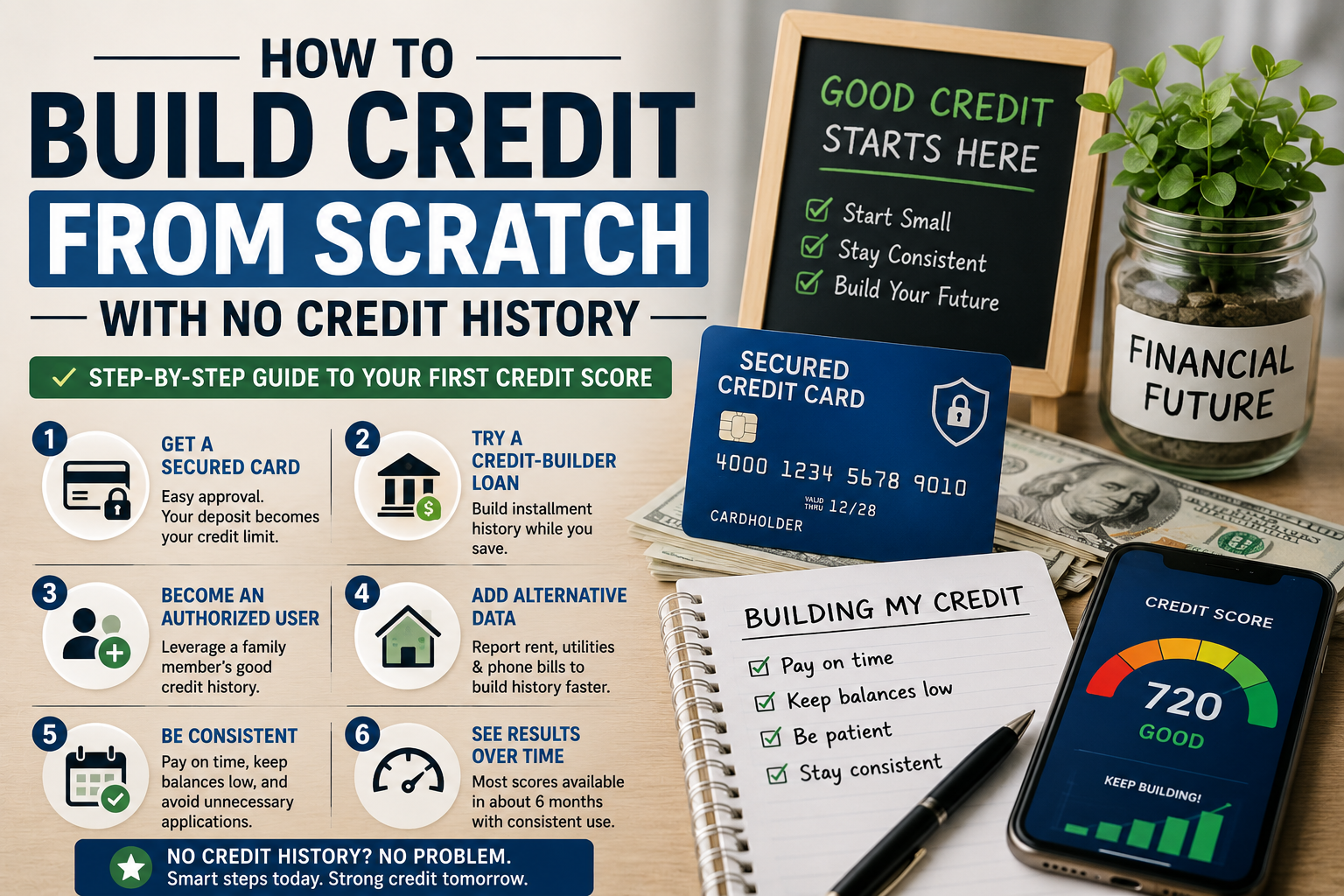
Having no credit history at all is a genuinely different problem than having bad credit, even though both can result in loan denials — and the strategies that fix bad credit (disputing errors, negotiating settlements) are mostly irrelevant here, because there’s nothing to dispute. You’re not repairing anything; you’re establishing a file that doesn’t yet exist. Here’s a practical, step-by-step path.
Why “No Credit” Can Be Almost as Hard as “Bad Credit”
Lenders assess risk based on demonstrated behavior. Bad credit tells them “this person has struggled with credit,” which is a known, if unfavorable, data point. No credit tells them nothing at all — there’s no data to evaluate, which many automated underwriting systems and algorithms treat cautiously by default, sometimes resulting in denials that feel unfair given you haven’t actually done anything wrong. This is sometimes called being “credit invisible,” and it affects a meaningful share of adults, particularly younger people, recent immigrants, and those who’ve simply avoided debt.
Step 1: Understand What “Scoring” Actually Requires
Most scoring models require:
– At least one account reported for a minimum period (often around 6 months) to generate a score at all.
– Some models can score with less history using alternative data, but the most widely used mainstream scores (FICO, VantageScore in their standard forms) need this baseline before they’ll generate a number.
This means your first priority isn’t optimizing an existing score — it’s simply getting *any* qualifying account open and reporting.
Step 2: Start With a Secured Credit Card
This is the most reliable, widely available starting point for someone with no credit history. You provide a cash deposit (often $200-500) that becomes your credit limit, which eliminates the lender’s risk and makes approval accessible even with zero credit history.
What to look for:
– **Confirm it reports to all three bureaus** — not all secured cards do, and this is non-negotiable for your purposes.
– **Look for a card that eventually converts to unsecured** with responsible use, so you’re not stuck putting down a deposit indefinitely.
– **Avoid cards with excessive fees** that eat into the value of building credit — some secured cards carry high annual fees that aren’t justified given the purpose.
Step 3: Consider a Credit-Builder Loan
These are specifically designed for this exact situation. Instead of receiving loan funds upfront, your payments go into a locked savings account, and you receive the funds (sometimes with a little interest)
once the loan term completes. This builds installment credit history — a different category from the revolving credit history a secured card provides — which helps establish credit mix even at the very start.
Many credit unions and community banks offer these specifically for building or rebuilding credit, often with low minimum requirements.
Step 4: Become an Authorized User on a Family Member’s Account
If you have a parent, spouse, or close family member with a long-standing, well-managed credit card, becoming an authorized user can add that account’s entire history to your own credit file — sometimes years of positive history appearing almost immediately once the card issuer reports the addition.
Important caveats:
– **This only works if the primary account holder’s history is genuinely strong** — a spotty payment history helps you just as much as it hurts you, in the negative direction.
– **Confirm the card issuer reports authorized user activity to the bureaus** — not all do.
– **This isn’t your own credit account legally** — the primary holder retains full responsibility, and if the relationship or arrangement changes, it’s worth understanding you don’t have independent control over that account.
Step 5: Explore Alternative Data Reporting Services
A newer category of tools has emerged specifically to help credit-invisible people establish history using bills that don’t traditionally report to credit bureaus:
– **Rent reporting services** — some let you report your on-time rent payments to credit bureaus, which traditionally aren’t captured even though rent is often someone’s largest recurring payment obligation.
– **Utility and phone bill reporting services** — similarly, some services let you add a positive payment history from utility and phone bills, which otherwise typically only show up on your credit report if they go to collections (a negative event), not when paid on time (a positive one, if reported).
These services often carry a modest fee, but for someone with genuinely no other credit history, they can accelerate the process meaningfully since you’re converting bills you’re already paying into credit-building data.
Step 6: Understand What Not to Do
– **Don’t apply for multiple credit products at once**, hoping one will approve you — each hard inquiry dings a thin file more noticeably than an established one, and multiple denials in a short window can compound the problem.
– **Don’t take on a large loan you don’t need** just to “build credit” — the goal is demonstrated reliability, not debt volume, and a loan you struggle to repay defeats the purpose entirely.
– **Don’t close your first account too quickly** once you qualify for something better — your average account age matters, and your oldest account (even a modest secured card) contributes positively the longer it stays open.
Realistic Timeline
– **Month 1**: open a secured card and/or credit-builder loan; if eligible, add rent/utility reporting.
– **Months 2-6**: consistent on-time payments accumulate; most scoring models can generate a score once you hit roughly 6 months of reporting history on at least one account.
– **Months 6-12**: with continued responsible use and low utilization, scores in this stage often land in the “fair to good” range, opening up better product options.
– **12+ months**: a genuinely solid foundation, at which point you can consider graduating to unsecured products, potentially with better terms and rewards.
Which Order Matters Most?
If you can only do one thing first, prioritize whichever path gets an account reporting **fastest** — for most people, that’s a secured card, since approval is typically quick and reporting begins within the first billing cycle. Layer in a credit-builder loan and/or alternative data reporting once that first account is established, both to diversify your credit mix and to accelerate the overall timeline.
A Note on Credit Unions
If you’re struggling to get approved for standard secured cards or credit-builder loans through big banks, local credit unions are often significantly more flexible and consumer-friendly for exactly this situation — many have specific programs designed for members establishing first-time credit, sometimes with lower fees and more personalized underwriting than large national banks offer.
The Bottom Line
Building credit from zero isn’t about fixing anything — it’s about establishing a track record where none exists, and the fastest, most reliable path is a combination of a secured card, a credit-builder loan, and (if available) alternative data reporting for rent and utilities, layered together rather than pursued one at a time in sequence. Consistency matters more than speed here: a handful of accounts used lightly and paid on time for 6-12 months will do more for your credit than any single dramatic move.