
Related reading: learn the fastest way to build credit from scratch if you’re starting over, see how the Chime Credit Builder card compares as an alternative, understand what a good credit score means so you have a clear target, and see our credit repair process if you need professional help along the way.
The short answer is yes, it can work, and the research backs that up. But the longer, more useful answer is that it works in a specific way, for specific reasons, and it has real limitations that the marketing copy from some providers tends to gloss over. Understanding those limitations before you sign up is the difference between a tool that genuinely helps you and one that leaves you frustrated a year later wondering why your score barely moved.
This guide walks you through everything you need to know: what a credit-builder loan is, the unusual mechanic that makes it work, who it helps most, how to choose a good one, what to watch out for, and how it compares to the other credit-building options on the table. We’ll be straight with you about what it can and can’t do, because that’s what a trusted advisor should do.
What Is a Credit-Builder Loan?
A credit-builder loan is a small installment loan — usually between $300 and $1,000, sometimes up to $2,000 — designed specifically to help you build or rebuild your credit history. What makes it different from a traditional personal loan is that you don’t receive the money upfront.
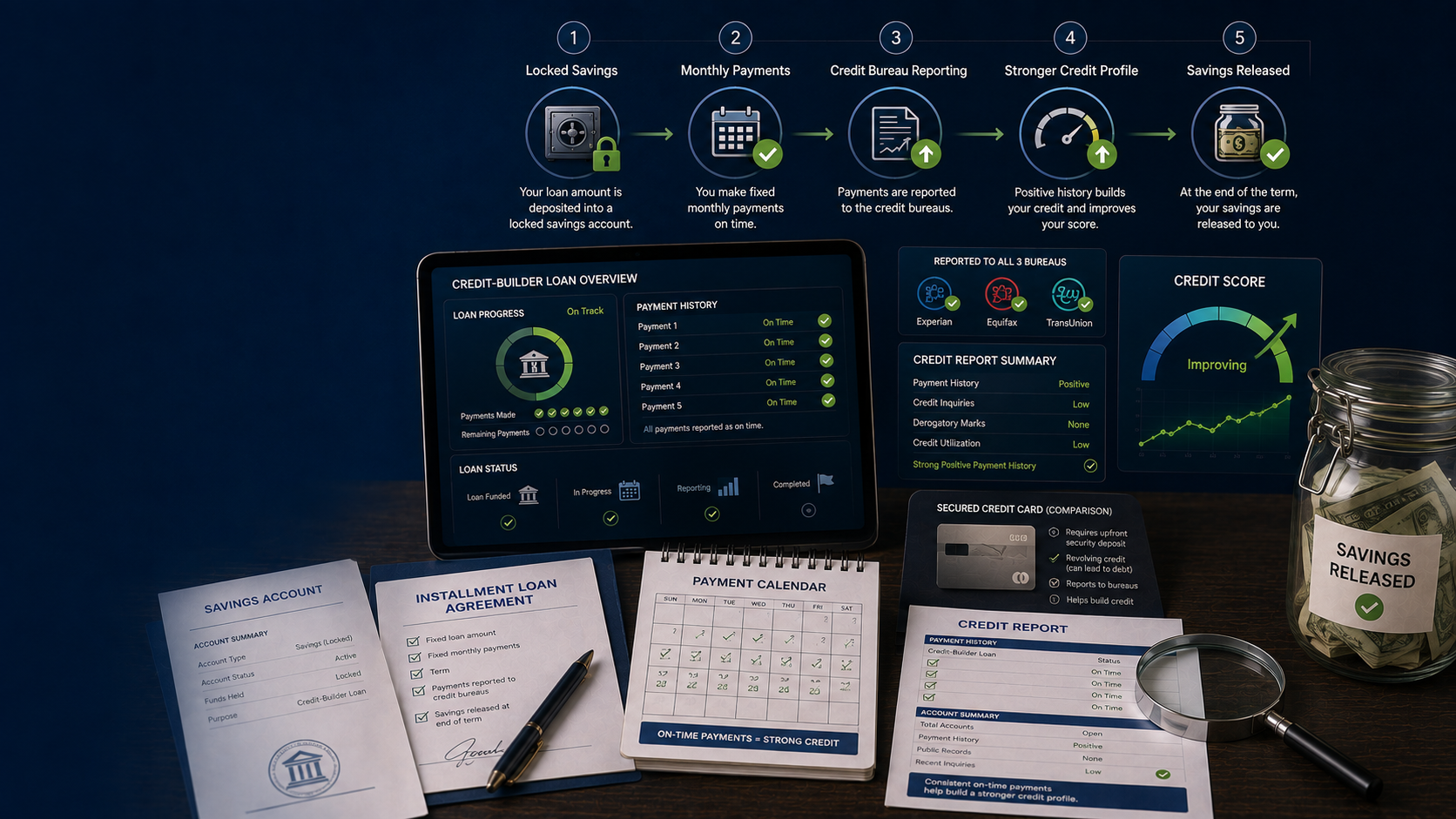
Instead, the lender holds the loan amount in a locked savings account or certificate of deposit (CD) on your behalf. You make monthly payments — principal plus a modest interest charge or administrative fee — over a set term, typically 6 to 24 months. Each payment is reported to the credit bureaus as an on-time installment payment. Once you’ve paid the loan in full, the money in the savings account is released to you, minus any fees or interest charges.
Think of it as a forced savings plan that also happens to build your credit. You’re not borrowing money to spend — you’re borrowing money to prove you can pay it back reliably. The “loan” is really the structure; the savings account is where your money lives until you’ve earned it back.
This is why credit-builder loans are sometimes called “fresh start loans” or “savings-secured loans.” The structure is what matters. The lender isn’t taking a risk on whether you’ll repay, because they already hold the full amount. You’re not taking on debt in the traditional sense — you’re paying into your own savings while building a credit file.
Where credit-builder loans come from
Credit-builder loans are offered by a mix of institutions, and the provider you choose matters more than you might expect:
- Community Development Financial Institutions (CDFIs) — These are Treasury Department-certified lenders (credit unions, community banks, nonprofit loan funds) whose mission includes serving low-income and underserved communities. A CDFI credit builder loan is often the most affordable option, with low or no fees and terms designed to set you up for success. Examples include Self-Help Credit Union, Latino Community Credit Union, and many local credit unions.
- Credit unions — Many credit unions offer credit-builder loans as part of their member services, often at very low cost. You typically need to join the credit union to qualify, but membership is usually easy to obtain.
- Fintech companies — Companies like Self (formerly Self Lender) and Credit Strong (a division of Austin Capital Bank) offer credit-builder loans that are available nationwide, often with an app-based experience. They’re convenient, but they tend to charge higher fees than community lenders.
- Some community banks — A smaller number of community banks offer similar products, often branded as “credit building loans” or “savings-secured installment loans.”
The key distinction isn’t the type of institution — it’s whether they report your payments to all three major credit bureaus (Equifax, Experian, and TransUnion). We’ll come back to that, because it’s the single most important factor in whether a credit-builder loan will actually help you.
How a Credit Builder Loan Works: The Unusual Mechanic
If you’re used to how normal loans work, the credit builder loan how it works question is worth slowing down for, because the mechanic is genuinely unusual.
The traditional loan flow (what you’re used to)
With a standard personal loan, the process goes:
- You apply. The lender checks your credit, income, and debt-to-income ratio.
- If approved, you receive the loan amount as a lump sum — deposited into your bank account or sent as a check.
- You spend that money however you intended (debt consolidation, a car repair, whatever it was for).
- You repay the lender over time, with interest.
- Your on-time payments are reported to the credit bureaus and help build your credit.
The lender is taking a real risk — they gave you money and they’re trusting you to pay it back. That’s why they check your credit first.
The credit-builder loan flow (the flip)
With a credit-builder loan, the flow is reversed:
- You apply. The lender typically does not check your credit (or only does a soft check that doesn’t affect your score). They may verify your identity and your ability to make payments.
- You do not receive the money. Instead, the loan amount is placed in a locked savings account or CD held by the lender (or a partner bank) in your name.
- You make monthly payments — a portion goes toward the principal (your savings), and a portion covers interest or fees.
- Each payment is reported to the credit bureaus as an on-time installment payment, building your payment history.
- When the loan term ends and you’ve paid in full, the savings account is unlocked and the money is released to you — minus any fees or interest that was charged along the way.
You never had access to the money during the loan. You were essentially paying yourSelf, with the lender acting as the structured middleman who reports your behavior to the credit bureaus.
Why this structure exists
This design solves two problems at once:
For you: It removes the risk of spending borrowed money you can’t afford to repay. Because you never get the cash upfront, there’s no temptation to use it for something else and fall behind. You’re building the habit of making a monthly payment while simultaneously building savings.
For the lender: It eliminates nearly all the credit risk. Since they hold the full loan amount in reserve, they don’t need to underwrite you the way they would for a traditional loan. This is why most credit-builder loans don’t require a credit check — the lender isn’t actually risking anything. They can approve you based on identity verification and a demonstrated ability to make the monthly payments, nothing more.
This is also why credit-builder loans can exist at all for people with no credit or bad credit. The structure makes them possible. Without it, lenders would have no way to offer a credit-building product to people who can’t qualify for traditional credit.
A concrete example
Let’s say you take out a $1,000 credit-builder loan with a 12-month term. Here’s what the flow looks like:
- The lender deposits $1,000 into a locked savings account in your name. You can’t touch it.
- Your monthly payment is around $87 to $90, depending on the interest rate or fee structure. (We’ll get into the specifics of pricing in the .)
- Each month, you pay that amount. The lender reports the on-time payment to Equifax, Experian, and TransUnion (assuming you chose a lender that reports to all three — which you should).
- After 12 months, you’ve paid in roughly $1,050 to $1,080 total (the $1,000 principal plus $50–$80 in interest or fees).
- The savings account unlocks. You receive approximately $1,000 — your accumulated principal payments. The lender kept the interest/fees.
- Your credit report now shows 12 months of on-time installment payments, which is exactly what scoring models want to see.
You essentially paid $50–$80 to build a year of credit history and walk away with $1,000 in savings. Whether that’s worth it depends on your situation — and we’ll get into that honestly below.
How It Builds Your Credit
To understand why a credit-builder loan works — and where it doesn’t — it helps to know what your credit score is actually made of. The FICO scoring model, which is used by the vast majority of lenders, weighs five categories:
| Factor | Weight | What It Measures |
|---|---|---|
| Payment history | 35% | Whether you pay your bills on time |
| Amounts owed / utilization | 30% | How much of your available credit you’re using |
| Length of credit history | 15% | How long your accounts have been open |
| Credit mix | 10% | The variety of credit types you have (revolving + installment) |
| New credit / inquiries | 10% | How many recent applications and hard inquiries you have |
A credit-builder loan directly affects payment history, which is the single biggest factor. That’s the whole point. Each on-time monthly payment is a positive data point on your credit report, and over 12 to 24 months, those payments add up to a meaningful track record.
Here’s how it touches each factor:
Payment history (35%) — the main event
This is where a credit-builder loan does its real work. Every month you pay on time, the lender reports a positive installment payment to the bureaus. After 12 months, you have 12 on-time payments on your report. After 24 months, you have 24. For someone starting with no credit history or a thin file, this is transformative — you go from having no payment data at all to having a solid, unbroken record of reliability.
For someone rebuilding after negative marks (late payments, collections, charge-offs), the credit-builder loan adds a stream of positive payments that starts to dilute the impact of the older negatives. The negative marks don’t disappear — they stay on your report for up to seven years — but as they age and as you accumulate fresh positive history, their effect on your score weakens.
Credit mix (10%) — a meaningful bonus
Scoring models reward you for having a mix of credit types — specifically, a combination of revolving credit (credit cards, lines of credit) and installment credit (loans with fixed payments, like auto loans, mortgages, and personal loans). If your credit file only has credit cards, adding an installment loan can give your score a small bump by improving your credit mix.
This is a modest effect — 10% of your score is a small slice — but for people with a thin file, every bit helps.
Length of credit history (15%) — helps over time
A credit-builder loan adds a new account to your report, which can temporarily shorten your average age of accounts (something we’ll discuss in the risks section). But as the loan ages over its 12- to 24-month term, it contributes to the overall length of your credit history. Once paid off, the account remains on your report for up to 10 years as a positive closed account, continuing to support your length of history.
What it does NOT do
Here’s the honest part that a lot of providers don’t emphasize enough:
A credit-builder loan does not help with credit utilization (30% of your score). Utilization is a revolving-credit metric — it measures how much of your credit card limits you’re using. An installment loan doesn’t factor into utilization at all. If your credit cards are maxed out, a credit-builder loan won’t fix that problem. You’d need to pay down card balances or increase your credit limits to improve utilization.
A credit-builder loan does not give you access to credit. During the loan term, you don’t have a usable credit line. If you need to make a purchase and finance it, the credit-builder loan doesn’t help with that — you still need a separate credit card or loan for actual borrowing needs.
A credit-builder loan’s score gains are modest, not dramatic. We’ll cover this in detail in the next section, but it’s worth flagging now: if you see a provider promising “boost your score 100 points,” be skeptical. Real gains depend on your starting point and your overall credit profile, and for most people they’re in a more realistic range.
Who a Credit-Builder Loan Is For
A credit-builder loan isn’t for everyone, and pretending otherwise doesn’t serve you. Here’s an honest breakdown of who benefits most and who might want to look at other options.
People with no credit history
This is the sweet spot. If you’re starting from zero — no credit cards, no loans, no credit file at all — a credit-builder loan is one of the most accessible ways to start building. Most providers don’t require a credit check, so your lack of history isn’t a barrier. You’ll get an installment account on your report with 12 to 24 months of on-time payments, which gives scoring models something to work with and gives future lenders evidence that you can handle a fixed payment obligation.
This group includes:
- Young adults just entering financial independence who haven’t opened any credit accounts yet
- Recent immigrants who are new to the U.S. and haven’t had time to establish a domestic credit file
- People who’ve been unbanked or cash-only by choice or circumstance and now want to build credit
- Divorcees or widows whose credit history was primarily or entirely tied to a former spouse
People rebuilding after credit damage
If you have negative marks on your credit report — late payments, a collection, a charge-off, a short sale — a credit-builder loan can help you rebuild by adding a clean, current stream of positive payment history. The old negatives don’t go away, but they age, and as they age their impact on your score diminishes. Meanwhile, your new on-time payments demonstrate that you’re back on track.
This works best when the credit-builder loan is part of a broader rebuild plan that also includes:
- Settling or paying off any outstanding collections or charge-offs
- Bringing any current delinquent accounts current
- Keeping all existing accounts in good standing going forward
- Addressing any errors on your credit report (this is where a professional credit audit can help — more on that at the end)
A credit-builder loan alone won’t undo serious credit damage, but as one tool in a larger effort, it’s a solid addition.
People who can’t qualify for a secured credit card
Secured credit cards — which we’ll compare in detail below — are another common credit-building tool, but not everyone can get one. Some secured cards require a minimum deposit of $200 or more, which is a real barrier if money is tight. Some require a credit check and have minimum score requirements. Some deny applicants with recent bankruptcies or certain negative marks on their file.
A credit-builder loan can be a good alternative if a secured card isn’t accessible to you, because most credit-builder loan providers don’t pull your credit for approval. The monthly payment may also be lower than a secured card’s deposit, making it more manageable on a tight budget.
People who struggle with credit card discipline
Here’s a group that doesn’t get talked about enough: people who have tried credit cards before and ended up carrying balances they couldn’t pay off. If you know that having a revolving credit line tends to lead to overspending for you, a credit-builder loan offers the credit-building benefit without the temptation. You can’t spend the money — it’s locked away — so there’s no way to rack up a balance you can’t afford.
For some people, this structural safeguard is exactly what they need to build credit without falling back into old patterns.
Who might want a different approach
A credit-builder loan may not be your best option if:
- You already have good credit and an established mix of accounts. If you’ve got a couple of credit cards and an auto loan that you’re paying on time, a credit-builder loan won’t add much. Your score is already being driven by your existing history, and the loan’s impact would be minimal.
- Your main credit problem is high utilization. If your cards are near their limits, paying down those balances will help your score far more than a credit-builder loan will. Utilization is 30% of your score, and an installment loan doesn’t touch it.
- You can’t comfortably afford the monthly payment. A credit-builder loan only helps if you make every payment on time. If you’re already stretched thin and a missed payment is a real possibility, the loan could end up hurting you instead of helping. We’ll cover this in the risks section.
- You need to borrow money right now. A credit-builder loan doesn’t give you access to funds during the term. If you need to finance a car repair, a medical bill, or an essential purchase, this product won’t solve that problem — you’d need a different loan or credit line.
Does a Credit Builder Loan Actually Work? The Honest Answer
This is the question that matters most, and it deserves a straight answer.
Yes — a credit builder loan does work, in the specific sense that it reliably creates a positive payment history on your credit report, and that history tends to produce measurable score improvements for people who start with no credit or thin credit. The evidence on this is real, not just marketing.
A widely cited study by the Consumer Financial Protection Bureau (CFPB) in 2020 examined the outcomes of credit-builder loan users and found that participants without existing debt saw an average score increase of roughly 60 points over the loan term. For participants with no credit score at the start, the majority became scoreable — meaning they went from having no credit file at all to having a FICO score that lenders could use.
That’s a meaningful result, and it matches what we see in practice. For people starting from scratch, a credit-builder loan is one of the most reliable on-ramps to a credit score.
But — and this is where the honesty comes in — the answer comes with important caveats that the advertising rarely mentions:
The gains are biggest for people starting with no credit, smaller for everyone else
The 60-point average in the CFPB study was driven largely by people who had no credit score at the outset. For people who already had a credit score and existing debt, the gains were much smaller — and in some cases, scores actually went down slightly. Why? Because opening a new account can temporarily lower your average age of accounts, and if you have existing debt, the new loan’s small benefit can be offset by that effect.
So the honest framing is:
- No credit history → credit-builder loan → big improvement. This is where the tool shines.
- Bad credit with existing debt → credit-builder loan → modest improvement, possibly mixed. The loan helps with payment history, but if you’re also carrying high credit card balances, the utilization factor will keep your score suppressed regardless of what the loan does.
- Already good credit → credit-builder loan → minimal or no benefit. You don’t need it, and the new-account penalty might offset any tiny gain.
It builds payment history, not credit mix or utilization benefits
We covered this above, but it’s worth restating in the context of “does it work.” A credit-builder loan affects one of the five scoring factors in a major way — payment history. It touches credit mix modestly. It doesn’t touch utilization at all, and utilization is nearly as important as payment history (30% vs. 35%).
This means a credit-builder loan is most effective when paired with a revolving credit account (like a secured card) that you keep at low utilization. Used together, the two cover more of the scoring factors. Used alone, the loan is still helpful but leaves the 30% utilization factor entirely untouched.
It works only if you pay on time every single month
This cannot be overstated. The entire benefit of a credit-builder loan comes from on-time payments. A single late payment — especially one reported as 30 days late — can wipe out months of progress and leave a negative mark that stays on your report for seven years. The loan doesn’t have a grace period for credit reporting purposes the way some credit cards do. If the lender reports you late, it’s on your report.
So “does it work” is really “does it work for you,” and the answer depends almost entirely on whether you can commit to making every payment on time for the full term. If you can, it works. If you can’t — if your income is irregular, your budget is already stretched, or you’re not confident you can make a payment every single month — then the tool can backfire, and you should consider whether the risk is worth it.
The score gains are real but not dramatic for most people
For someone starting with no credit, going from “no score” to “a score in the mid-600s” over 12–18 months is genuinely life-changing — it’s the difference between being denied for everything and being approved for entry-level credit products. In that context, the credit-builder loan absolutely works.
For someone starting with a 580 who wants to reach 700, a credit-builder loan alone will likely get them part of the way there — maybe into the low-to-mid 600s — but not all the way. Closing that gap usually requires a combination of tools and time: the credit-builder loan for payment history, a secured card for utilization, removal of any errors or inaccurate negative marks, and simply the passage of time as old negatives age.
If a provider tells you a credit-builder loan will “boost your score by 100 points,” treat that as a red flag. The honest version is: it will help, the amount depends on your starting point and your full credit picture, and it’s most effective as part of a broader plan rather than a standalone fix.
Pros and Cons of Credit-Builder Loans
Let’s lay it out plainly.
Pros
- No credit check required for approval at most providers. This is the feature that makes credit-builder loans accessible to people who can’t get any other credit product. You’re approved based on identity verification and ability to pay, not your credit history.
- Builds a positive payment history. This is the single most important factor in your credit score (35%), and a credit-builder loan delivers it reliably — 12 to 24 on-time installment payments on your report.
- Forces savings. Because the money is locked away and you’re paying toward it each month, you end the term with a lump sum — often $300 to $1,000 — that you might not have saved otherwise. For people who struggle with savings discipline, this is a genuine secondary benefit.
- Low monthly payments. Depending on the loan size and term, payments often fall in the $25–$90 range, which is manageable for many budgets.
- No risk of overspending. You can’t charge up a balance you can’t pay off, because there’s no usable credit line. The temptation problem that sinks many credit card users doesn’t exist here.
- Adds to your credit mix. If your file only has revolving accounts, adding an installment loan gives scoring models evidence that you can handle both types.
- Available from mission-driven lenders. CDFIs and many credit unions offer these loans at low cost because their mission includes serving underserved communities. You’re not just building credit — you’re often working with an institution that’s structured to support you.
Cons
- You don’t get the money until the end. Unlike a traditional loan, you can’t use the funds during the term. If you need to borrow for an immediate expense, this product doesn’t serve that need.
- You pay fees and/or interest, so you end up paying more than you receive. The total cost of a credit-builder loan — the interest or administrative fees — means you get back less than you paid in. You’re paying for the credit-building service, not getting a free lunch.
- Late payments are reported and can hurt your score. The same mechanism that helps you when you pay on time can damage you when you don’t. A 30-day late mark on a credit-builder loan is just as harmful as one on any other account.
- No impact on credit utilization. If your main score problem is high credit card balances, the loan won’t address it. Utilization is 30% of your score, and installment loans don’t factor in.
- Limited score gains for people with existing credit. If you already have a couple of accounts in good standing, the marginal benefit of adding a credit-builder loan is small.
- Short-term new-account penalty. Opening the loan creates a hard inquiry (at providers that pull credit) and shortens your average age of accounts, both of which can cause a small, temporary dip in your score in the first few months.
- Some providers only report to one or two bureaus. If your lender only reports to, say, Equifax and Experian but not TransUnion, your TransUnion file won’t benefit. This is a common and avoidable mistake — always confirm all-bureau reporting before signing up.
How to Choose the Right Credit-Builder Loan
Not all credit-builder loans are created equal, and choosing a poor one can mean paying more than you need to or getting less credit-building benefit than you expected. Here are the factors that actually matter, in order of importance.
1. Reports to all three credit bureaus — non-negotiable
This is the single most important criterion. Your credit score is calculated separately by each of the three major bureaus — Equifax, Experian, and TransUnion — and lenders don’t all pull from the same one. A mortgage lender might pull all three. An auto lender might pull one. A credit card issuer might pull another.
If your credit-builder loan only reports to one or two bureaus, your credit file at the non-reporting bureau(s) won’t show the loan at all. You could complete a 12-month loan, pay on time every month, and still have a thin file at one bureau — which means a lender pulling from that bureau would see no benefit.
Before you sign up, confirm in writing (or in the provider’s FAQ) that they report to all three bureaus. Reputable providers state this clearly. If a provider is vague about which bureaus they report to, that’s a red flag — look elsewhere.
2. Low fees and reasonable interest
The cost of a credit-builder loan varies significantly by provider. A CDFI credit builder loan from a community credit union might charge no fees and a very low interest rate (sometimes under 6% APR, sometimes a flat administrative fee of $10–$25 total). A fintech provider might charge an administrative fee of $9–$15 upfront plus a monthly fee of $5–$10, or an APR of 15% or more.
Over a 12-month term, the difference adds up:
- A low-cost CDFI loan: you might pay $15–$30 total above the principal
- A higher-cost fintech loan: you might pay $60–$150 total above the principal
That’s not necessarily a deal-breaker — if the fintech loan is the only one available to you or the convenience is worth it, the cost is still modest in absolute terms. But all else being equal, you should prefer the lower-cost option. Why pay $120 for something you could get for $25?
3. Reasonable term length
The typical credit-builder loan term is 6 to 24 months. The term you choose affects two things:
- The monthly payment amount — a longer term means lower monthly payments, which is easier on a tight budget
- The amount of payment history you build — a longer term means more on-time payments on your report, which is better for your score
For most people, a 12-month term is a good balance: long enough to build meaningful history, short enough that you’re not locked in for years. If your budget is very tight, an 18- or 24-month term with lower payments may be more sustainable. If you’re confident in your ability to pay and want to build history faster, a 6-month term works but gives you fewer data points.
Avoid terms shorter than 6 months — there’s not enough time to build a meaningful track record.
4. CDFI or credit union vs. fintech — the trade-off
This is a genuine decision point, not a clear-cut one.
CDFI credit builder loans and credit union loans:
- Usually the lowest cost
- Often come with financial education and counseling resources
- May require membership (which is typically easy to get but is an extra step)
- May have less polished digital experiences
- May have geographic limitations (some serve specific regions or communities)
- The mission-driven structure means they’re genuinely invested in your success
Fintech credit-builder loans (Self, Credit Strong, etc.):
- Available nationwide, usually with no membership requirement
- App-based, easy to manage from your phone
- Often faster to apply and get approved
- Tend to charge higher fees than community lenders
- Some offer additional features like credit monitoring included in the fee
There’s no wrong choice here — both can build your credit effectively if they report to all three bureaus. But if you have access to a good CDFI or credit union option, the cost savings and the access to human support are real advantages. If convenience and speed matter more to you, a fintech like Self or Credit Strong is a perfectly reasonable choice.
5. Payment flexibility and autopay
Look for a provider that offers autopay — automatic monthly payments from your linked bank account. Autopay is the single best safeguard against the worst risk of a credit-builder loan (a missed payment), because it removes the need to remember and manually make the payment each month.
Also check the provider’s policy on early payment or extra payments. Can you pay ahead if you have a good month? Can you pay off the loan early without penalty? Most credit-builder loans allow early payoff, but some don’t — and if you might want to finish early, confirm this before committing.
6. What happens if you miss a payment
Read the fine print on late payments. Key questions:
- Is there a grace period before a late payment is reported to the bureaus?
- Is there a late fee, and how much?
- Does the loan go into default if you miss a certain number of payments, and what does that mean for the money in the savings account?
- Can you pause payments (forbearance) if you hit a financial rough patch?
A provider that reports a late payment to the bureaus after just one day past due is riskier than one with a 30-day grace period. This matters — know the policy before you sign up.
7. Whether interest is earned on the savings portion
Some providers pay interest on the savings account holding your loan proceeds while you’re paying the loan off. It’s usually a small amount (savings rates aren’t high), but it partially offsets the cost of the loan. It’s a minor factor, but worth checking — a provider that pays interest on your savings is returning a bit of value to you.
Typical Terms and Costs
Let’s get concrete about what you can expect to pay and what terms you’ll see in the market. These are typical ranges — actual offers vary by provider.
Loan amounts
- Small: $300–$500 — lowest monthly payments, good for tight budgets, builds less savings
- Medium: $500–$1,000 — the most common range, balances payment affordability with meaningful savings at the end
- Large: $1,000–$2,000 — higher monthly payments, more savings at the end, available from some providers
Term lengths
- 6 months — fast, lower total cost, fewer payment data points
- 12 months — the standard, good balance of cost and history
- 18–24 months — lower monthly payments, more payment history, higher total cost over the term
Interest rates and fees
| Provider Type | Typical APR or Fee Structure | Total Cost on a $1,000 / 12-month Loan |
|---|---|---|
| CDFI credit builder | 5–10% APR or flat $10–$25 admin fee | $25–$60 |
| Credit union | 5–12% APR, sometimes no fees | $30–$70 |
| Fintech (Self) | $9 admin fee + $5–$10/month, or ~15% APR equivalent | $70–$130 |
| Fintech (Credit Strong) | Varies by plan; administrative fee + interest, ~15%+ APR equivalent | $80–$150 |
These are estimates — actual costs depend on the specific product, state, and term. The point is that the cost range across providers is meaningful: a low-cost CDFI loan might cost you $30 to build a year of credit history, while a premium fintech product might cost $130 for the same outcome. Both work; one is noticeably cheaper.
Example payment schedules
$500 loan, 12-month term, low-cost CDFI (no fee, 6% APR):
- Monthly payment: ~$43
- Total paid: ~$516
- Amount you receive at end: ~$500
- Net cost: ~$16
$1,000 loan, 12-month term, fintech ($9 admin + $10/month):
- Monthly payment: ~$92 ($83 principal + $9 monthly fee, plus initial $9 admin fee)
- Total paid: ~$1,120
- Amount you receive at end: ~$1,000
- Net cost: ~$120
$1,000 loan, 24-month term, credit union (8% APR):
- Monthly payment: ~$45
- Total paid: ~$1,083
- Amount you receive at end: ~$1,000
- Net cost: ~$83
As you can see, the longer term lowers the monthly burden but increases the total cost slightly due to more interest accrual. The fintech option is meaningfully more expensive but offers convenience and app-based management.
Step-by-Step: Using a Credit-Builder Loan
If you’ve decided a credit-builder loan makes sense for you, here’s a clear walkthrough of how to use one effectively.
Step 1: Check your current credit situation
Before you apply, pull your credit reports from all three bureaus. You’re entitled to free reports at AnnualCreditReport.com. Review them for:
- Errors or inaccurate negative marks — if there’s something wrong on your report, a credit-builder loan won’t fix it. Disputing errors first (or working with a professional credit repair firm) gives you a cleaner foundation to build on.
- Existing accounts — know what’s already on your report so you can see how the credit-builder loan fits in.
- Your current score (if you have one) — this gives you a baseline to measure progress against.
If you find errors or significant negative marks, consider addressing those first or alongside the credit-builder loan.
Step 2: Choose a provider that reports to all three bureaus
Use the criteria in the . Confirm all-bureau reporting, compare costs, and pick a provider that fits your budget and preferences. If you have access to a local CDFI or credit union, start there — the cost savings are worth the extra step of joining.
Step 3: Pick a loan amount and term you can afford
Be honest with yourSelf about what monthly payment you can sustain for the full term. A smaller loan with a longer term and a $25–$40 monthly payment is a safer choice than a larger loan with a $90 payment that you’ll struggle to make in a bad month. The goal is 12–24 months of unbroken on-time payments — choose a payment level that makes that realistic.
Step 4: Set up autopay before the first payment
This is the single most important step after choosing the loan. Set up automatic payments from your primary bank account so that you never have to remember to make a payment manually. Verify the payment date works with your cash flow — if you get paid on the 15th, schedule the payment for the 16th or later, not the 10th.
If your provider doesn’t offer autopay, set a recurring calendar reminder for at least five days before each due date, and make the payment manually as soon as you see the reminder.
Step 5: Make every payment on time
This is where the credit-building actually happens. Every on-time payment is a positive mark on your report. Every late payment is a negative mark that can undo months of progress. Treat the payment like rent or utilities — non-negotiable, paid before anything optional.
If you see a rough month coming, contact the lender before the payment is due. Some providers offer forbearance or payment arrangements if you reach out proactively. They’re far less flexible after a payment is already late.
Step 6: Monitor your credit along the way
Check your credit score periodically (many banks and credit card issuers offer free score monitoring, and some credit-builder loan providers include it). You’re looking for:
- Steady, gradual improvement over the loan term
- The new installment account appearing on all three bureau reports
- No unexpected drops that might indicate a reporting error or identity issue
If the loan isn’t showing up on one of your bureau reports, contact the lender — it may be a reporting issue they can correct.
Step 7: Receive your savings at the end
When the loan term ends and you’ve paid in full, the lender releases the savings account balance to you. This is usually paid via ACH transfer to your bank account or by check. Take a moment to acknowledge what you’ve accomplished — you’ve built a year or more of positive credit history and you’ve saved a meaningful lump sum at the same time.
Step 8: Decide what to do with the savings
You have a choice here, and it matters for your long-term financial health:
- Keep it as an emergency fund. If you don’t already have one, this is an excellent use. An emergency fund is the single best protection against the kind of financial setbacks that damage credit in the first place.
- Use it as a secured credit card deposit. If you’ve been building credit with the loan and want to add a secured card for the utilization factor, your newly saved lump sum can serve as the deposit. This is a smart next step that covers more of the scoring factors.
- Roll it into a new savings goal. If your emergency fund is already in place, keep the momentum going — move the money into a dedicated savings account for a specific goal.
- Avoid spending it on non-essentials. The discipline you built during the loan term is a habit worth keeping. Don’t let the lump sum evaporate on a purchase that doesn’t serve your bigger financial picture.
What Happens at the End of the Loan
The end of a credit-builder loan is a moment worth understanding clearly, because it’s where the “forced savings” aspect pays off — literally.
The payout
When your final payment posts and the loan is paid in full, the lender releases the savings account balance to you. The amount you receive is the total of your principal payments — the money you paid in that went toward the loan amount, not toward interest or fees. For example:
- On a $1,000 loan where you paid $1,080 total (with $80 in interest/fees), you receive $1,000.
- On a $500 loan where you paid $530 total (with $30 in fees), you receive $500.
The payout typically arrives within 7–14 days of the final payment, via ACH transfer or check, depending on the provider.
What stays on your credit report
The loan account doesn’t disappear from your credit report when it’s paid off. A paid installment loan remains on your report as a positive closed account for up to 10 years. During that time, it continues to contribute to your:
- Payment history — the 12–24 months of on-time payments stay on your report as evidence of reliable repayment
- Length of credit history — the account’s age continues to support your average age of accounts
- Credit mix — the closed installment account still counts toward your mix of credit types
This is a quiet but important benefit. The work you did during the loan term keeps paying off for years after the loan is gone.
What to do next
Once the loan is paid off, think about your next credit-building move:
- If you don’t have a revolving credit account yet, consider opening a secured credit card (using part of your payout as the deposit, if needed). This starts building the utilization factor that the loan didn’t cover.
- If you already have a credit card, keep its balance low and pay it in full each month. This maintains the utilization factor in your favor.
- If your score has improved enough, you may now qualify for an unsecured credit card with better terms than a secured one. Check pre-qualification offers (which use soft inquiries) to see what’s available without adding a hard inquiry.
- If you have older negative marks on your report, review whether any are due to age off soon or whether any are inaccurate and could be disputed.
The credit-builder loan was a foundation. What you build on it next is where the bigger gains come from.
Risks to Understand Before You Start
A credit-builder loan is one of the safer credit-building tools available, but “safer” doesn’t mean “risk-free.” Here are the real risks to understand before you commit.
Risk 1: Late payments damage your credit
This is the biggest risk, and it bears repeating. If you miss a payment and the lender reports it as 30 days late to the bureaus, that negative mark stays on your credit report for up to seven years. The same mechanism that builds your credit when you pay on time can damage it when you don’t.
A single 30-day late payment can drop a good credit score by 60–80 points. For someone building from scratch, it can mean going from a fledgling 650 back down to a 580 or lower — undoing months of careful work.
Mitigation: Set up autopay. Choose a payment amount you can sustain even in a bad month. Contact the lender proactively if you see trouble coming.
Risk 2: Fees can be higher than expected
Some fintech credit-builder loans have fee structures that aren’t immediately obvious — monthly maintenance fees, administrative fees, early closure fees, payment processing fees for certain payment methods. Read the full fee schedule before you commit, not just the headline APR.
Mitigation: Compare total cost across the full term, not just the monthly payment. Prefer CDFIs and credit unions where the fee structure is typically simpler and lower.
Risk 3: The new account temporarily lowers your score
When you open any new credit account, two things happen that can cause a small, temporary dip in your score:
- A hard inquiry appears on your report (if the provider pulls credit — many don’t for credit-builder loans)
- Your average age of accounts decreases because you’ve added a brand-new account
This dip is usually small (5–15 points) and recovers within a few months as you build payment history. But if you’re applying for a mortgage or auto loan in the next 3–6 months, the timing could be inconvenient.
Mitigation: If you have a major credit application coming up soon, either start the credit-builder loan after that application or talk to a credit professional about timing.
Risk 4: The provider doesn’t report to all three bureaus
We’ve covered this, but it’s a risk worth restating. If you complete a 12-month loan and discover at the end that one bureau never received the reports, you’ve built credit at two bureaus but not the third — and you can’t retroactively fix it.
Mitigation: Confirm all-bureau reporting in writing before you sign up. If a provider won’t confirm it, choose a different provider.
Risk 5: You need the money before the term ends
Because the savings are locked until the loan is paid in full, you don’t have access to that money if an emergency hits mid-term. If you were counting on those funds being available, this can create a real problem.
Mitigation: Don’t think of the credit-builder loan savings as an emergency fund during the term — it’s not accessible. Keep a separate small emergency fund (even $200–$500) in a regular savings account that you can reach if needed.
Risk 6: Some providers have early closure penalties or restrictions
If you need to close the loan early — because your situation changed, you’re moving, or you simply want out — some providers charge an early closure fee or have restrictions on how and when you can close. Read the terms before committing.
Mitigation: Confirm the early closure policy before you sign up. Most reputable providers allow early payoff without penalty, but not all do.
Common Mistakes to Avoid
In our experience working with clients on credit building, a handful of mistakes come up repeatedly. Here are the ones to watch for.
Mistake 1: Choosing a loan payment you can’t actually afford
It’s tempting to pick a larger loan amount because you’ll get more savings at the end. But if the monthly payment is a stretch, you’re setting yourSelf up for a late payment that will cost you far more in credit damage than the extra savings are worth.
Fix: Choose the smallest loan amount and longest term that still gives you meaningful payment history. A $500 loan at 24 months with a $22 monthly payment builds the same payment-history benefit as a $1,000 loan at 12 months with an $87 payment — but the smaller payment is far easier to sustain.
Mistake 2: Not setting up autopay
Manual payments rely on memory, and memory fails. One forgotten payment can undo months of progress.
Fix: Set up autopay on day one. If your provider doesn’t offer autopay, set a recurring calendar alert for five days before each due date.
Mistake 3: Not verifying all-three-bureau reporting
We’ve seen clients complete an entire loan term only to find out the provider only reported to one bureau. They built credit at one bureau and have nothing to show at the other two.
Fix: Before you sign up, find explicit confirmation (on the provider’s website, in their FAQ, or by calling and asking) that they report to Equifax, Experian, and TransUnion. If it’s not clear, choose a different provider.
Mistake 4: Opening a credit-builder loan when your real problem is high utilization
If your credit cards are maxed out, your utilization is suppressing your score by up to 30% of the total calculation. A credit-builder loan won’t touch that. You could complete a 12-month loan, pay on time every month, and see only a small score improvement because your utilization is still dragging you down.
Fix: If high utilization is your main issue, prioritize paying down card balances first. A credit-builder loan can be a useful addition, but it’s not the primary fix for utilization.
Mistake 5: Closing the loan early without understanding the impact
Some people get impatient or need the money and close the loan a few months in. This gives you only a few months of payment history — far less impactful than a full 12–24 months — and may trigger early closure fees.
Fix: Commit to the full term before you start. If you think you might need the money sooner, don’t lock it up in a credit-builder loan.
Mistake 6: Not addressing errors or inaccurate negative marks first
If your credit report has errors — accounts that aren’t yours, payments marked late that were actually on time, outdated information that should have aged off — a credit-builder loan builds positive history on top of a flawed foundation. The errors continue to hold your score down.
Fix: Pull your reports and review them for accuracy before starting a credit-builder loan. Dispute any errors, or work with a professional credit repair firm that can help.
Mistake 7: Treating the loan as your only credit-building tool
A credit-builder loan is excellent for payment history, but it leaves utilization untouched. If you stop there, you’re leaving score points on the table.
Fix: Plan to add a revolving credit account (secured card or unsecured card, depending on where your score is) at some point during or after the loan term. The combination covers more of the scoring factors and tends to produce better results than either tool alone.
Mistake 8: Not having a plan for the savings when the loan ends
When that lump sum lands in your account at the end of the term, it’s easy to spend it on something non-essential — and lose the savings habit you built over 12–24 months.
Fix: Decide before the loan ends what the savings will go toward. An emergency fund, a secured card deposit, a specific financial goal — having a plan keeps the money working for you.
Frequently Asked Questions
1. Does a credit builder loan actually work?
Yes — for people with no credit or thin credit, a credit-builder loan reliably builds a positive payment history on your credit report, which is the single most important factor in your credit score (35% of your FICO score). Research from the CFPB found that participants without existing debt saw average score gains of around 60 points, and most participants with no prior score became scoreable. The gains are largest for people starting from zero and more modest for people rebuilding with existing debt. The key condition: you must make every payment on time for the full term. For more detail, see our section on .
2. How does a credit builder loan work if I don’t get the money upfront?
That’s the unusual mechanic. The lender places the loan amount in a locked savings account in your name. You make monthly payments toward that amount, and the lender reports each on-time payment to the credit bureaus. When the loan is paid in full, the savings account unlocks and the money is released to you — minus any interest or fees. You’re essentially paying yourSelf while building a credit record, with the lender acting as the structured middleman who reports your payments. See for the full breakdown.
3. What’s the difference between a credit builder loan and a secured credit card?
A credit-builder loan is an installment loan — you make fixed monthly payments toward a locked savings account, and the lender reports those payments. It builds payment history and adds to your credit mix, but it doesn’t affect your credit utilization. A secured credit card is a revolving account — you put down a refundable deposit that becomes your credit limit, you use the card for purchases, and you pay it off each month. It builds payment history AND affects your utilization (keeping your balance low relative to your limit helps your score). The secured card gives you a usable credit line; the credit-builder loan doesn’t. See our for the full side-by-side.
4. How much does a credit builder loan cost?
The cost depends on the provider. A low-cost CDFI credit builder loan might cost you $15–$30 in fees and interest over a 12-month term. A fintech provider like Self or Credit Strong might cost $70–$150 over the same term. The monthly payment on a typical $500–$1,000 loan with a 12-month term ranges from about $25 to $90. See for specific examples.
5. Can I get a credit builder loan with no credit check?
Yes — most credit-builder loan providers do not require a credit check for approval, because the structure of the loan means the lender isn’t taking on credit risk (they hold the full amount in reserve). Approval is typically based on identity verification and your ability to make the monthly payments. This is one of the main reasons credit-builder loans are accessible to people who can’t qualify for other credit products.
6. What happens if I miss a payment on a credit builder loan?
A missed payment is the biggest risk of a credit-builder loan. If the lender reports it as 30 days late to the credit bureaus, that negative mark stays on your credit report for up to seven years and can cause a significant score drop — potentially undoing months of progress. Some providers have grace periods before reporting, and some may offer forbearance if you contact them proactively before the due date. Read the provider’s late payment policy before signing up, and set up autopay to eliminate the risk of forgetting. See our section on for more.
7. How long does it take for a credit builder loan to improve my score?
You can expect to see the loan appear on your credit report within 30–60 days of opening it, and you’ll start building payment history from your first on-time payment. Meaningful score improvement typically becomes visible after 3–6 months of on-time payments, with more substantial gains after 12 months. For people starting with no credit score, becoming scoreable usually takes about 6 months of reported payments (the minimum history most scoring models need to generate a score). The full benefit accrues over the entire loan term.
8. What’s the best credit builder loan?
There’s no single “best” credit-builder loan — the right choice depends on your priorities. If cost is your main concern, a CDFI credit builder loan from a community credit union or nonprofit lender is usually the most affordable option. If convenience and nationwide availability matter most, Self and Credit Strong are reputable fintech options with app-based management. The universal requirement, regardless of provider, is that they report to all three major credit bureaus. See our section on for the full criteria.
Ready to Take the Next Step?
A credit-builder loan is a solid, proven tool for establishing or rebuilding your credit — but it works best as part of a broader plan that also addresses any errors on your credit report, manages your credit utilization, and builds positive habits across all of your financial accounts.
If you’re not sure where you stand right now, that’s the natural starting point. Before you open any new account — credit-builder loan, secured card, or anything else — it helps to know what’s actually on your credit report, what’s helping you, what’s holding you back, and what specific steps will move the needle for your situation.
That’s exactly what we help with at credit-repair.com. We offer a free credit audit that reviews your reports from all three major bureaus, identifies any errors or inaccurate negative marks that may be unfairly dragging down your score, and gives you a clear, honest picture of where you stand and what your options are.
We’re a San Diego-based, attorney-backed credit repair firm operating in full compliance with the Fair Credit Reporting Act (FCRA). We don’t make empty promises or sell quick fixes — we help you understand your credit, dispute what’s inaccurate, and build a plan that combines the right tools for your specific situation. Whether that includes a credit-builder loan, a secured card, professional help removing errors, or a combination of all three, we’ll give you a straight answer about what makes sense for you.
Get your free credit audit at credit-repair.com →
Your credit score is one of the most important numbers in your financial life. It affects your interest rates, your insurance premiums, your housing options, even your job prospects in some cases. Building it the right way — patiently, honestly, with the right tools and the right guidance — is one of the highest-return investments you can make. We’re here to help you do it.
{/* Internal link placeholders to update when publishing:
- Learn more about credit repair
- Learn about credit monitoring
- Learn about disputing credit report errors
- Talk to a credit advisor
- */}
