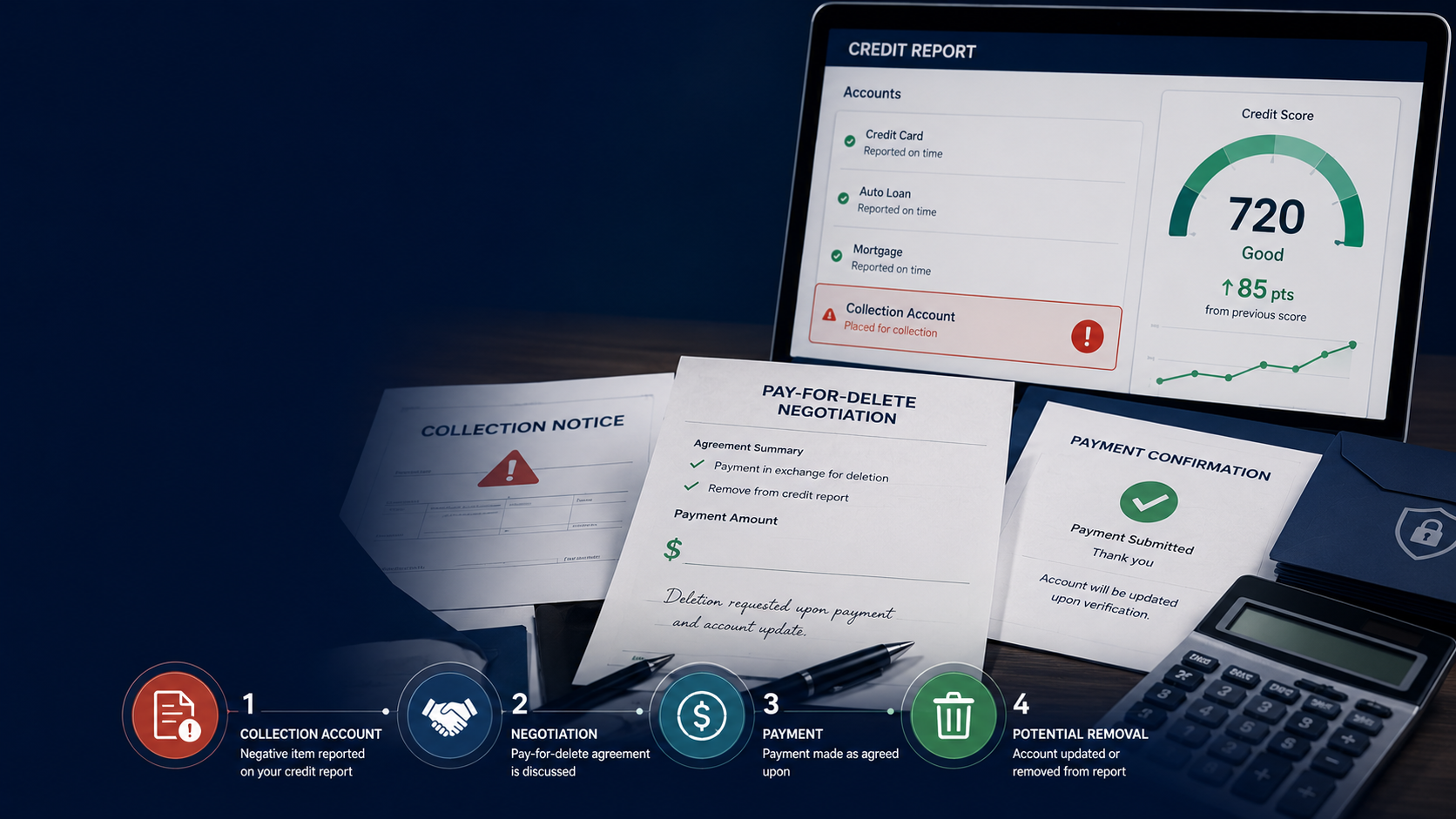
That question leads you to a concept called pay-for-delete. It sounds almost too good to be true — you pay the debt, the creditor or collection agency removes the negative mark from your credit report, and your score begins to recover. And in some cases, that is exactly what happens. But in many other cases, the process is far messier, the outcome far less certain, and the risks far less obvious than the blog posts and forum threads make it seem.
This guide walks you through everything you need to know about pay-for-delete: what it is, how it works conceptually, the honest truth about why it is not guaranteed, when it is most likely to succeed, and a step-by-step approach for attempting it the right way — including a full letter template you can adapt to your own situation. We will also compare pay-for-delete to goodwill deletion and to FCRA-based disputing, so you know which tool to reach for and when. Along the way, we will be straight with you about the risks, the tax implications of settling for less than you owe, and what to do when a creditor simply says no.
If you are reading this because you are staring down a collection and feeling overwhelmed, take a breath. You are not alone, and you are not out of options. Understanding the landscape is the fIRSt step toward reclaiming your financial footing — and that is exactly what we are here to help you do.
What Is Pay-for-Delete and How Does It Work?
At its core, pay-for-delete is a negotiated agreement between you and a creditor or collection agency. The premise is straightforward: you agree to pay some or all of an outstanding debt, and in exchange, the creditor agrees to remove the corresponding negative entry from your credit reports at all three major bureaus — Equifax, Experian, and TransUnion.
To understand why this is even a conversation worth having, it helps to understand how a collection ends up on your credit report in the fIRSt place. When a debt goes unpaid for a sustained period — typically 90 to 180 days past due, depending on the creditor — the original creditor may charge off the account and either assign it to an internal collections department or sell the debt to a third-party collection agency. That agency then reports the account to the credit bureaus as a collection, which appears as a serious negative mark on your report. This mark can stay on your report for up to seven years from the date of the original delinquency, and it can significantly lower your credit score depending on how recent it is, how large it is, and what the rest of your credit profile looks like.
The key insight behind pay-for-delete is this: creditors and collection agencies are not legally required to report a debt to the credit bureaus. Reporting is voluntary. The Fair Credit Reporting Act (FCRA) governs what must happen once something is reported — it must be accurate, it must be removable if inaccurate, and it must age off after the statutory period. But the decision to report in the fIRSt place, or to continue reporting, is a business decision made by the furnisher. Pay-for-delete exploits that gap. Because reporting is voluntary, a furnisher can agree to stop reporting as part of a negotiated settlement. There is no federal law that says they must keep reporting once they have started, just as there is no federal law that compels them to report in the first place.
Here is how the process typically unfolds in practice:
- You identify the collection on your credit report and confirm it is legitimate and within the statute of limitations.
- You contact the creditor or collection agency — in writing, ideally — and propose a pay-for-delete arrangement: if you pay a specified amount (sometimes the full balance, sometimes a negotiated percentage), they agree to remove the collection from your credit reports entirely.
- The creditor responds — they may accept, counter with different terms, refuse outright, or simply not respond at all.
- If they accept, you get the agreement in writing before sending any money. This is non-negotiable. A verbal promise over the phone is not worth the paper it is not written on.
- You pay according to the written terms — typically by a method that creates a paper trail, such as a cashier’s check or money order, rather than giving the collector direct access to your bank account.
- The creditor requests removal from the credit bureaus. This is not instantaneous — the bureaus update on their own cycles, and you should expect 30 to 60 days before the deletion reflects on your reports.
- You verify by pulling your credit reports after 30 to 45 days and confirming the collection is gone. If it is not, you follow up with the creditor and, if necessary, dispute the item using your written agreement as evidence.
That is the clean version. In reality, the conversation is often messier, the responses less predictable, and the outcomes less certain than a simple step list suggests. And that uncertainty brings us to the most important thing this guide can tell you.
The Honest Truth: Why Pay-for-Delete Isn’t Guaranteed
If you have read this far, you already know the upside of pay-for-delete. Now we need to talk honestly about the downside, because any source that tells you pay-for-delete is a sure thing is not telling you the full story.
The fundamental reason pay-for-delete is not guaranteed is that no creditor or collection agency is required to agree to it. The credit reporting system is built on voluntary furnishing. Just as furnishing is voluntary, so is the decision to stop furnishing. A creditor can simply say no — and many do. There is no statute, no regulation, and no enforcement mechanism that compels a furnisher to delete an accurate, verifiable tradeline simply because you paid it. In fact, under the agreements furnishers sign with the credit bureaus, they are generally expected to report accurately and completely. Deleting an accurate account in exchange for payment sits in tension with that expectation.
Here is where the industry dynamics get important. The three major credit bureaus — Equifax, Experian, and TransUnion — have historically discouraged pay-for-delete arrangements. Their position is that credit reports should reflect an accurate history of a consumer’s borrowing behavior, and that allowing negative marks to be bought off undermines the integrity of the scoring system. The bureaus’ agreements with furnishers (the collection agencies and creditors who supply data) typically require that reported information be accurate and that furnishers not manipulate the reporting system. Major industry players, including the three bureaus and FICO, have spoken about the practice in terms that range from skeptical to openly critical. Reporting by outlets such as The New York Times and statements from FICO have highlighted how creditors are discouraged from participating in pay-for-delete, and how some furnisher agreements explicitly prohibit removing accurate, verifiable information in exchange for payment.
What this means in practice is that many large creditors and collection agencies have internal policies against pay-for-delete. They may refuse the request outright, or they may offer a compromise — updating the account status to “paid” or “paid in full” or “settled for less than full balance” — without actually removing the tradeline from your report. That update can still be helpful for your score over time (a paid collection is generally viewed more favorably than an unpaid one), but it is not the same as deletion, and it will not produce the same score recovery.
It is also worth being honest about the incentives at play. A collection agency that has purchased your debt for pennies on the dollar has a strong financial incentive to recover something, and that incentive can sometimes outweigh their reluctance to agree to a deletion. But an original creditor — say, a major bank that still holds your charged-off credit card — has little incentive to agree to pay-for-delete. They have already taken the loss, the account may have been sold, and they are not going to recover meaningful money by negotiating removal with you. Their policies, shaped by bureau agreements and internal compliance, typically steer them toward refusing.
So when you read about pay-for-delete online, keep this framing in mind: it is a negotiation, not a right. It works sometimes, with some furnishers, under some circumstances. It is not a guarantee, it is not a loophole, and anyone who promises you it will work is either misinformed or trying to sell you something. The rest of this guide is about maximizing your chances within that honest frame — and knowing when to pivot to other strategies when pay-for-delete is not on the table.
When Pay-for-Delete Is Most Likely to Work
Not all creditors are created equal when it comes to pay-for-delete. Your odds of success depend heavily on who holds the debt, what kind of debt it is, and how old it is. Understanding these variables helps you focus your energy where a payoff is realistic and avoid wasting time on furnishers who almost never agree.
Smaller creditors and local businesses. Independent landlords, small medical providers, local utilities, and regional creditors are often more flexible than national banks. They are less likely to be bound by the strict furnisher agreements and internal compliance policies that govern the major players. A small medical clinic that reported you to collections may be perfectly willing to accept payment and request removal — they care about getting paid, not about the integrity of the national credit scoring system. These are the furnishers where a polite, well-written pay-for-delete letter can genuinely move the needle.
Medical bills and medical collections. Medical debt occupies a somewhat unique space in the credit reporting ecosystem. In recent years, the three bureaus have implemented changes that treat medical collections more leniently than other types — including extended waiting periods before medical collections appear on reports (up to one year as of recent policy changes) and the removal of paid medical collections from credit reports. This means that simply paying a medical collection may, under current bureau policies, result in its removal from your report without an explicit pay-for-delete negotiation. That said, the landscape for medical debt reporting continues to evolve, and it is still worth confirming what appears on your reports after payment. If a medical collection does not come off automatically after payment, a pay-for-delete request directed at the provider or the collection agency is often well-received.
Older debts. The older a collection is, the less impact it has on your credit score — FICO scoring models weight recent negative information more heavily. But older debts are also less valuable to the collection agency that holds them, especially if the debt is approaching the seven-year reporting limit. A collection agency holding a five-year-old debt that is about to age off your report anyway has diminishing leverage. They may be more willing to accept a pay-for-delete offer — or a discounted settlement — because recovering some money before the reporting window closes is better than recovering nothing. This is not a guarantee, but the age of the debt genuinely shifts the math in your favor.
Debts held by collection agencies rather than original creditors. When a debt is sold to a third-party collection agency, the original creditor has already written it off and moved on. The agency that purchased the debt paid a fraction of its face value and is primarily interested in recovering more than they paid. This creates room for negotiation that does not exist when you are dealing with the original creditor. Collection agencies — especially smaller, regional ones — are historically the furnishers most likely to entertain pay-for-delete proposals, because their business model is built on recovery, not on maintaining a long-term reporting relationship with the bureaus.
Smaller dollar amounts. A collection agency chasing a $150 unpaid utility bill has less to lose by removing the tradeline than one chasing a $15,000 defaulted auto loan. For smaller debts, the administrative cost of continuing to report — and the modest recovery involved — can make a pay-for-delete agreement feel like a reasonable resolution to the furnisher. This is not a hard rule, but as a general tendency, smaller balances are more amenable to negotiation.
Debts you can pay in a single lump sum. Furnishers prefer certainty. An offer to pay the full amount (or a substantial percentage) in one payment, immediately, is more attractive than a payment plan stretched over months. If you have the funds to make a lump-sum offer — especially if it is close to the full balance — you are in a stronger negotiating position than someone asking to pay in installments.
In short, the sweet spot for pay-for-delete is: a smaller or older debt, held by a collection agency or small creditor, ideally a medical bill or utility account, where you can offer a lump-sum payment. The further your situation drifts from that profile, the lower your odds — and the next section explains where the odds fall hardest.
When Pay-for-Delete Rarely Works
Just as some furnishers are open to pay-for-delete, others are known for refusing it as a matter of policy. Knowing who these furnishers are saves you from chasing a door that is almost never going to open.
Major banks and national credit card issuers. Large national banks — the ones issuing the majority of credit cards in the United States — are the furnishers least likely to agree to pay-for-delete. Their reporting practices are governed by strict internal compliance policies and by the agreements they sign with the credit bureaus, which generally require accurate and complete reporting of account history. A major bank that has charged off your credit card is not going to remove that charge-off from your report just because you pay it. They may update the status to “paid” or “paid, was a charge-off,” but the negative mark itself will remain for the remainder of the seven-year reporting period. Attempting pay-for-delete with a major bank is, in most cases, an exercise in frustration.
Credit cards already charged off. Once a credit card account has been charged off — meaning the creditor has written it off as a loss on their books — the damage to your credit report is already done, and the creditor has minimal incentive to revisit it. If the account is still with the original creditor, pay-for-delete is highly unlikely. If it has been sold to a collection agency, your odds improve somewhat (see the previous section), but the tradeline from the original creditor — showing the charge-off — will typically remain on your report regardless of what the collection agency does with its own separate collection entry.
Student loans. Federal student loans are governed by a different regulatory framework than most consumer debt, and private student loans are typically held by large institutions with strict reporting policies. Neither category of lender is known for entertaining pay-for-delete requests. In fact, for federal student loans, there are specific rehabilitation programs that can remove default notation from your report — but those are statutory programs, not negotiated pay-for-delete arrangements, and they have their own requirements and timelines. If you are dealing with defaulted student loans, the rehabilitation pathway is almost always more productive than a pay-for-delete request.
Auto loans and repossessions. Auto loans that have resulted in repossession, and the deficiency balances that often follow, are typically held by large lenders or their designated collection agents. These furnishers rarely agree to pay-for-delete. The deficiency balance from a repossession is a significant, documented debt, and the lenders involved tend to follow strict reporting policies.
Furnishers with explicit anti-pay-for-delete policies. Some collection agencies — particularly larger, national ones — have publicly stated or internally enforced policies against pay-for-delete. They may frame this as a commitment to accurate reporting or as compliance with bureau agreements. If you encounter a furnisher that refuses on these grounds, pushing harder is unlikely to change the outcome. Your energy is better spent on alternative strategies, which we cover later in this guide.
Recently reported, large-dollar collections with major furnishers. A fresh, large collection with a major furnisher is the worst-case scenario for pay-for-delete. The furnisher has every incentive to keep reporting (the debt is recent and significant), they are likely bound by policies that discourage deletion, and they have little motivation to negotiate removal when they can continue pursuing collection through other channels.
The takeaway is this: do not assume pay-for-delete is universally available. It is a tool that works in specific situations with specific furnishers. When your situation does not fit the profile where pay-for-delete tends to succeed, you are better off exploring goodwill deletion, FCRA-based disputes, or simply letting the negative mark age off while you build positive credit history in the meantime. All of those strategies are covered below.
Step-by-Step: How to Attempt Pay-for-Delete the Right Way
If you have read the previous sections and concluded that your situation fits the profile where pay-for-delete has a realistic chance, here is how to approach it carefully, methodically, and in a way that protects you at every step. The order matters — skipping steps, especially the verification and written-agreement steps, is where most people get burned.
Step 1: Verify the Debt
Before you contact anyone about paying a collection, confirm that the debt is legitimate, that the amount is correct, and that the collection agency contacting you actually has the legal right to collect it. Debt buyers purchase portfolios of debt, and the chain of ownership is not always clean. You have the right, under the Fair Debt Collection Practices Act (FDCPA), to request debt validation from a collection agency within 30 days of their initial contact with you. Even if that 30-day window has passed, you can still request verification — and many agencies will provide it, especially if you are signaling a willingness to pay.
Send a written debt validation request (sent via certified mail with return receipt) asking the agency to provide:
- The name and address of the original creditor
- The original account number
- The amount owed, including an itemization of any fees or interest added
- Proof that the agency is licensed to collect in your state (if your state requires licensing)
- Proof that they own or are authorized to collect the debt
If the agency cannot validate the debt, you have grounds to dispute it with the credit bureaus under the FCRA — and you should not pay anything until validation is confirmed. Paying a debt that you do not actually owe, or that cannot be legally validated, is a mistake that can be difficult to undo.
Step 2: Check the Statute of Limitations
Every state has a statute of limitations (SOL) on debt — the legal time limit within which a creditor can sue you to collect. These limits vary by state and by debt type (written contracts, oral contracts, open accounts, etc.), and they typically range from three to six years, though some states extend longer for certain types of debt.
This matters for two reasons. FIRSt, if the debt is outside the statute of limitations, the creditor can no longer successfully sue you to collect — which means you have significant leverage in any negotiation, including pay-for-delete. They know they cannot compel payment through the courts, so a voluntary payment offer (even a reduced one) may be attractive to them.
Second — and this is critical — making a payment, or even acknowledging the debt in writing, can restart the statute of limitations in some states. This is one of the most dangerous traps in debt negotiation. If you have a four-year-old debt that is one year away from passing the SOL, and you make a partial payment or send a letter acknowledging the debt, you may reset the clock entirely, giving the creditor fresh legal leverage. We cover this risk in detail later, but it is essential to understand your state’s SOL before you make any move.
Step 3: Decide on Your Offer
With the debt verified and the SOL understood, decide what you are offering. There are generally two paths:
- Pay the full amount in exchange for deletion. This is the strongest offer you can make — the furnisher gets 100% of what they are owed, and in exchange they remove the tradeline. This is most effective when the debt is small enough that paying it in full is feasible.
- Pay a reduced percentage in exchange for deletion. Collection agencies that purchased your debt for a fraction of its face value may accept a reduced settlement — often 40% to 60% of the balance — in exchange for deletion. The lower your offer, the less attractive it is, and the more likely the furnisher is to refuse deletion (or to agree to a “settled” status update rather than full deletion). If you are going to negotiate a reduced amount, start lower than your target and be prepared to meet somewhere in the middle.
A note on strategy: some people recommend starting by offering a lower percentage and negotiating up. Others recommend offering the full amount (or close to it) to maximize the chance of deletion. The right approach depends on your budget, the size of the debt, and how much the deletion matters to you relative to the money you are spending. If the score recovery is worth more to you than the dollars, lean toward a stronger offer. If you genuinely cannot afford the full amount, a reduced settlement is still worth proposing — the worst they can do is say no.
Step 4: Send a Pay-for-Delete Letter
Your offer should be made in writing, not over the phone. A written letter creates a record, forces the furnisher to respond in a way you can document, and protects you from the “he said, she said” ambiguity of a phone call. We have included a full pay-for-delete letter template below — adapt it to your circumstances, fill in the specifics, and send it via certified mail with return receipt requested, so you have proof of delivery and proof that the letter was received.
Step 5: Get the Agreement in Writing Before Paying
This is the single most important step in the entire process, and it is the step people skip most often — to their regret. Never send money based on a verbal promise over the phone. Collection agency representatives will sometimes tell you what you want to hear to secure a payment, and those verbal assurances are extraordinarily difficult to enforce if they do not follow through.
If the furnisher agrees to your pay-for-delete proposal — or to a counter-proposal they make — insist that they send you a written agreement, on company letterhead, specifying:
- The exact amount you will pay
- The payment method and deadline
- A clear statement that, upon receipt of payment, they will request deletion of the account from all three credit bureaus (Equifax, Experian, and TransUnion)
- The name of the account, the account number, and your identifying information
Only after you have that written agreement in your hands — a physical or electronic document you can save and reference — do you send payment. If the furnisher refuses to put the agreement in writing, that is a signal to walk away. A furnisher that will not commit to terms in writing is not a furnisher you can trust to follow through.
Step 6: Pay with a Paper Trail
When you pay, use a method that creates a verifiable record. A cashier’s check or money order sent via certified mail is ideal — it does not give the collector access to your bank account, and it creates a documented paper trail. Avoid giving a collection agency your checking account number or authorizing electronic debits, even if they ask for it as a condition of the agreement. If they insist on electronic payment, consider whether the risk is worth it — and if you have a written agreement in hand, a paper check should be acceptable.
Step 7: Verify the Deletion
Wait 30 to 45 days after your payment clears, then pull your credit reports from all three bureaus (you are entitled to free weekly reports from AnnualCreditReport.com). Check whether the collection tradeline has been removed. If it has, the process is complete. If it has not, contact the furnisher in writing, reference your pay-for-delete agreement and proof of payment, and request that they fulfill their obligation. If they fail to act, you have grounds to dispute the item directly with the credit bureaus, attaching your written agreement and payment proof as supporting documentation. The bureaus are required to investigate disputes within 30 to 45 days, and a documented pay-for-delete agreement is strong evidence that the continued reporting is no longer appropriate.
Pay-for-Delete Letter Template
Below is a template you can adapt to your own situation. Replace the bracketed placeholders with your specific details, and send via certified mail with return receipt requested. This is a starting point — adjust the tone and specifics to fit your circumstances.
[Your Name]
[Your Address]
[Your City, State, ZIP]
[Your Phone Number]
[Your Email]

[Date]

[Collection Agency or Creditor Name]
[Their Address]
[Their City, State, ZIP]

RE: Account Number [Account Number from your credit report]
Original Creditor: [Original Creditor Name]
Balance Listed: [$ Amount]

To Whom It May Concern,

I am writing regarding the above-referenced account, which appears on my credit
report with a current balance of $[Amount].

I am not disputing the validity of this debt at this time. However, I would like
to propose a resolution that benefits both parties.

I am prepared to pay $[Amount you are offering — full balance or a negotiated
percentage] as payment in full for this account. In exchange for this payment, I
am requesting that your agency agree to remove all information regarding this
account from my credit reports maintained by all three major credit bureaus —
Equifax, Experian, and TransUnion — and agree not to report this account to any
credit bureau in the future.

To be clear: this is a conditional offer. I will remit the agreed-upon payment
only after I receive a written agreement from your agency, on company letterhead,
stating that upon receipt of the specified payment, you will request deletion of
this account from all three credit bureaus and will not re-report it.

If you accept this offer, please send a signed written agreement to the address
above within 30 days of the date of this letter. Upon receipt of that agreement,
I will submit payment within the timeframe specified in the agreement.

If I do not receive a written response within 30 days, I will assume your agency
does not accept this proposal, and I will explore other options for resolving
this matter.

This letter is not an acknowledgment of liability for this debt and is not a
commitment to pay absent a written agreement from your agency. This letter is
sent for settlement negotiation purposes only and is without prejudice to any
rights I may have under the Fair Debt Collection Practices Act, the Fair Credit
Reporting Act, or any other applicable federal or state law.

Thank you for your consideration. I look forward to your written response.

Sincerely,

[Your Signature]
[Your Printed Name]
A few notes on using this template. FIRSt, the language about “not an acknowledgment of liability” and “without prejudice to any rights” is intentional — it helps protect you from inadvertently resetting the statute of limitations or admitting the debt in a way that could be used against you. That said, state laws vary, and if you are concerned about SOL implications, consult with an attorney before sending anything. Second, if you are offering less than the full balance, be prepared for a counter-offer. The first response may not be a yes or a no — it may be a different number. Third, keep copies of everything you send and everything you receive. If you eventually need to dispute with the bureaus or enforce the agreement, your documentation is your best evidence.
Pay-for-Delete vs. Goodwill Deletion
Pay-for-delete is not the only way to ask a creditor to remove a negative mark from your credit report. There is a second, softer approach called goodwill deletion (sometimes called a goodwill adjustment), and understanding the difference between the two helps you choose the right strategy for your situation.
The core difference comes down to whether money changes hands. Pay-for-delete is a transaction: you pay the debt (or a settlement amount), and the removal is the consideration you receive in return. goodwill deletion is a request: you ask the creditor to remove a negative mark as an act of goodwill, typically because the underlying issue has been resolved (the account is paid, or you have brought it current) and you are asking them to give you a fresh start.
When to use goodwill deletion. Goodwill letters are most appropriate when:
- The account is already paid — you have already settled the debt, paid the collection, or brought the account current, but the negative mark is still on your report.
- The negative mark was the result of a one-time hardship — a medical emergency, a job loss, a family crisis — and you have an otherwise strong payment history with the creditor.
- The account is current and in good standing but has a late payment or two in its history that you would like removed.
- You are dealing with an original creditor rather than a collection agency. Original creditors are more likely to grant goodwill adjustments than collection agencies, especially when you have a track record with them.
When to use pay-for-delete. Pay-for-delete is more appropriate when:
- The debt is unpaid and you are prepared to resolve it as part of the negotiation.
- You are dealing with a collection agency that purchased the debt.
- Goodwill has already been attempted and refused.
- The account is not one where you have a long, positive history to leverage.
The odds of success. goodwill deletion success rates vary widely. Some creditors grant them readily for accounts with strong history and isolated blemishes; others have strict policies against adjusting accurate reporting. The tone of your letter matters — a sincere, accountable, non-demanding letter that takes responsibility and explains the context of the hardship tends to perform better than a letter that sounds entitled or aggressive.
The risk profile. Goodwill letters carry less risk than pay-for-delete negotiations. Because you are not negotiating a payment, there is no money changing hands and no statute-of-limitations concern. The worst outcome of a goodwill letter is a refusal — the status quo. The worst outcome of a pay-for-delete negotiation gone wrong can include restarting the SOL, acknowledging a debt you might have defended against, or paying money for a deletion that never happens.
For many people, the right approach is to try goodwill fIRSt if the account is already paid, and to pursue pay-for-delete only if goodwill is refused or if the debt is unpaid and you are ready to resolve it. There is no rule that says you can only try one — but you should not pursue both simultaneously on the same account, as that can create confusion and contradictory records.
Goodwill Letter Template
If you have decided that a goodwill approach fits your situation — the account is paid or current, you have a reasonable relationship with the creditor, and the negative mark is an isolated blemish — here is a template to adapt.
[Your Name]
[Your Address]
[Your City, State, ZIP]
[Your Phone Number]
[Your Email]

[Date]

[Creditor Name]
[Creditor's Address]
[Creditor's City, State, ZIP]

RE: Account Number [Account Number]
Account Status: [Paid in Full / Current / Settled]

To Whom It May Concern,

I am writing to respectfully request a goodwill adjustment to my credit report
for the above-referenced account.

I have been a customer of [Creditor Name] since [Year], and I value my
relationship with your company. During the period of [Month/Year to Month/Year],
I experienced [brief, honest explanation of the hardship — e.g., a medical
emergency, a job loss, a family crisis]. This difficult period caused me to miss
payments on this account, resulting in [late payments / a charge-off / a
collection entry] on my credit report.

Since that time, I have [brought the account current / paid the account in full
/ settled the account], and I am committed to maintaining responsible financial
habits going forward. My account is currently [current / paid in full], and I
have worked hard to rebuild my financial standing.

I am respectfully requesting that [Creditor Name] consider removing the
[late payments / charge-off / collection notation] from my credit report as a
goodwill gesture. I understand that this information is accurate, and I take full
responsibility for the missed payments. I am not disputing the accuracy of the
reporting. I am simply asking, given the resolution of the account and my
commitment to positive credit behavior going forward, whether your company would
be willing to grant this adjustment.

I would be grateful for any consideration you can give to this request. If you
require any additional information from me, please do not hesitate to contact me
at [phone number] or [email].

Thank you for your time and for the opportunity to be a customer of
[Creditor Name].

Sincerely,

[Your Signature]
[Your Printed Name]
The tone here is deliberate: accountable, grateful, and non-demanding. Creditors respond to goodwill letters that feel genuine, not to letters that sound like legal demands. Keep your explanation brief and honest — a few sentences about the hardship are enough. Do not argue, do not blame, and do not threaten. If the fIRSt letter is refused, you can try again after a few months, perhaps addressing it to a different department or executive office within the creditor’s organization.
Pay-for-Delete vs. Disputing Under the FCRA
Pay-for-delete and goodwill deletion are both negotiation strategies — you are asking a furnisher to do something they are not required to do. There is a third strategy that operates on entirely different legal footing: disputing under the Fair Credit Reporting Act (FCRA).
What an FCRA dispute is. Under the FCRA, you have the right to dispute any information on your credit report that is inaccurate, incomplete, or unverifiable. When you file a dispute with a credit bureau, the bureau is required to investigate the item (typically by contacting the furnisher), and the furnisher is required to verify the accuracy of the information. If the furnisher cannot verify it, or if the investigation reveals that the information is inaccurate, the bureau must correct or delete the item — generally within 30 to 45 days.
When an FCRA dispute is the right route. Disputing is the appropriate tool when:
- The information on your credit report is factually inaccurate — wrong balance, wrong dates, wrong account number, wrong creditor name.
- The information cannot be verified — the original creditor cannot locate records, the collection agency cannot produce validation, the account is too old to be on your report (past the seven-year reporting limit), or the furnisher fails to respond to the bureau’s investigation request.
- The account is not yours — identity theft, mixed files, or a furnisher reporting an account that belongs to someone with a similar name.
- The account was discharged in bankruptcy but is still showing as active or with a balance.
- There are duplicate entries for the same debt.
When an FCRA dispute is the wrong route. Disputing is not the right tool when:
- The information is accurate and verifiable. If the collection is legitimately yours, the amount is correct, the dates are correct, and the furnisher can produce documentation, a dispute will fail. The FCRA gives you the right to have inaccurate information removed — it does not give you the right to have accurate information removed just because it is negative.
- You have already attempted pay-for-delete or goodwill and the furnisher has refused. Filing a dispute as a “next try” after a negotiation has failed is unlikely to succeed if the information is accurate, and repeated disputes that the bureaus deem frivolous can result in your disputes being rejected without investigation.
The strategic relationship between the two. These approaches are not mutually exclusive — in some cases, they work in sequence. For example, if you request debt validation from a collection agency and they cannot produce it, that failure becomes the basis for an FCRA dispute with the credit bureaus. If a furnisher agrees to pay-for-delete but then fails to follow through, your written agreement and payment proof become the basis for a dispute, because the continued reporting is arguably no longer verifiable in light of the settlement agreement.
A note on “disputing everything and hoping something sticks.” This is a strategy some credit repair companies promote — filing disputes on every negative item, regardless of accuracy, in the hope that some furnishers will fail to verify and those items will be removed. This approach is risky for several reasons. FIRSt, the FCRA allows bureaus to decline to investigate disputes they deem frivolous or irrelevant, and filing blanket disputes can trigger that designation. Second, if an item is verified, it remains on your report, and the dispute activity itself does not help you. Third, some furnishers may respond to a dispute by taking additional collection action, including litigation, if the debt is within the statute of limitations. If you are going to dispute, do it surgically and with a basis — not as a scattergun approach.
Which should you try fIRSt? If the information is genuinely inaccurate or unverifiable, an FCRA dispute is almost always the right first step — it is free, it is grounded in federal law, and the burden is on the furnisher to verify. If the information is accurate and the issue is simply that it is negative and you want it removed, negotiation strategies (pay-for-delete or goodwill) are your options — and your success depends on the furnisher’s willingness, not on a legal entitlement.
Settling for Less Than the Full Amount: Tax Implications and Score Impact
If you negotiate a pay-for-delete agreement for less than the full balance owed — say, you settle a $5,000 collection for $2,500 — there are two consequences you need to understand before you agree: the tax implication and the credit score impact (if the deletion does not happen).
The 1099-C and Canceled Debt
When a creditor forgives $600 or more of your debt, they are generally required to issue you a Form 1099-C, Cancellation of Debt, and to report that forgiven amount to the IRS. The IRS, in most cases, treats forgiven debt as taxable income — which means that the $2,500 you did not pay may be added to your taxable income for the year, and you may owe taxes on it at your marginal rate.
This catches people by surprise every year. You settle a debt for what feels like a win, and then in January you receive a 1099-C in the mail and discover you have a tax bill you did not budget for. The amount forgiven is not always taxable — there are exceptions, including insolvency (if your total debts exceeded your total assets at the time the debt was canceled, you may be able to exclude the canceled amount from income) and bankruptcy (debts discharged in bankruptcy are not taxable income). But these exceptions require specific documentation and the proper tax forms (such as Form 982), and you should work with a tax professional to determine whether you qualify.
The key point: factor the potential tax liability into your settlement math. If settling a debt for $2,500 generates a $2,500 1099-C and you are in the 22% marginal bracket, you are effectively paying an additional $550 in tax — so the “settlement” costs you $3,050, not $2,500. For smaller settlements, the tax impact may be negligible. For larger ones, it can materially change the economics.
The Credit Score Impact If Deletion Does Not Happen
If your pay-for-delete agreement works as intended, the collection is removed and your score begins to recover. But if the furnisher fails to follow through — or if they agreed only to update the status rather than delete it — the tradeline remains on your report, typically marked as “settled for less than full balance” or “settled.”
A settled collection is generally better than an unpaid collection — it shows that you have addressed the debt, and some scoring models treat paid/settled collections more favorably than unpaid ones. But it is still a negative mark, and it will remain on your report for the remainder of the seven-year reporting period from the original delinquency. The score impact depends on the age of the collection, the rest of your credit profile, and the scoring model being used, but do not expect a settled (but not deleted) collection to produce a meaningful score improvement — the primary benefit of settling without deletion is that it stops the collection activity and satisfies the debt, not that it boosts your score.
This is why the written agreement — and the insistence on full deletion, not just a status update — is so important. If you are going to pay money to resolve a collection, the score recovery you are hoping for depends on the deletion actually happening. A status update to “settled” is a fallback, not the goal.
Risks: Restarting the Statute of Limitations, Acknowledging the Debt, and Scams
The pay-for-delete process has real risks that are often glossed over in the optimistic blog posts and forum threads. Understanding these risks before you act is the difference between a careful, informed negotiation and a costly mistake.
Risk 1: Restarting the Statute of Limitations
As we noted earlier, every state has a statute of limitations on debt — the legal window within which a creditor can sue you. These SOLs range from roughly three to six years in most states, and they vary by debt type. The clock generally starts from the date of your last payment or last activity on the account.
Here is the trap: in many states, making a partial payment, acknowledging the debt in writing, or even entering into a payment agreement can restart the SOL clock. If you have a five-year-old debt that is one year from passing the SOL, and you send a pay-for-delete letter that acknowledges the debt and encloses a payment, you may have just given the creditor a fresh multi-year window to sue you — even if the pay-for-delete negotiation falls apart.
This is not a theoretical risk. It is a well-documented trap that catches consumers every year. Before you send any letter or make any payment on an older debt, you need to know:
- Your state’s statute of limitations for the type of debt in question
- Whether the SOL clock is based on last payment, last charge, or last written acknowledgment
- Whether your state law treats a written settlement offer as an acknowledgment that resets the clock
If the debt is already outside the SOL, you have significant leverage — but you also need to be careful not to inadvertently restart it. If the debt is inside the SOL, the risk is different: you are negotiating with a creditor who could, at any point, file a lawsuit. In that situation, the urgency to resolve the debt is higher, but so is the risk of the negotiation breaking down and the creditor escalating to litigation.
This is one of the areas where having an attorney in your corner makes a material difference. A legal professional can advise you on your state’s SOL, help you structure your communications to avoid inadvertently resetting it, and negotiate on your behalf with the protection of attorney-client privilege.
Risk 2: Acknowledging a Debt You Could Have Defended
Even if the SOL is not your primary concern, putting in writing that you owe a debt — especially one that might be inaccurate, misattributed, or beyond the reporting window — can weaken your position if you later want to dispute it. The pay-for-delete letter template above is deliberately worded to state “I am not disputing the validity of this debt at this time” rather than “I acknowledge that I owe this debt.” That distinction matters.
If there is any chance the debt is not yours, is past the reporting limit, or has been misreported, you should explore FCRA dispute and debt validation pathways before you send a letter that concedes the debt’s validity. Paying a debt you did not owe — or could have had removed — is a permanent outcome that you cannot undo.
Risk 3: Scams and Predatory Credit Repair Companies
The credit repair industry has a meaningful percentage of operators who promise results they cannot deliver, charge fees for services you can perform yourself, or engage in practices that are, at best, ineffective and, at worst, illegal. Red flags to watch for:
- Guaranteed removals. No one can guarantee that accurate, verifiable information will be removed from your credit report. Anyone who promises guaranteed deletion is either lying or planning to use a method (like filing false disputes) that is itself illegal.
- Upfront fees before any work is done. The Credit Repair Organizations Act (CROA) makes it illegal for credit repair companies to charge you before they have performed services. If a company demands payment before they have done anything, walk away.
- Pressure to dispute accurate information. Some companies file blanket disputes on every negative item regardless of accuracy, betting that some furnishers will fail to verify. This can backfire — the bureaus can decline to investigate disputes they deem frivolous, and the furnisher may respond to a dispute with heightened collection activity.
- Advice to create a “new” credit identity. This typically involves applying for an Employer Identification Number (EIN) and using it instead of your Social Security Number to apply for credit. This is illegal, and it is a hallmark of the most predatory operators in the industry.
- Refusal to explain your rights. Legitimate credit repair professionals will explain what you can do yourself for free — dispute inaccurate information, request your free credit reports, place fraud alerts — and will be transparent about what they charge and what they can realistically achieve.
The safest path is to work with a licensed, attorney-backed credit repair firm that operates in full compliance with the FCRA, the FDCPA, and the CROA — and that is transparent about the fact that no outcome is guaranteed. If you are going to get help, get it from someone who will tell you the truth, not someone who will tell you what you want to hear.
What to Do If the Creditor Says No
A refusal is not the end of the road — it is a fork in the road. Here are the paths available to you when a pay-for-delete request is declined.
1. Try goodwill deletion instead. If the pay-for-delete negotiation was refused but the account is already paid (or you are willing to pay without the deletion guarantee), a goodwill letter — using the template above — is a different ask with a different tone. Some creditors refuse pay-for-delete on policy grounds but will grant a goodwill adjustment for a paid account with a one-time hardship explanation. The worst they can do is refuse again.
2. Pay the debt and accept a status update. If deletion is off the table but you can get the furnisher to update the status to “paid” or “paid in full” (rather than leaving it as an open, unpaid collection), that is still worth doing. An unpaid collection is worse than a paid one, and some newer credit scoring models (such as FICO 9 and VantageScore 4.0) treat paid collections more favorably or even ignore them entirely. The score impact may be smaller than a full deletion, but it is a step in the right direction.
3. dispute under the FCRA if you have grounds. If there is anything inaccurate about the tradeline — the balance is wrong, the dates are wrong, the account number is wrong, the furnisher cannot validate the debt — you can file a dispute with the credit bureaus regardless of whether pay-for-delete succeeded. The refusal of a pay-for-delete offer does not affect your FCRA rights.
4. Let the negative mark age off. Negative information falls off your credit report after seven years from the date of the original delinquency (with limited exceptions, such as Chapter 7 bankruptcies, which remain for ten years). If a collection is already five or six years old and the furnisher will not negotiate, the simplest strategy may be to let it age off naturally while you focus on building positive credit history in the meantime. The scoring impact of a collection diminishes significantly as it ages — a six-year-old collection hurts your score far less than a six-month-old one.
5. Rebuild proactively. While you wait for negative marks to age off, the most productive thing you can do is build new, positive credit history. That means paying every current account on time, every month; keeping credit card balances low relative to your limits (ideally under 10%); and, if you need to rebuild, considering a secured credit card or a credit-builder loan. Positive information accumulates over time and, in most scoring models, recent positive information weighs more heavily than older negative information.
6. Get professional help. If you are dealing with multiple collections, complex situations, or furnishers who are unresponsive or hostile, an attorney-backed credit repair firm can navigate the landscape in ways that are difficult to replicate on your own. This includes sending properly structured correspondence, pursuing validation and dispute pathways in the right order, and — critically — providing legal advice about your state’s statute of limitations and your rights under the FCRA and FDCPA. Professional help does not guarantee results, but it does ensure that your approach is legally sound and that you are not inadvertently creating new problems while trying to solve old ones.
Realistic Expectations and Timeline
Setting realistic expectations is one of the most important things this guide can do for you. If you go into a pay-for-delete negotiation expecting a guaranteed outcome and a quick score jump, you are setting yourself up for frustration. Here is what to actually expect.
Success rates are not published, and for good reason. No reputable source publishes a “pay-for-delete success rate” because the outcome depends entirely on the furnisher, the debt, the circumstances, and the specific negotiator you happen to reach. What we can say, based on the experiences of credit repair professionals and consumer advocates, is that pay-for-delete is more likely to succeed with the furnisher profiles described in the “When It Works” section and less likely with those in the “When It Rarely Works” section. For the furnishers most likely to agree, success rates in the experience of practitioners are meaningful but not overwhelming — think “worth trying,” not “likely to work.”
The timeline, when it does work. If a furnisher agrees to pay-for-delete and you follow the process correctly:
- Negotiation period: 2 to 6 weeks, depending on how quickly the furnisher responds to your letter and whether there is back-and-forth on the settlement amount.
- Payment and processing: 1 to 2 weeks from when you send payment to when the furnisher processes it and notifies the bureaus.
- Bureau update cycle: 30 to 60 days for the deletion to appear on all three credit reports. The bureaus update on their own schedules, and the timing is not within the furnisher’s control.
- Score adjustment: Once the deletion is reflected, your score begins to adjust — but scoring models update at different times, and you may see the impact in days or in weeks depending on when your lender pulls your score.
All told, from the day you send your fIRSt letter to the day the deletion is reflected on your reports, expect two to three months in a straightforward case. Complex negotiations or furnishers that are slow to respond can push that to four months or longer.
The timeline when it does not work. If the furnisher refuses, you have spent a few weeks and the cost of certified mail — no money lost, no damage done (assuming you did not inadvertently reset the SOL). Pivot to one of the alternative strategies described above.
What to expect for your score. If a collection is successfully deleted, the score impact depends on what else is on your report. If the deleted collection was the only major negative mark, the score increase can be significant — potentially 50 to 100 points or more, depending on the rest of your profile. If you have multiple negative marks, removing one may produce a more modest improvement. The scoring models are holistic — they consider the overall pattern of your credit history, not just the presence or absence of a single item. And the score recovery is not just about what is removed — it is also about what positive history you are building simultaneously. The consumers who see the best score recoveries are the ones who combine negative-mark removal with consistent positive credit behavior over time.
Common Mistakes to Avoid
Over years of helping people navigate credit repair, the same handful of mistakes come up again and again. Here are the ones to watch for — and how to avoid them.
1. Paying before getting the agreement in writing. This is the most common and the most damaging mistake. A verbal “sure, we’ll remove it” over the phone is unenforceable. Once the money is paid, you have lost your leverage, and if the furnisher does not follow through, your only recourse is a dispute — which may or may not succeed. Always get it in writing fIRSt.
2. Giving a collection agency direct access to your bank account. Some collectors will ask for your checking account number and routing number to set up an electronic payment. Even with a written agreement in hand, this gives them the ability to debit your account — and if there is a dispute about the amount or the timing, you are in a weaker position to contest it. Use a cashier’s check, money order, or a payment method that does not expose your primary checking account.
3. Acknowledging an old debt without checking the SOL fIRSt. As we covered in the risks section, a written acknowledgment or a partial payment can restart the statute of limitations in some states. Know your state’s SOL before you send anything that concedes the debt.
4. Disputing accurate information as a “strategy.” Filing FCRA disputes on accurate, verifiable items in the hope that the furnisher will fail to verify is a low-yield strategy that can result in your disputes being flagged as frivolous — which closes off the dispute pathway even for legitimate inaccuracies. Save disputes for items that are actually wrong.
5. Using a template letter without customizing it. The templates in this guide are starting points. If you send them verbatim with the brackets still in place, the furnisher will immediately recognize them as a form letter, and it weakens your credibility. Fill in every detail, write in your own voice where you can, and make the letter specific to your situation.
6. Not keeping copies of everything. Every letter you send, every letter you receive, every certified mail receipt, every proof of payment — keep it all, organized by account, for at least as long as the item could appear on your credit report. If you need to dispute, follow up, or enforce an agreement, your documentation is your evidence.
7. Expecting overnight results. The credit reporting system moves on its own timeline. Bureau updates take weeks. Score adjustments take weeks. Negotiations take weeks. Anyone who tells you they can fix your credit in a week is not telling you the truth. Plan for months, not days.
8. Believing a single deletion will fix everything. A single deleted collection can help, but real credit recovery is a combination of removing negative marks, building positive history, and letting time do its work. Do not put all your hope on one negotiation — build a comprehensive approach.
9. Paying a debt that is past the reporting window. If a collection is already past the seven-year reporting limit and is about to fall off your report, paying it (or even contacting the furnisher about it) may accomplish nothing except re-engaging the collection agency. Verify the reporting date before you act.
10. Working with a credit repair company that makes promises. As we noted, guarantees of specific outcomes are illegal under the CROA and are a reliable signal that you are dealing with an operator who does not respect the law or the truth. Work with someone who tells you what is possible, not what is guaranteed.
Frequently Asked Questions
1. Does pay-for-delete actually work?
It can work, but it is not guaranteed. Success depends on the furnisher, the type of debt, the age of the debt, and the specifics of your offer. Smaller creditors, collection agencies, and medical providers are more likely to agree than major banks and credit card issuers. No one can promise you a specific outcome — anyone who does is not being honest with you.
2. Is pay-for-delete legal?
There is no federal law that prohibits a furnisher from agreeing to remove a tradeline in exchange for payment, and there is no law that compels them to agree. The practice exists in a gray area: the credit bureaus discourage it and some furnisher agreements with the bureaus restrict it, but it is not illegal for either party to propose it. The legality of the practice is distinct from the legality of the methods used by some credit repair companies to pursue it — filing false disputes or misrepresenting facts is illegal regardless of the goal.
3. What is a pay-for-delete letter?
A pay-for-delete letter is a written proposal you send to a creditor or collection agency offering to pay a debt (or a settlement amount) in exchange for their agreement to remove the corresponding negative entry from your credit reports at all three bureaus. It should be sent via certified mail, should clearly state that payment is conditional on a written agreement from the furnisher, and should be kept in your records. A template is included above in this guide.
4. Will paying a collection remove it from my credit report?
Not automatically. Paying a collection updates the account status (typically to “paid” or “paid in full”), but the tradeline itself generally remains on your report for the remainder of the seven-year reporting period unless the furnisher agrees to delete it. For medical collections, recent bureau policy changes may result in paid medical collections being removed, but for most other types of debt, payment alone does not remove the mark.
5. What is the difference between pay-for-delete and goodwill deletion?
Pay-for-delete involves paying the debt (or a settlement) as part of a negotiated exchange for deletion. goodwill deletion is a request to a creditor to remove a negative mark as an act of goodwill, typically after the account has already been paid or brought current. Goodwill is typically used for paid accounts with isolated blemishes; pay-for-delete is used for unpaid debts where you are prepared to resolve them as part of the negotiation.
6. Can a creditor re-report a debt after agreeing to delete it?
If the furnisher agreed in writing to delete the tradeline and not re-report it, they are bound by that agreement. If they re-report despite the written agreement, you have grounds to dispute with the credit bureaus using your agreement and payment proof. If the agreement was verbal only, enforcing it is far more difficult — which is why getting it in writing is essential.
7. Should I attempt pay-for-delete myself or hire a professional?
You can attempt pay-for-delete on your own — the process is legal for consumers to pursue, and the template in this guide is a starting point. However, if you are dealing with multiple collections, complex situations, debts near the statute of limitations, or furnishers who have been unresponsive, working with an attorney-backed credit repair firm can help you navigate the landscape correctly, avoid the risks described in this guide, and pursue the most effective strategy for each item on your report. A professional does not guarantee results, but they do ensure your approach is legally sound.
8. How long does a collection stay on my credit report?
A collection can remain on your credit report for up to seven years from the date of the original delinquency (the date you fIRSt missed a payment that led to the collection). After that, it must be removed automatically by the credit bureaus. The seven-year clock is separate from your state’s statute of limitations on collection lawsuits — the reporting window and the legal collection window are two different things, and they often have different timeframes.
Take the Next Step With Attorneys in Your Corner
If you have made it this far, you have probably realized that pay-for-delete is not a simple “pay and it disappears” transaction. It is a negotiation with uncertain outcomes, real risks, and a landscape that varies from furnisher to furnisher and state to state. You can attempt it on your own, and for some situations — a small medical bill with a local provider, an older debt held by a regional collection agency — a well-crafted letter may be all you need.
But if you are dealing with multiple collections, uncertain about the statute of limitations in your state, unsure whether a debt is even valid, or simply feeling overwhelmed by the complexity of it all, you do not have to navigate this alone.
That is where we come in.
At credit-repair.com, we are a San Diego-based credit repair firm dedicated to helping individuals and families take control of their financial future through honest, results-driven credit solutions. Our comprehensive services include in-depth credit audits across all three major bureaus, disputing inaccuracies under the FCRA, negotiating with creditors, removing negative marks where grounds exist, and building fully customized repair plans tailored to each client’s goals. We operate in full compliance with federal credit laws, including the Fair Credit Reporting Act, and we work alongside experienced attorneys to ensure every step of the process is ethical, accurate, and effective.
What sets us apart is our attorney-backed, legally compliant approach combined with a genuine commitment to client education. We do not just fix your credit — we equip you with the knowledge and tools to keep it strong for life. We offer transparent, affordable pricing with no hidden fees, no misleading claims, and no unnecessary services. When you work with us, you gain a long-term financial partner, not just a one-time service provider.
If you are staring down a collection and wondering whether pay-for-delete is worth pursuing — or whether goodwill deletion, FCRA disputes, or a combination of strategies is the better route for your specific situation — the best fIRSt step is a free credit audit. We will pull your reports, examine what is actually on them, identify the items that have the most realistic prospects for removal, and build a plan that is grounded in honesty, not false promises.
Get your free credit audit at credit-repair.com
No pressure, no obligation, no guarantees of outcomes we cannot deliver — just an honest assessment of where you stand and what your options are. Because the fIRSt step to reclaiming your financial footing is knowing exactly what you are dealing with. And that is a step we are here to take with you.
Leave a Reply